Savannah Tribune
Saturday, March 16, 1912
Savannah, Georgia
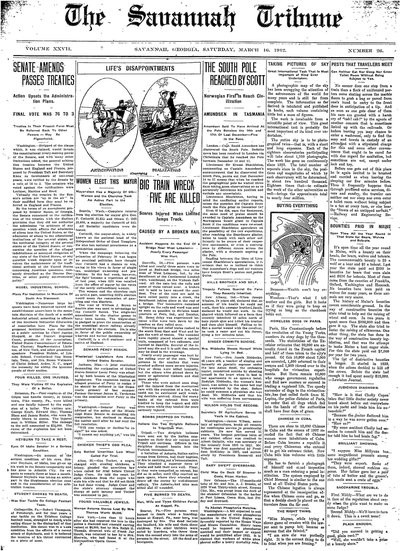
Page text (machine-generated)
The Savannah Tribune
VOLUME XXVII.
SENATE AMENDS PASSES TREATIES
Action Upsets the Administration Plans.
FINAL VOTE WAS 76 TO 3
Treaties In Their Present Form Must Be Referred Back To Other
Washington.—Stripped of the clause which, it was claimed, would invade the constitutional treaty-making power of the Senate, and with many other limitations added, the general arbitration treaties between the United States and England and France, proposed by President Taft and Secretary Knox as forerunners of universal peace, were ratified by the Senate by a vote of 76 to 3. The senators who voted against the ratifications were Lorimer, Martine and Reed. Virtually the treaties by the Senate's action are "up in the air". In their modified form they must be referred to England and France.
By the terms of an amendment proposed by Senator Bacon, of Georgia, the Senate consented to the ratification of the treaties with the distinct provision that they did not authorize the submission "to arbitrate of any question which affects the admission of aliens into the United States, or the admission of aliens to the educational institutions of the several states, or the territorial integrity of the several states or of the United States, or concerning the question of the alleged indebtedness or moneyed obligation of any state of the United States, or any question which depends upon or involves the maintenance of the traditional attitude of the United States concerning American questions, commonly described as the Monroe Doctrine, or other purely governmental policy."
MODEL INDUSTRIAL SCHOOL
Plans For Institution In Mountains Of South Are Discussed.
Washington—Numerous large bequests have been received toward the establishment somewhere in the mountain districts of the South of a model industrial school, according to officers of the Southern Industrial Educational Association here Plans for the proposed institution were discussed at a public meeting by Chief Justice Shepard, of the District Supreme Court, president of the association; United States Commissioner of Education Claxton; Representative Littleton, of New York, and other prominent speakers President Hubble, of Lincoln School, Cumberland Gap Mountain, Tenn., and Mrs. Susan Wetmore, of Christ School, Arden, N. C., urged the necessity for aiding the ignorant people of their section.
FOUR KILLED. ONE INJURED.
They Were Victims Of the Explosion Of a Boller.
Scranton, Pa.—Four employees of the Gilpin tool handle factory, at Greentown, Pike county, Pa., were killed and one fatally injured by the explosion of a boiler. The victims are: George Kraft, Edward Hay, Thomas Blass and James Roshe, who were literally blown to atoms. The injured man is William Biller. The damage to the mill amounted to $25,000. The cause of the explosion has not been determined.
HEYBURN TO TAKE A REST.
Eyes Of Idaho Senator In a Serious Condition.
Washington. On account of the serious condition of his eyes. Senator Heyburn, of Idaho, has given up his work in the Senate temporarily and has gone to Atlantic City. He expects to remain there at least a month. Senator Heyburn was taking an active part in the Stephenson election case and in the consideration of the arbitration treaties.
STUDENT CHOKES TO DEATH.
Was Star Tackle On College Football Team.
Collegeville, Pa.—Robert Thompson, of Pittsburgh, and for four years a star tackle on the Urishnus College football team, strangled to death while eating dinner in the dining-hall of that institution. His throat was in a weak condition from the effects of a recent attack of diphtheria, and it is believed the muscles of his throat contracted on a piece of meat.
LIFE'S DISAPPOINTMENTS
ANTIGIPATION
(Cop)
WOMEN ELECT THIS MAYOR
ANTICIPATION REALIZATION
Mayor-elect Has a Majority Of 645- Women and the Churches Took An Active Part In the Election.
Seattle, Wash.—Complete returns from the election for mayor give Geo. F. Cotterill 31,655 and Hiram C. Gill 31,000, a majority for Cotterill of 645. All Socialist candidates were defeated.
Cotterill, the mayor-elect, is widely known as the national head of the Independent Order of Good Templars. He also has national prominence as a prohibition speaker.
When the campaign following the primaries of February 20 was begun no practical politician here thought that Cotterill had a chance to win, owing to his views in favor of single tax, municipal ownership and prohibition. In the last week, however, the fight became a repetition of that of last year, when Gill was recalled from the office of mayor by the votes of the newly enfranchised women. The women and the churches took an active part, asserting Gill's election would mean the restoration of gambling and vice districts.
The visit of William J. Bryan to Seattle also was used to advantage by the Cotterill forces. The single-tax amendment to the charter seems to have been beaten. The Mayor-elect is pledged to press the construction of the municipal street railway already authorized by the electors. He is also in favor of the public ownership of wharves and harbor facilities. Cotterill is a civil engineer and a native of England.
DEMAND PERCY RESIGN
Mississippi Legislature Acts Anent United States Senator.
Jackson, Miss.—A joint resolution demanding the resignation of United States Senator Leroy Percy was adopted by both houses of the Mississippi legislature. The resolution recites an alleged promise of Percy to resign if he should be defeated in the Democratic primary of last summer. Former Governor James K. Vardaman won the nomination over Percy in the primary.
Washington.—Senator Percy was advised of the action of the Mississippi State Senate in demanding his resignation, but declined to discuss the matter until after he had read the full resolution.
"Will you resign or decline to resign?" he was asked.
"I cannot say anything yet," was his reply.
CHICKEN THIEF'S ODD PLEA.
Gets Behind Unwritten Law When Called For Trial.
Alton, Ill.-Gus Tucker, a negro, charged with stealing chickens, a felony, pleaded the unwritten law when called for trial before Circuit Judge Crow. He told the court he stole chickens from the negro who stole his wife and that he did not think he had done wrong. Judge Crow and the state's attorney changed the charge of petit larceny and Tucker was sentenced to jail.
FOUND VALUABLE JEWELS.
Woman Returns Stones Lost By Mrs.
Thomas Worth $6,000.
New York.-Less than 12 hours after she had reported the loss to the police a diamond and emerald carring valued at $6,000, lost by Mrs. Ralph H. Thomas, divorced wife of Frank Jay Gould, was returned to her by-a Mrs. Sherwin, who had found it at the Metropolitan Opera House.
SAVANNAH, GEORGIA, SATURDAY, MARCH 16, 1912.
REALIZATION
BIG TRAIN WRECK FIVE ARE KILLED
Scores Injured When Limited Jumps Track. CAUSED BY A BROKEN RAIL
Accident Happens At the End Of a Bridge Near West Lebanon Nearly Every Passenger
Danville, Ill.—Five persons were killed and nearly three score were injured at Redwood bridge, two miles west of West Lebanon, Ind., by the derailment of the Continental Limited train, westbound, on the Wabash Railroad. All the cars lett the rails and some of them turned over. A broken rail is said to have caused the accident. Two of the cars are said to have rolled partly into a creek, the derailment taking place at the end of a bridge. The locomotive-remained upright on the rails and word was sent as soon as possible to division headquarters at Peru, Ind., and Decatur, Ill. Some delay was experienced because wires were torn down by the coaches as they rolled over.
Wrecking and relief trains rushed to the scene from East and West and began the work of rescue. The wounded were rapidly placed aboard a special train, composed of two cabooses, and hurried to Danville. Several of the injured may die and it is said that others may be dead in the wreckage. Nearly every passenger was hurt by the rolling over of the cars. Those persons in the coaches that were crushed suffered more severe injuries. Two or three were killed instantly, but the others were pinned down by seats or splintered timbers and died more slowly.
Those who were unhurt soon dragged the injured from the overturned cars with the exception of a few, who could not be extricated until wrecking derricks arrived. Along the snowy banks of the railroad fires were kindled to keep the women and children warm while they tended the more seriously injured.
BOMBS DROPPED ON TURKS.
Italians Use Two Dirigible Balloons in Tripolitan War.
Tripoli. — Two dirigible balloons were sent out by the Italian commander on their first air voyage over Tripoli and environs. Officers in the dirigibles dropped bombs into the Turkish intrenchments.
A battalion of Askaris, Italian native troops from Eritrea, had their baptism of fire in carrying out a reconnaissance. They attacked a superior force of Arabs and held their own well. Finally they were compelled to retreat, but did so in order, until they reached an open space, where they wheeled and drove off the enemy by well-directed volleys. The Askaris had nine men killed and 37 wounded.
FIVE BURNED TO DEATH.
Man, Wife and Three Children Perish At Koppel, Pa.
Beaver, Pa.—Five persons were burned to death when a boardinghouse at Koppel, Pa., near here, was destroyed by fire. The dead include the landlord, his wife and their three children. Two other children were saved by boarders, who threw them from the second story into the arms of persons in the street. All the dead are foreigners.
THE SOUTH POLE REACHED BY SCOTT
Norwegian First to Reach Civilization
AMUNDSEN IN TASMANIA
Amundsen Said To Have Arrived At the Pole Between the 14th and 17th Of Laat December—Five
London.—Capt. Raold Amundsen has discovered the South Pole. Definite news has been received in London via Christiania that he reached the Pole between December 14 and 17.
Lieutenant Sir Ernest Shackleton, commenting on Captain Amundsen's announcement that he discovered the South Pole, points out that December 14 to 17 means that when he reached the geographical pole he waited three days taking noon observations so as to accurately determine his position and exclude any uncertainty.
Lieutenant Shackleton, having in mind the conflicting earlier reports, raises the question did Captain Scott reach the Pole prior to December 14?
Even if he did, says the Lieutenant, the same need of praise should be awarded to Captain Amundsen as the Norwegians would grant to Captain Scott if the conditions were reversed. Lieutenant Shackleton speculates on the possibility of the two expeditions, after reaching the Beardmore glacier, being in touch with each other sufficiently to be aware of their respective movements, or even a convergence by different routes across the glacier, with a dramatic meeting at the Pole.
Reading between the lines of Lieutenant Shackleton's speculations, it is evident that he is inclined to think that Amundsen's dogs and ski runners have beaten Scott's ponies and pedestrials.
Tragedy Follows Quarrel On Farm They Recently Inherited. New Albany, Ind.—When Joseph Whalen, 34 years old, declared that on account of his health he could not work, then his younger brother Jacob, declared he would not work. In the quarrel which followed on a farm they recently inherited 15 miles north of here Jacob shot and killed his brother and then shot himself. Failing to inflict a mortal wound with the revolver, he took a razor and cut his throat, dying a few minutes later.
SINGER COMMITS SUICIDE.
Mrs. Middecke Shoots Herself While Lying In Bed.
New York,—Mrs. Josefa Middecke, 48 years old, a teacher of singing and formerly an operatic soprano under the late Anton Seidl, the orchestra leader, committed suicide by shooting herself in the heart when in bed in her apartments in an uptown hotel. Rudolph Middecke, the woman's husband, was asleep in the same bed and was awakened by the shot. Before he could summon a physician she was dead. Mr. Middecke said that his wife was suffering from nervousness.
WILSON HOLDS THE RECORD.
Secretary Of Agriculture Serves 15 Years in the Cabinet.
Washington.—James Wilson, secretary of agriculture, broke all records for continuous service in presidential cabinets. He now has served 15 years. The longest previous term of any cabinet officer was credited to Albert Gallatin, who was secretary of the treasury from 1801 to 1813. Mr. Wilson was first appointed by President McKinley in 1897, and successively by Presidents Roosevelt and Taft.
BABY SWEPT OVERBOARD.
Child Was On Deck Of Streamer In Costa Rican Harbor.
New Orleans.-The 17-months-old baby of Mr. and Mrs. A. J. Brooks, of 1020 West Thirty-ninth street, Kansas City, Mo., was swept from the deck of the steamer Orleanian in the harbor at Port Limon, Costa Rica, last Friday and drowned.
To Abolish Phosphorus Matches
Washington:--A bill expected to end the manufacture of white phosphorus matches in the United States was favorably reported by the House Ways and Means Committee. Heavy taxes would be imposed on phosphorus matches and their import or export would be prohibited after 1913. It is claimed that workers of white phosphorus suffer a heavy mortality rate.
Great International Task That Is Most Important of Kind Ever Undertaken.
A photographic map of the sky has been occupying the attention of the astronomers of the world for many years and is still far from complete. The information so far derived is tabulated and published in books, each volume containing little but a mass of figures.
The work is invaluable from a scientific point of view. This great international task is probably the most important of its kind ever undertaken.
The entire sky is to be photographed twice—that is, with a short and long exposure. Each of the eighteen observatories participating will take about 1,200 photographs. The work has gone on continuously since 1892. The total number of separate stars in the sky, the positions and magnitudes of which by each observatory will be determined, is about two hundred thousand. Eighteen times that—to estimate the work of the other universities as well—brings the approximate total to nearly four million.
BUYING EVERYTHING
Vorge
Bronson—Wealth won't buy everything.
Woodson—That's what I tell mother and the girls. But it looks as if they were going to keep on trying as long as the checkbook holds out.
HOMELESS DOGS IN PARIS.
Paris, like Constantinople before the revolution of the Young Turks, numbers its stray dogs by the thousands. The statistician of the Excelsior estimates that 20,000 are annually found in the French capital and half of them taken to the city's pound. Of this 10,000 about 7,000 are executed, 1,500 returned to their owners and 1,500 turned over to the hospitals for vivisection experiments. But there remain 10,000 who escape government, regulation and find new masters or succeed in leading a vagabond life. Too speedy surrender of dogs to the vivisectionists has just called forth from M. Lepine, the police dictator of Paris, an order that all dogs which fall into the hands of the authorities shall have four days of grace.
CHINESE IN CUBA.
There are close to 12,000 Chinese in Cuba and the census of 1907 recorded the fact that 40 Chinese women were inhabitants of Cuba. Before Cuba became a republic it cost every Chinaman who entered $2 to get his entrance ticket. Now Cuba bids him welcome with little expense. He has to furnish a photograph of himself and stand inspection much as a man entering a penal institution. The system employed by Chief Menocal is similar to the one used at all United States ports.
The Chinese legation is always represented at the immigration office when Chinese come and go, so that a double check is placed on the travelers from the far east.
THE RIGHT THING.
"Miss Mayme, while trying a clever game of evasion with the lawyer sent to pump her, became so nervous that she fainted."
"I am sure she was perfectly right. It is the correct thing to do to feint when you are fencing."
NUMBER 26.
PESTS THAT TRAVELERS MEET
Can Neither Eat Nor Sleep Nor Enter
Toilet Room Without Being
Subject to Tax.
No sooner does one step from a train than a flock of uniformed porters come skating across the marble floors to grab a bag or parcel from one's hand to carry to the front door in anticipation of a tip. And as soon as one gets clear of them his cars are greeted with a harsh cry of "cab! cab!" by the agents of another concern that is sometimes linked up with the railroads. Or before leaving you may chance to enter a washroom, only to find the soap and towels in custody of an attendant with a stipulated charge for this and some other conveniences that ought to be cared for with due regard for sanitation, but sometimes are not, except under lock and key.
Before one gets out of this place he is again invited to be brushed and curried as when leaving the sleeping car five minutes before. Thus it frequently happens that through proffered extra services, divers and sundry, the traveler can neither eat nor sleep nor even enter a toilet room without being subject to a tax at every turn, or else bear the "frown of an untipped servant." —Railway and Engineering Review.
BOUNTIES PAID IN MAINE
Open Time All the Year Round In That State for Bears. Wolves and Bobcats.
It's open time all the year round in Maine, with a bounty on their heads, for bears, wolves and bobcats. The commonwealth bounty is $5 a wolf or a bear and $2 a bobcat. Last year the state paid out $595 in bounties for bears that were slain and $826 for bobcats. Most of them came from the counties of Franklin, Oxford, Washington and Hancock. No bounties have been paid on wolves for many years, as these animals are very scarce.
The history of Maine's bounties covers considerable ground. In the way of constructive bounties the state tried to help out the raising of wheat and corn. In two years it spent more than $200,000 and then gave it up. The state also tried to foster the raising of silkworms. One other thing, the state has done in the way of constructive bounty legislation, and that was the attempt to make Maine a beet sugar state. For this the state paid out $7,000 per year for two years.
The list of destructive bounties is longer. It started in 1830, when the solons decided to kill off the crows. Before the state had enough it had spent nearly $15,000. —Lewiston Journal.
JUDICIOUS DIAGNOSIS.
"How is it that Cholly Cupon takes that little doctor society never heard about before out everywhere on his yacht and lends him his automobile?"
"Because the doctor flattered him in a way he was never gotten over."
"How so?"
"By some accident Cholly had occasion to consult him and the doctor told him he had brain fag."
BRILLIANT SHOWING.
"I suppose Miss Millyuns has some magnificent presents among her wedding gifts?" "They were superb. Some of them, indeed, showed reckless expense. Her father gave her a pair of tubs of butter and the groom's rich uncle sent a crate of eggs."
SACCHARINE TROUBLE.
First Middy—What are we to do in face of the regulation about candy when the girls want to make us some fudge?
Second Middy—We'll have to turn it down. This is a sweet mess!
"Did you succeed in getting a good, plain cook?" "Well, she wouldn't take a prize at a beauty show."
AFRO-AMERICAN CULLINGS
With due ceremonial, a new president—Daniel E. Howard—has been installed as the successor of Arthur Barclay in Liberia. Liberia and Abyssinia are now the only areas in Africa not absolutely controlled by European powers. Great Britain, France and Italy have, however, undertaken to preserve the territorial integrity of Meneilk's empire, and the United States has taken a friendly interest in the recent reorganization of Liberia's finances.
The scheme for an international loan of $2,500,000, agreed upon one year ago, provides that an American controller, with British, French and German subcontrollers, shall administer the customs. Liberia has welcomed the arrangement, for since on July 26, 1847, the "Free and independent Republic" was constituted, its government has been in unstable equilibrium betwixt the threatened agrandizement of European powers and the menace of natives—at present numbering perhaps 2,000,000—in the unexplored and mysterious hinterland whose borders have never been precisely determined. What may be called "civilized," Liberia is but a strip of land along the sea front not more than 200 miles in width, inhabited by some 15,000 civilized American Liberians, negroes, with the status of British citizens, and Europeans of diverse nationality.
The appointment of an American controller in chief authority over the customs encourages the Liberians to believe that the United States will guarantee the territorial integrity of their country just as England, France and Italy are on guard to prevent encroachment in Abyssinia. They would like nothing better than to have an American protectorate established at Monrovia, their capital. But though the plantation on the African coast was of American origin and inspiration, the intention of the promoters being to provide a colony for American freedmen, the United States will go no further than the present agreement to reorganize the finances, the national defenses and the agricultural system, and determine the proper boundary. Otherwise, the Liberians will be left free to work out their own political destinies and to improve their rich and hitherto almost untouched natural resources.—Editorial, Philadelphia Public Ledger.
In some instances our people pray so long as there is, or has been any spirit in the congregation it will surely leave. It seems that the ones who offer these prayers have no conception whatever of how to pray to derive some benefit therefrom. They seem to think that they have got to "disturb God on his throne" in the way of a nonsensical prayer before they are heard. They will, in most cases, start in at "Our Father," etc., and end God knows where. They pray seemingly only trying to outpray the other good old brother who has just preceded him; caring nothing for how he addresses the Almighty, calling him from God the Father to the Babe born in the manger.
The good brethren get so enthused over their prayers some times they get out of words and repeat from one to fifty times in succession: "Oh Lord, Oh Lord, a-n-d ahf. Oh Lord!" which is good praying but not so regular. These brethren again seemingly pray for that shouting spirit to come to the good old Amen-Sisters; praying in every tone of voice, from a deep bass to high tenor, and from the cradle to the grave, they will finally get the good old sisters to moving about after a two or three hour prayer, then they will say: "Amen, and thank God." At the end of this noble three hour prayer the majority of the people are tired out and before the contribution basket is passed, half the congregation has dispersed. Dear brethren, when you pray—pray for the good that there is in prayer and not for the shouting qualities and the defeat of the brother who has just "disturbed God on his throne."—Palestine Plaindealer.
According to the last count made by the United States government, 9,328,294 negroes dwell in this country, and 8,327,345 of them live in the 13 states of the south.
A few years ago five southern states had larger negro than white population, but now, according to statistics only two have more negroes than whites, South Carolina and Mississippi. Mississippi's total population, white and negro, is 1,797,114, of which 1,009,487 are negroes. South Carolina has a total population of 1,515,400, of which 835,843 are negroes.
The negro population of this country has not decreased, but thousands of negroes who desired to remain in the south, on account of climate and other conditions, have been forced to scatter themselves over the country in search of manhood rights.
Many of those who have remained in Virginia have much to be thankful for, as they have practiced the industrial virtues, and instead of being tenants, as they were a few years ago, many flow are land owners, and can "sit down under their own vine and fig tree." The negro is steadily acquiring valuable property, and we com
mend his ambition for so doing. We implore him to continue to be law ablending and take advantage of every opportunity—Richmond Reformer.
The report of business progress made by the race during the past 12 years, as shown by the statement of Professor Charles H. Moore, national organizer of the National Negro Business league, published in The Age, should encourage the race everywhere not only to support negro business enterprises more and more, but to add to the 25,000 business places we now have as openings appear. The 52 banks with a capitalization of $1,700,000 which last year did $20,000,000 of business, and the 4 insurance concerns, with $1,500,000 business last year, will grow in number and capitalization and money handled in the next ten years more rapidly than in the past ten years, because the foundation has been laid, because the people have been taught now to do it, because the people have before their eyes "the evidence of these things, seen, not heard." Cover the south with negro business enterprises, and edge in one wherever there is an opening in the wherever there is an opening to do a thing is to do it. "If we do not make business openings for our children, whom we are educating every year who will?" should be a question ever present on the negro's tongue.
In many respects St. Paul's is the third largest school in the country for the education of colored youth, and the largest in the Episcopal church. Its enrollment will exceed 500, its faculty 50. It has a property with a gross value of over $200,000. There are seventeen families connected with the school, giving their entire life to the work. There are four other married persons awaiting accommodations. In an organized way the influence of the school reaches every person in the county and may be felt in the lives of its graduates in nearly every state in the Union and in some foreign countries. In this county alone the school has 36 active leagues, conducts an annual fair, a farmers' conference and a teachers' institute. During the past year we have been forced to turn away a large number of students for lack of accommodations and means of support. The majority of these applicants came from the rural districts and seemed to yearn for an opportunity to work for an education. —Lawrenceville (Va.) Southern Missioner.
In addition to having to sustain the shock of battle; being waged against the race at large, every negro who is trying to move forward has an individual battle of his own to fight—this is especially true of the negro whose working capital is his brains and who for that reason is in competition with the rest of the world. To illustrate: At Louisville, Ky., the white people are erecting a million dollar hospital, one wing for the white, and the other, with equal appointments, for the colored. White internes and physicians will practice on colored patients, but negro doctors and surgeons will not be permitted to enter. They are barred from practicing on any body.
Unless all signs fall movements of this sort will tend to stimulate negro physicians to establish hospitals and sanitariums of their own. It was once thought to be true, that on the intellectual sea there is room for every sail. If the negro does not find that to be so, he must make it so. If the sea is too narrow it must be enlarged.-Dallas Express.
"Health is wealth," this is an undeniable fact. Those who possess it will do well to throw around themselves all the safeguards in order to retain it, and those who have lost it should exert every effort to regain it.
We are by nature subject to many diseases, and the only way to guard against all stampedes on our health is to make a study of our own physical self.
To have a tuberculosis day in the colored schools of, this state is an excellent move, and we endorse it. Every pupil and parent should be made acquainted with the ravages this dread disease is making upon the race and the methods by which it may be prevented. Every effort should be made to put the young in possession of such facts and literature' that will enable them to successfully combat tuberculosis—Richmond Reformer.
To reconcile and unite these antagonistic opinions, and to gain the good will of the people in all sections in his effort to uplift the negro race, Dr. Washington has displayed great ability, unusual tact, marked patience, and unbounded faith in his mission. The great industrial school at Tuskegee stands as a monument to his success in overcoming obstacles that confronted him in his work. "My Larger Education," as a result of the accomplishment in the development of an earnest and sincere educator, is a valuable contribution to the literature of the race question as well as to the field of pedagogical achievement.
NOTES ON RAGIAL PROGRESS
REPORTED BY THE NAT., NEGRO BUSINESS LEAGUE.
A few of the well-to-do colored residents of Atchison, Kan., are Dr. W. H. Hudson, rated at $40,000; Messrs. John Kelly, $50,000; George Irving, $$20,000 and J. D. Colbert, $10,000.
Dr. J. T. Walton, real estate dealer in San Antonio, Tex., has handled business in his line within the last year amounting to $150,000. His weekly pay roll averages $500.
Mr. Michael Winfield of Baton Rouge, La., has been in the undertaking business nearly 30 years. His is the only colored firm in the city. He caters to both white and colored patronage. He transacts business to the amount of $12,000 annually and pays taxes on $80,000 worth of property.
Texas has more newspapers—29 in all—published by our people, than any other state in the Union. These papers represent nearly 200,000 copies during a month. It is estimated that close to half a million of readers are reached every month. These periodicals represent an investment of nearly $100,000 and give employment to about 300 persons.
It is right and proper that our people give support to members of their own race who are engaged in business enterprises. Furthermore, it is necessary and important for our business people to be prepared to render service and meet competition and not depend alone upon the color line for success. If, however, our merchants can sell to white people, do so, just the same as they do business with us. Business is by no means a channel of charity.
The new business directory recently published by Whittier H. Wright of Savannah, Ga., contains the names of 332 colored men doing business in that city. They are engaged in 46 different kinds of business, the largest number being in the barbering business-75 in number. There are 4 lawyers, 11 physicians, 2 dentists, 2 banks, 5 industrial insurance companies, 1 theater, 1 hotel, 1 livery stable, 2 real estate dealers, 2 newspapers, 1 drug store, 1 laundry, 713 owners of real estate, etc.
The Farmers and Mechanics bank, although scarcely two years old, is another institution of its kind in Texas that is growing strong and popular. The founder and president is Mr. Robert L. Smith, formerly of Paris, but now of Waco, where the bank's headquarters are. Mr. Smith is held in great esteem by the members of the race throughout the state, because of his rugged honesty, sterling worth and magnetic influence. He is also head and front of the Farmers Improvement association which he organized several years ago, comprising over 50,000 farmers in Texas. The bank has an authorized capital of $50,000, the most of which is paid up. It carries deposits to the amount of $15,000, while its resources aggregate $65,000. The bank is gradually and permanently growing in favor with the people for whose special benefit it was started because they are confident there is a man at the head of it in the person of Robert L. Smith, who is safe, sound and conservative.
The annual meeting of the stockholders of the Mechanics and Farmers bank, Richmond, Va., was held January 3. When the president, Mr. John Mitchell, Jr., made his report, it was learned that the resources of the bank had grown from $10,000 to $50,000 in three years; the total deposits for the year closing December 5, 1911, $180,230.38; cash balance at that time, $45,057.25. The total value of all the property of the, Mechanics Savings bank is estimated to be $144,003.74.
The directors of the bank at Palestine, Tex., own fifteen acres of land within the corporate limits of the city. It is called Westside Helights and valued at $12,000.00. The directors have had it divided up into lots to be sold to persons desiring to build for residential purposes. In addition to the above piece of property, the bank owns twenty tenement houses. The building in which are the headquarters of the bank cost $6,250, but it would easily bring today $10,000. The bank is capitalized a $50,000 on which it transacted a business last year of $50,000.
Messrs. Allen and Brown, Baton Rouge, La., general contractors, enjoy a very large patronage in their line of business. Over two years ago a disastrous storm swept over the capital city and seriously dismantled the State House, Deaf and Dumb institute and the A. and M. college buildings. When the authorities awarded the contract for the repair of these institutions it was given to Messrs. Allen and Brown whose bid was $115,000. They were the only colored contractors among the half dozen others who put in their bids. Some of the other structures on which they have done brick work within the past five years are: two public school buildings, costing respectively $32,000 and $26,000; Kress 5 and 10 Cent Store $38,000; Fuqua Hardware Store $32,000; Mess Hall of Louisiana State University $28,000, Alumni Hall $45,000, Court House at Alexandra $100,000, hotel at the same place $750,000, opera house $55,000, high school $45,000. The firm does a business upon a capital of $30,000. Mr. Allen owns twenty-
two houses which yield him an income of $12 to $18 a month each. for rent. Mr. Brown is estimated to be worth about $75,000.
At Columbia, Mo., lives Henry Kirkland, who is known as the Gardner of that city because of his unusual success in the truck garden business. For years he was employed at the State Agricultural college for the whites located there, receiving only menial wages, $1.25 a day. So emient in his particular calling was he that the teacher in the department of agriculture, who was receiving $3,000 a year, would often take his classes out into the field for practical work and turn them over to Mr. Kirkland for instruction, etc. In the course of time this colored employee at $1.25 a day put on his thinking cap, and as a result of doing so, he relinquished his job at the state institution some ten or twelve years ago and started in on one of his own, which has in the meanwhile turned him out a handsome fortune. Last season on one and a half acres of land he netted $900 profit, notwithstanding the excessive drought that unusually prevailed during that period. Here, also, is the 'home of another very prosperous farmer, Bartlett Akers, whose farm lands and other real estate holdings are valued at $50,000; and Arthur Strawn who owns in addition to several hundred fertile acres, three splendid thoroughbred stallions, the combined value of which is estimated to be $10,000.
NEGROES NEED NEGRO LEADERS
DR. HILLIS SAYS WHAT WHITE
MAN CAN NEVER DO, NEGRO
WILL ACCOMPLISH.
New York.—"The destruction of the poor is their poverty and the bondage of the colored man has been through his ignorance," said Dr. Newell Dwight Hillis, pastor of Plymouth church in Brooklyn, in arguing the need of educated leaders for the colored people of America, in the historic Plymouth church.
The remarkable story of negro progress since the emancipation, starting with the foundation of Fisk university, was told in Dr. Hillis' address, and in talks by President Gates of the university, and some of his graduates. Jubilee songs by Fisk students were as well received as forty years ago, when Henry Ward Beecher Introduced the jubilee singers in this same church at the beginning of their notable campaign for the cause of the emancipated negro.
"The great need of the colored people is the need of colored leadership," declared Dr. Hillis. "What a white man can never do, the colored man will easily accomplish for his people. The argument for colored leaders for the colored people is based upon the fact that every race has its own temperamental gift, and can be best guided by men of its own race. In the interest of the higher education of colored men and women who are looking forward to their work as teachers, and as industrial educators and nurses, has Fisk university been founded and, built up. Never was a need more insistent or an opportunity more inviting."
COLD WEATHER WARNINGS.
Eat the very best food your means will allow. Remember that you are working for your bread, and after you have earned it, buy it. Good food comes back in firm flesh, pink cheeks and good spirits, which make you far more attractive, and successful than any garment you could possibly buy. Drink lots of water. If you are afraid of taking on too much weight do not drink with your meals, for that is the time when weight is added. When working do not eat a heavy lunch. Have a good breakfast, because by the time you get to your work that is partly digested, but if you have a heavy lunch you are apt to feel sleepy. The big meal of the day should come at night.
In these cold days, dress warmly. It is true that woolens are not beautiful, but they keep your skin a pretty color, with a smooth, even flow of blood, and they keep you from using up your energy and power in trying to keep warm. Don't get jaded or overtired. There is no salary big enough to recompense you for that. Sacrifice a little salary for a position less trying if necessary. Ordinary work should not overtire a woman. "If it does, it is a sign she is not in good condition—she is not getting enough sleep nor food nor fresh air.
HELPING THEM OUT OF DANGER.
Two negro 'children hung on the rail fence in front of their cabin home. Their feet were stuck through the crack about three ralls' from the ground air their chins rested on the top rail between their hands.
It was morning. I passed and spoke to them. At noon as I came back by there, they were still there, hanging on the fence looking up and down the road.
Having occasion to pass the cabin late that evening, I noticed that the two little negroes were still hanging on the fence, and I stopped and asked: "Say, you all hang on the fence all the time, don't you?"
"Naw-suh, not all do time," answered the one that could talk the plainest. "We're waltin' fo' oauh mammy. She went ovah to Miss Hill's dis mawnln' to wash and tuck an' put ouah feet in de fence crack to keep us outer de fahil till she gits back."—Hogwallow Kentuckean.
WHITE JUDGE TOURS NORTHERN STATES IN INTEREST OF NEGRO SCHOOLS
WHITE JUDGE TOURS NORTHERN STATES IN INTEREST OF NEGRO SCHOOLS
JUDGE PETER' C. PRITCHARD OF ASHEVILLE, N.C., WORKING FOR NATIONAL RELIGIOUS TRAINING SCHOOL
BY GEORGE FRANCIS KING.
Springfield, Mass.—Judge Peter C. Pritchard of Asheville, N. C., who was United States senator for eight years; for a number of years served as assistant Supreme court judge of the District of Columbia and was later appointed by President Roosevelt United States circuit judge for the Fourth judicial district, is making a tour of this section of the country in the Interest of the National Religious Training school, Durham. He does not confine himself to speaking about the school, but also emphasizes the economic and social conditions in the south and especially his state. After speaking about the enobling scope of the school and the effective plans that have made the chauchaqua and summer school a potent force for good and showing the need of the great conference of negro ministers to be held at this institution for one week beginning July 6, 1912, the entertainment being free of charge, he in part said: "The American people by no means appreciate the importance of the conservation of manhood. After the Civil war we in the south were in a very bad condition. We had lost everything and had almost lost our ambition. The more earnest among us, though, went to work immediately to build up conditions, and we have succeeded in bettering the country remarkably. Right here I want to correct a false impression that seems to be very widespread in all section of the country. The whites and the colored people in North Carolina are far from being at sword's point. On the contrary, I feel safe in saying that there is as good a feeling between races in North Carolina as in any state in the Union.
"There is more racial prejudice in the north than in the south, and this can be attributed largely to the fact many of the negroes who come north are ignorant adventurers who think that they can better themselves in this section of the country without working. There has never been a time in the south when the white people were not willing to help the negroes, and that is especially true today. The school which Doctor Shepard has founded is not a denominational one in any sense of the word. His idea has been that the people can best be reached through the ministers of their own race. I am a firm believer in foreign missions, but I don't think that they are as important as converting the Americans at home to the Christian religion."
In touching upon the qualification for citizenship, as he did in the beginning of his address, he aroused pronounced enthusiasm. He said: "The negro can make a first-class citizen and a patriotic citizen. He is as thoroughly American as anyone. I am not a pessimist or an alarmist. But I am afraid that if we don't do something to alleviate our citizenship, the government will be in grave danger. The man who loves his God loves his country, and it is pretty well proved that the negro loves his God. It is well known that even the best educated people in the south at one time wanted to keep the negro in slavery, and my purpose in coming north is to let the people here know that the south realizes that it is important to educate the negro and to make a good citizen out of him. There are many undesirable negroes in North Carolina, but we believe that we can make good citizens out of them and we are going to do it. The problem that we have to face in the south is the same that you have to face in this state. There was a time when people in the south felt that their interests were entirely separate from the interests of the people in any other section of the country, but now we all feel that it is just as important to the people of Massachusetts to have good citizenship in North Carolina as it is to the people of that state, and that it is as important to the people of North Carolina to have good citizenship in Massachusetts as it is to the people here. The flood of foreign immigration that is pouring into the country is a good thing, but we must always keep the people who know and can sympathize with our government in as good condition as possible and that is why the training school at Durham has been founded. We must see to it that the homes are on the bench I had names on the criminal pocket of every race except one and that was the Jew. I attribute this to the fact that the Jews are more careful in home life and they are more particular in the training of their boys and girls at home. In North Carolina we are doing everything we can now to atone for any neglect we may have shown in the past. I firmly believe that we have made more advancement in legislation for education and for the building of roads during the past ten years than any other state in the Union. We realize that legislation cannot made a good man out of a bad man, but we can by legislating do away with liquor and gambling and thus remove the evil influences or at least minimize them. Ninety-five per cent, of all the criminal cases which come before me can be traced in their origin back to the barroom and by removing the barroom we remove a large part of the evil.
"When I first heard of Dr. Shepard's
scheme it seemed to me tremendous. It has succeeded, though; it is surely doing a great work. The negro is an emotional man, especially in matters of religion, and illiterate preachers of their own race do them more harm than good in teaching them the wrong kind of religion. What we want to teach them above everything else is practical religion and good citizenship. We want to show them that they cannot become good business men or succeed in any branch of life unless they have the real kind of religion."
Dr. James E. Shepard, founder and president of this movement, accompanied Judge Pritchard, who is chairman of the advisory board of the school, and spoke of its needs and the forthcoming ministers' conference of his race at his institution, which will discuss and study the social problems and the ways of solving them. He said that invitations have been extended the ministers of his race.
ROSS SUCGEEDS GRIFFIN
NEW HEAD OF TRUE REFORMERS
ASSUMES DUTIES — FORMER
GENERAL SECRETARY BURRELL
THINKS ORDER CAN BE REHABILITATED WITHIN FIVE YEARS.
Richmond, Va.—Floyd Ross, vice-grad worthy master of the True Reformers, and chief of the St. Louis division, is now the head of the order, succeeding the late W. R. Griffin, who was accidentally killed in a railroad wreck near Fordo, Va.
The news of the death of Grand Worthy Master Griffin came as a great shock to the members of the order throughout the country. The deceased had been at the head of the True Reformers since last fall and spent all of his time toward rehabilitating the order.
Funeral services were held over the remains from the Third street A. M. E. church last Thursday, and were attended by the prominent members of the order.
W. P. Burrell, formerly general secretary of the True Reformers, was a visitor in New York this week, and commenting on the accidental death of Grand Master Griffin declared that the order loses a member who had its best welfare at heart. Mr. Burrell viewed the remains of the deceased shortly after the wreck.
"Although I was one of those ousted last fall when Mr. Griffin and a new set of officers were elected, yet I was on good terms with the deceased," declared Mr. Burrell to a representative of The Age. "While he was grand worthy master he appointed me on several different committees, and I co-operated with him to the best of my ability.
"The outlook for the rehabilitation of the True Reformers is good. Under the leadership of the new grand worthy master, Floyd Ross, if a conservative policy is pursued, the order should ultimately get on its feet. There is a debt of $100,000 to be wiped out, which should be done within the next few years."
BUTCHER USING AX ON NEGROES
UNKNOWN MURDERER SPREADING TERROR IN LOUISIANA AND TEXAS.
Beaumont, Tex.-Ethel Love, a negress, her son and two daughters, were killed in their cabin near Beaumont, the seventh of a series of similar crimes which have occurred within several months in southwestern Louisiana and southeastern Texas and in which the number of persons killed now total 29.,
In each instance the slayer, believed to be the same person, battered the heads of his victims with an ax as they slept. Invariably the weapon used has been left near the bodies, but no other evidence has been found which might lead to an arrest. As a rule the negroes killed are obscure residents of small settlements and no motive can be assigned.
The first occurrence was at Rayne, Louisiana, when a mother and four children were killed. At LaFayette the victims number four. Next came Crowley, La., with a family consisting of father, mother and one child. LaFayette was then next with another family of four; then at Crowley a woman and her three children were killed on January 18. On January 21 a family of five was murdered at Lake Charles. The crime here was the seventh.
As a result, negro residents of the several cities are terror-stricken. Lights are kept burning, prayer meetings are held and male members of the families take turns in keeping watch at night.
POPULATION OF TEXAS.
On the date of the battle of San Jacinto, April 21, 1836, the combined population of Texas, Indians included, was approximately 40,000. Of this number not more than 25,000 were whites.
By 1850 the population had increased nearly six-fold, or to 212,592. In 1860 it was 604,251, an increase for the decade of 184 per cent; in 1870, 818,579, an increase of 35 per cent; in 1880, 1,591,749, or 94 per cent; in 1890, 2,235,523, or 40 per cent; in 1900, 3,048,710, or 36 per cent; in 1910, 3,896,542, or 28 per cent.
A recent report of the United States census shows that in Texas the negro race did not increase proportionately as much as the white, and that the negro population of the entire state represented a smaller percentage in 1910 than in 1900.
The Farm
ANIMAL SHELTER8.
The very cold weather of this winter should teach us some good lessons for better protection in the future for our animals. Hundreds of good animals were frozen, to death, and thousands more suffered severely from the cold, resulting in loss of feed and growth or production of the animals. Buildings and other equipment for sheltering them must be such that they will be comfortable at all times if maximum gains are to be expected from them. Good shelter means a saving in the cost of feed, which means a saving in the cost of production.
Domestic animals require more fresh air than human beings when housed because by nature they live more out of doors. They should be protected from dampness and cold winds in winter, but should not be housed in air-tight rooms if they are to remain healthy, vigorous and productive. In constructing buildings for the housing of domestic animals, the first thing to be considered is good drainage of the building site to insure dry floors. The next thing of importance is a solid and tight foundation for supporting the superstructure and for keeping out cold near the ground line. This gives complete protection to the feet and legs of the animals and to the entire bodies when the animals are lying down. The lower part of the building up to the height of the animals when standing must be frost proof, or nearly so. Above that line cracks between the sliding boards and other small openings are permissible and necessary, unless other means of good ventilation are provided.
Where the barn or stable is large, and the stalls numerous, many low partitions may be used to advantage, and they, together with mangers, should fit tightly down to the floors or walls. In this manner cold air cannot circulate freely along the floor line and wind cannot blow upon the sleeping animals, but fresh air can circulate freely above them for keeping the air dry and pure.
Much moisture and foul vapors are continually arising in stables and other rooms occupied by animals, hence a free movement of air across and above the heads and bodies of the animals is necessary to carry away the dampness. If stables along the ground line and up to a height of four or five feet are perfectly tight, the air above between the heads of the animals and the ceiling of the room should be moving briskly at all times of the day and night. The same is true for hog and sheep houses; keep the floor dry and well bedded, and the lower portion of the side walls tight and free from ingress of wind, but allow air to circulate above the heads of the animals. They must have fresh air for vital needs.
Poultrymen have tried all manner of warm, airlight and frost-proof houses for poultry to make summer conditions for their hens for securing full baskets of eggs when eggs bring the coveted high prices. Some have even built modern dwellings for their hens, with glazed windows and steam heat, to find that the flock soon went down with roop and other ailments, and that no more eggs were secured than when the hens roosted on the north limbs of a tree during winter blizzards.
Not till of late years has the poultry house for winter use been solved in a practical manner. Birds of all kinds breathe rapidly and consume proportionately large quantities of air. The practical modern henhouse meets this natural requirement of the hens. They are constructed with a large open front, so that plenty of life-giving oxygen can feed the lungs of the birds to cause the blood to flow at a high rate of speed, without which heavy egg laying is impossible.
In these open-front houses the hems are provided with roosts along the rear side of the room against airtight walls; but directly in front of them abundance of fresh air is continually coming in as the damp and foul air escapes. The open-air, curtain-front poultry house is a proven success wherever it has been tried, and where the poultry has been given good care and food. It is practical and sensible, since it meets the bird's essential needs - protection with dry and healthful living atmosphere. All domestic animals, except swine, are well provided with a body covering for keeping out the cold. Keeping the shelters dry, then, is really of more importance than keeping them perfectly warm. If animals in cold weather are sheltered in the dry they will be reasonably warm, and if they are protected both from dampness and direct cold winds they will be comfortable and contented.
DUCKS MAY BRING PROFIT.
The man who has a good pond, with fresh water, can make a good profit from ducks. They are cleanly and have one considerable advantage over geese in that they are more pleasant to have around, because they are not nolay. Ducks raised where there is only a small puddle or a drinking fountain may be healthy, but they will not lay so many eggs and will not hatch out as many ducklings as ducks who have more commodious watering places.
Cleanliness is essential in raising
ducks and cleanliness can best be secured by seeing that the water the ducks use is not stagnant. The best ponds are those made by damming a small stream, building the dam just high enough to allow the water to overflow at most times. A heap of sand should be supplied near the feeding ground, or in some place where it will not easily wash away.
Ducks should be allowed the run of a small plot of marshy land, preferably on the bank of a running stream. This sort of land usually furnishes appetizing minnows, beetles and insects, which will greatly reduce the cost of their feed.
In order to secure the most vigorous ducks one drake should be kept for every two or three ducks. The drakes should not be related to the females. In order to make sure of this it is best to send out of the neighborhood for your drakes, unless the females themselves were imported from a distance.
To prepare the ducks for market they should be confined in a small, darkened enclosure. This will prevent them taking too much exercise and will enable them to grow fat. During the last two weeks before marketing feed three-fifths corn meal with one-fifth flour and one-fifth bran and plenty of scrap and grit. Oil meal and shorts are sometimes used as as auxiliary ration by some raisers. Scraps may always be fed to ducks. A little green food may be added for an appetizer. Ducks are easily prepared for market and are more cleanly to dress than chickens. After they are killed they should be dry-picked, washed and placed in cold water. If there are a large number to be sent to market they should be packed in barrels and feed.
RAISING MULES.
The mule fills a position which no other means of locomotion, even steam power, can fill as well. Wherever crops are raised or lumber is hauled, or there is rough, wearing work to do, the mule is to be found.
The mule's hardlines makes him easy to raise with little care. All that a mule heeds is a paddock and a shelter shed open at the south. Turn the mules loose in the paddock at night with a rack of hay, pure water and a little corn, oats or other grain food. Give him a ration of the grain. The mule will lie down and take a roll, lie there a few minutes, then saunter to the rack and nibble some hay, followed by a little water, and then lie down again. Then he repeats the performance and continues it all through the night. There is no need of bedding, stabling, currying or careful feeding. A great herd of mules can be handled by one man.
There is a place for all kinds of mules, from the 16.2 hands mule to the little 12.2 hands mule for the mites. The mule is docile, and even on those rare occasions when he runs away, he seldom hurts himself. In the Spanish-American war and in the Boer war the Missouri mules were as much a feature of victory as the columns of troops. The mules did not stampede, even under fire, and they carried immense loads long distances at a reasonable pace on the scantiest rations. In the mines the mule's long ears and his meek demeanor make him more valuable than the horse. When the mule's ears touch the top of the tunnel he lowers his head, while a horse under the same circumstances will become frightened and throw his head up into the air, with consequent injury. Mules have been found the most enduring animals for many purposes in tropical countries. They are even used for saddle animals with excellent results.
A farmer can raise a mule cheaper than a marketable horse for several reasons, of which the most important is that he does not have to use such a high quality mare to breed from. The young mule should be fed all he will eat for the first six months of his life. Afterwards it will not hurt him to go two or three months without grain. Alfalfa makes an excellent ration. Little harm has been found in working mules as young as two years of age.
CULLING THE FLOCK.
Cull your pullets as carefully as you did your older hens. Do not include crooked beaks nor sway backs nor cripples of any kind. They are apt to prove unthrifty and succumb to winter troubles or the strain of heavy egg production. Do not include the dwarfed specimens for the same reason. The more uniform in size and build your bunch of pullets, the better they will thrive together. Just because you have your hens in winter quarters is no reason for shupping them up tight with the first breath of frost. Let them have all the air you can get into the houses, from the front, till really severe weather begins, but do not have a strong wind blowing over them at night. This applies even to early fall. The back, sides and roof of your houses should be draft proof. Provide plenty of clean nests and a few trap nests; if you can look after them they will greatly aid you in spotting the best layers. Keep the cockerels and cocks strictly away from the laying houses.—Farmer and Breeder.
A MISSIONARY TELLS OF DARKEST AFRICA
"And it was then I saw the horrors of the slave trade. All along the path we saw the shackles and the yokes of slaves who had died on the way down to the coast. To prevent the slaves escaping at night the legs of each four of them are tightly bunched together in wooden shackles. Dozens of shackles were found along the same route in 1909; not old shackles, but green shackles, shackles still wet with the sap of the tree. Though Britain prevents slaves being shipped to Jamaica or elsewhere in Africa, there is always any amount of slavery up the back path. Africa lives on slave labor.
"It was the nightmare of my life in the interior. At all hours of the night natives came to me, saying, 'Sir, sir, we are all killed,' and they told me of attacks of the slavers, of women dragged on," of old men killed. Often the slavers were led by white men, sporting false names, and there lay the difficulty. I have got date, name of town wiped out, names of all the victims, but I have not got the name of the Portuguese leader. These men put on the mask of a false name, and under the shield of it they do the devil's work in central Africa."
"Years before, Mushidi journeyed into the interior with his wife, Kapapa, and two slaves, grand total four, and this terrible quartet smashed up all the tribes of central Africa, Mushidi was a veritable Napoleon of central Africa. His brain worked with the precision of a machine. Tribe after tribe fell, under his away, and thus was evolved a great black Babylon, where all the tribes formed a seething mob and where slaves poured in by hundreds and thousands.
"It was a city of scores of thousands of people, certainly over 100,000. And there for years I was kept practically a prisoner, for Mushidi refused to let me go. It was a case of 'Will you walk into my parlor?' said the spider to the fly. Partly, perhaps, it was a case of pride, for Mushidi wanted his enemies north, south, east and west to know that he had caught a white man.
"Life there was awful. Hills of skulls all over the place, and drastic executions daily in full swing. Blood, blood, and yet more blood, blood of babes, blood of women, blood of old men. And there was I, shut in, a hopeless prisoner, seeing these people killed off in batches, 10, 14, 20 a day, frightful murders committed with unspeakable barbarites. Fifteen or twenty people were to be killed on say the Monday morning. I begged the emperor, 'Oh, king live for ever; give me two.' Another bath on Tuesday morning. Again, 'Oh, king, live for ever; give me two more.' On Wednesday, 'Oh, king, live for ever; give me three, give me three.' And I got three.
"The result is a lot of these people are called by a word which means 'begotten again from the dead,' and they turn up from all parts of Africa, bringing me little presents.
"What kind of a man was Mushidl? A typical Bantu cutthroat, but he had a wonderful head, really two heads in one, the curled, rigid occupant telling of terrible potentialities. He had 500 wives. "
"One day a strange flag was seen approaching, and this heralded the advent of a new factor in the country, namely, the Belgians. In a little while the great mushroom empire of central Africa was scattered to the winds and Mushidl's head was cut off and sent to the museum of a certain London institution in a petroleum tm". "From interview of a Returned Missionary
'TWAS A HOT BALL GAME,
Harken to this wild and woolly baseball yarn, ye fans, hot off the bat. Clark Griffith, the Washington manager, tells the story and vouchers for its truthfulness.
The scene was at Butte, back in the nineties, and the story resulted from a baseball game between Missoula and Butte at the latter town. There were a lot of gamblers in Butte who wanted to back the team, so about $5,000-was bet on the game, in which Griffith was to pitch for Missoula.
Everything went along nicely for a while, with a monster crowd on hand hollering for everything it was worth for Butte, to win.
In the ninth inning Missoula was leading by one run, but after two were out Butte got a man on third and then the catcher let the ball get away from him. It rolled a short distance, but when the catcher went to retrieve it one bug leaned over the stand with a six-shooter in his hand, "Touch that ball and you are dead," he shouted. And the catcher stood stock still in his tracks. Griff said that all the players were scared stiff while the tying run scored, but Missoula finally won in the tenth inning by a 5 to 4 score.
COLOR LINE DEMANDED
IN ILLINOIS SCHOOLS
Chicago.-Jim Crow regulations for the schools of Hyde Park were demanded by a unanimous vote of the Hyde Park Protective Improvement Association. The request is said to have grown out of the placing of negro teachers over white children and the inequality which allows wealthy Hyde Park residents to send their children to private schools and compels their neighbors to let their children come into daily association with negroes at the schools. The resolutions call for separate rooms until separate schools can be built
That is a significant allegory we find in the Bible of a man and a woman driven from their paradise and finding their way back to it barred by a flaming sword. It is figurative of ideas that from time immemorial have been deep-rooted in the human consciousness. Where is there a mythology or a creed that does not speak of an age when men lived in peace and happiness, unmarred by grief or death? Where is there a people that has not hoped for a return of this golden age—of an age when human lils shall be unknown?
Men have always been dreaming of a paradise and, like Adam and Eve, have clearly seen it only behind them. And if they took definite steps to realise this dream of theirs, they, again like Adam and Eve, found their way leading only to the whirling sword. The world's religions, those various guides to a better and higher life, have led to one gateway, though coming from different directions—the gateway of the sword. Especially is this the eminence of the three historical faiths. Judalism, however pure and untainted in its later development, had its beginning as a corporate faith in violence. For proof read the Biblical account of the conquest of Canaan and the establishment of the kingdom. With the Mohammedan the cry ever was the Koran and the sword. The faithful who died on the field of battle died with the assurance that they would receive the greatest reward. And as to the cross, the merest acquaintance with its history reveals it not alone as a symbol of sublime truths but also as a badge of war and conquest. All these have had the same object in common—a better, a higher life; and all have used the same means of attaining it. The sword has had complete and uninterrupted sway as a means of entering a better life. In the annals of history it is the one key to paradise—that has been common to all men.
What has the world gained by it? One thing is clear: Men have not been made better by violence. With all my love for the early scenes in the life of the Jews as a people, I turn with horror from those times' when our ancestors believed that they had the divine right not only to kill their enemies, but also the wives and children of their enemies, even to their cattle. We owe much to the followers of Mohammed, it is true. Through them the world received the philosophy of the ancients and through them we have secured two distinct branches of mathematics, besides many contributions to the science of language. But beyond these—which, by the way, did not come to us except when Mohammed fule for the time being put away the sword—beyond these what was the direct effect of the Mohammed faith that established itself by conquest? Nothing but an increase in the sum total of human misery. And as for the church, when it clothed itself with militant powers, forgetful of the sublime doctrines of its projectors, who can estimate the full measure of agony it brought upon the world? Whatever benefit it gave to the world came only when it cast away the sword and put on the garbs of peace. Except for a glimmering light here and there shining in the closet of some hiding and hounded thinker, Europe for nearly one thousand years was in mental darkness, and it was precisely during those thousand years that the sway of the sword was most absolute.
This should be sufficient proof that the gates of heaven are not to be taken by storm. It should convince every one that if the sword, has reigned supreme it is now time that it should be dethroned. Material force has failed to make the world better. On the contrary, whatever improvement has come to us has proceeded always from man's higher nature. The men who brandished the sword received the glory, but it was the men who had visions of truth who made the real gain for the world. It is as the prophet puts it, "Not by might, nor by power, but by my spirit, saith the Lord of Hosts." The men who could think, not those who could-fight were the men who brought blessings upon the human race. Weigh Aristotle on one scale and Alexander on the other, and see to whom civilization is more indebted. Or, if that is too far off in antiquity to make a profitable comparison, place all the noted military and naval heroes of the last hundred years on the one side and the great moralists, scientists and other men of thought on the other, and see from which side the world has received the greater and more lasting benefits. What distinguishes our modern world is the almost universal recognition of the authority of the moral law. Who gave it to the world—a people distinguished for its victories on the field of battle, or for its numerous martial heroes, or for its world-wide conquests? Was it preached by men who walked the high places of the earth or who received universal homage? Far from it. The moral law that is the glory of our modern life was promulgated by a people who in ancient times never as much as enjoyed a little brief authority in the great councils of the nations, by a people who when possessed of a little power only abused it, by a people who realized their real destiny only in preaching the message of peace these last twen-
ty centuries that they have been scattered over the whole world.
Not the sword but truth shall reign.
Men are beginning to realize now that a way to a better and higher human life lies not through war but through peace. Every religion, every denomination, clearly sees now the errors of the past and preaches and prays for universal peace. Thank God, the reign of the sword is almost past.
C. A. RUBENSTEIN.
NEARLY A MILLION SCHOOL CHILDREN IN TEXAS
The scholastic population of Texas for 1911-12, which was taken in May, 1911, shows that there were 991,409 children in the state over seven and under seventeen years of age, September 1, 1911, that are entitled to free tuition in the public schools. This gives a gain of 23,143 over the enumeration of a year ago. Using this figure as a basis for the annual apportionment of the state's available funds, the state board of education apportioned to each of the school districts for the year 1911-12, either through the country or direct from Austin, the sum of $6.80 for educational purposes for every child of school age enumerated in the scholastic census. The sum for 1911-12 amounts to $6,741,581.20.
The permanent school fund is $72,040,000. The total available funds derived from state, county and local resources is $13,351,121. The income from the county permanent fund and from local sources will give an average of $5.66 per capita, making a general average throughout the state of $13.46 for the maintenance of the schools for the present scholastic year. This is almost $3 more per capita than for the previous year. There are 20,742 certificated teachers in the public schools of Texas, 17,666 of these being white teachers, and 3,176 colored. Of the total number of teachers, 68.65 per cent hold state certificates, 3.35 hold city certificates, and 28 per cent hold county certificates. The general average salary of a white teacher in Texas for 1909-10 was $405.82, as compared with $394.23 in 1908-9. The pay of colored teachers was below that amount.
CONFERENCE IN ALABAMA.
Corona, Ma.—About three hundred farmers, ministers and teachers attended the first negro conference, held under the auspices of the Corona Normal and Industrial Institute, in response to a call issued by Principal M. H. Griffin. "Improving the Churches and Schools and Widening Their Influence" was the subject for open discussion the first day, while "How to Make Farm Life Attractive to Young Men" was the subject for discussion on the second day.
A great amount of interest was manifested in the proceedings, and the discussions were attended with a show of interest that was gratifying. Besides the discussion of subjects by a large number of the farmers attending the conference, addresses were made by W. T. B. B. Williams of Hampton, Va, field agent of the Slater and Jeanes Fund Boards; Dr. C. O. Bouthe and Dr. B. F. Riley of Birmingham, la. The organization of the conference, which will be an annual event hereafter, was perfected by the election of the following officers: J. R. Nall, president; R. S. Sykes, vice president; M. C. Cooley, secretary, and Fred D. Edmondson, corresponding secretary.
Strong resolutions were adopted, in which shortcomings of white and black were condemned and attention called to methods of better living that would bring about fruitful relations between the races.
SHORT ON MENTICULTURE.
Addison Mizner, in an address on menticulture, said in Chicago:
"Ours is a frivolous land, but it is nothing like so frivolous a land as Belgium. I'll never forget my first visit to the bathing beach at Ostend.
"On every side I saw young girls in boys' bathing suits—tight, filmsy, one-piece suits, sleeveless and skirtless. These young girls wore no stockings. As they sauntered to and fro on the white, sunlit beach, they looked—I frankly admit it—charming; but what a frivolous view of life, what a neglect of menticulture, their dress indicated!"
Mr. Mizner smiled.
"A young lady, beautifully clad in a Poiret gown," he said, "dropped something as she passed me on the Ostend sands. I picked it up and hurried after her."
"Pardon, but you have dropped your glove."
"She took the tiny object, and, smiling and blushing, she replied:
"Merel, monsieur; but this is not my glove; it is my bathing suit."—Pittsburg Dispatch.
A CHANGE OF DIET.
This incident happened at camp, when a corporal, who was making up the rations, was approached by the tent orderly, and the latter suggested a change in the dietary, says the London Telegraph.
"We should like to have some rhubarb," he said.
"You may have it," replied the corporal, who with pencil and paper then commenced trying to record the order. He began "Ru," hastily abandoning that for "Reu," and then put "Roo" and "Rheu" respectively. Thoroughly exasperated at last, the corporal exclaimed: "Rubub be blowed! You'll have cabbage."
WORK WHICH THEY ARE DOING
The following is a portion of an article by Rev. A. F. Owens, published in the Montgomery Advertiser.
Five counties in Alabama now have negro demonstration agents to carry on the work of teaching negro farmers better methods of farming by means of demonstration plots. There are at present negro demonstration agents in nearly all the souterm states, with the exception of Virginia, which has seven agents working in eleven counties. There is no other state where so much work is being done by negro agents for negro farmers as in Alabama. The reason so much is being done for the negro farmers in Alabama is undoubtedly due to the influence of Tuskegee Institute. Just as the reason that so much is being done for negro farmers in Virginia is due to Hampton Institute, of which the Tuskegee school is an offshoot.
Of the six negro demonstration agents in Alabama, four gained their training at Tuskegee, and the district agent, T. M. Campbell, who has charge of the work among the negroes in Alabama, Mississippi, Louisiana and Oklahoma, is a graduate of the same school. A recent report made by the agricultural department on the work of the demonstration agents in Alabama, shows that the negro farmers, working under the direction of these agents, have made a pretty good showing. The following is a summary of results obtained by some of the negro county demonstration agents in farm demonstration work during the past season:
C. D. Meneefe, Lee county, conducted 59 demonstrations in corn and 60 in cotton, using 123 acres for the former and 300 acres for the latter. The results were an average of 44 bushels of corn per acre and an average of 1,869 pounds of cotton per acre.
Washington A. Tate, Macon county, had charge of 22 demonstrations in corn and 38 in cotton, using a total of $39\frac{1}{2}$ in corn and 72 acres in cotton. The results were an average of 54.1 bushels of corn per acre and 1,429 pounds of cotton on the same amount of land.
Harry Sims, Wilcox county, supervised one demonstration in corn and 22 in cotton, planting one acre in corn and 35 acres in cotton. The one acre in corn yielded 27 bushels; the 35 acres in cotton yielded an average of 1,339 pounds per acre.
G. W. Patterson, Madison county, had charge of 21 demonstrations in corn and 25 in cotton. The amount of land cultivated in corn was 31 acres, and 56 acres were in cotton. This demonstrator made an average of 43.3 bushels of corn per acre and averaged 910 pounds per acre for cotton.
Some notion of what the demonstration agents have done for the negro farmers may be gathered from the fact that the average yield of corn per acre for negro farmers in 1909, the year the census was taken, was less than eight bushels per acre. The average bushels made this year by negro demonstration farmers in Macon county was 54.1 bushels per acre. This was the best average made by farmers under any of the negro demonstration agents and was nearly eight bushels above the average of the other white and negro demonstration agents throughout the state.
The average yield of seed cotton in Alabama in 1911 was about 600 pounds per acre. The highest average yield made on the farms conducted under a negro agent was in Lee county, where the average was 1,867 pounds of cotton per acre. This was 424 pounds of cotton above the average made on the other demonstration plots in different parts of the state and more than 1,200 pounds more than was made on the average farm.
NEGRO BUSINESS LEAGUE.
Boston, Mass.—The local Negro Business league had a red letter night Wednesday of last week. There were about forty present, and a program was arranged which gave a number of men opportunity to tell about the successes they had attained in business. The stories related by many of the men were remarkable, and during the course of the evening the enthusiasm reached a high pitch. Dr. Booker T. Washington, the president of the National Negro Business league was present as the special guest of the occasion, and delivered a stirring address. The local league is planning for much work during the present winter.
AN OLD FRIEND.
A private soldier once rendered some slight service to the first Napoleon.
"Thank you, captain," said the Emperor, carelessly.
"In what regiment, sire?" was the instant response of the quick-witted private.
"In my guards," repiled the Emperor, pleased with the man's ready retort.
This incident, with appropriate variations, also happened to Genghis Khan, Ivan the Terrible, Attila, Gustavus Adolphus, Louis XIV, Charlemagne, Alexander, King Alfred, Xerxes, Richard the Lion-Hearted and Henry of Navarre.—Success Magazine.
Published Every Saturday
1009 West Broad Street.
Phone 2171.
Remittance must be made by Express or Post Office Money Order, or Registered Letter. Advertising rates given on application.
Entered at the Post Office at Savan nah, Ga., as Second-Class mail matter.
SATURDAY MARCH 16TH, 1912
Only a few more days remain in which to register in order to vote in the elections of this year. Let the voters get a hustle.
Let all of our people join in the movement for a Greater Savanah by boosting a great getting together movement among our people along material lines.
Scandal is a sweet morsel in the months of some of us. How much better would it be for us to be charitable in words as well as action. In other words, "Let him who is without sin cast the first stone."
We quite agree with President R. R. Wright in his timely criticism of the unfortunate omission in the report of the secretary of the Chamber of Commerce. In his article in the Morning News of Thursday, President Wright called attention to the fact that the report omits any mention of the Negro whatever. He is correct in his statement that the Negroes compose about half of the city's population; they furnish a very large percent of the labor, both skilled and unskilled; they have large bank accounts and own much valuable real estate. In his article he asks, What is the Chamber of Commerce doing or thinking about doing to better the condition of the colored people of Sayannah and Chatham county? He further says that the colored population present some peculiar problems, among them being their health conditions, their housing conditions and their schooling conditions. Though the Negroes are large tax payers very little consideration is shown them in the matter of providing sanitary houses, in giving them sufficient school facilities and in protecting their communities from the evil presence of the women of the underworld who are allowed to infest their neighborhoods without the slightest restraint being brought to bear upon them. The Negroes are a very appreciable part of this great commonwealth, and as such should receive due recognition in all movements for the betterment of the community.
The present postmaster, who is also a National committeeman, has resigned as postmaster, and in doing so is attempting to force his brother-in-law, a Democrat, on the people to succeed him. The rank and file of the party men in the city, county, district and state are radically against the National Committeeman in his efforts in this direction, and are indignant to know that this committeeman has ignored all party lines in his attempt to elevate a democrat, especially when we have such a prominent and able republican as an applicant for the position as is the Hon. Joseph F. Dogle.
We are not a bit surprise at the action of the committeeman, for his actions throughout his term as such have been contrary to all republican usages in that he completely ignored party organizations in recommending appointments. His action in the recent county and district conventions have caused the rank and file of party men to be against him. The state and national leaders, and also the president are aware of these things and assurances have been given that he will not be allowed to dictate as to who will be his successor.
We need as postmaster an energetic party man with principle who will conduct the affairs of the office efficiently and impartially. We need a postmaster who will seek to improve the postal facilities of the city, one who will urge the appointment of more letter carriers and clerks, thus assuring the public of frequent and prompt deliveries, and especially one who will reward services according to efficiency and not to class. The President has promised to make appointments especially
when same is satisfactory to the community. The application of Mr. Doyle is endorsed not only by the leading trade bodies, the daily papers, the mayor and many of the aldermen, but by the party organization. This assures Mr. Doyle's appointment, and this assurance is backed by the promise of those who will see that a true party man will not be over-ridden by a democrat, even if that democrat is being forced by a National Committee man.
Dr. DuBois's Great Story.
The Quest of the The Silver Fleece is the latest book we have from the pen of Dr. DuBois. The plot is good and the story is well related. there is a lack of details which make many novels tiresome. The characters pass in rapid succession before the reader. The reader admires the self-sacrificing spirit of Miss Smith and the sincerity of "Bles" and wonders at the weirdness of Zora. Every character represents a distinct type. Col Cresswell is a typical southern gentlemen. John Taylor is the shrewd yankee, and Caroline Wynn is certainly the Becky Sharpe on the Negro novel. The wily politician is well represented by Sam Stillings, Elspeth and the other Negroes on Col Cresswell's plantation are an excellent study in race psychology. Get this book and read it, not because Dr. DuBois is a colored man, a very good reason, but because it is an entertaining instructive and high class story; we ought to know what our scholars and leaders are doing. Subscribe to the Carnegie Library fund that the curators may soon be in position to put all the best books published by colored men in the library where you may talk with the great thinkers of our race. A donation of ten (10) dollars was made by Cressent Lodge No 10 K of P. to the Carnegie Library. The site will soon be made public.
H. Pearson. Soliciting Agent.
IN HIS HOLY TEMPLE. Interesting Services in The Churches of the City.
Butler Presbyterian Church. On last Sunday the special service at this church were very commendable. A very appreciative audience was out at the four o'clock service to hear Rev. Rockwell S Brank and his sermon on "prayer" was one of the best ever heard at this church. The creditable showing of the church in every respect was the topic of discussion by every one who was present. Particularly noticeable were the new pews which have recently been put in
Second Baptist Church.
The services on Sunday were well attended both the old and young people. The pastor K. D. Augustine Reid, preached an excellent sermon from Exodus 32.10's subject, "The great God in the hands of sinful Men." At 3 p.m., was the Communion service there was a large crowd of members and friends out. The past week has been a week or prayer. Rev. S. L. Johnson of Bovinton, Va., will assist the pastor in the revival services that will commence on Monday night. The public cordially invited to attend these services.
Mt. Zion Baptist Church.
The pastor is McD. Spencer after a new sure-solid week of revive and vigor. Or returned home last Saturday and occupied the pulpit on Sunday. If notched the anniversary, sermon of the Independent Order of Good Samaritans at a 1 o'clock Sunday afternoon and they showed very kind appreciation. Their distribution was $110. The attendance was good and the services much enjoyed by all present. Tomorrow at a 1 o'clock, the Communion services take place and we cordially invite, our sister churches, well wishers and the public to be present.
R. B. B. Church.
On Sunday night the church was packed, even the gallery. Rev Wright read for the lesson Matt. 6:1-13. His text was from Matt. 6:13. The subject, "Lead us not into Temptation." The sermon was very appropriate and much needed. The most striking example used was that of Job, and of our Saviour on the mountain. The sermon was well received by all who heard it. The choir sang very sweetly "God will take care of me." Rev Wright led the hymn, "Amazing Sight." The interesting exercises of the B. Y. P. U are drawing quite a crowd on Sunday evenings from 7:30 to 8:30 p. m. Come at any time
Evangelical Ministers Union.
The Evangelical Ministers Union met with Dr. R. H. Singleton presiding. Devotional service was conducted by Rev. H. E. Smith. Having addressed the theme of grace the 10th, Psalm was then read in concert. The Union joined in chant. Miss M. H. Dembry, the great singer again visited the Union. The topic of the day was a paper by Dr. D. A. Reid, subject "The True Christian Unity." The paper was masterly gotten up and the Union as a whole offered commendation. Sermonic report was given by Dr. P. F. Curry. Friendly criticism was offered by the Union. On the 4th, Sunday in March there will be a rally at St. Philip A. M. E. Church, Dr. R. H. Singleton pastor at 3 p.m. at the Masonic Temple. The Rev. C. W. Prothro was elected to preach and Rev. J. S Jenkins alternate. All of the ministers of the Union are requested to be present. Rev. Rosier of Darien Ga., was in to see us. The subject for next Tuesday, "The Evil of Divorce Law," by Rev. H. L Haywood. All are welcome.
First African Baptist Church.
The pastor, Rev. Willis L. Jones, preached at the 11:30 o'clock a.m. service on last Sunday from Jeremiah 2:11; Subject, "Two classes of Fruit in the church." At the evening service he ably addressed the Brotherhood's Union and Ladies Branch, selecting for his discourse the 25th chapter of Lovitius, 35th verse. Theme, "He that feareth God helps his brother." Many words of advice and encouragement were given this noble body. Their contributions to the church, pastor, choir and sexton were liberal. President P. A. G. McDowell at the conclusion of the sermon led several animating hymns. The choir rendered very appropriate selections throughout the service. Deacon J. H. Sanders led a spirited prayer meeting at the early morning service. Before the close of the day's
service the "Big Mortgage Burning, Rally Clock" struck its second hour. To morrow the "Big Clock" will strike in rapid succession. How many times no one knows better than you, who are the works to it. The entertainments on last Monday night at the homes of Deacon Wm. H. Ward, Mrs. Amy Delaware and Mrs. Ulicia Morrell were a success. The church's deepest sympathy is extended to deacon Chas. H. Johnson and family in his sudden illness. The officers and members have been visiting him at Charity Hospital Prof. I. M. Jackson, Superintendent of the Sunday School, and his corpse of teachers, are making wonderful progress in the school.
(Masonic Temple, Gwinnett St., West.)
Rev. John A. Capps, Local Deacon,
preached at 11 a. m. on Sunday and
there was a large crowd out to hear
him. Text, Paul's 4th Epistle to the
Ephesians, theme "Perfect Love." Rev.
Capps' discourse was plain and practical.
Rev Singleton delivered an excellent discourse at 8 p. m., text Paul's 2nd letter to Timothy 32nd verse, Subj.
"A good soldier for Jesus Christ." We are sorry to note the serious illness of Bro J. B. Monroe. Brother Lewis Hill died Thursday. Bro S. J. Howard is improving. Sunday March 24th is the Big Rally. All class meetings for March will be held at the Monumental church on Tuesday night at 8:30 on account of previous engagement of the Masonic Temple, Gwinnett St. Let every member and friends do their best on Rally day, Sunday March 24th. On Thursday night, March 21st, at St. Paul C M. E. church Maple and West Broad Sts will be given a "Nobody Knows" concert for the benefit of the New St. Philip's church, admission 10 cents, Mrs. Fannie Gordon and Mrs. M. E. Nosest, Managers. This concert will be of high class music. On Wednesday night March 20, a grand Concert, Moving picture and Supper will be given at St. Philip's Monumental church New St., for the benefit of new St. Philip's church, 35c., including supper. The following services will be held on to-morrow. Sunday: Prayer meeting at 5 a. m.; Preaching at 11 a. m.; Sunday School at 3 p. m. A. C. E. League at 6:30 p. m.; Preaching at 8:15 p. m.
Famous Speaker at First Congregational Church.
Dr. Jenkin Lloyd Jones, the famous lecturer, who is lecturing at the Temple Mickva Israel on Charles Dickens will speak at the First Congregational Church tomorrow (Sunday) evening at S o'clock for Jones is quite a friend of our people, and everybody is invited to near him. Good music will be one of the features.
Social Happenings.
Social Happenings.
Mrs. Bertha Brown entertained delightfully at her residence 539 Charles street last Thursday evening in honor of Mrs. Ella Hart, of Macon, Ga. An enjoyable evening was spent in games and music. Those present were Mrs. Ella Hart of Macon; Mrs. M. K. Dukes, Mrs J. W. Dukes, Mrs. Lizzie Green, Mr. and Mrs. Henry Singleton, Miss Pheobie Miller, Mrs. Aurelia Allen, Messrs. Chestley Welch, J. D.' Powells, C. Mapp, Joseph Grant Capps Anderson, and J. R Brown
Mrs. James M. Mooney entertained quite a number, of her friends on Friday March 5th, in celebration of her thirty-fifth birthday. She was the recipient of many handsome and useful presents. Mr. and Mrs. Preston Alexander came over with their phonograph and rendered several delightful selections. Among the guests were Mr. and Mrs. Charlie Dukes. Mr. Lee Galmore. Mr. and Mrs. P. C. Hamilton. Mrs.-rus. Horace Young., Joe Grant, Miss Maggie Green, Mrs. Frances Moultie., Mr. and Mrs. Willie Brown, Mr. Frank Holmes, Mrs. Emma Harris, Mr. and Mrs. Preston Alexander, Mrs. Geneva Lucas, Miss Addie Simkins, Mr. and Mrs. Alexander Clayton, Mrs. Sadie Davis, Mr. Calvath Cook, Mr. Willie Stovall, Mrs. Rebecca Burton, Mrs. Barbra Batey, Mrs. Many Lue Baker, Mrs. Hattie Sims, Mr. and Mrs Richard Fisher.
Quite an unique social entertainment was pulled off by a number of the members of The Eureka Club on last Tuesday night at their club rooms, Nassie Temple building. A large number of guests were present and an enjoyable time was had. The freshments which were delicious served plentifully. Mr. W. W. M. phils and his committee spired no pains in arranging things up-to-date for the pleasure of those who were present.
Thanksgiving Proclamation
Office of Grand Worthy Counsellor
Grand Court O O. C N.A, S A, E., A, A. and A. Jurisdiction of Georgia.
Savannah, Ga., February 7, 1912.
To the Grand Court Officers, Grand Representatives. Members of the Grand Court, Worthy Counsellors, Members of the Courts and Juvenile Courts,
Greeting:
In compliance with the law and the establishing of Knights of Pythias and and Courts of Calanthe and by the power in me vested as Grand Worthy Counsellor of the State of Georgia, I call every Court in the State'out on Sunday the 21th day of March,' with badges to a church or hall or wherever the K. of P. Go. On this day let praises from more than eight thousand five hundred and fifty members in this State be given to Almighty God for the continued blessings He has bestowed upon our Order and that love and Harmony may reign supremely. Members failing to turn out without a lawful excuse and so accepted by their Court shall be fined $1.00.
You can get badges from this office at 60 cents each by applying for them before the 10th of March. All badges must come through this office. Programs from this office or Grand Chancellor's office, $1.00 per hundred. Juvenile badge 30 cents
I shall expect every Court in the Jurisdiction to comply with the above proclamation to the letter.
Yours in F. H. and L.
Mrs. R. L. Barnes, G. W. C.
Mrs. M. S. Grant, G. R. of D.
Death.
On March 3rd, Miss Flossie Hillery, of 401 Montgomery street, departed this life, the funeral services taking place the following Wednesday from First Bryan Baptist Church. The body was carried to Sapelo Island, for interment. The deceased is survived by a mother, two sisters and one brother.
Resolutions.
In loving memory of our beloved sister of Calanthe O. O. C., Evaline Robertson who departed this life Nov. 26h, 1911, in the full triumph of faith. May her soul rest in peace.
Whereas, It has pleased the Almighty God in His all wise providence to call our beloved sister from labor to reward, we bow in humble submission to His will, Who is too kind to do wrong, and too wise to make a mistake. Therefore be it.
Resolved, That in the demise of our sister; the husband has lost an affectionate wife and the child a loving mother, the Calantheians a faithful sister.
We would say to you Sister Robertson our dear Calanthe:
Sleep sweetly in your quiet room,
We hate from you to part,
But let no mournful yesterday
Disturb your peaceful heart.
Nor let tomorrow scare your rest
With dreams of coming ill.
We, your Calanthans, are your changeless friends. Our love surrounds you still.
Dear relatives of the departed one, we also say to you:
Strive on, your journey has just begun, Begin each day anew.
To reach the kingdom of our God;
Where our dear sister is gone
You must tread the path that she has trod.
And she will welcome you home.
Resolved, That a copy of these resolutions be sent to the bereaved family, be spread on our minutes and be published in The Savannah Tribune.
Gardners Court No. 350, O. O. C.
Mrs. L. B. Fleming,
Mrs. A. Brooks,
Mrs. P. G. Jones, Chairman.
In Memoriam.
In memory of my dear husband,
Mr. S. S. J. JONES,
who departed this life Feb. 15th, 1912.
Our loss but heaven's gain.
His wife,
Mrs. Janie Jones. $
627 Mercer St.
in memory of
MILTON N. ROBINSON.
Died in Savannah, Ga., Mar. 16, 1911.
Just one year ago today.
My beloved son and brother was
taken away
His troubles are o'er, his work is done,
His body is free from pain.
His form on earth no more we'll see,
His voice no more we'll hear;
Oh, what a happy time 'twill be
To meet him over there.
Unfinished is the well planned race,
Which he had hoped to run;
But this we all do truly know.
That it was well begun.
Mid toil and strife he journeyed on
Till he had reached the goal;
His master said "Thy work is done,
Come rest thy weary soul."
Mother, Sisters and Brother.
ETHEL ESTHER GIBBONS,
who departed this life March 11, 1911.
Gone but not forgotten.
Peaceful be thy silent slumber,
Peaceful in the grave so low,
Thou no more will join our number,
We no more will hear thy voice
Yet in heaven we hope to meet thee
When the day of toil is over,
Then in heaven with joy we will greet
thee
Where no farewell tear is shed.
Her devoted mother and father,
sisters and brothers,
Mr. and Mrs. E. M. Gibbons,
Mrs Florence Pinekney,
Mrs. Albertha Atkinson,
Mr. Frank Gibbons,
Mr. Herbert Gibbons.
In loving remembrance of my sister
in loving remembrance of his sister,
Miss SARAH A. STEELE,
who on the 12th of March 1899, after
an illness of two months, closed her
eyes on things of the earth, leaving
desolate forever the hearts of those
who held her dear.
In sad but loving memory of my only
sister,
LEILA JONES DAVIS,
who departed this life March 17, 1910.
Dear Le, two years ago today,
You heard the voice of Jesus say,
Some unto me and rest.
So thou thy way and I go mine,
Apart, yet not afar;
Only a thin veil hangs between
The pathways where we are.
And God keepeth watch between thee
and me,
He looketh thy way, he looketh mine
And keepeth us near,
I know not where thy road may lie,
Or which way mine will be;
If mine will lead through parching sands
And thine beside the sea;
Yet God keepeth watch between thee
and me,
So never fear; He holdeth thy hand,
He claspeth mine and keepeth us near.
I sigh some times to see thy face,
But since this may not be;
I will leave thee to the care of Him
Who careth for thee and me.
I will keep you both beneath my wings
This comforts, dear;
One wing over thee and one over me.
Sorrow over me.
In memory of our dear daughter,
ADRA C. SPENCER,
who died March 16, 1911.
The maiden is not dead but sleepeth.
In God's garden she lieth,
Not dead, only sleeping.
Resting from toil and strife,
In God's dear keeping.
Though tears may fall,
And hearts be sad with grief,
We thank Thee, Father,
For that loved life so brief.
So we leave her at rest,
In God's loving keeping,
Till the dawn of that day,
When we wake from our sleeping.
Father, mother, sisters and brothers,
R. T. Spencer.
Harden and 36th Street.
Sunday being the third Sunday in the month an evening service will take place in the school chapel. After the saying of the Rosary Father Dahlent will preach a special sermon, the subject of which will be "The Catholic Profession of Faith." After the sermon there will be the solemn profession of Faith of a convert and the Sacrament of Baptism will be administered. A large congregation is expected. Special music will be rendered on the occasion.
Special Notice to Odd Fellow
Lodges and Households.
The committee on entertaining the
District Grand Lodge is requested to
meet at Duffy street hall on Friday
night March 29th at 8:30 o'clock. All
lodges and households that have not
appointed their committees are
requested to do so at once.
J. S Causey, Chairman.
Ed. H. Burke, General Sec'y.
Saving
Money is
A Habit...
Get the habit of Saving a part of your Earnings each week.
$1.00 starts An Account
The Wage Earners
Loan & Investment Co.
468 WEST BROAD ST,
Savannah, Ga.
F. F. JONES
BEEF, VEAL, MUTTON, LAMB, PORK, HAMS, BACON and CORNED BEEF All kinds of GAME in season. Stall 31, City Market. The Acme Bicycle Store
K. HALPERN, Proprietor,
463 West Broad St.
Dealer in new and second handed
bicycles. - Tires and Supplies.
Expert Vulcanizer of Bicycle
Tires. Vulcanizing 75c.
Phone 1340.
Dr J. W. Jamerson
FIRSTCLASS DENTIST
All Work Guaranteed
623 West Broad Street
Between Huntingdon and Hall
Phone 2098
Business
FOR SALE—One First Class Drug Store, Jacksonville, Fla. Well located, good trade. Terms. Good reason for selling.
G. H. BOYEN,
210 Park Ave., L. Savanh, Ga.
DENTIST
240 Barnard Street.
Specialist in Gold and Bridge Work
Savannah, Ga.
Does all kind of high grade dental work of the best quality and workmanship. Gold crowns and bridge work.
White Porcelain Pivot and Gold Crowns mounted on the natural roots. Gold Fillings, Cement Fillings, and Silver or Amalgam Fillings. From nine to a full set of teeth $8.00 and $10.00 Broken plate mended and teeth added.
All Gold Crowns Guaranteed 23½ K Gold.
Bell Phone 314.
For A Professional Registered
TRAINED NURSE
Ring 3159-J or Write
529 OTT STREET. WELL
EXPERIENCE MASSEUSE
FLORIE A. WILSON
"DRY BONES"
A sermon to be preached at
St. Stephen's Episcopal Church
By ARCHDEACON BRIGHT
Watch for the Day, the Date
and the Hour
you can point your finger at the Air Dome and say that place is
Respectable Good, Clean Educational Wholesome Amusement
Every Monday
Starting At 4 O'clock
and you can come any time after that hour up to 11 p. m.
BAKER
THE MOVING PICTURE MAN
---
AIR DOME
---
Show Shop of Quality
If you are judged by the company you keep you can't be seen in a better place.
ADMISSION
Always The Same
J. L. MERCHISON
CHIEF DIVER
2815 Gravier St New Orleans, La.
And Vice President of the Workers Realty Co. of New York City. Capital stock $50,000 00
Organized 1907. Incorporated
1908.
HOME OFFICE 1931 BROAD WAY
For first class shoe repairing carry your shoes to Thomas Baker.
Gen F. M. Cohen and Col. F. B. Pettie made a flying trip to Brunswick, Ga.. this week.
Mrs. Perry Wright of 516 Anderson street, east, has been confined to the house ill for the past week.
C. A. Glossner, 24 Ontario St, Rochester, N. Y., has recovered from a long and severe attacks of Kidney trouble, his cure being due to Foley's Kidney Pills. After detailing his case he says: "I am only sorry I did not learn sooner of Foley Kidney Pills. In a few day's time my backache completely left me and I felt greatly improved. My kidneys became stronger, dizzy spells left me and I was no longer annoyed at night. I feel 100 per cent better since using Foley's Kidney Pills." Tonic in action, quick in results. Try them. Living stons Pharmacy.
Six reliable canvassers can secure a position by calling on Mrs. W. L. Horne, 776 East Waldburg street. Mrs. Sadie Robertson returned to Jacksonville, after a stay of one week with her sister.
Rev. C. W. Waller of Beaufort, S. C., will preach Sunday morning and evening March 17th. at Beth-Eden Baptist Church. Ask Pate's Drug Store about the Nyall Line.
Rev C. Priester has been called to South Valley Baptist Church but on account of his city work will be unable to accept the offer.
A Cold, Lugripine. Then Pneumonia.
Is too often the fatal sequence and coughs that hang on weaken the system and lower the vital resistance. R. G. Collins, Postmaster, Barnegit, N. J., was troubled with a severe la grippe cough. He says "I would be completely exhausted after each bit of violent coughing. I bought a bottle of Foley's Honey and Tar compound and before I had taken it all the coughing spells had entirely ceased. Foley's Honey and Tar compound can't be beat." It stops the cough by healing it cause Refuse substitutes, Luggston Pharmacy.
We are now at our new home 1000
We are now at our new home 1009 West Broad street. West Broad street 1009 is the place. Large front room to rent, nicely furnished with bathroom and modern improvements, suitable for one or two gentlemen. 505 Park avenue west, Mrs Sarah Hayward Mrs. Coralha Mickens, formerly of Savannah, but now of New York, after spending a few months with her parents Mr. and Mrs. Henry F. Chancy, a West End left Saturday last for New York.
Don't Neglect a Child's Cough
The "Child's Welfare" movement has changed the attention of thoughtful people everywhere. Mothers are natural supporters and will find in Foley's Honey and Tar Compound a most valuable aid. Coughs and colds that unchecked lead to group, bronchitis and pneumonia yield quickly to the healing and soothing qualities of Foley's Honey and Tar Compound Contains no opiates and no harmful drugs. Is a medicine, not a narcotic. Refuse substitutes, Livingstons Pharmacy.
Mr. and Mrs. C. M. Wallace announce the engagement of their daughter Maud Alice to Mr. B. J. White of this city, which will take place at their residence 202 Lathorpe Avenue, Grants Park, Wednesday evening April 24th, 1912
President L. E. Williams of The Wage Earners Bank and Dr B W. S. Damels made a flying trip to Washington, this week in the interest of the Sayannah Post-office light. With Col Henry Lincoln Johnson they had a satisfactory audience with the President. Before returning they stopped in Atlanta where elf work was done in interest of M. They arrived home Thursday. Assurances have been given th. oyle will be our next postmaster
Special Notice.
To all Chancellor Commanders, Officers and Members of the K. of P.'s you are hereby requested to appear at Masonic Temple Sunday March 24th, 1912, at 2 p.m. where the procession will be formed and thence proceed to St. Philip Monumental A. M.E. Church, to celebrate the 45th, Pythian Period.
The Young Ladies Progressive Club cordially invite you and your friends to attend an afternoon dance to be given at Masonic Hall, Wednesday March 20th, from 3 to 6:30. Plenty of music and refreshments. Committee—Misses Lizzie Schroder, Edith Weston, Lillian Johnson and Beulah Henderson.
is what people say about the sixteen page joke book, in colors given with the New York Sunday World each week. It's as good as if one paid 10 cents for it alone. And yet it is given FREE with the New York Sunday World. Do not confound this Joke Book with the regular Sunday World Comic Weekly. That is also given with every copy of the Sunday World, as well as the splendidly illustrated Magazine Section, and a Metropolitan Section contains the James Montgomery Flagg Drawing, and Story. The supply of Sunday Worlds is very limited, so it is advisable to tell your newsdealer TO-DAY to save you a copy.
The Colored People's Millinery Store MONDAY MARCH 18TH When there will be the grandest display of the season's favorites. Come and see what is stylish and beautiful. Open from 8 a.m. to 11 p.m. 464 WEST BROAD ST.
ANNOUNCEMENT
242 WHITAKER STREET
M.
In Which Class Are You?
"Wise men are instructed by Reason, men of less understanding by Exeprience, all others by Necessity.
"The judgment and sincerity exercised by individuals in their efforts for protection, uplift and development of themselves not those dependent upon them, are the unmistakable marks of the difference in men.
"This suggests the question of Insurance.
"Happy is the young man, who by Reason and a knowledge of men and things, protects himself against sickness and accidents by a liberal insurance policy, for he has a certain "peace of mind" denied the thoughtless. Besides, in youth, the cost of insurance is smaller than in later years.
"Fortunate is the man, who by Experience with unexpected Doctor's bills appreciates the value of an Insurance policy for himself and those dependent upon nim.
"Wretched is the man who, when the ravages of time have reduced his youthful bouyancy and vigor to a declining old age of affliction and discouragement, first awakens to the Necessity of Insurance. Then waning vitality either bars him from insurance benefits or admits him at greatly increased rates."
J. C. LINDSAY
Is the District Manager of the
Old Reliable
Union Mutual
Association
509 West Broad Street.
PHONE 1470 or write
WM. DRISKELL, Sec'y and Gen'l Mgr.
210 Auburn Ave.
ATLANTA, GEORGIA.
Branches everywhere in Georgia.
Attend the
SPRING OPENING
At The
People's Millinery Store
DAY MARCH 18TH
Be the grandest display of the season's
and see what is stylish and beautiful.
from 8 a. m. to 11 p. m.
WEST BROAD ST.
UNCEMENT
50th I will be Permanently Located at
THE MASTER
NG GOODS
OCK, LATEST STYLES
EST VALUE IN
TS, NOTIONS, UNDER-
Buy your Suit, Overcoat, Shirts, Underwear, Hats or Shoes now and SAVE MONEY
Who recently bought a place on my advice was offered a profit of $300. 00 within a week. I really know what you ought to pay for real estate in Savannah Been studying it too long now to have you make a blunder.
THE MUSEUM
The G. U. O of O. F.
The Odd Fellows Building Association
$5.00 per share to all Odd Fellows and
Ruth. We ask every loyal member to
that we will be able to furnish a mod-
commodated. For further infomation
rectors Information cheerfully give
C. W. ALEXA
A. M. MON
Funeral Directors
JAS. BACON, Manager.
Prompt and courtcous at
entrusted to us. Every
Latest Style Silver C
CARRIAGE FOR HIRE
605 WEST BROAD STREET
EYE TR
G. U. O of O. F.
All Fellows Building Association is now ready to off- share to all Odd Fellows and inmates of the House.ask every loyal member to purchase some amount will be able to furnish a modern hall that all may be a- sed. For further infornation call on any of the office information cheerfully given.
C. W. ALEXANDER, Sect'y, 1417 Rey
A. M. MONROE & CO.
General Directors and Embalmer
AS. BACON, Manager. PAUL STEELE, Embalmer
prompt and courteous attention given all busin- trusted to us. Everything of the latest sty-
Latest Style Silver Gray and Black Carr
AGE FOR HIRE
WEST BROAD STREET Phone
VE TROUBLE
The Odd Fellows Building Association is now ready to offer stock at $5.00 per share to all Odd Fellows and inmates of the House Hold of Ruth. We ask every loyal member to purchase some amount of stock that we will be able to furnish a modern hall that all may be suitably accommodated. For further information call on any of the officers or directors Information cheerfully given. C.W.ALEXANDER Sect'y 1417 Reynold St.
EYE TROUBLES
We take care of your EYES by Fitting the proper glasses and the right kind of frames to your face. You are assured good attention.
Dr. M. Schwab's &
118 Bull Street, Corner State
M. Schwab's &
118 Bull Street, Corner State
IF. You Don't Believe it Drop in and take a Look at Our Store. We Carry Everything. You no longer have to go to Broughton Street.
The Sunday School Lesson
Sunday School Lesson for March 17,
1912.
THE PARALYTIC FORGIVEN AND
HEALED.
Golden Text.—Bless the Lord, O my
soul, and forget not all his benefits;
who forgive all thine iniquities; who
healeth all thy diseases. Ps. 103:2-3.
Lesson Text.—Mark 2:1-12. Commit
vs. 9-11.
Time.—May. (or June) A. D. 28. Place.—Capernaum.
Exposition.—Jesus Teaching the Ignorant, 1-2. The presence of Jesus always draws a crowd (V. 13; 1:33, 45; 4:1, 2; Luke 13:1). As soon as it is known that Jesus is really in any church or home the people will come. Jesus could not see a crowd in a synagogue, on the street, in the home or at a social gathering without making known to them the life-giving, joy-bringing Word of God. Here is a lesson for us, much needed today. He preached "the Word" and that alone. The apostles followed his example (Acts 6:4; 8:25; 11:19; 14:25; 2 Tl. 4:2; Jonah 3:2). So have all the really mighty men of God in the church's history.
Jesus Forgiving the Sinner, 3-5. It required four men to get the one man to Christ, but it is worth the most persistent effort of four men to get one man to Jesus, and it often requires it. They brought the man to Jesus because there was no one else who could help and they were confident he could and would. It took much persistence and scheming and toil to get the man to Jesus, but they never gave up until the man was at Jesus' feet. Less earnest men would have waited for a "more favorable opportunity," but they had no guarantee that there would ever be any opportunity again, Jesus could be reached now, provided they were earnest enough to overcome the difficulty.
the uncultures, and they were. Nothing will make men so earnest in surmounting the difficulties that lie between them and Jesus as a sense of their utter need of him and faith that he can and will help. It was necessary to create an unpleasant disturbance and to violate the conventionalities to get the man to Jesus, but earnest men care more for saving men than they do for preserving ecclesiastical order or decorum. They got the man to Jesus in a very irregular way, but they got him there. "He came in irregular, but he went out regular." Jesus was mightily pleased with their irregularity and to have his meeting disturbed for such a purpose. He was not concerned about delivering sermons, but saving men. They got what they sought, and much more besides. It was because of their faith that Jesus did what they sought. Their faith was a faith that could be seen. True faith always can be seen, it materializes in works (Jas. 2:18). Nothing is more needed today than a faith that has legs and hands and feet. Their faith was very simple, it was
POETRY
of and by Our People
"DOAN COBBLE ROUN'"
W'en birds begin to chirp,
You better be at work
Doan let the sun rise
An' find you wild weeping eyes,
De sun nebber stops,
To tinker wild your crops,
So be up an' doing.
Keep a kicking an' a goln'.
W'en de cow-bells ring.
Lak music in de spring
Its warning to de lazy man,
If yer ain't been smart.
Its time to mak' a staht.
Nebber let de time weigh on yer han's.
W'en de grass begin to grow
An' yer heath de noise ob de crow,
It tells yer dey ain't no time to wait,
Now yer jes' cobble roun'
Allus tiailed an' sittin' down.
De workin' time is ober, you to late.
W'en de summer time has come!
All yer time has done gone wrong.
Den yer say dat de elements provalled,
Natur' allus has her ways,
Doan' care nuthin whut yer sez.
She goes on determined lak a whale.
Kase de watah-melon grows,
Wid out much work wild de hoe.
Doan yer tink lazy man dere's no work,
Dose tings ha a time.
Lak all others ob dere klpd
Dey show de plan of natur' w'en inert.
Ver haert will sholly hurt.
'Time done pas' wen yer ought worked.
De wolf now comes prowlin' 'tout yer
do.
For a day is sholy comin'
Wen dere's nuthin' comes by runnin'
Yer hab slept yerse'f away, do time's no
more.
Carr Palestine Texas.
Sleep does not refresh the soul
As work that is completed.
Sleep's a balm, too freely used.
Will leave the soul defeated.
not a metaphysical creed, it was simply absolute confidence that Jesus could and would save their friend (comp. Luke 7:50; 8:48; 13:41-42). Of course, that logically involves faith in the "proper Delty" of Christ, but these men were not theologians, and if you had propounded to them the questions about the Deity of Jesus and the Trinity, they would have been all at sea, but they did believe in Jesus with all their hearts. Jesus forgave the man's sins before he healed his palsy. The need of forgiveness was a sorer and deeper need than the need of healing, and sin must be gotten rid of before sickness could. If we would remove misery we must first remove sin. The great defect of modern philanthropy is, that it aims to remove the effect without touching the cause, to destroy the fruit instead of rooting up the tree; it seeks to save men who are sin-cursed by free baths and soup-kitchens. This man knew he was forgiven, because Jesus had said so. He would have no hesitation in joyfully proclaiming to anyone, "my sins are all forgiven. Jesus says so." Every believer can say the same (Acts 13:39, R. V.).
Jesus Silencing the Gainsayer, 6-10. As always the professional faultfinder was present, and he was a high ecclesiastic, a scribe, theological professor (Matt. 23:2). The scribes were there to find something to criticize (Luke 5:17; Jno. 5:16) and they found it. The real secret of their hostility was envy (Jno. 12:19; Mark 15:10). More criticism of successful preachers of the Word and servants of God arises from that source than any other. The man who draws nobody finds it hard to forgive the man who draws crowds. They made a very heavy and very common charge against Jesus, "He blasphemeth" (Jno. 10:33; Mark 14:64). Their reasoning was right up to a certain point. No one but God can forgive sins, and if Jesus was not God, he was a blasphemer. Granted the Unitarian conception of Jesus and the scribes were right and his execution justifiable. But if Jesus is God, then it is the scribes who are the blasphemers. Jesus demonstrated to his startled accusers that he was divine and had power to forgive sins by reading their secret thoughts (comp. 2 Chr. 6:30; Jer. 17:9-10; Ps. 139:1-2). Then he gives another proof, heals the palsied man. He wishes men to "know that the son of man hath power on earth to forgive sins." So he performs an act that we can see and which demands divine power for its accomplishment, that we may know that he has the power for that which we cannot see and which demands divine power for its accomplishment. Would that modern priests would give similar ocular demonstration of their pretended power to forgive sins.
Jesus Healing the Sick, 11, 12. Jesus simply spoke the word, "I say unto thee, etc." It was done "straightway." "All were amazed." Alas! they were not converted (Matt. 11:23). The scribes were not even convinced. Why not?
Leading Questions.—What proof of the Deity of Christ in this lesson? What lessons about faith? What points on bringing men to Christ? What lessons can we learn from the four men? What must we do to be forgiven? What is the great lesson of the lesson?
Craven slink away for rest
Before the war is ended.
Brave hearts stay and fight it out,
And their deeds are commended.
Sleep's the fool's Dlysium.
All-filled with dreams entrancing.
Never does he see himself
In any scene advancing.
Noble souls lie on the couch,
Repair of body making.
Wrestling will they find themselves
At dawn of morning waking.
THE SURGEON.
As high priest, teaching an acolyte,
He watches over each holy rife.
The flame and water to make them
clean—
Body, and garment, and weapons keen—
With sacred care for a sacred strife;
To rout a foe in the House of Life!
For blade and body must both be pure,
And hand be steady and eye be sure,
And weapons purged in the fery glow.
Whenever he wars against a foe.
With joy of battle his soul is rife.
Behold! He enters the House of Life!
His fashing blade, it is dripping red—
He follows fast where the trail has led.
To the sacred shrine with ruby throne
Where Life has fought with the foe
alone.
As the high priest's hand may lift the
Veil,
He boldly enters the holy pale;
His hand is steady, his weapon bright—
The foe is vanquished and put to flight!
And Life awakens, with anguished
breath;
For Man has grappled and beaten Death! Anne McQueen. in. Lippincott's.
Of hurrying life, of maddening strife,
The song of the wild turmoil.
These are my lofty mountains,
Fifteen stories high;
From the narrow street at their shadowed feet
To the strip of smoke-hid sky.
This is the river I sing you,
The rushing river of men;
Surging on to the work of dawn,
And home at night again.
Home, while the smoke of the city
Glimmers with pale moon-gleams.
And the roar of the day dies slowly away,
Hushed in the city of dreams.
-Anna Louise Strong in New York Mail.
FORMER WIFE OF CLARENCE H.
DURYEA UNITED TO BLACK
CHAMPION.
Pittsburgh, Pa.—Alderman John A.
Fuggassi, after reading the papers,
made a bee-line for the marriage
license office to file a return showing
that he performed the marriage service
which united Jack Johnson, the negro
champion heavyweight fighter, to
Etta H. Duryea, divorced wife of Clarence H. Duryea of Hempstead, L. I.
a white woman, in this city on January 18, 1911. The ceremony took place
at the negro hotel run by Frank Sutton.
According to the law Fuggassi should have made this return within thirty days. After making his return he declared he had made it a year ago. Johnson wanted the wedding kept a secret at the time in order to avoid "notorietely." Johnson in his affidavit, when he took out the license, gave his age as thirty-two, and swore he had never been married. Johnson in talking over the long distance wire from Chicago to Sutton stated the trouble was all occasioned by "Slg" Hart, his former manager, trying to annoy him by making it appear that when he married Etta he committed bigamy.
"JOHNSON IS AGGRIEVED."
New York.—On top of the news from Pittsburgh that Alderman John A. Fuggasal, in the presence of several witnesses, one of whom is city detective of Pittsburgh, had married Jack Johnson, in January a year ago, to "Etta H. Duryea, white," and that the alderman then had neglected to make proper report of the marriage to the authorities, came word from Chicago in which Johnson is "aggrleved."
"This story is just one more attempt by my enemies to be ornery against me," so Chicago says Jack said there. "I'm married to Mrs. Etta H. Duryea, divorced wife of Clarence H. Duryea, of Hempstead, L. I., and I never had another wife. I did just what the Bible says, 'Take unto yourself a wife.'"
"Now comes Pittsburgh authorities to make threats against prosecuting me or anybody else, like dispatches say they threaten, when I got a regular marriage license there on January 13, 1911, and was married the same day to Mrs. Etta Duryea under no fraud or false pretense. Mrs. Duryea had divorced her first husband for desertion, and I say right in the presence of my mother sitting here, I never was married any other time. Detective Cole, "Frank Sutton, proprietor of the Hotel Sutton, and Carrie Sutton, his sister, were the witnesses."
The activity of Pittsburgh's district attorney in investigating the case as to why there was no proper return of the marriage license, resulted in a dispatch from Pittsburgh that at the alderman's office assurance was made that the proper papers would be filed immediately.
At Hempstead, L. I., the residents were far from pleased over the fresh publicity that has come to Clarence Duryea, who is the son of John Duryea, who for some years was a wholesale fruit merchant of Manhattan.
The woman whom America and Europe during the past year has known as Mrs. Jack Johnson, was at Hempstead less than a week ago to attend the funeral of her father, David Terry of Flatbush, who was buried at Hempstead. She came from Flatbush with a brother and sister and left immediately after the burial services.
She was a tall and very pretty girl of seventeen when she was married to Clarence Duryea here about a dozen years ago. Young Duryea at that time was a soloist in the Garden City Cathedral. Later he went into light opera, and his wife also got a minor position in the company. Two years after they had gone on the stage they separated. Illness caused Duryea to go to the Adrondacks, while Mrs. Duryea continued on the stage. She got her separation from Duryea by charging desertion in Chicago.
The Duryeaes were married as the result of friendship that began when the then Etta Terry used to visit the home of John Whaley, her uncle, whose daughter, Loretta Whaley, eloped with Rev. Jere Knode Cook of St. George's church, Hempstead, in April, 1907. Cook left a wife behind, and he and the Whaley girl went to San Francisco, where they are now living.
A NEWSPAPER FOR NEGRO BUSINESS MEN
At the annual meeting of the Alabama.State Business league at Tuskegee, Ala., the first number of the Negro Business League Herald was issued. The paper is published monthly by the National Negro' Business league. The editors are Emmett J. Scott, corresponding secretary of the National league and Charles H. Moore, national organizer. In its announcement the editors say:
The Negro Business League Herald is published, as its name states, in behalf of the negro in business. It does not regard itself as the official organ of the National Negro Business league, or of any organization. Its major interest is helping to advance the business and economic condition of the negroes of the United States. It earnestly hopes, to begin with, that it may have the eager support of state negro business leagues and local negro business leagues, as well as all persons who are in any way concerned with business enterprises among the negro people.
PROGRESS AT HOWARD
REPORT OF PRESIDENT THIRK- IELD SHOWS THAT INSTITU TION IS IN PROSPEROUS CONDITION—MANY IMPROVEMENTS HAVE BEEN MADE.
Washington.—The semi-annual meeting of the board of trustees of Howard University was held this week with Justice Job Barnard, president of the board, in the chair. The board of trustees, comprised of a number of the most distinguished men of the district with several members from other states, were present as follows: Chief Justice Stenton J. Peelee, the Rev Charles Wood, the Rev. Chas. H. Richards of New York City; Justice Thomas H. Anderson, Justice George W. Atkinson, Dr. John R. Francis, Dr. F. J. Grimke, Dr. Booker T. Washington, William V. Cox, Henry M. Baker, Dr. J. H. N. Warling, Dr. Marcus Wheatland of Newport, R. I., John T. Emlen of Philadelphia, Pa., Hon. J. C. Napler, President W. P. Thirlkled, Secretary Geo. Wm. Cook and Treasurer E. L. Parks.
The report of President Thirkeld shows continued prosperity in the university, which is the only institution in the nation where the government directly touches the education of the negro, and the equipment of teachers, physicians, lawyers, and the training of moral and industrial leaders for a race of ten millions. The president commends the large student body for good order and devotion to scholastic work. With over 1,100 men enrolled, most of them rooming in the city, no serious case of infraction of law or order has been reported. The Deans on Sunday meet their departments in the study of the Bible, and classes in Bible study and religious work are regularly conducted under the auspices of the Y. M. C. A. He reports a fine expression of the religious experience of the students as shown on Christmas Eve, when nearly fifty spent several hours singing carols and Christmas hymns about the campus and through the wards of the hospital, and in the alleys of the city.
The attendance in the College of Arts and Sciences has shown a fourfold increase within five years, and the faculty has increased from seven to twenty-four. A decided advance has been made in the department of engineering, made possible by the completion of the new Hall of Manual Arts and Applied Science. For the first time such courses in an institution especially for colored men are available in civil, electrical and mechanical engineering, with competent instructors from the engineering departments of leading universities. These courses enable the university to meet the demand for the skilled mechanic and engineer.
The report also notes the eager response of the student body to the new facilities now offered in chemistry, physics, and biology, as seen in the fact that nearly seven hundred students are regularly instructed in these branches, with practical laboratory work offered in each department. This practical scientific work now requires three professors, one assistant professor, three instructors, besides seven students assistants. The emphasis has been shifted from the traditional to the modern basis of education. It has often been said that while colored students were proficient in the languages, history, etc., they showed no marked adaptation to 'the sciences; but the eager response of the great body of students to the opportunities here for the first time offered in any large way for laboratory work in the exact sciences reveals their adaptation to these lines of study, and marks an era in the educational life of the negro race.
BLACKS BAPTIZED IN ARCTIC WATER
BLACKS BAPTIZED IN ARCTIC WATER
WITH THERMOMETER NEAR ZERO 27 NEGROES ARE IMMERSED IN RIVER.
Pittsburg.—With the thermometer registering four degrees above zero, 27 colored men and women, recent converts to the Mt. Zion African Methodist Episcopal church of Brownsville, near here, were immersed in the icy waters of the Monongahela river today. The immersions were witnessed by several thousand persons who shivered on the river banks and huddled close to fires built by small boys.
In order to get the ceremony under way it was necessary to cut a hole in the ice. Carriages were in waiting and as fast as the converts came out of the water they were wrapped in blankets and driven to their homes.
A DOUBTFUL COMPLIMENT.
William Lawrence, bishop of Massachusetts, delights in telling this story. "Once when there was a vacancy in the Massachusetts bishopric, Phillips Brooks was the most likely candidate. I was walking with President Elliot one day, and, in the course of the observation, I said to him, 'Do you think Brooks will be elected?' "Well, no," said Dr. Elliot, 'a second or third-rate man would do as well.' "Phillips Brooks was elected, and a short time afterwards Dr. Ellot and I were walking again." "Glad Brooks was elected, aren't you?" I asked. "I suppose so,' returned Dr. Elliot, 'but to tell the truth, William, you were my man.'"—Cosmopolitan.
TOWN HAD GREATLY CHANGED
Two Good Reasons Why Citizen, After Short Absence, Almost Failed to Recognize It.
Returning to Yonkers after absence in Washington, Representative John E. Andrus rode at night through the city in his automobile to his residence in Hudson terrace. Passing spots that should have been reasonably familiar to him in the lower section of the city, he did not seem to recognize them at all. Thus it was in the principal business thoroughfares. At one point he was mystified and spoke to the chauffeur.
"Where are we now, John?" he inquired.
"This is Main street and Getty square," was the reply.
"Aren't you mistaken, John?" said the representative. "I don't recognize the corner at all."
"Probably not, Mr. Andrus," was the chauffeur's response. "You see, merchants have been lighting Main street and the city officials have cleaned it."
"No wonder it was unrecognizable," was the representative's comment, as the motor sped along at the speed limit of fifteen miles an hour.
I HON, DOWN AT THE RACE,
A WEEK OR NO AGO
I ONLY HON THE RACE, YOU SEE
THE BOOKIE, HON THE DOUGH
SAME SOUND HEARD TWICE.
Is it possible to hear the same sound twice over? It would seem so from the experience of a manufacturer in Trenton, New Jersey, as related in the Telephone Review. He had been talking by telephone with some one at the factory from a point several miles away, when the familiar whistle blew for one o'clock. It came to him very distinctly, lasting about five seconds, and he had hung up the receiver when to his amazement the same hound came to him through the slower medium of the air. Of course the possibility is obvious enough, but to most of us if will be one of those things that we never thought of before.
DUG FAR FOR BURIED MEN.
Three miners of Kinross county, Scotland, were recently entombed for 18 hours in the Benarty Pit, Kelty. They were engaged on the night shift, and were piercing through to some old workings, when a large fall of material came away from both sides of them, completely shutting them in. Rescue parties immediately started in an endeavor to release them. It was found that the men, though caged in, were safe, and it was also seen that it would be a long and tedious job to get them from the Benarty Pit side. A rescue party was accordingly formed at the Aitken colliery, and after a spell of hard work the men were got out and ascended by the Aitken shaft. None of them were any the worse for their long imprisonment.
PLAYING HER CARDS.
Tommy—May I stay up a little longer?
Ethel—I want to see you and Mr. Green playing cards.
Mr. Green—But we are not going to play cards.
Tommy—Oh, yes you are, for I heard mamma saying to Ethel that everything depended on the way in which she played her cards tonight.
—Auburn Citizen.
RATHER INVIDIOUS.
Mrs. Crawford—It must have been so nice for you to meet the man you refused years ago and have him greet you so pleasantly.
Mrs. Crabshaw—Indeed it wasn't dear. He acted just as if he was glad I hadn't married him.
LITERALLY SO.
"I wonder why it is so many marriages are failures."
"For one thing, you must remember the majority of marriages are miss-taken affairs."
Animal Likes the Sociability of It and Will Learn Many Words, According to Authorities.
Talk to your horse and teach him to obey your voice as well as the reins, advises a writer in the Spirit of the West. This may prove valuable if, as sometimes happens, the lines break or become unbuckled. Besides, the horse likes the sociability of it. He easily learns a dozen or more words, but be careful to use them only for exactly what you mean. For instance, "whoa" means to stop at once and stand perfectly still; "get up" to go straight ahead and at once; "back" to step backward; "easy" or "steady" to slow up.
These words the ltore readily learns and takes kindly to. "Walk" means to change at once to a walk; and "all right," spoken in a calm, reassuring tone, means "don't be afraid, that won't hurt you," and it is wonderful to see what a calming effect it has. Speak firmly, but not sharply to the horses, for they are nervous creatures. Talking to your horse will make him more intelligent and more friendly.
SALESMAN HAS GOOD THING
Though the Nature of His Wares Was Not at First Understood, He Is Doing Well.
An enterprising typewriter salesman who is "drummer" for a machine that can be easily carried about—his friends call it "a coffee grinder," its's so compact—recently hit upon a scheme for introducing it into private houses, where sales are hard to make. He shipped one hundred of the little typewriters to as many houses along Fifth avenue and the high-class residence streets adjoining. His first "come back" was a letter from a Fifth avenue woman, who advised him to "be more careful," as he had given the household "a terrible shock," because everybody, from the mistress to the kitchen maid, feared "the queer looking box contained a bomb," and they were about to immerse the whole thing in a laundry tub when a grocer's boy told them what it was. However, she inclosed a check for "the queer looking box," and the salesman is now plainly marking all his samples.—New York Tribune.
MADE FORTUNE IN MUSKRATS:
Having paid for a fine farm near Milton by the trapping of muskrats, Mrs. James Jones has so fallen in love with the work that she finds it impossible to give it up. Thus far this season she has broken all her previous records for the number of muskrats trapped.
Mrs. Jones is not only a trapper of muskrats but is an expert rifle shot and occasionally kills an otter, a mink, an opossum or a raccoon. In five years the efforts of the woman have resulted in the purchase of a nearby farm which she and her family now occupy.—Milton Letter to the Philadelphia Press.
SUNDRIES.
Don't think a girl will coo like a dove just because she is pigeontoed.
"This is a dog's life," yawned the vivisectionist, as he rolled up his sleeves preparatory to the slaughter. Money may talk, but it is usually a bit. ungrammatical. A ring on the hand is worth two at the door. That will be about all now. Judge.
NEVER PHASED HER.
Mr. Niggard—I'm sorry to say, dear, regarding—er—that birthday gift I promised you—er—diamonds are up in price now, higher than I can afford—"
Mrs. Niggard—Yes, it is disappointing—.
Mrs. Niggard—Yes, it's too bad that you'll have to pay more than you can afford.
Mrs. Gramercy—If you want a nice hall rug why don't you get one of those tiger skins with the real head on it?
Mrs. Gayboy —I never could use one of those things in my hall. You don't know how imaginative my husband is every time he comes home late.
BACK TO THE SOIL
"Don't you like to get close to nature sometimes?"
"Sure! I'm very fond of these palm rooms."
MODERN CRAZE FOR NOVELTY.
To vell one color with another is not a new idea, but to smother a multi-colored foundation with all the hues of the rainbow and to bedizen the top layer with embroidery echoing the colors of the spectrum is new and hideous also.
Over a white and gold satin sheath, for instance, you may wear, if you want to be in the very latest fashion, a slip of dazzling golden gauze, further illuminated by a velling of brilliant orange; over this again, an envelope of Indian red chiffon with an embroidered overdress in yellow net, complete the scheme.
Now that the long winter evenings have arrived, the question how best they can be occupied becomes a pressing one, especially in families, where there are many young people at home. Of course, "home lessons" usually take up a good many of the evening hours of any of the boys and girls who are still at school, but there is, or ought to be, some leisure intervals.
It is a great pity that the good old practice of reading aloud should have fallen so sadly out of favor as it has done, of late years. For certainly no pleasanter method for passing a long evening can be found than for one of
Add to this a Byzantine embroidery and touches here and there of a deep violet inspired by nothing in particular except a desire to proclaim your freedom from the ancient prejudice in favor of "matching" and there you have, not a travesty of a Turner sunset, but a fashionable party increasing in intensity until we have somehow overcome the nervous restlessness which characterizes this age, when the fashion prospect is not encouraging.
We console ourselves with, the belief that our restlessness must end by being bored with its own instability, and that in time Fashion will forget even her beloved vellings.
In the cloaks destined to cover one's evening magnificence there is nothing very new. Everything has been attempted; silks, satins; velvets, lace and fur, Indian shawls and Japanese kimonos, all these are an old story. The cut also has been varied ingeniously in many ways.
The newest idea just now is to dispense with cut altogether. But it must be adopted with discretion, for if it be easy to find your cloak to fit a woman, it is a rare thing, on the other hand, to see your woman who really fits the cloak.
Imagine a square shapeless piece of virgin satin, merely weighted with fringe or fur, and you will understand the difficulty of lending distinction to folds which owe nothing to the dressmaker, but depend entirely upon the grace of your carriage and your ability to "carry off" an effect. This blind of thing has been seen at the opera in sky blue crepe de chine, embroidered with strange, exotic birds and beasts. It was like a cold which shifted every moment. Anything except in the hands of an expert modiste it would have become a thing of heavy pleats and proscale hooks and eyes.
People less certain of themselves fall back on crime. Talless ermine (with the tails in rows to provide the inevitable black fringe), lined with real lace and chiffon—All this is almost an every day affair.
One hears complaints on every side about the expense of mere necessities, but when it comes to furs and real face and diamonds, almost everybody seems able to afford these trifles. For this the clever limitation may be partly responsible. Even the wealthiest of women wear diamonds which have never known a mine; there are pearls in the market which might decelve an oryster, and rats and rabbits that face life without fear and without reproach, as if they really were the seal and sable which they pretend to be.
FASHION HINTS.
One-piece dresses are highly regarded.
Costume skirts are draped either on one or on both front sides.
Although still narrow, costume skirts simulate a much fuller appearance, the fullness being often pleated, gathered or draped to waist line, though the skirt width at the hem remains narrow.
Waist line approximates normal.
No radical novelty in sleeves.
Three-quarter length preferred.
Cotton fabrics are in high favor.
Cotton agaric or Turkish towelling effects are very prominent.
Soft taffetas, surahs and fallles are very strong.
Indoor dresses, pegnoirs, tea gowns, lounging robes, etc., have taken on strong oriental and classic features in cut, coloring and trimming.
Petticoats are little more than drop skirts, very narrow, very short, and in every instance wholly without trimming.
Button galter boots are having a great vogue in Paris. The leading effect is perhaps mastic or ecru galter tops, with black patent-leather forepart. Any number of new forms in galter styles are being shown, but a great vogue continues for the galter shoe which buttons in a straight line on the outside, with top and quarter of cloth, the forepart alone being of leather. Buttons on these models are large and flat.
The popular feature in strictly evening shoes is the use of metal brocades, notably in black and gold and silver, though rich dark shades of blue, red and purple, enlivened with gold or silver, are also seen.
Black and white footwear is expected to have another season of great popularity.
Shoes and slippers of the colonial type, with ornamental buckles of medium size, oblong and oval, are very stylish. The old-fashioned light-colored satin and kid slippers are no longer in use. Evening footwear is wholly in metal effects.
Now that the long winter evenings have arrived, the question how best they can be occupied becomes a pressing one, especially in families, where there are many young people at home. Of course, "home lessons" usually take up a good many of the evening hours of any of the boys and girls who are still at school, but there is, or ought to be, some leisure intervals. It is a great pity that the good old practice of reading aloud should have fallen so sadly out of favor as it has done, of late years. For certainly no pleasanter method for passing a long evening can be found than for one of the party to read aloud some interesting book, while the rest are sewing or drawing or engaged in some other quiet occupation.
One great advantage of reading aloud is that only really good literature can be read aloud; poor or filmy literature becomes intolerable when every word is properly emphasized and when "skipping" is made impossible.
In the same way a taste for poetry is often aroused in those who have the opportunity of hearing good poetry read aloud; they become interested in what they hear and are tempted to read further for themselves.
But, of course, not all the evenings need be given to reading. Games are also good.
Where there is a large family party much amusement can be got out of a good story telling game. One plan is for every one in turn, which is fixed by lot, to tell a story, original preferred.
Another good game to play on a winter's evening is called "The Malls."
In this game a handkerchief or any small object can represent the letter bag. Each player chooses the name of a city, as New York, Paris, London. Any city may hold the letter bag, but here, by way of illustration, we will say that it is held by New York, who tosses it to London, crying as he does so: "The post." "From whence?" asks London, "From New York," answers the player who represents our metropolis. "Where bound?" asks London. It is then the part of New York to name any other city represented in the group, crying out: "To Paris," for example. At the same time the person holding the mail bag tosses it to the city last named. If the player holding the handkerchief makes a mistake in the name of the cities and throws it to the wrong one he must deliver up a trifle to be redeemed later on by some comic action. The player who has received the mail bag then puts the question.
An entirely different kind of entertainment but one which is of the utmost importance at this season of the year is the shower for the brides of the midwinter season. When a girl announces her engagement her friends immediately feel that they must do her honor by giving a shower. The cry for something new in showers is incessant. Here is the description of one to be given soon that is really unique:
The hostess has provided several yards of various towelings, squares of cheesecloth for dusters, bits of lace and insertions, materials for bags, scraps for holders, etc. She is going to ask the bride-to-be and about two dozen girls, all really good friends of hers, to come for a "seeking contest."
When all arrive they are to be given their choice of materials, and told to make an article, which is to be given the guest of honor. The invitations will say: "Bring thimbles. This is a most clever scheme and will insure an interesting afternoon. Coffee will be served, with hot toast fingers, orange marmalade and German coffee cake.
THICK LACE.
It will soon be realized, that thick lace is going to be the rage.
Look among your odds and ends, therefore, and see whether it is possible to find a piece of heavy gulpure, which could be transformed into the covering of a single flap lapel to hang outside the opened front of your coat or mantle.
Lapels and revers are one of the most prominent and favorite additions of dress now. They are found in single, double or treble file, one on top of the other, with the edges only showing or outspread in full view, and are made of every kind of material.
No method of renovating a dress more quickly can there be than that of adding to it revers made of crepe de chine, with the edges left raw. There is scarcely any sewing needed, and if the colors are judiciously chosen the effect is charming. For usual purposes are recommended sand and royal blue, or corise and the new soft gray called ghost. Three laces that are promised a great furore are Flanders, Luxeull and Bruges, and a fourth, guipure, has been mentioned.
FLOUNCES OF CHIFFON.
Flouces of bordered chiffon, that is, with a floral border on a white ground, are charmingly used upon petticoats of white satin, and one attractive line of white satin petticoats has deep accordion plaited flouces of white chiffon, over which are scattered big dots of color, delicate pink, or green or blue or cerise.
BOOKER T. WASHINGTON AT THE NATION'S CAPITAL
BOOKER T. WASHINGTON AT THE NATION'S CAPITAL
NOTED EDUCATOR ADDRESSES
LARGE AUDIENCE OF COLORED
PEOPLE IN WASHINGTON.
Washington.—Advising the colored
men of Washington to engage in business
enterprises in proportion to the
number of colored residents within the
boundaries of the District of Columbia,
and exhorting them to strive for
success with the declaration that success
in America is honored and looked
up with respect, regardless of religion or race, Dr. Booker T. Washington addressed probably 2,000 persons at an enthusiastic colored mass meeting in the Metropolitan African Methodist Episcopal church.
The sponsors of the meeting had expected President Taft to be present and deliver a short address. Owing to important business engagements at the executive offices through the evening, however, he was unable to accept the invitation. The address of Dr. Washington came after a dinner and reception extended to him by the colored lodgemen of Washington. After the preliminary exercises, he was introduced to his audience by Nelson E. Weatherless, prominent in local, colored, fraternal circles.
Good of Secret Orders.
"Secret orders existing among the negro race have accomplished much toward its uplift, notwithstanding the so-called weaknesses of these organizations are referred to in an uncompromitive fashion," said Dr. Washington. "They have an exceptionally strong side, a side that with a little consideration on the part of those who condemn them would receive a proper and sufficient credit. It is largely through the work of the secret organizations of the negro, in connection with his church, that the negro has in a large degree supported and cared for the poor and unfortunate of his own race. In the southern states there are few negro beggars, few negro paupers. The unfortunate are cared through the secret organizations and the church. This in a larger degree is truer of our race than any other race in the same relative stage of civilization in this or any other country.
"I am glad to take note of the preparations to erect a large and substantial building that will be headquarters for secret organizations, and the plans to provide accommodations for business enterprises that are owned and operated by our race. This is most praiseworthy and encouraging. The erection of this building should command the hearty good will and the generous support of all our people in the District of Columbia.
Building Means Much.
"The erection of this building will mean a new era in the business life of the negro in Washington. In proportion to the number of black people in the District of Columbia, and in proportion to the amount of money they handle the race here has not gone into business to the extent that is true of our brethren in the southern states. You have here a negro population of about 90,000. That is enough black people to constitute a city within itself. This means that you have as many black people here as there are persons in Dallas, Tex.; Hartford, Conn.; Lynn, Mass.; San Antonio, Tex.; Trenton, N., J., or Springfield, Mass. I repeat, then, that you have within our race here a city within itself aside from the white race.
There should be in operation in the District of Columbia, on the part of our race, at least 2,000 business enterprises. In a larger degree in the future than in the past we must become ploneers in industrial and commercial directions. There are openings in Washington with your 90,000 black people for 10 architects, 5 banks, 40 drug stores, 50 barber shops, 35 blacksmith shops, 30 boot and shoe stores, 30 shoemakers and repairers, 120 carpenters and contractors and builders, 30 confectionery stores, 40 dentists, 160 dressmaking businesses, 30 dry goods stores, 5 undertaking establishments, 20 florists, 10 furniture dealers, 175 grocery stores, 20 hair dressers, 20 milliners, 60 trained nurses, 70 painters and kalmisolers, 10 photographers, 120 physicians, 40 plumbers, 30 real estate dealers, 50 truck gardeners, 50 restaurants and 20 variety stores.
Handle Enormous Sums.
"I note in this city that our people who are employed by the government handle $3,000,000 at least annually. We should see to it that a large proportion of this tremendous sum is carefully and permanently invested in business enterprises.
"In Birmingham, Ala., with 52,000 negroes, they support three banks; in Memphis, with 52,000 negroes, they support two banks; in Richmond, Va., with 47,000 negroes, they support three banks; in Nashville, with 36,000 negroes, two banks; in Jacksonville, Fla., with 29,000, three banks, and Jackson, Miss., with 6,000, support two banks. Certainly you ought to be able to do as well in the District of Columbia."
"In the public schools here you have unusual opportunities to secure education of the best kind for your children. I know of no 90,000 black people anywhere in the world who are provided with such excellent public schools as are the 90,000 black people here. Your children should not only receive an education in the abstract, but they should learn to combine that education with the practical, every-day affairs of life.
"At the head of your school system stands Howard university, an institu-
tion that is sending out every year an increasing number of useful men and women to serve their race and their country. "It is interesting to note to what extent our people in Washington support and attend churches. At least $150,000 every year goes into the support of these churches.' In your schools and in your churches I am glad to say you set an example that the rest of our people throughout this country would do well to follow. I repeat, it is largely through the work of the secret organizations such as you represent and of the churches that the unfortunate of our race are not in any large degree dependent upon the charity of the public.
Should Not Be Discouraged.
"Lastly, do not become discouraged as a race. Do not emphasize overmuch your wrongs and your difficulties. While we should not seek to hide injustice, it does not pay to advertise it overmuch. In the last analysis, what this country respects and honors in the case of a race or an individual or the race that succeeds is going to be honored, is going to be rewarded regardless of the color of the skin.
"Notwithstanding many difficulties in the southern states our brethren are going forward. They have not time to complain about difficulties or injustices. They are more interested in success than they are in finding fault. The figures which have recently come out from the census office show that in Virginia, for example, within the last ten years the negro has bought 4,000 additional farms; in Tennessee he has bought 4,000 additional farms; in Arkansas, 15,000; in Alabama, 16,000; in Mississippi, 35,000; and in Georgia, 45,000. A race that can make such progress as these figures indicate is a race which if it is patient, if it is level-headed and persistent will in the long run win confidence and the respect of all classes, white and black, north and south."
After the church meeting Dr. Washington was the guest of the Mu-So-Lit club at the Lincoln-Douglass celebration at Fourteenth and U streets.
SUGGESTIONS FOR LOCAL NEGRO BUSINESS LEAGUES
SUGGESTIONS FOR LOCAL NEGRO BUSINESS LEAGUES
1. Be sure that your league has a meeting at least once a month, or oftener, if possible.
2. Have a definite program arranged for each meeting.
3. Do not waste time in discussion of points of order, or as to who shall occupy this or that office.
4. Contemplate directing the attention of the league on something that is progressive and constructive—something that will help the whole community, instead of general discussion.
5. Wherever possible, get leading white business men to speak to the league.
6. Consider what new business enterprise can be started in your community.
7. How can present business enterprises be strengthened and Improved?
8. Remember that, in most cases, the Local Negro Business league is the chamber of commerce, or board of trade for your community, so far as the negro race is concerned.
9. It is a good plan to go into the poorest sections of your community, into every out-lying district, and hold meetings in business houses, churches, etc., something after the manner that the New Orleans Business league has done.
10. Do not neglect to get hold of and cultivate the small inconspicuous man or woman engaged in business.
11. If your community has not a negro bank, is it not well for the business league to consider the advisability of encouraging the starting of such an enterprise?
12. Begin now to prepare for the meeting of the National Negro Business league in Chicago, August, 1912.
13. Go-operate with all other local organizations in every effort to secure from the local government better school facilities, hospitals, libraries, street and police service.
14. Where practicable, make the business league an organization to promote local improvements of every kind.
15. If possible secure the co-operation of churches and newspapers in bringing before our people the necessity of taking advantage of our business and economic opportunities.
16. State organizations should keep before the people, through the press and through public addresses, such matters as appear in the daily newspapers or magazines, and likely to interest and instruct our people along business lines.
FOOLING HIM8ELF.
John H. Finley, president of the College of the City of New York, was talking to a group of librarians at the state library convention.
"Too many books at the present time," he said, "are written solely to sell. Their authors' try to make us think they are producing literature, but they can't fool us. They only fool themselves. These men would just put a little more sincerity into their work; but, as it is, they remind me of Jake McMasters.
"You're workin' very hard today, Jake, me son,' said a friend. 'How many hods o' mortar, in the name of heaven, have ye carried up that ladder since startin' time?"
"Hush, me lad,' said Jake, with a wink. 'I'm foolin' the boss. I've carried the same hodful up and down all day, and he thinks I'm workin.'"—Pittsburgh Dispatch.
DR. EDWARD W. BLYDEN DEAD
DR. EDWARD W. BLYDEN DEAD
EDUCATOR AND DIPLOMAT EXPIRES AT THE AGE OF 79 YEARS
—REPRESENTED LIBERIA IN MANY OFFICIAL CAPACITIES—
ENJOYED FRIENDSHIP OF FAOUS MEN.
In the death of Dr. Edward Wilmot Blyden, educator and diplomat, which occurred at Sierra Leone, West Coast Africa, the negro race loses one of its foremost scholars' and Liberia its most widely known citizen. Dr. Blyden was seventy-nine years old at his death. He was born in the Danish island of St. Thomas in the West Indies on August 3, 1832, and was baptized as a member of the Dutch Reformed church, to which his parents, who were of pure negro stock, belonged.
When eighteen years old he came to the United States to enter an American college, but every college refused to act favorably on his application for admission, and in 1850 he sailed for Liberla, entering the Alexander high school at Monrovia two years later. While at the Alexander high school he took a course in mathematics and classics, becoming a teacher of the school in 1858. In 1861 he was appointed a professor of languages in Liberla college, which had just been established, and made an enviable reputation. Five years later he took a leave of absence and visited Egypt and Palestine, and while on his trip improved his knowledge of Arabic.
Returning to Liberia, Dr. Blyden resumed his duties at Liberia college until 1871, when he resigned and visited Europe. About this time he was appointed by the British government as diplomatic agent to make treaties with the Mohammedan and pagan chiefs of the interior tribes of Africa. He completed his work in three years' time and then took charge of the Alexander high school. In 1877 Dr. Blyden was appointed Minister Plenipotentiary by the Liberian government to Great Britain, serving three years, and upon returning to the black republic was made president of Liberia college. In 1884 Dr. Blyden resigned as the head of the college and took up independent educational work among the Mohammedans at Sierra Leone. He was appointed Liberian representative at the court of St. James in 1892. He was secretary of state and secretary of the interior in Liberia, and in 1862 visited the United States as commissioner from the Liberian government.
Dr. Hylden was an authority on Arabic, and also spoke French, German, Italian, Spanish, Hebrew, Greek and Latin. He was author of several books, and in 1863 after the publication of his work on Liberla he received the honorary degree of A. M. from Hamilton college. In 1870 Lafayette college conferred on him the degree of D. D. He was elected corresponding and honorary member of the Society of Sciences and Letters of Benal, and was a member of the Anthenaeum club of London. The deceased was intimately acquainted with Lord Salisbury, Charles Dickens, Charles Sumner and the Earl of Derby, and was a personal friend of Gladstone.
MAKING LEADED GLASS AT HOME
If you have a mechanical turn of mind, a clear eye and steady fingers, combined with an infinite capacity for taking pains, it is quite possible to make leaded glass windows or doors at home. The diamond-shaped and the long pointed panels are the most popular designs and the simplest. Whether you desire to make a hall window or doors for the bookcase or china closet, you must first measure the space you wish to fill with a piece of paper. This serves as a pattern on which are drawn, with the utmost accuracy, the diamond shapes, one-sixteenth of an inch being allowed between the shapes for lead. The sheet of glass is then cut into diamonds with a glass cutter. If you have not a sure hand, it were better to have a glazer do this for you.
The lead is pliable and bought in strings, six feet long, at the hardware shop, where may also be obtained the solder and the soldering iron. This lead is grooved on either side, into which the glass fits. The lead is fitted around the diamond shape, cutting and mitering it at each corner, where it is then soldered. When the piece of glass has been enclosed in its frame, some thin cement should be laid along the edge of the lead so as to hold lead and glass firmly together.
Now you have one pane completed with which to start. The rest of the work consists in fitting in diamond after diamond, according to the paper pattern. Heat the soldering iron in the fire or in the strong fire of a gas stove. As the lead is pliable it will be necessary to have an iron brace or two fastened across the inside of the door to make it firm. When the work is finished it is all bound by a heavier piece of lead and it is ready to be tacked or cemented to the wooden frame.
NOT TOO ENTHUSIASTIC.
Sandy was an elder in the church, and a truly pious man. He had an eye for beauty and a love for it, but he married Tina because he knew she would make him an excellent wife.
"I suppose Tina is a handsome lass!" said Sandy's cousin, who met him in Glasgow not long after the marriage, and had never seen the bride. "I ken ye've gude taste, Sandy."
"Aweel," said the bridegroom, cautiously, "she's the Lord's handiwork, Tammaz. I'm no' prepared to say she is his masterpiece."—Youth's Companion.
WIT AND HUMOR
HE CONSULTED THE DICTIONARY.
Franklin Matthews represented a newspaper during the Russo-Japanese war, and one day succeeded in breaking through that remarkable hedge of news censorship and reaching Field Marshal Oyama. The interview was brief but extremely courteous, and the jubilant correspondent hurried back to prepare the story for his paper. In the course of it he used this expression: "Marshal Oyama is a brick?"
The letter was duly passed along to the official translator, and presently Captain Kanaka of the marshal's personal staff, called upon the correspondent.
"Marshal Oyama presents his compliments," said the captain, suavely, "and regrets to inform the esteemed correspondent that his honorable letter can not be forwarded as written."
"Why, what's wrong with it?" cried the amazed war scribe.
Captain Kanaka explained with polite gravity.
"Marshal Oyama," he said, "objects to having the great American public regard him as baked mud."
For that is what the extremely literal translator had made of "brick."
NEW JERSEY MEASUREMENTS.
"The wilds of New Jersey," said Frank Malone, "reward the explorer well. If they who sojourn at Atlantic City or Long Branch would but penetrate into the wilds, they would see and hear many interesting things.
"Take, for example, the measurement of distance. I once asked the keeper of the general store in a New Jersey village choked with sand how far it was to Skeeter Swamp.
"Skeeter Swamp," said the store-keeper. "Well, I would say Skeeter Swamp was 'bout two whoops from here—or mebbe two whoops and a holler."
"I asked a man in Skeeter Swamp how far Flytown was. The man shifted his quld to the left cheek and replied:
"Flytown, stranger, is about three chaws to the south—unless you're a fast chawer. Then I'd say it was about three chaws and a halt."
NOT A REAL CONDUCTOR.
Sousa nearly always wears his bandmaster's uniform when he goes out walking, and on one occasion this habit of his led to a certain curious mistake. He was standing on a railway station platform when a lady approached him and asked him when the next train was due to start. o
"I am very sorry, madam," he replied, "but I do not know."
"Then why don't you know?" she asked, angrily, eyeing his uniform.
"Surely, you are a conductor, aren't you?"
"Yes," replied Sousa, quietly, "but only of a brass band!"
SOME SATISFACTION.
"Her mother wanted her to marry a duke, didn't she?"
"Yes."
"And she married a factory super-intendent?"
"Yes."
"Then it wasn't satisfactory at all, was it?"
"I'm not sure. Her daughter's husband can buy out three dukes and his wife's diamonds are bigger than those of any duchess!"
UNFORSEEN RESULT.
"I notice that you courteously refrain from mentioning the name of your political rival in any of your speeches."
"I can't say my practice in that respect is so much a matter of courtesy as of prudence. I once started in to denounce a rival, but as soon as I mentioned his name the audience burst into deafening and continuous applause."
CONTRETEMPS.
"I don't think I'll go to any more of my wife's parties," said Mr. Cumrox.
"Don't you enjoy yourself?"
"Yes. Only one always mistakes me for one of the guests and starts in making remarks about how I made my money."—Washington Star.
PHYSICAL DEMONSTRATION.
"The English carry their reputation as a physical nation into their politics."
"How so?"
"Because they use a party whip when they want to beat their opponents."
NOT SO BAD.
"I went home to my aunt's the other day and_asked for some lunch, as I was hungry, and she gave me the cold shoulder."
"How unkind of her."
"Not at all. She knows I like it
that way."
THE THING TO DO.
"What do you do when a number
of men in a baseball game die on the
bases?"
"If it's the home team, you bury
the subject."
Be: © 7 ‘ é “- € x i =e wMeug* tS Oe oa
er eS Se ee
zs + a « — —_
See ec ES AS _
“ . 7 . as PERE Eee EERE EEE - ,
as 9 ol at Se +} THE JOHNSON HOTEL
yo izen + AMONG THE MASONS, +4] ~ ( :
~ SCC : :
SPER PEER eee ~ 831 JEFFERSON STREET
a The faithful lodges have sent in| With all hotel conveniences, Hot or cold baths. Large parlor with read-°
‘ Th e U =t o-Date Tai lors their annwal reports ant fees, . Ag| 10g matter and musie. Pollte help. Carriage and hacks, also telephones.
. 4 usual the laggard dnes are behind.| If you want a hack or carriage ring up 676 and the manager will’see that
This report should be in the grand} 7Ou get Jt Rooms to let at 25 cents.
3 218 WEST BROAD STREET, BETWEEN HULI, AND OGLETHORPE AVE. secretary's office March first, MEALS AT ALL HOURS.
. ¥ The grand lodge will meet in Amer-|, PRINCE R. BUTLER, Maneger and Proprietor.
The Latest Patterns in FALL and WINTER GOODS. First-class workman~| icus June 11. Reduced rates have al- | —————————_______.___
ship guaranteed. Our prices will interest you. ready’ heen recelve. SEE THES
Es == ere BS i ee ny
+» G@AREY’S
Variety Bakery.
Goods delivered promptly to end
patt Gf tho city.
500 West Broad Street, Near Gacten
Phone 1231-L.
Johnson Undertaking Establishment
—COMBINED WITH——
. z
The Royall Undertaking Company
(Incorp orated.)
Funeral Directors and Embalmers -
Finest line of Coffins, Saskets and Robes. White and black funeral
cars, Office and warerooms 325-231 Jeflerson street.
W. R. FIELOS, Manager. 7
Residence Phone 2032, - Livery Stable Attached. Office Phone 676.
€, H. ROYALL, Residence 509 Charles St. Phone 3064.
erty ee i gis iain a
Take a Polley With The
Pilgrim Health and
Life Insurance Co.
Wy. EK. BE.UOUNT,
WHOLESALE AND RETAIL
_Pruit and Commission Merchant
284 OT. JULIAN 8T., WEST, 235 BRYAN 8ST., WEST. Phone 2968.
SAVANNAH, GEORGIA.
The Oldest, Strongest and Most
Rellable Company in the State.
Gives employement to hundyeds of
men and women of our race.
Pays from $1 to $10 weekly sick and
noeident benefits and from $10 to $100
death benefits. Our Motto: “Prampt-
ness, Honesty and Justice.”
Home Office;
2143 Gwinnett St. Auguste, Ga.
For further information write 609
West Broad St, Savannah, Ga.
J. 3. Perry, Supt,
A. B. Singfield, Gen. Supt. *
Cc. T. Walker, D. D., LL. D.,
Director and General Lecturer.
TAKE NOTICE THAT—
The Turner Restaurant
Has Moved to 109 JEFFERBON fy.
tm adidtion first clasa rooms, barber shop, hot and cold baths and av
tomobile service at any hour, day or night, In all of our departments
we give first class accommodation. Call and :-s¢# our rooms while visit:
ing the city at 109 Jofferson street, just a half block from Broughton St,
ear Une golng south on Jefferson. Ask any hackman.
J. H. TURNER, Proprietor.
Go TO
Young Bros.
For your
TOBACCO, CIGARS and FRUITS
Of al! kings.
609 West Broad street.
Paim Shaving Palace .
, FINEST IN THE CITY. .
Expert Hair Cutting, Electric Massage and Shampooing a Specialty. All
Work Done by Experienced Workmen, Courteous attention to all. SHIN-
ING PARLOR ATTACHED.
PERRY R. WRIGHT, Proprietor
317 WEST BROAD ST, — — — — — — — — — — BAVANNAH, QA.
— FF
Did you ever stop to think that an upright Shoe means an upright per-
_ Son. Let mo help you to be upright by repairing your shoes.
‘ J. H. WASHINCTON
309 WHITA KER STREET. =
a
WEST SIDE
RESTAURANT
461 West Broad Street,
Near Union Btation.
The place to get firstclasa mesia
Yiverything neat and clean. . Meals
prepared in an appetising manne
andrat all hours dally,
Meals 16 and 26 cents.
a A, 8. SOOTT, Proprictresa
McFALL’S
Ice Cream -Parlor
, Ice Cream and Sherbets In
large and small quantities.
‘Special prices to Churches
and Societies, Also Hot
and Cold Lunches. Fish
Suppers prepared to order.
Phone ‘4038, Orders very
Promptly filled. 2: : 0: 2‘
815 East Broad St, Savannah, Ga.
: POPULAR PRICED
<> ie eis, THE SHOE MAN
: 19 EAST BROUGHTON orreer. :
The affable H. B. Wright is still with us’ and expects the continuous
patronage of his friends.
5 e ee
Masonic Books
s
| « and Regalias
LODGE SEALS,
FINANCIAL CARDS and
BLANKS of every description.
Publishers and Manufacturers’ Prices
Latkrat Discounts Will Be Arranged.
SOL G. JOHNSON,
> Savannah, Ga.
Atlanta University
’ ATLANTA, GEORGIA,
@n Unsectarlan Christian Institutlon. High School, Normal School and
College.
Superior advantages in Industrial Tralning, Music and Printing. Home
Life Training. For catalog and information address
PRESIDENT EDWARD T. WARE.
‘Who is the man for Cleaning and
Pressing?’ i
Baker’s Pressi
aker’s Pressing Club
519 PRICE ST.
Men's Suits Pressed 40c; Pants 15¢;
Men's Suits Scoured $1. Ladies’ work
a specialty. Give us a trial.
iz
DO YOU WANT
A HOME?
. WE HAVE TWELVE LOTS ON THIRTY-NINTH- «
STREET, BETWEEN BURROUGHS AND FLOR. 7 - : 7
ENCE, UPON WHICH WE WILL BUILD HOMES = , s
= FOR ANY ONE DESIRING THEM. THE KIND OF .
- HOUSE YOU WANT WILL BE BUILT FOR YOU, .
- AND YOU CAN PAY US FOR IT!N EASY
2 MONTHLY PAYMENTS. COME AND SEE US’
e ASOUT THIS PROPOSITION. : a0 7
.
: 8 .
Collins Bros. Co.
% &S
30 DRAYTON STREET. . PHONE 244.
a x is
.
Graduate Prof. Reher’s School,
New York,
Hairdressing Parlor
521 Gaston Street, East.
Telephone 2328
Wigs, Switches and Pompadours
Made from Natural Hair.
Combings Made Up. Shampooing and
Hair. Straightening a Specialty.
Face and Electric Massage. Dyeing
and Matching Hair.
ORIENTAL HAIR GROWER.
An excellent preparation, wil! pro-
duce a beautiful growth of hair, Di-
rections on each box. For sale, price
25 cents per box,
Turn Over
a New Leaf
——S——s
By subscribing
for THIS PAPER
he *
+ AMONG THE MASONS, +
+ +
SPER PEER e HG
The faithful lodges have sent in
their annual reports and fees. . As
usual the laggard dnes are behind,
This report should be in the grand
secretary's office March first,
The grand lodge will meet in Amer-
icus June 11. Reduced rates have al-
ready been received.
In the Heat of. argument breth-
ren are sometimes Hable to forget
this item of the old charges, which,
as good Masons and true brethren,
they are bound to observe: “The
eraftsmen are to avoid all ill lan-
guage, and to call each other by no
disobliging name, but brother or fel-
low; and to behave themselves cour-
teously within and without the
lodge.” =
| The Grand Master of Tennessee re:
fused a dispensation to confer the
Master Mason degree upon three can-
didates in a tent, erected on top of
an Indian mound, at which there was
to be a basket dinner and a “rousing
good time.” We declared the cere-
monfes of Masonry to be too solemn
and serious to be made a plaything
of,
The Thing to Do.
Masonic office is not & personal
perquisite, and the brother who Is not
chosen by his brethren to official sta-
tion may feel inclined to grieve, but
he has no right to grumble, The
manly and Masonic thing to do is to
keep a stiff upper lp and let your
grief gnaw unseen, if gnaw it will.
It wil not last Jong, and when you
are cured you will be glad ,ihat you
did not exhibit your sores in public,
—Masonic Standard,
* Must Work Masonically.
The initiate, upon his entrance,
soon discovers, if indeed he is a man
of sound body and mind, that Masen-
ry deals with matters of vastly more
importance to him than petty self-
interest or aggrandisement, He is
taught that a real purpose in admit-
ting him was that he might be en-
couraged in first recognizing God the
All-Father; secondly, Humanity as
God's family, and finaly, himself as
a servant to both of them. He dis-
covers another fact: that Masonry,
far from being a playground, is 2
preparatory field for the real and
lasting labors of life, and that if he
wonld remain loyal to her precepts,
he, too, must work.—William Henry
Taimage.
Noble Lives.
No lives on earth can be nobler
than those spent for the upltfung and
betterment of mankind, For them
there is no death, Could that radi-
ant glow of joy and happiness which
‘they have poured into the dark and
‘desolate homes of the distressed be
reflected upon their deathbed, we
could see them pass in a halo of
heavenly glory. The voices that,
throughout such a noble life, hate
been whispering words of cheer and
encouragement to the sorrowtul may
be silent; the hands that patiently
and mercifwily have adininistered to
the weak and suffering may be folded
in the embrace of death: but life it-
self and the memory of their, deeds
will live forever—A. Q. Eberhart,
grand orator, Minnesota.
The honor with which Masonry is
received in the public mind of today
denotes in eloquent and splendid
fashion the distance we have travel-
ed away from superstition to sanity.
It is within the memory of living
men that Masonry was regarded as a
subtlé emanation of the dévil, and its
solenm rituals were regarded = by
thousands as demoniac incantations
fatal to the soul of man, to true’ re-
ligion and to the life of the repub-
lic. The lesson of that painful ehap-
ter in American history is the thin-
ness of the veneer which a thousand
years of civilization have spread over
the natural man—a bundle of super-
stitious fears, elemental passions and
brute inheritance——From an "Indiana
Correspondence Report,
important.
Atlanta, Ga. March 6, 1912.
My Dear Brother Johnson and Breth-
ren of Georgia:
This comes to call the attention of
the brethren of Georgia to the fact
that at this time of the year there
‘are several men running aver the
country, some claiming one thing and
some another and asking help and
assistance,’ This also comes to in-
form our brethren and to urge them
not to help any person on ny ex-
euse or for any cause or reason un-
til they shall have communicated
with me, I will not recommend any
assistance given until | can commun-
jeate with the brother's jurisdiction
from which he claims to hail cr from
his lodge. . ‘i
This is an order that must be obey-
ed, for the reason that there have
been so many dead beats claiming all
kinds of crimes committed and ask-
ing assistance. This will inform the
new members (the old ones know it)
that Masons never cover or attempt
to cover up the crime of any kind.
Let persons going over the country
in distress in «the future take the
course that r have stated in tas com-
munication. . \
Love to all.
Fraternally yours, .
H.R. BUTLER,
Grand Master.
¥or the Savannah Tribune.
Subseribe to this paper.
~ 831 JEFFERSON STREET
With all hotel conveniences, Hot or cold baths. Large parlor with read--
fag matter and music. Pollte help. Carriage and hacks, also telephones.
If you want a hack or carriage ring up 676 and the manager will’see that
you get Jt Rooms to let at 25 cents.
MEALS AT ALL HOURS.
“i PRINCE R. BUTLER, Maneger and Propristor.
“THOMAS BAKER, ,,.7
: 9 Shoemaker
res First class SHOH REPAIRING, Half sole, sewed, 85 cents; nailed,
he | 50 cents; rubber heels, $5 and 50 cents. All work guaranteed.
in-| . CORNER EAST BROAD AND BOLTON STREETS. .
00 a
: ’t Buy a New O
7 Don’t Buy a New One
a Save the old ones and send to us. We make them new—Stoves,
ng ture, Mattresses, Carpsts, “CARPYT AND MATTING LAYING ‘as 2
IALTY. O14 furniture bought and seld, Packing and Shipping.
called for and delivered. ‘
| JACKSON & SLOCUM, Upholsterers
0 7
fa- BOLTON AND BAST BROAD STREETS.
—————— a!|)!0U0UlUlLLlhLellLUe!|!|!!
‘When Your Eyes Trouble You
DR. M. SCHWABS’ SON
FOR SAFE, COHFORTABLE AND GLEAN LODGING ‘Or'"rmaneienr
Stop at McCARTH Y's
Finst CLASS SANITARY’ aAnsER SHOP AND’ RESTAURANT An
The Ideal Picnic Spot of Savannah*
THE PROGRESSIVE MAN
Is the one who makes it
his business to advertise
his business thoroughly.
-Now is your opportunity
: . =
The Mordecie Pressing Club
Two suits cleaned and pressed per month for $1.00. Ladies’ work a
specialty. Goods called for and de-livered, All work guaranteed. Steam
and dry cleaning.
816 EAST BROAD STREET. Phone 3940.
a qs |
STAG BOARDING AND LODGING. Ql
Furnished rooms by week or month.
Hot and cold bath, Blectric lights. 2 6 .
In center of city. Street car, hack | paoint id
and automobile convenient. |
CALL AT‘217 EAST, BROAD ST.
or phone 3746—I. C. Brown, Prop. sey
For the Sale of
Magic
Shaving
. It gives a quick shave
fm without the uso
ofa
. RAZOR 7
For Particulars, Write
THE SHAVING POWDER Co.,
Savannah, — — — — — -— Georgia
oa
Jfows Gasncoa
HIS ad. is directed at the
man who has all the
. business in his line in
this community.
@ Mr. Merchant—You say
you've got it all, You're scll-
ing them all they'll buy, any-
how. But at the same time
you would like more business. jf
g Make this community buy
more.
q Advertise strongly, consist- , J
ently, judiciously.
G Suppose you can buy a lot
of washtubs cheap; advertise
a big washtub sale in this pa-
per. Put in an inviting pic-
ture of a washtub where
people: can see it the minute
theylook at your ad. Talk
strong on washtubs. And
you'll find every woman in §
this vicinity who has been §
getting along with a rickety
washtub for years and years {|
will buy a new one from you,
@ That's creative business §
power
——————————————eSeEE
OUR» AD. RATES ARE RIGHT
—CALL ON US -
. Wopyrigh,IMLbyW..U2
i acces ora wayne | DE DUEETCET etn
Advertise in this paper,
a =