Savannah Tribune
Saturday, March 23, 1912
Savannah, Georgia
Page text (machine-generated)
The Savannah Tribune
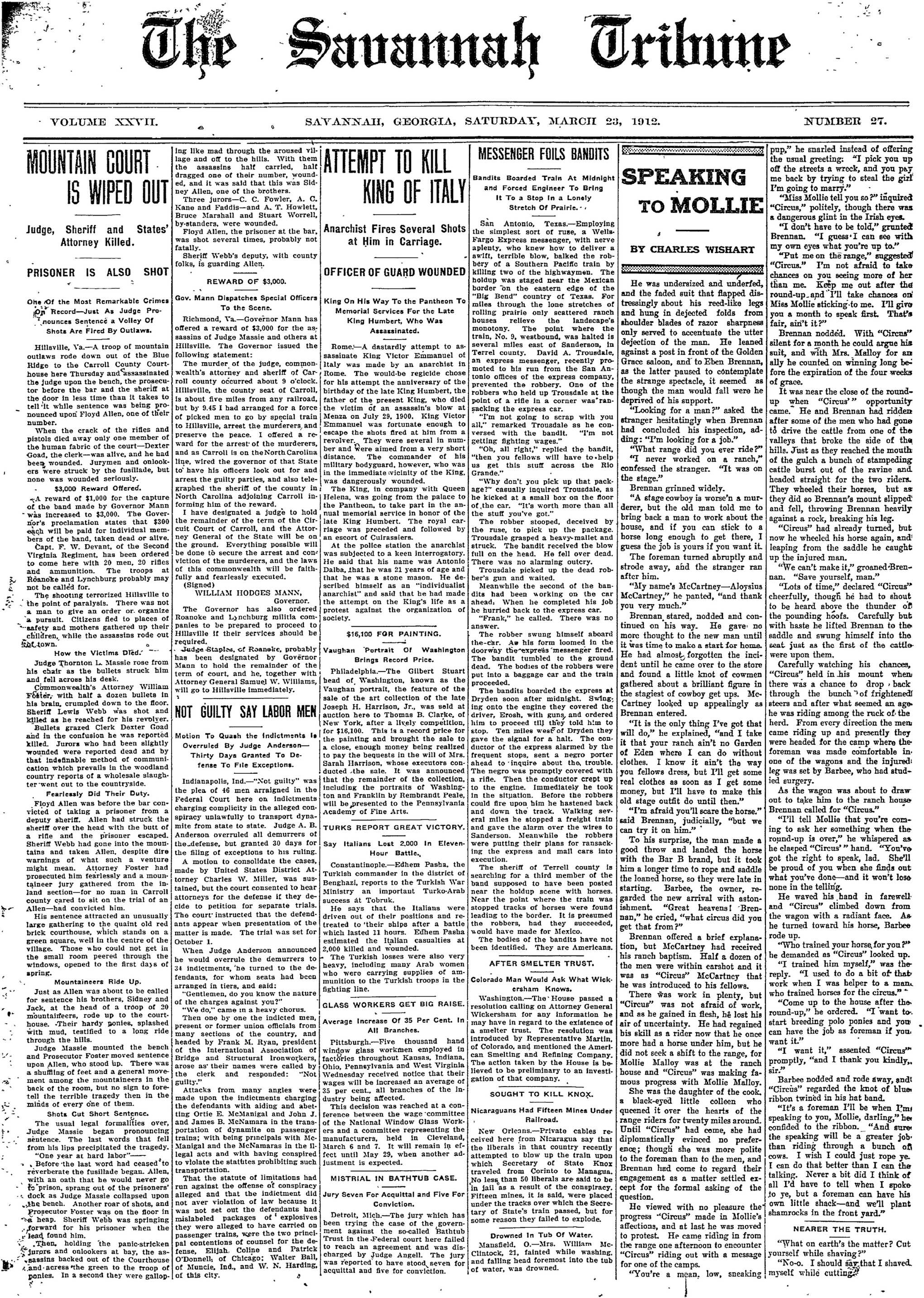
MOUNTAIN COURT IS WIPED OUT
Judge, Sheriff and States' Attorney Killed.
PRISONER IS ALSO SHOT
One Of the Most Remarkable Crimes On Record—Just As Judge Pronounces Sentence a Volley Of Shots Are Fired By Outlaws.
Hillsville, Va.—A troop of mountain outlaws rode down out of the Blue Ridge to the Carroll County Courthouse here Thursday and assassinated the judge upon the bench, the prosecutor before the bar and the sheriff at the door in less time than it takes to tell it while sentence was being pronounced upon Floyd Allen, one of their number.
When the crack of the rifles and pistols died away only one member of the human fabric of the court—Dexter Goad, the clerk—was alive, and he had been wounded. Jurymen and onlookers were struck by the fusillade, but none was wounded seriously.
$3,000 Reward Offered.
A reward of $1,000 for the capture of the band made by Governor Mann was increased to $3,000. The Governor's proclamation states that $300 each will be paid for individual members of the band, taken dead or alive. Capt. F. W. Devant, of the Second Virginia Regiment, has been ordered to come here with 20 men, 20 rifles and ammunition. The troops at Roanoke and Lynchburg probably may not be called for. The shooting terrorized Hillsville to the point of paralysis. There was not a man to give an order or organize a pursuit. Citizens fled to places of safety and mothers gathered up their children, while the assassins rode out of town.
How the Victims Died.
Judge Thornton L. Massie rose from his chair as the bullets struck him and fell across his desk. Commonwealth's Attorney William Foster, with half a dozen bullets in his brain, crumpled down to the floor. Sheriff Lewis Webb was shot and killed as he reached for his revolver. Bullets grazed Clerk Dexter Goad and in the confusion he was reported killed. Jurors who had been slightly wounded were reported dead and by that indefinable method of communication which prevails in the woodland country reports of a wholesale slaughter went out to the countryside.
Floyd Allen was before the bar convicted of taking a prisoner from a deputy sheriff. Allen had struck the sheriff over the head with the butt of a rifle and the prisoner escaped. Sheriff Webb had gone into the mountains and taken Allen, despite dire warnings of what such a venture might mean. Attorney Foster had prosecuted him fearlessly and a mountaineer jury gathered from the inland section—for no man in Carroll county cared to sit on the trial of an Allen—had convicted him.
His sentence attracted an unusually large gathering to the quaint old red brick courthouse, which stands on a green square, well in the centre of the village. Those who could not get in the small room peered through the windows, opened to the first days of spring.
Mountaineers Ride Up.
Just as Allen was about to be called for sentence his brothers, Sidney and Jack, at the head of a troop of 20 mountainteers, rode up to the courthouse. Their hardy ponies, splashed with mud, testified to a long ride through the hills.
Judge Massie mounted the bench and Prosecutor Foster moved sentence upon Allen, who stood up. There was a shuffling of feet and a general movement among the mountaineers in the back of the room, but no sign to foretell the terrible tragedy then in the minds of every one of them.
Shots Cut Short Sentence.
The usual legal formalities over, Judge Massie began pronouncing sentence. The last words that fell from his lips precipitated the tragedy. "One year at hard labor"
Before the last word had ceased to reverberate the fusillade began. Allen, with an oath that he would never go to prison, sprang out of the prisoners' dock as Judge Massie collapsed upon the bench. Another roar of shots, and Prosecutor Foster was on the floor in a heap. Sheriff Webb was springing forward for his prisoner when the lead found him. Then, holding the panic-stricken jurors and onlookers at bay, the assassins backed out of the Courthouse and acress the green to the troop of ponies. In a second they were gallop-
ing like mad through the aroused village and off to the hills. With them the assassins half carried, half dragged one of their number, wounded, and it was sald that this was Sidney Allen, one of the brothers.
Three jurors—C. C. Fowler, A. C. Kane and Faddis—and A. T. Howlett, Bruce Marshall and Stuart Worrell, by-standers, were wounded.
Floyd Allen, the prisoner at the bar, was shot several times, probably not fatally.
Sheriff Webb's deputy, with county folks, is guarding Allen.
REWARD OF $3,000.
Gov. Mann Dispatches Special Officers To the Scene.
Richmond, Va.—Governor Mann has offered a reward of $3,000 for the assassins of Judge Massie and others at Hillsville. The Governor issued the following statement:
The murder of the judge, commonwealth's attorney and sheriff of Carroll county occurred about 9 o'clock. Hillsville, the county seat of Carroll, is about five miles from any railroad, but by 9.45 I had arranged for a force of picked men to go by special train to Hillsville, arrest the murderers, and preserve the peace. I offered a reward for the arrest of the murderers, and as Carroll is on the North Carolina line, wired the governor of that State to have his officers look out for and arrest the guilty parties, and also telegraphed the sheriff of the county in North Carolina adjoining Carroll informing him of the reward.
I have designated a judge to hold the remainder of the term of the Circuit Court of Carroll, and the Attorney General of the State will be on the ground. Everything possible will be done to secure the arrest and conviction of the murderers, and the laws of this commonwealth will be faithfully and fearlessly executed.
The Governor has also ordered Roanoke and Lynchburg militia companies to be prepared to proceed to Hillsville if their services should be required.
Judge Staples, of Roanoke, probably has been designated by Governor Mann to hold the remainder of the term of court, and he, together with Attorney General Samuel W. Williams, will go to Hillsville immediately.
NOT GUILTY SAY LABOR MEN
Motion To Quash the indictments Is Overruled By Judge Anderson— Thirty Days Granted To Defense To File Exceptions.
Indianapolis, Ind.—"Not guilty" was the plea of 46 men arraigned in the Federal Court here on indictments charging complicity in the alleged conspiracy unlawfully to transport dynamite from state to state. Judge A. B. Anderson overruled all demurrers of the defense, but granted 30 days for the filing of exceptions to his ruling.
A motion to consolidate the cases, made by United States District Attorney Charles W. Miller, was sustained, but the court consented to hear attorneys for the defense if they decide to petition for separate trials. The court instructed that the defendants appear when presentation of the matter is made. The trial was set for October 1.
When Judge Anderson announced he would overrule the demurrers to 34 indictments, he turned to the defendants, for whom seats had been arranged in tiers, and said: "Gentlemen, do you know the nature
"Gentlemen, do you know the nature of the charges against you?"
"We do," came in a heavy chorus.
Then one by one the indicted men, present or former union officials from many sections of the country, and headed by Frank M. Ryan, president of the International Association of Bridge and Structural Ironworkers, arose as their names were called by the clerk and responded: "Not guilty."
Attacks from many angles were made upon the indictments charging the defendants with aiding and abetting Ortie E. McManigal and John J. and James B. McNamara in the transportation of dynamite on passenger trains; with being principals with McManigal and the McNamaras in the illegal acts and with having conspired to violate the statutes prohibiting such transportation.
That the statute of limitations had run against the offense of conspiracy alleged and that the indictment did not aver violation of law because it was not set out the defendants had mislabeled packages of explosives they were alleged to have carried on passenger trains, were the two principal contentions of counsel for the defense, Elijah. Coline and Patrick O'Donnell; of Chicago; Walter Ball, of Muncie, Ind., and W. N. Harding, of this city.
SAVANNAH, GEORGIA, SATURDAY, MARCH 23, 1912.
ATTEMPT TO KILL KING OF ITALY
ATTEMPT TO KILL KING OF ITALY
Anarchist Fires Several Shots at Him in Carriage.
OFFICER OF GUARD WOUNDED
King On His Way To the Pantheon To Memorial Services For the Late King Humbert, Who Was Assassinated.
Rome.—A dastardly attempt to assassinate King Victor Emmanuel of Italy was made by an anarchist in Rome. The would-be regicide chose for his attempt the anniversary of the birthday of the late King Humbert, the father of the present King, who died the victim of an assassin's blow at Menza on July 29, 1900. King Victor Emmanuel was fortunate enough to escape the shots fired at him from a revolver. They were several in number and were aimed from a very short distance. The commander of his military bodyguard, however, who was in the immediate vicinity of the King, was dangerously wounded.
The King, in company with Queen Helena, was going from the palace to the Pantheon, to take part in the annual memorial service in honor of the late King Humbert. The royal carriage was preceded and followed by an escort of Cuirassiers.
At the police station the anarchist was subjected to a keen interrogatory. He said that his name was Antonio Dalba, that he was 21 years of age and that he was a stone mason. He described himself as an "individualist anarchist" and said that he had made the attempt on the King's life as a protest against the organization of society.
$16,100 FOR PAINTING.
Vaughan Portrait Of Washington Brings Record Price.
Philadelphia.—The Gilbert Stuart head of, Washington, known as the Vaughan portrait, the feature of the sale of the art collection of the late Joseph H. Harrison, Jr., was sold at auction here to Thomas B. Clarke, of New York, after a lively competition, for $16,100. This is a record price for the painting and brought the sale to a close, enough money being realized to pay the bequests in the will of Mrs. Sarah Harrison, whose executors conducted the sale. It was announced that the remainder of the collection, including the portraits of Washington and Franklin by Rembrandt Peale, will be presented to the Pennsylvania Academy of Fine Arts.
Say Italians Lost 2,000 In Eleven-Hour Battle.
Constantinople.—Edhem Pasha, the Turkish commander in the district of Benghazi, reports to the Turkish War Ministry an important Turko-Arab success at Tobruk.
He says that the Italians were driven out of their positions and retreated to their ships after a battle which lasted 11 hours. Edhem Pasha estimated the Italian casualties at 2,000 killed and wounded.
The Turkish losses were also very heavy, including many Arab women who were carrying supplies of ammunition to the Turkish troops in the fighting line.
GLASS WORKERS GET BIG RAISE.
Average Increase Of 35 Per Cent. In All Branches.
Pittsburgh.—Five thousand hand window glass workmen employed in factories throughout Kansas, Indiana, Ohio, Pennsylvania and West Virginia Wednesday received notice that their wages will be increased an average of 35 per cent., all branches of the industry being affected.
This decision was reached at a conference between the wage committee of the National Window Glass Workers and a committee representing the manufacturers, held in Cleveland, March 6 and 7. It will remain in effect until May 29, when another adjustment is expected.
MISTRIAL IN BATHTUB CASE.
Jury Seven For Acquittal and Five For Conviction. Detroit, Mich.—The jury which has been trying the case of the government against the so-called Bathtub Trust in the Federal court here failed to reach an agreement and was discharged by Judge Angell. The jury was reported to have stood seven for acquittal and five for conviction.
MESSENGER FOILS BANDITS
Bandits Boarded Train At Midnight and Forced Engineer To Bring It To a Stop In a Lonely Stretch Of Prairie.
San Antonio, Texas.—Employing the simplest sort of ruse, a Wella Fargo Express messenger, with nerve aplenty, who knew how to deliver a swift, terrible blow, balked the robery of a Southern Pacific train by killing two of the highwaymen. The holdup was staged near the Mexican border on the eastern edge of the "Big Bend" country of Texas. For miles through the lone stretches of rolling prairie only scattered ranch houses relieve the landscape's monotony. The point where the train, No. 9, westbound, was halted is several miles east of Sanderson, in Terrel county. David A. Trousdale, an express messenger, recently promoted to his run from the San Antonio offices of the express company, prevented the robbery. One of the robbers who held up Trousdale at the point of a rifle in a corner was 'ransacking the express car.
"I'm not going to scrap with you all," remarked Trousdale as he conversed with the bandit. "I'm not getting fighting wages."
"Oh, all right," replied the bandit, "then you fellows will have to help us get this stuff across the Rio Grande."
"Why don't you pick up that package?" casually inquired Trousdale, as he kicked at a small box on the floor of the car. "It's worth more than all the stuff you've got."
The robber stooped, deceived by the ruse, to pick up the package. Trousdale grasped a heavy-mallet and struck. The bandit received the blow full on the head. He fell over dead. There was no alarming outcry. Trousdale picked up the dead robber's gun and waited.
Meanwhile the second of the bandits had been working on the car ahead. When he completed his job he hurried back to the express car. "Frank," he called. There was no answer. The robber swung himself aboard the-car. As his form loomed in the doorway the express messenger fired. The bandit tumbled to the ground dead. The bodies of the robbers were put into a baggage car and the train proceeded.
The bandits boarded the express at Dryden soon after midnight. Swinging onto the engine they covered the driver, Erosh, with guns, and ordered him to proceed till they told him to stop. Ten miles west of Dryden they gave the signal for a halt. The conductor of the express alarmed by the frequent stops, sent a negro porter ahead to inquire about the trouble. The negro was promptly covered with a rifle. Then the conductor crept up to the engine. Immediately he took in the situation. Before the robbers could fire upon him he hastened back and down the track. Walking several miles he stopped a freight train and gave the alarm over the wires to Sanderson. Meanwhile the robbers were putting their plans for ransacking the express and mall cars into execution.
The sheriff of Terrell county is searching for a third member of the band supposed to have been posted near the holdup scene with horses. Near the point where the train was stopped tracks of horses were found leading to the border. It is presumed the robbers, had they succeeded, would have made for Mexico. The bodies of the bandits have not been identified. They are Americans.
AFTER SMELTER TRUST.
Colorado Man Would Ask What Wicke-
crasham Knows.
Washington.—The House passed a resolution calling on Attorney General Wickersham for any information he may have in regard to the existence of a smelter trust. The resolution was introduced by Representative Martin, of Colorado, and mentioned the American Smelting and Refining Company. The action taken by the House is believed to be preliminary to an investigation of that company.
SOUGHT TO KILL KNOX.
Nicaraguans Had Fifteen Mines Under Railroad.
New Orleans.—Private cables received here from Nicaragua say that the liberals in that country recently attempted to blow up the train upon which Secretary of State Knox traveled from Corinto to Managua. No less than 50 liberals are said to be in fall as a result of the conspiracy. Fifteen mines, it is said, were placed under the tracks over which the Secretary of State's train passed, but for some reason they failed to explode.
Drowned In Tub Of Water.
Mansfield, O.—Mrs. William McClintock, 21, falnted while washing, and falling head foremost into the tub of water, was drowned.
SPEAKING TO MOLLIE
SPEAKING TO MOLLIE
BY CHARLES WISHART
He was undersized and underfed, and the faded suit that flapped distressingly about his reed-like legs and hung in dejected folds from shoulder blades of razor sharpness only served to accentuate the utter dejection of the man. He leaned against a post in front of the Golden Grace saloon, and to Eben Brennan, as the latter paused to contemplate the strange spectacle, it seemed as though the man would fall were he deprived of his support.
"Looking for a man?" asked the stranger hesitatingly when Brennan had concluded his inspection, adding: "I'm looking for a job."
"What range did you ever ride?"
"I never worked on a ranch," confessed the stranger. "It was on the stage."
Brennan grinned widely.
"A stage cowboy is worse'n a murderer, but the old man told me to bring back a man to work about the house, and if you can stick to a horse long enough to get there, I guess the job is yours if you want it.
The foreman turned abruptly and strode away, and the stranger ran after him.
"My name's McCartney—Aloysius McCartney," he panted, "and thank you very much."
Brennan stared, nodded and continued on his way. He gave no more thought to the new man until it was time to make a start for home. He had almost, forgotten the incident until he came over to the store and found a little knot of cowmen gathered about a brilliant figure in the stagiest of cowboy get ups. McCartney looked up appealingly as Brennan entered.
"It is the only thing I've got that will do," he explained, "and I take it that your ranch ain't no Garden of Eden where I can do without clothes. I know it ain't the way you fellows dress, but I'll get some real clothes as soon as I get some money, but I'll have to make this old stage outfit do until then."
"I'm afraid you'll scare the horse." said Brennan, judicially, "but we can try it on him."
To his surprise, the man made a good throw and landed the horse with the Bar B brand, but it took him a longer time to rope and saddle the loaned horse, so they were late in starting. Barbee, the owner, regarded the new arrival with astonishment. "Great heavens! Brennan," he cried, "what circus did you get that from?" Brennan offered a brief explanation, but McCartney had received his ranch baptism. Half a dozen of the men were within earshot and it was as "Circus" McCartney that he was introduced to his fellows.
There was work in plenty, but "Circus" was not afraid of work, and as he gained in flesh, he lost his air of uncertainty. He had regained his skill as a rider now that he once more had a horse under him, but he did not seek a shift to the range, for Mollie Malloy was at the ranch house and "Circus" was making famous progress with Mollie Malloy.
She was the daughter of the cook, a black-eyed little colleen who queued it over the hearts of the range riders for twenty miles around. Until "Circus" had come, she had diplomatically evinced no preference; though she was more polite to the foreman than to the men, and Brennan had come to regard their engagement as a matter settled except for the formal asking of the question. He viewed with no pleasure the progress "Circus" made in Mollie's affections, and at last he was moved to protest. He came riding in from the range one afternoon to encounter "Circus" riding out with a message for one of the camps.
'You're a mean, low, sneaking
NUMBER 27.
pup," he snarled instead of offering the usual greeting: "I pick you up off the streets a wreck, and you pay me back by trying to steal the girl I'm going to marry."
"Miss Mollie tell you so?" inquired "Circus," politely, though there was a dangerous glint in the Irish eyes.
"I don't have to be told," grunted Brennan. "I guess I can see with my own eyes what you're up to."
"Put me on the range," suggested "Circus." I'm not afraid to take chances on you seeing more of her than me. Keep me out after the round-up and I'll take chances on Miss Mollie sticking to me. I'll give you a month to speak first. That's fair, ain't it?"
Brennan nodded. With "Circus" silent for a month he could argue his suit, and with Mrs. Malloy for an ally he counted on winning long before the expiration of the four weeks of grace.
It was near the close of the round-up when "Circus" opportunity came. He and Brennan had ridden after some of the men who had gone to drive the cattle from one of the valleys that broke the side of the hills. Just as they reached the mouth of the gulch a bunch of stampeding cattle burst out of the ravine and headed straight for the two riders. They wheeled their horses, but as they did so Brennan's mount slipped and fell, throwing Brennan heavily against a rock, breaking his leg. "Circus" had already turned, but now he wheeled his horse again, and leaping from the saddle he caught up the injured man.
"We can't make it," groaned Brennan. "Save yourself, man."
"Lots of time," declared "Circus" cheerfully, though he had to shout to be heard above the thunder of the pounding hoofs. Carefully but with haste he lifted Brennan to the saddle and swung himself into the seat just as the first of the cattle were upon them.
Carefully watching his chances, "Circus" held in his mount when there was a chance to drop back through the bunch of frightened steers and after what seemed an age he was riding among the ruck of the herd. From every direction the men came riding up and presently they were headed for the camp where the foreman was made comfortable in one of the wagons and the injured leg was set by Barbee, who had studied surgery. As the wagon was about to draw out to take him to the ranch house Brennan called for "Circus."
"I'll tell Mollie that you're coming to ask her something when the round-up is over," he whispered as he clapped "Circus" hand. "You've got the right to speak, lad. She'll be proud of you when she finds out what you've done—and it won't lose none in the telling.
He waved his hand in farewell and "Circus" climbed down from the wagon with a radiant face. As he turned toward his horse, Barbee rode up.
"Who trained your horse, for you?" he demanded as "Circus" looked up.
"I trained him myself," was the reply. "I used to do a bit of that work when I was helper to a man who trained horses for the circus." "Come up to the house after the round-up," he ordered. "I want to start breeding polo ponies and you can have the job as foreman if you want it." "I want it," assented "Circus" promptly, "and I thank you kindly, sir." Barbee nodded and rode away, and "Circus" regarded the knot of blue ribbon twined in his hat band.
"It's a foreman I'll be when I'm speaking to you, Mollie, darling," he confided to the ribbon. "And sure the speaking will be a greater job than riding through a bunch of cows. I wish I could just rope ye. I can do that better than I can the talking. Never a bit did I think of all I'd have to tell when I spoke to ye, but a foreman can have his own little shack—and we'll plant shamrocks in the front yard."
NEARER THE TRUTH.
"What on earth's the matter? Cut yourself while shaving?"
"No-o. I should say that I shaved myself while cutting."
we CAs « «45K RN OO e .
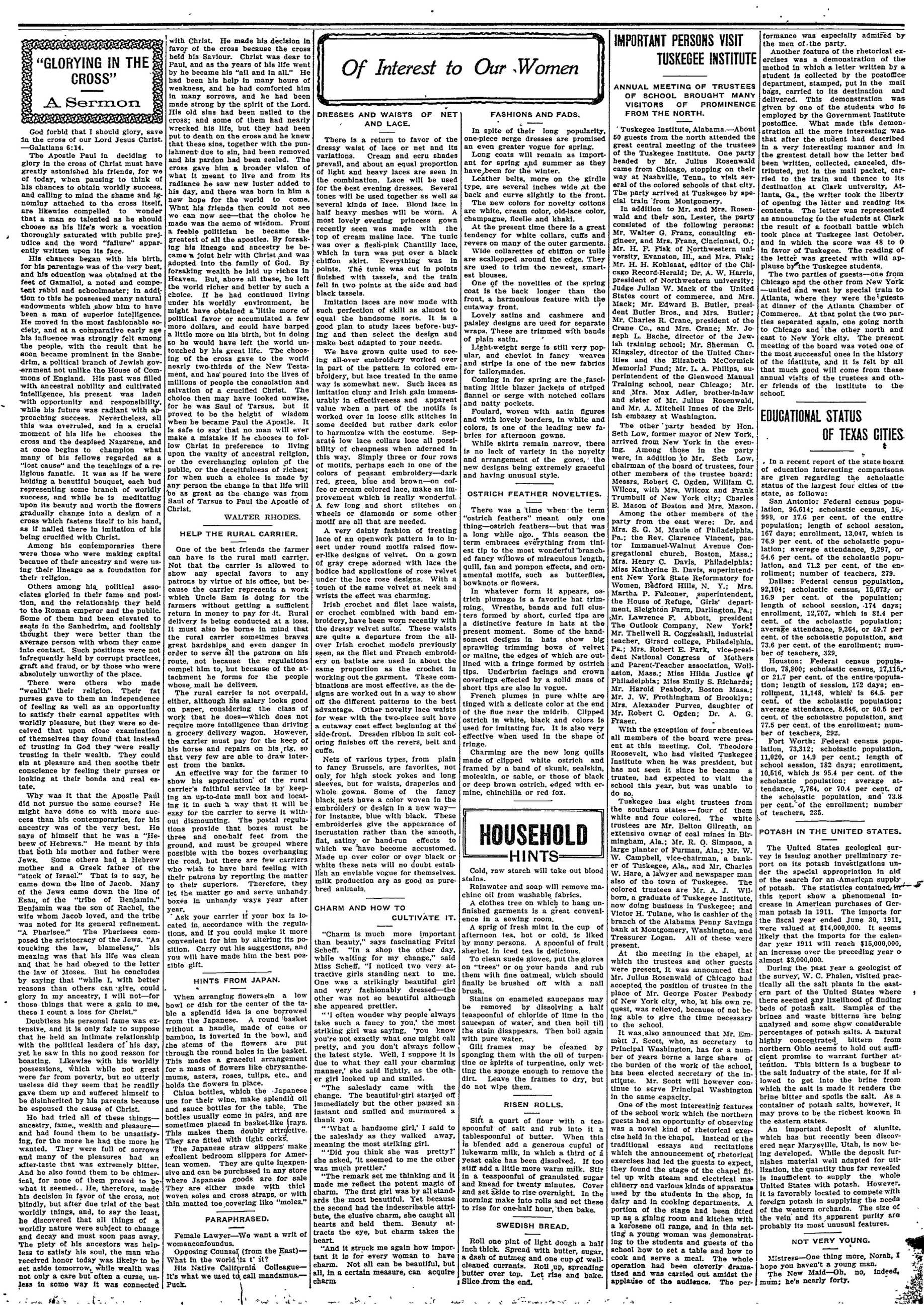
“GLORYING IN THE:
CROSS”
A Sermon
Oe ee eee
‘The Apostle Paul in deciding to
glory in the cross of Christ must have
greatly astonished his friends, for we
of today, when pausing to think of
his chances to obtain worldly success,
and calling to mind the shame and ig-
nominy attached to the cross itself,
Bre Mkewise compelled to wonder
that a man so talented as he should
choose as his life's work a vocation
thoroughly saturated with public prej-
udice and the word “faflure” appar-
ently written upon its face.
His chances began with his birth,
for bis parentage was of the very best,
and his education was obtained at the
feet of Gamaliel, a noted and compe-
tent rabbi and schoolmaster; in addt-
tion to this he possessed many natural
endowments which show bim to have
‘been a man of superior intelligence.
He moved in the most fashionable so-
clety, and at a coinparative early age
‘hhis influence was strongly felt among
the people, with the result that he
oon became prominent in the Sanhe-
‘drim, a political branch of Jewish gov-
‘ernment not unlike the House of Com-
mons of England. His past was filled
with ancestral nobility and cultivated
intelligence, his present was laden
with opportunity and responsibility,
while bis future was radiant with ap-
proaching success. Nevertheless, all
this was overruled, and {n a crucial
moment of his life he chooses the
cross and the despised Nazarene, and
at once begins to champion what
many of his fellows regarded as a
“lost cause“ and the teachings of a re-
liglous fanatic. It was as {f he were
holding a beautiful bouquet, each bud
representing some branch of worldly
success, and while he is meditating
upon its beauty and worth the flowers
gradually change into a design of a
cross which fastens itself to bis hand,
as if nailed there In imitation of his
being crucified with Christ.
Among his contemporaries there
‘wera those who were making capital
decause of their ancestry and were us-
ing thelr lineage as a foundation for
their religion.
Others among hia political asso-
slates gloried in their fame and pos!-
tion, and the relationship they held
to the Roman emperor and the public.
Some of them had been elevated to
seats in the Sanhedrim, and foolishly
thought they were better than the
average person with whom they came
into contact. Such positions were not
infrequently held by corrupt practices,
graft and fraud, or by those who were
absolutely unworthy of the place.
There were others who made
“wealth” their religion. Their fat
purses gave to them an independence
of feeling as well as an opportunity
to satisfy their carnal appetites with
worldly pleasure, but they were so de-
celved that upon close examination
of themselves they found that instead
of trusting in God they -were really
trusting in thelr wealth. They could
sin at pleasure and then soothe their
conscience by feeling their purses or
looking at thelr bonds and real es-
tate.
‘Why was it that the Apostle Patil
did not pursue the same course? He
might have done so with more suc-
cess than his contemporarieg, for his
ancestry was of the very best. He
says of himself that he was a “He-
brew of Hebrews.” He meant by this
that both his mother and father were
Jews. Some others had a Hebrew
mother and a Greek father of the
“stock of Israel” That is to say, he
came down the Iine of Jacob. Many
of the Jews came down the line of
Esau, of the “tribe of Benjamin.”
Benjamin was the son of Rachel, the
wife whom Jacob loved, and the tribe
was noted for its general refinement.
“A Pharisee.” The Pharisees com-
posed the aristocracy of the Jews. “As
doucking the law, blameless,” his
meaning was that his life was clean
and that he had obeyed to the letter
the law of Moses. But he concludes
by saying that “while I, with better
reasons than others can -give, could
glory in my ancestry, I will not—tor
those things that were a gain to me,
these I count a loss for Christ.”
Doubtless his personal fame was ex-
tensive, and it Is only fair to suppose
that he held an intimate relationship
with the political leaders of’ his day,
yet he saw in this no good reason for
boasting. Likewise with his worldly
possessions, which while not great
were far from poverty, but go utterly
useless did they seem that he readily
gave them up and suffered himself to
be disinherited by his parents because
he espoused the cause of Christ.
Ho had tried all of these things—
with Christ. He made his decision in
favor of the cross because the cross
held his Saviour. Christ was dear to
Paul, and as the years of his life went
by he became his “ail and In all" He
bad been his help in many hours of
weakness, and he had comforted him
{n many sorrows, and he had been
made strong by the spirit of the Lord.
His old sina had been nailed to the
cross; and some of them had nearly
wrecked his life, but they had been
put to death on the cross and he knew
that these sins, together with the pun-
ishment due to sin, had been removed
and bis pardon had been eealed. The
cross gave him a broader vision of
what {t meant to live and from Its
radiance he saw new luster added to
his day, and there was born in him a
new hope for the world to come.
What his friends then could not see
we can now see—that the choice he
made was the acme of wisdom. Front
a feeble politician he became the
greatest of all the apostles. By forsak-
ing his Ineage and ancestry he be-
came ~ joint heir with Christ and was
adopted into the family of God. By
forsaking wealth he laid up riches in
Heaven. But, above all these, he left
the world richer and better by such a
choice. If he had continued Iving
under his worldly environment, he
might have obtalned a ‘little more of
political favor or accumulated a few
more dollars, and could have harped
a little more on lils birth, but in doing
so he would have left the world un-
touched by his great life. The choos-
ing of the cross gave to the world
nearly two-thirds of the New Testa-
ment, and has’ poured into the lives of
millions of people the consolation and
salvation of a crucified Christ. The
choice then may have looked unwise,
for he was Saul of Tarsus, but it
proved to be the height of wisdom
when he became Paul the Apostle. It
is safe to say’ that no man will ever
make a mistake if he chooses to fol-
low Christ in preference to living
upon the vanity of ancestral religion,
or tho everchanging opinion of the
public, or the decejtfulness of riches;
for when such a choice is made by
any person the change in that life will
be as great as the change was from
Saul of Tarsus to Paul the Apostle of
Christ.
WALTER RHODES.
HELP THE RURAL CARRIER.
One of the best friends the farmer
can have fs the rural mall carrier.
Not that the carrier is allowed to
show any special favors to any
patrons by virtue of bis office, but be-
cause the carrier represents a work
which Uncle Sam fs doing for the
farmers without getting a suMiclent
return in money to pay for it. Rural
delivery {8 being conducted at a loss.
It must also be borne In mind that
the rural carrier sometimes braves
great hardships and even danger in
order to serve 4ll the patrons on his
route, not because the regulations
compel him to, but because of the at-
tachment he forms for the people
whose, mail he delivers.
The rural carrier ts not overpald,
either, although hits salary looks good
on paper, considering the class of
work that he does—vhich does not
require more intolligence than driving
a grocery delivery wagon. However,
the carrier must pay for the keep of
his horse and repairs on his rig, so
that very few are able to draw inter-
est from the banks.
‘An effective way for the farmer to
show his appreciation’ of the rural
carrier's faithful service {s by keep-
ing an up-to-date mail box and locat-
tng it in such a way that ft will be
easy for the carrier to serve {t with-
out dismounting. The postal regula-
tions provide that boxes must be
three and onehalf feet from the
ground, and must be grouped where
possible with the boxes overhanging
the road, but there are few carriers
who wish to have bard feeling with
thelr patrons by reporting the matter
to thelr superiors. Therefcre, they
let the matter go and serve unhandy
boxes in unhandy ways year after
year. :
“Ask your carrier 1f your box Is lo-
cated {n, accordance with the regula-
tlons, and if you could make it more
convenient for him by altering its po-
sition, Carry out his suggestions, and
you will have made him the best pos-
sible gift.
HINTS FROM JAPAN.
When arranging flowersein a low
bowl or dish for the center of the ta-
ble a splendid idea is one borrowed
from the Japanese. A round ‘basket
without a handle, made of cane or
bamboo, fs inverted in the bowl, and
the stems of the flowers aro put
through the round holes in the basket.
This mades @ graceful arrangement
for a mass of flowers like chrysanthe-
mums, asters, roses, tulips, etc., and
‘holds the flowers in place.
China bottles, which the -Japanese
use for thelr wine, make splendid oll
and sauce bottles for the table. The
pottles usually come in pairs, and are
sometimes placed in Hasket like {ray6.
This makes them doubly attrgctive.
‘They are fitted with tlght corks.
‘The Japanese straw slippers’ make
excellent bedroom slippers for Amer-
ican women. They are quite inexpen-
sive and can be purchased in any store
where Japanese goods are for sale
‘They are elther made with thicl
woven soles and cross straps, or with
thin matted toe covering like “moles.”
PARAPHRASED.
Female Lawyer—We want a writ of
womanconfoundus.
Opposing Counsal (trom the East)—
What In the world {is t” it?
His Native California Colleague—
It’s what we wed to call mandamus.—
Puck. 1
Of Interest to Our Women
a << we8i«: 2* @ Bessette ws st | CU
DRESSES AND WAISTS OF NET
5 AND LACE.
There {s a return to favor of the
dressy waist of lace or net and Its
variations. Cream and ecru shades
prevail, and about an equal proportion
of light and heavy laces are seen jn
the combination. Lace will be used
for the dest evening dresses. Several
tones will be used together as well as
several kinds of lace. Blond lace in
half heavy meshes will be worn. A
most lovely evening princess gown
recently seen was made with the
top of cream maline lace. The tunic
was over a fiesh-pink Chantilly lace,
which Jn turn was put over a black
‘chiffon skirt. Everything was in
points. ‘Thé tunic was cut in points
‘finished with tassels, and the train
fell In two points at the side and had
black tassels.
Imitation laces are now made with
such perfection of skill as almost to
equal the handsome sorts. It is 9
good plan to study laces before: buy-
ing and then select the design and
make best adapted to your needs.
We have grown quite used to see-
ing all-over embroidery worked over
in part of the pattern In colored em-
bfoigery, but lace treated in the same
way 1s somewhat new. Sucb laces as
imitatfon cluny and Irish gain immeas-
urably In effectiveness and apparent
value when a part of the motifs is
worked over In loose silk stitches io
some decided but rather dark color
to harmonize with the costume. Sep-
araté low lace collars lose all possi-
bility of cheapness when adorned in
this way. Simply three or four rows
of motifs, perhaps each in one of the
colors of peasant embroldery—dark
red, green, blue and brown—on cof-
fee or cream colored lace, make an im-
provement which {s really wonderful.
A few long and short stitches on
Wheels or diamonds or some other
motff are all that are needed.
A very dainty fashion of treating
lace of an openwork pattern is to in-
sert under round motifs raised flow-
erlike designs of velvet. On a gown
of gray crepe adorned with lace the
bodice had applications of rose velvet
under the lace rose designs. With a
touch of the same velvet at neck and
wrists the effect was charming.
Irish crochet and filet lace waists,
or crochet combined with band em-
broldery, have been worn recently with
the dressy velvet sults. These waists
are quite a departure from the all-
over Irish crochet models previously
seen, as the filet and French embroid-
ery on batiste are used in about the
same proportion as the crochet in
working out the garment. These com-
binations are most effective, as the de
signs are worked out in a way to show
off the different patterns to the best
advantage. Other novelty Inco wafsts
for wear with the two-piece sult bave
a cutaway coat effect beginning at thé
sidefront. Dresden ribbon in suit col-
oring finishes off the revers, belt and
cuffs.
Nets of various types, from plain
to fancy Brussels, are favorites, not
only, for high stock yokes and long
sleeves, but for waists, draperies and
whole gowns. Some of the fancy
black nets have a color woven In the
embroidery or design in a new way—
for instante, blue with black. These
embroideries give the appearance of
inerustation rather than the smooth,
flat, satiny or hand-run effects to
which we ‘have become accustomed.
Made up over color or over black or
white these nets will no doubt estab-
Ush an enviable vogue for themselves.
milk production arg as good as pure-
bred animals,
CHARM AND HOW TO
CULTIVATE IT.
“Charm is much more important
than beauty,” says fascinating Fritz!
Scheff. “In' a shop the other day,
while waiting for my change,” said
Miss Scheff, “I noticed two very at-
tractive girls standing next to me.
One was a strikingly beautiful girl
and very fashionably dressed—the
other was not so beautiful although
she appeared prettier. .
“I often wonder why people always
take such a fancy to you,’ the most
striking girl was saying, ‘you know
you're not exactly what one might call
pretty, and you don't always follow
the latest style, Well, I suppose It Is
due to what they call your charming
manner,’ she said lightly, as the oth-
er girl looked up and smiled.
“The saleslady came with the
change. The beautiful'girl started off
immediately but the other paused an
instant and smiled and murmured a
thank you.
“What a handsome girl,’ I sald to
the saleslady as they walked away,
meaning the most striking girl.
““Did you think she was pretty?"
she asked, ‘It seemed to me the other
‘was much prettier.”
“The remark set me thinking and it
made me reflect the potent magic of
charm, The first girl was by all stand-
ards the most beautiful. Yet because
the second had the indescribable attri.
bute, the elusive charm, she caught all
hearts and held them. Beauty at-
tracts the eye, but charm takes the
heart.
“and it struck me again bow tmpor-
tant it Is for every woman to have
charm. Not all can be beautiful, but
all, in a certain measure, can acquire
charm
FASHIONS AND FADS,
In spite of their long popularity,
one-piece serge dresses are promised
an even greater vogue for spring.
Long coats will remain as tmport-
ant for spring and summer as they
have,been for the winter.
Leather belts, more on the girdle
type, are several inches wide at the
back and curve slightly to the front.
‘The new colors for novelty cottons
are white, cream color, old-lace color,
champagne, ficelle and khaki.
At the present time there is a great
tendency for white collars, cuffs and
revers on many of the outer garments.
‘Wide collarettes of chiffon or tulle
are scalloped around the edge. They
are used to trim the newest, smart-
est blouses.
One of the novelties of the spring
coat 1s the back longer than tho
front, a harmonious feature with the
cutaway front. i
Lovely satins and cashmere and
paisley designs are uced for separate
wraps. These are trimmed with bands
of plain satin. ¢
Light-weight serge fs still very pop-
ular, and cheviot in fancy weaves
and stripe 1s one of the new fabrics
for tallorymades.
Coming in for spring are the fascl-
nating Ittle blazer jackets of striped
flannel or serge with notched collars
and natty pockets.
Foulard, woven with satin figures
and with lovely borders, In white and
colors, {s one of the leading new fa-
bries for afternoon gowns.
While skirts remain narrow, there
fs no lack of variety in the noyelty
and arrangement of the gores,' the
new designs being extremely graceful
and having unusual style.
OSTRICH FEATHER NOVELTIES.
‘There was a time when’ the term
“ostrich feathers” meant only one
thing—ostrich feathers—but that was
a long while ago. This season the
term embraces evétything from tint-
est tip to the most wonderful ‘branch-
ed fancy willows of miraculous length,
quill, fan and pompon effects, and orn-
amental motifs, such as butterfiles,
bowknots or flowers.
In whatever form it appears, os-
trieh plumage fs a favorite hat trim-
ming, Wreaths, bands and full clus-
ters formed by short, curled tips are
a distinctive feature in hats at the
present moment. Some of the band-
somest designs in hats show big
sprawling trimming bows of velvet
or maline, the edges of which are out-
Mned with a fringe formed by ostrich
tips. Underbrim facings and crown
coverings effected by a solid mass of
short tips are also In vogue.
French plumes jn pure white are
tinged with a delicate color at the end
of the flue near the midrib. Clipped
ostrich in white, black and colors {3
used for imitating fur. It is also very
effective when used in the shape of
fringe.
Charming are the new long quills
made of clipped white ostrich and
framed by a band of skunk, sealskin,
moleskin, or sable, or those of black
or deep brown ostrich, edged with er-
mine, chinchilla or red fox.
Cold, raw starch will take out blood
stains.
Rainwater and soap will remove ma-
chine oil from washable fabrics.
A clothes tree on which to hang un-
finished garments is a great conventl-
ence in a sewing room,
A sprig of fresh mint in the cup of
afternoon tea, hot or cold, is liked
by many persons. A spoonful of frult
sherbet in iced tea is delictous.
To clean suede gloves, put the gloves
on “trees” or on your hands and rub
‘them with fine oatmeal, which should
‘nally be brushed of with a nail
brush.
Stains on enameled saucepans may
be removed by dissolving a half
‘teaspoonful of chlorlde of lime in the
saucepan of water, and then boil till
the stain disappears. Then boil again
with pure water. :
Gilt frames may be cleaned by
sponging them with the ofl of turpen-
tine or spirits of turpentine, only wet-
ting the sponge enough to remove the
dirt. Leave the frames to dry, but
do not wipe them,
RISEN ROLLS.
Sift a quart of flour with a tea-
spoonful of salt and rub Into it a
tablespoonful of butter. When this
is blended add a generous cupful of
lukewarm milk, in which a third of
yeast cake has been dissolved, If too
stiff add a litte more warm milk. Stir
in @ teaspoonful of granulated sugar
and Imead for twenty minutes. Cover
and set aside to rise overnight. In the
morning make into rolis and set these
to rise for one-half hour, ‘then bake.
SWEDISH BREAD.
Roll one pint of light dough a half
inch thick. Spread with butter, sugar,
a dash of nutmeg and one cup of well.
cleaned currants. Roll up, spreading
butter over top. Let rise and bake.
Slice from the end.
IMPORTANT PERSONS VISIT
TUSKEGEE INSTITUTE
' Tuskegee Institute, Alabama.—About
50 guests from the north attended the
great central meeting of the trustees
of the Tuskegee Institute. One party
headed by Mr. Jullus Rosenwald
came from Chicago, stopping on their
way at Nashville, Tenu., to visit sev-
eral of the colored schools of that city.
The party arrived at Tuskegeo by spe-
cfal train ‘from Montgomery.
In addition to Mr. and Mrs. Rosen-
wald and thelr son, Lester, the party
consisted of the following persons:
Mr. Walter G. Franz, consulting en-
gineer, and Mrs, Franz, Cincinnatl, 0.;
Mr. H. F. Fisk of Northwestern uni-
versity, Evanston, Ill, and Mrs. Fisk;
Mr, H. H. Koblsaat, editor of the Chi-
cago Record-Herald; Dr, A. W, Harris,
president of Northwestern university;
Judge Julian W. Mack of the United
States court of commerce, and Mrs.
Mack; Mr. Edward B. Butler, presi-
dent Butler Bros., and Mrs. Butler;
Mr, Charles R. Crane, president of the
Crane Co. and Mrs. Crane; Mr. Jo-
seph L. Bache, director of the Jew-
ish training school; Mr. Sherman C.
Kingsley, director of the United Char-
ities und the Ellzabeth McCormick
Memorlal Fund; Mr. L. A. Philips, su-
Derintendent of the Glenwood Manual
Training school, near Chicago; Mr.
and Mrs. Max Adler, brother-in-law
and sister of Mr, Julius Rosenwald,
and Mr. A. Mitchell Innes of the Brit-
ish embassy at Washington,
The other ‘party headed by Hon.
Seth Low, former mayor of New York,
arrived from New York in the even-
ing. Among those in the party
were, in addition to Mr, Seth Low,
chairman of the board of trustees, four
other members of the trustee board:
Messrs, Robert C, Ogden, Willlam C.
Wilcox, with Mrs. Wilcox and Frank
Trumbull of New York city; Charles
E, Mason of Boston and Mrs, Mason.
Among the other members of the
‘party from the east were: Dr. and
Mrs. S. G. M. Maule of Philadelphia,
Pa.; the Rev. Clarence Vincent, pas-
tor Immanuel-Walnut Avenue Con-
gregational church, Boston, Mass.;
Mra. Henry C. Davis, Philadelphia;
Miss Katherine B. Davis, superintend-
ent New York State Reformatory for
Women, Bedford Hills, N. ¥.; Mrs.
Martha P. Falconer, ‘superintendent,
the House of Refuge, Girls’ depart-
ment, Sleightén Farm, Darlington, Pa.;
Mr. Lawrence F. Abbott, president
The Outlook Company, New York?
Mr. Thellwell R. Coggeshall, industrial
teacher, Girard college, Philadelphia,
Pa.; Mrs. Robert E. Park, vice-presi-
dent National Congress of Mothers
and Parent-Teacher association, Woll-
aston, Mass.; Miss Hilda Justice gt
Philadelphia; Miss Emily S. Richards;
Mr. Harold Peabody, Boston Mass.;
Mr. J. W. Frothingham of Brooklyn;
Mrs, Alexander Purves, daughter of
Mr. Robert C. Ogden; Dr. A. G.
Fraser. “
‘With the exception of four absentees
all members of the board were pres-
ent at this meeting. Col, Theodore
Roosevelt, who had visited Tuskegee
Institute when he was president, but
has not seen it since he became a
trustee, had expected to visit the
school this year, but was unable to
do 50,
Tuskegee bas eight trustees from
the southern states—four of them
white and four colored. The white
trustees are Mr. Belton Gilreath, an
extensive owner of coal mines in Bir-
mingham, Ala.; Bir. R. Q. Simpson, a
large planter of Furman, Ala.; Mr. W.
‘W. Campbell, vice-chairman, a bank-
er of Tuskegee, Ala,, and Mr, Charles
W. Hare, a vier aud newspaper man
also of the town of Tuskegee, The
colored trustees are Mr. A. J. Wil
born, a graduate of Tuskegee Institute,
now doing business in Tuskegee; and
Victor H. Tulane, who is cashier of the
brazch of the Alabama Penny Savings
bank at Montgomery, Washington, and
Treasurer Logan. All of these were
present. |
At the meeting in the chapel, at |
which the trustees and other guests
were present, it was announced that
Mr. Jullus Rosenwald of Chicago had
accepted the position of trustee in the
place of Mr. George Foster Peabody
of New York city, who, at his own =
quest, was relieved, because of not be-|
ing able to sive the time necessary
to the school,
It was.also announced that Mr, Em-
mett J. Scott, who, as secretary to
Principal Washington, has for a num-
ber of years borne a large share of
the burden of the work of the school, |
bas beem elected secretary of the In-
stitute. Mr. Scott will however con-
tinue to ¢e¢rve Princinal Wachine+nn
GUSSs, Was rebieved, because af not de-
ing able to give the time necessary
to the school,
It was.also announced that Mr, Em-
mett J. Scott, who, as secretary to
Principal Washington, has for a num-
ber of years borne a large share of
the burden of the work of the school,
bas been elected secretary of the in-
stitute. Mr. Scott will however con-
tnue to serve Principal Washington
in the same capacity.
‘One of the most interesting features
of the school work which the northern
guests had an opportunity of observing
was a novel kind of rhetorical exer.
cise held in the chapel, Instead of the
traditional essays and recitations
which the announcement of rhetorical
exercises had led the guests to expect,
they found the stage of the chapel fit
tel up with steam and electrical ma.
chinery and various kinds of apparatus
used by the students in the shop, in
dairy and in cooking departments. A
portion of the stage had been fitted
up ag a gining room and kitchen with
a kerosene oll range, and in this set-
ting a young woman was demonsirat.
ing to the students and guests of the
school how to set a table and how to
cook and serve a meal. The whole
operation bad been cleverly drame-
tized and was carried out amidst the
applause of the audience. The per-
formance was especially admired by
the men of-the party.
‘Another feature of the rhetorical ex-
ercises was a demonstration of the
method in which a letter written by a
student {s collected by the postofiice
department, stamped, put In the mail
bags, carrfed to its destination and
delivered. This demonstration was
given by ono of the students who fc
employed by the Government Institute
postoffice. What made this demon-
stration all the more interesting was
that after the student had described
4m a very interesting manner and in
the greatest detafl bow the letter had
been written, collected, canceled, dis-
tributed, put'in the mail packet, car
ried to the train and thence to its
destination at Clark university, At-
lanta, Ga., the writer took the liberty
of opening the letter and reading ite
contents, The letter was represonted
as announcing to the students at Clark
the result of @ football battle which
took place at Tuskegee last October,
and in which the score was 48 to 0
in favor of Tuskegee. The reading of
the letter was greeted with wild ap-
plause by“the Tuskegee students.
The two parties of guests—one from
Chicago apd the other from New York
—united and went by special train to
Atlanta, where they were the'guests
at dinner of the Atlanta Chamber of
Commerce. At that polnt the two par-
tles separated again, ope going north
to Chicago and the other north and
east to New York city. The present
meeting of the board was voted one of
the most successful ones in the history
of the institute, and it fs felt by all
that much good will come from these
annual visits of the trustees and oth-
er friends of the institute to the
schoo.
EDUCATIONAL STATUS
‘ OF TEXAS CITIES
+ Ina recent report of the state board
of education interesting comparisons
are given regarding the scholastic
Status of the largest four cities of the
state, as follows:
San Antonio: Federal census popu-
lation, 96,614; scholastic census, 16,-
999, or 17.6 per cent. of the entire
population; length of school session,
167 days; enrollment, 13,047, which is
76.9 per cent. of the scholastic popu-
lation; average attendance, 9,297, or
54.6 per cent. of the scholastic popu-
Jation, and 712 per cent. of the en-
rollment; number of teachers, 279.
Dallas: Federal census population,
92,104; scholastic census, 15,673; or
16.9 per cent. of the population;
length of school session, -174 days;
enrollment, 12,707, which {s 814 per
cent. of the scholastic population;
average attendance, 9,364, or 59.7 per
cent. of the scholastic population, and
73.6 per cent. of the enrollment; num-
ber of teachers, 329,
Houston: Federal census popula-
tion, 78,800; scholastic census, 17,116,-
or 21.7 per cent. of the entire popula-
tion; length of session, 172 days; en-
rollment, 11,148, which’ {s 64.5. per
cent. of the scholastic population;
average attendance, 8,646, or 50.6 per
cent. of the scholastre population, ant
77.8 per cent. of the enrollment; num-
ber of teachers, 292.
Fort Worth: Federal census popu-
lation, 73,312; scholastic population,
11,020, or 14.9 per cent.; length of
school session, 182 days; enrollment,
10,616, which fs 95.4 per cent. of the
scholastic population; average at-
tendance, 7,764, or 70.4 per cent. of
the scholastic population, and 73.%
per cent. of the enrollment; number
of teachers, 235.
POTASH IN THE UNITED STATES.
The United States geological sur-
vey is fsuing another preliminary re-
port on its potash investigations un-
der the special appropriation in ald
of the search for an-American supply
of potash, The statistics contained, tr
this report show a phenomenal in-
crease In American purchases of Ger-
man potash in 1911. The imports for
‘the fiscal year ended June 30, 1911,
were valued at $14,000,000. It seems
kety that the Imports for the calen-
‘dar year 1911 will reach $15,000,000,
an increase over the preceding year o
almost $3,000,000.
During the past year a geologist of
the survey, W. C. Phalen, visited prac-
Uically all the salt plants in the east-
ern part of the United States where
there seemed any lixellhood of finding
‘beds of potash salt. Samples of the
‘brines and waste bitterns are being
analyzed and some shgw considerable
percentages of potash salts. A natural
highly concentrated, bittern from
northern Ob{o seems to hold out sufil-
cient promise to warrant further at-
tention. This bittern fs a bugbear to
the salt Industry of the state, for if al-
lowed to get into the brine from
which the ealt is made it renders the
brine bitter and spoils the salt. As a
container of potash salts, however, It
may prove to be the richest known in
the eastern states.
An Important deposit of alunite,
which has but recently been discov-
ered near Marysville, Utah, Is now be-
Ing developed. While the deposit fur-
nishes material well adapted for uti-
lzation, the quantity thus far revealed
is insufficient to supply the whole
United States with potash. However,
{t 1s favorably located to compete with
foreign potash in supplying the needs
of the western orchards. The size of
the vein and its apparent purity are
probably its most unusual features.
NOT VERY YOUNG.
Atistress—One thing more, Norah, I
hope you haven't a young man.
‘The New Mald—Ob, no, indeed,
mum: he’s nearly forty. °
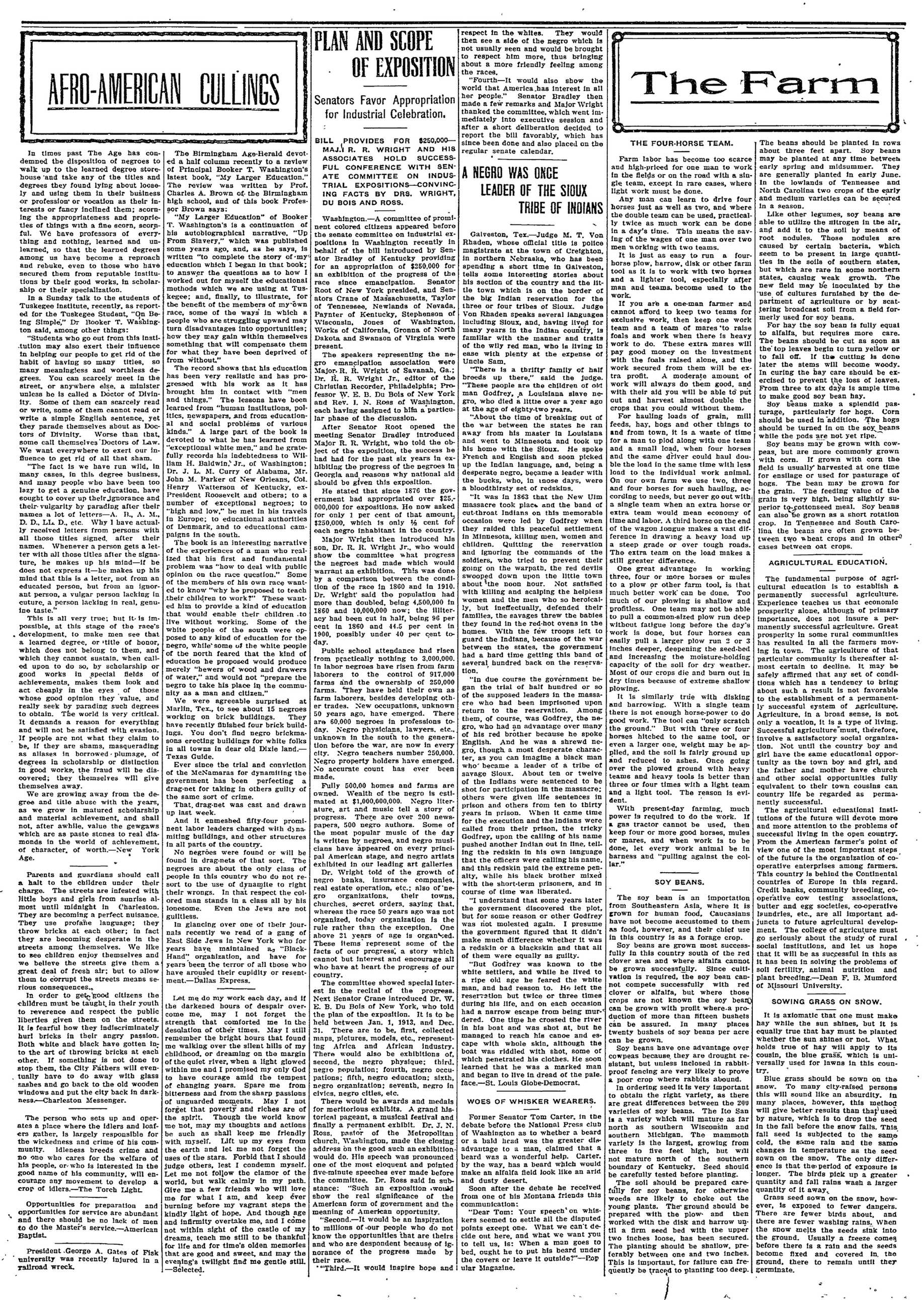
AFRO-AMERICAN CULLINGS
In times past The Age has condemned the disposition of negroes to walk up to the learned degree storehouse and take any of the titles and degrees they found lying about loosely and using them in their business or profession or vocation as their interests or fancy inclined them; scorning the appropriateness and properties of things with a fine scorn, scorful. We have professors of everything and nothing, learned and unlearned, so that the learned degrees among us have become a reproach and rebuke, even to those who have secured them from reputable institutions by their good works, in scholarship or their specialization.
In a Sunday talk to the students of Tuskegee institute, recently, as reported for the Tuskegee Student, "Qn Being Simple"; Dr Booker T. Washington said, among other things:
"Students who go out from this institution may also exert their influence in helping our people to get rid of the habit of having so many titles, so many meaningless and worthless degrees. You can scarcely meet in the street, or anywhere else, a minister unless he is called a Doctor of Divinity. Some of them can scarcely read or write, some of them cannot read or write a simple English sentence, yet they parade themselves about as Doctors of Divinity. Worse than that, some call themselves' Doctors of Law. We want everywhere to exert our influence to get rid of all that sham.
"The fact is we have run wild, in many cases, in this degree business, and many people who have been too lazy to get a genuine education, have sought to cover up their ignorance and their vulgarity by parading after their names a lot of letters—A. B., A. M., D. D., LI. D., etc. Why I have actually received letters from persons with all those titles signed, after their names. Whenever a person gets a letter with all those titles after the signature, he makes up his mind—if he does not express it—he makes up his mind that this is a letter, not from an educated person, but from an ignorant person, a vulgar person lacking in culture, a person lacking in real, genuine taste."
This is all very true; but it is impossible, at this stage of the race's development, to make men see that a learned degree, or title of honor, which does not belong to them, and which they cannot sustain, when called upon to do so, by scholarship or good works in special fields of achievements, makes them look and act cheaply in the eyes of those whose good opinion they value, and really seek by parading such degrees to obtain. The world is very critical. It demands a reason for everything and will not be satisfied with evasion. If people are not what they claim to be, if they are shams, masquerading as aases in borrowed plumage, of degrees in scholarship or distinction in good works, the fraud will be discovered; they themselves will give themselves away.
We are growing away from the degree and title abuse with the years, as we grow in matured scholarship and material achievement, and shall not, after awhile, value the gewgaws which are as paste stones to real diamonds in the world of achievement, of character, of worth.—New York Age.
Parents and guardians should call a halt to the children under their charge. The streets are infested with little boys and girls from sunrise almost until midnight in Charleston. They are becoming a perfect nuisance. They use profane language; they throw bricks at each other; in fact they are becoming desperate in the streets among themselves. We like to see children enjoy themselves and we believe the streets give them a great deal of fresh air; but to allow them to corrupt the streets means serious consequences.
In order to get good citizens the children must be taught in their youth to reverence and respect the public liberties given them on the streets. It is fearful how they indiscriminately hurt bricks in their angry passion. Both white and black have gotten in to the art of throwing bricks at each other. If something is not done to stop them, the City Fathers will eventually have to do away with glass cashes and go back to the old wooden windows and put the city back in darkness.—Charleston Messenger.
The person who sets up and operates a place where the idlers and lofters gather, is largely responsible for the wickedness and crime of his community. idleness breeds crime and no one who cares for the welfare of his people, or who is interested in the good name of his community, will encourage any movement to develop a crop of idlers.—The Torch Light.
Opportunities for preparation and opportunities for service are abundant and there should be no lack of men to do the Master's service.—American Baptist.
President George A. Gates of Fisk university was recently injured in a railroad wreck.
The Birmingham Age-Herald devoted a half column recently to a review of Principal Booker T. Washington's latest book, "My Larger Education." The review was written by Prof. Charles A. Brown of the Birmingham high school, and of this book Professor Brown says:
"My Larger Education" of Booker T. Washington's is a continuation of his autobiographical narrative, "Up From Slavey," which was published some years ago, and, as he says, is written "to complete the story of my education which I began in that book; to answer the questions as to how I worked out for myself the educational methods which we are using at Tuskegee; and, finally, to illustrate, for the benefit of the members of my own race, some of the ways in which a people who are struggling upward may turn disadvantages into opportunities; how they may gain within themselves something that will compensate them for what they have been deprived of from without."
The record shows that his education has been very realistic and has progressed with his work as it has brought him in contact with "men and things." The lessons have been learned from "human institutions, politics, newspapers, and from educational and social problems of various kinds." A large part of the book is devoted to what he has learned from "exceptional white men," and he gratefully records his indebtedness to William H. Baldwin Jr., of Washington; Dr. J. L. M. Curry of Alabama, Mr. John M. Parker of New Orleans, Col. Henry Watterson of Kentucky, ex-President Roosevelt and others; to a number of exceptional negroes; to "high and low," he met in his travels in Europe; to educational authorities of Denmark, and to educational campaigns in the south.
The book is an interesting narrative of the experiences of a man who realized that his first and fundamental problem was "how to deal with public opinion on the race question." Some of the members of his own race wanted to know "why he proposed to teach their children to work?" These wanted him to provide a kind of education that would enable their children to live without working. Some of the white people of the south were opposed to any kind of education for the negro, while some of the white people of the north feared that the kind of education he proposed would produce merely "hewers of wood and drawers of water," and would not "prepare the negro to take his place in the community as a man and citizen."
We were agreeable surprised at Marlin, Tex., to see about 15 negroes working on brick buildings. They have recently finished four brick buildings. You don't find negro brickmasons erecting buildings for white folks in all towns in dear old Dixie land. Texas Guide. Ever since the trial and conviction of the McNamaras for dynamiting the government has been perfecting a drag-net for taking in others guilty of the same sort of crime. That, drag-net was cast and drawn up last week. And it enmeshed fifty-four prominent labor leaders charged with dynamiting buildings, and other structures in all parts of the country.
No negroes were found or will be found in drag-nets of that sort. The negroes are about the only class of people in this country who do not resort to the use of dynamite to right their wrongs. In that respect the colored man stands in a class all by his lonesome. Even the Jews are not gulltless. In glancing over one of their journals recently we read of a gang of East Side Jews in New York who for years have maintained a, "Black-Hand" organization, and have for years been the terror of all those who have aroused their cupidity or resentment—Dallas Express.
Let me do my work each day, and if the darkened hours of despair overcome me, may I not forget the strength that comforted me in the desolation of other times. May I still remember the bright hours that found me walking over the silent hills of my childhood, or dreaming on the margin of the quiet river, when a light glowed within me and I promised my only God to have courage amid the tempest of changing years. Spare me from bitterness and from the sharp passions of unguarded moments. May I not forget that poverty and riches are of the spirit. Though the world know me not, may my thoughts and actions be such as shall keep me friendly with myself. Lift up my eyes from the earth and let me not forget the uses of the stars. Forbid that I should judge others, lest I condemn myself. Let me not follow the clamor of the world, but walk calmly in my path. Give me a few friends who will love me for what I am, and keep ever burning before my vagrant steps the kindly light of hope. And though age and infirmity overtake me, and I come not within sight of the castle of my dreams, teach me still to be thankful for life and for time's olden memories that are good and sweet, and may the evening's twilight find me gentle still. —Selected.
PLAN AND SCOPE OF EXPOSITION
Senators Favor Appropriation for Industrial Celebration.
BILL PROVIDES FOR $250,000—MAJ. R. R. WRIGHT AND HIS ASSOCIATES HOLD SUCCESSFUL CONFERENCE WITH SENATE COMMITTEE ON INDUSTRIAL EXPOSITIONS—CONVINCING FACTS BY DRS. WRIGHT, DU BOIS AND ROSS.
Washington.—A committee of prominent colored citizens appeared before the senate committee on industrial expositions in Washington recently in behalf of the bill introduced by Senator Bradley of Kentucky providing for an appropriation of $250,000 for an exhibition of the progress of the race since emancipation. Senator Root of New York presided, and Senators Crane of Massachusetts, Taylor of Tennessee, Newlands of Novada, Paynter of Kentucky, Stephenson of Wisconsin, Jones of Washington, Works of California, Gronna of North Dakota and Swanson of Virginia were present.
The speakers representing the negro emancipation association were Major. R. R. Wright of Savanah, Ga.; Dr. R. R. Wright Jr., editor of the Christian Recorder, Philadelphia; Professor W. E. B. Du Bois of New York and Rev. I. N. Roos of Washington, each having assigned to him a particular phase of the discussion.
After Senator Root opened the meeting Senator Bradley introduced Major R. R. Wright, who told the object of the exposition, the success he had for the past six years in exhibiting the progress of the negroes in Georgia and reasons why national aid should be given this exposition.
He stated that since 1876 the government had appropriated over $25,000,000 for expositions. He now asked for only 1 per cent of that amount, $250,000, which is only 1/2 cent for each negro inhabitant in the country.
Major Wright then introduced his son, Dr. R. R. Wright Jr., who would show the committee what progress the negroes had made which would warrant an exhibition. This was done by a comparison between the condition of the race in 1860 and in 1910. Dr. Wright said the population had more than doubled, being 4,500,000 in 1860 and 10,000,000 now; the illiteracy had been cut in half, being 96 per cent in 1860 and 44.5 per cent in 1900, possibly under 40 per cent today.
Public school attendance had risen from practically nothing to 3,000,000. In labor negroes have risen from farm laborers to the control of 917,000 farms and the ownership of 250,000 farms. They have held their own as farm laborers, besides developing other trades. New occupations, unknown 50 years ago, have emerged. There are 60,000 negroes in professions today. Negro physicians, lawyers, etc. unknown in the south to the generation before the war, are now in every city. Negro teachers number 250,000. Negro property holders have emerged. No accurate count has ever been made.
Fully 500,000 homes and farms are owned. Wealth of the negro is estimated at $1,000,000,000. Negro literature, art and music tell a story of progress. There are over 200 newspapers, 500 negro authors. Some of the most popular music of the day is written by negroes, and negro musicians have appeared on every principal American stage, and negro artists exhibited in our leading art galleries. Dr. Wright told of the growth of negro banks, insurance companies, real estate operation, etc.; also of negro organizations, their towns, churches, secret orders, saying that, whereas the race 50 years ago was not organized, today organization is the rule rather than the exception. One above 21 years of age is organed. These items represent some of the facts of our progress, a story which cannot but interest and encourage all who have at heart the progress of our country.
The committee showed special interest in the recital of the progress. Next Senator Crane introduced Dr. W. E. B. Du Bols of New York, who told the plan of the exposition. It is to be held between Jan. 1, 1913, and Dec. 31. There are to be, first, collected maps, pictures, models, etc., representing Africa and African industry. There would also be exhibitions of, second, the negro physique; third, negro population; fourth, negro occupations; fifth, negro education; sixth, negro organization; seventh, negro in clydes, negro cities, etc.
There would be awards and medals for meritorious exhibits. A grand historical pageant, a musical festival and finally a permanent exhibit. Dr. J. N. Ross, pastor of the Metropolitan church, Washington, made the closing address on the good such an exhibition would do. His speech was pronounced one of the most eloquent and pointed five-minute speeches ever made before the committee. Dr. Ross said in substance: "Such an exposition would show the real significance of the American form of government and the meaning of American opportunity.
"Second.—It would be an inspiration to millions of our people who do not know the opportunities that are theirs and who are despondent because of ignorance of the progress made by their race.
* "Third.—It would inspire hope and
respect in the whites. They would then see a side of the negro which is not usually seen and would be brought to respect him more, thus bringing about a more friendly feeling among the races.
"Fourth—It would also show the world that America has interest in all her people." Senator Bradley then made a few remarks and Major Wright thanked the committee, which went immediately into executive session and after a short deliberation decided to report the bill favorably, which has since been done and also placed on the regular senate calendar.
A NEGRO WAS ONCE
LEADER OF THE SIOUX
TRIBE OF INDIANS
Galveston, Tex.-Judge M. T. Von Rhaden, whose official title is police magistrate at the town of Creighton, in northern Nebraska, who has been spending a short time in Galveston, tells some interesting stories about his section of the country and the little town which is on the border of the big Indian reservation for the three or four tribes of Sloux. Judge Von Rhaden speaks several languages including Sloux, and having lived for many years in the Indian country, is familiar with the manner and traits of the wily red man, who is living in ease with plenty at the expense of Uncle Sam.
"There is a thrifty family of half breeds up there," said the judge.
"These people are the children of old man Godfrey, a Louisiana slave negro, who died a little over a year ago at the age of eighty-two years.
"About the time of breaking out of the war between the states he ran away from his master in Louisiana and went to Minnesota and took up his home with the Sioux. He spoke French and English and soon picked up the Indian language, and, being a desperate negro, became a leader with the bucks, who, in inse days, were a bloodthirsty set of redskins.
"It was in 1863 that the New Ulm massacre took place and the band of cut-throat Indians on this memorable occasion were led by Godfrey when they raided this peaceful settlement in Minnesota, killing men, women and children. Quitting the reservation and ignoring the commands of the soldiers, who tried to prevent their going on the warpath, the red devils swooped down upon the little town about the noon hour. Not satisfied with killing and scalping the helpless women and the men who so herotically, but ineffectually, defended their families, the savages threw the babes they found in the red-hot ovens in the homes. With the few troops left to guard the Indians, because of the war between the states, the government had a hard time getting this band of several hundred back on the reservation.
"In due course the government began the trial of half hundred or so of the supposed leaders in the massacre who had been imprisoned upon return to the reservation. Among them, of course, was Godfrey, the negro, who had an advantage over many of his red brother because he spoke English. And he was a shrewd negro, though a most desperate character, as you can imagine a black man who became a leader of a tribe of savage Sloux. About ten or twelve of the Indians were sentenced to be shot for participation in the massacre; others were given life sentences in prison and others from ten to thirty years in prison. When it came time for the execution and the Indians were called from their prison, the tricky Godfrey, upon the calling of his name pushed another Indian out in line, telling the redskin in his own language that the officers were calling his name, and this redskin paid the extreme penalty, while his black brother mixed with the short-term prisoners, and in course of time was liberated.
"I understand that some years later the government discovered the plot, but for some reason or other Godfrey was not molested again. I presume the government figured that it didn't make much difference whether it was a redskin or a blackskin and that all of them were equally as guilty.
"But Godfrey was known to the white settlers, and while he lived to a ripe old age he feared the white man, and had reason to. He left the reservation but twice or three times during his life, and on each occasion had a narrow escape from being murdered. One time he crossed the river in his boat and was shot at, but he managed to reach his canoe and escape with whole skin, although the boat was riddled with shot, some of which penetrated his clothes. He soon learned that he was a marked man and began to live in dread of the paleface. -St. Louis Globe-Democrat.
WOES OF WHISKER WEARERS.
Former Senator Tom Carter, in the debate before the National Press club of Washington as to whether a beard or a bald head was the greater disadvantage to a man, claimed that a beard was a wonderful help. Carter, by the way, has a beard which would make an alfalfa field look like an arid and dusty desert.
Soon after the debate he received from one of his Montana friends this communication:
"Dear Tom: Your speech' on whiskers seemed to settle all the disputed points except one. What we can't decide out here, and what we want you to tell us, is: When a man goes to bed, ought he to put his beard under the covers or leave it outside?"—Popular Magazine.
The Farm
THE FOUR-HORSE TEAM.
Farm labor has become too scarce and high-priced for one man to work in the fields or on the road with a single team, except in rare cases, where light work must be done.
The beans should be planted in rows about three feet apart. Soy beans may be planted at any time between early spring and midsummer. They are generally planted in early June. In the lowlands of Tennessee and North Carolina two crops of the early
Any man can learn to drive four horses just as well as two, and where the double team can be used, practically twice as much work can be done in a day's time. This means the saving of the wages of one man over two men working with two teams.
It is just as easy to run a four horse plow, harrow, disk or other farm tool as it is to work with two horses and a lighter tool, especially after man and teams, become used to the work.
If you are a one-man farmer and cannot afford to keep two teams for exclusive work, then keep one work team and a team of mares to raise foals and work when there is heavy work to do. These extra mares will pay good money on the investment with the foals raised alone, and the work secured from them will be extra profit. A moderate amount of work will always do them good, and with their aid you will be able to put out and harvest almost double the crops that you could without them.
For hauling loads of grain, mill feeds, hay, hogs and other things to and from town, it is a waste of time for a man to plod along with one team and a small load, when four horses and the same driver could haul double the load in the same time with less load to the individual work animal. On our own farm we use two, three and four horses for such hauling, according to needs, but never go out with a single team when an extra horse or extra team would mean economy of time and labor. A third horse on the end of the wagon tongue makes a vast difference in drawing a heavy load up a steep grade or over tough roads. The extra team on the load makes a still greater difference.
One great advantage in working three, four or more horses or mules to a plow or other farm tool, is that much better work' can be done. Too much of our plowing is shallow and profitless. One team may not be able to pull a common-sized plow run deep without fatigue long before the day's work is done, but four horses can easily pull a larger plow run 2 or 3 inches deeper, deepening the seed-bed and increasing the moisture-holding capacity of the soil for dry weather. Most of our crops die and burn out in dry times because of extreme shallow plowing.
It is similarly true with disking and harrowing. With a single team there is not enough horse-power to do good work. The tool can "only scratch the ground." But with three or four horses hitched to the same tool, or even a larger one, weight may be applied, and the soil is fairly ground up and reduced to ashes. Once going over the plowed ground with heavy teams and heavy tools is better than three or four times with a light team and a light tool. The reason is evident.
With present-day farming, much power is required to do the work. If a gas tractor cannot be used, then keep four or more good horses, mules or mares, and when work is to be done, let every work animal be in harness and "pulling against the collar."
SOY BEANS.
The soy bean is an importation from Southeastern Asia, where it is grown for human food, Caucasians have not become accustomed to them as food, however, and their chief use in this country is as a forage crop. Soy beans are grown most successfully in this country south of the red clover area and where alfalfa cannot be grown successfully. Since cultivation is required, the soy bean cannot compete successfully with red clover or alfalfa, but where those crops are not known the soy bean can be grown with profit where a production of more than fifteen bushels can be assured. In many places twenty bushels of soy beans per acre can be grown. Soy beans have one advantage over cowpeas because they are drought resistant, but unless enclosed in rabbit-proof fencing are very likely to prove a poor crop where rabbits abound.
In ordering seed it is very important to obtain the right variety, as there are great differences between the 200 varieties of soy beans. The Ito San is a variety which will mature as far north as southern Wisconsin and southern Michigan. The mammoth variety is the largest, growing from three to five feet high, but will not mature north of the southern boundary of Kentucky. Seed should be carefully tested before planting. The soil should be prepared carefully for soy beans, for otherwise weeds are likely to choke out the young plants. The ground should be prepared with the plow, and then worked with the disk and harrow until a firm seed bed with the upper two inches loose, has been secured. The planting should be shallow, preferably between one and two inches. This is important, for failure can frequently be traced to planting too deep.
The beans should be planted in rows about three feet apart. Soy beans may be planted at any time between early spring and midsummer. They are generally planted in early June. In the lowlands of Tennessee and North Carolina two crops of the early and medium varieties can be secured in a season.
Like other legumes, soy beans are able to utilize the nitrogen in the air, and add it to the soil by means of root nodules. Those nodules are caused by certain bacteria, which seem to be present in large quantities in the soils of southern states, but which are rare in some northern states, causing weak growth. The new field may be inoculated by the use of cultures furnished by the department of agriculture or by scattering broadcast soil from a field formerly used for soy beans.
For hay the soy bean is fully equal to alfalfa, but requires more care. The beans should be cut as soon as the top leaves begin to turn yellow or to fall off. If the cutting is done later the stems will become woody. In curing the hay care should be exercised to prevent the loss of leaves. From three to six days is ample time to make good soy bean hay. Soy beans make a splendid pasture, particularly for hogs. Corn should be used in addition. The hogs should be turned in on the soy beans while the pods are not yet ripe.
Soy beans may be grown with cowpeas, but are more commonly grown with corn. If grown with corn the field is usually harvested at one time for ensilage or used for pasturage of hogs. The bean may be grown for the grain. The feeding value of the grain is very high, being slightly superior to topponseed meal. Soy beans can also be grown as a short rotation crop. In Tennessee and South Carolina the beans are often grown between two wheat crops and in other cases between oat crops.
AGRICULTURAL EDUCATION.
The fundamental purpose of agricultural education is to establish a permanently successful agriculture. Experience teaches us that economic prosperity alone, although of primary importance, does not insure a permanently successful agriculture. Great prosperity in some rural communities has resulted in all the farmers moving in town. The agriculture of that particular community is thereafter almost certain to decline. It may be safely affirmed that any set of conditions which has a tendency to bring about such a result is not favorable to the establishment of a permanently successful system of agriculture. Agriculture, in a broad sense, is not only a vocation, it is a type of living. Successful agriculture must, therefore, involve a satisfactory social organization. Not until the country boy and girl have the same educational opportunity as the town boy and girl, and the father and mother have church and other social opportunities fully equivalent to their town cousins can country life be regarded as permanently successful.
The agricultural educational institutions of the future will devote more and more attention to the problems of successful living in the open country. From the American farmer's point of view one of the most important steps of the future is the organization of cooperative enterprises among farmers. This country is behind the Continental countries of Europe in this regard. Credit banks, community breeding, cooperative cow testing associations, butter and egg societies, co-operative laundries, etc., are all important adjuncts to future agricultural development. The college of agriculture must go seriously about the study of rural social institutions, and let us hope that it will be as successful in this as it has been in solving the problems of soil fertility, animal nutrition and plant breeding.-Dean F. B. Mumford of Missouri University.
SOWING GRASS ON SNOW.
It is automatic that one must make hay while the sun shines, but it is equally true that hay must be planted whether the sun shines or not. What holds true of hay will apply to its cousin, the blue grass, which is universally used for lawns in this country.
Blue grass should be sown on the snow. To many city-raised persons this will sound like an absurdity. In many places, however, this method will give better results than that used by nature, which is to drop the seed in the fall before the snow falls. This fall seed is subjected to the same cold, the same rain and the same changes in temperature as the seed sown on the snow. The only difference is that the period of exposure is longer. The birds pick up a greater quantity and fall rains wash a larger quantity of it away.
Grass seed sown on the snow, however, is exposed to fewer dangers. There are fewer birds about, and there are fewer washing rains. When the snow melts the seeds sink into the ground. Usually a freeze comes before there is a rain and the seeds become fixed and covered in the ground, there to remain until they germinate.
Entered at the Post Office at. Savan uah, Ga., as Second-Class mail matter.
SATURDAY MARCH 23RD, 1912
During the past two weeks the country from one end to the other has been confronted with acts of lawlessness which have caused her sober and more thoughtful citizens to hang their heads in shame. First came the bomb outrages in our great Metropolis which almost caused one of her noted judges to lose his life; next the awful deeds of the lawless mountaineers of Virginia in which the murderers were neither deterred from their dastardly act by old age or sex, but in which five persons have already lost their lives and ere the end comes no one can correctly, state to what extent the number of victims will be supplemented; next the jail delivery out in Nebraska with its toll of three human lives, one an uninterested young man who was walking by the roadside during the exchange of shots by the fugitive convicts and their pursuers; then the two bold train robberies, and lastly the disgraceful court scene in New Orleans when even the majesty of the law itself took part in the fiasco. These are but the more serious outbreaks to which must be added scores of minor instances where law and order have been set aside and then we shall get an idea of the volume of crimes throughout the country. Truly should there be an awakening of the national conscience to the gravity of the situation and a nation wide movement toward reform.
Sermon from a Philosopher
On last Sunday evening the members and friends of the First Congregational church had the rare privilege of listen to a sermon the like of which has scarcely been heard in this city for many years. The speaker on this occasion was the Rev. Jenkins Lloyd Jones of Chicago, ill., one of America's greatest and most impressive public speakers. The large audience which greeted the speaker was a most representative one and the marked attention given him during his forty minute sermon showed the profound appreciation in which the his words were received. Rev. Jones' sermon was one of the most encouraging ever heard by our people in this city, the only regrettable feature being that the audience would have been pleased had it been longer. The music rendered by the choir was excellent.
A Beautiful Display.
The spring opening on last Monday at the Colored Minibury store, 464 West Broad street, was one of the most attractive ever seen here and was attended by ladies from every part of the city. The display of the hats, ribbons, feathers and all articles appertaining to female headgear was as rich and as varied as was shown in the large stores down town. The season's latest creations were on exhibition and the most fastidious of the large crowd that was in attendance were simply charmed with the beautiful things which they beheld. Nothing but words of praise were to be heard on every side and Mrs. Allen and her employees are to be congratulated upon the excellent showing made. This establishment is a most worthy one and deserves the unstinted patronage of our women.
A Chance for Investment
A Chance for Investment
We call the attention of the many readers of The Tribune to the large half page advertisement of the Wilkinson Realty Company which appears on the opposite page Cann Park is situated in the growing part of the city and offers a good opportunity for investment. Messrs G. H. Bowen, Edward Rankin and S. T. Jordan, who are selling these lots, are the wide-awake salesmen who have about completed the Central Park proposition which was offered to our people a little over a year ago. They have started in selling the Cann Park property with the same vim and enthusiasm which characterized the sale of the Central Park property.
IN HIS HOLY TEMPLE.
Interesting] Services In The Churches of the City.
: Asbury M E Dots
A. Asbury M.E Dots
The services at Asbury last Sunday were great and largely attended. At 11 a.m. the pastor, Rev. W. V. Daughtry, filled the pulpit. His text was Gen. 29, 8, subject "Revival prerequisites." He also preached Sunday night from I Sam. 23:15, subject "Man consciously deserted of God." Both of these sermons seemed to have had great effect. Our revival meeting is in progress and will continue through next week. Increased interest is being manifested in these meetings and everybody is invited to attend. The District Superintendent, E. D. Giddens, is to be with us tomorrow and he is to hold our second Quarterly Conference Monday night.
Services tomorrow: Preaching at 11 a.
m. and 8 p. m. Sunday School at 3:30
p. m. Come with us and we will do you
good.
Evangelical Ministers' Union
The Evangelical Minister's Union met with Dr R. H. Singleton, presiding. Devotional service was conducted by Dr. P. F. Curry. President R., R. Wright of the Georgia State and Industrial College was present and gave a timely address. Dr. T. N. M. Smith responded. A motion to endorse the action of President Wright was carried. The main feature of Prof. Wright's talk was to bring the Exposition to this city. A Committee will meet the Chamber of Commerce. Dr. T. N. M. Smith was elected to represent the Evangelical Ministers' Union.
Monumental Notes
Monumental Notes
Sunday School last Sunday morning was well attended. The pastor, Dr. L. A. Townsley and the SUPet, Mr W. O.P. Sherman are always on hand. They, together with their board of officers and teachers deserve credit for making the school what it is. At 11 o'clock Dr. Townsley filled the pulpit and preached a wonderful shrimm. At 3 o'clock p.m. the Allen Christian Endeavor League met. At 8 o'clock p.m., the pastor again filled the pulpit and took for his text 103 Ps 1-2 verses. It was a sermon exhoring men and women to bless the Lord. The Friendly Brothers Aid and Social club was present, celebrating their twenty-fourth anniversary. Class meeting Tuesday night was well attended, accessions four. Total accessions since Conference 59, during the present pastage G4. Total raised in mock conference, $31.18. Services to-morrow: Prayer meeting 5:30 a.m. Sunday School, 9:30 a.m. Preaching at 11 a.m. and 8 p.m.; At 3 o'clock p.m. the Pythians and Calanthians will worship here in their 47th anniversary: You are welcomed.
special Services and Baptism at St. Stephen's Episcopal Church.
(Habersham and Harris Streets)
From now on until Easter there will be a series of interesting services at St. Stephen's church. To-morrow is known as Passion Sunday because the church begins to lay special stress on the sufferings of Christ which led up to His death on Calvary. In the morning the sermon will refer to this. At night the rite of Holy Baptism will be administered and the right hand of fellowship extended to those who are to be confirmed. On this occasion Archdeacon Bright usually preaches a striking sermon on sometopic in keeping with the ceremony. Next Sunday being Palm Sunday there will be a special sermon on Christ's entry into Jerusalem. Palms will be distributed to all who are present and Faure "Palms" will be sung by some picked voices among St. Stephen's noted choristers. At night (come early) Bishop Reese will administer the rite of confirmation. On Good Friday, April 5 there will be a holy and solemn service beginning at 12 and lasting until 3. This service commemorates the sufferings of our most Holy Redeemer, Jesus Christ as he hung on the cross. Addresses are made on the words which He spoke during His dying moments. On Good Friday night the choir and congregation sing the "Story of the Cross." To all of these services the public at large is cordially invited. Watch the Tribune for the notice of the "Dry Bones" sermon.
St. Paul C. M. E. Church. Words are inadequate to express the glory, and the excellence of the spirit of peace. harmony and good will, that is visible among the members and friends of our congregation. Besides, the Lord is adding to our number some very excellent men and women such as should be saved. The first quarterly conference over which Rev. R. L. Mitchell of Douglass, Ga., presided, was indeed a success. He expressed himself as being greatly pleased with the work. He said, that this was the best held this season. Don't forget the rally on the fifth Sunday. Bishop R. S. Williams, D. D., of Augusta, Ga., will preach the anniversary sermon Rev. Bro. King preached an excellent sermon Sunday morning, text, "And he trembling and astonished said, Lord, what wilt thou have me to do? Sunday night we were fayed with another good sermon delivered by Rev. G. G. McTier, text, "Quit ye like men, be strong." There will be prayed for at St. Paul Church, Sunday night, one of the greatest benevolent societies of the city, Mt Sier Lodge, No. 2441. Everybody is cordially invited.
Musical—"A Night in Japan"
A night in Japan is the name of a Musical which will be given at Beth Eden Baptist church on Monday, March 25th. Come one and all and help us, Sweet voiced, pretty girls and gallant boys will give you an enjoyable evening. Choice refreshments will be served. Admission 15 cents. The following program will be rendered:
1 Overture by Opollo orchestra "Morning, Noon, and Night."
2 Opening Chorus, "The Brass Band of Japan."
3 "The way they make love in Japan" Solo by James Green with chorus.
4 Violin Solo by Wilhelmina Grant.
5 "An Eastern Girl With a Western Name," Solo by Daisy Jones with chorus.
6 Overture by Opollo Orchestra? "Blushing Rose."
7 Duett between Mrs. Lulu Moses and Anita White with entire company in chorus followed by Yum Yum tableau.
8 Recitation "The Mikado" by Esther Snowden.
9 Duett between Miss Emily Grant and Robert Drake, "The Up-to-date Girl of Japan.
10 "The German in Japan," Solo by Herbert Givens with chorus.
11 Piano Solo by Mr. James Burke.
12 "The King of Abysinnia on a visit to Japan," Solo by Robert Drake.
13 Chorus, "The best friends of Japs are the Red men of the west."
14 Selection from the "Spring Maid" by Opollo Orchestra
Stage Manager, Mrs. Henrietta Richard son.
Musical Directress, Mrs. Laura Mungin.
Accompanied, Mrs. Meta Hart.
St. Benedict's Church.
Gaston and East Broad Streets.
Sunday, March 24, Passion Sunday.
First mass at 7 a.m. Second mass at
8 a.m. High mass and serman at 10:30
a.m. Sunday school after the las-
mass. Resary, sermon and benediction
of the Blessed Sacrament at 8 p.m.
At the first mass, the members of
St. Mary's Aid Society will receive
Holy communion in a body. At 4 p.
m., there will be the monthly meeting
of the Catholic Mutual Aid Society. On Wednesday evening March 27th Father Schadwell, rector of the Cathedral, will preach the last Lenten Sermon. Father Shadewell is well-known by St Benedict's people as an eloquent speaker, and it is expected that a large congregation will turn out to hear him. Last Wednesday Father O'Sullivan preached a most interesting and eloquent sermon on the important subject of salvation. On Friday evening we shall have the stations of the cross
Mt. Zion Baptist Church. Rev. McD. Spencer, the pastor, is looking forward to have a 50 cents rally on tomorrow. All the members are expected to respond. On Monday bight the church will have the old mortgage burnt up. This is the beginning of a new brick building, every one is invited to attend.
Death of Miss Josephine Juliet
Drayton.
On Wednesday morning March 13th, occurred the death of Miss Josephine Juliet Drayton after an illness of four months. She was born in this city on March 14th, 1891 and was loved by everybody, both young and old. She was trained up in the Second African Baptist Sunday School from early childhood, and early in her seventeenth year she decided to make a change and spend the rest of her days in the service of the Lord. She embraced religion on March 1st, 1908 and was baptized and received into the church on April 12th, 1908 and up to the time of her affliction she was a faithful soldier in the cause of Christ and found great joy in serving the Lord. Though her illness was a very lengthy one she never lost faith in her God nor wonder ed why He had seen fit to lay a hand of affliction upon her, but she bore it with patience and prayer and even in her most agonizing moments she could always give her friends a smile, together with words of cheer. We cannot understand why the Lord saw fit to cut off her young life, one that was full of usefulness, neither shall we stop to question Him, because He never makes a mistake. Her life was worthy of emulation, she was industrious and was one who always stood for the truth and that which was right. Best of all she was a Christian, one who was anchored in Christ and did not fear death, having realized a few years ago that it was not all of life to live nor death to die, she made preparations to meet her God. When the summons came for her at midnight she called her friends who were standing near her bed-side and told them she was not afraid to die for all things were well. It is our loss one I shall never forget or understand so we shall have to join the poet in saying "Jesus understands and all His ways are best." The funeral services were held at the Second African Baptist Church on Friday afternoon and were largely attended, despite the inclementy of the weather. The pastor Rev. D. Augustine Reid, conducted the services, assisted by Rev. Wm. Gray and both spoke of the beautiful life Josephine had lived. A quartette from the Georgia State Industrial College, from which she had been financed, rendered a selection, "Sleep, My Lady, Sleep," and tears burst forth from every eye. She is贪婪 but her memory will always be cherished by those whom she has left behind. She is survived by a devoted mother Mrs. George H. Draughton; two brothers Messrs. Charles and James Simon now of New York; and a true friend from early childhood, Miss Romena H. Gillard and hosts of others who are mourning her loss.
To the Superior Court of said *Cbunty:*
The petition of Edward H. Burke, J. C. Davis, Edward R. Collins, H. E. Payton, John F. Andrews, J. H. Gathers, Charles Squire, J. J. Brown, J. H. Ulmer, J. O. Miller, Jeff Moran and Albert Morris respectfully shows.
1. That, they and such other persons as may become associated with them, desire to form themselves into a corporation to be incorporated under the name of "Savannah Home Station" for a period of twenty years with the privilege of renewal of the expiration of that time, and the emicile of said corporation is here termed as Savannah, County and State alooresaid.
2. That the object and purposes of said corporation are to promote and elevate its members, intellectually and morally, to provide a fund for the payment of sick and funeral benefits for the relief of its members and their families, and to maintain a suitable house or room for the gathering of its members, with such facilities as ordinarily appertain to associations formed for such purposes.
3. That to carry into effect said object and purposes the corporation shall have the right to delegate to such officers or committees as it may designate in its by-laws.power to manage, generally or specifically, its affairs, to see that all its interests are cared for, to manage such property as it may acquire, and to make regulations looking to the comfort of its members.
4. That they desire the privilege of receiving donations by gift, will or otherwise, of property, real or personal; to purchase, hold and convey property, real or personal, as may be necessary or convenient for the purposes aforesaid, or the safe investment of such funds as it may acquire.
5. That they desire the power to make by-laws for the government of said corporation, the preservation of order, qualification and admission of members and the rights attaching to membership, the designation and duties of officers, the care of its property and the investment of the same, and generally to do all such things as may be found convenient or necessary for the accomplishment of the purposes aforesaid.
6. That this corporation, not being organized for the purpose of trade or individual or corporate profit, has no capital stock
Wherefore, petitioners pray the granting of an order incorporating them and their successors under the name and for the term aforesaid, for the purposes aforesaid, and with the rights, powers and privileges aforesaid.
WILSON & ROGERS,
Petitioners' Attorneys.
Filed in office this March 21, 1912.
J. EDWARD WAY.
BAKER AMUSEMENT COMPANY.
Starting my show at four o'clock on Mondays has been such a GREAT SUCCESS and many wishes to have me give two matinees a week, I will grant the requests and here-after on MONDAYS AND THURSDAYS the performances will start at four (4) o'clock continuing till eleven P. M.
For the Nice 6
Room Cottage
515 East Anderson St.
Lot northeast corner Price and Anderson Sts. 35x105 You can build on this lot houses or apartments facing two streets. This lot is a bargain, at $1350.00
$100.00 cash and $10.00 per month will secure one of those lovely lots on Park Ave. E., near East Broad This chance will not last long.
CHAS. A. R. McDOWELL,
Savannah's Leading Negro
Real Estate Dealer
623 WEST BROAD STREET
Phone 2098-1
BAKER A
AIRDOME
Savannah, Ga.
To the Public: --
Starting my show
GREAT SUCCESS and m
week, I will grant
THURSDAYS the perf
tinuing till eleven
Those wishing, ca
Special Notice.
To all Chancellor Commanders, Officers and Members of the K. of P.'s you are hereby requested to appear at Masonic Temple Sunday March 24th, 1912, at 2 p.m., where the procession will be formed and thence proceed to St. Philip Monumental A. M. E. Church, to celebrate the 48th, Pythian Period.
Faithfully yours,
R. W. Gadsden, Chairman.
W. O. P. Sherman, Jr., Secretary.
Don't Neglect a Child's Cough
The "Child's Welfare" movement has changed the attention of thoughtful people everywhere. Mothers are natural supporters and will find in Foley's Honey and Tar Compound a most valuable aid. Coughs and colds that unchecked lead to croup, bronchitis and pneumonia yield quickly to the healing and soothing qualities of Foley's Honey and Tar Compound Contains no opiates and no harmful drugs Is a medicine, not a narcotic. Refuse substitutes, Livingstons Pharmacy.
SHOES, HATS, NOTIONS, UNDERWEAR, HOISERY, COLLARS
Go to PATE'S right now before the Bed Bugs get the jump on you and get some PETERMAN'S BUG KILLER and put the crimp in the pests before they put one in you
K. HALPERN, Proprietor, 463 West Broad St. Dealer in new and second handed bicycles. Tires and Supplies. Expert Vulcanizer of Bicycle Tires. Vulcanizing 75c. Phone 1340.
"DRY BONES"
A mon to be preached at
St. Stephen's Episcopal Church
By ARCHDEACON BRIGHT
Watch for the Day, the Date
and the Hour
NT COMPANY.
NG
AIRDOME
Jacksonville, Fla.
annah, Ga., March 22, 1912
on Mondays has been such a
give me give two matinees a
here-after on MONDAYS AND
rt at four (4) o'clock con-
fter the opening hour.
ruly,
"BAKER'"
Backache. Almost. Unbearable Is an almost certain result of Kidney trouble. D. Toomy, S03 E Olive St. Bloomington, Ill., says "I suffered with backache and pain in my kidney which were almost unbearable. I gave Foley Kidney Pills a good trial, and they have done wonders for me. Today I can do a real hard day's work and not feel the effects." Foley Kidney Pills will cure any case of kidney and bladder trouble not beyond the reach of medicine. No medicine can do more. Livingstons
AMUSEMENT CO.
OPERATING
Savannah,
at four o'clock on Monday,
any wishes to have me go
the requests and here-a-
formances will start at 1
P. M.
In come any time after th
Yours very truly,
"BA
The mov
Dr. L. S. Parks.
DENTIST
240 Barnard Street,
Specialist in Gold and Bridge Work
Savannah, tin
The moving picture man.
Does all kind of high grade dental work of the best quality and workmanship. Gold crowns and bridge work. White Porcelain Pivot and Gold Crowns mounted on the natural roots. Gold Fillings, Cement Fillings, and Silver or Amalgam Fillings. From nine to 2 full set of teeth $8.00 and $10.00. Broken plate mended and teeth added. All Gold Crowns Guaranteed 23½ K Gold. Bell Phone 314..
Good Cook Wanted
A settled woman who is a good cook and desires a place in a family of three persons can secure same by applying to B. L Fitch, 1702 Barnard St., cor. 33rd. Good wages and steady employment promised to right party. West Broad street.
The Acme Bicycle Store
West Broad street 1009 is the place.
WANTED
Two Energetic Workers
TO SOLICIT APPLICATIONS FOR THE
International Liberty
Union of the World
CALL AT ONCE
At 710 WEST DUFFY STREET
Frank K. Armstrong, Deputy
F. F. JONES
Dealer in BEEF. VEAL. MUTTON. LAMB. PORK. HAMS. BACON and CORNED BEEF All kinds of GAME in season.
Special Notice to Odd Fellow
Lodges and Households.
O The, committee on entertaining the
District Grand Lodge is requested to
meet at Duffy street hall on Friday
night March 29th at 8:30 o'clock. All
lodges and households that have not
appointed their committees are
requested to do so at once.
J. S. Causey, Chairman
THREE QUESTIONS ONE ANSWER.
DO YOU WANT A HOME? THE ANSWER IS "YES"
THEN BUY A LOT IN CANN PARK, IN THE CITY
Just south of Brownsville on 42nd to 48th Street, between Florence street on the east, and Hopkins St., on the west in the city of Savannah.
Not far from the Best St., and Battery Park car lines. When West Broad Sts., line is extended, they will be even more convenient.
DO YOU WANT TO SAVE MONEY? THE ANSWER IS "YES" THEN BUY CANN PARK LOTS. The regular monthly payments are small, but they will cause you to think twice before spending your money foolishly for things that you do not need. "You will thus become prudent and learn to save and "saving will make you rich"
THEN BUY CANN PARK LOTS. Our prices are lower now tian they will ever be again, the fact is we could sell them for more money right now as the prices were fixed and our contract made last year. Since then there has been great improvement in the lots and adjacent property. Right across Florence St., lots are selling for $100 more than we are asking and no house can be built on them costing less than $1500.00 and there are other restrictions, while our lots are sold WITHOUT RESTRICTIONS. You can therefore see that you can safely count on a good profit whenever you want to sell.
$150 Lots
$200 Lots
$250 Lots
No Interest.
The Lots are owned by the Twelfth Street Land Company, which is composed of some of the best and wealthiest business men of Savannah, and the titles are good and have been so pronounced by as good lawyers as. the city affords
For first class shoe repairing carry your shoes to Thomas Baker.
Mr. W. H. Logan, who has spent a considerable time in the United States Army, has left the service and is now at 529 Taylor street. East.
Col. M. C. Parker of Blackshear, was in to see us this week and commended our new building. Mr. A. P. Barnard spent a few days in Jacksonville this week on business. Mrs. Eliza Carr of 524 Minus street has been seriously ill for the past week.
A. C. Glossner, 24 Ontario St., Rochester, N. Y., has recovered from long and severe attacks of Kidney trouble, his cure being due to Foley's Kidney Pills. After detailing his case he says: "I am only sorry I did not learn sooner of Foley Kidney Pills. In a few day's time my backache completely left me and I felt greatly improved. My kidneys became stronger, dizzy spells left me and I was no longer annoyed at night. I feel 100 per cent better since using Foley's Kidney Pills." Tonic in action, quick in results. Try them. Livingstons Pharmacy. Six reliable canvassers can secure a position by calling on Mrs. M. L. Horne, 776 East Waldburg street. Ask Pate's Drug Store about the Navall Line.
Mrs R. L. Barnes, Grand Worthy Counsellor of the Courts of Calanthe, left last night for Atlanta, Ga., where she will be the special guest of the Calanthians at the Pythian Period celebration.
Rev. J. B. Black. Messrs. W. T Overstreet and W. M. Mobley of Screven County were in the city last Sunday and Monday. They gave us a pleasant call.
Several friends have inquired about what time Rev. Bright will preach his "Dry Bones" sermon They are anxiously awaiting the announcement.
Is too often the fatal sequence and coughs that hang on weaken the system and lower the vital resistance. R. G. Collins, Postmaster, Barnegat, N. J., was troubled with a severe la grippe cough. He says: "I would be completely exhausted after each fit of violent coughing. I bought a bottle of Foley's Honey and Tar compound and before I had taken it all the coughing spells had entirely ceased. Foley's Honey and Tar compound can't be beat." It stops the cough by healing he cause. Refuse substitutes, Livgoston Pharmacy.
We are now at our new home 1009
It was indeed interesting to see the "Big Clock Hand" at the F. A. B church makes a sudden leap from pointing $200, to nearly $700 on last Sunday, when but a small part of the membership of the church reported. Others will report on the first Sunday in April. The systematical way that the pastor and officers have arranged to raise the
THE
THE
The Lots a
'PHO
F. A. B. Church.
money to burn the mortgage of the church at a designated time works an easy task on the members, and ere the time it is hoped that each member will be on record as having given something towards this expected "Day of Jubilee," The church is very grateful to Mr. Eugene A. Fields, the De Soto Hotel Watters, the St. Luke's Society and the J. W. Carr Association for their liberal donations, also other friends who helped to let the good work go on. The memorial windows are nearly completed. Arrangements are being now made for the unveiling, which will include interesting ceremonies. At that time each member will be called upon to give a memorial offering. Deacon Chas A. Johnson is convalescing to the delight of the church and his many friends. The entertainment at Sister Ulciea Morrell's home was a success on last Monday. There will be an "Orange Contest" entertainment at Sister Bell Roberson's home, 611 Gwinnett St. on Monday night, March, 25th for the benefit of the church Admission 10 cents. We invite you to each service of the church and to our progressive Sunday School at 4 o'clock in the afternoon.
In Memoriam.
In sad but loving remembrance of
my dear husband,
Mr. LEWIS TYSON,
who departed this life March 21, 1911.
One year ago today my beloved hus-
band was taken to rest; gone but not
forgotten, though silent in his tomb,
his memory still remains with me.
In God's garden he lieth, not dead,
Only sleeping, resting;
From toil and strife in God's keeping,
My loss but heaven's gain.
His devoted wife,
Mrs. Isabella Tyson.
The employers of The Oglethorp Club entertained at the home of Messrs D.B. Robinson and R. L. Smith as a celebration of the 64th birthday of Mr. Stephen Polote. He was born in Charleston, S. C., and has resided in this city for many years and is well known. The invited guests were Messrs Isaac Smith, James Harris and Arthur Tomar. The participants were seated at 12:45 a.m. and quite an enjoyable evening was spent. A very eloquent speech was made by the guest of honor and after few remarks from the Master of Ceremonies and Mr. Geo. Whitehead, the enjoyable event came to a close.
AMUSEMENT COLUMN.
Coming Events in the Social World.
NOTICE-Articles in this column one cent per word
March 25th, Monday. The Naval Stores Coopers Benevolent Association will give their Spring Entertainment at Harris street Hall. Tickets 25 and 40 cents.
March 25, Monday, Grand Masquerade Ball by Pansy Council, No. 485, G.
U. O. of W. M. at Mechanic Hall Tickets 15 cents.
March, 25, Monday, An Orange con-
REE QU
Social Happenings.
---
PRICES NOW REDUCED
ON ALL OUR
Clothing, Hats, Furnishings and Shoes
Buy your Suit, Overcoat, Shirts, Underwear, Hats or Shoes now and SAVE MONEY
SOLE AGENTS FOR
Edwin Clapp and other good Shoes
B, H, Levy Bro, & Co,
April 8th. Monday, Shoe Social by Woman's Guild at St. Augustine's church. Admission the size of your shoe multiplied by 2.
O
In Which Class Are You?
"Wise men are instructed by Reason, men of less understanding by Exeprience, all others by Necessity.
"The judgment and sincerity exercised by individuals in their efforts for protection, uplift and development of themselves not those dependent upon them, are the unmistakable marks of the difference in men.
"This suggests the question of Insurance.
"Happy is the young man, who by Reason and a knowledge of men and things, protects himself against sickness and accidents by a liberal insurance policy, for he has a certain "peace of mind" denied the thoughtless. Besides, in youth, the cost of insurance is smaller than in later years. "Fortunate is the man, who by Experience with unexpected Doctor's bills appreciates the value of an Insurance policy for himself and those dependent upon him.
"Wretched is the man who, when the ravages of time have reduced his youthful bouyancy and vigor to a declining old age of affliction and discouragement, first awakens to the Necessity of Insurance. Then waning vitality either bars him from insurance benefits or admits him at greatly increased rates."
Is the District Manager of the Old Reliable Union Mutual Association
Dr. M. Schwab's & Son,
And $5.00 Per Month And $5.00 Per Month And $7.50 Per Month No Charge for Contracts.
See COOPER & ODRIZEN The Up-to-Date Tailors
218 WEST BROAD STREET, BETWEEN HULL AND OGLETHORPE AVE. The Latest Patterns in SPRING AND SUMMER GOODS. Firstclass workmanship guaranteed. Our prices will interest you.
WE HAVE TWELVE LOTS ON THIRTY-NINTH STREET, BETWEEN BURROUGHS AND FLORENCE, UPON WHICH WE WILL BUILD HOMES FOR ANY ONE DESIRING THEM. THE KIND OF HOUSE YOU WANT WILL BE BJILT FOR YOU, AND YOU CAN PAY US FOR IT IN EASY MONTHLY PAYMENTS. COME AND SEE US ABOUT THIS PROPOSITION.
Nichols, THE SHOE MAN 19 EAST BROUGHTOX STREET.
B. Wright is still with us and expects the continuous friends.
Undertaking Establishment
—COMBINED WITH—
All Undertaking Company
(Incorporated.)
Directors and Embalmers
Offins, Saskets and Robes. White and black funerals
Barerooms 325-331 Jefferson street.
W. R. FIELDS, Manager.
032. Livery Stable Attached. Office Phone 671
Residence 509 Charles St. Phone 3064.
L. BLUNT,
HOLESALE AND RETAIL
Commission Merchants
WEST, 235 BRYAN ST., WEST.
SAVANNAH, GEORGIA.
Phone 296
In Shaving Palace
The affable H. B. Wright is still with us and expects the continuous patronage of his friends.
Johnson Undertaking Establishment
COMBINED WITH
Funeral Directors and Embalmers
Finest line of Coffins, Saskets and Robes. White and black funeral
cars. Office and warerooms 325-331 Jefferson street.
W. R. FIELDS, Manager.
Residence Phone 2032. Livery Stable Attached. Office Phone 676.
C. H. ROYALL, Residence 509 Charles St. Phone 3064.
W. L. BLUNT, WHOLESALE AND RETAIL
234 ST. JULIAN ST., WEST, 235 BRYAN ST., WEST. Phone 2968. SAVANNAH, GEORGIA.
Palm Shaving Palace
g. Electric Massage and Shampooing a Specialty. A
Perienced Workmen. Courteous attention to all. SHIP
ACHED.
R. WRIGHT, Proprietor
Expert Hair Cutting, Electric Massage and Shampooing a Specialty. All Work Done by Experienced Workmen. Courteous attention to all. SHINING PARLOR ATTACHED.
817 WEST BROAD ST., 6AVANNAH, GA.
The Mordecie Pressing Club
Two suits cleaned and pressed per month for $1.00. Ladies' work a specialty. Goods called for and de-livered. All work guaranteed. Steam and dry cleaning.
816 EAST BROAD STREET. Phone 3940.
First class SHOE REPAIRING. Half sole, sewed, 85 cents; nailed, 50 cents; rubber heels, 35 and 50 cents. All work guaranteed. CORNER EAST BROAD AND BOLTON STREETS.
Don't Buy a New One
Save the old ones and send to us. We make them new—Stoves, Furniture, Mattresses, Carpets. CARPET AND MATTING LAYING A SPECIALTY. Old furniture bought and sold. Packing and Shipping. Goods called for and delivered. JACKSON & SLOCUM, Upholsterers
30 DRAYTON STREET.
PHONE 244.
FINEST IN THE CITY.
Get the habit of saving a part of your Earnings each week.
$1.00
Starts an
Account
THE WAGE.
EARNERS' LOAN
AND INVESTMENT
COMPANY,
468 WESTBROADST.
Savannah, Ga.
GAREY'S
Variety Bakery
Goods delivered promptly to any part of the city.
506 West Broad St., Near Gaston.
Phone 1869-J.
SAMUEL MIDLETON,
—Teacher Of—
INSTRUMENTAL INSTRUMENTS
Open for Pupils.
541 CHARLTON STREET, EAST.
—For First Class—
GROCERIES AND CONFECTIONERY
M. G. GRAHAM
626 York St., West.
Courteous Attention to All.
MADAME FLORENGE E. WILLIAMS
Graduate Prof. Roher's School,
New York.
Hairdressing Parlor
521 Gaston Street, East.
Telephone 2328
Wlgs, Switches and Pompadours
Made from Natural Hair.
Combings Made Up. Shampooing and
Hair Straightening a Specialty.
Face and Electric Massage. Dyeing
and Matching Hair.
ORIENTAL HAIR GROWER.
An excellent preparation, will produce a beautiful growth of hair. Directions on each box. For sale, price
25 cents per box.
Furnished rooms by week or month. Hot and cold bath. Electric lights. In center of city. Street car, hack and automobile convenient.
CALL AT 217 EAST BROAD ST.
or phone 3746—I. C. Brown, Prop.
AGENTS WANTED
For the Sale of
Magic Shaving Powder
It gives a quick shave without the use of a RAZOR For Particulars, Write THE SHAVING POWDER CO., Savannah, Georgia.
A Review of the Part Taken by Negroes in National Politics.
NATIONAL NEGRO DEMOCRATIC CONVENTION AT INDIANAPOLIS —WOMAN SUFFERAGE AND THE NEGRO IN CALIFORNIA—NEGRO AND PROHIBITION IN TEXAS.
Tuskegee, Ala.—The Tuskegee Institute has in press a negro year book, prepared by Monroe N. Work, department of Records and Research. The following is Mr. Work's review of the political activities during 1911: May 17 the national negro Democratic convention was held at Indianapolis. The following appeal was sent out: We, the negroes in the national Democratic convention assembled, this, the 17th day of May, 1911, desire to appeal to the colored voters of the United States to open their eyes to the condition surrounding us as a race, and suggest that it is wisdom's way that the negro should no longer follow, blindly, one party to its own harm and detriment as he has heretofore followed the Republican party. We believe that the American negro should divide his vote the same as the white man and be found in all political parties for precisely the same reason that the white men are found in all parties.
Therefore, as we negro Democrats reaffirm our allegiance to the Democratic party, believing that its principles for reciprocity and for tariff for revenue only are the most conducive for an economical administration of the affairs of the American government, and comes nearer to meeting the approval of the masses of the common people.
We therefore appeal to the intelligent, honest, law-abiding colored citizens of the United States of America, to organize and bind themselves together in Democratic clubs preparatory for the war of the ballot in 1912. Remember the ancient adage, "The wise man forseeth the evil and hideth himself, but the fool goes out and is overtaken in the error of his ways."
The National Independent Political Rights league met in Boston in September. In its address to the country it demanded (1) the enforcement of the constitution to stop disfranchisement and peonage; (2) the passage of an anti-Jim Crow law for interstate passengers; (3) federal aid to education with the same schooling for all; (4) restoration of the discharged Brownville soldiers; (5) legislation making lynching a capital offense under federal jurisdiction.
President Taft on the matter of office holding by negroes said in an interview published in the Outlook: "What I have done in this line (of recognition of the Democracy of the south) has been without sacrifice of any interest of my own party.
"I have appointed many negroes to office, and have given some of them, like Lewis, Johnson and McKinlay—offices of essential dignity at Washington. What I have not done is to force them upon unwilling communities in the south itself I have appointed none where I knew that the race feeling was strong; and have preferred giving large offices to well-equipped negroes of the higher class to scattering a lot of petty ones among the mass of their race.
"This is not because I lack sympathy with the negroes, but because I want to see them advance. The worst thing I could have done for them was to keep alive any ill-feeling their white neighbors cherished toward them. But it stiffens their self-respect and spurs them on to more thorough preparation for public service if they see political honors going to their worthiest leaders."
In California the woman's suffrage advocates appointed special workers among the colored people and it is reported that the negroes generally supported the suffrage movement. In Illinois 150 delegates of the Coalition league met in Springfield and adopted resolutions in which they declared themselves opposed to all present political parties. The negro voters of the state were urged to vote independently. In Louisiana there has been a bitter fight against the black and tan faction and the lily white faction of the Republican party for supremacy. The fight was carried before the recent meeting of the national Republican committee in Washington and the old line Republicans charged the lily whites with not dealing fair with them. In Maryland the colored voters played a part in the recent state election which was out of the ordinary. They did not ask the white political leaders for money, but organized and contributed funds to carry on the campaign. They placed $500 in the hands of the leaders of the campaign with the request that the money be used for the election of the Republican governor and to defeat the Diggs disfranchisement bill. In Missouri the negroes expressed dissatisfaction with the policy of both the Republican and Democratic party in that state. They charged the Democratic party with not having kept its pre-election pledges and the Republican party with playing a big game of jolly with the colored voters and giving them only the glad hand.
Early in December the Taft Colored Republican association of New Jersey met in Trenton, and adopted resolutions indorsing the administration of President Taft and pledging allegiance to the Republican party, both national and state. In North Carolina the lily white faction of the Republican party is said to have made
a miserable and disappointing snow in the state election. In South Carolina it is said that for the first time in thirty years all the colored Republicans are working together and are being supported by the old line white Republicans. Rev. Richard Carroll, Prof. M. T. Frederick, Thomas E. Miller, Henry Toole and several other colored men voted in the South Carolina Democratic primary. The laws governing the Democratic primary in that state permit negroes to vote provided they voted for General Wade Hampton in 1876 and also have voted in every Democratic primary since that time. Henry Toole of Rockhill, S. C., is perhaps the only negro known to have been a member of the Klu Klux Klan, in the country. He is and always has been a Democrat and in reconstruction days was imprisoned because of his connection with the Klu Klux Klan outrages. He is said to be proud of the fact that he spent three weeks in York jail with the young white men of Rockhill, S. C., who were confined more at the time.
In the recent prohibition campaign in Texas, great efforts were made by both slides to secure the negro vote. After the election each party declared that the majority of the negroes voted on the other side.
NATIVES IN CONGO STILL IN SLAVERY
In a memorandum to his majesty's government the Congo Reform association makes strong statements with regard to conditions in the Congo and the attitude of the Belgian government in persisting in denying the right of other powers signatory to the Berlin act to criticise and, if necessary, to intervene in the affairs of the Congo conducted in a manner contrary to the terms of that act. That policy E. D. Morel says in a letter to Sir Edward Grey, calls for a clear and explicit repudiation on the part of his majesty's government.
While the Reform association is unable to describe its satisfaction as unreserved, it is pleased to note the beginning of methods of approximating to civilized rule in reform areas.
As to the condition of natives in areas where reform has not yet come into force, "the state of affairs is extremely grave," and the news at hand is declared to be "very nearly as bad as any intelligence which has been received from the Congo, even in the worst days of the old regime."
The extent of depopulation "can only be described as appalling." "A direct system of slavery created and maintained by the Belgian government" is the description given by Consul Armstrong in one of his reports, which is quoted.
The traffic in arms carried on by the Belgian government in order to procure ivory and rubber for purposes of revenue, in defiance' of international conventions, has according to the same official's report, reached "the most alarming proportions."
Severe comment is made with regard to the unsatisfactory character of the decree restoring to the natives the right to trade. It is stated that the Congo is "practically closed to ivory traders." The Belgian revenue purchases at fabulous prices. A gun valued at $1 will go in exchange for ivory worth $1,000.
GEYLON TO HAVE NORMAL SCHOOL FOR NATIVES ON TUSKEGEE INSTITUTE PLAN
Montgomery, Ala.—With a view to establishing a normal school in the Island of Ceylon, similar, though not as elaborate as Booker Washington's institute at Tuskegee for negroes, Alex. G. Fraser, a native Scotchman, who has been engaged in educational work in Africa and Ceylon the past 12 years, arrived in Montgomery after spending three days at the Tuskegee institute. He, inspected the Tuskegee school and conferred with Booker Washington.
"The Tuskegee school is magnificent," exclaimed the young Scotchman. "I/have already established schools and colleges in Ceylon, from the primary department up to the university examinations. I now intend to establish a normal school for the natives, but, of course, it will be on a more modest scale than the Tuskegee school, because I have not nearly the financial resources behind me."
NEW ENGLAND APPLE PIE.
Use a deep pie plate, pare Baldwin or Greening apples, core and cut in thin slices; line your pie plate with pastry, place a layer of apples over this and sprinkle with brown sugar, then another, and so on until the plate is full and heaped in the middle. Over the top dot bits of butter. Shake a pinch of salt over the whole and a dash of red pepper, which will give a rich, pungent seasoning that other spices will not; wet the edge of the lower crust, press both edges together firmly. Bake a rich brown.
CANNED PEACH MOUSSE.
Slice canned peaches to the amount of one quart. Rub through a sieve; add sugar to taste and two quarts of whipped cream. Heap the mousse lightly in individual molds, pack in ice and salt, and let it stand from four to six hours. When ready to serve, unmold and garnish with sliced peaches.
TRUSTEES OF TJSKEGEE INSTITUTE ISSUE CIRCULAR ASKING THAT ENDOWMENT BE ENLARGED FROM $2,000,000 TO $5,000,000—EXPENSES IN 1911 AMOUNTED TO $275,236.89.
Waterbury, Conn.—The Waterbury American, the leading paper of this city, publishes the statement that an increase in Tuskegee institute's endowment from $2,000,000 to $5,000,000 has been asked by the trustees of the institution, and a circular has been issued setting forth the needs of the school.
On the board of trustees are: Seth Low, chairman, New York city; Wright W. Campbell, vice-chairman, Tuskegee, Ala.; Robert C. Bedford, secretary, Beloit, Wls.; Warren Logan, treasurer, Tuskegee Institute, Ala.; Robert C. Ogden, New York city; Charles W. Hare, Tuskegee, Ala.; John C. Grant, Chicago; Charles F. Dole, Jamalca Plain, Mass.; Randall O. Simpson, Furman, Ala.; George Foster Peabody, New York city; Booker T. Washington, Tuskegee Institute, Ala.; Andrew J. Wilborn, Tuskegee, Ala.; Victor H. Tulane, Montgomery, Ala.; William G. Wilcox, New York city; William Jay Schleffellin, New York city; Belton Gilbreath, Birmingham, Ala.; Theodore Roosevelt, Oyster Bay, N. Y.; Frank Trumbull, New York city; Charles E. Mason, Boston.
Within the past few years the trustees, feeling that so great a work should not depend so largely in the future as it has in the past on the life and exertions of one individual, have sought to assume a larger degree of responsibility for the conduct of Tuskegee, in order to assure its future and continue and broaden its work. They have held an annual meeting in New York, and its executive and investment committees have also met frequently; in addition to which the whole board of trustees has held a meeting at Tuskegee in February, lasting to or three days, in order to have opportunity to inspect closely at first hand all the operations and results of the institute, and to plan intelligently for it. A number have also inspected the school at the time of these meetings.
It is now shown, in view of the increasing needs of the school in its work, that the endowment fund should be increased to at least $5,000,000, which would enable the president and other officers to devote themselves more exclusively to the work there, instead of being obliged to take time and strength to raise money. Small gifts, for the current operating expenses, are also constantly needed. The expenses for 1911 amounted to $275,236.89, to meet which $17,317 was received from students' entrance fees, $71,511 as income from the endowment, $4,500 from the state of Alabama, and $139,315 from donations for current expenses—a total of $232,643, so that there was a deficit of nearly $43,000 which had to be met from undesignated legacies. For the expenses of the institute proper and for such subsidiary activities as the Tuskegee Negro Conference and the National Negro Business league, about $175,000 must be held each year.
The burden of raising this large amount annully falls mainly upon the principal, Mr. Washington, and consumes a large part of his time and energy.
The trustees feel that the work of the Institute is now so thoroughly established and its great value not only to the colored race but also to the nation, is now so fully demonstrated, that the American people must realize that the ability and tact and Influence of Mr. Washington constitute a great national asset which should not be wasted in the comparatively unimportant work of raising money.
If the endowment fund were increased from its present figure—practically $2,000,000—to $5,000,000, Mr. Washington would be free to devote the remaining years of his life to broadening and strengthening the great work of the institute, whose future is fraught with such incalculable interest and importance to the entire country. Even the smallest amount will be gratefully received and promptly acknowledged.
ANGORA WOOL.
Angora wool, considered one of the new fabrics, is a soft and fleecy material, and it can be made up into many attractive forms. The prettiest sweaters of the winter season are soft and pliable, clinging to the figure in nice lines, and there are pockets and belts, the latter finished with smoke-pearl buttons. Among the new scarfs are those of angora wool, long and soft and loosely woven, although they are as warm as the proverbial toast.. They come in white, sometimes with purple-striped borders.
NEGRO FIGHTER DROPS
DEAD DURING BATTLE
Cleveland.—Charles Ellis, the negro welterweight pugillist, who fell unconscious at the start of the sixth round of his bout with Joe Motto here, died. It was thought at first that a blow over the heart, received by Ellis, was the cause of his condition, but examination showed that he was suffering from cerebral hemorrhages.
Louise—Clasping me in his arms he murmured;
"At last—the time, the place, the girl."
Julla—And was there nothing lacking.
Louise—Yes—a witness.—Life.
The Sunday School Lesson
Sunday School Lesson for March 24, 1912.
FEASTING AND FASTING.
Golden Text.—I came not to call the righteous, but slinner.—Mark 2:17.
Lesson Text.—Mark 2:13-22. Commit vs. 16, 17.
Time.—Vs. 13, 14, May or June; vs. 15-22, Autumn, A. D. 28. Place.—Capernaum.
Exposition.—1. The Call of Levi (Matthew), 13, 14. The crowds are still following Jesus. He teaches them. He uses God's own temple, the open air, by the sea, with the sky for a roof. As he passes along, his eyes fall on a Jew gathering taxes for Rome, lining his pockets at the sacrifice of his patriotism, Levi, otherwise known at Matthew (comp. Matt. 9:9). This man was to play an important part in the establishment of the Gospel. He belonged to a class despised by the Jews, but he was to write the distinctively Jewish Gospel. His business fitted him admirably to write a Gospel: as a tax gatherer, he had been trained to accuracy, to judge men, and to be proof against imposition. Those who have been unwilling to admit the truth of the Gospel story, especially of the resurrection, have suggested that the supposed appearances of Christ after his crucifixion, were visions (Strauss)), and one of them (Renan) has said, "The passion of a hallucinated woman (Mary) gives to the world a resurrected God." The utter prepossessionalness of such theories appears at once, when we remember that the writer of one of the Gospels received his training as a Jew tax gatherer. It was very humiliating and offensive to the self-righteous religions of the day, that Jesus should choose one of his most intimate disciples from the class they most despised. Matthew was attending faithfully to his business when Jesus called him, while the multitudes had forsaken their usual avocations and "resorted" to Jesus. This may have been from sturdy fidelity to business at the time of business, or from indifference to religious enthusiasm. From the fact that Jesus called him and that he so promptly obeyed it, it would seem to have been the former. The call was very sudden, very brief and very much to the point, "Follow me." There was a world of meaning in it. It involved the renunciation of self, the taking up of the cross, the saying farewell to earthly ambitions, possessions and prospects (Matt. 10:24; Luke 9:57, 58; 18:22), but it would bring reward and honor and blessing immeasurable (John 8:12; 12:26; Matt. 19:28). There was no hesitation on Levi's part; he arose at once, forsook all (Luke 5:28, it. V.), and followed Christ. It was the voice of Jesus that transformed this keen, money-getting publican into a devoted disciple.
POETRY of and by Our People
For six years the commodore's body has lain in a hallway at the Naval academy, Annapolis, Maryland, awaiting action by congress to provide for, the erection of the chapel designed as a fitting tomb!
Under a stairway, back in the hall, Waiting to hear his country's call, Coffin'd in lead—a bundle of bones— Lies what is left of the great Paul Jones!
Found in its tomb by the merest chance. Borne with acclaim from the land of France, Brought with the pride of a nation's guest
To sleep forever in splendid rest!
Here in the school where his trade is taught,
Where the lads learn how a battle's fought,
And how a hero's reward is paid
In promises broken ere they're made!
First to the air he tossed the stars.
The glorious flag with crimson bars—
Who steered'd the Ranger across the sea,
Beating the Bridish to make us free.
Deep in his debt is this selfish, land
Which pays the bill with a grudging hand;
Red the the waves where the Richard sank
Deep on the edge of the Dogger Bank;
Here is a grave made ready to hand,
Better and braver than one on land.
A couple of shot, a canvas shroud,
A little thunder of cannon loud;
The thing is over; secure in fame.
He needs no stone to mark his name!
Lucky the captains who heard the hall
And went to the depth in fight or gale,
BEDOUIN LOVE SONGS.
From the desert I come to thee.
On a stallion shod with fire;
And the winds are left behind
Ig the speed of my desire,
Under the stand,
And the midnight rain my cry.
I love thee, I love but thee!
With a love that shall not die
Till the sun grows cold.
2.—Jesus Associating and Feasting with Publicans and Sinners, 15-17. Levi made a great feast at his house (Luke 5:29). Jesus attended this gay party. Levi's purpose was evidently not to display his wealth, or even merely to honor his new-found Master. He sought to get hold of his old business associates and friends. He succeeded. "Many publicans and sinners sat down with Jesus." The publicans and sinners were welcome to the companionship of Jesus here on earth; there will be a great multitude who were once publicans and sinners who will sit down with him in glory. Jesus associated with publicans and sinners in order to save them. We can never save them unless we imitate the Master's example. But, in associating with them, we must be careful to do it for the same purpose he did or they will drag us down rather than we lift them up. Jesus directed the conversation quickly into Gospel channels. The scribes and Pharisees were around as usual to find fault. They did it not to himself but to his disciples. But Jesus heard. He hears all the fault-finding. Bear that in mind. It did look - odd, at first sight, that one who was so atristight, that one who taught such lofty ethics, should make friendships among the abandoned and the vile; but Jesus himself gives the solution of this enigma, "They that are whole have no need of a physician, but they that are sick." Jesus, was not merely a holy man and a teacher of ethics; he was above all a Saviour, a physician. The place for a physician is among the sick; for a Saviour among the lost. Where, then, is the church's true place? Jesus came to call sinners. He has no invitation of grace for a righteous man. Before a man can get anything from Jesus' hand, he must take his proper place, that of a sinner at Jesus' feet, then he gets all (Luke 18:9-14; 1 Tim. 1:15). Blessed is the sinner who hears the gracious call of Christ to repentance (Acts 2:38; 26:18; Luke 15:7, 10). If the sinner turns a deaf ear to this call there is no more hope (Luke 13:3).
3. "Jesus" Thought Concerning Fasting, 18-22. Jesus' disciples were a joyful company while he was with them. Fasting did not come natural to them. People were puzzled, for not only the Pharisees, but John the Baptist's disciples fasted. They wisely went to Jesus with their perplexity. He solved it. It wasn't the proper time to fast now; he was "the bridegroom," and they "sons of the bridechamber," and their joy in his present companionship forbade fasting. But the time was coming when he would be taken away for a season; then fasting would be in order. We are now "in that day" when fasting is in order. Jesus tells them further not to try to make a patchwork of the new Gospel and the old law; it would bring harm to both. Many are doing it nowadays.
Leading Questions—What sort of a man was Matthew when Jesus met him? What did he become through the meeting? What was Jesus' attitude toward sinners? Why did Jesus eat with publicans and sinners? What position must one take to be saved? What is the great lesson of this passage?
Look from thy window, and see,
My passion and my pain!
I lie on the sands below,
And I faint in thy disdain.
Let the night winds touch thy brow
With my burning sigh,
And melt thee to hear the vow
Of a love that shall not die
Till the sun grows cold,
And the stars are old,
And the leaves of the judgment
Book unfold!
My steps are nightly driven,
By the fever in my breast.
To hear from thy lattice breathed
The word that shall give me rest,
Open the door of thy heart,
And open thy chamber door,
And my kisses that shall seep thy lips
That love that shall fade no more
Till the sun grows cold,
And the stars are old,
And the leaves of the judgment
Book unfold!
THE MAGIC BOWL.
When my spirits are down and my troubles are up.
When life has the taste of a vintage unripe.
And destiny's adding fresh gall to the cup.
Bring me my pipe!
When the canker of care has got into my brain.
And sorrow—that demon of merciless type—
Lets fly poisoned arrows to pierce me with pain.
Bring me my pipe!
When pleasures are short and misfortunes are long.
When foks and catarrhs in December
abound.
When smuts from our eyes and our
noses we wipe.
When irritated drawn, and when
friends gather round.
Bring me my pipe!
-Vexatus, in London Chronicle.
IN AN EDDY.
Here is this little bay,
Full of tumultuous life and great re-
pose,
Where, twice a day,
The purposeless, glad ocean comes and
touches,
Under high cliffs, and far from the huge
town,
I sit me down,
For want of me the world's course will
not fall;
When at its work is done, the lie shall
lay;
The truth is great, and shall prevail,
When none cares whether it prevail or
not.
NEGROES SHINE IN THE RING
Three of the Greatest World's Champions Were Colored.
ONCE FAMOUS TRIO — GEORGE DIXON, JOE GANS AND JOE WALCOTT WERE UNEXCELLED IN THE HISTORY OF THE RING.
The sport loving public takes unseemly delight in calling a man "yellow." If a fighter shows the least inclination to quit, or if in the thickest of the fight he slows up for some reason, perhaps to conserve his forces, and it turns out that he is beaten, the first thing that comes into the minds of static devotees is the accusation, "He's not game." Especially is that attitude applied to negro pugilists. There has been cause, of course, many negro whalers having been troubled with a lack of courage. But exceptions have been noted. Some of the best fighters since the time of Figg have been negroes.
Peter Jackson, for instance. The great West Indian who battled Jim Corbett 61 rounds to a draw. Then there were George Godfrey, first colored champion heavyweight of America, and Frank Craig, the "Harlem Coffee Cooler." There are some truly remarkable negro fighters today—Johnson, Langford, Jeanette, McVean—but one splendid trio of negro battlers is foremost in pugilistic history.
It was composed of George Dixon, Joe Gans and Joe Walcott. Dixon, the first negro world's champion; Gans of knock-out fame; Walcott, the Barbados terror, whose head was so close to his shoulders that it was next to impossible to hurt him. All three won the highest honors the ring can bestow.
Dixon was ruler of the featherweights and bantamis, Gans of the lightweights, and Walcott, became master of the welters.
Dixon was the most popular negro that ever raised a glove. He was likewise the greatest ring artist. His career started in Hallifax, Nova Scotia, in 1886, when he knocked out Young Johnson. The following year he came to this country and located in Boston. He had 26 fights in Massachusetts cities and in other eastern towns, dating from 1887 to February 7, 1890, when he met Cal McCarthy for the bantam championship of America. The men fought 70 rounds to a draw with two-ounce gloves. Dixon was a different miller from the general run of fighters. Where, as a rule, coming champions knock out most of their opponents in the early days of their careers, Dixon played safe and was content with winning over his opponents. All the time he was learning cleverness, but when he fought McCarthy he did not look much like the star he became later.
"Little Chocolate" had four-fights after the memorable affair with McCarthy, and then Tom O'Rourke took him to London, where in June, 1890, he defeated Nunc Wallace, bantam champion of England, in 18 rounds. Nine months later he again fought McCarthy for the bantam championship of America and won it at Troy, N. Y., in 25 rounds. Next he met Abe Willis, the Australian champion, at San Francisco, and knocked him out in five rounds. Dixon became bantam champion of the world as a result of this feat.
There being no good men left in the bantam class for him to meet, he fought several featherweights and whipped them one after another. A year after his battle with Willis he was matched with Fred Johnson for the world's featherweight championship. They struggled at Coney Island for a $5,000 purse and Dixon dropped Johnson for the count in the fourteenth round. Dixon continued in the same game until 1906. In 1909 he lost the featherweight title to Terry McGovern.
In the '90s, Joe Walcott blazed a trail for lightweights, welterweights and middleweights that was hard to follow. Walcott was a welterweight, but he trained down to 132 pounds for Kid Lavigne when the kid was champion at that weight in 1895 and the Michigander gave him a terrific lacing. Before the Lavigne fight, and Walcott was universally feared. He was animalistic in his attack and established a string of knockouts. Walcott was a powerful puncher, and never hesitated to fight a man from 10 to 60 pounds heayler than himself.
His first fight with Mysterious Billy Smith was one of the most brutal ever staged. Smith was protected by two sets of articles and after 15 fierce rounds had been reeled off Smith's handler, Jim Westcott, told the referee the battle was over. The decision was a draw and the backers' of Smith thus saved their money.
Walcott became welterweight champ after that title had passed back and forth between Rube Ferns, Matty Matthews and Mysterious Billy Smith. He was the greatest demon welterweight of two decades. Walcott got his schooling under George Dixon, who took him in hand when he came from Barbados. Joe Gans was the name of a boxing marvel from Baltimore who arose to the height of lightweight champion in 1902 after eleven years of mixing. He was the third negro 'to become a titled head. His career was sixteen years long. The curtains were low-
ered on him when Bat Nelson stopped him twice in 1907.
Gans was the greatest knocker-out of the ring. Sixty-one forms buried their faces in the carpet at the behest of his thudding fists. Gans was both a fighter and a boxer—a true artist. He had an eye for distance that was remarkable and his blows rarely traveled over a couple of inches. He was also a fine blocker. In 1902, at Fort Erie, Ont., he feiled Frank Erne in a round and won the lightweight blue ribbon. His best fights were with Dal Hawkins, as dangerous a man as himself; Frank Erne and Bat Nelson. Gans put Hawkins away twice after Hawkins had rocked him groggy, the first contest going two rounds and the other three rounds. Joe lost once to Erne in twelve rounds. He won over Nelson on a foul in forty-two rounds and lost in seventeen and twenty-one rounds, respectively.
These three negroes were the most famed in the history of pugilism. Now Dixon and Gans are dead and Walcott, who attempted to "come back" at Boston a few months ago, and won a couple of bouts, is reported to be dying of consumption.—Cleveland Plain Dealer.
TRAVELS 100 MILES TO TESTIFY FOR FORMER NEGRO SERVANT
TRAVELS 100 MILES TO TESTIFY FOR FORMER NEGRO SERVANT
Atlanta.—The days "befo' de wah" and the care taken of negro servants by their ante-bellum masters was strikingly illustrated in the Fulton superior court when an "ole marster" from central Georgia traveled 100 miles simply to testify to the good character of a negro boy, born and reared on his plantation.
The boy had a perfect alibi, sworn to by a number of reputable white witnesses, and was sure of release, but in spite of this the "ole marster" came all the way from Washington, in Wilkes county, to testify.
The negro had no ties upon his former master and the gentleman expected nothing of his former servant. Evidently Colonel William Winn, an old and prominently known middle Georgia lawyer, felt that it was a case of noblesse oblige, and as he is a gentleman of the old school, he followed the promptings of the spirit.
Colonel Winn's action was undertaken as soon as he heard that the negro had been arrested, charged with robbery. When he learned that the case would be tried he immediately made preparations and came to Atlanta.
The old lawyer ascended the stand and told of the boy's birth on his Wilkes county plantation, and how the negro had remained on his place until eleighteen months ago, when he left the plantation to come to the big city.
When Colonel Winn finished his evidence, Sollicitor Dorsey rose and asked permission to direct a verdict of "not guilty." This was given and the boy was released.
NEGRO A PHENOM
ON MATHEMATICS
Topeka, Kansas.—Frank Humphrey, 29 years old, employed as a roustabout at a local railroad depot, is barely able to read and write, yet he can solve difficult problems in mental mathematics with a rapidity and accuracy possible to few persons. Humphrey is a negro. He knows little of the rules of mathematics, and says that he attended school only long enough to learn the multiplication tables.
"What is the cube root of 357,911?" he was asked.
"Seventy-one," replied Humphrey, without the least hesitancy.
"Multiply 102½ by 67½, Humphrey."
This caused the negro to hesitate for a moment and then his face brightened and he said: "Sixty-nine thousand nine hundred and forty-four and three-eighths."
The clerks in the railroad office find amusement in figuring the answers to intricate problems and then proponing them to Humphrey. In a moment he gives results which the clerks found difficult in obtaining in 15 or 20 minutes' hard work. For years Humphrey supposed that every person could solve problems just as he does, and was surprised when he learned that his was a special gift.
READY FOR ANYTHING.
A popular neighbor had just passed to the great beyond in a rural Pennsylvania community and the undertaker stood at the door of the home, when he heard the following remarks by the minister:
"Mine bredren und sisters, Joe Thomas he is dead. Maybe Joe Thomas he go to heaven up I no know, und maybe Joe Thomas he go to hell down, I no know, but, mine bredren und sisters, we must be bredred to meet him."—San Francisco Call.
DEEP STUFF.
Peking, February 8.—Reporter relate Fu Chow has captured HI Yan Mow Chung Fung his beaten Ll Sen Yung, Lim Chang has taken Su Mu Lang, Yan Shi has conquered Ong Hl Li. Yim Lee bombarded Su An Whe. Yi Kong assails while Yang Fu walls, Pu Yi bewalls 10,000 tails.
PLAGE AMONG WHITES OF COLORED GENIUS
HOW MEN OF AFRICAN FORBEARS HAVE SUCCEEDED IN ART AND LETTERS—NOTABLE MODERN EXAMPLES.
The author of "in the Land of the Pharaohs" describes Achievements "of hope" of Ethiopian race, as follows: A country or people producing a John Milton or a William Shakespeare can scarcely be said to be lacking in that essential qualification of artistic eminence—genius.
Similarly a race capable of producing a Poushskin, a Dumas and a Dunbar in letters, and a Coleridge-Taylor and a Marion Cook in music, can neither be lacking in high intellect and artistic temperament, nor devoid of that dash of creative genius without which literature is debased to the level of nonsensical drivel and music degraded to a flacid medley of conventional sounds.
It is a rather remarkable fact that three men of Ethiopian blood—Poushkin in Russia, Dumas in France, and Coleridge-Taylor in England—should have added lustre, through their names, to the art of the countries that gave them birth. And what is true of Europe is still more remarkable in the land of the dollars. Dvorak once said that the Americans had no national music except that emanating from negro melodies, and that it was to the negro that the Americans would have to look for creative work in that direction.
Quite recently Puccini, on his return to Europe after producing "The Girl of the Golden West" in New York, although not going so far as Dvork, also averred that the only music the Americans possessed was the negro melodies. The latter part of Dvork's statement was something of a prophecy when we remember Will Marlon Cook, the composer of "In Dahomey," "Abyssinla," "Bandanna Land," and "The Casino Girl." Thus we have four mulattoes who have done credit to the dual race to which they belong.
Alexander Sergievich Poushkin, born in 1799 of a noble Russian family, on the paternal side had an Ethiopian grandmother. Alexander Dumas, pere, born 1802, descended from an African grandmother from Halti and a French nobleman. The novelist's father took the name Dumas from his Ethiopian mother. Samuel Coleridge-Taylor, born in London in 1875, the son of a West African doctor and an English mother, and Will Marion Cook, with both maternal and paternal African forbears. Cook's mother was the first colored teacher in the state of Kentucky, and his father one of the first colored lawyers in America to practice in the city of Washington, D. C., where the composer was born forty-four years ago.
In France the color question is a negligible quantity, and Dumas was trained for the church, although he was eventually apprenticed to a notary. Later he sailed forth like D'Artagnan to make fame and fortune in Paris with a patrimony consisting of hope and buoyancy inherited from his grandmother, bravery from his soldier, father, the grand manner of a noble grandfather, a genius belonging to none but himself, and his pockets line with—twenty francs!
Dumas did for French fiction what Sir Walter Scott accomplished in English literature; but while English's style is ponderous, and for the most part tedious, like the tread of a lumbering elephant, Dumas' style is light and alrgy, like the gambol of a gazelle.
Poushkin not only gave dignity to Russian poetry, but his prose works, which include such novels as "The Captain's Daughter" and "Dubnoveki," and his "History of the Pugatcheff Insurrection"—for which he received 20,000 roubles in 1883—gave Russian prose a literary perfection. His intellect was original, his intuition quick, his wit keen, and his humor gentle. He possessed an extraordinary mastery of technique, both in prose and poetry, and his epigrams are said to be the best produced by any language.
Samuel Coleridge-Taylor's genius may be said to have assorted itself when, as a boy of six, Mr. Joseph Beckwith discovered him in Waddon New Road, Croydon, "holding a very small-sized violin in one hand, and playing at marbles with the other." The real discovery was, however, made by "his guardian, friend and benefactor, Col. Herbert A. Walters, V. D., late commanding the Fourth battallon, the Queen's regiment." There have been boy prodigies in abundance, but never before in the history of music has a boy, showing early promise, such as that identified with Coleridge-Taylor's early youth—except Handel and Brindis de Salis—fulfilled that promise on arriving at man's estate. Handel wrote his first opera, "Almira," at twenty. "Hlawatha" was produced when Coloridge-Taylor was twenty-three.
Mr. Coleridge-Taylor has been recently elected principal professor of musical composition at the Guildhall School of Music, London. For five years he has been and still is, conductor of the Handel Society of London. Paul Lawrence Dunbar, the pureblooded Ethiopian poet, may be termed the Burns of the negro race. William Dean Howells, in his introduction to Dunbar's "Lyrics of Lowly Life," says: "What struck me in reading Mr. Dunbar's poetry was that however gifted his race had proved itself in music, in oratory, in several of the other arts, here was the first instance of an American negro who had evinced innate distinction in literature." Here is a specimen: "When
Malindy Sings," from "Lyrics of Lowly Life."
Gway and quit dat noise, Miss Lucy.
Put dat music-book away;
Lak de ones dat rants and rings
From de kitchen to de big woods
When Malindy sings.
When hit comes to real right singin'
"Tain't no easy thing to do."
Dat jes strikes yo' heat' and clings,
Jas you stan' an' listen wif me
When Malindy sings.
As long as the Ethiopian race shall
continue to produce Coleridge-Taylors,
Dunbars, Booker T. Washington,
DuBoises, Blydens, Marion Cooks
and others who have made an impression upon their age, whether in law,
letters, music or the sister arts, so long will there be hope for the social,
material and political advancement of the Ethiopian race.—Duse Mohamed,
author of "In the Land of the Pharaohs," in London T. P.'s Magazine.
GREATEST MEN IN HISTORY
GREATEST MEN IN HISTORY
OUT OF A HUNDRED MOST NOTED MEN IN HISTORY AMERICA CONTRIBUTED TEN, ONE OF WHOM WAS A NEGRO—BOOKER T. WASHINGTON.
Mr. W. T. Stead, the brilliant editor of the Review of Reviews, London, England, has just published the results of an inquiry to determine who are the greatest men in history. Mr. Stead sent out letters to distinguished men in all parts of the civilized world and received about thirty replies, giving the names of 150 persons whom they considered the greatest of mankind. The result of the voting showed that there was a wide diversity of opinion.
Shakespeare led with a list of 23 votes out of a possible 30. Next to him, but a good way behind, came Columbus. Mr. Stead states:
"It is worth noting that out of the hundred, most noted men in history, America, according to vote, contributed ten. Of these ten, one, Booker T. Washington, is a negro. The other eight Americans who were counted among the greatest men were Benjamin Franklin, George Washington, Fulton, Emerson, Lincoln, Jefferson, Ingersoll and Edison.
"The following is a list of the twenty greatest men in history as made up from the 30 lists sent to me, with the votes cast for each:
Shakespeare, greatest of modern poets 23
Calumbus, discoverer of America 17
Gutenburg, inventor of typography 15
Newton, founder of modern astron-
omy and physics.....Jullus Caesar, the Roman emperor.
Darwin, founder of new science....Dante, father of modern poetry....Stephenson, inventor of locomotive
Michelangelo, painter-sculptor....Franklin, discoverer of electric forces
Abraham Lincoln.....Watt, inventor of steam power machines
Moses, early theocratic civilization
Homer, ancient poetry
Buddha, founder of Buddhism
Aristotle, ancient philosophy
Socrates, Athenian philosopher....St. Paul, apostle of Christianity
Confucius, Chinese philosopher....Luther
The analysis of these reports brings out some very interesting results. Of those who have taken part in this symposium, 18 belong to the English-speaking world. They represent all classes, with the exception of the clergymen of the Church of England, none of whom have contributed to the symposium.
It is interesting to note the distribution of great men among various nations. As most of those who contributed to the symposium are English-speaking men, it is only natural that we have more than our fair proportion in the final 20. These are: Shakespeare, Newton, Darwin, Stephenson, Watt, Franklin and Abraham Lincoln.
Italy contributes Columbus, Julius Gaesar, Dante, Michael Angelo; ancient Greece contributes Homer, Aristotle and Socrates. There are two Jews, Moses and St. Paul; one Chinese, Confucius; one Indian, Buddha, and two Germans, Gutenberg and Luther. France is left out altogether; so are Spain, Russia and the great Egyptian and Babylonian civilizations.
Even when the whole 150 named by the contributors to the symposium are subject to a similar analysis, it will be seen that there is a preponderance of English-speaking men, with 57 out of the 150.
The other countries represented are; 17 from Italy, 15 from Greece, 7 from Germany, 13 from France, 10 from the Jews (crediting the sons of Israel with Lord Beaconsfield and Spinosa), 4 from Sweden, 3 from India, two each from Carthage, Holland and Spain, 1 each from Arabia, China, Norway, Persia and Egypt. It is curious to note that only six votes each were given to Napoleon, Washington and Oliver Cromwell.
WIT AND HUMOR
RUBBING IT IN ON "DOC."
Dr. Cyrus L. Cutler, the well-known Springfield surgeon, is a member of the Colonial club, an institution that fines its members for talking shop.
Dr. Cutler, getting out of his motorcar, entered the Colonial club the other day for luncheon, and, advancing into the restaurant, said to a lawyer, as he took off his goggles:
"Well, old man, how are you?"
The lawyer got Dr. Cutler fined then and there for talking shop.
The next day, when he arrived at the club again for luncheon, the surgeon, angered at what had happened, cut the lawyer. The latter then had him fined once more.—New York Tribune.
THE BISHOP OF MIMOSA.
When a bishop of Minnesota was abroad he did a great deal of work in Rome. One day, after holding a service in the English church outside the walls, he overheard one English woman say to another:—
"Who was the bishop who conducted service today?"
"The Bishop of Mimosa," was the replay. "He comes from South Africa, you know."
ASKING TOO MUCH.
"Why does Blobsley look so glum?"
"Well, you know that he invented a combined potato masher, can opener and nutmeg grater."
"Of course. And it's making him rich."
"Sure. He's a millionaire already, but, he's sore because his name was not included in the list of the world's immortals."
MUSICAL ECONOMY
"What's all that racket about in the parlor?" asked the father.
"Why, that's Mary and Jane playing a duet on the plano," explained mother.
"Both of 'em playing at once?"
"Yes; it's a duet."
"Well, can't they wear out the plano fast enough playing one at a time?"—Yonkers Statesman.
A PERTINENT QUESTION.
There are great men who cannot spell, and snail people who object to them. "Spell 'cat,'" said the teacher to the boy at the tall-end of the class. "K-a-t," replied the boy. "Silly," replied the teacher. "Can't you spell cat?" "Well." replied the sensible boy. "what does k-a-t spell?"—London Chronicle.
TIMES DIDN'T DIFFER.
The mald was in the back yard hanging out the clothes.
"And that," said the queen ruefully.
"Is the way we lost her. The woman who lives next door looked over the fence and offered a dollar a week more than we were giving her."—Cleveland Plain Dealer.
CHANGES.
"My husband, fifteen years ago," said Mrs. Blank. "used to kiss me every time we passed through a tunnel. But now——"
She gave a bitter laugh.
"Now," she said, "he takes a long pull at his travelling flask."—London Opinion.
A NOT UNCOMMON CASE.
"That Mrs. Gaddle seems to be at home wherever she may be."
"I don't know. I saw her in a place yesterday where she appeared decidedly uneasy and restless."
"Where was that?" "At home."
REMEMBER THIS.
"Everything comes to him who waits, I suppose," said the restaurant diner patiently.
"Yes, suh," answered the colored walter, "but the gentleman what won't wait done gets his first."—Life.
WOMAN IN WAR.
She—Talking about women being soldiers, don't you think they could fight at a pinch?
He—I am sure if there was occasion for it, they could come up to the scratch.
HIS LITTLE PECULIARITY.
"One o' de mos' curiosest things about a fool," said Uncle Eben, "is'do way he'll holler, and git mad if you don't let him show on his misfortune."
—Washington Star.
INTERESTED PARTIES
Mr. Bullion—Can't you wait a year before you marry my daughter?
LOOKING AHEAD.
Benevolent Visitor—And what are you-going to be, my little man?
Little Boy (after a huge dinner)—I'm going to be—sick.
WHY JIM FLYNN WAS MATCHED TO BOX JACK JOHNSON
WHY JIM FLYNN WAS MATCHED TO BOX JACK JOHNSON
If so many fight fans and critics think Jim Flynn, Pueblo's fireman, has no chance in his coming battle with Jack Johnson for the heavyweight championship of the world, set for July 4 next, why did Flynn and his manager, Jack Curley, make the match?
Not for any losing end they may hope to get out of the contest, for the conditions are so framed it is the biggest kind of a gamble whether there will be a losing end of sufficient size to pay training expenses.
Any other answer might be hard to those who have a well-grounded impression that Flynn will be a child in the big black's hands.
But it is easy for Flynn and his manager to give good and sufficient reasons for thus running their heads, and especially Flynn's, into this supposedly deadly noose. Flynn's faith in himself is abiding. He infects others with this confidence. So it was with Curley, but long before Curley and Flynn formed their alliance Curley got some ideas about Johnson and he is willing to give them to the public now for the purpose of justifying his action and Flynn's in the matter.
"While I was in Europe I saw much of Johnson and had to take notice of the way he was living here," Curley said. "He was much in evidence in the boulevard cafes in Paris, and every time I saw him I felt that if some scrappy, game fellow would show up he could take the title away from him. As a matter of fact, I thought I knew of some middle-weights in America who could whip him.
"Mind you, this was long before I had any idea of hooking up in any way with Jim Flynn.
"When I returned to this country and saw Carl Morris I gave him a grand outside chance of being the lucky man against the big black. They told me that Flynn had given Al Kaufman an unmerciful beating in Kansas City, such a beating that poor Al was laid up for 72 hours and Flynn was under police surveillance. Kaufman ruled a 1 to 3 first choice, but it was Flynn's fight over every inch of the way.
"Before that contest there had been much talk of matching Kaufman against Johnson, he being considered the ideal 'white hope,' Indeed, as I remember it, Jack was roasted severely for seeming to dodge Al when the late Billy Delaney and Billy Brady offered to find a fat purse for the scrap,
"Now, if Kaufman was so well entitled to a match with Johnson, why is not the man who so thoroughly whipped Kaufman? This query goes directly and pertinently to Brady, Masterson, Corbett and the other wise fellows who conceded Kaufman such a grand chance with Johnson.
"Then, too, please consider that Johnson never would give Sam Langford a chance, sidestepping him persistently and religiously. Did not Flynn once beat Langford in Los Angeles in ten rounds, getting every newspaper decision there after the contest?
"And did not Flynn hand out an unmercilic beating to Carl Morris; such a beating, in fact, that the referee, Charley White, nearly lost his license for not stopping it, and the club was severely, censured. Had Morris as much as shaded Flynn the country would have acclaimed him the real goods and would have demanded that Johnson fight the Oklahoma man. As a matter of fact, that match would have been made the following day.
"Now, then, here's the point: If Kaufman, Langford and Morris were fit opponents for Johnson, why not the man who beat them all?"
"Five years ago Johnson beat Flynn, who weighed 155 pounds and was realy an inexperienced beginner. Today Flynn weighs 195 pounds, knows how to plow in and at the same time protect himself.
"Surely no one will say that Johnson is any better today than he was then. And besides this, five years ago Johnson did not stop Flynn. He pecked away at him until he gave him a bad eye and had him bleeding so that Mrs. Flynn jumped into the ring in the eleventh round and stopped the battle, the referee refusing to permit the game and still willing Flynn to continue. Coast critics have told me all this.
"Before Johnson beat Jeffries did the people think he was so much? Marvin Hart went 25 rounds with him, and even if the decision was questionable Hart was there and fighting hard at the end. Johnson didn't stop Tommy Burns in Australia, Burns always claiming it was a rotten decision that stopped the battle. So much for Johnson's championship career.
"And Flynn claims that Johnson is not nearly as good now as he was two years ago, and never will be that good again."
Curley further points out that it will be two years to the day on the next Fourth of July since Johnson has had a battle, that the black man is 35 years of age or more, has lived rapidly and, summed up, never was a man-killer in the ring.
HOW THE MAID WAS TEMPTED.
The maid was in the back yard hanging out the clothes.
"And that," said the queen ruefully, "is the way we lost her. The woman who lives next door looked over the fence and offered her a dollar a week more than we were giving her."
AMONG THE MASONS.
In the last issue of The Tribune the Grand Master gave the brethren timely warning against impostors. Let the lodges heed.
How about your annual report?
The Grand Lodge meets June 18.
As an entered apprentice man sets forth in the morning of life, taking his place among his fellows and wearing the pattern of his own character, he goes on until as a fellow-craft he reaches the period of manhood where he is beset by temptations, trials and difficulties, and is taught that "clothed in the armor of virtue he may resist the temptations, he may cast misfortunes aside and rise triumphantly above them." As a master Mason he beholds man in the "sere and yellow leaf," when he looks upon the sunset of life and patiently walts the approaching night.
Ingratitude.
It is an old saying that if you do a man nineteen favors and for any reason decline to do him the twentieth he will forget the nineteen requests you have granted and only remember the one you have refused—and for that refusal he will hate you ever afterward.
And this is true of some men; it is true of men of mean and narrow hearts; but it is as natural for a noble soul to cherish a lively recollection of kindnesses received as it is to breathe. And while we are often shocked to see acts of friendship towards others which have cost us a good deal of time and of labor entirely overlooked and forgotten, we not infrequently, on the other hand, are surprised by the grateful appreciation of some favor long since rendered and the very performance of which had passed from our own recollection until reminded of it by the recipient.
We have always regarded gratitude as a feeling which is hardly susceptible of being taught by any one. A lecture on gratitude, to whomsoever addressed, instead of awakening that emotion, is very apt to engender a feeling of indignation and hatred. People never like to be told to be grateful. And it is of no use to tell them. Ig it is not natural to a soul to appreciate the good nature of others, it can be taught such appreciation.—The Broadside.
The Dimit.
I never hear a brother call for his dimit but it makes me feel sad. Why?
First, because I know the brother is cutting himself and his loved ones off from all the pleasures of mixing and partaking with his brethren of the pleasures of our social meetings, and the future benefits that he and his family have a right to expect, and receive as Mason in good standing. But it deprives him of the privilege of a true Mason—the right of making the old better by setting the example Masonry teaches for others to follow. A Mason in good standing has a great privilege and responsibility resting on him—not alone in living up to, but in teaching to all mankind the grand and noble life our old order teaches for their good in time, but especially in fitting us for that home not made with hands eternal in the heavens.
A man must get a poor idea of Masonry who can calmly ask for a severance of the ties that bind him to live a better man and enable him to be more helpful to our fellow-men. My brother, before you ask for a dimit sit down and count the cost—count all the pleasures and benefits to you and to your family in time, alone, will the loss of these compensate you for the paltry sum you pay in annual dues? If you think it will, then by all means get a dimit. Masonry doesn't need your sort. Masonry wants a broad-minded member, all wool and a yard wide.
The narrow-minded, picayunish man has no place in a Masonic lodge. Get out, Masonry is better off without you. If you will learn Masonry, imbibe its noble teachings, and practice its precepts, you won't want a dimit. Try it, my brother.
SAM MILLER
Operating in McIntosh County—His Push and Progress Put in Play.
About a year ago Mr. Samuel Miller, one of our city's most prosperous citizens and business men, decided to shy his castor to other realms than these. He decided to spread out and do business upon a different and larger scale. He left Savannah—beautiful and prosperous Savannah—alluring and seductive Savannah, with all of its charms, all of its endearing relations.
He located at Eulonia, Ga., on the G., C. & P. railroad, and there purchased 720 acres of the productive soil of McIntosh county, there to operate various industries. He is raising chickens upon a large scale and "hogs and hominy" in abundance. He is operating a large saw mill and is contemplating the erection of a 15-room residence for the comfort of family and friends. He has purchased a motor boat of the naphtha variety that has the capacity of carrying 35 persons. This boat has cabin and waterworks and every convenience of a miniature home. Mr. Miller's property is convenient-
ly situated, being on the Sapelo river that abounds with choice fish. It takes no expert to angle the finny tribe successfully down about the "Miller plantation." Choice specie of the "finny tribe," which have been discarded by the inhabitants of Mr. Millers baillwick as "chain gang" fish (says Miller) are easily obtained, as a majority of the locals will not eat them.
Mr. Miller relinquished a job carrying with it a salary of $135, a business that paid, a home of value and a host of friends to take up his abode at his present location. During the first year, in his new home, his living expense was only $70, as against about that sum per month in the city. These two sums furnish a monstrous comparison and argues the convenience of life in the country, when protection is assured by wise preparation. From live hens, in one year, Mr. Miller has raised 100 head of chickens.
Speaking of his friends in the city, Miller states that he would consider it an insult should they offer remuneration for a few days' outing "beneath his vine and fig tree." He states, however, that such of his friends as like to, need not await elaborate preparation.
The conduct of Mr. Miller speaks volumes to the prophetic. The ownership of lands in this domain will, in the future, define one's position in the community. With hordes of immigrants pouring into the South, it is but reasonable to opine that land values will rise and that uncultivated and purchasable lands will ultimately become a rarity. The wisdom of investment in these lands, while they are purchasable, looms up in its intensity, before the eyes of calculating persons. "Back to the farm" may be an unrelished chant, viewed in the light of prevailing and contingent conditions, but the resonance of its truth is alarming to tht thoughtful. When the restrictions of the city grow burdensome and unbearable, when competition shall pinion with its fangs all kinds and character of labor, when hunger and want shall press down more heavily upon the poor of our great cities, then, too late, will it dawn upon the vast majority of our people that opportunity to secure lands, and homes in the country is a thin gof the past and an impossible barrier to their future progress.
We congratulate Brother Miller upon the wisdom of the sacrifice (?) and predict for him a great and prosperous career as a farmer. Though a noviitate in the art of farming and not a "fellow of the furrow," he will win out, for the "wind and the waves are ever upon the side of the boldest navigator." E. W. S.
Pilgrim Health and
The Oldest, Strongest and Most Reliable Company in the State. Gives employment to hundreds of men and women of our race. Pays from $1 to $10 weekly sick and accident benefits and from $10 to $100 death benefits. Our Motto: "Promptness, Honesty and Justice." Home Office: 1143 Gwinnett St. Augusta, Ga. For further information write 509 West Broad St., Savannah, Ga. J. B. Perry, Supt A. B. Slingfield, Gen. Supt C. T. Walker, D. D., LL. D., Director and General Lecturer. GO TO—
GO TO
Young Bros.
For your
TOBACCO, CIGARS and FRUITS
Of all kinds.
803 West Broad Street.
WEST SIDE RESTAURANT
Near Union Station.
The place to get first-class meals
Everything neat and clean. Meals
prepared in an appetizing manner
and at all hours daily.
Meals 16 and 25 cents.
MRS. A. S. SCOTT, Proprietress
McFALL'S
Ice Cream Parlor
Ice Cream and Sherbets in large, and small quantities. Special prices to Churches and Societies. Also Hot and Cold Lunches. Fish Suppers prepared to order. Phone 4023. Orders very Promptly filled. : : : : :
815 East Broad St., Savannah, Ga.
Masonic Books and Regalias
LODGE SEALS,
FINANCIAL CARDS and
BLANKS of every description.
Laboral Discounts Will Be Arranged.
SOL G. JOHNSON,
Savannah, Ga
ANNOUNCEMENT
AFTER MARCH 15TH I will be Permanently Located at
T
242 WHITAKER STREET
Will have on display this season's laest novelties and fads. Come in and see for yoruself the variety of new weaves, new shades and new colorings. There are blues without numbers, electric blues, azure blues, wiretinted blues, purple blues, peacock blues and deepsea blues. Tans, grays and browns are also popular shades for this season. We also carry our usual line of stripes, plaids and staples in every imaginable shade that is right for spring. No matter what your ideal is for a spring fabric, you will find it waiting here for you to call it yours.
G. C. C.
242 Whitaker Street
B. F. H.
Expert Dry and Steam Cleaners, Pre-
Silk and Chiffon work and Laces. C
in advance. Work called for and
Phone 3018.
G. C. CARTER
242 Whitaker Street, Cor. Perry Lane
B. F. HANDY
Expert Dry and Steam Cleaners, Pressers and Repairers. Specialists in Silk and Chiffon work and Laces. Club rates (4 suits) $1 per month in advance. Work called for and delivered. Not responsible for fire. Phone 2019.
918 West Broad Street
A. M. Mo
FUNERAL DIRECTORS
JAMES BACON, Manager.
Prompt and courteous attention given
everything of the latest style.
Latest style Silver Gray and Black C
605 West Br
M. Monroe
GENERAL DIRECTORS AND EMBAL
ON, Manager. PAUL STEELE
courteous attention given all business entrusted
the latest style.
Silver Gray and Black Cars. Carria
605 West Broad Street
A. M. Monroe Co. FUNERAL DIRECTORS AND EMBALMERS
The Proposed New Duffy Street O
Oposed New Duffy Street Odd Fell
The Proposed New Duffy Street Odd Fellows Hall
THE MUSEUM
The G. U. O. of O. F.
U. O. of O. F.
Fellows' Building Association is now ready to oure to all Odd Fellows and inmates of the Hask every loyal member to purchase some amo be able to furnish a modern hall that all may be. For further information, call on any of the oformation cheerfully given.
C. W. ALEXANDER, Secretary, 1417 Reynold
The Odd Fellows' Building Association $5.00 per share, to all Odd Fellows and Ruth. We ask every loyal member to that we will be able to furnish a moo commodated. For further information, rectors. Information cheerfully give C. W. ALEXANDER, S
The Odd Fellows' Building Association is now ready to offer stock at $5.00 per share to all Odd Fellows and inmates of the Household of Ruth. We ask every loyal member to purchase some amount of stock that we will be able to furnish a modern hall that all may be suitably accommodated. For further information, call on any of the officers or directors. Information cheerfully given.
C. W. ALEXANDER, Secretary, 1417 Reynolds Street.
ONE IS JUDGED BY THE
Did you ever stop to think that an
son. Let me help you to be upright by
J. H. WAS
309 WHITA K
Johnson Undertaki
COMBINE
The Royall Under
ever stop to think that an upright Shoe meant an help you to be upright by repairing your Shoes. J. H. WASHINGTON 309 WHITA KER STREET. on Undertaking Establish
Did you ever stop to think that an upright Shoe meant an upright person. Let me help you to be upright by repairing your Shoes.
Johnson Undertaking Establishment COMBINED WITH
onroe Co.
S AND EMBALMERS
PAUL STEELE, Embalmer
en all business entrusted to us. Ev
Cars. Carriage for Hire.
road Street
Street Odd Fellows Hall
OFFICERS.
E. A. Fields, President.
W. H. Burgess, Vice Pres.
C. W. Alexander, Secty.
W. Smith, Treas.
DIRECTORS.
C. W. Alexander,
W. H. Burgess,
W. H. Ward,
E. A. Field,
R. N. Rutledge,
P. L. Bowen,
W. Smith,
H. J. Freeman,
E. Seabrook,
H. Y. Davis,
W. B. Willis,
W. E. Phillips,
F. Dudley,
S. Williams,
W. O. P. Sherman, Jr.,
ation is now ready to offer stock at and inmates of the Household of to purchase some amount of stock modern hall that all may be suitably acn, call on any of the officers or diven. Secretary, 1417 Reynolds Street.
GASING OF THE FEET
an upright Shoe meant an upright per- by repairing your Shoes. SHINCTON KER STREET. ing Establishment
=