Savannah Tribune
Saturday, March 30, 1912
Savannah, Georgia
Page text (machine-generated)
The Savannah Tribune
VOLUME XXVII.
BELIEVE HE IS DIAMOND ROBBER
Arrested in St. Louis for Rob-
bing Postoffice.
JEWELS WORTH OVER $120,000
Callahan Will Be Held As Leader Of Gang That Stole $120,000 From
St. Louis, Mo.—Daniel Callahan was arrested here by postoffice inspectors, who say he is wanted for complicity in three diamond robberies aggregating $120,000 and in the robbery of a postoffice substation in St. Louis and other points.
Postoffice Inspector Bunsen, who made the arrest, says Callahan is being held as the leader of the gang which stole $120,000 worth of diamonds from Mrs. Maldwin Drummond's stateroom on the steamship Amerika in February, 1911, and who bound and gagged two men and stole $10,000 worth of jewels from Edward Alberti's store in Chicago in April, 1911, and killed a man in getting away.
The Drummond jewels were stolen from aboard the steamship Amerika on which Mrs. Drummond was a passenger in February, 1911. Several clues were followed, but without success. Mrs. Drummond gave to the police the following description of the jewels: One necklace of white and perfectly matched pearls, consisting of 283 pearls arranged in three strands and valued at $55,000. One black pearl ring, the pearl surrounded by diamonds perfectly white and each weighing a karat and a half, valued at $9,000. One large white pearl, set in a ring and surrounded by diamonds, each weighing a karat and a half, valued at $12,000.
One black and white pearl brooch,
set alternately with large and perfectly white diamonds of about two
karats each, with a large black pearl
pendant. Valued at $32,000.
Two black pearl earrings, surrounded by large diamonds, white and perfectly matched, valued at $12,000.
Total, $120,000.
BURIAL OF MAINE HEROES.
Five Officers Of the Ship Represent the Survivors.
Washington.—Five officers of the battleship Maine represented the survivors of the Havana disaster at the public burial services here Saturday, President Taft, Congress and government officials did honor to the men whose bodies were recovered by the recent operations. Rear Admiral Charles D. Sigsbee, who commanded the Maine; Rear Admiral Richard Wainwright, executive officer of the vessel; Lieut. Commander David D. Boyd, then a cadet; Medical Director Lucian G. Henneberger, the Maine's surgeon; and the Rev. John P. Chadwick, chaplain.
Admiral Dewey headed the naval officers in attendance The ceremonies were held on the lawn south of the State, War and Navy Building, near the White House. The bodies of the men, were interred in Arlington National Cemetery.
TO TEST THE FILIPINOS.
Proposed Bill To Give Them Probationary Independence.
Washington.—Representative Jones, of Virginia, chairman of the House Committee on Insular Affairs, proposed "probationary independence" for the Philippine Islands from July 4, 1913, to July 4, 1921, in a bill introduced Thursday.
During "qualified independence the archipelago would operate under a system identical with that of the United States, the President of the United States having the right of veto over Philippine Island laws."
The right to vote would be given to those in the Philippines who held it prior to the war in 1898, and to those who own any, pay taxes on 500 pesos worth of property, providing they can read and write. The bill would prohibit polygamy.
TWINS DROWN IN CREEK.
Sink At Spot Where Father Lost His Life.
Le Roy, N. X.—With grappling irons a force of men are searching Oatha Creek for the bodies of twin boys, drowned at the exact spot where their father lost his life four years ago. They were Carl and Joseph Schwartz, aged 10, and were playing on ice cakes which suddenly overturned. Two other boys were rescued by playmates.
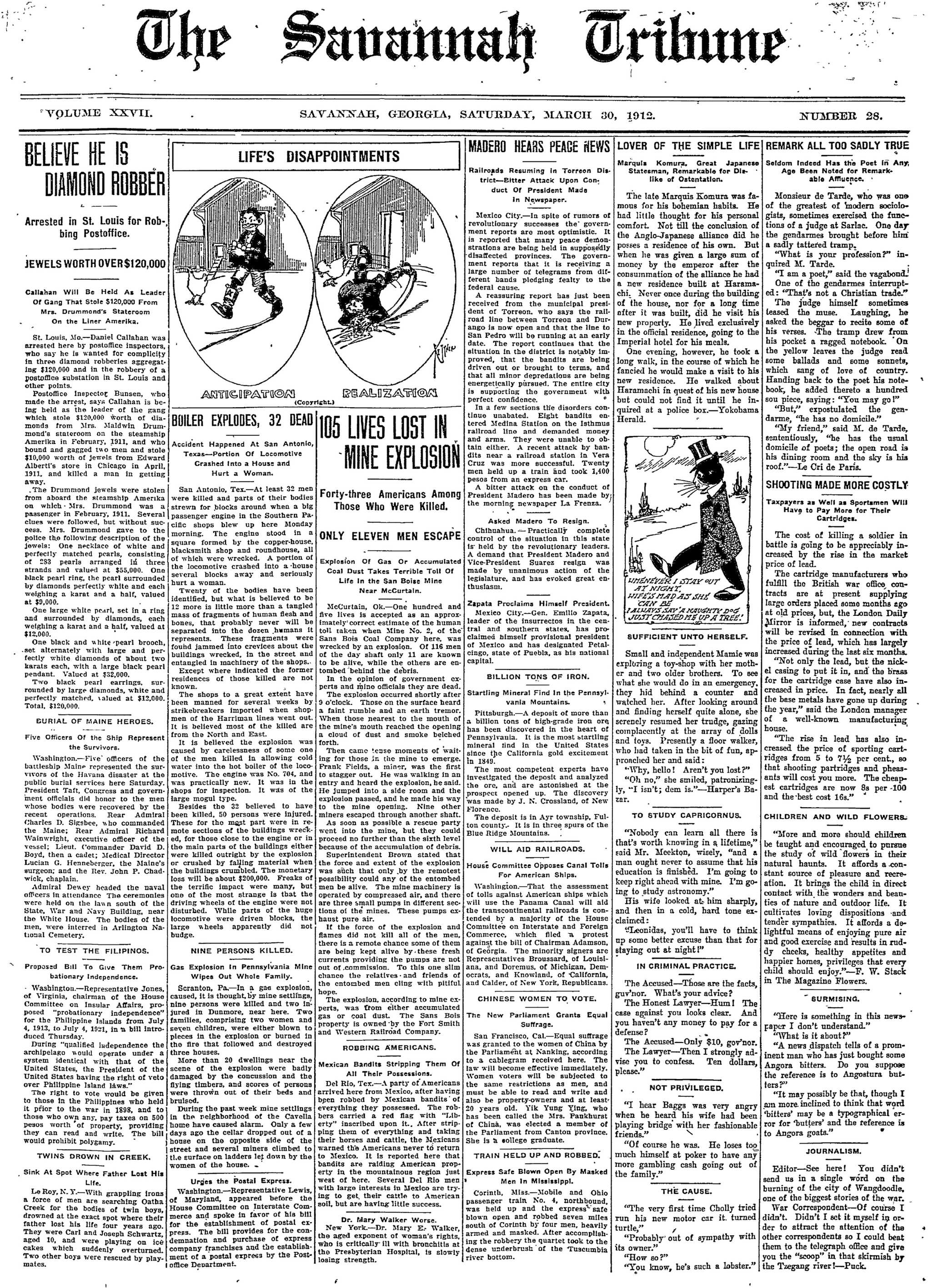
LIFE'S DISAPPOINTMENTS
ANTICIPATION
REALIZATION
BOILER EXPLODES, 32 DEAD
Accident Happened At San Antonio, Texas—Portion Of Locomotive Crashed Into a House and Hurt a Woman.
San Antonio, Tex.-At least 32 men were killed and parts of their bodies strewn for blocks around when a big passenger engine in the Southern Pacific shops blew up here Monday morning. The engine stood in a square formed by the copper-house, blacksmith shop and roundhouse, all of which were wrecked. A portion of the locomotive crashed into a house several blocks away and seriously hurt a woman.
Twenty of the bodies have been identified, but what is believed to be 12 more is little more than a tangled mass of fragments of human flesh and bones, that probably never will be separated into the dozen humans it represents. These fragments were found jammed into crevices about the buildings wrecked, in the street and entangled in machinery of the shops.. Except where indicated the former residences of those killed are not known. The shops to a great extent have been manned for several weeks by strikebreakers imported when shopmen of the Harriman lines went out. It is believed most of the killed are from the North and East.
It is believed the explosion was caused by carelessness of some one of the men killed in allowing cold water into the hot boiler of the locomotive. The engine was No.704, and was practically new. It was in the shops for inspection. It was of the large mogul type.
Besides the 32 believed to have been killed, 50 persons were injured. These for the most part were in remote sections of the buildings wrecked, for those close to the engine or in the main parts of the buildings either were killed outright by the explosion or crushed by falling material when the buildings crumbled. The monetary loss will be about $200,000. Freaks of the terrific impact were many, but one of the most strange is that the driving wheels of the engine were not disturbed. While parts of the huge locomotive were driven blocks, the large wheels apparently did not budge.
NINE PERSONS KILLED.
Gas Explosion In Pennsylvania Mine Wipes Out Whole Family. Scranton, Pa.—In a gas explosion, caused, it is thought, by mine settlings, nine persons were killed and two injured in Dunmore, near here. Two families, comprising two women and seven children, were either blown to pieces in the explosion or burned in the fire that followed and destroyed three houses. More than 20 dwellings near the scene of the explosion were badly damaged by the concussion and the flying timbers, and scores of persons were thrown out of their beds and bruised.
During the past week mine settlings in the neighborhood of the Cavella home have caused alarm. Only a few days ago the cellar dropped out of a house on the opposite side of the street and several miners climbed to the surface on ladders let down by the women of the house.
Urges the Postal Express.
Washington.—Representative Lewis, of Maryland, appeared before the House Committee on Interstate Commerce and spoke in favor of his bill for the establishment of postal express. The bill provides for the condemnation and purchase of express company franchises and the establishment of a postal express by the Post-office Department.
SAVANNAH, GEORGIA, SATURDAY, MARCH 30, 1912.
105 LIVES LOST IN MINE EXPLOSION
Forty-three Americans Among Those Who Were Killed.
ONLY ELEVEN MEN ESCAPE
Explosion Of Gas Or Accumulated Coal Dust Takes Terrible Toll Of Life In the San Boise Mine Near McCurtain.
McCurtain, Ok.—One hundred and five lives is accepted as an approximately correct estimate of the human toll taken when Mine No. 2, of the Sans Bois Coal Company here, was wrecked by an explosion. Of 116 men of the day shaft only 11 are known to be alive, while the others are entombed behind the debris.
In the opinion of government experts and mine officials they are dead. The explosion occurred shortly after 9 o'clock. Those on the surface heard a faint rumble and an earth tremor. When those nearest to the mouth of the mine's mouth reached the opening a cloud of dust and smoke belched forth. Then came tense moments of waiting for those in the mine to emerge. Frank Fields, a miner, was the first to stagger out. He was walking in an entry and heard the explosion, he said. He jumped into a side room and the explosion passed, and he made his way to the mine opening. Nine other miners escaped through another shaft. As soon as possible a rescue party went into the mine, but they could proceed no further than the sixth level because of the accumulation of debris.
Superintendent Brown stated that the force and extent of the explosion was such that only by the remotest possibility could any of the entombed men be alive. The mine machinery is operated by compressed air, and there are three small pumps in different sections of the mines. These pumps exhaust pure air.
If the force of the explosion and flames did not kill all of the men, there is a remote chance some of them are being kept alive by these fresh currents providing the pumps are not out of commission. To this one slim chance the relatives and friends of the entombed men cling with pitiful hope.
The explosion, according to mine experts, was from either accumulated gas or coal dust. The Sans Bois property is owned by the Fort Smith and Western Railroad Company.
ROBBING AMERICANS.
Mexican Bandits Stripping Them Of All Their Possessions. Del Rio, Tex.—A party of Americans arrived here from Mexico, after having been robbed by Mexican bandits of everything they possessed. The robbers carried a red flag with "Liberty" inscribed upon it. After stripping them of everything and taking their horses and cattle, the Mexicans warned the Americans never to return to Mexico. It is reported here that bandits are raiding American property in the mountainous region just west of here. Several Del Rio men with large interests in Mexico are trying to get, their cattle to American soil, but are having little success.
Dr. Mary Walker Worse
New York—Dr. Mary E. Walker, the aged exponent of woman's rights, who is critically ill with bronchitis at the Preabysterian Hospital, is slowly losing strength.
MADERO HEARS PEAGE NEWS
Railroads Resuming In Torreon District—Bitter Attack Upon Conduct Of President Made In Newspaper.
Mexico City.—In spite of rumors of revolutionary successes the government reports are most optimistic. It is reported that many peace demonstrations are being held in supposedly disaffected provinces. The government reports that it is receiving a large number of telegrams from different bands pledging fealty to the federal cause.
A reassuring report has just been received from the municipal president of Torreon, who says the railroad line between Torreon and Durango is now open and that the line to San Pedro will be running at an early date. The report continues that the situation in the district is notably improved, that the bandits are being driven out or brought to terms, and that all minor depredations are being energetically pursued. The entire city is supporting the government with perfect confidence.
In a few sections the disorders continue unabated. Eight bandits entered Medina Station on the Isthmus railroad line and demanded money and arms. They were unable to obtain either. A recent attack by bandits near a railroad station in Vera Cruz was more successful. Twenty men held up a train and took 1,400 pesos from an express car. A bitter attack on the conduct of President Madero has been made by the morning newspaper La Frenza.
Asked Madero To Resign.
Chihuahua. — Practically complete control of the situation in this state is held by the revolutionary leaders. A demand that President Madero and Vice-President Suarez resign was made by unanimous action of the legislature, and has evoked great enthusiasm.
Zapata Proclaims Himself President. Mexico City.—Gen. Emilio Zapata, leader of the insurrectos in the central and southern states, has proclaimed himself provisional president of Mexico and has designated Petalcingo, state of Puebla, as his national capital.
BILLION TONS OF IRON.
Startling Mineral Find In the Pennsylvania Mountains.
Pittsburgh.—A deposit of more than a billion tons of high-grade iron ore has been discovered in the heart of Pennsylvania. It is the most startling mineral find in the United States since the California gold excitement in 1849.
The most competent experts have investigated the deposit and analyzed the ore, and are astonished at the prospect opened up. The discovery was made by J. N. Crossland, of New Florence.
The deposit is in Ayr township, Fulton county. It is in three spurs of the Blue Ridge Mountains.
WILL AID RAILROADS.
House Committee Opposes Canal Tolls For American Ships.
Washington.—That the assessment of tolls against American ships which will use the Panama Canal will aid the transcontinental railroads is contended by a majority of the House Committee on Interstate and Foreign Commerce, which filed a protest against the bill of Chairman Adamson, of Georgia. The minority signers are Representatives Broussard, of Louisiana, and Doremus, of Michigan, Democrats, and Knowland, of California, and Calder, of New York, Republicans.
CHINESE WOMEN TO VOTE.
The New Parliament Grants Equal Suffrage.
San Francisco, Cal.—Equal suffrage was granted to the women of China by the Parliament at Nanking, according to a cablegram received here. The law will become effective immediately. Women voters will be subjected to the same restrictions as men, and must be able to read and write and also property-owners and at least 20 years old. Yik Yung Ying, who has been called the Mrs. Pankhurst of China, was elected a member of the Parliament from Canton province. She is a college graduate.
TRAIN HELD UP AND ROBBED
Express Safe Blown Open By Masked Men In Mislaslappl.
Corinth, Miss.—Mobile and Ohio passenger train No. 4, northbound, was held up and the express safe blown open and robbed seven miles south of Corinth by four men, heavily armed and masked. After accomplishing the robbery the quartet took to the dense underbrush of the Tuscumbia river bottom.
Marquis Komura, Great Japanese Statesman, Remarkable for Dislike of Ostentation.
The late Marquis Komura was famous for his bohemian habits. He had little thought for his personal comfort. Not till the conclusion of the Anglo-Japanese alliance did he possess a residence of his own. But when he was given a large sum of money by the emperor after the consummation of the alliance he had a new residence built at Haramachi. Never once during the building of the house, nor for a long time after it was built, did he visit his new property. He lived exclusively in the official residence, going to the Imperial hotel for his meals.
One evening, however, he took a long walk, in the course of which he fancied he would make a visit to his new residence. He walked about Haramachi in quest of his new house but could not find it until he inquired at a police box.—Yokohama Herald.
WHENEVER I STAY OUT
AT NIGHT,
HIEF'S MAD AS SHE
CAN BE
I ALWAYS SAY A NAVGHTY DOG
JUST CHASED ME UP A TREE!
SUFFICIENT UNTO HERSELF.
Small and independent Mamie was exploring a toy-shop with her mother and two older brothers. To see what she would do in an emergency, they hid behind a counter and watched her. After looking around and finding herself quite alone, she serenely resumed her trudge, gazing complacently at the array of dolls and toys. Presently a floor walker, who had taken in the bit of fun, approached her and said:
"Why, hello! Aren't you lost?"
"Oh no," she smiled, patronizingly, "I isn't; dem is."—Harper's Bazar.
TO STUDY CAPRICORNUS.
"Nobody can learn all there is that's worth knowing in a lifetime," said Mr. Meekton, wisely, "and a man ought never to assume that his education is finished. I'm going to keep right ahead with mine. I'm going to study astronomy."
His wife looked at him sharply, and then in a cold, hard tone exclaimed:
"Leonidas, you'll have to think up some better excuse than that for staying out at night!"
IN CRIMINAL PRACTICE
The Accused—Those are the facts, guv'nor. What's your advice?
The Honest Lawyer—Hum! The case against you looks clear. And you haven't any money to pay for a defense?
The Accused—Only $10, guv'nor.
The Lawyer—Then I strongly advise you to confess. Ten dollars, please."
"I hear Baggs was very angry when he heard his wife had been playing bridge with her fashionable friends."
"Of course he was. He loses too much himself at poker to have any more gambling cash going out of the family."
THE CAUSE.
"The very first time Cholly tried run his new motor car it. turned turtle."
"Probably out of sympathy with its owner."
"How so?"
"You know, he's such a lobster."
.
NUMBER 28.
REMARK ALL TOO SADLY TRUE
Seldom Indeed Has the Poet in Any Age Been Noted for Remarkable Affluence.
Monsieur de Tarde, who was one of the greatest of modern sociologists, sometimes exercised the functions of a judge at Sarlac. One day the gendarmes brought before him a sadly tattered trump.
"What is your profession?" inquired M. Tarde.
"I am a poet," said the vagabond. One of the gendarmes interrupted: "That's not a Christian trade."
One of the gentlemen interrupted: "That's not a Christian trade." The judge himself sometimes teased the muse. Laughing, he asked the beggar to recite some of his verses. The tramp drew from his pocket a ragged notebook. 'On the yellow leaves the judge read some ballads and some sonnets, which sang of love of country. Handing back to the poet his notebook, he added thereto a hundred sou piece, saying: "You may go!"
"But," expostulated the gendarme, "he has no domicile." "My friend," said M. de Tarde, sententiously, "he has the usual domicile of poets; the open road is his dining room and the sky is his roof."—Le Cri de Paris.
SHOOTING MADE MORE COSTLY
Taxpayers as Well as Sportsmen Will Have to Pay More for Their Cartridges.
The cost of killing a soldier in battle is going to be appreciably increased by the rise in the market price of lead.
The cartridge manufacturers who fulfill the British war office contracts are at present supplying large orders placed some months ago at old prices, but, the London Daily Mirror is informed, new contracts will be revised in connection with the price of lead, which has largely increased during the last six months.
"Not only the lead, but the nickel casing to put it in, and the brass for the cartridge case have also increased in price. In fact, nearly all the base metals have gone up during the year," said the London manager of a well-known manufacturing house.
"The rise in lead has also increased the price of sporting cartridges from 5 to $7 \frac{1}{2}$ per cent, so that shooting partridges and pheasants will cost you more. The cheapest cartridges are now 8s per -100 and the best cost 16s."
CHILDREN AND WILD FLOWER&
"More and more should children be taught and encouraged to pursue the study of wild flowers in their natural haunts. It affords a constant source of pleasure and recreation. It brings the child in direct contact with the wonders and beauties of nature and outdoor life. It cultivates loving dispositions and tender sympathies. It affords a delightful means of enjoying pure air and good exercise and results in ruddy cheeks, healthy appetites and happier homes, privileges that every child should enjoy."—F. W. Stack in The Magazine Flowers.
SURMISING.
"Here is something in this newspaper I don't understand."
"What is it about?"
"A news dispatch tells of a prominent man who has just bought some Angora bitters. Do you suppose the reference is to Angostura butters?"
"It may possibly be that, though I am more inclined to think that word 'bitters' may be a typographical error for 'butters' and the reference is to Angora goats."
JOURNALISM.
Editor—See here! You didn't send us in a single word on the burning of the city of Wangdoodle, one of the biggest stories of the war. War Correspondent—Of course I didn't. Didn't I set it myself in order to attract the attention of the other correspondents so I could beat them to the telegraph office and give you the "scoop" in that skirmish by the Tzegang river!—Puck.
It is better to use a straw stack for animal bedding than to allow the straw to rot in the field.
Stay off the fields when the soil is wet and soft. Hauling and pasturing should be done only when the soil is dry or frozen.
A split fence post will last longer than a round one. Cut and season fence posts ahead of the time of fence building, as seasoned posts will resist decay longer than green set posts.
Several pasture fields into which the animals can be shifted from time to time are better than one large pasture. Change of pasture is good for all animals.
The tighter woven wire is stretched the fewer posts will be needed. The corner posts must be extra heavy and well anchored for the fence to remain rigid and serviceable. The efficiency of any woven wire fence depends upon tight stretching to immovable posts.
A good roof on a building for sheltering feeds is figuratively worth its weight in gold and literally worth the price of all it costs to buy and lay, and more.
A well or clistern under the barn shed or even in the barn is a great convenience and a saving of time in watering the animals, especially the work teams. It is as handy to have water in the barn as it is to have water in the house.
Do not allow the cows' teats to be wet while she is being milked. Wetting the teats is unsanitary and causes them to chap. A little vaseline may be used on the teats without harm and sometimes with great benefit.
GRASS BAD FOR TREES.
At the Woburn experimental fruit farm a long inquiry has been conducted into the effect of grass on trees, and the experiments which have been carried out form the substance of the thirteenth report of the farm, which has just been issued. It has been shown, says the London Dally Mall, that the general result of grassing the ground, either by sowing seed or replacing the turf after the trees have been planted, is the arrestation of all healthy growth and the absolute stunting of the tree. A light and unhealthy character imparted to the leaves is one of the first noticeable results of the action of grass upon trees. With trees that age feeling the full effect of grass the fruits are found to be small and ill developed.
The variations in soil temperature are less when the ground is grassed, and this alone would be favorable to the growth of trees; but this good influence is outwelghed by the deleterious effects.
PORTABLE HOG HOUSES.
The farmer who builds portable hog houses will find his work lessened considerably. He will not have to spend several hours out of doors in the coldest part of the winter cleaning out the house that has become unsanitary, but can move the house itself in a few moments.
Portable houses should be built to accommodate five or six hogs and from ten to fifteen shoats. If they are larger than this it will be too heavy to move easily.
Two weeks before farrowing, sows should be placed in individual houses. Pens 6x8 feet will do for the sows. The A-shaped house will be found a good one, and also simple in construction.
An additional advantage of the portable house is that the renter can afford to build them at his own expense, since he may take them away with him, if he moves. Bright winter days are the best time to build hog shelters, as many farmers have little else to do on these days. The exercise of the carpenter work will keep the worker warm enough.
WHAT THE SILO DOES.
Prof. Grout of the Minnesota College of Agriculture figures out the increased value and efficiency of the silo as follows:
The silo practically increases the producing capacity of the farm at least 10 per cent, and often more. A 160-acre farm with a silo will produce as much revenue as one of the 180 acres without. Therefore, the first cost of a silo—like that of a dwelling house, a barn or a team—should be considered part of the initial investment; and, if one's capital is limited, it is better to buy a farm smaller by 10 per cent, rather than dispense with a silo. The producing value of a silo on $50 land would be equal to that of twenty acres added to the 160-acre farm, or $1,000; on $100 land, it would be $2,000. This is a low estimate; for the stock-carrying capacity of the farm will often be increased fully 25 per cent, by the adding of a silo. As compared with its producing value, the cost of constructing a silo is small. Round wooden silos cost from $1.50 to $3 per ton of capacity; those of stone, brick or cement, from $2 to $4. It has been shown by actual experiment in Minnesota that—working co-operatively in the purchase of materials, etc.—a number of farmers in a locality may erect on each of their farms a stave silo, of 140 to 150 tons capacity, for about $275.
BUSINESS: THE WORK OF NEGRO BUSINESS LEAGUES
W. R. PETTIFORD, PRESIDENT ALABAMA - PENNY SAVINGS BANK, BIRMINGHAM, ALABAMA.
(Reprinted from "Sparks," Birmingham.)
It is to be regretted that we do not have live, active, regular meetings in the local leagues throughout the country, and yet it is true to say that our leagues live at a dying rate. We are forced to the conclusion that there isn't but one good reason why we do not have regular, monthly well-attended meetings of the league, and that is, we do not understand its real purpose. Now let us see.
In the first place, the purpose of the league is to educate ourselves in the best business methods. In our league meeting we should have intelligent discussions of the best methods of buying and selling our products of our goods because no man can succeed well in business unless he knows how to buy goods to suit his customers, as well as to buy them at such a price as to sell them at a profit. This requires a great deal of information concerning the methods of the wholesale houses and jobbers, as well as to be a master of the quality of goods offered for sale.
It is an easy matter to purchase a lot of goods and have them be refused by your customers because of the quality as well as the price in contrast with the goods offered by others. It takes a great deal of thought and study and natural adaptation to sell our goods when they class up with others both in quality and price. In many cases the purchaser relies largely on the description and recommendation of the goods by the seller, and if he is not equal to the case his goods are often left in his store regardless of their merit and price. But is should be remembered by all the people who are offering goods for sale that the league is a schoolroom where they are to obtain all of this information by private study and public discussion, and the sooner our business men will learn that this part of their work is as important as getting a stock of goods and offering them for sale, the sooner they will reach a point in business where they will be profitable to themselves and their community.
Another important matter in the success of the business is the way the stock of the goods should be kept. A person may have a large stock of well selected, high-class goods, but if they are not attractively kept in clean places the sale will be poor. And this part of the work furnishes employment for intelligent and interested clerks all of the time, because it is often that when an article is properly adjusted on the shelves it greatly aids the clerks in its sale.
We also can be much profited by discussing the various difficulties in successful collections. For after a party has succeeded in all of his work up to this point, if he fails to know how to collect his bills and not offend his customers, he is still in danger of going out of business. And how profitable would a discussion of this kind be among a large number at the league who have a varied experience in this part of the work. In the National Negro Business league they have the intelligence to give correct instruction on these points, but not the time to go into details of this kind.
If there is one thing more important in the work of the league than another I would say that it is the education of public sentiment to the point where the mass of the people, as well as the leaders, would not only see that it is helpful to race elevation for them to give their trade to negro business men and women, but also to the point where they will be asshamed and chagrin when it is learned that they are not doing it. Public sentiment is a great judge, which stands behind the people, so to speak, and executes its laws. I went into a bank recently where there was a colored woman preparing to make a deposit, but when she saw me enter the door she turned her back on me to keep me from seeing her pass book in her hand. She was ashamed for me to know that she was depositing in a bank other than that of negroes. This is the way the mass of white people feel about depositing money in negro banks, and this is the point to which we must educate our people. The reason this education is necessary is that the aggregation of the money owned by the negroes is necessary. Being excluded from assimilation in business on the base of merit, we have got to build a business peculiar to ourselves for its employment and its profit.
A BUSHING BUSINESS.
Recently a well known partner of a brokerage house was seen rushing wildly downstairs in a Broad street skyscraper. A friend stopped him and asked the cause of the hurry. "Why, an old client of mine stepped in to see me for a moment and the fool office boy did not tell him I was in an inside office and he left saying he was going to be shaved, so I am following him up."
Later the broker was again met by his friend, who called out genially: "Did you find your customer in the barber's?"
"Yes, old man, and he gave me a ten-share order in New York Central," was the triumphant reply.
The friend said nothing, but thought all the more, for had not the same broker refused to carry "a mere 50 shares of Union Pacific" for him in 1906 on the plea that the firm did not care for "odd lots?"—Wall Street Journal.
MONEY IN THE BANK
Have you ever stopped to consider what it means to have money in the bank? While most of us have known that such things as savings banks have been in daily operation many years, it is surprising to note that comparatively few people really know anything about the saving bank plan or what it means.
This has reference more particularly to that class of our people who are wage-earners' and who have not adopted the method of carrying on their business through banks. They seem to think that the amount of money they handle is too small to bother with a bank-account, and that on account of its smallness the banks will not give them the same consideration that is given to a man with a large account. That is an erroneous notion, however.
Only in a general sort of a way do the great majority of our wage-earners realize that it is a good thing "to have money in a bank." The fact that this or that man can pay his bill with a check, always inspires confidence. People say of such a man, "He has money in the bank."
No matter how small one's earnings may be, it is a good plan to adopt banking methods. It enables you to tell exactly what you spend your money for. In many transactions, it is both a record and a receipt.
Mr. Workingman, Mr. Wage-earner, do you realize that you can have money in the bank without any material effort at saving on your part? Suppose you save your dimes—just the 10-cent pieces you get when change is made in your daily purchases, or payment of bills. You scarcely ever miss a dime when you spend it. It is a small and elusive coin that slips away from you before you know it.
Suppose one puts at least a dime away—puts it in a savings bank, in a year's time these dimes will amount to $36.50. Once in a while one may have more than one dime to spare in a day, and it should go to the savings bank account, also.
With anything like thrift one can save more than $75 a year in dimes alone.
If there is not a bank of our own in your town, or nearby town, put it in the other man's savings bank, where you may get interest on your deposit just the same.
Think it over, reader, and if you haven't a bank account already, start one as soon as possible, and see if you cannot save more than one hundred dollars worth of dimes before the year is ended. The ease with which it can be done will, doubtless, surprise you, if you go at it in earnest.
You will ever afterwards, also be thankful for the suggestion that caused you to become interested.
NEGROES SELL COLD STORAGE EGGS AT A PROFIT
NEGROES SELL COLD STORAGE EGGS AT A PROFIT
Who said the negro wasn't a shrewd trader? It is generally understood that when a negro goes in for a trade with a white man he comes out worsted. But there are a number of Montgomery county negroes who are making a new record for their race.
Montgomery people eat a good many cold storage eggs that are shipped into town from other places, but being good judges of what is fit to eat they also like good country; eggs, or "yard algs." They don't mind paying from 35 to 40 cents a dozen for these eggs so long as they know them to be fresh and genuine, and, so long too, as eggs will persist in remaining that high.
But who likes to buy fresh country eggs and learn later that many of them are cold storage eggs?
Well, whether Montgomery people like it or not, they have been doing it—or some of them have, rather.
Some of the Montgomery county negroes from the country were sharp enough to buy a supply of cold storage eggs in this city at 20 and 25 cents a dozen, mix them with a few fresh eggs and sell the lot as fresh country, eggs at 35 and 40 cents.—Montgomery Dally Advertiser.
DUTCH APRONS.
No longer does the white apron of transparent materials, trimmed with frivolous ribbons and many lace frills, reign supreme as a skirt protector at chafing dish parties. For the nounce the Dutch apron is in possession of the field and every girl who cannot afford one of the imported specimens made of dark blue, green, yellow or red sateen, with a printed border in a contrasting dull hue, that is half the depth of the entire accessory, does the next best thing and makes her apron of whatever material she has at hand.
The border, printed Holland sateen, is about 24 inches wide, and has the decoration along edge, and shirring it three times across, thus forming a half-inch frill and two half-inch deep puffs against the front of the waist.
But materials other than the imported Holland sateen are used and many girls prefer the transparent tabliers of dark-hued chiffon or mousseline de sole with a wide printed border, while other apron makers are applying the borders of foulards to plain-colored surah or china silks.
The main thing is to have the foundation of the apron—never longer than 70 inches when finished—of a dark and dull shade and the border of a decided pattern and an entirely different color.
ENTIRE COUNTRY REJOIGES OVER DESERVED PROMOTION OF EMMETT J. SCOTT ELECTED SECRETARY OF TUSKEGEE INSTITUTE.
Washington, D. C.—There is general rejoicing throughout the country over the action of the board of trustees of Tuskegee Institute in electing that faithful and experienced worker, Mr. Emmett J. Scott, as secretary of the school, in the upbuilding of which he has had so large a part. The place was created especially for him, and is a fitting recognition of his eminent and helpful services to the institution covering a period of 15 years.
The honor came wholly unsolicited, as far as Mr. Scott is concerned, and was, therefore, a complete surprise to him. Although he accepts the rare compliment paid him by the heads of the school, it is understood that in assuming the new dignity he will not consent to any suggestion that the relations he has long sustained as Dr. Washington's secretary shall be terminated. Consequently, it has been arranged that Mr. Scott shall continue to serve the principal in the same capacity as of yore, in addition to his duties as secretary to the school.
Mr. Scott is a native of Houston, Texas, and is a leader in the field of journalism, as well as in the arena of education. He won his spurs on the Houston Dally Post, and with C. N. Love founded the Texas Freeman, the higher voice of the great southwest. He is now editor of the Tuskegee Student, a paper of wide circulation and vast influence in educational circles, and has just launched the Business League Herald, as the spokesman of the National Negro Business League, of which he is corresponding secretary. Mr. Scott has declined several flattering offers to go into the federal service, but was induced by President Taft to accept a place on the United States commission to adjust the difficulties of the Liberian republic, and had the distinction of being the first colored man appointed by Mr. Taft after his inauguration in 1909. On this commission, in company with military and civil officers of high rank, Mr. Scott acquitted himself with marked credit, and is conceded to have been the foremost member of that unique body.
It is felt by Mr. Scott's host of friends that in his enlarged sphere of activity, Mr. Scott will prove to be an even more potent factor than ever in the forward movements and extension work of the famous Tuskegee Institute. He is in receipt of a heavy mall, bearing congratulations.
BEAUTIES AMONG DESPISED RAGES
CAHETS OF FRANCE AND RODIYAS OF CEYLON RENOWNED FOR GOOD LOOKS.
Paris.—I or the first time in many, many years a German book, Hans Heinz Ewers' "India," set all France talking. The great traveler makes the extraordinary statement that the most beautiful women in France and Ceylon come of a race formerly regarded as political and social pariahs. The English have abolished the pariah taint in Ceylon, and the first French revolution removed it from the Cahets or Cagotes in France, who, though Christians, were obliged to enter church by a special door, had their own holy water fonts, etc., up to the downfall of French royalty.
The Cahets live now in the landscapes of Gascogne, Gyuene, Bearn, Brittany and Malne. Their origin is unknown, but the name indicates that they may be descendants of the Goths, Cahet being a contraction of canis goticus—Goth-dog. For more than a thousand years the rest of France treated them as outcasts, and they are still so regarded socially in many of the rural districts. They are easily recognized by the missing ear-lob, a characterization likewise found in many Parisians. Maybe in olden times many stray Cahets, wishing to escape prosecution at home, emigrated to the great town.
It is a fact, though, that nearly all the great women beauties of France were and are Cahets, which, says the author, strangely coincides with the other fact that the Rodiyas of Ceylon, until the arrival of the English regarded as outcasts, both politically and socially, produce the most beautiful women, not only in Ceylon, but in all India.
"In this connection," says the author, "I observed that in the land of castes, the darker the skin, the lower the social order.
"This holds good in all India, yet the Rodiyas are much lighter in color than the majority of their contemporaries, and not only the women, the men, too, are far better looking than their contemporaries. Their features are of a noble cut and their legs are much better developed.
"Their better physical condition is due to the fact that up to the English protectorate the superior castes of India gave their unfaithful women and their unchaste daughters to the Rodiyas as the most horrible of punishments. In this way the despised race received a goodly admixture of the best blood of India, many queens, sultanas and princesses being condemned to marry Rodiyas."
Just in proportion as you advertise your business, and our columns are open for you to begin at once. Sup-
Advertise
Take a Policy With The Pilgrim Health and Life Insurance Co.
Pays:from $1 to $10 weekly sick and
accident benefits and from $10 to $100
death benefits. Our Motto: "Promptness,
Honesty and Justice."
Home Office:
$143 Gwinnett St. Augusta, Ga.
For further information write 509
West Broad St, Savannah, Ga.
J. S. Perry, Supt.
A. B. Singfield, Gen. Supt.
C. T. Walker, D. D., LL. D.
Director and General Lecturer.
GO TO—
Young Bros.
For your
TOBAOCO, CIGARS and FRUITS
Of all kinds.
509 West Broad Street.
Publishers and Manufacturers' Prices
Laberal Discounts Will Be Arranged.
The Sunday School Lesson
Golden Text.—"The people which sat in darkness saw great light, and to them which sat in the region and shadow of death, light is sprung up." Matt. 4:18.
<The lessons of the quarter extend over a period of about 34 years, from B. C. 6 to A. D. 28. They are all concerning Jesus, part with the preparation for his coming, and part with him as he actually came and lived among men.
Lesson I.—Gives us the announcement of the birth of his forerunner.
Lesson II.—Tells us of the birth of the forerunner, and the prophecles connected with his birth.
Lesson III.—Sets before us the birth of Jesus himself.
Lesson IV.—Tells of his presentation in the temple and his reception by Simeon and Anna.
Lesson V—Tells of the wise men who traveled far that they might see and worship him.
Lesson VI—Tells us all that we know of his boyhood.
Lesson VII.—Tells us how John the Baptist prepared the way for him.
Lesson VIII.—Tells us of his preparation for his work by his baptism and temptation.
Lesson IX.—Describes how he called his first disciples.
Lesson X.—Presents him as the great healer.
Lesson XI.—Sets him before us as the one who has power on earth to forgive sins.
Lesson XII.—Shows us Jesus in social life.
Details are found in the pending notes under each lesson.
HE KNEW HIS MAN.
"I dined with Henry James, the American novelist," said a magazine editor, "at his London club, the Athaneneum. Over the dessert I reproached James for the dreadful way he roasts the morals and manners of our millionaires in 'The Jolly Corner.' James said they deserved roasting—and to prove it he told me a story.
"He said a New York muni-millionaire got converted one night at a revival meeting, and, standing up in his place, the rich convert declared that his conversion was retroactive, and he proposed to make restitution to anyone he had ever wronged.
"Well, about two o'clock in the morning the millionaire was awakened by a long ring at the bell. He put his head out of the window.
"I am Thomas J. Griggs,' was the reply. I heard about your conversion and I'd like you to pay me back that $200,000 you cheated me out of in the U. B. D. receivership.'
"All right, I'll pay you,' said the millionaire. 'But why the deuce,' he added angrily, 'do you want to ring me up at this hour?"
"Well, you see,' was the reply, "I thought I'd come early and avoid the rush."—Philadelphia Record.
A NEW-FANGLED MULE.
Secretary MacVeagh at a dinner in Washington was urging the need of scientific laws.
"But let us make these laws scientifically," he said. "We must let in the light. We must work in the light. If we work in the dark, you will go wrong—like young Cornellus Husk.
"Cornellus Husk, was called one winter morning before dawn and told to go and harness the mule to the dearborn.
"The lad was too lazy to light a lantern, and in the dark he didn't notice that one of the cows was in the stable with the mule.
"As he tried to harness the cow his father, impatient at the long delay, shouted from the house:
"Corney, Corney. What ye doin?"
"I can't get the collar over the mule's head, the boy replied. 'His ears are frozen.'—Washington Star.
NO USE FOR THE RECALL.
At the dedication of the new Elk club house at Canon City Justice Balley of the supreme court was talking about the recall. He said some people felt about it the way that old Jeff White did when he was asked if he favored it.
"'Cledly no, sah,'" replied Jeff. "I'm ag'ln' it from every point of view. It got me 60 days las' time I was up afore Judge Walker for drinkin' too much gin.
"Jeff,' sald de judge, 'have you even been afore me befo?'"
"No, sah,' I answered.
"De jedge hes'tated a minute, then looked up at me and sald:
"'Jeft, I recall you very well.'
"Dat recall wot me 60 days, an' I'll vote aga'in' it early and often."—Denver Times.
WILLIE WAS SENTIMENTAL.
Willie was sent out by his mother to the wood shed to saw and split some stove wood out of a pile of old railroad ties. Going outdoors shortly after, she found the youth sitting on the sawhorse with his head bowed down in his hands. She asked her hopeful why he didn't keep at his work. "My dear mother," he replied with much feeling. "I find it so hard, so very hard, to sever old ties."—Lippincott's Magazine.
Your Money Pile Grows
pose you give us a trial.
in this paper
The Oldest, Strongest and Most Reliable Company in the State. Gives employment to hundreds of men and women of our race.
GO TO
WEST SIDE RESTAURANT
461 West Broad Street,
Near Union Station.
The place to get first-class meals
Everything neat and clean. Meals
prepared in an appetizing manner
and at all hours daily.
Meals 16 and 25 cents.
MRS A. S. EGOTT. Propretresa
McFALL'S
Ice Cream Parlor
Ice Cream and Sherbets in large and small quantities. Special prices to Churches and Societies. Also Hot and Cold Lunches. Fish Suppers prepared to order. Phone 4038. Orders very Promptly filled. : : : : : 15 East Broad St., Savannah, Ga.
Masonic Books and Regalias
LODGE SEALS,
FINANCIAL CARDS and -
BLANKS of every description.
SOL G. JOHNSON,
Savannah, Ga.
See COOPER & ODRIZEN The Up-to-Date Tailors
218 WEST BROAD STREET, BETWEEN HULL AND OGLETHORPE AVE. The Latest Patterns in SPRING AND SUMMER GOODS. Firstclass workmanship guaranteed. Our prices will interest you.
DO YOU WANT
A HOME?
WE HAVE TWELVE LOTS ON THIRTY-NINTH STREET, BETWEEN BURROUGHS AND FLORENCE, UPON WHICH WE WILL BUILD HOMES FOR ANY ONE DESIRING THEM. THE KIND OF HOUSE YOU WANT WILL BE BUILT FOR YOU, AND YOU CAN PAY US FOR IT IN E A S Y MONTHLY PAYMENTS. COME AND SEE US ABOUT THIS PROPOSITION.
SHOES
Nichols, THE SHOE MAN
The affable H. B. Wright is still with us and expects the continuous patronage of his friends.
Johnson Undertaking Establishment
COMBINED WITH
The Royall Undertaking Company (Incorporated.)
Residence Phone 2032. Livery Stable Attached. Office Phone 676. C. H. ROYALL, Residence 509 Charles St. Phone 3064.
234 ST. JULIAN ST., WEST, 235 BR YAN ST., WEST. Phone 2963
SAVANNAH; GEORGIA
Palm Shaving Palace
Expert Hair Cutting, Electric Massage and Shampooing a Specialty. All Work Done by Experienced Workmen. Courteous attention to all SHINING PARLOR ATTACHED.
PERRY R. WRIGHT, Proprietor
517 WEST BROAD ST., SAVANNAH, QA.
Two suits cleaned and pressed per month for $1.00. Ladies' work a specialty. Goods called for and de-livered. All work guaranteed. Steam and dry cleaning. $16 EAST BROAD STREET. Phone 3940.
THOMAS BAKER.
First class SHOE REPAIRING. Half sole, sewed, 85 cents; nalled, 60 cents; rubber heels, 35 and 50 cents. All work guaranteed. CORNER EAST BROAD AND BOLTON STREETS.
Don't Buy a New One
Save the old ones and send to us. We make them new—Stoves, Furniture, Mattresses, Carpets. CARPET AND MATTING LAYING A SPECIALTY. Old furniture bought and sold. Packing and Shipping. Goods called for and delivered.
JACKSON & SLOCUM, Upholsterers
The Beautiful Woodlawn Park New Improvements; More Lights; New Buildings The Ideal Picnic Spot of Savannah SECURE YOUR DATES EARLY.
30 DRAYTON STREET.
PHONE 244.
Get the habit of saving a part of your Earnings each week.
$1.00
Starts an
Account
THE WAGE.
EARNERS' LOAN
AND INVESTMENT
COMPANY,
468 WESTBROAD ST.
Savannah, Ga.
Variety Bakery
Goods delivered promptly to any part of the city.
506 West Broad St., Near Gaston.
Phone 1869-J
Teacher Of INSTRUMENTAL INSTRUMENTS
541 CHARLTON STREET, EAST.
BROWN'S STAG LODGING HOUSE
Furnished rooms by week or month. Hot and cold baths. Electric lights. In center of city. Street car, hack and automobile convenient.
CALL AT 217 EAST BROAD ST.
or phone 3746—I. C. Brown, Prop...
GROCERIES AND CONFECTIONERY
—Call On—
M. G. GRAHAM
626 York St., West.
Courteous Attention to All.
MADAME FLORENGE E. WILLIAMS
Graduate Prof. Roher's School,
New York.
Hairdressing Parlor
521 Gaston Street, East.
Telephone 2328
Wigs, Switches and Pompadours
Made from Natural Hair.
Combings Made Up. Shampooing and
Hair Straightening a Specialty.
Face and Electric Massage. Dyeing
and Matching Hair.
ORIENTAL HAIR GROWER
An excellent preparation, will produce a beautiful growth of hair. Directions on each box: For sale, prices
25 cents per box.
AGENTS WANTED
For the Sale of
Magic Shaving Powder
It gives a quick shave
without the use
of a
RAZOR
For Particulars, Write
THE SHAVING POWDER CO.,
Savannah, --- Georgia.
HENSEN TELLS OF TRIP TO THE POLE
Guest of Society for Historical Research In Yonkers.
ATE BOILED DOG OFTEN
MAN WHO ACCOMPANIED PEARY TO THE NORTH POLE RELATES MANY INTERESTING FACTS ABOUT THE ARCTIC REGIONS—CLIMATIC AND ASTRONOMICAL INCIDENTS OF THE VOYAGE.
Yonkers, N. Y. At a recent meeting of the Negro Society for Historical Research, with headquarters in this city, Mr. Matthew A. Hensen, who accompanied Commander Peary to the north pole, was the principal speaker. The exercises were held at Sunny Slope cottage, which is the residence of Mr. John E. Bruce, president of the organization. A special feature of the musical program was the part taken by little Miss Cecile Butler and her brother Willie, who gave several piano and violin selections with rare ability.
Mr. Hensen told of his travels and experiences in the arctic regions in a straightforward, painstaking manner, drawing here and there many striking illustrations of the difficulties and hardships encountered en route to the icy regions. He is a pleasing speaker and possesses a fund of humor. He said he felt highly honored when he was asked to speak before the Historical society, which is doing a good work in preserving for future reference the achievements of the negro race.
He had been a globe trotter for many years. Before he entered the service of Commodore Peary he made the trip to China and the orient on a sailing vessel and was out of the country for three years. On his return from this trip he went to South America, where it was so hot they had to feed the hens cracked ice to prevent them from laying hard boiled eggs. Next he entered the service of Peary and for 20 years had followed the commander's fortunes on all his trips to the north pole and shared with him the hardships which its triumphant discovery entailed.
In 1906 Hugh Lee and himself were the only men in Peary's party to volunteer to stay with him for another year, and they, with Peary, made the famous record trip across the polar ice in 33 days. In the final quest for the pole they made an average of 26 miles a day, and on reaching the pole Peary took five sets of observations to make sure he had actually got there.
He told in a humorous way how the party subsisted during this and other trips polarward. They had boiled dog for breakfast, stewed dog for dinner and cold boiled dog for supper. Sometimes they shot a musk ox and enjoyed a square meal. The Eskimos, he said, are polygamists, having as many wives as they can support. They have no religion that can be defined. They believe if a man is good he will go up into the sky after death and if bad down into the bowels of the earth.
They are a short lived people. The men rarely live to be 40 years of age. The females marry at from 12 to 14 years and at 18 or 19 look to be 30 or 40. They have a proverb which he quoted in Eskimo and translated: "The peacock may be a beautiful bird, but it takes a stork to deliver the goods."
He said the moon shone so brightly in the arctic regions that it is possible to hunt the musk ox by its refulgent light or to read or do any work ordinarily performed in the daytime. The sun at its brightest can be looked at without danger to the eyes. Its heat is not felt. For 110 days the sun never sets in the arctic regions, and for the same number of days it never rises.
Mr. Hensen was asked a number of questions by members of the society, which he answered quickly, showing that he was familiar with the geography and topography of the polar region, where he had spent, off and on, the best part of 20 years. A reception in Mr. Hensen's honor was given at the close of the program.
FIGHT FOR NEGRO BY WICKERSHAM
ATTORNEY GENERAL SAYS HE'LL QUIT BAR ASSOCIATION IF IT OUSTS LEWIS.
Washington. — Attorney General Wickersham said that he would resign from the American Bar association if that organization sustained the action of its executive committee in ousting William H. Lewis, a negro, and an assistant attorney general, from membership.
The attorney general declared that he was not fighting for the admission of a negro to the organization, but was waging a fight against the idea that the American Bar association could do a thing which he believes to be illegal.
SHY ONLY TEN YEARS.
"Weren't you shy when the judge asked you your age in court?"
"Yes, I was about ten years shy, my dear."—Life.
ART OF DRESSING WELL.
A famous designer of women's gowns was asked what she thought was the secret of being well dressed. The answer: "Knowing what to leave off."
If women digested this simple advice there would be fewer grotesque human fashion plates to rouse a laugh. Since the vogue of the tailor-made girl there are not so many caricatures in street attire. It is when she is in her festal war paint that many a woman shows ignorance.
A host at a large dance said when leaving the receiving line: "Don't women own mirrors any more? No one who saw herself first would ever be seen in some of the costumes here tonight."
It often seems to the onlooker that women must look in their glass with unseeing eyes. Otherwise they would lack courage to sally abroad.
The fat woman, for instance, cannot realize how she looks or she would prune her taste for gay colors and broken lines, big figures and shiny fabrics, huge hats and picture effects. She would know enough to avoid all but studied simplicity.
Here is a list of things to avoid:
Motor bonnets, picture hats, ultra short-skirts, girlish frocks and rakish angles for the woman of uncertain age. Such are for the young only.
Dutch colors, French necks and hard lines for the girl with the scrawny throat; never a decollete gown for the woman whose neck has shriveled with age and lack of massage.
Loud figures, crude colors, eccentric lines for a girl whose type is not ultra-refined. There are some women who can carry off the bizarre; most women, however, cease to look ladylike.
Hats to the ears or hair to the eyebrows by any one past her first flush of beauty, particularly if she is rotund of figure and square and short of face.
The garb of the stage for the drawing room belle. She may look beautiful, but she does not look smart, and runs the risk of looking what she is not.
The last freak of fashion for the girl who must hang on to her clothes. The one chance for the modest income is unobtrusive dressing that cannot be dated.
High heels, frills and fluffs on the street and severe attire in the drawing room, where frills are in place.
Anything that is too ultra for the community where it is to be worn. What goes without comment in the foyer of the Metropolitan opera house or on the avenues of our great cities scandalizes a small town.
Overexaggeration, especially when it verges on lack of refinement. The too scant or too low cut or too transparent gown is bad form, though many well born and bred women offend in this way. Hair too much curled by the girl with raven locks—the kinks give an ordinary air; an overdressed head by all who alm at smartness and a disheveled head by anyone short of a beauty with wavy tresses.
RENEWING USEFULNESS OF THE CARPET.
Many a good carpet becomes shabby and worn looking without being actually old. The figures lose their brightness, and the grain is rough and unkempt looking. Here is a simple process by which the carpet or rug will once more look presentable and as good as new:
Cut an ounce of yellow soap into small squares, and with them make a lather with a pint of clear boiling water. Add to this lather a quart of hot water to which has been added an ounce of borax. Place the mixture on the stove and bring to a boil. Remove it, set to cool, and when quite cold add one ounce each of alcohol and ammonia and half an ounce of glycerine. Wipe over only a small portion of the carpet at a time and rub vigorously with a clean flannel dipped into the mixture until, finally, all the spots are removed and the color revived. The result will be surprising, for the change and improvement are remarkable.
Another good method is to shave half a pound of soap and boll it in a quart of water until dissolved, then add a gallon of hot water and one ounce of salts of tartar. Mix thoroughly. Use a stiff brush and scrub the carpet with the mixture, which should lather freely and clean the carpet without making it very damp. As you clean a breadth wipe it hard with a cloth wrung out of cold water. If there is much green in the carpet put a cup of vinegar in the cold water. This quantity will clean a large carpet, and the process is approved by those of long experience.
A housekeeper who has tried the following method says this fluid is a success for cleaning a carpet: Put one cake of white soap, two tablespoons each of ammonia, borax and sal soda into a saucepan. Boll it until it is dissolved, then add soft water enough to make three gallons and let it come to a boil, and then set aside to cool. When cold apply to the carpet with a stiff brush, rinse the carpet with a cloth wet in cold water and wrung out partially dry.
Before washing rugs lay them out straight and brush with a stiff, dry scrubbing brush. You will be surprised at the amount of dirt to come out in this way, which is much better than shaking or beating them.
MAKING THE HOME BEAUTIFUL.
While woman's domain is the home, as every one acknowledges, there is one part of her kingdom over which she holds no sway. This is the den. Here man comes into his element and usually enjoys the privilege of "fixing up" one room to suit his own taste.
While no reflection is cast upon the masculine idea of beauty, still it must be admitted that the appearance of the usual den does not lead one to believe that his taste is altogether artistic.
A den is usually a room in which a heterogeneous collection of furniture is to be found—furniture which would do duty nowhere else in the house. The men of the family seek comfort rather than beauty, and with this object in view bring together all their favorite tables and chairs, regardless of the fact that they may be artistically screaming against each other. Now, comfort, of course, is to be desired—it is the keynote of the den—but this does not mean that harmony need not exist in the same room. A few suggestions as to how both may be combined may not come amiss.
In a room of this kind more elastic rules for furnishing are permitted than anywhere else in the house. The owner must be careful, however, not to go so far as to render the effect obnoxious to the eye.
Take for instance, a den seen recently which was done in mission furniture with all sorts of Egyptian and East Indian draperies hung about the walls. Probably the owner, himself, realized that something was the matter with the room but did not know where the trouble lay. The mingling of styles so extreme as these is sure to bring about an inharmonious effect which will grate on the good taste of every beholder. Though there need be no fixed style preserved throughout the room, harmony should be preserved, nevertheless. In the den, as in the living room, in fact, in any room which is in use by every member of the family, there must be furniture suited to the taste of each one, but care should be exerted to keep everything in good taste. For instance, in the room mentioned above, the only change that need have been made, was in the draperies. If the hangings had been in Indian style, they would have harmonized with the mission furniture and at the same time have offered an opposing note of relief from the severity of this much used furniture. The old Navajo blankets make wonderful wall decorations and are quite as useful for rugs or sofa coverings. Then, the Indian element might have been continued to good effect in the knick-knacks. The woven blankets of the Moki Indians of Arizona and the Pueblo pottery, both make unique fittings for the mantelpiece or shelves. In one den a bad light had been cleverly overcome by a repapering and a slight change in decorations. A north light is always trying, and when a room with a northern exposure is papered in blue or dark brown the effect is most depressing. A change from the brown in which, this room was done to a yellow brightened its aspect. The whole appearance was altered by painting the oak woodwork white, by blue pottery on the shelves and, by changing a dark carpet to warm rugs, repeating the room colors. An added touch of red was used besides.
PRACTICAL LUNCHES.
The following list of foods and the menus planned from it will assist the mothers in planning a well-balanced lunch for home or school:
Nitrogenous Foods.—Milk, eggs, meat, fish, poultry, cheese, beans, wheat, bread, gelatine.
Fats.—Butter, olive oil, fat of meat, cream, peanut butter, nuts.
Starches and Sugars.—Potatoes and starchy vegetables; sugar, all kinds; sweet chocolate, rice, oatmeal, macaroni, fruits, cornstarch, molasses, maple syrup, tapioca, honey.
Monday.—Minced chicken sandwiches, milk, white cookies, orange with sugar.
Tuesday.—Whole-wheat bread, roast beef, sliced; cake of sweet chocolate, banana.
Wednesday.—Peanut butter sandwiches, milk, tapioca pudding with fruit.
Thursday.—Brown bread with cheese-and-nut filling; chocolate pudding, molded; milk.
Friday.—Egg sandwiches, milk, hermits, gelatine molded with fruit and nuts.
When the child stays for an afternoon session without coming home at noon a larger amount of food should be given.—Harper's Bazar.
MOCK STEAK.
Put one pound of lean beef through a meat chopper, add a level teaspoonful of salt, a dash of pepper and two tablespoonfuls of water. Mix thoroughly and form into a cake the size and shape of a porterhouse steak Put an iron pan on the stove and grease it; when hot put in the steak. Cook for a moment on one side, turn like a pancake and sear the other. then push it over a moderate fire or put in the oven to cook slowly for 15 minutes, turning once or twice. Transfer to a heated platter and baste with a little butter.
Published Every Saturday
1009 West Broad Street.
Phone 2171.
Remittance must be made by Express or Post Office Money Order, or Registered Letter. Advertising rates given on application.
Entered at the Post Office at Savan mah, Ga., as Second-Class mail matter.
SATURDAY MARCH 30TH, 1912
For the past week we have been sounding the various Negro business and professional men of the city whom we happened to meet on the streets relative to the advisability of holding the field day sports which we suggested in our issue of February twenty-third might be "pulled off" during the month of May. The result of our inquiry has caused us to view the subject in a most optimistic light, for not a man spoken to raised a discordant note, but to the contrary, all expressed themselves as being in hearty accord with anything which might be done along this line, and promised their support, both morally and financially. Therefore, we are going at this movement with an eye single toward success, and within the next week we are hoping to have something tangible to offer the public. Our boys and girls are in need of some sort of wholesome amusement which is attractive; Charity Hospital can very easily find use for whatever money we may realize from these games, and our business and professional men, and those engaged in the ordinary pursuits of life, should be public spirited enough to assist in raising a sufficient amount of money with which to purchase prizes suitable for these games. We have had no push-mobile races of any note for our children, we have no Young Men's Christian Association which could arrange and conduct any athletic contests for them, in fact, scarcely anything in this line has been done for them, and the time is now at hand when we should make their little hearts leap with happiness by arranging these proposed games for them and carrying them out on a large basis. Let us give their little minds something high to think about, and there is no better way of doing this than by holding this athletic carnival. The necessity for supplying their children with sports of this nature has long been seen by the white people of the city and through their Y. M. C. A., the pushmobile races and their various juvenile baseball leagues this dearth of amusement has been supplied. But what about our children? What has been done along this line for them? What parent among us has had the thrilling experience of seeing his son out-distance his little competitors in any sort of athletic contest whatever? Who can tell but that a John Taylor, who time after time, before his utimely death; threw Madison Square Garden in New York City into a state of frenzy when he beat his pale faced competitors to the tape, may not be among our little school boys. It was through just such contests as these which we are advocating that he first got his inspiration and finally developed into America's leading quarter-miler. Let's try our boys out and see what's in them. They'll make good if only we'll provide a way for them to do so. The experiment will cost but very little if only we'll all lend a helping hand.
Mr. F. D. B. Tucker.
We are very glad to announce that Mr. Fleming D. B. Tucker, the oldest son of Mr. and Mrs. A. L. Tucker, will be in Savannah some time after April 1st. He will return to his old home for the purpose of engaging in business. He will have charge of the Mechanics' Investment Co., 20 State street W. He has been for two years in Boston, Mass., where he has taken a course in one of the leading business colleges of the Hub, after he had finished and received his A. B. at Atlanta University. He made an excellent record in the business college which he attended, in fact, so good a record that the school saw to it that he received a position within two weeks after he had graduated; and through his excellent work, his splendid record and his faithful endorsement of the school he has received one or two promotions-within the year as assistant bookkeeper of one of the largest firms in Boston. But through the urging of his parents, the boundless possibilities of the young colored business man in the south, he has decided to come and cast his lot with the colored citizens of Savannah We commend him to our citizens and predict for him in his chosen calling great success.
IN HIS HOLY TEMPLE.
Interesting Services In The Churches of the City.
The Evangelical Ministers' Union.
The Evangelical Ministers' Union met on Tuesday with Dr. R. H. Singleton presiding. Devotional service was conducted by Rev. Jas. Green. The Union learned of Rev. J. W. Hill's death with regret Resolutions of sympathy are to be adopted on same.
Second Baptist Church.
Despite the inclementity of the weather on Sunday morning the attendance was very good. The Rev. S. L. Johnson of Boynton, Va., the evangelist, preached a soul stirring sermon. The revival that is in progress is accomplishing a great good. On tomorrow afternoon at 3 p. m., there will be a special service for men only. All men are invited to be present.
Despite the inclement weather on Sunday, the services were well attended. At night the church was crowded. The distinguished guests were The Ladies Progressive Aid and Social Club and their juvenile. An excellent history of both the club and juvenile was read by their respective secretaries. Rev Wright gave them a hearty welcome. He read for the lesson Matt 9:1-13. His text was from Matt 9:12. The subject was "Christ the physician." Club and their juvenile made separate donations to the church, pastor, choir, organist and sexton. Though they were only ladies and children, their donations were so large that we were all spell-bound. They certainly made a fine appearance. Our weekly prayer meeting began on Monday night, come down at any time
Monumental Notes.
In spite of the inclement weather last Sunday morning the Sunday-school was crowded, and a large collection was raised. Rev. J. H. Blake of Spartanburg, S. C., addressed the school. At eleven o'clock a.m., Rev. R. Brady preached an excellent sermon. At J. o'clock p.m., an excellent program was rendered by the Pythians and Calan thians of the city in their 48th Pythian Period. Dr. L. A. Townsley delivered the sermon. At S. o'clock p.m., Rev. J. H. Blake preached a strong sermon. Class meeting Tuesday night was well attended. Usual services tomorrow.
Sunday was rally day at St. Phillips. On account of the heavy rain in the morning the congregation was very small. Rev. Singleton preached at both services. The Union Rally was held at 4 p.m. The various churches of the city were represented. At 8:15 one of the largest crowds that has ever attended services at the Masonic Temple was out to hear the reports from the various rally clubs. A large sum was raised, the largest by the W. J Williams Club. next Mrs. R. H. Singleton's Club. Total amount raised will be in the next week's paper. From this week all class meetings will be held at the Masonic Temple. The usual services tomorrow. Report of rally at 8:15 p. m.
Confirmation at St. Stephen's
(Harris and trabersham Streets)
To-morrow the services will be quite elaborate owing to the incidents that occurred in the life of Christ on the first Palm Sunday. The music and the seremon will all be in keeping with the day. The distributions of the blessed palms will take place immediately after the morning service. In the evening at 8 o'clock Bishop Reese will administer the rite of Confirmation. Next week there will be services on Wednesday, Thursday and Friday evenings at 8 o'clock. On Good Friday there will be a special service beginning at 12 and lasting until 3. A cordial invitation is extended to the public at large. Come early and get a good seat.
Chancel of Immaculate Heart of
(Harden and 30th street)
Palm Sunday at 10 a.m. The palms will be solemnly blessed and distributed to the people before Mass. The story of the Passion also will be read in English. Father Dahlent will give a short sermon in which he will explain the meaning of Palm Sunday. After Mass there will be Sunday School. There will be no service in the little chapel during Holy Week as the people should attend the grand ceremonies in St. Benedict's church. The children of St. Mary's school are preparing a charming program for the Easter Exercises on Easter Monday evening in the Catholic Hall on 35th street.
(Gaston and East Broad Streets)
Palm Sunday, First Mass at 7 a.m.
Second Mass at 8 a.m. High Mass and
Sermon at 10:30 a.m. Before the last
Mass the Palms are blessed solemnly
and distributed to the faithful in remembrance of the solemn entry of Jesus into Jerusalem when the Jews strewed palms and olive branches on the road. Those blessed palms are preserved with respect in the homes of Catholic people. During Mass also the story of the Passion according to St. Matthew will be read. In the evening we have the usual service consisting of Rosary, Sermon and Benediction of the Blessed Sacrament On Palm Sunday, the holiest week of the year begins, because during that week the most sacred mysteries of our Holy Faith are commemorated. The services during Holy week will be as follows: Wednesday Evening at 8 p.m.: The last Lenten Service; Rosary; Special Sermon and Benediction. Holy Thursday: at 7 a.m. Solemn High Mass in honor of the Institution of the blessed Sacrament. The Sacred Host will be solemnly exposed during the day. At 8 p.m. Devotions and special sermon on the Holy Eucharist. Good Friday. At 8 a.m. Mournful Service in commemoration of the death of Christ. Reading of the Passion Veneration of the Cross. At 6 p.m. Stations of the Cross. Special sermon on the Passion and adoration of the Divine Crucified. Easter Saturday at 7 a.m. Blessing of the New Fire of the Easter and Baptismal Water—Prophecies and Litanies. At 8 a.m., Solemn Mass in honor of the Resurrection. All faithful should attend those grand ceremonies with love and devotion and meditate upon the great mysteries of their Holy Faith.
The Allen Christian Union League met at Monumental A. M. E. churen Sunday March 17th, at 5 o'clock p.m. The League was opened in the usual way, Pres. W. L. Vickers, presiding. After reciting heart verses from the Bible, the league took up the topic for discussion: Success worth having and not worth having, Dan. 4:28-37. The
lesson was read by Rev. Mrs. Townsley, who also made a talk. The subject was most fittingly opened by Mr. W. O. P. Sherman, Jr., followed by Brothers Givins, F. B. Bryan, C. P. Perry, Rev. Mrs H. E. Smith, Jesse Brinson, C. W. Alexander, Dr. L. A. Townsley and the President. Mr. Sherman conducted the program, immediately after a collection was taken by Mr. W. O. Castleberry and Mr. Daniels. The program was as follows: Solo by Mrs. Hattie Savage; Duet, Mrs. Mamie Bostic and Mrs. Janie Collins; Recitation by Mrs. Rebecca Sanders; Solo by Mrs. R. Green; Duet, Miss Pearl Marshall and L. B. Drayton; Solo by Miss Pearl Marshall; Quartett by Prof. B. S. Reed, Mr. W. O. Castlebury, Mrs Janie Collins and Mrs. M. Bostic. The League then adjourned to meet at Masonic Temple the third Sunday in April at 5 o'clock p.m., Subject "Christian Virtue" (Per maneuver) Gal 6:1-9. The public is cordially invited. W. L. Vicera, Pres., Miss Nellie May Heart, Sect.; Jesse Brinson, Reporter.
Atlanta University Meeting.1 There will be an important meeting of the Atlanta University Association on Sunday, March 31, at 12:30 p.m., at the First Congregational church. All are earnestly urged to come.
IN MEMORIAM
In sad but loving memory of my dear
husband,
Whereas, God in His wise Providence has
seen proper, to take from our num-
ber my beloved husband,
A. W. WHITE,
who departed this life March 28th, 1911.
A loving one from us has gone,
His voice is hushed in death,
His smiling visage we no more see.
For he has gone to heaven.
You suffered out your days on earth,
Of sorrow, toil and pain
And now are gone to your reward
Forever to remain.
Sleep on, dear husband, a christian too,
Free from your troubles here
We know that thou art happy now
Rest from your trial here.
His devoted wife,
Mrs. Carrie L. White
Mrs. SALLIE LUGAS who departed this lite April 1st, 1911. Whore is the face we loved to greet, The form that graced the fireside seat, The gentle smile the winning way, That blessed our life-path day by day? Where fled those accents soft and low, That thrilled our hearts, one year ago! But why repine? A few more years, A few more broken sighs and tears And we, enlisted with the dead, Shall follow where her steps have led, To that fair world rejoicing go To which she passed one year ago. Cousin, Mrs. Louisa Shields, Friend, Mrs. Lula L. Allen.
In memory of mother
MRS. PRESCILLA ALEXANDER,
Died March 23rd, 1911. She's gone but
not forgotten.
We miss, her yes we miss her,
We loved her, yes we loved her,
But Angels loved her more,
And they have sweetly called her
To yonder shining shore.
The golden gates were opened,
A gentle voice, was heard,
And with farewell unspoken,
She calmly entered home.
Sleep on, sweet mother, and take your
rest
We loved you but God, He loved you
best.
Children.
To the Superior Court of said County:
The petition of Edward H. Burke, J. C. Davis, Edward R. Collins, H. E. Payton, John F. Andiews, J. H. Gathers, Charles Squire, J. J. Brown, J. H. Ulmer, J. O. Muller, Jeff Moran and Albert Morris respectfully shows.
1. That, they and such other persons as may become associated with them, desire to form themselves into a corporal on to be incorporated under the name of "Savannah Home Association" for a period of twenty (20) years with the privilege of renewal at the expiration of that time, and the domicile of said corporation is hereby fixed as Savannah, County and State aforesaid.
2. That the object and purposes of said corporation are to promote and elevate its members, intellectually and morally, to provide a fund for the payment of sick and funeral benefits for the relief of its members and their families, and to maintain a suitable house or room for the gathering of its members, with such facilities as ordinarily appertain to associations formed for such purposes.
3. That to carry into effect said object and purposes the corporation shall have the right to delegate to such officers or committees as it may designate in its by-laws power to manage, generally or specifically, its affairs, to see that all its interests are cared for, to manage such property as it may acquire, and to make regulations looking to the comfort of its members.
4. That they desire the privilege of receiving donations by gift, will or otherwise, of property, real or personal; to purchase, hold and convey property, real or personal, as may be necessary or convenient for the purposes aforesaid, or the safe investment of such funds as it may acquire.
5. That they desire the power to make by-laws for the government of said corporation, the preservation of order, qualification and admission of members and the rights attaching to membership, the designation and duties of officers, the care of its property and the investment of the same, and generally to do all such things as may be found convenient or necessary for the accomplishment of the purposes aforesaid.
6. That this corporation, not being organized for the purpose of trade or individual or corporate profit, has no capital stock
Wherefore, petitioners pray the granting of an order incorporating them and their successors under the name and for the term aforesaid, for the purposes aforesaid, and with the rights, powers and privileges aforesaid.
Go to PATE'S right now before the Bed Bugs get the jump on you and get some PETERMAN'S BUG KILLER and put the crimp in the pests before they put one in you
For the Nice 6 Room Cottage
515 East Anderson St.
Lot northeast corner Price and Anderson Sts. 35x105 You can build on this lot houses or apartments acingtwo streets. This lot is a bargain at $1350.00
$100.00 cash and $10.00 per month will secure one o those lovely lots on Park Ave.E., near East Broad This chance will not last long.
CHAS, A.R. McDOWELL,
Savannah's Leading Negro Real Estate Dealer
623 WEST BROAD STREET
Phone 2098-j
CHARLES 'SUMNER LODGE
No 87, K. of P.
At Harris St. Hall
MONDAY APRIL 29, 1912
Admission 25 Cents
F. F. JONES
Dealer in BEEF, VEAL, MUTTON, LAMB, PORK, HAMS, BACON and CORNED BEEF All kinds of GAME in season.
Dr. L. S. Parks
DENTIST
240 Barnard Street.
Specialist in Gold and Bridge Work
Savannah, Ga.
Does all kind of high grade dental
work of the best quality and workman-
ship. Gold crowns and bridge work.
White Porcelain Pivot and Gold Crowns
mounted on the natural roots. Gold
Fillings, Cement Fillings, and Silver or
Amalgam Fillings. From nine to a full
set of tooth $5.00 and $10.00. Broken
plates mended and teeth added.
All Gold Crowns Guaranteed 23½ K Gold.
Bell Phone $14.
The Acme Bicycle Store
K. HALPERN, Proprietor,
463 West Broad St.
Dealer in new and second handed
bicycles. Tires and Supplies.
Expert Vulcanizer of Bicycle
Tires. Vulcanizing 75c.
Phone 1340.
WANTED
Two Energetic Workers
TO SOLICIT APPLICATIONS FOR THE
International Liberty
Union of the World
CALL AT ONCE
At 710 WEST DUFFY STREET
Frank K. Armstrong, Deputy
Big "April Fool" Joke Book Free.
A colored cover Joke Book, profusely illustrated and containing sixteen big pages of wit and humor, will be given Free to every buyer of next Sunday's New York World. This is the best Joke Book ever issued. It is the hit of New York. Its jokes are copied on the stage and in newspapers all over America. Get your FUN first. You can do this by buying next Sunday's New York World. The Joke Book alone is worth the price charged for the great Sunday World and all its special features.
If you haven't been to this High Class Show dust the cobwebs from your brains and see what the world is doing. You'll Thank Yourself
MONDAYS
AND
THURSDAYS
STARTING AT
4 O'CLOCK
AIR DOME
Hall, Lane and West Broad St,
Program Changed Daily
BAKER
The Moring Picture Man
"DRY BONES"
A Sermon to be preached at
St. Stephen's Episcopal Church
By ARCHDEACON BRIGHT
Watch for the Day, the Date
and the Hour
THREE QUESTIONS ONE ANSWER.
DO YOU WANT A HOME? THE ANSWER IS "YES"
THEN BUY A LOT IN CANN PARK, IN THE CITY
Just south of Brownsville on 42nd to 48th Street, between Florence street on the east, and Hopkins St., on the west in the city of Savannah.
Not far from the Best St., and Battery Park car lines. When West Broad Street line is extended, they will be even more convenient.
THEN BUY CANN PARK LOTS. The regular monthly payments are small, but they will cause you to think twice before spending your money foolishly for things that you do not need. You will thus become prudent and learn to save and "saving will make you rich"
THEN BUY CANN PARK LOTS. Our prices are lower now than they will ever be again, the fact is we could sell them for more money right now as the prices were fixed and our contract made last year. Since then there has been great improvement in the lots and adjacent property. Right across Florence St., lots are selling for $100 more than we are asking and no house can be built on them costing less than $1500.00 and there are other restrictions, while our lots are sold WITHOUT RESTRICTIONS. You can therefore see that you can safely count on a good profit whenever you want to sell.
The Lots are owned by the Twelfth Street Land Company, which is composed of some of the best and wealthiest business men of Savannah, and the titles are good and have been so pronounced by as good lawyers as the city affords
1009 WEST BROAD STREET
Scott Bros. expect their new foun-
tain within the next three weeks
tain within the next three weeks.
Go to Pate's Drug Store, West Broad and Hall streets.
For first class shoe repairing carry your shoes to Thomas Baker.
A. C. Glossner, 24 Ontario St., Rochester, N. Y., has recovered from a long and severe attacks of Kidney trouble, his cure being due to Foley's Kidney Pills. After detailing his case he says: "I am only sorry I did not learn sooner of Foley Kidney Pills. In a few day's time my backache completely left me and I felt greatly improved. My kidneys became stronger, dizzy spells left me and I was no longer annoyed at night. I feel 100 per cent butter since using Foley's Kidney Pills." Tonic in action, quick in results. Try them. Living stons Pharmacy.
West Broad street 1009 is the place. Six reliable canvassers can secure a position by calling on Mrs. M. L. Horne, 776 East Waldburg street. Ask Pate's Drug Store about the Nyall Line.
Miss Sadie Freeman is out of the city touring a few places in North Georgia. Lawyer and Mrs. J. H. Kinckle have moved in their handsome new home, 514 East Henry street. Rev. J. H. Blake of Spartanburg, S. C., is among the visitors of this city. He is stopping with Mr. and Mrs. J. R. Drayton 66 Fahm street.
Don't Neglect a Child's Cough The "Child's Welfare" movement has changed the attention of thoughtful people everywhere. Mothers are natural supporters and will find in Foley's Honey and Tar Compound a most valuable aid. Coughs and colds that unchecked lead to croup, bronchitis and pneumonia yield quickly to the healing and soothing qualities of Foley's Honey and Tar Compound. Contains no opiates and no harmful drugs Is a medicine, not a narcotic. Refuse substitutes, Livingstons Pharmacy. WANTED:—A young respectable boy who wishes to learn the carriage painting trade. Apply at 225 Jefferson street. Mr. Wm. Wright, of Ellabell, was in to see us this week.
Mr. Robert B. Bryant 630 Duffy street west, who has been ill with LaGrippe is improving rapidly. Backache Almost Unbearable Is an almost certain result of Kidney trouble. D. Toomy, 803 E Olive St. Bloomington, Ill., says "I suffered with backache and pains in my kidney which were almost unbearable. I gave Foley Kidney Pills a good trial, and they have done wonders for me. Today I can do a real hard day's work and not feel the effects." Foley Kidney Pills will cure any case of kidney and bladder trouble not beyond the reach of medicine. No medicine can do more. Livigstons, Gen'l and Mrs F. M. Cohen are now occupying their new and beautifully furnished home at 312 Duffy street east.
Miss Annie E. Greene of New York. accompanied the remaius of her brother to the city. She will return home next Tuesday. She is the guest of Prof. and Mrs Jno. McIntosh. Mrs. Kate Jones wishes to return thanks to the pastor and members of
THIS
THIS
D
$150 Lots
$200 Lots
$250 Lots
No Interest.
The Lots are
PHON
Locals.
. 1009 is the number.
the F. B. B. Church, also friends and Eureka's Branch during the long illness of her daughter Miss Flossie Hiliary
Miss Bessie Moore wishes to thank her friends for the many kindnesses shown her during the illness and subsequent death of her mother. She also wishes to express her appreciation for the many beautiful floral designs which were given.
There will be an Industrial Demonstration and Trades Display at Meldrim's auditorium at Georgia State Industrial College on April 5th at three o'clock. The public is cordially invited to be present.
Wedding Announcement.
Mrs. Jane Williams announces the engagement of her daughter, Mrs. Eula Mae Johnson, of Paterson N. J., to Mr. Walter G. Hughes of Groochland, Va., the wedding to take place this summer.
The Eureka Ladies Branch held its third annual installation on Wednesday night of last week at The Eureka Club rooms, with the members of the club as its guests. Delightful music was rendered and dainty refreshments were served. Timely remarks were made by Messrs. Ed. R. Collins. H. S. Scott, J. R. Brown and J. C. Green. The officers were installed by Mr. Jos. J. Brown who acquitted himself commendably. The Following are the officers: W. W. Mumphris, president; Mrs. Louisa Pappy, vice-president; Mrs. M. L. Biggins, financial secretary; Miss Meta Galloway, recording secretary; Miss Rosa Lowry, treasurer; Miss Hattie olige, chaplain; Miss Florence Jordan, clerk of order; Mrs. Julia Brown, chair of finance.
A birthday party was given by Mr. John Roberson, Jr., of 538 Stewart street, March 26th. The invited guests were Mr. and Mrs. Henry Roberson, Mr. and Mrs. James Brooks, Mrs. Dezzy Mills, Mr. James Johnson, Miss Sylvian Sheftall, Mr. A. Ruffian, of Birmingham, Ala.; Misses Pearl Hawkins and Mamie Hall of Guyton, Ga.; Misses Addie Jackson, Sadie Greene, Messrs. Shelton Berkstine, Amon Hurley, Mrs. and Miss McDonald, Misses Clara Brown. Janie Collier, Janie McKine, Viola Daniels, Messrs. Andrew Brower, Sam Rivers and Frank Hogans.
The following officers for the ensuing year were installed by The Fox Club on Tuesday night March 19th T. A. Milledge, president; J. W. Jones, vice-president; S. A. Taylor, financial secretary; James McIntosh, recording secretary; Chas. B. Smith, treasurer; J. Clayton Williams, advocate; George Cabule, chaplain; Jno. A. Battise, chairman of entertainments. Mr. Yates Rogers installed the officers. Mr. Frank Bogan read a paper and The Fox Jr., quartette furnished selections.
Card of Thanks.
Industrial Disalax
BAC 1799
---
Eureka Ladies' Branch
---
Social Happening3.
Fox Club
Bring us Your
... JOB WORK...
@
AMUSEMENT COLUMN.
"Wise men are instructed by Reason, men of less understanding by Exeprience, all others by Necessity.
"The judgment and sincerity exercised by individuals in their efforts for protection, uplift and development of themselves not those dependent upon them, are the unmistakable marks of the difference in men.
"This suggests the question of Insurance.
"Happy is the young man, who by Reason and a knowledge of men and things, protects himself against sickness and accidents by a liberal insurance policy, for he has a certain "peace of mind" denied the thoughtless. Besides, in youth, the cost of insurance is smaller than in later years.
"Fortunate is the man, two by. Experience with unexpected Doctor's bills appreciates the value of an Insurance policy for himself and those dependent upon nim.
"Wretched is the man who, when the ravages of time have reduced his youthful bouyancy and vigor to a declining old age of affliction and discouragement, first awakens to the Necessity of Insurance. Then waning vitality either bars him from insurance benefits or admits him at greatly increased rates."
QUESTIONS
AT A HOME? THE
LOT IN CANN
48th Street, between Florence street on the
Park car lines. When West Broad Street
TO SAVE MONEY?
The regular monthly payments are small
do not need. You will thus become prudent
TO MAKE MONEY?
Our prices are lower now than they will ev
d our contract made last year. Since then th
s are selling for $100 more than we are asking
e our lots are sold WITHOUT RESTRICTION
all.
$5.00 Down
$5.00 Down
$10.00 Down
No Taxes for One Year,
Street Land Company, which is co-
are good and have been so pronounced
ON REAL
H. BOWEN - EDWARD
They will show you the lots. by street
Mr. W. H. Johnson, died on Wednesday night last at his late residence Charles street. Mr. Johnson had been in ill health for several months. He was employed for several years in the sleeping car service of the Central of Georgia. The remains were taken to Midville, Ga., where the funeral took place on Thursday. Mr. Johnson was a member of Armenia Lodge of Odd Fellows. He left a loving wife, two sons and other relatives.
On Monday afternoon the funeral of Mr. Hartwell Greene took place from the First Congregational Church this city. Mr. Greene was a native Savannahian, having been born here 32 years ago. Some years ago the deceased moved north where he took up the study of law and up to a short time before his death in New York City, March 22nd, he was practicing law in Garey, Ind. Mr. Greene was a member of the church from which his funeral took place, having joined there during the year of 1904. He was a very highly respected young man and his many friends in the city will regret to learn of his death. The deceased is survived by an aged mother, a sister, other relatives and many friends.
Coming Events in the Social World.
NOTICE—Articles in this column one eent per word
April Sth, Monday. Spring picnic by Joshua Co. B., U. R. K of P. at Woodlawn Park. Tickets 15 cents.
May 6th, Monday. Past Worthy Counsellors Union at Lincoln Park. Tickets 15 cents.
April 29th, Monday. Leap Year Spring Dance by Charles Sumner Lodge No. 87 K. of P. Tickets 25 cents.
April 10th, Wednesday. Hilton Lodge No. 2 A. F. and A. M. Grand Ball at Masonic Temple. Tickets 25 and 40 cents.
April 3rd, Wednesday. Savannah Home Association Ladies Branch Spring Dance at Masonic Temple. Don't miss it. Admission 25 cents.
April 8th, Monday. The Barbers Ball at Masonic Temple. Tickets 35 and 50 cents.
Dr J. W. Jamerson
FIRSTCLASS DENTIST
All Work Guaranteed
623 West Broad Street
Between Huntingdon and Hall
Phone 2098,
THE BEST PLACE
In Savannah
FOR MEN'S GOOD SHOES
Prices $3.50 up
B. H. Levy, Bro. Co.
April 10th, Wednesday, A Grand Easter Festival by St. Benedicts church at Harris Street Hall. Tickets 25 cents. April 8th. Monday, Shoe Social by Woman's Guild at St. Augustine's church. Admission the size of your shoe multiplied by 2.
[Pictorial portrait of a man with a mustache and a suit. The background is a pattern of dots and lines. The man's face is centered in the frame, and he appears to be looking directly at the viewer.]
CHEAP FOR SALE, 30 LOTS AT SOUTHOVER JUNCTION Fine Opportunity for A Syndicate to Make Good Money G. E. GIRARDEAU Citizen Trust Building, SAVANNAH, GA.
The Colored People Millinery Store The right place to get your Hat The Season's Latest Styles EVERYTHING IN THE MILLINERY'S LINE Come and See. 464 West Broad Street
J. C. LINDSAY
Is the District Manager of the Old Reliable
EYE TROUBLES
Union Mutual Association
We take care of your EYES by Fitting the proper glasses and the right kind of frames to your face. You are assured good attention. 118 Bull Street, Corner State Dr. M. Schwab's & Son,
And $500 Per Month And $5.00 Per Month And $7.50 Per Month No Charge for Contracts.
° » K ee .
AFRU-AMERICAN CULLINGS
four Boroughs, have more public en.
tertainments, more elaborate and ex.
pensive, than those of any other city
In the country. This is true because
they make more money and saye less
and have more opportunities ‘than the
negroes of other cities. ,
White, black and colored of New
‘Yorkers are alike in the disposition to
dress better, feed better and enjoy
Alife more than any other people in the
country, People who spend most
they make come upon trouble after
# while and fall out, but in New York
‘there are always others to fall in, 80
‘that there Is never any gap. The so
‘der-sides, and old fogies who watch
“the passing show and furnish the food
and drink and clothing for it gather in
the dollars and keep them. They are
‘he substantial negroes in every com-
anunity who do this, and they get more
satisfaction and comfort out of gath-
ering and saving the dollars their
brethren spend than the spenders do.
Indeed, it is more blessed to gather in
and save than to scatter and spend.
But those organizations of ours
‘that give entertainments should sit
down hard on the disposition to scan-
dalous conduct which has made its ap-
‘earance at public receptions. These
‘organizations have, in the main, a rep-
utation for high and ennobling pur-
poses to maintain, and they cannot af-
ford to allow it to be lowered by con-
duct of their patrons scandalous in
character. A new generation have
come upon the scene in New York,
many of whom have a notion that
loud, boisterous and vulgar conversa-
‘tion, indelicately suggestive dress,
dances In which the proprieties are
whistled down the winds, and drink-
Ing to excess are the things most ap-
Proved to be done, and do them—the
wives and daughters and sons should
be protected from the extremes in
these things that corrupt the mind and
encourage extravagant spending in
dress, drinking and eating.
31 fs to be regretted that the lessees
-and owners of dance halls and gardens
‘retain the right to sell all the liquor
and cigars and eatables they can, and
do it, to make up the difference in the
smal] rental demanded for the use of
such halls and gardens. The lessees
cmhake the money on the bar and res-
taurant privileges, and the organtza-
tion scarcely covers expenses by the
admission prices demanded. It {s
:a fair deduction that 90 per cent.
‘of the vast sums spent every week
Dy negroes in public entertainments
xoes into the pockets of the white
lessees and owners of the halls and
gardéns who retain the bar and restau-
rant privileges, and who often make
a scandalous condition tn the effort
fo sell as much liquor as possible, and
‘do it. There is no apparent escape
from this condition in New York ex-
cept that our organizations pool their
money and credit and purchase one
great garden and one great hall of
their own.
Public entertainments that corrupt
the morals of old and young alike,
that put a premium upon Intemper-
ance, which lead to display of obscene
talk and ‘vulgar actlons—such public
entertainments are dangerous. Our
older men and women should see this,
if the youdger do not, and do what
‘they cari to keep the moral standards
high. We believe they desire to do so
and will welcome any assistance we
cen give them In helping them to dd
80
The progress of a race Is measured
alike by things the race Is trying to
do, and by the things that It bas
ceased to do. Among the things that
have fallen into discredit among us
we may mention these: Begging mon-
ey from the-whites with which to bury
a negro. That used to be a rather
common custom in small towns and
villages. We know now that when-
ever the whites have to be appealed
to for funds with which to bury a ne-
gro It fs in the case of a negro who
fs not worth burying. Anotber cus-
tom now happlly on the decline is
that of soliciting ald from the whites
to enable us to celebrate the 19th of
Jone, Thoughtful negroes everywhere
are beginning to feel that In a matter
of this sort the negro should pay the
piper or do without the music. But
what about another habit closely akin
to these two dnd which in some quar-
ters is as strong now among us? We
mean the habit of begging and harass-
ing the white man for funds with
which'to bufd fine churches. Haven't
we reached the point where the ne-
gro should be content to worship In
only such, buildings as he ts able to
erect himself and such as his limited
means will justify? We know the
negro floes violence to his self-respect
—to say nothing about what he does
to God—by soliciting for funds to
build churches which fn no sense {3
an Indication of the sort of homes
the race {s content to accupy. In tho
matter of building costly churches we
have long ago exceeded the speed
limit and in the method of getting
the funds together for that purpose
we have often outraged common
sense and ordinary decency and self
respect. A church should in a meas-
ure be an index of the taste, comfort
and well being to be found in the
-Bomes of the majority of its wor:
sbipers; if it is varied from this It
should do so by reason of being be
low the general average of such
things. In nfnety-nive cases out ‘of 2
hundred the church with us ts a gro
tesque exaggeration. .The deserving
leader In theso matters {s the man
who Js trying to get the race to come
down to tho earth. Generally we've
been acting on ‘the theory: First, get
fine churches and everything else will
be added. We've got to turn that rule
around. Common sonse, business
zense, and tho sense of self-respect all
dictate this reversal--Dallas Express.
Those who have kept tab on Hous.
ton’s local affairs, especially as they
apply to and affect the negro citizen-
ship, know for a certainty that 2
brighter and better day ts dawning.
‘The negro fs coming into his own. In
this particular, they as a class are do-
Ing much for themselves, but as a
matter of fact the changes that are
being effected dally and which are
bound to Inure to the negro’s bet:
terment are being rapidly facilitated
by the dally press of the city, promt-
nent among which 1s the Houston Post,
which says:
“We come now to the question of
housing the negro people of Houston,
and what we say of Houston is true
of all the larger citles of the south.
The great majority of negroes live in
rented houses owned by white people.
As a rule, these habitations are miser-
able, filthy, Insanitary shacks, locat-
ed upon bogey streets. People who
lnbabit such places are subjected to
‘such conditlons of Uving that disease,
‘physical and moral, fs fnevitable.
The cons{deratton of self-preserva-
tion alone would suggest the crying
necessity for better conditions, If
such filthy quarters result in malig-
nant diseases, the health of the white
people of the community is always tm-
periled. Negroes are employed in al-
most every welltodo white home In
the southern cities, and thelr capacity
to transmit disease {s Itmited only by
the conditions among which they live.
If they are afforded decent eurround-
ings, they will have an Incentive to
cleanliness and self-respect that 1s oth-
erwise impossible. This incentive
must be afforded by thelr white land-
lords.
“A Houston bullding firm recently an-
nowfnced that {t would erect some mod-
el cottages to be sold upon easy
terms to negroes. This 1s an example
worthy emulation. The home-owning
negro is a good citizen. Homeowner-
ship makes a good cittzen of the aver-
age man white or black. But one
thing s certain: The public health
of all southern cities will be greatly
improved and the mortality rate ma-
terlally reduced if far-reaching move-
ments be Inaugurated to house the
tenant negroes fn clean and sanitary
houses. They are going to be with
us always, and it fs but common
sense to encourage them In every pos-
sible way to become a helpful, intelll-
gent, moral and respectable Influence
In the communities in which they live.
This they can not do unless they have
the constant sympathy and aid of thelr
white fellow citizens.
Governors and other leaders from
several southern states recently con-
ferred in Baltfmore on labor and {n-
dustrial conditions in that section.
‘The reawakened south, industrially
and agriculturally expanding at.a rate
unknown glace the Civil war, needs la-
Vor. There is insistent°demand that
European immigrants be steered to
the south to supply this demand.
_ ‘The negro fs almost ignored in this
‘demand for immigration. He is set
‘down as hopeless, trifling, futlle, im-
possible. But Is It safe to rush to that
conclusion?
‘Though the white population of the
south is increasing more rapidly than
the black, and though every decennial
census makes {t more clear that there
1s no possible danger of the black, as
once was feared, coming to predom!-
nate—despite all this, the fact remains
that there are some 11,000,009 of col-
ored people In the country, gad that
they cannot be got rid off There
stands the hard fact.
Tt may be that the negro ts not so
desirable a worker in factory or field
as the immigrant; but if the immi-
grant takes hla place, the negro will
be left on the hands of soclety, de-
manding the means of ilvellhood, a
menace to the community in greater |
and greater degree just in proportion |
ag the hopelessness of hls condition
is made more apparent. |
If the gsouth’s 11,000,000 negroes
No man who weeps at his misfortune
can ever get to be a true philosopher.
DOUGLASS’ PLACE IH HISTORY
BY SeNHIS, & THOMEEON BETH-
Tn summing up the life of Frederick
Douglass, It must be borne in mind
that he was the first colored man te
guln any considerable notoriety in .the
affairs of the American people. It {s
true that he came forward at a time
that afforded great opportunities for
one of bis race who had more than
ordinary ability, and much that be ac
complished was duo to this fact. He
was a natural product of his age and
was largely developed by the peculiar
clrcumstances by which he was sur
rounded. But he was, seemingly, the
right man tn the right place, and he
arose to the emergency, accomplish:
ing where ordinary men would’ have
failed with lke opportunities, because
he was made of the right material.
From the most reliable information
obtainable, it seems that Mr. Douglass
was born in Tuckahooe, Md., during
February, 1817, on the 13th of the
month, according to historfans, and
the year 1912 therefore marke the
ninety-fifth anniversary of his birth.
At the age of ten years Mr. Doug:
lass was sent to Baltimore, where he
learned to read and write. He was
alded {n his efforts for self-education
by William Lloyd Garrison. During
the summer of 1841 he attended an
anti-slavery convention at Nantucket,
and made a speech which was so well
recelved that he was offered the
agency of tNe Massachusetts Antl-
Slavery society. In this capacity he
traveled and lectured through the
Now England states for four years.
Large audiences were attracted by
his graphic descriptions of slavery
and his eloquence) of speech. At this
time he published his first book,
“Narrative of My Experience in Slav-
ery.”
He went abroad in 1845 and lec-
tured on slavery to enthusiastic audi-
ences {n all the prominent cities .of
Europe. In 1846 his friends In Eng-
land ralsed a purse of $750 to pur-
chase his freedom in due form of
law,
He remained two years In Great
Britain and in 1847 began the pub-
cation of “Frederick Douglass’ Pa-
per.” at Rochester, N. Y., whose title
was afterward changed to the “North
Star.”
“My Tondage and Freedom” was
published in 1855.
When the Join Brown riots took
place in Virginia in 1859, he was sup-
posed to be implicated in these and
Governor Wise made requisition for
nis arrest upon the governor of
Michigan, in which state he then was.
To avoid arrest Mr. Douglass went
(o England, where he rematned for
eight months. He ‘afterward re-
urned to Rochester and resumed the
publication of his paper.
Following close upon the abolition
ot slavery, he discontinued the publl-
ration of his paper and applied bim-
self to the preparation and delivery
of lyceum lectures. During the latter
part of 1870, he again engaged In
newspaper work, becoming editor of
the National Era. in Washington, of
which the publication was later con-
Nnued by: bls sons, Lewls and Fred-
erick.
The following year Mr. Douglass
was appointed assistant secretary to
he commission to San Domiingo, and
upon bis return President Grant ap-
pointed him one of the territorial
counsels for the District of Columbia.
In 1872 he was elected presidential
lector-atlarge for the state of New
York, and was appointed to carry the
‘lectoral vote of the state of Wasb-
ington.
In 1876 he was appointed United
States marshal for the District of Co-
lumbla, After this he became re-
corder of deeds for the district, from
which office he was removed by Prest-
Jent Cleveland in 1886. In the au-
umn of that year he revisited Eng-
land to inform the friends he had
made while a fugitive slave of the
progress of the African race In Amer-
ica.
Upon his return to this country
President Harrison appointed him
minister to Hayti in 1889. He was
sent to Hayt! in a United States man-
of-war, arriving at Hayt! on the &th
ot October, 1989, just as the country
was emerging from one of the worst
revolutions that country had wit-
nessed for years, °
‘The government existing upon his
arrival was simply provisional, and
éven after the new president took of-
ice there was ‘some delay in the ar-
rival and presentation of bis creden-
als. These circumstances gave rise
in the United States to persistent ru-
mors that the Haytien government
ee ree aes are ee
length and breadth of the country.
There were many underlying prin-
ciples in Mr. Douglass’ make-up that
impelled him to choose the life that
was so well spent. There were very
few people of any nationality at the
time of his boyhood possessed of that
degree of acumen with which fortune
favored him. As a boy he was dill-
gent and persevering, for he knew
that Industry would enable the poor-
est to achleve honor, if not distinc
ton.
It was the alm of young Douglass
to make a reputation not only for
himself, but for the race as well, and
he reasoned that the two most
Precious things this side of the
grave were a man’s reputation and
Ufe. But he lamented the fact that
the most contemptible whisper could
deprive a man of bjs reputation, and
the weakest weapon of his Iife. In
view of this fact, he was always
more anxious to deserve a good name
than to possess it, as it taught bim
to so live as not to be afraid to dle.
As Mr. Douglass grew into man-
hood he realized that character was
one of the greatest motive powers In
the world; in {ts noblest embodiments
Mt exemplifes human nature in its
highest form, because it exhibits man
at his best.
Commonplace though it may ap
pear, this doing of one's duty embod:
tes the highest Ideal of llfe and! char
acter, and Mr. Douglass felt at all
times that the highest and most sol-
emn duty of the citizen was the sup-
port of those principles that tend to
make the world better.
It {8 hardly probable that Freder-
ick Douglass Will ever be given the
credit due him by the members of bis
tace, for the invaluable service he
rendered it; in tha minds of al! Amer-
fean citizens he built a monument
of perpetual interest that ‘will be
handed down from generation to gen-
eration.
Generations may come and go, but
the name of Douglass will live for all
time; along with the leading states-
men, buildings and leaders of Amer-
{ca not only, but of the world, his
namo will take front rank In history..
decause his Ife was an incentive and
encouragement to all downtrodden
and unfortunate human beings.
It is possible to trace the evolution
of soclal organization and the prok-
tess of mankind along many difter-
ing paths. The battles of progress
have been fought on many different
Mines, and under many names. One
historfan traces the rise of clviliza-
tion fn the “progress of religious
tdeas.”
Another follows the gains made in
the direction of personal liberty, the
enlarging opportunity and security of
the individual under the law. There
1s an economte interpretation of his.
tory and a growth fllustrated tm let®
ters and the arts. There are great
names {dentified with any one of
these phases of progress—names be-
fore which the world makes obefsance
for thelr service“in advancing bu
man interests, each along his own
powers. Douglass’ place, however,
was In none of these categories.
His was not the work of 2 Moses,
or of a Paul, a Montfort or a Hamp-
den, a Cobden, a Shakespeare, or a
Michaelangelo. To find his historical
place we must turn to still another
phase of human society and Its ex-
Panding life.
To Douglass belong much of the
honor of the solving of the many in-
tricate problems that gbtained at the
time of his rise in life, and when
Providence saw fit to call him from
his earthly labors {t were as if every
wheel of Industry had ceased to roll.
‘The great Douglass had gone. The
negro race knew not which way to
turn for a leader such as be had
been, and while the ‘race had within
its ranks abundance of men and wom-
en of talent that were, and are yet,
accomplishing along many Ines, none
haye ever been brought forward to
Mill the space left vacant by Douglass.
He had filled a space peculiar only
to himself. He was one born to lead:
broad In bls views and of Mberat
thought, he was able to understand
the world and its people; he knew
what, it required to get on In the
world. Rightly did he consider when
he sald: “Men do not live by bread
alone; 80 with nations, they are not
saved by art, but by honesty; not by
the gilded splendors of wealth, but by
the hidden treasures of manly vir-
tues; not by the multitudinous grat!
fications of the flesh, but by the celes-
tial guidance of the spirit.”
AN OBJECT LESSON.
Denmark is perhaps the most re-
markable agricultural country in the
world. She exports more agricultural
products than any other strip of coun.
try of similar area and supports 155
persons on each square mile of terrl-
tory. The value of her exports {s nine
dollars each year for each cultivatea
acre, A significant feature of Den.
mark's industrial organization is that
eight out of each ten farmers own the
land they cultivate. This may have
something to do with the results at-
tained.
THE GARE OF
OUR SOULS
A Sermon
een. tee ee te eee ee ae ee mee
Babylonian captlvity (B. C. 629). It
was uttered because of thelr ways
and wickedness. The prophet de-
nounced their transgressions of the
anclent covenant with God. The
Kings of Judea and the inhabitants of
Jerusalem bad been led {nto captiy-
ity because of their idolatry and oth-
er crimes. They had neglected the
strict law of the Sabbath observance,
and had sald, “we will go after our
own thoughts and will do everyone ac-
cording to the perversity of his evil
heart.” They lived, “forgetting God,
sacrificing in vain and stumbling in
thelr ways tu ancient paths to walk
by them in a way not trodden.” They
had caught the spirit of commercial-
ism and of materialism and of earth-
ly things, and had felt the results of
“Cursed be the man that trusteth in
man, and maketh flesh his .arm, and
whose heart departeth from the
Lord.” Jeremiah was sent to them by
God to draw them from thelr desola-
tion and abomination, thelr evils and
distress, and to lead them to higher
planes of Iife and conduct back to the
Observance of the divine covenant.
He exhorts them to observe the Sab-
bath, to obey his law, hearken to bis
voice, not to neglect his word, to ful-
fill all the details of the holy cove
nant. Thelr lives were too carnal and
worldly—they ‘had gone after earthly
pursuits and indulged human desires.
But there fs something more tmport-
ant. They must “take heed to their
souls,” and live spiritual lives, and
not let thelr sorrows or their miser-
tes, thelr afiictions or tribulations,
thelr, needs or necessities, make them
forget his band and his power or
draw them from knowing that “My
name is the Lord.”
The whole trend of our Savior's
fe and teaching, of bis words and
deeds, of his laws and enactments,
was to raise us to spiritual ideals. and
aims through which the soul would
attain to righteousness and justice,
to grace and glory before God. He
would place us above earthly cares
apd troubles, above material projects
and work, “to lay up for ourselves
treasures above in Heaven,” to fear
only “him who can destroy both body
and soul in hell,” “to do and act by
love; and “if any man love me, let
him keep my commandments." The
care of one’s soul, the labor of per-
sonal sanctification, Js put upon us all
as our most important and absorbing
concern. “What will {t profit a man
if he gain the whole world and suffer
the loss of hfs soul?” ‘The Christian
religion, as well as all religion, {s
essentially a system of well-defined
duties to be accomplished and of cer-
tain very positive laws to be obeyed.
Those duties are toward God and
those Iaws ago his divine will. What-
ever else a man does or Ys, however
well he may merit of his fellow-men
and the world, he fs not doing right
unless he fulfills those dutles and
obeys those commandments. The
Christlan !s he who recognizes God
and whom he sent, Jesus Christ, and
in love and constancy acquits himself
of all the obligations begotten by the
twofold relation of God and Christ.
The Christian religion is not almed
primarily at the attainment of- any
mere earthly or material well-belng
of humanity; not to supply man's
femporal needs and ald in bodily ne-
cessities; not to forward social ad-
vancement, civilization and all we
comprehend by the betterment of
human fe. It {s fundamentally to
tell us how to know God and serve
him, how to love him and obey his
word, how to sanctify our souls and to
bring our hearts Into close union with
him. “Is not the life more than the
meat and the body more than the ral-
ment?" Be not solicitous for meat or
drink or ralment: “Seek re firat the
Kingdom of God and his justice.”
How prone are we to emphasize the
material good; to make of this mate-
al good a slgn or an argument of
real religion or turn Its absence Into
mn sueetion against religlon's efft-
lenc¥. Some will pray dnly when ip
need or sorrow—have no use for
prayer 1f God does not give them In+
stant réllet and cure—or will Join a
church or society that promises relief
from corporal ‘ills. Many make thelr
rellgion constst in deeds of charity,
In being to all they can ministering
angels of good. They have broken
all of God's commandments and
most of those of men; they have neg-
lected the Sunday; the Inside of a
church they have not seen for years.
Yet they will allege, as a justification,
that they have never withheld assist-
ance from the orphan and the widow
pie hee es ce agrae Dh m Ritie a
Ugion, clean and tindefited before God
and the Father is this: to visit the
fatherless and widows in their tribu-
lation, but be added, “To Keep one’s
self unspotted from the world” He
knew there was a law, “Tkou sbalt
love thy neighbor as thyself,” but he
did not forget that it was second to
the great first law, “Thou shalt love
the Lord, thy God, with thy whole
heart.”
Men and women of fntelligence and
education, of reflnement and culture,
pass their days In pleasure and their
nights in dissipation, {a worldly pur:
sults, the aggrandizement of power
and wealth, without serious and prac-
tical thought of God and his laws, of
their souls and their life. Noble minds
and generous hearts there are num-
berlesa who radiate around them
strong, Influence, who are always do-
Ing something good, whose lives are
an inspiration, whose sentiments aro
& sweet consolation to so many, but
they recognize not the claims and
rights of God who made them, render
him no_act of homage and obey not
his word. Countless more are labor-
ing hard and long; thetr lot 1s of the
toflera; they earn thetr daily bread in
the sweat of thelr brow; thelr days
are filled with many miseries, but
they spurn the attempts to lead them
to sense of their, obligations as im-
mortal souls and withdraw themselves
from the Influences that would Instilt
In them plety, prayerfulness and heav-
enly peace.
The religion which Christ gave us:
points out a higher and truer alm for
our industries. It teaches us, and on
{ts teachings we can and must rely,
that man’s noblest and only all-absorb-
{ng work 1s to know and serve God,
to submit himself to Christ's sweet
yoke, to order all his actions accord-
ing to his divine commands and prin-
ciples, and thus to attain the life
which he calls eternal. He came to
give us Ilfe and to give {t mbundant-
ly; but that Ife fs of the soul, not of
the body.
| Current Notes |
Those who are continually com-
plating that colored men cannot get
together Im a way to successfully con-
duct business enterprises, sttould not
overlook the fact that the negro peo-
ple are less than 60 yeara old, and
that the race {s not entirely rid of
the ignorance and superstitions which
it brought out of slavery.—The Van-
guard,
Widespread interest in the weifare
of children is one of the best indl-
cations of the Christian spirit—the
humanitarian spirit—of the day. The
children of today will be the men and
women of tomorrow. If they are
protected ta childhood and youth they
will abundantly repay the benefaction
in manhood or womanhood—The
Western Messenger.
Colored men who are In business
must get down to business and do
business, if they would succeed a9
the white business man succeeds In
bis business. When customers go to
a place of business they want to be
served, The average colored busl-
ness place you call at, you finé the
proprietor is either in am argument
or playing or jollying around with
some tramp of a fellow, or if not, he
will have an old cat or dog lying on
the floor where every one must watk
arotind ft or step over it—Wisconsin
Weekly Defender.
Any argument used to Induce col-
ored people to leave thelr homes in
the south for the greater comparative
privilege of some other section of the
country 1s fundamentally wrong. What
the negro needs 1s a better knowledge
of the situation which he has inherited
and greater wisdom In adjusting him-
self to the requirements of the same.
The opinion Is freely expressed that
a farmer bad better learn more about
farming than attempt to try his for-
tune im @ new and untried fleld. So
with all men Im whatever place they
hazpen to find themselves. “Let down
your buckets where they are,” says
Booker T. Washington, and the wis-
dom of the expression fs evident,
Many of the leading hotels of New
York are putting into thelr advertise.
ments, “Only white help em-
ployed.” The sentence has but four
words but {t reads death of a lucrative
branch ‘of labor for thousands of ne-
groes. Despair? Never! Let the no-
groes crowded out of the hotel bus!-
ness use thelr experience of men and
ways to create busine€ of one sort
and another of thefr own. Education
is chameleonte in character; the expe-
rlence a man gets working for others
is one of the best sorts of education.
to possess, but many who have it do
not appreciate the fact. If you can't
work for others, work for yourself, 1s
safe advice to give and to take—New
York Age. 7
Do you take a negro newspaper, If
not, why not? Negroes who never
read negro newspapers are untrue to
themselves and to the race. They
see only one side of the race question,
and lose interest In the race and In
themselves,
Reputatile negro newspapers give
the world the bright sido, while most
other journals paint a black picture.
‘All negroes are not failures, neith-
er are all negroes “black brutes.”:
Some are’men with souls, whose use~
ful lives make brilliant pages, worthy
to be read by any people. Suppose
you subscribe to and read a negro pa-
per, and (hus get another side of the
picture —frhe Negro Fortune Teller.—
(Huntsville, Ala.)
ON NEGRO LEWIS LAWYERS KICK
Wickersham Is Making Fight to Save His Assisstant.
LEWIS WAS ELECTED MEMBER OF BAR ASSOCIATION AND WICKERSHAM IS WORKING TO PREVENT EXPULSION OF THE NEGRO--CASE HAS BEEN REFERRED.
Washington. — Attorney General Wickersham is seeking to prevent the American Bar association from ousting W. H. Lewis, his negro assistant, from membership. Lewis was elected about a year ago, but the executive committee of the association when it met here January 4, passed a resolution rescinding the election.
The bar association membership has been in turmoil ever since the election of Lewis, but the facts have just come to light through the fight the attorney general has undertaken on behalf of his assistant. Lewis was elected at a meeting of the executive committee between the annual meetings of 1910 and 1911, the election having been a perfunctory matter, as Lewis was indorsed by a majority or the local council of Massachusetts. It is said his application did not state that he was an assistant attorney general. His color was not the subject of inquiry.
The membership committee was preparing to issue its year book for 1911-12 when a member of the committee sought information as to the identity of "W. H. Lewis of Boston," a new member. When it developed that Lewis was the negro assistant attorney general a storm of protest was heard, and the year book was held up. The case was referred to the executive committee which adopted a resolution at its January meeting rescheduling the vote by which Lewis had been elected. At the time of the meeting here it was rumored that some such action was to be taken, but members of the committee denied it. Assistant Attorney General Lewis was questioned at the time, but he disclaimed having knowledge of an attempt to oust him.
It is understood here the case has been referred to the general counsel of the association, which will meet in Milwaukee next August. This council is made up of one member from each state. Lewis placed his case in the hands of Mr. Wickersham, and he has written to all of the 4,700 members protesting that Lewis was legally elected, and that the executive committee was without warrant in rescinding the election.
It is claimed that a negro was never before elected as a member of the bar association. Members seeking to bar Lewis from membership claim the association is social in character, and some have gone so far as to declare they will resign if negroes are admitted.
100 PER CENT. ILLITERATE
AFRICAN MISSIONARY TELLS OF CONDITIONS IN DARK CONTINENT UNDER PORTUGUESE RULE — PORTUGUESE ALSO DENSELY IGNORANT.
New York.—Miss Martha Drummer, missionary to Quessua, Melange, Angola, Africa, addressed a St. Mark's audience dressed in the costume of the progressive natives a few evenings ago. Miss Drummer read and sang in the native language. She then gave at length her experiences with the curious customs, ignorance and superstition of the people. Her work is with and for the natives of Africa, supervised by Bishop Hartsel of the M. E. church. Her field of labor is on the Portuguese possessions. Notwithstanding the fact that the Portuguese nation is more than seventy per cent. illiterate, it holds complete control over the natives, who are one hundred per cent. illiterate.
The Portuguese hold Angola as a dumping ground for their criminal class. All the thieves, murderers and other objectionable citizens are exiled to Angola, where they are given free range with the native Africans as their prey. Thus, added to their burdens the missionary and the natives have this extra load of slu to bear.
Miss Drummer told her story with earnestness and zeal. In some instances her stories were amusing; at other times they were heart-rending. She told of when she was leaving this country, six years ago, how an old colored woman, having heard that Africa was a dark country, brought her five little pieces of candle to light her way. This incident she wrote back to a lady who sent her one hundred dollars to help in the work.
ARRAIGNED AS CHICKEN
THIEF NEGRO PLEADS
UNWRITTEN LAW
ARRAIGNED AS CHICKEN
THIEF NEGRO PLEADS
UNWRITTEN LAW
Alton, Ill.-Gus Tucker name, who talks with a felony, pleaded the unn when called for trial be Judge Crow. He told t stole chickens from the stole his wife and that think he had done wrong. and the state's attorney charge to petty larceny was sentenced to jail.
a negro, Spanish acriten law ore Circuit he court he negro who he did not Judge Crow changed the and Tucker
RACES MAY BE SEPARATED IN SLEEPING CARS BY LAW
Atlanta, Ga.—"It seems that the legislature has taken action prohibiting white and colored passengers from riding together in the same cars, but permitting white and colored passengers to sleep together in the same cars. This has always struck me as anomalous."
So wrote Judge James K. Hines, special attorney for the Georgia railroad commission, in an opinion recently rendered that body upon a complaint by John D. Walker, the well-known banker of Spata.
"It is not unlikely that Mr. Walker's complaint and the commission's investigation of it may lead to some more legislation or attempted legislation this summer upon the "jim crow" line.
When Mr. Walker got on a train in Atlanta a few nights ago, bound for New York, he found difficulty in getting a berth. All he could get was an upper, while there were three negroes who got on the train in Atlanta who were supplied with lowers. Also there were some other white passengers who were unable to get lower berths.
Mr. Walker was indignant, as were the other white passengers who failed to get berths. He did not wait to write; he telegraphed the railroad commission about it. He wanted to know if some action could not be taken to "stop such social equality privileges and objectionable practices."
Members of the railroad commission puzzled over the matter and began to hunt up the law. They knew it was unlawful in Georgia for the railroads to transport white and negro passengers in the same day coaches. But how about sleeping cars? Surely, if the two races were not allowed to sit up together in a railroad coach, it could not be lawful for them to sleep in the same car? Finally, the matter was turned over to Judge Hines, with the request for an opinion.
Did the commission have any authority in the matter? Could it deal with Mr. Walker's case? Judge Hines was asked to find out. He did.
"In my opinion," wrote Judge Hines to the commission in reply, "the commission has no power and authority to remedy this situation. Mr. Walker will have to appeal to the legislature and congress.
"The legislature of Georgia has passed a law requiring the railroads doing business in this state to furnish equal accommodations, in separate cars or compartments of cars, for white and colored passengers; but this law expressly provides that it shall not apply to sleeping cars."
Here Judge Hines makes the above quoted comment upon a law which permits under cover of darkness, as it were, what is prohibited by daylight, and continued:
"By another statute sleeping car companies and railroad companies operating sleeping cars in this state have the right to assign all passengers to seats and berths, and can separate the white and colored races in making said assignments, and the conductor and other employees on the train, to which said sleeping cars may be attached, shall not permit white and colored passengers to occupy the same compartment. This statute further provides that nothing therein contained shall be construed to compel sleeping car companies to carry colored persons in sleeping or parlor cars. Conductors have police power to enforce the provisions of this act. (Civil code sections 2724, 2725.)
"As the statutes of this state expressly declare that the races cannot be segregated in sleeping cars, but they can only be assigned to separate berths or compartments. I do not think that the commission has the power and authority to make a rule or regulation separating the races in sleeping cars.
"It is competent, for the legislature of this state to pass a law requiring the separation of the two races in public conveyances in intrastate journeys; and such a law is not unconstitutional.
"The legislature would hardly have authority to pass a statute regulating this subject in reference to interstate journeys.
"The segregation of white and colored passengers on interstate journeys is a reasonable regulation of interstate traffic, and carriers can make and enforce such regulations under the act to regulate commerce."
"The railroads of the south, if they see fit, could put into effect and force this regulation without legislation; and the commission might call their attention to the complaint filed by Mr. Walker."
Judge Hines' opinion will prove an interesting one; it contains information not generally known. The impression has been gained probably from the law requiring separate day coaches for whites and negroes, that the same, or a similar, law governed sleeping cars.
The legislature, if it should deal with it at all, could only make a regulation governing journeys wholly within the state. And since it is not likely that congress will pass an act separating the races in sleeping cars carrying interstate travel, it is a question, as Judge Hines says, that is up to the railroad companies.
FURS.
Mrs. Knlcker—Did you tell your husband you needed furs?
Mrs. Bocker—Yes; he said he couldn't afford anything but the skin of a Welsh rabbit—New York Sun.
MAJOR MOTON TELLS THE AUDIENCE THAT FORCES OF NATURE SEE NO RACE DISCRIMINATION AND DRAW NO COLOR LINE.
New York.—Despite the inclement weather Carnegie Hall was crowded with citizens of Greater New York, who braved the elements to hear about Hampton Institute and the work it is doing. Among the speakers were Joseph H. Chote, Dr. William J. Schleffell, Dr. H. B. Frisell, who has been principal of Hampton Institute since 1893; Major R. H. Moton, commandant at Hampton Institute; Michael V. Wolf, a Chippewa Indian from Reserve, Wis., and Madikane Quanduyane Cele, a Zulu student, who finished wheelwrighting at Hampton Institute in May, 1911. A well-trained charus of 30 negroes and 10 Indians from Hampton rendered several selections.
In speaking on "The Meaning of Hampton, Major Moton stated that the blackest negro in Alabama, Mississippi or Africa who puts the same heart and amount of skill and energy into his work gets as large returns from his labor as the whitest Anglo-Saxon; that the forces of nature, wind, wave, heat, steam and electricity are blind forces and see no race discrimination and draw no color line
"General Armstrong," said Major Moton, "struck the right keynote when, 44 years ago, he founded the Hampton Institute—an institution which, while it was in no sense lacking in appreciation of what is sometimes called higher education, did put emphasis upon the importance and value of such a moral and industrial training as would lead to character and competency. These are the elements without which no people, whether white, black or red, can ever hope to maintain themselves among civilized people.
"The strongest evidence of General Armstrong's wisdom and foresight we find in the work that is being done by the thousands of young men and women, black and red, who have gone out from Hampton, of whom Booker T. Washington is the most distinguished. They are now scattered all over the south and west. Their farms, their homes, their schools, their churches, their lives, and their characters are living influences of civilization in its best and most far-reaching sense. The demand of this age and hour is not so much what a man knows, but what he can do and how well he can do it."
THIS NEGRO HAS IRISH NAME
AND IS A NATIVE OF MEXICO.
Atlanta.—A negro with an Irish name, who talks with a Spanish accent and who was born at the mouth of the Río Grande and the Gulf of Mexico, appeared at police headquarters to protest at a police order that he should move from a negro settlement, 140 Glenn street, because they thought him a white man.
"I'm a colored man and have always gone with black folks," he said.
"Course I don't know what my blood is, but I guess you're right about my being part Mexican or Indian. My name's Casey, too, Frank Casey, and everybody knows me, cause I been painting 'for many years. All the white folks is my friends."
In the matter of religion Casey also bears out the supposition that he is a Mexican, for he says he is a Catholic. He is sixty-eight years old and has had an interesting history. Coming east at the beginning of the Civil war he enlisted in the Union navy, and was on the Colorado, in Admiral Farragut's fleet, during all the engagements on the Mississippi river and around New Orleans. He has never received a pension, although he has tried for one.
"Well, I hope they won't bother me any more. I ain't looking to go with none of the white folks, and I don't want to leave my house," he said hopefully as he left the station.
PAT OBEYED ORDERS.
Pat was strolling along the quayside as a big ship was about to sail. "Sure," says Pat to the captain, "could you find me a job?"
"Just the man I want," says the captain, and so Pat joined a ship for the first time in his life.
It was a fine night and they were in mid-ocean. The captain all at once noticed a man fall overboard, and shouted to Pat: "Throw a buoy overboard!"
Pat seized a bright-eyed youngster standing by and threw him into the sea.
"I did not mean that boy; I meant a cork buoy."
"Sure," says Pat, "show do I. know whether he comes from Cork or Tipperary?"
POTATO SALAD.
Take six boiled potatoes, two small onions, two hard boiled eggs and a pinch of salt; chop the onions very fine, then chop the potatoes and eggs. Use any favorite dressing or the following, which can be used upon nearly every salad:
Salad Dressing.—One teaspoonful of mustard, one teaspoonful of salt, three rounding teaspoonfuls of flour, six teaspoonfuls of sugar, and add one unbeaten egg. Beat these all together until very light. Add three-fourths of a cup of vinegar (a little less if very sharp) with a half cupful of water. Add a small piece of butter. Cook slowly until it thickens. When ready to use, thin a little with cream.
Many of those who admire the fancy neckwear and dainty jabots with frills and lace to be seen in the shops may not know that some of those designs can be copied quite easily.
To make one of white and pale pink linen take a triangular piece of pink linen and apply to the white by means of a row of buttonhole stitching. Groups of coin spots are then worked on the linen, and a narrow lace edge is sewed around the linen, which is then laid in narrow plats and stitched in place.
An oblong piece of fine white cotton volle, with a pointed end, has three tiny thread tucks on the point, run by hand. Wide lace is then sewed fast to the edge, with the corners mitered where the point turns. This is then laid in a triple box pleat, the straight edge turned over and sewed down, and a row of small black satin buttons sewed down the center.
From the topmost button two little inverted revers of black satin extend half way to the point. This makes a novel-looking jabot.
The jabot of embroidery, net and Irish lace is very elaborate, but with little trouble it can be made at home. If you happen to have a lot of old embroidery, say the fichu that your grandmother wore when she was a young woman, it will make a beautiful bit for the center of the jabot. Otherwise you can buy a rever of embroidered linen and attach the plaited net to the under side of one edge. On the other side is a plaiting of linen edged with Irish crochet.
Pale blue linen embroidered with a dainty vine is joined to a pointed piece of white linen worked with small eyelets to form the side revers, that has an underplaiting of fine lace edged linen.
MASH FEEDING FOR POULTRY.
Different claims are made as to the value of mash feeding for poultry. On the whole, however, successful poultrymen have found that it is not wise to feed exclusively on soft mashes at any time. The fowl's gizzard is a powerful muscular organ designed by nature for grinding all kinds of feed. Keeping the muscular organ at work and active seems to aid in the health and production of the fowl. Furnishing soft mashes defeats the purpose.
Of course energy is required to grind the hard feeds, and beyond question it is a good thing to furnish mature laying stock with at least one mash feed each day. This will conserve a part of the energy for more egg production. When mashes are fed it is best never to make them very wet or sloppy, but only slightly moist and crumbly. The mash feed is best given in the morning or at noon, with whole grain at night. Never feed laying stock all they will eat of wet mashes, nor leave the food before them all day. When a hen is gorged with soft feed she becomes sluggish and will not take enough exercises for her health and good egg production.
With young chicks it is never safe to give them a full feed of soft mashes. Overeating in their case is almost sure to result in bowel disorders and loss. Chicks may safely be given a crumbly mash, such that they will clean up in about one minute, but dry feed and pure water are all that may with safety be allowed to stand before them. The young bird must not be fed often and in small amounts. It will not overeat with dry feeds, but it will gorge itself and become, slick on all the soft mash it will take.
TOPICS OF THE HOUSEHOLD.
A delicious cake that has a cupful of apple sauce in place of the usual one, two or three eggs makes a kitchen saving when eggs are at winter prices. A reliable rule for such a cake calls for half a cupful of butter creamed with a cupful of sugar, a cupful of apple sauce that has been drained as dry as possible and mixed with a teaspoonful of soda that has been dissolved in hot water, a cupful of raisins, half a teaspoonful of nutmeg and cloves, a teaspoonful of cinnamon and two cupfuls of flour.
Another pure, unsweetened fruit juice has been added to the market. It is the orange juice bottled in Porto Rico. Grape and pineapple juices have been in the market for years, and there is the pure apple juice which we call elder and which has so many uses. A supply of these fruit juices is wanted with or without mineral water, and they serve in many cases for fruit salads and sauces.
One of the conveniences for a living room which one wonders was not thought of long ago, is a couple of three-cornered tables, each of which fits into a corner when not in use and which, put together, make a perfect square of generous size for tea, cards, etc.
NEW IDEAS IN ART WORK.
Hand-painted chiffon goes to the making of expensive evening dresses, and the artistic girl who can draw and paint can achieve most charming dancing dresses at a very small cost. Beautiful results can also be obtained by any industrious girl who knows how to stencil. Whatever the design or color, it is always well to experiment on a sample of the chiffon before attempting to decorate any part of a dress.
Art decorations supply designs, materials and directions for stenciling upon all sorts of fabrics. In stenciling chiffon, keep the brush perfectly upright and tap it lightly upon the fabric. There should be no rubbing or strain upon the delicate mesh of the material.
THE NEGRO QUESTION BRINGS CHURCHES TOGETHER
THE NEGRO QUESTION BRINGS CHURCHES TOGETHER
FIVE DENOMINATIONS OF THE PRESBYTERIAN ORDER IN CONFERENCE UPON AMALGAMATION OF WORK FOR BLACK MAN—SOUTHERN PRESBYTERIANS IN MOVEMENT.
By Religious Rambler.
The Negro has unwittingly caused some great severings, and now it begins to look as if he may, in equal unconsciousness, be the means of a great religious union: for a conference is to be held in Philadelphia next month looking toward the actual amalgamation of all the work that is being done, or that may be done, for the Negroes of the South by five leading denominations of the Presbyterian order. This conference is absolutely official, bearing the authorizations of the respective highest church courts, and it is openly stated that it is only the first step toward a logical larger union.
The bodies involved are the Northern and Southern Presbyterian church, the Dutch Reformed and the German Reformed churches. They have already made considerable progress in their negotiations, and the outlook seems good for a real consolidation of all mission work for the Negro. Once the Presbyterians take this step the Northern and Southern Methodists and the Northern and Southern Baptists cannot long remain behind in like comity.
Ever since the civil war there has been soreness in the South over the methods pursued by some of the agencies at work for the Negro. A classical education was regarded as the panacea for all the lilies of the exslaves. The popularity of Tuskegee is a reaction against this. The shadow of the war hung over all the missionary work done among the Negroes; the Northern and the United Presbyterian boards were called "Freedmen's boards."
This is naturally objectionable to the South. Its leaders in work for the Negro say that the name "freeman" has been outgrown; the Negroes of today are not freedmen, and there is no use in keeping old sores open. The name proposed by the Southern Presbyterians, and likely to be accepted, is "Colored Evangelical Work." This puts the religious side first, and implies that all educational enterprises are only subordinate and tributary to the ideal of evangelization.
Within the past five years the leaders in the Southern Presbyterian church have been endeavoring to bring the issue of colored evangelization to the fore. They have stressed it in the General Assembly and other general church gatherings, and in the the church press. They say that the Negro is to a peculiar degree the charge of the Southern white man. He is the nearest mission problem of the Southern churches. It is a reproach to them to leave his betterment to the care of Northerners, and then to find fault with the latter for their mistakes.
The common ground that all the churches are now finding is that the Southern man knows the Negro best, and when minded to do so, can help him most effectively. That the Negro question is really the problem of the white men of the South is coming to be the accepted conclusion. The "good Negro" of antebellum days was made such by his close contact with a high class of Southern white people; the "bad Negro" of today is at his worst in the cities of the North. Now the practical question is how to bring the Negroes once more into helpful association with those who once felt entire responsibility for them.
The rather startling measure seriously proposed by some of the workers for the Negro in the Northern churches is that practically all work for the Negro be turned over to the Southern Presbyterian church, the other bodies continuing and increasing their present gifts, but passing them on to the Southern church to administer. This is certainly a graceful and fraternal method but its basic idea is not courtesy, but efficiency. The Southern white man in work for the Negro can accomplish more than a Northern man. Furthermore, once this immense responsibility is upon the shoulders of the Southern church, the whole South will rally to it with characteristic loyalty. The educational effect upon Southern society of such a move would be far-reaching.
This idea is already taking hold of the students in Southern colleges and universities. The Young Men's Christian Association has had a secretary at work among the students, who has laid the claims of the Negroes upon the hearts of the children and grandchildren of their former masters. A book upon the subject is being studied by the thousands of copies. The result is that instances are being reported of white young men and women conducting night schools for the Negro children; of teaching in their Sunday Schools, of conducting training classes for Negro teachers; of instructing them in domestic science and industrial work. It is a sort of missionary study in which the interested person finds his field all about him.
The slogan is sounding forth that it was the fashion in the good old days of the South's unique civilization for masters and mistresses to teach the slaves, and to look after their religious welfare. Now for a return to this method) It as is true in hun-
dreds of instances, the best young people of a community will seek to uplift the Negro, helping him to the efficiency which must be the solution of the race question, something like a solution will have been achieved. A Loulouville man, the Rev. John Little, understook this sort of thing in his student days. It grew to such proportions that his industrial, educational and religious work for the Negro became an enterprise demanding his entire attention. He gives part of his time to addressing white students throughout the South upon the Negro question. None of the social disabilities which attach to Northerners at work for the Negroes of the South have applied to him, his honor is rather the greater among his fellow Southerners. Probably this proposed union will alter the attitude of the South toward all who work for the solution of America's great race question.
Certainly, if the Philadelphia conference of next month bears its expected fruit, the effect upon the enhanced solidarity of American churches, and upon the meeting of one of the great social issues of the day, will be beyond calculation.
NATIONAL NEGRO BUSINESS LEAGUE
The National Negro Business league will hold its twelfth annual meeting at Little Rock, Ark., Wednesday, Thursday and Friday, August 16, 17 and 18, 1911. Those intending to be present should notify W. M. Alexander, chairman committee on homes 50414 West Ninth street, Little Rock, Ark., as early as possible.
Governor George W. Donaghey of Arkansas is manifesting great interest in this coming meeting, and has assured the local league his entire willingness to do everything possible toward making a success. Governor Donaghey, the Little Rock Chamber of Commerce and the most important white citizens of Little Rock joined with the local league of Little Rock in inviting the national organization to Little Rock. The citizens have all ready begun to make extensive preparations for this meeting.
The annual meeting of the National Negro Business league are yearly increasing in value and helpfulness to the race. They bring progressive colored men and women together from every section of the country, and afford a chance to become acquainted and exchange ideas with each other. Moreover, the deliberations of the meeting and the opportunity which the members of other races are afforded to learn of what the negro is doing for himself, are helpful in the highest degree. Lastly, the annual vacation which every person usually takes can be made both inexpensive, delightful and profitable by attendance at these meetings of the National Negro Business league.
Hon. J. E. Bush, a member of the executive committee of the national organization, is the leading spirit in all of the activities now being made for the coming meeting, and is especially anxious to have northern members of the league present in large numbers. "It is no further from New York to Little Rock than it is from Little Rock to New York, and Arkansas has always been largely represented at every meeting of the national organization." Mr. Bush assures the northern members that the progress which the colored people of Arkansas have made will fully warrant their coming south in large numbers.
The railroads have already consented to make an attractive rate for this coming meeting, and delegates are especially urged to give attention to the matter of arranging for Pullman or tourist car parties. Further information will be furnished regarding this feature within the next week on ten days.
BOOKER T. WASHINGTON, President, Tuskegee Institute, Ala. J. C. NAPIER, Chairman Executive Committee, Washington, D. C.
EMMET J. SCOTT, Corresponding Secretary, Tuskegee Institute, Ala.
THE COMMERCIAL VALUE OF TRIFLES
THE COMMERCIAL VALUE OF TRIFLES
When one is in any kind of business not temporarily, but to stay there and build it up, if he is wise he will not only make the effort to attract new customers, but will do what is still more necessary and important, namely, try to hold the old ones.
Unless the proprietor is able "to deliver the goods," the firm will fall to attract the most valuable of all buyers, the regular customers, and, of course, will finally go under.
The question of holding customers is not solved merely by the exchange of honest goods at fair prices—a question of the utmost consideration—but it is also necessary to bring into play a little tact that is based upon a knowledge of human nature.
Sometimes an occurrence, or an omission of apparent little importance such as undue delay in waiting upon a customer, without some explanation or neglecting to say to the purchaser "I thank you," or victimizing him out of two or three cents, because at the time you have the chance, may result in driving his trade elsewhere.
LITERALLY.
He (after being rejected)—Goodbye,
but promise to be a sister to me.
She—I will, I accepted your brother
last night.—Variety. Life.
LEE CHEMICAL CO., Proprietors
The Only Negro Drug Store in the City
Fresh Drugs, Toilet Articles, Cigars, Delicious Creams, Sherbets and Soda The Only Place in Town to Get DR. KING'S NEW BLOOD AND RHEUMATISM REMEDY
811 WEST BROAD STREET PHONE 3570 Get the Habit of Patronizing Us.
We Do First=Class Painting
Carriages, Buggies and Cabs
AUTOMOBILE PAINTING A SPECIALTY.
JOHN A. LADSDEN,
225 JEFFERSON STREET.
DYEING. PRESSING. CLEANING.
Smart Set Tailoring
J. H. BARTLETT, Proprietor.
TAILOR-MADE SUITS FOR THOSE, WHO CARE. NEAT REPAIRING.
441 West Broad St. Savannah, Ga.
Eastside Shaving Parlor
HANDY BROS., Proprietors ALL FIRST-CLASS WORK. Haircutting, Shaving, Shampoo and Massage HOT AND CLEAN TOWELS AT ALL TIMES. 715 East Broad Street. Corner Gwinnett.
THOMAS. H. ANDERSON
Carpenter and Builder
Jobbing of All Kinds Promptly
Attended Tc.
56TH STREET, NEAR BULL ST.
Box No. 4-A, R, F. D. No. 2,
Phone 3325.
"LOOK OUT FOR THE CARS"
Do YOU know of anyone who is old enough to read, who has not seen that sign at a railroad crossing?
If everyone has seen it at some time or other, then why doesn't the railroad let the sign rot away? Why does the railroad company continue to keep those signs at every crossing?
Maybe you think, Mr. Merchant, "Most everybody knows my store, I don't have to advertise."
Your store and your goods need more advertising than the railroads need do to warn people to "Look Out for the Cars."
Nothing is ever completed in the advertising world.
The Department Stores are a very good example—they are continually advertising—and they are continually doing a good business.
If it pays to run a few ads'round about Christmas time, it certainly will pay you to run advertisements about all the time.
It's just business, that's all, to ADVERTISE in THIS PAPER
13 13 13
13 13 13
Sit at a table of 13 persons on Friday the 13th of the month.
Let a black cat cross your path.
Break a mirror.
Walk under a ladder.
And bad luck won't touch your business if you advertise in this paper.
Trade ads. know no superstition.
If you have goods to sell, let the ad. do it.
A Word to the Borrower
IF you are a borrower of this paper, don't you think it is an injustice to the man who is paying for it? He may be looking for it at this very moment. Make it a regular visitor to your home. The subscription price is an investment that will repay you well.
POETRY
of and by Our People
THE HOME-BOUND GYPSY.
A wanderer I ought to be
That's allus on the steady hike,
Ylt I ain't never been to see
What other ports an' lands is like;
I only sits upon the quay
Where ships come in an' ships depart.
I longs to board 'em an' to flee
But I ain't got the nerve to start.
I only dreams.
An' sets an' schemes
A thousand journeys more or less;
Long, wondrous trips
In stately ships—
But I won't never go. I guess.
I loves the spicy sort of smells
Them Eastern vessels seems to bring,
I loves the tales the sailors tells,
I loves the chanteys that-they sing:
I want to ship fer somewheres else
To loaf beneath some other sky.
I'd like to cross the ocean swells,
But lack the courage fer to try.
Within my eyes
Far visions rise,
I feel the trade winds' light caress,
An' yet I wait
An' hesitate—
I'll never get to go. I guess.
I sees the reckless sailormen,
I longs to view the ports they make,
I sees the ships go out, an' then
My heart it follers in their wake;
The thought of lands I've never been
Is callin' me acrostr the foam,
But I just looks an' sighs again,
An' turns my timid footsteps home.
For I'm the kind
That stays behind
In deep desire an' wishfulness;
I feel the thrall
Of ships an' all—
But I won't never go, I guess.
—Berton Brailey in the Popular Magazine
COMPENSATIONS.
There are dear compensations for the hours
When winter's wan battalions rule the year,
When all the forest 'neath the great white fear
In shivering submission shrinks and cowers,
Imagination, with its potent powers,
May limn an April morn with outline clear,
Make on the wind the darting flakes appear.
Like drifting bloom in Maytime apple bowers!
Yes, when the hearth glows and the chimney roars
Against the compass of the whelming night,
And that pale armored conqueror from the pole
Insidious creeps round the battened doors,
Fancy may warm the heart and soothe the soul
With midsummer visions of delight!
—Clinton Scollard.
A WINTER SUNSET.
All the valley vaguely lies
Mist and shadow, milky blue;
Flames the splendor of the skies.
Climbing to a wider view.
Like some mighty rose's heart.
Orange, scarlet, crimson, flame.
All vivid colors start.
Every westward cloud the same.
Wave on wave of glowing fire,
Tipped with molten gold each crest,
Mounting skyward ever higher
In the palpitating west.
At their utmost colors fall.
Flag, grow ashen from red gold.
Sidwly splendors sink and pale.
All the fiery heart lies cold;
While the shadows ghostly creep,
Shroud the world with vapors, gray,
Color visions fading sleep.
Only in the mind to stay.
—Pall Mall Gazette.
AT GOLDSMITH'S GRAVE.
On Goldsmith's grave today
I found a wreath of bay.
Laid by some loving hand; whose, none
may say.
Though since he ceased to be
The surge of time's great sea
Has swept uncasing, green his memory!
For through his limpid lines,
Unfailing, one divines
A humorous tenderness that sings and shines.
'Twas his unconscious part
To touch the human heart
With a fine feeling that it is more than art.
So where his bones repose
In the gray temple close
Shall mingle laurel, ivy and the rose!
—Clinton Scollard.
THE EMIGRANTS.
Europe complaining of our riches,
Sets up a howl and a fuss,
Swift her art treasures are passing
Over the sea to us.
Here is a brooding Madonna,
Dream of the painter of old.
Yonder a burgher of Rembrandt
Stands where the shadows enfold.
Here is an Angelus peasant,
Reverent, patient and slow,
Crowding with many another
Over the briny they go.
'Tis the lure of a Croesus
Sends them to fare on the trip.
Nay, these are treasures of Europe
Come on the emigrant ship.
—McLandburgh Wilson.
DREAMS.
If dreams were only true, love,
Never would we part.
Yet, all-of life is dream, love,
True to ev'ry heart.
If dreams were only true, love,
I would be with thee.
Tis not alone at night, love,
Comes thy form to me.
Amidst the tolls of day, love,
Always can I see
Thy picture pure and spotless—
Spotless as can be.
Though dreams may not be true, love,
Let her still be true,
Whom dreams do ever keep, love,
Always in my view.
A. A. A. Wilson.
It seems the movement to build a Masonic Temple in Jerusalem is not to erect one on Mt. Moriah, which would not be permitted, but one elsewhere at the cost of $100,000, which is to be solicited from all the lodges in the country. An association called the Jerusalem Temple Association has been incorporated under Massachusetts laws. The architecture will conform to King Solomon's Temple closely.—Ex.
The Eastern Star.
If the Eastern Star satisfies the demands of the age, it will live. Men may say what they please against it—it will live, and will become an institution in the land. That it has done good already, I know. That it has a capacity for good, a thousand times greater, I honestly believe. Therefore, let us adhere to it patiently do its work faithfully and in due time we shall receive our reward if we faint not—Robert Morris.
The genius of Masonry spans the continent with its arms of light and beneficence. It seeks to exalt man and society and to bring in a brotherhood of humanity. It is spring in the van of winter working quietly as the forces of nature, and when criticised replying not again, but going steadily forward with its humane and ennobling work in the service of God and man.—Rev. Edwin Wheelock, Vermont.
Keep Him Out.
Keep the evil-minded man out of Masonry if you expect to keep the fraternity a healthful working force for good. A tree of life does not develop from the root of evil planted in an atmosphere of purity. Keep the cynic far from the ancient fraternity where harmony is obstructed by the superstitious and morose." How much more care, then should, be taken to keep the man of evil intentions outside of society. It is much easier to keep him out in the first place than to get him out after he once gets in. —Masonic Chronicle.
In the Lodge Room.
Masons are, or ought to be, regular attendants at their lodge meetings, and should, at least occasionally, visit other lodges.
A true Mason will find good cheer, pleasure, companionship and great comfort and enjoyment in the lodge room.
Here he will meet old friends and make new ones. Here he will find a spirit of fraternity pervading the very atmosphere. Here he will imbibe lessons that will go with him through life, and aid him to live uprightly and honorably before God and man.
Without, the cold winds of hatred, envy and malice may fiercely blow. His motives may be misconstrued, his acts distorted, and all his deeds be judged with uncharitableness. False friends may deceive him and open enmies attack him. But within the tyled recesses of the lodge, among his brothers of the square, he will be greeted with hearty hand-clasps, with beaming faces, with friendly smiles, with the genuine spirit of brotherhood. Here love reigns supreme, and binds brother to brother in the golden chains of true fraternity.
When the world seems to frown on you, my brother, and all around seems dark and dreary, visit your lodge, and around its sacred altar, gather new inspiration for the battle of life.
Graceful East Indians.
Describiting the women of India, a writer says: "Even the most withered toll-worn hag has a dignity of carriage and a grace of motion that the western woman might envy. The 'sarl' is draped in an easy flowing style and adjusted as it slips back with a graceful turn of the silver bangled arm, the skinny legs move rhythmically, and the small feet fall with a silent and pantherlike tread. It is the beauty of natural and untrammeled motion, and says much in favor of the abolition of the corset, for the Indian women retain their uprightness and suppleness of figure till bowed with age.
"The commonest type is the coolie woman, who undertakes all sorts of rough work, carrying heavy burdens on her head, and she is, perhaps, the least attractive, for her workaday garments are usually faded and dirty; yet, even among this poor class of burden bearers, we see many with handsome straight features and supple well proportioned figures.
"No matter how poor their garments, jewelry of some sort is worn; necklaces of gold or beads, colored glass or silver hangles and heavy silver anklets."
Cultivate Presence of Mind.
Presence of mind is greatly dependent on knowing what is best to be done under conditions or alarm or danger. If this knowledge is acquired, a very moderate amount of courage and some common sense will enable persons to act with discretion and consequent safety in very trying circumstances.
Portable Church in England. An altar, duly consecrated by ecclesiastics, has been installed upon an automobile, the object being to promote mission work in the rural districts of England. It is a portable church.
ANNOUNCEMENT
AFTER MARCH 15TH I will be Permanently Located at
Q
242 WHITAKER STREET
Will have on display this season's laestest novelties and fads. Come in and see for yourself the variety of new weaves, new shades and new colorings. There are blues without numbers, electric blues, azure blues, wiretinted blues, purple blues, peacock blues and deepsea blues. Tans, grays and browns are also popular shades for this season. We also carry our usual line of stripes, plaids and staples in every imaginable shade that is right for spring. No matter what your ideal is for a spring fabric, you will find it waiting here for you to call it yours.
G. C. C
242 Whitaker Street
B. F. H
Expert Dry and Steam Cleaners, Pro
Silk and Chiffon work and Laces. C
in advance. Work called for and
Phone 3018.
G. C. CARTER
242 Whitaker Street, Cor. Perry Lane
B. F. HANDY
Expert Dry and Steam Cleaners, Pressers and Repairers. Specialists in Silk and Chiffon work and Laces. Club rates (4 suits) $1 per month. in advance. Work called for and delivered. Not responsible for fire. Phone 3018. 918 West Broad Street
A. M. Mo
FUNERAL DIRECTORS
JAMES BACON, Manager.
Prompt and courteous attention given
everything of the latest style.
Latest style Silver Gray and Black C
605 West Br
Phone
The Proposed New Duffy
M. Monroe'
GENERAL DIRECTORS AND EMBAL
ON, Manager. PAUL STEEL
courteous attention given all business entrusted
the latest style.
Silver Gray and Black Cars. Carria
605 West Broad Street
Phone 1211
Opened New Duffy Street Odd Fell
JAMES BACON, Manager. PAUL STEELE, Embalmer.
Prompt and courteous attention given all business entrusted to us. Everything of the latest style.
Latest style Silver Gray and Black Cars. Carriage for Hire.
The Proposed New Duffy Street Odd Fellows Hall
HOLIDAY HOSPITAL
The G. U. O. of G. F.
The 'Odd Fellows' Building Association $5.00 per share to all Odd Fellows and Ruth. We ask every loyal member that we will be able to furnish a more commodated. For further information, rectors. Information cheerfully give
C. W. ALEXANDER, S
U. O. of G. F.
Fellows' Building Association is now ready to co-
pare to all Odd Fellows and inmates of the Hask
ask every loyal member to purchase some amo-
be able to furnish a modern hall that all may be
. For further information, call on any of the o
formation cheerfully given.
C. W. ALEXANDER, Secretary, 1417 Reynold
The 'Odd Fellows' Building Association is now ready to offer stock at $5.00 per share to all Odd Fellows and inmates of the Household of Ruth. We ask every loyal member to purchase some amount of stock that we will be able to furnish a modern hall that all may be suitably accommodated. For further information, call on any of the officers or directors. Information cheerfully given.
C. W. ALEXANDER, Secretary, 1417 Reynolds Street.
ONE IS JUDGED BY THE
Did you ever stop to think that an
son. Let me help you to be upright by
J. H. WAS
309 WHITA K
Johnson Undertaking
COMBINER
The Royall Under
ever stop to think that an upright Shoe meant and help you to be upright by repairing your Shoes J. H. WASHINGTON
Did you ever stop to think that an upright Shoe meant an upright person. Let me help you to be upright by repairing your Shoes.
Monroe Co.
ERS AND EMBALMERS
PAUL STEELE, Embalmer
en all business entrusted to us. E
Cars. Carriage for Hire
Broad Street
e 1211
Street Odd Fellows Ha
OFFICERS.
E. A. Fields, President.
W. H. Burgess, Vice Pres.
C. W. Alexander, Secty.
W. Smith, Treas.
DIRECTORS.
C. W. Alexander,
W. H. Burgess,
W. H. Ward,
E. A. Field,
R. N. Rutledge,
P. L. Bowen,
W. Smith,
H. J. Freeman,
E. Seabrook,
H. Y. Davis,
W. B. Willis,
W. E. Phillips,
F. Dudley,
S. Williams,
W. O. P. Sherman, Jr.,
ation is now ready to offer stock and inmates of the Household to purchase some amount of stock modern hall that all may be suitably a n, call on any of the officers or oven.
‘MME RS