Savannah Tribune
Saturday, April 6, 1912
Savannah, Georgia
Page text (machine-generated)
The Savannah Tribune
VOLUME XXVII
SHOULD NEGROES SUPPORT
NEGRO ENTERPRISES
Address Delivered by J. C.
Lindsay at St. Paul C. M E.
Church on Tuesday Night,
March 26, 1912.
Mr. Master of Ceremonies, Ladies and
Gentlemen:
On Wednesday at high noon of last
week, the Reverend Mr. Rutherford,
your honored pastor, with his strong
personality, so completely overwhelmed
me until before I had given the
gravity of this subject consideration
and thought, I had promised him that
at this time I would endeavor to say
a few words on the subject just stated,
which I now here repeat: "Should
Negroes Support Negro Enterprises?"
To my mind, this is one of the most complexed questions confronting the American business Negro today. This question alone has racked the brain and puzzled the minds of the greatest business constructors among our people upon the American continent. The puzzle is not so much as to what the answer should be to this all-absorbing question, as what the answer really is. Should a foreigner, who knows nothing of the trying and vexing problems which daily confront the average Negro business man, happen up here at this very hour, no doubt he would ask himself the question, or perhaps he might even ask some of us, have Negroes any business enterprises to be supported by other members of their race, and if so, are they worthy of support? To this question what would your answer be?
With a finger of pardonable pride you, no doubt, would point to your pioneer Negro bank, which started a few years ago with perhaps less than two hundred dollars in cash money, and with no experience at all in this line of high class business, but with leads and volumes of determination and enthusiasm, which two things are only other names given by successful business men everywhere for it at triumphant work—Success. This Negro banking institution, of which we all are so proud, is doing here in Savannah a volume of business amounting to a hundred thousand dollars annually.
Hence, the question naturally arises, does this institution deserve our support? Gentlemen, I pause for your answer. It is true that Savannah has not done her full duty along industrial and economic lines among our people in the past, but still she has quite a number of business enterprises for which any city might well feel proud.
Take for example Scott Brothers' dry goods store, with its replete stock of shoes, notions, and so forth. This haberdashery is well stocked and intelligently managed by men with twentieth century business ideas.
The Savaunah Pharmacy Company, the only Negro Drug Emporium in this, the South's "Forest City," with fourteen medical doctors who should have their prescriptions filled by those two very able and competent registered pharmacists, Drs. Gant and Moody, who not only do as much for their patrons as similar stores run by members of other races, in all of which Negroes do not dare ask to be served at their soda counters, but these deserving young men do more, these accommodating and painstaking Negro pharmacists look after their minor wants with the greatest care. And here again we are confronted with the all absorbing question, are these young men and the business they represent deserving of our support?
Along West Broad street alone we have quite a number of Negro businesses which come in sharp competition with similar businesses conducted by members of another race. Handy and Turner in the tailoring business, Yelverton and Young Brothers in the confectionery business whose competitors in a large measure are not only members of another race, but are people of another tongue. Now, no doubt, you are asking yourselves the question, shall these Negroes named as business factors succeed or fail? Then, should
THE LATE COL. JOHN H. DEVEAUX
Founder of The Savannah Tribune
SAVANNAH, GEORGIA, SATURDAY, APRIL 6, 1912
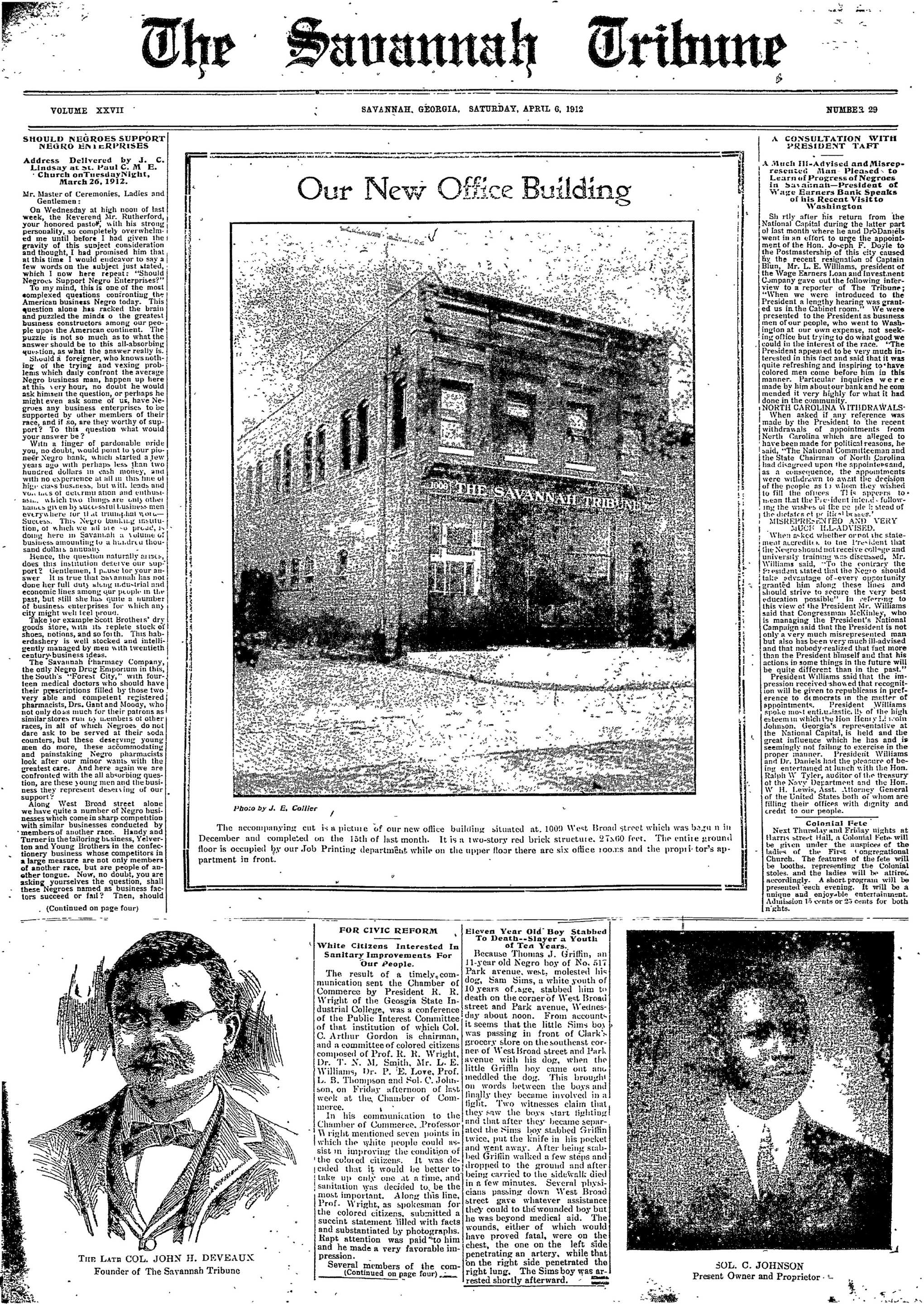
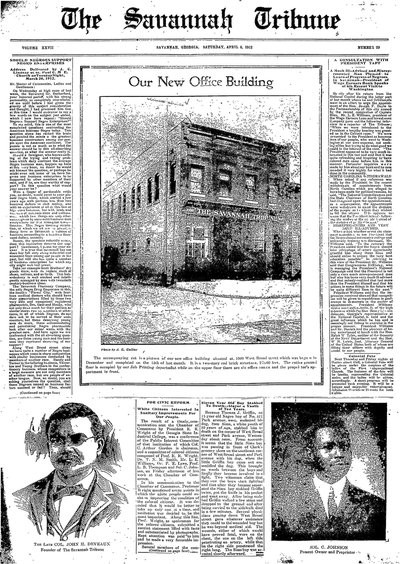
Our New Office Building
The accompanying cut is a picture of our new office building situated at. 1009 West Broad street which was begun in December and completed on the 15th of last month. It is a two-story red brick structure. 27x60 feet. The entire ground floor is occupied by our Job Printing department while on the upper floor there are six office rooms and the proprietor's apartment in front.
FOR CIVIC REFORM
White Citizens Interested In Sanitary Improvements For Our People.
The result of a timely communication sent the Chamber of Commerce by President R. R. Wright of the Geogia State Industrial College, was a conference of the Public Interest Committee of that institution of which Col. C. Arthur Gordon is chairman, and a committee of colored citizens composed of Prof. R. R. Wright, Dr. T. N. M. Smith, Mr. L. E. Williams, Dr. P. 'E. Love, Prof. L. B. Thompson and Sol. C. Johnson, on Friday afternoon of last week at the Chamber of Commerce.
In his communication to the Chamber of Commerce, Professor Wright mentioned seven points in which the white people could assist in improving the condition of the colored citizens. It was decided that it would be better to take up only one at a time, and sanitation was decided to be the most important. Along this line, Prof. Wright, as spokesman for the colored citizens, submitted a succinct statement filled with facts and substantiated by photographs. Rapt attention was paid to him and he made a very favorable impression.
Several members of the com. (Continued on page four)
Eleven Year Old Boy Stabbed To Death--Slayer a Youth of Ten Years.
Because Thomas J. Griffin, an 11-year old Negro boy of No. 517 Park avenue, west, molested his dog, Sam Sims, a white youth of 10 years of age, stabbed him to death on the corner of West Broad street and Park avenue, Wednesday about noon. From account it seems that the little Sims boy was passing in front of Clark's grocery store on the southeast corner of West Broad street and Park avenue with his dog, when the little Griffin boy came out and meddled the dog. This brought on words between the boys and finally they became involved in a fight. Two witnesses claim that they saw the boys start fighting and that after they became separated the Sims boy stabbed Griffin twice, put the knife in his pocket and went away. After being stabbed Griffin walked a few steps and dropped to the ground and after being carried to the sidewalk died in a few minutes. Several physicians passing down West Broad street gave whatever assistance they could to the wounded boy but he was beyond medical aid. The wounds, either of which would have proved fatal, were on the chest, the one on the left side penetrating an artery, while that on the right side penetrated the right lung. The Sims boy was arrested shortly afterward.
A CONSULTATION WITH
PRESIDENT TAFT
A Much Ill-Advised and Misrepresented Man Pleased to Learn of Progress of Negroes in Savannah—President of Wage Earners Bank Speaks of his Recent Visit to Washington
Sh rily after his return from the National Capital during the latter part of last month where he and Dr.Daniels went in an effort to urge the appointment of the Hon. Jo-eph F. Doyle to the Postmastership of this city caused by the recent resignation of Captain Blun, Mr. L. E. Williams, president of the Wage Earners Loan and Investment Company gave out the following interview to a reporter of The Tribune; "When we were introduced to the President a lengthy hearing was granted us in the Cabinet room." We were presented to the President as business men of our people, who went to Washington at our own expense, not seeking office but trying to do what good we could in the interest of the race. "The President appeared to be very much interested in this fact and said that it was quite refreshing and inspiring to have colored men come before him in this manner. Particular inquiries were made by him about our bank and he commended it very highly for what it had done in the community.
NORTH CAROLINA WITHDRAWALS When asked if any reference was made by the President to the recent withdrawals of appointments from North Carolina which are alleged to have been made for political reasons, he said, "The National Committeeman and the State Chairman of North Carolina had disagreed upon the appointersand, as a consequence, the appointments were withdrawn to await the decision of the people as to whom they wished to fill the offices. This appears to mean that the President intends following the wishes of the people instead of the dictates of political peoples."
MISREPREPENTED AND VERY
MUCH HLL-ADVISED
When asked whether or not the statement accredited to the President that the Negro should not receive college and university training was discussed, Mr. Williams said, "To the contrary the President stated that the Negro should take advantage of every opportunity granted him along these lines and should strive to secure the very best education possible" In referring to this view of the President Mr. Williams said that Congressman McKinley, who is managing the President's National Campaign said that the President is not only a very much misrepresented man but also has been very much ill-advised and that nobody realized that fact more than the President himself and that his actions in some things in the future will be quite different than in the past."
President Williams said that the impression received showed that recognition will be given to republicans in preference to democrats in the matter of appointments. President Williams spoke most enthusiastically of the high esteem in which the Hon Henry L. Lincoln Johnson, Georgia's representative at the National Capital, is held and the great influence which he has and is seemingly not failing to exercise in the proper manner. President Williams and Dr. Daniels had the pleasure of being entertained at lunch with the Hon. Ralph W. Tyler, auditor of the treasury of the Navy Department and the Hon. W. H. Lewis, Asst. Attorney General of the United States both of whom are filling their offices with dignity and credit to our people.
Colonial Fete
Next Thursday and Friday nights at Harris street Hall, a Colonial Fete will be given under the auspices of the ladies of the First congregational Church. The features of the fete will be booths, representing the Colonial stoles, and the ladies will be attired accordingly. A short program will be presented each evening. It will be a unique and enjoyable entertainment. Admission 15 cents or 25 cents for both nights.
M.
1
M. A. S.
SOL. C. JOHNSON Present Owner and Proprietor
FURS AND THE COMPLEXION.
A woman whose complexion is that of lilies and roses variety looks at her best when wearing white furs, while black furs are almost equally becoming, but she should as a rule avoid wearing furs of a brown color. A woman with red hair looks at her best, too, when wearing furs of the white or cream variety, but she will be able to select brown skins as well, especially those with a dash of red in them, leaving severely alone pelts of a yellowish tinge. Gray-blue skins are, as a rule, becoming to women with red hair, but the girl whose eyes are inclined to take on a greenish tinge should never wear gray as these will then make her face appear hard and cold. She should also avoid pelts having a red or yellow tinge.
A girl with blue eyes looks well wearing white furs but the woman whose eyes are violet should never wear any other fur than the chinchilla or gray squirrel. These soft grays are so very alluring, and chinchilla, although the skin par excellence of the modish woman, is delightfully artistic, the delicate blue and pearl gray shadings defying imitation.
A fair woman, whose skin is slightly inclined to sallowness can wear gray furs, as these tend to whiten the skin and also throw up any vestige of color she may possess. Sometimes sable and mukk are becoming to sallow blondes, but when the eyes are light in addition to the sallow skin the brown-toned furs should be avoided.
The brunette who has roses in her cheeks can wear all kinds of golden brown furs, also black fur, and the pelts of the light brown variety, but the brunette whose skin is inclined to be sallow should choose the silver-gray furs, red or yellow fox, or dark sable.
A woman with a fresh, fair complexion can wear mink with safety, but she whose skin is sallow should avoid this fur.
Sable, that most expensive pelt, can be worn by most women, but it does not mix well with other pelts except seakins, and as a rule a garment consisting of sable and any other fur turns out unsatisfactory in the long run. Sable skin looks best when worn with brown, gray, black, cream, or white, but it will be found that a costume of green, red, yellow, bright blue, or violet tends to rob the pelt of its richness.
A woman whose face is somewhat hard in its outlines will find that by wearing fur these outlines become softened, and it is not always the most expensive furs which give this softening effect.
KITCHENETTES
Camels' hair and red sable brushes that have gotten out of shape or curled can be restored to their proper form by dipping first into hot and then into cold water.
To make individual chicken pies, line gems pans with pastry, leaving crust enough to fold over a tablespoonful of rich chicken hash, and bake in a quick oven.
If the cake flavoring has been forgotten when making the batter try sprinkling the required amount over the cake as it stands in the pan before baking.
If brooms are to sweep clean they must be washed occasionally and freed from dust and dirt. To two quarts of warm water add four tablespoonfuls of household ammonia. Stand the brooms in this for a half hour. Rinse in cold water and hang in the sun to dry. House brushes of any variety may be washed in this manner.
Ammonia will remove white stains from furniture. A pluck of salt added to the whites of eggs will make them whip easily.
Wash fabrics may be set in color if given a thorough rinsing in salt water before putting into the wash.
To keep suet, take out any, skin there may be and then put the suet in a saucepan and place on a warm but not hot fire and let it melt gradually. When quite melted pour it into a pan of cold water. When quite hard wipe it dry, wrap it in white paper, and when wanted for use it may be rubbed on a grater.
Cold water, with but little soap, should be used in washing colored silks. If the color runs, vinegar should be stirred into the water until the color sets.
When coal is needed on the fire in the slick room it should be brought into the rooms in paper bags, which should be laid gently on the fire to prevent noise
A WINDOW GARDEN.
People who like to replant and grow hyacinth bulbs indoors will find help in remembering that there is likely to be trouble if the pots are at once brought into a strong light, as many times the bud refuses to come out of the bulb until the flower-spike is formed, in which case there will be a deformed flower.
You can prevent this by placing on the pot a paper cone, fitting the top inside its rim, made of any paper which is opaque, as blue, green or red. The cone should have an inch opening at the top, and the effect will be to make the bud draw up toward
the light. When it has cleared the top of the bulb remove the cone.
There is no fertilizer to be given the bulbs when they are brought in for blooming, as any given would have no effect on this year's blooms. The flower is made, or spoiled, in the growing of the roots. If a fine, large mass of fine fibrous feeding roots are grown while the pot is in the dark there will be a large, fine flower; if not it will be in proportion to the mass of roots. This is why the addition of fertilizer, after it has been brought into the light, has no effect on the blooming of the bulb.
However, there should be an abundance of water given the bulb, and it should be kept in mind that for the best effects we must simulate nature's way of growing them as far as we can.
In a state of nature they bloom outdoors, early in the spring, when the ground is wet and cool, and the sun heat makes little impression on the temperature. In order to reproduce these conditions we give-the pots plenty of water and keep them out of the direct rays of the sun. A north window is an ideal place for spring blooming bulbs when being grown in the house.
IRISH HUNTING WOMEN.
Hunting absorbs keen sportswomen in Ireland just now, says an exchange, and it is seldom that a frost drives the Irish follower to hounds from the countryside. Irish women are renowned for their fearless prowess in the hunting field, where the terrible obstacles to be, negotiated call for nerves of steel, and it is neck or nothing in the distressful country. The fearsome stone walls, sometimes overgrown with turf and masking a brook, appall all but the stoutest hearts, and even the most hardened sportswoman is known to quall at the commencement of the hunting season, experiencing the sensation of the heart in the mouth when called upon to face the stiff going. She finds her nerve returning, however, after a day or so in the saddle.
The late empress of Austria used to hunt regularly in Ireland, where her reckless and brilliant horsemanship is still spoken of. With the late Bay Middleton to give her a lead, she was always in the first fight and stuck at nothing. The famous happy-go-lucky hospitality that marks the Irish temperament is exemplified in matters sporting, and open house is kept by those having accommodation in a good hunting district. Every Irishman is a true sportsman, and the whole neighborhood turns out for a meet, those unable to raise a mount following on foot or driving in every sort of vehicle, some rare antediluvian specimens seeing the light of day on such occasions.
The Irish colleen will dance all night at a hunt ball and turn up at a distant meet as fresh as paint without going to bed at all, full of life and spirit, with wit and repartee bubbling like a font. The Irish country brings out all the daredevil Irish nature, and there is little searching for gaps or gates when the blood of Irish horse and rider is up.
Ireland is not overrepresented in the matter of hunting, and Irish packs are not by any means numerous, and may be reckoned to number a couple of dozen. Some only possess quite a restricted number of couples, and but few hunt four or five days a week, though an occasional by day may bring the total up. The Meath hunt lasts five days a week and is one of the famous hunts of the United Kingdom, and the county Galway; the Blazers four days a week.
HOME SHOULD BE RUN
"I don't see how Mrs. Brown understands housekeeping so well," said a curious matron the other day of a bride whom she had under observation. "You know, she was a teacher until she married."
It did not occur to her that Mrs. Brown was just applying the same system which she used in her teaching to her home. She was always very systematic in her school work; consequently it was an easy matter for her to have the housekeeping wheels running without friction.
There is an immense reward for the woman who will apply businesslike methods to the ordering of her home. Many a man knows that if his business were run as sillpshod as his home he would go into bankruptcy.
In a certain school of housewifery, where cooking and cleaning on the most modern lines are taught, a "housewives' creed" hangs on the walls. Here are some extracts from it:
"I believe housekeeping and cooking are and should be, interesting and worthy work, and that the majority of women would enjoy them if they had the opportunity to know more of their science.
"If a man is not ashamed of his profession or work, there is no reason why a woman should be of hers.
"I believe before marriage every woman should show to the man whom she is to marry that she thoroughly understands the work of making and keeping the home in a perfectly systematic and business basis, as much as a man has shown her that he has a profession or business capable of providing an adequate income."
HENSON'S BOOKS ON TRIP TO THE POLE
(From the New York Sun.)
One of the most interesting of the spring's authors from many points of view is Matthew Henson, whose book, "A Negro Explorer at the North Pole," contains the only personal account other than Peary's that will ever be written of the climax of the expedition. It is significant, as Peary has said, that several races were represented on the day of the discovery.
"It is an interesting fact," he said, "that in the final conquest of the prize of the centuries' not alone individuals but races were represented. On that bitter brilliant day in April, 1909, when the Stars and Stripes floated at the north pole Caucasian, Ethiopian and Mongolian stood side by side at the apex of the earth in the harmonious companionship resulting from hard work, exposure, danger and a common object.
"Henson, son of the tropics, has proven through years his ability to stand tropical, temperate and the fiercest stress of frigid climate and exposure, while on the other hand, it is well known that the inhabitants of the highest north, and hardy as they are to the rigors of their own climate, succumb very quickly to the vagaries of even a temperate climate. "Is it a difference in physical fibre or in brain and will power or is the difference in the climatic conditions themselves?"
Henson, the author, who throughout his good luck shows a love and knowledge of good books surprising when one considers his limited advantages and the restrictions imposed by his 20 years of hardships in exploration, does not in appearance show an evidence of extreme hardihood. Though virile enough to reach the pole with Peary, he is no huge Jack Johnson nor anything resembling him, but a smallish, quiet, observant sort of man. He is well knit, quick of movement and clear of eye—like a trained runner. He wears eyeglasses, carries himself like a competent though modest man of affairs and shows an efficiency and ease coming from long association with big-men.
There were always a few books along on the exploring expeditions, and no one made better use of them than did Peary's Negro companion. He tells of the little library on board the Roosevelt during the last polar journey.
"Out on the ice of the polar ocean," he says, "as far as reading matter went, I think Dr. Goodsell had a very small set of Shakespeare, and I know that I had a Holy Bible. The others who went out on the ice may have had reading matter with them, but they did not read it out loud, and so I am not in a position to say what their literary tastes were.
"But on board ship there was quite an extensive library, especially on Arctic and Antarctic topics, but as it was in the commander's cabin it it was not heavily patronized. In my own cabin I had Dickens's 'Bleak House', Kipling's 'Barrack Room Ballads,' and the poems of Thomas Hood; also a copy of the Holy Bible which had been given to me by a dear old lady in Brooklyn. I also had Peary's book, 'Northward Over the, Great Ice,' and his last work 'Nearest the Pole.' "During the long dreary midnights of the arctic winter I spent many a pleasant hour with my books. I also took along with me a calendar for the years 1908 and 1909, for in the regions of, noonday darkness and midnight daylight, a calendar is absolutely necessary. But mostly I had rougher things than reading to do."
In his book the English used by this Negro, who had only six years of schooling in his life, shows the influence of his constant reading of classical literature. It has been said that there is no better cultivator of a literary style than the Bible, and the work of Henson would seem to bear the statement out. Shakespeare is there, too, seemingly unconsciously on the author's part. For instance: "We forced the dogs," he writes, "and they took it on the run, the ice undulating beneath them the same as it does when little wanton boys play at tickey benders, often with serious results, on the newly formed ice on ponds and brooks down in civilization. Our tickey benders were not done in the spirit of play, but on account of urgent necessity."
"He died alone, he passed into the great unknown alone, bravely and honorably," he writes with Biblical simplicity and repetition of the death of Prof. Marvin. "He is the last of earth's great martyrs; he is home, his work is done. he is where he longed to be, the sailor is home in the sea. It is sad to write this. He went back to his death, drowned in the cold black water of the Big Lead. In unmarked, unmarbled grave, he sleeps his last, long sleep."
"Having no poetry in my soul," he says in a description of northernmost Grant Land, "and being somewhat hardened by years of experience in that unhospitable country, words proper to give you an idea of its unique beauty do not come to mind.
"Imagine gorgeous bleakness, beautiful blankness. It never seems broad, bright day, even in the middle of June. and the sky has the different effects of the varying hours of morning and evening twilight from the first to the last peep of day. Early in February, at noon, a thin band of light appears far to the southward, heralding the approach of the sun, and daily the twilight lengthens, until early in March, the sun, a flaming disk of fiery crimson, shows his distorted image above the horizon.
"The south sides of the lofty peaks have for days reflected the glory of the coming sun, and it does not require an artist to enjoy the unexamplied spender of the view. The snows covering the peaks show all of the colors, variations and tones of the artist's palette and more. Artists have gone with us into the arctic and I have heard them rave over the wondrous beauties of the scene and I have seen them at work trying to reproduce some of it with good results, but with nothing like the effect of the original. 'It is color run riot.'"
"To the northward all is dark and the brighter stars of the heavens are still visible, but growing fainter daily with the strengthening of the sunlight.
"When the sun finally gets above the horizon and swings his daily circle the color effects grow less and less," but then the sky and cloud effects improve and the shadows in the mountains and clefts of the ice show forth their beauty, cold blues and grays, the bare patches of the land rich browns, and the whiteness of the snow is dazzling.
"Above us the sky is blue and bright, bluer than the sky of the Mediterranean, and the clouds, from the silk cirrus mare's tails to the fantastic and heavy cumulus, are always objects of beauty. This is the description of fine weather."
The closing paragraph of the Negro explorer's record is particularly interesting, for into it he weaves two of his favorite authors, Shakespeare and Kulling.
"And now my story is ended; it is a tale that is told," he writes. "‘Now is Othello's occupation gone.’ I long to see them all again, the brave, cheery companions of the trail of the north. I long to see again the lithe figure of my commander and to hear again his clear ringing voice urging and encouraging me onward with his 'Well done, my boy.' I want to be with the party when they reach the untrud shores of Crocker Land. I yearn to be with those who reach the south pole; the lure of the arctic is tugging at my heart; to me the trail is calling.
"The old trail!
The trail_that is always new!"
Matt Henson was born in Charles county, Maryland, in 1866, and his mother dying when he was seven, he attended the N street school in Washington for six years while making his home with his uncle in that city. He began life as a cabin boy on an ocean steamship and before he met Peary he had already made a voyage to China. He was eighteen when he met the arctic explorer and he has been his companion for twenty-three years. During that time he acquired a knowledge of books and got a practical understanding of everything that is a necessary part of daily life in the icebound wildernesses of polar exploration. He was at times a blacksmith, a carpenter and a cook.
He became thoroughly acquainted with the life, customs and language of the Eskimos. He himself built the sledges with which the journey to the pole was successfully completed. He could not only drive a dog team or skin a musk ox, but was something of a navigator as well. He made himself not only one of the most trusted but also the most useful member of the expedition
JOHNSON FIGURES
FLYNN A. SOFT MARK
JOHNSON FIGURES
FLYNN A. SOFT MARK
St. Louis—"A good little man can't beat a good big man," chirped Jack Johnson, the heavyweight champion, when we asked him how he sized up his coming battle with Fireman Jim Flynn. Johnson picks himself to win. He believes it will be via the knockout route, although he claims he can't predict how far the contest will progress. But while he admits that he classes himself as a better man than the Brooklyn fighter, he says Flynn may be able to put up a good argument.
"Flynn, to my way of thinking, is the best of the present crop of white hopes," continued Johnson. "I believe he has it on Morris, Palzer, Wells and Kennedy. That's because he has had more experience than the other men I have named.
"But the man whom I regard as the most dangerous of the entire field is Sam McVey. McVey could wallop any of the men in the heavy-weight class today, outside of myself, I believe.
"I have seen Morris, Palzer, Kennedy and Wells work. Morris and Palzer may develop into dangerous men in the heavyweight division. But today they are in a crude state. It will require lots of experience to make them finished fighters, and then I believe Morris will be too slow.
"Palzer, they tell me, isn't a quick thinker, which is a big handicap for a first-class fighter. The trouble with most big fighters, though, is that when they get tired they wabble. They are top-heavy and can't hold up. After you get them in that condition a stiff wallop will finish the bout."
DEFINING HER CORRECTLY.
Father and son were walking the streets and passed a large park in which were many statues. One of them—the largest of all—was of a woman.
"Father, what is that?" asked the son, pointing to this particular one, which was inscribed, "Woman."
"That is not a statue, my son," answered the father. "It is but a figure of speech."—Life.
CLAREMONT TEMPERANCE INDUSTRIAL INSTITUTE
WIELDING A GREAT MORAL IN-
FLUENCE—PRESIDENT SMALL.
• WOOD AND HIS MOST
VIVID WORK.
By GEO. L. M'GATLAUGH.
Upon the ancient bank of the classic James seventy-five feet above its level, stands the great work of a single man, for the negro race, with no church or charitable society at his back, this one black man has done more work for his race and demonstrated a greater amount of negro individuality than any one colored man, single handed, in all the country.
THE TEMPERANCE, INDUSTRIAL AND COLLEGIATE INSTITUTE. This institution was founded October 12, 1892. "With less than ten pupils, and much less than fifty dollars in American money," so I am told by President "Smallwood. The institution is the outgrowth of an individual effort, made by John Smallwood himself.
The institution is not a church nor a state school, it has no organization at its back. It gets not a cent from the state. It is supported by voluntary contributions and by the sublime energy of John J. Smallwood, who is acknowledged to have the greatest amount of will power, and personal determination. The institution owns 398 acres of the finest farm lands in the vicinity of Claremont, about one hundred of which lies along fronting "The James." Just how Dr. Smallwood ever succeeded in getting these river front lands, under the circumstances, is a mystery to his best friends. Upon the James river lands are situated the institution—proper, Rebuilt Old Bagley Hall, first built in 1622, and was until 1865 a "Slave Pen" where human souls were sold, from 1624 to 1865. Rebuilt Old Bagley Hall is a most magnificent wooden building costing ten thousand five hundred dollars, as it stands 75 feet above the level of the James, giving a most pleasant and attractive view of the James. The John Hay Wharf, at the foot of the hill, is rebuilt, "John Hay Wharf," "Old Claremont Wharf," now known as the "John Hay Wharf," 798 feet long, 12% feet wide, built with the best North Carolina and Georgia pine, costing three thousand seven hundred ninety-eight dollars, the United States mall steamer Pocahontas, or the Mob-Jack, stop at this wharf to land passengers and freight. This is the first and only wharf on the James river, built and owned by negroes. It is the first time in the history of the ancient-classic stream, that negroes are privileged to tag a steamer to import and export, to receive and give out freight. This wharf is named in honor of Dr. Smallwood's great friend and benefactor, the late Honorable John Hay, the American scholar, statesman, business man, gentleman and diplomat. The rebuilding of the "Old Claremont Wharf" (now known as the John Hay Wharf) is an example of Dr. Smallwood's business efforts and his remarkable daring business manhood.
LINCOLN MEMORIAL HALL.
This beautiful brick and stone building sits upon the great beautiful hill, surrounded with beautiful poplar, oak cherry and dogwood trees. This building is 133½x49½ feet, four-story, which is costing thirty-seven thousand eight hundred ninety-seven dollars, for the erection without furnishing, and it is the first building ever erected upon Virginia soil by any individual negro. Dr. Smallwood's friends did not know that he contemplated building this most commendable building until he had let the contract. Just a few rods from the statey Lincoln hall is the, power house, from which power house the heat and water supply for Lincoln hall and Bagley halls are supplied. Lincoln hall will be fitted up with all modern improvements, bath, hot and cold water, steam heat, electric light, cooking ovens and the improved class and bedrooms. The grounds around this building are now being beautiful Lincoln hall is not only a blessing and an honor to the negroes, and especially to the brave Prof. John J. Smallwood, who is the very life and stability of the institution, but it is a great credit to the white people of Claremont. Claremont and Surry counties are both known, of and thought of, just at this time in places and by good people who and where it never would have been thought of nor heard of, had it not been that this polite, highly educated and most practical negro came to this town nineteen years ago and with prayer, faith and determination began this great work. He has accomplished great things, most assuredly so. In Lincoln hall will be placed the bronze bust of the late John Hay, Dr. Smallwood's greatest friend. The President Abraham Lincoln, honest merchant, farmer, the lawyer, the politician, statesman, orator emancipator and America's greatest reformer, Fred Douglass, Amanda Smith, Frances E. Willard, and it is said that Dr. Smallwood's great good southern friend, the late "Zeb," ("our Zeb") B. Vance, ex-governor of North Carolina, and late United States senator, will have a bust in this hall. The brick work is completed, the windows are all placed, the fourth and third floors and second floors, are laid. The roof is on, the tin and iron men are at work, the grounds are laid with the soakerage pipes, the artesian well, 210½ feet, flowing 60 or 65 gallons per minute of clear, pure water. The reservoir is built, the water flowing into it, and the pipes from the well to the top of the hill are already laid.
The electric men (Mr. W. H. Jenks of Richmond, the contractor) are at work placing the electric wires.
THE POWER HOUSE.
This building is 49½ feet. In it will be placed a 75 horsepower engine and a 85 horsepower boiler, and a water tank, which will hold 1,600 gallons of water. The electric fixtures for lighting all of the buildings, the powerhouse, the sewerage and the water works are additional expenses that Dr. Smallwood did not consider when he began to rebuild the Old Claremont Wharf, and to erect to the memory and honor of his emancipator the most magnificent building. The powerhouse, the electric and steam plant, the water works and the general extensions will cost eighteen thousand nine hundred and forty-two dollars more than was thought one year ago when President Smallwood began his greatest efforts in this work.
OLD SAWYER HALL.
This, our building, is a plain and somewhat uncomfortable building built by President Smallwood and his pupils in 1893-34. It is a quaint wooden structure, commanding in its appearance, and very graceful in its situation. In this building is found the president's office, entirely too crowded, but is one of the cleanest places I have ever visited. President Smallwood and his private secretary all work in the same office. In the building is also the dining room, the music room and the girl's bedrooms. Sawyer hall is named in honor of the late United States Senator Philotus Sawyer of Wisconsin, who, like the Hon. John Hay, befriended the institution in 1892, when slander and abuse thought to deter the brave negro educator.
THE SCHOOL'S PROPERTY.
The institution owns 398 acres of good land, the finest mules and horses in this section of the state, so far as I have seen in my travels. The most perfectly kept harness I have ever seen upon any school grounds, white or black, one of the best kept barnstables in the country, almost every modern farming implement is found here and the law is "that they be kept clean and under the tool shed when not in use." The Holloway and Boyce farms, of course, are not yet improved, but Dr. Smallwood only needs a chance to show his hand at their improvement, that is needed to be made upon these two valuable farms. These lands will be improved and beautified as sure as President Smallwood has his health, and work to get the money with which to make the needed improvements.
DR. SMALLWOOD AS A PATRIOT.
Dr. Smallwood was a slave in 1862.
He is self-educated, having had in early life no encouragements to get above his plantation life. He is a plain, gentlemanly man, without ostentation or human bigotry. He is a most easy and fluent conversationalist, and is undoubtedly the best informed negro in the south upon all economical and political, social and religious subjects.
NEGRO MUST SELL GOODS
What a tame and commonplace heading is this, there is nothing suggestive perhaps and nothing novel about it. We repeat though that the negro must sell goods. This dictum, if such you deem it, comes to us after much travel and study of the industrial and commercial condition of our race variety. In the south especially we are the largest laborers, the leading wage earners. Every Saturday night hundreds of thousands of dollars come into our hands as wages for the menial services we render other people. Just as regularly before another Saturday comes the larger part returns to the very people from whom we have received it. Our weekly stipend is scarcely touched by us ere it passes on. A mobile currency is the prize-honor which financiers contend for, but not the sort of mobility referred to above.
To be miserly is to be selfish and unpatriotic. We are not advocating such a spirit, not at all. We would not suggest that negroes boycott others; it would be folly, not to say sulcide. What is needed is for enterprising negroes to open stores and shops of every kind wherever large negro communities obtain, so as to delay for a week or so at least the transfer of so much of our hard earned wages to other hands. Negro grocery stores, shoe stores, haberdashery and millinery establishments, etc., should succeed, and will, when properly managed.
Right here in Charlotte, a dozen well ordered stores could thrive. The negro is busy home getting; in many southern towns one must own his home to be a reputable citizen; farms are being purchased, also, but far too little attention is given to mercantile affairs. Even Greeks and Italians, who never spend a cent with negroes and never even "have their washing done" are getting rich selling our people bananas, popcorn, peanuts and brittle candy.
Why can't a negro sell fruit? Why shouldn't a black man make good candy—he loves to eat it well enough.
Our chief commercial concerns are drug stores and undertaking shops. True, we need these, but if we, had more real high class grocery stores and cleaner and better restaurants our drug and coffin bills would be less. We again declare that the negro must sell goods—Star of Zion.
Customer—What have you in the shape of oranges?
General Storekeeper—Well, we have baseballs—Harlem Life.
The Sunday School Lesson
Sunday School Lesson for April 7, 1912.
THE APPEARANCE OF THE RISEN LORD.
Golden Text—This Jesus hath God raised up, whereof we all are witnesses. Acts 2: 32.
Lesson Text—J. Cor. 15: 1-11.
Lesson Text.—J. Cor. 15: 1-11.
Time.—Spring A. D. 57. Place.—
Ephesus.
Exposition.—I. The Gospel Paul Preached, 14. Vs. 1-4 give us a remarkably clear and full statement of the Gospel which Paul preached and the Gospel by which believers are saved. (v. 1, 2 cf. Rom. 1: 16.) Gospel means "Glad tidings" or "Good Neds." There were three parts to the Good News. (1) "That Christ died for our sins," and thus made perfect atonement (v. 3 cf. Gal. 3: 13; 2 Cor. 5; 21; Is. 53; 6; I. Pet. 2: 24). On the ground of the perfect atonement ghus made, any one who believes in and receives the One who made the atonement, at once receives forgiveness for all his sins and is justified from all things and obtains eternal life. (Act 10: 43; 13: 38, 29 R. V.; John 3: 15, 36.) (2) "That he was hurried." He was hurled
as our representative and we were buried with him. In his burial our sins are buried, our old self is buried, and the way is open for us to be raised to an entirely new life. (Rom. 6: 4; Col. 2: 11, 12, Col. 3: 3.) The burial of Christ is not merely incidental to his death, but an essential and deeply significant part of the Gospel. (3) "He hath been raised" (v. 4 R. V). That is a fact and it is a fact full of meaning. It proves his dely (Rom. 1: 4), that God has accepted the atonement which he made (Rom. 4: 25), that we shall raise also and have no longer a mere speculative hope of immortality but a certain hope, resting upon a solid fact (2 Cor. 4: 14; 2 Thess. 4: 14); it presents to us a Saviour who not only saves from the guilt of sin by his atoning death, but from the power of sin also by his resurrection life. (Rom. 6: 4, 11-13; 7: 4; 5: 10; Heb. 7: 25). All believers are identified with Christ in his death, burial and resurrection. (2 Cor. 5: 14 R. V.; Rom. 6: 1, 2, 4 R. V.; Eph. 2: 5, 6).
II. The Certainty of the Fact of the Resurrection, 5-8. Paul proceeds to give some of the conclusive proofs of the third part of the Good Tidings. He does not give all the instances in which Christ appears to people after the resurrection, but leading and typical instances, quite enough to prove the fact of his resurrection beyond the possibility of honest doubt. The First Epistle to the Corinthians is one of the epistles of which the Pauline authorship has never been denied, even by rationallistic critics. It is admitted by all that Paul wrote this book. This testimony therefore has very great weight. Peter's own testimony of the resurrection of Christ is found in his epistles (e. g. I. Pet 1: 3). Note especially Paul's statement about the appearance to
POETRY
of and by Our People
WHO LOVES ME?
"Who loves me?" is the anxious question
Every man will sometimes ask.
No matter what his sphere or station,
No matter what may be his task.
No matter if he's in the gutter,
Or nestled in the lap of fame.
He wants to know that someone loves him.
And is pleased to hear his name.
He wants to know that some true mortal
keeps in him the good that’s real—
To know that while he sometimes falters,
That mortal is as firm as steel.
He’d give the world to have this question
Gently answered with a kiss—
To hear the tender voice proclaim it,
Would be to him a dream of bliss.
True, there is but little gladness
For the man of busy life.
Except that joy which comes at evening
In his home with loving wife.
But to him who has no fireside.
And whose home cannot be found—
He who rolls and keeps a-rolling,
Like a ball upon the ground—
He it is who asks the question
O’er and o’er an doer again.
And if he never hears an answer.
The very silence gives him pain.
This would to him is very gloomy,
And naught there is in life to cheer—
No one to say, “Sweetheart. I love you,”
No one on earth to call him “dear.”
"Who loves me?" is the anxious question
Every man will sometimes ask:
No matter what his sphere or station,
No matter what may be his task.
No matter if he's in the gutter,
Or nestled in the lap of fame,
He wants to know that someone loves
him
And is pleased to hear his name.
-Charles Alexander, Boston, Maas.
LITTLE SISTER.
I know a little girl of presence fresh and fair
She has aged year-long, and so has lain
For a half a lifetime: flower sweet the air;
The room is darkened to relieve her pain.
There is no hope out of healing her,
the 500 brethren at once, of whom the greater part were still living at the time Paul wrote. Here we see the great importance of the admission of all scholarly rationalists that Paul wrote this epistle. He could not make a statement like this, that nearly 500 were still living unless it were, at least, substantially correct. It is admitted that Paul wrote this epistle and Paul fearlessly asserts that there were nearly 500 people still living in his day who had seen Jesus after his resurrection. Either then Jesus had risen or else Paul was the most conscienceless liar. But men, do not give up every earthly ambition and prospect as Paul did for a lie, and endure 30 to 35 years of hardships and untiring toll, and finally 'die for a lie. Moreover, if it were a lie, it was a lie that could easily be proven to be a lie at that time. It is then simply impossible for it to be a lie. If then anything can be proven by testimony, it is proven that Jesus arose from the dead. If that is proven, the whole system of Christian doctrine and all the miracles go with it. The ablest of the deniers of the fact of the resurrection (David Strauss) suggests that these appearances may not have been facts but visions, but does any honest-minded student think for a moment that 500 men have the same vision at the same time? If there is any historic fact absolutely proven, it is that Jesus arose from the dead. This James is the Lord's brother. He had been an unbelieber (John 7: 5) and was seemingly still an unbeliever at the time of Jesus' death. (John 19: 26, 27) Jesus did not leave his brother in unbelief. He appeared to him. Through seeing the risen Christ, he became fitted to be an apostle. (Gall. 1: 19; Acts 1: 22.) Last of all Jesus appeared to Paul himself (Acts 9: 3-9, 17: 22; 6-11; 26: 12-15). This was not a mere vision but an actual appearance of the risen Christ. Those with Paul saw the light and heard the voice, though they did not distinguish the message. Therefore, it could not be a vision of Paul. Paul either really saw the risen Christ in the glory, or else he deliberately lied and sacrificed everything, ambition, friends, ease, plenty, fame, and became an outcast and a wanderer and afflicted and persecuted for 30 or more years out of devotion to a lie of his own concocting. This is impossible. Paul actually saw the risen Christ in the glory and this again settle everything.
III. Paul's Estimate of Himself, 9-11. Paul had a deep sense of his own utter unworthiness before God and of God's wondrous grace toward him. He never forgot that he had "persecuted the church of God." (cf. I. Tim, 1:13.) We look at Paul's great character and remarkable achievements and begin to admire Paul but we ought rather to admire the grace of God (v. 10). But that grace was not "in vain." Paul improved it. The grace bestowed upon us is partly or altogether in vain. The reason why it was in vain in Paul is because he labored abundantly (v 10). He worked out the grace that God had worked in. Yet after all, it was not he that worked but the grace of God that was with him.
Leading Questions—How do we know that it is an absolute certainty that Jesus rose from the dead? What are the three parts of the Gospel Paul preached? What is the significance of each of the three? What does this lesson teach about Jesus Christ?
You could not blame her if she turned face
Sullen unto the wall, and did demur
From further breathing in her prison place.
Not so: her sickbed is a throne, where from
She doth most royalty her favors grant.
Whither the needy and the wretched come.
She is At Home to every visitant.
They call her Little Sister for her heart
Goes out to each that takes her by the hand.
In sisterly devotion 'tis her part
To feel, to suctor and to understand.
Unto her dim lit chamber how they flock.
The seamy folk, the weeviling and the base!
There is no sin so low that she will mock.
No shame that dare not look her in the face.
One never thinks of woe beside her bed.
So blithe she bends beneath the ignorant rod.
She does not seem like one uncomfortable.
Her prayers like songs go bubbling up to God.
Here is the Inner secret of the soul;
Radiant announcement, love and fellow cheer—
These things do crown her like an aureole.
Making her gladly, while they make her dear.
Richard Burton, In Scribner's Magazine.
MY LADY NIGHT.
My Lady Night, ah, fair is she
As is a twilight rose
That in some deep gloomed bower blows.
As is a lily's face at night
In some old garden 'neath the light
Of misty moon.
Her arms are deep and wide;
She moves as does a bride
To some slow wedding-tune.
Like pools unfathomod are her eyes,
And in them he unchartered skies
Where low lights burn like distant stars
Agglest through the sunset's bars.
That shint all mortality—
My Lady Night, ah, fair is she!
My Lady Night, ah, sweet is she.
With all her tender ways,
As is a mother when she laye
Her babe asleep in cradle low
Where unfelt winds from Dreamland
blow
Him far away.
Soft is her dusky hair.
Her bosom deep and fair
With gentle lull and sway.
Whate sink to sleep earth's weary ones.
While through time's glass life's bright
sand runs.
She sings like she fevered brow of pain
Till men to suffer more were fain;
She comes to all so tenderly—
My Lady Night, ah, sweet is she!
—Arthur Wallace Peach, in Smart Bot
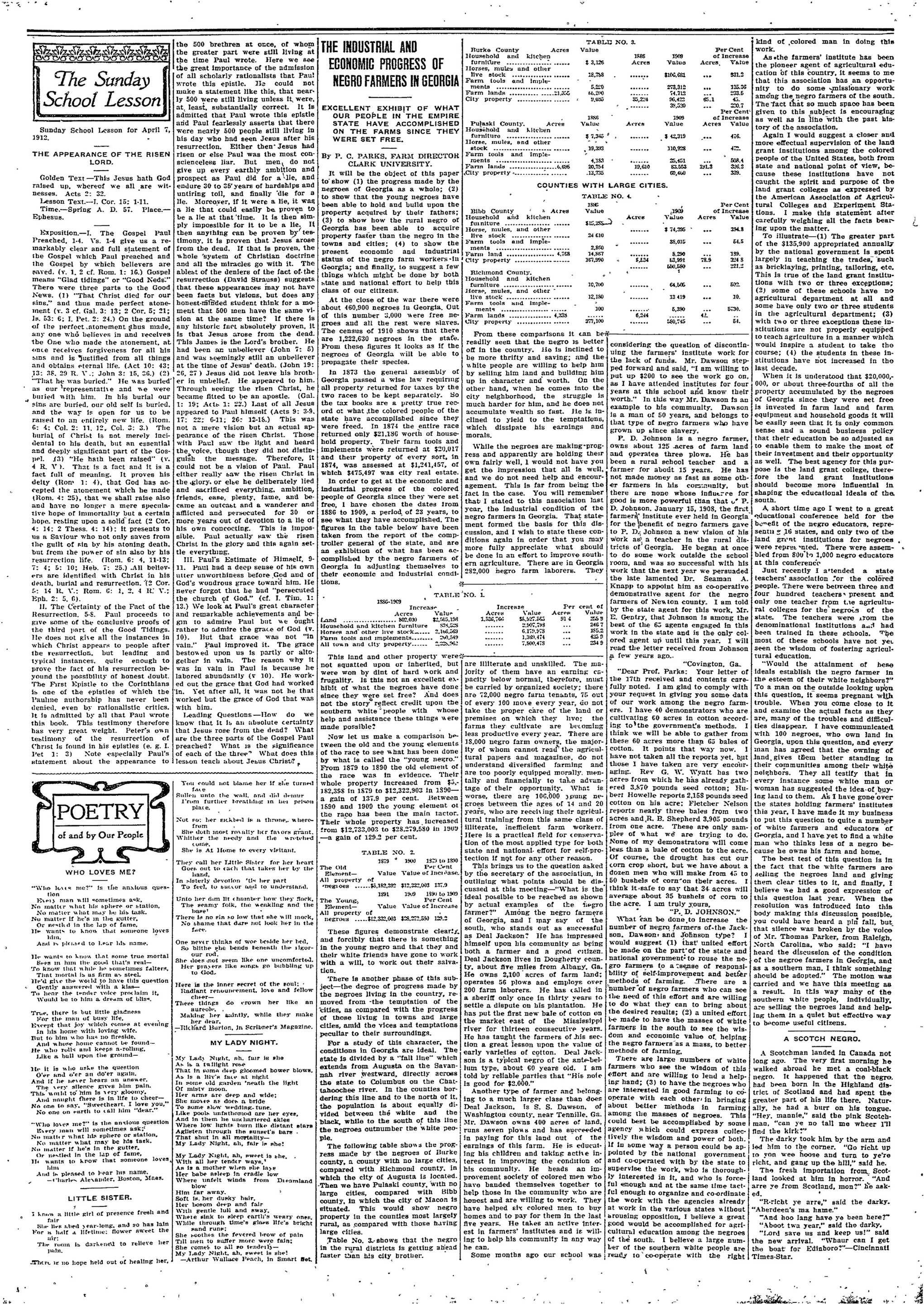
TABLE NO. 1
1886-1909
Increase
Acres Value
Land 802,030 $2,505,198
Household and kitchen furniture 888,528
Horses and other live stock 2,166,693
Farm tools and implements 290,549
All town and city property 2,220,082
Increase
Acres Value
Acres Value
Acres Value
91.4 85.8
85.8
246.7
156.2
425.9
234.9
THE INDUSTRIAL AND ECONOMIC PROGRESS OF NEGRO FARMERS IN GEORGIA
THE INDUSTRIAL AND ECONOMIC PROGRESS OF NEGRO FARMERS IN GEORGIA
EXCELLENT EXHIBIT OF WHAT OUR PEOPLE IN THE EMPIRE STATE HAVE ACCOMPLISHED ON THE FARMS SINCE THEY WERE SET FREE.
By P. C. PARKS, FARM DIRECTOR CLARK UNIVERSITY.
It will be the object of this paper to show (1) the progress made by the negroes of Georgia as a whole; (2) to show that the young negroes have been able to hold and build upon the property acquired by their fathers; (3) to show how the rural negro of Georgia has been able to acquire property faster than the negro in the towns and cities; (4) to show the present economic and industrial status of the negro farm workers-in Georgia; and finally, to suggest a few things which might be done by both state and national effort to help this class of our citizens.
At the close of the war there were about 460,900 negroes in Georgia. Out of this number 3,000 were free negroes and all the rest were slaves. The census of 1910 shows that there are 1,222,630 negroes in the state. From these figures it looks as if the negroes of Georgia will be able to propagate their species.
In 1873 the general assembly of Georgia passed a wise law requiring all property returned for taxes by the two races to be kept separately. So the tax books are a pretty true record of what the colored people of the state have accomplished since they were freed. In 1874 the entire race returned only $21,136 worth of household property. Their farm tools and implements were returned at $20,017 and their property of every sort, in 1874, was assessed at $1,241,457, of which $475,497 was city real estate.
In order to get at the economic and industrial progress of the colored people of Georgia since they were set free, I have chosen the dates from 1886 to 1909, a period of 23 years, to see what they have accomplished. The figures in the table below have been taken from the report of the comptroller general of the state, and are an exhibition of what has been accomplished by the negro farmers of Georgia in adjusting themselves to their economic and industrial conditions.
This land and other property were not squatted upon or inherited, but were won by dint of hard work and frugality. Is this not an excellent exhibit of what the negroes have done since they were set free? And does not the story reflect credit upon the southern white people with whose help and assistance these things were made possible?
Now let us make a comparison between the old and the young elements of the race to see what has been done by what is called the "young negro." From 1879 to 1890 the old element of the race was in evidence. Their whole property increased from $3.182,358 in 1879 to $12,322,903 in 1890—a gain of 137.9 per cent. Between 1890 and 1909 the young element of the race has been the main tactor. Their whole property has increased from $12,733,003 to $28,279,580 in 1909—a gain of 129.2 per cent.
TABLE NO. 2
The Old
Element— Value Value of Increase.
All property of
negroes ..... $5,182,392 $12,322,003 137.9
1891 1890 1890 to 1900
The Young,
Element— Value Value of Increase.
All property of
negroes ..... $12,322,003 $28,272,580 129.2
These figures demonstrate clearly,
and forcibly that there is something
in the young negro and that they and
their white friends have gone to work
with a will, to work out their salvation.
There is another phase of this subject—the degree of progress made by
the negroes living in the country, removed from the temptation of the
cities, as compared with the progress of those living in towns and large
cities, amid the vices and temptations
peculiar to their surroundings.
For a study of this character, the conditions in Georgia are ideal. The state is divided by a "fall line" which extends from Augusta on the Savannah river westward, directly across the state to Columbus on the Chattahoochee river. In the counties bordering this line and to the north of it, the population is about equally divided between the white and the black, while to the south of this line the negroes outnumber the white people.
The following table shows the progress made by the negroes of Burke county, a county with no large cities, compared with Richmond county, in which the city of Augusta is located. Then we have Pulaski county, with no large cities, compared with Tibb county, in which the city of Macon is situated. This would show negro property in the counties most largely rural, as compared with those having large cities.
Table No. 3 shows that the negro in the rural districts is getting ahead faster than his city brother.
TABLE NO. 3.
Burke County Acres Value Per Cent
Household and kitchen of Increase
furniture $3,126 Acres Value Acres Value
Horses, mules and other
live stock $106,681
Farm tools and imple-
ments $273,312
Farm lands $1,206 $7,712 $23.5
City property $3,224 $6,422 $5.1
$1,206 $307
Per Cent
of Increase
Pulaski County Acres Value Acres Value
Household and kitchen
furniture $7,345 $42,319 $476
Horses, mules, and other
stock $19,393 $110,928 $472
Farm tools and imple-
ments $4,153 $25,451 $508.4
Farm lands $6,695 $19,610 $3,552 $19.3
City property $13,735 $6,460 $329.
TABLE
186
Value
Bibb County Atres
Household and kitchen
furniture ..... $15,258
Horse, mules, and other
live stock ..... 24 610
Farm tools and imple-
ments ..... 2,860
Farm land ..... 4,768
City property ..... 167,990
Richmond County.
Household and kitchen
furniture ..... 10,700
Horse, mules, and other
live stock ..... 12,150
Farm tools and imple-
ments ..... 100
Farm lands ..... 4,338
City property ..... 377,100
TABLE NO. 4.
Bilb County Acres ISN Value Acres 1809 Value Acres Per Cent of Increase Household and kitchen furniture ..... $15,255 ..... $74,395 ... 394.8 Horse, mules, and other live stock ..... 24 610 ..... 88,015 ... 54.5 Farm tools and implements ..... 2,860 ..... ..... ..... ..... 189. Farm land ..... 14,867 ..... 8,290 ..... 189. City property ..... 157,990 $134 63,991 78.9 324.3 Richmond County. Household and kitchen furniture ..... 10,700 ..... 64,505 ..... 502. Horse, mules, and other live stock ..... 12,180 ..... 13 419 ..... 10. Farm tools and implements ..... 100 ..... 5,380 ..... 5730. Farm lands ..... 4,338 ..... 6,244 ..... 42. ..... City property ..... 277,100 ..... 580,745 ..... 54.
From these comparisons it can be readily seen that the negro is better off in the country. He is inclined to be more thrifty and saving; and the white people are willing to help him by selling him land and building him up in character and worth. On the other hand, when he comes into the city neighborhood, the struggle is much harder for him, and he does not accumulate wealth so fast. He is inclined to yield to the temptations, which dissipate his earnings and morals.
While the negroes are making progress and apparently are holding their own fairly well, I would not have you get the impression that all is well, and we do not need help and encouragement. This is far from being the fact in the case. You will remember that I stated to this association last year, the industrial condition of the negro farmers in Georgia. That statement formed the basis for this discussion, and I wish to state these conditions again in order that you may more fully appreciate what should be done in an effort to improve southern agriculture. There are in Georgia 282,000 negro farm laborers. They
NO. 1
Increase Per cent of
Acres Value Acres Value
1,536,798 $6,927,565 91.4 255.8
..... 2,467,708 ... 246.7
..... 6,179,878 ... 165.2
..... 1,380,474 ... 425.9
..... 7,800,478 ... 234.9
are illiterate and unskilled. The majority of them have an earning capacity below normal, therefore, must be carried by organized society; there are 72,000 negro farm tenants, 75 out of every 100 move every year, do not take the proper care of the land or premises on which they live; the farms they cultivate are becoming less productive every year. There are 18,000 farm owners, the majority of whom cannot read the agricultural papers and magazines, do not understand diversified farming and are too poorly equipped morally, mentally and financially to take advantage of their opportunity. What is worse, there are 100,000 young negroes between the ages of 14 and 20 years, who are receiving their agricultural training from this same class of illiterate, inefficient farm workers. Here is a practical field for conservation of the most applied type for both state and national effort for self-protection if not for any other reason.
This brings us to the question asked by the secretary of the association, in outlining what points should be discussed at this meeting—"What is the ideal possible to be reached as shown by actual examples of the negro farmer?" Among the negro farmers of Georgia, and I may say of the south, who stands out as successful as Deal Jackson? He has impressed himself upon his community as being both a farmer and a good citizen. Deal Jackson lives in Dougherty county, about five miles from Albany, Ga. He owns 2,100 acres of farm land; operates 56 plows and employs over 200 farm laborers. He has called in a sheriff only once in thirty years to settle a dispute on his plantation. He has put the first new bale of cotton on the market east of the Mississippi river for thirteen consecutive years. He has taught the farmers of his section a great lesson upon the value of early varieties of cotton. Deal Jackson is a typical negro of the ante-bellum type, about 60 years old. I am told by reliable parties that "His note is good for $2,000."
Another type of farmer and belonging to a much larger class than does Deal Jackson, is S. S. Dawson, of Washington county, near Tennille, Ga. Mr. Dawson owns 400 acres of land, runs seven plows and has succeeded in paying for this land out of the earnings of this farm. He is educating his children and taking active interest in improving the condition of his community. He heads an improvement society of colored men who have banded themselves together to help those in the community who are honest and are willing to work. They have helped six colored men to buy homes and to pay for them in the last five years. He takes an active interest in farmers' institutes and is willing to help his community in any way he can.
Some months ago our school was
considering the question of discontinuing the farmers' institute work for the lack of funds. Mr. Dawson stepped forward and said, "I am willing to put up $200 to see the work go on, as I have attended institutes for four years at this school and know their worth." In this way Mr. Dawson is an example to his community. Dawson is a man of 50 years, and belongs to that type of negro farmers who have grown up since slavery.
P. D. Johnson is a negro farmer, owns about 125 acres of farm land and operates three plows. He has been a rural school teacher and a farmer for about 15 years. He has not made money as fast as some other farmers in his community, but there are none whose influence for good is more powerful than that of P. D. Johnson. January 15, 1908, the first farmers' institute ever held in Georgia for the benefit of negro farmers gave to P. D. Johnson a new vision of his work as a teacher in the rural districts of Georgia. He began at once to do some work outside the school room, and was so successful with his work that the next year we persuaded the late lamented Dr. Seaman A. Knapp to appoint him as co-operative demonstrative agent for the negro farmers of Newton county. I am told by the state agent for this work, Mr. E. Gentry, that Johnson is among the best of the 65 agents engaged in this work in the state and is the only colored agent up until this year. I will read the letter received from Johnson a few years ago.
"Dear Prof. Parks: Your letter of the 17th received and contents carefully noted. I am glad to comply with your request in giving you some data of our work among the negro farmers. I have 40 demonstrators who are cultivating 60 acres in cotton according to the government's methods. I think we will be able to gather from these 60 acres more than 65 bales of cotton. It points that way now. I have not taken all the reports yet, but those I have taken are very encouraging. Rev G. W. Wyatt has two acres from which he has already gathered 3,870 pounds seed cotton; Hubert Howelle reports 2,158 pounds seed cotton on his acre; Fletcher Nelson reports nearly three bales from two acres and R. B. Shepherd 3,905 pounds from one acre. These are only samples of what we are trying to do. None of my demonstrators will come less than a bale of cotton to the acre. Of course, the drought has cut our corn crop short, but we have about a dozen men who will make from 45 to 50 bushels of corn on their acres. I think it safe to say that 34 acres will average about 35 bushels of corn to the acre. I am truly yours.
"P. D. JOHNSON."
What can be done, to increase the number of negro farmers of the Jackson, Dawson and Johnson type? I would suggest (1) that united effort be made on the part of the state and national government to rouse the negro farmers to a sense of responsibility of self-improvement and better methods of farming. There are a number of negro farmers who can see the need of this effort and are willing to do what they can to bring about the desired results; (2) a united effort be made to have the masses of white farmers in the south to see the wisdom and economic value of helping the negro farmers as a mass, to better methods of farming.
There are large numbers of white farmers who see the wisdom of this effort and are willing to lend a helping hand; (3) to have the negroes who are interested in good farming to cooperate with each other in bringing about better methods in farming among the masses of negroes. This could best be accomplished by some agency which could express collectively the wisdom and power of both. If in some way a person could be appointed by the national government and co-operated with by the state to supervise the work, who is thoroughly interested in it, and who is forceful enough and at the same time tactful enough to organize and co-ordinate the work with the agencies already at work in the various states without arousing opposition, I believe a great good would be accomplished for agricultural education among the negroes of the south. I believe a large number of the southern white people are ready to co-operate with the right
"Covington Ga
kind of, colored man in doing this work.
As the farmers' institute has been the pioneer agent of agricultural education of this country, it seems to me that this association has an opportunity to do some missionary work among the negro farmers of the south. The fact that so much space has been given to this subject is encouraging as well as in line with the past history of the association.
Again I would suggest a closer and more effectual supervision of the land grant institutions among the colored people of the United States, both from state and national point of view, because these institutions have not caught the spirit and purpose of the land grant colleges as expressed by the American Association of Agricultural Colleges and Experiment Stations. I make this statement after carefully weighing all the facts bearing upon the matter.
To illustrate—(1) The greater part of the $135,900 appropriated annually by the national government is spent largely in teaching the trades, such as bricklaying, printing, tailoring, etc. This is true of the land grant institutions with two or three exceptions; (2) some of these schools have no agricultural department at all and some have only two or three students in the agricultural department; (3) with two or three exceptions these institutions are not properly equipped to teach agriculture in a manner which would inspire a student to take the course; (4) the students in these institutions have not increased in the last decade.
When it is understood that $20,000,000, or about three-fourths of all the property accumulated by the negroes of Georgia since they were set free is invested in farm land and farm equipment and household goods it will be easily seen that it is only common sense and a sound business policy that their education be so adjusted as to enable them to make the most of their investment and their opportunity as well. The best agency for this purpose is the land grant college, therefore the land grant institutions should become more influential in shaping the educational ideals of the south.
A short time ago I went to a great educational conference held for the benefit of the negro educators, representing 16 states, and only two of the land grant institutions for negroes were represented. There were assembled from 800 to 1,000 negro educators at this conference.
Just recently I attended a state teachers' association for the colored people. There were between three and four hundred teachers present and only one teacher from the agricultural colleges for the negroes of the state. The teachers were from the denominational institutions and had been trained in these schools. The most of these schools have not yet seen the wisdom of fostering agricultural education.
"Would the attainment of these ideals establish the negro farmer in the esteem of their white neighbors?" To a man on the outside looking upon this question, it seems pregnant with trouble. When you come close to it and examine the actual facts as they are, many of the troubles and difficulties disappear. I have communicated with 100 negroes, who own land in Georgia, upon this question, and every man has agreed that the owning of land, gives them better standing in their communities among their white neighbors. They all testify that in every instance some white man or woman has suggested the idea of buying land to them. As I have gone over the states holding farmers' institutes this year, I have made it my business to put this question to quite a number of white farmers and educators of Georgia, and I have yet to find a white man who thinks less of a negro because he owns his farm and home.
The best test of this question is in the fact that the white farmers are selling the negroes land and giving them clear titles to it, and finally, I believe we had a good expression of this question last year. When the resolution was introduced into this body making this discussion possible, you could have heard a phi fall, but that silence was broken by the voice of Mr. Thomas Parker, from Raleigh, North Carolina, who said: "I have heard the discussion of the condition of the negroe farmers in Georgha, and as a southern man, I think something should be adopted." The motion was carried and we have this meeting as a result. In this way many of the southern white people, individually, are selling the negroes land and helping them in a quiet but effective way to become useful citizens.
A SCOTCH NEGRO.
A Scotchman landed in Canada not long ago. The very first morning he walked abroad he met a coal-black negro. It happened that the negro had been born in the Highland district of Scotland and had spent the greater part of his life there. Naturally, he had a burr on his tongue. "Hey, mannie," said the pink Scotchman, "can ye no tall me wheer I'll find the kirk?"
The darky took him by the arm and led him to the corner. "Go right up to yon wee hoose and turn to ye're right, and gang up the hill," said he.
The fresh importation from Scotland looked at him in horror. "And arre ye Scotland, mon?" he asked.
"R-right ye arre," said the darky. "Aberdeen's mahame."
"And hoo lang have ye been here?"
"Aboot twa year," said the darky.
"Lord save us and keep us!" said
the new arrival. "Whaur can I get
the boat for Edinboro?"—Cincinnati
Times-Star.
Published Every Saturday
1009 West Broad Street.
Phone 2171.
Remittance must be made by Express or Post Office Money Order, or Registered Letter. Advertising rates given or application.
Entered at the Post Office at Savan uah, Ga., as Second-Class mail matter.
Tomorrow will be glorious Easter The hearts of the faithful will swell in adoration for the risen Lord May the lesson of the day inspire each of our lives.
The senate has passed a bill appropriating $250,000 for the exposition commemorating the fiftieth anniversary of the freedom of colored citizens of this country. The bill is now before the house and from all indications that body will ratify it, and the exposition will be a fact. Now it behooves the colored citizens of Savannah to be on the alert in order to capture this exposition. Prof. Wright's prominent connection with the movement means that he will have much to do with its location, and with sufficient local backing, Savannah can easily secure the exposition.
The prostrate form of a little boy of eleven years of age, lying cold in death on a corner scarcely fifty yards away from our office, while on the opposite corner a youngster, who has seen but ten years, under arrest for having committed the murder, was the grim spectacle which greeted us about noon on Wednesday of this week when we looked out to investigate the cause of the unusual commotion which was going on. It was indeed difficult at first to realize the grewsome sight which we beheld and yet our eyes deceived us not, for the bowed heads and sad countenances of the spectators only confirmed it. It was murder. Yet how little could the perpetrator realize the gravity of the dreadfully shocking crime he had committed. It was a blow to the community and has cast a gloom over all. It should carry its serious lesson to parents as well as to boys. There is prevalent a dangerous habit in boys of carrying knives and other weapons which they use on the slightest provocation, not with the intention of doing serious injury but with results often times fatal. Parents should do all in their power to discourage and put a stop to this habit. Then too, a closer watch on the whereabouts of boys of tender age should be kept. Had it been possible for these boys to be in school under proper supervision perhaps this dreadful crime would not have occurred. A greater diligence should be maintained by parents on the training and discipline of their children.
In a recent issue of one of our daily papers there appeared a very interesting article on the "Need of Rural Police in Chatham County". The article in question would have been very commendable except for the fact that it was a little one sided and did not present a true picture of conditions as they really exist. It conveyed the impression that it was simply on account of the great number of crimes committed by Negroes in the rural districts of our county that the establishment of a county constabulary was necessary for the maintenance of peace, happiness and protection to the citizens in the outlying districts of Savannah. The article made little or no mention of the lawless element of whites in the rural districts of our county, who contribute equally as large a proportion of criminals for minor offenses as do the Negroes, and if our honorable Solicitor General's word is to be accepted as authentic, and he certainly is in a position to at least get an occasional glimpse of these law breakers and thereby have a delinite idea of the status of the criminal record of the county, the whites are guilty of far more of the serious crimes of the county than are the Negroes. Therefore, the writer, if he wished his article to convey the whole truth, and was desirous of placing the mat-
tert before the public in an unbaised manner, should have dealt with the criminal element of both races and not made it so pointedly prejudiced. We do not condone crime in any one, Negro or white man, and are anxious that the community should be rid of all law breakers, but we do not think that the impression should be cast abroad that the Negroes alone forms the lawless element of Shathaung county, for such is not the case. Both races contribute to the violators of the peace of the community and the establishment of a rural police force, should it be organized will be as much the result of the lawlessness of the one race as of the other.
(Continued from First Page) mittee spoke favorably of the matter as presented by Prof. Wright, and many suggestions were made tending to improvement.
The result of the conference was the appointment of the following committee to confer with the city authorities including the Board of Health, the Health Committee of City Council, the Mayor, etc.
From the Public Interest Committee: Prof. Otis Ashmore, Mr. F. G. Bell and Mr. H. L. Kayton From the Colored Citizens: Prof. R R. Wright, Dr. T. N. M. Smith and Sol. C. Johnson.
This conference may be held next week.
The colored citizens should be fully alive to the importance of the sanitary condition surrounding them, and whatever more is put forward should meet their hearty co-operation and support. Too much praise can not be given Prof. Wright for his lead in this matter and with proper manifestation, the result will be beneficial.
Should Negroes Support Negro Enterprises
(continued from First Page) you decide to answer the question affirmatively, permit me to ask this direct personal question, how much patronage and influence are you contributing to their success? Here again, I pause for your answer.
Not long ago, passing down a certain street in the city, I saw very much to my disgust and shame, a blatant mouth-mouthed preacher, with perfect comfort and composure, sitting down at a greasy dago's counter drinking and paying for soda water with the nickles and dimes given him by members of the Negro race, and this too, within fifty steps of a Negro business which serves their drinks to Negroes over an antiseptic pure white, marble counter which drinks pass thru an iceless fountain which costs approximately two thousand dollars. Yet, this same preacher will have the etirontry to go before a Negro congregation to preach race unity, race up-lift, race enterprise and so on. Hence, the question naturally arises, do the people believe him. So pst, so people.
This thought, of course, brings us to consider the real leadership of the Negro ministry; and to what extent does it go. The answer to this query as serenely given by the best thought and brain among us, who, after carefully considering all of the facts at hand and especially those which so forcibly emphasize the fact that we are still a chad race and in our swaddling clothes, that the God-fearing, consecrated, sacrificing, self-denying Negro preacher is the recognized leader of the Negro people in America, and will be for the next fifty years to come. Therefore, the question up for settlement is how well are these recognized leaders among us addressing themselves to their tasks? It goes unchallenged that if these recognized leaders were deeply sensible of the great and grave responsibility devolving upon them and intelligently appreciated their relation to the Negro as a whole, the material wealth of the race would be greatly enhanced, as no race of people can rise above their leaders. Again, this question like Banquo's ghost is up, and will not down, Are Negro businesses, as conducted in Savannah, worthy of and entitled to the unstinted support of the race? It will be seen that I have failed thus far to mention the Negro undertakers, who are doing a commendable business in this city and which class of business has the last to do with our people upon this terrestrial ball, and according to the mortality of our people as compared with that of other races, our Negro undertakers are enjoying their share of the patronage which accrue from time to time from this source. No race of people can expect to live long who is notoriously fail and stubbornly refuse to give to their own kith and kin their encouragement, influence, patronage and support. You will please bear in mind that this class of business as represented by men of brain, talent and money in the city of Savannah, must be in close touch and in keeping with that scriptural injunction which says: "And we know that all things work toge her for good to them that love God." For without any competition on their part at all in so far as the other races are concerned, certain conditions in this city force the black man to bury the black man. In so far as the social up-lift of the Negro is concerned in Savannah, to all intent and purpose (from the white man's view point) he is deal! There are the white undertakers have decreed and vowed that the dead in so far as the Negro is concerned, must bury his lead. Hence, no competition by the other races for this job.
Savannah, with a Negro population of about forty thousand, is blessed with six Negro insurance companies which represent an outlay of idle capital of thirty thousand dollars, which is kept on deposit at all times for the protection of our people who are big enough broad enough, considerate enough and who have race pride enough to allow a
a Negro agent or collector to some to his door for the purpose of collecting the premiums on his insurance, rather than a member of another race. We are deeply sensible of the fact that this is a long step in only forty-nine short years, and its hard, yet, very hard, for some or our good mothers of the cloth to realize that their prayers are answered, some of whom with opened mouths and walled eyes prayed loud and long or the day to hasten when Ethiopia would stretch forth her hands to God, and that her sons and daughters be the equal to the sons and daughters or any other race, morality, intercultural, commercial or otherwise. Now, in answer to their lervent prayers the good Lord sends along Dr T. W. Walker of Birmingham, Alabama, the South pioneer Negro insurance firm to preside in service Will Driskell and colleagues for the purpose of developing their talent and ability for the operation of the Union Mutual Assoc to, the pioneer Negro insurance company of the South. The good Master sent along Lucus E. Williams, Georgia pastor Negro banker, to be favored closely by such reputable institutions as the Pilgrim Health and Lite at Insurance Company, the Guaranty Aid Relief Society, the Atlanta Mutual Insurance Association, the Georgia Mutual Lite and Health Insurance Company, and the North Carolina Mutual Association. Then, the question is heralded down the line in thunderous asking the recognized leaders of our people, the Negro ministry, will you advise your people (over whom the Holy Ghost has made you overseer) to support these institutions? Again, we pause for your answer. These are not the only institutions of business, owned operated and controlled by our people, or which Savannah can boost, but be it said to the everlasting credit of this historic old city, that she has two Negro newspapers, which are fearless defenders of Negro manhood rights, namely, The old reliable 'Tribune,' whose owner and chief is that 'congenial accommodating and prince of good fellows, Sol C. Johnson, and the other paper, 'The Independent,' is carefully edited by our honored townsman the Reverend W. O. P. Sherman, D.D., and is successfully managed by his son, who proudly bears the same name as does his honored father. Again the question looms up before us: Will we support these Negro enterprises?
Now, in conclusion, I wish to call your attention briefly to the amount of commercial recognition which these various Negro enterprises and corporations bring to us as a people. The constructive element among us who are putting forth strenuous efforts as business factors for the material up-lift of all the Negro people, are planning and building better than they are aware of. Take for example that unassuming, yet diplomatic business genius, Geo. S. Williams, who has planted right in the very heart of the commercial center of the city a three story brick office building for the housing and encouraging of Negro business enterprises. And yet, he does not stop here, but goes himself one better, by placing hard by the side of this magnificent three-story press brick structure another modern and up-to-date brick structure with all the modern conveniences and equipments for the reception of Negro societies. Again the question is up. Should we support these enterprises? Under no conditions would I be misunderstood as advising my people to hate or boycott any man because he happens to be a member of another race, nor would I advise that they patronize and support a business simply because such business was operated by memoirs of my race, but I do a live and insist, that whenever and wherever a Negro business is operated on sound business principles, and the promoters of such business meet their competitors square on the field and intelligently look them square in the face, then I say Negroes should lay aside all of their scruples and misgivings and give to that Negro business their unstinted support.
Just here I am reminded of an old maxim which says: "Bread is the staff of life." Just who the author of this statement is, I do not remember now, but suffice it to say, if it be true, and for argument's sake let's say it is, then the cakes and pies, together with the other delicacies manufactured in that sanitary and neatly kept bakery which is so successfully operated by Joe G. Garry, must be life itself. I would not dare tax your patience further in having you to consider with me J A Lankford, the Negro Supervising Architect who drew the plans for that magnificent Negro church edifice which is now being constructed at the corner of West Broad and Charles streets, by the Pharrow Construction Company at a cost of approximately forty thousand dollars. This Negro architect together with the Negro contractors who compose the Pharrow Construction Company, the members or which firm are Wili Driskeil and Ed Pharrow of Atlanta, and who, by the way, are considered by some to be two of the very best business Negro men and safe financiers in the State of Georgia, have local branch offices in the Williams buildup 509 West Broad street, this city. Again, the question confronts us, are these high class Negroes worthy of our support. Whenever I am confronted with the question as to whether or not Negroes should support the enterprises founded by Negro brain and money, or whether or not they should sat supinely by and kill them out by indifference and non-support, the verse credited to the loyal lad comes to me who it is said was sitting under a large oak tree one day, where he had sat many a day before, when a cruel woodman came stalking up to fell this, his favorite tree to the ground, and here it is asserted that the lad forgetting all deference to age and propriety for authority, stood between the uplifted ax in the hands of the wouldbe slayer and this his favorite tree and said:
"Woodman, spare this tree,
Touch not a single bough,
In youth it sheltered me,
And I'll protect it now."
Easter at First Congregational Church
The services to morrow will be as
especially interesting. In the morning a
11 o'clock, the pastor Rev. W. L. Cash
will preach a special Easter sermon.
The choir will render appropriate music. The decorations will be in keep-
ing with the occasion.
At 8 p.m. the Sunday school exer-
cises will take place. A special invitation is extended to the public to
attend these services.
Mondays and Thursdays Starting at 4 O'clock Other Week Days Starting at 7 p.m.
If you are Judged by the Company you keep you Can't be seen in a Better Place.
NEXT THURSDAY APRIL 11th
ST. PAUL C.M.E. CHURCH Help to make it a big success SPECIAL PROGRAM
Go look at the cottage No. 515 Anderson St E. today and make me an offer.
623
W. BROAD
Phone 2098-j
Dr. L. S. Parks.
DENTIST
240 Barnard Street.
Specialist in Gold and Bridge Work
Samonah, (10)
Does all kind of high grade dental work of the best quality and workmanship. Gold crowns and bridge work. White Porcelain Fivot and Gold Crowns mounted on the natural roots. Gold Fillings, Cement Fillings, and Silver or Amalgam Fillings. From same to a full set of teeth $8.00 and $10.00 Broken pates mended and teeth added. All Gold Crowns Guaranteed 23; K Gold. Bell Phone 314.
PATE'S DRUG STORE
Go to PATE'S right now before the Bed Bugs get the jump on you and get some PETERMAN'S BUG KILLER and put the crimp in the pests before they put one in you
Phones 4710 and 4711 HALL and WEST BROAD STS. Opposite The Pekin Theatre.
CHARLES SUMNER LODGE,
No 87, K. of P.
At Harris St. Hall
MONDAY APRIL 29, 1912
Admission 25 Cents
"DRY BONES"
A sermon to be preached at
St. Stephen's Episcopal Church
By ARCHDEACON BRIGHT
APRIL 14th At 8 p. m.
Dr J. W. Jamerson
FIRSTCLASS DENTIST
All Work Guaranteed
623 West Broad Street
Between Huntingdon and Hall
Phone 2098
F. F. JONES
Dealer in BEEF, VEAL, MUTTON LAMB, PORK, HAMS, BACON and CORNED BEER All kinds of GAME in season. Stall 31, City Market The Acme Bicycle Store
```markdown
```
On New Stock
ONLY FOR APRIL
Bicycles, Tires and Supplies
at Cost price at Factory
K. HALPERN, Proprietor,
463 West Broad St.
Phone 1340.
THREE QUESTIONS ONE ANSWER.
DO YOU WANT A HOME? THE ANSWER IS "YES"
THAN BUY A LOT IN CANN PARK, IN THE CITY Just south of Brownsville on 42nd to 48th Street, between Florence street on the east, and Hopkins St., on the west in the city of Savannah. Not far from the Best St., and Battery Park car lines. When West Broad Street line is extended, they will be even more convenient.
THEN BUY CANN PARK LOTS. The regular monthly payments are small, but they will cause you to think twice before spending your money foolishly for things that you do not need. You will thus become prudent and learn to save and "saving will make you rich"
THEN BUY CANN PARK LOTS. Our prices are lower now than they will ever be again, the fact is we could sell them for more money right now as the prices were fixed and our contract made last year. Since then there has been great improvement in the lots and adjacent property. Right across Florence St., lots are selling for $100 more than we are asking and no house can be built on them costing less than $1500.00 and there are other restrictions, while our lots are sold WITHOUT RESTRICTIONS. You can therefore see that you can safely count on a good profit whenever you want to-sell.
$150 Lots $.500 Down Ana $5.00 Per Month
$200 Lots $5.00 Down And $5.00 Per Month
$250 Lots $10.00 Down And $7.50 Per Month
No Interest. No Taxes for One Year. No Charge for Contracts.
The Lots are owned by the Twelth Street Land Company, which is composed of some of the best and wealthiest business men of Savannah, and the titles are good and have been so pronounced by as good lawyers as the city affords
```markdown
```
Only once in a long while does a man come into a community of a large city a comparative stranger and succeed in the small space of time of one year in making himself one of the leading and most widely known citizens of that community. This however is exactly what Mr G H Bowen whose cut is here produced has accomplished, and all because of his congenial disposition and energetic life. Mr. Bowen formerly resided in Wainwos, Ga. and was for sixteen years employed in the Railway Postal service from which he resigned about 6 years ago on account of injuries received in a wreck. For the past six years Mr. Bowen has been engaged in real estate and insurance business in Waycross where he made quite a reputation among the leading business men of his city. However observing the wonderful opportunities which Savannah presented in the real estate business and seeing that the field here was wide he accepted last year a flattering offer of the General Agency for the Central Park Land Corporation, this city, and subsequently moved his family here. During the time that he has been with the company he has disposed of about eight hundred lots, practically selling the entire tract and has begun the sale of lots in Cann Park, 42nd and Florence streets which proposition gives promise of being equally if not more popular than the former Mr. Bowen through successfully handling the sale of these tracts of land has made an opening for two other salesmen and now that he has decided to go in the real estate business for himself, handling all classes of property, he will employ a third young man who will look after this feature of the business. Mr. Bowen has recently opened a private office at 605 West Broad street. Since coming to Savannah Mr. Bowen has erected for his family on Park Ave. east, between Lincoln and Abercorn, one of the most beautiful cottages in the city owned by Negroes.
Social Happenings.
A dinner party was given in honor of Mrs. Manie Troup Cox of New York, on Tuesday evening by Mrs. Williamson at the residence of Mrs. P. I. Small, West Waldburg street. Those present
Wore Mrs. Manie Troup Cox. Mrs.
Viola Cloud, Mrs. M. Williamson, Mrs.
K. Ward, Miss F. Aiken Mr. Geo. Tyson, Mrs. P. I. Simalla
Ask Pate's Drug Store about the Nyall Line.
Scott Bros. expect their new fountain within the next three weeks.
For first class shoe repairing carry your shoes to Thomas Baker.
Mr W. H. Herbert Ornal Secretary
Knights of Dumbo was in Charleston, S.
last week in mid rest of the Order.
Mr. John Drett or New York was
in the city Wednesday night to see Dr.
J. B. Gant
Friends of Capt. F. F Jones will re-
learn to be met with a very
unlikely jury to his hand last week.
Six reliable canvassers can secure a
position by calling on Mrs. d. l. Horne,
to last Waldurg street.
Go to Pate's Drug Store, West Broad
and Halt streets.
Mr. E. S. membry, residing at Bonaventure who was suddenly stricken with a spell of sickness on Tuesday night of last week is still improving. Mrs. Eliza Jones Whitehead made a quick trip on Sunday to tout Royal, S. C., to attend the funeral of her father in law, Mr. Shepard D. Whitehead. Mrs. Martha Ferrior formerly of this city now resiling in Jacksonville. Fla., will leave that city on Saturday for St. Augustine. Fla., where she will spend Easter with her niece, Miss Evalena Johnson, and other friends. The home of Mr. and Mrs. A. L. Bradwell was blessed with the arrival of a fine little girl Tuesday 2nd, at 7 o'clock p. m. Mother and daughter are doing fine. Mr Bradwell is all smiles.
Mrs. Manie Troup Cox arrived in the city about two weeks ago visiting relatives and friends. Mrs. Cox is residing in New York and this is her first visit in about six years. Col. F. A. Morel, of Providence, R. I., is in the city on a short visit. He is looking hale and and hearty, and is as jolly as ever. Mr. Morel is an old Savannahian and all of his friends here were glad to see him. Mrs. Etta Ray of Brooklyn, N. Y. is spending a few days with relatives in the city.
Evangelical Ministers' Union
The Evangelical Ministers' Union met on Tuesday with Dr. R. H. Singleton presiding. Devotional service was connected by Rev. J. S. Jenkins. Having addressed the throne of grace, the 13th Psalter was then read. The Union joined in a chant. The order of the day was a sermonic report by Dr. J. A. Hudley and Rev. C W. Prothro. The public will take notice that on the 2nd Sunday in April at 4 p.m. there will be a rally at Central Reform M. U. E. church on Mills Street, Rev. M. H. Rutherford will preach, Dr. J. H. Este, D. D., alternate. Next Tuesday the subject for discussion is "Life" by Dr. J. H Este. Visitors always welcome.
Good Cook Wanted
A settled woman who is a good cook and desires a place in a family of three persons can secure same by applying to B. L. Fitch, 1702 Barnard st., cor 33rd. Good wages and steady employment promised to right party.
Petition for Incorporation.
Georgia,
Chatham County.
To the Superior Court of said County:
The petition of Edward H. Burke, J.
C. Davis, Edward R. Collins, H. E.
Payten, John F. Andrews, J. H. Gath
ers, Charles Squire, J. J. Brown, J. H-
Ulmer, J. G. Miller, Jeff Moran and
Albert Morris respectfully shows.
1. That, they and such other persons as may become associated with them, desire to form themselves into a corporation to be incorporated under the name of "Savannah Home Association" for a period of twenty (20) years with the privilege of renewal at the expiration of that time, and the domicile of said corporation is hereby fixed as Savannah. County and State arores said.
22. That the object and purposes of said corporation are to promote and elevate its members, intellectually and morally, to provide a fund for the payment of sick and funeral benefits for the relief of its members and their families, and to maintain a suitable house or room for the gathering of its members, with such facilities as ordinarily appertain to associations formed for such purposes.
3. That to carry into effect said object and purposes the corporation shall have the right to delegate to such officers or committees as it may designate in its by-laws power to manage generally or specifically, its affairs, to see that all its interests are cared for, to manage such property as it may acquire, and to make regulations looking to the comfort of its members
4. That they desire the privilege of receiving donations by gift, will or otherwise, of property, real or personal; to purchase, hold and convey property, real or personal, as may be necessary or convenient for the purposes afored, or the safe investment of such funds as it may acquire.
5. That tier desire the power to make byaws for the government or said corporation, the preservation or order, qualification and admission of members and the rights attaching to membership, the designation and duties of officers, the care of its property and the investment of the same, and generally to do all such things as may be found convenient or necessary for the accomplishment of the purposes aforesaid.
6. That this corporation, not being organized for the purpose of trade or individual or cor, orate profit, has no capital stock.
Wherefore, petitioners pray the granting of an order incorporating them and their successors under the name and for the term aforesaid, for the purposes aforesaid, and with the rights, powers and privileges aforesaid.
WILSON & ROGERS,
Petitioners' Attorneys.
Filed in office this March 21, 1912.
J. EDWARD WAY,
Daputy Clerk S. C. C. Ga.
Ocean Wave Cafe
Meals at all hours. Quick lunches served in up-to-date style. Open day and night
LLOYD & SON
42 Habersham St.
April 10th, Wednesday, A Grand Easter Festival by St. Benedicts church at Harris Street Hall. Tickets 25 cents. April 8th. Monday, Shoe Social by Woman's Guild at St. Augustine's church. Admission the size of your shoe multiplied by 2.
CORRECTED
In Which Class Are You?
"Wise men are instructed by Reason, men of less understanding by Experience, all others by Necessity.
"The judgment and sincerity exercised by individuals in their acts for protection, that themselves not those depended upon them, are the unmistakable marks of the difference in men.
"This suggests the question of Insurance.
"Happy is the young man, who by Reason and a knowledge of men and things, protects himself against sickness and accidents by a liberal insurance policy, for he has a certain "peace of mind" denied the thoughtless Besides, in youth, the cost of insurance is smaller than in later years:
"Fortunate is the man, who by Experience with unexpected Doctor's bills appreciates the value of an Insurance policy for himself and those dependent upon him.
"Wretched is the man who, when the ravages of time have reduced his youthful bouyancy and vigor to a declining old age of affliction and discouragement, first awakens to the Necessity of Insurance. Then waning vitality either bars him from insurance benefits or admits him at greatly increased rates."
J. C. LINDSAY
Is the District Manager of the Old Reliable
Union Mutual Association
509 West Broad Street.
PHONE 1470 or write
WM. DRISKELL, Sec'y and Gen'l Mgr
210 Auburn Ave.
ATLANTA, : GEORGIA,
Branches everywhere in Georgia
S ON
```markdown
```
FOR MEN'S GOOD SHOP
Prices $3.50 up
E. H. Levy. Bro. Co.
CHEAP
FOR SALE, 30 LOTS
AT
SUTHOVER JUNCTION
Opportunity for A Syndicate to Make Good M
G. E. GIRARDEAU
Trust Building, SA VANNAH
The Colored People Millinery Store
is right place to get your L
The Season's Latest Styles
EVERYTHING IN THE MILLINERY'S LINES
Come and See.
464 West Broad Street
YE TROUBLE
FOR MEN'S GOOD SHOES Prices $3.50 up
B. H. Levy. Bro. Co.
CHEAP FOR SALE, 30 LOTS. AT SOUTHOVER JUNCTION Fine Opportunity for A Syndicate to Make Good Money G. E. GIRARDEAU Citizen Trust Building, SA VANNAH, GA.
The Colored People Millinery Store The right place to get your Hat The Season's Latest Styles EVERYTHING IN THE MILLINERY'S LINE Come and See. 464 West Broad Street
EYE TROUBLES
We take care of your EYES by Fitting the proper glasses and the right kind of frames to your face. You are assured good attention.
118 Bull Street, Corner State
M. Schwab's &
Dr. M. Schwab's & Son,
UNCLE SAM MAY WARN MEXICANS
Must Live Up to Government's Constitution.
THE FEDERAL FORCES WEAK
Likely to Lay Down the Same Principle To Mexico That Was Done Jn Cuba and Nicaragua.
Washington.—Consternation reigns in Mexico City over the Federal defeats in Chihuahua. Orozo's success there is looked upon as quite ominous and likely to be followed by serious events throughout the republic, according to State Department reports from the Mexican capital.
The weakness of the Federal forces, in the South is recognized, and Zapata seems to be taking advantage of this fact. He is reported to be resuming his fighting in that section.
The federalals, following their recent engagement in Southern Chihuahua, retreated to Torreon in a demoralized condition, and the State Department reports say the rebels are following them closely. The rebel successes have shaken the confidence of some of the Washington officials in the easy triumph of Madero over his enemies. They are now recognizing the possibility of an overthrow of the Madero government and the grave question is beginning to assert itself as to the correct attitude of the United States in the turmoil and chaos which probably would follow the clashing of presidential aspirations of at least three or four ambitious Mexican rebel leaders.
While there is still no thought of armed intervention in Mexico, attention is being drawn to the fact that in Cuba, in Panama, in Nicaragua and other Central American and West Indian republics the American government has laid down the principle that, having regular constitutions, the various disturbing elements in those countries must be obliged to live up to them; that the government must be representative of the will of the majority of the people freely expressed, and that there should be no self-created despotism.
The problem may soon be presented as to whether some such representations may not have to be made to the ambitious aspirant for executive power in Mexico in the event of Madero's overthrow. Even in such case, however, it is confidently believed here there will be no necessity for an invasion of Mexico or for the exercise of anything more than moral suasion such as has been evident in the case of other countries Latin-American republics.
RIDICULES IDEA OF PLOT.
Knox On Rumor To Dynamite His Train In Nicaragua.
Santo Domingo.—Secretary of State Knox states that the State Department had no information in any way substantial in the rumor of a plot in Nicaragua to dynamite his train. According to a Managua dispatch, published here, this alleged plot has resulted in the sentencing to death of 40 opponents of the government. Another dispatch from Managua says the allegations have been trumped up as an excuse to dispose of certain Zelaya adherents. Mr. Knox ridicules the idea of a plot, and believes the report has been circulated to discredit his mission.
Italian Loaves Put At Over 5,000 Officers and Men.
Constant People.—The Turkish War Office announced that Italian forces in Tripoli had been routed in battles on March 11, 12 and 13, asserting that the Italian losses had been 74 officers wounded and 5,200 men killed, captured and wounded. The Turkish losses are given as 300 men.
House Of New State Passes Bill; Another In the Senate.
Phoenix, Ariz.—The bill submitting the judiciary recall amendment to the people at the next general election passed the lower house of the Arizona Legislature. An identical bill is in the hands of the Senate Committee on Constitutional Amendments.
John Arbuckle Dead.
New York—John Arbuckle, the well-known coffee man, died at his home in Brooklyn. He was 74 years old. Death was due to a general collapse incident to old age.
Philadelphia—A strike among the textile workers in the Kensington mill district of this city has been avoided by the action of the Upholstery Weavers' Union in accepting a compromise offered by the mill owners. The men asked for an increase in wages from 24 to 26 cents an hour, a reduction in working hours from 57 to 54 a week and other concessions. The employers conceded the wage demand, but would not reduce the hours below 55 a week.
ANTICIPATION REALIZATION
EIGHTY MEN DEAD IN COAL MINE
Eleven Get Out of Mine Alive After Explosion.
Cause Of the Explosion At Jed, W. Va., Is a Mystery—Is Attributed To a Physical Phenomenon. Welch, W. Va.-Eighty-two men were killed by a gas explosion in the Jed Coal and Coke Company's mine at Jed, W. Va., a half-dozen miles from here. Only 11 men escaped alive and one of those died within an hour after being brought to the surface. Thirty-three bodies had been located.
When the explosion took place probably only the 11 men working at the foot of the shaft had a chance for their lives. They readily made their way up the cages, which were not damaged. Though some of the blades of the fans were shattered, they continued to operate with the fortunate result that enough air was present to admit searching parties immediately. Less than half an hour after the news of the explosion had been communicated to this place relief measures were in order.
Oxygen helmets and other appliances were rushed from the plant of the United States Coal and Coke Company, a United States Steel Corporation mine nearby, a government mine rescue car en route to Huntington, W. Va., was turned back on telegraphic orders from Washington, and another car was started from Pittsburgh.
State mine inspectors promptly organized rescue parties and began exploration of levels. As the gases were cleared out and they began searches of the lower levels they immediately began to come upon miners, killed almost instantly. Other mines nearby sent experienced foremen to lead hundreds of volunteer rescuers who flocked to the scene as the news spread about the countryside.
The usual scenes of horror and grief which attend mine disasters were lacking here. No families of the miners crowded about the mouth of the shaft. Women have kept within their homes overcome with grief and distraction.
Some local mine men are inclined to regard it as a physical phenomenon. Barometers in this vicinity have been showing unusually low readings for the last week without the usual atmospheric changes. The families of the dead men find themselves in sore straits: Work has been very slack at the mine.
Washington.—To equip the farmer to intrench himself, against possible loss by making financial arrangements for holding his crops and protecting his credit, Representative Norris, of Nebraska, introduced a bill to create a Presidential commission of farmers to ascertain the practicability and desirability of organizing a farmers' national co-operative credit association and to report by February 1.
Michigan For Suffrage.
Lansing, Mich.—The House, by a vote of 75 to 19, passed the bill providing for a vote at the fall election on a constitutional amendment granting woman suffrage. The bill now goes to the Governor for his signature. Governor Ocborn recommended the passage of the bill.
Seidel is Exonerated.
Milwaukee, Wis. At a session lasting until, long after, midnight Seidel, the Socialist mayor, was exonerated of a charge of malfeasance in office brought by the opposition the charge being that he suppressed information on which taxes should have been higher against favored taxpayers. The charge was investigated by a city council committee consisting of five Socialists; and none of the opposition and the Socialist council confirmed the report of the committee.
DEADLOCKED WITH THE ROADS
Committee of Managers So Notify the Brotherhood.
CONFERENCE IS DEADLOCKED
Managers Say That Railroads Are Unable Financially To Add a Burden Of 19 Per Cent. Increase In Expenses.
New York.—The conference committee of managers of 50 railroads east of Chicago and north of the Norfolk and Western Railroad and their locomotive engineers arrived at a deadlock Monday night over the question of an increase in and standardization of wages. The managers refused to accede to the demands of the men and the engineers declined to accept this decision and reaffirmed their demands.
As matters now stand it appeared that the question will have to be placed before the rank and file of the Brotherhood of Locomotive Engineers employed by the railroads for a referendum vote as to what the policy of the engineers shall be. W. S. Stone, grand chief engineer' of the Brotherhood, in a letter to J. C. Stuart, of the Erie Railroad, and chairman of the managers' committee, said the engineers could not accept the decision of the managers and that if they had nothing further to offer the matter would be given into the hands of the engineers for decision. Mr. Stuart replied that the managers could add nothing to their statement and that he hoped the members of the Brotherhood would give it full consideration when submitted to them.
The engineers had requested a minimum wage of $4.40 per day for passenger service, $5.25 per day for freight service, and substantial increases for overtime. They also asked increases for switch, belt-line and special engines and specified that all electrical trains should be manned by engineers at steam railroad pay. The managers replied that to acquiesce in the demands would mean an increase in wages of about 19 per cent, and that they were unable financially to add this burden to their already heavy expenses.
DESERTED, SEEKS DEATH.
Eloping Woman Robbed Of $4,300 By Man.
Hoboken, N. J.—After being robbed of $4,300 and deserted by the man, 20 years her junior, with whom she eloped from Germany, Mrs. Mary Worthman leaped from a third-story window in the Central Hotel and was fatally injured. The police are trying to trace the man with whom the woman eloped. He is believed to be in Philadelphia.
Horse Commits Suicide.
Jeffersonville, Ind.—Suicide is what Charles Pangburn, a veterinary surgeon, pronounced it when he saw a pain-maddened horse dash into the swollen current of Fourteen Mile Creek, near here, and without the appearance of a struggle, sink to its death. Dr. Pangburn had been treating the animal for a severe ailment with which it had suffered several days. He was driving away when he saw the sick horse gallop furiously toward the stream and watched it unliesitatingly plunge in and end its misery.
Appeals To Taft.
Washington—Rev. Charles S. MacFarland, secretary of the Federal Council of the Churches of Christ in America, presented a petition to President Taft urging him to take measures to prevent a closing of the coal mines of the nation. The petition expresses the belief that "where interests are involved which so seriously affect the welfare of the whole people, decisions of such moment can no longer be left solely to the limited and classified groups of men immediately concerned."
MR. STEPHENSON RETAINS HIS SEAT
Senate Declares His Election Was Valid.
REJECTS CORRUPTION CHARGE
Both Maryland Senators Voted With Majority—28 Republicans and 12 Democrats Favored Westerner.
Washington.—Senator Stephenson, of Wisconsin, octogenarian millionaire, banker and lumber man, retains his seat.
By a vote of 40 to 34 the Senate declared his election valid and rejected the charge that $107,793, which the Senator admitted spending in the Wisconsin primaries, had been used corruptly.
Twenty-eight Republicans and 12 Democrats voted to hold Senator Stephenson's election a valid one. Eighteen Democrats and 16 Republicans voted to declare it corruptly obtained.
Senator Stephenson declared he felt a vindication was due him.
"I never spent a dollar wrongfully in my life," said he.
"In 66 years of active management of large institutions I have employed several thousand men—three generations—and never had a strike. I never used a dollar for a fraud of any kind."
Senator Lorimer, whose vote for Senator Stephenson was greeted by an outburst of laughter in the Senate galleries, is under similar charges.
The vote came at the end of a day's speechmaking by Senators Pomerene and Sutherland for Stephenson and Senators Qummins, Lea, O'Gorman and Polindexter against him. Senator Poindexter declared Senator Stephenson's alleged offense was greater than that charged against Senator Lorimer. Senator Lea declared that Senator Stephenson's workers had violated the rules of ordinary decency and propriety and wept because there was nothing left to violate.
TO TAKE A STRIKE VOTE.
Wage Question To Be Put Up To The
Endlineers?
New York.—Fifty representatives of the Brotherhood of Locomotive Engineers, headed by Warren S. Stone, voted here to submit to a so-called strike vote the question of increase and standardization of wages as refused by the Eastern railroads. It will require several days to distribute the ballots among the engineers, and April 10 has been set as the date for making public in this city the result.
His Law Library Bequeathed To Washington University.
St. Louis, Mo.—By the will of Gen. John W. Noble, former secretary of the interior under President Harrison, filed here, his law library will go to the Washington University and his other books to the public library of Columbus, O. A bequest of $1,000 was also made to the Columbus Library. Part of the estate, the value of which is not known, was willed in trust to Lily Acton Hickok, of Columbus.
$2,000,000 MORE FOR SONS.
Henry Phipps, Sr., Records Deeds To Salt Lake City Real Estate.
Salt Lake City, Utah.—With the recording of deeds just received here, approximately $2,000,000 worth of Salt Lake real estate will be added to the gift of Henry Phipps, Sr., of New York, to his sons—John S., Henry C. and Howard Phipps. The transfer of Eastern holdings to the value of many millions from father to sons has just been made public.
Editor Dies From Injuries
Dayton, O.—James P. Chalmers, of New York, editor of the Moving Picture World, died from injuries received by falling down an elevator shaft at the National Cash Register Company convention hall. Mr. Chalmers was attending the convention of the Ohio Moving Picture Exhibition League, which is in session here.
Governor With Convicts.
Phoenix, Ariz.--Governor Hunt, of Arizona, occupied cell No. 24 Saturday night in the state penitentiary at Florence with Frank Howard, who is serving the last 10 months of a three-year sentence for burglary. Sunday morning the Governor fell into line with the convicts and marched to the dining-room, where he partook of the regular prison breakfast, consisting of bread, beans, mush and black coffee.
FEDERAL INTERVENTION.
Proposal To Have Erdman Act Include Coal Disputes. Washington.—Representative Lee, of Pennsylvania, urging a bill to amend the Erdman act to include disputes between coal operators and miners, told a subcommittee of the House Interstate Commerce Committee that provision for federal intervention in a great coal strike in the anthracite and bituminous fields must be made in the near future.
I know thy works, that thou art neither cold por hot.—Revelation 3:15.
neither cold nor hot.—Revelation,3:15. This sermon is written for some of the good people of Baltimore—people who always read the sermon in the Sun. They will wonder what I mean by the perils of respectability. Well, I mean that sometimes morally respectable people are what they are just because they haven't very strong feelings of any sort. Their goodness is merely negative. They are slaves to convention. They think a good deal about the opinions of other people. They value what the world approves, what society says, what people of their own class consider correct. And they are afraid to strike out against established prejudices; they always do what is customary and usual. Therefore they are not very bad. But neither are they very good.
The peril of mere respectability is that it will just be ordinary and commonplace. Therefore, in religion, as in everything else, respectable folk are apt to fall into dull and deadly mediocrity. They are content to be what they are, never dreaming that there are spiritual depths they have not counted. They never stop to think of the possibility of things higher than they have attained. They have no restless craving to be different, no longing that refuses to be satisfied till it finds perfect rest and peace and contentment in God.
Some time ago a newspaper report said that the Church of England was about to revise the Ten Commandments. A man who always believes what he sees in print asked me about it, and seemed disappointed when I explained how the misunderstanding arose. "Well," he said, "I wish it were true. I wish the commandments were never read in church. Why? Simply because so many people go away in deadly self-satisfaction, thinking they are all right because they have never broken them. They do not steal, murder or commit adultery, and so they never dream that they are sinners at all. They are like the rich young man who said, 'All these have I kept from my youth up,' and could not see that there was one thing he lacked."
It is true. Often one feels of our modern Christianity, in the churches and out of them, that the most appalling thing about it is its apathetic contentment. So many of us are satisfied with a barely respectable mediocrity in religion. We have no sense of awful shortcomings, no sufficient realization of the weakness and meagerness of our service, no strain and struggle for a higher standard, no vision of adoring love. We are satisfied with a merely conventional Christianity. We never look into our own souls, or know our own hearts, or face our actual spiritual condition. We do not test the reality of our Christian calling. We never ask ourselves just where we stand, or what we believe. We just drift religiously. We belong to that large class of people who, though not positively committed to the wrong, are not very positively committed to the right; the class who sin in moderation, who take things easily, who have not renounced their duty to God, but on the other hand are not prepared to make too open a break with the world. They are exhibiting, perhaps, many outward marks of Christian faith, and are ever doing something for others, but they have never really laid hold on God with a living and lasting affection.
That is what makes the preacher's task so hard these days. He feels as if he were an apostle to the Laodiceans; and, alas! amid the rush of work, in the hurry and bustle of modern religious activity, with too little time himself for the contemplation of spiritual things, he begins to suspect that he is one of the Laodiceans' himself. You remember who they were and what the Seer of Patmos was hidden to tell them in startling language: "I know thy works, that thou art neither cold nor hot; I would thou
HE WAS FOR THE WINNER.
Judge Orrin N. Carter, chief justice of the Illinois supreme court, told the following story at the fifth annual banquet of the Traffic club of Chicago: "Down in Missouri a few years ago a man who was about to declare himself as a candidate for judge asked a colored constituent to vote for him. "You's my second choice, Judge," answered the colored man. "Who's your first choice. Uncle Tom?" asked the prospective candidate. "Anybody who can beat you,' was the unexpected reply."
SON SIZES UP DAD.
Dad says that when he was a boy they told him he'd be president some day, and after he grew up he went to Washington and saw the chair the president sits in, and he said to himself: "I can fill it to a T." But when he came home and told the folks about it they shook their heads and said something about wheels in other people's heads. He didn't like that, and just to show 'em there was something in him he ran for the office of overseer and was beat by a man with one eye and one leg. After that the only thing he would run for was a storm pit when he saw a cyclone
wert cold or hot. So then because thou art lukewarm, and neither cold nor hot, I will spew the out of my mouth."
The message seems to be addressed to those who have been drawn out of the darkness of heathenism, who have heard the Master's voice calling them and have obeyed, who profess and call themselves Christians, and yet in whose lives there is little sign of the working of this faith; no deep, strong penitence; no warm, fervent love; no eager spirit of self-sacrifice, that sacrifice which is "the very genius of Christianity;" nothing that really glows and burns and lightens up the whole life. And God says of them that possibly it is safer to be without the fold than within and careless of its privileges.
The peril of mere conventional respectability—have you ever thought of it? As I write I call to mind that scene in the house of Simon the Pharisee. Simon had invited Jesus to be guest at a semi-public dinner in his house, with the rather ungracious purpose of closely observing all the Master's actions. In th' emidst of the feast a woman of the city entered the room. She was a sinful woman, but oh! so sick of her sin. She had struggled to do better, perhaps, but her task had been difficult, and she had received no help from a hard and pitiless world. Then she had seen and heard Jesus, and he had opened for her a door of hope. Again and again she had listened, with throbbing pulse and quick-beating heart. It meant for her pardon, peace, strength, life. In the joy of this new life, she sought her Delliverer, and careless of the crowd, with no self-consciousness, anxious only to show her gratitude, she broke the box of ointment, anointer his feet, washed them with her tears and wiped them with her hair.
It was a scene to touch any heart. Yet Simon stood by, cold, critical, disapproving. Nothing within him leaped out in sympathy or admiration.
Strange, is it not? But suppose the scene be transferred to our day and enacted at our table—should we be any reader in our sympathy? Imagine the woman of the city bursting in at one of our dinner parties—and then picture the shrugging of shoulders and the rising of eyebrows and the drawing back of skirts with which she would be greeted!
And so: What do we know of the heart of religion? Of the soul of Christian experience? How far have we sounded the depths of divine love? How much of sympathy have we with lives not cast in the same mold as our own?
We are very respectable folk. Does some one who is not quite so respectable put us to shame by a life of brotherly service? Is there some one who is not "in our class" who is putting his heart's blood into a work we have never thought of undertaking? Are we satisfied to stand for "good taste" in religion, as we are content to condemn crude emotionalism and unseemly display in social relationships?
The truth is, we respectable people need to get some definite idea of our own sins. With others we ought to look for their lovable traits, not their faults and fallings—it is marvelous how much good we find in the world when we look for it. But for ourselves we need some searching self-examination. We are all willing enough to call ourselves sinners, but we say it in a very general, vague, cloudy fashion. When we say it we ought to know what we mean.
We need to be just asdefinite about our work as about our self-knowledge. Our religious effort ought to be more positive. We need some definite plan about prayer and work; one by one we should be cultivating definite virtues; day by day making some definite effort toward a positive Christian life. It is wonderful how the effort to follow a definite plan in the Christian life breeds a healthy humility. Most of us are satisfied with ourselves because we have no very fixed idea of what we are trying to do, and so we have no very clear perception of how far short we fall of accomplishment. There is such a thing as a "divine dissatisfaction." It is a trait that comes only by careful cultivation. Complacent content vreeps in without any effort on our part. Any complacent content is always the accompaniment of spiritual torpor.
coming. All politiclans and ocee seekers are not as wise as dad in Atlanta Constitution.
FOUGHT FOR HIS TITLE.
Speaker Champ Clark has revived the old custom of conferring titles on all members of congress, says the New York World. Every man he summons to the chair to preside over the committee of the whole is designated as the "gentleman from Kentucky, Colonel Blank." The practice has been adopted by the employees at the house end of the capitol, and there is no member of the house or attache thereof so insignificant as to escape a title. Representative Doughton of North Carolina thought the limit had been reached, however, when he heard a dusky brushboy calling Representative James William Collier of Vicksburg, Miss., "Major." Mr. Collier was born in 1872.
"What are you the major of?" asked Mr. Doughton. "Major or militia or what? Where did you get a military title anyhow?" "Fighting," answered Mr. Collier. "Fighting what?" demanded Mr. Doughton. "Fighting to get to congress," answered Collier. "I expect to be brevetted for fighting to stay here."
Your Money Pile Grows
Just in proportion as you advertise your business, and our columns are open for you to begin at once. Suppose you give us a trial.
Advertise in this paper
Take a Policy With The Pilgrim Health and Life Insurance Co.
The Oldest, Strongest and Most Reliable Company in the State. Glives employment to hundreds of men and women of our race. Pays from $1 to $10 weekly sick and accident benefits and from $10 to $100 death benefits. Our Motto: "Promptness, Honesty and Justice." Home Office: 1143 Gwinnett St Augusta, Ga. For further information write 509 West Broad St, Savannah, Ga. J. S. Perry, Supt.
A. B Singfield, Gen. Supt.
C. T. Walker, D. D., LL. D.,
Director and General Lecturer
GO TO—
Young Bros.
oo to—
For your
TORACCO, CIGARS and FRUITS
Of all kinds.
599 West Broad Street.
WEST SIDE RESTAURANT
461 West Broad Street,
Near Union Station.
The place to get first-class meals
Everything neat and clean. Meals
prepared in an appetizing manner
and at all hours daily.
Meals 16 and 25 cents.
MRS. A. S. SCOTT, Proprietress
McFALL'S
Ice Cream Parlor
Ice Cream and Sherbets in large and small quantities. Special prices to Churches and Societies. Also Hot and Cold Lunches. Fish Suppers prepared to order. Phone 4038. Orders very Promptly filled. : : : : 5 East Broad St., Savannah, Ga.
Masonic Books
LODGE SEALS,
> FINANCIAL CARDS and
BLANKS of every description.
Laboral Discounts Will Be Arranged.
SOL G. JOHNSON,
Savannah, Ga.
NEGRO SPEAKER TELLS HIS PEOPLE ABOUT FLORIDA
BOOKER T. WASHINGTON HEARD BY LARGE CROWD.
Looking but a few years older, and showing that remarkable vigor which has characterized him as a noted speaker for nearly 20 years, Dr. Booker T. Washington faced an audience that literally filled all space in Duval theater, after his introduction by G. C. Bedell, a member of the county board of education, and a prominent lawyer of the bar of Jacksonville.
Beginning with happy references to Jacksonville and its people, and of the whole state of Florida, the speaker delivered an address of more than an hour's length, saying in part, as follows:
"We not only have the advantage in a state like Florida of securing land, but the further advantages of finding plenty of work. I will guarantee to say that there are few if any members of our race who have spent any considerable length of time in seeking labor. Instead of having to seek labor, labor seeks them. Our condition is different from laboring people in many parts of the old world where they have to spend days and sometimes months in seeking labor and then are not able to find it. And then, after they do find work in many parts of the old countries, they receive a wage that is much smaller than the wage paid to the average negro man or woman in the state of Florida.
"While we may have disadvantages in other directions, we should, however, bear in mind that the soil of Florida draws no color line; its soil will yield as much of her riches to the touch of the blackest hand in Florida as to the touch of the whitest hand in Florida. The rain draws no color line. The sun draws no color line. In all these fundamental respects we have the same advantages that the whitest man in Florida has.
"In Florida, like many other southern states, the negro is the main dependence for labor. I want our people, in the first place, to get rid of the old idea once for all that it is, a disgrace to labor. Get rid of the idea, once for all, that an educated man or woman should not work in the field, in the shop, in the kitchen, in the laundry. We must impress upon our people everywhere that it just as dignified to work in a field or in a shop or in a kitchen or laundry as it is to teach school, preach the gospel or write poetry.
"I do not want it said of our people anywhere in Florida that they are merely tolerated as laborers. I want to hear it said that the negro is used as a laborer in Florida because he renders such excellent service that people feel that they do not want to dispense with his services. If we would retain our place in the world of labor, in an increasing degree everywhere we must make our labor reliable. If we give our word that we will be at a place of labor at a certain hour on Monday morning, we must be right there, not a half a mile away or five minutes late. We should not let the temptation to go on an excursion or the temptation to go to town on Saturday pull us away from our places of labor. As a race we waste entirely too much time in idleness on Saturday and in going on useless excursions.
"And then if we are employed as laborers we must learn to improve in our methods of labor. The kind of labor that would satisfy a few years ago will not satisfy today. Progress is being made in methods of cooking and serving food, in laundering, in over one of these respects the negro must make progress or he will find himself in a few days without a job.
"Everywhere, especially in the large towns and cities of Florida, we must get rid of the idle man or woman of our race. Wherever there is idleness, wherever there are people hanging around on the street corners and railroad stations or loafing around bar rooms there you are likely to have crime and to find racial friction. From the pulpit, from the school teachers' desk, from the fireside, everywhere we must impress upon our people the fact that the idle man or idle woman must be gotten rid of, that an influence must be brought to bear on them that will make them go to work and earn an honest living and cease disgracing our race with their idleness.
"I will guarantee to say that the average colored man who is a farmer in Florida does not work more than 140 days in a year. This means, then, that half of the farming year is thrown away. Suppose the merchant or the lawyer or the doctor only worked half the year, in what condition would they find themselves? In a climate like Florida, in a soil such as you have here the farmer can find work every day in the year.
"In connection with getting rid of the idle man and woman, we must bring about an influence that will prevent so many of our people from going about the country loaded down with pistols in their pockets. The pistol carrier in Florida is a disgrace to the race, is a disgrace to any race. Instead of the pistol keeping one out of trouble, in nine cases out of ten it gets him into more trouble than it keeps him out of.
"We must get rid of the immoral leaders everywhere, whether they are ministers or teachers, and let them understand that our pulpits and our school teachers' desks must be clean."
"The white man in every part of the south has a great responsibility. The negro patterns his life very largely after the life of the white man in the community where he lives. If the
white man is law-abiding, virtuous and sober, the negro is likely to lead something of the same kind of life. On the other hand, if the white man in any community breaks the law, is a drunkard or gambler, the negro is likely to lead the same kind of life, so the white man has a great responsibility to see to it that he sets an example before the negro which shall help him to make himself a stronger and more useful citizen.
"As I said in the beginning, when we get down beneath the surface in every southern community we will find that notwithstanding what the sensational newspaper may say or the political demagogue may utter, when we get down beneath the surface we find that in every southern community that as individuals the negroes and white people live on friendly terms with each other. Every negro has, a white friend and every white man has a negro friend, and the relations between the individual negro and the individual white man here in the south are often closer and more sympathetic than they are in any community outside of the south. There is going to be no racial war. There is going to be no emigration from the south. Both the black race and the white race is going to live here in my opinion, for all time in peace and harmony.
"I come into this state for the sole purpose of seeing for myself something of the progress of the colored people and of the relations existing between white men and black men. I want at the same time, wherever I can, to speak a word which shall make our people more useful and will further friendly relations between the two races. I am perfectly aware of the fact that the average man who was not born here in the south, or who has never lived here for any length of time, often misunderstands and misjudges the south. One living outside of the south hears of the worst things that occur between white people and black people, but seldom hears of the best things that occur. One living outside of the south hears of the lynchings, the burnings, and the work of the mob, but he rarely hears of what white people are doing in nearly every community of a state like Florida to help and encourage the colored people. The worst that occurs between the races is flashed by telegraph all through the world, while the best that occurs is seldom heard of outside of our immediate local communities. In no other part of the world can there be found white and black people in so large numbers who are living side by side in such peaceful relations as is true in our southern states. This I say despite much that is wrong and unjust, despite the work of the mob which so often disgraces both races.
"I want to impress upon my people in the state of Florida the advantages that you have in a state like this. In the first place, you have the opportunity of living in one of the best climates in the world, a climate which is adapted to your condition and to your needs. In addition to that, you have the opprtunity of being able to secure land in large quantities while it is reasonably cheap, but I warn you that land in a state like Florida will not always be cheap. Florida in many respects is the newest of the southern states. There are almost 30,500,000 acres of unimproved land in the state. I repeat, in no state in the south do negroes have such opportunities, and in few places are they better paid than here.
The average value of farm land in 1900 was $7.08. In 1910 it was $17.83, an increase of 153 per cent. At this rate of increase, if our people do not secure land in Florida within the next few years they will find it very hard to do so in the future.
OFFER COLORED BOYS PRIZES FOR BEST CORN
WILL BE AWARDED AT COLORED STATE FAIR AT MACON.
Savannah, Ga.—President R. R. Wright of the Georgia State Industrial College and of the Georgia Colored State Fair has been advised by A. F. Jackson, immigration agent of the Central of Georgia Railway, that the railroad will offer five prizes for the fair to be given, as prizes to colored boys raising the greatest amount of corn on an acre.
The first prize will be a $60 cow, and the four other prizes will be sows valued at $25. No two prizes will be given in the same county and the contestants are limited to counties through which the Central Railway passes.
The Georgia State Industrial College also offers a scholarship to any boy under 18 years of age for the best acre of corn raised inside the state. The scholarship includes board and all expenses. The Fair Association offers a prize of $100 to any boy in any county in the state for the best acre of corn. The fair will be held in Macon Nov. 6-16.
TROUBLESOME.
"My husband has given me a checking account."
'Isn't that lovely? Now you can buy anything you want and just write out a check for it."
"Yes. I'm rather sorry on one account, though. It seems a lot of trouble to have to write a check for one's car fare, especially when the cars are crowded, or when you have to pay as you enter."—Chicago Record-Herald.
See COOPER & ODRIZEN The Up-to-Date Tailors
218 WEST BROAD STREET, BETWEEN HULL AND OGLETHORPE AVE. The Latest Patterns in SPRING AND SUMMER COODS. Firstclass workmanship guaranteed. Our prices will interest you.
WE HAVE TWELVE LOTS ON THIRTY-NINTH STREET, BETWEEN BURROUGHS AND FLORENCE, UPON WHICH WE WILL BUILD HOMES FOR ANY ONE DESIRING THEM. THE KIND OF HOUSE YOU WANT WILL BE BUILT FOR YOU, AND YOU CAN PAY US FOR IT IN EASY MONTHLY PAYMENTS. COME AND SEE US ABOUT THIS PROPOSITION.
Nichols, THE SHOE MAN
19 EAST BROUGHTON STREET.
The affable H. B. Wright is still with us and expects the continuous patronage of his friends.
Johnson Undertaking Establishment
COMBINED WITH
The Royall Undertaking Company (Incorporated.)
Funeral Directors and Embalmers
Finest line of Cofflus, Saskets and Robes. White and black funeral
cars. Office and warerooms 325-331 Jefferson street.
W. R. FIELDS, Manager.
Residence Phone 2032. Livery Stable Attached. Office Phone 676.
C. H. ROYALL, Residence 509 Charles St. Phone 3064.
234 ST. JULIAN ST., WEST, 235 BR YAN ST., WEST. Phone 2968.
SAVANNAH, GEORGIA.
Palm Shaving Palace
Expert Hair Cutting, Electric Massage and Shampooing a Specialty. All Work Done by Experienced Workmen. Courteous attention to all SHIN-ING PARLOR ATTACHED.
PERRY R. WRIGHT, Proprietor
617 WEST BROAD ST., SAVANNAH, GA.
Two suits cleaned and pressed per month for $1.00. Ladies work as specialty. Goods called for and de-livered. All work guaranteed. Steam and dry cleaning.
$16 EAST BROAD STREET. Phone 3940.
First class SHOE REPAIRING. Half sole, sewed, 85 cents; nailed, 50 cents; rubber heels, 35 and 50 cents. All work guaranteed. CORNER EAST BROAD AND BOLTON STREETS.
Don't Buy a New One
Save the old ones and send to us. We make them new—Stoves, Furniture, Mattresses, Carpets, CARPET AND MATTING LAYING A SPECIALTY. Old furniture bought and sold. Packing and Shipping. Goods called for and delivered..
The Beautiful Woodlawn Park
30 DRAYTON STREET.
PHONE 244.
Get the habit of saving a part of your Earnings each week.
$1.00
Starts an Account
THE WAGE.
EARNERS' LOAN
AND INVESTMENT
COMPANY,
468 WEST BROAD ST.
Savannah, Ga.
GAREY'S
Variety. Bakery
* Goods delivered promptly to any
part of the city.
506 West Broad St., Near Gaston.
Phone 1869-J
SAMUEL MIDDLETON,
Teacher Of
INSTRUMENTAL INSTRUMENTS
Open for Pupils.
541 CHARLTON STREET, EAST.
Furnished rooms by week or month. Hot and cold baths. Electric lights. In center of city. Street car, hack and automobile convenient.
CALL AT 217 EAST BROAD ST.
..or phone 3746—I. C. Brown, Prop...
For First Class
GROCERIES AND CONFECTIONERY
Call On-
626 York St. West. Courteous Attention to All.
MADAME FLORENGE E. WILLIAMS
Graduate Prof. Roher's School,
New York.
Hairdressing Parlor
521 Gaston Street, East.
Telephone 2328
Wigs, Switches and Pompadours
Made from Natural Hair.
Combings Made Up. Shampooing and
Hair Straightening a Specialty.
Face and Electric Massage. Dyeing
and Matching Hair.
ORIENTAL HAIR GROWER
An excellent preparation, will produce a beautiful growth of hair. Directions on each box. For sale, price
25 cents per box.
AGENTS WANTED
For the Sale of
Magic Shaving Powder
It gives a quick shave without the use of a RAZOR For Particulars, Write THE SHAVING POWDER CO. Savannah, Georgia.
The Mechanics Investment Company
20 STATE STREET WEST
We are out for a share of your business
We pay you 5 per cent on all deposits, with drawable on demand
We lend you money for 8% regular banking rates
All business strictly private
Give us a share of your business. Let us help you to lay aside something for a rainy day
COME AND OPEN AN ACCOUNT WITH US TO DAY
--Directors--
Henry Pearson, Pres E E DesVerney, Vice Pres. F B. Pettie
C J Madden A L Tucker C A R McDowell S A Grant
F D B Tucker, Sec and Treas
Smart Set Tailoring
J. H. BARTLETT, Proprietor.
TAILOR-MADE SUITS FOR THOSE WHO CARE. NEAT REPAIRING.
441 West Broad St. Savannah, Ga.
HANDY BROS., Proprietors ALL FIRST-CLAS8 WORK.
LEE CHEMICAL CO., Proprietors
The Only Negro Drug Store in the City
Carriages, Buggies and Cabs AUTOMOBILE PAINTING A SPECIALTY. JOHN A. GADSDEN 225 Jefferson Street
Hanging Events in the Social World.
NOTICE—Articles in this column one per word
May 6th, Monday. Past Worthy
Censellors Union at Lincoln Park.
Tickets 15 cents.
April 29th, Monday. Leap Year
Spring Dance by Charles Sumner Lodge
No. 87 K. of P. Tickets 25 cents.
April 10th, Wednesday. Hilton Lodge
No. 2 A.F. and A.M. Grand Ball at
Masonic Temple. Tickets 25 and 40
cents.
April 8th, Monday. The Barbers
Ball at Masonic Temple. Tickets 25
and 50 cents.
May 13th, Monday. Grand Outing at
Woodlawn Park by Tomichichi Lodge
No. 7972 of Odd-Fellows. Tickets 15
cents.
April 29th, Monday. Public Installation
and Barbecue by Mt. Sier Lodge
No. 2441 of Odd Fellows at Duffy street
Ball. Tickets 15 and 25 cents.
April 26th, Friday. Palmetto Aid and Social Club. First entertainment at Harris street Hall. Tickets 20 and 35 cents.
April 32nd, Monday. Spelling Match and Arbor day exercises at Beth-Eden Baptist Church. Tickets 15 cents
April 8th Monday. Easter Exercises and Festival at the Hall on 36th street by children of St. Mary's school. Admission 15 cents.
The Mechanics In
20 STATE ST
We are out for a share of your
We now pay 5 per cent on all
Both-Eden Deta.
"The Tragedy of the cross" will be the subject on which Rev. B. Melett will preach at Both Eden Baptist church Wednesday night April 16th. Beginning at hall past 8 until 9 there will be a praise meeting, giving all those who will and want to hear this great gospel preacher ample time to come and hear him. Don't miss the treat.
Thomas H. Anderson
CARPENTER
AND BUILDER
Jobbing of all kinds promptly attended to.
55th STREET, Near BULL ST.
Box No 4A, R. F. D. No. 2
Phone 3325
For A Professional Registered
Trained Nurse
Ring 3159-J or write
529 Ott Street
Well Experience Messouse
Florie A. Wilson
Investment Company
GREET WEST
business
posits, with drawable on demand
Among the masses
"We, like all other human institutions, are cursed with unworthy members, but we are bound by no affirmative tie to an unworthy Mason."
Louis Kosauth, the grand Hungarian patriot, said, "If all men were Freemasons, what a worldwide and glorious republic we should have."
Masonry does not make men long-faced, sad and sorrowful. On the contrary, it should make them cheerful, joyful and charitable toward all mankind.—Square and Compasses.
Love of Masonic principles rather than love of popularity should inspire and stimulate the efforts of every Masonic officer. No man should be allowed to go to the head of any Masonic body who has not given convincing proof that his controlling motives and desires are to advance the interests of the body, its members, and of Masonry.
Masonry sets before its votaries the loftiest ideals of life and conduct. It encourages his aspirations, and by his precept and example stimulates men to right living and right thinking. It furnishes practical inspiration. The hermit seeks to lead a sinless life by removing himself far from temptation. Masonry pursues the opposite course, and organizes personally conducted tours into the realms of righteousness, so that the pilgrim may have the benefit of association with fellow travelers who will support him if he grows faint and cheer him if he becomes down-hearted. It is a great caravan that is traveling from Babylon to Jerusalem, and the journey that would be weary to the solitary traveler is enlivened and cheered by the sympathy and assistance of fellow pilgrims.
Masonry owes its permanency and power to the fact that the moral principles which it teaches are eminently practical and feasible, and that to its teachings are added the influence and encouragement of association and example. It is a grand army of righteousness, although many who enlist therein are but dimly aware of its purposes.
If it be true that as a man thinketh in his heart so is he, then the key to his character will be found in his answer to the question.
"What do you most desire!"
Mr. Henry W. Wright after an illness of some time died at his late residence Huntingdon street, west, on last Saturday. The funeral took place on Monday afternoon.
Mr. James Goshea, died last week at Charity Hospital after a very short illness. He was buried Sunday afternoon. The funeral was largely attended. Mr. Goshea was well liked, by everybody
Mr. Chas. S. Lockett, whose death occurred on last Saturday morning at his late residence, 706 west 36th street, was buried on Monday afternoon from St. Augustine Episcopal Church, Bolton and West Broad streets. Mr. Lockett was born in this city about twenty one years ago. He was of a pleasing disposition and well liked in the community. The funeral was largely attended and many beautiful floral designs were given by his friends. He leaves a mother, Mrs. Mary Lockett Small, a step-father. Mr. James J. Small other relatives and a large number of friends to mourn his death.
SARAH LOGAN CLARK, who departed this life April 1st, 1910. Two years ago dear one we laid you in your silent tomb. But we miss you to-day as we did then. Some day the gate that closed on you with ajar will we hope, close on us. Though we miss you and our hearts are filled with anguish can we but say, Thy will not ours be done.
Mrs. A. L. Hawkins, Sister.
Brooklyn, N. Y.
Mrs. J. Williams, Aunt.
Miss S Williams, Cousin.
In memory of
CHARLIE M. MIDDLETON.
From the silvery twilight, to the golden
dawn;
And all the long days through
We are waiting to shield you from harm,
Just how much we care for you,
When the shadows' creeping
And the birds are sleeping,
And all the world has turned their backs
to me;
From the silvery twilight to the golden
dawn
We will remember thee.
His loving mother and father.
Mr. and Mrs. W. C. Middleton,
and Sisters and Brother.
Also a Joke Book Free.
The Magazine Section of next Sunday's New York World devotes a page to a May Manton Panier Skirt, and contains a coupon which will get the pattern. The pattern will be sent by mail for coupon and two stamps to cover postage and handling. There will also be a complete Joke Book, in colors tull of humor, games and puzzles. This is the most unique prize ever given with a newspaper. Remember, all of this and the great Sunday World Magazine and Comic Weekly—a full week's reading—at no advance in price.
T. H Quinn, 17 Cameron street, Atlanta, Ga., writes: "I have used Foley Kidney Pills for over twelve months, and they have given me more relief than all other medicines used by me. I cheerfully recommend them to others. They gave great help by relieving the bad effects of an ulcerated sore." Livingston's Pharmacy.
Intercultural Services in The Churches of the City.
First African Baptist Church
Bolton and West Broad streets.
Rev. Wm. Dunn, of Guyton, Ga., has been called to the pastorate of the First African Baptist Church, Bolton and West Broad streets. Rev. Dunn comes to Savannah well recommended and we extend our friends an invitation to hear him preach tomorrow. He will preach at both services.
Butler Presbyterian Church
The Presbytery, of Knox will meet with
the Butler Presbyterian church on East
Broad, Porry and McDonald Sts., Wednesday April 10th, at 7:30 o'clock p. m.
The opening sermon will be preached by Rev. J. W. Holland, D. D., pastor of Washington Ave. Presbyterian church, Mason, Ga. The sessions of the Presbytery will be opened to the public and all are cordially invited to attend.
St. Stephen's Church.
On Sunday evening last, Palm Sunday, the Rt. Rev. F. F. Reese, D. D. Bishop of Ga., administered the sacred rite of confirmation and afterward preached a very strong sermon. The choir rendered a beautiful offertory, being "Glory from the Twelfth Mass" by Mozart. On Sunday next, Easter Sunday, there will be services at 11 a.m. at which time the Holy Communion will be given those being desirous of refreshing and strengthening their souls. At 8 p.m. the Sunday school will hold its Easter festival. On Low Sunday, April 14, Rev. Bright will deliver his sermon on "Dry Bones," he having been requested to repeat this sermon which he preached some time ago. To all these services the public is cordially invited.
St. Philip's Dots. West Gwinnett St.
Rev. Singleton occupied the pulpit at each service on last Sunday and two excellent discourses were delivered. Tomorrow (Sunday) Easter will be a big day at St. Philip, the following services will be held: The Resurrection sermon at 4:30 a.m. Missionary sermon, baptism of children and adults at 11 a.m. Communion services at 4:30 p.m. 8 p.m., Literary exercises of the adult classes of the Sunday School. The pastor, officers and members of St. Philips are under many obligations to their many friends for their liberality in our spring rally. Our rally closed on Tuesday night April 2nd and all of the red brick gleaners have been called in, the public is advised not to give to any persons that are using them. The report from the various clubs follows: W. J. Williams' club led the men's club, Mrs. Josephine Singleton's club led the ladies' clubs Mens' Clubs, W. J. Williams, $120.50; J. B. Mourne, $5.87; R. W. Rogers, $5.20; B. S. Reid, $4.85; R. W. Cole, $4.30; Joseph Powell, $4.23 Ty Simmons, $4.25; B. W. Buncomb, $3.85; F. L. Dixon, $3.50; J. H. Law, $3.05; B. J. Jackson, $3.55; W. P. McGhee, $30.25; G. T. Harris, $28.75; J. B. Signon, $23.30; S. J. Howard, $27.35 S. J. Z. Franha, $24.10; Wm. Murry, $23.75; J. F Butler, $23.40; Robert Mason, $22.65; Jesse Brinson, $22.75; John H. Gilford, $21.61; W. W. Love, $21.08; R. H. Polote, $21.00; A. G. Holbrook, $20.00; G. H. Cabule, $19.65; Elijah Smith, $19.25; Robert H. Cuthbert, $18.60; J. M. Northington, $18.50; Carter Murry, $17.70; Geo. Gilmore, $13.05; S. D. Torrell, $11.75; H. G. Nixon, $11.50; J. S. Quarterman, $11.21; John L. Mitchell, $10.60; Joseph Pleasant, $10.00; W. A. Russell, $9.57; Philip Lovett, $8.00; W. B. Prothro, $6.25; Sol R. Harris, $5.34; James Gordon, $5.25; David Hudson, $5.00; Edward Seabrook, $4.35; W. M. Russell, $1.00; Ladies' Clubs, Mesdames Josephine Singleton, $113.00; R. L. Barnes, $53.70; P. G. Jones, $42.05; M. M. Stripling, $43.00; Frances Mason, $40.50; Hattie Standard, $37.05; L. A. Newton, $32.60; M. A. Pheonix, $31.55; Frances Mosley, $31.50; Anna Murry, $30.00; M. A. Coles, $29.00; C. L. White, $29.00; Julia White, $29.00; Nena Seabrook, $28.75; Irene Hardwick, $28.10; A. B. G. Carr, $29.10; Daisy F. Allen, $27.25; Addie H. Davis, $22.75; Lucinda Simmons, $21.10; Mary J. Howard, $21.63; Lula W. Green, $20.50; S. T. Martin, $18.15; Janie Collins, $16.25; Marie Law, $15.55; Rhena Monroe, $14.35; Ada Royal, $16.25; G. A. Whitfield, $13.10; Lilla G. Ballard, $12.63; Corrinthia Lovett $11.50; Miss Oneida L. Haynes, $10.32; Mesdames Carrie B. Rivers, $10.25; Zadie Redding, $8.79; Caroline Maxwell, $8.00; Fannie Graham, $8.00; J. B. Agenw, $6.00; M. J. Hudson, $5.00; Amanda Washington, $4.90; Katie Monroe, $4.45; Jane Newton, $3.00; Bell Holmes, $3.00. Rev. Singleton raised over $600.00. Total amount raised $2,612.62. Both men's and Ladies' clubs were composed of men and women. The men's club raised the highest amount.
P. B. B. Church Dots.
Sunday being the fifth Sunday is always observed at our church as "Children's Day." The weather was idea and a very large crowd of children and their parents was out to attend the exercises. The lessons for the three months were reviewed and quite an excellent address was given both parents and children by Rev. Charles Wright who conducted the services as Rev. Daniel Wright was at the Nicholsonboro church. At night Rev. D. Wright read for the lesson Heb. 6:1-20. His text was from Heb. 6:19, the subject was "Hope the anchor of the soul." It was a soul stirring sermon. A beautiful contrast between a ship's anchor and the soul's anchor was very vividly given. The choir sang "I'm anchored in Jesus." Rev. Wright led the hymn "Just as I am without one plea." We are having revival services and you are welcome at any time. Do not forget the B. Y. P. U. 7:30 to 8:30 p.m. The choir met at the home of Miss Janie Cradle 1514 Randolph Street for the last winter practice on last Friday night. Mrs. J. C. Woodruff, as chorister, brought out a very large number of members and they were received with pleasure and were highly entertained.
Two Energetic Workers TO SOLICIT APPLICATIONS FOR THE
CALL AT ONCE At 710 WEST DUFFY STREET Frank K. Armstrong, Deputy
ANNOUNCEMENT
T
242 WHITAKER STREET
WITH have on display this season's laest novelties and fads. Come in and see for yoruself the variety of new weaves, new shades and; new colorings. There are blues without numbers, electric blues, azure blues, wire-tinted blues, purple blues, peacock blues and deep-sea blues. Tans, grays and browns are also popular shades for this season. We also carry our usual line of stripes, plaids and staples in every imaginable shade that is right for spring. No matter what your ideal is for a spring fabric, you will find it waiting here for you to call it yours.
G. C. C.
242 Whitaker Street
B. F. H.
Expert Dry and Steam Cleaners, Pre-
Silk and Chiffon work and Laces. C
in advance. Work called for and
Phone 3019.
C. CARTI Whitaker Street, Cor. Perry B. F. HANDY and Steam Cleaners, Pressers and Repairers. Spiffon work and Laces. Club rates (4 suits) $1 Work called for and delivered. Not responsi
CARTER
Street, Cor. Perry Lane
. HANDY
cleaners, Pressers and Repairers. Specialists in
d Laces. Club rates (4 suits) $1 per month.
d for and delivered. Not responsible for fire.
G. C. CARTER
242 Whitaker Street, Cor. Perry Lane
Expert Dry and Steam Cleaners, Pressers and Repairers. Specialists in Silk and Chiffon work and Laces. Club rates (4 suits) $1 per month. in advance. Work called for and delivered. Not responsible for-fire. Phone 3018. 918 West Broad Street
A. M. MO
FUNERAL DIRECTORS
JAMES BACON, Manager.
Prompt and courteous attention given
everything of the latest style.
Latest style Silver Gray and Black C
605 West Br
Phone
The Proposed New Duffy S
M. Monroe C
GENERAL DIRECTORS AND EMBALLY
DON, Manager.
PAUL STEELE
courteous attention given all business entrusted
latest style.
Silver Gray and Black Cars.
Carriage
605 West Broad Street
Phone 1211
Opened New Duffy Street Odd Fellows
Monroe Co.
LECTORS AND EMBALMERS
PAUL STEELE/ Embalmer.
ention given all business entrusted to us. Ev-
and Black Cars. Carriage for Hire.
West Broad Street
phone 1211
Duffy Street Odd Fellows Hall
The Proposed New Duffy Street Odd Fellows Hall
THE MUSEUM
The G. U. O. of O. F.
The Odd Fellows' Building Association $5.00 per share to all Odd Fellows and Ruth. We ask every loyal member to that we will be able to furnish a moo commodated. For further information, rectors. Information cheerfully give C. W. ALEXANDER, S
U. O. of O. F. Fellows' Building Association is now ready to off-road to all Odd Fellows and inmates of the Howe ask every loyal member to purchase some amount I be able to furnish a modern hall that all may be able. For further information, call on any of the office information cheerfully given. C. W. ALEXANDER, Secretary, 1417 Reynolds
ing Association is now ready to offer stock at Fellows and inmates of the Household of all member to purchase some amount of stock furnish a modern hall that all may be suitably ac- information, call on any of the officers or dir- ferfully given. EXANDER, Secretary, 1417 Reynolds' Street.
The Odd Fellows' Building Association is now ready to offer stock at $5.00 per share to all Odd Fellows and inmates of the Household of Ruth. We ask every loyal member to purchase some amount of stock that we will be able to furnish a modern hall that all may be suitably accommodated. For further information, call on any of the officers or directors. Information cheerfully given.
C. W. ALEXANDER, Secretary, 1417 Reynolds' Street
ONE IS JUDGED BY THE
Did you ever stop to think that an son. Let me help you to be upright by
Did you ever stop to think that an upright Shoe meant an upright person. Let me help you to be upright by repairing your Shoes.
J. H. WASHINGTON
309 WHITA KER STREET.
Johnson Undertaking
COMBINED
The Royall Under
(Incorporated
Funeral Directors
Finest line of Coffins, Cashels and
cars. Office and warcorns 327-331
W. E. FIELDS,
Residence Phone 2022. Livery Stu
C. H. ROYALL, Residence 509 Charle
Union Undertaking Establishment
(COMBINED WITH)
Royall Undertaking Company
(Incorporated.)
Rural Directors and Embalmer
House of Coffins, Cashels and Robes. White and black
tea and warerooms 327-371 Jefferson street.
W. E. FIELDS, MANAGER.
Phone 2032. Livery Stable Attached. Office
LL, Residence 509 Charles Street.
Ubertaking Establishment
COMBINED WITH
Undertaking Company
(Incorporated.)
Directors and Embalmers
Caslets and Robes. White and black funeral
rooms 327-371 Jefferson street.
F. FIELDS, MANAGER.
Livery Stable Attached.
509 Charles Street.
Office Phone 676.
Phone 3064.
Johnson Undertaking Establishment COMBINED WITH
Funeral Directors and Embalmers
Finest line of Coffins, Caslets and Robes. White and black funeral
cars. Office and warcroomis 327-371 Jefferson street.
W. E. FIELDS, MANAGER.
Residence Phone 2032. Livery Stable Attached. Office Phone 676.
C. H. ROYALL, Residence 509 Charles Street. Phone 3064.
OFFICERS.
E. A. Fields, President.
W. H. Burgess, Vice Pres.
C. W. Alexander, Secty.
W. Smith, Treas.
DIRECTORS.
C. W. Alexander,
W. H. Burgess,
W. H. Ward,
E. A. Field,
R. N. Rutledge,
P. L. Bowen,
W. 'Smith,
H. J. Freeman,
E. Seabrook,
H. Y. Davis,
W. B. Willis,
W. E. Phillips,
F. Dudley,
S. Williams,
W. O. P. Sherman, Jr.,
GASING OF THE FEET
Tris
i
: aa
ne