Savannah Tribune
Saturday, April 13, 1912
Savannah, Georgia
Page text (machine-generated)
School Children's Athletic Games Assured.
BENEFIT OF CHARITY HOSPITAL.
Negro Business and Professional Men Behind Movement-Youngsters Eager To Get in Training-To be the Social Event of the Season
On Thursday night, April 4th, a large and very representative number of Negro business and professional men met in the annex of the First Congregational Church for the purpose of organizing themselves into an association for the furtherance of the proposed Public-Private school athletic games for the benefit of Charity Hospital to be held in the baseball park during the month of May. The meeting was a very enthusiastic one, and, judging from present indications, the games though they are the first ever attempted by our people, promise to be very interesting.
The exact nature of the various events to be held has not yet been made public, but the committee on program, which has this under advisement, is drawing up a gather elaborate schedule of events which will be published next week. This much, however, is known that the events to be run will include those light enough for the smallest tots in school to participate in, while for the larger boys there will be any number of events. There will also be a number of sprint, long distant and weight events which the committee hopes will particularly appeal to the older boys and the young men of the Georgia State Industrial College, who are depended upon very largely to make the afternoon a success. A few events will be open to the public so that any one in the city athletically inclined can take part. It has been whispered a round pretty generally that there is an effort being made by certain individuals to "pull off" a relay race between the business and professional men, which, if successfully gotten up, will undoubtedly prove very amusing.
Prizes for the various events are to be purchased with funds raised by popular subscription. The committee of five which has charge of raising these funds reports that their appeals to the public so far have been met very liberally and that the outlook for getting together a sufficient amount of money to purchase suitable prizes for the various events is very encouraging. It has also been intimated that several of the leading business enterprises are going to offer individual prizes aside from the subscriptions pledged.
Just how far the agitation in the interest of these games has reached may easily be ascertained from the fact that in all parts of the city the youngsters who have heard of the proposed games are holding themselves in readiness to get into immediate training whenever they receive assurances that the games are really to be had. Manifestations of rivalry between the boys of the various schools for the championship of the city are already in evidence and there is no doubt but that the contests will all be bitterly fought. The committee on arrangements will make known as early as possible the exact date when the races will be held.
The organization which is managing these games met again on last night to further perfect its plans. The officers elected at the first meeting are, J. H. Butler, chairman and S. A. Grant, secretary and treasurer. The following are the members of the various committees: Program committee, R. W. Gadsden, N. W. Este, W. O. P. Sherman, Jr., John McIntosh, J. G. Lemon; soliciting committee, S. A. Grant, I. D. Williams, C. A. R. McDowell, Perry R. Wright, H. G. Young; committee on arrangement, R. B. Heggs, H. T. Singleton, E. W. Sherman, George Jacobs, R. A Harper; committee on constitution, F. B. Pettie, J. H. Whitis, E. E. DesVerney, G. H. Bowen, Perry R. Wright, L. E. Williams, W. A. Hurris; entrance committee, F. N. Belcher, W. W. Hill;
VOLUME XXVII
The
en's
es
HOS-
rofes-
Move-
er To
be the
on
4th,
initative
and
an-
ditional
organ-
sociia-
of the
school
fit of
in the
month
very
bridging
the
first
people,
ing.
various
not yet
com-
mits this
up a
of
published
over,
to be
light
shots in
for
be any
There
of
weight
commit-
appeal
young
indus-
ended
be the
few
public
athleti-
t. It
found
is an
in-
relay
s and
succ-
The acco-
situated at De-
gusta, Ga.
founded on the
early life of the
perseverance
eight years ago
ty acres of la-
ings to the sch
Voorhees Indi
until December
over at present
teachers. The
eludes for b
dairying and
millinery, ba
is about three
there are on i
demie building
number of liv
publicity committee, E. W. Sherman, W. O. P. Sherman, Jr., J. E. Collier, W. H. Styles, J. H. Butler; field surgeon, G. W. Smith.
Savannah Home Association's Reading Room.
Something worthy of mention, praise and notability is the Reading Room of the Savannah Home Association at 410 W. Taylor Street. Its pictureque scenes, its beautifully decorated walls, its well covered floors and the fixtures in the several rooms are the latest improvements, and all you can hear from those who have had the pleasure of visiting these rooms, is, "there is some class to it" and indeed there is.
For an organization a little over three years old to launch upon such grounds as this one has undertaken deserves much credit. The establishment of this reading room alone is commendable, not withstanding the fact that they are arranging to do a more commendable act than the on eabove stated, and that is to qualify the members of this organization, thereby making them registered voters. This is the first step of this kind, ever undertaken by any organization in this city and should be followed by every other society, both fraternal and civic. In another column of this paper there appears a petition for incorporation of this organization which means a great deal to them.
The first floor of the building is used as a meeting room. It has every convenience for comfort and is brilliantly lighted. Judging from those who compose this club, it is useless to say that the treatment is courteous. This floor can also be secured for social entertainments. tea parties, etc. where no price of admission will be asked.
The upper floor consists of a parlor, dining room and a room exclusively used for writing purposes.
The formal opening of the Reading Room will be announced in a few days. It will be a pleasure to the members to have their friends call around and see how cozy they are situated.
Fox's Club Entertainment.
The Fox Club will entertain its friends with one of its usual classy entertainments on Tuesday night, April 16th, at Harris street hall. This club is one of best known in the city and is all the time yours for pleasure. Mr. John A. Battise, chairman of the ways and means committee, is unequalled in ability for arranging classy entertainments and under his supervision this should be one of the best ever pulled off by this club. Admission 35 and 50 cents.
Card of Thanks.
Charity Hospital wishes to thank the Knights of Pythias of this city for a donation of eight dollars and twenty cents ($8.20). I. D. Williams, treasurer.
Savannah
THE BALL GAME
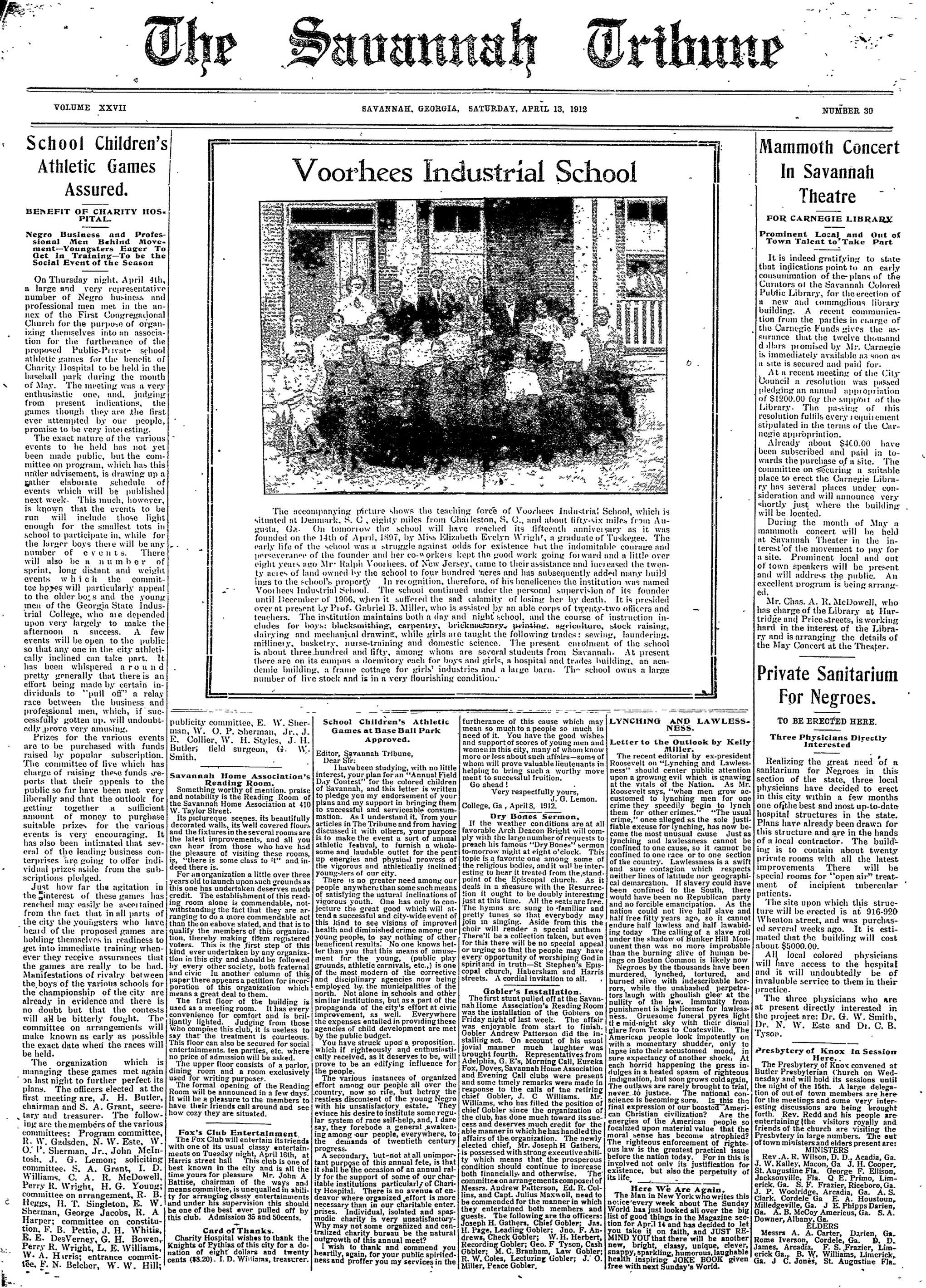
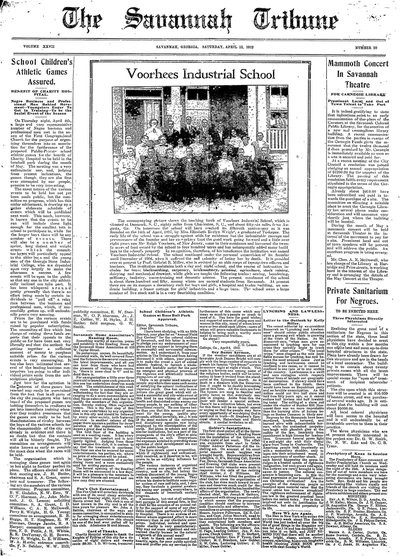
The accompanying picture shows the teaching force of Voorhees Industrial School, which is situated at Denmark, S. C., eighty miles from Chaileston, S. C., and about fifty-six miles from Augusta, Ga. On tomorrow the school will have reached its fifteenth anniversary as it was founded on the 14th of April, 1897, by Miss Elizabeth Evelyn Wright, a graduate of Tuskegee. The early life of the school was a struggle against odds for existence but the indomitable courage and perseverance of the founder and her co-workers kept the good work going forward and a little over eight years ago Mr. Ralph Voorhees, of New Jersey, came to their assistance and increased the twenty acres of land owned by the school to four hundred acres and has subsequently added many buildings to the school's property. In recognition, therefore, of his beneficence the institution was named Voorhees Industrial School. The school continued under the personal supervision of its founder until December of 1906, when it suffered the sad calamity of losing her by death. It is presided over at present by Prof. Gabriel B. Miller, who is assisted by an able corps of twenty-two officers and teachers. The institution maintains both a day and night school, and the course of instruction includes for boys: blacksmithing, carpentry, brickmasonry, printing, agriculture, stock raising, dairying and mechanical drawing, while girls are taught the following trades: sewing, laundering, millinery, basketry, nurse-training and domestic science. The present enrolment of the school is about three hundred and fifty, among whom are several students from Savannah. At present there are on its campus a dormitory each for boys and girls, a hospital and trades building, an academie building, a frame cottage for girls' industries and a large barn. The school owns a large number of live stock and is in a very flourishing condition.
SAVANNAH, GEORGIA, SATURDAY, APRIL 13, 1912
Voorhees Industrial School
School Children's Athletic Games at Base Ball Park Approved.
Editor, Savannah Tribune,
Dear Sir:
I have been studying, with no little interest, your plan for an "Annual Field Day Contest" for the colored children of Savannah, and this letter is written to pledge you my endorsement of your plans and my support in bringing them to successful and serviceable consummation. As I understand it, from your articles in The Tribune and from having discussed it with others, your purpose is to make the event a sort of annual athletic festival, to furnish a wholesome and laudable outlet for the pent up energies and physical prowess of the vigorous and athletically inclined youngsters of our city.
There is no greater need among our people anywhere than some such means of satisfying the natural inclinations of vigorous youth. One has only to conjecture the great good which will attend a successful and city-wide event of this kind to see visions of improved health and diminished crime among our young people, to say nothing of other beneficent results. No one knows better than you that this means of amusement for the young, (public play grounds, athletic carnivals, etc.) is one of the most modern of the corrective and disciplinary agencies now being employed by the municipalities of the north. Not alone in schools and other similar institutions, but as a part of the propaganda of the city's effort at civic improvement, as well. Everywhere the expenses entailed in providing these agencies of child development are met by the public budget.
You have struck upon a proposition, which if righteously and enthusiastically received, as it deserves to be, will prove to be an edifying influence for the people. The various instances of organized effort among our people all over the country, now so rife, but betray the restless discontent of the young Negro with his unsatisfactory estate. They evinice his desire to institute some regular system of race self-help, and, I dare say, they forebode a general awakening among our people, everywhere, to the demands of twentieth century progress.
A secondary, but-not at all unimportant purpose of this annual fete, is that it shall be the occasion of an annual rally for the support of some of our charitable institutions particularly of Charity Hospital. There is no avenue of endeavor where organized effort is more necessary than in our charitable enter-prises. Individual, isolated and spasmodic charity is very unsatisfactory. Why may not some organized and centralized charity bureau be the natural outgrowth of this annual meet?
I wish to thank and commend you heartily, again, for your public spirit-ness and proffer you my services in the
furtherance of this cause which may mean so much to a people so much in need of it. You have the good wishes and support of scores of young men and women in this city, many of whom know more or less about such affairs—some of whom will prove valuable lieutenants in helping to bring such a worthy move ment to successful fruition.
Go ahead!
Very respectfully yours,
J. G. Lemon.
College, Ga , April 8. 1912.
Dry Bones Sermon.
If the weather conditions are at all favorable Arch Deacon Bright will comply with the large number of requests to preach his famous "Dry Bones" sermon to-morrow night at eight o'clock. This topic is a favorite one among some of the religious bodies, and it will be interesting to hear it treated from the standpoint of the Episcopal church. As it deals in a measure with the Resurrection it ought to be doubly interesting just at this time. All the seats are free. The hymns are sung to familiar and pretty tunes so that everybody may join in singing. Aside from this the choir will render a special anthem. There'll be a collection taken, but even for this there will be no special appeal or urging so that the people may have every opportunity of worshiping God in spirit and in truth—St Stephen's Episcopal church, Habersham and Harris streets. A cordial invitation to all.
Gobler's Installation.
Gobler's Installation.
The first stunt pulled off at the Savannah Home Association's Reading Room was the installation of the Goblers on Friday night of last week. The affair was enjoyable from start to finish. Gobler Andrew Patterson did the installing act. On account of his usual jovial manner much laughter was brought fourth. Representatives from Adelphia, G. E's, Morning Call, Eureka Fox, Doves, Savannah Home Association and Evening Call clubs were present and some timely remarks were made in response to the calls of the retiring chief Gobler, J. C Williams. Mr. Williams, who has filled the position of chief Gobler since the organization of the club, has done much toward its success and deserves much credit for the able manner in which he has handled the affairs of the organization. The newly elected chief, Mr. Joseph H Gathers, is possessed with strong executive ability which means that the prosperous condition should continue to increase both financially and otherwise. The committee on arrangements composed of Messrs. Andrew Patterson, Ed. R. Collins, and Capt. Julius Maxwell, need to be commended for the manner in which they entertained both members and guests. The following are the officers: Joseph H. Gathers, Chief Gobler; Jas. H. Page, Leading Gobler; Jno. F. Andrews, Check Gobler; W. H. Herbert, Recording Gobler; Geo. F. Tyson, Cash Gobler; M. C. Branham, Law Gobler; R. W. Coles, Lecturing Gobler; J. O. Miller, Peace Gobler.
-
Tribune
LYNCHING AND LAWLESSNESS.
Letter to the Outlook by Kelly Miller
The recent editorial by ex-president Roosevelt on "Lynching and Lawlessness" should center public attention upon a growing evil which is gnawing at the vitals of the Nation. As Mr. Roosevelt says, "when men grow accustomed to lynching men for one crime they speedily begin to lynch them for other crimes." "The usual crime," once alleged as the sole justifiable excuse for lynching, has now become the most unusual cause. Just as lynching and lawlessness cannot be confined to one cause, so it cannot be confined to one race or to one section of the country. Lawlessness is a swift and sure contagion which respects neither lines of latitude nor geographical demarcation. If slavery could have been confined to the South, there would have been no Republican party and no forcible emancipation. As the nation could not live half slave and half free fifty years ago, so it cannot endure half lawless and half lawabiding today. The calling of a slave roll under the shadow of Bunker Hill Monument then was no more improbable than the burning alive of human beings on Boston Common is likely now
Negroes by the thousands have been murdered, lynched, tortured, and burned alive with indescribable horrors, while the unabashed perpetrators laugh with ghoulish glee at the nullity of the law. Immunity from punishment is high license for lawlessness. Gruesome funeral pyres light the midnight sky with their dismal glare from Texas to Coatesville. The American people look impotently on with a momentary shudder, only to lapse into their accustomed mood, in sure expectancy of another shock. At each horrid happening the press indulges in a heated spasm of righteous indignation, but soon grows cold again. The outlaws are rarely brought to trial, never to justice. The national conscience is becoming sure. Is this the final expression of our boasted American Christian civilization? Are the energies of the American people so focalized upon material value that the moral sense has become atrophied? The righteous enforcement of righteous law is the greatest practical issue before the nation today. For in this is involved not only its justification for existence, but also the perpetuity of its life.
Here We Are Again
The Man in New York who writes this notice every week about The Sunday World has just looked all over the big list of good things in the Magazine section for April 14 and has decided to let you take it on faith, and JUST REMIND YOU that there will be another new, bright, claessy, unique, clever, snappy, sparkling, humorous, laugable health inspiring JOKE BOOK given free with next Sunday's World.
NUMBER 30
Mammoth Concert In Savannah Theatre
FOR CARNEGIE LIBRARY
Prominent Local, and Out of Town Talent to Take Part
It is indeed gratifying to state that indications point to an early consummation of the plans of the Curators of the Savannah Colored Public Library, for the erection of a new and commodious library building. A recent communication from the parties in charge of the Carnegie Funds gives the assurance that the twelve thousand dollars promised by Mr. Carnegie is immediately available as soon as a site is secured and paid for.
At a recent meeting of the City Council a resolution was passed pledging an annual appropriation of $1200.00 for the support of the Library. The passing of this resolution fulfils every requirement stipulated in the terms of the Carnegie appropriation.
Already about $400.00 have been subscribed and paid in towards the purchase of a site. The committee on securing a suitable place to erect the Carnegie Library has several places under consideration and will announce very shortly just where the building will be located.
During the month of May a mammoth concert will be held at Savannah Theater in the interest of the movement to pay for a site. Prominent local and out of town speakers will be present and will address the public. An excellent program is being arranged. Mr. Chas. A. R. McDowell, who has charge of the Library at Hartridge and Price streets, is working hard in the interest of the Library and is arranging the details of the May Concert at the Theater.
Private Sanitarium For Negroes.
TO BE ERECTED HERE.
Three Physicians Directly Interested
Realizing the great need of a sanitarium for Negroes in this section of the state, three local physicians have decided to erect in this city within a few months one of the best and most up-to-date hospital structures in the state. Plans have already been drawn for this structure and are in the hands of a local contractor. The building is to contain about twenty private rooms with all the latest improvements. There will be special rooms for "open air" treatment of incipient tubercular patients.
The site upon which this structure will be erected is at 916-920 Wheaton street, and was purchased several weeks ago. It is estimated that the building will cost about $5000.00.
All local colored physicians will have access to the hospital and it will undoubtedly be of invaluable service to them in their practice.
The three physicians who are at present directly interested in the project are: Dr. G. W. Smith, Dr. N. W. Este and Dr. C. B. Tyson.
Presbytery of Knox In Session Here.
The Presbytery of Knox convened at Butler Presbyterian Church on Wednesday and will hold its sessions until the night of the 15th. A large delegation of out of town members are here for the meetings and some very interesting discussions are being brought forth. Rev. Redd and his people are entertaining the visitors royally and friends of the church are visiting the Presbytery in large numbers. The out of town ministers and elders present are: MINISTERS
Rev. A. R. Wilson, D. D., Acadia, Ga.
J. W. Kalley, Macon, Ga. J. H. Cooper,
St. Augustine Fla. George F. Ellison,
Jacksonville, Fla. Q. E. Primo, Limerick, Ga. S. F. Frazier, Riceboro, Ga.
J. P. Woolridge, Arcadia, Ga. A. S. Clark, Cordele Ga. E. A. Houstoun,
Milledgeville, Ga. J. E. Phipps Darien,
Ga. A. B. McCoy Americus, Ga. S. A. Dower, Albany, Ga.
Messrs A. A. Carter, Darien, Ga-Rome Iverson, Cordele, Ga. D. D. James, Arcadia, F. S. Frazier, Limerick Gau. B. W. Williams, Limerick, Ga. J C. Jones, St. Augustine Fla.
Of Interest to Our Women MAKING THE HOME BEAUTIFUL RECIPES REQUESTED BY READERS
For the woman who entertains a great deal fittings of the guest room are of greater interest perhaps than those of any other room. In the rest of the house the individuality of the owner may compensate to some degree for lack of comfort, but in a room which changes hands so often as a guest chamber comfort must be combined with good taste of a general, not a personal, sort. A few days ago in this column the guest room for the masculine visitor was discussed.
A room, which is intended for women alone may receive very different treatment from that accorded a man's quarters. More delicate colors, dainter draperies, lighter furniture, all go to make up a room whose appeal will be to the feminine, not masculine, senses.
As a rule, in a woman's room the predominating note is blue or pink and white. This dainty but rather insipid color scheme is apt to pall on the visitor who makes a long stay. There are some charming shades verging on the old rose which prove more satisfying than the usual light pink.
A very attractive room seen recently was done in wistaria, to very good effect. The paper was a figured one, with the wistaria blooms varying from the palest to the deepest shades climbing in an unconventional way over all the walls, making the room seem a perfect wistaria arbor. Cretonne bureau and table covers in the same design partly covered the two pieces of furniture in white maple. The window over curtains were in a plain lavender china silk, which lent balance to the figured paper.
Lavender is not very successful as a rule. It fades very quickly and leaves a washed out shade which is far from attractive. In the more expensive materials, however, it will keep its color for some time. Yellow is a charming color in some of its shades, but, unfortunately, it cannot be relied upon. Very often it is entirely different in the sunshine than at night. Taking these difficulties of lavender and yellow into consideration, they are counted with blue, old rose and pink as the most popular shades for feminine surroundings.
White maple, circassian walnut and other light woods should replace the darker mahogany and oak more suited to the masculine fancy. An old white set may be given a coat of gray paint to very good effect. Besides the one double bed or, better still, two single beds, the furniture should consist of a bureau or dressing table, a long dressing mirror, a small table, if possible a chiffonier, one easy chair and several straight chairs, a desk and perhaps a book shelf.
In providing the small requisites for a woman guest's room, it is wise to supply a brush and comb, manicure set, powder, a hand glass, a shoe horn and all the other articles which are essential to a girl's toilet. This does away with annoyances to the visitor in case of delayed luggage. The thoughtful hostess also takes care to furnish a set of sewing utensils in a basket and a well supplied pn cushion, which will spare the guest the embarrassment of asking her hostess for such things after her arrival. Hairpins should also be included among the dressing table appointments. Pretty pillows and dalty bureau decorations are a means for displaying taste in a woman's room.
NEW TRIMMING FOR
EVENING DRESS
Black diamante is the newest ornamentation for evening dresses, and is taking the place of bead embroideries, pink or silver pearls and the heavy silks which have been so fashionable of late. It is also used extensively for ornamenting jolifure bands and caps. Made of the smallest black particles, studded closely together, this black paste at first appearance looks like cut steel, but in artificial light it sparkles brightly in curious shades of green and red. Black paste, or diamante, though at its best on a black velvet foundation, also forms an effective contrast on the new chalk-white velvets used this season for evening dresses.
In one dress of the latter material, made on simple lines with a deep hem of velvet brocade on silver tissue, bands of black diamante decorated the corsage, which was softened with folds of white chantilly and ermine. A large buckle of, the black diamante, threaded with lace, finished the waist in front, and a similar trimming appeared at the back, holding in place a princess train of the velvet brocade.
LOBSTER SAVORY.
Baking Powder Bread.—One quart of flour, one teaspoonful of salt, a half teaspoonful of sugar, two heaping teaspoonfuls of baking powder, half of a medium sized cold, well baked potato, and water, milk or equal quantities of each will be needed for this recipe. Sift thoroughly together flour, salt, sugar and baking powder, rub in the potato, add sufficient liquid to mix rapidly and smoothly into a stiff batter or soft dough. This will require about one pint of liquid. Smooth the top with a knife dipped in melted butter and bake immediately in a moderate oven about one hour.
Lemon Ple.—Beat thoroughly the yolks of two eggs with one scant cupful of sugar, add two heaping tablespoonfuls of cornstarch, dissolved in milk; pour into the mixture one cupful of boiling water, add to this the juice and grated rind of one lemon, and when cooked pour into a baked crust. Beat the whites to a stiff froth, add one-half cupful of sugar and spread evenly on top. Put in the oven and allow to brown slightly.
Apple Dumplings Royal.—Take one quart of flour, thoroughly mix it with three teaspoonfuls of baking powder and a small teaspoonful of salt, rub in a piece of butter or lard the size of an egg, and then add one small potato, grated in the flour. After the butter is well mixed, stir in the milk and kned to the consistency of soft, biscuit dough. Break pieces of dough large enough to close over four quarters of an apple or other fruit as desired, without rolling; lay in an earthen dish and steam until the fruit is tender. Serve with brandy sauce, milk or cream.
BENEATH THE BIG COAT.
Hand embroidered white satin or white crepe blouses are to be seen this winter constructed upon simple tailor made styles, with the edges of the collar and sleeves scalloped and buttonholed, a good idea for the girl who can do needlework, both plain and elaborate. Net blouses are well liked to be worn under heavy coats, should a simple dress of the one-piece order not be preferred. Gossamer-like though they are, they take the place of the fine lingerie blouses very satisfactorily and make a pleasant change.
FADS AND FANCIES.
A child's bib in white linen may have a design of a tiny horse, a dog, a cat, a little rosebud, a duck or a bird. It will only take a short time to cross stitch one of these figures in the lower left hand corner of the bib, and a present for baby is accomplished.
There are many articles made of tin and a housewife rejoices in it. Among acceptable gifts for the tin wedding celebration are candy, dessert or ice cream molds, tea infusers, bellows and pans of every shape and size.
FRENCH TEA CREAM.
Scald one quart of cream, take from the fire, add one tablespoonful of any preferred kind of tea, stir for an instant, cover closely for six minutes, then strain. Return to the fire in a double boiler with five eggs and five tablespoonfuls of sugar beaten together and added to it, and stir until as thick as custard. Take from the fire add one box of gelatine which has been soaked in one cupful of cold water and stir until dissolved. Strain into a wetted mold and set away until firm. Serve with whipped cream.
FOR REMEMBRANCE.
A giggle at the wrong moment is as awkward as a mistake.
An adaptive girl wins admiration.
Gentlemen always take pains to be gracious to servants..
Not all girls can be beautiful, but any girl can be attractive.
FASHION
Lovely separate blouses of velvet and chiffon are displayed. One of white brocaded velvet has the yoke and undersleeves fashioned of black mousseline de sole. A blouse of dark blue satin is embroidered with scarlet silk. The design is arranged to form a yoke. Small buttons, of scarlet silk are used as trimming. The small draped toque retains its popularity. One of white velvet has a long white quill edged with seal placed at a jaunty angle to the left side. A toque of skunk fur has a trimming of black lace. Green, blue, yellow and red are used in the set mosaic designs. This used on a coat of a dark color gives a striking effect.
The blanket coat is another novelty. This is made of material resembling soft blankets. It is reversible and comes in all shades and tints. A coat made of this heavy cloth was of mauve and rose. A double hood turned back with huge revers formed the only trimming.
TAKING ADVANTAGE OF OPPORTUNITIES
BY BOOKER T. WASHINGTON.
In so far is I can, I want to help each one of you to realize that the south, in a large measure, at present, is a new country and that there are rare opportunities surrounding us for development, for usefulness in almost every direction. But it is too often true with our race, as with some others, that we do not seize the opportunity, do not realize what an opportunity is within our grasp until it is too late.
I want to say again that the south is a new country and surrounding us are all kinds of opportunities—opportunities which in twenty-five, or thirty or forty years from now we will begin to appreciate and understand.
There are two kinds of people in the world: One kind is always seeking civilization—goes to what he calls civilization. There is another kind that brings civilization to him. In a large degree, we must become a pioneer race if we would succeed. Heretofore, we have not been very greatly a pioneer people. We are inclined to go to the conveniences of life, instead of bringing the conveniences of life to us, and you will find, if you study the history of people, that the man who goes to a community, to a city after civilization and the conveniences of life, after reaching there, in most cases, finds himself at a disadvantage—fluttering on the outer edges of things, when if he had pursued a different course, he might be the center of things. We like to wait, in too many cases, before going to any place to settle until there is a pretty good sized community, until there is a railroad reaching the place, a good railroad—we want to have plenty of trains a day. You often ask: How many trains go there a day? We want to be sure that the streets are laid out; high buildings there, that they have street cars, telegraph offices, telephone offices, and now we begin to ask before we go if the town has electric lights.
Now that is all well, and it is important and natural and right that a large portion of you, as you go away from here, should seek after those centers of civilization, but I hope that a still larger proportion of you will feel and see that there is a great opportunity for you to go out into the open, go out into the country districts of the south, go into the forests, go into the fields and plant yourselves there and work there and toll there until you bring civilization to you, and then, instead of you having to depend upon somebody else, somebody will be depending upon you. Any person who settles in any part of the world and does a useful service, builds up something that is of value to himself, of value to the world, is going to bring the conveniences and the opportunities of civilization to him.
I do not want too many of you, as you go away from here, to yield to the temptation of going to large cities. The temptation is great. The conveniences are there; plenty of stores, many opportunities to spend money. Railroads are there, street cars are there, electric lights, steam heat. It is a great temptation for the short-sighted person to go there, but the person with long sight, who would consider the future as well as the present—in the present condition of the south—is the person who is going out into the forest while land is cheap, while you can get opportunities in the country which will never come to this part of the country again. Go out into the forest and plant civilization there in the form of a home, in the form of a school, in the form of a farm, in the form of a piggery, in the form of a poultry yard, in the form of a dairy, in the form of a truck farm, in the form of some useful industry which will be the foundation for you and your children and children's children in future generations. You can scarcely select for that purpose any portion of the south, which within a few years will not find civilization, with all of its conveniences seeking you, instead of you having to seek after these conveniences, and in the last analysis find yourselves, as I stated in the beginning, not the center of opportunity, not the center of activity and success, but you will find yourselves merely fluttering around on the outer edges of the civilization that somebody else has created.
These opportunities are not only before the young men, but they are before the young women. As I said to the young women a few days ago, the time has come when here at Tuskegee, in a larger measure than has ever been true in the past, we must encourage and see to it that young women do as women are doing in all parts of the civilized world—get more and more into the outdoor industries. Learn farming, learn, everything that relates to farming in all of its branches and you will find these opportunities. Women can go out and make these opportunities, make themselves independent by going out into the rural districts and planting themselves. You may have to endure what the world calls inconveniences as you go into these districts, but you will find recompense for it. It is a great thing for a person to have the courage, to have the foresight to go out into the open, to go out into a new country, go out Into the forests, among the trees, the streams, where he can get close to nature. He not only has an economic compensation for that, but in this kind of life there
Is an opportunity for the broadest kind of growth.
People who go out into the rural districts, who go out as pioneers and settle in this way have time to think. One difference is that many of the people who live in these large cities haven't time to think. This is especially true of our people. They go from these rural districts, from the fields, from the small communities and find themselves at once surrounded by a city, with all its glamor, and they haven't any time to think. Every time they want to think—or think they can think—a street car passes by, a parade passes by, a brass band goes by—something occurs and thus they cannot think, and thus they go all through life in a hum-drum manner.
You will find if you read the history of most of the successful men, men who have grown great and useful and prosperous, that they are men, for the most part, who have had time to think, began to think when they were out in some real country district, and you will find no better opportunity for broadening your mind, for strengthening your mind, for learning to think, than you will find in the country.
Whenever I have a chance, I always enjoy going out here in the country and talking with some of the farmers. They probably cannot give you a quotation handed down from generation to generation (and sometimes those very people who use these quotations have no idea of the meaning of them) but these farmers have sense, have brain power. They have education that they have gotten by studying nature, by observing trees, by coming into contact with water, coming into contact with birds, with cows and horses, and in many cases, they have the best kind of education.
I urge upon you again not to be afraid to be pioneers in this respect—men and women pioneers going out into country districts while the land is cheap, where the opportunities are many and where you can make civilization, instead of merely being used in a civilization that somebody else has created. There are opportunities for living a clean, pure, Christian life, and there are opportunities for usefulness.
And last of all, you will find a happiness in this kind of life, a real happiness that you do not find in the midst of the activity and glamor of the large city. You will find a freedom of action there that you do not find in any large city. Much of the time of our people is taken in connection with the discussion of little problems that relate to city life; time and thought that should go into larger and better things. We are free from all this in the country.
Before foreigners begin to flock into this part of the country, as they will within a few years by the thousands and take from you this opportunity, I want to urge upon each of you, as you begin planning for life, as you go out from here, to seize the opportunity of buying land and building a home before it is too late.
EMINENT COLORED MEN
WHO HELD HIGH OFFICIAL POSTS UNDER THEIR RESPECTIVE GOVERNMENTS.
Under the caption "A Polished Gentleman of Color" a London paper as far back as 1850 had the following interesting item: "We understand that the government has appointed a gentleman of color to the office of British consul at Liberia. This is, we believe, the first instance on record in which a gentleman of color has received a similar appointment from our government.
"On the introduction of the new British consul at the foreign office his personal appearance excited no inconsiderable interest. He is a man of superior intelligence and of highly polished exterior."
The name of this early negro diplomat was Hanson. He was a doctor of divinity and a native of Cape Coast Castle.
He held the record of being the first negro appointed a consul to represent a white government abroad. America followed England's example 18 or 20 years after by sending J. Milton Turner, a simon-pure negro, as United States minister resident and consul general to the republicof Liberia.
The appointment was made by President Grant. Mr. Turner was a Missourian, a lawyer and an able orator.
AN ELECTRICAL HOME.
From its front porch to its kitchen electricity was in use on every hand. In the hall, electric lights displayed the beauty of the furnishings, and a vacuum cleaner operated by an electric motor showed how they might be kept in their original freshness. In the parlor electricity played the piano and threw a glow of warmth from the fireplace. In the charming little bedroom electricity would heat my lady's curling tongs, warm his majesty—the baby's—bottle, and dry the shampooed hair of the entire household. In the dining room electrical appliances upon the sideboard would boll the eggs, cook the cereal and make the toast and coffee, to say nothing of keeping the plates hot and heating the chafing dish. In the kitchen the cook was mixing cake by electricity and baking it in an electric stove; while the materials for her future use were kept chilled in an electric refrigerator, and a little motor drove the machine which did the family washing. Electric irons stand ready for use when the clothes should come from) the electric dryer—Christian Herald.
He that hath seen me hath seen the Father.—John, xiv, 9.
Men have seen God in the works of nature, and through nature God has spoken by the voice of the storm, by the earthquake and by the fire—also by the still, small voice that whispers when all else becomes silent. Men have scanned the earth and searched the heavens; they have read the rocks and fathomed the seas; they have analyzed life and sought the mysterious operations of the soul, in order that by searching they might find out God. And not in vain have they searched, for they have found the God of nature. This is a real revelation of God; it is the revelation of God as Creator—the God of power.
Men have searched out God, likewise, along the paths of reason. Even pagan sages have seen at least vague glimpses of God and of God's providence. St. Paul, in speaking to the Athenians of the God in whom "wo liv, and move, and have our being," was able to quote Greek writers, saying, "as certain even of your own poets have said." Modern philosophers, walking not in the ways of revelation, but in the paths of reason, have likewise found out God. But the God they have found is the abstract and impersonal, the infinite, the inscrutable, the first cause, the power that makes for righteousness. This, too, is a real revelation of God.
But the Hebrew prophets had a far grander conception of God, for they received revelations inspired by the Holy Spirit, and they saw visions grand and splendid. Moses saw a vision of God from a cleft of the rock; Isaiah saw "the Lord sitting upon a throne, high and lifted up;" Ezekiel beheld "the appearance of the likeness of the glory of Jehovah." These were revelations of God in visions to prophets who saw in the play of intensest light, in radiant majesty, and in glorious splendor, symbols of the God Omnipotent who reigns in lofty and holy grandeur over Heaven and earth, and over the deity of man. But God is set forth also as the God of mercy and of love—"The loving kindness of Jehovah is from everlasting to everlasting upon them that fear him, and his righteousness unto children's children." Though he is a hater of sin, he is also a forgiver of sin—"He hath not dealt with us after our sins, nor rewarded us after our inquilines." God is even spoken of as a father—"Like as a father pitlieth his children, so Jehovah pitlieth them that fear him." Yet is there something still lacking in the Old Testament of God, great as that revelation is. That revelation is grand, but it is austere; it is glorious, but terrible. God is a father, but he is a stern father; and his children are ruled by fear. Not yet had men the revelation that made them intimate with God, not yet that inspiring thought that enabled them to look up into the face of God and pray, "Our Father, who art in Heaven."
It is when we look upon Christ that we see God the loving Father. Therefore said Christ to Philip, "He that hath seen me hath seen the Father." Christ did not say, "He that hath seen me hath seen the Almighty." "The high and lofty one that inhabiteth eternity, whose name is holy." Christ did not reveal, and had no need of revealing. It was his mission to reveal God in more tender aspect. It was his mission to reveal that fatherly heart of God that "so loved the world that he gave his only begotten Son, that whoever believeth on him should not perish, but have eternal life."
Jesus, then, revealed not God in the perfection of his nature and in the glory of his power, but God in that character that man needed most, the character of God as a loving father. This is the supreme revelation of God. God is might, God is power, God is wisdom, a spirit, infinite, eternal and unchangeable—yes, that has been revealed in various ways, both by revelation and by reason; but there was no need of such revelation through Christ. Something greater, something infinitely more precious did Christ reveal concerning God. The God of infinite power is also the God of tender love. "He that hath seen me hath seen the Father." Nothing like this do we find in the Old Testament. "Show me, I pray thee, thy glory," crled Moses in his desire to see God; but the answer came, "Thou canst not see my face; for man shall not see me and live." "Oh, that I knew where I might find him," crled Job, "that I might come even to his seat!" In vain was the cry, "Behold, I go forward, but he is not there; and backward, but I cannot perceive him; on the left hand, when he doth work, but I cannot behold him; he bldeth himself on the right hand, that I cannot see him." Yes, man wants to see God, and needs to see God; but man cannot look upon the face of God, and he would not dare even if he could.
Therefore in Christ we have the very revelation that man needs. We may look upon him and we see the Father—God in the one character that satisfies the heart. Here is God clothed in flesh; here is God manifested as a man. We look upon Christ and we see a life of perfect love; and in this life of perfect love we recognize for ourselves God as our Father. "No man hath seen God at any time; the only begotten Son, who
is in the bosom of the Father, he hath declared him." Look, then, upon Christ, ye who are doubtful, yet whose hearts hunger and thirst for life, ye who grope through the shadows after God. Look upon Christ, gaze upon him, until your hearts are satisfied; for inasmuch as ye have seen Him ye have seen the Father. Hear his words; behold his deeds, see his life of loving, unselfish ministration; his death upon the cross, and know that this is the Word of God—sye, the word of the Father, the expression, the utterance, the revelation of God as Love. "He that hath seen me hath seen the Father."
CHARLES G. GIRELIUS.
NEGROES OF NEW YORK CITY ARE GETTING BUSY
NEGROES OF NEW YORK CITY ARE GETTING BUSY
FORCED. TO GIVE UP HALL USED FOR LODGE MEETINGS, THEY HAVE DECIDED TO HAVE SOME-THING OF THEIR OWN.
The negroes of New York city are at last waking up to the feasibility of having their own halls, meeting places, theaters, club rooms and so on, and there is much talk of building going on these days.
There are many sensible colored people here who have discussed this matter for many years, but nothing has ever resulted from their talks and suggestions. But at the present time, there seems to be a great awakening along this particular line. The fact is, our people here are being forced in a manner to do what they are about to do.
The various lodges, societies and other social organizations pay every year to the white owners of halls and meeting rooms many thousands of dollars. Whereas, if there were one or two large buildings having meeting rooms and halls suitable for dances, receptions, etc., owned entirely by colored people, all of this money which is now being paid out could be saved to them, and the cost of their building could be repaid to them in a few years.
Our people here were all along depending on an old building on West Twenty-ninth street, called Association hall, for holding most of their meetings. This place was once owned by the colored people, and was then known as the Odd Fellows' hall, but by the usual bad management or something else, this place went into the control of the white people, and now, by reason of some other changes, all of the tenants of the building will have to vacate and the colored people are obliged to find, new quarters for their meetings, hence this great awakening and much talk of building. The writer is very glad of this awakening and sorry it was so long in coming.
Nearly all the big associations, clubs and lodges of every other race and nationality in this city, with the exception of the negro, have their own halls, theaters and club rooms and now that this great activity is being manifested, we hope something tangible will be the result. Already the new theater is in progress, and plans for erecting in Harlem a new home building for the colored Y. M. C. A. are being formed.
The Clet club, an organization of colored musical people of this city, at a recent meeting announced their intention of building a home in the near future and some of the orders of Odd Fellows are trying to raise enough money to have a hall of their own. We hope that all of these projects will materialize so that the colored people here will be able to meet whenever they want to and can have their entertainments, receptions, picnics, balls, etc., without having to go to a white person and pay their good money and get places with very little accommodation.
LIVE STOCK JOTTINGS.
In training the young horse to work, go about it gradually. Halter and bridle first, and allow the young animal to learn the "feel" of the harness a little at a time. Individual hog houses scattered over a wide area are better than a central large hog house and cheaper. Too many hogs in one pen or house will not thrive, as proved by many practical tests. Do not keep your pigs with large hogs. The pigs will lose by it.
Feed sows with litters according to the size of the litter. Have a long and shallow trough so that the plugs can eat stop from it as soon as they are old enough to eat. Build a separate feeding pen for the plugs, into which they can go but the sow cannot, and feed them milk separate from the sow before weaning. Do not wean them till all are able to eat and drink well. Feeding them some before weaning will help them along and prevent the sow from running down.
At the close of winter, when all animals are on dry feed, supply wheat bran or oil meal in the rations for regulating the bowels. Have all young stock in good flesh for going on to new pastures. It never pays to stunt the young.
Lambing time is the most critical period with sheep. They must be sheltered where they will be dry and warm when the young lambs arrive. Watch for the coming lambs, and when one arrives, see that it gets some warm nourishment, as soon as possible. After it swallows a few drops of new, warm milk the greatest danger point has been passed. Now is when the ewes will need nutritious feeds. Supply a variety and plenty both before and after lambing. Oats and clover hay are excellent. A small amount of shelled corn is good.
HOW FOREIGN IMMIGRATION WILL ULTIMATELY SOLVE NEGRO PROBLEM
BY FRANKLIN W. WILLIAMS, ATTORNEY AT LAW.
One of the most difficult problems of our nation today is the problem of the races. The enslaving and the subsequent emancipation of the negro bequeathed a legacy of trouble to the American people which is, now, one of the most difficult problems of the nation. It is difficult, because of its complexity and seemingly vexing phases. It is of the deepest concern, because the negro must somehow be built into the national life and character of America. For us, the problem means the security of the negro's welfare in this country. His welfare seems to be endangered and imperiled; yet, we shall see that it is really secure. The problem presents three phases: An industrial, an educational and a civil phase.
Now, you may ask, how can foreign immigration help to solve the negro problem? First, let us see how it will affect these three phases of the question; then, you shall judge for yourself if it will not help to solve the problem.
At present, there is much alarm among our people over the immigration laws which are being made in the southern states. But, we have no need to fear. The south is far from being overcrowded. There are thousands, yes, millions, of acres of land unoccupied and unused in this country which ought to be occupied by somebody. The present demand for labor, upon which the industrial and business prosperity, in a large measure depend, cannot remain unsatisfied. This explains why foreign immigrants are being brought to this country in such large numbers. Some of them—the Greeks for example—are making remarkable progress. The Afro-American can learn a lesson from this quiet but persistent people. We hear a little of them here in the south; but they are slowly saving their spare means and are bending every effort towards starting and developing various lines of business. They have already reached a point where they are establishing banks and other large enterprises. The Greeks of the south compel us to recognize them because of their progress. The Afro-Americans can compel the white races to recognize them when they prove their real worth; their practical ability by acquiring personal and real estate and by establishing banks and other enterprises.
Now, after forty-seven years of experience, our race is beginning to realize the importance of its own industrial and business development. Already, we are purchasing every year thousands of acres of land and we are founding schools and banks. Then too, in a large measure went to the white race is now turning towards our own people. In proportion as the members of a race learn to respect each other, in proportion as they learn to invent, foster and establish business enterprises and conduct them in a business-like way, in like proportion will such a race be respected by its fellow countrymen. Consequently the thrifty immigrants, bringing their healthy competition, which we so much need, will quicken our energy; stimulate us to be more industrious; cause us to buy more land, build better houses, have larger bank accounts and, thus, present to the world tangible and visible evidence of our worth as a race. By making constructive progress along industrial and economic lines we will secure the respect and consideration of our neighbors.
The educational phase is equally as important. It is true that the Afro-Americans have made unparalleled progress along the line of general education. Thousands of our young men and women are in academies, preparatory schools and colleges. Negroes are occupying prominent places in the professional and in the artistic world. But, as a race, we have not paid enough attention to technical training. We have too few well-trained, well-educated master mechanics; too few master masons and too few civil engineers and architects. Foreign immigration will be an incentive to this kind of education—which the masses need—which we as a race are neglecting. The better the negro is prepared for service, the better and more efficient service he can render and the greater will be the demand for those services. The individual or the race that is prepared gets something to do, regardless of his previous condition. Idleness means ignorance; ignorance means crime; and crime means a heavy burden to the race. Therefore, we can see that the safety of the race is in the direction of industry and education, which will be developed very largely by competition.
The civil phase is of no less importance. Foreign immigration is causing the negroes to unite. They must eventually become a power in the community. The white man will soon discover that his colored workmen understand him better; can suit him better than any ignorant foreigner. Our safety and protection, as a race, are not to be found in keeping the foreigners out of this country, but in our ability to get as much out of our business or vocation as any other race can. Senator Cannon, while pleading that the American people give the negro a fair chance, was interrupted by Senator\ Tillman, who said that the negro can do too much with a half of a chance. Ex-Presi-
dent Roosevelt believes that there is but one way, in the solution of such an intricate problem and that is by dealing with black men as you do with white men. It is the same rule which must be applied to rich men and poor men; that is, treating each man, whatever his color or creed or social position, with even-handed justice according to his real worth as a man. The white man ought to treat well the colored man who shows by his life that he deserves such treatment. Surely it is the highest wisdom to encourage individuals of whatever race who are honest, industrious and law abiding and who make good and safe neighbors and citizens.
Again, as a people, we have no need to fear that the coming foreigners will make it impossible for us to earn a livelihood. We believe that much of the talk about the movement is simply a, conspiracy to frighten the negro. It is evident that the south, as a whole, does not want the influx of foreigners. It was only a few years ago that the west settled her Japanese question, and the south is gathering material for a far greater trouble than she has ever witnessed. The bomb-throwing Helots and the black-handed Italians of Europe will certainly teach her a lesson. And the south will learn in the end that she has the best set of laborers right at her own door, and if she knew how to treat them decently she would find them kindly, intelligent, efficient and reliable. But after the foreigners have come over and begun their long strikes, have hurled their bombs and have smashed up cars and factories, the whites will become alarmed, will band themselves with the negroes and begin to respect them as fellow-countrymen. A common danger and a common sympathy will unite these long estranged neighbors. The black man will help the white man and the white man will help the black man.
BILL REPORTED FAVORABLY IN
Washington, D. C.—The senate committee on industrial expositions gave its approval to the Bradley bill providing for the holding of an exposition in the summer of 1913 to celebrate the semi-centennial anniversary of the emancipation proclamation. The president of the United States is to appoint a commission, consisting of the secretaries of the treasury, war and navy, to make the plans for the exposition. An expenditure of $250,000 also would be authorized. The exposition is to be under the joint supervision of the commission and the Semi-Centennial American Emancipation Exposition company, which has its headquarters in Savannah, Ga., and which has been promoting the exposition.
The exposition is to be held either in the District of Columbia or in one of the states where slavery existed before the Civil war. It is proposed that the exhibits shall show the history, progress and present condition of the negro race in this and other countries.
ENCYCLOPEDIA OF ACHIEVEMENTS OF PEOPLE OF COLOR TO BE PUBLISHED BY DANIEL MURRAY.
Washington, D. C.—A race publication of unusual merit and of extraordinary importance is about to see the light. It is to be an encyclopedia and compendium of the literary, musical, artistic and scientific activities and accomplishments of people of color in modern times especially in America. Biography and history will be fully covered.
The compilation is the work of Daniel Murray and has occupied a good part of his time for over a dozen years. During this time Mr. Murray has been an employee of the Library of Congress which gave him exceptional opportunities of which he diligently and conscientiously availed himself.
The work will be issued in about six large volumes and may be looked for the coming summer.
INCREASED POPULARITY OF EMBROIDERIES.
Embroideries for early spring will be more popular than ever. The tendency to a return to trimmed skirts in all fabrics, and especially to foot trimmings and three-tier effects, is one reason for this popularity. In these days of panel effects, band trimmings, fichu and surplice outlines and galloous, bands and insertions of various width are absolute essentials in the making of gowns. Widths of embroideries range from one inch to 18 inches, but the four to nine inch widths are those most used by designers of gowns.
Colbert embroidery bands and all-overs are expected to reach a great vogue. It is of the cut-work order, resembling, in an enlarged way, Carrickmacross lace, and also giving an effect similar to that of real Venise lace. It will be much used for lapels or revers on coats, as well as for hat trimming or gown garniture.
All-over embroideries have been very popular for several seasons, but new uses for them have been evolved from fashions in garments made of other fabrics. As the season advances little coates, overblouses, jackets, boleros and Etons will be created, to be worn over simple muslin gowns thus making them dressy at a moment's notice. There will be a larger use, than ever for all-over in whole gowns, parasols, hats, tunics and underwear.
COLORED EDUCATOR IS WELCOMED IN WASHINGTON
DR. JAMES E. SHEPARD, PRESIDENT OF NATIONAL RELIGIOUS TRAINING SCHOOL AT DURHAM, N. C., WAS GIVEN ROUSING RECEPTION IN THE NATION'S CAPITAL.
(BY GEORGE FRANCIS KING.)
Washington, D. C., Special—A rousing reception was tendered the brilliant young educator, Dr. James E Shepard, founder and president of the National Religious Training school, Durham, N. C., when he addressed the famous Bethel Literary and Historical association in the Metropolitan A. M. E. church, this city, recently. His able and tangible conception of the possibilities of true racial uplift by building upon a foundation as set forth in his plans caused a unique ovation for him on the subject, "The Religious Training the Hope of the Negro Race." This young apostle of a Gospel that has aroused a healthy propaganda among both races throughout the country, and bringing about the needed good destined, was given such an enthusiastic indorsement that made this event an epoch-making one in the life of the Afro-American folk in the district.
Justice Wendell Phillips Stafford of the Supreme court of the District of Columbia. Introduced Doctor Shepard and occasioned prolific applause. He spoke of the peculiar need of such an institution for the race and the remarkable growth and national scope this movement had attained and its endorsement by the leading educators and philanthropists. One feature that made this event one of extraordinary significance was the remarks by Rabbi Abram Simon of the Jewish synagogue. This noble exponent for equal rights and justice heartily gave impetus to the movement by his strong utterances at this meeting. For weeks a committee composed of representative citizens had been preparing for the complimentary dinner by the prominent citizens of this city, which proved to be a noteworthy event. Dr. I. N. Ross, the well known pastor of the Metropolitan A. M. E. church; and the ministers of the district gave their approbation of the purposes, aims and scope of the National Religious Training school. The following features of the coming ministers' conference, to be held this year in school July 6-13 inclusive, at the school were ably discussed by them. "What is the moral condition of the people in your community? Is crime on the increase? If not, what is the cause of its reduction? What is the sanitary condition? What effort, if any, has been made to improve the sanitary conditions? Is the death rate increasing? To what extent do you cooperate with Civic Improvement leagues? Has settlement work been conducted to any extent in your community, and with what results? What has been the effect of the Temperature organizations, and do you cooperate with them? To what extent has the work of the Y. M. C. A. and Y. W. C. A. been effective in your community? Do you approve them? What is the general fitness of the city and country school teacher? What has been the attitude of the day school teacher towards the church and Sunday school? What is the real religious condition of our people? Revivals, how conducted? During the conference ministers of all denominations will be the guest of the institution for one week.
Rev. Dr. Jesse L. Huribut, a recognized authority on the Bible and noted author, and Rev. Dr. W. Y. Chapman, the great pulpitteer and theologian, will be in charge of the expository features during the conference week. The summer school was another subject discussed at this affair. This event will begin July 3 and conclude August 11, 1912. The chataqua will be one of the greatest educational events ever held in this section of the country for Afro-Americans. Some of the most noted lecturers and scholars will compose the faculty and principal features of the summer school and chataqua of Doctor Shepard's school.
GRAIN DIET FOR HORSES.
Horses do not absolutely demand a mixed grain diet. Feeding a mixed quantity of clover and timothy hay with corn alone, the animals have been found to get along just as well as with a mixed grain ration. The corn fed horses were just as enduring as those fed oats, and they worked just as well in the hot weather as when it was cool.
Work horses should be fed with feeds that supply energy in capsule form. The use of corn or oats alone, without other grains, has been found desirable. Of the two, corn seems to be the most palatable. As regards economy, ear corn is usually cheaper per pound than oats, while their feeding value seems to be the same.
BEEF BROTH.
Two, and one-half pounds of shortribs of beef with enough cold water to cover. Put on slow fire and let simmer for two hours or longer, until tender. When at hotting point add one small onion and, two sprays of chopped parsley. One hour before done, add one fourth cup of rice, one carrot cut up and salt. There should be a pint of stock when strained Season and serve. Take the 2½ pounds of cooked beef, spread top with tablespoonful of butter and put in oven-long enough to brown.
HAMPTON NEGRO CONFERENCE
SEVERAL HUNDRED COLORED FARMERS OF VIRGINIA MEET AT HAMPTON UNIVERSITY TO DISCUSS CONDITIONS.
Hampton, Va.--The Hampton institute annual meeting of the Negro Farmers' conference brought together several hundred enterprising and prosperous farmers of Virginia, who are eager to improve their farm practice and secure increased yields per acre.
Year by year the farmers' conference has brought to Hampton a larger number of visitors from other states. This year the visitors came from twelve states and Canada, and included a number of government workers from Washington, D. C. This conference is managed by the agricultural department, of which Mr. Charles K. Graham is the director.
INTERESTING EXHIBITS.
INTERESTING EXHIBITS.
The large school gymnasium, which accommodates over fifteen hundred people, was filled to overflowing with interesting exhibits of farm, school, and home products. The entries of corn alone reached one hundred and seventy. The showing of seed wheat and rye was extremely good. Similar statements could be made concerning all the exhibits. Surely the Hampton Farmers' conference was a telling testimony to the thrift and progress of Virginia negroes and an indication of what is being quietly done through the co-operation of many agents—the preacher, the teacher, the farm demonstration agent, the business man, the housewife—to solve the race problem.
WOMEN'S MEETING
The welfare of the negro race is so closely associated with the life in the home that Hampton institute gave a prominent place to the discussion of home problems in the farmers' conference. The heads of the domestic arts and domestic science departments, as well as others who are interested in home economics, met the colored women and discussed the practical problems relating to health and hygiene, and gave some interesting demonstrations in caring for the sick.
FARM MACHINERY.
The advantages and purposes of various farm implements, as well as the conditions under which they can be used to advantage, were informally discussed by men who had had practical experience in farming. Plows, harrows, and farming machinery received attention.
NEGRO CANNING CLUBS.
NEGRO CANNING CLUBS. Under the direction of Jackson Davis, Richmond, Va., state supervisor of elementary schools in Virginia, and with the co-operation of the seventeen colored supervising teachers, who are working in eighteen counties of Virginia, a splendid movement for teaching negro girls the art and value of canning vegetables and, fruits has been in successful operation ever since the spring of 1911. This organization is known as Negro Home Garden association.
DRESSING POULTRY.
Miss Mary Yates of Toronto, Canada, who is recognized upon two continents as the greatest authority upon the subject of table poultry, gave a demonstration of dressing poultry for roasting. Miss Yates was at one time connected with the royal household of England, and was poultry instructor at the Studley Agricultural college, England. She is now on the Ontario government lecturing staff.
DR. FRISSELL SPEAKS
Dr. Hollis B.-Frissell, the principal of Hampton, expressed his satisfaction with the excellent progress which the colored people are making in agriculture and in kindred lines of work throughout the south. He declared that the best people of the whole country are intensely interested in what the colored people are doing to better the conditions in the home, in the farm, and in the schoolroom. He emphasized the importance of the negro preacher in the forward movement among the colored people. He showed the relation of Dr. Wallace Buttrick, secretary of the general education board, to the securing by the people of better schools, better homes and better agricultural results. Cooperation, in his opinion, is the great word of our modern times.
MAJOR MOTON'S ADDRESS.
Robert R. Moton, the well-known commandant of cadets at Hampton institute, spoke to a large audience of white and colored people on the value of teaching children to love the things by which they and their parents have lived and must continue to live. He said that men were slowly getting over the idea that anybody could be "just a farmer." While he values reading, writing and arithmetic, nevertheless he rates living as much more important than mere academic studies.
POTATO RAISING
Prof. P. T. Cole of the Norfolk trucking station discussed the problem of raising potatoes. He gave some interesting figures for the shipment of Irish Cobbler potatoes from Norfolk: 1906-07, 682,079 barrels; 1908-09, 799,152; 1909-10, 934,592; 1910-11, 587,141. From Eastern Shore, Va. there were shipped, during the season of 1910-11, 974,928 barrels. Tidewater Virginia ships over three million bushels of potatoes every year. The value of the truck crops from eastern Virginia exceeds fifteen million-dollars every year.
Cole gave the following formula and cost of a good potato fertilizer: 10 pounds of nitrate of soa $ at $35.50 per ton; fertilizer 10 pounds of nitrate of soda
at $36.50 per ton; 400 pounds cotton seed meal at $28.00; 400 pounds tankage at $28.00; 400 pohrdlu mfwppage at $40.00; 150 pounds sulphate of ammonia at $70.00; 750 pounds acid phosphate at $13.00; 200 pounds sulphate of potash at $47.00. This gives a fertilizer mixture costing $30.55. He recommended the use of from 1,000 to 1,800 pounds of this fertilizer per acre for potatoes. The unusual of this formula is that the nitrogen is obtained from several sources, and is therefore available for the potato during the whole growing season.
CITY-BRED FARMER.
George A. Cosgrove of Willington, Conn., a white farmer of ability and respect, told the story of his emigration from the city to the farm. At the age of fifty-seven, broken down in health and with a small amount of capital, Mr. Cosgrove, who was city born and city bred, moved with his wife and two grandchildren on a farm. The financial panic of 1893 closed the factory in which Mr. Cosgrove had served as a shipping clerk for five years. The little capital which Mr. Cosgrove and his wife had saved was used in buying a small farm and the necessary tools. No one in the family knew anything about the common duties of farm life. They were just as "green" as city people could be. "City people think," said Mr. Cosgrove, "they can go into the country and stay for weeks without incurring one cent of expense. Company soon came to us from New York, Washington, Boston and other places. The abundance of our farm supplies made it a delight to entertain our friends, instead of a burden."
- NEGRO FARMING...
The growth of demonstration farm work among the negroes of Virginia has grown very rapidly during the past five years, and its success has been largely due to John B. Plerce, a graduate of Tuskegee and Hampton, who has won the respect and esteem of the best white people of Virginia. Five years ago one negro demonstration agent was sent to Gloucester county and helped thirty negro farmers to improve their land. Indirectly he influenced for good seventy-five per cent, of the negro population. Today there are seven negro agents, working in eleven counties of Virginia, who come in touch with a thousand negro farmers and influence seventy-five per cent, of the negro population in these counties.
Whereas the average acre belonging to the negro farmer in Virginia will produce fifteen bushels of corn, with the instruction given by the farm demonstration agents the yields may be increased from fifty to three hundred per cent. Instead of raising one crop, farmers are now raising two and three crops each year. Fewer acres produce more crops. Men are raising, more kinds of food for themselves and for their stock.
"BACK" TO FORTY ACRES.
The following dispatch from Lenox, Mass., to the New York Herald, is significant of a radical change in American agriculture:
"Mr. George Westinghouse, Jr., the other day bought of Mr. John Sedgwick his forty-acre farm near the Greenock Country Club in Lee. Mr. and Mrs. Westinghouse will go there to live the last of October.
"Mr. Westinghouse has given up his position in Pittsburg and will devote his entire time to scientific farming in the Berkshires. It is understood that Mrs. Westinghouse never liked Pittsburg for a residence, and is much pleased with the idea of living in the hills."
As late as the civil war "forty acres and a mule" was considered enough land for a "round-log-cabin" and a negro family to occupy. As a change from "quarters" and slavery "forty acres and a mule" was alluring. But no occupant of the manor house thought of life upon a forty-acre plantation. A gentleman needed, for a liberal living and an income sufficient to send the girls to boarding school and the boys to college 400 rather than forty acres. For dignity in the community he needed 1,000 at least. And there are still in Kentucky a few farmhouses upon tracts of several thousand acres each.
The days of old-fashioned farming were good enough days for the owners of large tracts of land. They weren't bad days for owners of smaller tracts. But the time for the ownership of very large farms, save by men of considerable wealth, is passing. And the time has come when "forty acres and a mule," or forty acres and a team, in the hands of a scientific farmer, may produce a good income. It is not so easy to direct scientific farming operations as it was to tell the overseer to put the land in the valley in corn, the uplands in wheat or tobacco, and let the hogs range in the woods and eat "mast" till time to harden them by feeding them corn in' the fattening pen. But land farmed scientifically accommodates a population several times as large as it accommodated when it was worked by old-fashioned methods. And in America, as in older countries, unfenced range for cattle, requiring many acres to a steer and unscientifically cultivated farms requiring 1,000 acres for a gentleman and forty acres for a freed slave, are out of date.
Whether Mr. Westinghouse is a practical farmer or an "agriculturalist" in the humorous sense, remains to be seen, but in the days of his gronddaddy forty acres in the Berkshires or elsewhere would have been enough for a country house, a lawn, a garden and a cow pasture. It would not have been regarded as a farm. Louisville Courier Journal.
THIS NEGRO HAD SIXNAMES, SADLY DISTURBING THE COURT
Atlanta, Ga.—Six names for one man who was known equally well by any one of the six, sadly disturbed the city court of Atlanta when Gus Hogan was put on trial for larceny from the person.
On the defendant's witness list were six names.
"Call the witnesses, Mr. Clerk," directed an attorney.
The clerk held up his list.
"Sheep Ryan," he called. The cry was repeated by a baliff. The door of the court room opened and a small and extremely ugly darky appeared, hat in hand. He was decidedly slim and on one side of his face was a big scar.
"Slim' Jackson," cried the clerk. Again the call was repeated, and the same negro came through the door. "Here we don't want you, we want 'Slim' Jackson. Go out," the bailiff directed. The negro grinned. "Ah'se 'Slim' Jackson, too," he declared. "Well, go'on out," he was told. "Skinny' Johnson," called the clerk. The door opened and the negro with the scar again appeared. "I told you not to come back in here," the exasperated bailiff said.
"Yo' called mah name, boss," was the reply.
"I called 'Skinny' Johnson, I didn't call you."
"Ah's 'Skinny' Johnson, too," the man of aliases repiled.
Everyone in the court room was getting interested and the clerk called "Snake' Williams."
The door opened, this time cautiously, and slowly from around the corner appeared the head of the same negro. In a moment the audience was in a roar of laughter which lasted for several minutes.
"I suppose your name is 'Snake' Williams, too, is it?" the balliff asked when the laughter had subsided.
"Yas, suh, dat's mah name."
The negro began to slide out the door when Judge Calhoun called: "Look here, boy, have you got' any more names?"
"Yas, sur, yo' hono'."
The judge turned to the clerk. "Mr. Clerk, in order to save time and this colored gentleman of the many cogni-mens the trouble of opening and shutting the door a few more times, suppose you see if he isn't also the other witnesses in this case."
"Is your name 'Runt' Collins and 'Shorty' Green?" the clerk asked. The audience waited with bated breath.
"Yas, sur. Ah's bofe ub dem," the negro answered.
A few moments later the six wittenes, embodied in one short and decidedly skinny negro, were testifying on the witness stand.
TO WORK WITH BEES.
To protect one's self against bees observe the following rules: Do not stand in the way of a swarm of bees. While working with the bees do not make any sudden motion with your hands or head, do not twinkle with your eyes, and perform all your work so as not to produce any shock. Never work at the hive when in perspiration, or during a rain or thunderstorm, for the bees are then more disposed to sting. Do not allow your breath to penetrate the hive. Bees hate the odor of alcohol, tobacco and similar things. Never work without using smoke, but use it only moderately. The beginner will do well in working at first with a mask, at least with eyeglasses, and always with his head covered, but without gloves. It is advisable to wash the hands stung, so as to remove the odor of the poison. In the case of being stung, do not quiver, but remove the sting quickly by pushing it out with one finger nail. By pulling it out with two fingers the whole contents of the poison bag are liable to be pressed into the wound. If the spot can be reached with the mouth the poison should be sucked out. Never crush a bee, as the odor thus produced incites the others to sting. The body gets gradually used to the bee poison.
SUGGESTION ON DRAINING.
Any kind of land can be drained. There is no trouble in laying tile in quicksand if one understands. After the ditch is dug and graded then the tile should be laid by the operator backing up, that is, he must not step on the tile after they are laid, if he does he will get them out of shape, but if he has the bottom of the ditch properly graded and then the operator backs up in laying the tile and as he progresses, fills fine dirt in the bottom of the ditch on either side of the tile, being careful to put about the same amount on each side, and then some over the top so as to get this tile firmly fixed in its bed, then by putting on a foot or more of dirt there will be no difficulty about walking over the ditch or filling it in any way you please. The great trouble is experienced in not allowing the tile to settle where they are placed. If the depth of the outlet is sufficient I think it would be proper to lay these tile just about at the bottom of the muck where it is deepest, and then where it is only several inches deep the tile could go lower, but if you get the tile just below the muck then they will work best and drain the land thoroughly.—Colon C. Lillie in Michigan Farmer.
Remittance must be made by Express or Post Office Money Order, or Registered Letter. Advertising rates given on application.
The desire for prominence is rampant and some, men would make great sacrifices to gain that goal
Our business men are losing golden opportunities by their failure in getting together. The time is now ripe. Get together! Stay together!
If you are in business, let the people know about it, by constantly advertising your articles for sale. Get out of the rut and hustle for trade by the faithful use of printer's ink.
It is gratifying to note that a number of Negro children have taken advantage of the opportunity afforded them of entering the Morning News Fly Catching Contest. As a bit of inspiration and encouragement to these children, we should like to remind them that in a joint contest held in New York city last year a little Negro child was one of the winners.
It is sad to note that the little white boy who killed the eleven year old colored boy last week in this city can not read or write If these boys were in school the tragedy would have been averted There is an excuse for the colored boy to have been out of school, because there are no facilities for thousands like him, but the white boy had all of the educational facilities needed.
The registration for the State election closed on the 2nd of April, the result being 581 colored registered voters. This small number is quite a reflection on the very large and prosperous colored population of this city and county. It shows that we have hundreds of colored men of means and standing who are too pernicious to pay their poll tax and do not appreciate their citizenship sufficiently to register as voters. These men are not deserving of the freedom that they enjoy. While the books are closed so far as the state election is concerned, yet those who wish to vote in the National election have until May to qualify. Do not remain a laggard but qualify as a voter at once.
While we always read with great delight and interest the various articles which appear in the Crisis, the monthly journal published by the National Association for the Advancement of Colored People, yet we were particularly impressed with the stand which this magazine takes on advertising matter, which was made known in a recent article under the caption, "Crisis Sets Standard." The Tribune has long since seen fit to criticise the unprincipled methods which a goodly number of our papers have adopted in carrying misleading or unseemly advertisements. It has ever been our rule to refrain from publishing any advertisement which we personally could not commend to our readers, and therefore, it is with much pleasure that we call their attention to the article mentioned above, extracts from which we here present:
"In one of its recent issues the Crisis made an announcement which should set a precedent among Afro-American journals. As a rule, these papers do not exercise much discretion in the selection of their advertisers, and this laxity has done much to retard our commercial progress.
"Some publishers have not learned to say "No" when they have to choose between cash returns and the principle involved in eliminating worthless advertisements. A certain class of advertisements which formerly appeared in nearly all the papers run by white publishers is now found only in certain obscure periodicals and such papers edited by Afro-Americans as will take them.
and cure-all patent medicines have been exposed as absolutely impossible propositions, and yet once in a while we see these fakes advertised in some of our papers notwithstanding that they actually destroy the confidence of the reader, which is so necessary to successful and enduring journalism."
[From the Evangelical Ministers' Union]
[From the Evangelical Ministers Union]
Whereas, It has pleased Almighty God to take from our midst our father and brother, Rev. J. W. Hill, calling him from the church militant to the church triumphant on the 17th uft., to his final reward in heaven; and,
Whereas, Rev. Hill was 70 years old and one of the Union soldiers who fought and helped to make the Abraham Lincoln Proclamation of Emancipation a living and never-to-be-forgotten reality whereby four (4 1-2) and a half million slaves were set free; and,
Whereas, Rev Hill received an honorable nischarge from the army, and since then, received a regular pension as a Union soldier; and,
Whereas, he has been a Christian more than 50 years, and a Baptist minister in regular and good standing more than 45 years; and,
Whereas, He was a member of the Baptist Ministers' Union, and also a member of the Interdenominational Ministers' Union, and a traternational member of the Evangelical Ministers' Union or this city; and,
Whereas, Rev. Hill stood for union among ministers of all denominations,
Whereas, he stood for ministerial Christian purity, and died triumphant in the Christian faith, and now sleeps in the arms of Jesus; therefore, he is
Resolved, That we bow our heads in humble submission to our heavenly Father who death all things well.
Resolved, further, That we will ever remember the widow and her family in our prayers.
Resolved, further, That the same respect will be remembered to his church and Ministers' Union, and that these resolutions be adopted while standing with coved heads, and they be spread upon the minutes, a copy sent to the colored papers of the city, and a copy be sent to the family.
Respectfully submitted and signed, Committee
Committee:
L. A. Townsley, Chairman,
E D. Giddens, Secretary.
1. L. Heywood,
M. H. Rutherford,
J. S. Jenkins.
Interesting Services In The Churches of the City.
Second Baptist Church. The attendance on Sunday morning was excellent, the pastor, Rev. D. Augustine Reid, preached a powerful sermon on the "Resurrection." At 3 o'clock in the afternoon baptism took place. At 8 p.m. the Rev. S. L. Johnson breached a short but interesting sermon. To-morrow at 11 a.m. there will be baptism. The Lord's Supper and the reception of new members will take place.
F. B. B. Church Dots.
The church was so crowded on Sunday night that the e-who were late had to stand all through the exercise. The honored guest of the church was the Crescent Aid and Social Club. Quite an excellent history was read by the Secretary Rev. Wright welcomed them heartily. He read for the lesson Ps.1, the subject of his sermon was "What will you say when He shall punish you." It was an excellent sermon and very appropriate. The choir sang "Just think of His goodness to you." Rev. Wright had the club stand while he prayed an earnest prayer in their behalf. They donated liberally to the church, pastor, choir and sexton. As the club marched out, the Sunday School marched in to the strains of music. Rev. Wright read for the lesson Matt. 28:1-6. The speakers and songsters acted well their parts. Do not forget the revival services
Evangelical Ministers' Union.
Evangelical Ministers' Union met with Rev. R. H. Singleton, D. D. presiding. Devotional service was conducted by Dr. E. D. Giddins. Having addressed the throne of Grace the 14th Psalter was read. Rev. K. Sanders of Ridgeland, S. C. was in to see us. The Union is always glad to see its visitors. Rev H. L. Heyward responded to Dr. T. N. M. Smith's report concerning the cordiality that the Chamber of Commerce extended them and the promise of a hearty support by that body to aid the colored citizen in betterting themselves in regard to the sanitary condition. A paper was read by Dr. J. H. Este. The Union commended the writer and a vote of thanks was extended to him. Rev. Dupont Lafontain (white), a professor of Greek, of Oxford, England, was in to see us and gave a timely address. The subject next Tuesday will be "The evil of Divorce Law" by Dr. P. F. Curry. The public will take notice of Rev. Green's daily at Central church Sunday at p.4 m., Rev. M. H Rutherford will preach.
St. Paul C. M. B. Church
the pastor and members of St. Paul C. M. L. church wish to take this method to express their appreciation and thanks to The Savannah Tribune and the public in general for the unstinted support both in words and actions they have given us in this anniversary rally.
We realize fully that without you we would not have accomplished what we have. We also wish to thank the ministers for their hearty support. Dr. L. A. Townsley and his good people led in the church contributions with $9.10; Rev. W. A. Daughtry and his good people came next with $7.00. We are under many obligations to our insurance, business and professional men and women for their assistance. Our success is due largely to their patronage and christian liberality. Again we wish to congratulate the captains, all of them did remarkably well. Mrs. K. Pinkney led with $94.55; Mrs. Lela Johnson $80.27. Mrs. Pinkney, as captain, has raised, from May 1910 to March 1912, $223.54. The Rt. Rt. Bishop R. S. Williams of Augusta, Ga. was with us Sunday and preached two very excellent sermons. Rev. W. V. Daughtry preached an able sermon at 3:30 p. m.
Masonic Temple, W Gwinnett St.
Various services were held all day
last Sunday, from 4 a.m to 11 p.m.
Master was celebrated with an elaborate
program. At 4 a.m. M. Rev. Singleton
preached the Resurrection sermon,
text Mark 167; subject, "de goeth
before you." At 11 a.m. M. Rev. Singleton
preached and there was baptism of
children. At 2:30 p. m. the p-primary
and intermediate departments had their
Easter exercises which were excellent,
4:30 p. m. communion services were held,
8 p. m. the adult classes of the Sunday
school had their exercises. The papers,
recitations, and musical selections
rendered by the participants were especially
fine. The church and school were
in their glory. Every seat was taken
long before service hours. The duet
rendered at night by Rev. Singleton and
wife called for much great applause. Rev.
Singleton is making preparations to
attend the General Conference in May.
The Second Quarterly Conference or
St Philip's will be held on Friday night,
April 14 at Masonic Temple West Gwinnett St.
We are glad to note that the
walls of the new St. Philip are nearly
finished. We are sorry to note that
quite a number of our members are
in disposed. Bros. Howard' and Monroe
are out again. The following services
will be held on to-morrow: Prayer
meeting at 4 a. m. Preaching at 11 a.
m. and 8 p. m.
First A B Church
Rev. Wm. Dunn, Pastor.
Dea. S. B. Cooper, Clerk.
F. A: B. Church
Rev. W. L. Jones delivered a touching sermon to his congregation on last Sunday morning from St. Matt. 26:27; theme "The days of sorrow with Jesus" Among some of the things he said the words "Easter Day" occur in the bible in Acts 12:14 only, and are styled by eminent commentators on the bible as an abrupt translation and should be the "Passover." The sermon very impressively pictured the sorrows of Jesus in the garden, and while the congregation listened attentively they sobbed with tears throughout his able discourse. The communion service in the afternoon was a glorious gathering and many visitors were present, among whom six northern guests at the Dasoto Hotel who identified themselves as Baptists of the same faith and took communion. They expressed themselves as being pleased with the service. Infants Mamie King and Edward T. F. Smalls, Jr., were brought to the altar to receive benediction in the arms of their God Mrs. Rebeca Mitchell stood sponsor for the former and Mrs. Josie Fuller Johnson for the latter. The Sunday induction and bespoke credit for Prof. I. M. Jackson Supt. and his corps of teachers. Masters Robt. Jones, Guy Snyder, Nathaniel Melrose, Ralph Snyder,chas. Brownfield; Little Misses Emma Frazier, Irma Jackson, Mildred Johnson, Gertrude Ferguson, Mamie Brown Mary Stoney, Williams, Geneva Marks, Hazel Turner Viola Handy and Albera Wallace recited their pieces well. The solos of Misses Emma Jones, Edith Hines and P. D. Davis were well enjoyed. The Duet of Misses Matilda Walton and Bonzoula Smith was charming. Mrs. Susie Graham and Mrs. Mary Shivery's classes performed well in their class exercises. Misses Ethel and Willie Grant rendered "offine instrumental duet and Mr. James Elbert a solo. Mr. J. A. Snyder acted as master of ceremonies. The church is holding a revival which will last about two weeks. Rev. B. Molett preached on Monday night, the beginning. An able speaker and an evangelist from Atlanta will come next week to assist the pastor.
First Congregational Church Easter was very appropriately celebrated at the First Congregational church last Sunday. The church was very beautifully decorated for the occasion, and throughout the entire day it presented a very beautiful appearance. The day was begun with exercises by the Young People's Society of Christian Endeavor at 6:00, which were very largely attended. Then followed the 11 p.m. service when the pastor, Rev. W. L. Cash preached a very instructive and impressive sermon. At this service the choir rendered some very beautiful and appropriate selections. In the evening at 8 o'clock the Sunday School exercises took place. They were excellent, in fact, it seems to be the consensus of opinion that they were the best and most impressive in the history of the church. The crowd which was present at these exercises was tremendous, being the largest which has ever gained entrance at this church on any occasion. The superintendent, Mr M. W. Bryan, and his corps of teachers are to be congratulated upon the excellent showing which the school made and the little ones especially should receive our highest praise.
AIR DOME
THE SHOW SHOP OF QUALITY
THE PLACE YOU WON'T BE ASHAMED TO TAKE YOUR
MOTHER, SISTER, SWEETHEART OR WIFE
Monday's and Thursdays Starting at 4 O'clock
5 AND 10 CENTS-PRICES NEVER CHANGE
SPECIAL WEDNESDAY APRIL 17th
THE REAL 5000 FEET OF
Dante's Inferno
OR
A Trip to Hell
NEVER BEFORE SHOWN HERE
Go look at the cottage No. 515 Anderson St E. today and make me an offer.
623
W. BROAD
Phone 2098-j
Dr. L. S. Parks.
DENTIST
240 Barnard Street,
Specialist in Gold and Bridge Work
Does all kind of high grade dental work of the best quality and workmanship. Gold crowns and bridge work. White Porcelain Pivot and Gold Crowns mounted on the natural roots. Gold Fillings, Cement Fillings, and Silver or Amalgam Fillings. From nine to a full set of teeth $8.00 and $10.00 Broken plates mended and teeth added. All Gold Crowns Guaranteed 23½ K Gold. Bell Phone 314.
Paris Dress Shirts
Triangle and Century
Collars
Suspenders Garters
Sox Handkerchiefs
Neckties Umb. e las
SHOES
AT
WHITE LAWN
LACE
EMBROIDERY
CORSETS
HAIR-NETS
BELTS
HATS
SCOTT BROS.
UNDERWEAR
MEN'S UNDERWEAR
LONG and SHORT
SLEEVES
LADIES' MUSLIN
UNDERWEAR
GAUZE VESTS
HOSIERY
We Give Green Trading Stamps
Towels, Mattings Rugs, Curtain Cloth, Sheets, Spreads
Lyon's Tooth Powder 19c
Mennen's Talcum Powder 19c
Cashmere Bouquet 15c
WEST BROAD & GWINNETT
Phone 2829
PATE'S DRUG STORE
Go to PATE'S right now before the Bed Bugs get the jump on you and get some PETERMAN'S BUG KILLER and put the crimp in the pests before they put one in you
Phenes 4717 and 4711 HALL and WEST BROAD STS. Opposite The Pekin Theatre.
DON'T MISS THE
Leap Year Spring DANCE
CHARLES SUMNER LODGE
No 87, K. of P.
At Harris St. Hall
MONDAY APRIL 29, 1912
Admission 25 Cents
"DRY BONES"
St. Stephen's Episcopal Church
By ARCHDEACON BRIGHT
APRIL 14th At 8 p.m.
Dr J. W. Jamerson FIRSTCLASS DENTIST
All Work Guaranteed
623 West Broad Street
Between Huntingdon and Hall
F. F. JONES
Dealer in BEEF, VEAL, MUTTON. LAMB, PORK, HAMS. BACON and CORNED BEEF All kinds of GAME in season. Stall 31, City Market.
The Acme Bicycle-Store
A Cut Price Sale
On New Stock
ONLY FOR APRIL
Bicycles, Tires and Supplies
at Cost price at Factory
K. HALPERN, Proprietor,
463 West Broad St.
Phone 1340.
THREE QUESTIONS ONE ANSWER.
THAN BUY A LOT IN CANN PARK, IN THE CITY
THEN BUY CANN'PARK LOTS. Our prices are lower now than they will ever be again, the fact is we could sell them for more money right now as the prices were fixed and our contract made last year. Since then there has been great improvement in the lots and adjacent property. Right across Florence St., lots are selling for $100 more than we are asking and no house can be built on them costing less than $1500.00 and there are other restrictions, while our lots are sold WITHOUT RESTRICTIONS. You can therefore see that you can safely count on a good profit whenever you want to sell.
The Lots are owned by the Twelfth Street Land Company, which is composed of some of the best and wealthiest business men of Savannah, and the titles are good and have been so pronounced by as good lawyers as the city afferds
Mr. S G. Dent of Brunswick, Ga. was in the city this week.
Mr. John Mulligan of Charlotte, N. C., was in the city on last Tuesday.
Go to Pate's Drug Store, West Broad and Hall streets.
Mrs. Minnia Hester of Nashville, Tenn., was in the city last week.
For first class shoe repairing carry
For first class shoe repairing carry your shoes to Thomas Baker.
Miss Annie Carter of Rome, Ga, is visiting in the city.
Six reliable canvassers can secure a position by calling on Mrs. M. L. Horne, 776 East Waldburg street.
Mrs. Josephine Williams after an absence of several months from the city returned home last week.
W. A. Dodson, a well known citizen of Dallas, Ga., is willing to tell what Foley Kidney Pills have done for him in order that others may benefit by his experience. He writes: "I have been a sufferer from kidney colic and got no relief from medicine given me. I saw Foley Kidney Pills advertised in "The New Era" and began taking them, and I find great relief and satisfaction from their use. I have used two bottles, and they have benefited me more than anything I have ever taken." Livingston's Pharmacy
Friends of Mr. William Smith of 615 Henry street east will regret very much to learn of his continued illness.
Ask Pate's Drug Store about the Nyall Line. Mrs. Richard Wright had an operation performed for appendicitis at Georgia Infirmary on last Wednesday
Miss Helen Anderson of Charleston, S. C., was in the city last week visiting her brother.
Madam Florence Williams of Gastor street-cast, returned to the city this week from a short visit to Beaufort, S. C.
Mrs. James G. Lemon, of the Georgia State Industrial College, was called to Atlanta, Monday on account of the death of her step-father.
The Hon. H. A. Rucker of Atlanta, Ga., arrived in the city Thursday night for a short stay and his many friends are delighted to see him. He is stopping at the residence of Mr. Thomas Milledge, Gaston street cast.
W. W Nessmith, Route No. 2. Statesboro, Ga., wants others to know what Foley's Honey and Tar Compound has done for him He says "I have used Foley's Honey and Tar Compound for years, and can recommend it to all who need an infallible remedy for coughs and colds. I have used it in my family, and it never fails to cure." Livingston's Pharmacy. Mrs. S. E. Corner arrived in the city last week from Palm Beach, Fla. en route to New York. She will spend about two weeks here. On returning she will be accompanied by Mrs. Mamie Troup Cox. Mr. P. J. Atwood of Washington, D. C. and captain of the Royal Palm Hotel Miami, Fla., is in the city visiting Mr. and Mrs Wm. H. Graham of 532 Charles street.
Mr. S. F. Frazier passed through the city on last Saturday from Nashville, Tenn., where he was attending school and spent the Easter with Mr. and Mrs. F. Dudley. Miss Mary W. Long, head nurse of Charity Hospital, who has been ill for some time was removed from the hospital this week to the home of Mr. and Mrs.E. E. DesVerney, Taylor street east.
THE
THA
DO
T
m
-
T
vi
en
a
g
$150 Lots
$200 Lots
$250 Lots
No Interest.
The Lots are
'PHON
Mr. Henry Mills and son of Maccn. Ga. are in the city for a few days.
Mr. H. G. Munt. of Newark, N. J., was among the visitors in the city last week.
Mr Harvey Gordon, of Atlanta, Ga., enroute to New York is spanding the week in the city.
Mrs. Susan R. Meter of Jersey City, N. J. was in the city last week enroute to Jacksonville, Fla.
Dr. J. T. Smith, formerly of the Savannah Pharmacy, this city, and Dr J. S. Dorsey of Atlanta, have recently opened a drug store in Chicago, Ill.
Edward T. F. Jr., the infant son of Mr. and Mrs. Smalls, 1211 Burroughs street was prayed for Easter Sunday morning at the First African Baptist Church, Franklin Square. Rev. W. L. Jones in a very beautiful prayer earnestly implored God's blessing upon him. Mrs. J. M. Johnson stood god-mother for the infant.
W. T. Busin, Route No. 1 Fayetteville, Ga., was cured of bronchitis. He writes: I have been a sufferer from bronchitis for six months, so severely I could hardly breathe I tried remedies, but Foley's Honey and Tar Compound was the only medicine which served me. I recommend it as a positive cure for bronchitis, cough, and throat troubles." Livingston's Pharmacy.
Little People Entertained.
Miss M. M. Daniels, entertained the members of her Sunday School class of the First Congregational Church and several of their little friends at her home East Broad street Tuesday afternoon from 4 to 7 o'clock about twenty-five children were present. Many out door games were played. the young ones enjoying the perfect spring afternoon. After the games choice refreshments served by Mrs. W. A. W. and Miss Virginia Boxx. Those were little Misses Fanny Pettie, Gusie Pettie, Marian Bryan, Eurela Calhoun, Lilian Calhoun, Dorothy Spring, Marguerite Spring, Lilie Spring, Lora Ford, May Ford, Laura Jefferson, May Sales, Editha Horon Widie Mae Lucas, Edith Alfred, Luta Mae Andrews, Estella Myers, Catherine Thorpe, Hazel Sampson, Sadie Roberts, Marietta Mikell, Gertie Hul, Masters Summer Williams, Alfred and Richard Greenwood, of Atlanta
The Dove Club held their installation on the evening at the residence of M. battie, 500 Charlton, following officers a president of The Milledge: A. P. Wal. Stephen Jenkins, vice president, William Sahattie, financial secretary, J. D. Hughes, treasurer; C. Thad Foomer, recording secretary; Eddie Sahattie, sergeant at arms. After this ceremony the newly installed president, Mr. A. P. Williams and the rest of the officers spoke feelingly for the success of the organization. At the conclusion of these remarks the retiring president, Mr. H. W. Mann, was appointed toast master of the evening. Refreshments in abundance were served while Prof. Middleton's Orchestra rendered several selections. The announcement of the Dove's first outing of the season at Daufuskie on May 6th. was then greeted with tumultuous applause and the affair bids fair to be one of the most enjoyable events of the season.
Just south of Brownsville on 42nd to 48th Street, between Florence street on the east, and Hopkins St., on the west in the city of Savannah. Not far from the Best St., and Battery Park car lines. When West Broad Street line is extended, they will be even more convenient.
THEN BUY CANN PARK LOTS. The regular monthly payments are small, but they will cause you to think twice before spending your money foolishly for things that you do not need. You will thus become prudent and learn to save and "saving will make you rich"
To the Superior Court of said County.
The petition of Edward H. Burke. J. C. Davis, Edward R. Collins, H. E Payton, John F. Andiews, J. H. Gathers, Charles Squire, J. J. Brown, J. H. Ulmer, J. O. Miller, Jeff Moran and Albert Morris respectfully shows,
1. That, they and such other persons as may become associated with them, desire to form themselves into a corporation to be incorporated under the name of "Savannah Home Association" for a period of twenty (20) years with the privilege of renewal at the expiration of that time, and the domicile of said corporation is hereby fixed as Savannah, County and State aforesaid.
2. That the object and purposes of said corporation are to promote and elevate its members, intellectually and morally, to provide a fund for the payment of sick and funeral benefits for the relief of its members and their families, and to maintain a suitable house or room for the gathering of its members, with such facilities as ordinarily appertain to associations formed for such purposes.
3. That to carry into effect said object and purposes the corporation shall have the right to delegate to such officers or committees as it may designate in its by-laws power to manage, generally or specifically, its affairs, to see that all its interests are cared for, to manage such property as it may acquire, and to make regulations looking to the comfort of its members.
4. That they desire the privilege of receiving donations by gift, will or otherwise, of property, real or personal; to purchase held and convey property, real or personal, as may be necessary or convenient for the purposes aforesaid, or the safe investment of such funds as it may require.
5. That they desire the power to make by-laws for the government of said corporation, the preservation of order, question and admission of members and the rights attaching to membership, the designation and duties of officers, the care of its property and the investment of the same, and generally to do all such things as may be found convenient or necessary for the accomplishment of the purposes aforesaid.
6. That this corporation, not being organized for the purpose of trade or in dual or corporate profit, has no capital stock.
Whenfore, petitioners pray the granting of a order incorporating them and their successors under the name and for the term aforesaid, for the purposes of aforesaid, and with the rights, powers and privileges aforesaid.
WILSON & ROGERS,
Petitioners' Attorneys.
Filed in office this March 21, 1912.
J. EDWARD WAY,
Deputy Clerk S. C. C. C., Ga.
Ocean Wave Cafe
Meals at all hours. Quick lunches served in up-to-date style. Open day and night LLOYD & SON 42 Habersham St.
Mrs. Ada Miller of Americus; Ga., is in the city spending a few days with relatives.
Mr George Scott of Augusta, Ga. paid a flying business visit to the city ast week
THE NEW YORK TIMES
In Which Class Are You?
"Wise men are instructed by Reason, men of less understanding by Exeprience, all others by Necessity.
"The judgment and sincerity exercised by individuals in their efforts for protection, upift and development of themselves not those dependent upon them, are the unmistakable marks of the difference in men.
"The suggests the question of Insurance.
"Happy is the young man, who by Reason and a knowledge of men and things, protects himself against sickness and accidents by a liberal insurance policy, for he has a certain "peace of mind" depicted the thoughtless. Besides, in youth, the cost of insurance is smaller than in later years.
"Fortunate is the man, who by Experience with unexpected Doctor's bills appreciates the value of an Insurance policy for himself and those dependent upon him.
"Wretched is the man who, when the ravages of time have reduced his youthful bouyancy and vigor to a declining old age of affliction and discouragement, first awakens to the Necessity of Insurance. Then waning vitality either bars him from insurance benefits or admits him at greatly increased rates."
J. C. LINDSAY
Is the District Manager of the Old Reliable
THE BEST PLACE
In Savannah
FOR MEN'S GOOD SHOES
Prices $3.50 up
B. H. Levy, Bro. Co.
CHEAP FOR SALE, 30 LOTS AT SOUTHOVER JUNCTION Fine Opportunity for A Syndicate to Make Good Money G. E. GIRARDEAU Citizen Trust Building, SAVANNAH, GA
The Colored People Millinery Store The right place to get your Hat The Season's Latest Styles EVERYTHING IN THE MILLINERY'S LINE Come and See. 464 West Broad Street
EYE TROUBLES
We take care of your EYES by Fitting the proper glasses and the right kind of frames to your face. You are assured good attention.
ANSWER.
"YES"
THE CITY
in the city of Savannah.
more convenient.
ER IS "YES"
to before spending your
e you rich"
ER IS "YES"
them for more money
ER.
TY
S"
Dr. M. Schwab's & Son;
lots and adjacent prop- esting less than $1500.00 can safely count on a
---
And $500 Per Month And $5.00 Per Month And $7.50 Per Month No Charge for Contracts.
PRESIDENT TAFT URGES ECONOMIES
Recommendations Will Save $11,000,000 a Year.
CLASSIFIED SERVICE PLAN
Also Proposes Consolidation Of Revenue Cutter and Lighthouse Service In Labor Department.
Washington.—President Taft sent to Congress his second message of the present year on economy and efficiency in the Government service. He recommended legislation designed to save more than $11,000,000 annually. Probably his two most striking proposals were that the local Government offices in the, Treasury, Postoffice, Justice, Interior and Commerce and Labor Departments be placed in the classified service and that the Revenue Cutter Service be consolidated with the lighthouse service in the Department of Commerce and Labor.
By the first change, the President said, Congress could effect a saving of at least $10,000,000 annually, and although in this message he gave no figures for the consolidation of the two services of the sea, in a previous message on the same subject, early in the year, he predicted economics that would total about $1,000,000 yearly.
The President concluded his message with an appeal to Congress to appropriate the $200,000 necessary to support the Economy Efficiency Commission for another year, with $50,000 additional for the publication of the commission's findings.
President Taft's principal recommendations for economy were as follows:
Placing of pension agents in classified service; estimated saving $62,000 annually.
Abolition of office of receiver of district land offices and transfer of duties to register, who is to be assisted by a bonded clerk; estimated saving $200,000 annually.
Transfer of "political appointees" in internal revenue and customs services to classified service; estimate of saving not given.
Consolidation of lighthouse- and life-saving services into Bureau of Lighthouses; estimated saving $100,000.
Transfer of vessels and equipment of Revenue Cutter Service from Treasury to Commerce and Labor Department and its abolition as a separate service, estimated in message on economy January 17 that saving would be about $1,600,000 a year.
Consolidation of auditing offices of the Government under one auditory; estimated saving $200,000 annually.
Discontinuance of mileage allowances for Government travel and a per diem allowance for officers and employees in place of "subsistence," which includes. lodging for those traveling; no estimate of saving given. Improved method of handling correspondence; estimate of saving not given, but predicated that labor can be reduced 50 per cent. Centralization of the distribution of Government documents; estimated saving $242,000 a year. Discontinuance of publication of the official register; estimated saving $45,000 annually.
ECONOMIZING ON PINS.
Greater Care In Conserving Them Demanded By Railroads.
Chicago.—Officials of one of the leading Western railroads have begun a campaign against the waste of pins. Employees have been told that greater care in conserving them will be demanded in the future. It had come to the notice of the officials that pins were being thrown away in great numbers by the clerks. Last year the road, according to the purchasing agent, used 2,300 pounds of pins. There are 3,400 pins to the pound, and therefore 70,012,000 pins were purchased.
CALLS EXPRESS PARASITE.
Senator Gardner Says Parcels Post
Would Pay For Companies.
Washington. — Express companies
are characterized as parasitic in an
open letter to the people of the United
States by Senator Gardner, of
Malne, which was presented to the
Senate by Senator Clarke, of Arkansas.
Senator Gardner contended that
in one year, by continuing present
rates, the Government could make
good the $3,000,000 which is an estimated physical valuation of express
properties and railroad contracts.
JAPAN SENDS CHERRY TREES.
Gotham Plants First Of 3,000 At
Grant's Tomb.
New York.-The first of 3,000 cherry trees, the gift of the city of Tokyo to the city of New York, were planted at Grant's Tomb under the direction of Park Commissioner Stover. A representative gathering of Japanese citizens took part in the ceremony. A tablet made in the Tokyo Arts School, commemorating the gift, will be placed near by.
!
ANOTHER DARING AVIATOR KILLED
Calbraith Rodgers' Fatal Plunge at Calfiornia Resort.
HIS TRANSCONTINENTAL TRIP
Fell a Distance Of 200 Feet To The Surf At Long Beach—Almost On the Spot Where He Finished His Ocean-to-Ocean Flight.
Long Beach, Cal.—Calbraith P. Rodgers, the first man to cross the American continent in an aeroplane, was killed here almost instantly, when his biplane in which he had been soaring over the ocean fell from a height of 200 feet and buried him in the wreck. His neck was broken and his body badly mashed by the engine of his machine. He lived but a few moments.
Rodgers for a week past had been making daily flights here and had taken up with him many passengers, both men and women. He started from his usual place and soared out over the ocean, crossing the pier and then turned and dipped close to a roller coaster in a beach amusement park.
Seeing a flock of gulls disporting themselves among a great shoal of sardines just over the breakers, Rodgers again turned and dived down into them, scattering the sea fowl in all directions.
Highly elated with the outcome of his dive, Rodgers then flew farther out to sea, all the time gradually rising until he had reached a height of about 200 feet.
Making a short turn he started at full speed for the pier, then suddenly dipped his planes and his machine began a frightful descent. Rodgers was seen by hundreds of persons on the pier to relax his hold on the levers, and then, seemingly realizing that he was in danger, he made strenuous efforts to pull the nose of his machine into a level position.
Failing in this, he managed to turn his craft further in shore, and an instant later the craft crashed into the edge of the surf, not 500 feet from the spot where, on December 10 last, he had finished his ocean-to-ocean flight. Many men rushed to his aid.
Ernest Scott and James Goodwin, life guards, were first to reach him. They said Rodgers' head was hanging over one wing of the machine, the heavy engine was on his back and his feet were drawn up nearly doubling over his shoulders. Blood was flowing from his mouth.
Rodgers was lifted from the wreck and hurried to the-bath house hospital He died on the way.
Favor High Cost Of Living Bill.
Washington — Senator Crawford's bill looking to an international inquiry into the high cost of living was ordered favorably reported by the Senate Committee on Foreign Relations. It would provide for a general conference between representatives of the United States and foreign governments into the "present cost of living, its extent, causes and effects, and possible remedies."
Passes Bill To Preserve Flags.
Washington—The Senate passed the bill appropriating $30,000 for the repair, preservation and exhibition of the trophy flags captured in and after battles by the United States Navy, now stored in the Naval Academy at Annapolis. The bill has already passed the House and now goes to the President to sign.
Army Appropriation BILL
Washington.—The Army Appropriation Bill, carrying $95,314,711, an increase of $7,537,454 over the House bill and $2,447,278 under the War Department estimates, was reported to the Senate from the Military Affairs Committee.
Japanese War Minister Dead.
Tokio, Japan.—Gen. Shiaroku Ishiomoto, minister of war in the Japanese cabinet, to which post he was appointed in August last, died here of consumption at the age of 58.
SENATOR LODGE AFTER JAPANESE
Mikado Must Keep Hands Off Magdalena Bay.
RESOLUTION IN THE SENATE
The Senator Saya There Is Still An Indirect Movement Afoot By Which the Japanese Are Hoping To Secure a Naval Station.
Washington.—The Senate Tuesday adopted a resolution presented by Senator, Lodge requesting the President if not incompatible with public interest to furnish the Senate all information bearing on reported Japanese activity at Magdalena Bay, Lower California.
The resolution on which there was no debate had reference to reported purchase of land by the Japanese government or a Japanese company on Mexican soil.
Senator Lodge called the attention of the Senate, during the recent debate on the arbitration treaties, to the possibility of some great Eastern power directly or indirectly taking possession of a harbor on the West Coast of Mexico to establish a naval station and a place of arms. He said that in making this suggestion he was "using no imagination" and that it was not very long since an indirect movement was begun and "it is apparently still on foot to, obtain possession of Magdalena Bay for a foreign power."
"So," he added, "I may fairly suppose that such a case might arise. If it did, we should immediately intervene. We should declare that this was a violation of the Monroe Doctrine."
Senator Lodge was then arguing against the delegation of the treaty making power which;he contended was carried in the treaties as reported.
DENIAL FROM MEXICO.
Foreign Minister Says Japs Cannot Get a Station.
Mexico City.—That the Lodge resolution introduced in the United States Senate and the fear expressed by that senator that Japanese interests were laboring to obtain a coaling station on Magdalena Bay were founded upon wrong premises was the assertion of Foreign Minister Calero when informed of the Senate's action in asking President Taft for full information bearing upon a rumor that is current in this country as well as Washington.
Minister Calero's denial of the possibility of the acquisition of such a privilege by a foreign power was comprehensive and emphatic.
"Japan nor any other foreign government cannot gain a foot of Mexican soil except by fighting for it," he declared. "Senator Lodge, whom I know as one of the ablest American statesmen now in public life, is undoubtedly moved by the sincerest motives in his authorship of the resolution, but the possibility of the thing he fears is out of all question. The Senate of the United States is acting upon a theory for which there is no foundation, and I should be glad to have any statement of denial sent to the American people."
Shot Over a Nickel.
Greenbabor, N. C.—Because he had not paid a nickel that James Hill, a fourteen-year-old boy, of Goldsboro, claimed was due him, Ned Jones, an old colored man, was shot and killed by the boy.
KENTUCKY MAYOR INDICTED.
Charged With Receiving Moncy To Aid Candidate.
Paris, Ky.—James T. Hinton, mayor of Paris and one of the wealthiest men in Central Kentucky, was indicted by the Grand Jury on a charge of receiving $700 to cause the election of a candidate to the city council. The indictment is the result of charges made by Representative J. Campbell Cantrell that fraud would be found to exist if an investigation was made.
FLOOD FACTS SUMMED UP.
Seven thousand persons homeless.
Eight thousand persons have fled from flood-threatened homes.
Eight persons drowned.
Property loss will run into millions.
Ten states affected.
State and Federal governments helping afflicted.
Inundated Cities.
Nine thousand acres of manufacturing district of Cairo, Ill., under water.
Future City and Urbandale, outlying home sections of Cairo, with combined population of 1,100, flooded.
Hickman (Ky.) factory district and part of home section flooded. Two thousand homeless.
Columbus, Ky., with outlying country, under water, depriving 1,000 persons of homes.
Memphis (Tenn.) river sections flooded, driving 1,200 from homes.
Many factors under water.
New Madrid, Mo., 800 homeless.* Dorena, Mo., 700 homeless.
Eight thousand persons fleeing from flood-threatened homes in towns between Hickman, Ky., and Helena, Ark.
LAWYERS MOVED TO TEARS
Widow Tells a Story Of Abuse Inflicted Upon Her By Husband—Drove Her Out To Work.
New York—Jurors, lawyers and spectators were moved to tears Monday when Mrs. Genevieve Nicodemus, 20 years old, blue-eyed, soft-voiced, and shrinking in her manner, told a story of abuse inflicted upon her by her husband, Frank J. Nicodemus, for whose killing she is on trial. It was a story of blind love given in return for cruelty and at its conclusion the young widow, still dressed in mourning, said: "I love him still. I wish he were back with me."
Mrs. Nicodemus on October 3 last shot her husband and then tried to kill herself.
After her marriage her husband compelled her to go to work, she said, and when she was able to earn but $5 a week, he said to her, she testified: "You ought to be ashamed, u-great husky girl to earn no more money than that." Later, she said, Nicodemus had suggested to her that she earn a living for both of them in a manner that to her was impossible and that when she had threatened to tell her mother of his proposal he had dragged her about by the hair, struck her and made her promise not to tell.
How she tried to qualify as a nurse at a hospital and broke down when a baby died in her arms, how her husband used morphine, how her father took her to his house and refused to let Nicodemus live with her, how she kept trysting with him "because I thought I could help Frank be a good man," how Frank bought her a bottle of poison and suggested that she kill herself, were features of the story, told in a faltering voice and with a constant fingering of her wedding ring, that stirred the emotion of all in the court-room.
PROGRAM OF THE HOUSE.
Appropriation, Supply and Special Bills Only To Come Up. Washington. -, Representative Underwood, majority leader of the House, declared that the legislative program of the House from now on would be confined to appropriation and supply bills, legislation to come up under special calendar days and a few special bills of importance. The special legislation to have the call in the House will include the Isthmian Canal Government Bill, the bill to abolish the Commerce Court and one to amend the patent laws.
BUT TWO DIVORCES.
Chicago Pastor Had 4,607 Marriages
In Fifty Years.
Chicago.—Rev. Herman Lindskog, of the St. Ansgarius Swedish Episcopal Church, who on Easter Sunday celebrated the fiftieth anniversary of his pastorate, claims a record in the number of couples married where the matches have proved happy. Out of 4,607 marriages at which he officiated, only two couples, he says, have been divorced. St. Ansgarius Church is generally known as the Jenny Lind Church, because of a large donation made to it by the famous Swedish singer.
Dental Surgeons For the Navy
Washington.—A bill authorizing the appointment of dental surgeons in the Navy was passed by the Senate. Seventy years instead of 62 was fixed as the age for retirement.
ONLY GOT ONE VOTE.
And Miss Meyer Cast That One For Herself.
Lenox, Mass—Lenox voters think Miss Heloise Meyer, slater of the Secretary of the Navy, George Von L. Meyer, voted for herself for member of the school committee in the annual town election Monday. She was the only woman who voted and there was only one ballot cast in her favor. The other candidate indorsed by all parties got 360 votes.
PHOTOGRAPHING THE RED CHIEFS
Governmcnt Maintains Interesting Indian Collection at Washington
MAKING THE PICTURES—FIFTEEN THOUSAND NEGATIVES REPRESENTING PRACTICALLY EVERY NORTH, CENTRAL, AND SOUTH AMERICAN TRIBE.
Washington, D. C.—Indian pictures, Indian corners and everything or anything Indian, do you know that the nation maintains within this Mecca of the tribes and races a photograph gallery for red men only?
I happened into this unique institution a short time ago, happily at the moment while sat posing 'midst all the awe and majesty of a king, a pictureque and stolid chief of the wild lands, an aboriginal brave bedecked in the richest of reds and purples, besmeared with the gaudiest of barbary cosmetics, beneclaced with the formidable claws of the grizzly, be-earringed with bells whose jingles kept cadence with each toss of his proud head.
This proud chieftain had journeyed far to greet the "Great-Father." The portrait for which he posed was one of the perquisites of his mission. In a dressing room adjacent to the studio his suite of attendants had consumed a full hour and a half in grooming him for the sitting.
Fifteen thousand negatives, representing practically every aboriginal tribe of North, Central and South America, have been made by the official photographers, partly in this studio and partly in the field. All the work is done under the Bureau of Ethnology, of which the studio is a part.
Every savage photographed receives, gratis, one artistically mounted print from each negative for which he is willing to pose. These portraits the braves take home and tack up in their wigwams and tepees, exhibiting them to their friends with great pride and gusto.
Indian portraits were scarce articles prior to this enterprise of the Bureau of Ethnology. The more uncivilized the red men, the more intense is his fear of the camera. Only stealth and diplomacy have overcome these scruples among the wild tribes. Willingness to pose has been one of the accompaniments of gradual enlightenment.
The uncivilized or semi-civilized tribes look upon a camera just as they do a Gatling gun. Fear of material harm is but one scruple.
To give any man one's image is to give him supernatural control of one's life influences—power which also would be assured did another possess a hair of one's head or even the paring from one's finger nail. This is a part of the creed of many tribes.
The average Indian is averse to having his profile photographed. Those of whom this view is made invariably fail to recognize themselves. Although Poor Lo is the embodiment of all human vanities, he has never perhaps arranged his mirrors to present to his eye a direct profile view of his stolical features.
"Me no like. No, that no me. That half a man." This, or words to this effect, is the comment made by many red braves upon whom is brought to bear the presuasion that profile portraits represent them.
The superstition that a profile portrait will cause the side turned away from the camera to wither up and die is one which has been confided to the photographers by several Indians.
Indian children are always the first to make friends with the photographer; men the next; women the last. For purposes of anatomical study study, semi-nude poses have been attempted, but to these the women almost invariably object. An instinctive modesty forbids.
"In dealing with a group never photographed before, we are always faced by the obstacle of fear," said a photographer. "Frequently in the field we have to pay subjects sums of money, feed them handfuls of sugar, or bribe them with presents. Even then, the group having been posed to my taste, to see their images suddenly disappear from my ground glass during the operation of focusing, is a common experience. I often raise my head from the cloth only to find that all of my subjects have vanished 'like breath into the wind.'
"Frequently I commence operations by unscrewing one of my lenses and utilizing it as a sunglass to light my pipe. This invariably causes the curious crowd to gather nearer to behold the miracle, which I repeat again and again. I then select the most friendly among them—usually the interpreter. Assurance that no harm comes to him often makes many converts. Nevertheless, it is often necessary for one of our ethnologists to stand in the group as further guarantee that the instrument is loaded neither with bullets nor blasts from the infernal regions.
"The Indian will not smile, while posing. He assumes either a scowl or a look of abject melancholy. Nearly all of the aborigines with whom I have come in contact have a keen sense of humor, but this never lingers long on the surface. During the ordeal of posing it is, practically impossible to忍耐-up a pleasant physilogy. Three-quarter blood" or "半-breeds will often consent to grow dramatic, but the fullbloods must be photo-
graphed while brimming over with their proverbial stocism.
"All of the Indians whom I have photographed are exceedingly vain. They invariably ask for mirrors.
"Two old Otoes came up to be photographed some time ago. The first that posed a bear-claw necklace. The other, when his turn came, wanted to borrow it. The owner held on to it like grim death, but the covetor pulled and hauled the precious ornament till I feared that. it would be crushed to bits. A furious struggle ensued and I held fast to my tripod, fearing that the instrument would be kicked over. Finally the troubles were arbitrated, but the owner of the necklace won his point.
"Another day an old Ponka chief came in ostensibly to be photographed. He brought an interpreter with him and the two hemmed and hawed for a while. Soon it came out that the old fellow wanted to make a bargain with me before he would be willing to sit. I evaded these advances and busied myself preparing the apparatus. The old chief sulked and refused to be photographed until I assured him that he would be given something for posing. I explained that I would give him one print from each negative. This would not suffice.
"The interpreter, after digesting several minutes of pow-wow, explained that the chief wouldn't sit unless I made him a life-size portrait in colors, put a handsome gold frame around it and gave him $2.50 to boot. I pointed to the door. This brought the old man to time. He sat for his picture with a most benign smile on his face. This was about the only smiling Indian portrait I ever made.
"When the Indians come to Washington they almost always bring their most elaborate regalia to wear while calling upon the president. Some Yakima braves who appeared at the last New Year reception at the White House stopped by here on their way to see the 'Great Father' and asked me to have them photographed just as they would appear before him.
"If there is anything which exceeds the Indian's vanity, it is his curiosity. It is customary for our sitters to fumble through all of the desk drawers, look through all of the books and even penetrate the mysteries of the dark room before leaving the building.
"So far as steadiness is concerned the Indians are the most remarkable subjects I have ever seen. Once having been posed, they will stand as still and firm as a rock until I have focused and made the exposure. On dark days, when I have been focusing for detail, I have had them stand firm for fifteen seconds or more without causing a hairbreadth of movement on the plate—something a white man couldn't do if he practiced a year.
"Indians usually expect to receive their finished, portraits immediately after sitting. It is common for them to gaze into the lens, and seeing their image reflected upon it, to make various gesticulations.
"We have photographed practically all of the notable chiefs—Geronimo, Sitting Bull, Red Cloud, Spotted Tail, Washake, Chief Joseph and Capt. Jack's band, which latter massacred a commission sent to treat with them. Chief Joseph was photographed in Washington in the early eighties. A year ago, while he was in the city we photographed him again. A comparison of the two portraits shows that he does not look a year older than at the first sitting."
MANY THOUSAND DOLLARS AP- PROPRIATED FOR COL- ORED SCHOOLS
KENTUCKY LEGISLATURE WAS VERY LIBERAL IN DEALING WITH NEGRO INSTITU- TIONS
Louisville, Ky. (Special)—The state legislature of Kentucky closed its business, and of the numerous bills passed, not one was aimed at the abridgement of the negro's rights, but on the other hand the colored people have cause to rejoice in that quite a sum was appropriated for the education of the young men and women of the state. Frankfort Normal and Industrial Institute, received $17,500 for improvements to be made in the two new buildings recently erected. The Western Industrial school was voted $10,500 for the erection of a small school in the western part of the state. The Kentucky Home Society for the caring of little children without parents was given $5,000. All the schools have been remembered each with appropriations. Dr. C. H. Parrish is head of the home and Mr. Lee L. Brown is the secretary. Mr. Brown is a young man and is a graduate of Eckstein Norton University. He is a bustling and progressive young citizen and does splendid work in the newspaper field, also conducts a stenographic school and Miss Marie Streaty is his assistant.
The finest school building in the south is that of the new Lincoln school. It was dedicated Feb. 12 with appropriate exercises. Its erection was begun about 22 months ago, during the regime of the old school board. Its original cost was estimated at $45,000. Various additions and improvements, added from time to time, brought the cost of the building to a much higher figure, and when the present board came into office it was found necessary to appropriate still more for its completion. Its total cost amounts to $80,000. It is located at Morgan and Bland streets and accommodates 450 pupils. It has every modern convenience and Prof. J. W. Bell is the principal.
---
Your Money Pile Grows
Just in proportion as you advertise your business, and our columns are open for you to begin at once. Suppose you give us a trial.
Advertise in this paper
Take a Policy With The Pilgrim Health and Life Insurance Co.
The Oldest, Strongest and Most Reliable _Company in the State.
Gives employment to hundreds of men and women of our race.
Pays from $1 to $10 weekly sick and accident benefits and from $10 to $100 death benefits. Our Motto: "Promptness, Honesty and Justice."
Home Office:
$143 Gwinnett St. Augusta, Ga.
For further information write 509 West Broad St, Savannah, Ga.
J. S. Perry, Supt.
A. B. Singfield, Gen. Supt.
C. T. Walker, D. D., LL. D.
Director and General Lecturer.
Young Bros.
TOBAOCO, CIGARS and FRUITS
Of all kinds.
809 West Broad Street.
WEST SIDE RESTAURANT
461 West Broad Street,
Near Union Station.
The place to get first-class meals
Everything neat and clean. Meals
prepared in an appetizing manner
and at all hours daily.
Meals 16 and 25 cents.
MRS. A. S. SCOTT. Proprietress
Ice Cream Parlor
Ice Cream and Sherbets In large and small quantities. Special prices to Churches and Societies. Also Hot and Cold Lunches. Fish Suppers prepared to order. Phone '4038. Orders very Promptly filled. : : : : : 815 East Broad St., Savannah, Ga.
Masonic Books and Regalias
LODGE SEALS,
FINANCIAL CARDS and
BLANKS of every description.
Laboral Discounts Will Be Arranged.
SOL G. JOHNSON,
Savannah, Ga.
```markdown
```
Sunday School Lesson for April 14,
1912.
THE USE OF THE SABBATH.
Golden Text—The Sabbath was
made for man, and not man for the
Sabbath. Mark 2:27.
Lesson Text—Mark 2:23-3:6. Commit vs. 27, 28.
Time—A. D. 28. Place—Near Capernaum.
Exposition—I. The Sabbath made for man and not man for the Sabbath, 23-28. We have here one of the many indications of the poverty of the disciples, and the simplicity of their lives. More apostolic simplicity in our lives would be conducive to more apostolic tenacity in our faith, and apostolic fervor and power in our preaching and apostolic efficacy in our prayers. The critics always find something to complain about even in God's Son and God's Word. In the present case, they had a good show of reason on their side, the action of Christ's disciples seemed like a violation of at least the letter of the fourth commandment. (Deut. 5:14; Ex. 31:15.) The criticism of the pharisees, though apparently Scriptural, was after all founded upon an incomplete knowledge of the Scriptures. Jesus answered by bringing a complete view of Scripture, a view of the teaching of the Bible as a whole, against the view built upon isolated passages. He showed: (1) That ceremonial prescriptions must give way before the needs of man, which they were ordained to subserve. In illustration of this Jesus brings forward the case of David. (2) That the demands of temple services were superior to the prescription of the general law. (Cf. Matt. 12:5, 6.) He himself was greater than the temple, being the one in whom God really tabernacled (Matt. 12:6 cf. John 1:14 R. V. marg.) and of whom the temple was only a type. The Sabbath law must therefore give way before the necessities of Christian service. (3) That mercy was more than sacrifice, and so ceremonial demands must give way before the demands of mercy and compassion. This is a profound principle, the full significance of which many in the church have not even yet learned. The pharisees did not understand it and so condemned the guiltless. (4) That the Sabbath was made for man (vs. 27, 28) and therefore "the Son of Man," the consumption and head of the race, was Lord even of the Sabbath. This last principle was one the scope of which was not fully comprehended until after his death and resurrection. As Lord of the Sabbath, Jesus has entirely abrogated the seventh-day Sabbath, which was the shadow of things to come (Col. 2:17), and which belonged distinctly to the old creation: so now we have no right to judge any one in respect to the Sabbath day. (Col. 2:16, 17.) As Christians, belonging to the new creation "risen in Christ" (Col. 3:1) we keep the Lord's day (Rev. 1:10), the first day of the week (Acts 20:7), resurrection day. Those who are under the law may keep the seventh day; but those who are under grace keep the first day (Gal. 3:10), but not as a day of bondage, but of Christian liberty and privilege.
II. The proper use of the Sabbath, 1-6. It was his custom to frequent the synagogue on the Sabbath (cf. Luke 4:16), the day upon which the Jews still gathered there in large numbers. The question, "Is it lawful to heal on the Sabbath day?" (see Matt. 12:10) was not asked from an honest desire for information but to get material for an accusation. However, the question was none the less important and received an honest and deeply significant answer, vlz., "It is lawful to do good on the Sabbath day." (Matt. 12:12.) Mercy and love are more than ceremonies, even though those ceremonies be of divine appointment. God will have mercy, and not sacrifice. (Matt. 12:7.) Love is the divinest thing in the universe. (I John 4:8.) Therefore the demands of ceremonies, even though divinely appointed, must give way before the activities and exigencies of love, which is itself divine. Lower law must yield to higher law. The pharisees themselves acted upon this principle when it concerned men. They had not learned that a man is of much more value than a sheep. A good many have not learned it even yet. The pharisees had no plty for the poor fellow with the withered hand. All they saw in his misfortune was a chance to entrap Christ. They were very religious, great sticklers for the letter, but withered in heart. Jesus was angered at them and grieved at the hardening of their hearts. (V. 5 R. V.) He is just the same today. The pharisees attended to the minute and neglected the mammoth. (Matt. 23:23.) Jesus did nothing. He simply spoke the word of power; so his enemies were completely baffled: they could not accuse him of working on the Sabbath day; for if there was any work done, God himself must have done it. Though the pharisees were silenced, they were not satisfied. They went out and took council how they might destroy him: very religious but murderers at heart. The method of the cure was deeply significant; he commanded the man to do what quite likely it was naturally impossible for him to do (v. 5), but with the will to obey came the power to act. Jesus Christ often commands the impossible, but if we will just believe him, he will give the power to do the impossible.
(Mark 9:z3.) The command was simply a test of faith. The man acted his faith and the deed was done; the hand was restored whole. Faith is simply stepping out on Christ's word. Leading Questions—What does this lesson indicate as to the manner of life of Jesus and his disciples? What were the four principles upon which Jesus defended the technical breach of the Sabbath law by his disciples? In what way does the Deity of Christ come out in this lesson? What is the true method of Sabbath observance? What is the ground of our obligation to observe one day in seven? What was the character of the pharisees as seen in this lesson? What is the one condition upon which Jesus heals and blesses men?
POULTRY POINTERS.
If you expect to get eggs in the winter, you will have to furnish your hens with water that is not frozen. It is a good plan to renew the chickens' water from a deep well every day.
To cure hens of the egg-eating habit, a good plan is to put several glass eggs in each nest. Then gather the fresh eggs laid often. The hens will soon get tired pecking at the glass and will forget the habit.
Chopped alfalfa hay or alfalfa meal will solve the green food problem in winter as nearly as it can be solved.
Buttermilk may be mixed with the table scraps and meal with good results.
On sunny days let the fowls run out, but at night see that they have a clean and comfortable roosting place.
Kerosene is one of the cheapest and most effective insect exterminators known. It kills every mite it touches. In using kerosene in nest boxes at this season, be careful that it does not come in contact with eggs intended for hatching. Oil of any kind on the shell will kill the egg embryo.
Bear in mind that there is more in the individual hen than in the breed. This has been fully proved by the trap-nest. Beginners frequently blame the breed for failure when the fault is really with themselves or with the individual fowl. Because eggs are high and the hens are not laying are not sufficient reasons for changing breed. The hens by nature may be nonproductive, or they may not have been properly fed and cared for. If the incubator is to be used for hatching, aim to have the first brood out in February, or by the first weeks in March at furthest, so that the chicks may be forced for early broilers and catch the highest market. Later broods may be kept for laying stock and for the home table.
As chicks in the brooder grow, they become more active and require more room. Give them more room as they grow, and make high, woven wire sides to the run, so that they will not get out. Keep the run and brooder cat-proof and rat-proof, as neglect here may result in much loss. Use sanitary feeding and drinking vessels. Feed picked up from the floor contains filth and disease germs. These cause bowel troubles.
One chick hatched in February or March is worth two hatched in May or June. It gets the early start.
Spring is nature's time for reproduction, hence all hens lay well at this season, but for continued heavy egg laying, heavy feeding and good care must be given. Keep the hens in good health and flesh all the time, and the yearly egg record will be increased. The brooder should be washed out and disinfected and the lamp started several hours before the young birds are placed in it. Start the brooder at about 90 degrees Fahrenheit, and gradually decrease the heat as the chicks grow.
Skim milk mixed with ground corn is a good feed for finishing chicks for broilers. Before marketing young or old poultry, confine the birds closely on heavy feed for a week to ten days. After this time of forced feeding in confinement they will not make profitable gains. Chicks badly chilled seldom recover. Watch them during their early days till they learn to seek the hover when they need, the warmth. As soon as they learn the comfort of the hover, no assistance will be required.
As brooder chicks grow older and increase in size, enlarge the run and make the sides so high that they cannot get out. Much of their health and growth will depend upon the amount of exercise they can take. Make run and brooder absolutely cat-proof and rat-proof. Here is one source of much poultry loss. Giving poultry, young and old, plenty of room, plenty of fresh air and plenty of sunshine are the secrets of health. Cleanliness in all things pertaining to them must be added. Range for turkeys is what they must have for vigor and life. If they hang around the yards every day, or if they are confined too closely, you will soon have none of these noble birds.
An indication of unsanitary coops and houses may be noted by the foul odors coming from them. The remedy is obvious.
If there is no gravel or sand in the soil naturally about the poultry runs, furnish grit in abundance in some way. Where a fine gravel bank is near, it will pay to take the team and wagon and haul a full load for the chickens and other poultry to scratch over and eat. It is surprising how soon they will reduce a ton of this grinding material. If they like it, it must be good for them.
Hard coal cinders pounded up make good grit for chickens. Lime for egg shells is economically supplied with crushed oyster shells. Purchase a 100-pound bag at a time.
See COOPER & ODRIZEN The Up-to-Date Tailors
218 WEST BROAD STREET, BETWEEN HULL AND OGLETHORPE AVE. The Latest Patterns in SPRING AND SUMMER GOODS. Firstclass workmanship guaranteed. Our prices will interest you.
WE HAVE TWELVE LOTS ON THIRTY-NINTH STREET, BETWEEN BURROUGHS AND FLORENCE, UPON WHICH WE WILL BUILD HOMES FOR ANY ONE DESIRING THEM. THE KIND OF HOUSE YOU WANT WILL BE BUILT FOR YOU, AND YOU CAN PAY US FOR IT IN E A S Y MONTHLY PAYMENTS. COME AND SEE US ABOUT THIS PROPOSITION.
30 DRAYTON STREET.
19 EAST BROUGHTON STREET.
The affable H. B. Wright is still with us and expects the continuous patronage of his friends.
Johnson Undertaking Establishment
COMBINED WITH
Funeral Directors and Embalmers
Finest line of Coffins, Saskets and Robes. White and black funeral cars. Office and warerooms 325-331 Jefferson street.
W. R. FIELDS, Manager.
Residence Phone 2032. Livery Stable Attached. Office Phone 676.
C. H. ROYALL, Residence 509' Charles St. Phone 3064.
Palm Shaving Palace
Expert Hair Cutting, Electrie Massage and Shampooing a Specialty. All Work Done by Experienced Workmen. Courteous attention to all. SHINING PARLOR ATTACHED.
Two suits cleaned and pressed per month for $1.00. Ladies' work a specialty. Goods called for and delivered. All work guaranteed. Steam and dry cleaning. 816 EAST BROAD STREET. Phone 3940.
First class SHOE REPAIRING. Half sole, sewed, 85 cents; nailed, 50 cents; rubber heels, 35 and 50 cents. All work guaranteed. CORNER EAST BROAD AND BOLTON STREETS.
Don't Buy a New One
Save the old ones and send to us. We make them new—Stores, Furniture, Mattresses, Carpets, CARPET AND MATTING LAYING A SPECIALTY. Old furniture bought and sold. Packing and Shipping. Goods called for and delivered.
The Ideal Picnic Spot of Savannah Secure your dates from ANDREW D. MONROE, 124 East Thirty-third St.
Get the habit of saving a part of your Earnings each week.
$1.00
Starts an
Account
THE WAGE EARNERS' LOAN AND INVESTMENT COMPANY,
PHONE 244.
468 WESTB RQAD ST.
Savannah, Ga.
GAREY'S
Variety Bakery
Goods delivered promptly to any
part of the city.
508 West Broad St., Near Gaston.
Phone 1869-J
SAMUEL MIDDLETON,
MUSICAL INSTRUMENTS
541 CHARLTON STREET, EAST.
Furnished rooms by week or month. Hot and cold baths. Electric lights. In center of city. Street car, hack and automobile conveni ent.
CALL AT 217 EAST BROAD ST.
..or phone 3746—I. C. Brown, Prop...
GROCERIES AND CONFECTIONERY
—Call On—
M. G. GRAHAM
626 York St., West.
Courteous Attention to All.
MADAME FLORENGE E. WILLIAMS
Graduate Prof. Roher's School, New York.
521 Gaston Street, East.
Telephone 2328
Wlgs, Switches and Pompadours
Made from Natural Hair.
Combings Made Up. Shampooing and
Hair Straightening a Specialty.
Face and Electric Massage. Dyeing
and Matching Hair.
ORIENTAL HAIR GROWER.
An excellent preparation, will produce a beautiful growth of hair. Directions on each box. For sale, price 25 cents per box.
AGENTS WANTED
For the Sale of
Magic Shaving Powder
It gives a quick shave without the use of a RAZOR For Particulars, Write THE SHAVING POWDER CO. Savannah, Georgia.
Petition for Renewal of Incorporation.
In Trying to Prolong the Life of A Shoe One Should Use A GOOD SHOE POLISH Regularly. Shoes that are polishsd regularly will last much longer than those that are not Let me sell you a GOOD POLISH OF BLACK OR TAN, also a good Dressing for Ladies' and Children' Shoes.
Georgia,
Chatham County.
To the Superior Court of said County:
The petition of The Social Club of
Savannah, Thaddeus A. Morel, James
R. Middleton, Fannie L. Deveaux, John
H. Deveaux, Fannie L. Deveaux, (the
junior), heirs of John H. Deveaux, deceased, Rosa Low Clark, and Philip A. Low, heirs of Robert Low, deceased, E. E. Desverney and Florida Desverney, heirs of A. K. Desverney, deceased and Susan Ann Cuyler, Nelson A. Cuyler, Susan Cuyler Dowse and Frank Cuyler, heirs of N. A. Cuyler, deceased, respectfully shows:
J. H. Washington. 309 WHITAKER STREET SAVANNAH, GA.
1. That on May 16, 1871, by a judgment of the Superior Court of said County, Charles E. Middleton and others were incorporated under the name and style of "The Social Club of Savannah" for a period of twenty years with the privilege of renewal at the end of that time.
My Clothes Always Fit to Perfection Carry the Latest Weaves and Styles
2. That the object of said corporation was for the purpose of encouraging social and literary pursuits among its members, and for such other purposes as the said association may determine.
3. That the amount of said capital stock to be employed was Two Thousand Dollars, divided into shares of Twenty Dollars each, with the right to increase the same to Five Thousand Dollars.
4 That the place of business of said corporation was in the city of Savannah. County and State aforesaid
man, County and State offices said
5. That said corporation was authori-
zed to exercise all corporate powers
necessary for the purposes of its orga-
nization, to make contracts or pur-
chase, to hold, own and convey any
real or personal property that might be
necessary in carrying into effect said
purposes, or to secure debts due to the
said corporation, and to make such con-
stitution, by-laws, rules and regulations
as might be deemed advisable and proper,
and not contrary to the constitution
and laws of this State or of the United
States, and to alter or amend such con-
stitution, by-laws, rules and regulations,
and said corporation was further
invested with all the rights, franchises
and privileges incident to corporations
created by the Courts of this State.
WE LEND YOU MONEY AT 8 PERCENT Regular Banking Rates
We pay you 5 per cent on all deposits, with drawable on demand All business strictly private Give us a share of your business. Let us help you save something for a rainy day OPEN AN ACCOUNT WITH US TO-DAY The Mechanics Investment Company 20 STATE STREET WEST HENRY PEARSON, Pres. F. D. B. TUCKER, Sec-Treas.
E. SEABROOK
FUNERAL DIRECTOR & EMBALMER
First Class Embalming A Specialty
Polite attention as Heretofore.
530 West Broad Street SAVANNAH, GA
PHONE 2106
6. That the said charter expired on May 16, 1891, and has never been renewed.
7. That at the time of the expiration of said charter the said corporation owned real and personal property of considerable value in Savannah, Georgia, and since that time the said property has been held and managed by the officers and stockholders for the benefit of the stockholders of the said corporation.
8. That your petitioners, except "The Social Club of Savannah," are the present stockholders or owners of the entire capital stock of the said "The Social Club of Savannah," and the only persons interested in the assets thereof.
PRESSING.
CLEANING.
Smart Set Tailoring
9. That they desire to have the said charter renewed for a period of twenty years, for the purpose and with the capital stock, rights, powers and privileges granted to the original corporation by the said judgment of this Court dated May 16, 1871
J. H. BARTLETT, Proprietor.
TAILOR-MADE SUITS FOR THOSE WHO CARE. NEAT REPAIRING.
441 West Broad St. Savannah, Ga.
Wherefore, petitioners pray for a judgment of this Court renewing the said charter of the said "The Social Club of Savannah" for the term, for the purpose, and with the rights, powers and privileges aforesaid.
WILSON & ROGERS,
Petitioners' Attorney.
Petition for renewal filed in office April 10th, 1912.
[Seal]
JOS. J. CARR
Asbury M. E. Church Dots.
Large crowds attended all the services at Asbury church last Sunday. The Resurrection sermon was preached at 11 a.m. by Rev. W. V. Daughtry, the pastor, text, Matt. 28:6. He is not here for he is risen as he said, come see the place where the Lord lay, subject, "The open Sepulchre." A number of persons were received as membre of the church, and one child was baptized At 4 p. m. Holy Communion services were conducted, when a large part of the membership partook of the Lord's supper. At 8 p. m a grand Easter Concert was rendered by the Sunday School under the direction of the Supt., I. D. Seabrooks and Miss C. E. Lewis.
Total collection during the day $171.00.
Services to-morrow: 11 a.m preaching; 4 p. m. Sunday School; at 8:30 p. m. special service and sermon for one of the Knights of Pythias Lodges of the city Everybody cordially invited to attend all our services.
LEE CHEMICAL CO., Proprietors
The Only Negro Drug Store in the City
Thomas H. Anderson
CARPENTER AND BUILDER Jobbing of all kinds promptly attended to. 55th STREET, Near BULL ST. Box No 4A, R. F. D. No. 2 Phone 3325
Fresh Drugs, Toilet Articles; Cigars, Delicious Creams, Sherbets and Soda The Only Place in Town to Get
Ring 3159-J or write
529 Ott Street
Well Experience Messeuse
Florie A. Wilson
LEE'S LUNG EMULSION 811 WEST BROAD STREET PHONE 3570 Get the Habit of Patronizing Us.
WANTED
Two Energetic Workers
TO SOLICIT APPLICATIONS FOR THE
International Liberty
Union of the World.
We Do First=Class Painting
Carriages, Buggies and Cabs AUTOMOBILE PAINTING A SPECIALTY. JOHN A. GADSDEN 225 Jefferson Street
CALL AT ONCE
At 710.WEST DUFFY STREET
Frank K. Armstrong, Deputy
Among the Masons.
A "typical Mason" is a cheerful person, opposed to boss rule and fraud of any kind, who diffuses sunshine whenever he goes, is shod with peace, wears the breastplate of righteousness and dares to do the right thing at all times even in the face of fierce opposition—a man who cannot be bought, who knows his duty and does it. The Globe.
The origin of Freemasonry was shrouded in the darkness of past ages, yet some rays converged and united into the warm glow of its influence, were felt in every part of the inhabited globe. Freemasonry was a Brotherhood based on morality—it discouraged everything that was cruel and selfish. To succeed in securing an entrance into Freemasonry was indeed an honor. It had been, by unthinking critics, objected to as a secret society, but every family and every business had its secrets. The secrets of Freemasonry need not remain hidden from any man worthy of admission, but they could not be cast before those who could not appreciate their value.—R. W. Barr.
Complaints are frequent by presiding officers of various Masonic bodies that many members do not remain until the close of meetings. It is not difficult to understand why the member who is obliged to labor hard all day should desire to go to bed at an earlier hour than would be possible in the event of remaining at Lodge until the close.
Let the presiding officers arrange the work with a view to earlier closing and the chances are there will be an increase in the number who stay to the end. This can be done if desired. There are plenty of workers to make possible early openings, and there is seldom a genuine reason for having more candidates than can properly be disposed of before a late hour.
It too often happens that poor judgment is displayed in planning the work. One night there will be too much work and another night not enough. Proper consideration for the rights of candidates and members demands that presiding officers devote some thought to this matter. It seldom is necessary that a candidate be received on a certain night. Properly distributed, the work can be made interesting, but when poorly apportioned it frequently becomes a burden.—Masonic Chronicle.
"It is the purpose of Freemasonry, the privilege of Freemasonry, to deal with present-time issues and to help in the betterment of humanity today. For this service it has an equipment peculiarly its own, and an opportunity such as was never offered to it before. Out of weakness it has become strong. It has withy stood bitter persecution. It has been vindicated in the popular judgment; and now there is before it an open door through which it may enter the field of more abundant labors, for love's sake and for humanity's sake, and to fill the 'brotherhood idea' with a glory and a meaning that can only be fully appreciated by those who are within its mystic lines.—Exchange.
An able and far-famed brother expressed grave doubt as to who were the founders of Freemasonry, and I have to say, the more I study its philosophy and learn its mysteries the more it seems to me to be divine. I therefore conclude that the wisest men of the ages were its promoters. But I do not so much seek to know what the institution has been, as what it is, and whether it is accomplishing its heaven designed mission. The Masons today are in a living present, and can only use the past as light of duty now. They have all the Masonic work to do that it is possible to accomplish, and to labor is the call they must obey or fail in earning Master's wages. Let all, then, take up the Masonic banner and bear it forward. Let them triumph over all that is spurious and uphold all that is true and good. Never has the sphere of Masonic usefulness been extended as it now is, and never has the opportunity for exemplifying love to God and man been greater than it is at present. The world needs Masonry's beneficent, toning and refining influence, and will gratefully receive it if it is wisely extended. Therefore there is good, true, square work, for every Mason to do, and no reason for any craftsman's being idle. The exercise of all the Masonic virtues is demanded, and the greater the fervency, the zeal and the perseverance, the greater will be the success and the brighter the star in the crown of well doing.—Selected
"But the worth of Freemasonry, the glory of Freemasonry, does not chiefly depend upon or grow out of the antiquity of the institution. There is indeed an inheritance from the past enriching Masonic prestige and power. We rejoice that our Masonic institution has been compacted and made strong in the passing of the centuries." We are glad to believe that thus it takes its place among the prominent social and fraternal forces of the present age, prepared to grapple with this great problem of modern life and to be a helpful power on the side of liberty and law, of righteousness and humanity, as against all the foes that confront them.
Mr. Jas. A. Ross died at his late residence 2417 Burroughs St., on Thursday morning of last week. Mr. Rosa had been sick several months. He was well liked by all who knew him. He leaves a mother and two brothers who are living in Jacksonville, Fla. He was buried on Friday afternoon. Rev. H Singleton officiated.
Mr. William Hunter died in New, York on last Sunday. The remains were brought here for interment. Mr. Floyd Rhodes after an illness of nine days died at his late residence 911 Burroughs Street on Friday last. The funeral took place Sunday afternoon at three o'clock. He leaves a wife, Mrs. Lucile Bottamus Rhodes and many friends to mourn his death.
In Memoriam.
In memory of my beloved brother,
H. D. DAVIS,
who departed this life Easter Morning
April 9, 1898
A light is from our household gone,
A voice we loved is stillled
A place is vacent at our hearth
Which can never be filled.
A gentle heart that throbbed but now
With tenderness and love,
Has hushed its anxious throbbing here
To thrill in bliss above.
Yes, to home, where angels are
His happy soul has fled,
We can call him dead and yet we know
He dwells where living waters flow
The angel of the Lord took from us
Marie F Davis on June 12, 1910, leaving three sisters and a widow to mourn his loss.
Gaston and East Broad
Sunday April 14, Low Sunday: First Mass at 7 a.m. with a short instruction.
Second Mass at 8 a.m. High Mass and sermon at 11 a.m. Sunday School after the last mass. At 8 p.m. a special cele-
UNCEMENT
5TH I will be Permanently Located at
ANNOUN
AFTER MARCH 15TH I will
ANNOUNCEMENT
AFTER MARCH 15TH I will be Permanently Located at
```markdown
```
242 WHITAKER STREET
Will have on display this season's laest novelties and fads. Come in and see for yoruself the variety of new weaves, new shades and new colorings. There are blues without numbers, electric blues, azure blues, wiretinted blues, purple blues, peacock blues and deepsea blues. Tans, grays and browns are also popular shades for this season. We also carry our usual line of stripes, plaids and staples in every imaginable shade that is right for spring. No matter what your ideal is for a spring fabric, you will find it waiting here for you to call it yours.
G. C. C.
242 Whitaker Street
B. F. H
Expert Dry and Steam Cleaners, Pr
Silk and Chiffon work and Laces. C
in advance. Work called for and
Phone 3018.
CARTER
Street, Cor. Perry Lane
. HANDY
Cleaners, Pressers and Repairers. Specialists in
d Laces. Club rates (4 suits) $1 per month.
d for and delivered. Not responsible for fire.
242 Whitaker Street, Cor. Perry Lane
Expert Dry and Steam Cleaners, Pressers and Repairers. Specialists in Silk and Chiffon work and Laces. Club rates (4 suits) $1 per month. In advance. Work called for and delivered. Not responsible for fire. Phone 3018. 918 West Broad Street
A. M. Mc
FUNERAL DIRECTOR
JAMES BACON, Manager.
Prompt and courteous attention give
anything of the latest style.
Latest style Silver Gray and Black
605 West B
Monroe Co.
LECTORS AND EMBALMERS
PAUL STEELE, Embalmer.
ention given all business entrusted to us. Ev-
and Black Cars. Carriage for Hire."
West Broad Street.
A. M. Monroe Co. FUNERAL DIRECTORS AND EMBALMERS
Denth.
bration will take place in honor of St Benedict, the Patron of the church. Rt. Rev. Bishop Keiley will preside at the Vespers and preach the Panygeric of the Saint. Solemn benediction of the Blessed Sacrament will be given by the Bishop and the service will be brought to a close with the singing of the "Holy God." All the members of the church and their friends are requested to attend that solemn celebration. At all the masses on Sunday a collection will be taken up for the benefit of the new mission at Atlanta. Father Scherrer who has been stationed at St. Benedict's for the last six months will leave us during the week to take charge of the Atlanta mission. The best wishes of St Benedict's people will follow the good Priest to his new-field of labor.
AMUSEMENT COLUMN.
Coming Events in the Social World;
NOTICE—Articles in this column one cent per word
May 6th, Monday. Past Worthy Counsellors Union at Lincoln Park. Tickets 15 cents. April 29th, Monday. Leap Year Spring Dance by Charles Sumner Lodge No. 87 K. of P. Tickets 25 cents.
May 13th. Monday. Grand Outing at Woodlawn Park by Tomichichi Lodge No. 7072 of Odd-Fellows. Tickets 15 cents.
April 24th Monday. Public Installation and Barbecue by Mt. Sier Lodge No. 2441 of Odd Fellows at Dnffy street Hall. Tickets 15 and 25 cents.
April 26th. Friday Palmetto Aid and Social Club. First entertainment at Harris street Hall. Tickets 20 and 35 cents.
April 22nd. Monday. Spelling Match and Arbor day exercises at Beth-Eden Baptist Church. Tickets 15 cents.
April 26th Friday. Woman's Missionary Society of First Congregational Church, Entertainment at Masonic Temple. Tickets 5 cents.
April 29th, Monday First Spring Outing of Athletic A and S. C. at Lincoln Park Tickets 15 cents.
April 22nd, Monday. Grand picnic at Lincoln Park by Bakers' Pleasuie Club. Tickets 25 cents.
April 15th, Monday. Entertainment by Advance Lodge No. 166 K. of P. and Verbena Court No. 260 at Harris street Hall. Tickets 25 cents.
May 6th, Monday. The Dove will fly to Daufnskie. Tickets 25 and 50 cents.
May 6th Monday. May Hop by Lime Kiln A and S. C. at Harris street Hall. Tickets 25 cents.
April 24th, Wednesday. A grand Concert and Cadet picnic, benefit of Beth Eden Church at Masonic Temple. Tickets 15 and 25 cents.
May 29th, Wednesday. Excursion by Sons of 4'19 to Beaufort, S. C. Tickets 25 and 50 cents
z
sont
=
=
on
a
=
—
=