Savannah Tribune
Saturday, April 20, 1912
Savannah, Georgia
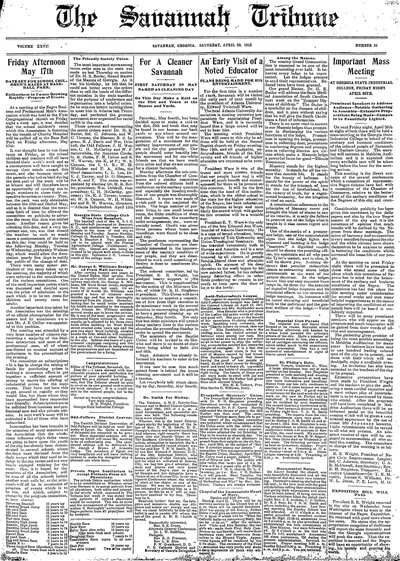
Page text (machine-generated)
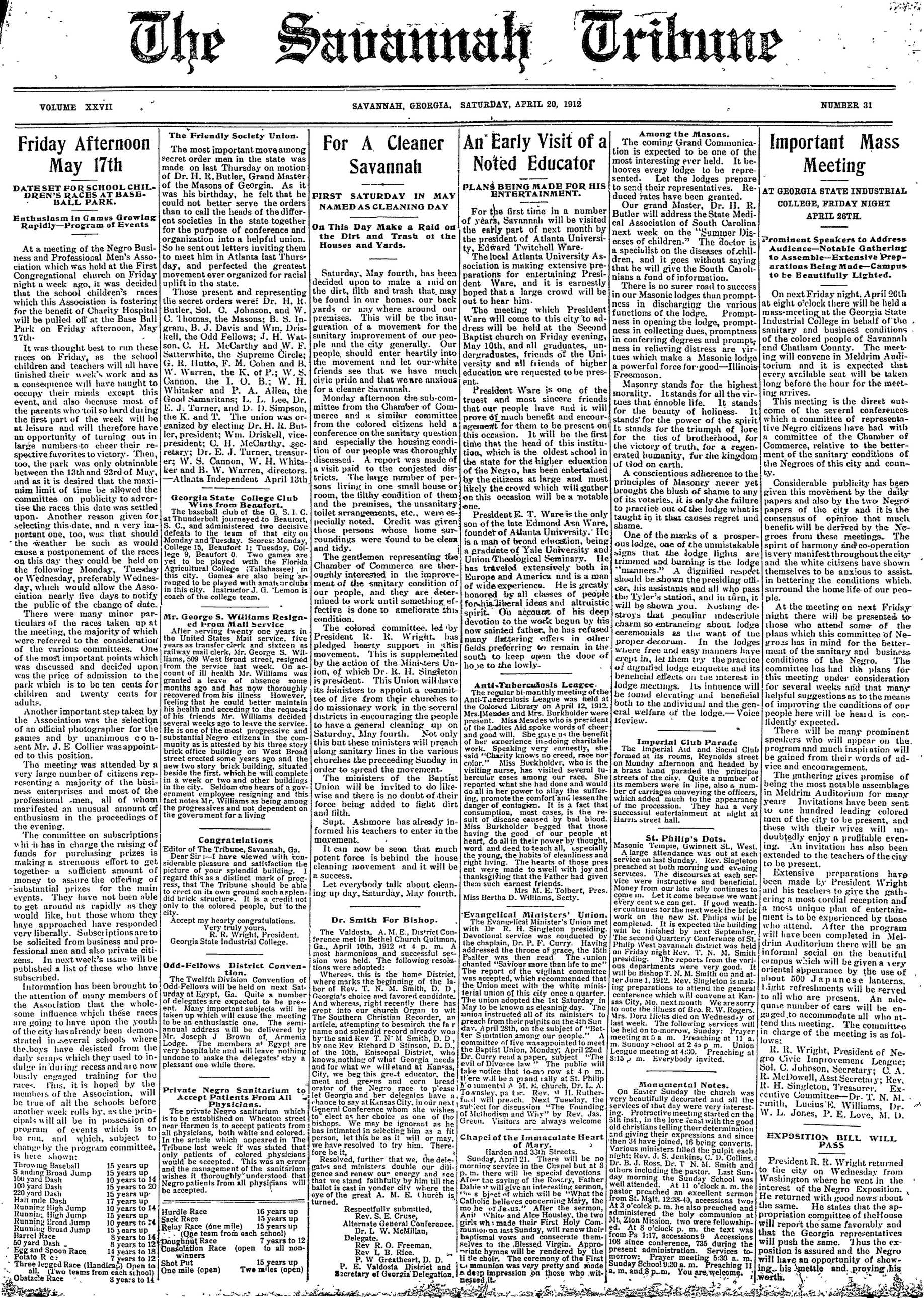
The Savannah Tribune
VOLUME XXVII
Friday Afternoon May 17th
Friday Afternoon May 17th
DATE SET FOR SCHOOL CHILDREN'S RACES AT BASEBALL PARK.
Enthusiasm in Games Growing Rapidly—Program of Events
At a meeting of the Negro Business and Professional Men's Association which was held at the First Congregational church on Friday night a week ago, it was decided that the school children's races which this Association is fostering for the benefit of Charity Hospital will be pulled off at the Base Ball Park on Friday afternoon, May 17th.
It was thought best to run these races on Friday, as the school children and teachers will all have finished their week's work and as a consequence will have naught to occupy their minds except this event, and also because most of the parents who toil so hard during the first part of the week will be at leisure and will therefore have an opportunity of turning out in large numbers to cheer their respective favorites to victory. Then, too, the park was only obtainable between the 13th and 23rd of May, and as it is desired that the maximum limit of time be allowed the committee on publicity to advertise the races this date was settled upon. Another reason given for selecting this date, and a very important one, too, was that should the weather be such as would cause a postponement of the races on this day they could be held on the following Monday, Tuesday or Wednesday, preferably Wednesday, which would allow the Association nearly five days to notify the public of the change of date.
There were many minor particulars of the races taken up at the meeting, the majority of which were referred to the consideration of the various committees. One of the most important points which was discussed and decided upon was the price of admission to the park which is to be ten cents for children and twenty cents for adults.
Another important step taken by the Association was the selection of an official photographer for the games and by unanimous consent Mr. J. E Collier was appointed to this position.
The meeting was attended by a very large number of citizens representing a majority of the business enterprises and most of the professional -men, all of whom manifested an unusual amount of enthusiasm in the proceedings of the evening.
The committee on subscriptions which has in charge the raising of funds for purchasing prizes is making a strenuous effort to get together a sufficient amount of money to assure the offering of substantial prizes for the main events. They have not been able to get around as rapidly as they would like, but those whom they have approached have responded very liberally. Subscriptions are to be solicited from business and professional men and also private citizens. In next week's issue will be published a list of those who have subscribed.
Information has been brought to the attention of many members of the Association that the wholesome influence which these races are going to have upon the youth of the city has already been demonstrated in several schools where the boys have desisted from the daily scraps which they used to indulge in during recess and are now busily engaged training for the races. Thus, it is hoped by the members of the Association, will be true of all the schools before another week rolls by, as the principals will all be in possession of program of events which is to be run, and which, subject to change by the program committee, is here shown:
Throwing Baseball 15 years up
Sanding Broad Jump 15 years up
100 yard Dash 10 years to 14
100 yard Dash 10 years to 20
220 yard Dash 15 years up
Hait mile Dash 17 years up
Running High Jump 10 years to 14
Running High Jump 15 years up
Running Broad Jump 10 years to 24
Running Broad Jump 15 years up
Barrel Race 8 years to 14
50 yard Dash 8 years to 12
Egg and Spoon Race 14 years to 18
Potato R c: 7 years to 12
Three legged Race (Handicap) Open to
all. (Two teams from each school)
Obstacle Race 8 years to 14
The Friendly Society Union.
The most important move among secret order men in the state was made on last Thursday on motion of Dr. H. R. Butler, Grand Master of the Masons of Georgia. As it was his birthday, he felt that he could not better serve the orders than to call the heads of the different societies in the state together for the purpose of conference and organization into a helpful union. So he sent out letters inviting them to meet him in Atlanta last Thursday, and perfected the greatest movement ever organized for racial uplift in the state.
Those present and representing the secret orders were: Dr. H. K. Butler, Sol. C. Johnson, and W. C. Thomas, the Masons; B. S. Ingram, B. J. Davis and Wm. Drickell, the Odd Fellows; J. H. Watson, C. H. McCarthy and W. F. Satterwhite, the Supreme Circle; G. R. Hutto, F. M. Cohen and B. W. Warren, the K. of P.; W. S. Cannon, the I. O. B.; W. H. Whitaker and P. A. Allen, the Good Samaritans; L. L. Lee, Dr. E. J. Turner, and D. D. Simpson, the K. and T. The union was organized by electing Dr. H. R. Butler, president; Wm. Driskell, vicepresident; C. H. McCarthy, secretary; Dr. E. J. Turner, treasurer; W. S. Cannon, W. H. Whitaker and B. W. Warren, directors.
- Atlanta Independent April 13th
Georgia State College Club
Wins from Beaumont
The baseball club of the G. S. I. C. at Thunderbolt journeyed to Beaufort, S. C., and administered two decisive defeats to the team of that city on Monday and Tuesday. Scores: Monday, College 15, Beaufort 1; Tuesday, College 9, Beaufort 0. Two games are yet to be played with the Florida Agricultural College (Tallahassee) in this city. Games are also being arranged to be played with amateur clubs in this city. Instructor J. G. 'Lemon is coach of the college team.
Mr. George S. Williams Resigned
From Mall Service
ed From Mail Service
After serving twenty one years in the United States Mail service, five years as transfer clerk and sixteen as railway mail clerk, Mr. George S. Williams, 509 West Broad street, resigned from the service last week. On account of ill health Mr. Williams was granted a leave of absence some months ago and has now thoroughly recovered from his illness. However, feeling that he could better maintain his health and acceding to the requests of his friends Mr. Williams decided several weeks ago to leave the service. He is one of the most progressive and substantial Negro citizens in the community as is attested by his three story brick office building on West Broad street erected some years ago and the new two story brick building, situated beside the first, which he will complete in a week or two and other buildings in the city. Seldom one hears of a government employee resigning and this fact notes Mr. Williams as being among the progressives and not dependent on the government for a living
Congratulations
Editor of The Tribune, Savannah, Ga.
Dear Sir: I have viewed with considerable pleasure and satisfaction the picture of your splendid building. I regard this as a distinct mark of progress, that The Tribune should be able to erect on its own ground such asplendid brick structure. It is a credit not only to the colored people, but 'to the city.
Accept my hearty congratulations.
Very truly yours.
R. R. Wright, President.
Georgia State Industrial College.
Odd-Fellows District Convention
The Twelfth Division Convention of Odd-Follows will be held on next Saturday at Egypt, Ga. Quite a number of delegates are expected to be present. Many important subjects will be taken up which will cause the meeting to be an enthusiastic one. The semi-annual address will be delivered by Mr. Joseph J Brown of, Armenia Lodge. The members at Egypt are very hospital and will leave nothing undone to make the delegates' stay a pleasant one while there.
Private Negro Sanitarium
Accept From All
Physicians
The private Negro sanitarium which is to be established on Wheaton street near Harmen is to accept patients from all physicians, both white and colored. In the article which appeared in The Tribune last week it was stated that only patients of colored physicians would be accepted. This was an error and the management of the sanitarium wishes it thoroughly understood that Negro patients from all physicians will be accepted.
SAVANNAH, GEORGIA, SATURDAY, APRIL 20, 1912
For A Cleaner Savannah
FIRST SATURDAY IN MAY
NAMED AS CLEANING DAY
On This Day Make a Raid on the Dirt and Trash of the Houses and Yards.
Saturday, May fourth, has been decided upon to make a raid on the dirt, filth and trash that, may be found in our homes, our back yards or any where around our premises. This will be the inauguration of a movement for the sanitary improvement of our people and the city generally. Our people should enter heartily into the movement and let our-white friends see that we have much civic pride and that we are anxious for a cleaner Savannah.
Monday afternoon the sub-committee from the Chamber of Commerce and a similar committee from the colored citizens held a conference on the sanitary question and especially the housing condition of our people was thoroughly discussed. A report was made of a visit paid to the conjected districts. The large number of persons living in one small house or room, the filthy condition of them and the premises, the unsanitary toilet arrangements, etc., were especially noted. Credit was given those persons whose home surroundings were found to be clean and tidy.
The gentlemen representing the Chamber of Commerce are thoroughly interested in the improvement of the sanitary condition of our people, and they are determined to work until something effective is done to ameliorate this condition.
The colored committee, led by President R. R. Wright, has pledged hearty support in this movement. This is supplemented by the action of the Ministers Union, of which Dr. R. H. Singleton is president. This Union will have its ministers to appoint a committee of five from their churches to do missionary work in the several districts in encouraging the people to have a general cleaning up on Saturday, May fourth. Not only this but these ministers will preach along sanitary lines in the various churches the preceeding Sunday in order to spread the movement. The ministers of the Baptist Union will be invited to do likewise and there is no doubt of their force being added to fight dirt and filth.
Supt. Ashmore has already informed his teachers to enter in the movement. It can now be seen that much potent force is behind the house cleaning movement and it will be a success. Let everybody talk about cleaning up day, Saturday, May fourth.
Dr. Smith For Bishop.
The Valdosta, A.M.E., District Conference met in Bethel Church Quitman, Ga., April 10th, 1912 *at* 4 p. m. A most harmonious and successful session was held. The following resolutions were adopted:
Whereas, this is the home District, where marks the beginning of the labor of Rev. T. N. M. Smith, D. D. Georgia's choice and favored candidate, And whereas, right recently there has crept into our church Organ to wif The Southern Christian Recorder, an article, attempting to besmirch the far name and splendid record already won by the said Rev T. N. M. Smith, D. D. by one Rev Richard D Stinson, D. D., of the 10th, Eniscopal District, who knows nothing of what Georgia needs and for what we will stand at Kansas, City, we beg this great educator, the ment and greens and corn bread orator of the Negro race to please let Georgia and her delegates have a chance to say at Kansas City, in our next General Conference whom she wishes to elect as her choice as one of the bishops. We may be ignorant as he has intimated in selecting him as a fit person, let this be as it will or may, we have resolved to try him. Therefore be it.
Resolved, further that we, the delegates and ministers double our diligence and renew our energy and see that we stand faithfully by him till the ballot is cast in younger city where the eye of the great A. M. E. (church is turned.
Respectfully submitted,
Rev. S. E. Cruse,
Alternate General Conference.
Dr. L. W. McMillan,
Delegate.
Rev R. O. Freeman,
Rev L. B. Rice.
P. W Greatheart, D. D.
P. E. Valdosta District and
Secretary of Georgia Delegation.
An Early Visit of a Noted Educator
PLANS BEING MADE FOR HIS ENTERTAINMENT.
For the first time in a number of years, Savannah will be visited the early part of next month by the president of Atlanta University, Edward Twitchell Ware.
The local Atlanta University Association is making extensive preparations for entertaining President Ware, and it is earnestly hoped that a large crowd will be out to hear him.
The meeting which President Ware will come to this city to address will be held at the Second Baptist church on Friday evening, May 10th, and all graduates, undergraduates, friends of the University and all friends of higher education are requested to be present.
President Ware is one of the truest and most sincere friends that our people have and it will prove of much benefit and encouragement for them to be present on this occasion. It will be the first time that the head of this institution, which is the oldest school in the state for the higher education of the Negro, has been entertained by the citizens at large and most likely the crowd which will gather on this occasion will be a notable one.
President E. T. Ware is the only son of the late Edmond Asa Ware, founder of Atlanta University. He is a man of broad education, being a graduate of Yale University and Union Theological Seminary. He has traveled extensively both in Europe and America and is a man of wide experience. He is greatly honored by all classes of people for his liberal ideas and altruistic spirit. On account of his deep devotion to the work begun by his now sainted father, he has refused many flattering offers in other fields preferring to remain in the south to keep open the door of house to the lowly.
Anti-Tuberculosis League
Anti-Tuberculosis League.
The regular bi-monthly meeting of the Anti-Tuberculosis League was held at the Colored Library on April 12, 1912. Mrs.[Mendes and Mrs. Burkholder] present. Miss Mendes who is president of the Ladies Aid scheme work of cheer at good health, the great the benefit of experience modifying charitable work. Speaking very earnestly, she said "Charity knows no creed, race nor color." Miss Burkholder, who is the visiting nurse, has visited several tubercular cases among our race. She reported what she had done and would do all in her power to allay the suffering, promote the comfort and lessen the danger of contagion. It is a fact that consumption, most cases, is the result of disease caused by bad blood. Miss Burkholder begged that those having the good of our people at heart, do all in their power by thought, word and deed to teach all, especially the young, the habits of cleanliness and right living. The hearts of those pres ent were made to swell with joy and thanksgiving that the Father had given them such earnest friends.
Mrs M. E. Tolbert, Pres Miss Bertha D. Williams, Secty.
Evangelical Ministers' Union
The Evangelical Minister's Union met with Dr R. H. Singleton presiding Devotional service was conducted by the chaplain, Dr P. F. Curry. Having addressed the throne of grace, the 15th Palast was then read. The union chanted "Saviour more than life to me" The report of the vigilant committee was accepted, which recommended that the Union meet with the white ministerial union of this city once a quarter. The union adopted the 1st Saturday in May to be known as cleaning day. The union instructed all of its ministers to preach from their pulpits on the 4th Sunday. April 28th, on the subject of "Better Stintuation among our people." A committee of five was appointed to meet the Baptist Union, Monday, April 22nd Dr. Curry read a paper, subject "The evil of Divorce law" The public will take notice that to-mo row at 4 p.m. there will be a grand rally at St. Philip Memorial a M. E. church, Dr. L. A. Townsley, a M. E. church, Dr. L. Rutherford will preach. Next Tuesday, the subject for discussion "The Founding of Methodism and Way" by Rev. Jas. Green. Visitors are always welcome.
Chapel of the Immaculate Heart of Mary.
Harden and 33th Streets.
Sunday, April 21. There will be no morning service in the Chapel but at 8 p.m. there will be special devotions After the saying of the Rosary, Father Dalie it will give an interesting sermon, "the bject of which will be "What the Catholic believes concerning Mary, the mo he of Jesus." After the sermon, Antl White and Alice Housley, the two girls who made their First Holy Communion on last Sunday, will renew their baptismal vows and consecrate themselves to the Blessed Virgin. Approximate hymns will be rendered by the lit choir. The ceremony of the First Communion was very pretty and made a deep impression on those who wit-
Among the Masons.
The coming Grand Communication is expected to be one of the most interesting ever held. It behooves every lodge to be represented. Let the lodges prepare to send their representatives. Reduced rates have been granted.
Our grand Master, Dr. H. R. Butler will address the State Medical Association of South Carolina next week on the "Summer Diseases of children." The doctor is a specialist on the diseases of children, and it goes without saying that he will give the South Carolinians a fund of information.
There is no surer road to success in our Masonic lodges than promptness in discharging the various functions of the lodge. Promptness in opening the lodge, promptness in collecting dues, promptness in conferring degrees and promptness in relieving distress are virtues which make a Masonic lodge a powerful force for good—Illinois Freemason. Masonry stands for the highest morality. It stands for all the virtues that ennoble life. It stands for the beauty of holiness. It stands for the power of the spirit. It stands for the triumph of love for the ties of brotherhood, for the victory of truth, for a regenerated humanity, for the kingdom of God on earth.
A conscientious adherence to the principles of Masonry never yet brought the blush of shame to any of its votaries, it is only the failure to practice out of the lodge what is taught in it that causes regret and shame.
One of the marks of a prosperous lodge, one of the unmistakable signs that the lodge lights are trimmed and burning is the lodge "manners." A dignified respect should be shown the presiding officer, his assistants and all who pass the Tyler's station, and in turn, it will be shown you. Nothing destroys that peculiar indescribable charm so entrancing about lodge ceremonials as the want of the proper decorum. In the lodges where free and easy manners have crept in, let them try the practice of dignified lodge etiquette and its beneficial effects on the interest in lodge meetings. Its influence will be found elevating and beneficial both to the individual and the general welfare of the lodge.—Voice Review.
Imperial Club Parade
Imperial Club Parade The Imperial Aid and Social Club formed at its rooms, Reynolds street on Monday afternoon and headed by a brass band paraded the principle streets of the city. Quite a number of its members were in line, also a number of carriages conveying the officers, which added much to the appearance of the procession. They had a very successful entertainment at night at Harris street hall.
St. Philip's Dots.
Masonic Temple, Gwinnett St., West.
A large attendance was out at each service on last Sunday. Rev. Singleton preached at both morning and evening services. The discourses at each service were instructive and beneficial. Money from our late rally continues to come in. Let it come because we want every cent we can get. If good weather continues to the next week the bridge work on the new St. Philips will be completed. It is expected the building will be finished by next September. The second Quarterly Conference of St. Philip West Savannah district was held on Friday right Rev. T. N. M. Smith presiding. The reports from the various departments were very good. It will be Bishop T. N. M. Smith on and after June 1, 1912. Rev. Singleton is making preparations to attend the general conference which will convene at Kansas City, Mo. next month. We are sorry to note the illness of Bro. R. W. Rogers. Mrs. Dora Hicks died on Wednesday of last week. The following services will be held on to-morrow, Sunday: Prayer meeting at 5 a.m. Preaching at 11 a.m. Sunday-school at 2:40 p.m. Union League meeting at 4:30. Preaching at 8:15 p.m. Everybody invited.
Monumental Notes.
On Easter Sunday the church was very beautifully decorated and all the services of that day were very interesting. Protractive meeting started on the 5th inst., in the love trust with the good old christians telling their determination and giving their expressions and since then 34 have joined, 16 being converts. Various ministers failed the pulpit each night; Dr. J. S. Jenkins, C. D. Collins, Dr. B. J. Ross, Dr. T. N. Smith and others including the pastor. Last Sunday morning the Sunday School was well attended. At 11 o'clock a.m. the pastor preached an excellent sermon from St. Matt. 12:38-40, accessions two; At 3 o'clock p. m. he also preached and administered the holy communion at Mt. Zion Mission, two were fellowshiped. At 8 o'clock p. m. the text was from Ps 1:17, accessions 9 Accessions 108 since conference, 735 during the present administration. Services tomorrow: Prayer meeting 5:30 a.m. Mt. Sunday School 9:30 a.m. Preaching 11 a.m. and 8 p. m. You are welcome.
NUMBER 31
Important Mass Meeting
Important Mass Meeting
AT GEORGIA STATE INDUSTRIAL COLLEGE, FRIDAY NIGHT APRIL 26TH
Prominent Speakers to Address Audience—Notable Gathering to Assemble—Extensive Preparations Being Made—Campus to be Beautifully Lighted.
On next Friday night, April 26th at eight o'clock there will be held a mass-meeting at the Georgia State Industrial College in behalf of the sanitary and business conditions of the colored people of Savannah and Chatham County. The meeting will convene in Meldrim Auditorium and it is expected that every available seat will be taken long before the hour for the meeting arrives.
This meeting is the direct outcome of the several conferences which a committee of representative Negro citizens have had with a committee of the Chamber of Commerce, relative to the betterment of the sanitary conditions of the Negroes of this city and county.
Considerable publicity has been given this movement by the daily papers and also by the two Negro papers of the city and it is the consensus of opinion that much benefit will be derived by the Negroes from these meetings. The spirit of harmony and co-operation is very manifest throughout the city and the white citizens have shown themselves to be anxious to assist in bettering the conditions which surround the home life of our people.
At the meeting on next Friday night there will be presented to those who attend some of the plans which this committee of Negroes has in mind for the betterment of the sanitary and business conditions of the Negro. The committee has had the plans for this meeting under consideration for several weeks and that many helpful suggestions as to the means of improving the conditions of our people here will be heard is confidently expected. There will be many prominent speakers who will appear on the program and much inspiration will be gained from their words of advice and encouragement.
The gathering gives promise of being the most notable assemblage in Meldrim Auditorium for many years. Invitations have been sent to one hundred leading colored men of the city to be present, and these with their wives will undoubtedly enjoy a profitable evening. An invitation has also been extended to the teachers of the city to be present.
Extensive preparations have been made by President Wright and his teachers to give the gathering a most cordial reception and a most unique plan of entertainment is to be experienced by those who attend. After the program will have been completed in Meldrim Auditorium there will be an informal social on the beautiful campus which will be given a very oriental appearance by the use of about 500 Japanese lanterns. Light refreshments will be served to all who are present. An adequate number of cars will be engaged to accommodate all who attend this meeting. The committee in charge of the meeting is as follows:
R. R. Wright, President of Negro Civic Improvement League; Sol. C. Johnson, Secretary; C. A. R. McDowell, Asst Secretary; Rev. R. H. Singleton, Treasurer. Executive Committee—Dr. T. N. M. Smith, Lucius E. Williams, Dr. W. L. Jones, P. E. Love, M. D.
EXPOSITION BILL WILL
PASS
President R. R. Wright returned to the city on Wednesday from Washington where he went in the interest of the Negro Exposition. He returned with good news about the same. He states that the appropriation committee of the House will report the same favorably and that the Georgia representatives will push the same. Thus the exposition is assured and the Negro will have an opportunity of showing, his mettle and proving his
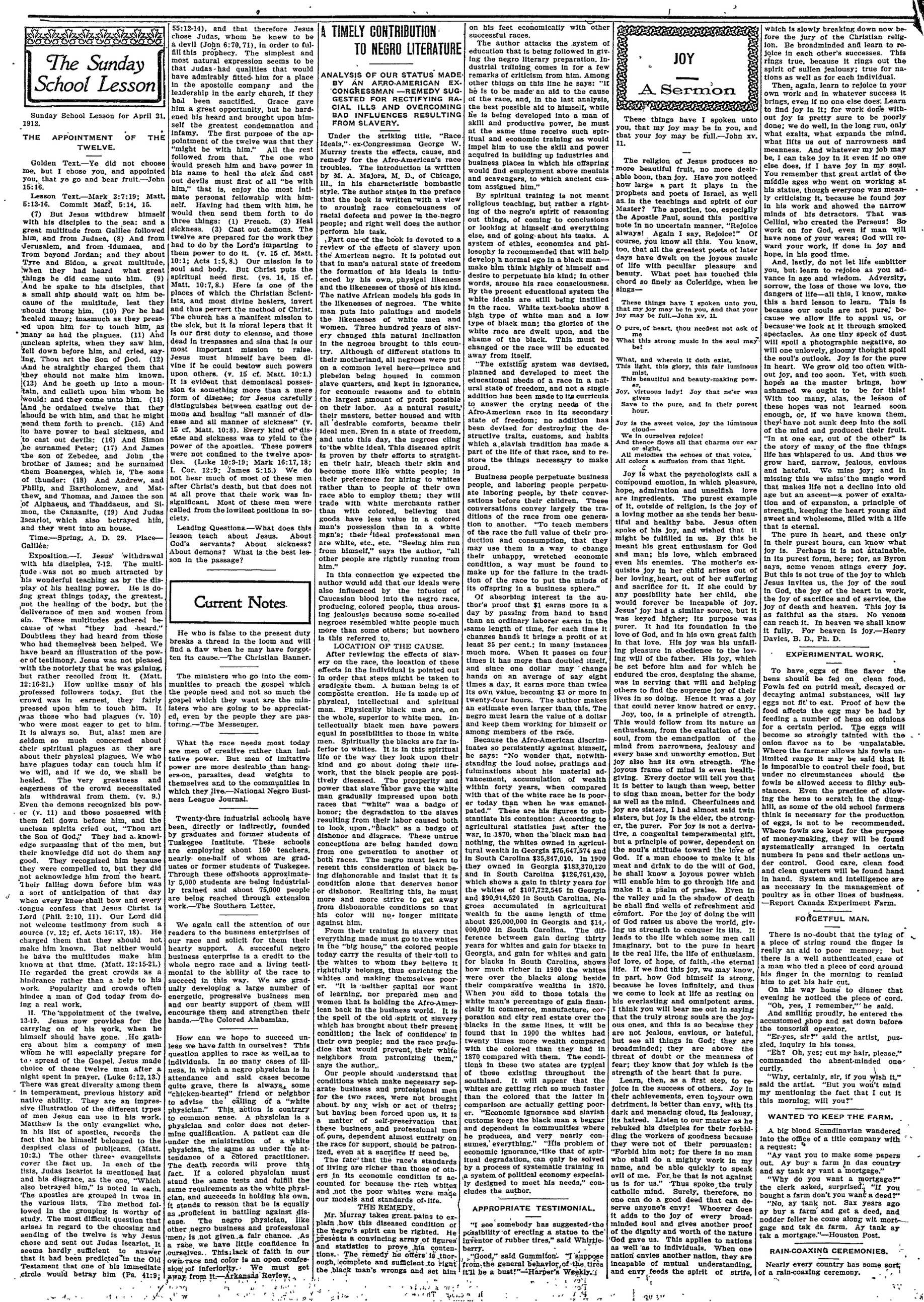
The Sunday School Lesson
Sunday School Lesson for April 21, 1912.
THE APPOINTMENT OF THE TWELVE.
Golden Text—Ye did not choose me, but I chose you, and appointed you, that ye go and bear fruit—John 15:16.
Lesson Text—Mark 3:7:19; Matt, 5:13-16. Commit Matt 5:14, 15.
(7) But Jesus withdrew himself with his disciples to the sea: and a great multitude from Gallilee followed him, and from Judaea. (8) And from Jerusalem, and from Idumaea, and from beyond Jordan; and they about Tyre and Sidon, a great multitude, when they had heard what great things he did came unto him. (9) And he spake to his disciples, that a small ship should wait on him because of the multitude, lest they should throng him. (10) For he had healed many; inasmuch as they pressed upon him for to touch him, as many as had the plagues. (11) And unclean spirits, when they saw him, fell down before him, and cried, saying, Thou art the Son of God. (12) And he straightly charged them that they should not make him known. (13) And he goeth up into a mountain, and calleth upon him whom he would; and they come unto him. (14) And he ordained twelve that they should be with him, and that he might send them forth to preach. (15) And to have power to heal sickness, and to cast out devils: (16) And Simon he surnamed Peter; (17) And James the son of Zebedee, and John the brother of James; and he surnamed them Boanerges, which is, The sons of thunder: (18) And Andrew, and Philip, and Bartholomew, and Matthew, and Thomas, and James the son of Alphaeus, and Thaddaeus, and Simon, the Canaanite. (19) And Judas Iscarlot, which also betrayed him, and they went into an house.
Time.—Spring, A. D. 29. Place— Galliee:
Exposition.—I. Jesus' withdrawal with his disciples, 7-12. The multitude was not so much attracted by his wonderful teaching as by the display of his healing power. He is doing great things today, the greatest, not the healing of the body, but the deliverance of men and women from sin. These multitudes gathered because of what "they had heard." Doubtless they had heard from those who had themselves been helped. We have heard an illustration of the power of testimony. Jesus was not pleased with the notoriety that he was gaining, but rather recolled from it. (Matt. 12:16-21.) How unlike many of his professed followers today. But the crowd was in earnest, they fairly pressed upon him to touch him. It was those who had plagues (v. 10) who were most eager to get to him. It is always so. But alas! men are seldom so much concerned about their spiritual plagues as they are about their physical plagues. We who have plagues today can touch him if we will, and if we do, we shall be healed. The very greatness and eagerness of the crowd necessitated his withdrawal from them. (v. 9.) Even the demons recognized his power (v. 11) and those possessed with them fell down before him, and the unclean spirits cried out, "Thou art the Son of God." They had a knowledge surpassing that of the man, but their knowledge did not do them any good. They recognized him because they were compelled to, but they did not acknowledge him from the heart. Their falling down before him was a sort of anticipation of that day when every knee shall bow and every tongue confess that Jesus Christ is Lord (Phill. 2:10, 11). Our Lord did not welcome testimony from such a source (v. 12; cf. Acts 16:17, 18). He charged them that they should not make him known. But neither would he have the multitudes make him known at that time. (Matt. 12:15-21.) He regarded the great crowds as a hindrance rather than a help to his work. Popularity and crowds often hinder a man of God today from doing a real work.
II. The appointment of the twelve, 13:19. Jesus now provides for the carrying on of his work, when he himself should have gone. He gathers about him a company of men whom he will especially prepare for a spread of the Gospel. Jesus made choice of these twelve men after a night spent in prayer. (Luke 6:12, 13.) There was great diversity among them in temperament, previous history and native ability. They are an impressive illustration of the different types of men Jesus can use in his work. Matthew is the only evangelist who, in his list of apostles, records the fact that he himself belonged to the despised class of publicans. (Matt. 10:3.) The other three evangelists cover the fact up. In each of the lists, Judas Iscariot is mentioned last and his disgrace, as the one, "Which also betrayed him," is noted in each. The apostles are grouped in twos in the various lists. The method followed in the grouping is worthy of study. The most difficult question that arises in regard to the choosing and sending of the twelve is why Jesus chose and sent out Judas Iscariot. It seems hardly sufficient to answer that it had been predicted in the Old Testament that one of his immediate circle would betray him. (Ps. 41:9)
55:12-14), and that therefore Jesus chose Judas, whom he knew to be a devil (John 6:70, 71), in order to fulfill this prophecy. The simplest and most natural expression seems to be that Judas-had qualities that would have admirably fitted him for a place in the apostolic company and the leadership in the early church, if they had been sanctified. Grace gave him a great opportunity, but he hardened his heard and brought upon himself the greatest condemnation and infamy. The first purpose of the appointment of the twelve was that they "might be with him." All the rest followed from that. The one who would preach him and have power in his name to heal the sick and cast out devils must first of all "be with him," that is, enjoy the most intimate personal fellowship with himself. Having had them with him, he would then send them forth to do three things: (1) Preach. (2) Heal sickness. (3) Cast out demons. The twelve are prepared for the work they had to do by the Lord's imparting to them power to do it. (v. 15 cf. Matt. 10:1; Acts 1:5, 8). Our mission is to soul and body. But Christ puts the spiritual need first. (vs. 15 cf. Matt. 10:7, 8). Here is one of the places of which the Christian Scientists, and most divine healers, invert and thus pervert the method of Christ. The church has a manifest mission to the sick, but it is moral lepers that it is our first duty to cleanse, and those dead in trespasses and sins that is our most important mission to raise. Jesus must himself have been divine if he could bestow such powers upon others. (v. 15 cf. Matt. 10:1). It is evident that demonlacal possession is something more than a mere form of disease; for Jesus carefully distinguishes between casting out demons and healing "all manner of disease and all manner of sickness" (v. 15 cf. Matt. 10:8). Every kind of disease and sickness was to yield to the power of the apostles. These powers were not confined to the twelve apostles. (Luke 10:9-19; Mark 16:17, 18; I. Cor. 12:9; James 5:15). We do not hear much of most of these men after Christ's death, but that does not at all prove that their work was insignificant. Most of these men were called from the lowliest positions in society.
Leading Questions.—What does this lesson teach about Jesus. About God's servants? About sickness? About demons? What is the best lesson in the passage?
Current Notes.
He who is false to the present duty breaks a thread in the loom and will find a flaw when he may have forgotten its cause.—The Christian Banner.
The ministers who go into the communities to preach the gospel which the people need and not so much the gospel which they want are the ministers who are going to be appreciated, even by the people they are pastoring.—The Messenger.
What the race needs most today are men of creative rather than imitative power. But men of imitative power are more desirable than hangers-on, parasites, dead weights to themselves and to the communities in which they live.—National Negro Business League Journal.
Twenty-three industrial schools have been, directly or indirectly, founded by graduates and former students of Tuskegee Institute. These schools are employing about 150 teachers, nearly one-half of whom are graduates or former students of Tuskegee. Through these shoouts approximately 5,000 students are being industrially trained and about 75,000 people are being reached through extension work.—The Southern Letter.
We again call the attention of our readers to the business enterprises of our race and solicit for them their hearty support. A successful negro business enterprise is a credit to the whole negro race and a living testimonial to the ability of the race to succeed in this way. We are gradually developing a large number of energetic, progressive business men and our hearty support of them will encourage them and strengthen their hands—The Colored Alabamlan.
---
How can we hope to succeed unless we have faith in ourselves? This question applies to race as well, as to individuals. In so many cases of illness, in which a negro physician is in attendance and said cases become quite grave, there is always some "chicken-hearted" friend or neighbor to advise the calling of a "white physician." This action is contrary to common sense. A physician is a physician and color does not determine qualification. A patient can die under the ministration of a white physician, the same as under the attendance of a colored practitioner. The death records will prove this fact. If a colored physician must stand the same tests and fulfill the same requirements as the white physician, and succeeds in holding his own, it stands to reason that he is equally as proficient in battling against disease. The negro physician, like other negro business and professional men, is not given a fair chance. As a race we have little confidence in ourselves. This lack of faith in our own race and color is an open confession of inferiority. We must get away from it—Arkansas Review.
ANALYSIS OF OUR STATUS MADE BY AN AFRO-AMERICAN EX-CONGRESSMAN —REMEDY SUGGESTED FOR RECTIFYING RACIAL ILLS AND OVERCOMING BAD INFLUENCES RESULTING FROM SLAVERY.
Under the striking title, "Race Ideals," ex-Congressman George W. Murray treats the effects, cause, and remedy for the Afro-American's race troubles. The introduction is written by M. A. Majors, M. D., of Chicago, Ill., in his characteristic bombastic style. The author states in the preface that the book is written with a view to arousing race consciousness of racial defects and power in the-negro people; and right well does the author perform his task.
Part one of the book is devoted to a review of the effects of slavery upon the American negro. It is pointed out that in man's natural state of freedom the formation of his ideals is influenced by his own, physical likeness and the likenesses of those of his kind. The native African models his gods in the likenesses of negroes. The white man puts into paintings and models the likenesses of white men and women. Three hundred years of slavery changed this natural inclination in the negroes brought to this country. Although of different stations in their motherland, all negroes were put on a common level here—prince and plebeian being housed in common slave quarters, and kept in ignorance, for economic reasons and to obtain the largest amount of profit possible on their labor. As a natural result, their masters, better housed and with all desirable comforts, became their ideal men. Even in a state of freedom, and unto this day, the negroes cling to the white ideal. This diseased spirit is proven by their efforts to straighten their hair, bleach their skin and become more like white people; in their preference for hiring to whites rather than to people of their own race able to employ them; they will trade with white merchants rather than with colored, believing that goods have less value in a colored man's possession than in a white man's; their ideal professional men are white, etc., etc. "Seeing him run from himself," says the author, "all other people are rightly running from him."
In this connection we expected the author would add that our ideals were also influenced by the infusion of Caucasian blood into the negro race, producing, colored people, thus arousing jealousies because some so-called negroes resembled white people much more than some others; but nowhere is this referred to.
LOCATION OF THE CAUSE.
LOCATION OF THE CAUSE.
After reviewing the effects of slavery on the race, the location of these effects in the individual is pointed out in order that steps might be taken to eradicate them. A human being is of composite creation. He is made up of physical, intellectual and spiritual man. Physically black men are, on the whole, superior to white men. Intellectually black men have powers equal in possibilities to those in white men. Spiritually the blacks are far inferior to whites. It is in this spiritual life or the way they look upon their kind and go about doing their lifework, that the black people are positively diseased. The prosperity and power that slave labor gave the white man gradually impressed upon both races that "white" was a badge of honor; the degradation to the slaves resulting from their labor caused both to look, upon, "black" as a badge of dishonor and disgrace. These untrue conceptions are being handed down from one generation to another of both races. The negro must learn to resent this consideration of black being dishonorable and insist that it is condition alone that deserves honor or dishonor. Realizing this, he must more and more strive to get away from dishonorable conditions so that his color will no longer militate against him.
From their training in slavery that everything made must go to the whites in the "big house," the colored people today carry the results of their toll to the whites to whom they believe it rightfully belongs, thus enriching the whites and making themselves poorer. "It is neither capital nor want of learning, nor prepared men and women that is holding the Afro-American back in the business world. It is the spell of the old spirit of slavery which has brought about their present condition; the lack of confidence in their own people; and the race prejudice that would prevent, their white neighbors from patronizing them," says the author.
Our people should understand that conditions which make necessary separate business and professional men for the two races, were not brought about. by any, wish or act of theirs; but having been forced upon us, it is a matter of self-preservation that these business and professional men of ours, dependent almost entirely on the race for support, should be patronized, even at a sacrifice if need be. The fate' that the race's standards of living are richer than those of others in its economic condition is accounted for because the rich whites and not the poor whites were made our models and standards of life.
THE REMEDY
Mr. Murray takes great pains to explain how this diseased condition of the negro's spirit can be righted. He presents a convincing array of figures and statistics to prove his contensions. The remedy he offers is thorough, complete and sufficient to right the black man's wrongs and set him
on his feet economically with other successful races.
The author attacks the system of education that is being followed in giving the negro literary preparation. Industrial training comes in for a few remarks of criticism from him. Among other things on this line he says: "If he is to be made an aid to the cause of the race, and, in the last analysis, the best possible aid to himself, while he is being developed into a man of skill and productive power, he must at the same time receive such spiritual and economic training as would impel him to use the skill and power acquired in building up industries and business places in which his offspring would find employment above mentals and scavengers, to which ancient custom assigned him."
By spiritual training is not meant religious teaching, but rather a righting of the negro's spirit of reasoning out things, of coming to conclusions or looking at himself and everything else, and of going about his tasks. A system of ethics, economics and philosophy is recommended that will help develop a normal ego in a black man—make him think highly of himself and desire to perpetuate his kind; in other words, arouse his race consciousness. By the present educational system the white ideals are still being instilled in the race. White text-books show a high type of white man and a low type of black man; the glories of the white race are dwelt upon, and the shame of the black. This must be changed or the race will be educated away from itself.
"The existing system was devised, planned and developed to meet the educational needs of a race in a natural state of freedom, and not a single addition has been made to its curricula to answer the crying needs of the Afro-American race in its secondary state of freedom; no addition has been devised for destroying the destructive traits, customs, and habits which a slavish tradition has made a part of the life of that race, and to restore the things necessary to make proud.
Business people perpetuate business people, and laboring people perpetuate laboring people, by their conversations before their children. These conversations convey largely the traditions of the race from one generation to another. "To teach members of the race the full value of their production and consumption, that they may use them in a way to change their unhappy, wretched economic condition, a way must be found to make up for the failure in the tradition of the race to put the minds of its offspring in a business sphere."
Of absorbing interest is the author's proof that $1 earns more in a day by passing from hand to hand than an ordinary laborer earns in the same length of time, for each time it changes hands it brings a profit of at least 25 per cent.; in many instances much more. When it passes on four times it has more than doubled itself, and since one dollar may change hands on an average of say eight times a day, it earns more than twice its own value, becoming $3 or more in twenty-four hours. The author makes an estimate even larger than this. The negro must learn the value of a dollar and keep them working for himself or among members of the race.
Because the Afro-American discriminates so persistently against himself, he says: "No wonder that, notwithstanding the loud noise, prattings and fulminations about his material advancement, accumulation of wealth within forty years, when compared with that of the white race he is poorer today than when he was emancipated." These are his figures to substantiate his contention: According to agricultural statistics just after the war, in 1870, when the black man had nothing, the whites owned in agricultural wealth in Georgia $75,647,574 and in South Carolina $35,847,010. In 1900 they owned in Georgia $183,370,120 and in South Carolina $126,761,430, which shows a gain in thirty years for the whites of $107,722,546 in Georgia and $90,914,520 in South Carolina. Negroes accumulated in agricultural wealth in the same length of time about $26,000,000 in Georgia and $14,000,000 in South Carolina. The difference between gain during thirty years for whites and gain for blacks in Georgia, and gain for whites and gain for blacks in South Carolina, shows much richer in 1900 the whites were over the blacks along beside their comparative wealths in 1870. When you add to those totals the white man's percentage of gain financially in commerce, manufacture, corporation and city real estate over the blacks in the same lines, it will be found that in 1900 the whites had twenty times more wealth compared with the colored than they had in 1870 compared with them. The conditions in these two states are typical of those existing throughout the southland. It will appear that the whites are getting rich so much faster than the colored that the latter in comparison are actually getting poorer. "Economic ignorance and slavish customs keep the black man a beggar and dependent in communities where he produces, and very nearly consumes," everything." "His problem of economic ignorance, like that of spiritual degradation, can only be solved by a process of systematic training in a system of political economy especially designed to meet his needs," concludes the author.
APPROPRIATE TESTIMONIAL.
"I see somebody has suggested the possibility of erecting a statue to the inventor of rubber tires," said Whitleberry.
"Good," said Gumminton. "I suppose from the general behavior, of the tires it'll be a bust!"—Harper's Weekly.
JOY
A Sermon
These things have I spoken unto you, that my joy may be in you, and that your joy may be full.—John xv. 11.
The religion of Jesus produces no more beautiful fruit, no more desirable boon, than joy. Have you noticed how large a part it plays in the prophets and poets of Israel, as well as in the teachings and spirit of our Master? The apostles, too, especially the Apostle Paul, sound this positive note in no uncertain manner. "Rejoice always! Again I say, Rejoice!" Of course, you know all this. You know, too, that all the greatest poets of later days have dwelt on the joyous music of life with peculiar pleasure and beauty. What poet has touched this chord so finely as Coleridge, when he sings—
These things have I spoken unto you, that my joy may be in you, and that your joy may be full.-John xv, 11
O pure, of heart, thou needest not ask of me
What this strong music in the soul may be!
What, and wherein it doth exist,
This dish, this glory, this fair luminous
milk.
This beautiful and beauty-making power. er.
Joy, virtuous lady! Joy that ne'er was
elven.
Save to the pure, and in their purest hour.
Joy is the sweet voice, joy the luminous cloud—
We in ourselves rejoice!
And thence flows all that charms our ear or light.
All melodies the echoes of that voice.
All colors a suffusion from that light.
Joy is what the psychologists call a compound emotion, in which pleasure, hope, admiration and unselfish love are ingredients. The purest example of it, outside of religion, is the joy of a loving mother as she tends her beautiful and healthy babe. Jesus often spoke of his joy, and wished that it might be fulfilled in us. By this he meant his great enthusiasm for God and man; his love, which embraced even his enemies. The mother's exquisite joy in her child arises out of her loving, heart, out of her suffering and sacrifice for it. If she could by any possibility hate her child, she would forever be incapable of joy. Jesus' joy had a similar source, but it was keyed higher; its purpose was purer. It had its foundation in the love of God, and in its own great faith in that love. His joy was his unfalling pleasure in obedience to the loving will of the father. His joy, which he set before him and for which he endured the cross, despelling the shame, was in serving that will and helping others to find the supreme joy of their lives in so doing. Hence it was a joy that could never know hatred or envy.
Joy, too, is a principle of strength. This would follow from its nature as enthusiasm, from the exaltation of the soul, from the emancipation of the mind from narrowness, jealousy and every base and unworthy emotion. But joy also has its own strength. The joyous frame of mind is even health-giving. Every doctor will tell you that it is better to laugh than weep, better to sing than moan, better for the body as well as the mind. Cheerfulness and joy are sisters, I had almost twin sisters, but joy is the elder, the stronger, the purer. For joy is not a derivative, a congenital temperamental gift, but a principle of power, dependent on the soul's attitude toward the love of God. If a man choose to make it his meat and drink to do the will of God, he shall know a joyous power which will enable him to go through life and make it a psalm of praise. Even in the valley and in the shadow of death he shall find wells of refreshment and comfort. For the joy of doing the will of God raises us above the world, giving us strength to conquer its ills. It leads to the life which some men call imaginary, but to the pure in heart is the real life, the life of enthusiasm, of love, of hope, of faith, the eternal life. If we find this joy, we may know, in part, how God himself is strong, because he loves infinitely, and thus we come to look at life as resting on his everlasting and omnipotent arms. I think you will bear me out in saying that the truly strong souls are the joyous ones, and this is so because they are not jealous, envious, or hateful, but see all things in God; they are broadminded; they are above the threat of doubt or the meanness of fear; they know that joy which is the strength of the heart that is pure.
Learn, then, as a first step, to rejoice in the success of others. Joy in their achievements, even to your own detriment, is better than envy, with its dark and menacing cloud, its jealousy, its hatred. Listen to our master as he rebuked his disciples for their forbidding the workers of goodness because they were not of their persuasion: "Forbid him not; for there is no man who shall do a mighty work in my name, and be able quickly to speak evil of me. For, he that is not against us is for us." Thus spoke, the truly catholic mind. Surely, therefore, no one can do a good deed that can deserve anyone's envy! Whoever does it adds to the joy of every broad-minded soul and gives another proof of the dignity and worth of the nature God gave us. This applies to nations as well as to individuals. When one nation envies another nation, they are incapable of mutual understanding, and envy feeds the spirit of strife,
which is slowly breaking down now before the jury of the Christian religion. Be broadminded and learn to rejoice in each other's successes. This rings true, because it rings out the spirit of sullen jealousy; true for nations as well as for each individual.
Then, again, learn to rejoice in your own work and in whatever success it brings, even if no one else does. Learn to find joy in it; for work done without joy is pretty sure to be poorly done; we do well, in the long run, only what exalts, what expands the mind, what lifts us out of narrowness and meanness. And whatever my job may be, I can take joy in it even if no one else does, if I have joy in my soul. You remember that great artist of the middle ages who went on working at his statue, though everyone was meanly criticising it, because he found joy in his work and showed the narrow minds of his detractors. That was Cellinl, who created the Perseus! So work on for God, even if man will have none of your wares; God will reward your work, if done in joy and hope, in his good time.
And, lastly, do not let life embitter you, but learn to rejoice as you advance in age and wisdom. Adversity, sorrow, the loss of those we love, the dangers of life—all this, I know, make this a hard lesson to learn. This is because our souls are not pure, because we allow life to appeal us, or because we look at it through smoked spectacles. As one tiny speck of dust will spoil a photographic negative, so will one unloved, gloomy thought spoil the soul's outlook. Joy is for the pure in heart. We grow old too often without joy, and too soon. Yet, with such hopes as the master brings, how ashamed we ought to be for this! With too many, alas, the lesson of these hopes was not learned soon enough, or, if we have known them, they have not sunk deep into the soil of the mind and produced their fruit. "In at one ear, out of the other" is the story of many of the fine things life has whispered to us. And thus we grow hard, narrow, jealous, envious and hateful. We miss joy; and in missing this we miss' the magic word that makes life not a decline into old age but an ascent—a power of exaltation and of expansion, a principle of strength, keeping the heart young and sweet and wholesome, filled with a life that is eternal.
The pure in heart, and these only in their purest hours, can know what joy is. Perhaps it is not attainable, in its purest form, here; for, as Byron says, some venom stings every joy. But this is not true of the joy to which Jesus invites us, the joy of the soul in God, the joy of the heart in work, the joy of sacrifice and of service, the joy of death and heaven. This joy is as faithful as the stars. No venom can reach it. In heaven we shall know it fully. For heaven is joy.—Henry Davies, B. D., Ph. D.
EXPERIMENTAL WORK.
To have, eggs of fine flavor the hens should be fed on clean food. Fowls fed on putrid meat, decayed or decaying animal substances, will lay eggs not fit to eat. Proof of how the food affects the egg may be had by feeding a number of hens on onions for a certain period. The eggs will become so strongly tainted with the onion flavor as to be unpalatable. Where the farmer allows his fowls unlimited range it may be said that it is impossible to control their food, but under no circumstances should the fowls be allowed access to filthy substances. Even the practice of allowing the hens to scratch in the dunghill, as some of the old school farmers think is necessary for the production of eggs, is not to be recommended. Where fowls are kept for the purpose of money-making, they will be found systematically arranged in certain numbers in pens and their actions under control. Good care, clean food and clean quarters will be found hand in hand. System and intelligence are as necessary in the management of poultry as in other lines of business.—Report Canada Experiment Farm.
FORGETFUL MAN.
There is no-doubt that the tying of a piece of string round the finger is really an aid to poor memory; but there is a well authenticated case of a man who tied a piece of cord around his finger in the morning to remind him to get his hair cut.
On his way home to dinner that evening he noticed the piece of cord. "Oh, yes, I remember," he said.
And smiling proudly, he entered the accustomed shop and sat down before the tonsorial operator.
"Er-yes, sir?" said the artist, puzzled, inquiry in his tones.
"Eh? Oh, yes; cut my hair, please," commanded the absent-minded one curtly.
"Why, certainly, sir, if you wish it," said the artist. "But you won't mind my mentioning the fact that I cut it this morning, will you?"
WANTED TO KEEP THE FARM.
A big blond Scandinavian wandered into the office of a title company with a request:
"Ay vant you to make some papers out. Ay buy a farm in das country and ay tank ay want a mortgage."
"Why do you want a mortgage?" the clerk asked, surprised, "If you bought a farm don't you want a deed?"
"No, ay tank not. Sax years ago ay buy a farm and get a deed, and nodder feller he come along wit mortgage and tak da farm. Ay tank ay tak a mortgage."—Houston Post.
RAIN-COAXING CEREMONIES.
Nearly every country has some sort of a rain-coaxing ceremony.
Remittance must be made by Express or Post Office Money Order, or Registered Letter. Advertising rates given on application.
Entered at the Post Office at Savan nah, Ga., as Second-Class mail matter.
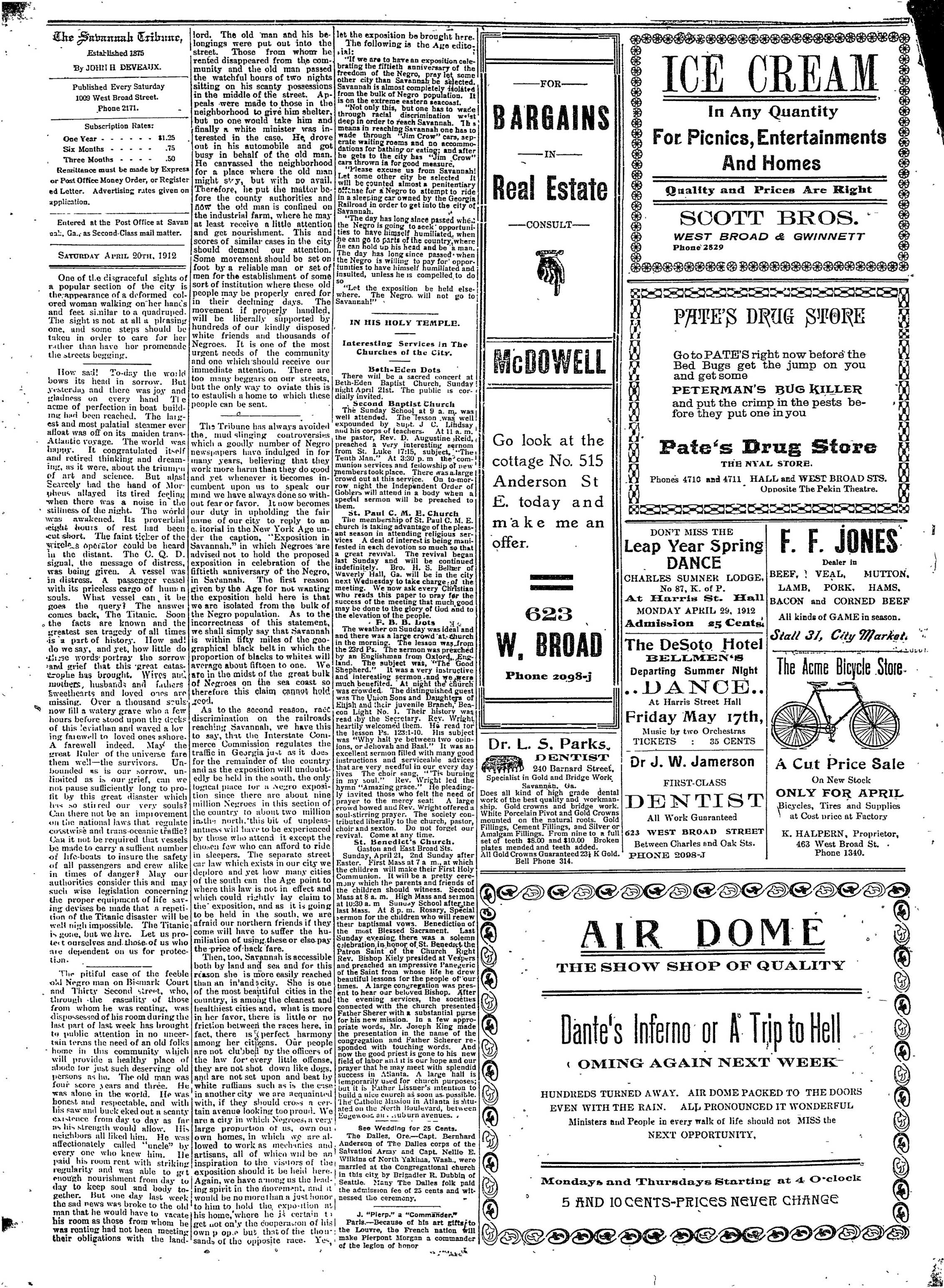
One of the disgraceful sights of a popular section of the city is the appearance of a deformed colored woman walking on her hands and feet similar to a quadruped. The sight is not at all a pleasing one, and some steps should be taken in order to care for her rather than have her promenade the streets begging.
How sad! To-day the world bows its head in sorrow. But yesterday and there was joy and gladness on every hand. The acme of perfection in boat building had been reached. The largest and most palatial steamer ever afloat was off on its maiden trans-Atlantic voyage. The world was happy. It congratulated itself and retired thinking and dreaming, as it were, about the triumph of art and science. But alps! Scarcely had the hand of Morpheus allayed its tired feeling when there was a noise in the stillness of the night. The world was awakened. Its proverbial eight hours of rest had been cut short. The faint ticker of the wireless operator could be heard in the distant. The C. Q. D. signal, the message of distress, was being given. A vessel was in distress. A passenger vessel with its priceless cargo of human souls. What vessel can, it be goes the query? The answer comes back, The Titanic. Soon the facts are known and the greatest sea tragedy of all times is a part of history. How sad! do we say, and yet, how little do these words portray the sorrow and grief that this great catastrophe has brought. Wives and mothers, husbands and fathers sweethearts and loved ones are missing. Over a thousand souls now fill a watery grave who a few hours before stood upon the decks of this seviathan and waved a loving farewell to loved ones ashore. A farewell indeed. May the great Ruler of the universe fare them well—the survivors. Unbounded as is our sorrow, unlimited as is our grief, can we not pause sufficiently long to profit by this great disaster which has so stirred our very souls? Can there not be an improvement on the national laws that regulate coastwise and trans-oceanic traffic? Can it not be required that vessels be made to carry a sufficient number of life-boats to insure the safety of all passengers and crew alike in times of danger? May our authorities consider this and may such wise legislation concerning the proper equipment of life saving devises be made that a repetition of the Titanic disaster will be well nigh impossible. The Titanic is gone, but we live. Let us protect ourselves and those of us who are dependent on us for protection.
The pitiful case of the feeble old Negro man on Bismark Court and Thirty Second street, who, through the rascality of those from whom he was renting, was dispossessed of his room during the last part of last week has brought to public attention in no uncertain terms the need of an old folks home in this community which will provide a healthy place of abode for just such deserving old persons as he. The old man was four score years and three. He was alone in the world. He was honest and respectable, and with his saw and buck eked out a scanty existence from day to day as far as his strength would allow. His neighbors all liked him. He was affectionately called "uncle" by every one who knew him. He paid his room rent with striking regularity and was able to get enough nourishment from day to day to keep soul and body together. But one day last week the sad news was broke to the old man that he would have to vacate his room as those from whom he was renting had not been meeting their obligations with the land-
lord. The old man and his belongings were put out into the street. Those from whom he renfed disappeared from the community and the old man passed the watchful hours of two nights sitting on his scanty possessions in the middle of the street. Appeals were made to those in the neighborhood to give him shelter, but no one would take him and finally a white minister was interested in the case. He drove out in his automobile and got busy in behalf of the old man. He canvassed the neighborhood for a place where the old man might stay, but with no avail. Therefore, he put the matter before the county authorities and now the old man is confined on the industrial farm, where he may at least receive a little attention and get nourishment. This and scores of similar cases in the city should demand our attention. Some movement should be set on foot by a reliable man or set of men for the establishment of some sort of institution where these old people may be properly cared for in their declining days. The movement if properly handled, will be liberally supported by hundreds of our kindly disposed white friends and thousands of Negroes. It is one of the most urgent needs of the community and one which should receive our immediate attention. There are too many beggars on our streets, but the only way to oviate this is to establish a home to which these people can be sent.
The Tribune has always avoided the, mud slinging controversies which a goodly number of Negro newspapers have indulged in for many years, believing that they work more harm than they do good and yet whenever it becomes incumbent upon us to speak our mind we have always done so without fear or favor. It now becomes our duty in upholding the fair name of our city to reply to an e. itorial in the New York Age under the caption, "Exposition in Savannah," in which Negroes are advised not to hold the proposed exposition in celebration of the fiftieth anniversary of the Negro, in Savannah. The first reason given by the Age for not wanting the exposition held here is that we are isolated from the bulk of the Negro population. As to the incorrectness of this statement, we shall simply say that Savannah is within fifty miles of the geographical black belt in which the proportion of blacks to whites will average about fifteen to one. We are in the midst of the great bulk of Negroes on the sea coast so therefore this claim cannot hold good.
As to the second reason, race discrimination on the railroads reaching Savannah, we have this to say, that the Interstate Commerce Commission regulates the traffic in Georgia just as it does for the remainder of the country and as the exposition will undoubtedly be held in the south, the only logical place for a Negro exposition since there are about nine million Negroes in this section of the country to about two million in the north, this bit of unpleasantness will have to be experienced by those who attend it except the chosen few who can afford to ride in sleepers. The separate street car law which exists in our city we deplore and yet how many cities of the south can the Age point to where this law is not in effect and which could rightly lay claim to the exposition, and as it is going to be held in the south, we are afraid our northern friends if they come will have to suffer the humiliation of using these or else pay the price of back fare.
Then, too, Savannah is accessible both by land and sea and for this reason she is more easily reached than an inland city. She is one of the most beautiful cities in the country, is among the cleanest and healthiest cities and, what is more in her favor, there is little or no friction between the races here, in fact, there is perfect harmony among her citizens. Our people are not clubbed by the officers of the law for every little offense, they are not shot down like dogs, and are not set upon and beat by white ruffians such as is the case in another city we are acquainted with, if they should cross a certain avenue looking too proud. We are a city in which Negroes, a very large proportion of us, own our own homes, in which we are allowed to work as mechanics and artisans, all of which will be an inspiration to the visitors of the exposition should it be held here. Again, we have among us the leading spirit in the movement, and it would be no more than a just honor to him to hold the exposition at his home, where he is certain to get not on'y the cooperation of his own people but that of the thousands of the opposite race. Yes,
let the exposition be brought here. The following is the Age editorial:
"If we are to have an exposition celebrating the fiftieth anniversary of the freedom of the Negro, pray let some other city than Savannah be selected. Savannah is almost completely isolated from the bulk of Negro population. It is on the extreme eastern coast."
"Not only this, but one has to wade through racial discrimination we'st deep in order to reach Savannah. This means in reaching Savannah one has to wade through "Jim Crow" cars, separate waiting rooms and no accommodations for bathing or eating; and after he gets to the city has "Jim Crow" cars thrown in for good measure.
"Please excuse us from Savannah! Let some other city be selected. It will be counted almost a penitentiary offense for a Negro to attempt to ride in a sleeping car owned by the Georgia Railroad in order to get into the city of Savannah.
"The day has long since passed when the Negro is going to seek' opportunities to have himself humiliated, when he can go to parts of the country, where he can hold up his head and be a man. The day has long since passed when the Negro is willing to pay for' opportunities to have himself humiliated and insulted, unless he is compelled to do so
"Let the exposition be held elsewhere. The Negro. will not go to Savannah!"
IN HIS HOLY TEMPLE.
Interesting Services in The Churches of the City.
There will be a sacred concert at Beth-Eden Baptist Church, Sunday night April 21st. The public is cordially invited.
Second Baptist Church
The Sunday School at 9 a.m. was well attended. The lesson was well expounded by Supt. J. C. Lindsay and his corps of teachers. At 11 a.m. the pastor, Rev. D. Augustine Reid, preached a very interesting sermon from St. Luke 17:15, subject, "The Tenth Man." At 3:30 p.m. the communion services and fellowship of new members took place. There was a large crowd out at this service. On to-morrow night the Independent Order of Goblers will attend in a body when a special sermon will be preached to them.
St. Paul C. M. E. Church
The membership of St. Paul C. M. E. church is taking advantage of the pleasant season in attending religious services. A deal of interest is being manifested in each devotion so much so that a great revival. The revival began last Sunday and will be continued indefinitely. Bro. H. S. Bellner of Waverly Hall, Ga. will be in the city next Wednesday to take charge of the meeting. We now ask every Christian who reads this paper to pray for the success of the meeting that much good may be done to the glory of God and to the elevation of the people.
The weather on Sunday was ideal and and there was a large crowd at church in the morning. The lesson was from the 23rd Ps. The sermon was preached by an Englishman from Oxford, England. The subject was, "The Good Shepherd." It was a very instructive and interesting sermon and we were much benefited. At night the church was crowded. The distinguished guest was The Union Sons and Daughters of Elijah and their juvenile Branch, Beacon Light No. 1. Their history was read by the Secretary, Rev. Wright, heartily welcomed them. He read tor the lesson Ps. 123:1-10. His subject was "Why halt ye between two opinions, or Jehovah and Baal." It was an excellent sermon filled with many good instructions and serviceable advices that are very needful in our every day lives The choir sang, "Tis burning in my soul." Rev. Wright led the hymn "Amazing grace." He pleadingly invited those who felt the need of prayer to the mercy seat. A large crowd bowed and Rev. Wright offered a soul-stirring prayer. The society contributed liberally to the church, pastor, choir and sexton. Do not forget our revival. Come at any time.
Gaston and East Broad Sts. Sunday, April 21, 2nd Sunday after Easter. First Mass at 7 a.m., at which the children will make their First Holy Communion. It will be a pretty ceremony which the parents and friends of the children should witness. Second Mass at 8 a.m. High Mass and sermon at 10:30 a.m. Sunday School after the last Mass. At 8 p.m. Rosary, Special sermon for the children who will renew their baptismal vows. Benediction of the most Blessed Sacrament. Last Sunday evening, there was a solemn celebration, in honor of St. Benedict the Patron Saint of the Church Right Rev. Bishop Kiely presided at Vespers and preached an impressive Panegeric of the Saint from whose life he drew beautiful lessons for the people of our times. A large congregation was present to hear our beloved Bishop. After the evening services, the societies connected with the church presented Father Sherer with a substantial purse for his new mission. In a few appropriate words, Mr. Joseph King made the presentation in the name of the congregation and Father Scherer responded with touching words. And now the good priest is gone to his new field of labor and it is our hope and our prayer that he may meet with splendid success in Atlanta. A large hall is temporarily used for church purposes; but it is Father Lissner's intention to build a nice church as soon as possible. The Catholic Mission in Atlanta is situated on the North Boulevard, between Eugewood and suburn avenues.
See Wedding for 25 Cent.
The Dalles, Ore.-Capt. Bernhard Anderson of The Dalles corps of the Salvation Army and Capt. Nellie E. Wilkins of North Yakima, Wash., were married at the Congregational church in this city by Brigadier R. Dublin of Seattle. Many The Dalles folk paid the admission fee of 25 cents and witnessed the ceremony.
J. "Pierp." a "Commander."
Paris.-Because of his art gifts to the Louvre, the French nation will make Pierpont Morgan a commander of the legion of honor
HUNDREDS TURNED AWAY. AIR DOME PACKED TO THE DOORS EVEN WITH THE RAIN. ALL PRONOUNCED IT WONDERFUL Ministers and People in every walk of life should not MISS the NEXT OPPORTUNITY,
Mondays and Thursdays Starting at 4 O'clock 5 AND 10 CENTS-PRICES NEVER CHANGE
```markdown
```
Go look at the cottage No. 515 Anderson St E. today and make me an offer.
623
W. BROAD
Phone 2098-j
Dr. L. S. Parks,
DENTIST
240 Barnard Street,
Specialist in Gold and Bridge Work
Does all kind of high grade dental work of the best quality and workmanship. Gold crowns and bridge work. White Porcelain Pivot and Gold Crowns mounted on the natural roots. Gold Fillings, Cement Fillings, and Silver or Amalgam Fillings. From nine to a full set of teeth $8.00 and $10.00 Broken plates mended and teeth added. All Gold Crowns Guaranteed 23 K Gold. Bell Phone 314.
Quality and Prices Are Right
SCOTT BROS.
WEST BROAD & GWINNETT
Phone 2829
PATE'S DRUG STORE
Go to PATE'S right now before the Bed Bugs get the jump on you and get some PETERMAN'S BUG KILLER and put the crimp in the pests before they put one in you
Phones 4710 and 4711 HALL and WEST BROAD STS. Opposite The Pekin Theatre.
Leap Year Spring
DANCE
CHARLES SUMNER LODGE,
No 87, K. of P.
At Harris St. Hall
MONDAY APRIL 29, 1912
Admission 25 Cents
The DeSoto Hotel
BELLMEN'S
Departing Summer Night
..DANCE..
At Harris Street Hall
Friday May 17th,
Music by two Orchestras
TICKETS : 35 CENTS
Dr J. W. Jamerson
FIRST-CLASS
DENTIST
All Work Guaranteed
623 WEST BROAD STREET
Between Charles and Oak Sts.
PHONE 2098-J
F. F. JONES
Dealer in BEEF, ! VEAL, MUTTON LAMB, PORK, HAMS, BACON and CORNED BEEF All kinds of GAME in season. Stall 31, City Market The Acme Bicycle Store
```markdown
```
A Cut Price Sale
On New Stock
ONLY FOR APRIL
Bicycles, Tires and Supplies
at Cost price at Factory
K. HALPERN, Proprietor,
463 West Broad St.
Phone 1340.
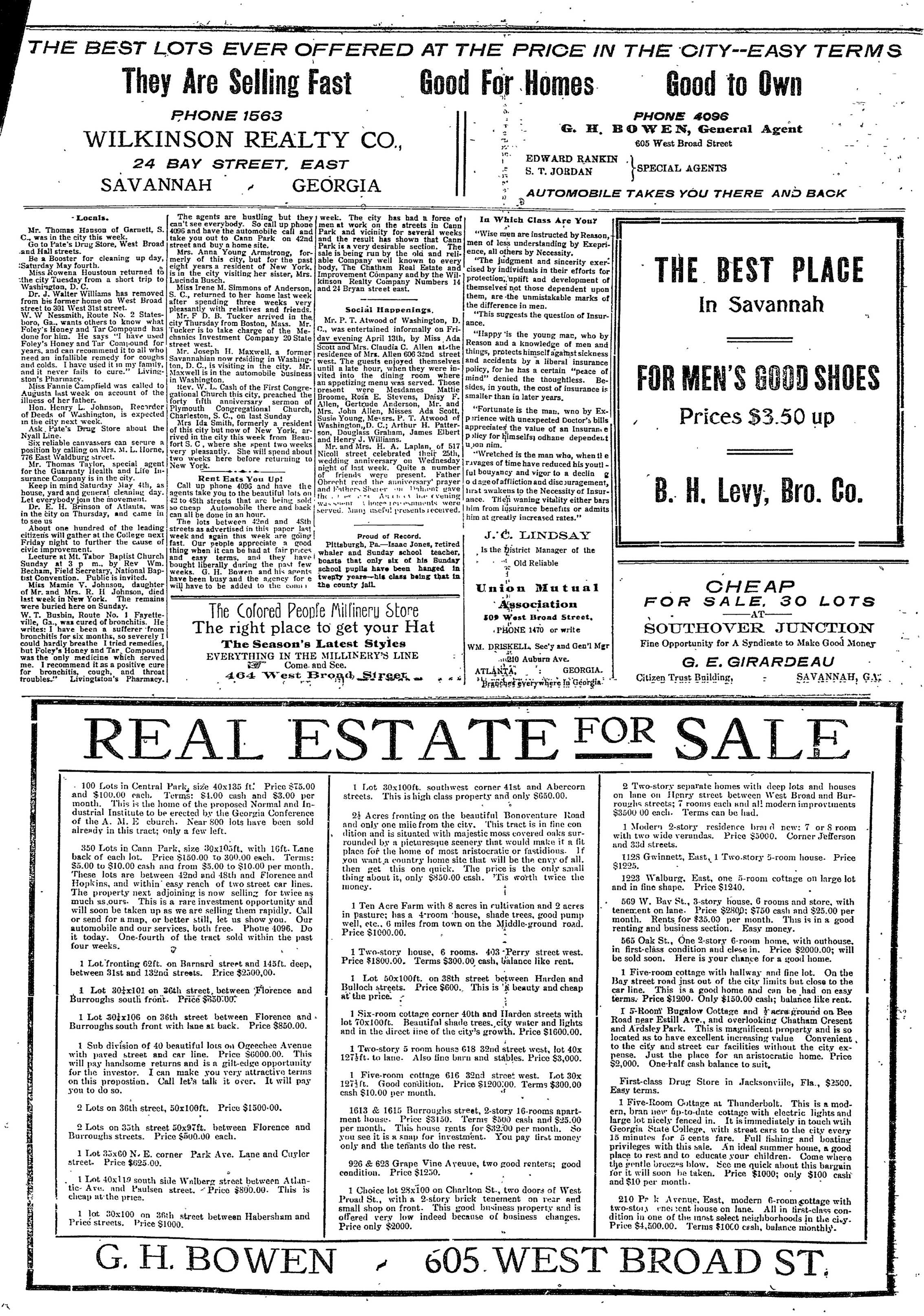
THE BEST LOTS EVER OFFERED AT THE PRICE IN THE CITY--EASY TERMS They Are Selling Fast Good For Homes Good to Own
PHONE 1563 WILKINSON REALTY CO. 24 BAY STREET, EAST SAVANNAH GEORGIA
REAL ESTATE FOR SALE
100 Lots in Central Park, size 40x135 ft. Price $75.00 and $100.00 each. Terms: $1.00 cash and $3.00 per month. This is the home of the proposed Normal and Industrial Institute to be erected by the Georgia Conference of the A. M. E cburch. Near 800 lots have been sold already in this tract; only a few left.
350 Lots in Cann Park, size 30x105ft, with 16ft. Lane back of each lot. Price $150.00 to 300.00 each. Terms: $5.00 to $10.00 cash and from $5.00 to $10.00 per month. These lots are between 42nd and 48th and Florence and Hopkins, and within easy reach of two street car lines. The property next adjoining is now selling for twice as much as ours. This is a rare investment opportunity and will soon be taken up as we are selling them rapidly. Call or send for a map, or better still, let us show you. Our automobile and our services, both free. Phone 4096. Do it today. One-fourth of the tract sold within the past four weeks.
1 Lot fronting 62ft. on Barnard street and 145ft. deep, between 31st and 132nd streets. Price $2500,00.
1 Lot 304x101 on 36th street, between Florence and Burroughs south front. Price $650.00.
1 Lot 30x106 on 36th street between Florence and Burroughs south front with lane at back. Price $850.00.
1 Sub division of 40 beautiful lots on Ogeechee Avenue with paved street and car line. Price $6000.00. This will pay handsome returns and is a gilt-edge opportunity for the investor. I can make you very attractive terms on this proposition. Call let's talk it over. It will pay you to do so.
2 Lots on 36th street, 50x100ft. Price $1500.00.
2 Lots on 35th street 50x97ft. between Florence and Burroughs streets. Price $500.00 each.
1 Lot 35x60 N. E. corner Park Ave. Lane and Cuyler street. Price $625.00.
1 Lot 40x119 south side Walberg street between Atlantic Ave. and Paulsen street. Price $800.00. This is cheap at the price.
1 lot 30x100 on 36th street between Habersham and Price streets. Price $1000.
- Locals.
Mr. Thomas Hanson of Garnett, S. C., was in the city this week. Go to Pate's Drug Store, West Broad
Go to Pate's Drug Store, West Broad and Hall streets. Be a Booster for cleaning up day Saturday May fourth.
Miss Rowena Houstoun returned to the city Tuesday from a short trip to Washington, D. C.
Dr. J. Walter Williams has removed from his former home on West Broad street to 301 West 31st street.
W. W Nessmith, Route No. 2 Statesboro, Ga.. wants others to know what Foley's Honey and Tar Compound has done for him. He says "I have used Foley's Honey and Tar Compound for years, and can recommend it to all who need an infallible remedy for coughs and colds. I have used it in my family, and it never fails to cure." Livingston's Pharmacy.
Miss Fannie Campfield was called to Augusta last week on account of the illness of her father.
Hon. Henry L. Johnson, Recorder of Deeds of Washington, is expected in the city next week.
Ask Pate's Drug Store about the Nyall Line.
Six reliable canvassers can secure a position by calling on Mrs. M. L. Horne, 776 East Waldburg street.
Mr. Thomas Taylor, special agent for the Guaranty Health and Life Insurance Company is in the city.
Keep in mind Saturday May 4th, as house, yard and general cleaning day. Let everybody join the movement.
Dr. E. H. Brinson of Atlanta, was in the city on Thursday, and came in to see us
About one hundred of the leading citizens will gather at the College next Friday night to further the cause of civic improvement.
Lecture at Mt. Tabor Baptist Church Sunday at 3 p.m., by Rev Wm. Becham, Field Secretary, National Baptist Convention. Public is invited.
Miss Mamie V. Johnson, daughter of Mr. and Mrs. R. H Johnson, died last week in New York. The remains were buried here on Sunday. W. T. Busbin, Route No. 1 Fayetteville, Ga., was cured of bronchitis. He writes: I have been a sufferer from bronchitis for six months, so severely I could hardly breathe I tried remedies, but Foley's Honey and Tar. Compound was the only medicine which served me. I recommend it as a positive cure for bronchitis, cough, and throat troubles." Livingston's Pharmacy.
The Colored People Millinery Store The right place to get your Hat The Season's Latest Styles EVERYTHING IN THE MILLINERY'S LINE Come. and See. 464 West Broad Street
The agents are hustling but they can't see everybody. So call up phone 4096 and have the automobile call and take you out to Cann Park on 42nd street and buy a home site. Mrs. Anna Young Armstrong, formerly of this city, but for the past eight years a resident of New York, is in the city visiting her sister, Mrs. Lucinda Busch. Miss Irene M. Simmons of Anderson, S. C., returned to her home last week after spending three weeks very pleasantly with relatives and friends. Mr. F D. B. Tucker arrived in the city Thursday from Boston, Mass. Mr. Tucker is to take charge of the Mechanics Investment Company 20 State street west.
Mr. Joseph H. Maxwell, a former Savannahian now residing in Washington, D. C., is visiting in the city. Mr. Maxwell is in the automobile business in Washington. Itev. W. L. Cash of the First Congregational Church this city, preached the forty fifth anniversary sermon of Plymouth Congregational Church, Charleston, S. C., on last Sunday Mrs Ida Smith, formerly a resident of this city but now of New York, arrived in the city this week from Beaufort S. C., where she spent two weeks very pleasantly. She will spend about two weeks here before returning to New York.
---
Call up phone 4096 and have the agents take you to the beautiful lots on 42 to 45th streets that are being sold so cheap Automobile there and back can all be done in an hour.
The lots between 42nd and 45th streets as advertised in this paper last week and again this week are going fast. Our people appreciate a good thing when it can be had at fair prices and easy terms, and they have bought liberally during the past few weeks. G. H. Bowen and his agents have been busy and the agency for e will have to be added to the com
1 Lot 30x100ft. southwest corner 41st and Abercorn streets. This is high class property and only $650.00.
2 1/4 Acres fronting on the beautiful Bonoventure Road and only one milie from the city. This tract is in fine condition and is situated with majestic moss covered oaks surrounded by a picturesque scenery that would make it a fit place for the home of most aristocratic or fastidious. If you want a country home site that will be the envy of all, then get this one quick. The price is the only small thing about it, only $850.00 cash. 'Tis worth twice the money.
1 Ten Acre Farm with 8 acres in cultivation and 2 acres in pasture; has a 4-room house, shade trees, good pump well, etc., 6 miles from town on the Middle-ground road. Price $1000.00.
1 Two-story house, 6 rooms. 403 Perry street west. Price $1800.00. Terms $300.00 cash, balance like rent.
1 Lot 50x100ft. on 38th street between Harden and Bulloch streets. Price $600. This is a beauty and cheap at the price.
1 Six-room cottage corner 40th and Harden streets with lot 70x100ft. Beautiful shade trees, city water and lights and in the direct line of the city's growth. Price $1600.00.
1 Two-story 5 room house 618 32nd street west, lot 40x 127½ft. to lane. Also fine burn and stables. Price $3,000.
1 Five-room cottage 616 32nd street west. Lot 30x 127½ft. Good condition. Price $1200.00. Terms $300.00 cash $10.00 per month.
1613 & 1615 Burroughs street, 2-story 16-rooms apartment house. Price $3150. Terms $500 cash and $25.00 per month. This house rents for $32.00 per month. So you see it is a snap for investment. You pay first money only and the tenants do the rest.
926 & 623 Grape Vine Aveuue, two good renters; good condition. Price $1250.
1 Choice lot 28x100 on Charlton St., two doors of West Proad St., with a 2-story brick tenement on rear and small shop on front. This good business property and is offered very low indeed because of business changes. Price only $2000.
week. The city has had a force of men at work on the streets in Cann Park and vicinity for several weeks and the result has shown that Cann Park is a very desirable section. The sale is being run by the old and reliable Company well known to every body, The Chatham Real Estate and Improvement Company and by the Wilkinson Realty Company Numbers 14 and 24 Bryan street east.
Social Happenings.
Mr. P. T. Atwood of Washington, D. C., was entertained informally on Friday evening April 13th, by Miss, Ada Scott and Mrs. Claudia C. Allen at the residence of Mrs. Allen 606 32nd street west. The guests enjoyed themselves until a late hour, when they were invited into the dining room where an appetizing menu was served. Those present were Mesdames Mattie Broome, Rosa E. Stevens, Daisy F. Allen, Gertzude Anderson, Mr. and Mrs. John Allen, Misses Ada Scott, Susie Young, Messrs. P. T. Atwood of Washington, D. C.; Arthur H. Patterson, Douglass Graham, James Elbert and Henry J. Williams.
Mr. and Mrs. H. A. Laplan, of 517 Nicoll street celebrated their 25th, wedding anniversary on Wednesday night of last week. Quite a number of friends were present. Father Obrecht read the anniversary' prayer and Fathers Sheeran Dohm gave the blessing. An evening was spent (more than) tenements were served. Many useful presents received.
Proud of Record.
Pittsburgh, Pa.—Isaac Jones, retired whaler and Sunday school teacher, boasts that only six of his Sunday school pupils have been hanged in twenty years—his class being that in the county jail.
PHONE 4096
G. H. BOWEN, General Agent
605 West Broad Street
EDWARD RANKIN
S. T. JORDAN
SPECIAL AGENTS
AUTOMOBILE TAKES YOU THERE AND
In Which Class Are You?
"Wise men are instructed by Reason, men of less understanding by Exeprience, all others by Necessity.
THE BEST PLACE In Savannah
"The judgment and sincerity exercised by individuals in their efforts for protection, uplift and development of themselves not those dependent upon them, are the unmistakable marks of the difference in men.
"This suggests the question of Insurance.
"Happy is the young man, who by Reason and a knowledge of men and things, protects himself against sickness and accidents by a liberal insurance policy, for he has a certain "peace of mind" denied the thoughtless. Besides, in youth, the cost of insurance is smaller than in later years.
"Fortunate is the man, who by Experience with unexpected Doctor's bills appreciates the value of an Insurance policy for himself; odhane dependent upon nim.
"Wretched is the man who, when the ravages of time have reduced his youthful bouyancy and vigor to a declining age of affliction and discouragement, first awakens to the Necessity of Insurance. Then waning vitality either bars him from insurance benefits or admits him at greatly increased rates."
B. H. Levy, Bro. Co.
J.C. LINDSAY
Is the District Manager of the
Old Reliable
Union Mutual
CHEAP FOR SALE, 30 LOTS AT SOUTHOVER JUNCTION Fine Opportunity for A Syndicate to Make Good Money
Association
509 West Broad Street.
PHONE 1470 or write
WM. DRISKELL, Sec'y and Gen'l Mgr
210 Auburn Ave.
G. E. GIRARDEAU Citizen Trust Building, SAVANNAH, GN
ATLANTA. GEORGIA. Branches everywhere in Georgia. TE FC
2 Two-story separate homes with deep lots and houses on lane on Henry street between West Broad and Burroughs streets; 7 rooms each and all modern improvtments $3500 00 each. Terms can be had.
1 Modern 2-story residence brand new: 7 or 8 room with two wide verandas. Price $5000. Corner Jefferson and 33d streets.
1128 Gwinnett, East, 1 Two-story 5-room house. Price $1225.
1223 Walburg, East, one 5-room cottage on large lot and in fine shape. Price $1240.
569 W. Bay St., 3-story house. 6 rooms and store, with tenement on lane. Price $2800; $750 cash and $25.00 per month. Rents for $35.00 per month. This is in a good renting and business section. Easy money.
565 Oak St., One 2-story 6-room home, with outhouse, in first-class condition and close in. Price $2000.00; will be sold soon. Here is your chance for a good home.
1 Five-room cottage with hallway and fine lot. On the Bay street road just out of the city limits but close to the car line. This is a good home and can be had on easy terms. Price $1200. Only $150.00 cash; balance like rent.
1 5-Room Bugalow Cottage and Acre-ground on Bee Road near Estill Ave., and overlooking Chatham Crescent and Ardsley Park. This is magnificent property and is so located as to have excellent increasing value. Convenient to the city and street car facilities without the city expense. Just the place for an aristocratic home. Price $2,000. One-half cash balance to suit.
First-class Drug Store in Jacksonville, Fla., $2500. Easy terms.
1 Five-Room Cottage at Thunderbolt. This is a modern, bran new tip-to-date cottage with electric lights and large lot nicely fenced in. It is immediately in touch with Georgia State College, with street cars to the city every 15 minutes for 5 cents fare. Full fishing and boating privileges with this sale. An ideal summer home, a good place to rest and to educate your children. Come where the gentle breezes blow. See me quick about this bargain for it will soon be taken. Price $1000; only $100 cash and $10 per month.
210 Park Avenue, East, modern 6-room cottage with two-story enclosed house on lane. All in first-class condition in one of the most select neighborhoods in the city. Price $4,500.00. Terms $1000 cash, balance monthly.
GEN. FREDERICK DENT GRANT DEAD
Attack of Diabetes, According to Physicians, the Cause.
SON OF A FAMOUS GENERAL
Commander Of the Department Of the East Had Been Ill For Some time—His Death a Profound Surprise.
New York.—Maj.-Gen. Frederick D. Grant, son of the famous general of the Civil War and himself commander of the Department of the East, died at the Hotel Buckingham, in this city. Rumors have been in circulation for weeks that he was afflicted with cancer of the tongue, the same malady which took the life of his father. But the cause of death given out is diabetes. It proves that he and the mysterious patient at St. Luke's Hospital were identical.
According to the best information obtainable, General Grant was operated upon at St. Luke's by Dr. Robert Abbe six weeks ago and two weeks later was treated with radium:
Every effort was made to conceal the fact that he was under treatment, on account of the unassuming and modest nature of the distinguished soldier, who disliked to be the subject of public comment. Every officer of the Department of the East headquarters at Governor's Island was enjoined to secrecy and so considerate had their commander always been of them that the request of the General was observed in every particular and systematic denials were made of the alarming reports concerning his health.
The General made a brave fight for his life, and for a portion of the day he even attended to some of his correspondence. Although the evidence was overwhelming that the General was in St. Luke's Hospital, diplomatic denials of his presence there were made.
Eldest Son Of U. S. Grant.
Maj.-Gen. Frederick Dent Grant, eldest son of President Ulysses S. Grant, reached that rank in the United States Army on February 8, 1905, less than one year after he assumed command of the Department of the East, with headquarters on Governor's Island, in September of 1906. That command he retained until the illness which caused his death forced him to relinquish his duties and obtain leave of absence.
He was born in St. Louis, Mo., on May 30, 1850, and the first years of his life were spent in army garrisons in various parts of the country. He received his early education in the public schools of St. Louis, Mo., and Galena, Ill. It was in the Illinois city that his father was in business at the outbreak of the Civil War.
WILL RETURN TO WASHINGTON.
Dr. Wu Ting-fang, Who Has Been Nominated For His Old Post As Chinese Minister To Washington By the New President Of the Chinese Republic.
ROEBERS WOULD BURN VICTIM.
Take Jewelry and Money, Blind Woman and Fire House.
Chicago.—Robbers gaining entrance to the house in the guise of telephone repair men forced Mrs. E. A. Clark to surrender her jewels and nearly $1,000 in currency and then tied her to a table in the basement and set fire to the house. Smoke pouring from both front and rear of the house gave the alarm. Firemen were compelled to force their way in with axes. They found Mrs. Clark unconscious, lashed with clothesline to a table leg.
WAR ON DEADLY WEAPONS
Even Large Pocketknives Under the Ban In Washington.
Washington—Citizens of this town who carry any deadly weapons hereafter will be liable to penitentiary sentenoe and fine, or both, by the terms of a bill passed in the House. Any Washingtonian who has a pocketknife with a blade more than three inches long comes within the provisions.
匈
Commander of the Department of the East, who died suddenly in New York.
Lindbergh Says Wall Street is Controlling Inquiry.
RESOLUTION CREATES A STIR
Chairman Pujo, Of Louisiana, Of Committee, Announces Indefinite Postponement Of Investigation.
Washington.—A charge that Wall street and the big corporations are controlling the House "Money Trust" inquiry was made by Representative Lindbergh, of Minnesota, Republican, in a resolution which would compel every member to disclose his business and corporation affiliations. Each member of the House would have to file his own bank holdings and those of his family. Names of members who failed to do so would be published in a Congressional Record "blacklist."
Coming close upon the insinuations of Representative Randell, Democrat, that members of the House and Senate had corporation connections, the resolution created a stlr.
In a statement explaining the purpose of his resolution, Mr. Lindbergh declared some committee members are controlled by persons whose personal work is hostile to the public interest." He said most of the "Money Trust" committee were interested in banks and that Wall street had the power to intimidate bankers.
Representative Pujo, of Louisiana, chairman of the Banking and Currency Committee, announced an indefinite postponement of the inquiry, saying he desired to go over the ground work with the committee's statistician.
The Democratic members of the Banking and Currency Committee will select counsel within a day or two and hearings probably will begin soon in Washington, to be followed by others in New York.
Gas Kills Two Women.
Pitman, N. J.—Mrs. Emma Engle and Miss Mary Wallace, each more than 60 years old, were found dead in the home of the former from gas asphyxiation. Death was accidental and was due to a defective gas stove. Miss Wallace was a resident of Millville, N. J., and was visiting Mrs. Engle.
Hoosevelt's Secretary Married. Toronto, Ont.—Frank Harper, of New York, private secretary to Col. Theodore Roosevelt, was married here to Miss Augusta Prime, daughter of F. A. Prime, of this city.
A "Pauper" Leaves $10,000.
Johnstown, Pa—Joseph Campalgo, an aged recluse, died here, and the undertaker, examining the effects, found $10,000 in cash, stocks and other securities. Campalgo, known as "Old Joe," was believed to be in poverty.
MEXICAN REBELS
SLAY AMERICAN
Fountain Who Commanded American Gun Executed.
Had Lain Concealed In a House Until Hunger Forced Him To Surrender—His Father Is a Prominent Lawyer.
El Paso, Tex.—An American newspaper man, who returned from Partial with 184 American and other foreign refugees from the battle-swept district, brought news of the execution of Thomas Fountain, of Las Cruces, N. M., by the rebels.
Fountain was captain of a federal gun under Gen. Pancho Villa.
When Villa retreated last week Fountain removed parts of the piece and concealed himself in a private residence. The occupants were ignorant that they had a guest in a part of the house seldom visited.
On Monday he was compelled to show the rebels where he had secreted the missing parts of his rapid fireer, was tried by court martial and condemned to death, apparently for having disabled the gun. American residents made every effort to obtain a modification of the sentence, but without avail. Finally American Consul Letcher, at: Chihuahua, sent to General Salazar what is believed to have been an appeal from Washington that his life be spared. In delivering the missive to a messenger the consul remarked: "This is the last resort."
In Mexico they have recourse to what is known as the "Law of Flight" under which a prisoner who has been condemned, but where there exists a doubt as to the legality of the sentence, is allowed his freedom within certain limits. The prisoner knows that his fate is scaled. Even if he does not walk a step, from some unexpected quarter the fatal bullet will come, and the report will be made that he was shot while "in flight." It was thus in Fountain's case. He told the correspondent that there was no hope, but strolled about the streets waiting for death. When his body was brought in it contained four bullet wounds, made by shots fired from behind.
JUDGE'S SON FOUND GUILTY.
Convicted Of Manslaughter For Killing Boy With Automobile.
Newark, N. J.—Daniel A. Dugan, Jr., of Orange, N. J., son of a district court judge, was found guilty of manslaughter by a jury here, with a recommendation for the court's clemency. The jury had been out 20 hours. Young Dugan was indicted for having run over with his automobile and killed 14-year-old Leo McDermott on Christmas Day last.
STARTED WITH
$1.25 CAPITAL
Publisher Tells Story of Remarkable Career.
E. G. LEWIS ON TRIAL
Ran Up Original Capital Into a Series Of Business Operations That Involved the Handling. Of Millions.
St. Louis, Mo.—E. G. Lewis, charged with using the mails to defraud, took the witness stand in the United States District Court here Monday and began the story of his, remarkable financial career from his first venture in the publishing field, when he started a magazine with $1.25. Rapidly, but without apparent effort at dramatic effect, he told how he ran up this $1.25 into a series of business and banking operations which involved the handling of several million dollars.
Lewis said his publishing business outgrew its plant several times and that he finally decided to build his own plant, and realizing that city property was improving westward, raised his building beyond the city limits, where University City has since grown.
He then recited the success of his business, declaring its downfall commenced with the issuance of a fraud order by the Postoffice Department in 1905. All his mail, the witness said, was returned to the senders, bearing the word "fraudulent," stamped in red. Before this, he said, he was receiving from 3,000 to 22,000 letters a day. As a result of the fraud order, Lewis testified, he lost $190,000 in advertising contracts and his banking credit was cut off.
When the People's Bank ceased business, in 1905, and a receiver was appointed, Lewis festified, he called a meeting of the stockholders and proposed the exchange of their stock for stock of the publishing company, with a $2,300,000 increase in its capitalization. He took the responsibility of any losses that might accrue to the stockholders in the adjustment of the affairs of the bank, he said, and gave them his notes to secure them to the full amount of the increased capitalization.
Lewis testified that 19,000 subscribers of the People's Bank changed their stock for an equal number of shares of the Lewis Publishing Company. When the bank was liquidated on a basis of $7 cents on the dollar, he said, he made up the other 13 cents and saved the subscribers from loss by giving them their full allotment of Lewis Publishing Company shares. In 1905, he said, 300 letters of the Lewis Publishing Company were held up in the postoffice. In October of the same year 300,000 copies of the Farm Journal were held up. He did not learn of this until five weeks later, he said. He then had to refund $12,000 taken in for advertising in the suppressed issue and many advertising contracts were broken as a result of the seizure.
After this Lewis said he and two other officials of the company were indicted on charges of sending out mall in excess of the government regulations.
HER SKIRT SAVED HER.
Girl Sought Death Vla a Bridge When Pulled Back.
Chicago.—A well-dressed girl about 18 years old climbed on the ralling of the Randolph Street Bridge and tried to jump into the river. Her skirt was seized by a man who was walking across the bridge just as she sprang. His grip held and the girl hung head down until policemen aided in pulling her back to safety.
Their First and Last Quarrel.
Siloam Springs, Ark.—A dispute over the division of their estate, valued at $100,000, resulted in M. R. Bentley, a retired farmer, killing his wife and then himself. Bentley was 75 years old and his wife 70. They had been married 50 years and this quarrel was the first of any consequence between them. Bentley, one of the richest men in the vicinity of Siloam Springs, recently advanced $30,000 to his wife's relatives, and when he wrote his will she objected to his deducting the amount from the dowry. He then shot her.
Eagles' Treasurer Dles.
Kansas City, Mo.—Finley McRae, national treasurer of the Fraternal Order of Eagles, died in Helena, Mont., following an operation, according to a telegram received here.
TAFT AGAINST GAG RULE.
Superlors Muat Transmit Petitions Offered By Employes.
Washington. President Taft, through the Civil Service Commission, has rescinded the so-called-"gag rule" imposed on Government employees and army and navy officers and men, which forbade them to petition Congress except when authorized by superior officers. By a new order, superior officers are compelled to transmit all petitions to Congress.
NEGROES IN BAR ASSOCIATION
NEGROES IN BAR ASSOCIATION
LEWIS NOT THE ONLY ONE MINNEAPOLIS LAWYER TELLS WICKERSHAM.
Washington. — Attorney General Wickersham's protest against the ousting of Assistant Attorney General William H. Lewis, a negro, from membership in the American Bar association has brought forth a letter from a Minneapolis lawyer, who says that a lawyer of that city, "nearly a full-blooded negro," is a member of the association.
The letter says that the negro attorney was elected to membership at the Boston meeting last year, despite the assertion of George W. Whitelock secretary of the association, in a letter to the attorney general, that no one except a white man had held membership in that body.
The attorney general informed Mr. Whitelock of the communication, saying it seems to have a distinct bearing on the Lewis case, and asking a confirmation or correction.
Boston.—The American Bar association has determined to insist on the expulsion of Assistant Attorney General William H. Lewis. The attitude of the association was made known in a circular signed by President Gregory. The circular asks its members to uphold the action of the officers, and adds:
"Every effort was made to represent the matter to Mr. Lewis in such a way as to induce him to relieve the situation by retiring voluntarily, and it was hoped at one time that this had been accomplished.
"Finally the members of the committee took the action indicated by their resolution.
"Notwithstanding all efforts to raise an issue not involved, the facts remain that Mr. Lewis was elected to membership in the association under a misapprehension," and he now insists on retaining the advantages of an election thus obtained."
INVITED TO COMPETE
ANDREW CARNEGIE DESIROUS THAT NEGROES MAKE AN EFORT TO WIN TROPHY TO BE AWADED FOR THE BEST COTTON GROWN IN THE UNITED STATES.
The officers of the American Land and Irrigation exposition, which was held in New York city last fall, and which is to be held again November 15 to December 2, 1912, in the Seventh Regiment armory, announces that Andrew Carnegie has just given a trophy valued at $750 to be awarded for the best cotton grown in the United States. Mr. Carnegie makes a special consideration of his award that the colored people of the country may be permitted to enter into this competition.
The prizes for staple products, to be awarded at the coming exposition, will be the handsomest in the history of the world's agriculture. The exposition will be open for sixteen days and it is confidently expected that over half a million people will attend. In addition to the prizes already offered, others are as follows:
President Stillwell of the exposition has already donated a $1,000 trophy for the best exhibit of white potatoes; Horace Havemeyer has given a $1,000 prize cup for the best exhibit of sugar beets, and the exposition management will offer a $1,000 prize for the best exhibit of apples—twenty-five boxes of any variety or varieties grown anywhere.
The exact terms of the awards and full list of prizes, together with any information regarding the various competitions, will be sent upon application to Gilbert McClurg, general manager, the American Land and Irrigation exposition, Singer building, New York city. The colored people are especially urged to enter for the Carpegie trophy for the best cotton grown as Mr. Carnegie desires.
HE WON THE BET.
It was a tayern where a newly-arrived commercial traveler was holding forth. "I'll bet anyone $5," he said, "that I have got the hardest name of anyone in this room."
An old farmer in the background shifted his feet to a warmer part of the fender.
"Ye will, will ye?" he drawled.
"Well, I'll take ye on. I'll bet ye ten agn' your five that my name'll beat yours."
"Done," cried the commercial traveler. "I've got the hardest name in the country, it is Stone."
The old man took a chew at his tobacco. "Mine," he said, "is Harder."
—Mack's National Monthly.
NEW JOB WAS SAFE.
A man who goes up to Maine each year for the hunting was quite surprised this season upon arriving at the village hotel to find one of the old and best-known guides loafing about idle.
"Well, Lafe," asked the visitor, "don't you guide hunting parties any more?"
"No, I gave it up," slowly, answered Lafe. "Got tired of being mistook for a deer."
"I don't blame you. How do you earn your living now?"
"Guide fishin' parties now. So fer nobody ain't mistook me for a fish."—Harper's Magazine.
POETRY
of and by Our People
MEGIDDO.
"In his days Pharoah-nechoh, king of Egypt, went up against the king of Assyria to the river Euphrates; and king Josiah went against him; and he slew him at Megiddo, when he had seen him." (2 Kings 23:29).
The cedars droop on Carmel's brow,
Megiddo!
On Rimmon's slopes the olives bow,
Megiddo!
Fallen' railed is Judah's glory now
Megiddo!
Then cried the chiefs amain—
Vain all their clamor, vain!
Weep o'er the thousands slain
On Estdraelon's plain,
Megiddo!
The train winds slow, low throbs the
drum,
Megiddo!
The eye is dim, the hand is numb,
Megiddo!
Slow, slow does Judah's hero come,
Megiddo!
Clanged shield and thundered, mace,
On swept the war apace;
Death looked from Egypt's face—
There ceased Jehovah's grace,
Megiddo!
The sun has sunk, thy day is done,
Megiddo!
The hour has struck, thy race is run,
Megiddo!
Past, past the hour, the goal not won,
Megiddo!
Judah, the hour is past;
Full is thy cup at last;
Fierce burns the wrath and vast;
Doom speeds, and woe files fast,
Megiddo!
The shrill pipes shriek; lift up the cry,
Megiddo!
And wall ye: "Ay! his glory, ay!"
Megiddo!
"Why must we live, if he could die?"
Megiddo!
Night comes, and lone we are;
Night comes, and thou art far;
No night thy ray can mar—
Judah's last evening star,
Megiddo!
—Walter G. Harbison.
MY SORROWS.
I face my sorrows all all alone,
With courage few could show;
They come always in mighty sum
To give an awful blow.
At times of sunny days I book,
The things that brighten life;
And when 'tis gloomy back I look
Upon them in the strife.
'Tis strange how sorrows come about,
Succeeding joys behind;
The moment they may all go out,
To pain the heart and mind.
My joys I rhyme, to cheer the world,
"My sorrows are concealed."
The wise their beat, always unfurl,
Although the pangs they feel.
A life of absent sorrows here,
But knows this world one way;
"To know the gloomy side and care,
Illumes the perfect day.
Our friends are wanting midst the house.
The sorrows may beguile;
Oh then we need consoling pow'r
To bear them with a smile.
The life of worth must undergo
The things of cheer and pain;
Yes learn to live, and last the more—
By sunshine, gloom or pain.
For sorrows learn me lessons too,
Of consequence as great,
As those of mirth, preferred by you
Of which my songs relate.
-Jaa. P. Magwood.
God never yet hath sent a man to fight
For or Love's dear kingdom, swording
him with hate,
And helmeting his head with brazen
weight
Of worldly glory, flashing in the light
Of Christ's great Day, to darken down
like night,
On shadowed hearts. Nor hath he
made men great
With grace to cry one message: "It is
late;
Pluck out, O Lord, the bitter sword and
smite!"
The world, we know, is full of sin and
fraud,
And Satan holds his ancient reign to
day.
But, Friend, the dear Christ did not walk
abroad
Condemning, hut redeeming men. Yet
see
Yon clown to his caught fellow crying:
Pay
The debt thou owest, Villian!" Art
thou he?
James D. Corrothers.
Haverhill, Mass.
THE GOLDEN·AGE.
We speak of songs the poets sing,
Of messages the preachers bring,
No sweeter notes are ever sung,
Nor richer words drop from the tongue.
Than those whose burden is to tell,
That man should treat his neighbor well.
The triumph of the works of art,
And Science in her evry part,
Which artists in each age have sought,
And sages patiently have taught,
Will come as if by magic spell,
When man will treat his neighbor well.
The day will come, the time draws nigh.
When through the land, the sea, the sky,
Will be the song of jubilee.
And every slave will be set free.
The heart of man with love will swell,
Since man does treat his neighbor well.
-A. A. Wilson-
BLOW, SPIRIT, BLOW.
Blow, Spirit blow
And sweep my breast
With some sweet song--
A song of rest.
Blow, Spirit, blow
Till peace I know.
Blow, Spirit, blow
And cleanse my heart
From doubts and fears.
Bid them: "Depart!"
Blow, Spirit, blow
Till joy I know.
Blow, Spirit, blow
And breathe the care
For every man
Both far and near.
Blow, Spirit, blow
Till love I know.
Your Money Pile Grows
Just in proportion as you advertise your business, and our columns are open for you to begin at once. Suppose you give us a trial.
Advertise in this paper
Take a Policy With The Pilgrim Health and Life Insurance Co.
The Oldest, Strongest and Most Reliable Company in the State.
Gives employment to hundreds of men and women of our race.
Pays from $1 to $10 weekly sick and accident benefits and from $10 to $100 death benefits. Our Motto: "Promptness, Honesty and Justice."
Home Office:
$143 Gwinnett St. Augusta, Ga.
For further information write 509 West Broad St, Savannah, Ga.
J. S. Perry, Supt.
A. B. Singfield, Gen. Supt.
C. T. Walker, D. D., LL. D.
Director and General Lecturer.
GO TO
GO TO
Young Bros.
For your TOBACCO, CIGARS and FRUITS Of all kinds. 609 West Broad Street.
WEST SIDE RESTAURANT
461 West Broad Street,
Near Union Station.
The place to get first-class meals
Everything neat and clean. Meals
prepared in an appetising manner
and at all hours daily.
Meals 15 and 25 cents.
MRS. A. S. SCOTT, Proprietress
McFALL'S
Ice Cream Parlor
Ice Cream and Sherbets in large and small quantities. Special prices to Churches and Societies. Also Hot and Cold Lunches. Fish Suppers prepared to order. Phone 4038. Orders very Promptly filled. : : : : : 815 East Broad St., Savannah, Ga.
Masonic Books and Regalias
LODGE SEALS,
FINANCIAL CARDS and
BLANKS of every description.
Laberal Discounts Will Be Arranged.
SOL G. JOHNSON,
Savannah, Ga.
PORTUGUESE WEST AFRICA FOR SALE
PORTUGUESE NEED MONEY— TREASURY IN A BAD CONDITION AND COUNTRY IS NEGOTIATING TO PART WITH RICH LAND.
Portuguese' West Africa, according to reports from Europe, is for sale and there is some talk of American capitalists acquiring the African possessions of the Portuguese, which is inhabited by 6,000,000 blacks. The country is said to offer great opportunities along agricultural lines.
The Portuguese Congq is connected with the Congo Free States, which has a population of 46,000,000 blacks. It is said that the purchase of Portuguese West Africa by American capitalists, and the introduction of farming among the natives would also have a great influence on the future of the blacks of the Congo Free State, as they, too, would likely be shown eventually the wisdom of raising cotton and tilling the land in which they live, which is known for its fertility.
Those deeply interested in the purchase of Portuguese West Africa by Americans predict that the contact of the natives with whites and negroes from America will bring many radical changes in Africa, where thousands of blacks now go about in an uncivilized state. Aside from the introduction of farming on a large scale, the mode of living of the African could be greatly changed. The natives now pay little attention to clothing, but it is the belief of many that within a decade the majority of blacks would adopt the habits of Europeans and Americans relative to wearing clothes. It is said that the Portuguese government is anxious to sell its African possessions because its treasury is in a depleted state.
GUEST OF ROSENWALD
DR. WASHINGTON ADDRESSES MANY MEETINGS IN CHICAGO—THOUSANDS TURNED AWAY.
Chicago.—Dr. Booker T. Washington left here for the east, after having spent a week in Chicago as the guest of Julius Rosenwald, the philanthropist, and trustee of Tuskegee Institute. Dr. Washington delivered more than 15 addresses during the week. The largest meeting was at Orchestra hall. The educator spoke under the auspices of the Chicago Sunday Evening club, and fully 8,000 persons tried to crowd into the auditorium, thousands being tuned away. The Tuskegeean spoke at Sinai Temple, the largest Jewish house of worship in Chicago. Then again hundreds were unable to secure admission, so great was the rush to hear Dr. Washington.
Dr. Washington addressed the Chicago Colored Young Men's Christian association. When he appeared on the platform escorted by Mr. Rosenwald, he was accorded an ovation lasting several minutes. Great enthusiasm was also shown when he met with the Chicago Local Negro Business league, of which Dr. George C. Hall is president. During the week Dr. Washington addressed the Commercial club, the City club, the Chicago School of Civics, the Missionary Society of the Second Baptist church and the Jewish Training school.
NONE OF THESE HEAVIES WANT JEANETTE'S GAME
New York.—While Jeanette has almost given up hope of ever getting the Kennedys, Morrises, Morans or Stewarts to meet him, his manager has now decided to take him to California for a contest with Jim Flynn or Burns, and to remain there until the return of the winner of the coming McVea-Langford fight. By eliminating Burns and Jim Flynn, and then Langford or McVea, he figures that Johnson will be forced into a contest with him. $ \textcircled{5} $
Jeanette in the past year has demonstrated beyond the shadow of a doubt that he is a genuine contender for the world's championship. His win over Sam Langford at the Madison Square Garden was the best evidence of his class. Langford's subsequent defeat by McVea eliminated the "tar baby," and as for McVea, he was stopped by Jeanette in forty-nine rounds, and later decisively whipped by him in thirty rounds.
NEGRO BOY. SAVES BABY'S LIFE.
Athens, Ga.—William Lane, a young negro boy, saved the life of Leslie, the three-year-old child of Mr. and Mrs. W. H. Aaron, in East Athens, by rushing into the house and smothering out the flames which had caught the filmsy garments of the child and were rapidly enveloping it. The mother was in the back yard and did not know that her little babe had been in danger till she found the colored boy tearing off the charred clothing and tenderly ministering to the child.
DAVID MANNES, FAMOUS PLAYER, TELLS NEW YORK AUDIENCE OF DEBT HE OWES TO CHARLES DOUGLAS, A COLORED MAN, WHO TAUGHT AND DIRECTED HIM AS A POOR BOY TRYING TO PLAY THE VIOLIN.
"New York and the Colored People," was the subject of discussion at the March conference on the evils of pauperism, held in the Charities building. The conference was made particularly interesting from the fact that David Mannes, director of the New York music school settlement, told the story of his first musical instruction and the debt he owed to his negro teacher. This debt, said Mr. Mannes, who is the brother-in-law of Walter Damrosch, he had attempted to repay by founding the Musical School Settlement for Negroes, which, in its first season has 150 pupils.
He was a very poor boy, whose first handling of the violin had been guided only by an itinerant music teacher. It was then that he met Charles Douglas, and the story he told was the story of Charles Douglas. Douglas was a Negro lad in a southern town when he first attracted attention as one possessed of conspicuous musical talent. So great was the promise he showed with the violin that rich patrons backed up his ambitions and sent him abroad to study under the masters there, and as he became a violinist of power he became, too, a man of wide reading and a fluent speaker of French and German as well as of English.
When he had finished his study he came back to America, hoping to find a bright future in the music world of the north. But this hope was never realized, for, though there was recognition of his ability among people who knew, the color line was drawn to shut him out of fair opportunities. There was no room for him in a great symphony orchestra. There seemed to be no place for him to pursue his career on the level for which his taste and his education had prepared him. And, gifted and accomplished though he was, he had to turn to the guitar and the banjo as the instruments with which a negro could gain a hearing.
Heart Broken, He Died.
"And I know that when he died," said Mr. Mannes, "he died of a broken heart."
One day, a broken and a disappointed man, Douglas was walking along 27th street, when he heard the strains of a violin rising from the basement of one of the old brownstone houses there.
"It is my son who is playing," was the proud reply of the woman there to the question that Douglas stopped to ask, and, going in, he found a boy of 13 or thereabouts, fiddling away for dear life.
"You do not play badly," the negro said, a little wistfully, as Mr. Mannes remembers it, for he was the boy with the violin.
And out of that meeting grew a friendship between the boy and the disappointed Negro, who taught him the things he had learned abroad, and who read to him from Poe and Tennyson, and helped to shape his life. Mr. Mannes afterward studied under the masters in Europe, but it was the colored man playing the banjo for a living in New York who first started him in the right direction.
Thae was thirty years ago, but it is to the memory of Douglas that Mr. Mannes has dedicated the Musical School Settlement for Negroes that is in progress in the quarters of the Mary F. Walton Free Kindergarten, on West 63rd' street, and 'in the parish house of St. Phillip's, on 103rd street.
OVERDONE.
The attorney for the defense: "You see, your honor, my client is a foreigner, who can't speak a word of English. He doesn't understand our laws. He didn't know it was wrong to carry a revolver."
"Two revolvers and a dirk," corrected the judge.
"Yes. And so, in view of his ignorance, both of our customs and our language, I ask that he be discharged."
"Can't do it," said his honor. "But I'll let him off with a fine of two dollars."
The ignorant one, across the table to his lawyer, and jerking his thumb toward the judge: "I'll get him, some dark night for that!"—Cleveland Plain Dealer.
TAFT TO VISIT NEGRO SCHOOL.
Raleigh, N. C.—President J. E. Sheppard of the National Training School for Negroes, located at Durham, N. C., wires that President Taft has just promised him to visit the institution and deliver an address to the students and faculty during the month of April.
The specific date is not set out in the telegram, it being merely stated that the president will stop over while en ropto to a trip south this month.
NO EMANCIPATION.
"And so you are an ex-slave," said the traveler in the south. "How interesting. But when the war was ended you got your freedom."
"No, suh," replied Uncle Rastus. "Ah didn't git no freedom. Ah was married."—New York Sun.
See COOPER & ODRIZEN The Up-to-Date Tailors
218 WEST BROAD STREET, BETWEEN HULL AND OGLETHORPE AVE. The Latest Patterns in SPRING AND SUMMER GOODS. Firstclass workmanship guaranteed. Our prices will interest you.
WE HAVE TWELVE LOTS ON THIRTY-NINTH STREET, BETWEEN BURROUGHS AND FLORENCE, UPON WHICH WE WILL BUILD HOMES FOR ANY ONE DESIRING THEM. THE KIND OF HOUSE YOU WANT WILL BE BUILT FOR YOU, AND YOU CAN PAY US FOR IT IN EASY MONTHLY PAYMENTS. COME AND SEE US ABOUT THIS PROPOSITION.
80 DRAYTON STREET.
Nichols, THE SHOE MAN
The affable H. B. Wright is still with us and expects the continuous patronage of his friends.
Johnson Undertaking Establishment
COMBINED WITH
Funeral Directors and Embalmers
Finest line of Coffins, Saskets and Robes. White and black funeral cars. Office and warerooms 325-331 Jefferson street.
W. R. FIELDS, Manager.
Residence Phone 2032. Livery Stable Attached. Office Phone 676.
C. H. ROYALL, Residence 509 Charles St. Phone 3064.
84 ST. JULIAN ST., WEST, 235 BRYAN ST., WEST.
SAVANNAH, GEORGIA. Phone 2962.
Palm Shaving Palace
Expert Hair Cutting, Electric Massage and Shampooing a Specialty. ALL Work Done by Experienced Workmen. Courteous attention to all SHINING PARLOR ATTACHED.
PERRY R. WRIGHT, Proprietor
The Mordecie Pressing Club
Two suits cleaned and pressed per month for $1.00. Ladies' work & specialty. Goods called for and de-livered. 'All work guaranteed. Steam and dry cleaning.
816 EAST BROAD STREET. Phone 3940.
First class SHOE REPAIRING. Half sole, sewed, 85 cents; nailed, 50 cents; rubber heels, 35 and 50 cents. All work guaranteed. CORNER EAST BROAD AND BOLTON STREETS.
Save the old ones and send to us. We make them new—Stoves, Furniture, Mattresses, Carpets, CARPET AND MATTING LAYING A SPECIALTY. Old furniture bought and sold. Packing and Shipping. Goods called for and delivered.
The Beautiful Woodlawn Park New Improvements More Lights New Buildings
Get the habit of saving a part of your Earnings each week.
$1.00
Starts an Account
THE WAGE EARNERS' LOAN AND INVESTMENT COMPANY,
PHONE 244.
468 WESTBROAD ST.
Savannah, Ga.
GAREY'S
Variety Bakery
Goods delivered promptly to any part of the city.
506 West Broad St, Near Gaston.
Phone 1869-J
SAMUEL MIDDLETON,
MUSICAL INSTRUMENTS
OPpen for Pupils.
541 CHARLTON STREET, EAST.
Furnished rooms by week or month. Hot and cold baths. Electric lights. In center of city. Street car, hack and automobile convenient.
CALL AT 217 EAST BROAD ST.
..or phone 3746—I. C. Brown, Prop...
—For First Class—
GROCERIES AND CONFECTIONERY
—Call On—
M. G. GRAHAM
626 York St., West.
Courteous Attention to All.
MADAME FLORENGE E. WILLIAMS
Graduate Prof. Roher's School,
New York.
Hairdressing Parlor
521 Gaston Street, East.
Telephone 2328
Wigs, Switches and Pompadours
Made from Natural Hair.
Combings Made Up. Shampooling and
Hair Straightening a Specialty.
Face and Electric Massage. Dyeing
and Matching Hair.
ORIENTAL HAIR GROWER.
An excellent preparation, will produce a beautiful growth of hair. Directions on each box. For sale, price
25 cents per box.
AGENTS WANTED
For the Sale of
Magic Shaving Powder
It gives a. quick shave without the use of a RAZOR For Particulars, Write THE SHAVING POWDER CO. Savannah, Georgia.
Regularly. Shoes that are polishsd regularly will last much longer than those that are not. Let me sell you a GOOD POLISH OF BLACK OR TAN, also a good Dressing for Ladies' and Children' Shoes.
My Clothes Always Fit to Perfection Carry the Latest Weaves and Styles
WE LEND YOU MONEY AT 8 PER CENT Regular Banking Rates
We pay you 5 per cent on all deposits, with drawable on demand All business strictly private Give us a share of your business. Let us help you save something for a rainy day OPEN AN ACCOUNT WITH US TO-DAY The Mechanics Investment Company 20 STATE STREET WEST HENRY PEARSON, Pres. F. D. B. TUCKER, Sec-Treas.
E. SEABROOK
FUNERAL DIRECTOR & EMBALMER
First Class Embalming A Specialty
Polite attention as Heretofore.
530 West Broad Street SAVANNAH, GA
PHONE 2106
Smart Set Tailoring
J. H. BARTLETT, Proprietor.
TAILOR.MADE SUITS FOR THOSE WHO CARE. NEAT REPAIRING.
441 West Broad St. Savannah, Ga.
Eastside Shaving Parlor
Haircutting, Shaving, Shampoo and Massage HOT AND CLEAN TOWELS AT ALL TIMES. 715 East Broad Street. Corner Gwinnett.
The Only Negro Drug Store in the City
A FULL LINE OF Fresh Drugs, Toilet Articles, Cigars, Delicious Creams, Sherbets and Soda The Only Place in Town to Get
LEE'S LUNG EMULSION
We Do. First=Class Painting
ON Carriages, Buggies and Cabs AUTOMOBILE PAINTING A SPECIALTY. JOHN A. GADSDEN 225 Jofferson Street
Petition for Renewal of Incorporation-
Georgia,
Chatham County.
To the Superior Court of said County:
The petition of The Social Club of Savannah, Thaddeus A. Morel, James R. Middleton, Fannie L. Deveaux, John H. Deveaux, Fannie L. Deveaux, (the junior), heirs of John H. Deveaux, deceased, Rosa Low Clark, and Philip A. Low, heirs of Robert Low, deceased, E. E. Desverney and Florida Desverney, heirs of A. K. Desverney, deceased, and Susan Ann Cuyler, Nelson A. Cuyler, Susan Cuyler Dowse and Frank Cuyler, heirs of N. A. Cuyler, deceased, respectfully shows:
1. That on May 16, 1871, by a judgment of the Superior Court of said County, Charles E. Middleton and others were incorporated under the name and style of "The Social Club of Savannah" for a period of twenty years with the privilege of renewal at the end of that time.
2. That the object of said corporation was for the purpose of encouraging social and literary pursuits among its members, and for such other purposes as the said association may determine.
3. That the amount of said capital stock to be employed was Two Thousand Dollars, divided into shares of Twenty Dollars each, with the right to increase the same to Five Thousand Dollars.
4. That the place of business of said corporation was in the city of Savannah. County and State aforesaid
5. That said corporation was authorized to exercise all corporate powers necessary for the purposes of its organization, to make contracts or purchase, to hold, own and convey any real or personal property that might be necessary in carrying into effect said purposes, or to secure debts due to the said corporation, and to make such constitution, by-laws, rules and regulations as might be deemed advisable and proper, and not contrary to the constitution and laws of this State or of the United States, and to alter or amend such constitution, by-laws, rules and regulations, and said corporation was further invested with all the rights, franchises and privileges incident to corporations created by the Courts of this State.
6. That the said charter expired on May 16, 1891, and has never been renewed.
7. That at the time of the expiration of said charter the said corporation owned real and personal property of considerable value in Savannah, Georgia, and since that time the said property has been held and managed by the officers and stockholders for the benefit of the stockholders of the said corporation.
8. That your petitioners, except "The Social Club of Savannah," are the present stockholders or owners of the entire capital stock of the said "The Social Club of Savannah," and the only persons interested in the assets thereof.
9. That they desire to have the said charter renewed for a period of twenty years, for the purpose and with the capital stock, rights, powers and privileges granted to the original corporation by the said judgment of this Court dated May 16, 1871.
Wherefore, petitioners pray for a judgment of this Court renewing the said charter of the said "The Social Club of Savannah" for the term, for the purpose, and with the rights, powers and privileges aforesaid.
WILSON & ROGERS,
- Petitioners' Attorney.
Petition for renewal filed in office April 10th, 1912.
[Seal]
JOS. J. CARR.
Royal Company C., Entertainment
Royal Company C. U. R. K. of P.,
will give one of its usual pleasant entertainments at Masonic Temple Friday night April 26th. A grand prize drill will take place between two pick squads of the first and second platoons. Competent judges will have charge of the drill. The affair promises to be very interesting. Admission 25 cents.
Thomas H. Anderson
CARPENTER
AND BUILDER
Jobbing of all kinds promptly
attended to.
56th STREET, Near BULL ST.
Box No 4A, R. F. D. No. 2
Phone 2325
For A Professional Registered
Trained Nurse
Ring 3159-J or write
529 Ott Street
Well Experience Messeuse
Florie A. Wilson
The Up-to-date
BARBER SHOP
Hair Cutting, Shaving, Shampooing
BUMP AND WART TREATMENT
WORK GUARANTEED.
W. H. PRINCE, Proprietor
508 W. Gwinnett St Sav'h. Ga.
WANTED
Two Energetic Workers
TO SOLICIT APPLICATIONS FOR THE
International Liberty
Union of the World
CALL AT ONCE
At 710 WEST DUFFY STREET
Frank K. Armstiong, Deputy
Meals at all hours. Quick lunches served in up-to-date style. Open day and night
Friendship Baptist Church.
Duffy Street West.
Services Sunday were conducted by the pastor Rev. H. L. Haywood, at 11:30 a. m., Jno. 72-21 subject "The Woman of Samaria." Sunday school at 3 p. m., Mr. D. Davis, Superintendent, was well attended. At 8:30 p. m., the pastor Rev. H. L. Haywood, conducted the services and preached an able sermon from Zachriah 2-4 subject, "A timely warning." We are in a revival. Come hear our choir, you will enjoy the sweet music. Following services will be conducted by the pastor Sunday: prayer meeting 5 a. m., preaching at 11 a. m., by the pastor, subject "The Greeks desiring to see Jesus." 8:30 p. m., subject, "The Headless Nail or pay day in Hell." On Monday night Rev. G R. Brogdail of Macon, Ga., will preach. Mr. Edward Gordon and Miss Sarah Jane Butler were united in holy wedlock on the 14th, inst., Rev. H. L. Haywood, officiating.
Despite the fact that the pastor, Rev. W. L. Jones, was slightly ill, he succeeded in preaching at both services on last Sunday. His text at the morning service was selected from St. Matthew 24:3; Theme, "The things that shall come to pass," and at the evening service Ps. 119:63; Theme, "Companionship in righteousness." Both sermons were instructive and edifying. The Savannah Bud No. 821, Independent Order of St. Luke attended the evening service in a body. Mr. Jos. Marks who is a deacon of the church, and a secretary of the order read a splendid paper on the workings of the order. Some facts worth knowing about the order are, that it has existed for 44 years, has to its credit now in operation in Richmond, Va. a banking institution and an enterprising department store and pays claims from $3000.00 to $44000.00 monthly. Mr. M. C Cambell is a diligent worker for the order here Rev. B. Molett, pastor of Shiloh Baptist church, by request baptized two (2) candidates of his church, in the pool directly after the early morning prayer meeting. On-to-morrow night the "Supreme Grand Lodge," Grand United Order of the Golden Circle, by request, will assemble here to pay the death claim of one of its members who departed this life Jan. 31, 1912, Mr. John Walthour, Hon. G. P. R. will perhaps conduct their ceremony. The memorial windows are placed in in the rear of the pulpit by a Philadelphia firm, and will be unveiled as soon as the revival meetings are closed. Watch for the program of the unveiling. The death, last Tuesday, of Rev. J. B. Miller, pastor of First Macedonia Baptist church, this city, and a devout member of this church, brings us much sadness. Deacon Chas. H. Johnson is convalescing.
In loving memory of our dear brother,
H. ALEXANDER HOUSTON.
Died April 17, 1909.
We shall meet, but we shall miss him,
There will be one vacant chair,
We shall linger to caress him
We shall meet, but we shall miss him,
There will be one vacant chair,
We shall linger to carve him
In memory of my beloved husband,
JOHN H. DENNIS.
Who departed this life April 8th, 1909.
Three years ago in a lonely cemetery
you were laid to rest.
One dear form is absent, husband kind and true.
Evermore he dwells where pleasure never dies.
John, I miss you, never more will you return.
Sleep on, dear one and take thy rest, Lay down thy head upon thy Savior's breast
I loved you dear, but Jesus loved you best.
Harris Neck, Lacy, Gn.
Dear Mr. Editor:
Please allow space in your paper to speak of our very successful Instilation and rally service Sunday April 7th. The weather was pleasant and our people from every direction. Savannah, Brunswick and different parts of Florida, came home to spend Easter and be at their church (First A. B. Church) to witness the Installation of Rev. I. J. Yancy of Savannah, Ga., who was called to the Pastorate in October 1911. Deacon T. M. Mills, Lic. M. M. Marshal, Brother John Hutchison and Sister Nancy Edmonds were with us from Elm Grove church, Merinian, Ga., of which Rev. Yancy is also pastor. We expected Deacons C. H. Hall, S. M. Dixon and others of Sapelo, another of his charges but news reached us that Deacon Hall had to be taken to the doctor instead. Deacon Thomas Holmes of Gould Branch church was also present. Rev, R. H. Thomas of College, ?Savannah. Ga., had been invited to preach the Installation sermon. He was present and with the following teachers conducted the model Sunday school at 10 a.m.: Miss Esfie Walker, public school teacher here, Messers, E. W. Low, E. W. Thorpe and I. C. Basden. The exercise was a grent inspiration for better Sunday school methods, Miss Walker's was the only method pronounced perfect in the conducting of class work, the others in order of perfection were E. W. Thorpe, I. C. Basden and E. W. Low. The Rev. Thomas preached at 11 a.m. from II Timothy 4:1; 2 The sermon was full of thought and was considered a gospel feast. At 3 p.m. the Lord's supper was celebrated At 8 p.m. addresses of welcome to the pastor were extended on behalf of the deacous, Sunday School, choir and the sister church by Dea. Geo. Moran, Mr. E. W. Low, Miss Lily Delegal, Dea. L. Thorpe respectively. The pastor hen preached from the subject "christian Unity." The sermon was logical and orcetful. The building was crowded at each service. The collection, amounting to $109.44, was the largest in the remembrance of any one who had been a member of the church for the past 25 years. It bespoke the confidence that we have in our pastor and the discrest used by him in laying the plana.
I. J. Yancy, pastor.
Coming Events in the Social World.
NOTICE—Articles in this column one cent per word
May 6th, Monday. Past Worthy Counsellors, Union at Lincoln Park. Tickets 15 cents.
April 29th, Monday. Leap Year Spring Dance by Charles Sumner Lodge No. 87 K. of P. Tickets 25 cents.
April 29th, Monday. Public Installation and Barbecue by Mt. Sier Lodge No. 2441 of Odd Fellows at Duffy street Hall. Tickets 15 and 25 cents.
April 26th, Friday. Palmetto Ald and Social Club. First entertainment at Harris street Hall. Tickets 20 and 35 cents.
April 22nd, Monday. Spelling Match and Arbor day exercises at Beth-Eden Baptist Church. Tickets 15 cents.
April 26th Friday. Woman's Missionary Society of First Congregational Church, Entertainment at Masonic Temple. Tickets 5 cents.
April 29th, Monday. First Spring Outing of Athletic A. and S.C. at Lincoln Park. Tickets 15 cents.
April 22nd, Monday. Grand picnic at Lincoln Park by Bakers' Pleasure Club. Tickets 25 cents.
May 6th, Monday. The Dove will fly to Danfuskie. Tickets 25 and 50 cents.
May 6th, Monday. May Hop by Lime Kiln A and S. C. at Harris street Hall. Tickets 25 cents.
April 24th, Wednesday. A grand Concert and Cadet picnic, benefit of Beth Eden Church at Masonic Temple. Tickets 15 and 25 cents.
May 29th, Wednesday. Excursion by Sons of 419 to Beaufort, S. C. Tickets 25 and 50 cents.
May 13th, Monday. Grand Onting at Woodlawn Park by Tomichichi Lodge No. 7972 of Odd-Fellows. Tickets 15 cents.
May 1st, Wednesday. Afternoon picnic at Woodlawn Park by The Royal. Admission 15 cents.
LOW H
ACCOUNT
U. C. V. Reunion
VI
SEABOARD
MAY 5, 6
Ticket good returning u
depositing ticket and paym
be extended to June 5th.
For full information
Agent or write
C. V. SMALL, D. P. A
ANNOUN
AFTER MARCH 15TH I will
LOW RATES
ACCOUNT
M. C. V. Reunion, Macon, G.
VIA
SEABOARD AIR LINE
MAY 5, 6, 7, and 8
ticket good returning until May 15th, 1912.
Visiting ticket and payment of 50cts same
attended to June 5th.
For full information, see nearest Seab
t or write
V. SMALL, D. P. A., Savannah, G.
INNOUNCEMENT
ER MARCH 15TH I will be Permanently Located
MER STREET
display this
st novelties
Come in and
self the vari-
weaves, new
new colors
are blues
bers, electric
blues, wire-
purple blues,
s and deep-
Tans, grays
are also pop-
for this sea-
to carry our
of stripes,
staples in ev-
able shade that
spring. No
your ideal is
fabric, you
waiting here
all it yours.
C. CART
Whitaker Street, Cor. Perry
B. F. HANDY
and Steam Cleaners, Pressers and Repairers.
Cuffion work and Laces. Club rates (4 suits) $1
Work called for and delivered. Not response.
LOW RATES
ACCOUNT
U. C. V. Reunion, Macon, Ga.
VIA
SEABOARD AIR LINE
MAY 5, 6, 7, and 8
Ticket good returning until May 15th, 1912. By depositing ticket and payment of of 50cts same, can be extended to June 5th.
For full information, see nearest Seaboard Agent or write
C. V. SMALL, D. P. A., Savannah, Ga.
ANNOUNCEMENT
AFTER MARCH 15TH I will be Permanently Located at
G
242 WHITAKER STREET
Will have on display this season's laest novelties and fads. Come in and see for yorusef the variety of new yeaves, new shades and new colorings. There are blues without numbers, electric blues, azure blues, wire-tinted blues, purple blues, peacock blues and deep-sea blues. Tans, grays and browns are also popular shades for this season. We also carry our usual line of stripes, plaids and staples in every imaginable shade that is right for spring. No matter what your ideal is for a spring fabric, you will find it waiting here for you to call it yours.
G. C. C.
242 Whitaker Street
B. F. H
Expert Dry and Steam Cleaners, Pr
Silk and Chiffon work and Laces. t
in advance. Work called for and
Phone 3018.
242 Whitaker Street, Cor. Perry Lane
Expert Dry and Steam Cleaners, Pressers and Repairers. Specialists in Silk and Chiffon work and Laces. Club rates (4 suits) $1 per month in advance. Work called for and delivered. Not responsible for fire. Phone. 3018.
A. M. Mc
FUNERAL DIRECTOR
JAMES BACON, Manager.
Prompt and courteous attention give
everything of the latest style.
Latest style Silver Gray and Black
605 West B
M. Monroe
GLOBAL DIRECTORS AND EMBAL
ON, Manager. PAUL STEELLE
courteous attention given all business entrusted
the latest style.
Silver Gray and Black Cars. Carrria
605 West Broad Street
JAMES BACON, Manager. PAUL STEELE, Embalmer.
Prompt and courteous attention given all business entrusted to us. Everything of the latest style.
Latest style Silver Gray and Black Cars. Carriage for Hire.
May 17th, Friday. The DoSoto Bellmen's Ball at Harris street Hall. Admission 35 cents.
April 26th, Friday. Grand Flag Drill by Royall Co C., U. R. K. of P. at Masonic Temple. Admission 25 cents.
April 26th, Friday. Big Minstrel Show by Feay Company U. R. K. of P. at Mechanic's Hall. Admission 15 cents.
April 26th, Friday. Annual Normal Concert at Beach Institute Admission 10 cents.
May 7th, Wednesday. Grand Ball by the Fleur-de-lis Social Club of the Steamship City of Montgomery at Harris street Hall. Admission 25 cents.
April 29th, Monday. Grand Picnic by Lone Star Lodge No. A. O. K of D. at Scott's Pavilion. Admission 15 cents.
May 13th, Monday. May Ball by the Rising Star of St. Paul at Harris street Hall. Admission 25 cents.
When the Circus Comes to Town
The downright Humor, the Laughter, the outbursts of Mirth that the Court Jester of "ye olden times" created, won't hold a candle to the Joy that awaits all readers of the Big weekly Joke Book that is given free with every copy of next Sunday's New York World. The Jokes, Funny Pictures, Witty Verses, Tricks, Riddles, Puzzles, &c., this booklet of "Fun" will contain would make a Barrel of Monkeys turn green with envy. Be sure and get IT.
When in Need of a
AUTOMOBILE
Ring Phone 1055-J or call for car No. 13635. A five passenger seat and very comfortable for riding. GILLISON and TAYLOR
RATES
COUNT
in, Macon, Ga.
AIR LINE
7, and 8
until May 15th, 1912. By
ent of of 50cts same, can
see nearest Seaboard
Savannah, Ga.
CEMENT
be Permanently Located at
CARTER
t, Cor. Perry Lane
ANDY
Pressers and Repairers. Specialists in
Club rates (4 suits) $1 per month.
delivered. Not responsible for fire.
onroe Co.
S AND EMBALMERS
PAUL STEELE, Embalmer.
en all business entrusted to us. Ev.
Cars. Carriage for Hire.
road Street
Se Se Sees oo see ee
i Sere eel
a
Se eee
Bae Pens ere See eS
Se
=
=
=
ae
=
==
=e
=
=o
c=,
-
==