Savannah Tribune
Saturday, May 4, 1912
Savannah, Georgia

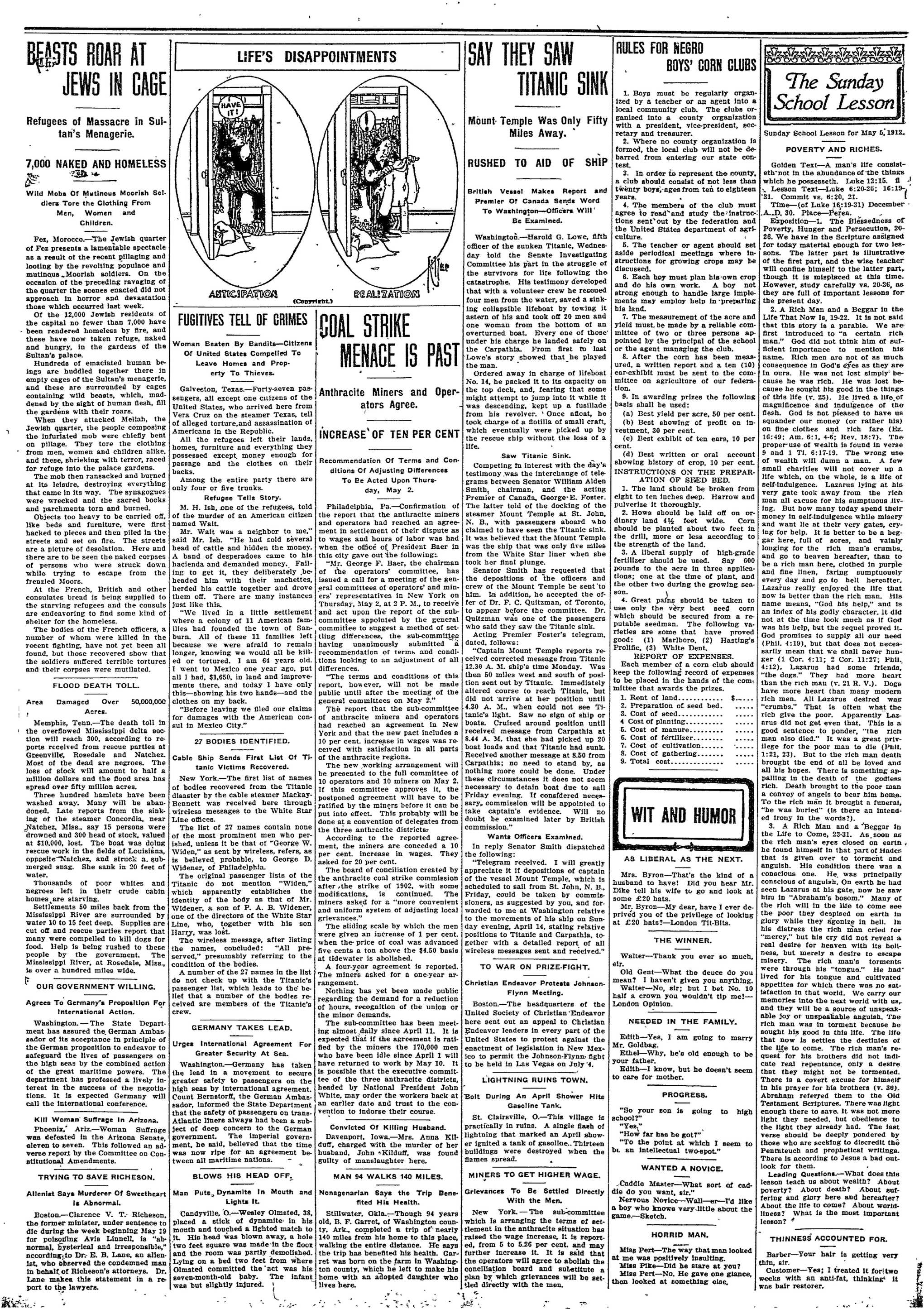
Page text (machine-generated)
VOLUME XXVII
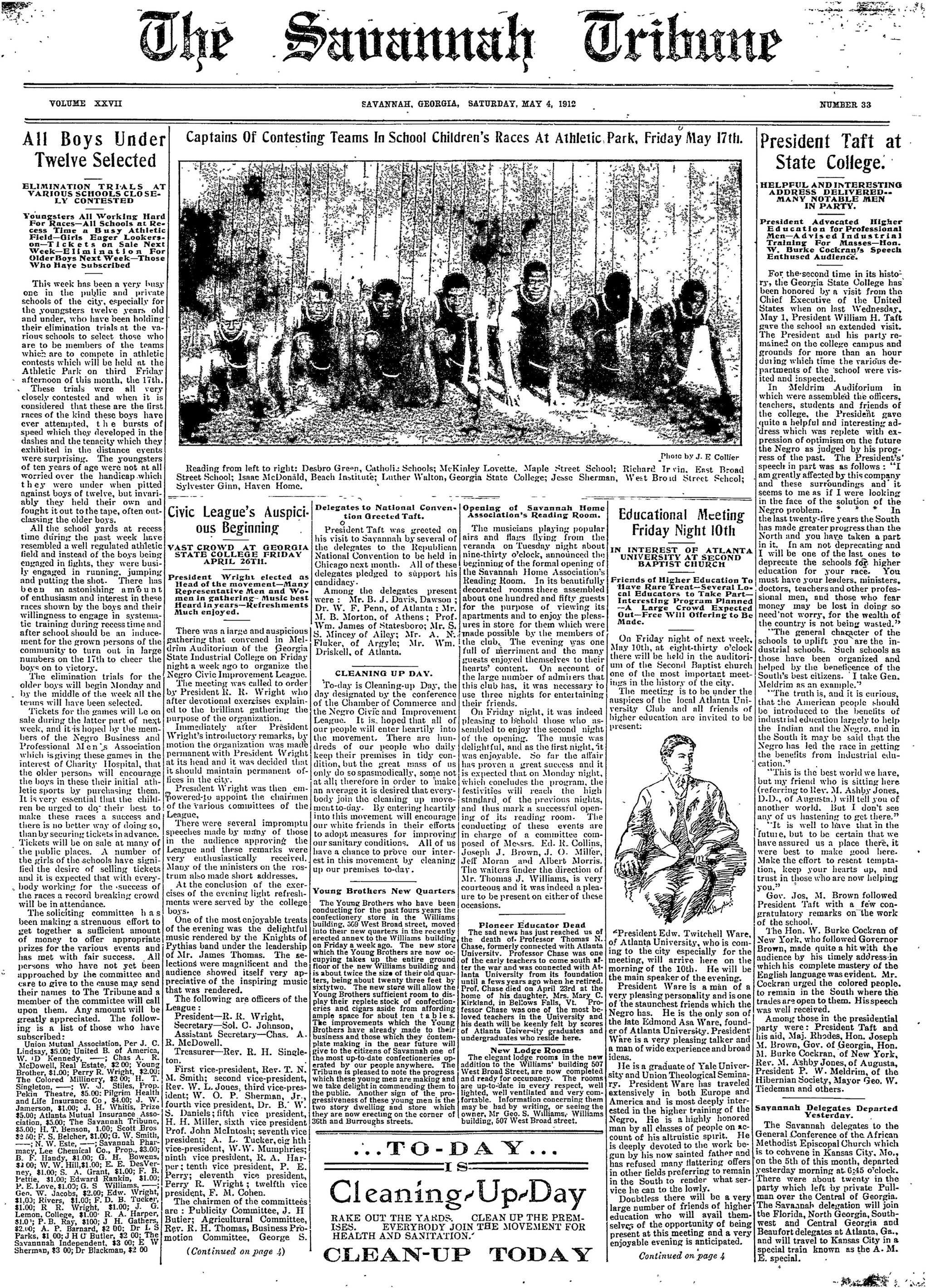
All Boys Under Twelve Selected
All Boys Under Twelve Selected
ELIMINATION TRIALS AT VARIOUS SCHOOLS CLOSELY CONTESTED
Youngsters All Working Hard For Races—All Schools at Recess Time a Busy Athletic Field—Girls Eager Lookerson—Tickets on Sale Next Week—Elimination For OlderBoys Next Week—Those Who Have Subscribed
This week has been a very busy one in the public and private schools of the city, especially for the youngsters twelve years old and under, who have been holding their elimination trials at the various schools to select those who are to be members of the teams which are to compete in athletic contests which will be held at the Athletic Park on third Friday afternoon of this month the 15th
These trials were all very closely contested and when it is considered that these are the first races of the kind these boys have ever attempted, the bursts of speed which they developed in the dashes and the tenacity which they exhibited in the distance events were surprising. The youngsters of ten years of age were not at all worried over the handicap which they were under when pitted against boys of twelve, but invariably they held their own and fought it out to the tape, often outclassing the older boys.
All the school yards at recess time during the past week have resembled a well regulated athletic field and instead of the boys being engaged in fights, they were busily engaged in running, jumping and putting the shot. There has been an astonishing amount of enthusiasm and interest in these races shown by the boys and their willingness to engage in systematic training during recess time and after school should be an inducement for the grown persons of the community to turn out in large numbers on the 17th to cheer the boys on to victory.
The elimination trials for the older boys will begin Monday and by the middle of the week all the teams will have been selected.
Tickets for the games will be on sale during the latter part of next week, and it is hoped by the members of the Negro Business and Professional Men's Association which is giving these games in the interest of Charity Hospital, that the older persons will encourage the boys in these their initial athletic sports by purchasing them. It is very essential that the children be urged to do their best to make these races a success and there is no better way of doing so, than by securing tickets in advance. Tickets will be on sale at many of the public places. A number of the girls of the schools have signified the desire of selling tickets and it is expected that with everybody working for the success of the races a record breaking crowd will be in attendance.
The soliciting committee has been making a strenuous effort to get together a sufficient amount of money to offer appropriate prizes for the various events and has met with fair success. All persons who have not yet been approached by the committee and care to give to the cause may send their names to The Tribune and a member of the committee will call upon them. Any amount will be greatly appreciated. The following is a list of those who have subscribed:
Union Mutual Association, Per J. C. Lindsay, $5.00; United B. of America, W. I D Kennedy, —; Chas A. R. McDowell, Real Estate, $2.00; Young Brother, $1.00; Perry R. Wright, $2.00; The Colored Millinery, $2.00; H. T. Singleton, —; W. J. Stiles, Prop. Pekin Theatre, $5.00 Pilgrim Health and Life Insurance Co., $4.00; J. W. Jamerson, $1.00; J. H. Whitis, Prize $5.00; Atlanta Mutual Insurance Association, $5.00; The Savannah Tribunc, $5.00; H. T. Benson, 1.00; Scott Bros $2.50; F. S. Belcher, $1.00; G. W. Smith,
---; N. W. Este, ---; Savannah Pharmacy, Lee Chemical Co., Prop. $3.00; B. F. Handy, $1.00; G. H. Bowens, $2.00; W. W. Hill, $1.00; E. E. DesVerney, $1.00; S. A. Grant, $1.00; F. B. Pettie, $1.00; Edward Rankin, $1.00; P. E. Love, $1.00; G. S. Williams, ---; Geo. W. Jacobs, $2.00; Edw. Wright, $1.03; Rivers, $1.00; F. D. B. Tucker, $1.00; R. R. Wright, $1.00; J. G. Lemon, College, $1.00; R. A. Harper, $1.01; P. B. Ray, $100; J H. Gathers, $2.00; A. P. Barnard, $2 00; Dr L. S. Parks, $1.00; J H. C Butler, $2 00; The Savannah Independent, $3 00; E W Sherman, $3 00; Dr Blackman, $2 00
The Savannah Tribune
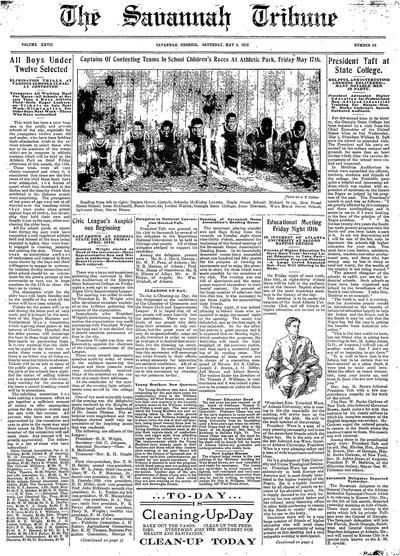
Captains Of Contesting Teams In School Children's Races At Athletic Park, Friday May 17th.
A
Reading from left to right: Desbro Green, Catholic Schools; McKinley Lovette, Maple Street School; Richard Irvin, East Broad Street School; Isaac McDonald, Beach Institute; Luther Walton, Georgia State College; Jesse Sherman, West Broad Street School; Sylvester Ginn, Haven Home.
Civic League's Auspicious Beginning
Civic League's Auspicious Beginning
VAST CROWD AT GEORGIA STATE COLLEGE FRIDAY APRIL 26TH.
President Wright elected as Head of the movement—Many Representative Men and Women in gathering—Music best Heard in years—Refreshments Much enjoyed.
There was a large and auspicious gathering that convened in Meldrim Auditorium of the Georgia State Industrial College on Friday night a week ago to organize the Negro Civic Improvement League. The meeting was called to order by President R. R. Wright who after devotional exercises explained to the brilliant gathering the purpose of the organization.
Immediately after President Wright's introductory remarks, by motion the organization was made permanent with President Wright at its head and it was decided that it should maintain permanent offices in the city. President Wright was then empowered to appoint the chairmen of the various committees of the League. There were several impromptu speeches made by many of those in the audience approving the League and these remarks were very enthusiastically received. Many of the ministers on the rostrum also made short addresses.
At the conclusion of the exercises of the evening light refreshments were served by the college boys.
One of the most enjoyable treats of the evening was the delightful music rendered by the Knights of Pythias band under the leadership of Mr. James Thomas. The selections were magnificent and the audience showed itself very appreciative of the inspiring music that was rendered.
The following are officers of the League:
President—R. R. Wright,
Secretary—Sol. C. Johnson,
Assistant Secretary—Chas. A. R. McDowell.
Treasurer—Rev. R. H. Singleton.
First vice-president, Rev. T. N. M. Smith; second vice-president, Rev. W. L. Jones, third vice-president; W. O. P. Sherman, Jr., fourth vice president, Dr. B. W. S. Daniels; fifth vice president, H. H. Miller, sixth vice president Prof. John Mcntosh; seventh vice president; A. L. Tucker, eig hth vice-president, W.W. Mumphries; ninth vice president, R. A. Harper; tenth vice president, P. E. Perry; eleventh vice president, Perry R. Wright; twelfth vice president, F. M. Cohen.
The chairmen of the committees are : Publicity Committee, J. H Butier; Agricultural Committee, Rev. R. H. Thomas, Business Promotion Committee, George S. (Continued on page 4)
SAVANNAH, GEORGIA, SATURDAY, MAY 4, 1912
Delegates to National Convention Greeted Taft.
President Taft was greeted on his visit to Sayannah by several of the delegates to the Republican National Convention to be held in Chicago next month. All of these delegates pledged to support his candidacy.
Among the delegates present were : Mr. B. J. Davis, Dawson ; Dr. W. F. Penn, of Atlanta ; Mr. M. B. Morton, of Athens ; Prof. Wm. James of Statesboro; Mr. S. S. Mincey of Ailey; Mr. A. N. Fluker, of Argyle; Mr. Wm. Driskell, of Atlanta.
To-day is Cleaning-up Day, the day designated by the conference of the Chamber of Commerce and the Negro Civic and Improvement League. It is hoped that all of our people will enter heartily into the movement. There are hundreds of our people who daily keep their premises in tidy condition, but the great mass of us only do so spasmodically, some not at all; therefore in order to make an average it is desired that everybody join the cleaning up movement to-day. By entering heartily into this movement will encourage our white friends in their efforts to adopt measures for improving our sanitary conditions. All of us have a chance to prove our interest in this movement by cleaning up our premises to-day.
Young Brothers New Quarters
The Young Brothers who have been conducting for the past four years the confectionery store in the Williams building, 569 West Broad street, moved into their new quarters in the recently erected annex to the Williams building on Friday a week ago. The new store which the Young Brothers are now occupying takes up the entire ground floor of the new Williams building and is about twice the size of their old quarters, being about twenty three feet by sixtytwo. The new store will allow the Young Brothers sufficient room to display their replete stock of confectioneries and cigars aside from affording ample space for about ten tables. The improvements which the Young Brothers have already made to their business and those which they contemplate making in the near future will give to the citizens of Savannah one of the most up-to-date confectioneries operated by our people anywhere. The Tribune is pleased to note the progress which these young men are making and we take delight in commending them to the public. Another sign of the progressiveness of these young men is the two story dwelling and store which they are now erecting on the corner of 36th and Burroughs streets.
Cleaning Up Day
RAKE OUT THE YARDS. CLEAN UP THE PREMISES. EVERYBODY JOIN THE MOVEMENT FOR HEALTH AND SANITATION.
CLEANING UP DAY.
Inven- Opening of Savannah Home Association's Reading Room.
The musicians playing popular airs and flags flying from the veranda on Tuesday night about nine-thirty o'clock, announced the beginning of the formal opening of the Savannah Home Association's Reading Room. In its beautifully decorated rooms there assembled about one hundred and fifty guests for the purpose of viewing its apartments and to enjoy the pleasures in store for them which were made possible by the members of the club. The evening was one full of merriment and the many guests enjoyed themselves to their hearts' content. On account of the large number of admirers that this club has, it was necessary to use three nights for entertaining their friends.
On Friday night, it was indeed pleasing to behold those who assembled to enjoy the second night of the opening. The music was delightful, and as the first night, it was enjoyable. So far the affair has proven a great success and it is expected that on Monday night, which concludes the program, the festivities will reach the high standard of the previous nights, and thus mark a successful opening of its reading room. The conducting of these events are in charge of a committee composed of Messrs. Ed. R. Collins, Joseph J. Brown, J. O. Miller, Jeff Moran and Albert Morris. The waiters under the direction of Mr. Thomas J. Williams, is very courteous and it was indeed a pleasure to be present on either of these occasions.
Pioneer Educator Dead
Pioneer Educator Dead
The sad news has just reached us of the death of Professor Thomas N. Chase, formerly connected with Atlanta University. Professor Chase was one of the early teachers to come south after the war and was connected with Atlanta University from its foundation until a few years ago when he retired. Prof. Chase died on April 23rd at the home of his daughter, Mrs. Mary C. Kirkland, in Bellows Falls, Vt. Professor Chase was one of the most beloved teachers in the University and his death will be keenly felt by scores of Atlanta University graduates and undergraduates who reside here.
The elegant lodge rooms in the new addition to the Williams' building 507 West Broad Street, are now completed and ready for occupancy. The rooms are up-to-date in every respect, well lighted, well ventilated and very comfortable. Information concerning them may be had by writing, or seeing the owner, Mr Geo. S. Williams, Williams building, 507 West Broad street.
New Lodge Rooms
Photo by J. E Collier
Educational Meeting Friday Night 10th
IN INTEREST OF ATLANTA UNIVERSITY AT SECOND BAPTIST CHURCH
Friends of Higher Education To Have Rare Treat—Several Local Educators to Take Part—Interesting Program Planned—A Large Crowd Expected Out—Free Will Offering to Be Made.
On Friday night of next week, May 10th, at eight-thirty o'clock there will be held in the auditorium of the Second Baptist church one of the most important meetings in the history of the city.
The meeting is to be under the auspices of the local Atlanta University Club and all friends of higher education are invited to be present:
M. M.
"President Edw. Twitchell Ware, of Atlanta University, who is coming to the city especially for the meeting, will arrive here on the morning of the 10th. He will be the main speaker of the evening. President Ware is a man of a very pleasing personality and is one of the staunchest friends which the Negro has. He is the only son of the late Edmond Asa Ware, founder of Atlanta University. President Ware is a very pleasing talker and a man of wide experience and broad ideas.
He is a graduate of Yale University and Union Theological Seminary. President Ware has traveled extensively in both Europe and America and is most deeply interested in the higher training of the Negro. He is a highly honored man by all classes of people on account of his altruistic spirit. He is deeply devoted to the work begun by his now sainted father and has refused many flattering offers in other fields preferring to remain in the South to render what service he can to the lowly.
Doubtless there will be a very large number of friends of higher education who will avail themselves of the opportunity of being present at this meeting and a very enjoyable evening is anticipated.
Continued on page 4
NUMBER 33
President Taft at State College.
HELPFUL AND INTERESTING ADDRESS DELIVERED MANY NOTABLE MEN IN PARTY.
President Advocated Higher Education for Professional Men—Advised Industrial Training For Masses—Hon. W. Burke Cockran's Speech Enthused Audience.
For the second time in its history, the Georgia State College has been honored by a visit from the Chief Executive of the United States when on last Wednesday, May 1, President William H. Taft gave the school an extended visit. The President and his party remained on the college campus and grounds for more than an hour during which time the various departments of the school were visited and inspected.
In Meldrim Audifiorium in which were assembled the officers, teachers, students and friends of the college, the President gave quite a helpful and interesting address which was replete with expression of optimism on the future the Negro as judged by his progress of the past. The President's speech in part was as follows: "I am greatly affected by this company and these surroundings and it seems to me as if I were looking in the face of the solution of the Negro problem. * * * In the last twenty-five years the South has made greater progress than the North and you have taken a part in it. In am not deprecating and I will be one of the last ones to deprecate the schools for higher education for your race. You must have your leaders, ministers, doctors, teachers and other professional men, and those who fear money may be lost in doing so need not worry, for the wealth of the country is not being wasted."
"The general character of the schools to uplift you are the industrial schools. Such schools as those have been organized and helped by the beneficence of the South's best citizens. I take Gen. Meldrim as an example."
"The truth is, and it is curious, that the American people should be introduced to the benefits of industrial education largely to help the Indian and the Negro. and in the South it may be said that the Negro has led the race in getting the benefits from industrial education."
"This is the best world we have, but my friend who is sitting here (referring to Rev. M. Ashby Jones, D.D., of Augusta.) will tell you of another world. But I don't see any of us hastening to get there." "It is well to have that in the future, but to be certain that we have assured us a place there, it were best to make good here. Make the effort to resent temptation, keep your hearts up, and trust in those who are now helping you." Gov. Jos, M. Brown followed President Taft with a few congratulatory remarks on the work of the school.
The Hon. W. Burke Cockran of New York, who followed Governor Brown, made quite a hit with the audience by his timely address in which his complete mastery of the English language was evident. Mr. Cockran urged the colored people to remain in the South where the trades are open to them. His speech was well received. Among those in the presidential party were: President Taft and his aid, Maj. Rhodes, Hon. Joseph M. Brown, Gov. of Georgia, Hon. M. Burke Cockran, of New York, Rev. M. Ashby Jones, of Augusta, President P. W. Meldrim, of the Hibernian Society, Mayor Geo. W. Tiedeman and others.
Sayannah Delegates Departed Yesterday.
The Savannah delegates to the General Conference of the African Methodist Episcopal Church which is to covene in Kansas City, Mo., on the 5th of this month, departed yesterday morning at 6:45 o'clock. There were about twenty in the party which left by private Pullman over the Central of Georgia. The Savannah delegation will join the Florida, North Georgia, Southwest and Central Georgia and Beaufort delegates at Atlanta, Ga., and will travel to Kansas City in a special train known as the A. M. E. special.
Of Interest to Our Women
WHEN GOING ABROAD.
If you are one of the lucky mortals soon to cross the briny to other lands remember that the less luggage you take the greater will be your comfort in travelling.
First of all, you will need a warm steamer rug.
THE INFLUENCE OF THE HOME.
The ideal home is not self-centered. It is a center of service. So far as circumstances will permit, the old-time ideals of hospitality should be maintained. In wise and uplifting ways the home should be shared. It is a good practice to invite young people
Also a wrap of extra heavy thickness to wear on shipboard.
A close fitting soft hat is necessary for comfort when sitting in a deck chair.
The wrap will be found useful to slip on during a night journey in a railway carriage.
Even in southern Europe, where the days are warm, the nights are often chilly.
Have a well made travelling suit of a color that will not show the dust.
Have your hat trimming of the sort that will withstand wind, weather and hard wear.
Take two pair of sensible walking shoes.
It will be found economical to have the travelling blouse of the color of the suit.
This may be brightened by lingerie collars and cuffs.
You will need at least one pretty costume for dinner and dressy occasions.
A kimono is, of course, indispensable.
Bubbers and umbrella should not be forgotten.
A fancy blouse for afternoon wear should also be included.
Nearly all the above mentioned articles may be packed in one large suitcase or a carryall. If it is not desirable to take a trunk along.
THE TROTTEUR SKIRT.
Womep may prepare themselves to receive full effects, more draperies and even trains for indoor wear; but they need not be prepared to let tailor gowns get out of hand. A certain amount of slimness is essential for comfort, and the reverse to scantiness may easily become too weighty.
But the armiters of feminine fate in the dress world have provided for this, and the fashionable paneled skirts conceal their width in knife-pleated folds which are only discovered when walking, and which drop neatly back into place at once. Neither are women to be asked to renounce established habit of wearing the tailormade well off the ground. The reign of the train in out-of-door suits will not be of very long duration.
One of the charms of taffets is that it can be mated successfully to other materials, and little face cloth coats are being made to wear with some of the new dresses in this material.
RAISED CORNBREAD.
Heat a pint of milk almost to boiling and pour it upon a cup and a half of corn meal. Let it stand until cool; then stir, in a half yeast cake dissolved in a half cup of warm water, a tablespoonful of sugar and a half cup of white flour. Let this rise overnight in a corner which is not too warm or five or six hours in a kitchen at the ordinary temperature. It should rise to double its original size. Stir in then a tablespoonful of melted butter, a half teaspoonful of salt and two beaten eggs. Beat hard, turn into muffin tins and set in a warm place to rise for fifteen minutes before baking. It will require about twenty minutes in a steady oven. Eat hot.
CRANBERRY FLUFF.
As like cranberry puff, as would be expected. Cook one pint of cranberries in one-quarter pint of water until the cranberries pop open, and then run them through a colander. Add the same amount of sugar as there is berry pulp by measure and boll the two together until they are as thick as marmalade. When cool and the whites of four eggs beaten stiff. Fold well together and bake until it sets—from five to ten minutes. Serve cold in sherbet glasses with whipped cream and chopped nuts.
CRISP COOKIES.
One cupful of granulated sugar, one half cupful of butter, two slightly rounding cupfuls of flour, three small eggs or two large ones, 24 grates of nutmeg and a half teaspoonful of rose water or vanilla. Cream, butter and sugar, add yolks and beat until light. Beat the whites until a stiff froth, then beat them in with the seasoning and flour. Roll very thin on a floured board, cut in rings or stars, sprinkle with sugar and bake in a quick oven for about five minutes. No milk, no soda in this recipe.
AIR AS MEDICINE.
Fresh air being the best of all medicines, folks should learn how to take it.
There's only one proper way of taking this medicine, and that is by deep breathing. And deep breathing means breathing that way all the time, not merely once or twice a day, when you happen to think about it.
The ideal deep breath is the kind you get once in a while when you yawn, and should give you much the same sense of pleasure that such a breath does.
THE INFLUENCE OF THE HOME.
The ideal home is not self-centered. It is a center of service. So far as circumstances will permit, the old-time ideals of hospitality should be maintained. In wise and uplifting ways the home should be shared. It is a good practice to invite young people who are away from home. It relieves loneliness, discouragement and temptation. Remember it is:
"Not what we give, but what we share.
The 'gift' without the giver is bare."
The home is the bulwark of civilization. Within the extreme limits of wealth and poverty a home may be good or bad, irrespective of social position or property.
Our homes are what we choose to make them. It is a question of what we admit and what we keep out of them. Our best selves and the best we have to give should go into the home life and to a large degree determines the character of children.
The home tends to make us better or worse. Thus the home becomes the chief factor in determining the character of the community and the nation. The trend of our times is away from the home into the countless amusements and interests of modern life.-Philadelphia Bulletin.
USE OF FRENCH CHALK.
Few women know what a real saving it is to have a little French chalk on hand. There is nothing better for removing many a spot from garments, especially when they are of silk. Cover the spot well, with the chalk, and do not disubtit it for at least twenty-four hours. Then cover the chalk with a piece of brown paper and iron, pressing quite hard, with a not-too-hot iron. French chalk often will remove stains from woolen fabrics, but is not so invariably successful. Better than the chalk for grease on woolen fabrics is a mixture of alcohol and chloroform in equal parts. Here, too, the warm iron comes into play. Before applying the liquid, cover the spot with a piece of brown paper and iron over it.
PICKLED PIGS FEET.
Put the clean feet in enough boiling water to cover them and cook till the meat is about to drop from the bones. Do not add more water, but be careful not to scorch them. There should be a quart or more liquid when finished. Take out the feet and set the liquid aside to cool. When the grease is hard on top remove it and return the jelly—for it will be jelly by this time—to the fire. Add one quart of vinegar to the hot broth and pour the whole over the feet. If they are not salted and peppered when put on to boil add the seasoning to the hot liquid. A small bag of mixed spices (about one tablespoonful tied in a thin cloth) may be added if the flavor is liked.
MEAT LOAF WITH TOMATO
DRESSING.
Any leftover meat from Saturday or Sunday may be utilized for this dish. To three cups of ground meat add one of bread crumbs, moisten with warm milk. If the mixture seems dry, add one beaten egg and season palatably with salt, pepper, a bit of curry or any desirable dry herb. Fashion into a loaf on a buttered pan, cover with flour or bread crumbs and bake. To make the dressing use one cup of tomatoes which have been pressed through a sieve, nicely seasoned and thickened with flour or corn starch; cook until smooth and pour the dressing over the browned beef before serving. Garnish with parsley.
DELICIOUS TOAST.
A woman who prides herself on the toast she serves gives very simple directions for making this usual breakfast accompaniment. Use bread at least two days old; cut the slices evenly, and put them in a moderately warm oven for a quarter of an hour. Then put the bread on the broiler of the gas stove or over the live coals of the kitchen range and let it come to a delicate, brown. It is then all crumbly and brittle clear through and a dish you can eat with a relish. There will not be a pasty soft portion of bread between two indifferently browned sides. Bread which is seared too quickly will be sure-to-be pasty, that is, if the bread is fresh and not dried out in the oven first.
OAT WAFERS.
Mix together one-half cupful of rolled oats, one-half cupful of wheat preparation, one cupful of flour, two tablespoonfuls of sugar and one-half teaspoonful of salt. Work in three tablespoonfuls of butter until well blended, then add slowly enough hot water to hold the ingredients together. Toss onto a floured cloth, shape, divide in two or three parts, roll each as thin as possible, cut in finger strips with a sharp knife. Bake on a buttered sheet in a slow oven until delicately browned. The seasoning for these cakes may be one-half teaspoonful of vanilla, a grating of nutmeg (the least speck in the world) or a few drops of roswater. Try them.
BOOKER WASHINGTON AT WORK
(By BRADLEY GILMAN.)
There are many things of interest in Florida at this season. There are the oranges; or you may like better the golden grapefruit; or you may prefer to "pot" alligators; or you can study the evolutions of the turkey-buzzards, as they drift and soar on the air-current, putting Glenn Curtiss and the Wright brothers to the bad, with their deftly-poised rugged, sooty wings.
If none of these things interest you, there is the negro; always the negro, bearing about with him his problem, standing—to the thoughtful, serious tourist—like a heavily-loaded interrogation mark, on the southern page of American history. What shall we do about him? What can he do about himself? What answer is he giving in Florida to his own embodied interrogation?
Booker T. Washington, the world-famous educator, is wisely and bravely giving his answers to this problem. He has recently completed an eight-day's journey-through the land which Ponce de Leon discovered, but he did not travel there in search of the fountain of eternal youth; he went with a dozen friends and helpers to Pensacola, thence to Tallahassee, Ocala, Tampa, Jacksonville and other points, and addressed vast audiences of whites and blacks, and gave such wise, hopeful words of counsel that his own people responded to him with enthusiasm, and his white hearers—even in the regions made notorious by lynchings—expressed approval and urged him to come again and deepen the good influences which he had already established.
This "missionary journey" was one of several which Dr. Washington has made through southern states; it was under the direction of M. M. Lewey, president of the Colored Men's Business league of Florida. The object which Dr. Washington has had in view in all these tours has been to ascertain the conditions existing among his own people and their relations to the white race, and to encourage public sentiment in the direction of plain elemental and industrial education for negroes. The state governments already do something in the direction, and private individuals help, but not over 5 per cent. of the total black population of the south is affected by schools like Hampton, Tuskegee and others.
Many of the public school superintendents see the need, of a more general education for the blacks, but are thwarted by an adverse public sentiment. This sentiment, hostile or indifferent, must be distinctly altered for good by Dr. Washington's impassioned addresses to such large audiences in so many centers of population. He does what more eloquent and theoretical speakers often do not; be changes the ideas and the feelings of his auditors; people who have heard this great man speak to audiences in the north have little idea of his addresses to southern gatherings, where he has his own people before him, and has also a considerable number of white people who begin the session in ill-concealed enmity.
The dramatic situation at L—I shall never forget; the famous negro leaders faced over 200 white men—about a fifth of his total audience—who sat with scowls of distrust on their faces, until his kindly appeals to their reason and better selves softened them and made them his friends. Probably almost every man in that white group carried a pistol; one or two weapons were displayed openly; some of those men must have taken part in the barbarous lynchings which disgraced the town fifteen months ago; but, like a lion facing jackals, and veritably with the royal mien of that king of the forests; Dr. Washington stood forth from his little group of friends alone and gave battle; a battle of right and reason against ignorance and prejudice; and he won; and some of those men said in my hearing afterward, that he was a great man and that the negro ought to be given a fair chance.
I made the similar trip with Mr. Washington through Mississippi three years ago; and all my observations and reflections on that journey were confirmed by what I saw on this present trip through Florida. There is only one solution of this vast problem in the south; the negroes are to remain on the land; therefore, common sense dictates that they be educated in the simple branches of book education, and trained in some industrial pursuit; and then given a chance to "make good." That is all that their leading men ask. I have talked with colored physicians, lawyers, ministers and business men, on this recent journey, who would be a credit to any race and a valuable asset to any cause; they have pointed out to me the signs of progress among their people; the advance of spring up the Atlantic seaboard today is no more obvious and certain than is the advancement of the negro race in the southland toward all that is characteristic of a high civilization. The increase in homestead holdings, the increase of stores and banks and taxable property—these tell the story of that gain in material prosperity which alone will give the black man position and power and justice in the south. All honor to such broad men as the mayor of Pensacola, and Judge Bullock of Ocala, and many others, who are so highly civilized, themselves, that they are ready to grant their colored brothers the opportunity to struggle forward to that same civilization.
A person of trained eyes, on going into a town or village in the south, can tell, by observing the faces and
manners of either of the two races what the other will be like, for the two are closely bound together, tyranny and cruelty, on the face of the whites, show in their faces, and can also be read in the constraint and caution and timidity of their black neighbors; and again, where you find the blacks frank and joyous, as is their nature; you may be sure that the whites of that region are just and broad-minded and kindly, as is characteristic of people really civilized. What I here write comes from close personal observation; and I say that the bitter enemies which the negro has in the south are the ignorant sensual "crackers" the vicious lower classes of the whites; the higher grades of white men tend toward justice and patience and encouragement, in their treatment of the as yet-immature black race; sometimes, when election is at hand, some, educated white candidate will indulge in public denunciations of "miggers"; but this is usually for political effect; he is after the ignorant "cracker" vote; and very likely he is the friend and helper of a half-dozen colored neighbors.
At Tallahassee I overheard significant comment on the closing words of Mr. Washington's address, made from a bandstand on the common; a group of white men had been listening closely, and I feared sullenly, to the speaker's words; then, at the close one of them spoke to the others, concisely, solemnly: "That's true, what he says about our trusting each other; you know we have left today, part of our families at our homes, outside, with our niggers; and there's nobody else in God's world we'd have trusted them with."
A charming and effective feature of the program of most of these Florida meetings was the singing by the blacks in the audience (usually a thousand of them) of the real "songs of slavery"; not the tawdry negroinstrel songs of later white composers, but the quaint old folk-songs of fifty and more years ago; the singing was led by Major Moton of Hampton, that sweet-voiced singer, with the physique of a Hercules and the sensibilities of a girl of seventeen. This singing seemed to bring the various elements in the audience together, before Dr. Washington gave his address; and it revealed the poetry and sentiment of this patient, tolling, loving race, as they groped their way out of their captivity, singing as they camo, with faith in their God and confidence in the day-star which was rising out of their night of gloom.
Many a time I have heard the dictum laid down by over-confident prophets like Thomas Nelson Page, that the negro was capable of a moderate degree of academic education, but could never go very high. In rebuttal, let me say that one of the members of Dr. Washington's party through Florida was a young colored man who is a graduate of Harvard, also of Oxford as a Rhodes scholar, and I have rarely met any man, of any race (as a Harvard man I speak) who possessed a more genuine and unostentatious cultivation of mind than does this young man, not in manners and voice alone, but in tastes and inner standards he is among the best graduated from our universities. Somebody will respond, "He is only an exception." Such was the comment made ten and twenty years ago, as young negro men came up, singly and by twos and threes, into the ranks of the professions; but those "exceptions" are now too numerous to be longer called "exceptions," there are scores and hundreds of them in the south; and similar results will be reached In the case of colored men of literary and esthetic taste; the number is steadily increasing.
It is high time that we laid aside the bugaboo of "social equality." Dr. Washington and other educated colored men condemn all movements of their race in this direction; they urge, with great earnestness, that the negroes keep to their own social life, that they develop all they can of civilization, within their own borders; whatever mingling of the races there may be in the business life is easily arranged, but, socially, colored men and women are urged to keep apart by themselves, and already, in several southern cities I have been admitted, on my rounds of journalistic inquiry, into many charming negro homes, where good taste was the rule and the good offices of a genuine and tactful hospitality were extended to me.
At the close of Dr. Washington's address at Tampa, I accosted, pleasantly, two white men coming out of the hall, and one said: "Booker Washington is as great a man as can be found in the world today." And the other man said, "The whole situation and inter-relationship of the two races can be summed up in that story which Washington told about the colored bishop and the white hackdriver." And this is the story in brief: At a town in North Carolina, a colored bishop of Dr. Washington's party was anxious to catch a train; he addressed a white hackman: "Take me to the depot, please, and I will pay you a quarter." The hackman replied, "I would like the quarter, but I can't drive a negro in my hack." Then the resourceful bishop suggested, "Very good! Now you take the back seat and ride, and I'll take the front seat and drive." And this was done; and the colored bishop got his train and the white hackman got his quarter; each gained by the transaction. That is the basis of an intelligent, reasonable self-interest upon which the future relations of the two races in the south must be established, and above their heads will float the ideal of human brotherhood, which, in time, will come into its own—Springfield (Mass.) Republican.
TEN YEARS OF EDUCATIONAL PROGRESS IN NORTH CAROLINA
Mr. J. Y. Joyner, superintendent of public instruction for this state, has just given to the public a statement of educational progress in North Carolina during the last decade. From this statement it appears that there were 233,000 colored children of school age in 1910 and 497,000 white, making a total of 735,000 with an average school term of 105 days for white and 94 for colored. It is also gratifying to note that this increase in days has been marked by 28 per cent. as to white and 20 per cent. as to colored, and there is put forth plans and suggestions which if enacted into law will so increase the school term throughout the state as to make it not less than six months anywhere. Such measures cannot but meet with the hearty approval of all even though they call for increased taxation. Experience has shown that those states are forward in material character and strength of their public schools. The backwardness of the south is due more to the decadence of their public schools than to any other cause, and her present awakening is also proportionate to the seriousness with which she has grappled with the public school problem.
There is more, however. There are 8,369 white teachers in the state and 2,793 colored with average monthly salary for white teachers amounting to $34.47 and colored $23.48. The conclusion is obvious that the colored teacher controls a larger number of pupils for about two-thirds the pay and besides works under time. This is a hardship which the colored teacher must bear until the change comes. There is certainly no clearer reason for the dirth of colored teachers for the rural schools than that given by the above facts. A man can make more at common labor and have a steadier job than he can teaching school for $23 a month, and a good cook or laundress might find her monthly balances far in excess of that of her sister who teaches a colored school. This lack of adequate salary for colored school teachers makes school teaching a makeshift which in the end proves unsatisfactory to both the teacher and the state. Some plan will eventually be provided which will assure the teacher a living salary and thereby cause a larger number of trained men and women to devote their lives to this line of race uplift.
It is noted that no word is said by the superintendent about compulsory education. This is of course a question upon which honest men may differ. Still there appears many cogent reasons' why North Carolina should have such a law, and enforce it. The masses of the people of the state need education of such kind and character as will make them better citizens. The industrial turn which all education of the masses is taking spells a new day for the development of the resources of our state and country. Should North Carolina take the lead in providing adequate and necessary facilities for the intellectual and industrial training of both races and make it compulsory for every one of school age to be trained until he has acquired enough book learning for the purposes of his life work and enough skill to make a living with his hands? Such policy if adopted and adhered to would make North Carolina the model state of the Union.
FIGHTING CONSUMPTION
---
TUBERCULOSIS EXHIBITION CAMPAIGN IN MISSISSIPPI DOING MUCH GOOD
Columbus, Miss.—Some real results are being reported from the tuberculosis exhibition campaign among the colored people. Principal W. I. Mitchell of Union Academy, the colored school, has written the following letter:
"I am sure the older pupils were very much benefited by visiting the exhibition. They have reduced to practice some things learned there. They now have their own drinking cups. They co-operate heartily in keeping their rooms clean. They are better prepared to listen to talks from their teachers along lines of health and cleanliness.
"The younger students under ten years of age will remember that they went to the 'Locus' exhibition, and after a while the full meaning of it will dawn upon them. Furthermore, the fact of their going interested their parents and caused many to visit the exhibition who otherwise would not have been there. Since the exhibition has been here I have screened my kitchen and dining room, installed city hydrant water and made other sanitary improvements."
PRESCRIBING A DIET.
Sir Richard Jebb, the eminent physician, was a man of irritable temper, and when bored by the querulous complaints of some of his patients could not always force himself to return a civil answer. A troublesome patient, whose illness was purely imaginary, pestered him one day with questions as to what he should eat. "My directions on that point," said Sir Richard, "will be few and simple. You must not eat the shovel, poker cr tongs, for they are hard of digestion; nor the bellows, for they are windy; nor anything else you please."
The Mission of
Silent Charity
A Sermon
The part, which any one plays towards the development of the community in which he lives, is so great an asset to his credit, whether it consists in the establishment of enterprises, the regulation of social systems or the removal of abuses. But whatever might be the character of the work undertaken, it must be removed from selfish motives in order to become effective. If the good deeds we perform are the results of policy, small thanks we get for reward; because those who are the recipients of our benefits will question our sincerity. Charity is a foster parent to benevolence; but in the bestowal of her patronage, is forgetful of self and seeks, without glare or ostentation, to relieve the wants of the needy. In the varied pursuits of life, human endeavors are collected with many wiles which parade themselves on occasions, and cry loudly: "These are we;" but when measured as to their valuation, there is little to be commended. In the careers of individuals, emergencies, sometimes, arise to test the extent of sympathy; yet, true sympathy needs no coaxing, it leaps upon its feet unbidden or unsought to settle the claim of duty. The abode of misery and despair is her place of resort; and there she aids in dispelling care. Conditions of things might be bettered and through personal efforts, the lot of those who lead a forlorn existence might be rendered happier, without the knowledge of the outside world, save through the sunbeams which brighten the countenance of those who fall in fortune's wake. There are crude conceptions respecting the obligations of man; and nothing enhances a service so nobly as disinterested performance. Human nature is greatly mixed with the virus ego, which often spoils the beauty of our acts, and leaves deformity in its stead. Loving favors voluntarily spring from the source of pure desires, and baptize the deserving with copious showers of blessing; but the footsteps are soft and easy. In all things undertaken, there are some prejudices to be overcome, and errors to be uprooted, though, public weal be the issue; but honest endeavor can always stand the test of keenest criticisms, of bereft of sinister purposes. Self-denial is a comely virtue ever anxious for the promotion of another's joy; but merits its approval from the pleasure it takes in performing its task in silence. Good Samaritans are necessary, and that tribe should be encouraged in every town and hamlet; but true nobility of alm should be the mainspring which sets benevolence in motion, and prompts the flow of that charity which heals our mutual woes. For the right let us dare to do. For the cause of humanity let us strive to win the laurels our exertions would demand; but leave the accomplishment to the approval of Jehovah and the heraldry thereof to the bugle of mankind. Thus will the memory life, after life shall have departed.
"BOB" TAYLOR'S BEST STORY.
He was President Taft's favorite story-teller. Once the president wanted to get away from his official duties for a few days, and that social soul invited half a dozen senators to go with him. One was Taylor. He spun one yarn, "and after that," said one of the other senators who was on the trip. "none of us could get a word in with the president. He spent that entire trip listening to 'Bob,' and he kept him laughing the whole time. Laugh? I never knew a man to laugh so much in my life."
His best-known story has since been plagiarized and extended to geographical localities unknown to "Bob;" but here is the story as it emerged in pristine beauty from Taylor's repertoire. A mountaineer who had never ridden on a railroad decided to take advantage. of the $2 excursion rate to Memphis and saw for the first time a large city. What chiefly interested him was the bars. He had never seen a bar nor a highball; he had been used to drinking "iliquor" out of a gourd. After he had visited a number of these marvelous places his enthusiasm overcame him, and he addressed the crowd thus: "I can lick any man in the United States."
The crowd laughed good-naturedly. This infuriated the mountaineer. "I can lick any man in Shelby county." he yelled. This time the crowd sobered and looked at him with hostile eyes. "I can lick any man in Memphis!" he shouted. A short thick-set man emerged from the crowd and put him out of action with a right-arm swing. When he came to the mountaineer looked around feebly, and said: "I reckon that in that last proposition I kivered too much ground."
SENATORIAL COURTESY.
Senator Vardaman of Mississippi was making his malden speech in the senate.
"My brain reels at the idea!" he shrilled. "My soul is consumed within me! My speech fails! I am at a loss for words! I am burning with indignation"—
"You are out of order," announced Presiding Officer "Sunny Jim" calmly.
"I guess that is what's the matter with me," said the Mississippi disgustedly, as he sank into his seat.— Judge.
The Farm VALUE OF CLOVER AS FEED. We have found both with work and
Unless alfalfa is grown on the farm, every effort should be made to grow clover, as it is one of the very best feeds in animals' rations that can be used. It can be fed to advantage to absolutely every animal on the farm, from poultry to cows and horses. It is of supreme excellence for dairy cows giving milk, and for growing young animals of all kinds.
The reason clover is such an excellent feed is that it contains a large percentage of protein and mineral matter, the essential compounds for animal growth and production that corn, timothy hay, corn stover and many other common feeds are deficient in. It is a rich fed, and its composition is such that animals fed on it will make fine growth of muscle, lean meat and bone impossible with many other feeds. The protein and lime in it are just what chickens need for laying eggs and cows for giving a strong flow of milk. These same food compounds are the essentials for making blood, bone and muscle, with young animals, and for producing rapid and economical gain in weight.
Well-cured clover hay is one of the best rough feeds in winter for horses, cattle, colts, calves, sheep and even hogs will eat it to advantage. Those who have never tried feeding clover hay to pigs in winter will be surprised to find how greedily the little animals will take to it, and how well they will thrive on it as a supplement to corn and other less bulky feeds. Clover leaves, heads and chaff can always be used to advantage in feeding pigs and poultry, either dry or mixed with wet mashes.
Perhaps the greatest advantage of having a good supply of clover hay for feeding in winter and at other seasons, is that it is an aid in balancing up the animals' rations. Most of us do not feed rations that are anywhere near balanced as to actual food compounds for the best normal growth or production. The majority of our feeds are rather too rich in starches, or carbohydrates, and poor in protein and mineral matter. By feeding all corn, corn stover, timothy hay and like feeds, we are giving the animals only a part of the necessary elements for life's needs. As a consequence, the animals do not grow and produce as they should. The way to make a big hog from a plg, a big cow from a calf, or a big horse from a colt, on the least feed with the greatest economy, and in the least time, is to give these young growing animals a variety not only of feeds, but of feeds that contain a great variety of food compounds.
Clover hay, as shown by actual chemical tests and practical feeding experiments, contains fully as much food value as wheat bran, and is worth as much, pound for pound, as the latter. In fact, clover is very similar to wheat bran in its composition, containing a large percentage of protein and mineral matter. On our own farm in growing hogs, horses and dairy animals, as well as poultry, we grow, harvest and store a good quality of clover hay every year. Through all the seasons some clover hay is fed to all the animals. The dairy cattle receive the greatest amount because of its excellence in milk production, and for promoting strong growth with calves to be grown for dairy use.
Many farmers depreciate the value of clover hay as a feed for horses and colts. This is a mistake. There is no better feed, when used with judgment, for either work animals or for growing horse or mule colts.
The mistake many make in feeding clover hay is that when they feed, they feed all clover and nothing else. It must be remembered that clover is a very rich feed, and that not more than one-half the quantity is required as of timothy or similar rough feeds. Also, clover, being very rich in protein, should always be used, with work horses especially, in connection with feeds of a more carbonaceous nature, such as timothy hay and corn. During the last of January we fed our young and old horses wheat straw with clover, hay and ear corn. The clover furnishes the protein for blood and flesh, while the corn and straw furnishes bulk and heat-forming material. The horse mangers are filled with clean straw morning and evening, and to each mature animal three ears of corn, and four or five pounds of clover hay are given. The corn and clover are eaten first, and then the animals eat as much of the straw as they wish, which is never a large amount, but which varies according to the taste of the animal and the condition of the weather. When the horses are worked at this season, they are given about twice as much clover and corn as when idle, with the same amount of straw or corn stover.
It is poor economy, and perhaps dangerous in some cases, to pile horses' mangers full of clover hay when they are idle. By eating all they will, they take too much protein, or nitrogenous, matter. into their systems than they can economically assimilate, hence some form of kidney trouble may arise. Clover should be fed to horses by the handful, rather than by the armful, and some corn and lighter hay should always be fed with it.
We have found both with work animals and with growing colts that by the moderate use of clover hay given through all the seasons, about one half of corn and other heavy grains can be saved. Our horses like clover hay about as well as they do the best grain feeds, and frequently they will eat the clover hay, before the grain, so well do they like it.
The man who attempts to conduct a dairy without clover, alfalfa or other leguminous hay is working to disadvantage, to say the least.
Where clover will not naturally catch and grow on the farm, a stand may be secured by planting the field to cowpeas and then giving the surface of the soil a light dressing of stable manure. Where the ground is covered with stable manure and clover seed sown, a good stand is almost sure. The decomposing manure seems to carry the right germs for inoculation and the right elements to make the young plants grow. H. J. W.
GOOD PLOWING.
There are few occupations where good work shows as much as on the farm. Plowing is the first operation in the production of all common farm crops, and if not well done it is hardly logical to expect good results, even though the other operations are well performed. Good plowing means completely loosening, stirring and pulverizing the soil to the desired depth. Simply making the ground black by plowing a shallow furrow and turning it over on a narrow strip that is unplowed can hardly be called good plowing. The proper depth of plowing will depend greatly on the character of the soil, but it is a sofe proposition to state that, as a rule, it would pay to plow Minnesota soils deeper than they are now plowed. In many heavier soils there is little opportunity for root growth or the liberation of plant growth beneath the furrow slice, owing to the density of the soil. Deeper plowing would certainly increase the depth of the available soil, make the soil capable of holding more moisture, alter it more completely, cause the liberation of more plant food, and certainly greatly increase the productive power of the farm without the necessity of buying additional tracts. It is always pleasing to see straight unturn, well-turned furrows, with all vegetation turned completely over. It is pleasing not only to pass-by, but to the man doing the work—Minnesota Agricultural College.
HAVE A FIXED PURPOSE.
"We can't succeed at anything unless we have something definite in view if we plod along from day to day with no fixed purpose leading us, we never know what the result is going to be except that history will repeat itself and no great measure of success will be attained.
"The farmer who wishes to make a specialty of dairying should have something more definite in mind than merely having a lot of cows around him. He should keep only dairy cows, these cows which convert their feed into milk. He must have those cows which are characterized by the same general conformation, i.e. spare quarters and big, deep middles. There are other characteristics of the good cow, but these two are the most tangible ones. Many men have failed to make dairying pay because they have tried to run the business with no definite aim in view. That is the reason they failed.
"This doesn't necessarily mean that he cannot follow diversified farming. It simply means that he should have something definite in view and work along that line until success has had time to crown his efforts."—Blue Valley Bulletin.
THE BACON BREEDS.
No matter whether you choose the Berkshire, Poland China, Duroc Jersey or O. I. C. as your favorite breed of hogs, when they go upon the block they are practically all the same, the lard type of hog, says the Kansas Farmer. One is sometimes led to wonder if there is not more room in the corn belt for the bacon type as well. The different breeds of the lard type are splendid and have done more for this country perhaps than any other money-making machine, but all men are not alike, and many prefer some one of the bacon breeds. This fact and the increasing demand for them make it seem sure that there is a profitable field of usefulness for the man who-best likes the Yorkshire, Hampshire or Tamworth.
CLOVER FOR SWINE.
The Missouri university experiment station estimates that 30 per cent of grain may be saved if forage crops are used in feeding hogs. Using forage crops, it was found that $3\frac{1}{2}$ pounds of grain would produce a gain of 1 pound in the hog, while 5.6 pounds of grain is needed if forage crops are not used. The same experiments revealed that an acre of clover would support from six to ten-head of swine for four months. It would require about twenty or thirty acres of clover to furnish forage for enough hogs to consume 1,000 bushels of grain.
AN EDUCATED ZULU SPEAKS
The following address delivered at the First Interstate congress of South Africa by Mr. John L. Dube will be read with interest.
Mr. Dube is a native Zulu, educated in America, and started some years ago in South Africa an industrial school on somewhat the same lines as that of Tuskegee institute. Mr. Dube has made himself to such an extent the leader of his own people in South Africa, that he has been chosen the first president of the first Interstate Native congress. His address follows:
Gentlemen of the South African Native Congress:
It is meet that my first word to you should, be one expressive of my high and heartfelt appreciation of the confidence which my countrymen assembled in Boemfontein have thought well to repose in me, and of my thanks for this unique honor, all unexpected and undeserved, which they have thrust upon me. Not even present at their gathering (having been unavoidably debarred that pleasure by pressing educational and editorial calls at home), they nevertheless went out of their way to seek me out in this remotest corner of Natal and to elect me the first president of this the first interstate Native congress of all South Africa. For this kind act I now do thank them and the dignity bestowed I hereby formally accent.
Gentlemen, it seems to me that the day of our race's renaissance is at length at hand, indeed it would not be inappropriate to mark this 8th day of January, and in future years so to commemorate it as the "red letter day" of our people's hopes, as the birthday of our existence as a political entity in this new South Africa.
I say this "New South Africa!" for the South Africa we see today developing before us is no more the South Africa known to our fathers. Yet none the less will it be the home and native land of our children. And for them we have to make straight the path and prepare a comfortable "place in the sun." Although, as a race we possess the unique distinction of being the first born sons of this great and beautiful continent; although as a race we can claim an ancestry more ancient than almost any round about us, yet as citizens of the glorious British empire, we are the last born children, just awakening into political life, born on the 8th day of January, in this the year of grace 1912.
Yes; politically, new-born babes, we are still very young and inexperienced, and as such we behooves us to feel our way slowly and warily. While teaching ourselves to walk boldly and uprightly before all mankind, we must still be careful ever to seek out the way where wisdom (not mere sentiment or desire) leadeth, treading softly, ploddingly, along the bright path illumined by righteousness and reason—the steep, steepy path, yet only one that will safely and surely lead us to our goal, the attainment of our rightful inheritance as sons of Africa and citizens of the South African commonwealth.
Many are the difficulties I foresee in our way—enemies without, fierce but frank; dangers within, undesigned perhaps, but still more harmful. It will be an uphill fight, but our watchword shall be "Excelsior;"—Onward, higher; cautiously, ploddingly! By dint of our perseverance, our patience, our reasonableness, our law-abiding methods, and the justice of our demands, all these obstacles shall be removed and enemies overcome. We have been distinguished by the world as a race of born gentlemen—a truly glorious title, bestowed on few other people!—and by the gentlenes of our manners (poor though we may be, unlettered and ill-clad) and by the nobility of our character shall we break down the adamantine wall of color prejudice and force even our enemies to be our admirers and our friends.
Gentlemen! for better or for worse, you have selected me to be for the nonce your president. As I trust you will therefore permit me to indicate the way, and I trow I shall never lead you astray. For while I shall at all times endeavor to be a straight goer, I propose also to be a strong leader—not one dragged by the nose, still less one pulled by the tail, for as already said, my war-cry is—Onward! Upward into the higher places of civilization and Christianity—not backward into the slump of darkness, nor downward into the abyss of antiquated tribal systems—our salvation is not there, but in preparing ourselves to take an honored place among the nations.
You have asked me to lead, and perchance you would ask me now how I intend to do so. I will show you my frame of mind and my ideal in two words—I take for my motto (and I hope as faithful and dutiful followers. it will be yours also). Festina lente, Hasten-Slowly; and for my patron saint I select that great, and edifying man, Booker T. Washington.
I recognize that the hour is come when we, the native races of South Africa, must be up and doing; for God helps those who help themselves. But I recognize, too, the necessity of moving cautiously, of making progress prudently. I see the danger we have to fear, less the too impetuous amongst us, in the first fervor of this new inspiration, become too ambitious in the start, too pushful, too eager to attain their majority in a day; in a word, contracting swelled head, and toppling over the apple cart. Therefore I say, Festina lente.
And Booker T. Washington is to be my guiding star (would that he were nigh to give us the help of his wise counsel!) I have chosen this great man, firstly, because he is perhaps the
most famous and best living example of our Africa's sons; and secondly, because, like him, I, too, have my heart centered mainly in the education of my race. Therein methinks lles the shortest and best way to their mental, moral, material, social and political betterment. Throughout ten long, tiring years and up to the present moment I have sacrificed all my time, all my strength and all my means upon this altar of my people's supremest need—the need of enlightenment, of knowledge, of understanding, of refinement of manners and refinement of mind. And if for the nonce I am ready to respond to my compatriot's call to serve them in the more urgent, and withal more perilous sphere of political activity, I shall on that account by no means less my educational and editorial efforts on their behalf. On the contrary I cherish a hope that my more honored position in the Native Commonwealth and my wider contact with the native world, may rather tend to make those efforts still more extensive and effective.
All the same, while I believe that in education my race will find its greatest earthly blessing, I am forced to avow that, at this present juncture of the reformation of the South African commonwealth, it has a still more pressing need—the need of political vigilance and guidance, of political emancipation and rights.
This native congress, then—if I may venture to speak as its appointed mouthpiece—representing, as it does, the whole body of educated nativedom throughout South Africa, respectfully tenders the government its submission and its support, and prays that the government may in return honor it with its confidence and grant our lawful requests their due consideration.
The policy which I am convinced will prove at once the surest, safest and quickest (and the policy which I hope our society will ever follow) is one of deep and dutiful respect for the rulers whom God has placed over us; a policy of hopeful reliance in that sense of common justice and love of freedom so innate in the British character, that these will ultimately triumph over all other baser tendencies to color prejudice and class tyranny. I feel assured that, if we approach this inherently religious and magnanimous British people in a respectful and reasonable manner, they will not refuse us a hearing, and will not refuse us our rights. Indeed they it is who have taught us to seek and to strive; we follow but their own example. Whatever political rights the British citizen now enjoys, he has won only at the cost of centuries of constant struggle; and surely he will not think ill of us if we now humbly follow in his footsteps.
But while we wage our little war, it shall always and only be along the constitutional way of peaceful endeavor and patient pegging away. An honest, manly fight every Britsher admires. We propose to put one up; and by God's help we shall win.
CONVEX LENS OF THE EYES
A BURNING GLASS THAT ADJUSTS THE SIGHT TO VARYING DISTANCES.
One of the manifold wonders of the human eye is the convex lens with which the focal distances of sight are made instantly and without mental effort. This lens in the eye is a literal "burning glass," as the small boy styles the glass lens with which he focuses the sun's rays and sets fire to a piece of paper. Just in this sense, too, is the lens of the eye a literal burning glass, as may be shown by the simplest of experiments.
Let the person at midday hold a straw against the face of the sun and focus his eyes on the straw. He can look at the straw, with its background of a dazzling sun, and without discomfort. But the moment he looks at the fiery ball of the sun itself, subconsciously the lens of the eye comes to its proper focus, with the result that a "burning" sun spot appears on the retina of the eye, and it is said that a few seconds of such looking would burn out the retina as if by fire itself.
In the subconscious adaptability of the eye lens to adjust itself to different distances lies its value to the human sight. The man with a camera adjusts the focus of his lenses by sliding them forward and back. The lenses of the human eye, by changing their curvatures, allow of one looking at fine print six inches from his nose and in a fraction of a second to look up and away, probably fifty miles to a mountain peak that in an instant is in true camera focus.—Pittsburg Press.
WORDS DIDN'T FIT THE GAME.
Mr. Justice McKenna of the United States Supreme court took up golf some time ago, and played at it at the Chevy Chase links near Washington.
He was practicing one day, and there was nobody with him except his caddie. He teed up his ball, made the preliminary waggles he could think of and swiped at the ball. He missed it a foot. He tried again, and this time struck the earth 18 inches behind the tee. He made another effort and missed again.
Then he stopped, and looked at the ball and said: "Tut-tut! Tut-tut-tut!" "Mister," observed the caddie, "you'll never learn to play golf wit" dem words!" — Saturday Evening Post.
STINSON GIVES ADVICE
TO THE NEGRO RACE
STINSON GIVES ADVICE
TO THE NEGRO RACE
EVERY NEGRO SHOULD BE TAUGHT A TRADE, DECLARES ATLANTA EDUCATOR.
Atlanta, Ga.—In a recent address, delivered to a large audience of negroes in the Atoc African Methodist Episcopal church at Dawson, Ga., Rev. R. D. Stinson, president of the Atlanta Normal and Industrial school, and one of the best known negro educators in the south, offered much timely advice to the colored race.
"I am not unmindful that individuals among us are making headway that, will permanently enable them to be fixtures in the communities where they live so far as their own comforts are concerned, but they are one in every thousand. Let me repeat, as forcibly as I am capable: Put the negro youth in a school that is manned and controlled by persons who believe in fortifying every boy and girl with a trade that will enable him to make a living for himself.
"Find your place and stay in it. If you are a cook see to it that you are the best one in town. If you are a seamstress do your work so well that when those who employ you pass you on the streets will say of you, 'there goes the best seamstress in this place.' Character and common sense are the essential things to strive for, and a few definite things along the line of right have value with God and with men. You may die ignorant, but you can die honest and respectable. The best thing you can give your child is a practical education. While I believe in higher education there are only ten out of a hundred that need it or would be benefited by it. God has set the metes and bounds of some things and some men."
AFRO-AMERICAN CULLINGS.
A layman whose business brings him into direct contact with a large number of negro ministers asked us a few days ago: "What are we going to do for better preachers?" On being asked to explain he said that many of those he knew did not seem to have a very definite conception of what was expected of them and fell far short of measuring up to our acceptable standard of intelligent discharge of duty. They knew little of what was required of them and frequently failed in that little. Now it has not been ours to observe so deplorable a condition, but we were struck with the sincerity of his words. He was a devout and loyal churchman who loved his own church in particular and would have given any reasonable proof of his love for the pastors. He had been made to believe that too many preachers failed in the knowledge of the Bible, in matters of common intelligence and above all, in sustained effort to fill the great place decreed unto them. Was he right? Perhaps not, altogether. Those who study the church today will agree that there is not the efficiency there should be, on the part of a number of pastors.
Men enter the holy calling of the ministry without the consciousness of the gravity of the work taken upon themselves, they begin without any definite idea of what they are to do and proceed without special preparation. Why wonder that failure is soon written large all over their careers? ignorance of the word of God, whether from inability to study it intelligently or evil mindedness, that precludes an insight into things which are spiritually discerned is inexcusable with the gospel ministry. It to this ignorance of mind and heart is added venality of purpose and practice there is to be expected a woeful state in the church.
The church owes it to the gospel she preaches, to the great name she bears and for her own self-preservation to prepare men to fill her pulpits and shepherd her flocks.
In the councils and conferences of the church, she does so urgent a demand, more time and care should be given to providing for the training of preachers; we mean preachers who can preach the word in season and out, rather than to the equipping of servers of tables and collectors of funds. These last are incidental and secondary. The first are vital and primary. Brethren, for Christ's sake and the kingdom's, let us have more preachers!
CARNEGIE TO BUILD
LIBRARY FOR NEGROES
Savannah, Ga. Within the next few days it is expected that the directors of the Savannah colored library will conclude negotiations for a valuable piece of property upon which a Carnegie library building, costing $12,000, will be erected. The custodians of the Carnegie fund have consented to erect the building under certain conditions. All of these conditions, except obtaining the site, have been compiled with. There are a number of prominent white people of Savannah interested in the movement and a sufficient amount to make the purchase of the property will be obtained, it is expected.
TOO READY TO QUIT.
"It is very kind of you to ask me to be your wife, but I must refuse," said the proud young woman haughtily. "I hope you will not hurry away and do anything rash." "Don't worry about that. I merely wanted to be sure that we understood each other." "You are so sensible that I am going to take back what I said and accept you."
SO SAYS DR. B. F. RILEY, WHOSE VERY LIFE WORK PLACES HIM IN POSITION TO SEE CONDITIONS IN A FAR BETTER LIGHT THAN, PERHAPS, WE OURSELVES CAN SEE THEM.
What has long been called the race question in the south is at last beginning to be approached in a temper fairly free from partisan blas. It has been a period of throes through which the colored race has passed, but history teaches that such have attended on every people who have had to struggle from a lower to a higher position. Civilization has advanced only where man has had to struggle for existence, and where the struggle has been the most intense, the advance has been the most rapid. The African race in America has been no exception to this rule.
While there are occasions and reasons for discontent among the negro people of the country, because of the injustice and cruelty to which they are subjects. I want to issue a note of cheer to my brethren in black, as a life-long friend belonging to the white race, that there is now reason for cheer and hopefulness. The clouds are certainly breaking, and the light is beginning to stream through.
I would not mislead any with false hope, nor do I say that there will not yet be friction and trouble, but I am in position to say that the friends of the colored man are multiplying, as I am in position to know, and if they could see the situation as I do, they would take fresh cheer and press with vigor on.
The general bearing and behavior of the colored race through the turmoil of all the years has been, for the most part, most commendable, and still is. This is helping to dissolve the difficulty and lend practical aid to every white friend enlisted in the work for the good of the colored people in which work I have been engaged for three years. I am in position to know that there is light ahead. We are going to solve this question and bring joy and light to a people in an era of a second emancipation.—Birmingham (Ala.) National Review.
A $50,000 COLORED BRIDE
Aubrey, Tex.—In the country near this place there lived a dainty little brown skinned maiden who dreamed of a lover constant and true. Perhaps her dreams even included a lover of great wealth. So when it was learned that the maiden was really to wed a millionaire her relatives and friends were beside themselves with joy, and even her jealous friends, who envied her good luck, wished her a successful matrimonial voyage though a stipulation in her marriage agreement stated that she and her husband were not to live together.
Mysterious? It happened this way. A very smooth young man who knew that maidens read the colored papers advertised for a wife, stating that she must have $1,000 in her own right, and the lucky girl was to be given $5,000 more. The young man was supposed to be the heir to a great fortune left him on condition that he marry by a certain date, and that the girl have $1,000. Miss Lula Lougrand, who lives near here, had the $1,000 and more, too. Correspondence brought the two moneyed young people together and arrangements made for the wedding. Relatives of the girl hired a lawyer, who supposed he had made a careful investigation and reported everything as O. K. McFall, as the young man was named, signed papers agreeing to give the girl the $50,000 upon their marriage and the ceremony was performed and a few days later the couple left for Muskgoose, Okla.
Now the girl is back and to date has failed to collect her $50,000, and everybody asks everybody else why McFall does not send the money to his bride. McFall was supposed to have a diamond mine and property unlimited. People even sympathized with him because of the conditions of the will that forced him to wed a girl he knew not while his heart was held by another fair maiden. If McFall was a fake, pure and simple, at least he was a live one, and knew that advertising paid.
NEGROES OUGHT TO DRIVE
PLOWS, NOT AUTOS, SAYS
JUDGE.
Macon, Ga.—"If Negroes will stick to their plows instead of learning to operate autos, they and the south will be better off," declared Judge W. H. Felton of the Bibb superior court in refusing to dismiss a warrant against George McDonald, a negro chauffeur, who was charged with having used his employer's machine without permission. "It depreciates the general efficiency of the negro race for some of them to be employed as chauffeurs," added the judge.
AN AWKWARD BREAK.
"You've made a mistake in your paper," said the indignant man, entering the editorial sanctum. "I was one of the competitors at the athletic match yesterday, and you have called me the well-known lightweight champion."
"Well, aren't you?" said the editor, "No, I'm nothing of the kind, and it's confounded awkward, because you see I'm a coal merchant."
Published Every Saturday
1009 West Broad Street.
Phone 2171.
Subscription Rates:
One Year - - - - - $1.25
Six Months - - - - .75
Three Months - - - - .50
Remittance must be made by Express or Post Office Money Order, or Registered Letter. Advertising rates given on application.
Entered at the Post Office at Savannah, Ga., as Second-Class mail matter.
SATURDAY MAY 4TH, 1912
Opportunities are knocking at our doors. Get up, let them in and take advantage of them.
The slogan for our men in this community is get together; stay together and by all means cut out the grouch and the fault finding.
The commencement season is nearly upon us. Hundreds of boys and girls will be thrown on the world. The professions are being filled, the wide open field is that of business. Parents are you fostering colored enterprises in order that openings may be made in a business way for your children. If you have not been doing so, begin now.
One of the modern abominations against nature is the hair straightening and face bleaching craze. If God intended certain ones of our race to have straight hair or that their faces be other than dark He would so make them. All of us should be commended for beautifying ourselves, but not at the expense of nature. This craze has gone to quite an extent. The pages of many of our leading journals are filled with ads of these hair straightening and face bleaching concoctions. These journals should maintain a more exalted standard. Under no circumstances would The Tribune accept a hair straightening or face bleaching ad nor those of whiskey dealers or any other class of business unless we can safely recommend same to our readers. The class of ads in our columns is proof of our assertion.
Parents can hardly afford to be unmindful of the athletic games which the Negro business and professional men are to give at the Athletic Park on the 17th of this month. These games are planned for the specific purpose of being a source of encouragement to our boys and girls. The Tribune has long since seen the necessity for providing some wholesome amusement for our children and these games will serve to demonstrate the good which systematic play will result in. Encourage the children in these games by being present at the Athletic Park on the 17th. It will be an afternoon well spent and you cannot afford to miss the opportunity of lending your encouragement to the youngsters in this their initial attempt at systematic play.
The account of the death of the Negro near Jackson, Ga., last Friday night who was lynched because he undertook to secure recruits for a proposed African colony shows with how little secrecy the whites of certain rural districts take the life of a Negro. We do not know the circumstances surrounding the death of this Negro other than the one fact that he was working among his own people endeavoring to get a sufficient number of them to go to Africa. The likelihood is that he was succeeding in his project and because of this apparent success the white farmers in the community who were depending on these Negroes to gather their crops became angered and decided to nip the movement in the bed by lynching the leader and holding to their laborers whose services they were getting for little or nothing. This they did and the pitiful part about it is that this lynching, as all others, will go unnoticed by the state and government authorities. Nothing was brought against this Negro's character by the people who took part in the lynching. He was not charged with the "usual crime" or termed an "unruly, disrespectful black brute." In fact, nothing whatever was given out against him other than the fact that he was securing recruits for Africa. The time was whenever a Negro was lynched some henious charge was
brought up but of late years lynchings have become so common and not the slightest effort has been made by the law to apprehend the guilty parties that they have not had to resort to this form of procedure in endeavoring to justify their actions. Truly has it come to a lamentable state when a Negro's life is to be snatched out for no cause whatever other than to satisfy the unquenchable thirst of certain white people for the blood of a black man.
The failure of the Negroes of the city to get a hearing from President Taft upon the occasion of his visit to the city Wednesday demonstrates conclusively the deplorable extent to which some Negroes will allow their petty feelings to go in order to gratify their personal desires for honor and distinction. There were three separate and distinct requests made by separate groups of Negroes of the city for a hearing from the President and the committee of the Hibernian Society which had charge of the program mapped out for the President was in a quandary which set to include in their arrangements. Therefore, not wishing to offend any of the colored brethren they were advised by the committee to get together and decide on some one place where the President might go and there address the Negroes. But this was found to be impossible and, as a consequence, there were hundreds of Negroes who were denied the privilege of hearing the President simply on account of a few contrary, obviate Negroes, who because they could not have their wishes gratified in selecting the place for the President to speak preferred that the whole people should meet with a disappointment. It was verily a keen disappointment for hundreds of hard working men and women among us who would have been able to hear him talk had only these men who were so bullied put under subjection their narrow feelings and been broad enough to act for the common good of the citizens at large. But it was not the people of whom they were thinking, it was simply that unattainable desire for honor and distinction which is so manifest in some people that was asserting itself and these men were completely oblivious of everything else. But the honor which they graved was denied them and it is hoped that they now see the folly in such uncalled for malishness as was demonstrated on this occasion. The President was here and he spoke to those of us who could find time to go out to the college but the great bulk of us who had anticipated hearing a word of encouragement from him in the city were forced to forego this pleasure and we shall have to live in hopes of another visit of the Chief Executive to our city when our selfish leaders will be more charitable to one another and not fight like so many cats and dogs over a bone which each one of them wished to devour when it should have been enjoyed by us all collectively. Until our men of public affairs get together and work for the common good of us all we are going to be a much disappointed people. There is plenty of honor to be distributed to every one of them when they bury their petty differences and give to the people the sort of magnanimous leaders they are looking for, and until they bring this happy condition of affairs about they will be a drawback and hindrance to the progress of the race instead of a proper stimulus.
Educational Meeting Friday Night May 10th.
Continued From Page One
President A. L. Tucker of the local Atlanta University Club will have charge of the entertainment of President Ware while is in the city and he will be pleased to have as many of the citizens as possible meet President Ware. There will be no price of admission charged but a free-will offering will be taken at the meeting to assist in furthering the grand work which Atlanta University is doing. The following is the program to be rendered:
12. Address—President E. T. Ware,
Atlanta University, 'Atlanta Ga
13. Music—Solo—Mr. J. H. C. Jenkins
14. Remarks—Pres. R. R. Wright,
Georgia State College.
Continued From Page One
Williams; Employment Bureau
Committee, George W. Jacobs;
Entertainment Committee, R. A.
Harper, Glad Hand Committee,
J. C. Lindsay; Finance Committee
E. E. DesVerney; Street Improvement
Committee; R. B. Heggs;
Health and Sanitation Committee,
Dr. P. E. Love; Legislation
Committee, L. B. Thompson; Member-
bership Committee, W. S. Scott;
Public Interests Committee, L. E.
Williams; Educational Committee
R. W. Gadsden.
On account of the recent ruling of the post office department we shall be compelled to cut off all subscribers who are in arrears more than one year. There are many subscribers who are far in arrears in their payments with whom we have been very lenient in the past but from now on we shall be compelled to cut their names from the mailing list unless they pay up. Bills were mailed to the out of town subscribers who are in arrears during the month of March and they are requested to straighten out their accounts or else we shall be forced to cut their papers off.
Among the Masons
The one great lesson taught in the course is to do something and in doing that something, bless somebody else - Tidling. Treat the candidate with the consideration and courtesy due a gentleman and an honored guest. The slightest suggestion of roughness or indigness toward him is repellent to the finer feelings which degree work should engender and mans the dignity and impressiveness of the lectures and lessons - Ex.
The Apron is the Symbol and not the wearing it. He who wears it worthily adds to its symbolic luster, just as he who wears it unworthily dims it. In either case, the Apron itself still remains ancient and honorable in the eyes of the true Mason than any emblem of the empire or decoration of the potentate.
Life, in the individual, as in the community large or small, is a history; we are all making history which cannot be recalled; let us then so co-operate in making that history both in and out of lodge, that each one of us may say when the last summons reaches him that he has done something for the good of other—T. Freed, Grand Master, Canada. A "typical Mason" is a cheerful person, opposed to boss rule and fraud of every kind, who diffuses sunshine wherever he goes, is shod with peace, wears the breastplate of "Righteousness and dares to do the right at all times even in the face of fierce opposition—a man who cannot be bought, who knows his duty and does it. The Globe
Masonry stands unalterably opposed to a evil in motive or practice, to every form of bigotry and intolerance: it stands as the champion of the largest liberty, purity and charity of thought and action. I would emphasize what another has said. The most hopeless and pitiful condition in human existence to day is that of the man of splendid scholarly and intellectual attentions who is bankrupt in the very essence of true manhood—an all inclusive love and charity for his fell low men. That one whose education does not include possessions of the sweet and tender virtues of the heart is possessed only of that knowledge, that "wisdom of man which is foolishness with God."—Selected.
"It is somewhat appalling to note the utter indifference existing among so many Masons on the subject of reading, and the enormous amount of energy expended in trying to 'pass through the chairs' without learning anything. Too many Masons of the present day are Past Masters Past High Priests and Past Commanders, and are proudly wearing the fez of the Shriner, when the simplest lesson of the Entered, Apprentice Degree has never dawned upon them. What has a brother gained by passing through the chairs in all of the bodies, who has not learned how to subdue the paions—the unruly tongue, the desire for intoxicants," the habit of gambling, the unholy words that day by day fall from his lipst. A Mason who has not learned to control a sharp, cutting tongue in conversation should never be allowed to receive more than the First Degree—he would not keep the obligation of the Second if he could not keep that of the First."—selected
Marriage Announcements On the 12th, of last month Mr. J. E Weston Jr., and Miss Virginia Rogers, daughter of Mr. and Mrs. W. S. Rogers, were joined in marriage. Mr. and Mrs Weston are residing at 5.0 Hartridge street.
Mr. and Mrs. F. F. Heffron announce the marriage of their eldest daughter Lillian M. to Mr. Fredrick S. Brooks of West Bloomfield, N. Y., at the residence of Rev. G. V. Clark, Cleveland, Ohio.
Lodges
The annual Thanksgiving services of the Grand United Order of Odds Fellows will be held on Sunday afternoon May 12th at First African Baptist Church, Franklin Square at 3 o'clock. All members of the lodges are requested to meet at Duffy street hall at 1 o'clock. The inmates of the Households are requested to assemble in the basement of the Church at the same hour. Fail not under penalty of a fine.
By Order,
R. L. Lockley, Chairman.
R. W. Williams, Secretary.
St. Paul C. M. E. Church
the revival at St. Paul C. M. E. church is being conducted by Dr. H. S. Belcher of Thomasville, Ga. To fail to hear him means that you will miss one of the greatest opportunities of your life to hear the greatest revivalist in the state. Everybody is cordially invited. The services continue through next week. Sunday morning prayer meeting five o'clock; Sunday School 9:30. Preaching at 11:30 a.m. Communion services at 8:30 p.m. Everybody is invited, sinners especially.
I Have Buyers
ON HAND NOW FOR FOR EVERY CLASS OF IMPROVED
PROPERTY
IF YOU HAVE ANY PROPERTY YOU WISH TO SELL LIST IT WITH ME.
McDOWELL
623
W. BROAD
Phone 2098-j
Dr. L. S. Parks.
DENTIST
240 Barnard Street.
Specialist in Gold and Bridge Work
THAT "AUGMENTED" ORCHESTRA OF SIX PIECES. RENDERING CHOICE SELECTIONS.
Does all kind of high grade dental work of the best quality and workmanship. Gold crowns and bridge work. White Porcelain Pivot and Gold Crowns mounted on the natural roots. Gold Fillings, Cement Fillings, and Silver or Amalgam Fillings. From nine to a full set of teeth $8.00 and $10.00 Broken plates mended and teeth added. All Gold Crowns Guaranteed 23J K Gold.
FUNERAL DIRECTOR & EMBALMER
First Class Embalming A Specialty
Polite attention as Heretofore.
530 West Broad Street SAVANNAH, GA
PHONE 2106
Bell Phone 1244
The Instaneous Hit, MISS LA BELLE GLENN has about recovered from her illness and I EXPECT HER N EXT WEEK.
THE BEST LOTS EVER OFFERED AT THE PRICE IN THE CITY-EASY TERMS They Are Selling Fast Good For Homes Good to Own
REAL ESTATE FOR SALE
PHONE 1563 WILKINSON REALTY CO. 24 BAY STREET, EAST SAVANNAH GEORGIA
100 Lots in Central Park, size 40x135 ft. Price $75.00 and $100.00 each. Terms: $4.00 cash and $3.00 per month. This is the home of the proposed Normal and Industrial Institute to be erected by the Georgia Conference of the A. M. E. (burch. Near 800 lots have been sold already in this tract; only a few left.
350 Lots in Cann Park, size 30x105ft, with 16ft. Lane back of each lot. Price $150.00 to 300.00 each. Terms: $5.00 to $10.00 cash and from $5.00 to $10.00 per month. These lots are between 42nd and 48th and Florence and Hopkins, and within easy reach of two street car lines. The property next adjoining is now selling for twice as much as ours. This is a rare investment opportunity and will soon be taken up as we are selling them rapidly. Call or send for a map, or better still, let us show you. Our automobile and our services, both free. Phone 4096. Do it today. One-fourth of the tract sold within the past four weeks.
1 Lot fronting 62ft on Barnard street and 115ft. deep, between 31st and 132nd streets. Price $2500,00.
1 Lot 30¼x101 on 36th street between Florence and Burroughs south front. Price $650.09.
1 Lot 304x106 on 36th street between Florence and Burroughs south front with lane at back. Price $850.00.
1 Sub division of 40 beautiful lots on Ogeechee Avenue with paved street and car line. Price $6000.00. This will pay handsome returns and is a gilt-edge opportunity for the investor. I can make you very attractive terms on this proposition. Call let's talk it over. It will pay you to do so.
2 Lots on 36th street, 50x100ft. Price $1500.00.
2 Lots on 35th street 50x97ft. between Florence and Burroughs streets. Price $500.00 each.
1 Lot 35x60 N. E. corner Park Ave. Lane and Cuyler street. Price $625.00.
1 Lot 40x119 south side Walberg street between Atlantic Ave. and Paulsen street. Price $300 00. This is cheap at the price.
1 lot 30x100 on 36th street between Habersham and Price streets. Price $1000.
G.H.BOWEN
Locals.
Don't forget the school children's races May 14th.
Mr. J. W. Glover, has removed to 911 Garey street.
Miss Janie Miller of Augusta, Ga., is in the city visiting relatives and fr. ends.
Miss Janie Stiles or Brunswick, Ga., is in the city visiting friends.
Miss Edith Butler of Garey, Ind., is in the city visiting relatives.
Mr. G. T. Thomas left for Newark, N. J., on last Tuesday.
Ask Pate's Drug Store about the Nyall Line.
Don't forget the school children's races May 17th.
Miss Madeline Stone of Washington, D. C. is in the city for a two weeks' visit.
Grand Cancellor G. R. Hutto, of Rainbridge, was in the city last Saturday:
Miss Marie Tweedy, after a visit of five weeks, returned to New York on Tuesday of last week.
Miss A. B. Miller has been called to Atlanta, Ga., on account of the illness of her sister, Miss Norris.
Mrs. Cornelia Patrick has been called to Bluffton on account of the illness of her sister.
Six reliable canvassers can secure a position by calling on Mrs. M. L. Horne, 476 East Waldburg street.
Miss Ethel Brooks of Americus, Ga., who was spending two weeks in the city returned home.Monday. Mrs. Helen Moore and daughter will leave Tuesday tor a two months' stay in New York City. Mr. H. C. Carter of Chattanooga, Tenn., enroute to Tampa, Fla., arrived in the city Wednesday. Mrs. Hattie K. Washington of Jacksonville, Fla., is in the city spending a few days. Mrs. Mamie Seabrooks of Atlanta, Ga., is spend ing a couple of weeks with Miss Susie Middleton of Maple street. Mr. James T. Mills and son of Augusta, Ga., were among the visitors in the city this week. Dr. G.P. Washington and Mr. J. C. McGraw of Waycross, Ga., were in the city this week.
Mr. A N. Fluker of Argyle, Ga., was among the visitors in the city during the week. Go to Pate's Drug Store, West Broad and Hall streets.
Don't forget the school children's races May 17th.
Miss Etta Blake and -iss Minnie
Carter who have been in Jacksonville, for the past six months returned home Monday.
By being thrown from his wheel Monday afternoon Mr. A. M. Monroe received several painful though not serious injuries.
Miss Hattie Scott of Atlanta, Ga., is in the city, in attendance upon her sister, Mrs Julia Hope, who is seriously ill.
Friends of Mr. Milton Newton of Gwinnett street west will be pleased to learn that he has entirely recovered from his recent illness.
Mr. Simon Johnson and Mr. Fred Armstrong of Limerick, Ga., are in the city visiting Mr. Joseph J. Brown. Mr. Johnson and Miss Jennie Byrd of Limerick, will graduate from Dorchester Academy, Thebes, Ga., on May 9th.
Little Misses Loretta and Nellie Conners, daughters of Prof. W. R. Connors of West Chester, Pa., are in the city wth their aunt, Mrs. James M. Ferebees, 1515 Montgomery street. They were accompanied to the city by their grand-mother.
---
Social Happenings.
Social Happenings.
On Monday evening Mrs. Ruth Wilson entertained informally a few friends at her residence 402 Gwinnett lane west. Several beautiful selections were rendered which added to the pleasure of the evening. Games were played and a very delightful time was had. The refreshments were delicious. Those present were Mrs. Rosa Stevens, Mrs. Pauline L. Scott, Mrs. Janie Stewart, Mrs. M. Lizzie Biggius, Mrs. Fannie Gordon, Mrs. Marie C. Lock'ey, Mrs. Ruth G Wilson, Miss Margaref V. Green, Messrs. Willie Lockley, T. J. Byrd, James Fleming, R. L. Lockley, James B. Green.
Miss Irene Philips entertained on last Monday evening in honor of Mrs. Sarah Smith of New York, at her residence, 516 Hall street, east. The evening was indeed pleasantly spent. The music which was furnished by Mr. Rufus Jenkins and others was delightful. Quite a number of guests were present and enjoyed themselves very much Mrs. Smith left on Tuesday for New York.
Miss Rebecca A. Burke entertained Mrs. Nancy Anderson Mitchell of Jacksonville, Fla., and a few friends on last Thursday evening at her residence 520 Charles street.
The Venus Auxiliary, Ladies' Branch
1 Lot 30x100ft. southwest corner 41st and Abercorn streets. This is high class property and only $650.00.
2 Acres fronting on the beautiful Bonoventure Road and only one mile from the city. This tract is in fine condition and is situated with majestic moss-covered oaks surrounded by a picturesque scenery that would make it a fit place for the home of most aristocratic or fastidious. If you want a country home site that will be the envy of all, then get this one quick. The price is the only small thing about it, only $850.00 cash. Tis worth twice the money.
1 Ten Acre Farm with 8 acres in cultivation and 2 acres in pasture; has a 4-room house, shade trees, good pump well, etc., 6 miles from town on the Middle-ground road. Price $1000.00.
Property advertised in this space has been sold.
1 Lot 50x100ft. on 38th street between Harden and Bulloch streets. Price $600. This is a beauty and cheap at the price.
1 Six-room cottage corner 40th and Harden streets with lot 70x100ft. Beautiful shade trees, city water and lights and in the direct line of the city's growth. Price $1600.00.
1 Two-story 5 room house 618 32nd street west. lot 40x 127½ft. to lane. Also fine barn and stables. Price $3,000.
1 Five-room cottage 616 32nd street west. Lot 30x 127½ft. Good condition. Price $1200.00. Terms $300.00 cash $10.00 per month.
1613 & 1615 Burroughs street, 2-story 16-rooms apartment house. Price $3150. Terms $500 cash and $25.00 per month. This house rents for $32.00 per month. So you see it is a snap for investment. You pay first money only and the tenants do the rest.
926 & 623 Grape Vine Avenue, two good renters; good condition. Price $1250.
1 Choice lot 23x100 on Charlton St., two doors of West Proud St., with a 2 story brick tenement on rear and small shop on front. This good business property and is offered very low indeed because of business changes. Price only $2000.
of Local Union No. 318 Carpenters and Joiners of America, held their 4th annual installation and collation at the residence of Mrs. Stephen Mane, Sr., Orchard and Montgomery streets, Monday night April 30th. The officers were installed by Mr. J. S. Adkis Financial Secretary of Local Union No. 318 Carpenters and Joiners of America. The officers installed were as follows: Mrs. S. T. Martin President; Mrs. R. A. Ramsey. Vice-president; Mrs. Hattie Green, Financial Secretary; Miss R. E. Martin, Recording Secretary; Mrs. J. Mane, Treasurer; Mrs. C. Lee, Chaplain; Miss N. Martin, Clerk of Order; Mrs. E. Smith Chairman of Health; Mrs. C. Green, Chairman of Ways and Means; Mrs. R. Robinson, Chairman of Finance; Mr. E. L. Martíq, Supervisor. After the installation the members and guests were ushered into the spacious dining room where every thing of the season was prepared. Every one enjoyed themselves till the wee hours of the morning.
Clean up To-Day
Laughter the Best Medicine. You hear a lot about "mind care," which any physician will tell you is a mighty fine thing, but which consists only of diverting the mind from worry, imaginary illness, &c. The theatre and similar amusements drive dull care away, but cost money and are but transitory curatives. The sixteen pages of jests, funny pictures, humorous stories, riddles, tricks, puzzles &c., which go to make up the Weekly Joke Book given FREE with every copy of next Sunday's New York World will not only make glad the heart but will last a long time. Order next Sunday's World in advance.
Gospel Tent Meetings West Broad and 34th. Streets.
The meetings at the gospel tent are attracting large crowds every night. Subjects of intense interest are being presented by Evangelist J. W. Manns. Bible readings are being held at the tent every Sunday, Wednesday and Saturday at 4:30 p.m. All are invited to attend. The subject for Sunday night is "The Law of God, will it stand." Don't fail to hear it. Service promptly at 8:30 every night.
We Do Job Printing
AUTOMOB LE TAKES YOU THERE AND BACK
EDWARD RANKIN
S. T. JORDAN
AUTOMOB LE
In Which Class Are You?
"Wise men are instructed by Reasor, men of less understanding by Exeprience, all others by Necessity.
"The judgment and sincerity exercised by individuals in their efforts for protection, uplift and development of themselves not those dependent upon them, are the unmistakable marks of the difference in men.
"This suggests the question of Insurance.
"Happy is the young man, who by Reason and a knowledge of men and things, protects himself against sickness and accidents by a liberal insurance policy, for he has a certain "peace of mind" denied the thoughtless. Besides, in youth, the cost of insurance is smaller than in later years.
"Fortunate is the man, who by Experience with unexpected Doctor's bills appreciates the value of an Insurance policy for himself, odhane dependent upon him
"Wretched is the man who, when the ravages of time have reduced his youthful bouyancy and vigor to a declining age of affliction and discouragement, first awakens to the Necessity of Insurance. Then waning vitality either bars him from insurance benefits or admits him at greatly increased rates."
J. C. LINDSAY Is the District Manager of the Old Reliable
Union Mutual
Association
509 West Broad Street.
PHONE 1470 or write
WM. DRISKELL, Sec'y and Gen'l Mgr
210 Auburn Ave.
ATLANTA, : GEORGIA.
Branches everywhere in Georgia.
TE FC
PHONE 4096 BOWEN, General Agent 605 West Broad Street
FOR MEN'S GOOD SHOES Prices $3.50 up
The Colored People's Millinery Store The right place to get your Hat The Season's Latest Styles EVERYTHING IN THE MILLINERY'S LINE Come and See. 464 West Broad Street
W. T. Busbin, Route No. 1 Fayetteville, Ga., was cured of bronchitis. He writes: I have been a sufferer from bronchitis for six months, so severely I could hardly breathe. I tried remedies troubles." Livingston's Pharma
2 Two-story separate homes with deep lots and houses on lane on Henry street between West Broad and Burroughs streets; 7 rooms each and all modern improvtments $3500.00 each. Terms can be had.
1 Modern 2-story residence brand new: 7 or 8 room with two wide veraifdas. Price $5000. Corner Jefferson and 33d streets.
1128 Gwinnett, East, 1 Two-story 5-room house. Price $1225.
1223 Walburg, East, one 5-room cottage on large lot and in fine shape. Price $1240.
569 W. Bay Sta, 3-story house. 6 rooms and store, with tenement on lane. Price $2800; $750 cash and $25.00 per month. Rents for $35.00 per month. This is in a good renting and business section. Easy money.
565 Oak St., One 2-story 6-room home, with outhouse, in first-class condition and close in. Price $2000.00; will be sold soon. Here is your chance for a good home.
1 Five-room cottage with hallway and fine lot. On the Bay street road just out of the city limits but close to the car line. This is a good home and can be had on easy terms. Price $1200. Only $150.00 cash; balance like rent.
1 5-Room Bugalow Cottage and 1/4 acre ground on Bee Road near Estill Ave., and overlooking Chatham Cresent and Ardsley Park. This is magnificent property and is so located as to have excellent increasing value. Convenient to the city and street car facilities without the city expense. Just the place for an aristocratic home. Price $2,000. One-half cash balance to suit.
First-class Drug Store in Jacksonville, Fla., $2500. Easy terms.
210 Park Avenue, East, modern 6-1com cottage with two-story tenement house on lane. All in first-class condition in one of the most select neighborhoods in the city. Price $4,500.00. Terms $1000 cash, balance monthly.
BIG BARGAIN—1 lot 30x90 on Church St., West Savannah, for $135.00 cash. Lots are selling here for $200.00, but owners must have the money, hence your chance.
FOR SALE--Nos. 1018 and 1020—37 St., East, one story, 5 rooms each. two doors from car line; rents for $10.00 each. Price $1200.00. Terms $100.00 cash, and $200.00 per annum.
FOR RENT—Brand new 5 room cottage with electric lights and on car line, at Thunderbolt, $10.00 per month. Will give lease if desired.
BEASTS ROAR AT JEWS IN CAGE
Refugees of Massacre in Sultan's Menagerie.
7,000 NAKED AND HOMELESS
Wild Mobs Of Mutinous Moorish Soldiers Tore the Clothing From Men, Women and Children.
Fez, Morocco.—The Jewish quarter of Fez presents a lamentable spectacle as a result of the recent pillaging and looting by the revolting populace and mutinous Moorish soldiers. On the occasion of the preceding ravaging of the quarter the scenes enacted did not approach in horror and devastation those which occurred last week.
Of the 12,000 Jewish residents of the capital no fewer than 7,000 have been rendered homeless by fire, and these have now taken refuge, naked and hungry, in the gardens of the Sultan's palace.
Hundreds of emaciated human beings are huddled together there in empty cages of the Sultan's menagerie, and these are surrounded by cages containing wild beasts, which, maddened by the sight of human flesh, fill the gardens with their roars.
When they attacked Meilah, the Jewish quarter, the people composing the infuriated mob were chiefly bent on pillage. They tore the clothing from men, women and children alike, and these, shrieking with terror, raced for refuge into the palace gardens.
The mob then ransacked and burned at its leisure, destroying everything that came in its way. The synagogues were wrecked and the sacred books and parchments torn and burned. Objects too heavy to be carried off, like beds and furniture, were first hacked to pieces and then piled in the streets and set on fire. The streets are a picture of desolation. Here and there are to be seen the naked corpses of persons who were struck down while trying to escape from the frenzled Moors. At the French, British and other consulates bread is being supplied to the starving refugees and the consuls are endeavoring to find some kind of shelter for the homeless.
The bodies of the French officers, a number of whom were killed in the recent fighting, have not yet been all found, but those recovered show that the soldiers suffered terrible tortures and their corpses were mutilated.
Area Damaged Over 50,000,000 Acres.
Memphis, Tenn.—The death toll in the overflowed Mississippi delta section will reach 300, according to reports received from rescue parties at Greenville, Rosedale and Natchez. Most of the dead are negroes. The loss of stock will amount to half a million dollars and the flood area has spread over fifty million acres.
Three hundred hamlets have been washed away. Many will be abandoned. Late reports from the sinking of the steamer Concordia, near Natchez, Miss., say 15 persons were drowned and 300 head of stock, valued at $10,000, lost. The boat was doing rescue work in the fields of Louisiana, opposite Natchez, and struck a, submerged snag. She sank in 20 feet of water.
Thousands of poor whites and negroes left in their crude cabin homes, are starving. Settlements 50 miles back from the Mississippi River are surrounded by water 10 to 15 feet deep. Supplies are cut off and rescue parties report that many were compelled to kill dogs for food. Help is being rushed to these people by the government. The Mississippi River, at Rosedale, Miss., is over a hundred miles wide.
OUR GOVERNMENT WILLING.
Agrees To Germany's Proposition For International Action.
Washington.—The State Department has assured the German Ambassador of its acceptance in principle of the German proposition to endeavor to safeguard the lives of passengers on the high seas by the combined action of the great maritime powers. The department has professed a lively interest in the success of the negotiations. It is expected Germany will call the international conference.
Phoenix, Ariz.—Woman Suffrage was defecated in the Arizona Senate, eleven to seven. This followed an adverse report by the Committee on Constitutional Amendments.
TRYING TO SAVE RICHESON.
Allenlist Says Murderer Of Sweetheart Is Abnormal.
Boston.—Clarence V. T. Richeson, the former minister, under sentence to die during the week beginning May 19 for poisoning Avis Linnell, is "abnormal, hysterical and irresponsible," according to Dr. E. B. Lane, an allied, who observed the condemned man in behalf of Richeson's attorneys. Dr. Lane make this statement in a report to the lawyers.
LIFE'S DISAPPOINTMENTS
HAVE IT!
ANTICIPATION
REALIZATION
FUGITIVES TELL OF GRIMES
Woman Beaten By Bandits—Citizens Of United States Compelled To Leave Homes and Property To Thieves.
Galveston, Texas.—Forty-seven passengers, all except one citizens of the United States, who arrived here from Vera Cruz on the steamer Texas, tell of alleged torture, and assassination of Americans in the Republic.
All the refugees left their lands, homes, furniture and everything they possessed except money enough for passage and the clothes on their backs.
Among the entire party there are only four or five trunks.
Refugee Tells Story.
M. H. Ish, one of the refugees, told of the murder of an American citizen named Walt.
Mr. Walt was a neighbor to me," said Mr. Ish. "He had sold several head of cattle and hidden the money. A band of desperadoes came to his hacienda and demanded money. Failing to get it, they deliberately beheaded him with their machettes, herded his cattle together and drove them off. There are many instances just like this.
"We lived in a little settlement where a colony of 11 American families had founded the town of Sanburn. All of these 11 families left because we were afraid to remain longer, knowing we would all be killed or tortured. I am 64 years old. I went to Mexico one year ago, put all I had, $1,650, in land and improvements there, and today I have only this—showing his two hands—and the clothes on my back.
"Before leaving we filed our claims for damages with the American consul in Mexico City."
27 BODIES IDENTIFIED.
Cable Bship Sends First List Of Titanic Victims Recovered.
New York.—The first list of names of bodies recovered from the Titanic disaster by the cable steamer Mackay-Bennett was received here through wireless messages to the White Star Line offices.
The list of 27 names contain none of the most prominent men who perished, unless it be that of "George W. Widen," as sent by wireless, refers, as is believed probable, to George D. Widener, of Philadelphia.
The original passenger lists of the Titanic do not mention "Widen," which apparently establishes the identity of the body as that of Mr. Widener, a son of P. A. B. Widener, one of the directors of the White Star Line, who, together with his son Harry, was lost.
The wireless message, after listing the names, concluded: "All preserved," presumably referring to the condition of the bodies.
A number of the 27 names in the list do not check up with the Titanic's passenger list, which leads to the belief that a number of the bodies received are members of the Titanic's crew.
GERMANY TAKES LEAD.
Urges International Agreement For Greater Security At Sea.
Washington.—Germany has taken the lead in a movement to secure greater safety to passengers on the high seas by international agreement. Count Bernstorff, the German Ambassador, informed the State Department that the safety of passengers on trans-Atlantic liners always had been a subject of deep concern to the German government. The imperial government, he said, believed that the time was now ripe for an agreement between all maritime nations.
BLOWS HIS HEAD OFF.
Man Puts, Dynamite In Mouth and Lights It.
Candyville, O.—Wesley Olmsted, 38,
placed a stick of dynamite in his
mouth and touched a lighted match to
it. His head was blown away, a hole
two feet square was made in the floor
and the room was partly demolished.
Lying on a bed two feet from where
Olmsted committed the act was his
seven-month-old baby. The infant
was but slightly injured.
COAL STRIKE MENACE IS PAST
Anthracite Miners and Operators Agree.
INCREASE' OF TEN PER CENT
Recommendation Of Terms and Conditions Of Adjusting Differences To Be Acted Upon Thursday, May 2.
Philadelphia, Pa.—Confirmation of the report that the anthracite miners and operators had reached an agreement in settlement of their dispute as to wages and hours of labor was had when the office of President Baer in this city gave out the following:
"Mr. George F. Baer, the chairman of the operators' committee, has issued a call for a meeting of the general committees of operators and miners' representatives in New York on Thursday, May 2, at 2 P. M., to receive and act upon the report of the subcommittee appointed by the general committee to suggest a method of settling differences, the subcommittee having unanimously submitted a recommendation of terms and conditions looking to an adjustment of all differences.
"The terms and conditions of this report, however, will not be made public until after the meeting of the general committees on May 2."
The report that the sub-committee of anthracite miners and operators had reached an agreement in New York and that the new pact includes a 10 per cent. increase in wages was received with satisfaction in all parts of the anthracite regions.
The new working arrangement will be presented to the full committee of 10 operators and 10 miners on May 2. If this committee approves it, the postponed agreement will have to be ratified by the miners before it can be put into effect. This probably will be done at a convention of delegates from the three anthracite districts.
According to the reported agreement, the miners are conceded a 10 per cent. increase in wages. They asked for 20 per cent.
The board of conciliation created by the anthracite coal strike commission after the strike of 1902, with some modifications, is continued. The miners asked for a "more convenient and uniform system of adjusting local grievances." The sliding scale by which the men were given an increase of 1 per cent. when the price of coal was advanced five cents a ton above the $4.50 basis at tidewater is abolished. A four-year agreement is reported. The miners asked for a one-year arrangement. Nothing has yet been made public regarding the demand for a reduction of hours, recognition of the union or the minor demands.
The sub-committee has been meeting almost daily since April 11. It is expected that if the agreement is ratified by the miners the 170,000 men who have been idle since April 1 will have returned to work by May 10. It is possible that the executive committee of the three anthracite districts, headed by National President John White, may order the workers back at an earlier date and trust to the convention to indorse their course.
Convicted Of Killing Husband.
Davenport, Iowa.—Mrs. Anna Kilduff, charged with the murder of her husband, John Kilduff, was found guilty of manslaughter here.
MAN 94 WALKS 140 MILES.
Nonagenarian Says the Trip Benefited His Health.
Stillwater, Okla.—Though 94 years old, B. F. Garret, of Washington county, Ark. completed a trip of nearly 140 miles from his home to this place, walking the entire distance. He says the trip has benefited his health. Garret was born on the farm in Washington county, which he left to make his home with an adopted daughter who lives here.
SAY THEY SAW TITANIC SINK
Mount Temple Was Only Fifty Miles Away.
RUSHED TO AID OF SHIP
British Vessel Makes Report and Premier Of Canada Sends Word To Washington-Officers Will Be Examined.
Washington.—Harold G. Lowe, fifth officer of the sunken Titanic, Wednesday told the Senate Investigating Committee his part in the struggle of the survivors for life following the catastrophe. His testimony developed that with a volunteer crew he rescued four men from the water, saved a sinking collapsible lifeboat by towing it astern of his and took off 20 men and one woman from the bottom of an overturned boat. Every one of those under his charge landed safely on the Carpathia. From first to last Lowe's story showed that he played the man.
Ordered away in charge of lifeboat No. 14, he packed it to its capacity on the top deck, and, fearing that some might attempt to jump into it while it was descending, kept up a fusillade from his revolver. Once afloat, he took charge of a flotilla of small craft, which eventually were picked up by the rescue ship without the loss of a life.
Saw Titanic Sink.
Competing in interest with the day's testimony was the interchange of telegrams between Senator William Alden Smith, chairman, and the acting Premier of Canada, George E. Foster. The latter told of the docking of the steamer Mount Temple at St. John, N. B., with passengers aboard who claimed to have seen the Titanic sink. It was believed that the Mount Temple was the ship that was only five miles from the White Star liner when she took her final plunge. Senator Smith has requested that the depositions of the officers and crew of the Mount Temple be sent to him. In addition, he accepted the offer of Dr. F. C. Quitzman, of Toronto, to appear before the committee. Dr. Quitzman was one of the passengers who said they saw the Titanic sink.
Acting Premier Foster's telegram, dated, follows:
"Captain Mount Temple reports received corrected message from Titanic 12.30 A. M. ship's time Monday. Was then 50 miles west and south of position sent out by Titanic. Immediately altered course to reach Titanic, but did not arrive at her position until 4.30 A. M., when could not see Titanic's light. Saw no sign of ship or boats. Cruised around position until received message from Carpathia at 8.44 A. M, that she had picked up 20 boat loads and that Titanic had sunk. Received another message at 8.50 from Carpathia; no need to stand by, as nothing more could be done. Under these circumstances it does not seem necessary to detain boat due to sail Friday evening. If considered necessary, commission will be appointed to take captain's evidence. Will no doubt be examined later by British commission."
Wants Officers Examined.
In reply Senator Smith dispatched the following:
"Telegram received. I will greatly appreciate it if depositions of captain of the vessel Mount Temple, which is scheduled to sail from St. John, N. B., Friday, could be taken by commissioners, as suggested by you, and forwarded to me at Washington relative to the movements of his ship on Sunday evening, April 14, stating relative positions to Titanic and Carpathla, together with a detailed report of all wireless messages sent and received."
TO WAR ON PRIZE-FIGHT.
Christian Endeavor Proteets Johnson-
Flynn Meeting.
Boston.—The headquarters of the United Society of Christian Endeavor here sent out an appeal to Christian Endeavor leaders in every part of the United States to protest against the enactment of legislation in New Mexico to permit the Johnson-Flynn fight to be held in Las Vegas on July 4.
LIGHTNING RUINS TOWN.
Bolt During An April Shower Hits Gasoline Tank
St. Clairsville, O.—This village is practically in ruins. A single flash of lightning that marked an April shower ignited a tank of gasoline. Thirteen buildings were destroyed when the flames spread.
MINERS TO GET HIGHER WAGE.
Grievances To Be Settled Directly With the Men.
New York.—The sub-committee which is arranging the terms of settlement in the anthracite situation has raised the wage increase, it is reported, from 5 to 5.26 per cent. and may further increase it. It is said that the operators will agree to abolish the conciliation board and substitute a plan by which grievances will be settled directly with the men.
RULES FOR NEGRO BOYS' CORN CLUBS
1. Boys must be regularly organized by a teacher or an agent into a local community club. The clubs organized into a county organization with a president, vice-president, secretary and treasurer.
2. Where no county organization is formed, the local club will not be debarred from entering our state contest.
3. In order to represent the county, a club should consist of not less than twenty boys, ages from ten to eighteen years.
4. The members of the club must agree to read and study the instructions sent out by the federation and the United States department of agriculture.
5. The teacher or agent should set aside periodical meetings where instructions for growing crops may be discussed.
6. Each boy must plan his own crop and do his own work. A boy not strong enough to handle large implements may employ help in preparing his land.
7. The measurement of the acre and yleid must be made by a reliable committee of two or three persons appointed by the principal of the school or the agent managing the club.
8. After the corn has been measured, a written report and a ten (10) ear-exhibit must be sent to the committee on agriculture of our federation.
9. In awarding prizes the following basis shall be used:
(a) Best yield per acre, 50 per cent.
(b) Best showing of profit on investment, 30 per cent.
(c) Best exhibit of ten ears, 10 per cent.
(d) Best written or oral account showing history of crop, 10 per cent.
INSTRUCTIONS ON THE PREPARATION OF SEED BED.
1. The land should be broken from eight to ten inches deep. Harrow and pulverize it thoroughly.
2. Hows should be laid off on ordinary land $ 4 \frac{1}{2} $ feet wide. Corn should be planted about two feet in the drill, more or less according to the strength of the land.
3. A liberal supply of high-grade fertilizer should be used. Say 600 pounds to the acre in three applications; one at the time of plant, and the other two during the growing season.
4. Great pains should be taken to use only the very best seed corn which should be secured from a reputable seedman. The following varieties are some that have proved good: (1) Marlboro, (2) Hasting's Prolific, (3) White Dent.
REPORT OF EXPENSES.
Each member of a corn club should keep the following record of expenses to be placed in the hands of the committee that awards the prizes.
1. Rent of land..... $.....
2. Preparation of seed bed. .....
3. Cost of seed. .....
4. Cost of planting. .....
5. Cost of manure. .....
6. Cost of fertilizer. .....
7. Cost of cultivation. .....
8. Cost of gathering. .....
9. Total cost.
WIT AND HUMOR
AS LIBERAL AS THE NEXT.
Mrs. Byron—That's the kind of a husband to have! Did you hear Mr. Dike tell his wife to go and look at some £20 hats.
Mr. Byron—My dear, have I ever deprived you of the privilege of looking at £20 hats?—London Tit-Bits.
THE WINNER.
Walter—Thank you ever so much,
sir.
Old Gent—What the deuce do you
mean? I haven't given you anything.
Walter—No, sir; but I bet No. 10
half a crown you wouldn't tip me!
London Opinion.
NEEDED IN THE FAMILY.
Edith—Yes, I am going to marry
Mr. Goldbag.
Ethel—Why, he's old enough to be your father.
Edith—I know, but he doesn't seem to care for mother.
"So your son is going to high school?"
"Yes."
"How far has he got?"
"To the point at which I seem to be an intellectual two-spot."
WANTED A NOVICE
Caddie Master—What sort of caddie do you want, sir."
Nervous Novice—Wall—er—I'd like a boy who knows vary.little about the game—Sketch.
HORRID MAN.
Miss Pert—The way that man looked at me was positively insulting.
Miss Pike—Did he stare at you?
Miss Pert—No. He gave one glance, then looked at something else.
The Sunday School Lesson
Sunday School Lesson for May 5, 1912.
POVERTY AND RICHES.
Golden Text—A man's life consisteth not in the abundance of the things which he possesseth. Luke 12:15.
Lesson Text—Luke 6:20-26; 16:19-31. Commit vs. 6:20, 21.
Time—(of Luke 16:19-31) December
A..D. 30. Place—Perea.
Exposition—I. The Blessedness of
Poverty, Hunger and Persecution, 20-
26. We have in the Scripture assigned
for today material enough for two
lessons. The latter part is illustrative
of the first part, and the wise teacher
will confine himself to the latter part,
though it is misplaced at this time.
However, study carefully vs. 20-26, as
they are full of important lessons for
the present day.
2. A Rich Man and a Beggar in the Life That Now Is, 19-22. It is not said that this story is a parable. We are first introduced to "a certain rich man." God did not think him of sufficient importance to mention his name. Rich men are not of as much consequence in God's eyes as they are in ours. He was not lost simply because he was rich. He was lost because he sought his good in the things of this life (v. 25). He lived a life of magnificence and indulgence of the flesh. God is not pleased to have us squander our money (or rather his) on fine clothes and rich fare (Ez. 16:49; Am. 6:1, 4-6; Rev. 18:7). The proper use of wealth is found in verse 9 and 1 Tl. 6:17-19. The wrong use of wealth will damn a man. A few small charities will not cover up a life which, on the whole, is a life of self-indulgence. Lazarus lying at his very gate took away from the rich man all excuse for his sumptuous living. But how many today spend their money in self-indulgence while misery and want lie at their very gates, crying for help. It is better to be a beagar here, full of sores, and vain longing for the rich man's crumbs, and go to heaven hereafter, than to be a rich man here, clothed in purple and fine linen, faring sumptuously every day and go to hell hereafter. Lazarus really enjoyed the life that now is better than the rich man. His name means, "God his help," and is an index of his godly character. It did not at the time look much as if God was his help, but the sequel proved it. God promises to supply all our need (Phil. 4:19), but that does not necessarily mean that we shall never hunger (1 Cor. 4:11; 2 Cor. 11:27; Phil. 4:12). Lazarus had some friends, "the dogs." They had more heart than the rich man (v. 21 R. V.). Dogs have more heart than many modern rich men. All Lazarus desired was "crumbs." That is often what the rich give the poor. Apparently Lazarus did not get even that. This is a good sentence to ponder, "the rich man also died." It was a great privilege for the poor man to die (Phil. 1:21, 23). But to the rich man death brought the end of all he loved and all his hopes. There is something appalling in the death of the godless rich. Death brought to the poor man a convoy of angels to bear him home. To the rich man it brought a funeral, "he was buried" (is there an intended frony in the words?)
3. A Rich Man and a Beggar in the Life to Come, 23-31. As soon as the rich man's eyes closed on earth he found himself in that part of Hades that is given over to torment and anguish. His condition there was a conscious one. He was principally conscious of anguish. On earth he had seen Lazarus at his gate, now he saw him in "Abraham's bosom." Many of the rich will in the life to come see the poor they despised on earth in glory while they agonize in hell. In his distress the rich man cried for "mercy," but his cry did not reveal a real desire for heaven with its holiness, but merely a desire to escape misery. The rich man's torments were through his "tongue." He had lived for his tongue and cultivated appetites for which there was no satisfaction in that world. We carry our memories into the next world with us, and they will be a source of unspeakable joy or unspeakable anguish. The rich man was in torment because he sought his good in this life. The life that now is settles the destinies of the life to come. The rich man's request for his brothers did not indicate real repentance, only a desire that they might not be tormented. There is a covert excuse for himself in his prayer for his brothers (v. 30). Abraham referred them to the Old Testament Scriptures. There was light enough there to save. It was not more light they needed, but obedience to the light they already had. The last verse should be deeply pondered by those who are seeking to discredit the Pentateuch and prophetical writings. There is according to Jesus a bad outlook for them.
Leading Questions.—What does this lesson teach us about wealth? About poverty? About death? About suffering and glory here and hereafter? About the life to come? About worldliness? What is the most important lesson?
THINNESS ACCOUNTED FOR.
Barber—Your hair is getting very thin, air.
Customer—Yes; I treated it for two weeks with an anti-fat, thinking' it was hair restorer.
Your Money Pile Grows
Just in proportion as you advertise your business, and our columns are open for you to begin at once. Suppose you give us a trial.
Advertise in this paper
Take a Policy With The Pilgrim Health and Life Insurance Co.
The Oldest, Strongest and Most Reliable Company in the State. Gives employment to hundreds of men and women of our race. Pays from $1 to $10 weekly sick and accident benefits and from $10 to $100 death benefits. Our Motto: "Promptness, Honesty and Justice." Home Office: 2143 Gwinnett St. Augusta, Ga. For further information write 509 West Broad St, Savannah, Ga. J. S. Perry, Supt. A. B. Singfield, Gen. Supt. C. T. Walker, D. D., LL. D., Director and General Lecturer.
Young Bros.
For your
TOBACCO, CIGARS and FRUITS
Of all kinds.
$89 West Broad Street.
WEST SIDE RESTAURANT
461 West Broad Street.
Near Union Station.
The place to get first-class meals
Everything neat and clean. Meals
prepared in an appetizing manner
and at all hours daily.
Meals 16 and 25 cents.
MRS. A. S. SCOTT, Proprietress
McFALL'S
Ice Cream Parlor
Ice Cream and Sherbets in large and small quantities. Special prices to Churches and Societies. Also Hot and Cold Lunches. Fish Suppers prepared to order. Phone 4038. Orders very Promptly filled. : : : : : 815 East Broad St., Savannah, Ga.
Masonic Books and Regalias
LODGE SEALS,
FINANCIAL CARDS and
BLANKS of every description.
Publishers and Manufacturers' Prices
Laberal Discounts Will Be Arranged.
SOL G. JOHNSON,
Savannah, Ga.
PITTSBURG CHURCH ENJOYING WAVE OF PROSPERITY
REV. DR. P. A. SCOTT, THE PRESENT PASTOR, IS GUIDING "THE OLD SHIP WITH A MASTER HAND.
Pittsburgh, Pa.—As an illustration of what may be accomplished by true religious fervor, coupled with a wise and businesslike administration of the finances of a church, the following article is of deep import:
It is very gratifying to all who are interested in the welfare of the race and the Christian church, to note the marvelous progress that is being made in the spiritual, financial and social affairs of Bethel A. M. E. church, corner of Wylie avenue and Elm street. Those who have any knowledge of the history of this church, in recent years, know that it has passed through a long period of adversity and discouragement, and that, during those conditions, hundreds of its members have withdrawn their membership, while many others, being discouraged, went adrift on the "sea of neglect;" leaving less than half its former membership to grapple with the great problems facing the church, and the nearly fifty-thousand dollar debt, incident to the building of the beautiful and commodious structure now in use, which was erected during the eventful pastorate of the much-beloved Dr. J. M. Townsend in 1906.
When the present pastor, Dr. P. A. Scott, took charge of this church about eight months ago, he found the congregation discouraged and scattered in almost every direction, with creditors threatening and instituting law suits, and the mortgagee preparing to foreclose the forty-two thousand eight hundred dollar mortgage, in a short while the interest being nearly a whole year in arrears. The new pastor was not long, however, in getting a strong grasp on the troublesome situation, and began at once the paying off of the old debts, and satisfying judgments, and warded off the foreclosure, and has inaugurated a new systematic financial method which is revolutionizing affairs in every department of this historic old charge. Even the much disputed "Avery Fund," which amounts to about three hundred dollars per month in rentals, and which has been a "bone of contention" for time immemorial, among people of varied ranks, is now being handled by one of Pittsburgh's most reliable real estate and banking institution, and the entire amount of income, less the cost of repairing the Avery property, is being applied on the large mortgage indebtedness.
In the past six months seventeen hundred and fifty dollars have been paid on the large interest arrearage, and more than one thousand dollars on old floating debts, besides meeting all the current expenses of the church, which sum amounts to nearly four hundred dollars per month, and a happy state of confidence is being restored among the people of all classes.
During this brief period one hundred and thirty new members have been added to the church, most of whom have been new converts to the Christian faith, as the result of the great revival meetings recently held at the church, in which the pastor was ably assisted by the noted evangelist, Dr. J. G. Robinson of Ohio, and other pastors in this city and vicinity, and the congregations have been more than doubled.
At the quarterly meeting recently held here, at which the able and popular presiding elder, Dr. T. J. Askew, presided, the services were the most largely attended, and most successful that have been witnessed here for many years; and at the quarterly conference it was found that more than twenty-five hundred dollars had been raised and properly applied in the past three months, while the spiritual condition is most happy in every way. Dr. Scott is proving himself to be master of the situation in every detail of this great charge, and both church and pastor are universally popular among people of all ranks and creeds, and among secret societies of all names, of many of which he is a member.
WHAT SHE WANTED.
A big negress came before a Virginia judge the other day seeking redress for domestic troubles.
"I's a wronged woman," she declared in a give-me-back-my-child, you villain tone, "an' I wants redress fru' dis yere Co't."
"Tell me about your trouble, said the kind-hearted judge.
"It's about mah old man. He's done been ca'yin' on plumb scandalous wif a lot of deese yeh young niggah gals, an' it's got so baad till I don' see him no moah'n once a week. Sumpin's gottah be did!"
"H'm! I see," said the judge. "You are seeking a divorce—a legal separation—is that it?"
"Go 'long, man! Divorce nothin'! Think I's gwine t' gib him what he wants and 'low dat man who, 'spite all his cussedness, is de hans'omest niggah in Coon Tree Holler, t' go skyhootin' 'roun'-'mong dem yaller gals? N' say! I dona' want no divo'ce, n'r dat legal septitution you'all talkin' about. N' sah, Jedge; what I wants is an injunction."—Lippincott's.
CONFESSED SLAYER INDICTED
CLEMENTINE BERNABET IMPLI CATES TWO OTHER NEGRO WOMEN IN PART OF 17 MUR DERS TOLD ABOUT.
Lafayette, La—Clementine Bernabet, the confessed slayer of 17 negroes in this and other towns, was indicted by the grand jury, the true bill returned charging her with the murder of Norbet Randall and his family of five here last, November. The negress received the news of her indictment with no other emotion than the shrug of her shoulders. While the grand jury was considering her case the girl sang "Nearer, My God to Thee" and "Lead Kindly Light." The young negress talked freely with newspaper men and gleefully puffed a cigar which one of them gave her. She smiled while retelling the ghastly details of her confession and got added gratification out of the thought of her photograph appearing in the newspapers. She attributed her desire to unbosom her criminal and fanatical self to the loss of her "cunjah" bag.
The grand jury will return an indictment against the negress for the murder of the Randall family. Two other negresses, Mary Conchon and "Irene," she said, helped Clementine in a part of the 17 murders she had confessed.
Jo Thibodeaux, the "voodoo doctor," whom Clementine declares sold her and her accomplices the "cunjah" bags, is not alarmed at the prospect of being involved in the murders. He acknowledged the distinction of being a "yerb doctah" and a "mystery worker," but insists that "the good white folks" of New Iberia, his home town, know him to be harmless and devoid of criminal intentions. He says Clementine is "hazy" and unbelievable.
CURIOUS ACCIDENT
IT CAUSED THE WRECK, LONG SHROUDED IN MYSTERY, OF A SCHOONER.
The queer accidents that have happened to Maine vessels would fill a volume, and some of them would not be believed. An old coaster captain recalled the mysterious wreck of the little schooner Active in Fox island thoroughfares some years ago. It was in the fall of the year, and the Active was going through the narrow passage between the islands. She carried only two men, the master, Captain Ray, and his sixteen-year-old son. When last seen under sail the Active was shipshape, the boy at the wheel and his father below taking a nap, as it was afterward found. Next day the Active was found on the rocks, with her stern stove in, the master drowned in his bunk and the boy dead at the wheel with a bullet hole in his head.
This discovery caused a great sensation, and there appeared to be no motives for any one to kill the boy, and as it was known that the shot must have been fired by a third person, the whole affair was a mystery and remained thus for years, when a man in a distant state confessed on his death-bed that it was he who fired the shot that killed the helmsman of the Active.
The man said that he had fired at a hawk, which was circling low, and did not see the schooner, which suddenly came into range, owing to an intervening clump of bushes. Then he was horrified to see the boy at the schooner's wheels throw up his hands and fall to the deck, while the vessel broached to and was driven ashore by the wind and tide. The gunner, who was after gulls and ducks, fled without waiting to investigate the result of his unfortunate shot, fearing that if he reported the matter to the authorities he might, although innocent of any criminal intent, be imprisoned—Washington Post.
SHARP CRITICISM FOR WICKERSHAM
BAR ASSOCIATION SECRETARY ROASTS ATTORNEY GENERAL ABOUT NEGRO LEWIS.
Washington.—George Whitelock of Baltimore, secretary of the American Bar association, in a letter to Attorney General Wickersham, made public, sharply criticizes the course taken by the latter to have W. A. Lewis of Boston, the negro assistant attorney general, retained as a member of the association. Assistant Attorney General Lewis' application for membership was favorably passed upon, but the governing board later rescinded his election to the bar association.
Replying to Attorney General Wickersham's statements that Lewis had been "wrongfully injured" by this action, Secretary Whitelock criticizes the attorney general for the method pursued in trying to secure immediate redress for the negro attorney.
Mr. Whitelock intimates that Attorney General Wickersham has tried to "coerce the committee through extravagant statements in the press," and "insinuated in your correspondence with me and in your circular a want of good faith on its part."
"Few will be persuaded that you have 'protected' or even think that you have 'protected' Lewis, or that you have thus promoted the cause of social justice," wrote Mr. Whitelock.
See COOPER & ODRIZEN The Up-to-Date Tailors
218 WEST BROAD STREET, BETWEEN HULL AND OGLETHORPE AVE. The Latest Patterns in SPRING AND SUMMER GOODS. Firstclass workmanship guaranteed. Our prices will interest you.
FOR ANY ONE DESIRING THEM. THE KIND OF HOUSE YOU WANT WILL BE BUILT FOR YOU, AND YOU CAN PAY US FOR IT IN EASY MONTHLY PAYMENTS. COME AND SEE US ABOUT THIS PROPOSITION.
19 EAST BROUGHTON STREET. The affable H. B. Wright is still with us and expects the continuous patronage of his friends.
Johnson Undertaking Establishment COMBINED WITH
Funeral Directors and Embalmers
Finest line of Coffins, Saskets and Robes. White and black funeral
cars. Office and warerooms 325-331 Jefferson street.
W. R. FIELDS, Manager.
Residence Phone 2032. Livery Stable Attached. Office Phone 676.
C. H. ROYALL, Residence 509 Charles St. Phone 3064.
294 ST. JULIAN ST., WEST. 235 BRYAN ST., WEST. PHONE 2968
SAVANNAH, GEORGIA.
Palm Shaving Palace
Expert Hair Cutting, Electric Massage and Shampooing a Specialty. All Work Done by Experienced Workmen. Courteous attention to all. SHINING PARLOR ATTACHED. PERRY R. WRIGHT, Proprietor
Two suits cleaned and pressed per month for $1.00. Ladies' work specialty. Goods called for and de-livered. All work guaranteed. Steam and dry cleaning. 816 EAST BROAD STREET. Phone 3940.
First class SHOE REPAIRING. Half sole, sewed, 85 cents; nailed, 50 cents; rubber heels, 35 and 50 cents. All work guaranteed. CORNER EAST BROAD AND BOLTON STREETS.
Save the old ones and send to us. We make them new—Stoves, Furniture, Mattresses, Carpets, CARPET AND MATTING LAYING A SFBC ALTY. Old furniture bought and sold. Packing and Shipping. Goods called for and delivered.
The Ideal Picnic Spot of Savannah Secure your dates from ANDREW D. MONROE, 124 East Thirty-third St.
30 DRAYTON STREET.
PHONE 244
SAVING MONEY IS A HABIT
Get the habit of saving a part of your Earnings each week.
$1.00
Starts an Account
THE WAGE.
EARNERS' LOAN
AND INVESTMENT
COMPANY,
468 WEST BROAD ST.
Savannah, Ga.
GAREY'S
Variety Bakery
Goods delivered promptly to any
part of the city.
506 West Broad St, Near Gaston.
Phone 1869-J
SAMUEL MIDDLETON,
MUSICAL INSTRUMENTS
OPpen for Pupils.
541 CHARLTON·STREET, EAST.
BROWN'S STAG LODGING HOUSE.
Furnished rooms by week or month.
Hot and cold baths, Electric lights.
In center of city. Street car, hack
and automobile convenient.
CALL AT 217 EAST BROAD ST.
..or phone 3746—I. C. Brown, Prop...
—For First Class—
GROCERIES AND CONFECTIONERY
—Call On—
M. G. GRAHAM
626 York St. West.
Courteous Attention to All.
MADAME FLORENGE E. WILLIAMS
Graduate Prof. Roher's School,
New York.
Hairdressing Parlor
521 Gaston Street, East.
Telephone 2328
Wlgs, Switches and Pompadours
Made from Natural Hair.
Combings Made Up. Shampooing and
Hair Straightening a Specialty.
Face and Electric Massage. Dyeing
and Matching Hair.
ORIENTAL HAIR GROWER.
An excellent preparation, will produce a beautiful growth of hair. Dl-
rections on each box. For sale, price
25 cents per box.
AGENTS WANTED
For the Sale of
Magic
Shaving
Powder
PATE'S DRUG STORE
Goto PATE'S right now before the Bed Bugs get the jump on you and get some PETERMAN'S BUG KILLER and put the crimp in the pests before they put one in you
Pate's Drug Store
Phones 4710 and 4711 HALL and WEST BROADSTS. Opposite The Pekin Theatre.
In Trying to Prolong the Life of A Shoe One Should Use A GOOD SHOE POLISH
Regularly. Shoes that are polishsd regularly will last much longer than those that are not. Let me sell you a GOOD POLISH OF BLACK OR TAN, also a good Dressing for Ladies? and Children? Shoes.
J. H. Washington,
309 WHITAKER STREET SAVANNAH, GA.
My Clothes Always Fit to Perfection I Carry the Latest Weaves and Styles
PHONE 3003
LOW RATES
ACCOUNT
U. C. V. Reunion, Macon, Ga.
VIA
SEABOARD AIR LINE
MAY 5, 6, 7, and 8
Ticket good returning until May 15th, 1912. By depositing ticket and payment of of 50cts same can be extended to June 5th.
For full information, see nearest Seaboard Agent or write
C. V. SMALL, D. P. A., Savannah, Ga.
Savannah Pharmacy
The Only Negro Drug Store in the City
A FULL LINE OF
We Do First=Class Painting
ON Carriages, Buggies and Cabs AUTOMOBILE PAINTING A SPECIALTY. JOHN A. GADSDEN 225 Jefferson Street
Petition for Renewal of Incorporation.
Georgia,
Chatham County.
To the Superior Court of said County:
The petition of The Social Club of Savannah, Thaddeus A. Morel, James R. Middleton, Fannie L. Daveaux, John H. Deveaux, Fannie L. Doveaux, (the junior), heirs of John H. Deveaux, deceased, Rosa Low Clark, and Philip A. Low, heirs of Robert Low, deceased, E. Desverney and Florida Desverney, heirs of A. K. Desverney, deceased, and Susan Ann Cuyler, Nelson A. Cuyler, Susan Cuyler Dowse and Frank Cuyler, heirs of N.A. Cuyler, deceased, respectfully shows:
1. That on May 16, 1871, by a judgment of the Superior Court of said County, Charles E. Middleton and others were incorporated under the name and style of "The Social Club of Savannah" for a period of twenty years with the privilege of renewal at the end of that time.
2. That the object of said corporation was for the purpose of encouraging social and literary pursuits among its members, and for such other purposes as the said association may determine.
3. That the amount of said capital stock to be employed was Two Thousand Dollars, divided into shares of Twenty Dollars each, with the right to increase the same to Five Thousand Dollars.
4. That the place of business of said corporation was in the city of Savannah, County and State afresaid.
5. That said corporation was authorized to exercise all corporate powers necessary for the purposes of its organization, to make contracts or purchase, to hold, own and convey any real or personal property that might be necessary in carrying into effect said purposes, or to secure debts due to the said corporation, and to make such constitution, by-laws, rules and regulations as might be deemed advisable and proper, and not contrary to the constitution and laws of this State or of the United States, and to alter or amend such constitution, by-laws, rules and regulations, and said corporation was further invested with all the rights, franchises and privileges incident to corporations created by the Courts of this State.
6. That the said charter expired on May 16, 1891, and has never been renewed.
7. That at the time of the expiration of said charter the said corporation owned real and personal property of considerable value in Savannah, Georgia, and since that time the said property has been held and managed by the officers and stockholders for the benefit of the stockholders of the said corporation.
8. That your petitioners, except "The Social Club of Savannah," are the present stockholders or owners of the entire capital stock of the said "The Social Club of Savannah," and, the only persons interested in the assets thereof.
9. That they desire to have the said charter renewed for a period of twenty years, for the purpose and with the capital stock, rights, powers and privileges granted to the original corporation by the said judgment of this Court dated May 16, 1671.
Wherefore, petitioners pray for a judgment of this Court renewing the said charter of the said "The Social Club of Savannah" for the term, for the purpose, and with the rights, powers and privileges aforesaid.
WILSON & ROGERS,
Petitioners' Attorneys.
Petition for renewal filed in office April 10th, 1912.
[Seal]
JOS. J. CARR,
Dep. Clerk S. C. C. Ga.
Thomas H. Anderson
CARPENTER
AND BUILDER
Jobbing of all kinds promptly
attended to.
56th STREET, Near BULL ST.
Box No 4A, R. F. D. No. 2
Phone 3325
For A Professional Registered
Trained Nurse
Ring 3159-J or write
529 Ott Street
Well Experience Messeuse
Florie A. Wilson
The Up-to-date
BARBER SHOP
Hair Cutting, Shaving, Shampooing
BUMP AND WART TREATMENT
WORK GUARANTEED.
W. H. PRINCE, Proprietor
508 W. Gwidnett St Sav'h, Ga.
WANTED
Two Energetic Workers
TO SOLICIT APPLICATIONS FOR THE
International Liberty
Union of the World
CALL AT ONCE
At 710 WEST DUFFY STREET
Frank K. Armstrong, Deputy
Meals at all hours. Quick lunches served in up-to-date style. Open day and night
J. S. Lloyd & Son
42 Habersham St.
When in Need of a
Ring Phone.1055-J or call for car No.13635. A five passenger seat and very comfortable for riding. GILLISON and TAYLOR
IN HIS HOLY TEMPLE.
Interesting Services in The Churches of the City.
Evangelical Ministers' Union.
The Evangelical Ministers' Union met with Dr. R. H Singleton presiding. Devotional service was conducted by Rev. C. W. Prothro. Having addressed the throne of grace, the 17th Psalter was then read. The Union went out in a body to the Georgia State College Wednesday morning at 10:30 o'clock to hear President Tatt speak. Rev. J. B. Belcher of the C. M.E. church visited the Union and gave a short address. On account of the departure of the various members of the Union to the A. M. E. General Conference at Kansas City Mo., those present held an old fashioned experienced meeting. The following committee was appointed to draft a resolution touching the death of Rev. Mrs. J. S. Jenkins: Revs. E. D. Giddens, J. H. Este, W. V. Daughtry, J. S. Green, M. H. Rutherford, L. A. Tonwsley, F. C. Curry. The program committee made their report for May 6th. The Union donated $8.50 to Rev. J. S. Jenkins because of the death of his wife.
Masonic Temple, West Gwinnett Street
A large and appreciative crowd was out at each service to hear Rev. Singleton's last sermon before going to the General conference which will convene at Kansas City, Mo., on Sunday May 5th.
Rev. Singleton's text at 11 a. m. was from St. John 11:35; Subject, "Christ's Tears." At 8:15 p. m. a special sermon was delivered to the Venus' Auxiliary which is an auxiliary to the Carpenters' Union by Rev. Singleton, text Ester 4:16, Subject, "Woman's Heroism." They donated quite a neat sum to the church pastor, choir and sexton. We are sorry to note that quite a number are on the sick list, some are seriously sick. Every member is urged to attend every service during the absence of the pastor. There was a large number out at love feast on Tuesday night. Rev. Singleton and wife left for Kansas City on Friday morning. The following service will be held on to-morrow, Sunday; Prayer meeting at 5 a. m. Preaching at 11 a. m. Sunday School at 2:45 p. m. Communion at 4:30 p. m. Preaching at 8:15 p. m. Everybody invited.
Monsumental Notes
Sunday was a pleasant day and the old mother church was in its bloom. At 9.30 a.m. the Sunday School was well attended and the lessons were thoroughly discussed, Dr. L. A. Townsley, as usual, explained the blackboard and leaf cluster. At 11 o'clock a.m. he preached an able sermon from Ephesius 4:1-5. General class was at its best at 3 p.m., every one present seemed to be full of the Holy Spirit. The pastor read for the scripture lesson Hebrews 12:1-15. At night he preached an interesting sermon from Heb 4:1-12. There was baptism at the 11 o'clock services, and fellowship at the afternoon services, twelve joined the church Sunday among them five were converts. Class meeting Tuesday night was well attended. A large crowd was out to bid the pastor good-bye, as he left yesterday for Kansas City, Mo., to attend the General Conference.
First African Baptist Church
Honors their Former Pastors
Honors their Former Pastors
In the midst of successful revival meetings which have been in progress for the past two weeks conducted by the Rev. W. F. Paschal of Atlanta Ga, the church paused immediately after the morning and evening service, on last Sunday to pay homage to their former decreased pastors upon the unveiling of two memorial windows placed in the rear of the pulpit by its loyal members. The window in the right corner of the pulpit bearing the bust photograph of the Rev. Andrew Bryan, their first pastor; Rev. Andrew Marshall, second pastor and Rev. Wm. J. Campbell, third pastor, was unveiled after the morning service. The one in the left corner bearing Rev. Geo. Gibbons, fourth pastor; Rev. Emanuel King Love, fifth pastor and Rev. James Wesley Carr, sixth pastor, was unveiled after the evening service. A short eulogy on the life and pastorate of Rev. Bryan was made by church clerk W. G. Williams; of Rev. Marshall by Deacon J. A. Snyder; of Rev. Campbell by Mr. M. C. Campbell; of Rev. Gibbons by Deacon Lee Gilmore; of Rev. Carr by Deacon Joseph Marks. The choir rendered appropriate selections for the occasion. In speaking of the history of the First African Baptist church, one of the facts that bears a remarkable recognition Jan. 20th 1768, it has only had seven pastors, and the seventh is now serving the church in his fourth term, the other six served until their death. Among their former pastors, the church can boast of having types of ministers that were broad spirited, race loving and abreast of the times and made themselves keenly felt in the community for good. Institutions of learning, a publication house, the foreign and home mission fields point with pride to the old historic church for the effectual work wrought through these eminent fallen heroes. The church is still unfurling her banner to the field of missions and education and under the leadership of their present pastor, Rev. Willis L. Jones who is a minister of experience ability and indomitable will, is much expected. The church will baptize a host of candidates on to-morrow, Sunday morning directly after the 5 o'clock prayer meeting. A special sermon at the 11 o'clock a.m. service will be preached. Sunday School at 2:30 p.m. Communion at 3:30 p.m. Preaching at 8:30 p.m. You are invited to be present at each service.
Deaths.
Mrs. Venus Walker, mother of Mr. Thomas Walker and grand-mother, of Miss Christophine Walker, died at her residence 622 Bryan street, west, on last Wednesday afternoon. She was buried on yesterday afternoon from St. Philip Monumental Church.
Mr. Geo. W. Sheppard, after an illness of several months died on Wednesday afternoon at his late residence 555 Harris street, east. For about fourteen years Mr. Sheppard conducted a barber shop at 319 East Broad street. He was well known in the city and had many friends. The remains were taken on Thursday to Wilmington, N. C., for interment. They were escorted to the depot by a delegation from Armenia Lodge of Odd-Fellows, Forest City Lodge K. of P., and Mt. Moriah Lodge of Masons. The body was accompanied by his wife. Mrs. Henrietta Sheppard and his sister, Mrs. Havana Bones of Wilmington, N. C. The lat-
WE LEND YOU MONEY AT 8 PER CENT
We pay you 5 per cent on all deposits, with drawable on demand
All business strictly private
Give-us a share of your business. Let us help you save
something for a rainy day
!OPEN AN ACCOUNT WITH US TO-DAY
The Mechanics Investment Company
20 STATE STREET WEST
HENRY PEARSON, Pres. F. D. B. TUCKER, Sec-Treas.
J. H. BARTLETT, Proprietor
TAILOR MADE SUITS FOR THOSE WHO CARE
NEAT REPAIRING
ter having been in the city during his illness.
On Friday noon of last week Mr. Frank Edward Gibbons of 517 West 34th street departed this life after an illness of many months. The deceased bore his sickness with much fortitude and when the end came he was willing to meet his Master. He was 21 years of age and was a graduate of the East Broad street school. The funeral services took place from the First Congregational Church of which he was a member. Rev. W. L. Cash conducted the services. The music at the cemetery by a quartette was very beautiful. The pall bearers were Messrs. James Deleware, Tracey Adams, Willie Anderson and Reuben McAllister. The floral offerings were beautiful. The deceased is survived by a father and mother, Mr. and Mrs. E. M. Gibbons, two Sisters, Mrs Samuel Pinkney, Mrs. Albertha Atkinson of Espanola, Fla., and a brother, Mr. Herbert Gibbons.
Death of Miss Kate Price. On last Sunday afternoon Miss Kate Price died at her late residence 617 Berrien street after an illness of about four months and was buried on Tuesday afternoon from First Bryan Baptist Church. Miss Price was eighteen years old, but though young in age was a consistent Christian and a faithful worker in both the church and Sunday school of which she was, a member. Her pleasing disposition and her willingness to always help others won for her many friends and the large number that attended the funeral plainly showed that her death was keenly felt. Rev. Daniel Wright, who officiated, spoke very feelingly of the many good deeds she had done during her young life. At her home she was the pleasure of the house, obedient to her parents and devoted to her brothers and sisters. To know her was but to love her and her many friends extend to the bereaved family their sympathies. She was a member of Savannah Home Association Ladies' Branch and the Savannah Branch of the Daughters of Africa which institutions attended her funeral in a body. There were many beautiful floral designs, among them were a pillow, given by the First B. B. Church, the gates ajar by the Ladies Branch of the Savannah Home Association and a heart by the Savannah Home Association. She leaves a mother, Mrs. Mary Price, a father, Mr. George Price, two sisters Mrs. Mabel Hodge and Miss Helen Price, two brothers, Messrs. Frank and George Price, other relatives and a host of friends to mourn her death.
Card of Thanks.
Mr. and Mrs. E. M. Gibbons wish to thank their many friends for the kindnesses shown them during the illness and subsequent death of their son Frank E. Gibbons. They also wish to acknowledge the many beautiful floral designs sent
The Acme Bicycle Store
ONLY FOR APRIL
Bicycles, Tires and Supplies
at Cost price at Factory
K. HALPERN, Proprietor,
463 West Broad St.
Phone 1340.
For First-Class
BOARDING & LODGING
Meals served in up-to-date style
and nicely furnished Rooms
Call on
Mrs. LIZZIE ANGLERS
321 Bay St, W, Cor Montgomery
For the Blues: Take 2 or 3 of the Middleton's Orchestra two-steps a few schottisches and 2 or 3 of the Apollo Orchestra Waltzes a set of lanciers and as many Metropolitan Glides as you can stand and with refreshments you will be happy again These things can be had at the
The DeSoto Hotel
BELLMENS'
Departing Summer Night
Follow Direction Below
..DANCE..
At Harris Street Hall
Friday May 17th,
Music by two Orchestras
TICKETS : 35 CENTS
PRESSING
DYEING
Coming Events in the Social World.
NOTICE—Articles in this column one cent per word
May 6th, Monday. Past Worthy' Counsellors Union at Lincoln Park. Tickets 15 cents.
May 6th. Monday. The Dove will fly to Daufuskie. Tickets 25 and 50 cents.
May 6th. Monday. May' Hop by Lime Kilm A. and S. C. at Harris street Hall. Tickets 25 cents.
May 17th. Friday. The DeSoto Bellmen's Ball at Harris street Hall. Admission 35 cents.
May 7th, Wednesday. Grand Ball by the Fleur-de-lis Social Club of the Steamship City of Montgomery at Harris street Hall. Admission 25 cents.
May 20th, Monday. Grand Outing by Ladies Circle of Truth at Woodlawn Park. Admission 15 cents.
May 13th, Monday. May Ball by the Rising Star of St. Paul at Harris street Hall. Admission 25 cents.
May 20th, Wednesday. Excursion by Sons of 419 to Beanfort, S. C. Tickets 25 and 50 cents.
May 19th. Monday. Grand Outing at Woodlawn Park by Tomichichi Lodge No. 7972 of Odd-Fellows. Tickets 15 cents.
May 20th, Monday. Ounting at Stiles Park by Mt. Sier Lodge No. 2441, G. U. O. of F. E. Tickets 15 cents.
May 20th Monday May Flower Party by White Rose Juvenile Court No. 1, at Masonic Temple. Admission 5 cents.
The first spring entertainment of the Tabietha Band will be given at the residence of Mrs. W. O. Castleberry 029 W. 31st St. Wednesday night May 1, from 6 to 12:30. Refreshments in abundance. Admission free.
St. Stephen's Parish Aid Society will give its usual outing to Daufnskie on Tuesday afternoon June 11th.
June 10th, Monday. Excursion to Beaufort, Y G E A and S C. Tickets 50 and 25 cents
May 6th, Monday May Hop by High Art A and S C at Masonic Temple. Tickets 25 cents.
May 19th, Monday Spring outing by Myrtle Lodge No. 1653, G U O of O F. at Stiles Park. Tickets 25 cents.
May 20th, Monday Picnic by Queen Esther Lodge No. 1 G U O of A K A at Lincoln Park. Tickets 15 cents.
May 6th, Monday Trolley Ride by the H L P Club. Tickets 25 cents.
May 6th, Monday, May Outing by Joshua Co. B U R K of P at Woodlawn Park Tickets 15 cents.
May 13th Monday Afternoon Excursion at Daufuskie by Forest City A and S clubs, Tickets 50 and 25 cents
May 20th, Monday Orange Party at residence of Mrs. F. H. Starr 523 Gaston E, Admission 10 cents
June 4th, Tuesday Picnic by Young Ladies Independent Circle at Lincoln Park, Tickets 15 cents
May 8th, Wednesday Entertainment by Mt Moriah Chapter No 37, O E S, at Masotic Temple, Tickets 25 cents
May 6th, Monday May Party by Ladies Union Commandary at 503 W 34th St Admission 10 cents
April 20th, Friday, Grand Opening, Woodlawn Park Tickets 15 cents.
May 13th. Monday. Outing at Lincoln Park by Chatham Lodge No. 7864
G. U. Q. of O. F. Tickets 15 cents.
May 20th. Monday. The Fox Outing at Daufuskie. Tickets 50 and 25 cents.
EXCURSION
From—
Savannah to New York
SATURDAY MAY 18th 1912
Cheapest rates of the season. Apply early and secure your state room.
C. A. TURNER
1615 Vine Street
Dr J. W. Jamerson
FIRST-CLASS
DENTIST
All Work Guaranteed
623 WEST BROAD STREET
Between Charles and Oak Sts.
PHONE 2098-J
F. F. JONES
Dealer in BEEF, VEAL, MUTTON. LAMB, PORK, HAMS. BACON and CORNED BEEF All kinds of GAME in season. Stall 31, City Market.
KEY AT 8 PER CENT
Banking Rates
possits, with drawable on demand
Let us help you save
WITH US TO-DAY
Investment Company
GREET WEST
F. D. B. TUCKER, Sec-Treas.
SING CLEANING
TAILORING
=e
eee eee a
pe ee eet aes
ee Sete
SaaS
et Ee
= pean ee
Sep
pas
eae
a