Savannah Tribune
Saturday, May 11, 1912
Savannah, Georgia
Page text (machine-generated)
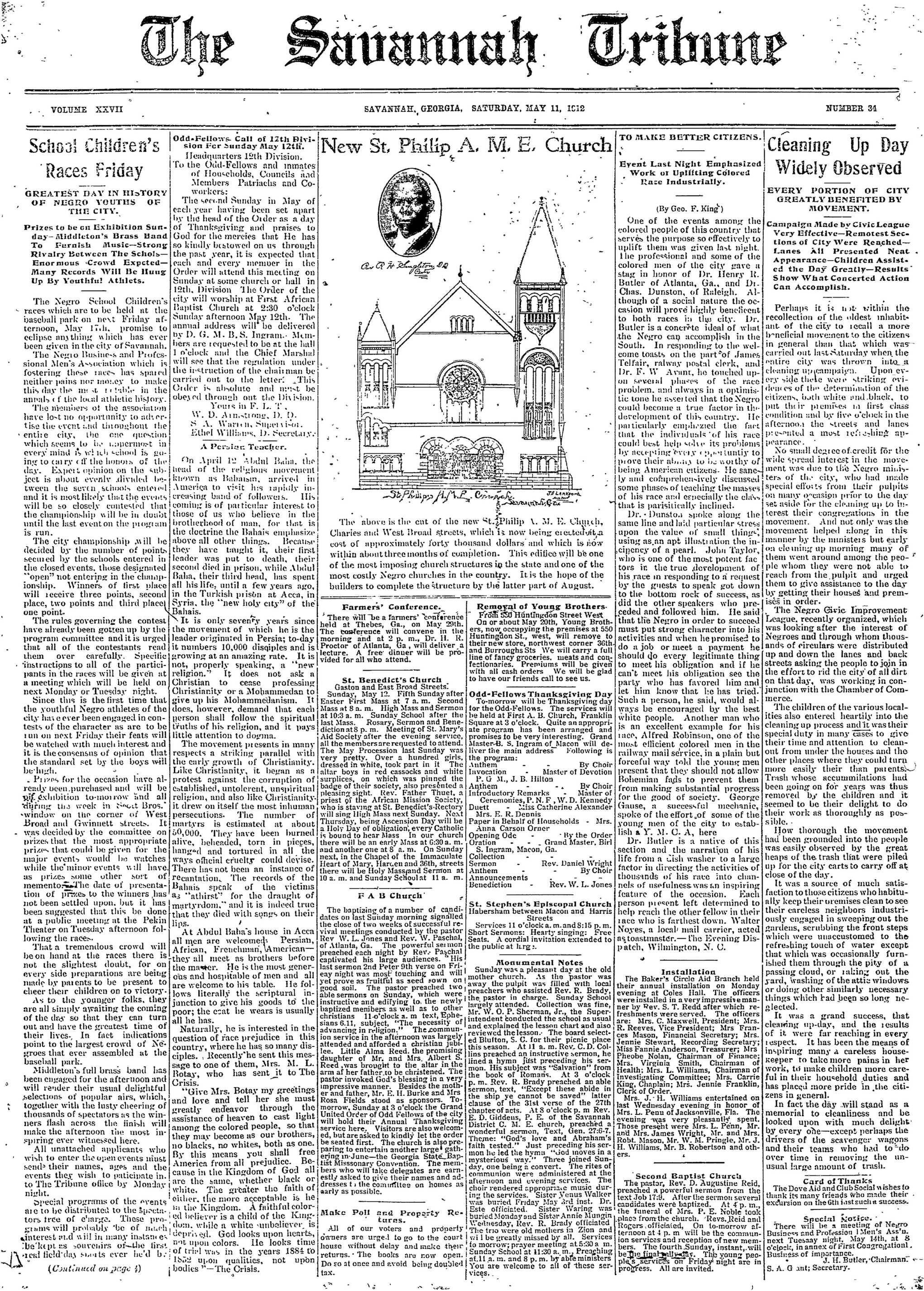
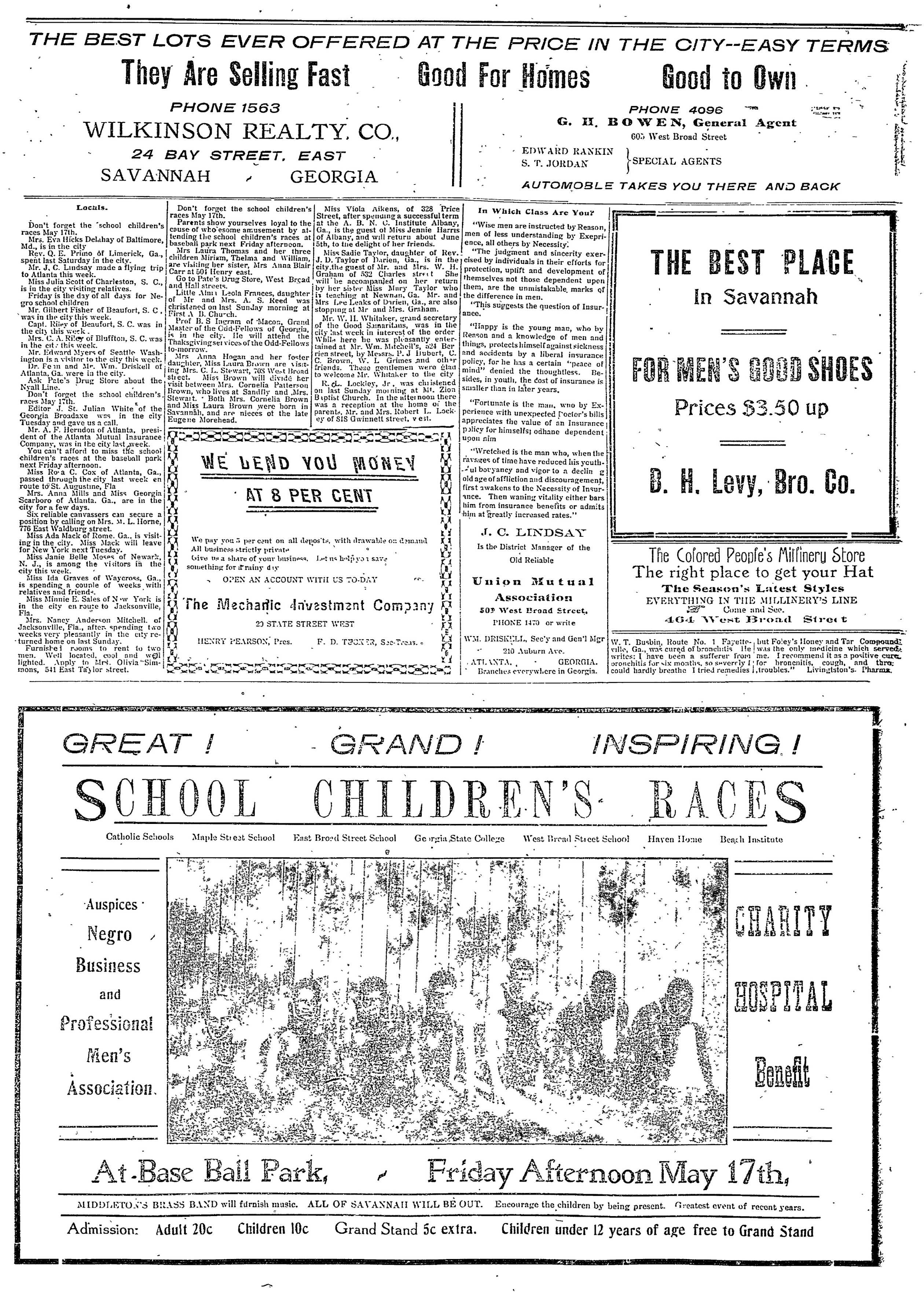
School Children's Races Friday
GREATEST DAY IN HISTORY OF NEGRO YOUTHS OF THE CITY.
Prizes to be on Exhibition Sunday—Middleton's Brass Band To Furnish Music—Strong Rivalry Between The Schols—Enormous Crowd Expeted—Many Records Will Be Hung Up By Youthful Athlets.
The Negro School Children's races which are to be held at the baseball park on next Friday afternoon, May 17th, promise to eclipse anything which has ever been given in the city of Savannah.
The Negro Business and Professional Men's Association which is fostering these races has spared neither pains nor money to make this day the most notable in the annuals of the local athletic history.
The members of the association have lost no opportunity to advertise the event and throughout the entire city, the one question which seems to be supermost in every mind is which school is going to carry off the honors of the day. Expert opinion on the subject is about evenly divided between the seven schools entered and it is most likely that the events will be so closely contested that the championship will be in doubt until the last event on the program is run.
The city championship will be decided by the number of points secured by the schools entered in the closed events, those designated "open" not entering in the championship. Winners of first place will receive three points, second place, two points and third place one point. The rules governing the contest have already been gotten up by the program committee and it is urged that all of the contestants read them over carefully. Specific instructions to all of the participants in the races will be given at a meeting which will be held on next Monday or Tuesday night.
Since this is the first time that the youthful Negro athletes of the city have ever been engaged in contests of the character as are to be run on next Friday their feats will be watched with much interest and it is the consensus of opinion that the standard set by the boys will be high. Prizes for the occasion have already been purchased and will be pif exhibition to-morrow and all diving the week in Scott Bros. window on the corner of West Broad and Cincinnati at It
Broad and Twinnett streets. It was decided by the committee on prizes that the most appropriate prizes that could be given for the major events would be watches while the minor events will have as prizes some other sort of memento. The date of presentation of prizes to the winners has not been settled upon, but it has been suggested that this be done at a public meeting at the Pekin Theater on Tuesday afternoon following the races.
That a tremendous crowd will be on hand at the races there is not the slightest doubt, for on every side preparations are being made by parents to be present to cheer their children on to victory-
As to the younger folks, they are all simply awaiting the coming of the day so that they can turn out and have the greatest time of their lives. In fact indications point to the largest crowd of Negroes that ever assembled at the baseball park. Middleton's full brass band has been engaged for the afternoon and will render their usual delightful selections of popular airs, which, together with the lusty cheering of thousands of spectators as the winners flash across the finish will make the afternoon the most inspiring ever witnessed here.
All unattached applicants who wish to enter the open events must send their names, ages and the events they wish to participate into The Tribune office by Monday night.
Special programs of the events are to be distributed to the spectators free of charge. These programs will probably be of much interest and will in many instances be kept as souvenirs of the first real field day sports ever be'd by:
The
Odd-Fellows Call of 12th Division For Sunday May 12th.
Headquarters 12th Division.
To the Odd-Fellows and nurses.
o the Odd-Fellows and inmates of Households, Councils and Members Patriachs and Coworkers;
The second Sunday in May of each year having been set apart by the head of the Order as a day of Thanksgiving and praises to God for the mercies that He has so kindly bestowed on us through the past year, it is expected that each and every member in the Order will attend this meeting on Sunday at some church or hall in 12th. Division. The Order of the city will worship at First African Baptist Church at 2:30 o'clock Sunday afternoon May 12th. The annual address will be delivered by D. G. M. B. S. Ingram. Members are requested to be at the hall 1 o'clock and the Chief Marshal will see that the regulation under the instruction of the chairman be carried out to the letter. This Order is absolute and must be obeyed through out the Division.
A Persian Teacher.
On April 12 Abdul Baha, the head of the religious movement known as Bahaisim, arrived in America to visit his rapidly increasing band of followers. His coming is of particular interest to those of us who believe in the brotherhood of man, for that is the doctrine the Bahais emphasize above all other things. Because they have taught it, their first leader was put to death, their second died in prison, while Abdul Baha, their third head, has spent all his life, until a few years ago, in the Turkish prison at Acca, in Syria, the "new holy city" of the Bahais.
It is only seventy years since the movement of which he is the leader originated in Persia; to-day it numbers 10,000 disciples and is growing at an amazing rate. It is not, properly speaking, a "new religion." It does not ask a Christian to cease professing Christianity or a Mohammedan to give up his Mohammedanism. It does, however, demand that each person shall follow the spiritual truths of his religion, and it pays little attention to dogma.
The movement presents in many respects a striking parallel with the early growth of Christianity. Like Christianity, it began as a protest against the corruption of established, untolerent, unspiritual religion, and also like Christianity it drew on itself the most inhuman persecutions. The number of martyrs is estimated at about 50,000. They have been burned alive, beheaded, torn in pieces, hanged and tortured in all the ways official cruelty could devise. There has not been an instance of recantation. The records of the Bahais speak of the victims as "athirst" for the draught of martyrdom, and it is indeed true that they died with songs on their lips.
At Abdul Baha's house in Acca all men are welcomed. Persian, African, Frenchman, American—they all meet as brothers before the master. He is the most generous and hospitable of men and all are welcome to his table. He follows literally the scriptural injunction to give his goods to the poor; the coat he wears is usually all he has.
Naturally, he is interested in the question of race prejudice in this country, where he has so many disciples. Recently he sent this message to one of them, Mrs. M. L. Rotay, who has sent it to The Crisis.
"Give Mrs. Botay my greetings and love and tell her she must greatly endeavor through the assistance of heaven to cast light among the colored people, so that they may become as our brothers, no blacks, no whites, both as one. By this means you shall free America from all prejudice. Because in the Kingdom of God all are the same, whether black or white. The greater the faith of either, the more acceptable is he in the Kingdom. A faithful colored believer is a child of the Kingdom, while a white umbeliever, is deprived. God looks upon hearts, not upon colors. He looks time of trial was in the years 1884 to 1852 upon qualities, not upon bodies"—The Crisis.
SAVANNAH, GEORGIA, SATURDAY, MAY 11, 1512
Rex R. H. Ringletton, D. Q.
St. Philippe A.M.P. Church.
J.S. LANFORD
The above is the cut of the new St. Philip A. M. E. Church, Charles and West Broad streets, which is now being erected at a cost of approximately forty thousand dollars and which is now within about three months of completion. This edifice will be one of the most imposing church structures in the state and one of the most costly Negro churches in the country. It is the hope of the builders to complete the structure by the latter part of August.
Farmers' Conference.
There will be a farmers' conference held at Thebes, Ga., on May 29th. The conference will convene in the morning and at 2 p. m., Dr. H. R. Proctor of Atlanta, Ga., will deliver a lecture. A free dinner will be provided for all who attend.
St. Benedict's Church
Gaston and East Broad Streets.
Sunday, May 12. Fifth Sunday after
Easter First Mass at 7 a.m. Second
Mass at 8 a.m. High Mass and Sermon
at 10:3 a.m. Sunday School after the
last Mass. Rosary, Sermon and Benedic-
tion at 8 p.m. Meeting of St. Mary's
Aid Society after the evening service,
all the members are requested to attend.
The May Procession last Sunday was
very pretty. Over a hundred girls,
dressed in white, took part in it. The
altar boys in red caskocks and white
surplices, on which was pinned the
badge of their society, also presented a
pleasing sight. Rev. Father Thuet, a
priest of the African Mission Society,
who is staving at St. Benedict's Rectory
will sing High Mass next Sunday. Next
Thursday, being Ascension Day will be
a Holy Day of obligation, every Catholic
is bound to hear Mass. In our church
there will be an early Mass at 6:30 a.m.
and another one at 8 a.m. On Sunday
next, in the Chapel of the Immaculate
Heart of Mary, Harcen and 36th, streets
there will be Holy Mass and Sermon at
10 a.m. and Sunday School at 11 a.m.
F A B Church
The baptizing of a number of candidates on last Sunday morning signalled the close of two weeks of successful revival meetings conducted by the pastor Rev W. L. Jones and Rev. W. Paschal, of Atlanta, Ga. The powerful sermon preached each night by Rev. Paschal captivated his large audiences. "His last sermon 2 Peter 9th verse on Friday night was most touching and will yet prove as fruitful as seed sown on good soil. The pastor preached two able sermons on Sunday, which were instructive and edifying to the newly baptized members as well as to other Christians 11 o'clock a.m. text, Ephesians 6.11, subject, "The necessity of advancing in religion." The communion service in the afternoon was largely attended and afforded a Christian jubilee. Little Alma Reed, the promising daughter of Mr. and Mrs. Albert S. Reed, was brought to the altar in the arm of her father to be christened. The pastor invoked God's blessing in a very impressive manner. Besides the mother and father, Mr. E. H. Burke and Mrs Rosa Fields stood as sponsors. Tomorrow, Sunday at 3 o'clock the Grand United Order of Odd Fellows of the city will hold their Annual Thanksgiving service here. Visitors are also welcomed, but are asked to kindly let the order be seated first. The church is also preparing to entertain another large gathering in June—the Georgia State Baptist Missonary Convention. The members who will take delegates are earnestly asked to give their names and addresses to the committee on homes as early as possible.
Make Poll and Property Returns. All of our voters and property owners are urged to go to the court house without delay and make their returns. The books are now open. Do so at once and avoid being doubled tax.
Removal of Young Brothers
From 550 Huntingdon Street West
On or about May 20th, Young Brothers,
now occupying the premises at 550
Huntingdon St., west, will remove to
their new store, northwest corner 36th
and Burroughs Sts. We will carry a full
line of fancy groceries, meats and con-
fectionaries. Premiums will be given
with all cash orders. We will be glad
to have our friends call to see us.
Odd-Fellows Thanksgiving Day
To-morrow will be Thanksgiving day
for the Odd-Fellows. The services will
be held at First A. B. Church, Franklin
Square at 3 o'clock. Quite an appropriate
program has been arranged and
promises to be very interesting. Grand
Master-B. S. Ingram of Macon will deliver
the main address. Following is
the program:
Anthem - - By Choir
Invocation - Master of Devotion
P. G. M., J. B. Hilton
Anthem - - By Choir
Introductory Remarks - Master of
Ceremonies, P. N. F., W. D. Kennedy
Duett - Miss Catherine Alexander
Mrs. E. R. Dennis
Paper in Behalf of Households - Mrs.
Anna Carson Orner
Opening Ode - By the Order
Oration - Grand Master, Birl
S. Ingram, Macon, Ga.
Collection
Sermon - Rev. Daniel Wright
Anthem - By Choir
Announcements
Benediction - Rev. W. L. Jones
St. Stephen's Episcopal Church
Habersham between Macon and Harris
Streets
Services 11 o'clock a.m. and 8:15 p.m.
Short Sermons: Hearty singing: Free
Seats. A cordial invitation extended to
the public at krg2.
Monumental Notes
Sunday was a pleasant day at the old mother church. As the pastor was away the pulpit was filled with local preachers who assisted Rev. R. Brady, the pastor in charge. Sunday School largely attended. Collection was fine, Mr. W. O. P. Sherman, Jr., the Superintendent conducted the school as usual and explained the lesson chart and also reviewed the lesson. The board selected Blufton, S. C. for their picnic place this season. At 11 a. m. Rev. C. D. Collins preached an instructive sermon, he lined a hymn just preceding his sermon. His subject was "Salvation" from the book of Romans. At 3 o'clock p. m. Rev. R. Brady preached an able sermon, text, "Except these abide in the ship ye cannot be saved" latter clause of the 31st verse of the 27th chapter of acts. At 8 o'clock p. m. Rev. E. D. Giddens, P. E. of the Savannah District C. M. E. church, preached a wonderful sermon, Text, Gen. 27:6-7. Theme: "God's love and Abraham's faith tested." Just preceding his sermon he led the hymn "God moves in a mysterious way." Three joined Sunday, one being a convert. The rites of communion were administered at the afternoon and evening services. The choir rendered appropriate music during the services. Sister Venus Walker was buried Friday May 3rd inst. Dr. Este officiated. Sister Waring was buried Monday and Sister Annie Mungin Wednesday, Rev. R. Brady officiated. The trio were old mothers in Zion and will be greatly missed by all. Services to morrow; prayer meeting at 5:30 a.m. Sunday School at 11:30 a.m., Preaching at 11 a. m. and 8 p. m. by able ministers You are welcome to all of these services.
TO MAKE BETTER CITIZENS.
Event Last Night Emphasized
Work or Uplifting Colored
Race Industrially.
(By Geo. F. King)
One of the events among the colored people of this country that serves the purpose so effectively to uplift them was given last night. The professional and some of the colored men of the city gave a stag in honor of Dr. Henry R. Butler of Atlanta, Ga., and Dr. Chas. Dunston, of Raleigh. Although of a social nature the occasion will prove highly beneficial to both races in the city. Dr. Butler is a concrete ideal of what the Negro can accomplish in the South. In responding to the welcome toasts on the part of James Telfair, railway postal clerk, and Dr. F. W Avant, he touched upon several phases of the race problem, and always in a optimistic tone he asserted that the Negro could become a true factor in the development of this country. He particularly emphasized the fact that the individuals of his race could best help solve its problems by accepting every opportunity to prove their ability to be worthy of being American citizens. He saneily and comprehensively discussed some phases of teaching the masses of his race and especially the class that is parisitically inclined.
Dr. Dunston spoke along the same line and laid particular stress upon the value of small things, using as an apt illustration the incipency of a pearl. John Taylor, who is one of the most potent factors in the true development of his race in responding to a request by the guests to speak got down to the bottom rock of success, as did the other speakers who preceded and followed him. He said that the Negro in order to succeed must put strong character into his activities and when he promised to do a job or meet a payment he should do every legitimate thing to meet his obligation and if he can't meet his obligation see the party who has favored him and let him know that he has tried. Such a person, he said, would always be encouraged by the best white people. Another man who is an excellent example for his race, Alfred Robinson, one of the most efficient colored men in the railway mail service, in a plain but forceful way told the young men present that they should not allow Bohemian fads to prevent them from making substantial progress for the good of society. George Gause, a successful mechanic, spoke of the effort of some of the young men of the city to establish a Y. M. C. A, here
Dr. Butler is a native of this section and the narration of his life from a dish washer to a large factor in directing the activities of thousands of his race into channels of usefulness was an inspiring feature of the occasion. Each person present left determined to help reach the other fellow in their race who is farthest down. Walter Noyes, a local mail carrier, acted as toastmaster.—The Evening Dispatch, Wilmington, N. C.
Installation
The Baker's Circle Aid Branch held their annual installation on Monday evening at Coles Hall. The officers were installed in a very impressive manner by Rev. S. T. Redd after which refreshments were served. The officers are: Mrs. C. Maxwell, President; Mrs. R. Reeves, Vice President; Mrs Frances Mason, Financial Secretary; Mrs. Jennie Stewart, Recording Secretary; Miss Fannie Anderson, Treasurer; Mrs Pheobe Nolan, Chairman of Finance; Mrs. Virginia Smith, Chairman of Health; Mrs. L. Williams, Chairman of Investigating Committee; Mrs. Carrie King, Chaplain; Mrs. Jennie Franklin, Clerk of Order.
Mrs. J. H. Williams entertained on last Wednesday evening in honor of Mrs. L. Penn of Jacksonville, Fla. The evening was very pleasantly spent. Those present were Mrs. L. Penn, Mr. and Mrs. James Wright, Mr. and Mrs. Robt. Mason, Mr. W. M. Pringle, Mr. J. H. Williams, Mr. B. Robertson and others.
Second Baptist Church
Second Baptist Church
the pastor, Rev. D. Augustine Reid,
preached a powerful sermon from the text Job 17:9. After the sermon several candidates were baptized. At 4 p.m., the funeral of Mrs. P. E. Noble took place from the church. Revs. Reid and Rogers officiated. On to-morrow afternoon at 4 p.m will be the communion services and reception of new members. The fourth Sunday, instant, will be the final call day. The young people's services on Friday night are in progress. All are invited.
Cleaning Up Day Widely Observed
EVERY PORTION OF CITY GREATLY BENEFITED BY MOVEMENT.
Campaign Made by Civic League Very Effective—Remotest Sections of City Were Reached—Lanes All Presented Neat Appearance—Children Assisted the Day Greatly—Results Show What Concerted Action Can Accomplish.
Perhaps it is not within the recollection of the oldest inhabitant of the city to recall a more beneficial movement to the citizens in general than that which was carried out last Saturday when the entire city was thrown into a cleaning up campaign. Upon every side these were striking evidences of the determination of the citizens, both white and black, to put their premises in first class condition and by five o'clock in the afternoon the streets and lanes presented a most refreshing appearance.
No small degree of credit for the wide spread interest in the movement was due to the Negro ministers of the city, who had made special efforts from their pulpits on many occasion prior to the day set aside for the cleaning up to interest their congregations in the movement. And not only was the movement helped along in this manner by the ministers but early on cleaning up morning many of them went around among the people whom they were not able to reach from the pulpit and urged them to give assistance to the day by getting their houses and premises in order.
The Negro Civic Improvement League, recently organized, which was looking after the interest of Negroes and through whom thousands ofcirculars were distributed up and down the lanes and back streets asking the people to join in the effort to rid the city of all dirt on that day, was working in conjunction with the Chamber of Commerce.
The children of the various localities also entered heartily into the cleaning up process and it was their special duty in many cases to give their time and attention to clean-out from under the houses and the other places where they could turn more easily their than parents. Trash whose accumulations had been going on for years was thus removed by the children and it seemed to be their delight to do their work as thoroughly as possible. How thorough the movement had been grounded into the people was easily observed by the great heaps of the trash that were piled up for the city carts to carry off at close of the day.
It was a source of much satisfaction to those citizens who habitually keep their premises clean to see their careless neighbors industriously engaged in sweeping out the gardens, scrubbing the front steps which were unaccustomed to the refreshing touch of water except that which was occasionally furnished them through the pity of a passing cloud, or taking out the yard, washing of the attic windows or doing other similarly necessary things which had been so long neglected.
It was a grand success, that cleaning up-day, and the results of it were far reaching in every respect. It has been the means of inspiring many a careless housekeeper to take more pains in her work, to make children more careful in their household duties and has placed more pride in the citizens in general.
In fact the day will stand as a memorial to cleanliness and be looked upon with much delight by every one—except perhaps the drivers of the scavenger wagons and their teams who had to do over time in removing the unusual large amount of trash.
Card of Thanks
The Dove Aid and Club Social wishes to
thank its many friends who made their
excursion on the 6th inst such a success.
Special Notice.
There will be a meeting of Negro
Business and Profession 1 Men's Ass'n.
next Tuesday night. May 14th, at 8
o'clock, in annex of First Congregation!
Business of importance.
J. H. Butler, Chairman.
S. A. Gant; Secretary.
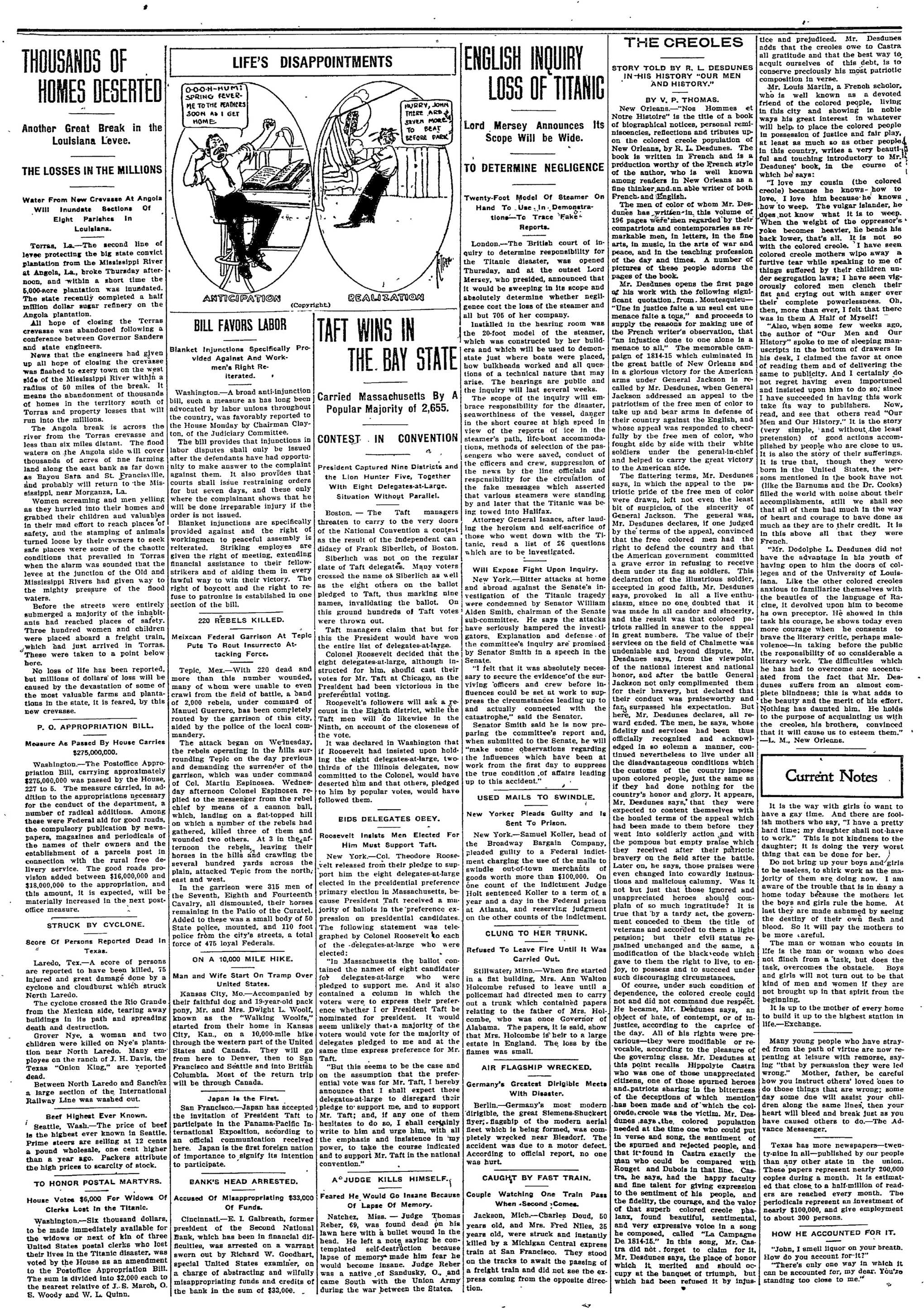
THOUSANDS OF HOMES DESERTED
Another Great Break in the Louisiana Levee.
THE LOSSES IN THE MILLIONS
Water From New Crevasse At Angola Will Inundate Sections Of Eight Parishes In Louisiana.
Torras, La.—The second line of levee protecting the big state convict plantation from the Mississippi River at Angola, La., broke Thursday afternoon, and within a short time the 5,000-bore plantation was inundated. The state recently completed a half million dollar sugar refinery on the Angola plantation.
All hope of closing the Torras crevasse was abandoned following a conference between Governor Sanders and state engineers.
News that the engineers had given up all hope of closing the crevasse was flashed to exery town on the west side of the Mississippi River within a radius of 50 miles of the break. It means the abandonment of thousands of homes in the territory south of Torras and property losses that will run into the millions.
The Angola break is across the river from the Torras crevasse and less than six miles distant. The flood waters on the Angola side will cover thousands of acres of fine farming land along the east bank as far down as Bayou Sara and St. Francisville, and probably will return to the Mississippi near Morgana La.
Women screaming and men yelling as they hurried into their homes and grabbed their children and valuables in their mad effort to reach places of safety, and the stamping of animals turned loose by their owners to seek safe places were some of the chaotic conditions that prevailed in Torras when the alarm was sounded that the levee at the junction of the Old and Mississippi Rivers had given way to the mighty pressure of the flood waters.
Before the streets were entirely submerged a majority of the inhabitants had reached places of safety. Three hundred women and children were placed aboard a freight train, which had just arrived in Torras. These were taken to a point below here.
No loss of life has been reported, but millions of dollars of loss will be caused by the devastation of some of the most valuable farms and plantations in the state, it is feared, by this new crevasse.
P. Q. APPROPRIATION BILL.
Measure As Passed By House Carries
$275,000,000.
Washington.—The Postoffice Appropriation Bill, carrying approximately $275,000,000 was passed by the House, 227 to 5. The measure carried, in addition to the appropriations necessary for the conduct of the department, a number of radical additions. Among those were Federal aid for good roads, the compulsory publication by newspapers, magazines and periodicals of the names of their owners and the establishment of a parcels post in connection with the rural free delivery service. The good roads provision added between $16,000,000 and $18,000,000 to the appropriation, and this amount, it is expected, will be materially increased in the next postoffice measure.
STRUCK BY CYCLONE.
Score Of Persons Reported Dead In Texas.
Laredo, Tex.-A score of persons are reported to have been killed, 75 injured and great damage done by a cyclone and cloudburst which struck North Laredo. The cyclone crossed the Rio Grande from the Mexican side, tearing away buildings in its path and spreading death and destruction. Grover Nye, a woman and two children were killed on Nye's plantation near North Laredo. Many employees on the ranch of J. H. Davis, the Texas "Onion King," are reported dead. Between North Laredo and Sanchez a large section of the International Railway Line was washed out.
Beef Highest Ever Known.
Seattle, Wash.—The price of beef is the highest ever known in Seattle. Prime steers are selling at 12 cents a pound wholesale, one cent higher than a year ago. Packers attribute the high prices to scarcity of stock.
House Votes $6,000 For Widows Of Clerks Lost in the Titanic.
Washington.—Six thousand dollars, to be made immediately available for the widows or next of kin of three United States postal clerks who lost their lives in the Titanic disaster, was voted by the House as an amendment to the Postoffice Appropriation Bill. The sum is divided into $2,000 each to the nearest relative of J. S. Maroh, O. S. Woody and W. L. Quinn.
O-OO-H-HUM!
SPRING FEVER-
ME TO THE FEATHERS
SOON AS I GET
HOME
HURRY, JOHN
THERE ARE
SEVEN MORE
TO BEAT
BEFORE PARK
ANTICIPATION
REALIZATION
(Copyright)
BILL FAVORS LABOR
Blanket Injunctions Specifically Provided Against And Workmen's Right Reiterated.
Washington.—A broad anti-injunction bill, such a measure as has long been advocated by labor unions throughout the country, was favorably reported to the House Monday by Chairman Clayton, of the Judiciary Committee.
The bill provides that injunctions in labor disputes shall only be issued after the defendants have had opportunity to make answer to the complaint against them. It also provides that courts shall issue restraining orders for but seven days, and these only where the complainant shows that he will be done irreparable injury if the order is not issued.
Blanket injunctions are specifically provided against and the right of workingmen to peaceful assembly is reiterated. Striking employees are given the right of meeting, extending financial assistance to their fellow-strikers and of aiding them in every lawful way to win their victory. The right of boycott and the right to refuse to patronize is established in one section of the bill.
220 REBELS KILLED.
Meixcan Federal Garrison At Tepic Puts To Rout Insurrecto Attacking Force.
Tepic, Mex.—With 220 dead and more than this number wounded, many of whom were unable to even crawl from the field of battle, a band of 2,000 rebels, under command of Manuel Guerrero, has been completely routed by the garrison of this city, alided by the police of the local commandery.
The attack began on Wednesday, the rebels operating in the hills surrounding Tepic on the day previous and demanding the surrender of the garrison, which was under command of Col. Martin Espinosea. Wednesday afternoon Colonel Espinosea replied to the messenger from the rebel chief by means of a cannon ball, which, landing on a flat-topped hill on which a number of the rebels had gathered, killed three of them and wounded two others. At 3 in the afternoon the rebels, leaving their horses in the hills and crawling the several hundred yards across the plain, attacked Tepic from the north, east and west.
In the garrison were 315 men of the Seventh, Eighth and Fourteenth Cavalry, all dismounted, their horses remaining in the Patio of the Curatel. Added to these was a small body of 50 State police, mounted, and 110 foot police from the city's streets, a total force of 475 loyal Federals.
ON A 10.000 MILE HIKE.
Man and Wife Start On Tramp Over United States.
Kansas City, Mo.—Accompanied by their faithful dog and 19-year-old pack pony, Mr. and Mrs. Dwight L. Woolf, known as the "Walking Woolfs," started from their home in Kansas City, Kan., on a 10,000-mile hike through the western part of the United States and Canada. They will go from here to Denver, then to San Francisco and Seattle and into British Columbia. Most of the return trip will be through Canada.
Japan is the First.
San Francisco. Japan has accepted the invitation of President Taft to participate in the Panama-Pacific International Exposition, according to an official communication received here. Japan is the first foreign nation of importance to signify its intention to participate.
BANK'S HEAD ARRESTED.
Accused Of Misappropriating $33,000
Of Funds.
Cincinnati.-E. I. Galbreath, former president of the Second National Bank, which has been in financial difficulties, was arrested on a warrant sworn out by Richard W. Goodhart, special United States examiner, on a charge of abstracting and wilfully misappropriating funds and credits of the bank in the sum of $33,000.
TAFT WINS IN THE BAY STATE
Carried Massachusetts By Popular Majority of 2,655.
CONTEST. IN CONVENTION
President Captured Nine Districts and the Lion Hunter Five, Together With Eight Delegates-at-Large. Situation Without Parallel.
Boston. — The Taft managers threaten to carry to the very doors of the National Convention a contest as the result of the independent candidacy of Frank Siberlich, of Boston.
Siberlich was not on the regular slate of Taft delegates. Many voters crossed the name of Siberlich as well as the eight others on the ballot pledged to Taft, thus marking nine names, invalidating the ballot. On this ground hundreds of Taft votes were thrown out.
Taft managers claim that but for this the President would have won the entire list of delegates-at-large. Colonel Roosevelt decided that the eight delegates-at-large, although instructed for him, should cast their votes for Mr. Taft at Chicago, as the President had been victorious in the preferential voting.
Roosevelt's followers will ask a recount in the Eighth district, while the Taft men will do likewise in the Ninth, on account of the closeness of the vote.
It was declared in Washington that if Roosevelt had insisted upon holding the eight delegates-at-large, two-thirds of the Illinois delegates, now committed to the Colonel, would have deserted him and that others, pledged to him by popular votes, would have followed them.
BIDS DELEGATES OBEY.
Roosevelt Insists Men Elected For Him Must Support Taft.
New York.-Col. Theodore Roosevelt released from their pledge to support him the eight delegates-at-large elected in the presidential preference primary election in Massachusetts, because President Taft received a majority of ballots in the preference expression on presidential candidates.
The following statement was telegraphed by Colonel Roosevelt to each of the delegates-at-large who were elected:
"In Massachusetts the ballot contained the names of eight candidate for delegates-at-large who were pledged to support me. And it also contained a column in which the voters were to express their preference whether I or President Taft be nominated for president. It would seem unlikely that a majority of the voters would vote for the majority of delegates pledged to me and at the same time express preference for Mr. Taft.
"But this seems to be the case and on the assumption that the preferential vote was for Mr. Taft, I hereby announce that I shall expect these delegates-at-large to disregard their pledge to support me, and to support Mr. Taft; and, if any one of them hesitates to do so, I shall certainly write to him and urge him, with all the emphasis and insistence in my power, to take the course indicated and to support Mr. Taft in the national convention."
A°JUDGE KILLS HIMSELF.
Feared He Would Go Insane Because Of Lapse Of Memory.
Natchez, Miss. — Judge Thomas Reber, 69, was found dead on his lawn here with a bullet wound in the head. He left a note saying he contemplated self-destruction because lapse of memory made him fear he would become insane. Judge Reber was a native of Sandusky, O., and came South with the Union Army during the war between the States.
ENGLISH INQUIRY LOSS OF TITANIC
Lord Mersey Announces Its Scope Will be Wide.
TO DETERMINE NEGLIGENCE
Twenty-Foot Model Of Steamer On Hand To Use In Demonstractions To Trace Fake
London.—The British court of inquiry to determine responsibility for the Titanic disaster, was opened Thursday, and at the outset Lord Mersey, who presided, announced that it would be sweeping in its scope and absolutely determine whether negligence cost the loss of the steamer and all but 705 of her company.
Installed in the hearing room was the 20-foot model of the steamer, which was constructed by her builders and which will be used to demonstrate just where boats were placed, how bulkheads worked and all questions of a technical nature that may arise. The hearings are public and the inquiry will last several weeks.
The scope of the inquiry will embrace responsibility for the disaster, seaworthiness of the vessel, danger in the short course at high speed in view of the reports of ice in the steamer's path, life-boat accommodations, methods of selection of the passengers who were saved, conduct of the officers and crew, suppression of the news by the line officials and responsibility for the circulation of the fake messages which asserted that various steamers were standing by and later that the Titanic was being towed into Halifax. Attorney General Isaacs, after lauding the heroism and self-sacrifice of those who went down with the Titanic, read a list of 26 questions which are to be investigated.
Will Expose Fight Upon Inquiry.
New York.—Bitter attacks at home and abroad against the Senate's investigation of the Titanic tragedy were condemned by Senator William Alden Smith, chairman of the Senate sub-committee. He says the attacks have seriously hampered the investigators, Explanation and defense of the committee's inquiry are promised by Senator Smith in a speech in the Senate.
"I felt that it was absolutely necessary to secure the evidence" of the surviving officers and crew before influences could be set at work to suppress the circumstances leading up to and actually connected with the catastrophe," said the Senator.
Senator Smith said he is now preparing the committee's report and, when submitted to the Senate, he will "make some observations regarding the influences which have been at work from the first day to suppress the true condition of affairs leading up to this accident."
New Yorker Pleads Guilty and Is Sent To Prison.
New York.—Samuel Koller, head of the Broadway Bargain Company, pleaded guilty to a Federal indictment charging the use of the mails to swindle out-of-town merchants of goods worth more than $100,000. On one count of the indictment Judge Holt sentenced Koller to a term of a year and a day in the Federal prison at Atlanta, and reserving judgment on the other counts of the indictment.
CLUNG TO HER TRUNK.
Refused To Leave Fire Until It Was Carried Out.
Stillwater; Minn.—When fire started in a flat building, Mrs. Ann Walton Holcombe refused to leave until a policeman had directed men to carry out a trunk which contained papers relating to the father of Mrs. Holcombe, who was once Governor of Alabama. The papers, it is said, show that Mrs. Holcombe is heir to a large estate in England. The loss by the flames was small.
AIR FLAGSHIP WRECKED.
Germany's Greatest Dirigible Meets With Disaster.
Berlin.—Germany's most modern dirigible, the great Siemens-Shuckert flyer, flagship of the modern aerial fleet which is being formed, was completely wrecked near Blesdorf. The accident was due to a motor defect. According to official report, no one was hurt.
CAUGHT BY FAST TRAIN.
Couple Watching One Train Pass
When · Second · Come.
Jackson, Mich.-Charles Doud, 50 years old, and Mrs. Fred Niles, 35 years old, were struck and instantly killed by a Michigan Central express train at San Francisco. They stood on the tracks to await the passing of a freight train and did not see the express coming from the opposite direction.
STORY TOLD BY R. L DESDUNES IN-HIS HISTORY "OUR MEN AND HISTORY."
BY V. P. THOMAS.
New Orleans.—"Nos Hommes et Notre Histoire" is the title of a book of biographical notices, personal reminiscencies, reflections and tributes upon the colored creole population of New Orleans, by R. L. Deadunes. The book is written in French and is a production worthy of the French style of the author, who is well known among readers in New Orleans as a fine thinker and an able writer of both French and English.
The men of color of whom Mr. Deadunes has written in this volume of 196 pages were men regarded by their compatriots and contemporaries as remarkable men, in letters, in the fine arts, in music, in the arts of war and peace, and in the teaching profession of the day and times. A number of pictures of these people adorn the pages of the book.
Mr. Desdunes opens the first page of his work with the following significant quotation from. Montesquieu—"Une in justice faite a un seul est une menace faite a tous," and proceeds to supply the reasons for making use of the French writer's observation, that "an injustice done to one alone is a menace to all." The memorable campaign of 1814-15 which culminated in the great battle of New Orleans and in a glorious victory for the American arms under General Jackson is recalled by Mr. Desdunes, when General Jackson addressed an appeal to the patriotism of the free men of color to take up and bear arms in defense of their country against the English, and whose appeal was responded to cheerfully by the free men of color, who fought side by side with their white soldiers under the general-in-chief and helped to carry the great victory to the American side.
The flattering terms, Mr. Desdunes says, in which the appeal to the patriotic pride of the free men of color were drawn, left not even the least bit of suspicion of the sincerity of General Jackson. The general was, Mr. Desdunes declares, if one judged by the terms of the appeal, convinced that the free colored men had the right to defend the country and that the American government committed a grave error in refusing to receive them under its flag as soldiers. This declaration of the illustrious soldier, accepted in good faith, Mr. Desdunes says, provoked in all a live enthusiasm, since no one doubted that it was made in all candor and sincerity, and the result was that colored patriots rallied in answer to the appeal in great numbers. The value of their services on the field of Chalmette was undeniable and beyond dispute. Mr. Desdanes says, from the viewpoint of the national interest and national honor, and after the battle General Jackson not only complimented them for their bravery, but declared that their conduct was praiseworthy and far surpassed his expectation. But here, Mr. Desdunes declares, all rewarded. The men, he says, whose fidelity and services had been thus officially recognized and acknowledged in so solemn a manner, continued nevertheless to live under all the disadvantageous conditions which the customs of the country impose upon colored people, just the same as if they had done nothing for the country's honor and glory. It appears, Mr. Desdunes says, that they were expected to content themselves with the honed terms of the appeal which had been made to them before they went into soldierly action and with the pompous but empty praise which they received after their patriotic bravery on the field after the battle. Later on, he says, those praises were even changed into cowardly insinuations and malicious calumny. Was it not but just that those ignored and unappreciated heroes should complain of so much ingratitude? It is true that by a tardy act, the government conceded to them the title of veterans and accorded to them a light pension; but their civil status remained unchanged and the same, a modification of the black code which gave to them the right to live, to enjoy, to possess and to succeed under such discouraging circumstances.
Of course, under such condition of dependence, the colored creole could not and did not command due respect. He became, Mr. Desdunes says, an object of hate, of contempt, or of injustice, according to the caprice of the day. All of his rights were precarious—they were modifiable or revocable, according to the pleasure of the governing class. Mr. Desdunes at this point recalls Hippolyte Castra who was one of those unappreciated citizens, one of those spurned heroes and patriots sharing in the bitterness of the deceptions of which mention has been made and of which the colored creole was the victim. Mr. Desdunes says, the, colored population needed at the time one who could put in verse and song, the sentiment of the spurned and rejected people, and that it found in Castra exactly the man who could be compared with Rouget and Dubols in that line. Castra, he says, had the happy faculty and fine talent for giving expression to the sentiment of his people, and the fidelity, the courage, and the valor of that superb colored creole phalanx, found beautiful, sentimental, and expressive voice in a song he composed, called "La Campagne De 1814-15." In this song, Mr. Castra did not, forget to claim for it. Mr. Desdunes says, the place of honor which it merited and should occupy at the banquet of triumph, but which had been refused it by injus-
tice and prejudiced. Mr. Desdunes adds that the creoles owe to Castra all gratitude and that the best way to acquit ourselves of this debt, is to conserve preciously his most patriotic composition in verse.
Mr. Louis Martin, a Frenoh scholar, who is well known as a devoted friend of the colored people, living in this city and showing in noble ways his great interest in whatever will help to place the colored people in possession of justice and fair play, at least as much so as other peoples in this country, writes a very beautiful and touching introductory to Mr. Desdunes' book, in the course of which he says:
```markdown
```
"I love my cousin (the colored creole) because he knows- how to love. I love him because he knows how to weep. The vulgar islander, he does not know what it is to weep. When the weight of the oppressor's yoke becomes heavier, lie bends his back lower, that's all. It is not so with the colored creole. I have seen colored creole mothers wipe away a furtive tear while speaking to me of things suffered by their children under segregation laws; I have seen vigorously colored men clench their fist and crying out with anger over their complete powerlessness. Oh, then, more than ever, I felt that there was in them A Half of Myself!
"Also, when some few weeks ago, the author of "Our Men and Our History" spoke to me of sleeping manuscripts in the bottom of drawers in his desk, I claimed the favor at once of reading them and of delivering the same to publicity. And I certainly do not regret having even importuned and insisted upon him to do so; since I have succeeded in having this work take its way to publishers. Now, read, and see that others read "Our Men and Our History." It is the story (very simple, and without, the least pretension) of good actions accomplished by people who are close to us. It is also the story of their sufferings. It is true that, though they were born in the United States, the persons mentioned in the book have not (like the Barnums and the Dr. Cooks) filled the world with noise about their accomplishments, still we shall see that all of them had much in the way of heart and courage to have done as much as they are to their credit. It is in this above all that they were French.
"Mr. Dodolphe L. Desdunes did not have the advantage in his youth of having open to him the doors of colleges and of the University of Louisiana. Like the other colored creoles anxious to familiarize themselves with the beauties of the language of Racine, it devolved upon him to become his own preceptor. He showed in this task his courage, he shows today even more courage when he consents to brave the literary critic, perhaps malevolence—in taking before the public the responsibility of so considerable a literary work. The difficulties which he has had to overcome are accentuated from the fact that Mr. Desdunes suffers from an almost complete blindness; this is what adds to the beauty and the merit of his effort. Nothing has daunted him. He holds to the purpose of acquaining us with the creoles, his brothers, convinced that it will cause us to esteem them."—L. M., New Orleans.
It is the way with girls to want to have a gay time. And there are foolish mothers who say, "I have a pretty hard time; my daughter shall not have to work." This is not kindness to the daughter; it is doing the very worst thing that can be done for her.
Do not bring up your boys and girls to be useless, to shirk work as the majority of them are doing now. I am aware of the trouble that is in many a home today because the mothers let the boys and girls rule the home. At last they are made ashamed by seeing the destiny of their own flesh and blood. So it will pay the mothers to be more careful.
The man or woman who counts in life is the man or woman who does not flinch from a task, but does the task, overcomes the obstacle. Boys and girls will not turn out to be that kind of men and women if they are not brought up in that spirit from the beginning.
It is up to the mother of every home to build it up to the highest station in life.—Exchange.
Many young people who have strayed from the path of virtue are now repenting at leisure with remorse, saying "that by persuasion they were led wrong." Mother, father, be careful how you instruct others' loved ones to do those things that are wrong; some day some one will assist your children along the same lines, then your heart will bleed and break just as you have caused others to do.—The Advance Messenger.
Texas has more newspapers—twenty-nine in all—published by our people than any other state in the union. These papers represent nearly 200,000 copies during a month. It is estimated that close to a half-million of readers are reached every month. The periodicals represent an investment of nearly $100,000, and give employment to about 300 persons.
HOW HE ACCOUNTED FOR IT.
"John, I smell liquor on your breath. How do you account for it?" "There's only one way in which it can be accounted for, my dear. You're standing too close to me."
See COOPER & ODRIZEN The Up-to-Date Tailors
218 WEST BROAD STREET, BETWEEN HULL AND OGLETHORPE AVE. The Latest Patterns in SPRING AND SUMMER GOODS. class workmanship guaranteed. Our prices will interest you.
DO YOU WANT
A HOME?
WE HAVE TWELVE LOTS ON THIRTY-NINTH STREET, BETWEEN BURROUGH3 AND FLORENCE, UPON WHICH WE WILL BUILD HOMES FOR ANY ONE DESIRING THEM. THE KIND OF HOUSE YOU WANT WILL BE BUILT FOR YOU, AND YOU CAN PAY US FOR IT IN EASY MONTHLY PAYMENTS. COME AND SEE US ABOUT THIS PROPOSITION.
30 DRAYTON STREET.
Nichols, THE SHOE MAN
The affable H. B. Wright is still with us and expects the continuous patronage of his friends.
Johnson Undertaking Establishment
COMBINED WITH
Funeral Directors and Embalmers Finest line of Coffins, Saskets and Robes. White and black funeral cars. Office and warerooms 325-331 Jefferson street. W.R.FIELDS.Manager.
Fruit and Commission Merchant
234 ST. JULIAN ST., WEST, 235 BRYAN ST., WEST.
SAVANNAH, GEORGIA.
Phone 2968.
Palm Shaving Palace
Expert Hair Cutting, Electric Massage and Shampooing a Specialty. All Work Done by Experienced Workmen. Courteous attention to all SHINING PARLOR ATTACHED.
PERRY R. WRIGHT, Proprietor
517 WEST BROAD ST., SAVANNAH, QA.
Two suits cleaned and pressed per month for $1.00. Ladies' work & specially. Goods called for and de-livered. All work guaranteed. Steam and dry cleaning. 816 EAST BROAD STREET. Phone 3940.
First class SHOE REPAIRING. Half sole, sewed, 55 cents; nailed, 50 cents; rubber heels, 35 and 50 cents. All work guaranteed. CORNER EAST BROAD AND BOLTON STREETS.
Don't Buy a New One
Save the old ones and send to us. We make them new—Stoves, Furniture, Mattresses, Carpets. CARPET AND MATTING LAYING A SPECIALTY. Old furniture bought and sold. Packing and Skipping. Goods called for and delivered.
The Beautiful Woodlawn Park New Improvements More Lights New Buildings The Ideal Picnic Spot of Savannah Secure your dates from ANDREW D. MONROE, 124 East Thirty-third St.
Get the habits of saving a part of your Earnings each week.
$1.00
Starts an Account
THE WAGE
EARNERS' LOAN
AND INVESTMENT
COMPANY,
468 WESTBROAD ST.
Savannah, Ga.
GAREY'S
Variety Bakery
PHONE 244.
Goods delivered promptly to any part of the city. 506 West Broad St. Near Gaston Phone 1869-J
MUSICAL INSTRUMENTS
OPpen for Pupils.
541 CHARLTON STREET, EAST.
BROWN'S STAG LODGING HOUSE.
Furnished rooms by week or month.
Hot and cold baths. Electric lights.
In center of city. Street car, hack and automobile convenient.
CALL AT 217 EAST BROAD ST.
.or phone 3746—I. C. Brown, Prop...
—For First Class—
GROCERIES AND CONFECTIONERY
—Call On—
M. G. GRAHAM
626 York St., West
Courteous Attention to All.
MADAME FLORENGE E. WILLIAMS
Graduate Prof. Roher's School,
New York.
Hairdressing Parlor
521 Gaston Street, East.
Telephone 2328
Wigs, Switches and Pompadours
Made from Natural Hair.
Combings Made Up. Shampooling and
Hair Straightening a Specialty.
Face and Electric Massage. Dyeing
and Matching Hair.
ORIENTAL HAIR GROWER.
An excellent preparation, will produce a beautiful growth of hair. Directions on each box. For sale, price 25 cents per box.
AGENTS WANTED
For the Sale of
Magic Shaving Powder
It gives a quick shave without the use of a RAZOR For Particulars, Write THE SHAVING POWDER CO. Savannah, Georgia.
School in Durham to Hold Ministers' Conference in Jul.
FEATURES OF THE PROGRAM- INSTITUTION FOUND BY DR. JAMES E. SHEPARD AFFORDS OPPORTUNITY FOR PASTORS AND TEACHERS TO PROPERLY PREPARE THEMSELVES-PLANS FOR THE SUMMER SCHOOL.
Durham, N. C. Throughout' this and other states the ministers of the race are manifesting an appreciable interest in the forthcoming ministers' conference to be held July 6 to 13. inclusive. at the National Religious Training school in this city. This movement was born in the fertile mind of the Rev. Dr. James E. Shepard, the founder of the most essential educational and religious undertaking ever inaugurated for the wholesome uplift of the race.
The plans of the conference are so comprehensive and far-reaching that not only ministers of the race are sanguine over the needed results that will be gained from such a meeting, but leading white divines in many sections of the country are giving impetus to the effort by substantial encouragement. Dr. W. Y. Chapman, pastor of one of the richest Presbyterian churches in the country, located in Newark, N. J., is an enthusiastic advocate of the conference. He says that the sociological problems of the race are largely to be solved by the Afro-American preachers.
He has visited this famous institution several times since it opened for the reception of students and has carefully studied conditions. Such a forceful character as Dr. Chapman, who always contends for giving the negro every right that is guaranteed an American citizen, will again this year give a series of lectures at the summer school and Chautauqua. Dr. Shepard is receiving applications from ministers in many sections of the country and the preachers in the rural district who need such inspiration and instruction as will be derived from such a conference.
The progressive citizens of Durham of both races are preparing to make this meeting one of national import. The institution will entertain during the week of the conference all ministers without cost. Such a concourse of divines, entirely undenominational, deliberating upon questions of vital import to the race and nation will be epocal in character. After a careful investigation it has been found, that there are 30,000 Afro-American preachers in this country and that only 3,000 are rightly prepared for the noble work they should accomplish; hence the need of such a conference is apparent. It will be a potent factor in reaching the masses of the race and turning the activities of thbusands of them into channels of usefulness.
Beginning July 3, the summer school and Chautauqua of this well known educational and religious Mecca will be crowded with students and teachers and visitors. Dr. Johnson of Kenia, O., the noted Bible student and instructor, says that this effort has an influence and helpfulness analogous to the movements of the white race, and, although as one of its lecturers, he was greatly benefited. The musical features are away above the average. Noted singers and reciters are heard daily. Such lecturers as Prof. Kelly Miller, Mr. D. Webster Davis, with his wholesome wit and philosophy, and Professor Douglass.
The program for the summer school and Chautauqua as is now being arranged will be one of the greatest sources of inspiration, educational and with splendid social diversions, that have ever been accorded the race in the south. The splendid achievements of the race along commercial and professional lines in Durham are "native ideals" for the visitors, so all who will attend the ministers' conference, summer school and Chautauqua will be encouraged by such concrete evidence of racial progress.
DRIVEN TO DRINK.
The Union club of Cleveland, O., is a large and imposing structure. At luncheon time it is one of the most populous and popular places in the city, but at night it is about as gay as the House of Usher.
A man from New Orleans, in Cleveland on-business, was given a card to the club by a friend. He didn't know a person in Cleveland except his sponsor. Naturally he was lonely and naturally he wert up to the Union club at night to see if he could find company. Nobody was there but the servants. He wandered about in the big rooms, growing lonesomer every minute. He sat first in one room and then in another, hoping for company. Finally, it seemed as if the very silence of it all would make him scream. He was plunged in a big chair in the lounging room, which was quiet as the grave, when his sponsor at the club came in.
He touched the New Orleans man on the shoulder and said:
"I say, old chap, will you have a drink?"
"Yes, by heavens, I will! You have talked me into it"—Saturday Eventing Post.
COLORED EXPOSITION EXCITES INTEREST
PROPOSITION TO CELEBRATE 50 YEARS OF INDUSTRIAL PROGRESS BRINGS READY SUPPORT.
Atlanta, Ga.—Considerable interest has been manifested over the state in the announcement that a big industrial and agricultural exposition for the colored race will be held in Georgia in 1913, the 50th anniversary of the race's emancipation. Prof. R. R. Wright, for the past 20 years president of the Georgia State Industrial college at Savannah, and one of the prime movers in the project, was in Atlanta-Saturday in the interest of the exposition, and he reports that not only the members of his race, but many white people as well have received the news with enthusiasm. A bill introduced by Senator W. O. Bradley of Kentucky has already passed the United States senate by a unanimous vote, appropriating $250,000 for the purpose. It received the support of the southern senators and no opposition is expected in the house.
The time is yet early for stating definite plans for the affair, but in general it may be said that the progress of the colored race in the last 50 years in an industrial way will be fittingly depicted in exhibits and displays. The negroes have for the past six years held successful fairs at Macon, and the leaders of the race are awaiting an opportunity to undertake something on a larger scale.
The following statement issued by Comptroller General William A. Wright shows some interesting facts concerning the colored race in Georgia:
"It is shown from compilations just completed that Georgia negroes returned to taxation in 1911, a total of $34,022,379, as compared with $32,234,037 in 1910, an increase of $1,788,342. There are 119,871 negroes who paid poll taxes last year, while 4,685 defaulted. Among the property-owning negroes are seven lawyers, 16 dentists and 133 doctors who pay $10 professional tax to the state. Negroes own 1,639,919 acres of improved farm lands in Georgia, which is assessed at $10,358,653. Their city and town property is taxed at $9,615,604; their money and solvent debts $237,214; their household and kitchen furniture $3,249,203; watches, silver plate and jewelry, $41,970; horses, mules, hogs, sheep and cattle, $7,931,264; farm and mechanical tools, $1,648,897; stocks and bonds, $1,700.
"It is indicated by these figures that the negro constitutes a large percentage of the farming class of the state; in fact, much larger than the figures would convey. For these figures relate to cases where the negroes actually own the property, whereas in most cases they work as croppers or renters on land owned by whites."
THE BIG "WHITE HOPE" RELEGATED
EFFORT TO DEVELOP WHITE PUGILIST TO CONTEST WITH JACK JOHNSON AN AWFUL JOLT—BIGGEST IN ON A FAILURE.
Exit Carl Morris from among the list of white heavyweights who are out to get a bout with Champion Jack Johnson. Morris has now been fighting for almost two years and has yet to show that he has the making of a first-class heavyweight.
His defeat by Jim Stewart puts him in the down and out class. The Oklahoma boxer's only asset in his ability to arm-milate punishment. For a man of his bulk, Morris is a wretched puncher. He usually depends upon sheer strength to wear down an opponent. New York boxing enthusiasts are halling Stewart as a regular "hope," but it should not be so, as his victory over Morris was not a wonderful feat.
PROPORTION OF COLORED ILLITERATES FOR COUNTRY OVER NOW 30%—WAS 44% 10 YEARS AGO—FOREIGN BORN 12.8%—NATIVE WHITES 3%.
Washington.—A preliminary census statement issued by Director Durand shows that in 1910 there were 5,517,608 illiterates among the 71,580,270 persons 10 years of age or over in the United States. This was a reduction of from 10.7 per cent. to 7.7 per cent., since 1900.
The native-born whites, constituting 75 per cent. of the entire population, had only 3 per cent. of illiterates; foreign-born whites had 12.8 per cent. and colored persons 30.5 per cent. The percentage of illiterates among native-born whites 10 years ago was 4.6; the colored percentage was 44.5 and that of the foreign-born whites was 12.9, or a slight increase over the percentage of 1910.
1. Get up.
2. Wash.
3. Eat.
4. Sit around.
5. Eat.
6. Talk politics.
7. Roast the ball team.
8. Eat.
9. Cuss the government.
10. Smoke.
11. Kick the cat.
12. Yawn.
13. Eat.
14. Go to bed.—Loulsville Herald.
Just in proportion as you advertise your business, and our columns are open for you to begin at once. Suppose you give us a trial.
Advertise
in this paper
Take a Policy With The
Pilgrim Health and
Life Insurance Co.
The Oldest, Strongest and Most Reliable Company in the State. Gives employment to hundreds of men and women of our race. Pays from $1 to $10 weekly sick and accident benefits and from $10 to $100 death benefits. Our Motto: "Promptness, Honesty and Justice." Home Office: 1143 Gwinnett St. Augusta, Ga. For further information write 509 West Broad St., Savannah, Ga. J. S. Perry, Supt. A. B. Singfield, Gen. Supt. C. T. Walker, D. D., LL. D., Director, and General Lecturer..
GO TO
Young Bros.
For your
TOBACCO, CIGARS and FRUITS
Of all kinds.
503 West Broad Street.
WEST SIDE RESTAURANT
461 West Broad Street.
Near Union Station.
The place to get first-class meals
Everything neat and clean. Meals
prepared in an appetizing manner
and at all hours daily.
Meals 16 and 28 cents.
MRS. A. S. SCOTT, Proprietress.
McFALL'S
Ice Cream Parlor
Ice Cream and Sherbets in large and small quantities. Special prices to Churches and Societies. Also Hot and Cold Lunches. Fish Suppers prepared to order. Phone 4038. Orders very Promptly filled. : : : : :
815 East Broad St., Savannah, Ga.
Masonic Books and Regalias
LODGE SEALS,
FINANCIAL CARDS and
BLANKS of every description.
Publishers and Manufacturers' Prices
Laboral Discounts Will Be Arranged.
SOL G. JOHNSON,
Savannah, Ga.
Published Every Saturday
1009 West Broad Street.
Phone 2171.
Entered at the Post Office at Savan uah, Ga., as Second-Class mail matter.
SATURDAY MAY 11TH. 1912
The Tribune acknowledges receipt of invitations to the closing exercises of the following schools Florida A. and M. College, Tallahassee, Fla., Talladega College, Talladega, Ala., Haines Normal and Industrial Institute, Augusta, Ga., and Masonic Home School, Americus, Ga.
Hundreds of our people are being made homeless by the devastating floods of the Mississippi. Many or them have been drowned houses swept away, battle destroyed and farms made useless. The condition of the survivors is in deed pititable and should appeal to the liberality of everybody. Our people here should respond liberally to the fund that is being raised for these sufferers.
The attention of the city authorities has been frequently called to the existence of bawdy houses in respectable colored localities, and the orgies conducted at times by the inmates and drunken men. The indecent action of the white man who was arrested last week in one of these localities and heavily fited by the Recorder for throwing bricks at colored women, and other actions is one of the mild occurrences.
Now that warm weather is here and it is a trying ordeal to remain in any large inside public gathering comfortably more than one hour, it would be very agreeable to the faithful attendants on churches if their pastors would limit the services to one hour. Why not cut out some of those unearthly, never-ending, unlimited notices that are given from the pulpits and if it is really necessary to mention them at all, simply do so without the superfluous comments that usually accompany them. And too, why not make the sermons a bout fifteen or twenty minutes, for the average minister can easily convey his message in that time. And further where's the necessity of drawing out a sermon when the congregation is worn out by the excessive heat and really pays but now little attention to the discourse
very little attention to the discourse after it has passed this time limit. So why not, preachers, give your congregations to understand that you'll not impose upon them by keeping them in church over one hour, except on rare occasions. They'll appreciate it by coming out more often and listening more attentively to your sermons.
Enthusiasm is running high among the hundreds of colored children in the public and private schools of the city. This already burning excitement centers about the great contests which are to be held at the Base Ball Park on Friday, May 17th. It is proposed to make this great field day exhibition an annual occasion. Its purpose is to stimulate wholesome amusement and the athletic spirit among the colored school children of the city (and others, for that matter)—children who are denied the advantages and opportunities of athletic sport. The proceeds are to be devoted to Charity Hospital. No argument as to the merit of this now, is necessary. One hundred young athletes (taken from the schools of the city) in track uniform, will pit their nimbleness of brawn and brain, their cleverness and skill of muscle and limb, in running races, jumping contests, comique events, etc., to decide the great question of supremacy of individual physique and the school championship of the city. A few nights ago upon making a visit to Thunderbolt, The Tribune man met a half-dozen husky young fellows in track uniform who had traveled all the way from the city—afoot and at a lively pace—training for the games. Another bunch equally as zealous, but representing the college, came in a little later. These last had
been cantering over the famous race course as far out as Sand Fly Station. Any morning at 5 a.m. (so we hear) if one happens to be in that vicinity, he may see some eight or ten young boys, kids, doing a lively clip out Water's Road to Bee Road and back to the city. we can't say what school they represent, but they are training for the games. In the grammar schools the youngsters are literally wild over the affair. Applicants and contestants have been so many that many "elimination meets" have already been held. Some promising material was discovered in these trials too. Once little fellow (at West Broad, we believe) cleared the bar at 4f. 7in. in the high jump. Interest is at fever heat all around. Beside these score or more of events, the best bands of the city will be on hand to furnish a continuous strain of music. Every man of the colored people of this city who has the real flame of fellow-feeling burning within him, that quality which makes us all interested in the development of our race, will be on hand to encourage the inspiring youngsters in their many efforts and to give their sanction and support to a worthy charity. The association promoting the games is made up of all the leading business and professional men or the city. You might be surprised to know that the forty or fifty men who are now working every day, at this feature or that task, in arranging for this great program of events comprise all the physicians, all the teachers, and all the business men in town. Ask them if they are in it. It has been inspiring to see so many prominent and influential colored men of widely different occupations and temperaments, meet together around the common shrine of racial uplift and charity. Don't rest simply with coming out yourself. Bring your mother, your wife, your children, your girl or a friend. Let's have the satisfaction that we can help ourselves; let's prove to the community that we can rise above sensuiness and "get together" when that "getting together" is for the glory of race. Some handsome prizes are being offered, totaling near an even hundred dollars. There will be a substantial prize for each event—prizes well worthy of the effort and skill of any preparation which the contestants may make—prizes which are serviceable—prizes which the winners will delight to keep and exhibit as evidence of the "spurs" they won on the field of wholesome, physical stuggle. The officials and judges in charge will be taken from the representative citizens of the city—men who know more or less about such fairs and who for that reason will be able to see things carried out in regulation form and style. All in all, this festival promises to be a "new thing under the sun" with the colored folk in this section. It will be a gala amusement day among us—a holiday. It will give us a chance to encourage and stimulate outdoor sports among our children, while giving us the chance to do something for charity. Not the least of its benefits will be the opportunity which it affords us of getting together on a fine proposition in racial advancement—a chance to make some real unselfish sacrifice in the interest of our children and our fellows, remembering that after all we are 'fellow travelers to the same grave and not a race of creatures bound on divers journeys.' Give the games a whole-hearted, vigorous, public spirited lusty-lunged boost and your presence.
The Dange; o! Industrial Education.
"In the State of Georgia there is being spent $324,000 annually for the purpose of educating white men and women in industrial and technical studies While this is going on for the white people, the State of Georgia is spending only $8,000 for the technical and industrial educational of colored men and women. This is a fair sample of what is going on in several states.
"In the face of such facts there are still a few left in the country among our own people who contend that too much attention is being given to technical education among the colored people. The plain truth of the matter is that for years since the white race has seen the value of industrial education, they are doing vastly more in this direction than the colored people are.
"The teachers of Negro youth at such institutions as Hampton were the first to see the value and utility of industrial education, and the white man was quick to see its value and has seized on industrial education and is spending more money for industrial education for white youths than is being spent for the same type of education for colored youths.
"When the white man sees a good thing he is quick to seize hold of it, and so-far from industrial education being something exclusively set aside for the Negro, the white race has long since outdistanced the Negro in imparting this kind of training."--New York Age. In the above the Age is quite correct except in the amount Georgia is credited for giving the colored children for technical and industrial education. Georgia
gives not one penny for either higher, technical or industrial education of the colored children. The $8,000.00 appropriated to the Georgia State Industrial College is from the Federal government. We have ever contended that the State should deal more liberally toward the colored children, but so far without avail.
School Children's Races Friday
(Continued from First Page)
Tickets are on sale at the following places: The Savannah Pharmacy, The Tribune, Young Bros, Scott Bros, Perry Wright's barbershop, S. S. McFall, Handy's barbershop, the Colored Library, Freeman's Barbershop.
The general laws governing the competitors are as follows:
(1) Only boys who are properly uniformed, may compete.
(2) Only amateurs shall be eligible to compete.
(3) Competitors shall report to the official starter at the call of each event.
(4) In straightaway races any competitor who crosses the path of another shall be disqualified.
(5) Any competitor who wilfully jostles or interferes with an opponent in any manner, shall be disqualified.
(6) No competitor shall be considered to have finished until his entire body shall have crossed the finish line.
Scoring
(a) Winning first place in any event shall entitle the contestant to three points.
(b) Winning second place shall entitle the contestant to two points.
(c) Winning third place shall entitle the contestant to one point.
The city championship shall be awarded to the school winning the greatest number of points in the closed events, those not designated "open."
the program of events is as follows:
Throwing Baseball 15 years up
Standing Broad Jump 15 years up
100 yard Dash 10 years to 14
100 yard Dash 15 years to 20
220 yard Dash 15 years up
Half mile Dash 17 years up
Running High Jump 10 years to 14
Running High Jump 15 years up
Running Broad Jump 10 years to 14
Running Broad Jump 15 years up
Barrel Race 8 years to 14
50 yard Dash 8 years to 12
Egg and Spoon Race 14 years to 18
Potato Race 7 years to 12
Three legged Race (Handicap) Open to
all. (Two teams from each school)
Hurdle Race 10 years up
Sack Race 15 years up
Relay Race (one mile) 15 years up
(One team from each school)
Doughnut Race 7 years to 12
100 Yard Dash (open)
Shot Put 15 years up
One mile (open) Two miles (open)
Delinquent Subscribers will be Cut Off
On account of the recent ruling of the post office department we shall be compelled to cut off all subscribers who are arrears more than one year. There are many subscribers who are tar in arrears in their payments with whom we have been very lenient in the past but from now on we shall be compelled to cut their names from the mailing list unless they pay up. Bills were mailed to the out of town subscribers who are arrears during the month of March and they are requested to straighten out their accounts or else we shall be forced to cut their papers off.
Special Notice to Odd-Fellow Lodges and Households.
The annual Thanksgiving services of the Grand United Order of Odd-Fellows will be held on Sunday afternoon May 12th at First African Baptist Church, Franklin Square at 3 o'clock. All members of the lodges are requested to meet at Duffy street hall at 1 o'clock. The inmates of the Households are requested to assemble in the basement of the Church at the same hour. Fail not under penalty of a fine by Order,
R L. Lockley, Chairman
R. W. Williams, Secretary.
Death in Florida.
Mrs. Priscilla E. Noble died Friday of last week at Donnelon, Fla. The remains were brought to the city and the funeral took place Sunday afternoon from the Second Baptist Church of which Mrs. Noble was a faithful and consistent member. She was married to Mr. P. H. Noble about nine years ago. They have been residing in Florida for the past four years.
Mrs. Noble was born and reared in this city and lived a life of much usefulness in the church and Sunday school and her impress for good will ever be felt by those for and with whom she labored. She left a loving husband and many relatives and friends to mourn her death.
Masonic Temple W. Gwinnett St.
Rev. John A. Cappus filled the pulpit at St Philip's on Sunday at 11 a. m. A good sized crowd was out to hear his discourse which was from Mark 7:2; at 4:30 p.m. Ccommunion services were held.
Rev Cappus was assisted by Revs Proturo, Warren and Giddins. At 8:30 Rev. Warren preached a powerful sermon appealing to the way, ward to turn from their ways. We are glad to note that some of the very sick members are improving. A letter was received from Bro. R. W. Rogers saying that he is improving. He is at Hepziebah, Ga. near Augusta. The carpenters began putting on the roof of the new church this week: To-mcrrow (Sunday) is trustees' day. Every one must do their duty as our current expenses are very heavy. The following services will be held on tomorrow, Sunday, Prayer meeting 5 a.m. Preechng 11 a. m. and 8:15 p. m.
AIR DOME
THE SHOW SHOP OF QUALITY
COMING
Monday May 20th
And don't Miss this one
The Star
Miss MABEL TALIAFERRO
IN
Cinderella
3 Reels - 3000 Feet Long
ANTANEOUS HIT
MISS LA BELL GLENN
With her HIGH CLASS SONGS all this Week, and Next
BAKER
THE MOVING PICTURE MAN
ADULTS
10C
PRICES NEVER CHANGE
CHILDREN
5C
ON HAND NOW FOR FOR EVERY CLASS OF IMPROVED
PROPERTY
IF YOU HAVE ANY PROPERTY YOU WISH TO SELL LIST IT WITH ME.
McDOWELL
623
W. BROAD
Phone 2098-j
Dr. L. S. Parks,
DENTIST
240 Barnard Street,
Specialist in Gold and Bridge Work
Does all kind, of high grade dental work of the best quality and workmanship. Gold crowns and bridge work. White Porcelain Pivot and Gold Crowns mounted on the natural roots. Gold Fillings, Cement Fillings, and Silver or Amalgam Fillings. From nine to a full set of teeth $8.00 and $10.00 Broken plates mended and teeth added. All Gold Crowns Guaranteed 23t K Gold.
Bell Phone 1244
SCOTT BROS.
WEST BROAD & GWINNETT
Phone 2829
The only place of Amusement that is untiring in its efforts to gain the favor, merit, the confidence, and earn the esteem of a discriminating, critical and appreciative public.
Monday Night-New Faces
GRAHAM & BROWN FUN MAKERS
THAT "AUGMENTED" ORCHESTRA OF SIX PIECES. Renders new, popular and standard selections nightly
In three parts-3000 feet of pictures. A Pathetic story of a Good Man Wronged. This great Convict Picture shows you what is going on every day in our great Prisons.
From the Country Fair to Sing Sing—Twenty years a Prison.
A Picture of a Life time Great Lesson to Everybody
CONTINUOUS PERFORMANCE from 7 p. m. to 11 p. m.
MATINEE Mondays and Thursdays
VAUDEVILLE PROGRAM CHANGED ON THURSDAYS
Pictures Changed Nightly
ADMISSION 10 CENTS CHILDREN 5 CENTS
LINCOLN PARK
The Great Place of Amusement. Open Sundays
Picnic Every Monday and Tuesday. FREE DANCING
Every Wednesday and Friday
E. SEABROOK
FUNERAL DIRECTOR & EMBALMER
First Class Embalming A Specialty
Polite attention as Heretofore.
530 West Broad Street SAVANNAH, GA
PHONE 2106
THE BEST LOTS EVER OFFERED AT THE PRICE IN THE CITY--EASY TERMS They Are Selling Fast Good For Homes Good to Own
PHONE 1563 WILKINSON REALTY. CO. 24 BAY STREET, EAST SAVANNAH GEORGIA
GREAT! GRAND! INSPIRING!
SCHOOL CHILDREN'S RACES
Catholic Schools Maple Street School East Broad Street School Georgia State College West Broad Street School Haven Home Beach Institute
Auspices Negro Business and Professional Men's Association.
CHARITY HOSPITAL Benefit
At-Base Ball Park, Friday Afternoon May 17th,
MIDDLETON'S BRASS BAND will furnish music. ALL OF SAVANNAH WILL BE OUT. Encourage the children by being present. Greatest event of recent years.
Admission: Adult 20c Children 10c Grand Stand 5c extra. Children under 12 years of age free to Grand Stand
EDWARD RANKIN S. T. JORDAN
The Colored People's Miffinery Store The right place to get your Hat The Season's Latest Styles EVERYTHING IN THE MILLINERY'S LINE Come and See. 464 West Broad Street
Of Interest to Our Women
FASHIONS AND FADS
The reign of the chiffon waist is by no means over.
The lines of the spring gowns are undoubtedly fuller.
Striped and checked silks will be fashionable this season.
Strands of flowers hang from the neck in place of jabots.
The new skirt is draped or has the double or triple effect.
Silk takes a prominent place as hat trimming to form bows.
Pleatings of tulle, lace or net are used in every possible manner.
The suit of taffeta will be the leading feature of spring style.
Bright greens are used. a great deal, especially for dinner gowns.
Trains complete the new evening gown, and the decolletage is cut low.
Tiny silk flowers decorate black velvet bands to be worn about the throat.
A large La France rose of pink satin is worn where the collar fastens in front.
On spring gowns there is a decided use of scallops, frills, shirrings and touches of black.
The newest hat models show profuse ornaments of leaves, flowers, shirrings and feathers.
Clematis blue, which shades on the purple, and a violet of a twilight tint are used for evening gowns.
In the new blouse fullness is introduced at the elbows by means of puffed undersleeves of net or lace.
The use of heavy lace and the touch of black are noticeable in the new blouses.
The "Wilhelmina" is the latest novelty in a more elaborate evening arrangement of the small Dutch cap.
A dainty girdle of lovely ribbon encircling the waist gives us an air of freshness and daintiness to a lingerie frock.
The white-lace waist models have come to the front and will be seen more and more as the season advances.
Hat brims, even in the widest hats, are being faced with satin or velvet. Colored velvets are often employed.
The return of the sash to full favor gives ribbon an important part to play in the spring and summer fashions.
· SOME ODD IDEAS IN JEWELRY.
Jewelry for the coming season will have two distinguishing features of beauty of design and exquisite delicacy in the technique. The finest and best workmanship is used in the beautiful lacework which is so characteristic of the setting of many of the newest diamond ornaments. One large stone will be set in an openwork platinum frame surrounded by circles of smaller stones, an effect which produces, when oft repeated in a series dazzling scintillations of light.
Although there is always a demand for novelties in jewelry every season, and fashions vary in gems almost as much as in the world of dress, if the style be artistic, women will continue, and rightly, to wear certain pieces of jewelry from year to year. It is true, however, that the once popular plaque or medallion has declined in favor owing to its immediate popularity in the artificial gems.
The drop pendant, with its lacework of surrounding jewels, now ranks as first favorite.
Pearls and diamonds, perhaps the most favored combination of stones, are seen in all the necklaces and pendants of the present moment, and the long "braid" of pearls as well as the circlet is coming more and more into vogue. For Lent pearls of course were worn chlefly, and the pearl cross suspended from a platinum chain was one of the favorite ornaments of the woman who likes to differentiate the seasons of the year by her jewelry.
The pendant earring with a swinging fringe of pearls or diamonds has eclipsed the once popular button earring. A new design is copied from the east and consists of a small square of blue enamel set with diamonds, while in the center of the enamel is a circle of small pearls. From this falls a fringe of pearls longer in the center than at the sides.
KNOWING AND GUESSING.
Life has been sifted, strained, twisted, warped, compressed, prettified, decorated, falsified and expurgated for me. This keeps me a humble listener to men's conversation, writes Inez Haynes Gilmore in Harper's Ba-
zar. I am always trying to eke out my scanty meal at life's table with the crumbs from -theirs. For, considered from one point of view, the dulest man who ever lived is more interesting than the most brilliant woman. What he knows he knows. What she knows she guesses. All women are Helen Kellers—modified.
I have never adjusted myself to this injustice. I eavesdrop shamelessly in public conveyances to the man-talk about me. It is a matter for genuine heart break with me that I can not frequent the smoking rooms of trains and steamers. How I envy man his ample, unquestioned social freedom, his privilege of social initiative, his spiritual privacy, his 99 per cent of laughter on the humor of existence, his crisp, racy, expressive vocabulary. Occasionally I get a brief sip of what daily the average man quaffs in huge bumpers—and how sparkling and intoxicating it seems.
VANITY PENDANTS
We have had coin pendants and watch pendants; now we have the vanity pendant. These are made double, the two swinging on a hinge to reveal beneath a clear bit of mirror. These pendants are somewhat larger than the ordinary ones, and are found in all sorts of quaint shapes and unusual studdings. An oblong one, shaped like a blunted wedge, is of greenish gold studded with bands of rhlestones and baroque pearls in a checkerboard design.
Another has a fretwork of silver set with turquoise to form a bunch of forget-me-nots in the center.
A third is a square of dull gold, with oval sapphire in the center, surrounded by a line of brilliants and a smaller sapphire sunk in each of the four corners. From this hang drops of the sapphire, two oval stones in the middle and one stone on either end.
An oval turquoise matrix surrounded by a double row of seed pearls, is a pretty and becoming vanity pendant for a blonde.
The girl who has a handsome locket of qualit design of a past generation may convert it into a vanity pendant by inserting a mirror in the picture space.
Perfumed soap, except of the most delicate odor, is no longer used by the woman of refined tastes. The odor of a heavily perfumed soap is acrid and penetrating, completely effacing any finer fragrance from the scent bottle or sachet. Use a pure soap devoid of perfume, and apply your favorite toilet water as an astringent after the face or hands have been bathed.
One of the best of the inexpensive and harmless freckle remedies is made by grating a fresh horse radish root very fine, covering it with fresh buttermilk and allowing the mixture to stand over night. In the morning strain through a cheesecloth and apply the lotion to the face night and morning.
A refreshing face powder is made by mixing together equal quantities of pure rice flour, Fuller's earth and white starch. Perfume with your favorite essential oil—violet, rose or an oriental odor.
SMART MILLINERY MODES.
It is rather interesting to note how many feathers are being worn this spring, and that on hats that have come from the most fashionable modistes. Flowers, of course, hold first place in the affections of most women at this season; still, some smart people continue to wear plumed hats all through the year—for all but the most workaday events of life. Now and again one sees hats in which the rival claims of flowers and feathers are set forth in tempting fashion, but the smartest models as a rule are not thus distractingly adorned.
Decidedly original was a Napoleon hat of darkest gray straw, edged on the high upturned brim with emerald green ostrich feathers—the lovely, thick, curly single fronds which both seem and are expensive! Not less charming, though certainly much more extravagant, was a high turban of ermine, a wintry trimming which gave a certain amount of solidity to the toque. At the back, slightly toward the right side, was a big upright bunch of black aigrettes.
TO REDUCE THE WAIST.
Simple as it is, a valuable exercise for reducing the waist and hips and at the same time strengthening the muscles of the back and loins consists in lying upon one side, with the head upon a pillow and hands clasped around the right knee, which should be drawn up in front of the abdomen, says Harper's Bazar. One should pull upon the knee with all one's strength for a few seconds and then relax. After repeating this ten times the same movement should be gone through with, lying on the other side and using the left knee. Gradually it becomes possible to increase the movements to twenty, never turning over until one side has had all the exercising that it should.
HOME OF MIXED BAGES
---
ALL COLORS OF MANKIND MAKE UP POPULATION OF NEW STATE.
"Anyone who has traveled through this desert country, with its red mountains and yellow plains, has been impressed with the violent contrasts in colors of the landscape," says Booker T. Washington, in the Independent, writing of a recent visit to Arizona. "For my part, I was more impressed with the variety and contrasts in the colors of the different elements of the population. I met there not only black men and white men but yellow and red men, with all the varying shades between them.
"Phoenix seems to be a sort of melting pot for all the races on the earth. In this southwestern country the tides of immigration from Europe and Asia, from north and south, meet and intermingle. It seemed to me, while I was thore, that I met white people and black people from every state in the Union.and from some parts of Canada as well. In fact, I am perfectly safe in saying I never had an opportunity before, in so short a space of time, to meet, touch elbows and talk with so many kinds of white people and so many kinds of colored people, as I did in Arizona."
All these people seemed to be taking part directly or indirectly, in a three-day celebration of Lincoln's emancipation proclamation and excursion trains were bringing in people from many parts of the new state. Mr. Washington had been invited to deliver an emancipation address. Part of the program of the celebration was a series of three baseball games between a Negro and Mexican team. He witnessed a foot race in which an Indian, a white man and a Mexican participated and a Negro was timekeeper.
"I every one in Phoenix, I discovered, has come from somewhere else—except the Indians," continues Mr. Washington.
"The result is, you find people from all parts of the country in the most unexpected places. The little hotel in which I stopped, for example, was conducted by an American white woman from the state of Idaho. When shortly after my arrival, I asked to have some breakfast sent up to my room, I found I was being served by a Chinaman from a Chinese restaurant. "I had heard of Chinese restaurants before, but I confess I was surprised to find that a Chinaman was running a restaurant in such close connection with the hotel in which I was stopping. As a matter of fact, as I was afterwards informed, there are only two restaurants in this city of 20,000 inhabitants which are not in control of Chinese. One of these is conducted by an American white man and the other by an American Negro.
"The Chinese have control of nearly all the truck gardens in the suburbs of the city, and wagons driven by Chinese drivers supply the hotels and most of the homes. I confess it looked, very strange to me to see a Chinese squatting on the front seat of a vegetable wagon driving a horse. Before I came to Arizona, I had seen pictures of Chinamen drawing two-wheel carts, and I had seen other Chinamen carrying bundles on their heads, but I had never before seen a Chinaman driving a real horse."
"Meeting for the first time in a position where one race either is or soon will be, crowding the other in the labor market. I was eager to learn how the two races felt toward one another," he continues. From his inquiries he concluded that the black man and the yellow man were getting along pretty well together.
Ho was much interested in the fact that the "Chinatown" of Phoenix has a mayor caller Mayor Dick who seems really to be the supreme authority. "Whenever a Chinaman is arrested for a small crime of any kind—anything less than a felony, In fact—it has become customary for the police authorities to turn the man and his crime over to Mayor Dick. They have found that they can get substantial justice more surely and more conveniently that way than they could by dragging the culprit Into the ordinary police courts and going through the ordinary processes. The reason for this seems to be that the Chinaman has very little understanding of and apparently very little confidence in the American methods of administering justice. And so the Chinaman in Phoenix even though he is not a citizen, gets in this indirect way a certain amount of self-government.
"During the few days that I was in the city, although I was very much hurried, I took occasion to go down to Chinatown and to visit Mayor Dick. He was a little, driedup, yellow man who spoke very broken English. He seemed, however, to have a pretty clear understanding of American customs and manners. When I asked him how he came to be called mayor, he said in quite a matter of fact tone: 'Well, you see I am here thirty year. I know American custom. When Chinaboy get in trouble he come to see me. When policeman get in trouble with Chinaboy, both come to me. I know how to make it all right. So the newspapers say I am mayor of Chinatown. Yes.'"
Sometimes people of this country speak of the Negro as allen race, Mr. Washington reflects, and suggests sending him back to Africa, but not one has yet suggested that the Negro, while still living in the midst of the white civilization, was so much of a foreigner that he could not be tried by the same law and in the same courts and according to the same
moral and political standards as the white man.
The Japanese, another race, are just making their appearancic in Arizona. They; frequently like the Chinese, take up the business of truck gardening, but they seem to find first entrance into American life as house servants, walters in the hotels and cooks in private families. "The Japanese have not yet made their appearance in large numbers," says the writer, "and perhaps when they do come and begin to take the place of the colored people in the hotels and other places, the Negroes will lose some of the admiration which they conceived for the little yellow peril during the war between Russia and Japan."
Meanwhile the Negro is getting into other kinds of labor. Several Negroes own large plantations. One runs a hand laundry, in which he employs Mexican women, who have a great reputation as ironers, to do the work. One is a wholesale fruit merchant; one runs a "post" store near Phoenix; another has a restaurant. Negroes have pretty near a monopoly of the barber business in Phoenix. More important is a general disposition among the leaders of the Negro people to consider seriously the needs of their little community.
The Mexicans are the most numerous of the different colored peoples in Arizona, and are performing in this part of the country much the same tasks that the masses of the colored peoples are performing in other parts of the south. As a class they are regarded as unprogressive, unsteady and unthrifty.—Pittsburg Leader.
JUDGING BY ELIMINATION.
A southern darky drifted north and got his first real taste of band music. In Waycross, Ga., he had heard nothing but the wavering efforts of some second horns, so when the Elks' convention brought regular Germans to town he came near passing up his job as saloon porter. He would have willingly joined that parade if the destination had been Cedar Rapids. After a while Sousa's visit was announced and one of the patrons of the place promised to buy him a ticket for the concert. Sam was installed in the balcony and held onto his chair for sheer fear of jumping over the rail when John Philip made his first uppercut. He went back to work the next day in a trance. "Well, how about the concert?" asked the boss.
"Tremendous," said Sam. "Ah's novah heard nothin' like it." An' it was attended by our ve'y bes' people."
"How do you know they were our best people?"
"Ah nevah saw none of 'em befo."
Odds and Ends
To go in and win is often merely a matter of owning the best engine.
When a chap has been shoved along in life, he never looks behind him to nod his thanks.
There is a world of difference between a man's rough tenderness and a cruel roughness.
To suffuse geniality among one's friends doesn't always consist in passing the bottle around.
Human nature ought to be good, it lasts so long.
Every individual tries his best; otherwise he gets the worst of it.
The man who finds fault at home bows to the ground to some one in the office.
Not to care for that which one wants, but to work hard for it is the secret of getting it.
To blow a kiss is a miss' way of not missing it.
Without flattery some women would go into nunneries.
Lent duties are getting nearer the shops and farther from church doors.
The girl who prays for a pretty bonnet generally makes a fine dessert for her dad 'at the same time.
Great men have fallen at one word from a mite of a girl.
A wasteful life is one that never strained at others' comfort.
When a man begins to be familiar is the time to try contempt.
The most becoming color a girl wants to wear is a blush color.
The time comes for a man who thinks himself unimpressionable, sooner or later.
The woman who scorns real love is the kind who dotes on fuzzy dogs.
Love filters a great deal of unworthiness.
The debonair fellow knows the power of smilingly fabricating.
When disability comes, then comes thoughts of a weak man's old friends.
It takes a lot of time for a bride to get accustomed to the odor of cigar smoke among her daintily-scented belongings.
NEGRO SOUTH'S GREATEST ASSET
FOR NEGRO EDUCATION—SPEAKERS TELL OF THE NEED OF BETTER EDUCATIONAL OPPORTUNITIES IN SOUTHERN STATES FOR RACE.
Nashville, Tenn.—One, of the principal speakers at the annual meeting of the Conference on Education in the South, held in Nashville last week, was Oswald Garrison Villard, editor of the New York Evening Post, who, in addressing the conference, declared that the negro was the south's greatest asset; that the south's rivers, its water power nor its natural resources compare with the worth of its colored citizens, without whose unflagging labor King Cotton, which is still the corner stone of southern prosperity, would topple from his throne
In his plea for better educational opportunities for the race in the south, Mr. Villard said that in Wilcox county, Alabama, there was expended in 1910 but $3,339.70 for the education of 10,758 negro children, while $30,612.75 was spent on 2,000 white children, $15.50 per capita being used for the education of the white children in the county and 32 cents a head for the colored children.
In his address Mr. Villard said:
"Primarily, let me say that in no field of the southern educational work is there greater need of co-operation and supervision and control as in this particular one. No one knows how many schools for negroes there are. Dr. Dillard of the Jeanes rural school fund board has listed about 150 negro schools and colleges, but there are many other, some, no doubt, worthless; others are placed where there is no pressing need for them; still others have made only pitifully ineffective beginnings where the necessity for them is tremendous; some are simple frauds upon the public; others exist only on paper and make a handsome living for canvassers who play upon the beneficence of the north.
"We need the best brains that the colored people possess in this work, stimulated by the best training, to assume the proper leadership for the little struggling, heart-breaking factories, for the turning out-of honorable American citizens of swarthy skins.
"Finally, let me impress upon you, particularly you, my friends of the south, that for every dollar invested in one of these schools you will withdraw thousands. The negro is the south's greatest asset. Not its rivers, nor its water power, nor its natural resources compare with the worth to it of its colored people, without whose unflagging labor King Cotton, still the corner stone of southern prosperity, would topple from his throne."
W. D. Weatherford, a prominent Y. M. C. A. worker, in an address on "The Training of the Negro." said in part:
"Many years ago, the south as a section deliberately settled the question that it would give training to the negro. Various states bean establishing public schools for negroes about 1870, and by 1875 a constructive policy was in the making. In spite of this fact, however, there are still many individuals in the south, not a few of whom are influential politically and otherwise, who stand squarely opposed to any adequate training for the negro. Still a larger number are indifferent and comparatively few white people are aggressively giving themselves to a policy of thorough training for the southern negro. It would seem as if the time has now arrived when we of the south as a united people should deliberately set ourselves to a constructive work in negro training.
"There are many reasons why huch a policy must be followed at the present time—the first of which has an economic bearing. The greatest and most pressing need of the south today, economically speaking, is for a trained and efficient force of labor, and the lack of such a trained laboring class is retarding the progress of the south at the present time more than any other single influence. Inasmuch as the negro is almost our only source of labor, the only way to have an intelligent laboring class in the south is to give the negro such training as will make him efficient.
"The average employer, of the negro laborer at the present time complains that the negro cannot be induced to work regularly, that we will labor only three or four days and will be idle the remainder of the week, living off the wages already secured. According, therefore, to the testimony of those who are less favorable to the negro, the greatest handicap of our laboring class in the south is that its wants are too few. These wants can be supplied from half time labor, and consequently it is impossible to get many negroes to work full time. In order to meet this situation, the standards of living for the negro must be raised. He must be made, to want better homes, more comforts, some reading material, better food, better clothes. To this end there must be a raising of standards through the better training of the masses of negroes.
"If the south wants to be free from a harvest of crime, it is none too soon
.
to deliberately start on a more definite plan of negro training. Last of all, one ought to say that, regardless of the economic improvement, health improvement and lessening of criminality, it is no less than human to give definite attention to this great problem. The very fact that some men are discouraged, that they feel the weight of this great ignorant mass pressing upon our southern life, is all the greater reason why a group of broad-minded educators should honestly face and heroically address a meeting like this.
LOG SCHOOL MUST GO.
"In order that we may undertake a more aggressive policy, four definite lines of improvement are demanded. First, among these stands the need for a more attractive school equipment. The log school house for the training of the negro children is still greatly in evidence. South Carolina has 1,777 school buildings for negroes, the average cost of the building and grounds being $246.88. When one remembers that this includes all the buildings in the cities, one sees that the average school building is the merest hut. South Carolina does not stand alone in this regard. I visited a large cotton plantation in Kansas recently where the plantation owner showed me $90,000 worth of gathered cotton ready for the market, where there were hundreds of negro families with children, yet when I drove to the negro school house, a half mile away from the headquarters of this plantation, it was such a place as is fitted for the housing of horses and cattle. The annual report of education in one of the states in the south, speaking of these buildings, says: "The negro school houses are miserable beyond description. They are usually without comfortable equipment, proper lighting or sanitation. In most cases they are a serious reflection on our civilization."
"The next great thing in an advanced policy is for a larger amount of money to be spent on the colored children. One state in the south annually spends $12.62 on every white child enrolled and $1.71 a year on every negro child enrolled. At the rate of $1.71 a negro child would have spent on its education in 12 years of school life $20.52, which is very far less than what is spent annually on the children of many of our northern states."
At the concluding session Robert C. Ogden of New York was re-elected president for the thirteenth successive time.
NEGRO MUSIC.
The development of the negro as he came under the influence of the white race does not show any material difference from that of other savage races under similar conditions. He adopted Christianity and in adopting it to his intellectual capacity he caricatured it to a certain extent. He mixed it up with the old witchcraft and sorcery of his African ancestor. The Celts and Teutons did the same, for all the church festivals of today and many of the church observances are concessions made by the priests to the heathen superstitions of their early converts. Did not our great Martin Luther believe in a personal devil and are there not today people who will not sit down thirteen at table! Freedom! Who is free? Are we not all more or less shackled?
But if proof positive of a soul in the negro people should be demanded it can be given, for they have brought over from Africa and developed in this country, even under all the unfavorable conditions of slavery, a music so wonderful, so beautiful, and yet so strange, that, like the gypsy music of Hungary, it is at once the admiration and despair of educated musicians of our race. Unique and imitable, it is the only music of this country, except that of the Indians, which can claim to be folk music. In it the negroes pour out their joys and their sorrows in naive but wonderfully moving fashion; and in the face of such testimony of emotional and esthetical beauty, who dare deny them wider future possibilities in the great work of liberation of mind and soul which is now going on?—Walter Damrosch in the Southern Workman. The Workman is published by the Hampton Normal and Agricultural Institute, Hampton, Va.
WEST EATS MOST WHEAT.
Citizens of the United States consume an average of almost one and one-fifth barrels of flour a year; experts of the government announce; in connection with a report on the wheat supply and distribution of the country, just made public. They figure this on a basis of four and one-half bushels of wheat to a barrel of flour. The average of all returns indicated a per capita consumption of about 5.3 bushels of wheat.
The people of the far west were the greatest consumers of wheat, their average being six bushels a person. Next come the people of the northern central states, west of the Mississippi, where 5.9 bushels were consumed. Then the northern central states east of the Mississippi follow, with 5.6 bushels; the North Atlantic states, with 5.2 bushels; the south central states, with 4.7, and the South Atlantic, with 4.6. The smaller consumption in the south is accounted for by the fact that corn meal is an important substitute for wheat flour. In some of the heavy surplus potato-producing sections of the northern states, such as Maine, Michigan and Wisconsin, potatoes are another substitute.
The Sunday School Lesson
Sunday school lesson for May 12,
1912.
THE LAW OF LOVE.
Golden Text.—Thou shalt love thy neighbor as thy Rom.—Iron: 13; 9.
Time.—Midsummer A. D. 28. Place
—The plain at the foot of the Horna
of Hattin.
II. The law of God summarized, 8-10. "Owe no man anything." That is plain enough and, it means what it says. Running in debt is not manifesting our faith but displaying our disobedience. But there is one debt we always owe and must always be paying, the debt of love. The one who really does love fulfils the whole love of God. God is love (1 John 4: 8), and all that he requires of his children is to be like himself—to love. All the commandments of God's Word can be comprehended in one word (v. 9 R.V.) namely love. Love desires supremely the good of the one loved, therefore it "works no ill to its neighbor." Consequently, love is the fulfilling of the whole law of God.
Leading Questions.—What does this lesson teach about love? What specific applications of the law of love are given? What does the lesson teach about giving? About debt? About prayer? About God?
DID THE DOG KNOW?
The tramp approached a house, when suddenly a dog ran out, barking furiously.
"Never mold, Bill, come on," said one, "you know the nuld sayin'—"The more the bark the less the bite."
"Ah, thou's all right, Jim," said the other, drawing back. "Ol know the sayin' and you know the sayin', but the question is—does the dog know it?" Mack's National Monthly.
POETRY of and by Our People
Your frock, my love,
A daintiness of gold and green,
In draped softness and silken sheen,
Speaks spring, my love, speaks spring!
Your hair, my love,
A showers of the nearest coppery gold,
Making the sunshine almost cold,
Speaks spring, adorned in roses, dear!
Your mouth, my love,
Half ready for the gracious smile,
I hunger for its kiss the white,
Smiles spring, my love, smiles spring!
Your eyes, my love,
Laughing like mirth of rippling waves,
A kind look from them my heart
craves—
Laugh, spring, my love, laugh spring!
Your voice, my love,
A purl of fountain clearest,
And melody that's dearest—
Sings spring, my love, songs spring!
Your voice and laughter, love,
Your eyes and speech, my love;
Let them laugh for me and ring,
And speak to me the bounteous spring!
CHURCH BELLS.
For those who are sitting helpless indoors,
And watching the throng go by,
Marching to church in their finery,
Those who see open sky:
Are they more blessed than I am, you think,
As helpless, here I lie?
The church bells bring me a message clear,
But it isn't a gall for me;
It's a loud ring of hope, and a song of joy
For the day that's all memory;
When I walked to church like those folks down there,
All clad in my finery.
The bells seem ring, by heavenly hands,
And the anthem by voice of Heaven;
I forget that I suffer on my couch,
And the sacred chants are leaven
To one who has nothing to do but think,
And count those spires seven.
"THE WORLD IS TOO MUCH WITH US."
"The world is too much with us,"
And we stand accused;
We brothers in a common, daily cause;
The world, our battlefield, our strife;
What if its struggles were refused?
The world is too much with us, indeed?
Ah, give us something better!
Sweeter hours, fonder loves and comrades,
Less tolling and less brooding—
We shall keep to the letter!
Ah, not too much with us the world.
This plain of beauty, strife and sin;
But perhaps wrongly, perhaps with little thought,
Perhaps embittered by returnu we get.— Too much with us, and, oh, so briefly
FLOWER OF THE POMEGRANATE.
Flower of the pomegranate, daughter of the desert,
Bold and dark of eye you seem;
But boldness is courage instead. I know.
For the desert makes courage its theme.
Flower of the pomegranate, daughter of a chieftain,
Little as palm that bends to the storm;
I know, I know where a dagger is hid;
For the foemain or friend who reveres not the form.
JANIE.
Janie is a pretty little girl,
She has lovely hair of many flaxen
curls.
Janie is my own—my only world—
Falest of the fairest pearls.
Then of her I sing.
When birds begin to bring
Their songs to welcome spring.
And forests ring.
Janie, Janie, if you will stay near,
I will never know a cure.
I WOULD NOT WEEP
Only you—there is not one in all the world as you—
And when you've smiled your last and best friend,
I wonder if my heart will courage gain,
To smile back brightly and subdue the pain.
I wander, dear.
Only you, thus all I lose;
I would not weep if I could choose.
THE BELOVED AT THE WINDOW.
When you have tired of the open road,
And come back home,
Draw near the window and you'll find
one
Who did not roam;
Your books and flowers will be there,
A child who treads the weary stair
Will always hold beyond compare
The loved one at the window.
TRAILING VINES.
Trailing vines and the thought of you,
Lad, across the sea;
Spring brings thoughts of you alway,
Do they bring thoughts of me?
Trailing vines and childish chatter,
Out where roses grew;
The white rose blooms, and illies fade.
And, Laddie, where are you?
ROGUE'S EYES.
You were four and I fourteen,
Oh, Rogue's eyes!
I loved you then, and now, I ween,
Oh, Rogue's eyes!
You are—no matter—I'm seventy-two,
Oh, Rogue's eyes!
And I've never regretted the hour I fell
To the Rogue's eyes!
THE AEROPLANE.
Bird of the man-built wing,
Heart that panthen at his pleasure,
Art thou vindictive in thy flight,
So often hurling to the Night
The one who hides thee
The one who bade thee
Bring him nearer to the Secret's Light?
0
A SPEECH DELAYED IN THE MAKING
A SPEECH DELAYED IN THE MAKING
On two occasions, I have been invited to speak before the Negro Conferences held in Columbia, and, on both occasions, was hindered by circumstances beyond my control. The ideas I had in my head last month, and upon which it would have been my pleasure to speak, are possibly not yet too stale for use, and hence I am spreading them out in the columns of The Ploughman. I am not posing as a critic, but as a friend of the people of whom I write.
THE NEGRO AND INTEGRITY OF
The American Negro is far ahead of the people from whom he sprung. His bondage in the years gone was like the light affliction which "worketh for us more and more exceedingly an eternal weight of glory." However, he is not yet out of the woods by a long jump. Before he takes a place alongside of the foremost orders of men, he must have integrity of character. He must know how to trust himself, to trust others, and to be trusted. This is a combination of virtues which thousands of white men do not possess.
How character is formed and strengthened is one of the problems which all of us can discuss, but not many of us can solve. Neither religion nor education seems to make a man all that he should be, while there have been many men of marked integrity who had neither religion nor education. How to form the highest character is a problem for universal man, and the Negro must take his place among the most diligent students of the great subject. Character is what a man is, and reputation is what he is supposed to be. Until the Negro has a character, and believes in the integrity of his own people who have acquired the same, his efforts along all civic and moral lines will be greatly hampered, and in great measure powerless. "What can I do to obtain integrity of character?" is the question which should burn itself into the brain of the American Negro. And, mark you, this character is not merely that which will influence other men to trust him, but which will make him strong in the consciousness that he can trust himself, and is never afraid to have all his motives looked into. The secret and clandestine methods of the Negro have done much to generate the distrust under which he suffers.
THE NEGRO MAN AND THE
CHURCH
The progress, growth and multiplication of negro churches is one of the marvels of the day. They build well, and many of them really seem to build better than they know, and above what they are supposed to be able to do. But the fact remains that the negro man, as distinct from the negro woman, has largely cut loose from the church, and his non-attendance thereupon is becoming more and more marked. I'll venture that a census of the attendance taken in almost any town, Sunday after Sunday, will reveal ten women to one man sitting under the sound of the gospel. Why is this? and where are the men? A negro man in Beaufort, when I quizzed him about this matter, said he stayed away from church because the calls for money were too frequent. He preferred to dishonor God by staying away from the place of worship on the Sabbath rather the jeopardize the dime he carried in his pocket. This is the excuse—it is not a reason—of but one man. What would the masses of men have to say? I cannot guess. I only know that the neglect of worship by the negro men is one of the sore evils of the day. It is a disease afflicting the churches, and the pastors who are not out in search of a remedy are neglecting one of the highest pastoral functions. The cry among the white church is that the men are not doing for the support of the church what they should do, but we have not yet come to the evil day when our audiences show ten women to one mar.
ABUSE OF THE SABBATH.
ABUSE OF THE SABBATH.
No man has a saving knowledge of God who willfully and wantonly abuses the Sabbath day. The great reform that will awake the negroes to righteousness is one that will teach them the evil of eating, sleeping, loafing and drinking- on the Sabbath day. True, it is a day of rest, and God will not hold him guilty who observes the day as such. The six days of hard labor may incline one to rest his tired limbs when Sunday comes; but the man robs God who takes the whole day for himself, and gives no part of it to the worship and service of his Creator. Nothing that a man gives to God can excuse him from giving himself—a part of his thought and devotion—and hence a part of his time. To err in a matter like this is to err vitally and fundamentally against the best interests of the immortal soul.
THE IMPROVIDENCE OF THE NEGRO
The average negro needs a broader horizon and a wider range of vision. He rarely ever looks beyond today, and too often not beyond the next meal. The result is a wasteful improvidence and a consequent poverty. Very few negroes are trying to save a few dollars for the purchase of a home or a piece of land. If he can go to bed contented and filled tonight, he takes but little thought of tomorrow and its needs. This shortsightness is bringing many to a miserable old age of want and suffering. By saving just a small percentage of the
weekly wage that is earned, almost any man can soon acquire a shelter for his head in this land of plenty. In densely populated countries, it never enters the head of the poor to think that they can become owners of property; but in a land like ours, the way to a moderate ownership is open to all. An acre or two of land and a sheltering cabin should be within the compass of every negro man's ambition. And it would be but for the fact that by nature he seems to be improvident and forgetful of tomorrow. He must know, however, that he will never be a useful and patriotic American citizen until he owns a title to property. The man who can change his place of abode by putting all his goods in a bag and whistling for his dog, cannot be worth much to the commonwealth. The negro will never know how to cast a wise ballot until he realizes that something he owns will be affected in some way by his vote.
THE NEGRO MAN AND THE WOMAN
One of the highest functions of the man is to protect the woman, and in doing this, the woman should lend a helping hand. The standing of woman is the test of civilization in every land. A perfectly virtuous woman is absolutely unapproachable by the lustful man. The man must protect the woman, and the woman must learn to protect herself. She must keep in mind that the average man has already fallen. Not more than one man in twenty—or shall I say fifty?—is virtuous at twenty years of age. The woman may well distrust his virtue, and always remember that he is the one animal that outbrutalizes the brute. His lust is merciless. From the venting of his passion he, in a way, is allowed to recover, while the woman forever remains a spilled and dishonored thing—not only in the minds of others, but—what is worse still—in her own mind. The woman who recovers so completely from her fall as to forget it entirely can never take her place among her sisters of the higher orders of life.
These, Mr. Editor, are some of the lines along which negroes must labor to improve themselves. Until these matters are attended to, and these high vantage grounds gained, education and a profession of religion, and every proud boast will amount to nothing, and the force of superior influences about him will keep the negro just where he is. Men do not climb up the scales of humanity upon fictitious ladders, nor can they dream themselves into heaven by imaginary visions of angels. Jacob tried this, but when the morning came, he found himself still lying upon the hard rocks by the brook. The whited sepulchre is but sepulchre after all, full of dead men's bones and all manner of uncleanness, and the keen eye of the world can pierce through the outer whiteness, and discover the filth within.
Sumter, S. C.
THE RETURN OF TOMMIE.
Not long ago Gov. Woodrow Wilson, whose various activities have had some small mention in the newspapers and other engines of publicity recently went down to Augusta, Ga.—where he lived when a boy, and where his father was a minister for some years—for a day or two of rest. He told his friends he just wanted to roam around the old town, revisit familiar scenes and do nothing else. In the course of his wanderings he came to the house of a dear old lady who was a pillar in his father's church. Wilson's lost first name is Thomas; and when he was a boy—and, indeed, while he was in college—he was known as Thomas Wilson. Mr. Wilson called on the dear old lady. She was very glad to see him after he had told her his name and recalled his father's pastorate. "Why, Tommie," she said, "how you have grown!"
"Yes," assented the governor; "I have grown some."
"Indeed you have! I remember you perfectly when you were a little bit of a boy. And I certainly hope you have prospered."
The dear old lady was genuinely interested.
"Oh, yes; I have done very well," Gov. Wilson sald.
"I am so glad—so very glad! By the way, Tommie, what are you doing now?"—Saturday Evening Post.
REDUCING THE COST.
Last year the mayor of Indianapolis, Ind., bought on his own account several car loads of potatoes and sold them to the people of his city at actual cost.
He did that because the merchants were charging unreasonable profits and the very high prices worked a hardship on the people. His plan seems to have been a success, and it is hoped has taught the merchants a lesson. The mayor probably got his idea from Germany, where the city councils are authorized to do almost anything which they may regard as necessary for the well-being of the people, and they often make use of such authority. They may and often do open markets for vegetables, buy and slaughter stock, establish fish markets, operate bakeries, deal in milk, etc., and sell direct to the consumer, either at cost price or for a profit which they consider right. Such action is invariably to prevent the unnatural raising of prices of foodstuffs through combination of dealers, or to maintain reasonable prices when natural causes have apparently stamped the regular dealers in such products.—Market Growers' Journal.
The Farm
GARDEN WORKING.
Very early in the spring of 1910 I dug a trench across the garden some 150 feet in length, more than a foot deep, and about as wide. In the bottom of this trench was placed a layer of manure from the cow stable and poultry house to a depth of about 4 inches, and the manure covered with soil thrown out of the trench. Sweet pea seed were planted in this deep trench in the soil above the deep layer of manure. When the pea came up and grew later in the spring soil was worked about the vines till the trench was nilled level with the surrounding garden soil. They were staked and wired, and cultivated during the summer, giving a very large amount of bloom.
This spring, the last of March, when the garden soil was dry, the garden was plowed the opposite way from what it was last spring, crossing last year's sweet pea trench. In plowing, this space through the garden proved to be by far the richest looking and most friable soil of the entire area. Not only was there a strip of soil of the darkest and finest in every respect as deep and wide as the trench was made last spring, but the soil on each side of the trench to a distance of more than 2 feet was of the same nature, friable and full of life. The trenching and deep manuring had influence outside of the immediate row.
When manure is buried deep in the soil, through decomposition, its chemical action upon the soil is much greater than when placed on the surface. Manure in decomposing liberates ammonia and other gases, which, in the case of deep covering, are absorbed by the the soil and held for complete union with mineral elements of the ground. The action is deep and lasting, making the soil where applied deeper and more fertile. Where manure is placed on the surface and allowed to remain there the greater portion of the gases resulting from decomposition escape into the free air to be lost.
In European countries, where land is many times more valuable than it is here, and where every square rod must be made to yield to the limit of its fullest capacity, deep trenching of the land is practiced. In many cases the earth is dug to the depth of 3 or 4 feet, the tenrobes filled with manure and refuse of all kinds and covered with surface soil. Where the land is thus treated it becomes so fertile, friable and retentive of moisture that immense crops are grown from it. One who has never seen soil so treated would be surprised at its texture and the enormous crops grown.
A man in Iowa a few years ago purchased land at $125 an acre. By subsolling and heavy manuring, as well as otherwise treating the land to make the soil deep, rich and friable, he has increased its value to more than $1,000 an acre, and has actually been offered that price for it.
Our farming and gardening land anywhere is capable of doubling and quadrupling its productive power through deep plowing, subsolling and working the manure deeply into the subsolli where it will have full action upon the subsolli as far down as the roots of common crop-plants penetrate. What we need is not more land, but more manure and deeper plowing and manuring of the land we already have. Most of our hay fields for instance, could within a few years be made to yield five and six tons to the acre instead of one or two tons. Other crops could be increased in proportion by using large amounts of manure buried deep down in the soil.
MAKING MINOR REPAIRS.
The past winter months have offered fine opportunities to farmers for the repairing of the little things about the farm that always need attention. There is always a post that needs tamping, a gate hasp to tighten, a hinge to replace or a weak place in the roof of a barn or shed that should be rehinking.
During the long winter months after each day's feeding of stock there is time to attend to such matters, while in the spring, summer and fall, when the farmer is busy with plowing, planting and harvesting, he is too much engrossed with other work to attend to such apparently trivial things when there are so many bigger things that loom up in the immediate present for attention. These little things are so numerous that a list can not be made of them here, but if the farmer will notice, as he accomplishes his daily chores where some sore-gummed horse has eaten half moons in a board of his feed trough, or where a fretful filly has sprung a plank of the sliding to a stall, or that a buckle or two on the work harness has become loose and needs sewing, and a half hundred other things, and makes a mental note or pocket memorandum of them, they can be repaired when there is nothing else to claim his time.
This essential work can be done through the spring and summer months as well, when the rainy days come, and it is too wet to work outside. There is always something to
do in the chicken house, such as the "freshening" of nests, the cleaning of roosts and the disinfecting of the crevices in the walls. There is never a time the year round when some jumping horse, determined cow or rooting sow has not damaged a fence in a distant pasture or field, and that the saw and hammer are not needed there.
The farmer who keeps things about the farm in repair is busy all the time, and experience has shown that the farm that is in repair is the home of the successful and thrifty farmer. Do not let the farm run down as to its improvements. Keep them up, as well as the fertility of its land. When the farm is "kept up" it is more valuable, and therefore more salable.
WHAT MAKES SOIL PRODUCTIVE.
"Any soil which was once rich can again be made rich," is the declaration made by the dean of the College of Agriculture, Ohio university, in a recent address. The principal factor concerned in the restoration of soil fertility is organic matter. "The destruction of organic matter, by cultivation and otherwise, is largely responsible for the depletion of our soils," said he. "This organic matter must be restored if we expect our farms to be productive. What does organic matter do? It increases the power of the soil to absorb and retain moisture; improves the physical or mechanical condition of the soil; helps to control soil temperature, and is a storehouse of plant food. How can organic matter be restored to the soil? By saving all animal manures and putting them onto the land; by making use of all crop residues, that is, putting back into the soil everything not used for feed; by turning under green manuring and catch crops." He pointed out the loss sustained by burning straw stacks and other residues and declaring that the difference between the careful saving of this plant food and its wanton destruction was "the difference between the-salvation and damnation of our soils."
WHAT DOES THE CROP COST?
How many farmers are there who know what every one of their crops has cost them? There are many who, if they really knew the cost of their crops, would at once be casting about for some means to reduce the cost; for it is not the crop that merely shows the largest yield to an acre that is the most profitable one. It is the crop that is made with the wildest margin between the cost and the selling price. The phenomenal yields of corn which we hear of being made in a contest for the greatest yield per acre generally cost more than the corn is worth, and are valuable only as showing what an acre can be made to produce. More farmers estimate the cost too low till we come to the cotton farmers, and there the practice is to estimate the cost by what it costs a tenant cropper to produce the crop when he is paying a merchant over 100 per cent, profit for feed for himself and his mule; and when one tries to show a cotton farmer that by good farming and economical management in labor the crop can be produced at half or less than it costs the tenants, she will say at once: "Do not tell of that, for those Yankees, will put the price down if they know it can be made for such figures." Guessing again that the northern buyers can put the price where they please!
POULTRY FOR EXHIBITION.
Poultry keepers, and particularly those whose leanings are to the exhibition side of poultry culture, should have their pens mated up. Many will say there is plenty of time and that it will be soon enough to trouble about mating when the weather is more seasonable. The old adage that it is the early bird which catches the worm is particularly applicable here, for if the youngsters are not hatched until late in the season they will neither lay nor be in show condition at the time when one is most anxious for them to perform their functions. One early chicken is usually worth a half dozen late May or June hatched youngsters. The novice exhibitor in particular is well advised to hatch as early as possible, for he has a much better chance at the first poultry shows, where competition is not so keen as those held later in the season.
WATER GLASS
For preserving eggs, water glass or silicate of soda can be purchased at most any drug store. It is a thick, creamy liquid, which dissolves in water. Nine parts of water are put in a wooden or stone vessel and one part of the water glass poured in. Stir thoroughly and cover with a lid, which prevents evaporation and keeps out dust. Dirty eggs should be washed before putting in the liquid. One pound of water glass properly diluted with nine pounds of water will cover fourteen dozen eggs. These eggs are good for cooking, but should never be offered as fresh eggs.
It is not what Masonry has done, but what Masonry is doing that interests the world to-day.
One of the beauties of Symbolic Masonry is its simplicity. The ceremony of initiation into the First Degree of Masonry; when properly conducted, is one of the most impressive ceremonies ever invented by man.—Missouri Freemason.
Go to PATE'S right now before the Bed Bugs get the jump on you and get some PETERMAN'S BUG KILLER and put the crimp in the pests before they put one in you
Kind words are the brightest flowers of earth's existence. They make a very paradise of the humblest home the world over. They are the jewels beyond price, heal the wounded heart, and make the weighed-down, spirit more glad than all other blessings the world can give. Ex.
Masonry is one of the links in the great chain of human existence. Its influence upon the hearts of the men who have come within its dominion and who have come under the warm sunshine of its affection is among the most benign offered to mankind. It has been a source of light to all men in all countries and its teachings the most rational and intelligent in aiding to create the highest order of moral ethics. Man's highest duty is to his family, his country and God, and these Masonry has always championed. The one important thought among the craft should be the moral influence it exerts upon community, and the great body politic. We should be proud that we occupy so enviable a place in the hearts of our fellowmen and our fealty in the future to society and God will depend upon devotion to all the tenets and precepts of our beloved fraternity.—Edwin J. Farr, G M. Wilson.
A GOOD SHOE POLISH Regularly. Shoes that are polishsd regularly will last much longer than those that are not. Let me sell you a GOOD POLISH OF BLACK OR TAN, also a good Dressing for Ladies' and Children' Shoes.
Our order plants the flower of brotherly love in every Mason's heart, brings down king and baron on a level with the weak and human; binds man to man with never a thought of caste or creed, pride or purse obtruding. Here are no distinctions—here is no caste. Every man's foot is on the broad level of equality and fraternity. It is one of the glories we should cherish and always celebrate that in Freemasonry are no degrees superior to the Master mason's degree, and the brother who is not a good citizen and man, and loyal to his mother lodge—the dear Masone mother who brought him from darkness into light is out of harmony with the so-called higher degrees. The ties on the blue lodge grow more and more binding as the Freemason advances on the Masonic ladder from the three to the thirty-three. This cannot be too often recalled, nor its importance to Freemasons over estimated. It is, as it were, the constitution under which we exist, the fundamental law by which the Masonic kingdom is governed—Hugh McCurdy, P. G. M, Michigan.
J. H. Washington,
309 WHITAKER STREET SAVANNAH, GA.
My Clothes Always Fit to Perfection I Carry the Latest Weaves and Styles
In the midst of denominational division and theological unrest, while churches are discussing the dearth of ministers, the necessity of more handshaking at the door and the advisability of sending their ministers to singing schools to improve their voices as the means of restoring the to church its influence, Freemasonry, united, consistent, dignified, and noble, challenges the respect and maintains the confidence of mankind.
LOW RATES
ACCOUNT
U. C. V. Reunion, Macon, Ga.
VIA
SEABOARD AIR LINE
MAY 5, 6, 7, and 8
Ticket good returning until May 15th, 1912. By depositing ticket and payment of of 50cts same can be extended to June 5th.
For full information, see nearest Seaboard Agent or write
C. V. SMALL, D. P. A., Savannah, Ga.
The ritual of Freemasonry has been handed down by word of mouth for uncounted centuries and is enriched by the legends of primitive people. These legends are used in Masonry simply to enforce moral truths and no man is asked to accept them as facts.
The religion of to-morrow, whatever name may be applied to it, will be the religion of Freemasonry. The atheism of to-morrow will be a confession of distrust as to the efficacy of ethical principles to elevate the race. For more than three thousand years the command of Freemasonry: "Let there be light," has been ringing down the centuries, and in response to that command the light of God's kidgdom has been dawning-Selected.
Workmen in the stone quarries sometimes find a very hard kind of rock. They pick little grooves for the iron wedges, and then, with large sledge hammers drive the wedges into the flinty rock. And yet, once in a while, they fail to divide the solid mass. The iron wedges and the sledges prove useless and the workmen wonder at the stubborn rock. But there is yet another way. The iron wedges are removed from the narrow grooves. Then the little wooden ones, of very fine fiber, are selected. They are then inserted in the grooves tightly while wet, and no sledge is needed to drive them. They would break under the severe blow of the ponderous hammer. But the workman just let the wedges alone. They will draw what the driven iron failed to do. How so? The damp woodswells. The particles must have room to enlarge. And the granite heart of the rocks cannot withstand this silent influence. In a while the solid rock parts from top to bottom and the workman's will is accomplished. What noise and visible effort fail to do, some quiet power when applied will surely accomplish. Teachers may remember this fact and manage some very stubborn natures by the application of the silent forces. The iron and the sledge hammer often fail, but tears, prayers and patient exmaplle never fail—Ex
Savannah Pharmacy
LEE CHEMICAL CO., Proprietors
The Only Negro Drug Store in the City
Fresh Drugs, Toilet Articles, Cigars, Delicious Creams, Sherbets and Soda The Only Place in Town to Get
who died May 8, 1911.
Oh dearest, sweetest mother,
Since you have passed away
It seems not that it was a year ago,
But only yesterday.
When'er we speak your loving name
Our eyes with tears are wet;
Oh, mother, how we loved you
And love can not forget.
The Lord took you from us;
It was His holy will
And left in our hearts a vacancy
Which no one else can fill
But in our saddest moments
One happy thought holds sway;
We will meet again dear mother
And be happy some sweet day
Mrs. Lula A. Middleton,
Daughter,
Mr. Benj. C. Middleton,
We Do First=Class Painting
Carriages, Buggies and Cabs
AUTOMOBILE PAINTING A SPECIALTY.
JOHN A. GADSDEN
.225 Jefferson Street
Special at Air Dome
Miss Laetie Glenn will be the main attraction of the Air Dome next week.
Miss Clenn is reputed to be a most pleasing vocal soloist and together with the high class pictures which the Air Dome presents the program will be very attractive.
Grows Funnier Every Week
The Joke Book to be given. wifh next Sunday's New York World is the funniest ever. You just can't help laughing from page to page. The pictures are funny and the jokes are funny, and it will be funny if you don't think it is funny.
Elm Grove Baptist Church Meridian, Ga.
Please allow me space in your much read paper to speak of our installation services on April 23th. Rev. I. J. Yancy was pastor elect. The weather was ideal. Sunday morning's early prayer meeting was well attended. At 6:30 a.m. six happy souls were baptized. By 8 a.m. the church was full, teams and boats had brought many persons from Lacy, Ca., 15 miles away. Prominent among the number were Deacons Geo. Moran, E. L. Stevens and I. Basdeon. From Sapelo had come others led on by Deacons C. H. Hall and Grant Johnson. There were also these people from Darien, Ga.; Mr. and Mrs. J. L. Grant, Mr. and Mrs. A. H Carter, Mrs. Sarah Lawton, and Dr. J. E. Stevens. Our sisters and neighboring churches, Emanuel Baptist and F.A.B, Meridian, were well represented the latter closing their services at home. The spirit of unity among the churches was never better exhibited in McIntosh, Co. The Rev. R. H. Thomas had been invited to preach the installation sermon, which he did to the delight and edification of his hearers. The fact that Rev. Thomas pastured this church for more than 13 years made his visit and commendations of our pastor the more appreciated. The pastor was presented for installation by Deacons Geo. Moran and I. Basdeon of Lacy, Ga. The addresses of welcome were well prepared and bespoke our deepest sincerity. They were: on the behalf of the deacons made by Dea. T. M. Mells; the Sunday School by Mrs. Lena Hutcherson; the choir by Mr. E. S. Holmes. The charge to the deacons was made by Dea. J. L. Grant, who is the principal of the city public school of Darwen. The charge to the church was delivered by Mrs. M. S. Grant. (The appointee, Dr Stevens being absent at the time.) Mrs. Grant, the wife of Mr. Grant, is one of the oldest and foremost teachers of the County. She is a member of the Grace Church. The Sunday School 4 p. m. was well attended and much enjoyed. We were much encouraged by the visit of our ex pastor and many friends. The collections amounted to $65.20.
I J. Yancey, Pastor
E. S. Holmes, C. C.
F. B. B. Dots
Quite a number took advantage of the beautiful weather on Sunday and accompanied Rev. Wright to Nicholsonboro where he conducted the services at the Nicholsonboro Baptist Church. They returned late in the afternoon having had a glorious meeting At night Rev Wright read for the lesson Ps. 138. The text was from Luke 10:37. Subject "Go, and do thou likewise," It was an excellent sermon, containing many good instructions and needful advices that are beneficial to all. The choir sang "I love the Lord." Rev. Wright led the hymn "That awful day will surely come." He earnestly invited those who felt the need of prayer to the mercy seat. A large crowd bowed and he offered a soul stirring prayer. The distinguished guest of the church was Golden Link Lodge No. 18 of the Good Samaritans of Savannah. Their history was given by their R. W. G C., L. W. Beasley. They contributed liberally to church, pastor, choir and sexton. The revival is still going on and many souls are being received into the church. Come at any time.
AMUSEMENT COLUMN.
Coming Events in the Social World.
NOTICE—Articles in this column one cent per word
May 17th, Friday. The DeSoto Bellmen's Ball at Harris street Hall. Admission 35 cents.
May 20th, Monday. Grand Outing by Ladies Circle of Truth at Woodlawn Park. Admission 15 cents.
May 13th, Monday. May Ball by the Rising Star of St. Paul at Harris street Hall. Admission 25 cents.
May 20th, Wednesday. Excursion by Sons of 419 to Beaufort, S.C. Tickets 25 and 50 cents.
May 15th, Monday. Grand Outing at Woodlawn Park by Tomichichi Lodge No. 7972 of Odd-Fellows. Tickets 15 cents.
May 20th, Monday. Outing at Stiles Park by Mt. Sier Lodge No. 2411, G. U O. of O. F. Tickets 25 cents.
May 20th-Monday May Flower Party by White Rose Juvenile Court No. 1, at Masonic Temple. Admission 5 cents.
St. Stephen's Parish Aid Society will give its usual outing to Daufuskie on Tuesday afternoon June 11th.
June 10th, Monday. Excursion to Beaufort, Y G E A and S C. Tickets 50 and 25 cents
May 13th, Monday Spring outing by Myrtle Lodge No. 1063, G U O of O F. at Stiles Park. Tickets 25 cents.
May 20th, Monday Picnic by Queen Esther Lodge No. 34 U O of A K A at Lincoln Park. Tickets 15 cents.
May 13th Monday Afternoon Excursion at Dauftskie by Forest City A and S clubs. Tickets 50 and 25 cents.
May 20th, Monday Orange Party at residence of Mrs. F. H. Starr 523 Gaston E. Admission 10 cents
June 4th, Tuesday Picnic by Young Ladies Independent Circle at Lincoln Park. Tickets 15 cents.
May 13th, Monday Outing at Lincoln Park by Latham Lodge No. 764 G. U. O. of O. F. Tickets 15 cents.
May 20th, Monday. The Fox Outing at Dauftskie. Tickets 50 and 25 cents.
May 22nd, Wednesday. Entertainment by U. R. A. O. K of D. No. 3 at Masonic Temple. Tickets 20 and 35 cents.
May 20th, Monday. Grand Picnic by Queen Esther Lodge A. K of A. at Lincoln Park. Tickets 15 cents. May 16th, Thursday. Furniture, Cabinet Makers and Drivers Association picnic at Lincoln Park. Tickets 15 cents. May 14th, and 15th, Joint Entertainment by Ferest City Lodge and Diamond Court at Harris steel Hall. Tickets 25 cents. May 20th, Monday. Annual Cuting of Mt. Sier Lodge O. F. at Styles Park. Tickets 25 cents.
J. H. BARTLETT, Proprietor
TAILOR MADE SUITS FOR THOSE WHO CARE
NEAT REPAIRING
ALL WORK GUARANTEED.
WORK CALLED FOR AND DELIVERED
THE
Only Colored Laundry
IN THE CITY
UNION LAUNDRY
W. H. Russell, Prop. 1218 West Broad Street
Ocean Wave Cafe
Meals at all hours. Quick lunches served in up-to-date style. Open day and night
J. S. Lloyd & Son
42 Habersham St.
When in Need of a
AUTOMOBILE
Ring Phone 1055 J or call for car No. 13635. A five passenger seat and very comfortable for riding.
Interesting Services in The Churches of the City.
Dr J. W. Jamerson
FIRST-CLASS
DENTIST
All Work Guarantee 1
623 WEST BROAD STREET
Between Charles and Oak Sts.
PHONE 2008-J
F. F. JONES
Dealer in BEEF, VEAL, MUTTON, LAMB, PORK, HAMS, BACON and CORNED BEEF All kinds of GAME in season. Stall 31, City Market.
For First-Class BOARDING & LODGING
Meals served in up-to-date style and nicely furnished Rooms
Call on
Mrs. LIZZIE ANGLERS
321 Bay St, W, Cor Montgomery
The Acme Bicycle Store
```markdown
```
ONLY FOR APRIL
Bicycles, Tires and Supplies
at Cost price at Factory
K. HALPERN, Proprietor,
463 West Broad St.
Phone 1340.
DYEING PRESS
SMART SET
J. H. BARTLE
TAILOR MADE SUITES F
NEAT RE
441 West Broad St.
ALL WORK C
WORK CALLED FA
W. H. LOGANS
FANCY GROCERIES AND MEATS
15 cents in cash when card is
punched out
A COZY ICE CREAM PARLOR
ATTACHED
Courtous Treatment to All.
417 EAST BROAD STREET
The South Atlantic Barber shop
Headquarters for barber supplies and shoe polish. A fine line of cigars pipes and tobacco. Shoes shinned and repaired.
Dealer in second handed shoes Clothes cleaned, pressed and repaired.
H. A. MANZO, Proprietor
143 West Broad St.
For the Blues: Take 2. or 3 of the Middleton's Orchestra two-steps a few schottisches and 2 or 3 of the Apollo Orchestra Waltzes a set of lanciers and as many Metropolitan Glides as you can stand and with refreshments you will be happy again. These things can be had at the
The DeSoto Hotel
BELLMENS:
Departing Summer Night
Follow Direction Below
..DANCE..
At Harris Street Hall
Friday May 17th,
Music by two Orchestras
TICKETS : 35 CENTS
EXCURSION
From
Savannah to New York
SATURDAY MAY 18th 1912
Cheapest rates of the season. Apply early and secure your state room.
C. A. TURNER
1615 Vine Street
BARBER SHOP
Hair Cutting, Shaving, Shampooing
BUMP AND WART TREATMENT
WORK GUARANTEED.
W. H. PRINCE, Proprietor
508 W. Gwinnett St Sav'h, Ga.
WANTED
Two Energetic Workers
TO SOLICIT APPLICATIONS FOR THE
International Liberty
Union of the World
CALL, AT ONCE
At 710 WEST DUFFY STREET
Frank K. Armstrong, Deputy
Thomas H. Anderson
CARPENTER
AND BUILDER
Jobbing of all kinds promptly
attended to.
56th STREET, Near BULL ST.
Box No 4A, R. F. D. No. 2
Phone 3325
*For A Professional Registered
Trained Nurse
Ring 3159-J or write
529 Ott Street
Well Experience Messeuse
Florie A. Wilson
SING CLEANING
TAILORING
TT, Proprietor
OR THOSE WHO CARE
PAIRING
Savannah, Ga.
GUARANTEED.
OR AND DELIVERED
ed Laundry
CITY
AUNDRY