Savannah Tribune
Saturday, May 25, 1912
Savannah, Georgia
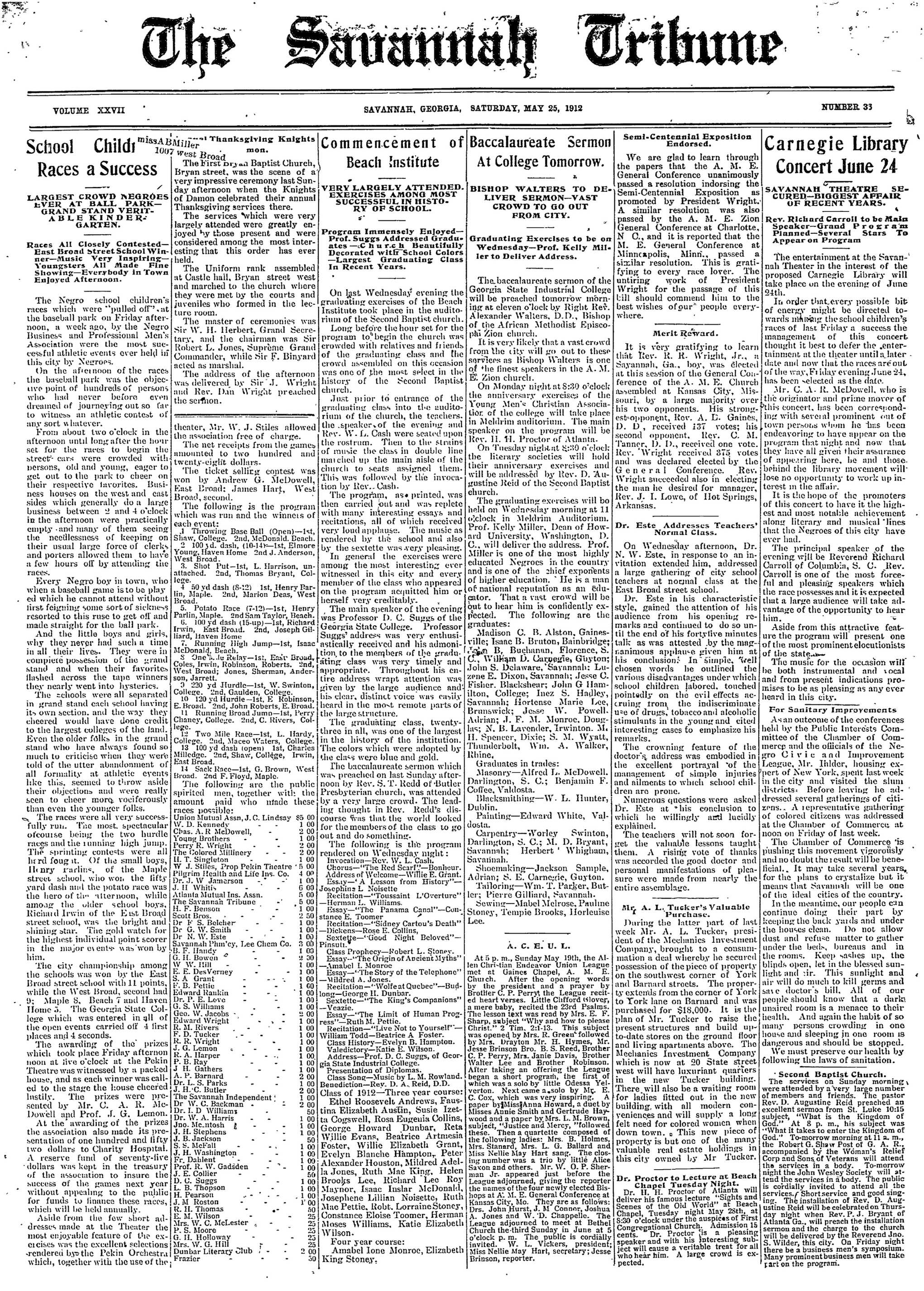
Page text (machine-generated)
missABMiller mon. 1007 west R
VOLUME XXVII
LARGEST CROWD NEGROES EVER AT BALL PARK—GRAND STAND VERITABLE KINDER-GARTEN.
Races All Closely Contested—East Broad Street School Winner—Music Very Inspiring—Youngsters All Made Fine Showing—Everybody in Town Enjoyed Afternoon.
The Negro school children's races which were "pulled off", at the baseball park on Friday afternoon, a week ago, by the Negro Business and Professional Men's Association were the most successful athletic events ever held in this city by Negroes.
On the afternoon of the races the baseball park was the objective point of hundreds of persons who had never before even dreamed of journeying out so far to witness an athletic contest of any sort whatever.
From about two o'clock in the afternoon until long after the hour set for the races to begin the street-cars were crowded with persons, old and young, eager to get out to the park to cheer on their respective favorites. Business houses on the west and east sides which generally do a large business between 2 and 4 o'clock in the afternoon were practically empty and many of them seeing the needlessness of keeping on their usual large force of clerks, and porters allowed them to have a few hours off by attending the races.
Every Negro boy in town, who when a baseball game is to be play ed which he cannot attend without first feigning some sort of sickness resorted to this ruse to get off and made straight for the ball park. And the little boys and girls, why they never had such a time in all their lives. They were in complete possession of the grand stand and when their favorites flashed across the tape winners they nearly went into hysterics.
The schools were all separated in grand stand each school having its own section, and the way they cheered would have done credit to the largest colleges of the land. Even the older folks in the grand stand who have always found so much to criticise when they were told of the utter abandonment of all formality at athletic events like this, seemed to throw aside their objections and were really seen to cheer more vociferously than even the younger folks.
The races were all very successfully run. The most spectacular ofcourse being the two hurdle races and the running high jump. The sprinting contests were all hard fought. Of the small boys, Henry rarlins, of the Maple street school, who won the fifty yard dash and the potato race was the hero of the afternoon, while among the older school boys, Richard Irwin of the East Broad street school, was the bright and shining star. The gold watch for the highest individual point scorer in the major events was won by him.
The city championship among the schools was won by the East Broad street school with 11 points, while the West Broad, second had 9; Maple 8, Beach 7 and Haven Home 5. The Georgia State College which was entered in all of the open events carried off 4 first places and 4 seconds. The awarding of the prizes which took place Friday afternoon noon at live o'clock at the Pekin Theatre was witnessed by a packed house, and as each winner was called to the stage the house cheered lustily. The prizes were presented by Mr. C. A. R. McDowell and Prof. J. G. Lemon.
At the awarding of the prizes the association also made its presentation of one hundred and fifty two dollars to Charity Hospital. A reserve fund of seventy-five dollars was kept in the treasury of the association to insure the success of the games next year without appealing to the public for funds to finance these races, which will be held annually. Aside from the few short addresses made at the Theater the most enjoyable feature of the exercises was the excellent selections rendered by the Pekin Orchestra which, together with the use of the
SAVANNAH, GEORGIA, SATURDAY, MAY 25, 1912
Commencement Beach Institute
VERY LARGELY ATTENDED EXERCISES AMONG MOST SUCCESSFUL IN HISTORY OF SCHOOL.
Program Immensely Enjoyed—Prof. Suggs Addressed Graduates —Church h Beautifully Decorated with School Colors —Largest Graduating Class In Recent Years.
On last Wednesday evening the graduating exercises of the Beach Institute took place in the auditorium of the Second Baptist church. Long before the hour set for the program to begin the church was crowded with relatives and friends of the graduating class and the crowd assembled on this occasion was one of the most select in the history of the Second Baptist church.
Just prior to entrance of the graduating class into the auditorium of the church, the teachers, the speaker, of the evening and Rev. W. L. Cash were seated upon the rostrum. Then to the strains of music the class in double line matched up the main aisle of the church to seats assigned them. This was followed by the invocation by Rev. Cash.
The program, as printed, was then carried out and was replete with many interesting essays and recitations, all of which received very loud applause. The music as rendered by the school and also by the sextette was very pleasing.
In general the exercises were among the most interesting ever witnessed in this city and every member of the class who appeared on the program acquitted him or herself very creditably.
The main speaker of the evening was Professor D. C. Suggs of the Georgia State College. Professor Suggs' address was very enthusiastically received and his admonition to the members of the graduating class was very timely and appropriate. Throughout his entire address wrapt attention was given by the large audience and his clear, distinct voice was easily heard in the most remote parts of the large structure.
The graduating class, twenty three in all, was one of the largest in the history of the institution. The colors which were adopted by the class were blue and gold. The baccalaureate sermon which was preached on last Sunday afternoon by Rev. S. T. Redd of Butler Presbyterian church, was attended by a very large crowd. The leading thought in Rev. Redd's discourse was that the world looked for the members of the class to go out and do something.
The following is the program rendered on Wednesday night:
Invocation—Rcv. W. L. Cash.
Chorus—"The Red Scarf"—Bonheur.
Address of Welcome—Willie E. Grant.
Essay—"A Lesson from History"—Josephine L Noisette
Recitation—"Toussaint L'Overture"—Herman L. Williams.
Essay—"The Panama Canal"—Constance E. Toomer
Recitation—"Sidney Cartou's Death"—Dickens—Rose E. Collins.
Sexette—"Good Night Beloved"—Pinsuit.
Class Prophecy—Robert L. Stoney.
Essay—"The Origin of Ancient Myths"—Amabel L. Monroe
Essay—"The Story of the Telephone"—Wildred A. Jones.
Recitation—"Wolffeat Quebec"—Budlong—George H. Dunbar.
Sexette—"The King's Companions"—Voagie
Essay—"The Limit of Human Progress"—Ruth M. Pettie.
Address—Prof. D. C. Suggs, of Georgia State Industrial College.
Presentation of Diplomas.
Class Song—Music by L. M. Rowland.
Benediction—Rey. D. A. Reid, D.D.
Class of 1912—Three year course:
Ethel Roosevelt Andrews, Faustina Elizabeth Austfin, Susie Izetta Cogswell, Rosa Eugeenia Collins, George Howard Dunbar, Reta Willie Evans, Beatrice Artnesia Foster, Willie Elizabeth Grant, Evelyn Blanche Hampton, Peter Alexander Houston, Mildred Adella Jones, Ruth Mae King, Helen Brooks Lee, Richard Lee Roy Maynor, Isaac Inslar McDonald, Josephene Lillian Noisette, Ruth Mae Pettie, Robt, Lorraine Stoney, Constance Eloise Toomer, Herman Moses Williams, Katie Elizabeth Wilson.
Four year course:
Amabel Ione Monroe, Elizabeth King Stoney.
Tribune
Baccalaureate Sermon At College Tomorrow.
BISHOP WALTERS TO DELIVER SERMON-VAST CROWD TO GO OUT FROM CITY.
Graduating Exercises to be on Wednesday-Prof. Kelly Miller to Deliver Address.
---
The baccalaureate sermon of the Georgia State Industrial College will be preached tomorrow morning at eleven o'clock by Right Rev. Alexander Walters, D.D., Bishop of the African Methodist Episcopal Zion church. It is very likely that a vast crowd from the city will go out to these services as Bishop Walters is one of the finest speakers in the A. M. E. Zion church. On Monday night at 8:30 o'clock the anniversary exercises of the Young Men's Christian Association of the college will take place in Meldrim auditorium. The main speaker on the program will be Rev. H. H. Proctor of Atlanta.
On Tuesday night at 8:30 o'clock the literary societies will hold their anniversary exercises and will be addressed by Rev. D. Augustine Reid of the Second Baptist church.
The graduating exercises will be held on Wednesday morning at 11 o'clock in Meldrim Auditorium. Prof. Kelly Miller, Dean of Howard University, Washington, D.C., will deliver the address. Prof. Miller is one of the most highly educated Negroes in the country and is one of the chief exponents of higher education. He is a man of national reputation as an educator. That a vast crowd will be out to hear him is confidently expected. The following are the graduates:
Madison C. B. Alston, Gainesville; Isaac B. Bruton, Bainbridge; John B. Buchanan, Florence, S. C.; William D. Carpegie, Guyton; John S. Delaware, Sayannah; Luzene E. Dixon, Savannah; Jesse C. Fisher. Blackshear; John G Hamilton, College; Inez S. Hadley, Savannah; Hortense Marie Lee, Brunswick; Jesse W. Powell. Adrian; J. F. M. Monroe, Douglas; N. B. Lavender, Irwinton. M. H. Spencer, Dixie; S. M. Wyatt, Thunderbolt, Wm. A. Walker, Rhine. Graduates in trades: Masonry—Alfred L. McDowell. Darlington, S. C.; Benjamin F. Coffee, Valdosta.
Blacksmithing—W. L. Hunter, Dublin.
Painting—Edward White, Valdosta.
Carpentry—Worley Swinton,
Darlington, S. C.; M. D. Bryant,
Savannah; Herbert ' Whigham,
Savannah.
Shoemaking—Jackson Sample, Adrian; S. E. Carnegie, Guyton. Tailoring—Wm. T. Parker, Butler; Pierre Gilliard, Savannah. Sewing—Mabel Melrose, Pauline Stoney, Temple Brooks, Horleuise Lee.
A. C. E. U. L.
At 5 p. m., Sunday May 19th, the Allen Chri-tian Endeavor Union League meet at Gaines Chapel, A. M. E. Church. After the opening words by the president and a prayer by Broftier C. P. Perry, the League recited heart verses. Little Clifford (lover), a mere baby, recited the 23rd Psalms. The lesson text was read by Mrs. E. F. Sharp, subject "Why and how to please Christ." 2 Tim. 2:13. This subject was opened by Mrs. R. Green followed by Mrs. Drayton Mr. H. Hymes, Mr. Jesse Brinson Bro. B. S. Reed, Brother C. P. Perry, Mrs. Janie Davis, Brother Walter Lee and Brother Robinson. After taking an offering the League began a short program, the first of which was a solo by little Odessa Velerton. Next came a solo by Mr. E. C. Cox, which was very inspiring. A paper by Miss Anna Howard, a duet by Misses Anna Smith and Gertrude Haywood and a paper by Mrs. L. M. Brown, subject, "Justice and Mercy," followed these. Then a quartette composed of the following ladies: Mrs. B. Holmes, Mrs. Stanard, Mrs. L. G. Ballard and Miss Nellie May Hart sang. The closing number was a trio by little Alice Saxon and others. Mr. W. O. P. Sherman Jr. appeared just before the League adjourned, giving the reporter the names of the four newly elected Bishops at A. M. E. General Conference at Kansas City, Mo. They are as follows: Drs. John Hurst, J. M Connor, Joshua A. Jones and W. D. Chappelle. The League adjourned to meet at Bethel Church the third Sunday in June at 5 o'clock p. m. The public is cordially invited. W. L. Vickers, president; Miss Nellie May Hart, secretary; Jesse Brinson, reporter.
Semi-Centennial Exposition Endorsed.
We are glad to learn through the papers that the A. M. E. General Conference unanimously passed a resolution indorsing the Semi-Centennial Exposition as promoted by President Wright. A similar resolution was also passed by the A. M. E. Zion General Conference at Charlotte, N C., and it is reported that the M. E. General Conference at Minneapolis, Minn., passed a similar resolution. This is gratifying to every race lover. The untiring work of President Wright for the passage of this bill should commend him to the best wishes of our people everywhere.
Merit Reward.
It is very gratifying to learn that Rev. R. R. Wright, Jr., a Sayannah, Ga., boy, was elected at this session of the General Conference of the A. M. E. Church assembled at Kansas City, Missouri, by a large majority over his two opponents. His strongest opponent, Rev. A. L. Gaines, D. D., received 137 votes; his second opponent, Rev. C. M. Tanner, D. D., received one vote. Rev. Wright received 375 votes and was declared elected by the General Conference. Rev. Wright succeeded also in electing the man he desired for manager, Rev. J. I. Lowe, of Hot Springs, Arkansas.
Dr. Este Addresses Teachers' Normal Class.
On Wednesday afternoon, Dr. N.W. Este, in response to an invitation extended him, addressed a large gathering of city school teachers at normal class at the East Broad street school.
Dr. Este in his characteristic style, gained the attention of his audience from his opening remarks and continued to do so until the end of his forty-five minutes talk as was attested by the magnanimous applause given him at his conclusion. In simple, well chosen words he outlined the various disadvantages under which school children labored, touched pointedly on the evil effects accruing from the indiscriminate use of drugs, tobacco and alcoholic stimulants in the young and cited interesting cases to emphasize his remarks.
The crowning feature of the doctor's address was embodied in the excellent portrayal of the management of simple injuries and ailments to which school children are prone. Numerous questions were asked Dr. Este at his conclusion to which he willingly and lucidly explained. The teachers will not soon forget the valuable lessons taught them. A rising vote of thanks was accorded the good doctor and personal manifestations of pleasure were made from nearly the entire assemblage.
Mr. A. L. Tucker's Valuable Purchase.
During the latter part of last week Mr. A. L. Tucker, president of the Mechanics Investment Company, brought to a consumption a deal whereby he secured possession of the piece of property on the southwest corner of York and Barnard streets. The property extends from the corner of York to York lane on Barnard and was purchased for $18,000. It is the plan of Mr. Tucker to raise the present structures and build up-to-date stores on the ground floor and living apartments above. The Mechanics Investment Company which is now at 20 State street west will have luxuriant quarters in the new Tucker building. There will also be a waiting room for ladies fitted out in the new building, with all modern conveniences and will supply a long felt need for colored women when down town. This new piece of property is but one of the many valuable real estate holdings in this city owned by Mr. Tucker.
Chapel Tuesday Night. Dr. H. H. Proctor of Atlanta will deliver his famous lecture "Sights and Scenes of the Old World" at Beach Chapel, Tuesday night May 28th, at 8:30 o'clock under the auspices of First Congregational Church. Admission 15 cents. Dr. Proctor is a pleasing speaker and with his interesting subject will cause a veritable treat for all who hear him. A large crowd is expected.
Carnegie Library Concert June 24
Carnegie Library Concert June 24
SAVANNAH THEATRE SECURED-BIGGEST AFFAIR OF RECENT YEARS.
Rev. Richard Carroll to be Main Speaker-Grand Program Planned-Several Stars To Appear on Program
The entertainment at the Savannah Theater in the interest of the proposed Carnegie Library will take place on the evening of June 24th.
In order that every possible bit of energy might be directed towards making the school children's races of last Friday a success the management of this concert thought it best to defer the entertainment at the theater until a later date and now that the races are out of the way, Friday evening June 24, has been selected as the date.
Mr. C. A. R. McDowell, who is the originator and prime mover of this concert, has been corresponding with several prominent out of town persons whom he has been endeavoring to have appear on the program that night and now that they have all given their assurance of appearing here, he and those behind the library movement will lose no opportunity to work up interest in the affair.
It is the hope of the promoters of this concert to have it the highest and most notable achievement along literary and musical lines that the Negroes of this city have ever had.
The principal speaker of the evening will be Reverend Richard Carroll of Columbia, S. C. Rev. Carroll is one of the most forceful and pleasing speakers which the race possesses and it is expected that a large audience will take advantage of the opportunity to hear him. Aside from this attractive feature the program will present one of the most prominent elocutionists of the state. The music for the occasion will be both instrumental and vocal and from present indications promises to be as pleasing as any ever heard in this city.
For Sanitary Improvements
As an outcome of the conferences held by the Public Interests Committee of the Chamber of Commerce and the officials of the Negro Civic and Improvement League, Mr. Inlder, housing expert of New York, spent last week in the city and visited the slum districts: Before leaving he addressed several gatherings of citizens. A representative gathering of colored citizens was addressed at the Chamber of Commerce, at noon on Friday of last week.
The Chamber of Commerce is pushing this movement vigorously and no doubt the result will be beneficial. It may take several years, for the plans to crystalize but it means that Savannah will be one of the ideal cities of the country.
In the meantime, our people can continue doing their part by keeping the back yards and under the houses clean. Do not allow dust and refuse matter to gather under the beds, bureau and in the rooms. Keep sashes up, the blinds open, let in the blessed sunlight and air. This sunlight and air will do much to kill germs and save doctor's bill. All of our people should know that a dark unaired room is a menace to their health. And again the habit of so many persons crowding in one house and sleeping in one room is dangerous and should be stopped. We must preserve our health by following the laws of sanitation.
Second Baptist Church.
The services on Sunday morning were attended by a very large number of members and friends. The pastor Rev. D. Augustine Reid preached an excellent sermon from St. Luke 10:15 subject, "What is the Kingdom of God." At 8 p. m., his subject was "What it takes to enter the Kingdom of God." To-morrow morning at 11 a. m., the Robert G. Shaw Post of G. A. R. accompanied by the Woman's Relief Corp and Sons of Veterans will attend the services in a body. To-morrow night the John Wesley Society will attend the services in a body. The public is cordially invited to attend all the services. Short service and good singing. The installation of Rev. D. Augustine Reid will be celebrated on Thursday night when Rev. P. J. Bryant of Atlanta Ga., will preach the installation sermon and the charge to the church will be delivered by the Reverend Jno. S. Wilder, this city. On Friday night there be a business men's symposium. Many prominent business men will take part on the program.
The Sunday School Lesson
Sunday School Lesson for May 26,
1912.
TRUTHFULNESS.
Golden Text—Putting away false-
hood, speak ye truth each man with
his neighbor; for we are members one
of another. Eph. 4:25.
Lesson Text—Matt. 5.33-37; James
3:1-12; 5:12. Commit vs. 34-36.
Time—Midsummer A. D 28, and A.
D. 60. Place—Horns of Hattin and
Jerusalem.
Exposition—l. The Law of the Kingdom of Heaven Regarding Veracity, 32-37. Jesus did not besithe to set his own teaching in its completeness in contrast to the incomplete teaching of Moses. All the Mosaic law required was that one should perform into the law as oaths. Not to do so was profanity. But the law of the kingdom goes way beyond this—oaths should not be made at all. There should be that absolute and simple veracity in all speech that makes all oaths unnecessary and profane. Jerusalem is the city of the great King, the coming King Jesus. Anything more than simple direct declaration of the truth comes from the evil one.
H. "Be not many teachers," 1-5. James does not say that no Christian shall be a teacher, but that the body of believers should not be a multitude of teachers, every one desiring to teach others and none willing to learn from others. Every man should be swift to hear, slow to speak (ch. 1:19). The position of the teacher is one no man has a right to take upon himself (1 Cor 12:28; Eph. 4-11; 1 Cor. 12:8-11). The true church of Christ will be a multitude of learners (disciples) rather than a multitude of teachers. James, according to tradition, was a man who spent so much time in prayer that his knees were found to be calloused like those of a camel through his much kneeling, yet this holy man puts himself right alongside of us and says, "In many things we all stumble" (v 2 R. V). Note the "In many things." This, however, is not saying that it is necessary for us to go on day after day sinning in the sense of consciously doing that which we know when doing to be contrary to the will of God (1 John 3:9). The tongue is the hardest member of the body to bring under control, and the last to yield to the constraining grace of God. How many saintly people there are who have not yet learned the complete mastery of the tongue. As a big horse is managed by a small bit and a big vessel is managed by a small
POETRY of and by Our People
Oh, the grim in here and the great out there!
The voices calling from everywhere
While the grim in here frowns hard and stern.
The wheels go round and the tollers yearn.
And eyes look out through the window-space
And feet go flying in fancy's race
Over the hills and far away
To the great out there with the heart at play!
Oh, the great out there and the grim in here-
The sunlight yonder and here the tear.
The spring out there with its lips that call
Through the door and window and office wall;
From bill and valley and stream and pond
This city's steaming and freeting, on
From dusk to dusk and down to dawn!
Oh, the grim in here and the great out
there—
The longing heart to be free from care,
The splendid morning, so fresh and new,
And here by the window a high-wall clew
Of teemed reillys and drays and cart,
The tolling throng and the breaking
heart,
The fret and rumble and ring and rear—
The grim in here and the great outdoor!
Oh the great out there and the grim in
here—
The great and over from year to year,
When freedom out younder on hill and sky
Is flaming her signals that all may spy
How life grows happy when grief grows
less,
How God's green world is a world to
bless,
Not harry his mortals who mild their
steam
Still sit in their longing to toll and dream!
-Ballimore Sun.
ONE MORNING.
One morning, oh, so early,
My beloved, my beloved,
All the birds were singing blithely,
As if never they would cease.
"Twas the thrush sang in the garden,
Mist me the morning dory,
And the laik sang, 'give us glory',
And the dove sang 'give us peace.'"
Then I listened, oh, so early,
My beloved, my beloved,
"To the murmur of the woodland,
Of the dove, of the dove,
When the nightingale came after,
'Give us fame to sweeten duty,'"
"When the wren sang 'give us beauty,'"
"She made answer, 'give us love.'"
Fair is April, fair the morning,
My beloved, my beloved,
Now for us doth spring's bright morning
Walt upon the year's increase,
Let my voice be heard that asketh
rudder, so a big man is managed by a small tongue.
III. The tongue is a fire, a world of* iniquity. 6-12. The tongue is indeed a fire; it inflames anger, and families and societies and nations are set in a conflagration in consequence of an untimely word (Prov. 15:1; judges 12:1-6; Sam. 19:43; 20:2; 2 Chron. 10:12-16 cf. 13:17); it inflames lust and withers the purity of the maiden and consumes the strong man physically, mentally and morally (Prov. 7:21-23); it inflames jealousy and destroys the beautiful tie that binds together man and wife and leaves the home in ruins; it kindles unbelief (Tit. 1:11; Gen. 3:1-6), and thus burns away the foundations of individual character, of of commercial integrity, of social purity, or national security. It is a "world of iniquity among our members." There is nothing mischievous and vile that the tongue cannot do. A little fire will kindle a vast amount of wood, a flickering blaze, in a broken lamp set all Chicago in a blaze and left it in ruins; a little word has set many a home, city and nation ablaze, and oftentimes that fire will burn on throughout eternity. The fires of hell are kindled by the idle words that set men thinking wrong about God and sin and Christ and the Bible. The destructive critics today by their professedly scholarly but really perverse and subversive words, are kindling fires of unbelief and sin. Men are usually careful how they handle fire but most of us are careless about how we use our tongues. The tongue itself "is set on fire by hell" Whence come the words that the imagination and passions, from French literature? No, Hell. Whence come the words that are undermining faith in the credibility of the Bible narratives to those who do not think for themselves but bow at the shrine of culture? From German scholarship? No, Hell. If any one questions James' statement that "the tongue can no man tame," he has evidently never tried it himself. But while no man can tame the tongue, God can. The best thing any one of us can do with his tongue is to bring it to God and surrender its control to him. How James heaps up illustrations to show the mischief working power of the tongue! (v. 8 R. V.) Has not a sharp tongue poisoned the life of many a husband, wife or child? Has not an obscene tongue poisoned the imagination of many a boy and man? Has not the infidel tongue poisoned the waters of life? "It defileth the whole body." An evil tongue has proved the physical, moral, spiritual and eternal death of more people than all the arsenic and strychnine ever administered. Are you a poisoner?
Leading Questions—What does this lesson teach as to the right use of the tongue? The wrong use of the tongue? The power of the tongue? The management of the tongue? What is the central truth of the whole passage?
Not for fame and not for glory.
Give for all our life's dear story.
Give us love, and give us peace.
—Jean Inglelow.
IF NO ONE EVER MARRIES ME.
If no one ever marries me,
I shan't mind very much;
I shall buy a squirrel in a cage,
And a little rabbit hutch.
AS A WOMAN THROWS.
Joseph H Chate, at the Three Arts club benefit at the Republic theater, in New York, told after his witty speech, a story about a pair of sweet-hearts.
"Two young girls," he said, "were drinking tea at Sherry's when a young man passed. As he passed the first girl blushed, displayed a beautiful ring on her white hand and murmured:
"Well, Jack and I are to be married Easter week."
"But," said the other girl, "I thought you had thrown Jack over!
"Oh, so I did," the first girl replied; "but—but you know how a girl throws!"—Washington Star.
SIR HENRY'S ADVICE
A belated story of Sir Henry Irving comes from a former member of his company. Sir Henry received a number of notes which grew into letters of length when his secretary continued to ignore them. Finally one reached "the governor," who scanned it carefully and found that the writer complained that he was Sir Henry's double and was continually being mistaken for him. This evidently so annoyed the gentleman that he insisted on knowing what the famous actor intended to do about it.
Sir Henry sent an envelope containing a shilling, and the terse advice, "Get your hair cut."—New York Tribune.
NOT SKILLFUL AT IT.
"No, indeed," Miss Gabbaway declared. "I'm not accustomed to fish for compliments."
"I can see that," replied Miss Cutting. "Any one who is accustomed to fishing realizes that one isn't likely to get anything if one talks too much."—Catholic Standard and Times.
INSECT GARDEN PESTS.
Some of the insects that visit our gardens every year to sample our good vegetables have an interesting life history. A full description of only a part of them would fill a printed volume. Every insect, you know, has four stages of existence—egg, larva, pupa and adult. So different as a rule are these stages that if we were to find one in the dormant or pupal stage, we should not identify it as the same creature that is so active and destructive in the larval stage, eating the leaves from our choice fruits and vegetables.
When the ground is plowed or spaded for planting in the spring or early summier, watch for signs of minute animal life in the rich soil as it is turned up. Every spadeful is apt to contain something. They are usually dark brown, the color of good garden soil, and their coloring is their protection. If they were some other color than the soil they could be more easily seen by birds, and hence would readily be picked up and eaten. Because they are colored like the soil is why we see so few of them.
Quite a number of our garden insects pass the winter down in the garden soil in the pupa or chrysalis stage. One of the largest and most striking examples is that of the tomato worm chrysalis. The big green worm, or rather caterpillar, that eats the tomato leaves in summer crawls down from the vines when he is through eating and growing, burrows a hole in the soil and there changes to a smooth, hard, joined chrysalis, a glistening, dark brown in color. This chrysalis can be recognized by a long, round organ at the head end that curves like the handle of a jug, the tip touching nearly the center of the body on the lower or abdominal side. If it is alive and left undisturbed in the soil, it will gradually work its way to the surface later in the summer, break open its brown shell and emerge as a full-grown enhinx moth to lav more eggs to hatch more tomato worms. The long, handle-like organ seen in the chrysalis becomes the curled-up proboscis which the sphinx moth unrolls in visiting flowers in the evening for suckling nectar from the deep corollas. The large slate-colored moths, which we see flying about in the evening, visiting our white flowers, are the same ones which lay the egg to hatch out into the big, ugly green tomato worms. They are interesting and perhaps useful in one stage, but destructive in another.
In spading or plowing the garden in spring, it is well to allow the chickens to follow the work to pick up dormant insects that have passed the winter in the soil. Birds have keener sight than we have, and they can see many of these which we can not. In two or three days during the early gardening season when the plowed-up soil is dry, a flock of chickens allowed to run in the garden will scratch out and devour thousands of these obnoxious insects that would damage the growing crops later in the season.
Some of the garden insect pests pass the winter in the egg, larval, pupal or adult stage in old vines and rubbish in the garden; hence in burning garden rubbish in the spring many of these bad insects will be killed.
With the best of care in cleaning the garden for spring work, not all of the active and dormant insects will be killed. A few surviving adults will lay hundreds of eggs for summer hatching. Begin to look for the first of them when real warm weather comes along the last of May or the first weeks in June. Kill in some way the first broods that appear. Liquid sprays are good for some, while powders work better on others. It is a good plan to have insect poisons on hand ahead of the insect season, so that prompt action can be taken in destroying the first that come. A small spraying outfit, costing only a few dollars, can be carried anywhere in the garden and effective work done with it. A hand sprayer, costing less than a dollar, will be sufficient for a small garden.
IMPROVE YOUR OWN CORN.
This business of improving the corn yield is a movement in which every farmer should bear an active part, especially when the improvement of the seed is considered.
In the fall the farmer may select out of his seed corn twenty-five of the best ears and hang them in a dry place all winter. In the spring a piece of ground considerably removed from other corn fields should be selected. This should be of the best kind of soil and the tract should be large enough for fifty rows three and one-half feet apart, twenty-five hills long. Work the ground into good shape. Number the rows from one to twenty-five. In the two rows numbered one plant the corn from one ear, and the two rows numbered two plant the corn from the second ear, etc. Save the remnant seed, putting it into bags numbered in accordance with the ears from which it came. When the crop has matured count and weigh each row separately. In this way the ten best yielding rows may be determined. The next year plant the remnant seed from the bags corresponding in number with the best rows. In the fall select the best ears from this lot and use for planting in the general field. This practical system amounts to nothing else than an extensive experiment in seed teating, and should result in great improvement in yield within three or four years. By this system the farmer cannot only determine which are the best kinds of corn, but also which kinds are especially adapted to his own land.
CULTIVATE RHUBARB.
Rhubarb which was set out last spring should be cultivated well during the summer. Apply well-rotted manure along the row and around the hills, working in the manure by cultivating and hoeing. Frequent stirring of the soil during the summer will stimulate the growth of the rhubarb plants through keeping down the weeds and preserving a surface mulch for holding moisture. Rhubarb plants are gross feeders, requiring abundance of moisture and plant foods. The soil in which the plants grow can not well be made too rich with decomposed manure. At the end of summer when the ground is clean and well worked about the plants, it is a good plan to mulch with old straw or manure, or both, as these will hold soil moisture during the dry weeks of late summer and early fall. This mulch can be left on the ground during the fall and winter, to be worked into the soil about the plants the following spring.
Last year we set out a dozen hills of rhubarb in our new garden, giving them the above cultivation and care during the summer. By August the young plants had made such large growth that we began to cut and use them for pies and sauce, being careful not to cut too many stalks from one hill. The main reason that we cut and used the rhubarb at that time of the year was that fruit of all kinds was scarce, and new rhubarb was a welcome substitute, all of us enjoying it as much as we do the usual fruits of the season.
When rubarbus is planted in the spring it is not the best plan-to cut and use it during the summer, since the removal of stalks and leaves will prevent the growth of strong roots. However, hills which have grown large by late summer may have a few stalks removed without serious injury, as by that time root growth for the season will have been completed.
MELLOWNESS OF VIRGIN SOILS
The really productive soils are those possessing the mellowness found in our virgin soils, and they possess it because proper methods are employed in their tillage. These include a proper rotation of crops, the incorporation of an abundance of organic matter in the soil, and the wise use of tools.
Nature, left to herself, provides a crop, and usually a rotation, for the soil, in which (1) the soil is filled with roots—often perennial roots, which, with frost and action, develop the crumbled and mellow or starched structure; (2) the bulk of the growth is returned to build up and enrich the soil. Bees may remove the nectares, birds may remove the seeds and grazing animals may crop off the grasses, but after all the roughage with most of the fertilizing material is returned to the soil. The wise farmer profits by the object lesson.
Nature, however, has need of no other tools than the roots and the frosts and the multitude of animal forms which burrow in the soil—earthworms, ants, etc. The farmer must use the plow, harrow, roller and other tools. With the proper moisture conditions, these tools may be made to help develop the mellow condition sought. Every farmer should learn to recognize this proper moisture condition and to appreciate its importance. If the soil be too wet the use of these tools may prove injurious rather than helpful. If a cultivated soil be allowed to become overdry, the drying often produces a degree of compacting that the use of these tools can not overcome.
VALUE OF MANURE FROM DAIRY COW.
Figures from experiments by Illinois experiment station are: The manure is figured at 11 tons per head for cows producing 8,000 pounds of milk. On the twenty-acre dairy farm at the university last year cows which were kept in the barn during the winter and in a dry lot during the summer produced 13 tons of manure per cow. The average value is considered at $1.50 per ton. At the Illinois agricultural experiment station on a three-year rotation of corn, oats and clover, manure has increased the crop yield $1.60 for each ton of manure used, figuring the market value of the crops for the first three years after it is applied. $^2$ No consideration is taken of the increased production from the effects of the manure after the first three years. At the Ohio experiment station the value of the crop yields has been increased $2.24$ for each ton of manure used. From the figures above stated, $1.50 a ton$ is a conservative value on cow manure which has been well cared for. Cows which produce less than 8,000 pounds of milk will produce, on the average less than 11 tons of malnure. Cows producing more than 8,000 pounds of milk will not only produce more manure, but it will be of a better quality, owing to the fact that they are fed more concentrates. For these reasons the value of the manure is lowered 50 cents per cow for every 1,000 pounds decrease in production of milk below 8,000 pounds, and raised 50 cents per 1,000 pounds increase in production above 8,000—Kansas Farmer.
JOURNALISTIC HUMOR.
The reporter who attended an inquest at which a verdict of "Death from recent hemorrhage" was recorded, concluded his report by stating that the jury returned a verdict of "Death from her recent marriage."—Jokes in Journalism.
URGES "MEMORIAL HOME"
FOR CARE OF EX-SLAVES
W. W. WATSON OF BISHOPVILLE
IN LETTER TO COLUMBIA (S.
G.) STATE SUGGESTS REFUGE
FOR THOSE WORN OUT IN
SERVICE AND PLEDGES $100
TOWARD A $100,000 INSTITU
TION FOR THEIR CARE AND
COMFORT.
To the Editor of The State:
We have read with a great deal of interest the timely article In The State of our good negro friend, the Rev. Richard Carroll, suggesting a monument to the faithful slaves who protected the properties of their masters far away in the war between the sections, guarding the homes, the lives and the safety of the master's wives, their daughters and their little helpless children. Too much praise can not be given the faithfulness of these humble people to recognized duty. But while we approve of the worthy spirit which prompted Carrol ito direct the attention of our people to the apparently neglected privilege or duty of proper acknowledgment of the great debt we as a southern people owe the one-time guardians of our homes, still we can not agree with his suggestion that the erection of a cold marble or granite monument the most fitting are the most humane method of expressing our lasting obligations.
Our suggestion as a substitute is that a refuge or home be speedily provided for the indigent, the poor, old, worn-out slaves, and that it be located centrally, in or near the city of Columbia, supported by endowment created by grateful warriors, their wives, daughters and the sons of veterans. That these worthy old subjects, both male and female, "uncle" and "auntie," be sought out throughout the confines of our borders and that they be impelled to permit themselves to be administered to in their old age and infirmities. We suggest that such an institution be governed by a board of directors or trustees competent and in sympathy with the plan, and that a worthy matron and superintendent be elected to have charge of the home, and that they be properly assisted by trained nurses and other help not provided by the beneficiaries of the home. What more, fitting memorial could we sons and daughters erect to the memory of our distinguished ancestors than by bestowing blessings upon our "brother in black?" I consider it one of the greatest privileges of my life to contribute $100 as a nucleus for a $100,000 hospital or home for the aged, the decrepit, the infirm, the indigent, who gave their youth freely in our service.
SOME REASONS.
Let me enumerate a few reasons why a "memorial home should be founded for the slaves of our ancestors: Are there any more truthful stories related by the historian or the warrior in his reminiscences than the oftimes heroism of faithfulness displayed and devotion to his master by his slave valet, who bravely, or from fear and sense of duty, worked within range of bullets, watching his master's movements, often carrying him wounded from the battlefield, administering to his needs until the arrival of the surgeon, and then tenderly nursing him back to convalescence? Few races have ever been placed in the position of having to produce substance of warfare, protection for the homes, bodyguards for their masters, while their owners were on the battlefield, in effect fighting for their continued bondage. Would many people of other bloods have stood his crowning test of faithfulness? The history of the southerner, the slave-owner, though fighting for his rights of accession, nevertheless, meant continued bondage, continued servitude, continued legal subordination. Their faithfulness, though counter to their apparent interests, will ever remain to true southerners one of the bright recollections of that period of awful struggle. All honor then to "Uncle Jerry," "Aunt Mandy," "Mum Nana," "Uncle Alex," "Aunt Hannah," "Mum Martha," "Mum Julia," and thousands of others, black his true, but no disgrace; thank God, for their humble and devoted service, faithful and constant, will ever abide in the hearts of the best southern people. Yet our gratitude has until yet not assumed form, although we have had nearly half a century to wake up to our obligations and responsibilities. A few more years and the opportunity will be forever buried. What is to be done must be done quickly. The angel voices are tenderly and softly calling "Old Black Joe" to join "the realm above." Will you, comrade, sons and daughters of the bravest people on earth, help to make "Uncle Joe's" last days more comfortable; will you see that he does not want for bread or suffer for clothing, or endure pain for the lack of medical attention?
I pause to thank God for his messenger, the Rev. Richard Carroll, a worthy son of his race, who has inspired the expression of gratitude in our hearts for his neglected ancestors, our former slaves. The contemplation of the good relief that may yet be done is quickening to the point of action.
NEEDS OF OLD NEGROES.
We read in the secular and religious press of the appalling distress and suffering in the far east of perishing Chinamen, dying by hundreds and thousands;*hundreds of our own countrymen fleeing for their lives often caught by the mercleass mad rush of the "Father of Waters," yet let us not be blinded to the reality that often right at our-back doors the ex slave, the "old-time darker," is perishing or
suffering unnoticed in some obscure alley, dilapidated hut, forgotten, neglected, a burden to his own people, living by the alms of the few, yet faithful in memory and delighting in the reminiscences of the past, never forgetting, to be polite and respectful, especially to his former "Mars Henry," "Miss Sally," "Young Miss" and "Young Boss."
"Is Uncle Remus' a true story, pana?" your little boy has perhaps already asked you, dear reader. Tell him yes, thank God, it is a true, true story, for Joel Chandler Harris, that Jovial, big-hearted and warm-hearted southerner, in that true-to-life character pictured the faithfulness, the sincerity, the trustworthiness of that class of people whom I, among many, love, to honor and respect and hold in loving remembrance.
Yes, friends of the feeble, God did not exclude the old-time ngro when he enjoined upon all Chirstians to visit the sick, the sorrowing, the infirm and the afflicted. Charity truly begins at home, yet should extend from pole to pole, from shore to shore, boundless as ends of the earth, blessing him who received, and great blessings to him who gives.
The Rev. Richard Carroll has touched a tender chord in the hearts of every true southerner, he be heir, son or grandson, daughter or granddaughter of the one-time negro slave owner. May you, Richard Carroll, live to hear the full notes and joyous music over good deeds accomplished.
The religion of Christ has less sentiment about the past and more activity for the present; fewer flowers for the dead, more food, more clothing, more necessities for the living. Don't wait till a man is dead to herald his virtues. Jesus came not to minister to the dead, but to the living. "Let the dead past bury its dead." The Christ religion is practical if anything. Is it fitting, is it merciful, is it true benevolence to erect a cold marble shaft or to build and fit a memorial home for the helpless? Monuments are good, monuments are fitting, but supplying the needs of the living is more appropriate and more imperative.
What more pitiful sight in the world is there to behold than an old, worn-out, decrepit, ragged, feeble "uncle" or "auntie" unable to work, too proud to beg. We have sometimes wondered why a merciful God leaves them so long in misery and neglect—but we have it now—"man's extremity is God's opportunity." These are missions of mercy—opportunities priceless for cultivation of acts of benevolence and mercy from among the more fortunate. Shall we "pass on the other side" or take the part of the good Samaritan?
URGES QUICK ACTION.
Let these be suggestions to be acted upon quickly, by the Daughters of the King, Sons of Veterans, Daughters of the Confederacy, Widows of the War and all other Christians who want to help a needy and most appreciative class of fellow creatures.
Some heartless and depraved human beings who call themselves men are credited with the belief that the negro has no soul. I'd a thousand times rather take the chances of many a good old "black mammy" than any such white man, and I positively assert that if there are no such "black mammys" in heaven then I for one, don't want to go there.
In the thrilling accounts of the great deeds, heroic endurance, the matchless bravery of an unconquered people, where is the poet or the painter or the historian who has suitably portrayed the herosam and the faithfulness of the old ex-slaves of the south?
Within the next 90 days the writer of this appeal will be installed in Columbia as cashier of the new People's bank of Columbia and will be delighted to co-operate with the white and colored people through the state to formulate plans to raise funds to build a home memorial in or near the capital city to suitably provide for the "old black mammys" and "daddys," the ex-slaves of the south, and to south end I hereby subscribe and donate the nucleus of $100.
WHITFIELD W. WATSON.
Bishopville, S. C.
HER MEASURE.
The young man was trying to select a jeweled belt for the young lady to whom he was engaged.
"What size do you wish?" asked the salesgirl.
The prospective bridegroom blushed and stammered: "Really, I don't know." Then a thought struck him. "Lend me your tape measure," he said.
The measure was handed to him and he laid it on the inside of his arm, from shoulder to wrist. "Twenty inches, please," he said, with decision—Spokane Spokesman Review.
HARD ON THE OTHER ONE.
One hot summer day a Kentucky beau stopped at a florists to order a box of flowers sent to his lady love. At the same time he also purchased a design for the funeral of a friend. On the card for the box he wrote:
"Hoping these may help you bear the heat."
The other card bore the one word, "Sympathy."
"Very soon the girl—telophoned: "Thank you so much for the flowers, but why did you write "Sympathy" on the card?"—Louisville Post.
Sillas—How we happen to select III
Higgins ez fire chief?
Hank—Natural qualifications. Why,
he kin break more windows in leas
time than any volunteer in this coun-
try. Chicago News.
COLORED WAITERS PLAN NATIONAL CONFERENCE
Hotel Men from Every Section Will Probably Meet This Summer.
SITUATION IS ALARMING—HEAD OF WAITERS' PROTECTIVE LEAGUE SAYS SIMILAR CONDITIONS EXIST IN MANY OTHER CITIES — WANTS CO-OPERATION.
New York.—Owing to the wholesale discharge of colored waiters and the substitution of white help, a state of affairs that is being viewed with alarm by colored waiters throughout the United States, a national conference of colored waiters will most likely be held some time this summer, when the situation will be discussed minutely and plans adopted to bring about better conditions.
Since, the publication a few weeks ago that the colored hotel men of New York were regarding seriously the situation in New York city in which 300 were put out of the hotels and restaurants of Manhattan in 1911, colored waiters in various sections have been corresponding with each other relative to getting together for the mutual good of all concerned.
The colored hotel men of New York are heartily in favor of the holding of a national conference this summer as are the waiters of Kansas City and other western cities. Referring to present conditions is the following letter from S. C. Jordan, president of the Walters' Protective league in Kansas City, Mo.;
"Having read the article regarding the situation of the hotels in New York city toward the negro waiter, I beg to say that similar conditions are spreading rapidly west, north and south. We are endeavoring to establish a National Negro Head Walters' and Side Walters' congress, and with cooperation of the Hotel Proprietors' association, we hope to establish a standard of service by which we can classify the service, thus making a more harmonious relation between the proprietors and servitors. We would appreciate your encouragement of our movement through your paper and would be glad to establish an agency in New York."
The officers of the Walters' Protective league are: S. C Jordan, president; George W Hall, corresponding secretary; W. I. Garett, treasurer; Edward Hudson, chairman of benefit fund; D. H. Collier, manager; L. A. Knox, attorney at law.
OWN MUCH PROPERTY
NEGROES PAY TAXES ON $34,022,379 WORTH OF REAL ESTATE IN GEORGIA-STATISTICS SHOWING PROPERTY RARE IN THAT STATE.
Atlanta. Ga.—The assessed valuation of property returned for taxation by negroes in Georgia, in 1911, is $34,022,379, as compared to $32,234,037 in 1910. The year's gain was $1,788,342. These figures and many others equally as interesting regarding the property holdings of the state's colored population, are contained in statistics just compiled by Capt. Tip Harrison, in charge of the tax department of the comptroller general's offices.
The 1911 tax digests show that-119,571 negroes paid poll taxes, and that 4,685 defaulted
Included among the property owning negroes are seven lawyers, 16 dentists, and 133 physicians.
The number of dogs returned for taxation by negroes is 54,926. They own 1,639,919 acres of improved land, with an assessment valuation of $10,-358,653. Their city and town property is taxed at $3,615,604; stocks and bonds, $1,700; money and solvent debts, $227,214; merchandise, $240,444; household and kitchen furniture, $3,249,203; watches, silver plate and jewelry, $41,970; horses, mules, hogs, sheep, cattle, etc., $7,931,264; plantations and mechanical tools, $1,648,857; value of all other property, $377,475; value of property of defaulters (single), $319,955.
ROUSELLE NAMED SECRETARY.
Richmond, Va.—Grand Master Floyd Ross has appointed Maurice Roussele of Washington, D. C., permanent grand secretary to fill the vacancy made by the death of J. Frank Douglass. Mr. Roussele, who was in the government service for 23 years and a late member of the board of directors of the order, has already assumed his new duties. He is a graduate of the Thirteenth street school in New York city.
Grand Worthy Master Ross is making an excellent record, having organized 39 fountains since February 5. The order has collected and disbursed over $65,000 in death claims.
NOT THE PROPER WORD.
"Did you send Mr. Dresser the samples he asked for?" inquired the tailor, "Yes," replied the clerk; "I'm just finishing our letter to him. I'm just sending it 'Trusting to have your order'."— "What" Cut out that word 'trusting' and make it 'hoping.'"—Catholic Standard and Times
NOTED SOCIOLOGIST SPEAKS TO LARGE CROWD AND TELLS NEGROES TO PROTECT THEIR GIRLS AND WOMEN—DISCRIMINATING LAWS IN WINDY CITY.
Chicago, Ill.—Dean Sumner, the noted sociologist and chairman of the Vice Commission of Chicago, addressed a mass meeting of negroes held under the auspices of the Western league, organized for the protection of colored women, at the Odd Fellows' hall.
Among other speakers was Mra. Cella Parker Wooley, the staunch friend and social settlement worker among colored people.
Dean Sumner, after an introduction by Father Massey of the St. Thomas Episcopal church, immediately plunged into his subject: "How to save our colored girls." He stated that the subject of vice was not a race question, and he disliked very much to discuss it along those lines, but it is very evident that the moral conditions in Chicago and many others warrant immediate steps to exdicate vice and change the moral situation among the colored people.
He gave in detail facts and figures showing the abunlainable conditions existing in Chicago from segregated vice.
According to police regulations there are districts set apart for the practice of prostitution, and it is generally located in colored neighborhoods. Consequently, those who will not submit to their families being surrounded by such intolerable conditions are forced to move into more desirable neighborhoods; and those who are unable to ayall themselves of this opportunity—which seems to be their only alternative—are compelled to remain with their young girls and children of a tender age, completely immersed in an ocean of vice and corruption in the most degrading sort.
In one segregated vice district there are 1,475 colored children, and besides coming into unavoidable contact with the lowest and most degraded kind of prostitutes, thieves, robbers and murderers, they are permitted to frequent these resorts and run errands for the inmates. Such conditions are outrageous, intolerable and should not be permitted for a moment.
Upon these facts Dean Sumner laid great stress, stating that such conditions would not be tolerated by white people for an Instant. Moreover, there is a law upon the statute books of Illinois, which prohibits white girls or women from working or acting in any capacity as a servant in a house of prostitution; while colored girls and women at any age beyond slateen are permitted with the greatest of freedom to work as servants, he said.
"The Everleigh club alone employs fifty-two colored servants, many of them girls and women. Is this right? Shall this crowning shame of the age be allowed to continue? Go unreubaked, unchecked without a vigorous protest from our leading colored citizens to the public authorities, the mayor, city council and the state legislature? There is no doubt but that such a law in substance is just and equitable. But where is the justice and protection to human morals in such a law as this? It is manifestly unjust, discriminatory, class legislation and therefore unconstitutional. It should be amended or repealed.
"For the leaders of the race to supinely submit to the continuance of such a law, is an obvious resignation of their inherent rights and privileges of citizenship."
TO ORGANIZE LAY MEMBERS.
Wilberforce.—During the session of the A. M. E. general conference, which will be held at Kansas City, President W. S. Scarborough of Wilberforce university will call together all the lay members and form a permanent organization to do the work of the church and discharge the duties of the mission to better advantage.
President Scarborough thinks that there are many perplexing problems aside from electing men to office that both laymen and clergy will have to wrestle with, that to do this work and do it well they shall have to consider long and widely the needs of the connection and the best measures to be adopted whereby the interest of the church may be best conserved.
He says it is the duty of the laymen to express themselves in unmistakable tones in regard to the many measures coming before the general conference, and especially as to the men who will be elevated to the Episcopal bench, as well as to the men who will be chosen to fill other offices.
DIPLOMATIC COMPLIMENTS.
Francis I. Madero, president of Mexico, is a small man and somewhat sensitive on the subject. Not long ago Madero and his cabinet were photographed. Abraham Gonzales, secretary of state, is a very tall man and stout, and he was required to stand next to Madero when the picture was taken. Madero lifted his eyes to the top of the head of the great Gonzales, observed the difference in stature and coughed slightly. Then he said: "I feel that my size will not show to advantage unless we are seated." "Your Excellency," replied Don Abraham, "if you could only stand on your wisdom we should all be dwarfs." "Well said," Madero returned, "provided you did not stand on your courtesy at the same time."—Saturday Evening Post.
MOUND BAYOU IMPROVEMENTS
Negro Town to Issue Municipal Bonds and Provide Better Facilities.
REALTY VALUATION OF TOWN—CITIZENS OWN $300,000 IN REAL ESTATE AND $200,000 IN PERSONAL PROPERTY—MANY BUSINESS INSTITUTIONS.
New York.—Many improvements are soon to be made-in Mound Bayou, Miss, the widely known negro town, according to Isaiah T. Montgomery, Mound Rayou's founder, who is in New York on business. Mr. Montgomery is negotiating to place municipal bonds of the town on the market, which will be done to inaugurate civic improvements, such as sidewalks, light, water and sewerage facilities. Already Mound Bayou has considerable plank walks and an artesian well that flows 15 to 20 gallons a minute of pure, soft water. However, no arrangements have been made to date for piping it.
While In New York Mr. Montgomery is arrangigg to float the $40,000 worth of oil mill bonds, and is further seeking to reach the class of far-sighted philanthropists with a view to showing them the need of the formation of a permanent trust, or foundation fund of several hundred thousand dollars, to be loaned among the negroes at 4 and 4½ per cent, which would encourage the development of small farms and the building of comfortable homes. It is the idea of Mr. Montgomery that a portion of the interest be used for building suitable rural schools, in which the South is quite deficient, particularly as relating to negroes.
The proposed trust or foundation fund may be made up in part of the endowments already set apart for negro institutions. In that case a proper proportion of the interest would be preserved to the purpose prescribed. The primary object of the investment sought is to secure the perpetuation and development of Mound Bayou as a progressive, agricultural, industrial and commercial center and for the promotion of thrift and enterprise that may continually demonstrate the administrative and constructive capacity of the negro, thereby contributing greatly as an encouraging example to the race at large as well as to the lasting and general of the State of Mississippi.
MOUND BAYOU'S HISTORY
Mound Bayou derives its name from two bayous that stretch irregularly like an, enormous Y. the left arm northeast and the right arm northwest. About three miles southeast of the town they join at the foot of an enormous mound relic of the Indian
About 1885 the L. N. O. & T. railroad, owned principally by Messrs. Collins P. Huntington and R. T. Wilson, came into possession of a million acres comprising a large portion of the great Yazoo delta, at that time considered scarcely habitable continuously by the Anglo-Saxon. In 1887 the company sought the attention of Isaiah T. Montgomery, who believed that he saw a golden opportunity for his race and soon concentrated all of his powers to attract the better class of negroes and encourage them to buy homes on the section drained by the two bayous. The country was a trackless wilderness assessed at one to two dollars per acre, and in many cases contracts had to be renewed. Montgomery instituted a rule with the railroad not to wholly cancel a contract as long as a settler could be depended upon, and in case of failure, another man was put in his place.
Very little live stock or building material was available, frontier methods were resorted to, settlers joining to help each other split andhew logs to build their cabins, make slab and puncheon floors, and pile the logs that had to be burned off their small clearings. Meanwhile an existence was eked out by splitting railroad ties and making white oak staves for the European market.
About 1894 a demand arose for town lots. Isalah Montgomery and a cousin, B. T. Green, had a 40-acre tract platted. A charter was duly executed by Gov. Anelm s. J. M. Laurin, and Isalah T. Montgomery was appointed first mayor.
One of the fundamental rules at Mound Bayou has been to cultivate public opinion and have the people at large participate in 'Responsibility for the reputation of the community. As a result law and order prevails to an extent equal to any town in the South. The first machinery brought in was a small saw mill used mostly to cut thousands of the fine white ash logs that abounded in the high cane lands. All land became cleared, a cotton gin and press was attached to the mill.
THE BANK OF MOUND BAYOU.
Some seven years ago Charles Banks associated with a number of others, established the Bank of Mound Bayou. This institution now owns a two-story brick building, has a paid-up capital of $25,000 with resources of over $100,000, and has been of invaluable service in concentrating and developing the business of agricultural interests. There are at present three saw mills that operate on an average of four or five months a year, cutting about 1,000,000 feet that enters mostly into the local trade. Many millions of feet of oak, ash, elm, cypress and a little gum are sold to Memphis mills in logs at from $9 to $25 per thousand feet. There are two Munger system gins worth $10,000 that handle between 3,000 and 4,000 bales of bender and
staple cotton annually and thousands of tons of cotton seed.
Among the leading business houses is the Farmers' Co-Operative Mercantile company, occupying a brick store 50x70 feet and carrying $10,000 worth of stock. Several other stores carry from $4,000 to $6,000 worth of stock. The town now covers between 160 and 200 acres, and has a population of 1,000. Realty valuations approximate $800,000; personal property, about $200,000; the value of church property, $12,000, and a $10,000 brick church is in course of erection. The value of school property is $5,000, owned by the A. M. A. Baptist, $3,000, and the public school, $1,500. A public library, constructed of brick, is valued at $5,000, $4,000 of which was contributed by Andrew Carnegie. There is in active course of construction an ice plant and a brick manufacturing plant.
MOUND BAYOU OIL MILL
The pride of the community is the Mound Bayou Oil mill, which is the direct outgrowth of the National Business league started in Boston about twelve years ago by Booker T. Washington. Mississippi negroes under the leadership of Charles Banks, were among the first to inaugurate a state league. After considerable deliberation extending over two years, they determined on building an oil mill with funds derived by the wide distribution of stock in small denominations to teach the power of combination.
The oil mill industry was selected because negroes have long performed practically all of the industrial and mechanical work attached to the industry. The company is duly incorporated, capitalized at $100,000, $80,000 of the capital is paid up, over 50 per cent. having been contributed by negroes of Mound Bayou. A plant has been constructed and equipped with the most improved machinery pronounced by competent crickes equal, to any mill in the state. Dr. Booker, T. Washington will start the machinery personally in October.
There is still $20,000 of unsold stock, but in order to assure ample finances to begin with, the managing officers have determined on issuing $40,000 in first mortgage bonds in denominations of $500 to $1,000 for the following purposes: to purchase tanks, belting and electrical plant, $5,000; to pay off the entire indebtedness, $15,000, which applies to machinery of the best class that has already been received and installed, and leave a reserve of $20,000 for operating. The mill has a capacity of handling forty tons of seed in twenty-four hours, and is so designed that the output can be readily doubled by adding two presses. A ton of raw seed averages in cost $18 to $25, the same seed turned into manufactured product will sell for $30 to $35. The cost of manufacture approximates three dollars per ton.
MURDERS UNSOLVED
TEXAS CITIZENS EXERCISED OVER WHOLESALE KILLING OF NEGROES IN LONE STAR STATE —COMMITTEE OFFERS REWARD —INTRUDER PROVES TO BE WHITE MAN BLACKENED UP.
Austin, Tex.—The negroes of Texas, and in this city in particular, are wrought up over the wholesale murdering of negro families in the various towns by what the press terms as the "ax-man" or "ax-woman." The latest crimes occurred in San Antonio, where five members of a family were murdered, and in Hempstead, where six met death by foul play. One of the intended victims at Hempstead awakened by a cut on the hand and rolled out of and under the bed screaming, frightening the culprits away and saving her life and the lives of her two children.
Every negro in Austin is aroused and very committees are being formed. Anonymous "red ax" letters have been received and turned over to the postal authorities. Dr. L. L. Campbell is chairman of a committee composed of teachers and prominent citizens which has offered a reward for the apprehension of the human vultures. The white press tries to lay stress on a certain negro religious cut, but the negroes believe it to be demons of other races. Some one tried to gain entrance to a white woman's home one night in a nearby town and a negro youth of 18 years fired through the door, hitting the intruder. By the blood the authorities trailed him several miles to Taylor, Tex., and found him to be a white man blackened. No arrests.
Mrs. John Roberts, who entered her room unexpectedly, was shot by her husband, who took her to be an intruder. She was hit in the shoulder and hopes are expressed for her speedy recovery.
THE MAN'S PRAYER.
When all is still within these walls And Thy sweet sleep through darkness falls
Their daily need by day enthralls My hand and brain, but when night falls
And leaves the questioning spirit free
To brood upon the days to be,
For time and strength O Lord on
time and strength, O Lord, on Thee.
Biggs—Are you thinking of getting a divorce?
Biggs—Not at the present rates of alimony.
MAKING FARM WORK EASY.
These are days in which science, uniting with education, is striving to make farm life worth living and add to the ease and leisure of the husbandman, and also to increase the rewards of his industry. In the current number of the Electrical Review and Western Electrician, Frank Koester specifies the different farming utensils which can now be operated by electricity and foreshadows the day when most of the work of the farmer will consist of turning electrical switches and pushing electrical buttons, and relying upon the handy current to do the rest.
According to Mr. Koester, small electric motors have helped to revolutionize many of the services connected with modern rural life, and they are ceasing to be luxuries and are coming to be regarded as necessities. They are said to be already used for operating house pumps, churns, cream separators, coffee and meat grinders, corn shellers, egg beaters and other kitchen utensils, hack saws, refrigerating machines, feed cutters, milking machines, horse and sheep clippers and various other agricultural devices.
It is conceded by the somewhat enthusiastic scientific writer that the present cost of the electrical current, delivered at the farm gate, still precludes its utilization by small farmers generally, but a hopeful method of cooperation is suggested which may be worth a trial. By uniting and using a small neighboring water power, a number of farmers can produce their own electricity at a figure which will bring it within the range of fair economy. When electrical transmission wires pass within a reasonable distance, current could be obtained for groups of farmers whose farms are not adjacent to local water powers.
It is to be apprehended that the expert's vision, is prematurely roseate, as means must first be taken to familiarize the farmer, the members of his family and his "help" with the peculiarities of the electric current; for electricity at a pressure which would be required for the heavier duties of the farm is apt to be an exacting master rather than a docile servant.
THE ANNUAL SPRING RUSH.
Some persons always put off many things for nice weather that might have been done during the winter, when no regular garden or field work could be done. The best system of work in farming is to plan for something each working day of the year—out of doors when it shines and indoors when it rains or snows. Some persons start to gardening and house-cleaning the first bright day that happens to come along, believing that one bright day foretells a long season of sunshine. They rush at this early work with such force and determination that they make a "great killing" of things in the start, completely exhausting themselves before they know it. Some even take the heating stoves down and have to put them up again before the week is out.
What we all need to do when spring comes is to just let it come, keeping up the stoves and keeping on our winter underclothing. We need to sit down a part of the time to enjoy the first mild days, watching the first early blossoms come out, but not try to plant all of the garden the first week, only to have the flowers and vegetables killed by a late frost or stunted by wet and cold. We may set out some of the hardy herbaceous perennial, sow oats and build fences, but let the more tender things absolutely alone till the weather becomes permanently settled and the soil thoroughly warmed. There is time for both work and rest if we plan and work under a good system.
Man and work animals on the farm have been more or less inactive during the winter. They are soft and easily fatigued when spring comes; hence they are not capable of severe and prolonged exertion without injury. It is best to take all the work easy and to not rush the teams. Trying to "turn up the whole earth" the first month of the season is not worth while. There are other days to come. Let the annual spring opening rush everybody it may, but do not let it rush you. All days are, and ought to be, the same. April is no better than May.
BAKED BEAN SALAD.
One pint of baked beans, the juice of half a lemon, one finely chopped shallot, the white part of a stick of celery, mayonnaise or other dressing, a few stoned olives and anchovy fillets, and one or two tomatoes. Put the contents of the can, or tin, of baked beans into a basin, and add the lemon juice, the shallot and the celery cut into shreds. Mix with mayonnaise or other dressing. Dress neatly in a salad bowl, and garnish with the stoned olives, the anchovy fillets and slices of the tomatoes.
MAKING NUT MUFFINS.
Two cupfuls of flour, half a teaspoonful of salt, three teaspoonfuls of baking powder, one cupful of milk, half a cupful of chopped nut meats, two eggs, two teaspoonfuls of sugar, three teaspoonfuls of melted butter, and half a teaspoonful of vanilla extract. Mix and sift the dry ingredients then add the beaten yolks of eggs, butter and millk. Beat well, add the vanilla extract and the stiffly beaten whites of the eggs. Divide into buttered and floured, gem pans, bake in a hot oven for twenty minutes.
The current issue of the Southern Workman (published by the Hampton Institute Press) presents a broadside on the subject of rural school supervision in Virginia and Alabama—a subject which is just now occupying a large-share of the attention of southern educators. It is believed that the supervising industrial teacher, by relating school instruction to community life, is solving the problem of education in country schools. Exhibits of the work of these schools are among the illustrations in an account of the Hampton farmers' conference. This number contains also an interesting description and classification of negro folk songs by an educated negro and an appreciation of them by the ablest of critics, Walter Damrosch. Some slave superititions and one of the Aunt Hannah stories add also to the wealth of folklore in this magazine. A timely and enlightening illustrated article is by Dr. Walter C. Roe, the veteran missionary among the Indians, on the continued and needless captivity of the Apache prisoners of war at Fort Sill. Editorials announce important educational meetings and show the significance of Dr. Washington's latest lecturing 'trlp, which was in the state of Florida.
Says the Texas Freeman: "The Freeman sees no wrong, morally or otherwise," in Christians attending the circus where it is impossible to see anywhere else the curiosities, birds, fowls and animals of which we read in natural history, especially so in places like Houston, where there is no museum maintained or kept. Nor does it see any necessity for the Freeman, which is secular through and through and all around, cutting out advertisements which are in every way lawful, legitimate and legal. The Freeman stands pat on these issues, the stand taken being the summum totum of its position."
What harm can come to a Christian by attending a circus? In these enlightened days, people go to circuses and theaters without the least harm attending, while on the other hand prove instructive and elevating. Our Freeman brother is right on these issues.—Tuskegee Student?
The international conference on the negro, held at Tuskegee institute last week and so largely attended by influential and representative people from all parts of the world, should be productive of great and lasting good, by bringing together people of like race and by interchange of thought on the same lines of ethical, ethnological and maternal development, and by giving those people an object lesson in the work they are interested in as it is carried on at the Tuskegee institute. Such conferences are always productive of good, even in rare cases where they seem for one reason or another not to be. Such a work as is being done at Tuskegee institute could well supplement in large or small measure the missionary work of all of our churches in the West Indies and in Africa, as well as in the United States.
The movement to give girls and young women systematic training in physical science, the care and development of the body, is so firmly established among the whites, that we are bound to encourage the like movement among our girls. Healthy girls are as necessary as healthy boys. If we do not have healthy boys and girls we cannot have healthy men and women. Most of our schools recognize this in their course of studies, and all of them will do so after awhile—New York Age.
There may have been a negro in the sinking of the great steamship Titanic off the Newfoundland coast last week, but the newspapers have not as yet discovered the fact. It is rather remarkable that there could be so great a tragedy without a negro somewhere concealed or exposed in it.
At Stephenville, Tex., a number of colored farmers have purchased an independent telephone line, this'belong the only rural line owned by negroes in Texas.
POTATO DISEASES FEARED.
Although home-grown seed potatoes are selling at high prices, foreign-grown potatoes should not be substituted for them. The following statement on the danger of the American potato crop from the use of imported seed potatoes is issued by the secretary of agriculture:
"Europe has several potato diseases not now known to exist in this country, which, if introduced, might be the means of greatly reducing our annual yield of potatoes. Should these diseases become prevalent throughout the United States, the cost of producing future crops might be very greatly increased."
"Do not, therefore, under any circumstances use foreign-grown potatoes' for seed, either in the north or in the south. The sorts which are coming to this country at the present time are late sorts and are not adapted to planting in the south, where early potatoes are the main crop, neither are they adapted to planting in the north, for, they will not produce a satisfactory crop.
"They are not adapted to our soils or to our climate, and will not yield profitable crops; but the danger' of introducing diseases not now' present is sufficient reason for refusing to plant them."
The other day while passing down a street in the heart of a distinctly Negro community our attention was attracted to a crowd of bare faced Negro children gathered around an ice cream cart. In the midst of this swarm of children was the Greek, who had charge of the ice cream, and as he would spy one of the little brown coins in the upfitted hands of the children he would dive down in his churus and supply their wants. After satisfying himself that he had taken all of the pennies which these children possessed, he smilingly took hold of the handle of his cart and pushed it to another community and, there too he found a ready sale for his cream, not among the little white children but among the little black boys and girls. Not once in either of these communities did he sell one cone of his cream to white children, although in the second place to which he wheeled his cart there was by no means a scarcity of them. Now the question that arose in our minds as we watched this Greek take in penny after penny from these children, would they not have bought just as readily from a Negro if he had been in possession of this ice cream cart. We believe that these children would have found a Negro's cream just as palatable and appetizing as the Greek's and would have patronized him just as liberally, but the trouble was and is now that there was no Negro "on the job" and as the Greek had what they wanted they simply bought it. It seems to us that this particular field of enterprise from which the Greeks have for years been reaping a harvest among our people might well be entered by Negroes. There is a fortune to be made by the enterprising, far-seeing Negro who makes this feature of the ice cream business a specialty. The field is ripe and it behooves some of our ice cream dealers to investigate the matter and see if it would not be profitable to place a few carts on the street. The time was years ago when this portion of the ice cream business was operated almost exclusively by the Negro dealers, not with hand carts but with wagons and they were able to make a very decent living too. But they fell by the wayside, for some reason or another and of recent years the Greeks have had a virtual monopoly of it. Let us enter into this feature of the ice cream business again. There is money in it for the Greek and it will likewise fatten the Negro's pocket book if he handles it in the proper manner.
Now that the schools have begun to close and there is very little studying for the boys and girls to do at night the usual danger of allowing them to run the streets at night is staring us in the face. Parents should do their utmost toward keeping their children off the streets at night. It is true that it is very uncomfortable for even children to remain indoors during the hot summer nights and yet it is infinitely better that they should remain home under the careful watch of their parents than prowl the streets getting into all sorts of trouble. Especially should this apply to parents with daughters. Our girls need our close observation at all times and it is an extremely dangerous habit to allow them to wander too far away from home at nights, for there is no telling what harm may befall them. The proper place for all children after nightfall is at home and when we submit to their prowling up and down the streets we lay them liable to all sorts of hafm. Let's put a stop this year to that promiscuous visiting of children at nights which in years gone by we have so generously allowed. Let's brake up these early evening strolls which our girls have been in the habit of taking all alone and
if we consider it necessary that they should go out for fresh air after darkness let us see to it that some reliable grown person accompany them. And let us put a stop to our boys hanging around the corners during all hours of the night. In short, let us give our children that protection which is due every child by its parent and until we do this we cannot expect them to develop into that manhood and womanhood which we desire of them. The unfortunate accident which befell the young girl who was run over by an automobile on last Sunday night near Lincoln Park is a striking illustration of the need of closer observation being kept by parents over their children. It was said that the victim of this accident left home with the understanding that she was going to church, but instead she went out to the park and the serious accident was the result of her going. The church is no excuse for parents to allow their children to go upon the streets at night unless properly chaperoned. Time after time young girls have used the church as a means for getting away from home at night and the unsuspecting parents according to their request to attend church have been made to shed bitter tears when they have found out too late that their daughters instead of attending church have been proiling up and down the streets and keeping improper company. Unless parents can without failure be sure that the proper protection is thrown around their children when on the streets at night they should keep them at home. Let not the church or any other place be the means of persuading us to allow our children to go upon the streets at night without some responsible grown person accompanying them.
Among The Masons
The Grand Lodge meets about two weeks from date. It is desired that every Lodge be represented. We expect to have a session timed with inspiration for the upbuiding of Masonry in all its phases.
Each week The Tribune publishes articles in this column of an uplifting nature appealing to all that is good in the brothel of the craft. We are anxious for these articles to reach a goodly number of the brothel and this can be done by every lodge in the jurisdiction not only subscribing for a copy, but urge the members to do likewise. Help us to spread the literature of the order.
The Mason who refuses to recognize the right of another to think or express his opinion has a great need to learn of the principles of fraternity—Ex. If humility cannot exist where a few members imagined that they and they only a e the ones to perform the work and direct the destinies of the lodge regardless of the ideas or qualifications of others—Masonic Chronicle. Now, in these hard times, is the time for brother to help brother. Masons should be alert to the calls for assistance or requests for employment from fellow Masons, or their families, and the good that can be done may be incalculable and serve a blessing for all times. Missouri Freemason.
Keep the evil minded man out of Masonry if you expect to keep the fraternity a healthful working force for good. A tree of life does not delevope from the root of evil planted in an atmosphere of purity "Keep the cynic far from the ancient fraternity where harmony is obstructed by the superstitious and morose." How much more care then should be taken to keep the man of evil intentions outside our society It is much easier to keep him out in the first place than to get him out after he once gets in. -Masonic Chronicle.
Don't encourage the grumbler by acquiescing his complaints. It is such a tacit approval that keeps him going. Rather call his attention to the fact that the Master is a good man and a Mason, and is doing his level best, with the assistance of the officers and brethren, to promote the interests of the Lodge. Tell the knocker that he should endeavor to help, rather than trip the Master and in nine cases out of ten you make a "booster" of him. He simply wants to keep busy, and being bilious his mental activity finds vent in fault-finding — Masonic Standard.
Be true to your judge. Do not run down its officers; give it a hearty and loyal support by word and deed. Remember that it belongs to you, that you are a joint owner, and that its honor is much in your keeping, that its growth and purity are affected to the extent of your influence in what you do and say. People who have confidence in you will look upon it according to your reputation. You have promised to advance its interest; then do nothing to injure its reputation, weaken its power for good, or mar its progress or fraternal fellowship.—Voice Review.
As the foundations of the beautiful coral isles are laid in secret, but in due time the new islands appear on the bosom of the sea, so the foundation of good deeds and of honor, planted by the fraternity of Freemasons, grow in the hearts of men and ennoble humanity by their influence, until the whole world is made better by the secret work. Little by little the island grows, and step by step, and line by line, the secret work of Masonry is carried forward, until the rounded and perfect character is complete, and the man who possesses it becomes a shining ornament to the society of men. We do not see the coral insect at its work, but we behold the glorious results of its labor in the beautiful island, verdant and fresh as at creation's morning. We do not see the work of the heart and mind as it receives the lessons in the lodge room, but we behold the results in the nobler actions and higher aspirations of the enlightened soul—Ex.
For living a pure life.
For doing your level best.
For being kind to the poor.
For looking before leaping.
For hearing before judging.
For thinking before speaking
For harboring clean thoughts.
For being generous to an enemy.
For asking pardon when in error.
For stopping your ears to gossips.
For standing by your principles.
For being as courteous as a duke.
For being square in business dealings.
For giving an unfortunate person a lift.
For putting the best construction on the acts of others--Ex.
AMONG THE CHURCHES
Friendship Baptist Church
The services were conducted at the above church by Rev. H. L. Haywood, pastor. At 11 a. m. his subject was the "Law of Love." Sunday School was omitted on account of rain. The Womans Mission held their meeting and elected their annual officers. At 8:30 p. m the pastor selected for his text Ex 20:33 Services will be conducted tomorrow by the Pastor. Baptism will be at the usual hour. Command will be administered at 4 p. m. and the right of fellowship given to the candidate. We shall soon begin to remodel our church and we ask all sister churches and friends to assist us in our struggle.
F. G. B. Dats.
On Sunday night to a crowded church Rev. Wright read for the lesson Ps. 101:10. His text was from Ps. 34:10. The subject was "The Lord is a Son and a Shield." With an easy flow or powerful words and illustrations, he held his hearers spell-bound through the whole sermon. The choir sang "He will Fide me" Rev. Wright read the hymn "Am I a soldier of the Cross." A large crowd bowed at the mercy-seat and prayer was offered in their behalf. Sunday will be our Communion and there will be baptism alter the morning services. Come down. You will be benefited.
St. Philip's Dots.
(Masonic Temple, West Gwinnett St.
Rev. John A. Capps conducted services on Sunday. Rev. Capps delivered two excellent discourses to large congregations. News from the General Conference indicates the election of Revs. Camnor, James, Hursts and Chapel to the Litchipine. Rev T. N. M. Smith, one of Georgia's foremost Ministers was defeated. Rev. Singleton is expected to be home on to-morrow. To-morrow, Sunday is trustees' day for collection. Every leader, member and friend is asked to do their full duty as the trustees are under a great strain in meeting the increasing obligations of the church. Fifty cents from each member is now due to pay for that illuminated cross that is to be placed on the spire of the new church. Work on the new church has been slow this week on account of the weather and lack of material. Next week the trusses and sheeting will be put on ready for slating. We are glad to note the improvement of Mrs Cole, the wife of Bro. R W. Cole, after an operation undergone at the Charity hospital and also the improvement of several of our other sick members. Rev John A. Capps must be congratulated on the management of the services in the absence of the pastor. Bro. A. L. Bradwell is also compounded on the way he presided as chairman of the official board in the absence of Rev. Singleton. The low ing services will be held on to-morrow. Sunday: Prayer meeting at 5 a.m. Preaching at 11 a.m. Sunday School at 3 p.m. A. C. E. League at 6:30 p.m. Preaching at 8:15 p.m. You are invited.
To The Public.
You are hereby notified that Paul J. Steele is no longer in the employment of the E. Seabrook Undertaking Establishment We shall not be responsible for any transaction by him. E. Seabrook Prop.
Deaths
Mrs. Elizabeth B Roberts died at her residence 606 32nd street west on Wednesday afternoon at 5:30 o'clock and was buried yesterday afternoon from First Bryan Baptist church of which she was a member. Mrs. Roberts was a devoted wife, a loving mother and a consistent christian. For a number of years she took great pride in church work. She was a member of the choir and a faithful teacher in the Sunday School. Her pleasing disposition and cheerful mood won for her many friends who extend to the bereaved family their heartfelt sympathies. She was a member of Gardner's Court of Calanthe, Household of Ruth, No. 438, Solomon Temple Chapter, Ladies Independent Circle and Young Ladies Christian Club, which institutions attended the funeral in a body. She leaves a husband, Mr. Nathan Roberts, three children a father. Mr. Wm. Robinson, one sister, and other relatives to mourn her death.
Mrs. Henrietta E. Rice, after being up and around during the entire day, died on Wednesday evening at 7 o'clock at her late residence 551 Maple street. Mrs. Rice had many friends and was well liked by all who knew her. She was a member of the G. E. Club Branch and Queen Esther Temple. She leaves a husband, Mr. Wilson Rice, a son, Mr. Willie Rice and a daughter, Miss Claudia Rice, to mourn her death. The remains were taken to Lawrence, S. C. for interment.
At eleven o'clock Thursday night Mrs. Eliza Carr departed this life at Charity Hospital after an illness of several months. Mrs. Carr up to several months ago resided for years in the house on the corner of Huntingdon and Jefferson streets, and was one of the leading dress-makers in the city. She is survived by several relatives. The funeral will take 'place this afternoon at 5 o'clock from St. Stephen's Episcopal Church.
A Big Number
On Sunday, June 2, the New York World will have an exceptionally good number. It will contain a sixteen-page joke book in colors: a new Anna Katharine Green detective story, a new Jack London story; the beginning of a new James Montgomery Flagg Kitty Cobb series; a story by Brand Whitlock, the famous Toledo Mayor; a twelve-page magazine; a four-page comic weekly for the children, and a big entertaining Metropolitan Section.
AIR DOME
The Show Shop of Quality
THE ONE PLACE EVERYBODY IS PROUD OF
MATINEE
Mondays and Thursdays
STARTING AT 4 O'CLOCK. SEND THE KIDS
THE PROPER PLACE FOR THE ENTIRE FAMILY
THAT'S SAYING SOMETHING
BAKER
THE MOVING PICTURE MAN
You Should Follow
THE GOOD EXAMPLE OF
OTHERS
and secure one those beautiful lots on 36th St., west or Park Ave., east
Not Many Left
IF YOU INTEND TO INVEST IN REAL-ESTATE SEE
McDOWELL
623
W. BROAD
Phone 2098-j
Dr. L. S. Parks,
DENTIST
240 Barnard Street,
Specialist in Gold and Bridge, Work
Does. all kind of high grade dental work of the best quality and workmanship. Gold crowns and bridge work. White Porcelain Pivot and Gold Crowns mounted on the natural roots! Gold Fillings, Cement Fillings, and Silver or Amalgam Fillings. From nine to a full set of teeth $8.00 and $10.00 Broken plates mended and teeth added. All Gold Crowns Guaranteed 23 K Gold.
A
Th
In Any Quantity For Picnics, Entertainments And Homes
The only place of Amusement that is untiring in its efforts to gain the favor, merit, the confidence, and earn the esteem of a discriminating, critical and appreciative public.
Monday Night New Faces
GRAHAM & BROWN
Fun Makers
RANSO I & RANSOM
of Chicago, High Class Entertainers
Back Again, the Original
MAY & MAY
STRINGBEANS AND STRINGBEANS
Nuf Said
THAT "AUGMENTED" ORCHESTRA OF SIX PIECES.
Renders new, popular and standard selections nightly
A PERSONAL LETTER
I was the first to give you a decent place of amusement. It has paid me—and you—will continue to give you the biggest and best SHOW in town. The pictures are hand colored, the performers, the patrons, the proprietor, are so by nature. Glad of it, aren't you.
CONTINUOUS PERFORMANCE from 7 p.m. to 11 p.m.
MATINEE Mondays and Thursdays
VAUDEVILLE PROGRAM CHANGED ON THURSDAYS
LINCOLN, PARK The Great Place of Amusement. Open Sundays Picnic Every Monday, Tuesday and Thursdav FREE DANCING Every Wednesday and Friday
First Class Embalming A Specialty Polite attention as Heretofore.
530 West Broad Street SAVANNAH, GA PHONE 2106
CANN PARK LOTS--42ND & 48TH STS., BETWEEN FLORENCE & HOPKINS STS Are the prettiest, most convenient and most promising and at the same time the cheapest lots ever offered in
PHONE 1563 WILKINSON REALTY CO. 24 BRYAN STREET, EAST SAVANNAH GEORGIA
Miss Mina Roland of Macon, $ ^{a} $ Ga., is in the city for a few days. Miss Susie Cox of Macon, Ga., is in the city visiting relatives. Mrs Helen Thomas left on last Saturday for New York.
Go to Pate's Drug Store, West Broad and Hall streets.
Mrs. R T Mills of Atlanta, Ga., and Mrs F R. Harper of Athens, Ga., are in the city for a few days.
Miss Jena Bythewood and Miss Minnie Moore of Charleston, S. C., are in the city.
Mrs. Hattue Byrd of St. Augustine, Fla., is the guest of Miss Anna C. Houmes. Gisson street west.
Mrs. Ann Williams and daughter left Monday for New York where they will spend the summer with relatives.
Miss Jane K. Mints and Mrs. Floyd C. Carr of Jacksonville, Fla., are in the city enroute to Saratoga, N.Y.
Mr. Solgmon F. Riley of Jacksonville, Fla., passed through the city Tuesday enroute to New York City.
Miss Julia L. Curtis of Cincinnati, Ohio, is the guest of Mrs M. C. Jones, Margarette street.
Mr. James S. Cohen and son of Atlanta, Ga., are in the city visiting relatives and friends.
Miss Henrietta Smalls and Miss Nina Henderson of Atlanta are in the city spending a few days with friends.
Mrs. Georgia Carter of Rome, Ga., is stopping with Mrs J. F. Williams of Gwinnett street east
Miss Elsie J Michael of Nashville, Tenn., passed through the city Monday enroute to Tampa, Fla.
Gen. F. M. Cohen made a flying trip to Jacksonville Fa. this week visiting the Grand Lodge K of P.
Ask Pate's Drug Store about the Nyall Line.
Six reliable canvassers can secure a position by calling on Mrs. M. L. Horne, 776 East Waldburg street.
Miss Annie E. Miller of Americus, Ga. who was spending a couple of weeks in the city returned home Wednesday.
Little Sadie Johnson, daughter of Mr. and Mrs. Arthur C. Johnson, who was seriously ill for the past two weeks is now out of danger.
Miss Alma Davis, Miss Mabel Durden and Miss Florence Gallen who have been teaching in Cuthbert, Ga., returned to the city Sunday.
Friends of Mrs. Amelia Ward, 923 West 40th St, will regret to learn that she is continued to the bed through illness. Mr. Geo. S. Williams, 509 West Broad street, left the city yesterday morning for Emanuel County to attend the funeral of the late Dr. Swan's mother. Brown's lodging house, 217 East Broad street is prepared to accommodate the public during the summer months. Furnished rooms to rent to two men. Well located, cool and well lighted. Apply to Mrs Olivia Simmons, $414 East Taylor street. Mrs. Brayboy of Dover and Mr. Clifford N. Boston of Jacksonville, Fla., formerly of Savannah. en route to Atlantic City are the guests of Mr. and Mrs John Herns and are being entertained by their many friends.
Messrs. C. M. and Jesse Brinson will leave the city this afternoon for Tuskegee Institute, Tuskegee, Ala, where they will be the guests of Mr. and Mrs. E. J Bruce during commencement.
Mrs. M. E. Williams, the popular hairdresser would like to notify her friends and patrons that she has moved from 514 West Broad street and her parlors are now at 1114 West Broad street be tween Park Ayenue and Duffy streets. She would like to have you call and inspect her line of fancy hair supplies.
Mr James M. Ferreebee, the popular letter carrier is enjoying a well earned vacation with friends at Washington, Ga. He left last Saturday.
The closing exercises of the Forest City High School will take place on Monday night May 27, at Masonic Temple.
Delinquent Subscribers will be cut Off
On account of the recent ruling of the post office department we shall be compelled to cut off all subscribers who are in arrears more than one year. There are many subscribers who are far in arrears in their payments with whom we have been very lenient in the past but from now on we shall be compelled to cut their names from the mailing list unless they pay up. Bills were mailed to the out of town subscribers who are in arrears during the month of March and they are requested to straighten out their accounts or else we shall be forced to cut their papers off.
For Sale.
One high grade, $300.00 piano comparatively new without a fault, can be bought for less than one half price. Apply to Wm. S. Rogers, 1109 East Waldburg street. A clear bill of leas can be furnished.
To The Public.
I want our people! of this city to know how fast their opportunity to purchase Cann Park Lots is passing by. There were only 456 lots in this sub division. The first six weeks I and my agency force sold more than 100 lots. On Monday of this week one prominent individual bought 80 lots and reserved 80 more for a friend to buy. This leaves us only about 186
ALL WORK GUARANTEED.
WORK CALLED FOR AND DELIVERED
THE
Only Colored, Laundry
IN THE CITY
UNION LAUNDRY.
W. H, Russell, Prop. 1218 West Broad Street
lots to be sold; so if you wish to make a high class investment where a little money will do the work, take my advice and do it now. This Cann Park property is beyond doubt the best investment opportunity open to the person of small means in this city to-day. The price is small and the terms are easy. See me or one of our special agents today. If you can't call Phone 4096 and our automobile will call for you. Outof town buyers may write me for map and prices.
Social Happenings.
Miss Mabal Clarke of No. 1210 Estr Broad street entertained a few of her friends in honor of her birthday on Wednesday evening May 15th. A number of presents were received. Danny refreshments were served and I an enjoyable time was given to all.
At the residence of Mr. James Smith, 753 Gwinnett street a pleasant and interesting assemblage gathered to be present at the 79th birthday celebration of his mother, Mrs. Cloe A. Bouie. The residence was tastily decorated by the dexterious hands of Mrs. Sarah L. Austio, a grand daughter, and Mrs. Robert Smith the congenial wife of her grand son. Mr. Robert Smith acted as family historian and unveiled in an appropriate manner the genesis of the family. The family, he said, had its origin in the historic old County of Wilkes. From the first matrimonial alliance there are yet alive, two sons, Osborne and James Smith, both of whom are well known to the city's life and progress. The consequences of the matrimonial alliances of these two sons are S. S. L. Austin, Mr. Robert Smith Mr. Thcodore Smith, sons and daughters of James Smith, and Mrs. Edna Raines, the only daughter of Mr Osborne Smith. There are alive, five great grand children all of whom were present to witness the celebration of their great-grandmother's 79th birthday. Little Miss Louise and Robert Flemming are the daughter and son of Mrs. Austin and Misses Mercedes and Vivian and Master Daniel are the children of Mrs. Edna Raines. It was indeed significant that about the table upon which was placed a birthday cake lit by 79 candles, three generations assembled and many were the compliments paid the family by those who responded to request of the toast master for the occasion. Many valuable tokens of respect, in words and things tangible were left by the guests to delight the eyes and cheer the life of this good Christian woman. Among those present were: Mr. and Mrs. Thos. Green. Mr. and Mrs. John H. Law, Mr. and Mrs. M. W. Bryan, Mrs. M. L. Horne, Mrs. B. E. Lewis, Mrs. C. B. Tyson, Mrs. A. P. Lester, Mrs. C. Jackson, Mrs. T. A. Harrison, Mrs. A. M. Johnson, Mrs. Addie Davis, Miss Florida Tate, Misses Etta and Mabel McIntosh, Mr. Isaac Robinson, Mr. J. H. C. Jenkins, the Misses Geneva, Carolyn and Iona Green, Misses Unice, Madeline and Olivia Lester, Miss Mildred Champen, Miss Alma Tyson, Mrs. O. S. Smith, Mr. J. R. Smith, Mr. and Mrs. R. L. Smith, Mrs. Edna M. Raines, Little Louise and Fleming Austin and Mercedes, Vivian and Daniel Raines, Mrs. Sarah L. Ausin and Mr. and Mrs E. W. Shermau
AMUSEMENT COLUMN.
Coming Events in the Social World.
NOTICE—Articles in this column one cent per word
May 20th. Wednesday. Excursion by Sons of 419 to Beaufort, S C. Tickets 25 and 50 cents
June 10th. Monday. Excursion to Beaufort, Y G E A and S C. Tickets 50 and 25 cents
June 4th. Tuesday Picnic by Young Ladies Independent Circle at Lincoln Park, Tickets 15 cents
St. Stephen's Parish Aid Society will give its usual outing to Daufnskie on Tuesday afternoon June 11th.
May 27th. Monday. Trolley Ride by St. Paul C. M. E Church. Tickets 25 cents.
June 10th. Monday. Annual Outing by Branch Sunday school of F. B. B. Church at Woodlawn Park. Tickets 15 and 10 cents.
June 11th, Tuesday. Concert and Closing Exercises of. St. Benedict's School at Beach Institute. Tickets 25 cents.
June 24th. Monday. Roosters Day at Daufuskie Island. Tickets 50 and 25 cents.
June 11th, Tuesday. Outing at Lincoln Park by Stark Lodge No. 302 K. of P. Tickets 15 cents.
May 30th, Thursday. Closing exercises of St. Mary's School at Catholic Hall. Tickets 20 and 10 cents.
June 3rd, Monday. Annual Excursion to Bluffton by First Congregational Sunday School. Tickets 25 and 50 cents
May 27th, Monday. Dance by Royal Peacocks Aid and Social Club at Harris street Hall. Tickets 25 cents.
May 27th, Monday. Outing at Lincoln Park by West End Pleasure Club-Tickets 15 cents.
May 25th, Tuesday. Picnic at Lincoln Park by Twilight Reapers A. and S C Branch. Tickets 25 cents.
May 29th, Wednesday, Memorial Day Excursion by Old Reliable Mutual Club. Tickets 75 cents.
May 27th, Monday. May Hop by Alpha Temple No. 1, V. B. of A. at Anderson St. Hall. Tickets 25 cents.
May 27th, Monday. Picnic by Lake City Willing Workers Club at Lincoln Park. Tickets 15 cents.
June 17th, Monday. Excursion to Palmetto Park. Dautuskie by Willing Workers Circle No. 1, G. U. O. of G. C. Tickets 40 and 25 cents.
June 25th, Tuesday. Outing at Daui-fuskie by Armenia Lodge 1930 G. U. O. of O. F. Tickets 50 and 25 cents.
June 5th, Wednesday. Outing at Lincoln Park by Feay Co., A. U. R. K. of P. Tickets 15 cents.
June 17th, Monday Excursion to Beaufort by Sluvery Moon A and S. Club. Tickets 50 and 25 cents
May 30th, Thursday. Picnic by Pekin Concert Band and Orchestra at Lincoln Park. Admission 15 cents.
June 24th, Monday. Outing at Lincoln Park by Eureka Lodge No. 1 A F. and A. M. Admission 15 cents.
June 27th, Monday. Afternoon Party by C.W. H. and F.M. Society of F B B. Church at Duffy street Hall. Admission 5 cents.
June 17th, Monday. Outing to Daufuskie by Young Adelphia A. and S. Tickets 50 and 25 cents.
June 19th, Wednesday. Outing by the Households of Ruth of Savannah at Woodlawn Park. Admission 15 cents.
June 24th, Monday. Trolley Ride by Ladies Crusade Club of Mt. Zion Baptist Church. Tickets 25 cents.
June 17th, Monday. Outing at Lincoln Park by Violet A. and S. Club. Admission 15 cents.
May 30th, Thursday. Outing at Lincoln Park by the Colored Automobile Chaffeurs. Tickets 15 cents.
June 3rd, Monday. Outing by Adelphia Club at Woodlawn Park. Tickets 25 cents.
May 27th, Monday. Memorial Day exercises by R. G. Shaw Post, No. 8, G. A. R. at Beaufort Tickets 75 and 50 cents.
June 3rd, Monday. Orange Squeeze by Morning Star Club of Mt. Zion Baptist Church 612 Oak street. Tickets 10 cents.
SEE ME AT THE Pyramid Ice Cream Parlor
And I will tell you about the nights that I camped along the Pasige River and my trip from Sueze City to Cairo Egypt conveyed by camels. Icees to suit your taste and FREE LEMONADE to suit the public.
W. H. LOGAN, Proprietor
417 East Broad Street
Protect Your Horses' Feet
Have Them Shod by the
AUTOMOBLE,TAKES YOU THERE AND BACK
EDWARD RANKIN
S. T. JORDAN
AUTOMOBLE
In Which Class Are You?
"Wise men are instructed by Reason, men of less understanding by Exepi- rence, all others b· Necessity.
"The judgment and sincerity exer- cised by individuals in their efforts for protection, upilt and development of themselves not those dependent upon them, are the unmistakable marks of the difference in men.
"This suggests the question of Insur-ance.
"Happy is the young man, who by Reason and a knowledge of men and things, protects himself against sickness and accidents by a liberal insurance policy, for he has a certain 'peace of mind' denued the thoughtless. Besides, in youth, the cost of insurance is smaller than in later years.
"Fortunate is the man, who by Experience with unexpected Doctor's bills appreciates the value of an Insurance policy for himself; odhane dependent upon nim
"Wretched is the man who, when the ravages of time have reduced his youthful bouyancy and vigor to a declining old age of affliction and discouragement, first awakens to the Necessity of Insurance. Then waning vitality either bars him from insurance benefits or admits him at greatly increased rates."
J. C. LINDSAY
Is the District Manager of the Old Reliable
Union Mutual Association
569 West Broad Street.
PHONE 1470 or write
WM. DRISKELL., See'y and Gen'l Mgr
210 Auburn Ave.
ATLANTA, : GEORGIA. Branches everywhere in Georgia.
A man in a suit and hat stands confidently with a coat in his hand.
CLASS
In Men's Clothes
is hard to define
but easy to see.
It is one of the fea-
tures that you get in
good tailoring — and
can't get in readymade.
Let us demonstrate on your Spring and Summer clothes. Come round and see our swell line of woolens.
JOHN D. BAKER
519 Price St.
Ocean Wave Cafe
Meals at all hours. Quick
lunches served in up-to-
date style. Open day
and night
J. S. Lloyd & Son Habersham St.
SPECIAL AGENTS J. H. HARPER R. D. TILLMAM
TAKES YOU THERE AND B
THE BEST PL
In Savanna
FOR MEN'S GOOD
Prices $3.50
B. H. Levy, Bro
V. T. Busbin, Route No. 1 Fayetteville, Ga., was cured of bronchitis. He writes: I have been a sufferer from me. I recommend bronchitis for six months, so severely I for bronchitis could hardly breathe. I tried remedies, troubles."
The Proposed New Duffy Street O
THE BEST PLACE
In Savannah
FOR MEN'S GOOD SHOES
Prices $3.50 up
B. H. Levy, Bro. Go.
W. T. Busin, Route No. 1. Fayette but Foley's Honey and Tar Compound ville, Ga., was cured of bronchitis. He was the only medicine which served writes: I have been a sufferer from me. I recommend it as a positive cure bronchitis for six months, so severely I for bronchitis, cough, and throat could hardly breathe I tried remedies, troubles." Livingston' Punnis
The Proposed New Duffy Street Odd Fellows Half
THE BANK OF NEW YORK
The G. U. O. of O. F.
The Odd Fellows' Building Association is now $5.00 per share to all Odd Fellows and Inmates of Ruth. We ask every loyal member to purchase that we will be able to furnish a modern hall that commodated. For further information, call on any rectors. Information cheerfully given.
C. W. ALEXANDER, Secretary, 14
The Odd Fellows' Building Association is now ready to offer stock of $5.00 per share to all Odd Fellows and inmates of the Household of Ruth. We ask every loyal member to purchase some amount of stock that we will be able to furnish a modern hall that all may be suitably accommodated. For further information, call on any of the officers or directors. Information cheerfully given.
C. W. ALEXANDER, Secretary, 1417 Reynolds Street
WE LEND YOU MONEY
AT 8 PER CENT
We pay you 5 per cent on all deposits, with drawable on demand
All business strictly private
Give us a share of your business. Let us help you save
something for a rainy day
OPEN AN ACCOUNT WITH US TO-DAY
The Mechanics Investment Company.
20 STATE STREET WEST
HENRY PEARSON, Pres. F. D. TUCKER, Sec-Treas.
The Colored People's Millinery Store The right place to get your Hat The Season's Latest Styles EVERYTHING IN THE MILLINERY'S LINE Come and See. 464 West Broad Street
We Do Job Printing
SANE AT TIME OF THE MURDER
Report of the Alienists Who Have Examined Richeson.
'MUST GO TO DEATH CHAIR
Physicians' Report Shows That the Former Preacher's Family Is Afflicted With Insanity, and That He Is a Neurotic.
Boston.—Clarence V. T. Richeson's last hope of escaping the death chain for the murder of Ayis Linnell, of Hyannis, expired when Governor Foss announced that he would not refer Richeson's petition for commutation of sentence to the executive council.
The statement from the governor followed closely the filing of the reports of a sanity commission which declared the condemned man sane, although subject to fits of hysterical insanity. The commission found that Richeson was sane at the time of the murder and that he is sane at present. In the death chamber at Charlestown the prisoner has borne himself calmly since he was transferred from the Charles street jail. It was apparent that he still hoped that clemency would be extended to him, and it was believed, this alone was keeping up his spirits.
The statement issued by Governor Foss shows that the alienists found that Richeson's family was afflicted very generally with insanity and that the condemned man himself is a neurotic, a somnambulist and a neurasthenic, and subject to hysterical insanity.
No Executive Clemency.
"Executive clemency will not be extended in the case of Clarence V. T. Richeson. The prisoner was sentenced upon his own confession and without trial for a crime which it appears impossible that any normal man could commit.
"After his confession and sentence a plea of insanity was set up by his counsel and strongly supported by affidavits extending over his life. The character of these affidavits left no other course for the governor than to submit these and the prisoner himself to an examination by the leading alienists, in order to protect the commonwealth from the charges that the man was actually insane when the deed was committed, as well as at the present time.
"The evidence shows that Richeson's family is heavily afflicted with insanity, that he himself is a 'neurotic, a somnambulist and a neurasthenic, that he is subject to extreme emotional disturbances, marked by loss of memory, which two alienists have diagnosed as hysterical insanity, one physician adding the alternative term of hysterical delirium, and the 'majority opinion indicating that these attacks are hysterical attacks marked by emotional disturbances of brief duration, with loss of memory during the attack and for a varying period following it.
Held Accountable.
"The evidence, however, while clearly revealing these attacks, indicates that his crime was not committed by him during such an attack. Therefore, while there is some divergence of opinion among the alienists as to whether these attacks indicate actual insanity, there is sufficient ground for the conclusion that he is accountable for his crime, and that the exercise of executive clemency in this instance would be contrary to the public good."
NOT TO PROBE MEAT INSPECTION
House Committee Postpones Action On Resolution.
Washington.—The House Committee on Expenditures in the Agricultural Department postponed indefinitely action on the Nelson resolution to investigate the meat inspection service. At the hearing on the resolution held during this and last week various charges were made against the service.
BREAKS JAIL; DROPS DEAD.
Seven Other Mexican Prisoners Still At Lager.
Laredo, Texas. After 18 years' imprisonment Maximo Martinez escaped from jail at Nuevo Laredo late Wednesday night with seven other prisoners. Martinez dropped dead after he had run one block from the jail. The other seven are still at large. Jailer Fructuoso de Leon was killed. CHINA CONCEALS TERMS.
Fears Popular, Disapproval Of Bankers' Exactions.
Peking—Fearing popular disapproval, the rate of interest on the loan of $300,000,000 by the six powers, just closed, was concealed. However, the toll enacted by the foreign bankers is said to have been huge. Only the most unimportant details of the loan remain to be settled and the first payment of 3,000,000 taels was begun today.
LIFE'S DISAPPOINTMENTS
WILLIAM! COME HERE, TAKE CARE OF BABY
ANTICIPATION
REALIZATION
FEEDING MINERS THROUGH A PIPE
Six Men Entombed by Cave-in in Michigan.
SEVEN OF COMRADES KILLED
The Accident Happened At Midnight Without Any Warning—Many Men Were Working At the 2,000 Foot Level.
Duluth, Minn.—Six of the 13 men entombed at the 2,000 foot level of the Norris mine, at Ironwood, Mich., by a cave-in Monday night are grouped in a small space with five of their comrades dead beside them. Two other bodies have been brought to the surface. The men still alive are being fed by means of a little pipe driven through the earth that hems them in. Many rescuers are working to save them.
It is not known just what caused the accident. Some time before midnight Monday night something gave way on the 2,000-foot level. Many men were at work there. New timbers recently had been installed and the workings were considered in perfect condition. When the cave-in occurred men scattered in both directions. The majority escaped up the right path, but 13 blundered into one of the many cross sections of the mine, considering themselves safe there. Then, with a roar that could be heard at the surface, the roof dropped down for yards and the 13 were trapped.
Two of them had started down the passageway and were killed at the edge of the cave-in. Later searching parties found them there. Five others were killed where they stood. Six backed close to the wall and stood still. The falling roof missed them. Then from the outside a many sectioned pipe was started downward. Presently it reached the men and the mine officials learned that six were alive.
Double crews went to work to save the lives of these six men. But many yards of broken timbers, rock and ore must be lifted out of the passage and a new roof built as the diggers go before the entombed miners can be rescued. The mine is controlled by the Oliver Mining Company, a subsidiary of the United States Steel Corporation. At the offices of that company here it was asserted that there was some hope that the six living would be rescued.
GEN. ALLEN IN THE AIR.
Signal Corps Head Makes Spectacular
Aeroplane Flight.
New York. — Brigadier General James II. Allen, chief of the Signal Corps of the United States Army, made a spectacular flight in a hydroaeroplane down the lower bay, past Governor's Island and around the Statue of Liberty. The craft was guided by Charles C. Witmer. It dipped into the water from a great height, rose again and dropped once more, finally landing near the statue.
Family Burned To Death.
Oacoma, S. D.—The charred bodies of seven persons were found in the ruins of the home of Chris Peterson near the town of Lund, in Lyman county. The bodies are supposed to be those of Peterson, his wife and five children. Whether the persons were murdered and their bodies burned or lost their lives in a fire is not known.
SHOOTS MATRON OF HOME.
Inmate Wounds Woman Following Morning Prayer.
Des Moines, Iowa.—Immediately following early morning prayer services at Benedict Rescue Home, here, Mrs. Elizabeth Evans, mission worker and matron of the home, was shot and seriously wounded by George Robbins, 47, an inmate of the home. Robbins then turned the pistol on himself, but was only slightly injured. No reason for Robbins' act has been made public.
DIED STARVING ON TITANIC RAFT
Two Others Probably Shared Same Fate.
THEY HAD CHEWED CORK
One Of Victims Was Woman, Whose Rings Were Found On the Raft—Picked Up By
New York.-The White Star liner Oceanic, which arrived here Thursday, brought out of the deep the story of a tragic sequel to the foundering of the Titanic. Two hundred miles away from the point where the Titanic had gone down, the Oceanic came upon a collapsible raft containing the bodies of three men, who had died of exposure and starvation. The three victims, as well as another man and woman who had pulled off from the Titanic on the raft, as indicated by articles found on the craft, were buried at sea.
One of the victims was partially identified as Thompson Beattie, of Chicago; two others were members of the crew. A woman had evidently taken refuge upon the raft, for two woman's rings were found. A fur overcoat, with the name "William Williams" written in it, was also found upon the raft.
The woman to whom the rings belonged and the man named Williams had either fallen into the water from the raft or else had died and been buried at sea by their companions, as there were only three corpses upon the raft when it was found.
Little bits of chewed cork in the bottom of the raft showed how, in the extremity of their sufferings from starvation, the refugees had tried to swallow anything that came to hand.
THAW'S DEATH LIST.
Had White, Gebhard and Davis Marked To Kill.
New York.—In a letter written by Harry K. Thaw and just made public for the first time, is contained the list of names of five persons with the word kill marked after the names of three. Stanford White's name was third on the list. The others named were Bancroft Davis, Frederick Gebhard, Craig Wadsworth and Reginald Franklin.
This letter, which was written by Thaw in December, 1903, was addressed to one of his confidential agents in this city. The letter and facts contained therein will play an important part in the state's hands in the sanity hearing now pending.
Thaw's letter was written just after he and Evelyn Nesbit had returned from their first trip together to Europe. Of the persons referred to in his letter, J. C. Baneroft Davis, a member of the Knickerbocker Club, and now an official of the Standard Trust Company in this city, was at the head of the list of those marked "kill."
The word kill following the names of Mr. Davis, Mr. Gebhard and Mr. White is underscored in each instance. In the same list without the notation kill are the names of Craig Wadsworth and Reginald Francklyn. Mr. Wadsworth's name was mentioned in both of Thaw's trials.
No word has ever been written or spoken to the public which connected J. C. Bancroft Davis, Frederick Gebhard or Reginald Franklyn with the slayer of White in the tragedy of Madison Square Garden roof on June 25, 1906.
SIXTY PATIENTS ESCAPE.
Sanitarium Burns Down and Inmates Get Away.
Memphis, Tenn.—Sixty patients in the James Sanlitarium, at Raleigh Springs, escaped when the institution was destroyed by fire. The loss is estimated at $125,000. E. L. Griffith, an employee, who dashed into the burning building to save property belonging to one of the patients, is believed to have perished
TRAIN RUBBERS GET $150,000
Masked Bandits Hold Up An Express Train.
MADE GOOD THEIB ESCAPE
New York Limited Train Over Queen and Crescent Route Waylaid At Lonely Flag Station In Mississippi.
Hattiesburg, Miss.—A rich haul was made by two masked bandits who held up the Queen and Crescent New York Limited train near Okahola, a flag station, eight miles south of Hattiesburg, and blew open the safe in the Southern express car. The sum the robbers obtained is variously estimated at from $50,000 to $150,000. However, express officials deny that the sum obtained aggregated the latter figure. The bandits made their escape. Sheriff Bennett and a posse started in pursuit. Bloodhounds led the way.
The safe in the express car was secured by a time signal lock when the train left New Orleans and there was a guard in the car in addition to the regular messenger. It is said that in the rifled car there was one package of money representing the payroll of the Alabama and Vicksburg Railroad, at Meridian, and about 25 packages of cash, representing the remittances of agents of the Southern Express Company at points along the Vicksburg, Shreveport and Pacific Railroad. In addition to these there were two or more sacks of silver, containing $1,000 each, other packages of currency and several packages of jewelry, valuable stock certificates and bonds.
With Drawn Revolvers.
When the train was passing the flag station, Okahola, two masked bandits climbed over the tender, and with drawn revolvers called out to Engineer Maher and his firemen: "Obey orders." No resistance was offered, and after the train had rounded the curve above Okabola, the engineer was commanded to stop. He compiled promptly. With guns pointed at their heads the engineer and fireman were marched back to the baggage car. Maher was ordered to call the express messenger. The engineer called out, and when the messenger, D. A. Gray, of Chattanooga, opened the door of his car he looked into the muzzle of a pistol. He did not hesitate to obey the orders to alight. Other trainmen were promptly lined up alongside the train, and, leaving them in charge of his partner, the commanding bandit jumped into the express car and began work on the large express safe. After applying a charge of nitro-glycerine he got down and awaited the explosion. It was ineffective and successfully five other charges of the high explosive were set off before the bandit accomplished his purpose. The sixth charge blew off the safe door and scattered silver coin and packages of currency and other valuables in every direction.
Except about $200 in silver, everything in sight was hurriedly placed in a sack and the two men backed off into the darkness with their revolvers leveled at the train crew. After walking backward for about 100 yards the men dashed off. It is believed they fled on horses, which had been left in charge of a third robber. It is presumed the robbers are those who held p a Mobile and Ohio train near Corinth in February. None of the passengers was molested.
New Orleans. — Officials of the Southern Express Company here this noon declined to state the amount of money obtained by robbers who held up the Queen and Crescent train near Hattiesburg. They declared a thorough investigation would be necessary before the amount of the "haul" could be determined.
Memorial To Titanic Heroes.
Washington.—A memorial to Major Archibald W. Butt and Frank D. Millet, the artist, who perished in the wreck of the Titanic, was proposed in a resolution introduced by Senator Bacon to permit the erection of a memorial to be paid for by private subscription in one of the government parks in Washington. Senators Borah and Townson objected to the form of the resolution, asserting that it was unwise to single out any particular victims of the disaster. They favored a general memorial to all who lost their lives.
Stockholm. Sweden. — Auguste Strindberg, the noted Swedish novelist and dramatist, died from cancer.
TEN-YEAR-OLD HERO.
Swims a Creek and Flags Train, Preventing a Wreck.
Charleston, W. Va.—Word reached here that Patterson Schilling, aged 10, probably saved the crew of a freight train from death on the Cabin Creek branch of the Chesapeake and Ohio Railroad by swimming the flooded water of Cabin Creek in-order to flag the train. A huge rock had rolled upon the track at a high embankment.
INFANTS' WEARING APPAREL.
There is little change in the style of the long first dresses from year to year. Made mostly of fine French lawn or naïnsook, the long silips and hand-made dresses for the baby-inarms are fashioned with round or square yokes of embroidery or inserted lace applied to the main garment with entredeux. Sometimes box plaits are added on the shoulders, running downward with good effect, tiny hand-run tucks filling in the space between them on the middle front and back, below the yoke, with ribbon rosettes applied on the boxplaits for the occasions of ceremony. There is no limit to the fanciful embellishment of these first frocks, and the skirts may be fashioned with a deep hand-stitched hem, or hem-stitching, or they may be tucked, lace-inserted and ruffled.
Sweet little cashmere sacques are made to wear over these long dresses, in case of a change of temperature, and the present fashion is to embroider the little garment first, then line it with a duplicate sacque o' plink or blue China silk, having the same inside and scallop the two edges together.
White serge and plque coats will prove very popular during the coming season, together with white linen designs, with dainty handwork of both open and closed embroidery. Plique will be trimmed with heavy embroidery and designs that show heavy lace and embroidery together. Another trimming will be bands of venise lace, set in to be transparent, and there will be little lingerie hats and bonnets to match.
White China silk is made into charming frocks for babies of eighteen months and over, with nothing but hand embroidery or a trimming of Irish or val lace, or the open madeira embroidery. China silk also makes soft lining for a volle coat, a dainty bonnet, little sacque lined with satine and klimonos lined with baby flannel.
There is the widest choice of styles concerning the tiny bit of material which makes the first close covering for the baby's head, for it may be of lace or embroidery, or shirred handkerchief lawn, with a silk lining, or else of white cashmere, bengalline, embroidered crepe de chine or shirred liberty silk. A quilted cap lining may be used for cool days, and the same unwadded is soft and pleasant for the little head that lies asleep so often in the open air. There is a preference for all-white first caps and the style of decoration is as various as their number. Many of them have the flat turnback portion around the face, on which the embroidery or other decoration is massed, admitting of ribbon rosettes over the ears if desired, while another favorite style has a high decoration above the brow.
One of the newest examples of this latter style is made of white crepe de chine embroidered in a pattern across the top and also in the small circle, with dainty white chiffon rosebuds, intermingled with loops of white baby ribbon and frilled valce above the face. Another style made of snirred white liberty silk, radiating outward from the center of the crown, is daintily finished around with box-plaited footing, the loops of white baby ribbon above the face being very full and charming.
A dainty cap is made of horizontal strips of half-inch val insertion, all sewed together and gathered into a small circle covered with frillings of narrow val lace to match. These same frillings ornament the turn-back piece that is flat and narrow on top, and broadens out over the ears to support full rosettes of white baby ribbon. Such a cap is lined with white China silk, but the additional lining of pink or blue China silk is not too heavy and may be used is desired. Silk caps have a circular back corded and a ruche in front. Lace figures, venise or Irish, are combined with tiny ribbon flowers. The transparent bonnets of batiste embroidery have rosettes of satin ribbon and half wreaths of tiny flowers. Sun bonnets of plique and linen have scalloped edges buttonholed, and separate so as to lie flat for washing.
To replace the worn fur and angora caps of winter and bridge over the time until the baby can wear his pretty lace and embroidery caps with safety, are offered dainty affairs made of white bengalline or uncut velvet, or embroidered crepe de chine, finished with full shirrings of liberty or chiffon, and sometimes with narrow bands of white ostrich or marabon. Dainty rosettes of white, pink or blue fibbon are added, and sometimes tiny rosebuds of for-get-me-nots. These bonnets look well with the baby's first long coat of cashmere or bengaline or bedford cord, having the deep hand-embroidered cape to match, which is usually shortened when the period for short clothes arrives and in that way made-to-do double duty.
JAPANESE NEGLIGEES
GAIN POPULARITY
Especially attractive Japanese embroidered negligees have the appearance of the familiar Japanese kimono being made of heavy satin and lined with thin silk. A lavender model lined with straw color showed the embroidery in harmonizing shades of purple and slightly deeper tones of yellow. Another model in pink was embroidered in soft shades of blue with a dash of rose, this shade being carried out
in the lining. The novel treatment of trimmings on these negligees is the noticeable feature. For instance, a very large collar was attached to a green negligee embroidered in pink and olive green shadings. This collar was made of heavy lace bands and plain chiffon exactly matching the satin. It extended well below the waist line in the back and front, and touched the line of the elbow.
Another equally effective model had a double ruffle in two-tone chiffon arranged on each side of the fronts, falling softly in slightly draped effect around the throat. The sleeves were gathered up on the inside seam and caught at the back to give a draped effect, chiffon ruffles appearing on, the inside of the sleeve, falling below the elbow.
A short negligee extending just below the waist line was made of satin, trimmed with Japanese embroidery and cut in cape effect, with points in the back and front and over each arm, edged with fringe. It was lined with Japanese silk to match the embroidery.
Many of the daintiest negligees are made entirely of lace. One made of allover val. lace in semi-fitted style has unbroken lines extending from the shoulder to the hem. Wide edging to match forms the fancy collar and front edges of the garment, the bottom finish showing narrow lace ruffles similar to those used on dainty summer dresses. A slip is to be worn with such a negligee.
IN THE KITCHEN AND PANTRY.
Luncheon is the time for dainties, especially the untried ones. When you have invited a few women in for this noonday repast, by all means choose some of the unusual recipes for the menu.
Clam Soup.
Cheese Pattyes, Creamed. Celery.
Lettuce Salad With Nut Balls.
Cocanut Pudding. Tea.
Cheese Pattles.—This makes a good luncheon dish when meat is not served. Cut out some rounds of bread about two inches in thickness and with a small cutter take out the middle, making a little tartlike case. Fry in fat both the case and the piece removed (which is to form the lid) until a golden brown, and drain on paper; or brush the cases with melted butter and brown in the oven. At serving time fill the cases with the following mixture: Boll half a cupful of water and two teaspoonfuls of butter together, and add to it four ounces of grated cheese, and season with a pinch of cayenne pepper. Stand the saucepan in boiling water and stir in the beaten yolk of an egg and half a cupful of fine bread crumbs. Reheat and fill the bread cases and serve hot.
Lettuce Salad With Nut Balls.—Take a cream cheese and work smooth with a fork, adding gradually just enough thick, sweet cream to make a stiff paste. Divide into three or more portions. Color one portion green with parsley and chives pounded to a paste; another red, with pounded sweet red pepper or spiced beets chopped fine; a third yellow, with the crushed yolk of a hard boiled egg; a fourth brown, with pounded pecan nuts. Mold in tiny balls and put one or more of each color in nests made with lettuce leaves.
THE LACE YOKE.
Every girl knows the trials of keeping her transparent collar and yoke clean when she wears a dark coat collar or furs.
Some girls keep a soft, rather large white handkerchief in the coat pocket and slip it around the neck before putting on the coat. This is more practical than slightly, and several pretty varieties in mufflers have been introduced.
One of these is made from a yard and a quarter of flowered ribbon—preferably dark in tone, or that, too, will soil—lined with white satin ribbon. The ends can be turned up and hemmed or are stylishly finished with a silk fringe.
This muffler is too heavy for spring wear, so a new one is shown made of cream colored net of a heavy mesh. Cut a strip seven inches wide and a yard long, finish the edges in a narrow hem, and put white silk fringe across the ends.
Sometimes the ends are finished in a point with a gold or silver tassel sewed to it. As the mufflers must wash often, if the metal tassels are used sew a tiny ring to each point, cover it with buttonhole stitch in white mercerized cotton, and tie the tassel or pendant through this ring instead of sewing each time.
KITCHENETTES.
If by any chance you have to use a nice clean saucepan over a smoky fire smear it over on the outside with just a little grease before putting it on.
This prevents smoke from hurting it, and if you will wash it afterward in some good suds it will be as bright as ever.
One of the best ways to make a little meat go a long way is to make it into a pie and add potatoes or any other leftover vegetables, a hard boiled egg or two cut into slices and a couple of tomatoes. Serve some nice gravy with it:
See COOPER & ODRIZEN The Up-to-Date Tailors
218 WEST BROAD STREET, BETWEEN HULL AND OGLETHORPE AVE. The Latest Patterns in SPRING AND SUMMER COODS. Firstclass workmanship guaranteed. Our prices will interest you.
WE HAVE TWELVE LOTS ON THIRTY-NINTH STREET, BETWEEN BURROUGHS AND FLORENCE, UPON WHICH WE WILL BUILD HOMES FOR ANY ONE DESIRING THEM. THE KIND OF HOUSE YOU WANT WILL BE BUILT FOR YOU, AND YOU CAN PAY US FOR IT IN EASY MONTHLY PAYMENTS. COME AND SEE US ABOUT THIS PROPOSITION.
Nichols, THE SHOE MAN
19 EAST BROUGHTON STREET.
The affable H. B. Wright is still with us and expects the continuous patronage of his friends.
Johnson Undertaking Establishment
—COMBINED WITH—
The Royall Undertaking Company
Funeral Directors and Embalmers
Finest line of Coffins, Saskets and Robes. White and black funeral cars. Office and warerooms 325-331 Jefferson street.
W. R. FIELDS,'Manager.
Residence Phone 2032. Livery Stable Attached. Office Phone 676.
C. H. ROYALL, Residence 509 Charles St. Phone 3064.
234 ST. JULIAN ST., WEST, 235 BRYAN ST., WEST. Phone 2968
SAVANNAH, GEORGIA.
Palm Shaving Palace
Expert Hair Cutting, Electric Massage and Shampooing, a Specialty. All Work Done by Experienced Workmen. Courteous attention to all SHINING PARLOR ATTACHED. PERRY R. WRIGHT, Proprietor
The Mordecie Pressing Club
Two suits cleaned and pressed per month for $1.00. Ladies"work a specialty. Goods called for and de-livered. All work guaranteed. Steam and dry cleaning.
816 EAST BROAD STREET. Phone 3940.
THOMAS BAKER,
First class SHOE REPAIRING. Half sole, sewed. 85 cents; nalled. 50 cents; rubber heels, 35 and 50 cents. All work guaranteed. CORNER EAST, BROAD AND BOLTON STREETS.
Don't Buy a New One
Save the old ones and send to us. We make them new—Stoves, Furniture, Mattresses, Carpets. CARPET AND MATTING LAYING A SPECIALTY. Old furniture bought and sold. Packing and Shipping. Goods called for and delivered.
JACKSON & SLOCUM, Upholsterers
The Beautiful Woodlawn Park New Improvements More Lights New Buildings The Ideal Picnic Spot of Savannah Secure your dates from ANDREW D. MONROE, 124 East Thirty third St.
30 DRAYTON STREET.
Get the habit of saving a part of your Earnings each week.
$1.00
Starts an
Account
THE WAGE.
EARNERS' LOAN
AND INVESTMENT
COMPANY,
468 WESTBROAD ST.
· Savannah, Ga.
GAREY'S
Variety Bakery
Goods delivered promptly to any part of the city. 506 West Broad St., Near Gaston. Phone 1869-J
SAMUEL MIDDLETON,
MUSICAL INSTRUMENTS
OPpen for Pupils.
541 CHARLTON STREET. EAST.
BROWN'S STAG LODGING HOUSE.
Furnished rooms by week or month. Hot and cold baths. Electric lights. In center of city. Street car, back and automobile convenient.
CALL AT 217 EAST BROAD ST.
...or phone 3746—I. C. Brown, Prop...
—For First Class—
GROCERIES AND CONFECTIONERY
Call On
M. G. GRAHAM
626 York St., West.
Courteous Attention to All.
MADAME FLORENGE E. WILLIAMS
Graduate Prof. Roher's School,
New York.
Hairdressing Parlor
521 Gaston Street, East.
Telephone 2328
Wigs, Switches and Pompadours
Made from Natural Hair.
Combings Made Up. Shampooing and
Hair Straightening a Specialty.
Face and Electric Massage. Dyeing
and Matching Hair.
ORIENTAL HAIR GROWER.
An excellent preparation, will produce a beautiful growth of hair. Directions on each box. For sale, price
25 cents per box.
AGENTS WANTED
For the Sale of
Magic Shaving Powder
It gives a quick shave without the use of a RAZOR For Particulars, Write THE SHAVING POWDER CO. Savannah, Georgia
(1. sermon for married people.)
And I will restore to you the years that the locust hath eaten.—Joel, 11, 25.
In his essay on 'The Formula of Sanctification,' Henry Drummond inquires half indignantly whether mechanical experiments are to succeed infallibly and the one vital experiment of humanity—the soul's growth in holiness—remain only a chance. He replies that the thing is incredible; that in a world of law and order it is not possible that corn should grow by method and character by caprice.
In the same way it is worth our while to ask ourselves whether there is no provision in the moral and spiritual world for broken lives, shattered hopes, defeated aspirations. If we break a bone, nature provides for the mishap, and in time the broken bone, if properly set, becomes stronger than before. Our lives are quite as much exposed to mishaps, trifling and serious, as are our bones, and if no provision has been made for the refashioning of strained and broken lives, then God has been strangely unmindful of one of the primary needs of humanity
Now, it is a curious fact that those persons who pose as the high priests of realism—our modern novelists and playwrights—see small hope of restoration and restitution for broken lives, of which the world is full. When, for instance, the marriage relation succumbs to strain, and the husband and wife, disillusionized, are made to realize that life—even married life—is real and earnest, what hope do the modern novelist and dramatist hold out for them? Generally speaking, no hope at all, so far as the old relationship is concerned. The modern novelist and the modern dramatist are frankly pessimistic as to the possibility of human recovery and restoration. Apparently they do not seriously contemplate the possibility of husband and wife adjusting their difficulties, large or small; confessing their faults one to another, forsaking their sins, mending their ways—in a word, reforming the marriage bond.
No. all marital difficulties to the modern realist are fatal; the only hope lies in the formal repudiation of the old ties and the establishment of fresh relations with other partners. In the sombre lexicon of the realists there is no word but fail. In their anthology there is no paradise regained. Life for them is but a dreary succession of melancholy failures. The high and holy hope of redemption and restoration is not dreamed of in their philosophy.
As a matter of fact, every sensible person knows that these so-called realists are not realists at all, in the broad sense of the term; that their picture is not a picture of life as a whole, but only of a small segment of life. Some men and women, indeed, who are weak and foolish, undisciplined and unreligious, act on the assumption that the difficulties of their personal life are insuperable and its fractures irremediable; but by far the larger number of men and women are accustomed to act upon the true principle, viz., the fact that it is possible and natural to atone for past mistakes in all relations of life, possible to overcome present errors, possible to avoid future occasions of falling. In a word, ordinary persons know that it is possible, under God, to recover the years that the locust hath eaten; they realize that broken lives may be set as well as broken bones, if intelligence and skill and love and pattence are brought to bear upon the problem.
While the preacher is glad to know and to proclaim that it is possible, aye, natural, for life to revive and renew its strength, even while it "has crept long on a broken wing," he would much prefer to practice preventive treatment in this matter. It is true, of course, that men and women are often not physically fit for matmen and women are often not mentally, morally or spiritually fit for matrimony. And so they have to learn by experience what it would have been better far for all concerned if they had understood and realized at the outset.
Thus, young people start out with the assumption that matrimony is designed to yield human happiness. That is not wholly true, of course. Married life, like life in general, is essentially an education, and while the process of education may be made easy and pleasant, yet, as a rule, it is somewhat hard and painful. So no thoughtful person expects to be perfectly happy even in the soft fetters of matrimony. But the moment the married relation begins to make demands of people, begins to test their personality, begins to deepen and refine their character—in short, begins to do part of what it is designed of God to do—that moment some man or woman begins to cry out in indignant surprise or angry protest.
It is all very foolish and very pathetic, the childishness of grown men and women. And the remedy, so far as there is a remedy, consists not in reading erotic novels and witnessing problem plays, which only inflame the level of discomfort, but in the quiet realization of the obvious truth that while happiness is the normal accompaniment of married life, as of all life, yet pain is easily possible, too, and some pain practically inevitable, and that when pain and disappointment come they are to be borne bravely and patiently—sweetly, if possible—in the
---
knowledge of the broad truth that it is good for men and women to be in trouble, and that if the situation be dealt with wisely and tenderly and patiently—always patiently—the years that the locust hath eaten may be restored.
What, after all, is the good, the net, personal good—what is the real moral advantage of the separations and divorces of which our modern life has come so full? It is only seeking to evade what God plainly intends us to meet, life's normal difficulties and responsibilities; it is merely following the line of least resistance, which never did and never can lead to any worthy destination.
"But,' some one steeped in erotic literature will object, "we are made for happiness, and when we are not consciously, blissfully happy surely it is a God-given sign that we are mismated and are to look elsewhere for that sublimated happiness which is humanity's birthright." All of which is nonsense, pure, unadulterated nonsense, fit to be printed or acted, perhaps, but emphatically not fit to be lived.
We men and women, as children of God, are not made primarily for happiness, but for duty. Do your duty faithfully, fully, cheerfully, sweetly—not grimly, stolically, doggedly, hopelessly—and happiness will come.
Happiness is not at the foot of the rainbow; it is in our own yards and homes and lives, as much happiness as we actually need. God does not arbitrarily give happiness to any of his children. It is the natural, automatic, inevitable reward of right living, of living according to nature, of fulfilling the conditions under which we live and move and have our being. Anybody can be happy who deserves to be. And further, it is true that happiness that has been enjoyed and lost—torfeited by our sin or folly—may be regained. God is too merciful to have it otherwise. The years that the locust hath eaten may be restored, for in this world of sorrows, sin and suffering it is graciously, blessedly true: That men—and women too—may rise
on stepping-stones
Of their dead selves to higher things.
SOME NEW MODELS.
An odd feature about the new models is that one sees them worn with the hats that are supposed to suit them; for instance, an old blue taffeta dress made with short, round, flat panniers caught into a flat ruche and gathered in the front of the skirt, after the fashion of the eighteenth century, had a beige straw hat, very wide in the brim, trimmed with tiny roses of many colors, all of them eighteenth century in tone. Beautiful big buttons trimmed the skirt of this dress where the panniers were gathered, and the taffetas fell in a few straight folds in front and behind.
The upper part of the corsage was in fine cream lace, and the lower part was bloused over a high, folded waist belt.
Over the shoulders there was a wide reverts collar caught in front into a dropping silk fringe motif.
All the corsages show this wide bloused effect, with flat, wide collars forming revers, and all sleeves, whether long and tight to the wrists and over the hands or short to the elbow and even above it, have lace frills.
One model had, indeed, frills from above the elbow to reach as low as the wrist, and very full, so that they were really more like flounces than frills
Two heads of lettuce, half a cupful of asparagus tips (cooked), one cooked crab, one hard-cooked egg, two ounces of smoked salmon, vinaigrette dressing and seasoning, parsley and chives. Trim and wash the lettuce, divide the leaves into small pieces, drain them well, and mix with the asparagus tips. Remove the meat from the crab, shred it finely and put in with the above. Cut the egg into slices, remove the yolk, and mix the latter with the vinaigrette dressing. Season the salad with salt and pepper and mix carefully with the vinaigrette dressing; arrange it neatly in a salad bowl. Garnish the hard-cooked white of the egg and smoked salmon cut into fine shreds, sprinkle with chopped parsley and chives, and serve.
THE LITTLE LOAFER.
The teacher was earnestly trying to picture the outcome of laziness and idleness. He drew a terrible picture of the habitual loafer, the man who hates work, and his ultimate fate.
"Now, Charlie." he continued to a little boy who had been looking out of the window and whose mind was far from the lesson of the honr, "tell me who is the wretched, miserable individual who gets clothes, food and lodging and gives nothing in return?
Charlie's face glowed.
"Please, sir," he repiled, "the baby."
—Housekeeper.
GUIDING HER THROW ARIGHT.
A man who, with his wife, is employed on a farm in Shropshire, recently found himself in a bad predicament when, in attempting to evade the onslaughts of a savage dog, assistance came in the shape of his wife.
When the woman came up the dog had fastened his teeth in the calf of her husband's leg and was holding on for dear life. Selzing a stone in the road, the wife was about to hurl it, when the husband, with wonderful presence of mind, snouted:
"Mary! Mary! Don't throw that stone at the dog. Throw it at me!"
Advertise
Take a Policy With The Pilgrim Health and Life Insurance Co.
The Oldest, Strongest and Most Reliable Company in the State. Gives employment to hundreds of men and women of our race. Pays from $1 to $10 weekly sick and accident benefits and from $10 to $100 death benefits. Our Motto: "Promptness, Honesty and Justice." Home Office: 1143 Gwinnett St. Augusta, Ga. For further information write 509 West Broad St., Savannah, Ga. J. S. Perry, Supt. A. B. Slugfield, Gen. Supt. C. T. Walker, D. D., LL. D. Director and General Lecturer
Ice Cream Parlor
Masonic Books and Regalias
Laberal Discounts Will Be Arranged.
SALAD NANTOISE.
Your Money Pile Grows
Just in proportion as you advertise your business, and our columns are open for you to begin at once. Suppose you give us a trial.
in this paper
oo το-
Young Bros.
TOBACCO, CIGARS and FRUITS Of all kinds. 909 West Broad Street.
WEST SIDE RESTAURANT
461 West Broad Street.
Near Union Station.
The place to get first-class meals
Everything neat and clean. Meals
prepared in an appetizing manner
and at all hours daily.
Meals 15 and 25 cents.
MRS. A. S. SCOTT, Proprietress.
McFALL'S
Ice Cream and Sherbets in large and small quantities. Special prices to Churches and Societies. Also Hot and Cold Lunches. Fish Suppers prepared to order. Phone 4038. Orders very Promptly filled. : : : : :
5 East Broad St., Savannah, Ga.
LODGE SEALS,
FINANCIAL CARDS and
BLANKS of every description.
SOL G. JOHNSON,
Savannah, Ga.
Everybody's Doing It!
GOING TO PATE'S THE POPULAR DRUG STORE-
Cut this out bring it or send it along and you get a box of soap, a box of talcum snd a jar of e'egant cold cream, all worth 75 cents, for 50 cents. Not good without the coupon. You need all these things right now, so why not save 25 cents. Remember a dollar goes a long ways at Pate's : : : : :
Regularly. Shoes that are polishsd regularly will last much longer than those that are not. Let me sell you a GOOD POLISH OF BLACK OR TAN, also a good Dressing for Ladies' and Children' Shoes. J. H. Washington, 309 WHITAKER STREET SAVANNAH, GA.
My Clothes Always Fit to Perfection I Carry the Latest Weaves and Styles
Expert Dry and Steam Cleaner, Pressers and Repairer. Specialist in Silk and Chiffon Work and Laces. Club rates (4 suits) $1 per month in advance. Work called for and delivered. Not responsible for Fire.
LEE CHEMICAL CO., Proprietors
The Only Negro Drug Store in the City
A FULL LINE OF Fresh Drugs, Toilet Articles, Cigars, Delicious Creams, Sherbets and Soda The Only Place In Town to Get
ON
Carriages, Buggies and Cabs
AUTOMOBILE PAINTING A SPECIALTY.
JOHN A. GADSDEN
225 Jefferson Street
J. H. BARTLETT, Proprietor
TAILOR MADE SUITS FOR THOSE WHO CARE
NEAT REPAIRING
441 West Broad St. Sayannah, Ga.
Delaware Convicts With Bodies Nearly Nude Tied to Arms of Cross.
Wilmington, Del.—With arms tied to the extended arms of a cross and with backs bared to the zero gale, two men were mercilessly lashed in the courtyard of the county workhorse here today as part payment of the toll the state exacts for their crimes.
John Brewington received 40 lashes with a cat-o'-nine-tails, in addition to which he will serve two years in
A
state's prison for highway robbery. Arthur Johnson received 20 lashes and will serve one year for larceny. Each wore a heavy blanket wrapped about his neck and hanging down across his chest—but his back was nude. The prisoners hands were encased in gloves as their extended arms were lashed to the cross—but the winds bit and the snow pelted against their naked backs. Brewington was whipped first. The back, blue from the cold, shivered and shook as the first blow of the strap fell, cutting nine bloody welts straight across. Ten times the scourge fell, straight down, and 90 livid welts showed on his quivering back. Then the warden changed position for the finish.
Johnson, nude to the waist, stood by all the while, shigring with cold and fright; involuntarily he braced himself as each landed on Brewington's shoulders as though he could feel the pain himself. Then, when Brewington's torture was ended, Johnson was led to the cross, pilloried and lashed.
MADMAN WRECKS A CHURCH
Smashes Paintings and Ravages the Altar Furnishings and Sacred Fittings With Frenzy.
Hammonton, N. J.—The interior of St. Joseph's Catholic church in this city looks as though a company of lunatics had treated it to a tornado. Fine paintings and other handsome decorations were cast down and smashed, while other serious damage was wrought by Antonio Bernato, a farmer near town, who had become suddenly insane. When efforts were
A man is pulling a large piece of paper from a wall. He is wearing a suit and has a beard. There are books and a rug on the floor. The background shows a large building with a high ceiling.
made to stop his work of destruction he rushed about the edifice and attacked everybody in sight, holding pretty much half the town at bay for an hour. He was finally captured and sent to the county jail for examination.
Bernato is about forty years old and as strong as an ox, his outdoor life knitting his muscles and giving him a fine physique. He attracted some little attention in town by his peculiar actions and went unnoticed to the church, where he began the work of wreckage. He pulled the paintings from the walls and attacked them with bits of the furniture he had cracked and smashed. He did not molest the sacred statues.
They Are Sentenced to Death by Court Martial for the Unusually Brutal Murder.
SHOW VICTIM'S SKULL
Wanted Money for Their Amusement and Finding the Old Woman Alone Beat Her to Death With a Club, After Struggle
Parls.—Two young soldiers belonging to an infantry regiment have been sentenced to death by the court martial sitting at Le Mans. On the second Sunday in October these men, whose names are Tisseau and Nolot, murdered under extremely shocking circumstances an old farm woman, who had treated them in a most hospitable manner.
They wanted money for their amusements, and, arriving about noon at the house they asked the old woman, who was alone, to give them some refreshment, a request with which she willingly complied. As they were eating Mme. Luceau talked to them about her husband, who had fought in the war of 1870, and said that he was expecting the medal for it.
She went to a wardrobe, took from it some documents which she and the veteran treasured, showed them with pride to the two soldiers, and then they spoke of the heroism which had been displayed by the French troops. So, indignant was the colonel who presided at the trial when all this was related that he exclaimed, "So you, who were wearing the uniform of the army, had no pity on this poor woman?" "No," replied Nolot, "the conversation had even made us forget our project, and we were going to leave empty-handed when Tisseau reminded me with a glance that we had to
A man is being hit by a woman.
He Struck One Blow. march." The soldiers shook hands with their hostess as they bade her farewell, a fact which evoked another emphatic protest from the president. Then the narrative of the crime was continued. Nolot said:
"First of all I took the woman's head under my arm and threw her down. She only said, "I am not rich, but do not kill me. I will give you everything I have." She got up and then Tisseau threw her down again and made a sign to me. Taking a thick stick, which he heid out to me, I said, "Oh, we must have done with this!" and I struck one blow, which was enough. Then we searched the wardrobe and left with seventeen francs, which wee shared as we went along."
"You certainly hit hard," remarked the president, and, undoing a parcel, he added, "Look, here are some bits of your victim's skull." The two young soldiers hung their heads and did not utter a word. In the course of the trial it transpired that the two men, whose antecedents were the reverse of respectable and who had been in the habit of bragging about them to their comrades, had previously contemplated the murder of another old woman dwelling in a lonely farmhouse, and also of a wealthy citizen residing at Le Mans, as well as the burglarly of a jeweler's establishment at La Fleche, winding up with a plan for the murder of a corporal in their company, with whom they were on friendly terms, in order to obtain possession of his savings bank book, the plan being that they should hide his corpse and spread a report that he had deserted. The verdict of the court martial was unanimous.
WOMAN IS VISITED BY "DEAD" SISTER
Mrs. John Harding Sees Ghosts When Katie McLean Appears Before Window.
Interment Without Identification of Girl Killed In Accident Leads to Melodrama When She Visits Relative for Social Cup
Chicago.—Mrs. John Harding, having been one of the sorrowing relatives who attended the funeral of Mrs. Katherine McLean and saw the body lowered into its grave at Mount Carmel cemetery, naturally was surprised the other morning when Mrs. Katherine McLean rapped on a window at her residence at 9 West Fifty-first street and called through the pane: "Well, sister, how are you?"
Surprised, in fact, is scarcely the word to describe Mrs. Harding's emotion. When Mrs. McLean opened the door and walked in she found her sister crouched behind a table with a face as pale as a sheet, muttering incoherencies about ghosts, banshees and other spirits. It required time and persuasion to induce Mrs. Harding to abandon the protecting table and sit down and be sociable. "Why, sister," said Mrs. Harding at last, "we thought you were dead!" "Well, I ain't," retorted Mrs. McLean.
"Now, Annie," said Mrs. McLean with asperity, "if you're going to talk foolishness I'm going to pack right out of this house and march back to my work. I came out here for a sociable cup of tea and you sit there with a face the color of a platter and try to tell me I'm a ghost. I've no time for such silliness."*
"Katie," said Mrs. Harding, solemnly, "as sure as I'm a lying woman
A woman sits in a window, looking out at a street scene. She is wearing a long dress and has a book on her lap.
your body lies out in its grave at Mount Carmel. We buried you December 27 and a grand funeral it was, too."
"Well, then," replied Mrs. McLean, "you've buried the wrong woman, for I'm no more dead and buried than you are, and I don't thank you for the aspersion. A grand funeral, did you say? Well, you've had your grand funeral for nothing, I can tell you, for I've made up my mind to stay above ground many a day."
"Aha," said Mrs. Harding, seeing a great light, "buried the wrong woman! Now, there's something in that."
She sat a moment in silence. Then, with a burst of tears, she fell upon her sister's neck.
As a matter of fact the body that lies out in the Harding lot at Mount Carmel cemetery is not that of Mrs. McLean, but of some other woman who much researches her. The woman was struck by a street car at Fifty-first and State streets and died in five minutes. Before she expired she whispered to the policeman who picked her up that her name was Katie McLean. The police learned that Patrolman Harding of their station had a sister-in-law named Katie McLean and by some process of reasoning arrived at the conclusion that she was the woman killed.
Mrs. Harding, was notified of the death and went to an undertaking establishment where an attendant advised her for her own peace of mind not to look at the dead woman's face, because it had been mutilated. She went away, therefore, without even lifting the sheet under which the body lay, and began the preparations for the funeral. In due course the funeral was held and the body buried. Meanwhile Mrs. McLean, who is employed at a hotel, kept on with her work. Knowing nothing of the funeral she knew of no urgent reason for going to see her sister. The other day, however, surprised at her sister's long silence, she went out to visit her. Now the Hardings propose to disinter the body about which centered "the grand funeral."
Job Printing
R. M. RIVERS
Barber Shop
Electric Massage. Everything
Sanitary Cigars and Tobacco
HOT AND COLD BATHS
509 WEST BROAD STREET
(Williams Building)
The South Atlantic Barber shop
Headquarters for barber supplies and shoe polish. A fine line of cigars, pipes and tobacco. Shoes shined and repaired.
Dealer in second handed shoes
Clothes cleaned, pressed and repaired
H. A. MANZO, Gen'l. Mgr
145 West Broad St.
The Up-to-date
BARBER SHOP
Hair Cutting, Shaving, Shampooing
BUMP AND WART TREATMENT
WORK GUARANTEED.
W. H. PRINCE, Proprietor
508 W. Gwinnett St Sav'h, Ga.
WANTED
Two Energetic Workers
TO SOLICIT APPLICATIONS FOR THE
International Liberty
Union of the World
CALL AT ONCE
At 710 WEST DUFFY STREET
Frank K. Armstrong, Deputy
Thomas H. Anderson
CARPENTER
AND BUILDER
Jobbing of all kinds promptly
attended to.
56th STREET, Near BULL ST.
Box No 4A, R. F. D. No. 2
Phone 3325
For A Professional Registered Trained Nurse
Ring 3159-J or write 529 Ott Street Well Experience Messeuse Florie A. Wilson
The Acme Bicycle Store
Dealer in New and Second Handed Bicycles. Tires and Supplies. Expert Vulcanizer of Bicycle Tires Vulcanizing 75c
K. HALPERN, Proprietor,
463 West Broad St.
Phone 1340.
For First-Class BOARDING & LODGING Meals served in up-to-date style and nicely furnished Rooms Call on Mrs. LIZZIE ANGLERS 321 Bay St, W, Cor Montgomery
F. F. JONES
F. F. JONES
BEEF, VEAL, MUTTON, LAMB, PORK, HAMS. BACON and CORNED BEEF All kinds of GAME in season. Stall 31, Cty Market. Dr J. W. Jamerson FIRST-CLASS DENTIST
All Work Guaranteed
623 WEST BROAD STREET
Between Charles and Oak Sts.
PHONE 2008-J
When in Need of a
AUTOMOBILE
Ring Phone 1055-J or call for
car No. 13635. A five passenger seat and very comfortable for riding.
sesso eset
Sse ence
fe SSeS ee
eoose SoS
+ ieee eeet ee
=
a
==
=e
=
:
=
as
a
Lise
ao
ae
—
Be
SF
res
BS
Sas
reas