Savannah Tribune
Saturday, June 1, 1912
Savannah, Georgia

Page text (machine-generated)
The
Haven Home Closing Exercises
Haven Home Closing Exercises
VERY LARGELY ATTENDED
—PROGRAM VERY INTERESTING—ADDRESS GREATLY ENJOYED
Last Year at Old Stand—Present Buildings and Grounds Bought by City for Public School—New School on Montgomery Cross Road.
The closing exercises of the Haven Home which were held at St. Paul C. M. E. Church, West Broad and Maple streets were among the most interesting in the history of the school.
There was a very large crowd of friends of the school present at these exercises which were most thoroughly enjoyed. On account of the almost incessant rains of the early evening it had been feared that the success of the exercises would be marred, but instead of allowing this to interrupt their plans of being at these exercises the crowd assembled heedless of the heavy down pour. The program was very interesting and all of the participants received hearty applause as they rendered their parts.
The main feature of the program was the address which was delivered by Mr. Edward W. Sherman. Mr. Sherman's advice to the graduates was very timely and his address in general was very creditable indeed. The music for the occasion was very pleasing and was very enthusiastically received by the audience. The baccalaureate sermon was preached on Sunday by Rev. W. L. Cash of the First Congregational Church. It is said to have been an able and pleasing one.
Of particular significance was this twenty-seventh commencement of the Haven Home, as this is the last year that the school will remain in the present quarters on Henry street. The present school site has been purchased by the city for a Negro public school and it is expected that it will be ready for occupancy by the first of October.
On account of this transaction, the Haven Home will leave their present quarters about the first of July and move out to Speedwell Home, Sandfly, where school will be carried on during the coming school year. All of the present teaching force will be retained and the entire boarding department will be maintained.
To accommodate this increase in the number of student and teachers, Speedwell Home, which has been in operation for twenty-seven years, being established at practically the same time as Haven Home, has been enlarged at a cost of about fifteen hundred dollars and will furnish adequate room for the combined schools during the coming year.
This arrangement, however, will only be temporary as the Haven Home contemplates building shortly on a track of land owned by the school about four and a half miles on the Montgomery cross road.
These changes, which will take place, are causing the parents of scores of city children, especially those in the kindergarten, who have been attending the Home no little concern and have placed them face to face with a problem which is not so easily solved.
The work of erecting the new buildings on the Montgomery cross road will probably not begin until late in the fall or early next spring. It is planned to have an entirely up-to-date building with all the conveniences which can possibly be afforded. The size of this ground owned by the school is about seven acres on the north side of the road.
Religious services at St. Paul C. M. E. church was very inspiring last Sunday. The bacculaureate sermon was preached by Rev. W. L. Cash, of the First Congregational' church. His sermon was indeed a masterly effort. The pastor, Rev. M. H. Rutherford, attended the Closing Exercises of H. I. A. of Cordele Ga., last week. This scholastic year was a record breaker for the school. Rev. Rutherford also made a flying trip to Albany, Ga. and other inland points on matters of business. The trolley ride last Monday was a success. Sunday is Communion and the members should be present. Prayer meeting at 5 a.m. Sunday. Second Quarterly Conference Second Sunday. Your pastor wishes to meet you at church.
VOLUME XXVII
St. Paul C. M. E. Church.
The Capabilities of Chatham County Soil.
It has been proven that Chatham county soil is rich and capable of great production in truck gardening, etc. This is being fully demonstrated by Mr. R. T. Spencer on a small plot of ground that he has been cultivating during his extra time, in the southern section of the city. 'On this plot Mr. Spencer raises some of the finest vegetables ever seen in this section. We have had on exhibition in our office some of the finest specimens of onions ever raised in this county. Mr. Spencer is an intensive farmer. While he has his regular occupation yet early in the mornings before going to work, and after work in the afternoons, he can be found industriously at work among his plants. The industry of Mr. Spencer should be emulated by the large number of our men who are trying to farm.
Closing of Berean High School.
The baccalaureate sermon of Berean High School will be preached Sunday June 2nd, at 4 o'clock p. m., at St. John Baptist Church. Rev. Daniel Wright will preach the sermon. On Wednesday night June 5th, the following program will be carried out at the same church, to which the public is invited:
Thompson
Presentation of the Diploma, Prof. J.
McIntosh
Class Song
Benediction. Rev. H. L. Haywood
Graduate of 1912
Laura Belle Greene
School Colors
Pink and Gray
Items from St. Mary, Ga.
Mr. Editor; Please allow me to say a few words about our school. The closing exercises began on Saturday night, May 18th with a concert of the Primary Department at Harris Hall. Sunday, May 19th at 3 p.m. at Trinity M. E. church, the annual sermon was delivered by Rev. L. B. Kemp, pastor of the M. E. Church. He delivered a most excellent address. Rev. Kemp is an able divine and his address will long live in the hearts of his hearers. Prof. Chas Lane, formerly of Ca. School of Technology gave one of his humorous lectures which was enjoyed by all present. After a few brief remarks by Hon. J. M. Holzendorf, a rising vote of thanks was tendered the speakers for their excellent addresses and timely advice to our race. On Monday night quite a large crowd' was present at the O. F. Hall to witness the closing of the intermediate and grammar grades. The program was well rendered. A large number of white friends attended all of our exercises. The teachers and pupils are highly elated over the successful termination of the term and are receiving the congratulations of patrons and friends for the able manner in which the exercises were carried out. On account of the inclementy of the weather the 4th annual picnic was held at the hall on Tuesday. Thus closed the most successful term of the school Through the assistance of the Board of Education, the school has secured a suitable lot and the trustees expect to erect a building by the next session, which begins in September. Mesdames M. E. Dallas and Morris, assistants, will spend their vacation in St. Mary's. Prof. Washington will leave in a few days for Savannah to visit his parents and friends.
Rev. Wallace of Woodbine was in town Sunday holding the quarterly Conference at Trinity, M. E. C curch, the Rev. E. D. Giddens being away. Rev. E. J. Kimball feels much gratified over the reports.
The Odd Fellows have just completed a commodius two-story building on Wheeler St. The Good Samaritans are planning to open a library for the benefit of their members and friends. Sunday was Pastorial Day at Mt. Pisgah B. church. Quite a large crowd was in attendance. Rev. F. Foreman and Deacon J. M. Washington were elected as delegates to Zion Association.
Gospel Tent Meetings
During the past four weeks the colored people of the city have been favored with a series of talks from the Bible by Evangelist J. W. Manns, under the large water-proof tent located at W. Broad and 33rd Sts. The evangelist has a well-equipped company of workers who are busy, day and night. The success of these meetings is evidenced by the large and enthusiastic audiences which greet the spaker every night. One of the most interesting features of these meetings is the question and answer service fifteen minutes before each sermon. All are invited to attend these meetings. Several lines of prophesy, chiefly from the books of Daniel, and Revelations have been taken up. These subjects are of special in terest, because of the clear explanation. A special invitation is given to all for Sunday night. Do not miss this interesting subject, "The Seal of God, what is it?"
SAVANNAH, GEORGIA, SATURDAY, JUNE 1, 1912
THE LIFE OF A MEMBER OF THE NATIONAL GAMBOLA SOCIETY
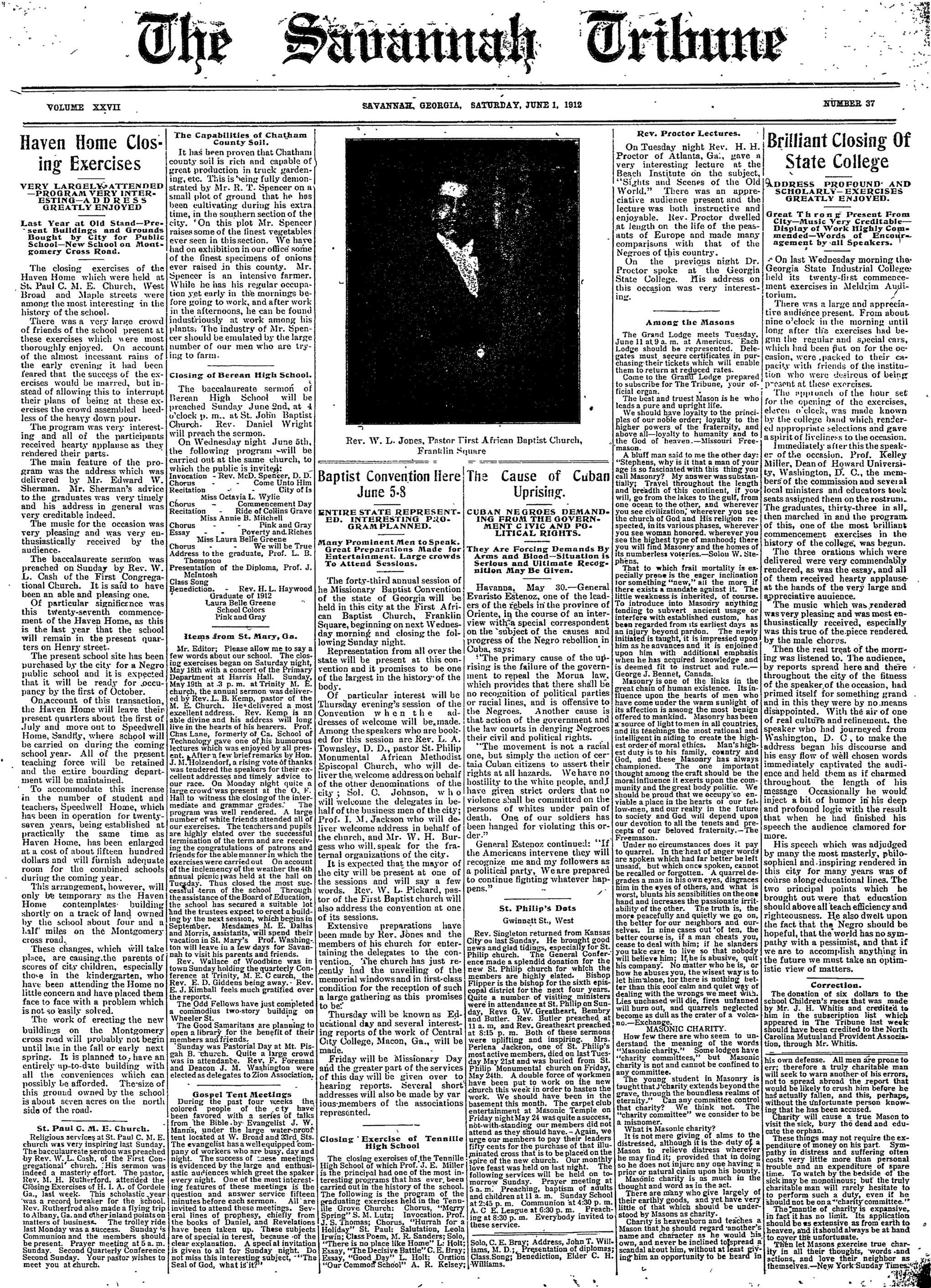
Rev. W. L. Jones, Pastor First African Baptist Church Franklin Square
Baptist Convention Here June 5-8
ENTIRE STATE REPRESENTED. INTERESTING PROGRAM PLANNED.
Many Prominent Men to Speak. Great Preparations Made for Entertainment. Large crowds To Attend Sessions.
The forty-third annual session of the Missionary Baptist Convention of the state of Georgia will be held in this city at the First African Baptist Church, Franklin Square, beginning on next Wednesday morning and closing the following Sunday night.
Representation from all over the state will be present at this convention and it promises to be one of the largest in the history of the body.
Of particular interest will be Thursday evening's session of the Convention when the addresses of welcome will be made. Among the speakers who are booked for this session are Rev. L. A. Townsley, D. D., pastor St. Philip Monumental African Methodist Episcopal Church, who will deliver the welcome address on behalf of the other denominations of the city; Sol. C. Johnson, who will welcome the delegates in behalf of the business men of the city; Prof. I. M. Jackson who will deliver welcome address in behalf of the church, and Mr. W. H. Burgess who will speak for the fraternal organizations of the city.
It is expected that the mayor of the city will be present at one of the sessions and will say a few words. Rev. W. L. Pickard, pastor of the First Baptist church will also address the convention at one of its sessions. Extensive preparations have been made by Rev. Jones and the members of his church for entertaining the delegates to the convention. The church has just recently had the unveiling of the memorial windows and in first-class condition for the reception of such a large gathering as this promises to be.
Thursday will be known as Educational day and several interesting reports of the work of Central City College, Macon, Ga., will be made. Friday will be Missionary Day and the greater part of the services of this day will be given over to hearing reports. Several short addresses will also be made by various members of the associations represented.
Closing Exercise of Tennille High School
The closing exercises of the Tennille High School of which Prof. J. E. Miller is the principal had one of the most interesting programs that has ever been carried out in the history of the school. The following is the program of the graduating exercises held in the Tennille Grove Church: Chorus, "Merry Spring" S. M. Lutz; Invocation. Prof. J. S. Thomas; Chorus, "Hurrah for a Holiday" St. Paul: Salutation, Leola Irwin; Class Poem, M. R. Sanders; Solo, "There is no place like Home" L. Holt; Essay, "The Decisive Battle" C. E. Bray; Essay, "Good Day" L. Holt; Oration "Our Common School" A. R. Kelsey;
The Cause of Cuban Uprising.
CUBAN NEGROES DEMANDING FROM THE GOVERNMENT CIVIC AND POLITICAL RIGHTS.
They Are Forcing Demands By Arms and Blood—Situation is Serious and Ultimate Recognition May Be Given.
Havanna, May 30.—General Evaristo Estenoz, one of the leaders of the rebels in the province of Oriente, in the course of an interview with a special correspondent on the subject of the causes and progress of the Negro rebellion in Cuba, says:
'The primary cause of the uprising is the failure of the government to repeal the Morua law, which provides that there shall be no recognition of political parties or racial lines, and is offensive to the Negroes. Another cause is that action of the government and the law courts in denying Negroes their civil and political rights.
"The movement is not a racial one, but simply the action of certain Cuban citizens to assert their rights at all hazards. We have no hostility to the white people, and I have given strict orders that no violence shall be committed on the persons of whites under pain of death. One of our soldiers has been hanged for violating this order."
General Estenoz continued: "If the Americans intervene they will recognize me and my followers as a political party. We are prepared to continue fighting whatever happens."
St. Philip's Dats
Gwinnett St., West
Rev. Singleton returned from Kansas City on last Sunday. He brought good news and glad tidings, especially for St. Philip church. The General Conference made a splendid donation for the new St. Philip church for which the members are highly elated. Bishop Flipper is the bishop for the sixth episcopal district for the next four years. Quite a number of visiting ministers were in attendance at St. Philip on Sunday, Revs G. W. Greatheart, Bembry and Butler. Rev. Butler preached at 11 a.m. and Rev. Greatheart preached at 8:15 p. m. Both of these sermons were uplifting and inspiring. Mrs. Perlena Jackson, one of St. Philip's most active members, died on last Tuesday May 21st and was buried from St. Philip Monumental church on Friday, May 24th. A double force of workmen have been put to work on the new church this week in order to hasten the work. We should have been in the basement this month. The carpet club entertainment at Masonic Temple on Friday night May 24 was quite a success, not-with-standing our members did not attend as they should have. Again, we urge our members to pay their leaders fifty cents for the purchase of that illuminated cross that is to be placed on the spire of the new church. Our monthly love feast was held on last night. The following services will be held on tomorrow Sunday. Prayer meeting at 5 a.m. Preaching, baptism of adults and children at 11 a.m. Sunday School at 2:45 p. m. Communion at 4:30 p. m. A.C. E. League at 6:30 p. m. Preaching at 8:30 p. m. Everybody invited to these service.
Solo, C. E. Bray; Address, John T. Williams, M. D.; Presentation of diploms; Class.Song; Benediction, Elder C. H. Williams.
Rev. Proctor Lectures.
On Tuesday night Rev. H. H. Proctor of Atlanta, Ga., gave a very interesting lecture at the Beach Institute on the subject, "Sights and Scenes of the Old World." There was an appreciative audience present and the lecture was both instructive and enjoyable. Rev. Proctor dwelled at length on the life of the peasants of Europe and made many comparisons with that of the Negroes of this country.
On the previous night Dr. Proctor spoke at the Georgia State College. His address on this occasion was very interesting.
Among the Masons
The Grand Lodge meets Tuesday. June 11 at 9 a.m. at Americus. Each Lodge should be represented. Delegates must secure certificates in purchasing their tickets which will enable them to return at reduced rates. Come to the Grand Lodge prepared to subscribe for The Tribune, your official organ.
The best and truest Mason is he who leads a pure and upright life.
We should have loyalty to the principles of our noble order; loyalty to the higher powers of the fraternity, and above all—loyalty to humanity and to the God of heaven.—Missouri Freemason.
A bluff man said to me the other day: "Stephens, why is it that a man of your age is so fascinated with this thing you call Masonry? My answer was substantially; Travel throughout the length and breadth of this continent, if you will, go from the lakes to the gulf, from one ocean to the other, and wherever you see civilization, wherever you see the church of God and His religion respected, in its various phases, wherever you see woman honored, wherever you see the highest type of manhood; there you will find Masonry and the homes of its numberless voteries.—Solou W. Stephens.
That to which frail mortality is especially prone is the eager inclination for something "new," all the more if there exists a mandate against it. The little weakness is inherited, of course. To introduce into Masonry anything tending to subvert ancient usage or interfere with established custom, has been regarded from its earliest days as an injury beyond pardon. The newly initiated is taught, it is impressed upon him as he advances and it is enjoined upon him with additional emphasis when he has acquired knowledge and is deemed fit to instruct and rule.—George J. Bennet, Canada.
Masonry is one of the links in the great chain of human existence. Its influence upon the hearts of men who have come under the warm sunlight of its affection is among the most benign offered to mankind. Masonry has been a source of light to men in all countries, and its teachings the most rational and intelligent in aiding to create the highest order of moral ethics. Man's highest duty is to his family, country and God, and these Masonry has always championed. The one important thought among the craft should be the moral influence it exerts upon the community and the great body politic. We should be proud that we occupy so enviable a place in the hearts of our fellow-men, and our reality in the future to society and God will depend upon our devotion to all the tenets and precepts of our beloved fraternity.—The Freemason.
Under no circumstances does it pay to quarrel. In the heat of anger words are spoken which had far better be left unsaid, but which once spoken, cannot be recalled or forgotten. A quarrel degrades a man in his own eyes, disgraces him in the eyes of others, and what is worst, blunts his sensibilities on the one hand and increases the passionate irritability of the other. The truth is, the more peacefully and quietly we go on, the better for our neighbors and ourselves. In nine cases out of ten, the better course is, if a man cheats you, cease to deal with him; if he slanders you take care to live so that nobody will believe him; If, he is abusive, quit his company. No matter who he is, or how he abuses you, the wisest way is to let him alone, for there is nothing better than this cool calm and quiet way of dealing with the wrongs we meet with. Lies unchased will die, fires unfanned will burn out, and quarrels neglected become as dull as the crater of a volcano.—Exchange.
MASONIC CHARITY
How few there are who seem to understand the meaning of the words "Masonic charity." Some lodges have "charity committees," but Masonic charity is not and cannot be confined to any committee.
The young student in Masonry is taught that $charity extends beyond the grave, through the boundless realms of eternity." Can any committee control that charity? We think not. The "charity committee" we consider to be a misnerome.
What is Masonic charity?
It is not mere giving of alms to the distressed, although it is the duty of a Mason to relieve distress wherever he may find it; provided that in doing so he does not injure any one having a prior or natural claim upon his bounty. Masonic charity is as much in the thought and word as in the act. There are many who give largely of their earthly goods, and yet have very little of that which should be understood by Masons as charity. Charity is heavenborn and teaches a Mason that he should regard another's name and character as he would own, and never be inclined to spread a scandal about him, without at least giving him an opportunity to be heard in
NUMBER 37
Brilliant Closing Of State College
ADDRESS PROFOUND' AND
SCHOLARLY-EXERCISES
GREATLY ENJOYED.
Great Throng Present From
City-Music Very Creditable-
Display of Work Highly Com-
mended-Words of Encourag-
ement by all Speakers.
On last Wednesday morning the
Georgia State Industrial College
held its twenty-first commence-
ment exercises in Meldrim Auditorium.
There was a large and appreciative audience present. From about nine o'clock in the morning until long after the exercises had begun the regular and special cars, which had been put on for the occasion, were packed to their capacity with friends of the institution who were desirous of being present at these exercises.
The approach of the hour set for the opening of the exercises, eleven o'clock, was made known by the college band which rendered appropriate selections and gave a spirit of liveliness to the occasion.
Immediately after this the speaker of the occasion. Prof. Kelley Miller, Dean of Howard University, Washington, D.C., the members of the commission and several local ministers and educators took seats assigned them on the rostrum. The graduates, thirty-three in all, then marched in and the program of this, one of the most brilliant commencement exercises in the history of the college, was begun. The three orations which were delivered were very commendably rendered, as was the essay, and all of them received hearty applause at the hands of the very large and appreciative audience.
The music which was rendered was very pleasing and was most enthusiastically received, especially was this true of the piece rendered by the male chorus.
Then the real treat of the morning was listened to. The audience, by reports spread here and there throughout the city of the fitness of the speaker, of the occasion, had primed itself for something grand and in this they were by no means disappointed. With the air of one of real culture and refinement, the speaker who had journeyed from Washington, D. C., to make the address began his discourse and his easy flow of well chosen words immediately captivated the audience and held them as if charmed throughout the length of his message. Occasionally he would inject a bit of humor in his deep and profound logic with the result that when he had finished his speech the audience clamored for more.
His speech which was adjudged by many the most masterly, philosophical and inspiring rendered in this city for many years was of course along educational lines. The two principal points which he brought out were that education should above all teach efficiency and righteousness. He also dwelt upon the fact that the Negro should be hopeful, that the world has no sympathy with a pessimist, and that if we are to accomplish anything in the future we must take an optimistic view of matters.
Correction.
The donation of six dollars to the school Children's races that was made by Mr. J. H. Whitis and credited to him in the subscription list which appeared in The Tribune last week should have been credited to the North Carolina Mutual and Provident Association, through Mr. Whitis.
his own defense. All men are prone to err; therefore a truly charitable man will seek to warn another of his errors, not to spread abroad the report that would be likely to crush him before he has actually fallen, and this, perhaps, without the unfortunate person knowing that he has been accused.
Charity will cause a true Mason to visit the sick, bury the dead and educate the orphan.
These things may not require the expenditure of money on his part. Sympathy in distress and suffering often costs very little more than personal trouble and an expenditure of spare time. To watch by the bedside of the sick may be monotinuous; but the truly charitable man will rarely hesitate to to perform such a duty, even if he should not be on a "charity committee." The mantle of charity is expansive, in fact it has no limit. Its application should be as extensive as from earth to heaven, and it should always be at hand to cover the unfortunate. Then let Masons exercise true charity in all their thoughts, words and actions, and love their neighbor as themselves.—New York Sunday Times
The Farm
THE CARE OF TURKEYS.
One of the most valuable branches of poultry husbandry is the raising of turkeys. Besides the high market price always obtainable for their flesh, the birds are an advantage and a positive benefit to the farmer. The occasional damage done to grain is not to be compared to the assistance turkeys give in ridding fields of insects, being great seed, bug and grasshopper consumers. The most popular breed of turkeys is the Mammoth Bronze, on account of its hardness, vigor and attainment of large size.
Success in raising turkeys depends much upon the care given the poults and the condition of the season's weather. Young turkeys find it hard to survive a drenching, and are generally unhealthy during damp weather, and for this reason damp quarters for nesting and herding should be avoided, as the poults are very delicate and their mortality is great.
A turkey hen lays from 35 to 40 eggs each season, and often will submit to three sittings during the spring and early summer, when her young are cared for by the poultry raler, the poults growing remarkably fast in August and September. It is considered best to hatch turkey eggs under a chicken hen, allowing the turkey hen to go to laying again. If, however, a turkey hen is used to hatch the eggs, it is better to let them roam at will with their flocks than to coop and feed them. They will come to the house at night, with their poults to roost if trained to expect a regular feeding of grain at that time of day.
Always use as breeders hens that are more than one year old, vigorous and of medium size. The male may be a yearling or older. It is an erroneous belief that extremely large toms are best. One male should be supplied for from two to ten hens. Close breeding should be avoided, and new blood should be added to the flock each year, or, at most, two years. It is generally believed by those interested in the raising of turkeys that the frequent introduction of new blood into the flock or the mating of unrelated males and females is essential to success, for there is no variety of poultry that is more dependent on vigorous, non-related and matured stock than the turkey.
Much care is necessary in the feeding of the poults. After the first twenty-four hours stale bread crumbs, soaked in milk, finely cut tender dandelions and crumbled hard-boiled eggs should be fed the poults, followed later with small, fine-cracked wheat. About the third day feed fresh meat scraps and coarser ground grain. Never fed sloppy feed. Finely ground oatmeal and clabber cheese are also good feed for very young poults. Supply them with plenty of fine grit and clean water. As with all poultry, clean water is essential to the health of the young turkeys. Use care not to feed too much, as they can easily be overfed. Train them to come in from their range' at night, where they can be quickly cared for should a severe storm come up.
Powder the nests well while the eggs are being incubated, as lice and mites are the greatest foes to young turkeys. Keep a diligent watch at all times for parasites, as they are often found on the poults right after hatching. Liberty is absolutely essential to the health of young turkeys. At about ten to twelve weeks the poults' wattles will appear, and the most critical period in their existence and care has passed.
FEW STANDS OF BEES.
Bees have a high economic importance on a farm aside from their usefulness as gatherers and storers of honey, as they are an important agent in the fertilization of fruit blossoms. A certain number of hives should be placed in the orchard to facilitate the process of flower fertilization. It requires no more intelligence and skill to raise bees than it does poultry, a certain amount of work at the right time being all that is necessary, and the necessary work does not take near the time that the attention to poultry and farm stock requires.
The enjoyment of honey should not be denied the farmer's family because of the expected cost, for the raising of bees is of very little expense after a colony is once started. Even the purchase of colonies, hives and the rest of the simple equipment, including a queen bee of excellent stock to head the colony, represents but a small outlay of money. Bees do not require very much time, but they must have attention at the right time. Their care does not interfere much with other farm labor, and a dozen or more hives are a source of both pleasure and profit.
The blossoms of fruit trees give the bees their first busy occupation, that of gathering nectar and pollen, until the main honey sets in with the general opening of the summer flowers. The beneficial influence of bees upon fruit trees is well known, and it is often noticed that where there are no bees, trees sometimes become unfruitful and orchards have been known to remain unprofitable until a few hives of bees were distributed among the
trees. Especially is this the case where certain trees are self-sterile, and can only be fertilized by pollen carried to their blooms from the blossome of other trees.
Another instance of the necessity of the sterile influence of the labors of the busy bee is in connection with the growth of white clover, a flower which depends almost entirely on cross-fertilization by hive bees to enable it to produce seed.
It is claimed that the best time to start with bees is between fruit bloom and white clover, or about the middle or latter part of May. Bees can be readily procured from any beekeeper or regular bee dealer. It is essential to get good stock, as in everything else, and a good queen. One hive should be used to keep the bees and an extra hive, two complete supers for each hive, a smoker, veil and gloves also obtained.
ABOUT GROWING POTATOES.
Seed potatoes should be pure, true to type and of moderately good size. It is not important that seed potatoes should be mammoth specimens, but it is essential that they not be too small. A medium-sized potato, free from scab, is the best for seed. Cut the potatoes into one and two eye pieces. The first planting should be of an early variety for quick maturity, if the potato raiser desires to get his crop on the market early when the prices are higher than they are later. Those for a later use or market can be of a later variety, if desired. New ground and sandy loam are excellent for potato growing, the loose condition of the earth allowing the growing tubers to expand readily. The ground should be plowed early in the season, previously enriching it with manure if it needs it. Frequent cultivation is demanded, the rows being kept well hilled Usually a one-horse cultivator is used, except the last time the ground is gone over, when the plants should be hilled with side-hoes. Bugs if bad, can be kept off by spraying the plants with Paris green, using one teaspoonful to a quart of water.
The mulching of the potato ground right after the planting of the potatoes has been very successfully tried in certain localities. The plants are never hilled or disturbed. They grow right up through the straw, which is spread over the ground, not too thickly. The mulching of straw keeps down the weeds and retains the moisture of the ground near the roots of the plants. When growing the potatoes under straw, it is essential to have the ground well worked and loose before distributing the straw, as it can not be cultivated afterwards.
Potato growing is but in its infancy in this country. According to an authority, the average yield of potatoes in the United States for the past decade is 59.8 bushels an acre; that of Russia, 98.4; that of Hungary, 117.8; France, 118; Austria, 154.4; United Kingdom, 186.4, and that of Germany 197.3 bushels to the acre, or more than double the highest average ever produced in America. Statistics show that in 1908 we imported from Europe potatoes with the jackets on to the amount of 7,620,000 bushels, valued at $4,953,206. We planted the same year 'an acreage of 3,257,000 acres in potatoes. An increase in production of two and one-half bushels an acre would have saved this country the $5,000,000 we paid to Europe for this important necessity which could have just as well have been grown here. In 1911, statistics show, 47 per cent of the national potato acreage was planted in Indiana, Ohio, Pennsylvania, New York, Michigan, Illinois, Iowa, Missouri and Kentucky.
MORE INTENSIVE FARMING.
Promulgation of the fact that sirup can be made from the stalks of sweet corn may lead to the founding of another rather important industry in this state. Experiments have already been carried on with the stalks which produce the corn used for canning, and a quality of sirup has been produced which excels the sorghum which has been raised in a small way in Minnesota for several years. The production of sweet corn for the canneries is already becoming a very profitable side issue with a large and increasing number of farmers, who will be glad to know that the stalks can be used for something besides fodder.
This is merely another sign that Minnesota is passing the pioneer stage. New openings are appearing every year where the wideawake farmer can find a market for produce which he formerly scorned to raise, or raising, failed to get the most out of. The husks of the corn used in canning are also salable. With the by-products canning will soon take a place second to buttermaking in Minnesota. The quality of the vegetables raised here, especially the corn, is almost unexcelled. The northern latitude lends a flavor to both vegetables and fruits which cannot be obtained in the warmer climate further south, and the summers furnish plenty of pleasant weather for the maturing of a very large assortment of crops.—From the St. Paul (Minn.) Pioneer Press.
A HOME--A VALUABLE ASSET
By FRANKLIN W. WILLIAMS.
Human achievement is one of the marked steps in human progress. In the history of culture as distinguished from the natural history of man, he is considered, primarily, as a producer of what did not exist. The distinction between organic and social evolution is, that the environment transforms the animal while man transforms the environment. Material civilization consists in the utilization of the forces of nature. Achievement is the work of individuals and it can be wrought through co-operative effort. It constitutes a form of immortality and has an exceedingly attractive side, and a soothing pleasure when pursued through dint of effort. Let us see.
In one of our progressive counties a few days ago I met a "father of the community." He is an incentive around which his race has risen in his neighborhood; and he has the respect and confidence of all the people—white and colored—who know and know of him. He has risen from serfdom to the pinnacle of success and fortune. So faithfully did he serve his old employer that at surrender the old master gave him the "bill of sale" which had transferred him to said master. The contents of said bill, in part, are as follows:
"Know All Men by These Presents
—That I. J. E—, of the County of
R—, and State of N. C., for and in
consideration of the sum of $—
to me in hand, paid by B. E—, Jr.,
of the county and state aforesaid, the receipt whereof I, the said J. E—, do hereby acknowledge myself satisfied,
contented and paid, have bargained,
and sold, and by these presents do bargain and sell unto the said B. E—, Jr., one Negro boy named J—
and I, the said J. E—, do by these presents warrant and forever defend the right and title of said Negro boy, J—, from myself, my heirs and assigns and all and every person or persons whatsoever, to the said B. E—, Jr., his heirs and assigns forever.
"In witness whereof I, the said J. E—, have hereunto set my hand and affixed my seal, this 20th day of January, in the year of our Lord, 1833.
"Witness, Samuel T——."
When his master told this man that he was free, he did not jump up and "crack" his heels together and thereafter seek a loafers' den. He was without a crust of bread and he had not where to lie his wife's and his children's heads. During slavery he had acquired skill as a maker of chairs and baskets, a blacksmith and an expert farmer. Being master of the situation and having acquired an abundance of mother wilt, himself and his brother—who was of the same age and size and better known as "Twin Brothers"—entered into an agreement with his old ex-master to the effect that they shall cultivate certain lands belonging to the latter on shares. Taking his wife as a partner, he labored in the fields by day and by night he made chairs and baskets, which he sold or bartered for "calico and toe cloth" with which to make his children one pieced garments that he might take them to church and Sunday school every Sunday. He has made all the furniture which he uses in his home in his own workshops. His children, his grandchildren and his great-grandchildren were rocked in cradles, slept in beds, sat at and ate from tables made by his own hand. During these days of struggle, the house in which he lived caught fire and everything destroyed except one boot. However, he did not give up.
Within three years after surrender these "Twin Brothers" bargained for a plantation for which they contracted to pay twenty-six hundred ($2,600) dollars. When this news leaked out and when the "Twins" with their wives and children had taken actual possession of the two dwelling houses on the premises, the whole community was shocked to the utmost, believing that the "Twins" were insane, and a few of the freed men began to advise some of the most influential white men to send the idiots to the insane asylum. However, having proper conception of freedom, the "Twins" kept "pegging away," while the sure enough idiots stood afar off "poking fun," and throwing every available stumbling block in the way. Working, as we aforesaid, in copartnership with their wives, who stood by them through "thick and thin;" and utilizing the services of their children—one being the father of eleven and the other nine—which children were first taught to stand "lonely, lonely, lonely," and next to use the fork, the rake, the hoe and the plow, these "Twins" moved on to success. Very soon the first plantation was within their control and they immediately transferred it for one fully worth five thousand ($5,000) dollars by paying the difference. The last deal was for the old master's plantation; yes, the soil upon which they had lost many a drop of sweat and with the riches of which soil they were acquainted. When the last adventure was known and it became, to the inquirers, an actual fact that these two men had bargained for their old master's plantation, some of the other ex-slaves who had had an equal chance to acquire property, but had not the moral courage to venture, were so amazed that they became slick and soon died of broken hearts, leaving scores of helpless children upon the church and the community. Those of them who overcame the shock took the "Twins" as guild—and began to put forth effort; while others, still, were careless and unconcerned, spending as much time in fash-
ing, hunting and loafing as they did in actual work. From the result of which their children are scattered to the four corners of the earth and many of them have broken and weighted down into watery graves the hearts of the parents by whom they were begotten. But the children of this father whose "bill of sale" we read in part, have purchased large plantations in the neighborhood of their father's, almost surrounding him on all sides, and within an hour he can easily summon all of his children around his family table to enjoy a repast with him. They constitute an honorable, respectable community and are held in the highest esteem by their white friends, both near and far. Not one of these children or grandchildren has worn a single stripe, nor has one been accused of an offence.
In conclusion it all leads to this: We must not sit down and "bicker" about our hard times; we"must work and teach our children the importance of settling down and accumulating property. "Rolling stones gather no moss" is a truism which should not be forgotten. We must roll up our sleeves and wade in as have all men who have really achieved success in life. When we get something which other races and people want; something which strikes their fancy; something which has gone down on record as a gift from God and which came through consecrated and constant service in effort to benefiting humanity and thereby erecting God's kingdom here on earth; then, and not until then, shall the races of the earth gather around one shrine singing sweet songs and clasping glad hands as brothers and fellow kinsmen.
"Haste not; rest not.
Meekly bear the storms of fate;
Duty be thy polar guilde
Do the right, whatever betide.
Haste not, rest not;
Conflicts past.
God shall crown thy work at last."
FARMING NOW A BUSINESS.
Farming has become just as much a business as banking or manufacturing. No longer is the successful farmer a slipshod individual, content with a sparse crop that will just pull him and his emaciated stock through the winter, but he-is a man of business ability, who knows the worth of certain kinds of feed as milk, butter and flesh producers, and likely keeps books on his business as do the proprietors of any commercial business. Men who invest their money in a farm expect a business return from the investment. The properly managed farm is a combination of a number of enterprises, each of which has a definite relation to the place or business as a unit.
The practice of keeping farm accounts is being taught now, in some agricultural schools and a regular course is given. The instruction comes under the department of rural economics and consists of lectures and practice work, dealing with the general principles of accounting and its application to farm work. Such instruction is good training for the young man who expects to make farming his business, but any staid and established farmer can adopt a system of bookkeeping of his own that is best adapted to the methods employed by him in his daily work. System is a very essential attribute in a farmer in this day, when the markets exact such high grades of products and so much of them.
WHAT A DIPLOMA OUGHT TO
. STAND FOR.
Any school that appropriates to itself the dignity of giving a diploma ought to be able to lay claim to giving thorough drill in the spelling of ordinary words and the correct use of ordinary grammar. And no student ought, under any circumstances, receive a diploma from the given school claiming that the prescribed course had been completed by the holder when he or she—as the case may be—had done no such thing. If there be one thing against which our negro leaders ought in righteous indignation arise, it is the purely surface training some of our negro schools are giving For example, read this:
"Please send -me twenty-five cents wurth of sope."
It was intended to write for soap. Now the above is an order given at the grocery store by a young woman who holds a diploma from one of the negro colleges in South Carolina. And it is no isolated case. Is it not a shame?
IN THE AGE OF SCIENCE.
"Come over and play with my little boy, sonnie," called the pleasant-faced new neighbor to the solemn-faced urchin on the fence between the two lots.
"Is your little boy sick of anything?" came the child's earnest question.
"No, indeed, sonnie. Why?"
"Cause I've had my tonsils taken out an' my adenoids removed an' my appendix cut out an' I've been vaccinated an' serumized for typhoid an' spinal meningitis an' I do hope I won't have to have anything done to me this year, so's for a little while I can have a bit o' fun!"—Chicago Record-Herald.
TWO EXCELLENT IDEAS.
The best way of whitening kitchen tables is to scour them with wood ashes and soap. Floors can be also most effectively scrubbed with cold water, soap and wood ashes. A cork soaked in oil makes a good substitute for a glass stopper.
The Sunday School Lesson
HYPOCRISY AND SINCERITY.
Golden Text—Take heed that ye do not your righteousness before men, to be seen of them; else ye have no reward with your father who is in heaven. Matt. 6:1.
Lesson 1 text—Matt. 6:1-18. Commit vs. 7, 8.
Time—Midsummer A. D. 28. Place—Horns of Hattin.
Exposition—I. How to give alms, 1-4. We should avoid doing our righteousness to be seen of men. This does not necessarily forbid all gifts in public (1 Cor. 16:1, 2; Luke 21:1-4). But while the gift may be in public the object should not be to be seen of men. God knows the gift of which no man knows. He seeth in secret (v. 4; cf. Heb. 4:13). We should avoid the uttermost all ostentation in our giving (v. 5). We need not fear that our alms will not be rewarded. We may not have a reward here, but we shall hereafter (Matt. 25:11, 32, 37-40; Mark 10:21; Acts 10:14). The best reward is in the very giving itself (Acts 20:35). The reward will be in proportion to the bountifulness of our giving (2 Cor. 9:6). The reward that God gives for well-doing is a legitimate motive (cf. Heb. 11:6, 26), but it is not the supreme motive for the Christian (2 Cor. 5:14; 1 Cor. 10:31).
POETRY of and by Our People
Old friend, farewell!
Strong friend, I say it sadly.
We've drawn together,
Braved the matter,
Held lofty hopes, or nother.
How long, I scarce dare tell.
And I shall miss you badly—
Sometimes, madly—
In the lonesome nights.
Strong friend! You've shared my moods
And privy been to all my fancies,
You've gone with me for miles
Where darling, dimpled Nature smiles,
And "Lazy Lawrence" defly dances
In the sunny places,
You've seen the faces
Of some friends I dare not own,
And kept my infidences
As your own,
And nerved me for some brave pre-
tenses,
And I shall miss you wildly—
Later, mildly—
When unsease blights.
Strong friend! You ARE strong
(That's the rub)—and black
With what, for long,
I've loved you. And for lack,
Mayhap of alring,
You are rank
As any lank
And raped hank
Of burnt cheese, odor flaring.
Folks hate you so!
And you must go.
Though I shall miss you, sighing,
Maybe, crying.
For the chummy lights.
Old pipe, good-bye!
Strong pipe, I heave you, grieving
It makes me sigh,
And almost cry
To have to speed your leaving.
A new one? Yes—but bitter,
And harsh and rugged to the feel.
If may, with these months, grow fitter,
May by me fairly deal,
But I shall miss you sadly—
Sometimes, madly—
In the lonesome nights.
GOD'S "AFTERWARD."
"God always has an 'afterward'
For every bitter thing.
The flowers may fall, but fruit abides;
The butterfly's bright wing
Is painted in its long night's sleep;
Each Winter has its Spring.
How glorious is the 'afterward'
When gladsome joy-bells ring."
"God always has an 'afterward'
The patriarch Job, of old,
When in the fires, was yet assured
He should 'come forth as gold';
And Joseph found it thus when he
Was by his brenn sold.
A wealth of blessing was designed,
Unfathomed and untold."
"God always has an 'afterward'
An afterward of bliss;
First night, then morning, formed the day,
So must it end like this!
He purposed his heart for thought,
We should be sad to miss.
Though hidden folded in His hand,
Faith still the hand 'would kiss.'
"God has a shining 'afterward'
For every cloud of rain;
We may no see the meaning now
Of sorrow and of pain.
But nothing God permits his child
Can ever be in vain;
The seed here watered by our tears
Will yield its ripened grain."
"God always has an 'afterward.'
He keeps the best in store.
And we shall see it hath been so
When we reach yonder shore;
The Cross, the shame, Christ once de-
spiled.
For the joy God set before;
And as we follow we shall find
Death is Life's opening door!"
-Selected.
OPPORTUNITY.
They do me wrong who say I come no more.
When once I knock and fail to find you in.
For every day I stand outside your door.
And bid you wake and rise to fight and wail.
Wall not for precious chances passed away.
Weep not for golden ages on the wane;
Each night I burn the records of the day;
At sunrise every soul is born again.
Laugh like a boy at splendors that have sped.
To vanish joys be blind and deaf and dumb:
My judgments seal the dead past with its dead.
But never bind a moment yet to come.
Though deep in mire, wring not your hands and weep:
I lend my arm to all who say, "I can."
No shame-faced outcast ever sank so deep
But yet might rise and be again a man
Dost thou behold thy lost youth all aghast?
Dost reel from righteous retribution's blow?
Them thou from blooded archives of the past
And find the future pages white as snow.
Are thou a mourner? Rouse thee from thy spell.
Art thou a sinner? Sins may be forgiven.
Each morning gives thee wings to flee from hell.
Each night a star to guide thy feet to heaven!
-Walter Malone.
Ship of the widows, of sorrow, of doom-
Hall her home from the scene of gloom!
Ship of the shadows of grief and tears.
Welcome her home to the crowded piers!
Ship of the shattered and saddened lives-
Welcome her home with her stricken
Ship of the widows, of youth turned gray
In the awful woe of a single day;
Ship of sorrow and shadow and care,
Home from the seas of the dark despair,
Flags half-masted and hearts a-weep
Welcome her home from the heartless
deep!
Welcome her, only
With sobs, not cheers;
Home to our sympathy,
Home to our tears!
The Bentztown Bard in Baltimore Sun.
See COOPER & ODRIZEN The Up-to-Date Tailors
218 WEST BROAD STREET, BETWEEN HULL AND OGLETHORPE AVE. The Latest Patterns in SPRING AND SUMMER GOODS. Firstclass workmanship guaranteed. Our prices will interest you.
WE HAVE TWELVE LOTS ON THIRTY-NINTH STREET, BETWEEN BURROUGHS AND FLORENCE, UPON WHICH WE WILL BUILD HOMES FOR ANY ONE DESIRING THEM. THE KIND OF HOUSE YOU WANT WILL BE BUILT FOR YOU, AND YOU CAN PAY US FOR IT IN EASY MONTHLY PAYMENTS. COME AND SEE US ABOUT THIS PROPOSITION.
30 DRAYTON STREET.
19 EAST BROUGHTON STREET.
The affable H. B. Wright is still with us and expects the continuous patronage of his friends.
Johnson Undertaking Establishment
COMBINED WITH
The Royall Undertaking Company
Funeral Directors and Embalmers
Finest line of Coffins, Saskets and Robes. White and black funeral
cars. Office and warerooms 325-331 Jefferson street.
, W. R. FIELDS, Manager.
Residence Phone 2032. Livery Stable Attached. Office Phone 676.
C. H. ROYALL, Residence 509 Charles St. Phone 3064.
234 ST. JULIAN ST., WEST, 235 BRYAN ST., WEST.
SAVANNAH, GEORGIA. Phone 2962.
Palm Shaving Palace
Expert Hair Cutting, Electric Massage and Shampooing a Specialty. All Work Done by Experienced Workmen. Courteous attention to all SHINING PARLOR ATTACHED.
PERRY R. WRIGHT, Proprietor.
The Mordecie Pressing Club
Two suits cleaned and pressed per month for $1.00. Ladles' work specialty. Goods called for and de-livered. All work guaranteed. Steam and dry cleaning. 816 EAST BROAD STREET. Phone 3940.
THOMAS BAKER, The Shoemaker
First class SHOE REPAIRING. Half sole, sowed, 85 cents; nailed, 50 cents; rubber heels, 35 and 50 cents. All work guaranteed. CORNER EAST BROAD AND BOLTON STREETS.
Don't Buy a New One
Save the old ones and send to us. We make them new—Steves, Furniture, Mattresses, Carpets. CARPET AND MATTING LAYING A SPECIALTY. Old furniture bought and sold. Packing and Shipping. Goods called for and delivered.
The Beautiful Woodlawn Park New Improvements More Lights New Buildings The Ideal Picnic Spot of Savannah Secure your dates from ANDREW D. MONROE, 124 East Thirty-third St.
SAVING MONEY IS A HABIT
Get the habit of saving a part of your Earnings each week.
$1.00
Starts an Account
THE WAGE
EARNERS' LOAN
AND INVESTMENT
COMPANY,
PHONE 244.
468 WEST BROAD ST.
Savannah, Ga.
GAREY'S
Variety Bakery
Goods delivered promptly to any
part of the city.
506 West Broad St., Near Gaston.
Phone 1869-J
MUSICAL INSTRUMENTS
OPpen for Pupils.
541 CHARLTON STREET, EAST.
BROWN'S STAG LODGING HOUSE.
Furnished rooms by week or month. Hot and cold baths. Electric lights. In center of city. Street car, hack and automobile convenient.
CALL AT 217 EAST BROAD ST.
..or phone 3746—I. C. Brown, Prop...
—For First Class—
GROCERIES AND CONFECTIONERY
—Call On—
M. G. GRAHAM
626 York St., West.
Courteous Attention to All.
MADAME FLORENGE E. WILLIAMS
Graduate Prof. Roher's School,
New York.
Hairdressing Parlor
521 Gaston Street, East.
Telephone 2328
Wigs, Switches and Pompadours
Made from Natural Hair.
Combings Made Up. Shampooing and
Hair Straightening a Specialty.
Face and Electric Massage. Dyeing
and Matching Hair.
ORIENTAL HAIR GROWER
An excellent preparation, will produce a beautiful growth of hair. Directions on each box. For sale, price
25 cents per box.
AGENTS WANTED
For the Sale of Magic Shaving Powder
It gives a quick shave without the use of a RAZOR For Particulars, Write THE SHAVING POWDER CO. Savannah, --- Georgia.
DRESSY SHORT COATS.
To be worn with lingeries and lace dresses are the qualint little taffeta coats. They are trimmed with ruchings of self-material, are short and cut in novel form, sometimes with coat tails or sash ends finishing the back. Both light and dark colors are used in their construction.
Some models of changeable taffeta in blues, combined with green, pink and gold, have the sleeves gathered into the armhole, extended back panel, cutaway front and one-button fastening. One attractive model is elaborately trimmed with shirred bands. These edge the collar, the cuffs and the three-quarter sleeves, the skirt and even outline the back panel, on which two silk-covered buttons are so placed as to give a slightly high-waisted effect. A single frog of colored silk fastens the jacket in front and tiny frills of fine cream lace peeping from under collar and cuffs contribute an old-fashioned air to the wrap.
Short, loose-backed or belted-in cutaway jackets of plain colored taffeta are worn with the new accordion-plaited skirts of crepe de chine, chiffon or taffeta. This plaiting is so fine that it gives to the soft material the appearance of heavy, crinkled crepe and admits of being adjusted so that it envelops the figure like a sheath, fitting smoothly over the hips and clinging close around the feet.
Short, fancy jackets of rough, loosely woven hop sacking in vivid colors will be worn with skirts of darker tone. Canvas, heavily embroidered with knots and cross-stitch, is used as a trimming. The work is done in worsted or rope silk of different colors in an old-fashioned rag carpet design, which is original and effective.
PUTTING AWAY THE
WINTER FLANNELS
Flannels, whether undergarments or bed clothes, become irksome just as soon as the passing of the Easter holidays tells us that spring has really routed winter, and then the housewife must see that all are carefully cleaned and put away until the chill autumn breezes again call them out.
In the first place, they should be soaked in lukewarm water, to which has been added a few shavings of soap. Cold water will make the flannel harsh, while hot water shrinks it and gives the yellow appearance which every good housekeeper deplores.
After the soil has been loosened by the soaking the different pieces are placed in another tub of warm water which has been made very soapy.
Each piece is rubbed firmly between the hands until all the soil has been washed out, when the pieces are rinsed in another water of the same temperature as the preceding two.
If the flannel is pure white or slightly ivory, a little blue can be added to the last water, but if the ivory tint is desired this is not necessary.
Blankets should be treated in precisely the same manner.
In putting away these flannels for the summer, large bags, made of some light blue stuff, chambray or gingham, should be used and a supply of moth balls in small bags placed inside.
The washboard should never be used in cleaning flannel, since the best results are always gained by the hand process.
PARASOLS TO BE CARRIED THIS SUMMER ARE ODD.
Novel as were the first parasols displayed in the shops, they cannot compare in oddity to those now shown in the windows.
In some cases only a few examples of a model have been imported, and those designed on this side of the ocean.
One of the odd shapes is wider on one side than the other, the wide side to extend over the shoulders, while another new shape is the deep dome, like the entire half of a sphere.
Another looks exactly like a French lamp shade, with a slightly sloping top, which breaks abruptly into a perpendicular border.
But the shapes and trimming are no less striking than the colorings and combinations of colors. Beautiful geranium reds, brilliant greens, novel black and white effects, and sprawling bunches of flowers are some of the new styles. Really lively are the fluffy ruffled parasols, however. Some of these have three or four graduated ruffles in lace or net set on top of a delicately trimmed silk covering, these ruffles running from an inch to three inches in width. Some of these with the ruffles in silk are scalloped, others simply hemmed, or perhaps hemstitched, while others show a tiny fringe.
Perhaps the most graceful of the shapes is the deep canopy, and very pretty models are shown for carriage use. In these the silk runs to a deep point at the ferrule, and at the border is arranged in arches.
MEATLESS VEGETABLE SOUP.
Put two tablespoons of butter or dripping in a soup kettle or large frying pan. When this is hot put in one medium onion diced and cook for two or three minutes. Then add 1 cup of carrot, 1 cup of turnip and 1 cup or potato which have been put through the meat chopper with the coarse knife on. Add one-half cup of céleri
Advertise in this paper
Take a Policy With The Pilgrim Health and Life Insurance Co.
The Oldest, Strongest and Most Reliable Company in the State.
Gives employment to hundreds of men and women of our race.
Pays from $1 to $10 weekly sick and accident benefits and from $10 to $100 death benefits. Our Motto: "Promptness, Honesty and Justice."
Home Office:
1143 Gwinnett St. Augusta, Ga.
For further information write 509 West Broad St. Savannah, Ga.
J. S. Perry, Supt.
A. B. Singfield, Gen. Supt.
C. T. Walker, D. D., LL. D.,
Director and General Lecturer.
GO TO Young Bros.
461 West Broad Street.
Near Union Station.
The place to get first-class meals
Everything neat and clean. Meals
prepared in an appetizing manner
and at all hours daily.
Ice Cream Parlor
Masonic Books and Regalias
Publishers and Manufacturers' Prices Laberal Discounts Will Be Arranged.
cut in small slices. Stir all over the fire until the vegetables are slightly browned, and a quarter of a cup of rice (washed in three or four waters) and two quarts of cold water. Bring slowly to a boiling point and simmer one hour. Press through colander and put on stove, again seasoning to taste. Add a tablespoon of butter mixed with two tablespoons of flour and one-half pint of milk. The flour, butter and milk may be made into a white sauce and thoroughly cooked before it is added to the strained vegetables. Or course, when the milk or white sauce are added we have a cream of vegetable soup, but this soup is very good without these, either strained or unstrained. The addition of a little butter helps to improve the quality. When the soup is not to be strained perhaps it would be considered more attractive looking, by most people, if the vegetables were sliced instead of put through the grinder.
SELECTING ACCESSORIES FOR SPRING COSTUMES
The woman who prides herself on never allowing the tiniest new fancy to escape her in the sartorial world will not neglect to wear a bright-hued vell with her dark hats and costumes, with a bunch of silk flowers fastened on the lapel of her coat to match the vell.
Thus a dark blue coat and skirt, worn with a dark hat, will be brightened by a very brilliant purple vell, and a bunch of bright purple silk anemones, not imitating the flowers, but merely carried in the flap like an embroidery, pinned in the buttonhole of the coat. The petticoat should also be purple.
Colored gloves and shoes, by the way, are not so popular as they were a couple of months ago; but they are capable of being very smart indeed when properly used, particularly the shoes. Colored gloves are always risky. The greatest mistake made in the wearing of colored footgear is when a dark dress is accompanied by light shoes and stockings.
ODD ENDS OF LINEN
EASILY UTILIZED
All of the white and unbleached linens on sale as remnants, and often at absurdly low valuations, can be utilized by the woman who has made the needlework exchange her place of business. Damask linen in short lengths may seem to some hasty shoppers the last possible piece of stuff for anything except the tablecloth for which it was originally intended, but it has a unique quality when enriched by heavy outlining along the design's edges.
Large pieces of this worked damask are cut the size of the table and edged with cluny lace as a luncheon cloth.
Remnants of heavy sheeting linen are frequently used for the various small pieces of embroidery, and to excellent advantage. No woman who has cut from enormously wide linens will fail to see the advantage of sheeting as a permanent possession in the sewing room.
ARE WOMAN UNFAIR?
Many a girl is placed at an unfair disadvantage, not only with her brothers, but with other girls of more intelligent parentage, by the lack of pocket money suitable to her parents' purse and position.
A high-spirited girl is often driven from home and into the wage-earning market by bad and silly treatment on this head. Such girls, having no economic knowledge or sense that is not mean, produce economic confusion and wrong in their struggle to undersell their really needy sister women. Innocent and ignorant themselves, they know nothing of what they do, and should they become employers of labor, educated or otherwise, it will be invariably found that, alternating extraordinary gusts of generosity with stupid, narrow lack of justice, and even sometimes of ordinary honesty, will interfere with the treatment due to employees.
The men employees will fare better at their hands, but the unfair measures meted out to themselves at a parent's hand will have their effect on every woman they employ.
GINGER ALE.
One and three-quarters pounds of sugar, one and one-half ounces whole ginger, two and one-half ounces cream of tartar, one lemon sliced, seven quarts of boiling water and two cents' worth of yeast. Put the sugar and spices into a stone jar, pour the boiling water over them and let stand covered in a cool place for twenty-four hours. Then add the yeast dissolved in lukewarm water and let stand again for twenty-four hours, fill in bottles, cork well and after three days it is ready to serve.
RENOVATING FEATHER PLUMES
To clean white ostrich feathers, make a solution of four ounces of white soap (cut small) and four quarts of rather hot water. Beat this into a lather with a paddle or clean large spoon. Dip the feather in this and rub gently but well for five or six minutes. Then wash in clear water as hot as the hands can bear, and shake until dry.
Just in proportion as you advertise your business, and our columns are open for you to begin at once. Suppose you give us a trial.
GO TO
For your TOBACCO, CIGARS and FRUITS Of all kinds. 809 West Broad Street.
WEST SIDE RESTAURANT
Meals 16 and 25 cent.
MRS. A. S. BOOTT. Proprietress
McFALL'S
Ice Cream and Sherbets in large and small quantities. Special prices to Churches and Societies. Also Hot and Cold Lunches. Fish Suppers prepared to order. Phone 4038. Orders very Promptly filled. : : : : : 5 East Broad St. Savannah, Ga.
LODGE SEALS,
FINANCIAL CARDS and
BLANKS of every description.
SOL G. JOHNSON,
Savannah, Ga.
Published Every Saturday
1009 West Broad Street.
Phone 2171.
Remittance must be made by Express or Post Office Money Order, or Registered Letter. Advertising rates given on application.
Intered at the Post Office at Savannah, Ga., as Second-Class mail matter.
The Republican National Committee meets next week in Chicago to consider contests. The Roosevelt contingent hopes to have the newly elected committeemen seated. This will be a new departure if allowed. No doubt the convention will contain many thrills of a new kind.
During the week a large quantity of unsound meat was taken from the city market by the inspectors. No doubt much of this unsound meat finds its way into cheap boarding houses and restaurants. The authorities are on the alert in guarding the health of the community, and it is hoped that greater restrictions will be placed around the selling of food stuff.
Savannah is awake as never before to the importance of doing things that will greatly benefit the community. The Chamber of Commerce is leading in these efforts and much is being accomplished. All of the white business men are alive to the situation and the spirit of boosting Savannah is rampant. The colored business and professional men should become contagious by bringing up our end of it. Let us stick to gether and stay together for progressiveness.
Some months ago The Tribune advocated a race meet for the school children. This agitation was continued and only crystalized when our manager and associate editor called a meeting of the business and professional men at the First Congrégational church. The matter was fully explained to them. They immediately took hold of it and went to work with much energy to make it a success. The columns of The Tribune were open to the movement and how well we boosted it, our readers can tell. The result was a success. The vast crowd was satisfied, the participants were stickled and the winners elated. The greater part of the proceeds were given to Charity Hospital. The business and professional men are to be commended. Enconiums were paid to our associate editor for his indefatigable efforts. It is assured that the meet will be an annual event and it will be looked forward to with much anxiety by the children and the public.
There is one lesson especially that our people should learn and that is to keep an engagement. There are not many of us who can be demanded upon to keep promptly an engagement. In some of our churches the hour of service is set for a certain time, but that is never observed. The same condition exists among some of our societies and lodges. A few weeks ago it was necessary for a number of our leading citizens to attend a conference. The hour was announced, and a goodly number were on time. After the conference began stragglers were seen to enter from fifteen to forty-five minutes after the hour of meeting. The thoughtful ones present were made to feel badly on account of their tardiness. When the leaders act thus, what can be expected of the followers. Time is quite a factor in this world's equation, and to be considered reliable, we must ever be on time and never violate a promise made.
The large, farm owners are being prevailed upon to divide their farms into small parts and sell to progressive white farmers instead of colored farmers. The idea prevails that the colored farmer is unprogressive and does not till the soil as skillfully as does the white farmer. This is not wholly true. We have many skillful farmers in every part of the state and if they do not number as many as the whites it is no fault of theirs. The
state has taken pains in establishing in every Congressional district in Georgia an agricultural school for the whites. Not one is given the colored citizens, and yet under the circumstances they expect the colored farmers to show as much progressiveness along this line as do the whites. The colored farmer is quite an asset to Georgia, and she should deal more liberally toward him. The state should at least establish one firstclass agricultural school in the central part of the state for the colored farmers. Georgia owes this much to a loyal citizenry and by doing so she will be paid back many fold in increased tax and efficient service.
For many months The Tribune has been complaining of the disgraceful conduct of many of the inmates of the houses of shame which are situated in the heart of respectable Negro communities. Again we take this opportunity to call attention of the city authorities to this evil which is ruining some of our very best neighborhoods and making them unfit for decent people to live in. On Thursday night while all was apparently quiet and the peaceful inhabitants of the community in which our office is located were fast asleep, there suddenly sounded forth the voices of men and women swearing at one another. These voices could be heard from afar and even the soundest sleepers within a block of the disturbance were awakened. It was the outcome of a controversy in one of these houses of prostitution and the inmates involved were hurling invectives at one another at the height of their voices. Their language was disgraceful, they cared naught for the law abiding, respectable citizens of the community and not until they became exhausted by their heated arguments which lasted more than one hour was the community able to rest in peace. There was no intervention on the part of the authorities and this disgraceful conduct was allowed to go to the limit. The harm which these houses are doing the respectable citizens in whose neighborhood they are situated is inestimable. These worthless women and men think not of the hundreds of homes that their disgraceful conduct is ruining and care less. There are hundreds of respectable Negro parents who own property within easy hearing distance of these houses and it is impossible for them to enjoy the pleasures of peaceful home life as long as the inmates of these houses of ill fame are allowed to carry on disgracefully. The time is now at hand when we as respectable citizens should join in a united effort to have the inmates of these houses removed from our midst. Our boys and girls are being ruined by the unwholesome influence which these houses are having upon them and we should make a strong appeal to the city authorities to close them up. It should be preached from our pulpits and condemned in our papers. It should be talked against by every self-respecting mother and father and we should seek to get our well disposed white friends to assist us in this movement.
First Bryan Baptist Church
The church was crowded all day Sunday. Services in the morning were conducted by Rev. Charlie Wright who preached a strong and very instructive sermon from the subject, "The ax is laid at the root of the tree." The choir very appropriately sang, "Savipur lead me lest I stray." Quite number were baptized. Some were small children, one candidate, who was sick, had to be carried to the pool. There was quite a number of visiting ministers, deacons, and members at the Communion services. At night Rev. D. Wright read for the lesson Ps. 31:1-12. His text was from Matt. 18:20. The many beautiful lessons drawn as to how careful we should live, made the sermon both interesting and instructive. The choir sang "Though your sins be as scarlet." The close of the revival was celebrated by an excellent banquet on Monday night, prepared by Mrs J. C Woodruff and committee. The B. Y. P. U. will resume its exercises on Sunday night, you are invited.
Evangelical Ministers Union
The Evangelical Ministers Union met with Dr. R. H. Singleton presiding. Devotional service was conducted by Rev. C. W. Prothro. Having addressed the throne of grace the 21st Psalter was then read. The President, Dr. R H. Singleton, gave a brief sketch of the General Conference of the A. M. E. church. The Union accepted the invitation of Dr. D. A. Reid to attend the installation at the 2nd Baptist church. There will be a grand rally on the 16th of June at 4 p.m. at the Ashbury M. E. church. The program committee made the following report: June 4. Sermonic report; June 11, subject. Roman Catholicism and its effect on National Government by Dr. E. D. Giddins; June 18. Protestanism and its relation to present system of Roman Catholicism, by Dr. B. S. Hannah; June 25. The evil of the Dime Noyels and Theatical Play and its effect by Rev. M. H. Rutherford. Drs. L. A. Townsley and Dr. J. A. Hadley reported the doings of the A. M. E.
General Conference and Rev. J. S. Jenkins reported the doings of the R. M. U. E. church General Conference Come out next Tuesday Remember the subject. "Sermonic Report." Visitors always welcome.
PETER
Mt. Zlon Baptist Church
The anniversary of Rev. McD. Spencer, D. D. who has been in charge of this work for two years, was May 19th. He came to this work finding about 240 members and the church under a mortgage of eleven hundred dollars. This anniversary shows the membership increased to 405 and the eleven hundred dollars paid off. We wanted to prove to him our appreciation by giving him an anniversary, so we chose Monday night May 27th for that purpose which was well attended by the members and friends. The ladies, with the help of their friends and a number of the brethren, had a banquet for him. Bro. R. Fisher prepared a paper, marking out the improvement, which was read by Deacon R. L. Lockley. He made some very striking remarks as to the improved condition of the work showing that the church had been under this burden for over eleven years. Mrs. Mary L. Baker also read a paper which was very creditable and full of many pleasing remarks concerning the work of the pastor. Rev. W. L. Jones delivered an address which was very impressive and much enjoyed after which a purse was raised for the pastor. Then all the Deacons, old members and friends, with the pastors formed a line and marched into the banqueting hall, where everything was so nicely arranged by the ladies. A new church is the cry of the congregation now and we shall soon give the public the assurance of this building. Music for this pleasurable occasion was rendered by the choir which was indeed very inspiring.
Monumental Notes.
It was a very pleasant day Sunday in the Old Mother Church. The Sunday school at 9:30 a.m. was graced with the presence of the beloved pastor and presiding Elder, Dr. B. H. Hannah, whose voices though familiar were cheering. Dr. Dianaah preached two able sermons at 11 a.m., and at 8 p.m., accessions three. The singing of the choir was fine. General class was in its bloom Sunday at 3 p.m., many of the new recruits were present. Class meeting Tuesday night was well attended, the past greeted his members with a hearty hand shake. Love feast last night was as usual good. Quarterly Conference was postponed on account of the inclement weather Wednesday night. Don't forget the Sunday school picnic June 10th, to Bluffton, S. C. You are cordially invited. Services tomorrow, prayer meeting 5:30 a.m., Sunday school at 9:30 a.m., preaching at 11 a.m., 3 p.m., and 8 p.m. The rites of Communion will be administered at both afternoon and evening services.
A Beautiful Life Ended.
Mrs. Florence Newsome Wright, was born in Lumkin, Ga., March 6th, 1911 and died in this city May 10th, 1912. She graduated from the public school of her own city in 1907, came to Savannah and attended the Beach Institute. She graduated from the Georgia Infirmary June 1910, as trained nurse. Was married to Mr. Richard Wright, Jr., Nov. 10, 1910. She was a loving wife and a cheerful mother, her kindness and courtesy* toward all whom she came in contact with won for her the esteem and friendship of all who knew her. She was a living example for her associates to follow. She is survived by a loving husband, mother, father, sister and a darling little nine months' old daughter, Wilne Bell, besides a host of friends who mourn her demise.
God knew all about it, how noble,
How gentle she was and how brave,
How brilliant her possible future,
Yet she lies asleep in her grave.
God knew all about those who loved
her;
How bitter their trial must be,
And right through it all He is loving
And knows so much better than we.
So in deep darkness we're trusting,
One day we shall say it was well
God took from her young brow earth's
laurels
And crowned her with death's immortalities.
J. S. Daniels, Jr.
A sympathizing friend.
Card of Thanks.
We extend many thanks to the kind friends for flowers and expressions of sympathy at the death of our dear wife and beloved sister.
Mr. N Roberts.
Mrs C. C. Allen.
Mrs. J. A. Ward wishes to extend thanks to her friends for their kindness and for the many floral designs extended to her husband.
Amelia Ward.
To The Public.
You are hereby notified that Paul J. Steele is no longer in the employment of the E. Seabrook Undertaking Establishment We shall not be responsible for any transaction by him. E. Seabrook, Prop. 530 West Broad street. 4t.
New Pension Laws GENT FREE
NATHAN BICKFORD, 1425 N. Y. AVE
Washington, D. C.
AIR DOME
THE SHOW SHOP OF QUALITY
COMING SOON,
WATCH OUT FOR
Nick Carter
3000 FEET LONG
I suppose everybody has read about Nick Carter the Great Detective, so you know this is a big one. Another one—
War's Havoc
A War Story that will make you hold your breath
The Photo
Play Theatre
that was built upon the foundation of sincerity and the delivery of the goods. The clean, bright educational, amusement, enjoying the patronage of the best people. A record to be proud of.
BAKER
THE MOVING PICTURE MAN
You Should Follow
THE GOOD EXAMPLE OF
OTHERS
and secure one those beautiful lots on 36th St. west or Park Ave., east
Not Many Left
IF YOU INTEND TO INVEST IN REAL ESTATE SEE
McDOWELL
623
W, BROAD
Phone 2098-j
Dr. L. S. Parks,
DENTIST
240 Barnard Street,
Specialist in Gold and Bridge Work
Does all kind of high grade dental work of the best quality and workmanship. Gold crowns and bridge work. White Porcelain Pivot and Gold Crowns mounted on the natural roots. Gold Fillings, Cement Fillings, and Silver or Amalgam Fillings. From nine to a full set of teeth $8.00 and $10.00 Broken plates mended and teeth added. All Gold Crowns Guaraguede 231 K Gold
Bell Phone 1244
In Any Quantity For Picnics, Entertainments And Homes
SCOTT BROS.
WEST BROAD & GWNNETT
Phone 2829
PEKIN THEATRE
High Class Pictures & Vaudeville The only place of Amusement that is untiring in its efforts to gain the favor, merit, the confidence, and earn the esteem of a discriminating, critical and appreciative public.
Monday Night-New Faces
RANSO'T & RANSOM
of Chicago, High Class Entertainers
WIGGINS & WIGGINS
Some Dancers
MURIEL RINGGOLD
Eccentric Comediene
MOSE GRAHAM
Nuf Said
UGMENTED" ORCHESTRA OF SIX
is new, popular and standard selections n
THAT "AUGMENTED" ORCHESTRA OF SIX PIECES. Renders new, popular and standard selections nightly
A PERSONAL LETTER
I was the first to give you a decent place of amusement. It has paid me—and you—will continue to give you the biggest and best SHOW in town. The pictures are hand colored, the performers, the patrons, the proprietor, are so by nature. Glad of it, aren't you.
CONTINUOUS PERFORMANCE from 7 p.m. to 11 p.m.
MATINEE Mondays and Thursdays
VAUDEVILLE PROGRAM CHANGED ON THURSDAYS
Pictures Changed Nightly
ADMISSION 10 CENTS CHILDREN 5 CENTS
LINCOLN PARK
The Great Place of Amusement. Open Sundays
Picnic Every Monday, Tuesday and Thursdav
FREE DANCING Every Wednesday and Friday
E. SEABROOK
First Class Embalming A Specialty Polite attention as Heretofore. 530 West Broad Street SAVANNAH, GA PHONE 2106
CANN PARK LOTS--42ND & 48TH STS., BETWEEN FLORENCE & HOPKINS STS Are the prettiest, most convenient and most promising and at the same time the cheapest lots ever offered in Savannah
MR. CARNEGIE HAS PLEDGED $1200000
The City of Savannah will Give $1200.00 per Year For THE COLORED PUBLIC LIBRARY
Go to Pate's Drug Store, West Broad and Hall streets.
Miss Edwina Clark of Athens, Ga., is among the visitors in the city this week. Mr. Harry Work of Columbus, Ga., is spending a week the city Miss Addie Miller of Waycross, Ga., is in the city visiting friends. Miss Christola King passed through the city last week enroute to New York. Mr Arthur Green is spending a few days in Beaufort. Mrs. Susie C. Martin of Charleston, S. C., is in the city for a few days. Mr. A. C. Brown and Mr. Morris Jefferson of Macon, Ga., are in the city on business. Mrs. L. W. Sales who has been confined to bed for the past two weeks is improving.
Miss Mary Ellen Williams who has been attending Hampton Institute has returned to the city for the summer
Miss Helen Meirick of Atlanta, Ga., passed through the city Tuesday enroute to Brunswick, Ga.
Miss Julia Marshall and Mrs. Willie Anderson of Elizabeth, N. J., are in the city for a short stay
Miss Anna Mae Williams, who has been teaching at Cuthbert, Ga. returned home Wednesday.
Miss Ida Lapham sailed for New York on Tuesday to spend the summer with her sister, Mrs. A. R. Bryan.
Mrs. Ophelia Garey is in Atlanta this week visiting her daughter, Mrs. R. E. Prowr
Miss Etta Hart of Columbus, Ga., who was spending a few days in the city last for home Wednesday. Miss Edith Rice of Charleston, S. C., returned home Monday after a two weeks visit to the city. Mrs Hazel Anderson and Miss Julia Martin of Atlanta, Ga., are in the city for a week's stay. Mrs. Auna C. Wadley of Jacksonville, Fla., is the guest of Mrs J. P. Hamilton, Waldburg street west. Mrs Henry H. Miller and daughter, Miss Daisy, of Americus, Ga., are in the city for a week enroute to Philadelphia Mrs Georgia Brooks of Macon, Ga., was in the city to attend the closing exercises of the Haven Home.
Miss Sadie McTier, of Wilmington, Del. who was in the city for a month returned home last Tuesday. Dr. J Walter Williams, accompanied by his mother and Dr. L. D Williams left Monday night for Oklahoma. Prof. R W Gadsden and family are now occupying their beautiful new home at 006 36th street west. Ask Pate's Drug Store about the Nyall Line. Six reliable canvassers can secure a position by calling on Mrs. M. L. Horne, 776 East Waldburg street. The friends of Mrs. Amelia Ward will be sorry to hear that she is still ill at her home, 923 40th Street, West.
Mrs. Mattie Broome of 626 West Bolton street left for Chicago last week to spend the summer with relatives and friends.
Mr. and Mrs. W. Cummings made a living trip to Covena, Ga., to visit Mrs. Cummings' sisters, Mrs. S Swinson and Mrs. E. Powell
Mr. Joseph Glover arrived in the city Sunday from Jacksonville, Fla., and spent a few hours. He was en route to his home Sumter, S. C.
Furnished rooms to rent to two men. Well located, cool and well lighted. Apply to Mrs. Olivia Simmons, 541 East Taylor street.
Mrs. R. A. Harper, Grand Lecturer Courts of Calanthe, left the city Wednesday on a lecture tour through the state.
Miss Elizabeth Riley of St. Augustine, Fla., is in the city visiting friends. Miss Riley is enroute to Newark, N. J., where she will spend the summer. Thursday was decoration day. Hundreds of our people left on Wednesday
June 11th, Tuesday. Outing at Lincoln Park by Stark Lodge No. 302 K. of P. Tickets 15 cents.
June 23rd, Monday. Annual Excursion to Bluffton by First Congregational Sunday School. Tickets 25 and 50 cents.
June 17th, Monday. Excursion to Palmetto Park, Dautuskie by Willing Workers Circle No.1, G. U. O. of G. C. Tickets 40 and 25 cents.
June 25th, Tuesday. Outing at Daufuskie by Armenia Lodge 1930 G. U. O. of O. F. Tickets 50 and 25 cents.
June 17th, Monday Excursion to Beaufort by Silvery Moon A. and S. Club. Tickets 50 and 25 cents
June 24th, Monday. Outing at Lincoln Park by Eureka Lodge No.1. A. F. and A. M. Admission 15 cents.
June 27th, Monday. Afternoon Party by W. H. and F. M Society of F. B. B. Church at Duffy street Hall. Admission 5 cents.
June 17th, Monday. Outing to Daufuskie by Young Adelphia A. and S. Tickets 50 and 25 cents.
June 19th, Wednesday. Outing by the Households of Ruth of Savannah at Woodlawn Park. Admission 15 cents.
June 24th, Monday. Trolley Ride by Ladies Crusade Club of Mt. Zion Baptist Church. Tickets 25 cents.
June 17th, Monday. Outing at Lincoln Park by Violet A. and S. Club. Admission 15 cents.
June 3rd, Monday. Outing by Adelphia Club at Woodlawn Park. Tickets 15 cents.
June 3rd, Monday. Orange Squeeze by Morning Star Club of Mt. Zion Baptist Church 612 Oak street. Tickets 10 cents.
June 19th Wednesday. Outing by the Eureka Aid and Athletic Club to Daufuskie. Tickets 50 and 25 cents.
June 3rd, Monday. Outing at Lincoln Park by the Crescent A. and S. Club Tickets 15 cents.
July 8th, Monday. Excursion to Beaufort by East Lodge No. 1, G. U. O.
E G. Tickets 50 cents.
Mrs. F. Dudley of 623 West Duffy street entertained a few friends on Wednesday evening of last week with a Leap Year party, in honor of her cousins Mrs. Eva Delahay of Paltimore, Md.; and Mrs. C. A. Johnson of Limerick, Ga. The room was beautifully decorated with cut-flowers and potted plants. The colors of the evening was red, white and blue. The invited guests to meet Mrs Delahay were Mrs. Bessie Holmes Speights, Mrs. Carrie Gordon, Misses N. E. Barnard, M. A. Adams, Ella V. Hicks of Grahamville, S. C.; C. Brown, Gertrude Holmes, Mr. and Mrs. Jerry Givens, Mrs. J. Searls, Messrs. J. Brown, Raymond A Hill, G. H Davis, and Mr Derrick of Georgia State College, N. B. Lavender and others Refreshments were served. Mrs. Delahay left for her home after two weeks the guest of Mr. and Mrs F. Dudley.
Protect Your Horses' Feet
Have Them Shod by the
The Cresceus Horseshoeing and
Clipping Shop
Important—The only Expert horse-hoeing shop in the city operated by a colored man.
NEGIE
Savannah will
LORED
WE MUST
ainment
JUNE
MR. CARNEY
The City of Sava
THE COLO
NOW WE
the Entertain
Is for This Purpose:
---
night to attend the celebration at Beaufort.
Miss Lula Jones who has been teaching at Pembroke, Ga, will return to the city this morning after a pleasant and successful term.
Miss C Rephila Jones of Fort Myers, Fla, is in our city, the guest of the Misses Hendrickson of 1002 Bolton street east.
Miss Amelia Sanders and Mrs. Edna Goodyear of Jacksonville. Fla., were in the city Tuesday visiting friends and relatives
Mr. John C. Cox who has been attending school in Nashville, Tenn., is in the city enroute to his home in Jacksonville, Fla.
Miss Anna George of New York is in the city for a few days. Miss George is enroute to Jacksonville, where she will visit her brother, Mr. William C. George.
The friends of Mr. Wylie A. Thrash will be glad to learn of his appointment as porter in the Pullman service. He left on Tuesday for Charleston, S. C. to report for duty.
Mrs. Rosalie Grant of Jacksonville, was in the city last week. She came to attend the funeral of her sister-in-law. Her friends here were glad to see her looking so well.
Prof George B. Hurd with Mrs Hurd and baby, passed through the city on Thursday from Orange Park, Fla. Mr. Hurd's many friends are always glad to see him.
Dr B. II. Baker, of Augusta, Ga., a representative of the Standard Life Insurance Company of Atlanta, Ga., was in the city in the interest of his company.
The home of Mr. and Mrs. Wilbur Haven, 2511 Florence St., was blessed on Wednesday morning early by the arrival of a fine little baby boy. Both mother and baby are doing nicely.
Mrs. Ida Johnson Mallard and Mrs Sadie Johnson Hutson of New York, have been on the sick list in that city for the past three weeks. They have many friends here who are glad to learn that they are improving.
Mr. Isaac Gainus, Jr., a railway mail clerk was called to Waycross, Ga., to the bedside of his ill father, Mr. Isaac Gainus, Sr., who departed this life May 29th. Through the death of Mr. Gainus, his son comes into possession of a considerable amount real estate.
AMUSEMENT COLUMN.
Coming Events in the Social World.
NOTICE—Articles in this column one cent per word
June 4th, Tuesday Picnic by Young
Ladies Independent Circle at Lincoln
Park, Tickets 15 cents
St. Stephen's Parish Aid Society will
give its usual outing to Daufn-kie on
Tuesday afternoon June 11th.
June 10th, Monday. Annual Outing
by Branch Sunday school of F. B. B.
Church at Woodlawn Park. Tickets 15
and 10 cents.
June 11th, Tuesday. Concert and
Closing Exercises of St. Benedict's
School at Beach Institute. Tickets 25
cents.
June 24th, Monday. Roosters Day at Daufuskie Island. Tickets 50 and 25 cents.
June 10th, Monday. Excursion to Beaufort, Y G E A and S C. Tickets 50 and 25 cents.
June 13th, Thursday. Picnic by Pekin Theater Orchestra and Band at Lincoln Park. Admission 15 cents.
June 18th, Tuesday. Moonlight Out. ing by the Young Imperials to Palme- to Park, Daufuskie. Fare 3, cents
June 5th. Wednesday. Outing at Woodlawn Park by Feay Co., A. U. R. K. of P. Tickets 15 cents.
June 12th, Wednesday Afternoon Excursion by Middleton's Orchestra to Dafuski. Ticket seg cents.
Social Happenings.
215 JEFFERSON ST. phone 3509
NELSON A. CUYLER
PHONE 4096 G. H. BOWEN, General Agent 605 West Broad Street
Watch for further Announcements.
EDWARD RANKIN S. T. JORDAN
SEE ME AT THE Pyramid Ice Cream Parlor
And I will tell you about the nights that I camped along the Pasige River and my trip from Sueze City to Cairo Egypt covered by camels.
Ices to suit your taste and FREE LEMONADE to suit the public,
W. H. LOGAN, Proprietor
417 East Broad Street
[Pictorial portrait of a man with a mustache and a suit. The background is white with a dotted pattern. The man's face is centered, and he appears to be looking directly at the viewer.]
In Which Class Are You?
"Wise men are instructed by Reason, men of less understanding by Exeprience, all others by Necessity.
"The judgment and sincerity exercised by individuals in their efforts for protection, uplift and development of themselves not those dependent upon them, are the unmistakable marks of the difference in men.
"This suggests the question of Insurance.
"Happy is the young man, who by Reason and a knowledge of men and things, protects himself against sickness and accidents by a liberal insurance policy, for he has a certain "peace of mind" denied the thoughtless. Besides, in youth, the cost of insurance is smaller than in later years. Fortunate is the man, who by Experience with unexpected Doctor's bills appreciates the value of an Insurance policy for himself, odhane dependent upon nim
"Wretched is the man who, when the ravages of time have reduced his youthful bouyancy and vigor to a declining old age of affliction and discouragement, first awakens to the Necessity of Insurance. Then waning vitality either bars him from insurance benefits or admits him at greatly increased rates."
J. C. LINDSAY
Is the District Manager of the Old Reliable
Union Mutual Association
509 West Broad Street.
PHONE 1470 or write
WM. DRISKELL, See'y and Gen'l Mgr
210 Auburn Ave.
ATLANTA, : GEORGIA.
Branches everywhere in Georgia.
HAS PLEDGED
Give $1200.00
SPECIAL AGENTS J.H.HARPER R.D.TILLMAM
THE BEST PLACE
In Savannah
FOR MEN'S GOOD SH
Prices $3.50 up
B. H. Levy, Bro.
The Colored People's Millinery
The right place to get you
The Season's Latest Styling
EVERYTHING IN THE MILLINERY'S
Come and See.
464 West Broad Street
WE LEND YOU MO
AT 8 PER CENT
We pay you 5 per cent on all deposits, with drawab
All business strictly private
Give us a share of your business. Let us help you sa
something for a rainy day
B. H. Levy, Bro. Co.
The Colored People's Millinery Store The right place to get your Hat The Season's Latest Styles EVERYTHING IN THE MILLINERY'S LINE Come and See. 464 West Broad Street
We pay you 5 per cent on all deposits, with drawable on demand All business strictly private Give us a share of your business. Let us help you save something for a rainy day
OPEN AN ACCOUNT WITH US TO-DAY
The Mechanics Investment Co
20 STATE STREET WEST
HENRY PEARSON, Pres. F. D. TUCKER,
The Mechanics Investment Company
20 STATE STREET WEST
HENRY PEARSON, Pres. F. D. TUCKER, See-Treas.
PRECIOUS WASTE
A Sermon
"They shall take to them every man a lamb, according to the house of their fathers, a lamb for a house; and if the household be too little for the lamb, let him and his neighbor next unto his house take it according to the number of the souls."—Exodus, 12:34.
Whatever the tendencies redounding to the credit of this age are, there is one which is certainly deserving of censure. I refer to the extravagance to which all classes of society, irrespective of financial standing, are given. Luxuries have been made necessaries of life. Substance which should be conserved is squandered.
Against waste all seriously thinking persons must needs protest. Waste has ever been regarded unreasonable and reprehensible. It has been prohibited—aye, even denounced—by the thinkers of the past, as well as by those of the present.
The desire to see waste avoided was manifested by the law giver of Israel when he commanded the slaughtering of a lamb at the hands of the Israelites a few days before their departure from their Egyptian house of bondage. These soon-to-belliberated slaves Moses told to kill lams, adding that no family should kill a lamb for itself unless the family's size warranted the same. And if, perchance, the family was too small for a separate lamb, two neighboring households were to divide the lamb.
This ancient regulation sounds a solemn and timely warning. In some families food is far in excess of their requirements. Hotels are known to throw away as many provisions as they consume. In markets, because the supply is greater than the demand, eatables are permitted to rot.
But as the waste of food, against which the old institution referred to inveighs, is general, so is the waste of other no less valuable assets, possessions and bounties. Consider the tracts of land which are permitted to lie uncultivated in more remote sections of modern countries and even within the boundaries of municipalities. These could easily be made to yield some return if they were but temporarily assigned for farming to dependents or were opened for recreation to tenement-imprisoned people. Estimate the private wealth devoted to gorging the appetites of young and old and the public funds frequently used without regard to the greatest possible public good.
Waste may be discovered also in the abuse of health, either because of ignorance of nature's laws or on account of the desire for fabulous success. Waste shows itself in the lack of the proper valuation of time when men live their minutes, their days—aye, their years—without purpose, as though life, instead of being a span, lasted forever. Waste is observed in the expenditure of effort when not marked by opportuneness, intelligence, direction or system. Waste is detected in unjustifiable ambition, when people are given to asploring for positions for which they are not fitted by endowment or training. Waste is revealed in hope, the realization of which is in conflict with all probability. Waste is demonstrated in thinking, when instead of concentrating attention upon one object and aim, men dissipate it by its extension over a wide area of interests. Waste is perpetrated in the expression of sympathy, when people' suffer either because their misfortune is the result of their own doing or because it is the inevitable visitation of Providence.
In some particulars one may encounter more waste in this country than elsewhere. This may be due in one case to our inexhaustible resources, in another to our valuation of men by material standards, in another to extreme nervous tension, in another to still other causes.
Whatever the form of waste may use, it must be overcome early in life. Through parental guidance and watchfulness it must be fought and fought earnestly as soon as it comes to the surface in the boy or girl.
Extravagance is always its own destroyer. It grows in people from day to day. Give it leeway and extravagance will, in the course of a short time, prove an unconquerable habit.
No person, country or nation has a right to squander material, physical, intellectual, ethical and temperamental possibilities. Let the squanderer but bear in mind that the hunger of hundreds, starving in one way or another, could easily be appeased if what wasasted were employed for improvement and betterment.
Who knows but some day we ourselves may need for assets wasted? A position of advantage is in every respect one of stewardship. Ours is the duty to give every resource telling value and purpose. Conserve your assets. Husband your resources. Prize your possessions, no matter what their character. Live with sanity and dignity. Do not put more of your wealth, either bodily or spiritual, to use than necessary. Life, to have meaning and significance and to be productive of joy and happiness, depends as much upon the proper conservation as upon the proper application of the powers and possibilities with which we are dowered
There's female gallantry as well as male, and in these days of the equal rights discussion, who can guess which will be the truer chivalry of the two?
WHO'S TO BLAME FOR HIGH COST OF LIVING?
I have been greatly amused over the cry of "back to the land" that has been in many papers of late years. The trust cry that the farmer is responsible for the high cost of living is perfectly absurd. We went to housekeeping nine years ago on October 1, and have kept a complete account of our living expenses. We always had a good garden, sometimes two town lots. When we went to housekeeping we had potatoes and canned fruit enough to do us the first winter. In the following table of expenses no rent is counted, as we lived in our own house nearly all the time. October 1 was the beginning of our fiscal year.
Eatables. Other Expenses
1903 $ 76.42 $ 104.52
1904 137.12 254.03
1905 180.98 272.73
1906 170.89 301.93
1907 203.03 288.51
1908 166.14 227.58
1909 181.45 286.26
1910 151.38 384.0
1911 171.65 238.67
Nine years $1,439.06 $2,359.44
Average per year 159.78 262.16
It will be seen from the above table that the eatables cost a great deal less than half the cost of our living. If to the other expenses rent be added, the difference of cost will be greater. As tea, coffee, spices, etc., were included in the cost of our eatables, the American farmers did not raise that $1,439.06 worth; and as most of our eatables were bought at the town store, the farmer did not get nearly all we paid. The "Yearbook of the Department of Agriculture" says that of the price paid by the consumer the farmer gets the following per cent:
Eggs, in cases, 69; beans, by bushel, 75; cabbage, by head, 48.1; caulflower, by dozen, 75; celery, by bunch, 60; apples, by bushel, 70.6; strawberries, by quart, 48.9; onions, by peck, 27.8; blackberries, by crate, 83.3; green peas, by quart, 60; hay, by ton, 82.2; oats, by bushel, 73.6; potatoes, by bushel, 59.3; watermelons, singly, 33.5.
From the above, I am convinced that the farmers never get hold of one-third what our living costs. Back to the land will never solve the high cost of living, though it may help a little.—E. E. Keeler, in Farm and Flreside.
CO-OPERATIVE DEMONSTRATION WORK FOR THE NEGRO FARMER
Secretary of 'Agriculture Wilson announces that during the present year the Farmers' Co-operative Demonstration Work of the Bureau of Plant Industry will have 32 negro agents in the field. These agents now have enrolled as demonstrators and co-operators something like 3,500 negro farmers, and before the 15th of April this list will probably be increased to 4,000 negro farmers. In addition to this work having for its object the aiding of the negro farmer in the south, numerous negro farmers also enrolled under the white agents, of which there are now 681. Altogether it is estimated that there will probably be between 10,000 and 15,000 negro demonstrations and co-operators on the lists working with the department's agents the coming season, and that in addition to these another 10,000 will be indirectly reached, making 25,000 negro co-operators in all.
ARE WOMEN HUMOROUS?
No one has ever yet decided if women possess a sense of humor or not, but it is not yet certain if men, as a mass, have it either, says a writer in the London Sketch. It seems to be a priceless quality which is vouchsafed to few of either sex, and which, though greatly sustaining to the possessor in times of trial and complication, does not always endear the humourist to his or her contemporaries. Shakespeare and Herr Franz Lehar—the composer of "The Merry Widow"—are at one in their opinion that the female folk are humorous only when they "are alone together and making merry over men." This must be a most disquieting view of the matter to the masculine sex, and it is no wonder they are usually of opinion that their feminine contemporaries are lacking in a real sense of fun.
HORSE DECREASING.
New York state is getting excited over the horse question. There were $500,000 horses on farms in that state in 1910, which is a loss of 38,000 head in ten years. The trouble with horse raising is that the colt does not reach maturity in less than five years, but a beef steer matures in two years, and a dairy cow will be giving milk and raising a calf in three years. A horse raised on high-priced land ought to be worth $500 at maturity.
MAKING WAFFLES.
Sift two cupfuls of flour into a basin, add two teaspoonfuls of baking powder, half a teaspoonful of salt and one teaspoonful of sugar. Beat up the yolks of two eggs, add one cupful of milk to them, add very gradually to the flour, then lightly mix in one tablespoonful of melted butter and the whites of the eggs, beaten to a stiff froth. Fry on a hot, well-greased waffle iron. Serve hot, with syrup.
LIFE CONDITIONS OF THE NEGRO IN THE CITY AND IN THE COUNTRY
LIFE CONDITIONS OF THE NEGRO IN THE CITY AND IN THE COUNTRY
From time immemorial it has been fashionable to exalt conditions of living in rural districts over conditions of living in city districts. The country districts have their charms and their disenchantments and the city districts have theirs. Some people prefer the one and some the other, but which of them is best is a question as old as the everlasting hills of Jacob and as young as the last hill thrown up by a ground-mole. In his address at the Carnegie hall meeting of the Men and Religion Forward Movement Dr. Booker T. Washington said:
"So long as the negro in the rural districts is fed upon the old worn-out theological dogmas, instead of getting from the pulpit inspiration and direction in practical work of community building, connecting religion with every practical and progressive movement for the improvement of the home and community life, so long will he forsake the land and flee to the city. If we would save the negro, 82 per cent of whom, as I have said, live in the country, he must be taught that when the Bible says: 'The earth is full of thy riches,' it means that the earth is full of corn, potatoes, peas, cotton, chickens and cows, and that these riches should be gotten out by the hand of man and turned into beautiful church buildings and a righteous, useful living.
"When I was in London, England, recently, I found that the churches and other philanthropic agencies of that city were spending $50,000 annually, not to keep people on their feet and help them to make greater progress in positive, constructive directions, but to save the drunkard, the gambler, the loafer, the pauper and the destitute after they had fallen into the ditch. Happily the negroes in America have not as yet fallen into the ditch; and I pray that, as a result of this great forward movement, a way may be provided, through the negro church and Sunday school, that the negro while it is it a new, fresh and vigorous race, may, as the old plantation hymn nuts it, be kept "from sinking down." In the rural districts the negro, all things considered, is at his best in body, mind and soul. In the city he is usually at his worst. Plainly one of the duties of the church is to help keep the negro where he has the best chance."
This view of the question is as plainly and bluntly stated as possible; there are no frills on it; it is reduced to a matter of every-day life and the commonplace things of it, such as better health conditions and food and air and water, and the like; things that go a long way towards making life worth living, but by no means of affording it opportunities for the higher cultivation of the mind, that has cravings of its own independently of the cravings of the body, which insists upon having the daily portion of corn pone and bacon and greens, and such other lumber an make blood for the heart. But the country life is a failure that does not furnish more than this, which does not provide the intellectual food the mind must have or wither, leaving the man an animal with a brain, with only the blood of foodstuffs in it, out of which may come all manner of savage thoughts and acts that are beastly in the eyes of men and the law.
The farm conditions of New England and the west have been brought to the highest possible condition of acceptability as to schools and churches and homes, with libraries here and there, but the inducements have not been sufficient to keep some and daughters of farmers from deserting the old home for the attractions and advantages of city life and the greater opportunities for making fortunes and enjoying to the most the cravings of the mind for refined associations and entertainments impossible to be had at any price in the country districts of the best sort. Nor have those conditions, on the other hand, been strong enough to allure from the cities the labor required by the farmers of New England and the west, even at wages that make farming unprofitable to the farmers when conducted on the largest and most expensive plan. Farmers within a hundred miles of New York and Philadelphia are unable to keep their grown children on the farm or to secure the necessary labor at fair wages to take their places properly to conduct their farming operations.
Farm conditions in the southern states are worse still, and less attractive and remunerative than in New England and the western states. That it is best for the negroes that they stick to the country districts as laborers and buy farms of their own as fast as they can is admitted by all who understand the race problem at all; but, during the past twenty years there has been a steady movement of negroes from the country districts to the large cities of the south, while rundreds of thousands of them have gone to Pittsburgh, Philadelphia, Boston and Chicago, where their conditions of living are harder, more difficult even, than in the cities of the south. Here the cruel Moloch grinds them to powder; only the best of them survive, one in ten perhaps, and that one is not always a strong and useful member of society.
Some will stick to the country and some will flee to the cities. It is the same with whites as with blacks. It is up to the thoughtful negroes in the cities and in the country districts to
do all that is possible, of themselves and with the assistance of others, to make the conditions where negroes are found in numbers as clean, healthful and progressive as those of their white neighbors, to the end that they may get the most out of living for themselves and for the nation. What Dr. Washington has done personally and with the aid of others through Tuskegee to improve negro farming conditions and home life is one of the brightest and most helpful pages in negro splift work. As an example to others it is inspirational—New York Age.
NEGRO BANKS
NO CAUSE FOR GENERAL FEELING OF ALARM BECAUSE SEVERAL COLORED BANKING INSTITUTIONS HAVE FAILED RECENTLY.
By reason of the failure within the past three months of three negro banks, the prophets of ill omen are having their inning, and are voicing their pleasure in the saying: "I told you so!"
However, there is no cause for alarm. Failure, like death, has always been in the world, but despite that fact, men are still brave enough to live.
There is nothing miraculous about the failure of a negro bank. It would be a miracle, however, if none of them failed. The negro is handicapped by lack of experience in a business way. This experience can not be imparted by the schools, nor derived from books alone. It must be acquired at first hand. We've got to get in the game just as the other folks have had to do, and if we blunder while trying to effect an entrance it ought not to cause surprise. It is told of Dr. Boyd that on one occasion he was soliciting funds from a rich philanthropist for a business venture. The philanthropist offered to advance $50,000 on condition that a white man be placed at the head of the concern. Dr. Boyd refused the offer, saying that he preferred to take a much smaller sum to be handled by negroes.
"Let us have what you can," he said, and we'll take it and waste it, and in the process we'll learn how to use it, just like you all had to do."
The colored banker has to pilot his way through reefs and rocks, and many of which are often hidden. He is sympathetic—a quality fatal, in business. He finds it hard to turn a man down who puts up a good front and thinks he will be able to make good when the notes fall due.
The colored banker has not yet developed into the bloodless business man who is equally concerned and indifferent as to whether you lost a day from work or lost your entire family by death. Further, the colored banker has only a narrow margin on which to do business.
Fifty per cent of the people to whom he may to look for support have no money, and among the other fifty per cent there are boss "knockers," "croakers," "fluence men," and others who know not Joseph if the latter happen to be black. However, the march upward is a necessity; it may be checked temporarily by a passing failure, or a business error, but it must move on. There is no other way out. We are surrounded by big business; we are living in the dawn of a new era. There is only one way for us to be a factor in this great industrial awakening and that is to mass our means. We have got to corner some of the dollars in a way that they will be forced to abide awhile among negroes. We recently heard a lecturer give this striking illustration of the cumulative force of a dollar at work. An old colored woman works a week and at the end she takes what she can spare of her money—say a dollar—and deposits it in a white bank. While she is leaving a Dago, or Jew, comes in and borrows that dollar. He buys groceries with it for his store and next week sells those groceries to the old lady who has deposited the dollar, and makes a profit. The man from whom he bought the groceries takes the same dollar and buys coal—from a white man—and this latter makes a profit. The coal man needs dry goods for his wife and takes this dollar and spends it with a white merchant, who, of course, makes a profit; the white merchant needs medicine and goes to a white druggist, buys it and this latter makes a profit. The druggist takes the dollar to a butcher—white, of course—and he makes a profit. The butcher needs some circulars printed to advertise his business. He takes the dollar to a white print shop, whose proprietor does the work, and makes a profit. The dollar continues in this charmed circle, yielding a profit for everybody except the negro. The old lady does not share in the profits, but she gets a big dividend of consolation at the thought of having money in "de white folks' bank."
We've got to break into that financial circle, not as an offense against the white man, but as a defense for the negro.
TOMATO BUTTER.
Scald 20 pounds of ripe tomatoes and remove the skins. Put them into a porcelain-lined kettle or stone crock with 4 pounds of apples, pared, cored and quartered; stand them over a moderate fire and coot slowly for one hour, stirring frequently to prevent sticking. Add 8 pounds of sugar, the juice of six lemons and some green ginger, sliced. Cook the mixture until it becomes thick. When cold put it in tumblers.
LESSONS FROM THE NEGRO CONFERENCE AT TUSKEGEE
LESSONS FROM THE NEGRO CONFERENCE AT TUSKEGEE
By WM. HICKS, B. D., UNIONTOWN, ALA.
The call of this, the first and only denominational conference on the negro ever held, was suggested to "Tuskegee Wizard" and the greatest educator of our race by letters coming to him from nearly every part of the globe, where the negro lives in large numbers. These letters have been coming to Dr. Washington for years, asking him for information that would put the writers in touch with the methods of education employed at Tuskegee. Hence the idea of calling representatives of the dark races of earth together to receive this information was born in the fertile mind of the great educator.
The writer, as an eyewitness, is pleased to testify that these messengers from over the seas, not only received information, but they gave us the religious, educational and industrial status of our brothers in distant climes that we could not have gotten from books. The first lesson was that the black man's condition from a world viewpoint is encouraging, but possibly the reports were discouraging where they showed that Africa, our fatherland, was sliced up and owned by European powers, with few exceptions, and that missionaries are up against seemingly impossible propositions because of this fact. The reports were encouraging and optimistic when they told of the large amount of work that has been and is today being accomplished under these adverse circumstances. More churches and schools are being organized and established among the natives, and much good and abiding work is being done. This is evidenced by the fact that two Africans from the schools of West Africa were roommates of the writer at Tuskegee during the conference. These young men conversed as intelligently and deported themselves as well as any American negro.
It was easily learned also from the reports that the salvation of the American negro means the salvation of the negro in Africa, and that the failure of the American negro means the failure of the negro in Africa. We in America have devolved upon us a wonderful responsibility. We must act well our part, as keys to the unlocking of the jungles, letting our brethren out into the enjoyment of civil and religious liberties, and to the walks of industrial life. To this end Dr. Washington issued the call for the conference, and to this end every one of us should co-operate with him and labor.
When Dr. Washington asked Mr. W. H. Plant, head master of the Titchfield school, Kingston, Jamaica; R. C. Thompson, master of the Old Harbour Elementary school, of Kingston, Jamaica; and Washington Harper, shipwright; A. R. Parkinson, teacher; Elliott Durant, journalist (all of Bar巴巴ados) "What was the best and most practical way we here in America could help you all in the islands of the sea," they promptly replied, "Give us a Tuskegee Institute."
Mr. Thompson said further in concluding his address. "We consider ourselves, while in Tuskegee, students and learners endeayoring to take in all we can, and to return to our native country. We mean to take away with us, in mind, some part, if not the whole of this wonderful industrial institution, to erect in a substantial manner on other spots beyond the sea." Our line of duty is closely seen.
Finally, the next lesson taught by this conference is that applied Christianity and applied industrialism are the negro's, high tower and fortress which alone will shield and protect him from the beating winds of adversity and besetment in the onward march of progress: Life is a game. The individual, race, or nation that plays best will win. We have opportunities more than two to one when compared with negroes in other parts of the world. It was easy to see at this great meeting that the American negro is in the world's garden spot right here in the south, where he has a field of opportunities.
The first session of the International Negro conference has passed into history the greatest meeting ever held for the tangible and constructive development of negroes throughout the world.
A NEEDED SUGGESTION.
The restaurant manager stood behind the cashier's desk, wearing his stock-in-trade smile for each customer."
An old gentleman came up. "I notice," said he, fumbling with his wallet, "that you advertise to make your own ples."
"Yes, sir," answered the manager proudly, "we do."
"Will you permit me to offer a suggestion?"
"Certainly, sir; certainly. We should be most happy to have you."
"Well, then, let someone else make 'em."-Rehoboth Sunday Herald.
TIS FALSE.
Miss Goodley—Miss Passay says she admires auburn hair most.
Miss Knox—She doesn't admire it at all. That's just a bluff she uses to throw people off the track.
Miss Goodley—How do you mean? She has black hair—"
| Miss Knox—Yes, and she wants to give the impression that she couldn't have bought auburn just as easily.—Catholic Standard and Times.
WIT AND HUMOR
STUPEFYING A WAITER.
Here's a way to get ahead of the cafe waiters that know it all. The recipe was handed us by a restaurant haunter. He does it as follows:
He seats himself and says: "Watter, have you any nice Gorgonzola cheese?"
"Yes, sir," says the waiter, "our Gorgonzola is very fine."
"Is it fresh?"
"Just made, slr."
"It is nice and white?"
"Believe me, it is as white as
snow, sir." .
"Good! And is it hard in the middle?
"
"Like a rock, sir."
"Thanks, George!—is your name George?—Well, thanks, anyway. Lot me tell you something. Gorgonzola cheese should never be fresh! it should never be white, but green. it should never be hard, in the middle, but mushy. If you are not a liar, you have no good Gorgonzola. If you have any good Gorgonzola, you are a liar. Bring us two Swiss sandwiches, with mustard."
The waiter then loses a whole night's sleep studying.—Cleveland Plain Dealer.
TIME NO USE TO HIM.
When Robert H. Davis was young and loose in the feet he once wandered into a little Mississippi town. It was a bright day in the early spring, and he walked down the one street. By and by he came to the county jail—a two-storied affair, standing flush with the sidewalk.
"There was a negro pressing his face against the barred window on the second floor," said Mr. Davis, "holding on to the bars and yawning. By and by an old negro came limping along the street, toting a whitewash bucket.
"Hello, Uncle Eph'm,' says the one in the window.
"Howdy,' says Ephraim, limping on.
"Wait a minute, uncle,' says this lonesome negro in the window. 'What time is it, uncle?'"
"Uncle Ephraim limped right on. He hardly looked up.
"What diffence does it make to you, niggha?" he asked. "You ain't goin' nowhere."—Cincinnati Times-Star.
THE REASON WHY.
The famous Jack Moakley was talking to a group of Cornell football men about an overrated player.
"Why is he overrated?" said Mr. Moakley. "Well, I tell you why. I'll tell you why by means of a parable.
"A sporting editor sat at his desk one Saturday evening when a little boy in spectacles entered solemnly and handed him a report, written in an uniform hand, of a game between the Harkaway Juniors, and the Young Deadwoods.
"The editor glanced over the report. It ended with the words:
"The feature of the game was Mannering's superb playing. Mannering tackled faultlessly. He kicked two magnificent goals, and the four touchdowns Mannering scored were the finest ever seen on the field."
"Who's Mannering?" said the editor.
"I,' the spectacled midget answered, proudly —I am Mannering."
THE DOG FOLLOWED HER.
Dr. Ronald H. Curtis, the widely known zoologist, said in a recent lecture:
"I take no stock in all these yarns about the disinterested affection of animals. An animal's affection is parasite—your dog-loves you because you feed it. Analyze these yarns about animal affection and they turn out like Sophia's case.
"There was a rich old maid who had an ill-natured cur named Sophia. The old maid dled, leaving her fortune to her nephew; who had lived with her. I met the nephew one day and ventured to offer, him my sincere sympathy. He said.
"Yes, it's very sad. And the morning after my aunt's death the dog Sophia also dled."
"Grief, I suppose?' said I.
"No," said he, 'prussic acid.'"—Tit-Bits.
WHERE GOLD COMES FROM.
A little girl in one of the local schools had brought a piece of quartz to show her teacher, and the teacher was explaining to the children the process of mining gold.
"And, now, children," she said, "does any little boy or girl know where the gold in the ground comes from?"
One wee miss held, up her hand timidly.
"Please, ma'am," said the little one, "maybe it comes from fillings in the teeth of Indians who died years, and years, and years ago."—Youngstown (Ohio) Telegram.
HER THOUGHT.
"Do you remember the first time I ever put my arm around you?" he asked, after they had started on their honeymoon.
"I shall never forget it," she replied.
"What did you think?"
"I thought you had fooled away a lot of time over the preliminaries."
At this season of the year occur many cases of ivy poisoning. This disorder usually causes great discomfort and suffering. The onset takes place a few hours after exposure to the plant rhus toxicodendron, and the symptoms of redness, swelling, heat, marked irritation, and the formation of small vesicles are well known. The spread of the disease to adjacent skin or to the face and other parts of the body is due to escape and transfer of the fluid contents of the vesicles.
For 17 summers I was regularly a sufferer from ivy poisoning, and on two occasions the condition was alarming. None of the usual remedies had any effect, except as they slightly modified the extreme distress. Lately permanganate of potash as an antidote was called to my attention, and ivy poisoning has lost its terrors for me. Briefly, the treatment is as follows:
No scratching. No ointments in the acute stage. No bandages, for these tend to spread the poison to the surrounding skin. If any protector is needed, let it be a loosely applied dressing of absorbent cotton and gauze, kept moist at all times with water containing a little bicarbonate of soda, and changed at short intervals. Frequent and copious washings with lukewarm water and an unirritating soap. After the parts are washed, a two per cent. watery solution of permananate of potash should be applied; this completely neutralizes any poison with which it comes in contact.
Any person assisting on suffering from ivy poisoning should wear rubber gloves. After the acute stage is passed, and a condition of eczema exists, soothing ointments may be permissible.
Permanganate of potash stains the skin a deep brown color, but this is a small price to pay for the relief it affords. A five per cent. solution of oxylic acid will remove the discoloration, though great caution must be exercised in applying it on the face, especially around the mouth and eyes.
HOW TO IRON TABLE NAPKINS.
Fold table napkins double, selvedge to selvedge, perfectly even, and mangle several at one time, then let them be rolled up in a towel for some time before ironing. To iron them, take one at a time, shake out and stretch evenly, lay out very smoothly on the table with the right side uppermost and as square as possible.
Iron the right side first, then the wrong, and back again on the right. He careful not to stretch the edges out of shape, and ironed until quite dry. They are ironed on both sides to avoid having one side rough and the other smooth, as sometimes happens. Give the hems an extra iron to dry them well.
Table napkins can be folded either in three or in four, according to taste. To fold in four, fold in the same way as a tablecloth, only on the opposite side, bringing the right side outside instead of the wrong. Get the ends very even, press the folds well with an iron, and fold in four across, making a square again. Afr well before laying them away.
FURNITURE LUSTER.
For cleaning furniture, a mixture of three parts linened oil and one of turpentine, well shaken, is recommended; use only a very little at one time, rubbing well and polishing with a dry cloth until all the oil is rubbed into the wood, or removed. Use a woolen rag. This is claimed not only to cover scratches and disghured parts, but restores the wood to its natural color and gives it a fine luster.
STUFFED EGG PLANT.
Cut a good-sized eggplant into six parts so that the peel remains intact on one side. Make four incisions in each piece and fry them one minute in boiling fat; dig out the fleshy part of the eggplant with a potato scoop and fill it with any forcemeat at hand. Sprinkle the top with bread crumbs and a little clarified butter; brown well in an oven for ten minutes and serve.
PLAIN CAKE.
Cream together two ounces of butter, one egg and one tablespoonful of nice hard with one cup of sugar, a pinch of salt and a teaspoonful of grated numneg; mix thoroughly and add one half cup of new milk; add a little flour to one and one-half teaspoonfuls of baking powder; mix with the other ingredients; add another half cup of new milk and sufficient flour to thicken to the proper consistency. for cake butter; in bake in muffin rings or loaf.
BREAD PUDDING.
Cut and butter five slices of bread (not very thick). Arrange in a pudding dish with currants between the slices. Sweeten and flavor a pint of milk either by infusing a little lemon peel in it or by adding a few drops of essence of vanilla. Whisk two eggs lightly and stir into the milk. Strain this over the bread and butter and bake in a moderate oven for one hour. Spice flavoring is also liked with bread pudding
CARNEGIE HEROES AND
THE RACE PROBLEM
CARNEGIE HEROES AND
THE RACE PROBLEM
BY BOOKER T. WASHINGTON, PRINCIPAL, TUSKEGEE NORMAL AND INDUSTRIAL INSTITUTE.
One of the most interesting little books which I have read in recent years is the report of the Carnegie Hero Fund. I think it will do any one good to read records printed in this book of the 683 persons who have been sought out and given recognition, since the commission was founded, because they risked their lives in the effort to save others from injury and death. Most of these heroes, as appears from the report, are men and women from the humbler walks of life. They were sailors, miners, railwaymen, and often common laborers, men, for the most part, employed in the dangerous trades, who in their work come daily in contact with unusual perils.
I observed, however, among this list of heroes an assistant secretary of the York Stock Exchange, a school superintendent in Kansas, an insurance agent and a bank clerk. A considerable number of heroes whose deeds have galned the recognition of the commission are boys and girls; several of them are put down merely as students. But among others I noticed the name of a woman, an author and an educator, who is 70 years of age. It is evident, therefore, that herosism, physical herosism of the kind to which Mr. Carnegie has tried to give recognition, is not confined to any particular age or class. It would, perhaps, be nearer the truth to say that there is a certain amount of herosism in every man and woman which simply needs an opportunity and an occasion to transmit itself into action.
The last report of the Hero Fund Commission was made in January, 1912, and there are, as I have said, 583 deeds of heroism recognized and recorded out of 6,667 cases examined and passed on by the Commission since the Fund was established in 1904. In each case in addition to the name of the person who performed the heroic deed, a brief record has been kept of the particular act of heroism rewarded and the circumstances under which it was performed. There are, however, in this new Book of Heroes, which Mr. Carnegie, through the commission he has established, is gradually bringing together, two classes of incidents which are particularly interesting to me. They are cases, the first in which a black man or woman has risked his or her life to save a white man or woman; second, in which a white man or woman has performed a similar act for the sake of a black man or a black woman.
There are nine cases of heroism credited to Negroes in the report issued a year ago, and since that time I have learned by inquiry, three other cases of heroism by Negroes have been investigated and recognized by the Commission. Following is the account of these particular instances of Negro heroism as recorded in the report of the Hero Fund Commission:
John B. Hill, colored, aged 35, coachman, rescued Thomas S. Prescott, aged 6, and Florence Williams, colored, aged 21, from a runaway, Atlanta, Georgia, December 1, 1905. By grabbing the bridle of a runaway team hitched to a landau containing the child and maid, Hill, after being dragged some distance, threw the horse. It fell upon him, breaking the stitches in a wound due to a recent operation.
Bronze Medal and $500 to reimburse him for pecuniary loss sustained on account of injuries.
George A. Grant, colored, aged 23, teamster, sustained fatal injuries rescuing Charles G. Campbell, aged 46, president American Printing and Decorating Co., and Charles A. Whipple, aged 48, superintendent of building construction, from a runaway, Groton, Connecticut, June 23, 1906. Grant grasped the bridle of one of the horses, and finding himself unable to control the other horse because its bridle was off, he threw the one he had hold of, and was kicked on the neck and run over by the vehicle. He died the second day after.
Silver Medal and $25 a month for the support of widow or until she remarries, with $5 a month additional for each of four children, until each reaches the age of sixteen.
Theodore H. Homer, colored, aged 32, waiter, rescued Freddie Berger, aged 8, from a runaway, Philadelphia, Pa., August 2, 1908. Homer ran several feet to meet a badly frightened runaway horse drawing a delivery wagon containing Berger, and grasping its bridle stopped it within eighty feet. Bronze Medal and $500 for educational purposes as needed.
Albert K. Sweet, colored, aged 20, machinist, attempted to save, Hanghild, S. D., Lily H. C, and Axel W. L. Hanson, aged fifteen, thirteen, ten, respectively, and Gilbert W. Johnson, colored, aged fifteen, from drowning, Norwood, Rhode Island, February 27, 1909. The Hansons and Johnson broke through the ice together on Sand Pond, two hundred feet from the bank where the water was twenty feet deep. Sweet skated to within four feet of the hole, and as he hung his overcoat, which Ranghild and Johnson grabbed, the ice broke under him. After being in the water twenty minutes, Sweet was rescued by men in a boat. The four others were drowned. Bronze Medal. George E. McCue, colored, aged 26, porter, saved Jacquelyn M. Herman, aged 2, from being run over by a train, Garden City, Kansas, November 19,
1908. McCue ran five hundred sixty feet, part of this distance on the track ahead of a passenger train running forty miles an hour, and grasping the baby and its carriage, which had rolled onto the track, threw them aside and cleared the track himself. The pilot beam of the engine missed him by a few inches. Bronze medal and $500 for educational purposes as needed.
Martha Generals, colored, aged 57, housewife, rescued Peter M. Malkeams, aged nine, from an electric shock. Wilkesbarre, Pa., July 25, 1906. Unable to, release his hold on an electric light wire carrying 2,200 volts, the boy was being jerked about, when Mrs. Generals grasped him by the neck and received a shock which temporarily paralyzed her arm. She appealed to bystanders to alld him, but none responded, and then she grasped the boy again and succeeded in pulling him free from the wire. Her hands were disabled for a week. The boy's hand was badly burned. Bronze medal and $20 a month during her life.
Harley Tomlinson, colored, aged 34, farmer, died assisting in an attempt to save from drowning, Norwood, N. C. August 3, 1909. During a flood of the Yadkin river, Tomlinson and another man in a bateau, paddled 400 feet from shore to Colson, who was clinging to a flatboat, and had gotten Colson aboard when the bateau capsized. Tomlinson and Colson were drowned. Bronze medal and $50 a month for support of widow, during her life, or until she remarries, with $2 a month additional for each of three children, until each reaches the age of 16.
Frank Forrest, colored, aged 53, farmer, assisted in an attempt to save Oscar Colson and help to save Henry C. Meyer, aged 62, insurance agent, from drowning, Norwood, N. C., Aug. 30, 1909. When the bateau capsized Forrest swam down stream 500 feet and was rescued by his son in a boat; then running along the bank a mile and a quarter up-stream to get above Myers, who was in a slump of trees 400 feet from land, he secured another boat, and accompanied by his son, rescued Myers. Bronze medal and $500 to liquidate debt, and for other worthy purposes as needed.
James L. Smith, colored, aged 36, peddler, saved Frances R. Hetrick, aged 2, from burning, Sisterville, W. Va., October 28, 1909. Breaking away from men who tried to restrain him, after two or three men who had tried to enter it, Smith crawled under a doorway, through a blast of heat and smoke and occasional flames, into the hall of a cottage and then into the adjoining living room, which was dense with smoke and grasped the child who had been left there. Smith gripped his way back to the open door, dragging the child with him, and when he reached the open air, collapsed. He soon revived. The child sustained no burns. Silver medal and $1,000 toward the purchase of a home.
Boise Lindsay, colored, aaged 16, delivery boy, saved E. Reynold Smith, aged 11, from being run over by a train, Spartanburg, S. C., May 28, 1910. Stooping over one rail in the face of a string of approaching box cars, when the cars were but four feet distant, Lindsay sung Smith off the middle of the track, where he had fallen from his bicycle, himself being struck on the right shoulder and whirled around against the side of a car as he was straightening up to get back from the track. Neither was injured. Bronze medal and $2,000 for educational purposes as needed.
John G. Walker, colored, aged 29, drayman, rescued William G. Oebar, aged 44, quartermaster general, state militia of Georgia; Legare H. Oebar, aged 34, and Julla H. Oebar, aged 4 months, and Edward W. Butler, aged 55, mayor and lawyer, and Green Thomas, aged 56; laborer, from a run away, Madison, Ga., June 27, 1909. Walker tried to grab the rein of one of a team of spirited horses drawing a surrey containing Butler, Thomas and the Oebars, but falling, he ran alongside the horses a few steps and grabbed the rein. It slipped through his hands to the loop, and at that moment Walker was struck by a wheel and knocked to the ground. The weel passed over his legs below the knees, and still clinging to the reln, he was dragged along the street about 15 feet, when as the result of his pulling back the horses ran into an embankment and came to a stop. Walker was disabled nine days by his injuries. None of the occupants of the surrey were hurt.
Bronze medal and $500 toward the purchase of a home.
Charles A. Smith, colored, aged 31, laborer, attempted to save Theodore Dilhof, aged 43, laborer, from suffocation, Cincinnati, O., November 26, 1910.
Disregarding warnings to take precautions for his own safety, Smith descended a ladder in a 12 foot manhole of a sewer, where Dilhof lay unconscious from carbonic acid gas and methane. When about two feet above Dilhof's body and as he was reaching toward him, Smith fell unconscious across Dilhof's body. Dilhof was dead when gotten out.
Bronze medal and $1,000 towards the purchase of a home.
Mack Stallworth, colored, aged 33, oil tank cleaner, died saving Squire Bradford, aged 28, oil tank cleaner, from suffocation, Port Arthur, Tex, June 25, 1910. Bradford was overcome in a tank-car by gas which had formed in it. Stallworth entered the car through an opening 15 inches in diameter, and grasping Bradford, lifted him up so that two men on the outside of the car could reach him. Bradford was gotten out, but Stallworth was overcome by the gas and was suf-
located before he could be rescued. Bradford revived.
Bronze medal and $30 a month for support of widow, during her life, or until she remarries, with $5 a month additional for her son until he reaches the age of 16.
In three of the cases I have quoted, it appears that the heroic deed was performed by Negroes in behalf of Negroes. In every other instance when a colored man or woman risked their lives it was in behalf of some member of the white race.
There are eleven instances recorded in the Carnegie Book of Heroes in which the hero was white, while the person rescued or attempted to be rescued, was colored. Following are the accounts of these heroic acts as recorded in the report:
Lochlin M. Winn, aged 30, physician, saved William Miller, colored, aged 54, laborer, William E. Houston, aged 35, watchman, and James E. Smith, aged 36, cotton buyer, from drowning, Clayton, Alabama, February 16, 1906. The three men were thrown into a pond at night, three hundred feet from the shore, by the capsizing of a boat. One who tried to swim to the shore was becoming numbed by the cold, when Winn swam out about sixty feet, and helped him to shore. This greatly fatigued Winn, but he successfully swam the full distance to the other two and helped them to shore, although the second rescue had almost exhausted him.
Silver Medal.
Clifford V. Graves, aged 50, farmer, saved Merritt L. Brown, colored, aged 42, farmer, from an enraged bull; Versallies, Kentucky, March 7., 1907. Graves attacked the animal with a pocket knife, while it was butting and trampling Brown to the ground. He was himself knocked down and sustained a fractured rib, and bruises all over the body, before the bull was chased away by Grave's dog. Bronze Medal and $700 to be applied to the liquidation of his debts.
Raymond A. May, aged 23, locomotive fireman, saved James L. Douglas, colored, aged two, from being run over by a train, Pates, Ky., September 8, 1908. While his train was running thirty miles an hour, May noticed the child on the track. The brakes having been applied, he went from the cab to the pilot, where he braced himself in a kneeling position on the footrail, and reaching forward with both hands, lifted the babe from the ground and threw it to the side of the track.
Bronze Medal.
James B. Goldman, aged 31, foreman, saved Warren Finley, colored, aged 30, laborer, from being run over by a train, Waterloo, S. C., June 29, 1908. Becoming frightened at an approaching train, Finley jumped from a hand car on which he was riding and fell in front of it. He was held to the ground by the hand car, and just as Goldman released him, they were struck by the engine, both being injured. Goldman sustained bruises on the body and a cut on the cheek. Silver Medal and $1,000 toward the purchase of a farm. Adolph Arnoldt, aged 34, weaver, died attempting to save Earl Johnson, colored, aged eight, from drowning, Philadephila, Pa., October 3, 1908. Arnoldt swam fifty feet from the bank in Schuylkill river to Johnson, who had fallen into the water, and, being grabbed around the neck by the boy, was unable to free himself. Both were drowned.
On the fly-leaf of the commission report, the Carnegie Book of Heroes the following statement of Mr. Carnegie in regard to the purpose for which the Hero Fund was established, is quoted.
"I do not expect to stimulate or create heroism by this fund, knowing well that heroic action is impulsive, but I do believe that if the hero is injured in his bold attempt to serve or save his fellows, he and those dependent upon him should not suffer peculiarly thereby."
Now the interesting thing about this report is not so much the individual heroism is reveals, as what it shows of good in the ordinary man of both races. The majority of heroes whose names are recorded in this book are just the common men whom we meet, working in the streets, on ships, in mines; men who are doing for us the hard, rough work of the world. But deeds of heroism are not confined to any class or to any race. More than that, this report shows that when the ordinary man or woman meets and recognizes human need, it makes little difference in what form or color that need presents itself.
Sometimes, in discussing the relations, of the races certain persons have made the assertion that the thing which made the problem peculiarly difficult was that the races were divided by an instinctive distrust and hatred, the one for the other. Whether or not that is true in just the sense which the people who made the assertion mean, I shall not discuss here. It seems to me more important to call attention to the fact that there is in the average man a disposition to help the man who is next to him, his neighbor, whether he be white or black. In fact, the records of the Hero Fund not only show that the average man is, under normal conditions, interested in the welfare of his neighbor, he is even willing to sacrifice himself, even to give his own life. in order to protect him from injury and preserve him from evil.
The real trouble is that the white man and the black man do not have an opportunity to get next to each other, or rather they too often meet each other in such a way that each sees the worst, and fails to recognize the best that is in the other.
I find that in most cases where
white men abuse the Negro, or where the Negro complains about the white man, each is talking not about the individual white man or the individual Negro, whom he knows, but about a class of individuals which he has constructed out of general impressions of persons he did not know intimately and well. Where, as frequently happens in the south, black men and white men get to know each other and where the races understand each other, there is very little difficulty between them. It is in their individual relationship where men get to know each other by working together that we must look for a solution of the race problem in the south and elsewhere.
Let me add in conclusion that it does not seem to me that there is any reason for despair as long as there remain individuals among the masses of each race who are willing to risk their lives to serve and save individuals of the other.
SOME IFS.
Now if the file in a rasping tone should call the auger a bore,
And the monkey wrench a nut from the vise, would the plane just smooth things o'er?
If the house was full and the water drunk, would the hose reel all around?
And if the waters could speak as they flow, how would Long Island Sound?
If you board a spell at a shore hotel, is the billow that you pay?
If a single car weighs several tons, how much does the whole subway?
Can a scavenger be a cheerful man when he's always in the dumps?
If the water pipes in a dance hall burst would the dancers use their pumps?
If a Harvard oareman rows in a shell, in what rows the salmon roe?
If no grass is grown in the frozen North, what then does the Eskimo?
If a gun missed fire would a parachute? This stuff gives me a palm.
If Franklin park is a beautiful spot, why is Jamaica Plain?
If a bullfrog wore a hobble skirt, would the lily pad—and hark?
If a thief broke into a drug store, do you think that the dogwood bark?
If a parrot can swear, can a crocus, too? Enough, ere we all grow ill!
QUEER BEEHIVES.
In the prettily situated mountain village of Hoefel, in Silesia, there are a number of curious beehives in the shape of life-size figures cleverly carved in wood and painted in colors. The figures were carved over a century ago by monks of the Naumburg monastery, who were at that time in possession of a large farm in the district. There are twenty of these strange beehives, and they represent different characters, ranging from Moses to a military officer, a country girl and a night watchman with a spear. The figures are hollow, with the exception of the heads, which are solid, the openings for the bees being in front, in the middle of the figures.
SMALL PROVOCATION.
Judge William H. McSureley of the Superior, court told the following at a recent Bar association dinner:
"One day when Judge Gray was trying a case he was much annoyed by a man in the back of the room who kept moving about, shifting chairs and poking into corners. Finally the judge stopped the hearing, and said: 'Young man, you are disturbing the court by the noise you are making. What excuse have you to offer for your conduct?'
"Why, Judge," said the young man, I've lost my overcoat."
"That's no excuse," retorted the Judge. "People often lose whole suits in here without making half the disturbance."—Chicago Tribune.
A DUBIOUS COMPLIMENT.
Judge Orrin N. Carter, chief justice of the Illinois supreme court, told the following story at the fifth annual banquet of the Traffic club of Chicago, which is recorded in the Chicago Tribune:
"Down in Missouri a few years ago a man who was about to declare himself as a candidate for judge asked a colored constituent to vote for him.
"You're my second choice, judge; answered the colored man.
"Who's your first choice, Uncle Tom? asked the prospective candidate.
"Anybody who can beat you,' was the unexpected reply."—Exchange.
THE SAD VICTIM.
"The Prodigial Son" was the sun subject of the Sunday school lesson. The teacher was dwelling on the character of the elder brother.
"But amidst all the rejoicing," said the teacher, "there was one to whom the preparations of the feast brought no joy, to whom the prodigal's return brought no happiness, only bitterness; one who did not approve of the feast and had no wish to attend it. Now, who can tell me who this was?"
Silence for several moments, then a hand raised and a small, syrup tinctive voice: "Please, ma'am, it was the fatted calf."—National Monthly
=
OVER $200,000 IN
DOLLAR MONEY RAISED
Financial Board of the A.M.E Church in Annual Session.
REV. JOHN HURST'S REPORT—MINISTERS AND LAYMEN MEET AT KANSAS CITY FOR TWENTY-FOURTH GENERAL CONFERENCE.
Kansas City, Mo.—Ove $200,000 in dollar money was raised by the A. M. E. church during the fiscal year. The annual meeting of the financial board of the denomination in session in this city, and the report of the Rev. John Hurst, financial secretary, shows that the grand total of dollar money collected by all the Episcopal districts amounted to $207,224.98.
The money raised by Episcopal districts during the year:
First, $14,339.14; second, $16,374.80; third, $6,705.46; fourth, $16,432.55; fifth, $14,076.03; sixth, $30,588.45; seventh, $20,074.50; eighth, $16,228.70; ninth, $15,205.55; tenth, $11,410.35; eleventh, $16,408.35; twelfth, $25,367.30; thirteenth (West Africa), $364; fourteenth (South Africa), $4,650.
The money passing through the department known as dollar money, being raised in subscriptions of $1 each. The dollar money collections during 1908-09 amounted to $182,397.11; $198,540.25 was raised during 1909-10, and $202,663.17 in 1910-11. During the four years Dr. Hurst has been financial secretary the total dollar money collections, amount to $790,825.51, the largest during any quadrennium.
Of this sum, 36 per cent., $234-
697.18, has been retained by the various annual conferences for the support of superannuated ministers, widows and orphans; 10 per cent., $79-
082.55, turned over to the board of church extension; 8 per cent., $63-
266.04, used to help in the general educational work of the denomination, and the remaining 46 per cent., $363-
779.73, retained in the general treasury of the church to be used in paying the salaries of the bishops and general officers and in furthering the general work of the denomination.
Bishop H. B. Parks, chairman of the board, presided at the session. The members of the board are the Rev. A. L. Murray, Jersey City, N. J.; J. T. Jenifer, Chicago; Charles Bundy, Cleveland, O.; J. R. Ransom, Topeka, Kan.; R. V. Branch, Atlanta, Ga.; N. B. Street, Charleston, S. C.; W. T. Strong, Jackson, Miss.; J. M. Conner, Little Rock, Ark; P. C. Hunt, Houston, Tex.; A. J. Kershaw, Tallahassee, Fla.; C. H. Shelton, Memphis, Tenn.; C. H. Johnstone, Liberia, West Africa; A. Fortune, South Africa.
SECOND INTERNATIONAL CONFERENCE, 1915,
The matter which follows is a memorandum of the meeting of the committee appointed to nominate a committee to arrange for a second international conference on the negro in 1915.
At the final session of the international conference on the negro, at Tuskegee, Ala., the task of appointing a committee to carry out the suggestions of the committee on declarations to provide for a continuance of these international meetings was referred back to the original committee with power to act.
This committee agreed to name Dr. Booker T. Washington, who served as presiding officer of the first conference, and Emmett J. Scott, its secretary, together with Dr. Hollis B. Frissell of Hampton, Va.; Robert E. Park of Wollaston, Mass., as members of this committee, and authorized them to add three others to their number, these to serve as a permanent executive committee of a general committee, referred to further on, for the purpose of making the necessary arrangements for a second international conference on the negro, three years hence.
It was agreed that this general committee shall consist of the members of the executive, including the three others to be named, together with the members of the committee on Declarations and other members to be nominated by the executive committee within the next twelve months. As finally constituted, it is intended that the general committee shall represent, if possible, all the countries in which the negro constitutes any considerable portion of the population, as well as all the interests that are concerned in any way with the education, moral or religious, of the negro, or the investigation and study of negro life, or the employment of negro labor. Signed:
J. R. Williams, Director of Education of Jamaica.
W. I. Thomas, Professor of Sociology, University of Chicago.
Maurice S. Evans, Representative of the British-African Society, London, England.
James Denton, Principal of the Fourrah Bay College, Sierra Leone, Africa.
Isalah B. Scott, Bishop of the Methodist Episcopal Church, Monrovia, Liberia.
Washington Harper, Representative from Barbados, B. W. I.
Robert E. Park, former Secretary of the Congo Reform Association in America
Social Happenings
Dr. and Mrs. R. H. Singleton were tendered a cordial reception on their return from the General Conference of the A. M E. church at Kansas City, Mo., on Monday night May 27th, at the new parsonage of St. Philip church by a party of ladies and gentlemen. Among those present were Messrs Robt Mason, J. H. Law, Geo Gilmore. Mesdames Frances Mason, Janie D. Hamilton, L. A. Newton, Frances Mosely, R. C. Lawton, Julia White. Louisa Brown. Refreshments were served and the occasion was a most pleasant one. Dr. Singleton responded to very pleasant remarks of welcome and appreciation made by Messrs Law, Gilmore, Mason, and Mesdames Hamilton, Mason and Newton.
Everybody's Doing It!
GOING TO PATE'S THE POPULAR DRUG STORE
Cut this out bring it or send it along and you get a box of soap, a box of talcum snd a jar of e'gant cold cream, all worth 75 cents, for 50 cents. Not good without the coupon. You need all these things right now, so why not save 25 cents. Remember a dollar goes a long ways at Pate's : : : : :
Biggest and Best
The "Big Number" announced by the New York Sunday World will be out next Sunday. "In addition to the great newspaper pages of news and special features, it will contain a 16-page Joke Book, a new Anna Katharine Green detective story, a new Jack London story, a big Sunday Magazine, a comic weekly for the children and a new-song from the famous opera "Patience." Words and music complete. Be sure and order from newsdealer in advance, as Sunday Worlds will be hard to get next Sunday.
In Trying to Prolong the Life of A Shoe One Should Use A GOOD SHOE POLISH
Regularly. Shoes that are polished regularly will last much longer than those that are not. Let me sell you a GOOD POLISH OF BLACK OR TAN, also a good Dressing for Ladies' and Children' Shoes.
In Memoriam.
In Memory of our darling MARION QUARTERMAN JENKS
MARION QUARTERMAN JENKS
who died May 22nd, 1911.
Can we ever forget the moments,
When the chariots swung so low,
Can we ever forget the hour,
While our hearts were aching so?
Can we estimate the value
Of our dear sweet Marion?
Can we sing too loud.his praises
Tho' they ring through years and miles?
Do we love him? Yes we love him
And we feel our loss is heaven's gain
He will no more toil and struggle
For in heaven there is no pain.
J. H. Washington, 309 WHITAKER STREET SAVANNAH, GA.
My Clothes Always Fit to Perfection I Carry the Latest Weaves and Styles
STEPHEN CURLEY GREEN.
Who departed this life May 30th, 1911.
Gone but not forgotten.
Just one year ago
My beloved son was taken away
His troubles are o'er, his work is done,
His body is free from pain.
His form on earth no more we'll see,
His voice no more we'll hear;
Oh! what a happy time t'will be to
Meet him over there.
Unfinished is the well planned race,
Which he had hoped to run,
But this we all do truly know;
That it was well begun.
Mid toil and strife he journeyed on
Till he had reached the goal;
His Master said "Thy work is done
Come rest thy weary soul."
Mother,
Grand-mother.
Wife and
Cousin.
Expert Dry and Steam Cleaner, Pressers and Repairer. Specialist in Silk and Chiffon Work and Laces. Club rates (4 suits) $1 per month in advance. Work called for and delivered. Not responsible for Fire.
Deaths.
Mrs Anna Smith beloved wife of Mr. James Smith, died May 18th. She was buried Sunday afternoon. following, from her late residence Florence street. The funeral service was conducted by Rev I. J. Yancy, and was largely attended. The deceased left a husband, mother, other relatives and many friends to mourn her death. The family extend appreciation to friends for their attention and also sympathy.
Savannah Pharmacy
At the First Bryan Baptist church Friday May 24th, at 4:30 p. m. the funeral services of Mrs. E. B. Roberts were conducted by Rev. D. Wright, assisted by Rev. H. L. Haywood, Rev. Giddins and others. The great esteem in which Mrs. Roberts was held, was manifested by the large number of beautiful floral designs sent by her many friends. The pall-bearers were Mr. H. B. Wright, Mr. T. B. Lee, Mr. M. Jones, Mr. G. Crawford, Mr. S. D. Scott. Honorary pall-bearers were Mrs. L. B. Timmons, Miss A. Maxwell, Miss L. Hendrickson, Mrs. D. Collins, Miss M. E. Dunham, Mrs. L. Bee. The pall-bearers sang "Only remembered by what you have done," having in mind the beautiful life the deceased had lived. She left a devoted husband, three loving children, a father, brother, sister, step mother and sorrowing friends. The various orders of which she was a member were fully represented, showing that she was held in high esteem by them. Mrs. Roberts was born in Beaufort, S. C. December 5th, 1882. She came to Savannah when quite a child, she attended the West Broad street school, married Mr. N. Roberts when quite young, joined the First Bryan Baptist church and lived a christian life. We loved her well but Jesus loved her best and has taken her home to rest.
LEE CHEMICAL CO., Proprietors The Only Negro Drug Store in the City
Fresh Drugs, Toilet Articles, Cigars, Delicious Cream, Sherbets and Soda
Mr. James A. Ward died at his residence 923 40th street west, on Saturday May 11th, at 2 o'clock, and was buried Tuesday May 14th, from the First African Baptist Church of which he was a member, Rev. W. L. Jones and others officiated at the funeral. Mr. Ward was a devoted husband, a loving father and a faithful Christian. For a number of years he was employed at the Atlantic Coast Line department up to his death. He was highly regarded by his employer and also by his fellow employees. Mr. Ward was of a cheerful disposition and gained many friends, who extend their sympathy to the bereaved family. He was a member of Mt. Sier Lodge No. 2441, the Twenty Sisters, the Brownsville Club, and the Atlantic Coast Line Insurance Company. He leaves a loving wife, Mrs. Amelia Ward, one son, Mr. James W. Ward of Walthourville, Ga.; one grand-son Willis E. Ward, two stepsons, Mr. Ben E. Young and Johnnie E. Williams, one step grand-son Johnnie Williams and other relatives and a host of friends to mourn his death.
We Do First=Class Painting
Carriages, Buggies and Cabs AUTOMOBILE PAINTING A SPECIALTY. JOHN A. GADSDEN 225 Jefferson Street
To The Public
I want our people of this city to know how fast their opportunity to purchase Cann Park Lots is passing by. There were only 456 lots in this sub-division. The first six weeks I and my agency force sold more than 100 lots. On Monday of this week one prominent individual bought 80 lots and reserved 80 more for a friend to buy. This leaves us only about 186
J. H. BARTLETT, Proprietor
TAILOR MADE SUITS FOR THOSE WHO CARE
NEAT REPAIRING
441 West Broad St. Sayannah, Ga.
lots to be sold; so if you wish to make a high class investment where a little money will do the work, take my advice and do it now. This Cann Park property is beyond doubt the best investment opportunity open to the person of small means in this city to-day. The price is small and the terms are easy. See me or one of our special agents today. If you can't call Phone 4096 and our automobile will call for you. Outof town buyers may write me for map and prices.
G. H. Bowen, Agent,
605 West Broad St.
Delfquent Subscribers will be cut Off
On account of the recent ruling of the post office department we shall be compelled to cut off all subscribers who are in arrears more than one year. There are many subscribers who are far in arrears in their payments with whom we have been very lenient in the past but from now on we shall be compelled to cut their names from the mailing list unless they pay up. Bills were mailed to the out of town subscribers who are in arrears during the month of March and they are requested to straighten out their accounts or else we shall be forced to cut their papers off.
For Sale.
One high grade $300.00 piano comparatively new without a fault, can be be bought for less than one half price. Apply to Wm. S. Rogers, 1109 East Waldburg street. A clear bill of leas can be furnished.
Lodge Rooms-For Rent.
The first requirement of a good meeting place or place of entertainment is sufficient ventilation, the next is cleanliness, the next is size, then comes location and convenience. In the Supreme Grand Temple Hall we have all of the above. Terms reasonable.
CALL AT
Headquarters of U. B. of A. 1316 East Broad St. Phone 4374.
Meals at all hours. Quick lunches served in up-to-date style. Open day and night
J. S. Lloyd & Son
42 Habersham St.
SUMMER
FOR MIN
PHELPS HALL BIBLE TRAINING SCHOOL
TO ALL COLORED CHURCHES
WHY not surprise your minister by being to July 12, 1912, there will be a tion with Phelps Hall Bible Training Industrial Institute for ministers.
While all ministers will be welcome their work, the special object of this Sition to ministers who have churches in the and more of our people live in the coun mer Schoöl will be to show the ministers the people in the rural districts.
There will be no cost for instruction board during the four weeks. Let the money to pay the traveling expenses and come to Tuskegee to take this course.
The minister will return to his strength in body and mind and will money spent.
Those who want to have their misspend at once with:
WHY not surprise your minister by giving him a vacation? From June 17 to July 12, 1912, there will be a Summer School in session in connection with Phelps Hall Bible Training School at the Tuskegee Normal and Industrial Institute for ministers.
While all ministers will be welcomed and helped and strengthened for their work, the special object of this Summer School will be to give instruction to ministers who have churches in the country districts. Eighty per cent. and more of our people live in the country and our special object of this Summer School will be to show the ministers how to strengthen their work among the people in the rural districts.
There will be no cost for instruction. The only cost will be $10.00 for board during the four weeks. Let the officers of the churches collect enough money to pay the traveling expenses and board of their ministers while they come to Tuskegee to take this course.
The minister will return to his congregation with new ideas, new strength in body and mind and will more than repay the church for the money spent.
Those who want to have their ministers take this course should correspond at once with:
Booker T. Washington, Principal.
Rev. A. E. Owens, Dean, Phelps Hall.
Tuskegee Institute, Alabama.
ALL WORK
WORK CALLED F
Only Color
IN THE
```markdown
```
ALL WORK GUARANTEED.
WORK CALLED FOR AND DELIVERED
THE
Only Colored Laundry
IN THE CITY
UNION LAUNDRY
W. H. Russell, Prop. 1218 West Broad Street
A
CLASS In Men's Clothes is hard to define but easy to see. It is one of the features that you get in good tailoring - and can't get in readymade.
Let us demonstrate on your Spring and Summerclothes. Come round and see our swell line of woolens.
JOHN D. BAKER
519 Price St.
SCHOOL
ISTERS
giving him a vacation? From June 17
summer School in session in connec-
pool at the Tuskegee Normal and In-
d and helped and strengthened for
summer School will be to give instruc-
country districts. Eighty per cent.
and our special object of this Sum-
now to strengthen their work among
The only cost will be $10.00 for
micers of the churches collect enough
board of their ministers while they
ingregation with new ideas, new
more than repay the church for the
masters take this course should corre-
DEAN, Phelps Hall.
GUARANTEED.
R AND DELIVERED
R. M. RIVERS
Barber Shop
Electric Massage. Everything
Sanitary Cigars and Tobacco
HOT AND COLD BATHS
509 WEST BROAD STREET
(Williams Building)
shop
Headquarters for barber supplies and shoe polish. A fine line of cigars, pipes and tobacco. Shoes shined and repaired. Dealer in second handed shoes Clothes cleaned, pressed and repaired H. A. MANZO, Gen'l. Mgr 145 West Broad St.
The Up-to-date
BARBER SHOP
Hair Cutting, Shaving, Shampooing
BUMP AND WART TREATMENT
WORK GUARANTEED.
W. H. PRINCE, Proprietor
508 W. Gwinnett St Sav'h, Ga.
WANTED
Two Energetic Workers
TO SOLICIT APPLICATIONS FOR THE
International Liberty
Union of the World
CALL AT ONCE
At 710 WEST DUFFY STREET
Frank K. Armstrong, Deputy
Thomas H. Anderson
CARPENTER AND BUILDER
Jobbing of all kinds promptly attended to.
56th STREET, Near BULL ST.
Box No 4A, R. F. D. No. 2
Phone 3325
For A Professional Registered
Trained Nurse
Ring 3159-J or write 529 Ott Street Well Experience Messeuse Florie A. Wilson
The Acme Bicycle Store
Dealer in New and Second Handed Bicycles. Tires and Supplies. Expert Vulcanizer of Bicycle Tires Vulcanizing 75c
K. HALPERN, Proprietor,
463 West Broad St.
Phone 1340.
For First-Class BOARDING & LODGING Meals served in up-to-date style and nicely furnished Rooms Call on Mrs. LIZZIE ANGLERS 321 Bay St, W, Cor Montgomery
F. F. JONES
BEEF, VEAL, MUTTON, LAMB. PORK, HAMS. BACON and CORNED BEEF All kinds of GAME in season. Stall 31, Cty Market.
Dr J. W. Jamerson FIRST-CLASS
All Work Guaranteed
623 WEST BROAD STREET
Between Charles and Oak Sts.
PHONE 2098-J
AUTOMOBILE
Ring Phone 1055-J or call for
car No. 13635. A five pass-
senger seat and very com-
fortable for riding.
GILLISON and TAYLOR
Job Printing
Se See
“Ese
oe
a
ar
mat
=r
=
tse
Sas
ma
Ae
oe
oe
-
: