Savannah Tribune
Saturday, June 8, 1912
Savannah, Georgia

Page text (machine-generated)
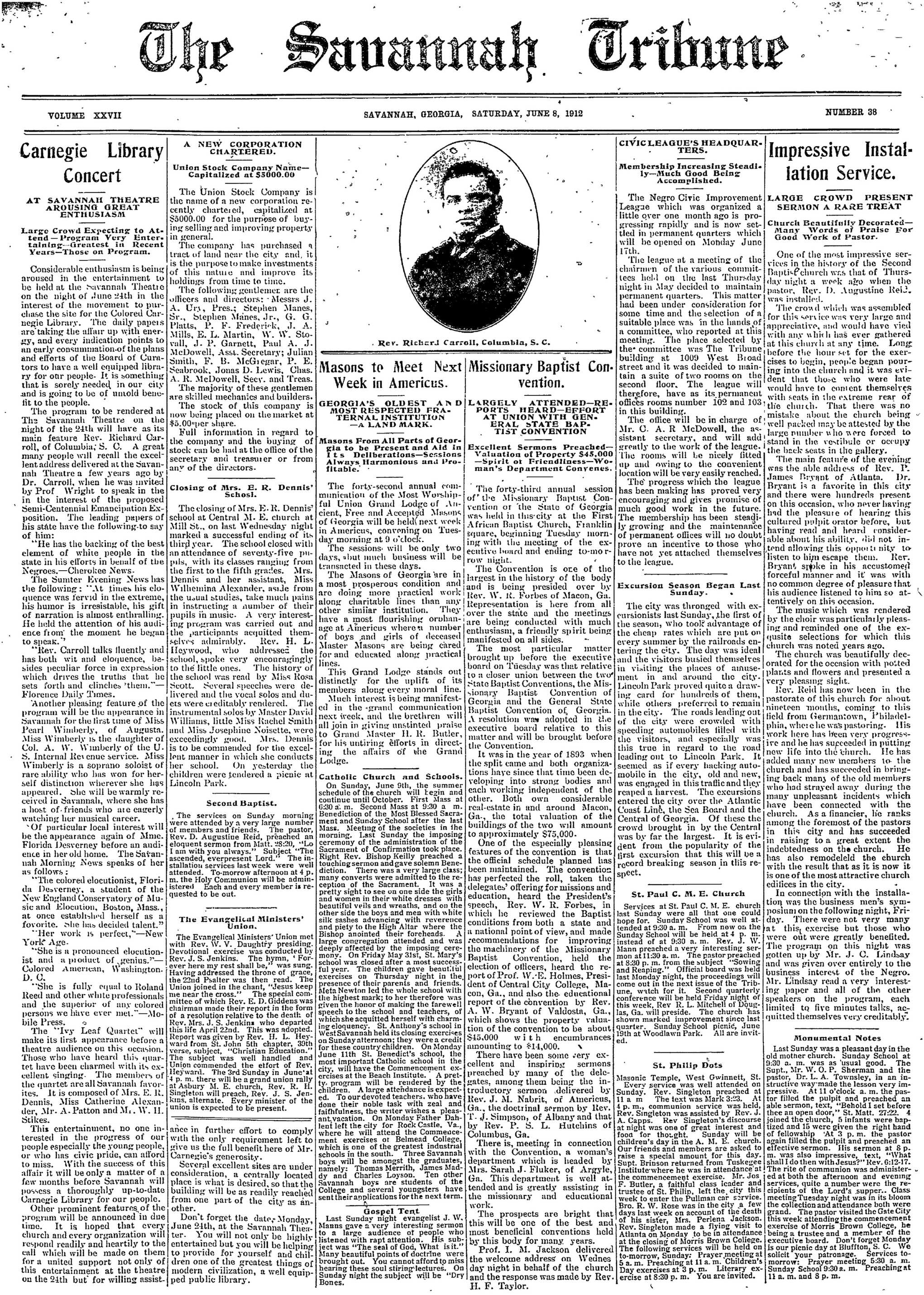
Carnegie Library Concert
AT SAVANNAH THEATRE AROUSING GREAT ENTHUSIASM Large Crowd Expecting to Attend-Program Very Entertaining-Greatest in Recent Years-Those on Program.
Considerable enthusiasm is being aroused in the entertainment to be held at the Savannah Theatre on the night of June 24th in the interest of the movement to purchase the site for the Colored Carnegie Library. The daily papers are taking the affair up with energy, and every indication points to an early consummation of the plans and efforts of the Board of Curators to have a well equipped library for our people. It is something that is sorely needed in our city and is going to be of untold benefit to the people.
The program to be rendered at The Savannah Theatre on the night of the 24th will have as its main feature Rev. Richard Carroll, of Columbia; S. C. A great many people will recall the excellent address delivered at the Savannah Theatre a few years ago by Dr. Carroll, when he was invited by Prof Wright to speak in the in the interest of the proposed Semi-Centennial Emancipation Exposition. The leading papers of his state have the following-to say of him:
"He has the backing of the best element of white people in the state in his efforts in benefit of the Negroes.—Cherokee News.
The Sunter Evening News has the following: "At times his eloquence was fervid in the extreme, his humor is irresistable, his gift of narration is almost enthralling. He held the attention of his audience from the moment he began to speak."
"Rev. Carroll talks fluently and has both wit and eloquence, besides peculiar force in expression which drives the truths that he sets forth and clinches 'them.'"—Florence Daily Times.
Another pleasing feature of the program will be the appearance in Savannah for the first time of Miss Pearl Wimberly, of Augusta. Miss Wimberly is the daughter of Col. A. W. Wimberly of the U. S. Internal Revenue service. Miss Wimberly is a soprano soloist of rare ability who has won for herself distinction wherever she has appeared. She will be warmly received in Savannah, where she has a host of friends who are eagerly watching her musical career. Of particular local interest will be the appearance again of Mme. Florida Deserney before an audience in her old home. The Savannah Morning News speaks of her as follows:
"The colored elocutionist, Florida Desverney, a student of the New England Conservatory of Music and Elocution, Boston, Mass., at once established herself as a favorite. She has decided talent."
"Her work is perfect,"—New York Age.
"She is a pronounced elocutionist and a product of genius."—Colored American, Washington D. C.
"She is fully equal to Roland Reed and other white professionals and the superior of any colored persons we have ever met."—Mobile Press.
The "Ivy Leaf Quartet" will make its first appearance before a theatre audience on this occasion. Those who have heard this quartet have been charmed with its excellent singing. The members of the quartet are all Savannah favorites. It is composed of Mrs. E. R. Dennis, Miss Catherine Alexander, Mr. A. Patton and Mr. W. H. Stikes. This entertainment, no one interested in the progress of our people especially the young people, or who has civic pride, can afford to miss. With the success of this affair it will be only a matter of a few months before Savannah will possess a thoroughly up-to-date Carnegie Library for our people.
Other prominent features of the program will be announced in due time. It is hoped that every church and every organization will respond readily and heartily to the call which will be made on them for a united support not only of this entertainment at the theatre on the 24th but for willing assist-
VOLUME XXVII
The
A NEW CORPORATION
CHARTERED.
Union Stock Company Name-
Capitalized at $5000.00
The Union Stock Company is the name of a new corporation recently chartered, capitalized at $5000.00 for the purpose of buying selling and improving property in general. The company has purchased a tract of land near the city and, it is the purpose to make investments of this nature and improve its holdings from time to time.
The following gentlemen are the officers and directors: Messrs J. A. Ury, Pres.; Stephen Manes, Sr., Stephen Manes, Jr., G. G. Platts, P. F. Frederick, J. A. Mills, E. L. Martin, W. W. Stovall, J. P. Garnett, Paul A. J. McDowell, Asst. Secretary; Julian Smith, F. B. McGregar, P. E. Seabrook, Jonas D. Lewis, Chas. A. R. McDowell, Secy. and Treas. The majority of these gentlemen are skilled mechanics and builders. The stock of this company is now being placed on the market at $5.00-per share.
Full information in regard to the company and the buying of stock can be had at the office of the secretary and treasurer or from any of the directors.
Closing of Mrs. E. R. Dennis' Schosl.
The closing of Mrs. E. R. Dennis' school at Central M. E. church at Mill St., on last Wednesday night marked a successful ending of its third year. The school closed with an attendance of seventy-five pupils, with its classes ranging from the first to the fifth grades. Mrs. Dennis and her assistant, Miss Wilhemina Alexander, aside from the usual studies, take much pains in instructing a number of their pupils in music. A very interesting program was carried out and the participants acquitted themselves admirably. Rev. H. L. Heywood, who addressed the school, spoke very encouragingly to the little ones. The history of the school was read by Miss Rosa Scott. Several speeches were delivered and the vocal solos and duets were creditably rendered. The instrumental solos by Master David Williams, little Miss Rachel Smith and Miss Josephine Noisette, were exceedingly good. Mrs. Dennis is to be commended for the excellent manner in which she conducts her school. On yesterday the children were tendered a picnic at Lincoln Park.
Second Baptist.
The services on Sunday morning were attended by a very large number of members and friends. The pastor, Rev. D. Augustine Reid, preached an eloquent sermon from Matt. 28:20, "Lo I am with you always." Subject "The ascended, everpresent Lord." The installation services last week were well attended. To-morrow afternoon at 4 p.m. the Holy Communion will be administered Each and every member is requested to be out.
---
The Evangelical Ministers' Union.
The Evangelical Ministers' Union met with Rev. W. V. Daughtry presiding. Devotional exercise was conducted by Rev. J. S. Jenkins. The hymn, "Forever here my rest shall be," was sung. Having addressed the throne of grace, the 22nd Psalter was then read. The Union joined in the chant, "Jesus keep me near the cross." The special committee of which Rev. E. D. Giddens was chairman made their report in the form of a resolution relative to the death of Rev. Mrs. J. S. Jenkins who departed this life April 22nd. This was adopted. Report was given by Rev. H. L. Heyward from St. John 5th chapter, 39th verse, subject, "Christian Education." The subject was well handled and Union commended the effort of Rev. Heyward. The 3rd Sunday in June at 4 p. m. there will be a grand union rally at Asbury M. E. church, Rev. R. H. Singleton will preach, Rev. J. S. Jenkins, alternate. Every minister of the union is expected to be present.
ance in further effort to comply with the only requirement left to give us the full benefit here of Mr. Carnegie's generosity. Several excellent sites are under consideration, a centrally located place is what is desired, so that the building will be as readily reached from one part of the city as another. Don't forget the date, Monday, June 24th, at the Savannah Theater. You will not only be highly entertained but you will be helping to provide for yourself and children one of the greatest things of modern civilization, a well equipped public library.
SAVANNAH, GEORGIA, SATURDAY, JUNE 8, 1912
[Portrait of a man in formal attire, with a serious expression, set against a plain background. The image is oval-shaped with a black border.]]
Rev. Richard Carroll, Columbia, S. C.
Masons to Meet Next Week in Americus.
GEORGIA'S OLDEST AND MOST RESPECTED FRA TERNAL INSTITUTION -A LAND MARK.
Masons From All Parts of Georgia to be Present and Aid in Its Delliberations—Sessions Always Harmonious and Profitable.
The forty-second annual communication of the Most Worshipful Union Grand Lodge of Ancient, Free and Accepted Masons of Georgia will be held next week in Americus, convening on Tuesday morning at 9 o'clock.
The sessions will be only two days, but much business will be transacted in these days.
The Masons of Georgia are in a most prosperous condition and are doing more practical work along charitable lines than any other similar institution. They have a most flourishing orphanage at Americus where a number of boys and girls of deceased Master Masons are being cared for and educated along practical lines.
This Grand Lodge stands out distinctly for the uplift of its members along every moral line. Much interest is being manifested in the grand communication next week, and the brethren will all join in giving unstinted praise to Grand Master H. R. Butler, for his untiring efforts in directing the affairs of the Grand Lodge.
Catholic Church and Schools.
On Sunday, June 9th, the summer schedule of the church will begin and continue until October. First Mass at 6:30 a.m. Second Mass at 9:30 a.m. Benediction of the Most Blessed Sacrament and Sunday School after the last Mass. Meeting of the societies in the morning. Last Sunday the imposing ceremony of the administration of the Sacrament of Confirmation took place. Right Rev. Bishop Keilly preached a touching sermon and gave solemn Benediction. There was a very large class; many converts were admitted to the reception of the Sacrament. It was a pretty sight to see on one side the girls and women in their white dresses with beautiful veils and wreaths, and on the other side the boys and men with white silk sashes advancing with reverence and piety to the High Altar where the Bishop anointed their forcheads. A large congregation attended and was deeply affected by the imposing ceremony. On Friday May 31st, St. Mary's school was closed after a most successful year. The children gave beautiful exercises on Thursday night in the presence of their parents and friends. Meta Newton led the whole school with the honor of making the farewell speech to the school and teachers, of which she acquitted herself with charming eloquence. St. Anthony's school in West Savannah held its closing exercises on Sunday afternoon; they were a credit for these country children. On Monday June 11th St. Benedict's school, the most important Catholic school in the city, will have the Commencement exercises at the Beach Institute. A pretty program will be rendered by the children. A large attendance is expected. To our devoted teachers, who have done their noble task with zeal and faithfulness, the writer wishes a pleasant vacation. On Monday Father Dahent left the city for Rock Castle, Va., where he will attend the Commencement exercises at Belmead College, which is one of the greatest industrial schools in the south. Three Savannah boys will be amongst the graduates, namely: Thomas Merrith, James Maddy and Charles Loyson. Ten other Savannah boys are students of the College and several youngsters have sent their applications for the next term.
Gospel Tent
Last Sunday night evangelist J. W. Manns gave a very interesting sermon to a large audience of people who listened with rapt attention. His subject was "The seal of God, What is it." Many beautiful points of doctrine were brought out. You cannot afford to miss hearing these soul stiring lectures. On Sunday night the subject will be "Dry Bones.
Missionary Baptist Convention.
LARGELY ATTENDED—REPORTS HEARD—EFFORT AT UNION WITH GENERAL STATE BAPTIST CONVENTION
Excellent Sermons Preached—Valuation of Property $45,000—Spirit of Friendliness—Woman's Department Convenes.
The forty-third annual session of the Missionary Baptist Convention or the State of Georgia was held in this city at the First African Baptist Church, Franklin square, beginning Tuesday morning with the meeting of the executive board and ending to-morrow night.
The Convention is one of the largest in the history of the body and is being presided over by Rev. W. R. Forbes of Macon, Ga. Representation is here from all over the state and the meetings are being conducted with much enthusiasm, a friendly spirit being manifested on all sides.
The most particular matter brought up before the executive board on Tuesday was that relative to a closer union between the two State Baptist Conventions, the Missionary Baptist Convention of Georgia and the General State Baptist Convention of Georgia. A resolution was adopted in the executive board relative to this matter and will be brought before the Convention.
It was in the year of 1893 when the split came and both organizations have since that time been developing into strong bodies and each working independent of the other. Both own considerable real-estate in and around Macon, Ga., the total valuation of the buildings of the two will amount to approximately $75,000.
One of the especially pleasing features of the convention is that the official schedule planned has been maintained. The convention has perfected the roll, taken the delegates' offering for missions and education, heard the President's speech, Rev. W. R. Forbes, in which he reviewed the Baptist conditions from both a state and a national point of view, and made recommendations for improving the machinery of the Missionary Baptist Convention, held the election of officers, heard the report of Prof. W. E. Holmes, President of Central City College, Macon, Ga., and also the educational report of the convention by Rev. A. W. Bryant of Valdosta, Ga., which shows the property valuation of the convention to be about $45,000 with encumbrances amounting to $14,000.
There have been some very excellent and inspiring sermons preached by many of the delegates, among them being the introductory sermon delivered by Rev. J. M. Nabrit, of Americus, Ga., the doctrinal sermon by Rev. T. J. Simpson, of Albany and that by Rev. P. S. L. Hutchins of Columbus, Ga.
There is, meeting in connection with the Convention, a woman's department which is headed by Mrs. Sarah J. Fluker, of Argyle, Ga. This department is well attended and is greatly assisting in the missionary and educational work.
The prospects are bright that this will be one of the best and most beneficial conventions held by this body for many years. Prof. I. M. Jackson delivered the welcome address on Wednes day night in behalf of the church and the response was made by Rev. H. F. Taylor.
CIVIC LEAGUE'S HEADQUARTERS.
Membership Increasing Steadily Much Good Being Accomplished.
The Negro Civic Improvement League which was organized a little over one month ago is progressing rapidly and is now settled in permanent quarters which will be opened on Monday June 17th.
The league at a meeting of the chairmen of the various committees held on the last Thursday night in May decided to maintain permanent quarters. This matter had been under consideration for some time and the selection of a suitable place was in the hands of a committee, who reported at this meeting. The place selected by the committee was The Tribune building at 1009 West Broad street and it was decided to maintain a suite of two rooms on the second floor. The league will therefore, have as its permanent offices rooms number 102 and 103 in this building.
The office will be in charge of Mr. C. A. R McDowell, the assistant secretary, and will add greatly to the work of the league. The rooms will be nicely fitted up and owing to the convenient location will be very easily reached. The progress which the league has been making has proved very encouraging and gives promise of much good work in the future. The membership has been steadily growing and the maintenance of permanent offices will no doubt prove an incentive to those who have not yet attached themselves to the league.
Excursion Season Began Last Sunday.
The city was thronged with excursionists last Sunday, the first of the season, who took advantage of the cheap rates which are put on every summer by the railroads entering the city. The day was ideal and the visitors busied themselves in visiting the places of amusement in and around the city. Lincoln Park proved quite a drawing card for hundreds of them, while others preferred to remain in the city. The roads leading out of the city were crowded with speeding automobiles filled with the visitors, and especially was this true in regard to the road leading out to Lincoln Park. It seemed as if every hacking automobile in the city, old and new, was engaged in this traffic and they reaped a harvest. The excursions entered the city over the Atlantic Coast Line, the Sea Board and the Central of Georgia. Of these the crowd brought in by the Central was by far the largest. It is evident from the popularity of the first excursion that this will be a record breaking season in this respect.
St. Paul C. M. E. Church
Services at St. Paul C. M. E. church last Sunday were all that one could hope for. Sunday School was well attended at 9:30 a. m. From now on the Sunday School will be held at 4 p. m. instead of at 9:30 a. m. Rev. J. W. Mann preached a very interesting sermon at 11:30 a. m. The pastor preached at 8:30 p. m. from the subject "Sowing and Reaping." Official board was held last Monday night, the proceedings will come out in the next issue of the Tribune, watch for it. Second quarterly conference will be held Friday night of this week, Rev R. L. Mitchell of Douglas, Ga. will preside. The church has shown marked improvement since last quarter. Sunday School picnic, June 19th at Woodlawn Park. All are invited.
St. Philip Dots
Masonic Temple, West Gwinnett, St. Every service was well attended on Sunday. Rev. Singleton preached at 11 a m. The text was Mark 3:3. At 4 p.m., communion service was held, Rev. Singleton was assisted by Rev. J. A. Capps. Rev Singleton's discourse at night was one of great interest and food for thought. Sunday will be children's day in the A. M. E. church. Our friends and members are asked to raise a special amount for this day. Supt. Brinson returned from Tuskegee Institute where he was in attendance at the commencement exercise. Mr. Jos F. Butler, a faithful class leader and trustee of St. Philip, left the city this week to enter the Pullman car service. Bro. R. W. Rose was in the city a few days last week on account of the death of his sister, Mrs. Perlena Jackson. Rev. Singleton made a flying visit to Atlanta on Monday to be in attendance at the closing of Morris Brown College. The following services will be held on to-morrow, Sunday: Prayer meeting at 5 a.m. Preaching at 11 a.m. Children's Day exercises at 3 p.m. Literary exercise at 8:30 p.m. You are invited.
NUMBER 38
Impressive Installation Service.
Impressive Installation Service.
LARGE CROWD PRESENT SERMON A RARE TREAT
Church Beautifully Decorated—Many Words of Praise For Good Work of Pastor.
One of the most impressive services in the history of the Second Baptist church was that of Thursday night a week ago when the pastor, Rev. D. Augustine Reil, was installed.
The crowd which was assembled for this service was very large and appreciative, and would have vied with any which has ever gathered at this church at any time. Long before the hour set for the exercises to begin, people began pouring into the church and it was evident that those who were late would have to content themselves with seats in the extreme rear of the church. That there was no mistake about the church being well packed may be attested by the large number who were forced to stand in the vestibule or occupy the back seats in the gallery.
The main feature of the evening was the able address of Rev. P. James Bryant of Atlanta. Dr. Bryant is a favorite in this city and there were hundreds present on this occasion, who never having had the pleasure of hearing this cultured pulpit orator before, but having read and heard considerable about his ability, did not intend allowing this opportunity to listen to him escape them. Rev. Bryant spoke in his accustomed forceful manner and it was with no common degree of pleasure that his audience listened to him so attentively on this occasion.
The music which was rendered by the choir was particularly pleasing and reminded one of the exquisite selections for which this church was noted years ago. The church was beautifully decorated for the occasion with potted plants and flowers and presented a very pleasing sight.
Rev. Reid has now been in the pastorate of this church for about nineteen months, coming to this field from Germantown, Philadelphia, where he was pastoring. His work here has been very progressive and he has succeeded in putting new life into the church. He has added many new members to the church and has succeeded in bringing back many of the old members who had strayed away during the many unpleasant incidents which have been connected with the church. As a financier, lie ranks among the foremost of the pastors in this city and has succeeded in raising to a great extent the indebtedness on the church. He has also remodeleld the church with the result that as it is now it is one of the most attractive church edifices in the city.
In connection with the installation was the business men's symposium on the following night, Friday. There were not very many at this exercise but those who were out were greatly benefited. The program on this night was gotten up by Mr. J. C. Lindsay and was given over entirely to the business interest of the Negro. Mr. Lindsay read a very interesting paper and all of the other speakers on the program, each limited to five minutes talks, acquitted themselves very creditably.
Monumental Notes
Last Sunday was a pleasant day in the old mother church. Sunday School at 9:30 a.m. was as usual good. The Supt., Mr. W. O.P. Sherman and the pastor, Dr. L. A. Townsley, in an instructive way made the lesson very impressive. At 11 o'clock a.m. the pastor filled the pulpit and preached an able sermon, text, "Behold I set before thee an open door," St. Matt. 27:22. 4 joined the church, 5 infants were baptized and 15 were given the right hand of fellowship 'At 3 p.m. the pastor again filled the pulpit and preached an effective sermon. His sermon at 8 p.m. was also impressive, text, "What shall I do then with Jesus?" Rev. 6:12-17. The rite of communion was administered at both the afternoon and evening services, quite a number were the recipients of the Lord's supper. Class meeting Tuesday night was in its bloom the collection and attendance both were grand. The pastor visited the Gate City this week attending the commencement exercise of Morris Brown College, he being a trustee and a member of the executive board. Don't forget Monday is our picnic day at Bluffton, S. C. We solicit your patronage. Services toorrow: Prayer meeting 5:30 a.m. Sunday School 9:30 a.m. Preaching at 11 a.m. and 8 p.m.
"OLD HICKORY" COMMENTS ON BOOK OF GEORGE W. MURRAY OF SOUTH CAROLINA.
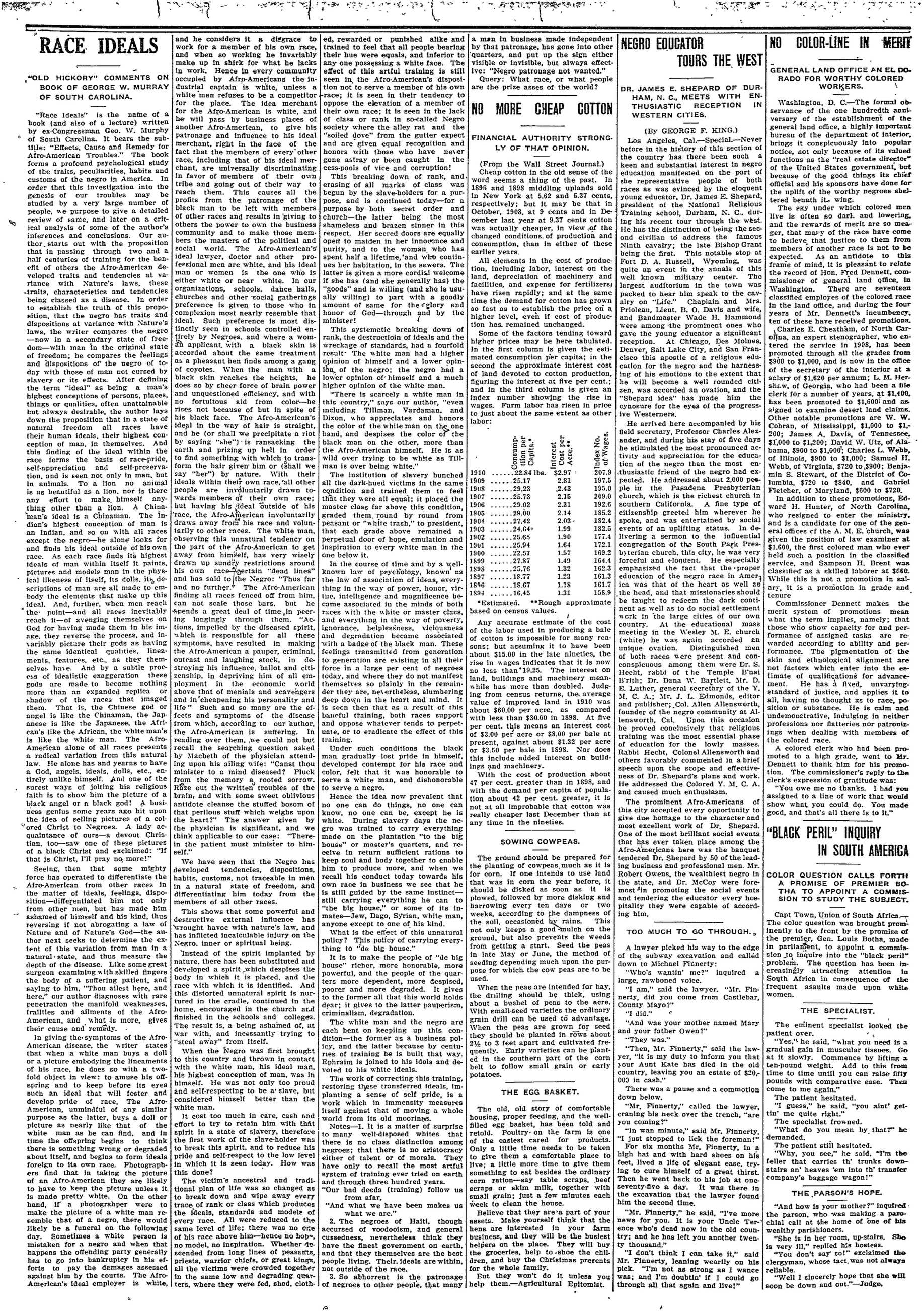
"Race Ideals" is the name of a book (and also of a lecture) written by ex-Congressman Geo. W. Murphy of South Carolina. It bears the subtitle: "Effects, Cause and Remedy for Afro-American Troubles." The book forms a profound study of the traits, peculiarities, habits and customs of the negro in America. In order that this investigation into the genesis of our troubles may be studied by a very large number of people, we purpose to give a detailed review of same, and later on a critical analysis of some of the author's inferences and conclusions. Our author starts out with the proposition that in passing through two and a half centuries of training for the benefit of others the Afro-American developed traits and tendencies at variance with Nature's laws, these traits, characteristics and tendencies being classed as a disease. In order to establish the truth of this proposition, that the negro has traits and dispositions at variance with Nature's laws, the writer compares the negro—now in a secondary state of freedom—with man in the original state of freedom; he compares the feelings and dispositions of the negro of today with those of man not cursed by slavery or its effects. After defining the term "ideal" as being a man's highest conceptions of persons, places, things or qualities, often unattainable but always desirable, the author lays down the proposition that in a state of natural freedom all races have their human ideals, their highest conception of man, in themselves. And this finding of the ideal within the race forms the basis of race-pride, self-appreciation and self-preservation, and is seen not only in man, but in animals. To a lion no animal is as beautiful as a lion, nor is there any effort to make himself anything other than a lion. A Chinaman's ideal is a Chinaman. The Indian's highest conception of man is an Indian, and so on with all races except the negro—he alone looks for and finds his ideal outside of his own race. As each race finds its highest ideals of man within itself it paints, pictures and models man in the physical likeness of itself, its dolls, its descriptions of man are all made to embody the elements that make up this ideal. And, further, when men reach the point—and all races inevitably reach it—of avenging themselves on God for having made them in his image, they reverse the process, and invariably picture their gods as having the same identical qualities, lineaments, features, etc., as they themselves have. And by a subtle process of idealistic exaggeration these gods are made to become nothing more than an expanded replica or shadow of the races that imaged them. That is, the Chinese god or angel is like the Chinaman, the Japanese is like the Japanese, the African's like the African, the white man's like the white man. The Afro-American alone of all races presents a radical variation from this natural law. He alone has and yearns to have a God, angels, ideals, dolls, etc., entirely unlike himself. And one of the surest ways of jolting his religious faith is to show him the picture of a black angel or a black god! A business genius some years ago hit upon the idea of selling pictures of a colored Christ to Negroes. A lady acquaintance of ours—a devout Christian, too—saw one of these pictures of a black Christ and exclaimed: "If that is Christ, I will pray no more!"
Seeing, then that some mighty force has operated to differentiate the Afro-American from other races in the matter of ideals, feelings, disposition—differentiated him not only from other men, but has made him ashamed of himself and his kind, thus reversing if not abrogating a law of Nature and of Nature's God—the author next seeks to determine the extent of this variation from man in a natural state, and thus measure the depth of the disease. Like some great surgeon examining with skilled fingers the body of a suffering patient, and saying to him, "Thou alest here, and here," our author diagnoses with rare penetration the manifold weaknesses, frailties and alliments of the Afro-American, and what is more, gives their cause and remedy.
In giving the symptoms of the Afro-American disease, the writer states that when a white man buys a doll or a picture embodying the lineaments of his race, he does so with a twofold object in view: to amuse his offspring and to keep before its eyes such an ideal that will foster and develop pride of race. The Afro-American, unmindful of any similar purpose as the latter, buys a doll or picture as nearly like that of the white man as he can find, and in time the offspring begins to think there is something wrong or degraded about itself, and begins to form ideals foreign to its own race. Photographers find that in taking the picture of an Afro-American they are likely to have to keep the picture unless it is made pretty white. On the other hand, if a photographer were to make the picture of a white man resemble that of a negro, there would likely be a funeral on the following day. Sometimes a white person is mistaken for a negro and when that happens the offending party generally has to go into bankruptcy in his efforts to pay the damages assessed against him by the courts. The Afro-American's ideal employer is white,
and he considers it a disgrace to work for a member of his own race, and when so working he invariably make up in shirk for what he lacks in work. Hence in every community occupied by Afro-Americanes the industrial captain is white, unless a white man refuses to be a competitor for the place. The idea merchant for the Afro-American is white, and he will pass by business places of another Afro-American, to give his patronage and influence to his ideal merchant, right in the face of the fact that the members of every other race, including that of his ideal merchant, are universally discriminating in favor of members of their own tribe and going out of their way to reach them. This causes all the profits from the patronage of the black man to be left with members of other races and results in giving to others the power to own the business community and to make those members the masters of the political and social world. The Afro-American's ideal lawyer, doctor and other professional men are white, and his ideal man or women is the one who is either white or near white. In our organizations, schools, dance halls, churches and other social gatherings preference is given to those who in complexion most nearly resemble that ideal. Such preference is most distinctly seen in schools controlled entirely by Negroes, and where a woman applicant with a black skin is accorded about the same treatment as a pheasant hen finds among a gang of coyotes. When the man with a black skin reaches the heights, he does so by sheer force of brain power and unquestioned efficiency, and with no fortuitous aid from color—he rises not because of but in spite of his black face. The Afro-American's ideal in the way of hair is straight, and he (or shall we prelatep a riot by saying "she") is ransacking the earth and prizing up hell in order to find something with which to transform the hair given him or (shall we say "her") by nature. With their ideals within their own race, all other people are involuntarily drawn towards members of their own race; but having his ideal outside of his race, the Afro-American involuntarily draws away from his race and voluntarily to other races. The white man, observing this unnatural tendency on the part of the Afro-American to get away from himself, has very wisely drawn up sundry restrictions around his own race—s certain "dead lines" and has said to the Negro: "Thus far and no further." The Afro-American finding all races fenced off from him, can not scale those bars, but he spends a great deal of time in peering longingly through them. "Actions, impelled by the diseased spirit, which is responsible for all these symptoms, have resulted in making the Afro-American a pauper, criminal, outcast and laughing stock, in destroying his influence, ballot and citizenship, in depriving him of all employment in the economic world above of menials and scavengers and in cheapening his personality and life." Such and so many are the effects and symptoms of the disease from which, according to our author, the Afro-American is suffering. In reading over them, we could not but recall the searching question asked by Macbeth of the physician attending upon his allying wife: "Canst thou minister to a mind diseased? Pluck from the memory a rooted sorrow. Raze out the written troubles of the brain, and with some sweet oblivious antidote cleanse the stuffed bosom of that perilous stuff which weighs upon the heart?" The answer given by the physician is significant, and we think applicable to our case: "There in the patient must minister to himself."
We have seen that the Negro has developed tendencies, dispositions, habits, customs, not traceable in men in a natural state of freedom, and differentiating him today from the members of all other races.
This shows that some powerful and destructive external influence has wrought havoc with nature's law, and has inflicted incalculable injury on the Negro, inner or spiritual being.
Instead of the spirit implanted by nature, there has been substituted and developed a spirit which despises the body in which it is placed, and the race with which it is identified. And this distorted unnatural spirit is nurtured in the cradle, continued in the home, encouraged in the church and finished in the schools and colleges. The result is, a being ashamed of, at war with, and incessantly trying to "steal away" from itself.
When the Negro was first brought to this country and thrown in contact with the white man, his ideal man, his highest conception of man, was in himself. He was not only too proud and self-respecting to be a slave, but considered himself better than the white man. It cost too much in care, cash and effort to try to retain him with that spirit in a state of slavery, therefore the first work of the slave-holder was to break this spirit, and to reduce his pride and self-respect to the low level in which it is seen today. How was this done?
The victim's ancestral and traditional plan of life was so changed as to break down and wipe away every trace of rank or class which produces the ideals, standards and models of every race. All were reduced to the same level of life; there was no one of his race above him—hence no hope, no model, no inspiration. Whether descended from long lines of peasants, priests, warrior chiefs, or great kings, all the victims were crowded together in the same low and degrading quarters, where they were fed, shod, cloth-
ed, rewarded or punished alike and trained to feel that all people bearing their hue were equals, and inferior to any one possessing a white face. The effect of this artful training is still seen in the Afro-American's disposition not to serve a member of his own race; it is seen in their tendency to oppose the elevation of a member of their own race; it is seen in the jack of class or rank in so-called Negro society where the alley rat and the "soiled dove" from the gutter expect and are given equal recognition and honors with those who have never gone astray or been caught in the cess-pools of vice and corruption!
This breaking down of rank, and erasing of all marks of class was begun by the slave-holders for a purpose, and is continued today—for a purpose by both secret order and church—the latter being the most shameless and brazen sinner in this respect. Her secret doors are equally open to maiden in her innocence and purity, and to the woman who has spent half a lifetime,'and who continues her habitation, in the sewers. The latter is given a more cordial welcome if she has (and she generally has) the "goods" and is willing (and she is usually willing) to part with a goodly amount of same for the glory and honor of God—through and by the minister!
This systematic breaking down of rank, the destruction of ideals and the wreckage of standards, had a fourfold result. The white man had a higher opinion of himself and a lower opinion of the negro; the negro had a lower opinion of himself and a much higher opinion of the white man.
"There is scarcely a white man in this country," says our author, "even including Tillman, Vardaman, and Dixon, who appreciates and honors the color of the white man on the one hand, and despises the color of the black man on the other, more than the Afro-American himself. He is as wild over trying to be white as Tillman is over being white."
The institution of slavery bunched all the dark-hued victims in the same condition and trained them to feel that they were all equal; it placed the master class far above this condition, graded them, round by round from peasant or "white trash," to president, that each grade above remained a perpetual door of hope, emulation and inspiration to every white man in the one below it.
In the course of time and by a well-known law of psychology, known as the law of association of ideas, everything in the way of power, honor, virtue, intelligence and magnificence became associated in the minds of both races with the white or master class, and everything in the way of poverty, ignorance, helplessness, viciousness and degradation became associated with a badge of the black man. These feelings transmitted from generation to generation are existing in all their force in a large per cent of negroes today, and where they do not manifest themselves so plainly in the remainder they are, nevertheless, slumbering deep down in the heart and mind. It is seen then that as a result of this baneful training, both races support and oppose whatever tends to perpetuate, or to eradicate the effect of this training.
Under such conditions the black man gradually lost pride in himself, developed contempt for his race and color, felt that it was honorable to serve a white man, and dishonorable to serve a negro.
Hence the idea now prevalent that no one can do things, no one can know, no one can be, except he is white. During slavery days the negro was trained to carry everything made on the plantation "to the big house" or master's quarters, and receive in return sufficient rations to keep soul and body together to enable him to produce more, and when we recall his conduct today towards his own race in business we see that he is still guided by the same instinct—still carrying everything he can to "the big house," or some of its inmates—Jew, Dago, Syrian, white man, anyone except one of his kind.
What is the effect of this unnatural policy? This policy of carrying everything to "de big house."
It is to make the people of "de big house" richer, more honorable, more powerful, and the people of the quarters more dependent, more despised, poorer and more degraded. It gives to the former all that this world holds dear; it gives to the latter pauperism, criminalism, degradation.
The white man and the negro are each bent on keeping up this condition—the former as a business policy, and the latter because by centuries of training he is built that way. Ephraim is joined to his idols and devoted to his white ideals.
The work of correcting this training, restoring these transferred ideals, implanting a sense of self pride, is a work which in immensity measures itself against that of moving a whole world from its old moorings.
Notes-1. It is a matter of surprise to many well-dispersed whites that there is no class distinction among negroes; that there is no aristocracy either of talent or of morals. They have only to recall the most artful system of training ever tried on earth and through three hundred years.
"Our bad deeds (training) follow us from afar,
"And what we have been makes us what we are."
2. The negroes of Haiti, though accursed of voodooism, and general cussedness, nevertheless think they have the finest government on earth, and that they themselves are the best people living. Their ideals are within, not outside of the race.
3. So abhorrent is the patronage of negroes to other people, that many
a man in business made independent by that patronage, has gone into other quarters, and put up the sign either visible or invisible, but always effective: "Negro patronage not wanted."
Query: What race, or what people are the prize asses of the world?
NO MORE CHEAP COTTON
FINANCIAL AUTHORITY STRONGLY OF THAT OPINION.
(From the Wall Street Journal.)
Cheap cotton in the old sense of the word seems a thing of the past. In 1895 and 1898 middling uplands sold in New York at 5.62 and 5.37 cents, respectively; but it may be that in October, 1908, at 9 cents and in December last year at 9.37 cents cotton was actually cheaper, in view of the changed conditions of production and consumption, than in either of these earlier years.
All elements in the cost of production, including labor, interest on the land, depreciation of machinery and facilities, and expense for fertilizers, have risen rapidly; and at the same time the demand for cotton has grown so fast as to establish the price on a higher level, even if cost of production has remained unchanged.
Some of the factors tending toward higher prices may be here tabulated. In the first column is given the estimated consumption per capita; in the second the approximate interest cost of land devoted to cotton production, figuring the interest at five per cent.; and in the third column is given an index number showing the rise in wages. Farm labor has risen in price to just about the same extent as other labor:
Consumption per Capita.*
Interest Cost per Acre.**
Index No. of Wages.
1910 ..... 22.84 lbs. $2.97 207.9
1809 ..... 25.17 2.81 197.5
1808 ..... 29.23 2.43 195.0
1807 ..... 25.73 2.15 209.0
1906 ..... 29.02 2.31 192.6
1905 ..... 29.00 2.14 185.2
1904 ..... 27.42 2.03 182.4
1903 ..... 24.64* 1.99 182.5
1902 ..... 25.65 1.90 177.4
1901 ..... 25.94 1.64 172.1
1900 ..... 22.57 1.57 169.2
1999 ..... 27.87 1.49 164.4
1988 ..... 25.76 1.32 162.3
1997 ..... 18.77 1.23 161.3
1996 ..... 18.67 1.18 161.7
1894 ..... 16.45 1.31 158.9
*Estimated. **Rough approximate based on census values.
Any accurate estimate of the cost of the labor used in producing a bale of cotton is impossible for many reasons; but assuming it to have been about $15.00 in the late nineteen, the rise in wages indicates that it is now no less than *19.25*. The interest on land, buildings and machinery meanwhile has more than doubled. Judging from census returns, the average value of improved land in 1910 was about $60.00 per acre, as compared with less than $20.00 in 1898. At five per cent, this means an interest cost of $3.00 per acre or $8.00 per bale at present, against about $1.32 per acre or $3.50 per bale in 1898. Nor does this include added interest on buildings and machinery.
With the cost of production about 47 per cent. greater than in 1898, and with the demand per capita of population about 42 per cent. greater, it is not at all improbable that cotton was really cheaper last December than at any time in the nineties.
SOWING COWPEAS.
The ground should be prepared for the planting of cowpeas, much as it is for corn. If one intends to use land that was in corn the year before, it should be disked as soon as it is plowed, followed by more disking and harrowing every ten days or two weeks, according to the dampness of the soil, occasioned by rains. This not only keeps a good mulch on the ground, but also prevents the weeds from getting a start. Seed the peas in late May or June, the method of seeding depending much upon the purpose for which the cow peas are to be used.
When the peas are intended for hay, the drilling should be thick, using about a bushel of peas to the acre. With small-seed varieties the ordinary grain drill can be used to advantage. When the peas are grown for seed they should be planted in rows about $2 \frac{1}{2}$ to 3 feet apart and cultivated frequently. Early varieties can be planted in the southern part of the corn belt to follow small grain or early potatoes.
THE EGG BASKET.
The old, old story of comfortable housing, proper feeding, and the well-filled egg basket, has been told and retold. Poultry-on the farm is one of the easiest cared for products. Only a little time needs to be taken to give them a comfortable place to live; a little more time to give them something to eat besides the ordinary corn ration—say table scraps, beef scraps or skim milk, together with small grain; just a few minutes each week to clean the house.
Believe that they are a part of your assets. Make yourself think that the hens are interested in your farm business, and they will be the busiest helpers on the place. They will buy the groceries, help to shoe the children, and buy the Christmas presents for the whole family.
But they won't do it unless you help them—Agricultural Epitomist.
NEGRO EDUCATOR
TOURS THE WEST
DR. JAMES E. SHEPARD OF DURHAM, N. C. MEETS WITH ENTHUSIASTIC RECEPTION IN WESTERN CITIES.
(BY GEORGE F. KING.)
Los Angeles, Cal.-Special.-Never before in the history of this section of the country has there been such a keen and substantial interest in negro education manifested on the part of the representative people of both races as was evinced by the eloquent young educator, Dr. James E. Shepard, president of the National Religious Training school, Durham, N. C., during his recent tour through the west. He has the distinction of being the second civilian to address the famous Ninth cavalry; the late Bishop Grant being the first. This notable stop at Fort D. A. Russell, Wyoming, was quite an event in the annals of this well known military center. The largest auditorium in the town was packed to hear him speak to the cavalry on "Life." Chaplain and Mrs. Prioleau, Leut. B. O. Davis and wife, and Bandmaster Wade H. Hammond were among the prominent ones who gave the young educator a significant reception. At Chicago, Des Molines, Denver, Salt Lake City, and San Francisco this apostle of a religious education for the negro and the harnessing of his emotions to the extent that he will become a well rounded citizen, was accorded an ovation, and the "Shepard idea" has made him the cynosure for the eyes of the progressive Westerners.
He arrived here accompanied by his field secretary, Professor Charles Alexander, and during his stay of five days he stimulated the most pronounced activity and appreciation for the education of the negro than the most enthusiastic friend of the negro had expected. He addressed about 2,000 people in the Pasadena Presbyterian church, which is the richest church in southern California. A fine type of citizenship greeted him wherever he spoke, and was entertained by social events of an uplifting status. In delivering a sermon to the influential congregation of the South Park Presbyterian church, this city, he was very forceful and eloquent. He especially emphasized the fact that the proper education of the negro race in America was that of the heart as well as the head, and that missionaries should be taught to redeem the dark continent as well as to do social settlement work in the large cities of our own country. At the educational mass meeting in the Wesley M. E. church (white) he was again accorded an unique ovation. Distinguished men of both races were present and conspicuous among them were Dr. S. Hecht, rabbi of the Temple B'nai Brith; Dr. Dana W. Bartlett, Mr. D. E. Luther, general secretary of the Y. M. C. A.; Mr. J. L. Edmonds, editor and publisher; Col. Allen Allensworth, founder of the negro community at Allensworth, Cal. Upon this occasion he proved conclusively that religious training was the most essential phase of education for the lowly masses. Rabbi Hecht, Colonel Allensworth and others favorably commented in a brief speech upon the scope and effectiveness of Dr. Shepard's plans and work. He addressed the Colored Y. M. C. A. and caused much enthusiasm.
The prominent Afro-Americans of this city accepted every opportunity to give due homage to the character and most excellent work of Dr. Shepard. One of the most brilliant social events that has ever taken place among the Afro-Americans here was the banquet tendered Dr. Shepard by 50 of the leading business and professional men. Mr. Robert Owens, the wealthiest negro in the state, and Dr. McCoy were foremost in promoting the social events and tendering the educator every hospitality they were capable of according him.
TOO MUCH TO GO THROUGH.
A lawyer picked his way to the edge of the subway excavation and called down to Michael Finnerty:
"Who's wantin' me?" inquired a large, rawboned voice.
"I am," said the lawyer. "Mr. Finnerty, did you come from Castlebar, County Mayo?"
"I did."
"And was your mother named Mary and your father Owen?"
"They was."
"Then, Mr. Finnerty," said the lawyer. "it is my duty to inform you that your Aunt Kate has died in the old country, leaving you an estate of $20,000 in cash."
There was a pause and a commotion down below.
"Mr. Finnerty," called the lawyer, craning his neck over the trench, "are you coming?"
"I wan minute," said Mr. Finnerty, "I just stopped to lick the foreman!" For six months Mr. Finnerty, in a high hat and with hard shoes on his feet, lived a life of elegant ease, trying to cure himself of a great thirst. Then he went back to his job at one-seventy-five a day. It was there in the excavation that the lawyer found him the second time.
"Mr. Finnerty," he said, "I've more news for you. It is your Uncle Terence who's dead now in the old country; and he has left you another twenty thousand."
"I don't think I can take it," said Mr. Finnerty, leaning wearily on his pick. "I'm not as strong as I wance was; and I'm doubtin' if I could go through all that again and live!"
GENERAL LAND OFFICE AN EL DORADO FOR WORTHY COLORED WORKERS.
Washington, D. C.—The formal observance of the one hundredth anniversary of the establishment of the general land office, a highly important bureau of the department of interior, brings it conspicuously into popular notice, not only because of its valued functions as the "real estate director" of the United States government, but because of the good things its chief official and his sponsors have done for the uplift of the worthy negroes sheltered beneath it, wing.
The sky under which colored men live is often so dark, and lowering, and the rewards of merit are so meager, that many of the race have come to believe that justice to them from members of another race is not to be expected. As an antidote to this frame of mind, it is pleasant to relate the record of Hon. Fred Dennett, commissioner of general land office, in Washington. There are seventeen classified employees of the colored race in the land office, and during the four years of Mr. Dennett's incumbency, ten of these have received promotions.
Charles E. Cheatham, of North Carolina, an expert stenographer, who entered the service in 1908, has been promoted through all the grades from $900 to $1,000, and is now in the office of the secretary of the interior at a salary of $1,620 per annum; L. M. Hershaw, of Georgia, who had been a file clerk for a number of years, at $1,400, has been promoted to $1,600 and assigned to examine desert land claims. Other notable promotions are W. W. Cohran, of Mississippi, $1,000 to $1,200; James A. Davis, of Tennessee, $1,000 to $1,200; David W. Utz, of Alabama, $900 to $1,000; Charles L. Webb, of Illinois, $900 to $1,000; Samuel H. Webb, of Virginia, $720 to $900; Benjamin S. Stewart, of the District of Columbia, $720 to $840, and Gabriel Fletcher, of Maryland, $600 to $720.
In addition to these promotions, Edward H. Hunter, of North Carolina, who resigned to enter the ministry, and is a candidate for one of the general offices of the A. M. E. church, was given the position of law examiner at $1,600, the first colored man who ever held such a position in the classified service, and Sampson H. Brent was classified as a skilled laborer at $660. While this is not a promotion in salary, it is a promotion in grade and tenure
Commissioner Dennett makes the merit system of promotions mean what the term implies, namely; that those who show capacity for and performance of assigned tasks are rewarded according to ability and performance. The pigmentation of the skin and ethnological alignment are not factors which enter into the estimate of qualifications for advancement. He has a fived, unvarying-standard of justice, and applies it to all, having no thought as to race, position or substance. He is calm and undemonstrative, indulging in neither professions nor flatteries nor patronizing when dealing with members of the colored race.
A colored clerk who had been promoted to a high grade, went to Mr. Dennett to thank him for his promotion. The commissioner's reply to the clerk's expression of gratitude was:
"You owe me no thanks. I had you assigned to a line of work that would show what, you could do. You made good, and that's all there is to it."
"BLACK PERIL" INQUIRY IN SOUTH AMERICA
COLOR QUESTION CALLS FORTH
A PROMISE OF PREMIER BO-
THA TO APPOINT A COMMISSION TO STUDY THE SUBJECT.
Capt Town, Union of South Africa.
The color question was brought prominently to the front by the promise of the premier, Gen. Louis Botha, made in parliament, to appoint a commission to inquire into the "black peril" problem. The question has been increasingly attracting attention in South Africa in consequence of the frequent assaults made upon white women.
THE SPECIALIST
The enilent specialist looked the patient over. "Yes," he said, "what you need is a gradual gain in muscular tissues. Go at it slowly. Commence by lifting a ten-pound weight. Add to this from time to time until you can raise fifty pounds with comparative ease. Then come to me again."
The patient hesitated.
"I guess," he said, "you aint' gettin' me quite right."
The specialist frowned.
"What do you mean by that?" he demanded.
The patient still hesitated.
"Why, you see," he said, "I'm the feller that carries th' trunks downstairs an' heaves 'em into th' transfer company's baggage wagon!"
THE PARSON'S HOPE.
"And how is your mother?" inquired the parson, who was making a parochial call at the home of one of his wealthy parishioners. "She is in her room, up-stairs. She is very ill," replied his hostess. "You don't say so!" exclaimed the clergyman, whose tact, was not always reliable. "Well I sincerely hope that she will soon be down and out."—Judge.
See COOPER & ODRIZEN The Up-to-Date Tailors
218 WEST BROAD STREET, BETWEEN HULL AND OGLETHORPE AVE. The Latest Patterns in SPRING AND SUMMER GOODS. Firstclass workmanship guaranteed. Our prices will interest you.
A HOME?
WE HAVE TWELVE LOTS ON THIRTY-NINTH STREET, BETWEEN BURROUGHS AND FLORENCE, UPON WHICH WE WILL BUILD HOMES FOR ANY ONE DESIRING THEM. THE KIND OF HOUSE YOU WANT WILL BE BJILT FOR YOU, AND YOU CAN PAY US FOR IT IN EASY MONTHLY PAYMENTS. COME AND SEE US ABOUT THIS PROPOSITION.
30 DRAYTON STREET.
Nichols, THE SHOE MAN
The affable H. B. Wright is still with us and expects the continuous patronage of his friends.
Residence Phone 2032. Livery Stable Attached. Office Phone 676. C. H. ROYALL, Residence 509 Charles St. Phone 3064.
W. L. BLUNT, WHOLESALE AND RETAIL
234 ST. JULIAN ST., WEST, 235 BRYAN ST., WEST. Phone 2968 SAVANNAH, GEORGIA.
Palm Shaving Palace
Expert Hair Cutting. Electric Massage and Shampooing a Specialty. All Work Done by Experienced Workmen. Courteous attention to all. SHINING PARLOR ATTACHED.
PERRY R. WRIGHT, Proprietor
817 WEST BROAD ST., 8AVANNAH, QA.
Two suits cleaned and pressed per month for $1.00. Ladies' work a specialty. Goods called for and de-livered. All work guaranteed. Steam and dry cleaning.
816 EAST BROAD STREET. Phone 3940.
THOMAS BAKER.
First class SHOE REPAIRING. Half sole, sewed, 85 cents; nailed, 50 cents; rubber heels, 35 and 50 cents. All work guaranteed. CORNER EAST BROAD AND BOLTON STREETS.
Don't Buy a New One
Save the old ones and send to us. We make them new—Stoves, Furniture, Mattresses, Carpets, CARPET AND MATTING LAYING A SPECIALTY. Old furniture bought and sold. Packing and Shipping. Goods called for and delivered.
JACKSON & SLOCUM, Upholsterers
The Beautiful Woodlawn Park New Improvements More Lights New Buildings The Ideal Picnic Spot of Savannah Secure your dates from ANDREW D. MONROE, 124 East Thirty-third St.
Get the habit of saving a part of your Earnings each week.
$1.00
Starts an
Account
THE WAGE.
EARNERS' LOAN
AND INVESTMENT
COMPANY,
468 WEST BROAD ST.
Savannah, Ga.
GAREY'S
Variety Bakery
Goods delivered promptly to any
part of the city.
506 West Broad St., Near Gaston.
Phone 1869-J
SAMUEL MIDDLETON,
MUSICAL INSTRUMENTS
OPpen for Pupils.
541 CHARLTON STREET, EAST.
BROWN'S STAG LODGING HOUSE.
Furnished rooms by week or month. Hot and cold baths. Electric lights. In center of city. Street car, hack and automobile convenient.
CALL AT 217 EAST BROAD ST.
...or phone 3746—I. C. Brown, Prop...
—For First Class—
GROCERIES AND CONFECTIONERY
—Call On—
M. G. GRAHAM
626 York St., West. Courteous Attention to All
MADAME FLORENGE E. WILLIAMS
Graduate Prof. Roher's School, New York.
Hairdressing Parlor
521 Gaston Street, East. Telephone 2328 Wlgs, Switches and Pompadours Made from Natural Hair. Combings-Made Up, Shampooing and Hair Straightening a Specialty. Face and Electric Massage. Dyeing and Matching Hair. ORIENTAL HAIR GROWER An excellent preparation, will produce a beautiful growth of hair. Directions on each box. For sale, price 25 cents per box.
AGENTS WANTED
For the Sale of
Magic Shaving Powder
It gives a quick shave without the use of a RAZOR For Particulars, Write THE SHAVING POWDER CO. Savannah, Georgia.
NEAT BARN GROUNDS.
With the rush of making a living and subduing the new land, the American farmer has taken little thought of how he might beautify his home surroundings. Few farmers have given serious attention to adorning the dwelling and surrounding grounds, much less the barn and its surroundings. The average farmer of the Middle West thinks he has done well to construct buildings with roofs and side walls for sheltering livestock and feeds. Any adornments around the barn and outbuildings would be considered out of place for anyone except a crank or a city man. Most barn yards are a dark brown mixture of manure and mud in the wet seasons, and a barren waste of sun-scorched ground in hot summer. At any season the grounds are barren and uninviting to man and beast.
The picture is too common to need reproduction. Old haying machinery, old cultivators, scraps of broken-down wagons, piles of old boards and junk of all kinds here receive their final resting place, harbors for rats and rank weeds, and the cause for cuts and bruises on domestic animals. They tell a long, sad story of use and abuse, but the saddest part of it is that the owner has never conceived the idea that keeping clean and making money go hand in hand. Old machinery, rotting on the ground for the stock to tramp over and become injured on, is not good business management, even though the farmer, who allows such conditions to exist, may be in good circumstances. A clean and well-kept barn yard indicates a clean and progressive farmer. The motive which prompts him to keep things in good shape will prompt him to do other things well, a little better than the average.
Of late years there has been great improvement in barn construction and the planning and keeping of the grounds about the barns. The dairyman, who attempts to produce certified milk, must have a lawn about his cow barns for the inspector to give his milk and equipment a high scoring. Perhaps he makes the lawn and plants the border of flowers to please the inspector, but what pleases the inspector makes money for the dairyman. If then the law compels the man who furnishes milk for others to drink to keep his dairy surroundings clean, why should not the man who produces milk for his own family to use, through a sense of justice to himself and family, keep his barn surroundings clean without the law? And if the man who keeps cows must keep his surroundings clean and attractive, why should not every farmer have neat and beautiful barn yards?
Horse, cows, sheep and hogs like shade in hot weather and seek it often when they can find it. Shade trees about the barn add beauty to the building and general home surroundings and at the same time make the summer atmosphere cooler for the animals at rest during the heat of the day. The team, which is driven to the barn for the neon meal on a hot day, will welcome stalls kept cool by the spreading branches and green foliage of a sheltering elm or maple.
It is easily possible to have trees, grass, and even flowers around the barn. Many already have such. The possibilities lie in the farmer's mind rather than in external conditions. Trees for the barn yard should be protected from the tramping and eating of the animals while they are young. Posts with wire or wooden framework about each tree will afford needed protection. A small paved lot for use in wet weather, keeping the animals from the main lot during the time, will permit of a grassy lot for all times when the ground is dry. The main grassy lot need be used only for the work teams to rest and graze on at odd times, or for a cow or mare with young at their side. With judicious handling it can be kept neat and clean at all times, and a good stand of grass most of the time.
The fences and general plan of the yards about the barn will determine the beauty and utility value of the surroundings. Let the yards be ample where space can be afforded. Make good fences and keep them in good repair. Let beauty, harmony and utility be combined to please the eye and furnish comfort for the farm animals.
GROWING EGGPLANT.
There are many good vegetables which all could grow in their home gardens, but which few do because they consider them too difficult for the average person to handle. The fact is that any of us could grow more varieties with a little extra effort. Some uncommon kinds are nearly as easy to grow as the common kinds. Your particular garden soil may be adapted to the growth of some very good things that you have never tried, and the only sure way of finding out is to try.
The eggplant, or Guinea squash, is a vegetable not grown in all gardens. yet it can be grown almost as easily as tomatoes or cantaloupes, especially in central and southern latitudes. One strong point in its favor is that the fruit may be cooked and eaten at any stage from the time it is the size of
a hen's egg till maturity. The fruit is a good keeper and surplus fruit may be had for use by storing in the cellar or other mild place, where it will keep many weeks.
The eggplant is grown from seed, which should be started in the hotbed or window-box ahead of planting time. The young plants are tender and should be kept at a temperature of from 60 to 70 degrees. They should not be set in the open garden till the ground has become thoroughly warmed and the weather settled and warm. When the seedlings have formed three or four leaves, they may be transplanted to other boxes, or to small pots, and grown in a sheltered situation till chilly nights have passed. When the real summer comes with warm days and mild nights, about the first of June in central latitudes, they may be finally transplanted to permanent rows in the garden, from two to three feet apart in the row, with rows three or four feet apart.
The soil for eggplants should be very fertile and in good physical condition, since they have a rather short season for outdoor growing and maturity. After the plants have been set, give them good, clean cultivation frequently and they will respond liberally in growth and fruiting.
Each eggplant will produce from three or four to half a dozen or more fruits, which have a rich, purple coloring and are from 4 to 6 inches in diameter. Where more than enough fruit is grown for family use, the surplus can be sold readily in nearly all towns and cities at good prices. When one has learned to grow this choice vegetable, a considerable amount of money can be realized from the crop each year. It is an interesting plant to work with. An ounce of seed will produce about 500 plants. Good varieties are the New York Improved purple, black Pekin and the early dwarf purple, the last of which should be grown for early use, or in latitudes where the growing season is short.
POULTRY POINTERS.
Eggs for incubation should be of normal size for the breed, neither very large nor very small, smooth and as fresh as possible.
The viability of eggs depends to a large degree upon the number and vigor of the males with the flock. Often the males are inattentive and lack constitutional vigor. Be sure there are enough males for the number of hens and that all members of the flock are healthy.
A fireless brooder can be made by fitting a woven wire frame in the top of a box and threading through the wire meshes strips of cotton flannel about an inch wide. The ends of these strips of cotton should extend from the frame to near the floor of the brooder.
Advantages of the fireless brooder are that there is never danger of fire or the lamp going out to chill the chicks. The inside temperature is always even and the air is better. There is less crowding and the expense and attention are less. The brooder should be kept under shelter in bad weather. Newly hatched chicks must not be given food or drink till after they are twenty-four hours old. Thirty-six to forty-eight hours is better. Water them first with slightly warmed water. Supply fine grit and charcoal.
Use insecticides and germicides freely in the poultry house, coops and brooder during the warm summer months. When a chicken of any kind dies, burn it immediately to prevent other chickens or pligs from eating it. A dead chicken about the place means chances for spreading disease. Permanganate of potash, enough to turn the drinking water slightly red, is a good germicide and disease preventive. Carbolic acid and kerosene are always reliable. Old piles of wood, boards or rubbish of any kind about the place, are harbors for rats and other enemies of young poultry. They cause needless loss. \ good rat dog is legitimate on the poultry farm.
MONEY IN EARLY TOMATOES.
It is the first tomatoes on the market that bring the good prices, and the raising of early tomatoes is something every farmer and truck gardener should be interested in for that reason. After selecting the earliest varieties select a mellow plot of ground, second year growth being preferable, which should be enriched with highgrade commercial fertilizer. Garden manure is often used, but in some instances it causes rot among the plants. When the plants begin to sucker, allow only one sucker to grow on each plant, and when these have set with flowers or fruit top the plants and let no more suckers grow.
Stake the plants as soon as high enough and do not permit the plants to fall over on the ground. When staked the fruit will ripen earlier, be less apt to rot, and be cleaner and above the reach of chickens, should they get into them. Pruning and topping will give the earliest tomatoes. There are so many excellent varieties of tomatoes that it is not advisable to suggest any especial one to the prospective grower. The catalogue of any reputable seed house will give you much information along the lines that are most popular
Just in proportion as you advertise your business, and our columns are open for you to begin at once. Suppose you give us a trial.
Advertise in this paper
Take a Policy With The Pilgrim Health and Life Insurance Co.
The Oldest, Strongest and Most Reliable Company in the State. Gives employment to hundreds of men and women of our race. Pays from $1 to $10 weekly sick and accident benefits and from $10 to $100 death benefits. Our Motto: "Promptness, Honesty and Justice."
Home Office:
1143 Gwinnett St. Augusta, Ga.
For further information write 509
West Broad St., Savannah, Ga.
J. S. Perry, Supt.
A. B. Singfield, Gen. Supt.
C. T. Walker, D. D., LL. D.
Director and General Lecturer.
GO TO—
Young Bros.
For your
TOBACCO, CIGARS and FRUITS
Of all kinds.
509 West Broad Street
WEST SIDE RESTAURANT
461 West Broad Street.
Near Union Station.
The place to get first-class meals
Everything neat and clean. Meals
prepared in an appetizing manner
and at all hours daily.
Meals 15 and 25 cents.
MRS. A. S. SCOTT, Proprietress
McFALL'S
Ice Cream Parlor
Ice Cream and Sherbets in large and small quantities. Special prices to Churches and Societies. Also Hot and Cold Lunches. Fish Suppers prepared to order. Phone 4038. Orders very Promptly filled. : : : : :
815 East Broad St., Savannah, Ga.
Masonic Books and Regalias
LODGE SEALS,
FINANCIAL CARDS and
BLANKS of every description.
Publishers and Manufacturers' Prices
Laberal Discounts Will Be Arranged.
SOL G. JOHNSON,
Savannah, Ga.
Memory
Col. JOHN H. DEVEAUX
Died June 9th, 1909
The purchasing of the Haven Home site and buildings by the city for a public school for our children, having been made known, our people throughout the city are evincing much pleasure and happiness over the same. The Board of Education, its president, Judge Samuel B. Alans, its superintendent, Prof. Otis Ashmore, deserve special commendation for the interest that they have shown in this matter. That a new school is needed is apparent to every one conversant with the school situation in our city as it pertains to our people. Readers of The Tribune will no doubt recall that we have called attention from time to time through our columns, to the overcrowded condition of our schools for our colored children. Hundreds of our children of school age are compelled each year to remain at home on account of the lack of school room. In some of the rooms of primary departments, as many as three children are found in one seat, owing to the overcrowded condition of the room. To a large degree, the new school will relieve this congestion. The Board of Education, acting on the recommendation of Supt. Otis Ashmore is planning for the opening of our new school next fall. A full fledged new school with all the accompanying apartments, we hope, is about to be given us. The Tribune begins now to urge all of our people who have children of school age to remember the foregoing facts and to show their appreciation of the action of the Board by having their children in readiness for the opening next year. The Tribune would like to see every seat in the new school taken. The Tribune wishes to see five or six hundred of our boys and girls who are now deprived of school facilities, waiting for the ringing of the bell of our new school next fall. Let is have a full school and show to the Board of Education that since they have furnished the building that we have the children to place in the same.
The election of Pres. Thirkield of Howard University, Washington, D.C. to the Bishopric of the M. E. church, gives to the Episcopacy of the M. E. church one of the strongest churchmen of the country, but removes from the University one of the most capable and successful heads that it has ever had. The vacancy in the presidency of the University caused by the elevation in the church of Dr. Thirkield, naturally causes us to debate within ourselves as to who his probable success, or will be. Since the establishment of the University, the Board of Trustees have seen fit to place at the head of the University, a white man. That the various succeeding heads have made good, no one can deny. As a result, Howard University, our largest and most prominent institution of high grade, receives from the National Government a permanent endowment. This to a degree insures the financial success of the institution. Now, while the doors of Howard are open to students of all races, it is a fact, that since its beginning, the majority, if not all of the students have been of our race. This fact, in our judgment, suggests to us that the place of a capable Negro at the head of the institution would be proper and in keeping with the personnel of its student body. In the selection of a president to succeed Dr. Thirkield, the Board of Trustees have a very solemn and important duty to perform. To select a man who will be able to measure, up to the high mark set by Dr. Thirk-
ield, will be no easy matter. This will take time and consideration. The University must not go backward but forward. There are several colored men who, in our humble judgement, are of good presidential timber. For most among these is Dr. Kelly Miller, an alumnus of the University and at present, Dean of the College of arts and sciences. Of Dr. Miller's ability there is hardly need for comment. He is a National figure in the literary world. We believe that Dr. Miller's selection would be of incalculable benefit to the institution and to the race. Let not the would-be seekers for the position and their friends, indulge in a wild and fruitless scramble for the place, but, let us all pull for the man, who by experience, training and accomplishments, has shown that he is fit for the place. We believe that Dr. Miller is the right man for the place and honestly recommend him to the kind and favorable consideration of the Honorable Board of Trustees of Howard University.
On last Saturday night while making a purchase at one of the grocery stores on the west side the attention of a representative of The Tribune was attracted to a crowd of men in the saloon in the rear of the store. There were about fifteen of them standing around a slot machine and dropping their nickles, dimes and quarters into it as rapidly as was practicable. This crowd of men, both young and old, was augmented by others who came in during the course of an hour and fell prey to the little machine that is bringing the German proprietor a small fortune. It was a pity to watch these hard working men, many of them with large families, throwing away their meager earnings in this machine. Some of them came in with their pay envelopes still sealed, opened them and nickle by nickle, dime after dime and quarter upon quarter, they placed in the machine without even the semblance of any returns for their money, for slot machines are not constructed to lose and those who play them continually have not one chance in a hundred to get an even break, let alone winning. No man has ever been known to beat these slot machines if he played the game to any extent and they have all been finally brought to see the folly of their attempts to get ahead by this means. This case which was witnessed the other night is by no means an isolated one and for that reason should not be surprising as these machines are operated in several sections of the city. It is an offense punishable by law to operate them in the city and yet they are to be found running in full view and only now and then are the proprietors of them made to feel the heavy arm of the law. The operation of these machines is an evil which we as a people should complain against, as it is usually the poor, ignorant Negro men and boys who fall prey to them. They labor under the absurd impression that they can beat them and are not convinced to the contrary until they have wasted their hard earned week's wages, with only the sad satisfaction of having seen the deceptive little wheel make its many revolutions and their money loss. The money squandered in these machines, has been the cause of many, a fond wife's heart being broken and many a little mouth going hungry. Too numerous to mention have been the instances where men have gone home on Saturday night to their families without a penny all because they were not strong enough to let these machines alone. Many have been the disrupted unions between husband and wife because of the money thrown away by the thoughtlessness of the former in playing these alluring little devices. The habit of playing these machines is far greater than most people would surmise, and is proving the undoing of many a man who is an easy victim to this particular form of gambling, but is otherwise very careful. But gambling in any form is a very dangerous habit and sooner or later leads to an indiscriminate playing of the games of chance. We should make some attempt to put a stop to the operation of these machines and by united effort in the proper direction it can be done. It is our duty to complain to the authorities of such evils as this and we should not sit supinely by and see them indulged in without taking the proper steps to stop them. We shall accomplish nothing in the line of progress as long as we do not take proper cognizance of these things which are knowing at the very vitals of the race.
Asbury A. M. E. Church
Services at Asbury last Sunday were very good and well attended. The pastor, Rev. W. V. Daughtry, preached at 11 a.m. He also preached the evening sermon and administered the Lord's supper to a large congregation. Tomorrow promises to be a great financial day at Asbury. Preaching at 11 a.m and 5:30 p.m. Sunday School at 4 p.m. and at 9:30 p.m. The great regimental contest, between the armies for financial supremacy will terminate and the regiment raising the highest amount of money will take the flag. Each regiment will wear different colors and occupy separate places in the church. There are several interesting features about this rally. Every body is invited to come, see, hear and help us in a worthy effort.
Wife of Rev. J. S. Jenkins.
Whereas it has pleased Almighty God to take from our midst the wife of our friend and brother, Rev. J. S. Jenkins, to her heavenly reward, on April 22nd, 1912, and whereas Sister Jenkins lived an exemplary life and fought valiantly by her husband's side as pastor of Central Reformed M. E. church of this city, for a number of years, and whereas our lost is heaven's gain. Therefore be it Resolved that we how our heads in humble submission to the will of our God. Resolved further that we stand and sing "Servant of God well done" and be led in prayer by Rev. H. L. Haywood. Resolved further that a copy of the resolutions be sent to The Savannah Tribune for publication.
Humbly Submitted,
Your Committee, Revs.
E. D. Giddens, L. A. Townsley, M. H. Rutherford, W. V. Daughtry, James Greely.
To The Public.
You are hereby notified that Paul J. Steele is no longer in the employment of the E. Seabrook Undertaking Establishment. We shall not be responsible for any transaction by him. E. Seabrook, Prop. 530 West Broad street. 4t.
"Still in the Ring."
"Funny as a clown" and as fresh and bright as a day in early summer is the big Joke Book to be given with next Sunday's New York World. Everybody is talking about it. It is the big hit of 1912. Nothing since the creation of the Newlyweds has caught on so big. The Joke Book is not what is generally called the "Funny Sheet." The World has its regular four-page Funny Sheet in colors, also a big Magazine Section. But in addition, and extra, but free, is the big Joke Book. Remember and get next Sunday's World.
Air Dome
THE SHOW SHOP OF QUALITY
COMING
Wednesday June 12,
Chinese
Revolution
Some big war picture
MATINEE
Mondays
AND
Thursdays
BAKER
THE MOVING PICTURE MAN
WHERE I WILL BE
PLEASED TO HAVE
YOU CALL
I can always set you on the right tract if you are going to invest in Real Estate. Come up and let me tell you what I have done for others
---
High Class Pictures & Vaudeville The only place of Amusement that is untiring in its efforts to gain the favor, merit, the confidence, and earn the esteem of a discriminating, critical and appreciative public.
THE
A PERSONAL LETTER
I was the first to give you a decent place of amusement. It has paid me—and you—will continue to give you the biggest and best SHOW in town. The pictures are hand colored, the performers, the patrons, the proprietor, are so by nature. Glad of it, aren't you.
E. SEABROOK
FUNERAL DIRECTOR & EMBALMER
First Class Embalming A Specialty
Polite attention as Heretofore.
530 West Broad Street SAVANNAH, GA
PHONE 2106
Sweet Music Excellent Speakers
GREATEST EVENT OF THE SEASON
At Savannah Theatre
MONDAY NIGHT JUNE 24TH
In the interest of the movement to purchase a site for the Carnegie Library
Don't Miss It Seats On Sale Next Week Popular Prices
Mrs. Geo. L Smith and little Marietta left Monday for Augusta, Ga., to spend awhile with friends Miss Annie G. Middleton who has been teaching in South Carolina returned to the city this week
Mr. P. F. Murry of Atlanta and Mr. A Harris of Rome, Ga', were in the city this week on business.
Miss Ada Miller and Mrs. Susie Henderson of Charleston, S. C., are in the city for a few days.
Miss Anna Myrick of Columbus, Ga., is among the visitors in the city this week. Furnished rooms to rent to two men. Well located, cool and well lighted. Apply to Mrs Olivia Simmons, 541 East Taylor street. Mr. Irwin H McDuffie of Atlanta, Ga.; was in the city this week on business.
Mrs Matilda Baker and Miss Julia A. Baker sailed Tuesday for Noroton, Conn., to spend the summer
Messrs. John Herns and Clifford N. Boston left on Tuesday afternoon for Atlantic City, to spend the summer. They will return in October.
Mrs R. W Cole, who has been so seriously ill at Charity hospital is at home again and rapidly improving to the delight of her many friends.
Mrs. Maggie Sanders was called away to Byromville, Ga., last Sunday on account of the illness of her slister, Mrs. Rhod nBloom.
Mr. Frank Callen, who has been living in Washington, D C, for the past year, was in the city for a few days last week visiting his parents.
Mr. J. M. Ferreebee has returned to the city from Washington, Ga., and Edgefield, S C, where he spent his vacation.
Mr and Mrs. Geo. S. Williams formu-
ly of 509 West Broad street are now
occupying their home at 418 Duffy
street west.
Miss V. O. Sherman is visiting her
cousin, Mrs. Pearl Lloyd of 203 Houston
street, Atlanta, Ga. She will return
about the 15th of the month.
Miss Anita Harrison of Wilmington, Del., is in the city for a few days stopping with Mrs. H. P. Hunter of Bolton street west.
Mrs. Annie Simmons of Moultrie, Ga., is in the city attending the Missionary Baptist Convention. She is the guest of Mr. and Mrs. Sydney Simmons, 407 Huntingdon street west. Mr. W H. Brissoe, an old Savannah boy, but now one of Atlanta's most efficient mail carriers is in the city having been called here on account of his father's death.
There came into the home of Mr. and Mrs. Edward T. Pazant, 2519 Drayton street on last Wednesday evening at 8 o'clock, a bright eyed bouncing baby boy.
Mr. E. P. Ladry of Washington, D. C., has been transferred from the department of Agriculture of that city to Savannah. Mr. Ladry is stopping at 708 West 36th street.
WANTED—Colored ladies and gentlemen agents; big money, easy work, exclusive territory; write immediately. Herbena Remedy Company. St. Louis, Mo.
The girl baby born to Mrs. Walter Lawson, at 556 East Jones street Friday evening May 24th, 1912, died Saturday May 26th, 1612. The loss was felt very deeply by Mr. and Mrs. Lawson and friends.
Archdeacon Bright preached the baccalaureate sermon at Saint Augustine school, Raleigh, N.C., this year. He was obliged to decline the invitation last year on account of being the commencement preacher at the Florida State College at Tallahassee.
Mrs. F. E. Johns and Miss E Garvin of Speedwell Home, Sandy, will leave the city to-morrow for a week's stay in Charleston, S. C. Upon their return they will leave for a trip to Philadelphia and Atlantic City, N. J.
Mr. Alonzo White of Daytona, Fla., is in the city on a visit to his sister-in-law, Mrs. E. M. Pinckney. Mr. White was a delegate to the recent encampment of the Knights held at Jacksonville, being a member of the Uniform Rank.
Mrs. W. G. Hill of the Georgia State College, lectured on last Monday night, to the Chapters of Eastern Stars in joint session at the Masonic Temple. Mrs. Hill is grand lecturer of Eastern Star and lett the city Thursday on a lecture tour throughout the State. Mrs Viola E. Hart of Americus, Grand Matron of the Eastern Stars, was in the city this week attending the Baptist Convention. Her friends here are always glad to see her. Editor W. J. White, D. D., of the Georgia Baptist, the nestor of Negro journalism of Georgia, was in the city this week attending the Baptist Convention. Dr. White looks well despite his recent illness. We are always proud to see him.
Messrs. C.M. and Jesse Brinson report having had a pleasant time at Tuskegee during commencement week. They were particularly interested in the fine record made by a Savannah boy, Mr. Floyd Reid, who graduated last year, winning the cash prize of $20.00 for best work in black smithing; he also attended school this term specializing in black-smithing, and just five days before commencement he won the flag for his company and a $0.00 cash prize for the best drilling.
Mrs. W. F. Redding attended commencement at Tuskegee. She is spending sometime in Montgomery, Ala., before returning home.
Among those who were in attendance at the Baptist Convention during the week and called on us were Rev. A. S. Staley and Rev. M. W Reddick of Americus; Rev. A. R. Stalling and son, of Boston: Prot W. L. Huguenes of Dublin; President W. E. Holmes of Central City College, and W. E Holmes, Jr., of Macon; Rev. M. R. Rogers of Dixie. Mrs. Anna Hogan and daughter of Philadelphia are in the city visiting Mrs. Stewart, 708 West Broad street. Mrs. Fannie Ferrebee and Miss Bessie Foster are assisting Mrs. Stewart in entertaining her guests Mrs Hogan is one of the leading Household of Ruth members of Philadelphia and has spent much of her time here visiting the local Households.
Mr and Mrs. Calvin A. Turner left on the 15th, of last month on the City of Montgomery for New York where they will spend sometime with his mother, Mrs Sarah Watkins and other relatives. They will leave New York about the middle of this month for New Jersey to take charge of their business Mr. Turner was head bellman at the De-Soto during the winter. The excursion which left on the 15th, of last month for New York was in charge of him.
Social Happenings.
Miss Maud Parker who has been the guest of Mr. and Mrs. Solomon W. Carter, of 113) Gwinnett street, east, returned to her home Clark-ville, Ga., on Thursday last. She wished to thank many friends for their untiring
Sweet Mu GREAT
manner in making her stay here an enjoyable one. Mr. and Mrs. Carter entertained a few of their friends in honor of Miss Parker. The residence was beautifully decorated with ferns and cut flowers. Music was rendered by Mrs. F. D. Pearce and Miss Catherine Alexander. Refreshments were served and an exceptional time given all. Among those present were Mrs. D. J Hamilton, Miss Helen Carter, Mrs. Lillie Lee, Mrs. Jennie V. Powell, Misses Catherine Alexander, Garnet Carter, Viola Thomas, Mrs. Carrie Middleton, Mrs. F. B. Pearce. Mrs Henrietta Howzer, Mrs. Amanda Green, Misses Bessie Showers, Mabel Carter, Dorrace Showers, Mrs. Dollie Jones, Mrs Rosa Miller, Messrs. W. M. Bryan, D. F. Mills, P. W. Chaney, H N. Bector, A. H. Patten, M. Peterson, P. A. Heywood, J. P. Robinson, W F. Parker, H. D. Brown and Thomas Carter.
AMUSEMENT COLUMN.
[Image of a man with a mustache and a suit]
The Colored People's Millsinery Store The right place to get your Hat The Season's Latest Styles EVERYTHING IN THE MILLINERY'S LINE Come and See. 464 West Broad Street
AFRO-AMERICAN CULLINGS
Herolm is always sublime and no finer illustration of that was ever witnessed on this earth than was exhibited by hundreds of men and women who were on the ill-fated ship, Titanic. There were the musicians who, making no effect to save themselves, continued playing to revive the spirits of others until their instruments were filled with water and their music was hushed forever. They played "ragtime," military music, waltz music—anything to keep up the courage of the passengers. The conduct of the men in giving the life boats to women and children, rather than take them themselves was great. Among the steerage passengers—that is, "the common people"—there were far different scenes. There was praying and weeping Men trampled down women and children in order to save themselves. Why this difference in conduct in the presence of death? Another heroic figure that loomed sublime was that of the captain. Amid scenes of confusion and imminent death he remained calm, resolute, efficient to the last. After seeing that
all the women and children had been provided for, he relaxed the discipline, commended the men for having done their duty so faithfully and then did the only proper thing to be done—committed suicide. If they are degrees in greatness in a scene where greatness was the rule, the palm for that quality must be awarded to Phillip, the wireless operator. This man clung to his machine and continued to send C. D. Q. and S. O. S. messages till the last. He was not deterred by the fact that hundreds of men were rushing by him each trying to save all. It was in vain that the captain relieved him of further duty. The operator seemed oblivious of everything save that high sense of duty. Seeing that he would not quit, his assistant thoroughly fastened a life belt on him—this was subsequently stolen from the devoted operator. This hero was later on found strapped to a piece of floating timber, and dead.
The most compact and powerful of the negro churches is the African Methodist Episcopal church. Its membership has grown from 42 members in 1787 to 200,000 members in 1876 and 494,777 members in 1906. It is governed by a board of bishops, fifteen to eighteen in number, over whom the senior bishop, at present the Rt. Rev. Henry M. Turner, presides.
The church has 7,000 local organizations, with property worth over $11,000,000. It raises about $2,000,000 a year; of this about $800,000 goes to pastors, $200,000 to bishops and presiding elders, and the other million to schools, missions and general expenses.
There are two publication houses, weekly papers and a quarterly magazine and some publication of books. The church supports over forty schools, of which the largest and oldest is Wilberforce university in Ohio.
The church, however, is chiefly noteworthy on account of its board of bishops. These bishops are elected for life by a general conference meeting every four years. The membership of the general conference consists of ministerial and lay delegates; the clerical delegates are elected from the annual conferences, one for every thirty ministers. Two lay delegates for each annual conference are selected by the representatives of the official church boards in the conference. Thus we have a peculiar case of negro government, with elaborate machinery and the experience of a hundred years. How has it succeeded? Its financial and numerical success has been remarkable, as has been shown. Moreover, the bishops elected form a remarkable series of personalities. Together the assembled bishops are perhaps the most striking body of negroes in the world in personal appearance: men of massive physique, clear-cut faces and undoubted intelligence
The negro races cannot afford to indulge in the luxuries and extravagance that the very rich of other nationalities do, and hope to overtake them in accumulating wealth, power and influence. They have had centuries for accumulation. They can indulge in luxuries of all kinds, wear extra fine clothing, have all of the latest styles of the expensive fabrics; engage in all kinds of amusements; eat the richest and costliest dlet, be in expensive operas and constantly travel extensively, and still have an abundance of money and other resources to draw upon, but when the negro tries this for a little while he is "satiated." Wisdom and common sense would say to the negro "Live within your means and not up to the limit of your means."
It matters little how fine the material or costly the goods may be if a suit of clothes do not fit a man he will look bad with that suit on. And the more attractive the material, the more undesirable attention will the misfit attract. Better by far is it to have clothes of most ordinary material and have them to fit.
Now what is true of clothes is increasingly true of degrees. In fact, a man makes of himself a legitimate
object for ridicule when he attempts to wear a degree which is entirely too large for his mental attainments. Yet how many negro preachers there are who are wearing the degree of D. D., which, to them, is an intellectual misfit.
Now it is known, or ought to be known, that no man can rightfully lay claim to such unless he be a ripe scholar and shall have, by the writing of a thesis or a book, made some original and recognized contribution to the realm of theological thought. But how alarming is the deficiency in scholarship, to say nothing of the other necessary qualifications. And when will negro preachers learn that, though they may raise enough money to buy the coveted degree, they cannot possibly raise enough money to buy the brains necessary to make the degree a fit?
The breaking of the levees of the Mississippi has called forth negro heroism more than once. The special mention given to the colored men who stopped the breaking levee at Greenville, Miss., is evidence of the heroism of the negro under special and exceptional circumstances to which the entire history of the country bears record. This single instance gains prominence because of the number which participated and may not be cited as the only instance of exceptional devotion to the best interests of the locality. The instances of sacrifice may be multiplied many times and doubtless will when the story of the rising waters of the Mississippi is fully told. It is to be remarked that the negro has never been backward in rendering whole-hearted service to the south and its people. During the last war when the white men were at the front fighting valorously for a hopeless cause the negro was toiling at home to feed the army which fought for his continued enslavement and not a single breach of trust has been charged to him. Through the years of freedom to the present the attempt to cast every slur imaginable upon him has been met with a patience and fortitude unequaled in the annals of the world. The negro has proved his case, has vindicated the inherent nobleness of his character and is just now grooming for a great place in American Life. All he wants is a chance—a man's chance.
Two striking cases of negro heroism came to our attention this month. A dispatch from Greenville, Miss., says that a human dike composed of several hundred colored men kept the levee from being destroyed for an hour and a half until the sand bags arrived.
One of the men killed in the Jed mine, near Bluefield, W. Va., was Ted Swaley. A local daily paper says: "This name may not mean much to some people, but to the miners who recall the explosion at Farm on the first of last August it will mean a great deal. Ted Swaley was the hero of that explosion Alone he worked his way through the confined workings of that new mine, and, crawling on his hands and knees, crept to where six unconscious men lay dying for need of help. One by one he rolled them on his back and dragged them to the bucket at the foot of the shaft, and then went to the surface with them. Assisted by John Moore, also colored, who carried a safety lamp, Swaley went back four times into the depths of the mine, and it was due to his courage and bravery that six men were taken out, five of whom came out alive. Swaley continued at mining, because it was the only trade he knew"—The Crisis.
We must not make the titles "Professor" and "Doctor" too common. Every man who has seen inside of a school room as a teacher for a few months or who has preached a few times and thinks he is "it" should not be called Doctor or Professor. These honorary titles will soon become meaningless if so used. Ripeness of scholarship, real depth of knowledge and mastery of certain subjects, broadness of research and wideness of experience along the intellectual lines are the things that really entitle men to such honors as Doctor and Professor.
We are constantly meeting men bearing these titles who are by no means able to measure up to what the titles signify. Giving such men these titles is like putting good and fine labels on spurious articles in jars, cans, boxes, etc. They don't tell the truth. The pure food law makes it a penal offense to do this. Isn't it about as bad to put these false labels on men?
Leguminotherapy is the latest scientific diet, and the name of it is sufficient to give a healthy person indigestion. It is the name of a vegetable diet by which the exact relations of each vegetable to the human system are determined. They will have to change the name if they earnestly desire the diet to become popular. Green peas, string beans, carrots, onions and the like, may not be good for some people, or one of them may not be, but to have to tell them to leguminotherapy is out of the question. Life is too short—New York Age.
TOO MUCH RACE PREJUDICE
PREACHED BY SOME
NEGROES
To teach or preach race prejudice is, to put it mildly, a most damnable occupation. And yet it is a fact, an awful fact, that the dormant political leaders, in the south today, for the most part, have gained their ascendance through and by such perilous teaching. As we have said before, we now repeat that "If the devil has any legitimate children on earth it is they who preach the doctrine of race, prejudice and, by so doing, they serve well and truly their father."
Race prejudice retards progress—individually and collectively—is hostile to the quality and character of our civilization—is an assassinator of the spirit of Christ—and damns the soul in this world and in the world to come. For the mental and spiritual attainments, it is more to be feared and dreaded than are the diseases of smallpox, consumption and yellow fever for the body.
But—and we do hate to have to confess it—there are many, very many negroes who, while denouncing most blatantly this evil practice in white people are nevertheless as guilty as, or even more guilty than the most bombastic jump-jack white politician seeking public office and hoping, in the absence of mental or moral qualifications, or both, to attain the desired end by imflaming the baser passions of the white people against the negroes. And the negroes thus guilty are not politicians. For negro politicians in the south are either non-entities or historical relics of days that were. No, the negroes thus guilty are heralds of the cross—ministers of the gospel whose duty it is, or ought to be, to preach "The fatherhood of God and the brotherhood of man"—"Love ye one another"—"Peace on earth, good will towards men"—and the like.
How often do we hear these so-called race leaders, in distinctively negro gatherings, when no white people are present, or are expected to be deliver themselves of such pernicious insidious statements as these: "All the groceries I buy are bought at a negro grocery store." "Every suit of clothes I wear is made by a negro tailor." "I read only negro newspapers." "No literature is allowed in my Sunday school and no hymn books or Bibles are used in my church except those produced by and in our negro publishing house."
Let us in soberness reason just a little together: Leaving out of consideration, for the moment, the religious phase of the question of race prejudice, let your imagination assert itself and suppose with us that the white people, as a whole, should carry their race prejudice as far as these so-called negro race leaders would have the negro race to carry its race prejudice as a whole—in other words, suppose white people should go to equal extremes and take advantage of their advantages over the negroes. Is any prophet needed to tell what dire consequences would ensue?
If white men would be shaved only by white men what would many of our negro barbers do? If white men should decide to wear no clothes except those made or cleaned by white men, how many negro tallors or negro pressing clubs would go out of the business to re-engage in it no more forever? Were white women to decide to wear no garments except those made by white women, how many worthy negro seamstresses dependent upon their labor for a livelihood would at once become unable to be self-supporting? Were white people to decide to rent farm lands to or buy farm products from white farmers only, what would negro farmers do? If—but why continue? Is it not evident to the thoughtful negro that white people as a whole, can the better play this game of race prejudice which these unwise leaders of the negro race are striving to have the negro race, as a whole, play? And yet while we must admit that the white man—especially the southern white man—has carried, and is carrying, his race prejudice too far, yet we humbly thank God that even the southern white man has not carried it as far as the unwise negro leader would have the negro to carry it.—Southern Ploughman.
BATHROOM NOVELTIES
Every year something new appears in the way of bathroom accessories. Decidedly new this spring are glass twisted towel rods with nickel-plated brackets in colonial design. The twisted glass prevents the towels from slipping off the rods, as so often happens with plain glass rods.
Another new fixture, which will be found useful in a small bathroom where it is impossible to have a stationary washstand, is a basin and soap holder of rather heavy wire, white enameled. This holder is made to span the bathtub from one side to the other by means of a heavy wire extending out on each side. Both ends of this wire are nickel plated and made very strong where they clasp the sides of the tub. The whole arrangement has an extension feature which enables it to fit any width bathtub.
A white enameled manicure table with glass top over oak, will be found convenient for either dressing room or bathroom. This table is finished with nickel rims. At one end is a quarter circle drawer, in which may be kept the various manicure instruments.
If you have a patch of warm, loose and friable soil, prepare it for sweet potatoes. A sandy loam, or almost pure sand, is good. The plants need not be set out till rather late, but have the soil worked up fine and clean.
If you never have had good success with melons, try the use of well decomposed manure for the individual hills. Place some of the manure several inches below and some on the surface. When the young plants come up and get started, thin to about three stalks to the hill, and watch them grow. Water when the soil is dry. A rapid and continuous growth with melons is discouraging to bugs and disease. Cultivate very clean till the vines begin to run.
The common garden sage is a hardy perennial, yet it does best by resowing every two of three years. Give it a warm, fertile soil along the fence line.
Every time you go among the fruit trees, remove unnecessary young sprouts and sappy growth from the trunks and larger branches. Undesirable growth, removed early, will leave no scars and the vitality of the trees will be saved. Soil for late potatoes should be plowed in the spring, harrowed two or three times to prevent escape of soil moisture, and again plowed and worked down fine before planting. The late potato crop goes into the ground at a time when much of the soil's moisture has been lost by summer evaporation; hence, all means must be taken to keep as much as possible of the spring moisture in the soil. Frequent and level cultivation will aid in this matter.
Peppers are tender while young, but hardy later in the season, enduring frost in the fall without injury. For these reasons, the plants should not be set out till rather late in spring. Large peppers are mild; small ones are hot. The size and quality of the grape crop may be increased by clean and fine cultivation with careful removal of surplus growth up to fruiting time. All small fruits do better by conserving the soil moisture while fruits are ripening. Never be afraid of making the garden soil too rich with well decomposed home manures. Hone meal and nitrate of soda are good commercial fertilizers to use. Incorporate all fertilizers well with the soil by disking or harrowing before planting.
Always in transplanting cut off a part of the roots and top of each plant. Root pruning induces a better new root growth, and shortening the top lessens evaporation when the young plants are getting a start. A cloudy day with moist soil is the best time and condition for transplanting. A few plants can be handled safely in the evening when the sun is low. Avoid exposing the roots to the wind. Where transplanting must be done in dry weather, water each plant after it is set to settle the soil about the roots, and rake the surface fine about the plants to form a dust mulch for holding moisture. Raking the garden in dry weather is equivalent to watering it.
Cultivate rhubarb, asparagus and other perennial vegetables as you do other crops if you would have large growth. Spading decomposed manure into the soil along the rows will stimulate growth. Summer mulching for this class of plants will aid in keeping down weeds and holding soil moisture. Plant parsnip seed in good soil, free from fresh manure, and cultivate for a long season of growth. This crop need not be harvested in the fall. The roots may be allowed to remain in the ground all fall and winter, digging them in the winter and early spring only as they are needed for use. Allowing them to remain, the open garden soil during the winter makes the roots more tender and better flavored. Celery plants should be started in a cool situation with moist soil and partial shade.
I have found that a field that has been packed by winter rains or by pasturing and remains too wet for working till late in spring will begin to dry-out nicely by giving the surface a disking. The soil, which the dicks turn up dries out quickly under the sun and wind, and after a day or two of drying the field will be in good condition for plowing or deeper disking. On thin land for oats or corn, disking and cross-disking are equal to a good plowing, and better in some cases. Where corn is to be planted more power should be used, more weight applied and the disks run deeper. If the soil can be disked six inches deep in the same time it is plowed to that depth, it is better to disk, as the soil will be ready for planting and in perfect condition with a harrowing for smoothing and leveling the surface.
When plowing and harrowing or disking is to be done every available horse and mule should be in harness to make the work easy and move on rapidly. Some allow one team to remain idle while the other is pulling the plow. It would be better all around to hitch three or four of them to the plow for deeper working and rushing things for reasonable planting. Better work four horses eight hours of the day than two horses sixteen hours. It will be easier on the man, at least.
JACK JOHNSON INTENDS WINDING UP HIS FIGHTING CAREER
FIRST OF SEPTEMBER
Money seems to be no object with Jack Johnson, the colored heavyweight champion, for he can refuse $30,000 offers without the quiver of an eyelash and apparently enjoy it, writes Tim Andrews in an exchange. Many of the boxing followers have been of the opinion that these $30,000 offers were very much of the bunk offer, but they are nothing of the kind. During the past week the writer was authorized by Hugh D. McIntosh of Australia to give Jack Johnson $30,000 for his end, and expenses, to meet Sam Langford, the Boston Tar Baby, in a contest for the championship of the world, to take place in Sydney, within six months from the date of offer. That would mean an outlay of at least $45,000 for the Australian promoter, as it is certain Langford would not enter into the contest without receiving at least half as much as Johnson, and the expenses would bring it up another $5,000, making the offer close to $50,000. When the proposition was put to Johnson the big fellow declined in a very polite manner, saying: "My determination to retire on the 1st of September has not been changed a bit. I have made up my mind to retire from the game for all time after that date, and you can say for me that it will be one case of a heavyweight fighter retiring with the championship, for I do not expect to lose to Jim Flynn July 4 next, when we battle twenty round at Las Vegas, N. M. I am not refusing to meet Langford because I fear him in any way, but, as I said before, it is my intention to retire September 1.
"I could not make arrangements to visit Australia after the Fourth of July battle and prepare properly for it, within the time limit; and another thing, I do not care to make the trip to Australia at this time, as I have other deals in view and may make a trip to Europe. If Sam Langford was in this country and an offer of that kind was made, I would consider it in a different light, but not as long as it comes from Australia. I would like very much to have accommodated Mr. McIntosh, because he gave me my first chance to win the world's title and treated me very fairly."
No amount of talk would change the views of the colored champion and he was emphatic in his statement that he would retire on the date named above. It was also evident from his talk that he might consider a proposition to meet Langford in this country. Johnson gald that his intention is to erect one of the finest cafes in the United States and attend strictly to business. It would be located in Chicago, with a view to catering to the colored trade. That a fighter should pass up an offer of nearly $35,000 for one fight is surprising, but it is evident that money is no object with Jack Johnson at the present time. However, he will have to give up his title to the next best man and as Sam Langford has been a legitimate challenger for that title for the past two years, it seems only fair that he should be the man to claim it. If he does he will have Joe Jeannette to deal with and Bombardier Wells of England. In fact, it is a question whether Langford would have the right to claim the world's title, as he would be obliged to first defeat the heavyweight champions of Great Britain and France before being awarded that honor. This is all, with the supposition that Jack Johnson will defeat Jim Flynn on July 4. If the white hope should turn the trick and defeat Johnson it would spoil all the little arrangements being made now by many of the heavyweights for the future. There would then be no necessity of Ll' Arthur retiring.
During the discussion of the Langford offer, Jack Johnson said: "Many of the wise ones figure that I have gone back on account of laying off two years, but I will fool them all. I do not need a great deal of training and will not start for the southwest until June I. That will give me plenty of time to get in shape to beat him in just as quick time as I did when we met a few years ago, and you can bet that the championship will not pass from the hands of Jack Johnson."
THE WIFE'S SUNDAY.
The farmer's wife should not be worked on Sunday more than on any other day. She is not a machine and needs rest and recreation. Her duties should be so arranged that she can get complete rest on Sunday, as she usually is a very busy person all through the week. Many farmers' wives burden themselves with entertaining company from the neighborhood on Sunday and overlook the fact that frequent entertaining of neighbors with big Sunday dinners is work of a physician kind that will tell later if she does not, rest from it amply. The farmer should see that his wife and children get a variety of entertainment and are not working all the time.
JUDGING FROM `RESULTS.
There used to be a police judge in a Kentucky town who liked a toddy before his dinner. In the same town a newcomer started a distillery whose product before long was famous for its fire and its potency.
One day, after court adjourned, the old judge was slipping a toddy at his favorite bar when a friend came in.
"Judge," said his friend, "did you ever try any of $_{o}$ the new whisky they're making down the street here?" "No," said the judge, "but I reckon I've tried everybody that did try it."—Saturday Evening Post.
The Sunday School Lesson
Sunday school lesson for June 9, 1912.
HEARING AND DOING.
Golden Text.—Be ye doers of the Word, and not hearers only, deceiving your own selves. Jas. 1: 22.
Lesson Text.—Luke 6: 39-49. Commit vs. 47-49.
Time.—Midsummer A. D. 28. Place.
—The plain at the foot of the horns of Hattin.
Exposition.—I. "Each tree is known by its own fruit," 39-45. The man who would lead others should first be sure that his own eyes see clearly. The world has always been full of blind men who aspired to lead others and lead them only into the ditch. There perhaps never was a time in the history of the world when there were more blind people trying to be leaders than today. While the disciple is not above his master, not a few professed disciples of Jesus today fancy that they know more than he did. When we are perfected, we shall be like him (cf. Eph. 4: 15). In so far we differ from him in thought, feeling, will or conduct we are imperfect. Most men are sharp sighted to see the mote in another's eye, but pass unnoticed the beam in their own. Jesus meets this strange injustice with a startling "Why?" The answer is self-evident—selfishness. There is no clearer proof of our selfishness than that we proof of others by different standards from those by which we judge ourselves. Love is indeed blind, but no other love is so blind as self-love. When we learn to love others, this treatment of them will cease (1 Cor. 13: 4-7 R. V.). One great reason of our harsh judgment of others is that we fancy that it covers up, or atones for our own faulty by no soft name—hypocrite, that is just what he is, his pretended zeal for righteousness is a humbug, for he desires it not in self but in others: Matt. 24: 51 tells us whitherward this man is headed. If we would really help the other to get the mote out of his eye, we must first get our own eye clear. It is well to desire to set others free from faults, but we should first be sure we are free ourselves. Jesus compares a good man to a good tree, and a bad man to a corrupt tree and then goes on to show that what a man is of heart determines whether he is a good or a bad man. If there is to be a good cutout life, there must first be a good inward man, a good heart (cf. Prov. 4: 23). The heart, too, determines the words as well as the acts (v. 45). There is no use trying to cultivate an unregenerate man until he bears the fruits of the Spirit. What he needs is a new heart, he "must be born again." Much of our twentieth century religious ethical culture is an attempt to make a corrupt tree bring forth good fruit. It cannot do it.
II. "Why call ye me, Lord, Lord, and do not the things which I say?" 46-49. Jesus here enters an emphatic protest against calling him Lord with our lips and not making him Lord in our lives. The religion of many today consists in calling Jesus Lord on the first day of the week, and spending the six remaining days of the week in not doing the things which he tells us to do (in commercial life, social life, domestic life, and personal life). If we call him Lord, we must render absolute obedience to him; we must do the things which he says. There will be many in the day of judgment who have called him Lord on earth and to whom he will say, "I never knew you. Depart from me, ye that work iniquity" (Matt. 7: 21-23; Luke 13: 35-27). Obedience is the one acceptable proof that we are the friends of Jesus (John 15: 14; see also I John 2: 1). Jesus graphically describes two builders; one goes deep in digging for a foundation, not until he reaches the solid rock does he lay his foundation. This man's house is severely tried, as all structures will be sooner or later; the flood rises, the stream breaks against the house, but the house is not even shaken. Who is, this builder? The one (1) who comes to Jesus. (2) Really hears his words. (3) Doeth the words he hears (v. 47). But there is another builder, and he has many imitators today. Look well to see if this is your own photograph. This builder does not dig down to the rock, he just builds on the loose earth, without any foundation whatever. His structure is tried, too; the stream breaks against it, and instantly there is disaster; the house falls and there is a ruin, a great ruin. Who is this builder? He is like the other builder in one respect, he hears the words of Jesus, but he is unlike in this vital respect, he does not do them. He is legion in our day. Every church congregation is full of such. How many great ruins there are to be as soon as the flood rises? What are you building upon, digt or rock? Simply hearing, or hearing and doing? Let each of us face this question and answer it honestly. We must face it some day: better face it now.
Leading Questions.—What does this lesson teach as to the duty of a leader? As to the duty of a disciple? As to our judgment of others? As to our judgment of ourselves? As to the heart? As to our attitude toward Jesus?
DAINTY LINGERIE STYLES FOR SUMMER AND SPRING
Women have learned to appreciate the comfort of the light, well fitted undermuslins of the day. There is no bunching, gathering and tying in of superfluous material, as in the old days of amplitude, thick fabrics and starch. Women know from experience the comfort of soft fabrics in underwear, and will never again accept the rugged, stiff materials once used, so now there are new, soft, durable, fascinating materials manufactured for the making of the new underwear, ranging all the way from daltony nainsook and batisties through the cotton crepe family into fancy barred and embroidered lingerie fabrics, and the sturder long-cloths and camphers.
French style garments, with the plain embroidered finish, are especially favorable to present styles. Real French underwear is costly, but many inexpensive garments are made to give the effect of French underwear. In these French-American models the hand embroidery is done abroad, while the garments are of domestic manufacture and machine made. This touch of handwork adds materially to the effectiveness, and produces a good-looking garment at a small price.
The chemise nightgown, which slips over the head and has simple trimming, is a practical style. The empire styles are as popular as ever, especially when the yokes and sleeves have the effective lace and embroidery trimming. Nightgowns cut with panel effect extending to the neck, with a yoke outline on either side front, are among the favorite models. The fullness is gathered at the sides and joined to the yoke, and hand embroidery in simple patterns is utilized for elaboration. Among the novelties are those in pink and blue batiste, trimmed with white lace.
For several seasons fashionable lines have called for the elimination of as much underwear as possible, thus effecting a prominent place for the combination garment, which includes the drawer and corset cover, drawer and petticoat, corset cover and knickerbocker and the princess slips. They are usually made of lawn, batiste or marquisette and trimmed with lace and embroidery. The newest ones show the waist section trimmed with embroidery and lace in the form of insertion and motifs, while the skirt sections show panels of these trimming inserted at intervals of about four inches all the way around the bottom edge. Other styles show the flounces in slightly scarer width than formerly, trimmed in the regulation manner with rows of insertion and bottom edge of lace. The new princess slips of color in messaline and satin are made in a straight line from the neck to the hem, with no suggestion of trimming around the bottom.
The combination of nightcap and nightgown is particularly effective. The caps are dainty little affairs, carrying out whatever trimming effect is employed, on the nightgowns, and have especially good features, in that they can be made to do service for bourdou caps as well.
The crepe de chine nightgowns combinations and princess slips are very pretty. Pink is the preferred color, and Irish, clumy and valenciennes laces are the favored trimming. A combination garment of this material is made with yoke-drawer effect. It has the seams delicately veined, and is trimmed with Irish lace edging and ribbon. Novelty flower effects in rosettes, wreaths and festoons, made of both chiffon and ribbon, are seen on these new crepe de chine garments. Nightdresses of this material are built on empire lines, the upper portion of which is a mingling of lace and ribbon, the high-waisted effect being accentuated by a handsome ribbon girdle, which sometimes falls in sash ends to the hem of the skirt, while at others it is tied at the back in a flat obi bow.
The sleeves are very wide, but are not more than four or six inches in width, falling back and revealing the upper arm. Sometimes these nightrobes are made of a strong quality of chiffon, the under layer being of the palest shell pink. The finest pocket handkerchief lawn is another material that is favored. In all instances elaborately trimmed with lace.
Some of the newest princess slips have the upper portion made of spun silk with a ribbon across the shoulder instead of the customary strap. The nems are supplemented with a deep flounce put on almost flat, composed of alternate rows of ribbon and lace, or the flounce may be entirely of lace, trimmed with trails of small flowers.
Other novelties in underwear are the printed cambries, lawns and charming ficured muslins. Touches of color by means of embroidery are also used. The dots in swisses are delicately embroidered in pale blue, pink or lavender, and crosbar musline, and allover laces, and allover embroideries are often lightly outlined with wash silk of a pale shade. This touch of color is seen on ruffles to drawers and petticoats, on yokes and sleeve ruffles of nightgowns, and sometimes an entire corset is touched up, at other times neck and sleeves are edged with this trimming.
Open-work medallion embroidery, so often repeated that very little of the background can be seen, is a favorite embellishment of a set of lingerie.
while two other sets of rose pink ninon are embroidered with little birds and butterflies supporting a rope of tiny roses and forget-me-nots, all rendered in the finest silk embroidery. Still another set is of very soft cream silk inset with large squares of maline lace, which is edged with hemstitched folds of the silk, and two dainty little camisoles are of fine white cambric trimmed with medallions of baby Irish lace and fine silk embroidery.
LITTLE JOURNEYS INTO FASHION LAND.
The new sunshades have all been, designed extraordinarily high. They will allow for any extravagances in the way of trimming. Some of them are shaped like a tulip upside down; others remind one of Chinese pagodas with the corners turned up in true Oriental fashion. No doubt a set of bells will follow in due course.
Some extraordinary designs have been seen which are intended to give a touch of gayety to a scheme in black satin. <On the panels of the sunshade there were sketches by artists, and for once there will be something new for the sun to shine on—when shine it does.
The new veil goes in for sober, restraint and a novel sanity. It is becoming fine, unspotted and unpatterned, and will not disguise the features in the grotesque fashion of its predecessor. On the other hand, it, too, has its disadvantages. It is the fashion to fix it tightly to one's hat with jeweled pins, and rather than embark on the unpinning process many fashionable young women prefer to go lunchless.
Stranger than the new sunshades, more disquieting than either the tall hat or the tight veil, is the sudden reappearance of the collar. For two years we have revelled in a free and easy collarless condition. Today there has come out a new turndown affair very high at the back and slightly Byronic in outline at the throat. This fairly comfortable arrangement is the thin end of the collar wedge.
It paves the way for the Valois collar, the starched Henri II<sub>e</sub> and Medicis atrocities. Already many small wired editions of the latter have been seen, which attained quite a respectable height at the back. This means a long farewell to the carefully careless knot of hair at the nape of the neck. It also foreshadows hats with brims turned up abruptly. The vista is not alluring, but no doubt we shall think very differently, as usual, when we get there.
HINTS FOR THE HOME.
Make a rule to scald sponges in soda an dwater at least once 4 week if you would have them sweet and clean.
In making a meat sauce of any kind it is wiser to blend the flour with the melted butter. By doing this the starch in the flour is more quickly cooked and the butter is absorbed. When the flour is mixed with water and then stirred into the liquid, at least ten minutes of boiling is required to cook the flour, and even then it may have a raw taste. Another difficulty with a sauce made this way is that the butter often does not blend, but rises to the surface of the liquid.
In making fish balls of any kind, mix them while the potato is hot if you would have them creamy.
Drain apple fritters the moment they are taken from the deep fat, and then sprinkle with powdered sugar.
If you cannot strip the skin from salt fish before soaking over night, soak it with the skin side up.
If a roast of meat browns rapidly, cover it with a buttered paper so that it will not burn.
In making stuffing for a loin of veal have it very moist, for the meat itself has little moisture.
If dish towels are washed in cold water with plenty of soap and then rinsed well after each using, there will be no necessity of boiling them and drying in the sun in order to keep them sweet and clean.
Creamed fish, baked and served in green pepper shells, is not only attractive to the eye, but the pepper adds a piquancy to the dish.
COPPER CASSEBOLES.
Among the novelties for the table are tiny individual casseroles. These are highly bronzed and have small, flat handles. Fish, eggs, etc., are some of the things that are served in them. They look very well on a dinner table and commend themselves because of novelty. The housekeeper of today is always looking for something new. It is her pride and her delight to set an original table and have something that interests her guests as well as the food does.
IN THE KITCHEN AND PANTRY
The home cook whose family appreciates the delicacy of sweetbreads seldom allows a week to pass by without serving them at least one. They are especially savory with tomatoes, as the following recipe will show:
Rice Broth
Sweetbreads With Tomatoes
Baked Potatoes
Fried Eggplant
Fruit Salad
WORKING OUT RACE PROBLEM At Great Tuskegee Institute MARVEL OF THE SOUTH
By ARTHUR M. EVANS.
Tuskegee, Ala.—Booker T. Washington and the Tuskegee Institute are doing for the negro people what the University of Wisconsin is doing for its state. Public service is the fundamental idea that makes the institutions at Tuskegee and at Madison similar in purpose and accomplishment. Both are striving to get into close touch with the people and to exert an influence on the affairs of everyday life; to teach the farmer how to raise larger crops and better herds; to instruct the housewife in domestic arts; to improve the home; to raise the standard of living; to develop raw labor into skilled labor; in short, to improve conditions of society in the mass. Where the University of Wisconsin, which of all the universities in the land is the finest embodiment of the extension idea in education, is working for the people of one commonwealth Tuskegee has a far wider range—it is working to change conditions among the masses of a whole race, and, at that, a race handicapped by the years of slavery.
Tuskegee is the most astonishing educational center on the continent. Despite the volumes written upon Booker Washington and his school, the visitor is never prepared for the marvels he finds. A school? Tuskegee is not a school, in the ordinary sense of the word. It's a city in itself, a community that dominates a whole county. It's a great industrial plant with forty trades and industries that consumes all its own products, that erects its own buildings (first making its own bricks), that grows its own food, makes its own clothes, writes and prints its town text-books, all by way of education.
It is a manmoth laboratory in which a race problem is being worked out. The object of Tuskegee is to train its students to serve society by doing some useful thing with skill, to give them a three-phased education of "the head, the heart, the hand," to use the alliterative phrase of the Tuskegee teachers, and then to send them out to teach to others what they have learned—education by the endless chain system. Intelligent thrift, training in the activities open to the masses of the negro race in the"south, industry, self-reliance, self-respect, cleanliness, system, courtesy, these are the things Tuskegee is teaching. Its principles are epitomized by Emmett J Scott, executive secretary of the institute, in "Tuskegee and Its People;" "There can be no liberty without intelligence; no independence without industry, and no power for man and no charm or women, without character."
The first surprise the visitor gets is he drives over from the sleepy city of Tuskegee to the institute is the magnificent scale on which the school has been built. Thirty-one years ago, when the institute was first opened, July 4, 1881, the school was housed in a rented shanty church. The legislature had appropriated $2,000 for teachers' salaries, but had overlooked the small item of school buildings. Northern friends of the movement bought 100 acres, the nucleus of the present site, in the opening year, and in 1884 the legislature increased its appropriation of $3,000. Out of this small beginning the genius of Booker Washington has developed an educational plant that now consists of 2,345 acres of land and 103 buildings, used for dormitories, rectation halls, shops, barns, hospitals, dining hall, chapel and library.
The school as it now stands has practically been built within the last ten years, the students doing the work, from the brickmaking to the manufacture of the great concrete pillars that give the newer buildings a colonial effect. After twenty-five years of experimenting a method of making lawns stick to the sandy soil has been discovered by the landscape architect. If was only a few years ago that Tuskegee often woke up in the morning to find that a rainstorm in the night had washed its lawns into the bottoms and had ripped gullies across its roads. Today, after the expenditure of great, effort, the school has one of the most beautiful campuses in the country. Curving avenues have been built on the edge of a ravine, trees and shrubbery grow luxuriously everywhere, the stretches of sandy hillsides have been replaced by a verdant landscape. The irregular topography has been used to the greatest advantage by the landscape artist and the buildings, instead of being placed in the conventional rectangle, are so distributed, that they fit naturally into the landscape. Considered alone from the architectural and landscape point of view, Tuskegee is a triumph. Off in the distance are the shops and the barns; fertile fields and meadows with grazing herds; as far as the eye can reach the land belongs to Tuskegee. The educational plant, including land, buildings, equipment, stock and personal property, is $1,279,248.45, exclusive of 19,910 acres of land remaining unsold from a land grant of 25,500 acres from congress, valued at $300,000, and the endowment fund of $1,401,926.70.
The population of the Tuskegee community is nearly 2,000, of which 1,702 are students and 180 are teachers. The student body consists of 1,114 young men and 599 young women, coming from 36 states and 21 countries, Alabama, Georgia, Mississippi, Texas, Florida and South Carolina furnishing the great majority. These 1,702 students, however, constitute less than one-half of those who are
given the benefit of Tuskegee teaching, for in addition to the regular enrollment there were last year 207 teachers in the summer course, 1,900 in the "short course" in agriculture, and enough in other courses to bring the total number of those instructed during the year to 4,184. These figures indicate the proportions of Tuskegee.
The operating expenses of this large establishment aggregate about $280,000 a year, a small amount compared with the yearly expenditures of many northern educational institutions. The annual revenue of the school from its endowment is $100,015, including entrance fees paid by students amounting to $13,600. So that each year more than $150,000 has to be obtained by contributions from the public at large. A dollar spent on education for the negro has to travel a great distance in the south. The 25 negro schools which are ordinarily rated as institutes or colleges in the south have in the aggregate tangible property and 'endowments worth $7,993,028. In the north there are 11 universities or colleges, each of which is as rich or richer than all 25 of the negro colleges of the south.
Twenty-four of the principal negro colleges have a total income of $1,048,317. In the north 15 universities or colleges have a yearly income of more than $1,000,000 each. The University of Chicago spends more on its school publications alone than Tuskegee Institute' does on its whole school, while the University of Wisconsin expends on its great extension work more than Tuskegee does on all its branches. Tuskegee, of course, is not a university, but to the masses of the colored race in the south which it is reaching this industrial and normal school stands on a plane as advanced as the university does to the whites.
THE NEGRO AND THE FARM.
That the black element of the south's population is going "back to the farm," while the white element is centering in cities and towns, is shown by Dr. Booker T. Washington by census figures in the Independent. A striking illustration for this is contained in the figures for the four typical cities of Charleston, Savannah, Montgomery, and Jacksonville, Florida. The ratio of black to white population in each of these cities has decreased largely in the decade. On the other hand, "in every southern state except Florida, the census shows that the number of negro farmers has increased more rapidly than the negro population as a whole," and "in spite of the fact that the white population has grown more rapidly than the colored population in all but two of the 15 southern states, in only five of these states has the number of white farmers grown more rapidly than the negro farmers."
Discussing the same subject, The Crisis for April states that "the value of farm property owned and rented by colored farmers has in the southern states increased from 50 per cent. to 225 per cent. in the last ten years." This means not merely the value of the same land has increased, for in ten states "the negro controlled in 1910, 3,655,154 more acres than in 1910." A solution for the negro problem on economic lines beneficial to the nation is here indicated. More workers are needed in the country, where many black men as well as white men will find prosperity, health and happiness.—Chicago Record-Herald.
TWO SIDES.
A household rarely given to entertainment but always on an elaborate scale numbers a budding youngster who has just come to know what champagne is—the luxury of it and the cost of it. A year ago he would have been in bed when the wires were twisted and the corks released, but last week he was allowed to stay up until the supper came along.
This was the thing that interested him the most, and after he had stolen his second saucer of ice cream he superintended the opening of the wine. Then when a large company had been served, he bounded into the middle of the room and shouted:
"There's eight more bottles to be drank!"
An opposite:
Biff Hall went into a saloon in the neighborhood of his court at the Harrison street police station. Speaking loudly but without addressing any body in particular, he said: "What are we going to have (everybody in the place jumped), snow or rain?"
LAUNDRY HINTS.
It is most trying for the woman who does her own laundry work to go from a hot room filled with steam and vapor to the chilling and bitter winds outside. After being put through the wringer every piece should be carefully shaken out, and all pieces of the same kind may be placed together. If clothes are put into the basket in proper order and condition, the work of hanging them out is reduced at least one-half. They also dry in better shape and are easier to iron. Clothes pressed into folds in the wringer, then hung upon the line still in wrinkles and dried that way are exceedingly troublesome when they reach the ironing board. It is an axiom of the housekeeper that "work properly begins is half done." Certainly the laundress who flings clothes on the line regardless of the shape in which they dry has lost sight of future advantages that may come from a better way of handling.
Life a Personal One
A Sermon
What things a man shall sow, those also shall he reap. - Galatians vi. 8.
also shall he reap. - Galatians v. 8.
We believe in an overruling Providence. We have an unshaken confidence that God is not far from any one of us, that he controls the universe and his sustaining will preserves the uniform action of nature's laws, that he holds the destinies of nations and individuals, that he sends to us his angels as ministering spirits, his eye follows us in our course and his heart is interested in all our concerns. But we must not lose sight of the fact that our lives are mainly what we make them. It is vain to trust in any sudden divine intervention, in any miraculous suspension of nature's laws or any extraordinary impulse to be imparted to the human will from above. The things that occur in the general trend of events and the special features of individual lives are the results of causes which we ourselves place; and the record of our days and years is exactly what we make it. In our own hands lies our destiny—either to down us or raise us to the skies.
We are wont to blame Divine Providence for the wreck of our hopes, the miscarriage of our plans, the ill success of our schemes; or to ascribe to some evil genius or the influence of some unlucky star the blasting of our prospects, the desolation of our lives, the destruction of our work. We bewall a condition in which our efforts are seldom if ever successful and bemoan a fatuity which follows us relentlessly, turns from us every favorably current and puts out of our reach every glorious and glittering possession. We oft throw ourselves back on the comfortless and paralyzing reflection that it is useless to try to do anything, as luck or fate controls all, or fortune is partial in its gifts and favors, or destiny is omnipotent and it is impossible to resist it. Our lives therefore are colorless, listless, indifferent, indolent, without spirit and independence, without energy and initiative, and they just drift along, the prey of wind and storm, the victims of ill fortune and disaster.
The fault, most always, lies with ourselves—with our lack of industry, of ingenuity, or perseverance, of courage, and the untoward events or things of which we complain are the result of our imprudence, false judgment and rash calculating. "The fault is not in our stars, but in ourselves that we are underlings." There is in every man and woman sufficient power and faculty to gain success and glory, peace and happiness, virtue and piety; sufficient force and resistance to cope with and conquer every adverse circumstance, to rise above difficulty and opposition, to ward off shadows, to dissipate fears, to be undismayed by terrors and unaffected by disappointments. There are many and various degrees of power and force, innumerable developments of intellect and reason, endless depths of vigor and strength, but all men are endowed by the Creator with inherent capacity to accomplish this one result—to make life a source of happiness, a means of livelihood, to confer a sense of importance and a title to glory. Every human life will be successful, in every human life will be found solid and precious merit if every human being will put to the best use, with earnest will, sincere purpose and indomitable courage, the powers with which his nature is essentially, endowed.
Character is, after all, the chief accomplishment. Character, according to Emerson, is a reserved force or latent power by whose impulses a man is guided, but whose counsels he cannot impart; a talent which acts by presence directly and without means; something in a man finer than what he does and says; some strong element that gives him superiority and ascendancy everywhere; a possession of attributes and qualities in a degree that creates a magnetism, and compels acknowledgment and homage always, and by everyone.
Character is not a mere gift of nature or a result of prayer. It is not bought with gold or silver, or acquired by bonds and jewels. Social intercourse cannot weave it into us, and position cannot engraft it on us. No man can give it to us; we must hammer and forge it into ourselves. The precious ore lies within our own bosoms; the fires of our heart must heat it and our own wills must pound it; every sacred deposit which experience may gain from the flow and ebb of time and tide, from personal and general happenings, must be added to it, and the whole composite, by your own exertions, be molded into beautiful and attractive shape.
In every way we view it our entire existence must be a personal one—the outcome of personal labor. No man can confer it; no aggregation of men can impart it; Providence will not usually step in and mold it. Faith must be won and defended; virtue must be acquired and retained; success must be achieved and preserved: peace and happiness must be attained—not by having all things agree with our ideas and prejudices or to suit our convenience—but by bringing ourselves into harmony with our surroundings.
The world and our friends will make make a fuss over us, will applaud and hurrah, when we shall have carved a career, made brilliant hits, secured fame and manifested sterling quall-
ties; but they will not or cannot give us wealth or power, or position or fame; precious few will aid us to acquire them. That we must do ourselves.
Life for us will be an alternation of hope and fear, of joy and sorrow, of success and failure, of glorious deeds and disappointed ambitions; but it will be our own personal life, well led if we do not let ourselves be unduly elated or carried away by the former or cast down and dismayed by the latter.
We shall be affected by many influences. Some will aid us, others will injure us. Some will be very needful, others we could do without and will retard our progress. Some offers of assistance it will be wise in us to refuse; others it will be our misfortune to reject. But it will always be our own life—built and sustained, or lost and destroyed by or through our own efforts.
God and Christ will not be far off. Heaven is, not so far removed from us. They will not be disinterested spectators. Graces of mind, heart and will will not be withheld. Even at times the Divine Presence may be intensely felt. But it will be our own personal life, our own personal fight and our own personal victory.—C. F. Thomas.
SOME THINGS ALL GIRLS'SHOULD
KNOW.
It is the wish of every girl to keep her wardrobe looking fresh and neat. This cannot be done if dresses are hung by the neck or by little tape loops sewed into the shoulder seams. Dresses, to be kept "In shape," should be either suspended from the shoulder forms (of wood or strong wire) or laid lengthwise in skirt boxes. It is not always possible for girls to have skirt boxes, and many times they find themselves short of shoulder forms. In the latter case, they will find the following suggestion well worth while to follow. Take smooth, clean pine sticks, say 14 or 16 inches long and two inches thick by three inches wide. With a sharp pocket knife taper the ends of the sticks to a rounded point. Then cover them with heavy white canvas or fadeless gingham. If one does not wish to go to the expense of new covering, take an old sheet and use strips of it for coverings. When the stick is neatly covered, tie about the middle of it a strong tape or string, formed into a six-inch loop. This will serve admirably as a shoulder form over which to hang your bodices and jackets. Skirts, if young should be kept in exact shape, because allowing parts of them to sag. A good idea is to pin the skirt band together and hang with the little trousers' "hangers," which can be bought for a few cents each. An accompanying illustration gives the idea of a properly hung skirt.
Every girl should have in her work basket an emergency needle cushion. In it there should be a needle for every colored waist or frock, threaded with the corresponding color or tint. In the event of donning the frock and finding a book and eye missing, or a little rent before unseen, or a few stitches in any way needed, the girl has the needle already threaded for the necessary work, and is not delayed by having to hunt for the correct color in thread, and perhaps to find none in the basket.
Every girl should have a ribbon box, one with numerous compartments. In one compartment she should keep all white ribbons; in another, all light tinted 'ribbons; and still another, dark colored ribbons. Each compartment should be labeled, so that the girl may put her hand on the exact ribbon she wishes for without making a search of the entire box. A pretty ribbon box may be made in this way: Take a light-weight wooden box, say 16 inches long by ten inches wide and six inches deep. Paint the outside with white enamel paint. Sprays of flowers or ferns, or groups of tiny birds and butterflies, may be delicately painted on the cover, which, of course, must be hinged to the box. The sides of the box should also carry some pretty design to harmonize with the design on the lid. On the inside the box should be partitioned into three or more compartments, according to the number of ribbons the owner keeps on hand. After the partitions have been tacked into place, line each compartment with clean white muslin or white paper. Then the girl has a pretty and clean place for her ribbons. A box of this kind being a bit too large to set on the ordinary dresser or dressing table, a little stock—also painted with white enamel—should be made for it, and these may stand close beside the dresser or dressing table.
USE OF SOAP.
The wise woman never uses soap in dish water, unless through the medium of a shaker. This for two reasons. Not only is it wasteful as far as the soap is concerned, to let it lie in the water, but there is very chance of the soap clinging to the dishes and soiling the dish towels. If there is not a soap-shaker at hand, keep the soap in a tin cup and pour on boiling water; turn this soapy water into the dishpan, but never the soap. The same rule should be followed in washing clothes. A great amount of soap is wasted if the bar of soap is allowed to stay in the tub.
HIS FEAT.
"That steepelejack did a paradoxical thing in fastening the weather signal on the church steepele."
Cut this out bring it or send it along and you get a box of soap, a box of talcum snd a jar of e'egant cold cream, all worth 75 cents, for 50 cents. Not good without the coupon. You need all these things right now, so why not save 25 cents. Remember a dollar goes a long ways at Pate's : : : : :
Pate's Drug Store
Regularly. Shoes that are polishsd regularly will last much longer than those that are not. Let me sell you a GOOD POLISH OF BLACK OR TAN, also a good Dressing for Ladies' and Children' Shoes.
My Clothes Always Fit to Perfection I Carry the Latest Weaves and Styles
Savannah's Leading Negro Tailor
PHONE 3003 310
DYEING PRESSING
SMART SET T
J. H. BARTLETT, H
TAILOR MADE SUITS FOR T
NEAT REPAIR
441 West Broad St.
SAVANNAH PH
E 3003 310 WHITAK
PRESSING
ART SET TAILOR
J. H. BARTLETT, Proprietor
FOR MADE SUITS FOR THOSE WHO
NEAT REPAIRING
Broad St. Sa
VANNAH PHARMA
J. H. BARTLETT, Proprietor TAILOR MADE SUITS FOR THOSE WHO CARE NEAT REPAIRING
Lee Chemical Co., Props.
The Only Neg
Store in the
A FULL Line
FRESH/DRUGS, TOIL
Cigars; Delicious Creams, Sh
THE ONLY PLACE IN TO
Dr. King's New Blood and R
AND
LEE'S LUNG E
811 West Broad St.
Get the Habit of Patron
The Only Negro Drug Store in the City
A FULL Line Of
SH/DRUGS, TOILET ARTIFIX
Gars; Delicious Creams, Sherbets and So
THE ONLY PLACE IN TOWN TO GET
ing's New Blood and Rheumatism
AND
E'S LUNG EMULS
West Broad St. Phone
Get the Habit of Patronizing Us.
The Only Negro Drug Store in the City
A FUll Line Of FRESH/DRUGS,TOILET ARTICLES Cigars, Delicious Creams, Sherbets and Sodas
THE ONLY PLACE IN TOWN TO GET Dr. King's New Blood and Rheumatism Remedy AND LEE'S LUNG EMULSION
81x West Broad St. Phone 3570 Get the Habit of Patronizing Us.
TUXEDO
ASK THE FELLOW WITH THE NICE FITTING SUIT ON WHO MADE IT? AND THE ANSWER WILL BE
D. FELDMAN, THE TAILOR 50912 WEST BROAD ST.
I PROMISE YOU GOOD GOODS, GOOD LINING GOOD WORK AND A PERFECT FIT FOR $18.00 UP Or Your Money Back
The services of last Sunday were very inspiring. At 8:30 o'clock p. m., the Golden Harvest Society assembled here and their anniversary sermon was preached by the pastor, Rev. McD. Spencer Their donations were liberal and much appreciated. On Thursday evening 8:30 o'clock Rev. T. A. Lomax, of Valdosta, Ca., was with us. We still have in view our plans for building and every effort is being put forth for this purpose. We are in hopes of being able to begin our work very soon. We ask the presence of the public. Our doors are open at all times.
After an illness of many months Mr. C: S. Carey, 507 McDonough street east died on Tuesday morning at 7 o'clock. The deceased was, up to a short time prior to his death, employed in Adlers department store. The funeral services, which took place Wednesday afternoon from Beth Eden church, were attended by a large number of friends of the family Rev. J. H. Rogers, assisted by Rev. D. Augustine Reid, conducted the services. The deceased is survived by a wife, one son, a daughter and other relatives.
On Thursday night of last week, Mr. William H. Briscoe, Sr., of 410 Wilson Court, departed this life very suddenly. Mr. Briscoe was apparently in good health and his death was quite a surprise to his many friends. He was found dead in his bed Friday morning having died during the night from apoplexy. Mr. Briscoe was sixty years old and was born in Oglethorpe County. He came to this city from Augusta, Ga., about thirty-two years ago and remained here until the year of 1893 when he went to Atlanta and was employed at the exposition grounds. It was during his stay in Atlanta that the accident befall him when his legs were cut off by a rail road train. Mr. Briscoe as soon as was practicable returned to Savannah and ran the shoe shining stand at Bull and Broughton streets until his death last Thursday night. He was well known to all classes of citizens, and by virtue of his long tenure of the shoe stand, there were many who passed his upturned chair with crepe on it during the first part of this week who were surprised to learn of his death. His funeral, which was attended by the Uniform Rank Knights of Pythias and subordinate lodges, took place from Mt. Tabor Baptist church, Rev. N. H. Whitmore officiating. The deceased is survived by a wife, a son, Mr. W. H. Briscoe, Jr., two sisters and one brother.
Card of Thanks
Mrs. C. F. Carey and Mrs. A. P Barnwish to thank their many friends for the kindness shown them in their recent bereavement.
In Memoriam.
In loving remembrance of my beloved aunt,
Mrs. MARY RUTTER,
who departed this life in the city of Charleston, S. C., Friday night
June 9th, 1911.
One year tomorrow since she has taken her flight to that land of pure delight. Her voice is hushed in death, her foot steps we cannot hear, there will always be a vacant chair to mark her departure here.
We loved her, but Jesus loved her best,
Sleep on dear aunt and take thy rest. ♥
Her niece and nephew,
Mr. and Mrs. E. L. Martin.
In Loving Memory of
THEQDORE L. MITCHELL
who departed this life the 4th day of
June, 1911.
We miss thee from our home dear father,
We miss thee from thy place,
A shadow o'er our life is cast,
We'miss the sunshine of thy face.
We miss thy kind and willing hand,
Thy fond and earnest care;
Our home is dark without thee—
We miss thee everywhere.
His Daughters,
Mary M. Taylor,
Margaret A Clark.
On Tuesday evening last, a dinner was given in honor of Mr. Jas. F. Butler at the residence of Mr. and Mrs. Samuel Jefferson, 623 W. 33rd St. Quite an enjoyable evening was spent, the dining room was handsomely decorated with potted plants. Everything that heart could wish for was there. Those present were Mr. and Mrs. W T. Davis, Mr. and Mrs. Samuel Jefferson, Mrs. Lydia Johnson, Mr. aud Mrs. Robert Pinckney, Mr. and Mrs. Jos. F. Butler, Mr. B. J. Bumcombe, Mr. Robt Mason, Miss Elizabeth Greyson. Mr. Butler who was a porter at M. S. and D. A. Byck, left on Wednesday last for Charleston, S. C. to receive an appointment in the Pullman service.
New Pension Laws SENT FREE
NATHAN BICKFORD, 1425 N. Y. AVE
Washington, D. C.
Job Printing
FELLOW WITH THE ANSWER WILL BE FELDM 5091
The first requirement of a good meeting place or place of entertainment is sufficient ventilation, the next is cleanliness, the next is size, then comes location and convenience In the Supreme Grand Temple Hall we have all of the above. Terms reasonable.
CALL, AT
Headquarters of U. B. of A.
1316 East Broad St. Phone 4374.
Mrs. M. E. Williams
HAS MOVED TO
1114 West Broad St.
And will be pleased to
have her friends and
customers call and see
her.
Meals at all hours. Quick lunches served in up-to-date style. Open day and night
J. S. Lloyd & Son
42 Habersham St.
For Sale.
One high grade $300.00 piano comparatively new without a fault, can be bought for less than one half price. Apply to Wm. S. Rogers, 1109 East Waldburg street. A clear bill of leas can be furnished.
Protect Your Horses'Fe et
Have Them Shod by the
The Cresceus Horseshceing and
Clipping Shop
Protect Your Horses'Fe et
Have Them Shod by the
The Cresceus Horseshceing and
Clipping Shop
315 JEFFERSON ST. Phone 3509
NELSON A. CUALER
Important—The only Expert horseshoeing shop in the city operated by a colored man.
SUMMER
FOR MID
PRELPS KALL BIBLE
SUMMER SCHOOL
FOR MINISTER
PHELPS HALL HOLE TRAINING SCHOOL
```markdown
```
TO ALL COLORED CHURCHES
WYK not surprise your - sister by to July 12, 1922, there will beention with Phelps Hall Bible Training ductrial Institute for ministers.
While all ministers will be weeded their work, the special object of this tion to ministers who have churches in and more of our people like in the coun mer School will be to show the ministers the people in the rural district.
There will be no cost for increased board during the four weeks. Just the money to pay the traveling expenses is come to Tuckegge to take it course.
If not surprise your - sister by giving him a vacation? From to July 12, 1922, there will be a Summer School in session in the Phelps Hall Bible Training School at the Tuskegee Normal Institute for ministers. While all miniers will be welcomed and helped and strengthened, the special object of this Summer School will be to give ministers who have churches in the country districts. Eighty-one of our people like in the country and our special object of the school will be to show the ministers how to strengthen their work in the rural districts. We will be cost for instruction. The only cost will be during the four weeks. Let the clerics of the churches collect pay the traveling expenses and Board of their ministers with Tuskegee to take it course.
WKY not surprise your mother by giving him a vacation? From June 17 to July 12, 1912, there will be a Summer School in session in connection with Phelps Hall Bible Training School at the Tuskegee Normal and Industrial Institute for ministers. While all mini-ters will be welcomed and helped and strengthened for their work, the special object of this Summer School will be to give instruction to ministers who have churches in the country districts. Eighty per cent. and more of our people live in the country and our special object of this Summer School will be to show the ministers how to strengthen their work among the people in the rural districts.
There will be no cost for instruction. The only cost will be $10.00 for board during the four weeks. Just the letters of the churches collect enough money to pay the traveling expenses and Board of their ministers while they come to Turkey to take this course.
The minister will return to his congregation with new ideas, new strength in body and mind and will more than repay the church for the money spent.
Those who want to have their ministers take this course should correspond at once with:
```markdown
```
THE NEW YORK TIMES
CLASS In Men's Clothes is hard to define but easy to see. It is one of the features that you get in good tailoring — and can't get in readymade.
Let us demonstrate on your Spring and Summer clothes. Come 'round and see our swell line of woolens.
JOHN D. BAKER
519 Price St.
SCHOOL WISTERS
TRAINING SCHOOL
going him a vacation? From June 17
Summer School in session in connec-
tion at the Tuskegee Normal and In-
d and helped and strengthened for
inner School will be to give instruc-
tory districts. Eighty per cent.
and our special object of this Sum-
now to strengthen their work among
The only cost will be $10.00 for
less of the churches collect enough
Board of their ministers while they
R. M. RIVERS
Barber Shop
Electric Massage. Everything
Sanitary Cigars and Tobacco
HOT AND COLD BATHS
509 WEST BROAD STREET
(Williams Building)
The South Atlantic Barber shop
Headquarters for barber supplies and
shoe polish. A fine line of cigars,
pipes and tobacco: Shoes shined and
repaired.
Dealer in second handed shoes
Clothes cleaned, pressed and repaired
H. A. MANZO, Gen'l. Mgr
145 West Broad St.
The Up-to-date
BARBER SHOP.
Hair Cutting, Shaving, Shampooing
BUMP AND WART TREATMENT
WORK GUARANTEED.
W. H. PRINCE, Proprietor
508 W. Gwinnett St Sav'h, Ga.
WANTED
Two Energetic Workers
TO SOLICIT APPLICATIONS FOR THE
International Liberty
Union of the World
CALL AT ONCE
At 710 WEST DUFFY STREET
Frank K. Armistrong, Deputy
Thomas H. Anderson
CARPENTER
AND BUILDER
Jobbing of all kinds promptly
attended to.
56th STREET, Near BULL ST.
Box No 4A, R. F. D. No. 2
Phone 3325
For A Professional Registered
Trained Nurse
Ring 3159-J or write
529 Ott Street
Well Experience Messeuse
Florie A. Wilson
The Acme Bicycle Store
Dealer in New and Second Handed Bicycles. Tires and Supplies. Expert Vulcanizer of Bicycle Tires Vulcanizing 75c K. HALPERN, Proprietor, 463 West Broad St. Phone 1340.
For First-Class BOARDING & LODGING Meals served in up-to-date style and nicely furnished Rooms Call on Mrs. LIZZIE ANGLERS 321 Bay St, W, Cor Montgomery
F. F. JONES
Dealer in BEEF, VEAL, MUTTON, LAMB, PORK, HAMS. BACON and CORNED BEEF All kinds of GAME in season. Stall 31, Cty Market.
ADE IT?
OR
ae
axe
ee
zo
sas teas
——
Ee
an
ek
=e
=e
25
ee
Sees
#5
as
fe