Savannah Tribune
Saturday, June 22, 1912
Savannah, Georgia
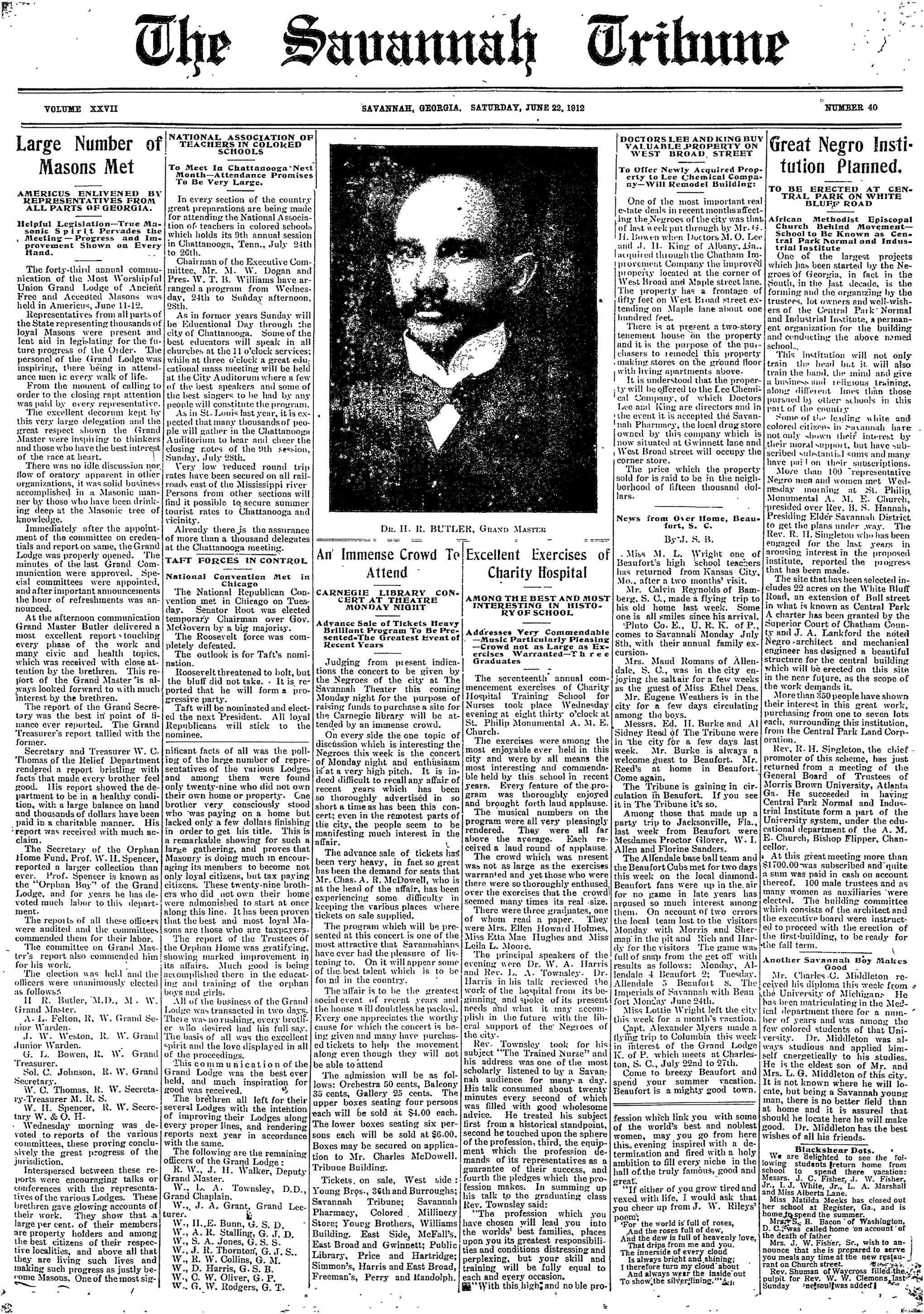
Page text (machine-generated)
VOLUME XXVII
Large Number Masons Met
AMERICUS ENLIVENED BY REPRESENTATIVES FROM ALL PARTS OF GEORGIA.
Helpful Legislation—True Masonic Spirit Pervades the Meeting—Progress and Improvement Shown on Every Hand.
The forty-third annual communication of the Most Worshipful Union Grand Lodge of Ancient Free and Accepted Masons was held in Americus, June 11-12.
Representatives from all parts of the State representing thousands of loyal Masons were present and lent aid in legislating for the future progress of the Order. The personel of the Grand Lodge was inspiring, there being in attendance men in every walk of life. From the moment of calling to order to the closing rapt attention was paid by every representative. The excellent decorum kept by this very large delegation and the great respect shown the Grand Master were inspiring to thinkers and those who have the best interest of the race at heart.
There was no idle discussion nor flow of oratory apparent in other organizations, it was solid business accomplished in a Masonic manner by those who have been drinking deep at the Masonic tree of knowledge.
Immediately after the appointment of the committee on credentials and report on same, the Grand Lodge was properly opened. The minutes of the last Grand Communication were approved. Special committees were appointed, and after important announcements the hour of refreshments was announced.
At the afternoon communication Grand Master Butler delivered a most excellent report touching every phase of the work and many civic and health topics, which was received with close attention by the brethren. This report of the Grand Master is always looked forward to with much interest by the brethren. The report of the Grand Secretary was the best in point of finance ever reported. The Grand Treasurer's report tallied with the former.
Secretary and Treasurer W. C. Thomas of the Relief Department rendered a report bristling with facts that made every brother feel good. His report showed the department to be in a healthy condition, with a large balance on hand and thousands of dollars have been paid in a charitable manner. His report was received with much acclaim.
The Secretary of the Orphan Home Fund, Prof. W. H. Spencer, reported a larger collection than ever. Prof. Spencer is known as the "Orphan Boy" of the Grand Lodge, and for years he has devoted much labor to this department.
The reports of all these officers were audited and the committees commended them for their labor.
The committee on Grand Master's report also commended him for his work.
The election was held and the officers were unanimously elected as follows:
H. R. Butler, M.D., M. W. Grand Master.
A. L. Felton, R. W. Grand Senior Warden.
J. W. Weston, R. W. Grand Junior Warden.
G. L. Bowen, R. W. Grand Treasurer.
Sol. C. Johnson, R. W. Grand Secretary.
W. C. Thomas, R. W. Secretary-Treasurer M. R. S.
W. H. Spencer, R. W. Secretary W. & O. H. Wednesday morning was devoted to reports of the various committees, these proving conclusively the great progress of the jurisdiction.
Interspersed between these reports were encouraging talks or conferences with the representatives of the various Lodges. These brethren gave glowing accounts of their work. They show that a large per cent. of their members are property holders and among the best citizens of their respective localities, and above all that they are living such lives and making such progress as justly become Masons. One of the most sig-
The Savannah Tribune
NATIONAL ASSOCIATION OF TEACHERS IN COLORED SCHOOLS
To Meet In Chattanooga'Next Month-Attendance Promises To Be Very Large.
In every section of the country great preparations are being made for attending the National Association of teachers in colored schools which holds its 9th annual session in Chattanooga, Tenn., July 24th to 26th.
Chairman of the Executive Committee, Mr. M. W. Dogan and Pres. W. T. B. Williams have arranged a program from Wednesday, 24th to Sunday afternoon, 28th.
As in former years Sunday will be Educational Day through the city of Chattanooga. Some of the best educators will speak in all churches at the 11 o'clock services; while at three o'clock a great educational mass meeting will be held at the City Auditorium where a few of the best speakers and some of the best singers to be had by any people will constitute the program. As in St. Louis last year, it is expected that many thousands of people will gather in the Chattanooga Auditorium to hear and cheer the closing notes of the 9th session, Sunday, July 28th.
Very low reduced round trip rates have been secured on all railroads east of the Mississippi river Persons from other sections will find it possible to secure summer tourist rates to Chattanooga and vicinity.
Already there is the assurance of more than a thousand delegates at the Chattanooga meeting.
TAFT FORCES IN CONTROL
National Convention Met in Chicago
The National Republican Convention met in Chicago on Tuesday. Senator Root was elected temporary Chairman over Gov. McGovern by a big majority.
The Roosevelt force was completely defeated.
The outlook is for Taft's nomination.
Roosevelt threatened to bolt, but the bluff did not take. It is reported that he will form a progressive party.
Taft will be nominated and elected the next President. All loyal Republicans will stick to the nominee.
nificent facts of all was the polling of the large number of representatives of the various Lodges and among them were found only twenty-nine who did not own their own home or property. One brother very consciously stood who was paying on a home but lacked only a few dollars finishing in order to get his title. This is a remarkable showing for such a large gathering, and proves that Masonry is doing much in encouraging its members to become not only loyal citizens, but tax paying citizens. These twenty-nine brothers who did not own their home were admonished to start at once along this line. It has been proven that the best and most loyal Masons are those who are taxpayers.
The report of the Trustees of the Orphan Home was gratifying, showing marked improvement in its affairs. Much good is being accomplished there in the educating and training of the orphan boys and girls.
All of the business of the Grand Lodge was transacted in two days. There was no rushing, every brother who desired had his full say. The basis of all was the excellent spirit and the love displayed in all of the proceedings.
This communication of the Grand Lodge was the best ever held, and much inspiration for good was received.
The brethren all left for their several Lodges with the intention of improving their Lodges along every proper lines, and rendering reports next year in accordance with the same.
The following are the remaining officers of the Grand Lodge:
R. W., J. H. Walker, Deputy Grand Master.
W., L. A. Townsley, D.D., Grand Chaplain.
W., J. A. Grant, Grand Lecturer.
W., II., E. Bunn, G. S. D.
W., A. R. Stalling, G. J. D.
W., S. A. Jones, G. S. S.
W., J. R. Thornton, G. J. S..
W., R. W. Collins, G. M.
W., D. Harris, G. S. B.
W., C. W. Oliver, G. P.
W., G. W. Rodgers, G. T.
SAVANNAH, GEORGIA, SATURDAY, JUNE 22, 1912
M. H.
DR. H. R. BUTLER, GRAND MASTER
CARNEGIE LIBRARY CONCERT AT THEATRE MONDAY NIGHT
Advance Sale of Tickets Heavy Brilliant Program To Be Presented-The Greatest Event of Recent Years
Judging from present indications the concert to be given by the Negroes of the city at The Savannah Theater this coming Monday night for the purpose of raising funds to purchase a site for the Carnegie library will be attended by an immense crowd.
On every side the one topic of discussion which is interesting the Negroes this week is the concert of Monday night and enthusiasm is at a very high pitch. It is indeed difficult to recall any affair of recent years which has been so thoroughly advertised in so short a time as has been this concert; even in the remotest parts of the city, the people seem to be manifesting much interest in the affair.
The advance sale of tickets has been very heavy, in fact so great has been the demand for seats that Mr. Chas. A. R. McDowell, who is at the head of the affair, has been experiencing some difficulty in keeping the various places where tickets on sale supplied.
The program which will be presented at this concert is one of the most attractive that Savannahians have ever had the pleasure of listening to. On it will appear some of the best talent which is to be found in the country.
The affair is to be the greatest social event of recent years and the house will doubtless be packed. Every one appreciates the worthy cause for which the concert is being given and many have purchased tickets to help the movement along even though they will not be able to attend
The admission will be as follows: Orchestra 50 cents, Balcony 35 cents, Gallery 25 cents. The upper boxes seating four persons each will be sold at $4.00 each. The lower boxes seating six persons each will be sold at $6.00. Boxes may be secured on application to Mr. Charles McDowell. Tribune Building.
Tickets, on sale, West side: Young Bros-, 36th and Burroughs; Savannah Tribune; Savannah Pharmacy, Colored Millinery Store; Young Brothers, Williams Building. East Side, McFall's, East Broad and Gwinnett; Public Library, Price and Hartridge; Simmon's, Harris and East Broad, Freeman's, Perry and Randolph.
Excellent Exercises of Charity Hospital
AMONG THE BEST AND MOST INTERESTING IN HISTORY OF SCHOOL
Addresses Very Commendable
—Music Particularly Pleasing
—Crowd not as Large as Exercises Warranted—Three Graduates
The seventeenth annual commencement exercises of Charity Hospital Training School for Nurses took place Wednesday evening at eight thirty o'clock at St. Philip Monumental A. M. E. Church.
The exercises were among the most enjoyable ever held in this city and were by all means the most interesting and commendable held by this school in recent years. Every feature of the program was thoroughly enjoyed and brought forth laud applause. The musical numbers on the program were all very pleasingly rendered. They were all far above the average. Each received a laud round of applause. The crowd which was present was not as large as the exercises warranted and yet those who were there were so thoroughly enthused over the exercises that the crowd seemed many times its real size.
There were three graduates, one of whom read a paper. They were Mrs. Ellen Howard Holmes, Miss Etta Mae Hughes and Miss Leila L. Moore.
The principal speakers of the evening were Dr. W. A. Harris and Rev. L. A. Townsley. Dr. Harris in his talk reviewed the work of the hospital from its beginning and spoke of its present needs and what it may accomplish in the future with the liberal support of the Negroes of the city.
Rev. Townsley took for his subject "The Trained Nurse" and his address was one of the most scholarly listened to by a Savannah audience for many a day. His talk consumed about twenty minutes every second of which was filled with good wholesome advice. He treated his subject first from a historical standpoint, second he touched upon the sphere of the profession, third, the equipment which the profession demands of its representatives as a guarantee of their success, and fourth the pledges which the profession makes. In summing up his talk to the graduating class Rev. Townsley said:
"The profession which you have chosen will lead you into the worlds' best families, places upon you its greatest responsibilities and conditions distressing and perplexing, but your skill and training will be fully equal to each and every occasion.
"With this high and noble pro-
---
DOCTORS LEE AND KING BUY
VALUABLE PROPERTY ON
WEST BROAD STREET
To Offer Newly Acquired Property to Lee Chemical Company-Will Remodel Building;
One of the most important real estate deals in recent months affecting the Negroes of the city was that of last week put through by Mr. G. H. Bowen when Doctors M. O. Lee and J. H. King of Albany, Ga., acquired through the Chatham Improvement Company the improved property located at the corner of West Broad and Maple street lane. The property has a frontage of fifty feet on West Broad street extending on Maple lane about one hundred feet. There is at present a two-story tenement house on the property and it is the purpose of the purchasers to remodel this property making stores on the ground floor with living apartments above.
It is understood that the property will be offered to the Lee Chemical Company, of which Doctors Lee and King are directors and in the event it is accepted the Savannah Pharmacy, the local drug store owned by this company which is now situated at Gwinnett lane and West Broad street will occupy the corner store.
The price which the property sold for is said to be in the neighborhood of fifteen thousand dollars.
News from Over Home, Beaufort, S. C.
By J. S. B.
Miss M. L. Wright one of Beaufort's high school teachers has returned from Kansas City, Mo., after a two months' visit. Mr. Calvin Reynolds of Bamberg, S. C., made a flying trip to his old home last week. Some one is all smiles since his arrival. Pluto Co. E., U. R. K. of P., comes to Savannah Monday July 8th, with their annual family excursion. Mrs. Maud Romans of Allendale, S. C., was in the city enjoying the salt air for a few weeks as the guest of Miss Ethel Deas. Mr. Eugene Weathers is in the city for a few days circulating among the boys.
Messrs. Ed. II. Burke and Al Sidney Reed of The Tribune were in the city for a few days last week. Mr. Burke is always a welcome guest to Beaufort. Mr. Reed's at home in Beaufort. Come again. The Tribune is gaining in circulation in Beaufort. If you see it in The Tribune it's so. Among those that made up a party trip to Jacksonville, Fla., last week from Beaufort were Mesdames Proctor Glover, W.I. Allen and Florine Sanders.
The Allendale base ball team and the Beaufort Cubs met for two days this week on the local diamond. Beaufort fans were up in the air for no game in late years has arused so much interest among them. On account of two errors the local team lost to the visitors Monday with Morris and Sherman in the pit and Rich and Hardy for the visitors. The game was full of snap from the get off with results as follows: Monday, Allendale 4 Beaufort 2; Tuesday. Allendale 5 Beaufort 8. The Imperials of Savannah with Beaufort Monday June 24th.
Miss Lottie Wright left the city this week for a month's vacation. Capt. Alexander Myers made a flying trip to Columbia this week in interest of the Grand Lodge K. of P. which meets at Charleston, S. C., July 22nd to 27th. Come to breezy Beaufort and spend your summer vacation. Beaufort is a mighty good town.
fession which link you with some of the world's best and noblest women, may you go from here this, evening inspired with a determination and fired with a holy ambition to fill every niche in the hall of the truly famous, good and great.
"If either of you grow tired and vexed with life, I would ask that you cheer up from J. W. Rileys' poem;
For the world is full of roses,
And the roses full of dew,
And the dew is full of heavenly love,
That drips from me and you.
The innerside of every cloud
Is always bright and shining;
I therefore turn my cloud about
And always wear the inside out
To show the silver lining."
NUMBER 40
Great Negro Institution Planned.
Great Negro Institution Planned.
TO BE ERECTED AT CENTRAL PARK ON WHITE BLUFF ROAD
African Methodist Episcopal Church Behind Movement—School to Be Known as Central Park Normal and Industrial Institute
One of the largest projects which has been started by the Negroes of Georgia, in fact in the South, in the last decade, is the forming and the organizing by the trustees, lot owners and well-wishers of the Central Park Normal and Industrial Institute, a permanent organization for the building and conducting the above named school.
This institution will not only train the head but it will also train the hand, the mind and give a business and religious training, along different lines than those pursued by other schools in this part of the country. Some of the leading white and colored citizens in Savannah have not only shown their interest by their moral support, but have subscribed substantial sums and many have paid on their subscriptions.
More than 100 representative Negro men and women met Wednesday morning at St. Philip Monumental A. M. E. Church, presided over Rev. B. S. Hannah, Presiding Elder Savannah District to get the plans under way. The Rev. R. H. Singleton who has been engaged for the last years in arousing interest in the proposed institute, reported the progress that has been made.
The site that has been selected includes 22 acres on the White Bluff Road, an extension of Bull street in what is known as Central Park A charter has been granted by the Superior Court of Chatham County and J. A. Lankford the noted Negro architect and mechanical engineer has designed a beautiful structure for the central building which will be erected on this site in the near future, as the scope of the work demands it. More than 350 people have shown their interest in this great work, purchasing from one to seven lots each, surrounding this institution, from the Central Park Land Corporation.
Rev, R. H. Singleton, the chief promoter of this scheme, has just returned from a meeting of the General Board of Trustees of Morris Brown University, Atlanta Ga. He succeeded in having Central Park Normal and Industrial Institute form a part of the University system, under the educational department of the A. M. E. Church, Bishop Flipper, Chancellor.
At this great meeting more than $1700.00 was subscribed and quite a sum was paid in cash on account thereof. 100 male trustees and as many women as auxiliaries were elected. The building committee which consists of the architect and the executive board were instructed to proceed with the erection of the first-building, to be ready for the fall term. Another Savannah Boy Makes Good
Mr. Charles G. Middleton received his diploma this week from the University of Michigan. He has been matriculating in the Medical department there for a number of years and was among the few colored students of that University. Dr. Middleton was always studious and applied himself energetically to his studies. He is the eldest son of Mr. and Mrs. L. G. Middleton of this city. It is not known where he will locate, but being a Savannah young man, there is no better field than at home and it is assured that should he locate here he will make good. Dr. Middleton has the best wishes of all his friends.
We are delighted to see the following students return home from school to spend there vacation: Messrs. J. C. Fisher, J. W. Fisher, Jr., I. J. White, Jr., L. A. Marshall and Miss Alberta Lane.
Miss Matilda Meeks has closed out her school at Register, Ga., and is home to spend the summer.
Mrs. S. B. Bacon of Washington, D. C. was called home on account of the death of father
Mrs. J. W. Fisher, Sr., wish to announce that she is prepared to serve you meals any time at the new restaurant on Church street.
Rev. Shuman of Waycross filled the pulpit for Rev. W. W. Clemons Last Sunday 'ne soul' was added
The Sunday School Lesson
Sunday School Lesson for June 23
1912
THE NP WOMAN.
Golden Text: *Patriotism is the saying,
and worthy of all acceptance, that
Christ Jesus came from the record to
save samaras.* 11 The 11:15.
Lesson Text. - Luke 7:36:50. Commit
mit 337 383 14 10
Exposition of Christian Institution and an Abhorious Speaker, 36-39 Jesus received an invitation to dinner from an unusual quarton, a Pharisee (Ch. 13:17, 14:1). The Pharisee desired to study Jesus, I Jesus, usually went, to the houses to which He was asked, and always gods today! He received scant courtesy from the Pharisee, the usual social amenities, were forgotten (vs. 44:46). An unexpected and unwelcome guest came, into the Pharisee's home, an abandoned woman. Nothing could have induced her to enter that home under ordinary circumstances, but Jesus drew her, as he always draws sinners. She heard him say that very day: "Come unto me, allize that labor and are heavy laden" (Matt. 11:28), and that certainly meant her. The Phariseo was much displeased, but Jesus was greatly pleased, to have her come (ch. 5:30-32). She brought a box of costly ointment with her. In her love to her new-found friend and Saviour, she wished to do something for him. As soon as she reached the feet of Jesus, she burst into tears of penitence and love. It is good for sinners to weep (Ps. 51:17; Joel 2:12, 13). It was love that brought this woman to repentance (cf. Ro. 2:4). Pharisaic treatment would never have accomplished it! According to the Pharisee's notion, righteousness is shown by drawing away from all contact with sinners, but in Christ's method righteousness is shown by winning the dinner from sin to righteousness:
II. A Critic Rebuked and a Pentient Commended, 40-46. Jesus quickly proved to the supercilious Pharisee that he could read hearts by reading hits. He told the Pharisee he had something to say to him, while the Pharisee had fancied he ought to say something severe to the woman. He showed the Pharisee 'that he' was debtor as well as the woman, that there was no essential difference between them (Ro. 3:22,23). The Pharisee, was like the woman in another respect, he 'had nothing to pay.' By representing himself as creditor, of both the Pharisee and 'woman, Jesus taught' that 'all sin was against himself; i.e., that he was 'God' (Ps. 51:4). The Pharisee had never dreamed that he was truly a lost sinner, with
POETRY
of and by Our People
Don't forget his little soul
Hungers. for your faith in him!
All the dreams that round him roll
Have for this their core and vim.
Show him how and take the time,
Feel an interest in the things
That in him are reason, rhyme,
And the flight of lofty wings.
Have you ever thought how you
Wanted to be tolil and shown
In those days so full of dew
For your boyhood that has flown?
Boys are all the same today,
Ener be taken in
To be heart that known the way—
No boy really wants to sin!
—The Bentztown Bard.
THE PEACH.
Say, fruit, who made thee
With fuzzy skin so thin,
And Saccharine within?
And formed each cell a well
Of juice to swell and tell
A fragrant story?
He took a bright hue
From earth, from air to share
In this, fair fair and clear.
A flavor sweet and meet
That makes a treat complete
Runs thy rich meat through.
An artist surely
In loved with care so, rage
Things for and near to share
In making thee to be,
The beauty we now see.
And artist made thee.
Pine Cone.
COME OUT.
"Come out into the morning light,"
The birds now, loudly call!
"Come out, come out from bed and sleep.
Come out, come out, and take a peep
Upon the earth and heavens deep,
Come out, both one and all."
nothing he could do to satisfy God, as the abandoned woman was. Jesus forgives sinners freely, when they have nothing to pay, but before they enjoy that forgiveness they must take their rightful place, pardon him (Psalm 11:13, 15). Jesus closes his pardon with a question (Psalm 11:16), then shows the question that if the woman be deep
a greater sinner in the past, she had now become a more loving saint in the present. Before there can be intense love for the Saviour there must be a deep sense of the enormity of the sins he has forgiven. Those forms of Christianity that minimize sin and have little to say of pardon never produce ardent love for Christ; Jesus put a second question to Simon: "Jesus thou this woman?" He did not really see her. All he saw was a vile outcast; Jesus, saw a, redeemed woman and, a great lover! In the contrast Jesus, drew 'between Sinion' and the woman he despised, the woman appears in far the better light. Thus God looks at the cold, morallist and the redeemed outcast now filled with intense love to the Redeemer. Jesus is far better pleased with the loving penitents, deep though they may have been in sin, than with the Simons.
III. Forgiveness, Love, Peace, 47-50. Jesus said her great love proved she was a forgiven sinner. It was not that she was forgiven because she loved—her faith saved her (v. 50)—but her sense of sins forgiven led to this great love, and so her great love was proof that her sins had been forgiven. Are we proving that our sins are forgiven by loving much? Jesus did not gloss over her sins. He is told "holy to minimize sin." "Her sins," which are many," was his very searching word. But then he turns to the woman with that wondrous word of comfort and blessing. "Thy sins are forgiven." That woman had a right to go out and say, "I know my sins are to give." She had the best possible proof of it, the sure word of him, not one word of whom shall ever fall (Matt. 24:15). Every believer in Christ has the same word that his sins are forgiven (Acts 13:38, 39). It would not have been presumption for her to say, "If know my sins are forgiven." It would have been presumption, for her to doubt it. It was, not, a question of what she felt, but what Jesus said. It was a significant question the hearers asked, "Who is this that forgiveth sins?" The answer is plain, the Son of God; faith had saved her. Her faith was simply this, that Jesus could and would forgive her sins. This is saving faith. Its foundation was his own word (Matt. 11:23). Being saved she went "into peace." There is no other road into peace but simple faith in Jesus for salvation (Ro. 5:1).
Leading Questions.—What proofs are here in this lesson of the Delty of Jesus? What is his attitude toward sinners? How is forgiveness of sins obtained? What is the proof that our sins are forgiven? What is the ground of our assurance that our sins are forgiven? What is saving faith? What are the results of faith? What were the seven steps heavenward which the woman took?
"In all the trees remaining green. And shrubberies that grow between." The breath of early morn is seven. Come out, enjoy this day."
Make, haste, make haste, come out, come out.
The brooks all sweetly sing:
'The way for all of us to do.
That we might get our labors through
Embrace the day while it is new.
Come out, for this is spring.'
A. A. L. Wilsdor
LOVE'S JOURNEY!
How many worlds away, is love,
That it is oft so long.
In journeying to the hearts that wait
Its whisper and its song to
In April it is very near,
And nearer still, in May.
But yet for many an latching heart
It seems so far away.
How many dawns and many nights
Has it been traveling here;
From star to star and step to step
Of sphere and rolling sphere.
Its music lit the robin's note
Outside my window then;
But, lo, in long lost leagues of time
It seems to soar again!
How many hearts beside a gate
Of lonesomeness must stand
In all the bitter tears of fate
Era it comes over the land!
How many regions near or far
Must it still travel through
Before it tells me where you are
And lights me, love, to you!
THE LONELY LOVER.
The rippling of the brook sounds sweet;
The fragrant air makes joy complete;
Each little bud some joy complete;
And birds, close by their nests, do sing.
The love that in my heart still lives.
Is kindled to a flame in spring.
When by your side I chance to be,
Each moment, then, is dear to me.
clear!
The, whippoorwill calls to his mate,
I pine, and wish that you were near.
Alone I 'stroll out by the gate.
Haya, opened their eyes and said to say,
"This time, for joy, why are you, nad?
The hand of love has placed us here.
Lift up your head, you should be glad,
There's love around, you, everywhere."
Then she felt sure to smile.
"This time, will love you, nad?"
BAKED CORN.
Drain one can of *crusheli corn* and beat into it two eggs, a little sugar, salt and pepper. Dot with "pats" of butter and bake in the set and slightly browned. This should be prepared in a neat bake dish in which may be served upon the table.
STUDENTS AT TUSKEGEE INSTITUTE MAKE INDUSTRY A HABIT AND ATTAIN HIGH STANDARDS OF LIVING.
Tuskegee, Ala.—Industry is the spirit of Tuskegee University, which is its system of government. From the moment the rising whistle blows at five o'clock until the "lights out" bell sounds at night, every moment of the day attains the highest point in its purpose. The keges are the most important part of the institution, as they are the setting for extra tasks, and by giving them a work to do. The purpose of the institution is to facilitate the seminaries the principle that a parish is no more work than a school is a punishment, for the work would be an insistence. Enforce the diligence, progress, beauty, enrolment and after graduation a daunting course, a middle in a busy community, a done amends the wrists, the discipline, stitches generally goes to the department and begins to be put to work.
This disciplined, disciplined, ever sifter, the openest of the disciplines, the studious, the boast on one’s temples, the student-body assembled, thirty years ago if he was to change, and it has been wrong no sooner as drilling in the learning, marching to dinner after the day out, sooth matching to chameleon might, marrying place, to the dormitories after his show excursion before the family on the platform, sembling on areas, carving every Sunday morning and on alternate meetings during the week, marching and drilling and becoming a juprigregated with the idea of a master system obliterated disciplined.
bolsterous, but 1,700 in simultaneous talk cataract of sound.
voices engaged
make father a
Visitors rarely fail to comment upon the fable manners of the students. At Tuskegee table manners are as much the manners of the students as is work in the shops or recitations in the classrooms. The man at the head of the table is the man at the head of a stairway each spindle made of the grafting material of the meat spearing and the bread harpooning that is a far from unusual feature of the school. The students are served, and the rule of the school is that each shall eat everything that is placed upon his plate without remarks upon the cooking, if, indeed, such averse remarks could be made. The food comes fresh from the institute farm, raised by the students, cooked by the students, served by the students and eaten by the students, and the variety of edibles placed on the table serves as another object lesson of the benefits derived from skillful labor on the soil. The student who goes out from Tuskegee is an accustomed to an excellent table, that, if a farmer, he, at once prepares to raise all the vegetables in their season, his farm becomes an object lesson for the surrounding community and gradually leads to a higher standard of living, which is the great object sought. For Tuskegee's real problem is nory, so much to educate a few thousand, boys and girls, as to change conditions among the masses, of the negro people.
Three or four years ago the University of Indiana started to educate the students in its technical courses by providing alternate days for theory and practice, one day being spent in the classroom and the next day in a real factory, where the students would not only learn how to build things, but would have the inspiration coming from the building of things actually to be used. This idea created a furore in the educational world; it was acclaimed as the newest and most advanced idea in technical education. Booker Washington, however, has been applying that idea at Tuskegee for the last thirty years. The students spend one day in the classroom, and one day on the farm or in the shops, where they turn out products that are to be used.
The grea cry among the great technical colleges has been that in the practice work the students build things that are torn down as soon as they are constructed. The energizing force that comes from creating something that is to be utilized is lacking. What inspiration is there in building a model bridge, when the student knows it is going to be, form down as soon as the last boat is in place? Educators in technical institutions have lamented this loudly.
Art. Tuskeguei the boy in this tailoring shop makes uniforms that are worn by the students. The head of the department, still talks of the, suit of clothes the boys made, for. Andrew. Carnegie for, $15, which the ironmaster pronounced as fine a fit as he had ever worn. In the harness and saddlery shop the boys manufacture things that are not torn to plebs as soon as they are finished. The head of the shop speaks proudly of the $300 double harness which the boys made for. Colonel. Roosevelt, in the wagon shop, the smithy, the ironmonger, the brick yard, theanning factory, the foundry.
the mattress-shop, the sheoaking-shop, the printing office, the tinsmith-shop, in all the 40 different trades and industries, the boys are not only getting an occupational education, but they are learning the important skills from making something to be used. All Tuskegee students are taught an art and learn out-aspired cobblers and plumbers as inspired architects and landscape artists. All the students are required to take academic studies, and the effort is made to correlate all the studies with the job offered. In English, for example, the boys and girls write
often graduating class, shows how a meal should be served, on a separate should be shot. It is a probabilistic con-struction of what has been learned, a clinic on indiviral education.
The students in the academic department are divided into day and night classes, about one-third of the students being in the night school, which is designed for those who are unable to pay the small charges made in the day school. Whenever a poor student arrives he works during the day and studies at night, and whatever he earns in excess of the board is added to his credit in the bank. The same as he has saved enough in enters the day school, he publishes in the day school attend and classroom books these days a week, and the other three days they spend in the shop, the expenses of day students allow the cost of nothing and what can be paid is about $45 or $50 for the nine months the school. Most of the pupils earn all their expenses. The teaching in the academic department, which has as its advanced in work as the second seat of a northern high school minus the languages, is done by a faculty of 50 college, graduates, many of them from reading universities of the country. The male pupils form two battalions, one of four companies of eight men, each containing the disabled students, the other of five companies of 90 men, each made up from a day student. Dills and Insplants take more every day in the training day, students being educated in the academy, which dull on intellectual manpower upon their classes of discipline and serious enough to be required for the university.
the industries are grouped into three departments, the school of agriculture, the industries for girls and the department of mechanical industries. The courses in agriculture are given in 1901 and 1902. Building erected in 1909 at a cost of $26,000. Farming was tiffins industry started at the institute, and the school farm in thirty years has grown until 1908. Braces form the same order which is raised produce for the school, eighty years, and the first year.
The dairy herd contains 227 head of cattle, breeders, yearlings and calves, with 105 milch cows "at the path". The farm also has 562, hogs, and 145 horses, mules and colts, while the poultry yard contains 3,000 fowls. The farm work is carried on by 228 students, 40 hired men and 18 instructors.
Last year 632 tone of enslage, 12,000 bushels of sweet, potatoes, 3,500 bushels of corn and 2,650 bushels of oats were grown on the general farm, while the truck garden yielded 115,453 pounds of greens, 1,116 dozen bunches of lettuce, 465 bushels of onions, 3,576 watermelons, 355 bushels of beans, 53 bushels of beets, 733 bushels of tomatoes, 321 bushels of rutabagas, 3,150 dozen ears of corn/green beans, 2,664 melons and cantaloupes, 47 bushels of white pointets and 258 bushels of peas—this enumeration, being given as an indication of the variety of the table, at Tuskegee and the manner in which the pupils are being saturated in one of the many ideas of Tuskegee that one indication of civilization is a variety of food products.
"One of God's objects in surrounding us with vegetables, with grain, berries and flowers," says Booker Washington, "is to help us to make our bodies better fitted for the uses of life, to make our bodies stronger, to make them more healthful. When I go to church and hear people preach for hours on all kinds of subjects, especially in country districts, where the soil is fitted for growing all kinds of vegetables, all kinds of fowl, how much I wish the minister would take a few hours and teach the people how to fill their bodies with some of the beautiful things with which nature has surrounded them."
THE BEST SCARECROW.
As the best scarecrow is a, dead crow, hung up where other crows can see it, it is well to know how to catch the crow, which is a very wary bird. One way that is often successful is to take the chilled or stale eggs from an abandoned sitting, hen's nest, and make an artificial nest out in the field somewhere so that the crows can see it as they fly over. Around the nest in the grass place, two, or three set steel traps. The crow will allight near the nest to investigate the eggs as to their eating qualities, and will usually step into the traps, which should be concealed under some light grass or earth.
Jigsworth tells me Mrs. Jigsworth is thinking very seriously of going to Europe. I dare say, her thinking about it doesn't make her half as serious as if does Jigsworth.
THINGS SEEN IN THE SHOPS.
New baskets for bonbons are in dull rose color. One is shown in the shape of a small grand plano. A paper box for candies is in the same rose tint, decorated with magellan blossoms, with pink patties. Either baskets are bounn hold in three grids of candy.
The nowest twelfth slippers have embroidered beets. Small spangled ornament in the place of buckles, for these slippers are in the shape of a four-winged butterfly, and 'aby' are of the same color as the slipper, unless of gold. Both these ornamental additions tend to make the foot large and gaudy, however.
Many of the shops are showing stiff little neck bows of variegated ribbon, or velvet ribbon. These are worn either at the front of the collar, or at the side. Their price is about fifty cents.
Among the Easter novelties is a large nest or straw for bonbons; this is decorated with a few twigs of natural wood, against which are wraps of wheat. A stuffed real chicken of full size is mounted on the side of the basket with spread wings. Another nest of straw made for a bonbon basket is not so large, and is set into a mass of natural twigs, twined about with artificial roses. Both these novelties are French.
Very charming are the newest hatskins, which are rosettes of tiny silk flowers of exquisite fashioning, or of fruit. With some of these are mingled wren ruffles of valenciennes lace.
For the boudoir there are to be found perfectly plain moire velour picture frames. The opening for the picture is oval, and the frame itself almost square. Those come in every color and the most exquisite shades. Their cost is $2.50 each.
Other frames are shown in the imitation ivory known as ivortus. They have inlaid a semi-conventional pattern of forget-me-nots in blue. One of the more elaborate frames, is French gilt with china flowers in entire relief.
Seed pearl jewelry is shown in great quantities, and some of the ornaments are bringing large prices, as much as $65 for a brooch. Great differences are to be noted in the designs; and they require careful selection.
Too odd to be pretty are the all-pink linen handkerchiefs with narrow dark red hemstitched border and red initials, in fact, very few, of the colored handkerchiefs are attractive this spring; the patterns show so little daintiness.
Many of the wraps and gowns of the season are edged or trimmed with taller ruching. This is called "shirring." It comes ready to add to the gown and costs 65 cents a yard for the width most in use. As it is easily renewed when it gets to have a worn appearance, and is not expensive, it should be in favor, with the woman who makes her own gowns.
A new pottery called Copenhagen Art, Palene initiates, the old Italian Majolica, but has not the fascination of the Italian ware in that it is too regular in its art decorations. The shapes in which it is shown are largely the old Italian shapes, and it will probably be a favorite selection for gifts with those looking for cozy articles.
Laces are always, of interest to every woman, though there are wide differences in styles at present, which call for much consideration when the moment of purchase arrives. The Baby Irish, which was formerly an extravagance, is so reasonable how that it is almost common. Insertion three-fourths of an inch wide, for instance, with the roses in relief, is but 36 cents a yard, while scallop edging of the same lace; allowing 16 scallops to the yard, is but 75 cents.
Ratine insertion, which is the exceedingly coarse, heavy lace, ranges from 60 cents to $3.50 a yard; this latter is distinctly for the gowns of women and not for young girls.
The girl who expects to trim her own summer hat will find that she can purchase for less than $2 a ready-made bow of ribbon of sufficient size and good fashion to be the only needed trimming. These may be found at the ribbon counter of any of the large stores.
NAPOLI MACARONI.
Cut four thin slices of bacon into small pieces, try out and strain. Set into a saucepan. Add three-fourths can of tomatoes (quart capacity), one sliced onion, one-fourth teaspoonful, each, of mace and allspice, one-eighth teaspoonful of cayenne and a bit of bay leaf, Bring to the boiling point, slimmer one hour and, season with salt and pepper. Add cooked macaroni cut into two-inch pieces, (of which there should be two cupfuls), and cook until macaroni is thoroughly heated. Berve very hot. Spbghetti may be used in place of macaroni for this dish.
Beat six eggs without separating the whites and yolks. Add a scant, teaspoonful of salt, a dash of pepper, a teaspoonful of chopped parsley, twenty drops of onion juice and one cup and a half of rich milk. Mix thoroughly, and pour into wall-huttered timbale molds. Cook, set on folds of paper, (burrowed, by hot water, until the centers are firm) Turn from the molds-upon a hot platter and, surfloor with bread sance, // // //
```markdown
```
"REMEMBER, GIRLS."
A flippant girl is the pet aversion of men; a witty one their delight. To have a pedigree is good, but a personality is better.
A "Greek god" invariably demands a pedestal. Better wed a man.
Move peacefully long into the atmosphere.
Be more eager to demonstrate your red than your blue blues.
Who *bāxāa* *hōrī* *lōverī* *has* *already*
lost him
"Dad" is about this best 'ball' in
impulsive girl can have. It is
moderately safe to follow an
accredited leader. Nonentitlement, power
lead.
Hyper-sensitiveness is about the
worst alliment that could afflict any
aspirant for social popularity.
Men wait for the cue before they presume to be flippant.
To show temper toward another girl who attracts your rightful knight is to damage your cause.
It is not enough to control your tongue; command your face also.
An inordinate love of praise is the beginning of evil.
The palm of fate is to be read neither by charlatan nor prayer.
Between the malden who goes in for outdoor sports and the "sporty girl" yaars about three generations.
"Admity" has; become a word that self-respecting girls avoid.
Envy no one. Destiny plays no favorites. The one you envy may have greater reason to envy you.
A giggle at the wrong moment has ruined many a spotless reputation. Be respectful, but know how to no one, if you crave respect. An adaptive girl wins admiration, but an "easy one" evokes contempt. Gentlewomen are at some points, to be gracious to servants.
Dignity is acquired through a same valuation of one's self and a fellow measure of appreciation of others. 1919ff
The personal note is always being struck by the girl of ordinary mind. The ability to look cool, though boiling within, is envyful.
Common sense' 'lèô noi' 'gitterink'
charm, but it is a 'gold imme to its pos-
seser.' -Mmna: Thomas 'Antrim/'-Hu
Philadelphia: Record.
One, cupful, of beans, two, cupfuls, of water (for soaking), one small onion, one medium-sized potato, two tablespoonfuls of salt, pepper to taste; water as needed.
Soak beans, over night in two cups/fulls of water; in the morning pour off if there is any water left, measure the beans/(they will have expanded about two and one-half times, their original bulk), and same amount of water, the potato, put into small cubes, add, minced onion, and holl about five hours or until tender. When ready, to serve add the butter and seasoning. If too thick a little more water can be added. Many like a little vinegar in beef soup, so serve that to the addd'd taste by each recording to taste. This soup can be run through press and served-like peas as a purée. A ninth of haking-soda hastens the process of softening, beans or peas, but if you wish beans to retain shape it is best to omit this, and just boil longer.
EPIGRAMS.
Many are called, but few want to get up. Love would last longer if it really were blind.
Why is it that a reformer seldom begins on himself?
If a man has sense his dollars will take care of themselves.
When counting his blessings a man seldom includes his poor relations.
But the beauty that is only skin deep is better than the kind that rubs off.
The faith of the average man wouldn't move a mole hill, much less a mountain.
A square deal is all a man wants, but he likes to be the judge of its squareness.
There may be plenty of happiness in slight, but distance doesn't lend enchantment to the view.
To every 12 pounds of meat, take three tablespoonfuls of salt, three of black pepper, six of powdered, sage and one tablespoonful of red pepper. Grind the meat through the mill, then mix in the seasoning thoroughly. Let stand half an hour, then grind again, stuff and hang up in a dry, cool place. After they hang a week or ten days, or until the skins are dry, take down, rub, well with corn meal and place in a wooden box with brown paper between each layer. Sausage may also be kept fresh if fried, placed in jars and covered with the drippings. If not sufficient make up the defluidity with melted lard. Keep the jar well covered in a cool place. Farm and Ranch.
FOUR NEW A.M.E. BISHOPS CHOSEN
DR. RANSOM ELECTED EDITOR—PASTOR OF BETHEL A. M. E. CHURCH, NEW YORK, TO EDIT A. M. E. CHURCH REVIEW—OTHER OFFICERS ELECTED.
Kansas City, Mo.—With four new bishops elected and the officers for the various official positions within the gift of the denomination chosen, the twenty-fourth general conference of the A. M. E. church, which has been in session at Allen A. M. E. church, wound up its final business.
The new bishops—Dr. John Hurst, Pashan H. Jones, W. D. Chappelle, and James M. Connor—were formally ordained Sunday afternoon with impressive services.
Each of the new prelates is widely known in the connection Dr. Hurst was born in Haiti about 50 years ago. He came to Haiti' country when a lad, and was connected for a few years with the Haitian legation at Washington. Later he entered Wilberforce university. After his graduation, he was appointed pastor at Elkridge, Md. Mr sixteen years he was pastor of leading churches $n_4$ Baltimore and four years ago he was elected financial secretary' of the denomination. Dr. Jories is about 54 years of age. He was educated at Claflin and Howard universities, and for eight years served as president of Wilberforce university, being succeeded four years ago by Dr. W. S. Scarborough. He is regarded as one of the most eloquent speakers in the denomination.
Dr. Chappelle is about 55 years of age. He was educated at Allen university, Columbia, S. C., of which school he has been president for the past four years. For eight years he served as secretary of the Sunday School Union. Dr Connor is one of the big men of the southwest Unlike the others, he has not received a collegiate training. He has served as a member of the financial board of the A. M. E. church for the past four years; is presiding effect of the Little Rock (LAR) district. He is president of the executive board of Shorter college.
The big surprise of the general conference was the failure of Dr W. W. Beckett to be elected to the bishopric. Until a few days before election, it was generally understood that Dr. Beckett would be one of the newly-elected bishops, and his name was mentioned favorably on every hand. Dr. Chappell, however, who also halls from South Carolina, was aspirant for the highest honor the church could confer and he made such an effective invarsse, that he defeated Dr. Beckett by thirty-five votes.
Among the other defeated candidates were, the. Revs. M. M. Ponton, H. H. W. Leake, F. Jesse Peck, James Bean, R. H. Downs, J. A. Jones, T. N. Smith, and I. N. Ross.
The halloting for general officers resulted as follows: John R. Hawkins, Jayman, financial secretary, succeeding Bishop Hurst; the Rev. J. W. Raukin, Waxahadie; Tex., missionary secretary, succeeding Dr. W. W. Beck; Dr. J. L. Lown, manager of the Hork Concern; Dr. W. W. Wright, editor Christian Recorder; Dr. Reverdy, C. Ransom, editor A. M. E. Review; in Pryant, secretary Sunday School Union, the Rev. J. C. Caldwell, secretary of the Allen Christian Endeavor Union.
In the selection of Dr. Reverdy C. Ransom as editor of the A. M. E. Review the pastor of Bethel A. M. E. Church New York, won a signal victory. His strongest opponent was Dr. C. V. Roman of Nashville. So overwhelming was the sentiment in favor of the selection of Dr Ransom that all his competitors withdrew and he was elected by acclamation.
The next general conference will be held at Philadelphia, where the A. M. E. church was founded in 1816. In connection with the next session the centennial of the denomination will be held.
The report of the commissioner of education, John R. Hawkins, showed that nearly 600,000 had been received from the general treasury of the church toward the support of the sixteen schools and colleges maintained by the denomination during the past four years. This does not take in account the money paid in tuition by the thousands of young men and women who have been enrolled in these schools, the money contributed by churches, conferences and individuals.
WOMAN LAWYER FINALLY LOSES
WHITE COLORED DEATH CASE.
New York.—Miss Lucille Pugh, the young-woman attorney from North Carolina, who obtained a disagreement by the jury on the first trial of her client, Leroy Polindexter, a negro, lost her case on the second trial of the prisoner. Polindexter was convicted by a jury of manslaughter in the second degree for killing Thomas Brown, negro, after a dispute over a crap game. Miss Pugh summed up for the defense and scored the police for what she alleged was their unfair antagonism to the prisoner. The jury was out 26 hours. This was the case where she referred to her client as "n'good "migger" and well-meaning, "darkey"
---
Conyers, Ha.—The negro public school had their commencement sermon preached in Macedonia Baptist church by Rev. Richard D. Stinson, principal of the Atlanta Normal School Industrial Institute. C. L. Maxey has served the colored people here for three years as principal. The congregation was large and seemed to appreciate the sensible and forceful remarks of the speaker.
Among the things Principal Stinson said was: "Practical, useful, everyday Christian education is the salvation of our people. It is appropriate that we should have these sermons and the influence of Christian teachers to shape the life and good behavior of the negro youth. It is encouraging to note how the best people of the south are substantially taking hold of the educational problem for the good of both races.
The south is laying a foundation for which the world is bound to commend.
The youth should be taught to have confidence in the community where they live; they should know how to earn an honest living for themselves, and I believe the best people among us are willing to see that every negro child has a decent, English education, which is a substantial foundation for a successful lifework. The negro teacher cannot be too devoted to this cause, of helping the masses to a more respectable life.
I verily believe that the south is a place for the great mass of us—good health, good climate, and plenty of herest work for us all do if we will do it, are some of the essentials for our future welfare. The boards of education in different parts of the state are seeing the wisdom of aiding our people in their educational struggles, for they realize that ignorance is a dangerous element in the life of any people.
"When I realize what the 'best people of Atlanta' have done in helping to establish an industrial school in Atlanta' the cooks' matters, housekeepers, and, in fact, all of that duty who must work with their hands for an honest living—I say when I realize what the 'people of Atlanta' have and are now doing to help the negro youth, I commend the south with all my heart."
VOORHEES INDUSTRIAL SCHOOL
EMMETT J. SCOTT DELIVERS AN- NUAL ADDRESS AT INSTITU TION'S COMMENCEMENT.EXERCISES ON "TRAINING FOR SERVICES."
Denmark, S. C.—Emmett J, Scott delivered the annual address at the commencement exercises of Voorhees Industrial school. Cyrus. Campfield is principal and Martin A. Menafee treasurer of the school.
I am to talk to you today on the subject of training for Service. I come to urge upon you that, you fit yourselves for that service which serves God and one's fellows, that puts aside the temptation to seek the life of ease and personal comfort and financialgrandizement, and which seeks instead that economic independence, that helping of the weaker man, that co-operation between the races, without which we surely must fail, and for the good of our section and our common country. These are at the very foundation of well ordered, helpful, efficient life.
"Just as Hampton and Tuskegee have stood for those things, so Vorhees, under your modest, efficient, self-sacrificing principal and treasurer, with their devoted helpers, stand for them. Not rights alone, but duties and responsibilities as well, with a sober appreciation of the opportunities and privileges all about to develop into full rounded manhood and womanhood.
"In every section of our country today men and women high in the educational world are seeking an adjustment of education in life. They are beginning to realize that the old order changeth, and that what a man knows is not true; he is considered alongside of what he can do. You're a rich heritage, for you have" had opportunity to study, to work, to be a part of it, in school whose ideals have come from two great squals, Gen. Samuel Chapman Armatrom, who founded Hampton, and Dr. B. T. Washington, who came from Hampton and founded Tinkegee."
NEGROES RESPOND. AS OTHER RACES TO IMPROVED ENVIRONMENT.
Louisville, Ky.-At a meeting here of the King's Daughters' (white), the problem of the negro was discussed. Rev. Little spoke at the Fourth Avenue Presbyterian church, and in a stereoicon talk, said: "It is a problem of the community. It has been demonstrated that they-respond as other races to improved environment, that they are willing to take what-chances are offered them. Here in Lontville, where in one of the most congested districts we have opened sewing, cooking, carpentry, basket-work classes, with many others, it is possible to see the greatest change and improvement." Dr. Little urged the white people not to be different to the welfare of the colored people.
MANY WAITERS FAVOR NATIONAL CONFERENCE
Believe That Organization Will Ameliorate Present Conditions.
WAITERS EXPRESS OPINIONS J. L. DICKERSON OF YALE UNIVERSITY DINING CLUB AND S.C.JORDAN OF.WAITERS' PROTECTIVE LEAGUE WRITE.
Since the announcement that the colored waiters throughout the United States are planning to hold a national convention some time this summer or fall and discuss ways and means to further their interest, many communications have been received in which views are given as to why the colored waiter is losing out. Other letters have been received in defense of the colored waiter, of today.
J. L. Dickerson of the Yale University, Dining club writes from New Haven, Conn., as follows:
As I am daily confronted by the news of the colored hotel waiter losing a chance for employment, I desire to say a few words in his favor.
"There was once a time when the dining room service of all the hotels of this country was carried on entirely by colored help. Then the hotel proprietors grew rich—many of them more so than now. And it is a fact that the colored waiter of today is far superior to the colored waiter then, when it was impossible to get an intelligent crew of colored waiters of uniform appearance. For now the colored waiter can read and write, while there are many of them who speak some of the foreign languages in use in the dining room. It is easy to get a crew of colored waiters of uniform and neat appearance.
"Having such desirable qualifications, one is made anxious to ask what, objections some hotel proprietors have against colored waiters. The answer to this would be that these certain proprietors imagine that their guests would object to them. But such an objection would not stand the test, for examination would show that these same guests are satisfied with colored waiters when they are served by them in at least one of these places: The Florida winter resorts, many of the steamers, summer resorts all over the country, or the pullman dining cars, in all of which places there 'are a great many colored waiters.'
"So we see that the preference of the guests has no influence in a proprietor's selection of waiters. And since the selection of waiters from races other than the colored has caused proprietors no end of trouble, because of help not only, having no knowledge of the service, but some of them, not even a speaking knowledge of the language of the nation, we trust that the proprietors may consider the colored waiters, men of long experience fit the service well-trained in both American and European service and who are sure to satisfy both the proprietor and the guests. All that the colored waiter asks is to be given a chance and then allowed to stand on his mettis."
S. C. Jordan, secretary of the Walters' Protective league, writes from Kelasas City, Ms. as follows:
That distant relation that exists among the colored waiters and their failure to acquaint themselves with the innatenal or fearful feeling has been the gulf between them, and success. Not only as a unit in society is the line clearly drawn, but at their every day vocation, where men are compelled by force of circumstances to stand side by side in the dining rooms and earn their daily bread; the spirit of indifference in regards of each other's feelings is of such a magnitude that to give the guest at his fellowworker's table a glass of water, or to stoop to catch the request for more bread or the Lea and Ferrin, becomes a burden of grief to him and a cause for a great irritation.
an amateur possession of evidence whereupon the request of a guest for an idle waiter to get him more bread, the waiter first sought the head, waiter to find out who was serving the party (while he knew all the time), and when told, regardless of who the waiter was, it convenient for him to set the bread to do so, this waiter's faces grew long and sulky, and his expression reminded one of a balky horse refusing to pull his load. This same waiter walked over that large dining rooms scanning trays trying to scrape up sufficient bread for the guest, and at last upon his failure to do so of course was forced to go straight for the kitchen, this time the
guest had appealed to the head waiter, who, in turn, ripped himself, the alqenveny, and fil-natured, waiter for such conduct, and waited fronted with this complaint. I am not here to wait on these other fellows. Thus that waiter had not bound anyone to make unto him a return of thankfulness.
"And there - are 'countless other things that could be mentioned which happens every day in nearly every hotel where colored boys 'are' employed that would substantiate the argument that the necessity of creating a fraternal spirit in the profession becomes a part of every waiter, and head-walters' duty to work unceasingly for the ultimate assurance of such a fraternality. The generous man cannot but regret to see dissension and displeasure throughout his brethren. Only the base, and ungenerous delight in discord. It is the poorest incident."
tion of humanity to label it to make men think worse of saqh other, yet those workers are in the majority of the colored waiters' profession. They are ever ready to censure rather than to praise. Jealousy has brought a complete dissolution, and the profession stands today in a perfect Babylonian condition.
Every trade or profession of late white man is linked obesitously by some trifurate force that brings them in contact, and harmonizes their interest in each other's welfare, regarding the trade or profession, which they pursue for livelihood. The duty of every writer should be to endeavor or to make men think better of his neighbor, to quiet, instead of aggravating difficulties to bring together those who are severed or estranged, to keep friends from becoming foes, and to persuade foes to become friends. To do this, they must needs control their own passions, and be not rash and hasty, nor swift to take offence, nor easy to be angered; for anger is a professed enemy to counsel.
"When the colored waiters learn the good of fraternity, and fraternity applies its principle in the advancement of the ambition, harmony, peace and tranquility of thought, one towards the other, shall be much in evidence here and elsewhere. Then, like the gradual dawning of civilization upon the american people, hotels that heretofore have looked upon the native negro with disdain, will throw open their doors and bid them welcome. Why? 'Because the reformation that will have taken place in their character, manner, increased knowledge of service, temperament, additional languages, all due to the harmonious relation brought about through fraternity.
"The writer appeals to the profession all over the United States' to catch, hold of the spirit of fraternity, and arouse the thoughtless brothers, that to obligate ourselves to a principle that has a tendency to increase our prestige means that to respect that 'obligation, will result in the future generation' looking forward for 'new fields to conquer.'"
SIGNS OF THE TIMES
When you see
A large mass of velvet decorated
with waving willow plumes, and pink
feathers, and buckles, and chiffon, and
what not come along the street, it is
a sign there a woman under it.
A broad-shouldered; slim-waisted
beauty drop her purse in the street
car and look anxiously about her for
some, kind parry to pick it up, for her.
It is a sign she has her hobble skirt
on.
A man down a cellar-looking for the
leak in the gas pipe with the aid of
a match, it is a sure sign he is going
to find it.
A very badly frightened man and an
overjoyed woman, marching up the
aisle to the tune of "tum, tum to tum,"
it is a sign of a wedding.
A man put sugar and cream in his
soap at a public dinner, it is a sign
he is not what might be called an
urbanite.
A woman goes into telephone booth and talk twenty-eight minutes to a dear lady friend in the next street at an expense of about fifty cents, it is a sign she hasn't said a word worth listening to.
A man sitting in a street car suddenly jump up and offer a homely looking 300-pound woman his seat, smiling at the same time with the expression of a dying gladiator, it is a sign she has just stepped on his foot.
A man with all his hair growing coil of his ears going to sleep in the theater, it is a sign the performance is not musical comedy.
A man run gagly or noisily up the steps of his home at 4:15 a. m. it is a sign he is single or his wife's away.
A young woman lying in a hammock, with her dresses tucked about her feet, her arm under her cheek, her face flushed, her illly-white hand drooping, gracefully down, and her eyes closed, it is a sign she is, wide awake and expecting some one.
A man and woman dining out and having a perfectly glorious and happy time of it, smiling sweetly at each other all the time, it is a sigh they are married.
A good bread gingerlet can be made by softening a cupful of the soft part of bread, in boiling water, pouring off what the bread does not absorb; to the soaked bread add a cupful of milk, the yolks of three eggs, an even tablespoonful of salt and a saltspoonful of pepper; put a tablespoonful of butter into frying pan over the fire; beat the whites of three eggs to a stiff froth, lightly stir them with the bread, etc.; pour the mixture into the hot pan and cook it over a moderate fire until the under surface is brown; then fold it together and serve a second on a hot dish.
Melt two tablespoonfuls of butter, add two tablespoonfuls of flour and stir until well, blended, then pour on gradually, while stirring constantly, one half cupful each of rich chicken stock and milk. Bring to the boiling point and season with salt and pepper. Prepare a rich chicken stock after this fashion: Take one cupful of lippur in which a fowl has been cooked and add half an onion and half a carrot sliced, a bit of bay leaf, a sprig of parsley and three pepper corns. Let simmer until reduced one half and strain.
$100,000,000 Y. M. C. A.
HOME DEDICATED
MASTERLY ADDRESS BY, SECRETARY OF WAR, STIMSON, AN ENDURING MONUMENT TO THRIFT, INDUSTRY, AND CHRISTIAN SPIRIT OF NEGRO
REQPLEE, ALL RACES AND ALL CREEDS LEND AID.
An immense, concourse of people, which extended a block in each direction from the structure, witnessed the formal dedication of the new $100,000 home of the colored branch of the Young Men's Christian association, located at 1816 Twelfth street, Northwest, in the heart of the most populous section of the negroes of Washington. It had been planned to hold the exercises in the gymnasium, but the crowd swelling to unexpected proportions, it was decided to conduct them on the front porte-cochere of the buffling.
On account of the unavoidable absence of President Taft in Ohio, the place which he was to have filled as principal speaker fell to the lot of the Hon. Henry L. Stimson, secretary of war. Mr. Stimson dwelt at length upon the necessity of moral training, supplemented by intellectual and physical, culture, and supported by a practical, knowledge of the professional, industrial and gainful callings that give ability to do one's full duty as a part of the glive compact. Everything that went to make the well-rounded man of affairs could be given an impetus by active identification with the broad-gauged work of the Young Men's Christian association, and he urged colored young men to take advantage of the golden opportunity that was here presented to them.
"The erection of this building is something for the colored race to be proud of" continued Secretary Stiffson, "designed as it was by a colored man, built largely by colored hands and, with money contributed by colored people, it shows that the race is capable of accomplishing much. It given the opportunity, it is also significant that gifts of white men and of people not connected with the Christian religion helped in a large way to make the completion of this building possible. Julius Rosenwald, a Hebrew, of Chicago, gave evidence of the broadest, human charity, in contributing $35,000 to the building fund. "Jude encourages to note the widespread tendency to give the colored people a chance to show what they can do and to lend assistance in the way that will yield the most lasting results.
"It is being recognized more, and more that the problem of the colored race is a great national one," declared the secretary, with emphasis, felt belongs to no section and to no particular class of people. If can never be solved except by the cooperation of peoples of all religions and all races. We must face it as Americans, all fighting together under one flag for a common end." Mr. Stimson's speech was frequently interrupted by hearty applause, and exulations of "Amen!"
Other speakers were Dr. George Dils Smith, president of the Washington Y. M. C. A.; W. Knowles Cooper, secretary of the Washington Y. M. C. A., and Mr. R. C. Moeze. References were made by each to former President Roosevelt, who laid the corner-stone of the structure on Thanksgiving day, November 26, 1907. Mr. E. J. Morton, president of the colored branch, conducted the exercises and happily introduced the speakers.
Ton much credit cannot be given to those indefatigable workers—International Secretary J. E. Moorland and Local Secretary Lewis E. Johnson—who created the movement and whose unfaltering faith and unflagging industry pushed it on to its grand realization. One of the most gratifying gifts was, $500, paid in by H. W. Chase, a colored man and a former slave. The other big donation, aside from that of Mr. Rosenwald, was $25,000 from Mr. John D. Rocketteler. More than $27,000 came from the colored people of Washington, representing the generosity of all classes from the humble $4 per week Jadoreer to the $4,000 per year government official, mingling together on a common platform of raid pride and Christian co-operation.
The building is admirably adapted to the purpose for which it is intended. It was designed by W. Sidney Pittman, n. colored architect and every brick was laid by a colored construction. This is a monument to brainstorm, brainwash and financial strength. The building has four floors. In the basement are a barber shop. Turkish bath social rooms, swimming pool (50x20 feet, 4 to 6 feet deep) shown, baths, lockers and furnace rooms. The pool contains 42,900 gallons of water. Entranced to the building is on the first floor. Four stairwells column adorn the front. The elevators lottery is nanked by a reading room on the south side, and a home room on the north side. On this door will also be found the executive offices, lunch room, committee room and the gymnasium. The "gym" is one of the prettiest rooms of the kind in the country, having light on three sides and a 30-foot ceiling. The running track, and also the balcony, entirely surrounds and o'erhangs the gymnasium proper. The "gym" is fully, equipped with all the latest and modern gymnasium apparatus. The second floor is taken up with the assembly hall, boys' department, classrooms and offices. The third, and fourth floors are given over entirely to dormitories. There are accommodations.
dations in the 44 rooms for about 600 men. The building is fitted up throughout with electric lights and steam heat.
TREATMENT FOR MILK FEVER.
Milk fever is common to all animals, giving milk, but more common and more dangerous with cows. Many valuable cows are lost every year from the disease, and in some cases with no treatment. A pronounced case of the disease runs its course within a very short time, and within a few hours the animal is dead. The cause is not positively known. It rarely occurs with a cow before her third calf, but after she has once suffered from milk fever, she becomes more susceptible to the disease than before. The disease never occurs before the secretion of milk begins, either before or after calving.
The symptoms of milk fever are: Dullness of the senses; lying down, closing of the eyes, cessation of feeding and rumination and general prostration. In the first stages of the disease the temperature is high, but it soon falls below normal. The pulse soon becomes weak and the feet and ears bold. The old treatment for milk fever was: the administering of medicine and under this treatment abut one cow out of every two affected with the disease died. No medicine seems to give any positive relief, and of those that recover, treated, in the old way, no doubt come through off their own strength rather than from, any good results from the medicine.
The new and more efficient treatment for milk fever is the forcing of oxygen or air into the udder, working the gas up into the cells of the udder and body by hand 'massage.' A special apparatus or pump is made and 'sold' for this purpose, and such can be secured from veterinary instrument hippops. The most essential part of the instrument, however, is the tent tube, through which air is forced into the udder. For those, sweeping, many cows, it is well to own a complete instrument, yet the teat tube is, all that is necessary if a bicycle pump can be secured.
A neighbor this spring had a fresh cow go down with milk fever. The foreman of a near-by large dairy was called to aid. His instrument had been borrowed a few days before, and all he brought with him was a common bicycle, pump. For a tate, tube he took the quill end of a chicken wing leather, opening the center and making the end to be inserted into the tate his found and smooth as possible. This hollow quill was fastened into the end of the rubber tube of the pump, dissected, and inserted in the teat of the slick cow. The pump was set to work and one-quarter of the udder inflated. After inflation, this quarter of the udder was kninded and worked to force the air into the upper ceilings of the udder.
As soon as one teat and one-quarter of the udder were treated, the other quarters of the udder in turn were treated. In each case, enough air was pumped through the teat, into the udder to distend it to more than double its normal size, when massaging was begun and continued for ten twenty minutes incessantly. The dairyman explained that the message treatment after inflation with alfalfa was of great importance in forcing the air further into the body of the cow. When the teat tube was withdrawn after inflation, only a small quantity of air escaped, most of it remaining in the quarter of the udder inflated. Nothing was tied around the bottom of the teat; land scarcely no air escaped during the massage treatment.
This cow had a very severe attack of milk fever, and six eight hours passed before treatment was begun, yet, within two hours after the treatment, the cow showed material signs of improvement, and within four hours she was up on her feet and eating.
Any person, with the assistance of another, can easily give the oxygen treatment to a cow for milk fever. The animal is too weak and paralyzed to make resistance. In all cases it is well to wash the teats and udder well and to carefully disinfect both, instruments and teats to prevent infection. The remedy is very simple and very effective, only one case in about twenty proving a failure.
POTASH AND KAINIT.
It requires four pounds of kaliit to contain as much potash as one pound of muriate of potash. The freight and cost of hauling to the farm and the handling are, therefore, nearly four times as much on the kaliit as on the muriate per pound of actual potash. A pound of potash in muriate will usually cost just a little more than a pound of potash in kaliit, but if the distance from the seaport is considerable or if the haul from the station to the farm is not short, the greater cost of getting kaliit to the farm will much more than balance the slightly higher price of the potash in muriated at the grapport. Use muriate of potash and give freight, charges, and cost of handling.
COLLECT EGGS WITH REGULARITY.
Eggs for the market should be collected daily and not remain unsold longer than two or three days. Do not use stale eggs for nest eggs, as one might be gathered through mistake with the eggs intended for market, and affect the sale of the entire lot as well as one's reputation for selling, fresh eggs. Such a reputation is hard to make, but not difficult, in relation to care is used. The customer, who knows that he is getting thinner, freshest eggs, will pay a better price.
Entered at the Post Office at Savan uah, Ga., as Second-Class mail matter.
SATURDAY JUNE 22ND, 1912
All honor to the Georgia colored delegates at Chicago. They are sticking like men to their pledge. Col. "Link" Johnson has proven to be a loyal leader and a mighty fighter.
The plea was made that the Colored Republicans of the south at the recent convention would not stick to their instructions, that they could be bought for a consideration. Facts are to the contrary. It seems from reports that only white delegates have gone back on their instructions.
The annual vacation season with all of its various avenues of pleasure is now opened to us. Outings of one kind or another, in addition to other forms of amusements will be indulged in very largely by our people from time to time during the next few months. And this is as it should be, since it is an established fact, beyond cavil, that an occasional pause from the busy marts of life is necessary for the preservation of one's health and happiness. However, believing as we do that an over indulgence in any one thing is bad and that it is our bounden duty as a moulder of public opinion and dispencer of good sound advice, to sound a note of warning whenever the occasion demands it, we do not this time hesitate to warn our people against the dangers of extravagance in pleasurable pursuits during this season of the year. It requires no effort on one's part to recall the hard times and severity of the past winter when the high cost of food stuffs and the severity of the weather made it difficult for a large number of our people to make ends meet. Shortly, another winter with all of its attendant hardships, will be upon us. And who can youthsafe to say, that the problems of living will not be as difficult of solution then as they were before? Taking it for granted then that life with all of its meaning will be the same to us in the future as it has been in the past, is it not well for us to pause in our mad rush for pleasure and reflect upon the advisability of laying aside some of our earnings of the summer for future needs? Our advice then to our people at this time is that a moderate participation in pleasurable pursuits should be indulged in at this season of the year. Our people must realize that five or six dollars spent three, four or five times during a season in the preparation of a picnic basket, will aggregate a larger sum than some of them can conveniently spare at one period. Hence a deprivation of some of the necessities of life when the hardest seasons of the year comes upon us. Let the proverbial, "Make hay while the sun shines" be our motto during the vacation season and let us all in the enjoyments of the summer months see to it that an over indulgence in pleasure had at the expense of our future upkeep and happiness cannot be placed at our doors.
Through our columns the attention of our people has been called from time to time to the apparent, indifference on the part of some of the parents of our boys and girls of tender ages in the supervision of their street hours. It is no uncommon sight to observe numbers of our boys and girls of public school age and others under maturity, roaming our streets at night, sometimes standing on street corners and at other times floating along, as it were, "with the crowd," from one place to the other with no set purpose or destination in view. Now in this age when divers amusement places (most times questionable) are in operation it requires little effort on our part to appreciate the hard and difficult problems which the rearing of the child brings to each parent, we realize fully how diffi-
cult it is for parents to 'keep tab' at all times on their children. To do this necessitates not only work and worry, but constant, unceasing watchfulness. But is it not a fact that it is worth the while? Turn a child to the streets while he is in the plastic age and allow him to roam and select his company or companions from the habitues of the street corners and dens of vice, sometimes called amusement places, and the time will not be long when he will be moulded and fashioned into a form that will be 'at home' in such company and such places. If ever the adage, 'Eternal vigilence is the price of happiness' comes home with striking forcefulness to those of us of parental care, it is at the present time. A few more days and the doors of our public schools will be closed, then hundreds of our boys and girls of tender age will cease to be under the helpful guiding influence of their teachers for several hours during the day and become the sole words of the parents. What shall I do along the line of providing or securing some lucrative and beneficial employment for my child during the summer months in order that he may develop as I would like to have him, should be the question uppermost in the mind of each parent at this time. Each parent should see to it that every effort is extended by him to place around his boy or girl the proper safeguards that will insure his development into a strong and useful man or woman. The Tribune sincerely hopes that each parent will consider this matter seriously and begin to take steps now, that will result in the keeping of his child under his protecting care and guidance. Keep your boys and girls off the streets at unreasonable hours, away from evil companions and out of the dens of iniquity and the time will come you will be proud of them.
An Open Letter To The Colored Citizens of Savannah.
There will be given at the Savannah Theater next Monday night an entertainment for the purpose of buying a lot for the Colored Public Library. This is a matter that interests vitally every colored citizen of Savannah. Mr. Carnege has agreed to give $12,000.00 with which to put up the Library building. The City Council of Savannah has agreed to give $100.00 a month for its support and maintenance forever. The colored citizens of Savannah are called on to donate a lot on which to put this building, and that is all; therefore, you see that it is thoroughly up to the colored citizens of Savannah to see to it that this entertainment next Monday night is thoroughly a success in every particular.
It is the hope of Mr. McDowell who has gone ahead on his own responsibility and worked up this entertainment, to sell 6,000 tickets to the friends of the cause in Savannah. It must be done, and to do this every Colored man and woman in Savannah is called on to buy at least one ticket and therefore in this small way show your interest in the enterprise. The entertainment is worthy, the cause for which the entertainment is given is worthy and noble and it is decidedly up to the Negroes of Savannah to give their undivided and loyal support. The eyes of the whole country are on you to see what you are going to do. Let us, of the city of Savannah, do as we have always done: Prove ourselves equal to, and worthy of the occasion.
IF THE BLIND LEAD THE
BLIND BOTH SMALL FALL
INTO THE DITCH.
HOLY BIGLE
UNBELIEF
SKIPFORM
INFUELITY
THISM.
On last Sunday night, Evangelist J. W. Manis, of the Beacon Light Gospel Tent, gave an inspiring and interesting lecture. He chose for his subject, "The Hole in the Wall." The subject and treatment were very appropriate. So full of facts and inspiration was his sermon until he held his hearers spell bound. The seating capacity was well taxed. Next Sunday night the Evangelist will take for his subject, "The Blind Guides and their attitudes toward the Sabbath."
A. C. E. U. L.
Sunday, June 16th was Union League day at Bethel A. M. E. church, East Broad Street. The League was opened in the usual way by the president. After reciting heart verses, the discussion of the topic was next in order, subject: "Duty of being pleasant." The subject was opened by Bro. Robinson, followed by Brothers W. O. P. Sherman, Jr., F. B. Bryan, Erwing, H. Hymes, D. H. Hoover, Jesse Brinson, Rev. H. E. Smith, and Dr. L. A. Townsley, also Sisters Scurdley, Townsley, Green and Mrs. H. E. Smith. After taking an offering the League next took up the following short literary program: Paper by little Edith Walker; Solo by Rev. Mrs. R.H. Singleton; Paper, Mrs. Frances Pringle; Reciting of 23rd Psalm by little Clifford Glover, a mere 'baby, Next meeting of the League at St. James A M., E. church third Sunday in July at 5 o'clock p. m. The public is cordially invited. W. L. Vickers, President, Miss Nellie May Heart, Secretary, Jesse Brinson, Reporter.
Rev. B. Molette, Pastor of St. Peter's Baptist Church Baptises 52 Happy Converts.
Permit me through the widely circulated columns of your popular journal to say that Sunday June 16th was a red letter day in the history of the Baptists of Waycross. Never before in the history of this swiftly growing city has there been such a large baptism from any colored church as was witnessed at St. Peter's Baptist church, Rev. B. Molette pastor. As a result of a three weeks' meeting, fifty two happy souls were buried within baptism. The large edifice was not able to hold the great crowds who poured in from every part of the city to hear the doctrinal sermon by the pastor, and see the candidates baptized; more than one thousand were present. St. Peters has set an example for the other baptist churches in this city. When Jesus Christ controls a church it always thrives. It buds and blossoms and bears fruit to the honor and glory of God. When Rev. B. Molette took charge of this church a little more than two years ago he found us in a sadly scattered condition, so scattered were the people that only fifty five members were found in good standing. He entered upon his work here with high spirits and much Christian zeal, and backed up by the powerful hand of God he has carried us from one stage of progress to another until now we have nearly four hundred members in good standing. Rev. B. Molette has succeeded in this field beyond the highest expectations of his best friends. Besides swelling the membership he has pulled down the dilapidated building that he found us using and erected a fine church edifice at a cost of ten thousand dollars. I am glad to say that less than $2500.00 will pay every cent of our indebtedness. We have under the administration of this powerful man raised and paid out more than seven thousand dollars for building purposes. We are greetful to the city of Savannah and especially the Shiloh Baptist church for lending us the services of this man of God. He has been with us now nearly three years and has done so much good work among us that we are beginning to feel that he belongs to us. Rev. Molette has made for himself a great name and built for himself a monument more lasting than marble or granite, because his name is written in the hearts of a loyal people. May he live long to bless the world by his very valuable service.
Yours in Christ,
W. M. Cröss.
I Now Occupy
OFFICES
IN THE
Savannah
Tribune
Building
WHERE I WILL BE
PLEASED TO!HAVE
YOU CALL
I can always set you on the right tract if you are going to invest in Real Estate. Come up andet me tell you what I have done for others
McDOWELL
Trtbune Building
E. SEABROOK
FUNERAL DIRECTOR & EMBALMER
First Class Embalming A Specialty
Polite attention as Heretofore.
530 West Broad Street SAVANNAH, GA
PHONE 2106
Seaboard Air Line
1st Georgia Batalion, 1st Regiment
TO
Grand Lodge K. of P and 6th Encampment
Columbus, Ga., July 9th-13 1912
After giving the the various routes to Columbus due consideration the committee has selected the SEA-BOARD AIR LINE as the official route from Savannah to the Convention City. They would also be glad to have any K. of P. Bros. join them while enroute.
Special Train will leave Savannah Monday, July 8th at 8 a. m. (Railroad Time) arriving Columbus same day at 4 o'clock.
Rates from Savannah for this round trip will be
Corresponding Low Rates from All Other Points. Tickets on sale July 7th, 8th 1912 and for trains scheduled to arrive in Columbus, Ca., before noon July 9th 1912. Final limit to reach original starting point, returning, not later than midnight of July 15th, 1912. For full information see any Seaboard Agent or apply to 10 Broughton St., W., Savannah, Ga.
The only-place of Amusement that is antiring in its efforts to gain the favor, merit, the confidence, and earn the esteem of a discriminating, critical and appreciative public. MONDAY NIGHT-NEW FACES
THAT "AUGMENTED" ORCHESTRA OE SIX PIECES. Renders new, popular and standard selections nightly
I was the first to give you a decent place of amusement. It has paid me—and you—will continue to give you the biggest and best SHOW in town. The pictures are hand colored, the performers, the patrons, the proprietor, are so by nature. Glad of it, aren't you.
CONTINUOUS PERFORMANCE from 7 p.m. to 11 p.m.
MATINEE Mondays and Thursdays
VAUDEVILLE PROGRAM CHANGED ON THURSDAYS
THE WORLD'S FIRST WOMAN
MILLS and WILSON High Class Comedians SARAH WILLIAMS Singing and Dancing Soubrett Don't fail to she "In Old Wyoming Days" one night only, Tuesday June 25. 3000 feet. A hair raising picture of early frontier days, creates a sensation whereever shown This picture is replete with sensational scenes. Participated in by hundred of Indians, Cowboys, Settlers, Soldiers, Horses and Cattle etc. A picture every one should see.
High Brows and Low Brows
Every race of people have two classes which are designated as follows:
Low Brows
Low brows are a class who are contended to remain uneducated don't want to learn sit and grumble all day and pray to the Almighty for him to give them their heart's desires. When they feel blue the first thing they think of is drink, get jagged to drown their sorrows and in that condition, who wants them? Who likes them? Nobody. They are brushed aside and soon forgotten. To sum it up they are more or less worthless. Am I rigid?
---
High Brows
Highbrows are a class who want to learn, who want to know what the world is doing—they are rising above the level, they want the best of everything. If they pray to the Lord to help them they realize that the Lord HELPS THEM WHO HELP THEMSELVES—they don't sit and grumble at hard luck, they work all the harder to accomplish their desires. Their morals are clean and the word REFINEMENT has a meaning. Am I right?
The Air Dome
Is catering to the high brows because it presents a good -clean, wholesome and educational amusement. Whether you are poor or rich if you are a high brow
BAKER
The Moving Picture Man
Wants you to.visithim
Church Architect
At the recent Conference of the African Methodist Episcopal church held in Kansas City Mo., Mr. John Andersen Lankford M. M. S. was unanimously elected supervising architect of that denomination. Mr. Lankford is well known in this city and is at present the architect of the new St. Philip building which is being erected at the corner of West Broad and Charles Streets.
Officers of Opal Court
On Monday night June 10th Opal Court Number 4, Order of Calanthe held its election with the following result. Sir. F. M Cohen, W. Inspector; Mrs. Sylvia Warren, W. Counsellor; Mrs. Mattie Culbert, W. Inspectrix; Miss Virginia Boxx, W. Orator; Miss Carrie B. Hendrickson, Register of Deeds; Mrs. Carrie E Thurman, Recorder of Acct.; Mrs. S J. Wayring, Receiver of Deposits; Mrs. Anna West, Escort; Mrs. Mamie Elliott, S. Directress; Mrs. Lou Brown, J. Directress; Mrs. Phyllis Richards, Conductress; Mrs. Eugenia Jones, Asst. Conductress; Sir J. J. Bolen, Protector and Herald: Trustees J. J. Bolen, F. M. Cohen, Mrs. Maggie Russel; Grand Court Represenatative, Mrs Sylvia Warren.
Headquarters of the S. G. T. of the U. B. of A. Inc. office of S. G. Architect.
Savannah, Ga., June 10th, 1912.
To the D. G. T. Subordinate Temple, Jr., Temple and Councils of the Jurisdiction.
Greeting:
By virtue of the authority in me vested, it is hereby ordered that each and every branch of the jurisdiction observe and celebrate our Annual Thanksgiving on July 14th, 1912. the same being the second Sunday of said month.
Each of the aforesaid branches must hold religious services either at their halls or church. A tax of ten 10 cents per member has been assessed against each member.
Temples must turn out its full membership under the penalty of a fine.
W. D. Kennedy, S. G. A.
Attest: R. L. Lockley, S G S.
Proslamation No 3
Office of Grand Worthy Counsellor of the Order of Calanthe K. of P. N. A., S. A., E, A. and A. Jurisdiction of Georgia.
Savannah, Ga. June 1st, 1912.
To the Grand Court Officers, Deputy Grand Worthy Counsellor, Past Worthy Counsellors and Representatives:
Greeting: 1st According to the requirements of Article and Section 2 of the Constitution of O. O. C. that the Grand Courts shall meet at the same time and place as the annual session of the Grand Lodge K. of P.
Therefore, be it known by the power of the above mentioned article and the authority in me vested as Grand Worthy Counsellor, I do hereby call the Grand Court of Georgia to assemble in its nineteenth annual session in the City of Columbus, State of Georgia, Tuesday, July 9th, 1912 in Court Castle Hall at 10 a.m.
2nd All endowments must be in this office by the twentieth of June otherwise the Court will be fined $2.50. All per capita tax must be in the Grand Register of Deeds office, Mrs. M. S Grant, Darien. Ga. by the 20th day of June, otherwise the Court will be fined $2.50.
3rd No representative will be allowed a voice until all indebtedness is paid.
4th Past Worthy Counsellors and Representatives that are to take the degree of the Grand Court must pay one ($1.00) dollar.
5th All representatives and members of the Grand Court must wear the Grand badge, those who have no badges must purchase them through this office for 50 cents.
6th The following are the credential Committee: Mrs. F. D Banks, Mrs L. Reid Thomas, Mrs. J. V. Sherman, Mrs. M. E. Stevens, Mrs. M. S. Grant. Turn your credentials to them on Tuesday morning before meeting. Part of the second day's session will be devoted to the Juvenile Courts 7th Rates will be given later through the columns of The Georgia Broad Axe. 8th All officers will receive board and lodging free. Grand Representatives and Past Worthy Counsellors and members will receive board and lodging for one dollar per day. For homes write Mrs. L. M. Thornton, 1529 Fifth Avenue, Columbus, Ga.
9th Past Worthy Counsellor's credentials are only for those who have served the Worthy Counsellor's station. Those who are eligible for Grand Court degree for meritorious services must have recommendations from their Court signed by the Worthy Counsellor and Register of Deeds with the Court sea
GREATEST EVENT OF THE SEASON Savannah Theatre MONDAY NIGHT JUNE 24TH
Mrs. R. L. Barnes, G. W. C.
Mrs. M. S. Grant, G. R. of D.
Locals.
Mr. James Reid of Atlanta, is visiting
in the city.
Mr. Henry C. Cox of New York City is in the city visiting relatives.
Capt. and Mrs. F. F. Jones left for Philadelphia Thursday. Ask Pete's Drug Store about the
Mr. John F. Andrews visited Griffin, Ga, this week.
Mrs. Addie Wright and Mrs. Ruth Miller left last Saturday for New York. Miss Mena Harris and Miss Sarah Ellis of Waycross, Ga., are in the city enroute to Philadelphia, Pa.
Mr. L. E. Williams, who has been spending a couple of weeks in Americus, Ga., returned home.
Miss Carrie Morton who has been visiting in Charleston for the past two weeks returned to the city Wednesday.
Miss Edith Carrington and Mrs. Julia Henderson of Augusta, Ga., are in the city for a short stay.
Mr. John C. Monroe of Macon, Ga., after a stay of two weeks in the city returned home Wednesday.
Go with St. Philip's Sunday School to Daufuskie Monday July 15th. 25 and 50 cents.
Miss Susie Carter of Atlanta, Ga., is in the city visiting Miss Ada Hill, Gwinnett street west.
Go to Pate's Drug Store, West Broad and Hall streets.
Mrs. Jennie Lucas Hill of Philadelphia, Pa., was in the city last week visiting Misses Rosa and Sallie Botfeuillet, 513 Gaston street east.
Miss Missouri Boukwright of Columbia, S. C., is in the city visiting her cousin, Miss Lillian Elbert, of 351 Jefferson street.
For a day of real enjoyment and pleasure spend Monday July 15th, with St. Philips Sunday School at Daufuskie.
Miss Elizabeth Smalls of Cleveland, Ohio, is in the city for a few days enroute to Jacksonville, Fla., where she will attend the marriage of her brother.
Miss Margurete Henry returned home Sunday evening after a lengthy and very pleasant stay in Jacksonville. Fla., with relatives.
Miss Nettie R. Bisard left last Friday for Washington D. C., and will spend the summer at the Thousand Islands, N. Y.
Mrs. Bell Pinckney and Mrs. D. B Scott have returned to the city after spending a very pleasant trip to Jacksonville, Fla.
Mrs Rachel Doyle returned home on Friday after attending the funeral of her grandmother, at Philadelphia, Pa. Before returning home she visited her friend Mme. Ostelle of New York, City. Mr. Albert P. Williams Jr., son of Mr. and Mrs. A. P. Williams, 319 Gaston street east, left the city Tuesday after a two weeks' stay from school for the Thousand Islands.
Mrs. Lizzie Middleton of White Rose Tent No. 171 and J: R. Giddings Jolliffe Union, attended the Grand Tent in Richmond, Va., as representative of her tent. She was appointed as Field Deputy of all tents in Savannah. We feel proud of her promotion. As a leader she has proven by her untiring efforts that she will fill the position with credit. She has the largest Tent in Savannah and we wish for her much success in her new field of labor.
AMUSEMENT COLUMN.
Coming Events in the Social World.
NOTICE—Articles in this column one cent per word
June 24th. Monday. Roosters Day at Daufuskie Island. Tickets 50 and 25 cents.
July 8th. Monday. Excursion to Beaufort by East Lodge No.1, G. U. O.
E G. Tickets 50 cents.
June 25th. Tuesday. Outing at Daufuskie by Armenia Lodge 1930 G. U. O. of O. F. Tickets 50 and 25 cents.
June 24th. Monday. Outing at Lincoln Park by Eureka Lodge No.1. A. F. and A. M. Admission 15 cents.
June 27th. Monday. Afternoon Party by W. H. and F. M. Society of F. B. B. Church at Duffy street Hall. Admission 5 cents.
June 24th, Monday. Trolley Ride by Ladies Crusade Club of Mt. Zion Baptist Church. Tickets 25 cents.
July 1st, Monday. Afternoon Outing by Palmetto A. and S. Club to Daufuskie. Tickets 50 and 25 cents.
June 28th, Friday. School Children's Picnic by Dunbar Literary and Social Club, at Styles Park. Tickets 25 and 20 cents.
July 16th, Tuesday. Annual Excursion of St. Benedict's Church to Daufuskie. Tickets 50 and 25 cents.
Sweet Mu GREATE
July 8th, Monday. Afternoon Outing by the Royal Bucks to Daufuskie. Tickets 50 cents.
July 10th, Wednesday. Outing at Woodlawn Park by Ladies Union Enterprise Club. Tickets 10 and 15 cents.
June 24th, Monday. Afternoon Outing by Boys of Pleasure to Palmetto Park, Daufuskie. Tickets 40 and 25 cents.
July 15th, Monday. Afternoon Excursion to Daufuskie by Brotherhood Union of Savannah. Tickets 50 and 35 cents.
July 16th, Tuesday. Annual Excursion by St. Benedict's Church, to Daufuskie. Tickets 50 and 25 cents.
July 9th, Monday. Trolley Ride by Evening Call A. and S. C. Branch. Tickets 25 cents.
July 1st, Monday. Outing by Crescent A. and S. Club at Lincoln Park. Tickets 15 cents.
July 1st. Monday. Annual Picnic by Verbena Court No. 260 at Styles Park. Tickets 25 cents.
July 9th, Tuesday. Savannah Home Association afternoon Outing at Dauuskie. Boat leaves foot of Abercorn treet at 3 o'clock. Tickets 50 and 25 cents.
Social Happenings
On Tuesday evening of last week Mr. and Mrs. David Simpkins entertained a few friends in honor of Miss. Mamie McDouald and Mrs. Helen Thomas of Savannah, Ga., at their residence 224 West Main street Newton, N J. The parlor was beautifully decorated with ferns and cut flowers. Musical selections were rendered. Delicious refreshments were served. Among those present were Mr. and Mrs. P.D Wilson, Mr. and Mrs. James Wilcocks, Misses Elnora Childs, Mirriam Johnson, Hortense Davis and Mr. James Robinson.
Mrs. Lavinia Little entertained very delightfully a number of friends on Friday evening of last week at her residence 603 Russell street. Various games were indulged in, there were music and refreshments. Mrs. Little left on last Tuesday for Bridgeport, Conn., where she will spend the summer.
On Friday evening of last week the spacious parlors of Prof. and Mrs. Robert W. Gadsden were thrown open to the teachers of East Broad street school and friends, who with a linen shower, surprised the family in their beautiful and comfortable new home. Under the leadership of Mrs A. E. Orner the party entered the house with a song and with a touch of the button, the house which was dark became illuminated Miss Johnson, the pianist, kept the piano sending forth melodious strains. Regrets were received from several teachers who could not be present. The party having partaken of a sumptuous repast, was taken over the house and retired. Those present were Misses Rebecca Houston, Eureka Jackson, Mattie Reynolds, Emma Quinney, Etta Houstoun, M. E F. Burns, Martha Daniels, Virginia Box, Etta McIntosh, Emma Lewis, Nettie Houston and Georgia Johnson. Mesdames Lizzie Jackson, Rhena Cuthbert, Clautelle Nelson, Gussie Burton and A. E. Orner. Prof. and Mrs. Gadsden, mother and niece and little Misses Lucy and Margaret Gadsden and Masters Eugene and Robert Gadsden, Jr.
Evangelical Ministers' Union
The Evangelical Ministers' Union met with Dr. R. H. Singleton presiding. Devotional service was conducted by Dr. L. A. Townsley. After a song the throne of grace was addressed, the 24th Psalter was then read. The Union joined in a chant after which Rev. M. H. Rutherford read a paper, subject, "The Evil of Dime Novels and Theatrical Plays" The paper was lengthily discussed. The report calling the attention to those divines who fail to subscribe to The Tribune was read. If you want to know the doings of the Evangelical Ministers' Union, you must read The Savannah Tribunc. Come out next Tuesday.
THE MAYOR OF BOSTON
In Which Class Are You?
"Wise men are instructed by Reason, men of less understanding by Exeprience, all others by Necessity.
"The judgment and sincerity exercised by individuals in their efforts for protection, upift and development of themselves not those dependent upon them, are the unmistakable marks of the difference in men.
"This suggests the question of Insurance.
"Happy is the young man, who by Reason and a knowledge of men and things, protects himself against sickness and accidents by a liberal insurance policy, for he has a certain "peace of mind" denied the thoughtless. Besides, in youth, the cost of insurance is smaller than in later years."
"Fortunate is the man, who by Experience with unexpected Doctor's bills appreciates the value of an Insurance policy for himselfs; odhane dependent upon nim
"Wretched is the man who, when the ravages of time have reduced his youth- and vig or to a declin g old age of affliction and discouragement, first awakens to the Necessity of Insurance. Then waning vitality either bars him from insurance benefits or admits
The Colored People's Millsinery Store The right place to get your Hat The Season's Latest Styles EVERYTHING IN THE MILLINERY'S LINE Come and See. 464 West Broad Street
We pay you 5 per cent on all deposits, with drawable on demand All business strictly private Give us a share of your business. Let us help you save something for a rainy day
We make a specialty of framing diplomas, marriage licenses and pictures of all sizes. Work neatly and promptly finished. Satisfaction guaranteed. Prices cheap. Enlarging pictures a specialty. Orders called for and delivered.
For hiring automoities, carriages and delivering of goods. The best service for the least money
When Visiting BEAUFORT Call on Mrs. M. SINGLETON Restaurant & Lodging House Cor. West and Port Republic Sts Beaufort, S. C.
Cuban Authorities on American Peace Mission.
Allowance Of a Few Days' Grace To the Rebels the Only Concession the Cuban Government Is Willing To Make.
Havana - Secretary of the Interior Bru states that the proposition to send Major General Leonard Wood or Brigadier General Enoch H. Crowder on a mission to Cuba would be regarded with disfavor by the government, if they came with authority to arrange terms of settlement between the government and the insurgents.
The Cuban government fears that if a mission from the United States were to have authority to arrange a settlement it might involve recognition of some of the demands of the negroes. The only succession the Cuban government was willing to make was the allowance of a few days' grace to the rebels in which to surrender, after which the only course open to the government would be to proceed to stamp out thoroughly the insurrection, of its ability to do which with promptitude the government entertained pp. doubt.
Washington. — The administration has not seriously considered sending General Wood or General Crowder or any other officer to Cuba at this juncture to bring about peace between the factions.
The proposal has been informally discussed. It emanated from some persons in Cuba—probably resident foreigners with large financial interests at stake. No responsible official here has made such a proposition, and it has not been officially considered.
MORE SMARINES LANDED.
Takes Place Of Bluejackets On North Oriente Coast.
Santiago Cuba—Fifty-five marines, under command of Capt. Richard S. Hooker, were landed here by the United States gunboat Eagle at Felton, on the north coast of Oriente province. The marines will proceed for Mayari, to relieve the bluejackets recently landed by the gunboat Nashville for the protection of the Woodford mines.
A force led government troops returned to Santiago after operations lasting 12 days in the vicinity of Songo La Maya, Sanjunilla and Mayari. The troops encountered a band of rebels under Coldred Mazo, and in a sharp engagement several of the insurgents were killed. Several horses and a quantity of ammunition were captured by the government soldiers.
One white man, whom the negroes had made a prisoner and who fell into the hands of the government force, reported that Mazo's band, which consisted of 40 men, had destroyed the Ollimpo plantation.
FAMINE ENDED IN CHINA.
No Further. Need For Relief the Word Sent.
New York - The China Famine Relief Committee announced through its secretary that cabled word had been received from China, indicating that there is no further need of help from this country at this time for the relief of famine sufferers: The committee has, therefore, ceased its efforts in this connection, will close its accounts. The total amount forwarded to China through all sources, says the statement, was $334,815, of which sum more than $122,000 passed through the hands of the New York committee.
TO TEST ALL PUPILS.
Chicago To Separate Those Who Are Deficient
Chicago. — Rigid medical examinations are to be made of every one of Chicago's 350,000 school children when the fall term opens in September. The board of education has decided on this action. When the examinations are completed those found to be mentally or physically deficient will be segregated from the rest of the pupils. Each pupil will receive a printed blank with instructions to have it filled out by a physician and returned to the board.
For Church Union.
Edmonton, Alberta.-The Presbyterian General Assembly of Canada, in session here, unanimously voted to enter into a union with the Methodist and Congregational Churches of Canada. The two other denominations voted favorably on the question last year.
Verdict Of Accidental Death.
Washington.—Accidental death was the verdict returned by the coroner's jury which investigated the death of Representative Robert C. Wickliffe, of Louisiana, killed by a railroad train here. Representative Wickliffe was deaf in one ear and the testimony tended to show he was struck by a south-bound train while watching one north-bound. One witness testified that Mr. Wickliffe narrowly escaped being run down by a trolley car just before he was struck by the locomotive.
THIS WILL SCARE ME ALL RIGHT
ANTICIPATION (Copyright.)
REALIZATION
WOULD PROTECT ATLANTIC LINERS
American Chief Of Service Proposes
At a London Dinner To Use Ves-
London. The first formal step in the campaign for the establishment of an international weather and storm bureau has been taken here by Prof. Willis Moore, chief of the United States Weather Bureau. In speaking of his plan Professor Moore said:
"If the plan is adopted, so far as storms are concerned, the crossing of the Atlantic will be made as safe as a short street car journey. Great ocean liners, which have but little to tear from anything except the most destructive gale may, by altering their course on receipt of the warning by 50 miles or more, escape a rough passage, while the smaller steamers and sailing ships by making a wide detour may escape possible destruction."
Professor Moore outlined the plan at a luncheon stater his father, William Shaw, head of the British weather-service, and the scientific staff of the London Meteorological Station. Professor Moore has carried the sight for the adoption of the plan into the international radio congress, now in session here, and all of the American delegates are under instructions to assist him in securing the co-operation of the other nations in the matter.
According to the plan a median line will be established through the North Atlantic. All ships sailing in either direction westward of this median are to be compelled to take a daily weather observation, which must be sent by wireless telegraphy to the nearest ship in communication to the west and thence the messages are to be relayed until they reach the nearest American land station. The messages are then to be telegraphed to Washington, where the Weather Bureau will make up a weather chart and a storm warning, which will be cabled to Eurone.
Ships to the eastward of the median will follow similar instructions, relaying the messages until they reach either London or Paris. The weather chart and storm warnings, made up by the European station, will be cabled to Washington, and the storm location from both America and Europe as compelled will be sent by wireless telegraphy to the nearest ships, which will be in duty bound to transmit them to the vessels in the vicinity of the storm-threatened areas.
Impeachment Of Judge Hanford
-Washington-An impeachment resolution similar to that in the Judge Swayne case is to be presented to the House by the Judiciary Committee against Judge Cornelius Hanford of Seattle, Wash. under fire for his action in the Olsen-Socialist citizenship case. A subcommittee will go to Seattle to hear the charges against Judge Hanford.
Girl Wins Law Prize.
Columbia, Mo. — Miss Ethel V.
Kynaston, of Moberly, Mo, the only
young woman student in the School
of Law of the University of Missouri,
won the Karnes prize in legal ethics
at the commencement exercise of the
university here. Four hundred and
thirteen certificates and degrees were
conferred.
Succeeds Nixon Until Nevada Legislature, Elects In 1913.
Reno, Nev.-Gov. Tasker L. Oddie, of Nevada, appointed George Wingfield, of Reno, friend and business associate of the late Senator George S. Nixon, as United States Senator until the meeting of the Nevada Legislature in January, 1913. At that time the Legislature will elect a successor to complete the unexpired term extending until March, 1917.
THE CALIFORNIAN WILL BE BLAMED
British Court of Inquiry in the Titanic Disaster.
SAFE MODE OF TRAVELING
Lord Mersey, the President, Declares That He Has No Doubt the Californian Did See Disaster Signals.
London.—The British court of inquiry into the Titanic disaster will find that the steamer Californian defaulted from its duly. In the course of the hearing, Lord Mersey, the president, stated without qualification.
"I have no doubt that the Californiaian did see distress signals, that they were signals from the Titanje, and that the Californiaian ought to have made efforts to get to the Titanic." Sir Alfred Chalmers, professional adviser to the marine department of the Board of Trade, explained to the court the reason why the Board of Trade's lifeboat scale had not been altered for, 18 years. It was, because "traveling across the Atlantic was the safest mode of traveling in the world." The disaster had not caused him to think changes were necessary. No lessons were to be learned from the catastrophe, because it was an extraordinary occurrence.
Allen C. Edwards; the attorney for the Dockers' Union, interjected that the Board of Trade seemed to be an extraordinary department for guarding, against ordinary occurrences.
Twenty-Seven Persons Reported Killed
At Different Points.
Mexico City - Twenty-seven persons
are reported to have been killed at
different places in the Republic, as a
result of a widely extended earthquake
shock. The shock is reported heaviest
in the states of Jalisco and Collma, but
details are lacking.
CUBAN, REBELS TWICE ROUTED.
Government Troops KJIJ, 12 Men and
Capture Guns.
Santiago, Cuba - Government troops
fought a battle with a force of rebels
numbering 200 in the vicinity of
Daiquiri, 15 miles from this city. Two
of the rebel leaders were killed and
20 horses and 18 rifles captured, as
well as some supposedly important
documents.
DESPONDENT; KILLS SELF.
Playwright Cuts His Throat When
Manuscript Is Rejected.
New Orleans—Despondent over the
rejected manuscript of play he had
written and sent to New York, Henry
B. Huber, 26 and unmarried, cut his
throat and wrists at his home here
dying at a hospital.
Washington—The right of Congress to "recall" the judges of the Commerce Court by legislating to reduce the number of circuit judges by five, as counttemplated by the Senate, presents a fine question of law which may reach the Supreme Court, of the United States, according to officials of the Department of Justice. A high official of the Department declared that Congress could not thus legislate the five judges out of office in view of the constitutional provision that federal judges shall hold office during good behavior.
- Washington—Representative Robert C. Wickliffe, of Louisiana, was run down on the tracks of the Southern Railway in Potomac Park Tuesday and instantly killed. He had left the capitol to be away a day on a fishing trip. How he happened to stray on the railroad tracks has not been cleared up. The engineer of the train said he saw the Congressman too late to avoid the accident.
ARMY AIR-MEN FALL TO DEATH
Killed in Wreck of Airship at College Park.
FATAL DIP OF ARMY MACHINE
Other Man Was In Employ Of the Wright Bros. and Considered Best Of Their Staff Of Teachers.
College Park, Md.-Lieut. Leighton W. Hazlehurst, Seventeenth Infantry, U. S. A.; of Mason, Ga., and A. L. Welch, of Washington, were killed here at 6.13 o'clock Tuesday night when a new army, aeroplane of the Wright type, in which they were flying, fell at the army aviation school and was wrecked.
Lieutenant, Hazlehurst and Welch had just started on their trip and had reached an elevation of about 200 feet, when the machine suddenly crashed to the ground. Death to both was instantaneous. Welch was operating the machine and Lieutenant Hazlehurst was with him as a passenger. After they had ascended about 200 feet they dipped, presumably, intending to come down and go up again. When about 30 feet from the ground and going at tremendous speed, estimated by eyewitnesses to be between 50 and 80 miles an hour, the machine collapsed. Apparently the weight of the engine and the two inviators caused the collapse. The machine struck, the ground with terrific force.
Capt. C. DeP., Chandler and seven other army officers witnessed the crash. Captain Chandler immediately appointed the following witnesses as a board of inquiry: Capt. Paul W. Beck, Lieutenant Graham, Captain Hennessy, Lieut. B. C. Kirtland and Lieut. T. DeW. Milling, Lieut. W. C. Sherman and Lieut. B. D. Poulls were the other witnesses.
Just one hour before the accident occurred Lieutenant Hazlehurst said he desired to go to Washington early and asked Capit. Frederick F. Hennessy, a student of the Curtiss biplane, to take his place in the Wright machine with Welch, Captain Hennessy agreed to do this, but just as Welch had the biplane run out of its hangar Lieutenant Milling, who is instructing, Captain Hennessy, called him to get into the Curtiss machine. Captain Hennessy did this, while Lieutenant Hazlehurst, crawled into the Wright machine, only to meet death a few moments later.
Welch had been at College Park several days demonstrating the new Wright biplane, for the Government. During the last few days the flyer had behaved beautifully, responding: to every move made by Welch. The aviator was 'jubilant' and expressed the desire to finish the tests and "go home."
The final test, to be made with 450 pounds on board, besides the gasoline, oil and water. The machine, was weighted down with 125 pounds of gunshot. Welch weighed 150 pounds and Hazlehurst 182). The aeroplane carried fuel enough for a two-hour flight.
The machine was brought to the army aviation field three weeks ago by Orville Wright. Welch came with him from Dayton, Ohio, and intended spending the season here as a teacher for the Wright company. Fifteen flights had been made in the aeroplane without accident since it was brought to College Park. Both Lieutenant Hazlehurst and Welch had made successful trips separately in the machine earlier in the afternoon.
OLD MAN SHOOTS WIFE.
He Feared She Would Contract Tuberculosis From Him.
Winnipeg, Man. Fearing that his wife, aged 75, would contract tuberculosis from him, Roderick MacDonald, aged 76, shot and probably fatally wounded the woman, according to provincial constables who arrived here with MacDonald as their prisoner. MacDonald is a farmer at Flaharton Manitoba.
DECLINES SALVAGE MONEY.
Cunard Co. Refuses Remuneration For Saving Titanic Passengers.
London. The Cunard Stewardship Company has declined to accept any remuneration for the salvage of the passengers of the Titanic by the Carpathia. The White Star Company has presented $500 top capt. earlur Rostron, of the steamer Carpathia, and $250 each to the surgeon, purser and chief steward. The rest of the members of the crew of the Carpathia receive, a month's pay.
Blaze in a Boston Paint Shop Threatens Hotels.
Boston—One man was killed and damage estimated at $50,000 was caused by a fire that broke out in a Portland street paint and varnish shop. Hubert Johnson, colored, a hotel porter, fell from the roof of a nearby building and was killed. Three hotels in the vicinity of the blaze were threatened. Exposure to chemicals made the fire dangerous to light.
COMBINE THE DOCTRINES OF HIGHER EDUCATION AND INDUSTRIAL TRAINING
GREATER RESULTS IN RACE DEVELOPMENT CAN BE HAD BY. REQUIRING EACH YOUNG PERSON WHO WILL PURSUE A COLLEGE, COURSE, TO LEARN A TRADE WHILE TAKING GRAMMAR SCHOOL AND PREPARATORY STUDIES.
It is known by intelligent people and thinkers the world over that the Negroes of America are divided into two schools of thought as to what is the best course of educational preparation for the black man. Higher education has its blindfolded following and industrial training has its financial supporters. Some of us deplore the fact that there is this division of opinion; others of us maintain that it is just this failure of agreement that keeps awake many white people's interest in our educational systems and brings from them financial assistance. The ministry, which for the present comprises most largely the leadership of our people, and also the press—second only, in power of leadership, to the pulpit—are both divided in their views on our educational program. Many in each of these two professions can be found in one or the other of these two groups of thinkers—the higher educationists and the manual training propagandists. The possibility of a union of the two ideas bringing about larger results and greater good to Afro-American interests, seems to be hopelessly remote, from the minds of a majority of the disputants on the question of Negro education.
Many-opposing groups of thinkers on questions of mere opinion or of metaphysical reasoning, have, at different times during past centuries, advanced nearer the truth they were seeking by uniting the essentials of their doctrines and coming together in a new school of thought. For example: in 440, B. C., a pre-Socratic philosopher named Empedocles of Agrigentum, combined the Eleatic doctrine of "being" with the opposing Heraclitic doctrine of "becoming" and helped to a higher plane the evolution of a system of philosophy.
Because we are convinced from observation and experience in actual life that a young Negro with both a trade and a college degree has a distinct advantage, over one having only a trade or a degree, the conviction grows on us that, these opposing schools of Negro thought and opinion could gain a far greater advance for the race by unifying their opinions as to, dur educational needs. Southern Life Magazine stands for, a system of training by which every young person will be required to learn a trade during his grammar school and preparatory courses, and in every possible case carried through a thorough class, sleek, scientific, or philosophical college course of study. On first thought this might appear to be a ridiculous proposition, but on investigation it will be found that, an industrially trained youth without higher literary culture serves only as does a well constructed mea of machinery; he sooner or later strikes a dead-line and can advance no further; he cannot be a leader, in the thought-force directing his industry. And on the other hand, many college graduates are failures because their talents and environment demand a life-work of a vocational nature. Many of them come to see their mistake, but in every case it is realized too late in life for them to make amends.
The editor of this magazine has received instruction both in a trade, and in a college course, and is on this account convinced that his conclusions here expressed are right from every point of view. He has tested the doctrine he presents, and speaks out of his own experience. But as well in the cases of others who have received the benefits of both kinds of training, has it been noted that they enjoy marked advantages over others with training' in but one of these lines. A clearer statement of his position follows:
"I believe, in a general way, the Negro should be developed along all the lines open to human effort, trusting to the law of supply and demand to regulate the proportion, as to numbers in the professions, or trades—those who receive higher education or take industrial training.
"Personally, (and possibly naturally) I hold that every Negro who has the intention of pursuing a higher course of study should, while taking his grammar school and preparatory course, be given a trade. The higher educated should, by actual experience, be able to appreciate the position and feelings of the working classes; thus the leaders will learn a younger relation to the masses, who on this account would entertain less feeling against those of higher culture. Then too, whatever might be the issue for the Negro, in coming years, forced or not, the higher educated will with a trade andfa profession, be masters of the situation."—Southern Life Magazine.
TO EXTINGUISH BURNING CHIMF NEYS.
When a burning chimney appears to be dangerous and threatening, place a few pounds of sulphur on the fire in the stove or fireplace while the chimney is burning out. The sulphur fumes are said to stop the fire in the fire quickly. It is often advantageous to let a chimney burn out unless it appears that the sparks may start a fire somewhere else.
Remember from whence thou art fallen, and repent—Revelation, 2.5. At some time every one rises above his ordinary self, inspired by the loftiest thoughts, doing the noblest deeds. His nature reaches its topmost height, its high-water mark. The warning of the text is for those who, having attained, a high point, afterward sink below it. "Remember from whence thou art fallen, and repent."
These are religious "has been," congratulating themselves that they were not always bad, and fondly hoping that the merciful God, who breaks- not the bruised reed nor quenches the smoking flax, will deal lentily with them in consideration of past goodness.
But there is another side of this matter which is usually forgotten. Ezekiel, the prophet, tells us the principles that govern God's dealings with such cases. It appears that some bad men wanted their present wickedness overlooked for the sake of former righteousness, and God's answer was: "When the righteous turneth away from his righteousness and commiteth iniquity, and doeth according to all the abominations that the wicked man doeth, shall he live? All his righteousness that he hath done shall not be mentioned," in his trespass that he hath trespassed, and in his sin that he hath sinned, in them shall he die"; His former goodness shall not be so much as mentioned.
There is a corresponding passage that some of us derive comfort from: "If the wicked will turn from all his sins that he hath committed and keep all my statutes and do that which is lawful and right, he shall surely live, he shall not die. 'All his transgressions that he hath committed, they shall not be mentioned unto him.' God will ignore alike the past sin of the repentant and the past righteousness of the backslider. It is not what you have been that counts, but what you are. Unless you are good now, the past righteousness, that you are trusting will induce God to be easier on you at the judgment will prove your ruin, for that past righteousness is the standard by which you will be judged. It shows what you can do, the height to which you can reach. If at present you are living on a lower plane, 'Remember from whence you have fallen and repent.'
The principle is perfectestyfairst. You are judging people by the same rule all the time. Suppose a boy, who thinks drawing lessons one day supposes all his previous efforts. That best, work becomes the standard by which all his succeeding work is judged until he excels, even that, thereby "writing" a new standard. "Look here, boy," says the teacher, "this is a drawing! you made a month ago, I expect you always to do as well that and gradually even better." Each or us "is
judged by his own best. An engineer, achieves a mechanical fearlessity, is the indication of the world, is a masterpiece of 'skill—a bridge, a road, a building. It makes a name for him. It shows what life can do. He might attempt nothing else, and if they on the reputation of that great work. But, one thing is certain. If he have any future works, they will be judged by his greatest, and if they fall short of it, even though they be better than the works of other men; there will be damaging comparisons!
The same is true of the novelist, All his succeeding books must, equal the one that made his reputation. If inferior, it will not avail that they are, nevertheless, better than the books of other writers, because he is not judged by other people's "books", but by his own. Harriet Beecher Stowe won fame with "Uncle Tom's Cabin", and people were never done, drawing comparisons between it and her subsequent novels, to their disadvantage. A commonplace among clergymen is not to preach one's best sermon on entering a parish because of the impossibility of sustaining that standard.
A man sets his own standard and is judged by his own best. Like a self-registering thermometer, he reaches a certain height, and the mark stays there until he makes another mark even higher. If he falls below his own high mark, people truly say "He knew better than that." Certainly he knew better, his own past proves it. You may be better than some other people, but you are not to be judged by their standard. On the other hand, many are much better than you; therefore, be thankful that God will judge you by your own standard. At the last day God will not ask, "Are you as good as your neighbor?" but "Are you as good as you can be?" How good is that? Your very best thoughts, your trust words, your noblest deeds, show it. If you come short of your own standard, it will be more-tolerable for Tyre and Sodom in the judgment than for you, who knew what to do and could do it, but who did it not.
And so, you see, he more we do the more God expects of us. We have no patience with a daub by an artist who has produced a masterpiece. Likewise will God reject a sinner who has shown himself capable of being a saint. God's eternal judgment will be absolutely just, and the standard by which he will judge us will be the standard that we ourselves have set, for each will be judged by his own best.
A horseback opinion always carries weight for it. Inspires the bellof that the man knows what he is talking about.
WE HAVE TWELVE LOTS ON THIRTY NINTH STREET, BETWEEN BURROUGHS AND FLORENCE, UPON WHICH WE WILL BUILD HOMES FOR ANY ONE DESIRING THEM. THE KIND OF HOUSE YOU WANT WILL BE BJILT FOR YOU. AND YOU CAN PAY US FOR IT IN E A S Y MONTHLY PAYMENTS. COME AND SEE US ABOUT THIS PROPOSITION.
Get the habit of saving a part of your Earnings each week.
$1.00
Starts an
Account
THE WAGE
EARNERS' LOAN
AND INVESTMENT
COMPANY,
463 WESTBROAD ST.
Savannah, Ga.
GAREY'S
Variety Bakery
Goods delivered promptly to any part of the city.
500 West Broad St, Near Gaston.
Phone 1869-J
Nichols, THE SHOE MAN 19 EAST BROUGHTON STREET. The affable H. B. Wright is still with us and expects the continuous patronage of his friends.
SAMUEL MIDDLETON,
MUSICAL INSTRUMENTS
OPpen for Pupils.
541 CHARLTON STREET, EAST.
BROWN'S STAG LODGING HOUSE.
Furnished rooms by week or month.
Hot and cold baths. Electric lights.
In center. of city. Street car, back and automobile convenient.
Funeral Directors and Embalmers Fineest line of Coffins, Saskets and Robes. White and black funeral cars. Office and warerooms 325-331 Jefferson street. W. R. FIELDS. Manager
CALL AT 217 EAST BROAD ST.
Residence Phone 2032. Livery Stable Attached. Office Phone 676. C. H. ROYALL, Residence 509"Charles St. Phone 3064.
...or phone 3746—I. C. Brown, Prop...
—For First Class—
W. L. BLUNT,
WHOLESALE AND RETAIL
Fruit and Commission Merchant
834 ST. JULIAN ST., WEST, 235 BRYAN ST., WEST
SAVANNAH, GEORGIA
Phone 2968
Palm Shaving Palace
FINEST IN THE CITY
Expert Hair Cutting, Electric Massage and Shampooing a Specialty. All
Work Done by Experienced Workmen. Conditions attaition to all SHIN-
ING, PARLOR ATTACHED.
PERRY R. WRIGHT, Proprietor
GROCERIES AND CONFECTIONERY
—Call On—
M. G. GRAHAM
626 York St., West.
Courteous Attention to All.
MADAME FLORENGE E. WILLIAMS
Graduate Prof. Roher's School, New York
Hairdressing Parlor
521 Gaston Street, East.
Telephone 2328 -
Wigs, Switches and Pompadour
Made from Natural Hair.
Combings Made Up. Shampooing and
Hair Straightening a Specialty.
Face and Geometric Massage. Dyeing
and Matching Hair.
ORIENTAL HAIR GROWER.
An excellent preparation, will produce a beautiful growth of hair. Directions on each box. For sale, price
25 cents per box.
Two suits cleaned and pressed per month for $1.00. Ladies' work a specialty. Goods called for and de-livered. All work guaranteed. Steam and dry cleaning. 816 EAST BROAD STREET. Phone 3940.
AGENTS WANTED
THOMAS BAKER, The Shoemaker
For the Sale of
Magic
Shaving
Powder
It gives a quick shave
without the use
of a
RAZOR
For Particular Write
THE SHAVING POWDER CO.
Savannah. Georgia
First class SHOE REPAIRING. Half sole, sewed, 85 cents; nailed, 60 cents; rubber heels, 35 and 50 cents. All-work guaranteed. CORNER EAST BROAD AND BOLTON STREETS.
EDUCATIONAL CONDITIONS OF THE
GOLD COAST OF WEST AFRICA:
ITS GREAT PAST AND HOPEFUL
FUTURE
PAPER READ AT THE INTERNATIONAL CONFERENCE ON THE
NEGRO AT THE TUSKEGEE
NORMAL AND INDUSTRIAL IN
STITUTE, UNDER THE PRINCIPAL
Ship of BOOKER T. WASH-
HINGTON, A. M. C. D.
MARK C. HAYFORD, D. D., F. R. G. S.
I am to deal with the section of Africa which constitutes, past of its most distinctive negro or black zone, and it will be useful, before dwelling upon the conditions existing there at the present time, to review the past history of the whole country of which it forms an integral part. The review will help us in determining what conditions may, with benefit, be introduced in the work of the situation in the good of this region of Africa, whose fortunes, as affecting not only the well-being of the negro there and elsewhere, but also the general progress and welfare of the world, every one may rightly seek.
I propose, then, to deal with the past and present conditions of the country and the conditions which may best subserve its interests in the future; and the discussion will bear upon the educative tendencies that these conditions have had, and may be expected to have, upon the people there, temporally and spiritually.
The Gold Coast, which is to be regarded and treated as representing the rest of the negro land of Africa, and as a true type thereof, occupies the southern part of the Sudan (or "Country of the Blacks," which is the meaning of the word "Sudan")... being bounded on the south by the Atlantic—the Gulf of Guinea; on the west by the French Ivory Coast and Liberia; on the east of the German Togoland, the French protectorate of Dahomey and the British dependency of Nigeria... while its northern parts or territories extend right into the Sudan, with which it forms one great whole. It lies between 5 and 12 degrees north of the equator, stretching from longitude 2 degrees east to longitude 5 degrees west, and is about 500 miles long, its greatest breadth being about 350 miles.
In our day the question has often been asked: "Has Negroland or the Country of the Blacks, really had any past worthy of the historian's attention, or the student's consideration? Has it ever taken part in the race of the nations for that which ennobles humanity in political government, in society, or in religion?" The answer to this question I can best give in the words of a descriptive note in a publication connected with the work of the Church Missionary society of England:
Before England was a monarchy, and whilst the Heptarchy was still a troublesome fact, there existed in the northern part of the Sudan several large and well-ordered native negro states, which had developed in digenuously a comparatively high condition of civilization. Some of these states attained to vast proportions, one, for instance, that of Shonghuf, was nearly half the size of Europe, stretching from the Atlantic to what is now called Sokoto, and from Bornu to Morocco. The empire of Bornu was also very nearly as large. But now little remains of these ancient glories.
"It was about the middle of the thirteenth century, that is, when the Third Henry reigned in England, that the empire of Bornu rose to its zenith. The seat of its government was then in Kanem, and is so shown on El Burstis map published in 1153, but its name subsequently became changed to that of Bornu, which has continued for many centuries until this day. Now, Bornu, or rather, as the natives spell it, Barna means the land, of Noah, and its people, are called Kanur, that is, the people of light."
"The greatest extent, of the empire was from the Niger to the Nile, that is, about 1,400 miles, embracing what are now known as Wadal, Baghirmil, Darfur, Kordofun and Kanem, which is now tributary to Wadi. It remained-prosperous, although occasionally suffering victisitudes, until the middle of the last (eighteenth) century, when an Arab seized the throne, and civil wars and discords ensued, which have resulted in its present decadence.
"Although Bornu has been reduced to about the size of England, it is by no means an unimportant state. Its form of government is constitutional, but its sultan is practically despotic, being the head of both the church and state, and the mirror of al excellence and infallibility. He has a special body guard of horsemen still coated in suits of armor, manufactured in the country. He has 20 metal cannons, which were cast in the capital. Kuka, the capital, contains 60,000 inhabitants.
There are (besides Kuka) many other, walled towns in the country. There is a large trade done in horse, cattle, asses, sheep, goats, ivory, ostrich feathers, indigo, wheat, and leather, besides native manufactured goods, woven fabrics, pottery and metal ware, which are, highly prized throughout the Sudan," and, we might add, outside the Sudan, too.
There stands revealed the fact that in Negroland generally, in African there has been much that has characterized the great nations of the earth, which occupy a common plane, and in whose advancement in the knowledge of the more important arts and sciences Africa has from the earliest time taken a leading, indeed not the
writers would have no think. He occupies a common position with all, and he stands or falls with all alike. Polygamy, the natural outcome of their social laws, which, however, is unfortunate for the position of manhood, and, particularly, of womanhood, was prevalent in every part of the country, but, whether pagan or Mohammedan in their practices, they were more or less clannish in their habits, and, for mutual security and help, observed certain common laws of good faith, hospitality and benevolence within the circles of each clan, and sometimes even generally. The people, as a rule, were, and still are attractive personally, having fine physique and great powers of endurance. It is a common practice in some quarters to represent the negro by the ugliest types of his race, not by the finest, or even the average. There is a constant pittable caricature of the negro, it being forgotten that in all races there are typical ugly types, by which they could be caricatured with perhaps better effect than the negro is.
And here it may remark, also, that the morality of some of the heathen tribes of Africa is of a very high order indeed, or is required to be. Chastity before marriage is an absolute requirement. For adultery the punishment in some places is 25 lashes on the bare back, fine or imprisonment, and on release a reminder of other 25 lashes, which generally has the effect of keeping the miscreant straight for the future. The woman is shaven and marched through the town or village, license being given to the children and everybody in the place to shout or cry "Shame" after her. You may depend upon it that this has a great deterrent effect upon those who would otherwise commit similar offenses. But it is one thing to make stringent laws and another to have the moral and spiritual power to keep them voluntarily and on principle. This power is what Christianity imparts, and hence lies, importance alike to the negro and to every other race of helpless man.
NEW TEN COMMANDMENTS FOR WOMEN
NEW TEN COMMANDMENTS FOR WOMEN
Thou shalt have no other man except thy husband; neither shalt thou eye another.
Thou shalt not neglect thy home-to-club or bargain sale or suffragette propaganda or any other female meeting place whatsoever.
Thou shalt not be a peach on the street. A pippin in society, and a lem on in the house.
Thou shalt not wear five dollar bonnets and imported lingerie, when thy husband wears ten-cent socks and hand-me-down trousers; neither shalt thou keep thy husband's nose to the grindstone perpetually until he be a broken and beaten old man.
Thou shalt use the same blandish
ments on thy husband that thou didst
use on thy sweetheart, and he shall
always be the lover.
Thou shalt not, nag thy husband, thy
son, thy daughter, nor thy servant
within the house.
Thou shalt suffer little children to
come, and forbid them not, for thy
greatest name is mother, and holy
shalt it be, and thy sons, and daugh-
ters shall rise up and call thee
blessed.
Thou shalt not neglect to pray for
thy children, neither shalt thou neglect
to spank them as occasion demands.
Thou shalt not rear thy children by proxy, but thou thyself shalt be their mother, and thou shalt lead them in the way they shall go, and when they are old they will not depart from it.—Swiped.
Four men, were, playing golf on a course where the hazard on the ninth hole was a deep ravine.
They drove off. Three went into the ravine and one managed to get his ball over. The three who had dropped into the ravine walked up to have a look. Two of them decided not to try to play their balls out and gave up the hole. The third said he would go down and play out his ball. He disappeared into the deep crevasse. Presently his ball came hobbing out and after a time he climbed up.
"How many strokes?" asked one of his opponents.
"Three."
"But I heard six."
"Three of them were echoes!"—Saturday Evening Post.
This story, of Dr. Elmer Filsworth Brown, the new Chancellor of New York university, is now going the rounds. On one occasion, when he was called upon to respond to a toast at a banquet, he compared the evening with the dull and drab nights he was forced to spend, poring over his books. "It makes me think of the little son of a friend of mine," said Chancellor Brown. "One summer he was taken to the circus for the first time by his doting father. When he returned, round-eyed and all but apoplectic with delight, his mother asked him how he liked the circus. 'Mother,' said my friend's little boy, 'if you once go to the circus with me, you'll never want to fool away time on church again.' — University Item.
Your Money Pile Grows
Just in proportion as you advertise your business, and our columns are open for you to begin at once. Suppose you give us a trial.
Advertise in this paper
Take a Policy With the Pilgrim Health and Life Insurance Co.
The Oldest, Strongest and Most Reliable Company in the State. Gives employment to hundreds of men and women of our race. Pays from $1 to $10 weakly sick and accident benefits and from $10 to $100 death benefits. Our Motto: "Promptness, Honesty and Justice." Home Office: 1143 Gwinnett St. Augusta, Ga. Epr further information write 509 West Broad St. Savannah, Ga. J. S. Perry, Supt.
A. B. Singfield, Gen. Supt.
Of T. Walker, D. D., LL. D.
Director and General Lecturer.
GO TO
Young Bros.
For your
TOBACCO, CIGARS and FRUITS
Of all kinds.
569 West Broad Street
WEST SIDE RESTAURANT
461 West Broad Street
Near Union Station.
The place to get first-class meals
Everything meat and clean. Meals
prepared in an appetizing manner
and at all hours daily.
Meals 16 and 26 cents.
MRS. A. S. SCOTT, Proprietress
McFALL'S
Ice Cream Parlor
Ice Cream and Sherbets in large and small quantities. Special prices to Churches and Societies. Also Hot Milk Coffee, Lunches, Fish Suppers prepared to order. Phone 4038. Orders every promptly filled. : : : : 815 East Broad St., Savannah, Ga.
Masonic Books and Regalias
LODGE SEALS,
FINANCIAL CARDS and
BLANKB of every description.
10
Everybody's
GOING TO PATE'S THE PO
Cut this out bring it or se
a box of soap, a box of
of elegant cold cream, all
cents. Not good without
all these things right now
cents. Remember a doll
Pate's :
Pate's Dr
Phones 4710 and 4711 HAL
In Trying to Prolong the Life
A GOOD SH
Regularly. Shoes that are
much longer than those that a
GOOD POLISH OF BLACK
Dressing for Ladies' and Chil
Everybody's Doing It!
BEGIN TO PATE'S THE POPULAR DRUG-STORE
at this out bring it or send it along and you get a box of soap, a box of talcum m, snd a jar of elegant cold cream, all worth 75 cents, for 50 cents. Not good without the coupon. You need all these things right now, so why not save 25 cents. Remember a dollar goes a long ways at Pate's:
Pate's Drug Store
4710 and 4711 HALL and WEST BROAD STS.
going to Prolong the Life of A Shoe One Should Use
GOOD SHOE POLISH
early. Shoes that are polishsd regularly will last longer than those that are not. Let me sell you a GOOD POLISH OF BLACK OR TAN, also a good thing for Ladies' and Children' Shoes.
Everybody's Doing It!
GOING TO PATE'S THE POPULAR DRUG STORE
Cut this out bring it or send it along and you get a box of soap, a box of talicum, and a jar of elegant cold cream, all worth 75 cents, for 50 cents. Not good without the coupon. You need all these things right now, so why not save 25 cents. Remember a dollar goes a long ways at Pate's : : : : :
Pate's Drug Store
Phones 4710 and 4711 HALL and WEST BROAD STS.
A GOOD SHOE POLISH
Regularly. Shoes that are polishsd regularly will last much longer than those that are not. Let me sell you a GOOD POLISH OF BLACK OR TAN, also a good Dressing for Ladies' and Children' Shoes. J. H. Washington.
309 WHITAKER STREET
SEE ME
Before Having that
My Clothes Always
I Carry the Latest
A. P. BAI
HITAKER STREET SAVANNAH, GA.
E ME
More Having that Spring Suit, Made
lothes Always Fit to Perfection
by the Latest Weaves and Style
P. BARNARD
309 WHITAKER STREET SAVANNAH, GA.
Before Having that Spring Suit. Made My Clothes Always Fit to Perfection I Carry the Latest Weaves and Styles
Savannah's Leading Negro Tailor
PHONE 3003 310 WHITAKER ST.
PHONE 3003
DYEING PRESS
SMART SET
J. H. BARTLET
TAILOR MADE SUITS FOR
NEAT REE
441 West-Broad St.
SAVANNAH
E 3003 310 WHITAKER ST.
PRESSING CLEANING
ART SET TAILORING
J. H. BARTLETT, Proprietor
OR MADE SUITS FOR THOSE WHO CARE
NEAT REPAIRING
Broad St. Sayannah Ga.
VANNAH PHARMACY
SMART SET TAILORING
J. H. BARTLETT, Proprietor TAILOR MADE SUITS FOR THOSE WHO CARE NEAT REPAIRING 441 West.Broad St. Savannah G
SAVANNAH PHARMACY
The Only Negro Dr Store in the City
The Only Negro Drug Store in the City
The Only Negro Drug Store in the City
A FU11 Line Of
FRESH DRUGS, TO
Cigars, Delicious Cream
THE ONLY PLACE I
Dr. King's New Bfood and
LEE'S LUNG
SH/DRUGS,TOILET ARTICLES
Wars, Delicious Creams, Sherbets and Sodas
THE ONLY PLACE IN TOWN TO GET
ing's New Blood and Rheumatism Remedy
AND
E'S LUNG EMULSION
FRESH/DRUGS,TOILET ARTICLES Cigars, Delicious Creams, Sherbets and Sodas
THE ONLY PLACE IN TOWN TO GET Dr. King's New Blood and Rheumatism Remedy AND LEE'S LUNG EMULSION
811 West Broad St. Phone 3570 Get the Habit of Patronizing Us.
ASK THE FELLOW WITH THE NICE FITTING SUIT ON WHO MADE IT? AND THE ANSWER WILL BE
PRESSING
CLEANING
D. FELDMAN, THE TAILOR 509 $ \frac{1}{2} $ WEST BROAD ST.
I PROMISE YOU GOOD GOODS, GOOD LINING, GOOD WORK AND A PERFECT FIT OR YOUR MONEY BACK SUIT $16.50
Second Baptist Church There was large a number of persons out on Sunday morning last. The pastor, Rev. D. Augustine Reid, preached an excellent sormon from St. John 17:19. On to-morrow at 11 a.m., the Rev. M. W. Gilbert of Selma University will preach: He will also lecture on Monday night at the church.
St. Paul C. M.E Church
Services at St. Paul C. M.E. Church were very impressive Sunday at both morning and night, notwithstanding the severe heat. The pastor, at each of these services, endeavored to deliver the message to an appreciative audience. The choir rendered splendid music which was enjoyed by all. The pastor preached last Sunday night, the text was, "I was in the spirit on the Lord's day," Rev. 1-10. Subject, "The Lord's day and what it is." This subject shall be repeated until our people shall know to differentiate between the Mosaic Sabbath and the Christian Sabbath. "The Christian Baptism and the Mode" will be our subject next Sunday night. Sunday School picnic at Woodlawn park last Monday was quite a success.
Death.
Miss Margretta Scott, wife of Maj. B. J. Scott, died June 14th. She was buried Sunday afternoon. The funeral service was conducted by Rev. Singleton of St. Philip A. M. E. Church and was attended by many friends and acquaintances. The deceased left a husband and one daughter to mourn her death. The pall-bearers were Messrs. J. S. Adkins, J. W. Anderson, Baccus Grant, T. J. Carter, J. Nco. Strobart and L. Williams
Miss Emeline Gordon departed this life at seven o'clock Monday morning at her late residence 610 Russell street, after an illness of about seven months. Miss Gordon's kind and affectionate ways won for her many friends and she was well liked by all who knew her. Miss Gordon is survived by several relatives and a host of friends. The funeral took place on Wednesday afternoon at 3 o'clock from her residence.
Everybody is trying to beat the other farming. Farming is discussed from Sunday to Sunday. Children's day in church passed away successfully. Rev. C. N. Cook of Norman Park, Ga., preached the entire day. At eleven o'clock service Rev. C. N. Cook was presented to the large audience by Rev. W. J Rodgers. This able divine preached an excellent sermon. Sunday night these same two able divines filled the pulpit and Rev. Dr. Cook preached a soul stirring sermon. We are glad to welcome our school boys and girls back to our little town. Miss Bronerand Miss Eva Johnson have been attending the Americus Institute. Rev. W. J. Rodgers has been attending the Georgia State College at Savannah, Ga. Rev. Rodgers has travelled abroad in the tronical countries. The most successful farmers in our little town are M. S. and D. M., the rest are coming to be farmers.
Funeral Notice
The funeral of Mrs. W. B. Posey, will be at St. Paul C. M. E. Church Sunday, at 2:30 p. m. Friends and acquaintances are cordially invited.
Special Notice to Odd-Fellow and Households Delegates to B. M. C.
All delegates elected to the B. M. C., by lodges and households are requested to meet at Duffy street hall, on Wednesday, June 26th, at 8:30 oclock. Important matter to be considered.
W. D Armstrong, Deputy.
First Congregational Church
Children's Day will be observed Sunday at 11 o'clock in connection with the morning worship at the First Congregational church, Rev. W. L. Cash pastor. "The children and the Church" is the title of the program to be rendered. It will consist of scripture selections, songs and selected addresses. Among these will be a solo by Miss Frances Langley, a selection by the quartette composed of Miss Essie Ham, Miss Marie Tolbert, Messrs Fred Taylor and Houston Tolbert. Papers: "Children's Day and the Children" by Miss Ruth M. Pettie, and "The Sunday School a Living Garden," by Mr. Louis Callen. An offering will be taken for the Missionary work of the Sunday School and Publishing society. You are cordially invited to attend these services. Visitors and strangers are always welcome.
St. Philip Dots.
Masonic Temple West Gwinnett Street.
Notwithstanding the extreme hot weather on last Sunday our members and friends were out in large numbers. Rev. Singleton preached a strong and timely sermon regarding the sayings and doings of the times, especially among the colored people of our city who are so easily led to believe the strange doctrine that is so prevalent in Savannah at the present time. Rev. Singleton's text was Matt. 11:3. Subject,
"The best way to remove doubt." On last Tuesday night one hundred clubs were organized for the next rally which will be on the third Sunday in September, that is the Sunday that we expect to go into the new church. The contractor says he will let us have it by then. Now it behooves every member to do his very best to make it the biggest rally on record at St. Philips. Miss Virgie Wright, after a long illness
died on Saturday June 15 and was buried on last Sunday at 4 p.m. Sister Wright was a member of St. Philip for a number of years. A letter received from Bro. R. W. Rogers this week says that he is improving. Tomorrow is trustee day. Let every member respond liberally. Mrs. Martha Scott, who was buried from her residence, 31st Street West last Sunday at 4:30 p.m. was a faithful member of class No. 5. The following services will be heed on to morrow, Sunday: Prayer meeting at 5 a.m. Preaching at 11 a.m. Sunday School at 3 p.m. A. C. E. League at 6:30 p.m. Preaching at 9:30 p.m. You are welcomed.
Some One Has Said
"There is nothing new under the sun."
Well, there's one thing sure, and that is that there is something new EVERY Sunday in the great New York Sunday World.
"B-e-l-i-e-v-e M-e, its true," said the small boy as he made a grab for the new 16-page illustrated Joke Book given FREE. It's always full of new things. Also, there is the Comic Weekly, and the Magazine, and the Metropolitan Section and half a dozen other sections. Tell your newsdealer to save a copy of next Sunday's World for you.
AMUSEMENTS
July 15th, Monday. Trolley Ride by Union Wilderness Lodge No. 188 I. O. of G. S. and D. of S. Fare 25 cents.
June 27th, Thursday. Picnic by Boys of K. of P. at Lincoln Park. Tickets 15 cents.
July 1st, Monday. Picnic by First Shiloh Baptist Church at Woodlawn Park. Tickets 15 cents.
July 9th, Tuesday. Excursion to Beaufort by St. John Baptist Church Tickets 50 and 35 cents.
July 1st, Monday. Excursion by Ladies Auxiliary Branch No. 1, to Beaufort. Tickets 50 and 25 cents.
July 8th, Monday. Trolley Ride by Evening Call A. and S. C., Ladies Branch. Tickets 25 cents.
July 4th, Thursday. Outing at Daufuskie by Prof. Middleton Band and Walter B. Shedrick. Tickets 35 cents
July 3rd, Wednesday. 4th, of July Two Boat Excursion to St. Helena Island by the Old Reliable Mutual Club. Tickets 50 and 25 cents.
July 17th, Wednesday. Outing by Beth Eden Sunday School at Woodlawn Park. Tickets 15 and 10 cents
June 24th, Monday night. Attend Carnegie Library Concert at Savannah Theater. Tickets 50, 35 and 25 cents.
July 1st, Monday. Joint Entertainment by Adamant Temple No. 4, and Queen Esther No. 11, at Our Hall. Tickets 15 and 25 cents.
July 22nd, Monday. Letter Carriers Outing to Daufuskie. Tickets 50 cents.
July 22nd, Monday. Imperial Aid and Social Club, Ladies Branch Outing at Palmetto Park. Tickets 35 and 25 cents.
July 11th, Thursday. Prize Picnic at Lincoln Park by Pekin Concert Band Admission 15 cents.
For Sale
Two horses and harness, two street wagons and badges for the year round.
A. R. D'Antignac
705 Joe street lane.
New Pension Laws SENT FREE
NATHAN BICKFORD, 1425 N. Y.AVE
Washington, D. C.
THE
Auditorium Cafe
Is the place to refresh your-
self when in Beaufort
Cold Drinks and Ice Cream,
Cigars and Tobacco. Every-
thing up-to-date. Courteous
treatment to all.
Alex Myers, Prop.
Bay St. Beaufort, S. C.
THE NOISE IS ON! DAUFUSKIE On the Afternoon of TUESDAY JULY 9 Savannah Home Association
YOUNG BROS. NEW STORE Cor, 36th and Burroughs Sts. Is the place to get your Groceries and Meats and Confectionary, Cigars and Tobacco Premiums are being given away. Come and get one. Telephone orders promptly attended to. PHONE 4291
Protect Your Horses' Feet Have Them Shod by the
315 JEFFERSON ST. Phone 3509
NELSON A. CUYLER
"The Expert Horseshoer," Prop.
Geo. Jaudon, Frank Dowse, assi-
stants
Important—The only Expert
horseshoeing shop in the city
operated by a colored man.
Ocean Wave Cafe
Meals at all hours. Quick lunches served in up-to-date style. Open day and night
J. S. Lloyd & Son
42 Habersham St.
Mrs. M. E. Williams
HAS MOVED TO
1114 West Broad St.
And will be pleased to have her friends and customers call and see her.
M.
CLASS
In Men's Clothes
is hard to define but easy, to see. It is one of the features that you get in good tailoring and can't get in readymade. Let us demonstrate on your Spring and Summer clothes. Come round and see our swell line of woolens.
Barber Shop
Electric Massage. Everything
Sanitary Cigars and Tobacco
HOT AND COLD BATHS
509 WEST BROAD STREET
£ (Williams Building)
The South Atlantic Barber
Headquarters for barber supplies and shoe polish. A fine line of cigars, pipes and tobacco. Shoes shined and repaired.
Dealer in second handed shoes Clothes cleaned, pressed and repaired
H. A. MANZO, Gen'l. Mgr
145 West Broad St.
The Up-to-date
BARBER SHOP
Hair Cutting, Shaving, Shampooing
BUMP AND WART TREATMENT
WORK GUARANTEED.
W. H. PRINCE, Proprietor
508 W. Gwinnett St Sav'h, Ga.
Thomas H. Anderson
CARPENTER AND BUILDER
Jobbing of all kinds promptly attended to.
56th STREET, Near BULL ST.
Box No 4A, R. F. D. No. 2
Phone 3325
For A Professional Registered
Trained Nurse
Ring 3159-J or write
529 Ott Street
Well Experience Messeuse
Florie A. Wilson
The Acme Bicycle Store
Dealer in New and Second Handed Bicycles. Tires and Supplies. Expert Vulcanizer of Bicycle Tires Vulcanizing 75c
K. HALPERN, Proprietor,
463 West Broad St.
Phone 1340.
For First-Class BOARDING & LODGING
Meals served in up-to-date style
and nicely furnished Rooms
Call on---
Mrs. LIZZIE ANGLERS
321 Bay St, W, Cor Montgomery
Lodge Rooms For Rent.
The first requirement of a good meeting place or place of entertainment is sufficient ventilation, the next is cleanliness, the next is size, then comes location and convenience. In the Supreme Grand Temple Hall we have all of the above. Terms reasonable.
CALL AT
Headquarters of U. B. of A.
1316 East-Broad St. Phone 4374.
Dr. L. S. Parks.
DENTIST
240 Barnard Street.
Specialist in Gold and Bridge Work
Savannah, Ga.
Does all kind of high grade dental
work of the best quality and workman-
ship. Gold crowns and bridge work.
White Porcelain Pivot and Gold Crowns
mounted on the natural roots. Gold
Fillings, Cement Fillings, and Silver or
Amalgam Fillings. From nine to a full
set of teeth $8.00 and $10.00. Broken
plates mended and teeth added.
All Gold Crowns Guaranteed 23 K Gold.
Bell Phone 1244