Savannah Tribune
Saturday, June 29, 1912
Savannah, Georgia
Page text (machine-generated)
The Savannah Tribune
VOLUME XXVII
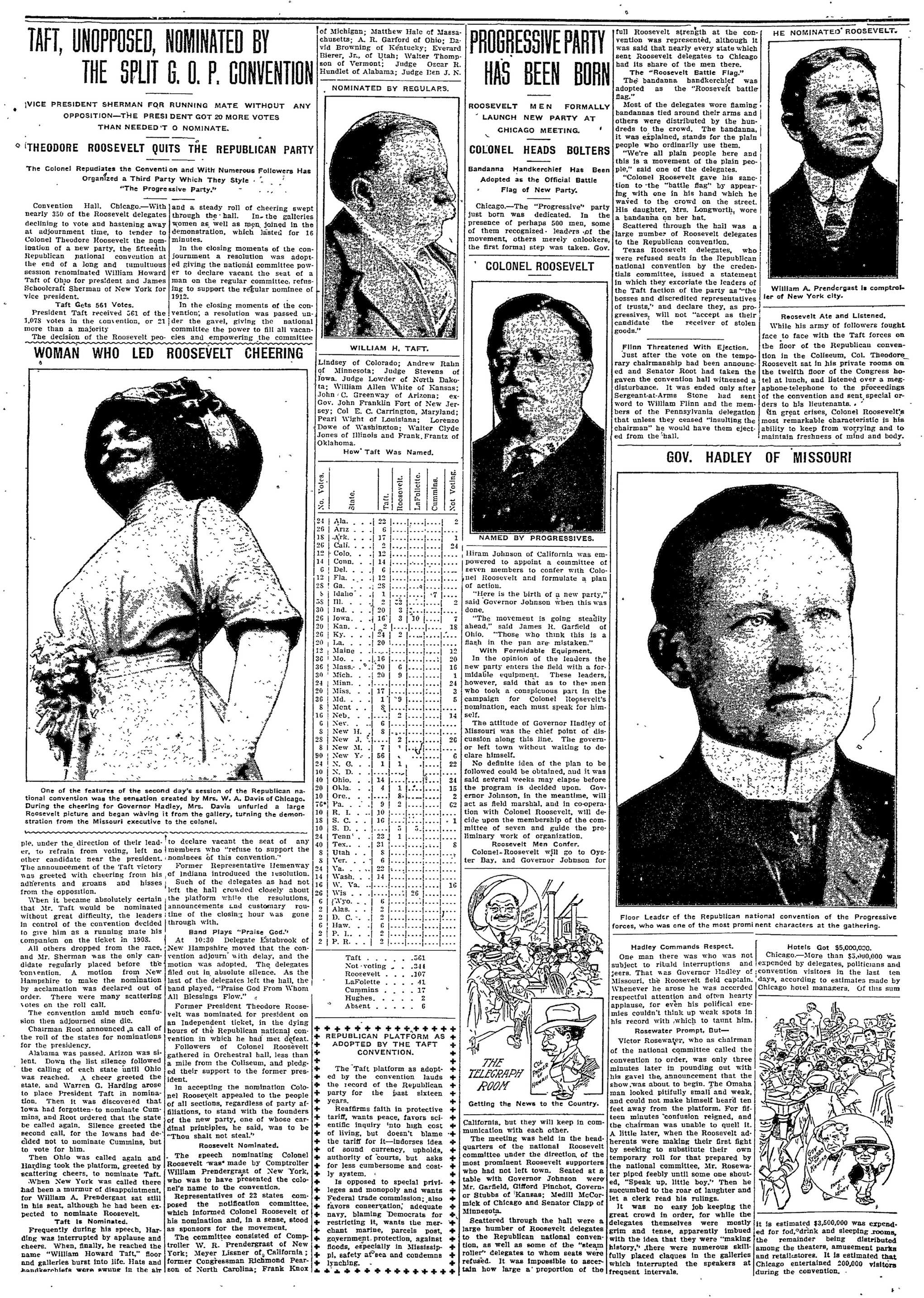
President Taft Wins Nomination
SHERMAN IS NAMED FOR VICE-PRESIDENT.
Taft Nominated on First Ballot—Receives 561 of 1078 Votes—Roosevelt's Name Withdrawn From Convention.
President William Howard Taft received on last Saturday night the nomination of the fifteenth Republican National Convention which met in Chicago, Ill., and Vice-President Sherman was named as his running mate.
Of the 1078 votes cast in the convention President Taft received 561, while Vice-President Sherman received 597.
President Taft won the nomination on the first ballot with most of his foes not voting.
A statement was made in behalf of Col. Roosevelt asking that his name be not presented and that his delegates sit in silent protest through all further proceedings. The majority of his adherents carried out his wishes as was shown in the result of the first ballot which gave Taft 561 votes, Roosevelt 107, LaFollett 41, Cummings 17, Hughes 2, while 344 did not vote.
The three hundred odd Roosevelt delegates who declined to vote hastened away at the adjournment of the convention and tendered to Col. Roosevelt the nomination of a new party. A split convention had been predicted and therefore the actions of the Roosevelt delegates was by no means a surprise.
Savannah Tribune:
Please allow me a small space in your profound paper to let the brethren of the Odd-Fellows the jurisdiction of America know that I am still alive holding the true principles of Odd-Fellowship untarnished like they were handed Peter Ogden from the purest English brethren at Liverpool, England. I have lately completed a nice two story building for the Odd-Fellows here. I have donated the lot and furnished the money to erect the hall on it. It is located about three quarters of a mile from the steamer landing on the island and about half a mile to St. Simon's New Hotel. We are now ready to accommodate all the excursions that might desire to come to St. Simons Island Beach through the summer season.
Yours in F. L. and T.
P. C. Joseph.
Dear Sir: Kindly allow me space in your valuable paper to speak of a gathering which assembled in Liberty County on Sunday June 16th. It was one of the most notable and important meetings in the history of this county and was attended by many persons from this and adjoining counties. The meeting was held under the auspices of the Supreme Circle and was the celebration of their annual Thanksgiving day. The order was out in full and much interest was manifested in the services by all who were present. There were many men of ability on the program which was one of the most interesting ever heard here. Among those who took part in the exercises were Mr. Roger Crawford, Prof. J. Baker, Mrs. Mary L. Stephens, Prof. Lawrence Fuller, Prof. J. Monroe, Rev. Bowens and Capt. Millen. After the exercises had been concluded the members of the Circle marched to Capt. Millen's home where they were welcomed by Mrs. Elsie Millen and entertained in high style. All the delicacies of the season were placed before the guests and they experienced one of the most enjoyable times of their lives.
Yours Truly, David E. Campbell.
St. Philip Dots
Masonic Temple, West Gwinnett St.
Every service on Sunday was well attended, everybody was delighted with Rev. Singleton's discourse. On last Monday night the pastor and officers' board decided to have the opening of the new St Philips on the fourth Sunday in September instead of the third Sunday as before stated. Remember the big rally on the Fourth Sunday in September. The one hundred clubs must all fall in line. The time is fast approaching. The workmen will work steadily on the new church until completed. On last Wednesday night Mr. S. J. Howard and Mrs. Carrie L. White were married by Rev. R. H. Singleton. Mr. and Mrs. Howard are among our faithful members. On to-morrow, Sunday our Sunday, School will finish up their Easter offering. Our friends are asked to put a small amount in their envelopes. July 15 is the date for St. Philip Sunday School's outing at Daufuski. The following services will be held on to morrow, Sunday. Prayer meeting at 5:30 a.m. Preaching at 11 a.m. Sunday School at 3:30 p.m. A. C. E. League at 6:30 p.m. Preaching at 8:30 p.m. Strangers are cordially invited.
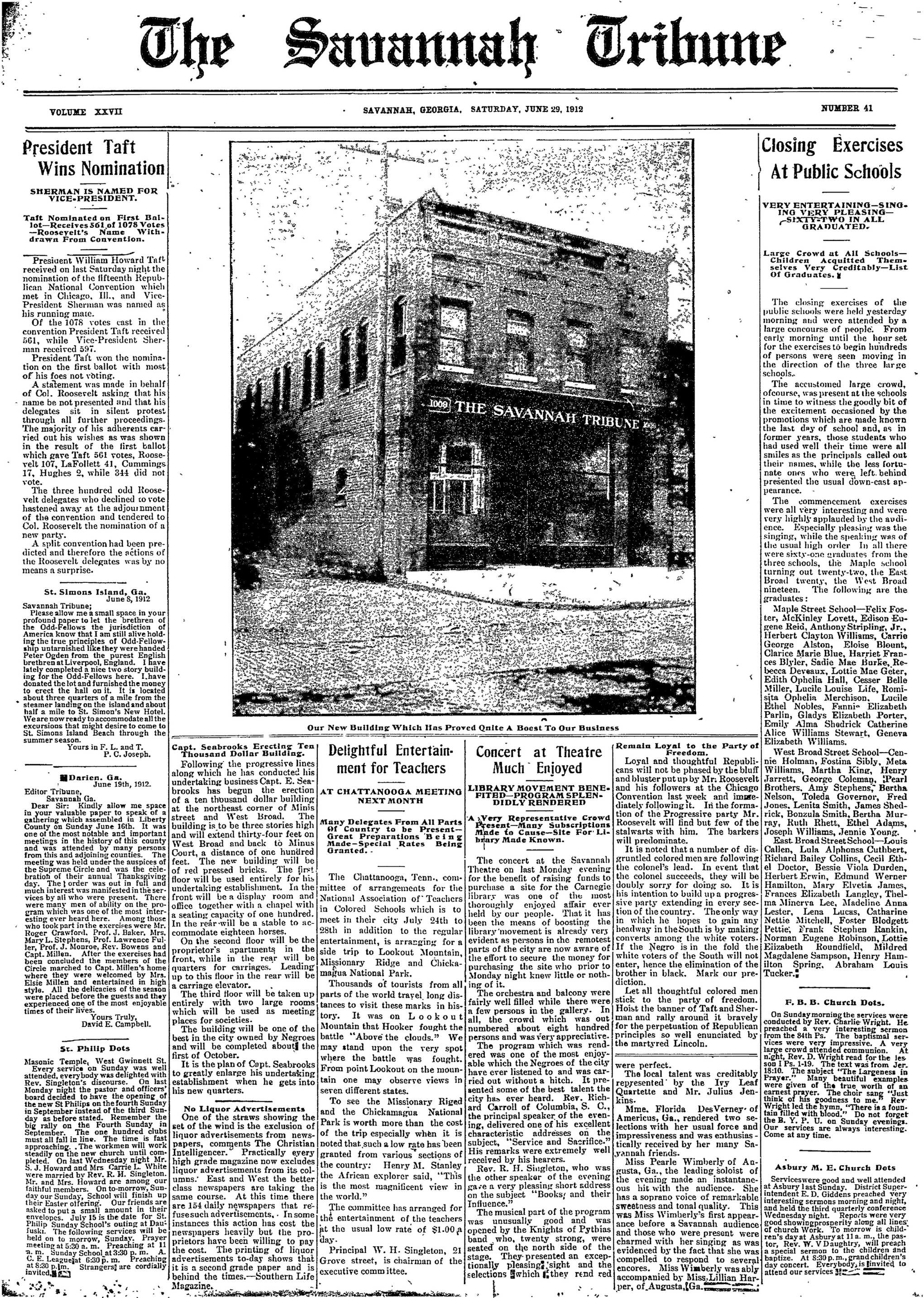
1008 THE SAVANNAH TRIBUNE
Capt. Seabrooks Erecting Ten Thousand Dollar Building.
Following the progressive lines along which he has conducted his undertaking business Capt. E. Seabrooks has begun the erection of a ten thousand dollar building at the northeast corner of Minis street and West Broad. The building is to be three stories high and will extend thirty-four feet on West Broad and back to Minus Court, a distance of one hundred feet. The new building will be of red pressed bricks. The first floor will be used entirely for his undertaking establishment. In the front will be a display room and office together with a chapel with a seating capacity of one hundred. In the rear will be a stable to accommodate eighteen horses.
On the second floor will be the proprietor's apartments in the front, while in the rear will be quarters for carriages. Leading up to this floor in the rear will be a carriage elevator. The third floor will be taken up entirely with two large rooms which will be used as meeting places for societies. The building will be one of the best in the city owned by Negroes and will be completed about the first of October. It is the plan of Capt. Seabrooks to greatly enlarge his undertaking establishment when he gets into his new quarters.
No Liquor Advertisements
No Liquor Advertisements
One of the straws showing the set of the wind is the exclusion of liquor advertisements from newspapers, comments The Christian Intelligencer. Practically every high grade magazine now excludes liquor advertisements from its columns.' East and West the better class newspapers are taking the same course. At this time there are 154 daily newspapers that refuses such advertisements. In some instances this action has cost the newspapers heavily but the proprietors have been willing to pay the cost. The printing of liquor advertisements to-day shows that it is a second grade paper and is behind the times.—Southern Life Magazine
SAVANNAH, GEORGIA, SATURDAY, JUNE 29, 1912
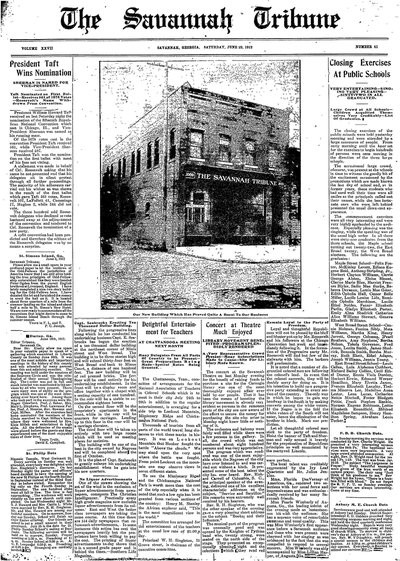
Our New Building Which Has Proved Qnite A Boost To Our Business
Delightful Entertainment for Teachers
Delightful Entertainment for Teachers
AT CHATTANOOGA MEETING NEXT MONTH
Many Delegates From All Parts Of Country to be Present Great Preparations Being Made-Special Rates Being Granted.
The Chattanooga, Tenn., committee of arrangements for the National Association of Teachers in Colored Schools which is to meet in their city July 24th to 28th in addition to the regular entertainment, is arranging for a side trip to Lookout Mountain, Missionary Ridge and Chickamagua National Park.
Thousands of tourists from all parts of the world travel, long distances to visit these marks in history. It was on Lookout Mountain that Hooker fought the battle "Above the clouds." We may stand upon the very spot where the battle was fought. From point Lookout on the mountain one may observe views in seven different states.
To see the Missionary Riged and the Chickamagua National Park is worth more than the cost of the trip especially when it is noted that such a low rate has been granted from various sections of the country: Henry M. Stanley the African explorer said, "This is the most magnificent view in the world." The committee has arranged for the entertainment of the teachers at the usual low rate of $1.00 a day. Principal W. H. Singleton, 21 Grove street, is chairman of the executive committee.
Concert at Theatre Much Enjoyed
LIBRARY MOVEMENT BENE-
FITED-PROGRAM SPLEN-
DIDLY RENDERED
A Very Representative Crowd
Present—Many Subscriptions
Made to Cause—Site For Library Made Known.
The concert at the Savannah Theatre on last Monday evening for the benefit of raising funds to purchase a site for the Carnegie library was one of the most thoroughly enjoyed affair ever held by our people. That it has been the means of boosting the library movement is already very evident as persons in the remotest parts of the city are now aware of the effort to secure the money for purchasing the site who prior to Monday night knew little or nothing of it.
The orchestra and balcony were fairly well filled while there were a few persons in the gallery. In all, the crowd which was out numbered about eight hundred persons and was very appreciative. The program which was rendered was one of the most enjoyable which the Negroes of the city have ever listened to and was carried out without a hitch. It presented some of the best talent the city has ever heard. Rev. Richard Carroll of Columbia, S. C., the principal speaker of the evening, delivered one of his excellent characteristic addresses on the subject, "Service and Sacrifice." His remarks were extremely well received by his hearers.
Rev. R. H. Singleton, who was the other speaker of the evening gave a very pleasing short address on the subject "Books; and their Influence."
The musical part of the program was unusually good and was opened by the Knights of Pythias band who, twenty strong, were seated on the north side of the stage. They presented an exceptionally pleasing sight and the selections which they rend red
Remain Loyal to the Party of Freedom.
Loyal and thoughtful Republicans will not be phased by the bluff and bluster put up by Mr. Roosevelt and his followers at the Chicago Convention last week and immediately following it. In the formation of the Progressive party Mr. Roosevelt will find but few of the stalwarts with him. The barkers will predominate.
It is noted that a number of disgruntled colored men are following the colonel's lead. In event that the colonel succeeds, they will be doubly sorry for doing so. It is his intention to build up a progressive party extending in every section of the country. The only way in which he hopes to gain any headway in the South is by making converts among the white voters. If the Negro is in the fold the white voters of the South will not enter, hence the elimination of the brother in black. Mark our prediction.
Let all thoughtful colored men stick to the party of freedom. Hoist the banner of Taft and Sherman and rally around it bravely for the perpetuation of Republican principles so well enunciated by the martyred Lincoln.
were perfect.
The local talent was creditably represented by the Ivy Leaf Quartette and Mr. Julius Jenkins.
Mme. Florida DesVerney of Americus, Ga., rendered two selections with her usual force and impressiveness and was enthusiastically received by her many Savannah friends.
Miss Pearle Wimberly of Augusta, Ga., the leading soloist of the evening made an instantaneous hit with the audience. She has a soprano voice of remarkable sweetness and tonal quality. This was Miss Wimberly's first appearance before a Savannah audience and those who were present were charmed with her singing as was evidenced by the fact that she was compelled to respond to several encores. Miss Wimberly was ably accompanied by Miss, Lillian Harper, of Augusta, Ga.
Closing Exercises At Public Schools
VERY ENTERTAINING—SING-
ING VERY PLEASING—
SIXTY-TWO IN ALL
GRADUATED.
Large Crowd at All Schools—
Children Acquitted Themselves Very Creditably—List
Of Graduates.
The closing exercises of the public schools were held yesterday morning and were attended by a large concourse of people. From early morning until the hour set for the exercises to begin hundreds of persons were seen moving in the direction of the three large schools.
The accustomed large crowd, ofcourse, was present at the schools in time to witness the goodly bit of the excitement occasioned by the promotions which are made known the last day of school and, as in former years, those students who had used well their time were all smiles as the principals called out their names, while the less fortunate ones who were left behind presented the usual down-cast appearance.
The commencement exercises were all very interesting and were very highly applauded by the audience. Especially pleasing was the singing, while the speaking was of the usual high order. In all there were sixty-one graduates from the three schools, the Maple school turning out twenty-two, the East Broad twenty, the West Broad nineteen. The following are the graduates:
Maple Street School—Felix Foster, McKinley Lovett, Edison Eugene Reid, Anthony Striplings, Jr., Herbert Clayton Williams, Carrie George Alston, Eloise Blount, Clarice Marie Blue, Harriet Frances Blyler, Sadie Mae Burke, Rebecca Deveaux, Lottie Mae Geter, Edith Ophelia Hall, Cesser Belle Miller, Lucile Louise Life, Romisita Ophelia Merchison, Lucile Ethel Nobles, Fannie Elizabeth Parlin, Gladys Elizabeth Porter, Emily Alma Shedrick Catherine Alice Williams Stewart, Geneva Elizabeth Williams.
West Broad Street School—Cennie Holman, Fostina Sibly, Meta Williams, Martha King, Henry Jarrett, George Coleman, Pearl Brothers, Amy Stephens, Bortha Nelson, Toleda Governor, Fred Jones, Lenita Smith, James Shedrick, Bonzula Smith, Bertha Murray, Ruth Rhett, Ethel Adams, Joseph Williams, Jennie Young.
East Broad Street School—Louis Callen, Lula Alphonsa Cuthbert, Richard Bailey Collins, Cecil Ethel Doctor, Bessie Viola Durden, Herbert Erwin, Edmund Werner Hamilton, Mary Elvetia James, Frances Elizabeth Langley, Thelma Minerva Lee, Madeline Anna Lester, Lena Lucas, Catharine Nettie Mitchell, Foster Blodgett Pettie, Frank Stephen Rankin, Norman Eugene Robinson, Lottie Elizabeth Roundfield, Mildred Magdalene Sampson, Henry Hamilton Spring, Abraham Louis Tucker.
F. B. B. Church Dots.
On Sunday morning the services were conducted by Rev. Charlie Wright. He preached a very interesting sermon from the 84th Ps. The baptismal services were very impressive. A very large crowd attended communion. At night, Rev. D. Wright read for the lesson I Ps. 1-19. The text was from Jer. 18:10. The subject "The Largeness in Prayer." Many beautiful examples were given of the true worth of an earnest prayer. The choir sang "Just think of his goodness to me." Rev Wright led the hymn, "There is a fountain filled with blood." Do not forget the B. Y. P. U. on Sunday evenings. Our services are always interesting. Come at any time.
Asbury M. E. Church Dots
Serviceswere good and well attended at Asbury last Sunday. District Superintendent E.D. Giddens preached very interesting sermons morning and night, and held the third quarterly conference Wednesday night. Reports were very good showing prosperity along all lines of church Work. To morrow is children's day at Asbury at 11a. m., the pastor, Rev. W. V Daughtry, will preach a special sermon to the children and baptize. At 8:30 p.m., grand children's day concert. Everybody, is invited to attend our services
Earth Full of
God's Goodness
A Sermon
The earth is full of the goodness of
the Lord.—Psalms, 33:5.
It was a whole-souled, warm-hearted post who exclaimed: "The earth is full of the goodness of the, Lord." These are the words of one whose soul vibrated with the soft music of earnest joy and overpowering thankfulness. "The world is very evil," we sometimes say; yes, and the Psalmist did not deny that, for often, indeed, do we find in the Psalms glimpses doleful enough of the evils of the world. But here he simply forgot the evils of the world as he lost himself in the contemplation of the goodness of God. In one of Brownling's poems we find a similar recognition of God's goodness:
The year's at the spring,
And the day's at the morn;
Morning's at seven;
The hillside dew-peared;
The lark's on the wing;
The snail's on the thorn;
God's in his heaven—
Literally that is not true. All is not right with the world, for, as a matter of fact, the world is very evil. But there is none the less a profound truth in the poet's happy optimism. "God's in his heaven—all's right with the world!" He knows that there is evil enough in the world, but he insists, nevertheless, upon seeing that which is good. So the Psalmist, although he, too, must have seen enough of that which is evil, emphasized the goodness of God in the same optimistic strain. "The earth is full of the goodness of the Lord," he insisted. An intense optimist was the Psalmist, for he believed that good has the right of way. This is god's world and not Satan's. It belongs to good and not to evil. Therefore in his gratitude he forgot to be dissatisfied. He contemplated the loveliness of nature around him, the stargemmed canopy of heaven above him and the peace of God within him. His heart thereupon melted with love and thanksgiving, and his poetic soul sang to the Most High a song of devotion and praise.
There is something noble in thus emphasizing the good and ignoring the evil! It does not mean that he is ignorant of the evil, for then were he no true optimist, but it does mean that he has such an overpowering sense of the good that he can afford to disregard evil. There is evil enough, but the good is so much greater and mightler that the evil is not worthy to be compared with the good. "For I reckon," said the apostle Paul, "that the sufferings of this present time are not worthy to be compared with the glory which shall be revealed in us." So we may reckon that evil is of no account as compared with good. "The earth is full of the goodness of the Lord."
It is true that there are times when we have a right to feel depressed, or, rather, times when we cannot help it. Those are times when the soul loses grip upon itself, weared and weakened as it becomes by some struggle or disappointment, when things go wrong, when ambitions fall us, when men deceive us, when the sky is dark above us, when sickness and death afflict us, when we can see neither the way before us nor God's clear light about us. But if we only knew it, the very shadows are full of the goodness of God. He is with us even in our trials and our troubles. In times of sorrow and affliction there is for us a sweeter message than ever the psalmist heard—"Blessed are they that mourn: for they shall be comforted."
There are those, too, who seldom if ever see the fairest portions of God's earth. They never have a chance to see God's world at its best. They see more of the vileness of man than they see of the goodness of God. About all of nature they see are occasional patches of blue sky between buildings, and beautiful sunsets they may see perchance only over the hideous red roofs of houses, while, on the other hand, are the cheerless homes and the crowded streets, the noisy factory and the selfishness of man. This is the lot of thousands, and it is no wonder if the brain becomes dull, the heart faint and the soul torpid. So the world is evil enough in places; but that is not God's fault. It is man who has brought upon himself the noise and the dirt, the fret and the worry. Take the earth as it is and man as he ought to be, if he would but conform to God's will, and we would have heaven right here and now. But man will not conform to those laws which make heaven; hence in some parts of the earth we have hell instead. Alas, that the righteous must suffer with the guilty! But then, too, the righteous suffer for the guilty, for it is God's will that the righteous shall help to redeem the earth and make more and more evident the goodness of God.
The earth already is full of the goodness of the Lord, but we need to make it also full of the goodness of those who love the Lord. God is in his world working to save his children from their sorrow, but his children still love the sin that brings them sorrow. To this end he sent forth his Son to say, "Come unto me all ye that labor and are heavy laden, and I will give you rest." Even now the spirit of the Master is in the world seeking its salvation.
Where cross the crowded ways of life. Where sound the cries of race and clan.
Above the noise of selfish strife,
We hear thy voice, O Son of Man!
In haunts of wretchedness and need,
On shadowed thresholds dark with
fears,
From paths where hide the lures of greed.
We watch the vision of thy tears.
Verily, the earth is full of the goodness of the Lord, and this is so because he is present to save us from the earth's badness. Let us, then, work together with God, we who love him truly. Where there is evil, let us help make the world better. Where there is sorrow, let us bring cheer. Where there is darkness, let us bring light. Where there is misery, let us bring love. Where there is sin and shame, let us bring God and forgiveness. So shall men know that the earth is full of the goodness of God, for they shall see that it is full of the goodness of God's people. God's people are God's witnesses. Woe unto them that do not bear witness unto the truth!
CHARLES G. GIRELIUS.
CARNEGIE IS GENEROUS
DONATES $50,000 FOR PUBLIC LIBRARIES—COLRED PEOPLE TO GET $25,000 BUILDING.
New Orleans, La.
The following important interesting news appears in the New Orleans Evening Item of this city:
An additional donation of $50,000 to the public libraries system of New Orleans has just been announced as having been made by Andrew Carnegie. Of this amount $25,000 is to be used for an addition to the main building, and $25,000 is to be utilized for the erection of a colored branch.
This information was conveyed to Mayor Behrman by a communication from Prof. J. H. Dillard, president of the library board, and was confirmed by Doctor Dillard in person, who, in company with Librarian Henry M. Gill, called on the mayor Monday morning.
The letter from Professor Dillard, which he said contained all the information that he could give on the subject, was as follows:
"Dear Sir: I have this morning returned from New York, and am glad to inform you that we have a communication from Mr. Bertram assuring us of Mr. Carnegie's promise of $25,000 for the addition to our main building of the public library, and $25,000 for the erection of a colored branch. These amounts will be paid whenever we desire to use the money.
"Both of these donations were badly needed by our library board. We shall build a stock-room in the rear of the main building, thus giving ample space for making suitable provision for the children, where the stacks now are. With regard to the colored branch, our board fully realizes the need of this provision, just as Louisville and other southern cities have had similar need.
"As you know, our library has had a marvelous growth, and I am glad we have prospects for still further development. The increase of the use of the library on the part of children has been particularly gratifying. Their present quarters in the main building are much too small, and it is well that Mr. Carnegie's additional donation will permit us to now give them a most attractive place."
GOWBOYS OF SPAIN
SPLENDID HORSEMEN, BUT THEY USE THEIR SPURS WITHOUT MERCY.
The perfection of Spanish horsemanship is to be seen among the vaqueros, granderos and garrochistas, by which various names the mounted herdsmen of the Andalusia plains are known—in brief, what we should call a cowboy. Every farm seems to maintain a number of these, for each herd, flock or drove has its own herdsman, goatherd or swineherd, as the case may be. The vaqueros are a fine looking lot of men. Tall, thin; light and loosely made, they look ideal horsemen, as, in point of fact, they are, though their mounts are poor.
The vaquero rides very high on a huge saddle, with a long stirrup and straight leg, using a single rein and a very heavy curb, but he has such beautiful hands that, although using this barbarous bit, he never cuts his horse's mouth about. It is different with the animal's sides, however, for he uses his spurs without mercy, and the white horses—of which there are a large number—all have ominous red stains behind the girths.
All the herdsman who look after cattle carry a long lance, called a garrocha, of thick and heavy wood, which, except when standing still, they always carry "in rest" and not "at the carry," presumably on account of its great length and possibly its weight. With this weapon, in the use of which he acquires amazing dexterity, the garrochista is able to control the most unruly brushes in the herd, not excepting the savage fighting bull.
-Wide World Magazine.
INDIVIDUALITY.
To each intellect belongs a special power. We belong to ourselves, and we lose control of our own when we try to be some one else. The original mind is a magnetic center for the attraction of other minds. But the lodestone loses nothing by attraction; it remains the same.—London New Age.
The time has arrived when there is practically no confusion regarding the, "race problem." The southern white man and the southern negro understand each other and appreciate each other. There are of course exceptions in both races, but it is true that the intelligent, unprejudiced leaders of both races, under the social and economic conditions of the past decade especially, have come to a fuller and more satisfactory understanding.
The big truths of this understanding are these: The negro recognizes the fact that there is no such a thing as social equality. The white man realizes the fact that he is largely dependent upon the negro for unskilled labor. The white man realizes that he is responsible to a considerable extent for the educational, moral and physical improvement of the negro race; and the negro realizes that the greatest help he can hope to receive in his work of self-improvement is from the southern white man, who understands his character, realizes his status and knows what he needs.
The white man in the north does not understand the negro and the northerner is beginning to realize that his well-meaning interferences with the "race problem" in the south have done more harm than good. The intelligent negro of today realizes that the northern man does not understand him and he turns to the southern man for advice and counsel. There have arisen among the negro race during the past two decades' a large number of white, earnest and conservative leaders. It is through these men that the race is being uplifted. These men are anxious that the north understand the satisfactory attitude of the southern white and colored people to each other. The Chronicle has just received a letter strikingly bringing out this point from J. E. Kwegyir Aggrey, registrar of Livingstone college, Salisbury. The letter was written the day after the A. M. E. Zion general conference here closed.
"I write this principally to thank you for your highly appreciated editorial on 'Upright Leaders and Safe,' in your issue of yesterday," writes Kwegylr Agrey.
"I was in Charlotte last night and took occasion to call the attention of many of the remaining delegates to it. Most of them live beyond the Mason and Dixon line. I had been telling them that down here in North Carolina, especially in Charlotte and Salisbury, we have no race problem; that we understand well the situation and we were helping to cement more firmly the friendly relations between the races. On commencement day, when the special train brought some 500 or more from the general conference and Charlotte to Livingstone college, the speech made in high commendation of our endeavor here by State Senator A. H. Royden, for nearly ten years mayor of Salisbury, confirmed—more than confirmed—my statement.
"Several preachers secured copies of the Chronicle and will read the editorial from their pulpit in the north, and my efforts to let the north understand the south better, I am sure, has by this means already received an impetus which will be increased when the men exhibit the original copies of the Chronicle. . . This has already helped, and I am going to use it in two more periodicals of ours, so as to reach all our ministers and most of our communicants. It will continue to inspire as long as memory harks back to the general conference. I am sure the sentiments expressed in your strong editorial are plainly appreciated and we trust so to continue our labor of elevating our people through the means of Christian and industrial education as to merit, or at least deserve, your high opinion of us."
In this immediate connection the Chronicle wishes to state that the excellent reports of the recent conference, which were admittedly the most comprehensive of that gathering, were furnished daily by Rev. W. H. Davenport, now pastor of one of the leading colored churches in Bayonne, N. J., who has had considerable experience in newspaper work. His reports were accurate, thorough and furnished clearer ideas of the transactions of the conference than any others made public. Dr. Davenport was a strong candidate for the editorship of the Star of Zion, in the event that the editor, Rev. George C. Clement, had been chosen bishop.
The Chronicle was much interested in the remedy for the labor problem in the south as suggested by Rev. Dr. J. D. Hammond, a distinguished Methodist clergyman who is now president of Payne college for colored youth at Augusta, Ga. "The average colored laborer in most sections of the south, if he makes enough money in three or four days to purchase the wherewithal to satisfy his physical needs, will not work the other two or three days. Therefore, cotton goes to waste in the field for want of picking while the negroes congregate around the railway stations and idle away their time elsewhere, and large projects are delayed for the same reason. The wants and desires of the negro laborers as a general rule are few—coarse food and the cheapest clothing. Increase the negro's desires by elevating him and he will work six days in the week for the money with which to supply his wants. When you bring the colored man to the point where he wants better food and better clothing, a more comfortably furnished home and a better home, and papers and
books and music, that man is going to make a better and a steadier working man." - Charlotte Chronicle.
NEGRO CAPABILITY THE FINAL TEST.
What is called the negro problem in the United States has many phases and aspects, and some of them are still acute, but upon one thing all observers, and thinkers, white or black, can agree. That is, that every step which the colored race takes toward efficiency, thrift, usefulness, service, is a step which counts toward the satisfactory solution of the highly complex "problem."
Hostility and prejudice based on race or faith are most effectually combated by indirect, subtle means. Contention and controversy cannot be avoided, but an ounce of positive achievement for good is worth volumes of theoretical arguments in this workaday world. A negro farmer, a negro banker, a negro merchant, a negro drummist, a negro foreman, a negro builder, a negro architect, a negro educator, a negro musician, a negro lawyer—there are the "arguments" which must finally prevail.—New York Evening Post.
SLEEPING ON OPPORTUNITY.
An observant citizen has counted three hundred and twenty-nine business places on Seventh street, between Florida avenue and K street. Of this number seventeen are conducted by colored people. And Seventh street is the leading business thoroughfare upon which colored people trade. Our people are sleeping upon their commercial opportunities. — Washington National Union.
THE NEGRO IN BUSINESS.
That the negroes of America are making great progress and are going forward by leaps and bounds along all lines of human endeavor cannot be denied. But while he has been making progress, the world about him has also been making progress, and having started in the lead, his white brother keeps the lead. Particularly is this true in the business world. The negro merchant, broker, banker, or what not, is not only handicapped by lack of experience and of capital, and hampered by social prejudice, but greater than all these is the handicap he is under by reason of the lack of confidence in the ability of his own race to do big business and his lack of race pride and loyalty which would make him suffer present temporary inconveniences and losses, if need be, in order that conditions may be made better for his posterity. The scarcity of large business enterprises among the negroes is not due so much to the lack of colored patronage of negro businesses, as to the lack of those negroes who have been patronized by the masses, to co-operate with one another in the production of larger businesses. The business and professional men are at fault for the lack of large corporations among the negroes, and the use by white corporations of most of the capital possessed by the race.—Chicago Chronicle.
TWO NEW HATS
THE SCHEME THAT WON THEM
'AND THE WAY IT WAS
WORKED.
A man who used to be in politics and was a constant:borrower found himself in need of a new hat, but he couldn't find anybody who would lend him a cent.
Finally he went to an acquaintance and said:
"I want to borrow $50 for five minutes."
"You can have it if you will put up a couple of fingers for security."
"Nix. Now, I've got a scheme. You lend me the fifty and you needn't let me get out of your sight. If you do it I'll stake you a hat."
Mystified, but curious, the acquaint-agreed agreed to this, and the two repaired to a prominent hat store.
"Walt a minute," said the adventurer and left his backer doing sentry duty on the sidewalk.
Picking out the most important looking personage in the store, the politician went up to him and said:
"I am So-and-so of the —— district. I have come to pay for two hats for which I have given orders on you to two of my constituents."
With that he flashed a fifty-dollar bill.
There was a scurrying around, a search of books and a reply that no such orders had been presented.
"Just look out for them, will you?" said the district leader, waving the big bill, which was hypnotic in its way, for the clerk bowed low and said, "Yes."
Half an hour later two orders were presented and two hats left the store. —Chicago Post.
COCKNEY CHIVALRY.
There was a crush in the pit, and the anaemic looking girl stood with the late comers behind the last bench. The young man in front of her, comfortably seated, was not too absorbed in the musical comedy to note that the girl looked tired as she doggedly stood out the first act. He rose when the curtain fell. "Would you," he asked, pushing past her, "like to mind my seat while I go out for a drink?" The age of chivalry is not past—London Chronicle.
EDUCATOR SPEAKS TO
2 GENERAL CONFERENCES
BOOKER T. Washington, at Kansas City and Charlotte.
STRONG TALK TO DELEGATE
A. M. E. AND A. M. E. ZION CONFERENCES HEAR PLEA THAT NEGRO MINISTRY PAY MORE ATTENTION TO RURAL DISTRICTS.
Kansas City, Mo.—Dr. Booker T.
Washington, principal of the Tuskegee institute, after speaking before the general conference of the African Methodist Episcopal Zion church at Charlotte, N. C., came to Kansas City and spoke before the general conference of the African Methodist Episcopal church.
Doctor Washington was welcomed by a throng numbering over ten thousand, conservatively estimated, when he rose to speak at the Auditorium, which is estimated to be the largest in the country. Not only were the bishops and officers of the church present, but thousands had journeyed to Kansas City from other places to hear Doctor Washington's address.
Doctor Washington, at special invitation of Chancellor Frank Strong of the University of Kansas, Lawrence, delivered a stirring address to the students of that university. The audience is said to have been as large as any that has ever gathered to hear any of the notables who have spoken there, such as President Taft and Gov. Woodrow Wilson. The students themselves gave Doctor Washington one of the warmest welcomes ever extended a visitor at Lawrence.
In his address before the general conference, Doctor Washington laid particular stress, as he had already done in his address before the general conference at Charlotte, upon the great need and necessity of the negro ministry turning its attention to saving and strengthening the millions of negroes who live in the country districts of the south.
He said in part:
"In the rural districts the negro, all things considered, is at his best in body, mind and soul. In the city, he is usually at his worst. Plainly, one of the duties of your church is to help keep the negro where he has the best chance. In a marked degree the negro is a social being. He, more largely than is true of any other race, uses the church as the rallying point for his social life. Whether it is a meeting relating to farming, business, education, politics or secret societies, the negro church house is used.
"Here, then is the opportunity for us to improve the church life of the negro in the country and thus to help to keep him on the land where he has a chance to grow a strong, healthy body, and be away from the temptations and complexities of large city life.
- "How can this be done? For one thing, make church life for the negro in the rural districts as attractive as it is now in the city. The negro problem is to a very considerable extent the problem of rural life everywhere. So long as the negro finds a poor, uncomfortable, unattractive church house in the country, and a good church house in the the city, or finds a weak, ignorant minister in the country and a strong, intelligent minister in the city, or finds in the country church services held once a month and in the city a church service held twice each Sunday: so long will the negro be tempted to leave the country and migrate to the city.
"In dealing with the millions of the negroes, let us in America learn a lesson from what has taken place in England where agriculture and the farm have been neglected by church and state, with the result that the cities of England are filled with millions of unfortunate misfits who are in the gutters instead of being on the soil and out in the free, bracing air where God meant that man should live.
"No class of people should be more interested in the plans and work of our great negro church organizations than the capitalists, the captains of industry, those who directly or indirectly employ negro labor. Nothing pays so well in producing efficient labor as Christianity. Religion increases the wants of the laborer. The man without religion is too often satisfied when he has worked long enough to provide himself with a little coarse food, a chew of tobacco and a bottle of whisky. The negro workman with the spirit of Christ in his head and heart wants land, wants a good house, wants another house, wants decent furniture, wants a newspaper or magazine. He wants to provide himself with the means' with which to maintain his church and Sunday school and his family with a Bible and hymn book.
"Tonight as we stand here and deliberate as to methods of Christian regeneration, in the southland there are about one million black children who entered no school room this year, and another million who have been in school for only three or four months in the year. Putting the ignorant negro under arrest will not give him Christianity. Putting him in jail or in the penitentiary will not give him Christianity.
"Mine is not a selfish plea to the church. I want to see the negro saved for his own sake, and I want, to see the negro saved in order that the white race which surrounds him may be saved. All history teaches that wherever the white race has been surrounded by a weaker race and a ne
gleucted race of any color, that there the white man has yielded to the temptation to degrade and weaken himself because of injustice perpetrated upon the weak race."
DR. THIRKIELD
ELECTED BISHOP OF M. E. CONNECTION, RECEIVING 537 VOTES
—ASSIGNED TO NEW ORLEANS:
Washington.—All Washington is gratified over the election of Dr. Wildur P. Thirkield, president of Howard university, as bishop of the Methodist Episcopal church. For many months it has been known that his friends would push him for promotion at the Minneapolis conference and his success comes as a happy culmination of a period of service to God and humanity. His election took place on the twenty-sixth ballot, receiving 557 votes, 38 more than the number necessary to a choice. He was a member of the body as a delegate from the Ohio conference, an unusually high compliment to one residing outside the state. Bishop Thirkield's elevation is richly earned, and he has been showered all this week with telegraphs and letters of congratulation from friends of both races in all sections of the country. The only "fly in the ointment" lies in the fact that the race must lose his eminent services as president of Howard university, in which capacity he has given six years of solid achievement. Despite the satisfaction felt by reason of his election, his departure from this fruitful field is attended with the keenest regret by those interested in the development of the race's premier school for the higher education. Justice Anderson of the district supreme court, and one of the trustees of the institution, speaking of the valued labors of Doctor Thirkield, admirably summed up the general feeling in saying:
"He has done more for the university in the past four years than has been done in the preceding forty years."
In six years the enrollment of students at the university has risen from 800 to 1,400. The number of professors and instructors has been trebled, and a half-million dollars in buildings and new equipment has been added to the permanent improvement of the institution. Best of all, President Thirlkield has been able to bring to Howard the permanent support of the federal government, and the assumption of this enormous obligation insures its future as a national institution.
His successors will find the task of administration a much lighter responsibility than when he took charge. Doctor Thirkeld's life is one long story of devotion to the uplift of the negro people. A native of Ohio, he soon gave up a Cincinnati pastorate to accept a call to Clark university, at Atlanta. Here he founded the Gammon Theological seminary, and for seventeen years he worked incessantly to make, that institution the potent agency for religious education that it is today. In 1900 he became one of the secretaries of the Freedmen's Aid society, from which he was called to the presidency of Howard university in 1906. Since coming to Washington Doctor Thirkeld has not confined his labors to Howard university, but has taken an active interest in every movement for the benefit of the colored people. He was elected to the directorate of the Young Men's Christian association, and for several years has been second vice-president of the organization, counting no sacrifice too great to assist in carrying forward the purposes of the association. His personal popularity and strength with men in high station have been utilized for the advancement of the causes most helpful to the race. Among those who have evinced great concern for the success of Howard and who have commended the effective labors of President Thirkeld are President Taft, former President Roosevelt, Ambassador Bryce, former Commissioner of Education Elmer E. Brown and Andrew Carnegle. Dr. B. T. Washington became a member of the board of trustees under Doctor Thirkeld's administration.
The now bishop has been assigned to the episcopal station at New Orleans. He carries with him the best wishes of a grateful people.
NOTES ON RAGIAL PROGRESS
By the will of Mrs. Alice A. Hicks,
nearly $360,000 was left to charitable
and educational institutions. The New
York Orphan asylum is left $10,000.
Mr. C. S. A. Baker, a colored man
of Detroit, Mich., has sold his patent
of a friction heater for street cars to
a Canadian company for $160,000.
Baker conducted his experiments on
a street car in Detroit, Mich.
John Patrick, a chief gunner's mate
in the United States navy, reenlisted
on board the U. S. S. Franklin at a
monthly rate of $100.31. Patrick is a
negro and has had over twenty-seven
years' service. He will soon be eligible
to retire on a handsome annuity.
It is reported that Mr. Victor LeBaron of Providence, R. I., has been informed by administrators that he is heir to a million dollars in France. He and his wife will soon take a trip to look after this wealth. Mr. LeBaron was not excited by the wealth, as he already was the owner of considerable real estate in Providence, where he was the head of the pasteurizing department of a Providence dairy company. He was a cousin to the late Alexandre Dumas.
$110,000 AVAILABLE FOR INVESTMENT
Members of 9th Cavalry Issue Appeal and "Scheme Note."
SUGGEST DEPARTMENT STORE—COLORED CAVALRYMEN WANT TO BRING RACE CLOSER TOGETHER—SOLDIERS ARE SAV'THEIR MONEY.
Cheyenne, Wyo.—The members of the Ninth cavalry, stationed at Fort D. A. Russell, through Sqdn. Sergt Maj. Milton T. Dean, have issued an appeal to the negroes of the United States to get closer together along business lines. To show that they desire to play a prominent part in bringing about a closer racial feeling the cavalrymen make known that they have $110,000 available for investment in wholly legitimate business.
The colored soldiers propose to establish a department store, to consist of a banking system, millinery and dry goods, shoe, drug, grocery, soda fountain, restaurant and clair departments, such a store to be opened in one of the cities where a large population of negroes is found.
The appeal and "scheme note" of the members of the Ninth cavalry follow:
We of the Ninth U. S. cavalry send out this broad appeal feeling the keen and absolute necessity of a closer cooperation on the part of the individuals of the race. Such an appeal should not be passed by without serious consideration, comment and action of some kind. We must awaken from that fear of venture and lack of push to enter new fields, such powerful factors in the material advancement of other people. Can you not come to us, can you not attempt, at least, the gathering in of the thousands of dollars which now flow into the pockets of the white man?
SCHEME FOR PROFESSIONAL NE GROES.
And now comes the part of this note to which we most earnestly urge and implore from all the insight: thought and action it desires. A scheme which will meet the demands not only of the colored soldier but his civilian brother as well impels us to present this subject as being a departure into a field ripe at this time for the entrance of the negro. It is given to the progressive men of the race and when we say "progressive men," we refer to the men inclined in that direction of legitimate business which has in a measure fitted them for such a task and men who are in a position to secure the necessary support. The financial status of the soldier is put before you. And bear in mind that the subject is not presented to you by one whose experience, time and thought has not been carefully applied to the obstacles that may and will be encountered from many sources.
We have in the race men possessed of these qualities—grit, push, perseverance. Initiative, education and above all, probity—requisite in all successful enterprises. This subject seems big, is big, but hardly out of proportion or beyond the control of the abilities of the necro. It is said with all force of words this is within the grasp of accomplishment; it must be taken hold of and carried through regardless of the pooh-poohs some might cast upon it. Such is expected. Such an enterprise would and should stand as an indisputable monument of the position of the race as well as its ability in competition.
ABOUT OUR COLORED SOLDIERS.
The figures herein given are taken from the Ninth U. S. cavalry, but will also approximately cover similar conditions in the Tenth U. S. cavalry and the Twenty-fifth U. S. infantry—all of which are, stationed in the United States.
They are compiled from the troop and regimental records based upon the present day. In computing length of service increase a mean estlist period is taken which gives a near average rather than the true amounts, which are much more:
Emitted strength of regiment in time of peace..... 855
Number of men drawing pay equal to $21 or more, basic pay only considered..... 264
Number of men drawing pay less than $21, basic pay only considered..... 591
264 men—total pay per month..... $ 7,500.00
291 men—total pay per month..... 8,100.00
855 men—length of service increase per month..... 4,030.00
855 men—total pay per month per regiment.....$19,630.00
Average pay per man per month.....$ 22.96
Average deposits with government, with banks, or sent to relatives..... 5,847.00
Necessary expenses per man per month..... 2.25
Total savings, all sources, per month per regiment... 5,000.00
Total expenses per month per regiment..... 1,923.75
Total savings and expenses per month per regiment..... 6,923.75
Which leaves a balance to be expended of.....$12,706.25
MANY SOLDIERS DO NOT DRINK OR SMOKE.
All soldiers are not drinkers, many do not smoke, so we may conservatively say the average amount per
man per month spent for liquor, tobacco and the revels incident thereto is $6.78, making a total per month per regiment of $6,776.90. In dress and display the soldier shows similar tastes to those of his civilian brother, so we have for each $6,929.35, giving for a year a sum of $8,315.20. The latter may be classed under the heading of "legitimate business" ($5,776.90). Of the prior amount we should take 65 per cent, as being spent for liquor and tobacco, which means $3,754.99 per regiment per month or for the year of $45,059.88. Add this sum to the legitimate business we have $128,212.08. That a further allowance for a larger sum being spent in an entirely different direction than above noted we will allow another reduction in savings and expenses and for legitimate business, leaving a figure for each of $80,000 business, and $30,000 savings, etc. This means we have added to the savings, etc., something like $182,212.08, giving a total of $25,135.53. The total pay per regiment
for a year is..... $235,560.00
The total savings, etc..... 107,347.92
Leaving a balance of..... $128,212.08
But take away the above
amount of..... 18,212.08
We have left as above..... $110,000.00
This amount is available for invest-
ment in wholly legitimate business
ment in wholly legitimate business.
An investment of $50,000 will hardly bring more than a four per cent dividend if left in banks, which means $2,000, this without the risks usual to the business ventures. Were this sum invested along the lines hereafter enumerated the first year would show a net gain of about sixty per cent, covering a possible loss of $30,000, leaving a similar amount for expenses, etc. The soldier is not a fool nor so easily led into a bargain as some may surmise. His travels alone should dissipate such an idea. Upon this subject we desire to speak at length another time. The scheme is to establish a department store comprising the following: A banking system, a millinery and dry goods store, a shoe, a drug, a grocery, a soda fountain, restaurant and a cigar department.
Suppose such a store was established in Philadelphia, in Washington, D.C., or Kansas City, localities where large populations, of negroes are found. And suppose a mail order branch was inaugurated. Could not the military patrons be reached no matter the location of the store?
COLORED BANK MESSENGER
TRUSTED WITH MILLIONS
COLORED BANK MESSENGER
TRUSTED WITH MILLIONS
RICHARD ALLEN OF KANSAS CITY
HAS CARRIED HUNDREDS
OF MILLIONS OF DOLLARS
THROUGH THE STREETS, AND
NEVER STOLEN OR LOST A
PENNY—WAS GIVEN A HOUSE.
Kansas City, Mo—Richard Allen,
the oldest employee of the First
National bank, has carried hundreds
of millions of dollars through the streets
of this city in the 26 years he has
been in its service, says the Kansas
City Times.
Mr. Allen, who is a negro, is the
medium through which all the cash
which the bank ships to country banks
and the institution's correspondents
east and west and north and south
is sent to the express office. Daily
$25,000 to $50,000 is sent to country
banks. Sometimes hundreds of thousands
of dollars in a day are sent to
eastern and western points.
"The bank has the most implicit faith in Mr. Allen," A. C. Jobes, vice-president, said the other day. "We trust him absolutely."
And as a token of the bank's appreciation, when the institution was 20 years old it made Mr. Allen a gift of a house and lot where he lives at 2324 Highland avenue. It was the bank's method of showing its appreciation of the high class service Mr. Allen had rendered in carrying hundreds of millions of dollars of the bank's cash through the streets of Kansas City and never losing a penny.
When Mr. Allen first went to work for the bank he was a man on the street looking for any kind of a job he could find. Lombard Brothers' Banking company were opening for business in the Junction building 26 years ago when Mr. Allen walked in and asked for a job—any kind of a job he said. They gave him a job cleaning the tile floor, and when the bank wanted a porter Mr. Allen got the place. A few years later he became the bank's messenger, and for eighteen years he has been a trusted employee. Mr. Allen is commissioned as a deputy policeman and is always armed when he is carrying the funds of the bank.
EGO.
An ego is a Latinized I. All men are created egos and endowed by their Creator with certain inalienable something of which neither statute, ukase, edict, injunction, beggar, magnate, book agent nor promoter can deprive him. He who steals my purse steals trash, but he who filches from me my ego takes that of which he already has enough and makes me not at all. Women without votes have egos and, strangely enough, would still have them if they secured the votes; hence egos are not a political issue.
An ego is what a man is when he has nothing and is nothing else; that is to say, he is then first person singular and no particular gender.
An ego is neither soul, body, spirit, family, country nor race. It is neither moral nor pathological. A criminal has just as much ego as a parson and no more. Some egos are better than others, chiefly our own—Life
SIGNS OF CIVILIZATION
SIGNS OF CIVILIZATION
A RECENT SUNDAY EVENING TALK BY BOOKER T. WASHINGTON TO THE STUDENTS OF TUSKEGEE INSTITUTE.
One of the things we are most interested in having you try to do when you leave here, as well as while you are here, is to the your education to something, to attach if to something. Abstract education is of value, but it becomes of more value in proportion as it becomes concrete, as it attaches itself to something that people are interested in in the community where one happens to live. One of the problems surrounding education as we are trying to impart here, and it is imparted throughout the world, is to try to get people to attach their education to something that people are interested in in the community where the educated person may reside.
Tonight, I am not going to speak to you of a single new idea. Everything I am going to mention is something that has been emphasized and re-emphasized in your hearing both as individuals and as a school. What I am going to speak to you about I will not designate as civilization itself, because civilization cannot always be seen from the outside, but the idea I want to impress upon you are ideas that usually go with civilization. They are the signs of civilization. I ought to add here before I go further, that there is no connection between these thoughts. They are simply those which front time to time I have gathered up as being in my opinion worth while, and are without any logical connection one with the other.
In a civilized country one of the signs of civilization is the use of whitewash and paint. There is a good deal of civilization. I grant, in countries and among people where they do not use, to any large extent, either whitewash or paint, but as a rule, the use of whitewash or the use of paint carry with them the idea of civilization.
When you go from here. I want every one of you to use your influence in getting paint and whitewash, one or both, used, first, of all, in your own homes; in the house where you may happen to dwell, whether permanently or in a temporary capacity, whether as the owner of that house, or as a person hiring that house for the time being. Throughout the south, as one travels, he sees signs of improvement; he sees added to a one-room cabin another room, and in some cases three, but the sad spectacle is to see that, in most cases, the builder stops when he gets shingles or the boards in their places without any attempt to go further in the use of either paint or whitewash, and, I wish we might in that regard set a better example here.
The students have done well in the erection of a grandstand on the ball ground, but I hope you will still go further and set an example in putting some paint or whitewash on that grandstand. It will look better and make us all feel better when you have done that.
The first thing I want you to do when you go back home, or when you go into a community this summer to reside, even for a short length of time, is to get everybody in that community into the habit of using paint or whitewash inside, outside, on the fences, on the gates, everywhere.
Another sign of civilization is in keeping everything about the home in good repair. The highly educated person, the highly civilized person does not let repairs go very long without having them attended to. The time to take hold of the door knob is when it is getting a little loose, not wait until it falls off. The time to put some putty around the window pane is when it gets a little shaky, when the wind begins to rattle it—and it costs less to putty, around that window pane and see that it is kept in good repair. The time to put the hinge in proper condition on the gate is when the hinge gets a little loose, then see to it that a screw or a nail goes into the proper place, tighten up the hinge. The time to see that the fence is kept in good repair is when the first paling gets a little loose. See that a nail is put there, not wait until one paling falls off and then two palings and then three palings.
It is unfortunately true that in many of the houses where our people live, both in town, and city and in the country, that the people seem to feel that one of the first obligations, that they have to perform after getting into that house is to break out half of the window glasses, then get every doorknob off the doors, then get the palings off the fence and then break the hinges off the front gate.
These things are going to continue until such forces as you represent get to work in various communities, and use your education in the communities where you are to bring about a different state of affairs. It will mean but little in the present condition of life among our people for you to go into any community and talk in an abstract way about what you know about history, the number of dates you remember, the number of great generals whose names you can recall. That will amount to something, perhaps, but very little in meeting the actual needs, actual conditions that surround our people in their present life.
Another sign of civilization is cleanliness. Cleanliness, 'first of all, of the person, cleanliness of collar, cleanliness of cuffs, cleanliness of everything that touches the person. Then cleanliness in so far as it relates to one's surroundings, in the house, in the yard, everywhere. I do not care how much education persons may say they have.
unless that education manifests itself in cleanliness of person, cleanliness of house, cleanliness of surroundings, I count that education of little value. In a country where people are mainly engaged in producing one kind of crop—and a very large proportion of you live in portions of the country where people are engaged in producing but one crop, either cotton, rice, sugar cane, or tobacco, or something of that kind—wherever people live under such conditions, the temptation is to devote all of one's time, all of one's energy to the production of that single crop and not produce a variety of food. Another sign of civilization is to find people producing and eating a variety of food. You know that while we do not have a very great variety of food here, it is an improvement upon the food consumed in many of the homes with which you are acquainted.
An educated person should study the soil where he lives, should study climatic conditions and see what can be produced from that soil, in that climate, and in the greatest variety that will tend toward the upkeep and health of the human body. A variety of good nourishing food, then, is another sign of civilization. I have often been in portions of the country near the seashore where there were all kinds of fine sea food, and you would see the people living right by the water side, surrounded day by day with all the riches of sea food that the water could supply, and still those people with those riches right under their nose were living upon canned food brought in, in many cases, one hundred miles away.
It is a common thing in the summer time, as well as in the spring time, to go through this part of the country, into people's homes, where the ground is capable of producing turnip, greens, tomatoes and peas, and where with no effort on man's part, the earth produces dew-berries and black berries, and see people living on corn bread and molasses.
There is no more doleful sight than to pass through certain sections of the country and see standing out in some field a house, sometimes with one room, and sometimes with two rooms, sometimes with three rooms, with not a flower in the yard, not a vine of any character near the house, not a vegetable growing in the garden, not a thing that would enliven and bring cheer and comfort and health and happiness to that home. You are the persons who are to go out and, change that kind of thing wherever you can exert your influence.
Another sign of civilization is to have a time for everything—a time especially for eating. We have a time to eat here and you may think it is pretty hard upon you as an individual when you are shut out from the dining-room, as some of you are when you are half a minute or two minutes or three minutes late, but we have a purpose in all that. The purpose is to impress upon you that among civilized people, in every community, each family should have a definite time for each meal, and every member of the family should be present, not behind time, but on time for that meal, and where that kind of organization in the family is lacking, there is want of the highest elements of civilization.
Another sign of civilization is shown by the kind of place that people have for their eating—the kind of place they have for their dining-room. When you build your homes, when you go away from here, when you remodel the present house in which your people live. I hope you will see to it that the dining-room, the place where you take your meals, is made the most attractive place in the home—the most beautiful, the most inviting place, that it has plenty of air, plenty of sunlight. You go into some homes, even where people live who have plenty of means to provide better conditions, and the dining-room is so small, so gloomy, so uninviting, that you want to get out of it just as quickly as you can. No matter how small the home may be, how simple it may be, see to it that in your home there is a beautiful, well-arranged, inviting place used as a dining-room.
Then civilized persons pride themselves on keeping their word, on keeping their promises, in little things, as in big things. You can usually pick out a highly-cultured person, a highly civilized person, from an uncultured and uncivilized one, regardless of how much book learning he may have, by noting the degree in which that individual keeps his promises, both large and small.
Another sign of civilization is in one's learning to be careful of his correspondence—to be prompt, to arrange his letters he receives in a systematic way so that he knows which are important, and which are un-important, and above all, to see to it that every letter that demands an answer is answered with promptness, with care, with system. There is no more perplexing task than to deal with an individual who is careless in his correspondence, who is not prompt in answering his correspondence. A sign then, I repeat, of a highly cultured, civilized person is in his seeing to it that all of his correspondence is carefully and promptly taken, care of.
All that I have been trying to say to you is summed up in this: As you go out from here, be sure that you keep in touch with the highest and best, the most advanced things that are going on in the world. It is a sad thing to see an individual, who has had advantages in an industrial school, in a college, or in a university, after he gets through with his course of study, instead of advancing and keeping abreast of the time.
losing ground; growing smaller in head and heart, rusting out, petering out, keeping in that direction until after a while he goes to seed. How many persons there are who have had your advantages—better advantages—who as you find them out in the world today, have completely petered out, have gone to seed, simply because they failed to keep in touch with all that is ripest and best through newspapers, through magazines, through books, through coming into contact with those who could teach them something.
If, as you go out from here, you will just resolve that in every way you will keep growing, keeping in mind that we have only given you a little start during the years you have been here, and resolve above all, that you will put into practice in every community where you may live for a short while or a long while, the lessons I have tried to emphasize, in showing everybody that you know what the highest signs of civilization are, and in proportion as you do, you will reap happiness, and you will reflect credit upon this school.
THE PROPER EDUCATION OF THE RACE
REV. D. HARVEY, GIRARD, ALA. There is a great and solemn duty devolved upon you in the teaching and the educating of your children. Remember that your children are helpless creatures entrusted to your care. They are at the threshold of life's rugged path, ready and waiting for orders to walk therein, and without the proper intellectual education and equipment they will make complete failures in the race of life. They are the boys and girls to go forth in the fullness of true manhood, womanhood, boyhood and girlhood, and measure arms with the great civilized world in language, literature, arts and sciences. Now then, think of the physical, intellectual, moral and financial development that must be accomplished and established before they will be able to do it.
An opportunity is what they need and the race expects you to give your children an opportunity to be developed in these various directions. You can very easily do it, if you will make the right effort and manage properly in every direction. It seems quite nonsensical and erroneous for parents to deny themselves of necessities in life, to lay up treasures for their children; when they willingly and willfully neglect to give them a day in school. They don't seem to think and know that if they are so unfortunate as to lay up treasures of property or wealth for them, that unless the heirs of the property are educated, soon or late it will be taken from them, by the hand of the unjust or by the lack of business foresight on their part. Now, dear parent, by giving your children the proper education, you help that much in the progress the race is making. It is a shame before our Maker to keep your boys and girls knuckled down to the plow and hoe until they become men and women, and let loose in this hard world to make the run successfully.
Dear preachers, teachers, leaders, mothers and fathers, you are much responsible before God and before man for your children's education. "Their situation in life requires them to be educated. And if we do our whole duty toward the proper education of the young, it will make the teachers' work easier and more profitable in that direction. We see the work to be done in the upbuilding of the race, therefore, let every man, woman, boy, and girl and lover of the people put their shoulder to the wheel and ask the Almighty God to help us push it on to great success! Let every man or every other person study to understand the matter to be taught, and the mind to be educated, and go at it with inspiration.
DANGER IN THE WELL.
Kentucky towns which rely wholly or largely on wells for their water supply would do wisely to have the water from these wells analyzed at reasonable intervals. A pure water supply is of tremendous importance to the health of a community.
In Glasgow recently the health officials had an analysis of the waters of eight wells made by the state bacteriologist. Some of these wells were regarded as "the best in town," but all of them showed the presence of bacteria in large numbers. The health officials say that in the face of the facts shown by the analysis they are "not surprised that the vital statistics show more cases of typhoid fever and deaths from same in Glasgow and surrounding territory than in other towns of the same size. They advise that all wells be so cemented and arranged that surface water can not get into them. In the meantime they further advise that all water taken for use from the affected wells should be boiled.
Water that is to all outward appearances pure and healthful may be recking with bacteria of a harmful nature. In fact, it is generally so, if it comes from a well that is so situated as to be liable to contamination by surface drainage. In most towns there are wells which are extensively used by the general population. The average patron of such wells is entirely satisfied to drink the water without question, provided it be fairly clear and reasonably cold. Health boards should keep a watchful eye on these public and semipublic drinking places, for not infrequently they are prolific in dangerous germs.—Louisville Courrier-Journal.
POETRY of and by Our People
Unanswered yet? The prayer your lips have pleaded.
In agony of heart these many years?
Does faith begin to fall, is hope departing.
And think you all in vain those falling tears?
Say the Father hath not heard your prayer.
You shall have your desire sometime, somewhere.
Unanswered yet? though when you first presented.
This one petition at the Father's throne.
It seemed you could not wait the time of asking.
So urgent was your heart to make it known.
Though years have passed since then, do not despair.
The Lord will answer your sometime, somewhere.
Unanswered yet? Nay, do not say ungranted;
Perhaps your part is not yet wholly done.
The work began when first your prayer
And God will finish what he has begun.
If you will keep the incense burning there
His glory you shall see sometime, somewhere.
FATE UNSEEN.
The stately ship, the Titan's queen,
Sped, on to fate unseen;
The boast of man, the ocean's pride,
Sped on with death beside.
In solemn that the night seemed wrapt,
The stars of heaven looked down, enrapt,
Millions of stars-yea, more again;
A thousand and more of the souls of
men.
The sea seemed calm; as if lost in that
Or awaiting some moment with anguish
fraught.
The unheeded warning science gave
But opened to her a watery grave;
A berg—a crash—an awful groun,
A civilized world caused to mourn.
Oh God of fate, was it Thine decree
* That oped that door to eternity.
As bodies sank with pitying cries,
Did souls rise to brighter skies?
THE SOUL OF MAN.
When from the dust God created
The man to do His will,
When the breath of life penetrated,
The form that was lying still—
A living soul man then became,
And God gave to him his name.
In the garden He put the man,
And made for him a mate;
But by the cunning serpent's plan,
He fell from his holy state.
For in every Eden, no matter where,
You will find the serpent there.
He gave to the man the law,
And gave him the woman too;
Through his weakness, he forsaw
That the man would sin. He knew.
For man's body was of the sod,
But the soul was the Breath of God.
So He made the redeeming plan,
That after the body had gone,
The soul that immortal part of man,
Would on.
Through endless ages above—
For the soul of man is Love.
-A. R. Smith.
AN ORIGINAL POEM.
BY LOTTIE CURRY JACKSON.
A man's life is like a baseball game.
The first ten years are spent near the same
The second ten years they are trying to strike.
If they hit running from home for dear life.
The third ten, look out, if they will make second.
He has tried and tried, but, alas, he decides to stand here until beckoned.
The fourth ten they are trying third.
If umple don't force him home with his word.
Then next he is still, but stands third on his fifth ten.
Oh, he is filled and cheered and kept up by his men.
Sixth ten, poor fellow, he comes home tired with cheers.
He lies around watching his fellow-men with fears.
THE BEES THAT GET THE HONEY.
A wise man called his only son and said to him, "Now, sonny.
'Tis not the bees that stay at home that gather in the honey.
So don your working ducks, my lad; at sunup start to roam.
Jes' keep moving day long, at sun-down hurry home.
You'll find when daddy leaves you, an you toll to keep alive.
The bees that get the honey, boy, don't stay around the hive.
"The moral's good for you and me, if success must be attained.
Sure the harvest must be stored away before the autumn's waned.
When labelling indulence benumb your choice years.
No use to try and thaw them out with long belated tears.
So let's be up and doing, ere Time puts on his gyeve.
The bees that get the honey, son, don't stay around the hive."
-Selected
WHENCE AND WHITHER.
From out Eternity's black darkness
By the pow'r of God I came.
Nor aught I knew of this world's beauty
Ere did God's sweet voice proclaim:
"Let there be light!"
No more was night.
So do I see
Both you and me.
Into Eternity's clear brightness
By the grace of God I'll go.
And then the joy and peace and blessing
Of that henryn realm I'll know.
And here light
Here comes no night.
Here we can be
Both pure and free.
-A. A. S. Wilson.
Published Every Saturday
1009 West Broad Street.
Phone 2171.
Subscription Rates:
One Year - - - - - $1.25
Six Months - - - - .75
Three Months - - - .50
Remittance must be made by Express
or Post Office Money Order, or Register
ed Letter. Advertising rates given on
application.
Entered at the Post Office at Savan
aah, Ga., as Second-Class mail matter.
SATURDAY JUNE 29TH, 1912
Mr. Chas. Banks, of Mississippi, has gotten himself in an unenviable position. If reports be true, Mr. Bank's usefulness to the race has been much impaired.
It is reported that bribe money in the hands of Roosevelt's workers was plentiful in Chicago. And yet the progressives have as their motte: "Thou shalt not steal."
The sixty odd colored delegates to the Republican National Convention at Chicago acquitted themselves, with one or two exceptions, like worthy men.
For only a few more days will the registration books be open for the city election next January. Those of our voters who have been unable to get on the books can do so by acting at once.
Hundreds of dollars are being spent each week by our people for pleasure. They are thus wasting their money and many of them their health. Let these pleasure seekers pause and consider.
1864-1912
And there will be some black men who can remember that with silent tongue, and clinched teeth, and steady eye and well-poised bayonet they have helped mankind on to this great consummation; while I fear there will be some white ones unable to forget that with malignant heart and deceitful speech they have striven to hinder it.—Lincoln in a letter to J. C. Conkling.
For a more recent illustration, compare the negro delegates who have so honorably stood by their pledges with the Hon. Tim Woodruff of Brooklyn who has deserted Taft for Roosevelt.—New York World.
And too, some of the white delegates from Georgia who went beck on their instructions in voting against Senator Root, etc.
Alasl The grewsome spectre stalks abroad again. The lynching bee has again made itself felt in our midst and our proud state bows its head it shame. And to realize that the victim is a woman! How can it be? How cruel, how heartless must be the men who participated in such a dastardly crimel Is it, that this shameless disregard for law and order is to continue? Is it, that constituted authority is to be continued to be relegated to the rear? Is it, that the laws of our state and country, the safe guards of our liberties, are to be thus questioned and jeopardized at the will of the mob Surely, this cannot be. The good people of our state (both white and black) can hardly tolerate much, longer such brazen effrontery of the mob. Just as surely as there is a God in Heaven, we believe that the time is near when the righteous indignation of a wronged citizenry will triumph over mob rule and violence. The signs of the times point to this. The good people of both races in our larger cities and towns are closer together on matters pertaining to law and order and civic righteousness than ever before. Soon, we believe, a solid phalanx will be presented to the enemy. His courage will be tested and in this he will be found wanting. A depletion in his ranks is already noticeable. The wave of law and order pushed forward by the leading men of both races is being felt in all parts of the state. Some day its influence will be final. Then and not till then will the mob and its followers find that his proper place has been picked out for him. The laws of our state and country are supreme. They must triumph. They will triumph only in the degree, however, that they are backed up by the great army of law abiding citizens of our land. It is the bounden duty of each of us not only to obey but to assist authorities in enforcing the
laws. Each individual must realize this fact. In so doing we will not only do our individual duty, but give impetus to state wide movement on the part of members of both races, to curb the power and daring of the mob. Mob rule ought to cease, mob rule must cease. Our country ought to demand this, the good name of our state requires it. May the time not be far distant when our great commonwealth, the proud Empire State of the South will cease to allow herself to be humiliated at the hands of a few heartless, conscienceless people. The good name of our state must be preserved.
Quite a large and representative audience of our people witnessed the superb concert and entertainment at the Savannah Theatre on last Monday night in the interest of the Carnegie Library Site fund. The entertainment was a great success in every particular. The participants, both local and out of town, were at their best and deserve special commendation for their parts. Mr. Chas. A. R. McDowell, our hustling and wide awake fellow townsman, who had charge of the arrangement of the entertainment has proven himself a worthy promoter of such events. Now that the meeting is over and time has been plenty for sober thought and judgment on its object, a few words from us may not be out of place. We believe that every man and woman in the city of Savannah realize the urgent need of a first class library for our people; a library that will furnish both the young and old of our race an opportunity to acquaint themselves with the great thinkers and doers of the past and present. Through the kindness and generosity of Mr. Andrew Carnegie who has promised $12,000 for a library building and our own city council who has pledged $100 per month for the expenses and up keep of the same, there is nothing left for us to do save the purchasing of the site. An excellent site for the proposed building has been selected by the Board of Curators. It is now up to the people of Savannah to stand by them and pay for the site selected. The psychological hour for action on our part has arrived. Shall we prove ourselves worthy at this time or shall we "be weighed in the balances and found wanting?" Surely, not the latter. Our most urgent appeal to our people at this time is for them to get busy among themselves at once and see, to it that the necessary amount for the purchase of the site is raised immediately. The colored citizens of Savannah expect every man and woman to do their duty. Gray-bearded grudges and petty personal differences, if there be any, should not stand in the way of any one who desires to help in this great cause. It is decidedly a duty of each of us to assist in this movement for a library site and to do so at once. The movement has lagged too long already. This indeed has proven a reflection on our loyalty to progressive educational enterprises. We must get busy, not one, nor two or a half dozen of us but all of us must become interested. We anticipate that a whirlwind campaign conducted by wide awake solicitors will be on in a few days. The churches, secret societies, lodges, social clubs and the individual will be approached. Let every one do his duty by being generous in his subscriptions. By all means, let us pay for our library site at once.
St. Paul C. M. E. Church.
St. Paul C. M. E. Church.
The services at St. Paul C. M. E. Church last Sunday was a source of inspiration. "Christian Baptism and the Mode," was the subject of the pastor discussed at night. Marked attention was given the the speaker. Rev. Brother King filled the pulpit at 11:30 a.m. "Ye are the Light of the World." was the text, from which a most excellent sermon was preached. Sunday is Children's day. The grandest literary program of the season has been arranged for the occasion. You can't afford to miss hearing it. "Children's duty to parents, and parents duty to children, will be the pastor's subject Sunday morning.
St. John's Day at Baxley
On Sunday last at New Jersey Baptist church at Baxley, Ga., there was a large audience of colored and white people the awaiting Masonic parade. Among the white friends in this audience were lawyers, doctors and representatives of all other important occupations of our city. The program of the day proved to be interesting from the beginning to the ending. The Cheral society singers under the direction of Miss Willie B. Barnum of Americus, Ga., played a very conspicuous part in rendering music for the occasion. Among some of those on the program, were Miss Bertha L. Moody, who read an essay, subject, "Society." Miss Moody in speaking of society impressed the the people in a way that they had never been before, in the way that she presented to their minds the true significance of the great principle of society v. Prof. E. H. Hall
held the audience spell bound as usual in his remarks. Prof. Hall proved himself to be a very instructive speaker. The anniversary address was delivered by Rev. L. A. Townsley, D. D., pastor of St. Philip's Monumental A. M. E. church, Savannah, Ga. Never before in the history of Baxley, Ga., have the people of this vicinity heard an address that they enjoyed better than this. Among some of the things that Dr. Townsley spoke of were, the duty of the white and colored Masons. The white friends acknowledged that this duty should be an imperative one, as well as a potential privilege. We believe if all the people in Georgia could hear an address like this, race prejudice would soon perish and universal peace would spread over he entire state. The people were so carried away with Rev. L. A. Townsley's address until after all had given in the collection, the master of ceremonies, Mr. D. D. Moody, W. M., asked the audience if they would give $500 more. Within a half minute the audience had responded to his request. When the program had ended all went away y feel ing glad that they had availed themselves of the privilege of hearing the excellent program of the day.
Wavcross Dots
Macedonia Baptist church held their regular service last Sunday. Every second and fourth Sunday are pastoral days. We had some very able speakers to discuss the Sunday School lesson, among whom were: Revs. Higgins, Tyson, Rodgers and Dr. McCary. Rev. J. McDavis, pastor. St. Peters Inst. Baptist Church held regular service on Sunday night, Rev. B. Molette, pastor, presented the Rev. N. Oliver of Atlanta Ga to a large audience to preach. This able divine took his text from Rev. 6:17. He preached a very solemn sermon, afterwards Rev. Rodgers carried us to the throne of Grace. Regular pastoral days, third and fourth. Come one Come all. Rev. B. Molett, D. D., Savnnah, Ga., pastor in charge.
St. Paul Baptist Church held their regular service Sunday, Rev. C. B. Barnes read I Cor. 26, and took for his text the 23rd verse. He preached a soul stirring sermon. Afterwards he introduced H. S. Davis, the Supreme Grand Chapter of the U. O. B. Society. There were 8 who applied after his talk, the dispensation was opened at $1.50 to become a full fledged member, Rev. C. B. Barnes Waycross Ga. pastor in charge. We hope everybody enjoyed the picnic that was given by St. John and Macedonia Baptist Sunday Schools by the way of A. B. A. R. R. All returned safe.
I Now Occupy
OFFICES
IN THE
Savannah
Tribune
Building
WHERE I WILL BE
PLEASED TO HAVE
YOU CALL
I can always set you on the right tract, if you are going to invest in Real Estate. Come up and det me tell you what I have done for others
And Get Reduced Prices on Our
Straw Hats & Summer
Underwear
We Can Please You in Hosiery
See our Goods and get Our Prices
before buying elsewhere
SCOTT BROS.
WEST BROAD & GWNNETT
phone 2829
C. SEABROOK
GENERAL DIRECTOR & EMBALMER
First Class Embalming A Specialty
Polite attention as Heretofore.
West Broad Street
SAVANNAH
PHONE 2106
Seaboard Air Line
OFFICIAL ROUTE
Georgia Batalion, 1st Regiment
TO
Lodge K. of P and 6th Encampment
Columbus, Ga., July 9th-13 1914
Driving the the various routes to Columbus
tion the committee has selected the
AIR LINE as the official route from Savannah
Convention City. They would also be glad
K. of P. Bros. join them while enroute.
Train will leave Savannah Monday, July
9th. (Railroad Time) arriving Columbus
same day at 4 o'clock
From Savannah for
ground trip will be $8.
Pending Low Rates from All Other Points.
On sale July 7th, 8th 1912 and for trains scheduled
Columbus, Ga., before noon July 9th 1912.
Each original starting point, returning, not later
of July 15th, 1912. For full information see
Agent or apply to 10 Broughton St.,
Columbus, Ga.
Rekin Theatre
THE HOUSE OF
Class Pictures & Vaudeville
Any place of Amusement that is untiring in its
favor, merit, the confidence, and earn the
telling, critical and appreciative public.
SUNDAY NIGHT-NEW FACILITY
"BUGMENTED" ORCHESTRA OF SIX
is new, popular and standard selections night
SCOTT BROS.
WEST BROAD & GWNNETT
Phone 2829
E. SEABROOK
FUNERAL DIRECTOR & EMBALMER
First Class Embalming A Specialty
Polite attention as Heretofore.
530 West Broad Street SAVANNAH, GA
PHONE 2106
Seaboard Air Line
1st Georgia Batalion, 1st Regiment TO Grand Lodge K. of P and 6th Encampment Columbus, Ga., July 9th-13 1912
After giving the the various routes to Columbus due consideration the committee has selected the SEA BOARD AIR LINE as the official route from Savannah to the Convention City. They would also be glad to have any K. of P. Bros. join them while enroute. Special Train will leave Savannah Monday, July 8th
Rates from Savannah for this round trip will be $8.25
Corresponding Low Rates from All Other Points. Tickets on sale July 7th, 8th 1912 and for trains scheduled to arrive in Columbus, Ca., before noon July 9th 1912. Final limit to reach original starting point, returning, not later than midnight of July 15th, 1912. For full information see any Seaboard Agent or apply to 10 Broughton St., W., Savannah, Ga.
Pekin Theatre
THE HOUSE OF
High Class Pictures & Vaudeville The only place of Amusement that is untiring in its efforts to gain the favor, merit, the confidence, and earn the esteem of a discriminating, critical and appreciative public.
MONDAY NIGHT-NEW FACES
THAT. "AUGMENTED" ORCHESTRA OF SIX PIECES
Renders new, popular and standard selections nightly
MILLS & WILSON
High Class Comedians
SARAH WILLIAMS
Singing and Dancing Soubrette
A PERSONAL LETTER
is the first to give you a decent place of an
time—and you—will continue to give you the
MOW in town. The pictures are hand co-
ntructed the patrons, the proprietor, are so by nature
you.
OUS PERFORMANCE from 7 p. m. to
MATINEE Mondays and Thursdays
WILLE PROGRAM CHANGED ON THURS
Pictures Changed Nightly
10 CENTS CHILDREN
I was the first to give you a decent place of amusement it It has paid me—and you—will continue to give you the biggest and best SHOW in town. The pictures are hand colored, the performers, the patrons, the proprietor, are so by nature. Glad of it, aren't you.
CONTINUOUS PERFORMANCE from 7 p.m. to 11 p.m.
MATINEE Mondays and Thursdays
VAUDEVILLE PROGRAM CHANGED ON THURSDAYS
LINCOLN PARK
The Great Place of Amusement. Open Sundays
Picnic Every Monday, Tuesday and Thursdays
FREE DANCING Every Wednesday and Friday
AIR DOME-Playing All the Greatest Pictures Made. Come any Time. Features almost Daily.
---
Headquarters of the S. G. T. of the U.B. of A. Inc. office of S. G. Architect. Savannah, Ga., June 10th, 1912. To the D. G. T. Subordinate Temple, Jr., Temple and Councils of the Jurisdiction.
Greeting:
My virtue of the authority in me vested, it is hereby ordered that each and every branch of the jurisdiction observe and celebrate our Annual Thanksgiving on July 14th, 1912. the same being the second Sunday of said month.
Each of the aforesaid branches must hold religious services either at their halls or church. A tax of ten 10 cents per member has been assessed against each member.
W. D. Kennedy, S. G. A.
Attest: R. L. Lockley, S. G. S.
Proclamation No 3
Office of Grand Worthy Counselor of the Order of Calanthe K. of P. N. A., S. A., E, A. and A. Jurisdiction of Georgia.
Savannah, Ga. June 1st, 1912. To the Grand Court Officers, Deputy Grand Worthy Counselor, Past Worthy Counselors and Representatives: Greeting: 1st. According to the requirements of Article and Section 2 of the Constitution of O. O. C. that the Grand Courts shall meet at the same time and place as the annual session of the Grand Lodge K. of P.
Therefore, be it known by the power of the above mentioned article and the authority in me vested as Grand Worthy Counselor, I do hereby call the Grand Court of Georgia to assemble in its nineteenth annual session in the City of Columbus, State of Georgia, Tuesday, July 9th, 1912 in Court Castle Hall at 10 a.m.
2nd All endowments must be in this office by the twentieth of June otherwise the Court will be fined $2.50. All per capita tax must be in the Grand Register of Deeds office, Mrs. M. S Grant, Darien, Ga. by the 20th day of June, otherwise the Court will be fined $2.50.
3rd No representatiye will be allowed a voice until all indebtedness is paid.
4th Past Worthy Counsellors and Representatives that are to take the degree of the Grand Court must pay one ($1.00) dollar.
5th All representatives and members of the Grand Court must wear the Grand badge, those who have no badges must purchase them through this office for 50 cents.
6th The following are the credential Committee: Mrs. F. D Banks, Mrs L. Reid Thomas, Mrs. J. V. Sherman, Mrs. M. E. Stevens, Mrs. M. S. Grant. Turn your credentials to them on Tuesday morning before meeting. Part of the second day's session will be devoted to the Juvenile Courts 7th Rates will be given later through the columns of The Georgia Broad Axe. 5th All officers will receive board and lodging free. Grand Representatives and Past Worthy Counsellors and members will receive board and lodging for one dollar per day. For homes write Mrs. L. M. Thornton, 1529 Fifth Avenue, Columbus, Ga.
8th Past Worthy Counsellor's credentials are only for those who have served the Worthy Counsellor's station. Those who are eligible for Grand Court degree for meritorious services must have recommendations from their Court signed by the Worthy Counsellor and Register of Deeds with the Court sea attached. Mrs. R. L. Barnes, G. W. C. Mrs. M. S. Grant, G. R. of D.
Locals.
Miss Ethel Williams of Columbia, S.C., was in the city this week
Ask Pate's Drug Store about the Nyall Line.
Miss Julia Butler and Mrs. Edna Scarborough of New York are in the city spending a couple of weeks with relatives.
Little George Rice, son of Mrs. Laura Rice, 9 Henry street east, who has been seriously ill, is very much improved.
Miss Henrietta Williams and Mrs. Susan Scott of Jacksouville, Fla., were in the city Tuesday enroute home from the north.
Miss Alberta Rogers of Waycross, Ga., who was taken ill in the city last week has sufficiently recovered to continue her journey to Richmond, Va.
Mrs. Thomas B. Reeves and sister, Miss Geneva Rivers, sailed on Saturday June 22nd, for New York enroute to Philadelphia, Pa.
Mrs Essie Palmer of Waycross, Ga., and Miss Julia Henderson of Jesup, were in the city this week enroute to Philadelphia, Pa.
Mrs. Joseph Miller and Miss Helen Meyers of Charleston, S. C., were among the excursionists to the city Sunday.
Miss Ella V. Hicks of Grahamville, S. C., returned home on Sunday, last after spending several weeks with relatives and friends.
Mrs. Addie L. Jenks of Stilson, Ga., aunt of Mrs. L. A. Woodard, was in the city this week to attend the wedding of her niece Miss Theodocia Mitchell.
Mrs Ella Rivers left the city Tuesday night for Columbus, Ga., to attend her brother-in-law's wedding, Prof. George F. Rivers of that city.
For a day of real enjoyment and pleasure spend Monday July 15th, with St. Philips Sunday School at Dau fuskei
Mrs. Anna Hogan and daughter of Philadelphia, who have been spending some time in the city as the guests of
Mrs. G. L. Stewart of 417 East' 32nd St. left for home on yesterday.
Go to Pate's Drug Store, West Broad and Hall streets.
Miss Fannie P. Sutton and Mr. James White were quietly married Wednesday night at the residence of the bride's parents, 39th street west. The ceremony was performed by Rev. D. Augustine Reid.
Savannah was well represented in the Woman's Convention in our city last week. Miss Bessie Foster, the talented Corresponding Secretary of the body headed the delegation with Mrs. Starr, Miss Jones and others whose names escaped us.—Georgia Baptist.
Mr. Edward A. Overstreet and wife formerly of Savannah but now residing in Charlotte, N. C., will arrive in the city on July 2nd, to spend a few days with Mrs. Cornelia Overstreet, his mother and Mrs. L. C. Rice, his sister. While here they will be pleased to meet their many friends. Mrs. E. A. Overstreet is the daughter of the late Rev. J. W. Carr and Mr. E. A. Overstreet is employed in the Railway Postal service running between Savannah and Charlotte, N. C.
Among the students to return to the city recently who have been away attending school were Miss Lucile Brown who graduated from St. Francis De-Sales Institute, Rock Castle, Va., Mr. James Madden, son of Mr. C. J. Madden, the mail clerk, formerly of this city but now of St. Louis Mo., and Mr. Thomas DeMerritt, Jr., both of whom graduated from St Emma College, Belmead, Rock Castle, Va., and won prizes for their excellent work. Mr. Madden is stopping with Mr. DeMerritt, 554 Jones street east.
On last Sunday night Evangelist J. W. Manns spoke to a very large audience The subject that he chose for his lecture was, "The Blind Guides." It was full of inspiration. In connection with his subject next Sunday night, "The Seven last Plagues" taken from Rev. 16, the Evangelist will review the text Rev. 1:10 subject, "The Christian Sabbath. "Which is it? Evangelist Manns is going to give the Bible truth of it. Do not fail to hear it. All are welcome. From time to time different sermons will be reviewed at the Beacon Light Gospel Tent, by the Evangelist, preached by other D. Ds., in the city. Mr. John H. Washington, after spending five years at Tuskegee Institute completed a post graduate course in scientific horsseeing.
Mr. Carl H. Millen of Waycross, Ga., was in the city this week. Mr. Millen, a relative of Mrs. Eva Coston Washington, was a guest at 508 Park Avenue east.
Mrs. Ophelia Davis formerly of Waycross, but now of Philadelphia, arrived in the city on Sunday last and was met by her sister, Mrs. Mamie L. Middleton 541 Charlton street east.
Grant-Millen Nuntials
Grant Millen Nuptials
On last Wednesday at four o'clock p.m., Miss Anna Elise Grant, daughter of Mrs. Cecilia Grant was married to Mr. Carl Millen, a progressive young man of Waycross, Ga. The wedding took place at the residence of the bride's mother, 506 Henry Street east, Rev. D. Augustine Reid officiating. The house was tastily decorated with vines and ferns. The bride was beautifully gowned in soft lingerie profusely trimmed in val lace made parisian style. She wore a tulle veil draped with orange blossoms which hung from a diamond tiara and carried a bouquet of bridal roses and a real silk handkerchief, which was her mother's wedding handkerchief. The maid of honor, Miss Nettie Houston, was very tastily gowned in white embroidered marquette and carried pink roses. The two flower girls were Miss Rebecca Curley and little Miss Ethel Jackson, the former wearing a white hand embroidered mule over blue, while the latter wore a white hand embroidered mule over pink and carried pink carnations. The bride's mother was gowned in black silk covered with lace. Mrs. Jessie Grant Butler, the bride's sister, wore an all over white embroidered dress. There were many fashionable guests present and the bride was the recipient of many valuable and useful presents. The bride and groom left at 7:30 o'clock for their home in Waycross, Ga. The bride wore a gray tailored coat suit with hat and gloves to match. Mr. Cassius Grant of Washington, D. C., brother of the bride, also a few other out of town guests were present at the wedding.
White-Sutton
A very beautiful wedding took place on Wednesday evening last at the residence of the bride's parents, Rev. and Mrs S. V. Sutton, 639 W. 29th street, when Miss Fannie P. Sutton and Mr. James R. White were married Rev. D. Augustine Reid performed the ceremony. The parlor was beautifully decorated with vines and ferns. The happy couple is residing at their new home 750 Gwannett street east.
Mitchell-Hoover
The marriage of Miss Theodosia G. Mitchell and Mr. Amos Hoover of Waycross, Ga. was solemnized at the home of the bride's parents in Fairview on Wednesday evening at 9 o'clock. The ceremony was performed by Rev. W.L. Cash of the Congregational church in the presence of relatives and a few friends. Miss Marie L. Taylor, the bride's cousin, was her only attendant and was becoming gowned in white voile trimmed with lace and messaline. The bride's dress was of marquiseette very prettily trimmed with cluny and shadow laces and a touch of embroidery on the bodice with apple blossoms in her hair. She was given in marriage by her father Mr. Theodore L. Mitchell. The best man was Mr. Wallace L. Mitchell. After the ceremony a reception was held, and at midnight Mr. and Mrs. Hoover left for a short trip to Charleston. They will reside in Waycross, Ga.
Mrs. Carrie L. White and Mr. Samuel J. Howard were united in holy bond of wedlock on Wednesday evening last at the cozy home of the bride, East Anderson street. The wedding was a quiet one, only the immediate family and friends were present. The ceremony was conducted by Rev R. H. Singleton, who is the pastor of the contracting parties. Mr. and Mrs. Howard are well known with a host of friends who wish them a joyous sail over the matrimonial seas.
A Pleasant Reception
Wednesday afternoon from 4 until 7 the home of Captain and Mrs. Starr, 523 Gaston St east, was a garden of pretty flowers when the invited guests of
beautiful,school girls gathered in honor of a reception to Miss Annie Lou Black of Americus, Ga., and Misses Ethel and Marie Coles of this city, who were students of the Masonic school Americus, Ga., now at home on their vacation, Music, songs and games were the pleasure of the time which passed-too swiftly. Refreshments' were served in the piazza. The presence of Mme Des Verayne, an especial guest, added much to the pleasure of the afternoon. Those present were Misses Marie Moore, Mildred Nesbitt, Lollie Preston, Lucile Clark, Katie Deleware, Addie Fisher of Beaufort, S.C. Marie and Ethel Cole, Annie Lee Black of Americus, Ga., Viola Akins. Mamie Smith. Willie Jenkins, Eloise Roberts, Georgia Johnson, Anna Hill, Annie Gilyard.
1912 A Year of Great Events. The present year, 1912, is one that is filled with great events and administrators to the public, food for thought. Very seldom do we find several things worthy of recognition in so close touch with each other as are now being presented to us. Only last week there gathered at Chicago 1,078 delegates to the Republican National Convention for the purpose of nominating a candidate for the presidency of the United States, and this week a similar number of Democrats are at Baltimore for the same purpose. The results of these two conventions are being watched with keen interest by the people. The meetings of these two parties, the election of a president of the United States and The Savannah Home Association Water Outing at Daufuskie on the afternoon of Tuesday July 9th will be the four greatest events of 1912 and those of you who had not the pleasure of attending those conventions, may be our guests on the above mentioned date. "Gather at the foot of Abercorn street at 2:30 o'clock sharp. Fare adults, 50 cents. Children under 12 years 25 cents.
Death.
Mrs Betsey James died near Sylvania, Screven County, on June 23. She was well known over the entire county, and was beloved by everybody. Mrs. James was among the organizers of Charity Chapter No. 48, O. E. S. and was always a faithful worker. She was the wife of Mr. F. R. James
Artabell King, age 16 after an illness of two weeks was taken from our midst by death in Blackshear, Ga., June 19th, 1912. She lived a commendable life being very pious, was a dutiful member of both church and Sunday school and was ever willing to take an active part in all good work. She was dutiful to her parents, and was never seen, idling her time, but was very diligent. Her aims were onward and upward. She has left an empty space which can never be refilled.
After an illness of twelve days Mrs. Julia Tate Youmand, formerly of Savannah, Ga., departed this life very suddenly on Wednesday June 12th, at 2 o'clock a.m., at her late residence 5745 Prairie Avenue, Chicago, Ill. Her death was quite a surprise to her many friends and family. The funeral took place Friday morning from Rawlings Undertaking Establishment. The remains were laid to rest in Mount Glanwood cemetery. The deceased is survived by a husband, one child, one brother, one niece, one nephew and other relatives and friends who mourn her death. She was also a member of Mt. Olive Baptist Church, Chicago.
Memoriam.
In sad but loving remembrance of Mrs. ELIZABETH B. ROBERTS.
WITH A MEMORIAM OF HER SON, JOHN A.
Thou no more wilt join our number;
Thou no more our songs shalt know.
Yet again we hope to meet thee,
When the day of life is fled,
Then in heaven with joy to greet thee;
Where no farewell tear is shed.
M. E. Dunham.
Funeral Notice.
Members of Pythagoras Lodge No. 11
A. F. and A. M. are hereby ordered to
appear at your Temple Sunday (tomorrow)
afternoon at 3 o'clock, to pay the
last tribute, of respect to our deceased
brother, Henry Williams. Sister lodges
are cordially invited to attend.
F. B. Pettie, W. M.
F. M. Cohen, Sect'y.
AMUSEMENT COLUMN.
Coming Events in the Social World.
NOTICE—Articles in this column one cent per word
July 16th, Tuesday. Annual Excursion of St. Benedict's Church to Dauuskie. Tickets 50 and 25 cents. Tickets 25 cents.
July 9th, Tuesday. Savannah Home Association afternoon Outing at Dauuskie. Boat leaves foot of Abercorn street at 3 o'clock. Tickets 50 and 25 cents.
July 8th, Monday. Afternoon Outing by the Royal Bucks to Daufuskie. Tickets 50 cents.
July 10th, Wednesday. Outing at Woodlawn Park by Ladies Union Enterprise Club. Tickets 10 and 15 cents.
July 15th, Monday. Afternoon Excursion to Daufuskie by Brotherhood Union of Savannah. Tickets 50 and 35 cents.
July 16th, Tuesday. Annual Excursion by St. Benedict's Church, to Daufuskie. Tickets 50 and 25 cents.
July 8th, Monday. Trolley Ride by Evening Call A. and S. C. Branch. Tickets 25 cents.
July 15th Monday. Trolley Ride by Mt. Tabor Baptist Church. Tickets 25 cents.
July 4th, Thursday. Outing by The Pine Top Club at Lincoln Park. Tickets 15 cents.
July 16th, Tuesday. Outing by S A L R R Boys at Lincoln Park. Admission 15 cents.
July 2nd, Tuesday. Picnic by Knights of Pythias Band at Lincoln Park. Tickets 15 cents.
July 4th, Thursday. Outing at Styles Park by United Sons and Daughters of Gospel Travelers. Tickets 15 cents.
July 9th Tuesday. Outing at Lincoln Park by The Shoemakers Benevolent Association. Tickets 15 cents.
July 4th. Monday. Barbecue at Freeman's Hall by F. S. Club.
July 22nd, Monday. Barbecue by Carpenters and Joiners Union No. 315 at Scott's Pavilion. Admission to Park
15 cents.
July 1st, Monday. Trolley Ride b
Mt. Bethel Baptist Church. Tickets 25
cents.
July 3rd, Wednesday. Moonlight
Ride benefit of St. Philip A. M. E.
Church. Tickets 25 cents.
July 15th, Monday. Outing at Styles
Park by Young Rising Sons and Daughters
of Eastville. Tickets 25 and 20
cents.
July 8th, Monday. Picnic by First
African Bastion Sunday School at Wood-
lawn Park. Tickets 25 cents.
July 1st, Monday. Picnic by Invincible
Temple of Hermion Court No. 6,
Ancient Order Knights of Damon at
Scott's Pavillion. Tickets 15 cents.
July 4th, Thursday. Barbecue and
Prize Drill by Feay Company A. U. R.
K. of P. Tickets 15 cents.
July 8th, Monday. Outing by Sons
and Daughters of Jacob to Daufuskie.
Tickets 25 cents.
July 23rd, Tuesday. Trolley Ride by Porters Benevolent Association. Tickets 25 cents.
July 15th, Monday. Trolley Ride by on Wilderness Lodge No. 188 I. O. G. S. and D. of S. Fare 25 ce nts.
July 9th, Tuesday. Excursion to Beaufort by St. John Baptist Church Tickets 50 and 35 cents.
July 8th, Monday. Trolley Ride by
Evening Call A. and S. C., Ladies
Branch. Tickets 25 cents.
July 17th, Wednesday. Outing by
Beth Eden Sunday School at Woodlawn
Park. Tickets 15 and 10 cents
July 22nd, Monday. Letter Carriers
Outing to Daufuskie. Tickets 50 cents.
Outing to Daufuskie. Tickets 50 cents.
July 22nd, Monday. Imperial Aid and Social Club, Ladies Branch Outing at Palmetto Park. Tickets 35 and 25 cents.
July 11th, Thursday. Prize Picnic at Lincoln Park by Pekin Concert Band.
Admission 15 cents.
Letter Carriers
OUTING
TO
DAUFUSKIE
Monday Afternoon
July 22nd. 1912
Returnning by Moonlight
AUTOMOBILE
Ring Phone 1055-J or call for car No. 13635. A five passenger seat and very comfortable for riding. GILLISON and TAYLOR
THE MAYOR OF BROOKLYN
"Wise men are instructed by Reason, men of less understanding by Exeprience, all others by Necessity.
"The judgment and sincerity exercised by individuals in their efforts for protection, uplift and development of themselves not those dependent upon them, are the unmistakable marks of the difference in men.
"This suggests the question of Insurance.
"Happy is the young man, who by Reason and a knowledge of men and things, protects himself against sickness and accidents by a liberal insurance policy, for he has a certain "peace of mind" denied the thoughtless. Besides, in youth, the cost of insurance is smaller than in later years.
"Fortunate is the man, who by Experience with unexpected Doctor's bills appreciates the value of an Insurance policy for himself; odhane dependent upon him
"Wretched is the man who, when the ravages of time have reduced his youth-old age of affliction and discouragement, first awakens to the Necessity of Insurance. Then waning vitality either bars him from insuffice benefits or admits him at greatly increased rates."
J. C. LINDSAY
Is the District Manager of the
Old Reliable
Union Mutual
Association
509 West Broad Street.
PHONE 1470 or write
WM. DRISKELL, Sec'y and Gen'l Mgr
210 Auburn Ave.
ATLANTA. : GEORGIA.
Branches everywhere in Georgia.
Pay Up Your Subscription
THE BEST PLACE In Savannah
B. H. Levy, Bro. Co.
The Colored People's Millinery Store The right place to get your Hat The Season's Latest Styles EVERYTHING IN THE MILLINERY'S LINE Come and See. 464 West Broad Street
AT 8 PER CENT
pay you 5 per cent on all deposits, with drawable on business strictly private
has a share of your business. Let us help you save
ing for a rainy day
We pay you 5 per cent on all deposits, with drawable on demand All business strictly private Give us a share of your business. Let us help you save something for a rainy day
OPEN AN ACCOUNT WITH US TO-DAY
Mechanics Investment Company
20 STATE STREET WEST
HENRY PEARSON, Pres. F. D. TUCKER, Sec-T
PICTURE FRAMES
make a specialty of framing diplomas, mary-
ses and pictures of all sizes. Work neatly
imply finished. Satisfaction guaranteed. F
nap. Enlarging pictures a specialty. Orders
for and delivered.
W. W. HILL 507 WEST BROAD STREET
SUMMER SCHOOL
FOR MINISTER
The Mechanics Investment Company
20 STATE STREET WEST
HENRY PEARSON, Pres. F. D. TUCKER, Sec-Treas.
PICTURE FRAMES
We make a specialty of framing diplomas, marriage licenses and pictures of all sizes. Wqrk neatly and promptly finished. Satisfaction guaranteed. Prices cheap. Enlarging pictures a specialty. Orders called for and delivered.
SUMMER SCHOOL FOR MINISTERS
SUMMER SCHOOL FOR MINISTERS
PHELPS HALL BIBLE TRAINING SCHOOL
TO ALL COLORED CHURCHES
If not surprise your minister by giving him a vacation? From July 12, 1912, there will be a Summer School in session at Phelps Hall Bible Training School at the Tuskegee Norris Institute for ministers.
All ministers will be welcomed and helped and strengthened, the special object of this Summer School will be to give ministers who have churches in the country districts. Eight of our people live in the country and our special object of the school will be to show the ministers how to strengthen their welfare in the rural districts.
There will be no cost for instruction. The only cost will be during the four weeks. Let the officers of the churchesCollege pay the traveling expenses and board of their ministers. Tuskegee to take this course.
The minister will return to his congregation with new body and mind and will more than repay the church present.
Those who want to have their ministers take this course should once with:
TO ALL COLORED CHURCHES
WHY not surprise your minister by giving him a vacation? From June 17 to July 12, 1912, there will be a Summer School in session in connection with Phelps Hall Bible Training School at the Tuskegee Normal and Industrial Institute for ministers.
While all ministers will be welcomed and helped and strengthened for their work, the special object of this Summer School will be to give instruction to ministers who have churches in the country districts. Eighty per cent. and more of our people live in the country and our special object of this Summer School will be to show the ministers how to strengthen their work among the people in the rural districts.
There will be no cost for instruction. The only cost will be $10.00 for board during the four weeks. Let the officers of the churches collect enough money to pay the traveling expenses and board of their ministers while they come to Tuskegee to take this course.
The minister will return to his congregation with new ideas, new strength in body and mind and will more than repay the church for the money spent.
Those who want to have their ministers take this course should correspond at once with:
Booker T. Washington, Principal.
Rev. A. F. Owens, Dean, Phelps J
ee Institute, Alabama.
Rev. A. F. Owens, Dean, Phelps Hall. Tuskegee Institute, Alabama.
TAFT, UNOPPOSED, NOMINATED BY THE SPLIT G. O. P. CONVENTION
VICE PRESIDENT SHERMAN FQR RUNNING MATE WITHOUT ANY OPPOSITION—THE PRESIDENT GOT 20 MORE VOTES THAN NEEDED'T O NOMINATE.
THEODORE ROOSEVELT QUITS THE REPUBLICAN PARTY
The Colonel Repudiates the Convention and With Numerous Followers Has Organized a Third Party Which They Style
THE WEDDING OF MARY HARRIS
One of the features of the second day's session of the Republican national convention was the sensation created by Mrs. W. A. Davis of Chicago. During the cheering for Governor Hadley, Mrs. Davis unfurled a large Roosevelt picture and began waving it from the gallery, turning the demonstration from the Missouri executive to the colonel.
One of the features of the second day's session of the Republican national convention was the sensation created by Mrs. W. A. Davis of Chicago. During the cheering for Governor Hadley, Mrs. Davis unfurled a large Roosevelt picture and began waving it from the gallery, turning the demonstration from the Missouri executive to the colonel.
Convention Hall. Chicago.—With nearly 350 of the Roosevelt delegates declining to vote and hastening away at adjournment time, to tender to Colonel Theodore Roosevelt the nomination of a new party, the fifteenth Republican national convention at the end of a long and tumultuous session renominated William Howard Taft of Ohio for president and James Schoolcraft Sherman of New York for vice president.
Taft Gets 561 Votes.
President Taft received 561 of the 1,078 votes in the convention, or 21 more than a majority
The decision of the Roosevelt peo-
WOMAN WHO LED
One of the features of the second national convention was the sensation c
During the cheering for Governor Hass
Roosevelt picture and began waving i
stration from the Missouri executive
ple, under the direction of their leader, to refrain from voting, left no other candidate near the president. The announcement of the Taft victory was greeted with cheering from his adherents and groans and hisses from the opposition. When it became absolutely certain that Mr. Taft would be nominated without great difficulty, the leaders in control of the convention decided to give him as a running mate his companion on the ticket in 1908. All others dropped from the race, and Mr. Sherman was the only candidate regularly placed before the convention. A motion from New Hampshire to make the nomination by acclamation was declared out of order. There were many scattering votes on the roll call.
The convention amd much confusion then adjourned sine die.
Chairman Root announced a call of the roll of the states for nominations for the presidency.
Alabama was passed. Arizon was silent. Down the list silence followed the calling of each state until Ohio was reached. A cheer greeted the state, and Warren G. Harding arose to place President Taft in nomination. Then it was discovered that Iowa had forgotten-to nominate Cummins, and Root ordered that the state be called again. Silence greeted the second call, for the Iowaans had decided not to nominate Cummins, but to vote for him.
Then Ohio was called again and Harding took the platform, greeted by scattering cheers, to nominate Taft.
When New York was called there had been a murmur of disappointment, for William A. Prendergast sat still in his seat, although he had been expected to nominate Roosevelt.
Taft is Nominated.
Frequently during his speech, Harding was interrupted by applause and cheers. When, finally, he reached the name "William Howard Taft," floor and galleries burst into life. Hats and handkerchiefs were swung in the air
and a steady roll of cheering swept through the hall. In the galleries women as well as men joined in the demonstration, which lasted for 16 minutes.
In the closing moments of the conjournment a resolution was adopted giving the national committee power to declare vacant the seat of a man on the regular committee, refusing to support the regular nominee of 1912.
In the closing moments of the convention, a resolution was passed under the gavel, giving the national committee the power to fill all vacancies and empowering the committee
ROOSEVELT CHEERING
d day's session of the Republican na- created by Mrs. W. A. Davis of Chicago. dley, Mrs. Davis unfurled a large it from the gallery, turning the demon- to the colonel.
to declare vacant the seat of any members who "refuse to support the nominees of this convention."
Former Representative Hemenway of Indiana introduced the resolution. Such of the delegates as had not left the hall crowded closely about the platform while the resolutions, announcements and customary routine of the closing hour was gone through with.
Band Plays "Praise God."
At 10:30 Delegate Estabrook of New Hampshire moved that the convention adjourn with delay, and the motion was adopted. The delegates filed out in absolute silence. As the last of the delegates left the hall, the band played. "Praise God From Whom All Blessings Flow."
Former President Theodore Roosevelt was nominated for president on an Independent ticket, in the dying hours of the Republican national convention in which he had met defeat. Followers of Colonel Roosevelt gathered in Orchestral hall, less than a mile from the Coliseum, and pledged their support to the former president. In accepting the nomination Colonel Roosevelt appealed to the people of all sections, regardless of party affiliations, to stand with the founders of the new party, one of whose cardinal principles, he said, was to be "Thou shalt not steal."
Roosevelt Nominated.
The speech nominating Colonel Roosevelt was made by Comptroller William Prendergrast of New York, who was to have presented the colonel's name to the convention.
Representatives of 22 states composed the notification committee, which informed Colonel Roosevelt of his nomination and, in a sense, stood as sponsors for the movement.
The committee consisted of Comptroller W. R. Prendergrast of New York; Meyer Lissner of California; former Congressman Richmond Pearson of North Carolina; Frank Knox
of Michigan; Matthew Hale of Massachusetts; A. R. Garford of Ohio; David Browning of Kentucky; Everard Bierer, Jr., of Utah; Walter Thompson of Vermont; Judge Oscar R. Hundlet of Alabama; Judge Ben J. N.
PETER H.
WILLIAM H. TAFT.
Lindsey of Colorado; Andrew Rahn of Minnesota; Judge Stevens of Iowa. Judge Lowder of North Dakota; William Allen White of Kansas; John C. Greenway of Arizona; exGov. John Franklin Fort of New Jersey; Col E. C. Carrington, Maryland; Pearl Wight of Louisiana; Lorenzo Dowe of Washington; Walter Clyde Jones of Illinois and Frank, Frantz of Oklahoma.
How Taft Was Named.
No. Votes. State. Taft. Roosevelt. LaFollette. Cummings. Not Voting.
24 Ala. 22 2
26 Ariz. 6 1
18 Ark. 17 1
26 Cali. 2 1
12 Colo. 12
14 Conn. 14
6 Del. 6
12 Fla. 12
28 Ga. 28
8 Idaho 1 7
5 Ill. 2 53
10 Ind. 20 3
26 Iowa. 16 3 10 7
20 Kan. 2 18
26 Ky. 24 2
20 La. 20
12 Maine 16 12
36 Mo. 16 20
36 Mass. 20 6 16
36 Mich. 20 9 1
24 Minn. 17 24
20 Miss. 17 3
36 Md. 1 9 5
8 Mcnt 8 14
16 Neb. 2 14
6 Nev. 6 14
8 New H. 8 14
28 New J. 2 26
8 New M. 7 14
90 New Y. 56 6
24 N. G. 1 1 22
10 N. D. 1 1 22
40 Ohio. 14 14 34
20 Okla. 4 1 15
10 Ore. 8 14 2
76* Pa. 9 2 62
10 R. I. 10 10 10
10 S. C. 16 16 10
10 S. D. 5 5 10
24 Tenn. 23 1 10
40 Tex. 31 11 10
8 Utah 8 11 8
8 Ver. 6 11 8
24 Va. 22 11 10
14 Wash. 14 11 10
16 W. Va. 11 11 10
26 Wis. 11 11 10
6 Wyo. 6 11 10
2 Alas. 2 11 10
2 D. C. 2 11 10
6 Haw. 6 11 10
2 P. I. 2 11 10
2 P. R. 2 11 10
REPUBLICAN PLATFORM AS ADOPTED BY THE TAFT CONVENTION.
The Taft platform as adopted by the convention lauds the record of the Republican party for the past sixteen years.
Reaffirms faith in protective tariff, wants peace, favors scientific inquiry 'into high cost of living, but doesn't blame the tariff for it—indorses idea of sound currency, upholds, authority of courts, but asks for less cumbersome and costly system.
Is opposed to special privileges and monopoly and wants Federal trade commission; also favors conservation; adequate navy, blaming Democrats for restricting it, wants the merchant marine, parcels post, government, protection, against floods, especially in Mississippi, safety at sea and condemnns lynching.
PROGRESSIVE PARTY HAS BEEN BORN
ROOSEVELT MEN FORMALLY LAUNCH NEW PARTY AT CHICAGO MEETING.
Bandanna Handkerchief Has Been Adopted as the Official Battle Flag of New Party.
Chicago.—The "Progressive" party just born was dedicated. In the presence of perhaps 500 men, some of them recognized leaders of the movement, others merely onlookers, the first formal step was taken. Gov.
COLONEL ROOSEVELT
PETER H. BURGESS
NAMED BY PROGRESSIVES.
Hiram Johnson of California was empowered to appoint a committee of seven members to confer with Colonel Roosevelt and formulate a plan of action.
"Here is the birth of a new party," said Governor Johnson when this was done.
"The movement is going steadily ahead," said James R. Garfield of Ohio. "Those who think this is a flash in the pan are mistaken."
In the opinion of the leaders the new party enters the field with a formidable equipment. These leaders, however, said that as to the men who took a conspicuous part in the campaign for Colonel Rogsevelt's nomination, each must speak for himself.
The attitude of Governor Hadley of Missouri was the chief point of discussion along this line. The governor left town without waiting to declare himself.
No definite idea of the plan to be followed could be obtained, and it was said several weeks may elapse before the program is decided upon. Governor Johnson, in the meantime, will act as field marshal, and in co-operation with Colonel Roosevelt, will decide upon the membership of the committee of seven and guide the preliminary work of organization.
Roosevelt Men Confer.
Colonel Roosevelt will go to Oyster Bay, and Governor Johnson for
PRINCE PURO
THE TELEGRAPH ROOM
COL. PROMER
OF HAWAII
Getting the news to the Country.
California, but they will keep in communication with each other.
The meeting was held in the headquarters of the national Roosevelt committee under the direction of the most prominent Roosevelt supporters who had not left town. Seated at a table with Governor Johnson were Mr. Garfield, Gifford Pinchot, Governor Stubbs of Kansas; Medill McCormick of Chicago and Senator Clapp of Minnesota.
Scattered through the hall were a large number of Roosevelt delegates to the Republican national convention, as well as some of the "steam roller" delegates to whom seats were refused. It was impossible to ascertain how large a proportion of the
GOV. HADLEY OF MISSOURI
J.
Floor Leader of the Republican national convention of the Progressive forces, who was one of the most prominent characters at the gathering-
full Roosevelt strength at the convention was represented, although it was said that nearly every state which sent Roosevelt delegates to Chicago had its share of the men there.
The "Roosevelt Battle Flag."
The bandanna handkerchief was adopted as the "Roosevelt battle flag."
Most of the delegates wore flaming bandannas tied around their arms and others were distributed by the hundreds to the crowd. The bandanna, it was explained, stands for the plain people who ordinarily use them.
"We're all plain people here and this is a movement of the plain people," said one of the delegates.
"Colonel Roosevelt gave his sanction to the "battle flag" by appearing with one in his hand which he waved to the crowd on the street. His daughter, Mrs. Longworth, wore a bandanna on her hat. Scattered through the hail was a large number of Roosevelt delegates to the Republican convention. Texas Roosevelt delegates, who were refused seats in the Republican national convention by the credentials committee, issued a statement in which they excoriate the leaders of the Taft faction of the party as "the bosses and discredited representatives of trusts," and declare they, as progressives, will not "accept as their candidate the receiver of stolen goods."
Filinn Threatened With Ejection. Just after the vote on the temporary chairmanship had been announced and Senator Root had taken the gaven the convention hall witnessed a disturbance. It was ended only after Sergeant-at-Arms Stone had sent word to William Flinn and the members of the Pennsylvania delegation that unless they ceased "insulting the chairman" he would have them ejected from the hall.
GOV. HADLEY
Floor Leader of the Republican nati
forces, who was one of the most promi
Hadley Commands Respect.
One man there was who was not subject to ribald interruptions and jeers. That was Governor Hadley of Missouri, the Roosevelt field captain. Whenever he arose he was accorded respectful attention and often hearty applause, for even his political enemies couldn't think up weak spots in his record with which to taunt him.
Victor Rosewater, who as chairman of the national committee called the convention to order, was only three minutes later in pounding out with his gavel the announcement that the show was about to begin. The Omaha man looked pitifully small and weak, and could not make himself heard ten feet away from the platform. For fifteen minutes confusion reigned, and the chairman was unable to quell it. A little later, when the Roosevelt adherents were making their first fight by seeking to substitute their own temporary roll for that prepared by the national committee, Mr. Rosewater piped feebly until some one shouted, "Speak up, little boy." Then he succumbed to the roar of laughter and let a clerk read his rulings.
It was no easy job keeping the great crowd in order, for while the delegates themselves were mostly grim and tense, apparently imbued with the idea that they were "making history," there were numerous skillfully placed claques in the galleries which interrupted the speakers at frequent intervals.
HE NOMINATED ROOSEVELT.
M.
William A. Prendegast is comptroller of New York city.
While his army of followers fought face to face with the Taft forces on the floor of the Republican convention in the Coliseum, Col. Theodore Roosevelt sat in his private rooms on the twelfth floor of the Congress hotel at lunch, and listened over a megaphone-telephone to the proceedings of the convention and sent special orders to his lieutenants. On great crises, Colonel Roosevelt's most remarkable characteristic is his ability to keep from worrying and to maintain freshness of mind and body.
OF MISSOURI
National convention of the Progressive
ment characters at the gathering.
Hotels Got $5,000,000.
Chicago.—More than $3,000,000 was expended by delegates, politicians and convention visitors in the last ten days, according to estimates made by Chicago hotel managers. Of this sum
GOY STREET
FOR
KANSAS
FRANK
S. HENEY
it is estimated $3,500,000 was expended for food,drink and sleeping rooms, the remainder being distributed among the theaters, amusement parks and retailstores. It is estimated that Chicago entertained 200,000 visitors during the convention.
See COOPER & ODRIZEN The Up-to-Date Tailors
218 WEST BROAD STREET, BETWEEN HULL AND OGLETHORPE AVE.
WE HAVE TWELVE LOTS ON THIRTY-NINTH STREET, BETWEEN BURROUGHS AND FLORENCE, UPON WHICH WE WILL BUILD HOMES FOR ANY ONE DESIRING THEM. THE KIND OF HOUSE YOU WANT WILL BE BUILT FOR YOU, AND YOU CAN PAY US FOR IT IN EASY MONTHLY PAYMENTS. COME AND SEE US ABOUT THIS PROPOSITION.
30 DRAYTON STREET.
SHOES
Niche
19 EA
The affable H. B. Wright patronage of his friends
Johnson Under
The Royall
Funeral Direct
Finest line of Coffins, Sincars. Office and wareroom
W.
Residence Phone 2032.
C. H. ROYALL, Residence
W. L.
WHOLE
Fruit and C
4 ST. JULIAN ST., WEST BA
Palm S
Expert Hair Cutting. Electrical Work Done by Experienced ENG PARLOR ATTACHED
PERRY R.
17 WEST BROAD ST.,
The Mord
Two suits cleaned and specialty. Goods called for and dry cleaning.
1816 EAST BROAD STREET
THOMAS
First class SHOE REP
cents; rubber heels, 35
CORNER EAST
Don't B
Save the old ones and se
ture, Mattresses, Carpets.
MALTY. Old furniture boun
called for and delivered.
ACKSON &
chols, THE SHOE MAN
Nichols, THE SHOE MAN 19 EAST BROUGHTON STREET.
Le H. B. Wright is still with us and expects the continuance of his friends.
On Undertaking Establishment
—COMBINED WITH—
Boyall Undertaking Company
(Incorporated.)
Royal Directors and Embalmers
of Coffins, Saskets and Robes. White and black funerals and warerooms 325-331 Jefferson street.
W. R. FIELDS, Manager.
Phone 2032. Livery Stable Attached. Office Phone 6733ALL, Residence 509 Charles St. Phone 3064.
L. BLUNT,
WHOLESALE AND RETAIL
and Commission Merchandise
N ST., WEST, 233 BRYAN ST., WEST.
SAVANNAH, GEORGIA.
Palm Shaving Palace
FINEST IN THE CITY.
Cutting, Electric Massage and Shampooing a Specialty. A busy Experienced Workmen. Courteous attention to all SHIRE ATTACHED.
RY R. WRIGHT, Proprietor
ROAD ST., BAVANNAH, GA.
Mordecie Pressing Club
cleaned and pressed per month for $1.00. Ladies' work goods called for and de-livered. All work guaranteed. Steam cleaning.
ROAD STREET.
MAS BAKER, The Shoemaker
SHOE REPAIRING. Half sole, sewed, 85 cents; nailed heels, 35 and 50 cents. All work guaranteed.
CORNER EAST BROAD AND BOLTON STREETS.
Don't Buy a New One
Good ones and send to us. We make them new—Stoves, Furniture, Carpets, CARPET AND MATTING LAYING A SPECIAL FURNITURE bought and sold. Packing and Shipping. Goods and delivered.
ON & SLOCUM, Upholsterers
The affable H. B. Wright is still with us and expects the continuous patronage of his friends.
Johnson Undertaking Establishment
COMBINED WITH
The Royall Undertaking Company
Funeral Directors and Embalmers
Finest line of Coffins, Saskets and Robes. White and black funeral
cars. Office and warerooms 325-331 Jefferson street.
W. R. FIELDS, Manager.
Residence Phone 2032. Livery Stable Attached. Office Phone 676.
C. H. ROYALL, Residence 509 Charles St. Phone 3064.
234 ST. JULIAN ST., WEST, 233 BRYAN ST., WEST. Phone 2968.
SAVANNAH, GEORGIA.
Palm Shaving Palace
Expert Hair Cutting, Electric Massage and Shampooing a Specialty. All Work Done by Experienced Workmen. Courteous attention to all SHINING PARLOR ATTACHED. PERRY R. WRIGHT, Proprietor
The Mordecie Pressing Club
Two suits cleaned and pressed per month for $1.00. Ladies' work a specialty. Goods called for and de-livered. All work guaranteed. Steam and dry cleaning.
816 EAST BROAD STREET. Phone 3940.
THOMAS BAKER.
First class SHOB REPAIRING. Half sole, sewed, 85 cents; nailed, 50 cents; rubber heels, 35 and 50 cents. All work guaranteed. CORNER EAST BROAD AND BOLTON STREETS.
Don't Buy a New One
Save the old ones and send to us. We make them new—Stoves, Furniture, Mattresses, Carpets, CARPET AND MATTING LAYING A SPECIALTY. Old furniture bought and sold. Packing and Shipping. Goods called for and delivered.
JACKSON & SLOCUM, Upholsterers
BOLTON AND EAST BROAD STREETS.
The Beautiful Woodlaw
New Improvements More Lights
The Ideal Picnic Spot of Sa
Secure your dates from ANDREW D. MONROE, 124. Ea
eautiful Woodlawn Park
ents More Lights New Buildings
ideal Picnic Spot of Savannah
dates from ANDREW D. MONROE, 124. East Thirty-third B
The Beautiful Woodlawn Park New Improvements More Lights New Buildings The Ideal Picnic Spot of Savannah Secure your dates from ANDREW D. MONROE, 124. East Thirty-third Bt.
PHONE 244
(Incorporated.)
Get the habit of saving a part of your Earnings each week.
$1.00
Starts an
Account
THE WAGE
EARNERS' LOAN
AND INVESTMENT
COMPANY,
463 WESTBROAD ST.
Savannah, Ga.
GAREY'S
Variety Bakery
Goods delivered promptly to any part of the city.
506 West Broad St, Near Gaston.
Phone 1869-J
SAMUEL MIDDLETON,
MUSICAL INSTRUMENTS
OPpen for Pupils.
541 CHARLTON STREET, EAST.
BROWN'S STAG LODGING HOUSE.
Furnished rooms by week or month. Hot and cold baths. Electric lights. In center of city. Street car, hack and automobile convenient.
CALL AT 217 EAST BROAD ST.
or phone 3746—I. C. Brown, Prop...
—For First Class—
GROCERIES AND CONFECTIONERY
—Call On—
626 York St. West.
Courteous Attention to All.
MADAME FLORENGE·E. WILLIAMS
Graduate Prof. Roher's School New York. Hairdressing Parlor
Wigs, Switches and Pompadours
Made from Natural Hair.
Combings Made Up. Shampooing and
Hair Straightening a Specialty.
Face and Electric Massage. Dyeing
and Matching Hair.
ORIENTAL HAIR GROWER.
An excellent preparation, will produce a beautiful growth of hair. Directions on each box. For sale, price
25 cents per box.
AGENTS WANTED
For the Sale of
Magic Shaving Powder
It gives a quick shave
without the use
of a
RAZOR
For Particulars, Write
THE SHAVING POWDER CO.,
Bavannah, --- Georgia.
The Sunday School Lesson
Sunday School Lesson for June 30,
1912.
REVIEW.
Golden Text.—"I am not come to destroy, but to fulfill." Matt. 5:17.
The lessons of the quarter belong for the most part to the year A. D. 28, if we leave out those taken from the Epistles and which have nothing to do chronologically with the regular lessons of the quarter. Seven of the twelve lessons are from the Sermon on the Mount and the Sermon at the Foot of the Mount. The review, for the most part must need be topical rather than chronological.
Lesson I.—Sets forth the fact and certainty and the meaning of the resurrection.
Lesson II.—Sets forth the true meaning and right uses of the Sabbath.
Lesson III.—The central thought is the power and authority of Jesus.
Lesson IV.—Teaches us the characteristics of the happy life.
Lesson XII.—The central thought is full salvation for the vilest sinners on the single condition of faith in Jesus Christ.
KING OF THE ASPS
THIS REPTILE, THE MOST VENOMOUS OF SNAKES, IS DEATH
The most venomous of snakes is said to be the Echis carinata of India. It is about eighteen inches long and of a gray color. The creature is death itself, and carries in its head the secret of destroying life with the concentrated agony of all the poisons.
The Echis carinata is tolerably common in India, being found in nearly every part of the peninsula.
Fortunately, however, for man, it is not, like the cobra, a house frequenting snake, for its aggressive habits would make it infinitely more fatal to life than its dreaded relative.
This king of the asps does not turn to escape from man, as the cobra will, or flash into concealment, like the korlat, but keeps the path against its human assailant and, pitting its own eighteen inches of length against its enemy's bulk, challenges and provokes conflict.
A stroke with a whip will cut it in two or a clod of earth disable it. But such is its malignity that it will invite attack by every device at its command, staking its own life on the mere chance of its adversary coming within the little circle of its power. At most the radius of this circle is twelve inches. Within it at any point lies certain death, and on the bare hope of hand or foot trespassing within its reach the Echis carinata throws its body into a figure of eight coll. Then it attracts attention by rubbing its loops together, which, from the roughness of the scales, make a rustling, hissing sound, erects its head in the center and awaits attack.
It is said that no one, having once encountered this terrible reptile, can ever forget its horrifying aspect when thus aroused, its eagerly aggressive air, its restless colls, which, in constant motion one over the other and rustling ominously all the while, stealthily but surely bring it nearer and nearer to the object of its fury.—Harper's.
THE SERVICE OF BIRDS.
Among the creatures that render service to mankind the birds occupy a foremost place. It is their' function to suppress the insects that play havoc with the farmers' hard-earned crops.
Fifty-three per cent. of the food of birds in one locality was found to consist of the larvae of the disease-disseminating mosquitoes. Horseflies are the burden not only of horses, but of other valuable stock, and the larvae of this fly are the natural food of several species of birds. The fever tick, so injurious to cattle, is the natural food of the killdeer and the plover. Corn, cotton and other crops are destroyed to a large extent by grassshoppers, and there are at least twenty-three species of birds that feed upon grasshoppers. Grass lands and grain crops in general suffer greatly from various insect pests, which are destroyed in vast multitudes by birds. The greatly dreaded boll weevil is food for the plover, the killdeer and others of the feathered tribe.
It is a common experience to see birds following the plow and consuming grubs that are destructive to garden and other valuable plants. These friends of the planter should in every state be protected by rigid legislation. Their wanton destruction is a public shame.—Courier Journal.
OVER: 1,000 AT COMMENCEMENT OF ST. PAUL NORMAL AND INDUSTRIAL SCHOOL—DR. THOMKINS' ADDRESS TO GRADUATES—LIST OF GRADUATES.
Lawrenceville, Va.—St. Paul Normal and Industrial school, conducted for the normal and industrial education of negro youth of both sexes, had its closing exercises. They began Sunday with the preaching of the annual sermon to graduates by Rev. Arthur P. Gray, Jr., rector of St. Andrew's, the local Episcopal church, and ended with the annual banquet of the alumni organization.
The graduating exercises were held Wednesday night, out of doors, on the lawn of Webster hall. The attendance was unprecedented, over one thousand people from various parts of the country and nearby towns being present. The white friends of the school attended in large number, two hundred occupying reserved seats out in the audiences, besides those on the platform. The program consisted of jubilee and folk songs, trade and academic papers. The participants acquitted themselves well. The president of the board of trustees, Bishop A. M. Randolph, presided. Seated on the platform with him, besides the trustees, were Bishop Coadjutor Tucker, Dr. Floyd W. Thomkins, Philadelphia; Postmaster Harrison, Hon. J. C. Carter, Houston, Va.; Rev. A. P. Gray, Jr., J. T. Ogburn, H. T. Butler, and others.
The address to the graduates was by Rev. Floyd W. Thomkins, D. D., rector of Holy Trinity church, Philadelphia. It was a most eloquent and practical effort. Special stress was laid upon the necessity of doing something in life and the importance of not living for self alone. Dr. Thomkins paid special tribute to what he declared was the great work of Archdeacon Russell in helping his people to help themselves and in educating and Christianizing them, that St. Paul's appeal, in view of the far reaching and conclusive effects of its work, should not fall unheeded on any ear.
The speaker counseled the class again pessimism, characterizing a pessimist as a man who blew out the light and then found fault with the darkness of his own creation.
After a jubilee song, Bishop Randolph, president of the board, presented the diplomas. In doing so the bishop took occasion to express his heartfelt thanks at the genuine progress and advancement of the school.
All of the papers and addresses were so good that distinction seems almost invidious, but because of its human interest and the concrete example it gave of the real effect of the training and education given at St. Paul, the "Story of My Life," by Joseph Wall, a brickmason, a trade and normal graduate, class '10, deserves special mention.
The first and second prizes of $10 and $5 in gold, respectively, for the first and second best paper, essay oration on some academic or trade subject, were awarded: First prize to Miss Jasper Davis, special A class; second prize to Miss Edmonia Watson, middle A class.
The battalion competitive drill was won by Co B, Capt. O. D. Morris. The prlz was handsome sword.
The graduates were: Normal, Elmira Birchett, Warfield; Mary J. Boyd, Portsmouth; J. Bessie Brown, Surry; James D. Cypress, Surry; Lestus P. Logan, Lexington; William Snead, Onancock; William A. Streat, Victoria; Shirley H. West, Danville; Edward L. Stanard, Richmond; all of Virginia; and James Hudley, Darlen, Ga.; Charlotte Kennedy, Newbern, N. C., and Arnold Spurlock, St. Albans, W. Va. Trade certificates: Alexander Allen, Hampton, Va.; William Taylor, McKenny; Arnold Spurlock, St. Albans, W. Va.
CHARTERED STATE NEGRO BUSINESS LEAGUES
CHARTERED STATE NEGRO BUSINESS LEAGUES
M. M. Lewey, Pensacola, president; J. N. Clinton, Tampa, vice-president; W. J. Lewis, Jacksonville, secretary; W. T. Wilson, M. D., Ocala, treasurer; Pensacola, Charles V. Smith, M. D., president; Jacksonville, Rev. John Dickerson, president; Lake City, B. J. Jones, president; Live Oak, C. S. Simpson, president.
CALIFORNIA.
Riverside, Frank H. Johnson, president; Sacramento, W. L. Howard, president; Oakland, W. T. Jackson, president; Los Angeles, Frederick M. Roberts, president.
Waterbury, W. F. Miller, president; Hartford, C. W. Curtis, president.
COLORADO.
Denver, J. H. Westbrook, president; Colorado Springs, R. B. Fleming, president.
DELAWARE.
Wilmington, Samuel G. Elbert, M. D., president.
PROPERLY PLACED.
"John," exclaimed the inebriated printer's wife, "when you come home in that condition at this unseemly hour I hardly know what to call you!" "At's awright, m'dear," cajoled the printer. "Jus' put me in the 'too late to classify' department."—Judge's Library.
Your Money Pile Grows
Just in proportion as you advertise your business, and our columns are open for you to begin at once. Suppose you give us a trial.
Advertise in this paper
Take a Policy With The Pilgrim Health and Life Insurance Co.
The Oldest, Strongest and Most Reliable Company in the State. Gives employment, to hundreds of men and women of our race. Pays from $1 to $10 weekly sick and accident benefits and from $10 to $100 death benefits. Our Motto: "Promptness, Honesty and Justice." Home Office: 1143 Gwinnett St. Augusta, Ga. For further information write 509 West Broad St., Savannah, Ga. J. S. Perry, Supt.
A. B. Singfield, Gen. Supt.
C. T. Walker, D. D., LL. D.
Director and General Lecturer.
GO TO
Young Bros.
GO TO
For your
TOBACCO, CIGARS and FRUITS
Of all kinds.
809 West Broad Street.
WEST SIDE RESTAURANT
451 West Broad Street.
Near Union Station.
The place to get first-class meals
Everything neat and clean. Meals
prepared in an appetizing manner
and at all hours daily.
Meals 16 and 25 cents.
MRS. A. B. SCOTT, Proprietress.
McFALL'S
Ice Cream and Sherbets in large and small quantities. Special prices to Churches and Societies. Also Hot and Cold Lunches. Fish Suppers prepared to order. Phone 4038. Orders very Promptly filled. : : : : : B15 East Broad St., Savannah, Ga.
Masonic Books
LODGE SEALS,
FINANCIAL CARDS and
BLANKS of every description.
Laberal Discounts Will Be Arranged.
SOL G. JOHNSON,
Savannah, Ga.
```markdown
```
Everybody's
GOING TO PATE'S THE P
Cut this out bring it or se
a box of soap, a box o
of e'egant cold cream, al
cents. Not good without
all these things right now
cents. Remember a dol
Pate's : :
Pate's Dr
Phones 4710 and 4711 HAL
In Trying to Prolong the Life
A GOOD SH
Regularly. Shoes that are
much longer than those that a
GOOD POLISH OF BLACK
Dressing for Ladies' and Chil
Everybody's Doing It
BEGGING TO PATE'S THE POPULAR DRUG STORE
but this out bring it or send it along and you get a box of soap, a box of talcum snd a box of e'egant cold cream, all worth 75 cents, for pants. Not good without the coupon. You need all these things right now, so why not save pants. Remember a dollar goes a long way.
Pate's Drug Store
at 4710 and 4711 HALL and WEST BROAD
going to Prolong the Life of A Shoe One Shou'r
GOOD SHOE POLISI
early. Shoes that are polishsd regularly wear longer than those that are not. Let me sell POLISH OF BLACK OR TAN, also aing for Ladies' and Children' Shoes.
Everybody's Doing It!
GOING TO PATE'S THE POPULAR DRUG STORE
Cut this out bring it or send it along and you get a box of soap, a box of talcum snd a jar of e'egant cold cream, all worth 75 cents, for 50 cents. Not good without the coupon. You need all these things right now, so why not save 25 cents. Remember a dollar goes a long ways at Pate's : : : : :
Pate's Drug Store
---
In Trying to Prolong the Life of A Shoe One Should Use A GOOD SHOE POLISH
Regularly. Shoes that are polishsd regularly will last much longer than those that are not. Let me sell you a GOOD POLISH OF BLACK OR TAN, also a good Dressing for Ladies' and Children' Shoes. J. H. Washington,
309 WHITAKER STREET
SEE ME
Before Having that
My Clothes Always
I Carry the Latest
A. P. BAI
Savannah's Lead
PHONE 3003
DYEING PRESENTS
SMART SET
J. H. BARTLE
TAILOR MADE SUITS F
NEAT RE
441 West Broad St.
SAVANNAH
WE ME
Before Having that Spring Suit M
lothes Always Fit to Per
by the Latest Weaves and
P. BARNAR
Savannah's Leading Negro Tailor
E 3003 310 WHITAKER
PRESSING
ART SET TAILOR
J. H. BARTLETT, Proprietor
LOR MADE SUITS FOR THOSE WHO
NEAT REPAIRING
Broad St. Sav
VANNAH PHARMA
309 WHITAKER STREET - SAVANNAH, GA.
Before Having that Spring Suit Made
My Clothes Always Fit to Perfection
I Carry the Latest Weaves and Styles
A. P. BARNARD
Savannah's Leading Negro Tailor
PHONE 3003 310 WHITAKER ST.
J. H. BARTLETT, Proprietor TAILOR MADE SUITS FOR THOSE WHO CARE NEAT REPAIRING 41 West Broad St. Sayannah, Ga.
SAVANNAH PHARMACY
Lee Chemical Co., Props.
The Only Negro Dru
Store in the City
A FULL Line Of
FRESH/DRUGS,TOILET ARTIC
The Only Negro Drug Store in the City
A FULL LINE Of
SH/DRUGS,TOILET ARTIF
The Only Negro Drug Store in the City
FRESH/DRUGS,TOILET ARTICLES Cigars, Delicious Creams, Sherbets and Sodas
Dr. King's New Blood and Rheumatism Remedy AND LEE'S LUNG EMULSION
811 West Broad St. Phone 3570 Get the Habit of Patronizing Us.
ASK THE FELLOW WITH THE NICE FITTING SUIT ON WHO MADE IT? AND THE ANSWER WILL BE
D. FELDMAN, THE TAILOR 509 $ \frac{1}{2} $ WEST BROAD ST.
I PROMISE YOU GOOD GOODS, GOOD LINING, GOOD WORK AND A PERFECT FIT OR YOUR MONEY BACK
For Sale
Two horses and harness, two street wagons and badges for the year round.
A. R D'Antignac
705 Joe street lane.
Mt. Zion Baptist Church
To-morrow being the fifth Sunday the services will be devoted exclusively to the Sunday School children. There will be sermon preached at 11 a. m. to the the children, and also at 8:30 p. m., the Sunday School choir will render appropriate music for the occasion. On last Sunday the pastor preached a very interesting and instructive sermon at 11 o'clock a. m. and ended his laborious work of the day at 8:30 p. m. The seating capacity of the church was well taxed and the collection was good. Through arduous work, prayer and faith we are about to conquer our aims. The trolley ride on last Monday night proved quite a success, one of the prizes being won by Mrs. R. L. Lockley. The trolley ride will be repeated on Monday night, July 1st. We are asking and thanking the public, sister churches and visitors for their patronage. We are in hopes of being able to accommodate our visitors with more comfortable seats and better convenience in every respect. So attend our services and keep in touch with what is going on. Rev. Spencer, our pastor, is having all he can do on all lines, on Wednesday night Mrs. Geneva Lucas was married to Mr. Thomas Jones at the parsonage.
Quit
Borrowing
THE TRIBUNE from your Neighbor HE has to pay for IT
Social Happenings
A musical treat was tendered a number of persons at the reading rooms of Savannah Home Association on Thursday evening of last week. Besides the carrying out of the program, dancing was indulged in. These entertainments are interesting and enjoyable. Refreshments were served and quite a pleasant evening was spent.
Yes, of Course I mean You! I certainly do mean you! There is a Joke Book for you in Next Sunday's New York World, and you must not forget to go right down after it Sunday morning. If you can trust your newsdealer to be sure and save you a copy and deliver it, all well and good. But don't take any chances. This is the fifth of the "June Joke" series. July jokes next. But DON'T miss the last of the "June Jokes. The World Ad Man.
Mrs. M. SINGLETON
Restaurant & Lodging House
Cor. West and Port Republic Sts
Beaufort, S. C.
Do You Visit Beaufort?
If so when there see therelible
H. G. FISHER
For hiring automobiles, carriages
and delivering of goods. The
best service for the least
money
A TWO-BOAT EXCURSION
To St. Helena
OLD RELIABLE MUTUAL
CLUB
On Wednesday Night
JULY 3RD
Fare Round Trip : 50 Cents
Children 25 Cents
St. Stephen's
Afternoon Outing
AND
Mid-Summer Fete
AT
DAUFUSKIE
Takes Place on Wednesday JULY 10TH Boat leaves foot of Abercorn street at 3:30. This being our only entertainment at Daufuskie this season we shall be delighted to see all our old time friends.
Have You Seen The
PYRAMID
If You Haven't Call At
417 East Broad
New Pension Laws SENT FREE
NATHAN BICKFORD, 1425 N.Y.AVE
Washington, D. C.
Auditorium Cafe
Is the piace to refresh your
self when in Beaufort
Cold Drinks and Ice Cream,
Cigars and Tobacco. Every-
thing up-to-date. Courteous
treatment to all.
Alex Myers, Prop.
Bay St. Beaufort S. C.
THE NOISE IS ON! DAUFUSKIE On the Afternoon of TUESDAY JULY 9 Sayannah Home Association
---
YOUNG BROS.
Cor, 36th and Burroughs Sts. is the place to get your Groceries and Meats and Confectionary, Cigars and Tobacco
Premiums are being given away. Come and get one. Telephone orders promptly attended to. PHONE 4291
Protect Your Horses' Feet
Have Them Shod by the
The Cresceus Horseshoeing and
Clipping Shop
315 JEFFERSON ST. Phone 3509 NELSON A. CUYLER "The Expert Horseshoer," Prop. Geo. Jaudon, Frank Dowse, assistants Important—The only Expert horseshoeing shop in the city operated by a colored man.
Ocean Wave Cafe
Meals at all hours. Quick lunches served in up-to-date style. Open day and night J. S. Lloyd & Son 42 Habersham St.
Mrs. M. E. Williams HAS MOVED TO-
1114 West Broad St.
And will be pleased to have her-friends and customers call and see her.
1920
CLASS
In Men's Clothes
is hard to define
but easy to see.
It is one of the features that you get in good tailoring — and can't get in readymade.
Let us demonstrate on your Spring and Summer clothes. Come 'round and see our swell line of woolens.
JOHN D. BAKER
519 Price St.
---
R. M. RIVERS
Barber Shop
Electric Massage. Everything
Sanitary Cigars and Tobacco
HOT AND COLD BATHS
509 WEST BROAD STREET
(Williams Building)
The South Atlantic Barber
Headquarters for barber supplies and shoe polish. A fine line of cigars pipes and tobacco. Shoes shined and repaired.
Dealer in second handed shoes Clothes cleaned, pressed and repaired
H. A. MANZO, Gen'l. Mgr
145 West Broad St.
The Up-to-date
BARBER SHOP
Hair Cutting, Shaving, Shampooing
BUMP AND WART TREATMENT
WORK GUARANTEED.
W. H. PRINCE, Proprietor
508 W. Gwinnett St Sav'h. Ga
Thomas H. Anderson
CARPENTER
AND BUILDER
Jobbing of all kinds promptly
attended to.
56th STREET, Near BULL ST
Box No.4A, R. F. D. No. 2
Phone 3325
For A Professional Registered-
Trained Nurse
Ring 3159-J or write 529 Ott Street Well Experience Messeuse Florie A. Wilson
The Acme Bicycle Store
Dealer in New and Second Hand ed Bicycles. Tires and Supplies. Expert Vulcanizer of Bicycle Tires Vulcanizing 75c
K. HALPERN, Proprietor,
463 West Broad St.
Phone 1340.
For First-Class BOARDING & LODGING Meals served in up-to-date style and nicely furnished Rooms Call on Mrs. LIZZIE ANGLERS 321 Bay St, W, Cor Montgomery
Lodge Rooms For Rent.
The first requirement of a good meeting place or place of entertainment is sufficient ventilation the next is cleanliness, the next is size, then comes location and convenience. In the Supreme Grand Temple Hall we have all of the above. Terms reasonable.
CALL AT
Headquarters of U. B. of A.
1316 East Broad St. Phone 4374
Dr. L. S. Parks.
240 Barnard Street.
Specialist in Gold and Bridge Work
Savannah, Ga.
Does all kind of high grade dental work of the best quality and workman ship. Gold crowns and bridge work White Porcelain Pivot and Gold Crowns mounted on the natural roots. Gold Fillings, Cement Fillings, and Silver or Amalgam Fillings. From nine to a full set of teeth $8.00 and $10.00. Broken plates mended and teeth added. All Gold Crowns Guaranteed 231 KG Gold
Be a Fi Bera =
ae — =
oe
ui!
—
==
Ee
-——
rae
pe
=
=