Savannah Tribune
Saturday, July 6, 1912
Savannah, Georgia
Page text (machine-generated)
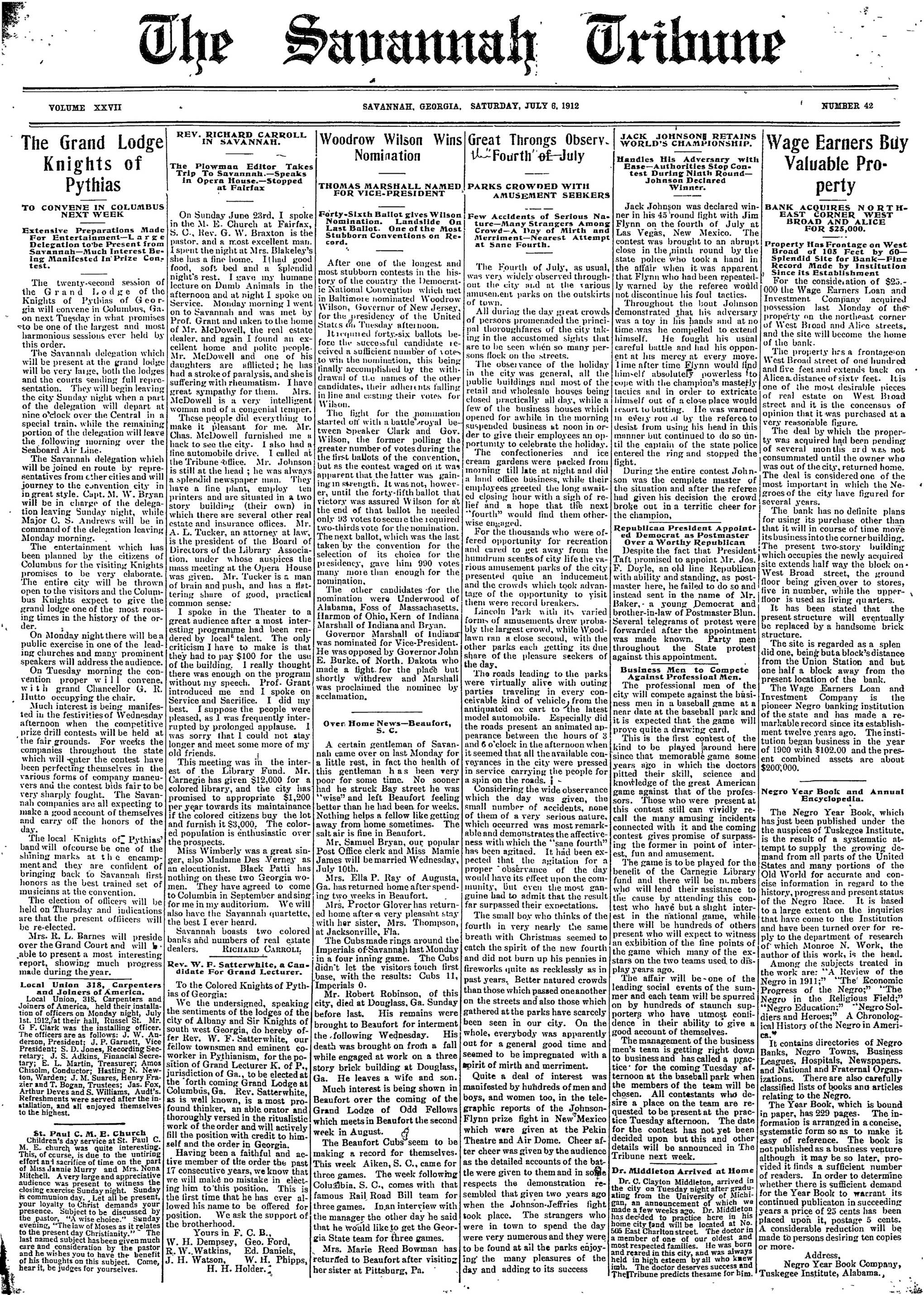
The Grand Lodge Knights of Pythias
TO CONVENE IN COLUMBUS NEXT WEEK
Extensive Preparations Made For Entertainment—Large Delegation to be Present from Savannah—Much Interest Being Manifested in Prize Contest.
The twenty-second session of the Grand Lodge of the Knights of Pythias of Georgia will convene in Columbus, Ga. on next Tuesday in what promises to be one of the largest and most harmonious sessions ever held by this order.
The Savannah delegation which will be present at the grand lodge will be very large, both the lodges and the courts sending full representation. They will begin leaving the city Sunday night when a part of the delegation will depart at nine o'clock over the Central in a special train, while the remaining portion of the delegation will leave the following morning over the Seaboard Air Line.
The Savannah delegation which will be joined en route by representatives from other cities and will journey to the convention city in ingreat style. Capt. M. W. Bryan will be in charge of the delegation leaving Sunday night, while Major C. S. Andrews will be in command of the delegation leaving Monday morning.
The entertainment which has been planned by the citizens of Columbus for the visiting Knights promises to be very elaborate. The entire city will be thrown open to the visitors and the Columbus Knights expect to give the grand lodge one of the most rousing times in the history of the order.
On Monday night there will be a public exercise in one of the leading churches and many prominent speakers will address the audience. On Tuesday morning the convention proper will convene, with grand Chancellor G. R. Hutto occupying the chair.
Much interest is being manifested in the festivities of Wednesday afternoon when the competitive prize drill contests will be held at the fair grounds. For weeks the companies throughout the state which will enter the contest have been perfecting themselves in the various forms of company maneuvers and the contest bids fair to be very sharply fought. The Savannah companies are all expecting to make a good account of themselves and carry off the honors of the day.
The local Knights of Pythias' band will ofcourse be one of the shining marks at the encampment and they are confident of bringing back to Savannah first honors as the best trained set of musicians at the convention. The election of officers will be held on Thursday and indications are that the present officers will be re-elected. Mrs. R. L. Barnes will preside over the Grand Court and will able to present a most interesting report, showing much progress made during the year.
and Joiners of America.
Local Union, 318. Carpenters and Joiners of America, held their installation of officers on Monday night, July 1st, 1912, at their hall, Russel St. Mr. G F. Clark was the installing officer. The officers are as follows: J. W. Anderson, President; J. P. Garnett, Vice President; S. D. Jones, Recording Secretary; J. S. Adkins, Financial Secretary; E. L. Martin, Treasurer; Amos Chisolm, Conductor; Hasting N. Newton, Warden; J. M. Suares, Henry Frazier and T. Bogan, Trustees; Jas. Fox, Arthur Deves and S. Williams, Audt's. Refreshments were served after the installation, and all enjoyed themselves to the highest.
St. Paul C. M. E. Church
Children's day service at St. Paul C. M. E. church was quite interesting.
This, of course, is due to the uniring effort and sacrifice of time on the part of Miss Jamie Murry and Mrs. Nona Mitchell. Avery large and appreciative audience was present to witness the closing exercise Sunday night. Sunday is communion day. Let all be present, your loyalty to Christ demands your presence. Subject to be discussed by the pastor, "A wise choice." Sunday evening, "The law of Moses as it relates to the present day Christianity." The last named subject has been given much care and consideration by the pastor and he wishes you to have the benefit of his thoughts on this subject. Come, hear it, be judges for yourselves.
VOLUME XXVII
The
REV. RICHARD CARROLL IN SAVANNAH.
The Plowman Editor Takes Trip To Savannah.—Speaks in Opera House.—Stopped at Fairfax
On Sunday June 23rd, I spoke in the M. E. Church at Fairfax, S. C., Rev. G. W. Braxton is the pastor, and a most excellent man. I spent the night at Mrs. Blakeley's she has a fine home. I had good food, soft bed and a splendid night's rest. I gave my humane lecture on Dumb Animals in the afternoon and at night I spoke on Service. Monday morning I went on to Savannah and was met by Prof. Grant and taken to the home of Mr. McDowell, the real estate dealer, and again I found an excellent home and polite people Mr. McDowell and one of his daughters are afflicted; he has had a stroke of paralysis, and she is suffering with rheumatism. I have great sympathy for them. Mrs. McDowell is a very intelligent woman and of a congenial temper.
These people did everything to make it pleasant for me. Mr. Chas. McDowell furnished me a hack to see the city. I also had a fine automobile drive. I called at the Tribune office. Mr. Johnson is still at the head; he was always a splendid newspaper man. They have a fine plant, employ ten printers and are situated in a two story building (their own) in which there are several other real estate and insurance offices. Mr. A. L. Tucker, an attorney at law, is the president of the Board of Directors of the Library Association, under whose auspices the mass meeting at the Opera House was given. Mr. Tucker is a man of brain and push, and has a flattering share of good, practical common sense:
I spoke in the Theater to a great audience after a most interesting programme had been rendered by local talent. The only criticism I have to make is that they had to pay $100 for the use of the building. I really thought there was enough on the program without my speech. Prof. Grant introduced me and I spoke on Service and Sacrifice. I did my best. I suppose the people were pleased, as I was frequently interrupted by prolonged applause. I was sorry that I could not stay longer and meet some more of my old friends.
This meeting was in the interest of the Library Fund. Mr. Carnegie has given $12,000 for a colored library, and the city has promised to appropriate $1,200 per year towards its maintenance if the colored citizens buy the lot and furnish it $3,000. The colored population is enthusiastic over the prospects. Miss Wimberly was a great singer, also Madame Des Verney as an elocationist. Black Patti has nothing on these two Georgia women. They have agreed to come to Columbia in September and sing for me in my auditorium. We will also have the Sayannah quartette, the best I ever heard.
Savannah boasts two colored banks and numbers of real estate dealers. RICHARD CARROLL
To the Colored Knights of Pythias of Georgia:
We the undersigned, speaking the sentiments of the lodges of the city of Albany and Sir Knights of south west Georgia, do hereby offer Rev. W. F. Satterwhite, our fellow townsmen and eminent coworker in Pythianism, for the position of Grand Lecturer K. of P., jurisdiction of Ga., to be elected at the forth coming Grand Lodge at Columbus, Ga. Rev. Satterwhite, as is well known, is a most profound thinker, an able orator and thoroughly versed in the ritualistic work of the order and will actively fill the position with credit to himself and the order in Georgia.
Having been a faithful and active member of the order the past 17 consecutive years, we know that we will make no mistake in electing him to this position. This is the first time that he has ever allowed his name to be offered for position. We ask the support of the brotherhood.
Yours in F. C. B.,
W. H. Dempsey, Geo. Ford,
R. W. Watkins, Ed. Daniels,
J. H. Watson, W. H. Phipps,
H. H. Holder.
SAVANNAH, GEORGIA, SATURDAY, JULY 6, 1912
Woodrow Wilson Nomination
THOMAS MARSHALL NAMED FOR VICE-PRESIDENT
Forty-Sixth Ballot gives Wilson Nomination. Landslide On Last Ballot. One of the Most Stubborn Conventions on Record.
After one of the longest and most stubborn contests in the history of the country the Democratic National Convention which met in Baltimore nominated Woodrow Wilson, Governor of New Jersey, for the presidency of the United States on Tuesday afternoon.
It required forty-six ballots before the successful candidate received a sufficient number of votes to win the nomination, this being finally accomplished by the withdrawal of the names of the other candidates, their adherents falling in line and casting their votes for Wilson.
The fight for the nomination started off with a battle royal between Speaker Clark and Gov. Wilson, the former polling the greater number of votes during the the first ballots of the convention, but as the contest waged on it was apparent that the latter was gaining in strength. It was not, however, until the forty-fifth ballot that victory was assured Wilson for at the end of that ballot he needed only 93 votes to secure the required two-thirds vote for the nomination. The next ballot, which was the last taken by the convention for the selection of its choice for the presidency, gave him 990 votes many more than enough for the nomination.
The other candidates for the nomination were Underwood of Alabama, Foss of Massachusetts, Harmon of Ohio, Kern of Indiana Marshall of Indiana and Bryan. Governor Marshall of Indiana was nominated for Vice-President. He was opposed by Governor John E. Burke, of North. Dakota who made a fight. for the place but shortly withdrew and Marshall was proclaimed the nominee by acclamation.
Over Home News-Beaufort, S. C.
A certain gentleman of Savannah came over on last Monday for a little rest, in fact the health of this gentleman has been very poor for some time. No sooner had he struck Bay street he was "wise" and left Beaufort feeling better than he had been for weeks. Nothing helps a fellow like getting away from home sometimes. The salt air is fine in Beaufort.
Mr. Samuel Bryan, our popular Post Office clerk and Miss Mamie James will be married Wednesday, July 10th.
Mrs. Ella P. Ray of Augusta, Ga. has returned home after spending two weeks in Beaufort.
Mrs. Proctor Glover has returned home after a very pleasant stay with her sister, Mrs. Thompson, at Jacksonville, Fla. The Cubs made rings around the Imperials of Savannah last Monday in a four inning game. The Cubs didn't let the visitors touch first base, with the results: Cubs 11, Imperials 0.
Mr. Robert Robinson, of this city, died at Douglass, Ga. Sunday before last. His remains were brought to Beaufort for interment the following Wednesday. His death was brought on from a fall while engaged at work on a three story brick building at Douglass, Ga. He leaves a wife and son. Much interest is being shown in Beaufort over the coming of the Grand Lodge of Odd Fellows which meets in Beaufort the second week in August.
The Beaufort Cubs seem to be making a record for themselves. This week Aiken, S. C., came for three games. The week following Columbia, S. C., comes with that famous Rail Road Bill team for three games. In an interview with the manager the other day he said that he would like to get the Georgia State team for three games. Mrs. Marie Reed Bowman has returned to Beaufort after visiting her sister at Pittsburg, Pa.
Tribune
Great Throngs Observ. "Fourth" of July
PARKS CROWDED WITH AMUSEMENT SEEKERS
Few Accidents of Serious Nature—Many Strangers Among Crowd—A Duy of Mirth and Merriment—Nearest Attempt at Sane Fourth.
The Fourth of July, as usual, was very widely observed throughout the city and at the various amusement parks on the outskirts of town.
All during the day great crowds of persons promenaded the principal thoroughfares of the city taking in the accustomed sights that are to be seen when so many persons flock on the streets.
The observance of the holiday in the city was general, all the public buildings and most of the retail and wholesale houses being closed practically all day, while a few of the business houses which opened for awhile in the morning suspended business at noon in order to give their employees an opportunity to celebrate the holiday. The confectioneries and ice cream gardens were packed from morning till late at night and did a land office business, while their employees greeted the long awaited closing hour with a sigh of relief and a hope that the next "fourth" would find them otherwise engaged.
For the thousands who were offered opportunity for recreation and cared to get away from the humdrum scenes of city life the various amusement parks of the city presented quite an inducement and the crowds which took advantage of the opportunity to visit them were record breakers.
Lincoln Park with its varied forms of amusements drew probably the largest crowd, while Woodlawn ran a close second, with the other parks each getting its due share of the pleasure seekers of the day.
The roads leading to the parks were virtually alive with outing parties traveling in every conceivable kind of vehicle, from the antiquated ox cart to the latest model automobile. Especially did the roads present an animated appearance between the hours of 3 and 6 o'clock in the afternoon when it seemed that all the available conveyances in the city were pressed in service carrying the people for a spin on the roads.
Considering the wide observance which the day was given, the small number of accidents, none of them of a very serious nature, which occurred was most remarkable and demonstrates the affectiveness with which the "sane fourth" has been agitated. It had been expected that the agitation for a proper observance of the day would have its effect upon the community, but even the most ganguine had to admit that the result far surpassed their expectations.
The small boy who thinks of the fourth in very nearly the same breath with Christmas seemed to catch the spirit of the new fourth and did not burn up his pennies in fireworks quite as recklessly as in past years. Better natured crowds than those which passed one another on the streets and also those which gathered at the parks have scarcely been seen in our city. On the whole, everybody was apparently out for a general good time and seemed to be impregnated with a spirit of mirth and merriment.
Quite a deal of interest was manifested by hundreds of men and boys, and women too, in the telegraphic reports of the Johnson-Flynn prize fight in New Mexico which were given at the Pekin Theatre and Air Dome. Cheer after cheer was given by the audience as the detailed accounts of the battle were given to them and in some respects the demonstration resembled that given two years ago when the Johnson-Jeffries fight took place. The strangers who were in town to spend the day were very numerous and they were to be found at all the parks enjoying the many pleasures of the day and adding to its success
JACK JOHNSON RETAINS WORLD'S CHAMPIONSHIP.
Jack Johnson was declared winner in his 45 round light with Jim Flynn on the fourth of July at Las Vegas, New Mexico. The contest was brought to an abrupt close in the ninth round by the state police who took a hand in the affair when it was apparent that Flynn who had been repeatedly warned by the referee would not discontinue his foul tactics.
Throughout the bout Johnson demonstrated that his adversary was a toy in his hands and at no time was he compelled to extend himself. He fought his usual careful battle and had his opponent at his mercy at every move. Time after time Flynn would find himself absolutely powerless to cope with the champion's masterly tactics and in order to extricate himself out of a close place would resort to butting. He was warned in every round by the referee to desist from using his head in this manner but continued to do so until the captain of the state police entered the ring and stopped the fight.
During the entire contest Johnson was the complete master of the situation and after the referee had given his decision the crowd broke out in a terrific cheer for the champion.
Republican President Appointed Democrat as Postmaster Over a Worthy Republican
Despite the fact that President Taft promised to appoint Mr. Jos. F. Doyle, an old line Republican with ability and standing, as postmaster here, he failed to do so and instead sent in the name of Mr. Baker, a young Democrat and brother-in-law of Postmaster Blun. Several telegrams of protest were forwarded after the appointment was made known. Party men throughout the State protest against this appointment.
Against Professional Men.
The professional men of the city will compete against the business men in a baseball game at a near date at the baseball park and it is expected that the game will prove quite a drawing card.
This is the first contest of the kind to be played around here since that memorable game some years ago in which the doctors pitted their skill, science and knowledge of the great American game against that of the professors. Those who were present at this contest still can vividly recall the many amusing incidents connected with it and the coming contest gives promise of surpassing the former in point of interest, fun and amusement.
The game is to be played for the benefit of the Carnegie Library fund and there will be numbers who will lend their assistance to the cause by attending this contest who have but a slight interest in the national game, while there will be hundreds of others present who will expect to witness an exhibition of the fine points of the game which many of the ex-stars on the two teams used to display years ago.
The affair will be one of the leading social events of the summer and each team will be spurred on by hundreds of staunch supporters who have utmost confidence in their ability to give a good account of themselves.
The management of the business men's team is getting right down to business and has called a practice for the coming Tuesday afternoon at the baseball park when the members of the team will be chosen. All contestants who desire a place on the team are requested to be present at the practice Tuesday afternoon. The date for the contest has not yet been decided upon but this and other details will be announced in The Tribune next week.
Dr. Middleton Arrived at Home
Dr. Middleton Arrived at Home
Dr. C. Clayton Middleton, arrived in the city on Tuesday night after graduating from the University of Michigan, an announcement of which we made a few weeks ago. Dr. Middleton has decided to practice here in his home city [and will be located at No. 505 East Charlton street. The doctor in a member of one of our oldest and most respected families. He was born and reared in this city, and was always held in high esteem by all who knew imh. The doctor deserves success and TheTribune predicts thesame for him.
NUMBER 42
Wage Earners Buy Valuable Property
BANK ACQUIRES NORTH-EAST CORNER WEST BROAD AND ALICE FOR $25,000.
Property Has Frontage on West Broad of 105 Feet by 60—Splendid Site for Bank—Fine Record Made by Institution Since its Establishment
For the consideration of $25.000 the Wage Earners Loan and Investment Company acquired possession last Monday of the property on the northeast corner of West Broad and Alice streets, and the site will become the home of the bank.
The property has a frontage on West Broad street of one hundred and five feet and extends back on Alice a distance of sixty feet. It is one of the most desirable pieces of real estate on West Broad street and it is the concensus of opinion that it was purchased at a very reasonable figure.
The deal by which the property was acquired had been pending of several months and was not consummated until the owner who was out of the city, returned home. The deal is considered one of the most important in which the Negroes of the city have figured for several years.
The bank has no definite plans for using its purchase other than that it will in course of time move its business into the corner building. The present two-story building which occupies the newly acquired site extends half way the block on West Broad street, the ground floor being given over to stores, five in number, while the upper-floor is used as living quarters. It has been stated that the present structure will eventually be replaced by a handsome brick structure. The site is regarded as a splen did one, being but a block's distance from the Union Station and but one half a block away from the present location of the bank.
The Wage Earners Loan and Investment Company is the pioneer Negro banking institution of the state and has made a remarkable record since its establishment twelve years ago. The institution began business in the year of 1900 with $102.00 and the present combined assets are about $200,000.
Negro Year Book and Annual Encyclopedia.
The Negro Year Book, which has just been published under the auspices of Tuskegee Institute, is the result of a systematic attempt to supply the growing demand from all parts of the United States and many portions of the Old World for accurate and concise information in regard to the history, progress and present status of the Negro Race. It is based to a large extent on the inquiries that have come to the Institution and have been turned over for reply to the department of research of which Monroe N. Work, the author of this work, is the head.
Among the subjects treated in the work are: "A Review of the Negro in 1911;" "The Economic Progress of the Negro;" "The Negro in the Religious Field;" "Negro Education;" "Negro Soldiers and Heroes;" A Chronological History of the Negro in America.* It contains directories of Negro Banks, Negro Towns, Business Leagues, Hospitals, Newspapers, and National and Fraternal Organizations. There are also carefully classified lists of books and articles relating to the Negro.
The Year Book, which is bound in paper, has 229 pages. The information is arranged in a concise, systematic form so as to make it easy of reference. The book is not published as a business venture although it may be so later, provided it finds a sufficient number of readers. In order to determine whether there is sufficient demand for the Year Book to warrant its continued publication in succeeding years a price of 25 cents has been placed upon it, postage 5 cents. A considerable reduction will be made to persons desiring ten copies or more.
Address,
Negro Year Book Company,
Tuskegee Institute, Alabama.
CHINA IS SEEING STIRRING TIMES
British Troops Leave Hongkong for Frontier.
CANTON IS IN A FERMENT
All Trains Delayed and Several of the Locomotives Tampered With. Secret Meetings to Organize Uprising.
Honkong, China.—British troops have been dispatched from here to guard the frontier, where they will remain for an indefinite period. The city of Canton is in a ferment, and all trains coming from Canton to Hongkong have been delayed, owing to troubles on the railroad. Several of the locomotives have been tampered with.
The leaders of the Manchu movement are known to be resident in the Portuguese dependency of Macao, and in the city of Hongkong. Quantities of money are coming into the Southern provinces, and arms and ammunition have been smuggled extensively into the province of Kwan-Tung, while secret meetings have been held to organize an uprising in Wu-Chow and Canton. The policy of the government officials is very unpopular. Executions are occurring daily. The mayor of the maritime town and treaty port of Pakhol, on the Gulf of Tonking, boasts that 5,000 people have been killed there alone.
The authorities at Hongkong are keeping a watchful eye on the foreign settlement in Canton and on the British railway. Many Chinese are fleeing.
Peking, China.—The loan negotiations between the international bankers and the Chinese government have been neither concluded nor broken off. The Chinese government apparently is endeavoring to make a bargain. A new proposal was recently submitted to the minister of finance, suggesting a loan much exceeding $300,000,000. The minister of finance requested the bankers to communicate their terms, which the bankers then drew up in accordance with original arrangements with Tang Shao Yi, which provided for foreign supervision of the salt tax and practically the appointment of the international bankers as financial agents for the Chinese government.
Hsiung-Hsi-Ling, the finance minister, thereupon objected and declared that he would borrow only $50,000,000. The group of bankers allowed Hsiung-Hsi-Ling to see that there was no desire to force a big loan on China, and submitted to the headquarters of their banks the minister's proposal that five monthly advances, each of 6,000,000 taels ($4,200,000) should be made, which should be absorbable in the sterling loan.
OVER 200 REBELS HANGED.
Mexican General, in Report, Says it Was to Strike Terror.
Mexico City.—Over 200 Zapatasta rebels were captured by federal troops after a battle near Hlutzilac and summarily hanged. Refugees arriving here from that bandit-infested region declared that the fringe of the forests lining the road for some distance in the vicinity of Hlutzilac was marked with bodies hanging from limbs of trees. The rebel leader garrendered after the battle. When the insurrectos had been disarmed they were taken to the edge of the forest and one after the other were hanged to the nearest tree.
Young Man Leaves Country Rather Than Submit.
Washington, N. J.—Rather than pay a $5 fine which he believed unjust, Frank Kinnaman, a young man of this town, is on his way to Europe. Kinnaman was one of sixteen youths who were arrested a few days ago for mischievous damage to private property. They were fined $5 each and given a week to pay the money. Kinnaman declared the fine was an outrage, and told friends he would leave the country rather than pay it. Two days later word was received that he had sailed for Europe.
Crops and Cattle Destroyed.
Albuquerque, N. M.—A cloudburst devastated an area approximately five square miles in extent. The Santa Fe railroad tracks were washed out at intervals for a mile or more, tying up indefinitely all train service, both East and West. Crops were destroyed and the loss of sheep and cattle will be heavy.
BOY KILLS POLICEMAN.
Philadelphia Bluecoat Meets Death While Making Arrest.
Philadelphia.—Thomas Dowling, a policeman, was shot and killed here by Herbert Johnson, 18 years old, who was about to be arrested. The shooting occurred in a pawnshop where Johnson was trying to pawn jewelry which the police say had been stolen. The policeman had been called to the place by the broker and was shot as he entered the door.
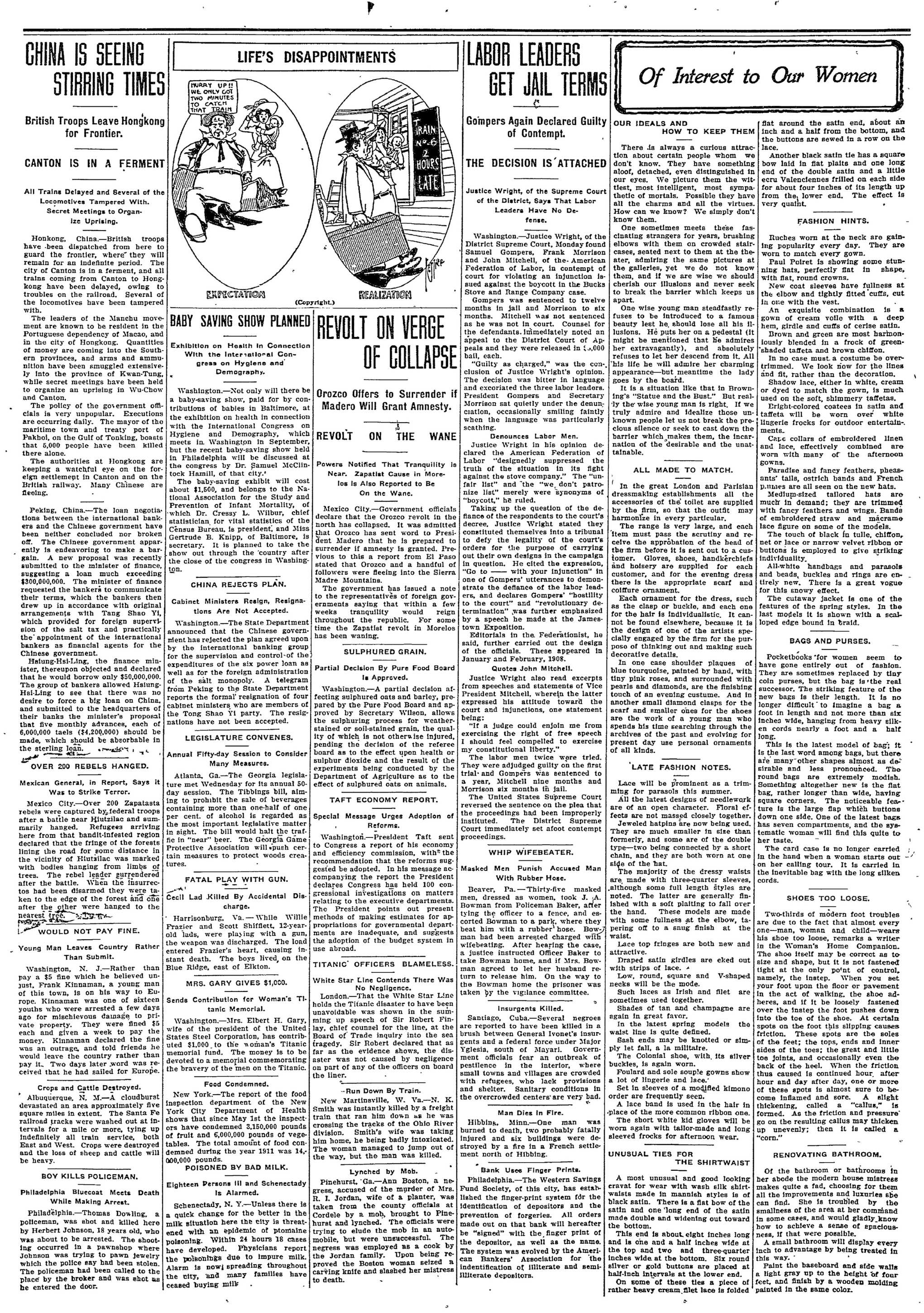
MURRY UP!!
WE ONLY GOT
TWO MINUTES
TO CATCH
THAT TRAIN
EXPECTATION
REALIZATION
TRAIN
NO.6
2
HOURS
LATE
BABY SAVING SHOW PLANNED
Exhibition on Health In Connection With the International Congress on Hygiene and Demography.
Washington.—Not only will there be a baby-saving show, paid for by contributions of babies in Baltimore, at the exhibition on health in connection with the International Congress on Hygiene and Demography, which meets in. Washington in September, but the recent baby-saving show held in Philadelphia will be discussed at the congress by Dr. Samuel McClintock Hamill, of that city.
The baby-saving exhibit will cost about $1,500, and belongs to the National Association for the Study and Prevention of Infant Mortality, of which Dr. Cressy L. Wilbur, chief statistician for vital statistics of the Census Bureau, is president, and Miss Gertrude B. Knipp, of Baltimore, is secretary. It is planned to take the show out through the country after the close of the congress in Washington.
CHINA REJECTS PLAN.
Cabinet Ministers Resign, Resignations Are Not Accepted.
Washington.—The State Department announced that the Chinese government has rejected the plan agreed upon by the international banking group for the supervision and control of the expenditures of the six power loan as well as for the foreign administration of the salt monopoly. A telegram from Peking to the State Department reports the formal resignation of four cabinet ministers who are members of the Tong Shao Yi party. The resignations have not been accepted.
LEGISLATURE CONVENES.
Annual Fifty-day Session to Consider Many Measures.
Atlanta, Ga.-The Georgia legislature met Wednesday for its annual 50-day session. The Tibbings bill, aiming to prohibit the sale of beverages containing more than one-half of one per cent. of alcohol is regarded as the most important legislative matter in sight. The bill would halt the traffic in "near" beer. The Georgia Game Protective Association will push certain measures to protect woods creatures.
Cecil Lad Killed By Accidental Discharge.
Harrisonburg, Va.—While Willie Frazier and Scott Shifflett, 12-year-old lads, were playing with a gun, the weapon was discharged. The load entered Frazier's heart, causing instant death. The boys lived, on the Blue Ridge, east of Elkton.
MRS. GARY GIVES $1,000.
Sends Contribution for Woman's TI
tanic Memorial.
Washington.—Mrs. Elbert H. Gary, wife of the president of the United States Steel Corporation, has contributed $1,000 to the woman's Titanic memorial fund. The money is to be devoted to a memorial commemorating the bravery of the men on the Titanic.
Food Condemned.
New York.—The report of the food inspection department of the New York City Department of Health shows that since May 1st the inspectors have condemned 3,150,000 pounds of fruit and 6,000,000 pounds of vegetables. The total amount of food condemned during the year 1911 was 14,000,000 pounds. POISONED BY BAD MILK.
Eighteen Persons III and Schenectady Is Alarmed.
Schenectady, N. Y.—Unless there is a quick change for the better in the milk situation here the city is threatened with an epidemic of ptomaine poisoning. Within 24 hours 18 cases have developed. Physicians report the poisonings due to impure milk. Alarm is now spreading throughout the city, and many families have ceased buying milk.
REVOLT ON VERGE OF COLLAPSE
Orozco Offers to Surrender it
Madero Will Grant Amnesty.
Powers Notified That Tranquility is Near. Zapatist Cause in Morelos is Also Reported to Be On the Wane.
Mexico City.—Government officials deolare that the Orozco revolt in the north has collapsed. It was admitted that Orozco has sent word to President Madero that he is prepared to surrender if amnesty is granted. Previous to this a report from El Paso stated that Orozco and a handful of followers were fleeing into the Sierra Madre Mountains.
The government has issued a note to the representatives of foreign governments saying that within a few weeks tranquility would reign throughout the republic. For some time the Zapatist revolt in Morelos has been waning.
SULPHURED GRAIN.
Partial Decision By Pure Food Board Is Appved.
Washington.—A partial decision affecting sulphured oats and barley, prepared by the Pure Food Board and approved by Secretary Wilson, allows the sulphuring process for weather-stained or soil-stained grain, the quality of which is not otherwise injured, pending the decision of the referee board as to the effect upon health or sulphur dioxide and the result of the experiments being conducted by the Department of Agriculture as to the effect of sulphured oats on animals.
TAFT ECONOMY REPORT.
Special Message Urges Adoption of Reforms.
Washington—President Taft sent to Congress a report of his economy and efficiency commission, with the recommendation that the reforms suggested be adopted. In his message accompanying the report the President declares Congress has held 100 congressional investigations on matters relating to the executive departments. The President points out present methods of making estimates for appropriations for governmental departments are inadequate, and suggests the adoption of the budget system in use abroad.
TITANIC OFFICERS BLAMELESS.
White Star Line Contends There Was No Negligence. London.—That the White Star Line holds the Titanic disaster to have been unavoidable was shown in the suming up speech of Sir Robert Finlay, chief counsel for the line, at the Board of Trade inquiry into the sea tragedy. Sir Robert declared that as far as the evidence shows, the disaster was not caused by negligence on part of any of the officers on board the liner.
- Run Down By Train.
New Martinsville, W. Va.-N. K. Smith was instantly killed by a freight train that ran him down as he was crossing the tracks of the Ohio River division. Smith's wife was taking him home, he being badly intoxicated. The woman managed to jump out of the way, but the man was killed.
Lynched by Mob.
Pinehurst, Ga.-Ann Boston, a negress, accused of the murder of Mrs. R. I. Jordan, wife of a planter, was taken from the county officials at Cordale by a mob, brought to Pinehurst and lynched. The officials were trying to elude the mob in an automobile, but were unsuccessful. The negress was employed as a cook by the Jordan family. Upon being reproved the Boston woman seized a carving knife and slashed her mistress to death.
LABOR LEADERS GET JAIL TERMS
Goimpers Again Declared Guilty of Contempt.
THE DECISION IS'ATTACHED
Justice Wright, of the Supreme Court of the District, Says That Labor Leaders Have No De-
Washington.—Justice Wright, of the District Supreme Court, Monday found Samuel Gompers, Frank Morrison and John Mitchell, of the-American Federation of Labor, in contempt of court for violating an injunction issued against the boycott in the Bucks Stove and Range Company case.
Gompers was sentenced to twelve months in jail and Morrison to six months. Mitchell was not sentenced as he was not in court. Counsel for the defendants. Immediately noted an appeal to the District Court of Appeals and they were released in $,000 ball, each.
"Guilty as charged," was the conclusion of Justice Wright's opinion. The decision was bitter in language and excoriated the three labor leaders. President Gompers and Secretary Morrison sat quietly under the denunciation, occasionally smiling faintly when the language was particularly scathing.
Denounces Labor Men.
Justice Wright in his opinion declared the American Federation of Labor "designedly suppressed the truth of the situation in its fight against the stove company." The "unfair list" and "the 'we don't patronize list' merely were synonyms of "boycott." he ruled.
Taking up the question of the defiance of the respondents to the court's decree, Justice Wright stated they constituted themselves into a tribunal to defy the legality of the court's orders for the purpose of carrying out their own designs in the campaign in question. He cited the expression, "Go to — with your injunction" in one of Gompers' utterances to demonstrate the defiance of the labor leaders, and declares Gompers' "hostility to the court" and "revolutionary determination" was further emphasized by a speech he made at the James-town Exposition.
Editorialists in the Federationist, he said, further carried out the design of the officials. These appeared in January and February, 1908.
Quotes John Mitchell.
Justice Wright also read excerpts from speeches and statements of Vice President Mitchell, wherein the latter expressed his attitude toward the court and injunctions, one statement being:
"If a judge could enjoin me from exercising the right of free speech I should feel compelled to exercise my constitutional liberty."
The labor men twice were tried. They were adjudged guilty on the first trial and Gompers was sentenced to a year, Mitchell nine months and Morrison six months in jail.
The United States Supreme Court reversed the sentence on the plea that the proceedings had been improperly instituted. The District Supreme Court immediately set afoot contempt proceedings.
WHIP WIFEBEATER.
Masked Men Punish Accused Man With Rubber Hose.
Beaver, Pa.—Thirty-five masked men, dressed as women, took J. A. Bowman from Policeman Baker, after tying the officer to a fence, and escorted Bowman to a park, where they beat him with a rubber hose. Bowman had been arrested charged with wifebeating. After hearing the case, a justice instructed Officer Baker to take Bowman home, and if Mrs. Bowman agreed to let her husband return to release him. On the way to the Bowman home the prisoner was taken by the vigilance committee.
Insurgents Killed.
Santiago, Cuba.—Several negroes are reported to have been killed in a brush between General Ivonet's insurgents and a federal force under Major Yglesia, south of Mayari. Government officials fear an outbreak of pestilence in the interior, where small towns and villages are crowded with refugees, who lack provisions and shelter. Sanitary conditions in the overcrowded centers are very bad.
Man Dies In Fire.
Hibbing, Minn.—One man was burned to death, two probably fatally injured and six buildings were destroyed by a fire in a French settlement north of Hibbing.
Bank Uses Finger Prints
Philadelphia.—The Western Savings Fund Society, of this city, has established the finger-print system for the identification of depositors and the prevention of forgeries. All orders made out on that bank will hereafter be "signed" with the finger print of the depositor, as well as the name. The system was evolved by the American Bankers' Association for the identification of illiterate and semiliterate depositors.
Of Interest to Our Women
OUR IDEALS AND
HOW TO KEEP THEM
There is always a curious attraction about certain people whom we don't know. They have something aloof, detached, even distinguished in our eyes. We picture them the wittiest, most intelligent, most sympathetic of mortals. Possible they have all the charms and all the virtues. How can we know? We simply don't know them.
One sometimes meets these fascinating strangers for years, brushing elbows with them on crowded staircases, seated next to them at the theater, admiring the same pictures at the galleries, yet we do not know them, and if we are wise we should cherish our illusions and never seek to break the barrier which keeps us apart.
One wise young man steadfastly refuses to be introduced to a famous beauty lest he should lose all his illusions. He puts her on a pedestal (it might be mentioned that he admires her extravagantly), and absolutely refuses to let her descend from it. All his life he will admire her charming appearance—but meantime the lady goes by the board.
It is a situation like that in Browning's "Statue and the Bust." But really the wise young man is right. If we truly admire and idealize those unknown people let us not break the precious silence or seek to cast down the barrier which makes them, the incarnation of the desirable and the unattainable.
ALL MADE TO MATCH.
In the great London and Parisian dressmaking establishments all the accessories of the toilet are supplied by the firm, so that the outfit may harmonize in every particular.
The range is very large, and each item must pass the scrutiny and receive the approbation of the head of the firm before it is sent out to a customer. Gloves, shoes, handkerchiefs and holsey are supplied for each customer, and for the evening dress there is the appropriate scarf and colfure ornament.
Each ornament for the dress, such as the clasp or buckle, and each one for the hair is individualistic. It cannot be found elsewhere, because it is the design of one of the artists specially engaged by the firm for the purpose of thinking out and making such decorative details.
In one case shoulder plaques of blue tourquoise, painted by hand, with tiny pink roses, and surrounded with pearls and diamonds, are the finishing touch of an evening custume. And in another small diamond clasps for the scarf and smaller ones for the shoes are the work of a young man who spends his time searching through the archives of the past and evolving for present day use personal ornaments of all kinds.
LATE FASHION NOTES.
Lace will be prominent as a trimming for parasols this summer. All the latest designs of needlework are of an open character. Floral effects are not massed closely together. Jeweled hatpins are now being used. They are much smaller in size than formerly, and some are of the double type—two being connected by a short chain, and they are both worn at one side of the hat. The majority of the dressy waists are made with three-quarter sleeves, although some full length styles are noted. The latter are generally finished with a soft plaiting to fall over the hand. These models are made with some fullness at the elbow, tapering off to a snug finish at the waist. Lace top fringes are both new and attractive.
Draped satin girdles are eked out with strips of lace. Low, round, square and V-shaped necks will be the mode.
Such laces as Irish and filet are sometimes used together. Shades of tan and champagne are again in great favor. In the latest spring models the waist line is quite defined.
Sash ends may be knotted or simply let fall, a la militaire.
The Colonial shoe, with, its silver buckles, is again worn.
Foulard and sole souple gowns show a lot of lingerie and lace. Set in sleeves of a modified kimono order are frequently seen. A lace band is used in the hair in place of the more common ribbon one.
The short white kid gloves will be worn again with tailor-made and long sleeved frocks for afternoon wear.
A most unusual and good looking cravat for wear with wash silk shirtwaists made in mannish styles is of black satin. There is a flat bow of the satin and one long end of the satin made double and widening out toward the bottom.
This end is about eight inches long and is one and a half inches wide at the top and two and three-quarter inches wide at the bottom. Six round silver or gold buttons are placed at half-inch intervals at the lower end.
On some of these ties a piece of rather heavy cream flet ice is folded
flat around the satin end, about an inch and a half from the bottom, and the buttons are sewed in a row on the lace.
Another black satin tie has a square bow laid in flat plaits and one long end of the double satin and a little ecru Valenciennes frilled on each side for about four inches of its length up from the lower end. The effect is very quiet.
FASHION HINTS.
Ruches worn at the neck are gaining popularity every day. They are worn to match every gown.
Paul Pooret is showing some stunning hats, perfectly flat in shape, with flat, round crowns.
New coat sleeves have fullness at the elbow and tightly fitted cuffs, cut in one with the vest.
An exquisite combination is a gown of cream volle with a deep hem, girdle and cuffs of cerise satin.
Brown and green are most harmoniously blended in a frock of green-shaded taffeta and brown chiffon.
In no case must a costume be overtrimmed. We look now for the lines and fit, rather than the decoration.
Shadow lace, either in white, cream or dyed to match the gown, is much used on the soft, shimmery taffetas.
Eright-colored coatees in satin and taffeta will be worn over white lingerie frocks for outdoor entertainments.
Cape collars of embroidered linen and lace, effectively combined are worn with many of the afternoon gowns.
Paradise and fancy feathers, pheasants' tails, ostrich bands and French punes are all seen on the new hats.
Medium-sized tailored hats are much in demand; they are trimmed with fancy feathers and wings. Bands of embroidered straw and mácrame lace figure on some of the models.
The touch of black in tulle, chiffon, net or lace or narrow velvet ribbon or buttons is employed to give striking individuality.
All-white handbags and parasols and beads, buckles and rings are entirely new. There is a great vogue for this snowy effect. The cutaway jacket is one of the features of the spring styles. In the last models it is shown with a scalloped edge bound in braid.
BAGS AND PURSES.
Pocketbooks for women seem to have gone entirely out of fashion. They are sometimes replaced by tiny coln purses, but the bag is the real successor. The striking feature of the new bags is their length. It is no longer difficult to imagine a bag a foot in length and not more than six inches wide, hanging from heavy silken cords nearly a foot and a half long.
This is the latest model of bag; it is the last word among bags, but there are many other shapes almost as desirable and less pronounced. The round bags are extremely modish. Something altogether new is the flat bag, rather longer than wide, having square corners. The noticeable feature is the large flap which buttons down one side. One of the latest bags has seven compartments, and the systematic woman will find this quite to her taste. The card case is no longer carried in the hand when a woman starts out on her calling tour. It is carried in the inevitable bag with the long silken cords.
SHOES TOO LOOSE.
Two-thirds of modern foot troubles are due to the fact that almost every one—man, woman and child—wears his shoe too loose, remarks a writer in the Woman's Home Companion. The shoe itself may be correct as to size and shape, but it is not fastened tight at the only point of control, namely, the instep. When you set your foot upon the floor or pavement in the act of walking, the shoe adheres, and if it be loosely fastened over the instep the foot pushes down into the toe of the shoe. At certain spots on the foot this slipping causes friction. These spots are the soles of the feet; the tops, ends and inner sides of the toes; the great and little toe joints, and occasionally even the back of the heel. When the friction thus caused is continued hour, after hour and day after day, one or more of these spots is almost sure to become inflamed and sore. A slight thickening, called a "callus," is formed. As the friction and pressure go on the resulting callus may thicken up unevenly; then it is called a "corn."
RENOVATING BATHROOM.
Of the bathroom or bathrooms in her abode the modern house mistress makes quite a fad, choosing for them all the improvements and luxuries she can find. She is troubled by the smallness of the area at her command in some cases, and would gladly know how to achieve a sense of spaciousness, if that were possible. A small bathroom will display every inch to advantage by being treated in this way. Paint the baseboard and side walls a light gray up to the height of four feet, and finish by a wooden molding painted in the same color.
t
: a
« The Up-to-Date Tailors
218 WEST BROAD STREET, BETWEEN HULL“AND OGLETHORPE AVE.
The Latest Patterns in SPRING AND SUMMER COODS. First-
class workmanship guaranteed. Our prices will interest you.
——_ - ae
i FETE EEE EEE ES
* DO YOU WANT. ; :
+
+ SAVING ;
+ +
, *
A HOM B?: MONEY IS 3}
+ +
+
e |+ AHABIT ;
+ +
: < + +
ty WE HAVE TWELVE LOTS ON THIRTY-NINTH * , Get the habit of +
moe ’ saving a part of +
STREET, BETWEEN BURROUGHS AND FLOR- ~i2 your Earnings +
+ each week, +
ENCE, UPON WHICH WE WILL BUILD HOMES _ a : = .
1 FOR ANY ONE DESIRING THEM. THE KIND OF =, | ¥ $1 00 =
; HOUSE YOU WANT WILL BE BUILT FORYOU, | - : :
AND YOU CAN PAY US FOR IT !N a sy : Starts an t
MONTHLY PAYMENTS. COME AND SEE US| + s +
7 A t t
ABOUT THIS PROPOSITION. é + ccoun t
. : + +
2 y + THE WAGE. +
+ . EARNERS’ LOAN *
Collins Bros. Co. |} © Ss. 3
+ COMPANY, +
+ +
30 DRAYTON STREET. PHONE 244 «|#468 WDSTB ROAD ST.+
i + Savannah, Ga. +
POPULAR PRICED
Wich ols, THE SHOE MAN
19 EAST BROUGHTON STREET. s
The affable H. B. Wright is still with us and expects the continuous)
patronage of his friends. .
GAREY’S
:
Variety Bakery
Goods delivered promptly to any
part of the city, e
506 West Broad St, Near Gaston.
Phone 1869-J :
SAMUEL MIDDLETON,
MUSICAL INSTRUMENTS
OPpen for Pupils.
541 CHARLTON STREET, EAST.
Johnson Undertaking Establishment
—COMBINED WITH——
The Royall Undertaking Company
(acorp orated.)
- Funeral Directors and Embalmers
x Finest line of Coffins, Saskets and Robes. White and black funeral
cars. Office and warerooms 325-331 Jeflerson street,
W. R. FIELOS, Manager.
Residence Phone 2032. Livery Stable Attached. Office Phone 676.
“C. H. ROYALL, Residence 509 Charles St. Phone 3064.
BROWN'S STAG LODGING HOUSE,
Furnished rooms by weelt or month.
Hot and cold baths. Electric lghts.
In center of city. Street car, hack
and automobile convenient. .
CALL AT 217 EAST BROAD ST.
--0F phone 3746—1. CG. Brown, Prop...
Ww. kK... BLoOn nt,
WHOLESALE AND RETAIL
Fruit and Commission Merchant
864 ST. JULIAN 8ST. WEST, 235 BRYAN ST., WEST. Phone 2963
SAVANNAH, GEORGIA, ‘
_- =For First Class—
cROCERIES AND CONFECTIONERY
—Call On—
M. G. GRAHAM
626 ‘York St., West.
Ccurteous Attention to AH.
Graduate Prof. Roher’s School,
New York.
Hairdressing Parlor
521 Gaston Street, East.
Telephone 2328
Wigs, Switches and Pompadoura
Made from Natural Halr.
Combings Made Up. Shampoolng.and
Halr Straightening a’ Specialty.
Face and Electric Massage, Dyeing
and Matching Hair.
ORIENTAL HAIR GROWER.
An excellent preparation, will pro-
duce a beautiful growth of hair. Di-
rections on each box. For sale, price
25 cents per box. ,
_ Paim Shaving Palace
FINEST IN THE CITY.
Hxpert Hair Cutting, Electric Massage and Shampooing a Specialty. Al!
Work Done by Experienced Workmen. Courteous attention to all. SHIN-
ING PARLOR ATTACHED. 7
PERRY R. WRIGHT, Proprietor
817 WEST BROAD ST, = — — — ee Oe SAVANNAH, GA.
EE ee
- The Mordecie Pressing Club
‘Two suits cleaned and pressed per month for $1.00. Ladies’ work a
specialty. Goods called for and de-livered, All work guaranteed. Steam
and dry cleaning. :
816 EAST BROAD STREET: Phone 3940. |
AGENTS WANTED
~ Magic
Shaving
Powder ~
enn
THOMAS BAKER, 5,.°°°
9 Shoemaker
First class SHOH REPAIRING. Half sole, sewed, 85 cents; nailed,
60 cents; rubber heels, 35 and 50 cents. All work guaranteed.
: CORNER EAST BROAD AND BOLTON STREETS.
9.
Don’t Buy a New One
Bavo the old ones and send to ua.” We make them new—Stoves, Foray
ture, Mattresses, Carpets. CARPET AND MATTING LATING A 8
IALTY. Old furniture bouzht and gold, Packing and Shipping Goods
called for and delivered.
JACKSON & SLOCUM, Upholsterers
BOLTON AND HAST BROAD STREETS.
I RUN No (Wm alk
The Ideal Picnic Spot of Savannah
Secure your dates from ANDREW D, MONROE, 125 East Thirty-third St.
| The Sunday |
School Lesson
Sunday — for July 7, 1912.
MALIGNANT UNBELIEF,
Golden Text.—This is the condemna-
tion, that light is come into the world,
and men loved darkness rather than
| light, because thelr deeds were evil—
John 3:19,
| Lesson Text—Mark 3:20-35. Com-
mit vs. 28, 29. 5
Time.—Mldsummer A. D, 28. Place.—
Galilee,
Expositton—I; Considered insane by
friends, 20, 21. We see the eagerness
of the multitude to hear our Lord, but
it was not simply to hear him that
the multitude came together (cf, vs.
9,10; Luke 6:17). He was more than
willing to have his rest and refresh-
ment broken in upon in this way (cf.
Mark 6:31-35). He was far more con-
cerned about doing good to others than
finding refreshment for,bimself (John
4:31, 34-36). When his best friends
heard how he was taking time from
rest and refreshment to minister to
the needy multitude, they at once
concluded that he had gone insane. If
a man nowadays spends his strength
and takes the time that other men
would spend in eating and rest in min-
istering to the needs of perlshing souls,
people at once conclude that he is
crazy. The fallure to enter into the
deeper motives of Jesus’ life lay at the
root of thelr grievous mistake.
H. Considered in league with the
devil by his foes, 22-30, The multi-
tude at once saw In Jesus’ power to
open thé eyes and lips, the evidence,
that he was the Messiah (Matt, 12:34).
Old Testament prophets had foretold
that the Messiah would do these
things (Is. 29:18; 32:3, 4). The Phar-
isees, In their unwillingness to yield to
the truth had another explanation: {t
was Beelzebub, the prince of demons,
casting out demons.. The scribes and
Pharisees had come down from Jerusa-
lem to discover something to find
fault with and to accuse him of (cf.
vs. 2, 6; ch. 7:1; Luke 5:17, 21; Matt.
21:15, 16). They did not accept the
natural and true explanation because
their own hearts were wicked and they
were unwilling to give the inheritance
to the real helr (John 3:19, 20; 11:47,
38; Mark 12:7). If such charges were
brought against Jesus, his true discl-
ples must not expect to escape (Matt.
10:25). These charges broke the
heart of our loving Lord (Ps. 69:20).
it was for our sakes that he “endured
such contradictions of sinners against
himself" (Is. 63:2, 4). He did not
meet these outrageous charges with
anger and invective, but lovingly
sought to open the eyes of those who
brought them, that they might not de’
lost forever. The Pharisees did not
make these charges directly to him,
but he had read their thoughts (Matt.
12:25; Luke 11:17), and by knowing
their thoughts had proved himeelf di-
vine. He_exposed the utter folly of
their charge (vs. 23-27). As it was
not by Satan's power that he cast
out demons, he showed them that It
must be by the Spirit of God (Matt.
12:28; Luke 11:20). He, who could
thus put forth the “finger of God” and
bring Satan's power to naught must
himself be divine. Satan jg a “strong
man" (y. 27; cf. Luke 21:22), but
Jesus is stronger. He has power to
bind the strong man and take his
goods out of his hands (y. 27). The
one who {a under‘ Satan's influence is
a slave, bound and guarded by the
“strong man” (cf. Luke 11:21 R. V.).
If one is under the mighty power of
Satan, there {s only one to whom we
can look for dellverance. All sins but
one are pardonable. No matter how
often a man has sinned, or how griev-
ously, he can find pardon (yv. 28), If he
will only receive the one who has
borne our sin in bis own body on the
tree (1 Pet. 2:25; Acts 10:43 18:
39). The one sin for which there is
nq pardon is the blasphemy against
the Holy Ghost (v. 29). The context
clearly shows that blasphemy ‘against
the Holy Ghost {s the deliberate at-
tributing to the devil what we know
to be the work of the Holy Spirit.
When one does this, he will beconie 80
hardened and so blinded that he will
never come to Christ, and thus will
never find pardon. If any one will
come to Jesus, he will receive him
(John 6:37), and if therefore one does
come to Jesus, it is proof that be has
not committed the unpardonable sin.
Jesus’ statement in v, 29 (see R, V,)
is proof positive that all men will ul-
{imately be forgiven and saved (If not
in ‘this age In a future age) Is ab-
solutely true.
Ill. Misunderstood by His Nearest
Kin, 31-35. Jesus’ nearest relatives,
Including his mother, were frightened |
at the confilct between our Lord and
the scribes, Thelr object in calling him
sister and mothertohim, were those
who did the wilpf God (cf. John 14:
about Jesus Ghrist’*\. What does the
make us children of God, and so near-
est kin to Christ, but it proves that
we are already children of God and
nearest kin to Christ. We become
children of God by simply receiving
Jesus (John 1:12, 13).
Leading Questions.—What does this
lesson teach about demons? About the
devil? In what ways does the divinity
of Christ come out in this lesson?
What other lessons may we learn
about Jesus Christ? What does the
lesson teach us about the Virgin Mary?
What is the central lesson taught as
to our own duty?
p of and by Our People |
iia SSR RC ee
DIERS.
Sleep on! Sleep on! Comrades brave,
In'the bosom of Mother earth.
‘There's a stone that marks the grave,
That proves the soldier's worth.
‘There's a flag that's gently waving,
The flag for which you fought;
And your records we are saving,
That with your blood you bought.
4Above your mouldering form,
A heavenly breeze fs blowing,
While for you our hearts are warm
And words of praise are flowing.
Your blood has enriched the soll,
In which your form !s decaying,
Free trom wars and Its spoil,
This tribute to you wo ara flowin,
No more to see the glittering steel,
Or hear the cannon’s roar,
The pain of death no more to feel,
For your soldier's life 1s o'er.
You fought and fell like soldiers brave,
Upon the- battle fela :
You went down to a soldier's grave,
While the cannon’s loudly pealed.
Ever up and always ready,
To meet the coming foe, ’
With a mind and hand so steady,
Wherever sent, there to go.
Yopegave your fe with a free will,
And your lfe's blood freely’ ran;
<All the way from Bunker Hill, 5
Down to San Juan.
Your records will he written above,
While Bards shall vainly try, °
To tell of a nation’s love,
For those who bravely dle.
Now war and its misery Is o'er
Sleep ont Sleep on! Comrades brave,
Until that mighty trumpet shall roar,
And wake you from a soldier's grave.
—A. R. Smith.
THE LAND OF BEGINNING AGAIN.
I wish that there were some wonderful
place 3
Called the Iand of Beginning Again,
Where all our mistakes and all our
_ _ heartaches
And all of our poor, selfish grlef
Could be dropped, Ike a shabby old coat,
And never put on again.
I wish we could come on It all unaware,
| Like the hunter who finds a lost trall.
And I wish that the one whom our olind-
ness had done _
‘The greatest Injustice of all +
Could be at the gates, like an old friend
4 that walts
For the comrade he's gladdest to hall,
We would find all the things we Intended
to do,
But forgot and remembered too late—
Little praises unspoken, Ilttle promises
brohen
And all of the thousand and one
Little duties neglected that might have
perfected :
The day for one less fortunate,
Tt wouldn't be possible not to be kind
In the Land of Beginning Again,
And the ones we misjudged and the ones
whom we grudged
Their moments of victory here
Would find in the grasp of our loving
handclasp
More than penitent Ips could explain.
For what had been hardest we'd know
had been best,
And what had seemed loss would be
gain,
For there isn’t « sting that will not take
wing
When we've faced !t and laughed tt away.
And I think that the laughter Is most
what we're after
Tn the Land of Beginning Again.
So I wish that there were some wonder-
tul place
Called the Land of Beginning Again,
‘Where all our mistakes and all our heart-
aches
And all of our poor. selfish grief
Could be dropped, ike a shabby old coat,
at the door
And never put on again. i
—Smart Set.
| STORM LIGHT.
‘Tha thick battalions of the rath
Tramp on the misty hillsides dimly,
I see along the sullen plain
Phantoms of nightfall gather grimly,
But from the gateway of the west
‘There comes a flond of gold outflowing,
‘That lights the passing sea bird’s breast
And gilds the hilltops with its glowing.
On rock and tree and grassy} glade
Flashes the swift. transfiguring bright-
ness,
While lingering ratnbow fracments fade
On leaden sles that clear to whiteness,
Then comes the closing of the gate
The flame of glory falls to ashes.
The far and near are desolate
With clouds that wrap and rain that
lashes.
~London Evening Standard.
CLEAR THE WAY.
Lo, § cloud’s about to vanish
From the day
And a brazen wrong to crumble
Into clay;
Lo, the right’s about to conquer!
Clear the way!
With the right shall many more
Enter smiling at the door.
With the giant wrong shall fall
Many others, great and small,
That for ages long have held us
For their pray.
Men of thought and men of action
Clear the way!
—Charles Mackay.
Your Money
Pile Grows
Just in propor-
tion as you ad=
vertise your
busiiiess, and
our columns |
are open for
-you to begin
at once. Sup-
pose you give _
°* us a -trial, , |
va
Advertise —
in this paper
Take a Policy With The
Pilgrim Health and
Life Insurance Co.
The Oldost, Strongest and Most
Rellabia Company in the State.
Gives employement to hundreds of
men and women of our race,
Pays from $1 to $10 weekly sick and
2ecident benefits and from $10 to $100
death benefits, Our Motto: “Prompt
ness, Honesty and Justice.”
Home Office;
4143 Gwinnett St. Augusta, Ga.
For further information write £09
West Broad St, Savannah, Ga
J. 8. Perry, Supt. 5%
A. B. Singfield, Gen. Supt,
C. T, Walker, D. D, LL. D.,
. ‘Director and General Iscturer.
G0 TO gs
Young Bros.
Yor your
TOBACCO, CIGARS and FRUITS
Of all kinds. .
66d West Broad Street.
ey
WEST SIDE
RESTAURANT
461 West Broad Street, :
Neer Union Btation,
‘The place to get firatclass meaig
Wrerything nest and clean, Mealy
prepared in an appetizing manag
and at all hours daily.
Meale 16 and 25 cents
MRS, A. 8. SCOTT, Proprictresa
McFALL’S
Ice Cream Parlor
Ice Cream and Sherbets in
large and small quantities.
Special prices to Churches
- and Socleties. Also Hot
and Cold Lunches, Fish
Suppers prepared to order.
Phone ‘4038. Orders, very
Promptly filled. = : : : :
815 East Broad St, Savannah, Ga.
o See ee
:
Masonic Books
5
and Regalias
LODGE SEALS, 7
FINANCIAL CARDS and
BLANKS of every description.
Publishers and Manufacturers’ Prices
Laberal Discounts Will Be Arranged.
SOL G. -OHNSON,
Savannah, Ga. aig Wi oes
A
Che Savannah Cribune,
Estat lished 2875
By JOIN H DEYEAUX.
Published Every Saturday
1009 West Broad Street.
Phone 2171.
Subscription Rates:
One Year - - - - - - $1.25
Six Months - - - - - .7
Three Months - - - - .50
Remittance must be made by Express
oF Post Office Money Order, or Register
ed Letter. Advertising rates given on
zpplication,
Entered atthe Post Office at Savan
aah, Ga., as Second-Class mail matter.
Satorpay Jury Gri, 1912
The steadfastness and courage
ef the Southern colored delegate:
at te national Republican Con:
vention recently held in Chicage
is at the present time the subjec
“of more favorable comment by the
press of the country thin ans
other feature im connection with
the sceat and bistory making
gatiertng. Winnked on all sides
by the leaders of the two wings of
tbe Repubdlicac Party and imper-
tuned as never before, to remain
fismoa the one hind aud to chanse
faith on the other. the stalwart
sons of the south, chose the betrer
course and remsined tué to the
Uustreposed mm them. For this
nrand sand noble exhibition of faith
fulness to duty and love of honor
do we heartily join in the encon-
jumof our fellow quill drivers.
Bur boys could not be bought: they
were beyond purchase: they were
men ef chonght and eonvietion ue-
terthined te stand Ly their pledges
and do the vivght cing as they saw
iw Shey thought ror themselves
thes acted for chemseives and. in
so doing gave kop to whe race.
The Hime is ugt far distant when
tho «atts ef the Neroes’ unsteadi-
ness an} }.ch of prinerp.e in crises
will cease He has been tried time
and again and each time he has
eme.zed fiom the strugele with
tlyimy colors. It was during the
revolutionary struyele when be
remsned steady and true to “his
country” lighting side bys*side with
his Yrother in white apparently
unmindful of the fact that his.
Jrothers m_ black were being
brought to this country at that
very time by the ship-load to be
sold inslavery. It was during the
yreat iaternecine struggle bet cen
theStates when he kept his pro- |
-mise to his master and remained
loyal.aud faithful to his master’s
family when in so doing he was
helping to perpetuate the institu-
tion of slavery. It was during
the Spanish-American War when
on the hills of San Juan and at
El Caney he came to the rescue of
Roosevelt and his rough riders
and other white American soldiers,
fighting forthe country of his love,
faithful to the trust reposed in‘
him as a soldier of the great Unit-
ed States, conscious at the same
ue that in far off America, his
native home, the boasted domicile
of the brave and free, his brothers
in blood were being denied their!
manhood rights in some instances
andin others the victim of mob
sivlence and prejudice. Really.
can be it be said of a people who
have thus acted, that they cannot
be trusted and depended upon in
times that call for that which is
:manty tu an individual.
> Weare particalarly gratified to
see that Recorder Schwartz is de-
termined to carry out his orders
to break up the “*black and tan”
resorts of the city and we trust that
the raids of last week will, be fol
Jowed by others if these places
continue to be operated. We see
in the continued operation of
these houses a menace to the coni-
munity which will work more
hammn than the average person may
imagine. It was in just Such places
as these in one of our neigh-
boring cities that a near riot was
started several months ago when
one of the white men who was
visiting them was seriously in-
jured by one of the inhabitants of
the house and it was only by the
most careful handiing of the situ-
tion by the authorities that the
matter was finally settled and the
impending riot averted. Such a
course of events isnot at all with-
out the range of possibility here
and we are pleased to see that the
authorities tre determined to close
these places up And while they
are bending their efforts at wiping
ont these ill-fame houses we should
like te sue them ferret ont at the
same time all of the whice women
of the underworld who have
migiated from the “ied light
district in the northeast section of
the city to the peaceful communi.
ties west of West Broad street and
south of Gwinnett which are in-
habitated by respectable Negro
families. ‘The presence of these
women has made the home sur-
roundings of the above cummuni-
ties very obnoxious and very un-
safe for the hoys and girls’ grow-
‘ing up in these homes. Children
can not become accustomed to
such scenes as are usually enact-
ed by these people without becom-
ing callous to the hideousness of
this form of criminality. . The
colony of these women on the
West side is' not decreasing but
increasing to an alarming extent.
Each week to a greater or less
extent new places of this character
are open‘ng in these communities
and it is no wonder that the re-
spectable Negroes in the yicinity
are becoming daily more alarmed
and grieved’ o¥er- the situation.
It is only fair and just that these
humble people's protest should be
given due consideration by the pro-
ver municipal authorities, What
injures and lowers the Negroes’
moral standsrd has its beneful ef-
fects upon the wiite race. for
their children are entrasted large-
Jy tu the rearing ef the urses
and household servants whe are
arawn from these hemes. And
our Negio ministers should give
more ernest atte:tion to this
matler now than they have ia’ the
past. because of the serious pro-
portions to. which it has grown,
They should keep it before the
parents atall times. They shontd |
disenss the subject before their
ministerml unions and decide up-
on a course of action which will
compel the authorities to revog-
nize the. wravity of the situation. |
It is indeed tume for corcerted
uction, prompt and decided ae
ais
craves 2emong our people,
une is more worthy of
condemnation at this time
[than the onenew rumpant among
us for gorgeous and unnecessarily
expensive funeral displays, It
fis nO uncommon sight to behold
almont daily on the streets that
ire generally used for our funeral
corteges, pfocessions of unusual
length wending their way te our
burial grounds. Now while we
do not wish to decry the desire
of one to put away his loved
jones in a decent and respectable
way yet in his attempting so to do
in keeping with the prevailing
Heustom, there isa danger of ex-
Mavaxunice that w:lldo no one any
good, but on the contrary, will
work to the harm of many. We
believe that itisthe duty of each
person to provide all the necessary,
comforts that he ean fur his sick,
ones, We believe that in case of
the death of a loved one, the love
and esteem in which he was held
should be attested by a decent and
respectable funeral, the arrange-
ment of*which however should
not be based upon the custom
of the times but should be in
keeping with the financial status
of the survivors. We believethat
the causeof this great desire
among us for expensive funerals
Gisplays is due to the fact that
there 1s growing among us a
class of people who might be term-
ed professional mourners or
funeral attendants. ‘[hese people
seem to think that only a passing
acquaintance with the deceased or
his surviving relatives is necessary
to warrant them a seat in one of
the family carriages. As 2 conse-
quence in order that there may be:
no after feeling with any one, the
surviving family usegy practically
pall of the money ihat may come
from the societies and insurances
sith which the deceased was con-
nected in supplying carriages and
lother conveyances for the friends
of the family, to the neglect of the
family doctor and other creditors
brought about by the prolonged
sickness of the deceased. .4s a
result debts become of long stand-
ing and thus the survivors lose
their credit in many instances.
Now in our devotion to thesick
and in caring for the dead, we can
proudly say that we yield to no
one in the warmness of* our heart
yet we feel that in the death of a
friend sufliciently close to war-
rant our presence not only at the
vhurch or home at which the {un-
eral services begin, but at the
cemetery as well we should be
sufficiently faithful to his memory
and generous to our consciences as
to provide our own conveyances
to the burial ground and thus not
to burden the relatives with un-
necessary or extra expenses. At
best, we are still a poor people
linaneially. Oursecret and benevo-
lent societies and insurances, sene-
rous as they are in their siek and
de ith benetits, fail asa rale to cov-
erdebts that are accumulated by a
fong siege of sickness. The money
accruing from these societies and
insurances therefare should not be
used to provide carriages , and
other conveniences for “friends of
a Te RR ae Sm a MR
themselves, buc aside from that
amount that is used to provide for
the comfort and conyenience of
the immediate family, the remain-
def shoula be used*in defraying
at least in part the expenses en-
tailed by the sickness and death of
the deceased. Far better can we
and do we hallow the memory of
our dear ones by paying promptly
the necessary debts brought on by
their sickness and subsequent
deaths, than by contracting wnnec-
essary debts that cause unusual
delayy in their liquidation. We
trust that our people will give this
matter their serious consideration.
ee
Second Baptist Church.
There was a large atteadance at the
morning services on Sunday last.
The pastor Rev. D. Augustine Reid
preanied a very powerful sermon from
the text 1, Peler 4:18. At night the
‘Children Day exercises took place.
Attend your weekly services. “
F. B. B. Church.
Sunday was Children's Day at our
‘church and.they played well their part
jin number and appearance. In the
absence of Rev, Daniel Wright, the ex-
teises were Conducted by Rev. Charlie
Wright. His subject ‘Be temperate
in alf things,” was well illustrated and
many home lessons were drawn. The
school sang “Yield not tu ‘lemptation”’
At nisht the pastor read fr the tesson,
St. John 17:1-26. His text was from
Rom, 8:17. The subject was ‘‘Suffer-
ing and gloritication.” The Jessons
taught by the examples of those whe
have suffered and the rewarg that we
may expect are sure if we are_tatthful
to the trust. The choir sang “Tis burn-
ing in my soul.” Rev. Wright led the
hymn “Amazing Sight the Savior
stands.” A large number came to the
mercy seat for prayer which was offer-
ed. Attend our services at any time,
you are always welcome.
Announcement.
Mrs. S. F. (Marshall: Scrugus, an-
nounces the marrisze ot her dauchter,
Miss Pearl G. vtershall te Mr. Isaac
Gainus, Jr, of Waycross, Ga Mr. and
Mrs Gainus fefl [ust Monday morning
for Waycross. Mr. Isaac Gaints 15 4
railway postal clerk ranning between
Cuthbert and Brunswick, Ga. The
ceremony was performed by Rev. L.
A. Townsley, D. D,
—eEeEaEauqomyR9RmRExEA_
| Now Occupy
' OFFICES ©
—— IN THE——
Savannah
, Lribune
Building
WHERE I WILL BE
PLEASED TO!HAVE
YOU CALL
es
Ican aways set
you on the right
tract if you are
going toinvestin
Real Estate.
Come up andlet
me tell you what
I have done for
others
| Tribune Building
| Ehene 4568
SOSSSESBSSCSCEOSST™ ESHESESHEDSR
. ° GO TO &
® SCOTT-BROS. %$
& GWNNETT 2&2 WEST BROAD &
RQ And Get Reduced Prices on Our ®
s ; Straw Hats & Summer s
= ; Underwear &
8 We Can Please You in Hosiery &
® ec our Goods an el ur 'rices &
8 Ser ewroe seine SNerkere | °
& SCOTT BROS.” &
& WEST BROAD & GWNNETT &
: Phone 2829 &
BESBEROSGSE BS ESSSPSECHSRSOSPHPDSS
‘ ee
. Ss
=
ro
—= .
eS =
—- 3
=
z=
: =
| = og
ep =
5 ER
- 3 =
| =
= &
en
._=, 5
minds a
— Fe.
oe 2
tw“
Ces
. DP exh
=
ese f
= &
° §
—
=—3
a.
SoS oO
ae
PA
_ @o
=
©
as
=~ 5
Ge te
ao st
= 5
- - ©
= e
eG =’
_ €D
= &
= =
7= D>
eM
=
, if p]
EE ae LE ESAs ROPE ee
A UE. SEABROOK |
‘ a e § 4 ¥
FUNERAL DIRECTGR & EMBALMER ’
. First Class Emlaiming A Specialty
: * Polite attention ss Heretofore. ‘
530 West Broad Street SAVANNAH, GA
4 PHONE 2106
a & . .
| Seangs
Ue
——- OFFICIAL ROU PE——
rst Georgia Batalion, rt Regiment
—]O—
°
Grand Lodge KX. of P and 6th = Encamement
Columbus, Ga., July 9th-13 1912
After-giving the the various routes to Columbus due
consideration ‘the® committee lus selected the SEA-
BOARD AIR LENE as the official route from: Savannah
to the Convention City. They would also be glad to
have any K. of P. Bros. juin them while enroute.
| Special Train will leave Savannah Monday, Juty 8th
| at3 a.m. (Rallroat Time) arrivitig Columbss 4
same day at 4 o'clock
.
| Rates from Savannah for § 95
| this roundtrip will be WW.Gu
See
: Corresponding Low Rates from All Other Points.
Tickets on sale July 7th.8th 1912 and for trains scheduled to
arrive in Columbus,.Ca., Before noon July 9thi912. Final
limit to reach original starting point, returning, not later ‘han
midnight of July 15th, 1912. For full information: see any
Seaboard Agentor apply to 10 Broughton St.,. W., |
Savannah, Ga. :
OO
Pekin Theat
. THE HOUSE OF FEATURES |
|
_ Monday Ni ,ht-New Faces _
2 g
| THAT “AUGMENTED? ORCHESTRA OF SIX PIECES
Renders new, popular and standard selections nightly
I it
. 5
Don't miss this one, Saturday July 6th, night only “‘the
| Crisis? a 101 Western Drama, 590 Indians, Cowboys and sol-
| diers . *
COMIN Gt
~ENARCH ARDEN
| SOME PICTURE
A PERSONAL LETTER
I was the first to give you a decent place of amusement
It.has paid me—and you—will continie to give you the biggest
and best SHOW in town. The pictures are hand colored, the
performers, the patrons, the proprietor, are soby nature. Glad
of it, arent you.
CONTINUOUS PERFORMANCE from 7 p.m, toll p.m. f
ts ‘ MATINEE Mondays and Thursdays §
VAUDEVILLE PROGRAM CHANGED ON THURSDAYS
i 3
a
i Pictures Changed Nightly
4 ADMISSION 10 CENTS - CHILDREN 5 CENT f
ee eroreperlinne entailed peri sfl
—_ x YT .
--— LINCOLN BAR ITS:
The Great Place of Amusement, Open Sundays
Picnic Every Monday, Tuesday and Thursdays 5
FREE DANCING Every Wednesday and Friday
Headquarters of the S. G. T. of the U. B. of A. Inc. office of S. G Architect. Savannah, Ga., June 10th, 1912. To the D. G. T. Subordinate Temple, Jr., Temple and Councils of the Jurisdiction.
Greeting:
By virtue of the authority in me vested, it is hereby ordered that each and every branch of the jurisdiction observe and celebrate our Annual Thanksgiving on July 14th, 1912. the same being the second Sunday of said month.
Each of the aforesaid branches must hold religious services either at their halls or church. A tax of ten 10 cents per member has been assessed against each member.
Temples must turn out its full membership under the penalty of a fine.
The Savannah District will celebrate at the Supreme Temple Hall, at 4 o'clock. Public is invited.
W. D. Kennedy, S. G. A.
Attest: R. L. Lockley, S. G. S.
Proclamation No.3
Office of Grand Worthy Counsellor of the Order of Calanthe K. of P. N. A., S. A., E, A. and A. Jurisdiction of Georgia.
Savannah, Ga. June 1st, 1912.
To the Grand Court Officers, Deputy Grand Worthy Counsellor, Past Worthy Counsellors and Representatives:
Greeting: 1st According to the requirements of Article and Section 2 of the Constitution of O. O. C. that the Grand Courts shall meet at the same time and place as the annual session of the Grand Lodge K. of P.
Therefore, be it known by the power of the above mentioned article and the authority in mevested as Grand Worthy Counsellor, I do hereby call the Grand Court of Georgia to assemble its nineteenth annual session in the City of Columbus, State of Georgia, Tuesday, July 9th, 1912 in Court Castle Hall at 10 a.m.
2nd All endowments must be in this office by the twentieth of June otherwise the Court will be fined $2.50. All per capita tax must be in the Grand Register of Deeds office, Mrs. M. S Grant, Darien Ga. by the 20th day of June, otherwise the Court will be fined $2.50. 3rd No representation will be allowed a voice until, all indebtedness is paid. 4th Past Worthy Counsellors and Representatives that are to take the degree of the Grand Court must pay one ($1 10) dollar. 5th All representatives and members of the Grand Court must wear the Grand badge, those who have no badges must purchase them through this office for 50 cents.
6th The following are the credential Committee: Mrs. F. D Banks, Mrs. L. Reid Thomas, Mrs. J. V. Sherman, Mrs. M. E. Stevens, Mrs. M. S Grant. Turn your credentials to them on Tuesday morning before meeting. Part of the second day's session will be devoted to the Juvenile Courts
-7th Rates will be given later through the columns of The Georgia Broad Axe. Sth All officers will receive board and lodging free. Grand Representatives and Past Worthy Counsellors and members will receive board and lodging for one dollar per day. For homes write Mrs. L. M. Thornton, 1529 Fifth Avenue, Columbus, Ga.
9th Past Worthy Counsellor's credentials are only for those who have served the Worthy Counsellor's station. Those who are eligible for Grand Court degree for meritorious services must have recommendations from their Court signed by the Worthy Counsellor and Register of Deeds with the Court sea attached. Mrs. R. L. Barnes, G. W. C. Mrs. M. S. Grant, G. R. of D.
Locals.
Mr. M. G. Graham, spent last Sunday very pleasantly at Whitehall, S. C.
Miss Lizzie Watkins, of Augusta, Ga., spent last Sunday in the city.
Mrs. Hattie Parker of Columbia, S. C., is in the city visiting friends.
Mr. James Cox of Macon, spent last week in the city with his friends.
Mr. Harvey Williams of Camden, N. J., is in the city for his vacation.
Miss Willie Hampton of Charleston, S. C., were in the city this week.
Mr. C. W. Simmons is visiting his relatives at Anderson, S. C.
Mrs. Ruth Allen is spending the summer very pleasantly with her cousin, Mrs. James West in New York City.
Miss Sadie Johnson and Miss Edith Ross of Americus, Ga., were in the city last week visiting relatives
Mrs. Madeline Williams and Mrs. Annie Smalls of Waycross, Ga., were in the city this week.
Mrs. Elizabeth Mills and daughter of Augusta, Ga., passed through the city Tuesday enroute to New York.
Miss Annie E. Scriven and daughter of Newark, N. J., are in the city visiting friends.
Miss Emma Bartlett of Scotia, S. C., is in the city spending a few days with friends.
Mrs. Ruth Carter and Mrs. Minnie Jordan of Jacksonville, Fla., are in the city for the week.
Mrs Nettie Willis of Americus, Ga., is in the city visiting her sister, Mrs Mena Johnson, Oak street.
Mrs. Ada Clark of Rome, Ga., is spending awhile with Mrs. J. C. Carnish, Bolton street east.
Mr Jerry Scarborough of Washington, D C., is in the city spending a few days with friends.
Mr. Richard Manning left on last
thursday for Ashville, N. C., on a sumer
vacation.
Mrs. Julia Ferguson left for Wilmington,
N. C., to visit relatives. She will
be gone for the summer.
An increasing number of people report
regularly of the satisfactory results
from taking Foley Kidney Pills
and commend their healing and curative
qualities. Foley Kidney Pills are
carefully prepared medicine, guar-
nanted to contain no harmful or habit
forming drugs. They can have only a
permanent effect when used for kidney
and bladder troubles, for backache,
neumatism, weak back or lumbago.
Never sold in back. Put up in two
sizes, in sealed bottles. The genuine
ways in a yellow package. Living-
son Pharmacy.
Mr Charles Patterson who was in
irred Sunday by being struck by an
automobile while on West Broad St., is
again
Mr. Henry J. Carson and Mr. Wm. aderson of Mountine, S. C., were in the city last week attending the marriage of an old schoolmate
miss Jill Scott and Mrs Ada War-
jof Augusta, Ga., passed through
the city last week enroute to Philadelphia, Pa.
Little George Rice, son of Mrs. Laura Rice. 9 Henry street east, who has been seriously ill continues to improve and is now out of bed.
A number of friends accompanied the Frances E. W. Harper Literary and Social Circle on its annual sail to Beaufort, yesterday.
Miss Josephine Carter of Jacksonville, arrived in the city on Wednesday to spend a few days with her mother, sister and friends.
Miss Agnes E. Brown of New York, arrived in the city last week. Her friends were glad to see her looking so well.
Miss Florence Kennedy left on City of Savannah,today for New York. from there she will go to Asbury Park, N. J., to visit her sister. Mrs J. H. Jones.
Mrs. Clara Elliot Coats and son, Mr. Arthur Elliot, formerly of this city but now of Jacksonville, Fla., are in the city visiting relatives and friends.
Mrs. M S. Grant of Darien, G. R. of D., of the Grand Court O. O. C., was in the city this week, the guest of Mrs. R. L. Barnes.
Mrs. L. S. Jenkins and son, Master Arthur M. King, left for Philadelphia, to visit her mother, Mrs. L. C. Williams and Mr. George I. King, Allenhurst, N. J.
Foley Kidney Pills are healing, strengthening and tonic, and contain no harmful or habit forming drugs. N. J. Gorham, Cashier Bank of Woodville, Woodville, Ga., recently had an acute attack of kidney trouble. "The pains in my back and kidneys were terrible, but I bought a bottle of Foley's Kidney Pills and took them, and can truthfully say they have entirely relieved me. I find more benefit from them than from any other kidney medicine I have ever taken." Try them. Refuse any substitute. Livingston Pharmacy. After spending three weeks at home with her niece Mrs. Anna L. Dennis, of 528 Gwinnett street west, Mrs. Anna E. Johnson sailed last Saturday for Poughkeepsie, N. Y., where she will be joined by her husband and son.
Messrs. James Berry, H. Murry and D. Burgess of Charleston, S. C., in company with Messrs. R. L. Jones and W. H. Herbert, were pleasant visitors at the Savannah Home Association Reading Rooms on last Sunday. Miss Mayrea Alethia Crawford, of 1613 Burroughs street, left Tuesday afternoon over the Seaboard Air Line tor New York, where she will visit her aunt, Miss Mary Shettall, and her cousin, Mrs Josephine Wiggins and Master Richard Bacote, 414 West 52nd, street. Mrs. Rena Fields accompanied by her two daughters, Eleanor and Inez, is in the city visiting her mother and friends. Mrs. Fields is now residing at St. Louis, Mo., and getting along nicely. Her many friends here are glad to see her and will join in making her stay very pleasant.
Prof. W. B. Matthews of Atlanta, and Prof. J. W. Gilbert of Augusta, auditors of the Grand Lodge, K. of P., were in the city this week auditing the books of Secretary and Treasurer, F. M. Cohen of the Endowment department of the Grand Lodge.
Mrs. Mary L. Ayers of Ashburn, Ga, spent Tuesday and Wednesday in the city, the guest of Miss Bessie E. Foster. Mrs. Ayers is one of the auditors of the Grand Court O. O. C. and assisted in the auditing of the books of the grand officers of that institution. She returned home Thursday morning.
Summer colds are hard to get rid of, and frequently lead to asthma, bronchitis, and hay fever. Do not let your cold get a hold on you, but use Foley's Honey and Tar Compound for quick relief. W. H Allen, Chelsea, Wis., says: "We prefer Foley's Honey and Tar Compound to other cough medicines because it quickly cures coughs and colds. It will ward off a cold if taken in time." Contains no opiates. Is safe for children. Remember the name, Foley's Honey and Tar Compound and accept no substitute. Livingston Pharmacy
A number of tennis enthusiasts met the home of Mr. Modron J. Hadley last Monday night and organized what bids fair to become one of the most popular Clubs in Savannah. The Gobert Tennis Club is the name of the new club and the following officers were elected: Prof. J. G. Lemon, president; Mr. B. F. Porter, vice-president; Mr. Ezra Johnson, secretary; Prof. S. A. Grant, treasurer; Mr. H. Ben Hannah, corresponding secretary; Mr. E. C. Blackshear, Chaplain; Mr. C. H. Bogan, Advocate; Mr. W. N. Wright, second vice-president; Mr. Modron J. Hadley, manager. On July 4th the initial performance games were played on their magnificent new club court located at Gwinnett street and Waters Avenue
Three men well known here have been appointed delegates to the national jubilee celebration of the tenth anniversary of the issuance of the Emancipation Proclamation. They are W. R Conners, Principal of the Gay street public school; Paul Brock, of Baltimore, who has been made Principal of a large school at 16th and Lombard streets, Philadelphia, and Hugh Brown, Principal of the Industrial School for Colored Youth at Cheyney. Letters to this effect have been written them by Governor John K. Tenor. The celebration takes place at the National Congress of Negro Educators in Washington, D. 'C., September 24th.
The above was clipped from a Pennsylvania paper. The first name appointed is well known by many of our citizens, having lived here. He is the brother of Mrs. Jas. M. Ferrebee.
In these days of high cost of living, a medicine that gets a man up, out of bed and able to work in a few days is a safe and valuable remedy. John Heath, Michigan Bar, Cal., says: "I had kidney and bladder trouble for nearly six years, and was confined to my bed, unable to turn without help. Soon after I commenced using Foley Kidney Pills and was relieved at once." His example is worth following. Foley Kidney Pills will do for others just as much as they have done for John Heath. Try them. Livingston Pharmacy.
Now For July Jokes.
Maybe you thought the "June Jokes" given with The World during June were good.
Well, say! they were not markers for the July Jokes in the big July numbers of the New York Sunday World Joke Book to be given FREE next Sunday. As the hot tamale is the popular dish of Mexico, so is the New York Sunday World Joke Book the one big event in the world of Wit, Fun and
Humor. Also with next Sunday's World, a coupon good for a ten-cent May Manton Pattern. May Manton is one of America's greatest Fashion experts.
THE WORLD AD MAN.
After an illness of several weeks Edith Lücile Adams, daughter of Mrs. Hattie Banks, died June 24th, Tuesday at 4 a. m., and was buried at St. Michell's cemetery, New York. Miss Adams was born in Savannah, Ga., in the month of September 1897. She is survived by a loving mother and brother.
On last Sunday night Evangelist J. W. Manne, of the "Beacon Light Gospel Tent" delivered a most interesting lecture, the subject of which was "The Seven Last Plagues." The seating capacity was well taxed, with the large crowd that was present on the occasion. Next Sunday night the subject will be "The Seven Last Plagues" concluded. Come and hear the evangelist on this subject, if you have not heard him yet, do not fail to hear him. All are welcome.
Mrs. M. M. Mills, wife of Rev. Daniel Mills, 1115 West Broad, departed this life very suddenly Thursday evening. Mrs. Mills was about her accustomed duties late Thursday afternoon, when she was taken ill and in a short time passed away. She was head teacher at the Duffy street school, a member of the Eastern Stars, Court of Calanthe, Public School Teachers' Aid, President of the Ladies' Auxiliary of the Berean Baptist Association and Secretary of the Sunday School Convention of the above association for fifteen years. She was a member of the First Bryan Baptist church choir and Secretary of the Sunday school. The funeral will take place this afternoon from the First Bryan Baptist church
Memoriam
In memory of our dear mother who departed this life July 1, 1911.
Mother! sweet mother! Oh the thrill
the pleasant memories that flow so vividly
through our minds by the mentioning
of that sweet name. What is home
without a mother. It is like a well
without water. When we hear your
dear name mother, it fills our heart
with pain. But we'll bear it all mother,
since it only brings us nearer to thy
sweet smiles again.
Your loving husband and
daughters:
H.L. Campbell.
Jennie Campbell
Georgia Campbell'
Lizzie D. Campbell.
In loving remembrance of my husband,
RAYFORD R. JONES
who departed this life, July 1st 1911
A place is vacant in our home that we can never fill. You have never been forgotten, nor will you ever be; as long as life and memory last we will ever remember thee.
Like one who watches upon the tower looking for the children's good, ever at thy post from hour to hour. But now you sleep, free from all pain and we who mourn are left in tears, but we will not call thee back to this sad vale of tears, for well we know thou has gone to that bright world above. Thy pilgrimage on earth is over.
Sleep on, dear husband, and take thy rest.
Mrs. Katie Jones, Wife Children
Mr. Sam'l C. Hillery,
Miss Teresa Hillery,
Miss Lottie M. Hillery.
Who departed this life June 30th, 1912.
'Whereas, God in His infinite wisdom has seen fit to touch our household with the hand of fate thus removing from our midst our beloved brother and devoted husband Eulece Gilbert,
and
Whereas, in His death there is a vacancy created in our home that we feel will be difficult to fill, and the lost to his friends irreparable, we bow our heads in humble gratitude for the fact that once he lived among us, although in his death we have sustained a loss, still we hope for better and greater things.
Mother, wife, sisters and brother.
Minerva Gilbert.
Vallene Gilbert.
Josephine Walton.
Mittie Bradly.
Emma Dwight.
Johnnie Gilbert.
Presiding Elder from Africa in City.
Rev. [C. J. Bynum, presiding elder of the A. M. E. Church in the Bassa district, Liberia, Africa, is in the city for a few weeks. Rev Bynum arrived in this country several months ago, coming over to attend the general conference which was held in Kansas City, last month. Since arriving in the city, Rev Bynum has filled several of the local pulpits and has given several lectures on Africa. In the district over which Rev Bynum presides there are eight churches, and two mission schools. Rev. Bynum is a native of Georgia, having been appointed to the African field twelve years ago.
AMUSEMENT COLUMN.
Coming Events in the Social World.
NOTICE—Articles in this column one cent per word
July 16th, Tuesday. Annual Excursion of St. Benedict's Church to Dauuskie. Tickets 50 and 25 cents.
Tickets 25 cents.
July 9th, Tuesday. Savannah Home Association afternoon Outing at Dauuskie. Boat leaves foot of Abercorn street at 3 o'clock. Tickets 50 and 25 cents.
July 8th, Monday. Afternoon Outing by the Royal Bucks to Daufuskie. Tickets 50 cents.
July 10th, Wednesday. Outing at Woodlawn Park by Ladies Union Enterprise Club. Tickets 10 and 15 cents.
July 15th, Monday. Afternoon Excursion to Dauuskie by Brotherhood Union of Savannah. Tickets 50 and 35 cents.
July 16th, Tuesday. Annual Excursion by St. Benedict's Church, to Daufuskie. Tickets 50 and 25 cents.
July 8th, Monday. Trolley Ride by Evening Call A. and S. C. Branch. Tickets 25 cents.
July 15th Monday. Trolley Ride by Mt. Tabor Baptist Church. Tickets 25 cents.
July 16th, Tuesday. Outing by S A
L R R Boys at Lincoln Park. Admission 15 cents.
July 9th. Tuesday. Outing at Lincoln Park by The Shoemakers Benevolent Association. Tickets 15 cents.
July 22nd. Monday. Barbecue by Carpenters and Joiners Union No. 318 at Scott's Pavilion. Admission to Park July 11th. Thursday. Prize Picnic at Lincoln Park by Pekin Concert Band. Admission 15 cents.
The Renovating Club of Beth-Eden Baptist Church will have their first picnic at the residence of Mrs. Henrietta Richardson, 2118 Harden street, Brownsville, Monday night July 8th, 1912. No pains will be spared at this novel entertainment to make it very pleasant for all who may attend. Come out and enjoy the southern breeze of our city. Admission 10 cents.
July 22nd. Monday. Excursion to Beaufort by Famous Georgia Company, Uniform Rank Knights of Damon. Tickets 50 and 35 cents.
July 23rd, Tuesday. Ladies Reception Society at Styles Park. Tickets 25 cents.
July 29th, Monday Outing by Ladies Venus Auxiliary at Lincoln Park. Tickets 15 cents.
August 5th, Monday Excursion by Eureka Lodge No 1 A. F. and A. M. Tickets 50 cents.
July 29th, Monday Outing at Palmetto Park by Union Brotherhood and Ladies Branch. Tickets 50 and 25 cents.
July 24th Wednesday Outing by The Royal Peacocks at Palmetto Park Tickets 35 cents.
July 15th, Monday Outing by The Royals at Woodlawn Park Tickets 15 cents.
July 24th, Wednesday Outing by the Elks to Daufuskie Tickets 50 and 25 cents.
July 30th, Tuesday. Outing by Twilight Reapers Aid and Social Club at Lincoln Park. Tickets 15 cents.
July 3rd, Tuesday. The Gobblers
Afternoon Outing at Daufuskie. Boat
leaves foot of Abercorn streets at 3
o'clock. Tickets 25 cents.
August 31st, Wednesday. Outing by
Morning Call Club at Daufuskie. Tickets
50 cents.
July 22nd Monday. Outing by The
Atheletic A and S. C. at Lincoln Park.
Tickets 15 cents.
July 29th, Monday. Run with The
Fox to Daufuskie. Tickets 50 cents.
July 15th, Monday. Outing at Styles
Park by Young Rising Sons and Daughters
of Eastville. Tickets 25 and 20
cents.
July 8th, Monday. Picnic by First
African Baptist Sunday School at Woodlawn Park. Tickets 25 cents.
July 8th, Monday. Outing by Sons
and Daughters of Jacob to Daufuskie.
Tickets 25 cents.
July 23rd, Tuesday. Trolley Ride by
Porters Benevolent Association. Tickets
25 cents.
July 15th, Monday. Trolley Ride by on Wilderness Lodge No. 188 I O. G. S. and D. of S. Fare 25 ce nts.
July 9th, Tuesday. Excursion to Beaufort by St. John Baptist Church Tickets 50 and 35 cents.
July 8th, Monday. Trolley Ride by Evening Call A. and S. C., Ladies Branch. Tickets 25 cents.
July 17th, Wednesday. Outing by Beth Eden Sunday School at Woodlawn Park. Tickets 15 and 10 cents.
July 22nd, Monday. Letter Carriers Outing to Daufuskie. (Tickets 50 cents.
July 22nd, Monday. Imperial Aid and Social Club, Ladies: Branch Outing at Palmetto Park, Tickets 35 and 25 cents.
A.
In Which Class Are You?
"Wise men are instructed by Reason, men of less understanding by Exeprience, all others by Necessity.
"The judgment and sincerity exercised by individuals in their efforts for protection, uplift and development of themselves not those dependent upon them, are the unmistakable marks of the difference in men.
"This suggests the question of Insurance.
"Happy is the young man, who by Reason and a knowledge of men and things, protects himself against sickness and accidents by a liberal insurance policy, for he has a certain "peace of mind" denied the thoughtless. Besides, in youth, the cost of insurance is smaller than in later years.
"Fortunate is the man, who by Experience with unexpected Doctor's bills appreciates the value of an Insurance policy for himself; odhane dependent upon nim
"Wretched is the man who, when the ravages of time have reduced his youth-old age of affliction and discouragement, first awakens to the Necessity of Insurance. Then waning vitality either bars him from insurance benefits or admits him at greatly increased rates."
J. C. LINDSAY
Is the District Manager of the Old Reliable
Union Mutual
WM. DRISKELL, Sec'y and Gen'l Mgr 210 Auburn Ave.
FOR MEN'S GOOD SHOES Prices $3.50 up
The Colored People's Millinery Store The right place to get your Hat The Season's Latest Styles EVERYTHING IN THE MILLINERY'S LINE Come and See. 464 West Broad St
We pay you 5 per cent on all deposits, with drawable on demand
All business strictly private
Give us a share of your business. Let us help you save
something for a rainy day
OPEN AN ACCOUNT WITH US TO-DAY
The Mechanics Investment Company
20 STATE STREET WEST
HENRY PEARSON, Pres.
PICTURE
We make a specialty of f
licenses and pictures of a
promptly finished. Satis
cheap. Enlarging picture
ed for and delivered.
W. W. HILL 50
Sail With U's
St. Philip A. M.
BRY PEARSON, Pres. F. D. TUCKER, Sec-T.
PICTURE FRAMES
make a specialty of framing diplomas, marriages and pictures of all sizes. Work neatly and aptly finished. Satisfaction guaranteed. Pricing. Enlarging pictures a specialty. Orders are and delivered.
W. HILL 507 WEST BROAD STREET
12th U's Monday July 15th
Philip A. M. E. Sunday S
HENRY PEARSON, Pres. F. D. TUCKER, Sec-Treas.
PICTURE FRAMES
We make a specialty of framing diplomas, marriage licenses and pictures of all sizes. Work neatly and promptly finished. Satisfaction guaranteed. Prices cheap. Enlarging pictures a specialty. Orders called for and delivered.
St. Philip A: M. E. Sunday School
Daufuskie Island
Refreshments in abundance. The best of time. We cordially invite you and your friend Abercorn street at 9 a. m.
nufuskie Island S. Cents in abundance. The best of order and medially invite you and your friends. Boat loe at 9 a.m.
Daufuskie Island S: C.
Refreshments in abundance. The best of order and a delightful time. We cordially invite you and your friends. Boat leaves foot of Abercorn street at 9 a.m.
of a MOBILE Letter Car
When in Need of a AUTOMOBILE Ring Phone 1055-J or call for car No.13635. A five passenger seat and very comfortable for riding. GILLISON and TAYLOR
Watch This Space
```markdown
```
Adults 50 Cents
F. D. TUCKER, Sec-Treas.
E FRAMES
of framing diplomas, marriage
of all sizes. Work neatly and
satisfaction guaranteed. Prices
fures a specialty. Orders call-
507 WEST BROAD STREET
Monday July 15th 1912
E. Sunday School
Island S. C.
The best of order and a delightful
and your friends. Boat leaves foot of
Children under 12 yrs. 25 Cents
Letter Carriers
OUTING
TO
DAUFUSKIE
Monday Afternoon
July 22nd. 1912
Returnning by Moonlight
FOR UP-TO.DATE
FURNISHED ROOMS
Call at 510-515 Huntingdon Street, west
Everything Clean and Inviting
E. W. Cummings, Proprietor
Dr. J. W. Jamerson
FIRST-CLASS
DENTIST
All Work Guaranteed
623 WEST BROAD STREET
Between Charles and Oak St.
PHONE 2098-J
The Gospel for an Age of
Luxury and Ease
A. Sermon
Who have read a recent book on “Ihe
Idle Rich” will need no proof of the
proposition so far as it concerns mem-
ders of the wealthy class. But we
need to guard against a too-cominon
mistake. Immoral Iuxury is by no
means contined to the very rich. The
largest single expenditure in” this
country, an annual budget of seven-
teen hundred millions of dollars (mote
than we pay for bread, for education,
‘or national defense), Is spent on alco-
holic beverages; and three-fourths of
this sum comes from those who are
comparatively poor. The Iaborer who
spends twenty cents dally for beer 18,
from the standpoint of family duty
ape responsibility, as guilty as the
Idle rich. So, for that matter, is a
thousand-dollar clerk who spends $30
@ year on cigars and tobaco.
Nor must it be forgotten that there
1s luxury and lucury, There Is a lux-
ury that fs social rather than selfish.
which helps to make life brighter and-
cheerler and therefore better—a lux-
ury which has its charter in the finely
balanced saying of St. Paul about the
God “who giveth us richly al Ithings to|
enjoy.” But while this is true and the
Christian spirit may exist in the midat
‘of a Iife of ease, the danger is that It
wiil not. Christ knew the human
heart, and in spite of our pitiful efferts
to explain away his saying he meant
something when he told his disciples |
that it was easier for a camel to pass
thtough the eye of a needle than for a
rich man to enter the kingdom of
heaven. =
Nor is our modern problem merely
‘a raatter of luxury; it Is In many cir-
cies outelde the realm of great wealth,
a question of softness of living. There
te umong us a marked decay of virile
hardness. We love ease; we sbrink
from self-denial,
And here, again, [t Is a situation
that runs parallel with no special so-
vclal class. Take the life of the ordl-
nary, every-day family As a nation
our attitude toward the child ts dan-
gerously indulgent. Mothers innumer-
able are slaving over work at which
their daughters should be, but are not
Jearning to help. Fathers innumer-
‘able are so anxious to have thelr boys
“rise In the world” that we find a hun-
‘dred poor clerks for one vacancy.
while the manual trades are held
more and more in contempt. The re-
sult is a coming generation with
wrong social standards, with little re-
spect for discipline and duty and with
no education for the inevitable pains
of Iife.
A generation not used to hardness
of any sort will lack the morat sturdl-
ness and the rugged moral discipline
that makes a happy family life possl-
ble.
‘What. then, Is the gospel for this
cage of ease”
First—It is a gospel of work. The
teaching of Christ is exemplified in his
Vite. With all, the world to choose
from, how striking that he selects his
place at a carpenter's shop and iden-
tifies himself with the plain people!
Jesus Christ's Ife is the glorification
of work. Labor must be the law of
every life If we are to be followers of
such a Master.
“They who tread the path of Jabor fol-
Jow where Christ's feet have
trod;
“They who work without complaining
do the holy will of God.
Where the weary toll together, there
am I among my own.
‘Where the tired workman sleepetb,
there am I with him alone.
‘This 1s the gospel of labor—ring it, ye
bells of the kirk— >
The Lord of love came down from
above to live with the men who
‘work.
If this be true, no life can be inno
cent that {s spent in selfish idleness.
Every idler, whether he be rich or
poor, !s really living on the gifts of
some one else. The pauperism of the
idle rich differs in nothing from that
of the tramp save in bis clothing ana
his uncertain abiding place. Not to
“be obliged to work {3 therefore far
from being a blessing. Work of some
sort everyone must do; and from the
leisure class the Gospel demands as a
right work for the community. Their
very lelsure lays upon them a duty to
others. Their exemption from manual
toll is the voice of God ringing a
“noblesse oblige” in their ears. Theirs
“4s a quickened call to social service.
‘Only in such service can their luxury
be prevented from becoming Immoral!
and debasing.
‘This 1s the lesson the children: of
today must be taught If they are to
eee et eee oe Ne ee oe
tal gifts, at least they have opportu-
‘nity for the highest cultivation of the
gifts that are theirs. They owe it to
‘the world, too, to show that elegance
and refinement may. be combined with
the enjoyment of the higher things.
| Third—Ours isa gospel of sacrifice.
Christ's own sacrifice stands over
against us as a ¢hallenge and appeal.
“Though he were rich, yet for our
sakes he became poor.” Christ stands
over against thj wills and hearts of
men, inviting and aftracting to sacri-
fice, demanding: and claiming sacri-
fice, welcoming sacrifice when it fs
offered. :
I belleve the gospel has failed to a
certain extent i our day, just be-
cause It has not/Heen preached strong-
ly on this side.| We have made relig-
jon easy instead of heroic. The world
still at heart loves the herofc, and
will always respond to tts call. Let
gospel of sacrifice—herole ‘sacrifice
—be preached more widely, and even
an ease-loving age will respond to its
message. Men will still do hard
things {f they have been made to see
them as a vision splendid.
Fourth.—Ours Is a gospel of brother-
hood. Not that Christianity first gave
the {dea of brotherhood to the world
—the Roman Terence won a storm of
applause in the theater by a Ine In
one of his plays which said the same
thing. But Christianity took the {dea
and set It at work. Our social serv-
ice must be brotherly service. It
asks not “Am I my brother's keeper?”
Many a man or woman of leisure has
literally found a new birth, with pos-
sibilities of happiness hitherto un-
dreamed, in the effort to give that
question an affirmative answer
Emally—Ours is thé gospel of the
other world If people are to live
stmply and to work. unselfishly for the
good of others, It must be for a bet-
ter reason than that this Is the wisest
and noblest thing for the life that now
is, That thought may help, but it will
not inspire. The supreme and moving
forcé can be found only in the life
that Is to come. To make life here
a better and bappler thing becomes
a noble aim, Inspiring to high serv-
fee only when the conviction is firm
that Ife bere Is an entrance into life
hereafter.
“Yes, there is luxury and luxury,
ease that makes us forget God, and
ease that makes us only more con-
stious of heavenly blessings that are
to be.
“THE WORD MELODRAMA
ORIGINALLY MEANT A PLAY IN
WHICH MUSIC WAS INTRO-
DUCED.
Nowadays “melodrama” Js In gen-
eral use as’ denoting a purely, sensa-
tonal play, with an all but impossible
hero, heroine and villain among the
characters represented. Formerly
the word kept more closely In Its sig-
nification to actual derivation. ~Mel-
cdrama” 1s compounded of the Greek
words melos, a song, and drama, an
action, a play, and was applied, to two
sorts of performances when it first
came into use.
It signified a play, generally of the
romantle school, in which the dia-
logue was frequently , relieved by
music, sometimes of an Incidental
and cometimes of a purely dramatic
character. On the strength of his
“Pygmalion” J. J. Rousseau is credit-
ed with the Invention of-this style.
Some of the so-called English operas
‘of the older school, such as the once
famous “Beggar's Opera” and the once
popwlar “No Song, No Supper,” are
In teutity true melodramas, *
In the second place “melodrama”
was applied to a peculiar kind of the-
atrical composition in which the actor
‘recited his part in an ofdinary speak-
‘Ing volce, while the orchestra played
‘a more or less elaborate accompani-
‘mient appropriate to the situation and
calculated to bring Its salfent features
into the highest possible relief. The
merit of the invention of this deserip-
tion of melodrama belongs to George
Beada, who used it with striking ef-
fect in bis “Ariadne auf Naxos,” pro-
duced at Gotha in 1774.—London
Globe.
BUTTERFLY EFFECTS.
‘There 13 at present a craze for but-
terfly eifects, The design flutters on
parasol tops, on smart vellings, and Is
worked In wonderful Iridescent effects
on the new trimmings.
‘The Winged favorite is used also as
shoe buckles, brooches, colffure orna-
ments and beautiful designs are seen
in enamels and small dlamonds. Black
satin and velvet butterfly bows edged
with brilliants or colored stones are
lovely. The material {3 slipped into a
frame, and thus any color can be
added to the diamond's rimmed bow.
VALUE IN STRAW STACKS.
Many farm leases this year contain
a,new and wise provision stipulating
that straw must elther be converted
into manure on the premises or its
equivalent in manure returned by
those carrying It away. City dealers
who have gone to the country recent:
ly to contract straw have met with
fiat refusals. Where straw has been
sold to nefghbors the return of ma.
ure hes been demanded. The aver.
age farm owner, even when a non-res.
ident, {s learning that soll depletion
is poor pollcy.—Field and Farm.
NO RELIEF IN DEATH.
‘The Courftess—This book says that
in India it ts the custom to bury the
Hving wife with her’ dead husband.
Isn't it terrible?
‘The Earl—Indecd tt ts! The poor
aospana! ‘Bven death brings him ro
release.”
COMMON INTEREST =~
BETWEEN NEGROES
Stoes anticipatory to the commercial,
industrial, and political revolution
logically subsequent to the opening of
the Panama canal and as to its ef-
fect upon negroes. The commercial
aspect deserves profound considera-
tlon; no less does the industrial and
political,
The tendency will be to draw Into
closer relation all the countries of
continental America and Incidentally
the whole world, by intensifying the
interests of the nations to facilitate
exchange with each other and to‘de-
velop standards that will better serve
industrial and commercial relations.
By reason of its proximity the south
will take on newer life. If the vast-
ness of Its resources must be ex-
plored and developed, the capitalists
will seize the situation with energy,
alertness and tenacity. Agatnst the
exacting and tenactous capitalists Ia-
bor must be protected. We still hear
more of the replication that unions
are Indispensable; that they cannot
exist without franchise; that It 1s un-
safe to admit any Jaborérs to untons
without franchise and espectally with-
out ambition to secure franchise at all
hazards, What answer will American
negroes make to the question that
they are without social efficiency to
withstand the sacrifice that franchise
and unontsm demand?
‘The Panama canal will make a new
‘south, Who {fs not willing to admit
the possibility of a new south becom-
ing a north, a Yankee land? For an
instance, we are familiar with white
competition driving the negro walter
to the wall. Foreigners and native
born are hardfast In the clutches of
the high cost of HvIng and must seek
and dignify any and every avenue of
employment. Even the native white
woman ts competing with the negro
woman for the scrub brush. If the
walters’ condition 1s without remedy,
will not this soon apply to other ave-
nues? There seems to be no public
sentiment to quicken In hts favor,
either as to reforming, hotel or as to
demanding better “tips.” This is also
a phase emanating from a dwindling
political status affecting the industrial
outlooks, *
This political status as appertaining
to the negroes of continental America
and {ts tslands will be revolut{onized.
Negroes of the United States, n Hay-
ti, San Domingo, Cuba, Brazil and Cen-
tral America are to be equalized by
the ugly hand of the arrogant Cau-
caslan, Will this be done to the white
man's taste or will nature foil bim
and sult it to the taste of the negro?
Here are twenty-five million negroes
inhabiting countries whose climate
more or less Is fashioned after the
climate of thelr orlgin, whose land
abounds in wealth, and where In some
Instances rights are equal and the
meahs by which to defend them are
equal.
Prejudice follows the American flag.
The white man ts growing the same
everywhere, like causes produce like
effects, what he has not done we may
expect bim to attempt at any time. It
becomes a matter of common interest
to all these negroes that Justice shall
prevail. The Panama canal will ap-
proximate them as if they were of
states of the same unfon, Where is
the negro leader of construction
statesmanship to marshal and apply
the means by which to bring about a
better understanding and substantial
helpfulness? This {s the negro's
prerogative.
Itis urgent to cast his future tnto
the proper mold. The crisis is Impend-
tng, shall Halt! retain her sovereign-
ity, shall other island nelghbors and
adjacent countries retain equal rights
and the means by which to defend
them and shall the reaction be the po-
Utfeal emancipation of American ne-
groes? I do not doubt the negroes of
these islands. “Thex cannot endure
serfdom: To them it would be more
bitter than death. If the test fs applied
will they not only successfully defend
themselves, but create a reaction that
will produce the political emanclpa-
tlon of negroes? There has never
been an instance where any country,
however large. has conquered a negro
country, however small.
When Alexander was in quest of
fingdoms, had lald Egypt at his feet,
he fell against Abyssinia, was utterly
repulsed and had to retreat. England
‘threw her giant strength agatnet her,
was defeated and had to withdraw.
‘Italy fell against her, with 45,000 sol-
diers, and in the decisive battle that
followed lost 33,000 soldiers and offi.
cers, killed and wounded, 20,000 arms,
handful of negroes In San Domingo
can destroy 50,000 of my best soldiers,
I could not hold Louistana in case of
war. I will sell at once.” Halt! sent
arms and printing press to Argentina
which precipitated freedom there.
Let the American negroes lend Cuban
negroes thelr moral support; let the
hearts of the 25,000 million negroes
of this section of the world beat as
one. If thelr’ opportunities are lost
in the Impending crisis, what of the
race?—J. Arthur Davis in New York
Age.
SCHOOLS AND COLLEGES
STUDENTS FROM MANY STATES
INCLUDED IN HIGH RECORD
List.
Afro-Americans have shown bril-
Mant records as students In the va-
tious high schools, academies and col-
leges during the past year, as may be
seen from the following report:
‘Miss Edith Palmer of Philadelphia
won the free scholarship prize to Cor-
nell untversity. Edward Withrop Rob-
fnsen was awarded a scholarship at
Amherst coflege. Bessie Ganner was
‘valedictorian of her class in the Hil
burn (N. ¥,) high school. She fin-
ished a four-year course {three
years.
Marion Reed of the- Brighton high
school was the best student to be
graduated from a secondary school in
Boston. She was valedictorian of her
class and qecelved a $100 scholarship
to Simmons college. The fly fighting
committee of the American Civie As.
sociation of New York city offered a
prize of $10 for the best essay on the
housefly as a carrier of disease _W1l-
le Henderson, a thirteen-year-old col-
ored gitl, won the prize.
Ethel Davis of Boston in a competi-
tive examination against 1,400 other
pupils won a scholarship of $500 per
year In Wellesley college. George W.
‘A. Scott won the second prize in the
Curtis medal contest at Columbia unt-
versity in 1910 and first prize in 1911.
James B. Clark, a junior negro stu-
dent at Cornell university, was award-
ex the prix d'honeurin the annual
competition In Erdach\eaeay writing
and translation, beld uhder the au-
spices of the Society of French Pro-
fessors of America. Charles Henry
Crippen of New York In a competl-
tive examination won the state schol-
arsbip in Cornell university. Dorothy
C. Guinn of New Bedford, Mass., won
a $200 scholarship at Radcliffe col-
lege. :
‘Thomas S. Lowry, a graduate of the
meaiat department of Howard unt-
versity, stood highest in the Florida
‘state medical examination. P, E_Rob-
‘Inson of Durham, N. C.. graduated
with the highest bonors from the
Northwestern Unlyersity Dental
School of Chicago. He was appointed
demonstrator In clintes, the first time
a colored man has ever held such a
position.
1, Aldridge Lewis of Nashville out
of 15 competitors received the high-
est grade, 92%, for interneship at the
City hospital and City dispensary in
Indianapolis, Ind. James B_ Murphy
in a recent test-at the St Paul
Glin.) postofice made an average
of 99.75 per cent, the highest gen-
fe average ever established by a
government employe in the northwest.
Odds and Ends
At last the Ilttle door fs open,
So watch the prisoner look up to the
sky—
Yet finds it not as blue as when he
saw it last:
And, so where freedom leads he goes,
Looks to the prison door again,
But knows that slavery {s of the past.
Discretfon isn;t 2 quality that gets
high praise.
Even the flavor of forbidden sweets
turns to ashes.
‘The first flowers of summer are the
kind toen find steep.
The stamp of disapproval 1s far
more forceful when not driven by
anger. .
Laugh before the- world laughs at
you.
A hungry mouth can be forgiven
thoughtlessly.
Once ‘shy may get many times bit-
ten. :
The gilded youth shows scratches
pretty quickly.
HOW MEREDITH NICHOLSON EX-
ERCISES,
_ They were talking about the value of
regular. physical exercise, and one of
‘the group, noticing that Meredith
‘Nicholson, the author, seemed pretty
fit, asked bim what he did to keep in
condition.
“Who, me? he exclaimed. “Why, I
don't need any calisthenfcs or things
of that sort. I Hive in a house on the
sunset side of the street, and I get all
‘the exercise my system needs in bufld-
Ing the fire every morning.”
“That doesn't seem to offer much
chance for exercise," remarked a
friend. “What kind of a fire fe ft
you build, wood or coal?”
“Nelther,” replied Nicholson. “We
use gas, and I have to scratch a match
every: time I light it”
FROM. LABORER
. TO STENDGRAPHER
‘Washington.—A few years ago Wool-
sey W. Hall, an Afro-American was a
laborer working for $548 a year In the
Bureau of Engraving and Printing,
but now, he Is a stenographer in the
division of printing and stationery, at
an annual salary of $1,400.
The story of the rise of this’ young
man fs interesting. Hall was burn in
Washington and educated in the pub-
Ae schools of the city. When he had
completed his course in the high
school, Instead of accepting a place
as a teacher, he decided to enter the
government service, begin at the bot-
tom and work his way to the top. He
went into the bureau of engraving
and printing as a laborer at $548 per
year. He toiled hard during the day,
but studied stenography at night and
soon become proficient.
In the winter of 1905,*Hon. J. Mil-
ton Turner, of Missouri, was before
congress fighting for the interests of
the freedom of the Choctaw and Chick-
asaw Indian tribes, and the bull of the
testimony and evidence necessary to
be presented to the committee of con-
gress being too voluminous of his reg-
ular stenographer be employed Hall
after department hours. Mr, Turao-
er’s sponsor in congress was Hon.
Richard Bartholdt, of St. Louis, the
then chairman of the house commit-
tee on public buildings and grounds,
and the clerk of this conimittee at
that time, Mr. Edward E. Miller, men.
tioned to Mr. Turner thatyhe was over-
run with work and would like to se-
cure the services of a stenographer
until the rush was over. Mr. Turner
inquired if the stenographer’s color
or race was a consideration. Mr.
Miller replied that the only qualifica-
tion required by Congressmen Bar-
tholdt, Rodenburg and himself was
proficiency, Turner then took Hall
to the capital and introduced him to
Miller, who in turn presented Hall to
Congressmen Rodenberg and Bar-
tholdt, and from that hour fortune has
seemed to smile on his pathway, for
Congressman Rodenberg interested
himself in Hall, worked with him over
confidential legislative and personal
correspondence, thus giving young
Hall the best and most practical steno-
graphic education It 1s possible to re-
celve, and as a climax to this work, in
1908, when Mr. Miller found the work
of handling the omnibus public bulld-
ings Dill of the GUth congress to re-
quire more sténographic help and
asked that some arrangement be
made to detall Hall to the committee,
Congressman Rodenberg prevailed up-
‘on Chairman Bartholdt to request the
house to appropriate for an assistant
clerk to the committee and when the
Place was created, had Hall appointed.
When Hon. Franklin MacVeagh be
ceme se¢retary of the treasury in
1909, Hall had reached the grade of
messenger in the office of an assist-
ant secretary of the treasury at $1,-
000 per annum, Mr. Redenberg told
Hall that a young man who was qual-
ified by experience and competitive
examination for a clerical place
should not be retarded in life and kept
a messenger. even at $1,000 a year,
and without solicitation on Hall's part,
Congressman Rodenberg of Illinols,
whose Interest In the race Is well
known, called upon Secretary Mac-
‘Veagh and after a short consultation
received a promise that Hall would
be given an opportunity. He was at
once transferred to one of the divis-
fons cf the secretary's office, as a
clerk, at $900 (the regular entrance
salary), and shortly thereafter he was
promoted to $1,200, skipping the $1,-
000 grade. He has again been pro
moted by Secretary MacVeagh, to $1,-
400 per annum. /
Secretary of the Treasury MacVeagh
is known as the “Square Deal Secre-
tary” and he well deserves the title,
because the employes in his depart-
ment get a square deal. When the
secretary “discovers” a young colored
man who has made good he does not
hesitate in giving him a promotion.
There are 1,400 Afro-Americans in
the treasury department and their
annual salaries aggregate more than
$1,000,000.
WOULD NOT SAVE HIS HEROINE.
Balfour's toast of the “Iiterature in
particular which serves the great
cause of cheering us all up,” reminds
‘one how an artist was once tempted
to give the heroine health and happi-
ness, ’
“Clarissa Harlowe” ran its course In
volumes issued pertodically, and at the
end of the sixth Clarissa was left dy-
ing, This so affected a misguided en-
thustast that he at once offered Rich-
ardson $5,000 if in the next volume
he would restore her to health,
Richardson refused, Literature has
its heroes—London Chronicle.
THE RIVER NILE.
These are some of the pupils’ an-
swers to examination problems in
Butte, Mont.:
The countries benefited by the over-
flow of the Nile are Europe, Acta,
Australia and America, because they
are not there to be drowned.
The source of the Nile river is its
main strength.
Example—A boy paid $8.25 for a
wagon and sold It for $7.75. Did he
gain or loge, and how much.
Answer—He gained oa the cents
and lost on the dollars,—Kansaa City
Btar.
EXERCISES AT BIDDLE
THIRTY-FIVE GRADUATES AWARD-
ED DIPLOMAS—NEW CARNEGIE
LIBRARY DEDICATED—REV. GC.
A. WARD ELECTED PRESIDENT
OF INSTITUTION.
Charlotte, N. C.—The commence
ment exercises of Biddle university
came to an end with the awarding of
diplomas to thirty-five graduates of
the normal, preparatory and theolog-
{eal departments. There were n0
graduates from the college of arts and
selences, a year having been added
to the course.
‘The honorary degree of doctor of
divinity was conferred upon the Rev.
Dr. W. Wedward Williams, pastor of
Grace Presbyterlan church, Baltimore,
who preached the annual sermon to
the Y. M, C. A. of the university, and
who also presented the diplomas to
the graduates; the Rev. W. E. Carr of
Danville, Va, and the Rey. B. F, Mur-
ray of Cleveland, N. C.
Following the conferring of the dl-
plomas, the new $24,000 Carnegie
Library building was dedicated. Pres-
ident H. L. McCrorey announced that
he had succeeded in,rdlsing $6,000,
and that the same would be used in
installing an electric light and power
plant during the summer. Music was
furnished by the Biddle University
quintet under the direction of Thomas
A. Long, Ph. 1.
On the morning of the commence-
ment day addresses were delivered by
A. P. Corley, C. B. Dusenbury, R. O.
Langford, H, W. MeNalr and D. E.
Thompson, who were among the grad-
uates from the theological department.
| Bugene W. Dennis won the gold
/medal in the juntor prize orator ¢on-
test. I, D, Davis won the five-dollar.
‘gold piece prize in the senfor normal
and preparatory contest.
"At the annual meeting of the alum-
‘ni the Rev, A. C. Ward was elected
president, the Rev. P. G. Drayron sec-
retary, and Prof. J. D. Martin treae-
urer. The Rev. J, A. Tillman of Lan-
caster, S. C., delivered the annual
alumni address. The visitors and
alumnt attended the commencement
of Scotia seminary, at Concord, last
Wednesday.
Biddle university {s maintained by
the Presbyterian church. It has 100
acres of lagd, 14 buildings valued at
$200,000. ‘There are 13 professors, be-
sides inatructors in the academic and
Industrial departments.
FOURTEENTH ANNUAL MEETING
OF THE NATIONAL MEDICAL
ASSOCIATION, TUSKEGEE NOR-
MAL AND INDUSTRIAL INSTI-
TUTE, ALABAMA, AUGUST, 1912.
| ‘The Indications are that ‘all roads
will lead to Tuskegee institute In Au-
gust this year. From several sections
of the country advice comes to us to
the effect that arrangements are being
made for special parties. Ciubs are
forming, for the purpose of taking the
best advantage of rates and conven-
jence of travel. It {s generally con-
ceded that tho coming meeting will be
the best attended the association has
ever witnessed. Arrangements are
being perfected to comfortably and
pleasantly care for all who come. Phy-
sicians, dentists, pharmacists, nurses
and members of their families and
friends are earnestly requested to at-
tend. Features of interest to heads
of schools. ministers, teachers and
other representative leaders will be
presented. They are cordially invited
to come.
Tuskegee Institute Is fast becoming
a “convention city.” We are accus-
tomed to handling big crowds. From
all patts of the world visitors come to
Tuskegee to see what we are doing,
and to study our educational methods.
The international conference just
closed brought representatives from
some twenty different nations or their
colontes.
Do you believe we can Interest you?
Come and see.
‘The campus with its beautiful flow-
ers, shrubbery and shade trees, bulld-
ings, cherts roads and extensive flelds
of growing crops furnish a veritable
panorama of beauty.
Of special interest to members of
the profession willbe the sclentific
program, which will contain papers
and addresses by some of the leading
lghtes In medicine. The United States
public health and marine hosy.Ital serv-
{ce will be represented. Dr. W. A.
Warfield, the skillful surgeon-in-chief
of Freedman’s hospital, Washington,
D. C., will deliver the oration on sur
gery.
‘The pellagra commission Is expect-
ed to present some startling original
ideas with reference to the success-
ful treatment of this bafiling diséase.
‘The ‘clinic committees are striving
to present the most Interesting series
of clinics we have witnessed.
J. A. KENNEY,
Chairman Local Committee.
RUN IN THE FAMILY.
Seated on the front porch of a
Woodland avenue home Thursday
morning two little fiveyearolds,
dressed for Memorial day, admired
each other's clothes.
“My alster bas three hats,” satd
one.
“My mamma has two diamond
rings.” the other observed,
“My mamma has nearly seven patra
of gloves,” the first girl ventured
again, “I guess gloves must run in
our family.”
‘The other Mttle girl didn’t speak
for a moment, then she exclaimed,
with a stegle:
“That's funny, ‘cause It’s shoes
that run in our family."—Youngstown
(O.) Telegrams.
The Farm
SORE SHOULDERS.
There is little excuse for any horses having sore shoulders. Carelessness and the use of ill-fitting collars are common causes. The horseman who is in sympathy with his horses will never allow one of the animals to have sore shoulders. There is no excuse for it.
To preserve sound shoulders with horses and mules, good collars must be used. The collar must fit the shoulders snugly, neither tight nor loose about the neck. It must not work too far back on the shoulder. The cheap collar is dear at any price. One can not afford to sacrifice the shoulders of a good work animal for the difference in price between a good and poor collar. An old collar with a part of the filling out or lumpy must never be used. The place for it is in the compost heap. Never keep an old and worn-out collar with a view of using it again at some time. Have a new one on hand instead.
During hot weather when the teams are working hard and sweating freely is the time when shoulder injury is most apt to occur Getting "hot under the collar" is as bad for horse as fern man When the shoulder is hot, wet and dirty, the skin becomes soft and easily abraded. A slight bruise or bare spot without prompt attention will soon become a large sore.
During the season of heavy work, take time every morning to brush the horses' shoulders, even if time can not be taken to brush the animals all over. Remove dust and dirt from all the surface where the collar works. In like manner, rub clean the collar every morning before harnessing. Keep the padded side perfectly smooth and clean. Small pumps will collect on it every hot working day, and these lumps must be irritating and injurious to the animal. If the collars are cleansed in the evening when the teams are unharnessed, the dirt will come off more easily when it is moist and soft. Rubbing them with a large, coarse rag will clean them effectively.
Some use sweat pads on their horses in hot weather, and these are good if they are of good material and kept clean. Yet it must be remembered that the extra pad about the horse's neck makes the animal hotter. It is better generally to use good leather collars without pads and to watch the shoulders carefully during hot weather with heavy work. The pad too often covers up a multitude of inattention, carelessness and poor material.
During very hot days I always lift the collars from the shoulders of the horses for a few minutes at a time when they are resting in the field. This allows air to strike the shoulders for drying and cooling them. If the team is allowed to rest several times each half day and the collars adjusted for cooling and drying the shoulders, the horses are more comfortable and less apt to contract shoulder injury. Keeping the neck and shoulders dry and cool is the main thing.
With young work animals and with all work animals during the busy season of heavy team work, it is an excellent plan to bathe the shoulders with hot water every noon and evening. Many use cold water for this purpose and certainly the use of cold water is better than no bathing at all, yet hot water is very much better. Hot water for both beast and man is one of the best-known medicines for extracting pain or soreness from sprained, bruised or inflamed flesh. Hot water draws out soreness as if by magic. Use large cloths for this purpose, saturating the cloth with hot water and placing it upon the shoulders around the neck of the animal. Allow it to remain in place for several seconds, when another hot cloth is applied. The horses will soon learn to like the treatment, and it will do them much good. Finish by wiping dry with a warm cloth. With this hot water, soda, salt, or alum may be used to advantage. Alum is especially good for toughening the skin, and this should be put in hot water for bathing shoulders of young work animals, whose skin, of necessity, must be tender. J. S. W.
SORGHUM FOR FEED
Last summer at the beginning of dry weather the writer planted about two acres of sorghum. The seed was drilled thickly in rows about three feet apart. Two light harrowings were given, and these were all the cultivation the plants received. The dry weather continued for many weeks after the young sorghum plants were up, yet they kept alive when the soil seemed perfectly void of moisture. When late summer and early fall rains finally came the sorghum began to grow so rapidly that it made a very thick and heavy crop several weeks before frost. Although standing very thickly in the rows, some of the stalks were large enough for dressing and taking to the mill for making sorghum syrup. However, feed being scarce, all of the crop was used for the live stock and dairy cows.
It would be difficult to estimate the number of tons of green fodder this crop of sorghum made to the acre. A conservative estimate would be from ten to fifteen tons. We began to feed
it to the horses and cows about the time the largest stalks began to head out. A few days later the largest stalks were picked out of each load hauled up and fed to the hogs. These animals chewed the stalks with great relish, rejecting the pommace, and they fattened and grew on it well. The hogs, cows, calves and horses were fed on this sorghum till the last of October, and several loads were cut and stored in the barn to be fed out after frost in a green state. About one-half of it was cut and made into small shocks in the field to cure for early winter feeding. This fodder was hauled to the barn after a few weeks' curing and fed out during November and December. It was placed in thin layers in bundles on top of the hay in the mow and none of it spilled, except in one place where it was piled deep with no circulating air to take up the moisture.
A relative from Illinois was at our place when we were feeding this crop of sorghum, and he stated that a neighbor grew a crop of sorghum each year especially for hog feed, finding that hogs fattened on it well. The sorghum we planted last summer was in an old clover field. The plowing and planting were done after the crop of clover had been removed. Hence, two good crops were grown on the same land during the season. Sorghum is a quick maturing crop, and it may be planted after wheat, oats or clover harvest in sparse fields that otherwise would lie idle. For this reason it is an economical field crop.
As with other crops, sorghum to grow, fast and large must have a rich soil. It is rather hard on the land, and if it and another crop are grown in a field the same year, then that field should be manured before another crop is planted.
Sorghum is an excellent soiling crop for late summer and early fall feeding when pastures are generally dry and short. With an acre or two of this crop all of the animals may have absolutely all the green feed they can consume at a season when they appreciate anything that is green and tender. Cows eat it with a relish, but will not eat the entire plant of large stalks. We placed the cows' mangers full and allowed them to eat of the blades and as many of the small stalks as they would. Every morning and evening their mangers were cleaned out and the large stalks stripped of leaves were fed to the hogs, these animals chewing them and sucking out the sweet juice with a distinct relish.
Horses like sorghum fodder perhaps better than any other domestic animals. We fed it to three horses and a young mule. They ate the entire plant, large and small stalks. One mare was rather poor when the sorghum feeding began, and on this feed it galned in fat and flesh faster than on anything she ever ate. The sweet juice of sorghum is fattening for all animals—H, H. S., Mo.
LIME AND POTATO SCAB
A contributor in the Rural New Yorker says:
"I would like to add my experience to the lime and potatoes discussion which come up at intervals. A year ago last October I plowed about three quarters of an acre of ground which had been poorly seeded about eight years ago, and upon which were growing mostly weeds and thistles. My intention at that time was eventually to sow alfalfa, but I afterward decided the ground was too low and wet. After plowing I sowed one and one-half ton of freshly burned unslaked fine lime. After one or two rains and several harrowings I sowed about October 15 crimson clover. The clover started but all winter-illed. The following spring I plowed again and planted three sacks and five bushels of potatoes. The lime had entirely changed the texture of the soil, and as some of the seed was badly infected with scab and the soil was so full of the lime that it could be plainly seen in places when we furrowed for planting. I fully expected (from everything I had ever read on the subject) to have a fine crop of scabby potatoes, but instead I had the best crop of fine large, smooth potatoes, that was dug in this vicinity last season. The good yield in a dry season I lay to the natural moisture of the ground, but the very excellent quality of the potatoes I attributed to the lime. This year after I finish planting I am going to sow finely ground limestone at the rate of two tons or more per acre and cultivate in. My ground this year is the finest rich sand loam and my seed, all from Maine, is, some of it, very scabby."
EARLY PASTURE FOR HOGS
As early in the spring as possible prepare a piece of rich ground. When a good seed bed is made drill in from one to one and one-half bushels of barley or early oats per acre; or, better still, a mixture of these. Be sure to use the beardless barley. Then follow with a grass seeder, sowing a mixture of four pounds timothy and eight pounds clover seeds per acre. I have been using algike, medium and mammoth clovers, but this spring shall include alfalfa, writes an expert in Farm and Home.
A FEW REASONS WHY THE NEGRO MINISTERS SHOULD SUPPORT RACE ENTERPRISES AND ENCOURAGE OTHERS TO DO THE SAME.
By A. N. DARDEN.
This subject is one that opens a field for discussion, for it is said that the true minister is the recognized leader of the people; and it is necessary and timely that this subject be presented today.
More business enterprises are being established and fostered than ever before in the annals of civilization. Banks are being founded, drug stores established, dental parlors being opened, lawyers pleading at the bar, merchants behind counters with bookkeepers and cashiers looking after their interest. Hefice, it is well that the minister who has the ear of his people on Sunday and in his parish during the week to direct his people to the many enterprises that are being established by his own people. We are a people controlling a great interest in the onward sweep of American business life, and more avenues are being opened to the young men and women of our race and more opportunities are being presented to support and encourage negro enterprises than ever before. No race has made the marked advancement in a half century starting from nothing and faced by so many difficulties and overcome them all—save the negro.
Bondage and slavery depressed and held him fast with rude and cruel morals and intellect, but through the stroke of the mighty pen of Abraham Lincoln we find him today in the business and financial world taking his honor among the monarchs of civilization. We point with a finger of pride to the magnificent buildings towering over the wrecks of time, mercantile and wholesale establishments under direct control and ownership of negroes. We rejoice at the great institutions of learning, seats of great moral and intellectual structures, institutions where Webster, Lincoln, Plato, Socrates, and a host of others of prominence would be proud to pluck of its luscious fruit and drink from its ever existing fountains. Retrospecting the past, seeing the present as it is, and looking into the future, I will state a few reasons why the negro minister should support and encourage race enterprises.
First of all I think candidly that the negro minister should have more encouragement and better support from the business men than they are getting today. I think also that the business man should be interested in them and the work they are doing and should support them in proportion to their financial gain.
I do not think the minister should be denominational in the good they do for humanity or of building up a community life or fostering some business enterprise. After respect has been shown them as a leader and a minister, I think they should sound aloud in no degree of uncertainty the importance of race business enterprise and it is a moral right for them to support the business man by precept and example.
It is a true type of manhood that the minister must teach his people to unite their forces and teach them also the more enterprises the more openings for young men and women and the success of any people or business give encouragement and mark a mile stone in opening a new and more creditable business among us. The true minister is God's chosen vessel, his pulpit is his throne, he sways a scepter, and he can sway it for weal or woe. He should teach and lead them, ought by pointing out the many business enterprises and encourage them to patronize the negro man in business and support them by words and deeds. The great foundation of race building should be laid deep, broad, and long; he should teach that it is their duty that they owe themselves, their fellow-man and to God to patronize every avenue of honest, respectable business fastened by us as a race. Again the ministers ought to identify himself with everything that is honest and honorable, because he is shepherd of his flock and the destiny of our race lies before him, and the eyes of the people are upon him watching his lead.
Race pride must be taught from the pulpit. He must teach that the more business among us the more wealth, and the more wealth the more prominent are we placed before the eyes of the world of progress, he should make it known that if we or any race rise to any point of pre-eminence of recognition it must be done by unity of that race.
These enterprises are signs of progress and should be supported and encouraged because to the rising generation they will act as a stimulant and inspiration and also give employment to hundreds of our race that would have died in despair. If we are ever to be a people and take our place among the nations of the world we must be master builders. He should teach that these enterprises depend upon the amount of patronage given by us as a race, teach also that these businesses are being operated upon business 'plans' and for business, purposes and it is through these channels that we are to bring about new life in the race and predict to the world the proper setting of a race that through slavery trials and difficulties we conquered the enemies and despite of combined forces if the minister will teach these things we
can see the possibilities of us as a race. We should be able to present this fact, that if the race sticks together in business life the day is nearer than we think when Ethiopia shall stretch forth her hand to God and our race become the chief corner stone that the builders rejected.
Wilson, N. C.
HELPING DELTA FARMERS
Besides co-operating with the state and local authorities in the matter of furnishing immediate relief to the flood sufferers in the Dita of the Mississippi and other affected regions, Thomas M. Campbell, negro demonstration agent with headquarters at Tuskegee institute, announces that the department of agriculture of Washington is arranging to secure as many potato silips as possible for distribution, one hundred to a farmer, in order that the people of the affected districts might have opportunity to raise something in the place of their destroyed and delayed crops.
Mr. Campbell has just returned from a trip through Mississippi and Louisiana inspecting the demonstration work in that region and co-operating with the local agents. He reports that the negro refugees, as well as those of the white race, were, so far as he could determine, being taken care of by the authorities. The heroism shown by black and white and the wide range of human sympathy, despite the difference of race, was declared by him to be significant of the co-operation between the races.
He details many scenes of pathos and humor that came within his notice, but declared that the outstanding feature was the hope and optimism displayed by the rich and poor, the planner and the laborer. Tuskegee institute will give a large number of potato slips to the government for this purpose. As soon as the plants become government property they will be franked through the mails.
Mr. Campbell's trip of inspection covered the region in Louisiana and Mississippi around Vicksburg, and from Yazoo City to Clarksdale and the region approaching Greenville. M. A. Jones, a demonstration agent, working under his direction, with headquarters at Indianola, has sent out a circular to the colored people advising them to fumigate their homes as soon as the water recedes, and how to plant cotton in high places as fast as the water leaves.
CANALS IN ENGLAND
THEY HAD THEIR ORIGIN IN A MATRIMONIAL DISAPPOINTMENT.
The British system of artificial inland navigation, which includes several thousand miles of canal, may be said to have had its origin in a matrimal disappointment. The duke of Bridgewater, the originator of the system, was engaged to be married just after he had attained his majority. A dispute arising between the couple, the match was broken off. The duke's chagrin changed the course of his life. He gave his first and last ball to the London world of fashion and then buried himself among his coal fields at Worsley. Eschewing the society of women, he refused even to employ them as servants in his manor house.
Disappointed in marrying the most beautiful woman in England, he determined to unite by means of a canal his coal fields with Malchester, then beginning its career as a manufacturing town. In those days good roads were the exceptions, bad roads the rule. The cottons of Manchester and the woolens of Leeds were conveyed from place to place on pack horses, which jogged along in single file. The freight charge from Leeds to London was $63 a ton. When the duke's canal was finished the pieces of coal and other commodities Manchester fell one-half.
The success of this canal started the duke to build one which would connect Manchester with Liverpool. To procure the funds he reduced his personal expenses to £400 a year. So strained was he at times that the London bankers hesitated to discount his note for £500. Sometimes when "hard up" he would send his steward upon a collecting tour among the tenant of the ducal estates. The steward would ride from tenant to tenant, getting £5 here and £10 there. When he had collected money enough he would return and pay the canal laborers their weekly wages. In a few years, however, the duke's canals paid him an annual revenue of £50,000.—New York Press.
STILL HAD A PROFIT.
The new drug clerk had just filled a prescription for a woman customer for which he charged her $1.10. After her departure the clerk discovered that the dollar was a counterfeit. He went hurriedly to the proprietor and informed him of the fact. "How about the ten cents," asked the proprietor—"is that good?" "Yes, sir," answered the clerk, "that seems to be all right." "Well," said the proprietor, "don't worry about it—we still make a nickel."-Harper's Magazine.
A SMART IDEA.
A smart idea for the trimming of tallor made dresses is suede for the binding of a collar and sleeves and for the waistcoat. The gloves worn match and a suede traveling cap adds to the completion of the scheme.
CONSENSUS OF OPINION AMONG MEMBERS OF THE RACE IS THAT NEXT PRESIDENT OF HOWARD UNIVERSITY SHOULD BE A NEGRO.
Washington, D. C.—The election of Dr. Wilbur T. Thirlkield to the bishopric in the M. E. church will cause a vacancy in the presidency of Howard university. Already a number of prominent colored educators have been mentioned for the vacancy. Who will succeed Dr. Thirlkield as president of Howard is not merely of interest to the colored people in Washington, where the university is located, but it is of great interest to every one of the 1,200 Howard students, to the several hundred Howard alumni, and to the thousands of colored men and women everywhere interested in the education of the race primarily, and in higher education secondarily.
Dr. Thirkeld is a white man. Every president Howard has had has been a white man. Many colored men, and correctly, too, think the next president ought to be a colored man in order to constantly emphasize the need of Howard university as an institution of learning to give hope. There is nothing in the laws and rules establishing and governing Howard to make it a separate institution for colored, yet, the entire student body is colored, not a white student to be seen in any department. It is as effectually a colored institution as if made so by congressional action or judicial decision. President Thirkeld, although himself white, and although a very successful president, has not been able to attract a single white student in the past several years. The faculty, for the most part, is composed of colored professors and instructors. Howard university by and through the mutations of race prejudice has become, so far as its student body is concerned, distinctly a colored institution, and congress appropriates for it upon this assumption.
There are, however, colored men who claim, and are insisting, that Dr. Thirkield's successor must be a white man for the reason that it is not time to make a colored man president of Howard. The men who advance this argument not only discredit their race and bellthemselves, but they give white men an argument to use against placing a colored man in any new position whatsoever. If it is not time to elect a colored man president of Howard then the time is not yet ripe for colored trustees for that institution, and those colored men who are now serving as trustees ought to resign in order to be in harmony with the backward movement. If it is not time for a colored president of Howard is it not possible that the colored deans at Howard are serving in positions several years in advance of the race's right to these positions?
The pioneer is always met with the laggard's argument of "it is not time." Catching their cue from race prejudice, and backed up by weak, service colored men, some white men have always objected to the entrance of every colored man upon any unbeaten path on the ground "it is not time." When R. H. Terrell and E. M. Hewlett were proposed for municipal judges here white men who coveted all the offices, and colored men who lacked race confidence and race pride contended that the time was not ripe for such appointments. The men were appointed, however, and both filled the positions acceptably and well, and in some cases better than any of their white associates. Given the opportunity to succeed as municipal judges has prepared these men for a round higher on the judicial ladder. There is not a single place occupied by colored men today but what was won against and in spite of the "not time" argument. When it was proposed to raise $100,000 for a colored Y. M. C. A. building here the same weak argument of "not time" was used, yet the conception of, the camgaming for, and the raising of that $100,000 was the work of colored men; and now Dr. Moreland, international secretary, and Lewis E. Johnson, local secretary, whose efforts more than any two men are responsible for the success, can behold the completed, furnished, equipped and occupied $100,000 colored Y. M. C. A. building. Who will say it is not time for a colored man to manage this institution? And it is just as reasonable to say that a white man should be in control and manage the $100,000 Y. M. C. A. building as to say a white man, of a necessity, should be head of Howard university.
One of the favorite, and as they think convincing, arguments of these colored men who favor a white president for Howard is that the president must raise money for the maintenance of the institution, and no colored man can be found equal to such a task. Dr. Booker T. Washington founded Tuskegee and developed it to its present amazing status, raising himself all the several millions that have been expended upon it. Dr. Washington is spoken of as being a colored man. Indeed he himself publicly admits it. The president of Howard university is not called upon to solicit monies from any source except congress. oCngress appropriates all that is required for the keep and improvement of Howard, in excess of the monies derived from the institution's endowment fund. The president of Howard makes out and files with the secretary of the interior each year an estimate of the appropriations required for maintenance and improvements. He goes over these estimates with the secretary, and if he is able to convince the secretary of the interior that the estimates are just, warranted and needed, these estimates, along with other estimates, are trans-
mitted to congress. When the appropriation committee of congress reaches the estimates the president of Howard appears before the committee, explains the estimates and urges their allowance by congress. If no colored man can be found who can do this then Howard university itself has been a failure, and the advancement of the race has been backward rather than forward.
Freedmen's hospital, also a government maintained colored institution, is one of the largest, finest, best equipped and most splendidly managed hospitals in the country. It has a colored man for surgeon-in-chief. Under him the discipline is admirable, and the results attained splendid. -As head of this institution he has secured congressional appropriation far in excess of any appropriation ever secured by any white president for Howard university. If it were possible to secure so well equipped colored executive for Freedmen's hospital it followed at somewhere there is a colored man who can meet all emergencies at Howard.
The social life about any institution is always an accelerator or a retardence—just as it encompasses or restricts. At Howard there has been an absence of that social life, emanating from or gravitating to the president's home, so characteristic of other similar institutions. In spite of Dr. Thirkield's interest in and zeal for the institution, and in spite of the fact that he probably has not aimed to socially exclude and seclude himself and family, yet the president's house at Howard has ever been a "beautiful isle of somewhere," and rarely has its threshold been crossed by students, faculty or wives of faculty members in a social way. Such a condition could not obtain were the president a colored man.
Howard university is recognized everywhere as a colored institution of learning. Its faculty, for the most part, is colored. Many of the trustees are colored men. In a few years Howard has gradually, surely, and without compulsion changed from an institution of learning for all classes to one for colored alone. If it is not time now for the selection of a colored educator as president that time will never arrive, in the opinion of those who cling to the servile "not time" argument. If in all these United States no colored man can be found equipped for the presidency of Howard, then Howard, and every other colored institution has been teaching a false theory and instilling into colored young men and women a false hope. If a white man of Dr. Thirkield's caller could prove a success as president of Howard university, then there are many colored men who, if given the opportunity, may be as eminently successful. There is no intention to disparage Dr. Thirkield—only to give full credit to men of our own race.
WAR ON "TIGERS"
URGED BY PASTOR
WAR ON "TIGERS"
URGED BY PASTOR
DR. PROCTOR DEPLORES THEIR DEADLY INFLUENCE OVER
COLORED PEOPLE.
Atlanta—Rev. H. H. Proctor preached at the First Congregational church (colored) on "Blind Tigers and the Men and Women Who Feed Them."
"Blind Tigers are working havoc among the colored people of Atlanta," he said. "Whether they operate in the street, in a place of business, in a private house or in a house of evil, their influence is deadly among our people. They promote lawlessness, idleness, vice and crime. They corrupt men and women and destroy boys and girls. The colored people have no greater handicap in this community than this illicit liquor-selling. A visit to the recorder's court tomorrow morning will confirm this.
"But these 'tigers', could not exist unless they were fed. Every man or woman who purchases liquor from them is a feeder of the tiger, and an amendment should be made to the law making the purchaser as guilty as the seller, for one could not operate without the other. Those who rent their property to persons who carry on this business help to feed the tiger; put him in the street, and he could be more easily caught and punished. Those who lend their moral influence to the tiger help to feed him; he who enters this business should be made to feel the weight of the disapproval of all good people."
FAMILIAR QUOTATIONS.
One of the most familiar quotations from the Bible which are not to be found there upon research is "the lion lying down with the lamb." The spirit of the reference is correct enough, but turn up the passage in Isaiah and you will find: "The wolf also shall dwell with the lamb, and the leopard shall lie down with the kid, and the calf and the young lion and the failing together." The popular mind has condensed the zoological miscellany, and to the incorrect version alliteration has no doubt contributed—Exchange.
JUST "TOO LITTLE NIGGER."
The negro small boy on the plantation had eaten a great deal of watermelon and was suffering from indigestion in consequence. The doctor gravely diagnosed the case as too much watermelon."
"No, sah!" said the old negro mammy. "No sich thing! Nevah was too much watermillion!" Then looking the small negro over, she added: "No, not too much watermillion—too little nigger!"—Judge.
D. FELDMAN, THE TAILOR 5091/2 WEST BROAD ST. I PROMISE YOU GOOD GOODS, GOOD LINING, GOOD WORK AND A PERFECT FIT OR YOUR MONEY BACK
TUXEDO
Everybody's
GOING TO PATE'S THE PO
Cut this out bring it or se
a box of soap, a box of
of e'egant cold cream, all
cents. Not good without
all these things right now
cents. Remember a dollar
Pate's : :
Pate's Dr
Phones 4710 and 4711 HAL
In Trying to Prolong the Life
A GOOD SH
Regularly. Shoes that are
much longer than those that a
GOOD POLISH OF BLACK
Dressing for Ladies' and Child
Everybody's Doing It!
BEGGING TO PATE'S THE POPULAR DRUG STORE
at this out bring it or send it along and you get a box of soap, a box of talcum snd a jar of e'gant cold cream, all worth 75 cents, for 50 cents. Not good without the coupon. You need all these things right now, so why not save 25 cents. Remember a dollar goes a long ways at Pate's Drug Store
at 4710 and 4711 HALL and WEST BROAD STS.
going to Prolong the Life of A Shoe One Should Use
GOOD SHOE POLISH
early. Shoes that are polishsd regularly will last longer than those that are not. Let me sell you a GOOD POLISH OF BLACK OR TAN, also a good thing for Ladies' and Children' Shoes.
Everybody's Doing It!
GOING TO PATE'S THE POPULAR DRUG STORE
Cut this out bring it or send it along and you get a box of soap, a box of talcum snd a jar of e'gant cold cream, all worth 75 cents, for 50 cents. Not good without the coupon. You need all these things right now, so why not save 25 cents. Remember a dollar goes a long ways at Pate's : : : : :
Pate's Drug Store
Phones 4710 and 4711 HALL and WEST BROAD STS.
In Trying to Prolong the Life of A Shoe One Should Use A GOOD SHOE POLISH
Regularly. Shoes that are polishsd regularly will last much longer than those that are not. Let me sell you a GOOD POLISH OF BLACK OR TAN, also a good Dressing for Ladies' and Children' Shoes. J. H. Washington.
309 WHITAKER STREET
SEE ME
Before Having that 8
My Clothes Always
I Carry the Latest W
A. P. BAR
Savannah's Leading
PHONE 3003
DYEING PRESS
SMART SET
J. H. BARTLET
TAILOR MADE SUITS FOR
NEAT REP
441 West Broad St.
SAVANNAH
E ME
More Having that Spring Suit Made
Lothes Always Fit to Perfection
by the Latest Weaves and Styles
P. BARNARD
Savannah's Leading Negro Tailor
E 3003 310 WHTAKER ST.
PRESSING CLEANING
ART SET TAILORING
J. H. BARTLETT, Proprietor
FOR MADE SUITS FOR THOSE WHO CARE
NEAT REPAIRING
Broad St. Savannah, Ga.
SAVANNAH PHARMACY
Before Having that Spring Suit Made
My Clothes Always Fit to Perfection Carry the Latest Weaves and Styles
Savannah's Leading Negro Tailor PHONE 3003 310 WHTAKER ST.
J. H. BARTLETT, Proprietor
TAILOR MADE SUITS FOR THOSE WHO CARE
NEAT REPAIRING
441 West Bread St. Sayannah, Ga.
SAVANNAH PHARMACY
Lee Chemical Co., Props.
The Only Negro Dru
Store in the City
A FULL Line Of
FRESH DRUGS, TOILET ART
The Only Negro Drug Store in the City
A FULL Line Of
SH/DRUGS,TOILET ARTICLES
The Only Negro Drug Store in the City
FRESH DRUGS,TOILET ARTICLES Cigars, Delicious Creams, Sherbets and Sodas
THE ONLY PLACE IN TOWN TO GET Dr. King's New Blood and Rheumatism Remedy AND LEE'S LUNG EMULSION
811 West Broad St. Phone 3570 Get the Habit of Patronizing Us.
ASK THE FELLOW WITH THE NICE FITTING SUIT ON WHO MADE IT? AND THE ANSWER WILL BE
CLEANING
Monumental Notes
As usual Sunday last was a pleasant day in the old mother church. Sunday School at 9:30 a.m. m. was well attended, collection was good. At 11 o'clock a.m. Rev. Dr. C. J. Bynum, D. D.; P. E. of Liberia W. C Africa preached. At 3:30 the pastor and part of his flock, together with Dr. Bynum, attended the mission church, Mt. Zion, in West Savannah. At 5:30 p.m. A. C. E. League met. At 8 p.m., Dr. Townsley preached an interesting sermon. Class meeting Tuesday night was a gem Dr. Bynum's lecture on Africa Wednesday night was a rare treat. Love feast last night was in its bloom. The "Guide" will appear to you to-morrow. Services tomorrow: Prayer meeting at 5:30 a.m. m Sunday School 9:30 a.m. Preaching at 11 a.m., 3 p.m and 8 p.m. The rites of Communion will take place at both the afternoon and evening services, there wil, also be baptism of infants and adults fellowshiping.
St. Philip Dots
Masonic Temple, West Gwinnett Street There was quite a big crowd out on last Sunday at each service. Rev. Singleton's text at 11 a. m. was St. John 3:19. Subject "God's supreme gift to the world." At 8:30 Rev C. J. Bynum, from Bassa District, West Coast of Africa, preached an instructive sermon which was of much interest. The work on our new church is progressing rapidly. Everybody is invited to go to Daufuski with our Sunday School on July 15. The following services on to:morrow, Sunday: Prayer meeting at 5 a. m. Preaching, baptism of children and fellowship at 11 a. m. Sunday School at 2:30 p. m. A. C. E. League at 6:30 p. m. Communion at 4:30 p. m. Preach at 8:30 p. m. Strangers are cordially invited.
Evangelical Ministers' Union
The Evangelical Ministers Union met with Rev. R. H. Singleton presiding. Devotional service was conducted by Presiding Elder Rev. B. S. Hannah. Having addressed the throne of Grace the 26th Psalter was then read; Blessed Assurance was sung. The order of the day was taken up. Sermonic report was given by Rev. W. V. Daughtry The sermon was excellent. Rev. C. J. Bynum P. E. Grand Bassa District, Liberia, Africa, visited the Union and made a very timely address. He also sang some of the sweetest songs in the native African tongue. A collection of $2.50 was taken for him. Next Tuesday Sermonic Report. Come out, visitors are always welcomed
Mt. Zlon Sunday School
The proceedings of the Children's day last Sunday were as follows: At 11 a. m. the pastor, Rev. Mc. D. Spencer, discussed the "True sacrifice of the good Jesus Christ" to the children and parents. His biblical proofs showed the difference in the cleansing of the soul and the body, from the old testiment to the new. The text was taken from Hebrew 9:13-14. Quite a number of children and parents were present At 8:30 p. m. the pastor also filled the pulpit and took his text from Acts of the Apostles 3:19. Subject, "Conversion" and he dwelled largely on the difference of repentance and conversion. To morrow all members are asked to be present at 11 a. m. and respond to the roll. At 8:30 p. m. the pastor will preach on the subject of "Immortality of the soul." The repeated trolley ride was quite a success. A new route was taken which made the ride a very lengthy and enjoyable one. Our doors are open to all. You are invited, Come.
Waycross Dots.
The district conference convened at Freewill Baptist church this week beginning Thursday night and ending Sunday night. Among the speakers who took part were Dr. H. C. Scarlett, Prof. W. M. Jackson, Mr. D. J. Hill, inspector of Guaranty Mutual Life Insurance Co., Savannah and Rev. W. J. Rodgers. Mr. H. H. Hobbs was moderator. Mt. Zion A. M. E. church, Rev. W. W. Logan pastor, held their regular services last Sunday. St. Paul Sunday School was held at 10:30 o'clock last Sunday morning and was very interesting, Mr. D. J. Hill and Rev. W. J. Rodgers addressed the school. A grand rally was held at the St. John's Baptist church by the B. Y. P. U. on Sunday, Prof. N. Thomas officiated. At 3:30 p. m. an excellent program was rendered. Rev. S. D Brown, a quartett, led by Mr. J. W. Bradley, the B. Y. P. choir, Mr. D. J. Hill, Miss Gussie Newton and Rev. C. F. Tillman took active part on the program. A liberal collection was raised. At the night session another interesting program was rendered on which Mr. J. C. Douglass, Prof. O. C. Stephens, Rev. C. F. Tillman, Prof. R. M. Turner and Rev. W. J. Rodgers took part. The B. Y. P. U. Social on Monday night at St. Johns church was much enjoyed. The meeting was called to order by the president at 8:30, the speakers of the evening were Mr. J. C. Douglas, Dr. G. P. Washington, and Rev. C. F. Tillman. After one of the most enjoyables sessions of the B. Y. P. U. the conference adjourned On Sunday night Macedonia Baptist Church was crowded. The occasion being the marriage of Mr. J. Goddie and Miss Alma Young. Mr. W. P. Holland was best man and Miss Cora M. Session was bridesmaid, Rev. J. H. McDavis officiated.
Among the Masons
The brethren who attended the recent Grand Lodge have all returned home fully inspired for greater work during the year. The sessions were indeed profitable and conducted with clock like precision. This was directed by Grand Master Butler whom all the brethren love and regard highly.
We are all determined to make this Masonic year the best ever. We do not intend running the same rut.
Let the brethren beware of the rascally fellow who is parading in certain sections as Bro. Fred Richardson of Mt. Moriah Lodge No. 15 of Savannah. He is a fake and should be placed in jail. In fact pay no attention to floating men claiming to be Masons.
St. John's Day was appropriately observed by many of the Lodges.
The Grand Chapter O. E. S. will convene in Brunswick, August 20. The chapter at Brunswick intend making it very pleasant for those who will attend- Masonry is love—love of God and fellowmen.
Toleration is the most brilliant gem that graces the diadem which adorns noble brow of Freemasonry.—Texas Freemason.
There is a tradition that certain companions engaged in the work of rebuilding the Temple first removed the rubbish from the ruins, and being stimulated by the discovery of a keystone in one of the arches, were encouraged to pursue their labors, which led to the discovery of a deposit which had been made in the remote past and thereby rendered a service of inestimable value to the craft. Those Masons who are content to dig only among the rubbish, bring to light nothing of value, but those who persevere are rewarded, as were the companions of old, by being permitted to share its richest treasures. If Freemasonry is overthrown, 'it will be betaise the plan of Masonry is changed and innovations are introduced which will make it something entirely different from that which the Fathers intended that it should be.—Frederic Speed, Mississippi.
At the Masonic Hall in Vallejo, California, one day in the month just passed, the tyler had lowered the blue flag which floats from that structure on the days which precede the meeting nights of Naval Lodge No. 87, and was in the act of furling a bit of bunting which serves as a beacon to the Masons of that community, when he was accosted by a little miss of six proud years who asked him what the flag meant and why it had been displayed from the pole which surmounted the Mason's house. "There is to be a meeting to-night," was the answer, to which the child replied: "My papa will be there." When the lodge was about to open, sure enough the ather came, and was greeted by the tyler, who said: "I knew you were coming, brother, for your little girl told me you would be here." "Yes" was the reply, "she said she had spoken to a man who was taking down the flag and I asked her if she were not afraid to talk to a strange man like that, and she answered me: 'Oh no! he is a Mason'."
This incident furnishes a pretty lesson of the confidence of innocent childhood. If every Mason will so conduct himself that this confidence be not betrayed, then indeed may it be said that the seed sown by the beautiful tenets of Freemasonry has fallen upon fertile soil.
When Visiting
BEAUFORT
Call on
Mrs. M. SINGLETON
Restaurant & Lodging House
Cor. West and Port Republic Sts
Beaufort, S. C.
Do You Visit Beaufort?
If so when there see therelible
H. G. FISHER
For hiring automopiles, carriages
and delivering of goods. The
best service for the least
money
St. Stephen's
Afternoon Outing
AND
Mid-Summer Fete
AT
DAUFUSKIE
Takes Place on Wednesday
JULY 10TH
Boat leaves foot of Abercorn
street at 3:30. This being our
only entertainment at Daufuskie this season we shall be
delighted to see all our old
time friends.
YOUNG BROS.
Cor, 36th and Burroughs Sts. is the place to get your Groceries and Meats and Confectionary, Cigars and Tobacco Premiums are being given away. Come and get one. Telephone orders promptly attended to. PHONE 4291
Prote ct Your Horses' Feet
Have Them Shod by the
The Cresceus Horseshoeing and Clipping Shop
315 JEFFERSON ST. Phone 3509
NELSON A. CUYLER
"The Expert Horseshoer," Prop.
Geo. Jandon, Frank Dowse, assistants
Important—The only Expert
horseshoeing shop in the city
operated by a colored man.
Ocean Wave Cafe
Meals at all hours. Quick lunches served in up-to-date style. Open day and night J. S. Lloyd & Son 42 Habersham St.
Mrs. M. E. Williams
HAS MOVED TO
And will be pleased to have her friends and customers call and see her.
New Pension Laws SENT FREE
NATHAN BICKFORD, 1425 N.Y.AVE
Washington, D. C.
Have You Seen The
PYRAMID
If You Haven't Call At
417 East Broad
Auditorium Cafe Is the place to refresh your self when in Beaufort Cold Drinks and Ice Cream, Cigars and Tobacco. Everything up-to-date. Courteous treatment to all. Alex Myers, Prop: Bay St. Beaufort, S. C.
THE NOISE IS ON!
DAUFUSKIE
On the Afternoon of
TUESDAY JULY 9
Savannah Home
Association
Quit Borrowing
THE TRIBUNE
R. M. RIVERS
Barber Shop
Electric Massage. Everything
Sanitary Cigars and Tobacco
HOT AND COLD BATHS
509 WEST BROAD STREET
(Williams Building)
The South Atlantic Barber
Headquarters for barber supplies and shoe polish. A fine line of cigars, pipes and tobacco. Shoes shined and repaired.
Dealer in second handed shoes Clothes cleaned, pressed and repaired H. A. MANZO, Gen'l. Mgr 145 West Broad St.
BARBER SHOP
Hair Cutting, Shaving, Shampooing
BUMP AND WART TREATMENT
WORK GUARANTEED.
W. H. PRINCE, Proprietor
508 W. Gwinnett St Say'h. Ga.
Thomas H. Anderson
CARPENTER AND BUILDER
Jobbing of all kinds promptly attended to.
56th STREET, Near BULL ST.
Box No 4A, R. F. D. No. 2
Phone 3325
For A-Professional Registered
Trained Nurse
Ring 3159-Jor write 529 Ott Street Well Experience Messeuse Florie A. Wilson
The Acme Bicycle Store
Dealer in New and Second Handed Bicycles. Tires and Supplies. Expert Vulcanizer of Bicycle Tires Vulcanizing 75c
K. HALPERN, Proprietor,
463 West Broad St.
Phone 1340.
For First-Class BOARDING & LODGING Meals served in up-to-date style and nicely furnished Rooms Call on Mrs. LIZZIE ANGLERS 321 Bay St, W, Cor Montgomery
Lodge Rooms For Rent.
The first requirement of a good meeting place or place of entertainment is sufficient ventilation, the next is cleanliness, the next is size, then comes location and convenience. In the Supreme Grand Temple Hall we have all of the above. Terms reasonable.
CALL AT
Headquarters of U. B. of A.
1316 East Broad St. Phone 4374.
240 Barnard Street.
Specialist in Gold and Bridge Work
Savannan, Ga.
Does all kind of high grade dental work of the best quality and workmanship. Gold crowns and bridge work. White Porcelain Pivot and Gold Crowns mounted on the natural roots. Gold Fillings, Cement Fillings, and Silver or Amalgam Fillings. From nine to a full set of teeth $8.00 and $10.00. Broken plates mended and teeth added. All Gold Crowns Guaranteed 234 KGold:
Crowns Guar Need 214 K Gold
Bell Phone 1244