Savannah Tribune
Saturday, July 13, 1912
Savannah, Georgia
Page text (machine-generated)
VOLUME XXVII
Relict of the Days of Reconstruction.
REV. JAMES M. SIMMS DIED AT THE RIPE AGE OF EIGHTY-NINE YEARS.
During the Days of Slavery And Reconstruction Period He Proved Himself on Able Leader—Was Bold, Fearless and Ever Contended For What He Thought Right.
Judge James M. Simms, the oldest and best known landmark in Savannah, passed to the great beyond Tuesday afternoon about 2 o'clock at the home of one of his sons, Mr. Wendull P. Simms, 618 Forty-first street W. On account of his age, Judge Simms has not been very active for the past year. He was only confined to the house about two weeks, and began growing weaker until claimed by the grim reaper.
All of his contemporaries have preceded him to the great beyond. His was a life full of activities and stirring events.
Judge Simms was born Dec. 27, 1823. His mother who was owned by the Potters, arranged with her owners, and for the sum of three hundred dollars, this noble woman procured the freedom of her son. The act of the mother did much to inspire him to work for the uplift of his race. During those days it was a crime for a colored person to be taught to read and write. Young Simms acquired both, and was the means of teaching many poor slaves and freemen to read and write. For this he was apprehended on several occasions and punished. This did not deter him in the least but caused him to persevere the more. Nothing fired him more than the bondage under which his people were held and no one welcomed the election of Lincoln and the subsequent hostilities for freedom more than he. He was active in encouraging our men to join the federal army after orders were issued for their organization, and he acted as chaplain among the several army posts in this section, South Carolina and Florida, for which service the government remunerated him to his death.
During reconstruction days he was active in politics and was among the ablest leaders of our men. He represented Chatham county in the legislature and was appointed judge of the then created senatorial court of this district, about the same time of the incumbency of the late Richard W. White as clerk of the superior court of this circuit. Judge Sinms was for years inspector of customs and immediately, following the war he was actively engaged in the work of the Freedmen's Bureau. On account of his aggressiveness and ever contending for what he thought that was right for his people, he was in constant conflict with the white population. Though small in statue, he allowed nothing to daunt him in his purposes.
In his early days he was quite musical, and few were the social events of either race, that he was not present with his band. He gave this up after connecting himself with the First Bryan Baptist church in which he was an active worker, especially during the pastorate of his friend and co-worker, the lamented Rev. Ulysses L. Houston. It was during the pastorate of Rev. Houston when he wrote the history of the First Bryan Baptist church and which was published in the early eighties. Rev. Simms was engaged in the ministry for years and has given excellent service.
On his trip to Boston in the early sixties he was made a Mason. He was given a commission as deputy for Georgia, Florida and Alabama. Upon his return to Savannah he called a meeting of all of the free men in order to form a Masonite Lodge. This he did not succeed in doing until after the proclamation of freedom was issued and in 1865 he was able to secure sufficient assistance in order to organize Eugenia Lodge No.1, whose membership then was only among the best of our citizens. He was assisted in this work by a white Mason, a member of one of the city lodges. He labored and afterward organized Hilton Lodge, which with Banneker Lodge of Augusta, the Grand Lodge of Georgia was organized in 1870 and he became the first Grand Master-
Air Dome Celebrates Anniversary Monday.
The anniversary of the Air Dome will be celebrated on Monday by special attractions. The Air Dome has proved one of the most attractive picture houses in the city and its patrons will have been singing its praises for one year when Monday arrives. The celebration therefore of this first anniversary the management intends to put on a special show Monday which will be one of the finest presented by this house. The success of the Air Dome has been very marked and the show of Monday night will be among the finest pictures ever seen in this city. That an over-crowded house will be present on this occasion is a foregone conclusion and those who wish to get seats will have to be among the first at the doors. The Air Dome has succeeded in building up a patronage which is very commendable. The pictures which have been presented there have been clean, bright, instructive and interesting and the order which is at all times kept is all one can ask.
St. Philip Dots
Masonic Temple, Gwinnett Street, W. Rev. John A. Capps filled the pulpit at 11 a. m. on last Sunday. Rev. Capps theme was "God in front." One infant was baptized and two adults given the right hand of fellowship Communion services were held at 4:30, conducted by Revs. Singleton and Capps. Quite a number of our members were in attendance at the K. of P. Grand Lodge sessions at Columbus, Ga. Everybody is invited to go to Daufiskie with St. Philip's Sunday School on Monday July 15, full fare round trip 50 cents. Every member of St. Philip that fails to go must pay 50 cents as the proceeds from the picnic are for the new pipe organ that is to be put in the new church. The following services will be held on toorrow, Sunday: Prayer meeting at 5 a. m. Preaching at 11 a. m. Sunday School at 3:30 p. m. Preaching at 8:30 p. m. Strangers are cordially invited
St. Benedict's Church
Gaston and East Broad streets.
The summer schedule of services will be continued until October. The masses are said at 6:30, 7:30 and 9:30 a.m. Benediction of the most blessed Sacrament and Sunday School after the last Mass. Father Peter of Augusta, Ga. will preach the sermon at the last Mass. The meeting of of St. Mary's Aid Society will take place at 10:30 a.m. immediately after the last service. The members are requested to attend. Father Dahlent has returned to the city after a pleasant trip to the north, during which he visited several grand Institutes for colored children. He was glad to meet the Savannah boys and girls who are being educated in these Institutions. Thus, for instance, at the splendid industrial school of Rock Castle, Va., he assisted at the commencement exercises; and he was proud to see that six boys of Savannah were awarded the first prizes in the trades department; two graduated with honors and are now in the city ready to work at their trade. Six new boys will join the other eleven students in Rock Castle and thus Savannah will have the largest number of students in that grand College. It shows that the colored people of Savannah are anxious to give to their boys a good practical education.
The Mutual Outing
The Mutual Benevolent Society will give another one of their enjoyable private outing at Daufuskie, Thursday July 25. Invitations are in demand. The outing is only for the members, their families and immediate friends.
He lived to see the Grand Lodge grow from three lodges to about three hundred and fifty lodges. Judge Simms was ever interested in every phase of uplift among our people especially in an educational way. When it was announced that a site was wanted for the present college at Thunderbolt, Judge Simms along with other citizens worked assiduously to secure it for Savannah. He was its first proctor.
The funeral took place Thursday afternoon from the First Bryan Baptist church. It was conducted by the pastor, Rev. Daniel Wright, who paid his memory glowing tribute along with several other divines. The funeral was largely attended. The last sad Masonic rites were paid by Hilton Lodge No. 2; of which he was a member. Judge Simms is survived by four sons, Messrs. James U. H., Wendel P., David G. W., and Plutarch Simms, several grand children, a sister, Mrs. Cornelia Patterson, of New York; a daughter, Mrs. Isabella Reid of Ohio, a nephew, Mr. J. B. Boughs, a neice by marriage. Mrs. Claudia Sykes, other relatives and many friends.
SAVANNAH, GEORGIA, SATURDAY, JULY 13 1912
MILITARY
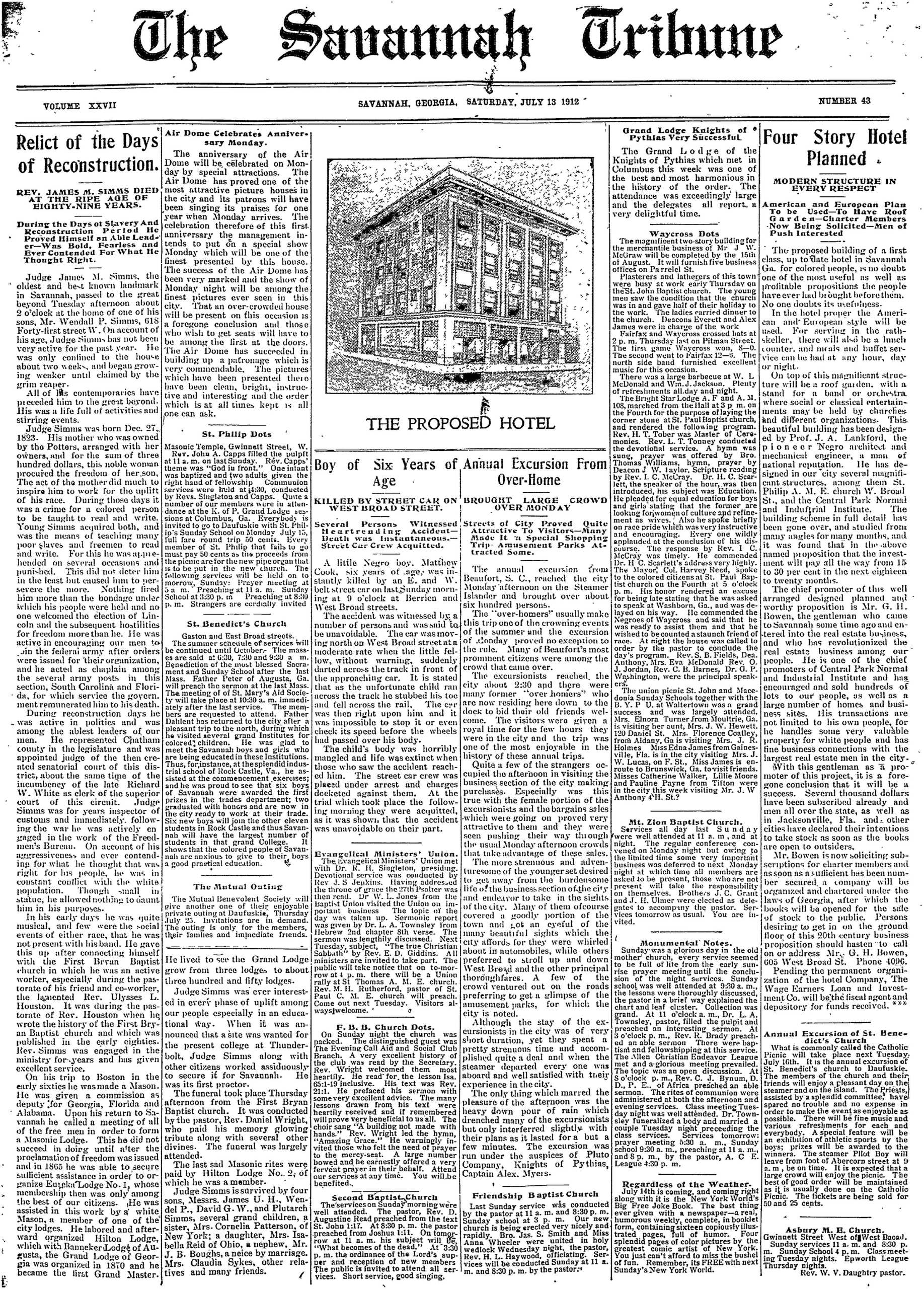
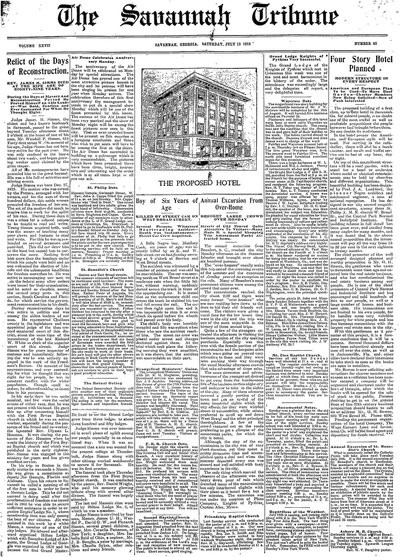
THE PROPOSED HOTEL
KILLED BY STREET CAR ON WEST BROAD STREET.
Several Persons Witnessed Heartrending Accident—Death was Instantaneous.—Street Car Crew Acquitted.
A little Negro boy, Matthew Cook, six years of age, was instantly killed by an E. and W. belt street car on last Sunday morning at 9 o'clock at Berrick and West Broad streets.
The accident was witnessed by a number of persons and was said to be unavoidable. The car was moving north on West Broad street at a moderate rate when the little fellow, without warning, suddenly darted across the track in front of the approaching car. It is stated that as the unfortunate child ran across the track he stubbed his toe and fell across the rail. The car was then right upon him and it was impossible to stop it or even check its speed before the wheels had passed over his body.
The child's body was horribly mangled and life was extinct when those who saw the accident reached him. The street car crew was placed under arrest and charges docked against them. At the trial which took place the following morning they were acquitted, as it was shown, that the accident was unavoidable on their part.
Evangelical Ministers' Union.
The Evangelical Ministers' Union met with Dr. R. H. Singleton, presiding, Devotional service was conducted by Rev J. S Jeukins. Having addressed the throne of grace the 27th Psalter was then read. Dr W. L. Jones from the Baptist Union visited the Union on important business. The topic of the day was taken up. Sermonic report was given by Dr. L. A. Townsley from Hebrew 2nd chapter 5th verse. The sermon was lengthily discussed. Next Tuesday, subject, "The true Christian Sabbath" by Rev. E. D. Giddins. All ministers are invited to take part. The public will take notice that on to-morrow at 1 p.m. there will be a Union rally at St Thomas A. M. E. church. Rev. M. H. Rutherford, pastor of St Paul C. M. E. church will preach. Come out next Tuesday. Visitors always welcome.
F. B. B. Church Dots.
On Sunday night the church was packed. The distinguished guest was The Evening Call Aid and Social Club Branch. A very excellent history of the club was read by the Secretary, Rev. Wright welcomed them most heartily. He read for the lesson Isa. 65:1-19 inclusive. His text was Rev. 21:1. He prefaced his sermon with some very excellent advice. The many lessons drawn from his text were heartily received and if remembered will prove very beneficial to us all. The choir sang "a building not made with hands." Rev. Wright led the hymn, "Amazing Grace." He warningly invited those who felt the need of prayer to the mercy-seat. A large number bowed and he earnestly offered a very fervent prayer in their behalf. Attend our services at any time. You will be benefited.
Second Baptist Church
The'services on Sunday morning were well attended. The pastor, Rev. D. Augustine Read preached from the text St. John 1:17. At 8:30 p. m. the pastor preached from Joshua 1:11. On tomorrow at 11 a. m. his subject will be "What becomes of the dead." At 3:30 p. m. the ordinance of the Lord's super and reception of new members The public is invited to attend all services. Short service, good singing.
Annual Excursion From Over-Home
BROUGHT LARGE CROWD OVER MONDAY
Streets of City Proved Quite Attractive To Visitors—Many Made It a Special Shopping Trip Amusement Parks Attracted Some.
The annual excursion from Beaufort, S. C., reached the city Monday afternoon on the Steamer Islander and brought over about six hundred persons.
The "over-homers" usually make this trip one of the crowning events of the summer and the excursion of Monday proved no exception to the rule. Many of Beaufort's most prominent citizens were among the crowd that came over.
The excursionists reached the city about 2:30 and there were many former "over homers" who are now residing here down to the dock to bid their old friends welcome. The visitors were given a royal time for the few hours they were in the city and the trip was one of the most enjoyable in the history of these annual trips.
Quite a few of the strangers occupied the afternoon in visiting the business section of the city making purchases. Especially was this true with the female portion of the excursionists and the bargains sales which were going on proved very attractive to them and they were seen pushing their way through the usual Monday afternoon crowds that take advantage of these sales.
The more strenuous and adventuresome of the younger set desired to get away from the burdensome life of the business section of the city and endeavor to take in the sights of the city. Many of them of course covered a goodly portion of the town and got an eyeful of the many beautiful sights which the city affords for they were whirled about in automobiles, while others preferred to stroll up and down West Broad and the other principal thoroughfares. A few of the crowd ventured out on the roads preferring to get a glimpse of the amusement parks, for which the city is noted.
Although the stay of the excursionists in the city was of very short duration, yet they spent a pretty strenuous time and accomplished quite a deal and when the steamer departed every one was aboard and well satisfied with their experience in the city.
The only thing which marred the pleasure of the afternoon was the heavy down pour of rain which drenched many of the excursionists but only interfered slightly with their plans as it lasted for a but a few minutes. The excursion was run under the auspices of Pluto Company, Knights of Pythias, Captain Alex. Myers.
Friendship Baptist Church
Last Sunday service was conducted by the pastor at 11 a.m. and 8:30 p.m. m. Sunday school at 3 p. m. Our new church is being erected very nicely and rapidly. Bro. Jas. S. Smith and Miss Anna Wheeler were united in holy wedlock Wednesday night, the pastor, Rev. H. L. Haywood, officiating. Services will be conducted Sunday at 11 a.m. and 8:30 p.m. m. by the pastor;
Grand Lodge Knights of Pythias Very Successful
The Grand Lodge of the Knights of Pythias which met in Columbus this week was one of the best and most harmonious in the history of the order. The attendance was exceedingly large and the delegates all report a very delightful time.
Waycross Dots
The magnificent two-story building for the mercantile business of Mr J W. McGraw will be completed by the 15th of August. It will furnish five business offices on Parreel St. Plasterers and lathigers of this town were busy at work early Thursday on the St. John Baptist church. The young men saw the condition that the church was in and gave half of their holiday to the work. The ladies carried dinner to the church. Deacons Everett and Alex James were in charge of the work.
Fairfax and Waycross crossed bats at 2 p.m. Thursday last on Pitman Street. The first game Waycross won, 8-0. The second went to Fairfax 12-6. The north side band furnished excellent music for this occasion. There was a large barbecue at W. L. McDonald and Win. J. Jackson. Plenty of refreshments all day and night.
The Bright Star Lodge A. F and A. M. 108, marched from the Hall at 3 p.m on the Fourth for the purpose of laying the corner stone at St. Paul Baptist church, and rendered the following program. Rev. H. T. Tober was Master of Ceremonies. Rev. L. T. Touney conducted the devotional service. A hymn was sung, prayer was offered by Bro. Thomas Williams, hymn, prayer by Deacon J W. Taylor, Scripture reading by Rev. I. C. McCray. Dr. H. C. Scarlett, the speaker of the hour, was then introduced, his subject was Education. He pleaded for equal education for boys and girls stating that the former are looking for women of culture and refinement as wives. Also he spoke briefly on race pride which was very Instructive and encouraging. Every one wildly applauded at the conclusion of his discourse. The response by Rev. I. C. McCray was timely. He commended Dr. H. C. Scarlett's address very highly. The Mayor, Col. Harvey Reyce, spoke to the colored citizens at St. Paul Baptist church on the Fourth at 5 o'clock p.m. His honor rendered an excuse for being late stating that he was asked to speak at Washborn, Ga., and was delayed on his way. He commended the Negroes of Wayerross and said that he was ready to assist them and that he wished to be counted as a staunch friend of race. At night the house was called to order by the pastor to conclude the day's program. Rev. S. B. Reyls, Dea Anthony, Mrs. Eva McDonald Rev. O. J. Jordan, Rev. C. B. Barnes, Dr. G. P. Washington, were the principal speakers.
The union picnic St. John and Macedonia Sunday Schools together with the B. Y. P U. at Waltertown was a grand success and was largely attended. Mrs. Elnora Turner from Moutrie, Ga. is visiting her aunt, Mrs. J. W. Hewettw. 120 Daniel St. Mrs. Florence Coatley, from Aldany, Ga. is visiting Mrs. J. R. Holmes Miss Edna James from Gainesville, Fla. is in the city visiting Mrs. J. W. Lucas, on F. St., Miss James is enroute to Brunswick, Ga. to visit friends. Misses Catherine Walker, Lillie Moore and Pauline Payne from Tifton were in the city this week visiting Mr. J. W Anthony $H. St.?
Mt. Zion Baptist Church.
Services all day last Sunday were well attended at 11 a.m. and at night. The regular conference convened on Monday night but owing to the limited time some very important business was deferred to next Monday night at which time all members are asked to be present, those who are not present will take the responsibility on themselves. Brothers J. C. Grant and J. H. Ulmer were elected as delegates to accompany the pastor. Services tomorrow as usual. You are invited.
Monumental Notes.
Sunday was a glorious day in the old mother church; every service seemed to be full of life from the early sunrise prayer meeting until the conclusion of the night services. Sunday school was well attended at 9:30 a.m. the lessons were thoroughly discussed, the pastor in a brief way explained the chart and leaf cluster. Collection was grand. At 11 o'clock a.m. Dr. L. A. Townsley, pastor, filled the pulpit and preached an interesting sermon. At 3 o'clock p.m. Rev. R. Brady preached an able sermon. There were baptism and fellowship at this service. The Allen Christian Endeavor League met and a glorious meeting prevailed. The topic was an open discussion. At 8 o'clock p.m. Rev. C. J. Bynum, D. D., P. E., of Africa preached an able sermon. The rites of communion were administered at both the afternoon and evening services. Class meeting Tuesday night was well attended. Dr. Townsley funeralized a body and married a couple Tuesday night preceding the class services. Services tomorrow: prayer meeting 5:30 a.m. m., Sunday school 9:30 a.m. preaching at 11 a.m. and 8 p. m., by the pastor, A. C E. League 4:30 p. m.
Regardless of the Weather-
July 14th is coming, and coming right
along with it is the New York World's
Big Free Joke Book. The best thing
ever given with a newspaper—a real,
humorous weekly, complete, in booklet
form, containing sixteen copiously illu-
strated pages, full of humor. Four
splendid pages of color pictures by the
greatest comic artist of New York.
You just can't afford to miss the bushel
of fun. Remember, its FREE with next
Sunday's New York World.
NUMBER 43
Four Story Hotel Planned
Four Story Hotel Planned
MODERN STRUCTURE IN EVERY RESPECT
American and European Plan To be Used-To Have Roof Garden-Charter Members Now Being Solicited-Men of Push Interested
The proposed building of a first class, up to state hotel in Savannah Ga. for colored people, is no doubt one of the most useful as well as profitable propositions the people have ever had brought before them. No one doubts its usefulness.
In the hotel proper the American and European style will be used. For serving in the rathskeller, there will also be a lunch counter, and meals and buffet service can be had at any hour, day or night.
On top of this magnificent structure will be a roof garden, with a stand for a band or orchestra where social or classical entertainments may be held by churches and different organizations. This beautiful building has been designed by Prof. J. A. Lankford, the pioneer Negro architect and mechanical engineer, a man of national reputation. He has designed in our city several magnificent structures, among them St. Philip A. M. E. church W. Broad St., and the Central Park Normal and Industrial Institute. The building scheme in full detail has been gone over, and studied from many angles for many months, and it was found that in the above named proposition that the investment will pay all the way from 15 to 30 per cent in the next eighteen to twenty months.
The chief promoter of this well arranged designed planned and worthy proposition is Mr. G. H. Bowen, the gentleman who came to Savannah some time ago and entered into the real estate business, and who has revolutionized the real estate business among our people. He is one of the chief promoters of Central Park Normal and Industrial Institute and has encouraged and sold hundreds of lots to our people, as well as a large number of homes and business sites. His transactions are not limited to his own people, for he handles some very valuable property for white people and has fine business connections with the largest real estate men in the city-
With this gentleman as a promoter of this project, it is a foregone conclusion that it will be a success. Several thousand dollars have been subscribed already and men all over the state, as well as in Jacksonville, Fla. and other cities have declared their intentions to take stock as soon as the books are open to outsiders.
Mr. Bowen is now soliciting subscriptions for charter members and as soon as a sufficient has been number secured a company will be organized and chartered under the laws of Georgia, after which the books will be opened for the sale of stock to the public. Persons desiring to get in on the ground floor of this 20th century business proposition should hasten to call on or address Mr. G. H. Bowen, 605 West Broad St. Phone 4096. Pending the permanent organization of the hotel Company, The Wage Earners Loan and Investment Co. will be the fiscal agent and depository for funds received. ****
Annual Excursion of St. Benedict's Church
What is commonly called the Catholic Picnic will take place next Tuesday July 16th. It is the annual excursion of St. Benedict's church to Daufuskie. The members of the church and their friends will enjoy a pleasant day on the steamer and on the Island. The Priests, assisted by a splendid committee, have spared no trouble and no expense in order to make the event as enjoyable as possible. There will be fine music and various refreshments for each and everybody. A special feature will be an exhibition of athletic sports by the boys; prizes will be awarded to the winners. The steamer Pillot Boy will leave from foot of Abercorn street at 9 a.m. be on time. It is expected that a large crowd will enjoy the picnic. The best of good order will be maintained as it is usually done on the Catholic Picnic. The tickets are being sold for 50 and 25 cents.
Ashbury M. E. Church.
Asbury M. H. Church.
Gwinnett Street West of West Baoad.
Sunday services 11 a. m. and 8:30 p.
m. Sunday School 4 p. m. Class meeting
Tuesday nights. Epworth League
Thursday nights.
Rev. W. V. Daughtry pastor.
FORTY-ONE KILLED OVER FIFTY HURT
Engine Crashes Into Rear End of Train. BIG FLYER BREAKS. LOOSE
Races On At 65 Miles An Hour, When Man At Lever Sees Danger, Reversees Throttle and Is Thrown From Cab.
Corning, N. Y.—Westbound Lackawanna passenger train, No. 9, from New York, due to arrive at Corning at 4.47 A. M., composed of two engines, a baggage car, three Pullmans and two day coaches in the order named, were demolished at Gibson, three miles east of Corning, at 5.25 o'clock Thursday morning by express train, No. 11, due at Corning at 5.10 A. M. Forty-one persons were killed and between 50 and 60 injured. Many of the victims were holiday excursionists bound to Niagara Falls, who had boarded the train at points along the line. The wreck was the worst in the history of the road. Its cause, according to Engineer Schroeder of the express, was his failure to see signals set against his train. The morning was foggy and he said he could not make them out. The wrecked train stood on the main track, blocked by a crippled freight train. There was no flag out, according to Engineer Schroeder. The signals, Engineer Schroeder declared, it was too foggy to see, were just around a curve. The flying express plunged past them and crashed into the rear of No. 9, bringing death to more than two score of its passengers.
Schroeder had taken No. 11 at Elmira 15 minutes before. It was a few minutes late. The stretch of track from Elmira to Corning is fitted for fast running, and he was sending his train along at 65 miles an hour. No. 9 was supposed to be half an hour ahead of him. He had no warning until he made out the outline of the rear coach of No. 9 through the fog. Then he threw on the reverse without shutting off steam. The jerk threw the train off the track and the locomotive plunged on to splinter the two day coaches filled with the excursionists and tear through the last of the Pullmans. Schroeder said the impact threw him from the cab and landed him on his shoulder on the roadbed, practically unhurt.
The 100-ton monster continued its plunge through the middle of the train, grinding everything in its path. When finally blocked by the debris, it remained on the roadbed in the midst of the desolation it had caused, while hundreds of persons rushed in every kind of vehicle to the scene to lift and pry the dead and injured from the tangled mass of wreckage.
Most of the bodies found were badly mangled. The wrecked cars were one heaped-up mass of wreckage, jamming into each other in telescope fashion. The last two cars on train No. 11 remained on the track and later were used as temporary hospitals.
Those who visited the scene of the wreck before the hospital forces had time to finish the work of removal, witnessed many scenes of horror.
HICCOUGHS PROVE FATAL.
Physicians Explode Giant Firecracker
As Last Resort.
Logansport, Ind.—Physicians exploded a giant firecracker at the bedside of James McGowan, at a hospital here, in the hope that the nervous shock would stop his hiccoughing, from which he had been guffering for five days, but though he was quieted, he died of exhaustion. McGowan, who was 48 years old, had been hiccoughing continuously, and electricity and other remedial agents were tried without effect before the opening of the Fourth of July celebration suggested the firecracker as a last aid.
ARRESTED FOR LARCENY.
Former Assistant Treasurer of Steel Company.
New York.—Peter J. Eliot, who was employed as assistant treasurer and secretary in the reorganization of the Southern Iron and Steel Company and who has been missing since November last, was arrested here, charged with the larceny of $40,000 in Southern Iron and Steel bonds. He was an accountant for a firm engaged in carrying out the reorganization plans and as such handled the securities. When arrested he refused to discuss the alleged theft.
FOR TITANTIC MEMORIAL.
Mrs. Carter H. Harrison To Conduct Illinois Campaign.
Chicago—Mrs. Carter H. Harrison, wife of Mayor Harrison, will conduct the campaign among Illinois women for aid in erecting the Titanic memorial in Washington. Mrs. John Hays Hammond, who was in Chicago with her husband during the Convention, interested Mrs. Harrison in the project during the former's stay here.
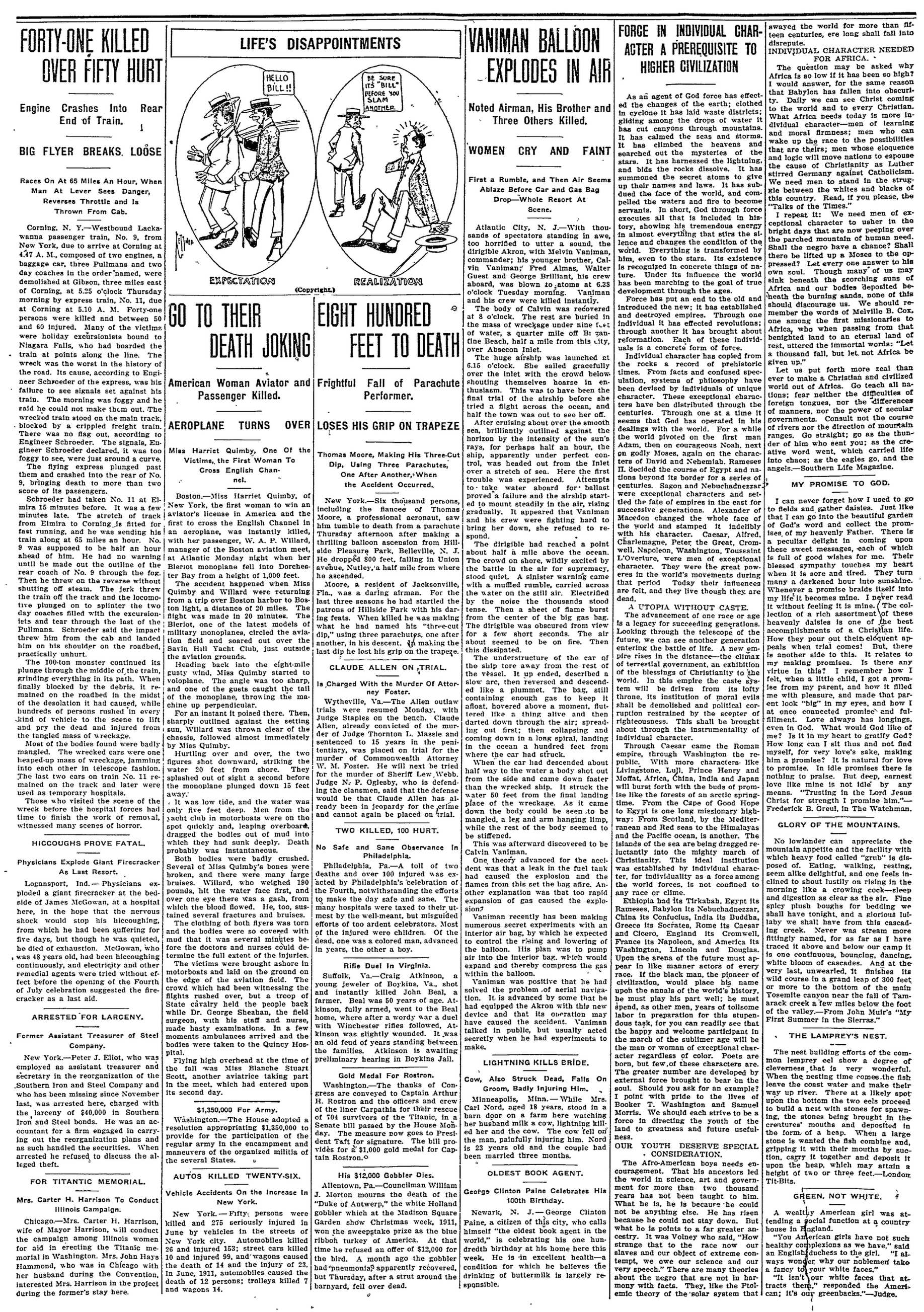
LIFE'S DISAPPOINTMENTS
HELLO
BILL!!
BE SURE
IT'S "BILL"
BEFORE YOU
SLAM
ANOTHER
EXPECTATION
REALIZATION
GO TO THEIR DEATH JOKING
American Woman Aviator and Passenger Killed.
Miss Harriet Quimby, One Of the Victims, the First Woman To Cross English Channel.
Boston—Miss Harriet Quimby, of New York, the first woman to win an aviator's license in America and the first to cross the English Channel in an airplane, was instantly killed, with her passenger, W. A. P. Willard, manager of the Boston aviation meet, at Atlantic Monday night when her Bleriot monoplane fell into Dorchester Bay from a height of 1,000 feet.
The accident happened when Miss Quimby and Willard were returning from a trip over Boston harbor to Boston light, a distance of 20 miles. The flight was made in 20 minutes. The Bleriot, one of the latest models of military monoplanes, circled the aviation field and soared out over the Savin Hall Yacht Club, just outside the aviation grounds. Heading back into the eight-mile gusty wind, Miss Quimby started to voloplane. The angle was too sharp, and one of the guests caught the tail of the monoplane, throwing the machine up perpendicular. For an instant it poised there. Then, sharply outlined against the setting sun, Willard was thrown clear of the chassis, followed almost immediately by Miss Quimby.
Hurtling over and over, the two figures shot downward, striking the water 20 feet from shore. They splashed out of sight a second before the monoplane plunged down 15 feet away:
It was low tide, and the water was only five feet deep. Men from the yacht club in motorboats were on the spot quickly and, leaping overboard, dragged the bodies out of mud into which they had sunk deeply. Death probably was instantaneous.
Both bodies were badly crushed. Several of Miss Quimby's bones were broken, and there were many large bruises. Willard, who weighed 190 pounds, hit the water face first, and over one eye there was a gash, from which the blood flowed. He, too, sustained several fractures and bruises.
The clothing of both flyers was torn and the bodies were so covered with mud that it was several minutes before the doctors and nurses could determine the full extent of the injuries. The victims were brought ashore in motorboats and laid on the ground on the edge of the aviation field. The crowd which had been witnessing the flights rushed over, but a troop of State cavalry held the people back while Dr. George Sheahan, the field surgeon, with his staff and nurse, made hasty examinations. In a few moments ambulances arrived and the bodies were taken to the Quincy Hospital.
Flying high overhead at the time of the fall was Miss Blanche Stuart Scott, another aviatrice taking part in the meet, which had entered upon its second day.
$1,350,000 For Army.
Washington.—The House adopted a resolution appropriating $1,350,000 to provide for the participation of the regular army in the encampment and maneuvers of the organized militia of the several States.
Vehicle Accidents On the Increase In New York.
New York.—Fifty, persons were killed and 275 seriously injured in June by vehicles in the streets of New York city. Automobiles killed 26 and injured 153; street cars killed 10 and injured 99, and wagons caused the death of 14 and the injury of 23. In June, 1911, automobiles caused the death of 12 persons; trolleys killed 7 and wagons 14.
EIGHT HUNDRED FEET TO DEATH
LOSES HIS GRIP ON TRAPEZE
Thomas Moore, Making His Three-Cut Dip, Using Three Parachutes, One After Another; When the Accident Occurred.
New York.—Six thousand persons, including the flancee of Thomas Moore, a professional aeronaut, saw him tumble to death from a parachute Thursday afternoon after making a thrilling balloon ascension from Hillside Pleasure Park, Belleville, N. X. He dropped 800 feet, falling in Union avenue, Nutley, a half mile from where he ascended.
Moore, a resident of Jacksonville, Fla., was a daring alfman. For the last three seasons he had startled the patrons of Hillside Park with his daring feats. When killed he was making what he had named his "three-cut dip," using three parachutes, one after another, in his descent. In making the last dip he lost his grip on the trapeze.
CLAUDE ALLEN ON TRIAL.
Is,Charged With the Murder Of Attorney Foster.
Wytheville, Va.—The Allen outlaw trials were resumed Monday, with Judge Staples on the bench. Claude Allen, already convicted of the murder of Judge Thornton L. Massie and sentenced to 15 years in the penitentiary, was placed on trial for the murder of Commonwealth Attorney W. M. Foster. He will next be tried for the murder of Sheriff Lew, Webb. Judge N. P. Oglesby, who is defending the clansmen, said that the defense would be that Claude Allen has already been in jeopardy for the crime and cannot again be placed on trial.
TWO KILLED, 100 HURT.
No Safe and Sane Observance In Philadelphia.
Philadelphia, Pa.—A toll of two deaths and over 100 injured was exacted by Philadelphia's celebration of the Fourth, notwithstanding the efforts to make the day safe and sane. The many hospitals were taxed to their utmost by the well-meant, but misguided efforts of too ardent celebrators. Most of the injured were children. Of the dead, one was a colored man, advanced in years, the other a boy.
Rifle Duel In Virginia.
Suffolk, Va.—Craig Atkinson, a young jeweler of Boykins, Va., shot and instantly killed John Beal, a farmer. Beal was 50 years of age. Atkinson, fully armed, went to the Beal home, where after a wordy war a duel with Winchester rifles followed. Atkinson was slightly wounded. It was an old feud of years standing between the families. Atkinson is awaiting preliminary hearing in Boykins Jail.
Gold Medal For Rostron.
Washington.—The thanks of Congress are conveyed to Captain Arthur H. Rostron and the officers and crew of the liner Carpathia for their rescue of 704 survivors of the Titanic, in a Senate bill passed by the House Monday. The measure now goes to President Taft for signature. The bill provides for $1,000 gold medal for Captain Rostron.
His $12,000 Gobbler Dies.
Allentown, Pa.—Councilman William J. Morton mourns the death of the "Duke of Antwerp," the white Holland gobbler which at the Madison Square Garden show Christmas week, 1911, won the sweepstake prize as the blue ribbon turkey of America. At that time he refused an offer of $12,000 for the bird. A month ago the gobbler had pneumonia apparently recovered, but Thursday, after a strut around the barnyard, fell over dead.
Noted Airman, His Brother and Three Others Killed.
First a Rumble, and Then Air Seems
Ablaze Before Car and Gas Bag
Drop—Whole Resort At
Scene.
Atlantic City, N. J.—With thousands of spectators standing in awe, too horrified to utter a sound, the dirigible Akron, with Melvin Vaniman, commander; his younger brother, Calvin Vaniman; Fred Almas, Walter Guest and George Brilliant, his crew aboard, was blown to atoms at 6.38 o'clock Tuesday morning. Vaniman and his crew were killed instantly.
The body of Calvin was recovered at 8 o'clock. The rest are buried in the mass of wreckage under nine feet of water, a quarter mile off B: sanfine Beach, half a mile from this city, over Absconen Inlet.
The huge airship was launched at 6.15 o'clock. She sailed gracefully over the inlet with the crowd below-shouting themselves hoarse in enthusiasm. This was to have been the final trial of the airship before she tried a flight across the ocean, and half the town was out to see her off. After cruising about over the smooth sea, brilliantly outlined against the horizon by the intensity of the sun's rays, for perhaps half an hour, the ship, apparently under perfect control, was headed out from the Inlet over a stretch of sea. Here the first trouble was experienced. Attempts to take water aboard for ballast proved a failure and the airship started to mount steadily in the air, rising gradually. It appeared that Vanlman and his crew were fighting hard to bring her down, she refused to respond.
The dirigible had reached a point about half a mile above the ocean. The crowd on shore, wildly excited by the battle in the air for supremacy, stood quiet. A sinister warning came with a muffled rumble, carried across the water on the still air. Electrified by the noise the thousands stood tense. Then a sheet of flame burst from the center of the big gas bag. The dirigible was obscured from view for a few short seconds. The air about seemed to be on fire. Then this dissipated.
The understructure of the car of the ship tore away from the rest of the vessel. It up ended, described a slow arc, then reversed and descended like a plummet. The bag, still containing enough gas to keep it afloat, hovered above a moment, fluttered like a thing alive and then darted down through the air; spreading out first; then collapsing and coming down in a long spiral, landing in the ocean a hundred feet from where the car had struck.
When the car had descended about half way to the water a body shot out from the side and came down faster than the wrecked ship. It struck the water 50 feet from the final landing place of the wreckage. As it came down the body could be seen to be mangled, a leg and arm hanging limp, while the rest of the body seemed to be stiffened.
This was afterward discovered to be Calvin Vanlman.
One theory advanced for the accident was that a leak in the fuel tank had caused the explosion and the flames from this set the bag afire. Another explanation was that too rapid expansion of gas caused the explosion?
Vanlman recently has been making numerous secret experiments with an interior air bag, by which he expected to control the rising and lowering of the balloon. His plan was to pump air into the interior bag, which would expand and thereby compress the gas within the balloon.
Vanian was positive that he had solved the problem of aerial navigation. It is advanced by some that he had equipped the Akron with this new device and that its operation may have caused the accident. Vanian talked in public, but usually acted secretly when he had experiments to make.
LIGHTNING KILLS BRIDE.
Cow, Also Struck Dead, Falls On
Groom, Badly Injuring Him.
Minneapolis, Minn.—While Mrs.
Carl Nord, aged 18 years, stood in a
barn door on a farm here watching
her husband milk a cow, lightning killed
her and the cow. The cow fell on
the man, painfully injuring him. Nord
is 23 years old and the couple had
been married three months.
OLDEST BOOK AGENT.
George Clinton Paine Celebrates His
100th Birthday.
Newark, N. J.—George Clinton Paine, a citizen of this city, who calls himself "the oldest book agent in the world," is celebrating his one hundredth birthday at his home here this week. He is in excellent health—a condition for which he believes the drinking of buttermilk is largely responsible.
FORCE IN INDIVIDUAL CHARACTER A PREREQUISITE TO HIGHER CIVILIZATION
As an agent of God force has effected the changes of the earth; clothed in cyclone it has laid waste districts; gliding among the drops of water it has cut canyons through mountains. It has calmed the seas and storms. It has climbed the heavens and searched out the mysteries of the stars. It has harnessed the lightning, and blids the rocks dissolve. It has summoned the secret atoms to give up their names and laws. It has subdued the face of the world, and compelled the waters and fire to become servants. In short, God through force executes all that is included in history, showing his tremendous energy in almost everything that stirs the silence and changes the condition of the world. Everything is transformed by him, even to the stars. Its existence is recognized in concrete things of nature. Under its influence the world has been marching to the goal of true development through the ages.
Force has put an end to the old and introduced the new; it has established and destroyed empires. Through one individual it has effected revolutions; through another it has brought about reformation. Each of these individuals is a concrete form of force.
Individual character has copied from the rocks a record of prehistoric times. From facts and confused speculation, systems of philosophy have been devised by individuals of unique character. These exceptional characters have been distributed through the centuries. Through one at a time it seems that God has operated in his dealings with the world. For a while the world plowed on the first man Adam, then on courageous Noah, next on godly Moses, again on the characters of David and Nehemiah. Rameses II. decided the course of Egypt and nations beyond its border for a series of centuries. Sagon and Nebuchadnezzar were exceptional characters and settled the fate of empires in the east for successive generations. Alexander of Macedon changed the whole face of the world and stamped it indelibly with his character. Caesar, Alfred, Charlemagne, Peter the Great, Cromwell, Napoleon, Washington, Toussaint L'Overture, were men of exceptional character. They were the great powers in the world's movements during that period. Today their influences are felt, and they live though they are dead.
A UTOPIA WITHOUT CASTE.
The advancement of one race or age is a legacy for succeeding generations. Looking through the telescope of the future, we can see another generation entering the battle of life. A new empire rises in the distance—the climax of terrestrial government, an exhibition of the blessings of Christianity to the world. In this empire the caste system will be driven from its lotty throne, its institution of moral evils shall be demolished and political corruption restrained by the scepter of righteousness. This shall be brought about through the instrumentality of individual character.
Through Caesar came the Roman empire, through Washington the republic. With more characters like Livingstone, Lujl, Prince Henry and Moffat, Africa, China, India and Japan will burst forth with the buds of promise like the forests of an arctic springtime. From the Cape of Good Hope to Egypt is one long missionary highway: From Scotland, by the Mediterranean and Red seas to the Himalayas and the Pacific ocean, is another. The islands of the sea are being dragged reluctantly into the mighty march of Christianity. This ideal institution was established by individual character, for individuality as a force among the world forces, as is a confined to any race or clime.
Ethiopia had its Tirkahah. Egypt its Rameses, Babylon its Nebuchadnezzar, China its Confucius, India its Buddha, Greece its Socrates, Rome its Caesar and Cicero, England its Cromwell, France its Napoleon, and America its Washington, Lincoln and Douglas. Upon the arena of the future must appear in like manner actors of every race. If the black man, the pioneer of civilization, would place his name uphob the annals of the world's history, he must play his part well; he must spend, as other men, years of tolsonse labor in preparation for this stupendous task, for you can readily see that the happy and welcome participant in the march of the sublimer age will be the man or woman of exceptional character regardless of color. Poets are born, but few, of these characters are. The greater number are developed by external force brought to bear on the soul. Should you ask for an example? I point with pride to the lives of Booker T. Washington and Samuel Morris. We should each strive to be a force in directing the youth of the land to greatness and future usefulness.
OUR YOUTH DESERVE SPECIAL
. CONSIDERATION.
The Afro-American boys needs encouragement. That his ancestors led the world in science, art and government for more than two thousand years has not been taught to him. What he is, he is because he could not be anything else. He has risen because he could not stay down. But what he is points to a far greater ancestry. It was Volney who said, "How strange that to the race now our slaves and our object of extreme contempt, we owe our science and our very speech." There are many theories about the negro that are not in harmony with facts. They, like the Ptolemic theory of the solar system that
swayed the world for more than fifteen centuries, ere long shall fall into disrepute.
INDIVIDUAL CHARACTER NEEDED FOR AFRICA.
The question may be asked why Africa is so low if it has been so high I would answer, for the same reason that Babylon has fallen into obscurity. Daily we can see Christ coming to the world and to every Christian. What Africa needs today is more individual character—men of learning and moral firmness; men who can wake up the race to the possibilities that are thelms; men whose eloquence and logic will move nations to espouse the cause of Christianity as Luther stirred Germany against Catholicism. We need men to stand in the struggle between the whites and blacks of this country. Read, if you please, the "Talks of the Times."
I repeat it: We need men of exceptional character to usher in the bright days that are now peeping over the parched mountain of human need. Shall the negro have a chance? Shall there be lifted up a Moses to the oppressed? Let every one answer to his own soul. Though many of us may sink beneath the scorching suns of Africa and our bodies deposited beneath the burning sands, none of this should discourage us. We should remember the words of Melville B. Cox, one among the first missionaries to Africa, who when passing from that benighted land to an eternal land of rest, uttered the immortal words: "Let a thousand fall, but let not Africa be given up."
Let us put forth more zeal than ever to make a Christian and civilized world out of Africa. Go teach all nations; fear neither the difficulties of foreign tongues, nor the differences of manners, nor the power of secular governments. Consult not the course of rivers nor the direction of mountain ranges. Go straight; go as the thunder of him who sent you; as the creative word went, which carried life into chaos; as the eagles go, and the angels.-Southern Life Magazine.
MY PROMISE TO GOD.
I can never forget how I used to go to fields and gather daisies. Just like that I can go into the beautiful garden of God's word and collect the promises of my heavenly Father. There is a peculiar delight in coming upon these sweet messages, each of which is full of good wishes for me. Their blessed sympathy touches my heart when it is sore and tired. They turn many a darkened hour into sunshine. Whenever a promise braids itself into my life it becomes mine. I never read it without feeling it is mine. The collection of a rich assortment of these heavenly daisies is one of the best accomplishments of a Christian life. How they pour out their eloquent appeals when trial comes! But, there is another side to this. It relates to my making promises. Is there any virtue in this? I remember how I felt, when a little child, I got a promise from my parent, and how it filled me with pleasure, and made that parent look "big" in my eyes, and how I at once connected promise and fulfillment. Love always has longings, even in God. What would God like of me? Is it in my heart to gratify God? How long can I sit thus and not find myself, for very love's sake, making him a promise? It is natural for love to promise. In idle promises there is nothing to praise. But deep, earnest love like mine is not idle by any means. "Trusting in the Lord Jesus Christ for strength I promise him."—Frederick B. Greul, in The Watchman.
GLORY OF THE MOUNTAINS.
No lowlander can appreciate the mountain appetite and the facility with which heavy food called "grub" is disposed of. Eating, walking, resting, seem alike delightful, and one feels inclined to shout lustily on rising in the morning like a crowing cock—sleep and digestion as clear as the air. Fine spicy plush boughs for bedding we shall have tonight, and a glorious lullaby we shall have from this cascading creek. Never was stream more fittingly named, for as far as I have traced it above and below our camp it is one continuous, bouncing, dancing, white bloom of cascades. And at the very last, unwearled, it finishes its wild course in a grand leap of 300 feet or more to the bottom of the main Yosemite canyon near the fall of Tamarack creek a few miles below the foot of the valley.—From John Mulr's "My First Summer in the Slirras."
THE LAMPREY'S NEST.
The nest building efforts of the common lemprey eel show a degree of cleverness that is very wonderful. When the nesting time comes, the fish leave the coast water and make their way up river. There at a likely spot upon the bottom the two eels proceed to build a nest with stones for spawning, the stones being brought in the creatures' mouths and deposited in the form of a heap. When a large stone is wanted the fish combine and, gripping it with their mouths by suction, carry it together and deposit it upon the heap, which may attain a height of two or three feet.-London Tilt-Bits.
A wealthy American girl was attending a social function at a country house in England.
"You American girls have not such healthy complexions as we have," said an English duchess to the girl.
"I always wonder why our noblemen take a fancy to your white faces."
"It isn't our white faces that attracts them," responded the American; it's our greenbacks."—Judge.
The Oldest, Strongest and Most Reliable Company in the State. Gives employment to hundreds of men and women of our race. Pays from $1 to $10 weekly sick and accident benefits and from $10 to $100 death benefits. Our Motto: "Promptness, Honesty and Justice." Home Office: 1143 Gwinnett St. Augusta, Ga. For further information write 509 West Broad St., Savannah, Ga. J. S. Perry, Supt.
A. B. Singfield, Gen. Supt.
C. T. Walker, D. D., LL. D.
Director and General Lecturer.
GO TO—
Young Bros.
For your
GO TO—
TOBACCO, CIGARS and FRUITS Of all kinds.
609 West Broad Street
WEST SIDE RESTAURANT
461 West Broad Street,
Near Union Station.
The place to get first-class meals
Everything neat and clean. Meals
prepared in an appetizing manner
and at all hours daily.
Meals 16 and 25 cents.
MRS. A. S. SCOTT, Proprietress
This Space Is for Sale
at very reasonable rates
Why not use it to advertise your warea
Masonic Books and Regalias
LODGE SEALS,
FINANCIAL CARDS and
BLANKS of every description.
Publishers and Manufacturers' Prices
Laboral Discounts Will Be Arranged.
SOL G. JOHNSON, Savannah, Ga.
Your Money Pile Grows
Just in proportion as you advertise your business, and our columns are open for you to begin at once. Suppose you give us a trial.
Advertise in this paper
Can Remain in New York but Do Not Think It Profitable.
RECEIVING BIG MONEY—DURING STRIKE NEGROES GETTING $3 A DAY—GOING TO SUMMER RESORTS—GEORGE W. HOLBERT WRITES.
There is very little likelihood that in the future colored waiters will be employed by the leading eating places of New York in large numbers. In fact, within the next week or ten days it is highly probable that there will not be a single colored man carrying a tray in any of the first class hotels or restaurants in Manhattan.
At present there are about one hundred negro waiters working in the best hotels, chiefly at the Plaza, Breslin and Marsellles. Their exit is expected to take place within a few days as the striking whites are going in, and each day finds many returning to work. The hotel managers, while making some of the concessions asked, have flatly refused to recognize the International Hotel Waiters' union.
The colored waiters at present employed could hold their jobs if they desired. They have not been notified that their services could not be needed much longer. To the contrary they have been told they could remain as long as they pleased if their work was satisfactory. At the Hotel Breslin the entire crew is composed of colored men and the management has informed them that there was no disposition to make a change unless they wanted to leave.
It is claimed by those familiar with conditions that the colored waiters working at the Plaza and other hotels will soon give up their jobs because they can find more profitable situations during the summer at the various resorts throughout the country. Since the colored men were installed in the white eating places they have been paid at a rate of $3 a day (working seven days) together with their board and lodging. When the white waiters struck they were only getting $25 a month and board, and protested against the quality of food they were compelled to eat.
With the strike over, which will be a matter of a few days only, the colored waiters will be offered $30 a month, which is at a rate of $60 less than what they have been receiving during the strike. They dq not think they would profit by working in New York at $30 a month and tips, when they can go to a summer resort where business will be good and make $500 during the season. It was given out at the headquarters of the Head and Side Waiters' association in Fifty-third street that the colored waiters do not contemplate affiliating with the International Hotel Waiters' union.
Negro waiters throughout the country are showing more than ordinary concern in the proposed conference of colored waiters, although there is a difference of opinion as to what lines should be followed in organizing.
George W Holbert, financial secretary of Local No. 634, Minneapolis, Minn., writes on the subject as follows.
In your paper of recent date there appeared an article entitled "A Conference for Colored Walters." The article touched upon things that are so vitally important to us as waiters, that I (being one of the craft) beg leave to offer a few suggestions.
I am heartily in favor of organization, but not along the lines as laid down in the article mentioned. If we are being dispensed with every-day and everywhere, somebody is taking our places and it must of course be the white walter So, just as long as he stands ready to supplant us, all the organizing we can do among ourselves will avail us nothing.
Over 50 per cent of the white waiters are unionized, and a great majority of that 50 per cent. are members of the Hotel and Restaurant Employes' International Association and Bartenders' International League of America. This is a very strong organization, embracing as it does all of the practical working force of any average hotel or cafe: namely, cooks, waiters, bartenders and waitresses. Now, it seems to me that if we should amalgamate with these people, the most serious obstacle would be removed—that of their opposition as well as competition.
I have given this subject much thought in the past, and as long as ten years ago I was severely criticised by the fellow workers of my race that they were fast losing their prestige and they themselves were as much to blame by their inattention to business, their failure to keep abreast of the improvements in service that are being demanded by the public and by their general deficiency and untidy habits. I declared then that in a few years we would have employment in only second-class places, and maybe not all of them. They laughed at me and said I was crazy. Since that time there have been erected in Minneapolis six first-class hotels, and we stood by with mouths agape as one by one, upon their completion, they were manned by white crews.
Volumes could be written upon this subject of the whys and wherefores, but I would rather discuss some practical method of organization and improvement of our service as well as working conditions. And I can prob-
ably best do so by giving a synopsis of a little of our local history here.
Some time ago I interested enough of my fellow workers to form a union. We did so, starting with 15. One house in which some of us are employed is unionized throughout—cooks, bartenders, waiters and waitresses. Out of this little handful of men have come some truly wonderful changes. We have our own meeting hall where we have weekly meetings, and once every month a general discussion of things pertaining to the good of the service. You can imagine the improvement there has been in that house alone; and it has been diffused around through the other houses, because we have members in every house in the Twin Cities that employs colored waiters, as we have a membership of something near one hundred now. But the two things that have impressed me most are the harmony which exists between the different working departments and the change in working conditions.
And so that makes me strong for organization. But I don't believe we can hope for anything by going alone. We must join hands with the white man who is working in our same crafts, and together we can become a powerful force—alone we can never do much. The educational part of our little local and the improvements it has brought about for us in our work and general conduct, have been worth the time and trouble it cost to bring us into existence. And so, if the young men in Kansas City, who are fathering this movement, will give this their earnest and honest thought, they will see that an affiliation with this international would be far the more effective.
CABLE WINS INTERCOL LIGATE HAMMER THROW
COLORED STUDENT AT HARVARD
MAKES LONGEST THROW
EXCEPT ONE EVER BY COLLEGES
OF THE UNITED STATES—NEARLY EQUALS BEST THROW EVER — QUARTER-MILE RECORD
HELD BY COLORED RUNNER IS BEATEN.
Philadelphia.—Pennsylvania was the winner of the inter-collegiate track and field championship meeting with 28 points, and while the Quakers won the greatest number of points, it was not its victory that caused any great surprise. This latter was furnished by the men of other colleges, who figured in bettering records and continuing to make the chances of American athletics who are to compete at Sweden this summer an almost assured victory.
Cable of Harvard showed the effects of Coach Quinn's instructions by tossing the hammer further than at any time since John De Witt made the intercollegiate records. Mercer's running broad jump was also noteworthy in that he only took one try.
In the quarter, C. D. Reidpath of Syracuse had to do 48 seconds flat or four-fifths of a second faster than that of Taylor of Pennsylvania back in 1907, and of D. B. Young of Amherst last May.
Although records in five events were shattered, that did not end the list of remarkable performances that more than 8,000 went wildly excited over this afternoon.
Cable of Harvard, by throwing the hammer 162 ft. $4\frac{1}{2}$ in. made the best throw ever made in the intercollegiate games in 37 meetings, except that of 164 ft. 10 in. which Dewitt of Princeton established as an intercollegiate mark in 1902.
BACK TO THE FARM
It is a hopeful sign to see the executive committee of the National Bankers' association using efforts to promote agricultural education, editorially asserts The Reformer, of Richmond, Va. Thus we see that those who are suffering from the high cost of living are not the only ones who are advocating a return to the soil for a livelihood, and converts are springing up in all parts of the country. Railroads all over this and other states are distributing information concerning farm lands, because the more farms operated means more business for them. On the same principle the bankers reason that the tilling of waste lands means more money to be handled in deposits and improvements
Agricultural education is doing much to keep the farmer in the country and to send him congenial company. It is bringing about that efficiency that makes farming as much a business as regards details as any other.
The technical education given in seeds and soil by Hampton, Tuskegee and other schools for the colored youth will continue to populate deserted farms and cause the desert places to "bloom like a rose."
Much attention is being paid to education and in many cases where the inhabitants gave poor educational facilities as the cause for leaving their "happy homes" conditions have changed. Educational, financial and social problems have been solved and distaste for country life has disappeared
WISE RATS.
Talkative Passenger—When the rats desert a ship before it salis it's a sure sign that the ship is unseaworthy, isn't it. Sailor—Not always. They might have discovered that a Chinese cook has shipped.
See COOPER & ODRIZEN The Up-to-Date Tailors
218 WEST BROAD STREET, BETWEEN HULL AND OGLETHORPE AVE. The Latest Patterns in SPRING AND SUMMER GOODS. Firstclass workmanship guaranteed. Our prices will interest you.
WE HAVE TWELVE LOTS ON THIRTY-NINTH STREET, BETWEEN BURROUGHS AND FLORENCE, UPON WHICH WE WILL BUILD HOMES FOR ANY ONE DESIRING THEM. THE KIND OF HOUSE YOU WANT WILL BE BJILT FOR YOU, AND YOU CAN PAY US FOR IT IN EASY MONTHLY PAYMENTS. COME AND SEE US ABOUT THIS PROPOSITION.
30 DRAYTON STREET.
Nichols, THE SHOE MAN
The affable H. B. Wright is still with us and expects the continuous patronage of his friends.
Johnson Undertaking Establishment
COMBINED WITH
Funeral Directors and Embalmers
Finest line of Coffins, Saskets and Robes. White and black funeral cars. Office and warerooms 325-331 Jefferson street.
W. R. FIELDS, Manager.
Residence Phone 2032. Livery Stable Attached. Office Phone 676.
C. H. ROYALL, Residence 509 Charles St. Phone 3064.
24 ST. JULIAN ST., WEST, 235 BRYAN ST., WEST. Phone 2968. SAVANNAH, GEORGIA.
Palm Shaving Palace
Expert Hair Cutting. Electric Massage and Shampooing a Specialty. All Work-Done by Experienced Workmen. Courteous attention to all SHIN-ING PARLOR ATTACHED.
PERRY R. WRIGHT, Proprietor
117 WEST BROAD ST., SAVANNAH, GA.
Advertise in this Paper.
It Will Pay You.
Now is the Time to Do It.
The Beautiful Woodlawn Park New Improvements More Lights New Buildings The Ideal Picnic Spot of Savannah Secure your dates from ANDREW D. MONROE, 124 East Thirty-third St.
Get the habit of saving a part of your Earnings each week.
$1.00
Starts an
Account
THE WAGE-
EARNERS' LOAN
AND INVESTMENT
COMPANY,
468 WEST BROAD ST.
Savannah, Ga.
PHONE 244.
GAREY'S
Variety Bakery
Goods delivered promptly to any
part of the city.
506 West Broad St., Near Gaston.
Phone 1869-J
East Side
Lodging House
With modern convenlences, athletic arrangements, also shining parlor attached for ladies and gentlemen. Open day and night. Give us a call.
217 East Broad St.,
ISAAC C. BROWN, . . Proprietor.
Phone 3746.
For First Class
GROCERIES AND CONFECTIONERY
Call On
M. G. GRAHAM
626 York St., West.
Courteous Attention to All.
MADAME FLORENGE E. WILLIAMS
Graduate Prof. Roher's School,
New York.
Hairdressing Parlor
521 Gaston Street, East.
Telephone 2328
Wigs, Switches and Pompadours
Made from Natural Hair.
Combings Made Up. Shampooing and
Hair Straightening a Specialty.
Face and Electric Massage. Dyeing
and Matching Hair.
ORIENTAL HAIR GROWER.
An excellent preparation, will produce a beautiful growth of hair. Directions on each box. For sale, price
25 cents per box.
AGENTS WANTED
For the Sale of Magic Shaving Powder
Among the many strong institutions of a commercial and business nature among our people, few if any command more admiration and respect from our thinking people, than our two well established financial institutions, viz: the Wage Earners' Loan and Investment Company located at 468 West Broad street and the Mechanics Investment Company of 20 State street, west. Starting business only a few years ago with a very small capital, these two institutions have grown step by step until they have become powerful and influential financial forces in our community. The recent purchase of the stores and buildings on the northeast corner of West Broad and Alice streets for the sum of $25000 by the Wage Earners' Loan and Investment Company, as well as the purchase of the stores and buildings on the southwest corner of York and Barnard streets by the Mechanics Investment Company for the sum of $18,500, attest in a way the progressiveness of the officers and directors of these two splendid institutions as well as the solidity of the foundation upon which they are built. The success of these institutions is indeed a splendid tribute to Negro managerial ability. There is held up before the world in bold relief, the fact, that in matters financial, as well as in other fields, the Negro is able to hold his own. And this is made possible through the loyalty and support that come to these institutions from the Negroes themselves. We have been told that in the course of a few months that our two banks, the Wage Earners' Loan and Investment Company and the Mechanics Investment Company, will grace the new sites recently purchased by them with handsome banking quarters where our people will not only receive the same courteous treatment that they now receive at the hands of the officers of these institutions, but where more ample accommodation and conveniences will tender this treatment more significant. It has always been the policy of this paper to commend to our people, the institutions of worth among us. These two institutions have entered the field of fiercest competition and have made good. They merit our praise, our confidence and our continued support. They have passed the experimental stage in their growth and are now firmly established among us. All praise is due their management. Savannah and Savannahians are proud of them. Believing that it is the duty of each of us to contribute to their maintenance and upkeep, we appeal to each thoughtful one among us to give at least a part of his business to one or more of these institutions. We are theirs and they are ours. Their success means our success. We are in a position financially to make these two institutions as strong as any of a similar nature among our people in the country. Keeping alive then to the spirit of progressiveness that now pervades our city, let us lend our financial aid and support unhesitatingly and instinctingly to these well established financial institutions and in so doing, we shall build more nobly than we think, not only for ourselves but for those who shall come after us. Freely and happily do we commend these two successful institutions to our people.
Recently there has been much discussion through the columns of one of our local papers—anent the so-called servant problem as it pertains to the Negro. The impression conveyed was, that as a domestic, the Negro servant was the sum total of all that is implied in the words unreliable, untrustworthy and incapable; that the
service rendered by him was so unsatisfactory that any change that would bring into service another class of servants from another race, would be welcomed. that the Negro servant has grown so haughty and overbearing in his manner toward his employers that an immediate and far-reaching change is imperative. Now while we do not wish to enter into a lengthy discussion of the subject, yet in the face of such a sweeping indictment of our people, we cannot refrain from saying a few words at this time, since we feel that there are so many angles from which this subject may be viewed. The Negro race, as well as any other race, has within its ranks certain members to whom faithfulness and fidelity to duty are total strangers. In them, there is little regard for love of honor as evinced in the proper discharge of duty. For this class of people, we offer no excuse or commendation but rather condemnation in the most superlative form. There is another class of domestics however among us, and who by the way are in the large majority, whose services are all that could be asked for by any thoughtful and fair-minded person. It is this latter class of domestics to whose defense we come, when such a sweeping indictment of the entire domestic servant world is made. It is an undisputed fact that there are servants among us who have been in the employ of one family from five to twenty years or more. It is no uncommon thing for these servants to be entrusted with the entire care of the premises of his employer during long periods of their absence from the city. Can it be said, in the light of the fact, that this latter class of servants is unreliable and untrustworthy? We fail to see in the light of reason how this can be said. Taken all in all, the Negro domestic is the poorest paid of any of our servant class. Their hours on duty are also of unusual duration extending from seven or eight o'clock in the morning to eight, nine and sometimes on special occasions even to ten o'clock at night. For this service, we are reliably informed that their wages range from $6 or $7 per month to $12 and $14 at the most. Now in the age of enlightenment one can hardly expect to get first class, intelligent help at such prices and for such hours. Yet it is a fact, that resists successful disputation that in the large majority of instances, the services given by these domestics for the wages received by them and the hours required of them, are far from being of an inferior order. On the contrary, it is all that can be expected. We do not hesitate to express the belief that it would be difficult to find a similar class of any race that would give better services under existing circumstances than the Negro domestic. In fact it is our conviction, after taking into consideration the natural disposition of our people to make the most of circumstances without undue complaint, that our domestics under the present state of affairs, make the most dependable servants to be found. Strikes and lockouts so prevalent among the foreign servant class are wholly unknown to us. It is an individual matter with each of our domestics. Our domestics have no cause for alarm over the present agitation. Counselling them to adhere firmly to the right and to do their duty as they should, we feel that the time is not far distant when the Negroes worth as a domestic will stamp itself indebly upon the mind and consciences of not a few but all of his employers. Then and not till then will such "tempests in teapots" as are now brewing cease to be and the Negro domestic will come in for his full share of merited encounties.
Resolutions on Death of Mrs.
M.W. Adams
1st: That they desire for themselves, their successors and assigns and such other persons as may become associated with them to be incorporated under the name and style of "The Dove Aid and Social Club," for the term of twenty (20) years with the privilege of renewal for a like term at the end and expiration thereor.
2nd: That said corporation has no capital stock and is not organized for individual or pecuniary gain, but to extend aid and attention to its members during illness and in case of death to pay to their legal representatives the sum $50.00 out of such dues and fines as may be received from them and from donations and funds received from other sources.
3rd: For the purpose of better promoting the objects aforesaid, your petitioners ask for corporate authority to enforce good order, receive donations, own property and to mortgage and sell same, to collect dues, to receive funds from entertainments and such other social gatherings as are promotive of the objects of the Association, to preserve and invest all monies paid into the treasury as the Directors of said Association may deem best.
4th: Petitioners also pray that said Association be authorized to prescribe the rights, privileges, benefits and liabilities of its members and to prescribe how and by whom membership may be obtained therein. Petitioners further pray the use of a corporate seal and to sue and to be sued.
5th: The principal office and place of business shall be in City of Savannah, Chatham County, State of Georgia.
6th: Petitioners pray the Court, to grant them and their Associates under the name aforesaid such corporate powers as may be suitable to their enterprise and not inconsistent with the laws of the state of Georgia nor violative of private rights.
And your Petitioners will ever pray ets.
II. A. Macbeth,
Petitioners' Attorney.
Original Petition, Filed in Clerk's Office this 3rd day of July 1912.
William L. Grayson,
Clerk S. U., C. Co., Ga.
I Now Occupy OFFICES
IN THE
Savannah
Tribune
Building
WHERE I WILL BE
PLEASED TO!HAVE
YOU CALL
I can always set you on the right tract if you are going to invest in Real Estate. Come up and let me tell you what I have done for others.
McDOWELL
Trtbune Building
All of our Pattern Hats, and Untrimmed Shapes, are being sold BELOW COST. We have also a nice lot of Summer Felts and Crash Traveling Hats that are very CHEAP- Everything in the Millinery Line very much Reduced. GIVE US A CALL.
464 WEST BROAD ST.
E. SEABROOK
FUNERAL DIRECTOR & EMBALMER
First Class Embalming A Specialty
Polite attention as Heretofore.
530 West Broad Street SAVANNAH, GA
PHONE 2106
PHONE 488
Western Hotel
N. E. THOMAS, Proprietor
152 Parallel St. Waycross, Ga.
OPEN DAY AND NIGHT
CAPACITY
35 Gussts
RATES
$1 Per Day and Up
PHONE 488
A List of WET GOODT That Can be Had At THE PYRAMID
Bloodwine, Coco Cola, Soda Water, IceCream Soda
Grape Ball, Sinalco, Banana Split.
217 EAST BROAD STREET
Pekin Theatre THE HOUSE OF FEATURES
Monday Night-New Faces
THAT "AUGMENTED" ORCHESTRA OF SIX PIECES Renders new, popular and standard selections nightly
Don't miss this one, Saturday July 6th, night only "the Crisis" a 101 Western Drama 500 Indians, Cowboys and soldiers
COMING
ENARCH ARDEN
SOME PICTURE
A. PERSONAL LETTER
I was the first to give you a decent place of amusement. It has paid me—and you—will continue to give you the biggest and best SHOW in town. The pictures are hand colored, the performers, the patrons, the proprietor, are so by nature. Glad of it, aren't you.
CONTINUOUS PERFORMANCE from 7 p.m. to 11 p.m.
MATINEE Mondays and Thursdays
VAUDEVILLE PROGRAM CHANGED ON THURSDAYS
Pictures Changed Nightly
ADMISSION 10 CENTS
CHILDREN 5 CENT
LINCOLN PARK The Great Place of Amusement. Open Sundays Picnic Every Monday, Tuesday and Thursdays FREE DANCING Every Wednesday and Friday
LOCALS.
Mr. John C. Miller of Macon, Ga. visited the city last week.
Miss Matte Reynolds is in Par Rockaway, N. Y. for the summer.
Mr. L. A. Newton is visiting relatives in New York City.
Mr. L. E. Williams is spending awhile in Americus.
Mrs. S. Jenkins is seriously ill at Charity Hospital, having undergone a partial operation last week.
Mr. J. E. Zealey, a prosperous merchant of Paris Island, was in the city on Monday.
Mr J. H. Harper of Columbia, S. C., passed through the city Monday enroute to F orida.
Miss Alice Garner of Birmingham, Ala., is in the city visiting her sister, Mrs. J. C. Lindsay 2308 Harden street.
Mrs. Heenretta Cox and daughter of Atlanta, Ga., are in the city for two weeks.
Friends of Mr. and Mrs. J. H. Butler 715 Henry street west will regret to learn of the loss of their infant son. Mr. Henry G. Harrison of Charleston, S C., is in the city spending a few days with relatives
Foley Kidney Pills are healing, strengthening and tonic, and contain no harmful or habit forming drugs. N. J. Gorham, Cashier Bank of Woodville, Woodville, Ga., recently had an acute attack of kidney trouble. "The pains in my back and kidneys were terrible, but I bought a bottle of Foley's Kidney Pills and took them, and can truthfully say they have entirely relieved me. I find more benefit from them than from any other kidney medicine I have ever taken." Try them. Refuse any substitute. Livingston Pharmacy.
Mrs. Sadie Mitchell and Mrs. Georgia Smalls of Chattanooga, Tenn., were in the city last week enroute to St Augustine, Fla.
Mr. Samuel J Brown, our popular post office clerk, reports a very pleasant vacation. He is at present in Windsor, Canada.
Mrs. Eugenia Robinson of Brunswick Ga., is spending a week with Mr. and Mrs. Theo Haynes, 1624 Ogeechee Rd. Capt Alex Myers and Mr. Malcom Fleming were among the excursionists from Beaufort in the city Monday.
Miss Minnie L. Barnes, who is visiting some of her relatives in Atlanta, will return home on Monday.
Rev. W. H. Prince will preach on next Thursday night at Union Baptist Church, Charles street The sermon promises to be interesting.
Mrs. Gussie Reynolds is visiting her friend, Mrs. Carrie V. Lennard in Columbus, Ga. She will return within three weeks.
Prof. T. H. Pinckney, the clarinetist of Columbia, S. C., spent Sunday the guest of Memphis Davis, 540 Charles street.
Summer colds are hard to get rid of, and frequently lead to asthma, bronchitis, and hay fever. Do not let your cold get a hold on you, but use Foley's Honey and Tar Compound for quick relief. W. H Allen, Chelsea, Wis., says: "We prefer Foley's Honey and Tar Compound to other cough medicines because it quickly cures coughs and colds. It will ward off a cold if taken in time." Contains no opiates. Is safe for children. Remember the name, Foley's Honey and Tar Compound and accept no substitute. Livingston Pharmacy Prof. R. M. Cooper and wife, of the Georgia State College, will leave to-day for an extended trip throughout the north. Miss Helen Robinson, who has been attending school in Boston, Mass. for the past several years is again at home to the delight of her parents and friends.
Masters Harry C. and Pazavia E. Hardwick left for New York, Saturday July 6th. They will spend a short while with their sister.
Mr. E. M. Green, the postman, is receiving the congratulations of his friends upon the sate arrival of another son, David T. Mother and baby are doing nicely.
Miss Minnie May Browning, formerly of Atlanta but now of Jacksonville is spending several months as the guest of her grandmother Mrs. D. D. Seabrook, 524 Duffy street, west.
Mrs. Effie L. Howell of Daytona, Fla., is spending a few days here with her sister, Mrs. Maud E. Haywood, 633 West 32nd street and will be glad to meet her friends.
Mrs Sarah F. King and her friend, Mrs. Maggie B. Thompson of Jacksonville, Fla., after spending a short while with her cousins, Mrs. Frances Pringle and Mrs. Lillie G. Ballard, returned home on Thursday.
The corner stone of Capt. E. Seahook's new building corner West Broad and Minis streets will be laid on Sunday afternoon July 21st at 3 o'clock by Mt. Motihi Lodge of Massons. An increasing number of people report regularly of the satisfactory results from taking Foley Kidney Pills and recommend their heating and curative qualities. Foley Kidney Pills are a carefully prepared medicine, guaranteed to contain no harmful or habit forming drugs. They can have only a minimal effect when used for kidney and bladder troubles, for backache, cummatis, weak back or lumbago, ever sold in bulk. Put up in two enclosed bottles. The genuine
ever sold in junk. Put up in two
s, in sealed bottles. The genuine
days in a yellow package. Living-
Pharmacy.
Mr. Nathaniel Branham, son of Mr.
Mrs. M. B. Branham of this city,
was awarded a neatly engraved medal
by the faculty of Belmead College,
ock Castle, Va., for excellent work
painting.
Mr. James F. Brown, the brother of
s. R. B. Bryant, 630 Duffy street
st, who has been absent from the
y for eight years spent a few days
thhis sister. He returned to Jack-
ville Fla., Sunday.
Rev. N. M. Clarke, pastor of the
first Baptist Church, Fernandina, Fla.,
all preach at Bath-Eden Baptist
purse on Sunday at both of the ser-
ces. In the morning his subject will
"Fitness for the Kingdom of
eaven." At night his topic will be
Naiting for What."
Inflammation has just reached the city the successful operation which Capt. F. Jones of this city recently underwent at the University of Pennsylvania hospital, Philadelphia, Pa. Capt. Jones accompanied by Mrs. Jones, left the city several weeks ago for the north where it was hoped that he would get relief by an operation from a complaint which has been of long standing. Friends of Mr. and Mrs. Jones will be pleased to learn that the Captain stood the operation well and is now out of danger.
Ramey-Durham Marriage. The home of Mr. and Mrs. W Dr. Ramey was the scene of a very beautiful wedding Thursday afternoon at five o'clock when their daughter, Emma Maria, became the bride of Dr. J. J. Durham. Because of the popularity of both parties this was a marriage of unusual interest Miss Emma is the fourth daughter of Mr. and Mrs. Ramey, a young woman of culture and refinement, and highly esteemed by all who know her. Dr. Durham is a man of culture, and known throughout the state as one of our greatest pulpit orators. The ceremony was performed by the Rev G. W. Rauford of Jacksonville, Fla. A large number of guests were present. Dr. and Mrs. Durham left 6:50 for Aiken, S. C., where a wedding reception was given by Dr. Durham's former church members; then to their home in Columbia—Columbia Indicator.
In these days of high cost of living a medicine that gets a man up out of bed and able to work in a few days is a safe and valuable remedy. John Heath, Michigan Bar, Cal., says: "I had kidney and bladder trouble for nearly six years, and was confined to my bed, unable to turn without help. Soon after I commenced using Foley Kidney Pills and was relieved at once." His example is worth following. Foley Kidney Pills will do for others just as much as they have done for John Heath. Try them. Livingston Pharmac
Social Happenings.
Mrs. Mary Smith of Savannah, guest of Mrs. Mary B. Matanna, of Pembroke, Ga., was entertained at a dinner party on Sunday given at the latter's home. Those present were Mr. and Mrs. A. E. Williams, Mrs. Alice Hayes, Miss Mary Taggart (teacher at Pembroke), Mr. Raymond Shellman, Mr. Ben Miller, Mrs. Roxey Smith, Mr. Charles Smith, Mr. John Stevens, Mr. Bonnie Campbell, Mr. Winfield Bacon and Mr. Willie Miller.
Special Service at St. Stephen's Services will be held Sunday morning at 8 o'clock at St. Stephen's Episcopal Church. The evening services will be held at 8:15 o'clock. The morning hour should especially attract a large attendance. Free seats, good music and a cordial welcome.
First African Baptist Church. Beginning with the early morning prayer meeting on last Sunday, at which time three candidates were baptized, each service of the day was attended. The pastdr. Rev. W L. Jones delivered a strong discourse at the 11 o'clock service, taking for his theme, "What will ye do with Jesus." Communion service was held in the afternoon, and the Holy Ghost, seemingly showered a blessing on every one present. At night a special sermon was preached from Ezekiel 33th, Chapter 2nd verse, which reads: "Son of man, set thy face against Mount Seir, and prophesy against it." The theme of his discourse was "What to cry or speak against." The sermon entered a strong and forceful plea against the immoral practice and Sabbath desecration at Lincoln Park.
Proclamation.
Headquarters of the S. G. T. of the U. B. of A. Inc. office of S. G. Architect.
Savannah, Ga., June 10th, 1912,
To the D. G. T. Subordinate Temple.
Jr., Temple and Councils of the Jurisdiction.
Greeting:
By virtue of the authority in me vested, it is hereby ordered that each and every branch of the jurisdiction observe and celebrate our Annual Thanksgiving on July 14th, 1912, the same being the second Sunday of said month.
Each of the aforesaid branches must hold religious services either at their halls or church. A tax of ten 10 cents per member has been assessed against each member.
Temples must turn out its full membership under the penalty of a fine.
W. D. Kennedy, S. G. A.
Attest: R. L. Lockley, S. G. S.
Among the Masons
The principles of Masonry are inculcated in every portion of the civilized world and it would be impossible not to benefit mankind at large by teaching Masons to become better men and better citizens.
It can never be disputed that the most eminent Masons have been men of elevated minds, warm hearts and irreproachable lives.
The influence of Masonry does not confine itself within the walls of the Lodge room but permeate the universe. No man lives to him elf alone, but casts off sunshine or shadow and affects to some extent those within reach.
It being of greater antiquity, wonderful vitality and founded on moral principles, and whose members exemplify in their lives the lessons—taught at its altars must necessarily have left, and will leave its impress upon civilization.
Masonry is an institution for all sea sons winter and summer, when "spring, unleeks the flowers, to paint the laughing soil," and when voluptuous autumn, beauties are unconfined, on sea or land, where-over man exists, its field extend. Masonry is not a myth or creature of the imagination. It is emphatically a real institution, practical in all its intents and purposes, its teachings and principles. It is never too hot never too cold for the performance of its kindly benefactions. It is not the same society it was in ritual and ceremony any more than the world is the same in manners and customs, than it was when Anthony Sayers presided over the first Grand Lodge of England, but its teachings, its fundamental principles, are precisely the same. No advancement in education, no change in language, no refinement of expression, no expansion of thought, no enlargement of ideas, no increase of intelligence, no broadening of the mind, can alter or add to, or take from those principles. They are infinite, because they are God given. Every lesson of Masonry is taken from God's Holy Word. This is reiterated so often, and recognized as a reality so universally that it fails to make an impression upon us. It is the unchangeable character of the basic doctrines of the institution that makes it permanent and so universally revered. Masonry knows no north, no south, no east, no west, no season of the year, no rich estate, on poverty stricken being, no heat, no
cold, no condition of intellegence or ignorance, no power, no weakness, no circumstances of man's existence that its kindly offices do not minister to. It is the most adoptable institution known to man. In short, it is the brotherhood of man.—Bro. Wm. J. Duncan.
The power of Masonry, says the Northern Freemason, is not to be found in visible results: these are but evidences of that power. Belief in God is the Alpha and Omega of Freemasonry; on this belief her constitution, laws and edicts are all based; her precepts here are grounded; in this belief her power is found; the power that drives out vice, the power that lifts. The eternal virtues here, and from this high tower issues their supernal rays. Here brotherly love, relief and truth, are born. Here temperance fortitude, prudence and justice grow. Here belief in the resurrection and the life eternal rests. The highest dignity of man is this belief in the existence of an all-wise all-powerful God, whose image he bears, and whose eternal child he is. The abject poverty of spoken language is never so keenly realized as when we come to speak of Deity; then it is that the paucity of words and the scantiness of their meaning break full upon us, and with the inspired writer we exclaim: "Canst thou find the Almighty to perfection? Yet, though language fails to satisfy and even though our perception be all imperfect, we still believe in God, and in simple faith look to Him for our temporal and eternal needs.
The ennobling, elevating power of this belief in man never be fully told by human tongue, nor measured by human equations, for it is the very power of God in man.
AMUSEMENT COLUMN.
NOTICE—Articles in this column one cent per word
July 17th, Wednesday. Afternoon Outing by Eureka Ladies Branch at Daufuskie. Tickets 50 and 25 cents.
July 16th, Tuesday. Annual Excursion of St. Benedict's Church to Dauuskie. Tickets 50 and 25 cents.
Tickets 25 cents.
July 15th, Monday. Afternoon Excursion to Dauuskie by Brotherhood Union of Savannah. Tickets 50 and 35 cents.
July 16th, Tuesday. Annual Excursion by St. Benedict's Chureh, to Dauuskie. Tickets 50 and 25 cents.
July 15th Monday. Trolley Ride by Mt. Tabor Baptist Church. Tickets 25 cents.
July 16th, Tuesday. Outing by S_A L R R Boys at Lincoln Park. Admission 15 cents.
July 22nd, Monday. Barbecue by Carpenters and Joiners Union No. 31S at Scott's Pavilion. Admission to Park July 22nd, Monday. Excursion to Beaufort by Famous Georgia Company, Uniform Rank Knights of Damon. Tickets 50 and 35 cents.
July 23rd, Tuesday Ladies Reception Society at Styles Park. Tickets 25 cents.
July 29th, Monday Outing by Ladies Venus Auxiliary at Lincoln Park. Tickets 15 cents.
August 5th, Monday Excursion by Eureka Lodge No 1 A. F. and A. M. Tickets 50 cents.
July 29th, Monday Outing at Palmetto Park by Union Brotherhood and Ladies Branch. Tickets 50 and 25 cents.
July 24th Wednesday Outing by Tha Royal Peacocks at Palmetto Park. Tickets 35 cents.
July 22nd, Monday. Trolley Ride by
First Georgia Missionary Baptist
Church. Tickets 25 cents.
August 6th, Tuesday. Afternoon
Outing by the G. E's at Daufuskie.
Tickets 50 and 25 cents.
July 22nd, Monday. Joint Trolley
Ride by U. S. Grant and Ladies Branch
Association. Tickets 25 cents.
August 19th, Monday. Afternoon
Outing at Daufuskie by the F. DeLis S.
Club at the S. S. City of Montgomery.
Tickets 50 and 25 cents.
July 22nd, Monday. Outing at Lincoln
Park by the Barbers Association.
Tickets 15 cents.
July 18th, Thursday. Annual Picnic
by St. James A. M. E. Sunday School a
Lincoln Park. Tickets. 15 cents.
Angust 12th, Monday. Annual Excursion
to St Catherine Island by First
African Baptist Church. Tickets 75
and 50 cents.
July 22nd, Monday. Annual Picnic by College Park Baptist Sunday School at Stiles Park. Tickets 15 and 10 cents. July 15th, Monday. Annual Entertainment by the UB of A at UB of A., Hall. Tickets 15 cents.
July 15th, Monday. Outing at Lincoln Park, by Savannah Temple, U B of A Tickets 15 cents
August 13th, Tuesday. Annual Two Boys Excursion to Beaufort by Armour Lodge No 1884 G U O of O F. Tickets 50 cents.
July 31st, Wednesday. Mid-day by by Mt Bethel Baptist Church to Palmetto Park.. Tickets 35 and 25 cents.
July 29th, Monday. Outing by Mt Sier Lodge at Stiles Park Tickets 25 cents.
July 22nd, Monday Outing by Adamant Lodge 7882 G U O of O F, and Household of Ruth, at Lincoln Park. Tickets 15 cents.
July 22nd, Monday. Trolley Ride by Progressive Temple No 23. Tickets 25 cents.
July 15th, Monday. Trolley Ride by the LaPageville Social Society. Tickets 25 cents.
July 15th, Monday. Trolley Ride by Carpet Club of Beth-Eden Baptist Church. Tickets 15 cents.
July 15th, Monday. Trolley Ride by St Luke's Industrial Council No 3. Tickets 25 cents.
July 29th, Monday. Excursion to St Catherine Island by the Seven Brothers Yacht Club of Thunderbolt. Tickets 75 and 50 cents.
August 13th, Tuesday. Outing at Lincoln Park by Mt Seir Lodge 2441, G U O of O F. Tickets 15 cents.
August 6th, Tuesday Mounl ig Outing by the Young Imperials. Tickets 35 cents.
Mrs. James Riley of Beaufort spent the week very pleasantly in the citythe guest of Mr. and Mrs. Starr, east Ga ton street.
July 15th, Monday Outing by The Royals at Woodlawn Park Tickets 15 cents.
July 24th, Wednesday Outing by the Elks to Daufuskie Tickets 80 and 25 cents.
July 30th, Tuesday. Outing by Twilight Reapers Aid and Social Club at Lincoln Park. Tickets 15 cents.
July 23rd, Tuesday. The Gobblers Afternoon Outing at Daufuskie. Boat leaves foot of Abercorn streets at 3 o'clock. Tickets 50 and 25 cents.
August 31st, Wednesday. Outing by Morning Call Club at Daufuskie. Tickets 50 cents.
July 22nd Monday. Outing by The Atheletic A and S. C. at Lincoln Park. Tickets 15 cents.
July 29th, Monday. Run with The Fox to Daufuskie. Tickets 50 cents.
Fox to Dautuskie. Tickets 50 cents.
July 15th, Monday. Outing at Styles Park by Young Rising Sons and Daughters of Eastville. Tickets 25 and 20 cents.
July 23rd, Tuesday. Trolley Ride by Porters Benevolent Association. Tickets 25 cents.
July 15th, Monday. Trolley Ride by on Wilderness Lodge No. 188 I O. G. S. and D. of S. Fare 25 cents.
G. S. and D. of S. Fare 25 cents.
July 17th, Wednesday. Outing by
Beth Eden Sunday School at Woodlawn
Park. Tickets 15 and 10 cents.
July 22nd, Monday Letter Carriers
Outing to Daufuskie. Tickets 50 cents.
JOHN H. HARRIS
In Which Class Are You?
"Wise men are instructed by Reason, men of less understanding by Exeprience, all others by Necessity.
"The judgment and sincerity exercised by individuals in their efforts for protection, uplift and development of themselves not those dependent upon them, are the unmistakable marks of the difference in men.
"This suggests the question of Insurance.
"Happy is the young man, who by Reason and a knowledge of men and things, protects himself against sickness and accidents by a liberal insurance policy, for he has a certain "peace of mind" denied the thoughtless. Besides, in youth, the cost of insurance is smaller than in later years.
"Fortunate is the man, who by Experience with unexpected Doctor's bills appreciates the value of an Insurance policy for himself, odhane dependent upon him
"Wretched is the man who, when the ravages of time have reduced his youth- old age of affliction and discouragement, first awakens to the Necessity of Insurance. Then waning vitality either bars him from insurance benefits or admits him at greatly increased rates."
J. C. LINDSAY
Is the District Manager of the Old Reliable
WM. DRISKELL, Sec'y and Gen'l Mgu 210 Auburn Ave.
ATLANTA, : GEORGIA.
Branches everywhere in Georgia.
A HINT TO THE WISE IS
SUFFICIENT
The GOBBLERS
DAUFUSKIE
On the Afternoon of
TUESDAY JULY 23
NOT YET, BUT SGON !
Are making preparations to fly again
TO DAUFUSKIE
Monday August 12th, 1912
For the last of the season. All we ask to come. Good order as usual. Yours for pleasure,
THE DOVES
Job Printing
THE BEST PLACE
In Savannah
FOR MEN'S GOOD SHOES
Prices $3.50 up
B. H. Levy, Bro. Co.
AT 8 PER CENT
We pay you 5 per cent on all do
All business strictly private
Give us a share of your business
something for a rainy day
you 5 per cent on all deposits, with drawable on demand business strictly private a share of your business. Let us help you save for a rainy day
We pay you 5 per cent on all deposits, with drawable on demand
All business strictly private
Give us a share of your business. Let us help you save
something for a rainy day
OPEN AN ACCOUNT WITH US TO-DAY
The Mechanics In
20 STATE ST
HENRY PEARSON, Pres.
PICTURE
We make a specialty of f
licenses and pictures of a
promptly finished. Satis
cheap. Enlarging picture
ed for and delivered.
W. W. HILL 50
Sail With Us
St. Philip A. M.
——WILL P
Daufuskie
Refreshments in abundance.
time. We cordially invite you and
Abercorn street at 9 a. m.
Adults 50 Cents
Mechanics Investment Company
20 STATE STREET WEST
RY PEARSON, Pres. F. D. TÜCKER, Sec-Treas.
PICTURE FRAMES
make a specialty of framing diplomas, marriage
cases and pictures of all sizes. Work neatly and
aptly finished. Satisfaction guaranteed. Prices
en. Enlarging pictures a specialty. Orders call-
er and delivered.
W. HILL 507 WEST BROAD STREET
With Us Monday July 15th 1912
Philip A. M. E. Sunday School
WILL PICNIC AT
aufuskie Island S. C.
events in abundance. The best of order and a delightful
cardially invite you and your friends. Boat leaves foot of
set at 9 a. m.
We make a specialty of framing diplomas, marriage licenses and pictures of all sizes. Work neatly and promptly finished. Satisfaction guaranteed. Prices cheap. Enlarging pictures a specialty. Orders called for and delivered.
Daufuskie Island S. C.
Refreshments in abundance. The best of order and a delightful time. We cordially invite you and your friends. Boat leaves foot of Abercorn street at 9 a.m.
of a
OMOBILE Letter Carriers
OUTING
AUTOMOBILE
Ring Phone 1055-J or call for car-No. 13635. A five passenger seat and very comfortable for riding.
Eiks Outing
Wednesday Afternoon
JULY 24TH
Dr. J. W. Jamerson
FIRST-CLASS
DENTIST
A Work Guaranteed
623 WEST BROAD STREET
Between Charles and Oak St.
PHONE 2008-J
DAUFUSKIE
3:00 p. m. FARE 50 CENTS
When in Need of a
Childre under 12 yrs. 25 Cents
FOR UP-TO.DATE
FURNISHED ROOMS
Call at 510-515 Huntingdon Street, west
Everything Clean and Inviting
E. W. Cummings, Proprietor
C. C. Middleton, M.D
Physician ane Surgeon
Office : 505 Charlton St., east.
Office Hours
9-11 a m
2-4 p m
7-8 p m
COLORED WOMEN IN LITERATURE
PHILLIS Wheatley First and Foremost of Them All.
SHOULD RUN WEEKLY PAPER CURSORY GLANCE AT THE ACHIEVEMENTS OF SOME OF THE MANY BRILLIANT WOMEN OF THE RACE WHO HAVE MADE VALUABLE CONTRIBUTIONS TO AMERICAN LETTERS - FUTURE POSSIBILITIES POINTED OUT.
First and foremost, of course, stands Phillis Wheatley, the poetess of the revolutionary period. Any mention of colored women as writers would be incomplete without her. Frances Ellen Watkins Harper of Maryland was one of the sweetest of our women poets. Her poem, "The Burial of Moses," will rank with any similar poem of its character in the English language. Mrs. Anna J. Cooper is a schoolteacher in Washington, with the mind of a wise statesman. Her book "A Voice From the South" is a most valuable contribution to race literature.
Mrs. Josephine Heard, Charlotte Forten Grimke, Miss H. Cardella Ray and her sister, Miss Florence Ray, are also poets. Mrs. Heard, who is the wife of a former minister to Africa, wrote a very readable volume of poems entitled "Morning Glories." Mrs. Grimke has written many very beautiful poems, one of them a masterpiece, entitled "Charles Summer." The Misses Cordella and Florence Ray have recently published a volume of poems, which they have dedicated to their father, the late Dr. Charles B. Ray.
The wife of Dr. Harvey Johnson, Baltimore's leading Baptist clergyman, is a writer of stories suitable for Sunday school libraries. The American Baptist Publication society paid her a handsome sum a few years ago for two books from her pen. Mrs. Johnson is a fine French scholar. Amanda Smith, the noted evangelist, has published an interesting autobiography of her labors in Africa, England and the United States. "Poor Ben" is the title of a biographical sketch of the late Bishop Arnett, from the pen of Miss Lucretia Coleman.
Ida B. Wells Barnett in journalism wielded a trenchant pen twenty or thirty years ago, and her right hand has not yet lost its cunning, for she is now editing a weekly newspaper in Chicago as Mrs. Barnett. There used to be several other papers edited by our women. Ringwood's Magazine was an ambitious undertaking and a creditable production. The Woman Era was edited in Boston by Mrs. Josephine St. Pierre Ruffin.
There are any number of careful and brilliant women correspondents, some of whom have done and are doing good work on rare papers and papers published by white people. Miss Ida Griffin was for a number of years editor of a periodical devoted to the interests of the home, and fashion, which circulated largely in the south. Mrs. Mary C. Lawton, wife of Rev. Dr. William R. Lawton, the successful pastor of St. James' Presbyterian church in New York, contributes regularly to a Brooklyn daily, the Standard Union, and Mrs. Lydia C. Smith is regularly employed by the Brooklyn Dally Eagle. For eleven years Mrs. Smith has reported the daily happenings among our people in Great New York for the Eagle. She is secretary of the woman's auxiliary board of managers of the Howard Colored Orphan asylum and vice president of the Fifty-third Street (New York) Young Women's Christian association.
There are bright women enough in the race to have a paper all their own, just as their white sisters have, and it is hoped that they will get together and think about it. There are enough women societies of one sort and another to support a paper independent of any help from men, for there are even compositors among our women, as well as writers, poets and lecturers.
AN ORNAMENT TO SOCIETY.
A society woman was commenting on the way different people act under embarrassing circumstances, some stammering excuses and acting like fools, while others take it as coolly as though nothing had happened.
"I never see any one embarrassed that I do not think of what happened at my home one evening when I was giving a dinner party," she said.
"We had almost reached the final course when chocolate was served my guests. It was steaming hot, but the whipped cream gave it a different appearance. The young man of whom I am speaking was engrossed in conversation with one of the debutantes and did not notice the chocolate was hot. He took one gulp, and then what happened I will never forget.
"He merely turned his head to one side and spat the chocolate on the new wall paper. Not in the least embarrassed, he turned to the guests and remarked:
"Now, don't you know that some
fools would have swallowed it? It
was so funny that we were all forced
to laugh."—Louisville Times.
WHEN TO GATHER APPLES.
Even though he may not be well versed in fruiticulture, the average schoolboy knows full well that the best time to gather apples is when the dog is chained up. The Tattler.
FRENCH WOMEN RAISE FUNDS
.FOR COLORED BACHELOR
FUND OF 22,000 FRANCS RAISED BY BAZAR IN PARIS—STORY OF AVARICE THAT COMES FROM LAVAL—GIVEN SO THEY CAN MARRY—MONEY TO GET WIVES.
Paris.—Surely there are no more kind-hearted people in the world than Parisians. They make a hobby of charity, and as their pocketbooks are not always as capacious as their hearts, they are continually arranging charity bazaars to raise money for all sorts of purposes. But the one recently given is probably the most original of them all. It was organized under the patronage of the charming Comtesse d'Eu, and the amount of 22,000 francs was raised for the wonderful purpose of enabling 110 bachelors of the dark continent to woo and wed the same number of black-skinned males.
The result was proclaimed amid thunders of applause at the general assembly of the French Anti-Slavery society, presided over by M. Le Myre de Villers.
This gentleman, who has played an extremely active part in France's colonial expansion, explained to his delighted audience that the society had, in the past eleighteen months, been holding an extensive investigation into the matrimonial customs of the negroes, as a result of which it had ascertained that only the men who had money enough to purchase wives were able to wed, and that as it took them many years to save up the necessary sum, they were becoming elderly when they entered the marriage state. As for their juniors, they naturally had to remain single until they had obtained the wherewithal, and even when they had won a wife, they held her only "by a precarious title," as her canny parents took advantage of the faintest pretext to ask for more money.
The tender hearts of the members of the society had been melted by the discovery that the course of true love did not run smooth even in those primitive regions, so they decided to facilitate wedlock among young negro couples by advancing to each prospective bridegroom 200 francs, which would be paid back in five years at the rate of forty francs per annum. The 22,000 francs will thus be devoted to the setting up of 110 negro households, by the way of a start, pending the receipt of other generous donations. It is to be hoped that the parents of those prospective brides will not hear of this marvelous stroke of good luck, as being already noted for their grasping proclivities, they may be tempted to double the figure and now anti-slavery. The wife's troubles often begin with her union, and she is usually bond-woman in every sense of the word. The old saying that charity begins at home seems to have been rather overlooked on this occasion
NEGROES FRIGHTENED BY NEWLY BORN CHILD
WHEN A Few HOURS OLD IT PROPHECIES END OF THE WORLD IN NOVEMBER, THEN DIES.
Thomasville, Ga.—According to reports received here the negroes around Pelham, over in Mitchell county, are much stirred up over an infant phenomenon which, it is said, spoke when only a few hours old, and among other things predicted the end of the world
Several negroes here have received letters from friends in Pelham telling of this child, which, they affirm, turned and spoke to its mother when it had been born only eight hours. The child, so the story goes, told its mother that it would die in two hours and she would die in four hours and the world would come to an end in six months. Mother and child are both said to have departed this life on schedule time, and now the colored population have no doubt whatever that the remalder of the prophecy Another portion of the prophecy will be fulfilled.
which the child is alleged to have uttered and which showed that it possessed a voice of wisdom that was that it would rain "off and on" until the end of the world. As the showers in this section have undoubtedly been of that character of late and are liable to continue so there is no difficulty in rectifying the truth of the utterance, which is, of course, held up as a confirmation of the whole matter.
REST AND MOTION IN THE UNIVERSE.
The studies of Professor Campbell on the radial velocities of stars and nebulae have led him to some interesting conclusions concerning the motions that take place among the bodies constituting the visible universe. He finds that stars which the spectroscope seems to prove are relatively old travel at higher velocity than those which are younger and that the formless nebulae, like those in Orion, appear to be nearly or quite motionless in regard to the stars. In explanation he suggests that the rate of motion depends upon the time during which the condensation into stellar bodies has been going on. When the matter is widely scattered in minute particles, solid or gaseous, the pressure of radiation, acting from all sides, counteracts the pull of gravitation, and the nebulous cloud remains at rest. But after condensation the gravitational force overcomes the radiation pressure, and the condensed bodies begin to move and their velocity increases with age. —London Graphic.
THE RISE AND FALL OF SLAVERY IN AMERICA
Slavery in its widest sense is the condition of a man who belongs to a master, who has the right to employ him and treat him as he pleases. It probably arose first from captives made by war and was general among ancient nations. In these countries the slaves were used for different purposes. Negro slavery of modern times was the result of the discovery of America, the Portuguese introducing them first into the new world to work their mines and plantations. Sir John Hawkins, the first English slave trader, was followed by others. The slave trade was very inhuman, the negroes being so crowded on the ships that a large proportion died on the passage. In 1619, slavery was introduced in the English colonies of America by a Dutch man-of-war who sold the inhabitants twenty negroes, as they were called. At this time is was a common thing to see human beings dashed about like imports. No one then condemned the traffic, for the people who dealt in such inhumanity were avaricious. This was the beginning of slavery in America. The system gradually spread over the country, and as time grew every one of the American colonies held slaves. We see here that slavery had some who aided in its origin. Now let us see who aided it in its prostration. In 1733, James Oglethorpe and his associates, who founded Georgia, determined to make the place they had evil in slavery, and with John Wesley, believed it to be a sin against God. For these reasons, they forbade the people of the colony to buy slaves. But unfortunately they were outpowered and the purchase of slaves was forced in. But nevertheless, generally a bad beginning makes a good ending. From this time up to 1776, when the American colonies became the United States there were about 300,000 slaves in the country and in 1790, at the taking of the first census, they numbered 697,597. But let us see how this great number was being rapidly diminished. The ordinance of 1787 which forbade the holding of slaves in the Northwest Territory, gave it a slight decrease, and the law by congress, which forbade the importation of slaves, struc it a tremendous blow. Then came the law in 1817 which gave the slaves in the north their freedom. The Missouri compromise of 1820 limited slavery in a "fadeaway" manner. After a period of eleven years had passed, a man that was strong, vigorous, cheerful, ambitious, and possessed of the most determined conviction, came upon the scene in behalf of the negro. This man was William Lloyd Garrison. He was a journalist of great genius and continued to follow the profession of journalism throughout his life. In his paper and outside of it, he began denunciations of the domestic slave trade, which caused him to e put in jail for his dangerous opinions. Not discouraged after his fine was paid, he started in 1831 the Liberator. His opinions in this paper caused him to become the object of the greatest possible degree of scorn and hatred on the part of the southern slave holders. He was charged with the intention of driving the slaves in Virginia into insurrection. The work of Mr. Garrison gave rise to the foundation of many anti-slavery parties all over the free states, and while one mob killed one of his companions, another in 1835 had dragged him through the streets of Boston, with a rope around his body, his life being saved by the city authorities lodging him in jail. Mr. Garrison's work was the second decisive blow to slavery. After a space of time, we have the Wilmot Proviso which by leading to a great compromise or plan of settlement made another successful attack on slavery. Following this, we have the passage of the fugitive slave law, and the underground railroad. The one had a tendency to persuade the north to refuse the returning of runaway slaves to their masters, and the passing of laws to protect them. The other made it possible for the people of the north to help them privately to get to Canada. This was the third decisive blow to slavery. This feeling of opposition to slavery was suddenly stewed by the publication of Mrs. Stowe's "Uncle Tom's Cabin." This did great good because it touched the hearts of the people and made them more determined to abolish slavery. Next comes the Kansas-Nebraska act. 1854, which gave rise to a new party of those who, in the broadest sense, utterly opposed slavery. This party was powerful, for it was one of its members that put the last and finishing touch to slavery which freed about 4,000,000 slaves, and confirmed in 1865 by an amendment to the constitution by twenty-seven of the thirty-six states. Then we have the martyr John Brown who died on the gallows in behalf of the negro and American freedom. He will always be remembered by these words. "John Brown's body lies a moldering in the grave, but his soul is marching on." Next we have, what we may call, the struggle of a slave for his freedom which ended in a malicious feeling between the two sections of the country. This negro (Scott) was the son of slave parents. His master had taken him to many free states and in one of them he was sold to a new master, but the negro demanded his liberty on the ground that since he had lived for a considerable time on free soil he had therefore become a free man. The struggle of Scott was due to some consideration, and for that reason
son the highest court in the United States took it up in 1857. Here the court decided three things. 1st. That a negro (whether bond or free) who was a descendant of slave ancestor, was not an American citizen. 2nd. He could not sue (even for liberty) in the United States courts. 3rd. That he could not gain his freedom by going into a free state, or territory where slavery, was prohibited by the Missouri compromise, since congress had no rightful power to make such a law. This decision stirred the north like an electric shock. The result was that many people determined that the law should not be carried out. This, of course, angered the south. Some failures are stepping stones to success. The defeat of Scott was a case.
We have next the fourth and last touch of slavery which abolished it altogether. This powerful touch was made by Abraham Lincoln, January 1, 1863. In his inaugural address he made an earnest plea for peace and union. His speech to the south was in these words: "In your hands, my dissatisfied fellow-countrymen, and not in mine, is the momentous issue of civil war. The government will not assail you. You have no oath registered in heaven to destroy the government, while I shall have the most solemn one to preserve, protect and defend it." He also said: "I have no purpose, directly or indirectly, to interfere with the institution of slavery where it exists. I believe I have no lawful right to do so; and I have no inclination to do so." But after realizing that the progress of the war was due to slavery, he changed his inclination and by issuing his proclamation, 1863, he freed with one stroke of the pen about 4,000,000 slaves. This is said to be, undoubtedly, his greatest single act, but throughout his administration he manifested such a degree of patience, of patriotism, and of practical wisdom, that he seemed like one commissioned by the most high. As one old Scotchman said, "Christ, Lincoln, and Burns are the three greatest men that ever trod this earth." He was a friend of every American. None of us or of our children, north or south, east or west, will ever know a more unselfish or a truer man than Abraham Lincoln. The negro shall always remember him, and shall always be more than glad to kiss the dirt of his grave. It would be a great injustice if I fail to mention some of the strong abolitionists who helped the negro and who were friends to him in his struggle for liberty.
Such persons as Wendell Phillips, who gave his life to the abolitionist party, and who was the foremost and unquestionably the ablest of the antislavery agitators. Benjamin Lundy, who in 1825 went to Haytil to arrange for the colonization of negroes, and in 1829 took thither a number lately freed, Samuel Joseph May, who preached as well as wrote in favor of the negroes, advocating immediate emancipation, for which he was mobbed and burnt in effigy at Syracuse, N. Y., in 1830. Prudence Crandall, who was persecuted and arrested for receiving colored girls into her school at Cantebury, Conn. Elliou Wright, who bore a part in founding the national anti-slavery party, and many others whose names are just as prominent. Thus we see that these helpers aided the negro in reaching the heights of prosperity in its widest sense. Fifty years ago, they could not even call themselves' their own, today they are taxed for several hundred, million dollars' worth of property, which they have fairly made and just as fairly enjoyed. He has risen in all walks of life.
THE COPPER IN A CENT.
A penny is made from almost chemically pure copper, which is obtained by the new electric methods. Formerly the refining of copper was an expensive process, but with the utilization of electricity the expense has been materially decreased. The copper is placed at one end of a tank which is filled with water. This is called the anode or positive pole. The action of a powerful electric current releases the copper, carries it on the negative or cathode pole. The result is what is known as "electricity" or "cathode" copper. It is what pennies are made of. While the "electrolytic" is the purest known copper, the "lake" copper brings a slightly higher price in the market. This is because there is a small amount of silver in all the copper from the Lake Superior regions. It is so small that it cannot be separated at a profit. Silver, however, is a better conductor of electricity than copper, and therefore for commercial purposes the lake copper is in such demand that it brings a better price.—New York Press.
THE LOOKING GLASS IN FICTION.
All nations have shown by their stories how the looking-glass is regarded as ministering to vanity. The ancient Greeks depicted Venus with a mirror and even described her chamber as lined all over with mirrors, so that whichever way her eyes turned she could behold her beautiful self. But Minerva never used a mirror. Pass to West Africa and we find a native story which begins with a magic mirror that possessed the power of speech and always said, "Mistress, there is none," when its owner, a woman called Maria, asked it, "My mirror, is there any other beautiful woman like myself?" But one day Maria's daughter entered the forbidden room where it was kept, asked a similar question and got a similar answer. A tale of maternal jealousy and vengeance follows.—London Spectator.
NOT RACE WAR, SAY CUBAN INSURGENTS TO U. S.
COLORED CUBAN GENERAL SAYS
NO SUCH THING POSSIBLE IN CUBA AS ALL WOULD BE ON ONE
SIDE EXCEPT FOR FOREIGNERS
—HAS WHITE SOLDIERS IN
RANK'S FIGHTING FOR RIGHTS—
MOB ATTACKS ON WOMEN.
(Washington Star.)
Emphatically denying that the present struggle in Cuba is a race war, and declaring that he has a number of whites in his ranks and that his followers would rather be governed by strangers than by Cuban methods, as in the past, Gen. Estenoz has issued a formal statement to the United States government. The message was brought from the rebel headquarters to the American consulate at Santiago by George Collister, the American ranch owner, who was reported captured. The statement made public at the state department is declared to be the first one of its kind issued from the rebel headquarters. It reads, in part as follows:
"The negro under the present conditions in this country has no chance and the object of the warfare which we are now carrying on is to secure for him the civic rights to which he, in connection with other Cubans, is entitled under the constitution of the republic of Cuba, and for which he fought during so many years. The warfare we are carrying on is a civilized warfare. We are neither robbing nor molesting women. We are not murdering white people, nor have we any intention of doing so, although the Cuban government is constantly stating that such is our purpose. We are not making war against foreigners and we hope that they will not take sides in this conflict.
"I have learned that the American mining companies have armed their Gallego laborers, and I have warned them not to permit these men to enter the fight against us, for it they do so, we shall retaliate by killing every Gallego on whom we can lay our hands.
"The present government of Cuba has endeavored to convince the people that the present is a race war. This, however, is false, as evidenced by the fact that in our ranks we have many white men, and that in Cuba a race war would be an absolute impossibility, for, with the exception of a few white foreigners, all would be on one side. It was for the purpose of notifying the world that I had undertaken and was conducting a revolution in Cuba that I burned the buildings of the Spanish American Iron company.
"I regretted this necessity for this action and also the taking of such property as arms, horses, saddles, etc., but for the success of the enterprise it was absolutely necessary to obtain these things, as it would be impossible to carry on a revolution merely by organizing a band of men and quietly sitting under a mango tree.
"Any agreement that I might make with the government of Cuba for the sittlement of this affair would have to be concluded in the presence of a representative of the United States of America and only upon the assurance of this representative that the United States would guarantee the absolute fulfillment by the Cuban government of the agreement, as the officials of that government have made many promises to me in the past and so far none of them have been fulfilled. We ask only for our rights as citizens and we hope the American people will comprehend our position and will study the matter with great care before they become satisfied that it is necessary to intervene."
George Collister, the American owner of a ranch at Sigua, near Dlaquiri, who was reported to have been held for ransom by the insurgents, has arrived here. He tells an interesting story of the experiences of himself and his partner, Mr. Wheeler, in the insurgent camp. On May 30 four armed negroes arrived at their ranch. They requested horses for the rebels, then camped at Alta Gracia and when they departed took six horses with them. Later a messenger arrived from the rebel headquarters and informed Collister and Wheeler that Generals Colnoz and Ivonet desired to see them.
They proceeded to the rebel camp, and General Estenoz made profuse apologies for taking their horses, but said that he had been compelled to do so. Estenoz assured them that the insurgents would not disturb their ranch, as they were carrying on civilized warfare. He added that he had been compelled to destroy property at Dalqurlir in order to show the world that they were engaged in a revolution, but denied that the was fighting against foreigners. The movement was aimed entirely against the Cuban government.
The rebel leader declared that he would allow none of his men to commit any outrage, and promised that all found guilty of such acts would be punished. He thanked the Americans for visiting him and escorted them beyond the outposts, from which they reached home without difficulty.
EMERGENCY SWEETS.
Keep a supply of candied cherries, rose and violet leaves on your emergency shelf. Then, when company unexpectedly drops in, sprinkle a few of either one of these over whipped cream that has been placed on a dish of stewed preserved fruit.
SELF-RESTRAINT IN THE USE OF AUTHORITY
A LACK OF FAIRNESS AND POISE
SHOWN BY THE AVERAGE NEGRO ON,REACHING A PLACE OF DISTINCTION AND POWER — THE YOUNG NEGRO MAY SCHOOL HIMSELF TO AVOID WRECKING HIS LIFE ON THE HIDDEN ROCKS OF AUSTERITY AND CONCEIT.
Editorial Contribution to the Southern Life Magazine.
Respect for the opinions of others is something to which we cannot all lay claim. It is not by any means necessary that each individual in this world should read Blackstone's Commentaries in order to get a clear idea of a person's individual rights and privileges—those he is entitled to demand for no reason other than that his is a sane human being.
It ought to be necessary only to call the attention of any warped, blased intellect to the necessity, for his own future good, of thinking and meditating on the solemn truths proving that every person, ignorant or intelligent, is due a hearing when he is concerned and desires it, and that according to the teaching of Christianity and of civilization generally, every person's opinions ought to be considered and at least be respected as his right to them even though they cannot be accepted.
The infidel, sceptic or agnostic has a right to express the conclusions of his reasonings; so has the anarchist. It seems to us that we need be seriously concerned in our treatment of any one only in so far as that person allows his opinions to influence his actions toward us or toward his fellowman generally. We feel safe in concluding that there is never an excuse for contemptuously disregarding, discounting or villifying any individual because of his thoughts or opinions merely. It must be admitted that. it is every one's unhindered right to think, and to express his thoughts should he see fit so to do.
We fear that the negro can lay a far smaller claim to a share of this full realization of individual rights than can any other race of people. Imposed upon most unreasonably when a slave, legislated against as a freeman and treated as though he landed upon this earth accidentally from some other planet, the average black man today finds himself falling out repeatedly with his neighbors who may chance to entertain opinions at variance to his own. It seems to be a natural result following past lessons taught him when he was powerless to decide what he wished to learn.
On coming into possession of a little authority we find the average negro overbearing; not wearing his honors with becoming grace and humility. We find him often discounting the wishes, desires or demands of his subordinates, and falling out entirely with any who might entertain thoughts and opinions that cannot coincide with his own. Unreasonableness often holds sway in his decisions and actions. The young negro who is gradually gaining a place in the world, is hereby warned that if he wishes permanently to retain influence with his fellows and enjoy their highest respect and esteem, he must ever be watchful to retain his poise and equilibrium; not to become haughty, domineering and tyrannical, but to remember that the possession of power gives him no further right to treat people as people treat cattle, than he had when first he was born.
Every aspirant for place and position should hold in mind that however strong are his conyliences in any direction, there exist diametrically opposite convictions, just as strong as his, and the persons possessing them have a perfect right to them, and not only can but should expect decent treatment from him in spite of these differences. Any one who cannot see the wisdom of these observations is narrow indeed. And he who will not be influenced by the advice here given must be a hopeless case and a coming tyrant.
We feel that the young negro especially needs to learn these lessons. He ought never forget that whatever other way his feelings dictate, he is unreasonable when he falls out with a fellow because he beats him in an argument.
FASHION DEMANDS THE
TOUCH OF BRIGHT COLOR
The day of the pure white costume has passed, for to be fully fashionable there must be a touch of color on the frock.
A ribbon girdle, a panel sash in back, a large bow of velvet or satin ribbon, a cluster of artificial poslee, buttons, chemisette and undersleeves or ribbon trimming or looping up the drapery or pannier are most effectively employed on the immaculate lingerie frock of lace or embroidery.
Colored taffeta, satin and velvet are also being introduced on the imported lace blouses for summer wear.
JEWELED BUTTONS ENLIVEN
THIS GOWN.
White satin tailored gowns with trim, simple lines, are garnished with brilliant jeweled buttons. The lapped skirt of this white satin gown fastens with three huge coral and rhinestone buttons and there is a necktie of coral silk above two rows of small rhinestone buttons on the bodice. Magpie boots with buttoned tops of white calf accompany the gown.
The Farm
LEVEL CULTIVATION.
Thirty to forty years ago corn was plowed the first time with a one-horse bar plow. The soil was thrown away from the row on both sides, leaving a narrow, elevated slice of soil exposed on three sides for the young corn to grow on and in. This left a large ridge of soil between rows, so the next time the corn was plowed this ridge was thrown back to the rows, resulting in two furrows with a small ridge between rows, or simply a trench, according to the width of the rows and the size of plow used. This cultivation of the corn was followed by the single-shovel or double-shovel cultivator. At the last cultivation of the crop the bar plow was again used for ridging up the rows as high as they could be ridged.
But the old-fashioned way of plowing corn has gradually given way to a newer and better fashion. The twohorse cultivator followed the single-shovel and double-shovel cultivators. This was simply two double-shovel cultivators on wheels, drawn by two horses and operated by one man, a saving of one man's time in working the crop.
The first two-horse cultivator had two shovels to the gang, and the majority of farmers use such, believing they are the acme of perfection. In some cases they may be as good as other kinds, yet in the majority of cases they leave the soil too uneven and full of hollows and ridges for quick drying out. During a very wet season when the soil really contains a surplus of moisture, the cultivator with large shovels is perhaps the best that can be used. But the average season is not yet. In most cases every pound of water in the soil in summer should be conserved for the growing plants. Cultivating corn and other crops with a large-shoveled cultivator dips deep trenches and throws up ridges for rapid evaporation of soil moisture, which is a detriment to the growing crop. It is an old saying that poor land will grow a large crop during a wet summer, and the reason is that the water in the soil dissolves mineral plant foods in abundance for feeding the growing plants. If during the average summer in humid climates the soil is cultivated as level and fine as possible, enough moisture will be retained in the soil for growing better crops than are usually grown. Water in the soil is the greatest factor to be considered, yet it is impossible for the soil to hold its moisture during the long, hot days of summer if the surface is plowed deep and left uneven with large shovels. The more surface exposed to the action of sun and air the greater is the evaporation of soil moisture at the surface.
The best cultivator is one with at least three rather small shovels to the gang. Four or five shovels to the gang are better for midsummer, dry surface working. The cultivator with three shovels to the gang leaves the surface soil fully 50 per cent. smoother and finer than the cultivator with two large shovels to the gang. The difference in loss of soil moisture in the use of the different kinds can easily be realized. The cultivator with three or more shovels to the gang has a tendency to make the space between the rows level in all directions. Depressions are filled more perfectly and large clods and humps in the field are reduced and spread out. The few large shovels working between rows might be compared to a dump scraper in road work, while the cultivator with three or more shovels is comparable to the road grader or modern road drag, which smooths and levels at the same time.
Level cultivation with a small-shovelled cultivator gives better general results in every way, both as to killing weeds and stirring the soil. The crops are cultivated the first time and the last time with the same-sized shovels. There is no ridging either way in the beginning or in the end. The weeds are effectively killed, the soil is well-stirred for perfect aeration, the soil moisture is conserved for feeding the growing plants, and the entire field is level for easy harvesting of the crop and for subsequent plowing. The only way to learn the actual good qualities of a cultivator with many shovels to the gang is to use one. After using one, you will wish to use no other kind.
ANOTHER FRUIT PEST.
A new and dangerous fruit pest has appeared in New York state. This is the pear thrips, one of the most dreaded enemies of this fruit and others in California, where the thrips first became noticeable. The outbreak of the insect in New York is one of the mysteries of entomology, since California and New York are about as widely separated as two states in the Union can be; yet the thrips appears in both, and not, as far as known, in the intervening territory. Its ravages in New York are largely confined to a small area in the Hudson river district, but it is known to be present in several other localities and may be more widely distributed, than is realized. Its work, is of a peculiar nature, often mistaken for frost injury or blight, and the insect itself is too small to attract attention unless present in large
numbers. Its attack, however, is upon the blossom buds, so that where abundant the prospects for a crop rapidly disappear. All the pear growers should be awake to the necessity of recognizing and combating the thrips as soon as it appears. Only prompt, thorough spraying with a contact insecticide, like the nicotine preparations, will prevent damage, since the pest soon gets into the centers of the buds, where it can not be reached effectively. The New York agricultural experiment station, Geneva, has published Bulletin No. 342 on the subject. It should be studied by all fruit growers. It will be sent free upon application.
AROUND THE FARM.
BY JAMES S. WOODS.
This season is different from last season in that generally the soil is now full of moisture, with favorable signs for good crops this summer and fall. Dry spells may come this summer, but the thing for us to do now is to work the land in such a manner as to conserve what moisture it holds. Harrowing plowed land as soon as possible will aid in preventing the escape of soil moisture. It is a good plan to have the plow in the field and to harrow in the evening that has been plowed during the day. This will not only conserve the store of moisture in the soil, but the clods will remain moist and soft for subsequent easy working. Harrowing newly-plowed land immediately after plowing in late spring and early summer reduces the labor of working the land down to a fine and smooth seed bed.
Water in the soil is what dissolves the plant foods for making the cultivated plants grow. The more soil moisture present, other conditions being good, the larger will be the crop yield. As the summer advances with longer days and hotter sunshine, evaporation from the surface of the soil becomes, very great. It should be the aim in handling growing crops in hot weather to retain as much soil moisture as possible to feed the roots of the growing plants. Frequent stirring of the soil early in the season, leaving the surface soil fine and level, will prevent excessive evaporation of soil moisture and hold it down at the roots of the plant where needed. Saving the spring store of soil moisture by right cultivation is an insurance against late summer suffering of the crops. Hence, saving the moisture at this time means saving, or making, money.
The time to plant corn is just as soon as the soil becomes warm enough to sprout the grain with no danger of the seed rotting on the ground. Some soils by nature are much warmer than others. Your neighbor may safely plant corn from a week to ten days sooner than you because his soil may be warmer. For the same reason, some fields on your own farm may be fit for planting considerably earlier than others. Every man must be the judge of his own soil conditions, and plow and plant accordingly. Some delay planting till late in May, and even up into June, in central latitudes, because they say early planted corn is slow in growing. It is true that corn will not come up and grow rapidly while the soil and air are cool, yet if the seed will sprout the young plants will be making deep roots for rapid and better growth when warm, growing weather does arrive. Other things in favor of early planted corn are that it has a longer season for growth and development, the mature ears as a rule will be heavier and firmer, summer worms will not bother the ears, and seed will mature and dry sufficiently as not to be injured by late fall frosts and freezes. It is often a good thing to plant a small field of late corn to be used for late fall green feeding, yet the main crop should be out as early as the soil can be worked without injury and when it is warm enough so that the seed will sprout perfectly without rotting.
Those who are short of hay and have a field of good clover may have hay for the work horses by cutting small strips of the clover before it begins to blossom. Enough can be cut for two or three days' feeding at a time. This can be allowed to cure in the field for several hours, then raked up and hauled to the barn. It will not be fully curled in this time, yet it will soon be fed out and, hence, none will spill. Most farmers before new haying begins have abundance of mow room, so by spreading new clover hay thin on the mow floor, enough can be kept without spoiling to last the teams for five or six days.
INSECT PESTS.
One-fourth of all cultivated crops are destroyed by insect pests. This means that we pay 25 per cent. more for them than we would but for their deprudations. This condition increases in direct proportion to the decrease in the bird population which we are slaughtering for food, for millinery or for fun. The great bird army was one of this nation's greatest resources, but, like our forests and our fauna, it has been wasted for "fun," and we "pay the diddler" by giving up, each year, one-fourth of the greatest farm crop produced by any nation. Such fun comes high.
And now there remain faith, hope and love, these three; but the greatest of these is love.—I Corinthians, xill, 13."
Without meaning to nderrate in the slightest degree the importance of faith and hope, St. Paul would have us understand that love is the greatest of all the virtues. And in this he is but following the lead of his master, who makes neither faith nor hope—important as both are—but love the test of true discipleship: "Not every one that saith 'Lord, Lord,' shall enter the Kingdom of Heaven." But "I was hungry and ye gave me to eat; thirst, and ye gave me to drink," etc. These shall go into the kingdom.
Many other virtues are necessary to the Christian, but love is the essence itself—the very bone and marrow—of Christianity. It is Christianity, for the religion of Christ and love are one and identical. "Master" asked the wily lawyer, "which is the greatest commandant in the law?" And Jesus answered: "Thou shalt love the Lord thy God with thy whole heart and thy whole soul. . . . This is the greatest and first commandant. And the second is like to this: Thou shalt love thy neighbor as thyself. On these two depend the whole law and the prophets." Thus reducing all the duties of the Christian life to two, or rather to one commandment of love—love of God and love of the fellow-man.
Mark the force of the words. "And the second is like to this"—to the first. The duty of loving the neighbor is put on the same high plane with the duty of loving God himself. It was a wondrous revelation to the people of that day. Before before had such words fallen from the lips of a religious teacher. Never had any previously existing system of religion arrived at such a high conception of man's duties to his fellow-man. With good reason did Christ term it a "new commandment"—"A new, commandment I give you that you love one another even as I have loved you"—for in his sense of the obligation in the importance he attached to it and the extension he gave it, it was till then unheard of. It was to embrace not only friends and kinsfolk, but the bitterest foes as well. "Love your enemies; bless them that curse you; do good to them that hate and calumniate you."
Love is the striking characteristic of Christ's whole life and teaching. It was the mainspring of his every thought, word and action from the moment he left the bosom of his father till he drew his last breath on Calvary's mount asking pardon for his very murderers: "Father, forgive them; they know not what they do." It is the keynote of the New Testament, whose records are saturated with it through and through. It was the dominant feature in the life of the first Christians, who "possessed all things in common and had but one heart and one soul." It was the first feature to attract the attention and excite the admiration of the pagans. "See," they said, "how these Christians love one another." And as a result it proved the source of innumerable conversions to the Christian church.
And wherever and whenever genuine love of the fellow-man has flourished strong and vigorous it has produced the same effect. The question "why men do not go to church" has been often put, and answered in various ways. We must confess that we never see the question in print without feeling that it takes too much for granted. That men in general are apathetic toward the church is a false assumption. And when those who act on this false assumption point out to us individual churches woefully lacking in male members we can point out to them, in turn, churches innumerable where the man make a most goodly-showing. It can be stated with positiveness and without presumption that where individual churches fail to draw or hold either men or women it is because there, is something radically, fundamentally wrong with the churches themselves; because they have lost the spirit of Christ, the pristine spirit of real brotherly love, which is the vital sap of Christianity, and become in consequence but lifeless forms or dried and dead branches.
Where there is genuine Christlike love and sympathy there is not likely to be such a woeful dearth of men; and where this Christlike love or sympathy is wanting it is the height of folly to count on their confidence or allegiance. And who can well blame them. Has not Christ himself said, plainly enough, "By their fruits ye shall know them?" Any religious system, to prove effective, must have its fruition in works of love. That's the kind of religion the men want, and the kind they have a right to expect. Dry formalism will not win them; neither will loveless philanthropy. To attract and hold thinking men the churches must prove their worth, their fitness for men, not by mere claims or professions, but by deeds of brotherly love.
The love of God and the love of the fellow-man go hand in hand; and there is no exaggeration in saying that one's religion is in exact proportion to his love-for his own kind. When the flame of brotherly love burns brightly in the heart religion is strong and deep; where there is little love, there is little religion; where the fire of brotherly love is burned out, religion
is dead. Such a one is none of Christ's. He is not a Christian, no matter how many other virtues he may possess. St. John, who of all the apostles was closest to the Master and understood him best, makes love of the fellowman the test and-touchstone of the love of God. And he minces no words in the matter: "If any man say that he loves God and hates his brother, he is a liar. . . . He that loveth not his brother abideth in death. . . . He that hath the substance of this world and seeth his brother in need and shuttel up the bowels of his mercy from him, how doth the love of God abide in him? . . . Let us love, not in word or in tongue, but in deed and in truth. The "love" which manifests itself only in kindly wishes and refuses to lend a helping hand to the needy brother when the giving of aid means sacrifice is but a very poor counterfeit. If we love God truly, that love will prove itself by an earnest endeavor to advance the interests of his kingdom. So, too, if we love our fellow-man sincerely, we will show it by doing all that lies in our power to lighten his burdens, to make his life brighter and cheerier. "The tree is known by its fruits."
Nothing makes a better impression on outsiders than the spirit and practice of brotherly love. It is religion in action; and if it were universal, it would do more than all the writings and sermons of the theologians and preachers to evangelize the world. Just as nothing is so scandalous and disgusting to the non-religious element as the sight of discord and disunion, bickering and contention, bigotry, intolerance, persecution and bitter hatred among men who profess themselves followers of the God of love.
JOHN D. GRAHAM
THE NEGRO AS A CITIZEN
Ethnologists who study various races by scientific methods and with as little prejudice as it is possible for men to have, affirm that there is no demand made on the human body or mind in modern life that anatomical or ethnological evidence would prove to be beyond the powers of the negro, writes A. R. Cook in the New York Christian Advocate. There is every reason to believe that when given facilities and opportunity he will be perfectly able to fill the duties of citizenship as well as does his white neighbor.
His present condition is far from being satisfactory to himself or to us. Is he lazy? Is not the white man also? Is he dishonest? We have found some white men to be so. Is he often generally worthless? He is not alone in that. His present shortcomings are partly due to unfair treatment, and when that treatment is unjust the white man must hasten to reform before expecting great things of the negro. The attitude of the white man is often hostile and is influenced by the pigment of the negro skin rather than by the color of his heart. Every man should have a chance, whatever his color. We Anglo-Saxon's have taken the attitude that God in his wisdom has created a white race to fare softly, to sleep quietly and to enjoy the good things of this world, and a black face to endure hardship and poverty, to toll and slave, to remain in ignorance and to suffer injustice in silence. Such an attitude harms the persons who maintains it as much as or more than it does the person toward whom it is directed. It is as important for the white man as it is for the negro citizen that the black man be entitled not only to life, liberty and property, but that as well he be given every opportunity to show what he can in the way of improvement. The question of voting is one of small importance. Fair-minded and careful students of political history are agreed that a state is most fortunate when its affairs are conducted by responsible people and when it allows no one to vote who has not educational or property qualifications.
The greatest field of usefulness for him, ones which promise the most freedom, success and happiness, are the fields of domestic service and agriculture. If negro women would learn the are of housekeeping there would always be open for them a line of work in which they could not be surpassed and which, after years of service, could furnish them a competency. Already enough land is owned by negroes in the United States to furnish each 16 acres per capita for the colored population. Agriculture will afford him his greatest opportunity.
In all things he needs most to, strive after efficiency. That should be his politics and his religion. When joined with the genuine religion which consists of purity of heart, of humility, of peacefulness, of honesty and the other virtues of the Sermon on the Mount, he will do his share toward making the kingdoms of this world to become the kingdom of our Lord and his Christ.
THE BRAYING OF AN ASS.
Senator Swanson of Virginia tells a good story on himself about the first political speech he ever made. He says:
"I jumped up and began: 'Gentlemen, Herodotus tells us'——
"Which ticket's he on?" yelled the man with the red shirt.
"Herodotus tells us," I resumed, with a gulp, 'of a whole army that was put to flight by the braying of an ass.'
"The crowd applauded and I felt fine. Then the man's voice rose above the din.
The Sunday School Lesson
SUNDAY SCHOOL LESSON FOR
JULY 14, 1912.
THE SEED IN THE FOUR KINDS OF SOIL.
Golden Text—Receive with meekness the engrafted word, which is able to save your souls.-James 1:21.
Lesson Text—Mark 4:1-20. Commit v. 20.
Time—Autumn A. D. 28.
Place—By Sea of Gallilee near Capernaum.
Exposition—I. Jesus as an Open Air Preacher, 1, 2. This like every other great sermon recorded in the Bible was preached in the open air. Jesus went to the sensile because that was where he would get the crowd. Jesus began to preach when the crowd collected (Luke 8:4), but he was not above preaching to an audience of one (Jno. 3:4). But the multitude loved to gather to hear Jesus (Matt. 5:1; 15:32; Luke 8:45). It is not hard to tell why. Jesus always saw in a great crowd a call to preach the gospel (Matt. 9:38-38; Mark 2:2; 6:34). Jesus began at this time to adopt the parabolic method of teaching, which reveals truth to those who love it and conceals it from those who have no appetite for it (vs. 11, 12; Matt. 13:10, 13; 2 Thess. 2:10-12).
II. Hard-Hearted Hearers, 3, 4, 15. Jesus represents himself as a sower. The word of God is seed (Luke 8:11); it has life! It brings more fruit (Col. 1:5, 6). There is more ultimate value in one grain of wheat than in the largest diamond ever found; for that grain sown, and its fruit sown, will in time fill the earth with its increase. So with a word of truth sown in the heart; it converts one, he many; each one he converts, many more, in everwidening circles. There are four kinds of soil or classes of hearers. The first class are like the trodden path over which the feet and wheels of the world have gone until there is no receptivity for the word of God. The seed sown in such hearts is snatched away by the devil through his ever-present emissaries, "fowls of the air." The devil's greatest aim in life is to keep men from believing the word and being saved (Luke 8:12). There are men who are actively sympathetic with the devil in this purpose. The devil doesn't let the grass grow under his feet; he comes as soon as the seed is sown.
III. Shallow-Hearted Hearers, 5, 6, 16, 17. The second class of hearers are like the thin soil on an outcropping ledge of rock. They hear the word, and immediately, without reflection upon its real import and the cost of acceptance, receive it with joy (Luke 8:13). There is response to the truth in this case. It takes hold upon the emotions, but not upon the great deeps of the will. A deep work is better than a swift one. These have no root and the young plant soon withers. The scorching sun is "tribulation or persecution because of the word." If the seed were well rooted the sun would make it grow and ripen; so do tribulation and persecution when the word is well rooted. The Galatians were rock soil-bearers (Gal. 4:15; 5:7; 6:12).
IV. Halt-Hearted Hearers, 7, 8, 19. The third class of hearers are like rich, promising, but pre-occupied soil. There are already thorns in the soil and the seed sown falls upon these. They grow up with their rank, luxuriant growth, and the good seed is choked and the early promise comes to nothing. In this case there has been real attention to the word and appreciation of it (v. 22). It has taken some hold upon the will, but there has not been whole-hearted surrender to it. They are capable of bearing fruit if they would only cast out the thorns; but they won't. So there is no fruit. This is most solemn. It pictures many, very many, in the church today. The thorns are (1) "The cares of the world." In how many a business man and housewife the word of God is thus choked. (2) "The deceitfulness of riches." How many a man grows godless as he grows rich. (3) "Pleasures of this life" (Luke 8:14), dance, theater, card party, etc., etc. (4) "Lusts of other things." Out with the thorns.
V. Whole-Hearted Hearers, 8, 20. But there is a fourth class, "good ground." They (1) "hear the word." They appreciate its value and give good heed. (2) "They "understand" it They take in its meaning and its price. (3) "accept it" "in an honest and good heart" (Luke 8:15, not merely hear but take hold. (4) They "hold it fast" (Luke 8:15 R. V.). They will not give it up at any cost. These bring forth fruit ("with patience"), thirty, sixty, an hundred-fold. So it is with our preaching. How discouraged we get over the apparently wasted seed. Don't! You will strike the "hundred-fold" man some day. But let all take heed how they hear (Luke 8:18).
Leading Questions — What great thought have we here about the value of the world? What lesson about how to hear? What lesson for discouraged teachers of the word? What are the things that damn the soul?
CLEAN MATTING.
To clean straw matting, put three pints of bran in two quarts of water and boll. When cool wash the matting. For white matting add a little salt. For red, add vinegar.
POETRY
of and by Our People
MY OLE COB PIPE.
Wen de' day is over
An' my workin' time is done
My habt jest sholy gladdens.
Wen its time to toddle home.
Fer de's joy of high spectation.
Kaze dere's nutthin' suits me right.
Mak de joys dat comes from puffing
Ob my ole cob pipe.
W'en de smoke am a curlin' up,
Wreathin' lak an' gran'
I'll let it snow, arrow,
A loosens up de bon's
Of all dat's disconsoil.
In de evenin' long tods night
Jes' ess' oubles stem
Ob my ole cob pipe.
down.
Lak d eagle form de sky.
Desse nio no use a worrying
W'en do stingy green is nigh.
I jest lays the leaves befo' de flah
Until dese dried up right
Den crumbles up and fills de bowl.
Ob my ole cob pipe.
De 'ristocrats dey use a box.
To keep dere matches dry.
But these to de pipe.
Lak a burnin' coal of flah.
I jes' lays a coal upon de bowl
An' draws wid all my might.
Den watch de smoke come rollin' out
Ob my ole cob pipe.
-Clarence F. Carr, Palestine, Texas.
WHAT STRIVES.
Nothing strives unless we lay
Down our lives to make it pay;
Leaving selfish motives out—
In the gain to come about,
Something comes, and something strives
Evvr with worthy noble lives,
Seldom goodness doth endure,
Less our hearts are true and pure.
Nothing strives to make us rise,
Towards a great enduring prize—
Hid away from others here,
What but we ourselves endear,
Things of consequence are known,
Virtue gives to them a tone.
Sweet to life and those we find
Working where they give sunshine.
Nothing strives unless we ask,
God to bless that thing and task;
Trusting Him and those around,
Showing faith in self renowned,
Expert with faith, with
Something strives for those who turn—
"Boon and late"—at trade of life,
Alming higher in the strife.
Nothing strives at one of worth,
Precious things are rare on earth;
Patient striving all have done,
Teeming with a victory won.
Suffering at war or those who win,
Fighting odds that come by,
Keeping hope forever bright,
In the heart at day and night.
—Jas, P. Magwood.
THE WISDOM OF YOUTH.
She has only turned eighteen.
Not a tear her cheek has stained.
By no sad and tragic scene
Has her happy heart been palmed.
But she'll tell you what to do
In the heat and din of strife
Just as though she really knew
All there is to know of life.
She has studied Greek and French.
She has read philosophy.
But her heart has known no wrench
Due to grief or misery.
So she laughs our woes away,
And she tells us what to do
With our troubles every day
Just as though she really knew.
She has only turned eighteen.
She has merely slipped the sweet
Of her tears
Where the clover kissed her feet,
And so we of wrinkled brow
And of battered heart just smile
When our daughter tells us how
To be happy all the while.
And we pray from day to day
That she'll never know the rough
Of life's sometimes troubled way
Or complain of its rebell.
And we never meet
With the heartache of the strife.
In the sunshine and the sweet
May she read her book of life.
—Detroit Free Press
FATHER, TAKE MY HAND.
Father, take my hand;
The first proud step I walked alone
I dashed my foot against a stone
And fell headlong.
Reach down and take my hand;
So rough I cannot stand
Without Thee.
Father, take my hand;
The first plain path I chose alone
With stones and thorns now oversown,
I wander lost.
Reach down and take my hand;
My way I cannot understand
Without Thee.
Father, take my hand;
The first good act I did alone
Has added to the world's deep groan—
"Twas evil, all!
Reach down and take my hand;
For ill is every good I planned
Without Thee.
-W. E. Killough, in Sunday School
Times.
AN OLD HYMN.
Earth and heaven bewailing,
The light at noonday falling,
The sea, which sparkled cheerily,
Rolling its dark waves drearly;
It was an hour of dread
Whispered to "Eil, Eil!" from the tree,
"Lord, I yield my soul to Thee."
It was an hour of grieving
To angels and to men;
A quick, convulsive heaving
Thro' Nature's bosom ran,
John Maker, maker,
Of human pangs partaker,
The God who gave us breath
For us to die the death,
It is a thought for gazing eyes,
But not for words, nor tears, nor sighs,
Jesus' dying agonies.
SIGNS OF THE SEASON.
From shaking the furnace we now arise
With curvature of the spine,
Only to shudder 'to see on the skies
The beating the carpet line.
From shovelling the snow we turn with
joy,
With our hacks bent two feet lower,
Only to stumble in daylight and dark
Over the old lawn mower.
1
Everybody's
GOING TO PATE'S THE P
Cut this out bring it or s
a box of soap, a box o
of elegant cold cream, a
cents. Not good without
all these things right now
cents. Remember a dol
Pate's :
Pate's Dr
Phones 4710 and 4711 HAD
OUR MOTTO: First Class M
LET US DO YOUR
Shoe Re
We have a Nett and WELL D
our WORK done as NICEI
ed.
J. H. Was
309 Whitaker Street
SEE ME
Before Having that
My Clothes Always
I Carry the Latest
A. P. BAM
Savannah's Lead
PHONE 3003
DYEING PRES
SMART SET
J. H. BARTLE
TAILOR MADE SUITS B
NEAT RE
441 West Broad St.
SAVANNAH
Everybody's Doing It
TO PATE'S THE POPULAR DRUG STORE
At this out bring it or send it along and you
box of soap, a box of talcum snd a
elegant cold cream, all worth 75 cents, for
ents. Not good without the coupon. You m
these things right now, so why not save
ents. Remember a dollar goes a long way.
State's Drug Store
4710 and 4711 HALL and WEST BROAD
OTTO: First Class Material and Workman
US DO YOUR
Shoe Repairing
Be a Nett and WELL FITTED Shoe shop.
YORK done as NICELY as a shoe can be m
J. H. Washington,
Mitaker Street : Savannah
E ME
More Having that Spring Suit M
Lothes Always Fit to Perf
the Latest Weaves and
P. BARNAP
Savannah's Leading Negro Tailor
E 3003 310 WHTAK
PRESSING
RT SET TAILOR
J. H. BARTLETT, Proprietor
FOR MADE SUITS FOR THOSE WHO
NEAT REPAIRING
Broad St. Savannah PHARMA
Cut this out bring it or send it along and you get a box of soap, a box of talcum snd a jar of elegant cold cream, all worth 75 cents, for 50 cents. Not good without the coupon. You need all these things right now, so why not save 25 cents. Remember a dollar goes a long ways at Pate's : : : : :
Pate's Drug Store. Phones 4710 and 4711 HALL and WEST BROAD STS.
OUR MOTTO : First Class Material and Workmanship. LET US DO YOUR
We have a Neat and WELL FITTED Shoe shop. All our WORK done as NICELY as a shoe can be repaired.
J. H. Washington,
309 Whitaker Street Savannah Ga
My Clothes Always Fit to Perfection Carry the Latest Weaves and Styles
Lee Chemical Co., Props.
The Only F
Store in
A FUII
FRESH|DRUGS,T
Cigars. Delicious Cream
The Only Negro Drug Store in the City
A FULL LINE Of
SH|DRUGS,TOILET ARTIFIX
ars. Delicious Creams, Sherbets and So
The Only Negro Drug Store in the City
FRESH DRUGS,TOILET ARTICLES Cigars, Delicious Creams, Sherbets and Sodas
THE ONLY PLACE IN TOWN TO GET Dr. King's New Blood and Rheumatism Remedy AND LEE'S LUNG EMULSION
811 West Broad St. Phone 3570 Get the Habit of Patronizing Us.
ASK THE FELLOW WITH THE NICE FITTING SUIT ON WHO MADE IT? AND THE ANSWER WILL BE
D. FELDMAN, THE TAILOR 509 $ \frac{1}{2} $ WEST BROAD ST.
I PROMISE YOU GOOD GOODS, GOOD LINING, GOOD WORK AND A PERFECT FIT OR YOUR MONEY BACK
Follow you on your
TRIBUNE BUII DING
YOUNG BROS.
Cor, 36th and Burroughs Sts.
is the place to get your Groceries and
Meats and Confectionary, Cigars
and Tobacco
Premiums are being given away. Come
and get one. Telephone orders
promptly attended to.
PHONE 4291
Fricet YoulRises' Feet
Have Them Shod by the
The Cresceus Horseshoeing and
Clipping Shop
315 JEFFERSON ST. Phone 3509
NELSON A. CUYLER
"The Expert Horseshoer," Prop.
Geo. Jandon, Frank Dowse, assistants
Important—The only Expert
horseshoeing shop in the city
operated by a colored man.
Ocean Wave Cafe
Meals at all hours. Quick
lunches served in up-to-
date style. Open day
and night
J. S. Lloyd & Son
42 Habersham St.
Mrs. M. E. Williams
HAS MOVED TO
1114 est Broad St
And will be pleased to have her friends and customers call and see her.
New Pension Laws SENT FREE
NATHAN BICKFORD, 1425 N.Y.AVE
Washington, D. C.
Auditorium Cafe
Is the place to refresh your-
self when in Beaufort
Cold Drinks and Ice Cream,
Cigars and Tobacco. Every-
thing up-to-date. Courteous
treatment to all.
Alex Myers, Prop:
Bax St. Beaufort, S. C.
When Visiting
BEAUFORT
Mrs. M. INGLETON Restaurant & Lodging House Cor. West and Port Republic Sts Beaufort, S. C.
Do You Visit Beaufort?
If so when there see therelible
H. G. FISHER
For hiring automobiles, carriages
and delivering of goods. The
best service for the least
money
Dr. Geo. W. Smith
Special attention to Diseases of Women and Children
Night calls will receive prompt attention
OFFICE : 811} West Broad Street,
Phone 1522
RESIDENCE : 605 Oak Street
Phone 3256
SAVANNAH, : GEORGIA
Quit Borrowing
THE TRIBUNE
R. M. RIVERS
Barber Shop
Electric Massage. Everything
Sanitary Cigars and Tobacco
HOT AND COLD BATHS
509 WEST BROAD STREET
(Williams Building)
The South Atlantic Barber shop
Headquarters for barber supplies and shoe polish. A fine line of cigars, pipes and tobacco. Shoes, shined and repaired.
Dealer in second handed shoes
Clothes cleaned, pressed and repaired
H. A. MANZO, Gen'l. Mgr
145 West Broad St.
The Up-to-date
BARBER SHOP
Hair Cutting, Shaving, Shampooing BUMP AND WART TREATMENT WORK GUARANTEED. W. H. PRINCE, Proprietor 508 W. Gwinnett St Say'h, Ga.
Thomas H. Anderson
CARPENTER AND BUILDER
Jobbing of all kinds promptly attended to.
56th STREET, Near BULL ST.
Box No 4A, R. F. D. No. 2
Phone 3325
For A Professional Registered
Trained Nurse
Ring 3159-J or write 529 Ott Street Well Experience Messeuse Florie A. Wilson
The Acme Bicycle Store
Dealer in New and Second Hand ed Bicycles. Tires and Supplies. Expert Vulcanizer of Bicycle Tires Vulcanizing 75c
K. HALPERN, Proprietor,
463 West Broad St.
Phone 1340.
For First-Class
BOARDING & LODGING
Meals served in up-to-date style
and nicely furnished Rooms
Call on
Mrs. LIZZIE ANGLERS
321 Bay St, W, Cor Montgomery
The first requirement of a good meeting place or place of entertainment is sufficient ventilation the next is cleanliness, the next is size, then comes location and convenience. In the Supreme Grand Temple Hall we have all of the above. Terms reasonable.
CALL AT
Headquarters of U. B. of A.
1316 East Broad St. Phone 4374
Dr. L. S. Parks.
DENTIST
240 Barnard Street.
Specialist in Gold and Bridge Work
Savannah, Ga.
Does all kind of high grade dental work of the best quality and workman ship. Gold crowns and bridge work. White Porcelain Pivot and Gold Crowns mounted on the natural roots. Gold Fillings, Cement Fillings, and Silver on Amalgam Fillings. From nine to a full set of teeth $8.00 and $10.00. Broken plates mended and teeth added. All Gold Crowns Guaranteed 231 K Gold Bell Phone 1244