Savannah Tribune
Saturday, July 27, 1912
Savannah, Georgia
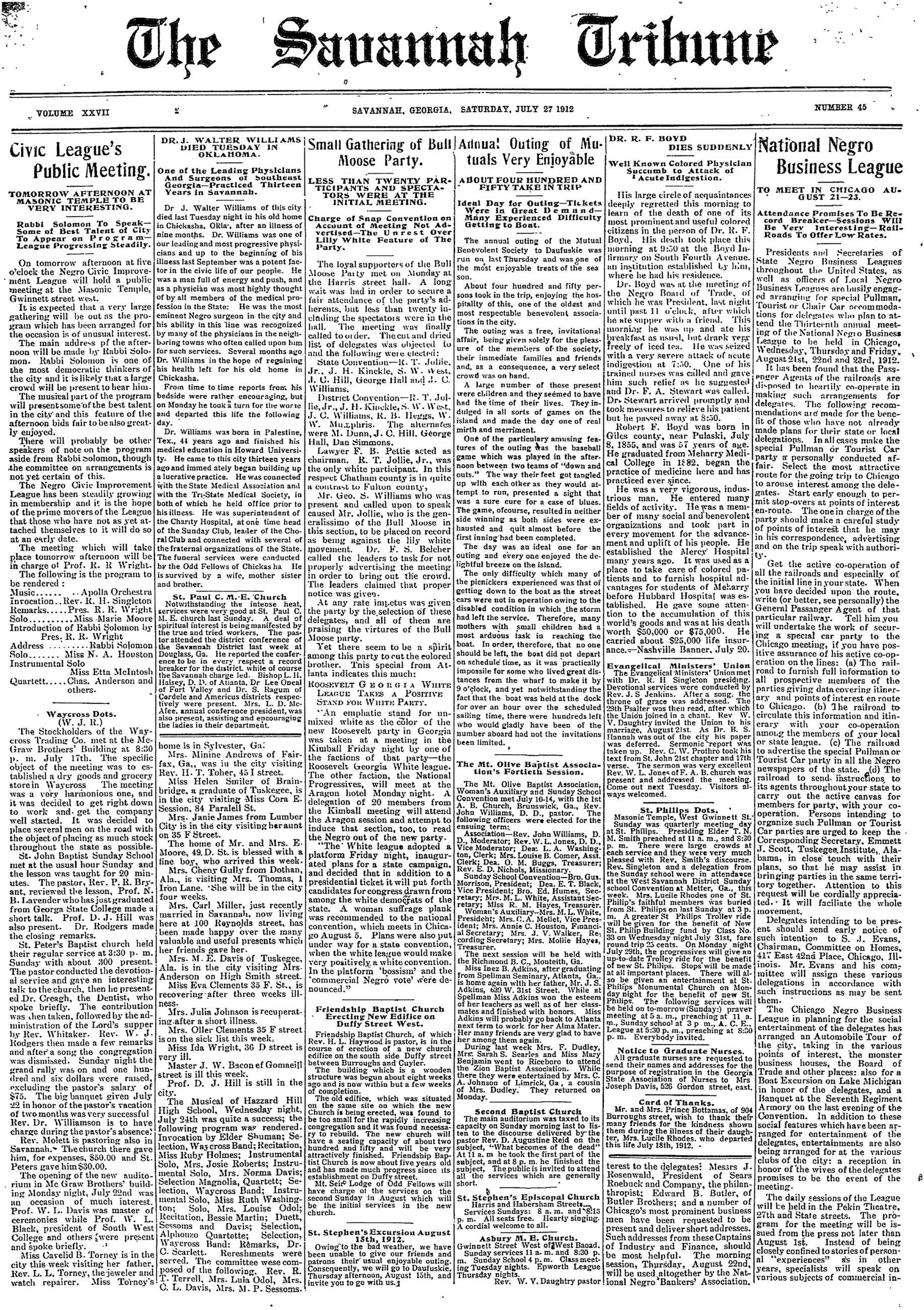

Page text (machine-generated)
The Savannah Tribune
VOLUME XXVII
Civic League's Public Meeting.
Civic League's Public Meeting.
TOMORROW AFTERNOON AT MASONIC TEMPLE TO BE VERY INTERESTING.
Rubbi Solomon To Speak—Some of Best Talent of City To Appear on Program—League Progressing Steadily.
On tomorrow afternoon at five o'clock the Negro Civic Improvement League will hold a public meeting at the Masonic Temple, Gwinnett street west.
It is expected that a very large gathering will be out as the program which has been arranged for the occasion is of unusual interest.
The main address of the afternoon will be made by Rabbi Solomon. Rabbi Solomon is one of the most democratic thinkers of the city and it is likely that a large crowd will be present to hear him. The musical part of the program will present some of the best talent in the city and this feature of the afternoon bids fair to be also greatly enjoyed. There will probably be other speakers of note on the program aside from Rabbi Solomon, though the committee on arrangements is not yet certain of this.
The Negro Civic Improvement League has been steadily growing in membership and it is the hope of the prime movers of the League that those who have not as yet attached themselves to it will do so at an early date.
The meeting which will take place tomorrow afternoon will be in charge of Prof. R. R Wright.
The following is the program to be rendered :
Music..... Apolla Orchestra
Invocation. Rev. R. H. Singleton
Remarks..... Pres. R. R. Wright
Solo..... Miss Marie Moore
Introduction of Rabbi Solomon by
Pres. R. R Wright
Address ..... Rabbi Solomon
Solo..... Miss N. A. Hovston
Instrumental Solo
Miss Etta McIntosh
Quartett..... Chas. Anderson and
others.
Waycross Dots. (W. J. R.)
The Stockholders of the Waycross Trading Co. met at the McGraw Brothers' Building at 8:30 p.m. July 17th. The specific object of the meeting was to establish a dry goods and grocery store in Waycross. The meeting was a very harmonious one, and it was decided to get right down to work and get the company well started. It was decided to place several men on the road with the object of placing as much stock throughout the state as possible.
St. John Baptist Sunday School met at the usual hour Sunday and the lesson was taught for 20 minutes. The pastor, Rev. P. R. Bryant, reviewed the lesson, Prof. N. B. Lavender who has just graduated from Georgia State College made a short talk. Prof. D. J. Hill was also present. Dr. Rodgers made the closing remarks.
St. Peter's Baptist church held their regular service at 3:30 p.m. Sunday with about 300 present. The pastor conducted the devotional service and gave an interesting talk to the church, then he presented Dr. Creagh, the Dentist, who spoke briefly. The contribution was then taken, followed by the administration of the Lord's supper by Rev. Whitaker. Rev. W. J. Rodgers then made a few remarks and after a song the congregation was dismissed. Sunday night the grand rally was on and one hundred and six dollars were raised, excluding the pastor's salary of $75. The big banquet given July 22 in honor of the pastor's vacation of two months was very successful Rev. Dr. Williamson is to have charge during the pastor's absence.
Rev. Molett is pastoring also in Savannah. The church there gave him, for expenses, $50.00 and St. Peters gave him $30.00.
The opening of the new auditorium in Mc Graw Brothers' building Monday night, July 22nd was an occasion of much interest. Prof. W. L. Davis was master of ceremonies while Prof. W. L. Black, president of South West College and others were present and spoke briefly.
Miss Cavelid B. Torney is in the city this week visiting her father. Rev. L. L. Torney, the jeweler and watch repairer. Miss Torney's
DR. J. WALTER WILLIAMS
DIED TUESDAY IN
OKLAHOMA.
One of the Leading Physicians
And Surgeons of Southeast
Georgia—Practiced Thirteen
Years in Savannah.
Dr J. Walter Williams of this city died last Tuesday night in his old home in Chickasha, Okla., after an illness of nine months. Dr. Williams was one of our leading and most progressive physicians and up to the beginning of his illness last September was a potent factor in the civic life of our people. He was a man full of energy and push, and as a physician was most highly thought of by all members of the medical profession in the State: He was the most eminent Negro surgeon in the city and his ability in this line was recognized by many of the physicians in the neighboring towns who often called upon him for such services. Several months ago Dr. Williams in the hope of regaining his health left for his old home in Chickasha.
From time to time reports from his bedside were rather encouraging, but on Monday he took a turn for the worse and departed this life the following day.
Dr. Williams was born in Palestine, Tex., 44 years ago and finished his medical education in Howard University. He came to this city thirteen years ago and immed ately began building up a lucrative practice. He was connected with the State Medical Association and with the Tri-State Medical Society, in both of which he held office prior to his illness. He was superintendent of the Charity Hospital, at one time head of the Sunday Club, leader of the Choral Club and connected with several of the fraternal organizations of the State. The funeral services were conducted by the Odd Fellows of Chickasaw ha He is survived by a wife, mother sister and brother.
St. Paul C. M.-E. Church
Notwithstanding the intense heat,
services were very good at St. Paul C.
M. e. church last Sunday. A deal of
spiritual interest is being manifested by
the true and tried workers. The pas-
tor attended the district conference of
the Savannah District last week at
Douglass, Ga. He reported the con-
ference to be in every respect a record
breaker for the district, while of course
the Savannah charge led. Bishop L. H.
Halsey, D. D. of Atlanta, Dr Lee Oneal
of Fort Valley and Dr. S. Ragum of
Cordele and Americus districts respec-
tively were present. Mrs. L. D. McAfee,
annual conference president, was
also present, assisting and encouraging
the ladies in their department.
home is in Sylvester, Ga:
Mrs. Minine Andrews of Fairfax, Ga., was in the city visiting Rey. H. T. Toher, 45 I street.
Miss Helen Smiler of Brainbridge, a graduate of Tuskegee, is in the city visiting Miss Cora E. Session, 84 Paralell St.
Mrs. Janie James from Lumber City is in the city visiting heraunt on 35 F Street.
The home of Mr. and Mrs. E-Moore, 49.D. St. is blessed with a fine boy, who arrived this week.
Mrs. Cheny Gully from Dothan, Ala., is visiting Mrs. Thomas, 1 Iron Lane. 'She will be in the city four weeks.
Mrs. Carl Miller, just recently married in Savannah, now living here at 100 Reynolds street, has been made happy over the many valuable and useful presents which her friends gave her.
Mrs. M. E. Davis of Tuskegee, Ala. is in the city visiting Mrs. Anderson on High Smith street.
Miss Eva Clements 35 F. St., is recovering after three weeks illness.
Mrs. Julia Johnson is recuperating after a short illness.
Mrs. Oller Clements 35 F street is on the sick list this week.
Miss Ida Wright, 36 D street is very ill.
Master J. W. Bacon ef Gomaeill street is ill this week.
Prof. D. J. Hill is still in the city.
The Musical of Hazzard Hill High School, Wednesday night, July 24th was quite a success; the following program was rendered. Invocation by Elder Shuman; Selection, Waycross Band; Recitation, Miss Ruby Holmes; Instrumental Solo, Mrs. Josie Roberts; Instrumental Solo, Mrs. Norma Davis; Selection Magnolia, Quartett; Selection, Waycross Band; Instrumental Solo, Miss Ruth Washington; Solo, Mrs. Louise Odol; Recitation, Bessie Martin; Duett, Sessoms and Davis; Selection, Alphonzo Quartette; Selection, Waycross Band: Rêmarks, Dr.C. Scarlett. Rereshments were served. The committee wese composed of the following. Rev. R. T. Terrell, Mrs. Lula Odol, Mrs. C. L. Davis, Mrs. M. P. Sessoms.
SAVANNAH, GEORGIA, SATURDAY, JULY 27 1912
Small Gathering of Bull Moose Party.
LESS THAN TWENTY PARTICIPANTS AND SPECTACTORS WERE AT THE INITIAL MEETING.
Charge of Snap Convention on Account of Meeting Not Advertised—The Unrest Over Lilly White Feature of The Party.
The loyal supporters of the Bull Moose Party met on Monday at the Harris street hall. A long wait was had in order to secure a fair attendance of the party's adherents, but less than twenty including the spectators were in the hall. The meeting was finally called to order. The cut and dried list of delegates was objected to and the following were elected:
State Convention—R. T. Jollie, Jr., J. H. Kinckle, S. W. West, J. C. Hill, George Hall and J. C. Williams, District Convention—R. T. Jollie, Jr., J. H. Kinckle, S. W. West, J. C. Williams, R. B. Heggs, W. W. Muxphris. The alternates were M. Dunn, J. C. Hill, George Hall, Dan Simmons. Lawyer F. B. Pettie acted as chairman, R. T. Jollie, Jr., was the only white participant. In this respect Chatham county is in quite a contrast to Fulton county,
Mr. Geo. S. Williams who was present and called upon to speak caused Mr. Jollie, who is the generalissimo of the Bull Moose in this section, to be placed on record as being against the lily white movement. Dr. F. S. Belcher called the leaders to task for not properly advertising the meeting in order to bring out the crowd. The leaders claimed that proper notice was given.
At any rate impotent was given the party by the selection of these delegates, and all of them are praising the virtues of the Bull Moose party.
Yet there seem to be a spirit among this party to cut the colored brother. This special from Atlanta indicates this much:
ROOSEVELT GEOGELA WHITE
"An emphatic stand for unmixed white as the color of the new Roosevelt party in Georgia was taken at a meeting in the Kimball Friday night by one of the factions of that party—the Roosevelt Georgia White league. The other faction, the National Progressives, will meet at the Aragon hotel Monday night. A delegation of 20 members from the Kimball meeting will attend the Aragon session and attempt to induce that section, too, to read the Negro out of the new party.
"The White league adopted a platform Friday night, inaugurated plans for a state campaign, and decided that in addition to a presidential ticket it will put forth candidates for congress drawn from among the white democrats of the state. A woman suffrage plank was recommended to the national convention, which meets in Chicago August 5. Plans were also put under way for a state convention, when the white league would make very positively a white convention. In the platform 'bossism' and the 'commercial Negro vote' were denounced."
Friendship Baptist Church
Erecting New Edifice on
Duffy Street West.
Friendship Baptist Church, of which Rev. H. L. Haywood is pastor, is in the course of erection of a new church edifice on the south side Duffy street between Burroughs and Cuyler. The building which is a wooden structure was begun about eight weeks ago and is now within but a few weeks of completion. The old edifice, which was situated on the same site on which the new Church is being erected, was found to be too small for the rapidly increasing congregation and it was found necessary to rebuild. The new church will have a seating capacity of about two hundred and fifty and will be very attractively finished. Friendship Baptist Church is now about five years old and has made much progress since its establishment on Duffy street. Mt. Seir Lodge of Odd Fellows will have charge of the services on the second Sunday in August which will be the initial services in the new church.
St. Stephen's Excursion August 15th, 1912.
Owing to the bad weather, we have been unable to give our friends and patrons their usual enjoyable outing. Consequently, we will go to Daufuskie, Thursday afternoon, August 15th, and invite you to go with us.3
Annual Outing of Mutuals Very Enjoyable
ABOUT FOUR HUNDRED AND FIFTY TAKE IN TRIP
Ideal Day for Outing—Tickets Were in Great Demand—Many Experienced Difficulty Getting to Boat.
The annual outing of the Mutual Benevolent Society to Daufuskie was run on last Thursday and was one of the most enjoyable treats of the sea son.
About four hundred and fifty persons took in the trip, enjoying the hospitality of this, one of the oldest and most respectable benevolent associations in the city.
The outing was a free, invitational affair, being given solely for the pleasure of the members of the society, their immediate families and friends and, as a consequence, a very select crowd was on hand.
A large number of those present were children and they seemed to have had the time of their lives. They indulged in all sorts of games on the island and made the day one of real mirth and merriment.
One of the particular amusing features of the outing was the baseball game which was played in the afternoon between two teams of "down and outs." The way their feet got tangled up with each other as they would attempt to run, presented a sight that was a sure cure for a case of blues.
The game, of course, resulted in neither side winning as both sides were exhausted and quit almost before the first inning had been completed.
The day was an ideal one for an outing and every one enjoyed the delightful breeze on the island.
The only difficulty which many of the picnickers experienced was that of getting down to the boat as the street cars were not in operation owing to the disabled condition in which the storm had left the service. Therefore, many mothers with small children had a most arduous task in reaching the boat. In order, therefore, that no one should be left, the boat did not depart on schedule time, as it was practically impossible for some who lived great distances from the wharf to make it by 9 o'clock, and yet notwithstanding the fact that the boat was held at the dock for over an hour over the scheduled sailing time, there were hundreds left who would gladly have been of the number aboard had not the invitations been limited.
The Mt. Olive Baptist Association's Fortieth Session.
The Mt. Olive Baptist Association, Woman's Auxiliary and Sunday School Convention met July 10-14, with the 1st A. B. Church, Brunswick, Ga., Rev. John Williams, D. D., pastor. The following officers were elected for the ensuing term; Association—Rev. John Williams, D. D., Moderator; Rev. W. L. Jones, D. D., Vice Moderator; Dea. L. A. Washington, Clerk; Mrs. Louise B. Comer, Asst. Clerk; Dea. O. M. Buggs, Treasurer; Rev. E. D. Missionary.
Sunday School Convention-Bro. Gus
Morrison, President; Dea. E. T. Black,
Vice President; Bro. Ed. Humes, Secre-
tary; Mrs. M. L. White, Assistant Secre-
tary; Miss R. M. Hayes, Treasurer.
Woman's Auxiliary-Mrs. M. L. White,
President; Mrs. C. A. Mellet, Vice
President; Mrs. Annie C. Houston, Financial
Secretary; Mrs. J. V. Walker, Recording
Secretary; Mrs. Mollie Hayes,
Treasurer.
The next session will be held with the Richmond B. G. Monteith, Ga.
Miss Inez B. Adkins, after graduating from Spellman Seminary, Atlanta, Ga. is home again with her father, Mr. J. S. Adkins, 630 W. 31st Street. While at Spellman W. Adkins won the esteem of her teachers as well as of her classmates and finished with honors. Miss Adkins will probably go back to Atlanta next term to work for her Alma Mater. Her many friends are very glad to have her among them again.
During last week Mrs. F. Dudley, Mrs. Sarah S. Searles and Miss Mary Benjamin to riceboro to attend the Zion Baptist Association. While there they were entertained by Mrs. C. A. Johnson of Limrick, Ga, a cousin of Mrs. Dudley. They returned on Monday.
Second Baptist Church
The main auditorium was taxed to its capacity on Sunday morning last to listen to the discount delivered by the pastor Rev. D. Augustine Reid on the subject, "What becomes of the dead" At 11 a.m. he took the first part of the subject, and at 8 p.m. he finished the subject. The public is invited to attend all the services which are generally short.
St. Stephen's Episcopal Church
Harris and Habersham Streets.
Services Sundays: 8 a.m. and 8:15 p.m. All seats free. Hearty singing. A cordial welcome to all.
Asbury M. H. Church.
Gwinnett Street West of West Baoad.
Sunday services 11 a.m. and 8:30 p.m. Sunday School 4 p.m. Class meeting Tuesday nights. Epworth League Thursday nights.
Rey. W. V. Daughtry pastor
DR. R. F. BOYD
DIES SUDDENLY
Well Known Colored Physician
Succumb to Attack of
1 Acute Indigestion.
His large circle of acquaintances
deeply regretted this morning to
learn of the death of one of its
most prominent and useful colored
citizens in the person of Dr. R. F.
Boyd. His death took place this
morning at 9:50 at the Boyd Infirmary on South Fourth Avenue.
an institution established by him,
where he had his residence.
Dr. Boyd was at the meeting of the Negro Board of Trade, of which he was President, last night until past 11 o'clock, after which he ate supper with a friend. This morning he was up and ate his breakfast as usual, but drank very freely of ice tea. He was seized with a very severe attack of acute indigestion at 7:50. One of his trained nurses was called and gave him such relief as he suggested and Dr. F. A. Stewart was called. Dr. Stewart arrived promptly and took measures to relieve his patient but he passed away at 8:50.
Robert F. Boyd was born in Giles county, near Pulaski, July 8, 1855, and was 57 years of age. He graduated from Mehary Medical College in 1882, began the practice of medicine here and has practiced ever since.
He was a very vigorous, industrious man. He entered many fields of activity. He was a member of many social and benevolent organizations and took part in every movement for the advancement and uplift of his people. He established the Mercy Hospital many years ago. It was used as a place to take care of colored patients and to furnish hospital advantages for students of Meharry before Hubbard Hospital was established. He gave some attention to the accumulation of this world's goods and was at his death worth $50,000 or $75,000. He carried about $25,000 life insurance.—Nashville Banner, July 20.
Evangelical Ministers' Union
The Evangelical Ministers' Union met with Dr. R. H Singleton presiding. Devotional services were conducted by Rev. J. S Jenkins. After a song, the throne of grace was addressed. The 29th Psalter was then read, after which the Union joined in a chant. Rev W. W. Daughtry invited the Union to his marriage, August 21st. As Dr. B. S. Hannah was out of the city his paper was deferred. Sermonic report was taken up. Rev. C. W. Prothro took his text from St. John 21st chapter and 17th verse. The sermon was very excellent Rev W. L. Jones of F. A. B. church was present and addressed the meeting. Come out next Tuesday. Visitors always welcomed.
St. Phillies Dots.
St. Philips Dots.
Masonic Temple, West Gwinnett St.
Sunday was quarterly meeting day at St. Philips. Presiding Elder T. M. Smith preached at 11 a. m., and 8:30 p. m. There were large crowds at adservership and mpleasured with Rev. Smith's discourses. Rev. Singleton and a delegation from the Sunday school were in attendance at the West Savannah District Sunday school Convention at Metter, Ga., this week. Mrs. Lucile Rhodes one of St. Philips faithful members was buried from St. Philips on last Sunday at 3 p. m. A greater St. Philips Trolley ride will be given for the benefit of New St. Philips Building fund by Class No. 33 on Wednesday night July 31st, fare round trip 25 cents. On Monday night July 29th, the progressives will give an up-to-date Trolley ride for the benefit of new St. Philips. Stops will be made at all important places. There will also be given an entertainment at St. Philips Monumental Church on Monday night for the benefit of new St. Philips. The following services will be held on to-morrow (Sunday): prayer meeting at 5 a. m., preaching at 11 a. m., Sunday school at 3 p. m. A. C. E. League at 5:30 p. m., preaching at 8:30 p. m. Everybody invited.
Notice to Graduate Nurses.
All graduate nurses are requested to send their names and addresses for the purpose of registration in the Georgia State Association of Nurses to Mrs Joseph Davis, 526 Gordon street, east.
Card of Thanks.
Mr. and Mrs. Prince Bottamas, of 904 Burroughs street, wish to thank their many friends for the kindness shown them during the illness of their daughter, Mrs. Lucile Rhodes, who departed this life July 18th, 1912.
terest to the delegates! Messrs J. Rosenwald, President of Sears Roebuck and Company, the philanthropist; Edward B. Butler, of Butler Brothers; and a number of Chicago's most prominent business men have been requested to be present and deliver short addresses. Such addresses from these Captains of Industry and Finance, should be most helpful. The morning session, Thursday, August 22nd, will be used altogether by the National Negro' Bankers' Association.
National Negro Business League
TO MEET IN CHICAGO AUGUST 21-23.
Attendance Promises To Be Record Brenaker—Sessions Will Be Very Interesting—Rail-Roads To Offer Low Rates.
Presidents and Secretaries of State Negro Business Leagues throughout the United States, as well as officers of Local Negro Business Leagues are busily engaged arranging for special Pullman, Tourist or Chair Car accommodations for delegates who plan to attend the Thirteenth annual meeting of the National Negro Business League to be held in Chicago, Wednesday, Thursday and Friday, August 21st. 22nd and 23rd, 1919.
It has been found that the Passenger Agents of the railroads are disposed to heartily co-operate in making such arrangements for delegates. The following recommendations are made for the benefit of those who have not already made plans for their state or local delegations. In all cases make the special Pullman or Tourist Car party a personally conducted affair. Select the most attractive route for the going trip to Chicago to arouse interest among the delegates. Start early enough to permit stop-overs at points of interest en-route. The one in charge of the party should make a careful study of points of interest that he may in his correspondence, advertising and on the trip speak with authority.
Get the active co-operation of all the railroads and especially of the initial line in your state. When you have decided upon the route, write (or better, see personally) the General Passanger Agent of that particular railway. Tell him you will undertake the work of securing a special car party to the Chicago meeting, if you have positive assurance of his active co-operation on the lines: (a) The railroad to furnish full information to all prospective members of the parties giving data covering itinerary and points of interest en route to Chicago. (b) The railroad to circulate this information and itinerary with your co-operation among the members of your local or state league. (c) The railroad to advertise the special Pullman or Tourist Car party in all the Negro newspapers of the state. (d) The railroad to send instructions to its agents throughout your state to carry out the active canvas for members for party, with your cooperation. Persons intending to organize such Pullman or Tourist Car parties are urged to keep the Corresponding Secretary. Emmett J. Scott, Tuskegee Institute, Alabama, in close touch with their plans, so that he may assist in bringing parties in the same territory together. Attention to this request will be cordially appreciated. It will facilitate the whole movement.
Delegates intending to be present should send early notice of such intention to S. J. Evans, Chairman, Committee on Homes, 417 East 42nd Place, Chicago, Illinois. Mr. Evans and his committee will assign these various delegations in accordance with such instructions as may be sent them.
The Chicago Negro Business League in planning for the social entertainment of the delegates has arranged an Automobile Tour of the city, taking in the various points of interest, the monster business houses, the Board of Trade and other places: also for a Boat Excursion on Lake Michigan in honor of the delegates, and a Banquet at the Seventh Regiment Armory on the last evening of the Convention. In addition to these social features which have been arranged for entertainment of the delegates, entertainments are also being arranged for at the various clubs of the city: a reception in honor of the wives of the delegates promises to be the event of the meeting.
The daily sessions of the League will be held in the Pekin Theatre, 27th and State streets. The program for the meeting will be issued from the press not later than August 1st. Instead of being closely confined to stories of personal "experiences" as in other years, specialists will speak on various subjects of commercial in-
Our Father's Teraphim
A Sermon
And Rachel stole the teraphim that were her father's.—Genesis, 31:19.
In her sudden flight Rachel had stolen her father's terapim, images, or gods. The act was in itself dishonest and necessitated falsehood and deception to conceal it. And yet we must recognize, though the end sought for never justifies the use of unlawful means, that the theft proceeded from a laudable desire. It might be said that her craftiness induced her to deprive her father of this important aid in divining the fugitives' whereabouts and effecting a successful pursuit. Her cupidity may have suggested that through the possession of her father's images she might secure the accompanying prosperity. But along with and over and above such base motives must have been the thought that in the new home in the strange land to which she was going there might be the need of something to keep her in touch with the old religious life—some outward and visible sign or symbol of the god or gods she had worshiped and served. After all she was but half heathen, saturated with superstition, and these terapim were the very signs and symbols of her spiritual life and the means of strength and guidance, and she longed to possess them.
Our heavenly father, it is true, seeketh such as will worship him in spirit and in truth. Not in Jerusalem nor in Gerazim is God to be worshiped, but is to be found of all who seek him. He dwelteth not in temples made with hands, but in the believer's heart. Sacraments are but means of grace. Signs and symbols are only valuable and helpful because of what they represent. But so long as man is man there will be the need for these outward and visible forms of the deeper spiritual verities. We are so constituted that we will, until this mortal puts on immortality, need our houses of God, our sacraments and other means of grace. Rites and ceremonies, signs and symbols will ever have their place in the religious life of man. These things mean much to us and we do well to value them highly.
When James I. of England sought the hand of the infanta of Spain for his son Charles, being of different households of faith, the consent of the pope was refused until satisfactory assurance was given that she would be allowed to worship God according to the customs of her fathers—that she be permitted to carry with her priest, altar, mass and all that represented and made up her religious life. The puritan feeing to the land of liberty carried with him his open Bible and distinctive religious beliefs and is today usually portrayed with that Bible under his arm or the psalter in his hand. In the days of the commonwealth, when the Puritan was in the ascendancy, the churchman was proscribed and forced into hiding. But he carried with him his prayer book and, forbidden though it was, worshiped God according to its formularies. Men do not lightly forsake their beliefs and traditions and we are what we are largely because we have inherited "our fathers' gods." Church and sacraments, rites and ceremonies, signs and symbols, creeds and confessions of faith, all have a part, and a very large one, in our religious life, and for all they represent to us, for the help they impart, for the love we bear them and the veneration we feel for them, we do well to take with us through life these our fathers' teraphim. It may be possible for one to become so spiritual, so superior to the material that no need is felt for ritual or ceremonial to appeal to the eye or ear. But most of us need these teraphim—outward and visible agencies through which we both learn of God and receive strength from him.
The ministry of the old church in the new land, the familiar sights and sounds of ritual and ceremonial have saved many an immigrant from the homelessness which was proving well-nigh unendurable. Though far from home and surrounded by strangers, he is not alone—he has found his household of faith, he has not left his father's God behind. The developer of real estate recognizes this desire to carry one's religious life to the new home and offers favorable terms to the congregation seeking a site for a church building, while the homeseeker looks favorably upon the development which offers him a spiritual home after the manner of his fathers.
During these summer months, when thousands seeking pleasure and rest for mind and body will turn to the mountains, the seashore or country, how many will carry their teraphy to these temporary homes? Will the nearness to church be taken into consideration in the making of plans? Is it not true that many leave behind the accustomed aids to their religious life and neglect the outward manifestations of the faith that is within them? The Bible is forgotten, or if taken is left in the trunk. All devotional reading is neglected. Diversions are many, and the ordinary routine of life is changed. Consequently family prayers are practically impossible, but the individual morning prayers are omitted or hurried through. And we make no secret of the fact that we desire a "rest" from the accustomed spiritual life. Attendance upon divine
service, a pleasure and means of grace at home, becomes a "duty" when on a vacation, and we have promised ourselves that during our holiday we shall be free to do only what we desire.
And more than that, we are away from home seeking recreation, amusement and diversion—the old manner of life is laid aside and many things are done and left undone at variance with our accustomed habits. "No one will notice it." "I am only a stranger here and my actions can influence no one." The professional man can lay aside all thought of client or patient and after a month or two return to his work the better for the rest, but it is not so with religion. "There is no discharge in that war." It is always "watch and fight and pray." The Christian is always on duty. Failure to attend church, the neglect of prayer and the various means of grace, the doing of things inexpedient (even if not unlawful), the lowering of the standard even for a few weeks, must prove harmful to the best of us. The vacation will prove as helpful; we will derive as much real enjoyment if we carry our teraphim with us and give ah hour for church on Sunday, a few minutes daily for our devotions, make some effort to help others, and always strive to remember that our religious life should be as real away from as at home.
It is the experience of many a country minister that "summer boarders" are frequently a positive injury to church work. Many will not attend service (they are in the country for a "rest"), and meeting their needs and demands make it impossible for their hosts to do so. So it is with many summer residents in country or suburbs. Though regular attendants at church the rest of the year, though zealous in good works at other times, late rising, Sunday guests, amusements of various kinds effectually prevent church-going, and the country church, the chapel in mountain or by the seashore lose the help and stimulus that could be given and also suffer positive injury from the example of indifference to things spiritual. The manner of life of the men and women who stand high in the professional, literary or social world at home is noted and commented upon and has an influence far beyond what is realized. The habit of imitation is great, footsteps are being followed, although the one who made them hears not nor sees those behind. We do not need to take our teraphy with us on our vacations to enable us to so live that while seeking rest and health for mind and body we do not injure or weaken our own souls nor cast stumbling blocks in the pathway of others.—Edward T. Helfenstein, Rector St. John's Church, Howard county, Maryland.
SOME PROGRESS OF THE
& RACE SINCE FREEDOM
Forty-seven years ago the colored people of Texas received news of their emancipation. At that time they hardly possessed their own clothes to wear. Today in Texas the colored people's holdings represent in value close to thirty millions of dollars. Forty-seven years ago there were hardly 5,000 colored people in Texas; today their population is over 800,000 (eight hundred thousand), having nearly 200,000 children of scholastic age, twenty institutions of learning, representing a value of about two millions of dollars, with a total yearly attendance of over 6,000. Over two-thirds of the colored people in Texas live in the country, where the farms are productive. Nearly 100,000 farms are owned by colored people in Texas, with a value of over eighteen million dollars. Colored labor is also a great factor in the state's progress, from the Red river to the gulf and from the Sabine to the Rio Grande.
The above are some things for which the race in Texas should feel proud of on the nineteenth of June; and it is to be hoped that all over this state the celebration be elevated to the occasion. In the whole United States the race has grown from four millions of people to tens of millions, representing a total wealth of nearly one billion dollars. In Galveston the population is close to 9,000, the total wealth being estimated now at over $600,000. There are about 100 colored people engaged in various business enterprises, etc., representing about $75,000 in investment. Over 200 homes owned in Galveston, three public schools and one Catholic school. Close to 2,000 colored men work on the Galveston wharf front during the busy season.
RICHEST SODA DEPOSITS.
Soda lake, situated at Magadi, British East Africa, is one of the richest soda deposits in the world, covering an area of more than 18 square miles and containing a quantity of soda estimated at 200,000,000 tons. As fast as the blocks of soda are removed from the surface the places fill again, and the natives claim that it is possible to work continually the same position for several consecutive years. With the primitive tools at hand the lake has been sounded to a depth of about nine feet and nothing but crystallized soda found. It is said that an English company with a capital of £1,600,000 will begin to exploit the deposit as soon as the Uganda railway reaches the district.
HERRINGS AS FERTILIZER JAPAN.
In Japan about 4,000,000 tons of herrings are caught every year. This enormous quantity is not by any means entirely used for human consumption. In fact, about four-fifths of the entire quantity is used as organic fertilizer for the rice fields.
PRACTICAL WORK AT TUSKEGEE HAS TREMENOUS INFLUENCE IN THE SOUTHERN STATES.
PRACTICAL WORK AT TUSKEGEE HAS TREMENOUS INFLUENCE IN THE SOUTHERN STATES.
By ARTHUR M. EVANS.
Tuskegee, Ala.-Macon county affords a tangible illustration of the way Tuskegee is constantly expanding its zone of influence. For years the work of the institute has reached far beyond the school grounds, each year bringing new ramifications, until today Tuskegee is conducting an extension work of twenty-six varieties that has two general alms—to change public opinion and direct attention to lines of industry that offer most opportunities for the colored people of the south and to educate the people in better methods of farming and so induce the children of negro farmers to remain on the soil.
An idea of the scope of this work may best be given by a list of the extension activities, with the dates of establishment:
1884—Teacher's Institute.
1891—Annual Tuskegee negro conference.
1892—The Hospital, Greenwood Village.
1893—The ministers' night school.
1894—Tuskegee town mothers' meeting.
1895—Building and loan association.
1896—The town night school.
1897—The town library and reading room; town cooking class; Russell plantation work; Farmers' Institute; mothers' clubs.
1898—The county fair; the town Y. M. C. A.; the town Sunday school.
1900—The National Negro Business League.
1901—New hospital building—treatment of outside patients becomes a regular feature at Tuskegee.
1902—Village Improvement association.
1904—The jail work; the farmers' short course; rural school improvement.
1905—The weekly farm paper; the Ministers' Institute; the circulating library.
1906—The Jesup agricultural wagon—an agricultural school on wheels.
1907—Farmers' co-operative demonstration work.
Macon county, in which Tuskegee is located, is one of the most prosperous and law-abiding in the south. It contains about 100 square miles and has a population of about 26,000, of which about 24,000 are negroes. It is constantly growing, due to the attractions afforded by its schools and by the assistance in farming methods given by Tuskegee Institute. The influence of the school is seen everywhere, particularly in the well-to-do condition of the negro farmers. Macon county is said to have a larger area of land held by negroes than any other county in the south. In 1910 negroes owned 61,689 acres in Macon. In Liberty county, Georgia, the next largest in negro land holdings, the area was 55,048, while in Louisa county, Virginia, the third county in this respect, the colored population owned 53,268 acres.
In Macon county there is no race problem—the negro population, through the industrial education of Tuskegee, has become self-reliant. The county has fifty-seven colored public schools, of which forty-seven have been built through the old and assistance of Tuskegee Institute, and the negro patrons have paid for buildings and equipment $15,065, an unusual amount for one county in the south.
The colored rural schools of the county are of a unique type and they demonstrate the intensely practical nature of Tuskegee methods, which are based on the idea that any education that cannot be put to practical use is not the real thing. The school at "Rising Star" is an example of the new type of school. It consists of a five-room frame house, in which the teachers—a· Tuskegee graduate and his, wife—not only teach but live. All the rooms are used by the school children. In the kitchen they are taught to cook; in the dining room, to serve a meal; in the bedroom, how to make the beds. In the garden they are taught how to raise vegetables, to raise poultry, to rear pigs and cows. They recite in the sitting room or on the veranda, and their lessons all deal with matters of their own every-day life. Little problems in arithmetic are given local color; lessons in English are given a familiar atmosphere. Instead of figuring how long it would take an express train to reach the moon if it traveled at the rate of forty miles an hour, the pupils figure out how much corn can be raised on Neighbor Smith's patch of land and how much Farmer Jones' plg will bring when slaughtered.
The pupils learn neatness and cleanliness by living in a decent home during their school hours. They carry the lesson home, and the result is seen in cleaner and better farmhouses. The model schoolhouse has become the pattern on which the farmers and their wives are improving their homes. There are some fifty such schools in the county, and each is a center from which radiate the Tuskegee ideas. Among the negroes the church is the most potent organization, and Booker Washington has taken advantage of this fact by influencing nearly every church community in Macon county to become a modern school community.
In various ways the school is teaching the farmers to increase the productivity of their lands, the principle underlying the system identical with the one that is the basis of Tuskegee's labors—learning and teaching by doing and seeing. The annual negro conference was started eighteen years
ago, when Mr. Washington sent out invitations to about seventy-five representative negroes in Macon county, farmers, mechanics, school teachers and ministers. Instead of seventy-five, about 400, most of them farmers, responded to the invitation, and the conference met with such success that it was made an annual feture, negro farmers from all parts of the south attending. The school employs a conference agent, who organizes local conferences in all parts of the state. The growth of this work is seen in the fact that 105 of these branch organizations have been established. Eight years ago a short course in agriculture was started with a view of giving farmers in the neighboring territory the advantage of two weeks' study of the work at the school farm. The first year there were eleven students, most of them older men; in 1911 there were 1,900, about 1,000 of them being young men and women.
A year after the short course had been established the school launched a movement to take agricultural education to the farmers by means of a school on wheels, the Jesup agricultural wagon. The practical demonstrations, given right on the farms by the men in charge of the wagons has been of great value in raising the standard of farming in Macon county. In 1907 the demonstration farming experiment, a work carried on by the department of agriculture at Washington, was started. Under this plan a number of farmers in a county farm a small portion of their land under the direction of the department, using seed furnished by the department. Of the six negro demonstration agents in Alabama, four were trained at Tuskegee, as was also the district agent who has charge of the work among the negroes in Alabama, Mississippi, Oklahoma and Louisiana.
An idea of what the demonstration agents have done for the negro farmer may be seen from the fact, that in 1909 the average yield of, corn per acre for negro farmers was less than eight bushels. Last year negro demonstration farmers in Macon county grew an average of 54 bushels to the acre. In 1911 the average yield of cotton in Alabama was about 600 pounds per acre. The highest average yield made on farms managed under a negro demonstration agent was in Lee county, where an average of 1,876 pounds of cotton to the acre was raised. This was more than 1,200 pounds per acre in excess of what was grown on the average farm of the state.
The last census figures gave an indication of how the influence of Tuskegee ramifies beyond the school gates. The census showed that while the counties in the black belt were losing in population, Macon had made an increase of more than 10 per cent. New negro families are continually coming into Macon—in five years 50 families bought $49,000 worth of land, in 1910 negro farmers in the county bought 1,450 acres at a cost of $21,335, an indication of the prosperity. Macon county today is not only prosperous, but it has so little crime that the sheriff complains of enforced idleness; it has no mob violence, no race problem; the white population co-operates with Tuskegee and with the negro farmers in the development of agricultural methods, and the county is regarded as a model. The movement of the southern negro to the soil is evidenced in the fact that in the last ten years the colored people have bought 4,000 additional farms in Virginia, 4,000 in Tennessee, 16,000 in Arkansas, 35,000 in Mississippi and 45,000 in Georgia.
No article on Tuskegee would be complete that did not mention the music at the school, the wonderful singing in the chapel, in which the student body is led by a choir of 150 voices, a pipe organ, a piano and an orchestra of 25 pieces. Special effort is made to preserve the old negro hymns and plantation melodies, orchestrations for which have been made with great skill by the bandmaster, Capt. N. C. Smith, who for nearly 20 years was leader of the Eighth Regiment band in Chicago. Forty-seven students are in the band, which furnishes music for all occasions, and the surprising phrase of the playing is the manner in which the students render classic music from the great operas. The leader drills the players in the story of the opera, telling them what every musical phrase means, before rehearsals are started, and with this as an inspiration the Tuskegee band plays almost as if it were composed of virtuos.
MASCOT JEWELRY.
She who has money to afford novelties should go in for mascot jewelry. Never has it been more fascinating. Even if you are not superstitious you are not above a luck charm of some sort.
A safety pin brooch, with a stone in the center, has attached to it by a thin, short chain a lucky tortoise in gold or enamel. The mascot can be further enhanced by using one's birth stone.
Another mascot is a charm in the sign of the zodiac for your birth month. These come in gold or silver or may be studded with your birth stone.
Another mascot is a charm in the sign of the zodiac for your birth month. These come in gold or silver or may be studded with your birth stone.
Another bracelet of gold or silver wire-can have attached to it various lucky charms, as the lucky finger in ivory, a luck penny, a tiny rabbit's foot and horseshoe, and a minute blue bird for happiness as well as safety.
The Sunday School Lesson
SUNDAY SCHOOL LESSON FOR
JULY 28, 1912.
THE WHEAT AND THE TARES.
Golden Text—Gather ye together
first the tares and bind them in bundles to burn them; but gather the
wheat into my barn. Matt. 13: 30.
Lesson Text—Matt. 13:24-30, 36-43.
Commit vs. 37-39.
Time—Autumn A. D. 28. Place—
By the Sea of Galllee, near Capernaum.
Exposition—I. Two Sowers, 24, 25. Here, as in the preceding parable, Jesus appears as a sow of good seed; but in the preceding parable "the seed is the Word of God"; in this parable "the good seed are the sons of the kingdom" (v. 38). But the sons of the kingdom are themselves the product of the Word of God (Jas. 1:18; I Pe. 1:23); so there is a close connection between the two parables and the two sowings. It is by sowing "the Word of God" that the Son of man sows "sons of the kingdom." There are in this world "sons of the kingdom" only because Jesus has sown them. The world is "His field." He has purchased it by His blood; the devil has forfeited it by his unfailfulness, but the devil does not like to relinquish the world of which he was once the prince (Jno. 12: 31). But the world belongs to Christ, "the sons of the evil one" are sown in it, and when the harvest comes they will be gathered out and sent to their own place. There is deep significance in two words in v. 25, "his enemy." The devil is our enemy, but he is primarily Christ's enemy. There is no one whom he hates as he hates the Son of God. Christ receives what the devil aspired to, the worship of the universe (Heb. 1: 6; Rev. 5: 11-13; comp. Matt. 4: 9; Ez. 28: 16, 17). The devil seeks to caricature and thwart Christ's work at every step. Christ sows good seed in His field, the devil will be stealth and sowes tares. The parable brings out very clearly the personality of the devil, the certainty of his existence, the malignity of his heart, the activity of his movements, the cunning of his operations, the subtlety of his methods. If there is not a personal devil, the enemy of Christ, this parable is meaningless. There is absolutely no necessity in the drapery of the parable t. bring him in. He is in the parable because he exists in fact. The tares in the world are his work. Christ sows "sons of the kingdom" by sowing good seed, "the Word of God"; the devil sows "sons of the evil one" by sowing bad seed, doubts and questions and error (Gen. 3: 1, 4; 2 Thess. 2: 9, 10). The devil did his work "while men slept." He always acts under cover and while men are off guard. He does much of his work today while Christians and ministers are dozing. He brings in the subtleties of disguised infidelity ("higher criticism," etc.) and masked pantheism ("Christian Science," etc.) while we are nodding, and some day we wake up to find the "tares" springing up everywhere among the wheat. When the devil had done his work he "went away." He got out of sight. He always does. He even stirs up some to argue that "there isn't any devil anyway."
II. Two Crops Growing Together, 26-29—There are just two classes of men: "Sons of the kingdom," or "children of God," and "sons of the evil one" (v. 38 R. V.), or "children of the devil" (I Jno 3: 10). The two classes are not always distinguishable or separable at the outset (vs. 29, 30), but they will be distinguished and separated when they are ripe, the one for heaven and the other for hell. But it will fortunately be the angels and not men who do the separating (v. 41). History furnishes countless instances of the devil's sowing tares among Christ's wheat (e. g., Jno. 13: 2; Acts 5: 3; 20: 29). Both history and the Word of God warn us against deciding that all that appears "among the wheat" must itself be wheat. While the tares were not distinguishable from the wheat until they began to grow, they were tares from the very first. There were those who wished to root up the tares at once, but the time was not ripe, nor were they competent to d- the task. There are those who in hustle long, to extirpate "the sons of the evil one" at once from the world, but the Master says, "Let them both grow together until the harvest." Premature separation, by religious persecution, would mean to tare as well as destruction to tares. This parable does not forbid church discipline. "The field is"—not the church, but "the world" (v. 38). Church discipline is positively commanded in the Bible (1 Cor. 5:3-5; 2 Ro. 16: 17; 2 Thess. 3: 6, 14). In the delay in separating the chaff from the wheat, we have another illustration of God's long suffering (cf. 2 Peter 3: 9). III. Two Harvests, 30, 35, 36-41. Separation comes at last. It is "in the end of the age" (v. 39 R. V., Marz) "The reapers are the angels." They are to be the ministers of God's boundless grace towards "the sons of the kingdom" and the executioners of His wrath towards "the sons of the evil one." The tares are to be "gathered" and the wheat is to be "gathered," but the one for burning in "the furnace of fire," where there is incomsolable grief and impotent rage (v. 42), the other into God's storehouse, "the kingdom of their Father," where
"they shall shine forth as the sun."
Is the fire literal? It is in the interpretation of the parable as well as in the parable itself. Evil is not to gradually disappear from the world, but to grow side by side with the wheat "until the harvest."
Leading Questions—What does this lesson teach about Jesus Christ? The devil? Angels? The destiny of the righteous? The wicked? What is the best lesson?
POETRY
of and by Our People
If we could know
Which of us, darling, would be first to go;
Who would be first to breast the swelling tide
And step alone upon the other side—
If we could; know!
If it were you
Should I walk softly, keeping death in view?
Should I my love to you more oft express?
Or should I grieve you, darling, any less—
If it were you?
If it were I
Should I improve the moments slipping by?
Should I more closely follow God's great plan.
Be filled with sweeter charity to man—
If it were I?
If we could know!
We cannot, darling, and 'tis better so,
I should forget; just as I do today.
And walk along the same old stumbling
If I could know.
I would not know
Which of us, darling, will be first to go.
I only wish the space may not be long
Between the parting and the greeting
long.
But when or where or how we're called
to go—
I would not know.
—Every Saturday.
The sweetest thoughts of Jesus
Come stealing o'er my soul.
Both in the midnight watches
And when the sun doth roll;
They lead me down the ages,
By storm-tossed Galllee.
And I see Time's greatest Teacher
As he walks beside the sea.
I see the throngs before him
Hang breathless upon his word;
For never truths so golden
Before on earth were heard;
I see the world's dark sorrows
Feeling before his face,
And sodden. sin-cursed people
Are healed and saved by grace.
O wondrous, living Presence,
Forever by my side;
I love thy promise,
"With thee I'll ever abide.
And to thy fond remembrance
These things I'll bring again.
How I have wrought and suffered
To save the race of men!"
O blessed Holy Spirit,
Though dark waves round me roll,
I feel thine inward presence
In chambers of my soul;
And always I am ready,
Earth dawn to lay
For just that sweet abliding
For ever and a day!
-Douglas Dobblins.
SOLITUDE.
Laugh and the world laughs with you. Weep and you weep alone. For sad old earth must borrow its mirth It has troubles enough of its own. Sing and the hills will answer; Sigh and it's lost on the air The echoes rebound to joyful sound, But shirk from voicing care.
Rejoice and men will seek your; Grieve and they turn and go. They want full measure of all your pleasure. But they do not want your woe. Be glad and your friends are many: Be sad and you lose them all There is none to decline your nectared wine. But alone you must drink the gall.
Forest and your halls are crowded; Fast and the world goes by. Success and give and it helps you to live. But no man can help you to die. There is room in the halls of pleasure For a large and lordly train, But one by one we must all file on Through the narrow slates of pain.
—Ella Wheeler Wilcox.
DAWN.
Into the darkness comes the day.
But not with sudden burst of splendor;
The shadows are slowly driven away
By torches of light that are faint and
tender;
At first just a flush on the eastern sky—
The perfect day cometh by and by.
So to soul-darkness comes the day:
The shadows of doubt and uncertainty
linger.
But slowly and surely they pass away
Under the touch of faith's gentle finger.
O, walk with hope in the light thou hast—
To the perfect day thou shalt come at
last —E\change.
RIPENING CHEESE BY ELEC-
TRICITY.
One of the most recent applications of electricity which has come to our notice is that for ripening cheese, says the Scientific American. The use of electricity for maturing various articles of consumption, such as wines and alcoholic liquors, is not new, but Mr. Gokkes' method of applying an alternating current of two amperes and 10,000 volts for the purpose of ripening cheese appears to be so. The treatment, as described in Cosos, is continued for 24 hours, and is said to effect in this short time a complete ripening of the cheese.
TEMPERATURE OF THE EARTH.
The temperature increases about 1 degree for every 60 feet as we penetrate into the interior of the earth.
FASHION NOTES.
A striking gown just exhibited is. of silver-gray satin charmeuse. It has a beautiful overdress of ninon in Chelsea-china green edged with a flat ruche of green silk shot with lavender. The yoke and sleeves are of perfectly plain seamless gray satin, Round the body, beneath the green ninon, is a corselet, shaped like medieval armor, of silk arranged in equal stripes of black and white. This is extremely effective. The yoke and sleeves are finished with frills of gray net edged with a narrow band of green. A gray straw hat accompanied the dress. It was in a becoming turned-up shape rather of the Cavalier period, and was lined with plaited green and lavender shot silk with a plain border, which gives almost the effect of a different shade.
Black lace was never so fashionable as at present, and, combined with black satin chiffon, makes up most charmingly. The present fashion of putting white net or lace under the black is much more becoming than the all black, and is very cleverly done, because it is not necessary to have it excepting about the neck or in the sleeves, thus making it more practical, if the economy point of view is being considered. Black chiffon over white lace is one of the favorite trimmings for the black gown. An afternoon grown that can also do duty for theater the yoke and collar are taken out has sleeves, and the upper part of the waist of white lace covered with black. This, as can easily be understood, is becoming, and so new that an old gown can be quite remodeled if trimmed according to this style. Another new and effective trimming this season is the blas band of soft satin or chiffon on the hemstitched edge of the plain chiffon. At one time this was relegated to mourning, but it has proved so becoming that it has been taken as trimming for every gown, with the difference that when not intended for mourning the chiffon is put over white lace instead of over white chiffon. It is very interesting to notice how some little touch like this will change the gown entirely
The reversible satin wraps are stunning with their effective color contrasts, and these wraps, though less elaborate in trimming than the taffetta models, have a dignity and grace that commend them to conservative women. Black satin, with a reverse of gold, makes a very handsome wrap of this sort which may be worn through the street over a bridge gown in the afternoon. If the occasion requires, as well as serving as a correct evening wrap. These reversible satin wraps are usually black on the outer side, with cerise, maize, chamols, hyacinth, or emerald as a lining color; and the wrap is draped so that the gay color on the reverse side shows in turned-back revers and at the lower edge as the draped or cutaway front of the wrap falls into graceful folds at every movement of the wearer.
Brocaded silks and crapes are much used for evening wraps by the French costumers this summer, one leader especially favoring this soft, brocaded stuff for his wonderful draped wraps. Tille, a golden mustard shade, peacock blue and dregs of wine are the favored colorings for such wraps, and the long lines, straight at the back from neck to heel and much draped up in front, are exceedingly graceful. The ratine weaves are also liked; and a khaki-colored ratine weave trimmed with black satin makes a most effective wrap.
A wide range of colors is in vogue just now, to suit diverse tastes. Violet and pink alone and combined, blue gray in the same way, light charming greens, deep pinks for evening wear, any amount of black and white, much black alone, and much white alone, that is what we shall be wearing for months. Shot green is very popular with the young; it suits young faces.
The chemisette appears, even though but an inch is seen under the collar. It is plain or gathered, and of contrasting material, and is generally becoming to models with or without collars.
MODES FOR THE HAPPY.
Every one knows how easy it is to look well—even distinguished—in mourning. Black, applied to the 'human being is a refiner; but the tints of the rainbow—which it seems, are to be in high favor this summer—are much more difficult to combine with the average countenance and the average form.
High spirits are necessary to certain colors, such as rose, yellow or grass green; the more pensive puces and purple, lavenders and blues may be assumed when the vitality is lower and the outlook of life is a trifle pessimistic.
The effect which has been aimed at of late, of gorgeous sunsets dimmed by clouds, is a compromise of essentially modern origin. It synthetizes the ends we aim at in dress, to express moods and emotions, as well as the needs and activities of the hour.
The prudent woman with the lean purse does not invest her all in a hat of so triumphantly gay a trimming that she cannot put it on when she is fatigued or sad. If she can buy one, it must be sober of outline and suited to all moods. There are many fash-
lons for the young and happy, but it requires tact and experience to know when to seek their aid.
FIVE-MINUTE CHATS
Perhaps one of the greatest trials of the young and inexperienced housewife is the weekly struggle over the various tradesmen's bills, which almost without exception, seem to come to considerably more than the sum on which she had reckoned. The first great point is, whenever possible, to insist on the bills being settled weekly, for otherwise, if once the young mistress falls behind, it is almost impossible for her to extricate herself and get her accounts straight again.
Besides, it is so very much more simple to keep a check on things if the bills are paid up weekly, for if a mistake has been allowed to run for a month unnoticed, it is much more difficult to prove it. Of course, in the case where a store cupboard is available, it is better to lay in a monthly supply of certain commodities which keep perfectly well; but, apart from that, it is best to begin with the principle of a weekly reckoning and adhere to it.
Now, although the young housewife may start with a very tolerable knowledge of how meat can be cut up and the prices of the different parts, it by no means follows that she thoroughly realizes the average allowances of the different things required in the way of food for a household, and she would therefore do well to make a point of learning this, and then she can see for herself whether the weekly bills are fair or not. For instance, she must have some idea of the average amount of butter required for the ordinary kind of sauces, cakes, etc., and also see that dripping is properly clarified and used for frying.
Unless she knows these things it will be difficult for her to put her finger on the extravagance, for the cook who sees her mistress has no knowledge of these points is very apt, being human, to put the consumption of extra butter and such like things down to these causes, and the mistress, knowing nothing of what is required in the way, will be unable to contradict her.
The meat question is often a vexed one, for the amount consumed seems often so entirely out of proportion to the presumed appetites of the household, and yet apparently the meat is eaten. The housekeeper, however, may be quite certain that anything over one pound of meat daily a head is wanton waste, and for the mcst part half a pound to three-quarters of a pound a head daily is ample, especially if the household is composed of more than five people.
All orders should be entered in a book kept by the mistress, and the bills sent by the various tradesmen carefully preserved and compared with the book when sent in at the beginning of the week. Some butchers are over fond of sending more meat than is desired, and if this little idiosyncrasy is allowed to pass unnoticed it may mount up at the end of the week. Then, too, the meat will often be badly cut and the inferior parts sent.
Therefore when repeatedly more meat comes from the butcher than has been ordered the tradesman's attention should be called to this and the point made clear by the mistress that she knows what she wants and intends to have that sent, and not what the butcher chooses to send her. There is no doubt that it is the housekeeper who knows exactly what she requires, and shows that she intends having it, who invariably is the best treated, for the tradesman soon realizes when it is worth while giving his best attention to a customer.
EMBROIDERED SASHES.
With the return of the directoire fashions comes the inevitable sash. Most women will welcome this fact, for sashes greatly improve any frocks with which they are worn. Black velvet or satin is the material most favored for the sash-girdle. The wide waist belt is formed of soft folds. The long sash ends are of odd lengths, falling from the side or back of the dress. These ends may be embroidered with plain black, or in colors, using an Arabian design. The corners may be rounded or cut diagonal. Fringe is sometimes used to border the ends. A charming sash to wear with sheer lingerie frocks was of palest pink satin, the first tint from the ivory-white. This was pleated in soft folds about the waist and caught at the left side by a garland of smallest pink and blue rose-buds and follage fashioned of ribbon.
NEW-EFFECTS
Transparent effects and semi-transparencies are the vogue of the moment, and in evening attire are somewhat daring in style, particularly when the nikon or chiffon bodice is cut with Margar sleeves and worn over a very low, sleeveless slip closely fitted to the wearer.
A gown of flesh coloured charmeuse draped with chiffon arranged in this fashion is quite startling. The most exquisite pale colorings, both in tafetas and dull satin, are used with nikon, marquisette and embroidered net.
NEGRO WOMEN OF ATLANTA ORGANIZE FOR THE UPLIFT AND PROTECTION OF THE RACE.
Atlanta.—The negro women of Atlanta, realizing that something must be done, and that quickly, have united with the Prison Mission Settlement Workers for the uplift and protection of their young people from crimes that lead to prison; also to devise ways to help the police to protect their women and girls who are in domestic service from the murder flands. The kind words, encouragement and, genuine interest in this movement by the white people in this movement by the white people of Atlanta has given renewed strength to the workers.
The negro women of our city have faith. They believe that all the women acting as one will influence their young people to be good and true, and also put to flight for all time the slayers of their women. Cocaine is another flend more dangerous, but not so quick, as it is said to require about five years for its victims to overtake death. One authority says: "This new vice, the cocaine vice, the most serious that has to be dealt with, has proved to be a creator of criminals and unusual forms of violence." Yet neither our national nor state government restricts the importation of this soul-destroying drug.
Through Rev. H. H. Proctor, pastor of the First Congregational church, the negro women of this city have in that church a place to meet at all times to discuss and plan ways to better their condition. As a result of these meetings during the fall of 1911 we are doing foundation work, which is the keynote to all our endeavors. We have a class in domestic science under an experienced instructor. All women and girls who are unable to pay for lessons will be taught free, provided they are fitting themselves to make a living. Any one that knows anything about domestic science can understand how valuable this training makes a person, not only in the kitchen, but in the slick room and among the children.
A woman thoroughly trained in domestic science is a treasure in her own home or in the home of others. Children's classes in sewing, mending and darning are conducted every afternoon from 3 to 4 o'clock. These classes are taught by the women of the city who desire to give an hour of service once a week to God and humanity. These little people are taught to mend and darn their own clothing. This work is not a task, but very much like a kindergarten of older children. In this way all mending and darning is taken from the mother's hands, which is quite an item in a home where there are children, and the mother works for others every day in the week. Classes of small boys are taught street etiquette, electric car deportment and good behavior in general. The parents of all these children work for white families in this city.
The only way to know a people is to go among them, not once, but often. Many of our good women live in alleyes and other sections of the city not so good. Some of these women are beautiful laudresses, others are cooks and housemaids. These women are rearing their children as well as they can. Their children attend our public schools, also Sabbath school. As these women work for the white families of Atlanta, they must live near the heart of the city and the alley is the only place for these women to live, who would live in a more respectable locality if they could. Here one will find true philanthropy. They will divide the last bite of bread and give their clothing to those among them in need.
All thoughtful negroes and those who keep up with current events appreciate the south's burden. The great work she is doing and is still planning and organizing to better conditions among white people. Payne Institute, at Augusta, for the education of preachers and teachers for the negro; the splendid public schools for our children, giving employment to thousands of our young women as teachers, are one of our greatest alds to race building.
However, there are conditions existing in this city which are of vital importance to both races. We are working to help the women, but our progress is handicapped by the unsanitary conditions in a large number of their homes. Many negro families live in small houses close together, having a common yard. To get into these homes, whose yards are a network of clothes lines filled with snowy-white clothes, one has to stop, twist and dodge until a door is found. On entering you will sometimes find three women washing clothes in one room of a two-room house, the little children standing around, for it is too wet and cold for them to play outdoors. Three tubs of water and wet clothes in a small two-room-house. When one takes into consideration that some of these women earn more than $5 a week by washing some idea can be gained as to the quantity of water used and the number of wet garments in one little home.
Why should the world be amazed at the ravages of tuberculosis among negroes? In such surroundings the foundation for tuberculosis and other diseases are laid in the new-born babies. In these communities wash sheds should be bulit, having doors and windows and large brick or stone fireplaces where the clothes could be beiled. In this way the little children
could be kept away from the camp and slush.
We hope to establish a day nursery in these congested communities, but we are not able to do so without outside aid. We ask all lovers of God and humanity to invest a little money for him at the bottom of the ladder, where so many of his creatures dwell, who are never blessed with the glad sunlight of sweet, clean homes.
Help us to save our children and we will save yours through our improved health and better sanitation in our homes. Respectfully,
ANNA M. TATE, Chairman.
ECONOMIC CONDITION OF NEGROES IN THE NORTH
In an informing paper on "The Economic Condition of Negroes in the North," in the Southern Workman, Dr. R. R. Wright, Jr., the editor of the Christian Recorder, presents some statistics and conclusions worthy the thoughtful consideration of the readers of The Age, and especially the negro preachers, settlement workers and others engaged in negro uplift work in the North and Western states. Some of Dr. Wright's conclusions are very startling and disconcerting; such, for instance, as that "Until recently the negroes of the North did not reproduce themselves; the great increase of negroes in the large cities was due chiefly to immigration from the South. To an extent, it is true today that the chief source of increase of the northern negro population is the immigration of negroes. More than half the negroes in the cities of the North today were born in the South."
He finds that records of births among negroes are very difficult to obtain, and "even now most of the cities would report an excess of deaths over births if they reported anything." In Philadelphia, where separate records of births and deaths have been kept since 1900, with a fair degree of accuracy, a table is given showing the results for nine years. In 1900, 1901 and 1902 there were 420, and again in 1908 144 more deaths than births. For the five other years the excess of births over deaths was only 1,832, the total excess for the nine years being 1,262 in favor of births. The bureau of vital statistics is of the opinion, however, that many negro births are not reported. However this may be, Wright concludes that "it is probable that the principal increase of the negro population is due to the births among the immigrant negroes from the South, rather than to the native-born northern negroes, and that in reality the native-born negro does not reproduce himself"; that is, does not perpetuate himself.
Our observation in New York for 33 years is that families peter out in the male line, leaving one or two healthy members, or become lost in the third and fourth generations. In this way most of the family names of old New Yorkers have been wiped out. The same thing is true of Philadelphia, where in 1900 only some 40 per cent of the 1,266 marriages were of Philadelphia, 37.7 per cent being born in Virginia, 13.9 in Maryland and 6.9 in North Carolina.
In concluding the consideration of the birth and death rate, and the small number of marriages contracted, based in the main on the Philadelphia statistics. Mr. Wright says:
"This much may be haphazard, that the negro in the northern city, handicapped by an increased cost of living and shut out of the fullest enjoyment of the community life, does not reproduce himself, but must be constantly reinforced by people from an environment sanctioning a lower standard of living, who are able and will consent to have children. If the migration from the South were cut off the northern negro population would probably slowly die out. For the population now maintains itself not only by immigration but by immigration of those who will have families. Their children, the second generation, born and reared under northern conditions, are those who do not reproduce themselves."
That this condition is not brought about by the climatic conditions of the northern and western states is shown conclusively by statistics, the death rate of the negro population of 12 northern and western cities, for 1900, being greatly less than that of 12 southern cities, that of Savannah, Charleston and New Orleans being twice as great as that of New York and Chicago. "Nor is that the only indication," says Dr. Wright. "According to the census, the death rate of northern negroes is frequently lower than that of whites in southern cities." The reason for the condition that works against the perpetuation or reproduction of the negro in the northern and western states must be sought for in some other causes than climate, housing and high cost of living, as compared with southern conditions. The question is one of vital interest and could to advantage be made a special study by our physicians.
In a thoughtful article in The Outlook for April 8 last, dealing with the decline of the birth rate in Great Britain, the Australian states, France and the United States, Colonel Theodore Roosevelt takes a soble view of the future, as failure of population and decadence of nationality go together. If the negro race is producing more females than males, if marriages are becoming fewer, if the death rate is exceeding the birth rate, and if the tendency not to perpetuate itself is gaining ground, the race is in a fair way of going to seed, and the causes making for it should be ascertained if possible and a remedy discovered and applied.
SCIENCE OF BREEDING.
Generous foreign support is promised for the International Eugenics congress, to open in London shortly. This will be the first gathering of its kind, and students of sociology and other highbrows are anticipating that the congress will inaugurate a new era in human welfare.
The papers to be delivered are divided into three classes—eugenics in relation to biology, eugenics in relation to sociology and history, and the practical application of eugenic principles. The chief purpose the promoters have set themselves to achieve is to find out from the practical biological workers of different countries exactly how far scientific knowledge warrants legislative action.
Although Britain will be represented by Sir William Osler and France and Germany by some of their foremost scientists, a large and important section of the program is occupied by the papers to be read by American professors. These have been arranged by Dr. C.B. Davenport, superintendent of the eugenics record office, Long Island, N.Y., secretary of the consultative American committee, who has promised to read a paper on "Marriage Laws and Customs."
Dr Raymond Pearl, director of the Maine agricultural station, will enlighten the congress on the subject of "The Inheritance of Fecundity," and Dr. David F. Weeks, superintendent of the new Jersey state village of epileptics, on "The Inheritance of Epilepsy." Dr. F. A. Woods of the Harvard Medical school has chosen as the topic for his paper "Some Interrelations Between Eugenics and Historical Research," and Bleecher Van Wagener will present a report of "Recent Investigations as to the Effects and Practicable of Sterilization." Prof. D. Starr Jordan of Leland Stanford university will speak on "War and National Welfare."
The meetings of the congress are to be held at the University of London, South Kensington, where there will also be an exhibition. This will include charts, pedigrees, photographs and specimens illustrative of heredity, especially in man; relics of Charles Darwin, Sir Francis Galton and Gregor Mendel, and portraits of notable workers.
LAND DISCOVERIES.
In the current issue of Farm and Fireside appears the following:
"Long before much was known about chemistry, the ancient farmers learned that crops grown after clover were larger and better than others. About 50 years ago a German scholar found out why it was. He learned that there was more nitrogen in the soil after a crop of clover had been grown on it than before; and later it was found out that the little white balls, or 'modules,' on the clover roots are the homes of bacteria which gather nitrogen from the air and leave it in the soil for the crop of the next year. But after clover had been grown and on for a good many years, it would hardly grow on some fields, and the land was called 'clover sick.' Really the clover was not sick. The soil was in such bad shape that the little nitrogen-making bacteria could hardly grow. Now why was this? People then did not know.
Any growing crop takes up from the soil certain things as food, but in taking this plant food it finds some mixtures that it cannot use, and these are thrown off by the little roots and left in the soil. This mixture left in the soil is often harmful to the next crop of the same kind.
No two crops need just the same kind of plant food mixtures, and so don't throw off the same things; but the mixtures that oats leave in the ground would be harmful to the next crop of oats or wheat to wheat. But what oats leave is not harmful to wheat.
"Now all of our crops throw off these mixtures which they cannot use and they are all different, yet most of the grain crops leave a tiny bit of acid in the soil. It is only recently that scientists working in the department of sols at Washington have really found out about this acid. They have named it Dihydroxystearic acid. That compound acid is left in the soil by many of our crops, and when there is quite a little of that acid in the soil, it hinders the nitrogen-making bacteria in their growth; and when they don't grow well, the clover doesn't grow well, either. So the nitrogen in the soil gets low, and that makes all the crops small and weakly. What we must learn to do is to prepare the soil so as to get rid of this acid so the bacteria can grow, then the supply of nitrogen will be put back in the soil. We have learned that lime helps to break down this acid compound.
PRETTY PEIGNOIRS
AND BOUDOIR CAPS
The fashionable pelignoir of this season is a very elaborate creation indeed. There is very little to distinguish it from the orthodox evening gown except for its absence of waistline, for the pelignoir is generally a loose garment—quite comfortable and appropriate for the 5 o'clock tea ceremonial.
Although some women have elected to return to the old-time nightcap, the fashion in this direction has very much changed of late, and the bou迪尔 cap is quite a fascinating finish to the negligee costume.
Greatest Business Factor.
The greatest factor for stability in business is the personality of the man who carries it on.
ONE-HORSE SEED DRILL
A one-horse seed drill is a handy machine on the large or small farm. A good one can be purchased for $10, or even less.
On a great many farms the two-horse planter is used for corn and the main seed crops, and for the regular work this style of planter is better, yet for many purposes the one-horse drill comes in handy and will save much time. We use ours for planting small patches of standard and sweet corn, and for replanting all of the drilled corn. At times when the team is busy and a field is to be drilled an extra horse and the light drill are brought into commission and the work done without interfering with the work of the regular teams. During the busy season or when the field work has been delayed for any cause, this means much in the saving of valuable time and in getting the seed in the ground early.
The one-horse drill is provided with several plates with different-sized openings for small and large seeds. We use our one-horse drill for planting mangels, beans, peas, cowpeas and for all manner of field and garden drilling of large and small seeds. It is an excellent machine for planting cowpeas in rows in the field for cultivation or for drilling them between the rows of corn at the last cultivation. Sowing cowpeas and other seed in high corn at the last cultivation is difficult and unsatisfactory when done by hand. Much seed is wasted when sown broadcast, yet with this drill all of the seed is covered, and hence less than one-half is required. Every year we plant corn between rows of early potatoes at the last cultivation. This seeding can not be done with the two-horse planter, and it is slow work by hand, but it is a quick and easy job with the one-horse drill.—H. A.
VALUE OF ASHES.
Sifted coal ashes absorb liquids, fix volatile ammonia, prevent offensive odors and are valuable as absorbers under hen roosts or in the stables. They are of little value as far as plant food is concerned, but they can be used with good results upon some soils in loosening them up. The potash in ashes is thus immediately available for plant food. They also contain a little magnesia and a considerable amount of carbonate of lime, which is of some importance, because of its effect in improving the texture of heavy soils.
Wood ashes may be applied to land at the rate of 50 to 1,000 bushels (1,000 to 2,000) pounds to the acre. One ton of good wood ashes will contain about 140 pounds of potash and 40 pounds of phosphoric acid. Spring is the best time to apply them. They can be used for any crop that needs potash. For cultivated crops they should be applied broadcast after the land has been harrowed, and then cultivated in by a light harrowing. They can be used also as a top dressing in connection with phosphate fertilizers.
It is claimed that the average sample of unbleached wood ashes contains about seven per cent. of potash and two per cent. of phosphoric acid. Besides the actual fertilizing value, by reason of the potash and phosphoric acid, there is some value to ashes simply by the power which the potash has to make the nitrogen of the soil available for plant use by its chemical action upon the organic matter and humus of the soil. As before stated, the potash in the ashes exists in a readily soluble form, and is thus immediately converted into plant food.
PLANTING VEGETABLE GARDEN.
It is not always advantageous to plant the garden as early as possible. Under certain conditions nature hastens the growth of late-planted seeds so that the difference in time of their ripening will not accord with the difference in planting. This is particularly the case when the season is late and rainy.
Plant for a succession of the different vegetables. A garden in which most of the planting is done at about the same time will not give as good results as where a period of time elapses between the second, third or fourth plantings of the same vegetables. Particularly is this true of peas, says Farm and Home. Where a number of different varieties were tried the best results were obtained from one or two varieties planted in succession.
In sweet corn, however, this was not so apparent. It was found best to rely on several varieties as well as successive plantings. If the season was backward or the plantings made unusually early, sweet corn seemed to be very slow in growth. On the other hand, the corn planted later would grow very fast under favorable conditions and almost catch up with the first plantings. To overcome this difficulty it was found advisable to rely on the plantings of different varieties.
SULPHUR AS A FERTILIZER.
Experiments by M. Boulanger have determined that sulphur (in the form of the familiar "flowers of sulphur") is a valuable fertilizer of soil, tending to materially increase the harvest. Its action is not direct, as in the case of other mineral fertilizers, however. It operates as a modifier of the bacterial flora contained in ordinary soil. It acts as a destroyer of noxious microbes on the one hand, while on the other it is favorable to the useful bacterial flora. This is proved by the circumstance that its influence is exerted only on normal earth. When the soil has been sterilized by heat the sulphur become inoperative.
A few more years and the rent evil will be a thing of the past among us. Our people are now acquiring homes as never before. Let the good work continue. Own a home and have a few dollars in the bank and you will command a standing in the estimation of your fellow-citizens.
Lest we forget, we wish to remind our people now in the midst of their summer gaunties of the gradual approach of the winter season with its attendant hard ships. A penny saved now and then will go a long way toward the purchase of a load of wood or a ton of coal when the same will be greatly needed.
If any one doubts the progressiveness of Savannah Negroes, let them take a stroll down West Broad Street, one of our most prominent business through fares and note the excellent buildings and businesses now in charge by our people. A walk down this street will act as a panacea for the most pessimistic as to the futur success among us,
---
It is indeed gratifying to note the present response of a large number of our citizens to the appeal for financial aid of the curators of our Colored Public Library. By all means we must have the library and have it soon. To fail now, will be a reflection on our whole people. Let every man, woman and child strive to do his duty for the cause. Remember that each pledge made in good faith to the curators, is sacred and should be redeemed. The curators expect every one to do his duty.
The actions of Mr. Joe Butts of Fannin County, the Colored man, who on Wednesday brought suit in the United States Court in Atlanta against the amendment to the Georgia Constitution disfranchising the Negro will be watched with much interest. The suit is brought against the registratras of Fannin County for $5000 damages for refusing to allow him to register, and in his suit he declares the amendment to the state constitution is contrary to the constitution of the United States. Mr. Butts' move in this matter should commend itself to the Negroes of the state and the case will undoubtedly be watched with considerable interest. We are especially gratified to see that Mr. Butts is not willing to sit quietly by and have his rights denied him and trust that he will right his case to the bitterest end. The time is now past when we as individuals and as a people should submit to the injustices which have been perpetrated against us without carrying the matter to the limit of the lay. The longer we submit to such treatment the more will we be denied our rights. We must follow the example of other people along this line and wherever we are wronged go to the limit of the law for justice. We are citizens of the state and as such should enjoy equal rights with all other citizens and if these are denied us, we should not only protest vehemently but carry our grievances before the highest courts of the land. It is with no small degree of satisfaction, therefore that we commend the actions of this Negro and trust that his case will prove an incentive for protest to other Negroes of the state who are discriminated against.
The Central Afro-American published at St. Louis, Mo., in its last issue reported the recent failures of two business houses conducted members of the race. The American says that these places of business, were well stocked, first-class in every detail with reasonable prices The cause of failure is placed to non-support of the colored citizens. But are the colored citizens to be blamed for many of the failures in business attributed to them? Had the men who conduct these places of business:d
vertised liberally? Did they carry regularly a good size "ad" in the American? Did they go out and hustle for trade? If they did not do these things, could they hope for anything else but failure? Our men must not think that because they are colored all they have to do is to open their doors and the the people will flock to them. Far from it. They must advertise liberally and success will be assured along with a first-class stock and polite attention. Other colored men in business will be failures too if they do not hustle and advertise.
Never before in the history of our city has such great activity been noted in our various field of endeavor as at present. The new lease of life which our city has recently acquired, is indeed a source of gratitude to all Savannahians alike. A movement of such proportions, involving such increased activity in all circles could scarcely fail to involve the Negroes who constitute at least half of the city's population. In this movement the Negro has a very considerable role to play. We trust, therefore, that no designing white or unthinking black has counted the Negro out. One may ask himself the questions just here what part will the Negro play? How will he figure in it? Will not the city, involuntarily eliminate them from consideration? We think not. The realization of the hopes of the promoters for a bigger and better Savannah is to be no easy task. The increase of the city's population with an earnest, patriotic and wealth producing citizenship, the increase of the city's manufacturing and creative enterprises by attracting prospective manufacturing concerns; the development of our internal material resources by encouraging business activity on the part of all citizens; the bringing to our city of modern attractions such as conventions, grand operas; keeping our city apart with the tunes and making it an interesting place of habitation adding to the beauty and attractiveness of our already beautiful surroundings by municipal restriction on unsanitary and unsightly conditions, improvement of our public streets, parks and buildings, will produce a happy, comfortable and contented citizenry, happy because they live under satisfactory conditions. These are but a few of the principal objects to be achieved in the city's onward march of progress. Now no well-thinking man will consider that 35,000 to 40,000 Negroes in a city of perhaps 70,000 is a negligible quantity in so momentous plans and the "man of the hour" who leads this city building crusade will not fail to utilize so powerful an asset and it will be a part of genius to use this systematically and judiciously. Time was (and often too) when the Negro has been used only in emergencies in the public life. Time is when he should be called upon to enter upon the regular duties of a citizen, for thus will he be taught to recognize the citizens' duty and perform it. The Negro can and is doing a great deal in bringing about a bigger and better Savannah. He is willing to use his influence to attract desirable home-seekers into our borders; he is anxious to improve the health and sanitary conditions in the city; he is anxious to improve and increase the educational opportunity; he is ready to support all public movements and enterprises instituted for the city's upbuilding and ready to enter cheerfully and vigorously into any movement that is designed for the public good. The Negro is here to stay; every one admits this. The white citizens cannot rise without the colored citizens. The Negro is a considerable factor and a valuable asset in this, "Long Pull, Strong Pull and Pull Altogether" and we believe that the enterprising, public-spirited citizens of the great city of Savannah recognize it.
Death.
The funeral of Mrs Mary A. Jones whose death occurred on Thursday July 18th, took place on last Sunday afternoon from the First African Baptist Church, Franklin Square. She was a member of the E. K L. B. Association and the Seven Sisters which attended her funeral. She leaves two daughters, Mrs. Mary E. Binyard of Savannah and Mrs. Georgia Griffin of Evanston, Ill., and two grand children.
Social Happenings.
Misses Anna B and Mamie Douglas entertained a few of their friends on Wednesday evening last at their residence 741 Henry street lane, east, in honor of their guests Misses Etta Simmons and Lillian Harmon of Augusta-Ga. An enjoyable evening was spent in games. After which dainty refreshments were served. The invited guests were Mrs. Rosa Byrd, Mrs. May Bell Foud, Misses Gertie Holmes, Mamie Adams, Ella Simmons and Nancy E. Barnard Messrs. Robie Robertson, Jno. Byrd, Theodore Kendricks, Robie Gibson, J. J. Holmes, and N. Mordecia.
THE COLORED PEOPLE'S MILLINERY STORE
All of our Pattern Hats, and Untrimmed Shapes, are being sold BELOW COST. We have also a nice lot of Summer Felts and Crash Traveling Hats that are very CHEAP
Everything in the Millinery Line very much Reduced.
GIVE US A CALL.
464 WEST BROAD ST.
E. SEABROOK
FUNERAL DIRECTOR & EMBALMER
First Class Embalming A Specialty
Polite attention as Heretofore.
530 West Broad Street SAVANNAH, GA
PHONE 2106
CONTINUOUS PERFORMANCE from 7 p.m. to 11 p.m. MATINEE Mondays and Thursdays VAUDEVILLE PROGRAM CHANGED ON THURSDAYS
To the Superior Court of said County:
The petition of Henry N Clayton,
John H. Harris, Stephen Jenkins,
William A. Sabattie, Charles T. Toomer,
Henry Horne, G. D. Hughes, Hartson
W Mann, Charles H Sabattie and
Albert P. Williams respectfully shows:
1st: That they desire for themselves, their successors and assigns and such other persons as may become associated with them to be incorporated under the name and style of "The Dove Aid and Social Club," for the term of twenty (20) years with the privilege of renewal for a like term at the end and expiration thereof.
2nd: That said, corporation has no capital stock and is not organized for individual or pecuniary gain, but to extend aid and attention to its members during illness and in case of death to pay to their legal representatives the sum $50.00 out of such dues and fines as may be received from them and from donations and funds received from other sources
3rd: For the purpose of better promoting the objects aforesaid, your petitioners ask for corporate authority to enforce good order, receive donations, own property and to mortgage and sell same, to collect dues, to receive funds from entertainments and such other social gatherings as are promotive of the objects of the Association, to preserve and invest all monies paid into the treasury as the Directors of said Association may deem best.
4th: Petitioners also pray that said Association be authorized to prescribe the rights, privileges, benefits and liabilities of its members and to prescribe how and by whom membership may be obtained therein. Petitioners further pray the use of a corporate seal and to sue and to be sued.
6th: Petitioners pray the Court to grant them and their Associates under the name aforesaid such corporate powers as may be suitable to their enterprise and not inconsistent with the laws of the state of Georgia nor violative of private rights.
And your Petitioners will ever pray ets.
H. A. Macbeth,
Petitioners' Attorney
Original Petition, Filed in Clerk's Office this 3rd day of July 1912,
William L. Grayson,
Clerk S. C., C. Co., Ga.
JOB PRINTING
FOR SALE
House at Thunderbolt,
very large Lot. Price
$700.00
1834 Kollock Street
Price $700.00
2 Nice Houses on 60 ft Lot, near Ardsley Park Price $3000.00
Fine Residence on 34th street, west, very large Lot. Price $3000.00
Seven Room Residence on Oak street. Price $2000.00
Lovely Home, Bolton street, east, near Panlsen. Price $1850 00
2 Story House near Gwinnett street Subway. Price $1700.00, $150.00 cash, balance 7 per cent
House on West Broad street. near Duffy. Lot 30x100. Price $3700.00
Lots, Park Ave., east between Price and East Broad. $900.00 each on easy terms
4.Lots beginning northwest corner 36th and Bulloch streets. Will submit an offer of $3200.00 for the four
Vacant Lots in every section of the city from $50.00 up
Satisfactory terms will be arranged on any of the the above places. It will pay you to investigate before you buy
McDOWELL
Tribune Building
Phone 4568
First-class Dry Goods at reduced Prices. All our seasonable goods at reduced Prices. Come and see our goods
SCOTT BROAD STREET
WEST BROAD & GWNNET
Line 2829
COLORED PEOPLE
MILLINERY STORE
Of our Pattern Hats, and Untrimmed
Clothes, are being sold BELOW COST. E
have also a nice lot of Summer Felts and
Traveling Hats that are very CHEAP
ing in the Millinery Line very much Re-
GIVE US A CALL.
4 WEST BROAD STREET
. SEABROOK
CIRCAL DIRECTOR & EMBASSY
First Class Embalming A Specialty
Colite attention as Heretofore.
West Broad Street
SAVANN
PHONE 2106
NE 488
Western Hotel
N. E. THOMAS, Proprietor
22 Parallel St. Waycross, Ga
OPEN DAY AND NIGHT
$1 Per-Day
Most of WET GOODS That Can be Hated
THE PYRAMID
Lane, Coco Cola, Soda Water, IceCream
Ball, Sinalco, Banana Split.
217 EAST BROAD STREET
ekin Theatre
HOUSE OF FEAUTURE FILM
Pictures that you are looking for, I have
be fooled. The pictures shown at the P
at the Arcadia Theatredaily
coming Monday July 21
WININGS & JENNIE
ter known as. Bad Land Pete. Some
CAPACITY
35 Gussts
A List of WET GOODS That Can be Had At THE PYRAMID Bloodwine, Coco Cola, Soda Water, IceCream Soda Grape Ball, Sinalco, Banana Split. 217 EAST BROAD STREET
Pekin Theatre HOUSE OF FEAUTURE FILMS
If its Pictures that you are looking for, I have them. Don't be fooled. The pictures shown at the Pekin are shown at the Arcadia Theatredaily
Better known as. Bad Land Pete. Some Class
If you are looking for a good show visit the PEKIN,Strictly firstclass, educational and refined
OUS PERFORMANCE from 7 p.m.
MATINEE Mondays and Thursdays
WILLE PROGRAM CHANGED ON THURS.
Pictures Changed Nightly
10 CENTS CHILD
LINCOLN PARK
Great Place of Amusement. Open Su
The Great Place of Amusement. Open Sundays Picnic Every Monday, Tuesday and Thursdays FREE DANCING Every Wednesday and Friday
Air Dome
```markdown
```
VISIT THE AIR DOME For the Quality Show Shop. Don't Miss Coming by Any Means.
```markdown
```
LOCALS.
Mr., A. P. Barnard spent a few days in Jacksonville, Fla., this week on business.
Mrs. Mamie Laphan of 516 Nicoll street left on Tuesday last for Brooklyn, N. Y., to spend the remainder of the summer with her daughters.
Mrs. M. V. Owens and, Mrs. F. M. Nelson of New York, are the guests of Mrs. R. H. Singleton 507 Charles street.
Mrs. Amelia Ward, residence 923 40th street west, is ill at the Charity Hospital and will be glad for her, many friends and Society members to visit her.
Miss Lula Bacon of Savannah, Ga., and Mr. James Edward Black of Green Point, N J. were united in marriage at Hot Springs, Va., by Rev. Wells on Thursday night June 18th, 1912.
After a successful operation George R. Rice, son of Mrs. L. C. Rice, 10 Henry street east is improving.
In these days of high cost of living a medicine that gets a man up out of bed and able to work in a few days is a safe and valuable remedy. John Heath, Michigan Bar, Cal., says: "I had kidney and bladder trouble for nearly six years, and was confined to my bed, unable to turn without help. Soon after I commenced using Foley Kidney Pills and was relieved at once." His example is worth following. Foley Kidney Pills will do for others just as much as they have done for John Heath. Try them Livingston Pharmacy.
Mr. Edward A Overstreet, of Charlotte, N. C., returned to his home last week, after a pleasant visit to his mother in east Henry street. Mrs. Overstreet who accompanied Mr. Overstreet here will remain two or three weeks longer.
Mr. Frank L. Canty of this city will be married to Miss Mamie Bell Ford at Ridgeland, S. C., on Sunday July 28th
Miss, Emmie Henderson, 24 Hull street west, leaves the city today for New York on business
Mrs. Elizabeth Raines of Macon, Ga., was in the city last Sunday visiting Miss Emmie Henderson, 24 Hull street west.
Stock in the new Colored Hotel Company now on sale at $50.00 per share. Cash or Installments. Now is the time to buy. Phone 4096.
G. H Bowen.
605 West Broad St.
Misses Helen Henderson and Eula Stallings are in Macon, Ga., spending a few weeks.
Miss Julia Harrison of Jacksonville. Fla., is in the city visiting Miss Sadie Marshall, Henry street-west.
Mr. J. F. Mason and Mr. J. B. Blanton of Macon, Ga., were the guests of Messrs. S H. Harris and W. Norman last Sunday.
Foley Kidney Pills are healing, strengthening and tonic, and contain no harmful or habit forming drugs. N. J Gorham, Cashier Bank of Woodyville, Woodville, Ga., recently had an acute attack of kidney trouble. "The pains in my back and kidneys were terrible, but I bought a bottle of Foley's Kidney Pills and took them, and can truthfully say they have entirely relieved me. I find more benefit, from them than from any other kidney medicine I have ever tinken." Try them. Refuse any substitute. Livingston Pharmacy. Mr Charles P. Handy of Atlanta, Ga., is in the city spending a few days. Mrs. Georgia Carter and Miss Anna Wright of Jacksonville, Fla., were the guests last Sunday of Mrs. Helen Johnson, Waldburg street west. Miss Jennie O. McIntosh, one of the Pilgrim Health and Life Insurance Company's efficient clerks is spending her vacation in Brunswick, Ga.
Miss Lucile Fears and Miss Paice McAlister of Milledgeville, Ga., are in the city visiting frends. Misses Etta Simmons and Lillian Harmon of Augusta, Ga., are visiting Misses Anna B. and Mamie Douglas. Mr. T M. Way of Arcadia, Ga., was in the city this week on business. Mrs. Maria Campfield of Augusta, Ga., is spending the week in the city.
Mr. Maria Campstead of Augusta, Ga., is spending the week in the city. Messrs. Grandal Hurlong, Frank Dawson and William Wheeler of Charleston, S. C., spent last Sunday in the city, the guests of Mr. John Carr Land values are increasing daily. See me about Cann Park and Central Park lots before they advance in price. Easy terms. Phone 4096. G. H. Bowen, 605 Wc; Broad St. Misses Willie Lawson and Essie Morrison of Augusta, Ga., were in the city on last Sunday.
Summer coins are hard to get rid of, and frequently lead to asthma, bronchitis, and hay fever. Do not let your cold get a hold on you, but use Foley's Honey and Tar Compound for quick relief. W. H Allen, Chelsea, Wis., says: "We prefer Foley's Honey and Tar Compound to other cough medicines because it quickly cures coughs and colds. It will ward off a cold if taken in time." Contains no opiates. Is safe for children. Remember the name, Foley's Honey and Tar Compound and accept no substitute. Livingston Pharmacy Mrs. L. H. Griffin leaves today for Blundale, Ga., for a short while. Mrs. Lavinia Simmons of 207 Green street, Beaufort, S. C., is the guest of her uncle and aunt, Mr. and Mrs. Albert Colty, 622 Rose Court. Her many friends wish her a pleasant stay. Mrs Simmons will return home on Monday July 29th.
Among the officers of the Courts of Calanthe to receive mementoes at Columbus, week before last for meritorious services rendered, was Mrs. Sophia L. Harris, Deputy, who was presented a handsome ring.
Among those to sail for New York, Tuesday were Misses Sarah and Minnie Johnson of Bolton street west.
Miss Henrietta Smalls and daughter left Tuesday for Boston, Mass., where they will remain for six weeks.
Miss Elizabeth Anderson of Waycross, Ga., is in the city visiting her sister, Mrs. Hattie Butler, Gwinnett street east.
Miss Ruth Miller and Miss Anna Singleton of Macon, Ga., were among the excursionists in the city last Sunday.
Mr. George Barnard of Jacksonville, arrived in the city last Wednesday for a visit of two weeks.
Mr. Janie Smith of Augusta, Ga, who has been spending a couple of weeks with Mrs. Mary Carter, Waldburg street west, returned home Tuesday. Mr Jacob Wright of Macon, accompanied by his sister, Mrs. Adra Nelson, was in the city last week
visiting relatives.
Miss Edith Jones of Atlanta, Ga., is in the city spending a few days with friends. Miss Jones is enroute to Grunswick, Ga.
Miss Cora Mulligan of Charleston, S. C., is in the city visiting her brother, Mr. J. J. Mulligan.
An increasing number of people report regularly of the satisfactory results from taking Foley Kidney Pills and commend their healing and curative qualities. Foley Kidney Pills are a carefully prepared medicine, guaranteed to contain no harmful or habit forming drugs. They can have only a beneficial effect when used for kidney and bladder troubles, for backache, rheumatism, weak back or lumbago. Never sold in bulk. Put up in two sizes, in sealed bottles. The genuine always in a yellow package. Livingston's Pharmacy.
Miss Birdie Hall of Macon, Ga., is in the city for a few days.
Mr. Henry Morse of Jacksonville, Fla., passed through the city Monday enroute to New York, where he will spend his vacation. Messrs. R. M. Cox, J. P. Jackson and F. Moore were among the Augusta, excursionists in the city last Sunday
Miss Nora Anderson of Aiken, S. C., is in the city visiting Mrs. J. F. Williams. Maple street. Mrs. Viola Mason of Americus, Ga., is in the city visiting relatives. Miss Rosa Wright sailed Tuesday evening for New York, where she will spend the summer with her sister Mrs. Gerrude Green formerly of Savannah. Mr. and Mrs. W. R. Boswell of Atlanta, Ga., are in the city visiting Mr. and Mrs. R. T. Spencer, 216 Park Avenue east$ Mr. J. M. Ross of Herndon, Ga., was in the city this week.
Prof J. A. Lankford of Jacksonville Flg., was in the city this week.
Notice.
Civil Service Examinations—Get prepared for positions of Mall Carrier and Railway Postal Clerk by attending Alston's Civil Service school. Three lessons weekly $2.25 and $2.50 per month.
Social Happenings.
One of the most delightful social events of the season was the afternoon party given by Mrs W. H. Prince at her home Tuesday July 23 in honor of Mrs. Thomas Allen of Augusta Ga., who is visiting her for two weeks Delightful refreshments were served, souveniors were given out. Those present were Mrs. J. M. Blair, Mrs. Flora Green of Barnwell, S. C., Mrs. Eugene Chance, Mrs. Emma White, Mrs. Mattie Jackson, Mrs. Enoch Holmes, Mrs. Willie Goff, Mrs. Victoria Manley, Mrs. Eliza Whitehead, Mrs. Susie Cook and Mrs. Georgia Coles.
F. B. B. Church Dots
On Sunday morning there was quite a crowd at church. Rev. Wright read for the lesson St. Matt. 5:1-17. His text was from Isa 45:22. The sermon was strong and gave useful advice to all. The choir sang "Look unto me." Rev. Wright led the hymn "My hope is built" At night the church was packed. The distinguished guest was the Y. M. and Y. L. C. C., and their Juvenile. The history of the clubs was read by Mrs. F. A. Merchison and of the Juvenile by Miss Wilheimena Lokey. Rev. Wright heartily welcomed them. He read for the lesson Ps. 92. He then introduced Rev. Murden of Athens who preached a forcible sermon from St Matt. 16:18. All were both surprised and much pleased to have Rev. Murden with us. The choir sang, "Tis burning in my soul." A hymn was sung and those who felt the need of prayer were invited to the mercy-seat. A large crowed bowed and Rev. Wright offered a fervent prayer in their behalf. The clubs and Juvenile donated very liberally to the church, pastor, choir, sexton and even remembered the poor saints. Our ushers are always waiting to welcome you, so come at any time.
AMUSEMENT COLUMN.
NOTICE—Articles in this column one cent per word
July 28th, Monday Outing by Ladies Venus Auxiliary at Lincoln Park. Tickets 15 cents.
August 5th, Monday Excursion by Eureka Lodge No 1 A. F. and A. M. Tickets 50 cents.
July 29th, Monday Outing at Palmetto Park by Union Brotherhood and Ladies Branch. Tickets 50 and 25 cents.
August 6th, Tuesday. Afternoon Outing by the G. E's at Daufuskie. Tickets 50 and 25 cents.
August 19th, Monday. Afternoon Outing at Daufuskie by the F. DeLis S. Club at the S. S. City of Montgomery. Tickets 50 and 25 cents.
August 12th, Monday. Annual Excursion to St Catherine Island by First African Baptist Church. Tickets 75 and 50 cents.
August 13th, Tuesday. Annual Two Boats Excursion to Beaufort by Armour Lodge No 1884 G U O of O F. Tickets 50 cents.
July 31st, Wednesday. Mid-day by by Mt Bethel Baptist Church to Palmetto Park. Tickets 35 and 25 cents.
July 29th, Monday. Outing by Mt Sier Lodge at Stiles Park Tickets 25 cents.
July 29th, Monday. Excursion to St Catherine Island by the Seven Brothers Yacht Club of Thunderbolt. Tickets 75 and 50 cents.
August 13th, Tuesday. Outing at Lincoln Park by Mt Seir Lodge 2441, G U O of O F. Tickets 15 cents.
August 6th, Tuesday Moonlight Outing by the Young Imperials. Tickets 35 cents.
July 30th, Tuesday. Outing by Twilight Reapers Aid and Social Club at Lincoln Park. Tickets 15 cents.
August 14th, Wednesday. Outing by Morning Call Club at Daufuskie. Tickets 50 cents.
July 29th, Monday. Run with The Fox to Daufuskie. Tickets 50 cents. July 31. Wednesday night. Trolley ride benefit St. Philip church building fund gived by Class No. 33. August 7, Monday. Mid-summer Trolley Ride by Clubs No 4 and 5 of St. Philip A. M. E. church, tickets 25 cents. August 1*: Monday. Outing by Myr-
Ile Lodge No. 1663 at Lincoln Park, tickets 15 cents.
July 31, Wednesday Outing by the Cosmopolitan Pleasure Club at Woodlawn Park, tickets 15 cents.
July 29, Monday, Trolley Ride by the Daughters of Zion, tickets 25 cents.
July 30, Tuesday, Outing at Daufuski by St. Peter's Fishermen Union No.
1. tickets 35 cents.
August 7, Wednesday, Trolley Ride by Progressive Co No. 3 U, R. K. of P., tickets 25 cents.
August 6, Tuesday Outing by Evening Call A. and S. Club at Lincoln Park, tickets 15 cents.
August 12, Monday, Trolley Ride by B. L. B. No 1 of U. S. and D., of Elijah, tickets 25 cents.
August 5, Monday Outing by the Roosters at Daufuski, tickets 50 and 25 cents.
Aug 5, Monday Two boat Excursion to Beaufort by Eureka Lodge No. 1 A. F. and A. M., tickets 50 and 25 cents.
August 5, Monday, Outing by Young Adelphia A. and S. Club at Lincoln Park, tickets 15 cents.
August 5, Monday, Outing by J. W. Armstrong Lodge 242 K. of P. at Woodlawn Park, tickets 15 cents.
July 29, Monday, Outing by the Boys of Pleasure at Dautuski, tickets 25 cents
July 29, Monday, Trolley Ride benefit St. Philip A M. E. church, tickets 25 cents.
August 14, Wednesday, Entertainment by Hermion Court No. 3 at Morse's Hall, tickets 25 and 15 cents.
August 7, Wednesday, Outing and Barbecue by Joshua Lodge No. 60, tickets 15 cents.
July 30, Tuesday Trolley Ride by St. Augustine Episcopal church, tickets 25 cents.
August 5th, Monday, Trolley Ride by St. Luke Industrial Council No. 3 Tickets 25 cents.
August 7th, Wednesday. Outing by Savannah Patriachie No. 38 G U O of O F to Daufuskie. Tickets 50 cent.
August 20th, Tuesday. Outing by Supreme Grand Lodge Knights of Damon, to Daufuskie. Tickets 50 and 25 cents.
August 21st, Wednesday. Savannah Home Association Repeated Afternoon Outing by request to Daufuskie Boat leaves foot of Abercorn street at 3 o'clock. Tickets 50 and 25 cents.
August 8th, Thursday. Picnic by The Angelic Club at Lincoln Park. Admission 15 cents.
August 12th, Monday. Entertainment by Juvenile No. 714 of H. H. of Ruth No 35SS at Masonic Temple. Tickets 5 cents.
August 28th, Wednesday. Outing by Sons and Daughters of Southville Branch at Woodlawn Park. Tickets 15 cents.
August 12th, Monday. Outing by
The Famous Headlight to Daufuskie
Tickets 35 cents.
August 5th Monday. Trolley Ride by
Isrealite Lodge No 160 I O of G S and
D of S U S of A. Tickets 25 cents.
August 12th, Monday Trolley Ride
by Mt Tabor Baptist Church. Tickets
25 cents.
September 9th, Monday. Picnic by
Leap Year Pleasure Club at Woodlawn
Park. Tickets 15 cents.
August 5th, Monday. Trolley Ride
by Pilgrim Travelers of South Carolina.
Tickets 25 cents.
August 1st, Thursday. Picnic by
Prince Hall Lodge No 28, A F and
A Mat Lincoln Park. Tickets 15 cents.
July 29th, Monday. Concert by Ivey Leaf Club at St. Philips Monumental Church. Tickets 10 cents.
Dr. J. W. Jamerson
FIRST-CLASS
DENTIST
All Work Guaranteed
623 WEST BROAD STREET
Between Charles and Oak St.
PHONE 2098-J
FOR UP-TO.DATE
FURNISHED ROOMS
Call at 510-515 Huntingdon Street, wes
E: W. Cummings, Proprietor
St. Stephen Kindergarten
A first-class Primary School where children get first-class training. We lay a good foundation. Clean, comfortable school rooms. Thorough work Girlt taught sewing and the rudiments of Domestic Science. Former pupils are requested to send their names and address to the Rev. R. Bright in order to have a reunion, if possible sometime this year. For particulars apply to the Rev. R. Bright, 313 E. Harris S
GILLISON and TAYLOR When in Need of a
AUTOMOBILE
Ring Phone 1055-J or call for car No. 13635. A five passenger seat and very comfortable for riding.
NOTICE
The Original Mme, DeLong
Formerly located at 809 West Broad street and late of Thunderbolt, now located at
708 West Broad St
Mme. DeLong is America's greatest life reader and adviser. Her work appeals to people of intelligence. She tells you the truth, good or bad, concerning the very matters you are in doubt about. Office hour 9 a.m. to 10 p.m.
JOB PRINTING
Savannah Home Association Repeated Afternoon Cutting To Daufuskie, Wednesday Aug. 21
WAIT. For the DAY IS COMING
The New York World's Campaign Offer.
One dollar will secure the New York Morning World for four months, postage paid. This period covers the time when political news will be much sought after. This is the most important campaign since Gen. Grant sought a third term. Send $1 to The World, Pulitzer Building, New York, and get the Morning World from now until after election.
JOHN H. HARRIS
In Which Class Are You?
"Wise men are instructed by Reason, men of less understanding by Exeprience, all others by Necessity.
"The judgment and sincerity exercised by individuals in their efforts for protection, uplift and development of themselves not those dependent upon them, are the unmistakable marks of the difference in men.
"This suggests the question of Insurance.
"Happy is the young man, who by Reason and a knowledge of men and things, protects himself against sickness and accidents by a liberal insurance policy, for he has a certain "peace of mind" denied the thoughtless. Besides, in youth, the cost of insurance is smaller than in later years.
"Fortunate is the man, who by Experience with unexpected Doctor's bills appreciates the value of an Insurance policy for himself; odhane dependent upon.nim.
"Wretched is the man who, when the ravages of time have reduced his youth-old age of affliction and discouragement, first awakens to the Necessity of Insurance. Then waning vitality either bars him from insurance benefits or admits him at greatly increased rates."
J. C. LINDSAY
Is the District Manager of the Old Reliable
Union Mutual Association
509 West Broad Street,
PHONE 1470 or write
WM. DRISKELL, Sec'y and Gen'l Mgr
210 Auburn Ave.
ATLANTA, : GEORGIA.
Branches everywhere in Georgia.
C.C. Middleton, M.D Physician ane Surgeon
Office: 505 Charlton St., east
Office Hours
9-11 a m
2-4 p m
7-8 p m
NOT YET, BUT SOGN!
Are making preparations to fly again
Monday August 12th, 1912
For the last of the season. All we ask
to come. Good order as usual. Yours
for pleasure,
THE DOVES
THE BEST PLACE
In Savannah
FOR MEN'S GOOD SHOES
Prices $3.50 up
B. H. Levy, Bro. Co.
AT 8 PER CENT
you 5 per cent on all deposits, with drawable on daily business strictly private? Use a share of your business. Let us help you save for a rainy day
We pay you 5 per cent on all deposits, with drawable on demand All business strictly private Give us a share of your business. Let us help you save something for a rainy day
OPEN AN ACCOUNT WITH US TO-DAY
The Mechanics Investment Company
20 STATE STREET WEST
RY PEARSON, Pres. F. D. TUCKER, Sec-Tr
HENRY PEARSON, Pres. F. D. TUCKER, Sec-Treas.
PICTURE FRAMES
We make a specialty of framing diplomas, marriage licenses and pictures of all sizes. Work neatly and promptly finished. Satisfaction guaranteed. Prices cheap. Enlarging pictures a specialty. Orders called for and delivered. W. W. HILL 507 WEST BROAD STREET
PROPOSED COLORED HOTEL
PROPOSED COLORED HOTEL
TO BE ERECTED ON WEST BROAD STREET
THE BANK OF THE UNITED STATES OF AMERICA
Capital Stock $50,000.00
This is a first-class business proposition and a much needed enterprise, To be erected as soon as the stock can be sold. STOCK NOW ON SALE
Payable either all cash or $10.00 cash and $10.00 per month Send in your order at once to
G, H, BOWEN
CHILD SLAYER IS FOUND DEAD
Swartz,Tortured by Conscience, Ends Life.
LETTER TO HIS MOTHER.
Murderer Of Julia Connors Commite Suicide By Inhaling Gas—Body Discovered In a Tene-
New York—The body of Nathan Swartz, whose father informed the police that his son was the slayer of 14-year-old Julia Connors, was found on the fourth floor of a tenement house on Chrystie street. Swartz had committed suicide by inhaling gas. The body was identified by Detective Joseph Brennan. Swartz had hired the room eight days ago under the name of Max Hirskowitz from Max Kaplan. Kaplan smelled gas. On investigation he found Swartz in bed with the end of a gas tube that ran from the middle of the ceiling tied to his mouth. Examination by a hospital physician showed the man was dead. Written in lead pencil on his collar were the words:
"I am guilty and insane. Caused by the beautiful makeup of women, which has made me passionate."
There were several pieces of newspaper lying around, and on one of these was written the sentence: "I was sorry the minute after I did it. So don't cry for me."
A letter was found addressed to Swartz's mother, in which he confessed his guilt and telling her not to cry her eyes out. Later Philip Swartz, a brother of the slayer of the Connors girl, identified the dead man as his brother.
Only a few days ago Swartz's father informed the police that his son had told him that he had killed the Connors girl, to which the father responded that there was nothing left but for the son to commit suicide.
Swartz left the following unsigned letter addressed to his mother:
"This is only to my dear mother, who I am always homesick for, and some for the rest and Pa. whose word I am taking by doing this, which I figure is the easiest death in my own estimation.
"I want to say that if it will happen that I am to be revived in order to be executed, why I'll take that medicine just the same.
"My last job was at a pocketbook manufacturing place in Grand street. He owes me for two days' work. Please procure pay and give to mother for she is very, very poor.
"My elder brother has lots of money and does not want to settle the old folks on a farm for the simple life. I am sorry to cause this trouble for my neighbor, but all he will have to do is to call a cop.
"Tell mother again I am really guilty and she shall not cry her eyes and heart out, but I know she thinks I am innocent but you should not blame me, nor any one."
DATE TO NOTIFY TAFT
August 1 Declided Upon By the Notification Committee.
Washington.—President Taft will be officially notified of his nomination at the White House on August 1. This was decided by Chairman Hilles, of the Republican National Committee, and Senator Root, chairman of the committee of notification appointed at Chicago.
It was President Taft's wish that the ceremony of notification be performed in Washington, because of the ease with which members of the committee could get here and because of his desire to entertain them. The notification will be given in the morning and the committeemen will be the President's guests at lunchoon in the White House.
If the present plans are carried out Mr. Taft will receive the committee on the rear portico of the White House that overlooks the Ellipse and down past the Washington Monument toward the Potomac River. He will speak from the portico, with the committeemen grouped below him on the grass.
Increased Export Trade
Washington. Great increases in the export trade of the United States to South America are shown in statistics for the 11 months ended May 30, 1912, compared with the corresponding period in 1910. Increases with the leading countries were: Chili, 94 per cent.; Uruguay, 82 per cent.; Venezuela, 80 per cent.; Brazil, 55 per cent.; Colombia, 52 per cent.; Argentina, 34 per cent., and Peru, 22 per cent.
CURBS POLITICAL ACTIVITY.
Bill Would Prevent Postmasters Being Delegates.
Washington.—Prevention of political activity on the part of postmasters and other Federal officeholders is sought in a bill reported favorably by the House Committee on Reform in the Civil Service. The measure would prohibit such officials from being delegates to any district, state or national convention or from becoming "perniciously active" in politics.
MUSHROOMS!
ANTICIPATION
THEM'S TOAD-STOOLS MISTER
REALIZATION
(Copyright)
The Amounts Have Ranged From
A Few Pennies To $35,000,
The Largest Ever
Received.
Has Now Reached a Total Of $431,801.
Washington.—The still, small voice of conscience, pleading with Americans who, in various ways, had defrauded the United States government, brought to the Federal treasury during the fiscal year of 1912, just closed, a total of $6,514.
This amount came from several hundred people, the identity of all unknown, and makes an aggregate of $431,801 thus paid into the treasury. While it is popularly supposed that these contributions are placed in a separate fund, or what is familiarly known as the "conscience fund," there is in reality no such distinct account piling up in the vaults of the government. As the money is received it is immediately turned into the general fund of the treasury and expended the same as any other receipts.
The conscience contributions range from a few cents to thousands of dollars. The largest received during the last fiscal year was $2,000, while the greatest sum ever received was $35,000 a number of years ago. These anonymous contributions represent payments for customs duties withheld, undervaluations, the use of cancelled postage stamps, and doubtless an infinite number of other things known only to the senders.
The first contribution was received in 1811, the second in 1827. Ever since the latter year they have been coming with increasing regularity.
YOUTH SWALLOWS WIRE NAILS.
Had Them In His Mouth When He Sneezed.
Waynesboro, Pa.—Harry Zimmerman, 18 years old, whose home is near Lancaster, this county, has swallowed two wire nails, each $2\frac{1}{2}$ inches long. A week ago Zimmerman was doing some carpenter work about his home and put the two nails in his mouth. A moment later he sneezed and the nails went down his throat. They caused him little pain until two days ago. Then he began to suffer intensely and Dr. J. S. Swartzwelter of Mercersburg, his physician, brought him to Waynesboro, where Dr. J. W. Croft took an X-ray picture of the young man's stomach. The physicians expect to operate on the youth.
PENNSY BARS LIQUOR ON CARS.
No More Drinks Served On Lines East Of Pittsburgh.
Philadelphia. — The Pennsylvania Railroad Company has ceased to serve intoxicating liquors on its trains on lines east of Pittsburgh. Inquiry disclosed the fact that orders to that effect had been sent to H. H. Baker, chief of the dining-car service at the Pennsylvania terminal, New York, last Thursday, and the cars on reaching that point had been cleared of their stock of alcoholic drinks.
80 Sign For Pilgrimage
Washington.—More than 80 Democratic members of the House signified their intention of joining the official House pilgrimage to Sea Girt, N. J., to call upon Governor Woodrow Wilson. The visit, arranged at the House Democratic caucus Friday, probably will be made Saturday, when the committee on arrangements expects that fully 200 Democratic Representatives will be on the special train when it leaves the capital.
CARBOLIC ACID FOR WINE.
Served At a Wedding Feast With Fatal Effect.
Vienna.—It is reported here from Bukarest, Roumania, that carbolic acid was served at a wedding banquet by mistake in place of wine and all present died a few minutes after drinking the health of the couple in the deadly fluid. The dead include the bride-groom, a postal official named Chabiano; his bride, their parents and eight guests.
AVIATOR LATHAM GORED TO DEATH
Escaped Fate in the Air to Die in the Jungles
BRILLIANT CAREER ENDED
The Announcement Of the Tragic End Of the Popular French Airman Received With
Paris.—Hubert Latham, the famous Anglo-French airman and one of the pioneers of heavier-than-air aviation, was killed by a wild buffalo on June 7 during a hunt in the French Sudan. Latham's death occurred on the Chari River, near the Bahr Es Salamat, practically in the center of the French Sudan, in the direction of Lake Chad. The governor general of French equatorial Africa, Martial Henri Merlin, in telegraphing the news to the Minister of the Colonies, says Latham was out with a number of natives in the forest when he shot and wounded a buffalo, which immediately charged and gored and trampled him to death.
The news of Latham's death has caused sorrow throughout France, where he was a sort of national hero because of his brilliant contribution of French successes in aviation during its earlier and most difficult stages.
The newspapers here pay tribute to him as a valorous young sportsman who dedicated his education and fortune to the advancement of his country's cause. Latham was for a long time convinced that he was stricken with an incurable malady and it was in order to fight this, according to his friends, that he temporarily abandoned aviation and sought seclusion and health in the wilds of Africa. Latham was a splendid shot, and in 1905 went elephant hunting in the Sudan. In 1906 he made a trip from Khartoum to Abyssinia, then passed, through British East Africa and visited India and French Indo-China.
On his last and fatal hunting trip he left Bordeaux on December 29 last year for the Congo, taking with him a monoplane and a big game outfit.
SIX MINERS KILLED.
Explosion At the Gayton Works, About 20 Miles From Richmond.
Richmond, Va.-Six men, two white and four colored, were instantly killed and three negro miners were seriously injured in an explosion at the Gayton coal mines, owned by the Old Dominion Development, Company, about 20 miles from this city. The nine men were working at the entrance of the second gangway to No. 3 slope, about 2,000 feet from the entrance to the mine, when the explosion occurred, and none of the other miners were endangered by the explosion.
Pure Food Regulation.
Washington.—The use of copper salts in the "greening" of foods, principally canned peas and beans, will be prohibited after January 1 next by a pure food decision signed by Secretary Wilson. The Remsen board, after studying the question three years, reported that "copper salts used in the greening of vegetables may have the effect of concealing inferiority" and, further, "even small quantities of copper must be considered injurious to health." Vegetables "trashened" with copper salts will be considered adulterated under the Pure Food Law.
SAYS SHE CAUSED WRECK.
Woman Operator Testifies She Misunderstood Message.
La Grange, Ills.—Admitting that she was responsible for the wreck of the Overland Limited, in which 13 people met death, Mrs. F. A. Wilcox, tower operator for the C. B. & Q., at Western Springs, declared that her misunderstanding of a telephone message from Congress Park was the immediate cause of the disaster.
Chairman Clayton, Of House Judiciary Committee, Reads Lengthy Articles Of Impeachment Against Accused.
Washington.—The impeachment of Judge Robert W. Archbald, of the Commerce Court, was formally laid before the Senate Monday by the committee of managers from the House, headed by Representative Henry D. Clayton, chairman of the Judiciary Committee.
Shortly after the Senate convened the House managers walked in a body to the rail before the presiding officers' desk and announced their mission. The Senate chamber and galleries were fairly well filled to witness the sober proceeding. It had not been paralleled since the impeachment of Judge Swayne in 1905. Mr. Clayton read the resolution under which the House had 'directed its committee to present the impeachment to the Senate.
Mr. Clayton concluded and before he could begin upon the articles of impeachment, Senator Lodge, of Massachusetts, pointed out that the rules provided for a proclamation by the Senate sergeant-at-arms. The House managers retired to the rear of the chamber and Col. Daniel Ransdell, sergeant-at-arms, in a voice that scarcely reached the Senate galleries made the formal proclamation: "Hear ye, hear ye, hear ye, all persons are commanded to keep silence on pain of imprisonment while the House of Representatives is exhibiting to the Senate of the United States articles of impeachment against Robert W. Archald."
Chairman Clayton proceeded with the formal reading of the long document of impeachment, with the demand of the House of Representatives that the judge be tried for "high crimes and misdemeanors" against the United States.
Representative Clayton was an hour reading the lengthy articles in which Judge Archbold was accused of securing favors from those interested in litigation before the Commerce Court. At the conclusion a resolution by Senator Clark, of Wyoming, to have the impeachment referred to a select committee of five was adopted and Senator Gallinger, as president pro tem., appointed Senators Clark, Nelson, Dillingham, Bacon and Culberson.
The Senate rules provide for its consideration the day after it is announced.
A postponement seems certain. Judge Archbald is said to favor this course. Its adoption would give the Judge and his counsel time to prepare a defense and permit Congress to end the protracted session. Representative Clayton gave notice that the House reserved the right to amend its articles of impeachment or to make reply to any representations of Judge Archbald and adduce testimony.
CANAL ACROSS NEW JERSEY.
State Will Spend Half Million Dollars
For Right Of Way.
Trenton, N. J.-The New Jersey Canal Commission awarded a contract for a survey and the erection of monuments to mark the route of the proposed ship canal across New Jersey. The canal will run from Bordentown to a point near South Amboy, connecting the Delaware River with Raritan Bay. New Jersey is committed by legislative enactment to the expenditure of $500,000 for a right of way for a ship canal, which the United States government is to construct as a link in the proposed inland water route along the Atlantic Coast.
ITALY WANTS TO END WAR.
Tells Powers She Is Willing To Pay Big Indemnity. Paris. — The Italian Government recently informed the powers in an unofficial way that it was ready and anxious to bring the Turko-Italian War to an end, according to information from an authoritative source. The Italian Government expresses itself as willing to pay a heavy cash indemnity to the Turkish Government for the transfer of its sovereignty rights in Tripoli to Italy and for the Turkish Islands, in the Aegean Sea, already occupied by Italy.
$300,000 FLAME IN AKRON, O.
Schumacher Block Destroyed and Several Firemen Injured. Akron, Ohio.—Fire here 'destroyed the Schumacher block on Main street, in the heart of the business section of the city, causing a loss estimated at between $300,000 and $400,000. Several firemen were injured.
Got Off With $200.
Auburn, Ala.—Robbers blasted the safe in the Auburn postoffice, got $800 and escaped. Villagers, who tried to find the robbers' trail, were easily eluded.
FOR LABOR DEPARTMENT.
Bill Passed By the House Provides New Member.
Washington.—The House passed the bill to create a Department of Labor, the secretary of which shall have a place in the Cabinet, thereby increasing the number of the President's official family from 9 to 10. The bill is one which has been long advocated by organized labor. It now goes to the Senate.
The following questions and answers were prepared by the Indiana state board of health and have been widely copied. The school board of Asheville, N. C., caused them to be pasted in the spelling books used in the graded schools of the city:
Where is the fly born? In manure and filth.
Where does the fly live? In every kind of filth.
Is anything too filthy for the fly to eat? No.
Where does he go when he leaves the surface closet and the manure pile and the spittoon? Into the kitchen and dining room.
What does he do there? He walks on the bread, fruit and vegetables. He wipes his feet on the butter and bathes in the milk.
Does the fly visit the patient sick with typhoid fever, consumption and cholera infantum? He does, and he may call on you next.
Is the fly dangerous? He is man's worst pest and more dangerous than wild beasts or rattlesnakes.
What disease does the fly carry? He carries typhoid fever, consumption and summer complaint. How? On his wings and hairy feet. What is his correct name? Typhoid fly.
Did he ever kill any one? He killed more American soldiers during the Spanish-American war than did the bullets of the Spaniards.
Where are the greatest number of cases of typhoid fever, consumption and summer complaint? Where there are the most files.
Where are the most files? Where there is the most filth.
Why should we kill the fly? Because he may kill us.
When shall we kill the fly? Kill him before he gets wings. Kill him when he is a maggot in the manure pile. Kill him while he is in the egg state.
How? Keep the stables dry and clean and don't allow any manure to stay on the premises longer than one week. Have all other filth and trash accumulating on your premises removed or burned at least once a week.
If your neighbor falls to comply with these rules and allows files to breed on his premises to visit you, screen your doors and windows and keep them out.
TO GET RID OF DANDELIONS.
Dandelions have become such a pest and their extermination seems a hopeless task. Digging usually does little good, as the roots go so deep they are hard to get, and simply taking off their heads doesn't kill the plant. In the past year or so spraying has been resorted to with more or less success, and a spraying solution which has proven quite good is one made with sulphate of iron (copperas). Make the solution in the proportion of $1\%$ pounds of copperas to a gallon of water. Spray the lawn or infested area every ten days with this solution. Use a spray that has a strong pressure and use it when the day is bright and warm. If the first few applications don't give any results, make the solution somewhat stronger. The grass may become somewhat blackened, but it will do no permanent damage. However, care should be taken to keep the spray off of cement walks, as it will discolor them. As the copperas is not expensive, costing only 2 or 3 cents a pound, this method is not only inexpensive, but much easier than the old way of crawling around on your knees and digging until both arms and back are worn out.
GROWING LEGUMES.
One important fact in relation to growing legumes should be remembered. While these plants can use free nitrogen under certain conditions and store it on their roots, they must nevertheless have other plant food constituents, such as lime, phosphoric acid and potash. Legumes require a liberal amount of these constituents for various growths so that they may fulfill the requirements of storing nitrogen for future use. Where the soil is deficient in phosphate, lime and potassium, these constituents should be added in commercial forms. Especially is this desirable with some of the more exacting legumes, such as alfalfa, clover and vetch. But the nitrogen in the soil is easily leached out, plants use it freely, and it is apt to be the first that is lacking. Thin soils are apt to have enough of the other elements to grow such legumes as peanuts, cow peas, soy beans. Hence the supply of nitrogen and organic matter may be supplied cheaply and quickly by growing these valuable crops.
MORE COWS NEEDED.
During the last thirty-five years the population of the United States has doubled, and it is estimated that the number of dairy cows has also doubled—increasing from less than 11,000,000 to more than 22,000,000. In the face of this increase cows have increased in value per head about $6.62. It is also estimated by statisticians that the population will again double in the next thirty-two years, and if people are to have the same amount of butter and milk the number of dairy cows must be again doubled. This means that the central west will gradually increase in dairying, and if it continues to supply its percentage of meat products we must grow more stock to the acre. Whether we come to smaller farms or not, one thing is sure, we must grow more to the acre.
In planning the barn, make the hay mow ample in size. The same roof can cover a high barn as well as a low one, and the same foundation will support it. Hay stored in the mow under a good roof will be worth twice as much the following spring as hay stacked out. On thin land, intended for clover or grass seeding, a thin coating of manure will insure a better stand. Where clover hay is fed and the manure applied to the land, a partial stand of clover may be secured through the manuring. In this case it is better to apply the manure to the surface of the plowed ground and harrow it well into the surface.
On hot days you like to take a jug of cool water to the field with you. The team also will appreciate a cool drink in the field on hot days, so why not take along in the wagon an eight-gallon milk can of water for the horses? The work animals must have plenty of good, substantial feed during the weeks of heavy plowing, planting and harvesting. Remove the harness at noon so they can rest better. Do not work the teams long hours any day unless there is extra rush work on hand. You and the team can do more and better work if you work moderately each day and take plenty of time for rest. It is never economy to rush things every day of the week. Systematic work is what counts.
Nothing is quite so ugly as a farm with fence rows grown up with brush and weeds. By cutting out and mowing the fence rows a few times, grass will gradually begin to take the place of the undesirable growth. After the fence rows are in grass they look better and they become productive, instead of unproductive land. The grass can be utilized for pasture when crops are removed. Pasturing a field with sheep during the summer aids in keeping down sprouts and weeds along fence.
Make a succession of plantings of sweet corn and snap beans up to the middle of summer. Stowell's evergreen sweet corn is a good variety for the main crop. The Kentucky wonder is a long season string bean of the pole variety.
Keep lice and worms from hoga. Hogs are generally subject to worms, which retard their development. Feed them worm medicine whether or not they show any signs of the pests. Do not rest till all the farm is fenced and cross-fenced with high, tight and strong woven wire. Fine fences improve the beauty as well as increase the earning value of land. They make it possible to utilize all of the fields for pasture when they are not in other crops. On the average farm a large share of the summer growth goes to waste for want of adequate fencing. Fences are an indication of thrift.
Give the poultry the same good, regular attention you do other good stock, and the birds will make money for you. So many expect poultry to shift for themselves and pick up all their living. Such persons are the ones who are sure there is no money in poultry. Cleaning and oiling harness will make it last much longer, makes it easier to handle is more comfortable to the horses and helps the leather to keep its strength.
When a small pig loses use of its hind quarters it is probably the result of feeding an unbalanced ration. Likely there is being fed too much corn and not enough oats, oilmeal and roots. Give the pig ten drops of tincture nux vomica and five grains of iodide of potassium at a dose in its feed twice a day. Apply mustard and water to its back at least three times a week, making the application hot with mustard. Also give it three ounces of lime water two or three times a day. Mice do not like camphor and its presence in the places they frequent will often cause the bothersome rodents to leave the premises. A tiny bit of butter is often an improvement to cake frostings, especially chocolate or caramel.
Do not allow the boar to run with the sows. Keep him in a separate pasture or lot and mate the sows at the proper time. In this way you may know when the sows are due to farrow. By knowing farrowing dates, the sows and litters can be sheltered and cared for with fewer pig losses.
Teach the foal to cat as soon as possible. Provide a low feed box by its mother's side and give it small amounts of oats and bran daily, together with fine hay.
Allow mares with foals to run in the pasture every day possible, and feed such mares more than other work horses.
See that animals in the pasture during that hot weeks have plenty of shade and pure drinking water. Hogs often contract cholera by being compelled to drink stagnant and dirty water.
A HOME-MADE FLY POISON.
Beat together the yolk of one egg, one-third cupful sweet milk, one level tablespoonful of sugar and a level teaspoonful of black pepper. Put on plates and set where files abound. After a few hours, says Emma P. Telford, you will find the floor covered with dead or stunned files. Sweep up and burn.
See COOPER & ODRIZEN The Up-to-Date Tailors
218 WEST BROAD STREET, BETWEEN HULL AND OGLETHORPE AVE. The Latest Patterns in SPRING AND SUMMER GOODS. Firstclass workmanship guaranteed. Our prices will interest you.
WE HAVE TWELVE LOTS ON THIRTY-NINTH STREET, BETWEEN BURROUGHS AND FLORENCE, UPON WHICH WE WILL BUILD HOMES FOR ANY ONE DESIRING THEM. THE KIND OF HOUSE YOU WANT WILL BE BUILT FOR YOU, AND YOU CAN PAY US FOR IT IN EASY MONTHLY PAYMENTS. COME AND SEE US ABOUT THIS PROPOSITION.
Collins Bros. Co.
30 DRAYTON, STREET.
Nichols, THE SHOE MAN
The affable H. B. Wright is still with us and expects the continuous patronage of his friends.
Johnson Undertaking Establishment
COMBINED WITH
The Royall Undertaking Company
(Incorporated.)
Funeral Directors and Embalmers
Finest line of Coffins, Saskets and Robes. White and black funeral cars. Office and warerooms 325-331 Jefferson street.
W. R. FIELDS, Manager.
Residence Phone 2032. Livery Stable Attached. Office Phone 676.
C. H. ROYALL, Residence 509 Charles St. Phone 3064.
Fruit and Commission Merchant
234 ST. JULIAN ST., WEST, 225 BRYAN ST., WEST.
SAVANNAH, GEORGIA
Phone 2968
Palm Shaving Palace
Expert Hair Cutting, Electric Massage and Shampooing a Specialty. All Work Done by Experienced Workmen. Courteous attention to all. SHIN-ING PARLOR ATTACHED.
PERRY R. WRIGHT, Proprietor
417 WEST BROAD ST., SAVANNAH, QA.
Advertise in this Paper.
It Will Pay You.
Now is the Time to Do It.
The Beautiful Woodlawn Park New Improvements More Lights New Buildings The Ideal Picnic Spot of Savannah Secure your dates from ANDREW D. MONROE, 124 East Thirty.third St.
Get the habit of saving a part of your Earnings each week.
$1.00
Starts an Account
THE WAGE EARNERS' LOAN AND INVESTMENT COMPANY,
PHONE 244
468 WESTBROAD ST.
Savannah, Ga.
GAREY'S
Variety Bakery
Goods delivered promptly to any part of the city.
506 West Broad St, Near Gaston.
Phone 1869-J
East Side
Lodging House
With modern conveniences, athletic arrangements, also shining parlor attached for ladies and gentlemen. Open day and night. Give us a call.
217 East Broad St.,
ISAAC C. BROWN, . . Proprietor.
Phone 3746.
—For First Class—
GROCERIES AND CONFECTIONERY
—Call On—
M. G. GRAHAM
626 York St., West. Ccurteous Attention to All.
MADAME FLORENGE E. WILLIAMS
Graduate Prof. Roher's School,
New York.
Hairdressing Parlor
521 Gaston Street, East.
Telephone 2328
Wlgs, Switches and Pompadours
Made from Natural Hair.
Combings Made Up. Shampooling and
Hair Straightening a Specialty.
Face and Electric Massage. Dyeing
and Matching Hair.
ORIENTAL HAIR GROWER.
An excellent preparation, will produce a beautiful growth of hair. Directions on each box. For sale, price 25 cents per box.
AGENTS WANTED
For the Sale of
Magic Shaving Powder
It gives a quick shave without the use of a RAZOR For Particulars, Write THE SHAVING POWDER CO. Savannah, Georgia.
East and west met at the Holborn restaurant in London, Eng., for the first reception held by members of the Nobodies club. Every nationality was to be found among the hundreds of nobodies and greetings were exchanged in a dozen languages. There are Hindoo nobodies, as well as Japanese, and negroes from Virginia, but each one is interested in art or literature, or some kindred occupation, so there is plenty to talk about.
"Our object is to hasten the death of race hatred," said Mr. Charles Roshen, the secretary. "Another object is to promote friendships among interesting people who have slender means and few friends in London.
"We have already about 500 members and are going to have suitable clubrooms somewhere in the West end as soon as we can."
A very large amount of the lawlessness among us in the towns, cities, and country, grows not only out of the idleness of many of our young men and women, but also out of that "spare-the-rod" home training. Many adult yet today mistake mannishness in boys for manliness, and womanishness in girls for womanliness, and go on ignorantly praising them for the wrong virtues until it is too late. Hence the Saturday night and Sunday cussing, gambling, cutting, shooting, and all the killing scrapes that are about us are prevalent as ever. You must respect the law or suffer the consequences.—Allendale Advocate.
It is very gratifying to learn that Rev. R. R. Wright, Jr., a Savannah, Ga, boy, was elected at this session of the general conference of the A. M. E. church, assembled at Kansas City, Mo. by a large majority, over his two opponents. His strongest opponent, Rev. A. L. Galnes, D. D., received 137 votes; his second opponent, Rev. C. M. Tanner, D. D., received one vote. Rev. Wright received 375 votes and was declared elected by the general conference. Rev. Wright succeeded also in electing the man he desired for manager, Rev. J. I. Lowe, of Hot Springs, Ark.
The lesson which is probably difficult for the great majority of men to learn and the one failure to learn which is a most fruitful source of discontent and dissatisfaction with life as we meet is in the lesson of self-denial. To relinquish at times the desire for present gratification to the end that we may be more able to satisfy future desires more abundantly is a distasteful engagement, and yet this is what must be done if we wish to attain to the envied standard of real independence—The Demonstrator.
How many young men in your community can you depend upon to take the places of the men who are managing the affairs of the church and the school and the state when these older men have passed away? The nation must have men of character and ability to rule in its affairs. Can we point to the boys and young men about us and say they will meet the requirements?—The Torchlight.
The man who manufactures a falsehood to injure his neighbor, or who circulates the falsehood after it is made, is blacker at heart than the assassin who lurks in the dark to strike down the unsuspecting passerby. There is no character so vile as the liar and the slanderer.—The Torch Light.
The striking improvement our women are making in the art of caring for their "crowning glory," has been commented on thuswise by Uncle Rucker: "The colored folks have to fight foes from without, foes from within, and they also have to keep fighting their hair."
The M. E. general conference did not elect a negro bishop, but it did elect President W. P. Thirkield of Howard university to the bishopric. Dr. Thirkield has spent the greater part of his life in uplift work for the negro.
Did you ever stop to think that the opinion that you have of yourself may not be shared by any one else? You may be the only one who thinks about yourself that way.—Interstate Reporter.
Saul strode among his fellows taller by many cubits, but he was deprive of the crown of Israel.
A draught of cold water will often prove effective in restoring a drunk man to sobriety.
The tightest place in which an individual can get is that from which he can't escape.
WORTH KNOWING.
In drawing threads for Mexican work or hemstitching it saves much time and trouble to draw the thread from the middle of the space first; after this two threads, one on each side of the drawn one, may be pulled out at once.
The very best remedy for a bruise is butter. Whenever one of the children has a fall or knock of any kind, apply butter. This relieves the pain, prevents swelling and keeps the hurt place from turning black and blue. It is a very simple salve and one that is always in the house.
WORK THE GROUND WELL
There will be some ground plowed and some crops planted all through the summer when the ground is relatively dry and the air dry and hot. Last winter and spring a good amount of water fell upon the earth and sank deeply into the soil. That soil water is now in reserve for summer use if we can hold it there and allow only a small amount to escape by surface evaporation. Where a crop of hay, grain or some cultivated crop is growing, much of the soil water is taken up and used by the plants. During dry seasons there is usually enough for corn, cotton and other cultivated crops if weeds are not allowed to grow in the field to drink away a large share of it. A few weeds may do small injury during a moist summer, yet during dry weather they steal away so much water from the roots of cultivated plants that the crop suffers materially. The same is true in the plowed field that is lying to be worked and planted to a summer crop. Such plowed fields should be harrowed and disced to kill all weeds to prevent them from taking up soil moisture that should be saved for the crop of useful plants.
Where ground is to be plowed for a summer or early fall crop, cut a narrow furrow but plow deep. Shallow plowing will not do for midsummer working. The ground must be broken deeply to form a deep and moist seed bed. Skimming over the surface only a few inches deep will allow the soil to become dry and hard, and no manner of surface working will make it moist.
Having the ground plowed deeply, the first thing to do to make it moist is to go over it with a spike-toothed harrow to break up some of the clods into fine soil to fill the many spaces between the large and small clods through which the moisture from below is escaping upward. The point is to check this as soon as possible, and instead of allowing it to escape into the dry air, keep a part of it at least down below where it will be taken up by the under sides of the large clods for making them moist and mellow.
Then "jump onto" the plowed ground again after a day or two with the same harrow. Some more fine soil will be formed to fill the spaces among the clods, which will further retard soil moisture from escaping into the air. If the ground is very dry, hard and cloddy, not much good with one harrowing will be apparent. Yet much good is done. The tramping of the heavy horses will mash many of the clods into fine soil, and every clod that is mashed will help a little. Every time you go over the plowed ground more fine soil will be made and more deep-soil moisture saved. Use a drag or roller, anything that will crush the clods and compact the surface soil. By and by, although the surface may look as dry and fine as the dryest road dust, yet just below this fine surface mulch there will be moist, mellow soil, just the kind for ideal germination of seed.
It is possible in summer to go onto a dry plowed field and make the soil wet by surface working in making the surface soil fine and, compact. The moisture is not created in the surface, but the surface is made so that it prevents the deeper soil moisture from escaping as it arises to the surface by capillary action. As long as there is a drop of water in the deep soil it gradually rises to the surface by capillarity of soil particles. On ordinary plowed land this moisture comes to the surface and immediately passes away into the dry air as an invisible vapor. The soil is wet under an old straw stack or a pile of boards in dry times, simply because the straw and boards prevent the water from evaporating when it arises to the surface. You can make and keep your dry fields wet in hot summer weather if you plow the surface deep and work the plowed ground down fine, firm and level. You can not make it rain to wet the soil from above, but you can accomplish a similar result by working the top soil and letting the rain come up from below. It is really better to catch the rain for crops from below than from above. The deep roots of the growing crops are the origins of the plants which need the water most. H. H. Shepard.
COTTON-SEED MEAL FOR COWS.
Cotton-seed meal when fed to dairy cows in moderate quantities is not dangerous if mixed with bulky feed, like bran, and the bowels kept open with some succulent feed, as silage and roots. A cow can safely be fed three or four pounds of cotton-seed meal daily under such conditions. When it is fed without some laxative sort of food, the cow is liable to become constipated and possibly have udder troubles. Do not feed it for a few weeks before parturition nor for a couple of weeks afterwards. When feeding cotton-seed meal begin with a small quantity and increase gradually the daily amount.
SILK HANDKERCHIEFS.
Silk handkerchiefs are favored by many,men, and when the softness, the suppleness and the small space they require are considered their choice is plainly a matter of material comfort as well as good looks. They make an attractive birthday or anniversary gift.
Charming letters can be made for marking silk handkerchiefs by using very pure silk net, and it adds very materially to the value of the gift if it is tastefully decorated by one of these letters. It is a pretty idea to inclose the letter in a wreath of flowers and fill in the space between the wreath and letter with French knots or with a fine latticework of stitches.
Pilgrim Health and
The Oldest, Strongest and Most Reliable Company in the State. Glives employment to hundreds of men and women of our race. Pays from $1 to $10 weekly sick and accident benefits and from $10 to $100 death benefits. Our Motto: "Promptness, Honesty and Justice." Home Office: 1143 Gwinnett St. Augusta, Ga. For further information write 509 West Broad St. Savannah, Ga. J. S. Perry, Supt.
A. B. Singfield, Gen. Supt.
C. T. Walker, D. D., LL. D.
Director and General Lecturer.
GO TO—
Young Bros.
For your
TOBACCO, CIGARS and FRUITS
Of all kinds.
899 West Broad Street.
WEST SIDE RESTAURANT
461 West Broad Street.
. Near Union Station.
The place to get first-class meals
Everything neat and clean. Meal
prepared in an appetizing manner
and at all hours daily.
Meals 16 and 28 cents.
MRS. A. S. SOOTT, Proprietress
This Space
Is for Sale
at very re-
sensible rates
Why not use
it to advertise
your wares
Masonic Books and Regalias
LODGE SEALS,
FINANCIAL CARDS and
BLANKS of every description.
Publishers and Manufacturers' Prices
Laboral Discounts Will Be Arranged.
SOL G. JOHNSON,
Savannah, Ga.
Your Money Pile Grows
Just in propor=
tion as you advertise your business, and our columns are open for you to begin at once. Suppose you give us a trial.
Advertise
in this paper
NEVER HAD A TAILC RED SUIT? THEN START NOW. BECAUSE I GIVE SPECIAL INDUCEMENT FROM THE 27 OF JULY TO 31 OF AUGUST
MADE TO YOUR MEASURE FROM THE LATEST FALL AND WINTER GOODS, 1912 AND 1913. I GUARANTEE THE GOODS, THE WORK, THE FIT OR YOUR MONEY BACK. A SQARE DEAL YOU GET AT THE UNION TAILOR, D. FELDMAN 50912 WEST BROAD ST.
TUXEDO
PATE SAYS
Hutson's 88 Head Ache Powders are the best,
Hutson's 88 Liver Pills are the best, 10c
26 Fever Tonic breaks the fever and keeps it off
Nya's Stone Root for the Kidneys, none better
All 25 cents Toilet Preperations, 19 cents
We save you money on almost everything
Our prescription department is our pride
Your doctor will tell you to take it to Pate's
Pate's Drug Store
Phones 4710 and 4711 HALL and WEST BROAD
OUR MOTTO: First Class Material and Work
LET US DO YOUR
Shoe Repairing
We live Neat and WELL FITTED Shoe shop
our WORK done as NICELY as a shoe can be
ed.
J H. Washington,
529 Whitaker Street : : Savannah
EE ME
Before Having that Spring Suit M
Clothes Always Fit to Perf
arry the Latest Weaves and
A. P. BARNAR
Savannah's Leading Negro Tailor
HCNE 3003 310 WHTAK
EING PRESSING
MART SET TAILOR
J. H. BARTLETT, Proprietor
TAILOR MADE SUITS FOR THOSE WHO
NEAT REPAIRING
West Bread St. Savannah, PHARMA
PATE SAYS
Hutson's 88 Head Ache Powders are the best, 10c Hutson's 88 Liver Pills are the best, 10c 26 Fever Tonic breaks the fever and keeps it off. Nya's Stone Root for the Kidneys, none better All 25 cents Toilet Preperations, 19 cents We save you money on almost everything Our prescription department is our pride Your doctor will tell you to take it to Pate's
Pate's Drug Store
Phones 4710 and 4711 HALL and WEST BROAD STS.
CUR MOTTO: First Class Material and Workmanship
LET US DO YOUR
Shoe Repairing
We live Neat and WELL FITTED Shoe shop. All
our WORK done as NICELY as a shoe can be repair-
ed.
J H. Washington,
209 Whitaker Street : : Savannah, Ga.
Before Having that Spring Suit Made My Clothes Always Fit to Perfection Carry the Latest Weaves and Styles
FHCNE 3003 310 WHTAKER ST.
DYEING PRESSING CLEANING
SMART SET TAILORING
J. H. BARTLETT, Proprietor
TAILOR MADE SUITS FOR THOSE WHO CARE
NEAT REPAIRING
441 West Bread St. Sayannah, Ga.
Lee Chemical Co., Props.
The Only Negro Drug Store in the City
A FULL Line Of
FRESH DRUGS, TOILET ARTIFIX
Cigars, Delicious Creams, Sherbets and S
The Only Negro Drug Store in the City
FRESH DRUGS,TOILET ARTICLES Cigars, Delicious Creams, Sherbets and Sodas
THE ONLY PLACE IN TOWN TO GET Dr. King's New Blood and Rheumatism Remedy AND LEE'S LUNG EMULSION
81x West Broad St. Phone 3570 Get the Habit of Patronizing Us.
Delinquent Subscribers
TO THE
WILL BE CUT OFF
AUGUST
UGUST 157
ST 15TH
AUGUST 15TH
THE SWANHILL BANK
Pay up your subscri
up your subscription an
subscription and read with CONSCIENCE.
Pay up your subscription and read
THE TRIBUNE with A CLEAR CON
LEAR CONSCIEN
A CLEAR CONSCIENCE.
When in Waycross
Give us a call and get your warm MEALS. All kinds of COUNTRY PRODUCTS, COLD DRINKS, ICE CREAM, Etc. You will be treated right for your potronage
25 D STREET
Hope P
Prop. a
Hope Pinckney Prop. and Mgr.
YOUNG BROS.
NEW STORE
Ewd C. Young, Manager
Over 10 years of experienced.
Cor, 36th and Burroughs Sts.
is the place to get your Groceries and
Meats and Confectionary, Cigars
and Tobacco
Premiums are being given away. Come
and get one. Telephone orders
promptly attended to.
PHONE 4291
Protect Your Horses' Feet
Have Them Shod by the
The Cresceus Horseshoeing and
Clipping Shop
315 JEFFERSON ST. Phone 3509
NELSON A. CUYLER
"The Expert Horseshoer," Prop.
Geq. Jaudon, Frank Dowse, assistants
Important—The only Expert
horseshoeing shop in the city
operated by a colored man.
Ocean Wave Cafe
Meals at all hours. Quick lunches served in up-to-date style. Open day and night
J. S. Lloyd & Son
42 Habersham St.
Mrs. M. E. Williams
1114 West Broad St
And will be pleased to have her friends and customers call and see her.
New Pension Laws SENT FREE
NATHAN BICKFORD, 1425 N.Y.AVE
Washington, D. C.
Auditorium Cafe
Is the place to refresh your-
self when in Beaufort
Cold Drinks and Ice Cream,
Cigars and Tobacco. Every-
thing up-to-date. Courteous
treatment to all.
Alex Myers, Prop.
Bay St. Beaufort, S. C.
When Visiting
BEAUFORT
Call on
Mrs. M. SINGLETON Restaurant & Lodging House Cor. West and Port Republic Sts Beaufort, S. C.
Do You Visit Beaufort?
If so when there see therelible H. G. FISHER
For hiring automonites, carriages and delivering of goods. The best service for the least money
Dr. Geo. W. Smith
Special attention to Diseases of Women and Children
Night calls will receive prompt attention
OFFICE: 811 West Broad Street,
Phone 1522
RESIDENCE: 605 Oak Street
Phone 3256 J
SAVANNAH, GEORGIA
BARBER SHOP
Hair Cutting, Shaving, Shampooing
BUMP AND WART TREATMENT
WORK GUARANTEED.
W. H.-PRINCE, Proprietor
508 W. Gwinnett St Sav'h, Ga.
Thomas H. Anderson
CARPENTER AND BUILDER Jobbing of all kinds promptly attended to. 56th STREET, Near BULL ST. Box No 4A, R. F. D. No. 21 Phone 3325 For A Professional Registered
Trained Nurse
Ring 3159-J or write 529 Ott Street Well Experience Messeuse Florie A. Wilson
The Acme Bicycle Store-
```markdown
```
Dealer in New and Second Handed Bicycles. Tires and Supplies. Expert Vulcanizer of Bicycle Tires Vulcanizing 75c K. HALPERN, Proprietor, 463West Broad St. Phone 1340.
For First-Class BOARDING & LODGING Meals served in up-to-date style and nicely furnished Rooms Call on Mrs. LIZZIE ANGLERS 321 Bay St, W, Cor Montgomery
The first requirement of a good meeting place or place of entertainment is sufficient ventilation, the next is cleanliness, the next is size, then comes location and convenience. In the Supreme Grand Temple Hall we have all of the above. Terms reasonable.
CALL AT
Headquarters of U. B. of A.
1316 East Broad St. Phone 4374.
Dr. L. S. Parks.
DENTIST
240 Barnard Street.
Specialist in Gold and Bridge Work
Savannan, Ga.
Does all kind of high grade dental
work of the best quality and workm-
ship. Gold crowns and bridge work.
White Porcelain Pivot and Gold Crowns
mounted on the natural roots. Gold
Fillings, Cement Fillings, and Silver or
Amalgam Fillings. From nine to a full
set of teeth $8.00 and $10.00. Broken
plates mended and teeth added.
All Gold Crowns Guaranteed 231-K Gold.
Ball Phone 1244
Bell Phone 1244
See
Se
=
SS ee
Sees
a
ose
ant
saa