Savannah Tribune
Saturday, August 24, 1912
Savannah, Georgia
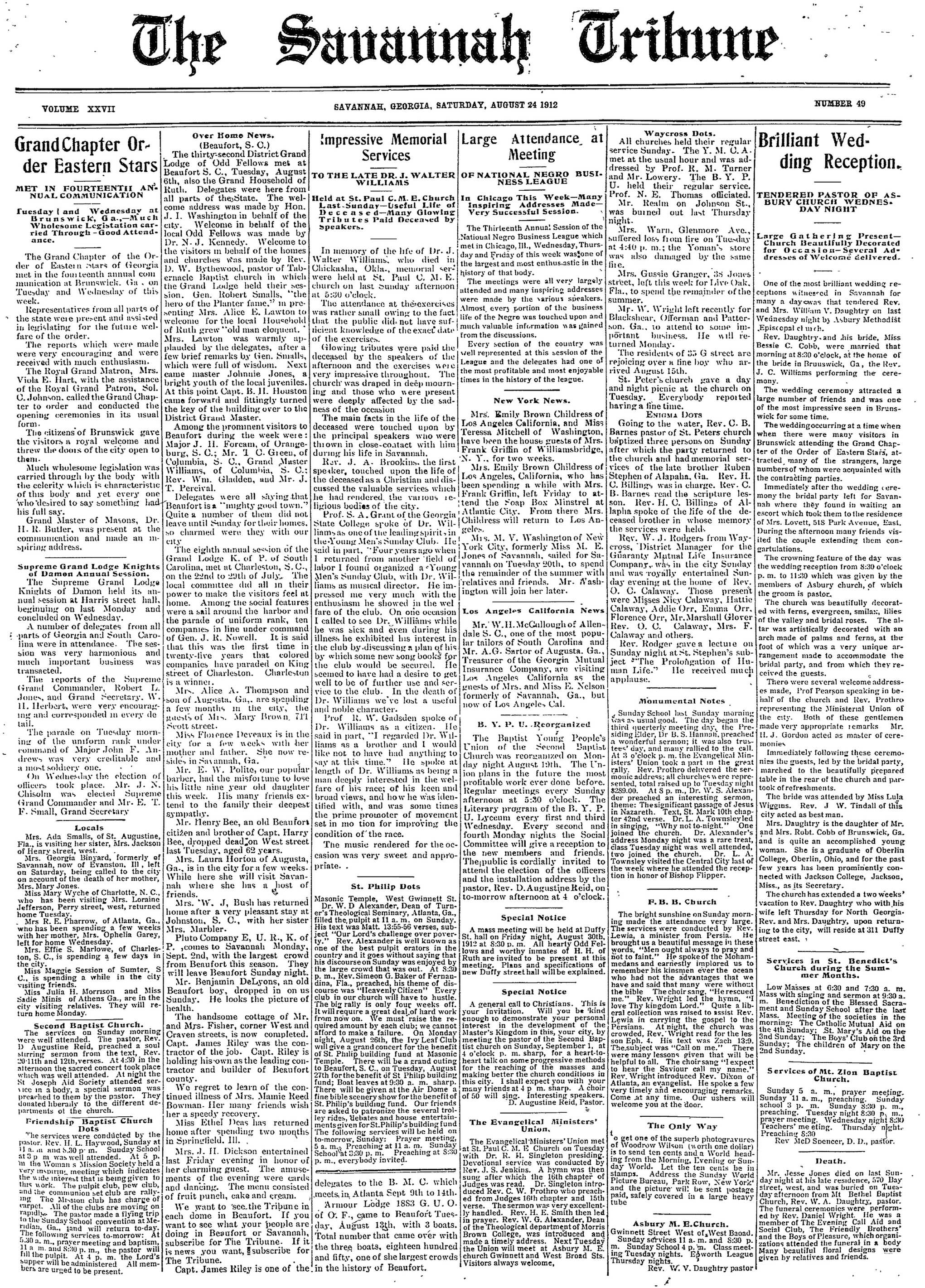
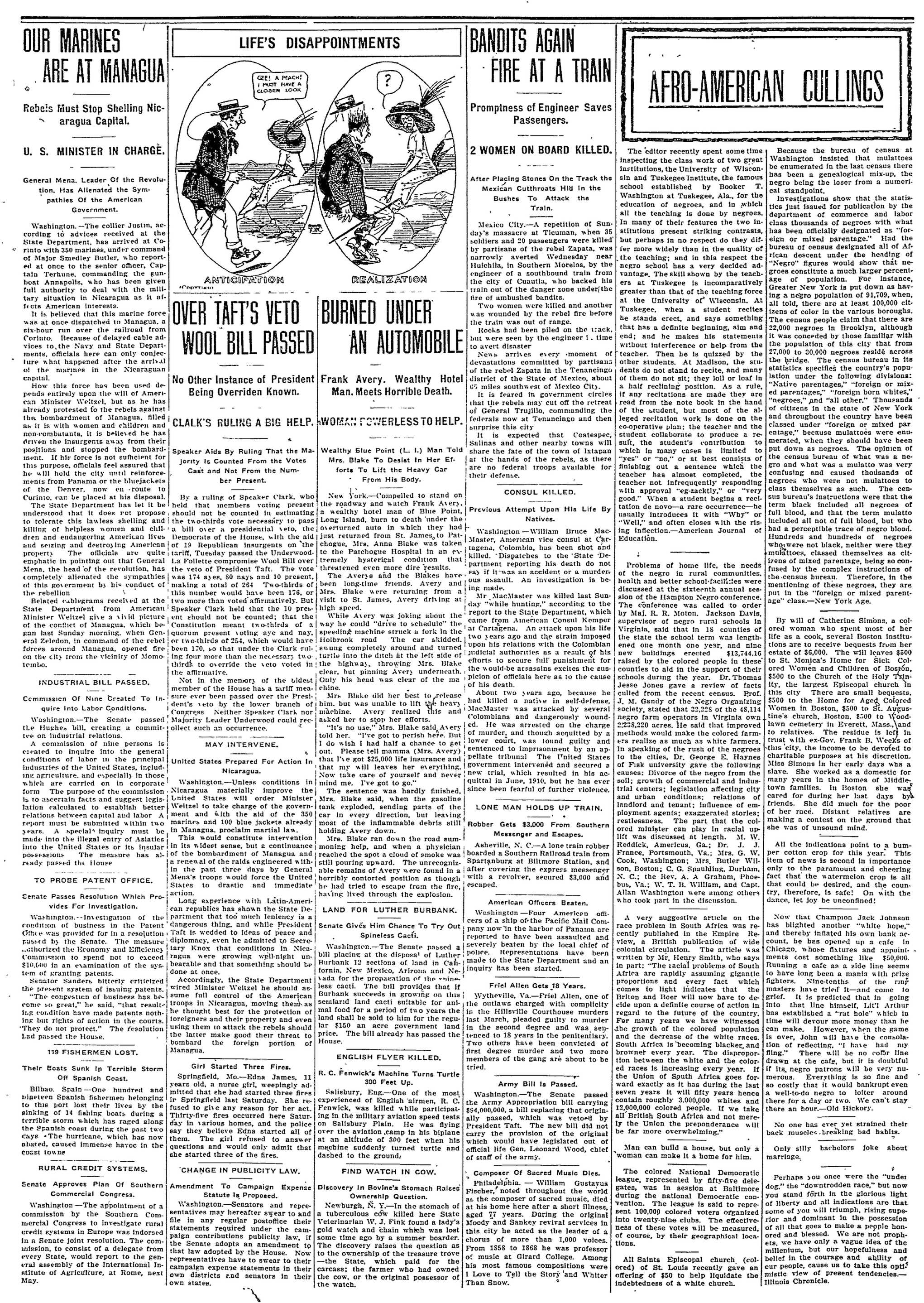
Page text (machine-generated)
The Savannah Tribune
VOLUME XXVII
Grand Chapter Order Eastern Stars
Grand Chapter Order Eastern Stars
MET IN FOURTEENTH ANNUAL COMMUNICATION
Tuesday and Wednesday at Brunswick, Ga.,—Much Wholesome Legislation carried Through - Good Attendance.
The Grand Chapter of the Order of Eastern Stars of Georgia met in the fourteenth annual communication at Brunswick. Ga. on Tuesday and Wednesday of this week.
Representatives from all parts of the state were present and assisted in legislating for the future welfare of the order.
The reports which were made were very encouraging and were received with much enthusiasm. The Royal Grand Matron, Mrs. Viola E. Hart, with the assistance of the Royal Grand Patron, Sol. C. Johnson, called the Grand Chapter to order and conducted the opening ceremonies in its usual form. The citizens of Brunswick gave the visitors a royal welcome and threw the doors of the city open to them. Much wholesome legislation was carried through by the body with the celerity which is characteristic of this body and yet every one who desired to say something had his full say.
Grand Master of Masons, Dr. H. R. Butler, was present at the communication and made an inspiring address.
Supreme Grand Lodge Knights of Damen Annual Session.
The Supreme Grand Lodge Knights of Damon held its annual session at Harris street hall, beginning on last Monday and concluded on Wednesday.
A number of delegates from all parts of Georgia and South Carolina were in attendance. The session was very harmonious and much important business was transacted.
The reports of the Supreme Grand Commander, Robert L. Jones, and Grand Secretary, W. H. Herbert, were very encouraging and corresponded in every detail.
The parade on Tuesday morning of the uniform rank under command of Major John F. Andrews was very creditable and a most soldiery one. On Wednesday the election of officers took place. Mr. J. N. Chisolm was elected Supreme Grand Commander and Mr. E. T. F. Small, Grand Secretary
Locals
Mrs. Ada Smalls, of St. Augustine, Fla., is visiting her sister, Mrs. Jackson of Henry street, west.
Mrs. Georgia Binyard, formerly of Savannah, now of Evanston, Ill, left on Saturday, being called to the city on account of the death of her mother, Mrs. Mary Jones.
Miss Mary Wyche of Charlotte, N. C., who has been visiting Mrs. Loraine Jefferson, Perry street, west, returned home Tuesday.
Mrs. R. E. Pharrow, of Atlanta, Ga., who has been spending a few weeks with her mother, Mrs. Ophelia Garey, left for home Wednesday.
Mrs. Effie S. Marlowe, of Charleston, S. C., is spending a few days in the city.
Miss Maggie Session of Sumter, S. C., is spending a while in the city visiting friends.
Miss Julia H. Morrison and Miss Sadie Minis of Athens Ga., are in the city visiting relatives. They will return home Monday.
Second Baptist Church.
The services on Sunday morning were well attended. The pastor, Rev. D Augustine Reid, preached a soul stirring sermon from the text, Rev. 20:11th and 12th, verses. At 4:30 in the afternoon the sacred concert took place which was well attended. At night the St Joseph Aid Society attended service in a body, a special sermon was preached to them by the pastor. They donated liberally to the different departments of the church.
Friendship Baptist Church Dots
The services were conducted by the pastor, Rev. H. L. Haywood, Sunday at 11 a.m. and 8:30 p.m. Sunday School at 5 p.m was well attended. At 5 p.m. the Woman's Mission Society held a very inspiring meeting which indicates the wide interest that is being given to this work. The pulpit club, pew club, and the communion set club are rallying The Mission club has charge of carpet. All of the clubs are moving on rapidly. The pastor made a flying trip to the Sunday School convention at Meridian, Ga., and will return to-day. The following services to-morrow: At 5:30 a.m., prayer meeting and baptism, At 11 a.m. and 8:30 p.m., the pastor will fill the pulpit. At 4 p.m. the Lord's supper will be administered. All members are urged to be present.
The thirty-second District Grand Lodge of Odd Fellows met at Beaufort S. C., Tuesday, August 6th, also the Grand Household of Ruth. Delegates were here from all parts of the State. The welcome address was made by Hon. J. I. Washington in behalf of the city. Welcome in behalf of the local Odd Fellows was made by Dr. N. J. Kennedy. Welcome to the visitors in behalf of the homes and churches was made by Rev. D. W. Bythewood, pastor of Tabernacle Baptist church in which the Grand Lodge held their session. Gen. Robert Smalls, "the hero of the Planter fame," in presenting Mrs. Alice E. Lawton to welcome for the local Household of Ruth grew "old man eloquent." Mrs. Lawton was warmly applauded by the delegates, after a few brief remarks by Gen. Smalls, which were full of wisdom. Next came master Johnnie Jones, a bright youth of the local juveniles. At this point Capt. B. H. Houston came forward and fittingly turned the key of the building over to the District Grand Master.
Among the prominent visitors to Beaufort during the week were: Major J. II. Forcam, of Orangeburg, S. C.; Mr. T. C. Green, of Columbia, S. C., Grand Master Williams, of Columbia, S. C.; Rev. Wm. Gladden, and Mr. J. T. Percival. Delegates were all saying that Beaufort is a "mighty good town." Quite a number of them did not leave until Sunday for their homes, so charmed were they with our city.
The eighth annual session of the Grand Lodge K. of P. of South Carolina, met at Charleston, S.C., on the 22nd to 29th of July. The local committee did all in their power to make the visitors feel at home. Among the social features were a sail around the harbor and the parade of uniform rank, ten companies in line under command of Gen. J. R. Nowell. It is said that this was the first time in twenty-five years that colored companies have paraded on King street of Charleston. Charleston is a winner.
Mrs. Alice A. Thompson and son of Augusta, Ga., are spending a few months in the city, the guests of Mrs. Mary Brown, 711 Scott street.
Miss Florence Deveaux is in the city for a few weeks with her mother and father. She now resides in Savannah, Ga.
Mr. E. W. Polite, our popular barber, had the misfortune to lose his little nine year old daughter this week. His many friends extend to the family their deepest sympathy.
Mr. Henry Bee, an old Beaufort citizen and brother of Capt. Harry Bee, dropped dead on West street last Tuesday, aged 62 years.
Mrs. Laura Horton of Augusta, Ga., is in the city for a few weeks. While here she will visit Savannah where she has a host of friends. Mrs. W. J, Bush has returned home after a very pleasant stay at Johnston, S. C., with her sister Mrs. Marbler. Pluto Company E, U. R., K. of P., comes to Savannah Monday, Sept. 2nd, with the largest crowd from Beaufort this season. They will leave Beaufort Sunday night. Mr. Benjamin DeLyons, an old Beaufort boy, dropped in on us Sunday. He looks the picture of health.
The handsome cottage of Mr. and Mrs. Fisher, corner West and Craven streets, is now completed. Capt. James Riley was the contractor of the job. Capt. Riley is holding his own as the leading contractor and builder of Beaufort county. We regret to learn of the continued illness of Mrs. Mamie Reed Bowman. Her many friends wish her a speedy recovery. Miss Ethel Deas has returned home after spending two months in Springfield, Ill.
Mrs. J. H. Dickson entertained last Friday evening in honor of her charming guest. The amusements of the evening were cards and dancing. The menu consisted of fruit punch, cake and cream.
We want to see the Tribune in each dome in Beaufort. If you want to see what your people are doing in Beaufort or Savannah, subscribe for The Tribune. If it is news you want, subscribe for The Tribune.
SAVANNAH, GEORGIA, SATURDAY, AUGUST 24 1912
Impressive Memorial Services
TO THE LATE DR. J. WALTER
WILLIAMS
Held at St. Paul C. M. E. Church
Last Sunday—Useful Life of
Deceased—Many Glowing
Tributes Paid Deceased by
Speakers.
In memory of the life of Dr. J. Walter Williams, who died in Chickasha, Okla., memorial serwere held at St. Paul C. M. E. church on last Sunday afternoon at 5:30 o'clock.
The attendance at the exercises was rather small owing to the fact that the public did not have sufficient knowledge of the exact date of the exercises.
Glowing tributes were paid the deceased by the speakers of the afternoon and the exercises were very impressive throughout. The church was draped in deep mourning and those who were present were deeply affected by the sadness of the occasion.
The main facts in the life of the deceased were touched upon by the principal speakers who were thrown in close-contact with him during his life in Savannah.
Rev. J. A. Brookins, the first speaker, touched upon the life of the deceased as a Christian and discussed the valuable services which he had rendered, the various religious bodies of the city.
Prof. S. A. Grant of the Georgia State College spoke of Dr. Williams as one of the leading spirit in the Young Men's Sunday Club. He said in part, "Four years ago when I returned from another field of labor I found organized a Young Men's Sunday Club, with Dr. Williams as musical director. He impressed me very much with the enthusiasm he showed in the welfare of the club. On one occasion I called to see Dr. Williams while he was sick and even during his illness he exhibited his interest in the club by discussing a plan of his by which some new song books for the club would be secured. He seemed to have had a desire to get well to be of further use and service to the club. In the death of Dr. Williams we've lost a useful and noble character.
Prof R. W. Gadsden spoke of Dr. Williams as a citizen. He said in part, "I regarded Dr. Williams as a brother and I would like not to have bad anything to say at this time." He spoke at length of Dr. Williams as being a man deeply interested in the welfare of his race; of his keen and broad views, and how he was identified with, and was some times the prime promoter of movement set in motion for improving the condition of the race.
The music rendered for the occasion was very sweet and appropriate.
St. Philip Dots
Masonic Temple, West Gwinnett St. Dr. W. D Alexander, Dean of Turner's Theological Seminary, Atlanta, Ga., filled the pulpit at 11 a. m. on Sunday. His text was Matt. 13:55-56 verses, subject "Our Lord's challenge over poverty." Rev. Alexander is well known as one of the best pulpit orators in the country and it goes without saying that his discourse on Sunday was enjoyed by the large crowd that was out. At 8:30 p. m., Rev. Simeon G. Baker of Fernandina, Fla., preached, his theme of discourse was "Heavenly Citizen" Every club in our church will have to hustle. The big rally is only four weeks off. It will require a great deal of hard work from now on. We must raise the required amount by each club; we cannot afford to make a failure. On Monday night, August 26th, the Ivy Leaf Club will give a grand concert for the benefit of St. Philip building fund at Masonic Temple. There will be a grand outing to Beaufort, S. C., on Tuesday, August 27th for the benefit of St. Philip building fund; Boat leaves at 9:30 a. m. sharp. There will be given at the Air Dome a fine bible scenery show for the benefit of St. Philip's building fund. Our friends are asked to patronize the several trolley rides, debates and house entertainments given for St. Philip's building fund. The following services will be held on-to-morrow, Sunday: Prayer meeting, 5 a. m. Preaching at 11 a. m. Sunday School at 8:30 p. m. Preaching at 8:30 p. m., everybody invited.
delegates to the B. M. C. which meets, in Atlanta Sept 9th to 14th. Armour Lodge 1883 G. U. O. of O. F., came to Beaufort Tuesday, August 13th, with 3 boats. Total number that came over with the three boats, eighteen hundred and fifty, one of she largest crowds in the history of Beaufort.
Large Attendance at Meeting
OF NATIONAL NEGRO BUSINESS LEAGUE
In Chicago This Week—Many Inspiring Addresses Made—Very Successful Session.
The Thirteenth Annual Session of the National Negro Business League which met in Chicago, Ill., Wednesday, Thursday and Friday of this week was one of the largest and most enthusiastic in the history of that body.
The meetings were all very largely attended and many inspiring addresses were made by the various speakers. Almost every portion of the business life of the Negro was touched upon and much valuable information was gained from the discussions.
Every section of the country was well represented at this session of the League and the delegates had one of the most profitable and most enjoyable times in the history of the league.
New York News.
Mrs. Emily Brown Childress of Los Angeles California, and Miss Teressa Mitchell of Washington, have been the house guests of Mrs. Frank Griffin of Williamsbridge, N. Y., for two weeks. Mrs. Emily Brown Childress of Los Angeles, California, who has been spending a while with Mrs. Frank Griffin, left Friday to attend the Soap Box Minstrel at Atlantic City. From there Mrs. Childress will return to Los Angeles.
Mis. M. V. Washington of New York City, formerly Miss M. E. Jones of Savannah, sailed for Savannah on Tuesday 20th, to spend the remainder of the summer with relatives and friends. Mr. Washington will join her later.
Los Angeles California News
Mr. W.H. McGullough of Allendale S. C., one of the most popular tailors of South Carolina and Mr. A.G. Sartor of Augusta. Ga., Treasurer of the Georgia Mutual Insurance Company, are visiting Los Angeles California as the guests of Mrs. and Miss E. Nelson formerly of Savannah, Ga., but now of Los Angeles Cal.
B. Y. P. U. Reorganized
The Baptist Young People's Union of the Second Baptist Church was reorganized on Monday night August 19th. The Union plans in the future the most profitable work ever done before. Regular meetings every Sunday afternoon at 5:30 o'clock. The Literary program of the B. Y. P. U. Lyceum every first and third Wednesday. Every second and fourth Monday nights the Social Committee will give a reception to the new members and friends. The public is cordially invited to attend the election of the officers and the installation address by the pastor, Rev. D. Augustine Reid, on to-morrow afternoon at 4 o'clock.
Special Notice
A mass meeting will be held at Duffy St. hall on Friday night, August 30th, 1912 at 8:30 p. m. All hearty Odd Fellows and worthy inmates of H. H. of Ruth are invited to be present at this meeting. Plans and specifications of new Duffy street hall will be explained.
Special Notice
A general call to Christians. This is your invitation. Will you be kind enough to demonstrate your personal interest in the development of the Master's Kingdom in this, your city, by meeting the pastor of the Second Baptist church on Sunday, September 1, at 4 o'clock p. m. sharp, for a heart-to-heart talk on some progressive methods for the reaching of the masses and making better the church conditions in this city. I shall expect you with your many friends at 4 p. m. sharp. A choir of 50 will sing. Interesting speakers. D. Augustine Reid, Pastor.
The Evangelical Ministers' Union.
The Evangelical Ministers' Union met at St. Paul C. M. E. Church on Tuesday with Dr. R. H. Singleton presiding. Devotional service was conducted by Rev. J. S. Jenkins. A hymn was then sung after which the 16th chapter of Judges was read. Dr. Singleton introduced Rev. C. W. Prothro who preached from Judges 16th chapter and 15th verse. The sermon was very excellently handled. Rev. H. E. Smith then led in prayer. Rev. W. G. Alexander, Dean of the Theological department of Morris Brown College, was introduced and made a timely address. Next Tuesday the Union will meet at Asbury M. E. church Gwinnett and West Broad Sts. Visitors always welcome,
All churches held their regular service Sunday. The Y. M. C. A.met at the usual hour and was addressed by Prof. R. M. Turner and Mr. Lowery. The B. Y. P. U. held their regular service. Prof. N. E. Thomas officiated. Mr. Realm on Johnson St., was burned out last Thursday night. Mrs. Warn, Glenmore Ave., suffered loss from fire on Tuesday at 4:40 p. m.; the Yoman's store was also damaged by the same fire. Mrs. Gussie Granger, 38 Jones street, left this week for Live Oak, Fla., to spend the remainder of the summer.
Mr. W. Wright left recently for Blackshear, Offerman and Patterson. Ga., to attend to some important business. He will returned Monday. The residents of 35 G street are rejoicing over a fine boy who arrived August 15th. St. Peter's church gave a day and night picnic at the church on Tuesday. Everybody reported having a fine time.
Going to the water, Rev. C. B. Barnes pastor of St. Peters church baptized three persons on Sunday after which the party returned to the church and had memorial services of the late brother Ruben Stephen of Alapaha, Ga. Rev. H. C. Billings, was in charge. Rev. C. B. Barnes read the scripture lesson. Rev. H. C. Billings of Alapha spoke of the life of the deceased brother in whose memory the services were held.
Rev. W. J. Rodgers from Waycross, District Manager for the Guaranty Mutual Life Insurance Company, was in the city Sunday and was royally entertained Sunday evening at the home of Rev. O. C. Calaway. Those present were Misses Nicy Calaway, Hattie Calaway, Addie Orr, Emma Orr, Florence Orr, Mr.Marshall Glover Rev. O. C. Calaway, Mrs. F. Calaway and others.
Rev. Rodger gave a lecture on Sunday night at St. Stephen's subject "The Prolongation of Human Life." He received much applause.
Monumental Notes
Sunday School last Sunday morning was as usual good. The day began the third quarterly meeting day, the Presiding Elder, Dr B. S. Hannah, preached a wonderful sermon; it was also trustees' day, and many rallied to the call. At 3 o'clock p.m. the Evangelical Ministers' Union took a part in the great rally. Rev. Prothro delivered the sermonic address; all churches were represented, total raised up to Tuesday night $289.00. At 5 p.m., Dr. W. S. Alexander preached an interesting sermon, theme: The significant passage of Jesus in Nazareth. Text, St. Mark 10th chapter 42nd verse. Dr. L. A. Townsleyed in singing, "Why to not-tnight." One joined the church. Dr. Alexander's address Monday night was a rare treat, class Tuesday night was well attended, two joined the church. Dr. L. A. Townsley visited the Central City last of the week where he attended the reception in honor of Bishop Flipper.
F. B. B. Church
The bright sunshine on Sunday morning made the attendance very large. The services were conducted by Rev. Lewia, a minister from Persia. He brought us a beautiful message in these words, "Men ought always to pray and not to faint." He spoke of the Mohammedans and earnestly implored us to remember his kinsmen ever the ocean who had not the advantages that we have and said that many were without the bible The choir sang, "He rescued me." Rev. Wright led the hymn, "I Love Thy kingdom Lord." Quite a liberal collection was raised to assist Rev. Lewia in carrying the gospel to the Persians. At night, the church was crowded, Rev. Wright read for the lesson Eph. 4. His text was Zach 13:9. The subject was "Call on me." There were many lessons given that will be helpful to all. The choir sang "expect to hear the Saviour call my name." Rev. Wright introduced Rev. Dixon of Atlanta, an evangelist. He spoke a few very timely and encouraging remarks. Come at any time. Our ushers will welcome you at the door.
The Only Way
to get one of the superb photogravures of Woodrow Wilson (worth one dollar) is to send ten cents and a World heading from the Morning, Evening or Sunday World. Let the ten cents be in stamps. Address the Sunday World Picture Bureau, Park Row, New York and the picture will be sent postage paid, safely covered in a large heavy tube
Asbury M. E. Church.
Gwinnett Street West of West Baoad.
Sunday services 11 a.m. and 8:30 p.m.
Sunday School 4 p.m. Class meeting Tuesday nights. Edworth League Thursday nights.
Rey. W. V. Daughtry pastor
NUMBER 49
Brilliant Wedding Reception.
TENDERED PASTOR OF ASBURY CHURCH WEDNESDAY NIGHT
Large Gathering Present— Church Beautifully Decorated for Occasion-Several Addresses of Welcome delivered.
One of the most brilliant wedding receptions witnessed in Savannah for many a day was that tendered Rev. and Mrs. William V. Daughtry on last Wednesday night by Asbury Methodist Episcopal church.
Rev. Daughtry and his bride, Miss Bessie C. Cobb, were married that morning at 8:30 o'clock, at the home of the bride in Brunswick, Ga, the Rev.J. C. Williams performing the ceremony.
The wedding ceremony attracted a large number of friends and was one of the most impressive seen in Brunswick for some time.
The wedding occurring at a time when when there were many visitors in Brunswick attending the Grand Chapter of the Order of Eastern Stars, attracted, many of the strangers, large numbers of whom were acquainted with the contracting parties.
Immediately after the wedding ceremony the bridal party left for Savannah where they found in waiting an escort which took them to the residence of Mrs. Lovett, 518 Park Avenue, East. During the afternoon many friends visited the couple extending them congratulations.
The crowning feature of the day was the wedding reception from 8:30 o'clock p. m. to 11:30 which was given by the members of Asbury church, of which the groom is pastor.
The church was beautifully decorated with ferns, evergreen, smilax, lilies of the valley and bridal roses. The altar was artistically decorated with an arch made of palms and ferns, at the foot of which was a very unique arrangement made to accommodate the bridal party, and from which they received the guests. Thero were several welcome addresses made, Prof Pearson speaking in behalf of the church and Rev. Prothro representing the Ministerial Union of the city. Both of these gentlemen made very appropriate remarks Mr. H. J. Gordon acted as master of ceremonies.
Immediately following these ceremonies the guests, led by the bridal party, marched to the beautifully prepared table in the rear of the church and partook of refreshments.
The bride was attended by Miss Lula Wiggins. Rev. J W. Tindall of this city acted as best man.
Mrs. Daughtry is the daughter of Mr. and Mrs. Robt. Cobb of Brunswick, Ga. and is quite an accomplished young woman. She is a graduate of Oberlin College, Oberlin, Ohio, and for the past few years has been prominently connected with Jackson College, Jackson, Miss., as its Secretary.
The church has extended a two weeks' vacation to Rev. Daughtry who with his wife left Thursday for North Georgia-Rev. and Mrs. Daughtry, upon returning to the city, will reside at 311 Duffy street east.
Services in St. Benedict's Church during the Summer Months.
Low Masses at 6:30 and 7:30 a. m. Mass with singing and sermon at 9:30 a. m. Benediction of the Blessed Sacrament and Sunday School after the last Mass. Meeting of the societies in the morning: The Catholic Mutual Aid on the 4th Sunday; St. Mary's Aid on the 3rd Sunday; The Boys' Club on the 3rd Sunday; The children of Mary on the 2nd Sunday.
Services of Mt. Zion Baptist Church.
Sunday 5 a. m., prayer meeting.
Sunday 11 a. m., preaching. Sunday
school 3 p. m. Sunday 8:30 p. m.
preaching. Tuesday night 8:30 p. m.
prayer meeting. Wednesday night 8:30
Teachers' meeting. Thursday night.
Preaching 8:30
Rev McD Spencer, D. D., pastor.
Death.
Mr. Jesse Jones died on last Sunday night at his late residence, 570 Bay street, west, and was buried on Tuesday afternoon from Mt. Bethel Baptist Church, Rev. W. A. Daughtry, pastor. The funeral ceremonies were performed by Rev. Daniel Wright. He was a member of The Evening Call Aid and Social Club, The Friendly Brothers' and the Boys of Pleasure, which organizations attended the funeral in a body Many beautiful floral designs were given by relatives and friends.
Rebels Must Stop Shelling Nicaragua Capital.
U. S. MINISTER IN CHARGE.
General Mena. Leader Of the Revolution, Has Alenated the Sympathies Of the American
Washington. -The collier Justin, according to advice received at the State Department, has arrived at Corinto with 350 marines, under command of Major Smedley Butler, who reported at once to the senior officer, Captain Terhune, commanding the gunboat Annapolis, who has been given full authority to deal with the military situation in Nicaragua as it affects American interests.
It is believed that this marine force was at once dispatched to Managua, a six-hour run over the railroad from Corinto. Because of delayed cable advises to, the Navy and State Departments, officials here can only conjecture what happened after the arrival of the marines in the Nicaraguan capital.
How this force has been used depends entirely upon the will of American Minister Weltzel, but as he has already protested to the rebels against the bombardment of Managua, filled as it is with women and children and non-combatants, it is believed he has driven the insurgents away from their positions and stopped the bombardment. If his force is not sufficient for this purpose, officials feel assured that he will hold the city until reinforcements from Panama or the bluejackets of the Denver, now en-route to Corinto, can be placed at his disposal.
The State Department has let it be understood that it does not propose to tolerate this lawless shelling and killing of helpless women and children and endangering American lives and seizing and destroying American property. The officials are quite emphatic in pointing out that General Mena, the head of the revolution, has completely alienated the sympathies of this government by his conduct of the rebellion.
Belated cablegrams received at the State Department from American Minister Weitzel give a vivid picture of the conflict of Managua, which began last Sunday morning, when General Zeledon, in command of the rebel forces around Managua, opened fire on the city from the vicinity of Momotomo.
INDUSTRIAL BILL PASSED.
Commission Of Nine Created To Inquire Into Labor Conditions.
Washington.-The Senate passed the Hughes bill, creating a committee on industrial relations.
A commission of nine persons is created to inquire into the general conditions of labor in the principal industries of the United States, including agriculture, and especially in those which are carried on in corporate form. The purpose of the commission is to ascertain facts and suggest legislation calculated to establish better relations between capital and labor. A report must be submitted within two years. A special inquiry must be made into the illegal entry of Asiatics into the United States or its insular possessions. The measure has already passed the house.
TO PROBE PATENT OFFICE.
Senate Passes Resolution Which Provides For Investigation.
Washington--Investigation of the condition of business in the Patent Office was provided for in a resolution passed by the Senate. The measure authorized the Economy and Efficiency Commission to spend not to exceed $10,600 in an examination of the system of granting patents.
Senator Sanders bitterly criticized the present system of issuing patents.
"The congestion of business has become so great," he said, "that resulting condition have made patents nothing but rights of action in the courts. They do not protect." The resolution Lad passed the House.
Their Boats Sunk In Terrible Storm Off Spanish Coast.
Billbao. Spain—One hundred and nineteen Spanish fishermen belonging to this port lost their lives by the sinking of 14 fishing boats during a terrible storm which has raged along the Spanish coast during the past two days. The hurricane, which has now abated, caused immense havoc in the coast towns
RURAL CREDIT SYSTEMS.
Senate Approves Plan Of Southern Commercial Congress.
Washington —The appointment of a commission by the Southern Commercial Congress to investigate rural credit systems in Europe was indorsed in a Senate joint resolution. The commission, to consist of a delegate from every State, would report to the general assembly of the International Institute of Agriculture, at Rome, next May.
GEE! A PEACH!
I MUST HAVE A
CLOSEER LOOK
ANTICIPATION
REALIZATION
OVER TAFT'S VETO WOOL BILL PASSED
No Other Instance of President Being Overriden Known.
CLALK'S RULING A BIG HELP.
Speaker Aids By Ruling That the Majority Is Counted From the Votes Cast and Not From the Num-
By a ruling of Speaker Clark, who held that members voting present should not be counted in estimating the two-thirds vote necessary to pass a bill over a presidential veto, the Democrats of the House, with the aid of 19 Republican insurgents on the tariff, Tuesday passed the Underwood-La Follette compromise Wool Bill over the veto of President Taft. The vote was 174 ayes, 80 nays and 10 present, making a total of 264. Two-thirds of this number would have been 176, or two more than voted affirmatively. But Speaker Clark held that the 10 present should not be counted; that the Constitution meant two-thirds of a quorum present voting aye and nay, or two-thirds of 254, which would have been 170, so that under the Clark ruling four more than the necessary two-thirds to override the veto voted in the affirmative.
Not in the memory of the oldest member of the House has a karliff measure ever been passed over the President's veto by the lower branch of Congress Neither Speaker Clark nor Majority Leader Underwood could recollect such an occurrence.
United States Prepared For Action In Nicaragua.
Washington.—Unless conditions in Nicaragua materially improve the United States will order Minister Weltzelt to take charge of the government and with the aid of the 350 marines and 100 blue jackets already in Managua, proclaim martial law. This would constitute intervention in its widest sense, but a continuance of the bombardment of Managua and a renewal of the raids engineered within the past three days by General Mena's troops would force the United States to drastic and immediate action.
Long experience with Latin-American republics has shown the State Department that too much leniency is a dangerous thing, and while President Taft is wedded to ideas of peace and diplomacy, even he admitted to Secretary Knox that conditions in Nicaragua were growing well-night unbearable and that something should be done at once. Accordingly, the State Department wired Minister Weitzel he should assume full control of the American troops in Nicaragua, moving them as he thought best for the protection of foreigners and their property and even using them to attack the rebels should the latter make good their threat to bombard the foreign portion of Managua.
Girl Started Three Fires
Springfield, Mo.-Edna James, 11 years old, a nurse girl, weepingly admitted that she had started three fires in Springfield last Saturday. She refused to give any reason for her act. Thirty-five fires occurred here Saturday in various homes, and the police say they believe Edna started all of them. The girl refused to answer questions and would only admit that she started three of the fires.
CHANGE IN PUBLICITY LAW.
Amendment To Campaign Expense Statute Is Proposed.
Washington.—Senators and representatives may hereafter swear to and file in any regular postoffice their statements required under the campaign contributions publicity law, if the Senate adopts an amendment to that law adopted by the House. Now representatives have to swear to their campaign expense statements in their own districts and senators in their own states.
BURNED UNDER AN AUTOMOBILE
Frank Avery. Wealthy Hotel Man. Meets Horrible Death.
WOMAN POWERLESS TO HELP.
Wealthy Blue Point (L. I.) Man Told Mrs. Blake To Deslat In Her Efforts To Lift the Heavy Car
New York.—Compelled to stand on the roadway and watch Frank Avery, a wealthy hotel man of Blue Point, Long Island, burn to death under the overturned auto in which they had just returned from St. James, to Patchogue, Mrs. Anna Blake was taken to the Patchogue Hospital in an extremely hysterical condition that threatened even more dire results. The Avery's and the Blakes have been long-time friends. Avery and Mrs. Blake were returning from a visit to St. James, Avery driving at high speed.
While Avery was joking about the way he could "drive to schedule" the speeding machine struck a fork in the Holbrook road. The car skidded, swung completely around and turned turtle into the ditch at the left side of the highway, throwing Mrs. Blake clear, but pinning Avery underneath. Only his head was clear of the machine.
Mrs. Blake did her best to release him, but was unable to lift the heavy machine. Avery realized this and asked her to stop her efforts.
"It's no use," Mrs. Blake said Avery told her. "I've got to perish here. But I do wish I had half a chance to get out. Please tell mamma (Mrs. Avery) that I've got $25,000 life insurance and that my will leaves her everything. Now take care of yourself and never mind me. I've got to go."
The sentence was hardly finished, Mrs. Blake said, when the gasoline tank exploded, sending parts of the car in every direction, but leaving most of the inflammable debris still holding Avery down. Mrs. Blake ran down the road summoning help, and when a physician reached the spot a cloud of smoke was still pouring upward. The unrecognizable remains of Avery were found in a horribly contorted position as though he had tried to escape from the fire, having lived through the explosion.
LAND FOR LUTHER BURBANK.
Senate Gives Him Chance To Try Out
Spineless Cacti.
Washington.—The Senate passed a bill placing at the disposal of Luther Burbank 12 sections of land in California, New Mexico, Arizona and Nevada for the propagation of the spinneless cacti. The bill provides that if Burbank succeeds in growing on this semiarid land cacti suitable for animal food for a period of two years the land shall be sold to him for the regular $150 an acre government land price. The bill already has passed the House.
ENGLISH FLYER KILLED.
R. C. Fenwick's Machine Turns Turtle 300 Feet Up.
Salisbury, Eng.—One of the most experienced of English airmen, R. C. Fenwick, was killed while participating in the military aviation speed tests on Salisbury Plain. He was flying over the aviation camp in his biplane at an altitude of 300 feet when his machine suddenly turned turtle and dashed to the ground;
FIND WATCH IN COW.
Discovery In Bovine's Stomach Raises Ownership Question.
Newburgh, N. Y.—In the stomach of a tuberculous cow killed here State Veterinarian W. J. Fink found a lady's gold watch and chain which was lost some time ago by a summer boarder. The discovery raises the question as to the ownership of the treasure trove—the State, which paid for the carcass; the farmer who had owned the cow, or the original possessor of the watch.
BANDITS AGAIN FIRE AT A TRAIN
Promptness of Engineer Saves Passengers.
2 WOMEN ON BOARD KILLED.
After Placing Stones On the Track the Mexican Cutthroats Hild In the Bushes To Attack the
Mexico City.—A repetition of Sunday's massacre at Ticuman, when 35 soldiers and 20 passengers were killed by partisans of the rebel Zapata, was narrowly averted Wednesday near Hulchila, in Southern Morelos, by the engineer of a southbound train from the city of Cunatla, who backed his train out of the danger zone under the fire of ambushed bandits.
Two women were killed and another was wounded by the rebel fire before the train was out of range.
Rocks had been piled on the track, but were seen by the engineer i. time to avert disaster
News arrives every moment of devastations committed by partisans of the rebel Zapata in the Tenancingo district of the State of Mexico, about 65 miles southwest of Mexico City.
It is feared in government circles that the rebels may cut off the retreat of General Trujillo, commanding the federalis now at Tenancingo and then surprise this city. It is expected that Coatespec, Sulinas and other nearby towns will share the fate of the town of Ixtapan at the hands of the rebels, as there are no federal troops available for their defense.
CONSUL KILLED.
Previous Attempt Upon His Life By
Natives.
Washington — William Bruce MacMaster, American vice consul at Cartagena, Colombia, has been shot and killed. "Dispatches to the State Department reporting his death do not say if it was an accident or a murderous assault. An investigation is being made.
Mr. MacMaster was killed last Sunday "while hunting," according to the report to the State Department, which came from American Consul Kemper at Cartagena. An attack upon his life two years ago and the strain imposed upon his relations with the Colombian judicial authorities as a result of his efforts to secure full punishment for the would-be assassins excites the suspicion of officials here as to the cause of his death.
About two years ago, because he had killed a native in self-defense, MacMaster was attacked by several Colombians and dangerously wounded. He was arrested on the charge of murder, and though acquitted by a lower court, was found guilty and sentenced to imprisonment by an appellate tribunal The United States government intervened and secured a new trial, which resulted in his acquittal in June, 1910, but he has ever since been fearful of further violence.
Robber Gets $3,000 From Southern Messenger and Escapes.
Asheville, N. C.—A lone train robber boarded a Southern Railroad train from Spartanburg at Biltmore Station, and after covering the express messenger with a revolver, secured $3,000 and escaped.
American Officers Beaten.
Washington—Four American officers of a ship of the Pacific Mail Company now in the harbor of Panama are reported to have been assaulted and severely beaten by the local chief of police. Representations have been made to the State Department and an inquiry has been started.
Friel Allen Gets 18 Years.
Wytheville, Va.—Friel Allen, one of the outlaws charged with complicity in the Hillsville Courthouse murders last March, pleaded guilty to murder in the second degree and was sentenced to 18 years in the penitentiary. Two others have been convicted of first degree murder and two more members of the gang are about to be tried.
Army Bill Is Pasard.
Washington.—The Senate passed the Army Appropriation bill carrying $44,000,000, a bill replacing that originally passed, which was vetoed by President Taft. The new bill did not carry the provision of the original which would have legislated out of official life Gen. Leonard Wood, chief of staff of the army.
Composer Of Sacred Music Dies.
Philadelphia. — William Gustavus Fischer, noted throughout the world as the composer of sacred music, died at his home here after a short illness, aged 77 years. During the original Moody and Sankey revival services in this city he acted as the leader of a chorus of more than 1,000 voices. From 1858 to 1868 he was professor of music at Glirard College. Among his most famous compositions were I Love to Tell the Story and Whiter Than Snow.
AFRO-AMERICAN CULLINGS
The editor recently spent some time inspecting the class work of two great institutions, the University of Wisconsin and Tuskegee Institute, the famous school established by Booker T. Washington at Tuskegee, Ala., for the education of negroes, and in which all the teaching is done by negroes. In many of their features the two institutions present striking contrasts, but perhaps in no respect do they differ more widely than in the quality of the teaching; and in this respect the negro school has a very decided advantage. The skill shown by the teachers at Tuskegee is incomparatively greater than that of the teaching force at the University of Wisconsin. At Tuskegee, when a student recites he stands erect, and says something that has a definite beginning, aim and end; and he makes his statements without interference or help from the teacher. Then he is quizzed by the other students. At Madison, the students do not stand to recite, and many of them do not sit; they loll or loaf in a half reclining position. As a rule, if any recitations are made they are read from the note book in the hand of the student, but most of the alleged recitation work is done on the co-operative plan: the teacher and the student collaborate to produce a result, the student's contribution to which in many cases is limited to "yes" or "no," or at best consists of finishing out a sentence which the teacher has almost completed, the teacher not infrequently responding with approval "eg-zacktly," or "very good." When a student begins a recitation de novo—a rare occurrence—he usually introduces it with "Why" or "Well," and often closes with the rising inflection.—American Journal of Education.
:
Problems of home life, the needs of the negro in rural communities, health and better school facilities were discussed at the sixteenth annual session of the Hampton Negro conference. The conference was called to order by Maj. R. R. Moton. Jackson Davis, supervisor of negro rural schools in Virginia, said that in 18 counties of the state the school term was lengthened one month one year, and nine new buildings erected $13,744.16 raised by the colored people in these counties to aid in the support of their schools during the year. Dr. Thomas Jesse Jones gave a review of facts culled from the recent census. Prof. J. M. Gandy of the Negro Organizing society, stated that 22,228 of the 48,114 negro farm operators in Virginia own 2,238,228 acres. He said that improved methods would make the colored farmers realize as much as white farmers. In speaking of the rush of the negroes to the cities, Dr. George E. Haynes of Fisk university gave the following causes: Divorce of the negro from the soil; growth of commercial and industrial centers; legislation affecting city and urban conditions; relations of landlord and tenant; influence of employment agents; exaggerated stories; restlessness. The part that the colored minister can play in racial uplift was discussed at length. M. W. Reddick, Americus, Ga.; Dr. J. J. France, Portsmouth, Va.; Mrs. G. W. Cook, Washington; Mrs. Butler Wilson, Boston; C. G. Spaulding, Durham, N. C.; the Rev. A. A Graham, Phoebus, Va.; W. T. B. Willlam, and Capt. Allan Washington were among others who took part in the discussion.
A very suggestive article on the race problem in South Africa was recently published in the Empire Review, a British publication of wide colonial circulation. The article was written by Mr. Henry Smith, who says in part: "The racial problems of South Africa are rapidly assuming gigantic proportions and every fact which comes to light indicates that the Briton and Boer will now have to decide upon a definite course of action in regard to the future of the country. For many years we have witnessed the growth of the colored population and the decrease of the white races. South Africa is becoming blacker and browner every year. The disproportion between the white and the colored races is increasing every year. If the Union of South Africa goes forward exactly as it has during the last seven years it will fifty years hence contain roughly 3,000,000 whites and 12,000,000 colored people. If we take all British South Africa and not merely the Union the preponderance will be far more overwhelming."
Man can build a house, but only a woman can make it a home for him.
The colored National Democratic league, represented by fifty-five delegates, was in session at Baltimore during the national Democratic convention. The league is said to represent 100,000 colored voters organized into twenty-nine clubs. The effectiveness of these votes will be measured, of course, by their geographical locations.
All Saints Episcopal church. (colored) of St. Louis recently gave an offering of $50 to help liquidate the indebtedness of a white church.
Because the bureau of census at Washington insisted that mulattoes be enumerated in the last census there has been a genealogical mix-up, the negro being the loser from a numerical standpoint.
Investigations show that the statistics just issued for publication by the department of commerce and labor class thousands of negroes with what has been officially designated as "foreign or mixed parentage." Had the bureau of census designated all of African descent under the heading of "Negro" figures would show that negroes constitute a much larger percentage of population. For instance, Greater New York is put down as having a negro population of 91,709, when, all told, there are at least 100,000 citizens of color in the various boroughs. The census people claim that there are 22,000 negroes in Brooklyn, although it was conceded by those familiar with the population of this city that from 27,000 to 30,000 negroes residé across the bridge. The census bureau in its statistics specifies the country's population under the following divisions: "Native parentages," "foreign or mixed parentages," "foreign born whites," "negroes," and "all other." Thousands of citizens in the state of New York and throughout the country have been classed under "foreign or mixed parentage," because mulattoes were enumerated, when they should have been put down as negroes. The opinion of the census bureau of what was a negro and what was a mulatto was very confusing and caused thousands of negroes who were not mulattoes to class themselves as such. The census bureau's instructions were that the term black included all negroes of full blood, and that the term mulatto included all not of full blood, but who had a perceptible trace of negro blood. Hundreds and hundreds of negroes who were not black, neither were they mulattoes, classed themselves as citizens of mixed parentage, being so confused by the complex instructions of the census bureau. Therefore, in the mentioning of these negroes, they are put in the "foreign or mixed parentage" class.—New York Age.
---
By will of Catherine Simons, a colored woman who spent most of her life as a cook, several Boston institutions are to receive bequests from her estate of $6,000. The will leaves $500 to St. Monica's Home for Sick Colored Women and Children of Boston, $500 to the Church of the Holy Trinity, the largest Episcopal church in this city. There are small bequests, $500 to the Home for Aged Colored Women in Boston, $500 to St. Augustine's church, Boston, $500 to Woodlawn cemetery in Everett, Mass., and to relatives. The residue is left in trust with ex-Gov. Frank B. Weeks of this city, the income to be devoted to charitable purposes at his discretion. Miss Simons in her early days was a slave. She worked as a domestic for many years in the homes of Middletown families. In Boston she was cared for during her last days by friends. She did much for the poor of her race. Distant relatives are making a contest on the ground that she was of unsound mind.
All the indications point to a bumper cotton crop for this year. This item of news is second in importance only to the paramount and cheering fact that the watermelon crop is all that could be desired, and the country, therefore, is safe! On with the dance, let joy be unconfined!
Now that Champion Jack Johnson has blighted another "white hope," and thereby inflated his own bank account, he has opened up a cafe in Chicago, whose fixtures and appointments cost something like $50,000. Running a cafe as a side line seems to have long been a manta with prize fighters. Nine-tenths of the ring masters have tried it—and come to grief. It is predicted that in going into that line himself, Lit'l Arthur has established a "rat hole" which in time will devour more money than he can make. However, when the game is over, John will have the consolation of reflecting, "I have had my fling." There will be no color line drawn at the cafe, but it is doubtful if its negro patrons will be very numerous. Everything is so fine and so costly that it would bankrupt even a well-to-do negro to loiter around there for a day or two. We can't stay there an hour—Old Hickory.
No one has ever yet strained their back muscles, breaking bad habits.
Only silly bachelors joke about marriage.
Perhaps you once were the "underdog," the "downtrodden race," but now you stand forth in the glorious light of liberty and all indications are that some of you will triumph, rising superior and dominant in the possession of all that goes to make a people honored and blessed. We are not prophets, we have only a vague idea of the millenium, but our hopefulness and belief in the courage and ability of our people, cause us to take this optimistic view of present tendencies.—Illinois Chronicle.
See COOPER & ODRIZEN The Up-to-Date Tailors
218 WEST BROAD STREET, BETWEEN HULL AND OGLETHORPE AVE. The Latest Patterns in SPRING AND SUMMER GOODS. Firstclass workmanship guaranteed. Our prices will interest you.
The affable H. B. Wright is still with us and expects the continuous patronage of his friends.
Johnson Undertaking Establishment
COMBINED WITH
Funeral Directors and Embalmers
Finest line of Coffins, Saskets and Robes. White and black funeral
cars. Office and warerooms 325-331 Jefferson street.
W. R. FIELDS, Manager.
Residence Phone 2032 Livery Stable Attached. Office Phone 676.
C. H. ROYALL, Residence 509 Charles St. Phone 3064.
234 ST. JULIAN ST., WEST, 238 BRYAN ST., WEST. Phone 2962. 8AVANNAH, GEORGIA.
Palm Shaving Palace
FINEST IN THE CITY.
Expert Hair Cutting. Electric Massage and Shampooing a Specialty. All
Work Done by Experienced Workmen. Courteous attention to all. SHIN-
ING PARLOR ATTACHED.
The Beautiful Woodlawn Park
SAVING
MONEY IS
A HABIT
Get the habit of
saving a part of
your Earnings
each week.
$1.00
Starts an°
Account
THE WAGE.
EARNERS' LOAN
AND INVESTMENT
COMPANY,
408 WESTBROAD ST.
Savannah, Ga.
Variety Bakery
Goods delivered promptly to any part of the city.
506 West Broad St. Near Gaston.
Phone 1869-J
Masonic Books and Regalias
LODGE SEALS,
FINANCIAL CARDS and
BLANKS of every description.
Publishers and Manufacturers' Prices
Laboral Discounts Will Be Arranged.
GAREY'S
SOL G. JOHNSON,
Savannah, Ga.
GHT, Proprietor
SAVANNAH, QA.
Woodlawn Park
Lights New Buildings
Spot of Savannah
D. MONROE, 124 East Thirty third St.
AGENTS WANTED
For the Sale of
Magic
Shaving
Powder
It gives a quick shave without the use of a RAZOR For Particulars, Write THE SHAVING POWDER CO. Savannah. --- Georgia. East Side
Lodging House
With modern conveniences, athletic arrangements, also shining parlor attached for ladies and gentlemen. Open day and night. Give us a call.
217 East Broad St.,
ISAAC C. BROWN, . . Proprietor.
Phone 3746.
—For First Class—
GROCERIES AND CONFECTIONERY
—Call On—
M. G. GRAHAM
626 York St., West. Courteous Attention to All.
MADAME FLORENCE E. WILLIAMS
Graduate Prof. Roher's School, New York.
719 West Broad Street.
Combings Made Up. Shampooing and Hair Straightening a Specialty. Face and Electric Massage. Dyeing and Matching Hair. ORIENTAL HAIR GROWER. An excellent preparation, will produce a beautiful growth of hair. Directions on each box. For sale, price 25 cents per box.
GO TO
Young Bros.
For your
TOBACCO, CIGARS and FRUITS
Of all kinds.
509 West Broad Street
WEST SIDE RESTAURANT
The place to get first-class meals Everything neat and clean. Meals prepared in an appetizing manner and at all hours daily.
Meals 16 and 26 cents.
MRS. A. S. SCOTT, Proprietress
Your Money Pile Grows
Just in propor-
tion as you ad-
vertise your
business, and
our columns
are open for you to begin at once. Sup-
pose you give us a trial.
Advertise
in this paper
THE HIGH
COST OF
LIVING
has not affected our job printing prices. We're still doing commercial work of all kinds at prices satisfactory to you.
A man in a suit points at another man in a suit, who is sitting with a dog.
CANVASSER MEETS HIS EQUAL
Aggressive Sewing Machine Agent Runs Into Undertaker and Is Forced to Retreat.
He was a sewing machine agent of the most aggressive type. For 20 minutes the lady of the house had been awaiting an opportunity to say she already possessed one. At last he paused. Only long enough, however, to thrust a card into the lady's hand. The bit of pasteboard was certainly a novelty.
"My name Is Sellum," it read, "of the firm of Blang and Company, sewing machine manufacturers, and I intend to prove to you that it is madness to defer purchasing one of our unequaled machines." After a long description of the machine came the following: "You may plead that you are unable to work a machine. I will remove that objection in 15 minutes, or in three lessons Will call next Wednesday."
When the agent called again a six-foot man opened the door and blandly remarked.
"You're the sewing machine man, I suppose?"
"Yes, I called last week, and—"
"Yes, I know," interrupted the big man
"You don't know me, I suppose? My name's Bury, of Bury and Keepem, undertakers, and I intend to prove to you that it is madness to defer purchasing one of our unequaled coffins."
The agent began to edge away
"You may plead that you are scarcely qualified for a coffin," the big man went on. I will remove that objection in ten seconds"
But the agent simply flew from the house.
A. Drifting Apart
"Well, what did you think of Dr. Plumper's sermon this morning?" asked Mrs. Poopleigh of Mr. Poopleigh, as they were returning home
"I'm afraid, my dear," said Mr. Poopleigh, "that I failed to catch the drift of his remarks."
"No doubt, no doubt," observed Mrs. Poopleigh, in caustic tones. "And the reason why you failed to catch the drift of Dr. Plumper's remarks was probably because you yourself were drifting toward Slumberland."
L.
Tom—She broke the engagement.
Dick—What did Harry do?
Tom—He sent her a bill for the use of the engagement ring for the time they were engaged.
At Two in the Morning
The Jolly Fellow (to the man above, who has been dragged from his bed by the wild ringing of his front doorbell)—One of your windows is wide open.
Mr. Dressing Gown—Thanks, awfully, old man. Which one is it?
The Jolly Fellow—The one you have your head out of. Ta ta!—Pearson's Weekly.
Not Fishless.
Bill—Where have you been?
Bill—Fishing.
"Any luck?"
"Well, I'm taking home quite a few fish."
"Where are they?"
"In my pocket. I stopped at the store and bought a can of sardines."
An Encouraging Observation.
"The prayers delivered at the great conventions have been beautiful."
"Yes," replied the delegate. "I am pleased to observe that our nation is progressing in religious ideals. The prayers were the only utterances that met with unanimous approval."
Doctor's Revenge.
Landlady—You believe in mustard plasters?
M. D.—Rather! I always order them for patients who call me out in the middle of the night when there's nothing the matter with 'em.—The.Scalpel.
AFRAID TO ASSERT HIMSELF
Agreeable Person Assented to Every Proposition Made to Him Rather Than Argue.
"Don't you think a man is a fool to try to drown his sorrows in strong liquor?"
"Yes."
"And don't you think chewing tobacco is 'an awful nasty habit?'"
"Yes."
"Don't you think that a man who smokes is foolish to burn up money in that way?"
"Yes."
"Don't you think it is ridiculous to deny women the right to vote when tramps and ignorant foreigners who have no knowledge of our institutions are permitted to ballot?"
"Don't you think a woman who does a man's work as well as a man could do it ought to have a man's pay?"
"Yes."
"For mercy's sake why don't you speak up and argue about something? Haven't you an idea of your own?"
Our Own Minstrels.
"Mistah Walkah, wot am de diffunc'tween a pantry an'—an' a Mexican?" "I give it up, Sam; what is the difference between a pantry and a Mexican?" "De one am a larder an' de uddah am a greaser." "Ladies and gentlemen, the celebrated baritone, Sig. Kawilin de Kowzome, will now sing the favorite sentimental ballad entitled, "My Heart Is Yours, Reginald, but I'll Go Back to Ma Betore I Darn Your Socks."
WOLF
Jim—Well, vacation time is here
Where are you going?
Jack—Into debt.
Wasted His Time.
"How is your boy getting along since he graduated?" "Poorly. He was too frivolous at college."
"Wouldn't study, eh?"
"Didn't go in for the right thing. Went in for rowing instead of baseball. What chance has he to get on a fat salary roll?"
Better for All Concerned.
"What horse is there for me this morning, Pati?"
"Well, sor, the one you rode yesterday is lame and the one you rode the day before is at the vet'inary's."
"What did your master say I was to ride today?"
"He sald you was to ride a strate car, sor."—Life
She—Here is a woman who says the only girl to marry is one who has been taught domestic science.
He—What sort of education is that?
She—It's the sort that turns a kitchen into an experimental laboratory and makes the garbage can a retort of waste tissues and discarded caloric.
She—If you could only have one wish what would it be?
He—It would be that—that—oh. If I only dared to tell you, what it would be!
She—Well, go on. Why do you suppose I brought up the wishing subject?
Literary Progress
"Do you think that friend of ours adds to his prestige by quoting the names of great men of the past?" "Undoubtedly. He raises his campaign literature from the rank of current fiction to that of the historic novel."
Benefactors.
"The food barons are claiming credit for putting up the price of food-stuffs as benefactors of their kind."
"How do they do it?"
"They say all experts are advising the public in the summer to eat sparingly."
Hampered.
"Now, my dear young lady," said the professor. "You are going out into the world. My advice to you is this: Be yourself."
"I'd like to, professor," was the unexpected response, "but my dressmaker won't let me."
Confidential.
"Say, what was that story about, Elvira?"
"Well, can you keep a secret?"
"Sure."
"So can I."
His Chief One.
"Are you foolish enough to think you can drown your troubles in drink?"
Lady Constance Stewart Richardson, barefoot dancer and otherwise advocate of the terpslchorean art in costumes that are barely described by the word "scant," will return to America from London in a few weeks, this time to earn her living as a professional.
A.
Few of Lady Constance's friends in England believe that much will be seen of her in her native land again. Not openly, but in whispers that might be heard across a ballroom by a person with good ears, it is said that the titled dancer has so offended the well-known Puritanism of King George and Queen Mary that she is persona non grata at court and her name has been erased from the calling list of many of England's peeresses because of the attitude of the sovereigns
Especially has Queen Mary cause for feeling "muffed" at Lady Constance, for in that person's latest escape it was her majesty in person who received an afront. The titled dancer, swimmer and sportswoman in that incident was not only guilty of the unpardonable crime of failing to recognize the queen, but she was guilty of gross rudeness in telling her to move aside and not obstruct her view in an art gallery. Of course, the queen hasn't forgotten the incident and it is probable that she won't care if Lady Constance doesn't come back.
Her coming appearance as a professional dancer recalls an incident in the life of King Edward that was the cause of a great deal of comment at one time. Lady Constance danced as "Salome" at a house party at which his majesty was a guest. When she finished the mad whirl the king applauded, and carrying out the conceit of the dance, asked in the words of King Herod: "Now, what may I do for you?"
"Give me the head of Sir Ernest Cassell on a charger," was the quick retort. The king was reported to have been very angry at the lack of taste of this allusion to his financial adviser
PRINCE OF WALES WILL MAKE A VISIT TO U. S.
The prince of Wales, who is now the guest of the marquis and marshaless de Breteuil, in Paris, has written to King George and Queen Mary urging that he be given permission to make his visit to the United States in September or October instead of deferring it until the following fall, as was previously planned. An incident which happened recently at
toness de Breteuil, in Paris, has written to King George and Queen Mary urging that he be given permission to make his visit to the United States in September or October instead of deferring it until the following fall, as was previously planned. An incident which happened recently at Bevilliers is responsible for the boy prince's sudden desire to see the new world.
The marquis and marchioness de Breteuil are both very fond of the society of young people and the park at Bevilliers is a favorite happy hunting ground of lads of good family on a visit in France. The young son of an American millionaire was recently invited to make an excursion to the park by a boy friend, a nephew of one of the high officials at the British embassy. He voted the chateau a "bully place" and was soon on the very best terms with his host and hostess, who introduced him to the British heir apparent, preserving, of course, the latter's incognito. But the millionaire's son placed the prince at sight and jolled his royal highness to the top of his bent. King George's son enjoyed it, made much of his American acquaintance, showed him through the gardens, and, in short, proved himself the fine, manly spirited boy he is, extracting from the lad from over the ocean a mint of information about America and Americans.
"You've got to see the states," said the American boy. "I'm going to," said the prince.
"Come this fall and I'll try to show you 'round."
"That's a bargain," returned the king's son and the two youths "shook" to seal the compact. That is why the prince of Wales is so eager to hasten the date of his American tour.
Good Idea In New York.
A "vocational analyst" has been engaged by a New York city benevolent association to assist boys in "finding themselves" industrially. Boys usually simply drift into "jobs" without any knowledge as to their adaptability for them, and the vocational expert will try to get the human industrial misfits into places for which they are psychologically and physically adapted. As it is estimated that two-thirds of our youths make a mistake in their first choice of a vocation, there is evidently plenty of work for the vocational analyst.
Oh, Joy!
"Hurray! Hurray!"
"Why so happy, girl?"
"This summer resort is deadly dull,
but I am amply repaid for my trip."
"As to how?"
"My poodle has gained an ounce
and a half."
Published Every Saturday
1009 West Broad Street.
Phone 2171.
Subscription Rates:
One Year - - - - - $1.25
Six Months - - - - .75
Three Months - - - - .50
Remittance must be made by Express or Post Office Money Order, or Registered Letter. Advertising rates given on application.
Entered at the Post Office at Savannah, Ga., as Second-Class mail matter.
SATURDAY, AUG. 2. TH, 1912.
Lest we forget, we say it yet that it is the duty of every Negro in Savannah to aid in the raising of the fund for the paying for the site for the Carnegie Library.
The recent session of the National Negro Business League in Chicago brings to our mind again the necessity of a strong local business league in our city. A move in the right direction will be the action on the part of some of our leading business men toward the organization of a business league among us.
Advices from nearly all parts of our country indicate a spirit of graft and lawlessness among us. The recent disclosures in Detroit, Pittsburg, New York and other places present to us sad pictures indeed. It is sincerely hoped that graft and lawlessness wherever found will be destroyed both root and branch in such a way, that their return will be well high impossible.
It is to be regretted that so many lights and brawls have been the order of the day on some of our recent river boat excursions. It would be a part of wisdom on the part of the promoters of those outings to mark the rowdies who infest the river boat from time to time and place a ban on them. As long as they refuse to a tidecently they should be made to understand that their absence is much more desired than their presence.
The man of worth nowadays is the man with a bank account. "Cuffs and collars and a very few dollars" may have been in the past the criterion by which a man was judged but not so now. The sooner some of our young men realize this, the better it will be for them. To have a bank account, be a registered voter and have only one suit of clothes is far better for one to have than only a few suits of clothing as an asset and nothing else. Young men, start today to day to build for yourselves a worthy future. Remember that clothes do not make the man. It takes something else. Have you got it? If not, it is your duty to get it.
The recent lynching of the colored boy in Columbus, Ga., comes as a terrible indictment upon the name and reputation of our State. It is to be regretted that such happenings take place within the borders of our commonwealth. Mob violence not only brings consternation and terror to a community but it hurts its progress. The authorities of Muscogee county have the opportunity of their lives to demonstrate the supremacy of law over lawlessness. The perpetrators of this dastardly crime should be punished to the full extent of the law. They are murderers and should be so dealt with. It is sincerely hoped that both the state and county authorities will see to it that the proper punishment is meted out to these offenders.
Without doubt, one of the greatest defects of our people and a most telling drawback to our progress, is the lack of race solidarity or cooperation among us. Content only on our personal achievements, too many of us by far, go along day by day in the even tenor of our way without any regard or thought of the struggles and hardships of our people as a race. Too many of us fail to realize the fact that it is a duty of each person in a community to take an active interest in anything that is for the public good. There are those among us whose vocation makes them one hundred per cent. dependent upon the members of our race for a livelihood, who are never seen or heard from whenever a move-
ment is launched or a step take for the welfare and development of the race. Even movements of the most vital importance to them are easily brushed aside on some flimsy pretext that cannot and does not hold good for any period. It is an established fact that certain of our men of influence and prominence fail at times to give their support to a movement for the common good on the ground of personal unfriendliness toward the person or persons who per chance may take the lead in the movement. This indeed is to be regretted. History gives no record of any people who have succeeded who have failed to get together on common ground when the future welfare and maintenance of that people were at stake. Situated as we are, with prejudice, race discrimination and curtailment on every side, our people are now living in the most crucial period in their history. The lines are tightening on us every day. In politics, in business, in religion and in every other avenue of activity we find that we are regarded as a separate and distinct people. We are being told in unmistakable terms and most frequently too, that we are not wanted here nor there. The door is closed to us in many places. The so-called square deal has become a shadow in some instances, a memory in others. We are being told that we must fight for ourselves and fight we must. We are being shown no quarters. We must do or die. Shall we accept the former or the latter. To accept the former, is to work and work together. The sooner our people realize this the better it will be for us. And the sooner shall we realize this when we are able to forget our personal differences in times that demand our getting together for the good of ourselves. Every man and woman must see to it that, casting all personal likes to the rear, he or she, is doing all in his power to lend caste and distinction to the race by assisting in its achievements. In union there is strength. It we stand together we can survive the fierce competition and opposition of the day. If we stand apart from each other we shall soon succumb to the onslaughts of the enemy. Again we repeat, "In union there is strength." Let our young men and our old men, our big men and our little men, our friends and our enemies get together in one grand army of progress. We must move either forward or backward. We prefer the forward movement. Will you help?
"How Jim Jackson Rode: The Goat."
Jim Jackson was a lucky chap,
He stood 'bout six feet two,
He never was in love with work,
His pennies they were few.
He b'lieved in dreams and signs and things,
And often he would say,
I know my luck will surely change,
And I'll be rich some day.
One afternoon a messenger
Gave Jim a telegram,
Which read, "your Uncle William died,
Out here in Alabama."
He left you all his property,
His money, thickens too,
So wire us quick it you're alive,
And just what you will do."
Jim's eyes out stuck like saucers,
His breath came sharp and fast,
He thought of all the chicken pie,
That he could have at last.
He took the train for Alabama',
And wound up his affairs,
And, dressed up all in store bought clothes,
He sure did put on airs.
He gave a ball to all his friends,
With pie on bill of fare,
And watermelon, ice-cream too,
And chicken, lots to spare.
He rode a brand new auto car,
And had his first joy ride,
But that was tame compared to Jim,
He wanted more beside.
He joined Odd Fellows, K. of P's,
Oh, he was in the fight,
But Jim ne'er did do things by halves,
But always did them right.
He wished the Masons to join,
And then made up his mind,
And sent his application
One night 'bout half past nine.
He very patiently waited,
Until the answer came,
And when he read the contents,
He most went blind and lame.
It said, Dear Sir, we read the note,
That you sent us last night,
But now to join the Masons,
We'll have to start you right.
You'll have to stop this riding out
Three times a day or more,
And cut out chicken dinners,
And making such a show.
And then besides you'll have to work,
And not spend all your dough,
And live a quiet, honest life,
And then we'll ask no more.
If you can meet these laws we've made,
You can have one more say,
You have but six months to make good,
And not another day.
And if at that time you have kept
These laws and mean to live
The life of honest working men,
Our hand to you we'll give.
Then you may be a Mason,
And no more will we say,
Until the expiration,
Of six months and one day.
Jim scratched his head and thought and thought,
And wondered o'er and o'er,
What in the world it all did mean,
And then he scratched some more.
That night he slept but little,
And next morning 'bout mine,
He rose and wrote a hasty note,
He had made up his mind.
Jim went to work on Monday,
And labored through the week,
His friends were all surprised at what
They called a crazy streak.
He buckled down to business,
And in a month or more.
He did not look the same old Jim,
As he did once before.
And when the six months they were
out,
He got his answer back,
Which read, come up next Tuesday
night.
At eight, please be exact,
On Tuesday night, Jim looking swell,
Was first man at the door,
'Twas rumored that he'd ride the goat.
And there'd be fun galore.
He brought along ham sandwiches,
And lobster salad too,
And chicken fried and chicken baked,
And then some chicken stew.
And not to speak of cakes and pies,
And other things to eat,
And just to see what Jim had brought,
Alone, was quite a treat.
That night about the hour of ten.
The people living near,
Were shocked to hear such sounds and
yells.
That gave them all a scare.
It sounded like the floor gave way,
And all the walls fell in.
The way they beat and banged around,
It surely was a sin.
And when the noise was at its height,
They heard another squall,
There sure was something doing,
In the colored Masonic Hall.
About the hour of three a.m.
The meeting it was o'er,
The Masons, one and all,
They filed out slowly through the door.
Jim was the last man out to come.
And he sure looked a sight,
He rode that goat, but me believe,
He sure got his that night.
He staid in bed about a week,
Then went to work new day,
And got paid for the time he lost,
And then a raise in pay.
Say, what did they to you, Jim, do,
His friend on all sides saked,
But Jim he never said a word,
But kept on at his task.
One day he said, "my secret, boys,
You cannot buy or sell.
For what the Masons did to me,
I'll never, never tell.
But note how changed I am to-day,
This, you can plainly see,
I'll tell you all that Masonry,
Has made a man of me."
Respectfully dedicated to Savannah
Lodge No. 325, A. F. and A. M.
By G. M. Manago
LOOK over our list of desirable places before you buy, our touring car is at your disposal.
McDOWELL
Trtbune Building Phone 4568
Buick fore door Touring Car
for pleasure drives etc.. at reasonable rates. Experienced and polite chauffeur
Phone 1055-J or 1206-J Ask for Peter Anderson
First-class Dry Goods at reduced Prices. All our seasonable goods at reduced Prices. Come and see our goods
SCOTT BROS.
WEST BROAD & GWNNE
June 2829
COLORED PEOPLE
IN MILLINERY STORE
of our Pattern Hats, and Untrimmed
Hopes, are being sold BELOW COST.
We have also a nice lot of Summer Felts and
Fish Traveling Hats that are very CHE
ing in the Millinery Line very much R
GIVE US A CALL.
4 WEST BROAD ST
M. SEABROOK
RAL DIRECTOR & EMBA
First Class Embalming A Specialty
Polite attention as Heretofore.
West Broad Street
SAVANNA
PHONE 2106
NE 488
Western Hotel
N. E. THOMAS, Proprietor
22 Parallel St.
Waycross, G
OPEN DAY AND NIGHT
31 Per I
DENCE WILL CAUSE YOU TO
THE PYRAMID
ICE CREAM PARLOR
New curiosity to guide you there and you
your visit
417 EAST BROAD-STREET
ekin Theatre
HOUSE OF FEAUTURE FILM
Pictures that you are looking for, I have
fooled. The pictures shown at the Pe
at the Arcadia Theatredaily
ming Monday July 2
Her known as Bad Land Pete. Some C
SCOTT BROS. WEST BROAD & GWNNETT Phone 2829
All of our Pattern Hats, and Untrimmed Shapes, are being sold BELOW COST. We have also a nice lot of Summer Felts and Crash Traveling Hats that are very CHEAP Everything in the Millinery Line very much Reduced. GIVE US A CALL. 464 WEST BROAD ST.
E. SEABROOK
FUNERAL DIRECTOR & EMBALMER
First Class Embalming A Specialty
Polite attention as Heretofore.
530 West Broad Street SAVANNAH, GA
PHONE 2106
PHONE 488
Western Hotel
N. E. THOMAS, Proprietor
152 Parallel St. Waycross, Gz.
OPEN DAY AND NIGHT
CAPACITY
35 Guests
RATES
$1 Per Day and Up.
"PROVIDENCE WILL CAUSE YOU TO SEE"
THE PYRAMID
ICE CREAM PARLOR
But allow curiosity to guide you there and you will en-
your visit
417 EAST BROAD-STREET
Pekin Theatre HOUSE OF FEAUTURE FILMS
If its Pictures that you are looking for, I have them. Don't be fooled. The pictures shown at the Pekin are shown at the Arcadia Theatredaily
If you are looking for a good show visit the PEKIN,Strictly firstclass, educational and refined
DUS PERFORMANCE from 7 p.m.
MATINEE Mondays and Thursdays
WILLE PROGRAM CHANGED ON THURS
Pictures Changed Nightly
10 CENTS - CHILD
LINCOLN PARK
CONTINUOUS PERFORMANCE from 7 p.m. to 11 p.m. MATINEE Mondays and Thursdays VAUDEVILLE PROGRAM CHANGED ON THURSDAYS
Presents the highest class photo plays enjoying the patronage of the best class of People
Mrs. A. S. Beaten of Charleston, S. C., is spending a while in the city with friends.
Mrs. E. Seabrook left on last Monday for Charleston, S. C., and Richmond, Va., on a visit to relatives of her husband, Capt. E. Seabrook.
Miss Sadie Freeman left on last Wednesday for a two weeks' visit at Americus, Ga.
Mrs. Janie Jackson and Miss Millie May Martin of Augusta, Ga., are in the city visiting Mrs. Catherine Collier and her daughter, Miss Jennie Collier, of Stewart street
Mr. D. S Evans, formerly of this city, but now a resident of Jersey City, sent a few days in the city this week.
Mr. Evans is on his way to Washington a to visit his mother.
The "Progressive" Party is the individual, man or woman, who uses Foley kidney Pills for backache, rheumatism, leak back, and other kidney and bladder irregularities. Robert W. Herter, Lawrenceville, Mo, says: "I took three bottles of Foley's Kikney Pills and got permanent cure." They are healing, strengthening tonic, and quick to produce beneficial results. Contain no harmful drugs. Never sold in bulk "put up in two sizes in sealed bottles. The genuine in a yellow package.—Livingston's Pharmacy.
Mrs. L. F. Coleman, Mrs. Pearlena Brown and Miss Albertena Smith of 410 Oak street, are entertaining their father, Mr. Peter Smith, and niece, Mrs. Annie McBride and daughter, Little Albertena McBride of Chattanooga, Tenn.
Mrs. Minnie Rogers and Mrs. Emma Carvey of Atlanta, Ga., are the guests of their surprised sister, Mrs. M. C. Campbell of 555 Berren street.
Miss Ella V. Hicks of Grahamville, S. C., returned home on Monday last after a pleasant stay with relatives and friends.
Mrs. Angeline Mitchell, formerly of Savannah but now residing in Macon, was in the city spending a week as a guest of Mrs. Eva Coston Washington, 508 Park Avenue east.
Mrs. Angeline Jones and son, of Cuthbert, Ga., were in the city spending a few days with Miss Iona S. Coston. They returned home on Friday.
Miss Pauline Elliott of St Augustine, Fla., is in the city the guest of Dr. and Mrs. E. M. Punckney. Miss Elliott is the daughter of Prof. G M. Elliott, principal of the St Augustine Industrial Institute.
Mrs M. S Parker left on Friday for Atlanta, where she will join a party of friends for a trip to Chicago.
Miss Mabel A Robinson left last Sunday morning for Brunswick, Ga., visiting Mrs. G. M Spratling, at 1200 I street
Mrs. Claudia C Allen, of 817 West 60th, street is spending a very pleasant week with Mr. and Mrs Richard Wallace of Beaufort, S. C., and is being entertained by sorrowing and sympatizing friends of her deceased sister, Mrs. E. B. Roberts who died last May. Miss Gavnell Walker and Alice Mae Rountree of Waynesboro, Ga., are in the city spending a while with their friend, Miss Willie G. Jenkins of 510 Gaston street east.
Mrs. Dora Ingram and son left Tuesday evening by steamer for New York, on route to New Port, R. I. for an unlimited stay. Mother and baby will visit Boston before returning south. FOR SALE—Boarding house with 20 furnished rooms. Good condition and has a number of responsible lodgers. Right at city market, 233 Bryan street west. Terms reasonable. For further information call on W. L Blunt, 234 St Julian street, west. tf.
Mr. and Mrs. Harry Davis are visit ing at Seven Springs. N C.
Miss Bertha Coleman left to-day for Wadley, Ga., to visit her mother-in-law, Mrs. Vina Coleman.
Mrs. W. J Watkins left on last Monday for a five days' visit to relatives and friends at Statesboro. She will later be the guest of Mrs. C. McEroy of Waynesboro, Ga. She will also visit Mrs. Golden at Augusta, Ga.
Miss Manie Anderson left last week for Lookout Mountain, Tenn., to visit her grandfather and other relatives. On her way back she will stop in Augusta with her grand mother and other relatives. D.C. C. bybee, teaming contractor living at 100 Keeling Court Canton, Ill is now well rid of a severe and annoying case of kidney trouble. His back pawned and he was bothered with headaches and dizzy spells. "I took Foley Kidney Pills just as directed and in a few days I felt much better. My life and strength seem to come back, my backache left me. I slept well and I got up free from headache and dizzy spells. I am now in my trouble and recommend Ivey Kidney Pills to everyone" - Livemont's Pharmacy.
Miss Bessie E. Singleton, of 111 Reynolds street, left the city on August 18th, for New York, where she will visit relatives and friends. She expects to be gone several weeks.
Misses Ernestine Lightburn and Matte Alexander are visiting relatives and friends in Jacksonville, Fla. Miss Lightburn will return home next month, while Miss Alexander will remain in Fla., where she will enter school during the coming term.
Mrs Daniel Simmons and her three sons, Masters D. LaRenne, Edward Julius and Herman Davis, left last Tuesday to spend a few weeks as the guests of Mrs. A. G. Cassel, No. 18 Brooklyn Avenue, Atlantic City, N. J. Miss Vashti N. Davis, of Atlanta, is in the city the guest of Miss Eloise M. Willi urs.
Stock in the new Colored Hotel Company now on sale at $500 per share. Cash or In allments. Now is the time to buy. Phone 4096.
M· C. C. Sheffield and Mr. J. Lobe, ot Rainbaind, Gia., after a week's stay in the city returned home last Tnesday.
Hay fever and asthma make August a month of intense suffering to many people. Foley's Honey and Tar Compound gives prompt ease and relief, and is soothing and healing to the inflamed membranes. Wm. M. Merethew of N Searsport. Me., says: "I, suffered with asthma for many years and have used many a doctor's prescription without avail. A few doses of Foley's Honey and Tar Compound relieved me and less than a bottle caused a complete cure. I am glad to let others know what Foley's Honey and Tar Compound has done for me." Refuse substitutes.—Livingston's Pharmacy.
Mr. G. H Harris, of 521 Oak street, returned to the city on Tuesday of last week after spending a few days very pleasantly in Memphis, Tenn. Since his arrival he has been very sick but has greatly improved, to the delight of his many friends.
Miss Norma Horton of Augusta, Ga., is in the city the guest of Mrs. R. B. Heggs, 512 Park Avenue east.
Judge J. H. Stays, of Fernandina, Fla., is in the city visiting friends.
Miss Mabelle Scott and Miss Janie Harris of Jacksonville, Fla., are among the visitors in the city. Land values are increasing daily. See me about Cann Park and Central Park lots before they advance in price. Easy terms. Phone 4096.
G. H. Bowen,
605 Wes. Broad S
Dr. C. H. Ellsworth, Dentist, 16 Baldwin St., Rochester, N. Y., says Foley Kidney Pills gave him immediate relief and strengthened bim wonderfully, "For some time past I have been bothered with weak kidneys and bladder trouble. Irregular action, pain and dizzy spells all troubled me. Foley Kidney Pills gave me immediate relief and strengthened me wonderfully. I am pleased to recommend their use." Foley Kidney Pills are specially prepared for kidney and bladder ailments and are always effective for rheumatism, backache, weak back and lumbago.—Livingston's Pharmacy.
Miss Georgia B. Morris and Miss Ada Wells of Columbia, S. C., were among the excursionists in the city this week. Mr. John Stephens of Pembroke, Ga., was in the city this week.
Ga., was in the city this week.
Mrs Hannah Reid and daughter, Miss
Willhelmina, of Macon, Ga., are the
guests of Mr. and Mrs. H. C. Moore,
Maple street.
Mr William Jackson, of Jacksonville,
Florida is among the visitors in town.
Miss Catherine Holder, of Macon, Ga.,
is in the city for a few days.
Mrs Susie Carter of Atlanta, Ga., is spending a week in the city visiting relatives.
St. Stephen's Episcopal Church
Harris and Habersham Streets.
Services Sundays: 8 a. m. and 8:15 a. m. All seats free. Hearty singing. A cordial welcome to all.
Mrs. Addie Lyons King, of Bolton street west, left last week tor Atlantic City, N. J., to attend the funeral of Mrs. Viola Norwood Thomas, formerly of this city. Mrs King will remain in Washington, D. C., for a few days on her way back home.
Mr. B. A. Hogan a pipe organ expert, who has been in the city tor the past three weeks doing repair work on some of the largest pipe organs in the colored churches, has decided to make Savannah his headquarters.
Misses Lenora Holt and Carrie Oliver, nieces, of Mrs. Fate Haines, 2416 Ogeechee Road, who have been in the city for several weeks visiting the latter, will leave about September 1st, for Atlanta, where they will enter school
Among the students to leave the city recently were the following who will attend school in Rock Castle, Va., Edmond Hamilton, Edward McDonald, Henry Gillardi, Willie DeSon, Newell Keys, and Julian Bythewood.
Mr. Robert L. Jones, Exalted Ruler o' Weldon Lodge of Elks, will leave on tomorrow night for Dayton, Ohio, where he will attend the Grand Lodge of the Order of Elks of the World.
Mr. Henry Jordan and Mr. William Slater of Wilmington, N.C., are in the city en route to Jacksonville, Fla.
Mrs. Sadie Hamilton and baby of Atlanta, Ga., are the guests of Mrs. James Green of Gwinnett street west.
Dr. and Mrs. H. R. Butler of Atlanta, who are in the city for a few days, were tendered a fishing party yesterday by several of their Savannah friends.
Mr. E. J. Mischeaux, of Charleston, S. C., spent last Sunday in the city.
AMUSEMENT COLUMN.
Coming Events in the Social World
NOTICE—Articles in this column one cent per word
August 26th, Monday. Outing by
Coopers Benevolent Association at
Palmetto Park Tickets 35 cents.
August 28th, Wednesday. Afternoon Outing to Daufuskie by Odd-Fellows Joint Grand Lodge Committee. Tickets 50 and 25 cents.
Not yet, but soon. New St. Philip is making preparation to give a grand Trolley Ride to Montgomery Ga. The date later.
Monday night September 9th, 1912. Go with us on the Grand Progressive Straw Ride Picnic at Wallace place. Tatemville. Transportation from New Church Building, corner West-Broad and Charles street, every hour beginning at 8:30 to 10:30, last trip returning to city 12:30. Choice refreshments will be served for benefit St. Philip Building fund, given by Class No. 33. Fare round trip 25 cents.
August 26th, Monday. The Ivy Leaf Club will give a Concert at Masonic Temple for benefit of St. Philip Building Fund. Tickets 10 cents.
September 2nd, Labor Day. Old fashioned barbecue at Woodlawn Park by Chatham Lodge No. 7864 G. U. O. of O. F. Admission to park 15 cents.
September 11th, Wednesday. Trolley Ride for benefit of St. Philip Building Fund., by Willing Workers Club. Tickets 25 cents.
September 4th, Wednesday. Grand Entertainment at Masonic Temple by Star Spangle Banner. Admission 15 cents.
September 16th, Monday. Outing at Lincoln Park by Past Worthy Counsellor's Union. Admission 15 cents.
August 26th, Monday. Minstrel show and dance at Culver hall, 46th and Bull street, by the Southside Society Club. Admission 25 cents.
September 2nd, Monday. Labor Day excursion to Dautuske by Middleton's Band. Fare 35 cents.
September 9th, Monday. Trolley Ride by Union Benevolent Society. Tickets 25 cents.
August 26th, Monday. Trolley Ride by the Ladies Gallation Society. Tickets 25 cents.
September 2nd, Labor Day. Dance at Harris street hall by Savannah Company B. U. R. A. O. K. of D. Admission 40. and 25 cents.
September 2nd, Labor Day. Grand Barbecue by the Four Brothers at Scott's Pavilion. Tickets 15 and 25 cents.
September 2nd, Monday.. Labor Day Outing at Mechanic's hall by Savannah Light Lodge No. 188 K. of P. Admission 15 cents.
August 28th, Wednesday. Outing at Woodlawn Park by Sons and Daughters of Southville. Tickets 15 cents.
September 9th, Monday. Afternoon Outing by the Young Pilgrim Travelers Society to Daufuskie. Tickets 35 cents.
August 26th, Monday. Trolley Ride by U. S Grant and Ladies Association. Tickets 25 cents.
August 28th, Wednesday. Outing by Fountain City Aid and Social Club to Daufuskie. Tickets 50 cents.
August 26th, Monday. Trolley Ride by Southern Union Aid and Social Club. Tickets 25 cents.
September 3rd, Tuesday. Outing by Chatham Household of Ruth No 3831,
at Lincoln Park Tickets 15 cents.
August 29th, Thursday. Outing by Anna Jarrett Household No 4211,
at Lincoln Park. Tickets 15 cents.
September 9th, Monday. Picnic by Leap Year Pleasure Club at Woodlawn
Park. Tickets 15 cents.
August 26th, Monday. Trolley Ride by Wanderers Aid and Social Club.
Tickets 25 cents.
August 26th, Monday. Trolley Ride by Orion Aid and Social Club. Tickets
25 cents.
September 1st, Sunday. Labor Day
Excursion to St Helena by Reliable
Mutual Club. Tickets 50 cents.
August 26th, Monday. Afternoon
Outing to Daufuskie by Ducks Aid and
Social Club. Tickets 50 and 25 cents.
August 26th. Monday. Barbecue at Woodsville School house by Ocean Progressive Aid and Social Club. Admission 15 cents.
September 2nd, Monday night. Dance at Masonic Temple by Hawkie and little Ed. Tickets 25 cents
August 27th, Tuesday Afternoon Excursion to Daufuskie by J. W. Roberts Lodge No. 250 K. of P. Tickets 50 and 25 cents.
August 27th, Tuesday. Palmetto Social Club Excursion to Beaufort, benefit of New St. Philip Church. Tickets 50 cents.
In Momerlam
In loving remembrance of my darling mother,
MRS. ADLINE LOUISE MUMPHRIES,
died August 20, 1909.
The voice at midnight came.
She started up to hear;
A mortal arrow pierced her frame,
She fell, but felt no fear.
The pains of death are past,
Labor and sorrow cease;
And, life's long warfare closed at last,
Her soul is found in peace.
Servant of Christ well done!
Praise be thy new employ,
And while eternal ages run,
Rest in thy Saviour's joy.
Mrs. Mamie Robinson, Daughter,
Miss Pearle Robinson, Grand daughter,
Master Fred Douglas, Robinson,
M.
In Which Class Are You?
"Wise men are instructed by Reason? men of less understanding by Exeprience, all others by Necessity.
"The judgment and sincerity exercised by individuals in their efforts for protection, uplift and development of themselves not those dependent upon them, are the unmistakable marks of the difference in men.
"This suggests the question of Insurance.
"Happy is the young man, who by Reason and a knowledge of men and things, protects himself against sickness and accidents by a liberal insurance policy, for he has a certain "peace of mind" denied the thoughtless. Besides, in youth, the cost of insurance is smaller than in later years.
"Fortunate is the man, who by Experience with unexpected Doctor's bills appreciates the value of an Insurance policy for himself, odhane dependent upon nim
"Wretched is the man who, when the ravages of time have reduced his youth-old age of affliction and discouragement, first awakens to the Necessity of Insurance. Then waning vitality either bars him from insurance benefits or admits him at greatly increased rates."
J. C. LINDSAY
Is the District Manager of the Old Reliable
MARKETING
THE BEST PLACE In Savannah
You Will Die A Seeker
IF YOU ARE SEEKING FOR A POLICY WITH BETTER CONDITIONS THAN THOSE ISSUED BY THE
Pilgrim
Health & Life Insurance Company
Prompt and courteous attention given all business entrusted to us. Everything of the latest style
LAST STYLE SILVER GRAY AND BLACK CARS
CARRIAGE FOR HIRE
605 WEST BROAD STREET
Phone 1211
THE PIONEER CO. OF ITS KIND IN THE STATE OF GEORGIA IN WHICH YOUR Dime or 25 Cents DOES ITS FULL DUTY IN BRINGING HOME
ATLANTA, GEORGIA.
An unsectarian christian institution.
WITH HIGH SCHOOL NORMAL SCHOOL
AND COLLEGE
Superior Advantages In Industrial Training
MUSIC AND PRINTING
HOME LIFE AND TRAINING
For Catalogue and information address
EDWARD T. WARE, President ATLANTA GA
TANGIBLE RESULTS MANY HUNDREDS HAVE CONSIDERED WISELY AND PLACED THEIR INSURANCE WITH THE OLDRELIABLE
Pilgrim Health & Life Insurance Co.
We make a specialty of framing diplomas, marriage licenses and pictures of all sizes. Work neatly and promptly finished. Satisfaction guaranteed. Prices cheap. Enlarging pictures a specialty. Orders called for and delivered.
AND HAVE THERE BY BEEN THE HAPPY RECIPIENTS OF GREAT BENEFITS. WHILE THERE ARE SOME WHO CONSIDERED THE MATTER OTHERWISE AND THEREBY FORFIET ED THEIR BEST OPPORTUNITY. THIS WORTHY INSTITUTION, WHICH HAS PROVEN TO BE A FRIEND TO THE FRIENDLESS, A REFUGE FOR THE SICK, AND PRESENT HELP TO OUR PEOPLE IN THE TIME OF NEED, IS WORTHY OF THE PATRONAGE OF OUR RACE. HENCE IF YOU ARE NOT BEING SERVED AS YOU SHOULD, SEE THE PILGRIM'S AGENT TODAY OR RING THE LOCAL OFFICE AT
PROPOSED COLORED HOTEL TO BE ERECTED ON WEST BROAD STREET
THE BANK OF THE UNITED STATES OF AMERICA
Capital Stock $50,000.00 This is a first-class business proposition and a much needed enterprise. To be erected as soon as the stock can be sold. STOCK NOW ON SALE Price $50.00 Per Share Payable either all cash or $10.00 cash and $10.00 per month Send in your order at once to
509 W. BROADST
Telephone 4129
Home Office
1143 Gwinnett Street
Augusta Ga.
J. S. Perry
Superintendent
A. B. SINGFIELD
General Superintendent
G. H. BOWEN
H
H
605 West Broad Street
Phone 4096 SAVANNAH, GA
THE
SCRAP
BOOK
"One thing that you can't find in New York is a professional Chinese nurse," a doctor said. "I had the town raked fore and aft for one not long ago. A slick American recently come home from the Orient declared that a Chinese nurse was essential to recovery, and the doctors on the case instituted a thorough search for such an attendant. Sometimes I think there ought to be a few of them imported, in spite of labor laws. Every person I have met who has ever been attended by a Chinese nurse cannot be satisfied with any other. There are a number of them in Chinese cities. They have been trained by American and European nurses and missionaries, but as soon as they get the hang of the business they go their instructors one better in gentleness and soothing ways. It is common for persons who have known their administrations abroad to ask for them in New York, but they cannot be found."
NEW STRIKE METHOD.
A new sort of strike has been invented by the waiters of a fashionable cafe in Prague. The proprietor had refused to raise their wages. As they had declared that they would not do a stroke of work until he did this, he was much gratified to see them all arrive the very morning after their ultimatum. There was a change in his feelings when they all sat down at the little table for guests and facetiously called for drinks. Neither persuasion nor threats could induce them to go, and at last the proprietor had to call in the police and turn them out. They were not in the least daunted, and announced that they would come back the next day with a number of their colleagues. They hoped to be a party of five hundred. The struggle is not yet ended, and the usual frequenters of the cafe are following its developments with interest—Manchester Guardian
FORTUNE FOR INVENTION.
There is a handsome fortune awaiting the person who will invent a method of curing hams and bacon from which the skin has been removed Albert Halstead, American consul at Birmingham, reports that the increasing use of pigskin as leather and its tendency to advance in price have made the leather manufacturers cast wistful eyes at the skin that is wasted on being left on pork products.
The Leather Trades Review estimates that there is a yearly loss of skins amounting to about three million dollars in Great Britain and Ireland alone.
At Twin Falls, Idaho, a swarm of bees settled in the spout of a stand pipe at the water tank, and when the fireman on the first train came along and attempted to lower it there was great excitement in the neighborhood. He was so vigorously attacked that he fled from the tender, the engineer was driven from the cab, the brakemen locked themselves in the caboose at
the rear end of the train; the fireman and switchman were routed, but after an hour's fight with the bees a farmer came along, turned a small stream from a garden hose on them, quickly scooped them into a box, put them under his arm and went along home. Then the train moved on.
KING GEORGE DETHRONED.
The slight extent to which the king of England can influence men's fashions is shown by the practical disappearance of the frock coat in New York and London in favor of the cutaway Yet King George and the prince of Wales still stick to the frock, as may be seen by the photograph of these personages in the act of performing their social duties. The rebellion of the king against putting on a high hat at Henley shows, on the ether hand, that he is, to that extent at least, with the sane and sensible.
MOUNTAIN SOLD AT AUCTION.
A curious auction has just taken place at Grandson, Canton of Vaud, Switzerland, the principal "article" being a mountain. It is named Erses, near Mont Aubert, in the Jura Alps, and has an altitude of about 1,500 feet, with its slopes well covered with timber. Twenty years ago the same mountain was sold for $13,000, but it has greatly increased in value, and was knocked down for $46,400.
PUZZLES ASTRONOMERS.
One of the most astonishing objects in the heavens is the great nebula in the constellation Andromeda, which is visible as a misty speck to the naked eye. It has long puzzled astronomers because, while its structure—a series of vast rings surrounding a central mass—suggests a gaseous constitution, its spectrum is continuous, resembling that of the sun. It has been suggested that it may be composed of stars constituting a universe external to ours. Studies of its parallax, however, indicate that it is nearer to us than some of the well-known stars, such as Capella; and Gore, the English astronomer, points out that if the Andromeda nebula were assumed to be an external universe, having a diameter comparable with that of the milky way, its mass would be forty million million times the mass of the sun. This is regarded as incredible and so may be taken as an additional argument in favor of the view that this nebula is a member of our system—Harper's Weekly
A GERMLESS DRINK.
Many of us have seen the bubbler principle at public drinking places, but a New York man has adapted it to be used with the bottled spring water so popular in offices. Where the splogt would be on the ordinary cooler there is a laterally extending pipe about a foot long. At the end of this is a small basin with a mouthpiece in the center. A plunger keeps this opening normally closed, but when the plunger is pushed in the weight of the water in the bottle causes a miniature geyser to spout up from the mouthpiece, and the person desiring a drink can be accommodated without having to use a cup or glass that is used by everybody else in the office and by people passing through. A wastepile carries the waste water to a bucket below the fountain.
NEEDED A BRACER
A horse belonging to a resident of Bayonne, N J., dropped into a well eighteen feet deep and containing six feet of water. He landed head up, but after the rigged derrick and hours of manipulation restored him to his family, was decidedly "all in." There fore, his eloquent plea for a 'bracer was met with alacrity, and a pint of whisky was poured down his throat, after which he rose comfortably, whinled his approval of the brand, and proceeded to demonstrate that he never felt better in his life.
BAG KEEPS WATER COOL.
Probably the Illinois man who has invented a novel water cooler has traveled in Australia. There all the railroads have a canvas bag filled with water hanging from the rear platform. The water in these bags is kept cool by evaporation and the same principle applies to the water bag seen here. This receptacle is made of a material which possesses the peculiar quality of holding the water yet exuding enough moisture to prevent the sun from appreciably affecting the temperature of the water. It requires no stretch of imagination to see how convenient such a bag would be for motorists, not only providing a perennial supply of fresh, cool water for drinking purposes, but for replenishing the car mechanism.
CORK TREE.
The cork tree is a species of oak in Spain the outer bark is harvested from the same tree once every nine or ten years. The best cork comes from trees that are 50 to 100 years old. Instead of injuring the tree, stripping the bark seems to add impetus to the growth of a new coal. The yield of a tree varies from 50 pounds to 500. What is known as the "cork bark elm" in your section is also called the "witch elm" in some parts of Canada, from the weird ghastly appearance of its boughs and trunk. Although somewhat similar in appearance to the cork oak, it has not the slightest value for its bark. The Spanish tree would almost certainly not thrive in these latitudes.
THE BARK OF THE DOG.
It is a fact that wild dogs do not bark. They wine, growl, howl, but the true bark is never heard among them. The explosive noise familiar to us all in the bark of the domestic dog is undoubtedly an acquired faculty. In a word, the barkling of the domesticated dog is an effort on the animal's part to speak, which he derives from his association with man. The dog's bark is, of course, varied in its expression. Anybody can tell the difference between the bark of welcome that the dog gives his master and the bark of defiance that he offers to the stranger who falls under his suspicion.
CAT'S DEVOTION.
Eight persons gave their lives to a cat which gave an alarm of fire in a house in the Welsh village of Cliffynnd, Pontyprldd, Glamorganshire, early the other day. The occupant of the house was aroused by the persistent cries of the animal, which had entered his bedroom, and found that a fire had broken out in the kitchen. The housekeeper and six children were warned of the danger and were able to leave the premises in safety.
TO CUT DOWN SIZE
Paper Money Bills Are to Be Made Smaller.
New Currency, Can Then Be Carried in a Pocket Book Without Folding—Only Objection is Two Sizes of Money.
Washington.—Despite the fact that the rise in the cost of living within recent years makes a dollar look smaller to most of us than it did a decade ago, the treasury department has decided to make the bills smaller than they are at present—not the purchasing power of the currency, but the size of the bills themselves.
It has been decided that the paper money of today is too large for convenient handling. A dollar bill is now over three inches wide and a little over eight and one-quarter inches long. It is to be cut down to six by two and one-half inches. The treasury thinks that this reduced size of the currency will be vastly easier to handle and it is certain that it will mean a large annual saving on Uncle Sam's expense bills for paper. The economy on paper alone (for 240,000,000 bills issued per annum) will amount to 87,000. Then there will be an increased output of at least 25 per cent for a given amount of labor at the bureau of engraving and printing where all the paper money is manufactured. This gain, carried through all the processes of printing, examining, counting, drying, numbering, etc., will in itself represent more than $200,000 a year
The notes being smaller, less engraving will be required for the plates from which they are printed. Less ink will be used—on item more important than one might imagine. Taking other items into account it is reckoned that the total saving to the government by reducing the size of paper money will be in the neighborhood of $615,000 per annum.
In addition, it is expected that the "life" of a dollar bill of the new size will be much longer, than that of one of the present series. Requiring the less fold to be stowed away conveniently in a pocketbook or bill-fold of the ordinary size, it will last at least one-third longer in circulation, according to the estimate of treasury officials. Consequently there will be fewer notes to be redeemed as unit for future use and the force of the redemption division in this city can be cut down sufficiently to save some $50,000 a year in salaries.
When it is considered that it costs the government one cent to print a paper dollar and put it into circulation, the importance of prolonging its "life" becomes manifest. Fortunately, the treasury has had an opportunity to make some advance tests, as they might be termed of the smaller money. All the paper money of the Phillippines (which has replaced the old Spanish notes) has been printed at the bureau of engraving and printing in this city. It is of exactly the size now proposed for our own green backs and certificates—six by two and a half inches. Up to date it has proved satisfactory in all respects.
The new paper money will be small enough to be carried flat—l. e., without folding—in a pocketbook of moderate size. It will also be very much easier to handle. Experiments made with bank clerks and tellers in this city recently have shown that the small notes do not cramp the fingers as do the old ones. They have also the additional advantage that banks can store in their vaults 25 per cent more of them within a given space.
The only objection to the new departure seems to be that for some time there will be two sizes in circulation. But this difficulty is to be obviated as far as possible by preparing in advance large quantities of the small notes, which, on a given date, will be changed for the big ones at subtreasuries and other large financial institutions throughout the country. By this means it is hoped that all the "large" bills will be collected within two months after the small ones are put into circulation and that this plan will obviate the confusion which would probably result from the two sizes of bills being in circulation at one and the same time.
In addition to changing the size of the bills it is also planned to reduce the nineteen designs now on the currency to nine, using the same portrait on one denation - throughout. Thus, the $1 bill, whether treasury note, bank note or certificate, will bear the head of Washington in the center of its face. Its holder will thus know the denation without looking at the figures and cashiers of banks and others who handle great quantities of money will be enabled thereby to detect counterfeits more readily.
MANY VISIT MOUNT VERNON.
The visitors to the home of Washington, Mount Vernon, during the past year have numbered 113,000, the total receipts reported from the fees amounting to $28,250, which will be used for the general expenses incurred in preserving Mount Vernon. A new $8,000 pler has been ordered by the Mount Vernon Ladies' association. The wharf at the present time is a wooden one and is beginning to rot. The new wharf is to be of a substantial character. The ladies have to cut their plans for improvements according to their cloth, and sometimes run pretty short of funds.
WASHINGTON MONUMENT BUILDER DEAD.
There died recently in Washington a man whose name ought to be known on both continents, and yet it is more than likely that his death scarcely caused a sigh from one of the thousands who have viewed his handiwork. This man was Thomas C. Purcell, builder of the Washington monument. He had the distinction of laying the second corner stone of the Washington monument and every other stone until the aluminum was placed on the apex. He was 88 years old, and has long been a resident of the District. He is said to have been the best and most artistic stone mason in the country. He was a native of Ireland, and came to this country when about 23 years of age. When he came to Washington he worked on the extension of the Capitol. He set the second cornerstone of the Washington monument in 1880 under direction of Col. Thomas Lincoln Casey. He personally set every stone in the exterior walls of the monument and supervised the setting of all the interior stones. He was familiar with its construction in every detail, and a few years ago published a nationwide famous history of the monument.
The last work which Mr. Purcell supervised was the construction of the new naval observatory building at the reservation on Wisconsin avenue. Under his supervision the corner stones of the patent office, the old postoffice building, Cabin John Bridge, the war and navy department building and the pedestals of the Lincoln and McPherson monuments were laid.
Mr Purcell was personally acquainted with almost every president since the Civil war. He was a great favorite with Presidents Lincoln and Grant. He is serviled by three sons and three daughters
CELEBRATE JULY 26.
The postoffice department celebrated its Fourth of July on July 26. It was in 1691 that the progenitor of the present postoffice was planned, when William and Mary, by letters patent, granted to one Thomas Neale, master of the mint, constituted him the first postmaster general of America. Neale delegated the task of establishing a postal service in the wilderness of the new world to a versatile, energetic Scotchman, Andrew Hamilton. Hamilton's first service, a weekly post, was from Portsmouth, N. H., to Boston, Saybrook, New York, Philadelphia, Maryland and Virginia, though the service was dependent to a large degree upon the weather. The receipts of the postoffice of New York city during the year 1693 were £61. Then England bought it back in 1707, paying Neale for his grant £1,664. One hundred years ago the whole country had only 2,300 post offices, as against 59,850 in 1910. The total receipts in the earlier year were $551,694. Since then they have been multiplied more than 400 times to reach the $224,128,657 of 1910. And it was on July 26, 1775, that the postoffice department was really established, although it was then very much like it is now.
MILITIA TO GET REVOLVERS.
The present rate of delivery of automatic 45-caliber pistols, model of 1911, indicates that the ordinance department of the army will be able to begin to supply these pistols in quantities to the organized militia about December, 1912. In the meantime the ordinance department can supply to each state not to exceed 20 pistols, with extra magazines, holsters and ammunition, charging them to the quota of the state through the division of military affairs, or the pistol, holster and ammunition can be sold to the several states by the ordinance department for cash under the provision law
The price of the pistol will be $14.75; holster. $1.55; ball cartridge for automatic pistol, $20.75 per 1,000, and the price of the slide for carrying the holster on the officer's leather saber belt probably 20 cents. A leather pocket to carry extra magazine, and web pockets to be worn on the field belt, and web field belt are being designed by the ornance department.
PENSION OFFICE SWAMPED.
The pension office is fairly swamped with applications. Over 425,000 have been filed under the new act passed May 11; hundreds are pouring in each day, and the pension office, which has to take care of them all, is undergoing the greatest rush of business that it has experienced since its foundation.
The payments on the new pension began July 4, and arrangements to pay them up to date just as fast as possible are being rushed. But because of the work incident to filling the applications, and then searching the records to determine whether they should be allowed, it has been absolutely impossible for the pension office to keep up with the task.
W. D. Howells, at a luncheon at Kittery Point, said of a certain popular novelist:
"There is about as much poetry in him as there is in McMasters.
"McMasters, you know, was walking with a beautiful girl in a wild New England wood.
"What is your favorite flower, Mr. McMasters," the girl asked softly.
"McMasters thought a moment, then cleared his throat and answered:
that and insWered:
"Well, I believe I like the whole wheat hss!."
WHEN THE HOURIS
DRIED THEIR HAIR
WHEN THE HOURIS
DRIED THEIR HAIR
Or What the Doctor Discovered in the Heat of New York.
(Copyright, 1912, by Associated Literary Press.)
"Did he take it, mother, did he?"
"Now girls." Mrs. Vernon protested, breathlessly, "not at all at once, please. Yes, he took it. Bab, dear, don't prance."
"But, mother, I'm dancing for joy," tall, fifteen-year-old Bab protested. "He's such a dear."
"For how much? asked Josephine, briskly, "It's worth ten with breakfast, munis, summertime, you know."
"But he takes his meals all out, Jo. And I let him have it for eight. He seems such a quiet person, just a big nice boy."
"Boy? Hasn't he a Vandyke and moustache, mother?"
"Carlotta, not so loud. No, he is quite smooth shaven. He is a doctor. He has come on from the middle west."
Indiana, I think he said—to take up a special summer course here, and he needs a quiet place to live, with no distractions."
She paused impressively to let this point penetrate. The guilty four surrounded her with sober faces and grave, sympathetic eyes.
There was Bab, blonde as a Christmas doll, and tall for her age; Josephine, demure and brown eyed, with satin bands of dark hair bound about her small head, Madonna-wise. Bab said that Jo resembled a sleek young doe, with wide surprised eyes.
Virginia came next, wondrously gentle, and fair like Bab. All the Vernon mischief found spring and gount in Virginia's silence, and just now she sighed, as if over the doctor's impending fate. Last of all, Carletta with her fox hair and fox eyes, half closed and full of amber glints, Carletta who would wear gowns of dull apple greens, and tenderest browns and maunes, and look like a grave, sweet princess maiden
"We won't bother him mother dear," said Carletta now, kindly and understandingly, "Don't you worry."
So Dr Arnold settled down in his summer quarters contentedly, thankfully. The house was one of the old mansions in the Washington square district, long since turned into a select rooming place. With four daughters to care for and educate in her widowhood, Mrs. Vernon had chosen this as the most comfortable, and as Virginia put it, inconspicuous way of earning a living in New York.
The doctor liked it. He was from a small town, thriving, but lacking frills. He was past his first struggles, and has succeeded. Ever since his interne days in Chicago he had longed to spend a season each year in New York, taking up special courses in one branch and another, and this was the first chance. There were no distractions, no annoyances at the Vernon house, he found. True, in the early morning as he passed out for breakfast he caught sight of various young persons, all with averted faces and hasty footsteps.
"Good morning, doctor," each would murmur, and gravely would the doctor acknowledge the greeting. He wondered how many daughters Mrs. Vernon had.
Saturday afternoon there were no classes at the clinics. The afternoons were for home study, he had decided. Seated by one of the long French windows, half hidden by cool art serim curtains, he beheld one very young person sally stealthily forth into the back garden and proceed to dry her hair in the sun.
It was a pretty garden, small as some toy one of Nippon. A stray bit of holy wilt filtered airly through the doctor's mind "My love is like a garden inclosed."
This was a garden inclosed in high brick walls, hidden by heavy masses of ivy. In the small diamond center of grass stood a tiny arbor, overrun with wistaria. There were pansy beds and mignonette borders, and low groups of dusky red and gold nasturtiums.
The doctor closed his book and regarded the young person drying her hair in the sun. It was beautiful hair. She might have been the love of the South Wind, My Lady Dandellon, with that golden glory falling about her. Her hair took on most wondrous glints in the sunlight, the doctor mused. This must be one of Mrs. Vernon's daughters. The youngest, possibly. Her shoulders drooped in schoolgirl fashion.
The doctor resumed his reading. Presently when he glanced up there were two girls in the garden. Industriously and without regard for the world above the garden, they dried their hair in the sun.
Josephine's hair was very long. She looked like some brown nymph of the woods when it fell about her. The doctor became meditative, almost retrospective. In this day of artificiality and pretense it was refreshing and reassuring to find here, in the heat of New York, such normal, beautiful crowns of glory, he told himself. It showed poise of health, of mental and physical health.
Here Virginia stole forth, robed in the white garments of a blameless life, her long blonde curls dripping like some Lurline of the Rhine.
"You'll get your kimono all wet," admonished so, the practical. Virginia laid her fingers to her lips.
"Mother says we must not talk. We might disturb the doctor, girls."
The doctor closed his book and laid it on the desk. Beneath his windows,
to and fro along the narrow walks, paced the girls, drying their hair in the sunlight Women to him meant frail, nervous, pittable creatures, handcapped by the old curse of Eden Young or old, rich or poor, he had grown to class them indiscriminately as patients of the Infinite, ever alling. These girls were not of this class Every vibrant electric hair on their lovely heads upheld its own affidavit as to their perfect health, and even while the doctor mused, impersonally, professionally even, out stepped Carletta, her tawny curls clinging to her head, a huge turkish towel wrapped around her shoulders over a dress of silk the color of a lily leaf.
Sunlight and firelight mingled, the doctor thought, watching that radiant topknot steal the sun's glory. She lowered her head and swept the curling mass forward, and the doctor knew no man's eyes had ever seen its like before.
He moved the curtains back with one hand, and lo, the four lifted innocent eyes of wonderment, and Virginia asked: Are we disturbing you, doctor?
And the doctor was abashed. He protested that he was not being disturbed, but that it was a great pleasure.
Bab chuckled. The doctor bowed discreetly and withdrew his head, selzed his hat and went out for a walk to forget the view of the garden disclosed.
"I'm afraid we did disturb the doctor, girls," said Carlotta. "Maybe he isn't used to a galaxy, girls."
"Are we that, Carlie?" Bab cried joyously "Something starry and beauteous! He looked at you the longest." "His eyes were glued to your hair," pronounced Jo
Carlotta laughed.
"That's a neat little picture, Jo. I must say Hope they come off easily. Remember once at school when a boy threw chewing gum at my hair, I mean my rippling curls, and you girls had to cut it out before mother discovered it."
"Well, I don't care," said Virginia, firmly. "I think the doctor is just as tame and intelligent as he can."
"Intellectual, Gene Animals are intelligent."
"Man is the noblest brute of all, salth someone He has a most intelligent face."
Every Saturday afternoon the doctor's study hour was interrupted by what he called in his heart of hearts the hair washing festival of the hours. Did he watch for it? The doctor was young and human, and he had an apreciation of the beautiful. Also, had he not come to New York to study life in all her myrtid phases. Most of all he watched for Carotta and her strange red gold curls, tawny as some fox of the woods. And he prolonged his weeks of special study
One evening he was late from a lecture. As he bounded up the stairs, Mrs. Vernon met him, a trifle pale and worried.
"Was there any accident in the subway, doctor? The girls are late, too"
"None in the subway. There's a big fire upown I stayed to watch them take away the injured. It's the Washington theater."
"The girls are there, Bab and Carlotta and Jo. Virginia stayed to keep me company. Oh, doctor, my girls—" The doctor became suddenly his professional self. "Get rooms ready. I may be able to bring them home. And keep yourself steady. They will need you, you know. Nobody was killed, Mrs. Vernon." His cheery, strong voice buoyed her up even after the door slammed behind him Swinging along Waverly place, around Fifth avenue, and so to the Eighth avenue stand, the doctor took a taxi up to the hospital where the injured had been taken. Yes, there was a Miss Vernon, they told him. Her sisters had only minor injuries in the crush that followed the fire panic. He told them he was the Vernon family physician, and was taken to the long ward where Carlotta lay with other girls and women. He drew the screen around her cot and knelt.
"Dear, dear, are you badly hurt?" he asked huskily. For the first time in his career the doctor lost his professional calm. Carlotta opened her eyes and smiled.
"Not much, doctor, not nearly so much as most of the poor creatures. My shoulder hurts, and—what do you think—my hair caught fire from a falling curtain as we came from the boxes. Not all of it—"
It lay on the pillow about her, singed and shortened, but beautiful as ever, and the doctor pressed his face down on it.
"I came to take you home to your mother, Carlotta," he said. "Do you mind?"
"Mind what?" asked Carlotta.
"I'm awfully in love with you, dear, and upset, and—oh, don't you know what it all means to me?"
Carlotta's hand stole out to rest on his bowed head.
"I know," she whispered. "I'm afraid we did bother you, doctor."
"Say Jack."
She moved her head nearer on the pillow. "Better take me home, hadn't you—Jack?"
First Time George Leaves Home.
"George is always looking for opportunities to show his devotion."
"Yes."
He said if I telegraphed him he wanted me to be sure to send a night message. I Dear boy. I wants to sit up all night to get it."
She—I got an awful shock last night when I looked under the bed.
He—You didn't see a man there!
She—Mercy, no! A mouse.
What the Smartest Dressmakers Are Now Displaying— Hints That May Help the Undecided
HE ebb and flow of a certain extreme fashion in one season is interesting. If one goes deep
Into the philosophy of human captive it is easy enough to reason this out. people who dress well are rather afraid of exploiting an extreme because they feel that those who dress for the moment will take this fashion as their own and communicate it; the latter are not struck with it, and the former, awaiting their time, go back to it, writes Anne Rittenhouse in the Philadelphia Record. All this has come about with the pannier. When Mine. Cheruit wore the first one in Paris it started, as you know, all sorts of wild rumors and comments. In a few days all the dressmakers in Paris exhibited panniers as the newest fashion, and in a few weeks the American shops had them. The public did not take to them and they fell from favor. They were merely an advertising scheme, after all, first for an individual, then for a class.
Whether or not the public or the dressmakers molded the first pannier into the zonave skirt of today is hard to tell, but the modification is most acceptable. It is a cross between Turkish froussers and a flour sack gathered at the hem, and yet it is most attractive and becoming to women who have big hips, as well as those who have slender ones. It is probably the skirt of the day as far as exclusiveness goes, and yet it is not well known enough to prevent its being offered on the 15th of August as an autumn fashion
It is quite simple to explain. The material is soft and is slightly gathered into a high waistband, falls over a flattened hip line to a half-way point between the knee and ankle, and is gathered there into a narrow lower skirt, which is plain or adorned. The gathering is done in such a way that the fulness of the shirt bags over it for about three inches, giving the Turkish trouser effect
Newest Ideas in Skirts.
Last winter a few gowns were worn over here which had this effect at the foot line. For months preceding January the smart dressmakers had been advocating this quaint method of arranging a skirt at the hem The method was to cut the skirt itself six inches longer than the lining, then turn it under and gather it to the skirt This produced that full scalloped effect which is now very smart to have at the knees.
It is the same method and is the same idea It is merely moved up to the body for six or seven inches. The affect is much better, as one retains the slim, tight lower skirt with its trinness at out the ankles. This zonous effect is just as smart on skirts that are long as those that are short It is rather effective on a straight two gored Empire underskirt, which is out to a polished train.
Using Flowered Silks.
It has much the effect of a tunic in that it conceals the tightness of the line drawn by the underskirt against the figure in the back, and also blides the not always graceful movement of the knees in a tight skirt. It takes consummate art to make a slim narrow skirt that does not catch and draw around the body in an ugly manner; and so the fashion for fulness from waist to knees comes as a happy afterthought.
Among the midsummer fashions is the use of soft-flowered silks instead of chiffons, or rather they are used as rivals not as substitutes. The flowered transparent stuff is always lovely, and in its present form it is alluring, especially for hot afternoons and evenings. The use of silks is newer, it came about through the revival of many of the Louis XVI fashions. That was a great epoch for silk covered with bunches of flowers and later with stripes.
Today one does not wish to wear the stiff broaches of those days, for the manufacturers have gone far in the art of weaving and can give us marvelous stuffs of silk and metal interwoven in gossamer weight. We can wear the dashing, brilliance of the Italian fabrics and not put an ounce of weight on our muscles.
Design Is Effective.
This is the kind of silk we are wearing this summer. It is fashioned into the new kind of pannler and is innermost effective. It is not draped as far down on the skirt as the thin chiffons are; it is carried down to the knees or a little above and is lifted slightly in the front. It drops into a baglike effect there and falls close to the slim silk or satin underskirt beneath.
It is better to use satin for the lower skirt than any other fabric, not only because it is the first favorite of the day, but because it presents an artistic contrast to most other fabrics. It has the advantage of bringing out to its best all things that are placed against it as a background, or on which it is placed as a striking accessory. This is the reason that satin is so continually used by those who put art into dressmaking.
Here is a gown that could be copied in many colors and would meet with instant approval by those who
like quaint effects. It cannot be worn by certain types of women, and it is to be hoped they have the wisdom to know that. The foundation is narrow, has a pointed train, is made of yellow satin and has an ungathered flounce of cream French lace stretched over it from knees to hem.
Zouave Upper Skirt.
The zouave upper skirt is of yellow silk on which are stamped small bunches of pink roses, green leaves and blue forget-me-nots. It is gathered to the skirt just, above the top of the lace and is pulled up by three cordings in the middle from waist down. It extends above the normal waist line for two inches, and the fulness at the back is made into a double box plait, which is unstitched, and provides the tulness at the lower edge.
The bodice is quite slim in its fit. is high-waisted to meet the skirt and is finished with a flat girdle of the yellow satin caught in front with a pump bow. Above this, outlining a deep narrow V in front and going high in the back, is a fuchu of yellow mousseille de sole, which is edged with thread lace. It is caught at the top of the high girdle with a large pink cameo set in a frame of interface and gold ribbons. The sleeves are small, plain, ending at the elbow, where they are finished with deep frills of thread lace, longer at the back than in front. At the top of each frill is a narrow folded band of the yellow mousseille finished with a tiny flat bow at the back.
This gown can be copied in black satin, black procured silk and Chantilly lace. It is especially fascinating when the fichu of the black lace is edged with a ruffe of fine white thread lace and the large cameo in the middle is white, not pink
Again Chantilly Lace.
When the fashion for Chantilly lace came in last summer it was thought to be sporadic and that it would quickly pass away, but it did not. Throughout the winter one has seen more or less of it, usually draped on white satin gowns, but this summer it has taken a stronger hold on public fancy.
The shawls of it which are bought or inherited are not always easily managed, and they are apt to fall to pieces, as those who possess them have found out. The manufacturer
5
met the fashion with new Chantilly lace made on the exact pattern of other days, and this comes in serviceable lengths that are easily utilized and has the advantage of being strong.
The top of the blouse from bust to collar is of white chiffon cloth, and there is a high stock of white thread lace finished in front with a fan-shaped arrangement of the same, which cascades itself down to the bust. Over this blouse of black and white is put a slim coat of black Chantilly lace, which has a high Robe. spiere collar in the back rolling down into wide points in front, tight sleeves to the wrist and a long neplum that is tight-fitting over the hips, does not meet in front and drops away to a long back that is arranged in box plats at the waist line.
Arrangement of Belt
The belt is of black satin fastened in front with an oblong cameo set in jet and finished at back with one folded streamer which ends at the bottom of the coat and is finished with knotted silk fringe. The long sleeves are fastened with small jet buttons from elbow to wrist and are finished with small frills of white silk net edged with a tiny insertion of black lace.
The illustration shows a smart costume of gray linen. The skirt is trimmed at left side with a row of closely set buttons covered with linen of a darker shade, and with braid loops to match.
The little coat has a basque set to the upper part under a narrow patent leather belt; the fronts are trimmed at the left side by buttons, and the right by holes to match; the darker linen is used for the collar and cuffs. Hat of chip to match, trimmed with a bow of blue satin ribbon. Materials required: Four yards linen 40 inches wide; one-quarter yard dark colored, 2½ dozen buttons.
PLOWING FOR WINTER WHEAT
Continuous, Growing of Small Grain is Hard on Soil and Gives Weeds Good Opportunity.
As a rule, we do not think much of the plan of following either oats or wheat with wheat. Continuous growing of small grain is not only hard on the soil, but it gives an unusual opportunity for the weeds, insect pests and diseases attacking grain crops to do their worst damage. We are quite sure that if winter wheat were never grown for more than two years in succession on the same land, that the Hessian fly would not be causing nearly the trouble it is at present.
Nevertheless, it will often happen with the very best of farmers that it is advisable to follow small grain with winter wheat. To them we wish again to give this advice: Disk and plow as quickly as possible after the small grain harvest. So if you can not stack the small grain, or in some way remove the bundles, so that you can get on the land with a disk before the middle of July. After you have given the land a good double disking, see if you cannot give a good plowing within a week or two. The disking serves to check the loss of moisture, but does not seem to take the place of plowing under the conditions which prevail when winter wheat is followed by small grain.
The ideal seed bed for winter wheat is that prepared by deep plowing, in July. This was indicated by a Kansas experiment two years ago. Disking without plowing gave a yield of four bushels to the acre; shallow plowing in September gave a yield of fourteen bushels to the acre; deep plowing in September a yield of nearly sixteen bushels to the acre; deep plowing in July a yield of thirty-eight bushels to the acre. Deep plowing in July cost nearly $5 an acre, which was $3 in excess of the expense of simply disking, but it paid many times over, for it increased the net profit by more than $20 to the acre.
Remember that the ideal seed bed is one which has been stirred deeply several months previously, but has had time to become firm and compact. There is an inch of mellow surface soil on top of the firm sub-surface soil which serves to hold the moisture. In such a seed bed, the moisture readily rises by capillarity from the sub-soil, but is not lost because the dust mulch on the surface holds it in. Theoretically and practically, the best way to secure a seed bed is to plow deeply in midsummer and follow the plowing every week or ten days with a good disking.
RICH MILK FROM FAT COWS
Holstein Breeders Take Advantage of This Fact—Point Is of Interest and Value.
Cows which are fat at the time of calving will, other conditions being equal, give richer milk than though they were thin. They take the fat from their backs and ribs and put it into the milk pail Holstein breeders have been taking advantage of this fact, as is indicated by many of the seven-day Holstein records. As an average of fourteen Holstein cows, it was found that during seven days early in the milking period, they had a butter fat percentage of 4.53. But the average for the whole year was only 3.42. The Missouri experiment station has conducted some very interesting work in regard to this point. It has kept record on a number of cows which have been unusually fat at calving time. Invariably the fat cows lost rapidly in flesh after calving, and the percentage of fat in the milk is abnormally high. In one instance the percentage of fat in the milk three days after calving was 5.68. The percentage declined day by day till a week after calving it was 4.34 and two weeks after calving it was 3.85.
The fact that fat cows are likely to give richer milk than though they were thin is not only a point of interest, but it is of direct value. Besides throwing some discredit on seven-day tests, it indicates the importance of good feeding during the period just previous to carving. Just after calving it seems to be necessary slightly to underfeed if the cow is to be in condition to put the greatest percentage of fat into the milk pail in a short time.
Turn the Hogs In the Orchard
Turn the Hogs in the Orchard.
One of the best ways of fighting worms and other insect pests of the orchard, aside from spraying, is to keep the infested fruit that has fallen under the trees cleaned up. It will pay to gather these rots and windfalls by hand or bogs or other stock may be turned into eat them. A great variety of insects will be destroyed in this way and that will mean fewer numbers to fight next year. No other method comes as near to controlling the apple maggot as this, as spraying will not reach it because the eggs are laid under the skin by the parent fly. The young maggot on hatching bores along under the skin and after the apple has fallen and is rotting it emerges and goes into the ground to transform into a fly the next spring. This pest works almost entirely on the sweet and early varieties of apples.
Butter for Customers
Dairyling is the mainstay of my business and I provide butter for a number of private customers, says a writer in an exchange. For the last three years I have been getting 30 cents a pound and during six months of last winter 35 cents. I prefer Guernseys and have a pure-bred herd. All of the butter is made at home.
GROWING CROPS FOR SILAGE
Cow Peas Sowed In Orchard as Cover Crop Which Are Left for the Chickens to Harvest.
I am a trucker and fruit grower and raise some chickens and grow soy beans and vetches to fit this business. After potatoes we sow rye and vetch. The next year we cut the rye and vetch for hay, sow soy beans, cut these for hay, disk and sow to rye and vetch and plow under the following season for some crop, says a writer in the Agriculturist.
We sometimes, after early potatoes, sow rye and vetch. This early sowing gives an immense growth of organic matter to plow under next spring for sweet corn, melons or strawberries. Among the fruit trees we sow peas as a cover crop, and these we let the chickens harvest.
I have talked with a number of seedsmen, and they all tell me that the sale of these seeds is increasing. I have been recommending farmers to grow soy beans for sale. On account of the scab germs of the potato getting into my soil. I am thinking of dropping out some potatoes and putting in soy beans. So far, we have used these soy beans for hay. All live stock take to this hay and thrive upon it. The soil on which the beans are grown is improved mechanically, and in its nitrogen content, as shown by the thrifty growth and dark green color of the leaves of plants following the soys.
At the Ohio station they put into the silo two loads of corn and one load of soy beans and find it an economical feed for the production of milk. This changes the rotation to one of four years; corn, soy beans, wheat, clover, thus bringing in a legume every two years, where before (corn, wheat and clover) the legume came in once in three years.
CLEANING IN POULTRY YARD
Make Sure to Reach All Crevices and Cracks-with Thorough Application of Whitewash.
Summer time is the season of house cleaning in the poultry yard. To clean the chicken house, take out roosts, drop boards, nest boxes, feed hoppers, etc. and brush down the walls. With a spray pump or whitewash brush, wash the interior thoroughly, and apply a coat of whitewash with 2 per cent of carbolic acid in the mixture. Make sure that you teach all of the cracks, crevices and knotholes. Remove the upper layer from a dirt floor and fill up with coarse sand or gravel. Wash the windows and muslin curtains and leave open to sun and air.
Go over the house for openings that might make drafts, and repair them. Don't put lousy hens in a clean hen house. If the weather is warm a thorough washing in tobacco water, or a mild solution of sheep dip will kill the lice and not hurt the chickens. At any rate, treat them thoroughly with lice powder. Give the nest boxes a thorough scalding with hot soapsuds in which is a handful of salt to the painful Strong smelling disinfectants and louse killers should not be used about the nest boxes, as the odor is absorbed by the eggs, making them unfit for use. Brooders and coops which are of no further use this season should be thoroughly cleaned, disinfected and alred before being put away. Water vessels and feed troughs should be scalded daily
Alfalfa for Winter of 1913
Alfalfa for Winter of 1913.
For most feeding purposes, three tons of alfalfa hay are fully equal to four tons of any other hay. Ton for ton; alfalfa costs no more to produce than clover or timothy hay. If you want alfalfa hay in your barn loft for feeding during the winter of 1913, now is the time to plan for it. We are talking now to our readers in the corn belt proper. Will you grow it on land which at present is in small grain? If so, you had best plan to stack the grain or in some way get the bundles off as soon as possible after harvest. Then go on with the disk and put a dust mulch over the entire field. The moisture saved in this way may mean the entire difference between success and failure when the alfalfa is seeded in August. Then when you get time, plow to a moderate depth, and then disk every week or ten days till alfalfa seeding time in August. This is the way to kill weeds and save moisture. It is the best way to prepare a seed bed for alfalfa in the corn belt.
Land In Grass.
Cutting hay off land for a series of years and then expecting to find it enriched is likely to lead to disappointment. Something will have been accomplished in getting rid of insect pests by the change of crop and the texture of the soil will have been improved by the organic matter from the roots and what nitrogen the clovers have gathered, but where the clovers have early run out even this will not be a great advantage. Grass lands need feeding, either with barnyard manure where hay is sold off or when pastured, extra feed should be used for the stock if the full benefit of lying on grass is to be secured.
Market for Feathers.
To secure a market for his feathers the poultryman should ascertain the names of the bedding manufacturers in his nearest large city and write to them for quotations. All feathers should be dry picked and should be kept free from blood. Tail and wing feathers should be kept separate from the body feathers
IN BOX WITH A GOAT
REMAINS OF BABY AND ANIMAL
DUMPED IN SAME COFFIN.
Infant Dies at a City Hospital, and Mother Claims That She Was Not Notified of Its Demise—Undertaker Makes Discovery.
St. Louis, Mo.—The mutilated body of their four-months-old son, Joseph, wrapped in a rag with a dead Angora goat, was recovered the other day by Mr. and Mrs. Stanislaus Maggos, 2008 Cass avenue. The parents at the time were on their way to the grave in potter's field, following the child's death at the City hospital.
Only the front of the skull, the arms and the chest of the infant were contained in the box, in which they and the goat were to have been buried together. The rest of the child's body had been cut away in an autopsy held in the morgue at the City hospital. The lower part of the body had been kept at the hospital for anatomical study.
Crazed with horror and grief at the fate of her only child, the distracted mother, Rosa, 30 years old, told the tale of her infant son's fate. Being in poor financial circumstances, and with a husband out of work, the woman has been forced, although paralyzed in her left arm and leg, to work for her living.
Unable to take her four-mouths-old baby to work with her, the mother has been leaving it at the Niedringhaus Memorial Mission, where she paid a few cents a day to have it cared for while she was at work.
She left the baby there the other morning, she says, and went to work. When she returned at five o'clock the matron in charge told her the baby was sick and had been sent to the City hospital about an hour before.
Mrs. Maggos then walked to the City hospital to see her baby, she says. There she was told she could see the little one the next morning. The following morning she went, saw the child for a few minutes, and then went to her work.
At 12:35 that afternoon the baby died, according to the City hospital records. The tracer was notified of the death and instructions given to notify the child's parents, at 2008 North Twentieth street. Investigation shows there is no such number, and the baby's parents were not notified.
"I called up the City hospital," Mrs. Maggos said (through an interpreter, and was told the baby's condition was the same.
"I called again the next day, and was told Joseph had died the day before at noon, and that I could have the body any time.
"When the undertaker went to the City hospital he was told the baby had been buried. He telephoned the Potter's Field, and was told the body was then on its way to the grave.
"The undertaker ordered the body held, he says, and went out and got it. When he brought the box supposed to contain the child's remains, he found the parts previously named and the goat wrapped together."
GIRL IS TREED BY BEARS
Minnesota Girl While Seeking a Lost Cow Has Thrilling Encounter.
Kinney, Minn.—While hunting for a lost cow in the woods adjacent to her father's homestead, seven miles north of this town, Mary McInnes, fifteen years old, encountered a black bear with two well-grown cubs. She was almost upon the animals before she saw them.
Screaming, the girl scrambled over fallen logs and dead brush, the enraged bears' coming after her. Coming to a small tree, she grasped the lower boughs and drew herself up until out of immediate danger. The bear hung around the tree and made several attempts to climb it, but its efforts were failures, owing to the small girth of the trunk, which prevented the brute from getting a solid grip. The weather was very cold, and as the evening wore on it became almost impossible for the girl to retain her hold on the boughs through cramps in her arms and the stiffness from cold.
When darkness came on the parents and elder brother became alarmed and started out with lanterns to find the girl, calling loudly as they proceeded through the woods. Miss McInnes heard the calls and endeavored to answer them, but at first found it impossible to make even the slightest sound because of the cold and nervousness. As the searchers drew nearer, however, she was heard calling faintly. The bears must have been frightened by the lantern light, as nothing was seen of them by the rescuing party.
Miss McInnes collapsed when taken from her perilous position. She had been in the tree six hours.
Ducks Clear Hotel of Ellics.
Chicago. The champion fly catchers of Chicago are said to be a flock of yellow ducks at a local hotel. According to the manager, they keep the restaurant free from flies every day. The ducks are kept in a fountain in the main entrance and each morning are carried to the dining room, where the chase for flies begins.
Costly Ham.
Chicago.—Frank Morlarty stole a ham worth $1.92. Patrolman Friends followed the trail of grease and arrested Frank. The ham cost Morlarty $5.
HOW INSIDIOUS DRUG RUINED
ONCE-FAMOUS WOMAN.
Member of Board of Managers of Great World's Fair Dragged Down to the Very Depths by Self-Destroy-
ing Habit
Indianapolis, Ind.—In the rogue's gallery, at police headquarters in this city, there is a picture of Annie Meyers, alias "Coke Annie," and after it is written the police record of shoplifter and general thief. The same picture and the same record appears in the galleries at Chicago, St. Louis, Louisville, Detroit and other places where the woman has been arrested. This woman was once well connected socially in Chicago, and was a member of the board of women managers of the world's fair. In a well written story of her downfall the unfortunate woman presents a most powerful warning against the use of cocaine.
"In 1894," she says, "while attending to some legal matters my lawyer, who noticed that I was suffering from a severe cold, advised me to try a certain catarrh remedy which would give me relief. He gave me a bottle and that started me on my downfall course.
"From a well-balanced Christian woman, I became a haggard and wretched physical and mental wreck. My thoughts were only for more of that accursed poison—cocalne—that was dragging me down to destruction. From city to city I wandered, and as I was using $10 worth of cocalne a day I was forced to steal. Readers of newspapers were greatly shocked to hear of my arrest in so many different places. As the first effects of the drug produce kleptomania, I was constantly in trouble.
"I had been driven to such a state that I thought the world against me and I made up my mind to fight the world, to steal, kill and play confidence games. I associated with the worst class of forgers, counterteers, confidence men and shoplifters. I would break the windows of a vacant house and get in to keep from freezing, so that the money I would be obliged to pay for a night's lodging might be saved for cocaine.
"I invented what is known as the 'cocaine dance', and would go to evil resorts and dance and a collection would be taken up and given to me. I would run without a hat to a drug store immediately to get my idol. I used to pet it and call it my baby and my only friend, cry over it, and laugh and dance like an insane person
"I once went 25 miles from the city of Chicago to rob a house. I first had to kill the dog, which I did by giving him rat poison. Then I got into the house, stole $1,000 and escaped. At another time, thinking that I did not have cocaine enough to last me until morning, and having no money, it also being too late to go into the stores, I deliberately took a pair of shears and pried loose a tooth that was filled with gold. I then extracted the tooth, smashed it up, and taking the gold, went to the nearest pawnshop (the blood streaming down my face and drenching my clothes), where I sold it for $0 cents and bought more cocaine."
FORSOOK THE HOE TO ROB
Long Rows and the Hot Sun Turned a Californian to "Easy Money."
Los Angeles, Cal.-Cornellius Haasakker, twenty-three years old, and a native of Holland, charged by the police with various crimes, was said the other day by officers to have told them he had become tired of hoeing potatoes and had determined to become a handit.
According to the police, Haasakker was employed until recently on a ranch. The heat and the long rows of potatoes he had to hoe started both perspiration and thought. When noon came and he realized he had earned only 75 cents, he made up his mind, the officers said he told them, to try crime as a means of getting rich more quickly. He changed his clothes, armed himself and came to Los Angeles. He waited until after nightfall, so the officers said, and in less than two hours robbed three houses, one Chinese, held up two motor parties, attempted to hold up two others and had driven one loffensive citizen off his own porch.
Haasakker obtained in his two hours, the police said, one pair of opera glasses, minus one lens, and an apron, a red sweater, a pair of gloves and $650.
He was arrested in the center of the business district later in the night after his description had been telephoned the police station by one of his alleged victims.
Hugs Burglar for Husband.
Palmyr, Mo.—A burglar who broke into the home of John Bross, a farmer, east of this city, the other night had a thrilling experience.
Bross had been aroused by the burglar and was searching the house for him, followed by Mrs. Bross. The burglar took refuge in a closet, and Mrs. Bross, mistaking him for her husband, threw her arms about him to persuade him to take no chances.
The burglar, thinking he had been captured, remained motionless, until Mrs. Bross, in her excitement, disclosed her error. The burglar gently unloosened her arms from around him and jumped through a window and escaped.
TUXEDO
PATE S
Hutson's SS Head Ache Powders and
Hutson's SS Liver Pills are the best
26 Fever Tonic breaks the fever and
Nya's Stone Root for the Kidneys.
All 25 cents Toilet Preperations, 1
We save you money on almost every
Our prescription department is our
Your doctor will tell you to take it
Pate's Drug
Phones 4710 and 4711 HALL and
OUR MOTTO: First Class Material
LET US DO YOUR
Shoe Repair
We have Neat and WELL FITTED
our WORK done as NICELY as
ed.
J H. Washin
309 Whitaker Street
Seaboard Air
ANNUAL AUGUST 6
TO
EASTERN CENTERS, MOUNTAIN
AUGUST 14
WASHINGTON, D. C. $13.50
RICIJMOND, VA. $10.00
WILMEN
Also low rates to various o
Tickets limited for return to reach orig
midnight Aug. 31912.
For full information relative Special S
ions, etc., call on nearest agent. or writ
C. W. SMALL, Division
Seaboard Air L
DYEING PRESSING
SMART SET. T
J. H. BARTLETT, Pro
TAILOR MADE SUITS FOR THE
NEAT REPAIRING
41 West Broad St.
SAVANNAH PH
PATE SAYS
Son's SS Head Ache Powders are the best,
Son's SS Liver Pills are the best, 10c
ever Tonic breaks the fever and keeps it off
Stone Root for the Kidneys, none better
25 cents Toilet Preperations, 19 cents
save you money on almost everything
prescription department is our pride
doctor will tell you to take it to Pate's
Pate's Drug Store
4710 and 4711 HALL and WEST BROADWAY
MOTTO: First Class Material and Work
US DO YOUR
Shoe Repairing
Save Neat and WELL FITTED Shoe shoes
WORK done as NICELY as a shoe can be
J H. Washington
Whitaker Street : : Savannah
Taboard Air Line
ANNUAL AUGUST EXCURSION
TO
BURN CENTERS, MOUNTAINS AND SEAS
AUGUST 14 1912
BINGTON, D. C. $13.50
NORFOLK, W.
OND, VA. $10.00
WILMINGTON, N.
Also low rates to various other points.
limited for return to reach original starting
Aug. 31912.
Information relative Special Service, Public
call on nearest agent, or write
C. W. SMALL, Division Passenger
Seaboard Air Line Savannah
PRESSING
RT SET. TAILOR
J. H. BARTLETT, Proprietor
OR MADE SUITS FOR THOSE WHO
NEAT REPAIRING
Broad St. Sa
PATE SAYS
Hutson's 88 Head Ache Powders are the best, 10c Hutson's 88 Liver Pills are the best, 10c 26 Fever Tonic breaks the fever and keeps it off. Nya's Stone Root for the Kidneys, none better All 25 cents Toilet Preperations, 19 cents We save you money on almost everything Our prescription department is our pride Your doctor will tell you to take it to Pate's
Pate's Drug Store
Phones 4710 and 4711 HALL and WEST BROAD STS.
OUR MOTTO : First Class Material and Workmanship LET US DO YOUR
We have Neat and WELL FITTED Shoe shop. All our WORK done as NICELY as a shoe can be repaired.
EASTERN CENTERS, MOUNTAINS AND SEASHORE
AUGUST 14 1912
WASHINGTON, D. C. $13.50 NORFOLK, VA. $10.00
RICIJMOND, VA. $10.00 WILMINGTON, N. C. $6.50
Also low rates to various other points.
Tickets limited for return to reach original starting point by
midnight Aug. 31912.
For full information relative Special Service, Pullman accom-
dations, etc., call on nearest agent, or write
C. W. SMALL, Division Passenger Agent
Seaboard Air Line Savannah Georgia
J. H. BARTLETT, Proprietor TAILOR MADE SUITS FOR THOSE WHO CARE NEAT REPAIRING 441 West Broad St. Savannah, Ga.
SAVANNAH PHARMACY
Lee Chemical Co., Props.
The Only Negro Dru
Store in the City
A FUll Line Of
FRESH DRUGS, TOILET ART
Cigars, Delicious Creams, Sherbets and S
The Only Negro Drug Store in the City A FULL Line Of SH DRUGS,TOILET ART
The Only Negro Drug Store in the City
FRESH DRUGS,TOILET ARTICLES Cigars, Delicious Creams, Sherbets and Sodas
THE ONLY PLACE IN TOWN TO GET Dr. King's New Blood and Rheumatism Remedy AND LEE'S LUNG EMULSION
811 West Broad St. Phone 3570 Get the Habit of Patronizing Us.
NEVER HAD A TAILORED SUIT? THEN START NOW. BECAUSE I GIVE SPECIAL INDUCEMENT FROM THE 27 OF JULY TO 31 OF AUGUST
A SUIT FOR $16.50
MADE TO YOUR MEASURE FROM THE LATEST FALL AND WINTER GOODS, 1912 AND 1913. I GUARANTEE THE GOODS, THE WORK, THE FIT OR YOUR MONEY BACK. A SQUARE DEAL YOU GET AT THE
623 WEST BROAD STREET
Between Charles and Oak St.
PHONE 2098-J
FOR UP-TO.DATE
FURNISHED ROOMS
Call at 519-515 Huntingdon Street, wes
Everything Clean and Inviting
E. W. Cummings, Proprietor
St. Stephen Kindergarten
AND
Primary School
A first-class Primary School where children get first-class training. We lay a good foundation. Clean, comfortable schoolrooms. Thorough work Girllf taught sewing and the rudiments of Domestic Science. Former pupils are requested to send their names and address to the Rev. R. Bright in order to have a reunion, if possible sometime this year.
For particulars apply to the Rev. R. Bright, 313 E. Harris $ _ { \mathrm { t } } $
GILLISON and TAYLOR
When in Need of a
AUTOMOBILE
Ring Phone 1055-J or call for car No. 13635. A five passenger seat and very comfortable for riding.
C. C. Middleton, M.D
Physician ane Surgeon
Office : 505 Charlton St., east
Office Hours
9-11 a.m
2-4 p.m
7-8 p.m
PHONE 86
The Original Mme. DeLong
Formerly located at 809 West Broad street and late of Thunderbolt, now located at
708 West Broad St
Opposite St. Paul's Church
Mme. DeLong is America's greatest life reader and adviser. Her work appeals to people of intelligence. She tells you the truth, good or bad, concerning the very matters you are in doubt about. Office hour 9 a.m. to 10 p. m.
We Do Job Printing
SA
THE COLORED M
FROM AUGUST 24TH
Trimmed Hats 50c 98c $1.1
our best patenrn trimmed hats
fice. Also untrimmed shapes
464 West B
SALE
THE COLORED MILLINERY STORE FROM AUGUST 24TH TO AUGUST 31ST Trimmed Hats 50c 98c $1.48 $1.98 $2.50. These are our best patenrn trimmed hats that we are offering at asacri-fice. Also untrimmed shapes from 25 cents to $1.25 464 West Broad Street
When in Waycross
Give us a call and get your warm MEALS. All kinds of COUNTRY PRODUCTS, COLD DRINKS, ICE CREAM, Etc. You will be treated right for your potronage 25 D STREET
COOPE THE U
SEE
THE UP-TO-DATE TAILORS 218 WEST BROAD STREET BETWEEN HULL & OGLETHORPE AVE The Latest Patterns in FALL AND WINTER GOODS. First-class\workmanship guaranteed. Our prices will interest you.
- NOTICE
THE NEW YORK TIMES
The popular place for your Dairy Lunches, Ice Cream, Cigars and Tobacco. 509 West Broad Street H G. YOUNG, Manager Young Bros.
Dr. Geo. W. Smith
Special attention to Diseases of Women and Children
Night calls will receive prompt attention
OFFICE: S111 West Broad Street,
Phone 1522
RESIDENCE: 605 Oak Street
Phone 3256 J
SAVANNAH, GEORGIA
Something New
Carnation Club
AT LINCOLN PARK
Tuesday September 10th, 1912
. ALBERT MORRIS, Chairman
GOOD-BYE MARIE
Archie Butt's Farewell
Popular Ballad
(BY W. M. CALDWELL)
For Sale By
A. RANNIAR, 504 Park Ave. W
LE
MILLINERY STORE
TO AUGUST 31ST
18 $1.98 $2.50. These are
that we are offering at asacri-
rom 25 cents to $1.25
Broad Street
Hope Pinckney
Prop. and Mgr.
SEE
R & OD
P-TO-DATE TAIR
STREET BETWEEN HULL
:
P
Ewd C. Young. Manager
Over 10 years of experienced.
Cor. 36th and Burroughs Sts.
is the place to get your Groceries and
Meats and Confectionary, Cigars
and Tobacco
Premiums are being given away. Come
and get one. Telephone orders
promptly attended to.
PHONE 4291
Protect Your Horses' Feet
Have Them Shod by the
The Cresceus Horseshoeing and
Clipping Shop
315 JEFFERSON ST. Phone 3509
NELSON A. CUYLER
"The Expert Horseshoe," Prop.
Geo. Jaudon, Frank Dowse, assi-
stants
Important—The only Expert
horseshoeing shop in the city
operated by a colored man.
Ocean Wave Cafe
Meals at all hours. Quick lunches served in up-to-date style. Open day and night
J. S. Lloyd & Son
42 Habersham St.
New Pension Laws SENT FREE
NATHAN BICKFORD, 1425 N. Y.AVE
Washington, D. C.
TIIE
Auditorium Cafe
Is the place to refresh yourself when in Beaufort
Cold Drinks and Ice Cream,
Cigars and Tobacco. Every-
thing up-to-date. Courteous
treatment to all.
Alex Myers, Prop:
Bay St. Beaufort, S. C.
When Visiting
BEAUFORT
Call on
Mrs. M. SINGLETON Restaurant & Lodging House Cor. West and Port Republic Sts Beaufort, S. C.
Do You Visit Beaufort?
If so when there see therelible.
H. G. FISHER
For hiring automobiles, carriages and delivering of goods. The best service for the least money
We do Job Printing
R. M. RIVERS
Barber Shop
Electric Massage. Everything
Sanitary Cigars and Tobacco
HOT AND COLD BATHS
509 WEST BROAD STREET
(Williams Building)
The South Atlantic Barber shop
Headquarters for barber supplies and shoe polish. A fine line of cigars, pipes and tobacco. Shoes shined and repaired.
Dealer in second handed shoes
Clothes cleaned, pressed and repaired
Hot, cold and shower baths.
H. A. MANZO, Gen'l. Mgr
145 West Broad St.
The Up-to-date
BARBER SHOP
Hair Cutting, Shaving, Shampooing
BUMP AND WART TREATMENT
WORK GUARANTEED.
W. H. PRINCE, Proprietor
508 W. Gwinnett St Sav'h. Ga.
Thomas H. Anderson
CARPENTER
AND BUILDER
Jobbing of all kinds promptly
attended to.
56th STREET, Near BULL ST.
Box No 4A, R. F. D. No. 2
Phone 3325
For A Professional Registered
Trained Nurse
Ring 3159-J or write
529 Ott Street
Well Experience Messeuse
Florie A. Wilson
The Acme Bicycle Store
Dealer in New and Second Handed Bicycles. Tires and Supplies. Expert Vulcanizer of Bicycle Tires Vulcanizing 75c K. HALPERN, Proprietor, 463West Broad St. Phone 1340.
For First-Class BOARDING & LODGING Meals served in up-to-date style and nicely furnished Rooms Call on Mrs. LIZZIE ANGLERS 321 Bay St, W, Cor Montgomery
The first requirement of a good meeting place or place of entertainment is sufficient ventilation, the next is cleanliness, the next is size, then comes location and convenience. In the Supreme Grand Temple Hall we have all of the above. Terms reasonable.
CALL AT
Headquarters of U. B. of A.
1316 East Broad St. Phone 4374.
Dr. L. S. Parks.
DENTIST
240 Barnard Street;
Specialist in Gold and Bridge Work
Savannan, Ga.
Does all kind of high grade, dental work of the best quality and workmanship. Gold crowns and bridge work. White Porcelain Pivot and Gold Crowns mounted on the natural roots. Gold Fillings, Cement Fillings, and Silver or Amalgam Fillings. From nine to a full set of teeth $8.00 and $10.00. Broken plates mended and teeth added. All Gold Crowns Gumpeed 231 K Gold
Id Crowns Guaranteed 23 K Gold
Bell Phone 1244
2S eee er Se
Sa See eee
=
=
=
aie,
a
ae
a 25
EEE
Sores
=
a
oe
ESS
he
aS