Savannah Tribune
Saturday, August 31, 1912
Savannah, Georgia
Page text (machine-generated)
The
National Negro Business League
RECENT SESSION MOST SUCCESSFUL IN HISTORY
Booker T. Washington Again Chosen President-Many Notable Addresses-Inspiring Music-Next Session In Philadelphia
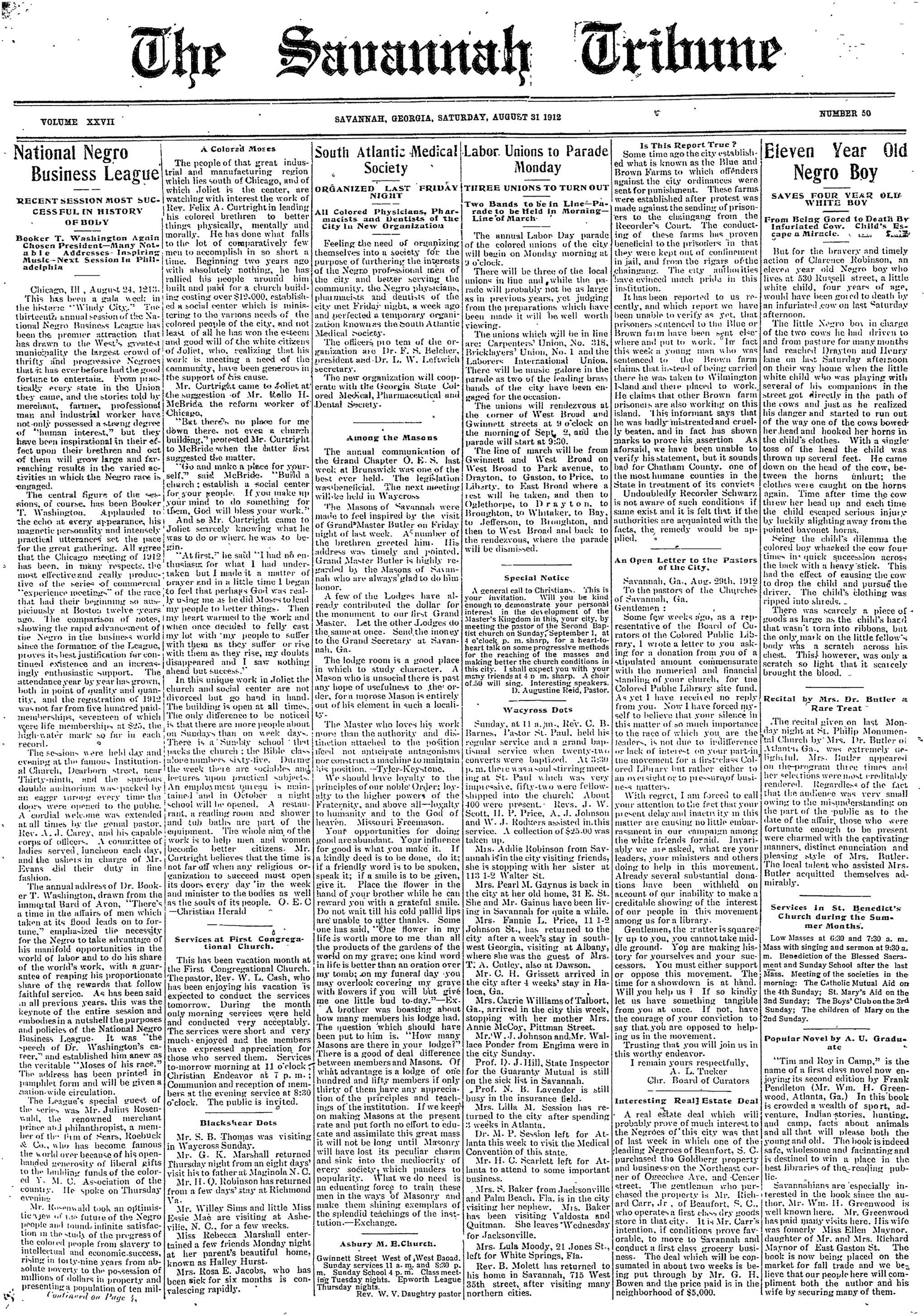
Chicago, Ill., August 24, 1913. This has been a gala week in the history "Windy City." The thirteenth annual session of the National Negro Business League has been the premier attraction that has drawn to the West's greatest municipality the largest crowd of thrifty and progressive Negroes that it has ever before had the good fortune to entertain. From practically every state in the Union they came, and the stories told by merchant, farmer, professional man and industrial worker have not only possessed a strong degree of "human interest," but they have been inspirational in their effect upon their brethren and out of them will grow large and far-reaching results in the varied activities in which the Negro race is engaged.
The central figure of the sessions, of course, has been Booker T. Washington. Applauded to the echo at every appearance, his magnetic personality and intensely practical utterances set the pace for the great gathering. All agree that the Chicago meeting of 1912 has been, in many respects, the most effective and really productive of the series of commercial "experience meetings" of the race that had their beginning so suspiciously at Boston twelve years ago. The comparison of notes, showing the rapid advancement of the Negro in the business world since the formation of the League, proves its best justification for continued existence and an increasingly enthusiastic support. The attendance year by year has grown, both in point of quality and quantity, and the registration of 1912 was not far from five hundred paid memberships, seventeen of which were life memberships at $25, the high-water mark so far in each record.
The sessions were held day and evening at the famous Institutional Church, Dearborn street, near Thirty-ninth, and the spacious double auditorium was packed by an eager crowd every time the doors were opened to the public. A cordial welcome was extended at all times by the general pastor, Rev. A. J. Carey, and his capable corps of officers. A committee of ladies served, luncheon each day, and the ushers in charge of Mr. Evans did their duty in fine fashion.
The annual address of Dr. Booker T. Washington, drawn from the immortal Bard of Avon, "There's a time in the affairs of men which taken at its flood leads on to fortune," emphasized the necessity for the Negro to take advantage of his manifold opportunities in the world of labor and to do his share of the world's work, with a guarantee of reaping his proportionate share of the rewards that follow faithful service. As has been said in all previous years, this was the keynote of the entire session and embodies in a nutshell the purposes and policies of the National Negro Business League. It was "the speech of Dr. Washington's career," and established him anew as the veritable "Moses of his race." The address has been printed in pamphlet form and will be given a nation-wide circulation.
The League's special guest of the series was Mr. Julius Rosenwald, the renowned merchant prince and philanthropist, a member of the fun of Sears, Roebuck & Co., who has become famous the world over because of his openhanded generosity of liberal gifts to the building funds of the colored Y. M. C. Association of the country. He spoke on Thursday evening.
Mr. Rosenwald took an optimistic view of the future of the Negro people and found infinite satisfaction in the study of the progress of the colored people from slavery to intellectual and economic-success, rising in forty-nine years from absolute poverty to the possession of millions of dollars in property and presenting a population of ten mil-
VOLUME XXVII
A Colored Moses
The people of that great industrial and manufacturing region which lies south of Chicago, and of which Joliet is the center, are watching with interest the work of Rev. Felix A. Curtright in leading his colored brethren to better things physically, mentally and morally. He has done what falls to the lot of comparatively few men to accomplish in so short a time. Beginning two years ago with absolutely nothing, he has rallied his people around him built and paid for a church building costing over $12,000, established a social center which is ministering to the various needs of the colored people of the city, and not least of all he has won the esteem and good will of the white citizens of Joliet, who, realizing that his work is meeting a need of the community, have been generous in the support of his cause.
Mr. Curtright came to Joliet at the suggestion of Mr. Rollo H-McBrida the reform worker of Chicago.
"But there's no place for me down there, not even a church building," protested Mr. Curtright to McBride when the latter first suggested the matter.
"Go and make a place for yourself," said McBride. "Build a church; establish a social center for your people. If you make up your mind to do something for them, God will bless your work."
And so Mr. Curtright came to Joliet scarcely knowing what he was to do or where he was to begin.
"At first," he said "I had no enthusiasm for what I had undertaken but I made it a matter of prayer and in a little time I began to feel that perhaps God was really using me as he did Moses to lead my people to better things. Then my heart warmed to the work and when once decided to fully cast my lot with my people to suffer with them as they suffer or rise with them as they rise, my doubts disappeared and I saw nothing ahead but success."
In this unique work in Joliet the church and social center are not divorced but go hand in hand. The building is open at all times. The only difference to be noticed is that there are more people about on Sundays than on week days. There is a Sunday school that packs the church; the Bible class alone numbers sixty-five. During the week there are sociables and features upon practical subjects. An employment bureau is maintained and in October a night school will be opened. A restaurant, a reading room and shower and tub baths are part of the equipment. The whole aim of the work is to help men and women become better citizens. Mr. Curtright believes that the time is not far off when any religious organization to succeed must open its doors every day in the week and minister to the bodies as well as the souls of its people. O. E. C —Christian Herald
Services at First Congregational Church.
This has been vacation month at the First Congregational Church. The pastor, Rev. W. L. Cash, who has been enjoying his vacation is expected to conduct the services tomorrow. During the month only morning services were held and conducted very acceptably. The services were short and very much enjoyed and the members have expressed appreciation for those who served them. Services to-morrow morning at 11 o'clock; Christian Endeavor at 7 p.m.; Communion and reception of members at the evening service at 8:30 o'clock. The public is invited.
Blackshear Dots
Mr. S. B. Thomas was visiting in Waycross Sunday. Mr. G. K. Marshall returned Thursday night from an eight days' visit his to father at Maginola N. C. Mr. H. Q. Robinson has returned from a few days' stay at Richmond Va. Mr. Willey Sims and little Miss Essie Mae are visiting at Asheville, N. C., for a few weeks. Miss Rebecca Marshall entertained a few friends Monday night at her parent's beautiful home, known as Halley Hurst. Mrs. Rosa E. Jacobs, who has been sick for six months is convalescing rapidly.
SAVANNAH, GEORGIA, SATURDAY, AUGUST 31 1912
South Atlantic Medical Society
ORGANIZED LAST FRIDAY
NIGHT
All Colored Physicians, Pharmacists and Dentists of the City In New Organization
Feeling the need of organizing themselves into a society for the purpose of furthering the interests of the Negro professional men of the city and better serving the community. the Negro physicians, pharmacists and dentists of the city met Friday night, a week ago and perfected a temporary organization known as the South Atlantic Medical Society.
The officers pro tem of the organization are Dr. F. S. Belcher, president and Dr. L. W. Leftwich secretary.
The new organization will cooperate with the Georgia State Colored Medical, Pharmaceutical and Dental Society.
Among the Masons
The annual communication of the Grand Chapter O. E. S. last week at Brunswick was one of the best ever held. The legislation was beneficial. The next meeting will be held in Waycross.
The Masons of Savannah were made to feel inspired by the visit of Grand Master Butler on Friday night of last week. A number of the brethren greeted him. His address was timely and pointed. Grand Master Butler is highly regarded by the Masons of Savannah who are always glad to do him honor.
A few of the Lodges have already contributed the dollar for the monument to our first Grand Master. Let the other Lodges do the same at once. Send the money to the Grand Secretary at Savannah, Ga.
The lodge room is a good place in which to study character. A Mason who is unsocial there is past any hope of usefulness to the order, for a morese Mason is entirely out of his element in such a locality.
The Master who loves his work more than the authority and distinction attached to the position need not anticipate antagonisms nor construct a machine to maintain his position. -Tyler-Keystone.
We should have loyalty to the principles of our noble Order; loyalty to the higher powers of the Fraternity, and above all—loyalty to humanity and to the God of heaven. Missouri Freemason.
Your opportunities for doing good are abundant. Your influence for good is what you make it. If a kindly deed is to be done, do it; if a friendly word is to be spoken, speak it; if a smile is to be given, give it. Place the flower in the hand of your brother while he can reward you with a grateful smile. Do not wait till his cold pallid lips are unable to utter thanks. Some one has said, "One flower in my life is worth more to me than all the products of the gardens of the world on my grave; one kind word in life is better than an oration over my tomb; on my funeral day you may overlook covering my grave with flowers if you will but give me one little bud to-day."—Ex. A brother was boasting about how many members his lodge had. The question which should have been put to him is, "How many Masons are there in your lodge?" There is a good of deal difference between members and Masons. Of what advantage is a lodge of one hundred and fifty members if only thirty of them have any appreciation of the principles and teachings of the institution. If we keep on making Masons at the present rate and put forth no effort to educate and assimilate this great mass it will not be long until Masonry will have lost its peculiar charm and sink into the mediocrity of every society, which panders to popularity. What we do need is an educating force to train these men in the ways of Masonry and make them shining exemplars of the splendid teachings of the institution.—Exchange.
Asbury M. B. Church.
Gwinnett Street West of West Baoad.
Sunday services 11 a.m. and 8:30 p.
m. Sunday School 4 p.m. Class meeting Tuesday nights. Epworth League
Thursday nights.
Rev. W. V. Daughtry pastor
Tribune
Labor. Unions to Parade Monday
THREE UNIONS TO TURN OUT
Two Bands to be in Line-Parade to be Held in Morning-Line of March.
The annual Labor Day parade of the colored unions of the city will begin on Monday morning at 9 o'clock.
There will be three of the local unions in line and while the parade will probably not be as large as in previous years, yet judging from the preparations which have been made it will be well worth viewing.
The unions which will be in line are: Carpenters' Union, No. 318, Bricklayers' Union, No. 1 and the Laborers International Union. There will be music galore in the parade as two of the leading brass bands of the city have been engaged for the occasion.
The unions will rendezvous at the corner of West Broad and Gwinnett streets at 9 o'clock on the morning of Sept. 2, and the parade will start at 9:30.
The line of march will be from Gwinnett and West Broad on West Broad to Park avenue, to Drayton, to Gaston, to Price, to Liberty, to East Broad where a rest will be taken, and then to Oglethorpe, to Drayton, to Broughton, to Whitaker, to Bay, to Jefferson, to Broughton, and then to West Broad and back to the rendezvous, where the parade will be dismissed.
Special Notice
A general call to Christians. This is your invitation. Will you be kind enough to demonstrate your personal interest in the development of the Master's Kingdom in this, your city, by meeting the pastor of the Second Baptist church on Sunday, September 1, at 4 o'clock p. m. sharp, for a heart-to-heart talk on some progressive methods for the reaching of the masses and making better the church conditions in this city. I shall expect you with your many friends at 4 p. m. sharp. A choir of 50 will sing. Interesting speakers. D. Augustine Reid, Pastor.
Wacyross Dots
Sunday, at 11 a.m., Rev. C. B. Barnes, Pastor St. Paul, held his regular service and a grand baptismal service when twenty-two converts were baptized. At 3:30 p.m. there was a soul-stirring meeting at St. Paul which was very impressive, fifty-two were fellow-shipped into the church! About 400 were present. Reys, J. W. Scott, H. P. Price, A. J. Johnson and W. J. Rodgers assisted in this service. A collection of $25.00 was taken up.
Mrs. Addie Robinson from Savannah is in the city visiting friends, she is stopping with her sister at 113 1-2 Walter St.
Mrs. Pearl M. Gaynus is back in the city at her old home, 31 E. St. She and Mr. Gainnus have been living in Savannah for quite a while. Mrs. Fannie L. Price, 11 1-2 Johnson St., has returned to the city after a week's stay in southwest Georgia, visiting at Albany, where she was the guest of Mrs. T. A. Cutley, also at Dawson. Mr. C. H. Grissett arrived in the city after 4 weeks' stay in Haloca, Ga. Mrs. Carrie Williams of Talbort, Ga., arrived in the city this week, stopping with her mother Mrs. Annie McCoy, Pittman Street. Mr.'W. J. Johnson and Mr. Wallace Ponder from Engima were in the city Sunday.
Prof. D. J. Hill, State Inspector for the Guaranty Mutual is still on the sick list in Savannah.
Prof. N. B. Lavender is still busy in the insurance field.
Mrs. Lilla M. Session has returned to the city after spending 3 weeks in Atlanta.
Dr. M. P. Session left for Atlanta this week to visit the Medical Convention of this state.
Mr. H. C. Scarlett left for Atlanta to attend to some important business.
Mrs. S. Baker from Jacksonville and Palm Beach. Fla. is in the city visiting her nephew. Mrs. Baker has been visiting Valdosta and Quitman. She leaves Wednesday for Jacksonville.
Mrs. Lula Moody, 21 Jones St. left for White Springs, Fla.
Is This Report True?
Some time ago the city established what is known as the Blue and Brown Farms to which offenders against the city ordinances were sent for punishment. These farms were established after protest was made against the sending of prisoners to the chaiingang from the Recorder's Court. The conducting of these farms has proven beneficial to the prisoners in that they were kept out of confinement in jail, and from the rigors of the chaiingang. The city authorities have evinced much pride in this institution.
It has been reported to us recently, and which report we have been unable to verify as yet, that prisoners sentenced to the Blue or Brown farm have been sent elsewhere and put to work. In fact this week a young man who was sentenced to the Brown farm claims that instead of being carried there he was taken to Wilmington Island and there placed to work. He claims that other Brown farm prisoners are also working on this island. This informant says that he was badly mistreated and cruelly beaten, and in fact has shown marks to prove his assertion. As aforesaid, we have been unable to verify his statement, but it sounds bad for Chatham County. one of the most humane counties in the State in treatment of its convicts
Undoubledly Recorder Schwarz is not aware of such conditions if same exist and it is felt that if the authorities are acquainted with the facts, the remedy would be applied.
An Open Letter to the Pastors of the City.
Savannah, Ga., Aug. 29th, 1912
To the pastors of the Churches of Savannah, Ga.
(Southeastern)
Some few weeks ago, as a representative of the Board of Curators of the Colored Public Library, I wrote a letter to you asking for a donation from you of a stipulated amount commensurate with the numerical and financial standing of your church, for the Colored Public Library site fund. As yet I have received no reply from you. Now I have forced myself to believe that your silence in this matter of so much importance to the race of which you are the leaders, is not due to indifference or lack of interest on your part in the movement for a first-class Colored Library but rather either to an oversight or to pressure of business matters.
With regret, I am forced to call your attention to the fact that your present delay and inactivity in this matter are causing no little embarrassment in our campaign among the white friends foraid. Invariably we are asked, what are your leaders, your ministers and others doing to help in this movement. Already several substantial donations have been withheld on account of our inability to make a creditable showing of the interest of our people in this movement among us for a library.
Gentlemen, the ratter is squarely up to you, you cannot take middle ground. You are making history for yourselves and your successors. You must either support or oppose this movement. The time for a showdown is at hand. Will you help us? If so kindly let us have something tangible from you at once. If not, have the courage of your conviction to say that, you are opposed to helping us in the movement. Trusting that you will join us in this worthy endeavor. I remain yours respectfully.
Interesting Real Estate Deal
A real estate deal which will probably prove of much interest to the Negroes of this city was that of last week in which one of the leading Negroes of Beaufort, S. C. purchased the Goldberg property and business on the Northeast corner of Ogeechee Ave. and Cenec street. The gentleman who purchased the property is Mr. Richard Carr, Jr., of Beaufort, S. C., who operates a first class dry goods store in that city. It is Mr. Carr's intention, if conditions prove favorable, to move to Savannah and conduct a first class grocery business. The deal which will be consumed in about two weeks is being put through by Mr. G. H. Bowen and the price paid is in the neighborhood of $5,000.
NUMBER 50
Eleven Year Old Negro Boy
Eleven Year Old Negro Boy
SAVES FOUR YEAR OLD WHITE BOY
From Being Gored to Death By Infuriated Cow. Child's Escape a Miracle.
But for the bravery and timely action of Clarence Robinson, an eleven year old Negro boy who lives at 530 Russell street, a little white child, four years of age, would have been gored to death by an infuriated cow on last Saturday afternoon.
The little Negro boy in charge of the two cows he had driven to and from pasture for many months had reached Drayton and Henry lane on last Saturday afternoon on their way home when the little white child who was playing with several of his companions in the street got directly in the path of the cows and just as he realized his danger and started to run out of the way one of the cows bowed her head and hooked her horns in the child's clothes. With a single toss of the head the child was thrown up several feet. He came down on the head of the cow, between the horns unhurt; the clothes were caught on the horns again. Time after time the cow threw her head up and each time the child escaped serious injury by luckily alighting away from the pointed bayonet horns.
Seing the child's dilemma the colored boy whacked the cow four times in quick succession across the back with a heavy stick. This had the effect of causing the cow to drop the child and pursue the driver. The child's clothing was ripped into shreds. There was scarcely a piece of goods as large as the child's hard that wasn't torn into ribbons, but the only mark on the little fellow's body was a scratch across his chest. This! however, was only a scratch so light that it scarcely brought the blood.
Recital by Mrs. Dr. Butler a Rare Treat
The recital given on last Monday night at St. Philip Monumental Church by Mrs. Dr. Butler of Atlanta, Ga., was extremely delightful. Mrs. Butler appeared on the program three times and her selections were most creditably rendered. Regardless of the fact that the audience was very small owing to the misunderstanding on the part of the public as to the date of the affair, those who were fortunate enough to be present were charmed with the captivating manners, distinct enunciation and pleasing style of Mrs. Butler. The local talent who assisted Mrs. Butler acquitted themselves admirably.
Services in St. Benedict's Church during the Summer Months.
Low Masses at 6:30 and 7:30 a. m. Mass with singing and sermon at 9:30 a. m. Benediction of the Blessed Sacrament and Sunday School after the last Mass. Meeting of the societies in the morning: The Catholic Mutual Aid on the 4th Sunday; St. Mary's Aid on the 3rd Sunday; The Boys' Club on the 3rd Sunday; The children of Mary on the 2nd Sunday.
Popular Novel by A. U. Graduate
"Tim and Roy in Camp," is the name of a first class novel now enjoying its second edition by Frank Pendleton (Mr. Wm. H. Greenwood, Atlanta, Ga.) In this book is crowded a wealth of sport, adventure, Indian stories, hunting, and camp, facts about animals and all that will please both the young and old. The book is indeed safe, wholesome and fascinating and is destined to win a place in the best libraries of the reading public.
Savannahians are especially interested in the book since the author, Mr. Wm. H. Greenwood is well known here. Mr. Greenwood has paid many visits here. His wife was formerly Miss Ellen Maynor, daughter of Mr. and Mrs. Richard Maynor of East Gaston St. The book is now being placed on the market for fall trade and we be lieve that our people here will compliment both the author and his wife by securing many of them.
AFRO-AMERICAN CULLINGS
"Have you a man to take charge of our farm?" "We wish a young woman to teach domestic science in our city school." "We need skilled mechanics to teach carpentry, wheelwrighting and blacksmithing." "Negro nurses, men and women, are in great demand here in our town." These are some of the many calls that assail the principal of Tuskegee Institute at all seasons of the year. It is reasonably so. The change of the trend of education among both white and black: the increase of wealth, and courage to venture into business among Negroes; the higher and higher esteem into which the skilled Negro workmen are rising all make this call louder and more general. At Tuskegee Institute some thirty odd of these industries are taught. There are millinery, dressmaking, ladies' tailoring, upholstering and mattress-making, domestic science, laundering and gymnastics for girls; there are shoemaking, tailoring, wheelwrighting, carpentry, cabinetmaking, tinsmithing, printing, harnessmaking, mechanical and architectural drawing, mechanical, electrical and steam engineering for boys; and there are dairying, swine raising, truck farming, poultry raising; stock raising, forculture, landscape gardening, veterinary science, fruit growing, and many other branches of industry, both mechanical and agricultural trades for both boys and girls. This again is the modern trend of things. Therefore let no one halt at the idea of young women entering the agricultural trades. Moreover, experience and experiments at Tuskegee Institute are demonstrating that the young woman is just as apt and able a pupil with the machinery in the creamery, with the science of feeds in the poultry yard, with packing and handling fruit in the orchard as she is with grammatical syntax in the classroom, and just as quick and aggressive as is her young man classmate, to whom time and prejudice have hitherto restricted these trades.
There have been several failures of co-operative effort to do business of one sort and another in New York in the past few years, but that should not deter our men and women from such efforts. Failures are, in a measure, the necessary step to success, as it is by experience that we learn what is good and what is bad method. As we have few opportunities to learn business methods by growing up with the business we have to get the experience the best way we can, even if it be through the sore ordeal of failure after failure. It is said that Peter Cooper failed at a dozen things before he found the sign of success. Nearly every day we meet some man of the race who, having made a venture by himself, or in partnerships and failed has no disposition to try again. He thus loses the capital he lost and the experience he gained in the losing of it. There is nothing but death in discouragement of any sort. Three men, five men, ten men, with a hundred dollars aplice can start a good business of most any sort, and while letting one of them manage it, earn an independent wage while the business grows. Plenty of them are beginning to do so here in New York and in other parts of the country. Try it, you!—New York Age.
Greenville, S. C., is a late addition to the list of southern cities that have passed segregation ordinances. Attempts to place limitations on negro progress can be only temporary.
The eighth biennial convention of the National Association of Colored Women, held at Hampton Institute, Hampton Roads, Va., was pronounced the largest and one of the best in the history of the organization. The convention began last week with a delegation of over four hundred women from various parts of the United States. Miss Elizabeth C. Carter of New Bedford, Maas, was the presiding genius, and among many others seated on the platform with her were: Mrs. Booker T. Washington, vice-president-at-large; Mrs. Mary Church Terrell and Mrs. Lucy Thurman, honorary presidents; Mrs. Josephine B. Bruce, acting chairman of the auditing committee; Mrs. Ida R. Cummings, corresponding secretary, and the various state presidents. Mrs. M. E. Steward of Louisville and Mrs. Victoria Clay Haley of St. Louis recorded the doings. Mrs. Eva T. Jenifer of Chicago was at her old post in charge of the ways and means committee, owing to the unavoidable absence of Mrs. Katherine D Tillman of California. Mrs. Mary Handy, president of the Mite Missionary society, which is national in scope, were seated on the platform
We gather from the reports of 1911 the total valuation of property owned by negroes and who paid taxes thereon for the current year in the following states is as follows:
Among the problems that the National Federation of Women's Clubs, soon to meet in Hampton, should take up for discussion and make a feature of Federation interest, is the work of domestic service as it affects our women. There are so many slides to the domestic service problem that it is necessary to indicate the special phase when discussing it. The first phase is, of course, the work of the wife in the home, and the work of the daughters as helpmates of the mother and as a preparation against the time when they as wives will have homes of their own. This is the highest call to-domestic service. It is the foundation of the American state. It is susceptible of infinite discussion. Every woman has ideas of home education for domestic service and what should be the character and scope of it, abilt the best people are coming to the sensible conclusion that the daughter, however wealthy, should have her education rounded out by a course in a domestic science school, like that of Pratt Institute, in Brooklyn, and such as is included in the courses of our own Hampton, Tuskegee and other Institutes. The Woman's Federation could do a good service by emphasizing this phase of domestic service education, as the home life of the negro, which depends so much upon the wife and mother, is of vital moment.
But the phase of domestic service as an occupation, as a livelihood, is also of great moment, as so many of our women, both young and old, have to take to it as a matter of necessity if not of choice. To all such the best domestic science education is of the greatest benefit and assures the best positions and wages. There are plenty of indications that negro women are not being attracted to domestic service as an occupation as formerly and that they are not giving the satisfaction the service calls for. The reason for this condition could be considered and discussed to advantage by the Woman's Federation.
---
A real race leader should be a useful man, able to arouse his people to become interested in his fellow men in making conditions better and in uplifting the human race, to see that each and every man enjoys the rights and privileges and blessings, as guaranteed by the state and national governments. We have been troubled too much with false leadership; men that were placed upon the pedestal of honor and "sold out" for selfish interests. They have regarded self aggrandizement higher than general good. Such leaders ought to be relegated to the rear and place given to men of honor intelligence, integrity and character. It is a fact that the younger generation is no longer standing by the false leaders and the press and people are up in arms against him. With such a spirit, the coming years will note a change that will work for the greatest good of the race. Let us keep up the fight for true leadership.—Illinois Chronicle.
At the recent commencement exercises at Wilberforce the following honorary degrees were awarded: Doctor of Laws—James C. Napler, register of the treasury; Bishop J. Albert Johnson and Bishop Levi J. Coppin. Doctor of Divinity—The Rev. J. C. Anderson, Loulsville, Ky. Master of Arta—The Rev. A. H. Attaway, president of Edward Waters college, Jacksonville, Fla., and William Stewart, New Jersey.
From a Pullman porter to one of the biggest property owners in Brockton, Mass., in five years is the jump which Watt Terry, a negro, has made. When papers passed conveying to Terry the famous Checkerton and Cheston apartments, valued at $150,000, he became the owner of $500,000 worth of the choicest property in the city. Terry had has a meteoric career, and where he once made $7 a week he is now making hundreds. Coming to Massachusetts from his home in Virginia when a young man, he took a position as coachman for a well-known physician. Then he went to the Y. M. C. A. as assistant janitor and became interested in the evening school. He enrolled and studied diligently for a long time. Finally he went away and was a Pullman porter for a while; then he returned to Brockton and went to work in a shoe factory, starting at $7 a week. He is superintendent of the Messiah Baptist Sunday school and is active in church work.
There is no courage in the display of sorrow; but there is often real heroism in the control of it.
In a recent editorial convention a minister was present and offered the following toast: "To save an editor from starvation, take his paper and pay for it promptly; to save him from despair, send him every item you can get hold of; to save him from bankruptcy, advertise in his paper liberally; to save him from profanity, write your correspondence plainly on one side of the sheet and send it in as soon as possible; to save him from mistakes, bury him. Dead people are the only ones who never make mistakes."
What the Smartest Dressmakers Are Now Displaying— Hints That May Help the Undecided
THE new fashions are directoire, says Paris, but directoire with a difference. The directoire styles we have all been used to during the past seasons were feminine directoire fashions—now the masculine directoire modes are to have their turn. And if ever modishness was the mode for masculinity, it was, in the elegant directoire days when every chap under his dotage was a dandy—and some old fellows in the dotage age, too. These gay dogs, if you please, affected silk stockings, and starched sleeve and neck frills, and perfumed collures. They were as fastidious about their cosmetics as any belle of today, and at the same time they could handle a sword and swallow a round of toasts in a way that proved them anything but effeminate.
The directoire dandy wore an oddly cut coat, which was somewhat like the modern dress coat extremely exaggerated. This coat had a sharply cutaway effect in front and tremendously long tails at the back, a high, turned-down collar, huge revers, and long, snugly fitting sleeves. Filmy frills escaped from the sleeves and foamed down the front of a lively waistcoat, between the big coat revers. It is these dandified coats of the late seventeen-hundreds that have formed the inspiration for women's tailored wear this season. The coat-tails, the cutaway fronts, the gay vest, the frills, the fanciful revers are all here, and coats are built in contrasting color and material to suggest the directoire dandy's cloth coat and satin breeches. Half of the new tailored wear for fall—hailing from Paris—shows the coat and skirt of contrasting fabrics, and the broadcloth coat with a velvet or satin skirt is seen as frequently as the velvet coat with a shirt of cloth or silk. Smooth finished materials are in high favor, and though rough chevots, wide welted serges and homeapuns will undoubtedly be used, trotabout suits and coats, the silky broadcloths, very soft, chiffony velvets, faille silks and poplin weaves will be favored for dressy costumes. A mixed weave of wornest with mohair threads, called in Paris a permo weave, is particularly well liked because of its lustrous, silky texture, and this-permo fabric comes in all the subdued, hard-to-describe colorings in which the French couturiers delight. A taupe shade and a deep mulberry shade are perhaps the most distinctive.
Grays in Favor.
Grays continue in the pronounced favor accorded them this summer, and many of the women who wore nothing but black and white combinations last season are now taking up their grays. It is a wise woman who—electing to dress in gray for a season—selects one particular shade of gray and keeps to it. There are dozens of shades and gradations of shade in the grays; there are blue grays, mauve-grays, pink-grays; taupe, smoke and elephant grays, and one gray can clash with another with as grating an effect as pink and orange or any other outrageous color combination.
Two striking features of Paris fashions for fall are the prevalence of pleats and the full-length sleeve. The elbow sleeve has passed with the high waltseat—which is now relegated to the limbo of passe fashions. All belts are at the waltseat normal; and some of the coat effects even drop below this point; and to make sure that nobody shall mistake the fact that a normal waltseat is now the mode, fashion has decreed that all waltseats shall be emphasized by a girdle, belt or sash of one sort or another. This is again a memory of the directore dante, whose sash, if his costume was military, was a very ornamental part thereof.
Sleeves are not only long, but they are snug. They cover the forearm and even the wrist in 'all coats, frocks and blouses intended for day-wear. Elbow sleeves in the form of loose, lace draperies are noted on some of the new evening frocks, but the bare forearm is not considered de rigueur during the morning or afternoon—unless with an informal at-home costume. Many of the sleeves have a most eccentric and fanciful cut, and frills falling from the lower edge and to their length. Cuffs are enormously modish and the fashionable cuff may be a mere band, or a deep affair, slashed, notched and garnished with many buttons and buttonhole loops. In fact, buttons are the style fetish of the fall season. No good luck can come to a costume which does not boast buttons in some part of its make-up, and one may pay as much for one's buttons as for the material of one's gown. New buttons made of silk braid are very fashionable on tailored coats and skirts of broad cloth, and these braid buttons are used also on silk and velvet costumes with good effect.
Machine Plait Everything.
Buttons and sleeves have rather sidetracked the Scribe from the subjects of plaits—a most vitally significant issue just now; for it is the plait
that is going to work a transformation in the silhouette, though the change will probably be so gradual that nobody will realize that skirt lines have completely changed until the metamorphosis has been wrought. Everything is plaited—in one way or another—and we are seeing again the old, old-fashioned knife plaites, tacked together on the under side with lengths of tape so that they may not spread apart. There are, among the new Paris models for autumn, skirts plaited all around at the top, in narrow knife-plaiting, yet so trimly held in place by rows of these confining tapes that the measurement at knee and foot does not exceed the prescribed two yards or so, and the silhouette is as slim and narrow as fashion still demands. Machine-plaited skirts are at the pinnacle of the machine plaiting—or accordion plaiting, as it is sometimes called—is put into even velvet and broadcloth fabrics, though, of course, the best effects are produced with satin, heavy silk or the soft, lustrous perma fabrics above referred to. When the whole skirt or part of it in panels or drapery, is not plaited, there is apt to be some trimming in the form of plaited quillings—or narrow bands of knife-plaiting stitched about half an inch inside either edge. A very smart coat designed by Mme. Paquin for her own use is of navy blue faille silk with yards and yards of this quilled plaiting, or plaited plaiting—which ever one chooses—in trimming bands. Plipings made of tiny plaitings stand up from every seam.
Watteau plats and paniers are being used with discretion by many of the courtiers, to give a touch of grace and picturesqueness to fall models. The Watteau plait is noted even on tailored coats, and it appears constantly on handsome wraps for evening wear. The panier is a much chastened and subdued modification of the impertinent puffed-out affair which heralded the arrival of this fashion last spring, and many of the looped and draped paniers on fall
1
frocks are exquisitely graceful. Skirts remain narrow at the foot, all the width being introduced in plaitings and long, clinging draperies which do not interfere with the slim silhouette. There seems a tendency to make skirts a bit longer, though footwear is as coquettish and fetching as ever. The new boots for fall have patent leather or dull kid vamps and buttoned tops of dull kid, ox or cloth. The very aristocratic boot is as long and slender in line as it can be and fits its wearer daintily. Anything like a stubby effect is considered cheap and 'common, and the slender, aristocratic foot has the day.
Shoe buckles are tremendously fashionable—still another echo of our directoire dandy—and while the trim, buttoned boot will continue to be the correct thing for the street and for afternoon wear with handsome toilettes, buckled slippers and pumps with embroidered silk stockings promise to be in great favor for evening and house wear.
Shantung Ccatume.
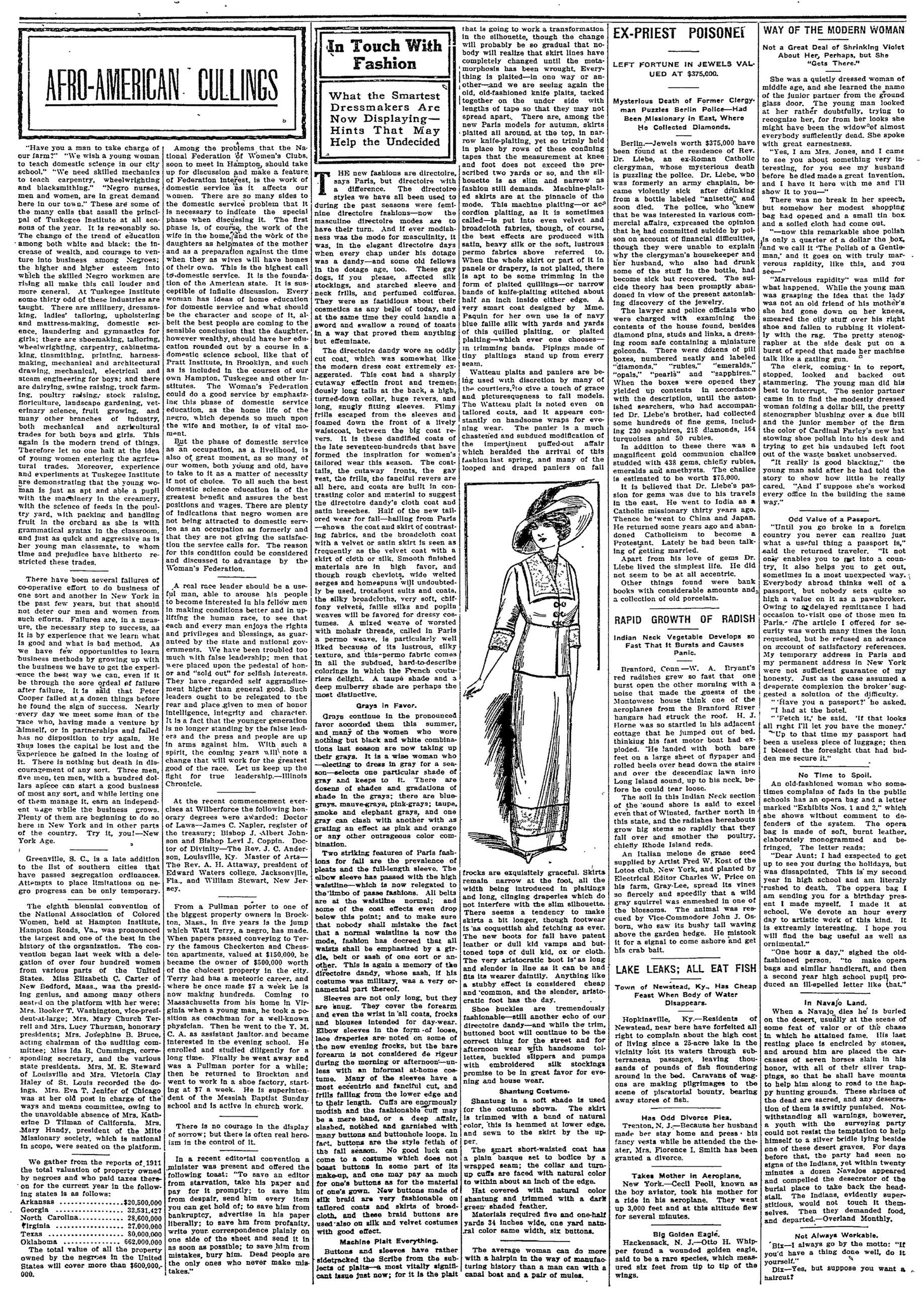
Shantung in a soft shade is used for the costume shown. The skirt is trimmed with a band of natural color, this is hemmed at lower edge, and sewn to the skirt by the upper.
The smart short-waisted coat has a plain basque set to bodice by a wrapped seam; the collar and turnup cuffs are faced with natural color to within about an inch of the edge.
Hat covered with natural color shantung and trimmed with a dark green shaded feather.
Materials required five and one-half yards 34 inches wide, one yard natural color same width, six buttons.
The average woman can do more with a hairpin in the way of manufacturing history than a man can with a canal boat and a pair of mules.
EX-PRIEST POISONED
EX-PRIEST POISONED
LEFT FORTUNE IN JEWELS VALUED AT $375,000.
Mysterious Death of Former Clergy man Puzzles Berlin Police—Had Been Missionary in East, Where He Collected Diamonds.
Berlin.—Jewels worth $375,000 have been found at the residence of Rev. Dr. Liebe, an ex-Roman Catholic clergyman, whose mysterious death is puzzling the police. Dr. Liebe, who was formerly an army chaplain, became violently sick after drinking from a bottle labeled "anisette" and soon died. The police, who knew that he was interested in various commercial affairs, expressed the opinion that he had committed suicide by poison on account of financial difficulties, though they were unable to explain why the clergyman's housekeeper and her husband, who also had drunk some of the stuff in the bottle, had become slick but recovered. The suicide theory has been promptly abandoned in view of the present astonishing discovery of the jewelry.
The lawyer and police officials who were charged with examining the contents of the house found, besides diamond pins, studs and links, a dressing room safe containing a miniature golconda. There were dozens of pill boxes, numbered neatly and labeled "diamonds," "rubles," "emeralds," "opals," "pearls" and "sapphires." When the boxes were opened they yielded up contents in accordance with the description, until the astonished searchers, who had accompanied Dr. Liebe's brother, had collected some hundreds of fine gems, including 230 sapphires, 218 diamonds, 164 turquoises and 50 rubies.
In addition to these there was a magnificent gold communion chalice studded with 438 gems, chletty rubies, emeralds and amethysts. The chalice is estimated to be worth $75,000.
It is believed that Dr. Liebe's passion for gems was due to his travels in the east. He went to India as a Catholic missionary thirty years ago. Thence he went to China and Japan. He returned some years ago and abandoned Catholicism to become a Protestant. Lately he had been talking of getting married.
Apart from his love of gems Dr. Liebe lived the simplest life. He did not seem to be at all accentric.
Other things found were bank books with considerable amounts and, a collection of old porcelain.
RAPID GROWTH OF RADISH
Indian Neck Vegetable Developa so Fast That It Bursts and Causes Panic.
Branford, Conn—W. A. Bryant's red radishes grew so fast that one burst open the other morning with a noise that made the guests of the Montowese house think one of the airplanes from the Branford River hangars had struck the roof. H. J. Horne was so startled in his adjacent cottage that he jumped out of bed, thinking his fast motor boat had exploded. He landed with both bare feet on a large sheet of flypaper and rolled beels over head down the stairs and over the descending lawn into Long Island sound, up to his neck, before he could tear loose.
The soil in this Indian Neck section of the 'sound shore is said to excel even that of Winsted, farther north in this state, and the radishes hereabouts grow big stems so rapidly that they fall over and smother the poultry, chiefly Rhode Island reds.
An Italian melone de grase seed supplied by Artist Fred W. Kost of the Lotos club, New York, and planted by Electrical Editor Charles W. Price on his farm, Gray-Lee, spread its vines so fiercely and speedily that a wild gray squirrel was enmeshed in one of the blossoms. The animal was rescued by Vice-Commodore John J. Osborn, who saw its bushy tail waving above the garden hedge. He mistook it for a signal to come ashore and get his bisc bait.
LAKE LEAKS; ALL EAT FISH
Town of Newstead, Ky. Has Cheap Feast When Body of Water Disappears.
Hopkinsville, Ky.—Residents of Newstead, near here have forfeited all right to complain about the high cost of living since a 25-acre lake in the vicinity lost its waters through subterranean passages, leaving thousands of pounds of fish floundering around in the bed. Caravans of wagons are making pilgrimages to the scene of piscatorial bounty, bearing away stores of fish.
Has Odd Divorce Plea.
Trenton, N. J.—Because her husband made her stay home and press his fancy vesta while he attended the theater, Mrs. Florence I. Smith has been granted a divorce.
Takes Mother in Aeroplane
New York.—Cecil Peoll, known as the boy aviator, took his mother for a ride in his aeroplane. They went up 3,000 feet and at this altitude flew for several minutes.
Big Golden Eagle
Hackensack, N. J.-Otto H. Whipper found a wounded golden eagle, said to be a rare species, which measured six feet from tip to tip of the wings.
Not a Great Deal of Shrinking Violet About Her, Perhaps, but She "Gets There."
She was a quietly dressed woman of middle age, and she learned the name of the junior partner from the ground glass door. The young man looked at her rather doubtfully, trying to recognize her, for from her looks she might have been the widow of almost everybody sufficiently dead. She spoke with great earnestness.
"Yes, I am Mrs. Jones, and I came to see you about something very interesting, for you see my husband before he died made a great invention, and I have it here with me and I will show it to you—"
There was no break in her speech, but somehow her modest shopping bag had opened and a small tin box and a soiled cloth had come out.
"—now this remarkable shoe polish is only a quarter of a dollar the box, and we call it "The Polish of a Gentleman," and it goes on with truly marvelous raplidity, like this, and you see—"
"Marvelous rapidity" was mild for what happened. While the young man was grasping the idea that the lady was not an old friend of his mother's she had gone down on her knees, smeared the oily stuff over his right shoe and fallen to rubbing it violently with the rag. The pretty stenographer at the side desk put on a burst of speed that made her machine talk like a gattling gun.
The clerk, coming in to report, stopped, looked and backed out stammering. The young man did his best to interrupt. The senior partner came in to find the modestly dressed woman folding a dollar bill, the pretty stenographer blushing over a due bill and the junior member of the firm the color of Cardinal Farley's new hat stowing shoe polish into his desk and trying to get his undaubed left foot out of the waste basket unobserved.
"It really is good blacking," the young man said after he had told the story to show how little he really cared. "And I suppose she's worked every office in the building the same way."
Odd Value of a Passport
"Until you go broke in a foreign country you never can realize just what a useful thing a passport is," said the returned traveler. "It not only enables you to get into a country, it also helps you to get out, sometimes in a most unexpected way. Everybody abroad thinks well of a passport, but nobody sets quite so high a value on it as a pawnbroker. Owing to delayed remittance I had occasion to visit one of those men in Paris. The article I offered for security was worth many times the loan requested, but he refused an advance on account of satisfactory references. My temporary address in Paris and my permanent address in New York were not sufficient guarantee of my honesty. Just as the case assumed a desperate complexion the broker suggested a solution of the difficulty. "Have you a passport?" he asked. "I had at the hotel."
"Fetch it," he said. "If that looks all right I'll let you have the money." "Up to that time my passport had been a useless piece of luggage; then I blessed the foresight that had bidden me secure it."
No Time to Spoil.
An old-fashioned woman who sometimes complains of fads in the public schools has an opera bag and a letter marked "Exhibits Nos. 1 and 2," which she shows without comment to defenders of the system. The opera bag is made of soft, burnt leather, elaborately monogrammed and beffringed. The letter reads:
"Dear Aunt: I had expected to get up to see you during the holidays, but was disspointed. This is my second year in high school and am literally rushed to death. The oppera bag I am sending you for a birthday present I made myself. I made it at school. We devote an hour every day to artistic work of this kind. It is extremely interesting. I hope you will find the bag useful as well as ornamental."
"One hour a day," sighed the old-fashioned person, "to make opera bags and similar handicraft, and then a second year high school pupil produced an ill-spelled letter like that."
In Navajo Land.
When a Navajo dies he' is buried on the desert, usually at the scene of some feat of valor or of the chase in which he attained fame. His last resting place is encircled by stones, and around him are placed the carcasses of seven horses slain in his honor, with all of their silver trappings, so that he shall have mounts to help him along to road to the happy hunting grounds. These shrines of the dead are sacred, and any desecration of them is swiftly punished. Notwithstanding all warnings, however, a youth with the surveying party could not resist the temptation to help himself to a silver bridle lying beside one of these desert graves. For days before that, the party had seen no signs of the Indians, yet within twenty minutes a dozen Navajos appeared and compelled the desecrator of the burial place to take back the head-stall. The Indians, evidently superstitious, would not touch it themselves. Then they demanded food, and departed—Overland Monthly.
Not Alwaya Workable.
Not Always Workable.
Bix—I always go by the motto: "If you'd have a thing done well, do it yourself."
Dix—Yes, but suppose you want a haircut?
FARM AND
ROAD
IMPROVEMENT
SAWDUST ROADS IN FLORIDA
Disposition Made of By-Products of Lumbering in Southern State—Wear Well in Georgia.
Sawdust roads are being made in an experimental way in Leon county, Florida. Great piles of sawdust dot the state throughout its pine land sections, useless monuments to the sawmill's work. The disposition of the by-products of lumbering in Florida—the sawdust and the stumps—has long been the subject of careful study, but until now they have largely been wastes. It is believed that a practical process has finally been evolved for the making of paper pulp from pine stumps and the utilization of the mountains of sawdust in road building would prove a great boon.
In many of the more favored sections of Florida clay lies beneath the sandy loam with more or less of over-burden Where this over-burden is light it may be readily stripped off and a clay pit opened which affords good material for hardening the road surface. In some sections—notably Marlon county—great lime deposits lie close to the surface, not rock like the usual limestone deposits, but soft enough to be handled by picks and to be crushed by road rollers. An application of this soft limestone on a road that has been surfaced with clay makes altogether an ideal road, and miles of such highways are being built by enterprising communities and counties. Where these materials are available, or where cheaper roads are desired, the sawdust can doubtless be utilized to good effect In Leon county two ridges of earth are thrown up with a road machine at the required width from each other and the space between is filled with a six-inch bed of sawdust This is followed with a smaller machine which plows up and mixes the earth with the sawdust. This makes a roadbed on which the tires of the heaviest loaded vehicles make no impression. The contractor has kept an accurate account of expenses in connection with this section of sawdust and earth road and finds the cost aggregates $297 a mile, showing it to be about the cheapest road material in use.
Some sawdust roads were built in south Georgia twenty ears ago and have worn well and given good satisfaction. The Leon county soil is somewhat clayed, which adapts it well to the use of sawdust, but this mill by-product can also be used to advantage in the sandier soils. It is a common practice in some of the sandy sections to build walks with the sawdust is which the manufactured ice is packed for shipment by express, and a little of this sawdust mixed with sand affords a surprisingly firm footing. There seems no reason to doubt that the mountains of sawdust scattered all over the pine lands of the south may be advantageously used to acquire a firmer surface on the sandy loam roads.
The Luscious Delaware Grane.
Just where the Delaware originated is not known. It was first noticed many years ago in the garden of Paul H. Provost of Hunterdon county, New Jersey. The Delaware flourishes best in a rich, well-drained soil. It is very popular in New York and other states to the south. Of high productivity and with a delicate, pleasing flavor, the Delaware holds high rank with many growers.
Listing Corn.
At one time listing corn was apt to be a rather slovenly operation, but now tools have been thoroughly well adapted to this method. Disk cultivators seem more in favor for they thoroughly destroy the weeds and then harrowing helps level the rows before the next cultivation. Even the small cane is deeply planted and seems to succeed well in states where there is plenty of rainfall.
Cooley on Good Roads
"Road building is a science," said G. L. Cooley, representing the good roads department of the federal government at the good roads convention at the Dallas (Tex.) fair. "There is no more reason why a man should work out his road tax than that he should teach out his school tax. We lose millions of dollars annually by lack of intelligent application of road funds."
Keep Grit and Lime
It is well to keep grit and lime within reach of the fowls at all times. It is true that in the country fowls can gather plenty of grit from the fields, but it is convenient to have it in the poultry-house, so that when bad weather is on the fowls are not compelled to be without it.
Good Roads.
Good roads are costly while they are in process of building. But we have yet to find a community which has these better highways that would by any manner of means consent to go back to the old way.
FOR BETTER HIGHWAYS
Appeal Made by Thomas Nelson Page for Betterment
Noted Author Heids Improvement of Roads Will Increase Prosperity of Country and Distribute Population Equally.
Mr. Thomas Nelson Page, the author, in a statement which he has issued as chairman of the American Association for Highways Improvement, points to the association as the proper vehicle through which all the people of the country can take part in the great movement for the improvement of the roads, which, he holds, will increase the prosperity of the country and provide a more equal distribution of population. The officers of the association include some of the most prominent men of the country.
"Of all the material affairs of the country at present," says Mr. Page, "the improvement of the public roads seems to me the most important and far reaching. Every improvement of our roads is a direct increase in the value of property and a direct assistance toward the improvement, physically, morally and mentally, of our people. It is not too much to say that in the southern portion of this country we are 50 years behind at least a part of the north in this matter of roads and we are 200 years behind Europe, at least that portion of Europe over which I have traveled, extending from the northern flords of Norway down to the southernmost points of Italy and Spain.
"Both urban and rural communities, of course, are interested vitally in roads, but the country is far more interested than the city, for good roads shorten the distance to the market, to the school, to the railway station and the country store, precisely so much as the road is improved. It is not too much to say that the agricultural land of the south would be more than doubled in value if the roads were only half as bad as they are.
"Our people need to be educated in this matter of good roads as much as on any other subject in the world, and the most important work perhaps that the American Association for Highway Improvement can perform is to establish clearly in the minds of our people that their personal interests are bound up with the improvement of their highways.
"It takes a long time to establish a new idea in the minds of a great conservative population; but this new idea is taking root among our people and will in time become established. The new ideas of farming are being introduced, which are already increasing materially the productivity of the soil and the knowledge of our farming population as to the value of improved methods, and it is as certain as any other law of nature that in time the improvement of the public roads will come. The only question is whether we shall allow this improvement to be postponed until our generation are all dead and buried or whether we shall bring the improvement in our own time and get the benefits of it—whether we shall use our knowledge and our opportunities to give to the rising generation throughout the country the benefits which come directly from a great system of good roads opening the way to enlightenment and comfort of all kinds, or whether we shall leave them to suffer from the want of such a system and possibly even from the want of knowledge that such improvement is essential."
Hot Weather Feeds.
Greens are essential in hot weather. The hens in a large open park will help themselves, but the inmates of a small yard must be liberally provided for by their keeper. Surplus greens and weeds from the garden, oats or wheat sown in mesh-covered boxes, or sprouted oats should be given daily. Sour milk, where it can be spared, is an excellent hot-weather tonic. Supply it in addition to cool drinking water and have all such vessels containing it set in the shade on the north side of the house or under specially made shelters. Renew the water at least twice every day.
Winter Clothes.
Alfalfa from northern grown seed is hardy, yet it needs winter protection. In case there is not a good growth left to cover it, to catch snow and to lessen the effect of freezing and thawing, it will be helpful to put on a light covering of straw or manure. True, some of this will get into the hay, but the all-important thing is to save the stand of alfalfa.
Demand for Selected Eggs.
It should be remembered that it will take time to work up a demand for selected eggs, but when people are once convinced that the eggs can be depended on, they will not only call for such eggs, but will tell their friends about them.
Amount of Feed.
The amount to be fed a flock is a matter of observation. The general rule to feed what will be eaten up clean should be supplemented by careful observation upon the effects of the food supplied in the condition of the fowls.
Roads In France.
Havre and other French cities are using a new method to allay the dust nuisance. Roadways are sprinkled with common salt and then watered freely.
MISS MORGAN'S VIEWS
ON ECONOMIC PROBLEMS
Miss Anne Morgan, daughter of America's greatest financier, does not believe any woman can be happy unless she works. Miss Morgan keeps reasonably busy. She was prominent in promoting the recent ball for the Vacation Savings fund for working girls. She explained some of her knowledge of conditions and views on econom-
A.
ic problems in talking about it.
"We all know," said Miss Morgan,
"that the girl who makes from five to six dollars a week cannot possibly live on her own resources in New York and save money. I know that no young woman here can be really self supporting on less than eight dollars a week, but a great many young women live on less because they are partially supported by their families. When any employer tells you that he pays his girls five or six dollars a week, and that he employs only young women who live at home, you can be sure that that employer who does not pay a living wage is practically subsidized by the families of his employees.
"The Vacation Savings fund was organized primarily to help the poorly paid working girl to save money for a vacation, but we hope ultimately to convince employers that a girl who works only fifty weeks is of greater value than one who works 52 weeks. You must know that the greater number of girls making five and six dollars a week do not receive paid vacations, and those that do have little chance of enjoying them, because their two weeks' wages are mortgaged in advance to their families.
The Vacation Savings fund was organized to help girls earning small wages to put aside sums ranging from five to twenty-five cents a week for the purpose of taking a two weeks' vacation in the country.
"The girls do not wish to feel that they were in any way the recipients of charity, and there is nothing that I detest more than charity myself. Charity solves no social problems—in fact, it retards their solution. So they conceived the idea of giving a ball." Miss Morgan said that she was strongly in favor of trades unions, but was not interested in suffrage. "I believe there are many things more immediately necessary for women," she went on, "but suffrage is certain to come."
REV. A. B. IRWIN IN ONE PULPIT 25 YEARS
The Presbyterian congregation in Highland, Kan., gave a reception a few nights ago to the pastor, Rev. A. B. Irwin, and Mrs. Irwin, upon the conclusion of his twenty-fifth year of continuous ministry in the same church.
P.
When Dr. Irwin came to Highland twenty-five years ago there was neither a Presbyterian church nor parsonage. The congregation worshiped in the chapel of an old college building. Dr. Duncan Brown, now of St. Joseph, who preceded him, served as both pastor and president of Highland college.
Dr. Irwin is a graduate of Knox college and of the Yale Divinity school. His first work was as principal of the Emerson Institute in Mobile, Ala., then maintained by the American Missionary association as a normal school for freedmen. He entered the home mission field in Nebraska, where he served four churches at one time, driving 50 miles each week to do so. Afterwards he preached for six years in the Presbyterian church at Beatrice. Neb., from which place he went to Highland.
Extract From Australian Diary.
About noon it got too hot for anything and I took a well earned swim in a secluded creek, amid shoals of fish, large and small, who apparently resented my intrusion from the way they came and stared at me. I found on emerging from the water that a host of blue brown ants had taken possession of my clothes, and when they were shaken out they revenged themselves by biting my bare feet in a way which was exceedingly painful.
There are thousands of ants everywhere. Some of the anthills are three feet high and six feet across—but except for a sharp nip at the time, the ordinary ants' bite is not noticeable. But if a soldier ant or a bull ant or a greenhead (an ant about 1½ inches long, with a green head) bites you, it is not to be forgotten because they take quite a big piece out.
Then there are the white ants (not really ants, but termites), which cheerfully eat the inside out of the beams of the wooden houses, and recently have been eating the sheet lead on the top of the Sydney museum. The city fathers thought this was going a little too far, so now the ants are preserved inside the museum with samples of the half consumed lead as a warning to all who would allow their appetites to run away with them.—The Gentlewoman.
ONCE A MILLIONAIRE;
CARRIES DINNER PAIL
ONCE A MILLIONAIRE;
CARRIES DINNER PAIL
Edward Corrigan, former king of the American turf, has come back to
former king of has come back to Kansas City, after thirty years, to start life over again. With what little he could save from the wreck of his fortune after the final crash three years ago, the former millionaire has leased a few acres of land, set up a stone crusher and settled down to de-
er thirty years, to start life over again. With what little he could save from the wreck of his fortune after the final crash three years ago, the former millionaire has leased a few acres of land, set up a stone crusher and settled down to devote himself to leveling limestone cliffs, the same sort of work he did as a railroad contractor before taking up the racing game.
A few years ago Corrigan was the most spectacular figure on the American turf. His thirty years in the racing game were spent in continuous fighting. In 1891 he forced the Coney Island Jockey club to allow his horse, Huron, to start in the Futurity at Sheepshead Bay after the club had ruled that there was a defect in the entry. The horse came in second, but the judges willfully overlooked him, so that no part of the $60,000 stake went to Corrigan. From that time on New York tracks were closed against Corrigan.
Nothing daunted, he took a stable of horses to England. He was not welcomed, and it was said that it was only through the efforts of Mark Hanna and others that he was granted privileges at Newmarket.
The scene of Corrigan's longest and most bitter fight was the Hawthorne track in Chicago, which he managed in opposition to John Condon's Harlem track. Condon sent word that rather than compromise he would sink the Harlem track to the bottom of Lake Michigan.
"Tell him," said Corrigan in reply, "that I'll put Hawthorne on top of it to keep it down."
Corrigan eventually moved to the coast. He established the beautiful Ingleside course on a site overlooking the Pacific. The authorities closed its gates. In New Orleans and Missouri his hard luck continued. He awoke one morning to find himself penniless, bankrupt.
The former "master of Hawthorne" now goes out to his little quarry every morning carrying a dinner pall.
MRS. REBECCA CLARK IS AN OPTIMIST AT 108
"I never worry," said Mrs. Rebecca Clark, the oldest of London's three centenarians, when asked how she had managed to remain an optimist at 108.
[Picture of a woman with a crown.]
"Never since I was a young girl have I allowed worries to interfere with me," she said brightly, "and to this I attribute my long life. As a matter of fact I am of such a happy disposition that I feel I must do a step or two when I hear a band playing. "Cheerfulness is the best elixir for living a hundred years. A woman can always be cheerful if she makes her work at home congenial. In fact, a woman's place ought to be her home."
Alert and active, Mrs. Clark runs up and down stairs with a vivacity that is amazing. She can hear a bee humming and threads needles for her daughter. Every Friday she walks to the postoffice to draw her old age pension. She has a son and a daughter who are both old age pensioners. Her eldest grandson is fifty-eight.
Mrs. Clark's chief delight is automobiling.
"I always feel somehow younger after an auto ride," she says. "This summer I have often gone motoring with a friend and did a little haymaking, which is another of my favorite pastimes."
Mrs. Clark scorns all invalid foods and insists on having the same fare as the others in the house. This was her birthday menu, to which she did full justice:
Breakfast, 10 a. m.—Eggs and bacon, bread and butter, two cups of tea.
Luncheon, noon—Biscuits and tea.
Dinner, 2 p. m.—Veal and ham, two vegetables, gooseberry tart and Devonshire cream.
Tea, 5 p. m.—Bread and butter, two slices of birthday cake, two cups of tea.
Supper, 7:30 p. m.—Crusts of bread and tea.
Mrs. Clark is the possessor of four royal letters—from the late King Edward, Queen Alexandra, King George and Queen Mary.
Gave Himself Away.
Mrs. Binks (with a disgusted air)—That Aunt Sallie, who writes the articles in the household department of this paper, isn't a woman at all. It's a man.
Mr. Binks—Why so?
Mrs. Binks—Here's an article that says woman's proper sphere is the home.
Domestic Explanations.
Young Hopeful—Ma, what's a carpet knight?
Ma (glaring at pa)—One who will put down the carpets for his wife without growling and before he'll see her attempt it herself.
HE FIXED THE DOCTOR
FINAL MESSAGE OF SPANIARD
DYING IN HOSPITAL.
Not Black Hand Letter, as Nurse Feared, But Instructions to His Brother Not to Pay the Medical Man.
In a New York hospital a cadaverous Spaniard, with the aid of oxygen and a pump, was staving off the final moment of exit.
Rallying temporarily, he stretched out a hand and clutched at the arm of the nurse, motioning her to lean over and put her ear to his mouth.
"My doctor go?"
"Yes; he's gone."
"Shut 'e door."
"Lock him," he begged—it was the custom to humor the dying.
He beckoned her closer and pulled her down to him again. "You make promise?"
"Yes, indeed; what is it?"
"Get paper, pencil, and—what you call?—envelope."
Shielding his writing with one hand he managed to scrawl a single line on the note paper and to address the message, but before loosening his hold on the paper he called her to him once more.
"Now you promise for me again? You promise you not show this to doctor?—not show it tonight, nurse—not to anybody? Just mail it—you promise?"
She nodded.
He slipped the sheet from the envelope once more, grinning with what had every appearance of fiendish exultation.
"That fix him," he muttered. "That fix him."
An hour later, when the doctor returned, he found the nurse crying.
turned, he found the nurse crying.
"He died fifteen minutes ago, and I don't know what to do. I ought to mail this, but I'm afraid it's some Black Hand business or something. Would you be willing to look it over and see if it's all right to send? You read Spanish. She handed him the letter.
He glanced at the one single line and shook his head.
"Is it a Black Hand message?" she whispered.
"No," he said plaintively, "it's to his brother. He just writes. 'Don't pay the doctor.'"—Lippincott's.
Cause of Age and Death.
Everything points, it appears to me, to the essential correctness of the view which holds age and death to be the result of the greatly increased differentiation of larger organisms. Is there then any probability that we shall some time find that in the higher animals, as in the lower ones, death need not occur? Evidently not. If death is the price of differentiation, then after the goods have been delivered the price must be paid. To prevent a higher organism from undergoing death would at the same time prevent him from becoming a higher organism. And the cell which remains in the embryonic condition—the cell of the germ glands—is even now as immortal as the cell of the infusorian. Death, as Minot says, is the price we pay for our complex life. Age and death, though not inherent in life itself, are inherent in the differentiation that makes life worth living.—Prof. H. S. Jennings in the Popular Science Monthly.
Dangerous Exercise.
Every person who has received gymnasium training is aware of the fact that an exercise which calls for painful effort on the part of the beginner is often performed almost without any conscious effort at all after a certain amount of training has been received. Again, it is perfectly well known that brute strength alone does not make a gymnast, and that a simple exercise may offer great difficulty to a muscular and well developed individual who has not been trained in the gymnasium. The explanation for this is made plain in an article by Prof. du Bols Reymond in Die Umschau, who points out that one of the essential functions of gymnasium work is not so much to build up muscle as to train nerves and nerve groups to work in proper unison and co-ordination.
'The Process.
Finding one of her pupils in peculiar distress over his lesson, a teacher in a primary school inquired as to the trouble. The boy stated this arduous problem:
"If Richard has three red apples and John has four, how many have they both got together?"
"Is that so very hard?" she asked.
"Yes, ma'am."
"But, surely," the teacher continued, "you know already that three and four make seven. There can be no trouble about that."
"I know that, ma'am," was the pathetic response. "But the process! It's the process that wears me out!"—Lippincott's.
Value of Buildings in France.
The results of the decennial valuation of buildings in France show that in the fiscal year 1909-10 there were, outside of public buildings, monuments, etc., 9,475,786 houses and 137,676 workshops and factories in the republic. The rental value of these structures is given in the returns as $708,723,431. The rental value in the department of the Seine, which includes Paris, is $232,922,284, practically one-third of the total rental value for the whole of France.
TEACHES THEM THRIFT
FATHER MAKING HIS CHILDREN
LEARN VALUE OF MONEY.
Each Has Some of His Own for Household Work, but Allowance is Reduced If His Savings Fall Below Mark.
William Jones is a thrifty father with a plan of his own for teaching, his four children the value of money. These children are 15, 11, 8 and 6 years old; the two eldest are girls, and the two youngest are boys. Father Jones is head of a branch of his household which he calls the "thrift department."
To teach a child to save, Jones believes, it is essential to let him handle a little money of his own, and always to have some in his possession. "I believe," says Jones, "that the boy who can go through a store full of attractive things, spend a small amount thoughtfully, and come back with some loose change in his pocket is on the road to thrift."
In carrying out his duties as general manager of the thrift department Jones pays each child a certain amount for work done about the house. The 8-year-old boy earns twenty-five cents a week in this way. He is expected to spend fifteen cents of that amount in any way he pleases, but to have at least ten cents every Saturday night for the small metal "home bank" which is kept for him. If he brings only eight cents, the next week his allowance is cut to twenty-three cents, and fifteen cents of this is put into the bank by General Manager Jones before the boy can touch it.
The plan works. Nearly a hundred dollars is in a savings bank to the credit of the eldest girl; the other girl has $40. The 8-year-old boy has been "broke" a number of times, but he is learning that it doesn't pay to spend it all. Jones says that his 75-year-old daughter has become a careful and successful shopper, that she always has money for whatever she wants most, and that so far as she is concerned his duty as overseer is about ended.
I've never heard of a thrift plan that seemed more reasonable, interesting and likely to succeed. I believe it would do a lot to hold a family together. Certainly, in Jones's case, it is going to ease the responsibilities of the future.
World's Largest Index.
On Beacon Hill, in Boston, under the golden slone of the state house, is one of the largest indexes in the world. In fact, the Russian public index is the only one known to be larger More than nine million names, giving births, marriages and deaths in Massachusetts from 1843, make a complete record, showing not only where people were born and where they died, but also statistics which are vital in making up calculations. Before this time the records were kept in the different towns, but now they are all concentrated in the state house in Boston. In a relatively small space all these records are preserved, and as births, marriages and deaths come in, different forms of cards are used, and a great variety of names, Grecian, Assyrian, Italian, and others now mingle with good old New England names that have been on the records since the landing of the Mayflower.—"Fairs at Washington." Joe Mitchell Chapple, in National Magazine.
Roman Masons and Their Tools
Roman Macons and Their Tools.
The excavations at Pompei and Herculaneum have unearthed mason's tools much resembling those in use today, and demonstrated the freer use of large tiles, the employment of iron to tie together brick and stone work, and the use of a kind of concrete of which lime was the binding medium, and finely broken brick a favorite material. The dome of the Pantheon, built in the first century of the Christian era, still testifies to the enduring nature of concrete superstructure, albeit bound with lime and not with cements—"Nobility of the Trades," Charles Winslow Hall, in National Magazine.
Day's Effect on the Mood
But the days themselves are not recurrent periods of limpid quietude. They vary as the landscape in its extreme of storm-terror and warm, autumn haze. And we vary with them, a very mirror of responsive emotion to all that surrounds us. The quest, then, is to learn so to live that we are content to make our way along a path we see but dimly, yet do so having no fear. Our faith must never waver in the security of the way; and each day's journey must find us enriched by what has been revealed.—Thomas Tapper.
Horseshoe Nails in South Africa. The demand for horseshoes nails is fairly good throughout South Africa. Away from the railways, the truck wagon, with five to eight pairs of bullocks, is still very much in evidence. Horses, mules and donkeys are used in more populated centers for drawing heavy loads. In the country horses are used chiefly for riding and driving. As the roads are usually quite rough all these animals require frequent shoeing.
New University for Slam.
The king of Slam has approved the scheme of establishing a "University of Bangkok." It will include eight faculties, viz., arts, medicine, law, engineering, agriculture, commerce, pedagogy and political science.
Interest in the Civic League organized several months ago should not lag. Those who subscribed to membership and the full-fledged members should see to it that the intent of the League be carried out.
The Republican State Central Committee met in Atlanta last Monday and matters pertaining to the best interest of the party were discussed and acted upon. A campaign committee was selected, also electors for the district and state at large.
The large popular vote recently given Judge Broyles for a place on the State Court of Appeals on the platform against the granting of new trials to the State courts on trifling technicalities, shows the growing opposition on the part of the voters of the State against the case with which new trials have been secured in the past. We believe that with such men as Judge Broyles on the Court of Appeals a repetition of some of the recent trials which resulted in a miscarriage of justice will be made impossible.
The response which the white friends of our city are making to the appeal of the management of the Colored Public Library for funds for the purchase of the site for the proposed colored library, is indeed most gratifying and encouraging. Incidentally this response also serves as a terrible indictment on a large part of our people for the indifference that they are showing toward such a worty cause. The world likes to help those who help themselves. Our people are not doing their full share in the promotor of this worthy project. Can we sit by idly and see others take more interested in matters that directly concern us than we ourselves? Each one of us should examine himself along this line and if he finds himself lacking in interest and cooperation in that which concerns us as a people, he should get busy at once in lending a helping hand to this worthy movement for a first class colored public library that is now before us.
The failure on the part of certain members of the American Bar Association to must Asst. Attorney General of the United States Lewis and other Negro members of the race, meets the approval of all lovers of justice and fair play to the Negro. The following is the attitude taken by the New York World with reference to the discrimination which was practiced against the Negroes by the American Bar Association: A BRAVE AND PATRIOTIC SERVICE
Attorney-General Wickersham has performed a brave and patriotic service in preventing the exclusion of three colored men from membership in the American Bar Association. These men are reputable practitioners in the profession. One of them is an Assistant Attorney-General of the United States. No objection was made to their admission to the Association until their color was known. No argument for their exclusion was advanced except their color.
This association is not a private or social club. It is a public organization co-extensive with the country, devoted to the elevation of the profession of law and pretending to be as broad as that profession. If it stands for one thing above any other, that is the equality of all citizens of all races and conditions before the law. It could not deprive these colored men of membership without destroying its public character, without mocking its professions of devotion to the good of the profession, without wrecking its standing for that equality which is fundamental to American institutions. And in its refusal to do so, the country and association are heavily indebted to the noble and uncompromising stand taken by the Attorney-General at the outset
That we are living in an age of fiercest competition where only the fittest survive, is attested more and more each day by the death struggles for existence that we observe among us. From the tiny seed, the microscopic protozoa to the mighty pines of California the gigantic mastodon, the same truth obtains; to the victor
belongs the spoils, to the conquerer the fruits of victory in nature's great conflict for existence. Just as true as the foregoing is with the forces of nature, is it equally true in business and the professions as followed by individuals. In order for anyone to succeed in any line of business or professional endeavor, he must be fit or in other words, able "to deliver the goods" at least as well if not better than his fellow competitors. No people have been able to succeed in the commercial or financial world who have not been able to do this. The sooner our people realized this, the more marked will their success become and less will be their failures. The time has long since passed when one in business or in the profession can expect patronage from the fellow members of his race when he relies solely on the race pride of his people for this patronage in utter disregard of the standard or value of the services rendered. Value for value received is the slogan of the world today. This applies to the business and professional men of our race as well as to any other. Our people in business and the professions have no more right to expect patronage from the members of the race when they fail to give first class service or value for value received than have the business or professional people of any other race. Impolite, incompetent, indifferent and slow service will not serve as retainers of trade in the great commercial struggle for existence of today. On the other hand, polite, competent, and prompt service will win a place for him who combines them in his business or calling. We believe that when a Negro in business can "deliver the goods," that he should be given the preference of the patronage of the race. We do not feel however, that our people are duty bound, any more than the people of any race, to patronize race enterprises when such enterprises fail to reach the ordinary standard of business, economy and services. Let the man, be he Jew or Gentile, Negro or German, conduct his business in a business-like manner at the same time having in stock what the people want and civilization will make a beaten path to his door. Let him do otherwise and the weeds of poverty will grow to his thresholds. More and more each day as our people become a more business and professional people, must they realize and appreciate the importance and necessity of being able to give as good service as the other fellow. The sooner we come to a realization of this, the better will it be for us. Let us be able "to deliver the goods" as well as the other fellow and the difficulties of business and professional existence will be fewer. Until we are able to do this, until we become as competent as the other fellow, we cannot expect to survive in the present great struggle for economic and professional existence.
lions, sixty-eight per cent of whom an read and write—a development that reads like a romance.
Among the notable addresses delivered before the convention were those delivered by Bishop I. B. Scott of the M. E. Church, who told of the splendid opportunities for investment of our people in Liberia and Western Africa: Isaiah T. Montgomery, describing the founding of the Negro town of Mound Bayou, Miss.; Major John R. Lynch of the United States Army; Rev. M. C. B. Mason of the Freedmen's Bureau of the Methodist Episcopal Church, and Prof. R. T. Greener, former consul to Vladivostok, Russia.
An inspiring feature of the "Rosenwald evening" was the musical selections rendered by the Williams Jubilee Singers, who have entertained royalty on several continents. Led by Mr. Charles P. Williams, these six singers rendered "Suwanee River" and kindred folk songs in a manner that delighted the immense audience and evoked the warmest approval of Mr. Rosenwald and his party. Others who assisted advantageously in the musical diversions of the Business League week were Mrs. Martha Broadus Anderson, soprano soloist par excellence; Miss St. Clair White, a finished violinist, accompanied by Mr. Alexander C. Taylor; "Tuskegee Club" of Chicago, made up of graduates of Tuskegee Institute; the Ladies' Band of Chicago, and Mme. Anita Patti Brown, styled the "Bronze Tetrazzini," who has just returned from a triumphal tour of Jamaica and the Central America States.
For the thirteenth time Doctor Booker T. Washington has been chosen president of the National Negro Business League. On Motion of Counsellor J. Madison Vance of Louisiana. seconded by Dr. E. C. Morris of Arkansas, president of the National Baptist Convention for eighteen years, with praise echoes by eloquent speakers from ten states, the rules were suspended and Dr. Washington was re-elected amid the heartiest demonstration of the week. It was a striking and significant recognition of his power as a leader and a testimonial that the entire race is at his back in the efforts he is making to uplift his people.
The Chicago meeting excelled in social functions, and each evening was marked by a score of entertainments, public and private, in honor of the visitors. On Monday evening Mrs. George C. Hall gave a royal reception in honor of Mrs. Booker T. Washington at her elegant home. The festivities closed Friday evening with a monster reception and promenade- at the Seventh Regiment Armory, which was attended by a brilliant crowd, embracing the flower of the social life of the race. The grand march was led by Dr. Booker T. Washington, accompanied by Mrs. Geo. C. Hall; Mrs. Washington was escorted by Dr. G. C. Hall, and prominent in the receiving line line were Registrar and Mrs. J. C. Napier, Mr. and Mrs. S. Laing Williams and others.
All things, considered, Chicago outlid herself in making the convention of 1912 a glittering success, and its influence will be of lasting benefit to the commercial well being of the race. It was the best of the long series and will be memorable for the good that was accomplished and for the ideals it has so firmly established.
LOOK
over our list
of desirable
places before
you buy, our
touring car is
at your dis-
posal.
McDOWELL
Trtbune Building
Phone 4568
Buick fore
door
Touring
First-class Dry Goods at reduced Prices. All our seasonable goods at reduced Prices. Come and see our goods
SCOTT BROAD
WEST BROAD & GWNNE
Phone 2829
COLORED PEOPLE
IN MILLINERY STORE
of our Pattern Hats, and Entrimming
Hopes, are being sold BELOW COST.
We have also a nice lot of Summer Felts and
Fish Traveling Hats that are very CHEE-
ing in the Millinery Line very much R
GIVE US A CALL.
E. SEABROOK
CIRCAL DIRECTOR & EMBA
First Class Embalming A Specialty
Special attention as Heretofore.
West Broad Street
SAVANN
PHONE 2106
NE 488
Western Hotel
N. E. THOMAS, Proprietor
12 Parallel St.
Waycross, Ga
OPEN DAY AND NIGHT
DENCE WILL CAUSE YOU TO
THE PYRAMID
ICE CREAM PARLOR
New curiosity to guide you there and you
your visit
417 EAST BROAD STREET
ekin Theatre
HOUSE OF FEAUTURE FILM
Pictures that you are looking for, I have
no fooled. The pictures shown at the Pe
at the Arcadia Theatredaily
ming Monday July 2
er known as Bad Land Pete. Some C
"PROVIDENCE WILL CAUSE YOU TO SEE" THE PYRAMID ICE CREAM PARLOR But allow curiosity to guide you there and you will en your visit 417 EAST BROAD STREET
If its Pictures that you are looking for, I have them. Don't be fooled. The pictures shown at the Pekin are shown at the Arcadia Theatredaily
If you are looking for a good show visit the PEKIN,Strictly firstclass, educational and refined
DUS PERFORMANCE from 7 p. m.
MATINEE Mondays and Thursdays
VILLE PROGRAM CHANGED ON THE
Pictures Changed Nightly
10 CENTS CHILD
LINCOLN PARK
CONTINUOUS PERFORMANCE from 7 p.m. to 11 p.m. MATINEE Mondays and Thursdays VAUDEVILLE PROGRAM CHANGED ON THURSDAYS
SEPT.2ND
Labor Day Special Show
Wednesday
SEPT. 4TH
Mungin's Apollo Orchestra
A musical treat with an excellent program
Thursday
SEPT. 5TH
A dandy pro gram 4000 feet long
Friday
SEPT. 6TH
A Special Program. A benefit night for St. Philip Church This will be one of the biggest events, so don't miss it
AIR DOME
Miss Marie V. Tolbert accompanied by Mrs. L. A. Lucas left for New York City Wednesday.
Mrs. L. A. Newton and son, Master James Waters, have returned home after a very pleasant stay in New York and Long Island.
Mrs. Mary Ellen Richardson has left the city to spend a while at Marietta, Ga., as the guest of Mrs Cornelia Punckney.
Miss Isadora Ancrum of Charleston, S. C., is in the city spending the week as the guest of Mrs. Ida Larsheay, 522 Gwinnett street, east.
Miss Alice Lewis of Jacksonville, Fla., is spending two weeks with her cousin, Mrs Mamie Miller, 1128 Waldburg street, east.
Mr. William Chuvis of Aiken S. C., is spending the week very pleasantly with Mrs W. H. Gardner at 305 Dutty street east.
The "Progressive" Party is the individual, man or woman, who uses Foley Kidney Pills for backache, rheumatism, weak back, and other kidney and bladder irregularities. Robert W. Herter, Lawrenceville, Mo., says: "I took three bottles of Foley's Kidney Pills and got a permanent cure." They are healing, strengthening tonic, and quick to produce beneficial results. Contain no harmful drugs. Never sold in bulk. Put up in two sizes in sealed bottles. The genuine in a yellow package.- Livingston's Pharmacy.
Land values are increasing daily. See me about Cann Park and Central Park lots before they advance in price. Easy terms. Phone 4096.
G. H. Bowen,
605 Wes. Broad St
Friends of Mrs. Ida Mallard of New York, will be delighted to know that she is getting a long nicely after a severe attack of sickness.
Mrs Faith Hunt Cook of Jacksonville, Fla., who spent a week with Mrs. J. H. Davis, 507 Bolton street, west, left tor home Sunday.
After spending a very delightful time of three weeks in Charleston, S. C. with Miss Panola V. Taylor, Miss Camilla G Marshall returned home on Sunday.
Mr. F. D Tucker spent last Sunday in Charleston, S. C.
Mrs. F. Bellinger and Master Amrose will leave tomorrow for Jacksonville to spend a while with relatives and friends.
Miss Marie Atkinson of Thomasville, Ga. is spending a while with her sister, Miss-Minnie Atkinson at her home on Eas. Broad street, near Henry street.
Miss Margaret A Green of 402 Gwinnett street Lane, has returned home after spending a few pleasant days at Meridian and Darren, Ga.
Mrs. R. L. Lockley and children, of N.Y. West Gwinnett street, left on last Thursday for a few weeks' stay in August, Ga.
Dr. C. H. Ellsworth, Dentist, 16 Baldwin St., Rochester, N. Y., says Foley Kidney Pills gave him immediate relief and strengthened him wonderfully.
"For some time past I have been bothered with weak kidneys and bladder trouble. Irregular action, pain and dizzyspells all troubled me. Foley Kidney Pills gave me immediate relief and strengthened me wonderfully. I am pleased to recommend their use." Foley Kidney Pills are specially prepared for kidney and bladder ailments and are always effective for rheumatism, backache, weak back and lumbago.—Livingston's Pharmacy.
Mr. L. E. Williams, who underwent an operation at Charity Hospital two weeks ago, is rapidly improving and will be able to leave the hospital within the next few days.
Miss Beatrice A. Foster is spending her vacation very pleasantly with her cousin, Mrs. D. A. Jones, of Macon, Ga
Mr. J. H. Carmichael of Ailey, was on the city on Wednesday and came in to see us.
Mr J. E. Warren of Waynesboro, spent the week end in the city.
A fine horse and buggy for sale. Apply to Dr. G. W. Smith, 811' West Load street.
FOR SALE—Boarding house with 20 furnished rooms. Good condition and has a number of responsible lodgers. Right at city market. 233 Bryan street west. Terms reasonable. For further information call on W. L. Blunt, 234 St. duvan street, west.
C. Bybee, teaming contractor living at Keeing Court Canton, Ill is now well rid of a severe and annoying case of kidney trouble. His back pained and he was bothered with headaches and dizzy spells. "I took Foley Kidney Pills just as directed and in a few days I felt much better. My life and strength seem to come back, my backache left me, I slept well and I got up free from headache and dizzy spells. I am now I over my trouble and recommend I have Kidney Pills to everyone"—Livingston's Pharmacy.
Stock in the new Colored Hotel Company now on sale at $50.00 per share. Cash or Installments. Now is the time to buy. Phone 4096.
G. H. Bowen.
Hay fever and asthma make August a month of intense suffering to many people. Foley's Honey and Tar Compound gives prompt ease and relief, and is soothing and healing to the inflamed membranes Wm. M. Merethew of N. Searsport. Me., says: "I suffered with asthma for many years and have used many a doctor's prescription without avail. A few doses of Foley's Honey and Tar Compound relieved me and less than a bottle caused a complete cure. I am glad to let others know what Foley's Honey and Tar Compound has done for me." Refuse substitutes.—Livingston's Pharmacy.
Prof. Jno. McIntosh and Mr. W R. Lields who are spending a few weeks at Asheville, N. C., report having a very pleasant time.
Miss Mabelle Sanders and Mrs., Susie Smith of Atlanta are in the city visiting relatives.
Mr. H. R. Mayors of Jacksonville, I. I. spending a few weeks in the city visiting friends. Mr. Henry Williams of Macon, Ga., visited through the city Tuesday en route to New York.
Miss Sadie Myers of Augusta, Ga., is in the city visiting friends. Mr. W. J. Pratt, one of the leading undertakers of Jacksonville, Fla., was in the city last week. Mrs. Sarah J. Searles left the city Saturday for New York. Miss Sadie Henderson and Miss Anna Murry of Atlanta, Ga., are in the city long friends.
Mrs. Hattie Scott of Americus, Ga., passed through the city Monday en route to New York.
Mrs. Minnie Golphin, of Augusta, Ga., is in the city visiting her sister, Mrs. G. G. Allen, 611 Oak street.
Mr. W. H. Alexander, Jr., of Jacksonville, Fla., is visiting in the city.
Mr. Murray Monroe left on last Monday night on his vacation He will visit Cincinnati and Toleda, Ohio; en route to Toronto, Canada, returning by the way of Niagara Falls, and Buffalo, N. Y.
Mrs. Philip H. Martin has returned to the city after a very pleasant stay at Manhattan Beach, Mayport, and Jacksonville, Fla.
Miss Maggie Covington of Jacksonville, Fla., is visiting in the city.
Mrs. William N. Brown of Jersey City, N. J., and Miss Louise Gardner of Allendale, S. C., are visiting their aunt. Mrs. J. S. Paige, of 521 Charles street. Mrs. Paige accompanied by Mrs. Brown will spend a few days of next week at Allendale, S. C., visiting their mother, Mrs. Lucretia Gardner, after which Mrs. Brown will return North about the 15th, of September. Miss Bertha A. Mills, formerly of this city but now residing in Nichols, Fla., passed through the city this week en route to Grahamville, S. C., on account of the illness of her father. She returned to Nichols, on Friday. Girl wanted who can handle the needle well for a Tailor store. Apply O. D., at The Savannah Tribune.
Rev. T. A. Lomax of Valdosta, Ga,
Moderator of the Macedonia Association,
passed through the city onThursday
stopping over a few hours with
Rev. McL. Spencer. Rev. Lomax was
on his his way home after a stay of ten
days at Hamlet, N. C.
Mrs. E F. Sharpe has returned from
Brunswick.
Miss Thelma Sharpe is spending some time in Brunswick.
Mrs. M. E. Evers is spending a few days in Brunswick.
Miss Janie Bell Daniels of Brunswick, is spending a few days in the city, the guests of Mr. and Mrs. C. M. Brinson.
Mrs. Annie Belle Steele, of Palatka, Fla., accompanied by her mother-in-law, was in the city for a day or two this week enroute to Asheville, N. C., and Washington D. C.
Mr. G. H. Harris of 521 Oak street is confined to the bed again through illness.
Mr. James W. Miller of Charleston, S. C., is in the city spending a week with friends
Mrs John Ferrill of 531] Charles street, left Wednesday on a pleasure trip to Chicago where she will be joined by her son, and then go to Detroit, Buffalo, N. Y. and other interesting points.
Eureka Club Election. Peoples'
Party Wins over Bull Moose.
For over three weeks the members of the Eureka Club were active preparing for their annual election which took place on last Sunday. There were two tickets in the field, namely, the People's Party and the Bull Moose. Both sides fought vigorously and uneasily until the last ballot was polled. It ended with victory for the Peoples' Party. Notwithstanding the fact that both sides were very anxious to win the election and made every effort to do so, harmony prevails in the ranks and all parties concerned have linked arms together to make this administration a prosperous one. Following were the officers elected: Chas. M. Mathis, President; William H. Norman, Vice-president; William W. Mumphris, Financial Secretary; Roscoe W. Bryant, Recording Secretary; Jesse C. Green, Treasurer; Admiral Edwards, Jr., Advocate; Solomon R. Harris, Marshal; Chas. N. Williams, Sunt. House.
Death.
Many were shocked and grieved to hear or the death of Mrs. Chutelle Elizabeth Nelson, who departed this life August 21th, 1912. Mrs. Nelson had not been in good health for several months, but true to her trust she kept plodding along. She was affable in department, constant and strickly conscientious in the discharge of every duty. She commanded respect, confidence and friendship as she filled each position of trust with credit to herself and pleasure to her associates. Mrs. Nelson was a teacher of recognized ability. She held first grade licenses for the several Counties of Georgia, in which she taught. At the time of her death she was one of the most efficient teachers of the city public schools; a faithful member of St. Stephen's Episcopal Church; a member of pulpit committee and a Sunday school teacher. It can be truly said of her "She has done what she could." Many are left to mourn her death.
On August 22nd, the home of Mr. and Mrs. Geo. II. Sampson, 549 Huntingdon street, east, was grief stricken by the death of their daughter, Mildred. The deceased was a most dutiful daughter and her death has been quite a blow to her relatives and friends. She was of a most lovable disposition and easily made friends with everybody. She was born on May 7th, 1896, and accepted the Lord Jesus as her guide and Savior one year ago. She was a member of the Second Baptist Church, from which her funeral took place last Sunday afternoon. The funeral services were very sad and were attended by a large concourse of friends. A very touching paper on the life of the deceased was read by Miss Frances E. Langley. The deceased is survived by her parents, a grand-mother, three sisters, a brother and a host of friends who mourn her death.
---
New Rule About Laughing.
It has been said that "the laughs best who laughs last," but you will laugh first, last and all the time you are reading the big weekly joke book, "Fun" to go free with every copy of next Sunday's New York World. Many of its funny pictures will be printed in colors; its jests, riddles, humorous verses, skits &c., are fresh from the pens of our most famous wits and jokesmiths; its cutout paper doll with gowns will please the little ones. Order next Sunday's World now.
AMUSEMENT COLUMN.
Coming Events in the Social World
NOTICE—Articles in this column one cent per word
Not yet, but soon. New St. Philip is making preparation to give a grand Trolley Ride to Montgomery Ga. The date later.
Monday night September 9th, 1912.
Go with us on the Grand Progressive
Straw Ride Picnic at Wallace place.
Tatemville. Transportation from New
Church Building, corner West Broad
and Charles street, every hour begin-
ning at 8:30 to 10:30, last trip:return-
ing to city 12:30 Choice refreshments
will be served for benefit St: Philip
Building fund, given by Class No. 33.
Fare round trip 25 cents.
September 2nd, Labor Day. Old
fashioned barbecue at Woodlawn Park
by Chatham Lodge No. 7864 G. U. O. of
O. F. Admission to park 15 cents.
ing Fund, by Willing Workers Club. Tickets 23 cents.
September 4th, Wednesday. Grand Entertainment at Masonic Temple by Star Spangle Banner Admission 15 cents.
September 2nd, Monday. Labor Day excursion to Daufuskie by Middleton's Band. Fare 35 cents.
September 9th, Monday. Trolley Ride by Union Benevolent Society. Tickets 25 cents.
September 6th, Friday. Outing by Savannah Mutual Benefit Association at Caffeas' Home, Fair-view. Tickets 25 cents.
September 1st, Wednesday. Nickel Party for benefit of St. Philip Church, at Masonic Temple. Tickets 5 cents.
September 2nd, Monday. Barbecue at residence of Mrs. Louisa Norman, 312 Wayne street, west.
September 3rd, Tuesday. Nickel Party benefit of St. Philip Building Fund, at Duffy street Hall. Tickets 5 cents.
September 2nd, Labor Day. Grand Barbecue by the Four Brothers at Scott's Pavillion. Tickets 15 and 25 cents.
September 2nd, Monday. Labor Day Outing at Mechanic's hall by Savannah Light Lodge No. 188 K. of P. Admission 15 cents.
September 3rd, Tuesday. Outing by Chatham Household of Ruth No. 3831, at Lincoln Pank. Tickets 15 cents.
September 9th, Monday. Picnic-by Leap Year Pleasure Club at Woodlawn Park. Tickets 15 cents.
September 1st, Sunday. Labor Day Excursion to St Helena by Reliable Mutual Club. Tickets 30 cents.
September 2nd, Monday night. Dance at Masonic Temple by Hawkie and little Ed. Tickets 25 cents
Card of Thanks.
Mr. and Mrs. George II Sampson wish to thank their many kind friends and acquaintances who sympathized with them in their bereavement and also for their many floral designs.
Young Bros.
```markdown
```
The popular place for your Dairy
Lunches, Ice Cream, Cigars and
Tobacco.
507 West Broad Street
J1 G YOUNG, Manager
"Wise men are instructed by Reason, men of less understanding by Exeprience, all others by Necessity.
"The judgment and sincerity exercised by individuals in their efforts for protection, uplift and development of themselves not those dependent upon them, are the unmistakable marks of the difference in men.
"This suggests the question of Insurance.
"Happy is the young man, who by Reason and a knowledge of men and things, protects himself against sickness and accidents by a liberal insurance policy, for he has a certain "peace of mind" denied the thoughtless. Besides, in youth, the cost of insurance is smaller than in later years.
"Fortunate is the man, who by Experience with unexpected Doctor's bills appreciates the value of an Insurance policy for himself, odhane dependent upon nim
"Wretched is the man who, when the ravages of time have reduced his youth-old age of affliction and discouragement, first awakens to the Necessity of Insurance. Then waning vitality either bars him from insurance benefits or admits him at greatly increased rates."
J. C. LINDSAY
Is the District Manager of the Old Reliable
STATE OF MICHIGAN
THE BEST PLACE In Savannah
You Will Die A Seeker
FOR MEN'S GOOD SHOES Prices $3.50 up
IF YOU ARE SEEKING FOR A POLICY WITH BETTER CONDITIONS THAN THOSE ISSUED BY THE
Pilgrim
Health & Life Insurance Company
JAMES BACON Manager
Prompt and courteous attention given all business
entrusted to us. Everything of the latest style
LATEST STYLE SILVER GRAY AND BLACK CARS
CARRIAGE FOR HIRE
605 WEST BROAD STREET Phone 121
THE PIONEER CO.,
OF ITS KIND IN THE
STATE OF GEORGIA
IN WHICH YOUR
Dime or 25 Cents
DOES ITS FULL DUTY
IN BRINGING HOME
TO YOU
An unsectarian christian institution. WITH HIGH SCHOOL NORMAL SCHOOL AND COLLEGE Superior Advantages In Industrial Training MUSIC AND PRINTING HOME LIFE AND TRAINING For Catalogue and information address EDWARD T. WARE, President ATLANTA GA
TANGIBLE RESULTS MANY HUNDREDS HAVE CONSIDERED WISELY AND PLACED THEIR INSURANCE WITH THE OLDRELIABLE
Pilgrim Health & Life Insurance
We make a specialty of framing diplomas, marriage licenses and pictures of all sizes. Work neatly and promptly finished. Satisfaction guaranteed. Prices cheap. Enlarging pictures a specialty. Orders called for and delivered.
Co.
AND HAVE THERE BY BEEN THE HAPPY RECIPIENTS OF GREAT BENEFITS, WHILE THERE ARE SOME WHO CONSIDERED THE MATTER OTHERWISE AND THEREBY FORFIETED THEIR BEST OPPORTUNITY. THIS WORTHY INSTITUTION, WHICH HAS PROVEN TO BE A FRIEND TO THE FRIENDLESS, A REFUGE FOR THE SICK, AND PRESENT HELP TO OUR PEOPLE IN THE TIME OF NEED, IS WORTHY OF THE PATRONAGE OF OUR RACE. HENCE IF YOU ARE NOT BEING SERVED AS YOU SHOULD, SEE THE PILGRIM'S AGENT TODAY OR RING THE LOCAL OFFICE AT
PROPOSED COLORED HOTEL TO BE ERECTED ON WEST BROAD STREET
THE NEW YORK MUSEUM
Capital Stock $50,000.00
509 W. BROADST
This is a first-class business proposition and a much needed enterprise. To be erected as soon as the stock can be sold. STOCK NOW ON SALE Price $50.00 Per Share Payable either all cash or $10.00 cash and $10.00 per month Send in your order at once to
Telephone 4129
Home Office
1143 Gwinnett Street
Augusta Ga.
J. S. Perry
Superintendent
A. B. SINGFIELD
General Superintendent
G. H. BOWEN
M
FOUNDER BOOTH'S GOOD LIFE ENDED
Grand Old Commander of the Salvation Army.
A·WORLDWIDE EVANGELIST.
For Over Half a Century He Had Devoted His Life To the Great Work Of Developing and Expanding the Organization.
HIS CHRISTIAN ARMY.
Salvation Army organized in July, 1865, by General Booth in London's East End as the Christian Mission.
Now engaged in 53 countries and colonies with over 18,000 officers, commanding 7,000 corps of workers.
The army's charitable institutions include homes for boys and girls, inebriates' homes, maternity homes and rescue work.
An insurance society with 2,000 agents and a large annual premium account.
Heavy property holdings, including barracks, halls, homes, hospitals in every Christian land.
General Booth, the grand old commander-in-chief, always the leader and inspiration of the movement.
He visited every part of the world in the advancement of the Army and was honored by presidents, emperors and kings.
London.—The Rev. William Booth, general and commander-in-chief of the Salvation Army, passed away Tuesday night. He was born at Nottingham in 1829.
The veteran Salvation Army leader was unconscious for 48 hours previous to his death. The medical bulletins had not revealed the seriousness of the General's condition, which for a week past, it is now admitted, was hopeless.
C. C.
GEN. WILLIAM BOOTH.
Twelve weeks ago General Booth underwent an operation for the removal of a cataract in his left eye. For two days after the operation indications justified the hope of the General's recovery. Then, however, septic poisoning set in and from that time, with the exception of occasional rallies, the patient's health steadily declined.
The General recognized that the end was near and often spoke of his work as being finished.
Throughout the commander-in-chief's illness his son, Bramwell Booth, chief of staff of the army, and Mrs. Bramwell Booth gave their unremitting attention to him both night and day. The aged evangelist died at his residence, the Rookstone, Hadleywood, some eight miles from London, where he had been confined to his bed ever since the operation. Present at the bedside when the end came were Mr. and Mrs. Bramwell Booth and the daughter and son. Adjutant Catherine Booth and Sergeant Bernard Booth; the general's youngest daughter, Commissioner Mrs. Booth-Helberd and Commissioner Howard, Colonel Kitching and Dr. Wardlaw Milne.
WANTS WOMEN TO TRY WOMEN.
Men Too Easily Moved, Says Chicago Prosecutor.
Chicago.—"We must have women jurors to try women. Men will not convict the opposite sex of crimes like murder. If we must have equal suffrage to get women on juries, then I favor it." This was the statement of State's Attorney John Wayman, commenting on the verdict of not guilty returned in the case of Mrs. Florence Bernstein, accused of the murder of her husband. The Bernstein case was the fourth husband murder trial here this year with no conviction.
LAD, ASLEEP, STEPS OFF TRAIN.
Shock Falls To Awaken Little Somnambulist, Who Is Unhurt.
Tifton, Ga.—Fast asleep, Paul Inman, 12 years old, of Tyty, Ga., walked from a swiftly moving Atlantic Coast Line train. The shock of the fall failed to awaken the lad and he did not know of the perils he had survived until he was roused by a party of searchers near Willacoochee. Young Inman bore no bruises.
AN! A DELIGHTFUL PLUNGE IN THE OLD SWIMMING POOL! IT'S LIKE BEING A BOY AGAIN!
ANTICIPATION
REALIZATION
AMERICANS SHOT IN NICARAGUA
Two Killed in the Massacre by Rebels in Leone.
FEW ESCAPED. SLAUGHTER.
More American Marines To Be On Guard Than Ever Before Sent To a South American. Republic In Time Of Peace.
Washington.—Two Americans are reported to have been deliberately murdered in the massacre of the Nicaraguan loyal troops by the rebels at Leon on August 19. One was said to be Harvey Dodd, of Kosciusko, Miss.; the other a man named Phillips. The two men had been wounded and were seeking refuge in a hospital, according to the report received at the State Department.
Dodd and Phillips were said to have been fighting with the government troops. In the defeat they were taken to the hospital badly wounded, where they were killed in the massacre which followed. No more details were sent to Washington.
The killing of Dodd and Phillips, though not entirely a parallel, recalls the killing of Cannon and Groce by Zelaya in 1909, which resulted in an upheaval which threw the dictator out of office and sent him to Europe an exile. The State Department is pressing for more information.
A delayed dispatch from Corinto today says the rebels are taking towns between Leon and Chinandaga. They are reported to have confiscated a large plantation and a distillery containing $5,000,000 worth of alcohol.
With the arrival of additional United States forces in Nicaragua, Rear Admiral Sutherland, on the cruiser California, will take full command.
ERAMWELL BOOTH TO TAFT.
Thanks the President For Message Of Condolence.
Washington.—President Taft received the following cable message from Bramwell Booth, son of the late Gen. William Booth:
"Your noble and eloquent tribute to our dear father's life and character touches me most deeply and will profoundly gratify our people and friends throughout the world. From the midst of my great sorrow I thank you both for them and for myself. We mourn our great leader's loss, but by God's grace we go forward with his work: One of his precious possessions was the friendship and sympathy of so many American citizens. I humbly pray God to bless you and to crown your great nation with His loving kindness."
CANAL ACROSS GEORGIA.
Plan Under Consideration By Atlanta Financial Interests.
Atlanta, Ga.-Local interests will soon submit a proposition to the United States government to utilize the Paname Canal machinery in the construction of a canal across Southern Georgia. The proposed canal, it is stated, would shorten the water route between ports on the Gulf of Mexico and the Atlantic seaboard by two days. It also would drain approximately 1,000,000 acres of land in the Okefenokee Swamp, making it available for farming purposes. Preliminary plans propose the construction of the canal from Folkston, on the St. Marys River, to the upper waters of the Suwanee River.
GATES' NEW YORK ESTATE.
The Tax Appraisers' Report Shows
But $62,989.
New York.-John W. Gates, who died on August 9, 1911, left an estate of only $62,989 in New York State. This was made known when the state tax appraiser's report was filed. Mr. Gates' estate in Texas is worth several millions. Mr. Gates' will was filed in Jefferson county, Texas. It named Dellora R. Gates, widow, and Charles G. Gates, son, as executors and benefactors.
RODGERS SHOT IN AFRICA'S JUNGLE
Elephant Poacher Had Established Empire.
BRITISH TROOPERS GET HIM.
Remarkable and Romantic Career Of An American (James Ward Rogers) in the Heart Of Africa.
London.—Hunted down by British soldiers in the depths of the jungles of Central Africa, where for years in defiance of all authority, he had pursued the career of an elephant poacher and illicit ivory trader, James Ward Rogers, an American, is dead. He was shot down by a little force of troops, which had been sent into the wilderness in pursuit with orders not to return without the outlaw, dead or alive.
News of Rogers' death came formally to the British colonial office from Capt. C. V. Fox, inspector of Mongalla province, who commanded the expedition. Although told in an official report, the story revealed is one of the most dramatic in colonial annals. For years Rogers had carried on his lawless trade, which popular opinion credited with netting him a fortune. The remote regions along the Lado Enclavo and Congo boundaries were the scenes of his operations. Time after time British officials of the Sudan had tried in vain to trap him. It was his defiance of years which determined the government to crush the old man.
Captain Fox's report shows that in his long operations Rogers had done more than had been dreamed of by the Colonial Office. He had established an organized administration over the wild, trackless country and among the natives was a virtual, if uncrowned, king.
The success of the outlaw in handling his "subjects" and in pursuit of his trade drew from Captain Fox, in his report, the tribute that Rogers' work was worthy of a better cause.
Not since the explorer, Henry M. Stanley, pierced the jungles in 1871 and found Dr. Livingstone has such a tale of hardship, trials and dangers come out of Africa. Captain Fox's report, in this respect, resembles most nearly, perhaps, the tale of General Funston's dogged pursuit of Aguinaldo in the Phillipines.
For the purpose of tracking the outlaw the English commander was given a non-commissioned subordinate and six Soudanese soldiers. Body carriers and mules for the transportation of supplies were part of his equipment. His instructions were plain—not to return until the outlaw was captured. With a soldiers' disregard for red tape, Captain Fox in his report falls to mention dates in describing the man hunt. Probably the denouement of the jungle drama came three months ago.
The pursuers had spent weeks plunging through the jungle that almost defied passage, Rogers cunningly leading them through the densest of swamps, forests and across deep streams. Before the outlaw was overtaken he had crossed the Nile into the Belgian Congo.
Would Probe Hemp Trust.
Washington.—Investigation of the so called American Hemp Trust and its alleged connection with the International Harvester Company, and the extent of the depression of hemp prices obtainable by Philippine farmers, is to be pressed at the next session of Congress.
CONGRESSMAN DWIGHT TO QUIT.
Says, After Six Terms, He Would Not Accept If Nominated.
Washington.—Representative John W. Dwight, of New York, announced that he would not again be a candidate for Congress and that if nominated he would not accept the nomination. He said his reason for retiring from Congress was personal. Mr. Dwight has been Republican whip of the House for several years. He has served in six Congresses.
SHERMAN TOLD OF HIS NOMINATION
First Man Twice Nominated for Vice President.
THE NOTIFICATION AT UTICA.
Declares Oblivion Awaits Third Party and That Republican Convention Was Open
Utica, N. Y.—Vice-President James S. Sherman, the first man to be twice nominated by the Republican party for the office he now fills, was formally notified at his home here Wednesday that he was again the choice of a Republican National Convention.
"This distinction was not sought by me," said the Vice-President, after United States Senator George Sutherland, of Utah, had delivered the speech of notification, "but unsolicited, it is the more appreciated. I cannot but recognize your message as a mandate I must obey."
PETER H. HARRIS
James S. Sherman.
The ceremony was in the open air in Roscoe Conklin Park. Mr. Sherman was escorted to the place by a procession of Republican Clubs.
In his speech accepting the nomination the Vice-President declared that his party was fortunate "in the fact that our opponents are divided into two camps."
"The new party," he said, "thrusts itself forward into the vacuum left by the phantoms of other third parties, which have passed into oblivion. Oblivion, too, awaits it."
Of Governor Wilson he said: "The Democratic candidate is Bryan and Parker over again without the oratory of the one or the legal training of the other, but with the free-trade prejudices of both seemingly intensified."
Most of Senator Sutherland's speech, aside from a short declaration of principles of the Republican party and a tribute to Mr. Sherman, was composed of caustic reference to the Progressive party and its recent convention which nominated Colonel Roosevelt and Gov. Hiram Johnson for President and Vice-President. Vice-President Sherman, in accepting the nomination, said in part:
"The crime of this 'new age' is frenzied speech and action, lack of thought, a spurning of deliberation and of the weighing of consequences. Fakers with projects to 'get rich quick' draw gaping crowds. Mad haste is the pastime of the multitude. Automobiles race to carry their passengers to death at a mile a minute. The British Board of Trade attributes the awful sinking of the Titanic, with its cruel sacrifice of life, of crew and passengers, to excessive speed. The third-term party and Candidate Wilson urge the country to like disaster and ruin."
NEWSY ITEMS.
A portable acetylene lamp of 350-candle power has been brought out in England.
Albert C. Fach, district attorney of Richmond county, N. Y., was shot and probably fatally wounded by Mrs. Elizabeth M. Edmunds.
Edward Marsh and Roy Lippincott, Philadelphia oarsmen, rescued two girls from going over a 25-foot waterfall at the Fairmont dam.
A fleet of seven aeroplanes is being gathered at the army aviation field, College Park, Md., where the training of young aviators will be resumed.
James M. Brenton, former mayor of Des, Moines, Ia., who was a delegate to the Progressive Convention at Chicago, died in a hospital in Chicago.
L. N. Dunn, of King Mills, O., was so badly stung by a nest of bees that he was rendered unconscious and is in a critical condition.
During a thunderstorm at Macon, Ga., Sunday two persons were killed and two others were injured by lightning.
The wife of Walter Klem, a Philadelphia banker, is mute from fright since a burglar entered her room in her cottage at Chelsea, N. J., and carried off $12,000 worth of jewelry, but she could not give an alarm.
BY LOUISE PALMER MILLER
Carmelita sat in her father's house on a low log stool, crocbetting, while Juan lay stretched on the floor at her feet, first looking into her pretty face, then watching her small brown fingers nimbly drawing the white threads into place by her crochet needle. He was telling her of his visit to the city and of the bold advance that the common peons had made in its capture the year before under the rising tide that surged throughout Mexico and submerged the brave Diaz.
It was not, however, the significance of the war that was holding the simple mind of Carmelita. She was interested in Juan's recital only because he told of the little city of which she had dreamed, but which she had never seen, although she had lived, since her birth, but forty miles from Culiacan. The only villages she had visited were much like her own. She had only heard of Culiacan. There people lived in brick houses. Instead of couches made of branches they had beds hung with draperies and they had rugs on the floor. She had heard of white Americans building houses with windows of glass.
Juan, throughout his narration, man-like, thought Carmelita was interested in the heroic deeds and was flattered by her attentive mood. Suddenly, in a pause of his recital, she interposed: "Juan. I wish we were rich and could live in the city after we marry. It must be fine to ride in carriages and look into stores with all their bright clothing. Can't we move there some day, Juan?" "You would not enjoy life in the hot city, my sweet," said Juan. "The houses are so closely built that you would smother for a breath of air. You could not watch the brilliant feathered birds nor see trees and bushes there. You could not bathe in, the cool brook when the hot days come.
"The women of Cullacan are not fresh and beautiful as you are. Carmelita, the only roses that blossom on their checks are placed there by the use of red paint. Perhaps we can visit there at the time of our marriage, if we save a little each week out of our scanty earnings, but to live there, never! never! never!" Carmelita did not raise her voice in protest, but in her heart the old craving did not die. There was always a hope that by some strange means she could live in a city where there were bands of music and a porch where people gathered to talk and promenade.
During the short silence between the two lovers, while Carmelita was resolving this hope within her mind, and Juan was comparing Carmelita favorably with all the other senoritas he had even seen, their silence was suddenly broken by the sound of hoofs on the road. Without, old Pedro, Carmelita's father, was halting his burro with that sizzling sound of the lips employed by the Mexican burro drivers.
Juan did not change his position, for he well knew that he was a welcome guest in the Casa of the old Pedro, as well as a welcome sutor for the hand of his daughter. The sound of another voice, however, caused him to glance up curiously. He immediately jumped to his feet with an attitude of respect. With old Pedro was a rural dressed in all of the elegance of his uniform. "Welcome, Juan!" exclaimed the father of Carmelita. "Come forward to meet an officer of our country who has lost his way hereabouts in the mountains."
The rurale but half-greeted Juan, for he was looking quite past him with bold admiration for the girl seated on a rustic stool with a pile of crocheting in her hands. He had looked upon many peon maldens before, but none so free from the heavy Mexican features as this girl. He noticed the unusual fairness of the skin, the slenderness of the nose, the delicately-curved lips and the arch of the small brown feet. "White blood somewhere," he silently mused.
Carmelita's cheeks were flushed at his steady gaze, and, while her eyes were partly drooped, she was not blind to the strange bearing of this man before her. He was unlike any man she had ever seen in her life. He wore a suit of wool with gold buttons, as she thought, and on his feet were shining boots instead of sandals, and over his arm hung a cape lined with bright velvet. She might have remained long in her fancy of whether this was a dream or a real being. If her father had not demanded, her to hurry a lunch for them.
When the rurale hailed old Pedro he gave him an extra pesa to hurry him on his journey with a quick lunch. Two days had passed now and yet he said nothing of his first intention to hurry to his regiment. Old Pedro asked him each morning if he should have his horse ready early for the journey, but the rurale proffered some offhand reason for a delay. Juan haunted the front of Pedro's ramada like a shadow, lacking courage to assume his former position. Twice he had resolved to enter boldly, but each time he saw Carmelita sitting on her stool with the rurale near by. The third day he rallied a firm resolution to enter the casa and to face the rurale with an order to leave Carmelita alone, even if a year in prison were the result of his impudence. This time Carmelita and the
rurale were sitting on the thong couch of old Pedro. They seemed unconscious of Juan's presence in the doorway. The rurale was telling her of his great wealth in the city: "You are too pretty a senorita to live hidden in the forest. If you will come to the city with me, there to marry, you would be known by the people of the world."
Juan was held to the spot as if by bands of steel. "But, don't you know," sald the low voice of Carmelita, "that Juan has always intended to marry me? Ever since my mother's death my father has told Juan that he could have me. Juan is very brave, for he fought at the capture of Cullacan last year." Juan's heart leaped with a great joy, and he was about to gather her to when, when she continued: "But Juan does not like the city, he said never, never, never! Oh, this grieves me much because all of my life have I yearned for a carriage and a silk mantel."
"Yes, and so you should have," urged the rurale, as if folling his nay, point by point. "You can go with me on my return. See, here is a lace revorsa for your journey into the city. The dresses we can purchase immediately after our arrival, and you can be dressed as befitting a lady." He drew from his pocket a revorsa and put it into her hands. Never had she seen a fabric so fine.
"We will go tonight after the dance. It will be better not to tell your father until after our marriage. Place this revorsa in your dress and wear it tonight at the time of your departure." With these, words he pressed her to him and said: "Promise." "Yes," she said thoughtfully. The fingers of Juan had been running along the edge of his stilleto until this last word and this last hope. "Instead of plunging it into the back of the rurale, let me keep it for myself," and he slunk away under the glare of the noontide sun. That night at the dance Juan was not seen. "Where is Juan?" was the query from young and old. Carmelita shook her head, but her mind was busy with the same question, "Where is Juan?" She danced less gally than she had ever done in her life.
At the close of the dance she returned home with her father. She lay down to sleep for the night, but she continually listened for the step of Juan. If she could only hear him speak. If he would approach to kill her, it would be better than this eating silence.
Suddenly a firm tread passed in front of her casa. She knew his step. She heard Juan arouse his mother in the silence of the night. "Mother, I to the other ranches—not more here. Tomorrow follow me on burro."
She heard the creak of his saddle as he sprang to the back of his horse. She heard the even walk of the hoofs. The horse did not canter, but it kept a slow step, step, fainter and fainter, until she could no longer deceive her ear into counting the step. Juan had gone and buried her out of his life.
She listened a few minutes. In the hope that he might return, then she unclenched her stinging palm from the leather thongs of the couch. She arose, and, feeling the soft blige of the lace reversa, she took it from her dress and stamped it into the dirt of the floor. If she ran through the breecha, which cut off two kilometers of distance to the road Juan had taken, she could reach the crossing point before Juan arrived there.
It was nearing the hour of dawn when she reached the crossing of the road. The Mexican sky was filled with the pink reflection of the sun. At the crossroad she stopped for breath for the first time—"Juan, Juan, Juan!" was the silent voice within. For a time, she thought he had passed. She was about to hasten on when the click of a horse's hoof held her. Not for a second did she doubt that it might not be Juan. Life was returning to her again as she fell on her knees. The faint shadow of a horse and man was approaching. Not daring to meet his gaze, she buried her face in her arms. His horse stopped of its own accord in front of her. Juan urged it gently with his foot, then he sat looking at the figure in the road. Not until he had jumped to his feet did he recognize Carmelta. His hand passed in front of his eyes as if brushing away a vision, when a sob aroused him. "Carmelta," he said.
She did not lift her face till he himself lifted it and held it long between his hands. Neither knew how all happened after that, but he held her closely and she clung to him with both hands. He then lifted her to the horse in front of him and turned the horse for the walk homeward.
Beerbohm Tree's Bide
A story is told concerning Beerbolt m Tree, who, after an evening at one of the London clubs, called a hanscom from a nearby stand he frequently patronized.
"Home," shouted Tree to the cabby, who was a new one about town.
"Beg pardon," said the man.
"Home," repeated Tree in commanding tone, and the driver whipped up his horse. He drove his fare about for half an hour or so and then returned again. Stopping his horse and arousing the sleepy actor, he apologized and asked to what number he should drive.
"Home," thundered Mr. Tree, this time thoroughly indignant.
"And where might your home be?" querted the cabby, shaking in his boots.
"You idiot," replied Tree, "do you think I'm going to tell you where my beautiful home is?" Adversity corrects the census of your true friends. Prosperity only multiplies hypocrites, as the sunshine brings out the gnats.
An Advertisement in This Paper
Helps you, helps your town
Johnson Undertaking Establishment
COMBINED WITH
The Royall Undertaking Company
(Incorporated.)
Funeral Directors and Embalmers
Finest line of Coffins, Saskets and Robes. White and black funeral cars. Office and warerooms 325-331 Jefferson street.
W. R. FIELDS, Manager.
Residence Phone 2032. Livery Stable Attached. Office Phone 678.
C. H. ROYALL, Residence 509 Charles St. Phone 3064.
Palm Shaving Palace
Expert Hair Cutting, Electric Massage and Shampooing a Specialty. ALL Work Done by Experienced Workmen. Courteous attention to all SHINING PARLOR ATTACHED.
SAVING
MONEY IS
A HABIT
Get the habit of
saving a part of
your Earnings
each week.
$1.00
Starts an
Account
THE WAGE-
EARNERS' LOAN
AND INVESTMENT
COMPANY,
468 WESTBROAD ST.
Savannah, Ga.
GAREY'S Variety Bakery
Goods delivered promptly to any part of the city.
506 West Broad St., Near Gaston.
Phone 1869-J
Masonic Books and Regalias
LODGE SEALS,
FINANCIAL CARDS and
BLANKS of every description.
Publishers and Manufacturers' Prices
Laboral Discounts Will Be Arranged.
SOL G. JOHNSON,
Savannah, Ga.
AGENTS WANTED
For the Sale of
Magic
Shaving
Powder
It gives a quick shave without the use of a RAZOR For Particulars, Write THE SHAVING POWDER CO. Savannah. Georgia. East Side
Lodging House
With modern conveniences, athletic arrangements, also shining parlor attached for ladies and gentlemen. Open day and night. Give us a call.
217 East Broad St.
ISAAC C. BROWN, . . Proprietor.
Phone 3746.
MADAME FLORENCE E. WILLIAMS
Graduate Prof. Roher's School, New York.
719 West Broad Street.
Telephone 2328. Wigs, Switches and Pompadours Made from Natural Hair. Combings Made Up. Shampooling and Hair Straightening a Specialty. Face and Electric Massage. Dyeing and Matching Hair. ORIENTAL HAIR GROWER. An excellent preparation, will produce a beautiful growth of hair. Directions on each box. For sale, price 25 cents per box.
GO TO
Young Bros.
For your
TOBACCO, CIGARS and FRUITS
Of all kinds.
829 West Broad Street.
WEST SIDE RESTAURANT
461 West Broad Street
Near Union Station
The place to get first-class meals
Everything neat and clean. Meals
prepared in an appetizing manner
and at all hours daily.
Meals 15 and 25 cents.
MRS. A. S. SCOTT, Proprietress
Your Money Pile Grows
Just in proportion as you advertise your business, and our columns are open for you to begin at once. Suppose you give us a trial.
Advertise in this paper
THE HIGH COST OF LIVING
has not affected our job printing prices. We're still doing commercial work of all kinds at prices satisfactory to you.
Experimenters. Report Results of Year's Study to Board.
Adoption of the New Idea Will Bring an Increase in the Efficiency, Say Probers—No More Aching Feet.
Washington.—"An army crawls on its belly, but it has to use its legs to do it."
With this seemingly paradoxical adaptation of the dictum of a famous general, officers of the United States army are today giving forcible expression to the vital importance of the matter of the soldiers' shoes. Napoleon himself once said that he made war not with the arms but with the legs of his soldiers, in expressing his identical view of the same question. Another grand commander, Marshal Bugeaud, declared that the two greatest problems of war are to find harness that will not injure horses and shoes that will not injure men.
Bearing in mind these vigorous expressions from the mouths of men who were great generals when the United States was hardly born, officers of the American army have been wrestling with the shoe problem for a century. Next to the matter of food itself, it has been long recognized as of supreme importance, though this recognition has not always resulted in proportionate attention being paid to the problem.
After many a weary and bitter struggle, during which investigating board succeeded investigating board, and shoe after shoe was tried on the long suffering soldier without much relief of his miseries, an army board has now produced a shoe which is generally pronounced as the most satisfactory yet devised for the United States army, and superior so far as is known to that in use in any other army. This board has presented its report after four years of experiment, study and investigation, and has been enabled to recommend a shoe which all its members feel sure is the best shoe the soldier could wear. This report is now in the hands of the war department, and will soon be taken up for final consideration by General Wood, chief of staff, and his military advisers. Should the report be accepted, as is generally anticipated, and the shoe recommended made the official shoe of the army, the American soldier will have a new experience in foot comfort, it is predicted. Indeed it is believed that the leaven of shoe reform spread among the soldiers will have no inconsiderable influence upon the foot comfort of the general public, for the defects of the present service shoe in the army are but slight indeed compared to those of the shoes worn by millions of Americans in civil life.
TALE OF POSTAGE STAMPS.
It is not often that Postmaster General Frank H. Hitchcock contributes a detective story to contemporaneous literature, but he did the other day when he forwarded to congress "The Trail of the Three Trunks; or, Who Got the Postage Stamps?" The story is in one volume and suitable for light summer reading. It is a stiring tale of the reasons why Edgar Allen, Jr., postmaster at Richmond, Va., should be relieved from accounting for $17,788 worth of two-cent stamps stolen from his postoffice in March, 1910.
The story is a thriller, and carries the reader over seven or eight states. Detectives disguised as baggage smashers and otherwise figure frequently. The tale revolves about the desperate attempt of Edward Fay and Richard Harris to "get away with the swag" in three trunks, and the trail of the trunks, which led to the discovery of the culprits; the return of part of the booty and prison cells for the burglars.
The postmaster is technically responsible for the partial loss. It has been the custom of Congress to make good the losses of bondsmen in such losses.
SLEEP PRODUCING BULLET?
Alexander F. Humphrey of Pittsburg is endeavoring to impress the war department with the desirability of equipping the United States army with his new sleep producing bullet. According to the claims of the inventor the Humphrey sedative bullet is coated with a preparation of morphine which renders it painless after it has once entered a wound. Instantaneous pain at the moment of impact and then sweet dreamless sleep is promised for the enemy so fortunate as to stop one of the new projectiles. At the war department it is stated that no officers or men of the army have yet volunteered their bodies for experiment as targets for Humphrey's soporific pellets.
LAST OF THE OLD SANTEE.
Another relic of the famous old wooden navy of the United States passed into private hands, probably to be reduced to junk, when the navy department accepted a bid of G. Hitner, of $3,610 for the Santee.
She was an old sailing frigate, laid down in 1820, and was for nearly half a century on duty at the naval academy, where many admirals and high ranking officers of the present navy were confined on her when she was the midshipmen's prison ship.
BIG SHOOT FOR CAMP PERRY
Other Nations to Send Teams to Make It an International Event.
Army officials say the international rifle match to be held at Camp Perry, O., next summer will be the greatest shooting tournament in the history of the world. It was announced that practically, every civilized and some of the semi-civilized nations of the world have indicated their purpose to send a team to the match. The prospects are that there will be enough sharpshooters at Camp Perry to form a brigade.
The recent victory of the American team at Buenos Ayres, and in Stockholm in the Olympic games, has convinced the military authorities of other nations that the marksmen of this country lead all others. The foreign military authorities say they are anxious to participate in the Camp Perry event in order to become better acquainted with the American system of developing marksmen.
They are at a loss to understand how the American riflemen have been able to use peep signals in rapid firing. Military authorities of other nations have not considered peep sights suitable for service conditions. They did not think that rapid firing could be done with any degree of accuracy by the use of peep sights. But in the Pan-American match at Buenos Ayres, and the Olympic shoot at Stockholm, this theory was exploded by the American teams. The American marksmen, according to official records, received at the department here, not only made more hits, but fired more rapidly.
The United States minister at Buenos Ayres in his latest report to the state department, speaks in the highest terms of the conduct of the American team. As the result of the team's remarkable record and its sportsmanlike conduct, the minister reports that Argentine, Brazil, Chili, Peru and Uruguay have decided to send teams to the Camp Perry international match. Reports of the same character come from the Olympic matches, which indicate that all of the nations of the Old World will be represented at the event.
HYDROPHOBIA DEATHS LESSEN.
Returns to the marine hospital'service indicate that there were 98 deaths out of 4,625 human hydrophobia patients treated with serum in the United States last year. The number of rabid animals killed and examined was 3,393. New York and New Jersey each had 13 deaths from hydrophobia and Pennsylvania 10. Every state except Idaho, Maine, Montana, Nevada, New Mexico, Utah and Vermont had hydrophobia infected areas. New York having 39, New Jersey 68, Ohio 91 and Pennsylvania 52. The total for all the states is 1,381, as against 534 infected localities in 1908.
The figures show a spread of hydroprobia to the Pacific coast states, which were apparently entirely free from the disease at the time of the government's investigation in 1908.
In contrast with the increased distribution in the lower animals there has been a decrease of 12 per cent. in human deaths.
BEWARE OF "FRIED FROZEN EGG."
The department of agriculture has issued a solemn warning to the American public to beware of "the fried frozen egg" and the "boiled dried egg."
These dread species of hen fruit, according to the department flourish around localities where fresh eggs are hard to obtain. The department insists that the traffic in these unlowful eggs has increased greatly in the past few years. The warning states that there is no particular harm in freezing a frying egg or drying a boiled egg if the same is done under the proper sanitary conditions and before the egg obtains a to venerable age. It warns the public further that such eggs appear in cakes and plies, where their inferiority may be successfully concealed.
ASKS SENATE TO NAME HER.
Believing in the omnipotence of the United States senate, Miss Sallie Rundles of Madison, Ala., has asked it to send her a real nice name, because she doesn't care for the one she had. Here is her letter:
"Dear Sirs: I will ask a favor of you if you Please my former name is Rundles, and I don't like the name and decided to ask the legislatagure for the favor of sending me a nice name. I am a young lady of 17 years of age. Please do your best in selecting a real nice name. I will Pay the cost so let me hear from you by return mall. Yours respect. Miss Sallie Rundles."
The senate regrets that it cannot oblige Miss Rundles.
HOME SCHOOLS FAVORED.
The navy department does not think much of "Naval Preparatory Schools." The regulations just issued governing the admission of candidates of the naval academy, just made-public by the navy department, recommend that all candidates study at home schools near their homes, rather than at one of the "cramming" preparatory schools.
DONATES NAVAL LIBRARY.
The valuable naval library of the late Commander Theodore Mason, U. S. N. has been donated to the United States Naval academy by Mrs. Dulin James. She is a sister of the naval officer.
WRONG. BODY BURLED
AFTER WAKE AND FUNERAL "CORPSE" COMES HOME.
All That Was Mortal of John Malone Was Laid to Rest, But There Were Two Malones; Both Had Crooked Fingers.
Chicago.—A few days ago, at Mount Olivet cemetery, all that was mortal of John Malone was laid to rest. Behind the hearse walked William Malone, mourning for his brother, and also John Malone, who was paying his last respects to a cousin, and other friends. Malone had died at the Oak Forest infirmary. The county officials had certified that Malone, who had lived in South Deering, was dead, his relatives had identified the body, and the incident was closed.
The day after the funeral John Malone walked into South Deering and met Con and John O'Keefe, both of whom had been pall bearers.
"Hello, boys," said Malone. "How goes it?"
"It's a ghost!" yelled Con O'Keefe, shrinking back from the outstretched hand.
"Sure it is," chattered John, "but it's Jack Malone's. See the crooked finger on his right hand. I saw that hand in the coffin."
"Ghost! You're crazy," sturdily retorted Malone. "I've been sick, but I'm no ghost. What's the matter with you fellows?"
Then when things were sifted down there came to light an unusual instance of resemblance, of a mistake by county officials, and a mistake by close relatives in identifying the body of a total stranger as that of their kin.
It appears that there were two John Malones as patients at the county hospital. One was from Michigan, the other from South Deering. The Chicago Malone grew better and told his friends he would soon leave the hospital. The Michigan Malone grew worse. Finally one of the Malones was dicharged as cured and the other was taken to Oak Forest.
On March 20 relatives of John Malone of South Deering received word that he had died at the infirmary. They protested at first that he had left the county hospital. The county hospital records and those of the infirmary at Oak Forest were consulted. They showed that John Malone, of South Deering had been removed from the hospital to the infirmary and had died there.
William Malone, a brother, and John Malone, a cousin, went to Oak Forest. They looked the body over. It looked like John Malone, their relative might have looked after having withstood the ravages of disease for months. On the right hand of the body was a crooked finger. John Malone had such a finger. They identified the body. After that came the funeral and the subsequent reappearance of John Malone in South Deering, looking for a job.
OWL EATS LIKE A LION
But Then It's a Forty-Pound Bird All the Way From the Klondike.
New York.—Many things have come to light in the Klondike, especially gold nuggets, but one of the latest is an owl named Bobo, which has been presented to the Central park menagerie by a family which returned from there a short time ago and sailed for Europe from this port. Bobo weighs forty pounds, is the biggest owl ever seen by the menagerie officials and has an appetite, according to Donald Burns, the bird keeper, that is as great as a young lion's.
Bobo has a cage to himself and is looked after by Burns. The persons who brought him from the Klondike mentioned only his weight and size as being of heroic proportions, but did not mention his appetite. The other day when Burns sought the meat for his forty-pound charge "Bill" Snyder, the head keeper, who has charge of doling out the provisions, said:
"What do you want with such a big piece of meat, Donald?"
Then Burns told him it was for the owl.
"Why, he eats as much meat at one sitting as a lion," said Snyder.
Bobo's hoots sound like a foghorn on an ocean liner.
Fewer Second Marriages.
London.—The detailed vital statistics for 1910 show that both the birth, and the death rate in England and Wales continue to decline, and that marriages are relatively fewer and are, generally speaking, contracted later in life than they used to be.
Another interesting fact brought out is that the proportion of persons who make a second venture in matrimony is steadily declining. Thus while in the years 1876-80 the number of widowers in every 1,000 bridegrooms was 136, in 1910 the figures had fallen to 84. The ratio of widows fell from 98 to 62.
Drops Dead After Trade.
New Brighton, Pa.—After making as horse trade by telephone and sending a boy for the horse, William Winters, aged fifty-two, a former chief of police of this place, fell dead of applexy at his shoe repairing shop in Third avenue. The deal for the horse was made with John W. Brenner of Beaver Falls, and when the boy returned with it Winters was dead.
REDUCTION PRICE A $22.00 SUIT FOR $16.50 $5.50 PANTS $3.98
DONT MISS IT. COME AND HAVE YOUR MEASURE TAKEN. I GUARANTEE THE GOODS, THE WORK, AND A PERFECT FIT OR YOUR MONEY. BACK. A SQUARE DEAL YOU WILL GET AT THE
TUXEDO
PATE SAY
Hutson's 88 Head Ache Powders are the best,
Hutson's 88 Liver Pills are the best, 10c
26 Fever Tonic breaks the fever and keeps it off.
Nya's Stone Root for the Kidneys, none better.
All 25 cents Toilet Preperations, 19 cents
We save you money on almost everything
Our prescription department is our pride
Your doctor will tell you to take it to Pate's
Pate's Drug Store
phones 4716 and 4711 HALL and WEST BROAD
OUR MOTTO: First Class Material and Work
LET US DO YOUR
Shoe Repairing
We have Neat and WELL FITTED Shoe shoes
our WORK done as NICELY as a shoe can be
ed.
J H. Washington
99 Whitaker Street : : Savannah
ING PRESSING
HART SET TAILOR
J. H. BARTLETT, Proprietor
TAILOR MADE SUITS FOR THOSE WHO NEAT REPAIRING
West Broad St. : : Savannah PHARMA
PATE SAYS
Hutson's 88 Head Ache Powders are the best, 10c Hutson's 88 Liver Pills are the best, 10c 26 Fever Tonic breaks the fever and keeps it off. Nya's Stone Root for the Kidneys, none better All 25 cents Toilet Preperations, 19 cents We save you money on almost everything Our prescription department is our pride Your doctor will tell you to take it to Pate's
Pate's Drug Store
Phones 4716 and 4711 HALL and WEST BROAD STS.
OUR MOTTO : First Class Material and Workmanship LET US DO YOUR
We have Neat and WELL FITTED Shoe shop. All our WORK done as NICELY as a shoe can be repaired. J H. Washington,
TAILOR MADE SUITS FOR THOSE WHO CARE NEAT REPAIRING
Lee Chemical Co., Props.
The Only Negro Drug Store in the City
A FULL Line Of
ESH DRUGS, TOILET ART
Cigars, Delicious Creams, Sherbets and S
THE ONLY PLACE IN TOWN TO GET
King's New Blood and Rheumatism
AND
EE'S LUNG EMULS
West Broad St. Phone
Get the Habit of Patronizing Us.
Negro Drug
the City
Line Of
TOILET ARTICLES
Rams, Sherbets and Sodas
IN TOWN TO GET
and Rheumatism Remedy
G EMULSION
Phone 3570
of Patronizing Us.
The Only Negro Drug Store in the City
A FUll Line Of FRESH DRUGS,TOILET ARTICLES Cigars, Delicious Creams, Sherbets and Sodas
THE ONLY PLACE IN TOWN TO GET Dr. King's New Blood and Rheumatism Remedy AND LEE'S LUNG EMULSION
8x1 West Broad St. Phone 3570 Get the Habit of Patronizing Us.
Give us a call and get your warm MEALS. All kinds of COUNTRY PRODUCTS, COLD DRINKS, ICE CREAM, Etc. You will be treated right for your potronage 25 D STREET Hope Pinckney Prop. and Mgr.
PATE
Hutson's 88 Head Ach
Hutson's 88 Liver Pills
26 Fever Tonic breaks
Nya's Stone Root for the
All 25 cents Toilet Pre
We save you money on
Our prescription depa
Your doctor will tell you
Pate's D
Phones 4710 and 4711
OUR MOTTO: First C
LET US DO YOUR
Shoe K
We have Neat and W
our WORK done as N
ed.
J H. W
309 Whitaker Street
DYEING
SMART SE
J. H. BART
TAILOR MADE SUIT
NEAT
441 West Broad St.
SAVANNAH
The Only
Store in
A FU
FRESH DRUGS
Cigars, Delicious C
THE ONLY PLACE
Dr. King's New Bloo
LEE'S LUN
811 West Broad S
Get the Habi
When in Waycross
1
2
WILL EXPIRE SEPTEMBER 2ND, 1912
SEMI-ANNUAL STATEMENT.
For the Six Months Ending June 30th 1912. Of the TY MUTUAL LIFE AND HEALTH INSURANCE the laws of the State of Georgia made to the Governor pursuant to the laws of said State. Principal office 468 West Broad St., Savannah, Ga.
1 Income during first six months of 1912 Gross amount paid by members to the Association or its agents without deductions for commission or other expenses as follows:
1 Membership fee ..... .....
2 Annual dues.....
is Ending June 30th 1912. Of the condition of the. GUARAN
AND HEALTH INSURANCE COMPANY, organized under
of Georgia made to the Governor of the State of Georgia,
of said State. Principal office (Give street and number)
Savaunah, Ga.
first six months of 1912 Gross
by members to the Association
without deductions for commissions
uses as follows:
$ 988 35 $
23,882 05
For the Six Months Ending June 30th 1912. Of the condition of the. GUARAN TY MUTUAL LIFE AND HEALTH INSURANCE COMPANY, organized under the laws of the State of Georgia made to the Governor of the State of Georgia, pursuant to the laws of said State. Principal office (Give street and number) 468 West Broad St., Savannah, Ga.
Total paid by members..... Interest ..... Cash received from all sources, viz: Balance forward Dec. 31, 1911 ..... Total Income ..... 2 Disbursments during first six months 1912. Losses and claims (see detailed schedule filed in office of Insurance Commissioner brought down to 19) Annual Payment and Assessments returned to
Total paid members
3 Commission and Fees retained by or paid to Agents
4 Salaries and Traveling Expenses of Managers of Agencies and General, Special and Local Agents.
5 Medical Examiner's Fees, whether paid direct by members or otherwise.
6 Salaries and other compensation of officers and other office Employes.
7 Rent, $197 50; Taxes, $330 56.
8 Advertising, $180 78; Blanks and Printing, $104 56.
and Assessments returned to
14 25
members..... 11,129 97
Fees retained by or paid to..... 7,437 37
Traveling Expenses of Managers
and General, Special and Local
Fees, whether paid direct by
otherwise..... 3 50
or compensation of officers and
employees..... 3,202 00
Taxes, $330 56..... 528 06
078; Blanks and Printing,..... 286 54
All other items, yiz: Interest $136 00; Postage and incidentals $291 79; Furniture and Fixtures, $205 00;
Total expenses, footings of items 3 to 9 13,811 78
Total Disbursements
3 Invested Assets
1 Cost value of Bonds and Stocks owned absolutely as per schedule D. filed with Annual Statement in office of Insurance Commissioner, brought down.
2 Cash in office.
3 All other deposits.
4 Agents' Balances.
5 Furniture and Fixtures, $568 50,
Total Net Assets
4 Contingent Assets,
1 Annual Payments on premiums due or unpaid on membership in force.
2 Annual Payments or premiums in process of collection not yet due
Total due from members ..... 1
1 Deduct estimated cost of collection..... 2
2 Net amount due from members ..... 3
3 All other assets viz: ..... 4
Total Assets ..... 5
5 Liabilities
1 Guaranty Fund Certificates outstanding.....
Total Liabilities
6 Exhibit of certificates of Policies Number and an
Total Business First Half
Policies or Certificates in force Dec, 31, 1911...
Policies or Certificates written during first half of 1912
Total
Deduct number and amount which have ceased to
force during the first half of 1912...
Total Policies or Certificates in for
Losses and claims on policies or certificates unpaid
ber 31, '11...
Losses and claims on policies or certificates incurred
first half of year 1912...
Total
Losses and claims on policies or certificates paid
first half of year 1912...
State of Georgia
County of Chatham
Personally appeared before the undersigned, I
duly sworn, deposes and says that he Is the Secreta
LIFE AND HEALTH INSURANCE COMPANY, and
is correct and true
Sworn to and subscribed before me, this 29
C. C. Middleton, M.D.
Physician ane Surgeon
States of Policies Number and amount.
Total Business First Half 1912.
iss in force Dec, 31, 1911 ..... 6,885 180,888 50
iss written during first half of 1912 ..... 6,889 217,437 00
Total ..... 13,774 398,325 50
amount which have ceased to be in
the first half of 1912 ..... 4,337 136,645 50
Policies or Certificates in force ..... 9,437 261,680 00
policies or certificates unpaid Decem-
ber ..... None None
policies or certificates incurred dur-
year 1912 ..... 3,611 11,115 72
policies or certificates paid during
year 1912 ..... 3,611 11,115 72
read before the undersigned, Walter S. Scott, who, being
and says that he is the Secretary of GUARANTY MUTUAL
INSURANCE COMPANY, and that the foregoing statement
Walter S. Scott,
and subscribed before me, this 28th day of August 1912
Sol. C. Johnson.
Notary Public C. C. Ga.
Total Liabilities
6 Exhibit of certificates of Policies Number and amount.
Total Business First Half 1912.
Policies or Certificates in force Dec, 31, 1911.....
Policies or Certificates written during first half of 1912 .....
Total
Deduct number and amount which have ceased to be in force during the first half of 1912.....
Total Policies or Certificates in force.....
Losses and claims on policies or certificates unpaid December 31, '11.....
Losses and claims on policies or certificates incurred during first half of year 1912.....
Total.....
Losses and claims on policies or certicificates paid during first half of year 1912.....
State of Georgia
County of Chatham
Personally appeared before the undersigned, Walter S. Scott, who, being duly sworn, deposes and says that he is the Secretary of GUARANTY MUTUAL LIFE AND HEALTH INSURANCE COMPANY, and that the foregoing statement is correct and true
Walter S. Scott,
Sworn to and subscribed before me, this 28th day of August 1912
Sol. C. Johnson.
Notary Public C. C: Ga
Office : 805 Charlton St., east
Office Hours
9-11 a m
2-4 p m
7-8 p m
* PHONE 86
Dr. J. W. Jamerson FIRST-CLASS
DENTIST
All Work Guaranteed 623 WEST BROAD STREET Between Charles and Oak St. PHONE 2098-J
COOPER
THE UP-T
218 WEST BROAD STREET
The Latest Patterns in FALL AND W
Our prices will interest you.
SEE
OPER& OD
THE UP-TO-DATE TAIL
BROAD STREET BETWEEN HULL
patterns in FALL AND WINTER GOODS. First-ill interest you.
THE UP-TO-DATE TAILORS 218 WEST BROAD STREET BETWEEN HULL & OGLETHORPE AVE The Latest Patterns in FALL AND WINTER GOODS. First-class workmanship guaranteed. Our prices will interest you.
24,941 75
1,284 16
24,819 15
31,896 S1
3,400 00
3,400 00
FOR UP-TO.DATE
FURNISHED ROOMS
Call at 510-515 Huntingdon Street, wes
Everything Clean and Inviting
E. W. Cummings, Proprietor
Dr. Geo. W. Smith
Special attention to Diseases offWomen and Children
Night calls will receive prompt attention
OFFICE: 811! West Broad Street,
Phone 1522
RESIDENCE: 605 Oak Street
Phone 3256 J
YOUNG BROS.
NEW STORE
Ewd C. Young, Manager
Over 10 years of experienced.
Cor. 36th and Burroughs Ns.
is the place to get your Groceries and
Meats and Confectionary, Cigars
and Tobacco
Premiums are being given away. Come
and get one. Telephone orders
promptly attended to.
PHONE 4291
Protect Your Horses' Feet
Have Them Shod by the
The Cresceus Horseshoeing and
Clipping Shop
315 JEFFERSON ST. phone 3509
NELSON A. CUYLER
"The Expert Horseshoer," Prop.
Geo. Jaudon, Frank Dowse, assistants
Important—The only Expert
horseshoeing shop in the city
operated by a colored man.
Ocean Wave Cafe
Meals at all hours. Quick lunches served in up-to-date style. Open day and night
J. S. Lloyd & Son 42 Habersham St.
THE
Auditorium Cafe Is the place to refresh your self when in Beaufort Cold Drinks and Ice Cream, Cigars and Tobacco. Everything up-to-date. Courteous treatment to all. Alex Myers, Prop. Bay St. Beaufort, S. C. When Visiting
BEAUFORT Call on Mrs. M. SINGLETON Restaurant & Lodging House Cor. West and Port Republic Sts Beaufort, S. C.
Do You Visit Beaufort? If so when there see therelible H. G. FISHER For hiring automooiles, carriages and delivering of goods. The best service for the least money
Something New
Carnation Club
AT LINCOLN PARK
Tuesday September 10th, 1912
ALBERT MORRIS, Chairman
REZIN
LORS
& OGLETHORPE AVE
class workmanship guaranteed.
R. M. RIVERS
Barber Shop
Electric Massage. Everything
Sanitary Cigars and Tobacco
HOT AND COLD BATHS
509 WEST BROAD STREET
(Williams Building)
The South Atlantic Barber
The South Atlantic Barber shop
Headquarters for barber supplies and shoe polish. A fine line of cigars, pipes and tobacco. Shoes shined and repaired:
Dealer in second handed shoes
Clothes cleaned, pressed and repaired
Hot, cold and shower baths.
H. A. MANZO, Gen'l. Mgr
145 West Broad St.
The Up-to-date
BARBER SHOP
Hair Cutting, Shaving, Shampooing
BUMP AND WART TREATMENT
WORK GUARANTEED.
W.H. PRINCE, Proprietor
508 W. Gwinnett St Sav'h, Ga.
Thomas H. Anderson
CARPENTER
AND BUILDER
Jobbing of all kinds promptly
attended to.
56th STREET, Near BULL ST.
Box No 4A, R. F. D. No. 2
Phone 3325
For A Professional Reistered
Trained Nurse
Ring 3159-J or write 529 Ott Street Well Experience Messeuse Florie A. Wilson
The Acme Bicycle Store
```markdown
```
Dealer in New and Second Handed Bicycles. Tires and Supplies. Expert Vulcanizer of Bicycle Tires Vulcanizing 75c K. HALPERN, Proprietor, 463 West Broad St. Phone 1340.
For First-Class BOARDING & LODGING Meals served in up-to-date style and nicely furnished Rooms Call on Mrs. LIZZIE ANGLERS 321 Bay St, W, Cor Montgomery
Lodge Rooms For Rent.
The first requirement of a good meeting place or place of entertainment is sufficient ventilation, the next is cleanliness, the next is size, then comes location and convenience. In the Supreme Grand Temple Hall we have all of the above. Terms reasonable.
CALL AT
Headquarters of U. B. of A.
1316 East Broad St. Phone 4374.
Does all kind of high grade dental work of the best quality and workmanship. Gold crowns and bridge work. White Porcelain Pivot and Gold Crowns mounted on the natural roots. Gold Fillings, Cement Fillings, and Silver or Amalgam Fillings. From nine to a full set of teeth $8.00 and $10.00. Broken plates mended and teeth added. All Gold Crowns Guaranteed 231 K Gold.
see Fm
eae eee
fate Se ee
Seen ee
pi era ees ee rarer
soe
ane
a
an
=e
aS
ae
7
gets
ESE
st
an
ws
ae
=
SE
Se
2