Savannah Tribune
Saturday, September 7, 1912
Savannah, Georgia
Page text (machine-generated)
VOLUME XXVII
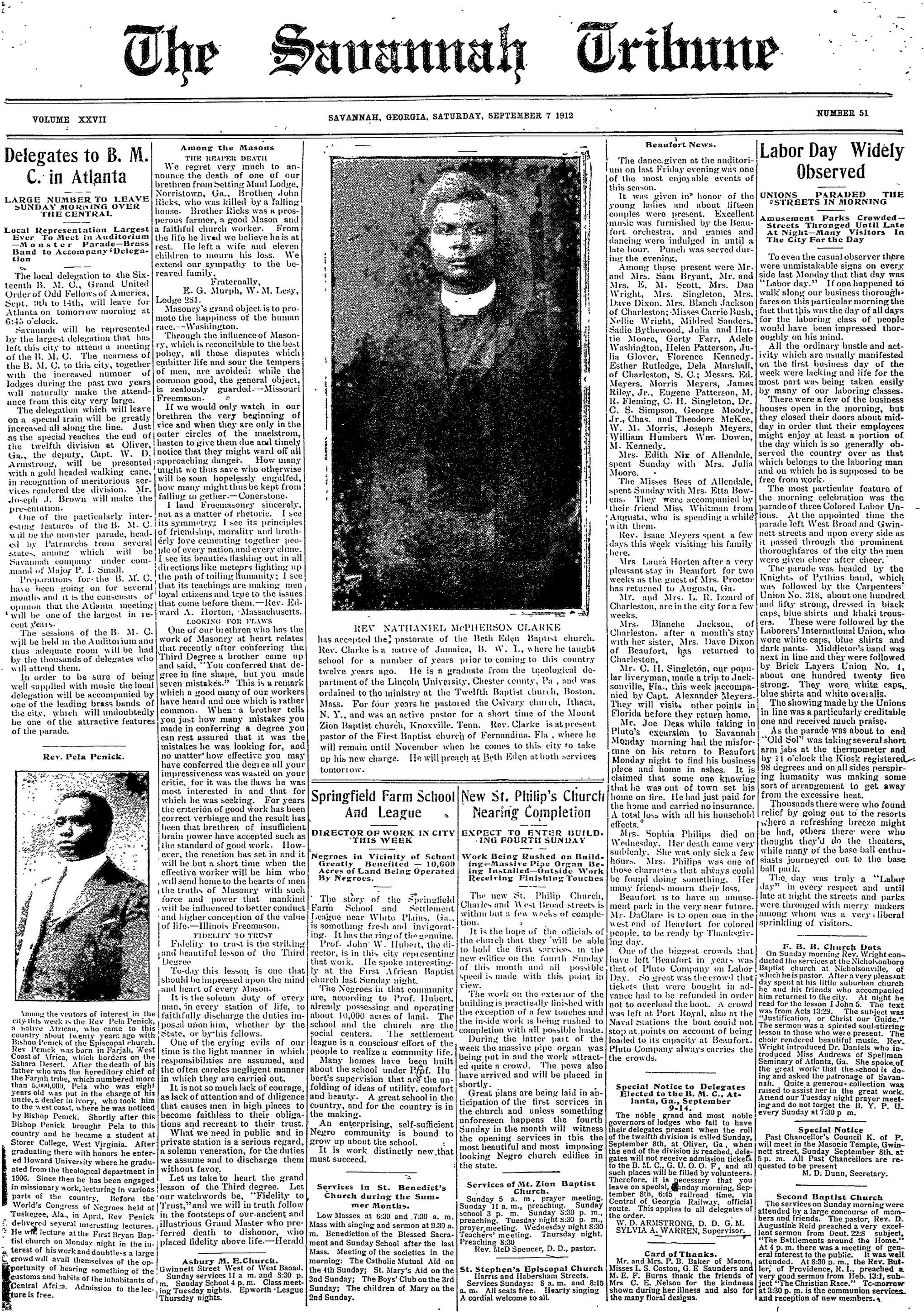
Delegates to B. M. C. in Atlanta
Delegates to B. M. C. in Atlanta
LARGE NUMBER TO LEAVE
SUNDAY MORNING OVER
THE CENTRAL
Local Representation Largest
Ever To Meet in Auditorium
—Monster Parade—Brass
Band to Accompany Delegation
The local delegation to the Sixteenth B. M. C., Grand United
Order of Odd Fellows of America,
Sept. 9th to 14th, will leave for
Atlanta on tomorrow morning at
6:45 o'clock.
Savannah will be represented by the largest delegation that has left this city to attend a meeting of the B. M. C. The nearness of the B. M. C. to this city, together with the increased number of lodges during the past two years will naturally make the attendance from this city very large.
The delegation which will leave on a special train will be greatly increased all along the line. Just as the special reaches the end of the twelfth division at Oliver, Ga., the deputy, Capt. W. D. Armstrong, will be presented with a gold headed walking cane, in recognition of meritorious services rendered the division. Mr. Joseph J. Brown will make the presentation.
One of the particularly interesting features of the B. M. C. will be the monster parade, headed by Patrarchs from several states, among which will be Savannah company under command of Major P. L. Small.
Preparations for the B. M. C. have been going on for several months and it is the consensus of opinion that the Atlanta meeting will be one of the largest in recent years. The sessions of the B. M. C. will be held in the Auditorium and thus adequate room will be had by the thousands of delegates who will attend them. In order to be sure of being well supplied with music the local delegation will be accompanied by one of the leading brass bands of the city, which will undoubtedly be one of the attractive features of the parade.
Rev. Pela Penick.
A. B.
Among the visitors of interest in the city this week is the Rev Pela Penick, a native African, who came to this country about twenty years ago with Bishop Penick of the Episcopal church. Rev Penick was born in Farjah, West Coast of Africa, which borders on the Sahara Desert. After the death of his father who was the hereditary chief of the Farjah tribe, which numbered more than 5,000,000, Pela who was eight years old was put in the charge of his uncle, a dealer in ivory, who took him to the west coast, where he was noticed by Bishop Penick. Shortly after this Bishop Penick brought Pela to this country and he became a student at Storer College, West Virginia. After graduating there with honors he entered Howard University where he graduated from the theological department in 1906. Since then he has been engaged in missionary work, lecturing in various parts of the country. Before the World's Congress of Negroes held at Tuskegee, Ala., in April, Rev Penick delivered several interesting lectures. He will lecture at the First Bryan Baptist church on Monday night in the interest of his work and doubtless a large crowd will avail themselves of the opportunity of hearing something of the customs and habits of the inhabitants of Central Africa. Admission to the lecture is free.
Among the Masons
THE REAPER DEATH
We regret very much to announce the death of one of our brethren from Setting Maul Lodge, Norristown, Ga., Brother John Ricks, who was killed by a falling house. Brother Ricks was a prosperous farmer, a good Mason and a faithful church worker. From the life he lived we believe he is at rest. He left a wife and eleven children to mourn his loss. We extend our sympathy to the bereaved family.
Fraternally,
E. G. Murph, W. M. Lesy,
Lodge 281.
Masonry's grand object is to promote the happiness of the human race.—Washington. Through the influence of Masonry, which is reconcilable to the best policy, all those disputes which embitter life and sour the tempers of men, are avoided: while the common good, the general object, is zealously guarded.—Missouri Freemason.
If we would only watch in our brethren the very beginning of vice and when they are only in the outer circles of the maelstrom, hasten to give them due and timely notice that they might ward off all approaching danger. How many might we thus save who otherwise will be soon hopelessly engulfed, how many might thus be kept from falling to gether.—Conerstone.
I laud Freemasonry sincerely, not as a matter of rhetoric. I see its symmetry; I see its principles of friendship, morality and brotherly love cementing together people of every nation, and every clime. I see its beauties flashing out in all directions like meteors lighting up the path of toiling humanity; I see that its teachings are making men loyal citizens and true to the issues that come before them.—Rev. Edward A. Horton, Massachusetts.
One of our brethren who has the work of Masonry at heart relates that recently after conferring the Third Degree a brother came up and said, "You conferred that degree in fine shape, but you made seven mistakes." This is a remark which a good many of our workers have heard and one which is rather common. When a brother tells you just how many mistakes you made in conferring a degree you can rest assured that it was the mistakes he was looking for, and no matter how effective you may have conferred the degree all your impressiveness was wasted on your critic, for it was the flaws he was most interested in and that for which he was seeking. For years the criterion of good work has been correct verbiage and the result has been that brethren of insufficient brain power have accepted such as the standard of good work. However, the reaction has set in and it will be but a short time when the effective worker will be him who will send home to the hearts of men the truths of Masonry with such force and power that mankind will be influenced to better conduct and higher conception of the value of life.—Illinois Freemason.
FIDELITY TO TRUST
Fidelity to trust is the striking and beautiful lesson of the Third Degree
To-day this lesson is one that should be impressed upon the mind and heart of every Mason.
It is the solemn duty of every man, in every station of life, to faithfully discharge the duties imposed upon him, whether by the State, or by his fellows.
One of the crying evils of our time is the light manner in which responsibilities are assumed, and the often careles negligent manner in which they are carried out.
It is not so much lack of courage, as lack of attention and of diligence that causes men in high places to become faithless to their obligations and recrent to their trust. What we need in public and in private station is a serious regard, a solemn veneration, for the duties we assume and to discharge them without favor. Let us take to heart the grand lesson of the Third degree. Let our watchwords be, "Fidelity to Trust," and we will in truth follow in the footsteps of our-ancient and illustrious Grand Master who preferred death to dishonor, who placed fidelity above life.—Herald
Asbury M. L. Cordray
Gwinnett Street West of West Baoad.
Sunday services 11 a.m. and 8:30 p.
m. Sunday School 4 p.m. Class meeting Tuesday nights. Epworth-League
Thursday nights.
SAVANNAH, GEORGIA, SATURDAY, SEPTEMBER 7 1912
1
REV NATHANIEL McPHERSON CLARKE has accepted the pastorate of the Beth Eden Baptist church. Rev. Clarke is a native of Jamaica, B. W. I., where he taught school for a number of years prior to coming to this country twelve years ago. He is a graduate from the theological department of the Lincoln University, Chester county, Pa., and was ordained to the ministry at the Twelfth Baptist church, Boston, Mass. For four years he pastored the Calvary church, Ithaca, N. Y., and was an active pastor for a short time of the Mount Zion Baptist church, Knoxville. Tenn. Rev. Clarke is at present pastor of the First Baptist church of Fernandina, Fla., where he will remain until November when he comes to this city to take up his new charge. He will preach at Beth Eden at both services tomorrow.
Springfield Farm School And League
Springfield Farm School And League
DIRECTOR OF WORK IN CITY
THIS WEEK
Negroes in Vicinity of School
Greatly Benefited — 10,000
Acres of Land Being Operated
By Negroes.
The story of the Springfield
Farm School and Settlement
League near White Plains, Ga.,
is something fresh and invigorating.
It has the ring of the genuine.
Prof. John W. Hubert, the
director, is in this city representing
that work. He spoke interestingly
at the First African Baptist
church last Sunday night.
The Negroes in that community are, according to Prof. Hubert, already possessing and operating about 10,000 acres of land. The school and the church are the social centers. The settlement league is a conscious effort of the people to realize a community life. Many homes have been built about the school under Prof. Hubert's supervision that are the unfolding of ideas of utility, comfort and beauty. A great school in the country, and for the country is in the making. An enterprising, self-sufficient Negro community is bound to grow up about the school. It is work distinctly new, that must succeed.
Services in St. Benedict's Church during the Summer Months.
Low Masses at 6:30 and 7:30 a. m. Mass with singing and sermon at 9:30 a. m. Benediction of the Blessed Sacrament and Sunday School after the last Mass. Meeting of the societies in the morning: The Catholic Mutual Aid on the 4th Sunday; St. Mary's Aid on the 3rd Sunday; The Boys' Club on the 3rd Sunday; The children of Mary on the 2nd Sunday.
Tribune
New St. Philip's Church Nearing Completion
EXPECT TO ENTER BUILDING FOURTH SUNDAY
Work Being Rushed on Building—Massive Pipe Organ Being Installed—Outside Work Receiving Finishing Touches
The new St. Philip Church, Charles and West Broad streets is within but a few weeks of completion.
It is the hope of the officials of the church that they will be able to hold the first services in the new edifice on the fourth Sunday of this month and all possible speed is made with this point in view.
The work on the exterior of the building is practically finished with the exception of a few touches and the inside work is being rushed to completion with all possible haste. During the latter part of the week the massive pipe organ was being put in and the work attracted quite a crowd. The pews also have arrived and will be placed in shortly. Great plans are being laid in anticipation of the first services in the church and unless something unforeseen happens the fourth Sunday in the month will witness the opening services in this the most beautiful and most imposing looking Negro church edifice in the state.
Services of Mt. Zion Baptist Church.
Sunday 5 a. m., prayer meeting.
Sunday 11 a. m., preaching.
Sunday
school 3 p. m. Sunday 8:30 p. m.
preaching. Tuesday night 8:30 p. m.
prayer meeting. Wednesday night 8:30
Teachers' meeting. Thursday night.
Preaching 8:30
Rev. McD Spencer, D. D., pastor.
St. Stephen's Episcopal Church
Harris and Habersham Streets.
Services Sundays: 8 a.m. and 8:15
a.m. All seats free. Hearty singing.
A cordial welcome to all.
Beaufort News.
The dance, given at the auditorium on last Friday evening was one of the most enjoyable events of this season.
It was given in honor of the young ladies and about fifteen couples were present. Excellent music was furnished by the Beaufort orchestra, and games and dancing were indulged in until a late hour. Punch was served during the evening.
Among those present were Mr. and Mrs. Sam Bryant, Mr. and Mrs. E. M. Scott, Mrs. Dan Wright, Mrs. Singleton, Mrs. Dave Dixon, Mrs. Blanch Jackson of Charleston; Misses Carrie Bush, Nellie Wright, Mildred Sanders, Sadie Bythewood, Julia and Hattie Moore, Gerty Farr, Adele Washington, Helen Patterson, Julia Glover, Florence Kennedy-Esther Rutledge, Dela Marshall, of Charleston, S. C.; Messrs. Ed. Meyers, Morris Meyers, James Riley, Jr., Eugene Patterson, M. R. Fleming, C. H. Singleton, Dr. C. S. Simpson, George Moody, Jr., Chas. and Theodore McKee, W. M. Morris, Joseph Meyers, William Humbert Wm. Dowen, M. Kennedy.
Mrs. Edith Nix of Allendale, spent Sunday with Mrs. Julia Moore.
The Misses Bess of Allendale, spent Sunday with Mrs. Etta Bowens. They were accompanied by their friend Miss Whitman from Augusta, who is spending a while with them.
Rev. Isaac Meyers spent a few days this week visiting his family here.
Mrs Laura Horten after a very pleasant stay in Beaufort for two weeks as the guest of Mrs. Proctor has returned to Augusta, Ga.
Mr. and Mrs. L. R. Izzard of Charleston, are in the city for a few weeks.
Mrs. Blanche Jackson, of Charleston, after a month's stay with her sister, Mrs. Dave Dixon of Beaufort, has returned to Charleston.
Mr. C. H. Singleton, our popular liveryman, made a trip to Jacksonville, Fla., this week accompanied by Capt. Alexander Meyers. They will visit, other points in Florida before they return home.
Mr. Joe Deas while taking in Pluto's excursion to Savannah Monday morning had the misfortune on his return to Beaufort Monday night to find his business place and home in ashes. It is claimed that some one knowing that he was out of town set his home on fire. He had just paid for the home and carried no insurance. A total loss with all his household effects. Mrs. Sophia Phillips died on Wednesday. Her death came very suddenly. She was only sick a few hours. Mrs. Phillips was one of those characters that always could be found doing something. Her many friends mourn their loss.
Beaufort is to have an amusement park in the very near future. Mr. DaClare is to open one in the west end of Beaufort for colored people, to be ready by Thanksgiving day.
One of the biggest crowds that have left Beaufort in years was that of Pluto Company on Labor Day. So great was the crowd that tickets that were bought in advance had to be refunded in order not to overload the boot. A crowd was left at Port Royal, also at the Naval Stations the boat could not stop at points on account of being loaded to its capacity at Beaufort. Pluto Company always carries the crowds.
---
Special Notice to Delegates Elected to the B. M. C., Atlanta, Ga., September 9,14
The noble grand and most noble governors of lodges who fail to have their delegates present when the roll of the twelfth division is called Sunday, September 8th, at Oliver, Ga, when the end of the division is reached, delegates will not receive admission tickets to the B. M. C., G. U. O. O. F., and all such places will be filled by volunteers. Therefore, it is necessary that you leave on special, Sunday morning, September 8th, 6:45 railroad time, via Central of Georgia Railway, official route. This applies to all delegates of the order.
W. D. ARMSTRONG, D. D. G. M.
SLYVIA WARREN, Supervisor.
Card of Thanks.
Mr. and Mrs. P. B. Baker of Macon, Misses I. S. Coston, G. E Saunders and M. E. F. Burns thank the friends of Mrs C. E. Nelson for the kindness shown during her illness and also for the many floral designs.
NUMBER 51
Labor Day Widely Observed
Labor Day Widely Observed
UNIONS PARADED THE STREETS IN MORNING
Amusement Parks Crowded—Streets Thronged Until Late At Night—Many Visitors In The City For the Day
To even the casual observer there were unmistakable signs on every side last Monday that that day was "Labor day." If one happened to walk along our business thoroughfares on this particular morning the fact that this was the day of all days for the laboring class of people would have been impressed thoroughly on his mind.
All the ordinary bustle and activity which are usually manifested on the first business day of the week were lacking and life for the most part was being taken easily by many of our laboring classes. There were a few of the business houses open in the morning, but they closed their doors about midday in order that their employees might enjoy at least a portion of the day which is so generally observed the country over as that which belongs to the laboring man and on which he is supposed to be free from work.
The most particular feature of the morning celebration was the parade of three Colored Labor Unions. At the appointed time the parade left West Broad and Gwinnett streets and upon every side as it passed through the prominent thoroughfares of the city the men were given cheer after cheer.
The parade was headed by the Knights of Pythias band, which was followed by the Carpenters' Union No. 318, about one hundred and fifty strong, dressed in black caps, blue shirts and khaki trousers. These were followed by the Laborers' International Union, who wore white caps, blue shirts and dark pants. Middleton's band was next in line and they were followed by Brick Layers Union No. 1, about one hundred twenty five strong. They wore white caps, blue shirts and white overalls. The showing made by the Unions in line was a particularly creditable one and received much praise.
As the parade was about to end "Old Sol" was taking several short arm jabs at the thermometer and by 11 o'clock the Kiosk registered 98 degrees and on all sides perspiring humanity was making some sort of arrangement to get away from the excessive heat. Thousands there were who found relief by going out to the resorts where a refreshing breeze might be had, others there were who thought they'd do the theaters, while many of the base ball enthusiasts journeyed out to the base ball park.
The day was truly a "Labor day" in every respect and until late at night the streets and parks were thronged with merry makers among whom was a very liberal sprinkling of visitors.
F. B. B. Church Dots
On Sunday morning Rev. Wright conducted the services at the Nicholsonboro Baptist church at Nicholsonville, of which he is pastor. After a very pleasant day spent at his little suburban church he and his friends who accompanied him returned to the city. At night he read for the lesson I John 5. The text was from Acts 13:29. The subject was "Justification, or Christ our Guide." The sermon was a spirited soul-stirring lesson to those who were present. The choir rendered beautiful music. Rev. Wright introduced Dr. Daniels who introduced Miss Andrews of Spellman Seminary of Atlanta, Ga. She spoke of the great work that the school is doing and asked the patronage of Savannah. Quite a generous collection was raised to assist her in the great work. Attend our Tuesday night prayer meeting and do not forget the B. Y. P. U. every Sunday at 7:30 p.m.
Special Notice
Past Chancellor's Council K. of P. will meet in the Masonic Temple, Gwinnett street, Sunday September 8th at 5 p. m. All Past Chancellors are requested to be present M. D. Dunn, Secretary.
Second Baptist Church
The services on Sunday morning were attended by a large concourse of members and friends. The pastor, Rev. D. Augustine Reid preached a very excellent sermon from Deut. 22:8 subject, "The Battlements around the Home." At 4 p. m. there was a meeting of general interest to the public. It was well attended. At 8:30 d. m., the Rev. Butler, of Providence, R. I., preached a very good sermon from Heb. 13:1, subject "The Christian Race." Tc-morrow at 3:30 p. m. is the communion services and reception of new members.
CAP
and
BELLS
Finds Out What Was Turned In at
Lost Department of Railroad
Probably Not His.
A tall, nervous-looking man entered the department in the railroad station where lost articles are kept.
"Anything turned in here today?" he shouted to the man at the desk
There was no reply
"I say, has anything been turned in here today?" he repeated in a louder tone of voice.
"Yes, sir," calmly replied the man at the desk, without raising his eyes.
"You heard me? Well, why can't you tell me what was turned in?" "Well, sir, a man was in here this morning who turned his toes in. They wouldn't happen to be yours. sir, would they?"
Not to Be Thought Of
"No, I cannot consent to be your wife. I have been told that you are intemperate."
"Darling. If you will be mine, I'll promise never to drink another drop as long as I live."
"Yes, but you wouldn't keep your promise."
"I would. I swear it."
"If you can'quit why don't you do so, even if I refuse to be your wife?"
"That wouldn't leave me anything to promise the next girl."
An Endless Job.
"Who are those fellows over in the corner?"
"They are Socialists."
"They seem to be engaged in a very earnest discussion."
"Yes. I suppose they are trying to invent new theories of government."
"I thought they had plenty of new theories."
"They did have, but the rest of the people have caught up with them, so they've got to invent more in order to keep ahead."
The Motor Murder
"What's your hard luck story, hoo-?
"I was a prosperous restaurant keeper in New York. But that last murder ruined me business."
"As to how?"
"After that, every time an automobile rolled up to me door, me patrons all rushed out at the back."
Doubtly--Why don't you invite Vivian to your bridge whist parties? I understand she plays remarkably well.
Excell—Yes; she does play remarkably well. That is the reason we don't wait her.
True to Form.
She had half way across the lake between Chicago and St. Joe Mr. Makinbrakes changed to meet an old acquaintance.
"Why, Miss Gumwell," he said, "whence did you—er—get aboard this boat?"
"I know she is. Now I have no objection to your falling in love with her, but that lack correspondence must be brought down to date first."
Not So Foolish.
"You gave all your money to your wife? Bah! You haven't much sense."
"Oh, I don't know. I think I'm improving. I gave it to the bookmakers for years."
Prepared.
"Three of the girls in that family have brought suits for breach of promise, and all have gained their suits. How do they manage it, I wonder?"
"Keep away from that house. Their father has had a dictagraph installed in the parlor."
Clever Edinburgh Clergyman Meets His Match in Examining Student on Classes Attended.
The Rev. Dr. Ritchie, of Edinburgh; although a very clever man, once met his match. When examining a student as to the classes he attended he said:
"I understand you attend the class for mathematics."
"Yes."
"How many sides has a circle?"
"Two," said the student.
"Indeed! What are they?"
What a laugh in the court the student's answer produced when he said, promptly:
"An inside and an outside."
The doctor next asked:
"And you attend the moral philosophy class also?"
"Well, you doubtless heard lectures on various subjects. Did you ever hear one on cause and effect?"
"Yes."
"Does an effect ever go before a cause?"
"Yes."
"Give me an instance."
"A barrow wheeled by a man."
The doctor hastily sat down and proposed no more questions.—San Francisco Herald.
Too Bad.
"So your brother Bill is dead? I'm mighty sorry to hear it, old man. How long had he been slick?"
"Only about a week. But we always kind of expected Bill to go sudden."
"Yes. The cubs and giants are going to play a double-header."
CONVENIENT IGNORANCE.
A
"How can you tell whether your automobile is going faster than the law allows or not?"
"I can't tell. That's one of the beauties of it."
A. Famillar Legend.
"I ought to have some legends connected with the place," said the landlord. "They bring trade, legends do. There needn't necessarily be any truth in them, you know." "Stick to the legend that you are running a first-class hotel," advised the guest. "That legend will catch a few suckers every year."
Horrors of Journalism
"Here's an item," observed Rivers, who was looking over the exchanges, "to the effect that the king of Sweden raises prize dogs on his farm"
"I suppose he uses them," suggested Brooks, "to drive his Stockholm."
After which the rattle of the type-writers broke out afresh with great violence.
Style Card Limitations.
Regstaff—Have had to borrow some money, have you? Well, you're a short story writer, all right.
Percolium (with some bitterness)—Yes—and I can't use that one, elitter, they'd never let me stick a hyphen between 'story' and 'writer'!"
No Help for It.
The Dorkins family had spent a month at a summer resort.
"John," said Mrs. Dorkins, with every indication of profound sorrow, "we'll have to stay, here another month. Here's a letter from Mrs. Jipes, and she says they've just oiled the street in front of our house."
In the Railway Mail Car
"Here's a letter directed to Golf Is there any such station?"
"Yes; there's one in Illinois, one in Ohio, and I think one in—"
"But this is addressed to Golf, Wis."
"O, that's easy; send it to La Crosse."
Entertaining Him.
"Mr. Spooner, I think I like you better than any o' the other fellers that come to our house."
"Why so, Bobby?"
"Cause when you give sister a box c' candy she always turns it over to me."
A Rare Event
"I met Spenders just now."
"Yes."
"He told me he was on his way down town to pay a bill."
"Ah! Do you suppose the moving picture rights would be worth anything?"
"She says her heart is buried. That she can never love again."
"And only yesterday I heard her listening intently to a mutt with side whiskers who was telling her that she looked beautiful in black."
MAKES HER TALKATIVE
RAPIDITY OF BLOOD FLOW CAUSE OF FEMININE LOQUACITY. $ ^{c} $
For generations and even for ages uncounted woman has been the greater "talkier" in the human race. All sorts of harmless fun has been poked at woman because of her love of conversation and her ability to rattle off more sentences in a given time than the average man has the ability to do. Now comes the great authority, Sir James Crichton-Browne, M. D., LL. D., F. R. S., president of the Child-Study Society in London, with an explanation of this. In his address before that body a few weeks ago he made this explanation, for the most part in somewhat technical language, but nevertheless intensely interesting.
Reduced to simple words, Sir Crichton-Browne explains that the talkativeness of woman is due entirely to the difference in the flow of blood to her head and the flow of blood in a man's head. The feminine brain gets the greatest supply of rich arterial blood at the posterior region of the brain, or back, while the best and biggest supply of blood to man's brain is in the anterior region, or front.
Sir Crichton-Browne explains that the work of the two regions of the brain is different, that the back of the brain is mainly sensory and concerned with seeing and hearing. The front of the brain contains the centers of the will, the association centers which include appetites and desires based upon internal sensation.
The brain is supplied with blood throughout, but in women the greater quantity of blood flows through the back of the brain, while with men the greater quantity of blood circulates through the front of the brain; thus the various brain centers are variously stimulated according to the blood supply.
This, explains Sir James, is why women see things quicker, are quicker readers and faster talkers, why they talk with greater ease and enjoyment. Their delicate powers of sensuous perception, rapidity of thought and emotional sensibility are increased in comparison to those of man. On the other hand, the richer blood supply in the front region of the brain in man gives him greater originality on the higher lines of intellectual work, calmer judgment, stronger will and stronger power of volition.
Hieroglyphics.
Jules Janin, whose memory was recently honored by the placing of a memorial tablet on his house in Paris, was famous for two things, his great critical ability and his abominable handwriting. The anecdote that Gill Blas tells of the fate of one of his letters can hardly record an incident of very rare occurrence.
One day a friend of Janin's received a letter from him. With great pains and patience he managed to gather from the few words he could declipher that it was about a matter of importance, but what the matter was he could not make out. There was nothing to do but to take a cab and drive directly to Janin's house.
"Ah," said Janin, "it is you! So you have read my letter."
"Nöt at all," replied his friend. "I have just received it, and have come to ask you to read it to me."
"Oh!" said Janin, in a dazed, hopeless voice. Then with a sigh of supreme resignation, "Very well, I will try!"
The Situation:
One year, when the youngsters of a certain Illinols village met for the purpose of electing a captain of their baseball team for the coming season, it appeared that there were an excessive number of candidates for the post, and that more than the usual wrangling must ensue.
Youngster after youngster presented his qualifications for the post; and the matter was still undecided, according to Lippincott's Magazine, when the son of the owner of the ball field stood up. He was a small, snub-nosed lad, with a plentiful supply of freckles, but he glanced about him with a dignified air of controlling the situation.
"I'm going to be captain this year," he announced, convincingly. "or else father's old bull is going to be turned into the field."
He was elected unanimously
A Tribute to American Railroads.
A tribute to American railways is indirectly paid by Maj Freeman, traffic manager of the railways of Delhi, India, during the recent durbar, which brought 200,000 visitors to that ancient capital. He says that the signally successful system adopted for train management at the durbar was found on the American "A-B-C system", as evolved by Mr. Beamer, superintendent of the Northern Pacific road. The smoothness with which the railway traffic was handled is spoken of as having been one of the marvels of this historic occasion.
What He Needed.
The amateur golfer had not been doing very well and toward the close of the round he turned to the caddie and said:
"Let me see; is that 195 or 196 strokes?"
"I don't know, slr!" was the reply.
"What you need is an adding machine, not a caddle."—Ladles' Home Journal.
MUTE CONVICT PUZZLES
SURGEONS CANNOT PROVE CHAS
CARSON ISN'T SHAMMING.
Even the Ether Test Failed to Loosen the Prisoner's Tongue After Silence of Nearly Three Years.
Even the ether test left alienists absolutely undecided whether Charles Carson, a convict in Folsom penitentiary in California, had been stricken dumb or is shamming. He has not spoken a word in three years.
Physicians say that although the test would have proved that Carson is not insane if he had talked, the negative result does not prove he is insane.
The common effect of 'ether is to loosen the tongue while the subject is coming under or out of its effects. It was expected that Carson would lose voluntary control of his vocal organs and reply to questions put to him by the physicians. No sound escaped his lips.
Yet when not under the influence of the drug, Carson conversed with his examinere in his usual manner, by shrugs and signs, and by pointing to letters in printed matter. He refused by a shake of his head to write, although it is known that his education makes him capable of it.
"What do you think will be done to you if you are kept here?" he was asked.
Carson gripped his neck with both hands to indicate the noose and raised his right arm to indicate the gallows.
he right time to increase the guanowar. Carson was sentenced to life imprisonment in 1904 for assault and robbery. Two years later he was given a death sentence for his share in a murderous jail break. He is a South Carolinian and the only member of his family to escape drowning at the time of the submergence of Charleston by the tidal wave of the early '60s. Repeated reprieves have thus far saved him from hanging, and prison officials believing that his muteness was assumed and indicated insanity brought about the present investigation. When first overtaken by, or having assumed, the phase of insanity known as aphonia, or inability to use his laryngeal and pharyngeal organs, Carson also refused to eat. Food was forced upon him, however, and he remained quiet.
From that time on he gave no sign to anyone that he was able to utter a sound. He made his wants known and answered questions by signs and shrugs. Physicians have found no evidence of physical disability which would cause muteness, and have refused to try the test by electricity, which they say would be torture.
Wall Paper That Flies Hate
Next time you are having your walls repapered you will be wise to choose colors that files dislike. Some rooms seem infested with files while others are comparatively free from them. The secret lies in the general color of the room. The favorite color of files is green. A doctor who recently made experiments with files prepared a box on which he pasted squares of paper of the same size but different colors. On the square of green paper there were no fewer than eighteen files. This was closely followed by a rose colored square with seventeen. After that came clear yellow, dark gray and white.
The least attractive colors to the files were lemon yellow, dark brown and blue. On papers of this color only one fly had settled. Plenty of attractive wall papers can be chosen from these three colors, and you will be rejoicing at your freedom from files while your next door neighbor has her walls covered with them because her wall paper is green.—Pearson's Weekly.
Not Thinking of Himself.
When the sleight-of-hand artist calls one of the audience to "aid" in a trick, he generally manages to "get the laugh" on this obliging person, but not always. The following is told in Tit-Bits:
The conjuror in the village schoolroom had invited any gentleman from the audience to step up on the platform, and a rustic in a velveteen coat responded.
"Now, sir," said the professor, "I suppose you consider it a matter of impossibility for me to make that rabbit in the box on the table pass into your coattail pocket?" "I funnə about impossible," came the reply, "but I wouldn't do it if I was you, sir."
"Oh, you'll be in no danger, I can assure you," smiled the sleight-of-hand man alrily.
"I won't thinkin' about myself," the rustic answer. "I was studying the rabbit. I've got a couple of ferrets in that there, pocket."
A Social Leader's Complaint
The editor of the Hennessey, Oklahoma, Clipper prints the following phonetic communication from a reader who thought himself aggrieved because of discrimination shown against him in the "society columns" of that paper:
"Mister editur. I want to noe why hit is that you use so infurnal much parshalty in your little ole paper. Me an' my fokes has bin visitin' hal duzin times latly, an' you never sed one wurd about hit. You run 'after big bugs an' let the little ones goe. I have bin thinkin' of subscribin' fur the Clipper, but I went do hit now. You no hoo this is. One Hoo Has Bin Ronged."
TRIBUTE TO THE JUNGLE.
That India still pays its annual tribute of human life to the jungle is shown by a statement made in a recent issue of the London Times During the past three years the number of deaths from snake bite or the attacks of wild animals has steadily increased. Rising waters have driven the serpents out of the lowlands up into the villages, and have diminished the natural food supply of the larger animals. In 1910 55 persons were killed by elephants, 25 by hyenas, 109 by bears, 851 by leopards, 318 by wolves, 853 by tigers, and 688 by other animals, including wild pigs. No less than 22,478 died from the bite of poisonous snakes. The grand total of mortality is 24,878.
During the same year, 93,000 cattle were also killed by wild beasts and snakes. The losses on the part of inhabitants of the jungle were nearly but not quite as great as those of their human enemies and domesticated animals combined. Ninety-one thousand one hundred and four snakes and over 19,000 wild beasts of various kinds were killed.
A WATERLOO DISPATCH.
There has just been published Blucher's dispatch which gave Berlin the first news of the victory of Waterloo. It was addressed to the governor, and said:
"I inform your excellency that in conjunction with the English army under Field Marshal the Duke of Wellington, I yesterday gained the most complete victory over Napoleon Bonaparte that could possibly be won.
"The battle was fought in the neighborhood of some isolated buildings on the road from here to Brussels bearing the name "La Belle Alliance," and a better name can hardly be given to this important day. The French army is in complete dissolution, and an extraordinary number of guns have been captured.
"Time does not at this moment permit me to send further details to your excellency, I reserve them for a future occasion, and beg you duly to communicate this joyful news to the good Berliners. (Signed.) "BLUCHER."
(Signed.) BILCHER.
This dispatch reached Berlin on June 24, 1815.
OLDEST FIRE TOWER.
At La Coruna, in northern Spain, may be seen a fire tower which is, with the exception of the ruins of the Roman lighthouse at Dover the oldest of all existing structures of this kind. The exact date of the erection of this tower is unknown. According to an ancient tradition, it is accredited to Hercules, whence its name Torre de Hercules. Others say that Phoenicians, who established several colonies in Spain, had erected this light tower for their northland cruises. However, judging from the inscription, it is more probable that the Roman emperor Trojan (98 to 117 A. D.) erected this structure. The inscription also mentions the name of Servius Supus of Lusitania as the architect. The tower is built of ashlars and is nine meters square and 40 meters in height. It has six separate stories, which can only be reached by a circular staircase around the exterior of the tower. The lighthouse was restored in 1684, but at the end of the eighteenth century was again in ruins. In 1797 it was rebuilt by the Spanish government and still sends forth its beams.
FRANCE'S LOW BIRTH RATE.
Statistics show for last year 34,867 deaths in France in excess of births. The depopulation of France, states Dr. Variot, the eminent children's physician, is not due to high death rates, but to low birth rates. In 1862, when the population of Paris was 1,721,917, there were 52,312 births. In 1907, with a population of 2,728,731, there were only 50,811. Germany, whose people numbered 60,000,000 in 1905, had increased to 64,900,00 by the year 1910. The German population is increasing at a faster rate than that of Great Britain.
SOUTH AFRICAN STOCK.
A summary of the returns of the five stock in South Africa as ascertained by the census in May of last year gives the following results: Cattle, 5,796,000; horses, 719,000; mules, 93,000; asses, 336,000; ostriches, 746,000; wooled sheep, 21,482,000; other sheep, 8,814,000; angora goats, 5,257,000; other goats, 7,487,000. The Cape Province supplies by far the principal proportion of these figures, viz.: 2,715,000 cattle, 339,999 horses, 728,000 ostriches, 11,051,000 wooled sheep, 6,082,000 other sheep, 3,340,000 angoras, and 4,613,000 other goats.
THE SPEED OF THOUGHT.
How fast do impulses travel along the nerves? The speed has been duly measured by the aid of the glabate apparatus with which the physiological laboratory of today is supplied. In man the rate has been set down at about 114 feet a second. This measurement has reference to the rate at which messages of the bodily telegraph system are sent from nerve centers along motor nerves or those destined to bring muscles into play. But a second class of nerves exists in the body called "sensory," whose duty it is to convey messages from the body to nerve centers. The rate of impulse in the sensory nerves is quicker than in the motor nerves. Investigators give varying rates, from about 163 feet to 675 feet per second, an average rate being 282 feet.
Physiologists have made careful calculations regu- what is called our reaction time. here we endeavor to calculate the interval which elapses between the impression made on our organ of sense and the giving of the signal which registers the impression as received by the brain and translated into terms of consciousness. Different results, due, no doubt, to the varying nervous capacities of the individuals, have been obtained. in one series the interval averaged 1087 of a second and in another 1911.
Signaling to the eye by means of a light demanded for its reception and demonstration .1139 of a second. In the case of a sound the interval was .1360. An electric spark used to stimulate the eye gave as reaction time .1377 of a second when the signal was given by the lower jaw and .S40 when given by the foot.
TYPEWRITER VS. COAL HEAVER.
The girl who is operating a typewriter doesn't appear to be doing very heavy physical labor, as compared with the brawny individual in the stakehold of an Atlantic liner who is shoveling coal into a hungry furnace, but this is one of the many instances in which superficial appearances are receptive, as a comparison of the force expended by the two will show. The stoker may be credited with handling one ton of coal per hour, or eight tons per day, plus the weight of his shovel. Adding the shovel to his 17,960 pounds of coal, he expends about 20,000 pounds of energy. For each key struck on the typewriter there is an expenditure of something over three ounces of energy, or, say, one pound to the average word. A fair operator will average 1,500 words an hour, or in eight hours 12,000 words—12,000 pounds of energy. To throw over the carriage for each new line requires on an average three pounds of force. Twelve thousand words will make 1,000 lines, so there are 3,000 pounds of energy to be added to the 12,000, making 15,000 pounds of energy expended—which compares pretty well with the stoker's 20,000, all things considered. A really fast operator would push the expenditure of energy in to 25,000 pounds or more.
DEATH LIST OF SOME WARS.
The total number of British killed in action in the South African war was 5,744; 22,829 were wounded, and 16,166 died of wounds or disease. The number of Boers killed or mortally wounded was about 3,700; about 32,000 prisoners of war were taken, 700 of whom died. The United States' loss in the war with Spain was 236 men killed, 125 mortally wounded, 5,277 died of disease. The Spanish loss was 30,000, the majority dying from disease. According to the report of the provost marshal general the casualties of the Union army from the beginning of the American Civil war to August, 1865, were as follows: Killed, 67,976; died of wounds, 25,947; disease, 183,164; disabled, 224,306. Confederate losses were. Killed: 51,525; wounded, 227,871. In the Union navy there were 4,030 killed and wounded in action, 2,522 died of disease, and 2,070 died from other causes. Japan, according to one computation, is said to have lost 167,400 in killed, wounded and captured in the Russo-Japanese war, while Russia's losses were computed to be 388,500 men.
THE LAST STRAW.
Few food cranks have carried their yearning after the simple life to such an extreme length as did one Roger Crab, who, in spite of his strange fare, saw a fair part of the seventeenth century. Up to his twentieth year he was normal-minded, then he turned vegetarian, and framed his apology: "Butchers are excluded from juries, but the receiver is worse than the thief, so the buyer is worse than the butcher." From the banning of meat he turned his attention to butter and cheese, and thought that he could live without them. He were even further, and banned all things edible, till at length he achieved the fine art of feeding upon dock leaves, grass and water, at a gross cost of about a penny a week.
A THIRSTY CITY.
Official statistics are published by the municipality of Murich, Bavaria, show that the city still holds the record for the per capita consumption of beer, the amount per head of the population last year being $70\frac{1}{2}$ gallons; the average consumption per head of population in England is only 26 gallons. The Munich breweries produced last year 81,752,000 gallons of beer, of which 42,500,000 gallons were drunk in the city, while the rest was exported to other parts of Germany and abroad. This home consumption represented an increase oof 2,310,000 gallons as compared with 1910.
GOOD ROADS
Indiana Leads All States of Union,
With Ohio a Close Second—Mostly
Composed of Gravel.
According to information just made
public by the director of the office of
public roads, Indiana leads all the
states of the Union in mileage of im-
proved roads. Most of the improved
roads of Indiana and Ohio are com-
posed of gravel and wore, for the
most part, built by the farmers in
working out taxes. In many cases
the gravel is dumped on the road
without proper spreading or rolling.
Roads constructed in this way seldom
give entire satisfaction.
The eight leading good roads states,
as shown by the data compiled by the
director, are as follows:
Mileage Improved
1901 1909
Indiana ... 22,877 24,553
Ontario ... 12,499 10,279
New York ... 6,586 12,787
Wisconsin ... 10,622 10,967
Kentucky ... 9,496 10,114
Illinois ... 7,924 8,944
California ... 8,992 8,987
Massachusetts ... 7,843 8,467
Where decreases are shown, they have been the result of reclassification of reads.
Strangely enough, New York is the only one of the eight that appears in the list of the eleven states leading in actual progress in road building in the five-year period. In other words, while the entire eight states maintain their lead, it is merely because of their earlier start, and New York alone is entitled to a place in the list of states in progress in the last five years. The states which are leading in progressive road building are New York, Georgia, Washington, Missouri, South Carolina, Alabama, Pennsylvania, Tennessee, New Jersey, Florida and Maryland.
The gain in New York, according to the director of the office of public roads, is due largely to the fact that the state has bonded itself for $50,000,000, and that $5,000,000 a year more is being expended by the state, in addition to an equal sum by the counties in building state highways. New York is leading all the states in actual progress at the present time, and if the place is maintained she will take the lead over Indiana and Ohio in actual mileage in a few years.
BEST PLACE FOR TOOL HOUSE
North Side of Barn Is Favored on Account of Coolness and Less Needed for Stock.'
The north side of a barn is in many ways the best place to house implements, for it is cooler to work in and less needed to shelter the stock than the south side. An iron roof not in every way suited to stock will answer the purpose, and is cheap. One of the many difficulties in shedding tools is to be able to get at them as needed. The drill is often needed, fall as well as spring and a lot of tools have to be moved to get at it, and other tools are often hard to reach.
Perhaps a square house with a driveway through the middle and plenty of rolling outside doors is the most convenient, for in that case each tool can be moved out directly.
Doors are not so very much more expensive than the sides of the building and they can be made tight enough for the machinery which is not affected by drafts. If the shed is not convenient the machinery will be outside a great part of the time. I do not believe it is practical to shed all the wagons in this climate—they must be out so much anyhow that the protection of good paint which they carry with them will be more effective than shedding part of the time, except with wagons used for hauling which are not in use through the summer.
Guinea as a Forager.
The guinea fowl is a great forager and destroys many insects that the lions will not touch. They do not scratch the garden and, though not easily kept near the house, they make known the places where they lay by a peculiar noise, which enables one accustomed to them to find all the eggs they lay. They really cost almost nothing to raise, and when roosting near the house create an alarm should intruders make their appearance.
Pin Feeding Made Easier.
Set the pig trough close up against the fence and nail a board to the inner side of trough so it will protect trough between the fence boards. When feeding pour the slop on the board from the opposite side and there need be no trouble in keeping the hogs away until the slop is in the trough as under the customary way of doing.
Plants for Poultry Yard
Plants for Poultry Yard.
If your poultry yard has not already some shrubs or trees, plant some for shelter for the fowls on hot days. It is well to have two yards, and sow one with grass while they are living in the other.
TO BUILD GOOD ROADS
Much Can Be Learned Before Funds Are Expended.
First Learn What Types of Highways Are Best Sulted to Traffic and Climatic Conditions — Millions Have Been Wasted.
At the present time there are two principal methods of raising funds for good roads, but Director Logan W. Page of the public roads department of the government believes that before plans are set on foot for securing money much should be said regarding the manner in which such funds should be expended.
It should not be assumed that simply because a country owns quarries from which trap or limestone rock can be secured that the expensive macadam road must necessarily be built.
The qualifications of any rock cannot be definitely decided upon until laboratory tests have been held.
Much money has been almost thrown away in this country, however, on the construction of rock-surfaced roads, those having the construction in charge neglecting to call in the services of expert chemists and using rock totally unsuited to their traffic or climatic conditions. In many cases the results were disastrous, the roads quickly traveling and going to pieces because the cementing value was lacking. A county which shows insufficient progress to bond itself in a liberal amount for the purpose of securing improved roads should keep its money intact until its officers have learned exactly what class of roads will best meet its requirements, what type of road it is best qualified to construct and what it can best afford.
Those facts can be secured through the aid of the national government, the office of public roads, standing ready to give gratuitous service and to supply skilled highway engineers who are qualified to tell what type of highway would best meet that county's requirements and to demonstrate those decisions by supervising the building of stretches of model highways, after which local officials may take pattern. Millions have been wasted in building roads which local conditions made impracticable and out of all cost proportion to the county's revenue. There are exceptions to all rules, however, and Pike county, Alabama, stands as a glittering exception to the usual construction blunder. There the county officials had planned to expend a large sum in the building of gravel roads.
W. L. Spoon, United States superintendent of road construction, being sent to make an inspection of the county's road possibilities, learned that 700 miles of important routes needed improvement.
He figured that the cost of gravel roads would be $3,000 a mile—plainly a sum greater than the county could be bonded for.
Conditions, however, were ideal for sand clay construction and he strongly urged its adoption. By a legal provision the county could be bonded for only three and one-half per cent of the assessed value of the real and personal property.
The plan was decided upon and an issue of $13,000 was voted, and $100,000 worth of the bonds were quickly sold, being disposed of in $50,000 allotments.
The first allotment brought a premium of $625 and the second one of $825. Forty thousand dollars was at once spent for mules and road-building machinery and work was started. With the sum remaining 118 miles of the finest sand-clay roads in the south had been built within two years from the date of the bond issue a generous sum was still on hand, eight gangs were at work and the people were so well pleased that they stood ready to take up the remaining issue of $43,060 and expend it in the same way.
SILAGE AND GRAIN RATIONS
Kansas Station Makes Experiments Comparing Manufacture of Milk —Former Is Cheapest.
The Kansas experiment station conducted an experiment comparing the manufacture of milk from grain and from a silage ration. It was found there that the grain ration costs $1.05 to produce 100 pounds of milk, and when silage was substituted in that same ration for half the grain it reduced the price to 68 cents per 100 pounds, a difference of 37 cents it cost 22 cents to produce one pound of butter fat where grain was used and only 12 cents where silage was used to take the place of half that ration. A difference of 9 cents again. The profit per cow per year where grain was used was $24.60 and where silage was used $68.50. This shows the value of silage.
Grain Interculture.
In an experiment at Lisbon, N. D., the yield of wheat by the intercultural method, from 20 pounds of seed per acre was $27\frac{1}{2}$ bushels; from one-half bushel of barley per acre $54\frac{1}{2}$ bushels; from three-fourths of a bushel of oats $2$ bushels. These fields were cultivated six to eight times, depending on conditions. By the ordinary methods the same year $1\frac{1}{2}$ bushels of wheat seed as commonly sown per acre yielded 3 to 7 bushels; 2 bushels of barley seed yielded 6 to 15 bushels and $2\frac{1}{2}$ bushels of oat seed yielded 0 to 20 bushels per acre.
Every summer, Mrs Luther M. Gulick, foremost among women outdoor lovers in America, closes her city home, and joyfully hles her to the forests to become a teet-dweller for the space of six months. The time seems all too short to her, for she not only enjoys the delights of nature herself, but sees that thirty girls enjoy them too. In short, Mrs. Gr-
lovers in America, closes her city home, and joyfully hides her to the forests to become a tent-dweller for the space of six months. The time seems all too short to her, for she not only enjoys the delights of nature herself, but - sees that thirty girls enjoy them too. In short, Mrs. Grick, knowing what outdoor life means, or should mean to a girl has instituted a sort of summer camp for girls up in Casco, Maine, which camp is probably one of the most unique in the world.
"With the exception of two years, I have really lived in tents whenever it was possible, all my life," says Mrs. Gillick; "and no one who has not undergone the same experience, can even imagine what it means. To sleep under the stars on a bed of pine boughs—to build your own eyrie in a tree-top, to sit by the camp-fire in the evening with the soft hoot of the owl in your ears, and the slinging of the pine branches all around you—to flash through silver water like a fish, paddle your own canoe around rocky bends of headlands in search of muds covered country;—there is no life or pleasure in the world so natural and free. Every year my husband and I go on what we call our annual wedding trip; and every year we are assigned to the bridal room on steamboats or railways, as we are usually taken for a newly married couple on account, I suppose, of my brand-new outing togs. He is as devoted as I, to outdoor life and sports, and we have brought up our family of three daughters and one son to feel the same."
Mrs. Gulick, however, has introduced a new-old spirit into the outdoor life. She feels that much of the old, wild romance of America passed with its first dwellers—the Indians—and she has set herself in a measure, the task of restoring and cultivating this spirit in her summer camp. Thirty girls become members of this camp every summer, and they preserve as far as tensible, the traditions and customs of those Indians of the olden days. Each girl has her buffalo robe, her ceremonial dress, her moccasins, her symbolic heads. They sit in council on the last day of the week, often on the banks of a singing stream, with only the rustling of the tree branches to break the silence, until their voices rise in the chanting of the Omaha Tribal prayer. The council fire is lit in true Indian fashion—by the rubbing of sticks—which ceremony is performed by one of the maidens whose buck skin dress, hair in two heavy braids, fastened only by the embroidered head band across the forehead, and soft stopping moccasins, make her a veritable daughter of the forest, after which comes the roll-call, each indemn responding to her musical Indian name. Mrs. Gulick, wearing her own ceremonial robe with its beads and embroidered symbols of outdoor sports in which she has acquired herself with honor, rules the camp—Illustrated Sunday Magazine
AMBASSADOR O'BRIEN'S
Ambassador O'Brien has provided himself with a home in Rome that is worthy of the representative of a power like the United States. But he could not do it if he was not almost as rich as Rockefeller. He it understood that in Rome the ambassador of a great country is scarcely recognized and loses much prestige if he lives in
worthy of the representative of a power like the United States, but he could not do it if he was not almost as rich as Rockefeller. He it understood that in Rome the ambassador of a great country is scarcely recognized and loses much prestige if he lives in a modern house or villa residence in Rome there are many magnificent old palaces, rich with paintings and tapestry and century-old furniture, which can be rented; but, oh, the cost of it.
The French ambassador occupies the Palazzo Farnese, a national monument in itself; the Austrian ambassador lives in the Palazzo Venezia, a stronghold so called because it belonged to the republic of Venice; the ambassador of Spain has the Palazzo di Spagna, which for centuries has housed grandeses of that country; the German ambassador has the Palazzo Caffarelli, which from the heights of the capitol frowns over the Eternal City below; the Japanese ambassador lives in the historic Palazzo Altieri, erected in 1670.
Mr. O'Brien has signed a contract to occupy a gorgeous apartment in the Palazzo Barberini, the most imposing structure of the Renascence, begun by the great architect, Maderna, in 1624, and finished by the ubiquitous Benini.
The palace is more than royal and is surrounded by one of the most magnificent gardens in Rome, full of stately pine trees and sweet-accented orange groves.
Difficult Languages.
"So they are married?"
"Indeed, yes."
"They must have needed an interpreter."
"Why?"
"She talks golf and he talks baseball."
TRY TO BE ORDERLY
HAVE PLACE FOR EVERYTHING
AND KEEP IT THERE.
The Topsy-Turvy Girl Finds It Hard to Live or Work In Cramped Quarters—Be Neat at
It is hard to keep crowded quarters neat, as the girl of one room or the housekeeper of a small house sorrowfully knows. In days when there were great linen chests, huge closets and fewer belongings, the problem was simpler. Then our grandparents made a fetish of neatness. If only in the interest of one's nerves a place for everything needed should be cultivated. It is not restful to hunt madly for gloves or overshoes; to make hay in a drawer in desperate search for a missing article; to turn a household upside down with frantic cries, "Mother, where is my hat?" "Who's taken my mileage book?" I know I'll miss the train."
The girl who works must be neat and in order. More surface cleanness will not do. If there is lack of system there argue to be painful mistakes and sharp reprimands. For her own sake a girl should be orderly; the time taken hunting one's belongings is that much time lost. Work in arrears is bad business.
The easiest way to be orderly is to learn that it is as easy to put an article in one place as another. It is not difficult to acquire places for everything and keep those things placed. The easy-going girl does not realize until she has a reputation for being sloven how far from nice she is
Another cure for disorder is elimination. Cut down your belongings. If you live in cramped quarters make the elimination drastle. It is surprising how much you can get along without. To own no more things at one time than one needs means a more placid life. If naturally careless and without early training in neatness, a woman should take herself severely in hand. She should determine to be neat at any cost. This means living more slowly. Half the secret of misplaced belongings is planning more for our day than there are hours for accomplishment. The woman who rushes from one engagement to another leaves a trail of scattered belongings and up set rooms.
Meringue Cereal Cream.
Use any cooked cereal the sure that it is steamed until it is very soft and creamy. Then remove from the fire and to each cupful stir in one tablespoonful of whipped cream and the same amount of stiffly whipped egg white. Serve this immediately helped on saucers, dusted with powdered sugar and pour over each portion half a small cupful of thick cream. This recipe may also be varied by stirring in a tablespoonful of chopped nut meats, seeded raisins, dates or figs, and forms one of the most delicious preparations.
Cream Cake.
Two cups powdered sugar, two-thirds cup butter, four eggs, one-half cup milk, finally the frosted whites, alternately with the flour; bake in felly tins; when cold, spread the following mixture between them. One cup milk, two small teaspoons cornstarch, one egg, one teaspoon vanilla, one-half cup sugar; scald the milk, add the cornstarch, wet with a little cold milk, pour upon the beaten eggs and sugar, return to the fire and stir until quite thick, flavor when cold.
Grape Juice Punch.
Cook together one pound sugar and half pint water until it spins a thread. Take from the fire and turn over a cup of strong tea. Add the juice of six lemons and the same amount of oranges with a quart of grape juice and stand aside over night. When ready to serve add sliced fruits and the water, plain or mineral, with ice in the punchbowl. If desired, cut one-half pound marshmallows into quarters and allow three to each glass.
Egg Salad.
Make a cup from the crisp leaves of lettuce. Remove the "shells from hard-bolled eggs, slice them across with a sharp knife and arrange the slices in the cup without breaking them. Break bickory nut meats in medium sized pieces and sprinkle generously over the top of the eggs. Garnish with a rich mayonnaise dressing and top with a brilliant green mint cherry. Chill well before serving.
Orangeade.
Squeeze out the juice of an orange, pour boiling water on a little of the peel and cover it close; boil sugar and water to a thin sipup and skim it; when all are cold mix the juice, the Infusion and the sipup with as much water as will make a rich drink; strain through a jelly bag.
Potato Puffs.
Boll six potatoes and put through rice. Beat one egg; mix with it one fourth milk; add the potatoes, piece of butter and salt. Form potatoes into fancy shape, brush with egg and bake in hot oven.
Chill Sauce.
Eighteen large tomatoes, two onions, three green peppers, one cup white sugar, $2\frac{1}{2}$ cups vinegar, two teaspoons each salt, cinnamon, cloves and allspice. Cook half an hour and bottle.
Bow low to her—Lady Marjorie Manners, eldest daughter of the Duke of Rutland, is now the "Marchioness of Anglesey." After ten years of suspense this "most beautiful girl in the kingdom," as Queen Alexandra called her, was the other day married to one of England's richest peers, Lord Anglesey
After ten years of suspense this "most beautiful girl in the kingdom," as Queen Alexandra called her, was the other day married to one of England's richest peers. Lord Anglesey has a real $1,000. 000 a year. What is something more, he is considered the handsomest man in all the house of lords. He has been in this country several times, always after big game.
London society—and this includes very many Americans—is all upset about the newest betrothal, quite the most important of the year. It is the greatest surprise of the season now ending. Designing dowagers have been angling after Anglesey ever since he came so unexpectedly into his marquise and his millions in 1905, and all but one of them are now beaten.
Anglesea was only a cousin of the title—and the money—when it all suddenly came to him. That bejeweled young top, the fifth Marquels of Anglesey, was his cousin. Crazy about clothes, actresses and display, he knew not how to enjoy the great wealth which was his. He died suddenly at Monte Carlo, and his body was fung into the suicide's patch awaiting orders from England. Finally it was shipped there in a plain deal packing case, and only a score of persons attended the quiet, funeral of the young man who had a million a year and didn't know how to spend it properly.
And so to plain Charles Paget, his cousin, went the money and the title. This young chap was cast in a wholly different mold. Good-looking, clever, fond of Wife and people, he had spent his modest nineteen years in all simplicity. He found his vast estates—40,000 acres make up his domain—quite encumbered. Even then they were worth $400,000 a year in income to him, but careful management has put them back where they were when his eccentric cousin inherited them. Today they are worth half a hundred million dollars and bring him in two hundred thousand pounds sterling a year income, which is the American equivalent of a million dollars a year. Lady Marjorie was born in a tent near Las Vegas, N M., when her parents were spending a vacation there in 1883. The bride is two years older than her husband.
VICE-PRESIDENT'S WIFE
ACKNOWLEDGES MANY FADS
Mrs. Sherman, wife of the vice president, acknowledges many fads, and says that the more varied the interests woman has in life the younger she keeps. In the past 10 years she has possessed more leisure for such occupation as flowers, books, patriotic and philanthropic work than in the days when her children were small and her hus-
and says that the more varied the interests woman has in life the younger she keeps. In the past 10 years she has possessed more leisure for such occupation as flowers, books, patriotic and philanthropic work than in the days when her children were small and her husband just beginning a career which has rounded out with the vice presidency of the nation. One of her chief joys is in the love of growing things, and as the years have passed she has added extensively to the modest greenories, ferneries and gardens of her Utica home.
Since her marriage Mrs. Sherman has managed her end of the dual responsibility of making a home, and has taken entire, control of domestic matters. It was she who selected and in many instances planted the many choice trees, shrubs and flowers that fill the well-planned gardens, and it is she who attends to the house plants and their transfer into winter quarters.
For years Mrs. Sherman made it a habit not to go to Washington until after Christmas, in order that she might give undivided care to the plants removed from the grounds and distributed through her home and placed in the greenhouse. For years also she discouraged her husband getting in Washington home, for the reason that her plants and flowers are such an essential part of it that she could not conceive a pleasant environment without them.
Among the large and influential group of New Yorkers resident in Washington she is held in particular esteem, and is in a way a sort of dean and arbiter of social affairs for them.
Obliged Him.
The panhandler met the prosperous man in the corridor of the office building.
"I am down and out," whined the panhandler. "Can you help me?"
"Yes," replied the prosperous man. "Just press that button on the elevator there and the operator will take you in and up."
The Main Point:
"Don't you think it is dreadful about all this graft business being discovered?" "Of course, I do. Why, with such a good thing, couldn't they. Keep it quiet?"
3,000 MILES IN BOAT
TWO OLD MEN END LONG VOYAGE IN MILWAUKEE.
Both Over Seventy Years of Age. They Build Own Craft and Cruise for Almost a Year-Started in
Milwaukee, Wis.—George G and L. W. Smith, brothers of former Alderman Henry Smith, who started in their houseboat, the It, from Fort Benton, Mont., on July 27, 1911, have tled up in Milwaukee. The younger brother has just celebrated his seventieth birthday, and the other is in his eighteenth year. On their houseboat, which they built themselves, and which they were able to construct so well because of their long experience as millwrights, they have covered a little more than 3,000 miles.
"We have enjoyed every minute of our trip," said George G. Smith, the elder of the brothers, "although at times we have been in some pretty tight places, but we will be glad of a little chance to rest before we undertake another journey of that kind. My brother and I were in Seattle about a year ago, when we thought of undertaking this journey.
"We decided to start from Fort Benton, the head of navigation of the Missouri river, and we went there in May, 1911, and started building our boat. It was finished about the middle of July, and on July 27 we started on our journey. On the upper part of the Missouri river we experienced considerable difficulty with sandbars and rapids. In fact, throughout our entire journey there was only one day during which we were not grounded at least once.
"At one place in the river we had to dig our own channel for fifty or sixty feet, and in many places we had to get out and push the boat off from stones in rapids. Since the journey was primarily undertaken as a sightseeing trip, we have traveled entirely in the daytime. We have taken as much time as we pleased, often staying in one town as long as three weeks. I have taken photographs of all the points of interest to me on the trip, and we have kept a log of our journey from day to day.
"We passed through some wild and beautiful country in the Bad Lands of North Dakota and Montana, and while there gave some of my best pictures. All of the trip was well worth taking in."
"My brother has been the cook and pilot and I have taken care of the enxire," said L. W. Smith, the younger brother. "We have fished and hunted all along our journey, always keeping within the bounds of what meat and fish we needed. Through Montana and North and South Dakota we had many chances to shoot big game, but since we would have no use whatsoever for the meat, we did not take advantage of our opportunities in this line. Many times along the upper Missouri when we were tied up to the river bank for the night, coyotes and timber wolves would howl at the windows of our cabin, and we saw many deer and antelope within easy shooting distance.
"We had originally intended to travel down the Missouri to the Mississippi and from there to the Gulf of Mexico but we decided to change our place. We came up the Illinois river and the drainage canal to Chicago, and made the rest of the journey on Lake Michigan. We were forced to stop in Kenosha for two days on account of the rough water on the lake, and we were again laid up in Racine for repairs to our engine. In fact, during our entire trip our engine has been more or less 'mullish' in its behavior, and has caused us a great deal of trouble and lost us considerable time."
Cettinje, Montenegro. — Nicholas, king of the smallest realm in Europe, is accused of loving money too well. Three of his ministers, Gattallo, Jurjievlez and Jovanovlez, complain that he is so stingy he refused to go to Moscow because the Czar did not give him all the money he recently asked for. The gets $200,000 a year from Russia and $100,000 from Austria. "And yet," say his ministers, "we never know what he does with the money, for he cannot be induced to render an account. He certainly does not spend it on his clothes."
When his beautiful Helen married Italy's king sixteen years ago Nicholas bought a silk hat, which he wore until this summer, bringing it out on his many visits at foreign courts. Seeing it looked very shabby, he gave it to his native valet, Sava. Sava had it froned and went about in it with great pride. The other day the king saw him wearing the hat and asked him where he got it.
"Your majesty gave it me," was the answer.
"What? I gave you such a nice hat? How could I have been so foolish? Give it back to me at once. It will save my getting a new one when I go to Vienna in the autumn."
The poor valet protested that he paid the equivalent of ten cents to have it froned in Belgrade. Nicholas pulled out the money.
"Here," he said, "I will pay your expenses in connection with the hat. Now hand it back to me!" And Savn had to obey.
Never did the words of the wizard of Tuskegee ring truer than in his recent address before, the Negro National Business League in which he advised our people to stick to the farm and farming. Let our people stick to the farm for a few more generations to come and a great amount of the difficulties that now confront us as a people will be solved.
Without doubt, one of the most important meetings ever held in our city in behalf of a more progressive and instructive christianity among our people, especially the young, was that held at the Second Baptist church on last Sunday. In the calling and holding of such a meeting, the pastor of the church, Dr. D. Augustine Reid, has proved himself to be one of the most wide awake and leveling influences in our midst. It is a fact that resists successful disputation, that the christianity practiced by us falls very short of being sufficiently general and far reaching in its scope. Too many of our people, and especially the young, find themselves an easy prey to vice and temptation on account of the failure on the part of those of us who profess to live right, to erect the proper influence over them. A movement that has for its purpose the banding together of all of the christian forces in our community, regardless to denomination, can but prove to be of much service to those among us who are prone to err. Our entire community should join in this great movement, inaugurated by Dr. Reid for the amelioration of the condition of our people through christian influences. We sincerely trust that this movement among us will find its place and that each of us will share in doing our part for the success of it.
Labor day of 1912 is now history. The laboring man throughout our country has had his holiday. Again the wheels and spindles of industry have been started and, for another twelve months our shops and factories will present a busy scene. It was with pleasure that we noted the fact that the day was not allowed to pass wholly unobserved by our people. A well arranged labor day parade participated in by three of our unions was one of the pleasant sights that our eyes witnessed. While the parade was a creditable one and the greatest commendation is due those who took part in the same, yet we regret to note the fact that the various other unions of our city were not represented in the parade. We fail to see any cause for the absence of the other unions from the parade except a lack of interest in the same. This is to be regretted. Our people, for the most part, are of the laboring class, a better and more honorable class does not exist. Each year, on labor day, we, together with the rest of the laboring world, are given an opportunity to show to the world the importance and dignity of our calling. This should be done fittingly, not indulged in by only a few but by many. Those of our unions that failed to grasp the recent opportunity to do this, ought to feel chagrined over their failure to do their duty to the cause that they represent. On the other hand, the three unions that held up the day among us can but feel proud of their act. We praise the one; we condemn the other. We sincerely trust that another labor day will find all of the unions in line as of old thus giving to the cause of labor the boost and honor that it so well deserves.
A few more weeks and the doors of our public and private schools will be opened for the reception of our school children. Then thous-
ands of our young hopefuls, the future greats of our great country will line our streets in their onward march to and from our schools. From the smallest hamlet to the greatest metropolis, the school bells ringing a joyful welcome to the returning hordes, will be heard. The streets of our city, Savannah, none the less than in other places, will take on new life. The welcome pattern of little feet, the joyous ring from a thousand voices, will recall in an unmistakable way, the presence of the young ones and the halcyon days that are theirs. Indeed school days are happy days. Once in a while some grown up among us pauses sufficiently long in his onward march of progress to recall the happy school days of childhood They were indeed happy days and the fond memories and happy recollections that they bring to us are always an inspiration. In keeping with the growth and progress of our city, our Board of Education has seen fit to provide increased school facilities for the rapidly growing school population. Both the white and colored school population will profit by the provisions now being made by the Board for more accommodations. A brand new and full fledged school for the whites will be opened at the beginning of the school year. A recently purchased building, now being converted into a five grade school house, will be at the disposal of the colored children. While the addition of the white school will relieve entirely the congestion in the white school population, the addition of the colored school building of five grades will hardly do as much since the number of our children who are out of school on account of the lack of school room is greatly in excess of that of the whites. Adhering firmly to the principle that something is better than nothing, that half a loaf is better than no loaf at all, we should not grow despondent over the thought that we cannot get this year what we expected along the line of increased school facilities, but relying on the fair mindedness and sense of justice of our school fathers let us hope that within another year a new school building designed for a full fledged eight grade school will grace the place of the present building now about to be opened to us.
Death.
The funeral of Mrs. Clautelle E. Nelson took place from St Stephen's Episcopal Church, August 26th, at 4:30 o'clock. The pastor, Archdeacon R. Bright, being away Rev. M. M. Weston of St Augustine Mission conducted the funeral services. The funeral was largely attended by the teachers of the public schools, the members of the church, the Sunday school, many of her friends, and the White Rose Court of Calanthe, who conducted the impressive rites of the order at the grave. Mrs. Nelson was also treasurer of the Teachers' Benevolent Association The floral designs were many and beautiful. The pullbearers were Messrs. L. M. Pollard, S Taylor, E. E DesVerney, W. D Kennedy, B. F. Handy and T. W. Williams
Mrs. Lucinda Simmons, 'stewardess at the Union Station, was taken suddenly ill on Thursday morning at 8:30 o'clock, while attending to her usual duties at the station. She was hurriedly taken to her home 720 Bolton street, west, where she died about 11:30 o'clock. The funeral will take place to-morrow afternoon at 3 o'clock from St. Philip Monumental Church. She was a member of the Household of Ruth and several other societies which will attend the funeral in a body. She is survived by a husband, Mr. NT. Y. Simmons, two sisters and two brothers
Atlantic City, N. J., Aug. 19.—Mrs. Viola G Thomas departed this life on Wednesday, August 14, at 8:10 a. m., at her late residence, 1901 Artic avenue. Mrs. Thomas was the wife of the well-known Undertaker, J. C. Thomas, whose tireless efforts was apparent on all sides and readily noticable to every one who knew and saw that every power of this scientific age was resorted to save her[ever hopeful life, but alas, without success.]
The hearse that bore her remains was drawn by four black horses draped with nets and plumes with a page at the head of each, slowly bore the funeral procession to the church. After the crowd viewed the remains, four coaches were necessary to carry the body, flowers, relatives and friends to her last resting place in the Pleasantville Cemetery. Full uniformed men of the Knights of Pythias acted as active palle-bearers, and the following well-known citizens as honorary palle-bearers: Messrs Walls, Nutter, Robinson, Fitzgeral, Gadson, Judge Page and Dr. Bourne. Walter W H. Casselle was in charge with Undertaker Jones as assistant.—Philadelphia Tribune.
McDOWELL
Tribune Building Phone 4568
"PROVIDENCE WILL CAUSE YOU TO SEE" THE PYRAMID ICE CREAM PARLOR But allow curiosity to guide you there and you will en your visit 417 EAST BROAD STREET
Pekin Theatre HOUSE OF FEAUTURE FILMS
If its Pictures that you are looking for, I have them. Don't be fooled. The pictures shown at the Pekin are shown at the Arcadia Theatredaily
If you are looking for a good show visit the PEKIN,Strictly firstclass, educational and refined
CONTINUOUS PERFORMANCE from 7 p.m. to 11 p.m. MATINEE Mondays and Thursdays VAUDEVILLE PROGRAM CHANGED ON THURSDAYS
YOU should tell your neighbor who by chance doesn't read this paper about the merits of my show they'll thank you and so will I BAKER the moving picture man. Mondays starting at 4 p.m., other days 7 p.m. Every day till 11:30 p.m. Prices always the same. Adults 10 Cents. Children 5 Cents.
LOCALS.
Rev. W J. Rodgers, representative of The Tribune in Weycross, Ga., was in the city Labor day.
Miss Ellen Miller of Brunswick, Ga., was in the city this week enroute to Macon, Ga., where she will spend two weeks.
Miss Hilda Morris of Chicago, Ill., is in the city visiting relatives.
Miss Morris is enroute to Key West, Fla.
Mrs. P C Burgess accompanied by Mrs. A. S Beat a of Charleston, S C., spent last Sunday in Jacksonville, Fla.
Prof and Mrs. R. M. Cooper, of the Georgia State College, Savannah, Ga., are visiting the city and residing with Mr. and Mrs. Frank Thompson, 302 Bridge street. They will remain until the last of September.—New York Age. Mrs. A. J. Shoots of Jefferson City, Mo., accompanied by her two children, left for home Wednesday evening after a two months' visit to her mother, Mrs. Harriet Edwards who accompanied her back home. Miss Jane Simmons of Jacksonville, Fla., is in the city spending a few weeks with relatives.
Miss Edith Carter of Atlanta, Ga, is in the city for a couple of weeks. Miss Anne Mae Williams lett last week for Cuthbert, Ga.
Friends of Denon F. H David, 101
Taylor street, west, will be delighted
to know that he is out again.
Mrs. Georgia Simmons and Mrs.
Anna Hawkins will leave Tuesday ton
New Bedford, Mass
Miss Frances Gordon and Mrs. Mary
L. Baker and little daughter last left
Sunday morning for Jacksonville. Fla
to visit Mrs. Eliza Jones. They were
entertained Monday in Jacksonville from
3 to 4 o'clock and left for Palatka, Fla
where they will remain for a few
months. The guests present were Mrs.
Lizzie Gadadan Miss Irene Gadaden,
Mrs. Mary L. Baker, little Earline
Baker and Miss Frances Gordon of
Savannah Mrs. Laura Stokes, "Mr.
Henry Stokes, Mr. Henry Miles and
Mrs. Eliza Jones
Land values are increasing
daily. See me about Cann Park
and Central Park lots before
they advance in price. Easy
terms. Phone 4096.
FOR SALE—Boarding house with 20 furnished rooms. Good condition and has a number of responsible lodgers. Right at city market, 233 Bryan street west Terms reasonable. For further information call on W L. Blunt, 234 St Julian street, west tt.
W A Smith, Bridgeton, Ind., is telling his friends and neighbors of his return to health and strength by the use of Foley Kidney Pills, and he says he wants others to benefit also. I was so crippled with rheumatism I could not dress without help, and had kidney trouble for years. I started using Foley Kidney Pills and now all my trouble has left me and I do not feel that I ever had rheumatism. I rest well all night and the 59 years old, can do the work of a man 35 years. I would like to be the means of others getting benefit from Foley Kidney Pills." For sale at Livingston's Pharmacy.
Stock in the new Colored Hotel Company now on sale at $50 00 per share. Cash or Installments. Now is the time to buy Phone 4096.
G. H. Bowen.
605 West Broad St
Girl wanted who can handle the needle well for a Tailor store. Apply O.D. at The Savannah Tribune.
Mr and Mrs M. C. Maxwell entertained the car-workers and their wives on their home on last Monday afternoon. Mrs. Maxwell will be among those in attendance at the B. M. C. in Avanta next week.
Quite an agreeable surprise was given the postor of Bethlehem Baptist Church when a party of ladies tendered him a large number of valuable gifts. Capt. W. H. Artison of West Palm Beach Fla., formerly an old Savannah man, underwent a serious operation at Douglas Hospital, Philadelphia, Pa., a month ago is improving.
Mr Charles Germany of Augusta, Ga., spent last Sunday in the city.
Mrs Pauline Scott after spending several weeks with relatives and friends at Newberry, S. C., returned home during the week.
Mrs Margaret Rutledge spent a few days in Augusta, G., this week.
Missy Nancy E. Barnard and Al-Mrs J. N. Hill, Homer, Ga., has used Foley's Honey and Tar Compound for years, and says: "I cheerfully testify to the merit of Foley's Honey and Tar Compound, having used it in my family for years, and always recommended it. I find it never fails to cure our coughs and colds and prevents croup. I have five children and it is the only thing they take for colds, and always with good results. We would not be without it in our home." Foley's Honey and Tar Compound contains no opiates or harmful drugs. For sale at Living-sten's Pharmacy.
bertena Smith spent last Sunday in Jacksonville, Fla.
Mrs. Addie L. King of 614 Bolton street, west, was called suddenly home last week from Atlantic City, where she was in attendance at the funeral of Mrs. Viola Norwood Thomas, on account of the death of her brother, Charles William Henry Lyons.
Mr. and Mrs Isaac Sanders of Beaufort, S. C., who for the past several months have been at Jacksonville. Fla., spent Monday in the city. They were enroute to Beaufort.
Mrs. Meyvina Griffin, formerly of this city but for the past seven years a resident of New York, is in the city visiting her sister Mrs. S. B. Cummings. She will visit Augusta before returning.
Mr. Ross F. Johnson left on last Thursday for New York, on a business trip. He will be gone about ten days.
Miss Florence Kennedy has returned home after a pleasant stay in New York and New Jersey. Mr. and Mrs. Clarence F. Jones and Master C. F. Jones, Jr., of Philadelphia, have been spending their vacation at "The Summit" on the banks of the Delaware. Mrs. Sarah E Ore and Master Henry Ore, Jr., are spending a few weeks in Waynesboro, visiting her uncle, Mr. Jim Brown. Mr. Leonton Grissom who has been ill for two weeks at 520 Stewart street, is rapidly improving and hopes to be out in a few days. Capt J. I. Washington, Capt Alex. Myers and Lieut J. S. Blocker were
among the excursionists from Beaufort in the city on Monday.
Mr. W I. Allen of Beaufort, S. C. spent last Monday in the city.
spent last Monday in the city.
Mr. C. H. Sugleton of Beaufort, S.
C., spent a few hours in the city on
last Tuesday. He was enroute to
Jacksonville, Fla.
$80,000,002,50 Lost Annually
By Wage Farmers.
Dr Sadler estimates that about 350,000,000 in wages is lost annually to the American people as a direct result of salds. Lost time means lost wages and doctoring is expensive. Use Foley's Bone, and Tar Compound promptly. It will stop the cough, and heal and soothe the sore and inflamed air passage. Cure your common colds quickly, and prevent their developing into more serious conditions. Foley's Honey and Tar Compound contains no opiates. Is safe for children. The genuine is in the yellow packages. For sale at Livingston's Pharmacy Mrs. N. M. Reynolds and her granddaughter, Lillian May Jones of Philadelphia, have been visiting friends in New York City and Yonkers. While in the former city, they were the guests of Prof. Acena Minott of 1838 St., and in the latter city they visited Mrs. Virginia White who has just moved into her lovely new home on MeClean Avenue. Little Lillian May has just completed a six weeks course in The Observation School of The University of Pennsylvania. They will return September 5th, accompanied by Mrs Reynolds' daughters, the Misses Lillian and Harriette Reynolds who have been spending the summer in New York, Yonkers and the neighbor-er resorts.
T L. Parks, Murrayville, Ga., Route 1 is in his Third year, and like the majority of elderly people, he suffered with kidney trouble and bladder weakness and urinary irregularity. He says: I have suffered with my kidneys. My back scaped and I was annoyed with bladder irregularities. I can truthfully say, one 50e bottle of Foley Kidney Pills cured me entirely." They contain no habit forming drugs. For sale at Livingston's Pharmacy.
Deaths.
On yesterday morning at 4 o'clock Joseph Jaudon, son of Mr. and Mrs. Jaudon, Minis street, departed this life after an illness of about three weeks. The deceased was sixteen years old and a member of St Paul C. M. E. Church or two years. He was a young man of exceptionally fine habits and was very much liked. The funeral will take place from St Paul Church tomorrow afternoon. The deceased is survived by his parents, four brothers, one sister and two aunts.
Aix Fun With Work
When you return home from your daily task it is well to rest both brain and body by relaxing in your easy chair and spending a happy hour or so with such jests, riddles, humorous pictures, drill stories, fascinating tricks, puzzles, &c., as will crowd the sixteen pages of "Fun," the jolly Jole Book to be given free with every copy of next Sunday's New York World. Order next Sunday's World from your news dealer in advance. That will be the safest and surest way.
A Letter from "Awl Inn."
Providence, R. I.
To the Editor: Savannah Pruhue
So many things have happened around
nere for the last ten days until Providence had the rest of the cities' completely off the front page of the newspapers.
In the first place, with great gusto, cranking of automobiles, blowing of mill whistles and a liberal supply of chum music, the people here greeted "The Big Bull Mouse," "The Displayer of Teeth," "The Slayer of Lions," "The Big Noise," etc., known once as the champion batter of the Political League, Home Run Teddy with a batting average of 0.99 and then some more but alas' to-day he is luckily he can even hunt the ball, while his batting average is 127. His holding is abominable, flies that he used to catch on the point of his fingers, now he can't catch with a barrel of tar, while grounders that he once scooped up, now he fumbles horribly, and resembles an old man trying to pick up an eel off the ground. The mighty arm that once threw such puzzling curves becomes a plaything for almost any amateur political ball player. He will run third in Rhode Island.
In the second place, it was thought that Providence was the abode of two distinguished personages by the names of "Lefty Louie" and "Gyp the Blood." So a man couldn't walk down the street without having a few thousand eyes on him. Up to this time, however, "Awl Inn" has not collected any of the reward for the capture of "Gyp the Blood" and "Lefty Louie."
In the third place, Big "Jack" Zelig was arrested here as a pick-pocket. If all the gun men offer no more resistance to arrest than did Jack Zelig, these gun men are even more gentle than innocent babes
In the fourth place, some guy found some "cured" hams which are over 100 years old and which are selling at one dollar a pound. Now the whole community is digging around expecting to come across some more "Century" hams. You can bet your money that "Awl Inn" hasn't eaten any part of these hams, as having very tender ol-factories he doesn't even care for ham that has reached manhood not to say anything about old age.
In the fifth place, someone visited the State Penetentiary here and found things going on that have shocked the community. One convict offered a large roll of bills, which he held in his hands, that the Red Sox will win the penant, his bet was promptly covered by another convict. A group of convicts was busy shooting dice. A convict walking across the grounds with a razor in his hands was asked: "What are you going to do with that razor?" He answered: "You see I'm crazy and wanting a shave I took this razor by mistake, thinking it was a box of writing paper." The convicts shoot die, have razors, play poker, etc., this is causing quite a stir.
The Evangelical Ministers' Union
The Evangelical Ministers' Union met Tuesday at Asbury church with Rev. Singleton presiding. Devotional service was conducted by Rev Jas. Green. Having addressed the throne of grace, the 32nd psalter was then read. This was followed by a chant Rev. I. S. Brooks visited the Union and distributed some valuable literature. Sermonic report was given by Rev. Mitchell from the 63rd Psalm. Come out next Tuesday. Visitors always welcome.
Coming Events in the Social World
NOTICE—Articles in this column one cent per word
Not yet, but soon. New St. Philip is making preparation to give a grand Trolley Ride to Montgomery Ga. The date late. September 17, Tuesday. Moonlight Outing by Adelphia Club at Lincoln Park Tickets 10 cents. September 10th, Monday. Flower Party by Club No. 5 at Harris street, Hall. Tickets 5 cents.
September 11th, Wednesday. Entertainment for benefit Spond Bartist Church, at Masonic Temple. Tickets 15 cents.
September 24th, Tuesday. Picnic by Savannah Household of Ruth No. 2381 at Lincoln Park. Tickets 15 cents.
September 10th, Tuesday The Carnation Club, first annual Cutting at Lincoln Park. Tickets 15 cents.
September 9th, Monday. Afternoon Outing by the Young Pilgrim Travelers Society to Daufuskie. Tickets 35 cents.
October 1st, Monday. Excursion to Bluffton by South Carolina Missionary Baptist Church. Tickets 50 and 25 cents.
September 16th, Monday. Trolley Ride by Light of Inheritance Lodge No. 1631 L. O. G. S. and D. of S. Tickets 25 cents.
September 16th, Monday. Trolley Ride by Willing Workers of Mt. Zion Baptist Church. Tickets 25 cents.
September 12th, Wednesday. Select Social at the residence of Mrs. Alma Ryans, 410 McDonough street, east, for benefit of New St. Philip Church. Admission 15 cents.
September 16th, Monday. Annual picnic at Lincoln Park by Broads Aid and Social Club. Tickets 15 cents.
September 16th, Monday. Grand Outing at Style's Park by Friendship Baptist Church Fare 25 and 15 cents.
September 16th, Monday. Social entertainment at Miss Irene Philip 553 McDonough east. Admission 15 cents. Double 25 cents.
September 16th, Monday. Trolloy Ride by New St. Philip A M E Church. Ticket 25 cents.
Monday night September 9th, 1912. Go with us on the Grand Progressive Straw Ride Picnic at Wallace place. Tatemville. Transportation from New Church Building, corner West Broad and Charles street, every hour beginning at 8:30 to 10:30 last trip returning to city 12:30 Choice refreshments will be served for benefit St. Philip Building fund, given by Class No 33. Fare round trip 25 cents.
September 9th, Monday. Trolloy Ride by Union Benevolent Society. Tickets 25 cents.
September 9th, Monday. Picnic by Leap Year Pleasure Club at Woodlawn Park. Tickets 15 cents.
THE MAYOR OF BROOKLYN
"Wise men are instructed by Reason, men of less understanding by Exeprience, all others by Necessity.
"The judgment and sincerity exercised by individuals in their efforts for protection, uplift and development of themselves not those dependent upon them, are the unmistakable marks of the difference in men.
"This suggests the question of Insurance.
"Happy is the young man, who by Reason and a knowledge of men and things, protects himself against sickness and accidents by a liberal insurance policy, for he has a certain "peace of mind" denied the thoughtless. Besides, in youth, the cost of insurance is smaller than in later years."
"Fortunate is the man, who by Experience with unexpected Doctor's bills appreciates the value of an Insurance policy for himself; odhane dependent upon him
"Wretched is the man who, when the ravages of time have reduced his youth-old age of affliction and discouragement, first awakens to the Necessity of Insurance. Then waning vitality either bars him from insurance benefits or admits him at greatly increased rates."
THE BEST PLACE
In Savannah
FOR MEN'S GOOD SHOES
Prices $3.50 up
B. H. Levy, Bro. Co.
You Will Die A Seeker
IF YOU ARE SEEKING FOR A POLICY WITH BETTER CONDITIONS THAN THOSE ISSUED BY THE
Pilgrim Health & Life
Insurance Company
THE PIONEER CO. OF ITS KIND IN THE STATE OF GEORGIA IN WHICH YOUR Dime or 25 Cents DOES ITS FULL DUTY IN BRINGING HOME TO YOU TANGIBLE RESULTS MANY HUNDREDS HAVE CONSIDERED WISELY AND PLACED THEIR INSURANCE WITH THE OLD RELIABLE
Pilgrim Health & Life Insurance Co.
We make a specialty of framing diplomas, marriage licenses and pictures of all sizes. Work neatly and promptly finished. Satisfaction guaranteed. Prices cheap. Enlarging pictures a specialty. Orders called for and delivered.
AND HAVE THERE BY BEEN THE HAPPY RECIPIENTS OF GREAT BENEFITS, WHILE THERE ARE SOME WHO CONSIDERED THE MATTER OTHERWISE, AND THEREBY FORFIETED THEIR BEST OPPORTUNITY. THIS WORTHY INSTITUTION, WHICH HAS PROVEN TO BE A FRIEND TO THE FRIENDLESS, A REFUGE FOR THE SICK, AND PRESENT HELP TO OUR PEOPLE IN THE TIME OF NEED, IS WORTHY OF THE PATRONAGE OF OUR RACE. HENCE IF YOU ARE NOT BEING SERVED AS YOU SHOULD, SEE THE PILGRIM'S AGENT TODAY OR RING THE LOCAL OFFICE AT
PROPOSED COLORED HOTEL
TO BE ERECTED ON WEST BROAD STREET
A
Capital Stock $50,000.00
509 W. BROADST
This is a first-class business proposition and a much needed enterprise. To be erected as soon as the stock can be sold. STOCK NOW ON SALE Price $50.00 Per Share Payable either all cash or $10.00 cash and $10.00 per month Send in your order at once to
Telephone 4129
Home Office
1143 Gwinnett Street
Augusta Ga.
J. S. Perry
Superintendent
A. B. SINGFIELD
General .Superintendent
FACTS FEATURES and FANCIES for WOMEN
The chief concern regarding frocks that are of such materials as the popular marquette and batiste is how to invest them with the requisite amount of fullness at the top without increasing the number of inches Fashion has decreed for the hem. This problem is solved in various interesting ways, one of which is demonstrated in the model sketched. The original is of white marquette, made, for convenience, on a foundation of wash blond, which is properly fitted, with the fullness taken in in darts. Then the marquette is gathered at the waist line, which is slightly raised, and at knee depth is scalloped all round and bound with emerald taffeta. At this point the tunic is met and the length completed by a series of three ruffles, each scalloped and trimmed, with an inch-wide shirred band of marquette, enclosed by the green silk cording.
The banding, with its hint of green, encircles the waist as a belt. A scroll design formed of it finishes the short-cut-in-one sleeve, and decorates the lower part of the blouse, while the rather deeply V-shaped neck is outlined with a double ruffle of white chiffon and a bit of the ruffling runs up the slashed sleeves.
Although the shirred bandings were rushed a great deal during the first of the season, they seem neither to have lost anything of their popularity nor to have become common. They still figure in the most exclusive new frocks
J.
and may be counted upon through fall. A new use for them is found in connection with panniers. For instance, a banding perhaps two inches wide is shaped around the pannier where it finishes below the hips, or a longer band of the same material is stretched across the back, holding up the pannier drapery. The ends of the band are gracefully curved, terminating in scroll points. Some of the white marquisettes, embroidered in detached flowers, are made up with taffeta bandings inclosed in marquisette cords, or the bandings are all of the taffeta in some bright color.
An original and effective model that is equally suited to marquiseette or onlard involves a suggestion of the pannier. The design is carried out in white marquiseette in the original, embroidered in an all-over pattern in "old" blue. The straight, scant skirt is given a tunic effect by a breadth of the marquiseette gathered across the sides and back. Around this is a wide band of blue taffeta. The band extends across the back, finishing in a circle at either end.
AFTERNOON TEA APRONS.
Afternoon tea aprons of the daintiest fabrics are quite de riguer with us at present. For years these charming accessories of dress have been worn on the continent, but in this country they have rarely been seen, though in the days of our grand-mothers no lady was considered "dressed" without her little apron of black satin, daily embroidered. Household duties have demanded some practical sort of pinafore, it is true, but it is only lately that we have again begun to look upon the little apron as ornamental rather than economical, and to make the afternoon tea, at which we receive our friends, an occasion for wearing one."
Dainty aprons may be evolved out of ribbons and lace, and may be of any size that pleases the fancy of the wearer. Soft white silk, with dainty sprigs of pale blue, make up a pretty apron cut in one piece, with a pointed bib and a long narrow drooping front and threaded through eyelet holes at the waist with pale blue ribbon. An edge and frill of lace gave their pretty finishing touch.
THE SEASON'S RIBBONS.
Have you noticed the variety and the beauty of the ribbons displayed even at this season of the year at the ribbon counter? So handsome and unusual are they that it is not surprising that the designers have made various uses of them. Just at present the picot edge ribbons are the newest and are a favorite trimming for the summer hat. In addition to the taffeta fallle, moire and marquise ribbons, there are some lovely ones showing antique designs with brocade and flower patterns. These are used as border to the frocks of crepon. Then there are the brocaded ribbons with the design picked out in silver or gold threads, the irregularly striped Peking ribbons, the handsome metallic ribbons and those with embroidered and open work designs.
To tie the feather boas which are so universally worn in Paris there are bows of ribbons with long ends, often falling below the waist line. More youthful in appearance are the ruffs made of gathered or pleated ribbon. Scarfs are often made with borders of ribbons or a series of graded ribbons, the widest being at the edge. A stunning scarf of pink and white moussellou de sole bands was joined with white fallie ribbon on which a design of pink roses had been outlined as artistically as if washed in with the brush of an artist. For ruchings, shirrings and quillings for gowns and hats and coats, and even parasols, ribbon is very much casier and more convenient to use than taffeta by the piece.
SLEEVES ARE TO BE LONG.
2 When this summer has passed women may put away the cold cream jar, as far as its use on the elbows is concerned. No more sitting up nights to cold cream the ungainly elbows in an effort to make them beautiful. No one will know if they are not.
' "When the frost is on the 'punkin' and the corn is in the shock" every woman who follows the fashion will be wearing long sleeves. Real long ones, which will come down well over the hands. These new sleeves will start at the shoulder and run down in a long straight line, covering half of the hands.
Talk about long, lean lines—they will be leaner and longer than ever. Women will try to be thinner than ever. With the long sleeves there will be longer and straighter skirts, and all of them will trail on the floor except those for street wear. Even they are longer than are now worn. There will be no place for the fat woman when the fall styles are in full swing.
THE ROMNEY HAT.
Autumn millinery modes are unde- clared yet, and changes of fashion will not be made known until about mid-August. Meanwhile we see many examples of the new round velour- felt with straw underbrim and straw band. This is very fascinating and quite light and useful for wear just now in the holiday season, while it will no doubt continue to be in vogue in the winter.
The-picturesque Romney hat is a novel revival just now. Many pretty straws have been seen in this shape, with long, curling feather encircling the brim and falling over the crown. Both the Romney and Gainsborough shapes promise to be fashionable in the winter season.
A curious drooping Capeline hat in folded satin is a novelty which was seen recently worn with a gown of satin charmuse. It was more picturesque than practical, but what matters that if it is becoming?
FASHIONABLE FOOTWEAR.
Some ingenious person has had the idea, that we may as well have our feet in harmony with our faces, and so our hose are being made to match our veils in pattern of fine cobwebby lace which are not quite so disfiguring on our extremities as they are when masking the presumably delicate complexion of some fair lady. Our lengthening frocks for evening wear do not give our shoes the prominence they merit, but Cinderella would find it difficult to make any sensation in a modern ballroom, I am, sure, with nothing more remarkable than crystal slippers, for footwear is most dalty and artistic and individual, no two pairs being alike.
The distinctive extravagance of the season is the slipper of gold or silver tissue discreetly veiled with red lace—Brussels over gold, black chantilly over silver, the lace itself being frequently embroidered with beads.
FANS FOR THE BRIDE.
A bride does not carry a fan to the altar, but if the wedding takes place in warm weather, there should be awaiting her at the scene of the marriage breakfast or reception, an all white fan of hand-carved ivory or celluloid, or of mother-of-pearl having a hand-embroidered white silk spread. For other occasions, she will need, not only this fan, but several others. One of these might be of bamboo, having outside sticks that are lacquered and inlaid and a spread of hand-embroidered or beaded colored satin, another might be of hand-carved sandalwood, mounted with Chinese embroidery and a third of colored gauze, heavily spangled and mounted over the slenderest of silver-coated wood sticks. Any sort of pretty fan is a nice present to send to a bride, especially if she is of the class likely to receive gifts of the practical workaday sort.
"CECIL OF WOODS"
A Snowbonnd Nightingale Sings by Wirə.
The snow had fallen steadily all the day, weaving garments of white for the undulating earth. As twilight came on the little train, in spite of the tremendous puffing of its engine, settled down to a walk. Men of the crew rushed backward and forward through the aisles, looking anxious. The country seemed a wilderness; deep ravines, dense forests, frowning cliffs and rugged mountains. The lamps were lighted and "The Faust Opera" troupers in the rear coach began to sing. All day their spirits had fallen with the snow. A failure to reach the junction meant Christmas Day In the wilds, a most distressing thing after the eagerly looked-for reunion with the folks at home. So they tried to sing the blues away. But it was no use. The songs died, mournfully. Suddenly the engine stopped. A brakeman, lantern in hand, entered from the rear.
"Where are we?" asked the tall thin manager of the show company.
"Frog Island Crossing," said the brakeman tersely. "The road's blocked."
Idly they watched the brakeman and another man working outside with a line to connect the telephone wire with an instrument in the car. This meant they were going to call up the nearest telegraph office so the man there might notify the superintendent to send the snow plow and men; relief was far away.
It was ascertained that the nearest help was seventy miles down the line, and that the snow-plows could hardly hope to reach the train before morning. As it was still snowing heavily even this calculation might be overly optimistic.
The conductor tound a farm house, and returned with baskets of delicious turkey, chicken, light bread and preserves. There were tankards of coffee, and cans of real cream. How the old world troubles fell under the gracious influence of that homely country fare foraged out of the storm. And how the actors are! It was a repast unsurpassed along the length and breadth of the Great White Way. Song birds chatted and laughed with farmers and country merchants They swapped yarns, cracked jokes and became jolly good fellows Finally, their hunger appeared, Methisto and Marguerite arose and started a song. "If you people don't mind my buttin' in, would you fist wait a minute?"
The unexpected remark came from the farmer who had come in with the food, and was waiting to take the empty baskets back over the white hills. He had been standing at the end of the car, deferentially waiting for his guests to get through. The travelers instantly divined, or thought they did, what he wanted, and began reaching into their pockets. The farmer shook his head. "Tain't that," he said: "you're welcome to the grub; glad you liked it. But I was thinking being as you people' sing, maybe you wouldn't mind givin' some folks out in the country a bit of a treat. Thar's people connected with this telephone in the car here what never saw a real show in all their lives—there's sick people on that line that—"
"Nough said, my friend," said Mephisto, his eyes lighting up with the idea; "you get busy now calling up everybody on that line. This is Christmas Eve—maybe there's trees at some of the school houses—call 'em up if they have phones—don't leave anybody out." Then turning to the actors: "All you sweet singers of Is—er—Michigan walk up to the end of the car. Now, ladies and gentlemen, our good farmer friend has made connections with our country cousins; the curtain may rise!"
When the actors arose to obey, a lady with chestnut curls and blue eyes, who took the rather inconsequential part of Bessy, started to join them. Marguerite of the sun-kissed hair observed Bessy, and said, sweetly:
"He didn't call for the maids-in-waiting."
The gentle Bessy, wounded to the quick, stepped back, the stately Marguerite sweeping by. It was mostly before the footlights that Marguerite's injured innocence and meekness glowed.
After a brief discussion of the selections to be given the performers removed the lid from their melody. As one finished he would step from the phone and the following would take his place. It was a fine performance, as, all were old, experienced singers, and each did his level best.
When the singers had finished as much of the piece as it was practical to give over the wire there came a "Ting-a-ling-ling-!"
A singer stepped to the phone.
"Is this the train where the sweet music comes from?" asked a girlish voice.
"Yes—this is the Faust Concert company you have been listening to."
"I think it is perfectly lovely."
"Thank you, Miss. Will you give me your name so I can tell my comrades?"
"Cecil of the Woods' they call me,
"We live in a little cabin up the mountain side. Oh, it is so cold and desolate here, and no friends for the longest distance!"
"Dear me! That's too bad. I wish you were nearer so you might come and see us."
"So do I. Then I would sing for you."
Mephisto turned from the instrument, grinning.
"There's a kid girl back in the woods who thinks she can sing," he said to Faust and Marguerite. "I'm going to let her blow off—then you folks can hear, too. (Then putting his mouth to the phone.) I would be delighted to hear you. Can't you sing over the phone?"
"I—I—I—you won't laugh at me?" said the gentle voice, tremulously.
"Sure not! Nobody will hear you but me."
"What shall it be—a Christmas carol?"
"Yes, yes—anything."
Those watching Mephisto noticed his brows knit; then his eyes lighted up and an eager expression swept over his cadaverous face.
The song at the other end finished,
Mephisto thus spoke to the singer:
"Little girl, I don't know you, but
let me tell you you've got talent—
oceans of it! I want you to sing
that to a friend of mine, Miss Hastings,
who plays Marguerite."
Marguerite, with a satirical smile,
took Mephisto's place at the phone.
Out of the depths of the snow floated
the gentle voice of "Cecil of the Woods."
"Over the blue depths of Galllee
There comes a holler calm,
And Silent waves, in solemn praise,
Her silent groves of palm.
"Holy to God! The sounding skies
Loud with their anthems rink,
Peace to the earth, good will to men,
From Heaven's Eternal King!"
Welling out of the blackness of the night, from some unknown spot in that vast, mysterious wilderness, the tender, well-inmodulated voice struck deep into the heart of the woman of the stage. There were the signs of rain in her eyes as she released the receiver and turned to her companions.
"That girl is best where she is," said Marguerite. "but think what that voice would be with a (the) training."
"Wouldn't it?" cried Mephisto, enthusiastically, again going to the phone. "That's a prize if we can get her." (In the instrument:) "Hello!"
"Yes, sir," replied the voice of Cell of the Woods.
"How would you like to train to travel with a great opera company like, ours?"
"Oh, sir—I fear you are laughing at me," with an expression of pain.
"Never more in earnest in my life," protested Mephisto. "We're snowbound for tonight and maybe all day tomorrow, but I will leave the address with one of the railroad men and means for you to meet us in the city during the holidays, and then we'll talk things over. You'll be playing Marguerite youtself inside of a year, and will be famous."
This terminated the interview, and Mephisto hunted up Jim the electrician, and instructed him about a further dispatch to the paper concerning his remarkable find.
"By George!" he said. "Our Luck's with us in spite of this infernal snow, Who'd a thought of striking a prize song-bird in this bleak region—and while snow-bound, too! Facts beat fiction every time."
Jim went into the forward car to write up the newest developments of the snow-bound troupe, under the inspiration of a cigar furnished by Mephisto, who followed to suggest interesting details. As he passed into the car ahead Mephisto noticed Bessy of the chestnut hair curled up in a seat, "sound asleep." Nailed to the corner of the car near her was a telephone, the same as in the rear car. A horrible suspicion swept over the manager, and he glared about with glassy eyes. Seeing a brakeman snoozing in a seat, with his lantern beside him, Mephisto seized it and ran outside. Holding the light up near the corner of the car he observed a thread-like strand reaching from the ventilator off into the darkness.
Then he re-entered the car, and nearly walked up to where Jim was traveling with his press dispatch, saying: "Since thinking the thing the thing over, Jim, you needn't send off that last chapter. It's too good for them muckraking newspapers anyhow."
Advertising in China
Tradesmen in China have quite as high appreciation of the value of advertising as any other people in the world. In China the biscuits bear the imprint of the baker, and ducks bought in the Celestial markets frequently show on their backs a big red stamp bearing the name of the seller. Chinese shops have large signboards which show an odd mixture of the poetic and the commercial traits of the people. Here are a few examples: "Shop of Heaven-sent Luck," "Tea Shop of Celestial Principles," "The Nine Felicities Prolonged," "Mutton Chop of Morning Twilight," "The Ten Virtues All Complete," "Flowers Rise to the Milky Way." A charcoal shop in Canton calls itself the "Fountain of Beauty," and a place for the sale of coal indulges in the title of "Heavenly Embroidery."
An oil and wine establishment is the "Neighborhood of Chief Beauty," and "The Honest Pen Shop of Ld" implies that some pen shops are not honest. New York Sun.
A Sordid Husband.
"To my Shakespeare club, hubby."
"What good has your Shakespeare club done you?"
"Why, I have learned all about the plays."
"Bah!" snarled her husband. "I thought surely you'd get chummy with some woman who owned a big automobile."
GROPS ARE GREAT
Will Be Bigger Than Last Year, but Still Short.
Conclusions Drawn About World's Harvest Prospects From Reports Received at the Department of Agriculture — Estimates Gathered From Almost Every Quarter.
Washington.—The season of year has come when the department of agriculture is getting a line upon the growing crops of the world and drawing conclusions about harvest prospects. It affects the value of crops at home and also points with some accuracy to the likelihood of prices for foodstuffs six months hence.
The department estimates are gathered from almost every quarter of the world, and include a vast deal of official information. All in all, it is more reliable than the information which comes from commercial sources, because of the evident interest of commercial authorities in influencing prices. The information of the department of agriculture is comprehensive. It furnishes much about the great food staple, wheat, but also much about feed for animals, about apples and divers fruits, barley and hops, in which brewers and malsters are concerned, flaxseed, which is of moment to the great paint industry, and so on through a long category.
The wheat harvest in Europe is now beginning. It is plain that the yield is to be much better than last year. Russia in later times is always an uncertain factor as to wheat. The reports from that great domain are always late. It looks as though Russia would raise 700,000,000 bushels of that cereal this season, which is above the harvest in Russia during 1909 and 1910. The Russian wheat crop, depleted by severe drought in 1911, amounted to hardly 500,000,000 bushels.
Wheat conditions in central and western Europe are not quite as good as in 1911, and a wheat shortage of about 60,000,000 bushels is expected there; but even taking this into account, there is promise that the wheat crop of all Europe this summer and autumn will be between 100,000,000 and 150,000,000 bushels more than in 1911.
Field crops, such as oats and hay and other cereals, in which the European yield for 1911 was phenominally small, are much better this season, but sufficiently short to warrant a continuance of good prices. The first cutting of hay in the European countries bordering upon the Atlantic ocean has been notically short. This will be felt the more keenly because the surplus crop carried over was almost nothing.
The English wheat crop will be smaller than last year. The French wheat crop, although sown on 600,000 more acres than in 1911, will not exceed that year's yield materially. The great object of agriculture in France is to make the country self-sustaining, but this will be the third year when the French farmers, in spite of the high agricultural tariff for their protection, will not raise all the foodstuffs the nation will require. Imports of wheat into France were 75,000,000 bushels in 1910 and 125,000,000 bushels in 1911.
The Spanish wheat crop has been seriously affected by drought this summer, and the product will be less than in 1911. The Italian wheat crop is expected to show some shortage over 1911. In the Scandinavian countries wheat, however, is promising well, but their crop is comparatively small. Wheat shortages are reported from Hungary and Roumania, but these will affect the international market rather than the consumption requirements at home. Canada has become a mighty factor in the raising of wheat to furnish bread for the world. The wheat acreage in Canada has been increasing by leaps and bounds in recent times, and it is claimed that 3,750,000 additional acres have been grown there during 1912.
Nowadays men who study the world supply of food products are constantly looking away to the southern hemisphere. This is the beginning of winter in Argentina, but the outlook for a tremendous acreage of wheat there is much emphasized. More acres will be under wheat in Argentina this year than ever, and that is true also of flaxseed and oats. In Australia the sowing has been retarded over a wide region by the lack of rain, and the drought will probably result in quite a reduction in the crop. Considerable anxiety exists through British India as to wheat, because the monsoons have not come with their accustomed force.
BEEF SUPPLY LESS
That the people of the United States are facing a serious beef famine, was the statement made the other day by an official of the bureau of animal industry. Government statistics on file at the department of agriculture show that in the last ten years there has been an increase in population in the United States of about 20 per cent., while the supply of beef cattle in that time has decreased 6,500,000, or 3 per cent. The supply of dairy cattle has kept price with the increase of population "The changed conditions of farming in the various parts of the country are the direct causes of the scarcity of beef cattle," said a government expert. "Under ordinary conditions the grass
farmer who raises beef cattle turns them over to the corn farmer and he in turn supplics the market. The grazing grounds in the middle west have disappeared practically, and instead of buying beef steers from the grass farmer the corn feeder expects to go to the market and buy his stock. In Indiana, for example, statistics show that in the last ten years there has been a decrease of 250,000 in the supply of beef steers, because of the disappearance of grazing land.
"The current reports on file in the bureau of animal husbandry show that although the receipts at the stock yards at Indianapolis and other cities are about normal, that there is a marked scarcity of fat cattle. Grain has been selling above normal, too, for some time and that has discouraged the feeders.
The remedy for the scarcity is to increase the breeding of beef cattle in the grazing belt of the United States."
PEER OF NAVY.
The battleship Colorado is the peer of the American navy in gunnery for ships of the battleship class. That vessel heads the list with a score of 71,618 for the fiscal year ended June 30 last. Her closest rival is the battleship Delaware, with a score of 434, with the New Hampshire third, score 39,961. In recognition of the showing made by the Colorado, the commendations of the secretary of the navy have been communicated by letter to Capt. W. A. Gill, her commander.
The super-dreadnaughts Arkansas and Wyoming, the newest ships of the American navy, will be placed in commission about Sept. 1. Capt. Roy C Smith, now on special duty at the navy department, will command the Arkansas. The commander of the Wyoming, which will be the flagship of Rear-Admiral Hugo Osterhaus, commander-in-chief of the Atlantic fleet, has not been picked.
ACTIVITIES WORLD-WIDE.
The Smithsonian Institution has issued an attractive pamphlet describing, in part, the expeditions which it has organized or participated in during the field seasons of 1910-11, covering a wide variety of investigations conducted both in this country and abroad.
During the last two years the institution has been represented in eighteen different exploration and field parties. The scope of these activities has been world-wide, but more recently especial attention has been directed to Africa and the Panama canal zone. Altogether the institution has had work in progress, under its various branches, in East Africa, Abyssinia, Algeria, Argentina, Brazil, Peru, Mexico, Panama canal zone, Aleutian islands, British Columbia, California, Colorado, Arizona, New Mexico, Wisconsin, Nebraska, New York, Maine, Massachusetts, Oklahoma and the District of Columbia.
LESS "STYLISH" KIND WANTED.
There recently appeared in a Washington paper an advertisement, as follows:
"Girl—American; 15 years old; pleasant mannered, smart, tidy, without artificial hair; powder or paint, to wait on store and soda fountain."
The above advertisement shows to what extremes employers are forced to resort in order to obtain reliable help. The proprietor of the store who is advertising for a girl with the characteristics required above, but whose name is withheld, in an interview, said:
"It is almost impossible to obtain a girl who does not paint or powder, or wear an immense coll of puffs. It may be the style' for a young girl to do all these things, but it does not pay from a business standpoint. I am forced to advertise for the less 'stylish' kind."
CASH AN OLD DRAFT.
The other day the post office department cashed a draft for $24.92 dated April 1, 1821. This draft was drawn by Assistant Postmaster-General Charles K. Gardner on James Millikin, postmaster of Tuscarora, Pa., in favor of David Kyle. It took many a long day's search through half a million forgotten and musty files before the draft could be finally verified. This research brought to light the fact that David Kyle, 81 years ago, was a mail carrier from Selina Grove, Pa., through villages to Fannettburgh, Pa. He made the trip once a week, and was paid $5.67 each week. The funny part of this payment is that the government contracted this debt five years before the department which paid it was created.
WYOMING THE FASTEST.
Uncle Sam's fastest big warship is the Wyoming, which makes a little over 22 knots an hour. That breaks all speed records, for biggun battalions. The naval expert board says that the Wyoming is the fastest battleship in the world carrying 12-inch guns. The Arkansas a few weeks ago made 21 knots an hour, which was a record-breaking performance at that time, but the Wyoming betters the Arkansas's average.
Endless : Trouble.
"Why don't you go to the baseball park and forget your troubles?"
"I tried that the other day. The home team lost, and I came away with more trouble."
An Advertisement in This Paper
Helps you, helps your town and helps the paper
Johnson Undertaking Establishment COMBINED WITH
Funeral Directors and Embalmers
Finest line of Coffins, Saskets and Robes. White and black funeral
carn. Office and warerooms 325-331 Jefferson street.
W. R. FIELDS, Manager.
Residence Phone 2032. Livery Stable Attached. Office Phone 676.
C. H. ROYALL, Residence 509 Charles St. Phone 3064.
W. L. BLUNT, WHOLESALE AND RETAIL
234 ST. JULIAN ST., WEST, 235 BRYAN ST., WEST.
SAVANNAH, GEORGIA Phone 2962.
Palm Shaving Palace
Expert Hair Cutting. Electric Massage and Shampooing a Specialty. All Work Done by Experienced Workmen. Courteous attention to all. SHINING PARLOR ATTACHED.
Get the habit of saving a part of your Earnings each week.
$1.00
Starts an Account
THE WAGE.
EARNERS' LOAN
AND INVESTMENT
COMPANY,
WESTBROADST.
Savannah, Ga.
GAREY'S
Variety Bakery
goods delivered promptly to any
part of the city.
John West Broad St., Near Gaston
Phone 1869-J
Masonic Books
and Regalias
LODGE SEALS,
FINANCIAL CARDS and
BLANKS of every description.
Publishers and Manufacturers' Prices
Liberal Discounts Will Be Arranged.
SOL G. JOHNSON,
Savannah, Ga.
Agents Wanted
TO SELL
Magic
Shaving
Powder
IT GIVES A CLEAN SHAVE WITHOUT THE USE OF A RAZOR. FOR PARTICULARS, WRITE
The Shaving Powder Co.
SAVANNAH, ..... GEORGIA
MADAME FLORENCE E. WILLIAMS
Graduate Prof. Roher's School, New York.
719 West Broad Street.
Telephone 2328.
Wigs, Switches and Pompadoirs
Made from Natural Hair.
Combings Made Up. Shampooing and
Hair Straightening a Specialty.
Face and Electric Massage. Dyeing
and Matching Hair.
ORIENTAL HAIR GROWER.
An excellent preparation, will produce a beautiful growth of hair. Directions on each box. For sale, price 25 cents per box.
GO TO—
Young Bros.
For your
TOBACCO, CIGARS and FRUITS
Of all kinds.
509 West Broad Street.
WEST SIDE RESTAURANT
The place to get first-class meals Everything neat and clean. Meals prepared in an appetizing manner and at all hours daily.
Meals 15 and 25 cents.
MRS. A. B. SCOTT, Proprietress.
Your Money Pile Grows
Just in proportion as you advertise your business, and our columns are open for you to begin at once. Suppose you give us a trial.
Advertise
in this paper THE HIGH COST OF LIVING
has not affected our job printing prices. We're still doing commercial work of all kinds at prices satisfactory to you.
SOLD HAIR FOR BREAD
WIFE'S SACRIFICE WON HER WARRANT FOR HER HUSBAND.
Kansas City Woman Showed the Prosecutor Where She Had Cropped Her Locks, and "Official Policy" Yielded.
Kansas City, Mo.—A woman who sold her hair a few weeks ago for the family support obtained a state warrant for the arrest of her husband by removing her hat in the prosecuting attorney's office, showing the hair closely cropped from the top of the head.
A moment before the woman, Mrs. Monroe Burch, 5832 Perry avenue, had been refused a warrant by E. J. Curtin, acting warrant officer.
With her little boy, Mrs. Burch had taken a seat before the assistant's desk. Her husband, a carpenter, had left her, she said. And he had made little effort to support the family of three for several months.
"It is against the policy of the office to issue a warrant so soon after the husband has left as a result of a quarrel," Mr. Curtin explained. "Your husband may return in a few days."
Mrs. Burch started to the door. She hesitated, turned and removed her hat.
"That was one of my sacrifices," she said. "I do not think my husband sought work as he should. Two weeks ago we were hungry at our home. I had begun to look for washing to do, but we needed food. I went to a woman who has a small hair shop near Twentieth street and Indiana avenue. My hair had often been admired. The shop woman offered me 50 cents an ounce. I let her clip four ounces.
"A week later I asked my husband for 50 cents to pay the milkman. He had been drinking and exclaimed angrily that I should have paid the milk bill out of the hair money. I told him two dollars would not last so long, but he started a violent quarrel. He took a stove poker and did some damage to the house before he left."
Mr. Curtin had picked up a pen. He was writing an information for a warrant from the justice court of Charles Clark. The "office policy" had been forgotten.
YOUTH'S PAST LIFE A BLANK
Assistant Gunner on Training Ship Is Afflicted With a Strange
San Mateo, Cal.—One of the strangest cases that the surgeons in the marine hospital service ever met with is that of Horace Walling, the eldest son of Mr. and Mrs. H. H. Walling of San Mateo, who was stricken with a mysterious malady while with the United States trainingship Nashville in San Domingo bay, Halti, and now lies in the naval hospital at Portsmouth, Va, suffering from a complete loss of memory.
One day, while the Nashville was in port at San Domingo, Walling, assistant gunner on the training ship, went ashore alone. Half an hour later he was brought back to the ship in a dazed condition, unable to speak, hear or walk. At first the surgeons were inclined to believe that he had been drugged by the natives, but as his condition remained the same, that theory was abandoned. An examination failed to reveal any evidence of sunstroke and no brushes of any kind were found on his head or body.
It was four weeks before Walling regained his speech and hearing and was able to walk, but he was as helpless as a small child. He could neither read nor write and he recognized none of his former companions. With painstaking care and training the physicians began to teach their patient to read, write and walk, and the progress was so rapidly that in a month he had regained all past book learning.
Walling is now normal in every respect, except that his mind is a blank as to all persons, places or events that took place before his illness. He can not recall his home, family or friends.
H H. Walling, the boy's father is a merchant of San Francisco.
Too Lazy to Live.
Paris.—M. and Mme. Bouzer and their daughter, Madeleine, twenty-five years old, were found dead in their flat. in the Rue Albouy, the other morning.
They took their lives because they did not think them worth living. They were all "cranks." and when the daughter preached Mr. Macdonald Hastings' theory that death was sometimes a duty, the parents allowed themselves to be persuaded.
Mme. Bouzer wrote a number of letters, which were found on the dining-room table. In all of them she explained that she, her husband, and her daughter were going to commit suicide because their lease to the flat had run out and they did not want the trouble of moving
Machines Kill Birds
Ellensburg, Wash.—Fully 50 per cent. of the annual hatch of the Chinese pheasants have been killed this year during the haying season, ranchers report. Hay putting time is the time for the birds to nest, and when the mowers and rakes pass over the fields the eggs are broken or the young birds are accidentally run over or trampled by the horses. Most of the farmers exercise much caution and try to protect the birds.
AFRO-AMERICAN CULLINGS
The Philadelphia Tribune has a philosopher on its staff who signs himself "Just Gone." In a recent issue of the Tribune he says: "There are some among us who seem to be worried because of the evident steady growth of color prejudice. They should remember that the proper thing to do is to stop worrying and bend their energies to improving conditions. Other classes have been as much despised as are we. For a Christian to associate with a Jew years ago was considered a degrading act. And yet by industry and economy the Jew has overcome it. The serf of Russia is not deprived of his rights because of his color, nor is the Irishman because of his brogue. The underlying cause in all such cases is condition, such as by comparison shows one class of people to be stronger than another. We must, therefore, develop our powers by all the means within our reach. Many of us grow enthusiastic over white peoples' business, but show little or no interest in affairs which concern us directly. We allow vice to flourish without an effort to check it; wrongs to be plotted against us without striving to checkmate them, and fakirs, both in church and civic life to pursue the even tenor of their ways while we smile; talk of their smart tricks, but make no organized effort to stop them in their mad career. As though unmindful of the fact that these things affect conditions."
And it should not be overlooked that negroes have as much color prejudice as other sorts of people, and have as nasty a way of showing it. It is hard to find a negro who thinks and speaks well of another negro, before his face or behind his back.
The Christian Recorder says: "Following the lead of Chicago, Philadelphia has appointed a commission to study the social evil, and the conditions creating vice in this community. This is a step forward. The Chicago commission has a colored member—our Bishop C. T. Shaffer. It is unfortunate that Philadelphia, with a larger colored population by twofold, has no such representation. For the vice question greatly concerns our people; not that we are given more to vice than others, but that, being poor, as a rule, many of our neighborhoods have forced upon them conditions which they are unable to prevent. It is notorious that a great deal of the vice of the white race is concentrated in colored communities. This condition deserves most careful study, and we are sure Philadelphia's commission will lose much of its efficiency because it has no person on it who has studied first hand and knows conditions among our hundred thousand people of color."
The best way for a person to get things done for himself needful to be done is to take the lead in talking and doing them, and in a short time the things will be done. The negro ministers of Philadelphia, and of every other large city in the Union, should be an association in restraint of the social evil. In some cities they already have such, as in Chicago, but all the cities need it. Negroes of the large cities have got to organize themselves and combat immorality, crime and poverty as others do it. When they have so organized they become a factor to be counted in all of the uplift work in the community and to share in the moneys set apart by public appropriation or charitable benevolence to aid in improving and relieving immoral, criminal and indigent conditions.
At the A. M. E. General conference in Kansas City, Dr. C. V. Roman said: The Negroes are only beginning to be a race. Racial consciousness has been lacking, but the Negro is finding himself. The material for a strong race is in him, but he faces the difficulties that every growing race has encountered—class prejudice and race prejudice. It has been said the Negro is dying out, but the race never was stronger than today. At the close of the civil war there were 4,000,000 Negroes in the United States; now there are 10,000,000.
Mrs. John A. Cathey, 1201 College avenue, Memphis, Tenn., manager of the "All Star Musical Course," alleged that she was mistaken for a colored woman as a basis for her $50,000 damage suit against the Nashville, Chattanooga, and St. Louis' railroad filed in the Shelby county court, Tennessee.
Funny thing about bargains. The people who offer them always get rich faster than those who take advantage of them.
J. Pierpont Morgan promises Fisk university $25,000 if all of $240,000 less that amount is raised from other sources. More than half of the required sum has already been subscribed and collected.
It takes the dark periods in our lives to make us conscious of the lives of others, just as it takes the darkened sky of night to reveal to us the existence of other worlds.
Nine times out of ten past time is time wasted.
The Tuskegee Student quotes the following from Dr. Washington's talk to the summer school members at Tuskegee Institute, June 21: "How often is it true that you see a schoolhouse that is a little old building out in a field somewhere—in a lonely spot, with no shelter near it? There is no sense in that. There is no reason why that building should not be alive with the activities that concern the people in that community. There is no reason why it should not be like many of the homes of the pupils in that community. In many cases, if you go inside, you will find that there is not a single thing taught there that has any relationship to the life of the people in that community. I might just as well be located 50 miles from that spot, so far as there is any vital connection between the school and the home life.
"Whether you are in the city, town or country, study the life of the parents and their activities, and every time you get a chance, make a connection between what you are teaching in the school room and the life of the people. Suppose, for instance, you are teaching in the city and you have a problem relating to measurements. Suppose you find a room being plastered by colored mechanics. Instead of spending the time on a dead problem in a book, take your class to that room and let them measure the room. Let them figure the cost of lathing and plastering, not in an imaginary room, but in an actual room right there in the city, and those colored mechanics will begin to wake up and get interested in you. Moreover, the children will have an interest in the problem that they never would have had so long as they were dealing with a mere book problem."
This is high class advice; but there are no dead problems in books; they all had life and meaning once as problems; when they ceased to be problems the spirit of them was transformed into new problems, with life and meaning in them, such as we have now. The problems of life are solved in the philosopher's library, as Plato, Bacon and Emerson solved them, and in the scientist's laboratory, as Marconi, Burbank and Edison solved them, before the school teacher, the preacher or the mechanic can apply them to the parents and children, they seek to instruct in the rudiments of mind, heart and hand education.
At its forty-ninth annual commencement this year Wilberforce university conferred degrees upon 76 graduates. In addition the degree of LL. D. was conferred on Bishop J. Albert Johnson of the South African diocese, Bishop Levi J. Coppin of Philadelphia, and Hon. J. C. Napler, register of the United States treasury. The degree M. A. was conferred upon Dr. A. H. Hathaway, president of the Edward Water college of Florida, and William Stewart, a brother of Chaplain Stewart of Wilberforce. Two degrees of D. D. were conferred.
The board of trustees concluded its work by re-electing Prof. W. S. Scarborough president of the university and re-electing all of the old teachers and providing for two or three new ones, who will be named later. The university is still at work on a fund of $25,000 for a new science building. Its efforts in this campaign have just received the commendation of former Senator J. B. Foraker.
Every one begins life alike—it's the finish that tells the story.
After all it must be conceded that the white man who presides over a Negro audience has the advantage of a Negro, is the conclusion of Rev. Richard Carroll. I have had occasion to notice the proceedings of the M. E. colored church and other organizations that are presided over by white men. The Negro, as a rule, shows more respect to a white man than he does to his own race. There are less "pints" of order raised, less noise, better decorum. I have never known any one to attempt to insult a white presiding officer, especially a white bishop.
Pullman porters are not being considered in the bill pending in congress to provide a remedy and compensation for accident injuries resulting in disability or death to employees of railroads and common carriers engaged in interstate or foreign commerce. An effort is being made to strengthen some of the weak points in what is known as the employers' liability and workmen's compensation act, with a view to protecting workingmen in the matter of compensation.
In public education Texas is leading all other southern states. Last year it built two schoolhouses a day at a cost of $3,000,000. That's setting a pace worthy to be imitated by her sisters.
No one is so particular in his description of a thing as the man who is ordering the impossible and, is too dumb to know it.
"A stitch in time" is all right, but it isn't so pleasant when time begins to take stitches in you.
“UNDIES TEILORING ESTABLISHMENT eS DONT WAST PORTS itier
FOR COLORED LADIES ONLY 2i \\ . lV Order Your Fall Clothes Now
nena oie AM WD Rell Git Gree Wet, i Sicae
- / , ‘a anteed Pit and a square Deal You
- 518.00 UP. _# Will Get At The
A PERFEC? FIT AND A SQUARE DEAL YOU WILL GET ss : . . * = 7 :
AT THE ! \N - , Union Tailor, D. Feldman
UNION TAILOR D. FELDMAN ; . ' . —_——
5093 W.BROADST . ¢* «<5 L2OGLW. BROAD S71
a Sf — ee |
COOPER& ODREZIN
| THE UP-TO-DATE TAILORS
218 WEST BROAD STREET BETWEEN HULL & OGLETHORPE AVE
The Latest Patterns in FALL. AND WINTER GOODS First-class workmanship guaranteed.
Our prices will interest you. =.
Se ~ = >
oe Cer fF EO EEA
i PATE SAYS }
A :
_ eae
* Hutsou’s $8 Head Ache Powders are the best. 10¢ ¥.
‘ Hutson’s 88 Liver Pills are the best. Ive i
iE 36 Fever Tonic breaks the fever and keeps it off. ;
* Nya’s Stene Root for the Kidneys. none better h
oe All 25 cents Toilet Preperations, 19 cerfis . ik
A . We save you money on almost everything 2
oo Our prescription department is our pride t
Ay Your doctor will tell you to take it to Pate’s
|
€
) Fate‘s Drug Store '
) . Phones 4716 and 4711 HALL ard WEST BROAD STS. ‘
SiS Oe eS ee IS
Social Harpennings
Miss Juanita Conyers waz enterta.ned
by her friends at the residenee of her
mother, Mrs. Daisy Conyers and hex
uncle, Mr. Thomas G. Young, on Monday
night'last, The following guests were
present: Misses Kate Delaware, Hattie
Jones, Juanita Walker, Lill.an’ Stiles.
Sarah Hunter, Beatrice Holmes, Marion
Nagle, Celestine McFall Darlor Bedell,
Ophelia Haywood, Mesdames E Nagle,
Frances Walker, Anna Duefore, Messrs
Coston Smith, Freddie Taylor, Elliott
Taylor, Houston Tolbert. Miss Conyers
left the following night for a few days
visit to her relatives, Mr. and Mrs. Crit.
tenden in Columbusafter which she will
leave for Tuskegee Where she will at-
tend school.
Mrs J. A. Lindsay of Memphis, Tenn.,
wife of Dr. J. A. Lindsay, tormer pas-
tor of St: Philip chureh West Broad St,
spent the past week most ‘pleasantly
here tirculating among friends. Mrs
Lindsay was the guest of Mr.and Mrs.
Randall W. Cole, steward and steward-
ess of StPhilip church. She was tend-
ered an automobile rid- around the race
course and ThunderLelt, The party
comprised Mrs. J.-A. Lindsay of, Mem.
phis, Tenn., Mrs. Clifford Hardwick and
Mrs. Randall W. Cole On returning a
party of friends gathered atthe home of
‘Mr. and Mrs. I, W. Cole in horer of Mrs.
JA. Lindsay and a pleasant time was
had ‘alter which retresliments were
served. Those present were Mrs. J. A.
Lindsay, Mrs. Carrie Street, Mrs. D.
Reed. Airs Hannah Middleton and. Mr
and Nirs Randall W. Cole. Mrs. Line-
‘say left on Monday morning for Geiftin,
Ga, which piace she wil leave to:
Memplus on Wednesday.
, OUR MOTTO : First Class Material and Workmanship
LET US DO YCUR __uscen :
Shoe R iri
y See Seng
Wehave Neat and WELL FIPTED Shee shop. | AH
our WORK done es NICELY as a shoe can be vepair—
ed "
tr aA ahwse +
Jd H. Washington,
309 Whitaker Street 2 : Savannah, Ga.
Soccer es _ ene eeere eee, e rern n
;
t 5 Memeriam
| In memory of my beloved hustand,
RICHARD BARNES,
who departed this lite September
2nd. 1911.
The grim reaper has come within our
home and taken away a devoled hus-
hand andloving brother. We bow sub:
missitely to the will of tlim who know-
eth all things and doeth all things for
the best.
Must Jesus bear the cross alone
And all the world go free?
No, there 1s 2 cross for every one
And there’s a cross fcr me.
The consecrated cross I'l! bear
Till death shall set me free,
And then go home my crown to wear
For there’s a crown for me.
Gone, but not forgotten,
Mrs R.L Barnes;. (wife)
° Mrs. Lilla Lloyd, (sister)
DYEING PRESSING « * CLEANING
SMART SET TAILORING
. J. WU. BARTLETT, Proprietor
S{AILOR MADE SUIT FOR THOSE WHO CARE
= NEAT REPAIRING .
441 West Bread St. 7 Oo Sayannah, Ga.
SAVANNAH PHARMACY |
Lee Chemical Co., Props.
The Only ‘Megro Drug
Store in the City
geo FUII Line Crs |
| FRESH DRUGS, TOILET ARTICLES
| . Cigars. Delicious Creams, Sherkets and Sodas
Mr
THE ONLY PLACE IX TOWN TO GET __.
| Dp. King's New Blood and Rheumatism Remedy
AND
| LEE’S: LUNG EMULSION
| 8xx West Broad St. Phone 3570
| + Get the Habit of Patronizing Us.
In loving remembrance of my dear-wife
MRS. MATTIE E. BENSON
died September 4, 1911
Gone, but not forgotten.
Call not back the dear departed :
Anchored saie where stérms are o'er
On the border Jand I left you
Soon to meet and part no more. .
When we leave this world of changes,
When we leave this world of care,
We'shall find those gone before us,
In‘our Father's mansions fair.
H. F. Benson, (husband)
The Carnation Club
The Carnation Club isa recently or-
ganized sccial club in the city which is
pushing its way to the front through tne
untiring efforts of sts olficers and the
able assistance rendered them by_ its
‘members. Not-with-standing the faet
that this club is something new fo the
pleasure seekers it will endeavor to
‘give them a pleasant time at jheir firs!
Jannual outing at Lincolp Park on. Tues-
Iday September 10th. The chairman,
i Mr. Albert Morris, is doing all inhi:
| power to make a success of this outing
as this. is their first appearance before
|the public. Admission 15 cents.
| Social Happenings.
Miss Laura O Brown of 617 Park
Avenue, west, entertained at supper
on August 23rd, in honor of Miss Tae
L. Williams of New York. Those who
attended were Misses Lizzie and Jen-
fnie Campbell, fda, Williams, “Louis
Smalls, Mesdames Izetta Scriven, Celi
Nickerson, Lucille Brown, Sarah Ore,
Rachel Doyle, Mabel Marks, Messrs
J, Marks, D, Holzendorf, H. Ore, J. N.,
C. F. and W. DuHenri Brown
A délightful social was given Augus!
28rd, in honor of Miss Willie Mac
Brown of Waynesboro, by her cousins
the hisses Brown of 617 Park Avenu
west, :
When in ;
Waycross --
Give us a call and get your ‘ :
. warm MEALS. All kinds of
. COUNTRY -P RODUCTS, i
COLD DRINKS, ICE)
CREAM, Etc. You will be
o treated right for your potronage
25 D SPREET
. Hope Pinckney
ee ee Prop. and Migr.
iin Lotte, SaSeie yO ee, 8
Among the many <ociely events of the
the past week in New York City and
one which was of special interest to
Savannahians, was a card party given
by.Mrs. Henry MeNichals on Saturday
eyening, in “honor of Miss Fannie |.
Deveaux and Miss Florence Erwn.
The evening was also spent in vocal
music and dancing, after which a
delightful repast was served. The
guests ingluded Misses Fannie L De-
veaux, Florence Erw n, Clifford Allen,
Blossom Lewis, Edna Henry, Edith
Spaulding, Ada Miles, Pear} Cacsineau
of Boston; Sylvester Johnson of Colum-
bia; Mr. and Mrs. Milton Miles, Mr.
and Mrs Charles Ramey, Messrs.
Shelton Bishop, Clarence Lewis, John
Deveaux, Eugene Williams, Charies
Green and Stanley Miles.
iene ts
| Young Bros.
gop SEAS
Lye. BSR RDS NN ES
i EMER eR Se Na
EPR ERS See
hate
1 Ce Cai ag
|. & ESS ame
GSS
4 eee
| SERS S
oF SERRE” B
seit s ey,
HESES ge
JSSSa etapeeed
The popular place for_your Dairy
Lunches, Ice Cream, Cizars and
Tobacco.
507 West Broad Street
HG. YOUNG, Manager
}St. Steshen Kindergarte!
: -- AND
Primary School
FiMary ocho
& first-class Primary School where
children get first-class training. We
lay a good foundation. Clean, com-
fortable sehool rooms. Thorough work
Gisif taught sewing and the rudiments
of Domestic Science. Former pupils
aré requested to send their names and
address to the Rev. R. Bright in ordér
to Rave a reunion, if possible sometime
this year.
For-partiestars apply to_ the
Rev. R. Bright, 313 E. Harris St
eee naam eae
‘€. C. Middleton, M.D.
Physician ane Surgeon
Office : 505 Charlton St., cast
| Odfice Hours
Q4tam
23pm
3pm
Prtoxge 86
Dr. J. W. Jamersoz:
FIRST-CLASS
5 yay EN ray
DENTIST
All Work Guaranteed
623 WEST BROAD STREET
Between Charles and Oak St.
PHONE 2098-J
ee
FOR UP-TO.DATE
FURNISHED ROOMS -
Call at 510-515 Huntingdon Sreet, wes
Everything Clean and Inviting
| E. W. Cummings, Proprietor
Dr. Geo. W. Smith
Special attention to Diseases of, Women
and Children
Night calls will receive prompt at-
tention
OFFICE : 811} West Broad Street,
Phone 1522,
RESIDENCE : 604 Oak Street
Phone 3256 J
SAVANNAH, 2 GEORGIA
~~ YOUNU BROds.
| NEW STORE
ro ;
g Pry Loe
GQGEEE Be “8
Bie ee
Vrs aca A eae
eer a eee
Ewd G. Young Manager
Over 10 years ut experienced.
Cor, 86th and Burroughs Sts.
is the place to get your Groceries and
Meats an@ Confectionary, Cigars
and Tobacco
Premiums are being given away. Come
and yet one. ‘felephone orders
__ promptly attended to.
PHONE 4291
My SS eee
13] . ! f i
Protect Your Herses’ Fee
Have Them Shod by the
4 The Grascsus Hersesheeipe end
i Clipping Stop :
E Pe ALFKERSON ST. Phone 2509
NELSON A. CRYLER
york Expert: Horesiner.” “Prop.
2 Geo Tawics, Frank Dowe-y, as 3
J sistanss f
Important—The only Pxpert J
horseshoving step inthe ety op §
H erated hy w evdosed man }
React 0S PERETTI BES
te 7
Ocean Wave Cafe
Meals at ai} hours- Quielk
lunches served in up-to-
date style. Open day
and aight
3S. Lloyd & Son
2 Habersham Se.
—THe—
~ .
Auditorium Cafe
Is-she pmceto refresh your-
self when in Beaufort
Cokt Drinks and Fee Cream,
Cigars asd Tobacco. Every-
things up-to-date.- Courteous
treatment to all. \
Alex Myers, Prop.
Buy St. Beaufort, S.C.
When Visituig z
BEAUFORT
—Call en —-
: Mes. M. SINGLETON
Restaurant .& Lodging House
Cor. West and Port Republie Sts
Beaufort, S.C. 2
Do You Visit Beaufort ?
If so when there see therelible
H,G. FISHER
Por biring automonifes, carriages
| and deliveriny’of goods. The
best service for the least
money
:
BO
= ——
a
eS —— Osi
Ss Cc3¢dsiés
sai aes
a a
. DMo22
a= S OF s
os 2c
m= 52%
Se o<
pore.
, c>*t
YAS RS ASA eh A A
a@ IR. M. RIVERS #
&. Barber Shop &
3 Electrie Massage. Everything 3
z Sanitary Cigais and Tobacéo 3
5 HOT AND COLD BATHS = 3
% sys WEST BROAD STREET 5
2 (Williams Building) 2
Sets seee Mase NL au2assas%
The South Atlantic Barber
shop
Headquarters for barber supplies and
shoe polish. A fine line of cigars,
pipes and tobacco. Shoes shined and
repaired.
Dealer in seccnd handed shoes :
Clothes cleaned, pressed and repaired
Hot, cold and shower baths. *
H. A. MANZO, Gen’l. Mgr
145 West Broad St.
The Up-to-date
Hair Cutting, Shaving, Shampoo-
ing
Beer axp Want TreatMent
Work Geanasterp.
; W. FE. PRINCE, Proprietor
[505 W. Gwinnett St Savh, Ga.
Thames H. Anderson
| CREPENTER
AND BUILDER
| Jobbinsz- of all kinds promptly
attended to”
56th STREET, Neir BULL ST.
Box No tA, R. F. D. No. 2
| Phone 3325
For A Professiorsl Re istered
L .
Trained Nurse
Ring 3159-3 or write
&209 Ott Street
Well Experience Messeuse
Florie A. Wilson
1
The Acme Bicycle Store
y ~A\- AYA
Woe INS
SISA =
Dealer in New and Second Hand-
ed Bicycles. Tires and Sup-
plies. Expert Vuleanizer
of Bicycle Tires
Vuleanizing Tie
K. HALPERN, Proprietor,
463 West Broad St.
' Phone 1340.
ee ee
3 For First-Class
OARDING & LODGING
Meals served in up-to-date style
and nicely furnished Rooms
—Callon - — _
@ Mrs. LIZZIE ANGLERS
321 Bay St, W, Cor Montgomery
A A Ee TE
——
Ledge Rooms For Rent.
The first requirement of a good
meeting place or place of enter-
tainment is suflicient vantilation,
the next is cleanliness, the next is
size, then comes location and_con-
venience. In the Supreme Grand
Temple Uall we have all of the
above. Terms reasonable.
—CaLL aT—
Headquarters of U. B. of A.
1316 East Broad St. Phone 4374.
| Dr. L. S. Parks,
: DENTIST
oP 240 Benard Street,
Specialist in Gold and Bridge Work
Savannah, Ua.
Does all kind of high grade dental
work of the best quality and workman-
ship. Gold crowns and bridge work.
White Porcelain Pivot and Gold Crowns
mounted on the natural roots. Gold
Fillings, Cement Fillings, and Silver or
Amalgam Fillings. From nine to a full
set of teeth $8.00 and$1900 Broken
plates mended and teeth added.
All Gold Crowns Guaranteed 23; K Gald.
« Bell Phone 1244,
=|
a
=
=
Ea
iB