Savannah Tribune
Saturday, October 5, 1912
Savannah, Georgia
Page text (machine-generated)
The Savannah Tribune
VOLUME XXVIII
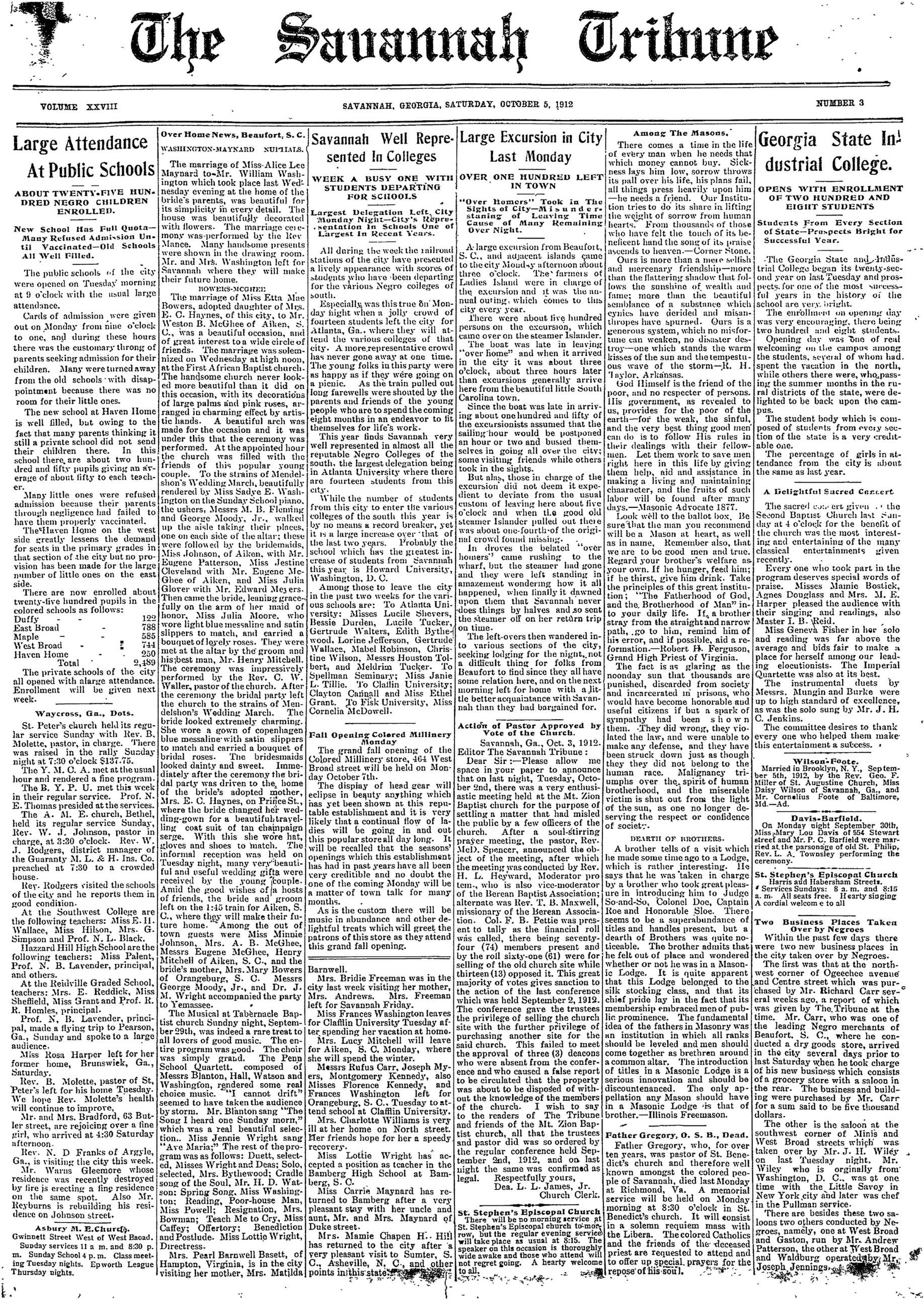
Large Attendance At Public Schools
ABOUT TWENTY-FIVE HUNDRED NEGRO CHILDREN ENROLLED.
New School Has Full Quota—Many Refused Admission Until Vaccinated—Old Schools All Well Filled.
The public schools of the city were opened on Tuesday morning at 9 o'clock with the usual large attendance.
Cards of admission were given out on Monday from nine o'clock to one, and during these hours there was the customary throng of parents seeking admission for their children. Many were turned away from the old schools with disappointment because there was no room for their little ones. The new school at Haven Home is well filled, but owing to the fact that many parents thinking it still a private school did not send their children there. In this school there, are about two hundred and fifty pupils giving an average of about fifty to each teacher.
Many little ones were refused admission because their parents through negligence had failed to have them properly vaccinated. The Haven Home on the west side greatly lessens the demand for seats in the primary grades in that section of the city but no provision has been made for the large number of little ones on the east side. There are now enrolled about twenty-five hundred pupils in the colored schools as follows:
The private schools of the city all opened with alarge attendance. Enrollment will be given next week.
Waycross, Ga., Dots.
St. Peter's church held its regular service Sunday with Rev. B. Molette, pastor, in charge. There was raised in the rally Sunday night at 7:30 o'clock $137.75. The Y. M. C. A. met at the usual hour and rendered a fine program. The B. Y. P. U. met this week in their regular service. Prof. N. E. Thomas presided at the services.
The A. M. E. church, Bethel, held its regular service Sunday, Rev. W. J. Johnson, pastor in charge, at 3:30 o'clock. Rev. W. J. Rodgers, district manager of the Guaranty M. L. & H. Ins. Co. preached at 7:30 to a crowded house. Rev. Rodgers visited the schools of the city and he reports them in good condition. At the Southwest College are the following teachers: Miss E. I1. Wallace, Miss Hilson, Mrs. G. Simpson and Prof. N. L. Black. Hazzard Hill High School are the following teachers: Miss Palent, Prof. N. B. Lavender, principal, and others.
At the Reidville Graded School, teachers: Mrs. E. Reddick, Miss Sheffield, Miss Grant and Prof. R. R. Homles, principal.
Prof. N, B. Lavender, principal, made a flying trip to Pearson, Ga., Sunday and spoke to a large audience.
Miss Rosa Harper left for her former home, Brunswick, Ga., Saturday.
Rev. B. Molette, pastor of St. Peter's left for his home Tuesday. We hope Rev. Molette's health will continue to improve.
Mr. and Mrs. Bradford, 63 Butler street, are rejoicing over a fine girl, who arrived at 4:30 Saturday afternoon.
Rev. N. D Franks of Argyle, Ga., is visiting the city this week. Mr. Warns Greemore whose residence is recently destroyed by fire is erecting a fine residence on the same spot. Also Mr. Reyburns is rebuilding his residence on Johnson street.
Gwinnett Street West of West Baad.
Sunday services 11 a.m. and 8:30 p.m.
Sunday School 4 p.m. Class meeting Tuesday nights. Epworth League Thursday nights.
All during the week the railroad stations of the city have presented a lively appearance with scores of students who have been departing for the various Negro colleges of south.
The marriage of Miss Etta Mue Bowers, adopted daughter of Mrs. E. C. Haynes, of this city, to Mr. Weston B. McGhee of Aiken, S. C., was a beautiful occasion, and of great interest to a wide circle of friends. The marriage was solemnized on Wednesday at high noon, at the First African Baptist church. The handsome church never looked more beautiful than it did on this occasion, with its decorations of large palms and pink roses, arranged in charming effect by artistic hands. A beautiful arch was made for the occasion and it was under this that the ceremony was performed. At the appointed hour the church was filled with the friends of this popular young couple. To the strains of Mendelshon's Wedding March, beautifully rendered by Miss Sadye E. Washington on the Sunday School piano, the ushers, Messrs M. B. Fleming and George Moody, Jr., walked up the aisle taking their places, one on each side of the altar; these were followed by the bridemaids, Miss Johnson, of Aiken, with Mr. Eugene Patterson, Miss Jestine Cleveland with Mr. Eugene McGhee of Aiken, and Miss Julia Glover with Mr. Edward Meyers. Then came the bride, leaning gracefully on the arm of her maid of honor, Miss Julia Moore, who wore light blue messaline and satin slippers to match, and carried a bouquet of lovely roses. They were met at the altar by the groom and his best man, Mr. Henry Mitchell. The ceremony was impressively performed by the Rev. C. W. Waller, pastor of the church. After the ceremony the bridal party left the church to the strains of Mendelshon's Wedding March. The bride looked extremely charming. She wore a gown of copenhagen blue messaline with satin slippers to match and carried a bouquet of bridal roses. The bridesmaids looked dainty and sweet. Immediately after the ceremony the bridal party was driven to the home of the bride's adopted mother, Mrs. E. C. Haynes, on Prince St., where the bride changed her wedding-gown for a beautiful traveling coat suit of tan champagne serge. With this she wore hat, gloves and shoes to match. The informal reception was held on Tuesday night, many very beautiful and useful wedding gifts were received by the young couple. Amid the good wishes of a hosts of friends, the bride and groom left on the 1:45 train for Aiken, S. C., where they will make their future home. Among the out of town guests were Miss Minnie Johnson, Mrs. A. B. McGhee, Messrs Eugene McGhee, Henry Mitchell of Aiken, S. C., and the bride's mother, Mrs. Mary Bowers of Orangeburg, S. C. Messrs George Moody, Jr., and Dr. J. M. Wright accompanied the party to Yemassee.
Especially day night fourteen Atlanta, tend the city. And has never the young as happy a picnic. Long fare parents a people we eight most themselves. This year well reputable south, in Atlanta are four city.
While from this colleges by no means it is a last the school we crease of this year. Washing among in the pious school versity: Bessie I. Gertrude wood, Le Wallace, tine Wils bert, and Spellman L. Tillie, Clayton Grant, R. Cornelia
Fall Open
The green Colored Broad street day October. The diel eclipse is yet but table estate likely dies will this popup will be re openings has had in very creed one of the matter months.
As is the music in lightful t patrons of this grand
Barnwell. Mrs. city last for Mrs. An left for S.
Especially, was this true on Monday night when a jolly crowd of fourteen students left the city for Atlanta, Ga., where they will attend the various colleges of that city. A more representative crowd has never gone away at one time. The young folks in this party were as happy as if they were going on a picnic. As the train pulled out long farewells were shouted by the parents and friends of the young people who are to spend the coming eight months in an endeavor to fit themselves for life's work.
This year finds Savannah very well represented in almost all the reputable Negro Colleges of the south, the largest delegation being in Atlanta University where there are fourteen students from this city.
While the number of students from this city to enter the various colleges of the south this year is by no means a record breaker, yet it is a large increase over that of the last two years. Probably the school which has the greatest increase of students from Savannah this year is Howard University, Washington, D.C.
Among those to leave the city in the past two weeks for the various schools are: To Atlanta University: Misses Lucile Shevers, Bessie Durden, Lucile Tucker, Gertrude Walters, Edith Bythewood, Lorine Jefferson, Gertrude Wallace, Mabel Robinson, Christine Wilson, Messrs Houston Tolbert, and Meldrim Tucker. To Spellman Seminary; Miss Janie L Tillie. To Clafin University; Clayton Canail and Miss Ethel Grant. To Fisk University, Miss Cornelia McDowell.
Fall Opening Colored Millinery Monday
The grand fall opening of the Colored Millinery store, 464 West Broad street will be held on Monday October 7th. The display of head gear will eclipse in beauty anything which has yet been shown at this reputable establishment and it is very likely that a continual flow of ladies will be going in and out this popular store all day long. It will be recalled that the seasons' openings which this establishment has had in past years have all been very creditible and no doubt the one of the coming Monday will be a matter of town talk for many months.
As is the custom there will be music in abundance and other delightful treats which will greet the patrons of this store as they attend this grand fall opening.
Barnwell.
Mrs. Bridie Freeman was in the city last week visiting her mother, Mrs. Andrews. Mrs. Freeman left for Savannah Friday. Miss Frances Washington leaves for Clafflin University Tuesday after spending her vacation at homo. Mrs. Lucy Mitchell will leave for Aiken, S. C. Monday, where she will spend the winter. Mossrs Rufus Carr, Joseph Myers, Montgomery Kennedy, also Misses Florence Kennedy, and Frances Washington left for Orangeburg, S. C., Tuesday to attend school at Clafflin University. Mrs. Charlotte Williams is very ill at her home on North street. Her friends hope for her a speedy recovery.
Miss Lottie Wright has accepted a position as teacher in the Bamberg High School at Bamberg, S. C.
Miss Carrie Maynard has returned to Bamberg after a very pleasant stay with her uncle and aunt, Mr. and Mrs. Maynard of Duke street.
Mrs. Mamie Chapen H.. Hill has returned to the city after a very pleasant visit to Sumter, S. C., Asheville, N. C., and other points in this state.
Over Home News, Beaufort, S. C.
WASHINGTON-MAYNARD NUPTIALS.
The marriage of Miss-Alice Lee Maynard to-Mr. William Washington which took place last Wednesday evening at the home of the bride's parents, was beautiful for its simplicity in every detail. The house was beautifully decorated with flowers. The marriage ceremony was performed by the Rev Mance. Many handsome presents were shown in the drawing room. Mr. and Mrs. Washington left for Savannah where they will make their future home.
BOWERS-MCGHER
The Musical at Tabernacle Baptist church Sundny night, September 29th, was indeed a rare treat to all lovers of good music. The entire program was good. The choir was simply grand. The Penn School Quartett. composed of Messrs Blanton, Hall, Watson and Washington, rendered some real choice music. "I cannot drift" seemed to have taken the audience by storm. Mr. Blanton sang "The Song I heard one Sunday morn," which was a real beautiful selection. Miss Jennie Wright sang "Ave Maria;" The rest of the program was as follows: Duett, selected, Misses Wright and Deas; Solo, selected, Mrs. Bythewood; Cradle song of the Soul, Mr. H. D. Watson; Spring Song, Miss Washington; Reading, Poor-house Man, Miss Powell; Resignation, Mrs. Bowman; Teach Me to Cry, Miss Caffey; Offertory; Benediction and Postlude. Miss Lottie Wright, Directress.
Mrs. Pearl Barnwell Baset, of Hampton, Virginia, is in the city visiting her mother. Mrs. Matilda
SAVANNAH, GEORGIA, SATURDAY, OCTOBER 5, 1912
Savannah Well Represented In Colleges
WEEK A BUSY ONE WITH STUDENTS DEPARTING FOR SCHOOLS Largest Delegation Left, City Monday Night-City's Representation In Schools One of Largest In Recent Years.
Large Excursion in City Last Monday
OVER ONE HUNDRED LEFT IN TOWN
"Over Romers" Took in The Sights of City-Mis under restaining of Leaving Time Cause of Many Remaining Over Night.
A large excursion from Beaufort, S. C., and adjacent islands came to the city Monday afternoon about three o'clock. The farmers of Ladies Island were in charge of the excursion and it was the annual outing, which comes to this city every year.
There were about five hundred persons on the excursion, which came over on the steamer Islander. The boat was late in leaving "over home" and when it arrived in the city it was about three o'clock, about three hours later than excursions generally arrive here from the beautiful little South Carolina town.
Since the boat was late in arriving about one hundred and fifty of the excursionists assumed that the sailing hour would be postponed an hour or two and bused themselves in going all over the city; some visiting friends while others took in the sights.
But alas, those in charge of the excursion did not deem it expedient to deviate from the usual custom of leaving here about five o'clock and when the good old steamer Islander pulled out there was about one-fourth of the original crowd found missing.
In droves the belated "over honers" came rushing to the wharf, but the steamer had gone and they were left standing in amazement wondering how it all happened, when finally it dawned upon them that Savannah never does things by halves and so sent the steamer off on her return trip on time.
The left-overs then wandered into various sections of the city, seeking lodging for the night, not a difficult thing for folks from Beaufort to find since they all have some relation here, and on the next morning left for home with a little better acquaintance with Savannah than they had bargained for.
Action of Pastor Approved by Vote of the Church.
Savannah, Ga., Oct. 3, 1912. Editor The Savannah Tribune:
Dear Sir: Please allow me space in your paper to announce that on last night, Tuesday, October 2nd, there was a very enthusiastic meeting held at the Mt. Zion Baptist church for the purpose of settling a matter that had misled the public by a few officers of the church. After a soul-stirring prayer meeting, the pastor, Rev. McD. Spencer, announced the object of the meeting, after which the meeting was conducted by Rev. H. L. Heyward, Moderator protem., who is also vice-moderator of the Berean Baptist Association; alternate was Rev. T. B. Maxwell, missionary of the Berean Association. Col. F. B. Pettie was present to tally as the financial roll was called, there being seventy-four (74) members present and by the roll sixty-one (61) were for selling of the old church site while thirteen (13) opposed it. This great majority of votes gives sanction to the action of the last conference which was held September 2, 1912. The conference gave the trustees the privilege of selling the church site with the further privilege of purchasing another site for the said church. This failed to meet the approval of three (3) deacons who were absent from the conference and who caused a false report to be circulated that the property was about to be disposed of without the knowledge of the members of the church. I wish to say to the readers of The Tribune and friends of the Mt. Zion Baptist church, all that the trustees and pastor did was so ordered by the regular conference held September 2nd, 1912, and on last night the same was confirmed as legal. Respectfully yours,
Dea. L. L. James, Jr.
Church Clerk.
St. Stephen's Episcopal Church
There will be no morning service at
St. Stephen's Episcopal church to morrow, but the regular evening service will take place as usual at 8:15. The speaker on this occasion is thoroughly wide awake and those who attend will not regret going. A hearty welcome to all.
Among The Masons.
There comes a time in the life of every man when he needs that which money cannot buy. Sickness lays him low, sorrow throws its pall over his life, his plans fail, all things press heavily upon him—he needs a friend. Our Institution tries to do its share in lifting the weight of sorrow from human hearts. From thousands of those who have felt the touch of its beneficent hand the song of its praise ascends to heaven.—Corner Stone.
Ours is more than a mere selfish and mercenary friendship—more than the flattering shadow that follows the sunshine of wealth and fame; more than the beautiful semblance of a substance which cynics have derided and misanthropes have spurned. Ours is a generous system, which no misfortune can weaken, no disaster destroy—one which stands the warm kisses of the sun and the tempestuous wave of the storm—R. H. Taylor, Arkansas.
God Himself is the friend of the poor, and no respecter of persons. His government, as revealed to us, provides for the poor of the earth—for the weak, the sinful, and the very best thing good men can do is to follow His rules in their dealings with their fellowmen. Let them work to save men right here in this life by giving them help, aid and assistance in making a living and maintaining character, and the fruits of such labor will be found after many days.—Masonic Advocate 1877.
Look well to the ballot box. Be sure that the man you recommend will be a Mason at heart, as well as in name. Remember also, that we are to be good men and true. Regard your brother's welfare as your own. If he hunger, feed him; if he thirst, give him drink. Take the principles of this great institution; "The Fatherhood of God, and the Brotherhood of Man" into your daily life. If a brother stray from the straight and narrow path, go to him, remind him of his error, and if possible, aid a reformation.—Robert H. Ferguson, Grand High Priest of Virginia.
The fact is as glaring as the noonday sun that thousands are punished, discarded from society and incarcerated in prisons, who would have become honorable and useful citizens if but a spark of sympathy had been shown them. They did wrong, they violated the law, and were unable to make any defense, and they have been struck down just as though they they did not belong to the human race. Malignancy triumphs over the spirit of human brotherhood, and the miserable victim is shut out from the light of the sun, as one no longer deserving the respect or confidence of society.
DEARTH OF BROTHERS:
A brother tells of a visit which he made some time ago to a Lodge, which is rather interesting. He says that he was taken in charge by a brother who took great pleasure in introducing him to Judge So-and-So, Colonel Doe, Captain Roe and Honorable Sloe. There seems to be a superabundance of titles and handles present, but a dearth of Brothers was quite noticeable. The brother admits that he felt out of place and wondered whether or not he was in a Masonic Lodge. It is quite apparent that this Lodge belonged to the silk stocking class, and that its chief pride lay in the fact that its membership embraced men of public prominence. The fundamental idea of the fathers in Masonry was an institution in which all ranks should be leveled and men should come together as brethren around a common altar. The introduction of titles in a Masonic Lodge is a serious innovation and should be discountenanced. The only appellation any Mason should have in a Masonic Lodge is that of brother.—Illinois Freemason.
Father Gregory, O. S. B., Dead.
Father Gregory, G. S. B., Dead.
Father Gregory, who, for over ten years, was pastor of St. Benedict's church and therefore well known amongst the colored people of Savannah, died last Monday at Richmond, Va. A memorial service will be held on Monday morning at 8:30 o'clock in St. Benedict's church. It will consist in a solemn requiem mass with the Libera. The colored Catholics and the friends of the deceased priest are requested to attend and to offer up special prayers for the repose of his soul.
NUMBER 3
Georgia State Industrial College.
Georgia State Industrial College.
OPENS WITH ENROLLMENT OF TWO HUNDRED AND EIGHT STUDENTS
Students From Every Section of State—Prospects Bright for Successful Year.
The Georgia State and Industrial College began its twenty-second year on last Tuesday and prospects, for one of the most successful years in the history of the school are very bright.
The enrollment on opening day was very encouraging, there being two hundred and eight students.
Opening day was one of real welcoming on the campus among the students, several of whom had spent the vacation in the north, while others there were, who, passing the summer months in the rural districts of the state, were delighted to be back upon the campus.
The student body which is composed of students from every section of the state is a very creditable one.
The percentage of girls in attendance from the city is about the same as last year.
A Delightful Sacred Concert
The sacred concert given the Second Baptist Church last Sunday at 4 o'clock for the benefit of the church was the most interesting and entertaining of the many classical entertainments given recently.
Every one who took part in the program deserves special words of praise. Misses Mamie Bostick, Agnes Douglass and Mrs. M. E. Harper pleased the audience with their singing and readings, also Master I. B. Reid.
Miss Geneva Fisher in her solo and reading was far above the average and bids fair to make a place for herself among our leading elocutionists. The Imperial Quartette was also at its best.
The instrumental duets by Messrs. Mungin and Burke were up to high standard of excellence, as was the solo sung by Mr. J. H. C. Jenkins. The committee desires to thank every one who helped them make this entertainment a success.
Wilson-Foote.
Married in Brooklyn, N. Y., September 5th, 1912, by the Rev. Geo. F. Miller of St. Augustine Church, Miss Daisy Wilson of Savannah, Ga., and Mr. Cornelius Foote of Baltimore, Md.-Ad.
Davis-Barfield.
Davis-Barfield.
On Monday night September 30th, Miss-Mary Lou Davis of 554 Stewart street and Mr. P. C. Barfield were married at the parsonage of old St. Philip, Rev. L. A. Townsley performing the ceremony.
St. Stephen's Episcopal Church
Harris aid Hobersham Streets.
Harris aud Habersham Streets.
Services Sundays: 8 a. m. and 8:15
a. m. All seats free. Hearty singing
A cordial welcome e to all
Two Business Places Taken
Over by Negroes
Within the past few days there were two new business places in the city taken over by Negroes. The first was that at the northwest corner of Ogeechee avenue and Centre street which was purchased by Mr. Richard Carr several weeks ago, a report of which was given by The.Tribune at the time. Mr. Carr, who was one of the leading Negro merchants of Beaufort, S. C., where he conducted a dry goods store, arrived in the city several days prior to last Saturday when he took charge of his new business which consists of a grocery store with a saloon in the rear. The business and building were purchased by Mr. Carr for a sum said to be five thousand dollars.
The other is the saloon at the southwest corner of Minis and West Broad streets which was taken over by Mr. J. H. Wiley on last Tuesday night. Mr. Wiley who is originally from Washington, D. C., was at one time with the Little Savoy in New York city and later was chef in the Pullman service. There are besides these two saloons two others conducted by Negroes, namely, one at West Broad and Gaston, run by Mr. Andrew Patterson, the other at West Broad and Waldburg operated by Mr. Joseph Jennings.
An Advertisement in This Paper
Nichols, THE SHOE MAN
The affable H. B. Wright is still with us and expects the continuous patronage of his friends.
Johnson Undertaking Establishment
COMBINED WITH
The Royall Undertaking Company
(Incorporated.)
Funeral Directors and Embalmers
Finest line of Coffins, Saskets and Robes. White and black funeral cars. Office and warerooms 325-331 Jefferson street.
W. R. FIELDS, Manager.
Residence Phone 2032: Livery Stable Attached. Office Phone 676.
C. H. ROYALL, Residence 509 Charles St. Phone 3064.
Expert Hair Cutting, Electric Massage and Shampooing a Specialty. All Work Done by Experienced Workmen. Courteous attention to all SHINING PARLOR ATTACHED.
117 WEST BROAD ST. SAVANNAH, QA. The Beautiful Woodlawn Park New Improvements More Lights New Buildings The Ideal Picnic Spot of Savannah Secure your dates from ANDREW D. MONROE, 124 East Thirty-third St.
SAVING
MONEY IS
A HABIT
Get the habit of
saving a part of
your Earnings
each week.
$1.00
Starts an
Account
THE WAGE-
EARNERS' LOAN
AND INVESTMENT
COMPANY,
468 WESTBROAD ST.
Savannah, Ga.
GAREY'S
Goods delivered promptly to any part of the city. 506 West-Broad St, Near Gaston Phone 1869-J
Masonic Books and Regalias
LODGE SEALS,
FINANCIAL CARDS and
BLANKS of every description.
Publishers and Manufacturers' Prices
Laboral Discounts Will Be Arranged.
BOL G. JOHNSON,
Savannah, Ga.
IT GIVES A CLEAN SHAVE WITHOUT THE USE OF A RAZOR. FOR PARTICULARS, WRITE
MADAME FLORENCE E. 'WILLIAMS
Graduate Prof. Roher's School, New York.
719 West Broad Street.
Telephone 2328.
Wigs, Switches and Pompadours
Made from Natural Hair.
Cobbings Made Up. Shampooing and
Hair Straightening a Specialty.
Face and Electric Massage. Dyeing
and Matching Hair.
ORIENTAL HAIR GROWER.
An excellent preparation, will produce a beautiful growth of hair. Directions on each box. For sale, price 25 cents per box.
Young Bros.
For your
TOBACCO, CIGARS and FRUITS
Of all kinds.
503 West Broad Street.
WEST SIDE RESTAURANT
461 West Broad Street.
Near Union Station.
The place to get first-class meals
Everything neat and clean. Meals
prepared in an appetizing manner
and at all hours daily.
Meals 16 and 25 cent.
MRS. A. S. SCOTT, Proprietress
Your Money Pile Grows
Just in proportion as you advertise your business, and our columns are open for you to begin at once. Suppose you give us a trial.
Advertise in this paper
THE HIGH COST OF LIVING
has not affected our job printing prices. We're still doing commercial work of all kinds at prices emisfactory to you.
GOOD ROADS
Boston Man Returns From Trip Abroad and Teils of Superiority of European Highways.
Well satisfied that the European countries have little to teach this country in the way of manufacture of motor cars, J. H. MacAlman, president of the Boston Automobile Dealers' association, returned recently.
It was a vacation trip for Mr. MacAlman, but he took care to note the state of the motoring industry in the different countries and to observe the condition of the highways. While praising the magnificent systems of highways in Great Britain and on the Continent, where he found roads everywhere equal to our best, he is of the opinion that the magnificent care that is taken of them. The principal roads are under national control, and are never allowed to wear out. All along the main routes of travel there are posted at intervals men who have a supply of road material at hand, and when a hole appears in the road surface, the road repairers at once pound stone into it and stop the wear. The traffic over these roads is heavy, but on none of them, according to Mr. MacAlman, is the traffic as heavy as that over such a road as the Revere Beach Parkway and other main avenues of motor travel out of Boston. What struck him particularly forcible in England was the fact that no matter where he wanted to go there were first-class roads, due to the fact that England has been building good roads for centuries, while the good roads idea in the United States is scarcely a score of years old.
ARRANGING GRADE OF CREAM
Lack of Quality Has Long Been Detriment to Dairy Interests of the United States.
Increased attention is being given in butter-producing districts to the grading of cream and the arranging of price schedules to conform more nearly with the real value of different grades of the product. Lack of quality has long been a serious detriment to the dairy interests, of the United States, regardless of locality. The production of a higher quality of cream by the individual farmer has long been urged by the creamyery operators as the prime necessity to the production of better butter. For the most part, however, creamyery interests and creamyery operators—even under the co-operative plan—have offered no particular inducement to the farmer to improve the quality of his product. Producing cream under the most improved conditions and keeping and delivering it in the best possible condition generally costs more work and more money than the production of an inferior product. As long as cream is paid for on a flat scale at so much per pound of butter fat regardless of condition, the great bulk of farmers are not going to spend money and effort to deliver a high-grade product at the creamyery. When, however, a price difference is paid commensurate with the real difference in quality the matter becomes a question of economics, as it properly should, and there is a tangible object in delivering cream of high quality. There is just as much good, sound season back of grading cream as paying for it according to its relative value as there is in the grading of wheat and corn.
Storing Pumpkins in the Field.
You needn't expect to reap much profit from gorging your hogs and cattle on pumpkins for a few days during the harvest season, then cutting off their supply of this valuable feed for another whole year. Store your pumpkins in the field.
Pile the pumpkins in a row, as high and as wide as you wish, cover with hay and set up fodder on each side to a thickness of three or four feet. This not only affords ample protection from cold, but it enables you to form a' most profitable balanced ration by adding "the fruit of the vine" as you feed out the corn and fodder.
Filling the Orchard.
The vacant places in an orchard caused by poor stock, injury in cultivation or borers, it may be as well to fill in with younger trees up to the age of about eight years. After that time the older trees will occupy the ground so fully with their root systems that young trees set make very little growth and seldom amount to much when they arrive at a bearing age.
Sheep in the Orchard
If fruit trees are a good size and there is some wasteful fruit on the ground, or plenty of grass and weeds here and there, to turn a few sheep in, it is more likely to do the ground good than harm. There must, however, be sufficient food somewhere to keep the young from getting hungry enough to get after the bark or twigs.
COST GF ROAD IMPROVEMENT
Secretary Wilson Shows That 300,000 Miles of Public Thoroughfares Need Batterment. According to information just made public by the director of the office of public roads, Indiana leads all the states of the Union in mileage of improved roads.- Most of the improved roads of Indiana and Ohio are composed of gravel and were, for the most part, built by farmers in working out the taxes. The eight leading good roads states are: Indiana, Ohio, New York, Wisconsin, Kentucky, Illinois, California and Massachusetts.
The states which are leading in progressive road building are: New York, Georgia, Washington, Missouri, South Carolina, Alabama, Pennsylvania, Tennessee, New Jersey, Florida and Maryland. That the nation-wide movement for the improvement of the public roads involves a large undertaking is indicated by information just made public by the U. S. department of agriculture. Secretary Wilson shows that 300,000 miles of roads must be improved before the public road system can be considered really efficient
It is only within recent years that the movement for better roads has galned force. The consequences of delay are shown in the fact that there are now but 190,476 miles of improved roads in this country. These improved roads constitute 8.66 per cent. of the total mileage of all public roads, improved and unimproved. It is figured that the percentage will have to be increased to 20 before traffic can be moved throughout the country with the minimum of wear and tear on horse, wagons and automobiles.
The French system of roads, long considered the best in the world, was bonded by Napoleon III. for $6,000,000, and something in the neighborhood of $612,775,000 has already been spent on that system. In this country, owing to the great distances, it is probable that close to $2,000,000,000 will have to be spent before a proper road system is developed.
While the amount necessary to perfect a great road system seems fabulously large, it does not seem too large when it is divided among the various states and spread over a period of five, ten or fifteen years. When it is considered that New York state has bonded itself for $50,000,000 and that $5,000,000 a year is now being expended by that state, it will be seen that a nation-wide system might soon be perfected were all states to progress as rapidly. South Carolina, Alabama and Florida have also made great gains by building sand-clay roads, and this is a very cheap and satisfactory type of road building.
The window gardener's year begins in September, because that is the time to bring tender plants indoors, and because bulbs begin to arrive then.
The ideal is to have flowers indoors every day from the first frost of autumn until the last frost of spring.
Bulbs alone will give flowers from Christmas to Easter. A little $2 collection of bulbs, will give a spot of color daily if carefully selected and managed, but it is pleasant to have a roomful of bulbs—about 250 pots.
The most practical bulbs for Christmas bloom are Roman hyacinths and the paper white narcissus. Chinese sacred lilies will also bloom then if protected from drafts.
For February, plan to have crocuses. For March and April plan to have tullips, hyacinths and daffodils.
Asparagus Doubly Useful.
Asparagus plant is hardy. It requires six weeks for the seed to germinate and come up. The young plants may be cultivated in rows as other garden vegetables, and set in permanent rows or beds this fall or spring.
The plants are very hardy, will stand all kinds of treatment, but will respond liberally to good treatment, and thrive in one place for ten or twenty years. The asparagus plant is doubly useful. The young shoots can be used for food, and the foliage branches for decoration. Sprays of asparagus are equaled by few other plants for their pleasing effect in decoration.
Good Roads.
Good roads are essential to the success of the farmer the world over. Poor roads are very costly; they cause the speedy wearing out of wagons, the loss of animals and the failure to market crops profitably. Good roads mean a greater ease in marketing, longer wear of farm wagons, more profit and more comfort. Good roads are not expensive; all roads can be improved at small cost in money, time and labor.
Avoid Weed Growth.
If there is any part of your garden or fields that you do not wish to grow vegetables or staple crops on do not allow it to grow up in weeds. Weeds are obnoxious, do not afford any profit or pleasure to the land owner and rob the soil of its fertility. Sow any unoccupied parts of your land in cowpeas or other legumes. It will pay you well.
Poor Fall Work.
Where the road is plowed and scraped up till it is so late in the fall, the dirt does not have time to pack and settle before it freezes, with the result that these newly-worked spots are not only rough throughout the entire winter, but they will be soft and difficult of travel all next spring.
HE JUST LOOKS BOA CON STRICTOR III EYE.
Zoo Guinea Thus Saves His Life- Then Calls on Lizard, Who Never Did Care for Him-Again His Glare Wins.
New York.—A very fat guinea pig, a fluffy ball of white and brown, with snappy little beads of eyes, that gaze up upon the world fearlessly, has furnished Raymond L. Ditmars, curator of the Zoological park in the Bronx, and Charley Snyder, his assistant, with another interesting puzzle, which they are still far from solving. The guinea pig was one of a fast increasing group which are from time to time killed off to replenish the snakes' bill of fare. The act which lifted this particular pig above the others of the family and brought it to the attention of Curator Ditmars and Snyder occurred when several days ago he managed to get into the enclosure of two hungry boa constrictors, and not only lived but so liked his experience that he sought further adventure in the retreat of the eight-foot monitor lizard.
The little animal was kept in a room at the north side of the reptile house, and back of the glass front enclosures containing the various members of the snake family. It was feeding time for certain of the big snakes, and Snyder, with a supply of fresh killed guinea pigs and rats, was in the narrow passageway back of the snake house feeding several Indian rattlers. The little brown and white pig, which had become accustomed to his quarters, wandered out into the space where the keeper was working. The little animal was very inquisitive, but Snyder gave him no more than passing attention.
He gave the rattlesnakes their allowance of food and stood for a few minutes waching them in the process of slowly swallowing their portions: Then he turned to the door of the boa constrictor cage, and as he opened it he saw a sight which filled him with surprise. In some way the guinea pig had climbed up to the cage and gained entrance to it.
Both snakes were hungry, for it had been several days since they had been fed, and one of their especial delicacies is guinea pig. Yet neither had made any attempt to eat up the fearless visitor, and when Snyder caught sight of the little animal he was in a comfortable position alongside the tail of the longest snake.
The other snake, half coiled, he said, was regarding the pig with interest mixed with amazement. The guinea pig appeared to be content, and was sitting, regarding the half-coiled snake with a steady stare. Evidently stimulated by his adventure in the boa constrictor cage, the pig went hunting more the day after his visit to the snakes. This time it got into the sun room at the east end of the reptile house. In this room are the reptiles that are sick in the process of shedding their skins.
When Mr Ditmars heard of this second visitation, the pig was endeavoring to make friends with the big monitor lizard Now, the lizard feeds upon eggs, which it bolts, shells and all, and it does not feel amiably disposed toward guinea pigs or rats. When discovered the little animal was sitting comfortably in front of the lizard, regarding it with a steady look that was returned with interest by the reptile. When Ditmars approached the lizard ambled forward, changing its course so as to move around the guinea pig.
The whole affair was so extraordinary, that Mr. Ditmars and his assistant are giving much study to it. Why two hungry snakes should refuse such a tempting morsel as a brown and white guinea pig, and not only reject him as an appetite satisfier, but show a desire to make friends with him, is so contrary to the natural course of events that both men are seeking a reason. Snyder inclines to the belief that the guinea pig possesses what he calls a hypnotic eye and that in this the snakes recognized one of their own kind, and the lizard also found in the pig's stare an all-compelling force.
TOO TICKLISH FOR ROBBERS
Woman'Just Could Not Stand for Hold-Up Man to Search
Kansas City, Mo.—Being ticklish saved Mrs. Frances Justine the other night from losing her purse to robbers and a meeting that might have been terrifying turned into an amusing affair. She was on her way home when two armed men commanded her to walk back with them to the shadow of a warehouse.
"We want money, that is all," they said. "So throw your hands up."
She obeyed and informed them that her purse was tucked in the top of her corset, under her arm. One of the men tore open her waist and thrust in a hand. It came out in a hurry to clasp over the woman's mouth, as she screamed "Don't!"
"I didn't mean to cry out that way," she laughed, as the hand dropped and gave her a chance, to speak, "but I am awfully ticklish and I just can't stand it."
The continued efforts of the men to find the purse, while Mrs. Justine's protecting arm wouldn't stay up, threw her into fits of laughter, which so disturbed the robbers that, as she sank to the pavement, they ran.
TAFT WOULD AID FARMERS.
Wants United States to Adopt Co-Operative Credit System.
RESULT
State Department, at the President's Direction, Has Looked Into the System In Vogue In Europe-It Would Mean Low Rates and Easy Terms For Repayment.
The state department's investigation of European systems of co-operative credit has now reached the second stage in which a study is made of the mortgage bond societies and the mortgage banks. It is expected that this is the form of co-operative credit which, under one plan or another, will be proposed for adoption in the United States in connection with President Taft's efforts to extend this assistance to the American farmer.
As compared to the present American system of farm land loans this form of co-operative credit would accomplish two things for the farmer: First.—It would permit him to repay his loan through an easy system of amortization extending over a long period of years and would remove effectively the menace of foreclosure or renewal which hangs like the sword of Damocles over the head of any borrower from a private individual under a short time mortgage
Second.—It would unlock the doors of the great money centers to the farmer of the remotest regions and give a security to the investor in New York, so that he would need have no concern with knowing anything of the sort of security offered by the farm in Texas or Oregon on which the money he lends is to be spent.
This means to the farmer low rates of interest and easy terms for repayment. What it would mean in more specific terms to the American farmer can be easily seen in a comparison of conditions in Germany of France and in the United States Here is the statement of a dealer in land mortgages in our southwest, made at a meeting in New York city. The speaker was describing the business of a company financed by British capital which makes mortgage loans on farms in the southwestern states:
"We have been loaning money at 8, 9 and 16 per cent I loaned money in the Pachandle twenty-seven years ago and for the first three or four years never got less than 8 per cent a month. That is incident to a new country. Now our bank rate is 10 per cent. Our land loans that we have been making the first year or so through that section of the country have been made on an 8 or 9 per cent basis. However, I am very frank to say that I think the rates ought to come down and that we ought to be able to get money from that section of the country at 8 or 7 per cent."
In comparison with this statement the Credit Foncier of France is able to loan money on farm lands at 4.3 per cent and the German societies and banks at about 4 or 4.5 per cent. As the speaker quoted above says, the high rate of interest in this country is probably to a large extent due to the fact that it is a new country and that money here is more actively employed. It is doubtful whether, even with the adoption of the European machinery, the interest rates on mortgages could be brought down as low in the United States as they are in either France or Germany. It is the opinion of no less an authority than Charles A. Conant, however, that they could be brought down to 5 per cent. A mortgage at 5 per cent with the advantage to the farmer of repaying his loan little by little through an unburdensome plan of amortization might be accepted as the sum total of benefit to be expected by the American farmer from the adoption of some such system—as, for instance, the German mortgage bank plan.
Another African Theodore.
An African Theodore came to grief just forty-five years ago because he thought he was the whole show. The rest of mankind thought they were some show, too, and Theodore of Abyssinia learned too late that he had made a very serious mistake in not taking that very natural attitude into account. Nature has not given to any individual a monopoly of the abilities requisite in the rule of a people.
A vote for the Democratic ticket this fall is a vote for free trade and all that free trade stands for. A vote for the bull moose ticket is a vote for something which no one, not even its promoters, can give any light upon. A vote for the Republican ticket is a vote for protection to honest American toll, and protection is a synonym for prosperity.—Newport (N. H.) Champion.
When Wilson Will Get Worse Left.
Woodrow Wilson complained that his private car was left several hours behind by the Chicago express. That's nothing to the way he and his free trade crew will be left behind by the Taft Republican express on Nov. 5.
BUSINESS MEN ARE ALL FOR TAFT
Prosperity Depends on His Re-election.
EVERY SECTION FAVORS HIM
Men of Substance, With Interests of Country at Heart, Place Republican Candidate Above Bull Moose Wrecker and Democratic Free Trader—Good Times in Sight.
The Evening Post of New York, which professes an independent attitude toward the presidential contest, has been taking the views of representative business men in various parts of the United States on the improvement in business conditions and the probable influence of that improvement on the national election.
Among conditions pointing to increasing prosperity and better times for all branches of trade and industry are a wheat crop estimated by the department of agriculture in its report for August at 58,000,000 bushels more than the crop of 1911 and exceeding in magnitude only in three preceding years; a corn crop, if not injured by early frosts, estimated to be the third largest of our yields and 10 per cent, larger than in 1911, and a cotton crop recently estimated as high as 14,000,000 bales, which would be exceeded only by the extraordinary 16,000,000 bale crop of last year. The country's iron production of July (usually a "barometer" of trade) surpassed allrecords for the month. Orders on the books of the United States Steel corporation at the beginning of August were the largest reported in any month since the panic of 1907, and showed the most rapid ratio of increase, as compared with a year ago, that had ever been recorded. The total weekly value of checks drawn on all the country's banks and passed through the clearing houses has increased over 14 per cent, over 1911, and in large sections of the west a.20 per cent recovery was reported. Along with this, the reports of the railway association on the number of railway freight cars idle in the United States have lately shown the smallest total for this time of year since 1907.
HONORS TO LABOR MEN
Positions of Public Trust Filled by Members of Trade Unions.
Washington.—The Trade Unionist, the official publication of organized labor in the District of Columbia, says:
"Representatives of labor are taking high place in public affairs—official, commercial, professional and civic. Fifteen members of the house of representatives—Republicans, Democrats and one Socialist — are proud possessors of "working cards" in the craft union which claimed their efforts before entering upon the larger duties of a wider field of endeavor. Recently the president of the United States, desiring a wise, keen, sagacious, practical private secretary, found his ideal in Mr. Carmi A. Thompson of Ohio.
"Mr. Thompson comes of a family of unionists, his father and six uncles being members of the Miners' union of his native state. Carmil as a boy and man working beside his father in the bituminous coal veins of the Hocking valley. In his early manhood Mr. Thompson attracted the attention of the leading public men of the state because of his wide knowledge of workingmen and rare judgment in matters pertaining to industrial conditions. His advance in public life was rapid, keeping pace with his developing popularity. He was elected to local and city offices, held important posts by appointment of the governor, and was secretary of state of Ohio. When appointed secretary to the president he was assistant secretary of the interior.
"Mr. Thompson is genial, kindly, sympathetic, and has lost none of his interest in the labor cause by promotion to commanding positions in the public service. W. N. B."
Under free trade the man who earns $20 a week now would be forced to accept either $15 or $12. The difference of $5 or $8, which now goes for clothing, rent, an occasional cigar or a theater ticket, possibly a delicacy for the home table, will not be at his disposal. Think of the several lines of trade that will lose millions of dollars every week by such enforced economy!
Now Used as a Circus Ground.
(From the Atlanta Constitution.)
Some say that Armageddon is "on the other side of Jordan" and others that it is a boat landing on Salt river.
Mr. Farmer, are you getting too much for your corn and cotton, meat and produce? If so, support Wilson and low tariff.—Bokoshe (Okla.) Enterprise.
TOFT
ADMINISTRATION
1909-1912
The tariff has been revised. Within a year following passage of the Payne bill wages were increased more than $500,000,000. Industry is operating at high pressure, general business is prosperous, and there is a scarcity of labor everywhere.
Two acts providing safety for railway employees and proper inspection of appliances have been passed.
The federal mining bureau for reducing the dangers to workmen has been established.
A children's bureau to minimize infant mortality and reduce child employment in factories has been organized.
Pensions for Union veterans of the war of the rebellion have been broadened and increased.
White slavery has been outlawed and checked. Our trade with foreign nations has These are among the achievement ministration within the same brief limi tial benefits to the people. Why make heaval of business, when every physl ble7—From Harrisburg (Pa.) Telegra
These are among the achievements of three years of Taft. No other administration within the same brief limit has accomplished so many substantial benefits to the people. Why make a change, involving widespread upheaval of business, when every physical and material condition is favorable?—From Harrisburg (Pa.) Telegram.
ALL NICE FELLOWS NOW.
ITALIAN
—From Morning Oregon
MY WOODROW WILSON
HIS BOOK
OY WOODROW WILSON
ITALIAN
WOODROW
REDDY WOODROW
J. WOODROS
—From Morning Oregonlan of Portland, Ore., Sept. 9, 1912.
WHO WAS REPRESENTED?
Dr. Wilson Asks Question That May Embarrass Democrats.
"Who," asks Woodrow Wilson, in his speech of acceptance, "when you come down to the hard facts of the matter, have been represented in recent years when our tariff schedules were being discussed and determined, not on the floor of congress, for that is not where they have been determined, but in the committee rooms and conferences?"
Precisely. Who has? When the Payne-Aldrich bill was being framed prolonged and open hearings were conducted by the ways and means committee. Every one who had facts or arguments to present was given an opportunity to be heard. However, when Dr. Wilson's fellow Democrats undertook to revise the schedules in this congress Oscar Underwood and his associates barred the doors and out of adylices, the sources of which they have never yet entirely disclosed, proceeded to make up the schedules in secret and Jam them through the house by gag rules. It would be interesting could Dr. Wilson secure from the Democratic leaders an answer to his question. It was not entirely thoughtful of him to propound it.
How the Democratic party does progress! Its tariff planks in 1992 and 1912 are duplicates. The results will be, too, if the American people elect Wilson.—Norwich (Conn.) Bulletin.
been enormously increased, particularly in iron and steel manufactures.
Congress has made the contract between railroads and their employees more favorable to the latter.
Shippers by rail and patrons of express, telegraph and telephone companies are assured just rates by reason of additional authority conferred upon the interstate commerce commission.
The eight hour law on government work has been extended to include contract supplies.
Practice in the federal courts has been simplified in the interest of all litigants, which will relieve particularly the poor sultor.
Postal savings banks have been established, to the great convenience of persons who formerly hoarded their surplus.
Provision has been made for the parcels post, which will begin operations Jan. 1. of three, years of Taft. No other adult has accomplished so many substan- a change, involving widespread upical and material condition is favora- am.
WOODROW
onlan of Portland, Ore., Sept. 9, 1912.
CHASING A PHANTOM
We are living in an age in which by exaggeration of the defects of our present condition, by false charges of responsibility for it against individuals and classes, by holding up to the feverish imagination of the less fortunate and the discontented the possibilities of a millennium, a condition of popular unrest has been produced. New parties are being formed, with the proposed purpose of satisfying this unrest by promising a panacea. In so far as inequality of condition can be lessened and equality of opportunity can be promoted by improvement of our educational system, the betterment of the laws to insure the quick administration of justice and by the prevention of the acquisition of privilege without just compensation, in so far as the adoption of the legislation above recited and laws of a similar character may aid the less fortunate in their struggle with the hardships of life, all are in sympathy with a continued effort to remedy injustice and to aid the weak, and I venture to say that there is no national administration in which more real steps of such progress have been taken than in the present one. But in so far as the propaganda for the satisfaction of unrest involves the promise of a millennium, a condition in which the rich are to be made reasonably poor and the poor reasonably rich by law, we are chasing a phantom; we are holding out to those whose unrest we fear a prospect and a dream, a vision of the impossible.—From President Taft's Speech of Acceptance.
WILSON ON LINCOLN.
Charles D. Hilles, chairman of the Republican national committee, has issued the following:
At this time, when the negroes throughout the United States are celebrating in various ways the fiftieth anniversary of the first proclamation of emancipation and when the Democratic candidate for the presidency, Woodrow Wilson, is appealing to the people of the western states to support him, it is fitting that the chairman of the political committee organized to further the cause of the candidates of the Republican party for president and vice president should call attention to an expression of opinion by Governor Wilson at a period in his career when possibly he never dreamed of being a candidate for a political office.
That expression of opinion was made in his capacity of historian, and it adds to the cumulative testimony that he was until he became a candidate and that he is now un-American in his views of public questions and at heart contemptuous of more than one class of American citizens and out of sympathy with their aims, their purposes and their beliefs.
It was on Sept. 22, 1862, that President Lincoln issued a proclamation giving formal notice that unless the southern states returned to their allegiance to the Union within a hundred days he would declare the slaves within their borders free, and it was on the 1st of January, 1862, following, that a definite proclamation of emancipation was issued. Of this crowning event of the career of the Immortal Lincoln, Woodrow Wilson says in his "History of the American People," written forty years afterward:
"The proclamation when it came was no law, but only his (Lincoln's) deliberate declaration of policy for himself and for his party, and changed, as he meant that it should change, the whole air of the struggle and of politics as well."
It is safe to say that not even the most radical unreconstructed southern man would attribute to Lincoln this motive which it remained for the historian Woodrow Wilson alone to discover. that Lincoln abolished slavery to further his own political ambitions and those of his political party. The statement adds proof to much already at hand that Woodrow Wilson forty years after the war was and presumably still is devoid of sympathy for the motive and results of the civil war.
The quotation from the Democratic candidate's writings proves that he is not a reliable historian nor a fair commentator. It goes to show what has been often asserted, that Governor Wilson is not at heart an admirer of or a believer in American institutions, as his other writings and speeches show that he is not a eulogist of American industries nor a defender of American labor. He continuously slanders millions of adopted citizens from abroad who have become good Americans. He sneers at trade unions, and apparently he would if he could close every American mill and buy in foreign markets, because in the first place he is an aristocrat born and bred and because he wants the American people to buy where they can buy the cheapest.
Everything that can be learned about Governor Wilson from his writings, from his speeches and from his manner of living indicate that he is not the type of man who can successfully appeal for the support of the American people.
MR. OTIS' DISGUST.
He Tells Why He Has Abandoned Third Party Movement.
Mr. Ralph C. Otis of Chicago seems to be a citizen of a type widely extant in the country today, taking a newer and a larger interest in the duties of citizenship and earnestly striving for bettering conditions of government. Like many another he was led away by the cant and the phrasemonging of the. third party promoters and made to believe that civic salvation only was to be obtained by following in the wake of the third termer.
But Mr. Otis, like the average intelligent citizen, could not stand for all that was put up to him. "Those fellows," he declares bluntly, referring to the third party bosses, "are around denouncing every one and calling everybody a 'crook' who does not agree with them." He declares that he will have nothing further to do with the bull moose movement. Inasmuch as Mr. Otis was president of the original Roosevelt league in Chicago and chairman of the new party national convention committee his defection from the cause is out of the ordinary.
His protest is that which every level headed man, presuming that he is not animated bypersonal or selfish reasons, will make when he has had an opportunity closely to observe the tactics and the hypocrisy of the self-seekers who are lending, directing and financing—especially financing—the new party.
TAFT THE MAN FOR THE CRISIS
The President and the Panama International Issue.
VALUE OF HIS DIPLOMACY
Not Since the Civil War Have the American People Had Greater Reason to Congratulate Themselves on Having the Right Man in the Right Place at the Vital Moment.
The American people never since 1860 have had greater reason to congratulate themselves on having the right man in the right place than they have in the fact that William Howard Taft is president of the United States. When Mr. Taft signed the Panama canal bill he upheld with a majesty worthy of the cause the right of the American people to attend to their own affairs at the same time that he confronted a most difficult international issue for which he was in nowise responsible.
It is easy to suppose what Mr. Taft's predecessor would have done under similar conditions. One can hear the bang and whiz and sputter, like the start of a wireless message across the Atlantic, hurling frantic defiance here and there and everywhere getting everybody mad, making foreign resentment more acute than before and an amiable adjustment well nigh, impossible.
President Taft's high standing as diplomat and statesman, his well known reputation for calm and dignified reasoning, his mastery of the principles of international law, of the obligation of treaties and the power of an independent people to supersede a treaty when it is found to infringe upon their national rights give assurance that the crisis, affecting as it does the honor of the nation and its fidelity to its solemn engagements, will be dealt with in a manner befitting the American republic and satisfactory to the civilized world
Foreign nations know that President Taft can be trusted to do what is fair and just, that his patriotism is as broad as it is pure and that no hunger for spread eagle notoriety will vitiate his judgment. And every American, whatsoever his party, knows in his heart of hearts that the national interests, the national honor, the national future—so far as he shall be permitted to control that future—are safe in the hands of William Howard Taft,
TAFT GOOD TIMES
A Good Deal More Substantial Than Wilson Promises.
There was an old song, a favorite in the days gone by, with the refrain, "Hard times come again no more!" Were it not for the dark cloud of Democratic free trade hovering above the horizon and the possibility of Wilson for president, with a cabinet of mossbacks from the south, with their heels on the cabinet table and telling each other how much better things were "before the wah," Americans might be singing that refrain with zest and glee today, for from all parts of the Union comes assurance of better times than for years past, of pressing demands for goods of all kinds, abundant employment and active and profitable trade. The large cities are thronged with buyers, and there is plenty of evidence that storekeepers, big and small, in city and village and at the crossroads, have money to spend—and mean to spend it.
How different four years ago! The country was still in the doldrums—not yet emerged from the Roosevelt panto of 1907. The nation was looking forward with hope and faith to the election of President Taft, then already recognized as one of the world's greatest statesmen, safe, sane, broad minded, with an intellectual grasp equal to the mighty task before him and an unselfish devotion to the welfare of all of his fellow citizens.
The nation's faith and hope in President Taft were not misplaced. Gradually and surely the country has come out of distrust and despair into the realization and enjoyment of ever growing prosperity. Business has recovered confidence, labor finds profitable employment, and in some, parts the demand for labor at good wages is greater than the supply.
President Taft has made good. Hard times have gone, never to return—provided Taft is re-elected and allowed to give the country four years more of sanity, safety and security. The frantic efforts of his predecessor to get a chance to give the country another taste of 1907 excite no alarm—the American memory is not short enough for that. But another, generation has grown to manhood and the ballot since the last calamitous experience of Democratic low tariff in 1894-7, and specious and illusive free trade arguments are appealing to ears that never heard them before.
There is every reason to believe, however, that the sunshine of Tatt's prosperity will clear the beclouded sky, dissipate the mist of Wilson free trade, and enable the younger voters to perceive, as their elders know by experience, the folly of exchanging good times for conditions that in the past have brought only business collapse and general hardship and depression for everybody and loss of opportunity.
The Savannah Tribune,
Established 1875
By JOHN H. DEVEAUX
Published by
SOL. C. JOHNSON
Editor and Proprietor
JAS. H. BUTLER
Asso. Editor and Manager
Published Every Saturday
1000 West Broad Street.
Phone 2171.
Subscription Rates:
One Year - - - - - $1.25
Six Months - - - - .75
Three Months - - - .50
Remittance must be made by Express or Post Office Money Order, or Registered Letter. Advertising rates given on application.
Entered at the Post Office at Savannah, Ga., as Second-Class mail matter.
SATURDAY, OCT. 5TH, 1912.
Register now for 1913. The books are open. Poll and property tax can also be paid at this time. Do not be delinquent.
A crusade should be made against the peddlers. They should be kept away from the homes. They are great nuisances and a bindrance to the savings of a certain class of our house wives.
The Republicans of the First Congressional District especially, should rally and prepare to pile up a big vote for the party ticket in November. The election is but a few weeks off. Chatham County and this district must lead the State.
Our people should keep away from their homes the installment house collectors and especially white insurance collectors. This class of men, that is some of them, have no respect for our women, nor any regard for their homes. They will enter certain homes without knocking, with covered head and cigar or cigarette stuck in their mouths. Keep these men who have no regard for you away from your homes.
The Tribune is not averse to the raiding of blind tigers and gambling dens operated by our people, but the police should not overlook similar lawlessness indulged in, by the opposite race. It will seem less like persecution to see some of the white blind tigers and gamblers also "pulled." And too, the police and city authorities would be doing everlasting good in segregating the bawdy white women from among respectable colored citizens especially from among those who own their homes. The disgraceful orgies performed by this class of women and the men who frequent these resorts, should be prevented. In this respect Savannah needs Atlanta's Chief Beaver.
With pardonable pride, The Tribune points to the fact that it numbers among its readers, some of the most intelligent of our young people. In our leading schools and colleges where our sheet finds shelter, we are told that it is eagerly sought by our young people who are quartered there. To learn of this is indeed both a pleasure and inspiration to us—a pleasure to know that we are interesting; an inspiration to us to fill our columns with subject matter so live and wholesome that it may be of some service to any who may read our pages. Today as our thoughts turn to our young people who are now domiciled within the walls of our colleges, the question arises in our mind more prominently than ever as to whether or not our young people in these high schools and colleges are making the most of the opportunities for self-development and culture offered them. To make good of the opportunities afforded them in school is to prove worthy of any sacrifice made in order that one might be educated; to do otherwise is to prove oneself the veriest ingrate imaginable. No people in the world make greater sacrifices to keep their loved ones in school than the parents of the young people of our race. To see a mother in the washtub and before the ironing board four, five and even six days of the week in order that a son or daughter may be kept in school is no uncommon sight. To see a noble father deprive his home of some of the necessities of life in order that his children may remain in a school and become educated is another observation that can be made any time. In the light of these facts can it be possible that any young man or woman in college can show so little an appreciation of the efforts of parents in his behalf as to grow indifferent as to the proper use of his time while in school. We cannot see how it can be. Our
boys and girls ought to strive to make each day in school bring such results that the day may stand apart as a fitting testimonial to something attempted, something done. Now is the time, dear college boys and girls, to make good. The world is waiting for and wanting your services; the race is in need of and is calling for strong men and women. There is a task that is awaiting each one of you to perform. Will you so fit yourself while in school as to be able to be of service to your country and people in the near future or will you sow wild oats during your college days and fail of the proper self-development and training for useful service in the future? We trust that the former idea rather than the latter will be an incentive to you. Do your duty to yourself young man or young woman while you are in school in order that you may meet the requirements of the world in the future. The gray hairs of an anxious mother and father are awaiting your debut into the world. Make good while in school and the probability is that you will make good out of school, thus bringing honor and happiness to the hoary heads whose plans and efforts made your education possible. By all means, young men and women of college, make good while you have the opportunity.
Ever mindful of its duty to sound an note of warning or to proffer suggestive advice to our people whenever the occasion demands it. The Tribune does not hesitate at this time to give such advice to our people. In a recent issue of one of the local dailies, we noted, with much regret, an account of the short-coming of one of the members of the race who was a trusted employee of one of our most reliable firms for nineteen years. According to the report, this individual was caught recently with an article of the firm concealed on his person. An investigation revealed the fact that the article confiscated was valued at about ten dollars and that it was only one of a number of articles taken from the store from time to time for a number of years. Such revelation naturally transferred the heretofore confidential employee into a thief caught with the goods on him. How sad indeed was it to us to note that the reputation of a life time was blasted in a moment. Occupying us do such a peculiar position in the life of our country where the merits and demerits of the race are judged by the action of each individual member, our people can ill afford to do anything that will reflect upon the honor and integrity of the race. The individual action of each member of the race must be conducive not to the destruction but to the growth of it. Here in our own city where discrimination in the industrial world is less marked than perhaps in any other city in the southland those of our people who are the trusted employees of our large firms, have an excellent opportunity to make the proper history for the race by doing their duties well, being polite and obliging and being honest at all times. We are indeed proud of those of our people who can point to ten, fifteen, twenty and sometimes over thirty or thirty-five years of service with one firm. Such records show, at least on the surface, years of faithful service rendered. How much more honorable is it to be able to round out such long years of service by resignation or even death than it is to be discharged or kicked out after such years on account of some unbecoming or questionable conduct. The example just referred to ought to serve as a lesson to all of us who occupy places of responsibility with the firms of our city. The honor of the race as well as the honor of the individual should be placed far and above any desire or temptation to do wrong. Our people must remember that we are still in the making. Every step taken backward is of more serious consequence to us than it would be perhaps under different circumstances. Each employee must remember that he is a party to the success of the race. Upon his action will depend to a large extent an increase or decrease in the prestige and respect of the race. Let each one of us appreciate our duty and do it well. Turning, as it were, neither to the right nor to the left, let each one so perform the tasks before him that he will be justly considered a contributor to the progress of our race and the good name that it is destined to bear.
With fitting ceremony, exercises commemorating the fiftieth anniversary of the announcement of President Lincoln that on January 1, 1863 all slaves would be freed, were held throughout the
Sunday, October 6th, the winter schedule of services will be resumed, on the first Sunday of October, which is the Feast of the Holy Rosary. The first Mass will be said at 7 a.m.; the second at 8 a.m. At 10:30, a.m. there will be High Mass and sermon. The chair will furnish special music for the occasion. The sermon will be preached by Rev. Jos. A. Dahleut and will be taken from the Gospel of the Day, "The Parable of the Marriage Feast" Matt. XXII. Sunday School will be held immediately after the last Mass. At 8 p.m. the evening service will take place and consist of the Rosary, sermon and benediction of the most Holy Rosary. Father Thuet, who is taking Father Obrecht's place, during the latter's absence in Europe, will give a special instruction. A large attendance is expected at those services. At the first Mass the children will receive Holy Communion. The Catholic Boys will have their monthly meeting at 4 p.m., and the Perpetual Help society will meet after the evening service. All our schools opened on Tuesday with a splendid attendance. This new school term began with most favorable prospects. The Sister's School especially is well attended and every seat was taken on the opening day.
Has a reputation already made for style, fit and durability. We sell for $ 1.00. Also 50 cents and 75 cents corsets made by the same factory.
Our Fall and Winter Stock Is Arriving Every Day
SCOTT BROS.
WEST BROAD & GWNNET
Phone 2829
THE COLORED PEOPLE'S MILLINERY STORE
GRAND FALL OPENING
464 WEST BROAD ST.
E. SEABROOK
GENERAL DIRECTOR & EMBALMER
First Class Embalming A Specialty
Polite attention as Heretofore.
West Broad Street
PHONE 2106
E. PIONEER NEGRO ARCHITECT
JALANKFORD
ARCHITECT.
will design your Churches, Residences, Schools, of Business and Amusements. Will assist in arranging Plans and sketches submitted on short notice.
J. A. ANKFORD
FRANCE AVE.
JACKSONVILLE
Pekin Theatre
HOUSE OF FEAUTURE FILMS
Pictures that you are looking for, I have them, don't be fooled. The pictures shown at the Pekin are drawn at the Arcadia Theatre daily.
Coming Saturday Oct. 5th
101 Bison 101
Doctor's Double
A Western Feature
Coming Wednesday Oct. 9th
Reels
2 Reels
"Undine"
SOME PICTURE
INNOUS PERFORMANCE from 17 p.m. to 11 p.m.
MATINEE Mondays and Thursdays
DEVILLE PROGRAM CHANGED ON THURS.
Pictures Changed Nightly
VISION 10 CENTS
CHILDREN 8
LINCOLN PARK
THE COLORED PEOPLE'S MILLINERY STORE
E. SEABROOK
FUNERAL DIRECTOR & EMBALMER
First Class Embalming A Specialty
Polite attention as Heretofore.
530 West Broad Street SAVANNAH, GA
PHONE 2106
JALANKFORD.
ARCHITECT.
He will design your Churches, Residences, Schools, Halls Places of Business and Amusements. Will assist in arranging loans. Plans and sketches submitted on short notice. Write him.
If its Pictures that you are looking for, I have them. Don't be fooled. The pictures shown at the Pekin are shown at the Arcadia Theatre daily
Coming Wednesday Oct. 9th 2 Reels 2 Reels
CONTINUOUS PERFORMANCE from17 p.m. to 11 p.m. MATINEE Mondays and Thursdays VAUDEVILLE PROGRAM CHANGED ON THURSDAYS
The Great Place of Amusement. Open Sundays Picnic Every Monday, Tuesday and Thursdays FREE DANCING Every Wednesday and Friday
If you know about the AIRDOME It is only put in this paper to be read by the people who don't know of this high class place of amusement. If you think you are too poor to come that's one thing but if you think you are too good to come let me tell you you. you will find people who are just as good as you are and may be better. The people who are up to the times realize the value of my clean, who lesome, bright and educational entertainment.
LOCALS
Mr. W. J Johnson, an old Savannahian now living in Buffalo, N. Y., was in the city this week
Mrs. Sarah M. Miner of Atlanta, Ga., is spending a few weeks in the city visiting relatives.
Miss Sadie Carter and Miss Mamie Riley of St. August, ne, Fla., are visiting Miss Anna Jones of Gwinnett street, west.
Mr. Smith, a contractor of Richmond, Va., is in the city and may locate here in the future.
Miss Hattie Richards of Jacksonville, Fla., passed through the city Monday enroute to Howard University, Washington, D. C.
Miss Susie M. Monroe and Miss Ada Ross of Milledgeville, Ga., are in the city visiting friends.
Mr. Harry S. Moore of Macon, Ga., is spending a couple of weeks in the city with friends.
Mr David Gordon and son left on last Tuesday for New York, where they will visit relatives.
Mrs. Sophia Anderson and Mrs. Nancy Butler were among the arrivals in the city this week from New York City.
C. P. Lee, one of the best known citizens of Walton Co., Ga., states: "I am now 75 years old and have had kidney trouble many year. I had rheumatic pains in my legs, and my back gave me great pain. I took Foley Kidney Pills, and will say frankly that they have given me more real benefit than anything I have ever taken. At Livingston's Pharmacy.—Ad
Miss Elizabeth J. Smalls of Boston, Mass., is in the city visiting her sister, Mrs. Carrie Johnson of Waldburg street, west.
Mrs. Henrietta Cox and daughter of Rome, Ga., are in the city spending a few weeks with relatives.
Mr G. H. Bowen, the real estate dealer, made a flying trip to Jacksonville, Fla., this week on business.
Mrs. Julia Wade and son of Charleston, S. C., passed through the city Monday enroute to Jacksonville, Fla.
Mr. and Mrs. J. H. Wiley and son of Ridgeland, S. C., have moved to Savannah and will during the latter part of the month reside in the house at 513 Henry street, west, which they recently purchased.
Mrs. Minnie Scott and Miss Marie James of Chattanooga, Tenn., who are enroute to Tampa, Fla., are in the city visiting friends.
Mr. Henry Sutton an old Savannah boy who has been living in Newark, N. J., for the past seven years, is in the city for a short stay. Mr. Sutton is enroute to Montgomery, Ala., where he will live in the future.
Don't forget the grand Fall opening at Colored Millinery Monday, October 7th.
Land values are increasing daily. See me about Cann Park and Central Park lots before they advance in price. Easy terms. Phone 4096.
C. E. Atkinson, Harlem, Ga., reports that he has been a constant user of Foley's Honey and Tar Compound in his family for years, "because it gives them relief from coughs and colds immediately, and I regard it an infallible remedy and a safe one for our children." At Livington's Pharmacy.—Ad
Misses Ada Reid, Mary Williams and Anna Middleton of Jacksonville Fla., passed through the city Tuesday enroute to Atlanta, Ga., where they will enter school.
Mrs F. A. Dickinson of Charleston, S. C., spent two weeks in the city the guest of Mrs. Rebecca Hamilton. 434 Montgomery street.
Mrs. Melvina Griffin of New York, who has been visiting her sister, Mrs S. B Cummings also spent a while with her mother at Augusta, Ga. She left for home on last Tuesday.
Mr. and Mrs. E. A. Brabham are rejoicing over the arrival of a ten pound baby girl September 21st. Her name will be Gwendolyn Elizabeth. Mother and baby are doing nicely. Madame Florence E. Williams is now in New York specializing in the latest Parisian hair-work, and beauty culture. Don't forget the grand Fall opening, at Colored Mullinery Monday, October 4th. Miss Inez E. Adkins, who is a recent graduate of Spellman Seminary, Atlanta, Ga., left the city Sunday morning, September 22nd, for Atlanta, where she goes to accept a position as teacher in Spellman Seminary
Mrs. J. J Wilson, living near Gainesville, Ga., was troubled with a terrible cough. She says: "At night I would cough and cough so I could not sleep well. After taking one bottle of Foley's Honey and Tar Compound, I was entirely welt and coughed no more. Last winter, my little two year old girl had whooping cough and we gave her Foley's Honey and Tar Compound, and she soon got well. At Livingston's Pharmacy.—Ad
Mr Charles Jefferson of Wayeross Ga., was in the city Monday visiting his father.
Mr. Julius Mays of Atlanta, Ga., passed through the city Tuesday enroute to Jacksonville, Fla., where he will live in the future.
Miss Annie M. Scott of Columbia, S. C., is in the city for a few days. Mrs. M. G. Moses and daughter of Key West, Fla., are in the city visiting relatives. Mrs L. S. Jenkins and her son, Arthur King, returned home after spending the summer very pleasantly in Philadelphia, Atlantic City, N. J., and other cities. Mrs. Hattie Edwards returned to the city last week after a pleasant visit to her daughter, Mrs. A. J. Shootes, Jefferson City, Mo. Mrs. Edwards is elated over her trip.
J. C. Simms, a merchant near Commerce, Ga., writes: "I suffered with severe pains in my back and my urine had been scant, but I have been entirely relieved by using Foley's Kidney Pills. They have also given entire satisfaction to all my customers who have used them, having proven all you claim for them," At Livingston's Pharmacy. -Ad
Mr. John McIntosh, Jr., left last week for Washington, D. C., where he entered Howard University and will finish his college course. At the same time he will take up the study of medicine and in the course of a few years return to us a full-fledged physician. "Johnny's" friends are expecting much of him.
Miss Nettie R. Bisard stopped in Washington, D. C., last week after
We make a specialty of framing diplomas, marriage licenses and pictures of all sizes. Work neatly and promptly finished. Satisfaction guaranteed. Prices cheap. Enlarging pictures a specialty. Orders called for and delivered.
spending the summer at Clayton, N. Y After a short stay in Washington, she will leave for home.
Social Happenings.
On Friday evening of last week Mr. and Mrs. A. Loran entertained at Jacksonville, Fla., Mrs. Lizzie Gadsden and daughter, Irene, of this city from 4 to 6 o'clock. Refreshments were served Those present were Mr. P. Powell, Mrs Lizzie Simmons. Miss Carrie Bostick, Mrs. Effie Bostick, Misses Josephine Bostick, and Mary DeRoach, Mrs Laura Ware; and Mrs. Eliza Jones. Mrs. Gadsden and daughter returned home last Friday.
Mr. and Mrs. J. C. Fleming celebrated their wedding reception on last Wednesday evening, September 25th, at the home of the bride's mother, Mrs. Mamie E. Greene, 402 Gwinnett street, lane. The bride received many useful presents. The bride will remain at her old home for the present
The Evening Call Aid and Social Club held its annual installation of officers at Harris street hall on last Wednesday night. The officers were installed by the president of Savannah Home Association. The following are the officers: T.S Young, president; John Grinage, vice-president; A. Williams, financial secretary; M. Anderson, recording secretary; T. Freeman, treasurer; W. M. Murry, chaplain; C. C. King, advocate; D D. Singleton, chair of health; James Porter, chair of finance; J. Roberson, chair of investigation; John Roberson, marshal; J Brawdley, sergeant-at-arms.
On last Saturday afternoon, September 28th, a delightful farewell social was given in honor of Master Alfonso M. Roberts by his aunt, Mrs. Claudia C. Allen at St. Mary's Catholic hall, 36th and Bulloch streets. Music was rendered by Miss Calotta Green, dancing was indulged in from 4 to 7 after which a dainty collation was served. Those present were little Misses Dorothy Walton, Lucile Andrews, Daisy Bland, Della Hemby, Mary Noisette, Marie Crawford, Ila Anderson, Margaret Anderson, Ethel Hemby, Mary Jones, Florene Washington, Ethel Younge, Gheechutus Johnson, Marie Gowdy, Ellen Spaulding Inez Hamilton, Alberta Hemby, Inez Porter, Mamie McTier, Romaceda Mercihson, Julia Tinsley, Charlotte Genrose, Lucy Coles, Gladys Williams, Jenny Aikens, Beatrice Flanigan, Maud Irwin, Mary E. Wilkins, Celeste Thomas, Regis Stevens, Gevena Deas, Ruby Banks, Lilla Aikens, Margaret Hemby. Cornelia Thomas, Helen Webb, Geneva Stevens, Etta Washington, Alfreda Evers, Elise Anderson, Masters Sylvester Ginn, Eugene Noisette, Alex Young, Herbert Gibbons, Wade Hamilton, Clisby Hamilton, Grant Hemby, John Young, Frank Merchison, Arthur Johnson, Frank Washington and E. Green. Mrs. Allen was assisted in entertaining the little folks by Mesdames Lavinia Willis, M. Johnson, Lizzie Myers and Miss Mary E. Dunham. Master Alfonso M. Roberts left on Monday night, accompanied by his father, Mr Nathan Roberts, for Columbia, S C., where he will enter Benedict College.
THE COLORED PEOPLE'S MILLINERY STORE
We have just received a most beautiful line of Fall and Winter Goods very stylish ready-to-wear and nutrimmed hats, also a lovely assortment of children's school hats of which we are now having advanced showing. Our pattern hats present the styles that have been decreed by Parisian modiste to be authoritative, for the fall and winter season.
We have also a beautiful line of ostrich feathers, bands, wings and everything in the way of trimming.
Our fall and winter opening Oct. 7th, will be the grandest ever. We will endeavor to present assured styles and offer values that will be appreciated by our customers. You are invited. Come and see us before going elsewhere.
464 West Broad Street
The Evangelical Ministers' Union.
The Evangelical ministers Union met at St. Paul C. M. E. church Tuesday with Dr R. H. Singleton presiding. Devotional service was conducted by Rev. E. D. Giddens. Having addressed the throne of grace the 35th Psalter was then read Drs. B. W. S Daniel and E. M. Pinkney visited the Union in behalf of the local Medical Union. A resolution was read relative to the professional and business men. After much discussion the resolution was passed. A committee of five was appointed to draw up resolutions touching on the death of Rev. S. B. Mabry.
Death.
Mr. William Henry, Sr., while at work on his farm, died suddenly Wednesday last about 1 o'clock. He resided at Wheat Hill and was a member of Fairlawn Baptist Church, Five Mile Bend, on the Augusta Road, where he will be buried Sunday morning at 11 o'clock. Mr. Henry was a member of Mt. Seir Lodge of Odd Fellows. He was an industrious man, straight forward in his manner, and well liked by all who knew him. He leaves a wife, three sons, four daughters and many relatives to mourn his death.
Bethlehem Relief Club.
The Bethlehem Relief Club through the untiring,efforts of its members and the assistance of the public and the kindness of the following pastors has been able to decrease the indebtedness on the widow's property, the wife of the late Rev. Blair, thirty (30) dollars; at a service at Bethelehem Baptist Church, Rev. Sutton pastor, Rev. Collier preaching, two dollars and thirty cents was raised; Rev. Butler of Tatemville, raised one dollar and fifty-nine cents, Rev. W, H. Prince delivering the sermon and Rev. E. D Davis of First Tabernacle Baptist Church, Rev Prince preaching, added eighteen dollars and sixty one cents to the fund.
AMUSEMENT COLUMN.
Coming Events in the Social World
NOTICE—Articles in this column one cent per word
Not yet, but soon. New St. Philip is making preparation to give a grand Trolley Ride to Montgomery Ga. The date late.
October 14, Monday, Beginning of a Five night Bazaar by Willing Workers Golden Circle No. 1 at Masonic Temple, tickets 10 cents.
October 7 Monday, Grand Soiree by Ladies & Gentlemen's Athletic Physical Culture and Dancing Class at St. Mary's Hall, tickets 25 cenes.
October 14th, Monday. Soiree by the G U B Society at Duffy street Hall. Tickets 15 and 25 cents.
October 14th, Monday. Entertainment by Adamant Lodge No. 7862 at Harris street Hall. Tickets 25 cents
October 7th Monday. Trolley Ride by Sisters and Brothers Sellers Union Tickets 25 cents.
October 15th, Tuesday. First Annual Entertainment by the S. A. L. Railway Boys at Harris street Hall. Tickets 50 cents.
October 30th, Wednesday. Savannah Home Association Ladies' Branch, fall entertainment at Masonic Temple. Tickets 25 cents.
October 25th, Friday. Fall Dance by the Palmetto A. and S. Club at Harris street Hall. Tickets 25 cents.
October 29th, Tuesday. Fall Entertainment by Past Worthy Counsellors Union at Harris street Hall. Tickets 15 cents.
October 21st, Monday Fall Entertainment by Lime Kiln Aid and Social Branch at Harris street Hall. Tickets 25 cents.
October 31st, Thursday. Dance by the Smart Set Club, alias Royal Syndicate at Masonic Temple. Tickets 25 cents.
October 28th, Monday. Fall Entertainment by Mt. Moriah Lodge No. 15 A. F. and A. M. and Chapter No. 37 O. E. S. at Masonic Temple. Tickets 25 and 35 cents.
October 7th, Monday. Beginning of Five night Fair by Mt. Moriah Lodge No. 15 A. F. and A. M at Masonic Temple. Tickets 15 cents
October 22nd, Tuesday. Fall Entertainment by Olympia Lodge No. 10 K. of P. at Masonic Temple Tickets 25 and 40 cents.
October 16th, Monday. First Entertainment by Imperial Ladies Branch at Harris street Hall. Tickets 25 and 40 cents.
October 21st; Monday. First Fall Dance by West End Pleasure Club at Masonic Temple. Tickets 25 and 40 cents.
UNTIL SOLD
I am offering lot on Northeast corner 31st and Burroughs Sts. Good business location or an investment.
See me quick. Phone 4096
G. H. BOWEN
605 WEST BROAD ST.
STATE OF NEW YORK
TE BEST PLACE In Savannah
You Will die a Seeker
IF YOU ARE SEEKING FOR A POLICY WITH BETTER CONDITIONS THAN THOSE ISSUED BY THE
FOR MEN'S GOOD SHOES
Prices $3.50 up
IF YOU ARE SEEKING FOR A POLICY WITH BETTER CONDITIONS THAN THOSE ISSUED BY THE
Pilgrim Health & Life Insurance Company
H. M. MONROE & COMPANY
Funeral Directors and Embalmers
JAMES BACON Manager
Prompt and courteous attention given all business entrusted to us. Everything of the latest style
LATEST STYLE SILVER GRAY AND BLACK CARS
CARRIAGE FOR HIRE
605 WEST BROAD STREET Phone 121F
THE PIONEER CO., OF ITS KIND IN THE STATE OF GEORGIA IN WHICH YOUR Dime or 25 Cents DOES ITS FULL DUTY IN BRINGING HOME TO YOU TANGIBLE RESULTS MANY HUNDREDS HAVE CONSIDERED WISHLY AND PLACED THEIR INSURANCE WITH THE OLD RELIABLE
Pilgrim Health & Life Insurance Co.
AND HAVE THEREBY BEEN THE HAPPY RECIPIENTS OF GREAT BENEFITS, WHILE THERE ARE SOME WHO CONSIDERED THE MATTER OTHERWISE AND THEREBY FORFIETED THEIR BEST OPPORTUNITY. THIS WORTHY INSTITUTION, WHICH HAS PROVEN TO BE A FRIEND TO THE FRIENDLESS, A REFUGE-FOR THE SICK, AND PRESENT HELP TO OUR PEOPLE IN THE TIME OF NEED, IS WORTHY OF THE PATRONAGE OF OUR RACE. HENCE IF YOU ARE NOT BEING SERVED AS YOU SHOULD, SEE THE PILGRIM'S AGENT TODAY OR RING THE LOCAL OFFICE AT
Prompt and courteous attention given all business entrusted to us. Everything of the latest style
LATEST STYLE SILVER GRAY AND BLACK CARS CARRIAGE FOR HIRE
605 WEST BROAD STREET
Phone 121F
ATLANTA UNIVERSITY
ATLANTA, GEORGIA.
An unsectarian christian institution.
WITH HIGH SCHOOL NORMAL SCHOOL
AND COLLEGE
Superior Advantages In Industrial Training
MUSIC AND PRINTING
HOME LIFE AND TRAINING
For Catalogue and information address
EDWARD T. WARE, President ATLANTA GA
T—Tangible results such as we enjoy
H—Honest dealings for which we are commended on all sides
E—Enthusiastic workers who bring things to pass.
U—Uniting the Negroes together
N—Now is the time to take insurance with the tried old company
I—Investing money with us brings satisfactory returns
O—Operated by, and for all the people
N—None but sound risks need apply
M—Men who are willing to render intelligent services are needed as agents
U—Upon this platform all honest men can stand
T—Tell your friends of the good old Union Mutual
U—Urge your friends who are not insured to do so to-day
A—All have conceded that the UNION MUTUAL is the best
L—Looking for your interest is our motto
THE PIONEER CO. OF ITS KIND IN THE STATE OF GEORGIA IN WHICH YOUR Dime or 25 Cents DOES ITS FULL DUTY IN BRINGING HOME TO YOU
ATLANTA UNIVERSITY
ATLANTA, GEORGIA.
An unsectarian christian institution.
WITH HIGH SCHOOL NORMAL SCHOOL
AND COLLEGE
Superior Advantages In Industrial Training
MUSIC AND PRINTING
HOME LIFE AND TRAINING
For Catalogue and information address
EDWARD T. WARE, President ATLANTA GA
TANGIBLE RESULTS MANY HUNDREDS HAVE CONSIDERED WISPLY AND PLACED THEIR INSURANCE WITH THE OLDRELIABLE
M. S. S.
AND HAVE THERE BY BEEN THE HAPPY RECIPIENTS OF GREAT BENEFITS, WHILE THERE ARE SOME WHO CONSIDERED THE MATTER OTHERWISE AND THEREBY FORFIETED THEIR BEST OPPORTUNITY. THIS WORTHY INSTITUTION, WHICH HAS PROVEN TO BE A FRIEND TO THE FRIENDLESS, A REFUGE-FOR THE SICK, AND PRESENT HELP TO OUR PEOPLE IN THE TIME OF NEED, IS WORTHY OF THE PATRONAGE OF OUR RACE. HENCE IF YOU ARE NOT BEING SERVED AS YOU SHOULD, SEE THE PILGRIM'S AGENT TODAY OR RING THE LOCAL OFFICE AT
T—Tangible results such as we enjoy
H—Honest dealings for which we are commended on all sides
E—Enthusiastic workers who bring things to pass.
U—Uniting the Negroes together
N—Now is the time to take insurance with the tried old company
I—Investing money with us brings satisfactory returns
O—Operated by, and for all the people
N—None but sound risks need apply
M—Men who are willing to render intelligent services are needed as agents
U—Upon this platform all honest men can stand
T—Tell your friends of the good old Union Mutual
U—Urge your friends who are not insured to do so to-day
A—All have conceded that the UNION MUTUAL is the best
L—Looking for your interest is our motto
509 W. BROADST
A—America's greatest Negro insurance Company
S—Show your race pride by your deeds and not words
S—Speak a kind word for the Union Mutual
O—Onward and upward for more than a dozen years
C—Call one of our agents to-day and talk the matter over with him
I—Indomitable will power has been a great boon to us
A—Adhering to business principles has been our main stay
T—There is protection in one of our contracts
I—Insist on having a UNION MUTUAL contract
O—Only sane requirements contained in our contracts
N—Now,Phone J. C. Lindsay, Dist Mgr., Phone 1470 509 West Broad St., or write Wm. Driskell! 210 Auburn Ave., Atlanta, Ga., to-day.
Telephone 4129
Home Office
1143 Gwinnett Street
Augusta Ga.
J. S. Perry
Superintendent
A. B. SINGFIELD
General Superintendent
S—Speak a kind word for the Union Mutual
O—Onward and upward for more than a dozen years
C—Call one of our agents to-day and talk the matter over with him
I—Indomitable will power has been a great boon to us
A—Adhering to business principles has been our main stay
T—There is protection in one of our contracts
I—Insist on having a UNION MUTUAL contract
O—Only sane requirements contained in our contracts
N—Now, Phone J. C. Lindsay, Dist Mgr., Phone 1470
509 West Broad St., or write Wm. Driskell 210 Auburn
Ave., Atlanta, Ga., to-day.
Telephone 4129
Home Office
1143 Gwinnett Street
Augusta Ga.
J. S. Perry
Superintendent
A. B. SINGFIELD
General Superintendent
% sis :
Oe ee: see: eclhamet:#.
Attorney General Interprets the
New Law.
DEFINITION OF SUBSCRIBER.
Mr.. Wickersham Upholds the Post-
master General's View That the
Law Covers the Total Num-
ber Of Copies.
" Washington. — Attorney General
Wickersham sent to Postmaster Gen-
‘eral Hitchcock a written opinion on
certain phases of the new federal law
requiring dally and weekly newspn-
pers and some other publication to
present to the Postmaster General
semiannual sworn statement of cir-
culation, ownership of thelr stocks
and bonds and other information un-
der penalty of denial of the use of the
mails.
‘The Attorney General upholds the
Postmaster, General's construction
that tt is Immateri! whether subscrip-
tions are individual or bulk, and that
the provision of the law covers the
number of copies of a publication dis-
tributed to certain paid subscribers
Sy any means. Mr, Wickersham’s
opinion, prepared at the direction of
President Taft, does not touch upon
the constitutionallty of the law, which
4g part of the Postoffice Appropriation
Bill enacted at the last session of
Consress.
Mr. Hitchcock inquired whether the
Jaw “shall be Mmited to paid indl-
‘vidual subscriptions or shall include
purchases in bulk by news agents or
others for redistribution; also,
whether {n your opinion the provision
covers paid circulation of daily news-
papers not distributed through the
mails.”
TYPHOON IN JAPAN.
Warships Sunk, Shipping Disabled,
“Tokio Isolated.
Tokio.—A typhoon swept over
Japan the night of September 22.
There was much loss of life and
heavy damage to property and ship-
ping.
A torpedo boat and the destroyers
‘Tachibana and Fubuki were sunk in
Ise Bay.
Tokio has been completely isolated
nince September 22, The typhoon
carried down all the telegraph lines.
‘The most disastrous effects of the
storm weré felt along the south coast.
At Yokahama the French armored
cruiser Duplaix dragged her anchor
and went ashore.
At Shimonesekl a Russian maitboat
fcundered. The casualties are un-
known, The losses to shipping have
been very serious.
The Japanese battleship Satsuma
and the tender Manshu were dismast-
ed. Four destroyers and five torpedo
boats were driven ashore.
There was a heavy loss of life at
Nagoya, capital of the prefecture of
Aichi, Islarid of Hondo.
TO PROTECT AMERICANS.
U. S. Gunboat Cincinnati Ordered To
Feechiow.
Washington.—The United States
gunboat Cincinnati, one of the largest
American ships now in Oriental
waters, sailed from Shanghai ‘for Foo-
chow, according to Navy Department
dispatches. The Cincinnati will pro-
ceed directly to Foochow and will le
off the city to protect the American
Snterests there in case ofan extended
revolt, presaged in the report that the
min{ster of police has threatened to
destroy the city and raurder all for-
elgners if molested by the Chinese
central government. The latest news
from Foochow indicates no especial
danger to Americans, but Admiral
Nicholeon, commanding the Asiatic
siuadron, evidently wishes to be pre-
pared for the worst.
KILLS BRIDE OF DAY.
Disappointed Suitor Held For Murder
. At Lacrosse, Wis. ?
Lacrosse, Wis.—Wednesday Ella
‘Thompson, belle of De Sota, Wis. be
came Mrs. Sever, Yitri in a wedding
ceremony considered one of the most
notable in the village. Thursday she
was killed in the Burlington Railroad
passenger station at Lacrosse, and
John Peterson, a disappointed suitor,
who later inflicted a elight wound
upon himself, was arrested charged
with murder. The shooting occurred
in a crowded waiting-room,
Mr. and Mrs. Yttri wore to take a
train home when Peterson approached
and, according to witnesses, began
firing. ‘The bride was shot through
the back and fell dying to the walk.
Peterson then turned the revolver
upon himself, inficting a slight
wound In the head.
MAKES RECORD SWIM.
Miss Nellie Schmidt Reunds Rocke In
Frisco Bay. «
San Francisco, Cal.—Miss Nellie
Schmidt, the 19-year-old girl, who
recently won distinction by being the
first of ber gex to swim across San
Francisco Bay, swam around Seal
Rocks, in the ocean outside the en-
trance to the bay. The feat had never
before been accomplished. Miss
Schmidt swam fully a mile over the
circuftous course and made the dis.
tance in 35 minutes and 28 seconds,
| BITTER DISAPPOINTMENTS
ALE
UU
Sel" as
SI i Bont es
Fy La eS
_ wean / REALIZAT
ALE RE 3
Wie | ais
Fas és
OU \ Se,
meen REALIZATION
MENAS CAPTURE
Nicaraguan Rebel Leader to Be
Sent to Panama.
U.S. FORCES STILL CONTROL.
Not Likely That General Zeledon
Will Continue To Hold Out,
Now That Mena Has
Surrendered.
Washington.—General Mena, leader
of the Nicaraguan evolutionists, is to
be sent to Panama, under- guard of
American sailors and marines. Ameri-
can Consul Weltzel reported to the
State Department that Rear Admiral
Southerland has accepted the surren-
der of Mena and 700 followers at mid-
night, September 24. His capture fs
taken to Indicate the collapse of the
revolution, and his removal to Pan-
ama probably means exile.
Officials here believed General Mena
requested that he be permitted to sur-
render to Admiral Southerland, for
fear of summary action at the hands
of the Nicaraguan federals, and the
Admiral doubtless thought {t advis-
able to get the rebel leader out of the
ecuntry as soon as possible.
Granade is now completely under
control of United States forces. Con-
ditfons are reparted pitiful in the ex-
treme. The tphabitants face famine
in consequence of their Iong isolation.
Red Cross provisions have been dis-
tributed with the greatest baste.
It Is not thought that General Zele-
don and his forces will attempt to
hold out, now that the head ‘of the
revolution has given up. Little im-
portance {s attached here to the an-
nouncement by Juan Irias, former fol-
lower of Zelaya, of his intention to
succeed General Mena.-Irias made
known his ambition before leaving
Sen Jose, Costa Rica, ‘several days
ago. Nothing since has been heard
of his whereabouts.
The disposition of Mena and his
force will depend upon the terms
made by him with Admiral Souther-
land. By his disregard of all of the
Fulee of civilised warfare, end expect
ally bis deliberate breach of promise
to American Minister Weftzel at an
early stage of the rebellion here has
placed himself outside the pale of the
law, and officials declare that it would
be entirely proper and ‘within pre
cedent to turn Mena over to the Nicz-
raguan government.
But if Admiral Southerland bas ac-
cepted the surrender with a pledge for
protection, that promise will be re
spected by the State Department, even
if {ts redemption involves the trans-
portation of the rebels to Panama.
BOY LOSES LIFE ON DARE.
Stands Too Long In the Path Of Auto’
Truck and Is Run Down,
Chicago—John Donigan, 7 years
old, was killed on the South Side as
the result of winning a dare from a
party of schoolboys. The boys were
‘crossing a street and dared each oth-
er to stand longest in the path of a
large automobile truck. Donigan stay-
ed too long.
PLAYED WITH DYNAMITE,
Student Has Hand Blown Off When
Cap Explodes, '
Rock Island, I—Willle Grefner
picked at a dynamite cap with a pen
in’ a German Lutheran parochial
schoolroom here. The cap exploded
and Willle’s left hand was torn away.
‘The 50 other pupils were thrown into
a panic. Greiner is 12 years old.
TO DISARM MINERS.
Quiet Prevails In Copper Strike In
Bingham, Utah. t
¢ Bingham, Utah—As a result of a} Southern Rallway Train Is Wrecked! eeturns $5,000 Of Bullion Stolen | f
[init of the county commissioners oF- Near Rome, Ga. From El Tigre Mine.
Jers were issued to the deputies pro- g ay t
ecting mine property here to destroy | Rome, Ga—Southern Raltway pas-! Dougias, ariz—Five bars of silver ‘
all breastworks fmprovised by the| ™8er train No. 14, from Cincinnati to! puntton, worth $5,000, were returned | g
Greek copper miners, who are on a|J2cksonville, was derailed at Plain-|to the El Tigre Mining Company by | y
strike. Every man found carrying| ville, 12 miles north of here. It s| Juan Ganzales, woodeutter, according | 1
weapons will be arrested. John S.| reported eight Pullman coaches went|to a messagé from the mine. The |
Mackay, one of the commissioners,| Into the ditch. All wires are down| bullion was part of the loot recently | ,
sald he felt confident the deputtes had | and reltef’ parties In automobiles are | taken by Seisar's rebels and wae | j,
the situation well in hand, rushing to the scene from’ this city. | found 10 miles Irom El Tigre.
: . \s ta He,
New Hotel at: Kansas City
_ Stiddenly Collapsed.
SEVERAL ARE BADLY HURT.
The Building Gave Way When Work-
men Were, Removing the Concrete
| Forms That Upheld tHe Fourth
I and Fifth Floors. y
Kansas City, Mo.—Three workmen
are buried’ beneath the walls of the
$260,006 Almeda Hotel, which, in
course of construction at Tenth street
and the Plaza, collapsed when work-
men were removing concrete forms
that upheld the fifth and top floors.
The concrete was laid last Saturday
and the contractor believed ft had
“sev” sufiiciently to allow safe re-
moval of the forms.
Ten men were buried under the
walls, which fell in as soon as the
floor sank, Seven of them were taken
out, but two are probably fatally hurt.
It is believed the three men still be
neath the walls are-dead,
“The crash was caused by 75 loads
of cinders on the top floor,” said Wal-
ter Davis, the owner. “When the
forms and props were taken out the
weight was more than the unset con-
erete could carry.” a
“There wasn't that much Cinders on
the root,” George Siedoff, the conerete
caker, said. “The walls simply were
too thin. There was no reinforced
concrete in “the rear wall and they
naturally buckled in.”
AMERICAN SIDE MENACED.
Town Of Boquillas, Near the Line,
Sacked.
Washington—General Steever noti-
fied the War Department that the
American side of the border was
threatened by a reported attack of the
rebels on Boquillas, Mexico. The town
has been sacked. General Steever
has directed Major Cameron to pre-
vent depredation in the Big Bend dis-
triet.
General Pascual Orozco continues
to elude his pursuers and is reported
to be in the vicinity of General
Trevina’s ranch, 110 miles southwest
of Del Rio, with 1,000 men. It is
grovent he may be advancing on
iedras Negras.
General Steever ‘reports he now has
continuous patrol from the south-
west corner of New Mexico to a point
thirty miles below Ofjinaga and has
other troops at Del Rio and Eagle
Pass.
“TABLET FOR TITANIC HERO.
Southern University Fraternity Com-
memorates Major Butt.
Nashville, Tenn.—A ‘bronze tablet
“to commemorate the noble life and
the heroic death” of Major Archibald
Willingham Butt, U. S. A., ‘was unveil-
ed in All Saints Chapel, Untversity
of the South, at Sewanee. Major Butt
was a Sewanee alumnus-and the un-
veiling ceremonies were under
auspices of his fraternity, Delta Tau
Delta.
. YOUTH. STOLE $55,000,
Bank Clerk, Twenty Years Old,,Con-
* fesses At Pensacola.
Pensacola, Fla-—William H. Bell, a
20-year-old bank clerk, confessed that
he robbed the local First National
Bank Wednesday of a package con-
taining “$55,000 of. the Louisville ‘and
‘Nashville’ pay roll and ‘substituted a
worthfess package in its place.
PULLMANS TN DITCH.
Southern Rallway Train is Wrecked
Near Rome, Ga.
Rome, Ga.—Southern Railway pas-
enger train No. 14, from Cincinnati to
Jacksonville, was derailed at Plain-
ville, 12 miles north of here. It fs
reported eight Pullman coaches went
Into the ditch. All wires are down
and relief’ parties in automobiles are
rushing to the scene from’ this city.
CENSORSHIP OF THE PRESS
‘The Act Gives the Federal Govern-
ment Inquiaitorial Powers Over
Newspapers, Which Are
Unconstitutional.
New York.—Mr. James M. Beck,
one of the. foremost lawyers of the
ccuntry, formerly United States dis-
trict attorney for Philadetphia and
counsel for the government in: the
Northern Securities case, has render
ed an opinion in which he expressed
the view that the “Act making appro-
priations for the service of the Post-
office Department,” approved August
24, 1912, which under the guise of
regulating the carriage of the matis
seeks to regulate Journalism.
‘The section referred to ts novel, far
reaching, and, whether intentional or
unintentional, will be, if sustained as
a valid law, the entering wedge for
4 federal censorship of the press. The
act, under the pretence of making ap-
propriations for the Postoffice Depart-
ment, makes it the duty of the editor,
publisher, business manager or own-
er of every newspaper, magazine,
periodical or other publication to file
with the Postmaster Genéral twice a
year “a sworn statement setting forth
the names and postoffice addresses of
the editor and managing editor, pub-
Usher, business managers, and own-
ers, and, in addition, the stockholders,
if the publication be owned by a cor-
poration; and also the names of
known bondholders, mortgagees or
other security holders, and also in
the case of daily newspapers, there
shall be included jo such statement
the average of the numbers of copies
of each issie of such publication sold
or distributed to paid subscribers dur-
ing the preceding six months.”
It is further provided: “That all
editorials or other reading matter pub-
lished in any such-riewspaper, maga*
zine, or periodical for the publication
of which money or other, vdluable con-
sideration is paid, accepted or promis-
€d, shall be plainly marked ‘adver-
tisement.’ Any editor or publisher
printing editorials or other reading
matter for which conpensation is paid,
accepted or- promised without so
marking the same, shall upon convic-
tion in any court having jurisdiction
be fined not less than fifty dollars nor
more than $506."
These two sections have different
purposes. . The cne secks to establish
dn Inquisitorial examination into the
ownership of newspapers and the
amount Of their clrculatio#, not for
the purpose of regulating the carriage
of the mails, but in order to determine
who is the responsible owner of the
organs of public opinion and the ex-
tent of the Influence of such organs as
measured by circulation. As the
newspaper press is today the most
usual and efficient method for public
discussions and the digseminatlon of
political news and views. it is obvions
that this Inquiry by the Postofiice De-
partment into the ownership f news-
Papers and the eatent of their Influ-
ence Is an attempt to ascertain
through the Postoflice Department
how Influential a given medium of
public opinion may be.
| HOLD UP IN NEW YORK.
|Auto Bandits Reb Merchant In Broad
) Daylight. :
| New York.—Two auto bandits black:
ancked and robbed John Popper, a
wealthy merchant. senior member of
the firm of Popper, Cray & Co., on one
of. the busiest streets of New York,
securing $800 In cash and $1,000 in
negotiable paper, and escaped in a
large, red touring car. As they sped
reer Patrolman Martin gave chase,
and the bandits opened fire.on him
with autosiatie pistols, finally disap-
‘pearing from sight in one of the
‘crowded side streets. *
| The robbery took place at the cor-
ner of Seventeenth street and Ninth
avenue. A policeman stood on fixed
post not 60 feet away, a trolley car
‘was passing, and hundreds of persons
were walking up and down the street.
Popper was on his way to make his
weekly deposit at the New York
contr Bank.
| , AVIATORS’ PRIZE MONEY.
| Howard Gill, Who Was Killed, Earned
$382 At Chicago.
Chicago. — Announcement of the
winnings of aviators who took part
in the meet at Cicero Field and Grant
Park during the past two weeks were
made. Glenn L. Martin was the
heaviest winner,-his prizes amounting
to $4,854. Anthony Jannus a sec-
ond, with $4,003; Max Lilie third,
with $2,811; Beckwith Havens fourth,
with $2,740, and DeLloyd Thompson
fitth, with $2,057. The winnings of
Howard Gill, who lost’bis life during
the Cicero meet, were $382.
REBEL LEADER A PRISONER.
General Mena Captured: With the
: Town Of Granada.
San del Sur—The town of Granada,
which was in the hands of the Nica:
\feguan rebels, has surrendered td the
government. Gen. Luis Mena, the in-
surgent leader, has been taken
prisoner. s
“AN HONEST WOODCUTTER.
Returns $5,000 Of Bullion Stolen
From El Tigre Mine
Douglas, Ariz.—Five bars of silver
bullion, worth $5,000, were returned
to the El Tigre Mining Company by
Juan Ganzales, woodentter, according
to a messagé from the mine. The
bullion was part of the loot recently
taken by Seisar's rebels and wae
found 10 miles Yrom El Tigre.
CROP INCREASE Bc
Se eee ete eee ee
’ Per Cent. .
Washington. —The total value.ot the
crops of continental United States in
1909 was, In round numbers, $5,487,-
000,000, as compared with $2,999,999,-
000 in 1899. The Increase was thus
'$2,488,000,000 or 83 per cent. accord
ing to a statement Issued today by E.
Dana Durand, director of the bureau
of the census, department of com-
merce and labor. The tabulations
showing these total results were car
ried on in the agricultural division of
the bureau of the census, under the
supervision of L. G. Powers, former
chief statistician, and J. L. Coulter, ex-
pert special agent. The census has
made no attempt to ascertain the to-
tal net value of farm products for
1909, Including both that of crops and
animal products. Merely to add the
value of these two groups of p&ducts
together would Involve extensive du-
plication, since large quantities of the
crops reported are fed to tho animals
on the farms and reported later as
live stock products. It fs imposelble
to ascertain accurately the amount of
such duplication, and the attempt to
do 80, which was made at the twelfth
census, was not considered satisfac-
tory. For this reason the relative im-
portance of crops as a factor in the
agricultural production of the United
States cannot be determined precise-
ly.
A large part of the extraordinary
Increase in the tctal value of farm
crops between 1899 and 1909 Js attrib-
utable to higher prices. This might
be inferred from, the fact that, while
the acreage of eréps with acreage re-
perts increased oily 9.9 per cent., the
value of such crops increased 82 per
cent. It also appears by comparing
the percentages of Increase in the
quantity of the various individual
crops with the percentages of Increase
In the value. Thus, for all cereals ta-
ken together, the production increased
only 1.7 per cent, while the value in-
creased 79.8 per cent; for hay and
forage the production increased 23
per cent. and the value 70.2 per cent.
and for cotton (not counting ‘cotton
seed) the production increased 11.7 per
cent. and the yalue 117.3 per cent. A
more precise calculation of the aver-
age increase in unit values of crops
bas, however, been made by the cen-
sus burean
For the individual crops for which
both quantity produced and value
were reported at both censuses, the
average value per unit in 1899 was
computed and this wis mult{plied into
the quantity produced Jn 1909, .thus
showing the total value which would
have been reported for each crop tn
1909 ff the acreage value per unit had
been the eame as ten years earlier.
For certain crops the values were not
reported separately in 1899, and for
certain other crops quantities were not
reported at either,census, but the anal-
ysis covers nine-tenths of the crops of
the country as measured by value.
The total reported value of the
crops covered by the compltatfon in
1899 was $2.691.979,000 gad the total
reported value of the same crops in
1909 was $4,934,490,000, an Increase of
82.3 per cent. Had the prices of 1899
prevailed, however, the value of thesé
crops in 1909 would have amounted to
$2,962,358.000, or an increase of only
10 per cent. over 1899. The difference
between $2,962,268,000 and $4,934,490,
000, or $1,972,122,000, represents the
amount added to the value of these
crops in 1909 by reason of increase in
prices over those of 1899, the average
percentage of increase in prices belng
thus 66.6.
‘The figure just given, 10 per cent. as
representing the excess of the yalue
of the crops of 1909. on the basis of
1899 values, over the values of the
same crops In 1899, fs virtually a con-
solidated expression of the general in-
crease in the quantity of crops pro-
duced. Covering, as it does, nine
tenths of the crops of the country, it
may properly be compared with the
fucrease of 21 per cent. in the popula-
tion of the United States between 1900
and 1910. As earlier statement show-
ed that the increase in the number of
ferme from 1900 to 1910 was 10.9 per
cent., and the increase, {n the rural
population, which includes places un-
der 2,590, in addition to the agricul-
tural population, was 11.2 per cent.,
the increase in urban population being
34.8 per cent.
FILIPINO WORK EXHIBITED.
, An exhibition of {ndustrial methods
from Philippine schools, prepared, by:
the bureau of insular affairs, has been
loaned to the public brary of the
District of Columbia, and is now set
out for public view.
‘The work done by boys and girls of
thé public schoolé, shown in the cx.
hibit, is their regular class room
work. The idea of the school author.
ities in the Philippines le to make
every boy and girl who completes
‘even the primary course of study, an
effective factor in the commercial af-
fairs of the community.
Included fn the exhibit is some of
the finest embroidery, which was turn-
ed out by the pupils of the primary
schools. The display of baskets,
mats and hats sbows conclusively
thattthe pupils are able to make com-
mercial products, as these: articles
are in every way equal to those made
In factories.
FIGHTING POPULATION GRows,
‘There are in the United States to-
day 20,473,684. men within the fighting
age Mmit. S 7
‘While the total population of the
country has increased during the dec-
ade 21 per cent, males of militia age
have, in the same period, increased
26.5 per cent, and as a consequence
they constituted a somewhat greater
proportion of the total population in
1910 than they did in 1900. Of the
‘total population of both sexes and all
ages in 1910, 22.3 per cent were males
of militia age, the corresponding per-
centage for 1900 being 21.3.
The fact that males of militia age
increased more rapidly than the total
population is accounted for in part by
immigration, which bas been, during
the last decade, to a” greater degree
than In earlier years, predominantly
male. Among Immigrants the propor-
tion elghteen td forty-four years of
age greatly exceeds the proportion in
those ages among natives, and conse-
quently the northern and western
states to’which immigrants chiefly 50°
have, as compared with the southern
states, a greater proportion of their
population males ot militia age.
The eastern divisions, however, lose
some part of their adult male popula-
tion: by Immigration westward, and an
effect of this westward migration ap-
pears in the higher percentages
shown for the states of the Rocky
mountain and Pacific coast regions.
As compared with the general aver-
age noted above for the country 2s a.
whole, of 22.3 per cent, males of mill-
tla age tn 1910 formed 22.8 per cent
of the total population ia the four
northern divisions taken together, 28
per cent in the two far western divi-
sions, and 19.9 per cent-in the three
routhern divisions taken together.
The percentages 1n the Individual
northern states are with few excep-
Uons close'to the average for the
country as a whole; in the far west-
ern states they are generally above
and In the sduthern states generally
below the average.
Amoig the states the percentage for
Wyoming ‘ts highest, males of militfa
age in 1910 constituting 37.4 per cent
of the population. Other states! with
hg percentages are Nevada, 35.9,
Montana 328, Washington 29.8, Ari-
zona 28.9, Oregon 28.3 and California
28; all of these states being in the
Rocky moantain and Pacific coast re-
gions. The percentage for North
Carolina, 17.8, Is the lowest.
Of the 20,473,681 males of militia
age in 1910, 2.156,361 were in the siu-
gle state of New York. Of the in-
crease far the decade amounting to
4,290,982, nearly one-fourth, 1,074,424,
was In the fhiddie Atlantic division,
comprising the states of New York,
New Jersey and Pennsylvania. “The
male population of militia age in New
York state increased (516,966, 1n Penn-
sylvanta 382,763, in Californfa 286,645,
in Mlinois 239,04, in Texas 205,759:
HAWAIIAN FORTIFICATIONS,
“With the completion of the fortif-
cations at’ Pearl Harbor, in Hawall,
the islands will ba so fortified that no
foreign foe, in my opinion, could gain
an entrance,” sald A, J. Contell, a
Jawyer of Honolulu, when in the city
recently, “The work on ‘these fortifi-
cations {s progressing splendidly, and
it will not be long before it Is com-
pleted.
“I have heard frequently since com-
ing to the states that the Japanese
are loaving Hawaif. I failed to find tn
my teh years’ residence there that
the number of yellow men fs decreas-
ing to any great extent. There are
more Japanese in Hawail today than
ever before, and it is true that most
of the men have seen military service.
They might not be termed ‘trained
soldiers,’ but they are good fighting
men, and if the Japs wanted to they
could make a lot of trouble for the
Americans in Hawall, However, there
apparently {8 no disposition on the
part of the Japs to raise any row,
and I have no apprehension that we
need fear any trouble from the Japs.
It {s Itkely that the number of Jap-
anese in Hawaii will decrease, for
there are none coming tn, and the dis-
position of the little people is to go
back to thelr own country once they
have acquired sufficient money on
which to live. Five hundred dollars
is pretty near a competency for the
average Japanese family.
“It is astonishing how much inter-
ested the younger Japanese are in the
English schools. They are eager to
obtain an education, and following
their hours In the public schools they
spend some time in Japanese echools.
We are getting most of our immi-
grants now from Portugal and Spain,
and they make excellent laborers, par-
ticularly the former.”
DID HIS DUTY.
Mounted Policeman Cullinane of the
patrol police force, did clever detect-
ive*work the other day. A suburban
resident complained to Major Sylves-
ter, superintendent of the police de
Bartment, that bees were eating her
grapes. Culllpane was asked to In-
vestigate. He went to the grape
vines, saw the bees at work. went to
a nearby store, got a pound of flour.
returned and springled it on the busy
bees. One by one the bedecked bees
flew away, golng west. Cullinane
mounted his horse and rode in*the
same direction. A half hour later he
came upon a bee hive, a milo Away,
and upon examination found the flour-
ed bees. The owner of the grapes was
given the name of the owner*of the
bees. What action the former will
take egainst the siatter or her bees is
not known. Thy police officer had
done his duty.
‘There ts n0 law in the District
against Lees eating grapes.
AFRO-AMERICAN CULLINGS
a
Advices from Paris, France, state
that the idea of maktrx up for the nu-
™érical inferiority of the annual
French conscription contingent for the
army, as compared with that of Ger-
many, by redrafting a corps of black
troops drawn from French West Africa
into the Continental forces has long
been broached. It will not meet with’
acceptance yet awhile. Rut every.
Now and then the campaign In favor
of the scheme is pushed a step for-
ward. Thus, the governor of French
West Africa, having been asked by
the war office for 5,°00 black troops
for Morocco, cabled within forty-elght
hours undertaking to supply the re-
quired contingent in six montbs time.
On the other hand, a permanent force
of native troops Is being organized In
the colony, whence reinforcements can
be drawn when wanted. Le Matin
takes these arrangements as a text
to argue in favor of the regular em-
ployment of black troops. By the new
year France will have over 15,000 men
of the latter under arms. By 191£ the
force will fall little short of 20,000.
That is the strength of an army corps,
and “France will thus possess twenty-
one, instead of twenty, army corps.”
The Twenty-first Army Corps, if em-
ployed in time of war, must necessar-
lly be employed on the European Con-
tinent. Any scheme for drafting it
Into Algeria, to enable the French
troops stationed there to be avaflable
elsewhere,would arouse the Arab popu-
lation to revolt. Will European opin-
fon ever stomach the employment of
Diack troops in European warfare”
Perhaps, if pressed by superior num-
bers, France would override European
opinion.
The fifth annual convention of the
National Assoclaticn of Colored Grad-
uate Nurses was in session recently in
Richmond, Va. There were between
forty and fifty nurses in attendence,
coming from different sections of the
country. Miss Mary F. Clarke, prest-
dent of the association, presided over
the deliberations of the body. There
were many excellent papers read dur-
ing the session, among which were
“General Nursing,” Miss Gussie V. Wil-
lam, superintendent of Richmond hos-
pital; “Homes for Nurses,” Mrs. W.
A. Frazier, Washington, D. C.; “Men-
tal Nursing,” Mrs. Ada Franklin, Pe-
tersburg, Va.; “Special Nursing,” Mrs.
Clara Roliins, Washington, D. C.;
“Chronie Nursing.” Miss Bessle Hun-
ter; “Nursing in America as a Pro-
fession,” Miss E Miller of Philadel-
phia, Others papers were read by
Miss M, B, Haltimore, Harrisburg, Pa.:
Miss M. A. Sandusky, Jacksonville,
Fla.; Ida B. Eason, Virginia; Dr. W.
H, Hughes, Richmond. “The Relation-
ebip of the Nurse to the Physician.”
“The Mistakes of tke Past and the
Outlook for the Future,” a round *ta-
ble talk, was one of the most interest-
ing features of the convention. The
address of welcome was made by Prof.
D Wabster Davis. The response was
by Miss Florence Fordham of Orange-
burg, S.C. The officers elected were:
Miss Mary F. Clarke, president, Miss
M Davis, first vice-president; Miss E.
C. Christle, Chester, Pa., second vice-
president; Miss Florella Porter, Or-
angeville, S. C., recording secretary;
‘Miss C. S. Morgan, corresponding sec-
retary; Mies M, R. Tucker, treasurer.
‘The installation address was made by
Dr. H. L, Harris.
When a’ fellow finds fault about
everybody, where Is the fellow who
doesn’t find fault with him?
Women must work that some men
may weep—those paid good salaries
by some socialistic concern,
Life 1s not so short, but that there
it always time enough for courtesy.—
Emerson. 3
Woman has a smile for every joy
and atear for every sorrow.—Ger-
main Francots Poullain de Saint’ Foix.
There is one thing that people
won't stand in any man, and that fs
for ‘him to feel that he 1s “above
them.”
The lesson of life is to belleva
what the years and the centuries say
against the hours.—Emerson,
Only he who lives a Ife of his own
can help tho lives of other men—
Phillips Brooks. :
‘The dishonest man fs apt to find the
people a rather suspicious lot.
, Many a man who Is not perfect fs a
tolerably good fellow, and useful in a
modest way. *
If a man cares for his friends, as
much as they caro for him, believe
him; but when he thinks they care
more for him, he’s only fooling him-
eelf.
The dancer who is to lecture upon
how to attract men won't even need
the Mustrative art of dancing in her
talks.
‘Three things a wise man will not
trust—the wind, the sunshine of an
April day, and woman's plighted faith.
—Robert Southey.
Some time ago the question of put-
ting regro policemen on the force was
mooted, There was much diversity of
opinion wherever discussed. There
are tose who believe that a colored
officer might get killed, and they are
very solicitous as to his welfare. They
have a perfect horror at the thought
of an officer being killed if he be of
African descent, but they have lttle
‘or no concern about a colored man be-
ing shot to death in citizens clothes.
There are those who think that a
colored policeman should not arrest
any one except colored people; while
there are still others who think that
being a policeman is a white man’s
Job. None of these elements will ever
¢o much toward festoring law and or-
der In Dallas, where we have a mur-
der every time we have a week. Those
charged with the responsibility of
galning a good name for Dallas and
Preserving the samo must rise above
these petty notions and adopt meas-
ures and select men to carry those
measures into effect without for a mo-
ment stopping to consider the question
of the color or race of the man,
‘The Dallas Express wants to see ne-
groes on the police force. We belleve
it will create a better feeling. The
colored officer will necessarily spend
much of his time with negroes. The
better eloment of negroes will feel
freer to help him hunt down a crim-
ina} than they will to help a white
man. In other words, the clty-is en-
Utled to the experiment. Let us try It.
If It does no good we can stop It be-
fore It does much harm.—Dallas
(Tex.) Express. i
From a standpoint of interesting
clinics, instructive papers, attendance,
entertainment and enthuslasm, the
fourteenth annual season of the Na-
tional Medical asoctation, held at
Tuskegee Institute, was the most suc-
cessful in the association's history.
One of the features of the session was
the dally clinics, 499 persons going to
the Institute's hospital for medical and
surgical attention in four days.
The news that the leading colored
physiclans and surgeons of the coun-
try would gather at Tuskegee in an-
nual session and conduct daily clinics
led to one of the most extraordinary
scenes ever Witnessed at far-famed
Tuskegee. For miles around negroes
who had been suffering with some af-
fliction for months, and In some cases
years, hed themselves to the Institute
to put themselves under the examina-
tion of doctors. The physicians were
deeply touched by the pathetic appeal
for medical ald, and quite often did
the patient leave the hospital greatly
benefited by his visit. Some crippled
and infirm walked from sixteen to
eighteen miles to Tuskegee institute
while others drove a distance of thirty
miles. Nashville was chosen as the
next place of meeting and Dr. J. A.
Kenney of Tuskegee fustitute, was
elected president at the annual elec-
tion of officers, which resulted as fol-
lows: J. A. Kenney, M. D., Tuskegee
institute, president; D. A. Ferguson,
D. D. S. Richmond, Va., vice-pres!-
dent; Dr. C.‘A. Wilkerson, Mobile,
Ala. "second vice-president; Dr. J. R.
Levy, Florence, 8. C., treasurer; Dr.
W. G. Alexander, Orange, N. J., sec-
retary.
Edna G. Weaver, twenty years old,
who took examination for seven ‘dif-
ferent civi] service positions open to
women at Kansas City, holds first
place In six of them and second place
In the other.
Two things have recently stirred
Chicago, First, the meeting of the
Business League, and secondly, the
generous gift to Negro education on
the part of Julius Rosenwald. In
eomo publications tho gift of Mr. Ro-
senwald to Negro education has been
misunderstood. It has been stated by
several papers that this gift of $25,000
goes to Tuskegee, which !s denfed.
The money ts simply placed into the
hands of Booker T. Washington to be
distributed as he deems wise among
the smaller schools of the south,
When you are disposed to be liber-
al nearly everybody will tako.advant-
age of you.
What is known as nervous prostra-
tion in the human family fs known as
fits In cats,
“A man hates his enemies with more
enthusiasm than he loves his friends.
Some dig niggers satisfy’their con-
sclences by merely talking for race
enterprises. They spend thelr money
elsewhere—Old Hickory. ~
Women should be = eal thelr
conduct, for appearances sometimes
inJure them as much as faults.—Abbe
Girard. :
i?
Men declare their love before they
feel it; women confess thelrs only af-
ter they have proved it—Nicolas
Valentin De Latena. -
‘Theyangel In the house Is -fond of
wings—on her latest outing bat.
Pride and purse are alllterative but
not in agreement with dally needs.
WHEN HE' MARRIES
Sense as Well as Scatiment
” Necessary.
By JEAN O, LOIZEAUX. ’
(Copyrizht, 19, by Associated Literary
Press.)
Rivers scowldd, tousled his blonde
hair, and slammed shut the law “book
before him. But Jefferson went
straight ahead with his panegyric of
Miss Rose Wentworth's charms. Fin-
ally Rivers grew tired of it.
“Confound you, Jeft! Stop raving
and get to work on that probate case!
It'the practice of law absorbed you as
girls do, in a year you'd-be too famous
to live with. Can't you get into your
head that I am pursuing a profession
and not a, problematic wife? I hate
fooling, and I can’t be serious until 1
am professionally and financially es-
tablished, I want to offer a woman
something fnore than just my sweet
self!” .
Jefferson stared, astonished. John
Rivers was a man of few words, and
outwardly of small sentiment. But he
had been roused. He went on.
“Let's finish this subject for gocd,
Jeff. No, 1 will not beau Miss Nannie
Wiley about Just to give you a chance
with her guest. In fact, I hope Miss
Wentworth will turn you down cold.
It would be your salvation. What
courting 1s done by this Srm should
be for favor with Judges and juries
and clients, Success comes from dig-
ging, rather than by grace of an Irish
temperament and a talent for banjo-
playing. Sentiment’s all right, but
when a man marries, he needs sense
‘also. A practicay man ‘chooses his
wife, instead of letting himself be
dragged to the altar by the first pret-
‘ty thing that makes eyes at him.”
“Quite a tirade, old man,” comment-
ed Jeff bitterly. “You walt! Your
‘time will come.” Rivers was reopen-
ing his book.
“When it,does I won't maunder to
you about tt, Going after those depo-
sitions?” Jeff departed.
Rivers so Jost himself tn study that
five minutes later he did not hear a
slim, \dark-eyed girl enter until she
spoke his name. She’ was delicate
and refinedlooking and—afraid. He
sprang up.
“Mr. Rivers? You're a lawyer—may
I talk with you?"
He bowed her before hit Into the
private officé and closed the door.
In a half hour he was ushering his
graceful client Into the outer hall as ‘If
she were a princess, Youth and beauty
have their spell. For all the tragedy
of her pale face and plain clothes she
was like tho spring. He gave her a
last bit of advice as he opened the
door.
“Look again for the papers and re-
port soon. We'll do all we can. Per-
haps the hope will keep your mother
up a bit longer. Keep up your cour-
age. Good morning.”
Jeff, just entering, grinned malf-
clously. .
“A bad business,” sald his partner,
ignoring the grin. “She is a Miss An-
nle Morrow. John Morrow of Atta
was her father. He died some months
ago and left things in queer shapa.
His widow, the girl's mother, thought
there was at least $20,000 for her in
the State bank here. Though very
close-mouthed, he had told her he was
leaving her that sum. He was much
older than’ his wife, and there was a
son by a former marriage who has
never recognized his stepmother and
half-sister. The father had provided
amply for him tn cash,”
Jeff wag all professional tnterest.
“No will?”
“The girl saw bim make and sign
one before witnesses which she can
produce. But the will can't be found.
And at the bank they found only
about $1,500! The bank people told
her Morrow had withdrawn the rest
six anonths before bis death. His
bankbook showed this. He took the
money in very large bills, and there 1s
no trace of It, The son denles all
knowledge of It, and has not changed
his mode of living. Now the girl says
that the funeral and her mother’s ill-
ness have eaten up all but about fitty
dollars and she has gone to clerking
at Atkinson's, at $7. week. Hor edu-
cation was ornamental, and she has
neither time nor money for a busi-
ness course. She has to spend her
spare bours with her mother.”
“I don't sea how law can help," re-
marked Jeff shortly.
“No, But Miss Morrow, wants me to
hunt for a hope! =Her mother can't at
best live long, and would go peacefully
it she was sure her girl would not be
left penniless. I'l do what I can, Put
a detective on the half-brother’s trail.
Meanwhile she says they ransacked
every corner of-the house they left for
the wit They soavched ovary hana:
whe? located any judge or jury would
sive it to the widow and daughter, He
left her almost happy, clinging to
his hand and begging him to come
again,
This was dn May, wheu the grass
was sreening on the slopes and the
outdoor world began to be gay. Riv-
ers relented towards poor Jeff, the
Jovelorn, and made himself useful es-
corting Miss Wiley, Mise Wentworth
smiled on Jeff. And us for Nannie
Wiley, Rivers soon began telling him-
self that if a man wished to marry,
she was the woman to choose. She
had health, dignity, beauty, social po-
sition, even a small fortune. Rivers
wanted to be In love with her. Finally
he made himself think that he was in
love with her, She frankly preferred
him to an extent that discouraged oth-
er suitors. One day walking with her
on the street they met Annie Mor-
row in her little blue gown and elm-
ple bat. Rivers lifted his hat with
an unconscious homage which Nannie
Wiley instantly observed,
“Who {s that pale little thing? Rath-
er pretty, though.” .
“Miss Morrow, a client of ming.”
His very thought pretected her from
another woman's comment. Mather
pretty! Why, she was lovely! He
had a moment's pained wonder why
Annie, during all his visits to her
mother, held herself so aloof. Sho
would give him a cup of tea, Join cour
teously in the conversation, but she
was his client, nothing more. Shoe
worked silently, courageously. And
he more and more devoted himself to
the failing invalid, ‘
One balmy evening late in May he
was dressing to go out with Miss
Wiley, Jeff and Rose Wentworth, when
Annie ‘phoned him. Her mother was
failing rapidly and wished to seo him.
Instantly he called up Annie Wiley,
telling ler that Important work for a
client had just come in, that keep-
ing his. engagement was Impossible,
that he would come out in the morn-
ing to be forgiven for having to deny
himself a pleasure. She excused him
prettily enough, but laughed over the
phone,
“It’s quite all right. Is tt your pret-
ty girl client?" He simply answered
that the matter could not be post-
poned, Then he took the first car to
the Morrow's.
The doctor and nelghbors were
there, and Annie met him at the door,
appealing to him to- exaggerate, do
something to make her mothor think
the money would be fourd. This he
did manfully, promising to ba the
girl's guardian, and seo that all went
‘well with her.
‘The end came suddenly. Annie was
‘dry-eyed and white, with no word for
anyone. He helped her through the
funeral, but that over she went back
to her work, refusing help trom him
further. Sho was going to keep the
rooms to the month's end. =
After that Rivers worried about her,
went frequently to see her, and was so
preoccupied that Nannte Wiley pro-
tessed herself not greatly amused by
his society. What troubled him was
that Annie held to her queer, cool, im-
personal attitude to him, as though
he were an enemy, and not her guard-
fan. He could not, moreover, bear to
have her clerktng in a store, growing
paler and thinner. Together they had
again searched all her father’s effects,
and in vain as before,
One Saturday night, on an impulse,
Rivers went’ out and found Annie
pecking desperately. Her chéeks
were flushed feverishly, and her eyes
big and bright. He demanded expla-
nations, standing over her.
“I'm going back to Atta, where we
used to live. I can't “stand this life.
I may be a coward. It may be wick-
ed, but—I'm going.” She could. not
finish, but he suddenly knew that she
was telling bim she was to be mar-
ried. A wave of pain swept over
him, and then he knew his heart.
“Do you love him?" he asked ab-
ruptly,” taking ber hands.
“Ihave known him all my life—you
have no right—"
“Lave, I love you. You shall not
go unless you tell mo truthfully that
you do not love me! You must’ be
wild to think of marrying anyone else!
You do love me, don't you? don't
you?" Still she drew away from him,
but tears rolled down her cheeks
helplessly. He bad both her hands,
Therefore he dried the tears with
his handkerchief, and when her eyes
smiled at bim, ho held her close a
moment and kiésed her soft’ hair. Un-
consclously he stepped back and
knocked a pile of old books to the!
Sound Dramatic Sense.
Among the stories told by Arnold
Bennett during his American “tour
was one about a young actress. = *
“Two met, just before ‘her debut,
were discussing th{s young actress's
future,” Mr. Bennett sald. “The, first
man remarked thoughtfully: ~
““T belleve her stage career will
be extraordinary. She bas a most
remarkable dramatic sence.’
“Yes? sald the other man, ‘And
how does this dramatic sense display
itself?”
“Well! replied the otber, ‘tt dis-
plays Itself best, perhaps, in the se-
ries of dinners at $4 a plate that she
has been giving week by week to all
the dramatic critics and theatrical
correspondents’"" ~
CA
REELS
LB, SO fERR ©
pa EN ri Rp
hn COMERS
in We
x a AY
Vay Bey /\
feet SEM
OFFICIAL UNIFORM OF BEAUTY
American State Wished to Make
For the seventeenth time in three
years the m{croscopic South Ameri.
can state had undergone a change of
administration, and the new potentate,
President Casper the three hundred
and second, hed summoned an artist.
and was ordering new designs for all
‘the offictal uniforms,
“I want something striking.” he de-
clared—“something showy, even. My
‘people are impressed by such things.
‘I have here some sketches I made my-
‘self. Look them over, and be guld-
ed by these ideas as far as possible.”
‘The artist examined them caretully.
They were gorgeous affairs. Green
coats vied with crimson vests in bril-
jiancy, orangé-colored trousers with
scarves of Cambridge blue. All the
colors of the Tainbow were there. +
“Ah!" be sald, turning the pages.
“This 1s evidently for the navy, this
for the army, this for the—this—what
is this for, with the long plume on the
three-cornered hat, the bright yellow
dress, trimmed with purple, and—"
“That,* explained the president
bravely, “Is for the secret police!"—
London’ Answers.
eas
‘The friend took the visiting Boston-
fan to tho ball game. The Bostontan
didn’t care for the game, but the local
man bad nothing else to show him.
“There, seo,” said the native; “the
pitcher hag just thrown @ curved ball.
Did you notice it?”
“T noticed It,” replied the Bostonian.
“But I wouldn't call it curved. 1
would call it sinusofdal.”
‘Whereupon the native ceased to of.
fer further information—and they lett
the ,grounds at the end of the sixth
Inning, the home team belng hope-
lessly in the minority —Cleveland
Plain Dealer.
A Real Philanthropist.
-A North side lumber dealer con-
tractéd to supply a lot of lumber to a
stranger. On looking It over he found
ft full of knotholes and told his cus-
tomer about it frankly.
“You may not want this lumber,”
he said.
“Why not?"
“I want to be honest with you. It's
full of knothotes.”
‘The stranger only laughed.
“rll take It." he declared. “This
lumber is to go around some baseball
grounds. Knotholes -won't burt mat-
ters any. I was a kid myself once.”
—Pittsburg Post.
te bad an. Rxctanaiion
A committee had the state senator
on the carpet.
“Didn't you promise If we elected
you to get our country good roads?”
“Why, certainly, gentlemen.”
“Did you do it?”
“No. You see airships aro getting
very common now, I thought we'd bet-
ter walt a few years. Maybe we won't
need any roads at all then. Fine
weather for corn; isn't it?”
NOW THEY DON’T SPEAK.
LN sae
OY
a+ tt 4
SS EE y
ae "I e LM
Hei en
ee “J ih
2 osc auillh
Se AD
Peat eae
Mrs. Uptown—We're living in a
much better nelghborhodd now.
Mra. Downtown—So are we.
Mrs. Uptown—Have you moved,
too? ,
Mrs. Downtown—No; we're still liv-
ing on the street you moved away
from.
A Glorious Time.
“Huw do you Itke your new Job?”
“Great! I'm working in an antique
furniture factory.”
“What do you do?”
“Just what I've wanted to do all my
lite I kick the new tables, put my
feet on them, spill hot coffee and burn
them with cigars and matches. I put
each table through 100 years of wear
te eteht hours.”
TEXT TAKEN TOO LITERALLY
Little Jutla Was Deeply Impressed by
Sunday School Lesson on Enter
taining Angele,
“Be not forgetful to entertain
strangers: for thereby some have en-
tertained angels unawares.”
The foregoing quotation Is from
chapter xill, verse 2, Book of He
brews, and it is Introduced solely be-
cause it constitutes a vital part of this
story. Julia 1s ten years old and sho
goes to Sunday school. It appears
that on a recent occasion the Sunday
scbool teacher had considerable to
gay about this matter of “entertain-
{ng angels unawares.” Anyway, it
made a deep Impression with Julia.
‘A few days after the lesson, Julla’s
mother left her in charge of the house
for a few hours. When the mother
returned she went to avparticular cup
In the cupboard to extract therefrom!
one-half dollar. In this cup ts kept
the family pin money, and - Julia's
mother knew that she had put fifty
cents there, before she had gone out.
But the half dollar was gone.+ Therd
was an expression of anxiety,on Ju-
la’s face and’ mother scented mis-
chief. ‘
“Did you take that money?” asked
the mother, somewhat severely.
Julis broke Into tears. “I gaye {t ta
2 man that came to the back door,”
sobbed the little girl. A
“Gave it to a man!” exclaimed the
mother. “What for?” “
“{ thought ho might be God,” tear
fully replied Julla—Kansas City Star!
. Muffled Knocks.
“Vérena, bring Uncle Elijah anothen
napkin; he has tucked that oné unden
his chin.” we
“I was only joking when I-said you
had been calling on the mantcure, Mr.
Plimmins; I can see that you have-
n't” 14 i
“It's awfully good of you to%stay 60
long .this evening, Mr. Spooner, sut
fering as you must be trom those tight
shoes.” 7.
“How much trouble it {s, to. look
after boys! I don’t wonder, Mrs.
Chucksley, that you seldon! have
time to wash Bobby's face.”
“Clarence, dear, are you starting
beard, or have you merely forgotten
to shave?”
KEPT HIS PRESENCE OF MIND.
‘Fy | IE
| eS
A Now York farmer visited a den-
tist in one of the upstate cities, to
be treated for an ulcerated tooth, Tha
dentist advised taking gas asit yould
only make a difference of 50 cents and
spate much pain, at the same time
showing his machine and explaining
its workings—how He Would } fall
asleep for a minute or two and then
would awake with tooth and pain
gone. At last the patient consented
and took out his wallet. “Never
miné paying now,” said the dentist.
“I wasn't thinking of paying,” respond-
ed.the patient, “but I thought if I-yas
going to sleep I'd lke to count my
money first.”
cz Wagea No Object. :
“Can't you get any work?" asked a
woman of the tramp who had applied
at the back door for food.» ~.}
“Yes, ma’am,” he retorted. “I was
offered’ a steady jub by the man yho
lives down the road In that big white
house.” wee
“That's Mr. Oatseed. What was the
work?" 3
“He wanted me to get up at four,in
the morning, milk 17 cows, feed, ‘wa-
ter and rub down four horses,’ clean
the stables, and then chop wood uphil.
it was time to begin the day's work?
“What did he want to pay?; <1
“I duand, ma’ém. 1 didn't: stop to
ask."—Youth’s Companion. yi
x Nautical Distinctfons. _ i
“How do you tell the difference be-
tween a yacht and a sailboat? sald
the girl with the inquiring mind. “¢
“By lookin’ into the pantry,” repiled
Capt. Cleet. “It she carries plenty of
retreshments and seegars, she's‘ta
yacht. If it's imostly plain victuals
she’s a sailboat.” “me
A Definition. iz
Willie—Pa, Mr. Jones and.Mr. Smith
and Mr, Robinson are always talking
about the “H. P.” of their autos. What
does that mean? 28g
Pa—In Mr. Jones’ case {t means
“high priced,” in Mr, Smith's “hit peo-
ple,” and in Mr. Robinson’s,“halt paid
for."—Satire.
Progress.
“{ see you devote a great deal) of
timo explaining the exact operations
of free trade and protection.”
“Yes,” replied Senator Sorghum; “f
have explained it eo much that I hon-
estly believe I am beginning to under-
stand It myself.” x
FOR COLORED LADIES ONLY
TAILORED TO MEASURE SUITS
$18.00 UPHOTECT FIT AND A SQUARE DEAL YOU WILL AT THE UNION AILOR D. FELDMAN
D½ W. BROAD
PATE SAYS
Jason's 88 Head Ache Powders are the best, 10c Jason's 88 Liver Pills are the best, 10c Fever Tonic breaks the fever and keeps it off. Falls Stone Root for the Kidneys, none better. 25 cents Toilet Preperations, 19 cents to save you money on almost everything. Our prescription department is our pride. Our doctor will tell you to take it to Pate's
Pate's Drug Store
No. 4710 and 4711 HALL and WEST BROAD
MOTTO: First Class Material and Workmanship
US DO YOUR Shoe Repairing
Save Neat and WELL FITTED Shoe shop. WORK done as NICELY as a shoe can be.
J H. Washington,
Whitaker Street : : Savannah
PRESSING
CITY
ART SET TAILOR
J. H. BARTLETT, Proprietor
OR MADE SUITS FOR THOSE WHO NEAT REPAIRING
Broad St. Saya
5.00 UP
SQUARE DEAL YOU WILL
AT THE
TOLOR D. FELDMAN
BROAD SAYS
Powders are the best, 10c
are the best, 10c
the fever and keeps it off.
Kidneys, none better
operations, 19 cents
almost everything
ment is our pride
you to take it to Pate's
Drug Store
MALL and WEST BROAD STS.
Glass Material and Workmanship
Repairing
ELL FITTED Shoe shop. All
CELLY as a shoe can be repair-
washington,
: : Savannah, Ga.
RESSING CLEANING
T TAILORING
LETT, Proprietor
FOR THOSE WHO CARE
REPAIRING
Savannah, Ga.
PHARMACY
A PERFECT FIT AND A SQUARE DEAL YOU WILL GET AT THE UNION AILOR D. FELDMAN 509 $ \frac{1}{2} $ W. BROAD ST
Hutson's 88 Head Ache Powders are the best, 10c Hutson's 88 Liver Pills are the best, 10c 36 Fever Tonic breaks the fever and keeps it off. Nyals Stone Root for the Kidneys, none better All 25 cents Toilet Preperations, 19 cents We save you money on almost everything Our prescription department is our pride Your doctor will tell you to take it to Pate's
Pate's Drug Store
Phones 4710 and 4711 HALL and WEST BROAD STS.
OUR MOTTO : First Class Material and-Workmanship LET US DO YOUR
We have Neat and WELL FITTED Shoe shop. All our WORK done as NICELY as a shoe can be repaired.
TAILOR MADE SUITS FOR THOSE WHO CARE NEAT REPAIRING 441 West Bread St. Sayannah, Ga.
SAVANNAH PHARMACY
Lee Chemical Co., Props.
The Only Degro Drugs Store in the City
A FULL Line Of DRUGS, TOILET ARTICLES, Delicious Creams, Sherbets and Sod
THE ONLY PLACE IN TOWN TO GET King's New Blood and Rheumatism RELIEF AND E'S LUNG EMULSION
West Broad St. Phone
Get the Help of Patronizing Us.
DEGRO DRUG
in the City
Line Of
TOILET ARTICLES
reams, Sherbets and Sodas
E IN TOWN TO GET
and Rheumatism Remedy
G EMULSION
Phone 3570
of Patronizing Us.
The Only Degro Drug Store in the City
FRESH DRUGS,TOILET ARTICLES Cigars, Delicious Creams, Sherbets and Sodas
THE ONLY PLACE IN TOWN TO GET Dr. King's New Blood and Rheumatism Remedy AND LEE'S LUNG EMULSION
811 West Broad St. Phone 3570 Get the Hait of Patronizing Us.
Give us a call and get your warm MEALS. All kinds of COUNTRY PRODUCTS, COLD DRINKS, ICE CREAM, Etc. You will be treated right for your potronage 25 D STREET Hope Pinckney Prop. and Mgr.
TUXEDO
Second Baptist Church
The Rev. Pela Penick, the African, preached at the morning services. His theme was, "The well is too deep and the rope too short." He handled his discourse in a masterly way. At 8:30 p.m. The Operative Plasterers' Union Local No. 15, attended services in a body. The pastor, Rev. D Augustine Reid, took for his text Genesis 3:19 The Union donated liberally to the several departments; of the church. To-morrow is rally day. The public is invited to attend each and all the services. The exercises of the B. Y. P U. Wednesday night were very inspiring: After the regular devotional exercises led by the president, the Rev. Pela Penick, a native of Africa, gave the large audience an hour's talk on Africa. The B. Y. P.U. then donated to Rev. Penick $6.90, the amount required to purchase a window for his proposed African school building. Next Wednesday evening the prayer meeting will be conducted by the Union preceeding the great revival meeting of the church. The public is cordially invited to attend the meetings every Wednesday evening at 8 o'clock.
St. Paul C. M, E. Church
The great fall rally at St. Paul C. M. E. church will be held the first Sunday in November. Rt. Rev. Bishop L. H. Holsey, D. D., of Atlanta will be present and will preach at 11:30 a.m., the first Sunday in November. The pastor is greatly delighted to see his members returning to the city. Come Sunday, let's|commune once more together.
Services at St. Stephen's Episcopal Church
Beginning with to-morrow, the services will be at 11 a. m. and 8 p. m. The Sunday School will open promptly at 9:45. On Sunday October 13th the rector will hold the usual services at 11 a. m. and 8 p. m. and in addition will preach at the Georgia State College in the afternoon. On Sunday October 27th, the Bishop will visit St. Stephen's to preach and administer Confirmation to any desirous of being confirmed. St. Stephen's Kindergarten and Primary School, despite reports to the contrary, opened as usual on Tuesday last. It has been a boon for twenty years to those citizens of Savannah who appreciate a good school and the useful and helpful training which only is secured at a school like St. Stephen's.
Services of Mt. Zion Baptist Church.
Sunday 5 a. m., prayer meeting.
Sunday 11 a. m., preaching. Sunday
school 3 p. m. Sunday 8:30 p. m.,
preaching. Tuesday night 8:30 p. m.,
prayer meeting. Wednesday night 8:30
Teachers' meeting. Thursday night.
Preaching 8:30.
Rev. McD Spencer, D. D., pastor.
Pay Up Your
Subsription COOPE
COOPER & ODREZIN
Drop in and see our Latest Patterns in FALL AND WINTER GOODS. First-class workmanship guaranteed. Our prices will interest you.
MAN COOPER
GOOD-BYE MARIE
OR
Archie Butt's Farewell
A
Popular Ballad
(BY W. S.M. CALDWELL)
For Sale By
A. RANNIAR 504 Park Ave.
Young Bros.
A.
The popular place for your Dairy
Lunches, Ice Cream, Cigars and
Tobacco.
507 West Broad Street
H. G. YOUNG. Manager
St. Stephen Kindergarten
A first-class Primary School where children get first-class training. We lay a good foundation. Clean, comfortable school rooms. Thorough work Girlf taught sewing and the rudiments of Domestic Science. Former pupils are requested to send their names and address to the Rev. R. Bright in order to have a reunion, if possible sometime this year.
For particulars apply to the Rev. R. Bright, 313 E. Harris St
C. C. Middleton, M.D.
Physician ane Surgeon
Office : 505 Charlton St., east
Office Hours
9-11 a m
2-4 p m
7-8 p m
PHONE 86
Dr. J. W. Jamerson FIRST-CLASS
DENTIST
All Work Guaranteed
623 WEST BROAD STREET
Between Charles and Oak St.
PHONE 2098-J
FOR UP-TO.DATE
FURNISHED ROOMS
Call at 510-515 Huntingdon Street, wes
Everything Clean and Inviting
E. W. Cummings, Proprietor
Dr. Geo. W. Smith
Special attention to Diseases of Women
and Children
Night calls will receive prompt attention
OFFICE: 8113 West Broad Street,
Phone 1522
RESIDENCE: 605 Oak Street
Phone 3256 J
SAVANNAH, GEORGIA
SEE
ER & OD
UP-TO-DATE TAIL
W. BROAD
BETWEEN
And , Oglethorpe
and see our Latest Patterns in F
DON'T WAIT FOR THE RUSH Order Your Fall Clothes Now Reliable Goods, Good Work, A Guaranteed Fit and a Square Deal You Will Get At The Union Tailor, D. Feldman
509 $ _{2}^{1} $ W. BROAD ST
[ ]
Ewd G. Young, Manager
Over 10 years of experienced.
Cor, 36th and Burroughs Sts.
is the place to get your Groceries and
Meats and Confectionary, Cigars
and Tobacco
Premiums are being given away. Come
and get one. Telephone orders
promptly attended to.
PHONE 4291
Protect Your Horses' Feet
Have Them Shod by the
The Cresceus Horseshoeing, and
Clipping Shop
315 JEFFERSON ST. Phone 3509
NELSON A. CUYLER
"The Expert Horseshoer," Prop.
Geo. Jaudon, Frank Dowse, assi-
stants
Important-The only Expert horseshoeing shop in the city operated by a colored man.
Ocean Wave Cafe
Meals at all hours. Quick lunches served in up-to-date style. Open day and night J. S. Lloyd & Son 42 Habersham St.
Auditorium Cafe
Is the place to refresh yourself when in Beaufort Cold Drinks and Ice Cream, Cigars and Tobacco. Everything up-to-date. Courteous treatment to all.
Alex Myers, Prop:
Bay St. Beaufort, S. C.
When Visiting
BEAUFORT
Call on
Mrs. M. SINGLETON
Restaurant & Lodging House
Cor. West and Port Republic Sts
Beaufort, S. C.
Do You Visit Beaufort?
If so when there see therelible
H. G. FISHER
For hiring automobiles, carriages
and delivering of goods. The
best service for the least
money
GRAND SOIREE
Will be given by the
Ladies and Gentlemen Athletic Physical Culture Dancing Class
Monday Night Oct. 7th, 1912
At Catholic Hall 36, & Harden Sts
Admission 25 Cents
PETER H. BURKE
R. M. RIVERS
Barber Shop
Electric Massage. Everything
Sanitary Cigars and Tobacco
HOT AND COLD BATHS
509 WEST BROAD STREET
(Williams Building)
Headquarters for barber supplies and shoe polish. A fine line of cigars, pipes and tobacco. Shoes shined and repaired.
Dealer in second handed shoes
Clothes cleaned, pressed and repaired
Hot, cold and shower baths.
H. A. MANZO, Gen'l. Mgr
145 West Broad St.
The Up-to-date BARBER SHOP
Hair Cutting, Shaving, Shampooing
BUMP AND WART TREATMENT
WORK GUARANTEED.
W. H. PRINCE, Proprietor
508 W. Gwinnett St Sav'h, Ga.
Thomas H. Anderson
CARPENTER
AND BUILDER
Jobbing of all kinds promptly
attended to.
56th STREET, Near BULL ST.
Box No 4A, R. F. D. No. 2
Phone 3325
For A Professional Registered
Trained Nurse
Ring 3159-J or write
529 Ott Street
Well Experience Messeuse
Florie A. Wilson
The Acme Bicycle Store
Dealer in New and Second Handed Bicycles. Tires and Supplies. Expert Vulcanizer of Bicycle Tires Vulcanizing 75c K. HALPERN, Proprietor, 463West Broad St. Phone 1340.
For First-Class OARDING & LODGING Meals served in up-to-date style and nicely furnished Rooms Call on Mrs. LIZZIE ANGLERS 321 Bay St, W, Cor Montgomery
Lodge Rooms For Rent.
The first requirement of a good meeting place or place of entertainment is sufficient ventilation, the next is cleanliness, the next is size, then comes location and convenience. In the Supreme Grand Temple Hall we have all of the above. Terms reasonable.
CALL AT
Headquarters of U. B. of A.
1316 East Broad St. Phone 4374
Dr. L. S. Parks.
DENTIST
240 Barnard Street;
Specialist in Gold and Bridge Work
Savannan, Ga.
Does all kind of high grade dental
work of the best quality and workman-
ship. Gold crowns and bridge work.
White Porcelain Pivot and Gold Crowns
mounted on the natural roots. Gold
Fillings, Cement Fillings, and Silver or
Amalgam Fillings. From nine to a full
set of teeth $8.00 and $10.00. Broken
plates mended and teeth added.
All Gold Crowns Guaranteed 23 K Gold.
fee ee
SEeet eo = eee
So Sea teers
Spee ck
Soa
Sees
Sere ee eens
See rere eee eee
feesears ieee
qt
=e
Fe
=
a
=
aSi
Saat
es
BEER
75
BS
EE
Sens