Savannah Tribune
Saturday, October 19, 1912
Savannah, Georgia
Page text (machine-generated)
The Savannah Tribune
VOLUME XXVIII
Col. Roosevelt Shot By A Crank
ATTEMPTED ASSASSINATION
MADE ON EX-PRESIDENT
Wound Not Thought Dangerous - Assassin Overpowered By Ex-President's Secretary - Colonel Maude Speech in Spite of Wound.
Colonel Theodore Roosevelt was shot in the breast Monday night by an assassin as he entered an automobile in front of one of the hotels in Milwaukee, Wis.
The colonel had just left the hotel and entered the automobile which was to carry him to an au ditorium where he was to speak. In his party were his private secretary and two others.
As the party approached the automobile, Col. Roosevelt's companions stood aside and he stepped into the bar, his secretary getting in next. Colonel Roosevelt stood up waving his hat in answer to the cheers of the crowd. The assassin who was standing in the crowd pushed his way to the car, and, raising his gun fired. The colonel's secretary leaped from the car on to the assassin's shoulders and bore him to the ground. There he overpowered him taking his revolver from him. The colonel barely moved as the shot was fired and was calmly looking on when the secretary picking the assassin up in his arms brought him before the colonel.
The crowd after recovering from the shock, was about to tear the man to pieces when the colonel intervened and cried: "Stop, stop, stand back; don't hurt him."
The party then continued toward the auditorium, no one, not even the colonel himself, thinking that he had been shot. Hardly had they proceeded one block when some one in the party uttered a sharp exclamation and pointed to the colonel's breast, saying, "Look, colonel, there is a hole in your overcoat."
In the colonel's overcoat was a bulky manuscript which probably saved his life. The bullet struck the manuscript which retarded its force as it passed through the flesh.
In spite of entreaties of physicians Col. Roosevelt insisted upon delivering his speech, saying: "I will make this speech or die, one or the other." Col. Roosevelt delivered his speech talking for more than an hour. After leaving the auditorium the colonel was rushed to a hospital where he was placed on the operating table. It was stated by the attending physicians that the Colonel was not critically injured and was carried to Chicago that night on a special train. The official reports last night from the colonel's bedside state that conditions indicate his speedy recovery.
St. Stephen's Episcopal Church.
At the 11 o'clock service at St. Stephen's Episcopal Church to morrow,Mr. Lebey will speak, and at the evening service at 8 o'clock the Rev. Mr. Dakin will speak.
Engagement Announced.
Mrs. Jennie C. Houstoun announces the engagement of her daughter, Miss Rowena Hutton, to Mr. Robert Alston McNichols, Jr., the wedding to take place at the residence, 303 Park Avenue, east, Tuesday evening, November 12th.
Dr. C. B. Tyson Surprised
On Tuesday evening Dr. C. B. Tyson was given a very pleasant surprise at his residence, 811 Gwinnett street, east. It was the doctor's birthday and many of his friends gathered at the home to celebrate the event. The affair was most delightful and the guests filed out on their way home the doctor not only expressed himself as feeling many years younger on account of the evening's surprise but looked the part as well. Music for the occasion was rendered by the Metronome orchestra Refreshments were served by Mrs. R. B. Tyson, Mrs. Wm. Durden, Mrs. Pearl Thomas and Mrs. Ida Hopkins. Those present were: Drs. W. A. Harris, G. W. Smith, P. E Love, N. W. Este, I D. Williams, J. W. Jamerson, H. L. Cooper, F. S. Belcher, L. W. Liftchow, C. M. Middleton, L. S. Parks, Messrs L. E. Williams, R. L. Jones, M. W. Bryant. Henry B. Henry, A. Holbrooks, J. E. Weston, Thomas Green, Samuel King, Willie Blair, Herbert Desarney, D J. Scott, Milledge Anderson, D M. Patterson.
Savannah Man Honored By One Of The Largest Industrial Insurance Companies Of The Entire South-The Atlanta Mutual Insurance Association, Headquarters, Atlanta, Ga.
It has been said that "he also serves who only stands and waits" providing one works while he waits. This is beyond all cavil, a fact not only in the case at point, but also in every case where labor holds sway over idleness and shiftiness. We use it in the case at point, however, with greater potency and signification because the things done and the door are within the range of our sight and ken. And besides this, even, the great company which our R. B. Heggs represents, as district manager—its splendid management here, its extraordinary possibilities for a more wonderful development, as well as the magnificent record in the settlement of claims—all of these facts are easily within the scope of our knowledge. Therefore, we rejoice as by leaps and bounds, this great company discovers and covers new territory.
In spite of the magical grow and magnificent development of the country, the Atlanta Mutual Insurance Association is not blind to the acknowledgement of merit among its operations. In fact Mr.A.F. Herndon, the president of the company, is too big heat reed not to give honor to whom honor is due. It is, therefore, illustrative of the traits of the man that
PETER H.
our fellow townsman, R. B. Heggs, has been rewarded for meritorious service. Mr. Heggs began his labors with the Atlanta Mutual Insurance Association in the year 1906, as an agent, in which capacity he worked for twelve months. After the expiration of this time, he was made superintendent of agents. In this capacity he worked for eight months, after which time he was made District Manager for the company. In this capacity he is still serving with credit to himself and satisfaction to his company. And there is no better proof of the truth of the foregoing declaration than the selection, of Mr. Heggs, as a director of the company for which, only a few years ago he began working as a raw recruit to a body of expert agents.
The election of Mr. Heggs, in our opinion, is but a fitting tribute to the man and to the excellency of his service to the company and to the people whom he and the great company serve. This is a very important and responsible position, director of a great and powerful insurance company. The responsibility that has borne down upon the shoulders of the original directors of the company forced upon President Herndon and Manager Gibson, who are also directors, the necessity and the wisdom of an addition to the number. We predict that with Herndon, Gibson, Faison, Pace and Heggs as directors, all of whom are men of thought and character, the splendid reputation of the company will not only be easily retained but it will be visibly increased by the efforts and sagacity of the new board.
We congratulate the company upon the wisdom of its selection. We congratulate our fellow townman, R. B. Heggs, that a reward for merit has come to him and we felicitate ourselves because it is a citizen of our bailiwick who has heard the command "come up higher" in the council of the great Atlanta Mutual Insurance Association for which he has labored so long and ardently.—Ady.
SAVANNAH, GEORGIA, SATURDAY, OCTOBER 19, 1912
Annual Report of Tuskegee Institute
INTERESTING PAMPHLET TELLING OF SCHOOL
Total Enrollment Over Fifteen Hundred-Value of Plant Nearly One Million and Half.
The annual report of Tuskegee Institute; which is just out, is a very interesting pamphlet and gives an idea of the great work being done by this institution.
For the year ending May 30, 1912, there were 1645 students enrolled, representing 34 states, and 19 foreign countries or colonies.
The school has been the meeting place of many large conventions during the year and has conducted two educational tours.
The value of the plant at Tuskegee is now $1,362,601 24 and the total valuation of the personal property, lands, buildings and securities in possession of the trustees is $3,606,825.47.
The report touches upon many other points of interest, alnough which are "The Needs of Negro Public Schools," "The Cost of Farming," and "Some of the Urgent Needs of the Institution."
Leverett-Lambert Nuptial
Miss Willie Jane Leverett, the beautiful and accomplished daughter of Mr. and Mrs. A. W. Leverett, of Leverett, Ga., and Mr. B. J. Lambert of this city were joined in holy wendlock, October Sh, 1912, at the home of the bride. A host of friends were in attendance and many useful tokens of esteem and appreciation were received. After the conclusion of the ceremonies, the contracting parties left on a tour of ten days for Jacksonville and south Florida. They will be domiciled in one of the new apartments on East Gwinnett street. A reception was held in their honor at 505 Hall street, east, on Thursday night last.
Taylor-Clarke Nuptial.
The marriage of Miss Fannie, V. A. Taylor to Mr. Arthur Leroy Clarke was solemnized on Wednesday evening at the home of the bride's parents, 601 W. Bolton street. Exquisite decorations made the home very beautiful. A beautiful arch was arranged with pink and white roses, under which the bridal party was grouped for the ceremony, and presented a very lovely scene. The ceremony was performed by the Rev. W. V. Daugherty. The bridal party consisted of Mrs. Florence Hipp Pousette, of Charleston, S. C., as dame of honor; Miss Leila Robinson, of Cheraw, S. C. a cousin of the bride, as maid of honor; little Miss Veronica Taylor, sister of the bride, as ring bearer and little Miss Eliza Redd as flower girl. Mr. Walden Rosoe Bryant was best man, and Messrs. Robert Smith and Isaiah Robinson acted as ushers. To the tune of Mendelssohn's wedding march, played by Miss Alice Ellis, entered the ring bearer and flower girl attired in very attractive little frocks of white satin trimmed with oriental lace. Next came the dame of honor who was charmingly gowned in a pink charmeuse. It was cut in classie lines and beautifully draped. The bodice was draped at the side with a shirring of goods, with comk and crystal trimmings. The other side was of hand braided pink net wedge with a pleating of pink satin. The skirt was pleated at the bottom and the over skirt corresponding with the draperies of the bodice, caught on the side with a cluster of pink hands made roses. She wore a crystal band around her head and carried an armful of pink roses. Then followed the maid of honor with a charming gown of pink beautifully arranged with crystal and persian trimming, the skirt being of panier front and back with side draperies. She wore a pink bird in her hair and carried a bouquet of pink roses. Then entered the bride on the arm of her father and was met under the arch by the groom and best man. She wore a gown of white crepe marquette. The bodice was almost of crystal bead net with pleatings of white massaline satin. The tran was hung from an empire waist line. At the front the skirt was draped with a cluster of hand-made white satin roses. She wore a tulle veil and a wreath of orange blossoms. The veil was arranged in the charming cap effect. She wore a necklace with a pendant of pearls, a gift of the groom. Her bouquet was a shower of Killarney roses. The mother of the bride wore a soft silk lavender. The mother of the groom wore a black silk, and the sister of the groom wore a beautiful pink satin draped with silk chiffon. The popularity of the young couple was attested by the numerous and handsome presents they received from many sisters, among them being much silver, cut glass and furniture. A mahogany parlor suite, a gift of the bride's parents, and a mahogany china closet, the gift of the groom's parents, were among the most beautiful. The bride is the daughter of Mr. and Mrs. Andrew C. Taylor who have lived here about twelve years having come to this city from Charleston, S. C. She is an attractive and popular young girl, who has made many friends here. Mr. Clarke is one of our Savannah bcyrs, and is a thrifty and steady young man. Mr. and Mrs. Clarke left Monday to spend the winter at Florence, S. C.
Convention of Congregational Churches
TO MEET HERE NOVEMBER 20TH-24TH
Delegates From All Congregational Churches in the State Expected-Great Preparations Being Made
The General Convention of Congregational churches of Georgia will be held at the First Congregational church this city, Rev. W. L. Cash, pastor, from November 20th to the 24th.
In connection with this Convention will be held the Sunday School and Young People's Christian Endevor Unions and also the Woman's State Missionary Union.
Delegates are expected from all the Congregational churches throughout the state and the Convention bids fair to be one of the most interesting ever held by these bodies.
Among the Masons
Levity, ribaldry, obsenity, profanity and all forms of baseness are absolutely incompatible with Masonry, while sombrenness, melancholy, and depression are equally inconsistent - Masonic Sun. PROFICIENCY A REQUISITE
PROFICIENCY A REQUEST
In one of the lodges of this Masonic district the newly installed Master created no little sensation among the members present at a recent communication by refusing to pass an Entered Apprentice who was waiting for the second degree, because he had not shown proficiency in the preceding degree. That this eminently proper action should have excited comment, proves that this lodge, like many others, must have become somewhat lax in regard to the requirements of candidates and the Master is to be highly commended who takes a firm stand in this matter at the very outset of his proficiency by an examination in open lodge, and the sooner this rule is put in force in every lodge, the better it will be both for the lodge and for the candidates—Tray Signet.
A WORD TO MASTERS
A WORD TO MASTERS
The Worshipful Masters of lodges cannot too often call the attention of their members, particularly the younger apprentices, to the care necessary in conversing on Masonic matters outside theodge, to them on their hands against the "bogus" and "clandestine," whom they should shun and the visiting or acknowledging of whom would incur the penalty of expulsion Tell your members, one and all, that if any one wants to talk Masonry with you invite him to meet you in the lodge where, after examination by a skilful committee, and be duly vouchered for, they can freely talk of Masonic subjects and as much as they want.
Teach them that not all are Masons who profess to be. These lessons can be taught the older as well as the younger brother. In this twentieth century no man can plead it as a mistake who enters a clandestine lodge.—Keystone.
WHO IS TO BLAME?
If they fail to learn the work and cannot fill any office or work their way into a lodge, who is to blame for it? The Master.
If members become lukewarm and want demits, who is to blame for it? The Master.
Why is the Master to blame for all that goes wrong among his lodge members and in his jurisdiction? He surely is, for the most of it. How so?
As the sun rules the day and the moon beautifies and illumines the night, so should the Worshipful Master govern and control his lodge. The Master is an autocrat in his lodge and his jurisdiction as long as he fills the East.
His acts and rulings are subject only to the scrutiny of the Grand Lodge There is no other appeal. He is a model for his lodge. If he is tardy or careless, so are his members. If he looks diligently after a sick brother, his widow and orphans, so will his lodge.
If he is prompt in attending all funerals, his members will be prompt. If he sees, to it that no candidate is advanced untif he is perfect in his work, he will have a bright membership and a full lodge room all the time. With all this responsibility how careful should he in the selection of a Master. He can best work, can best harmonize, can set the best-example for others to follow in the lodge and out of the lodge is the member to elect as your Master.
Look always to the good of Masonry in selecting your Master. Have no politics or favoritism. If you cannot fill this bill, have some other brother to fill your place until the next election. Being a Master of a lodge is no honor to you unless you can fill the place well. It is like wearing an emblem on your breast. It only emphasizes your ignorance.—Selected.
Over Home News.
Mrs. Emma E Haynes who has been very ill for several weeks is again able to be among her many friends. Beaufort is on a big boom, the merchants are all smiles, farmers are paying up, cotton moving right and left. New people are locating here buying up truck farms. Beaufort is today the truck growing center of South Carolina, climate ideal, labor plentiful. Come to Beaufort if you want to make good. Mr. and Mrs. Rufus Morris were visited this week by the stork. A bouncing baby boy was left, mother and baby are doing well.
Miss Addie Draylon, of Port Royal, is visiting her sister Mrs. Dan Wright, on Duke street. Among the teachers leaving Beaufort this week for different parts of the state to teach school were, Misses Esther Rutledge, Mannie Hamilton, Lurene Grayson, Morie Rider and Helen Caffae.
The Republican party of Beaufort called a convention on Oct. 18 at 12 o'clock to nominate candidates for county offices, State senator and members of the House of representatives. The convention will be composed of 63 delegates appointed his follows: Beaufort 10; Brick Church 10; Bellinger Hill 1; Bluffton 3; Halfway House 5; Laurel Bay 2; Ladies Island 3; Gardners Corner 7; Pott Royal 3; Paris Island 1; Cherry Hill 5; Chisolm Landing 3; Myrtle Bush 2; Pocotaligo 2, Hardeeville 1. By order of James Riley, county chairman, W. B. Rivers, secretary.
Civic League to Have Mass Meeting.
On Sunday, October 27th, the Negro Civic Improvement League will have a mass meeting at Masonic Temple at which time an address will be delivered by Judge John H. Schwartz of the Recorder's Court. The College Glee Club and others will render musical selections.
C. E. W. Gunther, proprietor and manager of Gunther's bakery, who leases a storeroom in the business section, occupied by John Kidd, a Negro pressing club operator, Friday received an unsigned letter threatening violence if Kidd was not evicted from the premises. Mr. Gunther refused to take action and the Negro remained until nightfall in the establishment. At dusk a crowd of white men and boys began to gather menacingly around the pressing club. Kidd locked the doors of his shop, and announced to the crowd that he would move immediately.
ANGREED WHITES THREATEN CLEVER
A mob of white men gathered at the depot at Flowery Branch, a small countryside nine miles from Gainesville, Saturday afternoon as the New York, Atlanta and New Orleans limited train of the Southern road stopped for orders, threatened violence to W. A. Flake, a Negro mail clerk on one of the mail cars. Cursing the Negro, and surging dangerously around the car, the crowd frightened Flake until he cowered in a corner of the coach. D. P. White, chief clerk of the car, stepped to the doorway and ordered the mob away threatening to shoot the first who attempted to mount the car. The train remained at the station only a few moments and pulled out before further demonstration.
Rumors spread rapidly and free-around Gainesville Saturday and Sunday that hostilities would result if prompt action were not taken by the police and federal authorities. The Negroes, too, it is rumored, nerved by the augmentation of refuge-seeking blacks in the city, are planning an uprising against repeated attacks upon their race. It is also probable a meeting will be held some time Monday by the cooler-headed residents, to prevail upon the city authorities to strengthen the police force and take precautions to prevent racial disturbance. Anticipating trouble, Sheriff Crow already has enlarged his staff of deputies and prepared to avert probable disturbance.—Atlanta Constitution.
Trouble Brewing In Hill Country
Trouble Brewing In Hill Country
CLASH OF RACES FEARED IN NORTHEAST GEORGIA
Many Blacks Are Being Driven Away by Angry Whites—Federal Authorities Asked to Investigate Mailing of Threatening Letters.
Guinesville, Ga., October 12. (Special)—Resulting from the recent reign of terror in Forsyth county, racial hostilities have broken out in northeast Georgia that threaten to become as serious as conditions during the period which followed the close of the civil war
Race sentiment has swept in a wave over the entire hill country of the state. Generated in Cumming, the county seat of Forsyth county, when two white women died as results of recent criminal assaults, hostile attitude toward the black race has spread throughout the mountains.
The situation has assumed proportions so serious that the United States commissioner, Judge J. B. Gaston, has been appealed to by residents of Hall and adjoining counties. He and other government authorities are now investigating conditions and the source of recent uprisings against Negroes of this section.
GAINESVILLE INVADED BY NEGROES
Gainesville is being invaded as a haven of refuge by hordes of Negroes from Forsyth and neighboring counties, who have been driven from their homes by indignant whites. The Negro sections of the city have been flooded with safety-seeking Negroes, and scores of shanties and dwelling houses shelter as many as six of more families. All roads entering Gainesville from the southeast are flanked by improvised camps, sheltering the fleeing blacks and many families are forced to live temporarily in the wagons in which they fled from their homes.
This influx of Negroes has created a wave of resentment throughout the hot-tempered and lawless element of the section. Demonstrations expressive of this attitude have already resulted; and to cope with the situation Chief of Police "Bud" Smith has been forced to strengthen the police force. Anonymous letters have been sent almost every planter in the hill country, demanding the dismissal of all Negro laborers, and their ejection from the premises. Most of these missives threaten arson and dynamizing of the houses in which the Negroes live as penalty for disobeyance. In many instances, mobs of whites appeared at the Negro homes on farms and openly demanded evacuation of the shacks and shanties.
These threatening letters and placards posted on mail boxes and in Negro neighborhoods are being forwarded to Judge Gaston tor investigation. Federal action probably will be taken to punish the persons sending the threatening missives through the mails.
HOUSE BOMBARDED BY MOR
Friday night a mob of whites appeared at the home of Joe Hood, a Negro, living about three miles north of Gainesville. A spokesman demanded. Hood's removal from the vicinity. The Negro slammed the door in the white man's face. A fusillage of shots was fired by the crowd into the house. Hood, his wife and family barricaded themselves behind mattresses and bedding and escaped unhurt, although their home was riddled with bullets. Large holes were rent in the sides of the building, showing the effect of shot gun shells while the entire side was peppered with pistol and winchester bullets.
Sheriff Crow is investigating the bombardment of the Negro,shouse. He already has secured clews which point to the leaders of the mob, and their arrests are expected at any time. Not only has the entire section suffered from the abandonment of farms, and loss of labor from the fleeing Negroes, but prominent business men of Gainesville have received the brunt of attacks by hostile whites. Many black chauffeurs of the city have been ordered to give up their jobs, and anonymous letters demanding the dismissal of Negro employees have been sent to scores of business
FROCKS FOR EVENING
SUITABLE FOR THE YOUNG GIRL
ATTENDING COLLEGE.
Need Not Be Expensive, but They Must Be of Pretty Material, Suitable to Her Age, and Perfect In Fit.
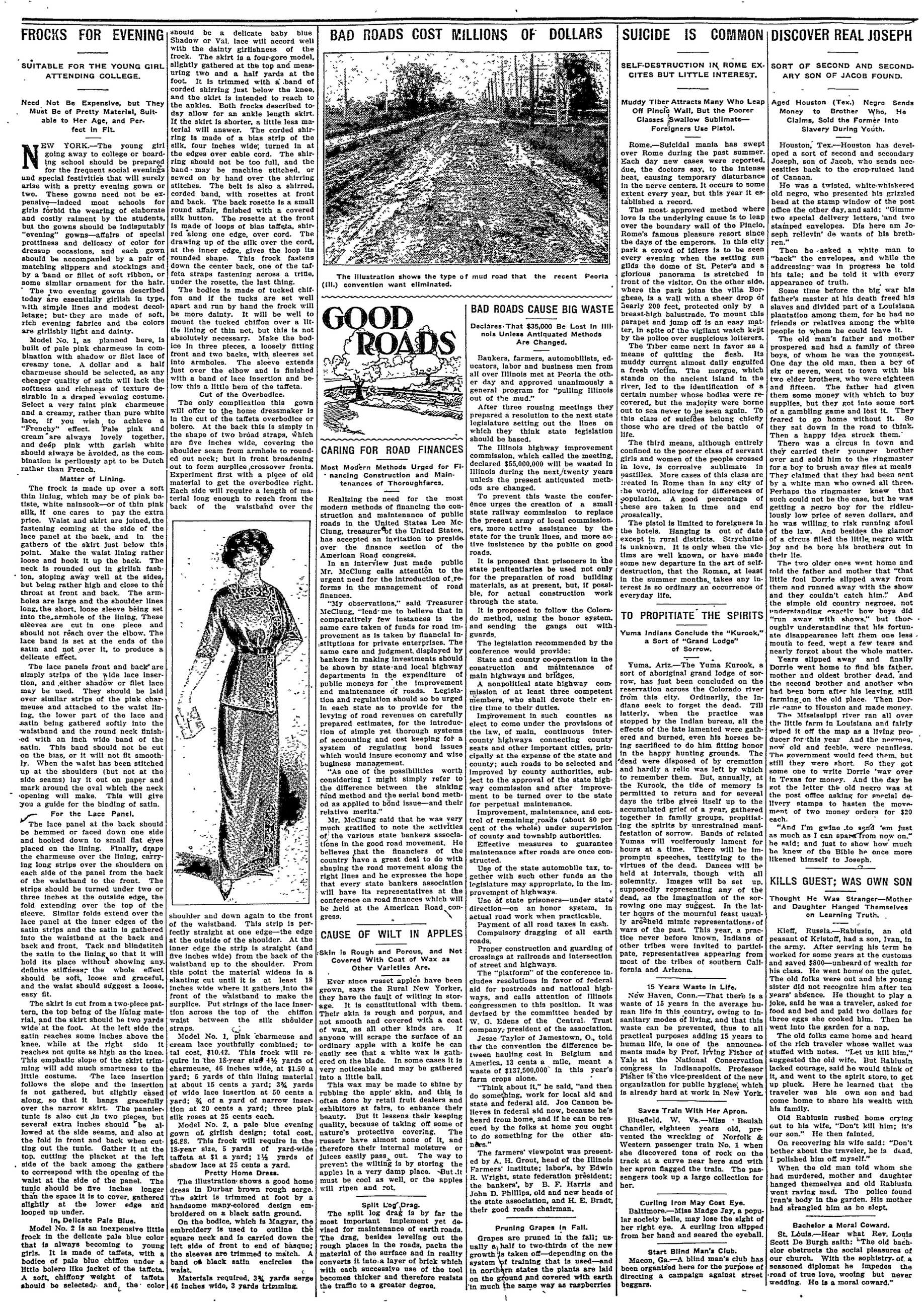
NEW YORK.-The young girl going away to college or boarding school should be prepared for the frequent social evenings and special festivities that will surely arise with a pretty evening gown or two. These gowns need not be expensive—indeed most schools for girls forbid the wearing of elaborate and costly ralment by the students, but the gowns should be indisputably "evening" gowns—affairs of special prettiness and delicacy of color for dressup occasions, and each gown should be accompanied by a pair of matching slippers and stockings and by a band or fillet of soft ribbon, or some similar ornament for the hair. The two evening gowns described today are essentially girlish in type, with simple lines and modest decolletage; but they are made of soft, rich evening fabrics and the colors are girlishly light and dainty.
Model No. 1, as planned here, is built of pale pink charmeuse in combination with shadow or flet lace of creamy tone. A dollar and a half charmeuse should be selected, as any cheaper quality of satin will lack the softness and richness of texture desirable in a draped evening costume. Select a very faint pink charmeuse and a creamy, rather than pure white lace, if you wish, to achieve a "Frenchy" effect. Pale pink and cream are always lovely together, and deep pink with garish white should always be avoided, as the combination is perilously apt to be Dutch rather than French.
Matter of Lining.
The frock is made up over a soft thin lining, which may be of pink batiste, white nailsook—or of thin pink silk, if one cares to pay the extra price. Waist and skirt are joined, the fastening coming at the side of the lace panel at the back, and in the gathers of the skirt just below this point. Make the waist lining rather loose and hook it up the back. The neck is rounded out in girlish fashion, sloping away well at the sides, but being rather high and close to the throat at front and back. The armholes are large and the shoulder lines long, the short, loose sleeve being set into the armhole of the lining. These sleeves are cut in one piece and should not reach over the elbow. The lace band is set at the ends of the satin and not over it, to produce a delicate effect.
The lace panels front and back are simply strips of the wide lace insertion, and either shadow or flat lace may be used. They should be laid over similar strips of the pink charmeuse and attached to the waist lining, the lower part of the lace and satin being gathered softly into the waistband and the round neck finished with an inch wide band of the satin. This band should not be cut on the bias, or it will not fit smoothly. When the waist has been stitched up at the shoulders (but not at the side seams) lay it out on paper and mark around the oval which the neck opening will make. This will give you a guide for the binding of satin.
The lace panel at the back should be hemmed or faced down one side and hooked down to small flat eyes placed on the lining. Finally, drape the charmeuse over the lining, carrying long strips over the shoulders on each side of the panel from the back of the waistband to the front. The strips should be turned under two or three inches at the outside edge, the fold extending over the top of the sleeve. Similar folds extend over the lace panel at the inner edges of the satin strips and the satin is gathered into the waistband at the back and back and front. Tack and blindstitch the satin to the lining so that it will hold its place without showing any definite stiffness; the whole effect should be soft, loose and graceful, and the waist should suggest a loose, easy fit.
The skirt is cut from a two-piece pattern, the top being of the lining material, and the skirt should be two yards wide at the foot. At the left side the satin reaches some inches above the knee, while at the right side it reaches not quite as high as the knee. This emphatic slope of the skirt trimming will add much smartness to the little costume. The lace insertion follows the slope and the insertion is not gathered, but slightly cased along, so that it hangs gracefully over the narrow skirt. The pannier-tunic is also cut in two pieces, but several extra inches should be allowed at the side seams, and also at the fold in front and back when cutting out the tunic. Gather it at the top, cutting the placket at the left side of the back among the gathers to correspond with the opening of the waist at the side of the panel. The tunic should be five inches longer than the space it is to cover, gathered slightly at the lower edge and looped up under.
In. Delicate Pale Blue.
Model No. 2 is an inexpensive little frock in the delicate pale blue color that is always becoming to young girls. It is made of taffeta, with a bodice of pale blue chiffon under a little bolero like jacket of the taffeta. A soft, chiffon weight of taffeta should be selected; and, the color
should be a delicate baby blue Shadow or Val. lace will accord well with the dalnty girlishness of the frock. The skirt is a four-gore model, slightly gathered at the top and measuring two and a half yards at the foot. It is trimmed with a band of corded shirring just below the knee, and the skirt is intended to reach to the ankles. Both frocks described today allow for an ankle length skirt. If the skirt is shorter, a little less material will answer. The corded shirring is made of a bias strip of the silk, four inches wide; turned in at the edges over cable cord. The shirring should not be too full, and the band may be machine stitched, or sewed on by hand over the shirring stitches. The belt is also a shirred, corded band, with rosettes at front and back. The back rosette is a small round affair, finished with a covered silk button. The rosette at the front is made of loops of bias taffeta, shirred along one edge, over cord. The drawing up of the silk over the cord, at the inner edge, gives the loop its rounded shape. This frock fastens down the center back, one of the taffeta straps fastening across a trine, under the rosette, the last thing.
The bodice is made of tucked chiffon and if the tucks are set well apart and run by hand the frock will be more dainty. It will be well to mount the tucked chiffon over a little lining of thin net, but this is not absolutely necessary. Make the bodice in three pieces, a loosely fitting front and two backs, with sleeves set into armholes. The sleeve extends just over the elbow and is finished with a band of lace insertion and below this a little hem of the taffeta.
Cut of the Overbodlce.
The only complication this gown will offer to the home dressmaker is in the cut of the taffetta overbodice or bolero. At the back this is simply in the shape of two broad straps, which are five inches wide, covering the shoulder seam from armhole to rounded out neck; but in front broadening out to form surplice crossover fronts. Experiment first with a piece of old material to get the overbodice right. Each side will require a length of material long enough to reach from the back of the waistband over the
1
shoulder and down again to the front of the waistband. This strip is perfectly straight at one edge—the edge at the outside of the shoulder. At the inner edge the strip is straight (and five inches wide) from the back of the waistband up to the shoulder. From this point the material widens in a slanting cut until it is at least 18 inches wide where it gathers into the front of the waistband to make the surplice. Put strings of the lace insertion across the top of the chiffon waist between the silk shoulder straps.
Model No. 1, pink charmeuse and cream lace youthfully combined; total cost, $10.42. This frock will require in the 18-year size $4½ yards of charmeuse, 46 inches wide, at $1.50 a yard; 5 yards of thin lining material at about 15 cents a yard; $3½ yards of wide lace insertion at 50 cents a yard; % of a yard of narrow insertion at 20 cents a yard; three pink silk roses at 25 cents each.
Model No. 2, a pale blue evening gown of girlish design; total cost, $6.88. This frock will require in the 18-year size, 5 yards of yard-wide taffeta at $1 a yard; $1½ yards of shadow lace at 25 cents a yard.
Pretty Home Dress.
The illustration shows a good home dress in Durbar brown rough serge. The skirt is trimmed at foot by a handsome many-colored design embroidered on a black satin ground. On the bodice, which is Magyar, the embroidery is used to outline the square neck and is carried down the left side of front to end of basure; the sleeves are trimmed to match. A band on black satin encircles the waist. Materials required, 3% yards serge 46 inches wide, 3 yards trimming.
```markdown
```
The illustration shows the type of mud road that the recent Peoria (ill.) convention want eliminated.
GOOD ROADS
BAD ROADS CAUSE BIG WASTE
Declares: That $35,000 Be Lost In Illinois Unless Antiquated Methods Are Changed.
Bankers, farmers, automobillists, educators, labor and business men from all over Illinois met at Peoria the other day and approved unanimously a general program for "pulling Illinois out of the mud."
After three rousing meetings they prepared a resolution to the next state legislature setting out the lines on which they think state legislation
Most Modern Methods Urged for Fi- nancing Construction and Main- tenances of Thoroughfares.
Realizing the need for the most modern methods of financing the construction and maintenance of public roads in the United States Lee McClung, treasurer of the United States, has accepted an invitation to preside over the finance section of the American Road congress.
In an interview just made public Mr. McClung calls attention to the urgent need for the introduction of re-forms in the management of road finances.
"My observations," said Treasurer McClung, "lead me to believe that in comparatively few instances is the same care taken of funds for road improvement as is taken by financial institutions for private enterprises. The same care and judgment displayed by bankers in making investments should be shown by state-and local highway departments in the expenditure of public moneys for the improvement and maintenance of roads. Legislation and regulation should so be urged in each state as to provide for the levying of road revenues on carefully prepared estimates, for the introduction of simple yet thorough systems of accounting and cost keeping for a system of regulating bond issues which would insure economy and wise business management.
"As one of the possibilities worth considering I might simply refer to the difference between the sinking fund method and the serial bond method as applied to bond issue—and their relative merits."
Mr. McClung said that he was very much gratified to note the activities of the various state bankers associations in the good road movement. He believes that the financiers of the country have a great deal to do with shaping the road movement along the right lines and he expresses the hope that every state bankers association will have its representatives at the conference on road finances which will be held at the American Road congress.
CAUSE OF WILT IN APPLES
Skin is Rough and Porous, and Not Covered With Coat of Wax as Other Varieties Are.
Ever since russet apples have been grown, says the Rural New Yorker, they have the fault of wilting in storage. It is constitutional with them. Their skin is rough and porous, and not smooth and covered with a coat of wax, as all other kinds are. If anyone will scrape the surface of an ordinary apple with a knife he can easily see that a white wax is gathered on the blade. In some cases it is very noticeable and may be gathered into a little ball.
This wax may be made to shine by rubbing the apple skin, and this is often done by retail fruit dealers and exhibitors at fairs, to enhance their beauty. But it lessens their keeping quality, because of taking off some of nature's protective covering. The russet have almost none of it, and therefore their internal moisture or juices easily pass out. The way to prevent the wilting is by storing the apples in a very damp place. But it must be cool as well, or the apples will ripen and rot.
Split Log Drag.
The split log drag is by far the most important Implement yet devised for maintenance of earth roads. The drag, besides leveling out the rough places in the roads, packs the material of the surface and in reality converts it into a layer of brick which with each successive use of the tool becomes thicker and therefore resists the traffic to a greater degree.
BAD ROADS CAUSE BIG WASTE
Declares That $35,000 Be Lost In Illinois Unless Antiquated Methods Are Changed.
Bankers, farmers, automobillists, educators, labor and business men from all over Illinois met at Peoria the other day and approved unanimously a general program for "pulling Illinois out of the mud."
After three rousing meetings they prepared a resolution to the next state legislature setting out the lines on which they think state legislation should be based.
The Illinois highway improvement commission, which called the meeting, declared $55,000,000 will be wasted in Illinois during the next/twenty years unless the present antiquated methods are changed.
To prevent this waste the conference urges the creation of a small state railway commission to replace the present army of local commissioners, more active assistance by the state for the trunk lines, and more active insistence by the public on good roads.
It is proposed that prisoners in the state penitentiaries be used not only for the preparation of road building materials, as at present, but, if possible, for actual construction work through the state.
It is proposed to follow the Colorado method, using the honor system, and sending the gangs out with guards.
The legislation recommended by the conference would provide:
State and county co-operation in the construction and maintenance of main highways and bridges.
A nonpolitical state highway commission of at least three competent members, who shall devote their entire time to their duties. Improvement in such counties as elect to come under the provisions of the law, of main, continuous intercounty highways connecting county seats and other important cities, principally at the expense of the state and county; such roads to be selected and improved by county authorities, subject to the approval of the state highway commission and after improvement to be turned over to the state for perpetual maintenance. Improvement, maintenance, and control of remaining roads (about 50 percent of the whole) under supervision of county and township authorities. Effective measures to guarantee maintenance after roads are once constructed.
Use of the state automobile tax, together with such other funds as the legislature may appropriate, in the improvement of highways. Use of state prisoners—under state direction—on an honor system, in actual road work when practicable. Payment of all road taxes in cash. Compulsory dragging of all earth roads. Proper construction and guarding of crossings at railroads and intersection of street and highways. The "platform" of the conference includes resolutions in favor of federal aid for postroads and national highways, and calls attention of Illinois congressmen to this position. It was devised by the committee headed by W. G. Edens of the Central. Trust company, president of the association.
Jesse Taylor of Jamestown, O., told the convention the difference between hauling cost in Belgium and America, 13 cents a mile, meant a waste of $137,500,000 in this year's farm crops alone.
"Think about it," he said, "and then do something, work for local aid and state and federal aid. Joe Cannon believes in federal aid now, because he's heard from home, and if he can be rescued by the folks at home you ought to do something for the other sinners."
The farmers' viewpoint was presented by A. H. Grout, head of the Illinois Farmers' institute; labor's, by Edwin R. Wright, state federation president; the bankers', by B. F. Harris and John D. Phillips, old and new heads of the state association, and H. E. Bradt, their good roads chairman.
Pruning Grapes in Fall.
Grapes are pruned in the fall; usually a half to two-thirds of the new growth is taken off—depending on the system of training that is used—and in northern states the plants are laid on the ground and covered with earth in much the same way as raspberries
SELF-DESTruction IN ROME EX
CELFS BUT LITTLE INTEREST.
Muddy Tiber Attracts Many Who Leap Off Pincio Wall, But the Poorer Classes Swallow Sublimate—Foreigners Use Pistol.
Rome.—Sulcidal manla has swept over Rome during the past summer. Each day new cases were reported, due, the doctors say, to the intense heat, causing temporary disturbance in the nerve centers. It occurs to some extent every year, but this year it established a record.
The most approved method where love is the underlying cause is to leap over the boundary wall of the Pinco, Rome's famous pleasure resort since the days of the emperors. In this city park a crowd of idlers is to be seen every evening when the setting sun gilds the dome of St. Peter's and a glorious panorama is stretched in front of the visitor. On the other side, where the park joins the villa Borghese, is a wall with a sheer drop of nearly 200 feet, protected only by a breast-high balustrade. To mount this parapet and jump off is an easy matter, in spite of the vigilant watch kept by the police over suspicious loiterers.
The Tiber came next in favor as a means of quitting the flesh. Its muddy current almost daily engulfed a fresh vietnam. The morgue, which stands on the ancient island in the river, led to the identification of a certain number whose bodies were recovered, but the majority were borne out to sea never to be seen again. To this class of sulcifies belong chiefly those who are tired of the battle of life.
The third means, although entirely confined to the poorer class of servant girls and women of the people crossed in love, is corrosive sublimate in pastilles. More cases of this class are treated in Rome than in any city of the world, allowing for differences of population. A good percentage of these are taken in time and end prosaically.
The platil is limited to foreigners in the hotels. Hanging is out of date except in rural districts. Strychnine is unknown. It is only when the victims are well known, or have made some new departure in the art of self-destruction, that the Roman, at least in the summer months, takes any interest is so ordinary an occurrence of everyday life.
TO PROPITIATE THE SPIRITS
Yuma Indians Conclude the "Kurook," a Sort of "Grand Lodge" of Sorrow
Yuma, Ariz.—The Yuma Kurook, a sort of aboriginal grand lodge of sorrow, has just been concluded on the reservation across the Colorado river from this city. Ordinarily, the Indians seek to forget the dead. Till latterly, when the practice was stopped by the Indian bureau, all the effects of the late lamented were gathered and burned, even his horses being sacrificed to do him fitting honor in the happy hunting grounds. The dead were disposed of by cremation and hardly a relic was left by which to remember them. But, annually, at the Kurook, the tide of memory is permitted to return and for several days the tribe gives itself up to the accumulated grief of a year, gathered together in family groups, propitiating the spirits by unrestrained manifestation of sorrow. Bands of related Yumas will vociferously lament for hours at a time. There will be impromptu speeches, testifying to the virtues of the dead. Dances will be held at intervals, though with all solemnity. Images will be set up, supposedly representing any of the dead, as the imagination of the sorrowing one may suggest. In the latter hours of the mournful feast usually are held mimic representations of wars of the past. This year, a practice never before known. Indians of other tribes were invited to participate, representatives appearing from most of the tribes of southern California and Arizona.
15 Years Waste In Life.
New Haven, Conn.—That there is a waste of 15 years in the average human life in this country, owing to insanitary modes of living, and that this waste can be prevented, thus to all practical purposes adding 15 years to human life, is one of the announcements made by Prof. Irving Fisher of Yale at the National Conservation congress in Indianapolis. Professor Fisher is the vice-president of the new organization for public hygiene, which is already hard at work in New York.
Saves Train With Her Apron.
Bluefield, W. Va.-Miss 'Beulah Chandler, eleighteen years old, prevented the wrecking of Norfolk & Western passenger train No. 1 when she discovered tons of rock on the track at a curve near here and with her apron flagged the train. The passengers took up a large collection for her.
Curling Iron May Cost Eye
Baltimore.—Miss Madge Jay, a popular society belle, may lose the sight of her right eye. A curling iron slipped from her hand and seared the eyeball.
Macon, Ga.—A blind man's club has been organized here for the purpose of directing a campaign against street beggars.
SORT OF SECOND AND SECOND
ARY OF JACOB FOUND.
Aged Houston (Tex.) Negro Sends Money to Brother Who, He Claims, Sold the Former Into Slavery During Youth.
Houston, Tex.-Houston has developed a sort of second and secondary Joseph, son of Jacob, who sends necessities back to the crop-rulined land of Canaan.
He was a twisted, white-whiskered old negro, who presented his grizzled head at the stamp window of the post office the other day, and said: "Glumme two special delivery letters, and two stamped envelopes. Dis here am Joseph relievin' de wants of his brethren."
Then he asked a white man to "back" the envelopes, and while the addressing was in progress he told his tale; and he told it with every appearance of truth.
Some time before the big war his father's master at his death freed his slaves and divided part of a Louisiana plantation among them, for he had no friends or relatives among the white people to whom he could leave it.
The old man's father and mother prospered and had a family of three boys, of whom he was the youngest.
One day the old man, then a boy of six or seven, went to town with his two elder brothers, who were eighteen and fifteen. The father had given them some money with which to buy supplies, but they got into some sort of a gambling game and lost it. They feared to go home without it. So they sat down in the road to think. Then a happy idea struck them.
There was a circus in town and they carried their younger brother over and sold him to the ringmaster for a boy to brush away files at meals. They claimed that they had been sent by a white man who owned all three. Perhaps the ringmaster knew that such could not be the case, but he was getting a negro boy for the ridiculously low price of seven dollars, and he was willing to risk running afoul of the law. And besides the glamor of a circus filled the little negro with joy and he bore his brothers out in their lie.
The two older ones went home and told the father and mother that "that little fool Dorrie slipped away from them and runned away with the show and they couldn't catch him." And the simple old country negroes, not understanding exactly how boys did "run away with shows," but thoroughly understanding that his fortunate disappearance left them one less mouth to feed, wept a few tears and nearly forgot about the whole matter. Years slipped away and finally Dorrie went home to find his father, mother and oldest brother dead, and the second brother and another who had been born after his leaving, still farming on the old place. Then Dorrie came to Houston and made money.
The Mississippi river ran all over the little farm in Louisiana and fairly wiped it off the map as a living producer for this year. And the nemps, now old and feeble, were penniless. The government would feed them, but still they were short. So they got some one to write Dorrle 'way over in Texas for money. And the day he got the letter the old negro was at the post office asking for special delivery stamps to hasten the movement of two money orders for $20 each.
"And I'm gwine. to send 'em just as much as I can spare from now on." he said; and just to show how much he knew of the Bible he once more likened himself to Joseph.
KILLS GUEST; WAS OWN SON
Thought He Was Stranger—Mother and Daughter Hanged Themselves on Learning Truth.
Kleff, Russiaa—Rablusin, an old peasant of Kristoff, had a son, Ivan, in the army. After serving his term he worked for some years at the customs and saved $800—unheard of wealth for his class. He went home on the quiet. The old folks were out and his young sister did not recognize him after ten years' absence. He thought to play a joke, said he was a traveler, asked for food and bed and paid two dollars for three eggs she cooked him. Then he went into the garden for a nap.
The old folks came home and heard of the rich traveler whose wallet was stuffed with notes. "Let us kill him," suggested the old wife. But Rablusin lacked courage, said he would think of it, and went to the spirit store, to get up pluck. Here he learned that the traveler was his own son and had come home to share his wealth with his family.
Old Rablusin rushed home crying out to his wife, "Don't kill him; it's our son." He then fainted.
On recovering his wife said: "Don't bother about the traveler, he is dead, I polished him off myself."
When the old man told whom she had murdered, mother and daughter hanged themselves and old Rablusin went raving mad. The police found Ivan's body in the garden. His mother had strangled him as he slept.
Bachelor a Moral Coward.
St. Louis—Hear what Rev. Louis Scott De Burgh saith: "The old bachelor obstructs the social pleasures of our church. With the sophistry of a seasoned diplomat he impedes the road of true love, wooing but never wedding. He is a moral coward."
Che Savannah Cribune,
Established 1875
By JOHN H. DEVEAUX —
. Published by
° 4 SOL. C. JOHNSON ~
+ . Editor and Proprietor
JAS. H. BUTLER
Asso. Editor and Manager _
Publisbed Every Saturday
1009 West Broad Street.
Phone 2171.
: Subscription Rates:
“ Que Year- - - - - - $1.25
Six Months - - + -- 75
Three Months - - - - 50
Remittance must be made'by Expres:
or Post Office Money Order, or Register
ed Letter. Advertising rates given ot
application,
Entered at the Post Office at Savan
‘aah, Ga., as Second-Class mail mattec.
Sarorpay, Ocr. 16 rn, 1912.
—————————
Less ‘than three weeks the Nat-
ional election tokes place. There
has been less enthusiasm in this
election than ever before-
The Republican candidate for
Congress in this district should get
every Republican vote and even
snore, The leaders in every coun-
ty should rally for the ticket.
In the death of Gen. W. W.
Gordon, the city and State at large
have lost one of its foremost and
most widely known citizens. Ie
was a nnn Joved by all classes with
whom he came in contact and he
was especially Jini to those occu-
pying positions under him. His
charity was unbounded, never
turning away an appeal to a
worthy cause. He wasa very con-
servative man, and while he mace
no show of his magnanimity, he
was especially kind to the Nevro,
and his attitude toward him was
always that of justice and sympa-
thy!’ Especially do we recall at
this time bis work among all
classes during the yellow fever
epidemic of 1876, ‘During that
terrible period he went among the}
lowly and gave comfort and en-
couragement, many times admin-
istering personal help. Not only
ad be show this charity to the
whit s. but made daily visits to
the hospitals and retention camps
weeupied by Negroes and did
everything in his power to see that
their sufferings were alleviated.
Throughout his lifehe was over a
helpful friend to the Negro and it
is with-deep regret that we have
Jearned of his death. 7
Our people, especially our busi-
ness men, can learn a beneficial
lesson from the Greeks who reside
in this city. They are operating
various kinds of business, sticking
and getting along successfally, and
wit) few exceptions garnering the
coins from the liberal hands of
our people who seemingly favor
them in preference to their own
people in similar business. The
Greeks are enterprising and race
loving. They will give employ-
ment tu nu other rice unless they
cannet secure one of the.r own.
In business they are ever alert to
the best interests of their fellow
business men. Among thein is an
ice dealer; nearly every Greek
buys his ice fromhim. They have
a wholesale fruit establishment
from, which they secure thei
fruits. hey have a bakery whicl
‘is supported mamly by that race.
In_politics they stand as a unit
and the resuit is uit -the pres n
sity administration respects ten
aud many ef ther daminds hav
been complied with, Perinstance
s-veral protests have been mad
uyainst the establishment of cer
tain near beer resorts, and nex
churehes.. tod, but these protest
had no effect against the solidit;
of the Greek vote. These usefu
Jessons should be inculcated b,
our people, our business men ani
our voters, and all should combin
ina manner that would be of th
greatest benelit to us all,
It is indeed distressing beyond
measure to note the frequency
with which some of the ollicers
of our churches repair to the civil
courts in order toair their troubles
and right their wrongs. Within
the past few’ months there have
been no less than three instances
where suits or injunctions have
fbeen filed by a part of the congre-
‘gation of some one of our churches
against the other part. This is
indeed to be regretted. A church,
of all other institutions, should
be the temple of peace and
brotherly love. Ofcourse differ-
ences, of opinion and ideas will
come about in any institution ot
society where freedom of thought
and discussion are allowed among
its members. More the less is this
true of the church than other in.
stitutions. However, we believe
that when there is a difference ot
opinion among eburch people, o1
those whose profession of Christi-
anity give thema mark of dis:
tinction from the rest of mankind,
the place of settlement where the
will of the majority will prevail,
should be within the walls of the
church and not without them.
Flying to the -eourts without
any cause or pretext worthy of
consideration, is a very unchris-
tianlike move. Such action, at
atl time, should be indulged in or
carried out only asa last resort.
‘The business of a church, just as
the business of any modern cor-
poration, should be kept within its
own doors. If there be any fall-
ing out among the brethren which
may require # settlement by a
court of justice, the same should
besettled within the walls of the
church itself. The leaders of our
churches should be made to under-
stand that they cannot hold their
places in their churches and at the
same time be walking boosters
of magistrate, city and county
courts. It is their duty to set the
example of love and peace before
their brethren of the world. To
do otherwise, is to livea life
diametrically opposite to that
which they profess to live. ‘The
time to call a halt on such action
on the part of our church leadérs
isat hand. We believe thu a
word to the wise is sullicient.
The recent moye on the part o!
|the white minisichal union of ou
|eity to inaugurate a vigerut’s can.
paign that will ud the comruuits
of its bawdy houses and their in-
mates, should meet the hearty ap-
|proval of all our citizens who have
the welfare and good same of our
city at heart- From tsmeto tame,
covering a period of — several
months, The Tribune has called
the attention of the city avthomties
to Uns growing and cancerous
evil among us| We have called
attention t the fact that in rections
of our city where respectable law
abiding and property holding
citizens reside, a large pum-
ber of these houses could be
found, the inmates of which in-
dulge iv such orgics both day and
night as to make a quiet home life
and the proper rearing of childeen
almostdmpossible. Drunken’ revel-
ry, the use of protane janguage,
cigarette smoksay, the playing of
[questionable masts, vulgar dancing
und other stuck in trade of the
denizens of the under world, are
things to be seen and heard at all
hours ot the day and night. Even
street brawls during which blows
me passed, sometimes between
women, aud sometimes between
men and women, are happenings
of common occurrence in the sec”
tions where these despised and
objectionable characters live. And
not only in the neighborhood of
the homes_of some ef our respect-
able citizens are these individuals
fourd but within the very shadow
of some of our churches, whose
services tare uftimes interrupted
by the conduct of these individuals,
do we find them happy and ap-
parently permanently — located.
Such a condition which should not
be allowed to oxist, is indeed a
reflection on the fuir name of our
city. As citizens and tax payers
of our city, we feel that we are
entitled to all of the protection
from danger and annoyance, of
whatever character it may be, to
wh ch all other citizens are entitled.
| We have watched with i: patience
Jubis evil, whichi takes away each
day a large proportion of the hap”
|piness* of our home life, mature
Jand grow within our midst. We
have nub sept ou our risdits, but
| keenly VG Ws tlie presence Ol
yp this untoward evil among us, have
Jpreacned soa peauoued Ulat thts
2}evil be removed. ‘Thus far, how:
-Jever, wechave thought that we
r{lubored in vain. Lt 1s, therefore
s{with increasing, satisfaction tha
y{we note the beginning of §
1] movement that bids fair to give u
s|relief from this growing monste
Jjat our doors. It is our desire t
{rear our chiidren properly, it i
e}our desire to have our environ
ment so wholesome that our hom
life will be a pleasure and not
pain. In this we yield to no one
i]. godsend is it then to note th
;Jaction on the partof the whit
s|ministers to start a ‘movemen
}| that will result in some good alon
s{this line. Our people whd mus
nj be deeply concerned in this matter
ejought to join hands at once wit
g|the white :nimisters of our city i
e|inaugurating a far reaching an
~| beneticial vice crusade among u
g| It isa thing to be desired soon
Jor later. Qur people should g
djbusy at once, especially tl
d| preachers and other leaders «
I thought, and see to it that so fe
Mas we are concerned no stor
‘L| Will be left unturned in this ma
«[ter. By all means let us get ri
is | of the bawdy houses and their it
1-|mates- Let us do our share t
¢ ward cleansing our city of vice. }
7: all means, away with the bawc
i-|l ouses. -Yes, wesay, away wil
s-| hem. . .
LOCALS
s GSSBOSE Gi ee
& Go 'rO ~ &
@ SCOTT BROS. g
Q GWINNETT & WEST BROAD . é
QS
Q Bors axp Grkts Scuoon Siors g
® Guaranteed Solid Leather -&
BS Large Assortment of Ginyhams &
@® « ” Percals, Repps and Poplins ete. * &
® Umbrellas, Rubbers, and Gloves &
®Q Winter Underwear for Men, Women and Children g
® We are still selling and reeommending an:
8 THE AMERICAN BEAUTY CORSET 2
8 $1.00 g
@ SCOTT BROS. 6
@ WEST BROAD & GWNNETT @
& Phone 2829 g
BBPBPCELFSVLRLBVEGESR BRE SRBSVL
Mr. snd Mrs. John H. Green of 7:8
West 3otn, treet Lane, are the re-
cipients ot inany congratulations from
their host of friends, upon the arriva!
of a promising daughter, on Wednes-
day October 9th. Mother and baby
are doing well. ‘
)_Miss Gertrude L. ‘McLeod of 2410
Harden street, left Suuday moriiing for
Jacksonville, Fla., whete she will be
the guest of her sister, Mts IdaG
Geathers! of 818 Jefferson street.
.C.P, Lee, one of the best known
citizens of Walton Co., Ga, states: “I
am now 78 years old and have had kid-
ney troublé many year. I had rheuma-
tic pains in my legs, and my back gave
me great pain. -f took Foley Kidney
Pills, and will say frankly that they
have given me more real benefit than
anything I have ever taken. At Liv-
ingston's Pharmacy.—Ad
Mrs. Sarah B Rivers who spent the
summer at Rye Beach, N. H., where
she has been employed by the Carter
Sisters, as masseuse and assistant chi-
ropodist, is back in the city for a short
stay. She also visited Philadelphia,
/Pa., New York City, Providence, R. 1.,
‘Boston, Mass., and Kittery, Maine.
Mrs M. D. Stiles and daughter, Miss
Josephine, of Milledgeville, Ga, were
in the city this week stopping with
Mrs. H. Anderson, 615 Dutty street,
west. '
Mr.-Chas. P. Willis of A‘lanta. Ga.
is inthe city spending a few wéexs
with relatives.
Land yalues are incresaing
daily. See me about Cann Park
and Céntral Park lots before
they advance in price. Easy
terms. Phone 4090.
G. H. Bowen,
605 Wes Broad’St
Dr. W Hf. Harns of Athens, Ga.,
Grand Seerstary of the Independent
Order of Good Samaritans, was in the
city this week on official business.
Mrs. Mbertha Britt of Jacksonville,
Fla, returnea home aster a pleasant
stayin our city, the guest of Miss Lena
Jones.
gC. Simms, a merchant near Com-
nisree, Ga, writes: “Lsaffered with
severe pains in my back and my urine
had Keen seaut, but L have been en-
tirels relieved-by “asing Foley's Kidnes
bills. They have also given entire sat
istaction to ai! my customers who have
used them, having proven all you claim
for eee -\M Livingston's Prarmacy.
Ad |
Mrs. DSA. Brinsex. i at Sus mer-
own, Gee. having been called there
wo weeks azo to the bedside of ti.
mother, Msy. Eluris Williums, whese
lines proved fatal, she having died
Weonesday, last. &
Mr. Jesse Brinso¥, was calked to
Summertown, (ia., on aecount of the
4eath of his grandmother. Mrs Eloris
Wulliams who died Wednesday, last.
Mrs. J. J. Wison, living near Gaines-
rille, Ga., was troubled with a terrible
ough. She saga: “At hight [ would
ouch and cougissol could not sieeg
vel} After taking one bottl+ of Foley's
Hosey and Tar Compound, L was en-|
irely weil and conghed no more. Last
winter, my little two year old. girl had}
whoopiay cough and we gave her|
Foley's Honey asd Tar Compound, |
ind she soon got well. At Livingston »
Pharmacy.—ad
Mr. G. Dent, of Brunswick, Ga.,
was in the city this ‘seek.
The friends of Mr. J. H. Baker of
Rulloch street, will be sorry to hear
of his illness.
Mr. and Mrs. Chas. H Ward arrived
nome Wednesday alter spending. a
year or more inthe north yery pleas-
antly wath their daughter, Mrs. John
Wallace, and are stopoing with Mr.
and: Mrs. Robert M. Davis, Jr., 789
Bolton street, east.
Mr. and Mrs. Calvin J. Turner-are at
home again after spending the sum-
mer months in New York and other
places. They will be glad to welcome
their friends at any time.
Rex. A. J. Gould of Vidalia, Ga, was
in the city on Wednesday en route to
Allendale, S. C. i
Rev. W.G. Johnson ef Macon, was
in the city last week. .
Friends of Capt. F.F.Jones will re-
gret to learn tnat he had a fall last
Wednesday which caused him slight
injury, from which he hopes to com:|
pletely recover in a day or. two.
C. E. Atkinson, Harlem, Ga., reports
that he has been a constant user of
Foley’s Honey ana far Compound in
his family for years, “because 1 gives
them reliet from ‘coughs and colds
ir mediately, and [ regard. it an_intall-
ible remedy and a sate one for our
children” At Livington’s Phurmacy.
F. SEABROOK _.
FUNERAL DIRECTOR & EMBALMER
First Class Emlalmine A Specialty
A Polite attention as Heretofore.
530 West Bread Street 4 SAVANNAH, Ga
| PHONE 2106
SAREE ET RSS a Ma ELT saa arn aE
THE PIONEER NEGRO ARCHITECT
iS z aa idl
f JALannroro, PRBa
{| ARCHITECT. .
sal (oS eee
ar | eer
| Ae, STEP at eee
| lm ra
a, 5 * RN ae A |
3 Real lB ESS A
255 RSS 4 eat. NG yo
I as: aVa\t 4 | Ae Ren.
eee fats oe ti Sats Ue fap eee
CACHED. F aA Ss ARNOEHEN nae Peper 7)
pepe TEMS | Ne a
Beveled So HE aa be tan) Biap. = f
a ‘accel ee Echt » ww aN “a :
bb RTE EE an $i gS
“He will design your Churches, Residences, Schools, Halls
Places of Business and Amusements. Willassist in arranging:
Jeans. Plans and sketches submitted on short notice. Write
Em.
JA, LANKEFORD
1832 PE ARCE AVE. JACKSONVILLE FLA
- 8
Pekin Theat
If its Pictures that youare looking for, I have them.
Don’t be fooled. The pictures shown at the Pekin are
shown at the Arcadia ‘Pheatre daily
-_ “NW OTEC EH
THE WORLD GREATEST MOVING PICTURES
Do Everything But Talk. We Show The Best Moving
Pictures Ever Seen
It Pleases Both Young and Old in Conjunction with
High Class Vaudeville |
Iwill keep you laughing from start to finish. Nothing
cheap about the PEKIN THEATER but the
Price AND 10 CENTS
See
CONTINUOUS PERFORMANCE frem 7 p. m_toll p.m.
MATINEE Mondays and Thursdays
VAUDEVILLE PROGRAM ‘CHANGED ON THURSDAYS
—
5 Pictures Changed Nightly x
ADMISSI@N 10 CENTS - CH ILDREN 5 CENT
—
—————————————
== SLINCOLN PARK =--
The Great Piace of Amusement. Open Sundays
= Picnic Every Monday, Tuesday and Thursdays
FREE DANCING Every Wednesday and Friday
ry
Social Happenings.
Mr. and Mrs. Ricard Melatosh en-
tertained quite a~number of trends
in celebration of Mrs. Mentosh’s birth-
day on last Monday evening, at their
residence 2S'Ann street. They also
had as their guests Hepe Company
Knights of Damon. A very pleasant
time washad and a plentiful supply of
retreshments was served.
A birthday party was_ given by Miss
Nianza Freeman on Mofday afternoon
in honor of her ninth birthday A de-
Hightful time was, spent in playing
games after which light refreshments
|were served. Among those presen’
were little Misses Vivian Adams, Ve
ronica Taylor, Jerodine Bottamus,
Marie Roberts, Blanche and Lizzie
Wright, Marie Williams, Delphine
Coles, Gladis Williams, Ruth and Edit
McDonald, Inez Harris, Minnie Mae
Brown and Pauldonia Wilberd.
A birthday party was given on Wed
nesday night last in honor of Mr. W. H
Gordon, at his residence 616 Wes
Duffy street. Mr. Ed. H. Burke acte
as toastmaster. Those present wer
Mesdames L. Payton, H. Martin, Ros
Bynes, Mary Jones, Sarah Johnson
Ellen Givens. Rosa Barnard, Edn
Smith, M. J Gordan, F. Dudley, Kati
Monree, ‘Fannie Armstrong and Mis
FE. Campficla, Messrs James Hamilton
E. J. Collins, Charles Nagle, Ed. 1
) Burke, Fenty Dillon. Robert Jone:
| Raymond Hill, W. H. Gordon and E. 1
a Tre or aag
Woodrow Wilson’s Best Pice
tures.
It is generally conceded that the,
best photograph ever taken of Wood-
row Wilson, Democratic candidate for
President, is that which has been ze-
produced asa large-sized photoyravure,
printed on rey? art paper suitable for
framing —Thig picture will be mailed,
in héavy pasteboard tube, to any ad-
dress upon receipt of ten cents- in
stamps by the New York World, Park
Row, New York Gity Send for this
art masterpiece to-day and gee what
Gov. Wilson really looks like
ATR
DOME
THE COLORED PEOPLE'S
MILLINERY STORE
. THE LATEST StYLE
FALLAND WINTER DWATS +
Prices Rexsonable. “ Give UsaCall, 7%
AG+ WEST BROAD ST.
Western
Special
—ITIS A CORKER—
Friday Might.
Silver Spoons
_ FOR
LADIES
SOME ..
| SHOW
Don’t
Miss
Any
Night |
This
. Week
Prices-the same
BAKER
The Moving Picture Man
- -OPERATING—“
AIR-DOME Savannah
Hall Lane and West Broad St.
Mondays Starting at 4 o'clock
Every night 7 till 11:30 p. m.
Admission
ADULTS 10 CENTS
CHIL DREN 5 CENTS
AIR-DOME-Jacksonvill
When 50 have been sold The prices will be advanced They are worth $250 each at this very moment NOW is your time to buy.
These Lots Are Splendidly Situated
On wide streets
Lanes behind every lot
Not far from two trolley lines
Well drained, high, dry and healthy.
Adjoining Lots sold this year
From $350 to $500
Within The Past Few Months We Have Sold
148 to white people
170 to colored people
This combination is a guarantee
That this property will receive its full share of
Recognition in all City improvements
Easy to pay for.
Good place to live.
Good place to double your money.
G. H. Bowen, General Agent
E. RANKIN and S. T. JORDAN, Special Agents
605 West Broad Street
VILKINSON REALTY CO 24 BRYAN STREET; E.
THE PIONEER CO. OF ITS KIND IN THE STATE OF GEORGIA IN WHICH YOUR
Dime or 25 Cents
DOES ITS FULL DUTY
IN BRINGING HOME
TO YOU
TANGIBLE RESULTS
MANY HUNDREDS
HAVE CONSIDERED
WISELY AND PLACED
THEIR INSURANCE
WITH THE OLD RE-
LIABLE
Pilgrim
Health & Life
Insurance
Co.
AND HAVE THERE BY BEEN THE HAPPY RECIPIENTS OF GREAT BENEFITS, WHILE THERE ARE SOME WHO CONSIDERED THE MATTER OTHERWISE AND THEREBY FORFIETED THEIR BEST OPPORTUNITY. THIS WORTHY INSTITUTION, WHICH HAS PROVEN TO BE A FRIEND TO THE FRIENDLESS, A REFUGE FOR THE SICK, AND PRESENT HELP TO OUR PEOPLE IN THE TIME OF NEED, IS WORTHY OF THE PATRONAGE OF OUR RACE. HENCE IF YOU ARE NOT BEING SERVED AS YOU SHOULD, SEE THE PILGRIM'S AGENT TODAY OR RING THE LOCAL OFFICE AT
509 W. BROADST
Telephone 4129
Home Office
1143 Gwinnett Street
Augusta Ga.
J. S: Perry
Superintendent
A. B. SINGFIELD
General Superintendent
ATLANTA, GEORGIA.
An unsectarian christian institution.
WITH HIGH SCHOOL NORMAL SCHOOL
AND COLLEGE
Superior Advantages In Industrial Training
MUSIC AND PRINTING
HOME LIFE AND TRAINING
For Catalogue and information address
EDWARD T. WARE, President ATLANTA GA
M. R. S.
, a : . r
REAL PROGRESS
UNDER TAFT
Many Progressive Measures
Put in Force
‘THE: WHOLE PEOPLE SERVED
Express Companies Compelled to Re-
duce Rates, Parcels Post Law En-
acted and Other Notable Progres-
sive Pollcles Made Effective by
‘Taft Without Boasting and Noise.
—UDDTTOae
Dispassionate judges will accord to
the Taft administration the credit of
putting in force more measures of a
positively progressive character than
any other administration since the
civil war. Not only have such meas-
ures been numerous, but they have
been of great and far-reaching impor
tance. President Taft has labored in-
defatigably to serve the whole people,
and by means of bis broad experience
and rare judicial mind and having at
his command legal talen of the high-
est order he has put hiy progressive
policles one after another into valid
and practical legislation. This has
been done without boasting and nose.
‘Whether vindicated or not at the com-
ing election, Mr. Taft's work will
stand as « chapter of achlevement as
brilliant as it is meritorious.
We wish at this time to invite atten-
tion to two specttic features of gov-
ernmental progress. One cousists of
the interstate commerce commission's
investigation of the express compa:
nies, resulting in the recent report or-
dering the companies to reduce rate
and institute sweeping reforms in va-
rious directions. The other is the en-
actment of the Bourne parcels post
Dill, one of the most useful measures
ever put fn force in this country under
any administration. These two re-
forins, taken in connection, will exert
@ powerful influence for a reduction
of the cost of living.
Mr. Taft has been in complete sym-
pathy with the interstate commerce
commission's inquiry-into the express
business, a process cousistent in all re-
gpects with the administration's gen-
eral policy of compelling big corpora-
tions to square themselves with the
law and the public interest. Some of
the more powerful corporations do not
like that policy, but the public ought
to indorse it. The enactment of a par-
cels post law brings to fruition a plan
that found indorsement in the plat-
form upon which the president was
@lected. Through the action of the
senate the Bourne bill, looking to a
parcels service at the lowest practica-
ble rates within a given territory, was
substituted for the house bill with Its
flat rate provisions. The measure as
passed probably 1s not perfect, nor
should the rates be regarded as per-
manent. The plan fs experimental in
certain respects. But we believe the
principle of the act is correct. One of
the most important aspects of this
measure is its bearing on the food sit;
uation. It will give consumers and pro-
ducers a new medium of direct con-
tdet. The Interstate commerce com-
mission’s rulings respecting the ex-
press companies also make special ac-
count of this problem. The express
companies-are required to order their
busfness in such a manner as to give
quicker service and lower rates on
food products.
It is recognized by,all economic in-
vestigators that one of the greatest
problems related to the cost of living
ig that which has to do with the sys-
tem of distribution. Express reforms
and the parcels post will be of great
value in promoting prompter and
cheaper distribution of food products
especially, and at the same time the
gcope of these measures 1s so compre-
hensive as to apply to all classes of
merchandise. Production, too, should
be greatly stimulated by the influence
thus Inyoked. *
We do not say that President Taft
deserves the sole credit for these de-
partures, but we cite them as features
of an administration that some persons
would have us believe is nonprogres-
sive, when In reality they form a logt-
cal part of a great progressive epoch,
which opened with the inauguration of
Mr. Taft, and which, in the people's
patriotism and good sense, will be con-
tinued during four more years of the
same courageous and able leadership.
Extract from statement of Mr.
Roosevelt, dated-Nov. 8, 1904:
“On the 4th day of March |
next I shall have served three
and one-half years, and this’
three and one-half years con- |
stitutes my first term. The |
wise custom which Ilmits the
President to two terms regards -
the substance and not the form, |
Under no circumstances will I
be a candidate for or accept |
another nominalien.”
«What Washington would not |
fake, and Grant could not get, |
; no MBB shall have.”
_ HE TURNS TO-TRUSTS. '
Woodrow Wilton Evades. Discussion
of the Tariff Question.
It is the trust Issue, we are now told
by Woodrow Wilson, that 1s para-
mount in the campaign. Last week It
was the tariff. What it wiMl be next
week has not yet been indicated.
In his speech of acceptance Gover-
nor Wilson emphasized the fact thata
platform was not a program. Those
were words of wisdom. A program {s
something to be followed with some
degree of fidelity. A platform, in the
lexicon of the Democratic candidate,
fs a flexible thing, not to be taken too
serlously, but to be bent and altered
to meet the demands of the moment.
A nice, adaptable platform is good
evough for him.
In all fairness and in all decency,
however, Dr. Wilson should not be
permitted to evade a discussion of the
{issue he brought forward as the im-
portant one early in bis campaign. His
campaign manager refused a chal-
lenge for & joint debate between Re-
publican and Democratic speakers on
the tariff, and the candidate might
disclaim personal responsibility for
that, but certainly Dr. Wilson cannot
avoid responsibility for his owh
words and his own arguments. The
fact that he ‘found his audiences to-
tally out of sympathy with his free
trade view’s should not still his tongue
it ha has the courage of his convie-
tions and honestly believes the doc-
trine which he preached, If he be a
true leader of the anti-protectionists,
he will justify his belfefs and opin-
ions. sf
So far from doing this, however, he
has elected to evade, precisely as his
managers evade, adequate discussion
of the aubject whiclt means 50 much
to every individual th the land, First
assilling protection and making stare-
ments that demonstrated his lack of
knowledge of the facts, he shifted
from that position to one where he was
trying to calm the fears of the indus-
trial and commercial elements in the
population aroused by his initial ut-
terances. Out of all his more or, less
vague talk on the subject only’ one
thing emerges clearly and distinctly
—that is, that he and his party pre-
pose « purely political revision of the
tariff, with all the disaster, distress
and! disturbance that such a revision
entails. Scientific revision on accur-
ate fuformation Is rejected by iim
and his party. Political revision 1s,
just what the people do not want, wut
both candidate and party are comnt?-
ted to it; hence, their desire to get
away from the issue.
By all means let the trusts be dis-
cussed, too, but not in terms of gen-
cralities, such as Governor Wilsoa fn-
dulged in before the Democratic state
convention at Trenton last Tuesday.
And while discussing {t Governor WiF
son might explain why it was that the
Democratic house curtailed the trust
investigating .work of the department
of justice by granting only two-thirds
of thy sum needed to carry on the la-
bors tapped out.
MR. WILSON'S APOLOGY.
Afriid to Publish What He Said About
Union Labor and Immigrants.
The so called Wilson defense bu-
reau has fssued a long statement to
the 2ffect that Woodrow Wilson's rub-
lished opinions In his books on the al-
legei interlority ,of European imrit-
grants and American workingnen
generally to the Chinese and favort..g
Chines2 immigration, ete, have becn
“misinterpreted.” g
‘Tnera'is one ready and complete re-
ply to nilsinterpretation, and that {5
to,rerubi:sh what Wilson said te let
him speak for himself. This the Wil
fon defense bureau of the Democratic
national committee carefully refrains
trom ‘doing, and neither Wilson nor his
apologists, therefore, can blame Amer-
{ean workingmen in general and Euro-
pean {immigrants in particular for con-
cluding that Wilson meant just what
his language meant When he ex-
pressed his bad opinion of trades
unions and his preference for Chinese
Over Europeans, moe
More Work Than Workers.
To the Editor of the World:
Ihave read your paper for about fif-
teen years and during that time I have
always found it very much on the
level, but just now I don’t agree with
you on Wilson, I am a Republican,
and have been for more than fifteen
years, so 1 am for Taft always. I will
answer why by taking up your adver-
tsing sheet of Sunday, Sept. 29.
That's the answer. Can you or Mr.
Wilson tell me, if he is elected, wheth-
er you will have more pages of help
wanted advertisements than you had
on that day? Eight pages of help
wanted, male and female, and a little
two and one-half pages of situations
wanted, male and female! Don’t you
think that means something? Bust-
ness must be good in this little city.
Will it be peter {f Wilson fs elected?
I know it won't be nearly as goo and
you don't want to know it.
H.C. RODDER.
New York, Oct. 1.
—Ndw York World (Dem.) Oct. 2.
“Whenever we got desperately bard
up I went back to Perkins,” safd Sena-
tor Dixon in describing the raising of
funds for the third term movement.
Very much of the movement goes back
to Perkins, and back .of him to his
steel and harvester trusts.
“The virtue of the sober second
thought,” mentioned by President Taft
in his speech at Parramatta as being
the possession of the American people
fs getting more and‘thore in evidence.
No one accuses the Democratic con-
vention in New Jersey of being un-
hed
TAFT FLAYS
THIRD PARTY
tance”—Republicans Have Made
the Grandeur of the Country for
Sixty Years.
The address of President Taft to the
Beverly Republican Club, Beverly,
Mass. Sept. 3, was as follows:
Gentlemen of the Beverly Republi-
can club and, I ain glad to say, my fel-
low citizens ‘of Beverly, 1 thank you
for this cordial greeting. This club
suggests one or two thoughts of a po-
Mtical character that I did not touch
upon in the remarks I addressed to
you on Saturday. It suggests the ne-
cessity for renewed organization of the
Republican party under-present condi-
tions. The Republican party has been
successful for many years. I think
the last riational defeat we' suffered
was in 1892, and that is twenty years
ago. We have reached a point where
it was natural that there should be
some gentlemen who were convinced
that their position in the party was
not all that they thought they
wefe entitled to aud therefore they
were In favor of sloughing off into a
third party. Now, the danger in the
continuance in power fora long time
to the party itself fs the jealousies,
the factions, the quarrels within the
party that long Iife and success are
apt to generate, and, while, of course,
a third party fs a misfortune to the
Republican party in the loss of some
votes, we must be philosophical and
look at this result on its good side as
well as on its bad side.
I conceive in respect of the life of
the Republican party that secession of
a third party is going to give us new
vitality In the very feeling of fight
that the fajustice of the claims of the
third party will arouse in us as real
Republicans. We know that we are a
better set of men than we are now
called by those who were very glad at
one time to be know as leading Re-
publicans. We know that we stand
in the nation as the guardian of those
institutions of civil liberty under our
constitution, the presertation of which
has made this nation permanent and
great, and that nothing could come to
this’ country of greater~political in-
Jury than such a split in the Republi-
can party as would destroy ft.
‘The Importance of this campaign in
its Immediate result Is great. I could
hardly state with more emphasis than
I really belleve the crisia that we now
face with reference to the cohtinuance
of prosperity in this country by reason
of the vote that we are to have in No-
vember, but there is something be-
yond November with respect to the
Republican party. It is essential that
we should continue and revitalize it as
a permanent party and a permanent
force in this nation for the continu-
ance of ‘the progress that has made it
great. No student of history can deny
that the grandeur of this nation and
the height that {t has reached among
nations during the last sixty years has’
been due to the gufdance and the force
and the enGrgy and enterprise of the
Republican party. We propose to have
that continue. We propose that the
force represented by the Republican
party shall continue useful in the his-
tory of this nation, With that in mind,
I would urge upon you the necessity
for closing up the ranks, finding out
who is.a Republican, and who is not,
and when you find a man who Is not,
do not count him for the party. One
who fs not loyal never helps.
There is no use, gentlemen, tempor-
izing about this matter. A man is a
Republican or he {s not. Is he going
to support the national ticket, and is
he golng to support the State ticket?
If he fs he is a Republican, and {f he is
not he fs not a Republican. Now, such
a policy may cost us some votes, but
fo the not distant futuye these gentle-
men who have deserted us in the hope
of enjoying office, on the one hand, or
a millennium, on the other, will find
themselves without office, millennfum
or party. They will feel a bit lonely,
and thea when they come back to the
Republican party, as they will come
back, let them come back as Republi-
cans, but ‘bringing forth works meet
for: senentasee,
} ete |
a
Ca kg ; ee 4 |
Bae ee
es
EN
3 pee =: ;
: BS
How Prosperity Changed to Panic
When Democrats Elected a President.
In January 1892, this country was
prosperous, and all conditfons Indi-
cated continuance of prosperity.
In November of that year a Demo-
cratic pres{dent was elected.
In 1893 the Democratic congress,
convened in extraordinary session, be-
gan its antt-protection activitles. After
a time ft enacted the Wilson low,tar-
itt law, “
In the early summer of that year
came thé panie. In the period from
May 1 to July 23, 301 banks, with a
total capital cf $38,000,000, suspended.
‘The total number of banks suspended
in that year was 585.
In 1892 the total amount of Mabill-
ties on account of business failure was
$114,000,000. In 1893 the total was
'$346,000,000.
Im the year 1893 railroad properties
whose aggregate value was $1,200,000,-
900 were in the hands of recelvers.
Between May 4 and Oct. 3 $378,000,000
was withdrawn from national banks.
In this state aloné withdrawals of
deposits from savings banks were $34,
000,000 in excess Of deposits made.
In the perlod from Jan. 1, 1892, to
Jan. 1 1896. there was a shrinkage of
$1,400,000,000. in the total value of
farm products and live stock in the
United States. ~
In that perlod prices were lower,
but hundreds of thousands were wage-
less and othgr multitudes worked at
low wages and on short time. They
had little money or none ssith which
to buy even the most ordinary neces-
saries of ‘life in adequate quantity.
Now, after twenty years, the Demo-
cratic party fs again asking the elec-
torate of the United States to put it
in control of national affairs in order
that the performances of its last pe-
riod of control and their disastrous
consequences may be repeated.
‘The Republican party, under whose
administration during sixteen years
the country has become newly pros-
perous and more prosperous than ever
it was before, pledges {itself to mainte-
nance of the policies which restored
and promoted prosperity.
There is a paramount issue. Wht
intelligent <American can hesitate to
make his chotce?—Albany Journal.
Business Confidences.
In hfs speech of acceptance Wood-
row Wilson asserted that the tariff has
made the business men of the country
“timid, fretful, full of alarms; has
robbéd them of self confidence and
manly force until they hase cried out
that they could do nothing without the
assistance of the government at Wash-
ington.” :
Present day conditions challenge the
accuracy of this statement. The ex-
cellent doctor would do well to point
out some of the “timid, fretful” bust-
ness men who are now “full of
alarms” and who cre lacking in “self
confidence and manly force.” Where
can he find them? =’
The country is at’ the high tide of
Prosperity. Business confidence is in
evidence everywhere. The course of
the Republican administration is di-
rectly responsible for this condition.
Danger lies only In a change of admin-
istration, with the consequent change
of policy that {s promised. Then, tru-
ly, the business men of the country
would be “full of alarms,” and they
would have justification. 7
STANISLAUS GRODZIK HAS
ENOUGH SAVED TO LAST
FOUR YEARS IF WiL-
SON'S ELECTED, 80 1S
WILLING TO LOAF.
epee: SS" Sareea
Webster, Mass., Sept, 29.—
Stanistaus Grodzik, who lives
in the East village, although
he isn’t a voter, Is red hot for
Wilson and has one of the
strongest arguments ever in
favor of the Princeton profes-
sor for president.
Grodzik has lived In Web-
ster fifteen years and Is a can-
didate for naturalization next
year. He won't be able to vote
for Wilson this’ year, but has
advised all his friends to vote
for Wilson.
Grodzik’s argument is that
he works*too hard under the
prosperity administration of
Taft and Republicans and
wants a rest. With Wilson
and Democracy at the helm
Grodzik, who has experienced
the administration of one
Democratic president, knows
that there will be plenty of
chance to loaf.
For ten months the East
village mill of the S. Slater &
Sons, Inc. has been working
night and day to fill orders,
ani as a result of the pros-
perity at the mill Grodzik has
been worked over-time. If
Taft is reelected Grodzik
fears that the overtime
schedule may be extended ‘to
another term of ten or twenty
months and wants to call a
halt. ¢
“Too much work when Re-
publican he's President,” sald
Grodzik today. “With Demo>
crat lots tlme to loaf and
spend all the money we make
when Republican is boss. By
Gosh! I'm sick for work so
hard and no chance to spend
my money. If Democrat he's
elected we have lots of time
then. 1 guess 1 got enough
save to last four years If we
work half time.”
—Warcester (Mass) Tele-
gram.
FOR CHINESE
IMMIGRATION
What Woodrow Wilson Wrote
in His Well-known “History”
PREFERRED IT TO EUROPEAN
“More to Be Desired as Workmen, If
Not as Citizens, Than Most of the
Coarse Crew That Came Crowding
Every Year at Eastern Ports”
SCM, se Nee
Woodeow (Wilson, Democratic can!
didate for president of the United
States, has declared himself in the
most public aud permanent manner
in favor of Chinese immigration as
preferable to,forelgners from southern
and eastern Europe, whom he calls
“the coarse crew crowding in at the
eastern ports"—that is, New York,
Boston, ete. As a very large propor-
tion of the workers in New England
mills Lelong to the class denounced by
Wilson as less desirable than the Chi-
nese, they ought to be interested in
the views which he has evpressed and
which,we quote as follows from page
and velume of Wilson's “History of
the American People.”
From page 21%, volume 5, “Now
there came multitude ‘of men of the
lowest class frdm the south of Italy
and meh of meaner sort out of Hun-
gary and Poland, aa if the countries
‘of the south of Emope were dis-
purdening themselves of the xaore scr-
did and Lapless elements of their pop-
ulation.”
Brom page 212, volume 5: “The
Chinese were more to be desired as
workmen, if not as citizens, than most
of the: coarse crew“that came crowd-
ing iu every year at the exstern ports.
It was their shill, their intellizence,
their knack of succeeding and driving
duller rivals out rather than their
alien habits that made them feared
and hated and led to their exclusion
ai the prayer ot the men they would
kely displace should they multiply
The unlikely fellow who came in at
the eastern ports (that is, the immi-
stants from Europe) were tolerated
Uecause they usurped no place but the
very lowest In the seale of Iebor.”
Foivign born workingiaen and work-
ing women of New England, what do
yeu think of this starersent hy Wood
row Wifson, De nvcratic candidate for
president of the United States? He
says that you are “a coarse crew,”
that the Chinese are better workmen
ant might make etter citizens thaa
jue are, oud that you are tolerated be
cause you usurp “no place but the
very lowest in the scale of labor.”
We have siven"you pase number
and vole number where these state-
ments are to be found in Woodrow
Wilson’a“History of the American Peo-
ple.” You can go to any library and
read them for yourseif.
Woodrew Wilson is the first candi-
date for president of the United
States who has declared himself in
fpvor of Chinese Immigration Of the
estimated population of 350,000,000 in
Chita many millions would like to
come to America. If admitted they
‘ould soon drive American labor out
of the mills and workshops and also
out of retail and’ much of the whote-
sale business. At present Wilson fs
keeping very mum on the subject} but
there can be no doubt whatever that
he ‘vould, if elected president, aztomp:
to carry out his published views, and
open the door to the Cninese In this
he woutd have the backing of the
southern Democrats, who mould be
glad to have the Chinese came over
and work for them in place, of the
nexroes.
In Uns connection we suggest par-
ticular attention to Woodrow Wilson's
expression ahout “the unlixely fellows”
from southern and eastern Europe be-
ing “tolerated, because they usurped
no place but the very lowest in the
seate of labor.”
The Republican party, whose first
president was Lincoln the rail splitter,
whose second president was Johnson.
the tailor, Whose third president was
Grant the tanner, whose fifth presl-
dent was Garfleld the towpath mule
driver, whose elgbth president wus
McKinley, in his youth an iron found-
sr. regards and treats all honest labor
8 honorable and as not merely to be
“tolerated,” but honored.
Wilson's slur upon the labor of the
foreign born finds no echo in the ut-
terances of President Taft, who, re-
turning from a visit to the wast, In the
course of which he addressed large
Fatherings of dur adopted countrvn:en,
declared that nothing had gratified
him so much as the inteligent inter-
est shown by his hearers in American
institutions and their earnest desire to
unde:stand the spirit and meaning of
the constitution of the United Stato.
“Nicaragua Pacified; Marines to Le
Withdrawn,” says a newspaper bad-
line, narking the conclusion of xnoth-
er delicate and menacing International
‘situation, ably Rendled by the admin-
istrauion.
>
Woodrow’ Wilson remarks that “the
American people aren't going to be fed
any longer with words,” but he has of-
fered no variation of dfet himselt.
Prosperity {s polities proof when a
Republican administration fs in power,
but it wouldn't be in the face of Dem-
ocratic or third party tinkering.
It fa apparent that the third term
party did not get value.or the $2 a
Yate It paid in the New York primaries.
The Self Degradation of a Former Re-
pubilcan President: ~
Serr eer once Tener ner
If at the time of the defeat of Bur-
goyne any one had foretold that Bene
dict Arnold four years later would lead
a force of British and Tories to the
massacre of bis countrymen at For:
Galewold, the prediction would have
been niet with the greatest resentment
and fudignation. e
If four years ago any one had pre-
dicted that a man twice honored by
the Kepub.ican party w:th the highest
office on carth—the presidenc7 of the
United States—would turn on that
party rnd seek to rend it because not
given a third term, and would do ms
dent Indirectly to elect the choice and
the representative of the southern
bourbon democracy, that prediction
would have seemed fully as fneredihle
as the former.
The third term eazdidate is the pein-
cipal spellbinder for Woodrow Wilson
He knows in his heart and eal thit
the only success possible for him
should he succeed would be ta defeat
Taft und elect Wilson. Evéry vote fur
Roosevelt 1s indirectly a vole for the
Democratic nominee, whose support-
ers at Baltimore made an open appeal
for his :iomination on the gesund that
he was a native of Virginia, an ey-Con-
federste state, and not, like his rival,
Champ Clark, a native of Lincoln's
state cf, Kentucky. A
Filled’ with anger against President
Taft, who has merited by able. aith-
ful and distinguished service the uru-
ai need of Republican presidents. an-
other term in the White Honce, Raose-
velt parades up and down, here and
thes ond everywhere, professing ay
prripie or lack of privciple, frata an-
archy te oligarchy, that he thiaks dnzy
win votes and throwing to ihe Sins
elke consittesey. decency rnd that
qeva@ence which every Ameriesn
should feel and express for the insti-
tutions of our country.
‘Phat the aspirant for a third term
will sink Into richly merited oblivion
there can be no doubt whatever. 119
might have maintained in privat? life
the honor, the dignity and the infu
ence belonging to his position xs an
expresdent. He has sacrificed them
all to a Catilinian ambition. and the
caim and deliberate judzinent of te
Amerjcan people will put the stamp 02
condehnauon ahhe cn his insatiable
appetite for power and his unserspu-
lous cermagosy. ‘
Even the bourbons who are egging
him on and rejoicing in the hope of
profit from his treachery have only
contempt for bis motives and his
course. They are dedzhted to see him
attempt to destroy’ the party which
abolished slavery, overthrew secession,
built up American industry and main-
tained the financfal integrity of the
nation, But théy have no stomach for
the malice and the treachery that are
behind his desperate adventure. When
Aaron Burr was self exiled to Europe
after the hilling of Hamilton and the
semitreason of his Mexican expedl-
tion an Englishman desiring to yisit
the United States asked him for let-
ters of introduction. “I have no
friencs {1 America,” answered the
former idol and once popular vice pres-
ident, with an expression of abject
Jonellucss that his visiter could never
forget. And so it will be wich the fer-
petua? candidate when his followers
recover from the brief. madness ‘that
now possesses them and realize aliks
his monstrous egotism and their awn
aberration. a
A PERTINENT QUESTION
Which the Third Termer Did Not Care 9,
a Ain
A man attending a third term meetf
ing at Denver asked the third termer
the very pertinent question, “\Vould
not the Republican party * haves
been: all right if it had nominoated.
you?”
‘Whe third termer did not réply. He
simply looked angry and went on dol-
ing cut political, economic and social
iste chop suey garnished with the
usual sauce of epithets. It was, we re
peat, a very pertinent question, Tho
Républican party and Republicav prin-
ciples were good enough for the-third
termer until he found that tho party
was not willing to give him a third
term. Then he broke loose, and be-
gan gathering in every issue and al-
leged Issue he could prab to make up
his eray quilt platform. He has
sought, with the savage rage of a
Malay renning amuck, to destroy
everybody and everything obstructing
his mad onrush toward a goal he will
never reach. Hils ingratitude to the:
party which honored hin immeasurably
Veyond his deserts will have Grting re
ward in the historic fate of those who
have sought to “rue or ruin.”
7 a ae
\ ~ NY
ee. q
ee |
pe Se coe
i ais
ra ;
Fs
a
ee oe
--~MES &. SHERMAN,
OF U5, MARINES
Public Square in Chinandega
Had Been Mined.
FOOD RUSHED TO NATIVES,
One Hundfed and Fifty Sticks Of
Dynamite That Failed To Ex-
plode When the Americans
= Entered the Town.
Washington. — American occupation
of Nicaragua is complete and while
military law prevails peace has been
‘restored and the clvil authorities are
taking up slowly the reins of govern-
ment.
Admiral Southerland, in dispatches
to the Navy Department, stated that
federal Nicaraguan soldiers gradually
are being paid off by spectal proclama-
tion of President Diaz and that hun-
Greds of them are returning to the cof-
fee plantations where ap abundant
crop Js awaiting the harvesting.
American marine officers are in
nominal charge of Quezalguaque,
Posaltega, Chichigalpa and Chinan-
dega. Lieutenant Colonel Long !s in
control of Leon. Railroad communica-
tlon has been opened between Corinto
and the farthest Inland fown and sup-
ples are being rushed to the cltles to
relieve conditions. Lake steamers are
saillng on regular schedules.
When the American sailors from the
Colorado entered Chinandega it was
discovered that the plaza, or public
square, had been mined with 150
sticks of dynamite, For some un-
known reason the charge was riot
ignited, thereby preventing a terrible
loss of Ife among Americans. The
mine was connected by wire with an
adjacent tower.
Admiral Southerland sent a correct-
ed Mist of the wounded at Leon as fol-
lows:
Private Wittsmiler, of the Colorado;
Lance, ordinary seaman, Colorado:
Balder, marine trumpeter.
The wounded and sick will be trans-
ferred to the Ancon Hospital at Pan-
ama by the Colorado.
Dr. Castrillo, Nicaraguan minister to
the Unlted States, sent a note of
thanks to the State Department for the
aid given by the American government
in quelling the revolution in his coun-
try. He deplores the killing and
wounding of the American marines.
The State Department replied saying
thet if through death of the American
marines Nicaragua will become a
united country their loss will not have
been in vain. -
TO TEST NEWSPAPER LAW.
Journal Of Commerce Files Suit In
New York.
New York.—Sult to’ test the right
of the Government to enforce the
Federal law of August 24, 1912, requir-
ing newspapers and periodicals to
publish their circulation figures twice
a year and Imposing other publicity
requirements was filed In the United
States District Court here by the Jour-
nal of Commerce and Commercial Bul-
letin Company, publishers of the
Journal of Commerce.
The suit is directed against Post-
master-General Hitchcock, Attorney-
General Wickersham, United States
District Attorney Wise and Postmas-
ter Morgan, of New York. The pet!-
Moner charges that the law Is uncon-
stitutional and prays for a temporary
“injunction restraining its enforcement
until final adjudication.
Back of the action, according to
Robert C. Morris, of counsel for the
complainant, is the American News-
paper Publishers’ Association. The
association decided recently to file a
test suit-and the Journal of Com-
merce, Mr. Morris said in filing its
petition, has the sanction and co-
operation of the association.
PEACEFUL USE FOR SPION KOP.
Scene Of Bloody Battle Becomes MIs-
slonary Farm.
Washington. ~The scene of the
bloodiest battle of the Boer War, Spion
Kop, a mountain outside of Ladysmith,
Natal, South Africa, 1s to be used by
Seventh Day Adventists as a mission
farm for educating and Christianizing
the Zulus. Advices received at the
headquarters of the denomination here
from one of its missfonaries there tell
of the purchase of this mountain peak,
containing 2,200 acres. The farm ts to
be celf-supporting. Soveral Christian-
tzed tribesmen will work with tne mis
slonarles in, teaching Christianity to
their brother natives.
FIFTY KILLED, MANY HURT.
Explosion Of 500 Kege Of Powder At!
Tampico, Mexico.
‘Tampico, Mex.—The charred bodies
of 22 victims of Tuesday's explosion
in a warehouse here have been recov-
ered from the ruins. Five hundred
kegs of powder exploded duriag a fire,
and it 1a belleved that nearly 50 per
sons were killed and several hundred
injured. a
A Soldier Kills Himsel#,
Newport News, Va.—First Sergeant
Mack C. Napter, of the Thirty-ftth
Company, Coast Artillery, at Fort
Monroe, killed himself in tho barracks
by shooting bimself through the head
with his service revolver. He en-
Usted two years ago from Lexington,
Ky.
ANOTHER BITTER DISAPPOINTMENT
come: LL oo EN | ) Fis eathloen
Su WTAE 4. QSR7 A OF A
\" We A Da
<n ATIF REALIZATION °
OWNERSHIP KEPT CONCEALED|PCDCAY ppnpe
Evidence Is Produced When Hearings
Are Resumed In the _Disso-
lution “Suit At
Chicago. |
SO ee RTE, eae ene ae ae
the government's charges In its suit
for the dissolution of the Internation:
al Harvester Company that the defen
ant corporation concealed Its owner
ship of acquired business competitors
was given when the hearing was re:
sumed before Special Examiner Tay:
lor, of the United States District
Court of St. Paul.
A number of illustrated advertise.
ments describing D. M. Osborne &Co.,
of Auburn, N. Y., as “the largeat inde
pendent manufacturer of harvesting
Paplementa in the world,” published
in an agricultural trade journal sev:
eral months after it Is charged the
concern had been absorbed by the In-
ternational Harvester Company, were
introduced as evidence. The adver-
tlsements pictured the alleged har-
vester combination as attempting to
crush all opposition.
E. N. Wood, secretary of the Inter-
national Harvester Company of ‘Amer-
ica, testified that all the stock in the
corporation was held in trust for’ the
owners by George W. Perkins, Cyrus
H, McCormick and James Deering.
The witness was unable to give infor-
mation regarding the profits of the
corporation.
Inside detalls of the organization of
the International Harvester Company
were revealed by government councel
when excerpts from the minutes of
the meetings of the directors of the
corporation were Introduced in the
evidence. Special Assistant Attorney
General Edwin P. Grosvenor read from
the minutes of the meeting of the {n-
corporatora and directors held August
12, 1902, for the purpose of showing
that the International Harvester Com-
pany was not organized until the com-
petitors, “McCormick, Deering, W. B.
and G. Plano and Milwaukee had
agreed upon the terms under which
they would go Into the alleged com-
bination.”
‘The contention of the government is
that the purpose of the organization
was to take over the properties of the
competitors by Issuing stock in pay-
ment for the Interest acquired. The
records werg produced to show that
the owners of the old companies at
once became officers and directors in
control of the corporation.
The minutes showed that shortly
after Its organization J. P. Morgan &
Co. were elected the fiscal agents and
George W. Perkins was made chalr-
man of the finance committee. Later
Mr. Perkins was chosen a member of
the executive committee.
Resolutions adopted by the board of
directors showed the sale of the entire
product of the New Jersey corpora-
tion to the International Harvester
Company of America. The govern-
ment introduced in evidence the ‘min.
utes of a meeting of the finance com-
mittee held January 20, 1903, at which
a resolution was adopted authorizing
the purchase of the D. M. Osborne &
Co. and the Columbian Cordage Com-
pany, competing concerns, The meet-
Ing was held at the offices of J. P.
Morgan & Co. in New York and was
attended by George W. Perkins, G. F.
Baker and Norman E, Ream.
DAUGHTER GOT EVIDENCE,
Has Alleged Slayers Of Her Father
. lentieted.
Jackson, Ky.—Atter Ed. Callahan,
former sheriff of Breathitt county,
Ky. was slain from ambush & few
months ago, bis daughter, Mra. Cllf-
ton Gross, vowed to find the assassins.
She spent many days and -nights in
the lonely mountain tralle, seeking
evidence, which, presented to a grand
jury, resulted In the indictment of 15
members of the Deaton faction. The
Killing of Callahan was a notable fea-
ture of one of Breathitt county's most
bitter feuds. °
EPIDEMIC OF DIPHTHERIA.
Disregard Of Health Laws Responal-
ble For Ite Prevalence.
Shamokin, Pa.—Conditions have be-
come so‘alarming In the town of Kulp-
mont, near here, where a serious diph-
therla epidemic prevails, that the
State Board of Health has taken
charge of the situation. Fifty cases
of the disease have been reported in
the last few days. -
Department's Reportfor October
Shows Bumper Crops.
THE FARMER IS PROSPEROUS.
Analysis Made By Secretary Wilson
Shows How the Government
Has Stimulated Scien-
tifle Farming.
Washington.—Never before hav
the great cereal crops of the Unites
States been so bountiful as those o
this year. Records of production fo:
almost every cereal have been sur
Passed, In some Instances by million:
of bushels.
The October crop report of the De
partment of Agriculture, just issued
shows spring wheat, onte, barley, ry‘
and hay all have exceeded the bes
record productions, while the crops of
corn and potatoes from present indi
cations’ also will be the greatest ever
when harvested,
Speaking of this great showing
made by the country’s farmers,
James Wilson, secretary of agricul.
ture, said:
“The crops are the heaviest on rec:
ord. The season has been favorable,
but some credit 1s due to the wide ef
forts made in late yeara by the Fed-
eral government and the States to
help farmers throughout the country
to’ get better returns from the average
‘acre.
| “The world has been searched for
batter plants by the Department of
Agriculture and {ts scientists have
deen creating new plants by hybridiza-
tion for the several localities.
“Twenty-elght million pieces of
literature have been sent out by the
Department in addition to the advices
from the State stations along these
lines. So the farmers have been
helped in producing their record-
breaking crops.” :
‘The features of the report are the
enormous harvests of corn, oats and
spring wheat. More than‘’3,000,000,-
000 bushels of corn, almost 1,500,000,-
000 bushels ‘of oats and 330,000,000
bushels of spring wheat, hate been
grown. The States in thé Northwest
are harvesting the greatest crops ever
grown there.
In North Dakota 146,592,000 bushels
of spring wheat, the greatest spring
wheat harvest ever grown by any
State, was produced. The yield per
acre there was Increased from eight
bushels last year to 18 bushels this
year.
Towa, with 219,780,000 bushels; IIll-
nols, with 182,726,000 bushels; Minne-
sota, with 192,932,000 bushels, and
North Dakota, with 96,138,000 bushels,
were the principal oat producers. In
each of these States the yield per
acre this year was almost double last
year’s yleld.
“It looks as if we won't have to im-
port any potatoes this year,” sald Sec-
retary Wilson in commenting on the
Fecord potato crop. Indications are
that the farmers will have 108,000,-
000 bushels more potatoes this year
than last, when, by reason of the short
crop, large quantitles were imported
from Europe.
a a eg co
RAILROAD INDICTED.
Interstate Commerce Law Violations
Charged Against Frisco.
St. Lous, Mo—The St. Louis and
San Francisco Railway Company was
indicted on ,11 counts for alleged vio-
lation of the Interstate Commerce law"
ot 1887, by the Federal Grand Jury.
‘The charges against the railroad set
forth thet it made an overcharge In
the tariff on boxed burial caskets de~
Hivered to {t from connecting lines.
DIVORCED FROM A LEPER. |
Mrs. John P. Early Given Custody Of
‘Their Children.
‘Tacoma, Wash.—Mrs. John P. Early
was granted a divorce here from John
P. Early, the leper, néw at Diamond
Point Hospital. She was given’ the
custody of thé three children and $55
of Early’s salary of $95 a monjh for
acting as keeper of another‘leper.
KILLED [f HEAD-ON CRASH
Wreck On the Western Maryland
Railroad Declared To Have Been
Due To the Failure Of Crew
To Obey Orders.
Hagerstown, Md.—At Kobeen, Pa.,
about five miles west of Shippens-
burg, Pa., on the sixth district, Phila-
delphia and Reading, a westbound
freight train operating over the West
er Maryland tracks, under trackage
‘arrangement, collided head-on with a
Western Maryland train handling
deadhead passenger coaches en route
to Shippensburg, resulting in the fol-
lowing fatalities and injurles to em-
ployes:
J. W. Frederick, firetian, Philadel-
phia and Reading Rallway; kifled.
C. R. Gordon, firenan, Western
Maryland Raliway;’killed.
D. S. McClain, conductor, Western
Maryland Railway; taken to hospital
at Chambersburg on special train,
where he died, <,
Frank Crouse, conductor, Philadel-
phia and Reading Rallway, died tn
hospital at Chambersburg.
M. L. Athey, brakeman, Western
Maryland Railway; serlously injured.
M. U. Bream, engineer, Philadel-
phia and Reading Railway; Injured,
but not serfously.
J. C. Shank, brakeman, Philadel-
phia and Reading Rallway; injured,
but not serfously.
‘The above injured employes were
taken to a hospital at Chambersburg
immediately after the accident, by a
rellef train.
J. P. Copeland, engineer, Western
Maryland Rallway, recelved slight in-
juries and after emergency medical
attention had been rendered, was
taken to his home at Hagerstown.
It is claimed the wreck was direct-
ly due to the failure of tho crew of
the Philadelphia and Reading train,
westbound, to obey orders. Dispatcher
D. P. Flanagan, of Hagerstown, had
Issued orders for the two trains to
pass at Lurgan, but it {s claimed the
freight crew attempted to reach the
next siding. At the point where the
two trains met, there fs a decided dip.
Conductor McClain, who died at the
hospital, was 40 years old, and leaves
a wife and elght children, the young-
est less than a year old. One of his
legs was cut off, and he was Injured
about the body. His death resulted
shortly after he reached the hospital.
Mr. Copeland stated, that following
the wreck he found himself covered
with debris. He finally managed to
dig himself out and assisted in the
rescue of the more seriously injured.
The wrecking crew from Hagers-
town spent practically the entire day
clearing away the debris. In addition
to the two Western Maryland coaches
petng destroyed, many of the freight.
cars were damaged by the Impact.
LEAPS FROM BIPLANE; DYING,
Aviators Skull Fractured and His
Lungs Punctured.
Birmingham, Ala—Joseph Steven-
son, aviator, leaped from his biplane,
which had become unmanagable at an
elevation of 50 feet, and, falling, sut-
fered injuries which physicians say
will prove fatal. He had been aloft
for only two minutes and was seen to
turn, with the apparent intention of
landing. Then he jumped. Man and
machine struck the ground some
distance apart, Stevenson’s skull was
fractured and a rib, several of which
were broken, punctured his lungs.
KILLS POLICEMAN.
Girl Thought He Was Burglar and
Shot Him.
Allentown, Pa.—Poiiceman Morgan
Morgans, aged 23, and single, was in
the yard at the rear of Philip Thomas
hotel at Lansford att o'clock A. M.,
guarding the premises —_ against
burglars when occupants of tbe hotel
heard him moving about and mistook
him for a burglar. Mr. Thomas’
adépted, daughter, Florence, aged 17,
fired through the door with a re-
volvér, killing Morgans instantly.‘
WOULD TAR THE MAYOR.
Black Hand Angry At Local Option
Laws.
Wheeling.—Mayor Henry M. Davies,
of St. Clairsville, Ohlo, a town near
here, has beet threatened with tar
and feathers by the Black Hand be.
cause of his rigid enforcement of the
local option law. In a letter sent
through the mail the gang not only
threatened the mayor, but says it will
blow up the county courthouse. ‘The
letter has been turned over to the pos-
tal authorities,
NOBLE PRIZE TO DR. A. CARREL.
Award In Recognition Of Achieve.
+ ments In Medicine.
Stickholm—The Nobel prize for
medicine this year has been awarded
to Dr. Alexls Carrel, of the Rockefeller
‘Institute, of New York. The award, it
Is announced, 1s made in recognition of
his achievements jn the suture of
blood vessels and the transplantation
of oreans. The Nobel prize 1s valued
at $39,000.
———— \
ALBANIAN TOWNS ABLAZE.
Peasants Fleeing To Frontier Killed
By Montenegrin,
Vienna.—Many Albanian villages to
the north of the Boyana River are fn
flamgs, according to a disbatch to the,
Neue Frele Presso from Cattaro.
Many fugitives, including some wound.
ed men, have arrived at Seutari. Some
peasants, who fled to the frontfer posts
at Szamesi, were slain by Monte-
negrins. |
DEBTS OF UNCLE SAM
Se ee Me pe
ment Checks Still Out.
Washington—The reported loss of
many thousands of dollars by the
sinking of the Titanic calls attention
to the fact that the government of
the United States frequently benefits
by the misfortunes of the people. It
never can be known what amount of
United States money went down with
the Titanic, but whatever the sum, the
treasury department has just so much
additional to its credit,as it can never
be presented for redemption.
‘A week rarely or never passes that
the treasury department does not re-
celve for redemption a number of
packages containing money that has
deen partly destroyed by fire, and in
all cases where the bills can be sat-
isfactorily identified new money Is
issued therefore; but frequently only
@ portion of the bill remains, and in
that event, if three-fifths of the note
can be Identified the full face value
Is returned to the owner, but if less
than three-fifths can be Identified
only one-half of the value is returned.
‘These losses by fire aggregate each
year a very large sum; but whgt has
Become ot the ‘mililons of dolidts of
which there is no trace is an unsolved
problem. Treasury officials speak of
the great fires that In years past
have swept Chicago, Boston, * San
Francisco, Baltimore, and other citles,
and estimate that many millions must
have been lost in these great con-
flagrations.
Early In the Civil war the United
States Issued over 400,000,000 of
legal tender notes, which were used
in payment of all government obliga-
tions, Including the pay of the armies
in the field. At this time there are
still outstanding over $3,000,000 of
these notes in the denominatfons of
one and two dollars alone, which are
never heard from except now and
then a stray bill or two is presented
for redemption. It fs a fair assump-
tion that a large percentage of the
whole $3,000,000 has been accidental-
ly destroyed, and this is undoubtedly
proportionately true of all of the ald
issues .
Soon after the war began the gov-
ernment issued from time to time an
aggregate of nearly $369,000,000 in
fractional paper money, and some
thing over $15,000,000 {s still carried
in the treasury accounts as outstand-
ing,
‘As fast as these old wartime “shin-
plasters” come in the treasury de-
stroys all of them that gare much
mutilated and worn, but they are
never pald out again other than in
small amounts and in exceptional
cases. The treasury now has on
hand only abous $246 of these small
notes. In 1879 the department, rep-
recognizing the fact that compara-
tively few of these old fractional
notes would ever be presented to the
treasury, directed the segregation of
a fund of something over $8,000,000
held in the treasury for the redemp-
tion of these notes, the amount to
be applied to the payment of war
pensions. Large sums of this Issue
are no doubt held by collectors as
souvenirs.
Of the Civil war issue of compound
interest notes which amounted to
nearly $267,000,000 there still re-
mains outstanding approximately
$160,000, ‘and of this issue only $70
came to the treasury last year. Of
rhe Issue of seven-thirty notes run-
ning from 1861 to 1865, which totaled
about $970,000,000, there 1s still out-
standing $130,000, and only $100 of
hese notes were redeemed last year.
Of the war time demand note Issue
ot $60,000,000, a total of $53,000 is still
inaccounted for and none of this {s-
sue has recently been presented for
redemption.
“During the issie of the Spanish war
oan in June,and July, 1898, about
235,000 government checks were sent
9 subscribers for small amounts of |:
ese bonds, which represented the|
aterest duestrom the date of Its re-
elpt until Auguat 1, the date of the
onda, and over 10,000 of these checks |;
ave never been presented for pay-|:
nent. It is assumed that as nearly|'
MI of the checks were ‘for. small];
mounts, some of them for only a few | ‘
ents, they also have been kept as
ouvenirs, >
Many people who recelved govern-
ment checks in payment of interest
mm Ive bonds Beem to be very care-|!
ess or not in need of funds, as aj <
arge number of these checks never |
ave been presented for payment.|f
Jne party alone fs known to have in
‘im nosseasion an arerecate of many | 4
souvenirs. >
Many people who recelved govern:
ment checks in payment of interest
on live bonds Beem to be very care
less or not in need of funds, as a
large number of these checks’ never
have been presented for payment.
One party alone 1s known to have in
his possession an aggregate of many
thousands of dollars réprosentad by
these checks, and although frequently
importuned to present them for pay-
ment, he bas so far neglected to do 20.
An investigation recently made by
the secretary of the treasury dis-
closes the fact that inany- national
banks are holders of these checks,
and the reasury now has the names
of over 1/9 national banks which
have thus far neglected to present
them for payment.
This fallure on the part of ny
such check holder to present
them has catised the — secretaiy.
to issue an order to the,effect. that
when such Interest cheggs remain
unpaid for more than thrge full fiscal
years tho holder wilt be frequired to
prove his right to them In addi-
tion, it is probable that new checks |
will have to be farued covering the|
amounts of the old.
NEW PAPER MONEY-
Robert C. Bailey, assistant secre~
tary of the treasury, has completed a
Ust of former presidents and other
Prominent men ‘whose names are to be
used on @ new serles of paper money
that {s about to be tssued. _
‘The face of George Washington wilh
appear on the $1 bills, Thomas Jeffor~
son on the $2 bills, Abraham Lincoln.
on the $5 bills, Grover Cleveland on{
tho $10, Alexander Hamilton, $20; An-
drew Jackson, $50; Benjamin i
Un, $100; John Marshall, $500; From,
Clay, $1,000; and U. S. Grant, $10,000.
It is Mr. Bafley’s plan to-have all
three branches of the goverument, @x-
ecutive, legislative and judicial, rep-
resented on thé paper money. All the
men named were presidents except
Hamilton, © Franklin, Marshall and
Clay. Marshall for yeara was chief
justice of the Supreme court and will
be the jurist represented on the bills.
‘The face of Henry Clay will be there
for the legislators.
All of the bills of the same denom-
ination, under the new plan, will bear
the faces of the same men, That is,
all treasury notes, silver certificates
and natfonal bank notes of the same
amount will be alike as far us pletures
go. This, It, 1s belleved, will be w
check on couitterfeiting.
Ofictals at the treasury department”
admit that the most dangerous form
of counterfeiting is bill raising. By
having bills of the same denomination!
bear the same pletures it would be
impossible for any one to add anoth-
er clpher to a $10 bill and pass it as
a $100 bill.
| TEETH AND MATRIMONY.
Dr. Jacob S. Wells of Fargo, N. D.)
who entertained "the National Dent:
ists’ convention with original {dear
about teeth and character, says he is
preparing a work on the subject of
teeth and character.
“Chaucer, the old English poet, sald;
‘She was a great tooth lcourous wom-
an,’" declared Dr. Wells. }
“He meant, of course, that her
teeth projected in front, Chaucer
recognized, away back yonder, tha
fact that women with large mouths
and projecting teeth fnvarily mar
ry. The fact that thie woman mar-
ried five times eubstantiates his state-
ment. 1
“You will find that men with long!
white, narrow teeth Ike to marry!
Such men make good husbands and
Provide well.
“Men and women of the type of
teeth, described drift together natural:
ly, Ike positive and negative steels;
They get along excellently,
“Men with broad, white teeth ara
hot fitted for matrimony. Such meni
make cur captains of Industry, but!
they have a contempt for women and!
are not good lovers.” 5 a
&/
SPOTTED FEVER GERM. ai
Dr. John F, Anderson, director of
the hygienic laboratory, ts preparing
to begin experimenting upon the Rock
mountain spotted fever ‘ticks, which
were turned over to him after they!
had caused the death of Dr, TeB. Mo-
Clintick. Dr. McClintick contracteg
the diseaso while experimenting upod
the ticks at Victor, Mont, ~
“My first task,” said Dr. Anderson
cheerfully, “will be to ifolate the spot,
ted fever germ. The germ has aereg
been Isolated as yet. It 1s so smal
that {t has been impossible thus mas
to detect ft under the microscope. |
“It I succeed in isolating the germ!
I shall continue my experiments In tha
hope of discovering an antitoxin fox,
the disease.”
Dr. Anderson has fn his office 50,000
of the deadly ticks, sealed in glasa
tubes—enough to wipe out ‘the popu-
lation of Washington should they be
liberated, it is sald.
“CONSCIENCE” FUND GROWS.
A conacience-stricken club member
in Chicago the other day contributed
to the conscience fund of the treas-
ury the sum of $100 as duty, on a
watch which be brought into this coun.
try without declaring. The letter in-
closing a $100 bill ‘is written on tha
Jetterhead of 2 prominent Chicago
‘club. This fs the letter, addressed to
Secretary MacVeagh! =
“when in Europe I bought a waich:
which T wore when landing. It was not
included iy my "declaration, and I incloso,
$100 to cover the duty on ‘same, belleiag-
that f shall nover bo satlsted ‘otherwise.
and knowing you, Task you to.add It to
Your already targe consclence fund. aad
oblige. “A PENITENT.“
HURRY TOO MUCH? ;
| Princess Gagarine of Russla, who ts
in Washington with her husband, has
caused a small commotion in soclat
circles by criticising the fairer ones
for being “slender.” ,
“American women of good breeding
are so remarkably slender,” safd the
princess. “They hurry too much,
That is the reason. Everywhere you
seo the American woman, whether she
1s going shopping, visiting or else
where, she 1s moving fast, as it she
did not have a second to lose.”
‘The princess would have the women
plumper.
STOP POTATO IMPORTATION.
| Real Irish potatoes from Irejan¢
‘will not be eaten in this country here-
after. The department of agriculture
the other day Issued an order prohib-
{ting Importation of Irish potatoeg
from Ireland, England, Germany and
Austria. :
‘The department's action was caused
by the discovery that the potatoes
grown in these countries are Infected
with “potato warts,” ihich makes
them unfit for hum3a consumption,
FOR COLORED LADIES ONLY TAILORED TO MEASURE SUITS
$18.00 UP
PECT FIT AND A SQUARE DEAL YOU
AT THE
UNION AILOR D. FELDM
½ W. BROA
PATE SAYS
Jason's 88 Head Ache Powders are the best, 10c
Jason's 88 Liver Pills are the best, 10c
Fever Tonic breaks the fever and keeps it off
It's Stone Root for the Kidneys, none better
25 cents Toilet Preperations, 19 cents
Save you money on almost everything
Prescription department is our pride
Our doctor will tell you to take it to Pate's
ate's Drug Store
at 4710 and 4711 HALL and WEST BROA
MOTTO: First Class Material and Work:
US DO YOUR
Shoe Repairing
Save Neat and WELL FITTED Shoe shop
WORK done as NICELY as a shoe can be
J H. Washington,
Whitaker Street : Savannah
VANNAH PHARMA
A PERFECT FIT AND A SQUARE DEAL YOU WILL GET AT THE UNION AILOR D. FELDMAN
Hutson's 88 Head Ache Powders are the best, 10c Hutson's 88 Liver Pills are the best, 10c 36 Fever Tonic breaks the fever and keeps it off. Nya's Stone Root for the Kidneys, none better All 25 cents Toilet Preperations, 19 cents We save you money on almost everything Our prescription department is our pride Your doctor will tell you to take it to Pate's
Pate's Drug Store
Phones 4710 and 4711 HALL and WEST BROAD STS.
OUR MOTTO: First Class Material and Workmanship LET US DO YOUR
We have Neat and WELL FITTED Shoe shop. All our WORK done as NICELY as a shoe can be repaired.
SAVANNAH PHARMACY
Lee Chemical Co., Props.
The Only Negro Drug Store in the City
A FULL Line Of
Rubber Goods, Cigars and Candies.
Description department is up-to-date. The glove is taken in compounding. We give you what we want you to have. Call and see
THE ONLY PLACE IN TOWN TO GET THE NEW BLOOD and RHEumatism RELIEF
E'S LUNG EMULSION
West Broad St. Phone
Get the Habit of Patronizing Us.
Drinks Can Come
The Only Negro Drug Store in the City
Rubber Goods, Cigars and Candies. Our prescription department is up-to-date. The greatest of care is taken in compounding. We give you what the doctor wants you to have. Call and see
THE ONLY PLACE IN TOWN TO GET Dr. King's New Blood and Rheumatism Remedy AND LEE'S LUNG EMULSION
811 West Broad St. Phone 3570 Get the Habit of Patronizing Us.
Hot Drinks Can Come Back
And the public can be served at THE PYRAMID ICE CREAM PARLOR LOGAN Prop. 417 EAST BROAD S PICTURE FRAMES make a specialty of framing diplomas, marshes and pictures of all sizes. Work neatly, aptly finished. Satisfaction guaranteed. P Enlarging pictures a specialty. Orders
ICE CREAM PARLOR W. H. LOGAN Prop. 417 EAST BROAD STREET
We make a specialty of framing diplomas, marriage licenses and pictures of all sizes. Work neatly and promptly finished. Satisfaction guaranteed. Prices cheap. Enlarging pictures a specialty. Orders called for and delivered.
TUXEDO
AMUSEMENT COLUMN.
Coming Events in the Social
World
NOTICE-Articles in this column one
cent per word
October 25th. Friday. Fall Dance by the Palmetto A. and S. Club at Harris street Hall. Tickets 25 cents.
October 29th, Tuesday. Fall Entertainment by Past Worthy Counsellors Union at Harris street Hall. Tickets 15 cents.
October 31st, Thursday. Dance by the Smart Set Club, alias Royal Syndicate at Masonic Temple. Tickets 25 cents.
October 28th, Monday. Fall Entertainment by Mt. Moriah Lodge No. 15 A. F. and A. M. and Chapter No. 37 O. E. S. at Masonic Temple. Tickets 25 and 35 cents.
October 16th, Monday. First Entertainment by Imperial Ladies Branch at Harris street Hall. Tickets 25 and 40 cents.
October 21st, Monday. First Fall Dance by West End Pleasure Club at Masonic Temple. Tickets 25 and 40 cents.
October 28th, Monday. Fall Entertainment by Light of Inheritance Lodge No. 133 IOG S and D of S, at Harris street Hall. Admission 25 and 40 cents.
October 22nd, Tuesday. Opening Dance by Catholic Mutual and St Mary's Aid Societies at St. Mary's Hall. Tickets 25 cents.
October 21st, Monday. Oyster Roast by Golden Star Lodge No. 5 A O K of D at Woodlawn Park. Tickets 15 cents.
October 21st, Monday. Entertainment at St. John Baptist Church. Tickets 10 cents.
October 23rd, Wednesday. Entertainment by Early Riser of the Union Brotherhood Ladies Branch at Harris street Hall. Tickets 15 and 25 cents.
November 18th, Monday. Grand Dance by the Young Imperials at Harris street Hall. Tickets 25 ceets.
October 28th, Monday Entertainment at 512 Hartridge street, benefit of F. A. B. Church, Franklin Square. Tickets 10 cents.
October 22nd, Tuesday. First Fall Dance, Silvery Moon Aid and Social Club at Harris street Hall. Tickets 25 and 40 cents.
October 30th, Wednesday. Original Royal Peacocks Aid and Social Club First Dance of the season at Harris street Hall. Tickets 25 cents.
November 1st Friday. Fall Entertainment by Primrose Court No. 269 O. O. C. at Masonic Temple 15 cents.
October 28th, Monday. Grand Public Installation of Savannah District of Supreme G. T. U. B. of A., at Supreme G. Temple Hall. East Broad and Anderson streets. Tickets 15 cents.
October 22nd, Tuesday Catholic Mutual and St. Mary's Aid Societies at St. Mary's Hall. Admission 25 cents.
October 21st. Monday. Concert at Gaines-Chapel Church. Tickets 10 cents.
October 23rd, Wednesday. Annual Ball of Eureka Aid and Athletic Club at Masonic Temple. Tickets 35 and 50 cents
October 21st, Monday. Outing and Oyster Roast by Lone Star Lodge No. 6 and Savannah Company B. Knights of Damon at Scott's Pavilion. Tickets 15 and 25 cents.
October 25th, Friday. Soiree Dance by Papa Hawkie and Little Ed. at Masonic Temple. Tickets 25 and 40 cents.
November 5th, Tuesday. Fall Dance by Y G E A and Social Club at Odd-Fellows Hall. Tickets 25 cents.
November 20th, Wednesday. MidFall entertainment by Opal Court of Calanthe at Harris street Hall. Admission 15 cents.
For an enjoyable time attend the
DANCE
OF
OLYMPIA LODGE
No. 10 K. of P.
AT MASONIC TEMPLE
Tuesday Night Oct. 22nd 1912
Tickets 25 and 40 Cents
COOPE
COOPER & ODREZIN
THE UP-TO-DATE TAILORS 218. W. BROAD ST. BETWEEN Hull And Oglethorpe Ave
Drop in and see our Latest Patterns in FALL AND WINTER GOODS. First-class workmanship guaranteed. Our prices will interest you.
—OF—
MAX COOPER
He is gone but not forgotten, rest on, my dear brother. We are striving to meet you. He leaves a mother, brother and sister to mourn his loss.
In Memory of Our Loving Wife and Mother.
MRS. LOUEASE PATTERSON.
Died October 15th, 1911.
Mother, thou art gone and left us, no one knows how we missed you. No one knows how our hearts have grieved us, but Jesus summoned thee away, thy Savior called thee home.
Dear, wife thou art gone to rest.
We loved you but Jesus loved thee best.
Sleep on, dear mother, until we meet you
Mrs. M. E. Evers, daughters
Miss Afreata M. Evers
Miss Thelma L. Sharpe
Savannah, Ga., Sept. 9th, 1912.
Most Noble Grand, Worthy Vice Grand, Officers and Members of Mt. Sier Lodge No. 2441, G. U. O. of O. F; Greeting:
We, your committee on the memorial of Brother Cyrus Shellman, must humbly say, in our feeble effort to point out some of the many virtues of this noble brother, we implore your attention.
We see him as one of the oldest and most peaceful residents of this beautiful and historic city, living one of the most consistent christian lives after his conversion.
He was a member of the First Bryan Baptist Church, and during his membership there, whatever was for the uplift of his church, he was a help therein; when discouragements came, he was there, in raising funds for his church even for the poor, he contributed to the collections.
We shall now take a retrospective view of his fraternal activities. Quite a number of years ago Brother Shellman decided that his life would be incomplete without connecting his efforts with his brothers in a fraternal assembly, therefore, after looking over the wide field of the various secret orders, he selected the Odd-Fellows as his choice, then after viewing the many lodges in this city of this order, he decided that he would cast his lot with dear old Mt. Sier.
At the time he joined her, she was a small lodge. He fell in line with the brothers, planning for the future success of his lodge by giving his time, talent and money, and on the other hand he shared her hardships, discouragements and adversities and after many hard battles for many long years, he saw her move upward in membership and finance, for which we imagine that we can hear him singing praise to an Omnipotent Gd.
But alas! Before he completed his pilgrimage on this terrestrial ball, an Omnipotent God allowed paralysis to place him on his bed, that he might get all things pertaining to the salvation of his soul ready to meet a true and just Savior. When death took him from our midst, he died in full triumph. In his death, the city has lost a peaceful citizen, the church a faithful member, the family a devoted and loving husband and father and the lodge a loyal member. Truly it is our loss, but heaven's gain, and gladly do we proclaim that he is not dead, but sleepeth. He is gone, but not forgotten.
All of which do we submit with sympathetic hearts.
Your Committee, in the bonds of F. L. and T. J. S. Causey, P. N. F. A. H. Merchison, M. V. P. Chr'm. J. S. Perry, P. N. F., Sec'y.
Carr's Grocery Company 1711 Ogeechee Ave Polite Attention. Best Service
DON'T WAIT FOR THE RUSH Order Your Fall Clothes Now Reliable Goods, Good Work, A Guaranteed Fit and a Square Deal You Will Get At The Union Tailor, D. Feldman
509 $ _{2}^{1} $ W. BROAD ST
In Memoriam.
grand-daughers
YOUNG BROS. NEW STORE
```markdown
```
1 Ewd G. Young, Manager
Over 10 years of experienced.
Col, 36th and Burroughs Sts.
is the place to get your Groceries and
Meats and Confectionary, Cigars
and Tobacco
Premiums are being given away. Come
and get one. Telephone orders
promptly attended to.
PHONE 4291
C.C. Middleton, M.D. Physician ane Surgeon
Office : 505 Charlton St., east
Office Hours
9-11 a.m
2-4 p.m
7-8 p.m
PHONE 86
Dr. J. W. Jamerson
FIRST-CLASS
DENTIST
All Work Guaranteed
623 WEST BROAD STREET
Between Charles and Oak St.
PHONE 2098-J
Young Bros.
The popular place for your Dairy
Lunches, Ice Cream, Cigars and
Tobacco.
507 West Broad Street
II G. YOUNG. Manager
FOR UP-TO.DATE
FURNISHED ROOMS
Call at 510-515 Huntingdon Street, wes
Everything Clean and Inviting
E. W. Cummings, Proprietor
Dr. Geo. W. Smith
Special attention to Diseases of Women and Children
Night calls will receive prompt attention
OFFICE : 811; West Broad Street,
Phone 1522
RESIDENCE : 605 Oak Street
Phone 3256 J
SAVANNAH, : GEORGIA
D. ODREZIN
R. M. RIVERS
Barber Shop
Electric Massage. Everything
Sanitary Cigars and Tobacco
HOT AND COLD BATHS
509 WEST BROAD STREET
(Williams Building)
The South Atlantic Barber shop
Headquarters for barber supplies and
shoe polish. A fine line of cigars,
pipes and tobacco. Shoes shined and
repaired.
Dealer in second handed shoes
Clothes cleaned, pressed and repaired!
Hot, cold and shower baths.
H. A. MANZO, Gen'l. Mgr.
145 West Broad St.
The Up-to-date
BARBER SHOP
Hair Cutting, Shaving Shampooing
BUMP AND WART TREATMENT
WORK GUARANTEED.
W. H. PRINCE, Proprietor
508 W. Gwinnett St Sav'h. Ga.
Thomas H. Anderson
AND BUILDER Jobbing of all kinds promptly attended to.
56th STREET, Near BULL ST.
Box No 4A, R. F. D. No.2
Phone 3325
Trained Nurse
Trained Nurse
Ring 3159-J or write 529 Ott Street Well Experience Messeuse Florie A. Wilson
The Acme Bicycle Store
Dealer in New and Second Handed Bicycles. Tires and Supplies. Expert Vulcanizer of Bicycle Tires Vulcanizing 75c K. HALPERN, Proprietor, 463 West Broad St. Phone 1340.
For First-Class BOARDING & LODGING
Meals served in up-to-date style
and nicely furnished Rooms
Call on
Mrs. LIZZIE ANGLERS
321 Bay St, W. Cor Montgomery
Protect Your Horses' Feet
Have Them Shod by the
The Cresceus Horseshoeing and
Clipping Shop
315 JEFFERSON ST. Phone:3509
NELSON A. CUYLER
"The Expert Horseshoer," Prop.
Geo. Jandon, Frank Dowse, assistants
Important—The only Expert
horseshoeing shop in the city
operated by a colored man.
Dr. L. S. Parks.
DENTIST
240 Barnard Street,
Specialist in Gold and Bridge Work
Savannah, Ga.
Does all kind of high grade dental
work of the best quality and workman-
ship. Gold crowns and bridge work.
White Porcelain Pivot and Gold Crowns
mounted on the natural roots. Gold
Fillings, Cement Fillings, and Silver or
Amalgam Fillings. From nine to a full
set of teeth $8.00 and $10.00. Broken
plates mended and teeth added.
All Gold Crowns Guaranteed 23t K Gold.
d Crowns Guaranteed 23 K Gold.
Bell Phone. 1244
oe
foe
5 eae
a
-
a
red
ant
Beas
EE
=