Savannah Tribune
Saturday, November 2, 1912
Savannah, Georgia
Page text (machine-generated)
The Savannah Tribune
VOLUME XXVIII
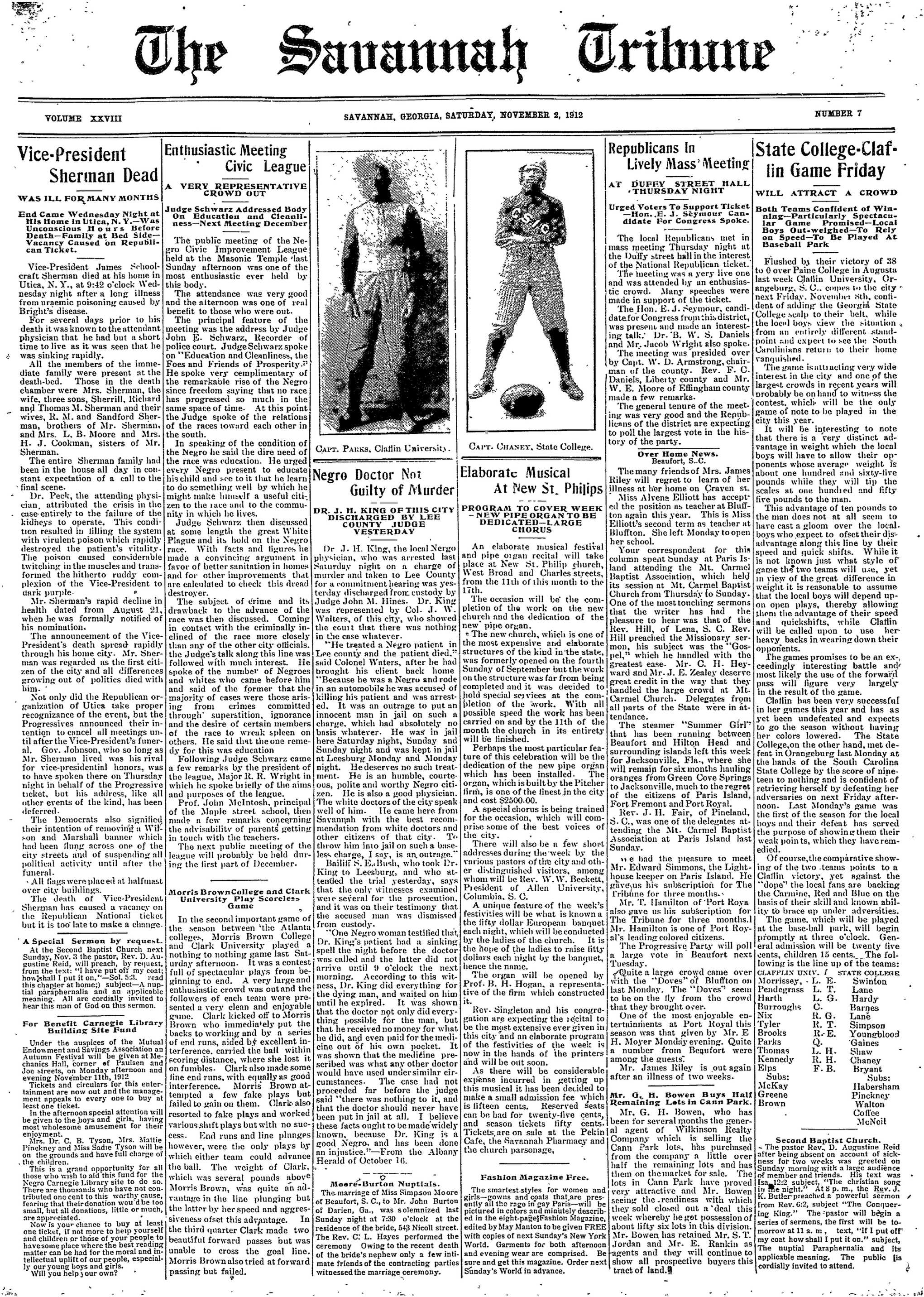
Vice-President Sherman Dead
Vice-President Sherman Dead
WAS ILL FOR MANY MONTHS
End Came Wednesday Night at His Home in Utica, N. Y.—Was Unconscious Hours Before Death—Family at Bed Side—Vacancy Caused on Republican Ticket.
Vice-President James Schoolcraft Sherman died at his home in Utica, N. Y., at 9:42 o'clock Wednesday night after a long illness from urgenic poisoning caused by Bright's disease.
For several days prior to his death it was known to the attendant physician that he had but a short time to live as it was seen that he was sinking rapidly.
All the members of the immediate family were present at the death-bed. Those in the death chamber were Mrs. Sherman, the wife, three sons, Sherrill, Richard and Thomas M. Sherman and their wives, R. M. and Sandford Sherman, brothers of Mr. Sherman, and Mrs. L. B. Moore and Mrs. H. J. Cookman, sisters of Mr. Sherman.
The entire Sherman family had been in the house all day in constant expectation of a call to the final scene.
Dr. Peck, the attending physician, attributed the crisis in the case entirely to the failure of the kidneys to operate. This condition resulted in filling the system with virulent poison which rapidly destroyed the patient's vitality. The poison caused considerable twitching in the muscles and transformed the hitherto ruddy complexion of the Vice-President to dark purple. Mr. Sherman's rapid decline in health dated from August 21, when he was formally notified of his nomination.
The announcement of the VicePresident's death spread rapidly through his home city. Mr. Sherman was regarded as the first citizen of the city and all differences growing out of politics died with him.
Not only did the Republican organization of Utica take proper recognition of the event, but the Progressives announced their intention to cancel all meetings until after the Vice-President's funeral. Gov. Johnson, who so long as Mr. Sherman lived was his rival for vice-presidential honors, was to have spoken there on Thursday night in behalf of the Progressive ticket, but his address, like all other events of the kind, has been deferred.
The Democrats also signified their intention of removing a Wilson and Marshall banner which had been flung across one of the city streets and of suspending all political activity until after the funeral. All flags were placed at halfmast over city buildings. The death of Vice-President Sherman has caused a vacancy on the Republican National ticket but it is too late to make a change.
A Special Sermon by request.
At the Second Baptist Church next Sunday, Nov. 3 the pastor, Rev. D. Augustine Reid, will preach, by request, from the text: "I have put off my coat; how shall I put it on,"—Sol. 5:3. read this chapter at home;) subject—A nuptial paraphernalia and an applicable meaning. All are cordially invited to hear this man of God on this sermon.
For Benefit Carnegie Library Building Site Fund
Under the auspices of the Mutual Endowment and Savings Association an Autumn Festival will be given at Mechanics Hall, corner of Paulsen and Joe streets, on Monday afternoon and evening November 11th, 1912
Tickets and circulations for this entertainment are now out and the management appeals to every one to buy at least one ticket.
In the afternoon special attention will be given to the boys and girls, having most wholesome amusement for their enjoyment.
Mrs. Dr. C. B. Tyson, Mrs. Mattie Pinckney and Miss Sadie Tyson will be on the grounds and have full charge of the children.
This is a grand opportunity for all those who wish to aid this fund for the Negro Carnegie Library site to do so. There are thousands who have not contributed one cent to this worthy cause, fearing that their donation would be too small, but all donations, little or much, are appreciated.
Now is your chance to buy at least one ticket, if not more to help yourself and children or those of your people to have some place where the best reading matter can be had for the moral and intellectual uplift of our people, especially our young boys and girls.
Will you help our own?
Enthusiastic Meeting Civic League
A VERY REPRESENTATIVE CROWD OUT
Judge Schwarz Addressed Body On Education and Cleanliness—Next Meeting December
The public meeting of the Negro Civic Improvement League held at the Masonic Temple last Sunday afternoon was one of the most enthusiastic ever held by this body.
The attendance was very good and the afternoon was one of real benefit to those who were out.
The principal feature of the meeting was the address by Judge John E. Schwarz, Recorder of police court. Judge Schwarz spoke on "Education and Cleanliness, the Foes and Friends of Prosperity." He spoke very complimentary of the remarkable rise of the Negro since freedom saying that no race has progressed so much in the same space of time. At this point the Judge spoke of the relations of the races toward each other in the south.
In speaking of the condition of the Negro he said the dire need of the race was education. He urged every Negro present to educate his child and see to it that he learn to do something well by which he might make himself a useful citizen to the race and to the community in which he lives.
Judge Schwarz then discussed at some length the great White Plague and its hold on the Negro race. With facts and figures he made a convincing argument in favor of better sanitation in homes and for other improvements that are calculated to check this dread destroyer.
The subject of crime and its drawback to the advance of the race was then discussed. Coming in contact with the criminally inclined of the race more closely than any of the other city officials, the Judge's talk along this line was followed with much interest. He spoke of the number of Negroes and whites who came before him and said of the former that the majority of cases were those arising from crimes committed through superstition, ignorance and the desire of certain members of the race to wreak spleen on others. He said that the one remedy for this was education
Following Judge Schwarz came a few remarks by the president of the league, Major R. R. Wright in which he spoke briefly of the aims and purposes of the league. Prof. John McIntosh, principal of the Maple street school, then made a few remarks concerning the advisability of parents getting in touch with the teachers. The next public meeting of the league will probably be held during the first part of December.
Morris BrownCollege and Clark University Play Scoreless Game
In the second important game of the season between the Atlanta colleges, Morris Brown College and Clark University played a nothing to nothing game last Saturday afternoon. It was a contest full of spectacular plays from beginning to end. A very large and enthusiastic crowd was out and the followers of each team were presented a very clean and enjoyable game. Clark kicked off to Morris Brown who immediately put the backs to working and by a series of end runs, aided by excellent interference, carried the ball within scoring distance, where she lost it on fumbles. Clark also made some fine end runs, with equally as good interference. Morris Brown attempted a few fake plays but failed to gain on them. Clark also resorted to fake plays and worked various shift plays but with no success. End runs and line plunges however, were the only plays by which either team could advance the ball. The weight of Clark, which was several pounds above Morris Brown, was quite an advantage in the line plunging but the latter by her speed and aggressiveness offset this advantage. In the third quarter Clark made two beautiful forward passes but was unable to cross the goal line. Morris Brown also tried at forward passing but failed.
SAVANNAH, GEORGIA, SATURDAY, NOVEMBER 2, 1912
10
CAPT. PARKS, Clafflin University.
Negro Doctor Not
Guilty of Murder
Negro Doctor Not
Guilty of Murder
DR. J. H. KING OF THIS CITY DISCHARGED BY LEE COUNTY JUDGE YESTERDAY
Dr. J. H. King, the local Nergo physician, who was arrested last Saturday night on a charge of murder and taken to Lee County for a commitment hearing was yesterday discharged from custody by Judge John M. Hines. Dr. King was represented by Col. J. W. Walters, of this city, who showed the court that there was nothing in the case whatever.
"He treated a Negro patient in Lee county and the patient died." said Colonel Waters, after he had brought his client back home. "Because he was a Negro and rode in an automobile he was accused of killing his patient and was arrested. It was an outrage to put an innocent man in jail on such a charge, which had absolutely no basis whatever. He was in jail here Saturday night, Sunday and Sunday night and was kept in jail at Leesburg Monday and Monday night. He deserves no such treatment. He is an humble, courteous, polite and worthy Negro citizen. He is also a good physician. The white doctors of the city speak well of him. He came here from Savannah with the best recommendation from white doctors and other citizens of that city. To throw him into jail on such a baseless charge, I say, is an outrage."
Bailiff S. E.Bush, who took Dr. King to Leesburg, and who attended the trial yesterday, says that the only witnesses examined were several for the prosecution, and it was on their testimony that the accused man was dismissed from custody.
"One Negro woman testified that Dr. King's patient had a sinking spell the night before the doctor was called and the latter did not arrive until 9 o'clock the next morning. According to this witness, Dr. King did everything for the dying man, and waited on him until he expired. It was shown that the doctor not only did everything possible for the man, but that he received no money for what he did, and even paid for the medicine out of his own pocket. It was shown that the medicine prescribed was what any other doctor would have used under similar circumstances. The case had not proceeded far before the judge said "there was nothing to it, and that the doctor should never have been put in jail at all. I believe these facts ought to be made widely known, because Dr. King is a good Negro, and has been done an injustice."—From the Albany Herald of October 16.
The marriage of Miss Simpson Moore of Beaufort, S. C., to Mr. John Burton of Darien, Ga., was solemnized last Sunday night at 7:30 o'clock at the residence of the bride, 543 Nicoll street. The Rev. C: L. Hayes performed the ceremony. Owing to the recent death of the bride's nephew only a few intimate friends of the contracting parties witnessed the marriage ceremony.
CSIC
CAPT. CHANEY, State College.
CAPT. CHANEY, State College.
PROGRAM TO COVER WEEK
- NEW PIPE ORGAN TO BE
DEDICATED-LARGE
CHORUS
An elaborate musical festival and pipe organ recital will take place at New St. Philip church, West Broad and Charles streets, from the 11th of this month to the 17th.
The occasion will be the completion of the work on the new church and the dedication of the new pipe organ.
The new church, which is one of the most expensive and elaborate structures of the kind in the state, was formerly opened on the fourth Sunday of September but the work on the structure was far from being completed and it was decided to hold special services at the completion of the work. With all possible speed the work has been carried on and by the 11th of the month the church in its entirety will be finished.
Perhaps the most particular feature of this celebration will be the dedication of the new pipe organ which has been installed. The organ, which is built by the Pitcher firm, is one of the finest in the city and cost $2500.00.
A special chorus is being trained for the occasion, which will comprise some of the best voices of the city.
There will also be a few short addresses during the week by the various pastors of the city and other distinguished visitors, among whom will be Rev. W.W. Beckett, President of Allen University, Columbia, S.C.
A unique feature of the week's festivities will be what is known as the fifty dollar European banquet each night, which will be conducted by the ladies of the church. It is the hope of the ladies to raise fifty dollars each night by the banquet, hence the name.
The organ will be opened by Prof. B. H. Hogan, a representative of the firm which constructed it.
Rev. Singleton and his congregation are expecting the recital to be the most extensive ever given in this city and an elaborate program of the festivities of the week is now in the hands of the printers and will be out soon.
As there will be considerable expense incurred in getting up this musical it has been decided to make a small admission fee which is fifteen cents. Reserved seats can be had for twenty-five cents, and season tickets fifty cents. Tickets, are on sale at the Pelkin Cafe, the Savannah Pharmacy and the church parsonage.
Fashion Magazine Free.
The smartest styles for women and girls—gowns and coats that are presently all the rago in gay Paris—will be pictured in colors and minutely described in the eight-pagetFashion Magazine, edited by May Manton to be given FREE with copies of next Sunday's New York World. Garments for both afternoon and evening wear are comprised. Be sure and get this magazine. Order next Sunday's World in advance.
Republicans In Lively Mass' Meeting
AT DUFFY STREET HALL
THURSDAY NIGHT
Urged Voters To Support Ticket
—Hon. E. J. Seymour
Candidate For Congress Spoke.
The local Republicans met in mass meeting Thursday night at the Duffy street hall in the interest of the National Republican ticket.
The meeting was a very live one and was attended by an enthusiastic crowd. Many speeches were made in support of the ticket.
The Hon. E. J. Seymour, candidate for Congress from this district, was present and made an interesting talk: Dr. B. W. S. Daniels and Mr. Jacob Wright also spoke.
The meeting was presided over by Capt. W. D. Armstrong, chairman of the county. Rev. F. C. Daniels, Liberty county and Mr. W. E. Moore of Effingham county made a few remarks. The general tenure of the meeting was very good and the Republicans of the district are expecting to poll the largest vote in the history of the party.
Over Home News.
Beaufort, S.C.
The many friends of Mrs. James Riley will regret to learn of her illness at her home on Craven st. Miss Alvene Elliott has accepted the position as teacher at Bluffton again this year. This is Miss Elliott's second term as teacher at Bluffton. She left Monday to open her school.
Your correspondent for this column spent Sunday at Paris Island attending the Mt. Carmel Baptist Association, which held its session at Mt. Carmel Baptist Church from Thursday to Sunday. One of the most touching sermons that the writer has had the pleasure to hear was that of the Rev. Hill, of Lenn, S. C. Rev. Hill preached the Missionary sermon, his subject was the "Gospel," which he handled with the greatest ease. Mr. C. H. Heyward and Mr. J. E. Zealey deserve great credit in the way that they handled the large crowd at Mt. Carmel Church. Delegates from all parts of the State were in attendance.
The steamer "Summer Girl" that has been running between Beaufort and Hilton Head and surrounding islands left this week for Jacksonville, Fla., where she will remain for six months hauling oranges from Green Cove Springs to Jacksonville, much to the regret of the citizens of Paris Island, Fort Fremont and Port Royal. Rev. J. H. Fair, of Pineland, S. C., was one of the delegates attending the Mt. Carmel Baptist Association at Paris Island last Sunday. we had the pleasure to meet Mr. Edward Simmons, the Lighthouse keeper on Paris Island. He gave us his subscription for The Tribune for three months.
Mr. T. Hamilton of Port Royal also gave us his subscription for The Tribune for three months. Mr. Hamilton is one of Port Royal's leading colored citizens.
The Progressive Party will poll a large vote in Beaufort next Tuesday.
Quite a large crowd came over with the "Doves" of Bluffton on last Monday. The "Doves" seem to be on the fly from the crowd that they brought over.
One of the most enjoyable entertainments at Port Royal this season was that given by Mr. E H. Moyer Monday evening. Quite a number from Beaufort were among the guests.
Mr. James Riley is out again after an illness of two weeks.
Mr. G, H. Bowen Buys Half Remaining Lots in Cann Park.
Remaining Lots in Cann Park
Mr. G. H. Bowen, who has
been for several months the general
agent of Wilkinson Realty
Company which is selling the
Cann Park lots, has purchased
from the company a little over
half the remaining lots and has
them on the market for sale. The
lots in Cann Park have proved
very attractive and Mr. Bowen
seeing the readiness with which
they sold closed out a deal this
week whereby he got possession of
about fifty six lots in this division.
Mr. Bowen has retained Mr. S. T.
Jordan and Mr. E. Rankin as
agents and they will continue to
show all prospective buyers this
tract of land.
NUMBER 7
State College-Claf lin Game Friday
State College-Claf lin Game Friday
WILL ATTRACT A CROWD
Both Teams Confident of Winning—Particularly Spectacular Game Promised—Local Boys Out-weighed—To Rely on Speed—To Be Played At Baseball Park
Flushed by their victory of 38 to 0 over Paine College in Augusta last week Claflin University, Orangeburg, S.C., comes to the city next Friday. November 8th, confident of adding the Georgia State College sculp to their belt, while the local boys view the situation from an entirely different standpoint and expect to see the South Carolinians return to their home vanquished.
The game is attracting very wide interest in the city and one of the largest crowds in recent years will probably be on hand to witness the contest, which will be the only game of note to be played in the city this year. It will be interesting to note that there is a very distinct advantage in weight which the local boys will have to allow their opponents whose average weight is about one hundred and sixty-five pounds while they will tip the scales at one hundred and fifty five pounds to the man.
This advantage of ten pounds to the man does not at all seem to have cast a gloom over the local boys who expect to offset their disadvantage along this line by their speed and quick shifts. While it is not known just what style of game the two teams will use, yet in view of the great difference in weight it is reasonable to assume that the local boys will depend upon open plays, thereby allowing them the advantage of their speed and quickshifts, while Claffin will be called upon to use her heavy backs in wearing down their opponents.
The games promises to be an exceedingly interesting battle and most likely the use of the forward pass will figure very largely in the result of the game.
Chalfin has been very successful in her games this year and has as yet been undefeated and expects to go the season without having her colors lowered. The State College, on the other hand, met defeat in Orangeburg last Monday at the hands of the South Carolina State College by the score of nineteen to nothing and is confident of retrieving herself by defeating her adversaries on next Friday afternoon. Last Monday's game was the first of the season for the local boys and their defeat has served the purpose of showing them their weak points, which they have remedied.
Of course,the comparative showing of the two teams points to a Clatlin victory, yet against the "dope" the local fans are backing the Carmine, Red and Blue on the basis of their skill and known ability to brace up under adversities.
The game, which will be played at the base-ball park, will begin promptly at three o'clock. General admission will be twenty five cents, children 15 cents. The following is the line up of the teams: CLAFFLIN UNIV. I STATE COLLEGE
Swinton
Lane
Hardy
Barnes
Lane
Simpson
Youngblood
Gaines
Shaw
Chaney
Bryant
Subs:
Habersham
Pinckney
Walton
Coffee
McNeil
Second Baptist Church.
~ The pastor Rev., D. Augustine Reid after being absent on account of sickness for two weeks was greeted on Sunday morning with a large audience of member and friends. His text was Isa 12:2 subject, "The christian song in the night." At 8 p. m., the Rev. J. K. Butler preached a powerful sermon from Rev. 6:2, subject "The Conquering King." The pastor will begin a series of sermons, the first will be tomorrow at 11 a. m., text, "If I put off my coat how shall I put it on." subject, The nuptial Paraphernalia and its applicable meaning. The public is cordially invited to attend.
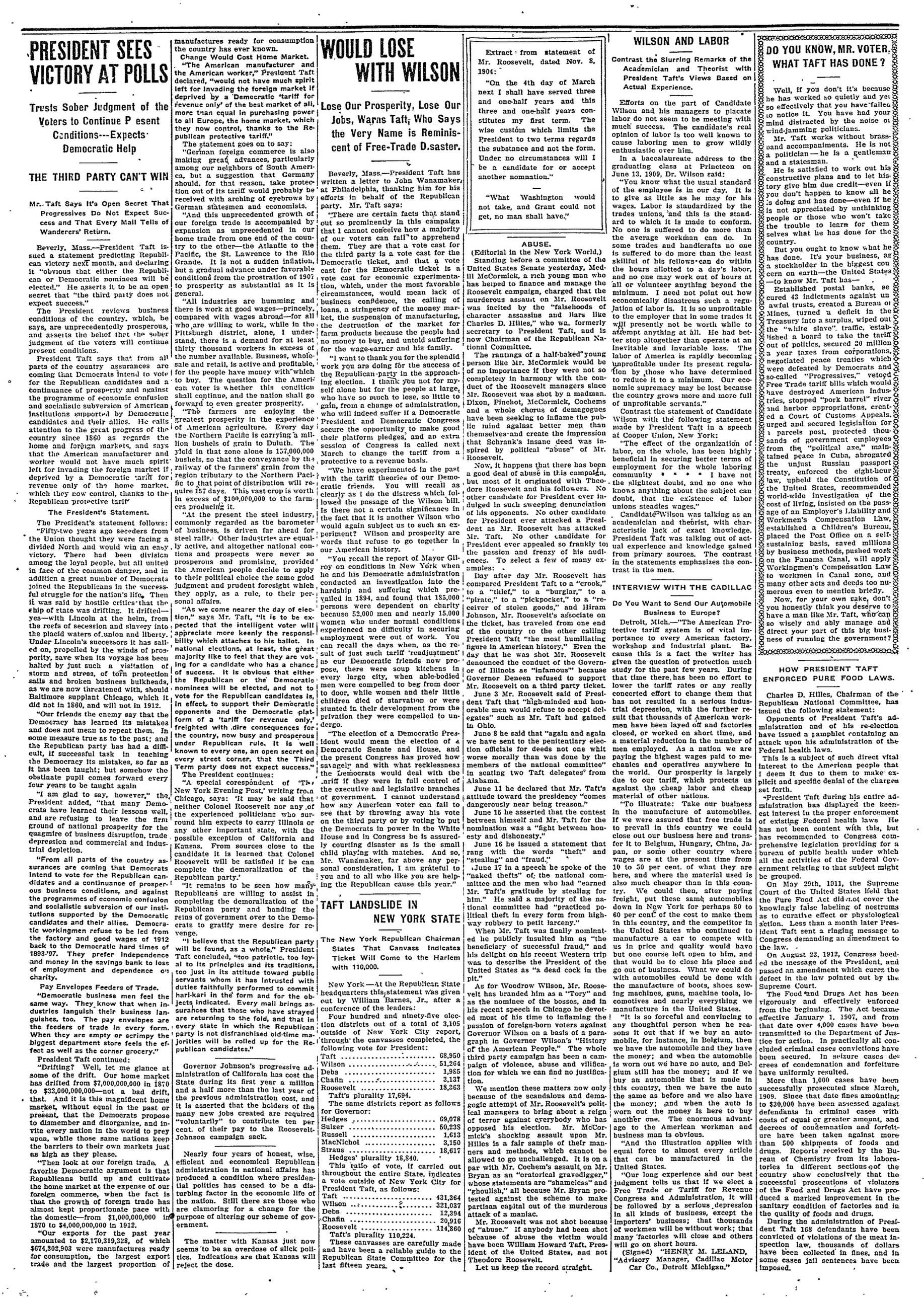
PRESIDENT SEES VICTORY AT POLLS
Trusts Sober Judgment of the Voters to Continue Present Conditions---Expects Democratic Help
THE THIRD PARTY CAN'T WIN
Mr. Taft Says It's Open Secret That Progressives Do Not Expect Success and That Every Mail Tells of Wanderers' Return.
Beverly, Mass.—President Taft issued a statement predicting Republican victory next month, and declaring it "obvious that either the Republican or Democratic nominees will be elected." He asserts it to be an open secret that "the third party does not expect success."
The President reviews business conditions of the country, which, he says, are unprecedentedly prosperous, and assists the belief that the sober judgment of the voters will continue present conditions.
President Taft says that from all parts of the country assurances are coming that Democrats intend to vote for the Republican candidates and a continuance of prosperity and against the programme of economic confusion and socialistic subversion of American institutions supported by Democrat candidates and their allies. He calls attention to the great progress of the country since 1860 as regards the home and foreign markets, and says that the American manufacturer and worker would not have much spirit left for invading the foreign market if deprived by a Democratic tariff for revenue only of the home market, which they now control, thanks to the Republican protective tariff.
The President's Statement.
The President's statement follows: "Fifty-two years ago seceders from the Union thought they were facing a divided North and would win an easy victory. There had been division among the loyal people, but all united in face of the common danger, and in addition a great number of Democrats joined the Republicans in the successful struggle for the nation's life. Then it was said by hostile critics that the ship of state was drifting. It drifted—yes with Lincoln at the helm, from the reefs of secession and slavery into the placid waters of union and liberty. Under Lincoln's successors it has salied on, propelled by the winds of prosperity, save when its voyage has been halted by just such a visitation of storm and stress, of torn protection sails and broken business bulkheads, as we are now threatened with, should Baltimore supplant Chicago, which it did not in 1860, and will not in 1912.
"Our friends the enemy say that the Democracy has learned its mistakes and does not mean to repeat them. In some measure true as to the past; and the Republican party has had a difficult, if successful task in teaching the Democracy its mistakes, so far as it has been taught; but somehow the obstinate pupil comes forward every four years to be taught again
"I am glad to say, however," the President added, "that many Democrats have learned their lessons well, and are refusing to leave the firm ground of national prosperity for the quagmire of business disruption, trade depression and commercial and industrial depletion.
"From all parts of the country assurances are coming that Democrats Intend to vote for the Republican candidates and a continuance of prosperous business conditions, and against the programmes of economic confusion and socialistic subversion of our institutions supported by the Democratic candidates and their allies. Democratic workingmen refuse to be led from the factory and good wages of 1912 back to the Democratic hard times of 1893-97. They prefer independence and money In the savings bank to loss of employment and dependence on charity. Pay Envelopes Feeders of Trade.
"Democratic business men feel the same way. They know that when industries languish their business languishes, too. The pay envelopes are the feeders of trade in every form. When they are empty or scrimpy the biggest department store feels the effect as well as the corner grocery."
President Taft continued:
"Drifting? Well, let me glance at some of the drift. Our home market has drifted from $7,000,000,000 in 1870 to $23,000,000,000—not a bad drift, that. And it is this magnificent home market, without equal in the past or present, that the Democrats propose to dismember and disorganize, and invite every nation in the world to prey upon, while those same nations keep the barriers to their own markets just as high as they please.
"Then look at our foreign trade. A favorite Democratic argument is that Republicans build up and cultivate the home market at the expense of our foreign commerce, when the fact is that the growth of foreign trade has almost kept proportionate pace with the domestic—from $1,000,000,000 in 1870 to $4,000,000,000 in 1912.
"Our exports for the past year amounted to $2,170,319,328, of which $674,302,903 were manufactures ready for consumption, the largest export trade and the largest proportion of
manufactures ready for consumption the country has ever known.
Change Would Cost Home Market.
"The American manufacturer and the American worker," President Taft declared, "would not have much spirit left for invading the foreign market if deprived by a 'Democratic tariff for revenue only' of the best market of all, more than equal in purchasing power to all Europe, the home market, which they now control, thanks to the Republican protective tariff."
The statement goes on to say:
"German foreign commerce is also making great advances, particularly among our neighbors of South America, but a suggestion that Germany should, for that reason, take protection out of its tariff would probably be received with arching of eyebrows by German statesmen and economists.
"And this unprecedented growth of our foreign trade is accompanied by expansion as unprecedented in our home trade from one end of the country to the other—the Atlantic to the Pacific, the St. Lawrence to the Rio Grande. It is not a sudden inflation, but a gradual advance under favorable conditions from the prostration of 1907 to prosperity as substantial as it is general.
"All industries are humming and there is work at good wages—princely, compared with wages abroad—for all who are willing to work, while in the Pittsburgh district, alone, I understand, there is a demand for at least thirty thousand workers in excess of the number available. Business, wholesale and retail, is active and profitable, for the people have money with"which to buy. The question for the American voter is whether this condition shall continue, and the nation shall go forward to even greater prosperity.
"The farmers are enjoying the greatest prosperity in the experience of American agriculture. Every day the Northern Pacific is carrying a million bushels of grain to Duluth. The yield in that zone alone is 157,000,000 bushels, so that the conveyance by the railway of the farmers' grain from the region tributary to the Northern Pacific to that point of distribution will require 157 days. This vast crop is worth in excess of $100,000,000 to the farmers producing it.
"At the present the steel industry, commonly regarded as the barometer of business, is driven far ahead for steel rails. Other industries are equally active, and altogether national contions and prospects were never so prosperous and promising, provided the American people decide to apply to their political choice the same good judgment and prudent foresight which they apply, as a rule, to their personal affairs.
"As we come nearer the day of election," says Mr. Taft, "it is to be expected that the intelligent voter will appreciate more keenly the responsibility which attaches to his ballot. In national elections, at least, the great majority like to feel that they are voting for a candidate who has a chance of success. It is obvious that either the Republican or the Democratic nominees will be elected, and not to vote for the Republican candidates is, in effect, to support their Democratic opponents and the Democratic platform of a 'tariff for revenue only,' freighted with dire consequences for the country, now busy and prosperous under Republican rule. It is well known to every one, an open secret on every street corner, that the Third Term party does not expect success."
The President continues:
"A special correspondent of 'The New York Evening Post,' writing from Chicago, says: 'It may be said that neither Colonel Roosevelt nor any of the experienced politicians who surround him expects to carry illinois or any other important state, with the possible exception of California and Kansas. From sources close to the candidate it is learned that Colonel Roosevelt will be satisfied if he can complete the demoralization of the Republican party.'
"It remains to be seen how many Republicans are willing to assist in completing the demoralization of the Republican party and handing the reins of government over to the Democrats to gratify mere desire for revenge.
"I believe that the Republican party will be found, as a whole," President Taft concluded, "too patriotic, too loyal to its principles and its traditions, too just in its attitude toward public servants whom it has intrusted with duties faithfully performed to commit harl-karl in the form and for the objects indicated. Every mall brings assurances that those who have strayed are returning to the fold, and that in every state in which the Republican party is not disfranchised old-time majorities will be rolled up for the Republican candidates."
Governor Johnson's progressive administration of California has cost the State during its first year a million and a half more than the last year of the previous administration cost, and it is asserted that the holders of the many new jobs created are required "voluntarily" to contribute ten per cent. of their pay to the Roosevelt-Johnson campaign sack.
Nearly four years of honest, wise, efficient and economical Republican administration in national affairs has produced a condition where presidential politics has ceased to be a disturbing factor in the economic life of the nation. Still there are those who are clamoring for a change for the purpose of altering our scheme of government.
The matter with Kansas just now seems to be an overdose of silk politics. Indications are that Kansas will reject the dose.
WOULD LOSE WITH WILSON
Lose Our Prosperity, Lose Our Jobs, Warns Taft, Who Says the Very Name is Reminiscent of Free-Trade D.saster.
Beverly, Mass.—President Taft has written a letter to John Wanamaker at Philadelphia, thanking him for his efforts in behalf of the Republican party. Mr. Taft says:
"There are certain facts that stand out so prominently in this campaign that I cannot conceive how a majority of our voters can fall" to apprehend them. They are that a vote cast for the third party is a vote cast for the Democratic ticket, and that a vote cast for the Democratic ticket is a vote cast for economic experimentation, which, under the most favorable circumstances, would mean lack of business confidence, the calling of loans, a stringency of the money market, the suspension of manufacturing, the destruction of the market for farm products because the people had no money to buy, and untold suffering for the wage-earner and his family.
"I want to thank you for the splendid work you are doing for the success of the Republican-party in the approaching election. I thank you not for myself alone but for the people at large, who have so much to lose, so little to gain, from a change of administration, who will indeed suffer if a Democratic President and Democratic Congress secure the opportunity to make good their platform pledges, and an extra session of Congress is called next March to change the tariff from a protective to a revenue basis.
"We have experimented in the past with the tariff theories of our Democratic friends. You will recall as clearly as I do the distress which followed the passage of the Wilson bill. Is there not a certain significance in the fact that it is another Wilson who would again subject us to such an experiment? Wilson and prosperity are words that refuse to go together in our American history.
"You recall the report of Mayor Gilroy on conditions in New York when he and his Democratic administration conducted an investigation into the hardship and suffering which prevailed in 1894, and found that 135,000 persons were dependent on charity because 52,000 men and nearly 15,000 women who under normal conditions experienced no difficulty in securing employment were out of work. You can recall the days when, as the result of just such tariff 'readjustment' as our Democratic friends now propose, there were soup kitchens in every large city, when able-bodied men were compelled to beg from door to door, while women and their little children died of starvation or were stunted in their development from the privation they were compelled to undergo.
"The election of a Democratic President would mean the election of a Democratic Senate and House, and the present Congress has proved how savagely and with what recklessness the Democrats would deal with the .arif if they were in full control of the executive and legislative branches of government. I cannot understand how any American voter can fall to see that by throwing away his vote on the third party or by voting to put the Democrats in power in the White House and in Congress he is assuredly courting disaster as is the small child playing with matches. And so, Mr. Wanamaker, far above any personal consideration, I am grateful to you and to all who like you are helping the Republican cause this year."
TAFT LANDSLIDE IN
NEW YORK STATE
The New York Republican Chairman States That Canvass Indicates Ticket Will Come to the Harlem with 110,000.
New York—At the Republican State headquarters this statement was given out by William Barnes, Jr., after a conference of the leaders:
Four hundred and ninety-five election districts out of a total of 3,105 outside of New York City report, through the canvasses completed, the following vote for President:
Taft ..... 68,950
Wilson ..... 51,264
Debs ..... 1,955
Chafin ..... 3,137
Roosevelt ..... 18,263
Taft's plurality 17,694
The same districts report as follows for Governor:
Hedges 69,078
Sulzer 50,238
Russell 1,613
MacNichol 3,150
Straus 18,617
Hedges' plurality 18,840.
This ratio of vote, if carried out throughout the entire State, indicates a vote outside of New York City for President Taft, as follows:
Taft 431,364
Wilson 321,037
Debs 12,394
Chafin 20,916
Roosevelt 114,860
Taft's plurality 110,224.
These canvasses are carefully made and have been a reliable guide to the Republican State Committee for the last fifteen years.
Extract from statement of Mr. Roosevelt, dated Nov. 8, 1904:
"On the 4th day of March next I shall have served three and one-half years and this three and one-half years constitutes my first term. The wise custom which limits the President to two terms regards the substance and not the form. Under no circumstances will I be a candidate for or accept another nomination."
"What Washington would not take, and Grant could not get, no man shall have."
ABUSE.
(Editorial in the New York World,) Standing before a committee of the United States Senate yesterday, Medill McCormick, a rich young man who has helped to finance and manage the Roosevelt campaign, charged that the murderous assault, on Mr. Roosevelt, was incited by the "falsehoods of character assassins and hirs like Charles D. Hillees," who was formerly secretary to President Taft, and is now Chairman of the Republican National Committee.
The rantings of a half-baked*young person like Mr. McCormick would be of no importance if they were not so completely in harmony with the conduct of the Roosevelt managers since Mr. Roosevelt was shot by a madman, Dixon, Pinchot, McCormick, Cochems and a whole chorus of demagogues have been seeking to inflame the public mind against better men than themselves and create the impression that Schrank's insane deed was inspired by political "abuse" of Mr. Roosevelt.
Now, it happens that there has been a good deal of abuse in this campaign, but most of it originated with Theodore Roosevelt and his followers. No other candidate for President ever indulged in such sweeping denunciation of his opponents. No other candidate for President ever attacked a President as Mr. Roosevelt has attacked Mr. Taft. No other candidate for President ever appealed so frankly to the passion and frenzy of his audiences. To select a few of many examples:
Day after day Mr. Roosevelt has compared President Taft to a "crook," to a "thief," to a "burglar," to a "pirate," to a "pickpocket," to a "receiver of stolen goods," and Hilram Johnson, Mr. Roosevelt's associate on the ticket, has traveled from one end of the country to the other calling President Taft "the most humiliating figure in American history." Even the day that he was shot Mr. Roosevelt denounced the conduct of the Governor of Illinois as "infamous" because Governor Deneen refused to support Mr. Roosevelt on a third party ticket. June 3 Mr. Roosevelt said of President Taft that "high-minded and honorable men would refuse to accept delegates" such as Mr. Taft had gained in Ohio.
June 8 he said that "again and again we have sent to the penitentiary election officials for deeds not one whit worse morally than was done by the members of the national committee" in seating two Taft delegates from Alabama.
June 11 he declared that Mr. Taft's attitude toward the presidency "comes dangerously near being treason."
June 15 he asserted that the contest between himself and Mr. Taft for the nomination was a "fight between honesty and dishonesty."
June 16 he issued a statement that rang with the words "theft" and "stealing" and "fraud."
June 17 in a speech he spoke of the "naked thefts" of, the national committee and the men who had "earned Mr. Taft's gratitude by stealing for him." He said a majority of the national committee had "practiced political theft in every form from highway robbery to petit larceny."
When Mr. Taft was finally nominated he publicly insulted him as "the beneficiary of successful fraud," and his delight on his recent Western trip was to describe the President of the United States as "a dead cock in the plit."
As for Woodrow Wilson, Mr. Roosevelt has branded him as a "Tory" and as the nominee of the bosses, and in his recent speech in Chicago he devoted most of his time to infighting the passion of foreign-born voters against Governor Wilson on a basis of a paragraph in Governor Wilson's "History of the American People." The whole third party campaign has been a campaign of violence, abuse and vilification for which we can find no justification.
We mention these matters now only because of the scandalous and demagogic attempt of Mr. Roosevelt's political managers to bring about a reign of terror against everybody who has opposed his election. Mr. McCormick's shocking assault upon Mr. Hilleis is a fair sample of their manners and methods, which cannot be allowed to go unchallenged. It is on a par with Mr. Cochem's assault, on Mr. Bryan as an "oratorical gravedigger," whose statements are "shameless" and "ghoulish," all because Mr. Bryan protested against the scheme to make partisan capital out of the murderous attack of a maniac. Mr. Roosevelt was not shot because of "abuse." If anybody had been shot because of abuse the victim would have been William Howard Taft, President of the United States, and not Theodore Roosevelt. Let us keep the record straight.
WILSON AND LABOR
Contrast the Slurring Remarks of the Academician and Theorist with President Taft's Views Based on Actual Experience.
Efforts on the part of Candidate Wilson and his managers to placate labor do not seem to be meeting with much success. The candidate's real opinion of labor is too well known to cause laboring men to grow wildly enthusiastic over him.
In a baccalaureate address to the graduating class at Princeton on June 13, 1909, Dr. Wilson said:
"You know what the usual standard of the employee is in our day. It is to give as little as he may for his wages. Labor is standardized by the trades unions, and this is the standard to which it is made to conform. No one is suffered to do more than the average workman can do. In some trades and handicrafts no one is suffered to do more than the least skilful of his fellows can do within the hours allotted to a day's labor, and no one may work out of hours at all or volunteer anything beyond the minimum. I need not point out how economically disastrous such a regulation of labor is. It is so unprofitable to the employer that in some trades it will present not be worth while to attempt anything at all. He had better stop altogether than operate at an inevitable and invariable loss. The labor of America is rapidly becoming unprofitable under its present regulation by those who have determined to reduce it to a minimum. Our economic supremacy may be lost because the country grows more and more full of unprofitable servants."
Contrast the statement of Candidate Wilson with the following statement made by President Taft in a speech at Cooper Union, New York:
"The effect of the organization of labor, on the whole, has been highly beneficial in securing better terms of employment for the whole laboring community * * * * I have not the slightest doubt, and no one who knows anything about the subject can doubt, that the existence of labor unions steadies wages."
Candidate Wilson was talking as an acadienician and the theist, with characteristic lack of exact knowledge. President Taft was talking out of actual experience and knowledge gained from primary sources. The contrast in the statements emphasizes the contrast in the men.
INTERVIEW WITH THE CADILLAC
Do You Want to Send Our Automobile Business to Europe?
Detroit, Mich.—"The American Protective tariff system is of vital importance to every American factory, workshop and industrial plant. Because this is a fact the writer has given the question of protection much study for the past few years. During that time there, has been no effort to lower the tariff rates or any really concerted effort to change them that has not resulted in a serious industrial depression, with the further result that thousands of American workers have been layed off and factories closed, or worked on short time, and a material reduction in the number of men employed. As a nation we are paying the highest wages paid to mechanics and operatives anywhere in the world. Our prosperity is largely due to our tariff, which protects us against the cheap labor and cheap material of other nations.
"To illustrate: Take our business in the manufacture of automobiles. If we were assured that free trade is to prevail in this country we could close out our business here and transfer it to Belgium, Hungary, China, Japan, or some other country where wages are at the present time from 10 to 50 per cent, of what they are here, and where the material used is also much cheaper than in this country. We could then, after paying freight, put these same automobiles down in New York for perhaps 50 to 60 per cent of the cost to make them in this country, and the competitor in the United States who continued to manufacture a car to compete with us in price and quality would have but one course left open to him, and that would be to close his place and go out of business. What we could do with automobiles could be done with the manufacture of boots, shoes sewing machines, guns, machine tools, locomotives and nearly everything we manufacture in the United States.
"It is so forceful and convincing to any thoughtful person when he reasons it out that if we buy an automobile, for instance, in Belgium, then we have the automobile and they have the money; and when the automobile is worn out we have no auto, and Belgium still has the money; and if we buy an automobile that is made in this country, then we have the auto the same as before and we also have the money; and when the auto is worn out the money is here to buy another one. The enormous advantage to the American workman and business man is obvious.
"And the illustration applies with equal force to almost every article that can be manufactured in the United States.
"Our long experience and our best judgment tells us that if we elect a Free Trade or Tariff for Revenue Congress and Administration, it will be followed by a serious depression in all kinds of business, except the importers' business; that thousands of workmen will be without work; that many factories will close and others will go on short hours.
(Signed) "HENRY M. LELAND,
"Advisory Manager, Cadillac Motor
Car Co. Detroit, Michigan."
Well, if you don't it's because he has worked so quietly and yet so effectively that you have failed to notice it. You have had your mind distracted by the noise on wind-jamming politicians.
Mr. Taft works without brassband accompaniments. He is not a politician—he is a gentleman and a statesman.
He is satisfied to work out his constructive plans and to let history give him due credit—even if you don't happen to know all he is doing and has done—even if he is not appreciated by unthinking people or those who won't take the trouble to learn for them selves what he has done for the country.
But you ought to know what he has done. It's your business, as a stockholder in the biggest concern on earth—the United States—to know Mr. Taft has—
Established postal banks, secured 43 indictments against unwalful trusts, created a Bureau or Mines, turned a deficit in the Treasury into a surplus, wiped out the "white slave" traffic, established a board to take the tariff out of politics, secured 20 million a year taxes from corporations, negotiated peace treaties which were defeated by Democrats and so-called "Progressives," vetoped Free Trade tariff bills which would have destroyed American Industries, stopped "pork barrel" river and harbor appropriations, created a Court of Customs Appeals, urged and secured legislation for 1 parcels post, protected thousands of government employees from the "political axe," maintained peace in Cuba, abrogated the unjust Russian passport treaty, enforced the eight-hour law, uphold the Constitution of the United States, recommended world-wide investigation of the cost of living, insisted on the passage of an Employer's Liability and Workmen's Compensation Law, established a Children's Bureau, placed the Post Office on a self-sustaining basis, saved millions by business methods, pushed work on the Panama Canal, will apply Workingmen's Compensation Law to workmen in Canal zone, and many other acts and deeds too numerous even to mention briefly. Now, for your own sake, don't you honestly think you deserve to have a man like Mr. Taft, whorc so wisely and ably manage and direct your part of this big business of running the government?
HOW PRESIDENT TAFT
ENFORCED PURE FOOD LAWS.
Charles D. Hilles, Chairman of the Republican National Committee, has issued the following statement: Opponents of President Taft's administration and of his re-election have issued a pamphlet containing an attack upon his administration of the Federal health laws. This is a subject of such direct vital interest to the American people that I deem it due to them to make explicit and specific denial of the charges set forth. President Taft during his entire administration has displayed the keenest interest in the proper enforcement of existing Federal health laws. He has not been content with this, but has recommended to Congress comprehensive legislation providing for a bureau of public health under which all the activities of the Federal Government relating to that subject might be grouped.
On May 29th, 1911, the Supreme Court of the United States field that the Pure Food Act did not cover the knowingly false labeling of nostrums as to curative effect or physiological action. Less than a month later President Taft sent a ringing message to Congress demanding an amendment to the law.
On August 22, 1912, Congress heeded the message of the President, and passed an amendment which cured the defect in the law pointed out by the Supreme Court.
The Food and Drugs Act has been vigorously and effectively enforced from the beginning. The Act became effective January 1, 1907, and from that date over 4,000 cases have been transmitted to the Department of Justice for action. In practically all concluded criminal cases convictions have been secured. In seizure cases degrees of condemnation and forfeiture have uniformly resulted.
More than 1,000 cases have been successfully prosecuted since March, 1909. Since that date fines amounting to $30,000 have been assessed against defendants in criminal cases with costs of equal or greater amount, and decrees of condemnation and forfeiture have been taken against more than 500 shipments of foods and drugs. Reports received by the Bureau of Chemistry from its laboratories in different sections of the country show conclusively that the successful prosecutions of violators of the Food and Drugs Act have produced a marked improvement in the sanitary condition of factories and in the quality of foods and drugs. During the administration of President Taft 168 defendants have been convicted of violations of the meat inspection law, thousands of dollars have been collected in fines, and in some cases jail sentences have been imposed.
BECKER JURY SAYS GUILTY
Murder in the First Degree Is the Verdict.
BECKER DID NOT FLINCH.
John F. McIntyre, Convicted Man's Counsel, Announced He Would Take An Immediate
New York. — Police Lieutenant Charles Becker was found guilty of murder in the first degree by the jury which has been trying him for instigating the death of Herman Rosenthal, the gambler.
The verdict read "murder in the first degree" and was pronounced exactly at midnight. Becker was remanded for sentence to the Tombs by Justice Goff.
Mrs. Becker, sitting outside the door of the courtroom, fell in a swoon when the verdict was announced.
Becker did not flinch when he heard the verdict pronounced by Harold B. Skinner, foreman of the jury.
John F. McIntyre, Becker's chief counsel, announced that he would take an immediate appeal, but added beyond this he had nothing to say.
The 12 jurors, with solemn faces and measured steps, filed into the courtroom at 11.55 o'clock. A minute later the defendant was brought in from the Tombs. Justice Goff had not yet entered the room and for a moment Becker took a side seat. As he waited he scanned with anxious eyes the faces of the jurors, but none of them returned his gaze. A tense silence prevailed. At 11.57 o'clock Justice Goff entered the courtroom and bowing low to counsel, took his seat. The jury roll was called. The clerk then asked the jurors if they had reached a verdict. "We have," announced Foreman Skinner. The jury rose to its feet.
"We find the defendant guilty as charged in the indictment," Mr. Skinner said, slowly and evenly, looking squarely at Justice Goff.
"Do you find the defendant guilty of murder in the first degree, as charged in the indictment?" said the clerk.
"We do," the foreman replied.
Mr. McIntyre, who had covered his face with his hands as the verdict was given, rose and asked that all further proceedings be deferred for one week, "until I can prepare the proper motions for appeal."
"I will defer sentence," announced Justice Goff, "until October 30 and remand the prisoner until that date."
Justice Goff spoke in the same low tone of voice—almost a whisper—that had characterized his utterances during the trial.
THIRD OF FARMS MORTGAGED.
Carry Heaviest Indebtedness.
Washington. — One-third of the farms of the United States are mortgaged, according to a bulletin issued by the Census Bureau. This bulletin shows that in 1910 the total number of farms operated by owners and mortgaged was 1,327,439, while 2,621,283 were reported free from mortgage. The average amount of mortgage indebtedness per farm increased from $1,214 in 1890 to $1,715 in 1910, but the average value per farm increased from $3,444 to $6,289, which shows that the owner's equity doubled.
The value of the farms and buildings which were mortgaged was placed at $6,300,000,000, while the amount of mortgages was $1,726,000,000, or 27 per cent, of the value.
The proportion of mortgaged indebtedness is higher in Iowa and Wisconsin than in any of the other States, and yet these States are among the most prosperous in agriculture.
WHITE HOUSE SCRUBBED.
First Inside-and-Out, Washing Since Cleveland's Time.
Washington. -For the first time since the Cleveland regime, the White House was washed thoroughly from cellar to garret Thursday, fire engines playing streams of water upon the exterior and a small army of charwomen scrubbing the interior. All the hardwood floors were shelllaced and the wood work painted.
Result Of Exodus Of Greeks From Illinois.
Galena, Ill.—Twelve lead and zinc mines in this district have had to close because of the exodus of Greeks and other foreigners who have returned to their native countries to take up arms against Turkey. It is estimated that more than 500 men have departed in the last few weeks.
Piece Inch and a Half Long Taken From Baby's Head.
Rochester, N. Y.-A piece of lead pencil an inch and a half long was removed from the brain of two-year-old William Tulley in a hospital here. The baby fell while playing and the pencil penetrated the frontal bone above the left eye, entering the brain. Physicians say he may recover.
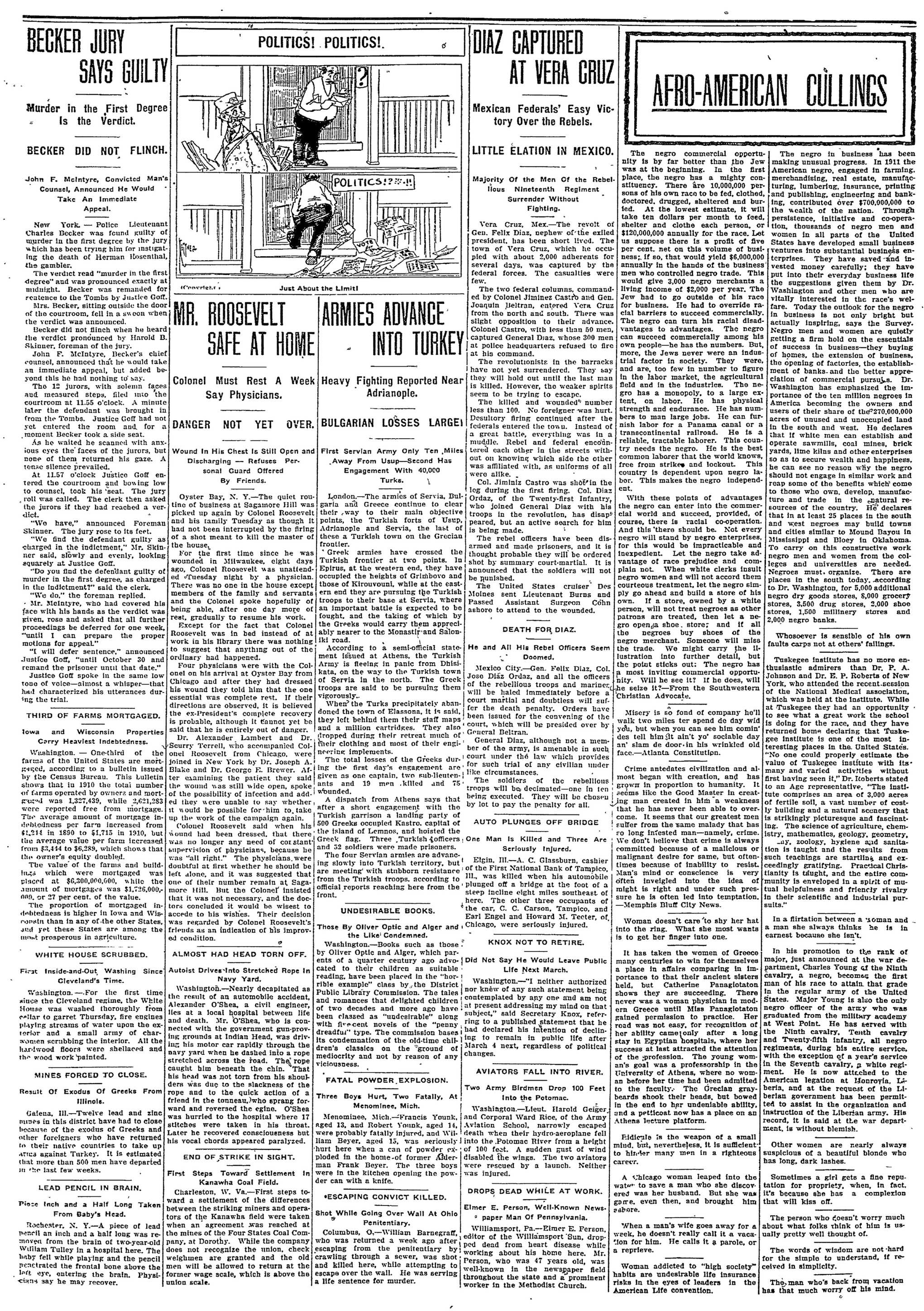
POLITICS! POLITICS!
POLITICS!?!!!
(Copyright
MR. ROOSEVELT SAFE AT HOME
Colonel Must Rest A Week Say Physicians.
Wound In His Chest Is Still Open and Discharging — Refuses Personal Guard Offered
Oyster Bay, N. Y.—The quiet routine of business at Sagamore Hill was picked up again by Colonel Roosevelt and his family Tuesday as though it had not been interrupted by the firing of a shot meant to kill the master of the house. For the first time since he was wounded in Milwaukee, eight days ago, Colonel Roosevelt was unattended Tuesday night by a physician. There was no one in the house except members of the family and servants and the Colonel spoke hopefully of being able, after one day more of rest, gradually to resume his work. Except for the fact that Colonel Roosevelt was in bed instead of at work in his library there was nothing to suggest that anything out of the ordinary had happened.
Four physicians were with the Colonel on his arrival at Oyster Bay from Chicago and after they had dressed his wound they told him that the one essential was complete rest. If their directions are observed, it is believed the ex-President's complete recovery is probable, although it cannot yet be said that he is entirely out of danger. Dr. Alexander Lambert and Dr. Scurry Terrell, who accompanied Colonel Roosevelt from Chicago, were joined in New York by Dr. Joseph A. Blake and Dr. George F. Brewer. After examining the patient they said the wound was still wide open, spoke of the possibility of infection and added they were unable to say whether it would be possible for him to take up the work of the campaign again.
Colonel Roosevelt said when his wound had been dressed, that there was no longer any need of constant supervision of physicians, because he was "all right." The physicians, were doubtful at first whether he should be left alone, and it was suggested that one of their number remain at Sagamore Hill. But the Colonel insisted that it was not necessary, and the doctors concluded it would be wisest to accede to his wishes. Their decision was regarded by Colonel Roosevelt's friends as an indication of his improved condition.
ALMOST HAD HEAD TORN OFF.
Autoist Drives Into Stretched Rope In Navy Yard.
Washington.—Nearly decapitated as the result of an automobile accident, Alexander O'Shea, a civil engineer, lies at a local hospital between life and death. Mr. O'Shea, who is connected with the government gun-proving grounds at Indian Head, was driving his motor car rapidly through the navy yard when he dashed into a rope stretched across the road. The rope caught him beneath the chin. That his head was not torn from his shoulders was due to the slackness of the rope and to the quick action of a friend in the tonneau, who sprang forward and reversed the egine. O'Shea was hurried to the hospital where 17 stitches were taken in his throat. Later he recovered consciousness but his vocal chords appeared paralyzed.
END OF STRIKE IN SIGHT.
First Steps Toward Settlement In Kanawha Coal Field.
Charleston, W. Va.—First steps toward a settlement of the differences between the striking miners and operators of the Kanawha field were taken when an agreement was reached at the mines of the Four States Coal Company, at Dorothy. While the company does not recognize the union, check weighmen are granted and the old men will be allowed to return at the former wage scale, which is above the union scale.
ARMIES ADVANCE INTO TURKEY
Heavy Fighting Reported Near Adrianople.
BULGARIAN LOSSES LARGE
First Servlan Army Only Ten ,Miles
.Away From Usup—Second Has
Engagement With 40,000
London.—The armies of Servia, Bulgaria and Greece continue to clear their way to their main objective points, the Turkish forts of Usup, Adrianople and Servia, the last of these a Turkish town on the Grecian frontier.
Greek armies have crossed the Turkish frontier at two points. In Epirus, at the western end, they have occupied the heights of Grimbovo and those of Kirouvouni, while at the eastern end they are pursuing the Turkish troops to their base at Servia, where an important battle is expected to be fought, and the taking of which by the Greeks would carry them appreciably nearer to the Monastir and Salonki road.
According to a semi-official statement issued at Athens, the Turkish Army is fleeing in panic from Dhikikata, on the way to the Turkish town of Servia in the north. The Greek troops are said to be pursuing them vigorously.
When the Turks precipitately abandoned the town of Elassona, it is said, they left behind them their staff maps and a million cartridges. They also dropped during their retreat much of their clothing and most of their engineering implements.
The total losses of the Greeks during the first day's engagement are given as one captain, two sublieutenants and 19 men killed and 75 wounded.
A dispatch from Athens says that after a short engagement with the Turkish garrison a landing party of 500 Greeks occupied Kastro, capital of the island of Lemnos, and hoisted the Greek flag. Three Turkish officers and 52 soldiers were made prisoners. The four Servian armies are advancing slowly into Turkish territory, but are meeting with stubborn resistance from the Turkish troops, according to official reports reaching here from the front.
UNDESIRABLE BOOKS
Those By Oliver Optic and Alger and the Like Condemned.
Washington.—Books such as those by Oliver Optic and Alger, which parents of a quarter century ago advocated to their children as suitable reading, have been placed in the "horrible example" class by the District Public Library Commission. The tales and romances that delighted children of two decades and more ago have been classed as "undesirable" along with five-cent novels of the "penny dreadful" type. The commission bases its condemnation of the old-time children's classics on the ground of mediocrity and not by reason of any viciousness.
FATAL POWDER EXPLOSION.
Three Boys Hurt, Two Fatally, At Menominee, Mich.
Menominee, Mich.—Francis Younk, aged 13, and Robert Younk, aged 14, were probably fatally injured, and William Beyer, aged 15, was seriously hurt here when a can of powder exploded in the home-of former Adlerman Frank Beyer. The three boys were in the kitchen opening the powder can with a knife.
*ESCAPING CONVICT KILLED.
Shot While Going Over Wall At Ohio Penitentiary
Columbus, O.—William Barnegraff, who was returned a week ago after escaping from the penitentiary by crawling through a sewer, was shot and killed here, while attempting to escape over the wall. He was serving a life sentence for murder.
Mexican Federals' Easy Victory Over the Rebels.
LITTLE ELATION IN MEXICO.
Majority Of the Men Of the Rebel
Illous Nineteenth Regiment
Surrender Without
Vera Cruz, Mex.-The revolt of Gen. Felix Diaz, nephew of the exiled president, has been short lived. The town of Vera Cruz, which he occupied with about 2,000 adherents for several days, was captured by the federal forces. The casualties were few.
The two federal columns, commanded by Colonel Jiminez Castro and Gen. Joaquín Beltran, entered Vera Cruz from the north and south. There was slight opposition to their advance. Colonel Castro, with less than 50 men, captured General Diaz, whose 300 men at police headquarters refused to fire at his command.
The revolutionists in the barracks have not yet surrendered. They say they will hold out until the last man is killed. However, the weaker spirits seem to be trying to escape.
The killed and wounded number less than 100. No foregner was hurt. Desultory firing continued after the federalers entered the town. Instead of a great battle, everything was in a muddle. Rebel and federal encountered each other in the streets without on knowing which side the other was affiliated with, as uniforms of all were alike.
Col. Jimlinz Castro was shot in the leg during the first firing. Col. Diaz Ordaz, of the Twenty-first Infantry, who joined General Diaz with his troops in the revolution, has disappeared, but an active search for him is being made.
The rebel officers have been disarmed and made prisoners, and it is thought probable they will be ordered shot by summary court-martial. It is announced that the soldiers will not be punished.
The United States cruiser Des Molnes sent Lieutenant Burns and Passed Assistant Surgeon Cohn ashore to attend to the wounded.
DEATH FOR DIAZ.
He and All His Rebel Officers Seem
Doomed.
Mexico City.—Gen. Felix Diaz, Col. Jose Diaz Ordaz, and all the officers of the rebellious troops and marine; will be haled immediately before a court martial and doubtless will suffer the death penalty. Orders have been issued for the convening of the court, which will be presided over by General Beltran. General Diaz, although not a member of the army, is amenable in such court under the law which provides for such trial of any civilian under like circumstances. The soldiers of the rebellious troops will be decimated—one in ten being executed. They will be chosen by lot to pay the penalty for all.
AUTO PLUNGES OFF BRIDGE
One Man Is Killed and Three Are Seriously Influred.
Elgin, Ill.—A. C. Glassburn, cashier of the First National Bank of Tampico, Ill., was killed when his automobile plunged off a bridge at the foot of a steep incline eight miles southeast of here. The other three occupants of the car, C. C. Carson, Tampico, and Earl Engel and Howard M. Tector, of Chicago, were seriously injured.
Did Not Say He Would Leave Public Life Next March.
Washington.—"I neither authorized nor knew of any such statement being contemplated by any one and am not at present addressing my mind on that subject," said Secretary Knox, referring to a published statement that he had declared his intention of declining to remain in public life after March 4 next, regardless of political changes.
AVIATORS FALL INTO RIVER.
Two Army Birdmen Drop 100 Feet Into the Potomac.
Washington.—Lleut. Harold Geiger and Corporal Ward Rice, of the Army Aviation School, narrowly escaped death when their hydro-aeroplane fell into the Potomac River from a height of 100 feet. A sudden gust of wind disabled the wings. The two aviators were rescued by a launch. Neither was injured.
DROPS DEAD WHILE AT WORK.
Williamsport, Pa.—Elmer E. Person, editor of the Williamsport Sun, dropped dead from heart disease while working about his home here. Mr. Person, who was 47 years old, was well-known in the newspaper field throughout the state and a prominent worker in the Methodist Church.
AFRO-AMERICAN CULLINGS
The negro commercial opportunity is by far better than the Jew was at the beginning. In the first place, the negro has a mighty constituency. There are 10,000,000 persons of his own race to be fed, clothed, doctored, drugged, sheltered and buried. At the lowest estimate, it will take ten dollars per month to feed, shelter and clothe each person, or $120,000,000 annually for the race. Let us suppose there is a profit of five per cent. net on this volume of business; if so, that would yield $6,000,000 annually in the hands of the business men who controlled negro trade. This would give 3,000 negro merchants a living income of $2,000 per year. The Jew had to go outside of his race for business. He had to override racial barriers to succeed commercially. The negro can turn his racial disadvantages to advantages. The negro can succeed commercially among his own people—he has the numbers. But, more, the Jews never were an industrial factor in society. They were, and are, too few in number to figure in the labor market, the agricultural field and in the industries. The negro has a monopoly, to a large extent, on labor. He has physical strength and endurance. He has numbers to man large jobs. He can furnish labor for a Panama canal or a transcontinental railroad. He is a reliable, tractable laborer. This country needs the negro. He is the best common laborer that the world knows, free from strikes and lockout. This country is dependent upon negro labor. This makes the negro independent.
With these points of advantages the negro can enter into the commercial world and succeed, provided, of course, there is racial co-operation. And this 'there should be. Not every negro will stand by negro enterprises, for this would be impracticable and inexpedient. Let the negro take advantage of race prejudice and complain not. When white clerks insult negro women and will not accord them courteous treatment, let the negro simply go ahead and build a store of his own. If a store, owned by a white person, will not treat negroes as other patrons are treated, then let a negro open a shoe, store; and if all the negroes buy shoes of the negro merchant. Someone will miss the trade. We might carry the illustration into further detail, but the point sticks out: The negro has a most inviting commercial opportunity. Will he see it? If he does, will he seize it?—From the Southwestern Christian Advocate.
Misery is so fond of company he'll walk two miles ter spend de day wid you, but when you can see him comin' des tell him it ain't yo' sociable day an' slam de door·in his wrinkled old face—Atlanta Constitution.
Crime antedates civilization and almost began with creation, and has grown in proportion to humanity. It seems like the Good Master in creating man created in him a weakness that he has never been able to overcome. It seems that our greatest men suffer from the same malady that has so long infested man—namely, crime. We don't believe that crime is always committed because of a malicious or malignant desire for same, but oftentimes because of inability to resist. Man's mind or conscience is very often invigiled into the idea of might is right and under such pressure he is often led into temptation. —Memphis Bluff City News.
Woman doesn't care to shy her hat into the ring. What she most wants is to get her finger into one.
It has taken the women of Greece many centuries to win for themselves a place in affairs comparing in importance to that their ancient sisters held, but Catherine Panagiotaton shows they are succeeding. There never was a woman physician in modern Greece until Miss Panagiotaton gained permission to practice. Her road was not easy, for recognition of her ability came only after a long stay in Egyptian hospitals, where her success at last attracted the attention of the profession. The young woman's goal was a professorship in the University of Athens, where no woman before her time had been admitted to the faculty. The Grecian gray-beards shook their heads, but bowed in the end to her undeniable ability, and a petticoat now has a place on an Athens lecture platform.
Eidicule is the weapon of a small mind, but, nevertheless, it is sufficient to hinder many men in a righteous career.
A Chicago woman leaped into the water to save a man who she discovered was her husband. But she was game, even then, and brought him ashore.
When a man's wife goes away for a week, he doesn't really call it a vacation for him. He calls it a parole, or a reprieve.
Woman addicted to "high society" habits are undesirable life insurance risks in the eyes of leaders in the American Life convention.
The negro in business has been making unusual progress. In 1911 the American negro, engaged in farming, merchandising, real estate, manufacturing, lumbering, insurance, printing and publishing, engineering and banking, contributed over $700,000,000 to the wealth of the nation. Through persistence, initiative and co-operation, thousands of negro men and women in all parts of the United States have developed small business ventures into substantial business enterprises. They have saved and invested money carefully; they have put into their everyday business life the suggestions given them by Dr. Washington and other men who are vitally interested in the race's welfare. Today the outlook for the negro in business is not only bright but actually inspiring, says the Survey. Negro men and women are quietly getting a firm hold on the essentials of success in business—the buying of homes, the extension of business, the opening of factories, the establishment of banks, and the better appreciation of commercial pursuits. Dr. Washington has emphasized the importance of the ten million negroes in America becoming the owners and users of their share of the 270,000,000 acres of unused and unoccupied land in the south and west. He declares that if white men can establish and operate sawmills, coal mines, brick yards, lime kilns and other enterprises so as to secure wealth and happiness, he can see no reason why the negro should not engage in similar work and reap some of the benefits which come to those who own, develop, manufacture and trade in the natural resources of the country. He declares that in at least 25 places in the south and west negroes may build towns and cities similar to Mound Bayou in Mississippi and Bloey in Oklahoma. To carry on this constructive work negro men and women from the colleges and universities are needed. Negroes must organize. There are places in the south today, according to Dr. Washington, for 5,000 additional negro dry goods stores, 8,000 grocery stores, 3,500 drug stores, 2,000 shoe stores, 1,500 millinery stores and 2,000 negro banks.
Whosoever is sensible of his own faults carps not at others' fallings.
Tuskegee institute has no more enthusiastic admirers than Dr. P. A. Johnson and Dr. E. P. Roberts of New York, who attended the recent session of the National Medical association, which was held at the Institute. While at Tuskegee they had an opportunity to see what a great work the school is doing for the race, and they have returned home declaring that Tuskegee institute is one of the most interesting places in the United States. "No one could properly estimate the value of Tuskegee institute with its many and varied activities without first having seen it," Dr. Roberts stated to an Age representative. "The institute comprises an area of 3,000 acres of fertile soil, a vast number of costly building and a natural scenery that is strikingly picturesque and fascinating. The science of agriculture, chemistry, mathematics, geology, geometry
any, zoology, hygiene and sanitation is taught and the results from such teachings are startling and exceedingly gratifying. Practical Christianity is taught, and the entire community is enveloped in a spirit of mutual helpfulness and friendly rivalry in their scientific and industrial pursuits."
In a flirtation between a woman and a man she always thinks he is in earnest because she isn't.
In his promotion to the rank of major, just announced at the war department, Charles Young of the Ninth cavalry, a negro, becomes the first man of his race to attain that grade in the regular army of the United States. Major Young is also the only negro officer of the army who was graduated from the military academy at West Point. He has served with the Ninth cavalry, Tenth cavalry and Twenty-fifth infantry, all negro regiments, during his entire service, with the exception of a year's service in the Seventh cavalry, p white regiment. He is now attached to the American legation at Honroyla, Liberia, and at the request of the Liberian government has been permitted to assist in the organization and instruction of the Liberian army. His record, it is said at the war department, is without blemish.
Other women are nearly always suspicious of a beautiful blonde who has long, dark lashes.
Sometimes a girl gets a fine reputation for propriety, when, in fact, it's because she has a complexion that will kiss off.
The person who doesn't worry much about what folks think of him is usually pretty well thought of.
The words of wisdom are not hard for the simple to understand, if received in simplicity.
The man who's back from vacation has that much worry off his mind.
JUST AS I TOLD YOU
The price on Cann Pari lots haa been advanced
Only $50.00 on the lot . c
Now it will not be long before another advance
_ will be made :
Knowing this to be true I have bought 50 .of
these beautiful jots which I bave placed
- on the market on easy terms. .
Only $5.00 Cash and 35.00 per month no interest
SAVANNAH 1S GROWING
12 years from now and history will have
peated itself many times a
12 years ago a man botght, two lots, .
* Out,in the suburbs,” aa
away out, os 5 < : :
For $55.00 . . "s
Last week he sold them f
For bow much? : =
$1650, .
. | TITLES ABSOLUTELY PERFECT |
+ ¥
When 50 have been sold .
7 The prices will be advanced
. They are worth $250 each at this very , moment
NOW is your time to buy,
. @
| These Lots Are Splendidly Situated |
SS
On wide streets st .
. Lanes behind every lot ~ . : ,
. Not far from two trolley lines 7
Well drained; high, dry and healthy. ° .
Adjoining Lots sold this year , . Vd
_ 4 From $350 to $500 a.
i ap
| Within The Past Few Months WeHlave Sold |
SS
148 to white people g ~ *
- |. 170 to colored people -
e This combination isa guarantee , -. ,
( That this property will receive its full share of
“Recognition in all City improvements 3 ‘
. Easy to pay for. . feo.
* Good place to live. . y
Good place to double your money, . a x
3 ‘ , ° 3
-These are the best and-cheapest in the city ” | Je
: Titles are absolutely perfect . .
| E.{ RANKIN and S. T. JORDAN, Special Agents. :
6 4
605 West Broad Street .
ds er Se ence
-H. BOWEN, Real Estate A
605_ WEST BROAD STREET
re ee i
+ ia ee aay,
. wy
You Will di
| ou Wi ie
| a Seeker
IF YOU ARE SEEK-
ING FOR A POLICY
WITH BETTER CON-
DITIONS THAN THOSE
ISSUED BY THE
e s |
Pilgrim
Health & ‘ii
ealth & ‘Life
Insurance '
|
|
Company |
THE PIONEER CO., |
OF ITS KIND IN THE
STATE OF GEORGIA |
IN WHICH YOUR ~ |
Dime or 25 Cents |
DOES ITS FULL DUTY
IN BRINGING HOME
TO YOU
TANGIBLE RESULTS
MANY HUNDREDS
HAVE CONSIDERED
WISELY axp PLACED
THEIR INSURANCE
WITH THE OLDRE.
| LIABLE
| = cele |
Pilgrim ~
‘Health & Life
Insurance
Co. .
AND HAVE 'THERE-
| BY BEEN THE HAP-
! PY RECIPIENTS OF
GREAT BENEFITS,
WHILE THERE ARE
SOME WHO CONSID-
ERED THE MATTER
OTHERWISE AND
AND HAVE ‘THERE-
BY BEEN THE HAP-
PY RECIPIENTS OF
GREAT BENEFITS,
WHILE THERE ARE
SOME WHO CONSID-
ERED THE MATTER
OTHERWISE AND
THEREBY {FORFIET-
ED THEIR BEST OP-
PORTUNITY. THIS
WORTHY INSTITU-
TION, WHICH HAS
PROVEN TO BE A
FRIEND TO THE
FRIENDLESS , A RE-
FUGE FOR THE SICK,
AND PRESENT HELP
TO OUR PEOPLE IN
THE TIME OF NEED,
JIS WORTHY OF
THE PATRONAGE OF
OUR RACE. HENCE
IF YOU ARE NOT BE.
ING SERVED AS YOU
SHOULD, SEE THE
PILGRIM’S AGENT
TODAY OR RING THE
LOCAL OFFICE AT
509 W. BROADST
* Telephone $129
Home Office
1148 Gwinnett Street
Augusta Ga.
J. S. Perry
Superintendent
A. B.SINGFIELD ,
General Superintendent
mT
et” .
THE BEST PLACE -~
In Savannah ~
FOR MEN'S GOOD SHOES
Prices $3.50 up.
B. H. Levy, Bro. Co.
A. ML. MONROE & GOMPANY
Funeral Directors and Embalmers.
James Bacon Manager
Prompt and courteous attention given all business .
entrusted to us. Everything of the latest style
Laresr Srrie,Su.ver Gray axp Brack Cans a
CARRIAGE FOR HIRE © -
605 WEST BROAD STREET Phone 121
oa 1
{ ALLANE UNIVERSILY §
i ATLANTA, GEORGIA. 5
Ap unsectarian christian institution.
‘4 WITH HIGH SCHOOL NORMAL SCHOOL g 6
AND COLLEGE iq
x Superior Advantages In Industrial Training - 5
MUSIC AND PRINTING
: : HOME LIFE AND TRAINING i
For Catalogue and information address : |
EDWARD T. WARE, President ATLANTA GA
AMUSEMENT COLUAIN.
Coming Events in the Secial
| World
NOTICE—Articles in this column one
cent per word
November 18th, Monday. Grand
Dance by the Young Imperials at Har-
ris street Hall. Tickets 25 ceets.
November 5th, Tuesday. Fall Dance
by YG EA and Social Club at ()dd-
Fellows Hall, Tickets 25 cents. .
November 20th, Wednesday. Mid-
Fall entertainment by Opal Court of
Calanthe at Harris street Hall. Ad-
mission 15 cents.
November 12th, Tuesday. Annual
Fall Dance by the Fox Club at Harris
street Hall. Admission 35 “and 50
cents.
November 25th, Beginning Monday.
Five night fete by the Ladies and
Gents Soiree Club at Masonic Tempie.
Admission First night ant Thanksgiv-
ing night 25 cents, other nights 10
cents.
November 11th, Monday. Annual
Ball by Violet Aid and Social Club at
Masonic Temple. Admission 25 and
40 cents. S~
November 18th to 22nd inclusivey
Five nightfete at Masouic Temple bg
the LBS Club. Admission openinOd
night 23 cents following this night 1
eents, closing night 15 cents. -
Nov. 13th, Wednesday. Soiree Dance
by Papa Hawkie and Little Ed. at Ma-
sonic Temple. Tickets 25 and 40 cents.
November 4th, Monday. J. W.
Strauther Court No. 383, afternoon
party at Duffy street hall. Admission
Scents.
i November 11th, Monday. Donkey
Party at the residence of Mrs. F. H.
Starr, $23 East Gaston street. Admis-
sion 10 cents. Refreshments free. _
November 4th, Monday. Entertain-
ment at the residence of Miss{Irene
Philips, 553 East McDonough street.
Admission 10 cents.
November sth, Friday. [Foot Ball
game at Baseball park, Georgia State
College oN ey woiversity, Ad-
‘mission 25 cents. a wh.
November 27th, Wednesday First.
fall social and merry-go-round of Cres-
cent Temple No. 2 of the Supreme
Grand Temple U. B. of A. at Harris
street hall. Admission 25 and 33 cents
November 12th, Tuesfay. Grand
Electric Soiree by The Savannah Home
Association at Masonic Temple. The’
first’of its kind to be given in the
city. Don’t miss it. Its a novelty.
Why
Not
Subscribe ?
For
The
Tribune
carers Sie eas oA et
wel LS EE S EE AT ied
Me tay so cok OS eae
at actSmetini Ee ES
tate Ss ei ES
Se 3 yah etfs Seed
eae ener ee AS
ie co 7 SEE
ie a emg ed
Beg a0 Pee
2 eS moet
eens Js Sar mma S|
‘S eee ane 2s, Stee E
a te eee
ie |
Deo NE pO 1 ee 4
re ce ee a
We SE a
oo, Ge
a ce; 6. Te ae
° ecu, |
7 eee heard " ,
: = ;
.
ke. wo , ee
What Will Your Children
Think of You
I£ when sickness. or accidents
necessitate your giving up work,
you are unable to contribute to
their suprort and maintenance.
during their dependent years #
It is not fair to jeopardize the
future success and happiness of
your children by overlooking the
one absolute method of insuring
their health, education, and free—
dom fro the evils of child-labor.
Asa husband and father, it is
your duty to insure yourself
against sickness and accidents,
otherwise the wife and children
must be sacrificed from home and
schoolroom to ‘‘keep the wolf from
the door,” .
__ Until the child has had just por-
tion of mental development in
schools and physical upbuilding in
the natural tendencies of its grow-
ing years, it is a crime to subjecé
it to the task of “bread-winning.”
In these enlightened days, chil-
dren read and children know and_
in after years will not hold you
blameless for your oversight. 1A.
policy in the Union Mutual Asso~
ciation protects your Wife and
children from these unnecessary
‘hardships. Sec one of our agents
today or phone 1470.
J.C. LINDSAY, Dist. Mgr.
or write, .
Wm. DRISKELL, Gen’l-Mgr | -
210 Auburn, Ave., Atlanta Ga.
IN SAME SPOT TWICE
Forest Rangers Say Lightning Does Repeat Stroke.
A Tree Once Struck Is Thereby Rendered More Liable to a Second Bolt—Person Is Safer Standing Under a Tree.
Washington.—Lighting does strike twice in the same place, despite the old saying. Rangers in the national forests report that single trees are often struck many times. Indeed, they say that a tree that has been deadened by a former stroke is more liable to a second attack; the dry, dead branches appear to be better conductors.
In a report Fred G. Plummer, geographer in the forest service, explodes also the theory that in a thunderstorm a person is safer in the open than under a tree. "It has often been stated," he says, "that the majority of persons killed by lightning sought refuge under trees, but this is not a fact. More than one-half of such deaths occur in the open and less than one-quarter under trees." The tree under which the person stands catches and absorbs the force of the stroke. The greatest danger is from secondary shocks or from flying splinters from the shattered tree. A person standing out in the open, being the most prominent object, attracts and receives the direct stroke of any electric current that may come near him.
Mr. Plummer says that lightning strikes more frequently in New Mexico and Arizona than in any other section of the country, though there are more thunderstorms in Florida and Illinois.
He reviews some of the curious early and present beliefs and theories about the immunity of some trees from lightning stroke. Late experiments and observations seem to bear out such a theory. While it has not been practically established, it is considered certain that some trees are more liable to stroke than others. Fiber, structure, shape and degree of moisture probably account for the immunity or liability. On this subject he says:
"From early times there has been a belief that certain trees more than others are likely to be struck by lightning. The elder Pliny said: 'Lightning never strikes the laurel.' This tree was also called bay, and wreaths of its leaves were worn by ancient rulers, both as a symbol of victory and as a protection from the lightning of the gods. Seneca and Plutarch held similar beliefs, which may be traced down even to modern times; but the theory as now held includes a number of trees, differing in various countries. This belief was so firmly established that such trees, as the beech and locust, supposed to be effective in warding off lightning, were planted near dwellings.
"To this day that there are many who still insist that the beech is never struck, while in parts of the United States the aspen is considered immune from lightning. On the other hand, it was believed that such trees as the oak, particularly cork oak, had a very bad reputation for attracting lightning, and this belief prevails even now. There is a proverb: 'Avoid the oak, flee from the spruce, but seek the beech.' And also:
"Beware the oak, it draws the stroke: Avoid the ash, it courts the flash, Creep under the thorn, 'twill save from harm.'
Mr. Plummer reports that incomplete forest records show that 76,301 trees have been struck in the national forests of the west during the past four years. The records have not been kept for the whole of that period in all the territory affected and under the supervision of the bureau. Lightning causes many of the destructive forest fires.
GUARDS FOR McLEAN TOMB.
On duty in Rock Creek cemetery at the tomb of Mrs. John R. McLean, who died at Bar Harbor September 9, is an armed guard to insure protection against mauders. A rumor that Mr. McLean insisted on having the night guard stationed and locked inside the tomb is denied. however. He is simply hired to keep guard at the tomb entrance. Employes at Rock Creek cemetery recount the fact that Mr. McLean kept guards at the tomb of his father and mother for several years after their death, although there has never been any attempt to despoil or rob any of the tombs in the cemetery for many years.
One Possible Explanation:
An Australian correspondent sends Electrical Engineering the following: "Not long ago, somewhere in New Zealand, a firm ordered a number of house service alternating-current meters. It happened that the inside of one of these contained a loose piece of cast iron, which caused a fairly loud humming noise when the current was passed through the meter. The firm who had received it returned it to the wholesale house from whence it came, accompanied by a letter, which was dictated and evidently signed in a hurry, as it read thus: 'We return you herewith one of the six meters recently supplied, as this meter makes a dreadful noise and hums considerably. We think this must be due to the lamentations of the iron core.'"
That it is commercially profitable to dry hay by artificial means, thus eliminating the large waste due to damage by rain in the fields after cutting, is the belief of officials of the department of agriculture. For two or three years past experts of the office of farm management have been conducting experiments in southeastern Missouri with alfalfa hay, putting it through a kiln-drying process. For a time doubt existed as to whether hay could be dried in this manner on a commercially profitable basis. While the work of experimentation has not been concluded, officials are satisfied that kiln-dried hay would save the farmers of the country an enormous amount of money annually.
The department has not formally announced the exact location of the government's plant. It is in the alfalfa belt of southeast Missouri and was under water for a considerable period of time during the recent flood. Since that time, however, it has been put into commission once more. It is expected that a formal bulletin dealing with the experiments will be published by the department in the near future. Hay artificially dried is subjected to great heat for a short time and comes through the process retaining a rich green color. The juice is forced out and the larger part of it preserved.
ORDNANCE FOR PANAMA.
The ordinance department of the army is busily at work in the manufacture of ordinance for the Panama Canal fortifications. This ordinance includes a number of 14-inch guns and guns of smaller callers, mortars and their carriages. There also is under way a disappearing carriage for the 16-inch gun built by the ordinance department some years ago, which has never been used, it having been kept at the Sandy Hook proving ground since its successful test. The law under which this gun was built specifies that it shall be mounted in the United States. However, a carriage is being built for it, with the expectation that congress will authorize it to be mounted in the Canal Zone.
Owing to the delay of congress in providing funds for the canal fortifications, these works will not be ready by the time the canal is opened. It is expected that some of the guns and their carriages will be sent to the Canal Zone and mounted in about six months, but it will be impossible to have all the ordnance ready by the time the canal is ready for traffic. The 16-inch gun carriage will not be finished for about two years.
PROFIT IN PAPER MONEY.
There are millions of dollars of currency outstanding, lost, destroyed or being preserved as souvenirs which the federal government never will be called upon to redeem, according to a compilation of figures by the register of the treasury. This indicates that the government makes a big profit on its issue of paper money. At the present time $15,232,093 is outstanding of the issue of fractional currency notes during the Civil war, familiarly known as "shinplasters." The total issue of these notes was nearly $369,000,000. It is known that many people are saving samples of them as relics, and it is probable that very few of the outstanding $15,000,000 ever will be presented for redemption.
Of the nearly $1,000,000,000 worth of gold certificates issued during the Civil war about $50,000 is still outstanding. There is also outstanding $1,055,000 of the $189,000,000 issue of gold certificates of the series of 18SS.
EXPENSE ACCOUNT TRIMMED.
Uncle Sam announced the other day that he would not reimburse government employees for mosquito nets, whisky, shoes, clothing and medicines incident to traveling. Controller of the Treasury Tracewell rendered a decision to that effect in passing upon the expense account of Claude A. Thompson, special assistant attorney general, who made a trip into Canada for the department of justice last summer. Tobacco is allowed. Mr. Thompson's expense account carried the following items:
One pair shoes, $9; field glasses and fly nets, $5; whisky for use on trip, $3; tobacco for men, $1.
Darwin as Girls Read Him.
Miss Elizabeth Marbury, the dramatic agent of New York, said at the Colony club the other day:
"It is an error to think that the intellectual girl is dowdy. Look at the girl graduates about you. Those with the highest marks wear usually the niceest frocks.
"I said one day to a Bryn Mawr girl:
"How beautifully your pannier gown fits, dear. I thought you grave and reverend seniors were above such trifles?"
"Oh, no,' said she. 'We all believe here in the survival of the best fitted.'"—New York Tribune.
Chance to Show His Skill.
Sad-Looking Man—I see you have a sign out, "Maker of Women's Habits." Do you mean it?
Ladies' Tallor—Certainly I do.
Sad-Looking Man—Well, since my wife's been going to the club she's lost all the good ones she had, and I wish you'd make her a complete new set regardless of expense. And please include the habit of staying at home once in a while and mending my clothes.
MANY GOOD ROADS FOUND IN MARYLAND
```markdown
```
The illustration given above shows a broken-stone Macadam road, treated with "Texas 60 per cent" oil, near Sallebury, Md.
The illustration given above shows a broken-stone Macadam road, treated with "Texas 60 per cent." oil, near Sallebury, Md.
the stakes shall fit properly. The hole to receive the forward end of the chain should be bored at the same time.
The two slabs should be held 30 inches apart by the stakes. Straight grained timber should be selected for the stakes, so that each stake shall fit snugly into the 2-inch hole when the two slabs are in the proper position. The stakes should taper gradually toward the ends. There should be no shoulder at the point where the stakes enter the slab. The stakes should be fastened in place by wedges only.
Two-Slab Log, With "Set Back," Found Satisfactory.
One Common Mistake in Construction of Device Is That It Is Too Heavy and Another Is in Use of Square Timbers.
A great many experiments have been made with a great variety of devices for road dragging, but the two-slab log or plank drag with liberal "set back" has been found the most satisfactory. Double drags for working both sides of the roadway simultaneously have been tried with only limited success, says a writer in the Illinois Farmer. The reason for this lies in the fact that both sides of an earth road are never exactly alike. This causes the two parts of the drag to work unevenly and to interfere with each other. It is also impossible for one man to operate both parts successfully, as will be shown later on
Two mistakes are commonly made in constructing a drag. The first lies in making it too heavy. It should be so light that one man can easily lift it. Besides, a light drag responds more readily to various methods of hitching and to the shifting of the position and weight of the operator, both of which are essential considerations. A drag can be made heavier at any time by proper weighting. The other mistake is in the use of squared timbers, instead of those with sharp edges, whereby the cutting effect of sharp edges is lost and the drag is permitted to glide over instead of to equalize the irregularities in the surface of the road. These mistakes are due partly to badly drawn illustrations and plans of drags which have occasionally appeared in newspapers and partly to the erroneous idea that it is necessary that a large amount of earth shall be removed at one time.
A dry red cedar log is the best material for a drag. Red elm is an excellent material, and box elder, soft maple, or even willow are preferable to oak, hickory, or ash.
The log should be 7 or 5 feet long and from 10 to 12 inches in diameter, and carefully split down the middle. The heaviest and best slab should be selected for the front. At a point on this front slab 4 inches from the end that is to be at the middle of the road locate the center of the hole to receive a cross stake and 22 inches from the other end of the front slab locate the center for another cross stake. The hole for the middle stake will lie on a line connecting and halfway between the other two. The back slab should now be placed in position behind the other. From the end which is to be at the middle of the road measure 20 inches for the center of the cross stake, and 6 inches from the other end locate the center of the outside stake. Find the center of the middle hole as before. When these holes are brought opposite each other, one end of the back slab will lie 16 inches nearer the center of the roadway than the front one, giving what is known as "set back." The holes should be two inches in diameter. Care must be taken to hold the auger .plumb in boring these holes in order that
the stakes shall fit properly. The hole to receive the forward end of the chain should be bored at the same time. The two slabs should be held 30 inches apart by the stakes. Straight grained timber should be selected for the stakes, so that each stake shall fit; snugly into the 2-inch hole when the two slabs are in the proper position. The stakes should taper gradually toward the ends. There should be no shoulder at the point where the stakes enter the slab. The stakes should be fastened in place by wedges only.
When the stakes have been placed in position and tightly wedged, a brace two inches thick and four inches wide should be placed diagonally to them at the ditch end. The brace should be dropped on the front slab so that its lower edge shall lie within an inch of the ground, while the other end should rest in the angle between the slab and the end stake.
CONSTRUCTION OF GOOD ROAD
Less Time Should be Devoted to Building and More Given to Improvement of Dirt Roads.
One point is generally overlooked in all our fuss about good roads, and that is the size of the job. Advocates of big bond issues talk as if fifty million dollars would give a state like Pennsylvania or Ohio good roads, whereas it will do nothing of the sort. It will build a few roads in each county, and only a few. Another mistake is to contuse road improvement and road construction or reconstruction. We loosely call a road built at great expense an "improved" road, and we have done this so long that the words "road improvement" are now associated in the public mind with heavy expense accounts and big bond issues. Road-building is costly no matter whether the road be brick, macadam, asphalt or a combination of such materials. It is too costly to be universal or even extensive, says the National Stockman and Farmer. But road improvement may be extensive, perhaps universal, and it may at the same time be more economical than the present sieve system of using road funds. Let us get a firm hold of these two great road facts, namely, that road-building can cover only a fraction of the mileage in this generation; and that road improvement can be applied to or all nearly all of it.
When we get these facts firmly in mind we shall not devote less attention to road construction but more to road improvement. 'We shall insist that more money be provided for the great body of road mileage, that it shall be applied in a more rational way, and then we shall have good earth roads. Just now in the clamor for road-building the dirt road has too few friends, too little money, too little study as to methods of improvement and entirely too little attention to its upkeep. At the same time this neglected dirt road of America is 2,000,000 miles long, while the constructed road is 200,000 miles long. Fortunately a few communities are pointing the way to better dirt roads at lower cost. The systematic use of the drag all the year, proper drainage, constant care instead of spasmic working—these are all on the finger-board that points to good dirt roads.
Good Roads.
New Jersey was the pioneer in the good roads movement, but New York has 80,000 miles of road with a greater mileage of improved highways than all the other eastern states put together. New York will this year spend $21,000,000 on roads.
New Road Surface.
In Montana road experts have found that crude sugar beet syrum sprinkled over dirt roads that were dusty makes the surface impervious to rain and two coat a year will keep the road in first class condition and at very low cost.
RETURN OF MARINO
BY LEWIS JAMES.
The hand of old Papa Tzantill trembled. The day's doings had been all wrong, and in his capacity as village priest at Mitriana he had been unable to help himself.
And then the news had come. It had spread rapidly, first in whispers and later, when men's excitement could no longer be restrained, in joy-out shouts.
"Marino is coming! Our Marino! Karistinaki, the Cretan eagle! Our hero! The slayer of Bulgaria! The savior of the oppressed! He is coming home."
Papa Tzantill went into his house on the outskirts of the village. He wished to avoid being questioned. He sat in his little room upstairs and gazed sadly toward the quay.
Toward evening a steamboat churned her way between the northern promontory of the island and the barren rock which rose sentinel a quarter of a mile off.
In the stem of the vessel stood a huge man with his hands upon the converging bulwark. He was a Cretan born, to judge by his dress, which he had donned for the special occasion of his homecoming.
He looked before him fixedly, and joy—fierce and glorious joy—filled his eyes.
As the boat began to pass under the promontory, a little calque shot round a projecting rock, followed by another and another. And as they came within hailing distance, their crews began to shout. At first it seemed to the Cretan that these were but the usual overtures of a varkarl soliciting passengers from the anchorage to the quay. But with a sudden hot flush of pleasure he soon realized the truth. Some one had told the news of his coming. They were shouting his name in welcome.
But Marino had other plans in view. He was well aware that once among this exuberant throng on shore it might be hours before he could tear himself away, and the first joys of his home-coming must be unobserved.
So, not loath to enjoy the triumph, but wishing to postpone it, he prevailed upon the skipper to land him in a secluded cove 20 minutes or more before the vessel should reach its appointed haven that he might first visit the home of his fiance.
Marino stepped ashore and gazed about him at the familiar scene.
He scrambled up the rocks a little way so that the view might be extended. Then he caught the sound of voices overhead, and presently he saw the figure of a small boy emerge from a shallow cleft, and, with a frightened glance behind him, run up the zlzgag path beyond.
In another second the Cretan discovered what the boy had been doing. A skin of wine lay at the entrance to the cleft, and as he advanced silently he could make out the form of a man seated in the shadow. He was eating some food the boy had brought
The soldier stopped and stared. That some solitary individual should eat his supper on a desolate cliff was not so singular, but that he should be clothed in ceremonious black, that an excessively high collar, resplendent from an Athens laundry, should encircle his neck, were surprising.
For a whole minute they stared at each other.
"You are frightened, D'metri?" Marino asked shortly, grinning in contempt and amusement. "You didn't expect to see me here so soon. You thought I was still with the bands. Is it not so, D'metri?"
"That is true," the fellow whined. "Have mercy on me! I did not mean to injure you; I couldn't help myself."
"That you could not help yourself from running when under fire I can quite believe, but that afterward you should turn traitor and betray us into the—"
He saw D'metri's hand slide into his pocket, and the next instant his own flashed over his head. One short scream strangled in the coward's throat, and Marino's knife struck home again.
For a moment or two the soldier stood over him, his face glowering, then without a backward glance continued the ascent.
Righteous indignation lent additional vigor to Marino's stride, and in a few minutes he had mounted the zig-zag path and stood upon the rock road which led to the cottage. As he came nearer he saw the small boy who had brought food for D'metri sitting at the roadside, cutting up an onion with a big knife. As the Cretan approached the lad started up in terror and began to run.
"Stop!" cried Marino. "Come here; I will not hurt you, little one."
The big man's voice was kind, and the boy obeyed. For a while they looked at each other, in the gathering dusk. Then, with a shout, Marino laid his hands upon the boy's shoulders.
"It is my little Adonl!" he cried, forgetting all else. "My little Adonl, grown so big as not to be recognized!"
"Why, it is Marino! And I did not know you in that dress. And how red you are! And Oh, what a cut that is upon your cheek!"
"Tell me, Adonl—how does your little sister? Tell me of Marianthe."
"Marianthe is well," and the boy looked away. "We thought that you were dead."
"Dead! Why? Men came in boats
from the town to meet me. They did not believe me dead. "They expected me—living." "The news of your coming arrived only today. We thought that you had been killed," and again Adonl avoided Marino's gaze; then, with startled suddenness, the lad hid his face against the big man's sleeve and began to cry. And before Marino could hold him Adonl broke away and fled. Something was wrong. The heart of the fierce warrior beat audibly.
of the fierce warrior beat adamny,
"I will go to Marianthe," he said,
and strode forth.
As he approached the house a man darted out, and, brushing by him without a word, sped away in the direction of the village.
His gray beard told Marina that this was the father of Marianthe.
"They are fleet of foot tonight," thought he, and came to the door. It was open, and the dim light. just sufficed to show him the one room of which the place consisted.
There was an armchair by the open window, and in it a woman rocked to and fro in an agony of grief.
Marino stood silent for several moments. Then he went in and took the woman in his arms.
"Marianthe, my loved one, I have come back to you!"
For a moment her arms were about his neck, and she raised her eyes to his and looked at him sorrowfully.
"Do you not say anything to me?"
"Why did you not come sooner?"
In a whisper so low as scarcely to be heard.
"I have come as soon as it was possible. Why do you look sq at me?"
He broke off and seized her hands, and covered them with kisses.
"Adonai said that the story came that I had been killed."
"Yes. They brought the cap I made for you, all stained with blood and torn by a bullet."
"I lost the cap six months ago. But they brought it—who?"
For the first time the shadow of suspicion crossed his mind. He was stroking her hands still, waiting for her to speak. Then as his grip tightened upon the fingers of her left hand, he felt something that he had not noticed before. His heart seemed to stop. Gray hands of fear tore at him, but he remained silent.
"D'metri. He came back in the spring. He said that you were killed at his side."
"Ay—and then?" The words hissed away her hands from him.
"And then—and then," she cried, "he came to my old father. For a long time nothing was said to me, but I know now that it was arranged between them that I should marry D'metrL. Ah, do not look at me so! Oh, Marino, my loved one, there was no life for me when you were dead. There was nothing. But I loathed D'metrL. I tried to flee away from the island, but they brought me back. And at length—at length I was forced to give in. Marino, mine, if you had come but yesterday!"
"What do you say—westerday?"
"Papa Tzantill married us today, and just as we had sat down to eat afterward a man arrived from Athens, saying you were not only alive, but were coming by the next steamer to Mitrane.
Marino rose, and roughly dragged the gold ring from her finger. For a moment he looked out of the window, watching the afterglow of the sun set above the horizon. Far below an easy tide lapped against the rocks. Half-way between lay one who was white and cold and stared forth from the rock cleft.
He held the ring in the palm of his hand.
"Our forefathers burned ornaments of gold with their dead," he said, and burst into a roar of laughter.
"Go and comfort the master!" he shouted, and hurled the ring away.
Influence of the Gincmatgraph
A striking illustration of the influence of the ubiquitous cinematograph is reported by the American consulate at Belgrade. American fashions have recently become very popular with the young men of that city; there is an unprecedented demand at the local shops for hats, boots and other wearing apparel similar to that in vogue in the United States, and the American style of hair cutting has come into favor. These innovations are unmistakably the result of the exhibition of moving pictures of American origin. The obvious moral of all this, as the consul points out, is that the cinematograph might be used to great advantage in advertising all kinds of American products. For instance, pictures of American agricultural machinery in operation would probably create a great demand for the thing itself. This plan offers an economical substitute for the actual exhibition of American products in commercial museums and the like.
Woman's Perilous Climb.
A daring feat was performed the other day by Miss Whitehouse, a schoolmistress at Far Cotton schools, Northampton. The young woman climbed the chimney of the brickwork here and walked round the steeplejack's scaffolding at the top, a height of 250 feet. She was provided with a line rope and climbing irons, but she dispensed with the line and went to the top with only two reests. When she reached the scaffolding at the top she had to climb over a projecting rim, which is girdled by a narrow plank footway, and stand on a single 11-inch plank. She remailed at the top of the chimney for about a quarter of an hour, talking with the steeplejacks. Miss Whitehouse, in an interview, said she did not feel at all frightened during her climb and descent. She quite enjoyed the magnificent panoramic view of Northampton and the floods along the Nene Valley.
Clothes made to order means money saved. I make all garments with utmost care. The quality of material excellent workmanship insures every order executed by me to be absolutely right or your money back. If want you a square deal Call at the Union Tailor
D. FELDMAN, 509 $ _{2}^{1} $ W. BROAD ST.
TUXEDO
PATE·SAY
Hutson's 88 Head Ache Powders are the best.
Hutson's 88 Liver Pills are the best, 10c
36 Fever Tonic breaks the fever and keeps it
Nya's Stone Root for the Kidneys, none better
All 25 cents Toilet Preperations, 19 cents
We save you money on almost everything
Our prescription department is our pride
Your doctor will tell you to take it to Pate's
Pate's Drug Store
Phones 4710 and-4711 HALL and WEST BRO
OUR MOTTO: First Class Material and Wor
LET US DO YOUR
Shoe Repairin
We have Neat and WELL FITTED Shoe she
our WORK done as NICELY as a shoe can
ed.
J H. Washington
309 Whitaker Street : : Sava
SAVANNAH PHARMA
PATE·SAYS
Hutson's 88 Head Ache Powders are the best, 10c Hutson's 88 Liver Pills are the best, 10c 36 Fever Tonic breaks the fever and keeps it off. Nya's Stone Root for the Kidneys, none better All 25 cents Toilet Preperations, 19 cents We save you money on almost everything Our prescription department is our pride Your doctor will tell you to take it to Pate's
Pate's Drug Store
Phones 4710 and-4711 HALL and WEST BROAD STS.
OUR MOTTO : First Class Material and Workmanship LET US DO YOUR
We have Neat and WELL FITTED Shoe shop. All our WORK done as NICELY as a shoe can be repaired.
SAVANNAH PHARMACY
The Only Negro Dr Store in the City
The Only Negro Drug Store in the City
A FUll Line Of
Rubber Goods, Cigars and Candies
Our prescription department is up-to-date. The
of care is taken in compounding. We give you
doctor wants you to have. Call and see
THE ONLY PLACE IN TOWN TO GET
Dr. King's New Blood and Rheumatism
AND
LEE'S LUNG EMULS
Bix West Broad St. Phone
Get the Habit of Patronizing Us.
Not Drinks Can Come
Rubber Goods, Cigars and Candies. Our prescription department is up-to-date. The greatest of care is taken in compounding. We give you what the doctor wants you to have. Call and see
THE ONLY PLACE IN TOWN TO GET Dr. King's New Blood and Rheumatism Remedy AND LEE'S LUNG EMULSION
81x West Broad St. Phone 3570 Get the Habit of Patronizing Us.
Hot Drinks Can Come Back
And the public can be served at
THE PYRAMID
ICE CREAM PARLOR
W. H. LOGAN Prop 417 EAST BROAD
PICTURE FRAME
We make a specialty of framing diplomas, m
licenses and pictures of all sizes. Work nea
promptly finished. Satisfaction guaranteed.
cheap. Enlarging pictures a specialty. Orde
ed for and delivered.
W. W. HILL 507 WEST BROAD ST
ICE CREAM PARLOR W. H. LOGAN Prop 417 EAST BROAD STREET
We make a specialty of framing diplomas, marriage licenses and pictures of all sizes. Work neatly and promptly finished. Satisfaction guaranteed. Prices cheap. Enlarging pictures a specialty. Orders called for and delivered.
SUITS
COOPER & ODREZIN
Drop in and see our Latest Patterns in FALL AND WINTER GQODS. First-class workmanship guaranteed. Our prices will interest you.
St. Paul C. M. E. Church
Last Sunday morning a large congregation greeted the pastor, who preached a most impressive and profound sermon using "faith" as his subject. The night service was also attended by an enthusiastic crowd. The Sunday School is teeming with interest and enthusiasm. Sunday, November 3rd, is our great fall rally. We are asking every member and friend to respond liberally. Bishop T. H. Holsey, the senior bishop of the C. M. E. church, will be with us all day and will preach at the morning service. At night he will administer the communion and hear the reports of the clubs. The public is invited to be present and hear him. You will do yourself an injustice if you fail to attend services at St. Paul C. M. E. church November,3rd.
F. B. B. Church Dots
The services on Sunday were attended by large crowd, especially at night when the church was packed. After quite a nice sermon on Sunday morning there was baptism. At 4 o'clock the communion was celebrated. There were several visiting ministers, deacons and members. At night the honored guest was the Grand United Order of Eastern Gates. An interesting history was read by their secretary, and a very sweet duette was sung by Misses Eva Singleton and Lucile Young. Rev. Wright gave the society a hearty welcome. He read for the lesson Ps. 118:1-17. His text was from acts 10:12. The sermon was beautifully illustrated and filled with many truths and helpful lessons. The choir very appropriately sang "The Gates Ajar." We are always glad to see and welcome strangers. The society donated very liberally to the church, pastor, choir and sexton and even to Sister Vickey Ward, one of our oldest members.
Just One Week Apart
Very seldom do we have the pleasure of having two important events in such close touch with each other as there are now about to take place. With only one week apart, the anxious public is waiting with patience the hailing of these two events. On next Tuesday, November 5th, the election of the president of the United States takes place which is expected to be the hardest fought contest in the history of the country. Early Tuesday morning, you will find every colored voter in our city wending his way to the polls to cast his vote for the Republican party. On the following Tuesday Nov. 12th, beginning at 8:30 p.m., you will find hundreds of pleasure seekers wending their way to the Masonic Temple to attend the Electric Soirie of the Savannah Home Association. Beyond a doubt this will be the most classy affair extended to the public this season. The committee has made suitable arrangements for this entertainment, and is therefore in a position to give to their patrons an evening full of pleasure.
New StPhillip's Church
New StPhilip's Church.
Those who failed to attend services at St- Philip on last Sunday failed to hear two splendid sermons by Rev. Singleton. There was a large crowd out at each service. The committee on the musical festival to be given week after next commencing on Monday night November 11th, ending the 17th, is making great preparation for the affair. The windows for the church arrived this week and are being put in. Within the next two weeks every thing will be completed. Mr. Fred Jackson, an elderly man about seventy years old, died in Forsyth Park very suddenly on last Saturday. He was converted about three years ago under Rev. Lindsay's administration. He was buried from his late residence on Monday afternoon October 28th. We are glad to note that Mrs. N. Seabrook and Mrs Yelverton are improving after having gone through an operation at the hospital. We are also glad to note that Brother A. L. Bradwell is improving after being confined at his home from blood poison. Quite a large crowd was out at love feast on Friday night. The following services will be held on tomorrow (Sunday): prayer meeting at 5:30 a. m., preaching at 11 a. m., Sunday school at 2:45 p. m., Communion at 4 p. m., preaching at 8:15 p. m., baptism of children and adults at 11 a. m., A. C. E. League at 7 p. m. Strangers are invited to attend these services.
MAX COOPER
Beth Eden Dots.
Rev. N. M. Clarke will begin his pastorate of Beth Eden Baptist Church on Sunday, Nov. 3rd, with appropriate services as follows: at 11 a. m. the pastor will preach on "The coming of the Captain of the host of the Lord," at 3 p. m. the communion of the Lord's supper will be observed and the pastor will give a special address on "The relation between pastor and people," at 8 p. m. his topic will be "The Lord's side." These services will be of special interest to every member and every friend of Beth Eden and no one should miss any one of them. Come early, bring your friends and be welcome.
The Evangelical Ministers' Union.
The Evangelical Ministers' Union met Tuesday, Rev. Singleton presiding. Devotional service was conducted by the chaplain, Rev. P. F. Curry. Having addressed the Throne of Grace the union chanted a hymn. A petition was presented to the union from some of the citizens and property owners on the west side of the city complaining against the houses of immorality in certain sections. After a careful investigation the union registered its endorsement of the petition and steps are to be taken to rid the community of these houses. The Union learned with regret of the death of Rev. H. L Heyward and the wife of Rev. Jas. S. Green. The following memorial committee was appointed: Revs. W. V. Daughtry, J. S. Jenkins and P. F. Curry. A paper was read by Rev. C. W. Prothro, subject, "The true Christian Sabbath." It was well received. Come out next Tuesday. The order of the day will be the sermonic report.
In Memory of my beloved husband,
SAMUEL L. LLOYD
Who departed this life Nov. 2, 1911.
Its hard to realize that he has left us,
and harder still to think we will never
see him more. His life bore many
traits of a noble character and a true
Christian, a loving husband, a kind
father and a true friend to all he knew.
In his last illness, when we had hopes,
he had none, and constantly prepared
for the end; and when the time came
for him to leave this world, he was resigned to go, and while his loss is so great and keenly felt, let us humbly bow to the will of Him who made us
To me the pall, the bier, the sod,
To thee the palm of victory given—
Enough my heart! thank God! thank
God!
That thou hast been a year in heaven.
A loying wife and children.
Who departed this life June 29th, 1912. To the will of Thee who made us and who doeth all things well, with a knowledge that our loss has been his gain. We will meet again in heaven, Where saints immortal reign. Where infinite day excludes the night, And pleasure banishes pain.
In memory of my mother
MRS. C. C. MANGRAM.
Who departed this live on the early
morn of Nov. 1st. 1910.
A precious one from us is taken,
The absent one still sleeps,
A footstep is vacant in my home,
That never can be filled.
A familiar voice that so often called,
Is hushed in silent thrill,
But God in heaven doeth all things
best,
And on earth His will shall be filled.
Her daughter
Mrs. Hertha Coleman.
Special Notice.
All participants both individuals and choirs of the coming Musical Festival are requested to appear at the grand rehearsal Monday night, Nov. 4th, at St. Philips church, West Broad and Charles streets, 8 o'clock sharp.
X
Ewd G. Young, Manager
Over 10 years of experienced.
Cor, 36th and Burroughs Sts.
is the place to get your Groceries and
Meats and Confectionary, Cigars
and Tobacco
Premiums are being given away. Come
and get one. Telephone orders
promptly attended to.
PHONE 4291
C. C. Middleton, M.D.
Physician ane Surgeon
Office : 505 Charlton St., east
Office Hours
9-11 a m
2-4 p m
7-8 p m
Dr. J. W. Jamerson
FIRST-CLASS
DENTIST
All Work Guaranteed
623 WEST BROAD STREET
Between Charles and Oak St.
PHONE 2098-J
Young Bros.
Rita
The popular place for your Dairy
Lunches, Ice Cream, Cigars and
Tobacco.
507 West Broad Street
H. G. YOUNG. Manager
FOR UP-TO.DATE
FURNISHED ROOMS
Call at 510-515 Huntingdon Street, wes
Everything Clean and Inviting
E. W. Cummings, Proprietor
Dr. Geo. W. Smith
Special attention to Diseases of Women
and Children
Night calls will receive prompt attention
OFFICE: 811; West Broad Street,
Phone 1522
RESIDENCE: 605 Oak Street
Phone 3256 J
SAVANNAH, : GEORGIA
D. ODREZIN
R. M. RIVERS
Barber Shop
Electric Massage. Everything
Sanitary Cigars and Tobacco
HOT AND COLD BATHS
509 WEST BROAD STREET
(Williams Building)
The South Atlantic Barber shop
Headquarters for barber supplies and shoe polish. A fine line of cigars, pipes and tobacco. Shoes shined and repaired.
Dealer in second handed shoes
Clothes cleaned, pressed and repaired
Hot, cold and shower baths.
H. A. MANZO, Gen'l. Mgr
145 West Broad St.
The Up-to-date
BARBER SHOP
Hair Cutting, Shaving, Shampooing
BUMP AND WART TREATMENT
WORK GUARANTEED.
W. H. PRINCE, Proprietor
508 W. Gwinnett St. Sav'h. Ga.
Thomas H. Anderson
CARPENTER
AND BUILDER
Jobbing of all kinds promptly
attended to.
56th STREET, Near BULL ST.
Box No 4A, R. F. D. No. 2
Phone 3325
For A Professional Re istered
The Acme Bicycle Store
Dealer in New and Second Handed Bicycles. Tires and Supplies. Expert Vulcanizer of Bicycle Tires Vulcanizing 75c K. HALPERN, Proprietor, 463 West Broad St. Phone 1340.
-FOR-
Staple & Fancy Groceries
-CALL AT-
Carr's Grocery Company
1711 Ogeechee Ave
Polite Attention. Best Service
Ocean Wave Cafe
Meals at all hops. Quick lunches served in up-to-date style. Open day and night
J. S. Lloyd & Son
42 Habersham St.
Protect Your Horses'|Feet
Have Them Shod by the
The Cresceus Horseshoeing and
Clipping Shop
315 JEFFERSON ST. Phone 3509
NELSON A. CUYLER
"The Expert Horseshoer," Prop.
Geo. Jaudon, Frank Dowse, assis-
Important—The only Expert horseshoeing shop in the city operated by a colored man.
Dr. L. S. Parks.
DENTIST
240 Barnard Street,
Specialist in Gold and Bridge Work
Does all kind of high grade dental work of the best quality and workmanship. Gold crowns and bridge work. White Porcelain Pivot and Gold Crowns mounted on the natural roots. Gold Fillings, Cement Fillings, and Silver or Amalgam Fillings. From nine to a full set of teeth $8.00 and $10.00. Broken plates mended and teeth added. All Gold Crowns Guaranteed 231 K Gold. Bell Phone 1244
=
a
zee
=F
—
a
a
See
=
es
ae
eo
Pe
=