Savannah Tribune
Saturday, November 23, 1912
Savannah, Georgia
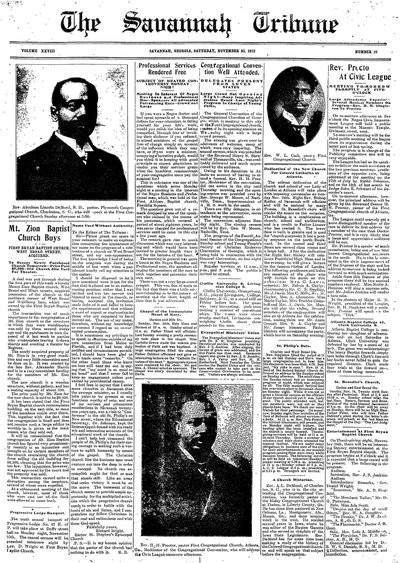
Page text (machine-generated)
The Savannah Tribune
M.
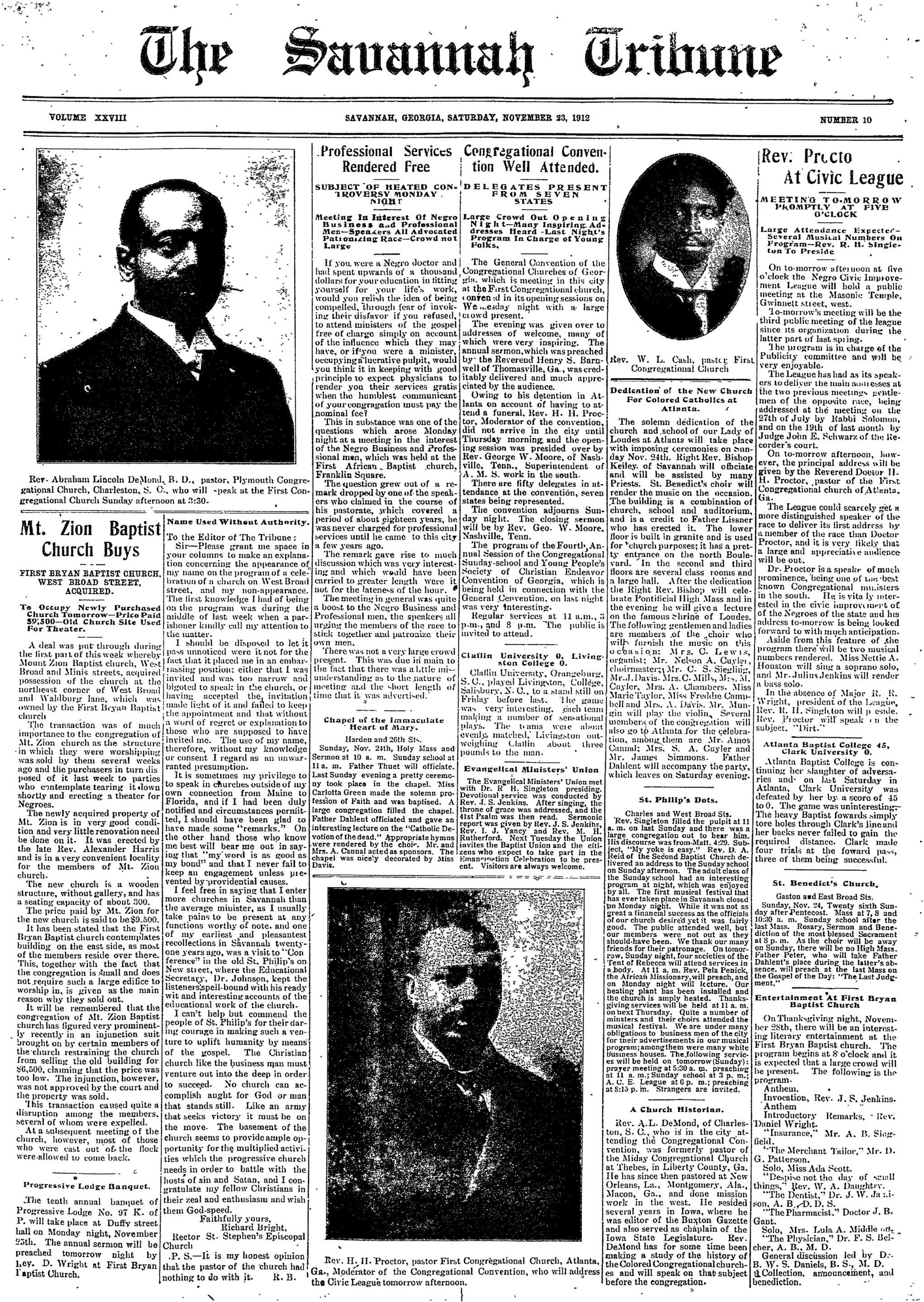
Rev. Abraham Lincoln DeMond, B. D., pastor, Plymouth Congregational Church, Charleston, S. C., who will peak at the First Congregational Church Sunday afternoon at 3:30.
VOLUME XXVIII
Rev. Abraham Lincoln DeMongational Church, Charleston, S. C. Congregational Church Sunday afternoon
Mt. Zion Baptist Church Buys
FIRST BRYAN BAPTIST CHURCH,
WEST BROAD STREET,
ACQUIRED.
To Occupy Newly Purchased
Church Tomorrow—Price Paid
$9,500—Old Church Site Used
For Theater.
A deal was put through during
the first part of this week whereby
Mount Zion Baptist church, West
Broad and Minis streets, acquired
possession of the church at the
northeast corner of West Broad
and Waldburg lane, which was
owned by the First Bryan Baptist
church
The transaction was of much importance to the congregation of Mt. Zion church as the structure in which they were worshipping was sold by them several weeks ago and the purchasers in turn disposed of it last week to parties who contemplate tearing it down shortly and erecting a theater for Negroes. The newly acquired property of Mt. Zion is in very good condition and very little renovation need be done on it. It was erected by the late Rev. Alexander Hurris and is in a very convenient locality for the members of Mt. Zion church.
The new church is a wooden structure, without gallery, and has a seating capacity of about 300.
The price paid by Mt. Zion for the new church is said to be $9.500.
It has been stated that the First Bryan Baptist church contemplates building on the east side, as most of the members reside over there.
This, together with the fact that the congregation is small and does not require such a large edifice to worship in, is given as the main reason why they sold out.
It will be remembered that the congregation of Mt. Zion Baptist church has figured very prominently recently in an injunction suit brought on by certain members of the church restraining the church from selling the old building for $6,500, claiming that the price was too low. The injunction, however, was not approved by the court and the property was sold.
This transaction caused quite a disruption among the members, several of whom were expelled.
At a subsequent meeting of the church, however, most of those who were cast out of the flock were allowed to come back.
Progressive Lodge Banquet.
The tenth annual banquet of Progressive Lodge No. 97 K. of P. will take place at Duffy street hall on Monday night, November 25th. The annual sermon will be preached tomorrow night by hey. D. Wright at First Bryan Baptist Church.
Name Used Without Authority.
To the Editor of The Tribune:
Sir—Please grant me space in your columns to make an explanation concerning the appearance of my name on the program of a celebration of a church on West Broad street, and my non-appearance. The first knowledge I had of being on the program was during the middle of last week when a parishoner kindly call my attention to the matter.
I should be disposed to let it pass unnoticed were it not for the fact that it placed me in an embarrassing position; either that I was invited and was too narrow and bigoted to speak in the church, or having accepted the, invitation made light of it and failed to keep the appointment and that without a word of regret or explanation to those who are supposed to have invited me. The use of my name, therefore, without my knowledge or consent I regard as an unwarranted presumption.
It is sometimes my privilege to to speak in churches outside of my own connection from Maine to Florida, and if I had been duly notified and circumstances permitted, I should have been glad to have made some "remarks." On the other hand those who know me best will bear me out in saying that "my word is as good as my bond" and that I never fail to keep an engagement unless prevented by providential causes.
I feel free in saying that I enter more churches in Savannah than the average minister, as I usually take pains to be present at any functions worthy of note, and one of my earliest and pleasantest recollections in Savannah twenty-one years ago, was a visit to "Conference" in the old St. Philip's on New street, where the Educational Secretary, Dr. Johnson, kept the listeners' spell-bound with his ready wit and interesting accounts of the educational work of the church.
I can't help but commend the people of St. Philip's for their daring courage in making such a venture to uplift humanity by means of the gospel. The Christian church like the business man must venture out into the deep in order to succeed. No church can accomplish aught for God or man that stands still. Like an army that seeks victory it must be on the move. The basement of the church seems to provide ample opportunity for the multiplied activities which the progressive church needs in order to battle with the hosts of sin and Satan, and I congratulate my fellow Christians in their zeal and enthusiasm and wish them God-speed.
Faithfully yours,
Richard Bright,
Rector St. Stephen's Episcopal
Church
.P. S.—It is my honest opinion
that the pastor of the church had
nothing to do with it. R.B.
SAVANNAH, GEORGIA, SATURDAY, NOVEMBER 23, 1912
C
Rev. H. II. Proctor, pastor First Congregational Church, Atlanta, Ga., Moderator of the Congregational Convention, who will address the Civic League tomorrow afternoon.
Rev. H. II. Proctor, pastor First Congregational Church, Atlanta, Ga., Moderator of the Congregational Convention, who will address the Civic League tomorrow afternoon.
Professional Services Rendered Free
SUBJECT OF HEATED CONTROVERSY MONDAY NIGHT
Meeting In Interest Of Negro Business and Professional Men—Speakers All Advocated Patronizing Race—Crowd not Large
If you were a Negro doctor and had spent upwards of a thousand dollars for your education in fitting yourself for your life's work, would you relish the idea of being compelled, through fear of invoking their disfavor if you refused, to attend ministers of the gospel free of charge simply on account of the influence which they may have, or if you were a minister, occupying lucrative pulpit, would you think it in keeping with good principle to expect physicians to render you their services gratis when the humblest communicant of your congregation must pay the nominal fee?
This in substance was one of the questions which arose Monday night at a meeting in the interest of the Negro Business and Professional men, which was held at the First African Baptist church, Franklin Square.
The question grew out of a remark dropped by one of the speakers who claimed in the course of his pastorate, which covered a period of about eighteen years, he was never charged for professional services until he came to this city a few years ago.
The remark gave rise to much discussion which was very interesting and which would have been carried to greater length were it not for the lateness of the hour.
The meeting in general was quite a boost to the Negro Business and Professional men, the speakers all urging the members of the race to stick together and patronize their own men. 'There was not a very large crowd present. This was due in main to the fact that there was a little misunderstanding as to the nature of meeting and the short length of time that it was advertised.'
Chapel of the Immaculate Heart of Mary.
Harden and 26th Sts.
Sunday, Nov. 24th, Holy Mass and Sermon at 10 a. m. Sunday school at 11 a. m. Father Thuet will officiate. Last Sunday evening a pretty ceremony took place in the chapel. Miss Carlotta Green made the solemn profession of Faith and was baptised. A large congregation filled the chapel. Father Dahlent officiated and gave an interesting lecture on the "Catholic Devotion of the dead." Appropriate hymns were rendered by the choir. Mr. and Mrs. A. Cannal acted as sponsors. The chapel was nicely decorated by Miss Davis.
Congregational Convention Well Attended.
DELEGATES PRESENT FROM SEVEN STATES
Large Crowd Out Opening Night—Many Inspiring Addresses Heard -Last Night's Program In Charge of Young Folks.
The General Convention of the Congregational Churches of Georgia, which is meeting in this city at the First Congregational church, convened in its opening sessions on Wednesday night with a large crowd present.
The evening was given over to addresses of welcome, many of which were very inspiring. The annual sermon, which was preached by the Reverend Henry S. Barnwell of Thomasville, Ga., was creditably delivered and much appreciated by the audience.
Owing to his detention in Atlanta on account of having to attend a funeral, Rev. H. H. Proctor, Moderator of the convention, did not arrive in the city until Thursday morning and the opening session was presided over by Rev. George W. Moore, of Nashville, Tenn., Superintendent of A. M. S. work in the south.
There are fifty delegates in attendance at the convention, seven states being represented.
The convention adjourns Sunday night. The closing sermon will be by Rev. Geo. W. Moore, Nashville, Tenn.
The program of the Fourth Annual Session of the Congregational Sunday-school and Young People's Society of Christian Endeavor Convention of Georgia, which is being held in connection with the General Convention, on last night was very interesting.
Regular services at 11 a.m., 3 p.m., and 8 p.m. The public is invited to attend.
Claitlin University 0, Livingston College 0.
Claflin University, Orangeburg, S.C., played Livingston, College, Salisbury, N.C., to a stand still on Friday before last. The game was very interesting, each team making a number of sensational plays. The teams were about evenly matched, Livingston outweighing Claflin about three pounds to the man.
Evangelical Ministers' Union
The Evangelical Ministers' Union met with Dr. R. H. Singleton presiding. Devotional service was conducted by Rev. J. S. Jenkins. After singing, the throne of grace was addressed, and the 41st Psalm was then read. Sermonic report was given by Rev. J. S. Jenkins, Rev. I. J. Yancy and M. H. Rutherford. Next Tuesday the Union invites the Baptist Union and the citizens who expect to take part in the Emancipation Celebration to be present. Visitors are always welcome.
[Picture of a man with a mustache and a suit].
Dedication of the New Church For Colored Catholics at Atlanta.
The solemn dedication of the church and school of our Lady of Loudes at Atlanta will take place with imposing ceremonies on Sunday Nov. 24th. Right Rev. Bishop Keiley, of Savannah will officiate and will be assisted by many Priests. St. Benedict's choir will render the music on the occasion. The building is a combination of church, school and auditorium, and is a credit to Father Lissner who has erected it. The lower floor is built in granite and is used for church purposes; it has a pretty entrance on the north Boulevard. In the second and third floors are several class rooms and a large hall. After the dedication the Right Rev. Bishop will celebrate Pontificial High Mass and in the evening he will give a lecture on the famous shrine of Loudes. The following gentlemen and ladies are members of the choir who will furnish the music on this occasion: Mrs. C. Lewis, organist; Mr. Nelson A. Guyler, choirmaster; Mr. C. S. Siegling, Mr.J.Davis, Mrs.C.Mills, Mrs.M. Cuyler, Mrs.A. Chambers, Miss Marie Taylor, Miss Freddie Campbell and Mrs. A. Davis, Mr. Mungin will play the violin. Several members of the congregation will also go to Atlanta for the celebration, among them are Mr. Amos Cannal; Mrs. S. A. Guyler and Mr. James Simmons. Father Dahlem will accompany the party, which leaves on Saturday evening,
St. Philip's Dots.
Charles and West Broad Sls.
Rev. Singleton filled the pulp at 11 a. m. on last Sunday and there was a large congregation out to hear him. His discourse was from Matt. 4:29. Subject, "My yoke is easy." Rev. D. A. Reid of the Second Baptist Church delivered an address to the Sunday school on Sunday afternoon. The adult class of the Sunday school had an interesting program at night, which was enjoyed by all. The first musical festival that has ever taken place in Sayannah closed on Monday night. While it was not as great a financial success as the officials of our church desired yet it was fairly good. The public attended well, but our members were not out as they should have been. We thank our many friends for their patronage. On tomorrow, Sunday night, four societies of the Tent of Rebecca will attend services in a body. At 11 a. m. Rev. Pela Penick, the African Missionary, will preach, and on Monday night will lecture. Our heating plant has been installed and the church is amply heated. Thanksgiving services will be held at 11 a. m. on next Thursday. Quite a number of ministers and their choirs attended the musical festival. We are under many obligations to business men of the city for their advertisements in our musical program; among them were many white business houses. The following services will be held on tomorrow (Sunday): prayer meeting at 5:30 a. m. preaching at 11 a. m.; Sunday school at 3 p. m.; A. C. E. League at 6 p. m.; preaching at 5:15 p. m. Strangers are invited.
A Church Historian.
Rev. A.L. DeMond, of Charleston, S.C., who is in the city attending the Congregational Convention, was formerly pastor of the Miday Congregational Church at Thebes, in Liberty County, Ga. He has since then pastored at New Orleans, La., Montgomery, Ala., Macon, Ga., and done mission work in the west. He resided several years in Iowa, where he was editor of the Buxton Gazette and also served as chaplain of the Iowa State Legislature. Rev. DeMond has for some time been making a study of the history of the Colored Congregational churches and will speak on that subject before the congregation.
NUMBER 10
Rev. Precto At Civic League
MEETING TO-MORROW
PROMPTLY AT FIVE
O'CLOCK
Lurge Attendance Expected
Several Musical Numbers On
Program—Rev. R. H. Singleton
To Preside
On to-morrow afternoon at five o'clock the Negro Civic Improvement League will hold a public meeting at the Masonic Temple, Gwinnett street, west.
To-morrow's meeting will be the third public meeting of the league since its organization during the latter part of last spring.
The program is in charge of the Publicity committee and will be very enjoyable.
The League has had as its speakers to deliver the main addresses at the two previous meetings gentlemen of the opposite race, being addressed at the meeting on the 27th of July by Rabbi Solomon, and on the 19th of last month by Judge John E. Schwarz of the Recorder's court.
On to-morrow afternoon, however, the principal address will be given by the Reverend Doctor H.H. Proctor, pastor of the First Congregational church of Atlanta, Ga.
The League could scarcely get a more distinguished speaker of the race to deliver its first address by a member of the race than Doctor Proctor, and it is very likely that a large and appreciative audience will be out. Dr. Proctor is a speaker of much prominence, being one of the best known Congregational ministers in the south. He is vitally interested in the civic improvement of of the Negroes of the state and his address to-morrow is being looked forward to with much anticipation-
Aside from this feature of the program there will be two musical numbers rendered. Miss Nettie A. Houston will sing a soprano solo, and Mr. Julius Jenkins will render a bass solo.
In the absence of Major R. R. Wright, president of the League, Rev. R. H. Singleton will preside. Rev. Proctor will speak on the subject. "Dirt."
Atlanta Baptist College 45,
Clark University 0.
Atlanta Baptist College is continuing her slaughter of adversaries and on last Saturday in Atlanta, Clark University was defeated by her by a score of 45 to 0. The game was uninteresting. The heavy Baptist fowards simply tore holes through Clark's line and her backs never failed to gain the required distance. Clark made four trials at the foward pass, three of them being successful.
St. Benedict's Church.
Sunday, Nov. 24, Twenty sixth Sunday after Pentecost. Mass at 7, 8 and 10:30 a. m. Sunday school after the last Mass. Rosary, Sermon and Benediction of the most blessed Sacrament at 8 p.m. As the choir will be away on Sunday, there will be no High Mass. Father Peter, who will take Father Dahlent's place during the latter's absence, will preach at the last Mass on the Gospel of the Day: "The Last Judgment."
Entertainment At First Bryan Baptist Church
On Thanksgiving night, November 28th, there will be an interesting literary entertainment at the First Bryan Baptist church. The program begins at 8 o'clock and it is expected that a large crowd will be present. The following is the program. Anthem.
Invocation, Rev. J. S. Jenkins.
Anthem
Introductory Remarks, Rev.
Daniel Wright.
"Insurance," Mr. A. B. Siegfield.
"The Merchant Tailor," Mr. D.
G. Patterson.
Solo, Miss Ada Scott.
"Despite not the day of small things," Rev. W. A. Daughtry.
"The Dentist," Dr. J. W. Jackson, A. B., D. D. S.
"The Pharmacist," Doctor J. B. Gant.
Solo, Mrs. Lula A. Middle on
"The Physician," Dr. F. S. Belcher, A. B., M. D.
General discussion led by Dr.
B. W. S. Daniels, B. S., M. D.
Collection, announcement, and benediction.
An Advertisement in This Paper
. Helps you, helps your town: pte
and helps the paper.
' POPULAR PRICED
Weim Oss, THE SHOE MAN
19 EAST BROUGHTON STREET. . e ‘
The affable H. B. Wright is still with us and expects tho cotitinaoual
patronage of his friends. . .
Johnson Undertaking Establishment.
—COMBINED WITH—— , 5
The Royall Undertaking Company
a « (incorp orated.) =
Funeral Directors and Embalmers
Finest line of Coffins, Saskets and Robes. White and black funeral
cara, Office and warerooms 325-331 Jeflerson street,
W. R. FIELDS, Manager.
Residence Phone 2032. Livery Stable Attached. Office Phone 676.
C. H. ROYALL, Residence 5093 Charles St. Phone 3064.
wy. kk. BLOND TT,
WHOLESALE AND RETAIL
* os .
Fruit- and Commission Merchant
£34 GT. JULIAN 8ST, WEST, 235 BRYAN 8T.. WEST. Phone 2968
SAVANNAH, GEORGIA,
Paim Shaving Palace -.
| FINEST IN THE CITY.
Expert Halr Cutting, Electric biassage and Shampooing a Bpecialty, A!
Work Done by Pxperienced Workmen, Courteous attention to all SHIN-
ING PARLOR ATTACHED.
PERRY R. WRIGHT, Proprietor
&17 WEST BROAD 8T, — — — —— = = SAVANNAH, GA.
New Improvements More Lights New {lk
The Ideal Picnic Spot of Savannah
i Secure your dates from ANDREW D,. MONROE, 124 East Thirty-third St.
Leet e Pes hee eee
4
+
+ SAVING ;
* , 4
>
» MONEYIS 3
+ 3
+
+ -A HABIT ;
oe . 4
be i
+ Get the habit of 4
+ saving a part of 3
“t your Earnings ™E
a each week. 4
4s : 7
a“ q
: $1.00 |
* 3
ms ° 4
+ 4
+ 4
> . starts an ‘
- * 4
c
; Account :
+ 4
* - 4
+ THE WAGE. 4
+> EARNERS’ LOAN - 4
= AND INVESTMENT 4
2 COMPANY, « 3
+ 7
+468 WESTB ROAD ST.9
+ Savannah, Ga. f
+ F
SPSS EERE EHTS
GAREY’S
Variety Bakery
Goods delivered promptly to any
part of the city,
506 West Broad St, Near Gaston.
Vhene 1869-J
pnp
:
fiasonic Books
= i
and Regalias
LODGE SEALS,
FINANCIAL CARDS and
BLANKS of every description.
Publishers and Manufacturers’ Prices
Laberal Discounts Will Be Arranged.
SOL G. SOH?ISON,
* Savannah, Ga. .
Agents Wanted
—TO SELL——
Magic
cv ° -
Shaving
Powder
x IT GIVES A CLEAN
SHAVE WITHOUT ,
THE USE OF A
RAZOR.
FOR PARTICULARS WRITE
The Shaving Powder Co.
SAVANNAH, «+ + 2 « » GEORGIA.
BROWN'S LODGING HOUSE
Hot and
Cold Baths
Shoe Shining Parlor At-
- tached
PROMPT ATTENTION TO PATRONS
217 East Broad Street
Phone S746 2
SAVANNAH, . . GEORGIA.
Hand This to Your Friend.
For First Class
GROCERIES and CONFECTIONERY
- ,» Cal On ,
m.'Gh GRAHAM
. 626 York St, West, ,
Courteous Attention to All.
Graduate Prof. Roher’s School,
New York.
719 West Broad Street,
2 Telephone 2328.
Wigs, Switches and Pompadours
Made from Natural Hair.
‘Combings Made Up. Shamposing and
Hair Straightening a Specialty.
Face and Electric Massage. Dyeing
and Matching Hair,
ORJENTAL HAIR GROWER.
An excellent preparation, will pro-
duce a beautiful growth of hair. DI-
rections on each box. For sale, price
25 cents per box.
ao TO—
Young Bros.
For your
TOBACCO, CIGARS and FRUITS~-
Of all kinds, |
602 West Broad Street,
peop
= é ;
WEST/SIDE
RESTAURANT
+ 461 Wert Broad Street,
Near Unton Btation,
‘The plcce to get firat<class meals
Wverything neat and clean. Mealt
prepared in an appetizing mannef
and at all hours daily,
MMoals 18 and 25 conta
MRS. A A SCOTT, Proprietreca
Your Money
Pile Grows
Just in propor-
tion as you ad-
vertise you r
- business, and
our columns
are open ‘for
you to begin
at once. Sup-
: pose you give
us a trial..
Advertise ~
in this paper
f THE HIGH
€ COST OF
\ LIVING
has not affected car ob
printing prices, We're still
doing commercial work :
m of ali kinds at prices cet.
i isfactory.to you.
Cee ee
ice
SR IS%
Age ‘oO
ol ince fen ise t 7
to boi A BBS - ;
3 cS 4) 19%
«2 92500 Gis Coes :
> aS ARAYA ES prs
£ iyo SLe RA ES oo
=f maa 8% 6
8 use Suerkoten a a 5
a 2
2 si 7 e<
< ¥ i
Ss
& sot Sahay Leven
FOWER REQUIRED ‘ON DIFFERENT GRADES
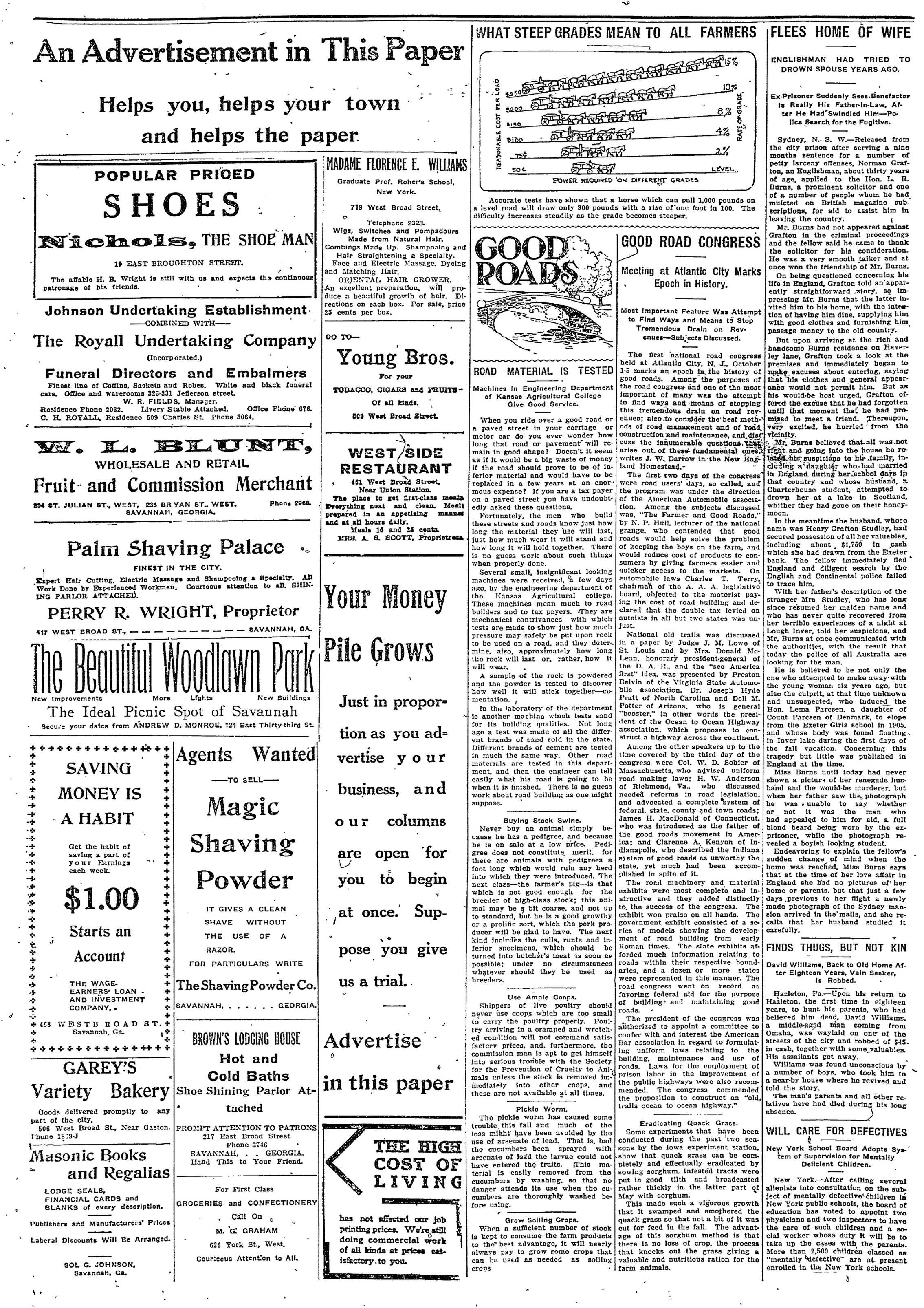
Accurate tests have shown that a horse which can pull 1,000 pounds on
po
‘a level road will draw only 900 pounds with a rise of’one foot !n 100. The
‘dificulty increases steadily as the grade becomes steeper.
GOOD:
OPES Oe
= ~ ee
== Sires =
ROAD MATERIAL IS TESTED
Machines In Engineering Department
of Kansas Agricultural College
Give Good Service.
‘When you ride over a good road or
@ paved street in your carriage or
motor car do you ever wonder how
long that road or pavement® will re-
main in good shape? Doesn't it seem
as if it would be a big waste of money
if the road should prove to be of in.
ferior material and would have to be
replaced in a few years at an enor-
mous expense? If you are a tax payer
on a paved street you have undoubt-
edly asked these questions.
Fortunately, the men who build
these streets and roads know just how
long the material they tise will last.
just how much wear it will stand and
how long it will hold together. There
is no guess work about such things
when properly done,
Several small, insignificant looking
machines were recelved, & few days
ago, by the engineering department of
the Kansas Agricultural college.
‘These machines mean much to road
builders and to tax payers. ‘They are
mechanieal contrivances with which
tests are made to show just how much
pressure may safely be put upon rock
to be used on a road, and they deter-
}mine, also, approximately how long
} tbe rock will Jast or, rather, how it
will wear,
| A sample of the rock is powdered
/and the powder is tested to discover
how well it will stick together—ce
mentation. ,
Im the laboratory ef the department
ig another machine winch tests sand
for its building qualities. Not long
#go a test was made of all the differ-
ent brands of sand gold in the state.
Different brands of cement are tested
in much the same way. Other road
materials are tested in this depart-
ment, and then the engineer can tell
easily what his road is going to be
when it is finished. There is no guess
work about road building as one might
suppose. *
Buying Stock Swine.
Never buy an animal simply _be-
cause he has a pedigree, and because
he fs on sale at a low price. Pedi-
gree does not constitute merit, for
there are animals with pedigrees a
foot long which would ruin any herd
into which they were introduced. The
next class—the farmer's pig—is that
which is not good enough for the
breeder of highlass stock; this ani-
mal may be 4 bit coarse, and not up
to standard, but he is a good growthy
or a prolific sort, which the pork pro-
ducer will be glad to have. The next
kind includes the culls, runts and in-
ferior specimens, which should be
turned into butchér’s meat 1s soon as
possible; under no circumstances
whatever should they be used as
breeders.
Use Amole Coors.
Shippers of live poultry should
never ase coops which are too small
to carry the poultry properly. Poul-
try arriving in a cramped and wretch-
ed condition will not command satis-
facterv prices, and, furthermore, the
comuiission man is apt to get himself
into serious trouble with the Society
for the Prevention of Cruelty to Ant-
mals unless the stock is removed im-
inediately into other coops, and
these are not available at all times.
Pickle Worm.
The pickle worm has caused some
trouble this fall ard much of the
loss mikht' have been avoided by tho
use of arsenate of lead. That is, had
the cucumbers been sprayed with
arsenate of ledd the larvae could not
have entered the fruits. (This ma-
terial is easily removed from tho
cucumbers by washing, so that no
danger attends its use when the cu-
cumbers are thoroughly washed be-
fore using.
Grow Sollina Crops.
When a sufficient number of stock
is kept to consume the farm products
to the® best advantage, it will nearly
always pay to grow £ome crops that
can ka uaed as needed as soiling
erons .
GQOD ROAD CONGRESS
Meeting at Atlantic City Marks
= Epoch in History.
Most Important Feature Waa Attempt
to Find Ways and Means to Stop
Tremendous Drain on Rev-
enues—Subjects Discussed.
The first national road congreas
held at Atlantic City, N. J.. October
1-5 marks an epoch in the history of
good roads. Among the purposes of
the road congress and one of tha most
important of many was the attempt
to find ways and -means of stopping
this tremendous drain on road rev-
enues; aleo.to consider the'best meth-
ods of road management and of road
construction and maintenance, and diss
cuss the innumerable questions. that
arise out_of these fundamental ones,
writes J. W. Darfaw in-the New Eng
land Homestead.+ =
The first two days of the congress
were road users' days, so called, and
the program was under the direction
of the American Automobile associa-
tion. Among the subjects discussed
was, “The Farmer and Good Roads,”
by N. P. Hull, lecturer of the national
grange, who contended that good
roads would help solve the problem
of keeping the boys on the farm, and
Would reduce cost of products to con-
sumers by giving farmers easier and
quicker access to the markets. On
-gutomobjle laws Charles T. Terry,
‘chafimah of the A. A. A. legislative
board, objected to the motorist pay-
‘ing the cost of road bullding and de-
clared that the double tax levied on
autoists in all but two states was un-
Just.
National old trafls was discussed
in a paper by Judge J. M. Lowe of
St, Louls and by Mrs. Donald Mc-
Lean, honorary president-general of
the D. A, R., and the “see America
first” idea, was presented by Preston
Belvin of the Virginia State Automo-
vile association, Dr. Joseph Hyde
Eat of North Carolina and Dell M.
Potter of Arizona, who is general
“booster,” in other words the presi-
dent of the Ocean to Ocean Highway
‘association, which proposes to con-
struct a highway across the continent.
| Among the other speakers up to the
‘time covered by the third day of the
congress were Col. W. D. Sohier of
Massachusetts, who advised uniform
road making laws; H, W. Anderson
of Richmond, Va. who discussed
needed reforms in road legislation,
and advocated a complete ‘system of
federal. state, county and town roads;
James H, MacDonald of Connecticut,
who was introduced as the father of
the good roads movement in Amer-
ica; and Clarence A, Kenyon of In-
@ianapolis, who described the Indiana
system of good roads as unworthy the
state, yet much had been accom-
plished in spite of it
The road machinery and material
exhibits were most complete and in-
structive and they added distinctly
to, the success of the congress. The
exhibit won praise on all hands. The
government exhibit consisted of a se
ries of models showing the develop-
ment of road building from early
Roman times. The state exhibits af-
forded much Information relating to
roads within their respective bound-
aries, and a dozen or more states
were represented In this manner. The
road congress went on record as
favoring federal ald for the purpose
of buildings and maintaining good
roads. -
The president of the congress was
alithorized to appoint a committee to
confer with and interest the American
Bar association in regard to formulat-
Ing uniform laws relating to the
building, maintenance and use of
roads. Laws for the employment of
prison labor in the improvement of
the public highways were also recom-
mended. The congress commended
the proposition to construct an “old.
trails ocean to ocean highway.”
Eradicating Quack Gracs.
Some experiments that haye been
conducted during the past ‘two sea-
sons by the lowa experiment station,
show that quack grass can be com.
pletely and effectually eradicated by
sowing sorghum. Infested tracts were
put in good tilth and broadcasted
rather thickly Im the latter part of
May with sorghum.
This made euch a vigorous growth
that it swamped and smothered the
quack grass so that not a bit of It was
eut for feed in the fall. The advant-
age of this sorghum method is that
there is no loss of crop, the process
that knocks out the grass giving a
valuable and nutritious ration for the
farm animals.
FLEES HOME OF WIFE
ENGLISHMAN HAD TRIED TO
DROWN SPOUSE YEARS AGO.
Ex-Prisoner Suddenly Sees. Benefactor
Is Really His Fathenin-Law, Af-
ter He Had”Swindied Him—Po-
ee Search for the Fugitive.
Sydney, N..S. W.—Released from
the city prison after serving a nine
months sentence for a number of
petty larceny offenses, Norman Graf-
ton, an Englishman, about thirty years
of age, applied to the Hon. L. R.
Burns, a prominent solicitor and one
of a number of people whom he had.
mulcted on British magazine sub-
scriptions, for ald to assist him in
leaving the country. t
Mr. Burns had not appeared against
Grafton in the criminal proceedings
and the fellow said he came to thank
the solicitor for his consideration.
He was a very smooth talker and at
once won the friendship of Mr. Burns.
On being questioned concerning his
Ufe in England, Grafton told an‘appar~
ently straightforward story, 80 im-
pressing Mr. Burns tbat the latter in-
vited him to his home, with the intee-
tion of having him dine, supplying him
with good clothes and furnishing him,
passage money tq the old country.
But upon arriving at the rich and
handsome Burns residence on Haver-
ley lane, Grafton took a look at the
premises and immediately began to
make. excuses about entering, saying
that ‘his clothes and general appear-
Ants would not permit him, But as
his would-be host urged, Grafton of-
fered the excuse that he had forgotten
uati! that moment thaf he kad pro-
mised to meet a friend. Thereupon,
very excited, he hurried ‘from the
vicinity.
, Mr, Burns belloved that-all was.not
Yelit. and going into the house he re-
latda_ Ate suspicions tor hir family, in-
cluding a‘danghtér who-had married
in Brgland, during ber<schbol days in
‘that country and whose hisband, 2
‘Charterhouse student, attempted to
drown her at a lake in Scotland,
whither they had gove on their honey-
moon.
In the meantime the husband, whose
name was Henry Grafton Studley, had
secured possession of all her valuables,
including about, $1,750 in cash
which she had drawn from the Exeter
bank. The fellow immediately fled :
England and ¢iligent search by the
English and Continental police failed
to trace him.
With her father's description of the
stranger Mrs. Studley, who has long
since resumed her maiden name and
who has never quite recovered from
her terrible experiences of a night at
Lough Inver, told her suspicions, and
Mr, Burns at once communicated with
the authorit{es, with the result that
today the police of all Australia are
looking for the man.
He Is believed to be not only the
one who attempted to make away-with
the young woman six years ago, but
also the culprit, at that time unknown
and unsuspected, who Induced the
Hon. Lema Paresen, a daughter of
Count Paresen of Denmark, to elope
from the Exeter Girls school in 1905,
and whose body was found floating -
in Inver lake during the first days of
the fall vacation. Concerning this
tragedy but little was published in
England at the time.
Miss Burns until today had never
shown a pictura of her renegade hus-
band and the would-be murderer, but
when her father saw the, photograph
he was-unable to say whether
or not it was the man who
had appealed to him for aid, a full
blond beard being worn by the ex-
prisoner, while the photograph re-
vealed a boyish looking student.
Endeavoring to explain the fellow’s
sudden change of mind when the
homo was reached, Miss Burns says
that at the time of her love affair in
England she Had no pictures of’ her
home or parents, but that just a few
days previous to her flight a newly
made photograph of the Sydney man-
sion arrived in the’malls, and she re-
calls that her husband studied it
carefully.
FINDS THUGS, BUT NOT KIN
2 ee
David Willlams, Back to Old Home Af-
ter Elghteen Years, Vain Seeker,
ls Robbed. .
Hazleton, Pa—Upon his return to
Hazleton, the first time in eighteen
years, to hunt his parents, who had
believed him dead, David Williams,
a middle-aged man coming from
Omaha, was waylafd on one of the
streets of the city and robbed of $45-
in cash, together with some, valuables.
His assailants got away. 7
Williams was found unconscious by
a number of boys, who took him to
a near-by house where he revived and
told the story.
‘The man's parents and all other re
latives here had dled during hls long
absence. >
WILL oS FOR DEFECTIVES
New York School Board Adopts Sys’
tem of Supervision for Mentally
Deficient Children.
New York.—After calling several
allentsts into consultatfon on the sub-
ject of mentally defective‘éhildren In
New York public schools, the board of
education has voted to appoint two
physicians and two Inspectors to have
the care of such children and a so-
cial worker whose duty it will te to
take up the cases with the parents.
More than 2,500 children classed as
“mentally Sefective” are at. present
enrolled in the New York schools.
WINE -
a
mi 2 -‘S
Be fee
Se egal
cl deb| Se
HIS ONE REDEEMING, FEATURE
Ball Player's Averages Were Poor,
but He Selected Good Man to
Write Stories of Game.
-“Yes, we're mighty proud of Bilt.”
“1 s'pose you are. Still his fieldin’
average wasn't quite up to the mark
this year, was it?”
“No, Bill sort of bad an off year In
his fieldin’, but we're mighty proud of
him, just the same.”
“I ain't saw the official battin’ aver-
ages yet. How did Bill do with the
stick this season?”
“Well, he kind of fell down in his
battin’. Didn't seem to have no luck;
but we're proud of him, just the
same.”
“Mebby he done some great work
stealin’ bases. That's a mighty tm:
portant part of the game.”
“To tell the truth Bill didn’t do
much in the way of stealin’ bases this
year. He got spiked early in the sea
son and it seemed to Kind of slow ‘im
up.”
“Well, what fs {t you're so blamed
Proud of him about, then?”
“Didn't you notice them reports he
wrote about the world’s championshir
games? Hill's was the best of the
whole lot.”
“I don't see anything much about
that to be proud of. I s'pose he got
somebody else to write ’em fer him.”
“Sure. But look at the judgment he
showed in pickin’ out the chap that
done It.”
Unthinkable.
Quite unexpectedly one of Brooks’
distant relatives had remembered him
in his will, but Brooks hadn’t told
anybody about it.
“Rivers,” he asked, in,a casual. off-
hand manner, “what do you reckon
you could do with—we'll say with—
$1,200, If somebody should die and
leave you a sum like that? How ‘would
you" =
“Twelve hundred dollars!” gasped
Rivers. *
“All at once? Great Scott, I couldn't
believe It! I'd think I had gone
crazy!”
NOT IN HIS LINE.
se Our (eu
- pe
AS By
al as Ue
Lm — ph
| —* ZY MV
Be OG
r ies ds A
| aS SS
Bess
st fo ZZ,
Py eee A
VALI
Managing Editor—See here! We
didn’t have a line about that fire early
this morning—
City Editor—No; I didn’t have any-
body to send out but the society edi-
ee E.—Well?
Cc. E—Well, he simply brought in a
list of the names of those present.
Music.
“Just Isten to the baby!”.said
young Mrs. Torkins. + :
“Yes,” replied her husband. “He's
trying to yell his head off!”
“and isn't it pleasant! The preco-
clous pet sounds as if he were at a
ball game, and our side had made a
home yun.”
Hyphenated Eplaode.
“What bas become of your hyphen-
ated friend?”
“My hyphenated friend?”
“Yes; your friend, Mr. Wombat
Wombat.” :
“He is ill of berl-berl.”
“Where?” ig
“In Walla-Walla.”
+ ‘Taking Life Easy.
“Rasserby used to have,a hard time
making both ends mett.”
“That's true. He seems more cheer-
ful now. I wonder why?”
“He's quit trying to make both ends
meet.”
A Great Capacity.
“Mr, Guzzlitt, have you any rivets
in your sides?” §
“No, Bobby. Why do you ask me
such a question?”
“My father sald you were a human
tank.” :
Inanimate Salesmen.
“Are these good graphophones?”
“The goods speak for themselves.”
“That's 80. Well, wind one up and
Jet's see if it can effect a sale.”
SUITABLE RING FOR A LADY
Young Man, Who Is Hard to Please,
Is Finally Told by Clerk to Buy
Pale of Gloves.
“I want to buy a diamond ring for a
lady,” said the young' man who-had
for half an hour been hanging ‘around
in the Jewélry department.
“Just step this way, please,” replied
the pretty girl behind the counter.
“About how much do you wish to
pay?”
“I don’t know. I want something
kind of good.”
“Here is one for $175 that fs very
nice. That's a splendid little stone.”
“Yes, it seems to be quite fine. Let
me see something a Ittle cheaper if
you have it.”
“This oné is $150. ‘The stone is per:
fect, too. It has a beautiful sparkle,
don't you think?”
The sparkle seems to be all right,
bat I don't just Ike, the setting.
Haven't you anything that 1s not so
expensive?”
“Ob, yes. I can show you a yery
pretty ring for $125,”
“1 don't believe I want to go as high
even as that.”
The young woman was in the act
of taking another tray from the show-
case, but she put it back and, stralght-
ening up, looked the ntggardly fellow
in the eyes, saying: -
“I thought you said you wanted it
tor a lady. If {t's only for your sister
why don't you buy her a pair of
gloves?”
COOL TREATMENT.
v iS =) ei i =a
NN, AY
RI Pons
yy ASN
wf Neos Uh
’ 2X
0 We (
IN MA Ashita
AND Sh AN SHe
NS SN ied
SS a
Mrs. Harlemhite—Did you tell the
janitor you'd complam to the land-
lord if he didn't give us more steam
heat? .
Harlemhite—Yes, and he sald he'd
‘make it hot for me if I did,
2 Her Covecience Clear,
“Well,” sald Mrs. Oldcastle, “it looks
as if my son*had found his place at
last. He has become a proetor in ad.
miralty.”
After she had studied the matter
tor a moment Mrs. Gottalotte put an
arm around her friend and consoling-
ly said:
“Try to dear it the best you can.
You'll always have the satisfaction of
knowin’ you done the ‘best you éould
for him, anyhow.” :
‘Her Best Recollection.
Physiclan—Cold in the head? That
all? I won't need to’ give you any
written prescription for that, madam.
Just send over to the drug store and
get an ounce of tris-nitrate of bismauth.
You can remember that easily enough.
Use it as you would snuff.
Mrs. Lapsling (an hour fater)—
Joimny, I wish you'd go to the drug
store and get me an ounce of the
transmigration of Bismarck.
-Gave Him Warning,
Western Judge—Why did yon Kill
Long Jack?
Hair Trigger Ike—He was a bad
man, y‘r honor, an’ it,was a tase 0”
chaw or be chawed.
Judge—Did you give him any warn-
ing before you shot him?
Hair Trigger Ike—Oh, yes, y’r hon-
or. I told him to hold up his hands.
tnveatigation.
“Did your investigation develop any
facts?”
“Yes.” replied the inquisitor. “We
have every reason to believe that the
answers given to our opéning ques-
tions as to the name, business and
residence of the star witness were
complete and absolutely accurate.”
———————
Well Written Up.
| “What do you think of the world’s
series?”
“Haven't got through reading about
it yet. I've read what the red-blood
novelists and the dialect poets have
to sasf and am just getting around
to the essayists and analytical high-
brows.”
.‘1-Timed. :
She—I see the papers say the du-
thorities are going to sbut up the
bucket shops. ~ .
He—Yes, that's so.
She—What a mean thing to do fust
when fall housecleaning is due. I
hope they'll let the broom factories
stay open.
Rough Work.
“I bad to quit rooming with that
football player.”
“Did he talk too much football?”
- "Yt wasn’t that go much, He was
always dreaming he was in a terrible
scrimmage.” i;
Blowing In the Coln.
“sly grandfather 8 hard to handle.
He wants to play the races, give wine
euppers, and go a rapid pace.”
“My grandfather is comparatively
easy,to manage. All he wants to do
{s to buy a chicken farm.”
OLD JENNINGS’ COUP
How Easy-Going Brskdionpar Bik
Best of Pompous Employer.
* By ERAN (FILSON, .
bookkeeper for the Hammer Press
company for twenty years and was by
far the longest employed of all the
five hundred odd persons in the big
building devoted to the manufacture
of the patent printing machine. Jen-
nings antedated President Bland, and
the treasurer, Muleahy, and he could
remember the time when the Hammer
Press company was a small concern
operating in a tiny shop oti Master-
man street.
Just as Jennings was the, oldest of
the men, so Miss Mary Hewlett was
the oldest of women employes. In a
very few years people would begin to
speak of her as an old maid. Miss
Hewlett was past thirty—in fact, she
was past thirty-five. She was the head
of the card index system, and her
desk was immediately opposite that
of Old Jennings in the aisle down
which President Bland walked pom-
pously to his office three times a week:
and sometimes four.
Old Jennings had never been any-
thing but a bookkeeper. He had been
bookkeeper for Van Tuysen, the in-
ventor of the famous press, in the
first days of the company; he alone
6f the old employes had been retain-
ed when, thirteen years previously,
the little organization had been taken
over by Bland.
Yan Tuysen, had he known the real
value of his invention, might have
become a millionaire. But he was an
easy-going, credulous sort of fellow.
He had let himself be jockeyed out
of his property—had sold it almost for
2 song and gone steadily downhill. He
Sometimes haunted the company's
offices, a disreputable wreck, 4asking
for ald, especially after his recovery
from a drinking spree. On the last
occasion Bland had told him not to
return. He never came back.
But on Saturday evenings Jennings
would visit him at his cheap lodging
house on Fourteenth street, and there,
seated upon the dingy bed, they would
discuss old times together. Van Tuy-
sen’s hatred of Bland was profound,
his pride In his invention supreme
It was grief at the loss of his factory
that drove him déeper and deeper into
the mire. The old’man’s days seem-
ed numbered, and, conscious of it, and
of his importance, he felt’ a resent-
ment that drove him Into paroxsyms
of tury. -
On Sundays Old Jennings would
call on Miss Mary Hewlett and they
would take a quiet stroll In the park
together. They had been engaged for
a number of years. “But we can’t be
married on sixty dollars a week,” said
Old Jennings. And Miss Mary, who
might, perhaps, have risked the ex-
periment, would sigh a little and be
silent. At the door of her- boarding
house Old Jennings would kiss her
good-by. .
“Better times will come; they must,
come, my dear,” he would say. And
Miss Mary Hewlett would reecho the
hope. Surely his salary would be
raised the next Christmas.
On the Saturday before Christmas
Old Jennings was not at his post. Ev-
erybody wondered, for he had never
been known to miss a day duringSthe
whole period of his service with the
company. But that evening he was
at Van Tuysen’s lodgings, as usual.
The old fellow was in a bad way.
“I guess I'm done for, John," mut-
tered the old inventor, stretching out
a bony hand in‘greeting. “And you'll
be at’your old post years after I'm in
‘the ground.” 7
Old Jennings laughed shortly. “Not
for me,” be said. “I'm out of it.”
- “What's that?” erled Van Tuysen,
raising himself and staring at the
other incredulously.
“I've Jost my job," sald Old Jen-
nings prosaically enough. “Bland sent
for me yesterday. ‘Jennings’ he
sald, ‘I guess we'll have to let you gg.
We're cutting down expenses anid
‘can't afford to keep you any longer.’
) “Why,” shouted Van Tursen,
“they've got money to burn. Thes’re
as rich as—as—" He could hot find
® suitable simile. |
“Why, it's this way,” sald Old Jen-
nings philosophically. "You know the
Hammer Press has the monopoly of
the market everywhere for printing
designs on the new doubleroll cer-
tificate paper. And the shares have
jumped from the original ten dollars
to—let me see, eighty-four, fen't st?
Well, Shafer and his crowd have been
trying to get control of it. They've
got all but the barest majority of
the shares and they're leaping up in
yalue every hour. Now Bland has all
his fortune tied up in the concern, and
| an hae. Salsa. ent tite Anak = comme.
studied with astonishment, and then,
not quite understanding, he looked
at Van Tuysen inguiringly.
“One hundred shares in tle Ham-
mer Press company,” said Van Tuy-
sen grimly. “They're worth about ten
thousand dollars now, John. It’s all
that was left to me—and I had the
sense to hold on to it. And it's yours,
Jobn, after I'm dead, After? No,
now.”
“But this {s a fortune!” exclaimed
Old Jennings. “Why, it would—you
can’t mean—" =
“Do I mean you to sell them and
retire, John? No, I don't,” said Van
Tuysen. “Listen, John, and get your
brains to working.” ‘
The two men sat up till two in the
morning, one outside the Coverlet, one
propped up within, figuring, comput-
ing. E
And Mary Hewlett missed John Jen-
nings on the next day for the first
Sunday in thirteen years.
Strange to say, John Jennings was
at his desk as usual on the Monday
morning, and the men in the office,
who had Iearned of his discharge, look-
ed at him in surprise, and winked, and
muttered that the old bookkeeper
must be losing his wits. So thought
Mulchay, the treasurer, when he
caught sight of him.
Um—did you you receive no com-
munication from Mr. Bland yester-
day?” he asked, stopping beside him
as he passed to his seat.
“Yes, sir,” replied Jennings respect-
fully. “But I thought Mr. Bland might
have changed his mind and might like
to speak to me again.”
Mulchay was afraid of ascene. He
hated scenes; besides, he did not
Imow but that John might have
some scheme of vengeance In his
mind, not disconnected with a knife
or a revolver. “He walked away to
warn Mr. Bland’s secretary. But Jen-
nings anticipated him, for, entering at
that moment, Bland, too, caught sight
of Jennings afd stopped to ask him
why he was there. And John's man-
ner was so mild, so respectful, and 50
portentous, that he actually agreed to
grant him a private interview.
“Now, Jennings,” he began pom-
pously, when they were alone togeth-
er, “we can't do anything more for
you. If it’s that—”
“No, Mr. Bland, it’s this,” sald Old
Jennings, and spread an engraved doc-
ument upon the table. Mr. Bland look-
ed atit and sprang up out of his chair.
“It’s that missing hundred shares!”
[he gasped. “Where did you get it,
Jennings? It's a forgery.”
“No, sir, it's the missing hundred
shares. You said so, Mr. Bland,” re-
turned Old Jennings quietly.
f “Where did you get it?"
“I've got it,” answered John.
“If it isn't a forgery I'll buy it from
you at fifty,” said President Bland
eagerly. 7
“No, sir,” answered Jobn.
“Sixty, then, Seventy. Ninety. A
hundred. What do you want for it?
They haven't reached a hundred yet,”
|e yelled, losing his self-control en-
tirely. 2 :
“Mr. Shafer would give me two hun-
dred,” sald John quietly.
“Curse you for a thief! Will you
take two, hundred at once?”
“No, sir.” said Old Jennings.
“Well, what do you want?” inquired
Bland, sinking back in his chair and
twitching nervously at the morocco
padding,
“Ll ted you,” Old Jennings an-
swered, straightening his bent forni
and looking the other between the
eyes. “I might sell out to Shafer, and
I guess that would make it nip and
tuck between you both. But Shafer's
just as big a rogue as you, and just
as mean, and this time I'm playing
for my own hand and for two others.
I’m not going to sell. Those shares
are worth just fifty dollars apiece, and
I won't, take advantage of any cut-
throat competition between Shafer
and you to make money. + But youll
do three things and sign an agreement
now.” ’,
“Name them, Mr. Jennings,” sald
Bland; and he said the latter part of
this expression for the first time in
his life.
“Well, sir,” said Old Jennings, re-
suming his respectful mafiher, “you
“know that I was associated with Mr.
Van Tuysen in the first days of the
‘machine and I know a whole lot about
it, So you will give me a ten years”
contract as head of the foundry at—
what does Mr. Rogers get?—Ah, yes,
at five thousand a year.”
“But what about Rogers?” ~
ae ¥,
“Name them, Mr. Jennings,” sald
‘Bland; and he said the latter part of
‘this expression for the first time in
‘hie life.
“Well, sir,” said Old Jennings, re-
suming his respectful mafiher, “you
“know that I was associated with Mr.
Van Tuysen in the first days of the
‘machine and I know a whole lot about
it, So you will give me a ten years”
contract as head of the foundry at—
what does Mr. Rogers get?—Ah, yes,
at five thousand a year.”
“But what about Rogers?" ~
“That's 0,” Jennings’ agreed.
“Well, as assistant, then, at thirty-five
hundred, with reversion if Mr. Rog-
ers shall leave you.” He was always
a soft fool, Old Jennings was. “Sec,
ondly, you will appoint Mr. Van Tus-
sen head.of the assembling room, at
the same salary, for 1 know that
Brown intends to leave you next.
month. And he'll be on & ten-year
contract too.” :
“But the old Idiot's dead!" yelled
Bland. “If'he wasn't he'd have been
here borrowing money from me long
ago.”
“Oh dear no,” answered Old Jen-
nings suavely. “I saw his doctor yes-
terday and he told me that, with prop-
er care and regular employment he's
good for years. It's grief ‘that’s kill.
ing him, Mr. Bland.”
“Well, what's the third condition?”
growled Bland savagely.
“A month's leave of absence-on full
salary for Miss Hewlett and myself,
sir,” sald Old Jennings. “You see,
sir, we are expecting to get married
tomorrow. After that she's going to
leave you.”
And when Old Jennings waited ‘tor
Mary Hewlett that night at the office
door there was a look on his face
which told her what sho wanted to
know fully five seconds before he kiss.
ed her. .
(Capyright, wi, by W. G. Chapman.)
+ THE
SCRAP
BOOK
ST,
=
af A
8 <> SSS
_ The prince of Monaco presented re-
cently to the Academy of Sciences in
‘Paris some notes about cephalopods
captured by him at an average depth
of about 13,000 feet. Cephalopods are
octopuses, cuttlefish and squids. These
deep sea creatures, he said, have such
transparedt bodies that all their Interr
nal arrangements can be seen distinct-
ly, and even the course of the nerves
through the head and tentacles may
be traced, Several years ago the prince
deseribed come cephalopods which
chad searchlights fixed ‘po: their
heads. He now describes a species
With eyes of whigh the lower half is
fuminous, so that ‘the eye serves both
foF seeing and, for lighting. Any ant-
mal that inhabits such depths as these
do must have artificial light, for the
sun’s rays cannot penetrate, and all
is absolute darkness, So the eyes of
these cephalopods are perfectly adapt-
ed to their environment.
. THE BLANKET TREE.
Blankets grow on trees in’ Ecuador,
and while the idea of an all-wool,
fresh from the forest, “bed-covering
might give insomnia and a backache
fo the child of civilization who likes
to snuggle comfortably under several
layers of down and wool, the natives
find it all right, as In fact, it is.
When an Ecuador ‘Indian wants a
blanket he hunts up a demajagua
tree and cuts from it a five or six foot
section of the peculiarly soft, thick
bark. This 1s dampened and beaten
until the flexibility of the sheet 1s
much increased, Tho rough, gray ex-
terlor is next peeled off, and the sheet
dried in the sun. The result is 2
blanket, soft, ght, and fairly warm,
of an attractive cream color. It may
be rolled into a compact bundle with-
cut hurt and with ordinary usage will
last for several years—Herper's
Weekly.
FARM HAS TRAGIC HISTORY.
A tragic history accompanies a
Welsh farm near Swansea. The farm
is known as “Talywanda.” A man
tamed David Davies, a farmer, thirty
years old, committed suicide there, a
few days ago, by cutting his throat.
‘When found fn a field, the body was
almost beyond recognition, » having
been attacked by rats. No fewer than
five inquests have been held’ by the
coroner at the farm on bodies of
members of the family, during the
past few years, and all met singular
deaths. The father was killed by
being run over by a cart which he
was drivingy the mother died sudden-
ly; an elder brother was thrown off
his horse and killed, and another
brother hanged himself. A previous
occupant of the farm, prior to the
tenancy of the Davieses, also hanged
himself.
SMOKE COSTS MILLIONS.
More than $500,000,000 a year is
done in damage to merchandise, de-
facement of buildings, tarnishing of
metals, injury to human and plant life,
Increased cost of housekeeping and
losses to manufacturers due to Imper-
fect combustion of coal. In other
words, in abating the smoke nufsance
in the large cities this amount of
money will be saved, as well as in-
creasing the comfort and conventence
of the residents. An important step
in this direction has been taken in
Pittsburg, where the University of
Pittsburg has undertaken to call the
matter to the attention of those inter-
ested in a series of papers published
in the form of bulletins,
FIRST SON NOT ALWAYS BEST.
‘The first born son is not necessarily
the smartest, according to history.
Among famous men of genius who
came along late in their families are
Joseph David, Napoleon, Dickens, Lin-
coln, Washington, Cromwell, Tolstol,
Daniel Webster, Franklin, Balzac, Ten.
nygon, Chopin, Van Dyck and Rem-
brandt. The oldest son in the family
is not necessarily the best. Being the
oldest, of course, he will put on the
most airs and be a family leader be-
cause of mere firstness, but the young-
est boy may be the one whose name
will become distinguished, or the one
who will be the greatest comfort to
his parents.—Gallipolis Tribune.
UNIT OF MAGNETISM.
‘The electron, or unit of eloctricity,
1s now supposed to form a material
part of the atoms of the various’ ele-
ments, and Prof. Pierre Weiss has at-
tempted to prove that a similar par-
ticle, which he calls the “magneton,”
is the unit of magnetism. In testing
his theory he has made numerous ex-
periments on magnetization at very
low temperatures. He has found con-
firmation of his view, and believes he
has shown the presence of magneton
in the atoms of iron, nickel, cobalt,
copper, manganese and the metals of
the rare earths. ©
ZEBRA REALLY BEAUTIFUL. -
The zebra is, perhaps, of all quad-
rupeds, the best made and most beau-
tifully clad by the hand of ‘nature, To
the figure and graces of the horses, It
adds the elegance of the stag; and the
black and white bands with which its
body is ornamented are arranged with
such wonderful symmetry that we
might almost be disposed to imagine
that rule and compass had been em-
ployed In their formation. ‘These al-
ternate bands are narrow, parullel and
exactly separated. They extend not
only over the body, but the head,, thigh
and legs and even over the ears and
tail. They follow 20 exactly the con-
tour of.the different forms that they
exhibit the entire figure in the- most
advantageous point of view. In the
female these bands are alternately
black and white. In the male they are
black and yellow, but always of a Ilve-
ly and brilliant: tint. They also rest
upon a ground of short, fine and cop!-
ous hairs, whose luster considerably
augments the general beauty of the
colors.
“TRAVELING” STONES.
“Traveling” stones, from the size of
a pea to six inches in diameter, are
found in Nevada. When distributed
on a floor or other level surface, with-
in two or three feet of one another.
they Immediately begin to travel to-
ward a common center, and there le
huddled like a clutch of eggs- in 2
nest. A single stono removed to a dis-
tance of three and a half feet, upon
being released, at once started with
wonderful and somewhat cemfcal cel-
erity to join its fellows.
These queer stones are found In a
region that is comparatively fevel and
Uttle more.than bare rocks, Scattered
over this barren region are little ba-
sins, from a few feet to a rod or two
in diameter, and it is in the bottom of
these that the rolling‘stones are found.
The cause for the strange conduct
of these stones {s doubtless to be
found in thé material of which they
are composed, which appears to be
loadstone, or magnetic fron ore.
INGENIOUS COUNTING SCALE.
In a motor accessories manufactory
there has been installed a specially
‘constructed scale for use in-counting
small parts. The upper scoop is the
anit, and the other scoops balance, re-
spectively at 25, 50 and 100 times the
weight contained in the former. By
counting out 10, 25 or 50 pieces to be
counted, and placing thein in the up-
per scoop, and then filling up one of
the other scoops until the scalo bal-
ances, the number of pieces in the lat-
ter may be determined by multiplying
the number in tke upper scoop by the
number markéd on the larger scogp.
That is, if there are say 50 pleces in
the unit scoop, the number in the
largest scoop, when the scale balances,
would be 160 times 50, or 5,000 pieces;
or in the next scoop, 2,500 pleces, and
50 on.
PROLONGING HUMAN LIFE.
The astounding apd gratifying fact
ig claimed that in the Inst half cen-
tury an average of 12 years has beer
ndded to the period of human life.
Since the first actual records were
taken In New York city in the middle.
‘60’s the rate cf mortality has. been
reduced from 35 deaths in each 1,000
inhabitants to about 15 or 16. This
reduction has resulted from the con-
trol of infectious diseases. The sav-
ing thus made relates only to the
period ef life under fifty years. There
is no saving knowledge regarding tho
organic diseases of advancing years,
which affict especially those who bave-
been activo4in affairs and who are-
tuxed with large responsibilities.
LIVED AFTER HANGING. f
There are many curlous cases of re-
suscitation after hanging, for Instance
that of Mme. de Balsham, who, In 1264,
having been condemned to death for
harboring thieves, was left hanging on
the gallows from nine o'clock Monday
morning until sunrise Thursday, but
revived on being taken down. Henry
IMI. granted her a pardon.
Another instance ‘of the kind oc-
curred at Oxford in 1650, when Anna
Green, a servant girl, hanged for child
murder, revived when handed over to
the doctors for dissection. Eager in-
quirles were made of her as to her
sensations after- suspension, but she
remembered nothing, saying that her
revival was like awakening fran a
deep sleep—London Chronicle,
KICKING HORSE PASS.
Kicking Horse pass in the Rocky
mountains, is named from the Kick-
ing Horse or Wapta river, which trav-
erses {t, ‘The pass was named from
the following circumstances: Doctor
Hector of the Pallister exploration of
1858 in attempting to catch his horse,
‘which had strayed off while some of
his men were engaged in extricating
another from the stream they were
passing at tho time, received a kick
which injured him serlously, His mea
then gave the name “Kicking Horse”
to the river, and the pass !s named
therefrom.
¥
PRINCETON’S WONDER.
In Princeton they have a sun dial
that Is a reproduction of an ancient
one of an English university whose
trustees presented the Gothic column
to Old Nassau. It is so fearfully and
wonderfully marked with figures that
Dean Fine once explained to a visitor
there were only three professors in
Princeton who could tell the time by
it, and that they could do so only three
days in the year, and then the dial
would be wrong.—New York Press.
THE BEST PLACE In. Savannah
T—THE UNION MUTUAL still wears the belt.
H—Her work for good everywhere is felt.
E—Enroll to-day and you will find,
U—Upon our books men of your kind.
N—New members are enrolled each day.
I—Insure with us now, while you may,
O—Our business methods too well-known.
N—No thoughts given out till they are grown.
M—Men of the hour who get results,
U—Uplifting the young, as well as adults.
T—The manager knows the ins and the outs,
U—Urging his men to work well their routes.
A—About our contract all must know,
L—Law is the same for high and low.
A—A dozen years have past and gone,
S—Since we began this work alone.
S—Some times our way was very dark.
O—Our crew stayed in our little bark.
C—Commander DRISKELL knew his men,
I—In their manhood he could depend.
A—All over the state his men he sent,
T—To tell about this great event.
I—In all these years we've stood the test,
O—Our contract now is called the best.
Now, see one of our Agts to-day or phone 1470, J. C. Lindsay District Manager, 509 W. Broad Street, Savannah, Ga. or write Wm. Driskell, Secretary-Manager, 210 Auburn Ave., Atlanta, Ga.
I AM DOING IT WHAT?
Cutting prices on made to order Suits
33 $1/3 Per Cent Reduction $30.00 SUITS FOR $20.00 ALLORDERS REDUCED ACCORDINGLY J. GREENBERG THE PEOPLE'S TAILOR 462 WESTBROAD ST.
For Rent-Nicely furnished, large and airy front room. Suitable for couple or two gentlemen. Apply Mrs. K. L. Tucker, 542 East Gaston street. Go to the Savannah Pharmacy with your prescription. The only Negro Drug Store in Savannah. Mr. Thos D. Tillman, deputy grand master of the Royal Knights of King David, with headquarters at Durham, N. C., is in the city in the interest of his Order and reports that his efforts are being successful.
Real Estate Values In Savannah Are Increasing At AFast Rate
Prof. J. M. Washington, who is teaching at St. Mary's, was called to the city on account of the death of his cousin.
Land values are increasing daily. See me about Cann Park and Central Park lots before they advance in price. Easy terms. Phone 4096.
G. H. Bowen,
608 Wes Broad St
Missa Etta McIntosh, teacher East Broad Street School and organist of the 'First Congregational, Savannah, Ga., gives piano lessons at 616 East Gwinnett Street. Terms reasonable.
-Ad.
Mr. and Mrs. M. Fletcher of Philadelphia, Pa., were blessed with the arrival at their home of an eight pound girl on Wednesday of last week. Mrs. Fletcher is formerly of this city and is the daughter of Mr. Thomas E. Ferrebee of 413 Hall street, west C. E. Atkinson, a resident of Hartem, Ga., states:- I have been a constant user of Foley's Honey and Tar Compound for years, because it gives my family relief from coughs and colds immediately. I regard it an infallible remedy and a safe one for my children." Livingston Pharmacy.-Ad Mr E. J. Matthews of Dawson, Ga., was in the city this week.
The friends of Mr. James M. Monroe will regret very much to learn of his illness. He has been confined to the house for the past two weeks.
Mr. Arthur Dilworth who have been sick for two weeks is out again.
Mr. W. S. Scott after spending several weeks in the north returned home Tuesday of last week.
BUT what good will it do you if you have no land? Nothing so absolutely certain as that real estate will increase in value in any growing city. Savannah is growing and it behooves every wide-a-wake person to get a piece of ground in this city.
Mrs. Fannie Gray has returned to Blackshear, Ga., after spending a month in the city.
Plain sewing and dressmaking by Miss Mabel G. McIntosh, 616 Gwinnett street, east From the sewing department of the Georgia State Industrial College, College, Ga.; Spellman Seminary, Atlanta Ga.; and The Florida Agricultural and Mechanical College, Tallahassee Florida.—Ad.
Miss Elizabeth S. Wilson arrived in the city on Sunday last from Hot Springs, Va.
Miss Gertrude Jones and Mr. Eddie C. Robinson were joined in holy wedlock on Thursday evening last.
Many friends of Miss Rosa Bacon will regret that she is confined through illness to her brother's home SOS Atlantic Avenue. Twinges of rheumatism, backache, stiff joints and shooting pains all show your kidneys are not working right. Urinary irregularities, loss of sleep, nervousness, weak back and sore kidneys tell the need of a good reliable kidney medicine. Foley's Kidney Pills are tonic, strengthening and restorative. They will give you quick relief and contain no habit forming drugs. Safe and always sure. Try them. Livington Pharmacy -Ad
Social Happiness
Mr and Mrs. David Middleton celebrated their wedding reception on November 14th, at their home on Duffy street, west. Quite an enjoyable time was had. Mrs. Middleton wore her wedding gown, a white chiffon over white charmeuse. Many useful presents were received. Mr. and Mrs Middleton will be at home at 520 Duffy street west. Those present were Mr. and Mrs. Orr, Mr. and Mrs. James Doyle, Mr. and Mrs. Gus Baker, Mr. and Mrs. David Doyle, Mr. and Mrs. George Merriman, Mr. and Mrs. Joseph Miller, Mesdames Lottie Baker, Lizzie Gadson, Rosa Sanders, Madelene Philips, Emma Housely, Sarah DeLoach, Victoria Smalls, Misses Laura Brown, Emily McDuffy, Viola Brown, Mr. R Bg Bryant and Feay Compar Uniform Rank K. of P.
Miss Anna Lucker, 212 Park avenue east, entertained with cards yesterday afternoon in honor of Miss Eleanor L. Jones. This was the first of a series of entertainments to be given in honor of Miss Jones, whose marriage to Mr. S. G. Dent of Brunswick, Ga., takes place Thursday nght at St. Stephen's Episconal church. The house was beautifully decorated for the occasion. Those present were: Misses Eleanor L. Jones, Clinton Dingle, Fannie Deveaux, Hattie Jones, Clifford Allen, Florence Erwin, Florence Callen, Maud and. Ellen Spencer, Geneva Stiles, Inez Belcher, Mesdames J H. Bütler, Rowena McNichols, Annie Scott, Laura Scott, Rosa McDonald.
Only a limited number for sale I also handle a nice line of improved property. I shall be pleased to send a beautiful map of the city showing the location of our lots free upon request. Call on or address
Dr. L. S. Parks.
DENTIST
240 Barnard Street,
Specialist in Gold and Bridge Work
Savannah, Ga.
Does all kind of high grade dental
work of the best quality and workman-
ship. Gold crowns and bridge work.
White Porcelain Pivot and Gold Crowns
mounted on the natural roots. Gold
Fillings, Cement Fillings, and Silver or
Amalgam Fillings. From nine to a full
set of teeth $8.00 and $10.00. Broken
plates mended and teeth added.
All Gold Crowns Guaranteed 23 K Gold.
Ball Ph. 1844
Station A. Letter Carriers
WILL GIVE A GRAND
Thanksgiving Entertainment
AT CATHOLIC'S HALL
36TH AND HARDEN STS
Thursday Evening Nov. 28th,
From 8:30 to 1:00 o'clock
Music bv Apollo Orchestra. Choice refreshments for sale. Come and bring your friends.
Notice To The Policy Holders Of The Union Mutual Association
A Special Meeting of the policy holders of the Union Mutual Association, a corporation of said State and County, is hereby called, to be held at the chief office of the said Association, at No. 210 Auburn Avenue, in the city of Atlanta, Georgia, at 12 o'clock, M., on the 18th, day of December, 1912, for the purpose of voting on the question of becoming a stock company and fixing the capital stock of said Company at a sum not less than Twenty-five Thousand dollars, in accordance with the provisions of Section 16 of Act No. 628, passed by the General Assembly of the State of Georgia of 1912, and approved August 19, 1912.
All policy holders of said Association are hereby notified to attend said meeting and participate in its proceedings either in person or by proxy.
You can get it from me in afast growing section at small cost and one easy terms. See those lots, on 42nd to 45th, streets west at from $200 to $300 per lotterms only $5.00 cash and $5.00 per month,no interest.
Given under our official signatures,
this 14th, day of November, 1912.
T. W. WALKER
President of the Union Mutual Association.
G. H. BOWEN, Real Estate Agt. 605 WEST BROAD STREET
E. Rankin S. T. Jordan W. J. Jackson SPECIAL AGENTS
Automobile Service Free
M.
MAKE CHEAP LOANS
German Co-Operative Credit System for Workers and Farmers.
United States Ambassador Reports on System of Banks Which Serves the Artlsan, the Workman, and the Small Business Man.
Washington.—The German artisan, as well as the German farmer, has provided himself with financial machinery to assist him in the conduct of his business. As with the farmer, cooperation is the basis of his banking scheme—cheap credit and quick credit is obtained for him by offering a collective guaranty. What he could not secure alone he finds readily obtainable when he combines his limited resources with those of his fellow-workmen.
The system of banks which serves the artisan, the workman, and the small business man of the towns of Germany is known as the Schulze-Delitzsch system. As the membership of these banks includes a high percentage of agriculturists and their operations have an important bearing upon the question of financing the farmers. Ambassador Leishman has included this system in the investigation which he is making in connection with President Tatt's effort to establish co-operative credit in this country for the benefit of the American farmer.
As the social structure of the town is more complex than that of the farming community, so the structure of the Schulze-Delitzsch or urban cooperative banks is more complex than that of the rural banks of the Raiffelsen type. Their membership includes men from many walks of life and of varying degrees of financial standing. It has been found necessary, therefore, to supply these banks with a larger foundation capital than is the case with the farmers' banks of the Raiffelsen type.
The collective guaranty offered by the farmers is, indirectly, a land guaranty. The guaranty of town residents is not so well defined. Therefore, the members of the urban banks are required to subscribe a comparatively large amount for capital stock, and the banks operate upon this cash basis more in the manner of other banks than is the case with the Raffelsen banks, which operate almost entirely upon the guaranties given by the members and with only a practically nominal capital.
Also the urban banks do more of a general banking business. Their larger cash capital makes this possible for them. They do not depend for their funds upon central co-operative banks, but receive loans from outside banks. They maintain and seek to pay dividends upon their capital stock. This dividend runs generally from 5 to 7 per cent, but a few of the Schulz-Delitzsch banks of Germany pay as high as 10 per cent, and a dividend of 25 per cent, is not unknown.
The primary object of the urban banks is to furnish their members with cheap, quick money. They lend in two forms—loans on current account and loans for fixed periods. Loans on current account comprise something over 40 per cent, of the banks' business. Loans for fixed periods are made on pledge or by discounting bills of exchange. Also loans on mortgage form about 10 per cent. of their total loans. A small number of loans are granted without guaranty of any sort.
Capital shares in the Schultze-Dellitzsch banks average a little over $90. The liability of a shareholder is generally limited. The rate of interest paid for their money by these banks averages about $3\frac{1}{4}$ per cent of the total working capital, while the gross profits average about $5\frac{1}{4}$ per cent, of the working capital. Deducting from this margin the cost of operating the banks and other expenses there is still left a net profit for distribution averaging about $8\frac{1}{2}$ per cent, of the share capital. A portion of this net profit is carried over as reserve and the remainder distributed as dividends.
Surplus funds not needed by the banks in making loans to members are deposited with outside banks or are invested in first-class securities. The urban banks in three provinces in Germany have organized central banks, but for the most part the banks are able to obtain money satisfactorily from outside banks, and the three provincial central banks are not of much importance. The urban banks do, however, maintain current accounts with the Dresden Bank, a private bank, in order to facilitate the movement of their funds and to equalize their debits and credits.
"MOVIES" RUINING SALOONS.
Moving picture shows have practically ruined the saloon business of the national capital, according to investigations of the excise board. Although the new license year began November, only 175 applications have been made for renewal of retail licenses. Last year 513 retail liquor licenses were taken out and unless business picks up during the next few days the board anticipates only one third of the regular saloon business will be in force during the coming year.
All young officers in the navy will hereafter serve at least one year on gunboat duty, according to a new plan of detailing announced at the navy department. The navy department regards gunboat duty as highly important, because the gunboat officers are thrown on their own resources to larger extent than on the battleships and more quickly learn self-reliance and confidence in their own abilities.
In the future the period of duty for all gunboat officers, except the commander, will be one year. At the end of this period they will be ordered to the battleships and armored cruisers. With this new system a greater number of officers will have the advantage of gunboat training than is now the case. The officers will have, while on gunboat duty, larger individual responsibilities and range duties. It is expected the new plan of one year details will make gunboat duty more popular, as such assignments will not hereafter mean long separation from the fleet.
A number of ensigns of the class of 1911 are now being detailed to the gunboats. This gives them a distinct advantage over their classmates not so detailed, as these ensigns immediately become watch and division officers with quarters in the wardroom. For this reason, only those who have proved special efficiency at sea in the last year are being chosen. At the end of the year they will return to the battleships.
It is expected that the same policy, somewhat modified, will also be applied to the destroyers. In this service, however, young officers will be allowed to remain two years if they choose.
GRADUATES SHUN MINISTRY.
A remarkable decrease in the number of Protestant ministers graduated from the universities of the country is shown in a current report of the United States bureau of education.
"It is plain," says the report, "that educated men no longer seek the cloth as they did when the nation was younger. It may mean much or little that the percentage of ministers among the graduates of typical colleges has declined from a proportion of 60 to 70 per cent, to less than 10 per cent.
An examination of the figures collected at the close of the nineteenth century from 37 representative colleges discloses the fact that the ministry takes between five and six per cent, of the university graduates, which marks the lowest point for that profession during the two and one-half centuries of American college history.
Between the years 1896 and 1900 only 863 divinity students were graduated from 37 representative colleges and universities, or 5.9 per cent. of the total number graduated, which was over 14,478.
WON'T PAY WARDEN $2.
The Atlanta prison cow, whose indiscretions caused a two hours' debate in congress several months ago, and changed the wording of a $450,000 appropriation bill, stirred Comptroller of the Treasury Tracewell the other day to write a long legal opinion as to her conduct.
The cow wandered out of her pasture and ate up all the neighboring farmers' turnips. She was impounded and Warden Moyer paid two dollars out of his own pocket to get her free. He could not collect from the government because the auditors here disallowed the claim.
Congress failed to remedy the situation, so that Moyer could get his money back, and the comptroller the other day added another chapter by handing down a decision that the expenditure was an illegal one that the government could not repay. The warden will make another appeal to congress for his two dollars.
TEA ROOM IN U. S. TREASURY.
Secretary of the Treasury MacVeagh has officially recognized tea as one of the rights of women by authorizing the opening of a "tea room" in the treasury department, where 100 individual pots of tea keep up a merry song during the lunch hour. The new tea room is the only one under Uncle Sam's protection. Some time ago indiscriminate tea making throughout the building caused Secretary MacVeagh to issue an "antithea" rule. The women raised a protest and the special tea room was the result.
To Oslerize Roosters
Harry M Lamon, in charge of the poultry division of the bureau of animal industry of the department of agriculture, recommends the Oserlization of all roosters after the spring hatch! He thinks that if his advice is followed, the cost of eggs and consequently the high cost of living, will be considerably reduced.
Mr. Lamon has found, after many experiments, that infertile eggs are best for food, and will keep longer than fertile offs. By confining, killing or selling all male birds after the breeding season, Mr. Lamon says the farmers of this country will prevent an annual loss of $15,000,000 in eggs.
The statement made by Mr. Lamon is cheering news to the poultry keepers of Washington, whose roosters are under ban of the health office.
"Why do you wish to divorce her, because she doesn't cook like your mother used to?" "No. because she does."
MRS. DAVID HUME GUEST OF SULTAN OF ZANZIBAR
Mrs. David T. Hume, wife of Commissioner Hume of the Killanjaro district of British Africa, recently visited the harem of the sultan of Zanzibar. The young sultan, All bin Hamoud, has a splendid English education, being a graduate of Eton.
1
Mrs. Humé, in an article in the Chicago Sunday Tribune, after describing her re-
ception at the palace, and the splendors of the sultan's home, has this to say regarding the harem proper:
"The harem is in a building connected with the palace by a bridge. As we entered the long court he (the sultan) pointed to some rooms with the doors closed, or half open, and said these were unimportant, as they belonged to the lowest class of women, who are practically slaves.
"In one of these rooms I noticed two Arab girls wearing masks in semimoslem fashion. They were squatted on the floor, just as do the higher types of monkeys. Their faces were protected by bright yellow masks that reached the mouth and were slit on the eyes showed through. Their dresses were even more ridiculous. The one had a large black and white shawl wound to protect the lower part of her body. Her chief upper covering was a long strand of shell heads.
"We walked on some paces and entered a more spacious apartment. The first room was a large reception room. The floors were covered with splendid rugs from Persia and India, and about the room were scattered great quantities of ebony, ivory, and lacquer work.
"The adjoining room was a bedroom crowded with furniture, including a handsome Turkish couch, costly silk draperies, and a handsome ebony dresser, piled high with toilet articles of solid gold.
"On the couch was a slight, graceful Zanzibar malden. She was farer than most of the women in the harem, and when she smiled she showed a double row of handsome pearls.
"Close by were the sultana's room, the favorite wife of the sultan. As we passed the sultan pointed out the suite and said that he was sorry he was not able to show me his favorite wife and her handsome rooms, but it was the rule of the harem that he was the only one, other than her slaves, who had the right to enter her apartments.
"As we retraced our steps we passed a room with the doors wide open, and I saw a beautiful girl with rosy cheeks; reddish hair, and large blue eyes seated on a couch doing some beautiful English embroidery.
"She had been brought to the place when she was not much more than a child, and was the daughter of a San Francisco carpenter, but he, could not find out from her or from anybody in the harem how she had been brought there.
"As we left the harem I remarked to the young sultan: "You are fortunate to have 'so many wives." "It is all the way you regard these things," he replied. "If I had my way, I should choose an American or English girl for my wife, and love her and her alone."
WEDS' THE MAN HER DAUGHTER REJECTED
WEDS' THE MAN HER DAUGHTER REJECTED
Mrs. George A. McLean of River side, Ill., is the bride of George Isham Randolph, son of Isham Randolph, the well-known civil engineer of Chicago.
```markdown
```
The couple were united in marriage at the Cathedral of SS. Peter and Paul in Chicago by Dean Walter T. Sumner and Rev. Oscar De Wolf Randolph of Lee Memorial
Church, Lexington, Va.
The wedding is the sequel of a romance begun when the groom was rejected by a daughter of his bride.
Announcement of the engagement of Miss Dorothy McLean, daughter of the bride, to Mr. Randolph, the bridegroom, was made in August, 1909, and was later canceled.
Harold Hellyer, next door neighbor and childhood sweetheart, had become a constant caller on Miss McLean and within a year she married Hellyer.
The jilted man continued calling at the McLean home, and the fact that he is in the early thirties while Mrs. McLean is nearly forty-five, served to allay notice. The wedding came as a surprise.
Another General Rule
Gen. Sir John French of the British army talked to a reporter on the Lusitania about aviation.
"Its mortality is dreadful," he said. "Such sacrifices, however, attend every human advance."
With a grim smile he added:
"On an aviation field an aeroplane inventor said one day to me complacently:
"See the aeroplanes looking down on the plodding motor cars! That is the general rule now. Aeroplanes everywhere are looking down on motor cars."
"Yes, and falling down on them, too," said I."
REV. F. C. EISELEN DECIPHERS OLD LETTERS.
Four thousand years ago in Babylon a young man wrote a love letter to his sweetheart. He wrote it on a chunk of damp clay with a stylus in cuneiform characters. Then he baked the missive and turned it into a brick, which has preserved the message to this day. The baked love letter was decliphered recently by the Rev. F. C. Eiselen, profes-
He wrote it on a chunk of damp clay with a stylus in cuneiform characters. Then he baked the missive and turned it into a brick, which has preserved the message to this day. The baked love letter was decliphered recently by the Rev. F. C. Elsclen, professor of Old Testament interpretation, in an address upon "The Recovery of a Lost Civilization," at the commencement of the fall term of the Garrett Biblical Institute of Northwestern university. Evanston, Ill.
In addition to this censure romance, Prof. Elselen read inscriptions on other bricks setting forth marriage contracts of Babylon and Nineveh; contracts relating to allmony; complaint from a lodger in a boarding house against the fare; a prescription for toothache; business and government records; and messages relating to the daily life of those ancient peoples whose capitals have been dust for centuries.
These bricks were unearthed by savants of the German Oriental society (Deutscher Oriental Gesellschaft), who are now making extensive excavations on the sites of Nineveh, Babylon and Ashur, which antedate Nineveh as the capital of the Assyrian empire. The Northwestern university recently has obtained 60 of these bricks. Many of the bricks are inscribed with temple records. Others are engraved with messages to the kings, official records of government, and letters of the common people.
The bricks vary in size. The largest are three inches long, two inches wide, and one-half inch thick. The smallest are not more than an inch long, half an inch wide, and one-fourth of an inch thick. The average is about an inch and a half long, an inch wide, and one-fourth inch thick. The temple records and the bricks which may be termed "official documents" are kiln baked. The love letter is likewise kiln baked. But most of the private letters are on sundried bricks. The bricks vary as greatly in value as in size. The temple records and the bricks setting forth official minutiae are valued at five dollars aplece. Others, especially those of historical significance, are valued at hundreds, and even thousands of dollars. The cuneal formings cover both sides of the bricks.
SIR. THOMAS LIPTON
PLAYS BEING NEWSBOY
An amusing incident occurred not long ago at Boulogne on the return of Sir Thomas Lipton and Sir Thomas Dewar from a continental motor trip. Anxious to learn the latest news from England, Sir Thomas Dewar purchased a parcel of English papers, and handed them to Sir Thomas Lipton to take care of. On the arrival of the boat er
A. B.
press from Paris Sir Thomas Lipton, wearing his yachting cap, was standing at the head of the gangway. An American went up to him, and thinking Sir Thomas was a newspaper vender, said: "What papers have you got there? Have you got any New York papers?" Sir Thomas immediately realized the situation and said that he had no New York papers, but had some English papers, including the Daily Telegraph, the Daily Express, the Daily News, the Star, the Westminster Gazette and Reynold's. "Give me the Daily Telegraph," said the American. "How much is it?" Thinking to make a profit, Sir Thomas replied "Twopence." The purchaser took the paper and made his way to his cabin.
Subsequently, on Sir Thomas Lipton informing Sir Thomas Dewar that he had made some money for him during his absence, the latter quickly told him that he was mistaken, that the paper had cost him threepence, and through the transaction he was a loser by a penny, or, as he put it in commercial language, 331-3 per cent.
Geography of Blushing.
The hunter, seated under a denuded tree upon a mound of red and yellow leaves, ate a luncheon of sandwiches in the mild sunshine of an October day.
"Dogs blush." he said. "Look at Carlo. I'll frighten him, and you'll see him blush plainly. Dogs blush in the tail."
He pretended that he was going to whip his hunting dog, and the animal showed the whites of its eyes in fright, while the skin of its white tail was, sure enough, suffused with blood. The tail blushed vividly.
"Horses," continued the huntsman, "blush in the ears, especially in the left ear. Cows and sheep, blush just above the fetlock. Watch that spot on a cow. When she blushes there it's a sign she's nervous. Move the milk pall then, for she is likely to kick it over.
"Cats and mice and lions and tigers blush at the roots of their antennae, or whiskers."
MARK'S LOST SOCK
Humorous Incident Not Creature of Writer's Brain.
Declared In After Years That It Was a True Story of His Search in Dark for His Lost Article of Apparel.
Readers of "A Tramp Abroad," who recall the incident of the finding of the lost sock in the vast hotel bedroom in Hellabronn may be interested to compare the story as thus told with what really happened. In his installment of the Mark Twain biography in the August Harper's, Albert Bigelow Palne quotes a letter from Mr. Clemens to his friend, Rev. J. H. Twickell, dated from Munich, in which we are given the earliest version of this incident. In the letter the account runs as follows:
"Last night I awoke at three this morning, and after raging at myself for two interminable hours I gave it up. I rose, assumed a cat-like stealthiness, to keep from waking Livy, and proceeded to dress in the pitch dark. Slowly but surely I got on garment after garment—all down to one sock; I had one slipper on and the other in my hand. Well, on my hands and knees I crept softly around; pawing and feeling and scooping along the carpet and among chair legs for that missing sock. I kept that up, and still kept it up, and kept it up. At first I only said to myself, "Blame that sock," but that soon ceased to answer.
"My expelives grew steadily stronger and stronger, and at last, when I found I was lost, I had to sit down on the floor and take hold of something to keep from lifting the roof off with the profane explosive that was trying to get out of me. I could see the dim hiru of the window, but, of course, it was in the wrong place and cc 'd give me no information as to where I was. But I had one comfort—I, had not waked; Livy; I believed I could find that sock in silence if the night lasted long enough. So I started again and softly pawed all over the place; and sure enough, at the end of half an hour I laid my hand on the missing article. I rose joyfully up and butted the wash-bowl and pitcher off the stand, and simply raised — so to speak. Livy screamed, then said: 'Who is it? What is the matter?' I said: 'There ain't anything the matter. I'm hunting for my sock.' She said: 'Are you hunting for it with a club?'
"I went in the parlor and lit the lamp, and gradually the fury subsided and the ridiculous features of the thing began to suggest themselves. So I lay on a sofa with a notebook and pencil," and transferred the adventure to our big room in the hotel at Hellisbronn, and got it on a paper a good deal to my satisfaction."—Rehoboth "Sunday Herald."
Dangerous Story.
A Yale undergraduate had been having a fairly lively time of it during his summer vacation. He was invited out to dinner with his mother, and he was seen to get a bit nervous when she began one of her favorite stories. This concerned the burning of their home, on which occasion the son's watch, left on a bureau, was found ticking in the ruins after the house had been destroyed.
At the conclusion of the story the college boy jumped up abruptly and left the room with his handkerchief over his face as if suddenly selzed with nose bleed. He did not return for several minutes, by which time the conversation had drifted.
After dinner the "undergrad's" chum asked the significance of the move. "I'll tell you, but nobody else," said he. "When mother told that story I was afraid she was going to ask me to show the watch."
His Idea of Sunday.
Albert was a solemn-eyed, spiritual-looking child.
"Nurse," he said one day, leaving his blocks and laying his hand gently on her knee, "nurse, is this God's day?"
"No, dear," said the nurse, "this is not Sunday; it is Thursday."
"I'm so sorry," he said, sadly, and went back to his blocks.
The next day and the next, in his serious manner, he asked the same question and the nurse tearfully said to the cook:
"That child is too good for this world."
On Sunday the question was repeated, and the nurse, with a sob in her voice, said: "Yes, Lamble, this is God's day."
"Then where is" the funny paper?
he demanded.
Embarrassing.
A tramp knocked at the door of a lonely spinster's home.
"Kind lady, arst yer 'usband if 'e aln't got a old pair o' trousers to give away."
The spinster, not wishing to expose her solitude, replied:
"Sorry, my good man, he—er—er—never wears such things."—Harper's Magazine.
You'd Think So.
"When she promised to be his wife he said he would do everything in his power to make her happy."
"Well?"
"He spends all of his time at the club!"
"Well, if he is really a brute that ought to help some."
SIMPLY WASTE TIME
Mistakes That Mr. Wilkinson Will Not Repeat.
Has Practically Given Up Idea That Telephone Girl Can Be Induced to Acknowledge That She Has Made Mistake.
Mr. Wilkinson had just fallen into a sound sleep when at 11:45 his wife shook him, saying:
"William, William! Hurry—get up. The telephone's ringing."
"Let it ring." Mr. Wilkinson sleepily replied.
"No, no! Hurry and answer it. It may be long distance. I'm so afraid mother may be worse—she might be dead! Please hurry! I'm so frightened I don't know what to do."
Mr. Wilkinson reluctantly crawled out of bed and stumbled through the darkness to the electric switch. While he was turning on the light the telephone bell rang again.
"Please hurry," Mrs. Wilkinson implored. "They may not wait."
"I am hurrying," Wilkinson grumbled. "If they don't want to wait let 'em go to the dickens."
At last he got down into the hall and took the receiver from the fork. "Well?" he asked, "what is it?"
There was no immediate reply. "Hello!" he exclaimed.
Still there was no response.
Then he jiggled the arm, a few times and presently a sweet voice asked:
"Number, please."
"Number nothin'!" replied William Wilkinson. "Who's calling us?"
"Number, please."
"I say, who's calling us?"
"Nobody is calling you."
"This bell has been ringing."
"Nobody is calling you."
"Well, what do you mean by getting people out of bed at this time of night?"
"Number, please, . . .
"I say, what do you mean by ringing us up at this time of night if nobody wants us?"
"Did you wish to call anybody?"
"Didn't you ring this phone just now?"
"Number, please."
"Has anybody been trying to get us?"
"Nobody is calling you."
"The bell has been ringing for the past ten minutes." "Has it? The wires must be crossed." While he was lying awake during the next two hours William Wilkinson arrived at the philosophical conclusion that it was useless to try to get a telephone girl to acknowledge a mistake—Chicago Record-Herald.
The Vandal.
Senator Depew was depreciating at Saratoga certain contemplated changes in the Constitution.
"To break up the venerable Constitution like that," he said with a smile, "smacks of vandallism, and recalls Tom Tunkin to my mind.
"Tom, traveling in Italy with a friend, said one day in Naples:
"Well, we've done Naples thoroughly—Aquarium and Arcade, Pompeii and Vesuvius. Let's get on to Florence."
"Oh, the deuce with Florence," his friend growled. "There no cafe life there, nor nothin'."
"Look here," said Tom Tunkin sternly, "a man tours Europe for something a little bit more elevating than cafe life. I'm going on to Florence if I go alone. I've got to get a chunk off of Michael Angelo's famous statue of David for my souvenir collection."
Two Thrusts
Congressman Henry was 'deprecating in Washington an international "marriage de convenance."
"Two men were talking about this marriage cynically but truthfully," he said. "The first man remarked: 'Of course the earl won't be able to support Miss Lotta Golde in the style she's been accustomed to.' 'Oh,' said the other, 'her father will make allowances for that.'"
Congressman Henry gave a grim laugh and resumed.
"The first man looked thoughtful for a moment. Then he said: ' 'Despite the stories about the earl's past, it does seem to me that he's Miss Golde's devoted slave.' 'Oh, yes,' was the other man's reply, 'he's eager for the bonds, all right.'"
"Child labor predisposes to tuberculosis. This does not apply exclusively to child labor in the factory. In many cases child labor in the home is as bad as in the factory, and the danger from tuberculosis is just as great." These are among the statements made in a paper before the recent Congress on Hygiene and Demography in Washington by Dr. S. Adolphus Knopf of New York. "Tuberculosis is a social disease in the final analysis. It cannot be eradicated until we have social justice."
Of Course He Doesn't
"Do you find your husband much of a help?" asked the lady who was a candidate for the legislature.
"Yes," replied the one who was running for mayor, "I really don't know how I should be able to get along without him. He listens to all my speeches before I make them in public."
"Does he ever criticize them?"
"Does he ever criticize them?"
"does he, what gives me con-
didence in myself."
Clothes made to order means money saved, I make all garments with utmost care. The quality of material excellent workmanship insures every order executed by me to be absolutely right or your money back. If want you a square deal Call at the Union Tailor
D. FELDMAN, 509 $ _{2}^{1} $ W. BROAD ST.
TUXEDO
PATE SAYS
Hutson's 88 Head Ache Powders are the best,
Hutson's 88 Liver Pills are the best, 10c
36 Fever Tonic breaks the fever and keeps it off
Nya's Stone Root for the Kidneys, none better
All 25 cents Toilet Preperations, 19 cents
We save you money on almost everything
Our prescription department is our pride
Your doctor will tell you to take it to Pate's
Pate's Drug Store
Phones 4710 and 4711 HALL and WEST BROAD
OUR MOTTO: First Class Material and Work
LET US DO YOUR
Shoe Repairing
We have Neat and WELL FITTED Shoe shop
our WORK done as NICELY as a shoe can be
ed.
J H. Washington,
309 Whitaker Street : : Savannah
STOP PAYING RENT
YOU can own your own home for what you are
now in rent. This Company will lend you the money
simple interest to buy or build a HOME or to
mortgage and give you ten years to repay the loan or
less. Small monthly payments, just like rent. Did
stop to consider how much money you will waste for ho
in ten years? If not, figure this up—it will take you
moment. You will find that it will be more than en
buy a home. We will gladly explain our plan to you
it now. It will cost you nothing to learn how to
your rent receipts into payments on a home of your o
Hutson's 88 Head Ache Powders are the best, 10c Hutson's 88 Liver Pills are the best, 10c 36 Fever Tonic breaks the fever and keeps it off. Nya's Stone Root for the Kidneys, none better All 25 cents Toilet Preperations, 19 cents We save you money on almost everything Our prescription department is our pride Your doctor will tell you to take it to Pate's
Fate's Drug Store
Phones 4710 and 4711 HALL and WEST BROAD STS.
OUR MOTTO : First Class Material and Workmanship LET US DO YOUR
We have Neat and WELL FITTED Shoe shop. All our WORK done as NICELY as a shoe can be repaired.
STOP PAYING RENT
YOU can own your own home for what you are paying now in rent. This Company will lend you the money at 5% simple interest to buy or build a HOME or to lift that mortgage and give you ten years to repay the loan or any time less. Small monthly payments, just like rent. Did you ever stop to consider how much money you will waste for house rent in ten years? If not, figure this up—it will take you only a moment. You will find that it will be more than enough to buy a home. We will gladly explain our plan to you. Do it now. It will cost you nothing to learn how to convert your rent receipts into payments on a home of your own.
Room 15 CITIZENS TRUST BUILDING
For First-Class OARDING & LODGING
Meals served in up-to-date style and nicely furnished Rooms
Call on
Mrs. LIZZIE ANGLERS
321 Bay St, W, Cor Montgomery
C. C. Middleton
Physician ane Su
Office : 505 Charlton
Office Hours
9-11 a m
2-4 p m
7-8 p m
PHONE 86
C. C. Middleton, M.D.
Physician and Surgeon
Office : 505 Charlton St., east
office Hours
11 a.m
4 p.m
8 p.m
PHONE 86
Protect Your Horses' Feet
Have Them Shod by the
The Cresceus Horseshoeing and Clipping Shop
315 JEFFERSON ST, phone 3509
NELSON A. CUYLER
"The Expert Horseshoer," Prop.
Important—The only Expert
horseshoeing shop in the city op-
rated by a colored man.
Hot Drinks Can Come
Hot Drinks Can Come Back
And the public can be served at THE PYRAMID ICE CREAM PARLOR GAN Prop 417 EAST BROAD STREET PICTURE FRAMES
PICTURE FRAMES
We make a specialty of framing diplomas, marri-
licenses and pictures of all sizes. Work neatly
promptly finished. Satisfaction guaranteed. P
cheap. Enlarging pictures a specialty. Orders
ed for and delivered.
W. W. HILL 507 WEST BROAD STREET
We make a specialty of framing diplomas, marriage licenses and pictures of all sizes. Work neatly and promptly finished. Satisfaction guaranteed. Prices cheap. Enlarging pictures a specialty. Orders called for and delivered.
BAY AND BULL
Hall For Rent
St. Mary's Catholic Hall
36th, and Harden Sts
Best hall in Savannah
For Pairs, Meetings & Festivals
Apply to Rectory
518 E. Gordon Street
or to W. J. Smith
535 E. Anderson St
Rent only to responsible Parties
W. H. LOGAN Prop
SAVANNAH, GA.
SUITS
COOPER & ODREZIN
THE UP-TO-DATE TAILORS 218 W. BROAD ST. BETWEEN Hull And Oglethorpe Ave
Drop in and see our Latest Patterns in FALL AND WINTER GOODS. First-class workmanship guaranteed. Our prices will interest you.
Special Notice
On and after November 15th, 1912 the price of physical examination for Secret Societies, Insurance Co., Clubs, etc., shall be one dollar($1.00).
South Atlantic Medical Society.
Dr. C. C. Middleton, Secty.
For Rent.
Hall, for meeting purposes. Very desirable dates can be given. Also sample of well located offices on West Broad street.
Apply to Wage Earners,
468 West Broad street.
Special Notice
Officers and members of Mt. Moriah Lodge No. 15, A. F. and A. M., you are hereby requested to meet at our temple, west Gwinnett street, Sunday morning, November 24th, 1912 at 9:30 a.m. for the purpose of attending Memorial services of Bro. G. O. Sheppard at St. Philip Monumental church. Sister Lodges are invited to be with us.
By order,
J. N. Chisolm, W. M.
Attest, W. H. Burgess, Sect.
Everybody's Saying It, Sayin It, Saying It—Saying What?
Saying I am going to attend the 6th Annual State Colored Fair, Macon, Ga. November 18-28, 1912.
Largest Agricultural exhibit, consisting of Farm products, live stock, poultry &c in the history of the state.
Superb exhibit in the Womens' Building. Exhibits from Negro Mechanics, Manufactures and inventors from every part of the state.
Savannah Day, Thursday, November 21st, when a Great Foot Ball Battle will take place between the Georgia State College team and Athens, Ga., Athletic Club.
Round trip rate from Savannan including admission to Fair ground $6.50. The Fair Association will furnish round trip rail road transportation, board and lodging in Macon for two days and nights and admission to Fair ground two days and nights for the low rate of $10.00. Join the Savannah State Fair club and spend two days at the Big Fair. 25 High class shows on Midway Grand Pythian Inter State Prize Drill on the Opening Day. Companies from Georgia, Florida and Alabama will be present. Boys Corn Club Parade, 1,000 boys expected to be in line.
Every body from every where will be there. Don't miss it.
For information apply to R. R. Wright, President.
adv. L: B. Thompson, Secretary,
Savannah, Ga.
"Tells the Whole Story."
To say that Foley's Honey and Tar Compound is best for children and grown persons and contains no opiates tells only part of the tale. The whole story is that it is the best medicine for coughs, cold, croup, bronchitis and other affections of the throat, chest and lungs. Stops la gripe, coughs and has a healing and soothing effect. Remember the name, Foleys's Honey and Tar Compound, and accept no substitutes. Livingston Pharmacy—Ad
AMUSEMENT COLUMN. Coming Events in the Social World
NOTICE—Articles in this column one cent per word
December 17th, Tuesday. Fall Dance by Sayannah Auto Boys at Masonic Temple. Tickets 20 and 35 cents.
November 27th, Wednesday. First Entertainment by Verbena Juvenile, No.28 at Duffy street Hall. Admission 5 cent.
December 9th, Monday. Concert and Festival at Our Hall. Mrs. A. E. Orner and Mrs. J. H. Patterson, managers-Tickets 10 cents.
December 4th, Wednesday, Social entertainment by UL Houston Benevolent Society at Savannah Home Association Reading Room, Music and refreshments, admission free
January 17th, Tuesday. Mid-winter Entertainment by Past Worthy Counsellor's Union at Masonic Temple. Tickets 15 cents.
December 16th, Monday. Beginning of Five night Fete by Queen Esther Lodge No. 959 S. J. A. at Harris street. Tickets 15 and 10 cents.
MAX COOPER
November 25th, Monday Fall Dance at Mechanic Hall by Union Brotherhood Ladies Branch.
December 9th, Monday. Chatham Lodge No. 7868 G. U. O. of O:F., at Masonic Temple. Tickets 25 and 40 cents.
November 25th. Monday. Blue Ribbon Party at Margaret street Hall, by the Margaret street school. Tickets 5 cents.
November 27, 23, 29, Feay, Company A U R K of P, three night Fete at Mechanic Hall, Paulsen and Joe streets. Ticket 10 cents
December 2nd, Monday. Grand Ball by High Art Aid and Social Club at Masonic Temple. Tickets 25 and 40 cents.
November 25th. Beginning Monday Five nights fete by the Ladies and GentsSoiree Club at Masonic Temple. Admission First night and Thanksgiving night 25 cents, other nights 10 cents.
November 27th, Wednesday First fall social and merry-go-round of Crescent Temple No. 2 of the Supreme Grand Temple U. B. of A. at Harris street hall. Admission 25 and 35 cents
December 13th, Friday. Grand Pythian Hop and Merry-go-Round at Harris Street Hall, by Crescent Lodge No. 2 Knights of Pythias. Admission single 25 cents, double 40 cents.
November 26th, Tuesday. Grand Fall Festival for benefit of St Benedict's Church at Harris street Hall. Admission 25 cents.
November 20th, Monday. Nickel party by Mrs. Greene and Mrs. Scott at Duffy street Hall.
December 9th, Monday. Fourth Annual Entertainment by Chatham Lodge No. 7064 G U O of O F at Masonic Temple. Tickets 25 and 40 cents
December 3rd, Tuesday. Last Dance of the season by the Royal Roosters Ladies' Branch, at Harris street Hall. Admission 25 cents. November 26th, Thursday. Thanksgiving Entertainment by Station A. Letter Carriers at St. Mary's Hall. Admission 25 cents.
December 2nd, Monday Entertainment by UB of A Entertainment Committee at S G T Hall Admission 25 and 40 cents December 16th, Monday Pilgrim A and SC will give their dance at Masonic Temple, tickets 15 cents
December 9th Monday, Last Dance of the year by the Dove Club at Harris street hall, tickets 25 cents.
November 23th, Thursday, Thanksgiving Dinner at Mt Olive Hall on Mullers Road, tickets 5 and 10 cents
November 28, Thursday, East Side Social Circle will give a Masquerade Entertainment at Morses Hall, tickets afternoon 5 cents; night 15 and 25 cents
November 28th Thursday, Barbecue and Raffle by Mrs. Emma Beckit at 159 East Boundary street, admission free
November 28th, Thursday. Oyster Roast and Barbecue at Woodlawn Park by the Local-Union No 1893, Carpenters and Joiners of America. Tickets 25 cents.
December 2nd, Monday. Light of Inheritance Lodge No. 133, Good Samaritans at Harris street Hall. Tickets 25 and 40 cents.
December 2nd, Monday. Entertainment at Mechanic Hall by the Georgia Union Tie Aid and Social Club. Tickets 15 cents.
November 28th, Thursday. Thanksgiving Barbecue at Lincoln Park by Joshua Division B. U. R. K. of P. Tickets 15 cents.
November 28th, Thursday. The Four Brothers' Oyster Roast at Scott's Pavilion. Tickets 15 cents.
November 25th; Monday. Dime Social of the Ladies Auxiliary of the Royal Blues Pleasure Club at Mrs. S. A. Greene's residence, 410 East Gwinnett street.
Notice
1. The Odd Fellows Building Associati onhas placed solicitors in the field to sell stock in the new building and collect for same. We earnestly ask that all Odd Fellows and Inmates of the Household of Ruth take at east one stock.
E. A. Fielos, President.
C. W. Alexander, Secy.
W. Smith, Treasurer.
P. L. Bowen. Asst. Secy.
National Bazaar at Beth Eden Church
A National Bazaar will be the name of our annual fete which will be given at, Beth Eden Baptist church lecture room, beginning Monday night November 18 continuing until November 29. At this entertainment the committee have bound themselves to make this the most unique and attractive of its kind. A program will be rendered each night consisting of songs and tableaux. Admission, single tickets 10 cents each night. Season tickets 30 cents.
ORDER OF PROGRAM
Monday Night, 1st Week
Invocation.
General Remarks
National Chorus Air
Tableau—Joan of Arc.
Tuesday Night
Freedom's Flag Chorus
Tableau—The Village Choir
Wednesday Night
Duet, "Silver Threads among the
Gold."
Tableau—Naomi and her Daughters-
in-law.
Thursday night
Chorus National Air.
Tableau ...Spring in the lap of Winter.
Friday
National Air
Tableau—Rock of Ages
Friday Night
Old Georgia Barbecue
Plantation Melodies by College Boys
Monday Night, 2nd Week
National Air, Union Forever
Tableau, Maude Muller
Tuesday Night
National Air
Tableau, Birthdays, by seven little girls
Mrs. H. Richardson, Chair Lady
Chocolate, Mrs. Ellen Richards
Ice Cream, Miss Lizzie Lee
Doll House booth, Mrs. Charlie Smith
Gypsy Camp, Miss Thelma Lee
The Venetian Argosy, Mrs. A. Collins
Sugar Bowl, Mrs. Henry Horn
The News Stand, Miss C. G. Marshall
Fruit, Mrs. Ida Smith
Miss H. Richardson, Pres.
Miss Sarah O. Lee, Secy.
Dea. Henry George, Gen'l Mgr.
Adv. Rev. N. M. Clark, Pastor.
Young Bros.
```markdown
```
Whether its cold or whether its hot
you can get what you want
on the spot, our specialities are
Oyster Stew, Dairy Lunches
and Gocoa. Give us a call.
507 West Broad Street
H. G. YOUNG. Manager
Dr. Geo. W. Smith Special attention to Diseases of Women and Children
Night calls will receive prompt attention
OFFICE : 811} West Broad Street,
Phone 1522
RESIDENCE : 605 Oak Street
Phone 3256 J
SAVANNAH, GEORGIA
A.
Barber Shop
Electric Massage. Everything
Sanitary Cigars and Tobacco
HOT AND COLD BATHS
509 WEST BROAD STREET
(Williams Building)
The South Atlantic Barber shop
Headquarters for barber, supplies and
shoe polish. A, fine line of cigars,
pipes and tobacco. Shoes shined and
repaired.
Dealer in second handed shoes
Clothes cleaned, pressed and repaired
Het, gold and shower baths.
H. A. MANZO, Gen'l. Mgr
145 West Broad St.
The Up-to-date BARBER SHOP
Hair Cutting, Shaving, Shampooing
BUMP AND WART TREATMENT
WORK GUARANTEED.
W. H. PRINCE, Proprietor
508 W. Gwinnett St Sav'h. Ga.
Thomas H. Anderson
CARPENTER
AND BUILDER
Jobbing of all kinds promptly
attended to.
56th STREET, Near BULL ST.
Box No 4A, R. F. D. No. 2
Phone 3325
For A Professional Registered
The Acme Bicycle Store
Dealer in New and Second Handed Bicycles. Tires and Supplies. Expert Vulcanizer of Bicycle Tires Vulcanizing 75c K. HALPERN, Proprietor, 463 West Broad St. Phone 1340.
Staple & Fancy Groceries
CALL AT--
Carr's Grocery Company
1711 Ogeechee Ave
Polite Attention. Best Service
Ocean.Wave Cafe
Meals at all hours. Quick lunches served in up-to-date style. Open day and night
J. S. Lloyd & Son
42 Habersham St.
Dr. J. W. Jamerson
FIRST-CLASS
DENTIST
All Work Guaranteed
623 WEST BROAD STREET
Between Charles and Oak St.
PHONE 2098-J
YOUNG BROS.
NEW STORE
P
Ewd G. Young, Manager
Over 10 years of experienced.
Cor, 36th and Burroughs Sts.
is the place to get your Groceries and
Meats and Confectionary, Cigars
and Tobacco
Premiums are being given away. Come
and get one. Telephone orders
promptly attended to.
PHONE 4291