Savannah Tribune
Saturday, December 14, 1912
Savannah, Georgia
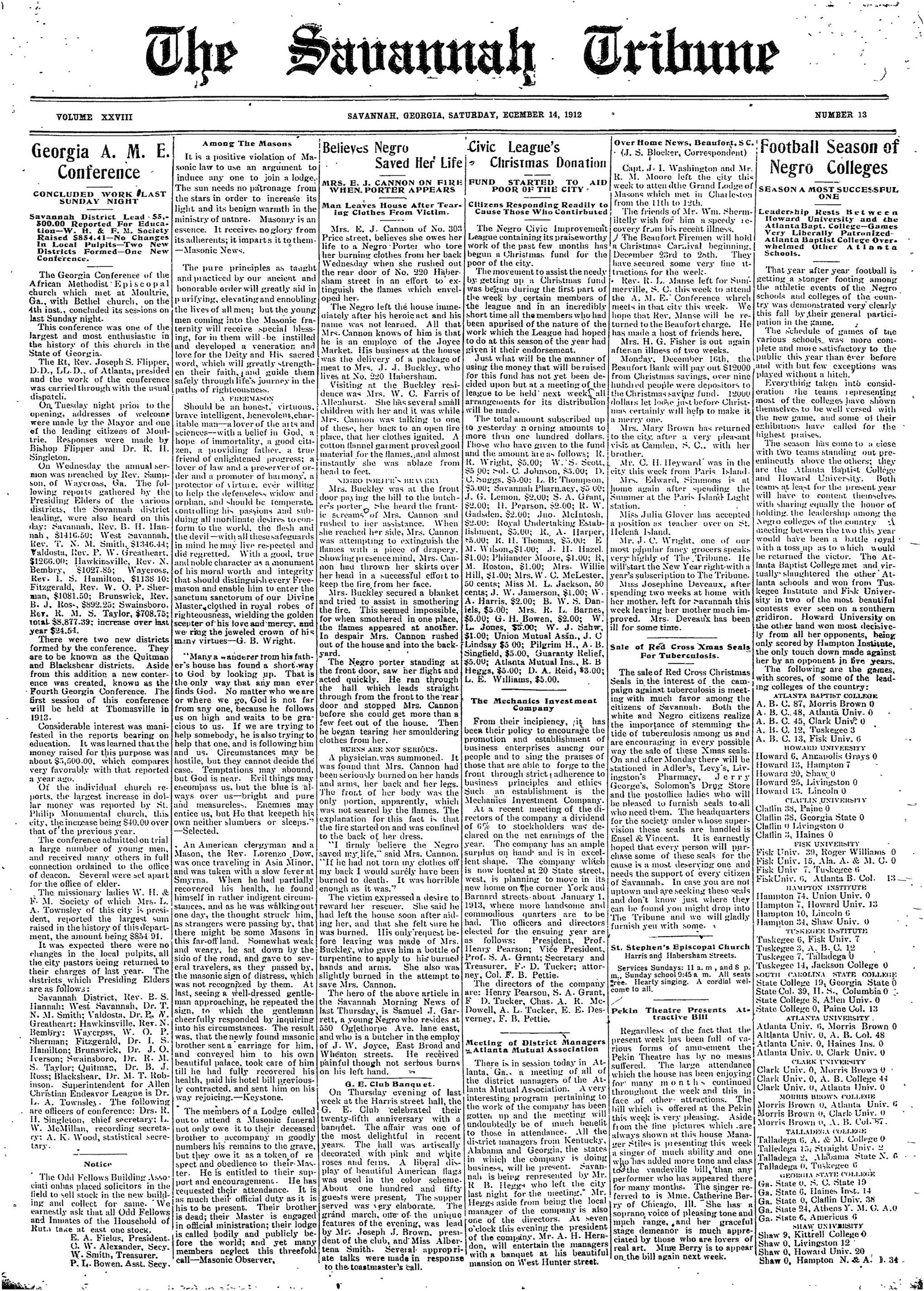
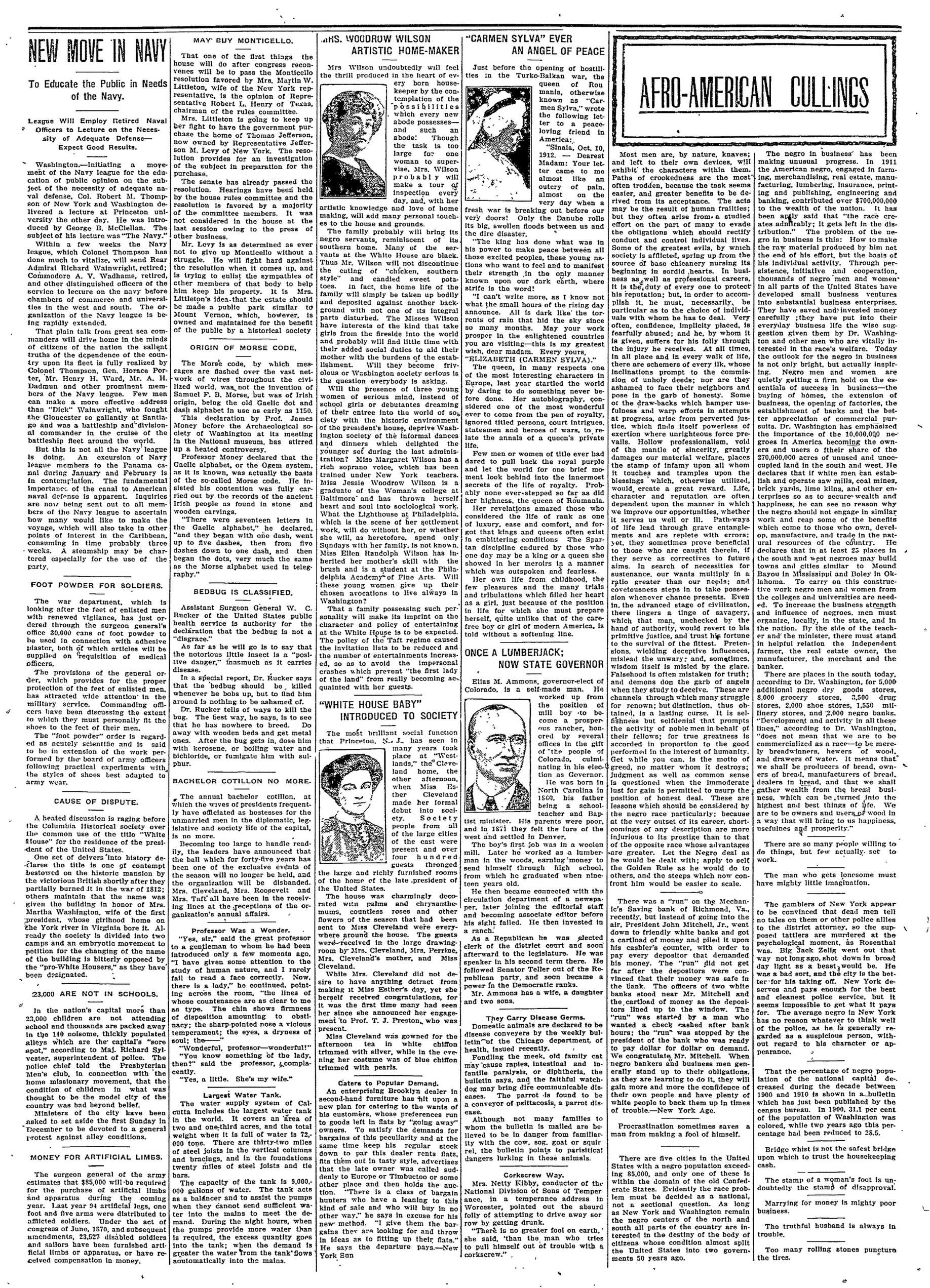
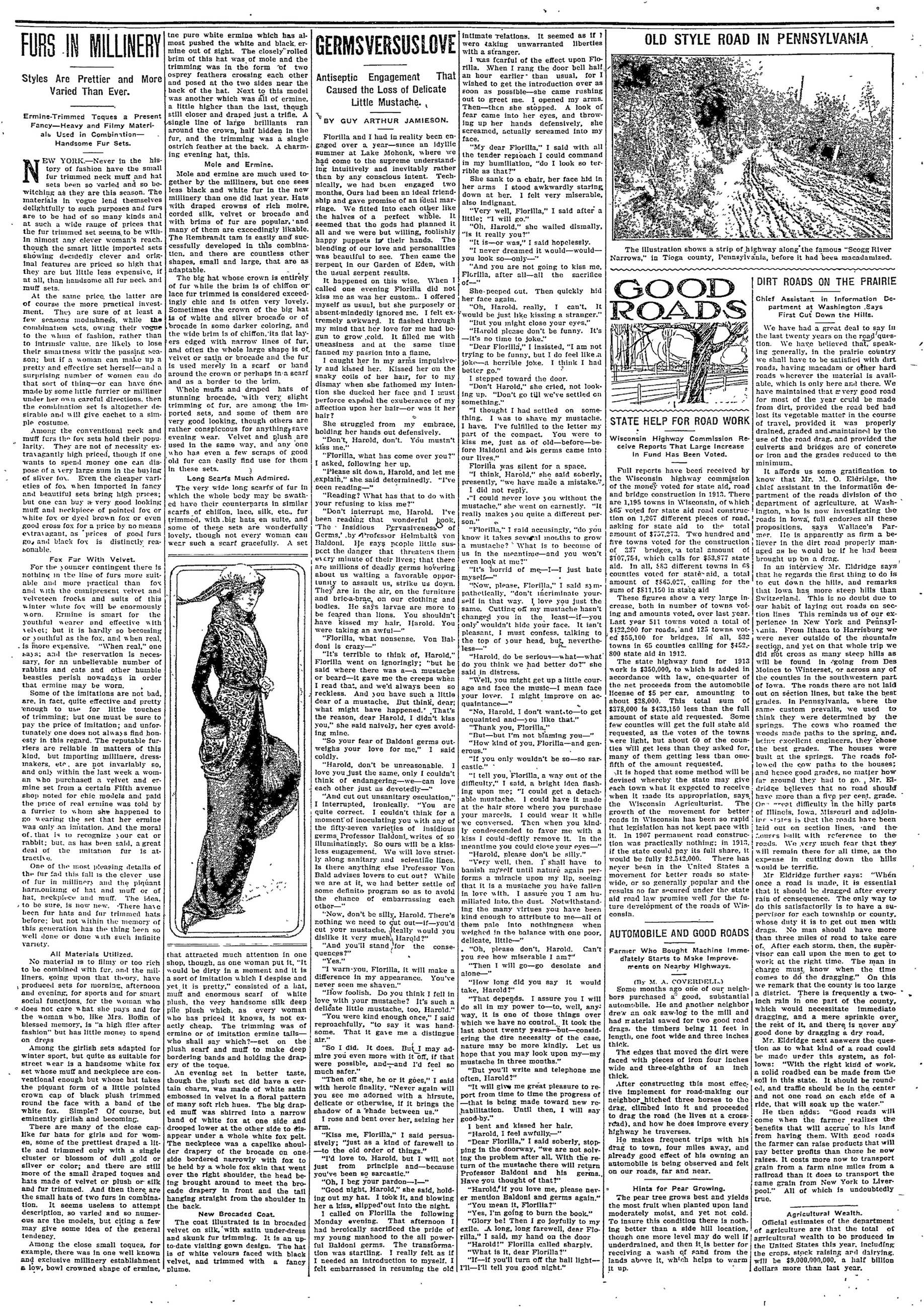
Page text (machine-generated)
ot . j — m3 ‘ < sib Roe Ts
SS SS
VOLUME XXVIII SAVANNAH, GEORGIA, SATURDAY, ECEMBER 14, 1912 ° NUMBER 13
_———————
i Among The Mas iRall ‘Cave 9 Over Home News, Beaufort, SC.! —
ne asons (Believes Negro Civic League’s Orer Home News, Beaufort. S¢-' Football Season
COPGia A. Me Es! iis a positive violation of Ma-| Saved Her Life)? Chri Donati (Js Se Blocker, Correspondent)’ 1 :
: Conference . sonic law to use an argument to[- © ave er Lire iristmas Donation Capt. de 1. Washington and Mr. Negro Colleges
i any joi : os ee . M. Moore left the city this
: : induee any one to join a lodge:| ups. ge. 5. CANNON ON FIRE|FUND STARTED. TO AID i i Atoers de rs Mis luy thie —
amd The sun needs no pitronage from|” WHEN. PORTER APPEARS POOR OF THE CITY ~ break nds e Crrand Mouge Ol SEASON A MOST SUCCES.SFU
CONCLUDED WORK §LAST tieistars’in order’t iuereace 10 pa } Masons which met in Charleston ONE
SUNDAY NIGHT i ne nd its benim a S he | Man Pentex ‘House After Tear- | Citizens Responding Readily to| from the LIth to 12th, oe
- ———— ight and its benign warmth in the) "jag Clothes From Victim. Cause Those Who Contirbuted, ‘The friends of Mr. Wm. Sherm-| Leadership Rests Bet wee
STOe ON Rees Boe deeds {Ministry of natnre. Masonry is an —- — Jiltelly wish foF him’ n speedy re-} Meward university and th
tios—W. MH. & FU. Society [essence. It receives noglory from] Mrs. I. J. Cannon of No. 303] The Negro Civic Improvemerit) covery frvm his receitt illness. Piignte Bape. Collere “Game
Raised $854.41—No_ Changes | its adherents; it imparts it to them. | Price street, believes she owes her | League containing itspraiseworthy |/ The Beaufort Firemen will hold! aclanta Baptist College Over
eo Local Pouleite Ewe new. = Maeonte Novel . life to 2 Negro-Porter who tore| work of the past few months has!n Christmas Caruival beginning,| whelmed Other Atlant,
Pistricts Pormed—Ose! New | alisonle news: ler burning clothes from her back |begun a Christmas fund for the| December 23rd to Qath. They} Schools.
The Georgia Conference of the
African Methodist" Episcopal
church which met at Moultrie,
Ga., with Bethel church, on the
Ath inst., concluded its sessions on
last Sunday night.
This conference was one of the
Jargest and most enthusiastic in
the history of this church in the
State of Georgia.
The Rt, Rev. Joseph S. Flipper,
D.D., LL.D. of Atlanta, presided
and the work of the conference
was curried through with the usual
dispateli.
On, Tuesday night prio: to the
opening, addresses of welcome
were made by the Mayor and one
ef the leading citizens of Moul-
trie. Responses were made by
Bishop Flipper and Dr. R. IL.
Singleton.
On Wednesday the annual ser-
mon was preached by Rey. Samp-
son, of Waycross, Ga. The fol-
lowing reports gathered by the
Presiding Elders of the various
districts, the Soyannah district
leading, were also heard on this
day: Savannah, Rey. B. H. Han-
nah, $1416.50; West savannah,
Rev. T. N. M. Smith, $1346.44;
Valdosta, Rev. P. W. Greatheart,
$1266.00; Hawkinsville, Rev. N.
Bembry, $1027.85; | Waycross,
Rev. 1. 5. Hamilton, $1138 10:
Fitzgerald, Rev. W. O. P. Sher-
man, $1081.50; Brunswick, Rev.
B. J. Ros-, $892.25; Swainsboro,
Rey. R. M.S. Taylor, $708.75;
rotal $8,877.39; increase over last
year $24.54.
There were two new districts
formed by the conference. They
are to be jinown as the Quitman
and Blackshear districts. Aside
from this addition a new conter-
ence was created, knowu us the
‘Fourth Georgia Conference. I'he
Grst session of this conference
will be held at Thomasville in
1913.
Considerable interest was mani-
fested inthe reports bearing on
education. It was learned thatthe
money raised for this purpose was
about $5,500.00, which compares
very favorably with that reported
a year ago.
Of the individual church re-
ports, the largest increase in dol-
Jar money was reported by St.
Philip Monumental church, this
city, the increase being $40.00 over
that of the previous year.
‘The conference admitted on trial
a large number of young men,
and received many others in full
connection ordained to the ollice
of deacon. Several were set apart
for the office of elder.
, The missionary Indies W. H. &
F. M. Society of which Mrs. L.
‘A. Townsley of this city is presi-
dent, reported the largest sun
raised in the history of this depart-
ment, the amount, being $854 91.
It was expected there were no
changes in the local pulpits, all
the city pastors being returned to
their charges of last year. ‘The
chstricts, which Presiding Elders
are xs follows:
Savannah District, Rey. B.S.
Hannah: West Savannah, Dr. T.
N. M. Smith; Valdosta, Dr. Ps ¥.
Greatheart; Hawkinsville, Rey. N-
Bembry: Waycross, W. O. P.
Sherman; Fitzgerald, Dr. 1. S-
Hamilton; Brunswick, Dr. J. O.
Iverson; Swainsboro, Dr. R- M.
S. Taylor; Quitman, Dr. B. J.
Ross; Blackshear, Dr. M. T. Rob-
inson. Superintendent for Allen
Christian Endeavor League is Dr.
LL. A. Townsley. The following
are officers of conference: Drs. R.
I. Singleton, chief secretary: L.
W. McMillan, recording secreta-
ty: A. K. Wood, statistical seere-
tary. :
Notice
* The Odd Fellows Building .\s50°
ciati onhas placed solicitors in the
field to sell stock in the new build-
ing and collect for same. “We
earnestly ask that all Odd Fellows
and Inmates of the Household of
Ruta tase at east one stock.
E. A. Fielas, President.
GC. W. Alexander, Secy.
W. Smith, Treasurer.
P. L. Bowen. Asst. Secy.
= be Raed: ceuecme hes is Bx wae v : e
Among The Masons
as ee rE
The sun needs no patronage fron
the stars in order to increase its
light and its benign warmth in the
ministry of natnre- Masonry is an
essence. It receives noglory from
its adherents; it imparts it to them
—Masonic News.
‘The pure principles as taught
and pincticed by our ancient and
honorable order will greatly aid ir
purifying, elevating and ennobling
the lives of ullmen; but the young
men coming into the Masonic fra-
ternity will receive special bless-
ing, for in them willbe instilled
and deyeloped a veneration and
love for the Deity and His sacred
word, which will greatly strength-
en their faith,yand guide them
safely through life’s journey in the
paths of righteousness.
A FEEEWASON
Should be an honest, virtuons,
brave intelligent, Jenevolent,char-
itable man—a lover of the arts and
sciences--with a belief in God, a
hope of immortality, a good citi-
zen, x providing father, a true
friend of enlightened progress; a
lover of law and a preserver of or-
der and a promoter of harmony, a
protector of virture. ever willing
to help the defenseless widow and
orphan, snd should be temperate.
controlling his passions and sith:
duing all motdinate desires to con-
form to the world, the flesh and
the devil —with all thesesafecuards
in mind he may live re-pected and
dié regretted. With a good, true
anc noble character as a monument
of his moral worth and integrity
that should distinguish every Free-
mason and enable him to enter the
sanctum sanctorum of our Divine
Masteryclgthed in royal robes of
righteousness, wielding the golden
scepter of his love and mercy. and
we: ring the jeweled crown of his
mezny virtues—G. B. Wright.
“Many a wanderer trom his fath-
ers house has found a short.way
to God by looking up. That is
the only way that any man ever
finds God. No matter who weare
or where we yo, God is not far
from any one, because he follows
us on high and waits to be gra-
cious to us. If we are trying to
help somebody, he is also trying to
help that one, and is following him
and us. Cireumstances may be
hostile, but they cannot decide the
case. Temptations may abound,
but God is near. Evil things may
encompass us, but the blue is “al-
ways over us—bright and pure
and measureless. Enemies may
entice us, but He that keepeth his
own neither slumbers or sleeps.”
Selected,
. An American clergyman anda
Mason, the Rey. Lorenzo Dow,
was once traveling in Asia Minor,
and was taken with « slow fever at
Smyrna. When he had partially
recovered his health, he found
himself in rather indigent cireum-
stances, and as he was walking out
one day, the thought struck him,
as strangers were passing by, that
there might be some Masons in
this far-off land. Somewhat weak
and weary, he sat down by the
sido of the road, and gave to sev-
eral trayelers,as they passed by,
the masonie sign of distress, which
was not recognized by them. At
Inst, seeing a well-dressed gentle-
man approaching, he repeated the
sign, to which the gentleman
cheerfully responded by inquiring
into his circumstances. The result
was, that the newly found masonic
brother sent a carriage for him,
and conveyed him to his own
beautiful palace, took care of him
till he had fully recovered his
health, paid his hotel bill previous-
ly contracted. and sent him on his
way rejoicing.—Keystone.
The members of a Lodge called
outto attend a Masonic funeral
not only owe it to their deceased
brother to accompany im goodly
Belieyes Negro
2 Saved Her Life
MRS. E. J. CANNON ON FIRE
WHEN. PORTER APPEARS
Man Leaves House After Tear:
ing Clothes From Victim.
Mrs. KE, J- Cannon of No. 30°
Price street, believes she owes her
life to a Negro-Porter who tore
her burning clothes from her back
Wednesday when she rushed out
the rear door of No, 220 Haber-
sham street in an effort to ex:
tinguish the flames which envel-
oped her.
‘The Negro left thé house imme-
aiately after his heroicact and his
name was not learned. All that
Mrs. Cannon knows of him is that
he is an employe of the Joyce
Market. His business at the house
was the delivery of a package of
meat to Mrs. J. J. Buckley, who
lives at No, 220 Habersham.
Visiting at the Buckley resi-
dence wax Mrs. W. C. Farris of
Allenhurst. She hits several small
children with her and it was while
Mrs, Cannon was talking to one
of these, her back to an open fire
place, that her clothes ignited. A
cotton flannel garment proved good
material for the flames,,and almost
instantly she was ablaze from
head to fert.
NEGKO PORIPES HEA ERY
Mrs. Buckley was at the front
door pay ing the bill to the butch-
ers porter 5 she heard the frant-
ie screams” of Mrs, Cannen and
rushed to ier assistance. When
she reached her side, Mrs, Cannon
was attempting to extinguish the
flames with a picee of drapery.
Showing presence mind, Mrs. Can-
non had thrown her skirts oyer
her head in a successful effort to
keep the tire from her face.
Mrs. Buckley secured a blanket
and tried to assist in smothering
the tire. This seemed impossible,
for when smothered in one place,
the tlames appeared at another.
In despair Mrs. Cannon rushed
out of the house and into the back-
yard. “ #
The Negro porter standing st
the front door, saw her flight and
acted quickly. He ran through
the hall which leads straight
through from the front to the ‘rear
door and stopped Mrs. Cannon
before she could get more than a
few feet out of the house. Then
he began tearing her smouldering
clothes from her.
BURNS ARE NOT SERIOUS.
A pbysician.was summoned. It
was found that Mrs. Cannon had
been seriously burned on her hands
and arms, her back and her Jegs.
The front of her body was the
only portion, xpparently, which
wus not seared by the flames. The
explanation for this fact is that
the fire started on and was confined
to the back of her dress.
“I firmly ‘believe the Negro
saved my life,” said Mrs, Cannon,
“If he had not torn my clothes off
my back I would surély have been
burned to death. It was horrible
enongh us it was.”
The victim expressed a desire to
reward her rescuer. She said he
had left the house soon after aid-
ing her, and that she felt sure he
was burned. His only“request be-
fore leaving was made of Mrs.
Buckley, who gave him a bottle of
turpentine to apply to his burned
hands and arms. She also was
slightly burned in the attempt to
save Mrs. Cannon.
The hero of the above article in
the Savannah Morning News of
last Thursday, is Samuel J. Gar-
rett, a young Negro who resides at
550 Oglethorpe Ave. lane east,
and who is a butcher in the employ
of J. W. Joyce, East Broad and
Wheaton streets. He received
painful though not serfous burns
on his left hand. =
G. E. Club Banquet.
On Thursday evenine of last
Un Thursday evening of last
week at the Harris street hall, the
G. E. Club celebrated their
twenty-lifth anniversary with a
bangiiet. The affair was one of
the most delightful in recent
years. The hall was artiscally
decorated with pink and white
roses and ferns. A liberal dis-
play of beautiful American flags
was used in the color scheme.
About one hundred and fifty
guests were present, ‘The supper
served was very elaborate. ‘The
grand march, ome of- the unique
features of the evening, was lead
by Mr. Joseph J. Brown. pres-
dent of the club, and’ Miss Alber.
tenn Smith. Several: appropri
ate talks were made in responst
to the toastmaster’s call.
Civic League’s
2 Christmas Donation
FUND STARTED TO AID
POOR OF THE CITY~
Citizens Responding Readily to
Cuuse Those Who Contirbured
The Negro Ciyic Lmprovement
League containing its praiseworthy
work of the past few months has
begun a Uhristmas fund for the
poor of the city.
‘Fhe movement to assist the needy
by: getting up a Christmas fund
was bevun during the first part of
the week by certain members of
the league and in an incredibly
short time all the members who had
been apprised of the nature of the
work which the League had hoped
to do at this season of the year had
given it their endorsement.
Just what will be the manner of
using the money that will be raised
for this fund has not yet been de-
cided upon but at a meeting of the
league to be held’ next week{all
arrangements for its distribution
will be made.
‘The total amount subscribed up
10 yesterday norning amounts to
more than one hundred dollars.
Those who have given to the fund
and the amount areas follows; RB.
K. Wright, $5.00; W.'S- Scott,
$5 00; Sol. C. Johnson, $5.00; D,
(U. Suggs, $5.00: L. B: Thompson,
$5.00; Savannah Pharnacy, $5 UC:
J. G. Lemon, $2.00; S. A. Grant,
$2.00; HH. Pearson, 32.00; R. W.
Gadsden. $2.00; Jno. MeIntosh,
$2.00: Royal Undertaking Estab-
lishment, $5.00; K., A. Harper,
75.00; KR. il. Thomas, $5.00; E
M. Wilsong$1-U0; J. H- Hazel.
$1.00; Phiianeer Moore, $1.00; R,
M. Koston, 31.00; Mrs. Willie
Hill, $1.00; Mrs. W. C. McLester,
50 cents; Miss M. L. Jackson, 50
cents; J. W. Jamerson, $1.00; W-
A. Harris, $2.00; B. W. 5. Dan-
iels, $3.00; Mrs. R. L. Barnes,
35.00; G. H. Bowen, $2.00; W.
L. Jones, $5.00; W. J. Sehw,
$31.00; Union Mutual Assn., J. C
‘Lindsay $5 00; Pilgrim H., A. B.
Singtield, $5.00, Guaranty Relief,
$5.00; Atlanta Mutual Ins., R. B
Heggs, $5.00; D. A. Reid, $3.00;
L,. E. Williams, $5.00. .
The Mechanics Invest meat
‘Company
| From their incipiency, jit has
been their policy to encourage the
promotion and establishment of
business enterprises ameng our
people and to sing the praises of
‘those that are able to forge to the
front through strict y adherence to
business principles and ethies
Such an ostablishment is the
Mechanics Inyestinent Company.
Ata recent meeting of the di-
rectors of the company a dividend
of 6% to stockholders was de-
clared on the net earnings of the
year. ‘The company has an ample
surplus on Hand: and is in excel-
Jent shape. ‘The company whitch
is now located at 20 State strect,
west, is planning to move in its
new home on the corner York and
Barnard streets-about January 1,
1913, where more handsome and
commodious quarters are to be
had. The officers and directors
elected for the ensuing year are
as follows: President, Prof.
Henry Pearson; Vice President,
Prof. 5. A- Grant; Secretary and
Treasurer, Fs D. Tucker; attor-
ney, Col, F. B. Pettie. :
The directors of the company
are: Henry Pearson, S. A. Grant,
FD. Tucker, Chas. A, R. Me-
Dowell, A. L. Tucker, E. E. Des-
verney, F. B. Pettie.
Meeting of District Managers
Atlanta Mutual Association
‘There is in session today in At-
lanta, Ga.. a meeting of all of
the district managers of the At-
ants Mutual Association. A very
interesting program pertaining to
the work of the company has been
gotten up and the meeting will
undoubtedly be of much benelit
to those in attendance. All the
district managers from Kentucky,
Alabama and Georgia, the states
in which the company is doing
business, will be present. Sayan-
nah is being represented by Mr.
RB. Hegys who left the city
last night for the meeting.” Mr.
Heygs aside from being the local
jmanager of the company is also
one of the directors. At seven
o'clock this evening the president
of the company. Mr. A. H. Hern-
don, will entertain the managers
with a banquet at his beautiful
mansion on West Hunter street.
Over Home News, Beaufort, SC.
- (J. 5. Blocker, Correspondent)
Capt. J. 1. Washington and Mr
KR. M. Moore left the city thi
week to atten dthe Grand Lodge o
Masons which met in Chatlesto:
| From the llth to 12th,
1. The friends of Mr. Wm. Sherm,
Jiltelly wish for him a speedy re:
covery from his recent illness,
Z The Beaufort Firemen will hold
a Christinas Caruival beginning,
December 23rd to 2oth, — They
have secured some very fine 1t-
tractions for the week. ,
+ Rev. R. L. Manse left for Suni.
merville, 8. C. this week to attend
the A. M. E.” Conference whreh
meets in that city this week. We
hope that Rey. Manse will be re-
turned to the Beaufort charge. He
has made a host of friends here,
Mrs. H. G. Fisher is out again
afteran illness of two weeks.
Monday, December 16th, the
Beanfort Bank will pay out $12000
from Christmas savings, over nine
hundied people were depositors to
the Christmas saving fund. 12000
dollars let lodge just before Christ-
mas certainly will hefp to make it
a merry one.
Mrs. Mary Brown has returned
to the city. after a very pleasant
visit at Camden, 3. C., with her
brother.
_ Mr. ©. UW. Heyward’ was in the
city this week from Paris Island
Mrs, Edward, Simmons is at
home aguin after spending the
Summer at the Paris [sland Light
station. = .
Miss Julin Glover has accepted
a position us teacher over on St.
Helena Island,
Mr. J.-C. Wright. one of our
most pypular fancy grocers speaks
very highly of The Eribune. He
will'start the New Year right-with a
year’s subscription to The Tribune.
Miss Josephine Deveaux, after
spending two weeks at home with
her mother, left for savannah this
week leaving her mother much im-
proved. Mrs. Deveau'x has been
ill for some time.
Sale of Réd Cross Xmas Seals
Por Tuberculosis.
The saleof Red Cross Christmas
Seals in the interest of the cam-
paign against tuberculosis is meet-
Ing with much favor among the
citizens of Savannah. Both the
white and Negro citizens realize
the importance of stemming the
lide of tuberculosis among us and
are encouraging in every possible
way the sale of these Xinas seals.
On and after Monday there will be
stationed in Adler’s, Levy's, Liv-
ingston’s Pharmacy, Jerry
George's, Solomon’s Dryg Store
and the postoilice ladies who will
he pleased to furnish seals toll
who need them, ‘The headquarters
for the society: under whose super-
vision these seals are handled is
Ensel & Vincent. It is earnestly
hoped that every person will pnr-
chase some of these seals for the
cause is a most deserving one and
needs the support of every citizen
of Savannah. In case you are not
uptown and are seeking these seals
and don’t know just where they
ean be found you might drop into
The ‘Tribune and we will gladly
furnish yeu with some.
St. Stephen’s Episcopal Church
Harris and Habersham Streets.
- Services Sundays: 11 a.m, and& p.
m,, Sunday school 9:45 m. All seats
free. Hearty singing. A cordial wel-
come to all.
ee a
Pekin Theatre Presents Ate
% tractive Bill
Regardless of the fact that the
present week has been full of va-
rious forms of amusement the
Pekin Theatre has by no means
suffered. ‘The large attendance
which the house has been enjoying
for many months continued
throughout the week and this in
face .of others attractions. ‘The
bill which is offered at the Pekin
this week is very pleasing. Aside
from the fine pictures which -are
nhways shown at this house Mana-
wer Stiles is presenting this week
asinger of much ability and one
why line added more tone and class
tovthe yandeville Dill, ‘than any
performer who has appeared there
for many months. ‘The singer re-
‘ferred to is Mme. Catherine Ber-
ry of Chicago, Ill She has a
soprano, voice of pleasing tone and
much range,,and her graceful
stage demeanor is much appre-
ciated by those who are Jovers of
real art. Mme Berry is to appear
onthe bill again next week.
Football Season of
Negro Colleges
SEaSONA MOST SUCCESSFUL
ONE
Leadership Rests Between
Moward University and the
Atlanta Bapt. College—Games
Very Liberally Patronized-
Atlanta Baptist College Overs
whelmed Other Atlanta
Schools.
“That year afier year football is
getting a stonger footing among
the athletic events of the Negro
schools and colleges of the coun-
try was demonstrated very clearly
this fall by their general partici-
pation in the game. 2
‘The schedule of games of tue
various schools_ was more eom-
plete and more satisfuctory to the
public this year than éver before
and with but few exceptions was
played without a hitch,
Everythitig taken into consid-
eration the teams representing
most of the colleges have shown
themselves tu be well versed with
the new game, and some of their
exhibitions have called for the
highest praises.
The season hhs come to a ciose
with two teams standing out pre-
emineutly above the others; they
are the Athinta Baptist College
and Howard University, Both
teams at Teast for the present year
will have to content theinselyes
with sharing equally the honor of
holding. the leadershp among the
degro colleges of the country 4
meeting between the two this year
would have been a batude royal
with a toss.up as to which would
he returned the victor. ‘The At-
lanta Baptist College met and vir-
tually: slaughtered the other’ At-
lanta schools and won from Tus-
kegee Institute and Fisk Uniyer-
sity in two of the most beautiful
contests ever seen on 4 southern
gridiron. Howard University on
the other hand won most decisive-
ly from all her opponents, heiog
only scored by Hampton Institate,
the only touch down made against.
her by an opponent jn Sve years.
The following are the games,
with scores, of some of the lead-
line colleges of the country:
ATLANTA BAPTIST COLLEGE
A. B. C. 87, Morris Brown 0
A.B. C.,48, Atlanta Uniy.0 «
Aa. B.C. 45, Clark Univ? 0
A.B. CG. 12, Tuskegee 3 *
A. B.C. 13, Fisk Univ. 6 :
MOWALRD UNIVERSITY
Howard 6, Ancanolis Grays 0
Howard 13, Hampton 7 :
Howara 20, Shaw, 0 3
Howard 25, Livingston 0
Howard 13. Lincoln 0 *
CLAPLIN UNIVERSITY
Clailin 38, Paine 0
Clallin 88, Georgia State 0 ;
Clailin 9 Livingston 0
Claflin 3, Haines 0
FISK UNIVERSITY 5
Fisk Univ. 39, Roger Williaans 0
Fisk Univ. 15, Ala. A. & M.C. 0
Fisk Univ 7. Tuskegee 6
FiskUniv. 6, Atlanta B. Col. 13 —
| HAMPTON INSTITUTE
Hampton 74. Union Uniy. 0
Hampton 7, Howard Univ. 13
Hampton 10, Lincoln 6
Hampton 24, Shaw Uniy. 0 -
TUSKEGEE INSTITUTE
‘Luskegee 6, Fisk Univ, 7
Tuskegee 3, A. B-C. 12,
Tuskegee 7, “Talladega 0
‘Tuskegee 14, Jackson College 0
SOUTH CALOLINA STATE COLLEGE
State College 19, Georgia State 0
State Col. 39, H.S., Columbia d 2.
State College 8, A'len Univ. 0
State College 0, Paine Col, 13
ATLANTA UNIVERSITY
Auanta Uniy. 6, Morris Brown 0
Altlanta Univ. 0, A. B. Col. 48
Atlanta Univ. 0, Haines Ins. 0
|Atlanta Univ. 0, Clark Univ. 0
CLARK UNIVERSITY
clark Univ. 0, Morris Brown U °
bee Univ. 0, A. B. Colleye 44
| Clarks Univ. 0, Atlanta Univ. 0 7
MORRIS BROWN COLLEGE
Morus Brown 0, Athuta Univ. 6
Morris Brown 0, Clark Univ. 0 >
I Morris Brown 0, A. B. Col- 87.
TALLADEGA COLLEGE
Talladega 6, A. & M. College 0
Taliedoga 15; Staight Univ. 2
‘Talladega 2, Alvama State NX. 6
Talladega 0, Tuskegee 6
GEORGIA STATE COLLEGE
Ga. State 0, 5. C. State 19
Ga, State 6, Haines Inst. 14
Ga. State 0, Claflin Univ. 38
Ga. State 24, Athens Y. M.G. A.0
Ga. State 6, Americus 6
SHAW UNIVERSITY
Shaw 9, Kittrell Colleze 0
Shaw 0, Livingston 12 ~
Shaw 0, Howard Univ. 20 |
Shaw 0, Hampton N. 2 A. EB. 34.
a an BE :
p MAY: BUY MONTICELLO. akS. WOODRUW WILSON ‘CARMEN SYLVA” EVER :
re ARTISTIC HOME-MAKER AN ANGEL OF PEACE
That one of the fret things the pam — 5
house will do after congress recon-| ry wilson undoubtedly will feel] Just before the opening of hostili-
. —o Fones will be to pass the Monticello | ne thrill preduced in the heart of ev-|ties in the Turko-Balkan war, tho
ex resolution favored by Mrs. Martin W. ery born house- queen of Row .
To Educate the Public in Needs} rittieton, wite of the New York rep. 2 keeper by the con-| [ESF] mania, otherwise & 4 4 f
of the Navy. resentative, {s the opinion of Repre- Segeo. | templation of the ae Ry] Known as “Car- 8
sentative Robert L. Henry of Texas. |) Pairs \| “possibilities! |e gm | men Sylva,” wrote Se RNS Sean
———— chairman of the rules committee. x Be ey: which every now||7.. fq tho following tet- y ‘
Mrs. Littleton ts going to keep up | EBM -%2 |" anode possesses—| sez". °°, ter to a peace
Retired NN Reet 4 «ee
Leapae, Witt Employ arte aval ver fight to have the government pur. ee | ana ‘sucn an|| A” gf beQ8| loving triona “tn | 6 :
ee ee state Derma” |ehase the home of Thomas Jetterson, || Wrewede P| 370, SPCR, ant | gdik 5 ‘America: osc gn cienies aaeaoaommeueeaens nena
aly OF “Adequate Defense — now owned by Representative Jefter-|] gga the task 1s too| | fesse ea “Sinala, Oct. 10, | “—™ = = Fe cerca a npiny Ml csupcseresy: umes ot
Expect Good Results. ee AE Pee ee ee ee | u k 1 4
" Washington.—Initiating a moye-
smeit of the Navy league for the edu-
cation of public opinion on the sub-
fect of the necessity of adequato na-
val defense, Col. Robert M. Thomp-
son of New York and Washington de-
livered a lecture at Princeton unt-
versity the other day. He was intro-
duced by George B. McClellan. The
subject of his lecture was “The Navy.”
Within a few weeks the Navy
Teague, which Colonel Thompson has
done much to vitalize, will send Rear
Admiral Richard Wainwright, retired;
Commodore A. V. Wadhame, retired,
and other distinguished officers of the
service to lecture on the navy before
chambers of commerce and universt-
tles in the west and south. The or-
ganization of the Navy league is be
ing rapidly extended.
‘That plain talk from great sea com-
mandera will drive home in the minds
of citizens of the nation the sallent
truths of the dependence of the coun.
try upon {ts flect is fully realized by
Colonel Thompson, Gen. Horace Por-
ter, Mr. Henry H. Ward, Mr. A. H.
Dadmun and other prominent mem-
bers of the Navy league. Few men
ean make a more cffective address
than “Dick” Wainwright, who fought
the Gloucester co gallantly at Santla-
50 and was a battleship and“division-
al commander in the cruise of the
battleship fleet around the world.
But this {s not all the Navy’ league
4s doing. An oxcursion of Navy
league members to the Panama ca-
nal during January and February is
im contemplation. The fundamental
Importance of the canal to American
naval defense is apparent. Inquiries
are now being sent out to all mem-
bers of the Navy league to ascertain
ow many would Ike to make the
voyage, which will also take tn other
points of interest in the Caribbean,
consuming in time probably three
weeks. A steamship may be char
tered especially for the use of the
party.
FOOT POWDER FOR SOLDIERS.
The war department, which ts
looking after the feet of enlisted men
with renewed vigilance, has just or-
dered through the surgeon general's
office 30,000 cans of foot powder to
be ured in connection with adhesive
plaster, both of which articles will be
supplied on requisition of medical
officers,
The provisions of the general or-
Yer, which provides for the proper
protection of the feet of enlisted men,
has attracted wide attention’ in the
milltary service. Commanding off-
cers have been discussing the extent
to which they must personally ft the
shoes to the fect of their men,
The “foot powder” order Is regard-
ed as acutely scientific and ts said
to be in extension of the work per-
formed by the board of army officers
following practical experiments with,
the styles of shoes best adapted to
army wear.
CAUSE OF DISPUTE.
A heated discussion is raging before
the Columbia Historical society over
the common use of the title “White
Mouse” for the residence of the pres!-
‘dent of the United States.
‘One set of delvers “Into history de-
-Glares the title is one of contempt
Destowed on the historic mansion by
the victorious Nritish shortly after they
partlally burned Jt in the war of 1812;
others maintain that the name was
given the building in honor of Mrs.
Martha Washington, wife of the first
president, whose girlhood home on
jehe York river in Virginia bore It Al-
ready the society fs divided into two
camps and an embryotic movement to
petition for the changing of the name
‘of tho bullding is bitterly opposed by
the “pro-White Housers,” as they have
been designated. &
23,000 ARE NOT IN SCHOOLS.
In the nation’s capital more than
23,000 children are not attending
schoo! and thousands are packed away
in the 140 nolsome, thickly populated
alleys which are the’ capital's “sore
spot,” according to Maj. Richard Syl-
ester, superintendent of police. The
police chief told the Presbyterian
‘Men's club, In connection with ‘the
tiome missionary movement, that the
condition of children {n what was
thought to be the model city of the
country was bad beyond belief.
Ministers of the city have been
asked to set aside the first Sunday In
“Becember to be devoted to a general
protest against alley conditions,
MONEY FOR ARTIFICIAL LIMES.
‘The surgeon general of the army
estimates that $85,000 will-ba required
for the purchase of artificial limbs
nd apparatus during the coming
year. Last year 94 artificial legs, one
foot and five arms were distributed to
afficted soldiers. Under the act of
congress of June, 1870, and subsequent
amendments, 23,527 disabled soldiers
and sailors have been furnished artt-
ficial Ilmbs or apparatus, or have re-
celved compensation in money.
MAY BUY MONTICELLO.
That one of the first things the
house will do after congress recon-
venes will be to pass the Monticello
resolution favored hy Mre. Martin W.
Littleton, wife of the New York rep-
resentative, {s the opinion of Repre-
‘Sentative Robert L. Henry of Texas,
chairman of the rules committee.
Mrs. Littleton ts going to keep up
‘ber fight to have the government pur-
‘chase the home of Thomas Jefferson,
now owned by Representative Jeffer-
son M. Levy of New York. The reso-
lution provides for an investigation
of the subject in preparation for the
purchase.
‘The senate has already passed the
resolution, Hearings have becti held
‘by the house rules committee and the
‘resolution is favored by a majority
oe the committee members. It was
not considered in the house at the
Jast session owing to the press of
‘other business.
Mr. Levy {3 as determined as ever
‘hot to give up Monticello without a
‘struggle. He will fight hard against
‘the resolution when it comes up, and
4s trying to enlist the sympathies of
ether members of that body to help
him keep his property. It 1s Mrs.
Eataletga's idea.that the estate should
be made a public park similar to
Mount Vernon, which, however, is
owned and matntained for the benefit
‘ob the Hebile tie & Sietiolaal anelace
ORIGIN OF MORSE CODE,
The Morse code, by which mes:
eages are flashed over the vast net.
-work of wires throughout the civi-
zed world, waa not the invention of
Samuel F. B. Morse, but was of Irish
origin, belog the ola Gaelic dot and
dash alphabet In use as carly as 1150.
‘This declaration by Prot. James
‘Money before the Archaeological so-
‘clety of Washington at its meeting
in the National museum, has stirred
‘up @ heated controversy.
Professor Money declared that the
Gaelic alphabet, or the Ogem system,
as it Is known, was actually the basis
of the so-called Morse code. He in-
sisted his contention was fully car-
ried out by the records of the ancient
Irish people as found in stone and
‘wooden carvings,
“There were seventeen letters in
the Gaelic alphabet,” he declared,
“and they began with ofie dash, went
up to five dashes, then from fivo
dashes down to one dash, and then
began the dots, very much the same
as the Morse alphabet used tn teleg-
raphy.”
BEDBUG IS CLASSIFIED,
Assistant Surgeon General W. C.
Rucker of the United States public
health service {s authority for the
declaration that the bedbug {s not a
“disgrace.”
| As far as he will go Is to say that
‘the notorious Ittle Insect 1s 2 “pos!
tive danger,” inasmuch as it carries
disease. 7
In a special report, Dr. Rucker says
that the ‘bedbug should bo, killed
whenever he bobs up, but to find him
around {s nothing to be ashamed of.
Dr. Rucker tells of ways to kill the
bug. The best way, ho says, 1s to seo
that he has nowhere to breed. Do
away with wooden beds and get metal
ones. After the bug gets in, dose hin
with kerosene, or boiling water and
dichloride, or fumigate him with sul-
pur.
BACHELOR COTILLON NO MORE.
«The annuat bachelor cotillon, at
hich the wives of presidents frequent.
ly have officiated as hostesses for the
unmarried men In the diplomatic, leg-
Islative and society life of the capital,
is no more. ‘
Becoming too large to handle read-
ily, the leaders have announced that
the ball which for forty-five years has
been one of the exclusive events of
the season will no longer be held, and
the organization will be disbanded.
Mrs. Cleveland, Mrs. Roosevelt and
Mrs, Taft’ all have been in the receiy-
ing lines at the geceptions of the or-
ganization’s annual affairs. =
Professor Was a Wonder.
“Yes, sir.” eald the great professor
to a gentleman to whom he had been
Introduced only a few moments ago,
“I have given some attention to the
study of human nature, and I rarely
fall to read a faco correctly. Now,
there Is a lady,” he continued, point:
ing across the room, “the lines of
whose countenance are as clear to me
as type. The chin shows firmness
of disposition amounting to obst!.
nacy; the sharp-pointed nose a vicious
temperament; the eyes, a dryness of
soul; the—"
“Wonderful, professor—wonderful!"
“You know something of the lady,
then?” safd the professor, 4.compla.
cently.
“Yes, a little. She's my wife.”
Largest Water Tank.
The water supply system of Cal-
cutta includes the largest water tank
in the world. It covers an ‘area of
two and one;third acres, and the total
weight when it {s full of water ts 72,-
000 tons. There are thirty-two miles
of steel joists In the vertical columns
and bracings, and in the foundations
twenty miles of steel joists and tie
bars.
‘The capacity of the tank Is 9,000,
000 galions of water. The tank acts
as a balancer and to assist the pumps
when they cannot send suffictent wa-
ter Into the mains to meet the de-
mand. During the night hours, when
the pumps provide more water than
fs required, the excess quantity goes
into the tank; when the demand ts
| greater the water from the tank" flows
acutomatically into the mains.
akS. WOODRUW WILSON
ARTISTIC HOME-MAKER
Mra Wilson undoubtedly will feel
the thrill preduced in the heart of ev-
ery born house-
es keeper by the con-
Segrgres | templation of the
APB exe | ‘possibilities
fy eee SEY). which every new
Tyee gg | abode possesses—
Wee & | and such an
Seecnee abode: Though
oe the task 1s too
OnE large for one
ae, Dh woman to super-
Bk vise, Mra, Wilson
beta | probably will
PEN) make 2 tour gf
RMMETRENL SN inspection every
‘ee ak os hae
‘nn
se ees sh
oe ee ey)
gust .
poo,
a.
artistic knowledge and love of home
making, will add many personal touch-
es to the house and grounds.
The family probably will bring its
negro servants, reminiscent of its,
southern home. Many of the ser-
yants at the White House are black.
‘Thus Mr. Wilson will not discontinue
the euting of “chicken, southern
style” and candied sweet pota-
toes. in fact, the home life of the
tamily will simply be taken up bodily
aud deposited against another back-
ground with not one of its futegral
parte disturbed. The Misses Wilson
have interests of the kind that take
sirls from the fireside into the world
and probably will find Nttle time with
thelr added social duties to ald their
mother with the burdens of the estab-
Ushment. Will they become friv-
olous or Washington society serious 1s
the question everybody 1s asking.
Wl the presence of three young
women of serious mind, instead of
school girls or debutantes dreaming
of thelr entree into the world of 50,
elety with the historic eavironment
of the president's house, deprive Wash-
ington soclety of the informal dances
and dinners which delighted the
younger sef during the last adminis-
tration? 3ilss Margaret Wilson has a
rich soprano voice, which has been
tralned under New York teachers.
Miss Jessie Woodrow Wilson is a
graduate of the Woman's college at
Baltimore’ and has thrown herself
heart and soul Into sociological work.
What the Lighthouse at Philadelphia,
which Is the scene of her settlement
‘work, will do without her, or whether
she will, a3 heretofore, ‘spend only
‘Sundays with her family, Is not known,
Miss Ellen Randolph Wilson has in-
herited her mother's skill with the
brush and is a student at the Phila-
delphia Academy*ot Fine Arts. Will
these young women give up their
chosen avocations to live always In
Washington? ;
‘That a family possessing such per
sonality will make its Imprint on the
character and policy of entertaining
at the White House is to be expected.
‘The polley of the Taft regime caused
the invitation Ists to be reduced and
the number of entertainments increas-
ed, so as to avold the {mpersonal
crashes which prevent “the first lady
of the land” from really becoming ac.
quainted with her guests.
“WHITE HOUSE BABY”
INTRODUCED TO SOCIETY
The moSt brilliant social functicn
that Princeton, N.- J.. has seen in
‘many years took
REE place at “West-
MEGS | lianas inc’ Cleve
fpr) sand nome, the
te ta] other afternoon,
Gawca AR | when Miss Es:
RE, 7 | ther Cleveland
G) = made her formal
, debut into soci-
Fee 7 ety. Soctety
eRe >| people from ail
Ze ee | of the large cities
25 of the cast were
as present and over
PARAEYS"| tour hundred
coats thseaced
. ey
ee ww
as
the large and richly furnished rooms
of the home cf the late .president of
the United States.
‘The house was charmingly dcco-
rated witn palms and chrysanthe
mums, countless roses and other
flowers of the season that had been
sent to Miss Cleveland were erery-
where ground the house. The guests
werd-recelved in the large drawing-
room by’ Mrs. Cleveland, Mrs, Perrine,
Mrs. Cleveland's mother, and Miss
Cleveland.
While Mrs. Cleveland did not de-
sire to have anything detract from
making it Miss Esther's day, yet she
hergelt recetved congratulations, for
it was the first tlme many had seen
her since she announced her engage-
ment ‘to Prof. T. J. Preston, who was
present.
Miss Cleveland was gowned for the
afternoon tea in white chiffon
trimmed with silver, while in the eve-
ning her costume Was of blue chiffon
trimmed with pearls.
Caters to Popular Demand,
‘An enterprising Brooklyn dealer in
second-hand furniture has ‘hit upon a
new plan for catering to the wants of
his customérs, whose preferences run
to goods left In flats by “going away”
owners. To satisfy the demands for
bargains of this pecullarity and at the
same time keep his regular stock
down to par this dealer rents fats,
fits them out In tasty style, advertises
that the late owner was called sud-
denly to Europe or Timbuctoo or somo
other place and then holds the auc-
tion. “There is a class of bargain
hunters who have a leaning to this
Kind of sale and who will buy in no
other way." he says In excuse for his
new method. “I give them the bar-
gains thev ara looking for and throw
tn ideas as {o fitting up thelr flats.”
‘He says the departure pays.—New
‘York Son
“CARMEN SYLVA” EVER
AN ANGEL OF PEACE
Just before the opening of hostill-
ties in the Turko-Balkan war, the
queen of Row
FSS APM] mania, otherwise
en FSe| known as “Car-
ge {| men Sylva,” wrote
y .. Be a| tho following let-
sf". 4m HB) ter to a peace
Be 6S4@G| loving friend in
ABE) Aretica:,
iS Se ot “Sinaia, Oct. 10,
<S 1912. —" Dearest
Lg XS Madam: Your let-
ve NMR) ter came to mo
eee almost like an
Te outcry of pain,
= a « almost on the
aa ~. vory day when a
a
Me g
ay H
be Joe
ih
AO ee
sa
be Se
wes
eg
fresh war ts breaking out before our
very doors! Only the Danube rolls
Its big, swollen floods between us and
the dire disaster. .
“The King has done what was in
his power to make peace betweén all
those exelted peoples, these young na-
tons who want to feel and to manifest
their strength in the oply manner
known upon our dark earth, where
strife is the word!
“I can't write more, as I know not
what the small hours of the rising day
announce. All {s dark like’ the tor-
rents of rain that hid the sky since
so many months. May your work
prosper in the enlightened countries
you are visiting—this Is my greatest
wish, dear madam. Every yours,
“ELIZABETH (CARMEN SYLVA).”
The queen, In many respects one
of the most interesting characters in
Europe, last year startled the world
by daring to do something never be-
fore done. Her autoblography, con-
sidered one of the most wonderful
ever to come from the pen of royalty,
ignored titled persons, court intrigues,
statesmen and heroes of wars, to, re
late the annals of a quecn’s private
ite.
Few men or women of title ever had
dared to pull back the royal purple
and let the world for one brief mo-
ment look bebind into the innermost
secrets of the life of royalty. Prob-
ably none ever-stepped so far as did
her highness. the queen of Roumania.
Her revelatjons amazed those who
considered the Ilfe of rank as one
of luxury, ease and comfort, and for-
got that kings and queens often exist
in emblttering conditions ‘he Spar-
tan discipline endured by those who
one day may be a king or a queen she
showed In her merotrs in a manner
which was outspoken and fearless.
Her own life from childhood, the
few pleasures and the many trials
and tribulations which filled her heart
as a girl, just because of the position
in Ife for which she must prepare
herself, quite unlike that of the care-
free boy or girl of modern America, Is
told without a softening lne.
ONCE A LUMBERJACK;
NOW STATE GOVERNOR
Ellas M. Ammons, governorelect of
Colorado, {8 a self-made man. Ho
worked up from
ASD the position of
Ory mill boy sto be
BS come a prosper
fe 3] ous rancker, hon-
S° eBBsgoal] cred by several
ai offices In the gift
Se ah of “tke people of
Ree | Colorado, culml-
RS. “See? | nating in his elec-!
me tion as Governor.
EOD Te was bora tn
Sov" Feb] North Carolina to
my AM! isco, his father
SABA - ABBA veing a school-
feather Sank Ban
| a ane
Soe
| gs Sy
i
BN
Uist minister. His parents were poor,
and In 187i they felt the lure of the
west dnd settled In Denver.
‘The boy's first job was In a woolen
mill. Later hé worked as a lumber-
man in the woods, earniug ‘money to
send himself through high school.
from which he graduated when nine-
teen years old.
He then became connected with the
circulation department of a newspa-
per, later joining the editorial staff
and becoming associate editor before
his sight failed. He then invested ta
a ranch.
As a Republican he was lected
clerk of the district court and soon
afterward to the legislature. He was
speaker in his second term there. He
followed Senator Teller out of the Re-
publican party, and soon became a
power fn the Democratic ranks.
Mr. Ammons has a wife, a daughter
and two sons,
‘Siew: Gasee Disease Gawa.
Domestic animals are declared to be
dlgense conveyers by the weekly bul-
letin~of the Chicago department, of
health, fssued recently. :
Fondling the meek, old family cat
may “cause raples, Intestinal and tn-
fantile paralysis, or diphtherla, the
bulletin says, and the falthful watch-
dog may bring dire communicable dis-
eases. The parrot 4s found to be
a conveyor of psittacosis, a parrot dis-
ease.
Although not many families to
whom the bulletin {s mailed are be-
Heved to be In danger from famillar-
ity with the cow, sog. goat or squir
rel, the bulletin points to parisitica!
dangers lurking In these animals.
Corkscrew Way.
Mrs. Netty Kibby, conductor of the
National Division of Sons of Temper
ance, in a temperance address in
Worcester, pointed out the absurd
folly of attempting to drive away sor
row by getting drunk,
“Theré is no greater fool on earth, '
she sald, ‘than the man who tries
to pull himself out of trouble with a
corkscrew.” _
AFRO-AMERICAN CULLING
and left to thelr own devices, wil
exhibit’ the characters within them.
Paths of crookedness are the most
often trodden, because the task seems
easier, and greater benefits to be de-
rived from {ts acceptance. The acts
may be the result of human frailties;
Dut they often arise from-a studied
effort on the part of many to evade
the obligations which should rectify
conduct and control Individual lives.
Some of the greatest evils, by wnich
society {s afflicted, spring up from the
source of base chicanery nursing its
beginning in sordid hearts. In bust-
ness as,well a professional careers,
It 18 thé,duty of every one to protect
his reputation; but, in order to accom-
plish it, he must, necessarily, be
particular as to the choice of individ-
uals with whom he has to deal. Very
often, confidence, Implicity placed, is
fearfully abused; and he, by whom it
{a given, suffers for his folly through
the injury he receives. At all times,
fn all place and In every walk of life,
there are schemers of every ilk, whose
{nclinations prompt to the commis-
sion of unholy deeds; nor are they
ashamed to face thelr nelghbors and
pose in the garb of honesty. Some
ot the draw-backs which hamper use-
fulness and warp efforts in attempts
at progress, arise from perverted Jus-
tice, which finds itself powerless of
exertion where unrighteous force pre-
yails. Hollow professionalism, void
of the mantle of sincerity, greatly
damages our material welfare, places
the stamp of infamy upon all whom
ft touches and tramples upon the
Diessings ‘which, otherwise utilized,
would, create a great reward. Life,
character and reputation are often
dependent upon the manner in which
we Improve our opportunities, whether
it serves us well or Ill. Path-ways
of life lead through grave entangle-
ments and are replete with errors:
yet, they sometimes prove beneficial
to those who are caught therein, if
they serve as correctives to future
aims. In search of necessities for
sustenance. our wants multiply in a
rptio greater than our needs; and
covetousness steps In to take posses-
sion whenever chance presents. Even
in, the advanced stage of civilization,
there lingers a tinge of savagery,
which that man, unchecked by the
hand of authority, would revert to bis
‘primitive Justice, and trust hig fortune
to the survival of the fittest. Preten-
sions, wielding deceptive influences,
mislead the unwary; and, sometimes,
wisdom itself fs misted by the glare.
Falsohood fs often mistaken for truth:
and demons don the garb of angels
when they study to deceive. These are
channels through which many struggle
for renown; but distinction, thus ob-
tained, 1s a lasting curse. It is sel-
fighnese but selfdentat that prompts
the activity of noble men in behalf of
their fellows; for true greatness is
accorded In proportion to the good
performed in the interest of humanity.
Get while you can, is the motto of
greed, no matter whom it destroys;
Judgment as well as common sense
fs questioned when the immoderate
lust for gain is permitted to usurp the
position of honest deal. These are
Teasons which should be considered by
the negro race particularly; because
at the very outset of its career, short-
comings of any description are more
injurious to its prestige than to that
of the opposite race whose advantages
“are greater. Let the Negro deal as
he would be dealt with; apply to selt
the Golden Rule as he would do to
others, and tho steeps which now con-
front him would be easier to scale.
‘There was a “run on the Mechan-
fe’'s Saving bank of Richmond, Va,
recently, but instead of going into the
air, President John Mitchell, Jr., went
down to friendly white banks and got
a cartload of money and piled ft upon
Wis cashier's counter, with order to
pay every depositor that demanded
his money. ‘The “run” did not get
far after the depositors were con-
vinced that thelr money was safe fn
the bank. The officers of two white
banks stood near Mr. Mitchell and
the cartload of money as the deposi-
tors Ined up to the window. The
“run” was started by a man who
wanted a check cashed after bank
hours; the “run was stopped by the
president of the bank who was ready
to pay dollar for dollar on demand.
We congratulate, Mr. Mitchell. When
negro bankers and business men gen-
Procrastination sometimes saves a
man from making a fool of himself.
There are five cities In the United
States with a negro population exceed-
ing 85,000, and only one of these Is
within the domain of the old Confed-
erate States. Evidently the race prob-
Tem must be decided as a national,
not a sectional question. As long
as New York and Washington remain
the negro centers of the north and
south all parts of the country are in-
terested in the destiny of the body of
citizens whose condition almost split
the United States into two govern.
ments 50 years ago.
ISR aaa ts RI SR Ss PEER MMR at
the American negro, engaged in farm-
Ing, merchandising, real estate, manu-
facturing, lumbering, Insurance, print-
ing and publishing, engineering and
banking, contributed over $700,000,000
to the wealth of the nation. It has
been apply sald that “the rack cre
ates adnfirably; it gets left in the dis-
tribution.” The problem of the ne-
gro in business fs this: How tomake
the raw material produced by him not
the end of his effort, but the basis of
his individual activity. Through per-
sistence, Initiative and cooperation,
thousands of negro’men and women*
in all parts of the United States have
developed small business ventures
Into substantial business enterprises.
‘They have saved and) invested money
carefully ;they have put into their
everyday business life the wise sug-
gestion given them by Dr. Washing-
ton and other men who are vitally in-
terested in the race’s welfare. Today
the outlook for the negro in business
4s not only bright, but actually inspir-
ing. Negro men and women are
quietly getting a firm hold on the es-
sentials of success in business—tho
buying of homes, the extension of
business, the opening of factories, the
establishment of banks and the bet-
ter appreciation of commercial pur-
suits. Dr. Washington has emphasized
the importance of the 10,000,090 ne-
groes In America becoming the own-
ers and users o {their share of the
270,000,000 acres of unused and unoc-
cupied land in the south and west. He
declares that if white men can estab-
Msh and operate saw mills, coal mines,
brick yards, lime kilns, and other en-
terprises so as to secure wealth and
happiness, he can see no reason why
the negro should not engage in similar
work and reap some of the benefits
which come to those who own, devel-
op. manufacture, and trade in the nat-
ural resources of the cduntry. He
declares that in at least 23 places in
the south and west negroes may butld
towns and citles similar to Mound
Bayou in Mississippi and Boley in Ok-
lahoma. To carry on this construc-
tive work negro men and women from
the colleges and universities are need-
ed. To increase the business strength
and influence of negroes, men must
organize, locally, in the state, and in
the nation. By ihe side of the teach-
er and‘ the minister, there must stand
in helpful relation the Independent
farmer, the real estate owner, the
manufacturer, the merchant and the
banker.
‘There are places in the south today,
according to Dr. Washington, for 5,000
additional negro dry goods stores,
8,000 grocery stores, 3,500 drug
stores, 2,000 shoe stores, 1,550 mil-
linery stores, and :2,000 negro banks.
“Development and activity in all these
lines,” according to Dr. Washington,
“does not mean that we are to be
commercialized as a race—to be mere-
ly breadwinners, hewers of wood.
and drawers of water. It means that”
we shall be producers of bread. own-
ers of bread, manufacturers of bread,
dealers in bread, and that we shall
gather wealth from the bread busi-
ness. which can be turned jnto the
highest and best things of ae We
are to be owners and userg.o? wood In
a way that will bring to us happiness,
usefulnes agd Prosperity.”
There are so many people willing to
do things, but few actually. set to
work. . =
‘The man who gets lonesome must
have mighty little imagination.
‘The gamblers of New York appear
to be convinced that dead men tell
no tales on them or other police alles
to the district attorney, so the sup-
posed tattlers are murdered at the
psychological moment, as Rosenthat
was. Big Sack Zellg went out that
way not longago, shot down in broad
day light as 2 beast,would be. He
was @ bad sort, and the city fs the bet-
ter-for his taking off. New York de-
serves and pays enough for the best
and cleanest police service. but It
seems Impossible to get what it pays
for. The average negro in New York
has no reason whatever to think welt
of the police, as he 18 generally re-
garded as a suspicious person, with-
out regard to bls character or ap-
pearance. 5
‘That the percentage of negro popu-
lation of the national capital de-.
creased during the decade between
1900 and 1910 ts shown in a.bulletin
which has just been published by the
census bureat. In 1900, 31.1 per cent
of the population of Washington was
colored, while two years ago this per-
centage had been reduced to 28.5.
Bridge whist {s not the safest bridee
upon which to trust the housekeeping
cash.
The stamp of @ eae foot ts un-
doubtedly the stam of disapproval.
Marrying for money {s mighty poor
buainess.
Tho truthful husband {8 always In
trouble,
Too many rolling stones puncture
the tires.
FURS IN MILLINERY
Styles Are Prettier and More Varied Than Ever.
Ermine-Trimmed Toques a Present Fancy—Heavy and Filmy Materials Used in Combination—Handsome Fur Sets.
NEW YORK.—Never in the history of fashion have the small fur trimmed neck muff and hat sets been so variegated and so bwitching as they are this season. The materials in vogue lend themselves delightfully to such purposes and furs are to be had of so many kinds and at such a wide range of prices that the fur trimmed set seems to be with in almost any clever woman's reach, though the smart little imported sets showing decidedly clever and original features are priced so high that they are but little less expensive, if at all, than handsome all fur neck and muff sets.
At the same price, the latter are of course the more practical investment. They are sure of at least a few seasons modishness, while the combination sets, owing their vogue to the whim of fashion, rather than to intrinsic value, are likely to lose their smartness with the passing season; but if a woman can make up a pretty and effective set herself—and a surprising number of women can do that sort of thing—or can have one made by some little furrier or milliner under her own careful directions, then the combination set is altogether desirable and will give cachet to a simple costume.
Among the conventional neck and muff furs the fox sets hold their popularity. They are not of necessity extravagantly high priced, though if one wants to spend money one can dispose of a very large sum in the buying of silver fox. Even the cheaper varieties of fox when imported in fancy and beautiful sets bring high prices; but one can buy it very good looking muff and neckpiece of pointed fox or white fox or dyed brown fox or even good cross fox for a price by no means extravagant, as prices of good furs go and black fox is distinctly reasonable.
Fox Fur With Velvet.
For the younger contingent there is nothing in the line of furs more suitable and more practical than fox and with the conipresent velvet and velveteen frocks and suits of this winter white fox will be enormously worn. Ermine is smart for the youthful wearer and effective with velvet; but it is hardly so becoming or youthful as the fox, and when real, is more expensive. "When real," one says; and the reservation is necessary, for an unbelievable number of rabbits and cats and other humble beasties perish nowadays in order that ermine may be worn.
Some of the imitations are not bad, are, in fact, quite effective and pretty enough to use for little touches of trimming; but one must be sure to pay the price of imitation; and unfortunately one does not always find honesty in this regard. The reputable furriers are reliable in matters of this kind, but importing milliners, dressmakers, etc. are not invariably so, and only within the last week a woman who purchased a velvet and ermine set from a certain Fifth avenue shop noted for chic models and paid the price of real ermine was told by a furrier to whom she happened to go wearing the set that her ermine was only an imitation. And the moral of that is to recognize your cat or rabbit; but, as has been said, a great deal of the imitation fur is attractive.
One of the most pleasing details of the fur fad this fall is the clever use of fur in millinery and the pliant harmonizing of hat and muff or of hat, neckpiece and muff. The idea, to be sure, is now new. There have been fur hats and fur trimmed hats before; but not within the memory of this generation has the thing been so well done or done with such infinite variety.
All Materials Utilized.
No material is to filmy or too rich to be combined with fur, and the millers, going upon that theory, have produced sets for morning, afternoon and evening; for sports and for smart social functions, for the woman who does not care what she pays and for the woman who, like Mrs. Boffin of blessed memory, is "a high filter after fashion" but has little money to spend on dress.
Among the girlish sets adapted for winter sport, but quite as suitable for street wear is a handsome white fox set whose muff and neckpiece are conventional enough but whose hat takes the piquant form of a little pointed crown cap of black plush trimmed round the face with a band of the white fox. Simple? Of course, but eminently girlish and becoming.
There are many of the close caplike fur hats for girls and for women, some of the prettiest draped a little and trimmed only with a single cluster or blossom of dull gold or silver or color; and there are still more of the small draped toques and hats made of velvet or plush or silk and fur trimmed. And then there are the small hats of two furs in combination. It seems useless to attempt description, so varied and so numerous are the models, but citing a few may give some idea of the general tendency. Among the close small toques, for example, there was in one well known and exclusive millinery establishment a low, bowl crowned shape of ermine.
the pure whiteermine which has almost pushed the white and blackermine out of sight. The closely rolled brim of this hat was of mole and the trimming was in the form of two osprey feathers crossing each other and posed at the two sides near the back of the hat. Next to this model was another which was all ofermine, a little higher than the last, though still closer and draped just a trifle. A single line of large brilliants ran around the crown, half hidden in the fur, and the trimming was a single ostrich feather at the back. A charming evening hat, this.
Mole and Ermine.
Mole and ermine are much used together by the milliners, but one sees less black and white fur in the new millinery than one did last year. Hats with draped crowns of rich moire, corded silk, velvet or brocade and with brims of fur are popular, and many of them are exceedingly likable. The Rembrandt tam is easily and successfully developed in this combination, and there are countless other shapes, small and large, that are as adaptable.
The big hat whose crown is entirely of fur while the brim is of chiffon or lace fur trimmed is considered exceedingly chile and is often very lovely. Sometimes the crown of the big hat is of white and silver brocade or of brocade in some darker coloring, and the wide brim is of chiffon, its flat layers edged with narrow lines of fur, and often the whole large shape is of velvet or satin or brocade and the fur is used merely in a scarf or hand around the crown or perhaps in a scarf and as a border to the brim.
Whole muffs and draped hats of stunning brocade, with very slight trimming of fur, are among the imported sets, and some of them are very good looking, though others are rather conspicuous for anything save evening wear. Velvet and plush are used in the same way, and any one who has even a few scraps of good old fur can easily find use for them in these sets.
Long Scarfs Much Admired.
The very wide long scarfs of fur in which the whole body may be swathed have their counterparts in similar scarfs of chiffon, lace, silk, etc., fur trimmed, with big hats en suite, and some of these sets are wonderfully lovely, though not every woman can wear such a scarf gracefully. A set
FASHION
that attracted much attention in one shop, though, as one woman put it. "It would be dirty in a moment and it is a sort of imitation which I despise and yet it is pretty," consisted of a hat, muff and enormous scarf of white plush, the very handsome silk deep pile plush which, as every woman who has priced it knows, is not exactly cheap. The trimming was of ermine or of imitation ermine tails—who shall say which?—set on the plush scarf and muff to make deep bordering bands and holding the drapery of the toque.
An evening set in better taste, though the plush set did have a certain charm, was made of white satin embossed in velvet in a floral pattern of many soft rich hues. The big draped muff was shirred into a narrow band of white fox at one side and drooped lower at the other side to disappear under a whole white fox pelt. The neckpiece was a capellike shoulder drapery of the brocade on one side bordered narrowly with fox to be held by a whole fox skin that went over the right shoulder, the head being brought around to meet the brocade drapery in front and the tail hanging straight from the shoulder in the back.
New Brocaded Coat.
The coat illustrated is in brocaded velvet on silk, with satin under-dress and skunk fur trimming. It is an up-to-date visiting gown design. The hat is of white velours faced with black velvet, and trimmed with a fancy plume.
GERMSVERSUSLOVE
Antiseptic Engagement That Caused the Loss of Delicate Little Mustache.
BY GUY ARTHUR JAMIESON.
Florilla and I had in reality been engaged over a year—since an idyllic summer at Lake Mohonk, where we had come to the supreme understanding intuitively and inevitably rather than by any conscious intent. Technically, we had been engaged two months. Ours had been an ideal friendship and gave promise of an ideal marriage. We fitted into each other like the halves of a perfect whole. It seemed that the gods had planned it all and we were but willing, foolishly happy puppets in their hands. The blending of our love and personalities was beautiful to see. Then came the serpent in our Garden of Eden, with the usual serpent results.
It happened on this wise. When I called one evening Florilla did not kiss me as was her custom.. I offered myself as usual, but she purposely or absent-mindedly ignored me. I felt extremely awkward. It fashed through my mind that her love for me had begun to grow, cold. It filled me with uneasiness and at the same time fanned my passion into a flame.
I caught her in my arms impulsively and kissed her. Kissed her on the snaky coils of her hair, for to my dismay when she fathomed my intention she ducked her face and I must perforce expel the exuberance of my affection upon her hair—or was it her hair?
She struggled from my embrace, holding her hands out defensively.
"Don't, Harold, don't. You mustn't kiss me."
"Florilla, what has come over you?" I asked, following her up.
"Please sit down, Harold, and let me explain," she said determinedly. "I've been reading—"
"Reading? What has that to do with your refusing to kiss me?"
"Don't interrupt me, Harold. I've been reading that wonderful book, The Insidious Pervasiveness of Germs," by Professor Helmbalts von Baldoni. He says people little suspect the danger that threatens them every minute of their lives; that there are millions of deadly germs hovering on us waiting a favorable opportunity to assault us, strike us down. They are in the air, on the furniture and brica-brac, on our clothing and bodies. He says larvae are more to be feared than lions. You shouldn't have kissed my hair, Harold. You were taking an awful—"
"Florilla, what nonsense. Von Baldoni is crazy—"
"It's terrible to think of, Harold." Florlora went on ignoringly; "but he said where there was a—a mustache or beard—it gave me the creeps when I read that, and we'd always been so reckless. And you have such a little dear of a mustache. But think, dear, what might have happened." That's the reason, dear Harold, I didn't kiss you," she said nalvely, her eyes avoiding mine.
"So your fear of Baldoni germs outweigh your love for me," I said coldly.
"Harold, don't be unreasonable. I love you just the same, only I couldn't think of endangering—we—can love each other just as devotedly—"
"And cut out unsanitary osculation," I interrupted, ironically. "You are quite correct. I couldn't think for a moment of inoculating you with any of the fifty-seven varieties of insidious germs, Professor Baldon't writes of illuminatingly. So ours will be a kissless engagement. We will love strictly along sanitary and scientific lines. Is there anything else Professor Von Bald advises lovers to cut out? Where we are at it, we had better settle off some definite program so as to avoid the chance of embarrassing each other—"
"Now, don't be silly, Harold. There's nothing we need to cut out—if you'd cut your mustache, really would you dislike it very much, Harold?"
"And you'll stand for the consequences?"
"Yes."
"I warn you, Florilla, it will make a difference in my appearance. You've never seen me shaven."
"How foolish. Do you think I fell in love with your mustache? It's such a delicate little mustache, too, Harold." "You were kind enough once," I said reproachfully, "to say it was handsome. That it gave me a distinct air." "So I did. It does. But I may admire you even more with it off, if that were possible, and—and I'd feel so much safer." "Then off she, he or it goes," I said with heroic finality. "Never again will you see me adorned with a hirsute, delicate or otherwise, if it brings the shadow of a shade between us." I rose and bent over her, selzing her arm.
"Kiss me, Florilla," I said persuasively; "just as a kind of farewell to—the old order of things." "I'd love to, Harold, but I will not just from principle and—because you've been so sarcastic."
"Oh, I beg your pardon—I—" "Good night, Harold," she said, holding out my hat. "I took it, and blowing her a kiss, slipped out into the night.
I called on Florilla the following Monday evening. That afternoon I had heroically sacrificed the pride of my young manhood to the all powerful Baldoni germs. The transformation was startling. I really felt as if I needed an introduction to myself. I felt embarrassed in resuming the old
.
intimate relations. It seemed as if I wero taking unwarranted liberties with a stranger.
I was fearful of the effect upon Florilla. When I rang the door bell half an hour earlier than usual, for I wished to get the introduction over as soon as possible—she came rushing out to greet me. I opened my arms. Then—then she stopped. A look of fear came into her eyes, and throwing up her hands defensively, she screamed, actually screamed into my face.
"My dear Florilla," I said with all the tender repoach I could command in my humiliation, "do I look so terrible as that?"
She sank to a chair, her face hid in her arms. I stood awkwardly staring down at her. I felt very miserable, also indignant.
"Very well, Florilla," I said after a little: "I will go."
"Oh, Harold," she wailed dismally, "is it really you?"
"It is—or was." I said hopelessly.
"I never dreamed it would—would—you look so—only—"
"And you are not going to kiss me, Florilla, after all—all the sacrifice of—"
She peeled cut. Then quickly hid her face again.
"Oh, Harold, really, I can't. It would be just like kissing a stranger." "But you might close your eyes." "Harold please don't be funny. It's—it's no time to joke."
"Dear Florilla," I insisted, "I am not trying to be funny, but I do feel like a joke—a horrible joke. I think I had better go."
I stepped toward the door.
"Don't Harold," she cried, not looking up. "Don't go till we've settled on something."
"I thought I had settled on something. I was to shave my mustache. I have. I've fulfilled to the letter my part of the compact. You were to kiss me, just as of old—before—before Baldoni and his germs came into our lives." Florilla was silent for a space. "I think, Harold," she said soberly, presently, "we have made a mistake." I did not reak.
"I could never love you without the mustache," she went on earnestly. "It really makes you quite a different person."
"Florilla," I said accusingly, "do you know it takes several months to grow a mustache? What is to become of us in the meantime—and you won't even look at me?"
"It's horrid of me—I—I just hate myself—"
"Now, please, Florilla," I said sympathetically, "don't incriminate yourself in that way. I love you just the same. Cutting off my mustache hasn't changed you in the least—if you only wouldn't hide your face. It isn't pleasant, I must confess, talking to the top of your head, but nevertheless—"
"Harold, do be serious—what—what do you think we had better do?" she said in distress.
"Well, you might get up a little courage and face the music—I mean face your lover. I might improve on acquaintance—"
"No, Harold, I don't want to—to get acquainted and—you like that."
"Thank you, Florilla."
"But—but I'm not blaming you—"
"How kind of you, Florilla—and generous."
"If you only wouldn't be so—so sarcastic."
"I tell you, Florilla, a way out of the difficulty," I said, a bright idea flashing upon me; "I could get a detachable mustache. I could have it made at the hair store where you purchase your marcels. I could wear it while we conversed. Then when you kindly condescended to favor me with a kiss I could-deftly remove it. In the meantime you could close your eyes—"
"Hurry, please don't be silly."
"Very well, then. I shall have to banish myself until nature again performs a miracle upon my lip, seeing that it is a mustache you have fallen in love with. I assure you I am humiliated into the dust. Notwithstanding the many virtues you have been kind enough to attribute to me—all of them pale into nothingness when weighted in the balance with one poor, delicate, little—"
"Oh, please don't, Harold. Can't you see how miserable I am?"
"Then I will go—go desolate and alone—"
"How long did you say it would take, Harold?"
"That depends. I assure you I will do all in my power to—to well, anyway, it is one of those things over which we have no control. It took the last about twenty years—but—considering the dire necessity of the case, nature may be more kindly. Let us hope that you may look upon my—my mustache in three months."
"But you'll write and telephone me often, Harold?"
"It will give me great pleasure to report from time to time the progress of—that is being made toward new rehabilitation. Until then, I will say good-by."
"I bent and kissed her hair."
"Harold, I feel awfully—"
"Dear Florilla," I said soberly, stopping in the doorway, "we are not solving the problem after all. With the return of the mustache there will return Professor Baldoni and his germs. Have you thought of that?"
"Harold,' if you love me, please never mention Baldoni and germs again."
"You mean it, Florilla?"
"Yes, I'm going to burn the book."
"Glory be! Then I go joyfully to my exile. A long, long farewell, dear Florilla," I said, my hand on the door
"Harold!' Florilla called sharply.
"What is it, dear Florilla?"
"If—if you'll turn off the hall light—I'll tell you good night."
OLD STYLE ROAD IN PENNSYLVANIA
```markdown
```
The illustration shows a strip of highway along the famous "Scogg River Narrows," in Tioga county, Pennsylvania, before it had been macadamized.
GOOD ROADS
DIRT ROADS ON THE PRAIRIE
Chief Assistant in Information Department at Washington Says First Cut Down the Hills.
We have had a great deal to say in the last twenty years on the road question. We have believed that, speaking generally, in the prairie country we shall have to be satisfied with dirt roads, having macadam or other hard roads wherever the material is available, which is only here and there. We have maintained that every good road for most of the year could be made from dirt provided the road had
STATE HELP FOR ROAD WORK
Wisconsin Highway Commission Receive Reports That Large Increase in Fund Has Been Voted.
Full reports have been received by the Wisconsin highway commission of the money voted for state aid, road and bridge construction in 1913. There are 1,195 towns in Wisconsin, of which $65 voted for state aid road construction on 1,257 different pieces of road, asking for state aid to the total amount of $757,273. Two hundred and five towns voted for the construction of 337 bridges, a total amount of $107,754, which calls for $53,877 state aid. In all, $83 different towns in 63 counties voted for state aid, a total amount of $65,027, calling for the sum of $811,150 in state aid
These figures show a very large increase, both in number of towns voting and amounts voted, over last year. Last year 511 towns voted a total of $122,200 for roads, and 125 towns voted $55,100 for bridges, in all, 532 towns in 65 counties calling for $452,800 state aid in 1912.
The state highway fund for 1913 work is $350,000, to which is added in accordance with law, one-quarter of the net proceeds from the automobile license of $5 per car, amounting to about $28,000. This total sum of $378,000 is $433,150 less than the full amount of state aid requested. Some few counties will get the full state aid requested, as the votes of the towns were light, but about 60 of the counties will get less than they asked for, many of them getting less than one-fifth of the amount requested.
It is hoped that some method will be devised whereby the state may give each town what it expected to receive when it made its appropriation, says the Wisconsin Agriculturist. The growth of the movement for better roads in Wisconsin has been so rapid that legislation has not kept pace with it. In 1907 permanent road construction was practically nothing; in 1913, if the state could pay its full share, it would be fully $2,542,000. There has never been in the United States a movement for better roads so statewide, or so generally popular and the results so far secured under the state aid road law promise well for the future development of the roads of Wisconsin.
AUTOMOBILE AND GOOD ROADS
Farner Who Bought Machine Immediately Starts to Make Improvements on Nearby Highways.
(By M. A. COVERDELL.)
Some months ago one of our neighbors purchased a good, substantial automobile. He and another neighbor drew an oak saw-log to the mill and had material sawed for two good road drags, the timbers being 11 feet in length, one foot wide and three inches thick.
The edges that moved the dirt were faced with pieces of iron four inches wide and three-eighths of an inch thick.
After constructing this most effective implement for road-making our neighbor hitched three horses to the drag, climbed into it and proceeded to drag the road (he lives at a crossroad), and how he does improve every highway he traverses.
He makes frequent trips with his drag to town, four miles away, and already good effect of his owning an automobile is being observed and felt on our roads, far and near.
Hints for Pear Growing.
The pear tree grows best and yields the most fruit when planted upon land moderately moist, and yet not cold. To insure this condition there is nothing better than a side hill location, though one more level may do well if underdrained, and then it is better for receiving a wash of sand from the lands above it, which helps to warm it up.
Chief Assistant in Information Department at Washington Says First Cut Down the Hills.
We have had a great deal to say in the last twenty years on the road question. We have believed that, speaking generally, in the prairie country we shall have to be satisfied with dirt roads, having macadam or other hard roads wherever the material is available, which is only here and there. We have maintained that every good road for most of the year could be made from dirt, provided the road bed had lost its vegetable matter in the course of travel, provided it was properly drained, graded and maintained by the use of the road drag, and provided the culverts and bridges are of concrete or iron and the grades reduced to the minimum.
It affords us some gratification to know that Mr. M. O. Eldridge, the chief assistant in the information department of the roads division of the department of agriculture, at Washington, who is now investigating the roads in Iowa, full endorses all these propositions, says Wallace's Farmer. He is apparently as firm a believer in the dirt road properly managed as he would be if he had been brought up on a drag.
In an interview Mr. Dildridge says that he regards the first thing to do is to cut down the hills, and remarks that Iowa has more steep hills than Switzerland. This is no doubt due to our habit of laying out roads on section lines. This reminds us of our experience in New York and Pennsylvania. From Ithaca to Harrisburg we were never outside of the mountain section, and yet on that whole trip we did not cross as many steep hills as will be found in going from Des Moines to Winterstet, or across any of the counties in the southwestern part of Iowa. The roads there are not laid out on section lines, but take the best grades. In Pennsylvania, where the same custom prevails, we used to think they were determined by the springs. The cows who roamed the woods made paths to the spring, and being excellent engineers, they chose the best grades. The houses were built at the springs. The roads followed the cow paths to the houses; and hence good grades, no matter how far around they had to go. Mr. Dildridge believes that no road should have more than a fivper cent. grade. One great difficulty in the hilly parts of Illinois, Iowa, Missouri and adjoining states is that the roads have been laid out on section lines, and the houses built with reference to the roads. We very much fear that they will remain there for all time, as the expense in cutting down the hills would be terrific.
Mr Eldridge further says: "When once a road is made, it is essential that it should be dragged after every rain of consequence. The only way to do this satisfactorily is to have a supervisor for each township or county, whose duty it is to get out men with drags. No man should have more than three miles of road to take care of. After each storm, then, the supervisor can call upon the men to get to work at the right time. The man in charge must know when the time comes to do the dragging." On this we remark that the county is too large a district. There is frequently a two-inch rain in one part of the county, which would necessitate immediate dragging, and a mere sprinkle over the rest of it, and there is never any good done by dragging a dry road.
Mr. Eldridge next answers the question as to what kind of a road could be made under this system, as follows: "With the right kind of work, a solid roadbed can be made from the soil in this state. It should be rounded, and traffic should be in the center and not one road on each side of a ridge, that will soak up the water."
He then adds: "Good roads will come when the farmer realizes the benefits that will accrue to his land from having them. With good roads the farmer can raise products that will pay better profits than those he now raises. It costs more now to transport grain from a farm nine miles from a railroad than it does to transport the same grain from New York to Liverpool." All of which is undoubtedly true.
Agricultural Wealth.
Official estimates of the department of agriculture are that the total of agricultural wealth to be produced in the United States this year, including the crops, stock raising and dairying, will be $,000,000,000, a half billion dollars more than last year.
The Savannah Tribune
Established 1875
By JOHN H. DEVEAUX
Published by
SOL. C. JOHNSON
Editor and Proprietor
JAS. H. BUTLER
Associ Editor and Manager
Published Every Saturday
1009 West Broad Street.
Phone 2171.
Entered at the Post Office at Savannah, Ga., as Second-Class mail matter.
SATURDAY, DEC. 14TH 1912
On January fourteenth next as is generally known, there will be held in our city, an election for Mayor and Aldermen of Savannah. At this time, the voters of Savannah will choose the men in whose keeping they will entrust the government of our city for the next two years. In so doing, the voters of Savannah have a serious and solemn duty to perform, casting all personal likes and dislikes to the wind, they owe it to the insives and to their posterity to vote for the men and measures that will subserve the best interests of our community. The progress as growth of our city in the past have been marked. This growth must continue. We must go forward and not backward. This can only be done when all interests of the city are properly nurtured and protected without fear or favor. In the present mayoralty campaign, the Negro voters of Savannah are destined to play a conspicuous part. The lines of the campaign are already drawn and he, the Negro, is being sought. As we view the situation in its entirety we are overcome with the conviction that now, as never before, is the time for gober and serious chit king on the part of our people before casting their lot with any party or faction. Conditioned unfortunately as we are, an incoming administration means a touch to us as a race. Our participation in the present campaign should not be with an eye single to self or personal gain. Our influence and vote should be given to those men and measures that will best subserve the interest of not only our city but our race as well. There are many things that can and ought to be done for us as a people. In the sections of our city commonly referred to as Negro settlements, much sanitary improvement is needed. The streets are unpaved, the sidewalks are in poor condition, cesspools are found in nearly all of the streets. The service of the scavenger department is poor and irregular. In some of the sections bawdy houses, the inmates of which indulge in all forms of orgies both by day and night, are found among the homes of some of our best people. The school facilities for our children are inadequate. With a little more than half the population of our city, members of our own race, we do not find a single representative of our people on the police force, in the fire department, in the health department as sanitary inspector, etc. This is not as it should be, we are not receiving the political recognition that is due us as citizens and tax payers of our city. To a large extent, we ourselves are to blame for our present plight. We have failed all along to get together for the common good of all. The time for action is near at hand. We must fight our battle not blindly but intelligently and in the light of our former experience. We must get together one and all for our common good. Our wants are known to us, they should be tabulated and presented. The various political clubs should do one of two things; either committees should be appointed from each club to meet later in a general meeting of committees from all of the clubs where a special committee representing all of the clubs would be appointed to make known our demands to the various factions and to find out their position on the same, or, in one monster-mass meeting of all clubs select a committee to wait on the factions in order that our wants may be made known. After this is done, then the faction that offers us the most recognition and concessions should be the faction to receive our influence and vote. This ought to be done. We cannot stand apart from each other and expect to gain recognition, we must get together. Let personal feeling be relegated to the rear for the time being at least and let us all get together for the common good of us all. We have an opportunity now, shall we seize it. To do so will give us life, to fail to do so is suicidal. Let us get busy at once and do our duty to ourselves and our posterity.
The unanimity of condemnation on the part of the Southern Press of the recent nihilistic utterances of the demagogic Governor of South Carolina before the Conference of Governors recently convened in Richmond, Va., is indeed most pleasing and encouraging to note. This present attribute on the part of the Southern Press against the incendiary manner and method of the South Carolina executive portends in a large measure the growth and development in the South of a more altruistic feeling among its natives and a greater respect for law and order. While we regret very much that we as a people are singled out for such invectives as that of Governor Please, yet we cannot escape the conviction that under the present condition of affairs in this country and especially the South as it pertains uncontrollably to the Negro, such distributes as that of Governor Please do us more good than harm. We consciously believe that more dormant friends in the Negro was crused in the breasts of the Governors, and balance upon the governor's overreaction by the unusually constant ranks of the South Carolina executive than there would have been had the governor kept science and not emitted huge on the race problem. Twoteen governors, the dignified Executive of as many states voted unanimously a reprimand to the South Carolina Governor. A half dozen of these Governors felt that they owed it as a duty to their constituents not to sit by idly and wince at such demagogic and unlawful utterances as those made by Governor Please. They arose, and in speeches nilled with much feeling, not only condemned the Governor of South Carolina for disregarding the Constitution of his State and Country, which he was under oath to obey and protect but pledged themselves as being unalterably opposed to lynching and determined to exert every possible influence against lynchings in their respective states. The presence of Governor Please at the Conference of Governors, made it necessary for them to place themselves on record as to their position on lynching. To a man, those of them who spoke, opposed it in no uncertain terms. Hence they returned to their constituents with the memory of their most recent pledge to protect and defend all classes of their citizens fresh within them. As an all wind, Governor Please has unconsciously and unintentionally blown us good. Meanwhile, the great state of South Carolina with its glorious history of the past and its glowing opportunities of the present must suffer both political and financial stagnation as a result of the utterances of its Governor. Outside capitalists will neither invest nor will desireable home seeking inhabitants settle in a state whose Governor places a premium on mob violence and who immodestly parades his popularity which he claims is a result of his approval of mob violence. And yet, Governor Please relying upon the suffrage of the people of South Carolina says that he will go to the Senate at the expiration of his second term as Governor. We shall wait and see. The people of South Carolina have been humiliated by the action and speech of their present Governor. We believe, with the press of the South assuming a new attitude, that there will soon awaken such righteous indignation within the breast of the good people of South Carolina, that Please and his ilk will find no place within its bailiwicks. Meantime, the Negro is finding new and true friends and helping to regenerate our great and glorious Southland.
Within the few past weeks, several public meetings, the purpose of which was to arouse in our people a keener and more helpful interest in the welfare of our business and professional men, have been held in certain of our churches. At these meetings various arguments were presented to show that there is at the present a dire lack of interest on the part of a large portion of our people in the welfare and support of the business and professional men of our race. That there is great need of an awakening of our people along this line, no one can deny. It is indeed a fact that resists successful disputation that a large portion of our people fail to do their duty toward the business enterprises of our people. The proper recognition and support of the enterprises do not come from them. As a result, after a short life and death struggle, the average-Negro business enterprise goes to the wall. This is to be regretted. For many years to come, at least, Negro business enterprises must depend almost solely upon the patronage of Negroes for their support. Our drug stores, dry goods stores, confectionery stores, our banks and in-
surance companies and our doctors and lawyers must of necessity realize this. Hence, wise is the Negro business or professional man, who conscious of the fact that the bulk of his support must come from his own people, strives to learn their habits, instincts and peculiarities of race, that he is the best able to give the service that his people need. We have in our midst a number of capable and efficient professional men. And too, we find a number of our people engaged in a small but lucrative business enterprise, small because the business has not received a general support but lucrative because the man at the head of the business has been able "to deliver the goods" to those who are its customers. Any people who hope to survive in the great competitive struggle of the day, must have race pride and a great deal of it. This is true of the Negro as well as any other people. We believe that whenever a Negro, by training and experience, is able as a lawyer or doctor to give required professional service that he should be given the preference when one of our race is in need of such service. We believe further that whenever goods are to be bought, and the same can be had of a Negro at market prices in conjunction with first-class service that the Negro business man should be given the preference. This is being done by people of other races; it ought to be done by us. With upward of forty thousand Negroes in Savannah as constituency, there is no reason why Negroes should not be found engaged in almost every legitimate field of business. Our shoe stores, our haberdasheries, our hardware and tea stores, our grain and feed stores, our wholesale and retail grocery stores should be found in every block and on almost every corner. In the business and professional world we must build for ourselves. This can only be done by our giving the proper support to our business and professional men of merit. The movement instituted by some of our churchster a broader and more generous support of our business and professional men is a step in the right direction. Let our people of whatever class rich and poor, high and low feel that it is a duty which they owe to the race to patronize, as far as possible the worthy business enterprises and professional men among us. This is our duty. Let us face it and do our share.
In Memoriam.
MR. JOE HAGAN
departed this life December 15, 1911.
The friends will regret to know that
one year ago he departed this life, but
he is still fresh to our memory.
Now sleeps the brave who God has blest
And men and angels bade him rest,
When with dewy fingers cold
Return to deck their hallowed mould
He then shall dress a sweeter sod
Than fancy's feet has ever trod.
His Wife
In memory of my dear wife
ALBERTHA SCOTT SWEEDENBERG.
Who departed this life Dec. 4th, 1911.
There is no flock howsoever tended,
But one dead lamb is there,
There is no fireside however defended
But has a vacant chair.
Athea Amelia,
Albertha Scott,
Jas. W. Sweedenberg.
In sad but loving remembrance of our
loved one,
Mrs. REBECCA OWENS GOODEN,
Who departed this life Dec. 9th, 1911.
She leaves a husband, Mr. John H.
Gooden, a son, Fred B. Johnson, three
sisters, Miss Nellie Owens, Miss Clara
Owens, Mrs. Estella Curtis, a niece,
Hyacinth Curtis to mourn her loss.
One year ago you left us,
Sad and lonely here to dwell,
For the Lord had sent and called thee
And you bade us all farewell.
Though you're gone we shall ne'er forget thee,
Ne'er forget thy gentle ways,
Till around the throne in glory
We shall sing that endless praise.
Her sisters,
Miss Nellie Owens,
Miss Clara Owens,
Mrs. Estella Curtis.
Red Cross Seal Returns.
Returns from the sale of Red Cross seals in the Negro Sunday schools of the city should be made as soon as possible, not on Saturday., to
Miss Mendes,
210 Gwinnett street, west.
SPECIAL OFFERING
IN
REAL ESTATE
1 Two-story house on Wheaton St., 8 Rooms in first-class condition $3500.00. $5.00 Cash, $20 per month.
1 Two-story, 7 Room house and large lot, 38th, St., West. $1800 Cash.
1 Four room cottage lot 50 x 100 feet on Hill street-second door from Bull street. Only $1800. The lot is worth the price. A few other bargains G. H. Bowen Phone 4096 605 West Broad St
APPROPRIATE GIFTS for Boys and Girls
For Ladies—Shoes, Handkerchiefs, Collars, Comb and Brush Sets, Umbrellas, Hosiery, Rugs, Aprons, Gloves, Barrettes, Side and Back Combs, Gloves For Gentlemen—President and Guyot Suspenders Paris Dress Shirts, Triangle Brand Collars, Handkerchiefs, Suspendets and Garters in Boxes, Socks, Umbrellas, Hats and Caps, Shoes Neckties in Boxes. We are prepared to serve you in underwear. See our curtains goods before buying. Our wool and matting rugs are low priced. American Beauty Corsets. Black Cat Hosiery.
THE COLORED PEOPLE'S MILLINERY STORE
THE LATEST STYLE FALL AND WINTER HATS Prices Reasonable. Give Us a Call.
464 WEST BROAD ST.
I wish to call your attention to my new place of business at 514 West Broad street, E. Seabrook, Funeral Director and Embalmer. Polite attention as heretotore to all patronage. We now carry the largest line of Coffins Caskets and Burial Robes in the city and our rates are reasonable. Our new Chapel for Funeral services are the most modern and up-to-date there is in the state and I have also two of the most commodious Halls for Lodge or Societies meetings in the city. Remember them over Seabrook's 3rd floor
Coming Tuesday Dec. 17th
"Universal Weekly"
Showing All The Latest Events
Coming Wednesday Dec. i8th
101 BISON 101
"Trapped By Fire"
SOME CLASS
Coming Thursday Dec: 19th
"In The Long Run"
A Good Western Picture
PRICES
ADULTS 10 CENTS CHILDREN 5 CENTS.
Rev. McD. Spencer visited his wife. Mrs. Nellie Spencer at Black-ear, Ga., on Wednesday and returne Thursday night. Mr. and Mrs. S. B Cooper regret to announce the death of their son-in-law, Jas. Fields of Boston, Mass., which cured in November.
Miss Addie Cox of Augusta, Ga, is visiting her brother, Mr. George Cox, elaple street
The scores of friends of Mr. M. C. Rogers of New York were glad to shake hands with him during his visit to the city. He was the guest of Mr. and Mrs. P. M. Holly on East Oglethorpe Avenue.
Go to the Savannah Pharmacy with your prescription. The only Negro Drug Store in Savannah.
Don't forget that Red Cross Christmas seals can be purchased at The Tribune office.
Miss Eua McIntosh, teacher East Broad Street School an organist of the First Conventual, Savannah, Ia, gives Iano leaps at 616 East Goune t Street. Terms reasonable. -Ad.
OST--A chased gold, bracelet get- ing, a getting out of a carriage go- ing to or from St. Stephen's Episcopal Church, Thursday evening, November 1st. Under will please return same to 212 Park Avenue east, and receive Mrs Willie C. Mack of Athens, Ga., in the city visiting friends. Mrs Sarah Maxwell of Henry street, west left Tuesday for Montgomery, Ala., where she will spend two months with her sister. Miss Huttie Jones of Jacksonville, Fla., is in the city en route to Richmond, Va. Mr James H. Anderson of Macon, Ga., is spending a few days in the city visiting his sister, Mrs. Mary Williams, Gaston street, west.
Miss Elizabeth Wilson has been spending a while with Mrs. E. D. Seabrook on her return from Hot Springs, Va. She left on Friday for Palm Beach, Fla.
Second Baptist Church.
On Sunday morning the pastor, Rev. D Augustine Reid, preached from 1st, Peter 4.12 At 3.30 p.m. was the Communion. At this service a large crowd of members and friends were out. The pastor was assisted by Revs. Maxwel, Gordon and Butler At night the Rev. Butler preached a very interesting sermon. The usual services on tomorrow. The Sunday school meets at 9.30 p.m.
Free Trip to "Happyland." That s virtually what you will be taking it you sing or play the great song out of Nora Bayes and Jack Norworth in Weber & Field's Music Hall entitled 'There is a Happyland,' words and music which will be featured in the Magazine of next Sunday's New York World. It's a song that will put one in a happy mood to better enjoy the fastuvites of gay Christmastide. Tell your newsreel in advance to save you a copy of the Sunday World
Social Happenings.
The D. W. C. Circle entertained with cards at the cozy home of Mrs. J. King. The guest of honor was Mrs. Robt. Jones of Philadelphia. Prizes were won by Miss Geneva Stiles, Mrs. Howard Reed and Mrs. Robt.. Jones. The hostess presented Mrs. Jones with a bon bon dish. There were three table of players. The afternoon was enjoyed by all the ladies.
On Thanksgiving day the West Side Hunting Club entertained the members at Joe Jenning's Place, 1001 West Broad street. All the members were in attendance and the dinner was considered the finest the club has ever given. The tables were laden with all of the choicest game of the season and costly viands And amidst the beautiful and artistic decorations' of the rooms and tables many witty and appropriate toasts were given by the members. The talks by the chairman, Mr. Charley Hart and President Gaston were much enjoyed.
The trustees of Charity Hospital wish to express through The Savannah Tribune their sincere gratitude to the following friends who so generously remembered the Hospital on Thanksgiving Day: St Stephen's Parochial School $3.08; A number of little children $1.20; Duffy St. Public School, 1 doz. plates, 1 doz. cups and saucers, 6 platters; Maple St. Public School, 2 baskets fruit; 1 doz. sheets; 3 doz. towels; 1 bolt homespun; First Congregational church 1 box vegetables; Mrs. L. H. Griffin, 1 box groceries; Mrs. Eliza Cohen, 1 half peck apples; Mrs. Parker, 3 bunches of greens; Mrs. C B. Tyson, 17 towels, 9 willow cases, 3 sheets, 1 comfort: Mrs. Turnbull, 1 basket groceries; Mr. A. Shulhafer, 1 box grapefruit; Mrs. J. D. Weed, 1 rolling chair; Mrs. Fields, 1 rolling chair; Dr. Geo. W. Smith, turkey and cranberries; Dr. I. D. Williams chicken and celery.
Meeting In Interest Old Folks and Orphans.
On Wednesday evening, December 18th, there will be a meeting of the Old Folks and Orphan Home Society at Mt. Tabor Baptist Church, Henry and East Broad streets All persons interested in the old folks and orphan children of the race are asked to be present. The officers of the Society are: Rev N. H. Whitmire, president; R. E. Scott, secretary; Mrs. Ellen Richardson, treasurer and Rev. D A. Reid, chairman of Board of Trustees.
Does all kind of high grade dental work of the best quality and workmanship. Gold crowns and bridge work. White Porcelain Pivot and Gold Crowns mounted on the natural roots. Gold Fillings, Cement Fillings, and Silver or Amalgam Fillings. From nine to a full set of teeth $8.00 and $10.00. Broken plates mended and teeth added. All Gold Crowns Guaranteed 234 K Gold.
Do you know what Savannah colored people are doing to make money? Do you wish to know where is the best section to buy city property? Then read the following from the Savannah Press of the 6th inst:
1
COLORED PEOPLE AS REAL ESTATE BUYERS
"The colored people have shown great discretion during the past few years. Formerly it was only necessary to cut up a piece of land, no matter where, and they would buy it, pay something on it and in many cases drop it. Not so now. They are more particular and have shown greater shrewdness than ever before. Buying to the southward in the line of the city's growth, where land will be worth fifty to one in the years to come, and in the southern part of the city, where property will enhance continually with the advent of every new railroad and manufacturing enterprise. Some of the best sites for factories lie to the southwest of the city on the Seaboard Air Line and Atlantic Coast Line railways.
"There has been large buying of lots in the southwestern section of the city during the present year, and both white and colored citizens have shown great foresight and sagacity in their investments in that section."
I am the man who sells this property. Be wise: read my holiday offer:
BOWEN'S HOLIDAY OFEER
$5.00~COUPON~$5.00
Good until twenty-five lots have been sold. This Coupon will be accepted as part of first payment on a lot when accompanied with $5.00 cash,
people can buy and the best and cheapest too-right in the best section for increase in VALUES-desirable for
These lots are laid off on Forty-second to Forty-sixth street and the city owns the streets, lanes and squares. Not far from two trolley lines. Let us show them to you. Automobile from any part of the city and return in a few minutes. Price $250 each. Terms: $5.00 cash and $5.00 per month. N. B.—Six of these lots have been sold since this offer was made—ONLY 19 LEFT.
E. Rankin S. T. Jordan W. J. Jackson SPECIAL AGENTS
THE BEST PLACE In Savannah
A. JM. MONROE & COMPANY
Prompt and courteous attention given all business entrusted to us. Everything of the latest style
LATEST STYLE SILVER GRAY AND BLACK CARS CARRIAGE FOR HIRE
605 WEST BROAD'STREET Phone 1211
T—THE UNION MUTUAL still wears the belt.
H—Her work for good everywhere is felt.
E—Enroll to-day and you will find,
U—Upon our books-men of your kind.
N—New members are enrolled each day,
I—Insure with us now, while you may.
O—Our business methods too well-known.
N—No thoughts given out till they are grown.
M—Men of the hour who get results,
U—Uplifting the young, as well as adults.
T—The manager knows the ins and the outs,
U—Urging his men to work well their routes.
A—About our contract all must know,
L—Law is the same for high and low.
A—A dozen years have past and gone,
S—Since we began this work alone.
S—Some times our way was very dark;
O—Our crew stayed in our little bark.
C—Commander DRISKELL knew his men,
I—In their manhood he could depend.
A—All over the state his men he sent,
T—To tell about this great event.
I—In all these years we've stood the test,
O—Our contract now is called the best.
, see one of our Agts to-day or phone 1470, J. C. Linds District Manager, 509 W. Broad Street, Savannah, G or write Wm. Driskell, Secretary-Manager, 210 Aubur Ave., Atlanta, Ga.
Now Is Your Chance
A good proposition for an energetic colored man with a good foresight.
A place of enjoyment for the colored people of Savannah and their many friends, will be leased to the highest bidder on December 31st, bids must be sealed so that your business will be strictly confidential. Get your bid in by December 31st, as that is the day that we will open them. We handled thousands of people last summer and made good and you can do the same. Address bids to Woodlawn Park Co., Edw. G. Bryant, Mgr, 733 E. 88th St., city.
Notice To The Policy Holders Of The Union Mutual Association
A Special Meeting of the policy holders of the Union Mutual Association, a corporation of said State and County, is hereby called, to be held at the chief office of the said Association, at No. 210 Auburn Avenue, in the city of Atlanta, Georgia, at 12 o'clock, M, on the 18th, day of December, 1912, for the purpose of voting on the question of becoming a stock company and fixing the capital stock of said Company at a sum not less than Twenty-five Thousand dollars, in accordance with the provisions of Section 16 of Act No. 628, passed by the General Assembly of the State of Georgia of 1912, and approved August 19, 1912.
All policy holders of said Association are hereby notified to attend said meeting and participate in its proceedings either in person or by proxy.
M.
PLAN OF RECALL BEFORE SENATE
Proposes to Amend Constitution to Permit Popular Vote.
LEVER AGAINST CONGRESS.
Gives President Whip Over Congress—Would Permit Appeal To People from Supreme Court's Decision.
Washington.—The initiative and the recall of judicial decisions, as amendments to the Federal Constitution, were proposed by Senator Bristow in resolutions laid before the Senate.
Senator Bristow's first resolution would permit the President to.submit to popular vote at a Congressional election any measure he has recommended to Congress and upon which no action has been taken for six months.
To Overrule Court.
The second would provide that "if the Supreme Court shall decide a law enacted by Congress is in violation of the provisions of the Constitution of the United States, the Congress at a regular session held after such decision may submit the act to the electors at a regular Congressional election."
Under each amendment it is proposed that the questions submitted to the people must mave a majority of the popular vote in a majority of the States, as well as in a majority of the Congressional districts of the nation.
Lever Against Congress.
In a brief explanation Senator Bristow declared the amendment affecting the President would enable him to appeal from a dilatory or adverse Congress to the people, and that a President could not, as an excuse for signing an undesirable measure, say that it was the best he could get from an unfriendly Congress.
Senator Bristow, in support of his amendment affecting decisions of the Supreme Court, declared that it would "give to the people an opportunity to state whether or not they desire the law enacted by Congress and approved by the President, to stand as the last expression of their will and judgment."
JOHNSON WEDS WHITE GIRL.
Negro Pugilist Married To Lucille Cameron.
Chicago.—Jack Johnson, the negro pugilist, and Lucille Cameron, the Minneapolis white girl, were married here in the home of Johnson's mother.
"I guess this will stop all those prosecutions," said the negro rather grimly. "As soon as we can get away we will go to Paris."
The marriage took place almost on the same spot in the front parlor of the Wabash avenue home where the body of Johnson's first white wife, who died a suicide through the bitterness of her lot, lay only a few short weeks ago.
WOMAN JURY CONVICTS WOMAN.
Takes a Recess To Allow Members To Cook Dinner.
Twin Falls, Idaho.—The first jury of women in Idaho found one of their own sex guilty of threatening a man with a revolver, but recommended her to the mercy of the court. The defendant, Mrs. Edward Butts, was on trial in the Probate Court, charged with drawing a weapon upon Arthur Requa. The hearing was adjourned while the jurors prepared the midday meal for their families, and when the evidence was in they reached their verdict in less than one hour.
COLONEL GRACIE DEAD.
Went Down with Ship, but Came to Surface.
New York.—The last man to be saved from the sinking Titanic, Col. Archibald Grace, of Washington, died in a private hospital at 34 East Thirty-second street. The Colonel went down with the ill-fated steamer and, after being whirled around for a time, managed to grasp a wooden grating. This supported him until he was able to swim to a life raft and he stayed on it until picked up by one of the lifeboats.
CHILD KILLS COMPANION.
Four-Year-Old Boy Shot By Young Playmate.
Corning, N. Y.—George Button, a four-year-old boy, fatally shot Ray Adams, the same age, at Mills, Pa. The Adams boy aimed a pop gun at his companion, who in turn fired a revolver which had been left on a table in the room where they were playing. The bullet entered the Adams boy's mouth and passed through the lower part of his skull.
SAW VOTES BEING BOUGHT.
So Says Defeated Democrat Of Fairfield. Conn.
Fairfield, Conn.—Alfred S. Perry, defeated Democratic candidate for judge of probate, in filling his election expenses, swore that he spent no money in his campaign but did spend "one day's time watching Republicans buy votes."
AT LAST MY TOBACCO HAS COME
FOR GOODNESS SAKE HENRY, WHAT ARE YOU SMOKING—RAG-WEED!!
ANTICIPATION
REALIZATION
COST A MILLION TO ELECT WILSON
Democratic National Committee's Expenses.
CHARLES R. CRANE LEADS.
Statement Filed With the House
Shows Expenditure of $1,159,-446, With Contributions
of $1,110,952
Washington.—It cost the Democratic National Committee $1,159,446 to carry the election for Wilson and Marshall, according to its final statement of contributions and expenses filed with the House. Charles R. Crane, of Chicago, was the heaviest contributor with $40,000, closely pressed by Cleveland H. Dodge, of New York, $35,000 and Herman Ridder, of New York, as treasurer of funds collected for the committee, $30,073.
The total of $1,110,952 contributions received by the committee came from 89,854 separate contributions; of which all but 1,625 were in amounts less than $100.
POSTAL CARD LESS POPULAR.
Gaudier Postcard Is Now Largely Taking Its Place.
Washington.—The public appears to have forsaken the government's sober postal card for the gaudierproduction of the souvenir shop, for the report of Public Printer Donnelly shows that only 770,253,399 cards were printed in 1912, while in the preceding year the big establishment turned out 1,280,895,840. The printing office is run on a cost basis, for Congress and the government departments. Its business for the past year amounted to $6,775,825, the largest in its history, and the Public Printer promises a reduction of 6 per cent. In its charges for the next year. Speaking in typographical terms, the printery produced 1,002,078,306 "impressions" during the year.
$200,000 FIRE AT RICHMOND.
Express Officers and Book Storeroom Gutted by Flames.
Richmond, Va.—Fire in the three-story brick building at Ninth and Cary streets, occupied jointly by the Southern Express Company and the Adams Express Company, made such headway that the entire fire-fighting equipment was called out. The structure was completely gutted. The upper floor was occupied by the offices and general storeroom of the Virginia Book Company, which supplies schoolbooks for the entire State of Virginia. Only a few records and packages of express were removed from the storerooms of the two express companies. The loss will be about $200,000.
TOWN MOVED FOUR MILES.
Cold Springs, Okla. Transported On Flat Cars.
Guthrie, Okla.-The town of Cold Springs, in Kiowa county, was moved four miles south, in compliance with an order of the state corporation commission. The frame buildings were transported on flat cars. Two rival town sites have fought over the location of the town for several years.
W. J. BRYAN LAUDS RAYNER.
Says Senator Exemplified All That Is Best In Public Life.
Lincoln, Neb.—William J. Bryan paid this tribute to the late Senator Rayner in the Commoner: "In the death of Isidor Rayner, of Maryland, the Democratic party lost a strong leader and the United States of America lost a valuable citizen."
THREE BURNED IN JAIL.
Prisoners Set Fire, Hoping Thus to Escape.
Crowley, La.—Three prisoners in the local jail were cremated when they set fire to the structure in an attempt to burn their way to freedom.
A DEEP PROBE INTO RAILROADS
House Unanimously Pases Physical Valuation Bill.
STOCK AND BOND INQUIRY.
Purpose Of the Bill Is To Have Railroad Rates Fixed On the Basis Of Income On Actual
Washington.—Amended to authorize a complete investigation into the question of interstate carrier corporation stock and bond issues, the bill by Representative Adamson, empowering the Interstate Commerce Commission to make a physical valuation of the property of railroads and other common carriers was passed by the House without a dissenting vote.
The measure, asked-for by the Inter-State Commerce Commission, provides for a far-reaching inquiry with the view of having railroad rates fixed on the basis of income on actual investment. It would authorize the employment of engineers and other experts, with power to summon witnesses and take testimony, to make an inventory listing in detail the property of every interstate carrier. The investigators would be directed to ascertain the original cost for railway purposes of each piece of property, the cost and value to the present owner and what increase in value is due to improvements. All questions relating to existing stock and bond issues of such carriers also would be inquired into and reported upon.
Representative Mann, of Illinois, offered the amendment directing the examination into the stock and bond issue question after a point of order had been sustained against his amendment authorizing the Inter-State Commerce Commission to regulate and restrict the issuance of securities by carriers. The amendment adopted provides that the proposed investigation by the commission's experts shall "also cover so far as practicable questions pertaining to the issuance of stocks and bonds by common carrier corporations, subject to the provisions of this act, and the power of Congress to regulate or affect the same, and particularly methods to prevent the issuance of stocks and bonds by such corporations without full value being received therefor."
TO PENSION EX-PRESIDENTS.
Representative De Forrest Would Al-
low Them $2,000 Per Month.
Washington.—One of the first bills introduced in the House proposed to pension all future ex-presidents at the rate of $2,000 a month. The bill was introduced by Representative De Forrest, a New York Democrat. Mr. De Forrest also asked an appropriation for the widows of future ex-presidents at the rate of $1,000 a month and a pension for their minor children of $200 a month. A companion bill introduced by Mr. De Forrest proposes an amendment to the Constitution to fix the term of the president at six years and to make him ineligible for reelection.
James F. Fielder To Become Governor Of New Jersey.
Trenton, N. J.—Democratic state senators of the next New Jersey legislature in caucus here selected Senator James F. Fielder, of Hudson county, as the majority nominee for president of the Senate. Mr. Fielder will succeed Governor Wilson when the latter resigns to go, to Washington. Senator James A. C. Johnson, Bergen county, was selected as president prot. and will succeed Senator Fielder as president of the Senate after the latter becomes acting governor.
CONTESTS LEVY'S ELECTION.
Goodman, His Opponent, Claims He Spent Too Much.
Washington.—A. H. Goodman, a Progressive candidate, for Congress against Representative Levy, of New York, sent notice of contest to the House against Mr. Levy's retention of his seat. It was alleged that Mr. Levy spent more than the $5,000 limit to procure his election.
Women Start Movement To Increase Love For Stars and Stripes. Portland, Ore.-With the object of fostering loyalty "to our homes, our flag and our country," women of Oregon have started a movement which they hope will spread throughout the Union and which will provide a formidable counter to the insidious advance of the "red flag Socialists."
William S. Taylor Takes Mrs. Nora Meyers As Bride.
Louisville, Ky.—Announcement was made here of the marriage at Jamestown, Ky., of former Gov. William S. Taylor, of Kentucky, and Mrs. Nora Meyers. They will make their home in Indianapolis, Ind., where Governor Taylor has resided since the turbulent period following the assassination of Governor Goebel 12 years ago.
---
GREECE WILLING TO FIGHT ALONE
Still Holds Out Against Signing the Armistice.
TERMS OF THE AGREEMENT.
Official Note Issued In Constantinople Says the State Of War With Greece Continues.
Constantinople. — An official note says:
"An armistice has been concluded with Bulgaria, Servia and Montenegro. The state of war with Greece continues."
Although the complete terms of the protocol have not been made public, it is learned that the question of revictualing the beleaguered towns was abandoned, the government being satisfied that the towns were sufficiently supplied with foodstuffs to last until the conclusion of peace.
The only condition mentioned in the official communication to the press is that the troops will remain in the positions now occupied. It is understood that no limit has been placed on the armistice, which may be terminated by 48 hours' notice by either side. Speculation is rife as to the real reason for the failure of Greece to be a signatory to the armistice. It is generally felt that the mere rejection of the special Greek demands did not constitute a sufficient reason for Greece's independent attitude. These demands were the capitulation of Janina and the surrender of the Turkish troops in the Islands of Chios and Mytilene.
In some quarters the attitude of Greece is ascribed to megalo-mania—the type of insanity where the ideas are exalted. According to another view, Turkey has succeeded in putting a wedge between Greece and the Slav states, the friction between the Greeks and the Bulgarians at Saloniki being adroitly utilized with that object.
Athens.—Commenting on the conclusions of the armistice, the Athens newspapers express the conviction that the government will, if necessary, continue the war without her allies. According to advices from Saloniki the Greeks are meeting with considerable opposition in Epirus. The Turkish Army which retreated from Monastir has not surrendered, but the submission of small detachments continue.
No Break Among Allies.
London.—It is officially announced in Athens that Greek plenipotentiaries will participate in the peace negotiations. A semi-official statement, issued in the Greek capital, protests against interpreting the fact that Greece did not sign the armistice as proof that dissensions exist among the allies, and declares that it was by agreement of the allies that Greece adopted a different attitude than the other states.
DR. ALICE STOCKHAM DEAD
She Was One Of the Pioneers Of the Eugenic Movement.
Chicago.—Dr. Alice Bunker Stockham, widely known as a physician, author, suffraist and one of the ploneers of the eugenic movement, is dead at her late home in Alhambra, near Los Angeles, according to word received in Chicago. Dr. Stockham was born of Quaker parentage at Cardington, G., in 1833.
SWITZERLAND ALSO PREPARING.
Republic Stores Wheat and Corn In Large Quantities.
Geneva, Switzerland.—Even Switzerland appears to be preparing for the eventuality of war. The Federal Government is filling the various military storehouses with wheat and corn ordered from the United States and Canada. A large quantity, consisting of 572 carloads, is on the way to Zurich from Rotterdam.
WILL SUCCEED WILSON.
FIGHTING THE RED FLAG.
FORMER GOVERNOR WEDS.
---
CAP
and
BELLS
FINE WAY OF PAYING DEBTS
Editor, Persuaded by Tailor to Order
Suit of Clothes, Adopts Novel
Method of Payment.
When a newspaper man of New Orleans was preparing to leave that city in order to take a position in New York, a tailor named Eisenstein overwhelmed him with offers of new suits of clothes at unusually low prices. The writer finally took the clothes, put them on, and set out for New York, carefully neglecting to pay Mr. Eisenstein any money at all.
A few months later he received this communication from the tailor:
"Dear Sir: On looking over my books I find that you are Indebted to me in the sum of fifty dollars. Kindly remit same at your earliest convenience. Very truly yours,
"SAMUEL EISENSTEIN."
Hurling himself upon his trusty typewriter, the newspaper man wrote the following gem:
"Dear Mr. Eisenstein: Inclosed find my check for one hundred dollars. If you can get it cashed, kindly remit the other fifty dollars."—Popular Magazine.
One/That He Forgot.
Two black-faced minstrels were giving an entertainment on the sands of a certain seaside holiday resort recently. While one of them was telling funny stories about the humors of boarding house landladies, the other went among the crowd making a collection. He at length went up to a stern-looking woman, who promptly snatched the tambourine from his hand and poured the contents into her lap. As she returned the empty tambourine to the astonished minstrel she exclaimed:
"Tell your friend who knows so much about landladies that I'm the one he forgot to pay the last time he was here!"
Reporters' Troubles.
A well-known newspaper man was talking about the difficulties of a reporter's life.
"A kind of intuition, a kind of mind reading," he said, "is essential to successful reporting.
"Two business men were talking at a club.
"Did you tell that reporter not to announce that you were a candidate for the shrivelalty?" said the first.
"The other looked up from his journal gloomily.
"Yes," he answered, 'and the durn fool never put it in his paper!'"
FEARFUL
PATE
Vonx
Editor—You made an awful mistake in setting up that poem.
Composer—What poem?
Editor—"Polly's Dimples;" and you set it up "Polly's Pimples."
Split Possessives.
Split infinitives jar on the sensibilities of the meticulous, but split possessives are funny Sometimes. You cure them, by coming back with one that's slightly worse. Frinstance: "Did you see the lady that got off the car's red parasol?" "Yes, but look at that man down there on the other side of the street's funny fuzzy hat."
His Time Is Money.
"Is he a man of much importance in this community?"
"I should say he is! A caller has to pass through six ground glass doors and explain his mission to three secretaries before he ever gets a glimpse of that man."
First Bachelor Maid—Miss Singleton is playing with fire again.
Second Bachelor Maid—How is that?
First Bachelor Maid—Gcing with an "old flame" of hers.—Judge.
More Real Enjoyment at Play Than Time She Saw David Harum, In "The Music Teacher."
"Yes, yes, indeed! 'Bunny Pulls the Strings' is certainly a nice little play," remarked Mrs. Wood B. Highbrow, patronizingly. "Of course, a person of high intellectual pabulum would prefer a play of Isben's or Shakespeare's or that other celebrated dramatist—let's see, what is his name? It's the French for 'rooster.' Oh, yes, Cyrano Rostand—but for an evening's digression, 'Bunny' proved very enervating, especially for a person of sedimentary habits, like Wood.
"When the dear man proposed going, I was reluctant, fearing my amour propre—which is so delicate in me—might be shocked, but, much to my relief, 'Bunny' never even mentioned corset, much less pulled it tighter in plain view.
"Wasn't Molly McIntosh cute in hoopskirts? However, I'm glad bouffe draperies are blase. It took me some time to get used to tight skirts, but now that I have reduced my environment by daily messages, I feel perfectly naive in them.
"No, I didn't find it hard to understand the dialect. You see, I am perfectly familiar with the Beverly novels and Walter's 'Scottish Chlefs' and 'The Sticky Minister,' which all abound in Scotch phrenology.
"Yes, yes, indeed! Wood and I haven't laughed and cried so much at a play since we saw David Harum in 'The Music Teacher.'"—Kansas City Star.
HASTE IS WASTE.
"Bis dat qui cito dat.' That's Eyetalian, I guess. What's it mean? Do you know?"
"Literally. 'He gives twice who gives quickly.' A freer translation would be 'He who gives quickly gives twice as much as he would if he stopped to think it over.'"
Merely an Inference.
"Have you asked my daughter to be your wife?"
"No, sir."
"Then why do you come to me to ask for her? How do you know she would accept you if I gave my consent?"
"Well, I have an idea that it will be all right. She asked me about my salary last night."
"Yes?"
"And when I told her how much I was getting per week I noticed that she neither looked at the clock nor said anything about being all tired out because she had been on duty all day, tagging for the benefit of the Children's hospital."
As Gentlemen Go.
The women's waiting room of a certain Cleveland hotel is presided over by one of the mildest-mannered, self-effacing little ladies in existence. She seldom speaks, and never finds fault. It is related of her that a young man came into the room one time to keep an appointment with a woman who had not yet appeared. He held a cigar in his hand.
"May one smoke here?" he asked, politely.
"I'm sorry," smiled the attendant, "but it's against the rules."
"Where did all those cigar stubs come from?"
"They were left by gentlemen who didn't ask."
Muffied Knocks.
"Tommy... you musn't interrupt Mrs. Kawler. She has only a few minutes to stay, and she wants to do the talking."
"Sometimes I feel, Gerald, that if I didn't see you oftener than once in six months I'd think ever so much more of you."
"You have such good little boys. Mrs. Fagus, that I often wonder why you don't dress them decently."
"You're well fixed financially, old chap, and you really ought to try to move in good society."
Cure Worked.
"How many of these sheep got out of here?" asked the angry farmer.
"I don't know," replied the new hired man, rubbing his eyes. "After I had watched five or six of 'em jump over the fence I seemed to lose the count, for that always puts me to sleep."—Lippincott's.
Ladies and Cigarettes
"My wife made me promise to quit smoking before she would marry me," remarked Mr. Meekton.
"And now?"
"I'm doing my best to get her to promise not to begin."
Fostering a Fancy.
Mrs. Jones—Why are you going home so soon? Surely your husband can get along without you.
Mrs. Smith—I know it. But I don't want him to find out that he can
THE
SCRAP
BOOK
HARD TIMES IN JAPAN.
The semi-official Japan Times gives a pitiful account of the miseries throughout the country caused by the increased cost of commodities. Masses of people, always on the border line of starvation, have been forced over the line by the elasticity of prices and the rigidity of pay. "The laboring men cannot support their families with the scanty wages they get. The little storekeepers find it impossible to balance their ledgers with the credit ahead of the debit, and are universally discouraged by dull business. At homes their wives need money and their children are simply crying aloud from starvation. The hard-pressed and miserable husbands go out in the morning to search for work, and many of them never return again at night." The results are similar to those in other countries. Crime has vastly increased; so has suicide; and the country is rent by labor quarrels and strikes. In the arsenals alone there are 20,000 men clamoring for Increased pay.—Argonaut.
· MEREDITH'S POETRY.
There is no doubt that into the poems went the most of Meredith's "message"—and, however we dislike the word, Meredith most emphatically had a message. There is little in the novels to compare with the downright doctrine of the poems; it is in them that his words have most conspicuously the zeal of the man who dare not cease from believing that the labors of his brain are meant for the good of his kind. One may assume that the pregnant and earnest teaching which Meredith packed (somewhat tightly packed) into his poetry is pretty well-known to the cultivated nowadays. Be strong! is his favorite word; whatever other virtues may be desirable, the prime necessity for a man, if he is to profit by life, and still more if life is to profit by him, is strength—spiritual strength. And it is from Mother Earth man is to draw his strength; from whole-hearted and loving acceptance of earth.—Lascelles Abercromble.
COUNTRY GIRL'S CHARM.
Every girl has her own particular charm, but certainly the country girl possesses some extra specially beguiling ones.
To begin with, she is so much younger than her town sister—for all that the years may declare differently. So infinitely fresher in mind, as she is rosier in complexion and brighter of eyes. Amusements that have ceased to be amusements to the town dweller fill her with keenest enjoyment. Perhaps. It is in delicious and frankly displayed joy of life that the country girl most excels.
Her tongue may be less ready, her general appearance less smart than if she had grown among brick walls and shop windows, but the country girl's bright face takes all hearts by storm and the gentle friendliness that is the inevitable result of country neighborliness makes friends for her wherever she goes.
MODEST HERO.
Israel Greenberg, seven years old, was playing on the string piece of pier 21, East river, New York, when he tripped and fell into the water. A woman who saw him fall ran for help, and the first person she met was a neatly dressed man who had come off one of the New Haven boats. The man dropped his vallse, ran to the spot, and dived into the water. He swam to the boy, and, grabbing him, managed to get him aboard a sand barge Patrolman Meyers found the man and the boy on the barge, and asked the man his name. "You don't want my name," said the man. "That isn't necessary. Just show me a place where I can change my clothes. That is all I want." The policeman called an ambulance, and the boy was removed to the Hudson Street hospital. Then Meyers led the rescuer to a seaman's lodginghouse.
LIGHT LIKE THAT OF DAY.
Patents have just been taken out in Berlin for using marble instead of glass in lamps, which has the effect of making the illumination scarcely distinguishable from daylight. Innumerable experiments have been made with tinted and patterned types of glass with the idea of producing this effect, but all have been failures. As a last recourse a sheet of white marble was planed down until it was semi-transparent, and then different intensities of light were shown from behind. The result was exactly what so many but seeds of experiments had failed to produce.
Develop this discovery the patientess have fitted lights to the corner of a room with such success that it is difficult to prove that it is artificially light.
TOADS.
This is about toads. Just toads. So, if you aren't interested in toads, don't care anything about the advancement or uplift of toads, you really may as well skip the paragraph. Toads have been accused of ability to poison infants with their breath, to cause cows to go dry, to carry valuable jewels inside their head, and to cause warts on the hands of naughty little boys. Moreover, no toad can ever hope to take a prize in a beauty show. But scientists of the United States agricultural department have shown that the toad is no gem carrier, doesn't poison infants, cause warts or harm cattle. On the other hand, each toad is worth $19.44 a year as an efficient and patient-destroyer of noxious bugs and insects. The toad, in fact, is an epicure in bug eating. As such he should be encouraged in all gardens, farms and woodland groves. He is an amiable, but independent, animal, so the use of the term "toadying" is slanderous in respect to him. To deprive a toad of life is to encourage files and other pests. What is needed is a society for the protection and patronage of toads. Perhaps in time, by eugenic methods, a handsomer race of toads might be evolved.
CLOVES.
Cloves, which are used to good advantage in preserving fruits, are the flower-buds of a tree that usually attains a height of between 20 and 40 feet, with a beautiful pyramidal head of foliage. The leaves are large, of an oblong shape, and evergreen. The flowers are small, but very abundant. The leaves, flowers and bark of the clove tree possess a strong aromatic perfume.
The ripe fruit of this tree is shaped like a small olive. It is sometimes dried and used by the natives, as are also the broken fruit stalks, but the flower buds are the most valuable part of the tree. They are gathered at the proper season, and dried in the sun. The tree is a native of the Spice Islands, but is also cultivated in Sumatra, and some other parts of the West Indies. The oil of cloves is useful in medicine, being often added to tonic mixtures.
POETRY AND THE CHILD.
Read poetry to the child Read easy, simple verse, read nonsense verse, read real poems, read sometimes such poems as "Thanatopsis" and bits of "Paradise Lost." Of course the child will not understand the thought, but he will enjoy the sound, and he will unconsciously learn the words. Poetry was never meant to be read to one's self, but always to be read aloud or recited. It is harder than prose. The order of the words is often unlike our everyday speech, and the words themselves are frequently different. Here especially, children need help. If they find it they learn to love poetry, and there are few things that so sweeten life as a genuine love for poetry, for its beauties and for the helpful lines that come to one's mind in hard places. Home Progress Magazine.
ENGLAND'S NATIONAL AIR.
According to Professor Cambouroglon of Athens the tune of "God Save the King" is one of the oldest we have. Six years ago the professor discovered, among the manuscripts in the National Library of Greece, the words and music of an anthem composed in 1457 in honor of Emperor Constantine Paleologos. The anthem opens with the line, "Long may our sovereign reign," repeated three times. The musical notation is of an obsolete type and had to be transposed by an expert in ancient music. It was then found that the tune of the fifteenth century anthem is almost identical with that of "God Save the King."—London Chronicle.
CONVICTS KEEP THEIR NAMES.
No more ridiculous statement appeared in the press than that a man in prison is known by his number and not by his name. The numbers are serial, explains the Outlook; those at Sing Sing are now over 60,000 and those at Auburn over 31,000 and those at Clinton over 10,000. Imagine how cumbersome it would be to employ such numbers as names. The guards would be candidates for a madhouse if such a task were theirs. John Jones remains John Jones throughout his prison experience and only knows he has a number when he has business with the administration officers, when the number is used, in addition to the name, as a further means of identification.
CARVED WITH POCKETKNIFE.
A clever carved model of the capitol at Washington, D. C., has been made by Prof. George F. Sayres of Stokesville, Va. The carving is of wood and was made with no other tool than an ordinary pocketknife, not even a carpenter's square being used on it. The carving consists of more than thousand pieces. The wood used is poplar, white pine and white walnut. The height of the building is ten inches to the crest of the Liberty statue. The structure is two feet long and about eight inches wide. The grounds contain 141 trees, made of felt of different shades of green, which supply a beautiful and artistic setting for the work.
Brunette Age.
"They say that blondes are dying out."
"I thought we'd gotten by the dark ages."
PSYCHIC DREAM FADES
SEERESS-ERRS IN FORECASTING OWN BLISS WITH STRANGER.
Blithe One Happened to Be Married and the Father of Two Children— Also to Have Vanished—Pollice Now Seeking Him.
Chicago.—Six months ago Miss Emily Edyth Tannen was an unsophisticated fortuneteller occupying a commodious, but unpretentious tent on the outskirts of Seattle, and teasing-a reluctant livelihood from a grudging world by means of her unparalleled powers of clairvoyance, trance mediumship, and psychomancy, and unexamined skill in divining the mysteries of the future from curves, lines and fissures of the human palm.
Life for Miss Emily Edyth Tannen was happy and gay.
That was before William Cadrous of 9232 Erie avenue, South Chicago, crossed Miss Tannen's path. It was one bright, sunshiny day early in June when Cadrous entered Miss Tannen's unpretentious tent. All nature seemed in tune. Mr. Cadrous was tall and dark, and Miss Tannen had no sooner looked at him than she recognized her true affinity.
Mr. Cadrous wanted his fortune told and Miss Tannen told it with a wealth of detall and a prodigality of optimism that won Mr. Cadrous' enthusiastic interest.
She informed him, among other things, that within a short time he was to fall in love with a beautiful young woman of about Miss Tannen's general style of architecture and assortment of features, and Mr. Cadrous replied, at the same time looking admiringly at Miss Tannen, that by a strange coincidence a presentiment of the same sort had just impressed itself upon him—this is what Miss Tannen says.
A community of interest thus having been effected Miss Tannen and Cadrous became friends. Frequently, while he lived in Seattle, he called upon the fortune teller, and every time he called Miss Tannen drew from him rosy pictures of the future. At last, she says, they plighted their troth. Then, she declares, Cadrous went away to South Chicago to arrange for the wedding.
For a long time after this, says Miss Tannen, she and Cadrous corresponded. Cadrous' communications, she declares, were full of expressions of undying affection. Then one day he ceased to write. There was a heart-breaking and permanent hiatus. Then Miss Tannen silently folded her tent and came to Chicago.
She appeared before Lieut. Patrick McCauley at the South Chicago station the other day with tear stains on her cheeks and some of Cadrous' alleged letters in her hand. She asked the policeman to find her recreant flance. Lieutenant McCauley Investigated. He discovered that Cadrous is a married street car employe with two children. He ascertained also that Cadrous had recently dropped mysteriously out of sight. Miss Tannen, when told this bitter news, swore out a warrant for Cadrous, charging him with disorderly conduct. The police are now hunting for him.
"I guess she's not much of a fortune teller," said McCauley, "seeling she went so far wrong on her own, but she seems to be a nice girl.
"And those letters," he added, reminiscently, "say, I thought I'd read some mushy ones in my time, but those letters that street-car man wrote to that fortune teller sure were all to the sugar."
GRAY-HAIRED BABY IS BORN
Birth of Infant With Full Growth of Silver Locks Creates Much Excitement.
Whitesburg, Ky.—The farming community of Pine Creek, near Making, five miles from this city, is all agog over the birth of a baby boy with a full growth of gray hair.
The baby boy was born early the other day to the wife of John H. Craft, a prosperous farmer. The news spread rapidly and all day long the home of Craft was besieged by neighbors and friends, some of them coming many miles, to take a look at the new arrival. Never before in the history of the community has anything stirred the people to such great interest as has this phenomenon. It is the talk everywhere, at the country store, on the pike and in the farmhouses.
OLD SEXTON MAN OF PEACE
Gently Lays Would-Be Robber on Back and Keeps on Way to Church.
Palmyra, N. J.—Martin Stockbrine, seventy-year-old sexton of the Palmyra M. E. church, is a man of peaceable instincts. A highwayman attacked him as he started from his home to open the edifice before daybreak, and as Stockbrine tried to escape landed a smashing blow on his nose and tried to throw him to the ground.
The old sexton refused to hit back, but turned and, seizing his assailant by the shoulders, lifted him from his feet and gently laid him on his back on the pavement.
Then the old man slipped quietly oT toward the church and the highwayman, nervously watching until his intended victim had disappeared, scurried to his feet and ran off in the opposite direction.
An Advertisement in This Paper
Helps you, helps your town and helps the paper.
IF you want to get the best that's going—High-Class Literature—Copyrighted Articles from the World's Best and Most Hustrious Writers—
Read This Paper
We spare neither time nor expense to give our readers the best
A local newspaper, county newspapers, general newspaper, farm journal, magazine, woman's home companion, all in one great weekly family paper—THIS PAPER
204 ST. JULIAN ST., WEST, 235 BR YAN ST., WEST. Phone 2962
SAVANNAH, GEORGIA.
Palm Shaving Palace
Get the habit of saving a part of your Earnings each week.
$1.00
Starts an
Account
THE WAGE
EARNERS' LOAN
AND INVESTMENT
COMPANY,
468 WESTBROAD ST.
Savannah, Ga.
GAREY'S
Variety Bakery
Goods delivered promptly to any part of the city. 506 West Broad St., Near Gaston Phone 1869-J
Agents Wanted
TO SELL
Magic
Shaving
Powder
IT GIVES A CLEAN
SHAVE WITHOUT
THE USE OF A
RAZOR.
FOR PARTICULARS WRITE
The Shaving Powder Co.
SAVANNAH, . . . . GEORGIA.
BROWN'S LODGING HOUSE
Hot and
Cold Baths
Shoe Shining Parlor Attached
PROMPT ATTENTION TO PATRONS
217 East Broad Street
Phone 3746
SAVANNAH, . . GEORGIA.
Hand This to Your Friend.
For First Class
GROCERIES and CONFECTIONERY
Call On
M. G. GRAHAM
626 York St., West.
Courteous Attention to All.
MADAME FLORENCE E. WILLIAMS
Graduate Prof. Roher's School, New York.
Telephone 2328.
Wigs, Switches and Pompadours
Made from Natural Hair.
Combings Made Up. Shampooling and
Hair Straightening a Specialty.
Face and Electric Massage, Dyeing
and Matching Hair.
ORIENTAL HAIR GROWER.
An excellent preparation, will produce a beautiful growth of hair. Directions on each box. For sale, price 25 cents per box.
GO TO—
Young Bros.
For your
TOBACCO, CIGARS and FRUITS
Of all kinds.
623 West Broad Street.
WEST SIDE RESTAURANT
461 West Broad Street,
Near Union Station.
The place to get first-class meals
Everything neat and clean. Meals
prepared in an appetizing manner
and at all hours daily.
Meals 15 and 25 cents.
MRB. A. B. SCOTT, Proprietress.
Your Money Pile Grows
Just in proportion as you advertise your business, and our columns are open for you to begin at once. Suppose you give us a trial.
---
Advertise
in this paper
THE HIGH COST OF LIVING
has not effected our job printing prices. We're still doing commercial work of all kinds at prices est-
factory to you.
ga es OC SUITS OR?
; a v YN ¥/ There is somethin gabout clothes that makes the wearer throw his chest ; out.
aay Pf ._ Do you know what itis? Wedo! Its because they are made of material
that will stand the test. Workmanship the best. Style and fitare guar- _ _
. , | , ____ anteed and that you will get if your clothes are made by ae
D. FHLDMAN, THE UNION TAILOR
INS BO ‘A SQUARE DEAL YOU WILL GET AT °
v* -¥% 5090) WHST BROAD STREET
, PAT AYS
E SAY
——SSee
“ Hutson’s 88 Head Ache Powders are the best. 10¢ :
JIutson’s 85 Liver Pills are the best, 10c b
; 36 Fever Tonic breaks the fever and keeps it off. :
r Nya's Scone Root for the Kidneys, none better 5
All 25 cents Toilet Preperations, 19 cents = Ne K
X We save you moncy on almost everything e
y Our prescription department is our pride 7
1 Your doctor will tell you to take it toPate’s "1. ,
s . . :
( .
: &
Pate‘s Drug Store 5
f Phones 4716 and 4711 HALL ard WEST BROAD STS. b
1O_ 00 ele ee a0 010 60 a0 010010 000100
J H. Washington,
SILOL RIPAIRER
While looking over the Shoe finding dealers for the
Dost material to be had for the repairing of shoes, we
found a rubber heel, which we-can safely say. will
vive you better service than any other so-called best,
rubber heels on the market (the Spring Step Rubber)
We are also able to furnish you with shoe laces, shoe
polishes and various articles pertaining to foot-
wear. ©
309 Whitaker Street is cs Savannah, Ga.
STOP PAYING RENT
re
YOU can own your own home for what you are paying
now in rent. This Company will lend you the money at 5%
ximple interest to buy or build a HOME or tolift that
mortgage and give you fen years to repay the loan or any time
less. Small monthly payments, just like rent. Did you ever
stop to consider how much money-you will waste for house rent
in ten years ? If not, figure this up—it will take you only a
moment. You will find that it will be more than enough to
buy ahome. We will gladly explain our plan to you. Do |
‘t now. It will cost you nothing to learn how to convert
your rent receipts into payments on a home of your own.
-_ == sa a
. ~ =
CAPITAL SECURITY COMPANY
Roow 15 CIFIZENS TRUST BUILDING
Bay axp But. - Savannan, Ga.
: ‘
Hot Drinks Can Come Back
And the public can be served at
THE PYRAMID
ICK CREAM PARLOR .
wW, H. LOGAN Prop 417 EAST BROAD STREET,
mT
‘S SIRS REECE!
vs PICTURE FRAMES t
A, - We make alspecialty of framing diplomas, marriage x
tk licenses and'pictures of all sizes. Work neatly and
ci promptly finished. Satisfaction guaranteed. Prices x
cheap. Enlarging pictures a specialty. Orders call-
Pa ed for and delivered. &
se
1 W. W. HILL 507 WEST BRUAD STREET
_- WW. HILL 507 WEST BRUAD STREBT wy
| . For First-Class
i OFRDING & LODGING
Meals served in up-to*date style
and nicely furnished Rooms
: —— Call on ——
; airs. LIZZIE ANGLERS
; 21 Bay St, W, Cor Montgomery
ln cn marae epee PS I |
St. Mary’s Catholic Hall
‘36th, and Harden Sts
Test hall in Savannah .
+ a Fairs, Meetings & Festivals
‘oply to-Rectory
o18 E, Gordon Street
otto W. J. Smith “
535 E. Anderson St
Rent only to responsible Parties.
'C. C. Middleton, M.D,
Physician ane Surgeon
Gffice : 585 Charlton St., east
Office Hours
9-llam
24pm
78pm 4
Puoxs 86
ee TB
I
Protect Your Horses’ jFeet
| Have Them Shod by the
The Cresceus Horseshoeing and
Clipping Shop
315 JEFFERSON ST, Phone 3509
NELSON A. CUYLER
“The Expert Horseshoer,” Prop.
fnportant—The only Expert
Ihorseshoeing shop in the city op-
erated by a colored wan.
= , : . >
Johnson Undertaking Establishment
—COMBINED WITH— aS
_ The Royall Undertaking Company
(Incorporated)
Funeral Directors and Embalmers
Finest line of Coffins, Caskets and Robes. White and black
funeral cars. Office and warerooms 325-331, Jefferson street.
W. R. FIELDS, Manager ~
Residence Phone 4241. Livery Stable Attached, Office Phone 676
\p- J. Wilson, 507 East Huntingdon St. Phone 2278
. A T ;
WHAT ?
Cutting prices on made to
order Suits .-*
333 Per Cent Reduction
$30,00 SUITS FOR $20.00
ALL ORDERS REDUCED ACCORDINGLY
J. GREENBERG “ESior™s
- 462. WESTBROAD ST. /
COOPER & ODREZIN
— \ LHE UP-TO-DATE TAILORS cee,
> ae : ) 3 Poe me
&..) 218 W. BroadSr. xe
ee ap —» BETWEEN <= al
Se ae . , ae
gx fiull And Ogiethorpe Ave %e.
j ° Drop in’and see our Latest Patterns in FALL AND ‘ oe :
an WINTER GOODS. First-class workmanship guaranteed’ *
i —_ Our prices{will interest you. ‘ . ms
DE or Cinnwere . D. Onrvezm
| Mecting of Interest of Emanci-
pation Celebration.
| On next Tuesday morning at 10
o'clock there will be a meeting of citi-
zens at Asbury Church, Gwinnett
‘street near West Broad. in the interest
‘of the Emancipation celebration _It is
desired that as many as possitle be
present. as the business that will be
transacted is of a very important ua-
ture.
Blackshear Dots.
Mr. S. L. Marshail is on the sick list.
Mrs. Georgia Tingie had a stroke of
paralysis. Mr. John Leslie’s friends are
glad to see him up. Miss M. Meeks
has recovered from her recent illness.
Mrs. M.R. Lee is out again. Mrs.
Georgia Allen and Miss Rebecca Mar-
shall made a flying trip to Waycross
Monday. On Thanksgiving day a fish
fry was given in honor of Mrs. Fannie
Gray, of Savannah, Ga.
Ss St. Philip Dots.
wHaries and West Broad. streets.
The congregatign on last Sunday was
very small. Rey. John A. Capps
preached at the eleven o’clock services
and Rev C. P. Perry ateight. Rev.
Singleton has been returned to St.
Philip for another vear. The mem-
bers must corigratulate themselves on
having him returned to them Key.
|Singleton dida great work last year
Our members must put their shoulders
to the wheel this year There is much
work tobe done both spiritually and
financially. Our members and friends
will note that the electric cr ss on top
of the tower of the new church will be
lighted during the services on Sunday
nights. Class No. 33 raised $3440 dol-
lar money this year and class No. 42
raised $34.0 +; thus it will be seen that
class No. 33 1s the Banner class for 1912.
Weare under many obligations to The
Savannah Tribune management for the
weekly publication of our church news.
Rev. and Mrs. Singleton returned from
the Conferenee on last Monday morn-
ing. St. Philip lead in every Se part.
ment as usual. No changes have been
madeinthe A M. E. Church minis;
ters in Savannah proper. The election
for trustees of St. Philip will be held
on Tuesday night December 16th, every
member must be aut in order to elect
the very best men to look after the
businessof the church. Ourmenbers did
not respond to the special $1.50 and
$100 Rally on Iast Sunday. Remem-
ber your obligations to meet this year.
It behooves every member to be doing
something, itis your church. Our new
pastor for 1913, Rev. R. H Singleton,
will preach at 11_ a. m., on tomorrow,
| (Sunday). The following services will
be held on (Sunday) tomorrow prayer
meeting at 5:30. m., preaching at 11
a. m., Sunday school at 3 p. m., A. C.
E. League at 6:30 p. m, preaching at
8:15 p m. Everybody invited.
ARTSCHOOL
Simm's Fine Art School
—Has Opened At—
S17 West Broad Street Savannah Ga,
Prof. Ff, Simns Art ‘Instructor
‘The prdfession of Pottrait Paint-
such as enlarging pictures and
taking photographs. is taught in
3 weeks so you can doe gook work.
Payments not required in adyanee,
but are arranged to suit you.
Call up and see about taking
lessons at once. You will tnlarge
2 life size portraits during the
course worth $4.00 each.
AMUSEMENT COLUMN.
ComingEvents in the Social
Bg a b2
NOTICE—Articles in this column one
cent per word
December 17th, Tuesday. Fall Dance
by Savannah Auto Boys at Masonic
Temple. Tickets 20 and 35 cents.
January 17th, Tuesday, Mid-winter
Entertainment by Past Worthy Coun-
sellor’s Union at Masonic Temple. Tic-
kets 15 cents. = 4
| December 16th, Monday. Beginning
of Five night Fete by Queen Esther
Lodge No. 959S. J A. at Harris street.
Tickets 15 and 10 cents.
December 13th, Friday. Grand
Pythian Hop and Merry go-Round_ at
Harris Street Hall, by Crescent Lodge
No.2 Knights of Pythias. Admission
single 25 cents, double 40 cents
December 16th, Monday Odd Fel-
lows and Households Jubilee Entertain-
ment at Masonic Temple, given bv the
Volunteer Workers of the Grand
Lodge Committee Tickets 25 cents.
December 16th, Monday Pilgrim A
and $ C will give their dance at Masonic
Temple, tickets 15 cents
January 2nd, Thursdays Annual Ball
by DeSoto Waiters at Harris street
‘Hall. Tickets 25 cents.
| January 6th, Monday, Jubilee _En-
tertainment by Jumor Temple U. B. of
‘A. at U. B.of A. Hall. Tickets 10, 15,
and 25 cents,
January 15th, Weduesday Annual
Entertainment by Joshua Lodge No. 60
J O.of G.S.and D, of S. at Masonic
Temple Tickets 15 cents.
January 18th, Monday. Turkey Trot
Dance by Forest City A. and S. C.ub at
Harris street Hall. Tickets 25 ctuts,
January 27th, Monday. Beginning cf
aFive night Fete by Savannah Patri-
archy No 38 at Harris street Hall. Tic-
kets 25 and 10 cents ;
January 7th, Tuesday. New Year
Dance by Colored Chauffeurs Associa-
tion of Georgia at Masonic Temple.
Tickets 25 and 40 cents. ~
January 20th, Monday. Annual Ball
by Grand United Benevolent Society
at U. B. of A. Hall Tickets 15 and 25
cents.
January 6th, Monday. Grand Dance
by Hezekiah Temple No. 25 U. B. of A.
at Masonic Temple. Tickets 15 cents.
January 14th, Wednesday. New
Year Entertainment , by Progressive
Lodge No. 97 K. of P.'at Masonic Tem-
ple Tickets 25 cents.
Young Dros.
& gate RS Ca NARS
or eS Se oe, SIS S
eR SESE SS
¥ SSSR fe : 3
« ESSE SSS
sgh PATER «S
wf, WS eS
OE eS
re enh SoS
* PE ee * ~
Sp LEBER
Re oRete ges «
. Se
ge SRS
oy OSS Ba
a +g CP,
See} Ee
As "Soe
SERS a tes
- SNES Se pees
SESS x sues
PSO TRE SREB AS
Whether its cold or enetlier its hot
> you can get what you want .
on the spot, our specialities are
+ Oyster Stew, Dairy Lunches
‘and Gocoa. Give'us a call,
5 07 West Broad Street
U. G. YOUNG. Manager.
Dr. Géo. W. Smith
Special attention te Diseases of, Women
and Children
Night cails will receive prompt at-
tention 6
OFFICE : 811} West Broad Street,
Phone 1522
+ RESIDENCE : 605 Oak Street
Phone 3256 J
SAVANNAH, 3 GEORGIA
! QOL AAAS AAA
& R. M. RIVERS 3
é Barber Shop &
3 Electric Massnge. | Eversthing 3
z Sanitary Cigars and Tobacco’ ¥
€ -nor AND COLD BATHS &
g 509 WEST BROAD STREET ¥
2 (Williams Buildin) 2
Cra sasaracesaessese see
teat load
The Seuth Atlantic Barber
shop *
Headquarters for barber supplies and
shoe polish. A fine line of cigars.
Pipes and tobacco. Shoes shined ‘and
repaired. .
Dealer in second handed shees
Clothes cleaned, pressed and repaired
Hot, cold and shower baths.
H. A. MANZO, Gen’l. Mgr
145 Wést Broad St.
The Up-to-date!_
Hair Cutting, Shaving, Shampoo-
ing
Bumpy axp Warr TREATMENT
Work Guanantern.
“W. H. PRINGE, Proprietor
508 W. Gwinnett St Sav’h. Ga.
Thomas fH. Anderson
CARPENTER.
AND BUILDER
Jobbing of all kinds promptly
attended tcl.
56th STREET, Near BULL ST.
Box No 4A, R. F. D. No. 2
Phone 3325
For A Professional Re istered
1 ’
The Acme Bicycle Store
AIT GIS
Dealer in New and Second Hand-
ed Bicycles. Tires and Sup-
plies. Expert Vulcanizer
of Bicycle Tires
Vuleanizing T5e
K. HALPERN, Proprietor,
. 463 West Broad St.
Phone 1340.
= FOR
Staple & Fancy Groceries
CALL AT-- $
Carr's Grocery Company
1711 Ogeechee Ave
Polite Attention. estServiee
Ocean Wave Cafe
Meals at all hours. Quick
lunches served in up-to-
date style. Open day
and night
Jd. S. Lloyd & Son
- 42 Habersham St.
Dr. J..W. Jamerson
FIRST-CLASS
STAT ry
DENTIST
All Work Guaranteed
623 WEST BROAD STREET
Between Charles/and Oak St. |
PHONE 2098-3
’ NEW STORE
Ewd G. Young, Manager
Over 10 years of experienced.
Cor, 36th apd Burroughs Sts,
is the place to yet your Groceries an
Meats ane Confectionary, Cigars
and Tobecco
Premiums are being givenaway. Coan.
and get one. Teephone orders.
promptly atténded to.
PHONE 4291 ei
.. Job Printing,