Savannah Tribune
Saturday, January 25, 1913
Savannah, Georgia
Page text (machine-generated)
The Savannah Tribune
- VOLUME XXVIII,
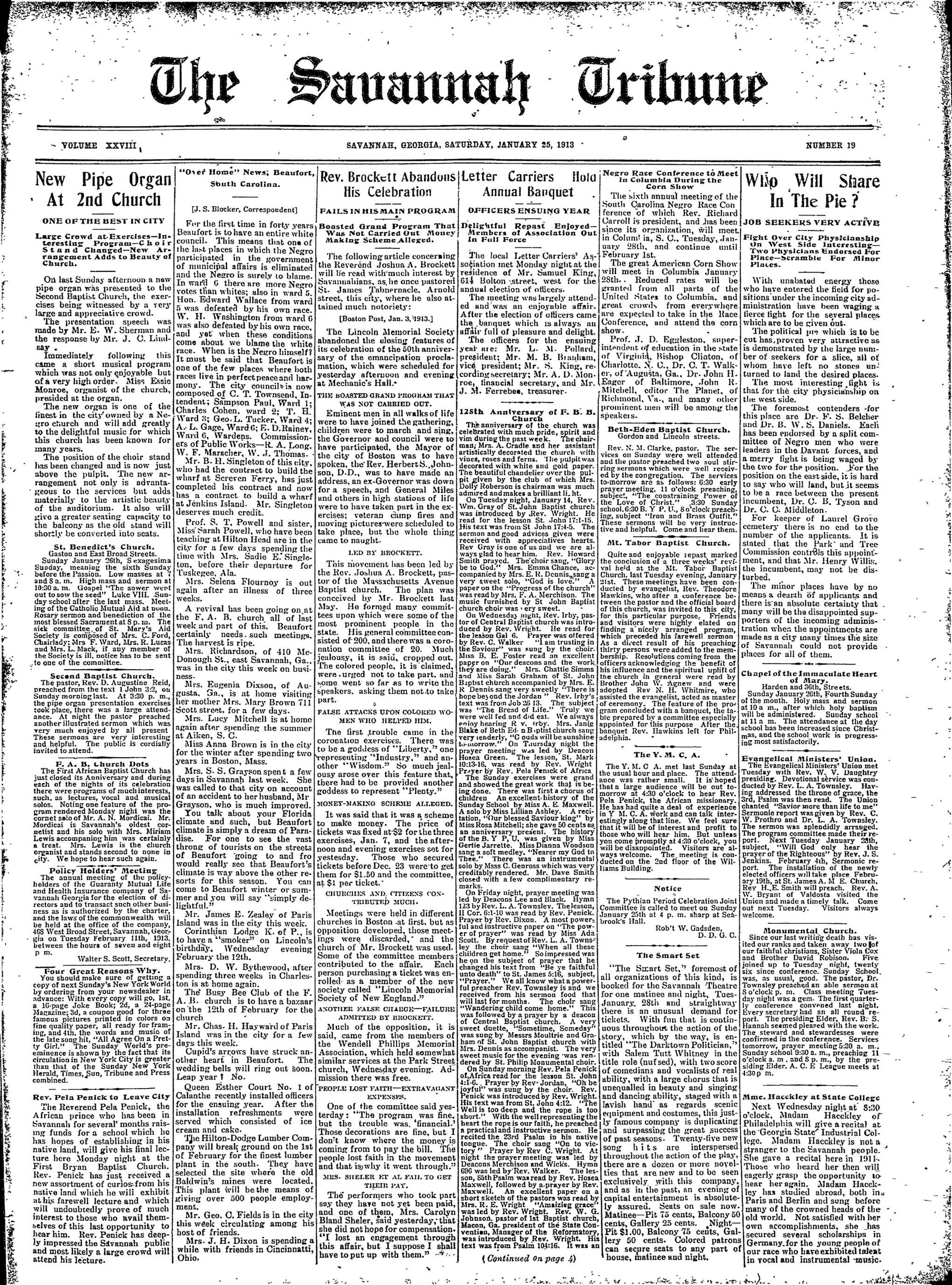
New Pipe Organ At 2nd Church
ONE OF THE BEST IN CITY
Large Crowd at Exercises—Interesting Program—Choir Stand Changed—New Arrangement Adds to Beauty of Church.
On last Sunday afternoon a new pipe organ was presented to the Second Baptist Church, the exercises being witnessed by a very large and appreciative crowd.
The presentation speech was made by Mr. E. W. Sherman and the response by Mr. J. C. Lind-say.
Immediately following this came a short musical program which was not only enjoyable but of a very high order. Miss Essie Monroe, organist of the church, presided at the organ.
The new organ is one of the finest in the city owned by a Negro church and will add greatly to the delightful music for which this church has been known for many years.
The position of the choir stand has been changed and is now just above the pulpit. The new arrangement not only is advantageous to the services but adds materially to the artistic beauty of the auditorium. It also will give a greater seating capacity to the balcony as the old stand will shortly be converted into seats.
St. Benedict's Church.
Gaston and East Broad Streets.
Sunday January 26th, Sexagesima
Sunday, meaning the sixth Sunday
before the Passion. Low masses at 7
and 8 a.m. High mass and sermon at
10:30 a.m. Gospel "The sower went
out to sow the seed" Luke VIII. Sunday
school after the last mass. Meeting
of the Catholic Mutual Aid at noon.
Rosary sermon and benediction of the
most blessed Sacrament at 8 p.m. The
sick committee, of St. Mary's Aid
Society is composed of Mrs. C. Ford,
Chairlady; Mrs F. Ward, Mrs. R. Lucas
and Mrs. L. Mack, if any member of
the Society is ill, notice has to be sent
to one of the committee.
Second Baptist Church
Second Baptist Church.
The pastor, Rev. D. Augustine Reid, preached from the text I John 3:2, on Sunday morning last. At 3:30 p. m., the pipe organ presentation exercises took place, there was a large attendance. At night the pastor preached another illustrated sermon which was very much enjoyed by all present. These sermons are very interesting and helpful. The public is cordially invited to attend.
E. A. B. Church Dots
The First African Baptist Church has just closed its Anniversary and during each of the nights of its celebration there were programs of much interests, such, as lectures, vocal and musical solos. Noting one feature of the program rendered Monday night was the cornet solo of Mr. A. N. Mordicali. Mr. Mordicali is Savannah's oldest cornetist and his solo with Mrs. Miriam Lewis accompanying him was certainly a treat. Mrs. Lewis is the church organist and stands second to none in city. We hope to hear such again.
Policy Holders' Meeting
Policy Holders' Meeting
The annual meeting of the policy-
holders of the Guaranty Mutual Life
and Health Insurance company of Savannah Georgia for election of the
and to transact such other business
as is authorized by the charter,
and the laws of the commonwealth will
be held at the office of the company,
468 West Broad Street, Savannah, Georgia on Tuesday February 11th, 1913,
between the hours of seven and eight
n.m.
Walter S. Scott, Secretary.
Four Great Reasons Why.
You should make sure of getting a copy of next Sunday's New York World by ordering from your newsdealer in advance: With every copy will go, 1st, a 16-page Joke Book; 2d, a 24-page Magazine; 3d, a coupon good for three famous pictures printed in colors on fine quality paper, all ready for framing, and 4th, the words and music of the late song hit, "All Agree On a Pretty Girl." The Sunday World's pre-eminence is shown by the fact that its circulation in New York City is greater than that of the Sunday New York Herald, Times, Sun, Tribune and Press combined.
Rev. Pela Penick to Leave City
Rev. Pela Penick to Leave City
The Reverend Pela Penick, the African prince who has been in Savannah for several months raising funds for a school which he has hopes of establishing in his native land, will give his final lecture here Monday night at the First Bryan Baptist Church.
Rev. Penick has just received a new assortment of curios from his native land which he will exhibit at his farewell lecture and which will undoubtedly prove of much interest to those who avail themselves of this last opportunity to hear him. Rev. Penick has deeply impressed the Savannah public and most likely a large crowd will attend his lecture.
"Over Home" News; Beaufort, Sbuth Carolina.
[J. S. Blocker, Correspondent]
For the first time in forty years Beaufort is to have an entire white council. This means that one of the last places in which the Negro participated in the government of municipal affairs is eliminated and the Negro is surely to blame. In ward 6 there are more Negro votes than whites; also in ward 5. Hon. Edward Wallace from ward 5 was defeated by his own race. W. H. Washington from ward 6 was also defeated by his own race, and yet when these conditions come about we blame the white race. When is the Negro himself? It must be said that Beaufort is one of the few places where both races live in perfect peace and harmony. The city council is now composed of C. T. Townsend, Intendent; Sampson Paul, Ward 1; Charles Cohen, ward 2; T. H. Ward 3; Geo. L. Tucker, Ward 4; A. L. Gage, Ward 6; E. D. Rainey, Ward 6, Wardens. Commissioners of Public Works—R. A. Long, W. F. Marscher, W. J. Thomas. Mr. B. H. Singleton of this city, who had the contract to build the wharf at Screven Ferry, has just completed his contract and now has a contract to build a wharf at Jenkins Island. Mr. Singleton deserves much credit.
Prof. S. T. Powell and sister, Miss Sarah Powell, who have been teaching at Hilton Head are in the city for a few days spending the time with Mrs. Sadie E. Singleton, before their departure for Tuskegee, Ala.
Mrs. Selena Flournoy is out again after an illness of three weeks.
A revival has been going on at the F. A. B. church all of last week and part of this. Beaufort certainly needs, such meetings. The harvest is ripe.
Mrs. Richardson, of 410 McDonough St., east Savannah, Ga., was in the city this week on business.
Mrs. Eugenia Dixson, of Augusta, Ga., is at home visiting her mother Mrs. Mary Brown 711 Scott street, for a few days.
Mrs. Lucy Mitchell is at home again after spending the summer at Alken, S. C.
Miss Anna Brown is in the city for the winter after spending two years in Boston, Mass.
Mrs. S. S. Grayson spent a few days in Savannah last week. She was called to that city on account of an accident to her husband, Mr. Grayson, who is much improved.
You talk about your Florida climate and such, but Beaufort climate is simply a dream of Paradise. For one to see the vast throng of tourists on the streets of Beaufort going to and fro would really see that Beaufort's climate is way above the other resorts for this season. You can come to Beaufort winter or summer and you will say "simply delightful."
Mr. James E. Zealey of Paris Island was in the city this week.
Corinthian Lodge K. of P., is to have a "smoker" on Lincoln's birthday. Wednesday evening February the 12th.
Mrs. D. W. Bythewood, after spending three weeks in Charleston is at home again.
The Busy Bee Club of the F. A. B. church is to have a bazaar on the 12th of February for the church
Mr. Chas. H. Hayward of Paris Island was in the city for a few days this week.
Cupid's arrows have struck another heart in Beaufort. The wedding bells will ring out soon. Leap year! No.
Queen Esther Court No. 1 of Calanthe recently installed officers for the ensuing year. After the installation refreshments were served which consisted of ice cream and cake.
The Hilton-Dodge Lumber Company will break ground on the 1st of February for the finest lumber plant in the south. They have selected the site where the old Baldwin's mines were located. This plant will be the means of giving over 500 people employment. Mr. Geo. C. Fields is in the city this week circulating among his host of friends. Mrs. J. H. Dixon is spending a while with friends in Cincinnati, Ohio.
SAVANNAH, GEORGIA, SATURDAY, JANUARY 25, 1913
Rev. Brockett Abandous His Celebration
FAILS IN HIS MAIN PROGRAM
Boasted Grand Program That
Was Not Carried Out Money
Making Scheme Alleged.
The following article concerning
the Reverend Joshua A. Brockett
will be read with much interest by
Savannahians, as he once pastored
St. James Tabernacle, Arnold
street, this city, where he also
attained much notoriety:
[Boston Post, Jan. 3, 1913.]
The Lincoln Memorial Society abandoned the ulosing features of its celebration of the 50th anniversary of the emancipation proclamation, which were scheduled for yesterday afternoon and evening at Mechanic's Hall.
THE BOASTED GRAND PROGRAM THAT
WAS NOT CARRIED OUT.
Eminent men in all walks of life were to have joined the gathering, children were to march and sing, the Governor and council were to have participated, the Mayor of the city of Boston was to have spoken, the Rev. Herbert S., Johnson, D.D., was to have made an address, an ex-Governor was down for a speech, and General Miles and others in high stations of life were to have taken part in the exercises; veteran camp fires and moving pictures were scheduled to take place, but the whole thing came to naught.
LED BY BROCKETT.
This movement has been led by the Rev. Joshua A. Brockett, pastor of the Massachusetts Avenue Baptist church. The plan was conceived by Mr. Brockett last May. He formed many committees upon which were some of the most prominent people in the state. His general committee consisted of 200, and there was a coronation committee of 20. Much jealousy, it is said, cropped out. The colored people, it is claimed, were urged not to take part, and some went so far as to write the speakers, asking them not to take part.
FALSE ATTACKS UPON COLORED WOMEN WHO HELPED HIM.
The first trouble came in the coronation exercises. There was to be a goddess of "Liberty," one representing "Industry," and another "Wisdom." So much jealousy arose over this feature that, there had to be provided another goddess to represent "Plenty."
MONEY-MAKING SCHEME ALLEGED.
It was said that it was a scheme to make money. The price of tickets was fixed at $2 for the three exercises, Jan. 7, and the afternoon and evening exercises set for yesterday. Those who secured tickets before Dec. 23 were to get them for $1.50 and the committee, at $1 per ticket.
CHURCHES AND, CITIZENS CON-TRIBUTED MUCH.
Meetings were held in different churches in Boston at first, but as opposition developed, those meetings were discarded, and the church of Mr. Brockett was used. Some of the committee members contributed to the affair. Each person purchasing a ticket was enrolled as a member of the new society called "Lincoln Memorial Society of New England."
ANOTHER FALSE CHARGE—FAILURE ADMITTED BY BROCKETT.
Much of the opposition, it is said, came from the members of the Wendell Phillips Memorial Association, which held somewhat similar services at the Park Street church, Wednesday evening. Admission there was free.
PEOPLE LOST FAITH-EXTRAVAGANT EXPENSES.
One of the committee said yesterday: "The program was fine, but the trouble was, 'financial.' Those decorations are fine, but I don't know where the money is coming from to pay the bill. The people lost faith in the movement and that is why it went through."
THEIR PAY.
The performers who took part say they have not yet been paid, and one of them, Mrs. Carolyn Bland Sheler, said yesterday, that she did not hope for compensation. "I lost an engagement through this affair, but I suppose I shall have to put up with them."
Letter Carriers Holo Annual Banquet
OFFICERS ENSUING YEAR
Delightful Repast Enjoyed
Members of Association Out
In Full Force
The local Letter Carriers' Association met Monday night at the residence of Mr. Samuel King,
614 Bolton street, west for the annual election of officers.
The meeting was largely attended and was an enjoyable affair.
After the election of officers came the banquet which is always an affair full of pleasure and delight.
The officers for the ensuing year are: Mr. L. M. Pollard,
president; Mr. M. B. Braham,
vice president; Mr. S. King,
recording secretary; Mr. A. D. Monroe,
financial secretary, and Mr.
J. M. Ferrebee, treasurer.
125th Anniversary of F. B. B. Church
The anniversary of the church was celebrated with much pride, spirit and vim during the past week. The chairman; Mrs. A. Cradle and her assistant artistically decorated the church with vines, roses and ferns. The pulpit was decorated with white and gold paper. The beautiful chandelier over the pulpit given by the club of which Mrs. Dolly Roberson is chairman was much admired and makes a brilliant li. ht.
On Tuesday night, January 14, Rev Wm. Gray of St. John Baptist church was introduced by Rev. Wright. He read for the lesson St. John 17:1-15. His text was from St John 17:4-5. The sermon and good advices given were received with appreciatives hearts, Rev Gray is one of us and we are always glad to hear him. Rev. Howard Smith prayed. The choir sang, "Glory be to God," Mrs. Emma Chance, accompanied by Mrs. E. R. Dennis, sang a very sweet solo, "God is love." A paper on the "Progress of the church" was read by Mrs. F. A. Merchison. The music furnished by St John Baptist church choir was very sweet.
On Wednesday night, Rev. Irby, pastor of Central Baptist church was introduced by Rev. Wright. He read for the lesson Gal 6. Prayer was offered by Rev. C. Walker "I am trusting in the Saviour" was sung by the choir Miss B. E. Foster read an excellent paper on "Our deacons and the work they are doing." Mrs. Chattie Simms and Miss Sarah Graham of St. John Baptist church accompanied by Mrs. E. Rennis sang very sweetly "There is hope bey on the Jordan" Rev. Irby's text was from Job 26 13. The subject was "The Bread of Life." Truly we were well fed and did eat. We always enjoy hearing R v. irby. Mrs. Janie Blake of Beth Ed. n Baptist church sang very tenderly, "C ouds will be sunshine to-morrow." On Thursday night the prayer meeting was led by Deacon Hosea Green. The lesson, St. Mark 10:13-16, was read by Rev. Wright Prayer by Rev. Pela Penck of Africa
The Sunday exercises were grand and showed the great work that is being done. There was first a chorus of children. An excellent-history of the Sunday School by Miss A. E. Maxwell. A solo by Miss Lillian Ashley. A recitation, "Our blessed Saviour king" by Miss Rosa Mitchell; she gave 50 cents as an anniversary present. The history of the B. Y P, U, was given by Miss Gertie Jarrette. Miss Dianna Woodson sang a soft medley, "Nearer my God to Thee." There was an instrumental solo by Miss C. Gen罗恩 which was very creditibly rendered. Mr. Dave Smith closed with a few complimentary remarks.
On Friday night, prayer meeting was led by Deacons Lee and Black. Hymn 133 by Rev. L. A. Townsley, The lesson, II Cor. 6:1-10 was read by Rev. Penick. Prayer by Rev. Dixon. A most powerful and instructive paper on "The power of prayer" was read by Miss Ada Scott. By request of Rev. L. A. Townsley the choir sang "When all these children get home." So impressed was he on the subject of prayer that he changed his text from "Be ye faithful unto death" to St. James 5:16, subject, "Prayer." We all know what a powerful preacher Rev. Townsley is and we received from his sermon food that will last for months. The choir sang "Wandering child come home." This was followed by a prayer by a deacon of Central Baptist church. A very sweet duette, "Sometimes, Someday" was sung by Messrs Moultrie and Graham of St. John Baptist church with Mrs. Dennis as accompanist. The very sweet music for the evening was rendered by St. Philip Monumental choir.
On Sunday morning Rev. Pela Penick of Africa read for the lesson St. John 4:1-6. Prayer by Rev. Jordan, "Oh be joyful!" was sung by the choir. Rev. Penick was introduced by Rev. Wright. His text was from St. John 4:12. "The Well is too deep and the rope is too short." With the well representing the heart the rope is our faith, he preached a practical and instructive sermon. He recited the 23rd Psalm in his native tongue. The choir sang "On to victory" Prayer by Rev C. Wright. At night the prayer meeting was led by Deacons Merchison and Wicks. Hymn 696 was led by Rev. Walker. The lesson, 5th Psalm was read by Rev. Hosea Maxwell, followed by a prayer by Rev Maxwell. An excellent paper on a short sketch of the pastors was read by Mrs. R. E. Wright "Amazizig grace" was led by Rev. Wright. Rev. W. G. Johnson, pastor of 1st Baptist church, Macon, Ga. president of the State Convention, Manager of the Reformatory, was introduced by Rev. Wright. His text was from Psalm 104:16. It was an
(Continued on page 4)
Negro Race Conference to Meet in Columbia During the Corn Show
The sixth annual meeting of the South Carolina Negro Race Conference of which Rev. Richard Carroll is president, and has been since its organization, will meet in Columbia, S. C., Tuesday, January 28th, and continue until February 1st.
The great American Corn Show will meet in Columbia January 28th. Reduced rates will be granted from all parts of the United States to Columbia, and great crowds from everywhere are expected to take in the Race Conference, and attend the corn show.
Prof. J. D. Eggleston, superintendent of education in the state of Virginia, Bishop Clinton, of Charlotte, N. C., Dr. C. T. Walker, of Augusta, Ga., Dr. John H. Eager of Baltimore, John R. Mitchell, editor The Planet, of Richmond, Va., and many other prominent men will be among the speakers.
Beth-Eden Baptist Church.
Gordon and Lipcoln streets.
Rev. N. M. Clarke, pastor. The services on Sunday were well attended and the pastor preached two soul stirring sermons which were well received by the congregation. The services to-morrow are as follows: 6:30 early prayer meeting, 11 o'clock preaching, subject, "The constraining Power of the Love of Christ." 3:30 Sunday school, 6:30 B. Y P. U., 8 o'clock preaching, subject "Iron and Brass Outfit." These sermons will be very instructive and helpful. Come and hear them.
Mt. Tabor Baptist Church.
Quite and enjoyable repast marked the conclusion of a three weeks' revival held at the Mt. Tabor Baptist Church, last Tuesday evening, January 21st. These meetings have been conducted by evangelist, Rev. Theodore Hawkins, who after a conference between the pastor and the official board of this church, was invited to this city, for this particular purpose. Friends and visitors were highly elated on finding a nicely arranged program, which preceded his farewell sermon. As a direct result of his preaching thirty persons were added to the membership. Resolutions coming from the officers acknowledging the benefit of his influence and the spiritual uplift of the church in general were read by Brother John W. Agnew and were adopted Rev N. H. Whitmire, who assisted the evangelist, acted as master of ceremony. The feature of the program concluded with a banquet, the table prepared by a committee especially appointed for this purpose. After the banquet Rev. Hawkins left for Philadelphia.
The Y. M. C. A.
The Y. M. C A. met last Sunday at the usual hour and place. The attendance was rather small. It is hoped that a large audience will be out tomorrow at 4:30 o'clock to hear Rev. Pela Penick, the African missionary. He has had a deal of experience in Y M. C. A. work and can talk interestingly along that line. We feel sure that it will be of interest and profit to those who will hear him. But unless you come promptly at 4:30 o'clock, you will be disappointed. Visitors are always welcome. The meeting is conducted on the 2nd floor of the Williams Building.
Notice
The Pythian Period Celebration Joint Committee is called to meet on Sunday January 25th at 4 p. m. sharp at Seabrook's Hall.
Robt' W. Gadsden
D. D. G. C.
The Smart Set
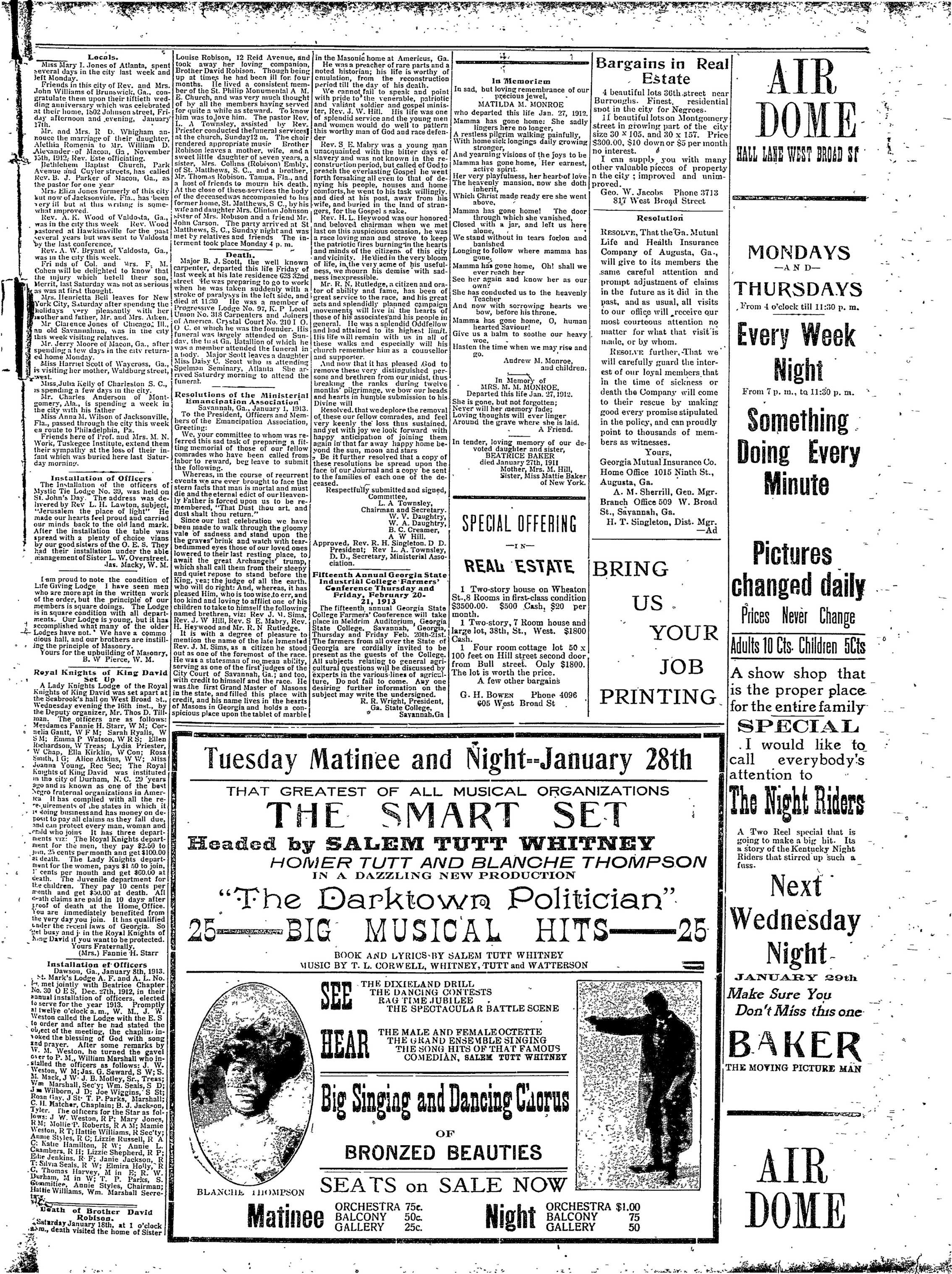
"The Smart Set," foremost of all organizations of this kind, is booked for the Savannah Theatre for one matinee and night, Tuesday, 28th and straightway there is an unusual demand for tickets. With fun that is continuous throughout the action of the story, which by the way, is entitled "The Darktown Politician," with Salem Tutt Whitney in the title role (nuf sed), with two score of comedians and vocalists of real ability, with a large chorus that is unequalled in beauty and singing and dancing ability, staged with a lavish hand as regards scenic equipment and costumes, this justly famous company is duplicating and surpassing the great success of past seasons. Twenty-five new song hits are interspersed throughout the action of the play, there are a dozen or more novelties that are new and to be seen exclusively with this company, and as in the past, an evening of capital entertainment is absolutely assured. Seats on sale now. Matinee—Pit 75 cents, Balcony 50 cents, Gallery 25 cents. Night—Pit $1.00, Balcony 75 cents, Gallery 50 cents. Colored patrons can secure seats to any part of house, matinee and night.
NUMBER 19
Who Will Share In The Pie?
JOB SEEKERS VERY ACTIVE
Fight Over City Physicianship On West Side Interesting—Two Physicians Endorsed For Place—Scramble For Minor Places.
With unabated energy those who have entered the field for positions under the incoming city administration have been waging a fierce fight for the several places which are to be given out.
The political pre which is to be cut has proven very attractive as is demonstrated by the large number of seekers for a slice, all of whom have left no stones unturned to land the desired places.
The most interesting fight is that for the city physicianship on the west side.
The foremost contenders for this place are Dr. F. S. Belcher and Dr. B. W. S. Daniels. Each has been endorsed by a split committee of Negro men who were leaders in the Davant forces, and a merry fight is being waged by the two for the position. For the position on the east side, it is hard to say who will land, but it seems to be a race between the present incumbent, Dr. C. B. Tyson and Dr. C. C. Middleton. For keeper of Laurel Grove cemetery there is no end to the number of the applicants. It is stated that the Park and Tree Commission controls this appointment, and that Mr. Henry Willis, the incumbent, may not be disturbed.
The minor places have by no means a dearth of applicants and there is an absolute certainty that many will be the disappointed supporters of the incoming administration when the appointments are made as a city many times the size of Savannah could not provide places for all of them.
Chapel of the Immaculate Heart of Mary.
Harden and 30th, Streets.
Sunday January 26th, Fourth Sunday of the month. Holy mass and sermon at 10 a.m., after which holy baptism will be administered. Sunday school at 11 a.m. The attendance at the day school has been increased since Christmas, and the school work is progressing most satisfactorily.
Evangelical Ministers' Union.
The Evangelical Ministers' Union met Tuesday with Rev. W. V. Daughtry presiding. Devotional service was conducted by Rev. L. A. Townsley. Having addressed the throne of grace, the 3rd, Psalm was then read. The Union chanted "Savior more than life to me" Sermonic report was given by Rev. C. W. Prothro and Dr. L. A. Townsley. The sermon was splendidly arranged. The program committee made their report. Next Tuesday January 29th, subject, "Will God only hear the prayer of the Righteous" by Rev. J. S. Jenkins. February 4th, Sermonic report. The installation of the newly elected officers will take place February 19th, at St. James A. M. E. Chureh, Rev H. E. Smith will preach. Rev. A. W. Bryant of Valdosta visited the Union and made a timely talk. Come out next Tuesday. Visitors always welcome.
Monumental Church.
Since our last writing death has visited our ranks and taken away two of our faithful christians, Sister Viola Cox and Brother David Robison. Five joined up to Tuesday night, twenty six since conference. Sunday School was, as usual, good. The pastor, Dr. Townsley preached an able sermon at S o'clock p. m. Class meeting Tuesday night was a gem. The first quarterly conference convened last night. Every secretary had an all round report. The presiding Elder, Rev. B. S. Hannah seemed pleased with the work. The steward and stewardesses were confirmed in the conference. Services tomorrow, prayer meeting 5:30 a. m., Sunday school 9:30 a. m., preaching 11 o'clock a. m. and 8 p. m., by the presiding Elder. A. C. E League meets at 4:30 p. m.
Mme. Hacckley at State College
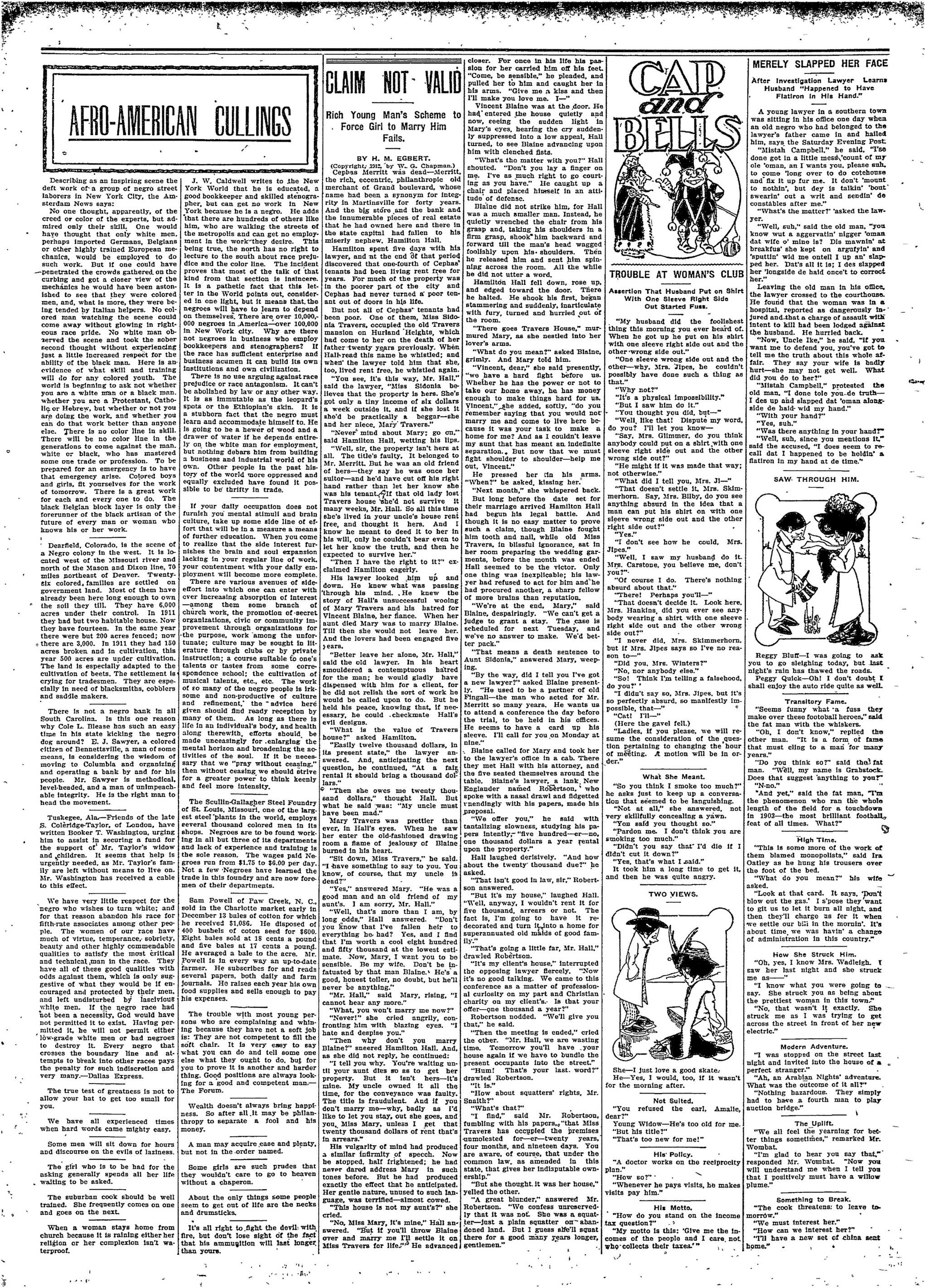
AFRO-AMERICAN CULLINGS
Describing as an inspiring scene the deft work of a group of negro street laborers in New York City, the Amsterdam News says:
No one thought, apparently, of the creed or color of the experts, but admired only their skill. One would have thought that only white men, perhaps imported Germans, Belgians or other highly trained European mechanics, would be employed to do such work. But if one could have penetrated the crowds gathered on the curbing and got a closer view of the mechanics he would have been astonished to see that they were colored men, and, what is more, they were being tended by Italian helpers. No colored man watching the scene could come away without glowing in righteous race pride. No white man observed the scene and took the sober second thought without experlending just a little increased respect for the ability of the black man. Here is an evidence of what skill and training will do for any colored youth. The world is beginning to ask not whether you are a white man or a black man. whether you are a Protestant, Catholic or Hebrew, but whether or not you are doing the work, and whether you can do that work better than anyone else. There is no color line in skill. There will be no color line in the generations to come against the man. white or black, who has mastered some one trade or profession. To be prepared for an emergency is to have that emergency arise. Colored boys and girls, fit yourselves for the work of tomorrow. There is a great work for each and every one to do. The black Belgian block layer is only the forerunner of the black artisan of the future of every man or woman who knows his or her work.
Dearfield, Colorado, is the scene of a Negro colony in the west. It is located west of the Missouri river and north of the Mason and Dixon line, 70 miles northeast of Denver. Twenty-fix colored, families are settled on government land. Most of them have already been here long enough to own the soil they till. They have 6,000 acres under their control. In 1911 they had but two habitable house. Now they have fourteen. In the same year there were but 200 acres fenced; now there are 3,000. In 1911 they had 150 acres broken and in cultivation, this year 500 acres are under cultivation. The land is especially adapted to the cultivation of beets. The settlement is crying for tradesmen. They are especially in need of blacksmiths, cobblers and saddle makers.
There is not a negro bank in all South Carolina. Is this one reason why Cole L. Blease has such an easy time in his state kicking the negro dog around? E. J. Sawyer, a colored citizen of Bennettsville, a man of some means, is considering the wisdom of moving to Columbia and organizing and operating a bank by and for his people. Mr. Sawyer is methodical, level-headed, and a man of unimpeachable integrity. He is the right man to head the movement.
Tuskegee, Ala—Friends of the late S. Coleridge-Taylor, of London, have written Booker T. Washington, urging him to assist in securing a fund for the support of Mr. Taylor's widow and children. It seems that help is urgently needed, as Mr. Taylor's family are left without means to live on. Mr. Washington has received a cable to this effect.
We have very little respect for the negro who wishes to turn white; and for that reason abandon his race for fifth-rate associates among other people. The women of our race have much of virtue, temperance, sobriety, beauty and other highly commendable qualities to satisfy the most critical and technical man in the race. They have all of these good qualities with odds against them, which is only suggestive of what they would be if encouraged and protected by their men, and left undisturbed by lascivious white men. If the negro race had not been a necessity, God would have not permitted it to exist. Having permitted it, he will not permit either low-grade white men or bad negroes to destroy it. Every negro that crosses the boundary line and attempts to break into other races pays the penalty for such indiscretion and very many—Dallas Express.
The true test of greatness is not to allow your hat to get too small for you.
We have all experienced times when hard words came mighty easy.
Some men will sit down for hours and discourse on the evils of laziness.
The girl who is to be had for the asking generally spends all her life waiting to be asked.
The suburban cook should be well trained. She frequently comes on one and goes on the next.
When a woman stays home from church because it is raining either her religion or her complexion isn't waterproof.
J. W, Caldwell writes to the New York World that he is educated, a good bookkeeper and skilled stenographer, but can get no work in New York because he is a negro. He adds that there are hundreds of others like him, who are walking the streets of the metropolis and can get no employment in the work they desire. This being true, the north has no right to lecture to the south about race prejudice and the color line. The incident proves that most of the talk of that kind from that section is insincere. It is a pathetic fact that this letter in the World points out, considered in one light, but it means that, the negroes will have to learn to depend on themselves. There are over 10,000,000 negroes in America—over 100,000 in New Work city. Why are there not negroes in business who employ bookkeepers and stenographers? If the race has sufficient enterprise and business acumen it can build its own institutions and own civilization.
There is no use arguing against race prejudice or race antagonism. It can't be abolished by law or any other way. It is as immutable as the leopard's spots or the Ethiopian's skin. It is a stubborn fact that the negro must learn and accommodate himself to. He is going to be a hewer of wood and a drawer of water if he depends entirely on the white man for employment, but nothing debars him from building a business and industrial world of his own. Other people in the past history of the world more oppressed and equally excluded have found it possible to be thrifty in trade.
If your daily occupation does not furnish you mental stimuli and brain culture, take up some side line of effort that will be in a measure a means of further education. When you come to realize that the side interest furnishes the brain and soul expansion lacking in your regular line of work, your contentment with your daily employment will become more complete.
There are various avenues of side-effort into which one can enter with ever increasing absorption of interest—among them some branch of church work, the promotion of secret organizations, civic or community improvement through organizations for the purpose, work among the unfortunate; culture may be sought in literature through clubs or by private instruction; a course suitable to one's talents or tastes from some correspondence school; the cultivation of musical talents, etc., etc. The work of so many of the negro people is lrksome and non-productive of culture and refinement, the advice here given should find ready reception by many of them. As long as there is life in an individual's body, and health along therewith, efforts should be made unceasingly for enlarging the mental horizon and broadening the activities of the soul. If it be necessary that we "pray without ceasing," then without ceasing, we should strive for a greater power to think keenly and feel more intensity.
The Scullin-Gallagher Steel Foundry of St. Louis, Missouri, one of the largest steel 'plants' in the world, employs several thousand colored men in its shops. Negroes are to be found working in all but three of its departments and lack of experience and training is the sole reason. The wages paid Negroes run from $1.75 to $6.00 per day. Not a few Negroes have learned the trade in this foundry and are now foremen of their departments.
Sam Powell of Paw Creek, N. C., sold in the Charlotte market early in December 13 bales of cotton for which he received $1,086. He disposed of 400 bushels of cotton seed for $600. Eight bales sold at 18 cents a pound and five bales at 17 cents a pound. He averaged a bale to the acre. Mr. Powell is in every way an up-to-date farmer. He subscribes for and reads several papers, both daily and farm journals. He raises each year his own food supplies and sells enough to pay his expenses.
The trouble with most young persons who are complaining and whining because they have not a soft job is: They are not competent to fill the soft chair. It is very easy to say what you can do and tell some one else what they ought to do, but for you to prove it is another and harder thing. Good positions are always looking for a good and competent man.—The Forum.
Wealth doesn't always bring happiness. So after all, it may be philanthropy to separate a fool and his money.
A man may acquire ease and plenty, but not in the order named.
Some girls are such prudes that they wouldn't care to go to heaven without a chaperon.
About the only things some people seem to get out of life are the necks and drumsticks.
It's all right to fight the devil with fire, but don't lose sight of the fact that his ammugition will last longer than yours.
CLAIM NOT VALID
Rich Young Man's Scheme to Force Girl to Marry Him
BY H. M. EGBERT.
(Copyright, 1912, by W. G. Chapman).
Cephas Merritt was dead—Merritt,
the rich, eccentric, philanthropic old
merchant of Grand boulevard, whose
name had been a synonym for integrity
in Martinsville for forty years.
And the big store, and the bank and
the innumerable pieces of real estate
that he had owned here and there in
the state capital had fallen to his
miserly nephew, Hamilton Hall.
Hamilton spent five days with his
lawyer, and at the end of that period
discovered that one-fourth of Cephas'
tenants had been living rent free for
years. For much of the property was
in the poorer part of the city and
Cephas had never turned a poor tenant
out of doors in his life.
But not all of Cephas' tenants had been poor. One of them, Miss Sidonia Travers, occupied the old Travers mansion on Hurland Heights, which had come to her on the death of her father twenty years previously. When Hall read this name he whistled; and when the lawyer told him that she, too, lived rent free, he whistled again. "You see, it's this way, Mr. Hall," said the lawyer, "Miss Sidonia believes that the property is hers. She's got only a tiny income of six dollars a week outside it, and if she lost it she'd be practically a beggar—she and her niece, Mary Travers."
"Never mind about Mary; go on," said Hamilton Hall, wetting his lips.
"Well, sir, the property isn't hers at all. The title's faulty. It belonged to Mr. Merritt. But he was an old friend of hers—they say he was once her sutor—and he'd have cut off his right hand rather than let her know she was his tenant. If that old lady lost Travers house she'd not survive it many weeks, Mr. Hall. So all this time she's lived in your uncle's house rent free, and thought it hers. And I know he meant to deed it to her in his will, only he couldn't bear even to let her know the truth, and then he expected to survive her."
"Then I have the right to it?" exclaimed Hamilton eagerly.
His lawyer looked him up and down. He knew what was passing 'through his mind. He knew the story of Hall's unsuccessful wooing of Mary Travers and his hatred for Vincent Blaine, her fiance. When her aunt died Mary was to marry Blaine. Till then she would not leave her. And the lovers had been engaged five years.
"Better leave her alone, Mr. Hall," said the old lawyer. In his heart smouldered a contemptuous hatred for the man; he would gladly have dispensed with him for a client, for he did not relish the sort of work he would be called upon to do. But he held his peace, knowing that, if necessary, he could .checkmate Hall's evil designs.
"What is the value of Travers house?" asked Hamilton.
"Easily twelve thousand dollars, in its present state," the lawyer answered. And, anticipating the next question, he continued, "At a fair rental it should bring a thousand dollars."
"Then she owes me twenty thousand dollars," thought Hall. But what he said was: "My uncle must have been mad."
Mary Travers was prettier than ever, in Hall's eyes. When he saw her enter the old-fashioned drawing room a flame of jealousy of Blaine burned in his heart.
"Sit down, Miss Travers," he said. "I have something to say to you. You know, of course, that my uncle is dead?"
"Yes," answered Mary. "He was a good man and an old friend of my aunt's. I am sorry, Mr. Hall."
"Well, that's more than I am, by long odds," Hall answered. "Don't you know that I've fallen heir to everything he had? Yes, and I find that I'm worth a cool eight hundred and fifty thousand at the lowest estimate. Now, Mary, I want you to be sensible. Be my wife. Don't be infatuated by that man Blaine. He's a good, honest toller, no doubt, but he'll never be anything."
"Mr. Hall," said Mary, rising, "I cannot hear any more."
"What, you won't marry me now?" "Never!" she cried angrily, confronting him with blazing eyes. "I hate and despise you."
"Then why don't you marry Blaine?" sneered Hamilton Hall. And, as she did not reply, he continued:
"I tell you why. You're waiting until your aunt dies so as to get her property. But it isn't hers—it's mine. My uncle owned it all the time, for the conveyance was faulty. The title is fraudulent. And if you don't marry me—why, badly as I'd like to let you stay, out she goes, and you. Miss Mary, unless I get that twenty thousand dollars of rent that's in arrears."
His vulgarity of mind had produced a similar infirmity of speech. Now he stopped, half frightened; he had never dared address Mary in such tones before. But he had produced exactly the effect that he anticipated. Her gentle nature, unused to such language, was terrified—almost cowed.
"This house is not my aunt's?" she cried.
"No, Miss Mary, it's mine," Hall answered. "But if you'll throw Blaine over and marry me I'll settle it on Miss Travera for life." He advanced
closer. For once in his life his passion for her carried him off his feet. "Come, be sensible," he pleaded, and pulled her to him and caught her in his arms. "Give me a kiss and then I'll make you love me. I—"
Vincent Blaine was at the door. He had entered the house quietly and now, seeing the sudden light in Mary's eyes, hearing the cry suddenly suppressed into a low appeal, Hall turned, to see Blaine advancing upon him with clenched fists.
"What's the matter with you?" Hall shouted. "Don't you lay a finger on me. I've as much right to go courting as you have." He caught up a chair and placed himself in an attitude of defense.
Blaine did not strike him, for Hall was a much smaller man. Instead, he quietly wrenched the chair from his grasp and, taking his shoulders in a firm grasp, shook him backward and forward till the man's head wagged foolishly upon his shoulders. Then he released him and sent him spinning across the room. All the while he did not utter a word.
Hamilton Hall fell down, rose up, and edged toward the door. There he halted. He shook his first, began stammering and suddenly, inarticulate with fury, turned and hurried out of the room.
"There goes Travers House," murmured Mary, as she nestled into her lover's arms.
"What do you mean?" asked Blaine, grimly. And Mary told him.
"Vincent, dear," she said presently, "we have a hard fight before us. Whether he has the power or not to take our home away, he has money enough to make things hard for us, Vincent." she added, softly, "do you remember saying that you would not marry me and come to live here because it was your task to make a home for me? And as I couldn't leave my aunt that has meant an indefinite separation. But now that we must fight shoulder to shoulder—help me out, Vincent."
He pressed her in his arms. "When?" he asked, kissing her.
"Next month," she whispered back. But long before the date set for their marriage arrived Hamilton Hall had begun his legal battle. And though it is no easy matter to prove such a claim, though Blaine fought him tooth and nail, while old Miss Travers, in blissful ignorance, sat in her room preparing the wedding garments, before the month was ended Hall seemed to be the victor. Only one thing was inexplicable; his lawyer had refused to act for him and he had procured another, a sharp fellow of more brains than reputation.
"We're at the end, Mary," said Blaine, despairingly. "We can't get a judge to grant a stay. The case is scheduled for next Tuesday, and we've no answer to make. We'd better pack."
"That means a death sentence to Aunt Sidonia," answered Mary, weeping.
"By the way, did I tell you I've got a new lawyer?" asked Blaine presently. "He used to be a partner of old Fingall—the man who acted for Mr. Merritt so many years. He wants us to attend a conference the day before the trial, to be held in his offices. He seems to have a card up his sleeve. I'll call for you on Monday at nine."
Blaine called for Mary and took her to the lawyer's office in a cab. There they met Hall with his attorney, and the five seated themselves around the table. Blaine's lawyer, a lank New Englander named Robertson, who spoke with a nasal drawl and fidgeted unendingly with his papers, made his proposal.
"We offer you," he said with tantalizing slowness, studying his papers intently, "five hundred—er—no, one thousand dollars a year rental upon the property."
Hall laughed derisively. "And how about the twenty thousand due?" he asked.
"That isn't good in law, slr," Robertson answered.
"But it's my house," laughed Hall. "Well, anyway, I wouldn't rent it for five thousand, arrears or not. The fact is, I'm going to have it decorated and turn it into a home for superannuated old maids of good family."
"That's going a little far, Mr. Hall," drawled Robertson.
"It's my client's house," interrupted the opposing lawyer fiercely. "Now it's no good talking. We came to this conference as a matter of professional curiosity on my part and Christian charity on my client's. Is that your offer—one thousand a year?"
Robertson nodded. "We'll give you that," he said.
"Then the meeting is ended," cried the other. "Mr. Hall, we are wasting time. Tomorrow you'll have your house again if we have to bundle the present occupants into the street."
"Hum! That's your last. word?" drawled Robertson.
"It is."
"How about squatters' rights, Mr. Snailth?"
"What's that?"
"I find," said Mr. Robertson, fumbling with his papers, "that Miss Travers has occupied the premises unmolested for—er—twenty years, four months, and nineteen days. You are aware, of course, that under the common law, as amended in this state, that gives her indisputable ownership."
"But she thought. it was her house," yelled the other.
"A great blunder," answered Mr. Robertson. "We confess unreservedly that it was not. She was a squatter—just a plain squatter on~abandoned land. But I guess she'll squat there for a good many years longer, gentlemen."
CAP
and
BELLS
TROUBLE AT WOMAN'S CLUB
Assertlon That Husband Put on Shirt
With One Sleeve Right Side
Out Started Fuss.
"My husband did the foolishest thing this morning you ever heard of. When he got up he put on his shirt with one sleeve right side out and the other-wrong side out."
"One sleeve wrong side out and the other—why, Mrs. Jipes, he couldn't possibly have done such a thing as that."
"Why not?"
"It's a physical impossibility."
"But I saw him do it."
"You thought you did, but—"
"Well, like that! Dispute my word, do you? I'll let you know—"
"Say, Mrs. Glimmer, do you think anybody could put on a shirt, with one sleeve right side out and the other wrong side out?"
"He might if it was made that way; not otherwise."
"What did I tell you, Mrs. Jl—"
What did I tell you, Mrs. S.
"That doesn't settle it, Mrs. Skimmerhorn. Say, Mrs. Bilby, do you see anything absurd in the idea that a man can put his shirt on with one sleeve wrong side out and the other right side out?"
"Yes."
"I don't see how he could, Mrs. Jipes."
"Well, I saw my husband do it. Mrs. Carstone, you believe me, don't you?"
"Of course I do. There's nothing absurd about that."
"There! Perhaps you'll—"
"That doesn't decide it. Look here, Mrs. Hankins, did you ever see anybody wearing a shirt with one sleeve right side out and the other wrong side out?"
"I never did, Mrs. Skimmerhorn, but if Mrs. Jipes says so I've no reason to—"
"Did you, Mrs. Winters?"
"No, nor anybody else."
"So! Think I'm telling a falsehood, do you?!"
"I didn't say so, Mrs. Jipes, but it's so perfectly absurd, so manifestly impossible, that—"
"Cat! I'll—"
(Here the gavel fell.)
"Ladies, if you please, we will resume the consideration of the question pertaining to changing the hour of meeting. A motion will be in order."
What She Meant.
"So you think I smoke too much?" he asks just to keep up a conversation that seemed to be languishing. "Not at all," she answered, not very skillfully concealing a yawn. "You said you thought so." "Pardon me. I don't think you are smoking too much."
"Didn't you say that I'd die if I didn't cut it down?" "Yes, that's what I said." It took him a long time to get it, and then he was quite angry.
-
She—I just love a good skate.
He—Yes, I would, too, if it wasn't
for the morning after.
"You refused the earl, Amalle, dear?"
Young Widow—He's too old for me.
"But his title?"
"That's too new for me!"
His Policy.
"A doctor works on the reciprocity plan."
"How so?"
"Whenever he pays visits, he makes visits pay him."
His Motto.
"How do you stand on the income tax question?"
His Motto.
"My motto is this: 'Give me the incomes of the people and I care, not who-collects their taxes.'"
MERELY SLAPPED HER FACE
After Investigation Lawyer Learns
Husband "Happened to Have
Flatiron in His Hand."
A young lawyer in a southern town
was sitting in his office one day when
an old negro who had belonged to the
lawyer's father came in and hailed
him, says the Saturday Evening Post:
"Mistah Campbell," he said, "Iso
done got in a little mess' count of my
ole 'oman, an I wants you, please suh,
to come 'long over to do cotehouse
and fix it up fur me. It don't 'mount
to nothin', but dey is talkin' 'bout
swearin' out a writ and sendin' de
constables after me."
"What's the matter?" asked the law-
yer.
"Well, suh," said the old man, "you know wut a aggervatin' nigger 'oman dat wife o' mine is? Dis mawnin' at breakfus' she kept on argufyn' and 'sputtn' wid me ontell I up an' slapped her. Dat's all it is; I des slapped her 'longside de haild once't to correct her."
Leaving the old man in his office, the lawyer crossed to the courthouse. He found that the woman was in a hospital, reported as dangerously injured and that a charge of assault with intent to kill had been lodged against the husband. He hurried back.
"Now, Uncle Ike," he said, "if you want me to defend you, you've got to tell me the truth about this whole affair. They say your wife is badly hurt—she may not get well. What did you do to her?"
"Mistah Campbell," protested the old man, "I done tole you de truth—I des up and slapped dat 'oman alongside de haid-wid my hand."
"With your hand?"
"Yes, suh."
"Was there anything in your hand?"
"Well, suh, since you mentions it," said the accused, "I does seem to recall dat I happened to be holdin' a flatiron in my hand at de time."
SAW THROUGH HIM.
Reggy Bluff—I was going to ask you to go sleighing today, but Inst night's rain has thawed the roads.
Peggy Quick—Oh! I don't doubt I shall enjoy the auto ride quite as well.
Transitory Fame.
"Seems funny what a fuss they make over these football heroes," said the fat man with the whiskers.
"Oh, I don't know," replied the other man. "It is a form of fame that must cling to a man for many years."
"Do you think so?" said the fat man. "Well, my name is Grabstock. Does that suggest anything to you?"
"N-no."
"And yet," said the fat man, "I'm the phenomenon who ran the whole length of the field for a touchdown in 1903—the most brilliant football, feat of all times. What?"
High Time.
"This is some more of the work of them blamed monopolists," said Ira Oatley as he hung his trousers over the foot of the bed.
"What do you mean?" his wife asked.
"Look at that card. It says, 'Don't blow out the gas.' I's pose they want to git us to let it burn all night, and then they'll charge us fer it when we settle our bill in the mornin'. It's about time, we was havin' a change of administration in this country."
How She Struck Him
"Oh, yes, I know Mrs. Wadleigh. I saw her last night and she struck me as—"
"I know what you were going to say. She struck you as being about the prettiest woman in this town."
"No, that wasn't it exactly. She struck me as I was trying to get across the street in front of her new electric."
Modern Adventure.
"I was stopped on the street last night and invited into the house of a perfect stranger."
"Ah, an Arabian Nights' adventure. What was the outcome of it all?"
"Nothing hazardous. They simply had to have a fourth man to play auction bridge."
The Uplift.
"We all feel the yearning for better things sometimes," remarked Mr. Wombat.
"I'm glad to hear you say that," responded Mr. Wombat. "Now you will understand me when I tell you that I positively must have a willow plume."
Something to Break
. we Be de im 2 ed e $ ° ey ~ PS ae = ee ee ae OS ee on
- . , : cere Ee er epee
7 ; r= Nitta dar ; — = a
fo . Delights in Smashing’ All the i Farmer's Trouble Started With
: Hel ee, Crockery EAS iy = BEST POLICY Stiff Neck 16 Years Ago.
: elps you, helps your = a Py ctrl sean tren Gractis Lang. List of Fithious| win srepten ot se
and helps the paper Penni Horie unemn| mis at Untartunate)"'™bown he tone tae
. POPULAR PRICED | |
IW 8 elm eo@iss, THE SHOE MAN
19 HAST BROUGHTON STREET,
‘Tho affable H. B, Wright Is still with us and expects the continuous
patronage of his friends.
FE. you want to get the best thet’s going—High-
Class Literature—Copyrighted Articles from
i@ the World’s Best and Most Hlustrious Wsiters—
Read This Paper
| We spare neither time nor expense
te give our readers the hest
A local newapaner, county newspapes, general news-
paper tin ate great weskly farky gona He pee
nL
Ww. kL BLOnNT,
WHOLESALE AND RETAIL :
Fruit and Commission Merchant
&34 GT. JULIAN ST, WEST, 235 BRYAN 8T., WEST. Phones 23968
SAVANNAH, GEORGIA,
- Paim Shaving Palace .
FINEST IN THE CITY.
Sxpert Hair Cutting, Electric Massage and Shampooing = Specialty. AN
‘Work Done by Experienced Workmen, Courteous attention to all SHIN-
ING PARLOR ATTACHED. 4
PERRY R. WRIGHT, Proprietor
817 WEST BROAD 8T, —~ — — —— — — — — — BAVANNAH, GA.
New Improvements i Ooch Park
The Ideal Picnic Spot of Savannah
Secure your dates from ANDREW D. MONROE, 124 East Thirty-third St.
eon ee
+ .
> SAVING
> . ‘
>
> MONEYIS :
> .
> .
> AHABIT
* .
+ / .
* Get the habit of .
> ss saving a part of ’
+ your Earnings .
> each week ‘
> 4
+ ‘
: $1.00 |
> ’
+ ® 4
+ ’
> 4
. Starts an :
> q
> c
- Account ;
> 4
+ :
> THE WAGE. c
> EARNERS". LOAN 4
a AND INVESTMENT .
4 COMPANY, 4
> q
#468 WEPSTB ROAD ST.4
* Savannah, Ga. 4
+ 4
eb eeeRe Se aE Se PS
GAREY’S
*
Variety Bakery
Goods delivered promptly to any
part of the city.
606 West Broad St, Near Gaston,
Phone 1869-3
PT
Masonic Books .
‘
_ and Regalias
LODGE SEALS, ‘
FINANCIAL CARDS and .
BLANKS of every description,
Publishers and Manufacturers’ Prices
Laberal Discounts Will Be Arranged.
BOL G JOHPISON, ©
Savannah, Ga, ‘
= ate 2 pe esse 4 WRT
Try the New Discovery
MAGIC
Shaving Powder
GUARANTEED TO SHAVE rol
CLEAN WITHOUT USING A RA
ZOR. WILL SEND HALF POUND
CAN BY MAIL. POSTAGE PAID
FOR 25 CENTS IN STAMPS, .
Agents Wanted
WRITE
The Shaving Powder Co.
SAVANNAH, GA.
Y
BROWNS LODGING HOUSE
Hot and
_ Cold Baths
Shoe Shining Parlor At-
tached_
PROMPT ATTENTION TO PATRONS
217 East Broad Street
Phone 3746 7
SAVANNAH, . . GEORGIA.
Hand This to Your Friend.
For First Class
GROCERIES and CONFECTIONERY
?
Call On
M. G. GRAHAM
, 626 York St, West,
:
~ Gourteous Attention.to All. |
S + pews +2" sog 2 sR Reeve aS
MAVAPIL TLURLNUL b. YILUAtlo
Graduate Prof. Roher's School,
New York.
719 West Broad Street.
Telephone 2328.
Wigs, Switches and Pompadoura
Made from Natural Halr.
Combinga Made Up. Shampooing and
Halr Straightening a Specialty.
Face and Electric Massage, Dyeing
and Matching Halr,
ORIENTAL HAIR GROWER.
An excellent preparation, will pro-
duce a beautiful growth of hair. Di-
rections on each bor. For sale, price
25 cents per” box. 4
@0 TO .
Young Bros.
For your
TOBACCO, CIGARS and FRUITS
Of all kinds,
809 ‘West Broad Btrect,
Aarne
WEST SIDE
RESTAURANT
462 West Broad Strest,
Near Union Station.
‘The place to gst Sratclass menim
Mverything neat and clean, Moclg
prepared in an appetizing manned
end at all hours daily,
Meals 16 and 25 cents
MRS. AB, BCOTT, Propristresn
Your Money
Pile Grows
Just in propor-
tion‘as you ad-
vertise your
business, and
our columns
‘are open for
you to. begin
at once. Sup-
pose you give
us atrial. -
Advertise
in this paper
THE HIGH
COST OF
- LIVING
‘has, not piiected our job
printing prices. We're stil!
doing commercial work
cf all kinds at prices emt.‘
_tatectory to you. ;
MAD ‘PRINCE'S LIFE
Delights in Smashing’ All the
~ Crockery Each Day. ~
Francie Charlea of Bourbon, insdhefor
| 40 Years, Is Deaf and Dumb and
Presents Horrible Sight—Not
Washed for Years.
Extraordinary revelations are made
of the mode of life of Francis-Charles
of Bourbon at Rome. Prince of Ca-
spua, who-is sexenty-five and has lived
a madman's life for 40 years in the
Villa Marlin Capannori: For several
years now he has not spoken, appar-
ently having been stricken deat and
dumb In an apoplectic seizure.
Every morning at 8 a servant knocks
at the door of the prince's bed chamber
and hurriedly places the breakfast
tray—a sumptuous repast—through a
sliding window inside the room.
The princé jumps out of bed, throws
@ toga around his shoulders and hides
till the domestic has dlappeared. He
connot bear any one to see him. He
has neither shaved, had his hair cut,
washed nor cut his nalls within the
memory of his oldest retainers,
Formerly, if he saw any one ap-
proaching him he would make the
most terrible noise, but nowadays, un-
able to give vent to his feelings thus,
the claws at the alr In front of him
and lashes out with his fists, although
the intruders may be 100 yards or
more away.
But the most remarkable perform
ance takes offect after breakfast. Day
after day, year in and year out, no
matter what the weather fz, the unfor-
tunate old man rushes without cloth-
ing out of the room, down the corri-
dor, across the terrace of the villa
to a chair, .
It fs always the same one. Once it
waa removed, and the prince fell down
in one of his oft-regurring fits. Seated
on this chair, he dresses himself slow-
ly, being generally presentable by mid-
day. The rest of the day is spent
within a circle of four or five square
yards. The prince never moves farth-
er away ‘than that from the chair.
Round and round ft he walks, sharing
his meals with‘the birds.
| He takes great delight in smashing
all the crockery each day. At 8 p. m.
it is time to go-to bed. A servant ap-
‘pears, and that fs enough. Fighting
the {maginary foe, the old man rushes
‘off to his room and locks the door.
BIRD HAS BEARDED FACE
ta Sald to Be Strong as an Ox and
Cries Like an Inifant—Devours
Chickens.
It had the face of a monkey, the
beak of a guinea keat, the strength of
an ox, the bill of an eagle, and the cry
of an infant, did a strangelooking
bird that Charles H. Werner of West:
port, Md., reports having captured aft
er it had given him an bour's battle
for his life late the other day.
The halt animal, half bird, or what-
ever it 1s, measured ten inches in
height and four fect from tip to tip of
its wings. Around its neck/ia a band.
Mr. Werner says that after attacking
him it devoured a live chicken which
happened to stray too close to a cage
in which it Js a prisoner.
Mr. Werner says he has traveled all
over the world and never before saw
anything like the creature he cap-
tured. He believes that it came here
in a ship from a foreign port and es-
caped from its captors. Two small,
coal-black eles “are firmly set in its
head, surrounded by a bearded face.
Its claws are reported as being “some-
thing fierce.”
THIEVES RIFLE ROYAL TOMB
Precious Stones Buried With the Body
of the Duchess of Genoa
Are Stolen,
A robbery of the tomb of the duch-
ess of Genoa, mother of Queen Mar-
gherita, queen-mother of Italy, in the
*Church of Superga, near Turin, was
discovered the other day. Robbers
broke the triple shell of lead contain-
ing the body, seized all the jewels and
precious stones which had been bur-
ied with it, and even tore the ears
to obtain the earrings.
The Church of Superga containg
many tombs of the royal,house of
Savoy and the duchess of Genoa was
the last to be buried there.
‘The robbery was discovered by the
guardian noticing that the gates lead-
ing to the royal crypt had been forced.
The telephone wires communicating
with Turin had been first ett, then
one of the windows had been broken
and ladders used to reach the interior
of the church, *
° For Subway Guards.
Any trainman who can properly re-
peat the following shogld not expe-
rience any lingual difficulty to lucidly
announce any station on the Interbor-
ough system: “Theophilis Thistle, in
sifting a sieve full of unsifted thistles,
thrust three thousand thistles through
the thick of his thumb. See if thou,
in sifting a sieve full of unsifted this-
tles, thrust not three thousand this-
tles through the thick of thy thumb.
Success to the successful thistle-sift-
er.”—Interborough Bulletin.
An Encouraging Sign,
“I think mother favors you,” said
she, timidly. 7
“That so?” asked he. “Has she sald
so?” s
“No, but I'm almost sure of it. The
othier night when, you stayed £o late
she ndver-sald.a word aboutit"- ”
CEOEEEERE RIE
HONESTY THE,
BEST POLICY
Gracé’s Long List of Fictitious
Admirers Had Unfortunate
‘ Results for: Her.
“No wonder I feel so grouchy!"
pouted Grace, as she shut the book
she was reading with a slam. “Every
time that phone rings I think it will
be Edward. He promised to call me
up the next day, and today is Satur
day. Six days have passed, and not a
word. It is impossible that he could
be so busy. Surely, he could find
some tlme to call me up. How fool-
ish.of me to believe all the nice noth-
ings he told me Monday evening, but
he spoke so sincerely. If that phone
rings again, and it 1s some dear girl
telling me of her manypengagements,
I will bang the receiver. I am getting
tired of listening to other people's
good times, and acting enthusiastic
when I would Ike to say, ‘I don’t
care’ And sis is not at home today
to disturb me. Generally, she seats
herself right next to me, and takes
in every word of it. If she is not in
sight she 1s at the extension, and I
have to have each word repeated until
the pleasure {= all zone.”
Just then Grace- bounced up. The
phone, the doorbell—which should she
answer first? She ran to the phone.
“Hello! Oh, Ed, I am so’glad to hear
from you. Just a moment, Ed, the
doorbell is ringing.” ~
| “Hello, sis, be quiet. I am telephon-
ing. I don't care whom you met. Tell
‘me after. Go to your room and stay
there.”
| In a second she was back at the
phone.
| “Hello, Ed! Yes, isn't the door a
‘nuisance? I really have been so busy
‘I didn’t get time to think of any phone
‘messages. It certainly don’t seem
‘nearly a week since—Oh, just a mo-
ment, Ed.
| “Sis, be still. I don’t know where
your white vail {t. You make so much
noise I don’t know what I am saying
to Ed. I'll look for tt after a while.
Now hush just for five minutes.
“Hello, Ed! I'm back again. It was
the doorbell again. A box of sweet
peas tor me. Yes, just lovely. Won-
derful weather? I should say! Auto-
mobiling? Fine weather for that, Oh,
Ea, just a moment—that bell again—
“Now, sis, juat stop calling me. I
don't keep track of your clothes. I
can't help it if all your silk stockings
are ripped. You shouid darn them.
Then wear a cotton pair—be still. I
mean it! What will I tell Ed this time?
Can't tell him it is you. He will think
youchave no bringing up—a reflection
on our family. I'll buy you a new pair
If you promise not to talk—now re-
member.
“Hello, hello, Ed. Are you still
there? You must excuse me for in-
terrupting you so often, but I just got
a box of candy. Yes, canday. De
Nelous? I should say. Well, you
know It takes some time to sign for
it—and then—what—popular did you
say? Oh, no—I can't understand you,
Ed. My sister, did you say? With
you? Why, of course, she will be
glad to go, I know. You say I have
too many other admirers? Oh, yes, T
know I will enjoy the candy and flow-
ers. Just a moment, and I'll call sis
to the phone.” i.
Grace went to her sister's room and
told her she was wanted at the phone,
“But let me tell you,” she continued,
“yow can go riding with Ed under one
condition, and that Is that you do not
tell him that I did not get the candy
and flowers.”
Sis ran to the phone enthuslastical-
ly, and while she was saying “I'll be
glad to go,” Grace walked In the I
brary, gazing upon an old motto
which read: “Honesty is the begt Pol-
fcy."—New Yerk Press.
Not a Lover of the Country.
Flavel Rankin is one of these city
chaps that can’t see the country at
all. He says he tried living in the
rural districts once and never again
for him. Tommy Scott, the cigar man,
spent his vacation in the country thts
summer and came back enthusiastic
about {t, He met Rankin on the street
sbortly after he returned,
“Hello, Flavvie!” he shouted. “Had
your vacation yet?”
“Yes—a month ago.”
“Go to the country?”
“No, I didn’t go to the country. But
I got the same results right home.; I
told the iceman to stop coming, bought
a lot of stale vegetables, took the
springs out of my bed, had tho dally
papers delivered two days late, took
the screens out and set a kerosene
lamp in the window and spent each
morning in the back yar¢ without my
hat-tintil' my nose peeled. That's why
I look as if I'd been In the country.”"—
Cleveland Plain, Dealer.
Life of a Drop of Water.
A German professor named Meinar.
due has amused himself with calculat
ing how long a drop of water stays
in the ocean before it 1s evaporated,
and how goon it returns to the sea.
Caleulatinghe does not say how—
the total evaporation from the gur.
face of the ocean and estimating the
total volume of water in the oceans,
a drop of water entering the ocean
will stay there 3.460 years, provided
it awaits its turn to be evaporated.
However, the professor admits that
the surface water stands a good
chance of getting abead of its turn,
’ The average stay out of the ocean
1s only twelve days before it has
fallen back xgain to the sea.
Farmer’s Trouble Started With
Stiff Neck 16 Years Ago.
With Exception of His Eyes; His
Tongue and Arms From Elbow
Down, He Is One Huge
Plece of Bone. *
Frank Worden of Colfax, Ia., will
give $1,000 to any surgeon in the
United States who will break his back
with anything short of a sledge ham-
mer. Worden was in Omaha a
short time ago and was seen by a
number of physicians, but when he
left the city he carried his thousand
dollars with him,
Worden is an ossified man—the
only real one in the country. He is*
also a farmer and lives near Colfax,
Ia. With the exception of his eyes, his
tongue and his arms from the elbow
down, he is one huge plece of bone,
without a joint or a hinge of any
kind. His body is as hard as stone,
and as rigid as 4 plece of steel. Ex-
cept as noted, he cannot move a sin-
gle muscle of his entire body. All
day and all night he les straight and
jstiff, motionless. He can not laugh;
‘he can not even smile,
Eighteen years ago Worden was a
farmer living near Colfax. One morn-
ing he awoke with a stiff neck. There
Was no pain, Lut he could not move
his head as freely-as had been his cus-
tom. He paid no attention to it at
first. But the affliction grew worse,
and he finally consulted -the family
physician.
“Just a little stiffness,” said the
doctor. “That'll soon wear off.”
But the stiffness did not pass away.
And Worden went back to the doctor.
And this time the doctor found some-
thing that puzzled him. While mak-
ing bis examination, he discovered
that Worden had lost practically all
feeling in the neck. And then he
called in another doctor,
The second physician was also puz-
zled. “Looks like this fellow is turn-
ing Into a big done,” said the new
doctor, And then they discovered that,
in fact, Worden was actually turning
to bone. His’ flesh tissues were hard-
ening.
-Other physicians and surgeons were
called in, but they were fever able
to stop the ravages of the peculiar
malady. a
When Worden felt his Jaws becom-
ing set, he placed small wedges of
wood between his teeth, and in that
position the lower portion of his face
became rigid) In time the wedges
were removed and the teeth were left
about half an inch apart. Through
this aperture he ts fed Nquid foods.
He cannot now masticate, but he can’
swallow Hquids of any kind that are
put canto his mquth.
Gradually the hardening went cown-
ward, affecting his body, his limbs and
then his feet. Hight years after the’
morning when he discovered his stiff
neck Worden’s feet and ankles were
as rigid as those of a stone image.
Years before that time his legs had-
succumbed to the strange disease, and
it was as impossible to use his hip
joints, as it would be for a woodén
Indian to walk. .
By this time, also, the arms were
perfectly rigid, except at the elbow.
The wrists,-fingers and forearm are
all pliable, although Worden says he
can feel that his hands are getting a
little bit heavier than they were for-
merly. This indicates, he says, that
these members have at last become af-
fected.
Surgeons say there is no regular cir-
culation of the blood through Word-
en’s body, but that this flow has de-
generated into simply a seepage. In
time it will cease altogether.
Worden Hes on his back <ll the
time, and he does not get weary. His
body is not sore from its contact with
the bed. There are no “bed sores,”
as is often the case with chronic bed-
ridden Invalids,
Doctor's Prescription,
In the Woman's Home Companion
appears a story in which {s‘related an
account of a prescription given to an
exceedingly stingy farmer by“a doc-
tor. The farmer took the prescrip-
tion to the druggist. The “druggist
told the farmer that he could not fill
the prescription, and said to the farm-
er: “If you will read {t yourself you.
will see why.” Whereupon the farmer
adjusted his glasses and read, to his
astonishment: “One hired girl, to, be
taken as soon as you can get her, and
kept constantly on hand thereafter.
A few new dresses that the wives of
your hired men’ wouldn’t be ashamed
to wear, and a new hat and wrap to
replace those you bought ‘her last
thirteen years ago. All to be tinc-
tured with at Jeast as much, dally con-:
sideration as you bestow upon your.
cattle.” 8
Rothschilds Help a Composer.
A curious story is told as to how
the Rothschilds supported Carafa, thé
composer. The latter was far from
rich. His principal income was de-
rived from a snuff box. And thia was
the way of it, The-snuff bor was given
to the author of “La Prison d'Edim-
bourgh” about 30 years ago by Baron
James de Rothschild as a token of es-
teem. Carafa sold it 24 hours later
for 75 napoleons to the same jeweler
from whom it had been bought. This
Decame known to Rothschild, who
gave it again to the musician in the
following year, The next day it re-
turned to the jeweler's. Th{s trafic
continued till the death of the bank-
er, and longer still, for his sons kept
up the tradition, to the great satisfac-
tion of Carafa——From the Argonaut
The Savannah Tribune,
Established 1875
By JOHN H. DEVEAUX
Published by
SOL. C. JOHNSON
Editor and Proprietor
JAS. II. BUTLER
Asso. Editor and Manager
Published Every Saturday
1000 West Broad Street.
Phone 2171.
Subscription Rates:
One Year - - - - - $1.25
Six Months - - - - 75
Three Months - - - 50
Remittance must be made by Express
or Post Office Money Order, or Registered
Letter. Advertising rates given on
application.
Entered at the Post Office at Savannah, Ga., as Second-Class mail matter.
Now that the smoke of the recent local political war has cleared and our people have had opportunity for the sober consideration of matters other than political, thus giving their minds a much needed rest from politics and its diversified perplexities, we feel that it is not altogether out of place at this time to revert their minds again to politics, not of the present particularly, but of the future as it may affect us. As we may all remember, during the recent local political fight, there was much talk of a democratic white primary for future mayoralty struggles within our city. And since the close of the campaign, there has been much newspaper comment in advocacy of such a plan among us. Now, it requires no breadth of mind for one to understand that the inauguration of such a plan among us will mean nothing short of our total disfranchisement in all elections save the national. To sit by idly and see such a plan adopted without using every means within our power, to prevent the same, means the most utter criminal indifference and negligence on our part. Fortunately for us, we have been notified, not directly, that it is one of the main purposes of a certain organization to eliminate the Negro from local politics. What are we going to do to prevent this? At the recent municipal election less than six hundred of our men by being qualified were able to exercise the right of franchise. This small number of registered voters is indeed a reflection on our whole people. Instead of there being less than six hundred voters there should have been six thousand of our men marching to the polls on election day and casting their votes for the men of their choice for office. The time is indeed ripe for missionary work of a political nature among us. Our young men who have just entered manhood, should be made to feel that it is a duty which they owe to themselves and those whose protecting care it is theirs to be, to properly qualify themselves as voters. Our older men who have neglected to qualify themselves as voters in the past, should be made to feel that the time is at at hand when this duty which they owe to themselves and their city cannot be shirked any longer. The registration books of Chatham county should show an increase in numerical strength of several hundred per centamong the Negro voters of the county within the next year. May it be said to their credit, there is an increasing number of white citizens among us who would refuse to give their voice or vote to any measure which would mean our elimination from local affairs. While there are some among us, as among all other people, who use the ballot for pecuniary gain, yet there are many among us whose vote is far and above purchase at any price. And this latter class among us is on the increase. With our white friends who believe in justice and fairness to us as a people, backing us in our endeavor to maintain our political status and with our young men of voting age and our delinquent old men of voting age qualifying themselves as voters, we believe that any attempt to curtail our right or privilege to participation in local political affairs which has to do with the assessing and regulation of taxes, the protection of our homes and surrounding and the future development of our city of which we are a constructive part, will meet with nothing short of absolute defeat. Let our people get busy along this line at once and get our prospective and should be voters to qualify themselves as they should be.
---
Of the many activities in which the Negro has engaged himself since emancipation, few if any have received as much of his at-
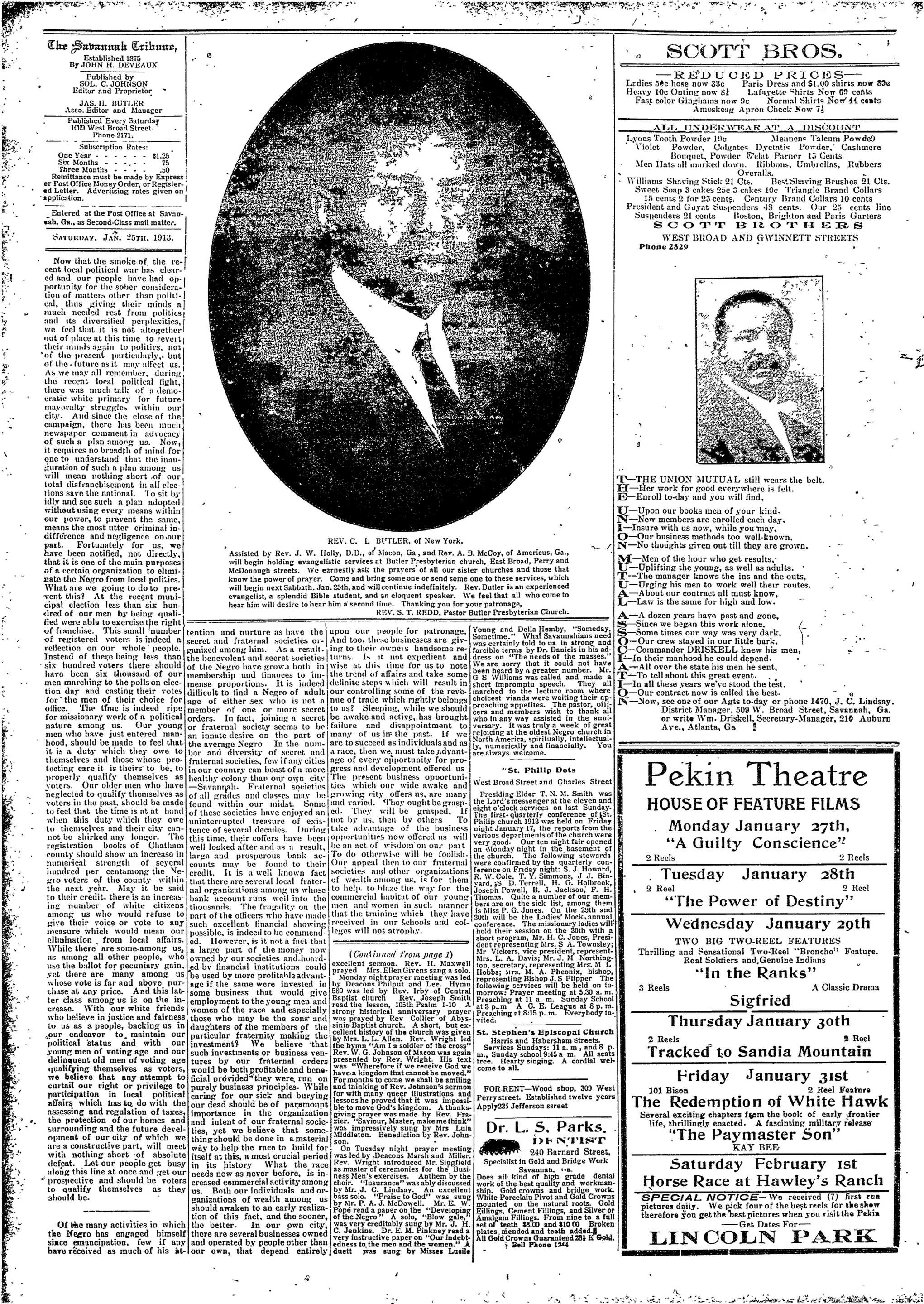
[Portrait of a man with a white face and dark hair, wearing a suit and tie. The background is black with a white oval border.]
Assisted by Rev. J. W. Holly, D.D., of Macon, Ga., and Rev. A. B. McCoy, of Americus, Ga., will begin holding evangelistic services at Butler Presbyterian church, East Broad, Perry and McDonough streets. We earnestly ask the prayers of all our sister churches and those that know the power of prayer. Come and bring some one or send some one to these services, which will begin next Sabbath, Jan. 25th, and will continue indefinitely. Rev. Butler is an experienced evangelist, a splendid Bible student, and an eloquent speaker. We feel that all who come to hear him will desire to hear him a second time. Thanking you for your patronage, REV. S. T. REDD. Pastor Butler Presbyterian Church.
tention and nurture as have the secret and fraternal societies organized among him. As a result, the benevolent and secret societies of the Negro have grown both in membership and finances to immense proportions. It is indeed difficult to find a Negro of adult age of either sex who is not a member of one or more secret orders. In fact, joining a secret or fraternal society seems to be an innate desire on the part of the average Negro. In the number and diversity of secret and fraternal societies, few if any cities in our country can boast of a more healthy colony than our own city—Savannah. Fraternal societies of all grades and classes may be found within our midst. Some of these societies have enjoyed an uninterrupted treasure of existence of several decades. During this time, their coffers have been well looked after and as a result, large and prosperous bank accounts may be found to their credit. It is a well known fact that there are several local fraternal organizations among us whose bank account runs well into the thousands. The frugality on the part of the officers who have made such excellent financial showing possible, is indeed to be commended. However, is it not a fact that a large part of the money now owned by our societies and boarded by financial institutions could be used by more profitable advantage if the same were invested in some business that would give employment to the young men and women of the race and especially those who may be the sons and daughters of the members of the particular fraternity making the investment? We believe that such investments or business ventures by our fraternal orders would be both profitable and beneficial provided they were run on purely business principles. While caring for our sick and burying our dead should be of paramount importance in the organization and intent of our fraternal societies, yet we believe that something should be done in a material way to help the race to build for itself at this, a most crucial period in its history. What the race needs now as never before, is increased commercial activity among us. Both our individuals and organizations of wealth among us should awaken to an early realization of this fact, and the sooner, the better. In our own city, there are several businesses owned and operated by people other than our own, that depend entirely
REV. C. L BUTLER, of New York,
upon our people for patronage. And too, these businesses are giving to their owners handsome returns. Is it not expedient and wise at this time for us to note the trend of affairs and take some definite steps which will result in our controlling some of the revenue of trade which rightly belongs to us? Sleeping, while we should be awake and active, has brought failure and disappointment to many of us in the past. If we are to succeed as individuals and as a race, then we must take advantage of every opportunity for progress and development offered us. The present business opportunities which our wide awake and growing city offers us, are many and varied. They ought be grasped. They will be grasped. If not by us, then by others. To take advantage of the business opportunities now offered us will be an act of wisdom on our part. To do otherwise will be foolish. Our appeal then to our fraternal societies and other organizations of wealth among us, is for them to help to blaze the way for the commercial habitat of our young men and women in such manner that the training which they have received in our schools and colleges will not atrophy.
(Continued from page 1)
(Continued from page 1)
excellent sermon. Rev. H. Maxwell prayed Mrs. Ellen Givens sang a solo. Monday night prayer meeting was led by Deacons Philput and Lee. Hymn 580 was led by Rev. Irby of Central Baptist church Rev. Joseph Smith read the lesson, 105th Psalm 1-10. A strong historical anniversary prayer was prayed by Rev Collier of Abysinia Baptist church. A short, but excellent history of the church was given by Mrs. L. L. Allen. Rev. Wright led the hymn "Am I a soldier of the cross" Rev. W. G. Johnson of Macon was again presented by Rev. Wright. His text was "Wherefore if we receive God we have a kingdom that cannot be moved." For months to come we shall be smiling and thinking of Rev. Johnson's sermon for with many queer illustrations and lessons he proved that it was impossible to move God's kingdom. A thanksgiving prayer was made by Rev. Frazier. "Sayiour, Master, make me think" was impressively sung by Mrs Lula Middleton. Benediction by Rev. Johnson.
On Tuesday night prayer meeting was led by Deacons Marsh and Miller. Rev. Wright introduced Mr. Singfield as master of ceremonies for the Business Men's exercises. Anthem by the choir. "Insurance" was ably discussed by Mr. J. C. Lindsay. An excellent bass solo. "Praise to God" was sung by Mr. P. A. J. McDowell. Mr. E. W. Pope read a paper on the "Developing of the Negro" A solo. "Blow gale," was very creditably sung by Mr. J. H. C. Jenkins. Dr. E. M. Pinkney read a very instructive paper on "Our indebtedness to the men and the women." A duett was sung by Misses Luile
Young and Delta Hemby, "Someday, Sometimes." What Savannahians need was certainly told to us in strong and forcible terms by Dr. Daniels in his address on "The needs of the masses." We are sorry that it could not have been heard by a greater number. Mr. G S Williams was called and made a short impromptu speech. They all marched to the lecture room where choicest viands were waiting their approaching appetites. The pastor, officers and members wish to thank all who in any way assisted in the anniversary. It was truly a week of great rejoicing at the oldest Negro church in North America, spiritually, intellectually, numerically and financially. You are always welcome.
"St. Phillip Dots
West Broad Street and Charles Street
Presiding Elder T. N. M. Smith was the Lord's messenger at the eleven and eight o'clock services on last Sunday. The first-quarterly conference of $ \mathrm{G} $ t. Philip church 1913 was held on Friday night January 17, the reports from the various departments of the church were very good. Our ten night fair opened on Monday night in the basement of the church. The following stewards were confirmed by the quarterly conference on Friday night: S. J. Howard, R. W. Cole, T. Y. Simmons, J. J. Binyard, S. D. Terrell, H. G. Holbrook, Joseph Powell, B. J. Jackson', F. H. Thomas. Quite a number of our members are on the sick list, among them is Miss P. G. Jones. On the 29th and 30th will be the Ladies' Mock, annual conference. The missionary ladies will hold their session on the 30th with a short program, Mr. H. C. Jones, President representing Mrs. S A. Townsley; Mr Vickers, vice president, represent Mrs. L. A. Davis; Mr. J. M. Northington, secretary, representing Mrs. M. L Hobbs; Mrs. M. A. Pheonix, bishop, representing Bishop J. S Flipper The following services will be held on tomorrow: Prayer meeting at 5:30 a.m. Preaching at 11 a.m. Sunday School at 3 p.m. A C. E. League at 8 p.m. Preaching at 8:15 p.m. Everybody invited:
Harris and Habersham Streets.
Services Sundays: 11 a.m. and 8 p.
m., Sunday school 9:45 a.m. All seats
free. Hearty singing. A cordial wel-
come to all.
FOR RENT—Wood shop, 300 West
Perry street. Established twelve years
Apply235 Jefferson ssreet
Dr. L. S. Parks,
DENTIST
240 Barnard Street,
Specialist in Gold and Bridge Work
Does all kind of high grade dental work of the best quality and workmanship. Gold crowns and bridge work. White Porcelain Pivot and Gold Crowns mounted on the natural roots. Gold Fillings, Cement Fillings, and Silver or Amalgam Fillings. From nine to a full set of teeth $3.00 and $10.00 Broken plates, mended and teeth added. All Gold Crowns Guaranteed 28 K Gold. Bell Phone 1244
REDUCED PRICES
Ladies 50c hose now 33c Paris Dress and $1.00 shirts now 59c
Heavy 10c Outing now 84 Lafayette Shirts Now 69 cents
Fast color Ginghams now 9c Normal Shirts Now 44 cents
Amoskeag Apron Check Now 71
ALL UNDERWEAR AT A DISCOUNT
Lyons Tooth Powder 19c Mennens Talcum Powde9
Violet Powder, Colgates Dyctatis Powder, Cashmere
Bouquet, Powder E'clat Parner 15 Cents
Men Hats all marked down. Ribbons, Umbrellas, Rubbers
Overalls.
Williams Shaving Stick 21 Cts. Best Shaving Brushes 21 Cts.
Sweet Soap 3 cakes 25c 3 cakes 10c Triangle Brand Collars
15 cents 2 for 25 cents. Century Brand Collars 10 cents
President and Guyat Suspenders 48 cents. Our 25 cents line
Suspenders 21 cents Boston, Brighton and Paris Garters
SCOTT BROTHERS
WEST BROAD AND GWINNETT STREETS
Phone 2829
M.
T—THE UNION MUTUAL still wears the belt.
H—Her work for good everywhere is felt.
E—Enroll to-day and you will find,
U—Upon our books men of your kind.
N—New members are enrolled each day.
I—Insure with us now, while you may.
O—Our business methods too well-known.
N—No thoughts given out till they are grown.
M—Men of the hour who get results,
U—Uplifting the young, as well as adults.
T—The manager knows the ins and the outs,
U—Urging his men to work well their routes.
A—About our contract all must know,
L—Law is the same for high and low.
A—A dozen years have past and gone,
S—Since we began this work alone.
S—Some times our way was very dark,
O—Our crew stayed in our little bark.
C—Commander DRISKELL knew his men,
I—In their manhood he could depend.
A—All over the state his men he sent.
T—To tell about this great event.
I—In all these years we've stood the test,
O—Our contract now is called the best.
N—Now, see one of our Agts to-day or phone 1470, J. C. Lindsay.
District Manager, 509 W. Broad Street, Savannah, Ga.
or write Wm. Driskell, Secretary-Manager, 210 Auburn
Ave., Atlanta, Ga
TWO BIG TWO-REEL FEATURES Thrilling and Sensational Two-Reel "Broncho" Feature. Real Soldiers and, Genuine Indians "In the Ranks"
Thursday January 30th
2 Reels 2 Reel
Tracked to Sandia Mountain
Friday January 31st
101 Bison 2 Reel Feature
The Redemption of White Hawk
Several exciting chapters from the book of early frontier life, thrillingly enacted. A fascinating military release
"The Paymaster Son"
KAY BEE
Saturday February 1st Horse Race at Hawley's Ranch
SPECIAL NOTICE—We received (7) first run pictures daiy. We pick four of the best reels for the show therefore you get the best pictures when you visit the Pekin
Get Dates For
LINCOLN PARK
Locals.
Miss Mary L. Jones of Atlanta, spent several days in the city last week and left Monday.
Friends in this city of Rev. and Mrs. John Williams of Brunswick, Ga., congratulate them upon their fifteenth wedding anniversary which was celebrated at their home, 1802 Johnson street, Friday afternoon and evening, January 17th.
Mr. and Mrs. R D. Whigham announce the marriage of their daughter, Alethia Romenia to Mr. William D. Alexander - of Macon, Ga., November 15th, 1912, Rev. Este officiating.
Bethlehem Baptist Church, Park Avenue and Cuyler streets, has called Rev. B. J. Parker of Macon, Ga., as the pastor for one year.
Mrs. Eliza Jones formerly of this city but now of Jacksonville. Fla., has been very ill but at this writing is somewhat improved.
Rev. A. K. Wood of Valdosta, Ga., was in the city this week. Rev. Wood pastored at Hawkinsville for the past several years but was sent to Valdosta by the last conference,
Rev. A. W. Bryant of Valdosta, Ga., was in the city this week.
Friends of Col. and Mrs. F. M. Cohen will be delighted to know that the injury which betell their son, Merritt, last Saturday was not as serious as was at first thought.
Mrs. Henrietta Bell leaves for New York City, Saturday after spending the holidays very pleasantly with her mother and father, Mr. and Mrs. Atken.
Mr. Clarence Jones of Chicago, Ill., an old Savannahian, was in the city this week visiting relatives.
Mr. Jerry Moore of Macon, Ga., after spending a few days in the city returned home Monday. Miss Harriet Scott of Waycross, Ga., is visiting her mother, Waldburg street, west.
Miss, Julia Kelly of Charleston S. C., is spending a few days in the city. Mr. Charles Anderson of Montgomery, Ala., is spending a week in the city with his father
Miss Anna M. Wilson of Jacksonville, Fla., passed through the city this week en route to Philadelphia, Pa. Friends here of Prof. and Mrs. M. N. Work, Tuskegee Institute, extend them their sympathy at the loss of their infant which was buried here last Saturday morning.
Installation of Officers
The Installation of the officers of Mystic Tie Lodge No. 39, was held on St. John's Day. The address was delivered by Rev L. H. Lawton, subject, "Jerusalem the place of light" He made our hearts feel proud and carried our minds back to the old land mark. After the installation the table was spread with a plenty of choice vians by our good sisters of the O. E. S. They had their installation under the able management of Sister L. W. Overstreet. Jag. Macky. W. M.
I am proud to note the condition of Life Giving Lodge. I have seen men who are more apt in the written work of the order, but the principle of our members is square doings. The Lodge is in square condition with all departments. Our Lodge is young, but it has accomplished what many of the older Lodges have not.* We have a commoious hall, and our brothers are instilling the principle of Masonry.
Yours for the unbuilding of Masonry, B. W Pierce, W. M.
Royal Knights of King David Set Up
A Lady Knights Lodge of the Royal Knights of King David was set apart at the Seabrook's hall on West Broad St., Wednesday evening the 16th inst., by the Deputy organizer, Mr. Thos D. Tillman. The officers are as follows: Mesdames Fannie H. Starr, WM; Cornelia Gautt, WF M; Sarah Ryalls, WSM; Emma P Watson, WRS; Ellen Richardson, W Treas; Lydia Priester, W Chap, Ella Kirklin, W Con; Rosa Smith, IG; Alice Atkins, WW; Miss Joanna Young, Rec Sec; The Royal Knights of King David was instituted in the city of Durham, N. C. 29 years ago and is known as one of the best Negro fraternal organizations in America. It has complied with all the requirements of the states in which it is doing business and has money on deposit to pay all claims as they fall due, and can protect every man, woman and child who joins. It has three departments viz: The Royal Knights department for the men, they pay $2.50 to join, 25 cents per month and get $100.00 at death. The Lady Knights department for the women, pays $1.50 to join, 1 cents per month and get $60.00 at death. The Juvenile department for the children. They pay 10 cents per month and get $50.00 at death. All death claims are paid in 10 days after proof of death at the Home Office. You are immediately benefited from the very day you join. It has qualified under the recent laws of Georgia. So get busy and ji in the Royal Knights of King David if you want to be protected. Yours Fraternally.
(Mrs.) Fannie H. Starr
Installation of Officers
Dawson, Ga., January 8th, 1913.
St. Mark's Lodge A. F. and A. L. No.
met jointly with Beatrice Chapter
No. 30 O E S, Dec. 27th, 1912, in their
annual installation of officers, elected
to serve for the year 1913. Promptly
at twelve o'clock a.m., W. M., J. W.
Weston called the Lodge with the E.S
to order and after he had stated the
object of the meeting, the chaplain
invoked the blessing of God with song
and prayer. After some remarks by
W. M. Weston, he turned the gavel
over to P. M., William Marshall who
installed the officers as follows: J. W.
Weston, W M; Jas. G. Seward, S W; S.
M. Mack, J W: J. B. Motley, Sr., Treas;
Wm Marshall, Sec'y; Wm. Seals, S D;
J: Wilborn, J D; Joe Wiggins, S St;
Roan Gay, J St: T. P. Parks, Marshall;
C. H. Hatcher, Chaplain; B. J. Jackson,
Tyler. The officers for the Star as follows:
J W. Weston, R P; Mary Jones,
RM; Mollie P. Roberts, R A M; Mamie
Weston, R T; Hattie Williams, R Sec'ty;
Annie Styles, R C; Lizzie Russell, R A C;
Katie Hamilton, R W; Annie L.
Chambers, R H; Lizzie Shepherd, R P;
Eile Jenkins, R F; Janie Jackson, R
T: Silvia Seals, R W; Elmira Holly, R
G. Thomas Harvey, M in E; R. W.
Durham, M in W; T. P. Parks, S.
Committee, Annie Styles, Chairman;
Hattie Williams, Wm. Marshall Secre-
Tuesday Matinee and Night=January 28th
THAT GREATEST OF ALL MUSICAL ORGANIZATIONS THE SMART SET Headed by SALEM TUTT WHITNEY HOMER TUTT AND BLANCHE THOMPSON IN A DAZZLING NEW PRODUCTION "The Darktown Politician" 25 BIG MUSICAL HITS 25
Louise Robison, 12 Reid Avenue, and took away her loving companion, Brother David Robison. Though being up at times he had been ill for four months. He lived a consistent member of the St. Philip Monumental A M. E. Church, and was very much thought of by all the members having served for quite a while as steward. To know him was to love him. The pastor Rev. L. A Townsley, assisted by Rev. Priestere conducted the funeral services at the church, Sunday12 m. The choir rendered appropriate music. Brother Robison leaves a mother, wife, and a sweet little daughter of seven years, a sister, Mrs. Collins (Robison) Embly, of St. Matthews, S. C., and a brother, Mr. Thomas Robison, Tampa, Fla., and a host of friends to mourn his death. At the close of these services the body of the deceased was accompanied to his former home, St. Matthews, S. C., by his wife and daughter Mrs. Clinton Johnson sister of Mrs. Robison and a friend Mr. John Carson. The party arrived at St Matthews, S. C., Sunday night and was met by relatives and friends. The interment took place Monday 4 p. m.
Death.
Major B. J. Scott, the well known carpenter, departed this life Friday of last week at his late residence 628 32nd street. He was preparing to go to work when he was taken suddenly with a stroke of paralysys in the left side, and died at 11:30 He was a member of Progressive Lodge No. 97, K. P. Local Union No. 318 Carpenters and Joiners of America. Crystal Court No. 210 I O. O. C. ot which he was the founder. His funeral was largely attended on Sunday, the first Ga. Battalion of which he was a member attended the funeral in a body. Major Scott leaves a daughter Miss Daisy C. Scott who is attending Spelman Seminary, Atlanta. She arrived Saturday morning to attend the funeral.
Resolutions of the Ministerial Emancipation Association
Savannah, Ga., January 1, 1913.
To the President, Officers and Members of the Emancipation Association, Greeting:
We, your committee to whom was referred this sad task of preparing a fitting memorial of those of our fellow comrades who have been called from labor to reward, beg leave to submit the following.
Whereas, in the course of recurrent events we are ever brought to face the stern facts that man is mortal and must die and the eternal edict of our Heavenly Father is forced upon us to be remembered, "That Dust thou art, and dust shalt thou return."
Since our last celebration we have been made to walk through the gloomy vale of sadness and stand upon the the graves' brink and watch with tearbedimmed eyes those of our loved ones lowered to their last resting place, to await the great Archangels' trump, which shall call them from their sleepy and quiet repose to stand before the King, ye; the judge of all the earth. who will do right: And, whereas, it has pleased Him, who is too wise, to err, and too kind and loving to afflict one of his children to take to himself the following named brethren, viz: Rev J. V. Sims, Rev J. W Hill, Rev S. E. Mabry, Rev H. Heywood and Mr. R N. Putledge
It is with a degree of pleasure to mention the name of the late lamented Rev. J. M. Sims, as a citizen he stood out as one of the foremost of the race. He was a statesman of no mean ability, serving as one of the first judges of the City Court of Savannah, Ga.; and too, with credit to himself and the race. He was the first Grand Master of Masons in the state, and filled this place with credit, and his name lives in the hearts of Masons in Georgia and holds a conspicuous place upon the tablet of marble
THE MALE AND FEMALE OCTETTE
THE GRAND ENSEMBLE SINGING
THE SONG HITS OF THAT FAMOUS
COMEDIAN, SALEM TUTT WHITNEY
in the Masonic home at Americus, Ga.
He was a preacher of rare parts and a noted historian; his life is worthy of enumlation, from the reconstruction period till the day of his death.
We cannot fail to speak and point with pride to the venerable, patriotic and valiant soldier and gospel minister, Rev. J. W. Hill. His life was one of splendid service and the young men and women would do well to pattern this worthy man of God and race defender.
Rev. S E. Mabry was a young man unacquainted with the bitter days of slavery and was not known in the reconstruction period, but called of God to preach the everlasting Gospel he went forth forsaking all even to that of denying his people, houses and home comforts, he went to his task willingly, and died at his post, away from his wife, and buried in the land of strangers, for the Gospel's sake.
Rev. H. L. Heywood was our honored and beloved chairman when we met last on this auspicious occasion, he was a race loving man and strove to keep the patriotic fires burning in the hearts and minds of the citizens of this city and vicinity. He died in the very bloom of life, in the very acme of his usefulness, we mourn his demise with sadness inexpressible.
Mr. R. N. Rutledge, a citizen and orator of ability and fame, has been of great service to the race, and his great acts and splendidly planned campaign movements will live in the hearts of those of his associates and his people in general. He was a splendid Oddfellow and had attained to its highest limit. His life will remain with us in all of these walks and especially will his church remember him as a counsellor and supporter.
And now that it has pleased God to remove these very distinguished persons and brethren from our midst, thus breaking the ranks during twelve months' pilgrimage, we bow our heads and hearts in humble submission to his Divine will.
Resolved, that we deplore the removal of these our fellow comrades, and feel very keenly the loss thus sustained, and yet with joy we look forward with happy anticipation of joining them again in that far away happy home beyond the sun, moon and stars.
Be it further resolved that a copy of these resolutions be spread upon the face of our Journal and a copy be sent to the families of each one of the deceased.
Committee,
L. A Townsley,
Chairman and Secretary.
W. V. Daughtry,
W. A. Daughtry,
B. C. Creamer,
A W Hill.
Approved, Rev. R. H. Singleton. D D.
President; Rev L. A. Townsley,
D. D., Secretary, Ministerial Association.
Fifteenth Annual Georgia State
Industrial College 'Farmers'
Conference Thursday and
Friday, February 20-
21, 1913
The fifteenth annual Georgia State College Farmers' Conference will take place in Meldrim Auditorium, Georgia State College, Savannah, Georgia, Thursday and Friday Feb. 20th-21st. The farmers from all over the State of Georgia are cordially invited to be present as the guests of the College. All subjects relating to general agricultural questions will be discussed by experts in the various lines of agriculture. Do not fail to come. Any one desiring further information on the subject may write the undersigned.
R. R. Wright, President,
Ga. State College,
Savannah, Ga
SPECIAL OFFERING
REAL ESTATE
1 Two-story house on Wheaton St.,8 Rooms in first-class condition $3500.00. $500 Cash, $20 per month.
1 Two-story, 7 Room house and large lot, 38th, St., West. $1800 Cash.
1 Four room cottage lot 50 x 100 feet on Hill street second door from Bull street. Only $1800. The lot is worth the price.
A few other bargains
G. H. BOWEN Phone 4096
¢05 West Broad St
11 beautiful lots on Montgomery street in growing part of the city size 30 x 105, and 30 x 157. Price $300.00, $10 down or $5 per month no interest.
I can supply you with many other valuable pieces of property in the city; improved and unimproved.
Geo. W. Jacobs Phone 3713
817 West Broad Street
Resolution
RESOLVE, That the Ga. Mutual Life and Health Insurance Company of Augusta, Ga., will give to its members the same careful attention and prompt adjustment of claims in the future as it did in the past, and as usual, all visits to our office will receive our most courteous attention no matter for what that visit is made, or by whom.
RESOLVE further,That we will carefully guard the interest of our loyal members that in the time of sickness or death the Company will come to their rescue by making good every promise stipulated in the policy, and can proudly point to thousands of members as witnesses.
Yours,
Georgia Mutual Insurance Co.
Home Office 1015 Ninth St.,
Augusta, Ga.
A. M. Sherrill, Gen. Mgr.
Branch Office 509 W. Broad
St., Sayannah, Ga.
H. T. Singleton, Dist. Mgr.
—Ad
BRING
US YOUR JOB PRINTING
ary 28th NIZATIONS
AIR DOME HALL LANE WEST BROAD ST
MONDAYS
— AND —
THURSDAYS
From 4 o'clock till 11:30 p. m.
Every Week Night
From 7 p. m., to 11:30 p. m.
Something Doing Every Minute
Pictures changed daily
Prices Never Change
Adults 10 Cts. Children 5Cts
A show shop that is the proper place for the entire family SPECIAL I would like to call everybody's attention to
The Night Riders
A Two Reel special that is going to make a big hit. Its a story of the Kentucky Night Riders that stirred up such a fuss.
Next Wednesday Night
JANUARY 29th Make Sure You Don't Miss this one
BAKER
THE MOVING PICTURE MAN
President-elect Considers it an
Unnecessary Expense.
ALOSS TO THE GOVERNMENT,
His Letter To Chairman Eustis Asking
That the Ball Be Omitted.
Stilt No Word About
the Cabinet.
Princeton, N. J.—In a letter to Wil-
Mam Corcoran Eustis, chairman of the
inaugural committee, President-elect
Wilson called off the historic Inaugu-
ral ball, which heretofore has been the
important social function in connec-
dion with the inauguration, It has
been represented to the -President-
elect that the ball fs always a scurce
of great unnecessary expense to the
government. It has been declared that
the ball has cost the government no
Jess than $85,000 in Joss of services of
clerks, etc., in, the Pension Building
who have to be laid off while prepara-
tions for the ball are belng made. The
President-elect cannot see, therefore,
where the ball serves any useful pur-
Pose. Mcreover, it will save $5 each
to the persons who would have at-
tended. The Presidentelect’s decision
in this matter is in keeping with his
desire to make the inauguration as
simple as possible. Already, at his re-
quest, the inaugural parade has been
greatly contracted Im length. It will
be recalled that he has also deter-
mined to cut out the daily receptions
at the White House and devote his
time to the business of the govern-
ment.
President-Elect Explains.
His letter to Chairman Eustis fot-
lows: -
“My Dear Eustis: After taking
counsel with a great many persons
and learning a well as I could gen-
eral opinion in the matter, I have
come to the conclusion that it is my
duty to ask you to consider the feasi-
bility of omitting the inaugural ball
altogether.
“I do this with a great deal of hesi-
tation, because’I do not wish to inter-
fera with settled practices or with rea-
sonable expectations of those who
usually go to enjoy the Inauguration,
but it has come to where the aspect of
a sort of public duty, because of the
arse indirect, expense upon the gov-
ernmext incideatal to it, and because |
these balls haye ceased to be neces:
sary to the enjoyment of the Visitors.
“{ hope most sincerely that this re-
quest will in no way embarrass you
and that I have not too long delayed
in making the suggestion.
“With “cordial regard, sincerely
yours, :
(Signed) “WOODROW WILSON.”
MONEY TRUST REAL MENACE.
‘Two Leading Bankers Tell Why It Ie
Dangerous. :
Washington.—Liberty of individuals
to concentrate money and power to
the Hmit of their ability was advo-
cated before the House Money Trust
Committee by Jacob H. Schiff, of the
New York banking firm of Kuhn, Loeb
& Co.
Mr. Schiff dectared that individuals
should be allowed to exert thelr ut-
most efforts to concentrate fortunes
and power ugtil the ‘laws of nature
caused the attempted monopoly to
fall of {ts own weight.” He was
opposed, however, to concentration
through corporations and holding com-
panies. Mr. Schiff could not say
whether concentration had as yet
reached a point where it was danger-
ous.
‘The New York bond financier fol-
lowed George M. Reynolds, of Chicago,
on the stand. Mr. Reynolds told the
committee that he had studied the
concentration of money and credit and
that he believed, at the point it had
now reached, it was “a menare to the
progress of the country.” He sdid that
competition in banking should be re-
vived.
TUBURCULOSIS SERUM.
Repert On the Cure Discovered tn
Germany.
Washington, —-In responge to @&
recent resolution by Senator Gore,
President Taft sent to the Senate a
report on a new German tuberculosis
serum forwarded to the State Depart.
ment by Consul General Thackara.
Mr. Thackara stated that up to No-
“vember Dr. F. F. Friedman, one of the
principal exponents of the new cure,
had treated 1,182 cases, most of them
successfully. Dr. Friedman, accord:
ing to the report, is not yet, able to
furnish the serum to physicians and
does not know when it can be supplied
in America. ¢
A “CULINARY CRUISER.”
Surgeon General Stokes Wants a
Woman “Dietician” For Navy.
‘Washington—Need for a “culinary
cruiser” for shore work in the Navy
is to be impressed on Congress by Dr.
Charles P. Stokes, surgeon-general of
the service, who wants the legislators
to make an appropriation for a wom-
an “dletician.” The new adjunct to
the Navy would be given charge of
the female nurses in the various naval
hospitals in so far as thelr duties as
cooks are concerned and would have
more or less of a’roving commission.
| ~~ LIFES DISAPPOINTMENTS
ABP a
LAD £08
| ey poss
SMT ES
S ®. SN
EE |
a BRITS 99 | es
* LEER YY, (Fern
EAN NG ped Vee 14
Re eee
y Ket Dif
rr. i oe
eS
ANTICIPATION @EALIZA
; Fa sen ara)
CH ; e/ = eae
FESS Argins - | brass
Se i
ee. fen
= Ore er
Oy Re Cee PE?
as EEA Sey ee
8) Lay” FA
iss - PP» Ae
anion PEALIZATION
Fate Seems Sealed in House
of Lords. :
VOTE STIRS ENTHUSIASM.
Redmond Says Measure Will Become
Law During the Lifetime Of .
Present Parlia-
mene:
London.—After a long, stern battle
the Home Rule Bill passed the House
of Commons by a majority of 110.
Later it was read for the first time in
the House of Lords.
There were two divisions in the
lower house. Mr, Balfour's motion for
Ite rejection was defeated, 258 to 368,
while the third reading was carried by
a vote of 367 to 257, one member of
each side having left the House in the
interval.
The result of the division was toa
much a foregone conclusion for a tre-
mendous demonstration, but Irishmen
inside and outside of the House did
their best, and, assisted by the Lib-
crals and Laborites, gave the measure
for which they had waited and worked
so long a good sendoff on its way to
the House of Lords, where its fate is
certainly sealed.
The division was preceded by an-
other series of brilliant speeches by
the political leaders, among whom
were Frederick E. Smith and the soll-
citor general, Sir John A. Simon, two
of the cleverest among the younger
members, and the veterans, John E.
Redmond, Timothy Healy and
Augustine Birrell, chief secretary for
Ireland.
The House was crowded throughout
the day. The Nationalists were only
one man short of their full strength.
Several of the older Nationalists, who
are seldom able to attend, came over
from Ireland for the division.
The Liberals and Laborites, too,
turned out in force, and the Unionists
were not far below their total mem-
bership.
FLOOD OF PETITIONS.
Titanic Survivors Ask For More Than
$10,000,000 Damages.
New York.—A flood of petitions for
damages through the loss of the
steamer Titanic, filed Wednesday, In-
cluded one from Mrs. Irene Wallach
/Harris, Who clalms $1,000,000 for the
loss of her husband, Henry B. Harris,
the theatrical manager. This is the
heaviest of the 279 claims so fan filed.
Mrs, May Futrelle, of Scituate, Mass.,
asks $300,000 compensation for the
loss of her husband Jacques Futrelle,
author. The claim of Mrs. Lily B.
Millet, widow of Francis D. Millet, the
artist, a Titanic victim, is $100,000.
United States Judge Hand extended
the time for fillng petitions of claims
to February 11. ‘fhe tlélms amount
to more than $11,000,000, but the
White Star Line “contends that its
Nabilities 1s Ilmlted under the United
States statutes to les than $100,000
the value of recoygred records and
passage money. *
TRY COMMISSION PLAN.
Louisiana Cities Will Adopt New Gov-
ennai.
New Orleans—A number of Lout-
slana cities elected mayors and com-
missioners-preparatory to the Installa~
ion. of, the commission form of
municipal government. Since the
adoption of the commission plan by
New Orleans a short time ago there
has been a statewide movement in
favor of the system.
WOMAN SUFFOCATED IN TRUNK. |
Hid In It To Tease Husband and Lock
Snapped. ¥
Amesbury, Mass.—To'tease her hus-
band Mrs. Alphonse Victorine con-
cealed herself In a trunk as she heard
him enter the house. As the cover
dropped over the bolt. of the old-
fashloned lock slipped into its place
and“In a few hours the woman was
dead from suffocation.
a7 &
i ae
IiCapertene *
Startling Statistics Compiled
for the Year Just Passed.
100,000 GRANTED IN 1912.
tegal Separations Have Increased
‘Three and One-third Times As
Fast As the Population,
In the Last 40 Years.
| New York.—The urgent need of unl.
form marriage and divorce laws in all
the States of the Unton to check the
ever-increasing divorce evil, which, as
it is was pointed out, has increased
three and one-third times as fast as
the population in the last 40 years,
was discussed by the New York State
Marriage and Divurce Commission at
the Aldine Club,
‘The conference was presided over
by Bishop Charles Burch, and among
those present were Bishop David H.
Greer, Dr. Felix Adler, of the Ethical
Culture Society; Rev. Dr. Sidney E.
Goldstein, assistant rabbi of the Free
Synagogue; Mrs. Anna Garland Spenc-
er, of the ‘executive committee of the
American Vigilance Association; Rev.
Francis M. Moody, who has been lead-
ing the agitation for uniform divorce
laws in the West, and representatives
of the International Council for
Patriotic Service.
It was announced that Bourke Cock-
ran who had previously said that he
could not join the commission in ts
work without the consent of Cardinal
Farley, had since given assurance of
his co-pperation, thus apparently indi-
cating that the movement met with
the approval of the Cardinal, as well
as the religious leaders of other faiths.
Rev. Mr. Moody cutlined the condl-
tions that made necessary the passage
of uniform divorce laws throughout
the country.
“The Pacific Coast,” sald he, “has
been the greatest divorce cénter not
only of this country, but of the entire
world, and in that belt of Washing-
ton, Oregon and California, the divorce
center has been San Francisco. In
the year 1912 alone there were granted
in this country over 100,000 divorces.
More than 70,000’ children, mostly
under ‘the age of 10 years, were de-
prived of one or both parents by
divoree. In the 40 years alluded to
3,700,000 adults were separated oy
divorce In the United States, and more
than 5,000,000 persons were affected
by these cases.
“The bulk of these cases in that
period have been in the Middle West-
ern States, nine of which provided
632,000 divorces, or practically halt
of all the divorces in the country.
Iilinols afone provided 120,000, ana
for this reason we have deemed it
wise to make the beginning of our
movement in that State, where we
now have a commission on marriage
and divorce, striving to bring about
reform of the marriage and divorce
laws and work for country-wide unl-
formity thereof. Pennsylvania had
65,760 divorces the State of California
50,000, and that of New York 44,450.
ONE TERM FOR PRESIDENT.
Senate Agrees To Vote On Resolution
On January 30,
Washington.—An agreement to vote:
on the legislative day of January 20!
on Senator Works’ joint resolutfoa for |
‘one six-year term for president and
vice-president was made in the-Senate.
Senator Page's Vocational Education-
al Bill will become the unfinished bust-|
ness aS soon as the Works resolu-
tion Is disposed of, and there ts 2|
tacit understanding that It will be
allowed to go to a vote soon after it}
is taken up.
WALKED. WITH BACK BROKEN.
Man Goes To Hospital After Fall On
the Ice.
St. Louls—John Buchold, 33 years,
old, fell on the ice, walked to the city|
dispensary and complained of severe}
pains "In his back. An examination}
revealed that his back was broken.
He fs in a aerlous.condition, ,
be etter EE
‘. 6.25 *,
TRE ALLIES 10
RESUME WAL
Horrors of Winter’s Campaign
Now Threatened.
ARMIES ABOUT ADRIANOPLE.
Convinced- That Turks Are Merely
Drifting, the Allies Are Deter-
mined To End Peace
Negotiations.
|, London.—Unless unforseen events
should change the current of affairs
the war in the Near East will be re
sumed within a week, and Europe will
witness the horrors of a winter cam
paign.
The allies have firmly made up
thelr minds to take up arms a second
time. The Turks last week were
threatening to leave London and let
matters take whatever course they
might.
Now the Balkan delegates are con-
vinced that the Turks are merely
drifting without a fixed policy, and
‘they have decided to end the seem-
ingly fruitless debates and wire-pull-
ing and begin the battles anew where
they left off more than a month ago.
The Ottoman government failed to
convene the grand council Tuesday,
and apparently has no intention of
meeting the allies’ ultimatum on
Adrianople. The allies do not be-
Neve in the efficacy of the note which
the powers will present at Constanti-
nople, because it is couched in too
mild terms and simply advises Tur-
key to submit to the fate of war and
abandon Adrianople for fear of com-
plications in other parts of the em-
pire at a time when Turkey could not
find moral or financial support in
Europe.
The Turkish government knows
that this méans nothing, because it
is aware that the ‘powers will be un-
able to agree on any coercive meas
ure. Thus the presentation by the
powers of the note, it Is pointed out,
might mean simply the opening of a
new chapter in the already wearl-
some “diplomatic parleyings and the
shifting of the discussion from a de-
bate between the belligerents to one
between Turkey and the powers.
The Balkan kingdoms, moreover,
are anxious to obtain relief from the
heavy burdens of keeping their armies
on a war footing indefinitely. Wish-
ing, however, to observe all the diplo-
matic courtesies, they have given the
powers a reasonable time to agree on
the note, frame it and present it to
Turkey. But this once done, if Tur-
key, as id probable, falls to yield, they
are determined to act. *
‘Their governments have agreed to
call another sitting of the conference
through Sir Edward Grey or Rechad
Pasha, who, according to the rotation
followed, would be the next presiding
officer. They. will then simply. an-
nounce their decision definitely to
break the negotiations, and also thank
England for the hospitality extended
and the conditions of fair play under
which the discussions occurred.
HONORS FOR ROSTRON.
Besides a Medal From Congress He
Gets Cross Of Honor.
Washington.—In recognition of his
prompt response to the call of hu-
manity in rescuing the pessengers of
the Silfated Titanic, Capt. Arthur H.
Rostron, then in command of the
steamship Carpathia, has been award-
ed the Cross of Honor by the Ameri-
can Cross of Honor. It will be pre-
sented to him by James Bryce, the
British ambassador, in this city March
1 next. On the same day the medal
awarded by Congress to Captain Ros-
tron will be presented to him by Presi-
dent Taft. In a letter to Thomas H.
Herndon, president of the American
Cross of Honor, Captain Rostron, now
in command of the steamship Coronia,
in accepting the tender of the cross,
expressed his great appretiation of
the honor conferred upon him
THE FARMERS’ PROFITS.
Prices For His .Products Shown By
Federal Statisticlan.
Washington. — The farmer was
sharing the profits of the increased
cost of living as far aé the prices paid
for meats on December 15 last com-
pared with those of a year. ago, accord-
ing to figures announced by the De-
partment of Agriculture. At the same
time the farmer was receiving less
for his staple crops than he did a year
previous.
Average prices received by pro-
ducers on December 15 last showed
hogs selling at $6.89 a hundred
pounds, an Increase of $1.17 over the
same time in 1911; beef cattle. at
$5.33 was 96 cents higher; veal calves
at $6.88 and 90 cents higher; sheep
at $4.21 was 50 cents higher, and
lamb rt 95.70| was 77 cents higher.
Hogs, veal enlves' and, shoep were
lower than in 1910.
ips as
OFF FOR VACATION.
Vice-President-Elect Marshall On Way
To Arizona.
Chicago. Ill. —Vice-President-elect
Thomas R. Marshall and Mrs. Marshall
started for Arizona, where they will
visit friends. Mr. Mershall purchased
some hunting clothes, as he expects to
hunt while in the West
N DEFENSE OF “MISS ANNIE” SMOOT
CAPITAL SOCIAL SET’S GREATEST BEAUTY
MANY JEWELS AT MRS. DRAPER’S BALL
DR. ‘CARL, ALSBERG SUCCEEDS DR. WILEY
Some sort of a society jenkins an-
jounced that’ Miss Anfe Smicot, who
will make her de-
%s but in Washing-
ro “Oy ton this winter,
(MS ie 2 Os] “bas forced Wash-
2 33° 2 cdamtatee S| Ington society to
She face a problem,”
2 and then goes on
COR go*s| to remark that
. BS ge, | the highly conven-
0 San. +s] tional dowagers of
CORRS =| the offtctal set
L . +e | wil scarcely be
c fy -.| able to reconcile
ad *| themselves to as-
tg ~| sociating with
————————_ their daughter, a
ay
young woman who is avowedly a
Mormon, and who .has forbears
elders ‘of the church in Utah long
before there was a pretense of
giving up bigamy. As a matter of
fact, Miss Smoot, who Is a very pretty
and very bright girl, has been living
in Washington for a number of years,
attended school, and has grown into
young womanhood right in the circle
of the young ladies who will make
thelr bow to the public this winter.
She never has been snubbed, and I
do not supose anybody has stopped
to think whether she was a ‘Mormon,
Pagan, Catholic, or Cambellite, Po-
lygamous Mormontam 1s long since a
dead letter, and pretty Miss Smoot
has not a thing on earth to do with it,
and just why, as she ts blooming Into
young womanhood, she should be the
No result of the recent election is
so gratifying to a larger-number of
Washington peo-
. >. ple as the election
a Se of young Peter
Pree Sad| Cerry of Rhode
Re! Island, to a seat
Cay a fy) in ‘the lower
>ke *, $7 | house. Apart from
7? the charming per-
- Beet sonality of this
ca young couple
we > their names re
i call many Import.
+. +2 AY) ant chapters of
L} ‘..% + "| history. Mr. Ger-
ey : J ty represents
ee ean eee
. = ple as the election
ba ee of young Peter
CPrwee Sess | Cerry of Rhode
Fe! Island, to a seat
Cay a fy] in ‘the lower
he, sp” | bouse. Apart from
7? the charming per-
- Boe sonality of this
a % young couple
wee their names re-
a call many Import.
>, +2.) ant chapters of
Js ‘..%4 "| history. Mr. Ger-
ey 7 J ty represents
the sixth genera-
tion of his name to figure’ in
the national annals and his friends
predict that as a lawmaker he
wilt add new laurels to the name.
He comes in direct line with the
signer, Eldridge Gerry of Marble
head, Mass., a member of the Cont!-
nental Congress from 1776 to 1780, a
commissioner sent by the infant re-
public to France in 1789, governor of
Massachusetts and vice-president, of
the United States from 1813 to 1814.
Mr. Gerry fs one of the long line of
vice-presidents who died in office. El-
dridge Thomas Gerry, the distinguish-
ed lawyer and philanthropist, {s his
grandfather. In Mrs. Gerry, formerly
Miss Mathilde Townsend, centers
much interesting political history con-
Mrs. William F. Draper of Wasbing-.
ton, who Is noted for the lavishness
of her Christmas
— costume balls, en-
Pome | tertained at an
3 "SWE @| eighteenth cen-
Ce =. Weg! tury ball the oth-
eek S er night which
Es surpassed all
wee which she has’
fr ~i + | previously given
ese S| Tt has been re-|
+y3 S++ S{) named the “Pearl”
Neen ball on account of
RNR | me display of
vo a+ | Priceless — fowels
pees worn with the
Louis XV cos
or
a
ie eek .
ROE
eo wees
tumes of the hostess and her guests.
Mrs. Draper wore $500,000 worth of
pearls, which included a five-pointed
tlara of pear-shaped pearls, .some of
them as large as a small pear, ear-
rings and collar of pearls, a four-
strand necklace, besides a long strand
of pearls, which hung from her shoul-
ders nearly to the bottom of her
gown, a corsage ornament of pearls
and a stomacher which covered her
waist and bips and was described by
one of her guests as a coat without
sleeves. Mrs. Draper was gowned in
the costume of a court lady of the
Louls XV period, and wore beneath
‘tha pearls a costume of white satin
with broad stripes of black velvet.
Although many of the jewels worn
were priceless, it 1s estimated that
more than $1,500,000 in pearla were
Following instructions from Presi-
dent Taft, Secretary of Agriculture
— ‘Wilson the other
apie, | day appointed Dr.
? BY] Carl Alsberg chief
Ens $43 | Of the bureau of
TES chemistry, the po-
eee ms, Se | sition vacated last
“eee4 | spring by Dr. H.
eG! | Ww. Whey.
AE io? ‘The vacancy in
is the bure‘au’of
GN o>, fi chemistry made
Pk by the resigna-
Eom | tion of Dr. Wiley
‘ WNT | has been filled
i _ aj since Marth 15
aa last by Dr. R.
Be coe eee ee
| eeepiiilie, | day appointed Dr.
4 WMS] Carl Alsberg chief
conan $24] Of the burean of
Tame ee | chomlstry, the po
eee. es, Se | sition vacated last
“eee | spring by’ Dr. H.
eG! | Ww. Whey.
AE io? ‘The vacancy in
Pete, the bure‘au'of
Ree, f chemistry made
Pek by the resigna.
aD | tion of Dr. Wiley
BESS has been. filled
i i “Aj since March 15
last by Dr. R, EL
Doolittle, formerly in charge of
the New York food laboratory of
the department. It has been thought
in many quarters that the ap-
pointment of Dr. Doolittle as perma-
nent chief of the bureau would be
‘made. It was also reported and cur-
subject of social ostracism’ Is not un-
derstandable. Senator and Mrs. Smoot
move in the very best society in Wash-
4ngton. He has but one wife, and never
had but one, and he says so. It ts
true that back of Miss Smoot she has
bad some grandfathers who were po-
lygamous Mormons. Her father’s
father, Abraham Smoot, had several
wives. One of them was a Norwe-
sian girl, and she gave birth to tho
present apostle, Miss Annie's father.
‘The debutante has two sisterg and
three brothers. When Senator Smoot
was made an apostle of the Mormon
church, and elected to the United
States senate in 1904, an attempt was
made by certain ‘women's organiza-
tlons to have him expelled from the
senate on the ground that he was a
member of a corporation that beileved
in polygamy. It was even charged
that tho senator himself had three
wives, but the charge was not proven.
Senator Smoot's wife was formerly
Miss Alpha Eldridge. She was “Al-
pha and Omega, the first and the
last,” so the husband told his accus-
era. Some time previously the Mor
mons elected Brigham 'H. Roberts to
congress. He had several wives.
‘The houso of representatives rejected
him, on the ground that he practiced
polygamy, and none of his daughters
were received in Washington society.
But with Miss Annfo Smoot the prop-
ositton {s entirely different. Her fath-
er {s not @ polygamous Mormon. She
{s well qualified for social dutles.
ee eS he mince railroad
Smportance of the lake country of
‘Pennsylvania, Ohio and Hlinols,
through her grandfather's connection
with the Pennsylvania system and la-
ter as a member of congress.
Beauty as a divine attribute and the
most desirable possession which a
daughter of Eve caa hope, !s however
more associated with any considera-
tion of Mrs. Gerry than her intimate
relation to history past and present.
She fs by universal consent oné of the
rarely beautiful women of her erg-and
at the time of her presentation to so-
clety, she created.a furore here and
abroad. She is of that blonde spirit,
uelle type, slender graceful with pure
gold hair and the deepest of azure
eyes. Her expression is rather pen-
sive, something which adds to the
charm of her calm Madonnalike de-
meanor. An only child of parents who
idolized her and eventual cobeir with
her cousin, Mrs. Ronalds of New Fork.
of the vast estate left by William’ L.
Scott of Erie, she was most’ carefully
educated at home under specially se-
lected teachers. Her childhood and
girlhood were passed here, and Wash-
ingtonians feels an especial pride in
all that relates to her future. <i
Mr. and Mrs. Gerry were married In
the spring of 1906,'and among the 200
oficial guests included the president
and his wife, as well as 200_out‘of.
town guests.
worn by Mrs: Draper and her guests.
Miss Margaret Draper -was gownead
in the fashion of a young woman of
the court of Loulx XV, and wore a
strand of pearls around her neck
which {s more valuable than any other
necklace of its kind in the world.
These pearls were given to Miss
Draper by the Dowager Queen Mar
gherita of Italy, who is her godmoth-
er. Miss Draper was ‘born in Rome
while her father was American apr
bassador to Italy, and Queen Mar
gherita gave ber one of the pricelesa
pearls which are her pride. She haa
added to them each year, always take
Ing care to pick out those with inter.
esting history or of intrinsie value.
Among other women who opened
their Jowelry caskets to wear thelr
pearls were Mrs. Franklin Mac
Veagh, wife of the secretary of ths
treasury, whose pearls, like her emer
alds, havg been carefully selected by
a lapldist whe travels all over ths
world for the purpose.
Mrs. Joseph Lelter wore the gitt ot
Ms. Levi Z. Leiter, a companion
strand to those of the Duchess of Su-
folk, the late Lady Curzon and Mrr.
Colin Campbell of England, daughterk
of Mrs. Leiter. Mra. Peter Goelet
Gerry, who made a personal canvara
of Europe in search of the pearls for’
her strand; Mme. Hauge, Mrs. Rich
ardson Clover and Miss Eudore Clover,
all added to the beauty of the “pearf*
ball.
rently accepted as true that there
would be no appointmetn of a perma-
nent chief during the present admin-
istration.
“It is understood that Dr. Doolittle,
on finishing his térm as acting chief,
will return to. the charge of the New
York laboratory.
Dr. Alsberg is the son of a chemist
and grew up in an atmosphere of
chemistry. His early education was
obtained In private schools in New
York city, and in 1892 he entered Co-
lumbia university, recetving the A. B.
degree in 1896. He then entered the
College of Physicians and Surgeons of
Columbia university, receiving his M.
D. degree in 1900 and the degree of
A. M, from the university during the
same year. He then went to Ger
many, and during the period from
1900 to 1903 he took graduate work in
the University of Strassburg along the
lines’ of pharmacology, physiological
chemistry and Internal medicin
SPORTS
BILLIARDS
The Japs are proud of Yamada, but have some difficulty expressing their emotions on the subject in English. Brooklyn lost to Boston in a National billiard league three-cushion match at Boston. Ammidon of *Boston made 50, with a high run of 6, and an average of .43. Otis of Brooklyn made 48, with a high run of 4 and average of .42.
AOUATIC
That the University of California is getting ready to send crews to the intercollegiate regatta on the Hudson is believed from a visit to Ithaca of Arthur Eaton, captain of the 1913 varsity eight-oared shell of that university. Rowing is one of the most popular sports in Australia, and the enthusiasm has spread to women, as shown by the following from the Sydney Referee: "A deposit of $25 has been forwarded to the Referee by Eddie Larsen on behalf of Miss Alma Larsen (Broadwater, Richmond river), to row Miss Fern Kemp for the Australian women's sculling championship (best—and best boats) for $250 a side. The challenger asks for $50 expenses if the race is rowed on the Parramatta river."
TENNIS
Jay Gould, the national champion court tennis player, will defend his title in the championship tourney at Boston next April.
Mrs. Larscombe, the English tennis champion, won the women's singles in the Paris tennis tournament. She defeated Mile, Broquedus, one of the winners in the Olympic games.
"Vary" is a word constantly found in Raymond Little's article on tennis play in the December Outing. The great player says that versatility is the first essential of the tennis expert.
For the first time since 1892 the name of Larned does not appear in the front ranks of the tennis rating. This year the great player is only listed in an addenda, of whom it is said that not sufficient data was furnished the committee.
Doherty, reckoned by many the greatest tennis player that ever lived, says that the game is all in the legs. Larned held the title seven years on strength alone and was displaced finally by Maurice McLaughlin, who possesses powerful hip muscles.
FOOTBALL
Change of the system in handling athletics at the University of Illinois is seen by followers of college sports in the signing of Coach Robert Zuppke of Oak Park for three years for football coach.
Having retired from the football season with laurels, Storer, the speedy Harvard tackle, who swooped down on Wheeler's fumbled punt in the recent Yale game and then flashed across the goal line for the first touchdown Harvard had scored on Yale for eleven years, is to add new honors to his list. Harvard is to revise its college hymnal, and Storer has been selected to lead the literary "team" in that difficult work.
Allen E. McBean, *mmanager of athletics*, announces receipts from the University of Minnesota's football games this season. Receipts from the Wisconsin game approximately were $20,000, checking on this game not having been entirely completed. Of this amount Wisconsin received approximately $13,000. Receipts from other games were: South Dakota, $1,638; Ames, $2,073.50; Nebraska, $5,891.70; Iowa, $3,667.55; Illinois, $6,500.60; Chicago, approximately $14,000.
PUGILISM
Battling Miner, a Memphis boy, took the place of Young Saylor of Indianapolis, who failed to appear for his fight with Joe Sherman of Baltimore, at Memphis, and the referee stopped the fight in the seventh round to save Miner from a knockout. Miner had been floored twice, and his face was beaten to a pulp when the referee stopped the affair.
Bob McAllister of the Olympic club of San Francisco, winner of the Pacific coast middle-weight and heavy-weight boxing championships at Los Angeles, recently, is declared to be the greatest amateur boxer that has been developed since Jim Corbett stepped from the amateur ranks of the Olympic club in order to win the world's heavy-weight title. McAllister weighs 158 pounds.
Fred Welsh, the English fighter, successfully defended his title of lightweight champion of England against Hugh Mehegan, the Australian lightweight champion at London. The contest was fought before the National Sporting club, and it went the 20 rounds. Welsh won the decision on points. Neither fighter seemed to possess a punch that could possibly cause a knockout.
P
American Champion Tank Swimmer May Be Matched to Race Duke Kahanamopku of Hawaii, the Olympic 100-Meter Champion and Record Holder.
SWIMMING
Australia has many outdoor swimming pools constructed by means of breakwaters. The municipal bath at Sydney, New South Wales, is splendidly arranged for 8 swimmers, and also accommodates ten thousand spectators. C. M. Daniels has consented to stage a 100-yard swimming match with Duke Kallananoku, the Hawaiian, who distinguished himself at the Stockholm Olympiad. The match will undoubtedly be the biggest water event of America this season.
WRESTLING
Billy Lynn contends he is the rightful holder of the American featherweight wrestling title. Caseau, a French wrestler at the mixed style, is coming back for more trouble. Cazeau believes in hitting in the clinches. Zbyszko defeated Lundin in two straight falls in a wrestling match at Detroit. Dr. Rioler won from Webber, also in straight falls. Mahmout and his, Bulgarian associates, have changed the map of Europe and McCarty has slightly altered the map of Jim Flynn. Jim Corbett favors decisions in boxing, something Emil Klank advocates for wrestling. A rule requiring a decision in such matches would eliminate much stalling they think.
At Battle Creek, Mich., Yankee Rogers of Rochester, N, Y., was eliminated from the list of heavyweight wrestling championship contenders, when Stanislaus Zbyszk threw him in straight falls of twenty-nine and eleven minutes.
BASEBALL
The Phillies have secured walters on Schultz, the old Penn star; and will ship him back to the International. Cleveland proposes to recall Fred Falkenberg, who performed wonderfully with the Toledo Mud Hens in the A. A. last season. Buffalo wants Arthur·Devlin, the veteran, but George Stallings forecasts his best season for the old Giant and refused to part with him. Evers hopes to trade Sheckard and Leach for a pitcher. But he hasn't received any offers of Mathewson, Marouard, Johnson or Walsh yet. "There's no use claiming first place for Detroit next reason," says Hughey Jennings. "If the Tigers finish in fourth place we shall feel that we have done well."
There will be another Rixey in the Virginia battery this season, this being Bill, Eppa's younger brother. Eppa Rixey is in the law school, but of course ineligible.
Miller Huggins refuses to part with the coveted Slim Sallee to Chicago for Sheckard, or for that matter with any other member of his pitching staff. He has offered Murphy $4,000 for Jimmy. Ray Morgan, the Nationals' second sacker, who was replaced for a short while last season by Laporte, is in line for his old job next spring. He was signed up at an increased salary last season.
This may put a quietus on the story that Mack will send Schang to the Yanks for $3,000. "Drafting a man at a pretty low price and then selling him at a profit," says Connie himself. "is a pretty cheap business. Besides, I need Schang, myself."
Francis C. Richter, the veteran sporting writer, strikes a sound note of warning in deploring the extensive building of million dollar plants. out the ups and downs of the national game in 20 years and says a slump in public interest is bound to come.
Evers isn't worried about a successor to Joe Tinker. He says Al Bridwell will fill the job. Red Corridon is not looked to star exceptionally, as conflicting reports have been received as to his ability. But Bridwell has assured Evers he is in the best of
NEW BLOUSE DESIGNS
IMPORTED MODELS ARE OF THE MOST HANDSOME MATERIALS.
Vivid Coloring a characteristic of New Styles That Are Just Now So Popular—Slashed Sleeves a Feature of the Moment.
NEW YORK.-The simple blouses of handsome materials are the most appealing, at least one is inclined to think so until she feasts her eyes or some of the recently imported models in which lace and embroidery, chiffon and brocaded stuffs are ingeniously combined. There is certainly much satisfaction in the severely plain, well-cut blouses of brocaded silks In the various new colorings.
The wool back satins have been adopted for these simple little blouses with great success. One of the most striking characteristics is the vivid coloring of the satin; the sulphur, the Besnard and Dahlia reds, the Chinese blues, the emerald greens and the poppy pinks being more in demand than the taupes, grays and browns. There is no trimming, unless the small patch pocket at the left side is thus classed. If one would be very modish she will not introduce a contrasting color even in the handkerchief, but will tuck into the pocket a handkerchief of crepe de chine in the same shading as the surface of the blouse. The low shoulder seam gives the desired long drooping shoulder and the buttons are covered with satin. A bit of hand embroidery may lend an individual note to these buttons. As the brilliant shades are seldom becoming next to the face unless one has a clear skin and high color, a white or cream net gulpe can be added to go with the plaited jabot of the net.
Model That Attracts.
A particularly stunning model which carries out many of the new ideas is of gold satin with relieving touches of white satin in the collar, gulpe and cuffs. The sleeves, which are set into the drooping shoulder, are slashed from the elbow down and inset with the white satin. Lace frills are sometimes substituted for the
```markdown
```
Latest One-Piece Gown.
satin, but unless one can always have them immaculately fresh it is better to continue the material to the bottom of the sleeve and finish with a plaiting of white net, which can easily be freshened. The blouses of ratine are quite as effective as those of the satins or-brocaded materials. A striking model, which would appeal more to the woman on the lookout for something different than to the conservatively gowned woman, is of yellow ratine with purple and red flowers scattered over it in reckless profusion. The yoke and high collar of white net tone down the daring color combination and the Robespierre collar finished with a narrow plait, and the elbow sleeves, also of the net, add softening effects.
The Epaulette.
Another new style note on the blouses of soft, thick silks is the epaulette. These shoulder pieces aid introducing the fashionable dropping shoulder, and are therefore a logical development. They offer an excellent opportunity for a little hand embroidery, which never falls to add distinction to a plain waist. The vestees, while not as new, are exceedingly attractive, and suggest a method whereby color can be introduced on a somber blouse. A saupe-colored crepe de chine waist is given a charming effect by a vestee (reaching only to the bust line) of geranium ratine, with buttons covered with the crepe de chine. This color note is repeated on the strap which decorates the outer seam of the long sleeves and in the piping marking the shoulder seam.
Smocking for Variety.
It requires only a little handwork in the form of smocking to give a novel trimming to a plain blouse of crepe de chine. The smocking may be
combined to the shoulder, extending from the neck to the elbow, below which the fullness falls softly to the wrist, where it is restrained by a turn-back cuff, or it may form the yoke. On a slender figure this additional fullness is very becoming. There are other fetching models which are designed very closely after the artist's smock, as it is called in the atellers. A young woman whose talent for dressing is far famed among her acquaintances, has made some fascinating blouses by dyeing the crepe fabrics herself, in order to get the queer, subtle colorings she desires, and then making up the material with touches of smocking, either on the yoke or on the sleeves. There is a delightful individuality in these blouses which cannot be given by even the most exclusive shops.
In Chiffon Waists.
There are two distinct types of chiffon waists this season—those entirely of chiffon; and others on which the chiffon is an accessory to the satin or velvet. The chiffon blouse—soft, light and delicate—is very different from the waist of satin veiled with chiffon. There is a diaphanous, cloudlike effect, which is lost when the lining of satin is discernible. A charming blouse of white chiffon gave the effect of being draped around the figure and caught carelessly in the front with a row of buttons covered with the chiffon. A strip of moleskin edged the top of the collar, another glip finished the bottom of the long sleeves, which were just full enough to fall softly and gracefully, and a third 'strip appeared in some mysterious way to outline the fastening in front. Another creamy chiffon blouse has as a foundation flesh pink chiffon, which glimmers through the sheer veil with all the fascination of flesh. It is a simple little 'affair, with a Robespierre collar of white. satin and a jabot of the plaited chiffon finished with hem of black chiffon. A two-inch band of the hemstitched black chiffon marks the outside seam of the long sleeves, and a frill of black and white chiffon falls over the hands.
White Lace In Profusion.
Another white chiffon lace is combined with lace and white net, the latter forming the yoke and the standing collar. From the bust line of the bottom of the waist the stifter is lost under a veil of the white lace. The lace is likewise used to veil the sleeves, which are usually full, the fullness being held in by a row of black jet nail heads across the back of the sleeves. The touch of black is further accentuated by a band of black chiffon which outlines the yoke, ending in a perky little bow in the front. A charming departure from the regulation white net blouse is one of ecru net, tucked in clusters of three. A cravat, of soft black silk fastens the low comfortable collar of lace, dyed to match the net. The ends of the cravat, instead of falling free, are run through straps of lace. Even the sleeves are tucked and are finished with black cuffs, softened with the lace.
Velvet Blouses.
It is an easier task this winter to discover simple blouses, with good lines and of attractive materials, than it is to weed out from the bewildering mass of models dressy waists with distinctive touches. On many of the more elaborate waists various materials are combined with a recklessness that is more daring than artistic. The search is well worth while, for occasionally one finds a blouse where two colors and two contrasting materials are skillfully blended, as in the blouse of gray satin and ruby red panne velvet. The lower portion and the undersleeves are of ruby red panne velvet, and the upper part, which fits closely to the figure like a deep yoke, is of gray satin. The upper part of the sleeves is cut in one piece, with this deep yoke, and the turndown collar is likewise of the satin, with a flat bow of the panne velvet.
With a suit of old blue velvet a fetching waist could be worn which could easily be copied in any desired coloring. The entire-upper part of the waist, even the upper part of the sleeves, is of old blue chiffon embroidered in silver soutache. This gives the flat effect over the neck and shoulders which is so much desired. The velvet extends from the waist to the bust line in two points in the front and in the back, and falls below the girdle in two similar points. There is a deep peplum, practically a skirt yoke, of the embroidered chiffon. The lower part of the sleeve is of velvet laid in soft folds, and the girdle is of velvet in yet a deeper tone, fastening at the side in two upstanding loops, and two others falling almost to the bottom of the peplum.
The illustration shows a design of black velvet, draped gracefully over an underdress of violet Ninon-sope. The toque and stole are of tallessermine.
All He Wanted.
A neatly dressed actor called on our dramatic editor one morning recently.
"What do you wish?" asked our dramatic editor politely.
"I have called to request that you insert a line in your paper to the effect that I have just refused a salary of $1,000 a week from the opposition."
"I'll make a note of it. Lovely day. Was there anything else you wanted?"
"Only one other thing—will you lend me a quarter?"
There's Music In the Air.
The Brusque Customer (in music shop)—Libretto. "Mikado."
The New Assistant—I no speak Italian.—Sketch.
DIVINING ROD IS NIL
U. S. Geological Survey Pronounces It Deceptive.
Unconscious Work of Will Say Experts; Also That Rod May Be Worked by Operators Who Know Ground Signs.
Washington.—Local experts who use the divining rod for the purpose of locating fissure veins, water courses, etc., will doubtless take issue with the report of the United States Geological Survey on the subject. The geologists claim that there is nothing in the contention that underground water can be located with the divining rod, except where it is obvious to any one conversant with the subject that they could as readily locate the presence of water without the use of the divining rod as with it.
The question is one that has been studied and commented on for many years. The divining rod men contend that they can do what they claim and that the rod moves downward over a water course despite any effort on their part to restrain it. On the other hand the geological experts maintain that such is not the case, but that the rod is consciously or unconsciously manipulated by the holder of the rod. The report of the government experts is as follows:
The United States Geological Survey states in water supply paper 255, entitled "Underground Waters for Farm Use," just reissued, that no appliance, either mechanical or electric, has yet been devised that will detect water in places where plain common sense and close observation will not show its presence just as well. Numerous mechanical devices have been proposed for detecting the presence of underground water, ranging in complexity from the simple forked branch of witch hazel or other tree to more or less elaborate mechanical or electric contrivances. Many of the operators of these devices, especially those who use the home-cut forked branch, are entirely honest in the belief that the working of the rod is influenced by agencies—usually regarded as electric currents following underground streams of water—that are entirely independent of their own bodies and many people have implicit faith in their own and others' ability to locate underground water in this way.
In experiments with a rod made from a forked branch it seemed to turn downward at certain points independent of the operator's will, but more complete tests showed that this down turning resulted from slight and, until watched for, unconscious muscular action, the effects of which were communicated through the arms and wrist to the rod. No movement of the rod from causes outside of the body could be detected, and it soon became obvious that the view held by other men of science is correct—that the operation of the "divining rod" is generally due to unconscious movements of the body or of the muscles of the ahd. The experiments made show that these movements occur most frequently at places where the operator's experience has led him to believe that water may be found.
In Vindication of the Weather Bureau.
Concentrating at the weather bureau offices, the spot in Washington where the "signs of the skies" of continents are read, one finds the old horoscope instinct very much alive.
The weather department is becoming more important, not so much because of infallible weather predictions, as for its records of general averages on which probabilities may be based. Willis P. Moore of the weather bureau has "weathered" many a storm of disapproval, when predictions went awry, but he remains a weather scientist in every sense of the word. The Supreme court of New York has lately rendered a decision, which determined the responsibility of the individual under certain adverse weather conditions, which is looked upon as a triumph for weather bureau records. An Italian banker was sued for five hundred dollars damages, owing to ice approaches to his premises. The records of the weather bureau showed that rain and sleet had fallen for two days before the accident and that the temperature was low enough to cause the mixture to congeal; consequently, on the day of the accident it was proven by the records of the weather bureau that icy sidewalks would have been unavoidable. The weather affects nearly every phase of human effort, and the evidence of interested witnesses falls before the immutable records of the weather bureau. The gigantic activities of a great nation are often dependent in the last analysis on phenomena, measured by simple mathematical calculations and matters of routine record of the weather, so that the time-honored tradition placing conversation about the weather only subordinate to courteous salutation is fully vindicated by modern science.
468,000 Apply for $1-a-Day Pensions.
In answer to the complaints of delay that have been pouring in from applicants for pensions under the so-called "dollar-a-day" act of May 11 last, James L. Davenport, Commissioner of Pensions, the other day explained that the pension office has been swamped with nearly 500,000 au-
plications in the last seven months and that it has taken an extra force of clerks, working double shift, to complete the adjudication of about 200,000 of these applications.
"From May 11 to the end of June," said the commissioner, "468,000 applications were received. Each case had to be fully investigated and the justification of the claim confirmed. It has been a tremendous task, and the fact that we have adjudicated more than 200,000 claims in the last seven months is a high tribute to the efficiency of our office force.
"A number of complaints have been received from veterans who have learned that some of their friends who filed applications on the same day they did have already received notification of the adjudication of their claims.
"These complainants cannot understand why an application filed on the same day should be adjudicated several weeks before theirs. This is explained by the fact that in one day we have received as many as 37,000 applications. Naturally several weeks must pass before the last of those 37,000 claims have been attended to."
Carnival Called Off for Wilson Inaugural.
Washington will have no inauguration week carnival. This was decided at a conference between Chairman W.C. Eustis of the inaugural committee and Chairman Isaac Gans of the Chamber of Commerce carnival committee.
Mr. Eustis said that plans for an elaborate carnival made by the Chamber of Commerce would be impracticable, because of the lateness of the season, and also, because it might mar the glory of the inauguration ceremony itself.
W. H. Santelmann, leader of the Marine band, said he will play anything the dancers want at the inaugural ball. So far as he is concerned, the statesmen and other guests at the party can dance the turkey frot, the bunny hug, the Texas Tommy, the angleworm wiggle, the grubworm shuffle, the horse trot, the alligator amble, the merry wold waltz, the Parisian glide, the camel slide, the wallaby hop, the hartbeest's cavort or the blind staggers. On his list of raggy songs to be played at the ball are "Steamboat Bill," "Watting for the Robert E. Lee," "On the Mississippi" and "Everybody's Doin' It," and he is trying to think of others.
Dread Toll of Pellagra in United States.
Pellagra is spreading in the United States and in the six years it has been known to medical authorities, has claimed not less than 30,000 victims with a fatality rate in excess of 40 per cent, according to a report of the public health service.
"It has reached," the report contends, "the dignity of a public health question of national importance."
The report gives these figures by states for the period 1907-1911: Virginia, total cases, 628, deaths 349, death rate per hundred cases, 55 per cent; North Carolina, cases 2,412 deaths 1,667, rate 44 per cent; South Carolina, cases 1,880, deaths 582; rate 31 per cent; Georgia, cases 4,558, deaths 1,582, rate 34 per cent; Kentucky, cases 513, deaths 220, rate 43 per cent; Alabama, cases 2,314, deaths 859, rate 37 per cent; Mississippi, cases 2,895, deaths 1,250, rate 43 per cent; Louisiana, cases 670, deaths 296, rate 44 per cent.
The figures show, pellagra either prevalent or sporadic in the greater part of the United States, but particularly serious in the south.
Three Million Stamps Are Used Each Day.
Startling figures are shown indicating the amount and value of United States stamps used during the year. More than nine million stamps have been sold, and the stamp collectors are still busy. As an evidence of prosperity it is interesting to note that there is a five dollar postage stamp, more than 11,500 of which were sold last year, and besides these more than eighty thousand of the one-dollar denomination.
It has been estimated that more than three million stamps per day were used by the people of the United States last year. As one French humorist remarked in England, "That shows that the American people are certainly used to liking." He thought he had sprung a real joke, but was surprised to hear the American's apt reply, "Yes, we lick the stampe to keep in trim for liking the other fellows." The American-eagle screamed, the flag unfuried and the American complimented himself upon having patriotically vindicated the dignity of Uncle Sam by a pertinent allusion to an humble postage stamp."—National Magazine:
Historic.
A newly rich woman, who was anxious to make a favorable impression in her neighborhood, decided to show her collection of antiques to the bishop when he called. The time came, and one by one she displayed the whole collection, giving him the history of each piece. "There," she said, pointing impressively to an old yellow teapot. "that teapot was used in the Boston Tea Party."—Everbody's.
But Walt Till Pay Day.
"Didn't that man bow to you?"
"He may have done so."
"But you did not-how to him?"
"I can't be bowing to everybody.
That was my husband."
And if you would get your suits made by me of woolens I handle, you would get up on the fence "longside of me" and crowd louder than I do.
$15.00 Suits
PATE'S DRUG STORE
We want to express our deep appreciation to the readers of The Trlbune and the public generally for their generous patronage during the year just closed. We wish you a most-Happy and Prosperous 1913—Our business policy has alwrys been fair and honest dealings to all alike. During 1913 we want you to come to us with all of your Drug Store wants. No store in town has a more complete line. We save you money on prescription and many other things. A y business like ours built on truth and honestly m st grow. We sell stamps and our phone is at your se vice.
Phones 4710 and 4711 HALL and WEST BROAD STS.
J H. Washington,
While looking over the best material to be had for found a rubber heel, which give you better service than rubber heels on the mark. We are also able to furnish polishes and various art wear.
309 Whitaker Street
Johnson Undertake
—COMB
The Royall Under
(Incor
Funeral Director
Finest line of Coffins, Caskets
Burial cars. Office and warero
W. R. FIELD
Residence Phone 4241. Livery S
D. J. Wilson, 507 East Hunting
SHOE REPAIRER
We looking over the Shoe finding dealers for
material to be had for repairing of shoes
on rubber heel, which we can safely say,
you better service than any other so-called
heels on the market (the Spring StepRu-
ne also able to furnish you with shoe laces,
ties and various articles pertaining to
Staker Street : : Savannah
On Undertaking Establishment
—COMBINED WITH—
Payall Undertaking Com-
pany
(Incorporated)
Real Directors and Emball-
age of Coffins, Caskets and Robes. White
Office and warerooms 325-331 Jefferson
W. R. FIELDS, Manager
Phone 4241. Livery Stable Attached. Office
Mon, 507 East Huntingdon St. Phone 2
While looking over the Shoe finding dealers for the best material to be had for repairing of shoes we found a rubber heel, which we can safely say, will give you better service than any other so-called best rubber heels on the market (the Spring Step Rubber) We are also able to furnish you with shoe laces, shoe polishes and various articles pertaining to footwear.
Johnson Undertaking Establishment
Funeral Directors and Embalmers
Finest line of Coffins, Caskets and Robes. White and black
Burial cars. Office and warerooms 325-331 Jefferson street.
W. R. FIELDS, Manager
Residence Phone 4241. Livery Stable Attached. Office Phone 67
D. J. Wilson, 507 East Huntingdon St. Phone 2278
For First-Class
OARDING & LODGING
Meals served in up-to-date style
and nicely furnished Rooms
Call on
Mrs. LIZZIE ANGLERS
321 Bay, St, W, Cor Montgomery
Hall For Rent
St. Mary's Catholic Hall
36th, and Harden Sts
Best hall in Savannah
For Pairs, Meetings & Festivals
Apply to Rectory
518 E. Gordon Street
or to W. J. Smith
535 E. Anderson St
Rent only to responsible Parties.
Staple and Fa
HAVE YOU TRIED
Staple and Fancy Groceries
AT
THE PYRAMID
They are delicious and just the thing for you to have for lunch
W. H. LOGAN Prop 417 EAST BROAD STREET
We make a specialty of framing diplomas, marriage licenses and pictures of all sizes. Work neatly and promptly finished. Satisfaction guaranteed. Prices cheap. Enlarging pictures a specialty. Orders called for and delivered.
REPAIRER
Shoe finding dealers for the
repairing of shoes we
we can safely say, will
any other so-called best
set (the Spring StepRubber)
with you with shoe laces, shoe
articles pertaining to foot-
Savannah, Ga
Bring Establishment
NED WITH—
Artaking Company
(corporated)
Ls and Embalmers
and Robes. White and black
rooms 325-331 Jefferson street.
DS, Manager
Table Attached. Office Phone 67
Gordon St. Phone 2278
C. C. Middleton, M.D.
Physician ane Surgeon
Office : 505 Charlton St., east
Office Hours
9-11 a m
2-4 p m
7-8 p m
PHONE 86
Protect Your Horses' Feet
Have Them Shod by the
The Cresceus Horseshoeing and
'Clipping Shop
315 JEFFERSON ST., phone 3509
NELSON A. CUYLER
"The Expert Horseshoer," Prop.
Important—The only Expert
horseshoeing shop in the city
operated by a colored man.
OU TRIED
ncy Groceries
E. SEABROOK
FUNERAL DIRECTOR
I wish to call your attention to my new place of business at 514 West Broad street, E. Seabrook, Funeral Director and Embalmer. Polite attention as heretofore to all patronage. We now carry the largest line of Coffins. Caskets and Burial Robes in the city and our rates are reasonable. Our new Chapel for Funeral services are the most modern and up-to-date there is in the state and I have also two of the most commodious Halls for Lodge or Societies meetings in the city. Remember them over Seabrook's 3rd floor.
Chas. H Royall and Stubbs C Pughsley Licensed Embalmers for E. Seabrook 514 West Broad Street SAVANNAH, GA
A. M. MONROE & COMPANY
Funeral Directors and Embalmers
JAMES BACON Manager
Prompt and courteous attention given all business
entrusted to us. Everything of the latest style
The latest styles in hats and
PRICES REASONABLE. GIVE US A TRIAL
464 W BROAD ST.
FOR MEN'S GOOD SHOES Prices $3.50 up
B. H. Levy, Bro. Co.
1
Pants $3.98
Because I have the Spurs. Second, I know the built of a man. Fourth, A judge of woolens.
ComingEvents in the Social World
February 3rd, Monday. Fifth Annual Dance by Lime Kiln A. and S. Club at Mechanic Hall. Tickets 25 cents.
February 3rd, Monday. The Savannah Progressive Association First Soiree at Harris street Hall. Tickets 25 cents
February 3rd, Monday. Concert and Festival at St. Mary's Hall, benefit of St. Benedict' Church. Tickets25 cents.
February 17th, Monday. First New Year Dance by Crescent A. and S. Club at Harris street Hall. Tickets 25 and 40 cents.
February 5th, Wednesday. Dance by the Royal Peacocks A. and S. Club at Harris street Hall. Tickets 25 cents
March 11th, Tuesday. Brotherhood Union Dance at Masonic Temple, Admission 25 cents.
March 19th, Wednesday. Dance by the American Eagle Aid and Social Club at Harris Street Hall. Tickets 25 cents.
February 4th, Tuesday. Dance by the Broads Aid and Social Club at Harris Street Hall. Tickets 25 cents.
February 4th, Tuesday. Gobblers 1913 Strut at Masonic Temple. Tickets 25 cents.
February 10th, Monday. Dance by the Ducks Aid Social Club, at Harris Street Hall. Tickets 25 cents.
February 28th, Friday Second Dance by the L B S Club at Harris Street Hall Tickets 25 and 40 cents
January 31st, Friday Moon Dance by the Smart Set Club at Masonic Temple Tickets 25 cents.
February 5th, Wednesday Entertainment by the Eureka Ladies Branch at Masonic Temple Tickets 25 cents
February 7th, Friday Entertainment by the ME and 9 Association at Masonic Temple Afternoon 5 cents
Night 15 cents
February 20th, Monday Annual Ball by Hyacinth Aid and Social Club at Harris Street Hall Tickets 20 and 35 cents
February 21st, Friday Mid-winter Entertainment by Mt Moriah Lodge of Masons and Mt Moriah Chapter No 37 Eastern Star at Masonic Temple Admission 25 cents
February 29th, Wednesday Dance at Masonic Temple by Young Adelphia Aid and Social Club Admission 25 cents.
January 27th, Monday. Beginning of a Five night Fete by Savannah Patriarchy No 38 at Harris street Hall. Tickets 25 and 10 cents
February 3rd, Monday Old Virginia Reel Dance by Ladies Charitable Aid Society at Masonic Temple Tickets 15 cents.
January 27th, Monday New Year Dance by O P I A Local No 15, at Masonic Temple. Tickets 25 and 40 cents.
Thomas H. Anderson
CARPENTER
AND BUILDER
Jobbing of all kinds promptly
attended to.
56th STREET, Near BULL ST.
Box No 4A, R. F. D. No. 2
Phone 3325
Young Bros.
Whether its cold or whether its hot you can get what you want on the spot, our specialities are Oyster Stew, Dairy Lunches and Cocoa. Give us a call.
507 West Broad Street
H. G. YOUNG. Manager
Dr. Geo. W. Smith
Special attention to Diseases of Women
and Children
Night calls will receive prompt attentlon
OFFICE : 811 West Broad Street,
Phone 1522
RESIDENCE : 605 Oak Street
Phone 3256 J
SAVANNAH, : GEORGIA
REZIN
LORS
St.
Ave
ALL AND
guaranteed
THE UP-TO-DATE TAILORS 218 W. BROAD ST.
Drop in and see our Latest Patterns in FALL AND WINTER GOODS. First-class workmanship guaranteed Our prices will interest you.
D. ODREZIN
1
R. M. RIVERS
Barber Shop
Electric Massage. Everything
Sanitary Cigars and Tobacco
HOT AND COLD BATHS
509 WEST BROAD STREET
(Williams Building)
The South Atlantic Barber shop
Headquarters for barber supplies and shoe polish. A fine line of cigars, pipes and tobacco. Shoes shined and repaired.
Dealer in second handed shoes
Clethes cleaned, pressed and repaired
Hot, cold and shower baths.
H. A. MANZO, Gen'l. Mgr
145 West Broad St.
The Up-to-date BARBER SHOP
Hair Cutting, Shaving, Shampooing
BUMP AND WART TREATMENT
WORK GUARANTEED.
W. H. PRINCE, Proprietor
508 W. Gwinnett St Sav'h. Ga.
The Acme Bicycle Store
Dealer in New and Second Handed Bicycles. Tires and Supplies. Expert Vulcanizer of Bicycle Tires Vulcanizing 75c K. HALPERN, Proprietor. 463 West Broad St. Phone 1340.
Staple & Fancy Groceries CALL AT Carr's Grocery Company 1711 Ogeechee Ave Polite Attention. Best Service
Ocean Wave Cafe
Meals at all hours. Quick lunches served in up-to-date style. Open day and night
J. S. Lloyd & Son
42 Habersham St.
Dr. J. W. Jamerson
FIRST-CLASS
DENTIST
All Work Guaranteed
623 WEST BROAD STREET
Between Charles and Oal. St.
PHONE 2098-J
ART SCHOOL
Simm's Fine Art School
—Has Opened At—
Simm's Fine Art School
—Has Opened At—
817 West Broad Street Savannah Ga.,
Prof. F. Simm's Art Instructor
Prof. F. Simms Art Instructor
The profession of Portrait Paint-such as enlarging pictures and taking photographs, is taught in 3 weeks so you can do gook work. Payments not required in advance, but are arranged to suit you.
Call up and see about taking essons at once. You will enlarge 2 life size portraits during the course worth $4.00 each.
YOUNG BROS.
Ewd G. Young, Manager
Over 10 years of experienced
Cor, 36th and Burroughs Sts.
is the place to get your Groceries and
Meats and Confectionary, Cigars
and Tobacco
Premiums are being given away. Come
and get one. Telephone orders
promptly attended to.
PHONE 4291
Job Printing,