Savannah Tribune
Saturday, February 1, 1913
Savannah, Georgia
Page text (machine-generated)
The Savannah Tribune
VOLUME XXVIII
Fisherman Kills His Half Brother
Fisherman Kills His Half Brother
TRADEGY OCCURS AT BEAULIEU
Slayer in Drunken Condition—Dead Man Had Recently Befriended His Assailant—Killing Took Place on Boat in Vernon River
The usual peacefulness of the inhabitants of the little settlement at Beaulieu, on the Vernan river, a suburb of this city, was disturbed Wednesday at dusk by a murder which was one of the most brutal in the history of the outlying settlements of Savannah.
Owing to the intoxicated condition of the murderer very little could be gotten from him as to the cause of the crime. But from several eye witnesses to the crime it was learned that the dead man had little or no chance to protect himself from his assailant. It seems that the two men. Negroes, half brothers, were returning home in the sloop, late in the afternoon from their day's work, when suddenly opposite Beaulieu, the murderer, Robt Mumford, suddenly attacked his brother, Shad Bond, and practically hacked him to pieces with a large knife.
Shouts of the wounded man and his assailant were heard at Montgomery several minutes before the sloop appeared off shore and attracted considerable attention. The two men were fighting desperately. By the time the sloop reached Beaulieu all was quiet and the assailant was walking aimlessly up and down the deck. By this time news of the conflict had scattered widely and in a short time two officers were on the scene. The sloop had dropped anchor off shore and the two officers in bateaux rowed out to it from opposite directions. Bond had defied arrest and sat down with a shot gun across his knees.
Although apprehensive of trouble, the officers approached the boat, and, contrary to expectations, placed the intoxicated man under arrest with no difficulty. The gun was found to be empty. The murdered man had been stabbed in fifteen different places and was dead when the officers boarded the slop. The two men lived at Pin Point, a little spot near Beaulieu. A few months ago Bond had mortgaged his boat to pay his half brother out of jail, where he had been sentenced for stabbing a man with an ice stick.
Pekin Theater Now a Picture House Entirely
For the past several weeks Manager Stiles of the Pekin theater has been trying out an innovation which he thought might be rather pleasing to the great majority of the patrons of this house and so far he has been particularly pleased with the manner the public has taken to it.
At the beginning of the New Year the idea of changing the Pekin theater from a combination vaudeville and picture house to a strictly first class photo play house strongly appealed to the management of this popular theater, and the idea was given a trial. How successful it has proven can best be attested by the extraordinarily large and appreciative crowds that have been attending the pictures ever since the change was made. In fact so pleased has the management been with the success with which this change has met that it contemplates enlarging the house in the near future to accommodate the overflowing crowds that so often attend the performances of this house.
The running of the pictures only at the Pekin has been the means of attracting many who here-to-fore have not been regular patrons of the house and they have all expressed themselves as being particularly pleased with the innovation which Manager Stiles has made.
To the management, the way the public has taken to the change has been very gratifying and its appreciation of the liberal support which the public is giving the house is shown by the high class pictures which it is presenting.
The house is now getting seven reels a day, four of which are generally being shown nightly and occasionally, when the time permits, the entire seven are put on.
I
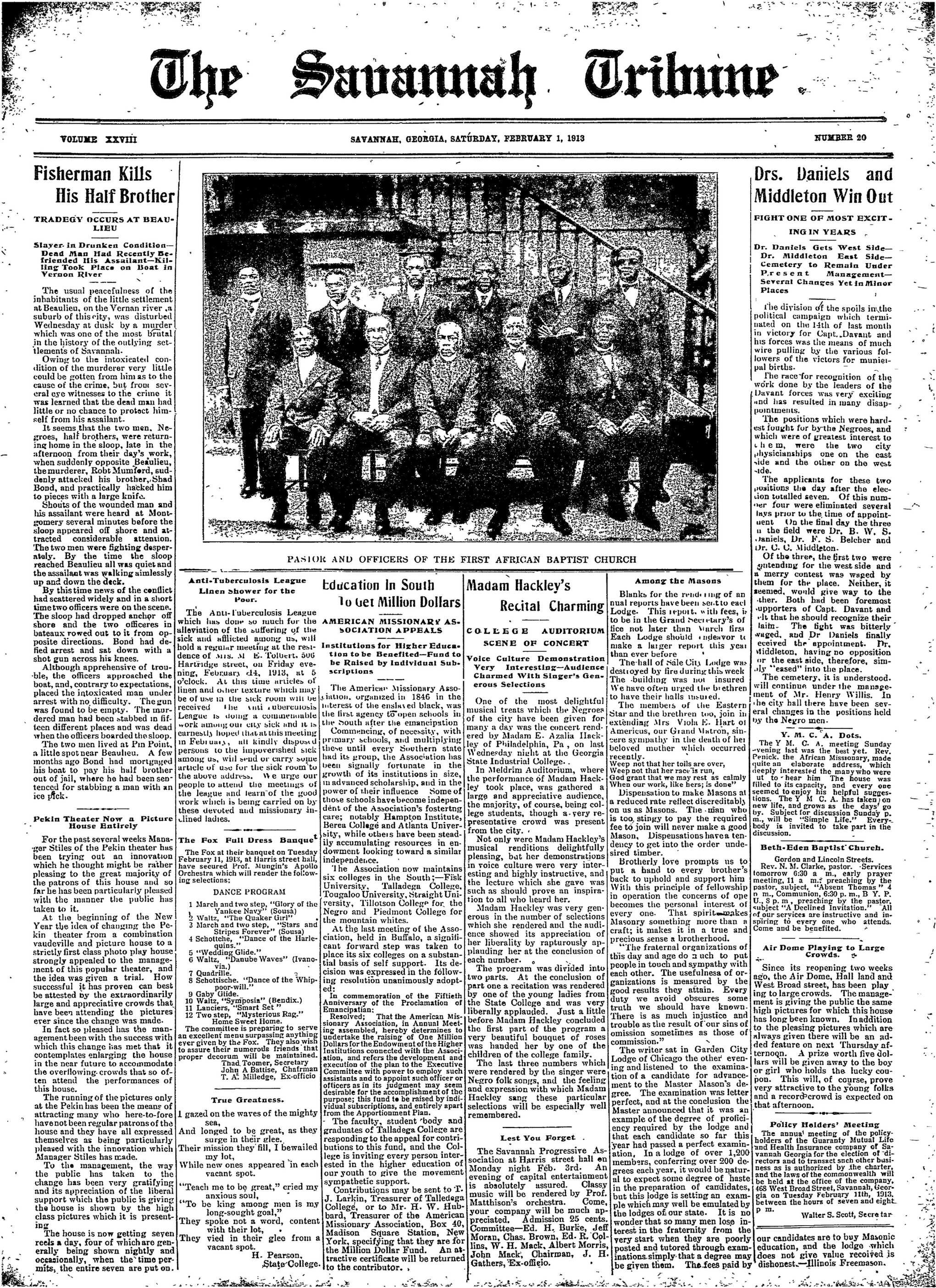
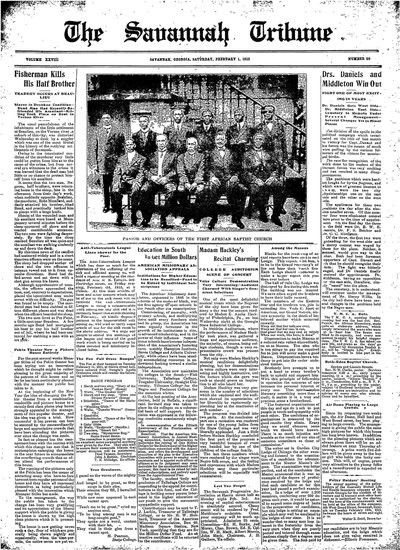
PASIOR AND OFFICERS OF THE FIRST AFRICAN BAPTIST CHURCH
Anti-Tuberculosis League Linen Shower for the Poor.
The Anti-Tuberculosis League which has done so much for the alleviation of the suffering of the sick and afflicted among us, will hold a regular meeting at the residence of Mrs. M. E. Tolbert, 506 Hartridge street, on Friday evening, February 14, 1913, at 5 o'clock. At this time articles of linen and other texture which may be of use in the sick room will be received. The Anti-Tuberculosis League is doing a commendable work among our city sick and it is earnestly hoped that at this meeting in February, all kindly disposed persons to the impoverished sick among us, will send or carry some article of use for the sick room to the above address. We urge our people to attend the meetings of the league and learn of the good work which is being carried on by these devoted and missionary inclined ladies.
The Fox Full Dress Banque $ ^{t} $
The Fox at their banquet on Tuesday February 11, 1913, at Harris street hall, have secured Prof. Mungin's Apollo Orchestra which will render the following selections:
DANCE PROGRAM
1 March and two step, "Glory of the Yankee Navy" (Sousa)
2 Waltz, "The Quaker Girl"
3 March and two step, "Stars and Stripes Forever" (Sousa)
4 Schottche, "Dance of the Harle-quins."
5 "Wedding Glide."
6 Waltz, "Danube Waves" (Ivanovia.)
7 Quadrille.
8 Schottische, "Dance of the Whippoor-will."
9 Gaby Glide.
10 Waltz, "Symposia" (Bendix.)
11 Luciers, "Smart Set"
12 Two step, "Mysterious Rag."
Home Sweet Home.
The committee is preparing to serve an excellent menu surpassing anything ever given by the Fox. They also wish to assure their numerous friends that proper decorum will be maintained.
Thad Toomer, Secretary
John A Battise, Chafman
T. A. Milledge, Ex-officio
True Greatness.
1 gazed on the waves of the mighty sea,
And longed to be great, as they surge in their glee.
Their mission they fill, I bewailed my lot.
While new ones appeared in each vacant spot.
"Teach me to be great," cried my anxious soul,
"To be king among men is my long-sought goal."
They spoke not a word, content with their lot,
They vied in their glee from a vacant spot.
H. Pearson,
State College
SAVANNAH, GEORGIA, SATURDAY, FEBRUARY 1, 1913
Education In South
To Get Million Dollars
AMERICAN MISSIONARY ASSOCIATION APPEALS
Institutions for Higher Education to be Benefited—Fund to be Raised by Individual Subscriptions
The American Missionary Association, organized in 1846 in the interest of the enslaved black, was the first agency to open schools in the South after the emancipation
Commencing, of necessity, with primary schools, and multiplying these until every Southern state had its group, the Association has been signally fortunate in the growth of its institutions in size, in advanced scholarship, and in the power of their influence Some of those schools have become independent of the Association's fostertng care; notably Hampton Institute, Berea College and Atlanta University, while others have been steadily accumulating resources in endowment looking toward a similar independence.
The Association now maintains six colleges in the South;—Fisk University, Talladega College, Tougaloo University, Straight University, Tillotson College for the Negro and Piedmont College for the mountain whites.
At the last meeting of the Association, held in Buffalo, a significant forward step was taken to place its six colleges on a substantial basis of self support. Its decision was expressed in the following resolution unanimously adopted:
In commemoration of the Fiftieth Anniversary of the Proclamation of Emancipation:
Resolved; That the American Missionary Association, in Annual Meeting assembled, hereby determines to undertake the raising of One Million Dollars for the Endowment of the Higher Institutions connected with the Association, and refers the development and execution of the plan to the Executive Committee with power to employ such assistants and to appoint such officer or officers as in its judgment may seem desirable for the accomplishment of the purpose; this fund to be raised by individual subscriptions, and entirely apart from the Apportionment Plan.
The faculty, student body and graduates of Talladega College are responding to the appeal for contributions to this fund, and the College is inviting every person interested in the higher education of our youth to give the movement sympathetic support.
Contributions may be sent to T. J. Larkin, Treasurer of Talledega College, or to Mr. H. W. Hubbard, Treasurer of the American Missionary Association, Box 40, Madison Square Station, New York, specifying that they are for the Million Dollar Fund. An attractive certificate will be returned to the contributor.
Madam Hacklev's
Recital Charming
COLLEGE AUDITORIUM
Voice Culture Demonstration Very Interesting-Audience Charmed With Singer's Generous Selections
One of the most delightful musical treats which the Negroes of the city have been given for many a day was the concert rendered by Madam E. Azalia Hackley of Philadelphia, Pa., on last Wednesday night at the Georgia State Industrial College.
In Meldrim Auditorium, where the performance of Madam Hackley took place, was gathered a large and appreciative audience, the majority, of course, being college students, though a very representative crowd was present from the city.
Not only were Madam Hackley's musical renditions delightfully pleasing, but her demonstrations in voice culture were very interesting and highly instructive, and the lecture which she gave was such as should prove an inspiration to all who heard her. Madam Hackley was very generous in the number of selections which she rendered and the audience showed its appreciation of her liberality by rapturously applauding her at the conclusion of each number.
The program was divided into two parts. At the conclusion of part one a recitation was rendered by one of the young ladies from the State College and was very liberally applauded. Just a little before Madam Hackley concluded the first part of the program a very beautiful bouquet of roses was handed her by one of the children of the college family. The last three numbers which were rendered by the singer were Negro folk songs, and the feeling and expression with which Madam Hackley sang these particular selections will be especially well remembered.
Lest You Forget .
The Savannah Progressive Association at Harris street hall on Monday night Feb. 3rd. An evening of capital entertainment is absolutely assured. Classy music will be rendered by Prof. Matthison's orchestra. Come, your company will be much appreciated. Admission 25 cents. Committee—Ed. H. Burke, Jeff Moran, Chas. Brown, Ed. R. Collins, W. H. Mack, Albert Morris, John Mack, Chairman, J. H. Gathers, Ex-officio.
Among the Masons
Blanks for the rendering of annual reports have been sent to each Lodge. This report, with fees, is to be in the Grand Secretary's office not later than March first. Each Lodge should endeavor to make a larger report this year than ever before. The hall of Sale City Lodge was destroyed by fire during this week. The building was not insured. We have often urged the brethren to have their halls insured. The members of the Eastern Star and the brethren too, join in extending Mrs Viola E. Hart of Americus, our Grand Matron, sincere sympathy in the death of her beloved mother which occurred recently.
God grant that we may rest as calmly
When our work, like hers; is done"
Dispensation to make Masons at a reduced rate reflect discreditably on us as Masons. The man who is too stingy to pay the required fee to join will never make a good Mason. Dispensations have a tendency to get into the order undesired timber. Brotherly love prompts us to put a hand to every brother's back to uphold and support him. With this principle of fellowship in operation the concerns of one becomes the personal interest of every one. That spirit makes Masonry something more than a craft; it makes it in a true and precious sense a brotherhood.
"The fraternal organizations of this day and age do much to put people in touch and sympathy with each other. The usefulness of organizations is measured by the good results they attain. Every duty we avoid obscures some truth we should have known. There is as much injustice and trouble as the result of our sins of omission sometimes as those of commission."
The writer sat in Garden City Lodge of Chicago the other evening and listened to the examination of a candidate for advancement to the Master Mason's degree. The examination was letter perfect, and at the conclusion the Master announced that it was an example of the degree of proficiency required by the lodge and that each candidate so far this year had passed a perfect examination. In a lodge of over 1,200 members, conferring over 200 degrees each year, it would be natural to expect some degree of haste in the preparation of candidates, but this lodge is setting an example which may well be emulated by the lodges of our state. It is no wonder that so many men lose interest in the fraternity from the very start when they are poorly posted and tutored through examinations. simply that a degree may be given them. The fees paid by
Drs. Daniels and Middleton Win Out
FIGHT ONE OF MOST EXCIT-
ING IN YEARS
Dr. Daniels Gets West Side—
Dr. Middleton East Side—
Cemetery to Remain Under
Present Management—
Several Changes Yet in Minor
Places
The division of the spoils in the
political campaign which termi-
nated on the 14th of last month
in victory for Capt. Davant and
his forces was the means of much
wire pulling by the various
followers of the victors for munie-
pal births.
The race for recognition of the work done by the leaders of the Dayant forces was very exciting and has resulted in many disappointments.
The positions which were hardest fought for by the Negroes, and which were of greatest interest to them, were the two city physicianships one on the east side and the other on the west side.
The applicants for these two positions the day after the election totalled seven. Of this number four were eliminated several days prior to the time of appointment. On the final day the three in the field were Dr. B. W. S. Daniels, Dr. F. S. Belcher and Dr. C. C. Middleton.
Of the three, the first two were attending for the west side and a merry contest was waged by them for the place. Neither, it seemed, would give way to the other. Both had been foremost supporters of Capt. Davant and it that he should recognize their claim. The fight was bitterly waged, and Dr Daniels finally received the appointment. Dr. Middleton, having no opposition or the east side, therefore, simply "eased" into the place.
The cemetery, it is understood, will continue under the management of Mr. Henry Willis. In the city hall there have been several changes in the positions held by the Negro men.
Y. M. C. A. Dots.
The Y M. C. A. meeting Sunday evening last was the best yet. Rev. Penick, the African Missionary, made quite an elaborate address, which deeply interested the many who were out to hear him. The house was filled to its capacity, and every one seemed to enjoy his helpful suggestions. The Y M. C. A. has taken on new life, and grows as the days go by. Subject for discussion Sunday p.m., will be "Simple Life." Everybody is invited to take part in the discussion.
Beth-Eden Baptist Church.
Gordon and Lincoln Streets.
Rev. N. M. Clarke, pastor. Services tomorrow 6:30 a m., early prayer meeting, 11 a m., preaching by the pastor, subject, "Absent Thomas" 4 a m., Communion, 6:30 p. m., B Y. P. U., S p. m., preaching by the pastor, subject "A Declined Invitation." All of our services are instructive and inspiring to every one who attends. Come and be benefited.
Air Dome Playing to Large Crowds.
Since its reopening two weeks ago, the Air Dome, Hall land and West Broad street, has been playing to large crowds. The management is giving the public the same high pictures for which this house has long been known. In addition to the pleasing pictures which are always given there will be an added feature on next Thursday afternoon. A prize worth five dollars will be given away to the boy or girl who holds the lucky coupon. This will, of course, prove very attractive to the young folks and a record crowd is expected on that afternoon.
Policy Holders' Meeting
The annual meeting of the policyholders of the Guaranty Mutual Life and Health Insurance company of Savannah Georgia for the election of directors and to transact such other business as is authorized by the charter, and the laws of the commonwealth will be held at the office of the company, 468 West Broad Street, Savannah, Georgia on Tuesday February 11th, 1913, between the hours of seven and eight p.m.
Walter S. Scott, Secre tar our candidates are to buy Masonic education, and the lodge which does not give value received is dishonest. Illinois Freemason.
WALLS TUMBLE KILLING MANY
Fire Follows Crash and Victims Burn to Death.
INJURED ARE MOSTLY WOMEN
Two Buildings, One Occupied By a Department Store, Collapsed Without Warn-
ing.
McKinney, Tex.-The most appalling tragedy in the history of this city or county was enacted in the collapse of two of the city's largest brick buildings, both filled with customers at the time.
Until the ruins, which caught fire, are completely cleared from the fatal spot, the exact loss of life cannot be ascertained, but it is stated by Mayor Finch that it cannot fail to be less 35. Willing hands by hundreds tore apart the smoking bricks of the fallen buildings. Hurling aside smoke-blackened and water-soaked timbers and four hours after the collapse the mangled and crushed bodies of seven persons had been tenderly moved by 300 workers and the forms of 13 injured persons carried to the four hospitals of the city or to private houses after emergency medical attention.
The collapsed stores were the threestory Odd Fellows Building, occupied by the dry goods store of Cheeves Brothers, crowded with women and children attending a white goods sale at the time, and the adjoining two-story implement store of T. J. Tingle. The buildings collapsed shortly before 4 o'clock. The implement house was also doing a thriving business. Those in the buildings suddenly heard a sound of the groaning of timbers. A harsh crackling followed, and clerks and customers alike broke for the safety of the street.
Pressed outward by the weight of the heavy implements and of the stock, the walls of the implement store swayed, sagged and burst through into the department store. In an instant hundreds of tons of merchandise and wrecked and shattered building material roared into a tremendous heap of debris on the site of the ruined department store, spilling 30 feet high into the air and settling in a cloud of dust that rose like a pall above the buried bodies, while jagged timbers thrust ugly heads from the mass.
After a moment of stunned amazement, of paralyzed inactivity, hundreds of willing workers pitched into the ruins. Scarcely had they mounted the heap when tongues of flames burst through it, and an alarm of fire was added to the confusion. From all over the city came workers, hundreds of them, and as they came they were formed into relays by Mayor Finch and those assisting him.
As one shift became exhausted another took its place. From a mound of debris the smoking, steaming ruins became a crater. Bricks were hurled aside, timber torn out and cast into the street and mangled and crushed forms were tenderly lifted from the twisted mass of wreckage and hurried to various hospitals in wagons.
· TURKS YIELD TO POWERS.
The Allies May Demand the Payment
Of $200,000,000.
Constantinople, Jan. 22.—Yielding to the demands of the powers, which it now appears amounted to nothing less than an ultimatum, the Grand Council of the Ottoman Empire decided late today to cede the fortress of Adrianople to the Balkan allies and to leave to the powers the question of the disposal of the Aegean Islands. This action, it is believed here, will lead to the resumption of the peace conference in London tomorrow and an early termination thereof, with the allies complete victors in the war with Turkey and in the diplomatic conflict that followed it, without further blood-shed.
HOW TO TREAT THE BABY.
Don't Pick It Up When It Cries, Says Noted Specialist.
Chicago.—Dr. Stewart Paton, specialist in mental hygiene at Princeton University, warned against picking up the baby when it cries in an address here before the Mental Hygiene Conference. He said this was the first step toward making this same child, grown to manhood, a mental defective, possibly an imbecile. "The baby soon learns that by crying it may get whatever it years," he said. "The next step in development is a nervous child. When about 14 years old strange impulses come into its mind. The more nervous it is the stronger the impulses."
PROHIBITS CONTRIBUTIONS:
Corporations Cannot Give To Political Campaigns.
Washington.-The Senate passed the Culberson bill to prohibit corporations from making any contributions for political conventions or primary elections. The bill is an extension of the campaign contribution law enacted in 1907, under which corporations were forbidden to contribute to general election campaign funds. A penalty of $4,000 or a year's imprisonment for officers of corporations violating the law is carried by the bill.
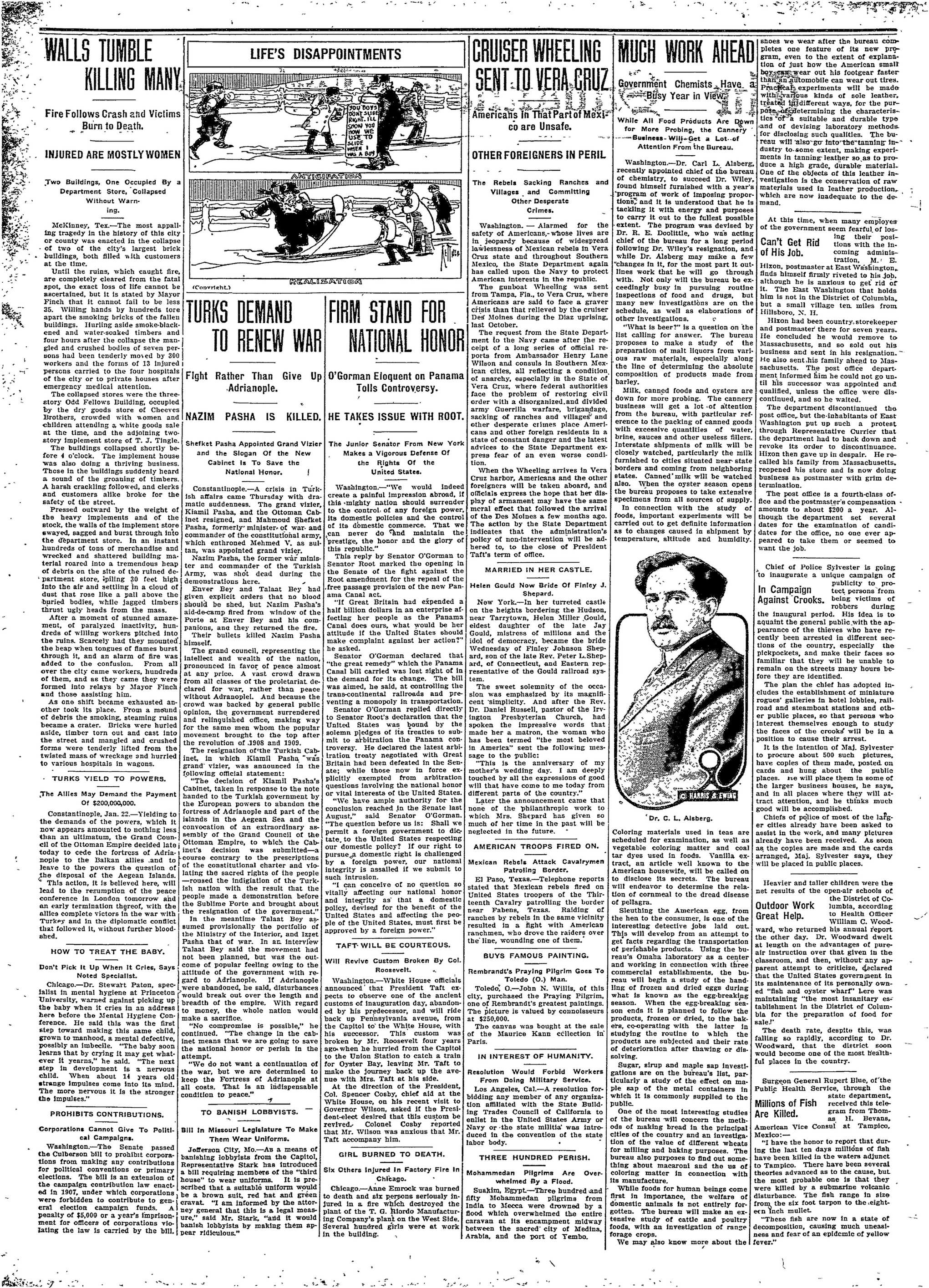
YOU BOYS DON'T SLIDE RIGHT. ILL SHOW YOU HOW WE USE TO SLIDE WHEN I HAS A BOY
ANTIGIPATION
TURKS DEMAND TO RENEW WAR
Shefket Pasha Appointed Grand Vizier and the Slogan Of the New Cabinet Is To Save the National Honor.
Constantinople.—A crisis in Turkish affairs came Thursday with dramatic suddenness. The grand vizier, Kamil Pasha, and the Ottoman Cabinet resigned, and Mahmoud Shefket Pasha, formerly minister of war and commander of the constitutional army, which enthroned Mehmed V. as sultan, was appointed grand vizier.
Nazim Pasha, the former war minister and commander of the Turkish Army, was shot dead during the demonstrations here.
Enver Bey and Talaat Bey had given explicit orders that no blood should be shed, but Nazim Pasha's aid-de-camp fired from window of the Porte at Enver Bey and his companions, and they returned the fire. Their bullets killed Nazim Pasha himself.
The grand council, representing the intellect and wealth of the nation, pronounced in favor of peace almost at any price. A vast crowd drawn from all classes of the proletariat declared for war, rather than peace without Adranoplel. And because the crowd was backed by general public opinion, the government surrendered and relinquished office, making way for the same men whom the popular movement brought to the top after the revolution of 1908 and 1909.
The resignation of the Turkish Cabinet, in which Klamil Pasha was grand vizier, was announced in the following official statement:
"The decision of Klamil Pasha's Cabinet, taken in response to the note handed to the Turkish government by the European powers to abandon the fortress of Adrianople and part of the islands in the Aegean Sea and the convocation of an extraordinary assembly of the Grand Council of the Ottoman Empire, to which the Cabinet's decision was submitted—a course contrary to the prescriptions of the constitutional charter and violating the sacred rights of the people—roused the indignation of the Turkish nation with the result that the people made a demonstration before the Sublime Porte and brought about the resignation of the government."
In the meantime Talaat Bey assumed provisionally the portfolio of the Ministry of the Interior, and Izzet Pasha that of war. In an interview Talaat Bey said the movement had not been planned, but was the outcome of popular feeling owing to the attitude of the government with regard to Adrianople. If Adrianople were abandoned, he said, disturbances would break out over the length and breadth of the empire. With regard to money, the whole nation would make a sacrifice.
"No compromise is possible," he continued. "The change in the cabinet means that we are going to save the national honor or perish in the attempt.
"We do not want a continuation of the war, but we are determined to keep the Fortress of Adrianople at all costs. That is an indispensable condition to peace."
TO BANISH LOBBYISTS.
Bill In Missouri Legislature To Make Them Wear Uniforms.
Jefferson City, Mo.-Ab a means of banishing lobbyists from the Capitol, Representative Stark has introduced a bill requiring members of the "third house" to wear uniforms. It is prescribed that a suitable uniform would be a brown suit, red hat and green cravat. "I am informed by the attorney general that this is a legal measure," said Mr. Stark, "and it would banish lobbyists by making them appear ridiculous."
FIRM STAND FOR NATIONAL HONOR
O'Gorman Eloquent on Panama Tolls Controversy. HE TAKES ISSUE WITH ROOT.
The Junior Senator From New York Makes a Vigorous Defense Of the Rights Of the United States.
Washington.—"We would indeed create a painful impression abroad, if this mighty nation should surrender to the control of any foreign power, its domestic policies and the control of its domestic commerce. That we can never do and maintain the prestige, the honor and the glory of this republic."
This reply by Senator O'Gorman to Senator Root marked the opening in the Senate of the fight against the Root amendment for the repeal of the free passage provision of the new Panama Canal act.
"If Great Britain had expended a half billion dollars in an enterprise affecting her people as the Panama Canal does ours, what would be her attitude if the United States should make complaint against her action?" he asked.
Senator O'Gorman declared that "the great remedy" which the Panama Canal bill carried was lost sight of in the demand for its change. The bill was aimed, he said, at controlling the transcontinental railroads and preventing a monopoly in transportation.
Senator O'Gorman replied directly to Senator Root's declaration that the United States was bound by the solemn pledges of its treaties to submit to arbitration the Panama controversy. He declared the latest arbitration treaty negotiated with Great Britain had been defeated in the Senate; while those now in force explicitly exempted from arbitration questions involving the national honor or vital interests of the United States. "We have ample authority for the conclusion reached in the Senate last August," said Senator O'Gorman. "The question before us is: Shall we permit a foreign government to dictate, to the United States respecting our domestic policy? If our right to pursue a domestic right is challenged by a foreign power, our national integrity is assailed if we submit to such intrusion.
"I can conceive of no question so vitally affecting our national honor and integrity as that a domestic policy, devised for the benefit of the United States and affecting the people of the United States, must first be approved by a foreign power."
TAFT WILL BE COURTEOUS.
Will Revive Custom Broken By Col. Roosevelt.
Washington.—White House officials announced that President Taft expects to observe one of the ancient customs of inauguration day, abandoned by his predecessor, and will ride back up Pennsylvania avenue, from the Capitol to the White House, with his successor. This custom was broken by Mr. Roosevelt four years ago when he hurried from the Capitol to the Union Station to catch a train for Oyster Bay, leaving Mr. Taft to make the journey back up the avenue with Mrs. Taft at his side.
At the direction of the President, Col. Spencer Cosby, chief aid at the White House, on his recent visit to Governor Wilson, asked if the President-elect desired that this custom be revived. Colonel Cosby reported that Mr. Wilson was anxious that Mr. Taft accompany him.
GIRL BURNED TO DEATH.
Six Others Injured In Factory Fire In Chicago.
Chicago—Anne Emrock was burned to death and six persons seriously injured in a fire which destroyed the plant of the T. G. Rlordo Manufacturing Company's plant on the West Side. Several hundred girls were at work in the building.
The Rebels Sacking Ranches and Villages and Committing Other Desperate
Washington. — Alarmed for the safety of Americans, whose lives are in jeopardy because of widespread lawlessness of Mexican rebels in Vera Cruz state and throughout Southern Mexico, the State Department again has called upon the Navy to protect American interests in the republic.
The gunboat Wheeling was sent from Tampa, Fla., to Vera Cruz, where Americans are said to face a graver crisis than that relieved by the cruiser Des Moines during the Diaz uprising, last October.
The request from the State Department to the Navy came after the receipt of a long series of official reports from Ambassador Henry Lane Wilson and consuls in Southern Mexican cities, all reflecting a condition of anarchy, especially in the State of Vera Cruz, where federal authorities face the problem of restoring civil order with a disorganized, and divided army Guerrilla warfare, brigandage, sacking of ranches and villages and other desperate crimes place Americans and other foreign residents in a state of constant danger and the latest advices to the State Department express fear of an even worse condition.
When the Wheeling arrives in Vera Cruz harbor, Americans and the other foreigners will be taken aboard, and officials express the hope that her display of armament may have the same moral effect that followed the arrival of the Des Moines a few months ago. The action by the State Department indicates that the administration's policy of non-intervention will be adhered to, to the close of President Taft's term of office.
MARRIED IN HER CASTLE.
Helen Gould Now Bride Of Finley J.
Shepard.
New York.—In her turreted castle on the heights bordering the Hudson, near Tarrytown, Helen Miller Gould, eldest daughter of the late Jay Gould, mistress of millions and the idol of democracy, became the bride Wednesday of Finley Johnson Shepard, son of the late Rev. Peter L.Shepard, of Connecticut, and Eastern representative of the Gould railroad system.
The sweet solemnity of the occasion was emphasized by its magnificent simplicity. And after the Rev. Dr. Daniel Russell, pastor of the Irvington Presbyterian Church, had spoken the impressive words that made her a matron, the woman who has been termed "the most beloved in America" sent the following message to the public:
"This is the anniversary of my mother's wedding day. I am deeply touched by all the expressions of good will that have come to me today from different parts of the country." Later the announcement came that none of the philanthropic work to which Mrs. Shepard has given so much of her time in the past will be neglected in the future.
AMERICAN TROOPS FIRED ON.
Mexican Rebels Attack Cavalrymen Patrolling Border.
El Paso, Texas—Telephone reports stated that Mexican rebels fired on United States troopers of the Thirteenth Cavalry patrolling the border near Fabens, Texas. Raiding of ranches by rebels in the same vicinity resulted in a fight with American ranchmen, who drove the raiders over the line, wounding one of them.
BUYS FAMOUS PAINTING.
Rembrandt's Praying Pilgrim Goes To Toledo (O.) Man.
Toledo, O.—John N. Willis, of this city, purchased the Praying Pilgrim, one of Rembrandt's greatest paintings. The picture is valued by connoisseurs at $250,000.
The canvas was bought at the sale of the Maurice Kann collection in Paris.
IN INTEREST OF HUMANITY.
Resolution Would Forbid Workers From Doing Military Service.
Los Angeles, Cal.—A resolution forbidding any member of any organization affiliated with the State Building Trades Council of California to enlist in the United States Army or Navy or the state militia' was introduced in the convention of the state labor body.
THREE HUNDRED PERISH.
Mohammedan Pilgrims Are Overwhelmed By a Flood.
Suakim, Egypt.—Three hundred and fifty Mohammedan pilgrims from India to Mecca were drowned by a flood which overwhelmed the entire caravan at its encampment midway between the sacred city of Medina, Arabia, and the port of Yembo.
MUCH WORK AHEAD
MUCH WORK AHEAD
While All Food Products Are Down for More Probing, the Cannery Business-Will-Get a Lot of Attention From the Bureau.
Washington.—Dr. Carl L. Alsberg, recently appointed chief of the bureau of chemistry, to succeed Dr. Wiley, found himself furnished with a year's program of work of imposing proportions, and it is understood that he is tackling it with energy and purposes to carry it out to the fullest possible extent. The program was devised by Dr. R. E. Doolittle, who was acting chief of the bureau for a long period following Dr. Wiley's resignation, and while Dr. Alsberg may make a few changes in it, for the most part it outlines work that he will go through with. Not only will the bureau be exceedingly busy in pursuing routine inspections of food and drugs, but many new investigations are on the schedule, as well as elaborations of other investigations.
"What is beer?" is a question on the list calling for answer. The bureau proposes to make a study of the preparation of malt liquors from various raw materials, especially along the line of determining the absolute composition of products made from barley. Milk, canned foods and oysters are down for more probing. The cannery business will get a lot of attention from the bureau, with particular reference to the packing of canned goods with excessive quantities of water, brine, sauces and other useless fillers. Interstate shipments of milk will be closely watched, particularly the milk furnished to cities situated near state borders and coming from neighboring states. Canned milk will be watched also. When the oyster season opens the bureau proposes to take extensive specimens from all sources of supply.
In connection with the study of foods, important experiments will be carried out to get definite information as to changes caused in shipment by temperature, altitude and humidity.
HARRIS & EWING
Dr. C. L. Alsberg.
Coloring materials used in teas are scheduled for examination, as well as vegetable coloring matter and coal tar dyes used in foods. Vanilla extract, an article well known to the American housewife, will be called on to disclose its secrets. The bureau will endeavor to determine the relation of cornmeal to the dread disease of pellagra.
Sleuthing the American egg, from the hen to the consumer, is one of the interesting detective jobs laid out. This will develop from an attempt to get facts regarding the transportation of perishable products. Using the bureau's Omaha laboratory as a center and working in connection with three commercial establishments, the bureau will begin a study of the handling of frozen and dried eggs during what is known as the egg-breaking season. When the egg-breaking season ends it is planned to follow the products, frozen or dried, to the bakers, co-operating with the latter in studying the routine to which the products are subjected and their rate of deterioration after thawing or dissolving.
Sugar, sirup and maple sap investigations are on the bureau's list, particularly a study of the effect on maple sap of the metal containers in which it is commonly supplied to the public.
One of the most interesting studies of the bureau will concern the methods of making bread in the principal cities of the country and an investigation of the value of different wheats for milling and baking purposes. The bureau also purposes to find out something about macaroni and the us of coloring matter in connection with its manufacture.
While foods for human beings come first in importance, the welfare of domestic animals is not entirely forgotten. The bureau will make an extensive study of cattle and poultry foods, with an investigation of range forage crops.
We may also know more about the
shoes we wear after the bureau completes one feature of its new program, even to the extent of explanation of just how the American small boy can wear out his footwear faster than an automobile can wear out tires. Practical experiments will be made with various kinds of sole leather, treated in different ways, for the purpose of determining the characteristics of a suitable and durable type and of devising laboratory methods for disclosing such qualities. The bureau will also go into the tanning industry to some extent, making experiments in tanning leather so as to produce a high grade, durable material. One of the objects of this leather investigation is the conservation of raw materials used in leather production, which are now inadequate to the demand.
At this time, when many employees of the government seem fearful of losing their positions with the incoming administration. M. E. Can't Get Rid of His Job.
Hixon, postmaster at East Washington, finds himself firmly riveted to his job, although he is anxious to get rid of it. The East Washington that holds him is not in the District of Columbia, but a small village ten miles from Hillsboro, N. H.
Hixon had been country, storekeeper and postmaster there for seven years. He concluded he would remove to Massachusetts, and so sold out his business and sent in his resignation. He also sent his family ahead to Massachusetts. The post office department informed him he could not go until his successor was appointed and qualified, unless the office were discontinued, and so he waited.
The department discontinued the post office, but the inhabitants of East Washington put up such a protest through Representative Currier that the department had to back down and revoke its order to discontinuance. Hixon then gave up in despair. He recalled his family from Massachusetts, reopened his store and is now doing business as postmaster with grim determination.
The post office is a fourth-class office and the postmaster's compensation amounts to about $200 a year. Although the department set several dates for the examination of candidates for the office, no one ever appeared to take them or seemed to want the job.
Chief of Police Sylvester is going to inaugurate a unique campaign of publicity to protect persons from being victims of robbers during the inaugural period. His idea is to aquaint the general public with the appearance of the thieves who have recently been arrested in different sections of the country, especially the pckpockets, and make their faces so familiar that they will be unable to remain on the streets many hours before they are identified.
The plan the chief has adopted includes the establishment of miniature rogues' galleries in hotel lobbies, railroad and steamboat stations and other public places, so that persons who interest themselves enough to study the faces of the crooks will be in a position to cause their arrest.
It is the intention of Maj. Sylvester to procure about 500 such pictures, have copies of them made, posted on cards and hung about the public places. he will place them in some of the larger business houses, he says, and in all places where they will attract attention, and he thinks much good will be accomplished.
Chiefs of police of most of the larger cities already have been asked to assist in the work, and many pictures already have been received. As soon as the copies are made and the cards arranged, Maj. Sylvester says, they will be placed in public places.
Outdoor Work Great Help.
ward, who returned his annual report the other day. Dr. Woodward dwelt at length on the advantages of pureair instruction over that given in the classroom, and then, without any apparent attempt to criticize, declared that the United States government in its maintenance of its personally owned "fish and oyster wharf" here was maintaining "the most insanitary establishment in the District of Columbia for the preparation of food for sale." The death rate, despite this, was falling so rapidly, according to Dr. Woodward, that the district soon would become one of the most healthful places in the country.
Surgeon General Rupert Blue, of the Public Health Service, through the state department, received this telegram from Thomas H. Bevans, American Vice Consul at Tampico, Mexico:— "I have the honor to report that during the last ten days millions of fish have been killed in the waters adjunct to Tampico. There have been several theories advanced as to the cause, but the most probable one is that they were killed by a submarine volcanic disturbance. The fish range in size from the six foot tarpon to the eight-een inch mullet. "These fish are now in a state of decomposition, causing much uneasiness and fear of an epidemic of yellow fever."
An Advertisement in This Paper
Helps you, helps your town and helps the paper
The affable H. B. Wright is still with us and expects the continuous patronage of his friends.
IF you want to get the best that's going—HighClass Literature—Copyrighted Articles from the World's Best and Most Illustrious Writers— Read This Paper We spare neither time nor expense to give our readers the best A local newspaper, county newspaper, general newspaper, farm journal, magazine, woman's home companion--all in one great weekly family paper--THIS PAFER
Fruit and Commission Merchant
634 ST. JULIAN ST., WEST, 235 BRYAN ST., WEST.
SAVANNAH, GEORGIA
Phone 2962
Palm Shaving Palace
Expert Hair Cutting, Electric Massage and Shampooing a Specialty. All Work Done by Experienced Workmen. Courteous attention to all SHINING PARLOR ATTACHED.
517 WEST BROAD ST. SAVANNAH, GA.
The Beautiful Woodlawn Park
New Improvements More Lights New Buildings
The Ideal Picnic Spot of Savannah
Secure your dates from ANDREW D. MONROE, 124 East Thirty-third St.
Get the habit of saving a part of your Earnings each week.
$1.00
Starts an Account
THE WAGE-
EARNERS' LOAN
AND INVESTMENT
COMPANY,
468 - WEST BROAD ST.
Savannah, Ga.
GAREY'S
Variety Bakery
Goods delivered promptly to any part of the city. 506 West Broad St. Near Gaston. Phone 1869-J
Masonic Books
LODGE SEALS,
FINANCIAL CARDS and
BLANKS of every description.
Publishers and Manufacturers' Prices
Laboral Discounts Will Be Arranged.
BOL G. JOHNSON,
Savannah, Ga.
Try the New Discovery
MAGIC Shaving Powder GUARANTEED TO SHAVE YOU CLEAN WITHOUT USING A RAZOR. WILL SEND HALF POUND CAN BY MAIL. POSTAGE PAID FOR 25 CENTS IN STAMPS.
Agents Wanted
WRITE
The Shaving Powder Co.
SAVANNAH, GA.
BROWN'S LODGING HOUSE
Hot and'
Cold Baths
Shoe Shining Parlor Attached
PROMPT ATTENTION TO PATRONS
217 East Broad Street
Phone 3746
SAVANNAH, . . GEORGIA.
Hand This to Your Friend.
For First Class
GROCERIES and CONFECTIONERY
Call On
M. G. GRAHAM
626 York St, West.
Courteous Attention to All.
MADAME FLORENCE E. WILLIAMS
Graduate Prof. Roher's School New York.
Telephone 2328. Wigs, Switches and Pompadours Made from Natural Hair. Combings Made Up. Shampooling and Hair Straightening a Specialty. Face and Electric Massage. Dyeing and Matching Hair. ORIENTAL HAIR GROWER. An excellent preparation, will produce a beautiful growth of hair. Directions on each box. For sale, price 25 cents per box.
Young Bros.
For your
TOBACCO, CIGARS and FRUITE
Of all kinds.
509 West Broad Street.
WEST SIDE RESTAURANT
451 West Broad Street,
Near Union Station.
The place to get first-class meals
Everything neat and clean. Meals
prepared in an appetizing manner
and at all hours daily.
Meals 15 and 25 cents.
MRS. A. S. SCOTT, Proprietress
Your Money Pile Grows
Just in proportion as you advertise your business, and
our columns
are open for you to begin at once. Suppose you give us a trial.
Advertise in this paper
THE HIGH COST OF LIVING
has not effected our job printing prices. We've still doing commercial work of all kinds at prices satisfactory to you.
FOUND HIS IDEAL
What Happened When Frances Kennedy Went Coasting With the Little Folks.
By M. DIBBELL.
"Frances Kennedy, what prank are you up to now?"
"Why, Aunt Flossie, don't you remember my telling you this morning that Elmer Bergen was going to take his sister and me tobogganing tonight? You don't think I would wear my hair up so it would all come down the minute we started to slide, did you?" The heavy braid, fell below her waist and a fluffy wool cap was pulled well down over her ears. Her dress reached her shoe tops, thus making a charming school girl of the mature young woman.
Her aunt regarded her quizzically, "What a child you are, Frances; I don't believe you ever will grow up. The idea of a college graduate going to slide down a country hill with a small boy and his sister."
"That is just where the fun comes in—I am tired of the conventional way of doing things. Good bye—I am certain to have a jolly time." She threw her aunt a kiss and danced from the room singing "Jingle Bells" at the top of her voice.
"Bless the youngster. I only hope she keeps the child spirit all her life," thought Aunt Flossie as she watched her niece join Elmer and his sister at the gate and then pass from sight down the moonlit road.
It did not take the trio long to reach the steep hill down which they were to slide, and when the girls were safely tucked in front of him Elmer said warningly before starting the toboggan: 'You must be prepared for a surprise at the foot of the hill, Frances—I shan't tell you what it is.' Then they were off, going faster and faster over the crusted snow. Frances enjoyed the slide immensely, until the "surprise came. This proved to be the shooting out into the air of the toboggan over the top of a high stone wall, and alighting of the same in the field several feet lower down with such a hearty thud that the breath was about knocked out of all three passengers.
Elmer did not wait for the vengeance he knew awaited him, but as soon as he could regain his breath started away at a run, calling back with a shout of laughter, "How did you like my surprise, Frances—wasn't it fine?"
Frances scrambled to her feet and started in hot pursuit, her long braid streaming behind. "Just wait till I catch you, you little wretch, and see how you like having your ears well boxed," she threatened breathlessly.
Etta Bergen.remained in possession of the toboggan, laughing in huge delight at the exciting chase, until a warning shout sounded at the stone wall. She sprang aside just as another toboggan plumped down beside her brother's.
"Oh, Roy," she cried, as she recognized the new comer. "You almost landed on top of me. I was too excited to think of moving, it is such fun." In few words she explained the cause of the chase going on before them. Big Roy Singleton watched Frances with admiration. "My, but she's a fine runner," he said shortly, "Elmer has met his match this time—look at the young scamp doubling back here for protection."
"Save me, Roy," gasped Elmer, as he neared them. "Don't let me be scaled before your face and eyes," and he darted behind his friend to drop on the snow, after his run.
Frances was too taken with her pursuit to notice anything but her proposed victim, and as she was almost within reaching distance when he swerved around Roy, she ran headlong into that young man's open arms.
"My, but you are a wonder!" he cried as he held her tight. "I would never have believed that a mite of a girl could give Elmer such a hard run for his life if I hadn't seen it for myself."
Frances struggled to free herself. "I am not a 'mite of a girl,'" she flared out wrathfully, "and how dare you hold me!"
Roy released her instantly, looking decidedly sheepish. His first glance showed him that his escaped captive was not the child for which he had taken her.
"I beg your pardon," he began stumblingly.
Frances interrupted with a stamp of her foot. "Ot, bother, I forgot my hair--you are not to blame. Come, Elmer, is there any way out of this horrid field?" She turned her back on Roy and marched. toward the wall with Etta and Elmer and the toboggan trailing meekly in her wake.
"We have to go up to the far end to get out," Elmer informed her, and soon the three were climbing up the long hill down which they had come.
It was Elmer who broke a glum silence. "You aren't mad are you, Frances?" he asked contritely. "You know I only meant it for a joke, and it couldn't hurt you."
"Yes I am angry, Elmer—but not with you. It is I who should have my ears boxed for acting like a goose."
"What rot," was Elmer's answer.
"You are the only nice grown-up girl I ever knew. Most of them are so stupid and slow they make me tired."
Frances had to smile at this plain expression of opinion. "I am glad you like me, but who do you suppose
that young man will think of a person of my age sliding down hill dressed up like a school girl"
"Pooch," snorted Elmer. "I think you heard what his opinion of you was. Roy was twenty-four last June, but he likes to have a good time same as he ever did—has all the digging he wants, at the office and is in for some fun when he can get away."
This was comforting to Franges' wounded self-cateem, but she utterly refused to take another ride down the hill, though Elmer coaxed.
"I have had all the tobogganing I want," she said decidedly. "You and Etta can keep on if you want to, I am not afraid to go home alone."
But they would not listen to this, and the three turned their steps homeward.
"Just wait till I get a chance at Roy," grumbled Elmer to his sister after they parted from Frances, "Till give him a piece of my mind. If he hadn't butted in at the wrong minute Frances would have stayed out a long time."
The evening following the toboganning experience, Frances was reading aloud to her aunt when a loud knock sounded at the front door, and she answered the summons to find standing before her big Roy Singleton.
"I called to ask if I might have the pleasure of giving you a ride down the long hill," he said at once. "I am sure Mrs. Frencham will vouch for my reliability." Aunt Flossie on hearing his voice had come forward.
"Why, Roy, you are a sight for sore eyes," she said heartily. "Come right in and let me introduce you to my niece, Frances Kennedy, who is paying me a visit."
"I had the happiness of meeting Miss Kennedy last evening, and now I want to induce her to take another try at tobogganing," explained Roy as he entered.
Aunt Flossie looked surprised, for she had heard nothing of the encounter. Frances had told her that she found coasting uninteresting.
But with Roy on the scene the whole affair was soon made clear to her, and she laughed unrestrainedly at his account of the fleeing Elmer and his valiant pursuer.
"I don't see how you could call such an incident uninteresting," she told Frances. "I thought you had been unusually quiet today, you little humbug." Roy's pleading was ably seconded by Mrs. Frencham, and the two young people started for the long hill, which was at the opposite side of the village from their former evening's exploit. Etta and Elmer came rushing up as they reached the summit. "Oh, I say, isn't this fine," cried Elmer at sight of them. "I take it all back, Roy, now you have made up with Frances and got her to come out again."
That evening began a new era for Frances and Roy. It was not many weeks before the straightforward young man said to her, "Ever since I first held you in my arms I have loved you, Frances. I knew when you left me below the stone wall that I had found my ideal."
Frances asked demurely, "Don't you think it was most unwomanly to throw myself at your head, and anything but an ideal action to lose my temper and stamp my foot?" "What would an ideal be like without a temper?" was Roy's counter question. "I fell head over ears in love with you on the spot—I know perfection when I see it."
(Copyright, 1913, by the McClure Newspaper Syndicate.)
"I had a little lesson several weeks ago," remarked the man with the gray mustache, "and it called me in good shape."
"Go ahead," sald the stout man.
"I was in the garage where I keep my car and happened to overhear a conversation among the boys. A certain man had been injured while traveling abroad—very badly injured, it was reported—and one of the boys was telling the others about it. "The story in the paper says he can't get well," the youngster went on. "Did you know him, Pete?" And the boy addressed promptly replied, "Sure, I knew th' old grouch." Say that hit me pretty hard. Here was a leading citizen dying and all the boy could remember about him was that he was a grouch. Yes, sir, it made me sit up and think hard. And I got in my mind that when I passed out I'd like to be remembered for something different." He paused.
"That's worth considering," said the other man.
"Good text," said the first man.
"Good sermon," said the other.—Cleveland Plain Dealer.
Desirable Insect Immigrants.
The Australian ladybird beetle came into California to destroy the white scale in the late 80's, and this was followed by the carriage of the same species of beetle, with equally good results, to Portugal, to Italy, to South Africa, and quite recently to Formosa, in all cases destroying the same scale insect.
Another instance was the importation from Australia of certain parasites of the sugar cane leaf hopper into Hawaii, which is said to have resulted in the reduction of the numbers of the leaf hoppers to a negligible quantity. A gigantic experiment of the same kind is now being carried on in the importation of parasites and natural enemies of the gypsy moth and the brown-tail moth from all parts of Europe and from Japan into the New England states. A number of species have already been introduced and acclimated, and admirable results are expected from this work.—Exchange.
HER "BIG BROTHER"
Heath Garner turned out the light and flung himself defectedly into the inviting arms of his chair, and gazed at the heart of the glowing fire.
The flames danced in weird fantastic shapes, first springing high and then crouching low along the logs until they leaped into space. Their antics were unheeded, for he saw only the face of Ethel Ward as she said. "Heath, I am going to marry a man I have loved a long, long time. Tell me that you are glad."
Glad? Of course he was. Ethel was created for happiness. Lucky 'devil, whoever he was. Heath had heard of heartaches, but he had never suffered of the malady before; the loss of Ethel gave him a chronic case, for which there was no relief.
Since the day before his sixth birthday, when her family moved to the house next door, they had been the best of chums. She was "introduced" to the social life of the little suburban town at his party. He vividly recalled the shy, dainty, golden-haired elf, as she clung to his mother's skirts. Her dress was white, and a huge pink bow poised like a graceful butterfly on top of her head.
He was glad that she had no brothers to fight for her at school, and gave the other boys to understand that he was her sworn knight, errant, and no one ever infringed upon his right.
When his exciting high school days were over, he entered an eastern college and Ethel attended a school at Washington. What pangs of loneliness he endured! How he longed for her sweet companionship! Even the splendid fellows who were his classmates were poor compensation for the loss of her congenial society. Then vacation time came and passed, much too quickly, but they crowded it full of happy experiences. Pleenics, canoe trips and horseback rides were taken over the glorious country roads.
Finally they were graduated. He and his family accompanied hers to Washington. It seemed but yesterday. How proud they were when Ethel was named an honor student! To him she was the prettiest and best girl there. Any fellow that she deligned to notice should consider himself favored by the gods.
Several weeks later, when he received his degree, he noticed her sweet face beaming, as he was declared to be "the best all-round fellow" in the class.
Both families spent the summer abroad. They explored the chateau country of France, climbed the Alps and sailed up the Rhine together. If only he might relive those happy days!
The voyage home was a trying experience. He felt the first, fierce pangs of the green-eyed monster. Ted Carter, from Virginia, happened to be on board, and from the moment he introduced him to Ethel, the pest had followed her like a shadow. When he left her for a moment, on his return he would find them engaged in a serious conversation. So engrossed were they that for several seconds his presence was unnoticed.
Then he decided that no one had any right to claim even a minute of her attention, which should belong entirely to him. After dinner they promenaded for the last time, as they were to land at New York in the early morning.
Heath shaded his eyes with his hand, trying to shut out the vision of her, sitting beside him on the anchor; as he told his love, begging her to marry him immediately. Her eyes glowed with that wonderful light which he remembered shone from his mother's eyes when the good-night kiss was given.
He thought her won, but after gazing intently in his eyes she answered: "I am glad you are fond of me, Heath, but we are such good chums, do not spoil everything. You are my great big brother, and I can not exchange you for a husband."
When Ted Carter did not visit her home, he knew that permission had been withheld, which was some consolation.
A year had passed and they "chummed" together as in the old days. She had informed him of her intention to marry just as he left her home the evening before.
With an unsteady voice, for his heart was pounding in his throat like a piledriver, he gasped his hopes for her happiness.
He wondered where she had met the man. They were sure to be happy. If they were not, the man would have to account to him, her "big brother."
He never realized how cheerless the library was before. The telephone bell interrupted this thought. It was Ethel, asking him to come over to discuss a matter of grave importance. He wondered what was wrong?
She stood waiting for him at the door and when they entered the living room she said: "Heath, you forgot to ask me whom I intended to marry, so I called you over to explain." He never would have believed she could have been so heartlessly cruel, but he bravely asked the expected question. In answer she flung her arms about his neck and lightly pecked him on the lips, saying: "Do you mind 'if I marry you'—Buffalo Express.
The Savannah Tribune,
Established 1875
By JOHN H. DEVEAUX
Published by
SOL. C. JOHNSON
Editor and Proprietor
JAS. H. BUTLER
Asso. Editor and Manager
Published Every Saturday
1009 West Broad Street.
Phone 2171.
Subscription Rates:
Entered at the Post Office at Savannah, Ga., as Second-Class mail matter.
The passing of Captain Austin from the head of the police department of the city is looked upon with much regret by a large number of citizens and especially by the Negroes. Under Captain Austin the Savannah police department attained, probably, the highest point of efficiency in the history of the city and the force compared favorably with that of any other city in the country. He was chief not in name only, but in fact, and he safe-guarded the city in a manner which was pleasing to every law-abiding citizen. His treatment of our people was always courteous, and for this we feel very grateful. It was he who put a stop to the brutal treatment which our people were receiving at the hands of the police several years ago and made our beautiful city a place of peace and happiness for the Negro as well as for the whites. We believe that Chief Meldrim will continue the kindly disposed feeling toward us which his predecessor manifested and we trust and confidently believe that the present efficiency of the force will be maintained by him.
Last Monday witnessed the inauguration of Mayor-elect Richard J. Davant and his board of aldermen as the officers of our city government for the next two years. In his inaugural address, Mayor Davant reiterated his pre-election pledge to give the city of Savannah a clean, progressive and business like administration. He urged all citizens of all classes and creeds, to assist him in making the progress of the city what it should be during the years of his administration. Mayor Davant stated that in conducting the affairs of the city that he would see to it that his administration is as free from politics as it will be possible for it to be. In soliciting the co-operation and aid of the citizens of Savannah regardless as to class of party affiliation, our new mayor, in his initial move, is taking the right step in the right direction. In the budding of a city co-operation is as necessary as in the budding of a private business or interest. Mayor Davant will surely find an active co-operative spirit among the citizens of Savannah. They realize that at this time they are approaching a most important period in the development of this city. They realize further that the greatest opportunity of the age to make our city the leading South Atlantic Seaboard harbor is at our very doors. Casting all affiliations, religious, social and political to the winds, the slogan of the true hearted citizens of our city will be a bigger and broader Savannah. In seeking the aid and co-operation of all classes of citizens, we trust that our new mayor will not lose sight of our people. There is among us a law abiding, tax paying class that is ever ready and anxious to do anything in their power for the upbuilding of their city. We believe in our city and its future. We have striven in the past to contribute to its prosperity. We hope that in the future our constructive part in the development of our city will be even more marked than in the past. We have no doubt that Mayor Dayant will find among his fellow citizens of our race a large class of wide awake and progressive citizens who imbued with the glories of our city's past with which they had so much to do, stand ready and anxious to assist her in her onward march of progress in the future. Our slogan too is a bigger and broader Savannah. Let us all get busy and work toward this end.
Despite the rantings of the Bleases and Tillmans and others of their ilk, whose stock in trade is Negro abuse and vituperation, ever and anon there will rise up a fearless champion of equal rights to all, who, with well
chosen words, will make it plain to the south that it is her duty to educate her Negro citizenry. In a masterly plea for compulsory education, made at the National Corn Exposition held recently in Columbia, S. C., Mayor Thomas C. Thompson of Chattanooga, Tenn., made it plain that the Negro can only be made a citizen by education. Hence his advocacy for compulsory education to all alike. It requires no breadth of mind on stretch of imagination for one to appreciate the truthfulness of Mayor Thompson's statement. Education is and always will be the lever by which one is raised from darkness into light. As this is true of individuals, so is it true of a race of people. The Negro as an individual or as a race is no freak. He is human. His yearnings, his aspirations, his emotions, his affections and his desires are similar to those of other people of normal mentality. He indeed has a mind and soul susceptible of development. As with others, his efficiency as a citizen, a constructive factor in the development of his state and country's resources in proportion to his education. Take away from him the opportunity for education and he loses the one great chance to lift himself from the dependent parasitical class to that of a contributor to civilization. The Negro was not made to be only a hewer of wood and a drawer of water. God Almighty intended that he should be more than this, and with God's help he will be, the rantings of the demagogues notwithstanding. Our water hword should be—educate, educate. Let us educate ourselves and our children. Let us get in touch more and more each day with the things that surround us and the affairs of moment. Let us the more and more each day strive to incorporate ourselves into the complex life of American civilization and citizenship by educating ourselves as to its rights and duties. Mayor Thompson is right. Education is a prerequisite to good citizenship. With this fact in mind, our people should see to it that no opportunity of an educational nature shall escape them. Again we say, let our watchword be, education, education.
125th Anniversary First A. B. Church
The First African Baptist Church began to celebrate its century and a quarter period of existence on Tuesday night January 14th, and continued, until Tuesday January 21st.
The church was most beautifully decorated with vines, ferns, flowers and other tints of decorations which presented a picturesque scene when the hundreds of electric bulbs were lighted. The weather was ideal throughout the celebration and thousands witnessed the splendid program arranged for the occasion. On Tuesday night, the opening devotional service was led by Deacon B H. Maxwell, chairman of the Deacon's Board. The pastor, Rev. W. L. Jones, welcomed the members and friends in befitting words to witness each night's program. Miss Emmie Jones, daughter of the pastor, sang a solo. Rev. McD. Spencer, pastor Mt. Zion Baptist church delivered a strong sermon, which gave credit to himself and the opening of the celebration.
On Wednesday night, the "Mortgage Burning" took place. The regular order of service was practically carried out, interspersed with spicy improvata remarks from the visiting ministers and each officer of the church Among the visiting ministers who spoke were Rev R. H. Singleton, pastor St. Philip A. M. E. Church, Rev. Pela Penick, an African Missionary and Rev. Williams. A spirit of unusual interest was manifested on this night among the members of the church; as it meant to them the unyoking of a burden, that had heretofore brought much unpleasantness among them; yet like good christian soldiers, they bore their burdens in the heat of the day, kept their discussions among themselves, and finally won the fought for day. At the conclusion of the many timely remarks, the singing of glorious hymns and the pastor and his Board of Deacons, formed a semi-circle around the altar, and proceeded to carry out the mandates of the church, by setting fire to the mortgage papers. Deacon Joseph Marks read the contents of the mortgages briefly, after which they were turned over to Deacon B. H. Maxwell, who held them out with a pair of fire tongs, made and presented to him by little Geneva Deas, the daughter of Mrs. Henrietta Deas, a faithful worker in the church, while Deacon Thomas R. Williams applied a torch to them, presented to him by little Lucretia Palge, the daughter of a warm friend to the church. Trustee C. H. Ebbs held a silver tray beneath the flames to catch the ashes, and as they fell, the congregation arose and sang with loud and animating voices: "All hail the Power of Jesus name" Deacon Phillip L. Smith struck the match to flame the torch. The solemnity of a funeral rite could not have borne more impression upon one's mind, than the ceremony performed in committing the papers to the ashes; yet, one could see that the member's hearts were over flowed with joy.
On Thursday night deacons Paul W. Walford and J. A. Snyder led devotional service. Rev. John Byrd offered prayer. Mrs. Viola Green and Miss Lula Bachelorel sang a beautiful duett. Miss Mamie V. Holmes read a paper which was a gem of historic facts concerning the church. Mr. W Howard captivated the audience with a tenor solo entailed "The sinking Titanic" his
own production. Mr. N. H. will
read an interesting paper and
us fulness in church work. Rev G.
W Cowan, pastor of Friend pop Baptist
church, read an approp t page of
scripture. Rev. N. H. Whitmire, pastor
Mt Tabor Baptist church, preached an
able sermon which was well received
Friday night deacons Lee Gilmore and
J. H. Sanders led the devotional service
Mesdames Janie Mack and Cornelia ill-
more sang a charming duet. Miss
Lula Bachelor sang a rich solo. Rev
N M. Clark, pastor Beth Eden Baptist
church, delivere a very eloquent sermon, full of good and wholesome advices. This being his visit to this
church, the pastor, officers and members have expressed much desire to have him pay them visit.
Deacons Thomas R Williams and J. H. Sanders led a very spirited prayer meeting early Sunday morning, assisted by several healer ministers. At the 11 o'clock a m service, Mr. Edward Rankin read a fine paper. Mr. Robt. L. West sang a tenor solo. The pastor preached an awakening sermon. At the night service deacon Jos. Marks led devotional service. Lieutenate John Meyers offered a very fervent prayer. The pastor read a suitable passage of scripture Rev. A.W Brant, formerly of Valdosta, Ga., very forcibly delivered a discourse from the 116th Psalms 12th verse; subject, "Jehovah's 125 years guiding." The sermon was received by one of the largest gatherers during the celebration. Mrs. Isabel D. Black, et. al., sang a chorus, which was much applauded Mrs Miriam G. Lewis rendered an organ voluntary. Master Guy Hawkins, from the Sunday School, recited well. Miss Mamie McCray read a splendid paper.
Monday night was the aniversary proper. Mr. A. N. Mordecai rendered a cornet solo, with Mrs. Miriam G. Lewis accompanist, which was very select. Miss Bertha D. Williams read a well prepared paper which diffused much light on the celebration. Mr. P. D. Davis sang a bass solo. Mr. John Delaware very eloquently and masterly read a paper on "The day we celebrate" Rev. R. B. Williams of Macon, Ga., the principal speaker of the occasion, was introduced by the pastor and master of ceremonies in glowing terms to preach the anniversary sermon. He selected his text from the 87th Psalm 2nd verse: "The Lord loveth the gates of Zion more than all the dwellings of Jacob" 3rd verse: "Glorious things are spoken of thee; O city of God." Theme, "God's love manifested to man and the glorious feeling with all." The beautiful thoughts, which were produced from the text, will remain with those who heard the discourse, long after many more celebrations are held.
On Tuesday night, January 21st, the celebration concluded with a banquet. A short literary programme was carried out. Miss May Stewart, one of our city's best soprano sololists, sang a solo that would incline the ears of angels to listen. Reminiscences of the past were spoken of in glowing terms by the pastor, officers and friends. Mr. J. M. Elbert rendered a cornet solo. At the conclusion of the programme the members and friends repaired to the basement of the chur chur where a sumptuous banquet was tendered them free. Three tables, stretching almost the length of the church, and one forming a T at the head, covered with white linens, ferns and other artistic decorations, presented an imposing scene, and the many choice vians appealed strongly to the appetite. One of the novelties of the banquet was the pastor and officers serving as waiters. One of the novelties of the banquet was the pastor and officers dressing in full dress, tuxedos, and others in white coats and aprons. Fully 500 persons sat at the table and were well served. A beautiful ice cake with 125 dolls, iced around the edge, representing 125 years of the church's existence and seven colored lighted candles, representing the seven pastors that pastored the church, was placed on the table at which sat ministers only. This was the gift of Deacon David Smalls and his family. The banquet committee, composed of deacons Lee Gilmore, David Smalls and Chas H. Johnson, deserve credit for the arrangement of the banquet, also the ladies that did much of the cooking. The passing of this celebration reflects credit on every effort put forth by the pastor, officers and members and will be long remembered, because of their triumph in paying every claim against them. This year bids fair for a year of jubilee with the church. Renewed interest is being manifested in every department of the church work. Harmony and peace like a dove seem to hover over the entire membership. Let these encouraging words find favor with the members of the church:
Beautiful Zion, thou art free from debt.
Doth anything hinder thy progress yet?
The zeal with which thou hast run this
Face, Will enable thee to set another pace.
St. Philip Church.
A large crowd was out to bear Rew Singleton on Sunday morning and night. Both discourses were inspiring and instructive. Our ten night fair closed on Thursday night with the Mock conference. Mrs. M. A. Pheonix acted as bishop azd. Mrs. Josephine Singleton associate bishop. Mrs. Rosa C. Hodgds, secretary. On the first Sunday night in March we will begin a big revival. Service, the second Sunday in February will be the next pledge day. Our monthly love feast was held on Friday night. The following services will be held on to-morrow Sunday, prayer meeting at 5:30 a. m., 11 a. m., preaching, baptism of infants and adults and reception of members, at 2:30 Sunday school, at 4 p. m., Communion, at 6:30 A. C. E. League. Strangers are cordially invited.
F. B. B. Church.
All day Sunday the services were well attended. In the morning Rev. C'Walker preached a very interesting sermon from the words 'The power of God in the Church.' The choir sang "I am trusting" Rev. C Wright led the hymn "My hope is built on nothing less." There was baptism after these services. Quite a number of visiting ministers, deacons, and members were at communion in the afternoon. The services were very impressive. All seemed to realize that it was the first time in the New Year. The Union Benevolent was the honored guest at night. A very creditable history of the society was read by the secretary. Rev Wright heartily welcomed them. He read for the lesson St. John 3:1-17. He preached an eloquent sermon from the words "Trusting in God." The
choir sa "I'm anchored in Jesus"
the socte very silberly donat
o the chu chu, pastor, choir, sextor
and even numberd the poor saint
Come at any time you are welcome
Monumental Church.
Monume. tal Church.
The presiding elder, Rev B. S Hannah, wound up his first quarterly conference Sunday, preaching at 11 a.m. and 8 p.m. The conference convened Friday night, 24th, ult, with every thing in good shape. The secretaries from all departments had very good reports M. Parry Hamilton was elected secretary, Miss Rosalie McAlnster assistant. The three matshalls elected were Brothers Wm Toos, M C Young and R J Hamilton Mr. J. S Daniels was elected as reporter to secular press and Christian Record Miss Alice Stokus, Southern Christian Recorder, Rev R. Brady, Western Christian Recorder, Mrs S A Townsley, Woman's Missionary Recorder. One brother received his license. The stewards and stewardess were confirmed, six died during the quarter. Membership 1199, in addition to 64 to be fellowshipd Report on finance for the quarter was as follows: Stewards all purposes $374.41; trustees, $3.4.17; A board of stewardesses, $19.00; B board of stewardesses, $14.00; auxiliaries, $9.0; parsonage aid board, $12.30; pulpit aid board, $3.50; ushers, $13.02; Women Home and Foreign Society, $15.30; Sunday school, $37.38; A. C. E. League, $40.00; Willing Workers, $3.75; Dollar money, $215.00; choir, $1,000 total $1106.33 The A. C. E. League held a splendid session Sunday afternoon. The topic was generally discussed. Class meeting Tuesday night was excellent. Three joined the church. The trustees, auxiliaries, pulpit and parsonage board were all installed at class meeting. Services tomorrow, prayer meeting, 5:30 a.m., Sunday school 9:30 a.m., preaching 11 a.m., 3 and 8 p.m., A. C. E. League 6:30 p.m The rites of communion will be administered at both afternoon and evening services.
Asbury M. E. Church.
Asbury M. E. Church.
Services were very good and well attended last Sunday. At 11 o'clock a.m., the pastor, Rev W. V. Daughtry, preached from 2 Kings 2:14 "where is the Lord God of Elijah," subject "Where is thy God." Sunday night at 8 p. m., Rev F. Sims an art instructor from Sumter, S. C., preached a soul stirring sermon from St. John 3:14 subject, "Lift up Christ." Several sinners came to the altar for prayer and one joined the church. Preaching to-morrow at 11 a. m., and at 8 p. m., preaching and the Lord's Supper, Sunday school 3:30 p. m. The public is cordially invited to attend all our services.
Evangelical Ministers' Union
The Evangelical Ministers' Union met Tuesday with Rev. W. V. Daughtry presiding. Devotional service was conducted by Rev. B. S. Hannah. Having addressed the throne of grace the 4th Psalm was read. The topic of the day was a paper read by Rev. J S Jenkins, subject, "Will God only hear the prayer of the Righteous." The subject was lengthily discussed. A motion that a rising vote be tendered the writer was carried. Next Tuesday will be sermonic report. Visitors always welcome.
In Memoriam.
In sad but fond remembrance of my darling mother.
MARY ELIZABETH JOHNSON.
Who departed this life Jan. 27th, 1312.
She is gone! Her stars went down
To rise upon some fairer shore;
And bright in heaven's jewelled crown
She sbines forevermore.
She is gone! An angel form
Walks o'er the earth with silent tread;
He bears our best loved ones away;
And then we call them "dead."
Death has left a vacant chair,
He plucked my fairest flower
Transplanted into bliss from strife,
Around immortal bowers.
Her devoted and affectionate daughter,
R. Ethel Wright.
Fifteenth Annual Georgia State Industrial College Farmers Conference Thursday and
The fifteenth annual Georgia State College Farmers' Conference will take place in Meldrim Auditorium, Georgia State - College, Savannah, Georgia, Thursday and Friday Feb. 2014-21st. The farmers from all over the State of Georgia are cordially invited to be present as the guests of the College All subjects relating to general agricultural questions will be discussed by experts in the various lines of agriculture. Do not fail to come. Any one desiring further information on the subject may write the undersigned.
R. R. Wright, Presiden-
Ga. StateCollege.
Savannah, Ga.
Harris and Habersham Streets.
Services Sundays: 11 a.m. and 8 p.m.
m., Sunday school 9:45 a.m. All seats free.
Hearty singing. A cordial welcome to all.
FOR RENT—Wood shop, 309 West Perry street. Established twelve years Apply235 Jefferson sreet.
Does all kind of high grade dental work of the best quality and workmanship. Gold crowns and bridge work. White Porcelain Pivot and Gold Crowns mounted on the natural roots. Gold Fillings, Cement Fillings, and Silver or Amalgam Fillings. From nine to a full set of teeth. $8.00 and $10.00. Broken plates mended and teeth added. All Gold Crowns Guaranteed 23 K Gold.
SCOTT BROS.
REDUCED PRICES
c hose now 33c Paris Dress and $1.00 shirt
c Outing now 8¢ Lafayette Shirts Now 6
for Ginghams now 9c Normal Shirts Now
Amoskeag Apron Check Now 7¢
ALL UNDERWEAR AT A DISCOUNT
Both Powder 19c Mennens Talcum
Powder, Colgates Dyctatis Powder, O
Bouquet, Powder Eclat Parner 15 Cents
ats all marked down. Ribbons, Umbrellas,
Overalls.
Shaving Stick 21 Cts. Best Shaving Brush
Soap 3 cakes 25c 3 cakes 10c Triangle Bran
ats 2 for 25 cents Century Brand Collars 1
and Gayat suspenders 48 cents. Our 25
aters 21 cents Boston, Brighton and Paris
COTT BROTHER
WEST BROAD AND GWINNETT STREET
2829
REDUCED PRICES
Ladies-50c hose now 33c Paris Dress and $1.00 shirts now 89c
Heavy 10c Outing now 81c Lafayette Shirts Now 69 cents
Fast color Ginghauns now 9c Normal Shirts Now 44 cents
Amoskeag Apron Check Now 71
ALL UNDERWEAR AT A DISCOUNT
Lyons Tooth Powder 19c Mennons Talcum Powde9
Violet Powder, Colgates Dyctatis Powder, Cashmere
Bouquet, Powder E'clat Parner 15 Cents
Men Hats all marked down. Ribbons, Umbrellas, Rubbers
Overalls.
Williams' Shaving Stick 21 Cts. Best Shaving Brushes 21 Cts.
Sweet Soap 3 cakes 25c 3 cakes 10c Triangle Brand Collars
15 cents 2 for 25 cents Century Brand Collars 10 cents
President and Guyat suspenders 48 cents. Our 25 cents line
Suspenders 21 cents Boston, Brighton and Paris Garters
SCOTT BROTHERS
WEST BROAD AND GWINNETT STREETS
Phone 2829
A. B.
NATION MUTUAL still wears the belt. Work for good everywhere is felt. No-day and you will find.
Our books men of your kind. Members are enrolled each day, with us now, while you may. Business methods too well-known. Rights given out till they are grown.
If the kour who get results, bring the young, as well as adults. Manager knows the ins and the outs, this men to work well their routes. Our contract all must know. The same for high and low.
In years have past and gone, we began this work alone. Times our way was very dark. Stayed in our little bark. Under DRISKELL knew his men, manhood he could depend. For the state his men he sent, about this great event.
These years we’ve stood the test, contract now is called the best.
One of our Agts to-day or phone 1470, J. District Manager, 509 W. Broad Street, Sava, write Wm. Driskell, Secretary-Manager, 211 Ave., Atlanta, Ga.
Rekin Theatre
HOUSE OF FEATURE FILM
Monday February 3rd
“Their Masterpiece”
Classic Drama Some P
Tuesday February 4th
Bison 101
“Maid of War”
A thrilling Western play in two parts
Wednesday February 5th
TWO-BIG TWO-REEL FEATURES
Mystery of Boscomb
A Sherlock Holmes Feature
Bluegrass Romance
Story of old Kentucky Very Intense
Thursday February 6th
Napoleon’s Luck Stone
A Highclass Drama
Friday February 7th
Romance of Utah Pioneer
Bison 2
The Little Turn Coat
Scenes in Sunny South Before The War
Saturday February 8th
Hearts on the North-bour
T—THE UNION MUTUAL still wears the belt.
H—Her work for good everywhere is felt.
E—Enroll to-day and you will find.
A—A dozen years have past and gone,
S—Since we began this work alone.
S—Some times our way was very dark.
O—Our crew stayed in our little bark.
C—Coramander DRISKELL knew his men,
I—In their manhood he could depend.
A—All over the state his men he sent,
T—To tell about this great event.
I—In all these years we've stood the test,
O—Our contract now is called the best.
Pekin Theatre HOUSE OF FEATURE FILMS
Tuesday February 4th
101 Bison 101 Bison
"Maid of War"
A thrilling Western play in two parts
Wednesday February 5th
TWO-BIG TWO-REEL FEATURES
"The Mystery of Boscomb Vale"
A Sherlock Holmes Feature
Bluegrass Romance
A Story of old Kentucky Very Interesting
Thursday February 6th
Napoleon's Luck Stone
A Highclass Drama
Friday February 7th
"A Romance of Utah Pioneers"
101 Bison 2 Reels
The Little Turn Coat
Scenes in Sunny South Before The War
Saturday February 8th
Hearts on the North-bound
TO-DAY
HAGENBECK & WALLACE COMBINED CIRCUS Doors open at 2 o'clock Admission 10 Cents to all.
ENBECK & WALLACE COMM
CIRCUS
open at 2 o'clock Admission 10 Cen
Locals
Mrs. L. H. Griffin of Walker St., this city has arrived in Los Angeles, Cal., and is stopping at Mrs. R Nelson of 761 Gladys Avenue, formerly of Savannah
Mrs. E. J. Bruce of Tuskegee Institute is still at her mother's, 607 West Slist street
Miss Malinda O Smith with a party from Selma, Ala, spent last week at Tuskegee.
Mrs Willie Lucas and baby of Charleston, S. C., en route to Jekyl Island, were guests of Mrs. J. M. Davis, 511 Anderson street, east, last Tuesday. Among the visitors in the city last week were Gen Joseph L. Jones, head of the Central Regalia Company, Cincinnati, Ohio, and his assistant, Miss Myrtle Touver. The former was entertained by Mr G A Vilhams, Duffy street, west, and the latter by Mrs. R. L. Barnes, East Broad street Capt and Mrs W. D Armstrong celebrated their silver wedding and the fiftieth birthday of Capt. Armstrong on January 13th, at their residence 519 Bolton street, west Many useful and handsome presents were received.
The 12th. Division District Convention of Odd-Fellows will convene at Duffy street hall on next Saturday morning, February 5th. Quite an interesting program will be presented. Mrs. Fannie Taylor Clarke of Florence, S. C., is visiting her parents, Mr. and Mrs. A. C. Taylor on Bolton street, west.
Mr. Arthur L. Clarke made a flying trip to the city on last Thursday to visit wife and parents. President Meserve of Shaw University, Raleigh, N. C., was among the visitors to our city last week.
Dr. M. O Lee of Albany was in the city this week.
Lenten Preachers at St. Stenhen.
Bishop Nelson of Atlanta, Wednesday, February 26th, 8 p. m. Rev. G. L. Winitney of Augusta, Monday, March 3rd, 8 p. m. Rev. C. B. Wilmer of Atlanta, Ga., Tuesday March 11th, 8 p. m.
Allen Christian University Union League.
Sunday afternoon January 19th, was Union League day at St. James A. M. E. Church. The president, Mr. W. L. Vickers, conducted the opening in the usual way. "Successful prayer meeting." was the subject discussed. Those that spoke on the topic are Rev. C. P. Perry, Mrs. H. C. Jones, Mrs. Drayton, Rev. L. A. Townsley, Rev. R. H. Singleton and others. Mrs. E. J. Bruce of Tuskegee Institute was present and led in singing "Sweet hour of prayer." The literary program was deferred until the next meeting of the league which will convene at St. Philip Monumental A. M. E. Church, the third Sunday in February at 5 o'clock p. m., at which time, the officers of the league will be installed by Rev. Townsley. The public is cordially invited. Rev. W. L. Vickers, president; Miss N. M Hart, secretary; Jesse Brinson, reporter.
Deata.
Friends of Mr. and Mrs. David Moore 218 Anderson street, west, will be grieved to learn of the death of their infant daughter, Louise Cornelie, which occurred Thursday. The funeral took place Friday afternoon from the house.
St Benedict's Church
Guston and East Broad Streets. Sunday February 2nd, First mass at 7 a.m., second mass at 8 a.m. High mass and solemn blessing of the candles at 10:30 a.m., Sunday school after the last mass. At 8 p.m., evening devotions, at which Father Dahlent will answer all the questions which have been put into the question box for the last few weeks. Many very interesting question will be answered and the service will be attended by a large congregation Next Wednesday will be Ash Wednesday. Hero e the first mass the ashes will be blessed and be distributed in the morning and after the evening service. When the priest places the ashes on the forehead of the faithful, he says "Remember, O man, that thou art dust and that into dust thou shalt return." This impressive ceremony just into our mind the thought of death, which should prompt us to spend Lent well. On Asti Wednesday evening a special Lenten sermon will be preached. Every Friday night during Lent we shall have the great devotion of the way of the cross. On Monday evening a grand concert and an enjoyable Festival will be given at St. Mary' Hall for the benefit of the church. The concert will be given by the members of the choir and also by the larger pupils of St. Benedict's school. It will be a great treat for all those who will append. This will be the last festival before Lent; during the holy season a true Cateolic will abstain from all amusements. On Tuesday afternoon the school children will have a peanut hunt on the grounds of St. Mary's school.
Social Happenings.
On Monday evening of last week little Aletheia McCants celebrated her second birthday Those present were Gladys Williams, Alice Mingledorff, Lillian Brown, Alma Williams, Henrietta Williams, Cameal McCants, Ruth McCants, Ida Jackson, Margaret Belsinger, Cyrus Allen, Susie May Allen, Bertha Bell, Ida Bell Berrien, Alberta Toomer, William Mingledorff, Gladys Micherson, Seleka Mays Little Atheia is the grand-daughter of Mrs. L. D. Davis of 617 Waldburg street, west.
Installation at St. Philip
Installation services were held at St.
Philip A. M. E. church Sunday afternoon January 19th. Rev. T. N. M.
Smith made the occasion very impressive. The service of the Sunday School was well attended, each of the 25 classes being represented. There was also a good many promotions in the intermediate and primary departments of the schoo. After the promotion by the pastor, Rev. Singleton, Rev. Smith installed the following officers and teachers: Mr. Jesse Brinson, superintendent; Mr. H Hymes, assistant superintendent; Mrs M. A Phenix, primary superintendent; Miss Oneda Haynes, superintendent cradle roll; Mrs C. A. Bailey, superintendent of home department; Miss N. M. Hart, secretary; Mrs. R. C. Hodgers, assistant secretary; Mrs. J. T. Reed, treasurer; Mr. S. J. Z.
Franks, librarian; Masters Edward Martin, J. T. Hopkins, Wilte Peasaut, assistant librarian; Mrs. C. P. Franks, organist; Mrs. R. H. Singleton, assistant organist; Mr. A. G. Holbrook, chief marshal; Messrs Robt. Williams, D. H. Hoover, assistant marshals; Mr. B. S Reed, chorister; Mrs. B. Holmes, assistant chorister. Permanent teachers—Classes: No 1, Dr. R. H. Singleton; No. 2. Mr. H. Hymes; No. 3, Mrs. J. Singleton; No. 4, Rev C P. Perry; No. 5, Mr H. C. Jones; No. 6, Mrs. J. F. Reed; No. 7, Mrs. M. E. Evers; No. 8, Mrs. L. A. Newton; No. 9, Mrs. A. H. Davis; No 10, Mrs. H. Stanford; No 11, Mrs. C. L. Howard; No. 12, Mr. E. F. Sharpe; No. 13, Mrs. Gussie Reynolds; No. 14, Mrs. M. A. Phoenix; No. 15, Mrs. I. B. Agnue; No. 16, Mrs. N. Scabrook; No. 17, Mr. W. A. Russel; No. 18, Mrs. P. G. Jones; No. 19, Mrs. A. Murry; No. 20, Mrs. C. V. Payton; No. 21, Mrs. A. Bailey; No. 22, Miss O. L. Haynes; No. 23, Mrs. B. Holmes; No. 24, Mrs. Lillie G. Ballard; No. 25, Mrs. R. W. Lamar. Assistant teachers: Mesdames R. C. Hodgers, Bessie Williams, Florence Gray, Ida Terrell, Misses Henrietta Johnson, Janie Young, Louvinio Scruggs, Rosa Collins, Gustina Carrs, Thelma Sharpe, Rosalee Bailey, Everlyna Phoenix, Ruth Martin, Pereline Martin
Resolution
RESOLVE, That the Ga. Mutual Life and Health Insurance Company of Augusta, Ga., will give to its members the same careful attention and prompt adjustment of claims in the future as it did in the past, and as usual, all visits to our office will receive our most courteous attention no matter for what that visit is made, or by whom.
RESOLVE further, That we will carefully guard the interest of our loyal members that in the time of sickness or death the Company will come to their rescue by making good every promise stipulated in the policy, and can proudly point to thousands of members as witnesses.
Georgia Mutual Insurance Co.
Home Office 1015 Ninth St.,
Augusta, Ga.
A. M. Sherrill, Gen. Mgr.
Branch Office 509 W. Broad
St., Sayannah, Ga.
H. T. Singleton, Dist. Mgr.
—Ad
SPECIAL OFFERING
—IN—
REAL ESTATE
1 Two-story house on Wheaton St.,8 Rooms in first-class-condition $3500.00. $500 Cash, $20 per month.
1 Two-story, 7 Room house and large lot, 38th, St., West. $1800 Cash.
1 Four room cottage lot 50 x 100 feet on Hill street second door from Bull street. Only $1800 The lot is worth the price.
A few other bargains
G. H. Bowen Phone 4096
605 West Broad St
Bargains in Real Estate
4 beautiful lots 36th street near Burroughs. Finest residential spot in the city for Negroes.
11 beautiful lots on Montgomery street in growing part of the city size 30 x 105, and 30 x 157. Price $300.00, $10 down or $5 per month no interest.
I can supply you with many other valuable pieces of property in the city; improved and unimproved.
Geo. W. Jacobs Phone 3713 817 West Broad Street
STEAVE'S BICYCLE SHOP
BABY CARRIAGE TIRES
AND REPAIRS A SPECIALTY
Aff Work Guaranteed
Bring around your, work boys,
you all know Steave
Oglthorpe Ave. & Jefferson St.
S. E. PARRISH, Proprietor
PHONE:2812
Henry Mears Feed Co
HAY & GRAIN
OF ALL KINDS
508 W. Jones St.
Come and take a look at our
Stock or Phone your
order and it will be
delivered promptly.
Phone 3461
---
THURSDAYS
From 4 o'clock till 11:30 p. m.
Every Week
Night
From 7 p. m., to 11:30 p. m.
Pictures
changed daily
Prices Never Change
Special Notice
I will give away
—NEXT—
Thursday
Afternoon
FEBRUARY 6. AT 5:30 P.M.
A 5.00 suit of clothes for a boy or a 5.00 dress for a girl holding the lucky ticket.
The winner can go to the Broughton Street store pick out what they want and be correctly fitted.
Remember Next
THUBSDAY AFTERNOON At 5:30 P: M. Send the kids, your boy or girl might be the lucky one.
The Show Shop For The People
BAKER
THE MOVING PICTURE MAN
AIR DOME
Land Is THE BASIS OF All Wealth
And when it can be Bought at a Low Price ON EASY PAY GENTS In a Great City like Savannah, where it is bound to Grow in Value, it behooves every sensible person to buy it.
CANN PARK LOTS
Are the Best Lots for the Prices to be found in
FURTHERMORE, THEY ARE DESIRABLY SITUATED AND IN ADDITION TO THE REGULAR INCREASE IN VALUE, NO RAILROAD CAN ENTER THE CITY WITHOUT FURTHER INCREASING THEIR VALUE.
The Value is there NOW and it will GROW
One of our Buyers Bought at $200 and Sold at $350 In a year or two the same lot will sell for $500. Another bought at $225 and wants $550 and will get it. Another at $175 and will sell for $400, no less.
Bed Rock Prices Now, Good Profit Later.
Another Chance in Lots
where the Great A. M. E. Church SCHOOL will be built
- On the Direct Line of the City's Greatest growth
Central Park on BULL STREET Extended
The A. M. E. Church is the strongest Negro Organization in the WORLD. Where it gets to work, you will see values rise. Look at the increase in value of the land on which the Morris Brown University stands, beyond the wildest dream of any living men 25 years ago.
CENTRAL PARK NORMAL AND INDUSTRIAL INSTITUTE IS A PART OF THE SYSTEM AND UNDER THE CARE AND PATRONAGE OF MORRIS BROWN UNIVERSITY.
BUILDING WILL COMMENCE IN A SHORT TIME.
It is a Certainty, Not A Loose Promise.
It will be established. The church has assumed the obligation and it will be met at once to the great benefit of the Church and its membership and the Colored race and the lot owners.
Time will come when those lot ownerst will be offered large advances on present prices which are NOW, LOW with EASY payments backed up BY A LIFE INSURANCE GUARANTY.
This Life Insurance feature is a great advantage to the LOT BUYER and is WORTH CONSIDERING.
The sale of these properties is controlled by our office, and we will take great pleasure in showing buyers the lots and telling them particulars. Automobile to the properties. See them, and your time will be well spent. Savings Invested in LAND will MAKE YOU RICH,
G. H. BOWEN, Real Estate Dealer
HERE IS
Chance
A. M. E. Church SCH
SOUTH OF THE
Direct Line of the City's Greatest
where it always enhance in Value
W. J. JACKSON, Salesmen
SAVANNAH, GEORGIA
AFRO-AMERICAN CULLINGS
Tuskegee, Ala.—"Agricultural Cred it" and "Finances of the Negro Public School" were the two principal topics of discussion at the twenty-second annual negro farmers' conference held at the Tuskegee Institute, Tuskegee, Ala.
The first day's conference was given over to the negro farmers. As stated in the program, the subject for discussion was "How to Secure Cheaper Money for Running the Farm." This put the problem of agricultural credit in terms that the negro farmer understood, and was interested in. Representative negro farmers from Georgia, Alabama, Mississippi, Louisiana and Arkansas described the present condition of the negro farmer in the states from which they come and the present methods of obtaining loans, rates of interest and so forth. Individual farmers told how they have succeeded in reducing the principal and rates of interest upon their yearly loans.
R. L. Smith of Waco, Tex., who is the head of a negro farmers' co-operative association in that state, which has established a bank, discussed the subject of co-operative credit and the success of the Texas farmers in cutting down the item of interest in the farmers' annual budget. Charles Banks, cashier of the Bank of Mound Bayou, Mississippi, which supplies a large share of the funds necessary to conduct the agricultural operations of the farming community in which the little negro town of Mound Bayou is the center, discussed the question from the point of view of the man who makes the loans.
One of the features of the day's proceedings was the exhibits showing some of the results of the demonstration farming work being done in the several counties adjoining Tuskegee Institute where the demonstration method of teaching farmers has been in operation. The report of the demonstration agents was followed by a distribution of prizes to the corn clubs organized and conducted in these counties.
The second day's session of the conference was the meeting of teachers, principals, school trustees and others actively interested in school work. The subject for discussion was: "How to Secure More Money for the Public Schools." Teachers and principals of schools in Mississippi, Tennessee, Alabama and Georgia described the present condition of the schools in their home communities, and the various means employed by the county school teachers to secure the interest of white planters, county school superintendents, and others, in meeting the needs of the negro schools. They will also report upon the extent to which the negro farmers are taxing themselves in order to improve the school building and lengthen the school term in different local communities.
Repreensntatives of the Anna T. Jeanes fund, for the improvement of negro rural schools, and also the new state supervisor of negro public schools in Alabama spoke at this conference session.
Philadelphia, Pa.—Dr. Booker T. Washington addressed the students at the University of Pennsylvania in Logan Hall. His theme was "The Progress Made by the Colored Race During the Forty-nine Years of Their Freedom." At the conclusion of his talk he was asked about the intermarriage of races. "We do not teach it," he replied quickly.
Le Siecle of Paris, France, publishes from the Colonial Bulletin the following article under the headline "An Example." The negro throughout the world will learn with pleasure and satisfaction of the great recognition given a representative of the negro race by the great government of France. The French republic is not afraid to honor such of its black citizens as deserve honor and who, by worth and achievement, deserve it. The march through Fashoda several years ago of a portion of the French army was under the command of General Dodds, also a representative of the negro people. The French seem to believe in the "square deal," and are not afraid of giving honor to those to whom honor is due.
A new skyscraper, a six story Odd Fellows building, to cost $135,000, is the work of a Negro contractor, Mr. R. E. Pharrow of Atlanta, Georgia. This is only one of a great many buildings he has erected, among which is Sale Hall of Atlanta Baptist College, and the First Congregational church of Atlanta.
Dr. G. W. Gates, late president of Fisk university, died at Winter Park, Fla., a suicide from wounds in the throat inflicted by his own hand. Continued ill health is supposed to have been the cause.
The punishment for bad manners and habits is more certain than the punishment for crime.
The man who does not seek first the kingdom of God and his righteousness, will find little else that will do him much good.
Tuskegee, Ala.—Booker T. Washington, principal and founder of Tuskegee institute, the famous school for negroes, delivered a characteristic address in the chapel of the school to nearly 1,600 students, 200 teachers and several hundred colored citizens from the town of Tuskegee and the Greenwood settlement. Much interest was attached to the address, because it was the last talk to the student body and teachers for the old year and because it was expected that the address would touch upon future work of teachers and students. The address was delivered without notes, stenographically reported, and it was characteristic of the practical and helpful discourses Dr. Washington delivers Sunday evenings to the school. Washington's address emphasized two principles as applied to the negro: the value of organization and the necessity of obedience and discipline. Summing up his arguments and stressing the need for respect of authority, he said: "One of the fine results, satisfactory results, following the mastery of that lesson is that in any organization, a school or what not, where people have learned that great fundamental lesson of respect for authority, obedience to commands, you will find order, there you will find peace, there you will find absence of friction, there you will find success. Now, let me repeat that one of the differences between ignorance and intelligence, between crudeness and culture, consists in the fact that an individual has learned obedience, respect for authority and the other has not learned it, and don't make the mistake that so many people make, often educated people make, that to obey is a sign of weakness, is a sign of degradation; to obey is a sign of strength; to obey is a sign of all that which indicates nobility of character. I want you every day to get into your blood and bones and practice it in every avenue of work, here, the lesson that if you want to be useful, even great after you leave here, learn the lesson of obedience; practice it here and through all times."
Throughout the country there secms to be an awakening to the fact that the Negro is to be a hewer of wood and a drawer of water just so long as he is satisfied to be that. Positions above the menial class must come if they come at all, through cooperation among Negroes along commercial lines. The duty of patronizing race enterprises is being talked everywhere. And just here it is well to caution the Negro in business against the fallacy of trying to do business solely on his color. In order to get a share of even the Negro's business, he must adopt and use those methods—often inexpensive—which spell success for other business people. He must be reliable, keep a decent place, as against a dive, or hang-out for the worthless; he must let his place of business be noted for cleanliness and up-to-dateness. In short, he must not only prepare to win success, but to deserve it. He must stand ready and willing and fully able to "deliver the goods."—Dallas Express.
There was a run on the Mechanics Saving bank, colored, in Richmond, Va., caused by a carpenter who tried to cash a check after the closing hour, and because he was refused, spread the report that the bank was broke. The run was handled by the officials in a masterful manner.
Always be the first to see the bright spot in a black, sky, and your face will soon begin to look as good to those you meet as a barrel of apples does to a boy.
White principals and teachers have been in control of the public schools of Charleston, S. C., since these schools were first established. The introduction of a Jim crow street car ordinance has aroused many of the colored leaders to realize now the injustice of white teachers continuing in their schools to the exclusion of prepared negroes, whereas formerly they felt flattered by having them. It is argued that these leaders are acting in a spirit of retaliation. No matter if they are—being aroused to action on this subject is the essential thing just now.
An investigating committee of the C. M. E. church has found Bishop Stewart guilty of embezzlement of church funds, and voted his suspension. Of the money handled by the bishop over $43,000 could be accounted for and $10,000 could not be traced.
White men made Jack Johnson, and now the belief is growing that his recent troubles have been brought on by attempts of white men to break him. True to the growing racial consciousness, negroes have gone to his rescue. Attorney Gilchrist Stewart, sent to Chicago by the Constitutional league to investigate the case, says: "Owing to appeals to race prejudice, we shall have to make a great effort to save him from the penitentiary."
All doors fly open to the man who has plenty of sunshine in his face.
AS TO TAILOR MADES
Basque Coat Is Seen Everywhere on These Costumes.
Revival of the Newmarket and the Directoire is Also Noted—Trim-
ness Always the Main Thing to Be Attained.
NEW YORK—Every woman is at present discussing the new tail-
or makes. They loom so large
on the modistic horizon and the details are just now so enthralling that there is scarcely a tea table where the subject does not rise to the surface above the clatter of the teacups during the hour, between 4:30 and 5:30. Those, too, who have been too precipitate in choosing their outfits for the coming months are repenting at leisure, in view of the tempting models over which the tailor is expending much thought and attention.
The basque coat is making its appearance to such an extent that it can no longer be ignored. Everywhere one sees it.
The accordion plaited basque has struck the newest note of all. It is chiefly to be seen in conjunction with the velvet suit, and is, of course, only possible to the woman of tall, slight figure, who has nothing to fear from the introduction of superfluous fullness, the basque being about fourteen inches deep and plaited as closely as the young 'debutante' ball gown of the eighties. In nearly every other case the fronts of the basque are cut away, while there is more than a mere suggestion of the Newmarket coat which was worn twenty-five years ago. In the pocket flaps which appear on the seam of the basque, the manner in which the latter is split up in the middle of the back, and in the trim tautness of the whole costume.
With the revival of the Newmarket there is, beside, the revival of the directoire. The tall, slim woman looks her best in the little cutaway coat.
1
with its long postillion coattails, its upstanding turnover collar, and its huge striped revers. These latter are a feature of the coats in almost all styles for winter wear.
But where is the Robespierre collar where the morning costume is concerned.
Want of Trimness Gone.
Every woman who looked confidently for these features of fashion among the new styles is metaphorically rubbing her eyes at their sudden disappearance.
Gone, in fact, is everything which seems to suggest a certain sloppiness of style or want of trimness. Once again we have our collar bands concealing the throat as completely as we revealed it in the summer and surmounted, as the season advanced, with a tiny strip of fur, which, against the pink and creamy smoothness of a good skin, will act as a most potent and valuable beautifier. The new and curious relics of ornamentation as regards these collars is supplied by a little square of filmsy lace, hardly larger than a doily, which hangs suspended from the top of the collar in front over the vest like a bib which has been attached under the chin.
And here, indeed, is the new note modified and softened into feminine gulse, but unquestionably following the masculine idea, nevertheless.
The taller suit which is to be first in favor and most in demand is the suit which faithfully follows the lines of a man's morning coat in some thick and heavy but plain and fairly smooth material, while the skirt is of striped suiting, such as supplies the correct trousers with the morning coat. Falling this strict adherence to a man's fashions, there are numbers which are
being made in two materials, the cone being perhaps fashioned of corduroy velvet with a thick heavy rib, and the skirt of plain cloth, or the new "wallpaper" velvet, which has a pattern stamped lightly upon it, but not embossed, so that it suggests a flat wallpaper design and which is also worn with a cloth skirt.
Mole is, curiously enough, once again the popular color. One sees quantities of mole suits, just as one did five years ago, and with these there are waistcoats of bright tomato red or tangerine cloth or velvet trimmed with tarnished gold or silver braid, and perhaps a few buttons.
Three-Quarter Length Coat. The three-quarter length coat bids fair to replace the long coat of last season and some of the models are attractive enough to insure the success of this new fashion. Those of clothing trimmed with fur seem particularly good in that they may do double duty, serving for both day and evening wear. Quite the prettiest Paris' design up to date is one carried out in old rose colored broadcloth on simple but new lines. This model is edged about neck, hem and sleeves with black fox fur bands of varying widths and a matching muff is carried, giving a correct finishing detail to which the French woman always gives careful attention. Cut on kimono lines with diagonal closing in front, the sleeves are cut separate and attached flatly to the coat shoulders without running off the corners.
Some of the new one piece dresses that are worn under the three-quarter length coats are real style innovations. A one piece frock on tailored lines, ideal for a short, stout figure, is of black velvet opening over a white full length-vest front that shows bib fashion above the empire belt. Below the black velvet empire belt is placed one of folded white satin, so that the becoming empire effect is retained while the natural waist line is defined by the vest belt. While satin buttons and overbound buttonholes close the white satin front and the black velvet strap fastens under a cord ornament. Plattled wrist ruffles of white net are almost covered by plaited black chiffon.
More elaorate in workmanship is another gown with skirt of oddly draped black satin, as if the train had been drawn toward the front. The upper part of the corsage is red moire. This introduces also the once popular pelerine collar, a fashion detail noted in many of the late models. This pelerine collar, a fashion detail noted in many of the late models. This pelerine is lined and pliped with black satin; the revers and cuffs are of the same material.
Style Lines Break Traditions.
A curious point of the afternoon gown is the way the style lines break the usual traditions. The neck of the dress is cut lower than is usual in daytime models; deep, transparent yokes are left unlined with within single sheer thickness of chiffon, and the ankle peeps startingly through the crossed skirt draperies or slashed seams.
The muff of this winter is to continue the prestige gained for its predecessors of last year and previous ones and is to be worn morning, noon, or night. There are evening muffs as well as day muffs, and muffs for every occasion, for the car, pedestrianism, the theaters, visiting, and so forth.
Why does not some one revive the girdle muff, the muff shown in an old drawing of an English woman of 1588?
It is depicted as a trifle of a muff, a mere fairly when compared with the giants of today. But it has a more than passing charm (slung from the girdle and would own the merit of always being there when wanted and not easily lost. Alas! the modern muff is of a truly vagrant behavior. The great big fat muff is the smart one' of the day and the basis upon which others are designed. Made of tailless ermine, it is given a bordering of skunk and a demure little black velvet bow through which a few sprigs of heather are thrust. To agree with the ermine and skunk muff a quaint looking 'tippet and cap are worn. The tippet has a high, fold over collar, and it and the cap are decorated with skunk. Another black velvet bow is added, centered like the first, with mother-of-pearl slide.
One variation of the flat muff has a triangular front and another has double points.
A third has rounded corners and is trimmed with a broad band of opossum, finished at one side by a plaque of handsome embroidery in the bright peasant colors of Bulgaria.
The rest of the muff is carried out in black panne, of which material the cap is made. A throatlet of opossum completes the trilo in the case.
The bolster muff recalls the fashions of the time of Charles II. There is on record a muff of that period that sounds delightfully smart. It was made of yellow silk with a black fur edging, and another developed in minner has a modern note about it, for it was trimmed with a blue rosette.
Walking Costume.
Cloth, serge, tweed, or any firm woolen fabric could be employed to advantage in the costume illustrated. The skirt has a double wrapped seam down center of front; trimmed above the rounded corners with buttons, a piece of material fills in the opening. The coat is a little high-waisted, and has the joining of basque to bodice part hidden by a patent leather belt, buckled in front; buttons trim down center of front, also the collar and sleeves. Felt hat, trimmed with velvet and a feather mount. Materials required; 5 yards 48 inches wide, 1 dozen large and $1\frac{1}{2}$ dozen small buttons, 5 yards silk for lining coat.
WIT and HUMOR
Father and Brother of Cash Martin Extremely Agitated by Sudden Reappearance of Latter.
Cash Martin was the most brilliant boy in his community. Whenever the neighbors got tired of discussing the weather or wondering why the hens had stopped laying, they turned themselves into a propheying circle for the benefit of Cash. The future of Cash unrolled itself before their admiring gaze in limitless splendor and led to a towering pinnacle of greatness.
One day excitement in the village became intense. Cash had decided to leave home and wrest from the cold and cruel world that fame and fortune which must surely be his. One-old man opined that Cash would be gone 20 years and return with his pockets bulging with the wealth of J. P. Morgan. Another declared that at the end of 17 years he would come whirling through his native town on the rear platform of a special car in his campaign for the presidency of the United States. Cash listened to all these predictions with a smiling ease that indicated his belief in everything his admirers said. Then he went away.
One week later Cash returned, and, worn out by excessive walking and terrific underfeeding, strolled into his home and asked his mother for a piece of bread. Cash's younger brother went to break the news to Cash's father, who ran a sawmill. There ensued this dialogue:
"Pop. Cash is come back, by George!"
"Has he, by George."
"Yes, by George!"
"By George!"—Popular Magazine.
The Kind Lawyer
"Now," said the fatherly old lawyer, "what's the trouble?"
"I want a divorce. My husband has no regular employment, and besides he, is cruel. He throws knives at me."
"Throws knives at you, eh? That's a queer fad. How long has this been going on?"
"Several years."
"Then you must have become fairly expert at dodging knives."
"Oh, yes; I can dodge them all right."
"Now, my girl, look here. You don't want a divorce. Make up with your husband and take your knife throwing specialty into vaudeville. There you are; all your troubles settled at one crack."
Only One Jolt Left.
A Chicago man who has a son at Cornell took occasion while on the way home from New York recently to stop off for the purpose of seeing how the boy was getting along. It happened to be just after the Cornell football team, which has undergone many humiliating experiences this season, had been beaten by Colgate. "How are things going with the Cornell football team?" the father asked, pretending to be seeking information. "The Cornell football team!" the young man exclaimed with all the disgust that he could put into his tones; "It has been beaten by everything except the Colonial Dames!"
POOR.
Hoax—How does Kutem rank as a sculptor?
Joax—He doesn't cut much of a figure.
A Specimen.
"Our doctor says nothing pleases him so much as the appropriate in all things."
"Then I suppose he is charmed to attend a grass widow with the hay fever."
Appropriate Color:
"Jaggs came home last night much the worse for wear and insisted he had seen a lot of black snakes." "Well you know Jaggs' family is in mourning."
FOR HIS WIFE'S EARS ONLY
Business Man Couldn't Find Redeeming Feature in Makeup of His New Stenographer.
"How do you like your new stenographer?"
"I don't like her at all."
"What's the trouble?"
"Oh, she isn't any good. If it wasn't such a bother to break a new one in I'd let her go tomorrow."
"I understood from what your chief clerk said that you considered her a gem."
"He must have been thinking of the one I had before. There was a woman who had some sense. She was old enough to pay attention to business instead of thinking of her clothes or her beau. I'm mighty sorry she inherited money so that it wasn't necessary for her to keep on working."
"I was in to see you yesterday. Sorry I missed you. I had a little talk with the new girl. She seemed to me to be rather interesting."
"You wouldn't think, so if you had to have her in your office."
"Isn't she good at taking dictation?"
"Fair—that's all. As soon as business lets up a little I'm going to discharge her. I don't want her around the place. Just now we are so badly rushed that I couldn't get along with a green girl who didn't know anything about our line. And the next time I'm going to try to get a woman who has got past the frivolous age."
"I thought the way she spoke that she was keenly interested in your business, and that you probably placed a good deal of confidence in her. Mighty pretty, too. A regular peach. I'm surprised that—"
"Sh-sh-sh! Confound it! Can't you see that my wife's listening?"
J.
Guest—Ten dollars a day! Can't you make a reduction? I'm a robber. Hotel Proprietor—What's that to do with it? Guest—I thought perhaps that you recognized the profession.
Apprehension.
"You are nervous, sir, are you not?"
"Yes, sir. I shall be nervous until the drafting season is passed and gone."
"The drafting season?"
"Yes—for cooks! I live in the suburbs, you know. We are divided into leagues out there—major and minor, and each league is further divided into classes. To the major league belong those families whose cars cost more than 2,500, to the minor league those whose cars cost less. My family is In Class B of the minor league, which means that our cook is subject to draft Class A of the minor league and all the classes of the major league. A number of scouts have dined with us, and—in short, I fear the worst."—Puck.
Took the Tall End.
The Lancashire people are fond of dogs—in fact, they're very proud of them, and, therefore, when a prominent dog fancier came home one night and found his son had bought a nondescript mongrel he was rather riled.
"How much didst the gle for that dog?" he inquired.
"Five shillings," replied the son.
"Five shillings," replied the son.
"Tell thee what A'll do," replied the parent. "A'll go shares wi' thee. A'll gie thee half a crown for ma share."
The half crown was duly paid; then the father remarked:
"A'll tak' t' tall end, and A'm goin' to kick my half, outen t' door!"
And he did—London TitBits
Why He Remembered
"Well, Tommy, what did you think of Venice?"
"Oh, I'll never forget Venice!"
"No doubt you were profoundly impressed. What did you see there?"
"I saw the little girl who lived across the street from me, back in Oklahoma City."
A Difficult Feat.
First Actress—I have the latest fashionable gowns to wear in the new play, and I have a fat part.
Second Ditto—Then how are you going to wear the fashionable gowns?
Exceptions.
"The immensity of nature strikes everyone with the same awed feeling."
"No, it doesn't. I took a girl to the circus once and she told me she thought the hippopotamus was cute."
"Didn't say herself she was going to be round with him?"
FROM INDIAN TEPEE TO WASHINGTON FLAT
INVENTOR OF DOUBLE-FLOWERING PETUNIA
CROWN PRINCESS REFUSES TO KEEP HOUSE
WILL BE HOSTESS TO THE NEW PRESIDENT
No one would imagine that the rather handsome, splendidly, proportioned, brunette, who presides over a section of the claims division of the Indian office at Washington, and who is known to her fellow clerks as Mrs. Marie L. Baldwin, is really a three-quarter blood "red skin" with an Indian name. N-Dan-Sis, meaning the daughter
brunette, who presides over a section of the claims division of the Indian office at Washington, and who is known to her fellow clerks as Mrs. Marie L. Baldwin, is really a three-quarter blood "red skin" with an Indian name, N-Dan-Sis, meaning the daughter of a clief.
Thoroughly cultured and speaking English far more correctly than some of her acquaintances to whom it is the mother tongue, Mrs. Baldwin is none the less an Indian and Uncle Sam prides himself on his sense of fairness in placing her where she has a part in settling the claims of dealers who furnish supplies to her own people.
Her face is of an enviable olive tint, her hair soft, brown and slightly waving, is luxuriant as is that of all women who have gone hatless through youth. Incidentally, she displays a truly "pale-face" vanity in this same adornment. One of her first remarks, after the caller had boldly enthused over her crowning glory, was "But I don't get any credit for it" Just because every second woman wears rats, or puffs, or braids, or all three, everyone concludes that I do also."
She has the large, dark, inscrutable eyes which cause so many students to insist that the red man came originally from the east. No suggestion of her eyelids are momentarily lowered
It was an American woman, Mrs. Myrtle Shepherd Francis, of the
Francis, of the quaint old mission town of San Buena Ventura, Ventura-by-the Sea, who recently succeeded simultaneously with the noted German hybridist in what seedgrowers of many nations have for years been striving to produce—a self-feeding, double-flowering petunia!
P
The result of this young California floriculturist's splendid work with this popular flower is said to bid fair to revolutionize the double petunia business. In the six years that Mrs. Francis has been working and experimenting with petunias and in the creating of new flowers she has won wide recognition, and today, she is recognized, not only in America, but in England, in scientific and trade circles, and her recent achievements have made the name of Mrs. Myrtle Shepherd Francis known among hybridists of two continents. She is a member of the American Breeders' association, and her double-seeding petunia was announced in a recent issue of the American Breeders' Magazine, Washington, D. C.
Mrs. Francis is the daughter of the late Mrs. Theodosia Burr Shepherd, known as the Mother of Flowers, or the feminine wizard of the plant world, who was recognized as one of the world's greatest hybridists. Mrs.
Crown Princess Cecilia of Germany has signified her intention never to keep house again. She has become a disciple of the latest custom among the members of the higher circles of the fatherland and elsewhere — that of living in the fashionable hotels or boarding houses.
P
And O, what a rage it has put the kaiser in! He is not so angry at Cecilia herself as he is at the Princess of Pless, who put the idea into his daughter-in-law's head. The emperor fears the tottering of traditions may follow this innovation among the high and mighty. The war lord, though progressive in many things, clings tenaciously to kingly prerogatives. A Hohenzollern's castle is his home and a noble's palace his domicile. He wants these things kept up. The crown princess says she likes the modern hotel.
Mrs. William Corcoran Eustis, daughter of a former vice-president of the United States and wife of the chairman of the inaugural committee, will be hostess to the president and his wife and daughters at the inaugural ball on March 4.
P
While it is not probable, as has been generally stated, that Mrs. Eustis will lead the grand march with President Wilson, she will be the first to greet the
to be quickly raised again—in itself a plainsman's habil- and then a faint, tinge of crimson in their veining is revealed.
But she is an Indian all the same, she proudly insists, even though she talks without a trace of accent. "Indians never have any accent," she "explained, "unless they have learned French or Spanish before English and permit a reminiscent hint of them to creep in. Our own language is made up of dead monotones, with each syllable pronounced and, it enables us to speak all tongues with whatever accent they require." Mrs. Baldwin chats as readily in French as in her childhood tongue; indeed, far more so, since, she confessed with reluctance, her knowledge of her native language is departing. For more than half a dozen years she has been here in Washington.
"Now, when I go near my own people," she confessed sorrowfully, "I hear whole sentences of which I know not the meaning. And that is a disgrace with them. Sometimes ago I was sent on a special trip for the office among the Indians and I realized then that I was growing frightfully far away from them—not only in speech but in dress, ideas and appearance. But in one thing an Indian never changes—and unconsciously Mrs. Baldwin drew her figure up until she appeared to gain several inches—"I mean in the feeling of the heart. It explains why so of us, after becoming educated, return to live the same as before."
Listening, one caught the chant in her voice and saw visions of sweeping plains, a circle of indignant braves and, in their midst, a humiliated figure in store shoes and a college rig.
Francis says: "It is my greatest ambition to round, out the life work of my mother, which she felt was but begun and all things point to a realization of that ambition."
Among her marvelous new creations in petunias, which are her specialty, are petunias of such extraordinary size and beauty in form, texture and color as to surpass all others; many of the hybridized species are in their rosette-like doubleness very similar to a carnation, while one of the favorites is the new single "orchid flowering," which bears a close resemblance to an orchid. The huge flowers are supported on long, graceful stems, and the dainty overlapping petals are exquisitely ruffled and futed, and of a rich satiny texture, with the widest imaginable color range, seemingly embracing all the delicate hues and tints of the rainbow.
This energetic young woman has many interests, but first and above all else is her home, and she considers her petunia work an aside; yet in the six years that she has been manager of the business, aside from her marvelous new creations in petunias, she is conducting a most successful general forist business. Mrs. Francis is a member of various clubs and associations; since the advent of equal suffrage, delegates from the various womens' clubs in Ventura have been admitted to the local chamber of commerce. Mrs. Francis was the delegate from the Shakespeare club, of which she is the president for the ensuing year. In the chamber she is on the landmarks committee, which is a subject of great interest to her.
The kaiser says he will have none of it.
The crown prince likes the crown princess and likes her idea of liking the hotel. But——
Since the kaiser is so set against the idea the crown prince doesn't know just exactly what to do.
The Princess of Pless is living at a hotel and says she will continue to do so.
The kaiser rages, but the princess only smiles.
And there you are. How it will end nobody knows.
The Princess of Pless is really to blame for it all. This feud, primarily between one of the most powerful of Europe's rulers and one of the most beautiful women in the world, began when the princess suddenly became tired of her palatial home and took a large apartment in the most up-to-date hotel in Berlin.
In doing this the princess gave birth to an idea that became immediately popular. Many of her friends followed her example. Thus the merry row extended. Her associates, one by one, closed up their homes and moved to fashionable boarding houses.
presidential party when it enters the ball room and will follow close behind them on the arm of her husband to the promenade.
The president and Mrs. Wilson will circle the room twice and will then be invited to a seat in the gallery, where they can see the dancing. Later they will be scorted by the inaugural committee, Mr. and Mrs. Eustis leading, to the supper room, where Mrs. Eustis will play the part of hostess to the distinguished guests.
Mr. and Mrs. Eustis will have prominent seats on the stand near President-elect and Mrs. Wilson during the inauguration ceremonies, and among their duties will be to greet and make at ease the notables in Washington at that time.
WAR ON CANNIBALS SEARCH FOR NAME
Government of Sierra Leone Trying to Stamp Out Practice
"Human Leopards" is the Name of Secret Society, Members of Which Eat Their Neighbors, as a Preliminary to Becoming "Leopards"
It is reported from Sierra Leone that the government has arrested several hundred chiefs of the tribes in the native Sherbo district, as the beginning of an active campaign against the Human Leopard society, says the New York Evening Post. The murders committed by this brutal organization have increased at an alarming rate of late. Originally its membership was limited rather narrowly to the Imperri district and some years ago the government thought it had succeeded in completely destroying the organization. Writing in 1901, the district commissioner of the Sherbro, T. J. Aldridge, said: "Happily, the persistent and effective measures adopted by the government have been so successful that I quite believe the Human Leopard society is now simply a matter of history." Within eleven years it appears to have spread widely throughout the country and even involved in its toils some if not many of the Christian negroes of the Freetown section, descendants of the liberated slaves from the West Indies.
This leopard society is one of the most curious of the many forms of fetishism among the lower races of man. Apparently it is of recent origin, although simple leopard worship appears to have existed for many years in west Africa. The human leopards, however, if they worship that animal at all, make it an unimportant part of their mumbo-jumbo—so far as we know—at least. They have always maintained the greatest secrecy regarding their operations and the natives are so thoroughly saturated with the superstition that they shut up like clams when the subject is mentoned. Therefore the knowledge possessed by the government regarding theirrites and rituals is meager and by no means beyond suspicion in the matter of accuracy. Here is the substance of what the Sierra Leone authorities think they know about the human leopards:
The members of the society are cannibals, but apparently not because of any love for "long pig." They eat their neighbors, in the first place, because such a feast is a necessary preliminary to becoming a "human leopard" and, secondly, because of a belief that there is peculiar virtue in such food—a belief that the eater is protected in some magical way by his unnatural meal. It is said that strangers are often tricked into joining the order by feeding them human flesh mixed with other food. Afterward they are informed what they have unwittingly joined the club, and few have the courage to back out. The new member's initiation fee consists of the murder of some relative or neighbor for the use of the society.
There appear to be two magic medicines manufactured by them. One is called nessil, is made from human fat and used as a magical ointment. The other, known as borfima, consists of the heart and other organs, and serves as a sort of "swearing block." The members are sworn to secrecy on borfima and such an oath is the most binding of any known in the Sherbro. When there is no new member to furnish the needed sacrifice lots are drawn for the victim as well as his or her murderer. The murder is committed in some secret pathway of the jungle, the victim being pounced on from behind and struck in the neck with a curious three-pronged fork or knife, supposed to resemble a leopard's claw. Oftentimes the vertebrae are severed and death is instantaneous.
According to H. C. Lukach, the nearest parallel to the Human Leopard society is a Human Alligator society, which exists where alligators abound. The victims of the latter organization are killed in a way to simulate the attack of an alligator.
Don't Gulde a Man.
"We were late," groaned the girl who was tired. "because we went fifteen blocks out of our way." "Why did you do that?" asked an unsympathetic brother. "Why didn't you keep your eyes open and take the right car?"
"I did," said the girl. "I knew which way to go, but my escort got confused, and I didn't dare to put him on the right track. If I had he would never have forgiven me. I have lost the friendship of three interesting men by that very evidence of strongmindedness. Experience has taught me that next to being caught in a fib the thing that most riles a man is to be gulded by a woman. To wander around like a babe in the woods, to retract his steps half a dozen times, and finally to arrive somewhere an hour late are blunders that he can cover up with one excuse or another, but for a woman to take the lead and say, 'We want this car,' or 'We must go this way,' presupposes a state of lamentable ignorance on his part and makes him hate that woman forevermore."
The Heroic Remedy
"Well," observed the man with the bulbous nose, "since the police can't put a stop to the gambling, it might be just as well to let the automobile bandits do it; they've shown, by George, that they can!"
Story in Newspaper *Aids* Rev. David Johnson to Discover He Is David Y. Leonard—Was Civil War Waif Lost in River Disaster.
Rev. David L. Leopard, erstwhile Rev. David Johnson, "Little Dayey" to the few who remember the frightened, bedraggled youngster they sheltered when one day in 1861 federal artillery capsized a houseboat at Ozark Landing, on the Arkansas, came to his own at Springfield, Ark., the other day. For the first time in 51 years he greeted relatives and learned what he never knew before—his name.
With the telegrams in his hand from the families of three brothers and sisters in the south urging him to meet them the minister sat at the home of his sister, Mrs, J. C. Johnson, in Springdale, told his part of the disconnected story, matched data with some of the pioneers, and ended by legally renouncing the name David Johnson.
David's parents moved from his birthplace, Knok county, Tenn., two years before the war to Coop Ridge, near Fort Smith, Ark. When mother and father died, neighbors placed David and four brothers and sisters aboard a houseboat, in charge of a slave, and started them for their old home in Teinnessee.
Following the capsizing of the boat David disappeared. The other children were taken aboard of a passenger boat at the landing, and on to their defination. Next day David was found by a farmer a few miles from Ozark, sobbing on the river bank. He was three years old, and his name, he said, was "Davy." Some months later, James Johnson and his family of Greenville, Tex., came through Ozark in a covered wagon, and adopted the homeless boy.
The Johnson's journeyed to Kansas City, lived there four years, and then went east in the wagon to Tennessee. At Jasper, Marion county, Tenn., David grew up, and in 1891 was ordained a Primitive Baptist minister. From the moment he learned to read and write he devoted his spare time in the search for relatives and a name. The Johnson's told him all they knew of his history, but he found names and dates at Ozark forgotten when he sought to learn of his stay there. Two months ago he received a letter from the family of Thomas Leonard of Koppel, Tex., saying they had recognized in his story, told in an Arkansas paper, the connection with their own family history.
The letter directed him to Mrs. Johnson, and when he came to Springdale, the identification was made complete
Mr. Leonard now lives at Elkmont, Ala., is married and has 11 grown children. The Leonards, mostly wealthy farmers, are planning a reunion of the family.
It Worked.
"If these reformers would only reform themselves!"
The speaker was Mayor Gaynor. He continued:
"Of course, I am not now referring to the sincere reformer, but to the pharsical one, the one who is always rushing into print.
"Would that this fellow could be served like Starr!"
"See here, Starr," said a friend, 'you were going to get your wife to make a New Year's resolution of rigid economy—did it work?"
"Well—er—er—well, yes," was the reply. 'It worked in a way. I now shave myself and Mary cuts my hair; and instead of getting the new winter coat I had expected, I have decided—or at least Mary has decided—that it will be best for me to have my year-before-last overcoat turned."
London's House-Cleaning.
With the holidays comes cleanliness in London. In the poorest of that city's byways the windows are notably clean, and adorned with the cleanest of curtains, though some show signs of long service. Then there is the matter of personal cleanliness. An attendant at one of London's municipal baths in a working class district said that the week before Christmas was always a busy time—the busiest during the winter—so many people coming for their bath. For so many people think that "cleanliness is next to godliness" is in the bible, and want the nearest possible.
There Was Some Heat There.
"There you go, Henry. You've dropped the bucket and spilled coal all over the cellar floor again. I never saw such a careless man! Now you get right down on your hands and knees and pick up every bit of that coal! My goodness, with coal so high we can't afford to lose so much as a cinder! As it is, I don't know what on earth we're going to do to keep the house warm this winter!" "My most amiable wife," meekly suggested the object of this lengthy tirade, "we might—er—utilize your temper, you know!"
Entertainment:
our, Henk, mr. Smeerfeld, p. 11
himself and his friends, replied Mime
Cayenne, "by entertaining a remarka-
ble opinion of himself."
SPORTS
SWIMMING
H. B. Hebner, of the Illinols, Athletic club set a new world's record for the 150-yard back-stroke swim, in the feature event of the Central A. A. U. swimming championships. His time was 1:50 4-5. The former record, which was also held by Hebner, was 1:52 4-5.
AQUATIC
A junior eight-oared shell, race may take the place of the four-oared shell contest in the eastern intercollegiate rowing races at Poughkeepsie. Harvard, Princeton and the University of Pennsylvania will meet in a three-cornered rowing 'race on the Charles river early in May. The date has not been set, but the race will probably take place about two weeks before Harvard meets Cornell at Ithaca.
WRESTLING
Stanislaua Cyganlewitch, otherwise known as Zbyszco, alias Zbyszko, is out with a new challenge to Frank Gotch.
Zbyszko, the Polish wrestler, defeated Jack McGrath, the Irish heavyweight, in a finish match at Worcester, Mass. The Pole gained the required two falls within the hour.
After Henry Ordemann of Minneapolis had won the first fall on a half-nelson and crotch hold in twenty-four minutes his opponent, Jess Westerguard of Des Molnes, 1a., won two straight falls and claims the heavyweight wrestling championship of America. Frank Gotch, retired champion, was referee.
HORSE RACING
Prince Arundle, 2:09%, has been sold to Canadian parties.
It is said that Baden, 2:05%, left but three foals in this country.
Springfield, Ill., it is said, will make application for membership in the Grand Circuit.
For the year ending October 3, 1912, the New Zealand government received $378,065 from horse racing clubs.
W. H. Gocher, secretary of the National Trotting association, has been elected president of the Hartford (Conn.) Road Drivers' club.
It is reported that the noted Ohio sire, Bobby Burns, 2:19 1,4, now in his twenty-fifth year, is very feeble and not likely to survive the winter.
August Belmont has presented the celebrated stallion, Dandy Rock, by Rock Sand out of Madonna, to the government for breeding purposes.
James A. Murphy', the New York road driver, has purchased Hertha, 2:15 1,4, by Onward Silver, 2:05 3,4, from John Kernan of Philadelphia.
John E. Madden has offered ten thousand cold for Hellos, the sunnamed champion 2-year-old, but Johnson Camden, his owner, refuses to part at any price. Camden says he will win the 'Kentucky Derby this year with Hellos.
PUGILISM
McCarty has been sailor, tramp, trestle builder and cowboy.
McCarty has made a speciality of two punches—the cow punch and the hook to the jaw.
The friends of Eddie Murphy are loud in their claims that Packey McFarland used foul tactics in their recent match at Kenosha.
Reports from Chicago have it that Abe Attell will assume the management of the static affairs of Jesse Willard, the Lone Star cowboy. Abe couldn't keep away from the glamour evidently. If he can't fight himself, he will take to promoting.
Next April Johnny Kilbane will defend his title against Johnny Dundee in a 20-round bout before the Pacific Athletic club at Vernon, Cal. The two feathers are almost unquestionably the best of their class and the scrap promises to be a lively one.
Hugh McIntosh has announced the sale of his Australian stadium to "Snowy" Baker, an American fighter, and followed up the proclamation with his "Vale" to the ring game. In the past two years McIntosh has stood out as the most notable single figure connected with the promotion of the fight game.
MISCELLANEOUS
The Chicago Motorcycle club has issued seven life memberships.
Indianapolis motorcyclists are discussing plans for trip to Florida late in January.
California is anxions to adopt Cornell racing methods and may retain the service of Assistant Coach Hoyle of the Ithacans.
Thomas O. Haydock, who volunteered his services in coaching the Pennylania track team last season, will have charge of the track and field candidates until Mike Murphy is able to resume command.
M.
Owner of Cincinnati Reds, who is given credit for engineering deal by which Frank Chance was secured by New York American league club.
BILLIARDS
Alfred Dro Ore retalued his title as world pocket billiard champion by defeating James Maturio of Denver. E. V. Caimer of St. Louis defeated C. A. McCourt of Pittsburgh, 50 to 41, in the National Three-Cushion Billiard tournament at St. Louis. Brooklyn took the third and deciding game of the series from New York in the National Three Cushion Billiard league, played in Brooklyn. Charles Otis of Brooklyn defeated Frank Jones of Philadelphia in a National Three-Cushion Billiard league match at Philadelphia, 50 to 41. Ora C. Morningstar of Pittsburgh, world's champion at 13-1斗型 billiards, retained his title by defeating George Sutton of Chicago, 500 to 478. Kansas City again defeated Pittsburgh in the National Billiard league tournament, when Johnny Moore of Kansas City defeated Charles McCourt of Pittsburgh, 50 to 37.
In a game up-hill battle with George Slosson for the supremacy in their 2-00-point match at 18.2 balk-line billiards last night Koju Yamada, Japanese cuelet, won the final block, 720 to 400, but lost the match, 2,000 to 1,920.
FOOTBALL
Three Brazilian are on the Cornell University association football team of the Eastern Intercollegiate league. Football coaches could learn a lot about interference by studying the methods of some baseball club owners. Andy Smith is back flatfooted at Dr. Carl Williams, stating that his ideas did not prevail at Penn late in the season when the team found itself and licked Michigan and Cornell. It must be a source of grief at West Point that no punishment is to be meted out to the 400 middies who violated the commandant's orders and bet on the annual army game. Five Cogdells will fight for place on the Auburn eleven next fall. Two are younger brothers of the famous Auburn All-Southerner of 1909-10-11, and the other three are first cousins. Not one of the family weigh under 190.
On New Year's day Alonzo Stagg rounded out 20 years of service as professor of physical culture at Chicago. Stagg was a Yale athlete of note in years long gone and made Walter Camp's All-American of 1889. Bill Roper, some time Missouri coach and more-recently head mogul at Princeton, believes that despite the success of the 1912 code that the attack should be strengthened still more, the onside kick restored, and the forward pass unrestricted except that it be made from behind the line of scrimmage.
Vanderbilt will not go east next year, having turned down an offer from Yale and having announced that no effort will be made to secure a game with Harvard. The commodores intend to devote their attention to southern games, incidentally making a return trip to play Virginia at Charlottesville.
BASEBALL
George Davis, the sometime shortstop of the Sox, will be found coaching the Amherst nine next spring. Hub Northern of the Dodgers, who looked like a coming star, has been traded to Toronto for Benny Myers, a catcher. Fred Clarke has agreed to the proposal of a series of exhibition games in Hot Springs next spring between the Pirates and the Red Sox. Harry Davis will probably be found next season as manager of Reading in the Tri-State, a club of which Connie Mack is a big stockholder. Ivy Wingo, the Cardinals' catcher, who will do most of the backstopping next season, is the most promising receiver in the National league. The New York Yankees will play all of their home games on the Pobo grounds, as the work on the new site of the Highlanders' park has not yet begun.
Connie Mack has made six separate efforts to sign Robert McGraw, Jr. (no relation to John "Muggsy"), who is a pitcher and at least eighteen years old.
And if you would get your suits made by me of woolens I handle, you would get up on the fence. "longside of me" and crowd louder than I do.
Why I am crowing so loud? First, I am a practical cutter. Third, A Tailor of years' experience.
PATE'S DRUG STORE
We want to express our deep appreciation to the readers of The Tribune and the public generally for their generous patronage during the year just closed. We wish you a most Happy and Prosperous 1913 Our business policy has alwrys been fair and honest dealings to all alike. During 1913 we want you to come to us with all of your Drug Store wants. No store in town has a more complete line. We save you money on prescription and many other things. A y business like ours built on truth and honestly m st grow. We sell stamps and our phone is at your se vice.
Phones 4716 and 4711 HALL and WEST BROAD STS.
J H. Washington,
SHOE RE
While looking over the best material to be had for found a rubber heel, which give you better service that rubber heels on the mark. We are also able to furnis polishes and various art wear.
SHOE REPAIRER
We looking over the Shoe finding dealers for
material to be had for repairing of shoes
a rubber heel, which we can safely say,
you better service than any other so-called
heels on the market (the Spring StepRu-
ne also able to furnish you with shoe laces,
ties and various articles pertaining to
Staker Street : Savannah
On Undertaking Establishment
—COMBINED WITH—
Boyall Undertaking Com-
munity
(Incorporated)
Real Directors and Embal-
age of Coffins, Caskets and Robes. White
Office and warerooms 325-331 Jefferson St.
W. R. FIELDS, Manager
Phone 4241. Livery Stable Attached. Office
son, 507 East Huntingdon St. Phone 2
C. C. Middletown
Physician ane Su
While looking over the Shoe finding dealers for the best material to be had fo. repairing of shoes we found a rubber heel, which we can safely say, will give you better service than any other so-called best rubber heels on the market (the Spring StepRubber) We are also able to furnish you with shoe laces, shoe polishes and various articles pertaining to footwear. 309 Whitaker Street : Savannah, G.
Johnson Undertakings
—COMBINE
The Royall Under
(Incor
Funeral Director
Finest line of Coffins, Caskets
Burial cars. Office and wareroom
W. R. FIELD
Residence Phone 4241. Livery St.
D. J. Wilson, 507 East Hunting
For First-Class
CARDING & LODGING
Meals served in up-to-date style
and nicely furnished Rooms
Call on
Funeral Directors and Embalmers
Finest line of Coffins, Caskets and Robes. White and black
Burial cars. Office and warerooms 325-331 Jefferson street.
W. R. FIELDS, Manager
Residence Phone 4241. Livery Stable Attached. Office Phone 67
D. J. Wilson, 507 East Huntingdon St. Phone 2278
Mrs. LIZZIE ANGLERS 321 Bay St, W, Cor Montgomery
Hall For Rent
St. Mary's Catholic Hall
36th, and Harden Sts
Best hall in Savannah
For Fairs, Meetings & Festivals
Apply to Rectory
518 E. Gordon Street
or to W. J. Smith
535 E. Anderson St
Rent only to responsible Parties.
Staple and Fa
HAVE YOU TRIED
Staple and Fancy Groceries
AT
THE PYRAMID
They are delicious and just the thing for you to have for lunch
W. H. LOGAN Prop 417 EAST BROAD STREET
We make a specialty of framing diplomas, marriage licenses and pictures of all sizes. Work neatly and promptly finished. Satisfaction guaranteed. Prices cheap. Enlarging pictures a specialty. Orders called for and delivered.
W. W. HILL 507 WEST BROAD STREET
REPAIRER
shoe finding dealers for the
repairing of shoes we
we can safely say, will
in any other so-called best
set (the Spring StepRubber)
with you with shoe laces, shoe
articles pertaining to foot-
: : Savannah, Ga
Building Establishment
WNED WITH—
Artaking Company
(corporated)
S and Embalmers
and Robes. White and black
rooms 325-331 Jefferson street.
DS, Manager
Table Attached, Office Phone 67
Gdon St. Phone 2278
C. C. Middleton, M.D.
Physician ane Surgeon
Office : 505 Charlton St., east
Office Hours
9-11 a m
2-4 p m
7-8 p m
Phoenix 86
Protect Your Horses', Feet
Have Them Shod by the
The Cresceus Horseshoeing and
'Clipping Shop
315 JEFFERSON ST, Phone 3509
NELSON A. CUYLER
"The Expert Horseshoer," Prop.
Important—The only Expert
horseshoeing shop in the city
operated by a colored man.
OU TRIED
ncy Groceries
E. SEABROOK FUNERAL DIRECTOR
I wish to call your attention to my new place of business at 514 West Broad street, E. Seabrook, Funeral Director and Embalmer. Polite attention as heretofore to all patronage. We now carry the largest line of Coffins, Caskets and Burial Robes in the city and our rates are reasonable. Our new Chapel for Funeral services are the most modern and up-to-date there is in the state and I have also two of the most commodious Halls for Lodge or Societies meetings in the city. Remember them over Seabrook's 3rd floor.
Chas. H Royall and Stubbs C Pughsley Licensed Embalmers for E. Seabrook 514. West Broad Street SAVANNAH, GA
A. M. MONROE & COMPANY
Funeral Directors and Embalmers
JAMES BACON Manager
Prompt and courteous attention given all business
entrusted to us. Everything of the latest style
LATEST STYLE SILVER GRAY AND BLACK CARS
PRICES REASONABLE. GIVE-US A TRIAL.
Colored Millinery Store
464 W BROAD ST.
FOR MEN'S GOOD SHOES Prices $3.50 up
B. H. Levy, Bro. Co.
MAX COOPE
Pants $3.98
Because I have the Spurs. Second, I know the built of a man. Fourth, A judge of woolens.
AMUSEMENT COLUMN. ComingEvents in the Social World.
NOTICE-Articles in this column one cent per word. February 3rd, Monday. Fifth Annual Dance by Lime Kiln A. and S Club at Mechanic Hall. Tickets 25 cents. February 3rd, Monday. The Savannah Progressive Association First Soiree at Harris street Hall. Tickets 25 cents. February 3rd, Monday. Concert and Festival at St. Mary's Hall, benefit of St. Benedict' Church. Tickets25 cents.
February 17th, Monday. First New Year Dance by Crescent A. and S. Club at Harris street Hall. Tickets 25 and 40 cents.
February 5th, Wednesday. Dance by the Royal Peacocks A. and S Club at Harris street Hall. Tickets 25 cents
March 11th, Tuesday. Brotherhood Union Dance at Masonic Temple, Admission 25 cents.
March 19th, Wednesday. Dance by the American Eagle Aid and Social Club at Harris Street Hall. Tickets 25 cents.
February 4th, Tuesday. Dance by the Broads Aid and Social Club at Harris Street Hall. Tickets 25 cents.
February 4th, Tuesday. Gobblers 1913 Strut at Masonic Temple. Tickets 25 cents.
February 10th, Monday. Dance by the Ducks Aid Social Club, at Harris Street Hall. Tickets 25 cents
February 28th, Friday Second Dance by the L B S Club at Harris Street Hall Tickets 25 and 40 cents
February 5th, Wednesday Entertainment by the Eureka Ladies Branch at Masonic Temple Tickets 25 cents
February '7th, Friday Entertainment by the ME and S Association at Masonic Temple Afternoon 5 cents
Night 15 cents
February 20th, Monday Annual Ball by Hyacinth-Aid and Social Club at Harris Street Hall Tickets 20 and 35 cents
February 21st, Friday Mid-winter Entertainment by Mt Moriah Lodge of Masons and Mt Moriah Chapter No 37 Eastern Star at Masonic Temple Admission 25 cents
February 29th, Wednesday Dance at Masonic Temple by Young Adelphia Aid and Social Club Admission 25 cents.
February 3rd. Monday Old Virginia Reel Dance by Ladies Charitable Aid Society at Masonic Temple Tickets 15 cents.
Thomas H. Anderson
CARPENTER
AND BUILDER
Jobbing of all kinds promptly
attended to.
56th STREET, Near BULL ST.
Box No 4A, R. F. D. No. 2
Phone 3325
Whether its cold or whether its hot you can get what you want on the spot, our specialities are Oyster Stew, Dairy Lunches and Cocoa. Give us a call. H G. YOUNG. Manager
Dr. Geo. W. Smith
Special attention to Diseases of Women and Children
Night calls will receive prompt attention
OFFICE : 811} West Broad Street, Phone 1522
RESIDENCE: 605 Oak Street Phone 3256 J SAVANNAH, GEORGIA Let us do your JOB PRINTING
REZIN
TILORS
O St.
e Ave
STALL AND
guaranteed
THE UP-TO-DATE TAILORS 218 W. BROAD ST. BETWEEN Hull And Oglethorpe Ave Drop in and see our Latest Patterns in FALL AND WINTER GOODS. First-class workmanship guaranteed Our prices will interest you.
D. ODREZIN
1
R. M. RIVERS
Barber Shop
Electric Massage. Everything
Sanitary Cigars and Tobacco
HOT AND COLD BATHS
509 WEST BROAD STREET
(Williams Building)
Headquarters for barber supplies and shoe polish. A fine line of cigars, pipes and tobacco. Shoes shined and repaired.
Dealer in second handed shoes
Clothes cleaned, pressed and repaired
Hot, cold and shower baths.
H. A. MANZO, Gen'l. Mgr
145 West Broad St.
The Up-to-date
BARBER SHOP
Hair Cutting, Shaving, Shampooing
BUMP AND WART TREATMENT
WORK GUARANTEED.
W. H. PRINCE, Proprietor 508 W. Gwinnett St Sav'h. Ga.
The Acme Bicycle Store
Dealer in New and Second Handed Bicycles. Tires and Supplies. Expert Vulcanizer of Bicycle Tires Vulcanizing 75c K. HALPERN, Proprietor, 463 West Broad St. Phone 1340.
Staple & Fancy Groceries
-CALL AT--
Carr's Grocery Company
-1711 Ogeechee Ave
Polite Attention. Best Service
Ocean Wave Cafe
Meals at all hours. Quick lunches served in up-to-date style. Open day and night
J. S. Lloyd & Son 42 Habersham St.
Dr. J. W. Jamerson EIRST-CLASS
All Work Guaranteed
623 WEST BROAD STREET
Between Charles and Oak St.
PHONE 2098-J
ART SCHOOL
Simm's Fine Art School
—Has Opened At—
817 West Broad Street Savannah Ga.,
817 West Broad Street Savannah Ga. Prof. F. Simms Art Instructor The profession of Portrait Paint-such as enlarging pictures and taking photographs, is taught in 3 weeks so you can do gook work. Payments not required in advance, but are arranged to suit you. Call up and see about taking essons at once. You will enlarge 2 life size portraits during the course worth $4.00 each.
YOUNG BROS.
NEW STORE
Ewd G. Young, Manager
Over 10 years of experienced.
Cor, 36th and Burroughs, Sts.
is the place to get your Groceries and
Meats and Confectionary, Cigars
and Tobacco
Premiums are being given away. Come
and get one. Telephone orders
promptly attended to.
PHONE 4291
Job Printing,