Savannah Tribune
Saturday, February 28, 1914
Savannah, Georgia
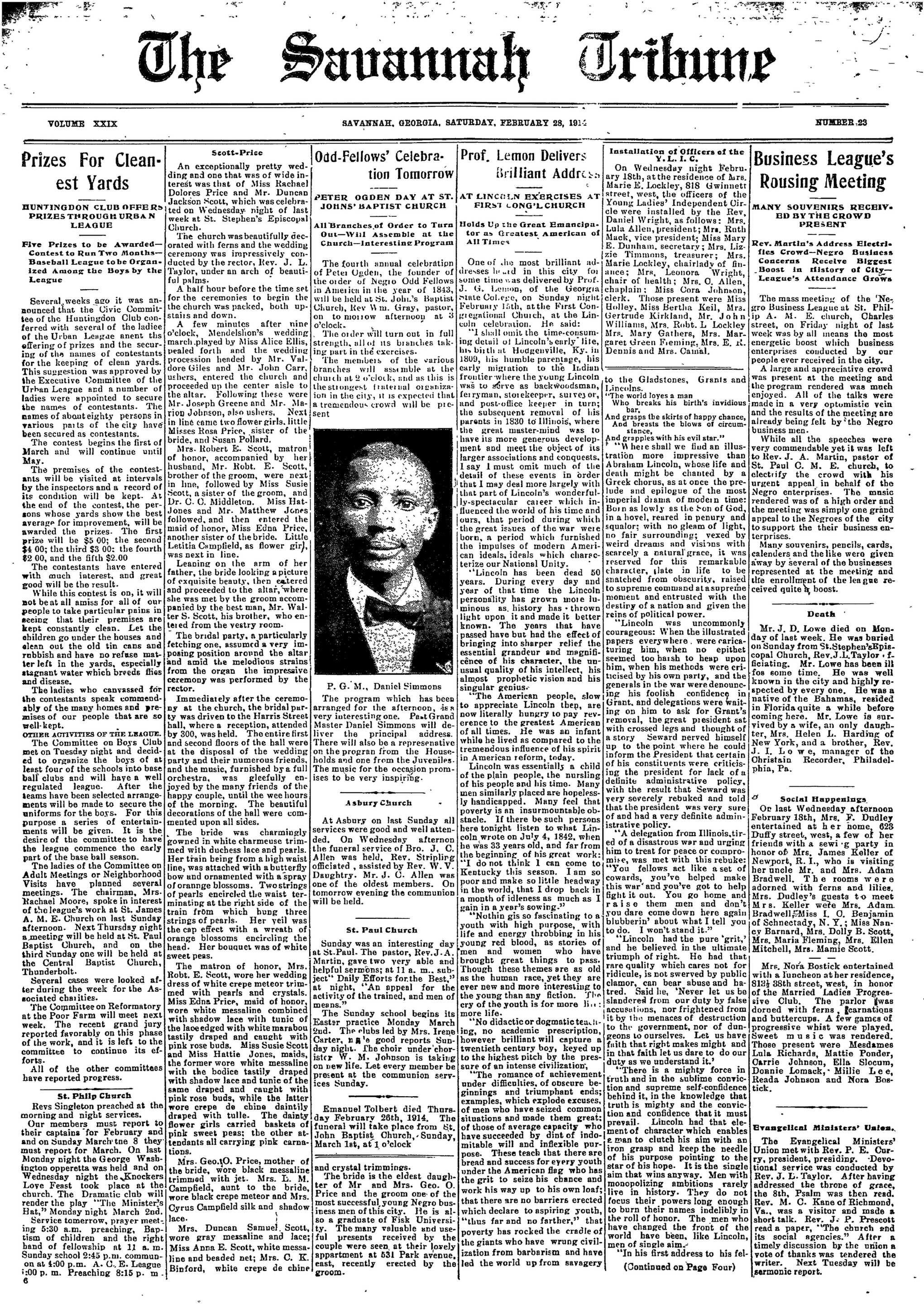
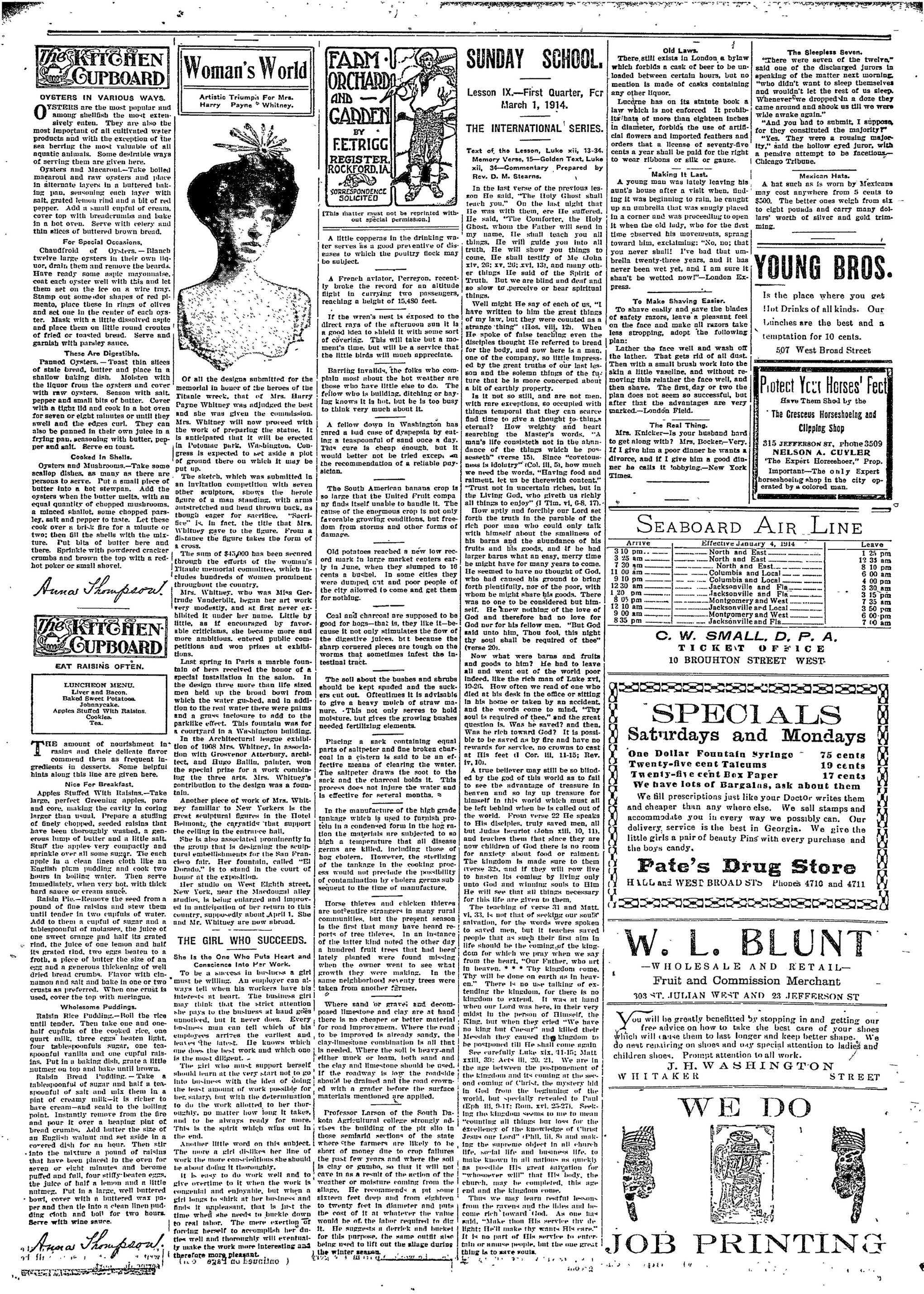
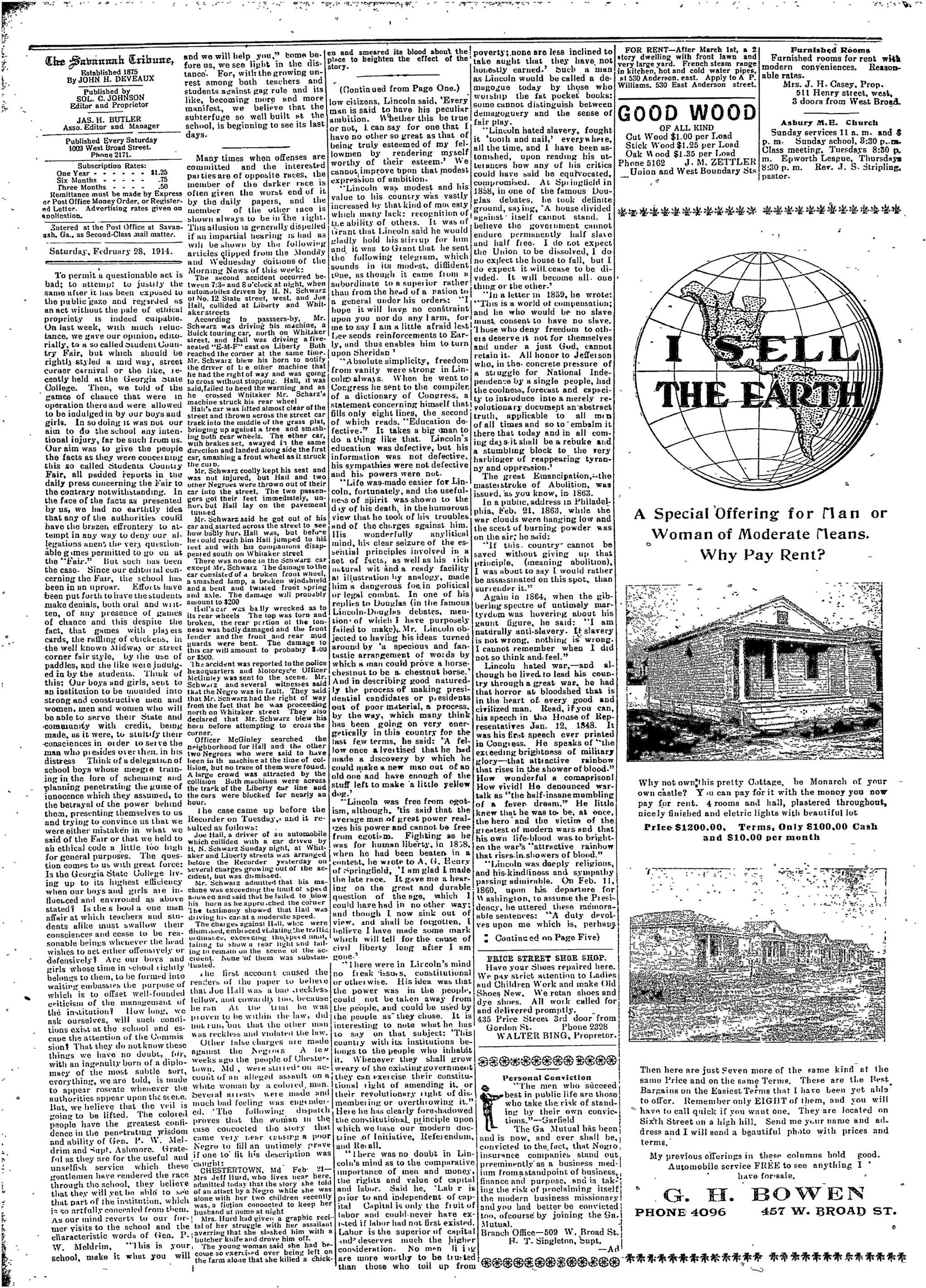
Page text (machine-generated)
Prizes For Cleanest Yards
HUNTINGDON CLUB OFFERS PRIZES THROUGH URBAN LEAGUE
Five Prizes to be Awarded—Contest to Run Two Months Baseball League to be Organized Among the Boys by the League
Several weeks ago it was announced that the Civic Committee of the Huntingdon Club conferred with several of the ladiee of the Urban League anent this offering of prizes and the securing of the names of contestants for the keeping of clean yards. This suggestion was approved by the Executive Committee of the Urban League and a number of ladies were appointed to secure the names of contestants. The names of about eighty persons in various parts of the city have been secured as contestants. The contest begins the first of March and will continue until May.
The premises of the contestants will be visited at intervals by the inspectors and a record of its condition will be kept. At the end of the contest, the persons whose yards show the best average for improvement, will be awarded the prizes. The first prize will be $5 00; the second $4 00; the third $3 00; the fourth $2 00, and the fifth $2.00
The contestants have entered with much interest, and great good will be the result.
While this contest is on, it will not be at all amiss for all of our people to take particular pains in seeing that their premises are kept constantly clean. Let the children go under the houses and clean out the old tin cans and rubbish and have no refuse matter left in the yards, especially stagnant water which breeds flies and disease.
The ladies who canvassed for the contestants speak commendably of the many homes and premises of our people that are so well-kept.
OTHER ACTIVITIES OF THE LEAGUE. The Committee on Boys Club met on Tuesday night and decided to organize the boys of at least four of the schools into base ball clubs and will have a well regulated league. After the teams have been selected arrangements will be made to secure the uniforms for the boys. For this purpose a series of entertainments will be given. It is the desire of the committee to have the league commence the early part of the base ball season.
The ladies of the Committee on Adult Meetings or Neighborhood Visits have planned several meetings. The chairman, Mrs. Rachael Moore, spoke in interest of the league's work at St. James A. M. E. Church on last Sunday afternoon. Next Thursday night a meeting will be held at St. Paul Baptist Church, and on the third Sunday one will be held at the Central Baptist Church, Thunderbolt. Several cases were looked after during the week for the Associated charities.
The Committee on Reformatory at the Poor Farm will meet next week. The recent grand jury reported favorably on this phase of the work, and it is left to the committee to continue its efforts. All of the other committees have reported progress.
Reys Singleton preached at the morning and night services.
morning and night services.
Our members must report to their captains for February and and on Sunday March the 8 they must report for March. On last Monday night the George Washington operetta was held and on Wednesday night the Knockers Love Feast took place at the church. The Dramatic club will render the play "The Minister's Hat," Monday night March 2nd. Service tomorrow, prayer meeting 5:30 a.m. preaching, Baptism of children and the right hand of fellowship at 11 a.m. Sunday school 2:45 p.m. communion at 4:00 p.m. A. C. E. League i:00 p.m. Preaching 8:15 p.m.
VOLUME XXIX
St. Philip Church
The
Scott-Price
An exceptionally pretty wedding and one that was of wide interest was that of Miss Rachel Dolores Price and Mr. Duncan Jackson Scott, which was celebrated on Wednesday night of last week at St. Stephen's Episcopal Church.
The church was beautifully decorated with ferns and the wedding ceremony was impressively conducted by the rector, Rev. J. L. Taylor, under an arch of beautiful palms.
A half hour before the time set for the ceremonies to begin the church was packed, both upstairs and down.
A few minutes after nine o'clock, Mendelshon's wedding march, played by Miss Alice Ellis, pealed forth and the wedding procession headed by Mr. Valdore Giles and Mr. John Carr, ushers, entered the church and proceeded up the center aisle to the altar. Following these were Mr. Joseph Greene and Mr. Marion Johnson, also ushers. Next in line came two flower girls, little Misses Rosa Price, sister of the bride, and Susan Pollard.
Mrs. Robert E. Scott, matron of honor, accompanied by her husband, Mr. Robt. E. Scott, brother of the groom, were next in line, followed by Miss Susie Scott, a sister of the groom, and Dr. C. C. Middleton. Miss Hat-Jones and Mr. Matthew Jones followed, and then entered the maid of honor, Miss Edna Price, another sister of the bride. Little Letitia Campfield, as flower girl, was next in line.
Leaning on the arm of her father, the bride looking a picture of exquisite beauty, then entered and proceeded to the altar, where she was met by the groom accompanied by the best man, Mr. Walter S. Scott, his brother, who entered from the vestry room.
The bridal party, a particularly fetching one, assumed a very imposing position around the altar and amid the melodious strains from the organ the impressive ceremony was performed by the rector.
Immediately after the ceremony at the church, the bridal party was driven to the Harris Street hall, where a reception, attended by 300, was held. The entire first and second floors of the hall were at the disposal of the wedding party and their numerous friends, and the music, furnished by a full orchestra, was gleefully enjoyed by the many friends of the happy couple, until the wee hours of the morning. The beautiful decorations of the hall were commented upon all sides.
The bride was charmingly gowned in white charmeuse trimmed with duchess lace and pearls. Her train being from a high waist line, was attached with a butterfly bow and ornamented with a spray of orangege blossoms. Twostrings of pearls encircled the waist terminating at the right side of the train from which hung three strings of pearls. Her yeil was the cap effect with a wreath of orange blossoms encircling the head. Her bouquet was of white sweet peas.
The matron of honor, Mrs. Robt. E. Scott, wore her wedding dress of white crepe meteor trimmed with pearls and crystals. Miss Edna Price, maid of honor, wore white messaline combined with shadow lace with tunic of the lace edged with white marabou tastily draped and caught with pink rose buds. Miss Susie Scott and Miss Hattie Jones, maids, the former wore white messaline with the bodice tastily draped with shadow lace and tunic of the same draped and caught with pink rose buds, while the latter wore crepe de chine daintily draped with tulle. The dainty flower girls carried baskets of pink sweet peas; the other attendants all carrying pink carnations.
Mrs. Geo. 10. Price, mother of the bride, wore black messaline trimmed with jet. Mrs. L. M. Campfield, aunt to the bride, wore black crepe meteor and Mrs. Cyrus Campfield silk and shadow lace.
Mrs. Duncan Samuel Scott, wore gray messaline and lace; Miss Anna E. Scott, white messaline and beaded net; Mrs. C. K. Binford, white crepe de chine
SAVANNAH, GEORGIA, SATURDAY, FEBRUARY 28, 1914
Odd-Fellows' Celebration Tomorrow
PETER OGDEN DAY AT ST. JOHNS' BAPTIST CHURCH
All Branches of Order to Turn Out—Will Assemble at the Church—Interesting Program
The fourth annual celebration of Peter Ogden, the founder of the order of Negro Odd Fellows in America in the year of 1843, will be held at St. John's Baptist Church, Rev Wm. Gray, pastor, on to morrow afternoon at 3 o'clock.
The order will turn out in full strength, all of its branches taking part in the exercises.
The members of the various branches will assemble at the church at 2 o'clock, and as this is the strongest fraternal organization in the city, it is expected that a tremendous crowd will be present
A.
The program which has been arranged for the afternoon, is a very interesting one. Past Grand Master Daniel Simmons will deliver the principal address. There will also be a representative on the program from the Households and one from the Juveniles. The music for the occasion promises to be very inspiring.
Asbury Church
At Asbury on last Sunday all services were good and well attended. On Wednesday afternoon the funeral service of Bro. J. C. Allen was held, Rev. Stripling officiated, assisted by Rev. W. V. Daughtry. Mr. J. C. Allen was one of the oldest members. On tomorrow evening the communion will be held.
St. Paul Church
Sunday was an interesting day at St.Paul. The pastor, Rev.J.A. Martin, gave two very able and helpful sermons; at 11 a. m.. subject "Daily Efforts for the Best," at night, "An appeal for the activity of the trained, and men of means."
The Sunday school begins its Easter practice Monday March 2nd. The clubs led by Mrs. Irene Carter, n.g'e good reports Sunday night. The choir under chorister W. M. Johnson is taking on new life. Let every member be present at the communion services Sunday.
---
Emanuel Tolbert died Thursday February 26th, 1914. The funeral will take place from St. John Baptist Church, Sunday, March 1st, at 1 o'clock
and crystal trimmings.
The bride is the eldest daughter of Mr. and Mrs. Geo. O. Price and the groom one of the most successful young Negro business men of this city. He is also a graduate of Fisk University. The many valuable and useful presents received by the couple were seen at their lovely apartment at 531 Park avenue, east, recently erected by the groom.
Prof. Lemon Delivers Brilliant Address
AT LINCOLN EXERCISES AT FIRST CONG'L CHURCH
Holds Up the Great Emancipator as Greatest American of All Times
One of the most brilliant addresses heard in this city for some time was delivered by Prof. J. G. Lemon, of the Georgia State College, on Sunday night February 15th, at the First Congregational Church, at the Lincoln celebration. He said:
"I shall omit the time-consuming detail of Lincoln's early life, his birth at Hudgenville, Ky. in 1809, his humble parentage, his early migration to the Indian frontier where the young Lincoln was to serve as backwoodsman, ferryman, storekeeper, surveyor, and post-office keeper in turn; the subsequent removal of his parents in 1830 to Illinois, where the great master-mind was to have its more generous development and meet the object of its larger associations and conquests. I say I must omit much of the detail of these events in order that I may deal more largely with that part of Lincoln's wonderfully-spectacular career which influenced the world of his time and ours, that period during which the great issues of the war were born, a period which furnished the impulses of modern American ideals, ideals which characterize our National Unity.
"Lincoln has been dead 50 years. During every day and year of that time the Lincoln personality has grown more luminous as history has thrown light upon it and made it better known. The years that have passed have but had the effect of bringing into sharper relief the essential grandeur and magnificence of his character, the unusual quality of his intellect, his almost prophetic vision and his singular genius.
"The American people, slow to appreciate Lincoln then, are now literally hungry to pay reverence to the greatest American of all times. He was an infant while he lived as compared to the tremendous influence of his spirit in American reform, today.
Lincoln was essentially a child of the plain people, the nursling of his people and his time. Many men similarly placed are hopelessly handicapped. Many feel that poverty is an insurmountable obstacle. If there be such persons here tonight listen to what Lincoln wrote on July 4, 1842, when he was 33 years old, and far from the beginning of his great work: "I do not think I can come to Kentucky this season. I am so poor and make so little headway in the world, that I drop back in a month of idleness as much as I gain in a year's sowing."
"Nothin gis so fascinating to a youth with high purpose, with life and energy throbbing in his young red blood, as stories of men and women who have brought great things to pass. Though these themes are as old as the human race, yet they are ever new and more interesting to the young than any fiction. The cry of the youth is for more life: more life.
"No didactic or dogmatic teaching, no academic prescription, however brilliant will capture a twentieth century boy, keyed up to the highest pitch by the pressure of an intense civilization.
"The romance of achievement under difficulties, of obscure beginnings and triumphant ends; examples, which explode excuses, of men who have seized common situations and made them great; of those of average capacity who have succeeded by dint of indomitable will and inflexible purpose. These teach that there are bread and success for every youth under the American flag who has the grit to seize his chance and work his way up to his own loaf; that there are no barriers erected which declare to aspiring youth, "thus far and no farther," that poverty has rocked the cradle of the giants who have wrung civilization from barbarism and have led the world up from savagery
Tribune
Installation of Officers of the Y. L. I. C.
On Wednesday night February 18th, at the residence of Mrs. Marie E. Lockley, 818 Gwinnett street, west, the officers of the Young Ladies' Independent Circle were installed by the Rev. Daniel Wright, as follows: Mrs. Lula Allen, president; Mrs. Ruth Mack, vice president; Miss Mary E. Dunham, secretary; Mrs. Lizzie Timmons, treasurer; Mrs. Marie Lockley, chairlady of finance; Mrs. Leonora Wright, chair of health; Mrs. O. Allen, chaplain; Miss Cora Johnson, clerk. Those present were Miss Holley, Miss Bertha Keil, Mrs. Gertrude Kirkland, Mr. John Williams, Mrs. Robt. L. Lockley Mrs. Mary Gathers, Mrs. Margaret Green Fieming, Mrs. E. R. Dennis and Mrs. Canal.
to the Gladstones, Grants and Lincolnns.
"The world loves a man
Who breaks his birth's invidious bar,
bar,
And grasps the skirts of happy chance,
And breasts the blows of circumstance.
"Where shall we find an illustration more impressive than Abraham Lincoln, whose life and death might be chanted by a Greek chorus, as at once the prelude and epilogue of the most imperial drama of modern time: Born as lowly as the Son of God, in a hovel, reared in penury and squalor; with no gleam of light, no fair surrounding; vexed by weird dreams and visions with scarcely a natural grace, it was reserved for this remarkable character, late in life to be snatched from obscurity, raised to supreme command at a supreme moment and entrusted with the destiny of a nation and given the reins of political power.
"Lincoln was uncommonly courageous: When the illustrated papers everywhere were caricaturing him, when no epithet seemed too harsh to heap upon him, when his methods were criticised by his own party, and the generals in the war were denouncing his foolish confidence in Grant, and delegations were waiting on him to ask for Grant's removal, the great president sat with crossed legs and thought of a story Seward nerved himself up to the point where he could inform the President that certain of his constituents were criticising the president for lack of a definite administrative policy, with the result that Seward was very severely rebuked and told that the president was very sure of and had a very definite administrative policy.
"A delegation from Illinois, tired of a disastrous war and urging him to treat for peace or compromise, was met with this rebuke: "You fellows act like a set of cowards, you've helped make this war' and you've got to help fight it out. You go home and raise them men and don't you dare come down here again blubberin' about what I tell you to do. I won't stand it."
"Lincoln had the pure 'grit,' and he believed in the ultimate triumph of right. He had that rare quality which cares not for ridicule, is not swerved by public clamor, can bear abuse and hatred. Said he, 'Never let us be slandered from our duty by false accusations, nor frightened from it by the menaces of destruction to the government, nor of dungeons to ourselves. Let us have faith that right makes might and in that faith let us dare to do our duty as we understand it.'
There is a mighty force in truth and in the sublime conviction and supreme self-confidence behind it, in the knowledge that truth is mighty and the conviction and confidence that it must prevail. Lincoln had that element of character which enables a man to clutch his aim with an iron grasp and keep the needle of his purpose pointing to the star of his hope. It is the single aim that wins anyway. Men with monopolizing ambitions rarely live in history. They do not focus their powers long enough to burn their names indelibly in the roll of honor. The men who have changed the front of the world have been, like Lincoln, men of single aim.
"In his first address to his fel (Continued on Page Four)
NUMBER,23
Business League's Rousing Meeting
MANY SOUVENIRS RECEIVED BY THE CROWD PRESENT
Rev. Martin's Address Electrifies Crowd—Negro Business Concerns Receive BIGGEST Boost in History of City—League's Attendance Grows
The mass meeting of the Negro Business League at St. Philip A. M. E. church, Charles street, on Friday night of last week was by all means the most energetic boost which business enterprises conducted by our people ever received in the city.
A large and appreciative crowd was present at the meeting and the program rendered was much enjoyed. All of the talks were made in a very optimistic vein and the results of the meeting are already being felt by the Negro business men.
While all the speeches were very commendable yet it was left to Rev. J. A. Martin, pastor of St. Paul C. M. E. church, to electify the crowd with his urgent appeal in behalf of the Negro enterprises. The music rendered was of a high order and the meeting was simply one grand appeal to the Negroes of the city to support the their business enterprises.
Many souvenirs, pencils, cards, calenders and the like were given away by several of the businesses represented at the meeting and the enrollment of the league received quite a boost.
Death
Mr. J. D. Lowe died on Monday of last week. He was buried on Sunday from St. Stephen's Episcopal Church, Rev J. L. Taylor, associating. Mr. Lowe has been ill fos some time. He was well known in the city and highly respected by every one. He was a native of the Bahamas, resided in Florida quite a while before coming here. Mr. Lowe is survived by a wife, an only daughter, Mrs. Helen L. Harding of New York, and a brother, Rev. J. I. Lowe, manager of the Christain Recorder, Philadelphia, Pa.
Social Happenings
Or last Wednesday afternoon February 18th, Mrs. F. Dudley entertained at her home, 623 Duffy street, west, a few of her friends with a sewing party in honor of Mrs. James Keller of Newport, R. I., who is visiting her uncle Mr. and Mrs. Adam Bradwell. The rooms were adorned with ferns and lilies. Mrs. Dudley's guests to meet Mrs. Keller were Mrs. Adam Bradwell; Miss I. O. Benjamin of Schnectady, N. Y.; Miss Nancy Barnard, Mrs. Dolly B. Scott, Mrs. Maria Fleming, Mrs. Ellen Mitchell, Mrs. Mamie Scott.
Mrs. Nora Bostick entertained with a luncheon at her residence, 813$^{1}$ 38th street, west, in honor of the Married Ladies Progressive Club. The parlor was dored with ferns, carnations and buttercups. A few games of progressive whist were played. Sweet music was rendered. Those present were Mesdames Lula Richards, Mattie Ponder, Carrie Johnson, Ella Slocum, Donnie Lomack, Millie Lee, Reada Johnson and Nora Bostick.
Evangelical Ministers' Union.
The Evangelical Ministers' Union met with Rev. P. E. Curry, president, presiding. Devotional service was conducted by Rev. J. L. Taylor. After having addressed the throne of grace, the 8th, Psalm was then read. Rev. M. C. Kane of Richmond, Va., was a visitor and made a short talk. Rev. J. P. Prescott read a paper, "The church and its social agencies." After a timely discussion by the union a vote of thanks was tendered the writer. Next Tuesday will be sermonic report.
The KITCHEN CUPBOARD OYSTERS IN VARIOUS WAYS. OYSTERS are the most popular and among shellfish the most exten-
among shellfish the most extensively eaten. They are also the most important of all cultivated water products and with the exception of the sea herring the most valuable of all aquatic animals. Some desirable ways of serving them are given here.
Oysters and Macaroni.-Take boiled macaroni and raw oysters and place in alternate layers in a buttered baking pan, seasoning each layer with salt, grated lemon rind and a bit of red pepper. Add a small cupful of cream, cover top with breadcrumbs and bake in a hot oven. Serve with celery and thin slices of buttered brown bread.
For Special Occasions.
Chaudfroid of Oysters. — Blanch twelve large oysters in their own liquor, drain them and remove the beards. Have ready some aspic mayonnaise, coat each oyster well with this and let them set on the ice on a wire tray. Stamp out some dot shapes of red pimento, place these in rings of olives and set one in the center of each oyster. Mask with a little dissolved aspic and place them on little round croutees of fried or toasted bread. Serve and garnish with parsley sauce.
These Are Digestible.
Panned Oysters. — Toast thin slices of stale bread, butter and place in a shallow baking dish. Molsten with the liquor from the oysters and cover with raw oysters. Season with salt, pepper and small bits of butter. Cover with a tight lid and cook in a hot oven for seven or eight minutes or until they swell and the edges curl. They can also be panned in their own juice in a frying pan, seasoning with butter, pepper and salt. Serve on toast.
Cooked In Shells.
Oysters and Mushrooms.—Take some scallop dishes, as many as there are persons to serve. Put a small piece of butter into a hot stewpan. Add the oysters when the butter melts, with an equal quantity of chopped mushrooms, a minced shallot, some chopped parsley, salt and pepper to taste. Let these cook over a brisk fire for a minute or two; then fill the shells with the mixture. Put blots of butter here and there. Sprinkle with powdered cracker crumbs and brown the top with a red-hot poker or small shoel.
Annas Thompson
The KITCHEN
CUPBOARD
LUNCHEON MENU.
Liver and Bacon.
Baked Sweet Potatoes.
Johnnycake.
Apples Stuffed With Raisins.
Cookies.
Tea.
THE amount of nourishment in rasins and their delicate flavor commend them as frequent ingredients in desserts. Some helpful hints along this line are given here.
Nice For Breakfast.
Apples Stuffed With Raisins.—Take large, perfect Greening apples, pare and core, making the cavity in coring larger than usual. Prepare a stuffing of finely chopped, seeded raisins that have been thoroughly washed, a generous lump of butter and a little salt. Stuff the apples very compactly and sprinkle over all some sugar. Tie each apple in a clean linen cloth like an English plum pudding and cook two hours in boiling water. Then serve immediately, when very hot, with thick hard sauce or cream sauce.
Raisin Pie.—Remove the seed from a pound of fine raisins and stew them until tender in two cupfuls of water. Add to them a cupful of sugar and a tablespoonful of molasses, the juice of one sweet orange and half its grated rind, the juice of one lemon and half its grated rind, two eggs beaten to a froth, a piece of butter the size of an egg and a generous thickening of well dried bread crumbs. Flavor with cinnamon and salt and bake in one or two crusts as preferred. When one crust is used, cover the top with meringue.
Wholesome Puddings.
Ralsin Rice Pudding.—Roll the rice until tender. Then take one and one-half cupfuls of the cooked rice, one quart milk, three eggs beaten light, four tablespoonfuls sugar, one teaspoonful vanilla and one cupful ralsins. Put in a baking dish, grate a little nutmeg on top and bake until brown.
Raisin Bread Pudding. - Take a tablespoonful of sugar and half a teaspoonful of salt and mix them in a pint of creamy milk—it is richer to have cream—and scald to the boiling point. Instantly remove from the fire and pour it over a heaping pint of bread crumbs. Add butter the size of an English walnut and set aside in a covered dish for an hour. Then stir into the mixture a pound of raisins that have been placed in the oven for seven or eight minutes and become puffed and full, four stiffly beaten eggs, the juice of half a lemon and a little nutmeg. Put in a large, well buttered bowl, cover with a buttered wax paper and then tie into a clean linen pudding cloth and boil for two hours. Serve with wine sauce.
Annas Thompson.
A.
Of all the designs submitted for the memorial in honor of the heroes of the Titanic wreck, that of Mrs. Harry Payne Whitney was adjudged the best and she was given the commission. Mrs. Whitney will now proceed with the work of preparing the statue. It is anticipated that it will be erected in Potomac park, Washington. Congress is expected to set aside a plot of ground there on which it may be put up. The sketch, which was submitted in an invitation competition with seven other sculptors, shows the heroic figure of a man standing, with arms outstretched and head thrown back, as though eager for sacrifice. "Sacrifice" is, in fact, the title that Mrs. Whitney gave to the figure. From a distance the figure takes the form of a cross.
The sum of $45,000 has been secured through the efforts of the woman's Titule memorial committee, which includes hundreds of women prominent throughout the country. Mrs. Whitney, who was Miss Gertrude Vanderbilt, began her art work very modestly, and at first never exhibited it under her name. Little by little, as if encouraged by favorable criticisms, she became more and more ambitious, entered public competitions and won prizes at exhibitions.
Last spring in Paris a marble fountain of hers received the honor of a special installation in the salon. In the design three more than life sized men held up the broad bowl from which the water gushed, and in addition to the real water there were palms and a grass incisure to add to the parklike effect. This fountain was for a courtyard in a Washington building. In the Architectural league exhibition of 1908 Mrs. Whitney, in association with Grosvenor Atterbury, architect, and Hugo Ballin, painter, won the special prize for a work combining the three arts. Mrs. Whitney's contribution to the design was a fountain. Another piece of work of Mrs. Whitney familiar to New Yorkers is the great sculptural figures in the Hotel Belmont, the caryatids that support the ceiling in the entrance hall.
She is also associated prominently in the group that is designing the sculptural embellishments for the San Francisco fair. Her fountain, called "El Dorado," is to stand in the court of honor at the exposition. Her studio on West Eighth street, New York, near the Macdougal alley studios, is being enlarged and improved in anticipation of her return to this country, supposedly about April 1. She and Mr. Whitney are now abroad.
THE GIRL WHO SUCCEEDS.
She Is the One Who Puts Heart and Conscience Into Per Work.
To be a success in business a girl must be willing. An employer can always tell when his workers have his interests at heart. The business girl may think that the strict attention she pays to the business at hand goes unnoticed, but it never does. Every business man can tell which of his employees arrives the earliest and leaves the latest. He knows which one does the best work and which one is the most diligent.
The girl who must support herself should learn at the very start not to go into business with the idea of doing the least amount of work possible for her salary, but with the determination to do the work allotted to her thoroughly, no matter how long it takes, and to be always ready for more. This is the spirit which wins out in the end.
Another little word on this subject. The more a girl dislikes her line of work the more conscientious she should be about doing it thoroughly.
It is easy to do work well and to give overtime to it when the work is congenial and enjoyable, but when a girl longs to shirk at her business and finds it unpleasant, that is just the time when she needs to buckle down to real labor. The mere exertion of forcing herself to accomplish her duties well and thoroughly will eventually make the work more interesting and therefore more pleasant.
( no oas9 no leucitno )
FARM
ORCHARD
AND
GARDEN
BY
F.E.TRIGG
REGISTER,
ROCKFORD, IA.
SORRESPONDENCE
SOLICITED
[This matter must not be reprinted without special permission.]
A little copperas in the drinking water serves as a good preventive of diseases to which the poultry flock may be subject.
A French aviator, Perreyon, recently broke the record for an altitude flight in carrying two passengers, reaching a height of 15,480 feet.
If the wren's nest is exposed to the direct rays of the afternoon sun it is a good idea to shield it with some sort of covering. This will take but a moment's time, but will be a service that the little birds will much appreciate.
Barring invalids, the folks who complain most about the hot weather are those who have little else to do. The fellow who is building, ditching or haying knows it is hot, but he is too busy to think very much about it.
A fellow down in Washington has cured a bad case of dyspepsia by eating a teaspoonful of sand once a day. This cure is cheap enough, but it would better not be tried except on the recommendation of a reliable physician.
The South American banana crop is so large that the United Fruit company finds itself unable to handle it. The cause of the enormous crop is not only favorable growing conditions, but freedom from storms and other forms of damage.
Old potatoes reached a new low record mark in large market centers early in June, when they slumped to 16 cents a bushel. In some cities they were dumped out and poor people of the city allowed to come and get them for nothing.
---
Coal and charcoal are supposed to be good for hogs—that is, they like it—because it not only stimulates the flow of the digestive juices, but because the sharp cornered pieces are tough on the worms that sometimes infest the intestinal tract.
The soil about the bushes and shrubs should be kept spuded and the suckers cut out. Oftentimes it is advisable to give a heavy mulch of straw manure. This not only serves to hold moisture, but gives the growing bushes needed fertilizing elements.
Placing a sack containing equal parts of saltpeter and fine broken charcoal in a cistern is said to be an effective means of clearing the water. The saltpeter draws the soot to the sack and the charcoal holds it. This process does not injure the water and is effective for several months. $ \textcircled{3} $
In the manufacture of the high grade tankage which is used to furnish protein in a condensed form in the hog ration the materials are subjected to so high a temperature that all disease germs are killed, including those of hog cholera. However, the sterilizing of the tankage in the cooking process would not preclude the possibility of contamination by cholera germs subsequent to the time of manufacture.
Horse thieves and chicken thieves are not entire strangers in many rural communities, but the present season is the first that many have heard reports of tree thieves. In an instance of the latter kind noted the other day a hundred fruit trees that had been lately planted were found missing when the owner went to see what growth they were making. In the same neighborhood seventy trees were taken from another farmer.
Where sand or gravel and decomposed limestone and clay are at hand there is no cheaper or better material for road improvement. Where the road to be improved is already sandy, the clay-limestone combination is all that is needed. Where the soil is heavy-and either muck or loam, both sand and the clay and limestone should be used. If the roadway is loy the roadside should be drained and the road crowned with a grader before the surface materials mentioned are applied.
Professor Larson of the South Dakota Agricultural college strongly advises the building of the pit silo in those semiarid sections of the state where the farmers are likely to be short of money due to crop failures the past few years and where the soil is clay or gunbo, so that it will not care in as a result of the action of the weather or moisture coming from the silage. He recommends a pit some sixteen feet deep and from eighteen to twenty feet in diameter and puts the cost of it at whatever the value would be of the labor required to dig it. He suggests a derrick and bucket for this purpose, the same outfit also being used to lift out the silage during the winter season.
SUNDAY SCHOOL.
SUNDAY SCHOOL.
Lesson IX.—First Quarter, For March 1, 1914.
THE INTERNATIONAL SERIES.
Text of the Lesson, Luke xii, 13-34. Memory Verse, 15—Golden Text, Luke xii, 34—Commentary Prepared by Rev. D. M. Stearns.
In the last verse of the previous lesson He said, "The Holy Ghost shall teach you." On the last night that He was with them, ere He suffered. He said, "The Comforter, the Holy Ghost, whom the Father will send in my name, He shall teach you all things. He will guide you into all truth. He will show you things to come. He shall testify of Me John xiv, 26; xv, 26; xvl, 13; and many other things He said of the Spirit of Truth. But we are blind and deaf and so slow to perceive or hear spiritual things.
Well might He say of each of us, "I have written to him the great things of my law, but they were counted as a strange thing" (Hos. vill. 12). When He spoke of false teaching even the disciples thought He referred to bread for the body, and now here is a man, one of the company, so little impressed by the great truths of our last lesson and the solemn things of the future that he is more concerned about a bit of earthly property.
Is it not so still, and are not men, with rare exceptions, so occupied with things temporal that they can scarce find time to give a thought to things eternal? How weighty and heart searching the Master's words, "A man's life consisteth not in the abundance of the things which he possesseth" (verse 15). Since "covetousness is idolatry" (Col. ill. 5), how much we need the words, "Having food and ralment, let us be therewith content." "Trust not in uncertain riches, but in the Living God, who giveth us richly all things to enjoy" (1 Tm. vi. 68-12).
How aptly and forcibly our Lord set forth the truth in the parable of the rich poor man who could only talk with himself about the smallness of his barns and the abundance of his fruits and his goods, and if he had larger barns what an easy, merry time he might have for many years to come. He seemed to have no thought of God, who had caused his ground to bring forth plentifully, nor of the poor, with whom he might share his goods. There was no one to be considered but himself. He knew nothing of the love of God and therefore had no love for God nor for his fellow men. "But God said unto him, Thou fool, this night thy soul shall be required of thee" (verse 20).
Now what were barns and fruits and goods to him? He had to leave all and went out of the world poor indeed. like the rich man of Luke xv1, 19-26. How often we read of one who died at his desk in the office or sitting in his home or taken by an accident, and the words come to mind. "Thy soul is required of thee," and the great question is. Was he saved? and then. Was he rich toward God? It is possible to be saved as by fire and have no rewards for service, no crowns to cast at His feet (I Cor. ill. 11-15; Rev. iv. 10).
A true believer may still be so blinded by the god of this world as to fail to see the advantage of treasure in heaven and so lay up treasure for himself in this world which must all be left behind when he is called out of the world. From verse 22 He speaks to His disciples, truly saved men, all but Judas Iscariot (John xil. 10, 11), and teaches them that since they are now children of God there is no room for anxiety about food or ralentment. The kingdom is made sure to them (verse 32), and if they will now live to hasten its coming by living only unto God and winning souls to Him He will see that all things necessary for this life are given to them.
The teaching of verse 31 and Matt. vi. 33, is not that of seeking our souls salvation, for the words were spoken to saved men, but it teaches saved people that as such their first aim in life should be the coming of the kingdom for which we pray when we say from the heart, "Our Father, who art in heaven. * * * Thy kingdom come. Thy will be done on earth as in heaven." There is no use talking of extending the kingdom, for there is no kingdom to extend. It was at hand when our Lord was here, in their very midst in the person of Himself, the King, but when they cried "We have no king but Caesar" and killed their Messiah they caused the kingdom to be postponed till He shall come again.
See carefully Luke six, 41-15; Matt xxill, 30; Acts ill, 20.21. We are in the age between the postponement of the kingdom and its coming at the second coming of Christ, the mystery bid in God from the beginning of the world, but specially revealed to Paul (Eph ill, 9-11; Rom, xvl, 25-27). Seeking the kingdom seems to me to mean "counting all things but loss for the excellency of the knowledge of Christ Jesus our Lord" (Phil, ill, 50) and making the supreme object in all church life, social life and business life, to make known in all nations as quickly as possible His great salvation for "whosoever will" that His body, the church, may be completed, this age end and the kingdom come.
Thus we may learn restful lessons from the ravens and the lilies and become rich toward God. As one has said, "Make thon His service thy delight: He'll make thy wants His care." It is no part of His service to entertain or amuse people, but the one great thing is to save souls.
\(2000\)
We fill prescriptions just like your Doctor writes them and cheaper than any where else. We sell stamps and accommodate you in every way we possibly can. Our delivery service is the best in Georgia. We give the little girls a pair of beauty Pins with every purchase and the boys candy.
Pate's Drug Store
HALL and WEST BROAD STS Phones 4710 and 4711
You will be greatly benefitted by stopping in and getting our free advice on how to take the best care of your shoes which will cause them to last longer and keep better shape. We do neat repairing on shoes and may special attention to ladies and children shoes. Prompt attention to all work. J. H. WASHINGTON WHITAKER STREET
WE DO
Old Laws.
There, still exists in London a bylaw which forbids a cask of beer to be unloaded between certain hours, but no mention is made of casks containing any other liquor.
Lucerne has on its stutute book a law which is not enforced. It prohibits hats of more than eighteen inches in diameter, forbids the use of artificial flowers and imported feathers and orders that a license of seventy-five cents a year shall be paid for the right to wear ribbons or silk or gauze.
Making It Last.
A young man was lately leaving his aunt's house after a visit when, finding it was beginning to rain, he caught up an umbrella that was smugly placed in a corner and was proceeding to open it when the old lady, who for the first time observed his movements, sprang toward him, exclaiming: "No, no; that you never shall! I've had that umbrella twenty-three years, and it has never been wet yet, and I am sure it shan't be wetted now!"—London Express.
To Make Shaving Easier.
To make shaving easier.
To shave easily and save the blades of safety razors, leave a pleasant feel on the face and make all razors take less stropping, adopt the following plan:
Lather the face well and wash off the lather. That gets rid of all dust. Then with a small brush work into the skin a little vaseline, and without removing this relather the face well, and then shave. The first day or two the plan does not seem so successful, but after that the advantages are very marked—London Field.
The Real Thing.
Mrs. Knicker—Is your husband hard to get along with? Mrs. Docker—Very. If I give him a poor dinner he wants a divorce, and if I give him a good dinner he calls it lobbying.—New York Times.
The Sleepless Seven.
"There were seven of the twelve," said one of the discharged jurors in speaking of the matter next morning, "who didn't want to sleep themselves and wouldn't let the rest of us sleep. Whenever we dropped in a doze they came around and shook us till we were wide awake again."
"And you had to submit, I suppose, for they constituted the majority." "Yes. They were a rousing majority," said the hollow eyed juror, with a pensive attempt to be facetious—Chicago Tribune.
Mexican Hata.
A hat such as is worn by Mexicans may cost anywhere from 5 cents to $500. The better ones weigh from six to eight pounds and carry many dollars' worth of silver and gold trimming.
YOUNG BROS.
Is the place where you get
Hot Drinks of all kinds. Our
Lunches are the best and a
temptation for 10 cents.
507 West Broad Street
Protect Your Horses' Fect
Have Them Shod by the
The Cresceus Horseshoeing and
Clipping Shop
315 JEFFERSON ST. Phone 3509
NELSON A. CUYLER
"The Expert Horseshoer," Prop.
Important—The only Expert
horseshoeing shop in the city oper-
ated by a colored man.
AIR LINE
January 4, 1914 Leave
East 1 25 pm
East 12 25 pm
The KITCHEN CUPBOARD
SERVING MUSHROOMS.
MUSHROOMS are a delicacy, yet a light nutrient. There are but few persons who do not relish them, but such fatal mistakes are made by gatherers that many are distrained to eat them, or at least do so with more or less reluctance. Mushrooms may be bought in the markets, or the dried ones are sold in the shops. Grilled Mushrooms.—Mushrooms for grilling must be of a large and even size. After having washed them and cut off the stalks, dip them in olive oil, season with salt and pepper, then grill over a bright fire, turning them when done on one side. Arrange in a vegetable dish, the hollow side upward, then place in the center of each mushroom a very small pat of malte d'hôtel butter or parsley butter and serve hot.
Mushrooms In Cases.
Wipe and peel eight cup mushrooms, cut them into small dice and fry them with an ounce of butter in a sauce pan. Butter some souffle cases, paper or china, lay a thin slice of lemon in each, three parts fill with prepared mushrooms and season to taste. Spread a layer of potted deviled meat mixed with a yolk of egg; over the mushrooms, brush over with melted butter and bake for fifteen minutes.
A Dainty Way.
Mushroom Croutes.—Take slices of stale white bread, stamp these out into rounds or oblongs with a fancy or plain cutter, fry them in butter to a golden color and drain. Have ready the required quantity of large button mushrooms, peeled, minus stalks and fried in butter; also a mixture of finely chopped beef and ham, moistened with a little rich brown sauce. When quite hot spread the meat mixture over the croutes, place a mushroom on each season with salt, pepper, cayenne and a little lemon juice. Put them in a hot oven for a few minutes, dish up, garnish with fried parsley and serve.
Served on Toast.
Mushroom With Eggs.-Peei and take the stalks from four or five mushrooms, wash and drain them, then cut them into small slices, place them in a stewpan with two ounces of butter and season well with salt and pepper and allow them to stew gently for twenty minutes. Break six eggs into a basin and beat them up thoroughly; add two tablespoonfuls of milk and pour the mixture over the mushrooms in the stewpan. Stir them gently with a spoon until the mixture is set.
Anna Thompson.
The KITCHEN CUPBOARD JUST A FEW TURNIPS.
TURNIPS should be prepared in the following ways to make them popular in families that and turnips cooked in the ordinary ways insipid:
Fried Turnips.—Pare and cut turnips in half inch slices, soak for twenty minutes in cold water. Drain and parboil them for twenty minutes, drain again and wipe dry. Salt, pepper and dip in corn meal or flour and fry in bacon fat or other shortening.
A Novel Way.
Stewed Sugared Turnips—Take turnips of equal size, put them into a saucepan with a lump of butter and try till well browned. Sprinkle powdered sugar over them, season with a little salt, pour in about a teacupful of stock according to the number of turnips. Place the cover on the saucepan and let it simmer till they are tender. Serve on a hot dish
Turnips With Tarragon S. e.e.—Take some turnips, scrape, wash and trim them and boll them. Then serve them with a sauce made as follows: Prepare half a cupful of melted butter sauce, using milk and no water; season it add a teaspoonful of finely minced dried tarragon and bring it to boiling point. Have ready the yolk of an egg beaten up with a large teaspoonful of lemon juice, stir this quickly into the sauce and remove it at once from the stove, and then add half a tablespoonful of fresh butter and pour the sauce over the turnips.
- Served With Boiled Meats.
Served With Boiled Meats.
Turnips and Potatoes.—Take two good sized turnips, pare and cut into slices, drop into an uncovered vessel of boiling unsalted water and cook just below the boiling point until transparent. Have ready boiled the same bulk of Irish potatoes. Drain the turnip slices in a colander, let the potatoes dry off, then add them to the turnip and press both through into a hot dry dish. Add half a tablespoonful of butter, half a teaspoonful of salt, a dusting of white pepper and paprika. Beent until light, then add two tablespoonfuls of hot milk or four tablespoonfuls of reheated cream sauce or thick cream soup of any kind. Beent and pile in a small hot dish. Send at once to the table. Use a dish without a cover.
Anna Thompson .
HAPPY THOUGHTS
Make for yourselves nests of pleasant thoughts. None o. us vet know, for none of us have been taught in early youth, what fair palaces we may build of beautiful thoughts, proof against all adversity, bright fancies, satisfied memories, noble histories, faithful sayings, treasure houses of precious and restful thoughts.—Ruskin.
Not as Bad as It Might Have Been.
"Now that your boys have gone away to school and your daughters have got married I suppose you find it rather dismal around home, don't you, Mr Cudgerley?"
"Well, it's not as bad as it might be. When I begin carving at dinner now I always know that it will be my turn to eat before everything is so cold that it is tasteless." -Chicago Record-Herald
Hand to Mouth.
"Are you getting accustomed to New York?" asked the talkative grocer. "By degrees," said the woman. "I think I like it a little better than I did at first. "But how did you know that we had just moved to town? I never told you." "No, you never told me, but the way you bought groceries did. You bought in such large quantities. This showed that you had just come from some place where people had plenty of storeroom and so bought groceries by the box and barrel instead of by the pound. But I see you are getting used to keeping house on two kitchen shelves and are buying in driblets, like all New Yorkers."—New York Times.
Got Hia Reward.
Years ago a tradesman whose name is now a household word was employed in a modest capacity in a west end shop in London. While exhibiting some delicate ware to the very first customer he served he let it fall and break. The customer, a doctor, good naturely took the blame and paid for the broken article. Years later the salesman, now a wealthy man, called on the doctor, reminded him of the incident and settled on him $5,000 a year for life.—London Express.
The Wickedest Bit of Sea
Nine out of ten travelers would tell inquirers that the roughest piece of water is that cruel stretch in the English channel, and nine out of ten travelers would say what was not true. As a matter of fact, "the wickedest bit of sea" is not in the Dover strait or in yachting, for example, from St. Jean de Luz up to Paillac or across the Mediterranean "race" from Cadiz to Tangler, nor is it in rounding Cape Horn, where there is what sailors call a "true" sea. The "wickedest sea" is encountered in rounding the Cape of Good Hope for the eastern portion of Cape Colony.—London Globe.
Off and On.
"Save when you're young."
The speaker, John D. Rockefeller, Jr., was addressing a Y. M. C. A. meeting in Cleveland.
"Save when you're young," repeated Mr. Rockefeller, with a smile. "The years will pass swiftly. Then when you find yourself well on you'll also find yourself well off."
St Peter's In Rome
St. Peter's is certainly the most amazing church in the world. It is not beautiful—I am satisfied that no true artist would grant that—but after you have been all over Europe and have seen the various edifices of importance it still sticks in your mind as astounding—perhaps the most astounding of all.—From Theodore Dreiser's "A Traveler at Forty."
Giving Happiness
To make some nook of God's creation a little fruitfuler, better, more worthy of God, to make some human hearts a little wiser, manfuller, happier, more blessed, less accursed—it is a work for a God—Carlyle.
Wrty Sayings.
W. S. Gilbert said of Beerbohm Tree's Hamlet that it was "funny without being coarse."
During an Englishman's lecture in New Haven the usher said to a late comer: "Please, sir, take your seat as quietly as possible. The audience is asleep."
A Philadelphia woman said: "Of course, there will be no marriage in heaven. There will be plenty of women there and a few men, but none any one would care to marry."
DO IT WELL.
What is worth doing at all is worth doing well. Not giving your whole, undivided attention to the task in which you have invested your life and money means that you are wasting your own precious time and that of others. Whatever you do, do it with your whole heart and mind or get out and try something else. It takes pretty nearly all of a man's time to perfect an undertaking, provided it be a big and worthy one to begin with.
Milauy's Mirror
Home Care of the Nails.
A home manicuring outfit is a great convenience. It should contain two or three smooth, nicely polished sticks, a pair of small, curved, sharp pointed scissors, a couple of emery boards, a nailbrush (not too stiff), a slender, flexible file of hard steel; a box of any guaranteed nail polish, a soft buffer and a small bottle of peroxide of hydrogen, with a bit of lemon and a fine toilet pumice stone. A soap with olive oil in it will be found the best, and a jar of plain cold cream should be provided.
If the nails have been neglected and seem clogged with dirt and grime fill them with cold cream, rubbing it in well; then with a piece of fine old linen remove the dirt from one set with the nails of the other hand, never with an instrument of steel.
A little white vaseline should be on band also, as it heals and helps to prevent brittleness. After the soaking rub in the vaseline well, then use the brush and clean suds, warm, but not hot. The nails are then ready for the careful looking over to rid them of any ragged bits of flesh clinging to the sides and base. The stick should be dipped into the peroxide and passed around the nails as well as under. This helps to whiten and cleanse them. If there are callous places use the toilet pumice with the soapy water, rinsing well afterward.
Stains may require the juice of a lemon, but cold cream should be applied after to prevent the roughness that would otherwise be caused by the acid, and great care must be taken not to cut the skin around the base, or it will remain ragged, as it is really a "selvage."
Filing Finger Nails.
Before beginning the home manicuring the file, which should be a thin, flexible one, should be used. The nails are then in a condition to stand this, as after the soaking they will be too soft.
They should never be allowed to grow too far beyond the tip of the finger. Long, pointed nails are entirely out of style, if they were ever in as a woman does not want the talons of the Chinaman at the ends of her pretty fingers.
So, in the filing, rub them down to pass just a trifle beyond the finger itself, rounding them nicely, and do not file the sides down too closely, as the natural support is then withdrawn, and this causes hangnails.
Often a nail will persistently break or show a flaw in the same place for years. As the new nail grows the split or crack seems to come naturally, and the only cure is to watch that nail, using the emery board to smooth off the first sign of the flaw.
Ridged Nails.
The little emery boards should be used daily to remove any roughened edges from the nails, and it is advisable to use these every day instead of the steel file. Where the nails are scaly and ridged it shows an excess of acid in the blood. Those afflicted with rheumatism often find their nails ridged as they grow and the ends will break off in fine scales. Some treatment for the disease itself should be used, and, in addition, a small piece of wash leather, dipped into powdered pumice stone, will make the nails fairly smooth, but there should also be used a little thick gelatin. Dip each nail in at the night, wrap the fingers separately in old linen and let it remain all night. Dip each into warm water next morning. This helps greatly in preventing and curing the scalliness.
Simple Nail Powder.
A good nail powder is made of a quarter ounce of talcum powder, boric acid and starch, also powdered very fine. Add a few drops of carmine tincture. Mix the powders and add the tincture. Pass the whole through a fine sieve three times, forcing out all lumps. Coat the nails with a very small bit, rubbing it in well with the fingers; then use the buffer lightly. If too much is applied it should be rinsed off, the nails carefully wiped dry and then the buffer used, finishing by rubbing the nails of one hand on the palm of the other, a natural polisher.
Too Much Maniouring.
When the finger nails are constantly breaking and seem soft and brittle there is either something wrong in the general health or they are improperly cared for. Many women in the effort to have nice nails scrub and file and polish all the health out of them, making them frail and too tlin. Usually too much manicuring does the harm, so it is just as well to let them alone once in awhile, permitting them to thicken and harden, so they will stand the ordinary wear and tear of daily use.
White Spots on Nails.
When white spots appear on the nails they show a bruise condition, although the cause may be called, and they also denote a nervous condition of the system. A half ounce of myrrh and refined pitch and spread over the nails at night, wearing glove fingers. In the morning apply olive oil to remove this, and use almond meal in place of soap for the heads.
TRY TO BE CHEERFUL
Cheerfulness, like other good qualities, can be developed and increased, and whoever omits its culture neglects, an important duty to himself and to society. The fact that few men can do their best work or think their best thoughts unless a cheerful spirit animates them should be sufficient reason for setting in motion every cause which produces such a spirit.
Tiny Goust
The republic of Goust is a square mile in the Pyrenees which for the last three centuries has been recognized by Spain and France as independent. It has a population of about 150 weavers. They are ruled by a council of elders and pay no taxes or duties of any sort. This civic unit is so tiny that it has to go abroad for its cure of souls and body, for it has neither physician nor priest, for these needs it has to go to Laruns, the nearest French town. Even the dead must leave Goust to find consecrated ground in which to lie, the coffins being slid downhill and thus out of the smallest republic in the world.
Not Worded the Same.
Just as the family was about to sit down to the evening meal the minister unexpectedly dropped in and was asked to join them.
When the maid set the table she had turned the plates bottom side. Written on the bottom was the name of the manufacturer.
The minister was asked to say grace, and as he did so he reverently bowed his head above his plate.
When he had finished the little five-year-old daughter of the house picked up her plate, looked at the manufacturer's name closely and said: "Papa, it doesn't say that on my plate"—Ladies' Home Journal.
Discovery of Turtle Soup.
According to some authorities, Bristol has a special claim to fame as the city where turtle soup was invented by a seventeenth century mayor, who was also a shipowner. The captain of one of his ships brought home a live turtle, thinking that his worship would like to have it in his fishpond. This happened just as the mayor was about to give a civic banquet, and, deeming that his guests might appreciate a new dish, he ordered the turtle to be stewed. The corporation was so delighted with the novelty that it re-elected its host to the municipal chair nine times running.—London Chronicle.
Restaurant Affiliation
The waiter in the light lunch cafe looked expectantly at the first of five men who had just entered. "Bring me a coffee cake and a cup of coffee," ordered the first man.
"I'll take some milk biscuit and a glass of milk," said the second.
"Tea buns and a cup of tea, please," remarked the third.
"A piece of coconut pie and a cup of cocoa," said the fourth. The waiter went to the fifth man. "I know what you want," he said. "You want a slice of chocolate cake and a cup of chocolate." "No; I do not," protested the fifth man. "I want a plate of ice cream and a glass of ice water."—Judge.
Stevenson Carried His Tall Hat. Sir Sidney Colvin, in a lecture on "Personal Reminiscences of R. L. Stevenson," denied firmly that Stevenson had any affectation.
"R. L. S," said Sir Sidney, "did once possess a frock coat and tall hat, which he acquired for the purposes of a wedding. Coming to London subsequently, he made the concession to my respectability of donning the coat and hat, and thus we walked down Plecadilly. But the hat was in Stevenson's hand, and as the gates of Burlington House closed on us, Stevenson was declaiming in vibrant voice and rich Scotch accent a chorus from Milton's 'Samson Agonisten.'"—London Globe.
Illusions.
A rude shock greets the idea that the testimony of eyewitnesses is especially reliable when one comes to stu the laws of evidence. The majorit' persons see what they think ought to see. If a house is repa haunted it is easier to see a gl there than not. Possibly this account for the widespread belief that luminous appearances of one kind or another accompany earthquake shocks. Scientific men do not believe these stories, and they usually dwindle on investigation, yet they continue to circulate on both sides of the Atlantic, says a writer in Cosmos, Paris, translated for the Literary Digest.
Memory.
Dear as remembered kisses after death.
All our sensations are memory, some say. It may be. It may not be. But this we know: The perfume that is the finest is the perfume of reminiscence. It may be a vagrant fragrance from the woods or in the city's air. The song neglected, but remembered, is the most appealing. The taste acquired in childhood is that that tickles most our older palate. A friend is a composite of our memories. Sometimes that part of us that is the bud and leaf seems the whole tree. But we would die without the roots. Memory is the roots and sap of us—Kansas City Star.
We make a specialty of framing diplomas, marriage licenses and pictures of all sizes. Work neatly and promptly finished. Satisfaction guaranteed. Prices cheap. Enlarging pictures a specialty. Orders called for and delivered.
THE PALM SHAVING PALACE
Expert Hair Cutting, Electric Massage and Shampooing a Specialty. All Work Done by Experienced Workman. Courteous attention to all SHINING PARLOR ATTACHED,
Perry R. Wright
Proprietor
H. M. MONROE & COMPANY
Funeral Directors and Embalmers Prompt and courteous attention given all business entrusted to us. Everything of the latest style
Johnson Undertaking Establishment $ ^{\beta} $ —COMBINED WITH—
Fines. line of Coffins, Caskets and Robes. White and black Burial cars. Office and warerooms 325-321 Jefferson street.
VERNON PARK
Lies to the Right on Bull street, a short distance beyond the Granger Tract, where Lots are selling for forty times more than those in Vernon Park. You can build a nice little home, have hens, fresh eggs, fresh vegetables, a cow and a pig, if you like, and be independent. Just one mile this side of Central Park College where you can educate your children for life. I shall be glad to take you out and show you these Lots. Terms $5.00 cash, $3.00 per month, down to $1.00 per month. You can pay for one. No Taxes, no Interest. In case of death we give the lot Free. Ten per cent off for cash. Will build you a Home when your lo is paid for. Call and talk it over with me.
Land is the Safest Investment, I Sell Land/
VERNON PARK COMPANY
Wm.'J. Jackson. Agent,
PHONE 3713 817 West Breed Street
SAVANN/F.CA.
大
If It Is For Your Lodge WE HAVE IT!
We manufacture Lodge Regalia for every Fraternal Society. Cash or Installment Plan. Cheapest Badge House in the Country. Catalogue for your Society FREE. CENTRAL REGALIA GO. The Negro Regalia House. JOS. L. JONES, Pres. N. E. Cor. 8th & Plum Cincinnati. Ohio
THE BEST PLACE
In Savannah
FOR MEN'S GOOD SHOES
Prices $3.50 up
B. H. Levy, Bro. Co.
Entered at the Post Office at Savannah, Ga., as Second-Class mail matter.
Saturday, February 28, 1914.
To permit a questionable act is bad; to attempt to justify the same after it has been exposed to the public gaze and regarded as an act without the pale of ethical propriety is indeed culpable. On last week, with much reluctance, we gave our opinion, editorially, to a so-called Student Country Fair, but which should be rightly styled a mid way, street corner carnival or the like, recently held at the Georgia State College. Then, we told of the games of chance that were in operation there and were allowed to be indulged in by our boys and girls. In so doing it was not our aim to do the school any intentional injury, far be such from us. Our aim was to give the people the facts as they were concerning this so called Students Country Fair, all padded reports in the daily press concerning the Fair to the contrary notwithstanding. In the face of the facts as presented by us, we had no earthly idea that any of the authorities could have the brazen effrontery to attempt in any way to deny our allegations anent the very questionable games permitted to go on at the "Fair." But such has been the case. Since our editorial concerning the Fair, the school has been in an uproar. Efforts have been put forth to have the students make denials, both oral and written, of any presence of games of chance and this despite the fact, that games with players cards, the raffling of chickens, in the well known Midway or street corner fair style, by the use of paddles, and the like were indulged in by the students. Think of this; Our boys and girls, sent to an institution to be moulded into strong and constructive men and women, men and women who will be able to serve their State and community with credit, being made, as it were, to stultify their consciences in order to serve the man who presides over them, in his distress. Think of a delegation of school boys whose meagre training in the lore of scheming and planning penetrating the guise of innocence which they assumed, to the betrayal of the power behind them, presenting themselves to us and trying to convince us that we were either mistaken in what we said of the Fair or that we held to an ethical code a little too high for general purposes. The question comes to us with great force: Is the Georgia State College living up to its highest efficiency when our boys and girls are influenced and environed as above stated? Is the sool a one man affair at which teachers and students alike must swallow their consciences and cease to be reasonable beings whenever the head wishes to act either offensively or defensively? Are our boys and girls whose time in school rightly belongs to them, to be formed into waiting embassies the purpose of which is to offset well-founded criticism of the management of the institution? How long, we ask ourselves, will such conditions exist at the school and escape the attention of the Commission? That they do not know these things we have no doubt, for with an ingenuity born of a diplomacy of the most subtle sort everything, we are told, is made to appear roseate whenever the authorities appear upon the scene. But, we believe that the veil is going to be lifted. The colored people have the greatest confidence in the penetrating wisdom and ability of Gen. P. W. Meldrim and Supt. Ashmore. Grateful as they are for the useful and unselfish service which these gentlemen have rendered the race through the school, they believe that they will yet be able to see that part of the institution, which is so artfully concealed from them. As our mind reverts to our former visits to the school and the characteristic words of Gen. P. W. Meldrim, "This is your school, make it what you will
and we will help you," come before us, we see light in the distance. For, with the growing unrest among both teachers and students against gag rule and its like, becoming more and more manifest, we believe that the subterfuge so well built at the school, is beginning to see its last days.
Many times when offenses are committed and the interested parties are of opposite races, the member of the darker race is often given the worst end of it by the daily papers, and the member of the other race is shown always to be in the right. This allusion is generally dispelled if an impartial hearing is had as will be shown by the following articles clipped from the Monday and Wednesday editions of the Morning News of this week:
The second accident occurred between 7:30 and 8 o'clock at night, when automobiles driven by H. N. Schwarz ot No. 12 State street, west, and Joe Hall, collided at Liberty and Whitaker streets.
According to passers-by, Mr. Schwarz was driving his machine, a Buick touring car, north on Whitaker street, and Hall was driving a five-seated "E-M-F" east on Liberty. Both reached the corner at the same time. Mr. Schwarz blew his horn to notify the driver of the other machine that he had the right of way and was going to cross without stopping. Hall, it was said, failed to heed the warning and as he crossed Whitaker Mr. Scharz's machine struck his rear wheel
Hall's car was lifted almost clear of the street and thrown across the street car track into the middle of the grass plat, bringing up against a tree and smashing both rear wheels. The other car, with brakes set, swayed in the same direction and landed along side the first car, smashing a front wheel as it struck the curb.
Mr. Schwarz coolly kept his seat and was not injured, but Hall and two other Negroes were thrown out of their car into the street. The two passengers got their feet immediately, unhurt, but Hall lay on the pavement tuned.
Mr. Schwarz said he got out of his car and started across the street to see how badly hurt. Hall was, but before he could reach him Hall jumped to his feet and with his companions disappeared south on Whitaker street
There was no one in the Schwarz car except Mr. Schwarz. The damage to the car consisted of a broken front wheel, a smashed lamp, a broken windshield and a bent and twisted front spring and axle. The damage will probably amount to $200.
Hall's car was badly wrecked as to its rear wheels. The top was torn and broken, the rear portion of the torneau was badly damaged and the front fender and the front and rear mud guards were bent. The damage to this car will amount to probably $.00 or $500.
The accident was reported to the police headquarters and Motorcycle Officer McGinley was sent to the scene. Mr. Schwarz and several witnesses said that the Negro was in fault. They said that Mr. Schwarz had the right of way from the fact that he was proceeding north on Whitaker street. They also declared that Mr. Schwarz blew his horn before attempting to cross the corner.
Officer McGinley searched the neighborhood for Hall and the other two Negroes who were said to have been in th machine at the time of collision, but no trace of them were found. A large crowd was attracted by the collision. Both machines were across the track of the Liberty car line and the cars were blocked for nearly an hour. The case came up before the Recorder on Tuesday, and it resulted as follows: Joe Hall, a driver of an automobile which collided with a car driven by H. N. Schwarz Sunday night, at Whitaker and Liberty streets was arranged before the Recorder yesterday on several charges growing out of the accident, but was dismissed.
Mr. Schwarz admitted that his machine was exceeding the limit of speed allowed and said that he failed to blow his horn as he approached the corner. The testimony showed that Hall was driving his car at a moderate speed. The charges against Hall, who were dismissed, embraced violating the traffic ordinance, exceeding the speed limit, failing to show a rear light and failing to remain on the scene of the accident. None of them was substantiated.
The first account caused the readers of the paper to believe that Joe Hall was a bad neckless fellow, and cowardly too, because he ran. At the time that he was proven to be within the law, did not run, but that the other man was neckless and violated the law.
Other false charges are made against the Negroes. A few weeks ago the people of Chestertown, Md., were started on account of an alleged assault on a white woman by a colored man. Several arrests were made and much bad feeling was engendered. 'The following dispatch proves that the woman in the case concocted the story that came very near causing a poor Negro to fill an untimely grave if one to fit his description was caught:
CHESTERTOWN, Md Feb. 21—Mrs Jeff Hurd, who lives near here, admitted today that the story she told of an attack by a Negro while she was alone with her two children recently was a fiction concocted to keep her husband at nome at night Mrs. Hurd had given a graphic recital of her struggle with her assailant averring that she slashed him with a butcher knife and drove him off. The young woman said she had become so exercised over being left on the farm alone that she killed a chick-
en and smeared its blood about the place to heighten the effect of the story.
(Continued from Page One.)
low citizens, Lincoln said, 'Every man is said to have his peculiar ambition. Whether this be true or not, I can say for one that I have no other so great as that of being truly esteemed of my fellowmen by rendering myself worthy of their esteem.' We cannot improve upon that modest expression of ambition.
"Lincoln was modest and his value to his country was vastly increased by that kind of modesty which many lack: recognition of the ability of others. It was of Grant that Lincoln said he would gladly hold his stirrup for him and it was to Grant that he sent the following telegram, which sounds in its modest, diffident tone, as though it came from a subordinate to a superior rather than from the head of a nation to a general under his orders: "I hope it will have no constraint upon you nor do any harm, for me to say I am a little afraid lest Lee sends reinforcements to Early, and thus enables him to turn upon Sheridan"
"Absolute simplicity, freedom from vanity were strong in Lincoln always. When he went to Congress he sent to the compiler of a dictionary of Congress, a statement concerning himself that fills only eight lines, the second of which reads, "Education defective." It takes a big man to do a thing like that. Lincoln's education was defective, but his information was not defective, his sympathies were not defective and his powers were not.
"Life was made easier for Lincoln, fortunately, and the usefulness of spirit was shown to the day of his death, in the humorous view that he took of his troubles and of the charges against him. His wonderfully anlytical mind, his clear seizure of the essential principles involved in a set of facts, as well as his rich natural wit and a ready facility at illustration by analogy, made him a dangerous foe in political or legal combat. In one of his replies to Douglas (in the famous Lincoln-Douglas debates, mention of which I have purposely failed to make).Mr. Lincoln objected to having his ideas turned around by a specious and fantastic arrangement of words by which a man could prove a horse-schestnut to be a chestnut horse. And in describing good naturedly the process of making presidential candidates or presidents out of poor material, a process, by the way, which many think has been going on very energetically in this country for the last few terms, he said: 'A fellow once invented that he had made a discovery by which he could make a new man out of an old one and have enough of the stuff left to make a little yellow dog.'
"Lincoln was free from egotism, although, 'tis said that the average man of great power realizes his power and cannot be free from egotism. Fighting as he was for human liberty, in 1858, when he had been beaten in a contest, he wrote to A. G. Henry of Springfield, 'I am glad I made the late race. It gave me a hearing on the great and durable question of the age, which I could have had in no other way; and though I now sink out of view, and shall be forgotten. I believe I have made some mark which will tell for the cause of civil liberty long after I am gone."
"I there were in Lincoln's mind no freak issues, constitutional or otherwise. His idea was that the power was in the people, could not be taken away from the people, and could be used by the people as they chose. It is interesting to note what he has to say on that subject: 'This country with its institutions belongs to the people who inhabit it. Whenever they shall grow weary of the existing government they can exercise their constitutional right of amending it, or their revolutionary right of dismembering or overthrowing it.' Here he has clearly foreshadowed the constitutional principle upon which we base our modern doctrine of Initiative, Referendum, and Recall.
"There was no doubt in Lincoln's mind as to the comparative importance of men and money, the rights and value of capital and labor. Said he, 'Lab r is prior to and independent of capital. Capital is only the fruit of labor and could never have existed if labor had not first existed. Labor is the superior of capital and deserves much the higher consideration. No men liing are more worthy to be trusted than those who toil up from
poverty; none are less inclined to take aught that they have, not honestly earned.' Such a man as Lincoln would be called a demagogue today by those who worship the fat pocket books; some cannot distinguish between demagoguery and the sense of fair play.
"Lincoln hated slavery, fought it 'tooth and nail,' everywhere, all the time, and I have been astonished, upon reading his utterances how any of his critics could have said he equivocated, compromised. At Springfield in 1888, in one of the famous Douglas debates, he took definite ground, saying, 'A house divided against itself cannot stand. I believe the government cannot endure permanently half slave and half free. I do not expect the Union to be dissolved, I do no expect the house to fall, but I do expect it will cease to be divided. It will become all one thing or the other.'
"In a letter in 1859, he wrote: 'This is a world of compensation; and he who would be no slave must consent to have no slave. Those who deny freedom to others deserve it not for themselves and under a just God, cannot retain it. All honor to Jefferson who, in the concrete pressure of a struggle for National Independence by a single people, had the coolness, forecast and capacity to introduce into a merely revolutionary document an abstract truth, applicable to all men of all times and so to 'embalm it there that today and in all coming days it shall be a rebuke and a stumbling block to the very harbinger of reappearing tyranny and oppression.'
The great Emancipation,-the masterstroke of Abolition, was issued, as you know, in 1863. In a public, address in Philadelphia, Feb. 21, 1863, while the war clouds were hanging low and the scent of burning powder was on the air; he said: "If this country cannot be saved without giving up that principle, (meaning abolition), I was about to say I would rather be assassinated on this spot, than surrender it."
Again in 1864, when the gibbering spectre of untimely martyrdom was hovering about his gaunt figure, he said: "I am naturally anti-slavery. If slavery is not wrong, nothing is wrong. I cannot remember when I did not so think and feel."
Lincoln hated war, and although he lived to lead his country through a great war, he had that horror at bloodshed that is in the heart of every good and civilized man. Read, if you can, his speech in the House of Representatives Jan. 12, 1848. It was his first speech ever printed in Congress. He speaks of "the exceeding brightness of military glory—that attractive rainbow that rises in the shower of blood." How wonderful a comaprison! How vivid! He denounced war-talk as "the half-insane mumbling of a fever dream." He little knew that he was to be, at once, the hero and the victim of the greatest of modern wars and that his own life-blood was to brighten the war's "attractive rainbow that rises in showers of blood."
"Lincoln was deeply religious, and his kindliness and sympathy passing admirable. On Feb. 11, 1860, upon his departure for Washington, to assume the Presidency, he uttered these memorable sentences: "A duty devolves upon me which is, perhaps
Continued on Page Five)
PRICE STREET SHOE SHOP.
Have your Shoes repaired here.
We pay strict attention to Ladies
and Children Work and make Old
Shoes New. We retan shoes and
dye shoes. All work called for
and delivered promptly.
435 Price Street 3rd door from
Gordon St. Phone 2328
---
Personal Conviction
"The men who succeed best in public life are those who take the risk of standing by their own convictions."—Gurfield
```markdown
```
The Ga Mutual has been and is now, and ever shall be, convicted to the fact, that Nugro insurance companies stand out preeminently as a business medium from standpoint of business, finance and purpose, and is taking the risk of proclaiming itself the modern business missionary and you had better be convicted too, of course by joining the Ga Mutual. Branch Office—509 W. Broad St.
```markdown
```
I SELL
THE EARTH
THE HOUSE
Why not own this pretty Cottage, be Monarch of your own castle? You can pay for it with the monoy you now pay for rent. 4 rooms and hall, plastered throughout, nicely finished and electric lights with beautiful lot Price $1200.00. Terms, Only $100.00 Cash and $10.00 per month
THE STREETS OF THE CITY
Then here are just Seven more of the same kind at the same Price and on the same Terms. These are the Best Bargains on the Easiest Terms that I have been yet able to offer. Remember only EIGHT of them, and you will have to call quick if you want one. They are located on Sixth Street on a high hill. Send me your name and address and I will send a beautiful photo with prices and terms.
My previous offerings in these columns hold good. Automobile service FREE to see anything I have for sale.
G. H. BOWEN
PHONE 4096 457 W. BROAD ST.
FOR RENT—After March 1st, a 2 story dwelling with front lawn and very large yard. French steam range in kitchen, hot and cold water pipes, at 530 Anderson. east. Apply to A. P. Williams, 530 East Anderson street.
GOOD WOOD
OF ALL KIND
Cut Wood $1.00 per Load
Stick Wood $1.25 per Load
Oak Wood $1.35 per Load
Phone 5162 J. M. ZETTLER
Union and West Boundary Sts
Furnished Rooms
Furnished rooms for rent with modern conveniences. Reasonable rates.
Mrs. J. H. Casey, Prop.
511 Henry street, west,
3 doors from West Broad.
Sunday services 11 a. m. and $ p. m. Sunday school, 8:30 p.. m. Class meeting, Tuesdays, 8:30 p. m. Epworth League, Thursdays 8:30 p. m. Rev. J. S. Stripling, pastor.
Personally appeared before the undersigned. Walter S. Scott, who, being duly sworn, deposes and says that he is the President-Manager of the GUAR ANTY MUFUAL LIFE & HEALTH INSURANCE COMPANY and that the fore going statement is correct and true.
WALTER S. SCOTT
Sworn to and subscribed before me. this 26th day of February, 1914.
WYLLY SMITH,
Notary Public, Chatham County, Georgia
LOCALS
Marie Gilliard is the name of the litte stranger who arrived at the home of Mr. and Mrs. David W. Moore on the Zird inst.
Mrs. Helen L. Harding will return to New York next Tuesday. She was called here on account of the illness of her father.
Mrs. Ann Martin of Odessadale, mother of Rev. J. A. Martin, is spending a few weeks with them at their home.05 Maple St.
Mr. A. W. Bacote was called home on account of death of his aunt, Mrs. T. G. Black, Society Hill, S. C.
Miss Agnes Miller, formerly of Savannah, Ga., but who has resided in New York for the past two years, left on Thursday for this city to visit relatives and friends.
Rev. E L. Barber of Macon, Ga., will be in the city this week to take charge of the pastorate of the Abysinia B. Church on the first Sunday in March.
Mrs. Charles H. Dorsey of Brooklyn, N. Y., and Mrs. Kate Dickerson, also of Brooklyn, but formerly of Boston, Mass. en route north from Jacksonville, are in the city on a short visit at Mrs. W C McLester, Dale avenue near Stiles, Park.
Mrs Florence E. Williams, the hair culturist, who has spent several weeks in Brooklyn, N. Y., returned home on Saturday of last week. She will reopen her business at her residence 530 Anderson street east.
St. Benedict's Church
During the holy season of Lent, which opened on last Wednesday and which will last until Easter Sunday, there will be held in all the Catholic churches, special services, on Sundays, Wednesday and Friday evenings. At St. Benedict's Church every Wednesday evening at 8 p.m., a sermon will be preached by a priest of the Sacred Heart Church by one of the clergy of the Cathedral. On Friday evenings at 8 p.m., the Stations of the Cross will take place. The usual morning and evening services will be held, namely: first mass at 7 a.m; second mass at 8 a.m.; high mass at 10:30 a.m; rosary, sermon and benediction at 8 p.m. The fair has come to a close and everybody is enthusiastic over the big results obtained.
First Congregational Church
The First Congregational Church, Rev. W. L Cash, pastor
Morning worship at 11 o'clock
and evening worship at 8 o'clock
The pastor will preach at both
services. At the evening worship
the Holy Communion will
be administered and new members
will be received into the
fellowship of the church. An
offering will be taken also for
the benefit of Charity Hospital.
You are cordially invited to attend all these services. Strangers and visitors are always welcome.
In Memoriam.
MRS. J. A. WICKS.
who departed this life Feb. 28, 1913
When we hear the music ringing
In the bright celestial dome,
When sweet angel voices singing,
Gladly bid us welcome home
To the land of ancient story,
Where the spirit knows no care,
In the land of life and glory—
Shall we know each other there?
Oh! ye weary, sad, and tossed ones,
Droup not, faint not by the way,
Ye shall join the loved and just ones
In that land of perfect rest.
Harp strings touched by angels' fingers
Murmur in my rapturous ear,
Ever more their sweet song lingers,
We shall each other there.
Gone but not fo gotten.
Sleep on and take your rest.
Who departed this life Feb. 24, 1912
Oh loved and moaned and loved
through life,
In sorrow but in loving remembrance,
'Tis ours thy departure to deplore,
To linger here and feel thy aid no more,
"We only know that thou hast gone,
And that the same relentless tide,
Which bore thee from us, still glides
on,
And we who mourn thee, with it glide. '
M. C. Parker.
In loving but sad memory of my dear
wife and our loving mother
Mrs. JANE ANN WICKS
Who departed this life Feb 18, 1913.
Mother, one year ago, your spirit
departed to God by whom it was given.
Though one year is gone, we will never
forget your sweet words of love, we
hear them yet. We never can forget
the voice that always made our hearts
rejoice. We miss you, dear mother,
your place in the home is so vacant.
We know that thou wast mild and lovely.
Gently as the, summer breeze
Pleasant as the air of evening
When it floats among the trees,
Whenever we think of you so dear
We feel your angel spirit near.
Husband, Mr. Edward Wicks
Children, Mrs. E R. Dennis
Mrs. Lula L. Allen'
Mr. Arthur E. Wicks, New York
Son-in-law, Mr. William Allen
F. A. B. Sunday School
The Sunday School is rapidly increasing. On Sunday I last there were one hundred and six one scholars. Advance class sewing circle every Wednesday. We had thirteen new scholars on Sunday. B Y. P. U. every Sunday at 6:20 p. m.
F. B. B. Church
There was a very large attendance at every service on Sunday. At the morning service, Rev. Wright read for the lesson Ps 119. His text was from Ps 119: 27, the subject, "Fine Gold". The many beautiful lessons, the most striking being that pure gold is always found in the valleys and ow places around the mountains and a true christian is always
humble and meek not haughty and boisterous. The choir sang "If Jesus goes with me I'll go." There was a soul stirring communion in the afternoon. At night Rev. Wright read for the lesson Psalm 23rd. The honored guests were the Twilight Reapers Aid and Social Club and the Imperial Aid and Social Club. The secretaries of both clubs read excellent histories of their clubs, for which they were highly commended by Rev. Wright. His text was from John 1:4, subject, "The Light of the World. He preached a beautiful sermon that pleased every hearer. The choir sang "Jesus the light of the world." Rev Wright led the hymn "Amazing sight the Savior stands." The clubs donated liberally to the church, pastor, choir and sexton. The Imperial Aid and Social Club raised a great surprise when quite a young man arose and in an excellent speech presented quite a sum of money to the poor old members of the church, in behalf of his club. Come at any time. You are always welcome.
(Continued from page 5)
greater than that which has devolved upon any other since the days of Washington. He never could succeed except for the aid of Divine Providence, upon which he at all times relied. I feel that I cannot succeed without that same Divine aid which sustained him, and on the same Almighty Being, I place my reliance for support, and I hope you, my friends, will all pray that I may receive that divine assistance without which I cannot succeed, but with which success is certain."
Upon another occasion, he wrote to Stanton, his secretary of war: "My dear Sir: A poor widow, by the name of Baird, has a son in the army, that for some offence has been sentenced to serve a long time without pay, or at most with very little pay. I do not like the punishment of withholding pay, it falls so hard upon the poor families." "I have in my hand, here, a reprint copy of the famous Bixby letter, which I will read: Executive Mansion Washington, Nov. 21, 1864 To Mrs Bixby, Boston, Mass. Dear Madam:
I have been shown on the file of the War Department a statement of the Adjutant General of Massachusetts that you are the mother of five sons who have died gloriously on the field of battle. I feel how week and fruitless must be any word of mine which should attempt to beguile you from the grief of a loss so overwheming. But I cannot refrain from tendering you the consolation that may be found on the thanks of the republic they died to save. I pray that our Heavenly Father may assuage the anguish of your bereavement, and leave you only the cherished memory of the loved and lost, and the solemn pride that must be yours to have laid so costly a sacrifice upon the altar of freedom. Yours very sincerely and respectfully.
Mr. Lincoln was ushered in upon the Presidency, at the most critical period of our country's history, after the bitterest and the most sharply-contested political campaign the country has ever experienced, when the serious and sickening complication of a disastrous civil war, coupled with countless details of regular administrative routine, made the office of President, if it ever can be, an undesirable honor. No president, before nor since, not even excepting Washington, has borne the burdens Lincoln bore, none had the poignant sorrows and pangs of heart, and it is touching that the Great Leader, thus driven and absorbed, could so often turn aside to do some act of personal kindness: He pardoned the condemned deserters, slept in the hospital among the wounded and dying soldiers, went through the ranks of the army to console and encourage the weat, delivered his anti-slavery lectures and pleaded for the preservation of the union.
"The famous Gettysburg address was delivered in Nov., 1863, in the hour of his deepest consecration the great principles he sought to perpetuate. How strangely unanticipated was his eloquent message How ominous and yet how strangely appropriate his appeal I look to see the memorable message there delivered, some day, move the public conscience to 'turn the tangle straight.'
"This speech, with his majestic second inaugural address, takes rank with the greatest literary efforts of all times, and enrolls the name of Lincoln with the Literary Immortals.
As we stand upon the seashore as the tide is coming in, one wave reaches up the beach higher than the rest, then recedes, and for some time none that follow come up to its mark, after a while the whole sea is there and beyond it so it is with men; now and then
there comes a man head and shoulders above his fellows,showing that nature has not lost her ideal.
"Lincoln was such a man. Modern degeneracy had not reached him. He lived 'above the fog, in public duty and in private thinking,' there was in him something that could create, subvert, or reform, an understanding, a spirit, and an eloquence to summon all mankind to united exertion, or to break the band of slavery asunder, and to rule the wilderness of free minds with unbounded authority, something that could establish, overwhelm or preserve an empire, and strike a blow that would resound through the Ages. No state chicanery, no narrow system of vicious politics, sunk him to the level of the vulgar great.
"To him we owe the high moral ideals of modern American statemanship. His influence runs like a silver thread through the great public issues and policies of the day. His altruism pervades military and labor reform. He is the moulder of the American motto of 'Fair Play and Equal Opportunity.' He is the Prophet of the New Americanism the Spirit of Natural Unity, those exalted humanitarian principles, which have their fruition in equal suffrage, the curbing of corporate power, the guarantee of fair trade competition, municipal protection of the poor and oppressed, brotherhood and equal rights before the law.
"And when the fair escrutcheon ofstate emblazoned with the names of this nation's illustrious and immortal heroes, shall be read into the imperishable record of the Great Men of all Ages, the name of the Great Emancipator will be ranked with the stars of First Magnitude, with the names of Luther, Garibaldi, Knox, and Gladstone.
"The lesson is plain: Character never dies:
*Were a star quenched on high,
* For ages would its light,
Still traveling downward from the sky
Shine on our mortal sight.
"Let us, then, whisper a vow of reverence and gratitude to the greatest of all Americans, Abraham Lincoln, who held the ear of an unwilling world with that burning word, "Freedom", which did not cease its vibration, until it had breathed its sweet secret to the last slave
Coming Events in the Social World.
NOTICE—Articlesin this Column Two
Cents Per Word, Payable in Advance.
March 2nd, Monday Entertainment
by Adamant Household of Ruth No.
4096 at Harris street hall. Admission
25 cents.
March 6th Monday. First Spring
entertainment by the Past Worthy Counsellers Union at Masonic Temple. Tickets, 15 cents.
Just completed, cozy mordern ap
ments of three rooms, kitchen, sinks
front and back porches Seven dollar
a flat. Perry street, east of. Randolph
Rowland and Rowland 23 Abercorn
Special Notice
The public is hereby notified that Wm. J. Jackson, formerly my salesman, is no longer connected with my office in any manner. He has no authority to sell or collect for lots sold in Central Park, Cann Park or College Heights. G. H Bowen, Gen, Agt
MEDICINE AND SURGERY
Residence: 403 W. 34th Street
Office: 623 West Broad Street
Office Hours: 8 to 11 a.m. 3 to 5 p.m.
8 to 10 p.m
Phone 1120-L Savannah, Ga
Will the Roman Catholic Church Rule America?
This "Question" means much with the Protestant Clergy. Evangelist J W. Manns will answer the "Question"
The following lectures will be delivered at the Seventh-day Adventist Church, 36th and Burroughs streets; subjects:
Sunday Night March 1—"The Rise and Progress of Papacy"
Sunday March 8th—"The Papacy a Menace to America's Liberty"
Sunday March 15th—"The Roman Church will rule America"
Sunday March 2nd—"How will Rome Rule America?"—Adv.
2MARCH 2 F. A. B. Church, Franklin Sq "Heavenly Twins"
A Fare in Three Acts
Two College men secure feminine disguises and enter Miss Brown's Select School for Young Ladies"
Complications arising are amusing
Farm and Garden
FARM MANAGEMENT.
Agriculture Should Be Handled as the Merchant Handles a Store. By ANDREW BOSS, Chief of agronomy and farm management Minnesota agricultural experiment station.
Farm management, in its best interpretation, means the application of progressive, scientific and business principles to the business of farming. The farm manager holds the same relation to the farm and its business as does the business manager of the store or other business enterprise—that is, he is the one responsible for the success or failure of the enterprise from the financial point of view; therefore he must know every detail of crop growth, of cost of production, of marketing, of operating and of all business transactions performed in connection with the farm.
Farming is a business, and the one who can grow the largest crops of the best quality and at the same time produce them at the lowest cost, sell them at the highest price and make the best investment of the money received should rank as the best manager. While farming has not commonly been regarded as a business, the fact remains that the successful financial operation of a farm presents even a more complex problem and involves at least as much business ability and tact as are required in operating a store. A farmer must have a knowledge of the elements of soil fertility, of the principles of the movement of soil winter, of soil bacteria and their action, of
```markdown
```
SCENE ON A BADLY MANAGED FARM.
plant growth, of varieties and species of plants, of the effect of one crop on the crop following and of the care of the seeds and forage. He must also understand animals and how to feed and care for them, and in addition he must know how to buy and sell to advantage, to make contracts, plan his buildings and farm so as to economize labor and distribute it to advantage. The farm manager who would successfully conduct his business may profit by the example of the merchant. The merchant takes an inventory of his stock, considers the demand for his goods, both present and prospective; notes the supply and cost of each article of commerce, the labor required to operate his business and any other items of expense that may be legitimate to the business, regulating his purchases and prices accordingly.
The farm manager should likewise take an inventory of his capital stock and equipment. He should consider the fertility of the soil and the demands that will be made upon it by the crops grown, the sources from which fertility may be renewed and at what cost; he must study the markets and demands for the various crops and the possibility of handling them at a profit, the cost of producing each of the crops and the probable net profit that will be returned; the labor supply, the interest on investment and similar expenditures which must be made that affect the final result. Large farms may likewise be organized into departments and accounts kept with the cows, the plugs, the grain crops, the garden and similar enterprises. The business statement at the end of the year will then show which lines have been most profitable and will enable the manager to drop out those that are unprofitable.
TIMELY POULTRY NOTES.
Cabbages, beets and mangels make ideal greens for bens during the winter. Small potatoes and specked apples are also relished, particularly when the fowls are confined to their indoor quarters.
To keep the bens healthy provide a dry floor, plenty of dry litter, plenty of dry air and no draft; keep the house clean, feed well, water regularly and provide a constant supply of artificial grit, oyster shells, cracked bone and charcoal.
Hens should be dusted with insect powder occasionally, but the presence of a good dust bath will make these necessary occasions far fewer. Mix about one pound of powdered sulphur with each bushel of dust for the best results. - A. C. Smith, Poultryman, University Farm, St. Paul.
THE BANK OF THE UNITED STATES OF AMERICA
The Wage Earners Loan and Investment Company
Will pay Interest in its Savings Department at the rate of
6 Per Cent
on Sums of $100. 00 or more, when left for the period of One Year.
Interest payable quarterly at the rate of
5 Per Cent
on deposits payable upon demand
Officers
L E. Williams, Pres and Treas.
W. R. Fields, Vice-President
A.R. Harper, Secretary
Directors
L. E. Williams,
L. M. Pollard,
W H. Burgess
W. J. Williams
J. G. Garey
Jno. F. Jones
W. R. Fields
H. B. Wright
Sol C. Johnson
P Edward Perry
Wm. Wright
R. A. Harper
James M. Ferrebee
The Wage Earners Loan and Investment Co.
(The Pioneer Negro Savings Bank of Georgia)
468 W. Broad St.
Savannah, Ga.
---
THE KITCHEN CUPBOARD
SAVORY BREAKFAST VIANDS.
BREAKFAST MENU.
Oranges.
Cereal, of Choice.
Fried Mush With Molasses.
Breaded Kidneys and Bacon.
Coffee or Cocoa.
THERE is probably no meal which counts more to the average person than the first repast of the day. It should be borne in mind that the appetite is usually more fickle in the morning than it would be late in the day. Indeed, the sense of taste is never so keen as at an early hour. On this account the dishes selected for breakfasts should at all times be well seasoned, daintily and attractively served, and yet simple in character. Elaborate dishes should as much as possible be avoided.
Fine Appetizers.
Breaded Kidneys and Bacon.—Take half a pound of beef kidney, a quarter pound of bacon, egg and crumbs. Cut the kidney into slices and season with salt and pepper. Egg and crumb these and fry until nicely browned, place the bacon in rolls on a skewer and toast in front of the fire. Dish dainty with a roll of bacon on each slice of kidney and serve hot.
Broiled Bacon With Bananas.—Cut the required number of rashers of streaky bacon and broil them on both sides over the fire on a grill iron or in a pan. Peel some bananas, cut each in half lengthways, season with salt and very little pepper, dip each in egg and roll in breadcrumbs and fry in bacon fat. Serve with the bacon and place half a banana on each rasher. Garnish with sprigs of parsley and serve hot. If liked the bananas may be simply fried in the bacon fat without being first egged and crumbed.
Minced Foods.
Fried Tripe.—Take some boiled tripe, wash and then boil it one hour, cut into small pieces and dry. In the morning dust with salt, pepper and flour; then dip in egg (an egg beaten with a tablespoonful of grated onion and one tablespoonful of cold milk), then in breadcrumbs. Fry in deep very hot drippings until a nice brown. Serve on hot platter garnished with parsley.
Ham Timbales. — Melt two tablespoonfuls of butter, add a quarter of a cupful of stale breadcrumbs and two-thirds of a cupful of milk. Add one cupful of chopped cooked ham, two beaten eggs and half a tablespoonful of finely chopped parsley. Season to taste with salt and pepper. Turn into greased molds, filling them two-thirds full. Set in a pan containing hot water, cover with buttered paper and bake about twenty minutes. Remove from molds to hot serving dish and place small sprig of parsley on top of each.
Anna Thompson.
THE KITCHEN
GUPBOARD
CREAMED CODFISH.
CREAMED fish is a palatable dish
when the usual meats have grown
tiresome, says an authority on
cooking. With it corn muffins are
particularly good, while a potato and
endive salad is appetizing.
Cod and Creamed Sauce.-Take two tablespoonfuls of breadcrumbs, one-fourth teaspoonful of chopped parsley, salt and pepper, one-half a lemon rind grated fine, one egg and one ounce of butter. Mix breadcrumbs, parsley and seasoning on the plate. Remove skin from the fish and wash in salt and water. Dry well on a clean cloth, brush it with beaten egg and roll in the mixture. Place in baking pan and bake for about half an hour.
When Fish Is Left Over.
Creamed Codfish and Potato Sandwich.—Take cold mashed potatoes and whip them until light. Put half of the potato into a shallow baking dish, brush with melted butter, spread over it cold creamed codfish, add the remainder of the potatoes, brush with melted butter and place in a brisk oven for ten minutes. Both mashed potatoes and creamed codfish are leftovers.
Creamed Codfish on Toast--Take a cupful each of salt codfish and milk, a tablespoonful each of butter and flour, a dash of paprika and a half teaspoonful of grated onion. Soak the codfish overnight. In the morning pour off the water and cover with cold water. Put it on the stove and bring to the boiling point; then pick into small pieces, mix with the sauce and serve on toast. To make the sauce put the butter and onion into a saucepan, add flour, mix well, add the cold milk slowly, stirring until smooth and creamy, boil three minutes. Dust the creamed codfish with paprika.
Served In Delicious Sauce.
Creamed Codfish With Eggs.—Take two cupfuls each of flaked codfish and milk, two tablespoonfuls of flour, two tablespoonfuls of butter, salt and pepper to taste, three hard boiled eggs, a tablespoonful of minced parsley. Boll the codfish till tender; then reheat in a white sauce made of the other ingredients. Chop the eggs coarsely, add to mixture, sprinkle in the parsley and serve either in a border of mashed potatoes or on toast.
Aunna Thompson.
MINARET YELLOW.
Afternoon Gown of This Startling New Shade.
```markdown
```
CHRIC AFTERNOON GOWN.
Minaret yellow is one of the new and popular shades. It is a rather brilliant tone, but combined with lace, as in the case on the gown illustrated, it is quite pleasing. This tunic of princess lace is sloped to give the smart pointed effect in the back. The costume is for afternoon affairs or for restaurant wear in the evening.
The attempt to bring in high collars is as unwelcome as attempts to bring in long sleeves have so far been. In the case of the collars it will probably fall. However, the fact remains that some of the new lingerie waists show high collars and, of course, back closings. The front closing and the low waist are both so comfortable that women will probably cling to them.
THE VALENTINE DANCE
Clever Touches That Will Make It a Social Success.
There are so many novel social affairs that suggest themselves for St. Valentine's day that it is difficult to choose.
Of course the heart is the symbol of the day and is grouped with Dan Cupid. Invitations engraved or written upon heart shaped cards are sent to the guests.
Decorate the room with hearts cut from red cardboard and suspended from ribbons, making a "shower of hearts" to be danced under.
A pretty touch could be given to the affair if the girls would wear white dance frocks and trim them with hearts cut from red crape paper. A flounce or fringe of hearts would be most attractive.
If a cotillion is danced the favors may be heart shaped boxes of candy.
1
PARTY GOWN.
bonquets, wands topped with hearts, Cupid's bow or a quiver filled with arrows. Many suitable favors come in heart shapes.
If not superstitious have the guests come as the thirteen hearts of a pack of cards or add the joker, making fourteen.
If there are more to be invited have two of each kind, with the exception of the king, queen and knave.
The table decorations may be effectively carried out with hearts. Have a fringe of hearts falling from the edge of the table.
A chain of hearts arranged in festoons would be very pretty. Candle shades of hearts and a floral centerpiece of red roses or carnations in a heart design complete the effect.
Cupid's darts could be substituted for the hearts in the decorations. A shower of golden arrows makes a lovely decoration. A dainty gown suitable for a valentine dance or theater party is illustrated here. It is of white embroidered net garlanded with roses.
The KITCHEN CUPBOARD
DINNER MENU.
Baked Stuffed Skirt Steak.
Brown Sauce.
Browned White Potatoes.
Escaloped Tomatoes.
Pineapple Taploca.
Coffee.
PEOPLE who like pineapple and are aware of the wholesome nature of the fruit will appreciate these nice desserts.
USES FOR CANNED Pineapple.
Pineapple With Cream.-Cook one can of grated pineapples with a cupful of sugar ten minutes. Strain through a cloth, pressing out the juice. Add a pint of ice water, a cupful of sugar, one-quarter cupful of lemon juice and freeze as usual. Serve in glasses. Decorate the top of each with a star of whipped cream. The whipped cream is prepared as follows; To a cupful of double cream well chilled add one-quarter teaspoonful of vanilla extract and a tablespoonful of powdered sugar. Beat with a whisk until solid. To shape the cream use a pastry bag with star tube attached.
Pineapple Tapioca.-Take a cupful of tapioca and souk it overnight. In the morning drain and put it in a double boiler with one and one-half cupfuls of hot water, one-third teaspoonful of salt, a cupful of sugar, one-half can of shredded pineapple and the juice of a lemon and an orange. Cook until clear, fold in the stiffly beaten whites of three eggs, cook two minutes longer and serve cold with or without cream.
Served With Carnetarch.
Pineapple Blancmange. - Take two and two-thirds cupfuls of milk and scald in a double boiler. Mix one-third cupful of cornstarch with one-third cupful of cold milk and add to the hot milk with three tablespoonfuls of sugar and one-half saltspoonful of salt. Stir until smooth and thick. Cover and cook fifteen minutes, stirring occasionally. Add the stillly beaten whites of two eggs and one cupful of grated pineapple, turn into wet individual molds, chill and serve with cream, either plain or whipped.
Pineapple Sponge.—Take one and one-half cupfuls of grated pineapple, three-fourths cupful sugar and one-half cupful water and let them simmer together for fifteen minutes. Add one-fourth package gelatin soaked in one-fourth cupful cold water and strain through a cheesecloth, pressing the juice from the pulp. Place in a pan of cracked ice and stir constantly till it begins to set. Then add juice of half a lemon and the beaten whites of two eggs and stir till stiff. Turn into a mold and set in a cold place. This may be served with whipped cream.
Anna Thompson.
THE KITCHEN
GUPBOARD
SEASONABLE FRUIT TRIFLES.
WHEN lightness and simplicity are
desired in a dessert a fruit trifle is one of the daintiest sweets
that the housewife can contrive.
Pineapple Trifle.—Take two-thirds of a cupful of sugar and one pint can of grated pineapple and boil until a good stirp is formed. Dissolve one-half package of gelatin in one-half pint of boiling water. Add pineapple stirp, juice' of an orange and let set. When well set add one-half cupful of whipped cream and beat until well mixed. In carrying out a color scheme of red or green a decoration of maraschino cherries could be used. It should be topped with whipped cream.
Handsomely Decorated.
Handomely Decorated.
Bannana Trifle--Take six bananas, six small sponge cakes, one orange, half a lemon, some strawberry jam, half a pint of good custard, half a pint of cream and half an ounce of plistachio nuts. Peel the bananas and cut them into quarters lengthways. Slice the cake thinly and spread each piece with some jam. Peel the orange, cut it into thin slices and then again into small disks. Grate the lemon rind. Put a layer of the cakes into the dish and put on them a spoonful or two of custard. Next put a layer of the bananas and a few of the pieces of orange and lemon rind. Continue this till the dish is nicely filled up. Pour in the remainder of the custard. Whip the cream and heap it all over the top. Shell and shred the plistachio nuts and stick them in rows over the cream.
Two Wholesome Sweets.
Apple Trifle.—Take some apples and pass through a sieve to form a thick layer at the bottom of a dish. Scald them, then add sugar to taste and the finely grated rind of half a lemon. Now mix together half a pint of cream, the same quantity of milk, the yolk of an egg and scald over the fire. Stir well and do not let it boil. Add sugar to taste, and when it is cold pour over the apples. Whipped cream flavored with vanilla should cover the whole. Apricot Trifle.—Spread the underside of some macaroons with apricot jam and pile them all up in a pyramid. Pour over them a tumblerful of sherry and water one-third sherry to two-thirds water. Dip up what flows into the dish and pour it over again. Cover with whipped cream.
Annas Thompson.
INSURANCE GEUGKA-
PHY
When is a man most confused.
When he misses his train.
When are the people most unsafe? When they are not insured with the Pilgrim Health and Life Insurance Company.
Which company pays for all our cases known to medical science?
The Pilgrim.
Which company carries its members the longest before bracing their policies? The Pilgrim.
Will you explain why the Pilgrim does this? Only to aid its policy holders, that's all.
Which company organizes first among Negroes in Georgia, an SECU further to do business along industrial lines? The Pilgrim, of course.
Which company collected the largest amount of money, record to the last report of the INSURANCE DEPARTMENT of the Governor of the State? The answer is in the report. The diagram.
How can this statement be verified? By referring to the report of the INSURAN E DEPARTMENT, of the State of Georgia.
How can a policy be obtained with the Pilgrim, in case its agent训 back before they reach you home? By ringing phone 4129.
Why has the Pilgrim so many satisfied policy holders? By performing its perpetuated motto PR EUTIPIS, BONETY AND JUSTICE.
Why is it so easy to secure new members for the Pilgrim? They have heard of the many blessings it has, and is still bestowing upon its thousands of satisfied policy holders.
How long after the death of a member, before the beneficiary can draw the death benefit? As soon as the death certificate is properly filled by the attending physician.
How many men and women of our race are employed and are well paid by the Pilgrim? SIX HUNDRED TWENTYSEVEN.
Are you being satisfactorily served? If not see the Pilgrim's agents, or ring the office, and your order will be filled, and promptly delivered. Local and long distant phone 4129. Office, 509 West Broad Street, Savannah Georgia J. S. Perry, Sup A. B. Singfield, on s.n. shunt
Ocean Wave Cafe
Meals at all hours. Quick-
lunches served in up-to-
date style. Open day
and night
J. S. Lloyd & Son
42 Habersham St.
The Limit.
Knicker—In he mingy? Bocker—Yes; he'd like the smoke rings he blows to a girl returned—New York Sun. Seeing That He insisted.
"But," she said, "I don't want to promise to be your wife until I can be sure that I love you."
"I forgot 10 mention," he explained, "that my salary has just been raised $10 a week."
"Oh, well, if you insist on having your answer now I suppose I shall have to say yes!"—Chicago Record-Herald.
Barometers Indicate State of Mind.
If you're a business man—watch the barometer.
If you want to sell a big bill of goods—watch the barometer.
Such is the advice of Dr. Colin A. Scott, professor of psychology in the Boston normal school.
The barometer, he says, is as sure an, indicator of persons' minds as it is of the weather. You'll find them active and up and doing with the barometer high; gloomy and irritable with the barometer low.-Boston Post.
Putting Them at Ease.
Precedence is not the only puzzle in official and social circles in any city, but to say the right thing at the right time is equally necessary.
"To make mistakes in speech is suicidal," said a state department official recently. "Let it not be as in the case of Mrs. Brody, who gave a party, and when all the guests were in the parlor she entered with a beaming smile and said:
"Do make yourselves at home, ladies. I'm at home myself, and I wish you all were."—Washington Star.
Said the Owl to the Quail.
A quail, being shot at by a hunter and narrowly escaping with her life, tremblingly took refuge in a thicket. From a tree overhead an owl looked down upon her sardonically. "You are very silly," he remarked, "to allow yourself to be hunted so when you have the means of defense ready at your hand. If you were to stop killing the insects that prey on the wheat and the corn man would speedily perish of starvation." The quail thanked him civilly for his advice. "However, if you don't mind," said she. "I think I prefer to go on doing what is so evidently my duty, let others do as they may."—Farm and Fireside.
SUNDAY SCHOOL.
Lesson X.—First Quarter, For March 8, 1914.
Text of the Lesson, Luke xii, 35-48.
Memory Verses, 47, 48—Golden Text,
Luke xii, 37—Commentary 'Prepared
by Rev. D. M. Stearns.
The secret of deliverance from the
sunres of this present evil age is the
attitude of expecting the return of the
Lord Jesus, according to the teaching
of the epistles, "waiting for the coming
of our Lord Jesus Christ;" "serving
the Living and True God and waiting
for His Son from heaven;" "looking,
for that blessed hope, the glorious
appearing of the great God, even
our Saviour Jesus Christ;" l Cor. 1, 7;
I Thess. 1, 9, 10; Tit. l, 13.
In the gospels, as in the Old Testament, the coming of Christ is generally. If not always, His coming in glory to set up His kingdom; His coming in vengeance upon His enemies and with redemption for Israel, as in Deut. xxxil, 30-33; [sa xxxil, 1; xxxyl, 4; lxill, 1; Matt. xxyl, 30; xxyl, 31. His coming for His church, previous to His coming in glory to judge the nations was specially revealed to Paul, as we saw in our last lesson.
The reference to the return from the wedding in verse 36 makes us think of the order of events in Rev xix, where the coming in glory with His saluts follows the marriage of the Lamb; also in Matt. xxv, 1, in both the Syriac and Vulgate versions, the reading is that the ten virgins wont forth to meet "the bridegroom and the bride" so that the virgins cannot represent the church nor can the "all nations" of Matt. xxv, 32, include the church. The church must be seen with Him as the Bridegroom and with Him when He shall come in His glory (Matt. xxv, 1, 31; Col. Ill, 4). The coming of Christ as the Son of Man is His coming with His saluts to begin His reign of righteousness and peace on earth (Matt. xxv, 64; Dan. vil, 13, 14; Isa. xxxl, 1, 17).
Having considered the interpretation, we must not lose the application to our own hearts as set forth in such words in our lesson as loins girded, lights burning, watching, ready, doing (35, 37, 40, 42, 43). The loins girded takes us back to Ex. xil, 11, and the night of the first passover and on to Eph. vl. 14; I Pet. l, 13; "loins girt about with truth;" "gird up the loins of your mind, be sober and hope to the end for the grace that is to be brought unto you at the revelation of Jesus Christ."
Watching reminds us of the thrice repeated "watch" of Mark xiii, 33, 35, 37; the reproof in Gethsemane: "Couldest not thou watch one hour? Watch ye and pray lest ye enter into temptation" Mark xiv, 37, 38; the praying and watching of Eph. vi, 18; Col. iv, 2; the "Watch ye: stand fast in the faith" of I Cor. xvl, 13, and the watching to see what He will say Hub. i. 1. The word "ready" reminds us that on His part all things are now ready," but there is a fullness of salvation ready to be revealed in the last time" Luke xiv, 17; I Pet. l. 5).
Bellervers should always be ready to preach the gospel, ready to every good work, ready to be absent from the body or to be caught up to meet the Lord in the air (Rom. 1. 15; Tit. III. 1; Acts xxI, 13; Rev. xix, 7; 1 Thess. iv, 16-18). As to "doing" (verse 43), while there can be no doing on our part to obtain salvation (Rom. iv, 5; Eph. ii, 8, 9), we are saved in order to good works which God has prepared for us to walk in, works which are good and profitable unto men when they are God working in us both to will and to do of His good pleasure (Eph. ii, 10; Tit. III. 18; Phil. ii, 13).
The coming of Christ will not be to His waiting ones as a thief, for we are not in darkness, but children of light and of the day (1 Thess. x, 4.5). We are stewards of the manifold grace of God and of the mysteries of God, and the one thing required of a steward is faithfulness (1 Cor. iv, 1, 2; 1 Pet. iv, 10). All who handle the word of God must be careful to give meat in due season, not only milk for babies, but meat as people are able to bear it (1 Cor. III, 1-3; Heb. v, 12-14; John xvI, 12).
We are stewards in reference to all with which our Lord has intrusted us, whether talents or wealth or the gospel, and we must give an account of our stewardship. Every one of us shall give account of himself to God (Rom. xiv. 12). This will be at the judgment seat of Christ, where only saved ones shall be to be tried for their service since they became believers. We need for all our service such words as these: "That God in all things may be glorified through Jesus Christ." Not as pleasing men, but God, who trifle our hearts" (I Pet. iv, 11; I Thess. ii, 4; II Tlm. ii, 15).
As Joseph shared the throne with Pharmano, so we are to share the rule with Christ in His kingdom, but whether over few or many cities will depend upon our faithfulness as stewards now (Rev. ill. 21; v. 10; Luke xix. 17, 19). Joseph was ruler over all Egypt: Christ shall rule over all the world (Ps. lxxil. 11).
There are those called servants who are only outwardly servants, like the Pharisees. Such shall find their place with the unbelievers. However they may profess to have known Christ. He will say to them: "I never knew you. Depart from Me ye that work iniquity" (Matt. vii. 21-23).
That there will be different degrees of punishment seems evident from verses 47, 48.
The South Atlantic Barber shop
Headquarters for barber supplies and
shoe polish. A fine line of cigars,
pipes and tobacco. Shoes shined and
repaired.
Dealer in second handed shoes
Clothes cleaned, pressed and repaired
Hot, cold and shower baths.
H. A. MANZO, Gen'l. Mgr
145 West Broad St.
The Up-to-date
BARBER SHOP
Hair Cutting, Staining, Skin pooing
BUMP AND WAIT TREATMENT
WORK GUARANTEED.
W. H. PRINCE, Proprietor
508 W. Gwinnett St. Savil, G a
AGENTS WANTED
TO SELL MAGIC Shaving Powder A wonderful discovery to share the head and face without using sheeps or razor. Will send half pound can by mail, postage. paid, for 25 cents in stamps.
Savannah, Georgia
Contractor and General Builder
Estimates Cheerfully Furnished
ON SHORT NOTICE
Write or Call at
139 Barnard street
Phone 506
The Acme Bicycle Store
Dealer in New and Second Handed Bicycles. Tires and Supplies. Agency on the Monarch Bicycles. K. HALPERN, Proprietor, 463 West Bread St. Phone 1340.
Henry Mears Feed Co HAY & GRAIN
OF ALL KINDS
508 W Jones St.
Come and take a look at
Stock or Phone your
order and it will be
deliveredpromptly.
Phone 3461
Madame Florence Z. Williams
Graduate Prof. Roher's School,
New York.
445 Price Street, near Gordon
Telenhone 2328
Wigs, Switches and Pompascours
Made from Natural hair.
Combings Made Up. Shampooing and
Hair Straightening a Speciality.
Face and Electric Massage, Dyeing
and Matching Hair.
ORIENTAL HAIR GROWER,
An excellent preparation, will pro
duce a beautiful growth of hair. Dl
rections on each box. For sale, price
25 cents per box.
GAREY'S
Variety Bakery
Goods Delivered Fromatly
To any part of the City.
506 West Broab St.;
Phone 1869-J Near Gaston.
Masonic Books
And Regalias
LODGE SEALS
FINANCIAL CARDS
AND BLANKS
Of Every Description.
Publishers and Manufacturers' Prices.
Liberal Discounts Will Be Arranged.
SOL. C. JOHNSON,
-1009 West Broad St., Savannah, Ga
Among the Masons WHY WE ARE MASONS.
Why are you a Mason! Not because you have complied with the forms and ceremonies of our ancient institution and received signs and tokens and words, but because you have discerned, accepted and adopted the inner meanings of the symbols, allegories and legions of the Fraternity and have submitted to the principles inculcated in the Masonic degrees and in the Ancient Constitutions, regulations, and landmarks. This being true, you are not to allow yourself to be on Masonic matters, but are to govern yourselves wholly as a Mason, in full view of and controlled by the Masonic lights and teachings. Other institutions may have forms, regulations teachings, which you can approve, and which are all right as they use them, but as a Mason, you are not to introduce them into any Masonic body or association of the Craft for the sole reason that they are not in accord with Freemasonry. To illustrate: The beneficiary system of various orders is all right so far as they are concerned, but all wrong if attempted by Masonic bodies. Freemasonry is on a higher plane, namely that of faith, hope and love, as taught by pure and undefiled religion, and the necessity of the distressed and the ability of the donor is the measure of the giving by the individual, by the lodge and the Grand Lodge. We are Masons because we arise to and stand upon that plane with God our Father and man our brother.—John W. Brown.
JACHIN.
All Masons have heard the explanation of the pillar of Solomon's, temple named Jachin, but many of them do not know that Jachin was a real character, nor that a family of Jachinites existed when Moses numbered the people of Israel. Jachin was a son of Jacob and Leah. He is named in Exodus xi., 15 and in Numbers xxxvi., 12. In First Chronicles ix., 24, he is called Jarib. Jachin means "God confirms—he that strengthens and makes steadfast," and Jarib means "adversary—fighting, chiding multiplying, avenging."
Boaz is triparite; Jachin is dual —Body and Soul.
One time a young man was taking his Masonic degrees, says a contemporary. In the ceremonies he attempted to turn around and retrace his steps. The Senior Deacon gave his arm a jerk and whispered, "In Masonry we always go forward, never backward." This is a very important lesson which it would be well for all Masons to learn. Many Masons seem to think the attainment of the Master Mason's degree is the summit of Masonic progression. It is however, but the beginning. To advance in Masonry one must be a student of the institution and strive to learn something of the fraternity and what it stands for. The brother who is making progress in Masonry is attending the meetings of his lodge, studying the ritual and trying to be of service to his fellow men. There is no half way point. We either advance in Masonry or retrograde.
THE SAYINGS OF JOHN WESLEY.
I have no time to be in a hurry.
God begins his work in children.
The best of all is, God is with us.
I looked upon the world as my parish.
I dare no more to fret than curse or swear.
God buries His workmen but continues His work.
I save all I can and give all I can; that is all I have. Loyalty (to rulers) is with me an essential branch of religion.
It is a happy thing if we can learn obedience by the things which we suffer.
It is plain God sees it best- for you frequently to walk in a thorny path.
When I devoted to God my ease, my time, my fortune, my life, I did not except my reputation.
Be punctual. Whenever I am to go to a place the first thing I do is to get ready; then what time remains is my own.
The principles of Masonry is nothing untried. It has stood the test, and we as Masons, need not hesitate to live its teachings and preach its doctrine and show our belief in God, who knows our hearts and desires to rule them that we may be true Masons. Let us study our principles more and thus be better fitted for our special work.—M. E. Raferty. The man who, taking his degrees, declaring that he is in search of light and then after-
ward altogether discontinues his investigations is like a man who momentarily is blinded by a bright light and gropes about thereafter in denser darkness than ever.—Square and Compasses.
Masonry stands unalterably opposed to all evil in motive or practice. To every form of bigotry and intolerance. It stands as the champion of the largest liberty, purity and charity of thought and action. I would emphasize what another has said: "The most hopeless and pitiful condition in human existence today is that of the man of splendid scholarly and intellectual attainments who is bankrupt in the very essence of true manhood—an all-inclusive love and charity for his fellowmen. That one whose education does not include possession of the sweet and tender virtues of the heart, is possessed only of that knowledge, that "wisdom of man which is foolishness with God."—Leon M. Abbott.
Important News for Investors Public interest has been aroused to no small degree by The New York World's great financial page of Wall street news In The Morning World complete stock quotations and news of vital interest to investors is presented while in The Sunday World weekly reviews of stocks, bonds and business conditions in general are chronicled in comprehensive fash
PEKIN T
Week of Mon
Monday, y Tuesday
"RAILROAD
Dra
Thursday. Frid
"CHARLIE T
Musical
NEW
Popular Matinee—Mo
at 3:3
PEKIN THEATRE
Week of Monday Feb. 23
Monday Tuesday and Wednesday
"RAILROAD JACK"
Drama
Thursday. Friday and Saturday
"CHARLIE THE BARBER"
Musical Comedy
NEW FACES
lar MatInee—Mondays and Thurs
at 3:30 p. m.
Popular Matinee—Mondays and Thursdays at 3:30 p.m.
Two Shows Nightly, 7:30 to 9:30
9:30to 11:30
Moving
A Big Feature Photo Pl
ADMISSION
Advance
of Spring
Latest Shapes
Novelty
Colored Mill
464 WEST
Moving Picture
Big Feature Photo Play in 3 Parts Every Day
ADMISSION 10 CENTS
Advance Showing
of Spring Millinery
test Shapes, Flowers and
Novelty Effects
Red Millinery S
4 WEST BROAD ST
Moving Pictures A Big Feature Photo Play in 3 Parts Every Day
Advance Showing of Spring Millinery Latest Shapes, Flowersand Novelty Effects Colored Millinery Store 464 WEST BROAD ST.
TUSKEGEB INSTITUTE
SUMMER SCHOOL FOR TEACHERS FIFTH ANNUAL SESSION June 22 to July 17, 1914 Over 400 Teachers Present Last Summer
SUMMER SCHOOL
FIFTH ANNUAL SESSION
Over 400 Teachers F
D. FEL
AER SCHOOL FOR TEACH ANNUAL SESSION June 22 to July Over 400 Teachers Present Last Summer D. FELDMAN
Is well worth $20.00 or more, Don't miss it, The reduction is now on.
$ 5 0 9_{2}^{1} $ West Broad Street
ion. No person at all interested in money matters and investment activities should miss reading a single copy of the Morning or Sunday World. Order from your news dealer today.
St. Augustine Parish.
Sunday services 11 a.m. and 8 p.m. Sunday school 10 a.m. Wednesday evening 8 p.m. Strangers are cordially invited to join in the worship and work of the church. Rəv. M. M. Weston, rector.
Special Notice
The public is hereby notified that Mr. A. A. Coleman is in charge of the renting of the Odd-Fellows Hall, Harris street. He can be found at the hall in the morning and afternoon of each day.
Wanted
Colored farmers, renters, share farmers and wage hands. Also good man for shop; one who can do general plantation repair work. Large plantation. Land produces bale to acre and 30 to 40 bushels of corn. Write or apply to Estate of
W. O. Wadley,
Rogers, Ga.
Woman's Ways.
Honestly, most women wouldn't want their own way if they could have it—Chicago News.
THEATRE
day Feb. 23rd
y and Wednesday
AD JACK"
ma
y and Saturday
HE BARBER"
Comedy
FACES
holidays and Thursdays
0 p. m.
Pictures
day in 3 Parts Every Day
10 CENTS
Showing
Millinery
Flowersand
Effects
Millinery Store
BROAD ST.
FOR TEACHERS
ON June 22 to July 17, 1914
Present Last Summer
WEST BROAD STREET JUST SOUTH OF GASTON STREET
Finest and Largest Theatre in the South For Colored People Only
Why certainly! If wintry breezes blow, that is no reason why you should stay at home and hug the fire. Don't fear the cold, the Star Theatre is
+
Important Announcement
Beginning with Mondaay March 2nd, there will be a change in the character of the shows given at the
Vaudeville and Stock Perfomances will be discontinued, and the efforts of the management will be directed to
of the very highest order. Our pictures will be the best in town.
Many of our patrons have requested that we make this change, as they desire to visit us every night to see our pictures but did not care to sit through the same performance that they had seen the night before
REDUCTION IN PRICES Prices of admission at the Star will be reduced to Adults 10 cents Children 5 cents
Complete Change of Pictures Every Day
STAR THEATRE
Star Theatre
Moving Pictures
The Star will open daily [Sunday excepted at 3:30 p.m., and remain open until 11 p. m. Yau can see the show any time new
COMFORT
+
a
.
}
=e
a
ae
ere
mses
=
a