Savannah Tribune
Saturday, April 18, 1914
Savannah, Georgia
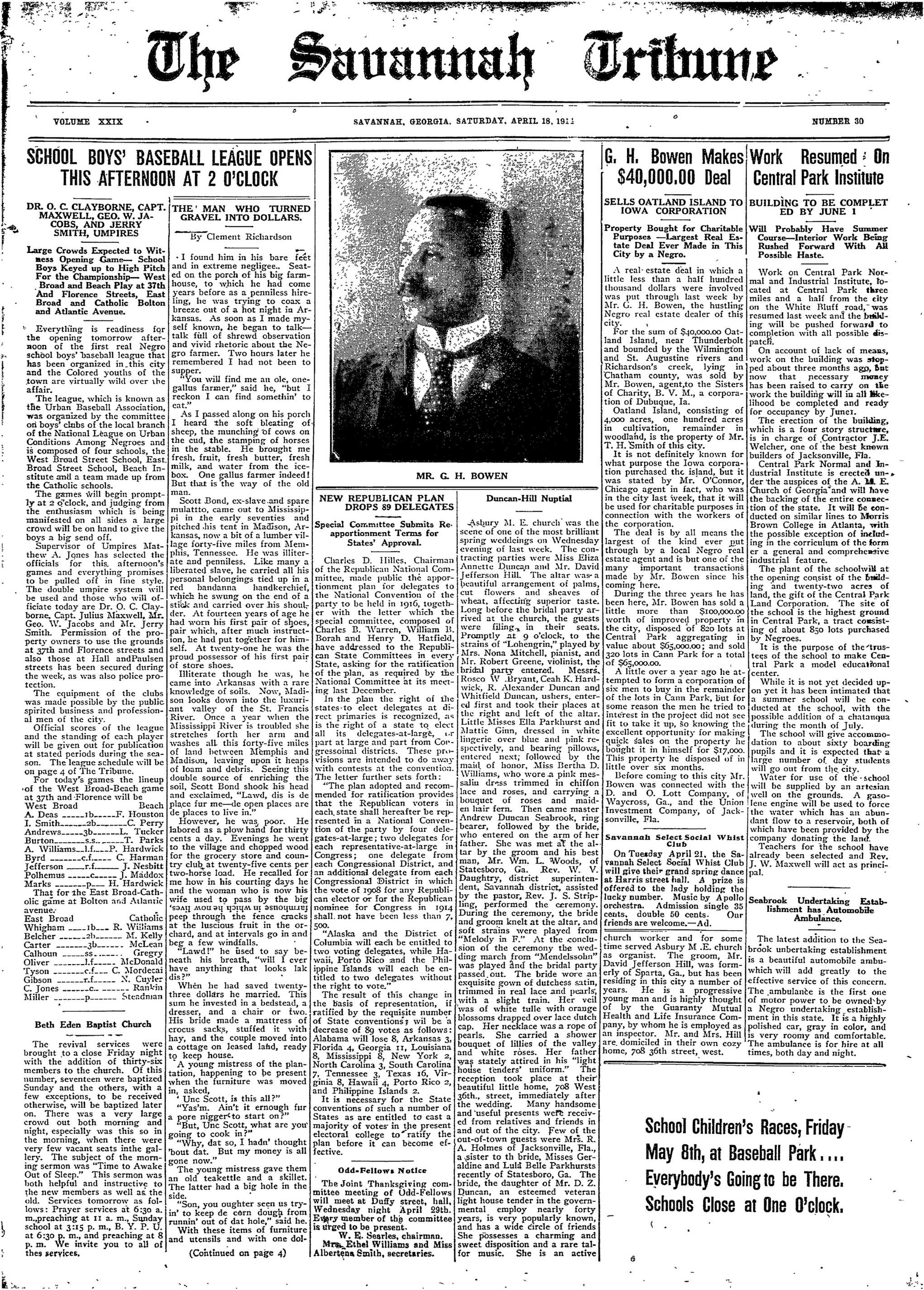
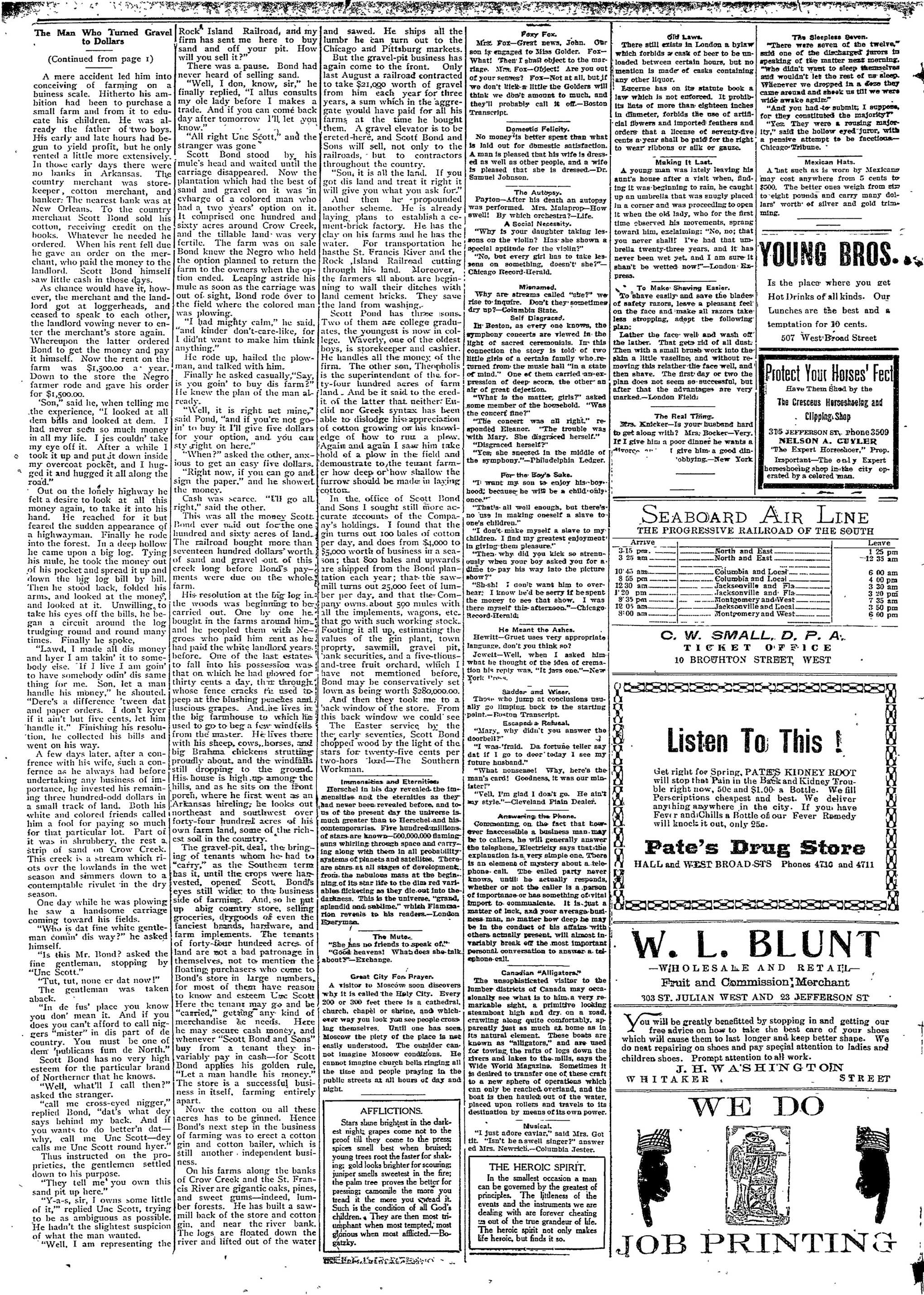
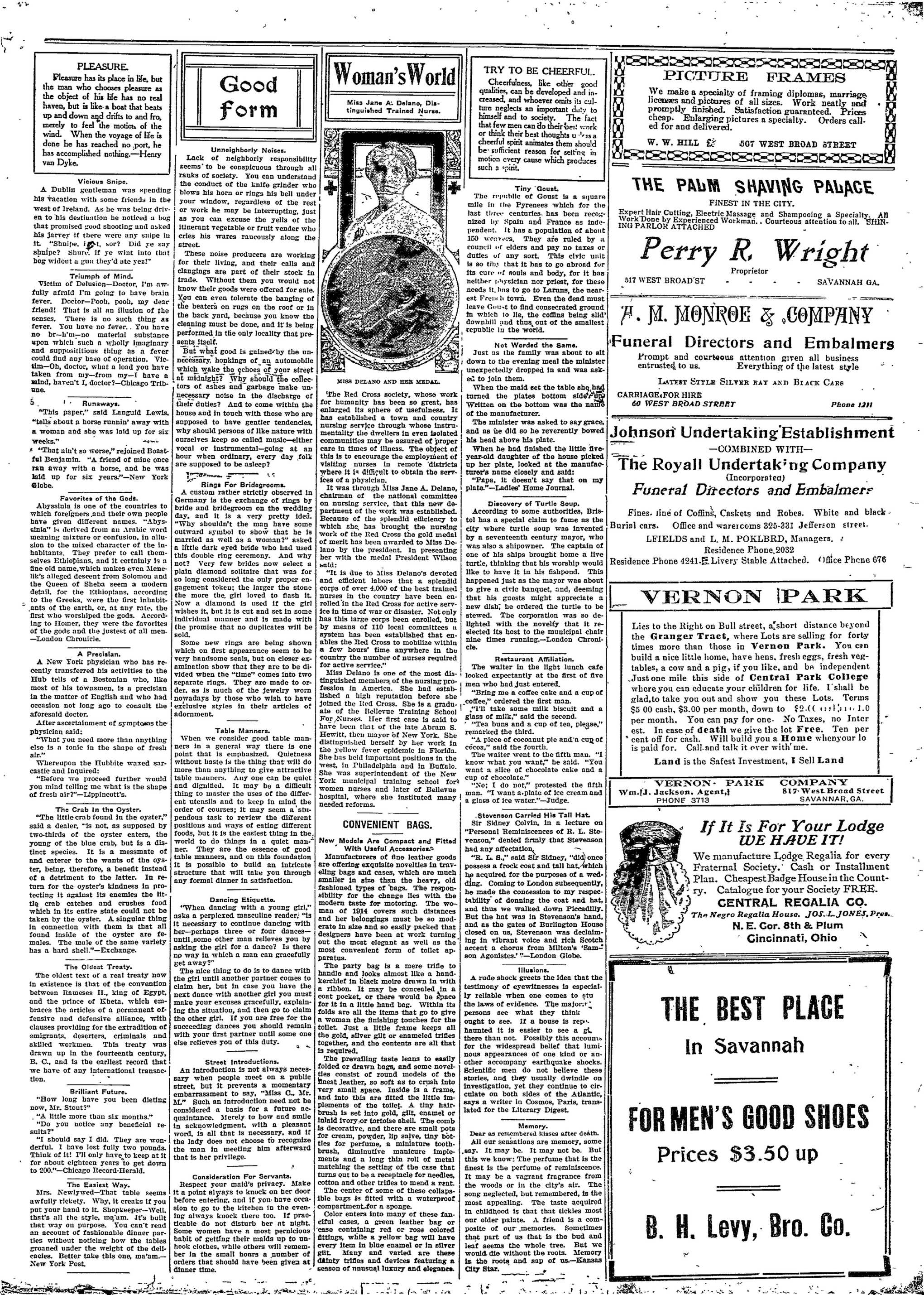
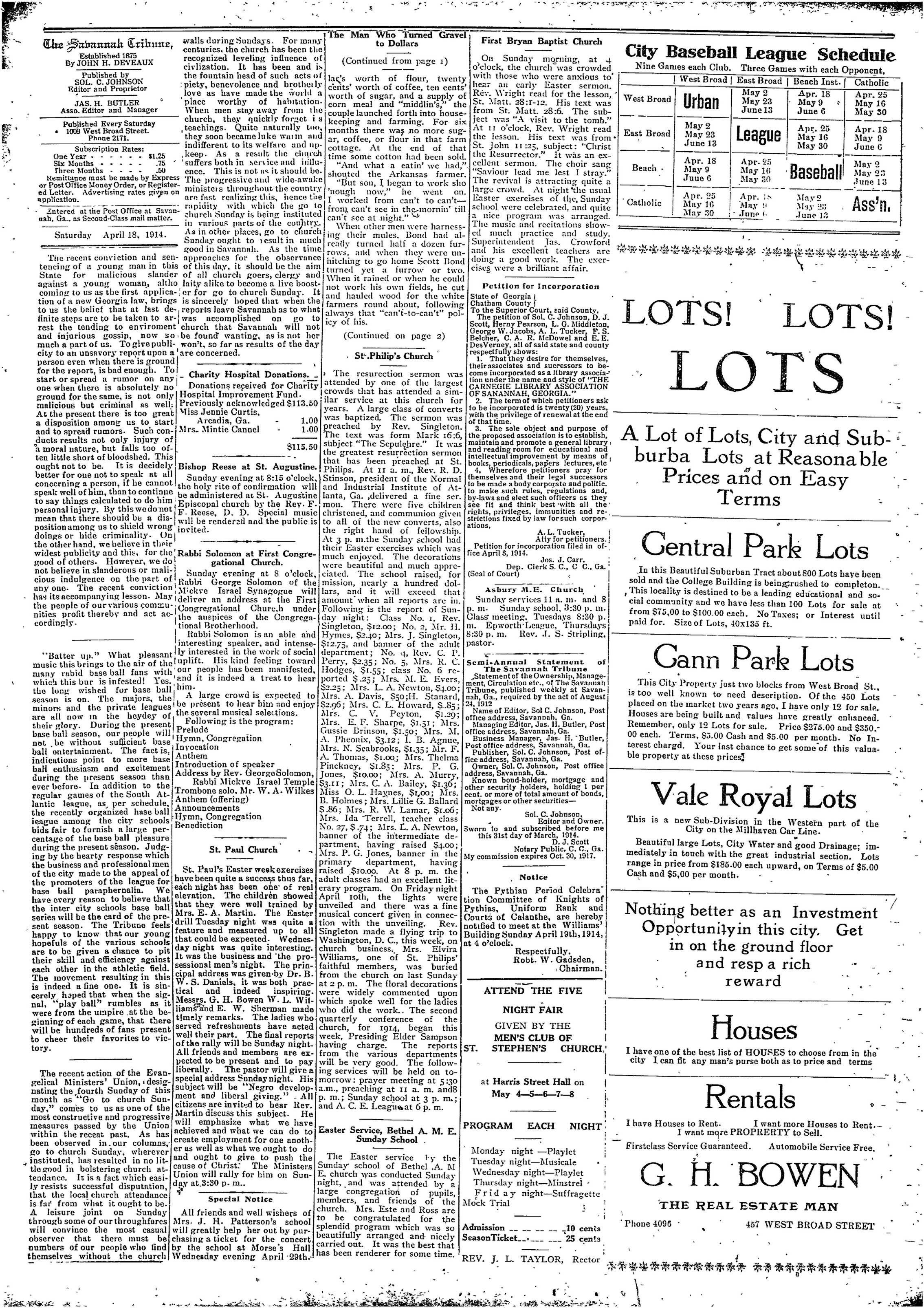
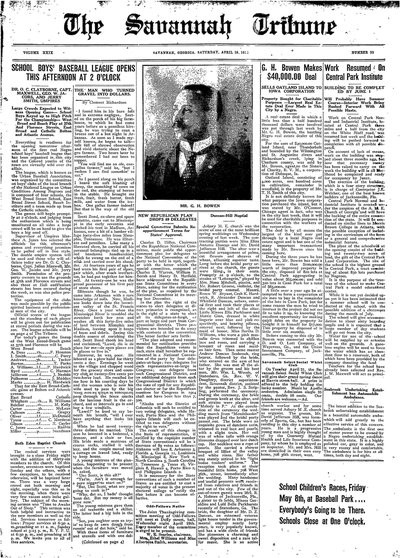
Page text (machine-generated)
SCHOOL BOYS' BASEBALL LEAGUE OPENS THIS AFTERNOON AT 2 O'CLOCK
VOLUME XXIX
SCHOOL BOYS' BASE
THIS AFTERNOON
DR. O. C. CLAYBORNE, CAPT.
MAXWELL, GEO. W. JA-
COBS, AND JERRY
SMITH, UMPIRES
Large Crowds Expected to Witness Opening Game—School Boys Keyed up to High Pitch For the Championship—West Broad and Beach Play at 37th And Florence Streets, East Broad and Catholic Bolton and Atlantic Avenue.
Everything is readiness for the opening tomorrow afternoon of the first real Negro school boys' baseball league that has been organized in this city and the Colored youths of the town are virtually wild over the affair.
The league, which is known as the Urban Baseball Association, was organized by the committee on boys' clubs of the local branch of the National League on Urban Conditions Among Negroes and is composed of four schools, the West Broad Street School, East Broad Street School, Beach Institute and a team made up from the Catholic schools. The games will begin promptly at 2 o'clock, and judging from the enthusiasm which is being manifested on all sides a large crowd will be on hand to give the boys a big send off.
Supervisor of Umpires Matthew A. Jones has selected the officials for this afternoon's games and everything promises to be pulled off in fine style. The double umpire system will be used and those who will officiate today are Dr. O. C. Clayborne, Capt. Julius Maxwell, Mr. Geo. W. Jacobs and Mr. Jerry Smith. Permission of the property owners to use the grounds at 37th and Florence streets and also those at Hall and Paulsen streets has been secured during the week, as was also police protection. The equipment of the clubs was made possible by the public spirited business and professional men of the city.
Official scores of the league and the standing of each player will be given out for publication at stated periods during the season. The league schedule will be on page 4 of The Tribune.
For today's games the lineup of the West Broad-Beach game at 37th and Florence will be West Broad Beach
A. Deas _____1b_____F. Houston
I. Smith_____2b_____C. Perry
Andrews_____3b_____L. Tucker
Burton_____s.s_____T. Parks
A. Williams____l.f____P. Hardwick
Byrd____c.f____C. Harman
Jefferson____r.f____J. Nesbitt
Polhemus____c____J. Maddox
Marks____p____H. Hardwick
That for the East Broad-Catholic game at Bolton and Atlantic
one game at Bolton and Atlantic avenue;
East Broad Catholic
Whigham ____1b___ R. Williams
Belcher ____2b___ M. Kelly
Carter ____3b___ McLean
Calhoun ____ss___ Gregrry
Oliver ____1f___ McDonald
Tyson ____c.f___ C. Mordecai
Gibson ____r.f___ N. Cuyler
C. Jones ____c___ Rankin
Miller ____p___ Steadman
Beth Eden Baptist Church
The revival services were brought to a close Friday night with the addition of thirty-six members to the church. Of this number, seventeen were baptized Sunday and the others, with a few exceptions, to be received otherwise, will be baptized later on. There was a very large crowd out both morning and night, especially was this so in the morning, when there were very few vacant seats in the gallery. The subject of the morning sermon was "Time to Awake Out of Sleep." This sermon was both helpful and instructive to the new members as well as the old. Services tomorrow as follows: Prayer services at 6:30 a.m., preaching at 11 a.m., Sunday school at 3:15 p.m., B. Y. P. U. at 6:30 p.m., and preaching at 8 p.m. We invite you to all of these services.
THE' MAN WHO TURNED GRAVEL INTO DOLLARS.
By Clement Richardson
I found him in his bare feet and in extreme negligee. Seated on the porch of his big farmhouse, to which he had come years before as a penniless hireling, he was trying to coax a breeze out of a hot night in Arkansas. As soon as I made myself known, he began to talk talk full of shrewd observation and vivid rhetoric about the Negro farmer. Two hours later he remembered I had not been to supper.
"You will find me an ole, one gallus farmer," said he, "but I reckon I can find somethin' to eat."
As I passed along on his porch I heard the soft bleating of sheep, the munching of cows on the cud, the stamping of horses in the stable. He brought me fresh, fruit, fresh butter, fresh milk, and water from the icebox. One gallus farmer indeed! But that is the way of the old man.
Scott Bond, ex-slave and spare mulatto, came out to Mississippi in the early seventies and pitched his tent in Madison, Arkansas, now a bit of a lumber village forty-five miles from Memphis, Tennessee. He was illiterate and penniless. Like many a liberated slave, he carried all his personal belongings tied up in a red bandanna handkerchief, which he swung on the end of a stick and carried over his shoulder. At fourteen years of age he had worn his first pair of shoes, pair which, after much instruction, he had put together for himself. At twenty-one he was the proud possessor of his first pair of store shoes.
Illiterate though he was, he came into Arkansas with a rare knowledge of soils. Now, Madison looks down into the luxuriant valley of the St. Francis River. Once a year when the Mississippi River is troubled she stretches forth her arm and washes all this forty-five miles of land between Memphis and Madison, leaving upon it heaps of loam and debris. Seeing this double source of enriching the soil, Scott Bond shook his head and exclaimed, "Lawd, dis is de place fur me—de open places are de places to live in."
However, he was poor. He labored as a plow hand for thirty cents a day. Evenings he went to the village and chopped wood for the grocery store and country club at twenty-five cents per two-horse load. He recalled for me how in his courting days he and the woman who is now his wife used to pass by the big 'saw worm in noqumma peep through the fence cracks at the luscious fruit in the orchard, and at intervals go in and beg a few windfalls.
"Lawd!" he used to say beneath his breath, "will I ever have anything that looks lak dis?"
When he had saved twenty-three dollars he married. This sum he invested in a bedstead, a dresser, and a chair or two. His bride made a mattress of crocus sacks, stuffed it with hay, and the couple moved into a cottage on leased land, ready to keep house.
A young mistress of the plantation, happening to be present when the furniture was moved in, asked.
' Unc Scott, is this all?"
"Yas'm. Ain't it enough fur a pore nigger to start on?"
"But, Unc Scott, what are you going to cook in?"
"Why, dat so, I hadn' thought 'bout dat. But my money is all gone now."
The young mistress gave them an old teakettle and a skillet. The latter had a big hole in the side.
"Son, you oughter seen us tryin' to keep de corn dough from runnin' out of dat hole," said he.
With these items of furniture and utensils and with one dol-
(Continued on page 4)
SAVANNAH, GEORGIA, SATURDAY, APRIL 18, 1911
M.
MR. G. H. BOWEN
NEW REPUBLICAN PLAN DROPS 89 DELEGATES
Special Committee Submits Reapportionment Terms for States' Approval.
Charles D. Hilles, Chairman of the Republican National Committee, made public the apportionment plan for delegates to the National Convention of the party to be held in 1916, together with the letter which the special committee, composed of Charles B. Warren, William B. Borah and Henry D. Hatfield, have addressed to the Republican State Committees in every State, asking for the ratification of the plan, as required by the National Committee at its meeting last December.
In the plan the right of the states to elect delegates at direct primaries is recognized, as is the right of a state to elect all its delegates-at-large, or part at large and part from Congressional districts. These provisions are intended to do away with contests at the convention. The letter further sets forth:
"The plan adopted and recommended for ratification provides that the Republican voters in each state shall hereafter be represented in a National Convention of the party by four delegates-at-large; two delegates for each representative-at-large in Congress; one delegate from each Congressional District, and an additional delegate from each Congressional District in which the vote of 1908 for any Republican elector or for the Republican nominee for Congress in 1914 shall. not have been less than 7, 500.
"Alaska and the District of Columbia will each be entitled to two voting delegates, while Hawaii, Porto Rico and the Philippine Islands will each be entitled to two delegates without the right to vote."
The result of this change in the basis of representation, if ratified by the requisite number of State conventions7 will be a decrease of 89 votes as follows: Alabama will lose 8, Arkansas 3, Florida 4, Georgia 11, Louisiana 8, Mississippi 8, New York 2, North Carolina 3, South Carolina 7, Tennessee 3, Texas 16, Virginia 8, Hawaii 4, Porto Rico 2, and Philippine Islands 2.
It is necessary for the State conventions of such a number of States as are entitled to cast a majority of votes in the present electoral college to ratify the plan before it can become effective.
The Joint Thanksgiving committee meeting of Odd-Fellows will meet at Duffy street, hall, Wednesday night April 29th. Every member of the committee is urged to be present. W. E. Searles, chairmn. Mrs. Ethel Williams and Miss Albertena Smith, secretaries.
Odd-Fellows Notice
Duncan-Hill Nuptial
Asbury M. E. church was the scene of one of the most brilliant spring weddесions on Wednesday evening of last week. The contracting parties were Miss Eliza Annette Duncan and Mr. David Jefferson Hill. The altar was a beautiful arrangement of palms, cut flowers and sheaves of wheat, affecting superior taste. Long before the bridal party arrived at the church, the guests were filing, in their seats. Promptly at 9 o'clock, to the strains of "Lohengrin," played by Mrs. Nona Mitchell, pianist, and Mr. Robert Greene, violinist, the bridal party entered. Messrs. Rosco W. Bryant, Ceah K. Hardwick, R. Alexander Duncan, ushers, entered first and took their places at the right and left of the altar. Little Misses Ella Parkhurst and Mattie Ginn, dressed in white lingerie over blue and pink respectively, and bearing pillows, entered next; followed by the maid of honor, Miss Bertha D. Williams, who wore a pink messalin dress trimmed in chiffon lace and roses, and carrying a bouquet of roses and maiden hair fern. Then came master Andrew Duncan Seabrook, ring bearer, followed by the bride, who entered on the arm of her father. She was met at the altar by the groom and his best man, Mr. Wm. L. Woods, of Statesboro, Ga. Rev. W. V. Daughtry, district superintendent, Savannah district, assisted by the pastor, Rev. J. S. Stripling, performed the ceremony. During the ceremony, the bride and groom knelt at the altar, and soft strains were played from "Melody in F." At the conclusion of the ceremony the wedding march from "Mendelssohn" was played and the bridal party passed out. The bride wore an exquisite gown of dutchess satin, trimmed in real lace and pearls, with a slight train. Her veil was of white tulle with orange blossoms drapped over lace dutch cap. Her necklace was a rope of pearls. She carried a shower bouquet of lillies of the valley and white roses. Her father was stately attired in his "light house tenders' uniform." The reception took place at their beautiful little home, 708 West 36th, street, immediately after the wedding. Many handsome and useful presents were received from relatives and friends in and out of the city. Few of the out-of-town guests were Mrs. R. A. Holmes of Jacksonville, Fla., a sister to th bride, Misses Geraldine and Lulà Belle Parkhursts recently of Statesboro, Ga. The bride, the daughter of Mr. D. Z. Duncan, an esteemed veteran light house tender in the governmental employ nearly forty years, is very popularly known, and has a wide circle of friends She possesses a charming and sweet disposition and a rare talor music. She is an active
Tribune
School Children's Races, Friday May 8th, at Baseball Park.... Everybody's Going to be There. Schools Close at One O'clock.
G. H. Bowen Makes $40,000.00 Deal
SELLS OATLAND ISLAND TO IOWA CORPORATION
Property Bought for Charitable Purposes —Largest Real Estate Deal Ever Made in This City by a Negro.
A real estate deal in which a little less than a half hundred thousand dollars were involved was put through last week by Mr. G. H. Bowen, the hustling Negro real estate dealer of this city.
For the sum of $40,000.00 Oatland Island, near Thunderbolt and bounded by the Wilmington and St. Augustine rivers and Richardson's creek, lying in Chatham county, was sold by Mr. Bowen, agent,to the Sisters of Charity, B. V. M., a corporation of Dubuque, Ia.
Oatland Island, consisting of 4,000 acres, one hundred acres in cultivation, remainder in woodland, is the property of Mr. T. H. Smith of this city.
It is not definitely known for what purpose the Iowa corporation purchased the island, but it was stated by Mr. O'Connor, Chicago agent in fact, who was in the city last week, that it will be used for charitable purposes in connection with the workers of the corporation.
The deal is by all means the largest of the kind ever put through by a local Negro real estate agent and is but one of the many important transactions made by Mr. Bowen since his coming here.
During the three years he has been here, Mr. Bowen has sold a little more than $100,000.00 worth of improved property in the city, disposed of 820 lots at Central Park aggregating in value about $65,000.00; and sold 320 lots in Cann Park for a total of $65,000.00.
A little over a year ago he attempted to form a corporation of six men to buy in the remainder of the lots in Cann Park, but for some reason the men he tried to interest in the project did not see fit to take it up, so knowing the excellent opportunity for making quick sales on the property he bought it in himself for $17,000. This property he disposed of in little over six months. Before coming to this city Mr. Bowen was connected with the D. and O. Lott Company, of Waycross, Ga., and the Union Investment Company, of Jacksonville, Fla.
Savannah Select Social Whist Club
On Tuesday April 21, the Savannah Select Social Whist Club will give their grand spring dance at Harris street hall. A prize is offered to the lady holding the lucky number. Music by Apollo orchestra. Admission single 35 cents, double 50 cents. Our friends are welcome.—Ad.
church worker and for some time served Asbury M.E. church as organist. The groom, Mr. David Jefferson Hill, was formerly of Sparta, Ga., but has been residing in this city a number of years. He is a progressive young man and is highly thought of by the Guaranty Mutual Health and Life Insurance Company, by whom he is employed as an inspector. Mr. and Mrs. Hill are domiciled in their own cozy home, 708 36th street, west.
NUMBER 30
Work Resumed On Central Park Institute
BUILDING TO BE COMPLETED BY JUNE 1
Will Probably Have Summer Course—Interior Work Being Rushed Forward With All Possible Haste.
Work on Central Park Normal and Industrial Institute, located at Central Park three miles and a half from the city on the White Bluff road, was resumed last week and the building will be pushed forward to completion with all possible dispatch.
On account of lack of means, work on the building was stopped about three months ago, but now that necessary money has been raised to carry on the work the building will in all likelihood be completed and ready for occupancy by Juner. The erection of the building, which is a four story structure, is in charge of Contractor J.E. Welcher, one of the best known builders of Jacksonville, Fla.
Central Park Normal and Industrial Institute is erected under the auspices of the A. M. E. Church of Georgia and will have the backing of the entire connection of the state. It will be conducted on similar lines to Morris Brown College in Atlanta, with the possible exception of including in the curriculum of the form a general and comprehensive industrial feature.
The plant of the schoolwill at the opening consist of the building and twenty-two acres of land, the gift of the Central Park Land Corporation. The site of the school is the highest ground in Central Park, a tract consisting of about 850 lots purchased by Negroes. It is the purpose of the trustees of the school to make Central Park a model educational center. While it is not yet decided upon yet it has been intimated that a summer school will be conducted at the school, with the possible addition of a chatanqua during the month of July.
The school will give accommodation to about sixty boarding pupils and it is expected that a large number of day students will go out from the city. Water for use of the school will be supplied by an artesian well on the grounds. A gasoline engine will be used to force the water which has an abundant flow to a reservoir, both of which have been provided by the company donating the land. Teachers for the school have already been selected and Rev. J. W. Maxwell will act as principal.
Seabrook Undertaking Establishment has Automobile Ambulance.
The latest addition to the Seabrook unbertaking establishment is a beautiful automobile ambuwhich will add greatly to the effective service of this concern. The ambulance is the first one of motor power to be owned by a Negro undertaking establishment in this state. It is a highly polished car, gray in color, and is very roomy and comfortable. The ambulance is for hire at all times, both day and night.
---
(Continued from page 1)
A mere accident led him into conceiving of farming on a business scale. Hitherto his ambition had been to purchase a small farm and from it to educate his children. He was already the father of two boys. His early and late hours had begun to yield profit, but he only rented a little more extensively. In those early days there were no banks in Arkansas. The country merchant was store-keeper, cotton merchant, and banker: The nearest bank was at New Orleans. To the country merchant Scott Bond sold his cotton, receiving credit on the books. Whatever he needed he ordered. When his rent fell due he gave an order on the merchant, who paid the money to the landlord. Scott Bond himself saw little cash in those days.
As chance would have it, however, the merchant and the landlord got at loggerheads, and ceased to speak to each other, the landlord vowing never to enter the merchant's store again. Whereupon the latter ordered Bond to get the money and pay it himself. Now the rent on the farm was $1,500.00 a year. Down to the store the Negro farmer rode and gave his order for $1,500.00.
"Son," said he, when telling me the experience, "I looked at all dem bills and looked at dem. I had never seen so much money in all my life. Ijes couldn't take my eye off it. After a while I took it up and put it down inside my overcoat pocket, and I hugged it and hugged it all along the road."
Out on the lonely highway he felt a desire to look at all this money again, to take it into his hand. He reached for it but feared the sudden appearance of a highwayman. Finally he rode into the forest. In a deep hollow he came upon a big log. Tying his mule, he took the money out of his pocket and spread it up and down the big log bill by bill. Then he stood back, folded his arms, and looked at the money, and looked at it. Unwilling, to take his eyes off the bills, he began a circuit around the log trudging round and round many times. Finally he spoke,
"Lawd, I made all dis money and hyer I am takin' it to somebody else. If I live I am goin' to have somebody odin' dis same thing for me. Son, let a man handle his money," he shouted. "Dere's a difference 'tween dat and paper orders. I don't kyer if it ain't but five cents, let him handle it." Finishing his resolution, he collected his bills and went on his way.
A few days later, after a conference with his wife, such a conference as he always had before undertaking any business of importance, he invested his remaining three hundred-odd dollars in a small track of land. Both his white and colored friends called him a fool for paying so much for that particular lot. Part of it was in shrubbery, the rest a strip of sand on Crow Creek. This creek is a stream which riots over the lowlands in the wet season and simmers down to a contemptable rivulet in the dry season. One day while he was plowing he saw a handsome carriage coming toward his fields.
"Who is dat fine white gentleman comin' dis way?" he asked himself.
"Is this Mr. Bond? asked the fine gentleman, stopping by "Unc Scott."
"Tut, tut, none er dat now!"
The gentleman was taken aback.
"In de fus' place you know you don' mean it. And if you does you can't afford to call niggers "mister" in dis part of de country. You must be one of dem 'publicans fum de North."
Scott Bond has no very high esteem for the particular brand of Northerner that he knows.
"Well, what'll I call then?" asked the stranger.
"call me cross-cyed nigger," replied Bond, "dat's what dey says behind my back. And if you wants to do better'n dat—why, call me Unc Scott—dey calls me Unc Scott round hyer."
Thus instructed on the proprieties, the gentlemen settled down to his purpose.
"They tell me' you own this sand pit up here."
"Y-a-s, sir, I owns some little of it," replied Unc Scott, trying to be as ambiguous as possible. He hadn't the slightest suspicion of what the man wanted.
"Well, I am representing the
Rock Island Railroad, and my firm has sent me here to buy sand and off your pit. How will you sell it?" There was a pause. Bond had never heard of selling sand.
"Well, I don, know, sir," he finally replied, "I allus consults my ole lady before I makes a trade. And if you can come back day after tomorrow I'll, let you know."
"All right Unc Scott," and the stranger was gone
Scott Bond stood by his mule's head and waited until the carriage disappeared. Now the plantation which had the best of sand and gravel on it was in cvcharge of a colored man who had a two years' option on it. It comprised one hundred and sixty acres around Crow Creek, and the tillable land was very fertile. The farm was on sale Bond knew the Negro who held the option planned to return the farm to the owners when the option ended. Leaping astride his mule as soon as the carriage was out of sight, Bond rode over to the field where the colored man was plowing.
"I had mighty calm," he said, "and kinder don't-care-like, for I didn't want to make him think anything."
He rode up, hailed the plowman, and talked with him.
Finally he asked casually, "Say, is you goin' to buy dis farm?" He knew the plan of the man already.
"Well, it is right net mine," said Pond, "and if you're not goin' to buy it I'll give five dollars for your option, and you can sty right on here."
"When?" asked the other, anxious to get an easy five dollars.
"Right now, if you can go and sign the paper," and he showed the money.
Cash was scarce. "I'll go all right," said the other. This was all the money Scott Bond ever paid out for the one hundred and sixty acres of land. The railroad bought more than seventeen hundred dollars worth of sand and gravel out of this creek long before Bond's payments were due on the whole farm.
His resolution at the big log in the woods was beginning to be carried out. One by one he bought in the farms around him, and he peopled them with Negroes who paid him rent as he had paid the white landlord years before. One of the last estates to fall into his possession was that on which he had flowed for thirty cents a day, thus through whose fence cracks he used to peep at the blushing peaches and luscious grapes. And he lives in the big farmhouse to which he used to go to beg a few windfalls from the master. He lives there with his sheep, cows, horses, and big Brahma chickens strutting proudly about, and the windfalls still dropping to the ground. His house is high up among the hills, and as he sits on the front porch, where he first went as an Arkansas hireling; he looks out northeast and southwest over forty-four hundred acres of his own farm land, some of the richest soil in the country.
The gravel-pit deal, the bringing of tenants whom he had to "carry," as the Southern term has it, until the crops were harvested, opened Scott, Bond's eyes still wider to the business side of farming. And, so he put up abig country store, selling groceries, drygoods of even the fanciest brands, hardware, and farm implements. The tenants of forty-four hundred acres of land are not a bad patronage in themselves, not to mention the floating purchasers who come to Bond's store in large numbers, for most of them have reason to know and esteem Ume Scott Here the tenant may go and be "carried," getting any kind of merchandise he needs. Here he may secure cash money, and whenever "Scott Bond and Sons" buy from a tenant they invariably pay in cash—for Scott Bond applies his golden rule, "Let a man handle his money." The store is a successful business in itself, farming entirely apart.
Now the cotton on all these acres has to be ginned. Hence Bond's next step in the business of farming was to erect a cotton gin and cotton bailer, which is still another independent business. On his farms along the banks of Crow Creek and the St. Francis River are gigantic oaks, pines, and sweet gums—indeed, lumber forests. He has built a sawmill back of the store and cotton gin, and near the river bank. The logs are floated down the river and lifted out of the water
and sawed. He ships all the lumbr he can turn out to the Chicago and Pittsburg markets. But the gravel-pit business has again come to the front. Only last August a railroad contracted to take $21,000 worth of gravel from him each year for three years, a sum which in the aggregate would have paid for all his farms, at the time he bought them. A gravel elevator is to be erected here, and Scott Bond and Sons will sell, not only to the railroads, but to contractors throughout the country.
"Son, it is all the land. If you got dis land and treat it right it will give you what you ask for." And then he propounded another scheme. He is already laying, plans to establish a cement-brick factory. He has the clay on his farms and he has the water. For transportation he hasthe St. Francis River and the Rock ,Island Railroad cutting through his land. Moreover, the farmers all about are beginning to wall their ditches with land cement bricks. They save the land from washing.
Scott Pond has three sons. Two of them are college graduates, the youngest is now in college. Waverly, one of the oldest boys, is storekeeper and cashier. He handles all the money, of the firm. The other son, Theopholis is the superintendent of the forty-four hundred acres of farm land. And be it said to the credit of the latter that neither Euclid nor Greek syntax has been able to dislodge his appreciation of cotton growing or his knowledge of how to run a plow. Again and again I saw him take hold of a plow in the field and demonstrate to the tenant farmer how deep or how shallow the furrow should be made in laying cotton.
In the office of Scott Bond and Sons I sought still more accurate accounts of the Company's holdings. I found that the gin turns out 100 bales of cotton per day, and does from $4,000 to $5,000 worth of business in a season; that 800 bales and upwards are shipped from the Bond plantation each year; that the sawmill turns out 25,000 feet of lumber per day, and that the Company owns about 500 mules with all the implements, wagons, etc. that go with such working stock. Footing it all up, estimating the values of the gin plant, town property, sawmill, gravel pit, bank securities, and a five-thousand-tree fruit orchard, which I have not mentioned before. Bond may be conservatively set down as being worth $280,000.00. And then they took me to a back window of the store. From this back window we could see The Easter service by the early seventies, Scott Bond chopped wood by the light of the stars for twenty-five cents per two-hors load—The Southern Workman.
Immensitics and Eternities
Herschel in his day revealed the immenities and the eternities as they had never been revealed before, and to us of the present day the universe is much greater than to Herschel and his contemporaries. Five hundred-millions of stars are known—500,000,000 flaminguns whirling through space and carrying along with them in all probability systems of planets and satellites. There are stars at all stages of development, from the nabulous mass at the beginning of its star life to the dim red variables flickering as they die out into the darkness. This is the universe, "grand, splendid and sublime," which Flammarsion reveals to his readers—London Everyman.
The Mute
"She has no friends to speak of."
"Good heavens! What does she talk about?"—Exchange.
Great City For Prayer.
A visitor to Moscow soon discovers why it is called the Holy City. Every 200 or 300 feet there is a cathedral, church, chapel or shrine, and whichever way you look you see people crossing themselves. Until one has seen Moscow the plenty of the place is not easily understood. The outsider cannot imagine Moscow conditions. He cannot imagine church bells ringing all the time and people praying in the public streets at all hours of day and night.
AFFLICTIONS
Stars shine brightest in the darkest night; grapes come not to the proof till they come to the press; spices smell best when bruised; young trees root the faster for shaking; gold looks brighter for scouring; juniper smells sweetest in the fire; the palm tree proves the better for pressing; camomile the more you tread it the more you read it. Such is the condition of all God's children. They are then most triumphant when most tempted, most glorious when most afflicted.—Bogatzky.
Poxy Fox.
Mrs. Fox—Great news, John. Our son is engaged to Miss Golden. Fox—What! Then I shall object to the marriage. Mrs. Fox—Object! Are you out of your senses? Fox—Not at all, but if we don't likek a little the Golders will think we don't amount to much, and they'll probably call it off—Boston Transcript.
Domestig Felicity.
No money<sup>2</sup> is better spent than what is laid out for domestic satisfaction. A man is pleased that his wife is dressed as well as other people, and a wife is pleased that she is dressed.—Dr. Samuel Johnson.
The Autopsy.
Payton—After his death an autopsy was performed. Mrs. Malaprop—How swell! By which orchestra?—Life. A Social Necessity. "Why is your daughter taking lessons on the violin? Has she shown a special aptitude for the violin?" "No, but every girl has to take lessons on something, doesn't she?"—C Chicago Record-Herald.
Misnamed.
Why are streams called "she?" we rise to inquire. Don't they sometimes dry up? - Columbia State.
Self Disgraced.
In Boston, as every one knows, the symphony concerts are viewed in the light of sacred ceremonials. In this connection the story is told of two little girls of a certain family who returned from the music hall "in a state of mind." One of them carried an expression of deep scorn, the other an air of great dejection.
"What is the matter, girls?" asked some member of the household. "Was the concert fine?"
"The concert was all right." responded Eleanor. "The trouble was with Mary. She disgraced herself."
"Disgraced herself?"
"Yes; she sneezed in the middle of the symphony."—Philadelphia Ledger.
For the Boy's Sake.
"I want my son to enjoy his-boyhood; because he will be a child only once."
"That's all well enough, but there's no use in making oneself a slave to one's children."
"I don't make myself a slave to my children. I find my greatest enjoyment in giving them pleasure."
"Then why did you kick so strenuously when your boy asked you for a dime to pay his way into the picture show?"
"Sb-sh! I don't want him to overhear; I know he'd be sorry if he spent the money to see that show. I was there myself this afternoon."—Chicago Record-Herald
He Meant the Ashes
Hewitt—Gruet uses very appropriate language, don't you think so?
Jewitt—Well, when I asked him what he thought of the idea of cremation his reply was, "It just one."—New York Press.
Sadder and Wiser.
Those who jump at conclusions usually go limping back to the starting point.—Boston Transcript.
Escapea a Refueal.
"Mary, why didn't you answer the doorbell?"
"I was 'fraid. Da fortune teller say dat if I go to door today I see my future husband." "What nonsense! Why, here's the man's card! Goodness, it was our minister!" "Vell, I'm glad I don't go. He ain't my style."—Cleveland Plain Dealer.
Answering the Phone.
Commenting on the fact that however inaccessible a business man may be to callers, he will generally answer the telephone. Electricity says that the explanation is a very simple one. There is an element of mystery about a telephone-call. The called party never knows, until he actually responds, whether or not the caller is a person of importance or has something of vital import to communicate. It is just a matter of luck, and your average business man, no matter how deep he may be in the conduct of his affairs with others actually present, will almost invariably break off the most important personal conversation to answer a telephone-call.
Canadian "Alligators"
The ausophisticated visitor to the lumber districts of Canada may occasionally see what is to him a very remarkable sight, a primitive looking steamboat high and dry on a road, crawling along quite comfortably, apparently just as much at home as in its natural element. These boats are known as "alligators," and are used for towing, the rafts of logs down the rivers and lakes to the mills, says the Wide World Magazine. Sometimes it is desired to transfer one of these craft to a new sphere of operations which can only be reached overland, and the boat is then hauled out of the water, placed upon rollers and travels to its destination by means of its own power.
Musical.
"I just adore caviar," said Mrs. Got
tit. "Isn't he as well singer?" answer
ed Mrs. Newwicki.-Columbia Jester.
THE HEROIC SPIRIT.
In the smallest occasion a man can be governed by the greatest of principles. The littleness of the events and the instruments we are dealing with are forever cheating out of the true grandeur of life. The heroic spirit not only makes life heroic, but finds it so.
Get right for Spring, PATES KIDNEY ROOT will stop that Pain in the Back and Kidney Trouble right now, 50c and $1.00 a Bottle. We fill Perscriptions cheapest and best. We deliver anything anywhere in the city. If you have Fever and Chills a Bottle of our Fever Remedy will knock it out, only 25a.
HALL and WEST BROAD-STS Phones 4710 and 4711
WHOLESALE AND RETAIL Fruit and Commission Merchant
You will be greatly benefitted by stopping in and getting our free advice on how to take the best care of your shoes which will cause them to last longer and keep better shape. We do neat repairing on shoes and pay special attention to ladies and children shoes. Prompt attention to all work.
```markdown
```
Old Laws.
Eucerne has on its statute book a law which is not enforced. It prohibits hats of more than eighteen inches in diameter, forbids the use of artificial fibwers and imported feathers and orders that a license of seventy-five cents a year shall be paid for the right to wear ribbons or silk or gauze.
Making It Last.
A young man was lately leaving his aunt's house after a visit when, finding it was beginning to rain, he caught up an umbrella that was snugly placed in a corner and was proceeding to open it when the old lady, who for the first time observed his movements, sprang toward him, exclaiming: "No, no; that you never shall! I've had that umbrella twenty-three years, and it has never been wet yet, and I am sure it shan't be wetted now!"—London Express.
To Make: Shaving Easier.
To shave easily and save the blades of safety razors, leave a pleasant feel on the face and make all razors take less stropping, adopt the following plan:
Lather the face well and wash off the lather. That gets rid of all dust. Then with a small brush work into the skin a little vaseline, and without removing this relather the face well, and then shave. The first day or two the plan does not seem so successful, but after that the advantages are very marked.—London Field.
The Real Thing-
Mrs. Knicker-Is your husband hard to get along with? Mrs. Bocker-Very.
If I give him a poor dinner he wants a divorce and I give him a good din-obbying.-New York
The Sleepless Seven.
"There were seven of the twelve," said one of the discharged jurors in speaking of the matter next morning. "Who didn't want to sleep themselves and wouldn't let the rest of us sleep. Whenever we dropped in a doze they came around and shook us till we were wide awake again."
"And you had to submit; I suppressed, for they constituted the majority?"
"Yes. They were a rousing majority," said the hollow eyed juror, with a pensive attempt to be facetious—Chicago Tribune.
Mexican Hats.
A hat such as is worn by Mexicans may cost anywhere from 5 cents to $500. The better ones weigh from six to eight pounds and carry many dollars' worth of silver and gold trimming.
YOUNG BROS.
Is the place where you get Hot Drinks of all kinds. Our Lunches are the best and a temptation for 10 cents.
507 West Broad Street
Protect Your Horses' Fect
Have Them Shod by the
The Cresceus Horseshoeing and
Clipping Shop
3T5 JEFFERSON ST. Phone 3509
NELSON A. CUYLER
"The Expert Horseshoer," Prop.
Important—The only Expert
horseshoeing shop in the city op-
erated by a colored man.
AIR LINE
EARLROAD OF THE SOUTH
Leave
East 1 25 pm
East -12 35 am
and Local 6 00 am
and Local 4 00 pm
and Fla 3 30 am
and Fla 3 20 pm
and West 7 35 am
and Local 3 50 pm
and West 6 00 pm
L, D, P. A.
OFFICE
STREET, WEST
To This!
TETS KIDNEY ROOT
Back and Kidney Trou-
1.00 a Bottle. We fill
and best. We deliver
the city. If you have
of our Fever Remedy
use.
Drug Store
STS Phones 4710 and 4711
BLUNT
AND RETAIL
Mission, Merchant
AND 23 JEFFERSON ST
by stopping in and getting our
the best care of your shoes
larger and keep better shape. We
may special attention to ladies and
to all work.
HINGTON
STREET
DO
INTING
PLEASURE
Pleasure has its place in life, but the man who chooses pleasure as the object of his life has no real haven, but is like a boat that beats up and down and drifts to and fro, merely to feel the motion of the wind. When the voyage of life is done he has reached no port, he has accomplished nothing.—Henry van Dyke.
Vicious Snipe.
A Dublin gentleman was spending his vacation with some friends in the west of Ireland. As he was being driven to his destination he noticed a bog that promised good shooting and asked his jarve if there were any snipe in it. "Shnipe, is it, sor? Did ye say snipe? Shure. If ye wint into that bog woutid a gun they'd ate yez!"
Triumph of Mind.
Victim of Delusion—Doctor, I'm awfully afraid I'm going to have brain fever. Doctor—Pooh, pooh, my dear friend! That is all an illusion of the senses. There is no such thing as fever. You have no fever. You have no br-h'm—no material substance upon which such a wholly imaginary and supposititious thing as a fever could find any base of operation. Victim—Oh, doctor, what a load you have taken from my—from my—I have a mind, haven't I, doctor?—Chicago Tribune.
"This paper," said Languid Lewis,
"tells about a horse runnin' away with
a woman and she was laid up for six
weeks."
"That ain't so worse," rejoined Boastful
Benjamin. "A friend of mine once
ran away with a horse, and he was
killed up for six years."—New York
Globe.
Favorites of the Gods
Abyssinia is one of the countries to which foreigners, and their own people have given different names. "Abyssinia" is derived from an Arabic word meaning mixture or confusion, in allusion to the mixed character of the inhabitants. They prefer to call themselves Ethiopians, and it certainly is a fine old name, which makes even Menelik's alleged descent from Solomon and the Queen of Sheba seem a modern detail. for the Ethiopians, according to the Greeks, were the first inhabitants of the earth, or, at any rate, the first who worshiped the gods. According to Homer, they were the favorites of the gods and the justest of all men.—London Chronicle.
A Precisian.
A New York physician who has recently transferred his activities to the Hub tells of a Bostonian who, like most of his townsmen, is a precisian in the matter of English and who had occasion not long ago to consult the aforesaid doctor.
After ascertainment of symptoms the physician said:
"What you need more than anything else is a tonic in the shape of fresh air."
Whereupon the Hubbite waxed sarcastic and inquired:
"Before we proceed further would you mind telling me what is the shape of fresh air?"—Lippincott's.
The Crab In the Oyster.
"The little crab found in the oyster," said a dealer, "is not, as supposed by two-thirds of the oyster eaters, the young of the blue crab, but is a distinct species. It is a messmate of and caterer to the wants of the oyster, being, therefore, a benefit instead of a detriment to the latter. In return for the oyster's kindness in protecting it against its enemies the little crab catches and crushes food which in its entire state could not be taken by the oyster. A singular thing in connection with them is that all found inside of the oyster are females. The male of the same variety has a hard shell."-Exchange.
The Oldest Treaty.
The oldest text of a real treaty now in existence is that of the convention between Rameses II., king of Egypt, and the prince of Kheta, which embraces the articles of a permanent offensive and defensive alliance, with clauses providing for the extradition of emigrants, deserters, criminals and skilled workmen. This treaty was drawn up in the fourteenth century, B. C., and is the earliest record that we have of any international transaction.
Brilliant Future.
"How long have you been dieting now, Mr. Stout?"
"A little more than six months."
"Do you notice any beneficial results?"
"I should say I did. They are wonderful. I have lost fully two pounds. Think of it! I'll only have to keep at it for about eighteen years to get down to 200."—Chicago Record-Herald.
The Easiest Way.
Mrs. Newlywed-That table seems awfully rickety. Why, it creaks if you put your hand to it. Shopkeeper—Well, that's all the style, ma'ma. It's built that way on purpose. You can't read an account of fashionable dinner parties without noticing how the tables groaned under the weight of the delicacies. Better take this one, ma'ma.—New York Post
Good form
Unneighborly Noises.
Lack of neighborly responsibility seems to be conspicuous through all ranks of society. You can understand the conduct of the knife grinder who blows his horn or rings his bell under your window, regardless of the rest or work he may be interrupting, just as you can excuse the yells of the itinerant vegetable or fruit vender who cries his wares raucously along the street.
These noise producers are working for their living, and their calls and clangings are part of their stock in trade. Without them you would not know their goods were offered for sale. You can even tolerate the banging of the beaters on rugs on the roof or in the back yard, because you know the cleaning must be done, and it is being performed in the only locality that presents itself.
But what good is gained by the unnecessary, honklings of an automobile which wake the echoes of your street at midnight? Why should the collectors of ashes and garbage make unnecessary noise in the discharge of their duties? And to come within the house and in touch with those who are supposed to have gentler tendencies, why should persons of like nature with ourselves keep so called music—either vocal or instrumental—going at an hour when ordinary, every day folk are supposed to be asleep?
Rings For Bridegrooms.
A custom rather strictly observed in Germany is the exchange of rings by bride and bridegroom on the wedding day, and it is a very pretty idea. "Why shouldn't the man have some outward symbol to show that he is married as well as a woman?" asked a little dark eyed bride who had used this double ring ceremony. And why not? Very few brides now select a plain diamond solitaire that was for so long considered the only proper engagement token; the larger the stone the more the girl loved to flash it. Now a diamond is used if the girl wishes it, but it is cut and set in some individual manner and is made with the promise that no duplicates will be sold.
Some new rings are being shown which on first appearance seem to be very handsome seals, but on closer examination show that they are to be divided when the "time" comes into two separate rings. They are made to order, as is much of the jewelry worn nowadays by those who wish to have exclusive styles in their articles of adornment.
Table Manners.
When we consider good table manners in a general way there is one point that is emphasized. Quietness without haste is the thing that will do more than anything to give attractive table manners. Any one can be quiet and dignified. It may be a difficult thing to master the uses of the different utensils and to keep in mind the order of courses; it may seem a stupendous task to review the different positions and ways of eating different foods, but it is the easiest thing in the world to do things in a quiet manner. They are the essence of good table manners, and on this foundation it is possible to build an intricate structure that will take you through any formal dinner in satisfaction.
Dancing Etiquette.
"When dancing with a young girl," asks a perplexed masculine reader; "is it necessary to continue dancing with her—perhaps three or four dances—until some other man relieves you by asking the girl for a dance? Is there no way in which a man can gracefully get away?"
The nice thing to do is to dance with the girl until another partner comes to claim her, but in case you have the next dance with another girl you must make your excuses gracefully, explaining the situation, and then go to claim the other girl. If you are free for the succeeding dances you should remain with your first partner until some one else relieves you of this duty.
Street Introductions.
An introduction is not always necessary when people meet on a public street, but it prevents a momentary embarrassment to say, "Miss C., Mr. M." Such an introduction need not be considered a basis for a future acquaintance. Merely to bow and smile in acknowledgment, with a pleasant word, is all that is necessary, and if the lady does not choose to recognize the man in meeting him afterward that is her privilege.
Consideration For Servants.
Consideration for servants
Respect your maid's privacy. Make it a point always to knock on her door before entering, and if you have occasion to go to the kitchen in the evening always knock there too. If practicable do not disturb her at night. Some women have a most perilous habit of getting their malds up to unhook clothes, while others will remember in the small hours a number of orders that should have been given at dinner time.
[MEDAL OF THE ROYAL MUSEUM OF LONDON]
MISS DELANO AND HER MEDAL.
The Red Cross society, whose work for humanity has been so great, has enlarged its sphere of usefulness. It has established a town and country nursing service through whose instrumentality the dwellers in even isolated communities may be assured of proper care in times of illness. The object of this is to encourage the employment of visiting nurses in remote districts where it is difficult to obtain the services of a physician.
It was through Miss Jane A. Delano, chairman of the national committee on nursing service, that this new department of the work was established. Because of the splendid efficiency to which she, has brought the nursing work of the Red Cross the gold medal of merit has been awarded to Miss Delano by the president. In presenting her with the medal President Wilson sold:
"It is due to Miss Delano's devoted and efficient labors that a splendid corps of over 4,000 of the best trained nurses in the country have been enrolled in the Red Cross for active service in time of war or disaster. Not only has this large corps been enrolled, but by means of 110 local committees a system has been established that enables the Red Cross to mobilize within a few hours' time anywhere in the country the number of nurses required for active service."
Miss Delano is one of the most distinguished members of the nursing profession in America. She had established a high reputation before she joined the lied Cross. She is a graduate of the Bellevue Training School For Nurses. Her first case is said to have been that of the late Abram S. Hewitt, then mayor of New York. She distinguished herself by her work in the yellow fever epidemic in Florida. She has held important positions in the west, in Philadelphia and in Buffalo. She was superintendent of the New York municipal training school for women nurses and later of Bellevue hospital, where she instituted many needed reforms.
CONVENIENT BAGS.
New Models Are Compact and Fitted With Useful Accessories. Manufacturers of fine leather goods are offering exquisite novelties in traveling bags and cases, which are much smaller in size than the heavy, old fashioned types of bags. The responsibility for the change lies with the modern taste for motoring. The woman of 1914 covers such distances and her belongings must be so moderate in size and so easily packed that designers have been at work turning out the most elegant as well as the most convenient form of toilet apparatus.
The party bag is a mere trifle to handle and looks almost like a handkerchief in black moire drawn in with a ribbon. It may be concealed in a coat pocket, or there would be space for it in a little hand bag. Within its folds are all the items that go to give a woman the finishing touches for the toilet. Just a little frame keeps all the gold, silver gilt or enameled trifles together, and the contents are all that is required.
The prevailing taste leans to easily folded or drawn bags, and some novelties consist of round models of the finest leather, so soft as to crush into very small space. Inside is a frame, and into this are fitted the little implements of the toilet. A tiny hairbrush is set into gold, gilt, enamel or inlaid ivory or tortoise shell. The comb is decorative, and there are small pots for cream, powder, lip salve, tiny bottles for perfume, a miniature toothbrush, diminutive manicure implements and a long thin roll of metal matching the setting of the case that turns out to be a receptacle for needles, cotton and other trifles to mend a rent. The center of some of these collapsible bags is fitted with a waterproof compartment for a sponge.
Color enters into many of these fanciful cases, a green leather bag or case containing red or rose colored fittings, while a yellow bag will have every item in blue enamel or in silver gilt. Many and varied are these dainty trifles and devices featuring a season of unusual luxury and elegance.
TRY TO BE CHEERFUL
Cheerfulness, like other good qualities, can be developed and increased, and whoever omits its culture neglects an important duty to himself and to society. The fact that few men can do their best work or think their best thoughts unless a cheerful spirit animates them should be sufficient reason for setting in motion every cause which produces such a spirit.
Tiny Goust.
The republic of Goust is a square mile in the Pyrenees which for the last three centuries has been recognized by Spain and France as independent. It has a population of about 150 wreens. They are ruled by a council of elders and pay no taxes or duties of any sort. This civic unit is so tiny that it has to go abroad for its cure of souls and body, for it has neither physician nor priest, for these needs it has to go to Laruns, the nearest French town. Even the dead must leave Goust to find consecrated ground in which to lie, the coffins being sled downhill and thus out of the smallest republic in the world.
Not Worded the Same.
Just as the family was about to sit down to the evening meal the minister unexpectedly dropped in and was asked to join them.
When the maid set the table she had turned the plates bottom side up. Written on the bottom was the name of the manufacturer.
The minister was asked to say grace, and as he did so he reverently bowed his head above his plate.
When he had finished the little five-year-old daughter of the house picked up her plate, looked at the manufacturer's name closely and said:
"Papa, it doesn't say that on my plate"—Ladies' Home Journal.
Discovery of Turtle Soup.
According to some authorities, Bristol has a special claim to fame as the city where turtle soup was invented by a seventeenth century mayor, who was also a shipowner. The captain of one of his ships brought home a live turtle, thinking that his worship would like to have it in his fishpond. This happened just as the mayor was about to give a civic banquet, and, deeming that his guests might appreciate a new dish, he ordered the turtle to be stewed. The corporation was so delighted with the novelty that it re-elected its host to the municipal chair nine times running.—London Chronicle.
Restaurant Affiliations
The waiter in the light lunch cafe looked expectantly at the first of five men who had just entered.
"A piece of cocoanut pie and a cup of cocoon," said the fourth. The waiter went to the fifth man. "I know what you want," he said. "You want a slice of chocolate cake and a cup of chocolate." "No; I do not," protested the fifth man. "I want a plate of ice cream and a glass of ice water."—Judge.
Stevenson Carried His Tall Hat
Stevenson Carried his Trial Hall Sir Sidney Colvin, in a lecture on "Personal Reminiscences of R. L. Stevenson," denied firmly that Stevenson had any affectation. "R. L. S," said Sir Sidney, "did) once possess a frock coat and tall hat, which he acquired for the purposes of a wedding. Coming to London subsequently, he made the concession to my respectability of donning the coat and hat, and thus we walked down Piccadilly. But the hat was in Stevenson's hand, and as the gates of Burlington House closed on us, Stevenson was declaiming in vibrant voice and rich Scotch accent a chorus from Milton's 'Samson Agonistes.'"—London Globe.
Illusions.
A rude shock greets the idea that the testimony of eyewitnesses is especially reliable when one comes to stu the laws of evidence. The major persons see what they think ought to see. If a house is repa haunted it is easier to see a g there than not. Possibly this accounts for the widespread belief that luminous appearances of one kind or another accompany earthquake shocks. Scientific men do not believe these stories, and they usually dwindle on investigation, yet they continue to circulate on both sides of the Atlantic, says a writer in Cosmos, Paris, translated for the Literary Digest.
Memory.
Dear as remembered kisses after death.
All our sensations are memory, some say. It may be. It may not be. But this we know: The perfume that is the finest is the perfume of reminiscence. It may be a vagrant fragrance from the woods or in the city's air. The song neglected, but remembered, is the most appealing. The taste acquired in childhood is that that tickles most our older palate. A friend is a composite of our memories. Sometimes that part of us that is the bud and leaf seems the whole tree. But we would die without the roots. Memory is the roots and sap of us.—Kansas City Star.
We make a specialty of framing diplomas, marriage licenses and pictures of all sizes. Work neatly and promptly finished. Satisfaction guaranteed. Prices cheap. Enlarging pictures a specialty. Orders called for and delivered.
THE PADM SHAVING PALACE
Expert Hair Cutting, Electric Massage and Shampooing a Specialty. All Work Done by Experienced Workman. . Courteous attention to all. SHINING PARLOR ATTACHED
Johnson Undertaking Establishment
—COMBINED WITH—
The Royall Undertaking Company
(Incorporated)
Funeral Directors and Embalmers
Fines, line of Coffins, Caskets and Robes. White and black
Burial cars. Office and warriors 325-331 Jefferson street.
LFIELDS and L. M. POKLBRD, Managers.
Residence Phone, 2032
Residence Phone 4241. Livery Stable Attached. (Office Phone 676
VERNON PARK
Lies to the Right on Bull street, a short distance beyond the Granger Tract, where Lots are sailing for forty times more than those in Vernon Park. You can build a nice little home, have hens, fresh eggs, fresh vegetables, a cow and a pig, if you like, and be independent. Just one mile this side of Central Park College where you can educate your children for life. I shall be glad to take you out and show you these Lots. Terms $5.00 cash, $3.00 per month, down to $2.00 per month. You can pay for one. No Taxes, no Interest. In case of death we give the lot Free. Ten per cent off for cash. Will build you a Home when your lo is paid for. Call and talk it ever with me.
Land is the Safest Investment, I Sell Land
VERNON·PARK COMPANY
Wm.[J. Jackson, Agent,]
PHONE 3713
817 West Broad Street
SAVANNAR, GA.
If It Is For Your Lodge
WE HAVE IT!
We manufacture Lodge, Regalia for every
Fraternal Society. Cash or Installmen-
Plan. Cheapest Badge House in the Coun-
try. Catalogue for your Society FREE.
CENTRAL REGALIA CO.
The Negro Regalia House. JOS. L. JONES, Pres.
N. E. Cor. 8th & Plum
Cincinnati, Ohio
If It Is For Your Lodge WE HAVE IT!
We manufacture Lodge Regalia for every Fraternal Society. Cash or Installment Plan. Cheapest Badge House in the Country. Catalogue for your Society FREE. CENTRAL REGALIA CO. The Negro Regalia House. JOS. L. JONES, Pres. N. E. Cor. 8th & Plum Cincinnati, Ohio
The Savannah Tribune,
Established 1875
By JOHN H. DEVEAUX
JAS. H. BUTLER
Asso. Editor and Manager
Entered at the Post Office at Savannah, Ga., as Second-Class mail matter.
Saturday April 18, 1914.
The recent conviction and sentencing of a young man in this State for malicious slander against a young woman, although coming to us as the first application of a new Georgia law, brings to us the belief that at last definite steps are to be taken to arrest the tending to environment and injurious gossip, now so much a part of us. To give publicity to an unsavory report upon a person even when there is ground for the report, is bad enough. To start or spread a rumor on any one when there is absolutely no ground for the same, is not only malicious but criminal as well: At the present there is too great a disposition among us to start and to spread rumors. Such conducts results not only injury of a moral nature, but falls too often little short of bloodshed. This ought not to be. It is decidedly better for one not to speak at all concerning a person, if he cannot speak well of him, than to continue to say things calculated to do him personal injury. By this we do not mean that there should be a disposition among us to shield wrong doings or hide criminality. On the other hand, we believe in their widest publicity and this, for the good of others. However, we do not believe in slanderous or malicious indulgence on the part of any one. The recent conviction has its accompanying lesson. May the people of our various communities profit thereby and act accordingly.
"Batter up." What pleasant music this brings to the air of the many rabid base ball fans with which this bur is infested! Yes, the long wished for base ball season is on. The majors, the minors and the private leagues are all now in the heydey of their glory. During the present base ball season, our people will not be without sufficient base ball entertainment. The fact is, indications point to more base ball enthusiasm and excitement during the present season than ever before. In addition to the regular games of the South Atlantic league, as per schedule, the recently organized base ball league among the city schools bids fair to furnish a large percentage of the base ball pleasure during the present season. Judging by the hearty response which the business and professional men of the city made to the appeal of the promoters of the league for base ball paraphernalia. We have every reason to believe that the inter city schools base ball series will be the card of the present season. The Tribune feels happy to know that our young hopefuls of the various schools are to be given a chance to pit their skill and efficiency against each other in the athletic field. The movement resulting in this is indeed a fine one. It is sincerely hoped that when the signal, "play ball" rumbles as it were from the umpire at the beginning of each game, that there will be hundreds of fans present to cheer their favorites to victory.
---
The recent action of the Evangelical Ministers' Union, designating the fourth Sunday of this month as "Go to church Sunday," comes to us as one of the most constructive and progressive measures passed by the Union within the recent past. As has been observed in our columns, go to church Sunday, wherever instituted, has resulted in no little good in bolstering church attendance. It is a fact which easily resists successful disputation, that the local church attendance is far from what it ought to be. A leisure joint on Sunday through some of our throughfares will convince the most casual observer that there must be numbers of our people who find themselves without the church
walls during Sundays. For many centuries, the church has been the recognized leveling influence of civilization. It has been and is the fountain head of such acts of piety, benevolence and brotherly love as have made the world a place worthy of habitation. When men stay away from the church, they quickly forget its teachings. Quita naturally too, they soon became luke warm and indifferent to its welfare and upkeep. As a result the church suffers both in service and influence. This is not as it should be. The progressive and wide-awake ministers throughout the country are fast realizing this, hence the rapidity with which the go to church Sunday is being instituted in various parts of the country. As in other places, go to church Sunday ought to result in much good in Savannah. As the time approaches for the observance of this day, it should be the aim of all church goers, clergy and laity alike to become a live booster for go to church Sunday. It is sincerely hoped that when the reports leave Savannah as to what was accomplished on go to church that Savannah will not be found wanting, as is not her won't, so far as results of the day are concerned.
Charity Hospital Donations.
Donations received for Charity Hospital Improvement Fund.
Previously acknowledged $113.50
Miss Jennie Curtis,
Arcadia, Ga. - 1.00
Mrs. Mintie Cannel - 1.00
$115.50
Bishop Reese at St. Augustine.
Sunday evening at 8:15 o'clock,
the holy rite of confirmation will
be administered at St. Augustine
Episcopal church by the Rev. F.
F. Reese, D. D. Special music
will be rendered and the public is
invited.
Rabbi Solomon at First Congregational Church.
Sunday evening at 8 o'clock, Rabbi George Solomon of the Mickve Israel Synagogue will deliver an address at the First Congregational Church, h under the auspices of the Congregational Brotherhood. Rabbi Solomon is an able and interesting speaker, and intensely interested in the work of social uplift. His kind feeling toward our people has been manifested, and it is indeed a treat to hear him.
A large crowd is expected to be present to hear him and enjoy the several musical selections. Following is the program:
Prelude
Hymn, Congregation
Invocation
Anthem
Introduction of speaker
Address by Rev. GeorgeSolomon,
Rabbi Mickve Israel Temple
Trombone solo. Mr. W. A. Wilkes
Anthem (offering)
Announcements
Hymn, Congregation
Benediction
St. Paul Church
St. Paul's Easter week exercises have been quite a success thus far, each night has been one of real elevation. The children showed that they were well trained by Mrs. E. A. Martin. The Easter drill Tuesday night was quite a feature and measured up to all that could be expected. Wednesday night was quite interesting. It was the business and the professional men's night. The principal address was given by Dr. B. W. S. Daniels, it was both practical and indeed inspiring. Messrs. G. H. Bowen W. L. Williams and E. W. Sherman made timely remarks. The ladies who served refreshments have acted well their part. The final reports of the rally will be Sunday night. All friends and members are expected to be present and to pay liberally. The pastor will give a special address Sunday night. His subject will be "Negro development and liberal giving." All citizens are invited to hear Rev. Martin discuss this subject. He will emphasize what we have achieved and what we can do to create employment for one another as well as what we ought to do and ought to give to push the cause of Christ. The Ministers Union will rally for him on Sunday at 3:30 p.m.
Special Notice
All friends and well wishers of Mrs. J. H. Patterson's school will greatly help her out by purchasing a ticket for the concert by the school at Morse's Hall Wednesday evening April 29th.
The Man Who Turned Gravel to Dollars
(Continued from page 1)
lat's worth of flour, twenty cents' worth of coffee, ten cents' worth of sugar, and a supply of corn meal and "middlin's," the couple launched forth into housekeeping and farming. For six months there was no more sugar, coffee, or flour in that farm cottage. At the end of that time some cotton had been sold. "And what a eatin' we had," shouted the Arkansas farmer. "But son, I began to work sho 'nough now," he went on. I worked from can't to can't—from can't see in the mornin' till can't see at night."
When other men were harnessing their mules. Bond had already turned half a dozen furrows, and when they were unhitching to go home Scott Bond turned yet a furrow or two. When it rained or when he could not work his own fields, he cut and hauled wood for the white farmers round about, following always that "can't-to-can't" policy of his.
(Continued on page 2)
St. Philip's Church
The resurrection sermon was attended by one of the largest crowds that has attended a similar service at this church for years. A large class of converts was baptized. The sermon was preached by Rev. Singleton. The text was form Mark 16:6, subject "The Sepulchre." It was the greatest resurrection sermon that has been preached at St. Philips. At 11 a. m., Rev. R. D. Stinson, president of the Normal and Industrial Institute of Atlanta, Ga., delivered a fine sermon. There were five children christened, and communion given to all of the new converts, also the right hand of fellowship. At 3 p. m.the Sunday school had their Easter exercises which was much enjoyed. The decorations were beautiful and much appreciated. The school raised, for mission, nearly a hundred dollars, and it will exceed that amount when all reports are in. Following is the report of Sunday night: Class No. 1, Rev. Singleton, $12.00; No. 2, Mr. H. Hymes, $2.40; Mrs. J. Singleton, $12.75, and banner of the adult department; No. 4, Rev. C. P. Perry, $2.35; No. 5, Mrs. R. C. Hodges, $1.55; class No. 6 reported $.25; Mrs. M. E. Evers, $2.25; Mrs. L. A. Newton, $4.00; Mrs. A. Davis, $50; H. Stanard, $2.96; Mrs. C. L. Howard, $.85; Mrs. C. V. Peyton, $1.29; Mrs. E. F. Sharpe, $1.51; Mrs. Gussie Brinson, $1.50; Mrs. M. A. Pheonix, $3.12; I. B. Agnue, Mrs. N. Scabrooks, $1.35; Mr. F. A. Thomas, $1.00; Mrs. Thelma Pinckney, $1.85; Mrs. P. G. Jones, $10.00; Mrs. A. Murry, $3.11; Mrs. C. A. Bailey, $1.36; Miss O. L. Haynes, $1.00; Mrs. B. Holmes; Mrs. Lillie G. Ballard $.86; Mrs. R. W. Lamar, $1.06; Mrs. Ida Terrell, teacher class No. 27, $.74; Mrs. L. A. Newton, banner of the intermediate department, having raised $4.00; Mrs. P. G. Jones, banner in the primary department, having raised $10.00. At 8 p. m. the adult classes had an excellent literary program. On Friday night April 10th, the lights were unveiled and there was a fine musical concert given in connection with the unveiling. Rev. Singleton made a flying trip to Washington, D. C., this week, on church business. Mrs. Elvira Williams, one of St. Philips' faithful members, was buried from the church on last Sunday at 2 p. m. The floral decorations were widely commented upon which spoke well for the ladies who did the work.. The second quarterly conference of the church, for 1914, began this week, Presiding Elder Sampson having charge. The reports from the various departments will be very good. The following services will be held on tomorrow: prayer meeting at 5:30 a.m., preaching at 11 a. m. and 8 p. m.; Sunday school at 3 p. m.; and A. C. E. League at 6 p. m.
Easter Service, Bethel A. M. E. Sunday School
The Easter service by the Sunday school of Bethel A.M. E. church was conducted Sunday night, and was attended by a large congregation of pupils, members, and friends of the church. Mrs. Este and Ross are to be congratulated for the splendid program which was so beautifully arranged and nicely carried out. It was the best that has been renderer for some time.
First Bryan Baptist Church
City Baseball League Schedule
Nine Games each Club. Three Games with each Opponent.
West Broad
Urban
May 2
May 23
June 13
Apr. 18
May 9
June 6
Apr. 25
May 16
May 30
East Broad
League
Apr. 25
May 16
May 30
Apr. 18
May 9
June 6
Beach
Apr. 18
May 9
June 6
Apr. 25
May 16
May 30
Baseball
May 2
May 23
June 13
Catholic
Apr. 25
May 16
May 30
Apr. 18
May 9
June 6
May 2
May 23
June 13
Ass'n.
On Sunday morning, at 4 o'clock, the church was crowded with those who were anxious to hear an early Easter sermon. Rev. Wright read for the lesson, St. Matt. 28:1-12. His text was from St. Matt. 28:6. The subject was "A visit to the tomb." At 11 o'clock, Rev. Wright read the lesson. His text was from St. John 11:25, subject: "Christ the Resurrector." It was an excellent sermon. The choir sang "Saviour lead me lest I stray." The revival is attracting quite a large crowd. At night the usual Easter exercises of the, Sunday school were celebrated, and quite a nice program was arranged. The music and recitations showed much practice and study. Superintendent Jas. Crowford and his excellent teachers are doing a good work. The exercises were a brilliant affair.
```markdown
```
Petition for Incorporation
State of Georgia
Chatham County
LOTS! LOTS! LOTS
To the Superior Court, said County.
The petition of Sol. C. Johnson, D. J. Scott, Herny Pearson, L. G. Middleton, George W. Jacobs, A. L. Tucker, F. S. Belcher, C. A. R. McDowel and E. E. DesVerney, all of said state and county respectfully shows:
1. That they desire for themselves, their associates and successors to become incorporated as a library association under the name and style of "THE CARNEGIE LIBRARY ASSOCIATION OF SANANNAH, GEORGIA."
2. The term of which petitioners ask to be incorporated is twenty(20) years, with the privilege of renewal at the end of that time.
A Lot of Lots, City and Subburba Lots at Reasonable Prices and on Easy Terms
3. The sole object and purpose of the proposed association is to establish, maintain and promote a general library and reading room for educational and intellectual improvement by means of books, periodicals, papers lectures, etc
4. Wherefore petitioners pray for themselves and their legal successors to be made a body corporate and politic to make such rules, regulations and, by-laws and elect such officers as they see fit and think best with all the rights, privileges, immunities and restrictions fixed by law for such corporations,
A. L. Tucker,
Atty for petitioners.
Petition for incorporation filed in office April 8, 1914.
Jos. J. Carr.
Dep. Clerk S. C., C C., Ga.
(Seal of Court)
In this Beautiful Suburban Tract about 800 Lots have been sold and the College Building is being rushed to completion. This locality is destined to be a leading educational and social community and we have less than 100 Lots for sale at from $75,00 to $100.00 each. No Taxes; or Interest until paid for. Size of Lots, 40x135 ft.
Asbury M.E. Church
Sunday services 11 a.m. and 8
p.m. Sunday school, 3:30 p.m.
Class meeting, Tuesdays 8:30 p.m.
Epworth League, Thursdays
8:30 p.m. Rev. J. S. Stripling,
pastor.
Gann Park Lots
This City Property just two blocks from West Broad St., is too well known to need description. Of the 450 Lots placed on the market two years ago, I have only 12 for sale. Houses are being built and values have greatly enhanced. Remember, only 12 Lots for sale. Price $275.00 and $350.00 each. Terms, $5.00 Cash and $5.00 per month. No Interest charged. Your last chance to get some of this valuable property at these prices.
Vale Royal Lots
This is a new Sub-Division in the Western part of the City on the Millhaven Car Line. Beautiful large Lots, City Water and good Drainage; immediately in touch with the great industrial section. Lots range in price from $185.00 each upward, on Terms of $5.00 Cash and $5.00 per month.
Notice
The Pythian Period Celebration Committee of Knights of Pythias, Uniform Rank and Courts of Calanthe, are hereby notified to meet at the Williams' Building Sunday April 19th, 1914, at 4 o'clock.
Nothing better as an Investment Opportunity in this city. Get in on the ground floor and resp a rich reward
Respectfully.
Robt. W. Gadsden,
Chairman.
ATTEND THE FIVE
NIGHT FAIR
GIVEN BY THE
MEN'S CLUB OF
ST. STEPHEN'S CHURCH
I have one of the best list of HOUSES to choose from in the city I can fit any man's purse both as to price and terms
at Harris Street Hall on May 4-5-6-7-8
PROGRAM EACH NIGHT
Monday night—Playlet
Tuesday night—Musicale
Wednesday night—Playlet
Thursday night—Minstrel
Friday night—Suffragette
Mock Trial
Admission 10 cents
SeasonTicket 25 cents
I have Houses to Rent. I want more Houses to Rent. I want more PROPRERTY to Sell. Firstclass Service Guaranteed. Automobile Service Free.
LOCALS
FOR RENT—Three room Flat with bath. Apply 218 East Park Avenue Unfurnished rooms for rent. Apply to Mrs. Maggie Williams, 712 Bolton, west.
FOR RENT—Nicely furnished front room in private family for one or two gentlemen, with or without board. 543 East Huntingdon street.
Our Job Printing department is well equipped to turn out any class of printing. On account of our facilities and stock we can afford to offer prices that are reasonable.
President B. F. Allen of Lindon Institute Jefferson City, Mo., was in the city this week, called here on account of the death of his aunt. His hosts of friends were glad to see him looking so well. He made a flying trip to Jacksonville.
Wanted: Three first class, energetic young men who have the ability to sell city lots. Big commissions paid and automobile free service to your customers. None but live-wire men wanted. Apply toG. H. Bowen, 457 West Broad Street.
Mme. Estelle has returned to New York from Atlantic City, where she joined her husband to spend Easter holidays, after visiting her mother-in-law, Mrs. Keturah Nash, in Philadelphia, Pa.
Mrs. J. H. Washington will leave on Sunday morning to visit her father, who is very sick in Macon, Ga.
Mr. Wm. J. White, of the Georgia Baptist, spent a few hours in the city Tuesday night and came in to see us. Wanted: Three first class, energetic young men who have the ability to sell city lots. Big commissions paid and automobile free service to your customers. None but live-wire men wanted. Apply toG. H. Bowen, 457 West Broad Street. Rev Wm. L. Cash left on Tuesday for Washington, where he is attending the session of the National Convention of Congregational Workers. He will return next week. Rev. J, W. Manns left Wennesday morning on a business trip to Atlanta. The friends of Mrs. A. Ward, 923 40th west, will regret to know she is suffering from an attack of the gripe.
Mrs C. B. Tyson was called to Waycross this week on account of the illness of her sister.
Wanted: Three first class, energetic young men who have the ability to sell city lots. Big commissions paid and automobile free service to your customers. None but live-wire men wanted. Apply to G. H. Bowen, 457 West Broad Street.
James Zachary Horn is the name given to the little son born to Mr. and Mrs Henry Horn.
Mr. W. Bagnell who has been in Americus for several months working for the Guaranty Mutual Life and Health Insurance Company is now with the Company's headquarters here.
Mrs Sarah Carson of East Duffy St. has returned home after an extended visit to Marion and Selma Ala. This is her first visit in many years and was enjoyable.
Wanted: Three first class, energetic young men who have the ability to sell city lots. Big commissions paid and automobile free service to your customers. None but live-wire men wanted. Apply to G. H. Bowen, 457 West Broad Street.
Miss Florence F. Anderson died in Jacksonville, Fla., Friday afternoon of last week and was buried there on Monday. Miss Anderson was a Savannahian and a trained nurse. On account of declining health she went to Jacksonville, with the hope of recuperating. She left a number of relatives in this city.
Rev. L. A. Townsley, D. D., now pastoring at Macon spent two days in the city this week
Rev. W. W. Warthen will preach Sunday morning at 11 o'clock at the First Congregational Church. At night he will preach at the Butler Presbyterian Church. Rev. Warthen is a pleasing and concise speaker.
Men's Club St. Steven's Church
The meeting of the Men's Club will be resumed to-morrow afternoon at 4 o'clock. An interesting program will be presented. Sunday evening April 26th, at 8 o'clock, a sacred concert will be given. The selections will be among the best.
St. Thomas Church
Promptly at 4 o'clock Easter morning services began at St. Thomas A. M. E. church. The church was beautifully decorated, ferns, vines evergreens, cut, and pot flowers were in profusion. The altar was arranged so as to represent an empty sepulcher. Some one was at the head and while the lights were turned low, three women came walking down the aisle, and when near the sepulcher they were hailed by one in shining garments and told that
"He is not here, He is risen as He said." Pastor Richards preached a strong sermon impressing greatly the many hearers. At 11 a. m. the services were unusually interesting. At 3 p. m. the Sunday school was very well attended. Supt. Hughes has things well in hand. At 6 p. m. the A. C. E. League of which Mrs. Lottie Slee is president took place. At 8 p. m. the Easter exercises proper began with Mrs. Sallie Loyd managing the young folks and Mrs. Riley presiding at the organ. Prominently among the little ones to take part in the exercises were Misses Anna Terrel and Rosa Stokes who captivated
and carried by storm the vast audience. The collections were good.
Silver Sprinkle Party
Mrs. R. E Chapman and sisters Misses Martin, entertained at the residence of the former 110 Estill Avenue on Easter Monday evening, a number of their friends at a silver sprinkle surprise party, given in honor of their mother's birthday, Mrs. S. T. Martin. Those present were: Mesdames A. Edwards, M. Gordon, P. Huntly, J. Williams, E. T. Pazant, C. Williams, E. Smith, Miss L. Fields, Messrs, J. J. Ohair, J. E. Edwards, E. L. Martin, Jr. A table of delicious refreshments was spread by her daughters and Mrs. C. Williams, which was elaborately decorated, a cake with 47 candles all lighted appeared in the center. Mesdames Huntly and Gordon made lovely and timely remarks. Trio by Misses V. Chapman, M. Williams and Mr. B. Williams. Solo, Mrs. M. Gordon, subject "He Leadeth Me." The presents were fine.
Ladies' Branch Organized
On Wednesday evening April 8th., the High Art Aid and Social Club assembled at Mrs. C. Patrick's residence, 145 Fahm street, and organized a Ladies' Branch. The following program was rendered: Invocation by Rev.*C. Sanders; Opening address by president of the club, Mr. F. Gillins; Instrumental solo by Mrs. C. Patricks; Paper by Mrs. E. Rivers, subject "What caused us to be here;" Duet by Mrs. N. Dorsey and C. Patricks; Paper by Mrs. M. Sanders, subject "Our basis;" Mrs. F. Parker furnished music for the occasion. The following officers were installed by Rev. S. E. Scott: Mr. D. P. Scott, president; Mrs. C. White, vice president; Mrs. E. Rivers, recording secretary; Mrs. M. Sanders, financial secretary; Mrs. M. Reid, treasurer; Mrs. N. Dorsey, chairman of finance; Mrs. E. Higgins, chairman of health; Mr. J. Reid, clerk of order. The room was artistically decorated. The flowers furnished by the ladies were numerous.
Cards of Thanks
Mrs. Florence E. Gordon wishes to thank the many friends and the Red Rose Sewing Circle for the kindness and sympathy shown during the illness and death of her mother, Mrs. M. L. Lloyd, and also for the many flowers and designs that were sent.
Mr. Stephen Henderson, Mr. and Mrs. B. F. Andrews wishes to express thanks to the pastor, and members of the First Bryan Baptist church, friends and neighbors for the kindness shown them during the 9 weeks' illness of their devoted wife and mother and for floral offerings. Those who gave flowers Mesdames S. N. Shuptrine, Eliza Whitehead, Emma Dennis, Lula Allen, Molsie Andrews, Gussie Davis, Rebecca Sanders, Priscilla Grayer, Carrie Middleton, Clara Byrd, Mrs. Lizzie Williams and daughter, Mr. Arthur J. Andrews and the U. S. Club.
Asbury M. E. Church
Easter was a glorious day at Asbury, starting at 5 a. m., the resurrection sermon was preached by the pastor, Rev. J. S. Stripling. It was indeed an able one. At 11 o'clock the ascension sermon was preached by the pastor to a large and interesting congregation. At night the Easter exercise was held. They were excellent. It reflected much credipupon Mr. I. D. Seabrooks, superintendent and his corps of teachers. Tomorrow preaching at 11 a. m., and 8:30 p. m.
F. A. B. Sunday School
Sunday school begins 4 p.m. every Sunday except first Sunday 3 p.m. The school is increasing very much. Sewing circle every Wednesday. On Sunday last there were 150 scholars out. Easter exercises on Sunday night were very interesting.
Deaths
On Wednesday morning of last week at ten o'clock at her residence, 610 West Waldburgstreet, Mrs. Maria Louisa Lloyd passed from this life to the Great Beyond. Mrs. Lloyd had been in ill-health several months but was confined to bed only two weeks. The funeral was held Friday afternoon at three thirty o'clock from the Beth-Eden. Baptist Church, Rev. N. M. Clarke offi-
write to The World, for full information regarding
Hotels, Theatres,
Restaurants,
Railroad Time Tables,
Steamship Sailings,
Baggage Transfers,
Cab Fares, &c.
Reservations Made FREE
WHEN IN NEW YORK
call at any of The World Information Bureaus. These are maintained for the FREE use of the public.
WORLD OFFICES:
Pulitzer Bldg., 61 Park Row.
N. W. cor. Broadway and 38th St.
155 West 155th Street.
410 E. 149th Street.
292 Washington St., Brooklyn.
NEW YORK WORLD
Pulitzer Bldg., New York City
Hair Culturist and Manicurist Miss Marie V. Tolbert, a graduate of the Wanamaker School of New York in Hair Culture, Manicuring and Massaging, is especially prepared for performing the very highest class of work. Being equipped with the very latest and up-to-date methods, the most satisfactory and lasting effect promised results.
Mrs. M. E. Tolbert is now associated with Miss Marie Tolbert and would be glad to receive a call from her friends.
Agents for Madam C. J. Walker's Wonderful Hair Grower.
COMING! COMING!! COMING!!!
"Fifteen Miles to Happytown" will be presented by the Ira Frederick Aldridge Dramatic Club
under the auspices of the Choir Club of the First Congregational Church at Beach Institute Friday Evening May 1, 1914
Admission 25 Cents
PRICE STREET SHOE SHOP.
Have your Shoes repaired here.
We pay strict attention to Ladies
and Children Work and make Old
Shoes New. We retan shoes and
dry shoes. All work called for
and delivered promptly.
435 Price Street 3rd door from
Gordon St. Phone 2328
ZW
standing and even in well regulated families. And while this is true it does not alter the fact that we as.Negroes are seriously dependent one upon the other for whatever prominence in success we hope ever to attain, and our future'depends upon our agreement. We further contend that our company is your company and that you are profiting from a racial, religious, social and commercial point of view in proportion to its success. Join to-day and we all will be just that much better off.
MEDICINE AND SURGERY
640 President E.
1 block from Tybee Depot
Office Hours: 8 to 11 a.m. 3 to 5 p.m.
8 to 10 p.m.
Phone 1120-L Savannah, Ga
Will the Roman Catholic Church Rule America?
This "Question" means much; with the Protestant Clergy, Evangelist J. W. Manns will answer the "Question." The following lectures will be delivered at the Seventh-day Adventist Church, 36th and Burroughs streets; subjects: Sunday Night March 1—"The Rise and Progress of Papacy." Sunday March 8th—"The Papacy a Menace to America's Liberty." Sunday March 15th—"The Roman Church will rule America." RSunday March 22nd—"How will Rome rule America?"—Ady.
ciating. She was born in this city June 22nd, 1841 and was the daughter of the late Robert and Sarah Roberts, a sister of the late Isabella P. Gibbs and the wife of the deceased Samuel L. Lloyd. In her christian duties she was devout and consistent having accepted Christ and being baptized at the age of twelve by the late Rev. John Cox and remaining faithful in His vineyard to the day of her death. Likewise in the home she possessed those qualities which are characteristic of a patient, devoted, and loving mother whose tenderness will be missed by those who survive her; three daughters and two sons. Miss Hattie L. Lloyd, Mrs. Florence E. Gordon, Mrs. Isabella P. Ellis, Mr. Samuel H. Lloyd and Mr. Walter T. Lloyd, two grandchildren; Misses Maria Louise Gordon and Sarah Roberts Lloyd; one neice, Mrs. Janie G. Marshall and several grand-neices.
After an illness of several months' duration, Mrs. Mary Sweet died on Saturday evening April 4th. Her lovable disposition endeared her to all who knew her. She leaves a bereaved family and many sorrowing friends to mourn her death. She was a member of St. John Baptist Church, and the remains were taken to Beaufort for burial and the services took place Wednesday morning from Tabernacle Baptist Church, of which she was formerly a member, Rev. Bythewood officiating. She is survived by three children, Misses Sadie Sweet and Jennie Sweet, Master George Sweet, one brother, Mr. Hamilton Robinson of Washington, D. C., who was at her bedside when the end came; an uncle and aunt, Mr. and Mrs. J. C. Wright of Beaufort, S. C., and several neices, nephews and cousins. The floral designs were numerous and beautiful. Beside the relatives Mrs. Jennie Franklin and Mrs Frances Mason accompanied the remains to Beaufort.
Friendship Baptist Church
ComingEvents in the Social World.
NOTICE--Articlesin this Column Two
Cents Per Word, Payable in Advance.
May 4th, Monday. Spring Outing at
Woodlawn Park by the Fox Hunters.
Tiekets 15 cents.
April 21st, Tuesday. Grand Spring Dance'at Harris Street Hall by Savannah Select Social Whist Club. Admission 35 and 50 cents.
April 27th, Monday. Annual Dan by Coopers Benevolent Association at Harris Street Hall. Admission 25 and 40 cents.
May 15th, Monday. Annual Reunion by Anderson-Maple street schools at Masonic Temple. Admission 25 cents.
May 4th, Monday. Afternoon Excursion to Daufuskie by Forest City Aid and Social Club. Tickets 50 cents
April 20th, Monday. Five night Fete at Masonic Temple by L. B. S. Club. Opening night 25 cents other nights 15 cents.
May 11th, Monday. Afternoon Excursion down the river by Y. G. E. A. and S. C. Tickets 50 and 25 cents.
April 27th, Monday. District school and spelling bee for the benefit of Palen M. E. Church, at Sisters Hall. Admission 10 cents.
May 25th, Monday. Entertainment at Masonic Temple by Driskell Household of Ruth No. 44021. Admission afternoon children 5 cents, a night 15 cents.
April 20th, Monday. Spring Entertainment at the residence of Mrs. Fannie Starr, 523 Gaston street, east, Admission 10 cents.
May 18th, Monday. Tango special by Ladies and Gents Soiree Club at Masonic Temple. Admission 25 and 40 cents.
May 11th, Monday. Hop at Harris street Hall by B. M. C. Club No. 1, G. U. O. of O. F. Admission 25 and 40 May 4th, Monday. Picnic at Lincoln Park by Crescent Aid and Social Club Branch. Tickets 15 cents
May 20th. Wednesday. Tango Soiree by the G. E. Club at Masonic Temple. Admission 25 cents.
St. Augutines Parish
Sunday services 11 a.m. and 8 p.m. Sunday school 10 a.m. Wednesday and Friday evenings at 8:15 p.m. Strangers are cordially invited to join in the worship and work of the church. Rev. M. M. Weston, rector.
Pure Indian Runner duck eggs from fine strain $1.50 per setting. Fine dressed swabs 75 cents per pair. Phone 4320, Mrs. L. E. Williams or call at 1512 Ogeechee Ave.
Before You Visit New York
Contention
The Gu. Mutual contends that a little disagreement at times is quite natural, along business lines, among those of equal social
DR. HENRY M. COLLIER
East Side Grain Store
O. T. MITCHELL, Proprietor 543 LIBERTY STREET, E. Phone 3521-J
THE BANK OF THE PHILIPPINES
The Wage Earners Loan and Investment Company
Will pay Interest in its Savings Department at the rate of
6. Per Cent
on Sums of $100. 00 or more, when left for the period of One Year.
interest payable quarterly at the rate of
5 Per Cent
5 Per Cent
on deposits payable upon demand
Officers
L. E. Williams, Pres and Treas. W. R. Fields, Vice-President R.A. Harper, Secretary
Directors
L. E. Williams,
L. M. Pollard,
W. H. Burgess
W. J. Williams
J. G. Garey
Jno. F. Jones
W. R. Fields
H. B. Wright
Sol. C. Johnson
P. Edward Perry
Wm. Wright
R. A. Harper
James M. Ferrebee
The Wage Earners Loan and Investment Co.
(The Pioneer Negro Savings Bank of Georgia)
468 W. Broad St
Savannah, Ga.
Most any day when the sun shines warm in the south windows of shop and office a stray box elder bug will limber up enough to crawl around in a sluggish, lifeless manner. Just how the bug has survived to the present time with nothing to eat is a bit mysterious.
Potato growers the country over will be interested in a recent bulletin put out by the department of agriculture under the caption, "Potato Wilt, Leaf Roll and Related Diseases." It can be had free on application to the United States department of agriculture at Washington.
Caked udder in milk cows is not always, but is nevertheless usually, brought on by catching cold. This follows lying down on a damp stable floor or on the cold ground outside. With good cows as high priced as they are, it is shortsighted in the extremo to allow such preventable cases of caked udder.
The consensus of opinion seems to be that it is a risky proposition using coal tar as a material for painting the wounds of young fruit trees. In a number of instances which the writer has run across lately trees so treated a year ago are practically done for now, and this is particularly true where the coal tar was used freely and the trunks completely covered with it.
That it is a very easy matter for so called experts to get mixed up in the scenery was proven in a rather tragic manner the other day when a woman who claimed to have unnering judgment in the matter of distinguishing between, polsonous and edible varieties of mushrooms died shortly after partaking of some of the "harmless" mushrooms. Folks who don't have a keener knowledge than this woman should feed the cooked product to the cat first or let the stuff alone entirely.
Apple sauce cake is much enjoyed by those who have eaten it. The following recipe is one that is published by a lady at Black River Falls, Wis.: One egg, well beaten; one cupful of granulated sugar, one and one-half cupfuls of sweetened apple sauce, one scant half cupful of lard, one teaspoonful each of cinnamon, cloves and nutmeg; and one and one-quarter teaspoonful of soda, dissolved in apple sauce; one cupful of seedless raisins and two cupfuls of flour. Beat well and bake in moderate oven.
Poor condition in aged horses as a result of a bad condition of the teeth is a common thing. Occasionally the same thing is responsible for untrifle condition in a growing hog. The writer remembers the case of two horses that were of the same age and ate of the some trough, yet one flourished and the other was thin and poor. When cornmeal was substituted for shelled corn the runt began to pick immediately. The natural inferen from this was that its teeth were out of whack.
Scores of young orchards are got to pot every year because the own think they can work the tracts as calf pasture proposition before the target to a bearing age. The two thieves don't go together, and if the calves to have the right of way it would better to quit monkeying with trees and take a grab hoe and dig out. If, on the other hand, they counted on to become something yond sticks for the calves to scn their backs on the horlines would not be pastured elsewhere.
The old, old law of growth, "To that hath shall be given," holds as truly in the feed lot and how as it does among trees in the among men in business or in the of the individual in the building physical, mental and moral Because of this fact precautions be taken to see that the wealth have a place where they can fed they need unmolested by and stronger animals. Unless so is given one might just about knock such runs on the head.
The first step that should be followed in restoring the fertility of a down farm should be to increase number of animals kept on the Cattle, sheep and hogs are better none, but the dairy cow is the fertility restorer of the lot. Fort should be made to increase manurial product of the farm. er aid is to grow the clovers manures. After this a crop raised which will require cleavation and dispose of the weed ver should be sowed again and under or may be used as a men one season and then phwced with a cultivated crop following the soil becomes richer the clover will not have to be produced
Hog feeding experiments wl
been carried on by the low
ment station during the past
seem to prove conclusively t
general rule the time spent
ing corn for hogs is worse t
ed. From weaning time un
the call lots of spring pigs o
were fed rations of dry ear c
ed (shelled) corn, dry corn
soaked cornmeal. The amoun
required for 100 pounds of gai
different lots was as follows
corn, 440 pounds; soaked shee
403 pounds; dry cornmeal, 51
soaked cornmeal, 520 pounds.
ing rapid gain the dry ear
also the most economical wi
up to 200 pounds in weight.
larger than this the cheaper
were made on soaked shelled corn.
SUNDAY SCHOOL.
Lesson III.—Second Quarter, For April 19, 1914.
THE INTERNATIONAL SERIES.
Text of the Lesson, Luke xiv, 25-35
Memory Verses, 26, 27—Golden Text,
Matt. xvi, 25—Commentary Prepared
by Rev. D. M. Stearns.
The topic of this lesson, "The Cost of Discipleship," is an all important one, inasmuch as few seem to see the difference between being a Christian and being a disciple. One great point of difference is that the cost of our salvation fell wholly upon the Lord Jesus, while the cost of discipleship falls upon us. In our last lesson in this chapter we saw salvation represented as a prepared feast to which all were invited. In Isa. lv. 1, the initiation is, "Ho, every one that thirsteth, come *.* without money and without price." This is in accord with the record of the coats of skins provided for Adam and Eve in Gen. ill. 21, in which the Lord did all, and they had only to accept the clothing which He provided by the shedding of the blood of the substitute. In the passover record in Ex. xil safety depended wholly upon their being under the shelter of the blood of the Lamb.
In the sacrifices, if the offering was perfect, it was accepted for the offerer, and the priest did all (Lev. 1, 1-4; 1v, 27-31). Our Lord Jesus Christ, who was both priest and sacrifice, having offered Himself without spot to God, has by His own blood obtained eternal redemption for us (Heb. 1x, 11-14), and therefore eternal life is the free gift of God since He has paid such a price for it (Rom. ill, 24; vl, 23; John iv, 10). "I will give unto him that is atrist of the fountain of the water of life freely." "Whosoever will let him take the water of life freely" (Rev. xxl, 6; xxl, 17). Since our Lord Jesus has finished the work of providing eternal redemption the only thing for the sinner to do is to plead guilty, receive Him as his own personal Saviour and then take Him at His word concerning his acceptance in Christ, the forgiveness of sins and the possession of eternal life (Rom. ill, 19; John i, 12; ill, 16-18; v, 24; vl, 37; x, 27, 28; Eph. i, 6, 7; I John ii, 12). He who would put anything as necessary to salvation between the sinner and the Saviour, such as reform, good works, a changed life, money or aught else, does not understand the grace of God and frustrates the same, according to Gal. ii, 21.
With this made plain we are now ready to consider the matter of discipleship and its difficulties or what it costs to be a whole hearted follower of the Lord Jesus Christ. The privilege is as open to all as is the gift of eternal life to any penitent sinner. This is indicated by the words, "If any man come to me" (verse 26). Whether for salvation or discipleship, it must be according to Lev. 4, 3, "of his own voluntary will." Notice the three times repeated "Cannot be my disciple" of our lesson (verses 26, 27, 33) and the conditions, preferring Christ to father, mother, wife, children, brothers, sisters or one's own life; bearing the cross and forsaking all that we have. Well may we say, Who is sufficient for these things? I said preferring Christ to our dearest loved ones, because in Matt. x, 37, it is written, "He that loveth father or mother, * * * son or daughter more than me is not worthy of me." The greatest lover should have the greatest love and be in all things pre-eminent. There is a way today of making religion (so called) easy and alluring to ordinary people. Even cards and the dance and the theater are not prohibited if only people can be persuaded to join a church. This is as far below our Lord's method as earth or hell is below heaven. It is unthinkable that He would at such infinite cost to Himself deliver us from the wrath to come that we might live as we please here and yet expect to share His glory.
Is it not also almost as unthinkable that one who has been delivered by such a sacrifice should be unwilling to follow fully such a deliverer no matter how great the cost? Paul saw it correctly when he said, "I even reckon all things as pure loss because of the priceless' privilege of knowing Christ Jesus my Lord, for the sake of whom I have suffered the loss of everything and reckon it all as mere refuse" (Phil. iii, 8, Weymouth). "God forbid that I should glory save in the cross of our Lord Jesus Christ, by whom the world is crucified unto me and I unto the world" (Gal. vi, 14). Our Lord said to His Father in His prayer that last night, "I am no more in the world, but these are in the world," and He also said to His disciples that evening, "The world seeth me no more, but ye see me" (John xvii, 11; xiv, 19), implying that we are here in His stead and that He expects the world to see Him in us. He never pleased Himself nor sought His own will or His own glory (Rom. xv. 3; John v, 30; viii, 50), and we are here to manifest His life in these mortal bodies.
The life that does not savor of Christ is good for nothing, in the light of His kingdom and glory. (verses 34, 35); Matt. v. 13). This life of discipleship is spoken of as "serving the living and true God," "denying ungodliness and wordly lusts," and while it can only be by the love of Christ constraining us the attitude that controls is always waiting for our Lord's return (I Thess. 1, 9, 10; Tit. ii, 11-13).
INSURANCE GEOGRA-
PHY
When is a man most confused When he misses his train.
When are the people most unsafe? When they are not insured with the Pilgrim Health and Life insurance Company.
Which company pays for all diseases known to medical science? The Pilgrim.
Which company carries its members the longest before lapsing their policies? The Pilgrim.
Will you explain why the Pilgrim does this? Only to aid its policy holders, that's all.
Which company organized first among Negroes in Georgia, an secur.: charter to do business along the Industrial lines? The Pilgrim, of course.
Which company collected the largest amount of morey, accord to the last report of the INSURANCE DEPARTENT. to the Governor of the State? The answer is in the report, The Pilgrim.
How can this statement be verified? By referring to the report of the INSURANCE DEPARTMENT, of the State of Georgia.
How can a policy be obtained with the Pilgrim, in case its agents turn back before they reach your home? By ringing phone 4129.
Why has the Pilgrim so many satisfied policy holders? By performing its perpetuated motto, PR MPTNESS, HONESTY AND JUSTICE.
Why is it so easy to secure new members for the Pilgrim? They have heard of the many blessings it has, and is still bestowing upon its thousands of satisfied policy holders.
How long after the death of a member, before the beneficiary can draw the death benefit? As soon as the death certificate is properly filled by the attending physician.
How many men and women of our race are employed and are well paid by the Pilgrim? SIX HUNDRED TWENTYSEVEN.
Are you being satisfactorily served? If not see the Pilgrim's agents, or ring the office, and your order will be filled, and promptly delivered. Local and long distant phone 4129. Office, 509 West Broad Street, Savannah Georgia J. S. Perry, Supt A. B. Singfield, Gen'l Sunt
Ancient Money.
In Biblical days silver and gold coins were struck of such weight, that one of them represented the value of a particular animal, says the Chicago News. Thus the word kestish (used in Genesis), translated "pieces of money," means literally a lamb. The Latin pecunary comes from pecus, a general name for sheep and the smaller animals. In early times coins bore figures of a horse, a bull or a hog, together with the names of the animals pictured. Afterward, as values changed, the figures upon the coins no longer bore representations of their value in cattle, but figures representing a rose, an eagle, etc.
A Lame Excuse.
"A French sentinel in Algeria," said a playwright, "had for his colonel a very tall, lanky, round shouldered man. This round shouldered colonel one night was making a quiet inspection. Passing the sentinel, he found, to his rage and indignation, that he was not challenged. So he returned to the man and roared:
"You didn't challenge me!"
"N-no, sir," faltered the sentinel, saluting.
"Well, why didn't you?" the colonel demanded.
"Excuse me, sir," said the sentinel, "but I thought—I beg your pardon, sir—I thought you was a camel."
"Air usually has no weight, but when placed in a barometer a square inch of it is found to weigh about fifteen pounds."
"The 'fiannelette peril' means petticoat government."
"Milton is called the father of English poetry because he was blind and his daughters did the writing for him."
"James I. claimed the throne of England through his grandmother, as he had no father."
"In the British empire the sun always sets."
Unspeakable.
Anxious Author—What do you think of this play? Manager—You had better send it to a movie concern. Anxious Author—Why? Manager—Words cannot express the sadness of it. Dartmouth Jack o' Lantern.
A QUERY ABOUT UNIONS.
A reader makes inquiry as to the matter of raising onions. The land intended for the patch should be as free as possible from weed seeds, and it is better if it was plowed last fall. Onions are heavy feeders on soil fertility and for this reason the land on which they are to be grown should be rich. As soon as the frost is out the land should be given a shallow plowing, or thorough disking and then harrowed and floated. The seeder should be regulated so as to put the rows about sixteen inches apart, while the seed gauge should be set so as to sow the seed from an inch to and an inch and a half apart. Before deciding how thick to sow the seed it is well to test its germinating power. In his own experience the writer has found it more satisfactory to sow the seed a bit too thick and thin when the plants were three or four inches high, than to sow sparingly and have from half to two-thirds of a stand, for it takes just as much time to cultivate a part of a crop as a full crop. One should start the cultivation as soon as the slim green rows can be seen, and this should be kept up at frequent intervals, and particularly following heavy rains, and with soil that is likely to pack and bake. Where the soil is none too rich it may be well to apply fertilizers. For this purpose a mixture of 825 pounds of tankage, 850 of bone meal and 325 pounds of muriate of potash has been found to give very satisfactory results. This should be supplied with the drill close to the seed rows. Some onion growers give a second application when the plants are about six inches high, the fertilizer being scattered close to the rows. In deciding what varieties to grow, one should be guided by the preference prevailing in the markets one would be most likely to ship to. One of the most popular varieties is the Red Globe, and it not only fetches a good price, but is a good keeper and is prized by the housewives who use them. For the northern portions of the country, where there is danger of early September frosts, every effort should be made to get the seed in as soon as the condition of the soil will permit so as to insure early ripening. A dollar or two, more or less, in the initial cost of the seed is a small matter in a crop that will gross between $200 and $300. Hence none but the best seed should be used. If it is good and has strong germinating power three pounds will be ample to sow an acre of land.
CARING FOR BROOD SOWS.
CARING FOR BROOD SOWS.
The Kansas experiment station has been carrying on some experiments during the past three years along the line of the care of brood sows that should be of definite practical value to hog raisers everywhere. In 1911 from thirty-three of the station sows litters averaging 7.0 per sow were raised. The next year twelve Duroc-Jersey sows weaned ninety-six pigs. Last year an equally good showing was made from a still larger number of sows. The care of the litters was started when the sows were bred. The mothers-were forced to take a moderate amount of exercise every day during the period of gestation. The feeds given during the period included corn, shorts, wheat bran, tankage, oilmeal and alfalfa hay. For the early portion of the period the ration consisted of a little corn, some shorts and tankage and all the alfalfa hay the sows would eat. Bran and oilmeal were added the last few weeks. The aim in feeding was to bring the sows to farrowing time in a laxative condition and in good thrift and medium flesh.
WAS HE WORTH IT?
Farmers of those conservative sections where the idea seems to be deeply rooted that the way their grandfathers did agriculturally is plenty good enough today and where no effort is made to hide contempt for the county agricultural expert should be interested in the following record of ten months' work of such a demonstrator who is in the employ of Merrick county, Neb. In the period mentioned he traveled 9,040 miles in answering the calls for assistance which he received from the farmers, in the course of which travel he visited 543 farms. He had 478 callers on Saturdays in his office, had 2,000 telephone talks, received 200 letters from his employers, the farmers, wrote them 800 letters and spoke at twenty meetings, at which 2,000 farmers gathered. In addition to numerous field demonstrations he vaccinated over 2,000 hogs, valued at $17,000, among which there was a loss from cholera of but 3 per cent. He spotted forty cows that were of the star boarder stripe and weren't giving milk enough to pay for their feed. Did this man earn his salary?
POOR SEED CORN AGAIN.
H. M. Cottrell, agricultural commissioner of the Rock Island lines, has lately sent out warnings to the farmers of the middle western states that the seed corn that is available in much of the territory tributary to this system is of very low grade this year. He states that there is very little good seed in southern Nebraska, Kansas, Missouri, Oklahoma and northwestern Texas, seed from last year's crop being unsafe to plant and much of the 1912 crop showing poor germination. He further warns farmers against buying seed corn outside of their own counties and particularly from any considerable distance, as a reduced yield is almost sure to result.
J.C. Piigg
Society Woman a Candidate For State Schator of Colorado.
A
Colorado is to witness an interesting campaign for the office of state senator. Mrs. James J. Brown, prominent in Newport and Denver society, is the candidate in opposition to Mrs. Helen Ring Robinson. Mrs. Brown is a survivor of the Titanic disaster. While Denver is her home, she has of late years spent much time in the east. Her niece, whom she chaperoned, was recently married to William J. Harper, Jr., of New York, and since then she has felt she had more leisure to devote to personal and public affairs.
Mrs. Helen Ring Robinson became widely known through the fact that she was the first woman elected to the office of state senator. She is a good public speaker and has lectured throughout the country. In the senate she gave her attention to a bill intended to ameliorate the condition of women and children—a field in which the woman legislator may find, much opportunity for usefulness.
Appreciation of Cats.
Cats have many sins for which to answer, but some of them should be forgotten for a little while in recognition of the act done by one wise and faithful cat in a suburb of another city, says the Philadelphia Ledger. Some time ago this animal awakened its master from a sound sleep by its persistent pawing. On getting his eyes open the man instantly realized that his house was on fire. Having time to check the flames, he finally put them out.
There is no doubt that cats vary much in disposition and intelligence. Some resemble dogs very much in their faithfulness, while others, like the cats in Kipling's "Just So" story, like to "walk by themselves" and are not interested in people.
The suburban cat is not always appreciated by neighbors who love birds and who see in the feline only a bitter enemy of bird life. When one loves both cat and birds it is hard to reconcile such a viewpoint. One way to help matters is to keep pussy in the house every night during nesting time, for there are more depredations during the night than in the daytime.
Dishwashing Problems.
That dishwashing problem, we all know, is always with us! Labor may be saved by wiping greasy plates with a piece of paper before putting them in the water. If the plates are scraped with a knife before putting them in the dishpan a lot of unnecessary washing can be saved.
In cleaning forks, which are really awkward things, for so much lodges between the prongs, a stiff brush is preferable to a cloth, and in drying glasses a warmed cloth gives excellent results.
These may seem trifling matters, and perhaps they are, but they save both time and labor—and temper, too sometimes.
Saucepan covers are often hung up exposed to the air and, where gas is used, to fumes which have a discoloring effect. The result is a great deal of unnecessary polishing and cleaning, which might all be avoided if the covers were inclosed in calco bags or even in paper covers, cut to shape and pasted together so that they could be easily slipped on and off. The frequent burnishing by this simple method would be avoided.
Lighting a Fire
A capital way to light a fire quickly if sticks of wood are not obtainable is to put a few pieces of newspaper at the bottom of grate and soak a few lumps of coke for a minute or two with kerosene. Place these on the paper and apply a match. The flame will be found to "get hold" immediately and in a very few minutes there will be quite a good fire.
ALFALFA.
What makes the landscape look so fair;
What blossoms bright perfume the air;
What plant repays the farmer's toll,
And will enrich the wormout soil?
Alfalfa!
What is the crop that always pays,
Which may be cut each forty days.
Resisting drought, the frost and heat;
Whose roots reach down full twenty feet?
Alfalfa!
What grows in loam and clay and sand;
What lifts the mortgage off the land;
What crop is cut three times a year,
And of never a failure do you hear?
Alfalfa!
What makes the swine so healthy feel,
And never raise a hungry squeal;
The wholesome food that never falls
To put three curls into their tails?
Alfalfa!
What makes all other stock look nice,
And brings the highest market price;
What fills the milk pails, feeds the calf;
And makes the old cow almost laugh?
Alfalfa!
FLOUR MILL ON FARM.
How One North Dakota Man Gets
Greatest Return From Crops.
A North Dakotaan realizes the maximum returns from his wheat and rye crops by converting these grains into flour which he sells at $3 a hundred pounds. In his locality it was practically impossible to obtain good rye, graham or whole wheat flour, so this farmer started growing and grinding his own grain. As he became proficient the quality of the flour improved until finally his neighbors were annually demanding his surplus at hand-game prices. This keen demand for high quality flour increased until he decided that it would pay him to equip a small mill thoroughly and to embark in the business on a commercial scale.
A stream of considerable velocity flows through his farm and furnishes the power with which to operate his machinery. He equipped his miniature mill with a crusher, a grinder, a cleaner and an elevator. The income from his flour business during the first two years paid for his plant and equipment and yielded him a good net profit. This miller eliminates all the charges that usually go to the middle man. He annually raises about eighty acres of wheat and thirty-five acres of rye. Some of this grain he sells as a cash crop on account of inadequate bin room in which to store it, but more than half of the crop is converted into flour to be used for human food.
A gasoline engine is also maintained as a reserve source of power in case the water power should give out. The marketable flour is neatly sacked and sells for $3 a hundred pounds. Annually the rye and wheat have a farm value of about 60 and 82 cents a bushel respectively where they are sold as cash crops. At a slight expense as regards time and labor this shrewd farmer converts his raw wheat and rye—that in the bulk are worth approximately, $1.07 and $1.10 a hundred pounds—into excellent flour that sells for $3 a hundred pounds.
Yearly this progressive farmer is gaining an attractive income from his milling operations, since he also grinds grain for his neighbors. This labor in nowise interferes with his farm work, as the greater share of the mill work is done during the period when field work is relatively slack.—Country Gentleman.
A Handy Harness Box.
The next time a new set of harness is bought take a box and fit it with doors so that it may be closed tight. Hang the harness in this when it is not in use. It is a surprise how long it will look neat and stay in good shape
when cared for in this manner. A box
2 by 3 by 4 feet high is a good size.
Screw harness hooks will make good
hangers. A little box may be attached
to the inside of the door for holding
combs, brush, etc.
Plowing In Winter.
There is a diversity of opinon as to the advisability of plowing in winter. It is generally conceded, however, that sod lands should be plowed in the winter season. The freezing and thawing of the soil put it in much better condition than it can be put by the plow and harrow after the spring has opened. Winter plowing also destroys many insects that would damage crops if they were allowed to live. There will be much more moisture laid up in the soil and saved for the use of the growing crop the next year if the plowing is done during the winter season than there would be if it were left until spring. The capillary connection with the subsoil will have time to be renewed if the plowing is done early.
The South Atlantic Bärber
chen
Headquarters for barber supplies and shoe polish. A fine line of cigars, pipes and tobacco. Shoes shined and repaired.
Dealer in second handed shoes Clothes cleaned, pressed and repaired Hot, cold and shower baths.
H. A. MANZO, Gen'l. Mgr 145 West Broad St.
The Up-to-date
BARBER SHOP
ing
BUMP AND WART TREATMENT
WORK GUARANTEED.
W. H. PRINCE, Proprietor
508 W. Gwinnett St Sav'h. Gz
AGENTS WANTED
TO SELL
MAGIC
Shaving Powder
A wonderful discovery to shave the head and face without using shears or razor. Will send half pound can by mail, postage paid, for 25 cents in stamps.
THE SHAVING POWDER COMPANY
J.W.SMALLS
Contractor and General Builder
Estimates Cheerfully Furnished
ON-SHORT NOTICE
Write or Call at
139 Barnard street
Phone 506
Thc Acme Bicycle Stoe
Dealer in New and Second Hatred Bicycles. Tires and Supplies. Agency on the Monarch Bicycles.
K. HALPERN, Proprietor,
463 West Broad St.
Phone 1340.
Henry Mears Feed Co
HAY & GRAIN
OF ALL.KINDS
508 W Jones St.
Come and take a look at
Stock or Phone your
order and it will be
deliveredpromptly.
Phone 3461
Madame Florence E. Williams
Graduate Prof. Roher's School,
New York.
445 Price Street, near Gordon
Telephone 2328
Wigs, Switches and Pompamours
Made from Natural Hair.
Combings Made Up. Shampooing and
Hair Straightening a Speciality.
and Electric Massage, Dyeing
and Stoning Hair.
ENTAL HAIR GROWER,
excellent preparation, will pro
a beautiful growth of hair. Dip
ions on each box. For sale, prices
cents per box.
GAREY'S Variety Bakery
Goods Delivered Fromatly
To any part of the City.
506 West Broab St.;
Phone 1869-J Near Gaston.
Masonic Books
And Regalias
LODGE SEALS
FINANCIAL CARDS
AND BLANKS
Of Every Description.
Publishers and Manufacturers' Prices.
Liberal Discounts. Will Be Arranged.
SOL. C. JOHNSON,
---
They Are to Be Very Popular. For Spring Wear.
X
NEW BLACK AND WHITE GOWN.
The common sense costume shown here is a Potret creation. It is intended to be worn under a spring coat, and its lines particularly adapt it for youthful figures. Black and white checked serge is combined with plain black cloth. It is ornamented with ball buttons in black and white. The vogue of checks is foreshadowed in this as in many other spring models.
Much attention may be given to buttons, as on all the well made tailor mades the buttons are a striking note. The lesser precious stones are being used for these trimmings, so we see buttons in jade, amber, lapus lazull, cornaline, agate, etc.
Moreover, it is not an extravagance to pay a good price for a set of buttons, as they can always be used on something if they have intrinsic value, no matter what the fashions. And just now they have a very obvious value, for it is in details chiefly that the marks of good dressing are to be found.
NECKWEAR A LA MODE.
High Collars Are Favored For the Coming Season.
The neckwear fashions of the present season are designed to please women who have thin necks. The high medici and the Mary Stuart collars are favorable to the concealment of gaunt neck lines.
Illustrated here, is one of the new plaited neck frills with satin tie to be worn with a simple morning blouse.
The butterfly bow is used in every conceivable way by spring fashion designers. A bow in wired black tulle is also illustrated here.
At present the lavish display of beautiful neckwear in the shops indicates a continuance of the styles of
A
SPRING NECKWEAR.
the midwinter season and the introduction of many new novelties. Designs vary from the small, trim roll back collars to the full, lace edged, quantify fashioned berthas.
The distinguishing feature about these new collars is their extreme sheerness. Even the Plauen collars are lacier than ever and some very prettily designed. These show up particularly well on a dress of dark serge.
Collar and cuff sets of dainty embroidered batiste are so sheer that they have the appearance of gauze.
Making the Little Farm Pay
NO reader of this department need fear that purely theoretical farming is urged at the expense of practical methods. These articles are written for the benefit of established landowners as well as amateurs, and much commendation has come from expert-
No reader of this department need fear that purely theoretical farming is urged at the expense of practical methods. These articles are written in the benefit of established landowners as well as amateurs, and much commendation has come from experienced men who realize the shortcomings of ordinary farming.
For instance, while I urge the advisability of growing fruit in localities which have the advantage of good markets, I should dislike to see farmers in the central states or anywhere else devote themselves to this single industry. That would be about as foolish as exclusive grain raising or dairying. The orchard belongs in a scheme of mixed farming, together with poultry and hogs.
Important facts for fruit growers are that orchard land may be made to pay double and the fertility of the soil maintained without extraordinary effort. While the trees are coming to maturity land earns nothing for five or six years unless there is a plan of vegetable raising, when a return of $100 an acre is easily secured and the soil is benefited by the necessary cultivation. Unless such a system of cropping is established a nonbearing orchard is apt to be neglected, and this results in waste of time, investment and land.
The cultivation of vegetables or small fruit in an orchard is therefore for the purpose of securing immediate profits and keeping up the quality of the soil. It goes further than this, however, for it makes the land return a living income even in unfavorable fruit seasons, when late frosts, insect pests or other destructive agencies have spoiled the apples, pears, plums and cherries. Apple and cherry trees should be planted thirty feet apart; plum, pear and peach trees twenty to twenty-five feet apart. The trees need to stand in straight rows to permit the free use of a horse cultivator in the vegetable and berry patches. One of the most common mistakes in farming is to plant trees too near together.
Nitrogen, phosphorus and potassium are necessary for the fertilization of fruit trees and plants in general. Nitrogen can be obtained in stable manure, but the principal source is air, and we may obtain it by growing legumes. Vegetable gardening carried on with the aid of barryard manure is an excellent treatment for orchard land. Phosphorus may be obtained by the use of raw rock phosphate or bone meal. Potassium is contained in large amounts in our ordinary soils in a more or less unavailable state. To get more potassium in such a shape that the plants can use it we can either apply soluble potassium salts or unlock that which is already present, in abundance. Experiments have shown that it does not pay to apply potassium to ordinary soils, provided decaying organic matter in the form of manure or cover crops is worked into the soil. The decaying organic matter will liberate the potassium.
It may not be generally known that apples are about as hard on land as wheat or corn, except they do not take from it as much phosphorus. A 425 bushel apple crop will remove from the soil about the same amount of nitrogen and potassium and half as much phosphorus as fifty bushels of corn or twenty-five bushels of wheat. Therefore a thorough system of gardening not only makes the orchard land do double duty, but restores the soil fertility.
If for any reason gardening cannot be carried on in a thorough way in an orchard I should recommend legumes in place of manure as the source of nitrogenous organic matter. It is shown that a cheap way to grow legumes is to apply ground limestone and rock phosphate. The cost of this treatment would not exceed $2 per acre per year, which should not seriously interfere with this system of fertilization.
POTATO NOTES.
To secure an early supply of new potatoes next season plant the tubers of any good early variety in pots and start them in the house. Four or five inch pots can be used, filled only about two-thirds full of soil, leaving room for a top dressing of soil to be supplied as the plants grow, after the manner of hilling up potatoes when grown in the garden. One potato is sufficient for each pot.
Time the planting so the plants will be well started in the pots when they are to be transplanted in the garden at the time the tubers are usually planted outdoors.
If there is a well ventilated, cool, light place, such as a cold frame or cool greenhouse, in which to grow them potatoes can be raised in pots and full sized tubers developed very much earlier than the first crop from the garden.
Ten inch pots will be sufficiently large. Rub off all the eyes except the strongest for pot culture.
The one thing that came home to me with great force was that Germany is in no way loose jointed or idle, but, on the contrary, strong, red blooded, avid, imaginative. Germany is a terrific nation, hopeful, courageous, enthusiastic, orderly, self disciplining, at present anyhow, and if it can keep its place without engaging in some vast, self destroying conflict, it can become internally so powerful that it will almost stand irresistible.—From Theodore Dreiser's "A Traveler at Forty."
A Famous Old English Church.
The Church of St. Botolph in Boston, England, is a long, low, decorated building, with a high perpendicular tower surmounted by an octagonal lantern, locally known as Boston Stump. The tower is 300 feet high. The light and spacious interior has very lofty arches resting on slender pillars. The church is said to have as many doors as days in the week, as many windows as weeks in the year, as many pillars as months in the year and as many steps up to its tower as days in the year.
But He Didn't Go, Even Then.
"I wish I could read your thoughts," he said.
"So do I," she replied, with a half stifled yawn. "It's so unpleasant sometimes to have to say what one thmks."—Calicago Record-Herald.
THE PIONEER OF N
The Union Mutu
THE PIONEER OF NEGRO INSURANCE
The Union Mutual Association
OF ATLANTA, GEORGIA
Rev. T. W. Walker, D. D., Pres.
Your friend in time of sickness and managed by men noted for con- executive ability and wide expert representatives are intelligent, poli- formation, see one of them or pho-
J. C. LINDSAY. District Man- nah, Ga., or write the Sec'y'-Mg'r.
Savannah
811 WEST BR
Rev. T. W. Walker, D. D., Pres. G. S. Norman, Sec- & Mgr Your friend in time of sickness, accident and death. Controlled and managed by men noted for conservative business methods, great executive ability and wide experience in the insurance field Our representatives are intelligent, polite and courteous. For further information, see one of them or phone 1470, J. C. LINDSAY. District Manager, 509 West Broad St., Savannah, Ga., or write the Sec'y'-Mg'r, 200 Auburn Ave, Atlanta, Ga.
Savannah Pharmacy 811 WEST BROAD STREET
(LEE CHEMICAL CO., PROP)
We are in business for your benefit our Mentholated Cough Syrup relieves a Cough, quicker than any
Saturday
Beef, Wine and Iron.....
Tasteless Cordial of Cod Liver Oil.....
Emulsion of Cod Liver Oil.....
Dyspepsia Remedy.....
Female Regulator.....
25 Compound Cathartic Pills.....
Toothache Wax.....
Regal Hair Dressing.....
Wine of Cardui and Black Drau...½ lb Peroxide 15c,½ lb.....
If it is in the drug line we have Quick Deliver.
Dr. L. S. Parks,
DENTIST
240 Barnard Street,
Specialist in Gold and Bridge Work
We are in business for your health. Stop that cough! Use our Mentholated Cough Syrup. It P O S I T I V E L Y relieves a Cough, quicker than any other remedy.
Beef, Wine and Iron.....49 cen
Tasteless Cordial of Cod Liver Oil.....49 "
Emulsion of Cod Liver Oil.....49 "
Dyspepsia Remedy.....49 "
Female Regulator.....49 "
25 Compound Cathartic Pills.....12 "
Toothache Wax.....05 "
Regal Hair Dressing.....19 "
Wine of Cardui and Black Draught.....1.00 "
¼ lb Peroxide 15c, ½ lb.....25 "
If it is in the drug line we have it. Phone 3570 your order.
Quick Delivery.
Does all kind of high grade dental work of the best quality and workmanship. Gold crowns and bridge work White Porcelain Pivot and Gold Crowns mounted on the natural roots. Gold Fillings, Cement Fillings, and Silver or Amalgam Fillings. From nine to a fall set of teeth $8.00 and $10.00. Broken plates mended and teeth added. All Gold Crowns Guaranteed 231 K Gold. Bell Phone 1234
Dr. J. W. Jamerson FIRST-CLASS
All Work Guaranteed
623 WEST BROAD STREET
Between Charles and Oak St.
PHONE 2098-J
Dr. A. R. Ferebee
Surgeon Dentist
Office Hours : 8 a. m., to 2 p. m.
3 p. m., to 6 p. m.
Sundays by Appointment
Gwinnett and East Broad Sts
(Adjoining Drug Store)
Dr. Geo. W. Smith
Special attention to Diseases of Women and Children
Night calls will receive [prompt attention].
OFFICE : 8111 West Broad Street,
Phone 1522
RESIDENCE : 605 Oak Street
Phone 1439
SAVANNAH. : GEORGIA
C. C. Mildedto M.D.
Physician & Surgeon
505 Charlton St., East.
Office Hours
9-11 a.m., 2-4 p.m., 7-8 p.m.
Phone 86
Germany.
Cast forth thy act, thy word, into the ever living, ever working universe. It is a seed grain that cannot die. Unnoticed today, it will be found nourishing as a banyan grove after a thousand years.-Carlyle.
As She Is Wrote In England.
A correspondent sends to the British Weekly a rare bit of English. It was written by a woman in excusing her tardiness in answering an inquiry that had been addressed to her: "I_would have written before, but I have been sick with a dog bite on the arm. The man that owns the sawmills' dog bit me in the road." The excuse was accepted as sufficient.
Alabama's Iron Ores
The boom which followed the discovery of the extensive deposits of iron ore in the vicinity of Birmingham, Ala., in 1882, was without precedent in the industrial history of the United States, and the rush to Birmingham was paralleled only by the stampedes which followed such discoveries as the Comstock lode in Nevada and the Alaska gold fields. The iron ores of Alabama, while inferior in quality to those of Lake Superior, have the advantage of being near deposits of good cooking coal and of the limestone requisite for fluxing, so that Birmingham, the Pittsburgh of the south, can manufacture pig iron cheaper than any other district of the world.—Argonaut.
NEGRO INSURANCE
G. S. Norman, Sec- & Mgr
ness, accident and death. Controlled
conservative business methods, great
experience in the insurance field Our
colite and courteous. For further in-
hone 1470,
Manager, 509 West Broad St., Savan-
Pr, 200 Auburn Ave., Atlanta, Ga.
health. Stop that cough! Use Syrup. It POSITIVELY any other remedy.
My Specials
49 cent
Oil. 49 "
49 "
49 "
49 "
12 "
05 "
19 "
1.00 "
25 "
have it. Phone 3570 your order.
delivery.
Diving Work
Atlantic and Pacific Coast THE DIVING CONSTRUCTION Co. Reference: Central Bank & Trust Co. All Work Promptly Attended To
R. E. PHARROW General Contractor
HOME OFFICE
202 Odd Fellows Building
ATLANTA, Ga.
Builder of the $250,000 Odd
Fellow Block, Atlanta, and St.
Philip A. M. E Church, Savannah, Ga. Mechanically Competent and financially able to carry out the Largest Contracts.
Estimates furnished free on application.
GIVE
Mme. Hart's
Hair Dressing and
Grower
A TRIAL
It will make the hair grow long
and silky. Second to no hair
preparation on the market. All
who have trie it gladly reccom-
mend same to others. Agents
wanted everywhere. Write for
terms
VIOLA E. HART
Manufacturer
208 College St. Americus, Ga
I Am Confidential
Let me Build Your Homes and save you from worrying and having extra expense.
Thos. H. Anderson, Contractor
Carpenter and Builder. Jobbing of all kinds promptly attended to, Estimat cheerfully given. No. 5 West 56th St
P, O. Box 4 R. F. D., Phone 3223
Words and Deeds:
"Say, waiter," said the travelling man to the hotel waiter, "what kind of chicken do you call this?"
"That's a Plymouth Rock, I believe," replied the waiter.
"I'm glad it has some claim to historical mention," said the man. "I thought it was just an ordinary cobblestone"—Pittsburgh Press.
An Artist's Sad Task.
Caton Woodville, the English war artist, painted a large equestrian portrait of the Emperor Frederick of Germany in the handsome white uniform of the Imperial guards, with the magnificent golden helmet crowned by the silver eagle. In his "Random Recollections," Woodville says: "It was a sad task. I painted the portrait shortly after the emperor's death," and the empress was very particular about the color and shape of his eyes. She wore a bracelet with a miniature of one of his eyes painted on ivory in a medallion upon it. She stood beside me for hours holding the bracelet so that I could see it in the best light and not miss any of the details."
Surpicious Actions
"I wish," said the head of the firm, "you'd keep an eye on the office boy." "Very well, sir," replied the secretary. "Do you think he has been stealing postage stamps?" "I have no idea what he has been doing, but he's up to mischief of some kind. For three mornings now he has had all my papers placed upon my desk just as they should be, with nothing to indicate that he has, been reading the sporting pages. There's something very suspicious about it."—Chicago Record-Herald.
Louis Rubin
Cash Grocery
DEALER IN
Groceries and Greengroceries
Cigars and Tobacco
Fruits. Etc.
N. E. CORNER
GWINNETT AND PAULSEN STS.,
Phone 3053
—Why Not Join—
The American Woomen
A Colored Fraternal Society
THE CHEAPEST AND BEST
—It Pays—
SICK
ACCIDENT
—AND—
Death Benefits
SICK BENEFIT $3.00 PER WEEK
ACCIDENT FROM $100.00 to $200
DEATH BENEFIT $500 to $2000
For Information See
E. A. Fields, Clerk, 519 Oak St.
S. M. Turner, Asst Clerk 809 W.
Broad Street or Robert McNichols
222 East Park Ave.
GEORGE GREEN
FIRST-CLASS
HORSEHOEING
Give me a trial
756 WHEATON STREET
OVER 85 YEARS'
EXPERIENCE
PATENTS
TRADE MARKS
DESIGNS
COPYRIGHTS & C.
Anyone sending a sketch and description may
outline accepted our opinion free whether an
invention is probably patentable. Communica-
tions strictly confidential. HANDBOOK on Patent-
sent free. Oldest agency for securing patents.
Patents taken through Num & Co. receive
special notice, without charge, in the
Scientific American.
A handsomely illustrated weekly. Largest circulation of any scientific journal. Terms, $3 a year; four months, $1. Sold by all newdealers.
MUNN & Co. 384 Broadway. New York
Branch Office, 625 F St., Washington, D. C.
T. F. Smith Chas. Molony.
William J. Ryan.
Vulcan Fuel Co.
Coal and Wood
Phones 283 and 328.
YOUNG BROS.
NEW STORE is the place to get your Groceries, Meats and Confectioneries, Cigars and Tobacco. Telephone orders promptly attended to EDW. G. YOUNG, Manager Phone 4291
ALFALFA A MONEY MAKER.
Success In Assured if Proper Directions Are Followed.
By H. D. HUGHES.
Chief of bureau of farm crops, Iowa agricultural experiment slut
Success does not always come with first attempts with alfalfa, but that should not be discouraging. The percent of failures in securing a stand of alfalfa is not so great as with many other crops commonly grown. Very simple measures turn failure to success. For instance, in a number of cases where the seeding of alfalfa failed without inoculation, the mere addition of 300 pounds per acre of soil from an alfalfa field or from a sweet clover patch brought success. After inoculation the soil produced a fine growth of alfalfa. In other sections of the state, particularly in the south-central, the application of from 1,500 pounds to 3,000 pounds of lime per acre brought success when various other trials without lime failed.
Perhaps the most important thing in securing a stand of alfaifa is the liberal use of manure even on soils above the average in fertility. Its application before plowing has increased
AN IOWA ALFALFA FIELD.
the yield of alfalfa notably. On all soils below the average the use of manure has been absolutely essential to securing a satisfactory stand and yield.
In buying alfalfa seed, as in buying seed for other crops, the highest price seed is usually the cheapest. In order that the seed may all be sowed under proper conditions for germination, should preferably be put in with an ordinary grain drill, and in average so covered to a depth of about one inch. To distribute the seed uniformly it is good plan to set the drill so to go only about ten pounds per acre and then to go over the land twice for example, crossing the field north, south first and then east and west.
There has been much discussion regarding the variety of alfalfa suited to Iowa conditions. Since the per cent of winter killing has been comparatively low and seed of the harder varieties is very high price and also uncertain as to priority the only variety which can well be recommended for general use is that known as the common American. This grown almost altogether in such stur as Kansas and Nebraska. Seed grown on nonirrigated land, under conditions so nearly as possible the same as are found in Iowa, is usually preferral. No hay should be relied on yet that the alfalfa is seeded. Sp. seeding may be clipped once or two when necessary to keep down the weeds, but a good growth should cover the ground when frozing we. comes on in the fall.
Usually the alfalfa should be when about one-tenth of the head in bloom, which generally is early June, as this is about the time the new shoots begin to appear at bottom of the stalk.
Much has been said regarding difficulty of handling and curling first cutting, but reports from men in Iowa who have the l. acreages state that alfalfa is not difficult to cure than red clover number have said that it is easier cure.
Various methods of curing has used successfully.
In dry, sunny weather alfalfa one afternoon may be raked the leewing day, put in bunches and of it stacked the same day.
It is important that as few of leaves as possible be lost. Ir to save the leaves many grow the alfalfa into windrows as it has wilted and before the leaves dry, bunch the hay with a soon as dry enough to stack it at once. This method also eli the labor of cocking the hay, a which has been found desirab number of men who handle lages.
Where one has much alfalfa cure a side delivery rake will be to be of the greatest value.
Where the hay is to be cut late in the afternoon or the ing, raked before dinner and cocks in the afternoon. Here be left for two or three days. of hay covers assures one difficulty in curing even in cutting and produces a hay excellent quality.
The Care of Eggs.
The perishable nature of too little understood. Damp above 60 degrees, strong odor delay in marketing, are factor very quickly destroy fresh good quality of eggs.
Protect Small Trees
See that the grass is pulled from the base of small trees put wire protectors about mice or rabbits cannot injure during the winter.
Among the Masons
In these days the social feature of Masonry are receiving great attention. Entertainments of various kinds including almost all phases of innocent amusement are given by lodges or by associations formed by lodge members. It is well that this be so, for the ties of brotherhood are strengthened thereby. The features of Masonic teaching affect the character of our pleasure. We learn by the association of our many forms of entertainment with the moral principles the fraternity inculcate how to enjoy ourselves without yielding to many temptation. In these days of extravagance and foolish dissipations it is commemorable for our fraternity to encourage wholesome pleasure and to make provisions at the Lodge meetings to contribute to the uplifting and moral good of the brethren.—Masonic Sun.
THE CABLE TOW
How many of our Fraternity know the real import and meaning of the Cable Tow? Originally it was a chain or rope of some kind worn by the I or those about to be initiated, to signify their belief in God and their dependence on Him, and their solemn obligations to submit and devote themselves to His will and service, and the fact that He is neither naked nor clothed is an emblem that he is untutored—a more child of nature—unregenerate and destitute of any knowledge of the true God as well as being destitute of the comforts of life. This is the state in which we find all candidates. The chain was used by the Druids and Egyptians as a symbolism, as stated above. Also that he was being lead from darkness into light, from ignorance to knowledge of the one true and living God, Creator and Judge of all.
That the rope appears around the neck of more than one in these picture soenes—seven in some—is only a symbol of the seven powers
—as "the seven rope." and each one of the wearers of these represents one of the seven powers or attributes of Horus I in their ascerdotal duties. Originally it was one only which was associated with Horus I and Amsu—the risen Horus or Horus in the spirit. Horus, having been led or passed through dangers, difficulties darkness and death in the underworld, emerges as Amsu, the first, risen man-God, and attached to his crown of two feathers—denoting the two lives, earthly and spiritual—is this cable-tow or rope, as a symbol that it is a "power" which has led him through from earthly to spiritual life.—Albert Churchward in The Trestle Board.
A BRIEF SERMON
A Southwestern preacher the other day delivered a brief but very beautiful funeral sermon. Here it is: A word to you all. Post-mortem praises and love are in the air. People kiss the dead when they never stop to kiss the living; they hover over caskets in hysteric sobs, but fail to throw their arms around their loved ones who are fighting the stern battle of life. A word of cheer to the struggling soul in life is worth more than the roses in Christendom piled high on the casket covers. The dead cannot smell the flowers, but the living can. Scatter them broadcast in their pathway, therefore, and pluck out the thorns before it is too late.—Masonic Home Journal.
MASONIC PRIDE
---
To be proud of being a Mason is commendable, particularly if the pride is of the right sort. We have seen some who have traveled a long way up, and yet were not very high Masons after all. They had degree knowledge, but precious little of the old baptism. They were proud of being Masons because of its personal honor, and yet they made no efforts to build up the institution itself. What it had done for them they were well enough pleased with—but what they could do for it they had never yet tried.
Every Mason ought to be proud that he is one, because it makes him that much more of a true man; that is if he has the stuff in him to make it of. If he has not, then, alas! for the widow's son. To be a Mason is to be a citizen of the world for, travel where he may, he will find fellow citizens—men who will know him who will fellowship him. Isn't all this an honor? Then who are they that will recognize him? Will they be vagabonds, cheats, for ignorant loafers? No not one, word of it. He will find himself among the royal blood of humanity—the fin-
ished gentlemen of the rarest charity. True they must be roughly clad, like some we met the other day in the great railroad shops of the north. Yet they were nobleman, well worthy of any man's recognition—of any man's grip.
We felt proud to be classed with such men. They were our brothers, and had we called for it they would have rallied to our assistance with the steady readiness of the clans of Rhoderick Dhu. We are talking of true Masons now, not of mere things. We pity any poor victim who has gone through all the corridors of the glorious temple, and then come out only a thing in Masonry, after all. He may well be pitied, for he must be a sham man as well as a sham Mason.
The Mason of thought, of soul, of dignity, integrity and honor has a right to be proud of his Masonry; for it has helped him to conquer himself—to squelch his native littleness, and to climb up and get on top of the great mountain of human dignity and charity—then he ought to be proud of it and never while life lasts, hide himself away from the three great lights of his holy altars—Martin H. Rice.
Paper Bag Trolics.
Busy mothers may discover in paper bags many possibilities for amusement and exercise for their children. They will prove a boon on many a stormy day. A small bag inflated and tightly tied makes an excellent air ball to be batted upward with the palm of the hand. When two or three boys and girls try to bat it before it falls to the floor there is plenty of excitement. The bag will stand a good deal of batting. A larger bag filled with wool or pieces of soft woolen cloth and tied tightly serves well for an indoor football and will do no injury. A paper bag the size of an ordinary punching bag can be stuffed, tied and hung in the doorway just low enough for a youngster to punch.
Paper bags of any and all sizes will give pleasure when the children want to play shop. Smoothed out paper bags can be used for kites and will amuse the little tots. The bags should be tied to the window sill outside and left to flutter against the panes.
Land of Wheelbarrows.
The wheelbarrow is the most common medium of transportation in Shantung, China. The load is balanced about the wheel so that the workman does not have to carry a portion of the load, as is the case with the American wheelbarrow. Some wheelbarrows have but one push man, some having a pulling man as well. Some have one, two and three donkey- to aid in the pulling, and some are equipped with a sail to obtain the help of favorable winds. The equipment depends on the load carried, the maximum load being about a ton.—Chicago Journal.
Aurora Borealis.
The aurora borealis is a combination of two Latin words meaning "northern dawn." In Great Britain it is seen as an arch of whitish green or rosy light in high northern latitudes during clear nights, especially in winter. In the arctic regions it is a vivid mass of ribbon-like bands of light extending in irregular half circles, one above the other, from the horizon where the sun has set. As it disturbs delicate magnets, it is believed to be due to electric discharges controlled by the magnetic forces of the earth.
The Lone Star State.
Texas is sometimes referred to as the Lone Star State. This is owing to the fact that for a brief period before the American civil war Texas was an independent state, and prominent on her national flag was one solitary star.
A Costly Drink.
Sir Thomas Gresham, the millionaire merchant of Queen Elizabeth's day, in order to shame the Spanish ambassador, who was extolling the riches of his master before Elizabeth, remarked "that the queen had subjects who at one meal would expend a sum equal to the daily revenue of the king of Spain and all his grandees put together." Soon after this the Spanish ambassador was invited to dine with the English knight, when the latter drew from his pocket a pearl for which he had shortly before refused $75,000, ground it to powder and drank it to the health of his mistress, the queen.—National Magazine.
PAST AND FUTURE
The past is in many things the foe of mankind; the future is in all things our friend. For the past has no hope; the future is both hope and fruition. The past is the textbook of tyrants; the future, the bible of the free.
Our Shadow.
Our Shadow.
Always there is a black cloud on our sunshine. It is the shadow of ourselves.—Carlyle.
Placing the Picture.
"Oh, pa, my Harold is so handsome he is a perfect picture!"
"That's all right, but you let him know that when I stamp my feet upstairs he's to get busy and be a moving picture."—Baltimore American.
No. 11. No. 13 No. 14 No. 12.
7:00 am. 6:00 pm.....Lv. Savannah.....Ar 8:00 pm. 8:35 pm.
7:47 am. 6:43 pm.....Cuyler 7:15 am. 7:45 pm*
8:05 am. 7:20 pm.....Lanier. 7:00 am. 7:27 pm*
8:53 am. 8:00 pm.....Claxton 6:10 am. 6:40 pm*
9:20 am. 8:32 pm.....Collins. 5:40 am. 6:10 pm*
9:50 am. 9:08 pm.....Lyons. 5:08 am. 5:40 pm*
10:05 am. 9:22 pm.....Vidalia 4:55 am. 5:25 pm*
10:30 am. 9:53 pm.....Mt. Vernon. 4:27 am. 4:57 pm*
10:59 am. 10:25 pm.....Alamo 4:02 am. 4:27 pm.
11:25 am. 10:53 pm.....Helena 3:35 am. 4:03 pm.
12:25 pm. 12:01 am.....Abbeyville 2:44 am. 3:08 pm.
12:45 pm. 12:24 am.....Rochelle 2:25 pm. 2:46 pm.
12:55 pm. 12:37 am.....Pitts. 2:15 am. 2:36 pm.
2:00 pm. 1:15 am.....Cordele. 1:43 am. 2:05 pm.
3:10 pm. 2:40 am.....Americus 12:25 am. 12:31 pm.
4:10 pm. 3:42 am.....Richland. 11:30 am. 11:35 pm.
4:32 pm. 4:01 am.....Lumpkin 11:10 am. 11:06 pm.
6:13 pm. 5:43 am.....Hurttsboro 9:32 am. 9:30 pm.
8:15 pm. 8:10 am.....Ar. Montgomery Lv. 7:30 pm. 7:20 am
C. W. SMALLS, Division Passenger Agent, Savannah, Ga.
S. C. WOLFF GROCERIES
HANDSOME SOUVENIRS FREE EVERY SATURDAY WITH EVERY DOLLAR SALE
ST. PAUL'S MILITARY AID
FOR HIRE, NIGHT OR DAY SEABROOK'S PRIVATE AMBULANCE 14 West Broad Street Phone 910
Homes in Reach of all!
Why pay rent when I can sell you a nice little home in West Savannah, Augusta Road, on car line. Only $50.00 down $12.95 per month, which pays interest and insurance also. I have some nice little homes for rent also.
SEABOARD AIR LINE RAILWAY
"THE PROGRESSIVE RAILWAY of the SOUTH"
LOW RATES TO JACKSONVILLE, FLA., ACCOUNT ANNUAL REUNION, UNITED CONFEDERATE VETERNS MAY 6-8 1914.
RATES FROM SAVANNAH, GA, $370
Correspondingly low rates from all stations. Tickets on sale May 3, 4, 5, 6 and 7th and for trains scheduled to reach Jacksonville before noon of May 8th, 1914. Final limit returning May 15th. Upon payment of 50c and depositing ticket in Jacksonville limit can be extended to June 4th, 1914.
Low Side Trip Rates from Jacksonville to various Points in Florida, Georgia, North Carelina, South Carolina, Alabama, Mississippi and Tennessee
As It Was Revealed.
Dr Hale declared once that he had had a special revelation. He was down in Maine with an agreeable company of fishermen, and he must needs leave the trout brook in order to get to Boston in time to prepare his sermon. As he thought of the old trout rod and the new sermon, the "revelation" suddenly came to him something like this: "It is far better to preach a good old sermon than a poor new one. Edward Everett Hale, stay where you are and go a fishing!"—Boston Cooking School Magazine.
Just So.
"Why do you write so many letters to the newspapers, old man? Do you suppose anybody wants to see your views in print?" "Well, it's better than talking to yourself."—Judge.
Alcohol and Water.
When in a pure state alcohol is greenish in color, while water is distinctly blue in shade.
SEABOARD
THE PROGRESSIVE RAIL
Important Change of S
No. 11. No. 13
7:00 am. 6:00 pm... Lv. Savanna
7:47 am. 6:43 pm... Cuyler
8:05 am. 7:20 pm... Lanier.
8:53 am. 8:00 pm... Claxton
9:20 am. 8:32 pm... Collins.
9:50 am. 9:08 pm... Lyons.
10:05 am. 9:22 pm... Vidalia.
10:30 am. 9:53 pm... Mt. Ven.
10:59 am. 10:25 pm... Alamo
11:25 am. 10:53 pm... Helena.
12:25 pm. 12:14 am... Abbevil
12:45 pm. 12:24 am... Rochell
12:55 pm. 12:37 am... Pitts.
2.00 pm. 1:15 am... Cordele
3:10 pm. 2:40 am... Americu
4:10 pm. 3:42 am... Richland
4:32 pm. 4:01 am... Lumpkin
6:13 pm. 5:43 am... Hurtsbond
8:15 pm. 8:10 am... Ar... Montgomery
C. W. SMALLS, Division Pass
S. C. V.
GROC
HANDSOME SOUVENIRS
WITH EVERY
236 St. Julian St. W.
FOR HIRE, NIC
SEABROOK'S PRIV
514 West Broad Street
A. B.
Homes in R
Why pay rent when I can sell j
Savannah, Augusta Road, on or
$12.95 per month. which pays
I have somo nice little homes f
Wm. J. JA
817 W t Broad St.
"A monster Polar bear.
"The largest white polar bear I ever saw," said an old whaler and hunter, "was shot in November, 1885, about 150 miles northeast of Point Barrow, Alaska. It measured twelve feet two inches from tip of tall to nose, six feet three inches in girth, fifteen inches across from ear to ear and possessed a seven inch skull, while the track made by the huge beast covered eleven inches in length. An idea of the size of this monster can be gained when it is known their average length is only about eight or nine feet."
Dutch Sense.
A good head and industrious hand are worth gold in any land.—Dutch Proverb.
MISS SADIE E. TYSON
525 E. ANDERSON ST.
Phone 3241-J Savannah, Ga.
RD AIR LINE
THE RAILROAD OF THE SOUTH
Age of Schedule, April 12, 1914
Savannah.....Ar 8:00 pm. 8:35 pm
Cuyler 7:15 am. 7:45 pm
Canler.....7:00 am. 7:27 pm
Glaxton.....6:10 am. 6:40 pm
Collins.....5:40 am. 6:10 pm
Leyons.....5:08 am. 5:40 pm
Vidalia.....4:55 am. 5:25 pm
Mt. Vernon.....4:27 am. 4:57 pm
Alamo.....4:02 am. 4:27 pm
Selena.....3:35 am. 4:03 pm
abbeyville 2:44 am. 3:08 pm
Rochelle 2:25 pm. 2:46 pm
Lifts.....2:15 am. 2:36 pm
Cordele 1:43 am. 2:05 pm
Americus 12:25 am. 12:31 pm
Richland 11:30 am. 11:35 pm
Bumpkin 11:10 am. 11:06 pm
Curtsboro 9:32 am. 9:30 pm
Montgomery Lv. 7:30 pm. 7:20 am
On Passenger Agent, Savannah, Ga.
WOLFF
OCCERIES
WIRS FREE EVERY SATURDAY
EVERY DOLLAR SALE
235 Bryan St. W.
NIGHT OR DAY
PRIVATE AMBULANCE
Phone 2106
Phone 2106
Let Me Paint That House and Save, You Money!
Paints insures the outside against decay; saves the inside from germs. Have a pretty home and a sanitary dwelling place at small cost. I Palnt, Varnish, Kalsomine, Tint Walls, Do Floors, Stain, Grain, Glaze, Etc., at living wages
ADDRESS
Jesse Brinson
607 W. 31st St. Savannah, Ga.
Reach of all!
can sell you a nice little home in West
val, on car line. Only $50.00 down
pay enterest and insurance also.
homes for rent also.
J. JACKSON
Phone 3713
Phone 3713
PEKIN THEATRE
Week o
SE
DON'T FAIR
MONDAY—THE CO
love for riches.
TUESDAY—THROU
parts, a gripping
WEDNESDAY—WIL
made, powerful,
THURSDAY—WHE
trayal of family
FRIDAY—THE HA
tective story ful
SATURDAY—TREA
world's greatest
opular Math
Week of Monday Apr. 20
SMITH and SMYTHYE
A Powerful Drama
DON'T FAIL TO SEE MINUS and BRYA
SMITH and SMYTHYE
A Powerful Drama
DON'T FAIL TO SEE MINUS and BRYANT
MOVING PICTURES
DAY—THE CONFESSION, in three parts, a story of riches.
DAY—THROUGH THE FIRE OF TEMPTATION, a gripping story of a homeless girl adrift in New Jersey. DAY—WINTER'S TALE, the greatest production, powerful, dramatic and beautiful.
DAY—WHEN MEN HATE, an intensively dramatic of family hatred.
DAY—THE HAND THAT CONDEMNS, is a new kind of story full of intense situations.
DAY—TREASURE ISLAND, a marvellous adoptive child's greatest book of adventure.
Car Matinee—Mondays and Thursdays at 3:30 p. m.
MONDAY—THE CONFESSION, in three parts, a story of a man's love for riches. TUESDAY—THROUGH THE FIRE OF TEMPTATION, in three parts, a gripping story of a homeless girl adrift in New York. WEDNESDAY—WINTER'S TALE, the greatest production ever made, powerful, dramatic and beautiful. THURSDAY—WHEN MEN HATE, an intensively dramatic por trayal of family hatred.
FRIDAY—THE HAND THAT CONDEMNS, is a new kind of detective story full of intense situations.
opular Matinee—Mondays and Thursdays s
at 3:30 p. m.
Two Shows Nightly,* 7:30 to 9:30
9:30 to 11:30
ADMISSION 10 CENTS
"IF WE MUST DIE,"
Said Spartacus, addressing the Roman gladiators, "L
Us Die Together." Spartacus should have reflected tha
ADMISSION 10 CENTS
WE MUST DIE,'
Spartacus, addressing the Roman gladiator, the Together." Spartacus should have reflected
ADMISSION 10 CENTS
"IF WE MUST DIE."
Said Spartacus, addressing the Roman gladiators, "Let Us Die Together." Spartacus should have reflected that
THERE IS NO IF ABOUT DYING
The only certain thing in uncertain life is the ultimate call for the undertaker
THE GRIM REAPER IS ALWAYS ON THE JOB
YOUR turn may come next. Think it over, and if you conclude that this is true, ask US about the bully Policies offered by the
Guaranty Mutual Life and Health Insurance Company
only certain thing in uncertain life is the
or the undertaker
THE GRIM REAPER IS ALWAYS ON THE
E turn may come next. Think it over, and
that this is true, ask US about the bully
by the
Anty Mutual Life and B
Insurance Company
The only certain thing in uncertain life is the ultimate call for the undertaker
THE GRIM REAPER IS ALWAYS ON THE JOB
YOUR turn may come next. Think it over, and if you conclude that this is true, ask US about the bully Policies offered by the
Guaranty Mutual Life and Health Insurance Company
SAVANNAH AGENCY FORCE
Joseph S. Causey, R.
T Hudson, J. W. Glover, R.
Wilder, Chesley Welch, I.
Jackson, A. H. Patton, J. H.
L. A. Washington, Solom
M. M. Gailliard, E. C. Black
Home office
Causey, R. W. Houston, Joseph J. Brown, C. H. W. Glover, T. A. Milledge, J. H. Phrophet, E. S. Key Welch, D. Pringle, Henry Payne, Thos. McP Patton, J. H. Preston, J. J. Holmes, Chas. Squire, Solomon Grant, S. F. Fant, John Roston, Ad. E. C. Blackshear, David J. Hill, E. C. Williams,
Joseph S. Causey, R. W. Houston, Joseph J. Brown, C. L. Davis, H. J. T Hudson, J. W. Glover, T. A. Milledge, J. H. Phrophet, E. Simmons, W. A. Wilder, Chesley Welch, D. Pringle, Henry Payne, Thos. McPherson, W. L. Jackson, A. H. Patton, J. H. Preston, J. J. Holmes, Chas. Squire. F. J. Brown L. A. Washington, Solomon Grant, S. F. Fant, John Roston, Adam S. Rogers M. M. Gaillard, E. C. Blackshear, David J. Hill, E. C. Williams, Thos. Taylor
Home office, 504 West Broad St.
WYLLY SMITH,
City Manager.
WALTER S. SCOTT,
President.
Grand Spring Styles
Colored Millinery Store
and Spring Stylred Millinery S
Grand Spring Styles Colored Millinery Store
464 West Broad Street
SUMMER S
FIFTH ANNUAL
Over 400 T
HER SCHOOL FOR TEACH
ANNUAL SESSION June 22 to July
Over 400 Teachers Present Last Summer
SOCIAL AT SCOT
5c Gigars for 10c Seven 5c Gigars f
Cortez for 25c 6 Soda Checks f
SUMMER SCHOOL FOR TEACHERS FIFTH ANNUAL SESSION June 22 to July 17, 1914 Over 400 Teachers Present Last Summer
SPECIAL ATSCOTT'S
Three 5c Oigars for 10c Seven 5c Oigars for 25c Three Cortez for 25c 6 Soda Checks for 25c Ice Cream Delivered in any Quantity
WEST BROAD & GWINNETT STS.
Negro Grocery Company
Corner East Broad & Anderson Sts.
Now is the time to show your Race pride. We expect to Compete in Quality and Quantity with all others in this business.
OUR STORE IS OPEN TO INSPECTION
Come in and see our Stock and if there is anything you need, we will be glad to serve you.
Thanking you in advance for your patronage. We are
Yours for Business,
Thos. G. Young and George R. Styles PROPRIETORS
$25.00 REWARD $25.00
Will pay Twenty-five ($25.00) Dollars for sufficient evidence to Convict any Quack "DOCTOR," person or persons practicing medicine among colored people without a license granted by the State of Georgia
Apr. 20
HYE
a
US and BRYANT
parts, a story of a man's TEMPTATION, in three girl adrift in New York. Greatest production ever ful. Intensively dramatic por NS, is a new kind of de. Marvelous adoption of a and Thursdays
CENTS
DIE,"
roman gladiators, "Let would have reflected that
in life is the ultimate
AYS ON THE JOB
think it over, and if you
about the bully Policies
e and Health
mpany
H. J. Brown, C. L. Davis, H. J. Phrophet, E. Simmons, W. A. Wayne, Thos. McPherson, W. L. Les, Chas. Squire. F. J. Brown John Roston, Adam S. Rogers E. C. Williams, Thos. Taylor
West Broad St.
WALTER S. SCOTT,
President.
Styles
ery Store
INSTUTE FOR TEACHERS June 22 to July 17, 1914 Last Summer
TUSKEGEE INSTITUTE
ee
ee
=
ue
Se
Sis
lee
Stes
di
es