Savannah Tribune
Saturday, July 18, 1914
Savannah, Georgia
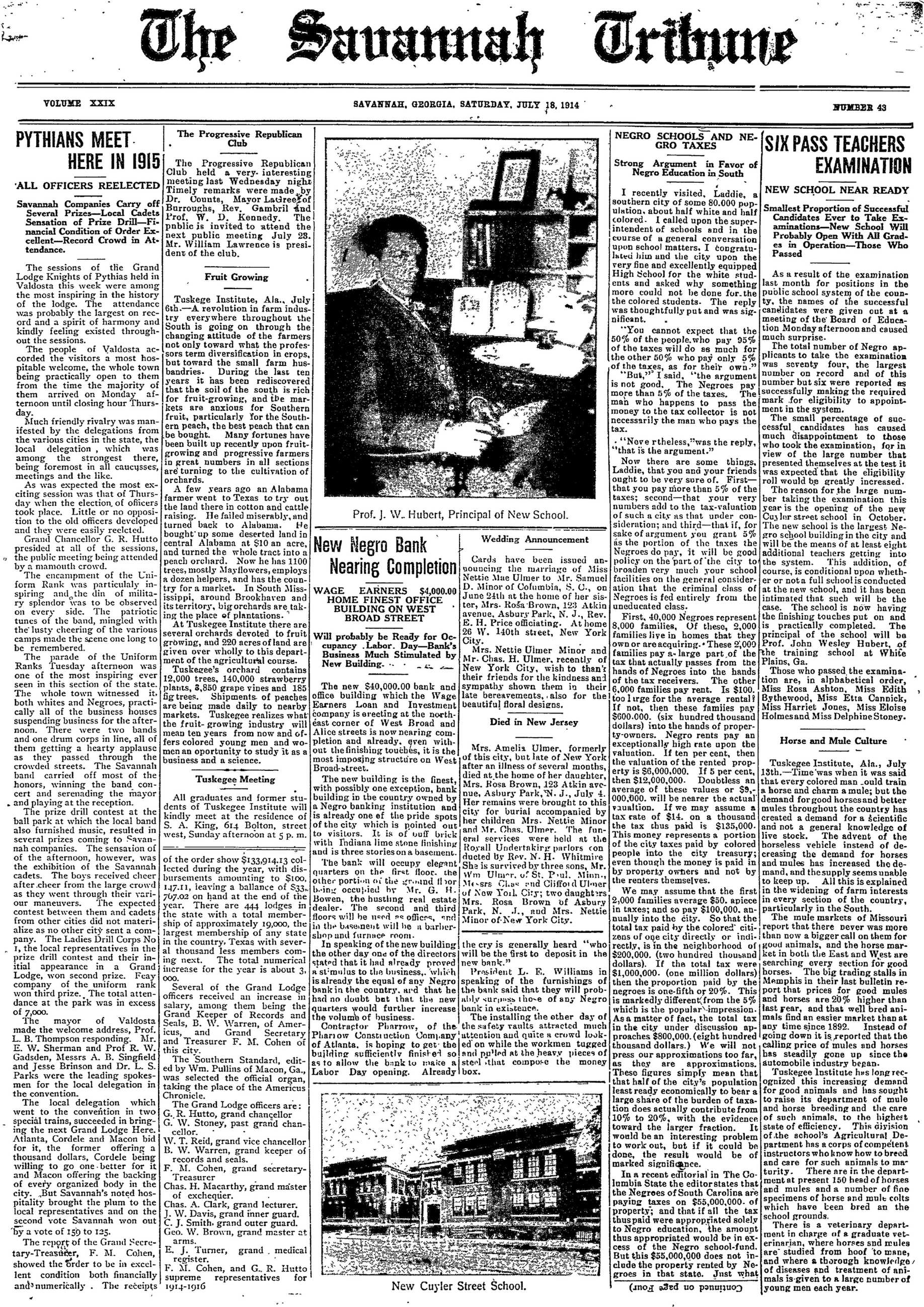
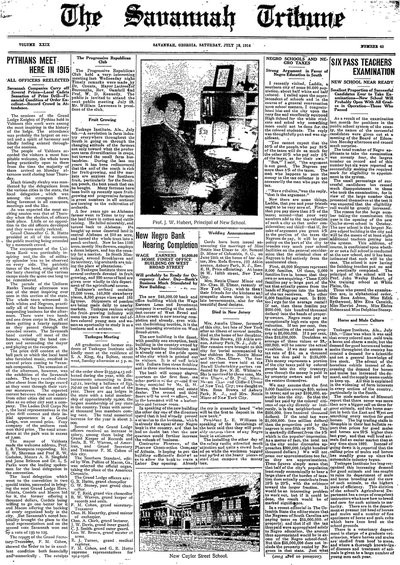
Page text (machine-generated)
The Savannah Tribune
VOLUME XXIX
PYTHIANS MEET HERE IN 1915
PYTHIANS MEET HERE IN 1915
ALL OFFICERS REELECTED
Savannah Companies Carry off Several Prizes—Local Cadets Sensation of Prize Drill—Financial Condition of Order Excellent—Record Crowd in Attendance.
The sessions of the Grand Lodge Knights of Pythias held in Valdosta this week were among the most inspiring in the history of the lodge. The attendance was probably the largest on record and a spirit of harmony and kindly feeling existed throughout the sessions.
The people of Valdosta accorded the visitors a most hospitable welcome, the whole town being practically open to them from the time the majority of them arrived on Monday afternoon until closing hour Thursday.
Much friendly rivalry was manifested by the delegations from the various cities in the state, the local delegation, which was among the strongest there, being foremost in all caucuses, meetings and the like.
As was expected the most exciting session was that of Thursday when the election of officers took place. Little or no opposition to the old officers developed and they were easily reelected.
Grand Chancellor G. R. Hutto presided at all of the sessions, the public meeting being attended by a mamouth crowd. The encampment of the Uniform Rank was particularly inspiring and the din of military splendor was to be observed on every side. The patriotic tunes of the band, mingled with the lusty cheering of the various camps made the scene one long to be remembered.
The parade of the Uniform Ranks Tuesday afternoon was one of the most inspiring ever seen in this section of the state. The whole town witnessed it both whites and Negroes, practically all of the business houses suspending business for the afternoon. There were two bands and one drum corps in line, all of them getting a hearty applause as they passed through the crowded streets. The Savannah band carried off most of the honors, winning the band concert and serenading the mayor and playing at the reception.
The prize drill contest at the ball park at which the local band also furnished music, resulted in several prizes coming to Savannah companies. The sensation of of the afternoon, however, was the exhibition of the Savannah cadets. The boys received cheer after cheer from the large crowd as they went through their various maneuvers. The expected contest between them and cadets from other cities did not materialize as no other city sent a company. The Ladies Drill Corps No 1, the local representatives in the prize drill contest and their initial appearance in a Grand Lodge, won second prize. Feay company of the uniform rank won third prize. The total attendance at the park was in excess of 7,000.
The mayor of Valdosta made the welcome address, Prof. L. B. Thompson responding. Mr. E. W. Sherman and Prof R. W. Gadsden, Messrs A. B. Singfield and Jesse Brinson and Dr. L. S. Parks were the leading spokesmen for the local delegation in the convention.
The local delegation which went to the convention in two special trains, succeeded in bringing the next Grand Lodge Here. Atlanta, Cordele and Macon bid for it, the former offering a thousand dollars, Cordele being willing to go one better for it and Macon offering the backing of every organized body in the city. But Savannah's noted hospitality brought the plum to the local representatives and on the second vote Savannah won out by a vote of 150 to 125.
The report of the Grand Secretary-Treasurer, F. M. Cohen, showed the order to be in excellent condition both financially and numerically. The receipts
The Progressive Republican Club
The Progressive Republican Club held a very interesting meeting last Wednesday night Timely remarks were made by Dr. Counts, Mayor LaGreef of Burroughs, Rev. Gambril and Prof. W. D. Kennedy. The public is invited to attend the next public meeting July 23. Mr. William Lawrence is president of the club.
Fruit Growing
Tuskegee Institute, Ala., July 6th.—A revolution in farm industry everywhere throughout the South is going on through the changing attitude of the farmers not only toward what the professors term diversification in crops, but toward the small farm husbandries. During the last ten years it has been rediscovered that the soil of the south is rich for fruit-growing, and the markets are anxious for Southern fruit, particularly for the Southern peach, the best peach that can be bought. Many fortunes have been built up recently upon fruit-growing and progressive farmers in great numbers in all sections are turning to the cultivation of orchards.
A few years ago an Alabama farmer went to Texas to try out the land there in cotton and cattle raising. He failed miserably, and turned back to Alabama. He bought up some deserted land in central Alabama at $10 an acre, and turned the whole tract into a peach orchard. Now he has 1100 trees, mostly Mayflowers, employs a dozen helpers, and has the country for a market. In South Mississippi, around Brookhaven and its territory, big orchards are taking the place of plantations. At Tuskegee Institute there are several orchards devoted to fruit growing, and 220 acres of land are given over wholly to this department of the agricultural course.
Tuskegee's orchard contains 12,000 trees, 140,000 strawberry plants, 8,350 grape vines and 185 fig trees. Shipments of peaches are being made daily to nearby markets. Tuskegee realizes what the fruit-growing industry will mean ten years from now and offers colored young men and women an opportunity to study it as a business and a science.
Tuskegee Meeting
All graduates and former students of Tuskegee Institute will kindly meet at the residence of S. A. King, 614 Bolton, street west, Sunday afternoon at 5 p. m.
of the order show $133,914.13 collected during the year, with disbursements amounting to $100, 147.11, leaving a ballance of $33, 707.02 on hand at the end of the year. There are 444 lodges in the state with a total membership of approximately 19,000, the largest membership of any state in the country. Texas with several thousand less members coming next. The total numerical increase for the year is about 3, 000.
Several of the Grand Lodge officers received an increase in salary, among them being the Grand Keeper of Records and Seals, B. W. Warren, of Americus, and Grand Secretary and Treasurer F. M. Cohen of this city.
The Southern Standard, edited by Wm. Pullins of Macon, Ga., was selected the official organ, taking the place of the Americus Chronicle.
The Grand Lodge officers are: G. R. Hutto, grand chancellor G. W. Stoney, past grand chancellor.
W. T. Reid, grand vice chancellor B. W. Warren, grand keeper of records and seals.
F. M. Cohen, grand secretary-Treasurer
Chas. H. Macarthy, grand master of exchequer.
Chas. A. Clark, grand lecturer.
J. W. Davis, grand inner guard.
C. J. Smith, grand outer guard.
Geo. W. Brown, grand master at arms.
F. M. Cohen, and G. R. Hutto supreme representatives for 1014-1016
SAVANNAH, GEORGIA, SATURDAY, JULY 18, 1914
THE
Prof. J. W. Hubert, Principal of New School.
New Negro Bank Nearing Completion
WAGE EARNERS $4,000.00
HOME FINEST OFFICE
BUILDING ON WEST
BROAD STREET
Will probably be Ready for Occupancy. Labor. Day—Bank's Business Much Stimulated by New Building.
The new $40,000.00 bank and office building which the Wage Earners Loan and Investment company is erecting at the northeast corner of West Broad and Alice streets is now nearing completion and already, even without the finishing touches, it is the most imposing structure on West Broad street.
The new building is the finest, with possibly one exception, bank building in the country owned by a Negro banking institution and is already one of the pride spots of the city which is pointed out to visitors. It is of buff brick with Indiana lime stone finishing and is three stories on a basement. The bank will occupy elegant quarters on the first floor. the other portion of the ground floor being occupied by Mr. G. H. Bowen, the hustling real estate dealer. The second and third floors will be used as offices, and in the basement will be a barbershop and furnace room.
In speaking of the new building the other day one of the directors stated that it had already proved a stimulus to the business, which is already the equal of any Negro bank in the country, and that he had no doubt but that the new quarters would further increase the volume of business. Contractor Pharrow, of the Pharrow Construction Company of Atlanta, is hoping to get the building sufficiently finished so as to allow the bank to make a Labor Day opening. Already
THE MUSEUM OF THE WEST
New Cuyler Street School.
Wedding Announcement
Cards have been issued announcing the marriage of Miss Nettie Mae Ulmer to Mr. Samuel D. Minor of Columbia, S. C., on June 24th at the home of her sister, Mrs. Rosa Brown, 123 Atkin avenue, Asbury Park, N. J., Rev. E. H. Price officiating. At home 26 W. 140th street, New York City. Mrs. Nettie Ulmer Minor and Mr. Chas. H. Ulmer, recently of New York City, wish to than't their friends for the kindness and sympathy shown them in their late bereavements, also for the beautiful floral designs.
Died in New Jersey
Mrs. Amelia Ulmer, formerly of this city, but late of New York after an illness of several months, died at the home of her daughter, Mrs. Rosa Brown, 123 Atkin avenue, Asbury Park, N. J., July 4. Her remains were brought to this city for burial accompanied by her children Mrs. Nettie Minor and Mr. Chas. Ulmer. The funeral services were held at the Royall Undertaking parlors conducted by Rev. N. H. Whitmire She is survived by three sons, Mr. Wm Ulmer, of St. Paul, Minn., Messrs Chas and Clifford Ulmer of New York City; two daughters Mrs. Rosa Brown of Asbury Park, N. J., and Mrs. Nettie Minor of New York City.
the cry is generally heard "who will be the first to deposit in the new bank."
President L. E. Williams in speaking of the furnishings of the bank said that they will probably surpass those of any Negro bank in existence.
The installing the other day of the safety vaults attracted much attention and quite a crowd looked on while the workmen tugged and pulled at the heavy pieces of steel that compose the money box.
THE HOTEL
NEGRO SCHOOLS AND NEGRO TAXES
Strong Argument in Favor of Negro Education in South
I recently visited, Laddie, a southern city of some 80,000 population, about half white and half colored. I called upon the superintendent of schools and in the course of a general conversation upon school matters, I congratulated him and the city upon the very fine and excellently equipped High School for the white students and asked why something more could not be done for the the colored students. The reply was thoughtfully put and was significant.
"You cannot expect that the 50% of the people, who pay 95% of the taxes will do as much for the other 50% who pay only 5% of the taxes, as for their own."
"But," I said, "the argument is not good. The Negroes pay more than 5% of the taxes. The man who happens to pass the money to the tax collector is not necessarily the man who pays the tax.
"Nove rtheless," was the reply, "that is the argument."
Now there are some things, Laddie, that you and your friends ought to be very sure of. First—that you pay more than $5% of the taxes; second—that your very numbers add to the tax-valuation of such a city as that under consideration; and third—that if, for sake of argument you grant $5% as the portion of the taxes the Negroes do pay, it will be good policy on the part of the city to broaden very much your school facilities on the general consideration that the criminal class of Negroes is fed entirely from the uneducated class.
First, 40,000 Negroes represent 8,000 families. Of these, 2,000 families live in homes that they own or are acquiring. These 2,000 families pay a large part of the tax that actually passes from the hands of Negroes into the hands of the tax receivers. The other 6,000 families pay rent. Is $100. too large for the average rental? If not, then these families pay $600.000. (six hundred thousand dollars) into the hands of property owners. Negro rents pay an exceptionally high rate upon the valuation. If ten per cent, then the valuation of the rented property is $6,000.000. If 5 per cent, then $12,000.000. Doubtless an average of these values or $9,000.000 will be nearer the actual valuation. If we may assume a tax rate of $14. on a thousand the tax thus paid is $135,000. This money represents a portion of the city taxes paid by colored people into the city treasury; even though the money is paid in by property owners and not by the renters themselves.
We may assume that the first 2,000 families average $50. apiece in taxes; and so pay $100,000. annually into the city. So that the total tax paid by the colored citizens of one city directly or indirectly, is in the neighborhood of $200,000. (two hundred thousand dollars). If the total tax were $1,000,000. (one million dollars) then the proportion paid by the negroes is one-fifth or 20%. This is markedly different from the 5% which is the popular impression. As a matter of fact, the total tax in the city under discussion approaches $800,000. (eight hundred thousand dollars.) We will not press our approximations too far, as they are approximations. These figures simply mean that that half of the city's population least ready economically to bear a large share of the burden of taxation does actually contribute from 10% to 20%, with the evidence toward the larger fraction. It would be an interesting problem to work out, but if it could be done, the result would be of marked significance.
In a recent editorial in The Columbia State the editor states that the Negroes of South Carolina are paying taxes on $55,000,000. of property; and that if all the tax thuspaid were appropriated solely to Negro education, the amount thus appropriated would be in excess of the Negro school-fund. But this $55,000,000 does not include the property rented by Negroes in that state. Just what
NUMBER 43
SIX PASS TEACHERS EXAMINATION
NEW SCHOOL NEAR READY
Smallest Proportion of Successful Candidates Ever to Take Examinations—New School Will Probably Open With All Grades in Operation—Those Who Passed
As a result of the examination last month for positions in the public school system of the county, the names of the successful candidates were given out at a meeting of the Board of Education Monday afternoon and caused much surprise.
The total number of Negro applicants to take the examination was seventy four, the largest number on record and of this number but six were reported as successfully making the required mark for eligibility to appointment in the system. The small percentage of successful candidates has caused much disappointment to those who took the examination, for in view of the large number that presented themselves at the test it was expected that the eligibility roll would be greatly increased.
The reason for the large number taking the examination this year is the opening of the new Cuyler street school in October. The new school is the largest Negro school building in the city and will be the means of at least eight additional teachers getting into the system. This addition, of course, is conditional upon whether or not a full school is conducted at the new school, and it has been intimated that such will be the case. The school is now having the finishing touches put on and is practically completed. The principal of the school will be Prof. John Wesley Hubert, of the training school at White Plains, Ga.
Those who passed the examination are, in alphabetical order, Miss Rosa Ashton, Miss Edith Bythewood, Miss Etta Cannick, Miss Harriet Jones, Miss Eloise Holmes and Miss Delphine Stoney.
Horse and Mule Culture
Tuskegee Institute, Ala., July 13th.—Time was when it was said that every colored man _ould train a horse and charm a mule; but the demand for good horses and better mules throughout the country has created a demand for a scientific and not a general knowledge of live stock. The advent of the horseless vehicle instead of decreasing the demand for horses and mules has increased the demand, and the supply seems unable to keep up. All this is explained in the widening of farm interests in every section of the country, particularly in the South.
The mule markets of Missouri report that there never was more than now a bigger call on them for good animals, and the horse market in both the East and West are searching every section for good horses. The big trading stalls in Memphis in their last bulletin report that prices for good mules and horses are 20% higher than last year, and that well bred animals find an easier market than at any time since 1892. Instead of going down it is reported that the calling price of mules and horses has steadily gone up since the automobile industry began.
Tuskegee Institute has long recognized this increasing demand for good animals and has sought to raise its department of mule and horse breeding and the care of such animals, to the highest state of efficiency. This division of the school's Agricultural Department has a corps of competent instructors who know how to breed and care for such animals to maturity. There are in the department at present 150 head of horses and mules and a number of fine specimens of horse and mule colts which have been bred an the school grounds.
There is a veterinary department in charge of a graduate veterinarian, where horses snd mules are studied from hoof to mane, and where a thorough knowledge of diseases and treatment of animals is given to a large number of young men each year.
AFTERNOON GOWNS.
Crapes Are Used With Net
For Garden Party and Casino.
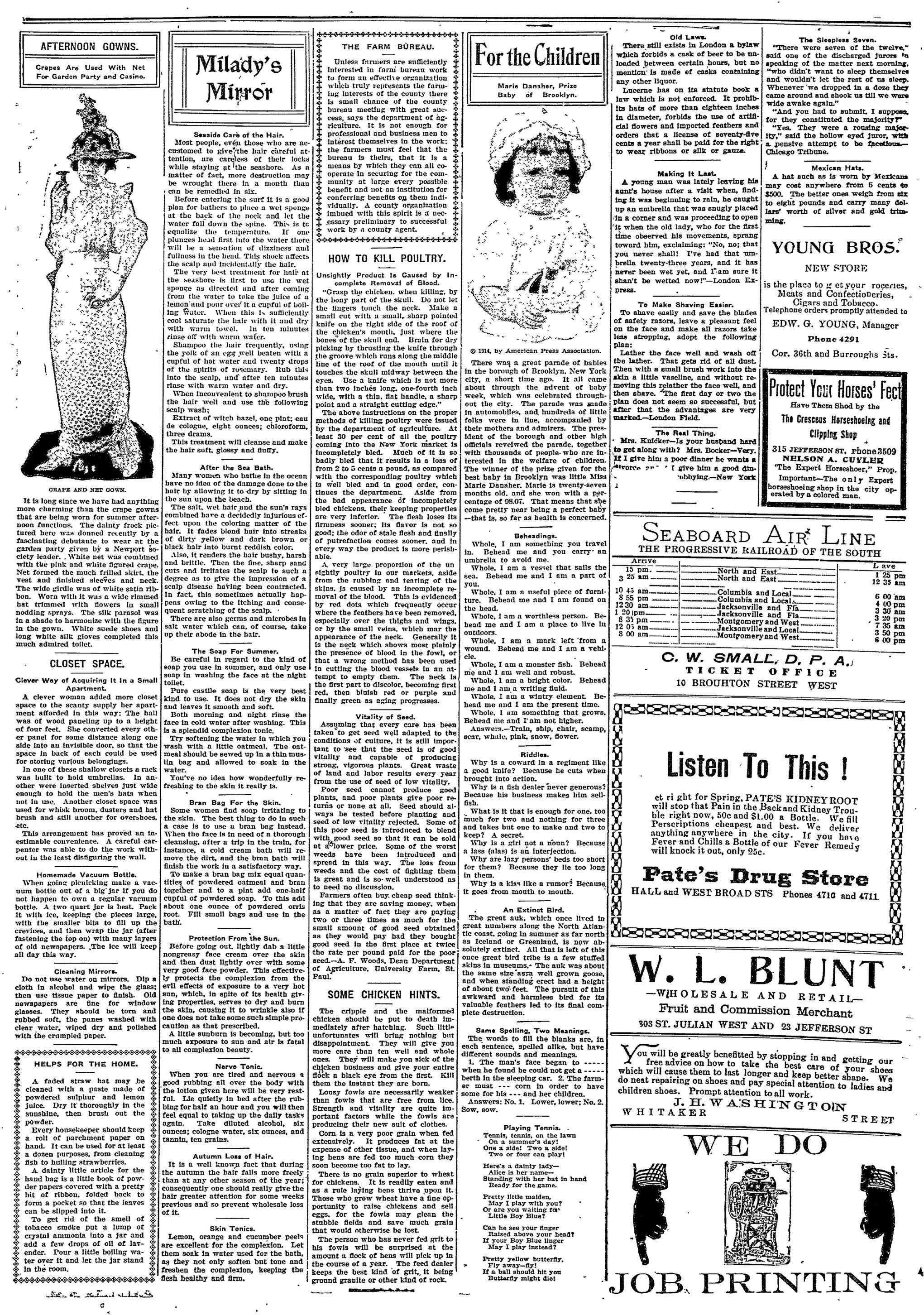
GRAPE AND NET GOWN.
It is long since we have had anything more charming than the crape gowns that are being worn for summer afternoon functions. The dainty frock pictured here was donned recently by a fascinating debutante to wear at the garden party given by a Newport society leader. White net was combined with the pink and white figured crape. Net formed the much frilled skirt, the vest and finished sleeves and neck. The wide girdle was of white satin ribbon. Worn with it was a wide rlmmed hat trimmed with flowers in small nodding sprays. The silk parasol was in a shade to harmonize with the figure in the gown. White suede shoes and long white silk gloves completed this much admired toilet.
CLOSET SPACE
Clever Way of Acquiring It In a Small Apartment.
A clever woman added more closet space to the scanty supply her apartment afforded in this way: The hall was of wood paneling up to a height of four feet. She converted every other panel for some distance along one side into an invisible door, so that the space in back of each could be used for storing various belongings.
In one of these shallow closets a rack was built to hold umbrellas. In another were inserted shelves just wide enough to hold the men's hats when not in use. Another closet space was used for whisk broom, dusters and hat brush and still another for overshoes, etc.
This arrangement has proved an investible convenience. A careful carpenter was able to do the work without in the least distinguisher the wall.
Homemade Vacuum Bottle.
When going plucking make a vacuum bottle out of a big jar if you do not happen to own a regular vacuum bottle. A two quart jar is best. Pack it with ice, keeping the pieces large, with the smaller bits to fill up the crevices, and then wrap the jar (after fastening the top on) with many layers of old newspapers. The ice will keep all day this way.
Cleaning Mirrors
Do not use water on mirrors. Dip a cloth in alcohol and wipe the glass; then use tissue paper to finish. Old newspapers are fine for window glasses. They should be torn and rubbed soft, the panes washed with clear water, wiped dry and polished with the crumpled paper.
A faded straw hat may be cleaned with a paste made of powdered sulphur and lemon juice. Dry it thoroughly in the sunshine, then brush out the powder.
Every housekeeper should keep a roll of parchment paper on hand. It can be used for at least a dozen purposes, from cleaning fish to hulling strawberries.
A dainty little article for the hand bag is a little book of powder papers covered with a pretty bit of ribbon, folded back to form a pocket so that the leaves can be slipped into it.
To get rid of the smell of tobacco smoke put a lump of crystal ammonia into a jar and add a few drops of oil of lavender. Pour a little boiling water over it and let the jar stand in the room.
```markdown
```
Milady's Mirror
Seaside Care of the Hair.
Most people, even those who are accustomed to give the hair careful attention, are careless of their locks while staying at the seashore. As a matter of fact, more destruction may be wrought there in a month than can be remedied in six.
Before entering the surf it is a good plan for bathers to place a wet sponge at the back of the neck and let the water fall down the spine. This is to equalize the temperature. If one plunges head first into the water there will be a sensation of dizziness and fullness in the head. This shock affects the scalp and incidentally the hair.
The very best treatment for hair at the seashore is first to use the wet sponge as directed and after coming from the water to take the juice of a lemon and pour over it a cupful of boiling water. When this is sufficiently cool saturate the hair with it and dry with warm towel. In ten minutes rinse off with warm wafer.
Shampoo the hair frequently, using the yolk of an egg well beaten with a cupful of hot water and twenty drops of the spirits of rosemary. Rub this into the scalp, and after ten minutes rinse with warm water and dry. When inconvenient to shampoo brush the hair well and use the following scalp wash; Extract of witch hazel, one pint; eau de cologne, eight ounces; chloroform, three drams. This treatment will cleanse and make the hair soft, glossy and fluffy.
After the Sea Bath.
Many women who battle in the ocean have no idea of the damage done to the hair by allowing it to dry by sitting in the sun upon the beach.
The salt, wet hair and the sun's rays combined have a decidedly injurious effect upon the coloring matter of the hair. It fades blond hair into streaks of dirty yellow and dark brown or black hair into burnt reddish color.
Also, it renders the hair bushy, harsh and brittle. Then the fine, sharp sand cuts and irritates the scalp to such a degree as to give the impression of a scalp disease having been contracted.
In fact, this sometimes actually happens owing to the itching and consequent scratching of the scalp.
There are also germs and microbes in salt water which can, of course, take up their abode in the hair.
The Soap For Summer.
Be careful in regard to the kind of soap you use in summer, and only use soap in washing the face at the night toilet.
Pure castile soap is the very best kind to use. It does not dry the skin and leaves it smooth and soft.
Both morning and night rinse the face in cold water after washing. This is a splendid complexion tonic.
Try softening the water in which you wash with a little oatmeal. The oatmeal should be sewed up in a thin muslin bag and allowed to soak in the water.
You've no idea how wonderfully refreshing to the skin it really is.
Bran Bag For the Skin.
Some women find soap irritating to the skin. The best thing to do in such a case is to use a bran bag instead. When the face is in need of a thorough cleansing, after a trip in the train, for instance, a cold cream bath will remove the dirt, and the bran bath will finish the work in a satisfactory way. To make a bran bag mix equal quantities of powdered oatmeal and bran together and to a pint add one-half cupful of powdered soap. To this add about one ounce of powdered orris root. Fill small bags and use in the bath.
Protection From the Sun.
Before going out, lightly dab a little nongreasy face cream over the skin and then dust lightly over with some very good face powder. This effectively protects the complexion from the evil effects of exposure to a very hot sun, which, in spite of its health giving properties, serves to dry and burn the skin, causing it to wrinkle also if one does not take some such simple precaution as that prescribed.
A little sunburn is becoming, but too much exposure to sun and air is fatal to all complexion beauty.
Nerve Tonic.
When you are tired and nervous a good rubbing all over the body with the lotion given here will be very restful. Lie quietly in bed after the rubbing for half an hour and you will then feel equal to taking up the daily tasks again. Take diluted alcohol, six ounces; cologne water, six ounces, and tannin, ten grains.
Autumn Loza of Hair.
It is a well known fact that during the autumn the hair falls more freely than at any other season of the year; consequently one should really give the hair greater attention for some weeks previous and so prevent wholesale loss of it.
Skin Tonics.
Lemon, orange and cucumber peels are excellent for the complexion. Let them soak in water used for the bath, as they not only soften but tone and freshen the complexion, keeping the flesh healthy and firm.
THE FARM BUREAU.
Unless farmers are sufficiently interested in farm bureau work to form an effective organization which truly represents the farming interests of the county there is small chance of the county bureau meeting with great success, says the department of agriculture. It is not enough for professional and business men to interest themselves in the work; the farmers must feel that the bureau is thelrs, that it is a means by which they can all cooperate in securing for the community at large every possible benefit and not an institution for conferring benefits on them individually. A county organization imbued with this spirit is a necessary preliminary to successful work by a county agent.
HOW TO KILL POULTRY.
Unsightly Product Is Caused by Incomplete Removal of Blood.
"Grasp the chicken, when killing, by the bony part of the skull. Do not let the fingers touch the neck. Make a small cut with a small, sharp pointed knife on the right side of the roof of the chicken's mouth, just where the bones of the skull end. Brain for dry pickling by thrusting the knife through the groove which runs along the middle line of the roof of the mouth until it touches the skull midway between the eyes. Use a knife which is not more than two inches long, one-fourth inch wide, with a thin, flat handle, a sharp point and a straight cutting edge."
The above instructions on the proper methods of killing poultry were issued by the department of agriculture. At least 30 per cent of all the poultry coming into the New York market is incompletely bled. Much of it is so badly bled that it results in a loss of from 2 to 5 cents a pound, as compared with the corresponding poultry which is well bled and in good order, continues the department. Aside from the bad appearance of incompletely bled chickens, their keeping properties are very inferior. The flesh loses its firmness sooner; its flavor is not so good; the odor of stale flesh and finally of putrefaction comes sooner, and in every way the product is more perishable.
A very large proportion of the un sightly poultry in our markets, aside from the rubbing and tearing of the skins, is caused by an incomplete removal of the blood. This is evidenced by red dots which frequently occur where the feathers have been removed, especially over the thighs and wings, or by the small veins, which mar the appearance of the neck. Generally it is the neck which shows most plainly the presence of blood in the fowl, or that a wrong method has been used in cutting the blood vessels in an attempt to empty them. The neck is the first part to discolor, becoming first red, then blubish red or purple and finally green as aging progresses.
Vitality of Seed.
Assuming that every care has been taken to get seed well adapted to the conditions of culture, it is still important to see that the seed is of good vitality and capable of producing strong, vigorous plants. Great waste of land and labor results every year from the use of seed of low vitality. Poor seed cannot produce good plants, and poor plants give poor returns or none at all. Seed should always be tested before planting and seed of low vitality rejected. Some of this poor seed is introduced to blend with good seed so that it can be sold at a lower price. Some of the worst weeds have been introduced and spread in this way. The loss from weeds and the cost of fighting them is great and is so well understood as to need no discussion.
Farmers often buy. cheap seed thinking that they are saving money, when as a matter of fact they are paying two or three times as much for the small amount of good seed obtained as they would pay had they bought good seed in the first place at twice the rate per pound paid for the poor seed.A. F. Woods, Dean Department of Agriculture, University Farm, St. Paul.
SOME CHICKEN HINTS.
The cripple and the malformed chicken should be put to death immediately after hatching. Such little unfortunates will bring nothing but disappointment. They will give you more care than ten well and whole ones. They will make you sick of the chicken business and give your entire flock a black eye from the first. Kill them the instant they are born.
Lousy fowls are necessarily weaker than fowls that are free from lice. Strength and vitality are quite important factors while the fowls are producing their new suit of clothes.
Corn is a very poor grain when fed extensively. It produces fat at the expense of other tissue, and when laying hens are fed too much corn they soon become too fat to lay.
There is no grain superior to wheat for chickens. It is readily eaten and as a rule laying hens thrive upon it. Those who grow wheat have a fine opportunity to raise chickens and sell eggs, for the fowls may glean the stubble fields and save much grain that would otherwise be lost.
The person who has never fed grit to his fowls will be surprised at the amount a flock of hens will pick up in the course of a year. The feed dealer keeps the best kind of grit, it being ground granite or other kind of rock.
For the Children
Marie Dansher, Prize
Baby of Brooklyn.
© 1914, by American Press Association.
There was a great parade of babies in the borough of Brooklyn, New York city, a short time ago. It all came about through the advent of baby week, which was celebrated throughout the city. The parade was made in automobiles, and hundreds of little folks were in line, accompanied by their mothers and admirers. The president of the borough and other high officials revelled the parade, together with thousands of people who are interested in the welfare of children. The winner of the prize given for the best baby in Brooklyn was little Miss Marie Danaher. Marie is twenty-seven months old, and she won with a percentage of 98.07. That means that she come pretty near being a perfect baby—that is, so far as health is concerned.
Beheadings.
Whole. I am a wintry element. Behead me and I am the present time. Whole. I am something that grows. Behead me and I am not higher. Answers.—Train, ship, chair, scamp, scar, whale, pink, snow, flower.
Riddles.
Why is a coward in a regiment like a good knife? Because he cuts when brought into action.
Why is a fish dealer never generous? Because his business makes him selfish.
What is it that is enough for one, too much for two and nothing for three and takes but one to make and two to keep? A secret.
Why is a girl not a noun? Because a lass (alas) is an interjection.
Why are lazy persons' beds too short for them? Because they lie too long in them.
Why is a kiss like a rumor? Because it goes from mouth to mouth.
An Extinct Bird.
The great auk, which once lived in great numbers along the North Atlantic coast, going in summer as far north as Iceland or Greenland, is now absolutely extinct. All that is left of this once great bird tribe is a few stuffed skins in museums. The auk was about the same size as an well grown goose, and when standing erect had a height of about two feet. The pursuit of this awkward and harmless bird for its valuable feathers led to its final complete destruction.
Same Spelling, Two Meanings.
The words to fill the blanks are, in each sentence, spelled alike, but have different sounds and meanings.
1. The man's face began to -----
when he found he could not get a -----
berth in the sleeping car. 2. The farmer
must --- corn in order to have
some for his --- and her children.
Answers: No. 1. Lower, lower; No. 2.
Sow, sow.
Playing Tennis.
Tennis, tennis, on the lawn
On a summer's day!
One a side! Two a side!
Two or four can play!
Here's a dainty lady—
Alice is her name—
Standing with her bat in hand
Ready for the game.
Pretty little maiden.
May I play with you?
Or are you waiting for?
Little Boy Blue?
Can he see your finger
Raised above your head?
If your Boy Blue linger
May I play instead?
Pretty yellow butterfly,
Fly away—fly!
If a ball should hit you
Butterfly might die!
Arrive L ave
15 pm. North and East 1 25 pm
3 25 am North and East 12 35 am
10 45 am Columbia and Local 6 00 am
8 55 pm Columbia and Local 4 00 pm
12 30 am Jacksonville and Fla 3 30 am
1 20 pm Jacksonville and Fla 3 20 pm
8 35 pm Montgomery and West 7 35 am
12 05 am Jacksonville and Local 3 50 pm
8 00 am Montgomery and West 6 00 pm
et right for Spring, PATE'S KIDNEYROOT will stop that Pain in the Back and Kidney Trouble right now, 50c and $1.00 a Bottle. We fill Perscriptions cheapest and best. We deliver anything anywhere in the city. If you have Fever and Chills a Bottle of our Fever Remedy will knock it out, only 25c.
-WHOLESALE AND RETAIL
Fruit and Commission Merchant
303 ST. JULIAN WEST AND 23 JEFFERSON ST
You will be greatly benefitted by stopping in and getting our free advice on how to take the best care of your shoes which will cause them to last longer and keep better shape. We do neat repairing on shoes and pay special attention to ladies and children shoes. Prompt attention to all work.
WE DO
Old Laws
There still exists in London a bylaw which forbids a cask of beer to be unloaded between certain hours, but no mention is made of casks containing any other liquor.
Lucerne has on its statute book a law which is not enforced. It prohibits hats of more than eighteen inches in diameter, forbids the use of artificial flowers and imported feathers and orders that a license of seventy-five cents a year shall be paid for the right to wear ribbons or alk or gauze.
Making It Last.
A young man was lately leaving his aunt's house after a visit when, finding it was beginning to rain, he caught up an umbrella that was snugly placed in a corner and was proceeding to open it when the old lady, who for the first time observed his movements, sprang toward him, exclaiming: "No, no; that you never shall! I've had that umbrella twenty-three years, and it has never been wet yet, and I am sure it shan't be wetted now!"—London Express.
To Make Shaving Easier.
To shave easily and save the blades of safety razors, leave a pleasant feel on the face and make all razors take less stropping, adopt the following plan:
Lather the face well and wash off the lather. That gets rid of all dust. Then with a small brush work into the skin a little vaseline, and without removing this relather the face well, and then shave. The first day or two the plan does not seem so successful, but after that the advantages are very marked—London Field.
The Real Thing.
Mrs. Knicker-Is your husband hard to get along with? Mrs. Bocker-Very. If I give him a poor dinner he wants a divorce and I give him a good dining obbying.-New York
"There were seven of the twelve," said one of the discharged jurors "u speaking of the matter next morning, "who didn't want to sleep themselves and wouldn't let the rest of us sleep. Whenever we dropped in a doze they came around and shook us till we were wide awake again." "And you had to submit, I suppose, for they constituted the majority?" "Yes. They were a rousing majority," said the hollow eyed juror, with a pensive attempt to be faceless—Chicago Tribune.
Mexican Hats.
A hat such as is worn by Mexicans may cost anywhere from 5 cents to $500. The better ones weigh from six to eight pounds and carry many dollars' worth of silver and gold trimming.
YOUNG BROS.
NEW STORE
is the place to get your roceries,
Meats and Confectioneries,
Cigars and Tobacco.
Telephone orders promptly attended to
EDW. G. YOUNG, Manager
Phone 4291
Cor. 36th and Burroughs Sts.
Protect Your Horses' Fect
Have Them Shod by the
The Cresceus Horseshoeing and
Clipping Shop
315 JEFFERSON ST. Phone 3509
NELSON A. CUYLER
"The Expert Horseshoer," Prop.
Important—The only Expert
horseshoeing shop in the city op-
erated by a colored man.
AIR LINE
RAILROAD OF THE SOUTH
Lave
East 1 25 pm
East 12 35 am
and Local 6 00 am
and Local 4 00 pm
and Fla 3 30 am
and Fla 3 20 pm
and West 7 35 am
and Local 3 50 pm
and West 6 00 pm
L, D, P. A.
OFFICE
STREET WEST
Do This!
TE'S KIDNEYROOT
Back and Kidney Trou-
100 a Bottle. We fill
and best. We deliver
the city. If you have
of our Fever Remedy
Drug Store
Phones 4710 and 4711
BLUNT
AND RETAIL
Session Merchant
ND 23 JEFFERSON ST
by stopping in and getting our
the best care of your shoes
and keep better shape. We
special attention to ladies and
to all work.
STREET
DO
INTING
There is a moral in this little story of child life.
"Mamma," asked little three-year-old Freddie, "are we going to heaven some day?"
"Yes, dear; I fervently hope so," was the reply.
"I wish papa could go, too," continued the little fellow.
"Well, and don't you think he will?" asked his mother.
"Oh, no," replied Freddie; "he could not leave his business!"
---
Dr. G. W. Smith, Pres. Dr. C. B. Tys
East Side S
THE BEST PRIVATE PLACE FOR
SICI
MODERN EQUIPMENT
Terms Re
CALL, WRITE OR PHONE
EAST GWINNETT ST,
Phone 4941
YOUNG
Is the Place to get your Ice C
Come to us or we
phone 2932
Grand Spr
Colored Mill
464 West B
Dr. C. B. Tyson, Treas. Dr. N. W. Este, Sect'ry
Side Sanitarium
PRIVATE PLACE FOR COLORED PEOPLE WHEN
SICK
ERN EQUIPMENT GOOD NURSING
Terms Reasonable
E OR PHONE
BENNETT ST, & ATLANTIC AVENUE
Savann ah, eorgia
JUNG BROS.
to get your Ice Cream, Cigars and Tobaccos
Come to us or we will come to you.
507 WEST BROAD STREET
and Spring Styles
Red Millinery Store
164 West Broad Street
Dr. G. W. Smith, Pres. Dr. C. B. Tyson, Treas. Dr. N. W. Este, Sect'ry East Side Sanitarium
THE BEST PRIVATE PLACE FOR COLORED PEOPLE WHEN SICK
EAST GWINNETT ST, & ATLANTIC AVENUE Phone 4941 Savann ah, eorgia
Is the Place to get your Ice Cream, Cigars and Tobaccos
Come to us or we will come to you.
hone 2932 507 WEST BROAD STREET
Grand Spring Styles Colored Millinery Store 464 West Broad Street
SEABORAD AIR LINE RAILWAY
Important Change of S
No. 11. No. 13
7:00 am. 6:00 pm... Lv. Savanna
7:47 am. 6:43 pm... Cuyler
8:05 am. 7:20 pm... Lanier
8:53 am. 8:00 pm... Claxton
9:20 am. 8:32 pm... Collins
9:50 am. 9:08 pm... Lyons
10:05 am. 9:22 pm... Vidalia
10:30 am. 9:53 pm... Mt. Ver
10:59 am. 10:25 pm... Alamo
11:25 am. 10:53 pm... Helena
12:25 pm. 12:01 am... Abbevil
12:45 pm. 12:24 am... Rochell
12:55 pm. 12:37 am... Pitts...
2 00 pm. 1:15 am... Cordele
3:10 pm. 2:40 am... Americw
4:10 pm. 3:43 am... Richland
4:32 pm. 4:01 am... Lumpki
6:13 pm. 5:43 am... Hurtsbor
8:15 pm. 8:10 am... Ar... Montgom
C. W. SMALLS, Division Park
Important Change of Schedule, April 12, 1914
3 No. 14 No. 12.
m... Lv. Savannah Ar. 8:00 pm. 8:35 pm
m... Cuyler 7:15 am. 7:45 pm
m... Lanier 7:00 am. 7:27 pm
m... Claxton 6:10 am. 6:40 pm
m... Collins 5:40 am. 6:10 pm
m... Lyons 5:08 am. 5:40 pm
m... Vidalia 4:55 am. 5:25 pm
m... Mt. Vernon 4:27 am. 4:57 pm
m... Alamo 4:02 am. 4:27 pm
m... Helena 3:35 am. 4:03 pm
m... Abbeville 2:44 am. 3:08 pm
m... Rochelle 2:25 pm. 2:46 pm
m' Pitts 2:15 am. 2:36 pm
m... Cordele 1:43 am. 2:05 pm
m... Americus 12:25 am. 12:31 pm
m... Richland 11:30 am. 11:35 pm
m... Lumpkin 11:10 am. 11:06 pm
m... Hurtsboro 9:32 am. 9:30 pm
m... Ar... Montgomery Lv. 7:30 pm. 7:20 am
LLS, Division Passenger Agent, Savannah, Ga.
No. 11. No. 13 No. 14 No. 12.
7:00 am. 6:00 pm.... Lv. Savannah..... Ar. 8:00 pm. 8:35 pm
7:47 am. 6:43 pm..... Cuyler 7:15 am. 7:45 pm
8:05 am. 7:20 pm..... Lanier 7:00 am. 7:27 pm
8:53 am. 8:00 pm..... Claxton 6:10 am. 6:40 pm
9:20 am. 8:32 pm..... Collins 5:40 am. 6:10 pm
9:50 am. 9:08 pm..... Lyons 5:08 am. 5:40 pm
10:05 am. 9:22 pm..... Vidalia 4:55 am. 5:25 pm
10:30 am. 9:53 pm..... Mt. Vernon 4:27 am. 4:57 pm
10:59 am. 10:25 pm..... Alamo 4:02 am. 4:27 pm
11:25 am. 10:53 pm..... Helena 3:35 am. 4:03 pm
12:25 pm. 12:01 am..... Abbeville 2:44 am. 3:08 pm
12:45 pm. 12:24 am..... Rochelle 2:25 pm. 2:46 pm
12:55 pm 12:37 am..... Pitts 2:15 am. 2:36 pm
2:00 pm. 1:15 am..... Cordele 1:43 am. 2:05 pm
3:10 pm. 2:40 am..... Americus 12:25 am. 12:31 pm
4:10 pm. 3:42 am..... Richland 11:30 am. 11:35 pm
4:32 pm. 4:01 am..... Lumpkin 11:10 am. 11:06 pm
6:13 pm. 5:43 am..... Hurtsboro 9:32 am. 9:30 pm
8:15 pm. 8:10 am..... Ar... Montgomery Lv. 7:30 pm. 7:20 am
C. W. SMALLS, Division Passenger Agent, Savannah, Ga.
Why .Be Sick? When Health Knocks at Your Door. See
Dr.H.M.Collier
Physician and Surgeon
640 PRESIDENT ST., EAST
Phones
Office 2152-J Residence 1120-L
Visit The BEE
and have a Haircut and Shave. Clothes Cleaned, Pressed, Dyed and Renovated, also Ice Cream and Soft Drinks D. J. REID, Prop. President St. E. Phone 2914
---
Mr5. Frank Moore wishes to announce that she has just opened Private Boarding
on SCOTT ST. Furnished rooms with or without Bord. For further informaton apply to Mrs. Frank Moore. 514 Scott St.
Mrs. Frank Moore, 314 Scott St. Beanfort, South Cariolina
PRICE STREET SHOE SHOP.
Have your Shoes repaired here.
We pay strict attention to Ladies and Children Work and make Old Shoes New. We retan shoes and dye shoes. All work called for and delivered promptly.
435 Price Street, 3rd door from
A Story For Papa.
A.
House
Humorous by Comparison.
Humorous by Comparison.
Strickland W. Gillian tells of a hotel waitress who was reading a book and laughing heartily. An impertinent person leaned over her shoulder and exclaimed.
"Girl, what on earth are you laughing at? That's the dictionary you're reading."
"Yes, I know, but it's so much funnier and newer than the line of 'smart talk' the fresh guys give me at the table that I'm liable to die laughing at it some time."—Kansas City Star.
Let Me Paint That House and Save You Money!
Paints insures the outside against decay; saves the inside from germs. Have a pretty home and a sanitary dwelling place at small cost. I Paint, Varnish, Kalsomine, Tint Walls, Do Floors, Stain, Grain, Glaze, Etc., at living wages
ADDRESS
Jesse Brinson 607 W. 31st St. Savannah, Ga.
On visiting Beaufort this Summer call at
Auditorium Cafe
BAY STREET
Regular meats and lunches. Ice cream and soft drinks of all kind. Also short orders. My specialties, fish and crabs. Private parties carefully attended to. Also special rates to summer boarders. Drop a card. Isaac W. Sanders Beaufort, S. C.
Chinese
Chinese RESTAURANT
461 West Broad Street.
Chop Suey in American Style.
Liquid Dinners. Meals Cheap
FOR LADIES AND GENTLEMEN
(Colored.)
GOOD SERVICE.
PRIVATE BOARDING HOUSE AN TABLE BOAR Reasonable Terms SOFT DRINKS OF ALL KINDS AND LUNCHES Martha C. Watkins, Proprietress. 612 Liberty St, East.
Hadn't Been Taught.
Little Grace, who had recently entered school, brought home some pumpkin seed one day and told her mother that the teacher said that although the seed was white the pumpkin would be yellow.
"And what will the color of the vines be?" her mother asked.
Grace replied that the teacher had not taught her that yet.
"I know, dear, but we have pumpkin vines in our garden, and you must know what color they are."
"Oh, of course I do, mother, but we aln't supposed to know anything until we're taught." replied Grace convincedly.—National Magazine.
The Gordian Knot.
When one of Uncle Sam's sailors, a man named Gordon, formerly serving on one of the vessels in a West Indian squadron, was taken to the Naval hospital in Washington he described with grewsome vividness to his companions there his adventure with a shark off one of the islands in the West Indies.
"I had jest fell over the bulwarks," said the able seaman, "when along comes a big shark an' grabs me by the leg."
"What did ye do then, matey?" asked one of the patients.
"I never disputes none with sharks," said the sailor. "I let him have the leg."
Her Choice.
They were sisters-in-law and reasonably well disposed toward each other. One was the mother of George, aged six months, and the other was the mother of Marian, aged six months and four days.
"Marian does not seem to grow very fast," said the mother of George, with a suggestion of commiseration in her tones. "George is much taller"—(height being measured in inches).
"Perhaps he is," replied the mother of Marian coldly, "but Marian weighs more."
"Oh, well," responded the sister-in-law, with a smile of high bred superiority, "of course I should not wish George to be gross."—Exchange.
Orosites.
"It's such a world of opposites," says an observer "On one side the rich, on the other side the poor. On one side the laughing optimists, on the other side the wailing pessimists. Here the gilded youth who won't do any work, there the ragged youth who can't get any work to do." He paused, then ended:
"Yes, a world of opposites. On the one hand we see an army of young fellows saving up to get married, and on the other hand an army of old fellows saving up to get divorced."—Exchange.
A Culinary Tragedy.
"What's the matter, dear?" asked Mr. Justwed as he came into the house and found his wife crying as if her heart would break.
"I am so discouraged." she sobbed.
"What has bothered my little wife?"
What has bothered my little wife. "I worked all the afternoon making custards, because I knew you were so fond of them, and—and" Here she began weeping hysterically again.
"And what, darling?"
"And they turned out to be sponge cakes."
Hard Music.
"Can you make me a sheet iron mandolin?"
"I might, but it wouldn't have much tone. What do you want of a sheet iron mandolin, anyway?"
"I'm trying to serenade a girl, and they have a bulldog. I've busted several instruments on him. Next time I smash him I want to smash him good."—Louisville Courier-Journal.
The Man and the Mummy.
"This," said the guide who was piloting a bunch of tourists through Egypt as he pointed to a mummy, "was a high priest, the wisest man of his day. He lived to a great age."
"Was his last illness fatal?" queried the wag of the bunch.
"Of course it was," answered the guide, with a look of pity at the other.
"That's queer." rejoined the waggish person. "His present appearance would seem to indicate that he was permanently cured."—Chicago News.
East Side Grain Store
O. T. MITCHELL, Proprietor 543 LIBERTY STREET, E. Phone 3521-J
GEORGE GREEN
HORSESHOEING
ive me a trial
56 WHEATON STREET
West Broad Street
The only Colored Studio in town J. W. JOHNSTON,
They Have Superseded All Other Fabrics For Summer Upholstering.
ROSE
CRETONNE CUSHION CHAIRS.
This is a cretonne season so far as house furnishing is concerned. Cretonnes face us on every side. They are used to cover walls, as door or window hangings, as bed coverings and even in upholstering summer furniture. Two attractive summer chairs of wicker are pictured here. Owing to their shape, the mattress style of cushion is not adapted to them. They have cushions covered with handsome cretonne in futurist patterns.
SUMMER SHOPPING.
Leisurely and Systematic Ways of Doing It Will Prevent Exhaustion. A plentiful supply of small change is often of great help to the summer shopper. Much tedious waiting may be avoided if one always has the right change. In most of the department stores, of course, shoppers must wait for certain formalities to be gone through with, whether they are to receive change or not. But at certain counters in these stores—at the notion counter usually and sometimes where toilet goods and soaps are sold—the shopper who has the exact change may pocket her purchase and leave immediately. And in anything but a department store exact change makes quick purchasing easy.
If you feel tired while shopping, rest. Exhaustion from heat can almost always be avoided. Rest is one way to avoid it. There are pleasant rest rooms in most of the big department stores, clean and comfortable, where you can relax for half an hour, an hour if need be, and regain strength and composure. If you are very tired, if your head throbs with heat, if you feel really ill from fatigue and warmth, select a comfortable chair, take off your hat, close your eyes and force yourself to relax. As soon as you are really refreshed go home. Leave the rest of the shopping for another day.
The slogan "Shop early!" ought to be sounded in the summer time, both for the shopper and for the clerk, for in summer the early part of the day is surely the coolest. Moreover, in most of the big cities the stores close early in summer, and the woman who shops late in the afternoon is keeping the clerks from much desired rest and recreation.
Cutting Small Pieces of Ice.
When you have a large cake of ice and want a small piece to put in a glass you are somewhat helpless if you have no ice pick at hand. Use an ordinary pin instead of an ice pick and you can have the ice in pieces the size you desire.
Press the pin into the ice as far as it will go and work it back and forth slowly and steadily until the ice splits. Then put the pin in a new place and make another cleft. In this way you can break off piece after piece of any desired size.
THE FASHION BUDGET.
Tub dresses are made with straight gored skirts.
White serge suits are brightened by a touch of brilliant color. Amber tipped parasols are an English idea that seems to take. Many shades of green and greenish grays are seen in dress materials. Pretty buttons are of gualallith decorated with gilt on Chinese characters. The curiously carved wooden beads from the east are among the most artistic.
The Crisis is the best Negro magazine in the United States. For sale at Young's, 507 West Broad Street. W. W. Hill, Agent, and also agent for Pictures and Frames. plaques Portraits no males but all sizes.
THE PALM SHAVING PALACE
Expert Hair Cutting, Eleetric Massage and Shampooing a Specially. All Work Done by Experienced Workman [. Courteous attention to all. SHINING PARLOR ATTACHED
H. M. MONROE & COMPANY
H. M. MONROE & COMPANY
Funeral Directors and Embalmers Prompt and courteous attention given all business entrusted to us. Everything of the latest style LATEST STYLE SILVERY BAY AND BLACK CARS
The Royall Undertaking Company (Incorporated) Funeral Directors and Embalmers Finest line of Coffins, Caskets and Robes. White and black Burial cars. Office and warerooms 325-331 Jefferson street.
FOR HIRE, NIGHT OR DAY
SEABROOK'S PRIVATE AMBULANCE
14 West Broad Street Phone 2106
THE BEST PLACE
In Savannah
FOR MEN'S GOOD SHOES
Prices $3.50 up
B. H. Levy Bro. Co.
Teacher—Where is Chile? Bertle (venturing a guess)—I-I-I-I think it is in the arctic circle.—Tit-Bita.
The Mystified Father.
"Your son." said the schoolteacher.
"is very backward in his studies."
"That's funny." mused the father.
"At home, in conversation with me, he seems to know it all."—Philadelphia North American.
Very Convenient
Caretaker (to prospective tenant)—Yes, this 'ouse is most conveniently situated. There's a music 'all close and 'andy and there's a pub just over the way and a pawnbroker's round the corner.—London Tit Bits.
The Accommodating Patron.
"Shall I send this or will you take it?" asks the affable drug clerk after filling the prescription.
"You may send it and then I will take it," suggests the accommodating patron.
THE CRISIS is the best N
States For sale at Young's
W. Hill, Agent, and also ap-
plarges Portraits.
W. W. Hill
THE PALM SH
FINEST IN
Expert Hair Cutting, Eleetric Massage
Work Done by Experienced Workma-
ING PARLOR ATTACHED
Perry R
Prop
517 WEST BROAD ST
A. M. MONROE
Funeral Director
Prompt and courteous at
entrusted to us.
LATEST STYLE SILVER
CARRIAGE;FOR HIRE
605 WEST BROAD STREET
Johnson Undertak COMB The Royall Under
Dishes of Tea.
The Tavistock, the bachelors' hotel in Covent Garden, is probably the only place in London where a man must drink his "dish" of tea after the fashion of a century and more ago. These dishes are cups without handles. They are larger than those used by our great-great-grandmothers, which would hardly suit the modern masculine demand. The Tavistock dishes are of uniform pattern-white china with a broad blue band-Pall Mall Gazette.
Bonaparte said France was not large enough for himself and Mme. de Stael at the same time and exiled her. Next to Bonaparte she was, through her salons, the most powerful personage in the country in her time. "If I were empress of the world," exclaimed the brilliant Mme. de Tesse, "I would command Mme. de Stael to talk to me forever."
CRISIS
pro magazine in the United
, 507 West Broad Street. W.
cent for Pictures and Frames.
is free of all sizes.
507 West Broad St.
HAVING PALACE
IN THE CITY.
and Shampooing a Specialty. AN
[. Courteous attention to all. SHIN-
Wright
rietor
SAVANNAH GA.
& COMPANY
and Embalmers
attention given all business
everything of the latest style
RY BAY AND BLACK CARS
king Establishmen
INED.WITH—
rtaking Company
Entered at the Post Office at Savannah, Ga, as Second-Class mail matter.
Among the many excellent ideas and suggestions recently advanced for the good of our community, few if any should come in for more worthy mention and consideration than that of Judge Charlton of the Superior Court of Chatham County anent the establishment of a reformatory for young white criminals. It goes without saying that if any one know the need of such an institution, then it must be the judge of one of our criminal courts, whose daily duties cause him to deal with criminals and criminality of every description. In our opinion such an institution has been a long felt want among us. To allow youthful first offenders to associate by daily contact with hardened criminals, results in nothing that savors of reform. This is an universally established fact of long discovery. We say with Judge Charlton that there ought to be a reformatory for youthful criminals but we do not say with him that this reformatory should be designed for the care of youthful white offenders alone. We believe that for a reformatory to serve its real purpose in the community, provisions should be made therein not only for the care of white boys of criminal tendencies, but for black boys as well. We can not expect our community to grow in grace if only a part of its young manhood is to be shielded from the seasoned wrongdoers. What is good for the goose in this case is also good for the gander, for if the goose is reformed while the gander is left to make his own headway from among the habitual wrongdoers or breakers of the law, it can readily be seen that the moral atmosphere will be little clarified. Youthful Negro criminals are just as much the ward of the county as the youthful white offenders. If the reformatory idea is pushed to a successful end, and we trust that it will, it is our hope that it will be sufficiently broad to make flesh of both classes and not "flesh of one and bone of the other."
Few city ordinances, whether in vogue or contemplated, have attracted as much attention among the small boys who make up the army of newsies on our streets, as the one suggested to prohibit the sale of newspapers by boys under fifteen years of age. Not only is young white America, "hot under the collar" so to speak, over this proposed legislation, but young black America as well. The newsies both white and black seem to think that the ground over which they were so wont to tread familiarly and which as a result of long acquaintance, they had begun to regard as their own, is now being shaken at its very foundation. Accustomed as they were to ply their ware unmolested and unrestricted so far as municipal legislation is concerned, it is quite natural for them to look with an eye of doubt and suspicion at any law or suggestion of law designed to limit the absolute freedom which is now theirs. As it is today, boys of any age may sell news papers upon our streets. On the streets may be found daily, boys whose ages range from eight to twenty, actively and profitably engaged in the newspaper selling business. And while it is true that none of them grow rich out of the business, it is nevertheless also true that in a good many instances boys far below the age of fifteen are able through the sale of their papers not only to buy all of their necessary articles of clothing for themselves but to assist in the support of their indigent parents. If such an ordinance as the one to be proposed limiting the sale of newspaners to boys sixteen years of age and over goes into effect, there is no doubt that many parents whose main support comes from their boys who must sell papers in order to make a live-
lihood, will suffer. While it is true that the real object of the contemplated legislation is to prevent boys of tender ages from engaging in a livelihood that very often takes them into questionable and undesirable places, at the same time unless some provision is made for those boys who must work between hours in order to help support a needy home, we can but see an unusual amount of privation and suffering coming as a result of such legislation. We believe that the newsy should be protected. He is in a large measure the ward of the municipality. Nevertheless we should not in our attempt to protect him, close the door of opportunity in his face. We cannot predict at this time the action of council, should it be called upon to pass, an act anent the age of newspaper sellers. We do hope however that whatever is done will not in any wise close the door of opportunity for work to so many of our boys who have no other source of revenue save that which accrues to them from the sale of their newspapers.
Continued from page One) factor will connect the property owned by Negroes and the total property upon which they pay taxes may not be easily determined. It probably is not four; it may not be as high as three. But in all likelihood the Negroes of South Carolina pay taxes directly or indirectly upon from $125,000,000. to $140,000,000. of property. This but illustrates and accentuates the argument that everywhere the Negroes are paying a much larger proportion of the tax than is usually credited to them; and when this is really understood, and if the principal is still to be maintained that there shall be some ratio between taxes paid and school appropriations granted, we may expect a more generous appropriation toward Negro schools.
Second:- If there is any meaning, Laddie, in the phrase—"the unearned increment"—there must be in the city under consideration as in mahy another city, people who are deriving handsome incomes from the mere presence in, among, and around them of 40,-000 Negroes. Doubling the population of a city not only adds to the taxable acreage, but raises the valuation of the acres hitherto taxed. In a recent discussion with an Atlanta business-man, he remarked that for his part he would be glad if all the Negroes could be made to leave the south. I replied: "If all the Negroes in Atlanta were to leave the city, Atlanta would become a small town. If all were to leave Georgia, the shrinkage of values would bankrupt the state." And it would. The business involved in housing, feeding and clothing 40,000 people even if on a lower plane, or upon a plane absolutely low, is very large. The housing factor, yielding an annual rental of $500,000, has entered into the previous discussion. The business involved in feeding and clothing 40,000 people must add much to the tax valuation of business property. The needs of 40,000 people in one economic plane do not differ markedly from those of 40,000 people on a different plane. The man with an income of $1,000. a week does not spend fifty times as much for food and clothes as does the man with an income of $1,000 a year. Just how much business results from the presence among 40,000 white persons of 40,000 Negroes is another problem difficult of solution. There can be no question however as to its value to the city even though the figures are difficult to approximate.
Forty thousand Negroes will spend at least on the average $5. a year for shoes This is a com- comfortable business of $200,000. This is not in itself a large item in a city's business, but it is one item. Ten such items make a business of $2,000,000 annually. If the raw material to feed 40,000 is one dollar per week per capita, the total is $2,000,000. per year. Even if fifty cents, here is a business of $1,000,000. and this any city would be desirous of holding on to.
No claim is here made that the added tax due to the added valuation of property because of the presence of 40,000 Negroes in a city should be considered as paid by them. But nevertheless, a recognition of this increased valuation which should show itself in a generous school appropriation would be retroactive. The better schools would attract a worthy class of colored people to the city, and their presence would enhance business and therefore valuation. Good schools, like good roads, attract population and
enhance values. In fact one of the chief causes of the influx of colored people into the cities is the better schools. As a business proposition it will pay any southern city that will maintain good primary and secondary schools (Grammar and High Schools) for its Negro population. This will react upon the quality of the Negroes involved, their increased efficiency and consequent enhance economic status, and this will react again favorably at every point of civic life.
I have tried, Laddie, in what I have said, to show that you and your friends pay a larger portion of taxes than that with which your white friends usually credit you; and that your presence in large numbers is an economic asset to the city you dwell in.
There still remains the third argument in favor of generous appropriations for colored schools, namely; that the criminal Negroes come from the submerged tenth of the race and that the submerged tenth is largely an illiterate and ignorant class. Any careful student of the problem of Negro crime will soon reach this conclusion. Perhaps the first statement of this conclusion, based upon a careful study of the facts, was made by the Atlanta University Conference upon Negro Crime in 1904.
In her recent book, "In Black and White," Mrs. Hammond says page 10: "Our criminals, like the criminals of every country, come chiefly from the economic class which lives on or over the poverty line,—from the submerged tenth. * * * it is just the Negroes who belong in this economic class * * * who furnish the most of our (Negro) criminal supply * * * the poorest, the most ignorant, the ones least able to resist temptation, the folk underfed, untaught, who was born in squalor, who live in ignorance and in want of all things necessary for useful innocent, happy lives * * *."
Even more recently, the Atlanta University in its conference for the present year (1914) made in connection with the Probation Court of Atlanta a careful study of a hundred Negro arrests in Atlanta. The heredity, the environment and the personal, history of these criminals were carefully studied. The study is still being carried on. But the results of the study of the first hundred showed conclusively that all were either illiterate or had had only the slightest schooling; and that most of them come from those on or below the poverty line. I saw a letter written by one who seemed to have had the most advantages. He claimed to have reached the sixth grade. This may be true, but the letter showed no evidence of it.
A few years ago a Negro was hung in Atlanta, legally hung. His guilt was unquestioned. His history was this: he was the unfathered child of an abandoned woman. She deserted him as soon as she could. He simply "came up." Kind hearted people got him to go to school; its restraints were too irksome. He never returned after the first day. With no training for work and no inclination to it, he drifted more and more into the criminal class **** until the law ended a career hopeless from the start.
I once heard a worthy New England voter protest in town meeting against the High School appropriation on the ground that the more education a criminal has the more dangerous a criminal he becomes. To this there can be no question. But the High School is not a school for training criminals, though doubtless some criminals have had High School training. But the educated Negro is not in the criminal class.
Standing on the steps of the College for Negro youth which you attended, Laddie, I listened to a southern business man, a white man, as he admired the campus and the buildings. Finally he said: "This school must mean a great deal to the colored people of this city..."
I replied: "Yes, and to the white people as well. This school is worth a million dollars a year to this city."
And that is true, Laddie, whether considered from the point of money spent in running the school; that paid by the students in clothing and other supplies; the taxes paid by the families of graduates and under-graduates; the rents paid by the same, and their annual living expenses; etc., etc. or from the higher point of view of the morals of the student body, and of the families of the graduates and under graduates and in their influence for good in all civic, economic, religious and educational progress.
Some things, Laddie, you and your friends must be sure of. The Negroes in the south pay a much larger portion of the taxes than that usually credited to them; they are an economic asset to their communities; the criminal Negroes are not supplied from the educated class.
Special NOTICE.
Until the democratic principle that all children shall have equal rights and privileges in the public schools, irrespective of race, color or economic condition, is accepted in the south as in the north, these three propositions are arguments in favor of a larger appropriations for Negro schools.
College. Park Church
The B. Y. P. U. of the College Park Baptist church, Rev. R. H. Thomas, pastor, opens every Sunday at 4:30 p.m. A very interesting program was rendered last Sunday. This Sunday's program is as follows: Solo, Mrs. S. Bacon, president; recitation, Miss M. Nichols; duet, Misses Brown and Lanur; remarks, J. W. Derrick. Sunday school at 9:45 a.m.
Only Two Weeks
Remain in which you will have the chance to buy stock in
Married
Miss Mae R. Lamar and Mr. David Davis were quietly married on Thursday evening at the residence of the bride's mother, 1015 Burroughs street. Rev. T. C. Collier, officiated.
Officers Elected
The Select WhiteRose Pleasure Club held its regular meeting on Tuesday night at the president's home, 829 West Gwinnett street. As this was the club's annual meeting it was attended by the entire membership and a number of visitors. Officers were elected as follows: Miss Lula Jones, president; Miss Freida Strobert, vice president; Mrs. Claudia Murray, secretary; Miss Mable Foster, assistant secretary; Miss Alice Steele, treasurer.
When the option on that valuable West Broad street property, adjoining the new bank, will expire. Do not put it off longer until it is too late and then regret your lost opportunities.
Deaths
Mr. Courtland Eugene Thomas died Friday morning July 10th. at 2 o'clock, after an illness of six weeks and was buried from the First Bryan Baptist church Sunday afternoon at 3 o'clock. Mr. Thomas was born March 24th, 1895 on Walker and Guerard streets. He attended the West Broad street school, until his failing health probibited him, but through the kindness of his teachers and the principal he received his diploma, which he so highly prized and worked so faithfully for. He leaves to mourn his death an aunt and uncle, Mr. and Mrs. P. I. Small, Mrs. Minnie Tillie, Mrs. Maggie Small and a cousin, Mr. Wesley Walker and a host of shoolmates and friends. The pall bearers were Messrs. Peter Houston, Elijah Butler, Joseph Wright, William Bird and James Wells. The flower girls were Misses Meta Williams, Idella Hemby, Delphine Colef, Mary Noisette, Charlotte Genross and Lucile Young.
Because they failed to grasp the opportunity when it was theirs.
GUARANTY Lodges
July 28, 1914, Music and
Refreshments
FARE - 50 - CENTS
G. H. BOWEN
457 West Broad Street.
Phone 4096
Resolutions.
Whereas it pleased our Heavenly Father to call from our midst Brother WYATT SURRENCY on the 15th day of June 1914
Resolved first. That we, the members of Sumner Lodge No. 10, of Baxley, Ga. of which Bro. Surrency was treasurer, bow in humble submission to Him who doeth all things well.
Resolved second, That we extend our sympathy to the bereaved family during their hours of sadness.
Resolved third, that through the death of Bro. Surrency. Sumner Lodge has lost a faithful and worthy member, his children a loving father, his wife a devoted husband, his church a useful member and his country a loyal citizen.
Resolved fourth, That a copy of these resolutions be spread upon the minutes of Sumner Lodge, and that they be sent to The Savannah Tribune for publication and that a copy be tendered the bereaved family.
The face so familiar to us we see no more,
But we hope to meet thee over on the other shore,
As we view thy life we catch inspiration,
Which we hope will convoy us during temptation.
Thy life's work on earth is done,
The battle is fought, the victory won,
We hope to meet thee again by and by.
In the celestial city above the sky.
P. A. Sellers,
N. A. McTier,
E. H. Hall,
Committee
茶茶出茶茶茶茶茶茶茶茶茶茶茶茶茶茶茶茶茶
The Union Mutual Association OF ATLANTA, GEORGIA
Has an efficient SYSTEM of handling the daily business or Industrial Insurance. As a result of their long experience in this line of work. The officers of this grand old pioneer Negro Insurance Company are easily in a class by themselves. Each officer and employee becomes a unit in an EFFICIENT SYSTEM working for the benefit of their many policy holders. If you have ever done business with us you know the advantage of such an EFFICIENT SYSTEM. If not, we would like to prove to you the many ways in which our SYSTEM of handling this class of insurance will benefit you. DON'T PUT IT OFF, but see one of our agents THIS VERY DAY or phone 1470, J. C. LINDSAY Dist, Mgr., 509 West Broad St. Savannah; Ga. or write T. W. WALKER, Pres't, or C. C. Shank, Secretary, 200 Auburn Ave, Atlanta Ga.
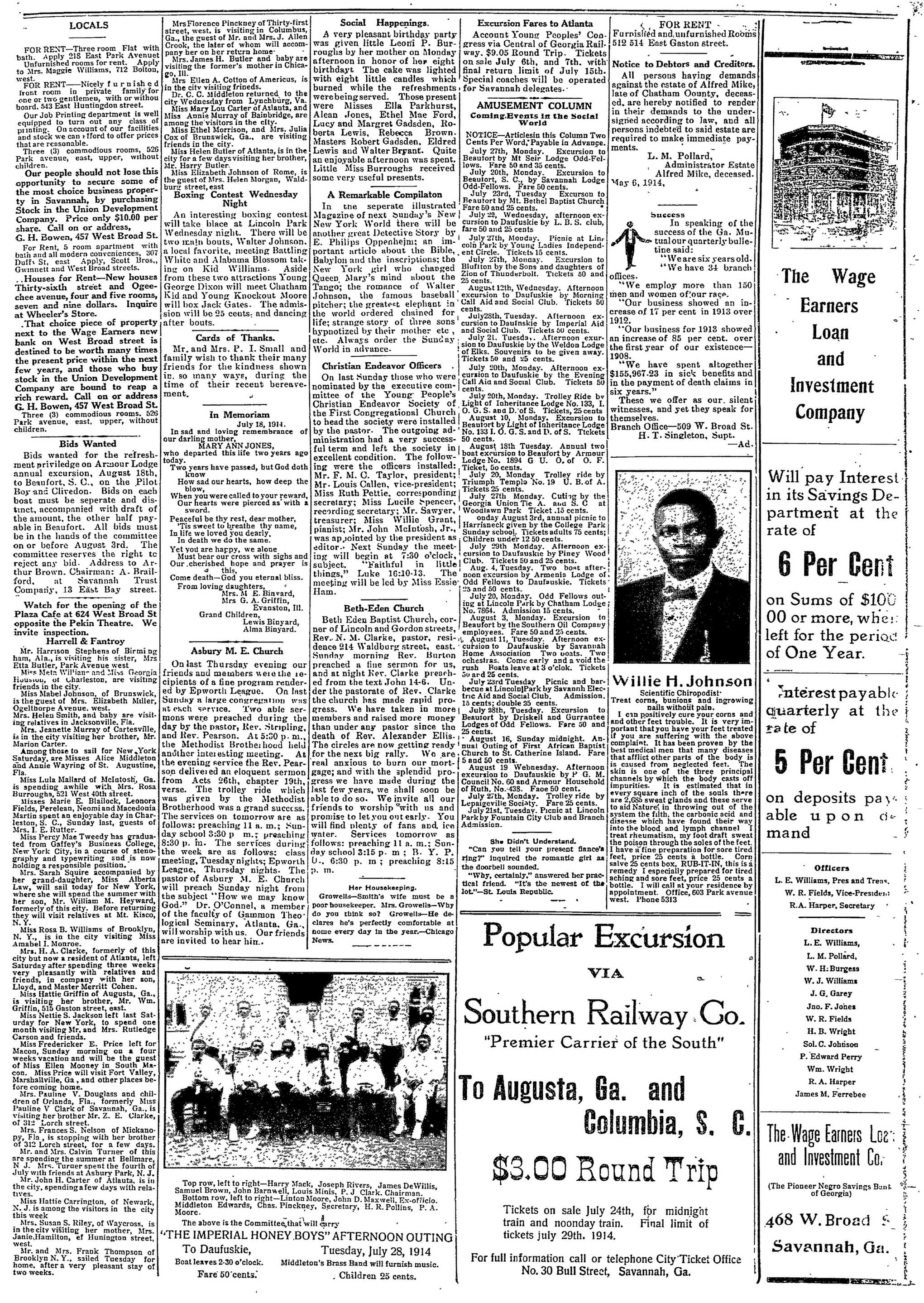
LOCALS
FOR RENT—Three room Flat with bath. Apply 218 East Park Avenuet Unfurnished rooms for rent. Apply to Mrs. Maggie Williams, 712 Bolton, west.
FOR RENT—Nicely furnished front room in private family for one or two gentlemen, with or without board. 543 East Huntingdon street.
Our Job Printing department is well equipped to turn out any class of printing. On account of our facilities and stock we can afford to offer prices that are reasonable.
Three (3) commodious rooms, 526 Park avenue, east, upper, without children.
Our people should not lose this opportunity to secure some of the most choice business property in Savannah, by purchasing Stock in the Union Development Company. Price only $10.00 per share. Call on or address,
G. H. Bowen, 457 West Broad St.
For Rent, 5 room apartment with
bath and all modern conveniences, 307
Duff St, east Apply, Scott Bros.,
Gwinnett and West Broad streets.
...Houses for Rent—New houses
Thirty-sixth street and Ogee-
chee avenue, four and five rooms,
seven and nine dollars. Inquire
at Wheeler's Store.
.That choice piece of property next to the Wage Earners new bank on West Broad street is destined to be worth many times the present price within the next few years, and those who buy stock in the Union Development Company are bound to reap a rich reward. Call on or address G. H. Bowen, 457 West Broad St. Three (3) commodious rooms. 526 Park avenue, east, upper, without children.
Bids Wanted
Bids wanted for the refreshment privilege on Armour Lodge annual excursion, August 18th, to Beaufort, S. C., on the Pilot Boy and Clivedon. Bids on each boat must be seperate and distinct, accompanied with draft of the amount, the other half payable in Beaufort. All bids must be in the hands of the committee on or before August 3rd. The committee reserves the right to reject any bid. Address to Arthur Brown. Chairman: A. Brailford, at Savannah Trust Company, 13 East Bay street.
Watch for the opening of the Plaza Cafe at 624 West Broad St opposite the Pekin Theatre. We invite inspection.
Harrell & Fantroy
Mr. Harrison Stephens of Birmingham, Ala., is visiting his sister, Mrs Etta Butler, Park Avenue west
Miss Meta Williann and Miss Georgia Houston, of Charleston, are visiting friends in the city.
Miss Mabel Johnson, of Brunswick, is the guest of Mrs. Elizabeth Miller, Oelgthorpe Avenue, west.
Mrs. Helen Smith, and baby are visiting relatives in Jacksonville, Fla.
Mrs. Jeanette Murray of Cartesville, is in the city visiting her brother, Mr. Marion Carter.
Among those to sail for New York Saturday, are Misses Alice Middleton and Annie Wayring of St. Augustine, Fla.
Miss Lula Mallard of McIntosh, Ga. is spending awhile with Mrs. Rosa Burroughs, 521 West 40th street.
Misses Marie E. Blailock, Leonora Fields, Peretean, Neomiand Macedonia Martin spent an enjoyable day in Charleston, S. C., Sunday last, guests of Mrs. I. E. Rutter.
Miss Percy Mae Tweedy has graduated from Gaffey's Business College, New York City, in a course of stenography and typewriting and is now holding a responsible position.
Mrs. Sarah Squire accompanied by her grand-daughter, Miss Alberta Law, will sail today for New York, where she will spend the summer with her son, Mr. William M. Heyward, formerly of this city. Before returning they will visit relatives at Mt. Kisco, N.Y.
Miss Rosa B. Williams of Brooklyn, N.Y., is in the city visiting Miss Amabel I. Monroe.
Mrs. H. A. Clarke, formerly of this city but now a resident of Atlanta, left Saturday after spending three weeks very pleasantly with relatives and friends, in company with her son, Lloyd, and Master Merritt Cohen.
Miss Hattie Griffin of Augusta, Ga., is visiting her brother, Mr. Wm. Griffin, 515 Gaston street, east.
Miss Nettie S. Jackson left last Saturday for New York, to spend one month visiting Mr. and Mrs. Rutledge Carson and friends.
Miss Fredericker E. Price left for Macon, Sunday morning on a four weeks vacation and will be the guest of Miss Ellen Mooney in South Macon. Miss Price will visit Fort Valley, Marshallville, Ga., and other places before coming home.
Mrs. Pauline V. Douglass and children of Orlanda, Fla., formerly Miss Pauline V Clark of Savaunah, Ga., is visiting her brother Mr. Z. E. Clarke, of 312 Lorch street.
Mrs. Frances S. Nelson of Mickanopy, Fla., is stopping with her brother of 312 Lorch street, for a few days.
Mr. John H. Carter of Atlanta, is in the city, spending a few days with relatives.
Miss Hattie Carrington, of Newark, N. J. is among the visitors in the city this week.
Mrs. Susan S. Riley, of Waycross, is in the city visiting her mother, Mrs. Janie.Hamilton, of Huntington street, west.
Mr. and Mrs. Frank Thompson of Brooklyn N. Y., sailed Tuesday for home, after a very pleasant stay of two weeks.
THE FENCERS
Top row, left to right—Harry Maek, Joseph Rivers, James DeWillis, Samuel Brown, John Barnwell, Louis Minis, P. J Clark. Chairman.
Bottom row, left to right—Linton Moore, John D. Maxwell, Ex-officio. Middleton Edwards, Chas. Pinckney, Secretary, H. R. Pollins, P. A. Moore.
Mrs Florence Pinckney of Thirty-first street, west, is visiting in Columbus, Ga., the guest of Mr. and Mrs. J. Allen Crook, the later of whom will accompany her on her return home.
Mrs. James H. Butler and baby are visiting the former's mother in Chicago, Ill.
Mrs Ellen A. Cotton of Americus, is in the city visiting frineds.
Dr. C. C. Middleton returned to the city Wednesday from Lynchburg, Va.
Miss Mary Lou Carter of Atlanta, and Miss Annie Murray of Bainbridge, are among the visitors in the city.
Miss Ethel Morrison, and Mrs. Julia Cox of Brunswick, Ga., are visiting friends in the city.
Miss Helen Butler of Atlanta, is in the city for a few days visiting her brother, Mr. Harry Butler. Miss Elizabeth Johnson of Rome, is the guest of Mrs. Helen Morgan, Waldburg street, east
An interesting boxing contest will take place at Lincoln Park Wednesday night. There will be two main bouts, Walter Johnson, a local favorite, meeting Battling White and Alabama Blossom taking on Kid Williams. Aside from these two attractions Young George Dixon will meet Chatham Kid and Young Knockout Moore will box Jack Gates. The admission will be 25 cents, and dancing after bouts.
Cards of Thanks.
Mr. and Mrs. P. I. Small and family wish to thank their many friends for the kindness shown in, so many ways, during the time of their recent bereavement.
In Memoriam
In sad and loving remembrance of our darling mother,
MARY ANN JONES,
who departed this life two years ago today.
Two years have passed, but God doth know
How sad our hearts, how deep the blow,
When you were called to your reward,
Our hearts were pierced as with a sword.
Peaceful be thy rest, dear mother,
Tis sweet to breathe thy name,
In life we loved you dearly.
In death we do the same.
Yet you are happy, we alone
Must bear our cross with sighs and Our. cherished hope and prayer is this.
Come death—God you eternal bliss.
From loving daughters,
Mrs. M. E. Binvard,
Mrs. G. A. Griffin,
Evanston, Ill.
Grand Children,
Lewis Binyard,
Alma Binyard.
Asbury M. E. Church
On last Thursday evening our friends and members were the recipients of a fine program rendered by Epworth League. On last Sunday a large congregation was at each service. Two able sermons were preached during the day by the pastor, Rev. Stripling, and Rev. Pearson. At 5:30 p.m., the Methodist Brotherhood held another interesting meeting. At the evening service the Rev. Pearson delivered an eloquent sermon from Acts 26th, chapter 19th, verse. The trolley ride which was given by the Methodist Brotherhood was a grand success. The services on tomorrow are as follows: preaching 11 a.m.; Sunday school 3:30 p.m.; preaching 8:30 p.m. The services during the week are as follows: class meeting, Tuesday nights; Epworth League, Thursday nights. The pastor of Asbury M. E. Church will preach Sunday night from the subject "How we may know God." Dr. O'Connel, a member of the faculty of Gammon Theological Seminary, Atlanta, Ga., will worship with us. Our friends are invited to hear him.
Social Happenings.
A very pleasant birthday party was given little Leoni P. Burroughs by her mother on Monday afternoon in honor of her eight birthday. The cake was lighted with eight little candles which burned while the refreshments were being served. Those present were Misses Ella Parkhurst, Alean Jones, Ethel Mae Ford, Lucy and Margret Gadsden, Roberta Lewis, Rebecca Brown-Masters Robert Gadsden, Eldred Lewis and Walter Bryant. Quite an enjoyable afternoon was spent. Little Miss Burroughs received some very useful presents.
A Remarkable Compilaton
In the seperate illustrated Magazine of next Sunday's New New York World there will be another great Detective Story by E. Philips Oppenhejm; an important article about the Bible, Babylon and the inscriptions; the New York girl who changed Queen, Mary's mind about the Tango; the romance of Walter Johnson, the famous baseball pitcher; the greatest elephant in the world ordered chained for life; strange story of three sons hypnotized by their mother etc., etc. Always order the Sunday World in advance.
Christian Endeavor Officers
On last Sunday those who were nominated by the executive committee of the Young People's Christian Endeavor Society of the First Congregational Church to head the society were installed by the pastor. The outgoing administration had a very successful term and left the society in excellent condition. The following were the officers installed: Mr. F. M. C. Taylor, president; Mr. Louis Callen, vice-president; Miss Ruth Pettie, corresponding secretary; Miss Lucile Spencer, recording secretary; Mr. Sawyer, treasurer; Miss Willie Grant, pianist; Mr. John McIntosh, Jr., was appointed by the president as editor. Next Sunday the meeting will begin at 7:30 o'clock, subject, "Faithful in little things," Luke 16:10-13. The meeting will be led by Miss Essie Ham.
Beth-Eden Church
Beth Eden Baptist Church, corner of Lincoln and Gordon streets, Rev. N. M. Clarke, pastor, residence 214 Waldburg street, east. Sunday morning Rev. Burton preached a fine sermon for us, and at night Rev. Clarke preached from the text John 14-6. Under the pastorate of Rev. Clarke the church has made rapid progress. We have taken in more members and raised more money than under any pastor since the death of Rev. Alexander Ellis. The circles are now getting ready for the next big rally. We are real anxious to burn our mortgage; and with the splendid progress we have made during the last few years, we shall soon be able to do so. We invite all our friends to worship with us and promise to let you out early. You will find plenty of fans and ice water. Services tomorrow as follows: preaching 11 a. m.; Sunday school 3:15 p. m; B. Y. P. U., 6:30 p. m; preaching 8:15 p. m.
Her Housekeeping
Growells—Smith's wife must be a poor housekeeper. Mrs. Growells—Why do you think so? Growells—He declares he's perfectly comfortable at home every day in the year.—Chicago News.
FOR RENT Furnished and, unfurnished Rooms 512 514 East Gaston street.
Notice to Debtors and Creditors.
All persons having demands against the estate of Alfred Mike, late of Chatham County, deceased, are hereby notified to render in their demands to the undersigned according to Law, and all persons indebted to said estate are required to make immediate payments.
L. M. Pollard,
Administrator Estate
Alfred Mike, deceased.
May 6, 1914.
In speaking of the success of the Ga. Mutual our quarterly bulletine said:
"We are six years old.
"We have 34 branch offices.
"We employ more than 150 men and women of our race.
"Our business showed an increase of 17 per cent in 1913 over 1912.
"Our business for 1913 showed an increase of 85 per cent. over the first year of our existence—1908.
"We have spent altogether $155,967.23 in sick benefits and in the payment of death claims in six years."
These we offer as our silent witnesses, and yet they speak for themselves. Branch Office----509 W. Broad St
Treat corns, bunions and ingrowing nails without pain.
I can positively cure your corns and and other feet trouble. It is very important that you have your feet treated if you are suffering with the above complaint. It has been proven by the best medical men that many diseases that afflict other parts of the body is caused from neglected feet. The skin is one of the three principal channels by which the body casts off impurities. It is estimated that in every square inch of the souls there are 2,688 sweat glands and these serve to aid Nature in throwing out of the system the filth, the carbonic acid and disease which have found their way into the blood and lymph channel. I treat rheumatism, my foot draft sweat the poison through the soles of the feet. I have a fine preparation for sore tired feet, price 25 cents a bottle. Corn salve 25 cents box, RUB-IT-IN, this is a remedy I especially prepared for tired aching and sore feet, price 25 cents a bottle. I will call at your residence by appointment. Office, 603 Park avenue west. Phone 5313
Popular Excursion
Southern Railway Co. "Premier Carrier of the South"
To Augusta, Ga. and Columbia, S. C. $3.00 Round Trip
Tickets on sale July 24th, for midnight train and noonday train. Final limit of tickets July 29th. 1914.
For full information call or telephone City Ticket Office No.30 Bull Street, Savannah, Ga.
Account Young Peoples' Congress via Central of Georgia Railway. $9.05 Round Trip. Tickets on sale July 6th, and 7th. with final return limit of July 15th. Special coaches will be operated for Savannah delegates.
AMUSEMENT COLUMN Coming.Events in the Social World
NOTICE—Articles in this Column Two Cents Per Word, Payable in Advance.
July 27th, Monday. Excursion to Beautort by Mt Seir Lodge Odd-Fellows. Fare 50 and 35 cents.
July 20th, Monday. Excursion to Beautort, S. C. by Savannah Lodge Odd-Fellows. Fare 50 cents.
July 23rd, Tuesday. Excursion to Beautort by Mt. Bethel Baptist Church Fare 50 and 25 cents.
July 22, Wednesday, afternoon excursion to Daufuskie by L. B. S. club, fare 50 and 25 cents.
July 27th, Monday. Picnic at Lincoln Park by Young Ladies Independent Circle. Tickets 15 cents.
July 27th, Monday. Excursion to Blufutt by the Sons and daughters of Zion of Thunderbolt. Tickets 50 and 25 cents.
August 12th, Wednesday. Afternoon excursion to Daufuskie by Morning Call Aid and Social Club. Tickets 50 cents.
July28th, Tuesday. Afternoon excursion to Daufuskie by Imperial Aid and Social Club. Tickets 50 cents.
July 21, Tuesday, Afternoon excursion to Daufuskie by the Weldon Lodge of Elks. Souvenirs to be given away. Tickets 50 and 25 cents.
July 20th, Monday. Afternoon excursion to Daufuskie by the Evening Call Aid and Social Club. Tickets 50 cents.
July 20th, Monday. Trolley Ride by Light of Inheritance Lodge No. 133, I. O. G. S. and D. of S. Tickets, 25 cents. August 10, Monday. Excursion to Beaufort by Light of Inheritance Lodge No. 133 I. O. G. S. and D. of S. Tickets 50 cents.
August 18th Tuesday. Annual two boat excursion to Beaufort by Armour Lodge No. 1894 G U. O. of O. F. Ticket, 50 cents.
July 20, Monday Trolley ride by Triumph Temple No. 19 U. B.of A. Tickets 25 cents.
July 27th Monday. Cutting by the Georgia Union Tie A. and S. C at Woodlawn Park Ticket .15 cents.
onday August 3rd, annual picnic to Harrisneck given by the College Park Sunday school. Tickets adults 75 cents;
Children under 12 50 cents.
July 29th Monday. Afternoon excursion to Daufauskie by Piney Wood Club. Tickets 50 and 25 cents.
Aug. 4, Tuesday. Two boat afternoon excursion by Armenia Lodge of Odd Fellows to Daufauskie. Tickets 25 and 50 cents.
8 August 11, Tuesday. Afternoon excursion to Daufauskie by Savannah Home Association Two oats. Two orchestras. Come early and a void the rush Boats leave at 3 o'clock. Tickets 50 and 25 cents.
July 23rd Tuesday Picnic and barbecue at Lincoln Park by Savannah Electric Aid and Social Club. Admission. 15 cents; double 25 cents.
July 28th, Tuesday. Excursion to Beautort by Driskell and Gurrantee Lodges of Odd Fellows. Fare 50 and 25 cents.
August 16, Sunday midnight. Annual Outing of First African Baptist Church to St. Catherine Island. Fare 5 and 50 cents.
August 19 Webnesday. Afternoon excursion to Daufauskie by P G. M. Council No. 60 and Armour Household of Ruth. No. 438. Faoe 50 cent.
July 27th, Monday. Trolley ride by
Lepaigeville Society. Fare 25 cents.
July 21st, Tuesday. Picnic at Lincoln
Park by Fountain City Club and Branch
Admission.
"Can you tell your present flance's ring?" inquired the romantic girl as the doorbell sounded.
"Why, certainly," answered her practical friend. "It's the newest of the lot."-St Louis Republic.
In speaking of the success of the Ga. Mutual our quarterly bulletine said:
"We are six years old.
"We have 34 branch
JOHN A. BROWN
Willie H. Johnson
Scientific Chinadisk
THE HOTEL
The Wage Earners Loan and Investment Company
Will pay Interest in its Savings Department at the rate of
6 Per Cent
on Sums of $100 00 or more, when left for the period of One Year.
interest payable quarterly at the rate of
5 Per Cent
on deposits pay able upon demand
L. E. Williams, Pres and Trens
W. R. Fields, Vice-President
R.A. Harper, Secretary
Directors
L. E. Williams,
L. M. Pollard,
W. H. Burgess
W. J. Williams
J. G. Garey
Jno. F. Jones
W. R. Fields
H. B. Wright
Sol. C. Johnson
P. Edward Perry
Wm. Wright
R. A. Harper
James M. Ferrebee
The Wage Earners Loa and Investment Co.
(The Pioneer Negro Savings Bank of Georgia)
468 W. Broad S
Savannah, Ga.
SUNDAY SCHOOL.
Lesson III.—Third Quarter, For July 19, 1914.
THE INTERNATIONAL SERIES.
Text of the Lesson, Mark x, 46-52.
Memory Verses, 51, 52—Golden Text,
Isa. xxxv, 5, 6—Commentary Prepared by Rev. D. M. Stearns.
Causing the blind to see, the deaf to hear, the dumb to sing and the lame to walk were samples of what will be more fully when His kingdom comes (Isa. xxxv, 4-6). The blind and all other afflicted ones were physical illustrations of Israel's spiritual condition, and He was ready to open their eyes as He was literally to open the eyes of a few individuals. But the great ones among them preferred their blindness because all the time they thought they saw clearly. Our Lord called them blind Pharisees, blind leaders of the blind (Matt. xiii, 26; xv, 14), and when they asked Him, "Are we blind also?" He said unto them, "If we were blind ye should have no sin, but now ye say, We see; therefore your sin remalnath" (John ix, 40, 41). In their case, as in the case of multitudes today, the god of this world blinded their minds, lear the light of the glorious gospel of Christ, who is the image of God, should shine unto them (II Cor. iv, 4).
Our lesson story is found in Matt. xx. 20-34, as well as in Mark, and is the record of a healing as He left the city of Jericho. He healed another man who was blind as He entered Jericho, and that man followed Him, glorifying God as He entered and passed through Jericho (Luke xxii. 35, to xix. 1). Matthew and Mark both say that the heal-
When the kingdom comes we shall see him. King in His beauty, and we shall then think that we never knew Him before. He will be so glorious (isa. xvxill. 17, 24; John ill. 1, 2). Every one shall see Him, either to adore Him and enjoy Him forever or else to see Him and hear Him say, "Depart from me; I never knew you." The cry of the man who was healed as He entered Jericho and that of the others healed as He left the city is so similar that some cannot think that Luke is telling of a separate incident (Matt. xx. 30; Mark x. 47; Luke xvill. 38). In each event Jesus stood and commanded the man or men to be brought unto Him or called them to Him. Mark says that those who called him said, "He of good comfort; rise; He calleth thee." That which we have in eight words here is just four words in the Greek.
I carry those who can read the Greek and Hebrew readily; there is such a fulness of meaning in those languages which it is difficult to express in English. There is something very remarkable here, and it is this: The words "Be of good comfort" (Greek "thursel") are used by our Lord on five different occasions, all exceedingly interesting and helpful, four while He was on earth and once after He returned to heaven (Matt. ix, 2, 22; xliv, 27; John xvl, 33; Axts xvll, 11). They make a beautiful, helpful Bible study on forgiveness, peace, victory and the purpose of God.
The remarkable thing is that this word, used only elsewhere by our Lord, is used in our lesson by those who called the blind man. I wonder why they should use one of our Lord's special words. I do not understand it. I only note the fact. If it was the disciples who used the word they did it as His representatives, and we think of a later word of His, "As my Father hath sent Me, even so send I you" (John xx, 21). If some of the multitude used the word, then I am perplexed.
Casting away his garment, he came to Jesus, and I expect that he did so very quickly. He knew his need and that there was a deliverer at hand, and he did not hesitate nor make any excuse. He was poor, empty, helpless, ready to receive. In the song of Mary it is written; "He hath filled the hungry with good things, and the rich He hath sent empty away" (Luke, 1, 53). It is also written, "Blessed are ye that hunger now, for ye shall be filled" (Luke vi, 21). The poor and the needy are those who obtain help speedily (Ps. lxii, 4). The rich and the self sufficient and self righteous are the ones whom it is impossible to help.
"What wilt thou that I should do unto thee?" This is the question ever coming to us from Him in whom all fullness dwells, for has He not said, "If ye shall ask anything in My name I will do it." "If ye abide in Me and My words abide in you ye shall ask what ye will and it shall be done unto you?" (John xiv, 14; xv, 7.) How brief and definite is the blind man's request, "Lord, that I might receive my sight." He did not want five things, nor three, nor two—just one. He knew well what he wanted, and he asked for it. If we knew our need as well and were as definite in our asking, what might we not receive! The longer I live the more fear it seems to me that we have but one great need as believers, and that is to be filled with and controlled. Joly Spirit.
NSURANCEGEOGRA
PHY
When is a man mos confused?
When he misses his train.
When are the people most unsafe? When they are not insured with the Pilgrim Health and Life Insurance Company.
Which company pays for all disease known to medical science? The Pilgrim.
Which company carries its members the longest before lapsing their policies? The Pilgrim.
Will you explain why the Pilgrim does this? Only to aid its Picy holders, that's all.
Which company organized firs among Negroes in Georgia, an occur charter to do business along the Industrial lines? The Pilgrim, of course.
Which company collected the largest amount of money, accord to the last report of the INSURANCE DEPARTENT, to the Governor of the State! The answer is in the report, The Pilgrim. How can this statement be verified? By referring to the report of the INSURANCE DEPARTENT, of the State of Georgia
How can a policy be obtained with the Pilgrim, in case its agents turn back before they reach your home? By ringing phone 4129.
Why has the Pilgrim so many satisfied policy holders? By performing its perpetuated motto, PR BPTNES, I N O N T Y AND JUSTICE.
Why is it so easy to secure new members for the Pilgrim? They have heard of the many blessings it has, and is still bestowing upon its thousands of satisfied policy holders.
How long after the death of a member, before the beneficiary can draw the death benefit? As soon as the death certificate is properly filled by the attending physician.
How many men and women of our race are employed and are well paid by the Pilgrim? SIX HUNDRED TWENTY SEVEN. Are you being satisfactorily served? If not see the Pilgrim's agents, or ring the office, and your order will be filled, and promptly delivered. Local and long distant phone 4129. Office, 509 West Broad Street, Savannah Georgia J. S. Perry, Supt
PERSEVERE
My field may be swampy or
stony, my plow may be poof, my
strength small, the weather bad, but
if heathly as unto the Lord I do the
best I can and look not back, but
keep right on, I am no failure.
Mahlie D. Babcook.
Wanted a Sample.
A young minister unexpectedly called upon to address a Sunday school asked, to gain time:
"Children, what shall I speak about?"
A little girl, on the front seat who was in the habit of reciting at entertainments had committed to memory several declamations, so that she was always prepared for any occasion. Sympathy and interest shone in her face as she held up her hand and in a shrill voice inquired:
· "What do you know best?"—Chicago News.
Essad Pasha's Revenge.
A number of years ago Genl Bey, Essad Pasha's brother and, like himself, an Albanian nationalist, was shot by order of Abdul Hamid. For this reason, when the Turkish parliament deposed the sultan, Essad Pasha begged to be sent to Yildiz klosk to tell Abdul of his fate. Accompanied by three others, he presented himself before his brother's murderer and pronounced the formula: "In accordance with Fetra, the representatives of the nation have decreed your deposition. Follow us!" Essad subsequently declared that April 27, 1909, when he thus tasted the sweets of revenge, was the happiest day he had ever known—London Spectator.
Point to Be Remembered.
"Yes, mum, I be the oldest 'un in yon village, but, mind ye, I ain't always been."—London Opinion. Orthography of Shakespeare.
Orthography of Shakespeare.
Some interesting Shakespearean appear in the London Record. It is well known that in Shakespeare's time orthography was little accounted of and that Shakespeare himself would have considered the question of spelling his name in one way and not another a mere waste of time. It is, however, worth recording how the name struck the Bodilian officials when the first folio was given a place and mark in the library. The entries are as follows and were all written in 1623: Shakespeare, Shape-speare, Shakespeare, Shakespeare, Shak-speare. The testimony, so far as it goes, is obviously in favor of the form "Shakespeare" and of the present pronunciation of the word.
Nutmea
Nutmeg should be used sparingly, as it contains an etherial oil that as a recognized poison.
FARM
ORCHARD
AND
GARDEN
BY
F.ETRIGG
REGISTER.
ROCKEORD.IA
CORRESPONDENCE
SOLICITED
[This matter must not be reprinted without special permission.]
[This matter must not be reprinted without special permission.]
Air slacked lime is recommended by some as effective in controlling melon bugs.
A Michigan White Wyandotte hen is credited with having laid ninety-three eggs in as many days. Her name is Pinfeather, and her owner holds her worth $100.
One Iowa farmer succeeded in getting the upper hand of a patch of horse nettle last July and August by applying twenty gallons of kerosene oil to the patch, 3 by 4 rods in extent.
Corn smut cannot be controlled, as can oat smut, by treating the seed with a formalin solution. The only preventive consists in not planting seed on fields which produced smutty corn the preceding year.
A bit odd, isn't it, that one of the largest American trees known—the cottonwood—has a seed so small that it is borne for long distances in the air supported by a little fluff of cotton to which it is attached?
A strip of several thicknesses of most any kind of paper wrapped around the stem of the garden plants and extending an inch and a half into the soil and as far above the ground will give effective protection from cutworms.
For the sake of the boy and only incidentally because of consideration for the automobile gas bill the boy who salts around in such a machine for pleasure merely ought to be required to earn the money to pay for the gasoline that he burns up.
A new process has been discovered for the drying of lumber by electricity. The trees are first sawed into thick planks and subjected to an electric current for ten hours. Under this method the wood is said to be harder and to warp less than by the usual method.
Corn belt hog raisers should take note of the warning which has lately been issued by the United States department of agriculture to the effect that no faith should be placed by hog raisers in any treatment for hog cholera except by the serum vaccination method.
A word of appreciation doesn't cost a red cent, but in a good many cases it secures a type and quality of service that mere wages will not. Justly spoken, such appreciation tends to create good feeling and makes possible a type of co-operation that produces most satisfactory results.
A California farm hand who apparently thinks while his hands are busy milking has devised the plan of strapping a one legged milk stool to that part of his anatomy where he sits down. When he finishes one cow and goes to the next the stool goes along with him and is there when he sits down.
Rarely should asparagus be cut beyond the middle of June, and many do not cut it after the 1st. The condition of the bed next year will depend largely upon the care which it receives from this on. Such care should include keeping the bed free from weeds, keeping the soil loose and generous fertilizing if the bed has not been fertilized earlier in the season.
The fact—vouched for by geologists—that the surface of the country is wearing away at the rate of an inch in 750 years isn't half as important a consideration for the average farmer as that involved in taking from the soil more in fertilizing elements in raw crops than he restores to it in the shape of natural and commercial fertilizers and the growing of leguminous crops.
A Minnesota woman, writing Dr. Bracken of the state board of health, recommends the following recipe for the successful use of face powder: For giving the face the best color get a pot of rouge and a rabbit's foot. Bury them about two miles from home and walk out and back once a day to see that the stuff is still there. On the face of it this would seem to be an entirely successful way to keep the complexion fresh and of the right color.
The poisoned mash bait which is used to kill cutworms is made as follows: Thoroughly mix a teaspoonful of parsley green in a quart of dry bran and then moisten the mixture with a pint of sweetened water, molasses or sugar being good for the purpose. The bait thus prepared should be scattered in little chunks as large as a good sized hickory nut along the rows of the plants. Poultry should not be allowed to run in a garden where this poison has been placed.
THE DEADLY CUTWORM.
It Has Been Destroying Wheat In Western Kansas—Preventive Measures.
The mysterious worm which has been reported to be destroying wheat in western Kansas is none other than the common clayback cutworm, according to George A. Dean, professor of entomology in the Kansas State Agricultural college.
When the first report of damage was received an entomologist was sent into the infested region. Infestation was found to be confined practically to wheat fields containing much volunteer wheat and to grass lands and alfalfa fields. Unless weather conditions are unfavorable for growing crops, the worms will probably, says the entomologists, cause no great loss of the wheat crop.
Preventive measures are best for controlling cutworms. If the wheat fields are plowed during the summer and the volunteer wheat is kept down until after seeding there is very little danger. Cutworms often migrate from field to field, in which case a good dust barrier should be constructed in which the worms may be destroyed. Where the worms are migrating or are concentrated in a small area, they can probably be killed by using the poison bran mash employed against grass-hoppers. This should be sown in the evening along the edge of the field that the worms are entering.
Growing Alfalfa
In preparing the land for alfalfa it is best to go slow. The first step is to plow the soil deep and prepare it the first year for potatoes or corn, using ten loads of manure per acre, pulverizing or harrowing the land down in good shape. The corn or potato crop should then be kept thoroughly clean for a season. This will destroy weeds and the ground will have time to settle properly for alfalfa. Then the following spring the land should be double disked, rolled and harrowed. The seed can then be sown with an ordinary wheat drill as follows: Mix, and mix thoroughly, about six pounds of cornmeal to ten pounds of alfalfa seed. The ordinary drill when closed to its finest calibration will sow about sixteen pounds per acre. Thus sixteen pounds of the mixture will mean ten pounds of alfalfa seed. This is considered about the best amount to sow per acre under field conditions.
Another method of sowing is to cover or plug up all but the first, seventh, etc., holes in the drill with the indicator set at the same position as before. This will take about one pound of seed per acre and will put the rows forty-two inches apart, far enough to be cultivated.
Straw as a Fertilizer.
A large amount of straw is shipped from a county in Missouri to a nearby paper and strawboard factory. This straw brings the farmer about 50 cents per ton. A county agent recently found a pile of about 1,000 tons at Silkeston ready for shipment. He computes that as a fertilizer this straw is worth $2.50 per ton, in addition to its value as a means of adding organic matter to the soil. He is making a campaign of the county in an attempt to show the inadvisability of the farmers selling their straw and urging its more extensive use as bedding in stables and feed lots. Straw used as a top dressing on fall wheat has been found to practically insure a good stand of clover on lands where clover is otherwise grown with great difficulty.
Cure or Kill Trees.
It is very unjust to neighbors to permit trees to grow that are covered with insects or troubled with disease. The disease or insects will spread and finally destroy other trees on the property where they are growing, and the trouble rapidly spreads to neighboring grounds. Either cure or kill. If unable to do the first cut down the trees and burn them, and do it promptly.
A Good Whitewash.
A pound of cheap bar soap dissolved in a gallon of boiling water and added to about five gallons of thick whitewash will give it a gloss like oil paint. Silicate of soda in the proportion of one to ten of whitewash produces a fireproof cement.
Orchard No Place For Hay.
The wise farmer does not try to raise a crop of fruit and a crop of hay from the same land. By so doing he falls to get the best possible results from either. Better put all the attention to the orchard and raise the hay on some other land.
Farm and Garden
INOCULATION FOR ALFALFA.
Nitrogen Gathering Bacteria on Roots of Plant Advised.
"Alfalfa is a legume crop, and for its successful growth nitrogen gathering bacteria on its roots are necessary," according to Manley Champill, assistant agronomist at the State college, South Dakota.
"Where alfalfa has been grown for many years the bacteria are likely present in the soil--for instance, certain parts of the Black Hills region. But if the bacteria are not in the soil it would probably be well to inoculate either the seed or the land to produce them."
Mr. Champlin offers the following suggestions on methods of inoculation: "Nitrogen gathering bacteria are prepared in the form known as pure culture by the United States department of agriculture at Washington, and small quantities of this pure culture are sent free to the farmers desiring to make a trial of inoculation. In sending in a request for this material the following facts should be stated: The name of the crop to be inoculated amount of seed to be sown, acreage to be sown to this crop and the approximate date on which you expect to sow the seed.
The inoculating material is sent out within seven days of the time the application is received, and it should be used before the expiration of twenty-five days from the date on which it was sent, as the bacteria may be destroyed if held longer than that. Requests should be sent to the secretary of agriculture, Washington, D.C. The state of South Dakota has provided no funds for the making of pure culture at the State College of Agriculture, though
A
A FIELD OF YOUNG ALFALFA
requests received at the college are usually forwarded to the secretary of agriculture at Washington for attention.
"Karl F. Kellerman of the bureau of plant industry says: The inoculation of legume seeds with liquid pure culture is exceedingly simple. The seeds to be treated' are placed in a clean bucket, pall or tub and the liquid pure culture applied a little at a time, thoroughly stirring the seeds with the hands, as though one were kneading dough. This will produce a thin, moist coating of culture on every seed. Too much liquid makes the seeds too wet, and if left standing thus for any extended period' they may be injured. The small quantity of liquor, pure culture, furnished by the department is sufficient to produce the required amount of moisture on a considerable bulk of seeds, depending entirely upon the size of the seeds and how thoroughly they are stirred with the culture. After moistening the seeds should be spread in a thin layer on a clean floor or on newspapers and thoroughly dried. The complete application requires but a short time and should not be done in bright light or direct sunlight. If inoculated in the evening and spread in a protected place the seeds will be ready for early morning sowing, although seeds thus treated can be stored for a week or more should weather or other conditions prevent immediate sowing.'
"In all cases where inoculation is practiced a strip should be left along the edge of the field without inoculation so as to determine whether or not the inoculation was necessary.
"After the alfalfa or other legume crop is two or three months old an abundance of nodules or small bunches should appear on the roots. These nodules are the homes of the bacteria, and the number of nodules indicates the number of bacteria present. If an alfalfa or other legume crop grows without the bacteria it takes its nitrogen from the soil the same as a grain crop and therefore is not as beneficial to the soil as it is when it gets its nitrogen from the air. Furthermore, the legume will not make the best growth unless it is supplied with bacteria or, on the other hand, is sown upon land which is well manured and rich in nitrogen. After one field is inoculated adjoining fields may be quickly treated in future years by simply scattering soil from the inoculated field upon the new field."
Fruit on Every Farm.
No farm should be without fruit. A farmer who has a taste for fruit growing and land suitable for it should have his orchards of such fruits as his local market calls for and of such varieties as succeed best in his locality.
Fish and Lightning. Sensitiveness to Lightning has been noted in fishes. In several cases trout and other fishes in tanks and pools have died from the effects of Lightning, which, however, struck some distance
The South Atlantic Barber shop
Headquarters for barber supplies and
shoe polish. A fine line of shoes,
pipes and tobacco. Shoes shined and
repaired.
Dealer in second handed shoes
Clothes cleaned, pressed and repaired
Hot, cold and shower baths.
H. A. MANZO, Gen'l. Mgr
145 West Broad St.
The Up-to-data
BARBER SHOP
Hair Cutting, Shaving, Shampooing
BUMP AND WART TREATMENT
WORK GUARANTEED.
W. H. PRINCE, Proprietor
508W. Gwinnett St. Savh. Ga
AGENTS WANTED
TO SELL MAGIC Shaving Powder A wonderful discovery to shave the head and face without using shears or razor. Will send half pound can by mail, postage paid, for 25 cents in stamps.
THE SHAVING POWDER COMPANY
Savannah, Georgia
Thc Acme Bicycle Stoe
Dealer in New and Second Handed Bicycles. Tires and Supplies. Agency on the Monarch Bicycles.
K. HALPERN, Proprietor,
463 West Broad St.
Phone 1340.
Henry Mears Feed Co HAY & GRAIN
OF ALL KINDS
508 W Jones St.
Come and take a look at
Stock or Phone your
order and it will be
deliveredpromptly.
Phone 3461
OVER 65 YEARS' EXPERIENCE
PATENTS
TRADE MARKS
DESIGNS
COPYRIGHTS & C.
Anyone sending a sketch and description may
quickly ascertain our opinion free whether an
invention is probably patentable. Custom-
ations strictly confidential. HANDBOOK on Patents
sont free. Oldest agency for securing patents.
Patents Laken. Mauro & Co. receive
special notices, without charge, in the
Scientific American.
A handsomely illustrated weekly. Largestcircum-
year; four months, $L. Sold by all newsooners.
MUNN & Co 384 Broadway, New York
Brant Omes, F. C. St., Washington, D. C.
GAREY'S
Variety Bakery
Goods Delivered Promatly
1 To any part of the City.
506 West Broab St.,
Phone 1869-J Near Gaston.
Masonic Books
And Regalias
LODGE SEALS
FINANCIAL CARDS
AND BLANKS
Of Every Description.
Publishers and Manufacturers' Prices.
Liberal Discounts Will Be Arranged.
SOL. C. JOHNSON.
REDEEMABLE ON DEMAND AT THE OFFICE OF THE
CONSUMERS DISCOUNT COMPANY
Given with
Cash P
RE
COM
204
204 Broughton Street, West,
In a certain literary club years ago one of the members in proposing the name of a candidate for membership mentioned, among his qualifications, that he could speak several dead languages. To this an opponent replied that he never heard the gentleman in question speak but one dead language, and he murdered that as he went along.—Christian Register.
Our small earth is not absolutely safe from collision with bodies in space, but is safe from collision with any planet in the solar system and with the sun. To be hit by a planet either the earth or the planet must leave its orbit. This is impossible, and it is also impossible that the earth can leave its orbit and fall to the sun. The earth is being hit by millions of meteors daily, from the size of pin heads up to the largest, several hundred tons in weight.New York American.
Baron von Kempelen, at the beginning of last century, traveled through Europe with what he described as an unbeatable chess automaton in the likeness of a Turk. Kempelen used to conceal a man in the chest on which the Turk was seated, but so ingenious was the contrivance that for a long time everybody was deceived. Napoleon played chess with the pseudo-automaton when stopping at Schoenbrunn after the battle of Wagram. He lost the first game and in the second deliberately made two false moves. The pieces were replaced each time, but on the emperor making a third false move the Turk swept all the pieces off the board. London Chronicle.
The sorrow of yesterday is as nothing, that of today is bearable, but that of tomorrow is gigantic because indistinct.—Euripides.
The most ancient encyclopedia extant is Pliny's "Natural History," in thirty-seven books and 2,493 chapters, treating of cosmography, astronomy, meteorology, geography, geology, botany, medicine, the arts and pretty nearly every other department of human thought known at the time. Pliny, who died 79 A.D., collected his work in his leisure intervals while he was engaged in public affairs. The work was a very high authority in the middle ages.
---
Slow Death.
Colliding With a Planet.
The Chess Automaton.
SORROWS
The Oldest Encyclopedia.
BY ASKING YOUR MERCHANT FOR
all
Purchases
DEEMABLE
NSUMER
Broughton Street,
Quick Recovery. "The star soon recovered her health." "Yes. Her understudy made a hit." Baltimore Sun.
Vinegar of Arabia. The Arabs have made vinegar for ages. Arabian vinegar is said to be far superior to any other.
Fatal Disease.
A young painter who had just finished a picture insisted upon a friend calling to see it.
"There, now," enthused the artist, "you see my new picture! What's the matter with that?"
"I don't know," replied the bored friend, "but I should say it was a case of art failure."—National Monthly.
Stubbornness.
Mule headed stubbornness is the perseverance of a man you don't like.—Columbia State.
The Wickedest Bit of Sea.
Nine out of ten travelers would tell inquirers that the roughest piece of water is that cruel stretch in the English channel, and nine out of ten travelers would say what was not true. As a matter of fact, "the wickedest bit of sea" is not in the Dover strait or in yachting, for example, from St. Jean de Luz up to Paulliac or across the Mediterranean "race" from Cadiz to Tangier, nor is it in rounding Cape Horn, where there is what sailors call a "true" sea.
The "wickedest sea" is encountered in rounding the Cape of Good Hope for the eastern portion of Cape Colony. London Globe.
Not Alone.
"Dear me, Uncle Ephraim," exclaimed the bright western girl as she met the old gentleman in the hallway, "you don't, know how surprised I am to see you! Did you travel all the way from the east alone?" "Naw," he replied, deeply offended at the question, as he put his carpetbag down. "There were forty or fifty people on the same train."—Exchange.
Tender Steak.
A noted New York architect said of a recent criticism of skyscrapers:
"This criticism is not fair. It is prejudiced. Hence it will do more harm than good, like the remark of the waiter.
"To a waiter who was under notice to leave, a guest said in a restaurant:
"Not tender enough? the waiter snarled. 'Ah, what do you expect? Do you want it to jump up and hug and kiss you?'—Exchange.
DISCO
CASH CHECKS
Dr. Johnson's Resolutions.
Dr. Johnson compiled this list of good resolutions on his fifty-first birthday in 1760: "Resolved, Deo juvante, to combat notions of obligations; to apply to study; to reclaim imaginations; to consult the resolves on Tetty's coffin; to rise early; to study religion; to go to church; to drink less strong liquors; to keep a journal; to oppose laziness by doing what is to be done tomorrow; rise as early as I can; send for books of history of war; put books in order; scheme of life."
Dr. L. S. Parks.
DENTIST
240 Barnard Street,
Specialist in Gold and Bridge Work
Savannah, Ga.
Does all kind of high grade dental work of the best quality and workmanship. Gold crowns and bridge work.
White Porcelain Pivot and Gold Crowns mounted on the natural roots. Gold Fillings, Cement Fillings, and Silver or Amalgam Fillings. From nine to a full set of teeth $8.00 and $10.00. Broken plates mended and teeth added.
All Gold Crowns Guaranteed 23 K Gold.
Bell Phone 1244
Dr. J. W. Jamerson FIRST-CLASS
- All Work uaranteed
623 WEST BROAD STREET
Between Charles and Oak St.
PHONE 2098-J
Dr. A. R. Ferebee
Surgeon Dentist
Office Hours: 8 a.m., to 2 p.m.
3 p.m., to 6 p.m.
Sundays by Appointment
Gwinnett and East Broad Sts
(Adjoining Drug Store)
C.C. Middletor M.D.
Physician & Surgeon
505 Charlton'St., East.
Office Hours
9-11 a.m., 2-4 p.m., 7/8 p.m.
Phone 86
They Like to Hear It. Every pretty girl is aware of the fact, but no young man who mentions it to her will be censured.—Judge.
Diving Work
Atlantic and Pacific Coast
THE DIVING CONSTRUCTION CO.
Reference: Central Bank & Trust Co.
All Work Promptly Attended To
J. L. MURCHISON
Chief Diver
2815 Gravier St. New Orleans, La
R. E. PHARROW.
HOME OFFICE 202 Odd Fellows Building
Builder of the $250,000 Odd Fellow Block, Atlanta, and St. Philip A. M. E Church, Savannah, a. Mechanically Competent and financially able to carry out the Largest Contracts. Estimates furnished free on application.
GIVE
Mme. Hart's
Hair Dressing and
Grower
A TRIAL
It will make the hair grow long and silky. Second to no hair preperation on the market. All who have trie it gladly recommend same to others. Agents wanted everywhere. Write for terms VIOLA E. HART Manufacturer 208 College St. Amerieus, Ga
I Am Confidential
Let me Build Your Homes and save you from worrying and having extra expense. Thos H.Anderson,Contractor Carpenter and Builder. Jobbing of all kinds promptly attended to, Estimat cheerfully given. No.5 West 56th
Savanah, Georgia
Tipping the Attache.
zipping the Attache.
A good story of the younger days of Sir Herbert E. H. Jerningham is told in the London Mall. As an attache and feeling very pleased with himself, as he records, he was once told that he was wanted in the anteroom of our embassy at Paris. There an old man addressed him as a "clerk" and demanded a passport to Russia. When he received it he handed Sir Hubert Half a crown, saying: "It's for you, you know. I know what clerks are. Bless you, they do like an occasional tip."
Savannah
811 WEST BF
Savannah Pharm
811 WEST BROAD STREET
(LEE CHEMICAL CO., PROP)
We are in business for your health. Stop tha
cur Mentholated Cough Syrup. It P O:
relieves a Cough, quicker than any other remedy.
are in business for your health. Stop that entholated Cough Syrup. It POg is a Cough, quicker than any other remedy.
We are in business for your health. Stop that cough! Use cur Mentholated Cough Syrup. It P O S I T I V E L Y relieves a Cough, quicker than any other remedy.
Saturday Spec's
Beef, Wine and Iron.....
Tasteless Cordial of Cod Liver Oil
Emulsion of Cod Liver Oil.....
Dyspepsia Remedy.....
Female Regulator.....
25 Compound Cathartic Pills.....
Toothache Wax.....
Regal Hair Dressing.....
Wine of Cardui and Black Drau
¼ lb Peroxide 15c, ¼ lb.....
If it is in the drug line we h
Quick De
Standard Life
Wine and Iron
Press Cordial of Cod Liver Oil
Iron of Cod Liver Oil
Cosia Remedy
Regulator
Impound Cathartic Pills
Chee Wax
Hair Dressing
Of Cardui and Black Draught
Proxide 15c, 1/2 lb
It is in the drug line we have it. Phone 351
Quick Delivery.
Beef, Wine and Iron.....49
Tasteless Cordial of Cod Liver Oil.....49 "
Emulsion of Cod Liver Oil.....49 "
Dyspepsia Remedy.....49 "
Female Regulator.....49 "
25 Compound Cathartic Pills.....12 "
Toothache Wax.....05 "
Regal Hair Dressing.....19 "
Wine of Cardui and Black Draught.....1.00 "
½ lb Peroxide 15c, ½ lb.....25 "
If it is in the drug line we have it. Phone 3570 your order.
Quick Delivery.
Standard Life Insurance Co.,
CAPITAL FULLY PAID UP $100,000 The Only Legal Reserve Life Insurance Company or Has Securities Deposited with the State of Amounting to $105,000 Is supervised by she Insurance Department of Six S Alabama, Tennessee, Kentucky, Arkansas and The Certified Public Accountants who recently exp any for the Insurance Departments said: "All expre,sonable and evidenced careful management.
Legal Reserve Life Insurance Company of Has Securities Deposited with the State of Amounting to $105,000vised by she Insurance Department of Six S Alabama, Tennessee, Kentucky, Arkansas and certified Public Accountants who recently exe the Insurance Departments said: "All expe ared evidenced careful management.
The Only Legal Reserve Life Insurance Company owned by Negroes Has Securities Deposited with the State of Georgia Amounting to $105,000 Is supervised by she Insurance Department of Six States—georgia. Alabama, Tennessee, Kentucky, Arkansas and Missouri. The Certified Public Accountants who recently examined the Company for the Insurance Departments said: "All expenses were found reasonable and evidenced careful management. Records show,hat claims are paid as promptly as consistent, and the Company evidences every desire to treat the assured with equity." (Signed and sworn to by) 20. N. Spring, Accountant.
HOME OFFICE: ODD FELLOWS BLD, ATLANTA, GA.
W. LEWIS WILLIAMS, Mgr. Savannah Branch. MSS RETA EVANS, Clark.
FLEETING TIME
Make the most of the time allotted to you. Mark how fleeting and paltry is the estate of man yesterday in embryo, tomorrow a mummy or ashes. So, for the hair's breadth of time assigned to thee, live rationally and part with life cheerfully, as drops the ripe olive, extelling the season that bore it and the tree that matured it.—Marcus Aurelius.
Pharmacy
AD STREET
(Co., PROP)
alth. Stop that cough! Use
up. It POSITIVELY
other remedy.
49
49 "
49 "
49 "
12 "
05 "
19 "
1.00 "
25 "
it. Phone 3570 your order.
ery.
ance Company owned by Negro with the State of Georgia $105,000 Department of Six States—Georgia, Arkansas and Missouri. who recently examined the Corsoids"All expenses were four
GOLDEN CIRCLE NEWS.
The Grand Cabinet which met on last Friday night at the office, was largely attended by its officers and members. Brother John Waltnour, Hon. G. P. R.. presided over the meeting. Refreshments were served. Brother A. G. Johnson, deputy of Friendship Circle No. 8, left the city on Tuesday morning to spend a short while with his relatives.
The meeting of The Lily of South No. 11, was held at Seabrook's hall on Monday night with a crowded hall. The newly elected officers were installed by the Hon. G. P. R., Brother John Walthor assisted by the Hon. G. S., Brother Dan W. Thornton, G. L. Sister Rosa Bowie, Brother Wetly L. Freeman, Hon. G. P. V. R. and other grand cabinet officers, Brother Thomas Hamilton, Brother Wade Bowers and Sister Ada Scott were elected delegates to the grand lodge which will meet in September at Seabrook's hall. Refreshments were served. There were a number of applicants applying for membership.
The Friendship Golden Circle No 5 met on Tuesday night at Seabrooks hall. The newly elected officers was installed by the L. G. P. R., Brother John Walthour, assisted by Sister Laura King, Hon. Deputy No. 11 and Brother Wayman Cooper, Delegates elected Brother Jessie Butler, Sister Cenia Holman and Sister Arzada Cook. The Golden Lin. No. 4 met on Tuesday night at Scott's hall. The newly elected officers were installed by Brother John Johnson Deputy No. 6, assisted by Brother John Carson, Grand Director.
Tue G. L. Sister Rosa Bowie and Sister Eliza Williams will leave on Monday July 20th, to visit Traveling Pilgrim No. 10 Golden Circle in Augusta, Ga.
Willing Workers Circle No. 1, meets 1st, and 3rd, Wednesday nights at Seabrooks hall, Arthur Brown, Hon. ruler and son Hucherson Hon. deputy
Triliph Circle No. 2 meets 2nd
Monday night and 4th, Wednesday
night, a Seabrooks hall, A. R. Brown,
Hon ruler; J. S. Lloyd, Hon. deputy.
Three Gates City Circle No. 3, meets
2nd and 4th, Wednesday nights at
Scott's hall. Jason Dukes, Honor
rue, G. W. Winley, Hon. deputy.
Gotten Link Circle No. 4 meets 2nd,
and 4th, Tuesday nights at Scott's hall,
B. R. Robinson, Hon. ruler; M. C.
Gamell, Hon. deputy.
Savannah Circle No. 5 meets 1st, and
3rd, Thursday nights at Mechanic's
hall, G. O. Heyward, Hon ruler; Henry
Hall, Hon. deputy.
Rising Sun Circle No. 6, meets 1st,
and 3rd, Wednesday nights at West
Savannah, Rev. Stokes, John Johnson.
Hon. deputy.
Relief Circle No. 7 meets 2nd, and
4th, Wednesday nights at Mechanics
Hall, J. H. Green, Hon. ruler; Sam
Oliver, Hon. deputy.
Friendship Circle No. 8, meets 2nd, and 4th, Tuesday nights at Seabrook's hall, J. C. Holloway, Hon ruler; A. G. Johnson, Hon deputy.
Union Link Circle No. 9, meets 1st, and 3rd, Monday nights at Williams building, Brother Seabon Benton Hon ruler, Sister Sallie Green, Hon deputy Traveling Pilgrim No. 10, meets in Augusta Ga., at Singfield hall, Watkins street, Rev. P. T. Gallot, Hon ruler; Sister Nancy L. Westly, Hon deputy.
Lily of the South Circle No. 11 meets 2nd, and 4th, Monday nights at Seabrook's hall, A. B. Singfield, Hon ruler; Sister Laura King, Hon deputy Working Lily of East No. 12 meets 1st, and 3rd, Tuesday nights at Seabrook's hall, Brother Lawrence Miller, Hon ruler; Sister Julia McMasters, Hon deputy.
Gateway to Success Circle No 14,
m. 2nd, and 4th, Wednesday nights
at Williams Building, J. C. Lindsay,
Honruler; Brother, L. J. Biggins,
Hon deputy.
GoldenStar No. 16, meets 2nd, and 4th Thursday nights at Williams building, Wilton Wiggins, Hon. ruler; Sister Reiney Morrison, Hon. deputy. Easter Rose Junior Circle No. 1, meets 2nd and 4th. Tuesday evenings at 4 o'clock at Williams building, Sister Clara Hazel, Hon. lecturer. Sunflower Junior Circle No. 2 meets 2nd, and 4th, Monday evenings at Williams building, Sister Anna B. Campfield, Hon. lecturer.
Ladies Sewing Circle Anniversary
The Ladies Sewing Circle of Springfield Terrace celebrated its first anniversary on the 4th, of July at the home of Mrs. Cora Austin, Styles Terrace. Prayer was offered by Mrs. O. Creamer; paper, Mrs. C. Austin, the history of the club; duet, Mrs. Mobley and D James; solo Mrs. Creamer; chorus, the club; duet, Mrs. James and Miss Anderson; Mrs. Henderson, Mrs. James and Miss Anderson spoke a few words of encouragement to the club. Among the guests was Mrs. Morgan of Jacksonville. Mrs. Cora Austin is president of the circle.
.Fountain City Club
The Fountain City Club and its Ladies Branch will give one of its usual pleasant outings at I in Park on Tuesday July July 1st. The committee in
charge has made suitable arrangements for making this an enjoyable event. The public and their many friends are cordially invited to attend. The price of admission is 15 cents.
Negro Business League's Weekly Letter—by J. C. Lindsay
In our last letter we attempted to tell you of some of the things for which the Negro Business League does not stand. We also hinted at some of the hypocritical and hook-worm methods resorted to by some of the would be leaders, which methods in their last analysis mean nothing more nor less than the eternal destruction of the best business assets of the race. Mark you, these baneful practices complained of here, are not charged to all of our leaders, for some of ourmen who are foremost in all of the enterprises launched by men of the race, do not only talk these enterprises up, but, on the other hand, give to them their unstinted support. To prove the truthfulness of this assertion, with your kind permission, we think it not out of place to mention the names of the city's pastors and physicians, (who by the way make every brass penny they get to spend, either with white or black people, as to that matter, from the humble people of our own kith and kin,) who, though busily engaged in the work of their own chosen profession, find time to spend at least a few minutes once or twice a month in advising with the Johnsons, Bowens Singfields, Singletons, Williams, Scotts, Polards and score or more of others who are just as active in the promotion of Negro enterprises whose names I cannot mention, here in this brief write up.
Pastors Taylor, Martin, Stripling, Singleton and Protho belong to that class of ministers of whom the Negro Business League is proud. These pious men realizing as they do, that the Negro Christian ministry is the recognized leaders of the Negro people now, and will be for the next fifty years to come, have shown their interests in Negro enterprises in Savannah, by joining the Negro Business League and meeting with them from time to time, and saying to them, "Go ahead, boys, we are with you, head, heart, hand and pocket." Are you ashamed of such a leadership as this? I leave you to answer this question alone.
Doctors Smith, Middleton, Ferrebee, and Daniels are likethe class of preachers referred to in the above; think it not robbery and too great a condescension to to meet and advise with the Negro Business men from time to time as,to the best methods to adopt in conditions which will result in furnishing better places of employment for the army of young men and women who are coming from the various schools and colleges from year to year.
Just here, permit us to tell you what really happened a few days ago. A certain little dude preacher, who by the way is a batchelor with high heeled shoes and side whiskers, told his agent who had been collecting 25 cents per week from him that "he warnt gwinter to carry any more' 'nigger' insurance" on the ground that he had found out that three white companies in which he was insured at 25 cents per week each, would pay more than any "nigger" company in town. The agent, a very intelligent man, assured this little dude preacher that he was in error, and that the state law required uniformity in insurance matters, and each company paid the same, and that each company had $5000 for the protection of its members; all to no avail. The agent returned to his office and took his district manager with him to talk the matter over with this dude batchelor preacher, who withstood them both, and openly declared that he would continue to give these little nickles and dimes he can squeeze out of our kith and kin to the other fellow. What do you think of it? Don't answer, but think. League meets 1st Wednesday and 3rd Friday of each month. $1.00 to join; 25 cents per month.
First A. B. Church.
The Sunday school of the First African Baptist Church is increasing rapidly. New scholars are joining every Sunday. The Sunday school picnic was largely attened on last Wednesday. We are doing good work. The B. Y. P. U. meets at 7 p. m., a very interesting program will be rendered.
SWEET CLOVER.
Not a Weed and Has Considerable Agricultural Value.
The Kansas experiment station in a recent publication makes it plain that sweet clover, a hitherto neglected plant, despised as a pernicious weed, has very considerable agricultural value. It is stated that "as a soil improver it is unexcelled; for pasturing purposes it has considerable value, and as a forage crop it can be utilized to good advantage where alfalfa or red clover cannot be successfully grown."
Attention is called to the fact that "there are several varieties of sweet clover, of which the common white sweet clover and the large biennial yellow sweet clover are the most important. The white variety is generally to be preferred for farm purposes, although the biennial yellow is sometimes preferred where hay production is desired." Sweet clover is adapted to a wide range of soils, and while it does best on good soils it will make a satisfactory growth on very poor soils.
Grown on good soil and properly handled it makes a fair quality of hay which may in many cases be substituted with advantage for the more valuable alfalfa and clover hays. In actual nutritive constituents it is practically equal to these. It makes an excellent pasture for cattle, sheep, horses and hogs, and for this purpose may be profitably grown on very poor and rough land.
For quick results in improving the soil sweet clover is superior to most other crops. Its ability to thrive well on soils lacking in humus or otherwise badly run down makes it especially adapted for this purpose. Like alfalfa, cowpeas and other legumes, it has the ability to obtain nitrogen from the air by means of the nitrogen gathering bacteria which live in tubercles on the roots of the plants, thus adding much nitrogen to the soil in which it grows. When plowed under for green manure or allowed to remain on the land this crop is a very efficient one in building up the humus content of the soil. The large roots, which penetrate deeply, break up the lower layers of the soil and add much humus thereto when they decay, thus improving the physical condition of the soil to a considerable depth below the depth of plowing. Sandy as well as heavy clay and hardpan soils, which would not otherwise produce satisfactory crops, may be so improved in texture by growing sweet, clover for a few years that they become quite productive.
Soil Texture and Moisture.
The term texture when applied to the soil refers to the size of the soil particles. Generally speaking, there are three main classes of soil, based on texture, sand, silt and clay, and all productive soils are, as a rule, composed of combinations of the above classes.
The amount of movement and the rate of movement of soil moisture are governed to quite an extent by texture. In sand we find that the action is rapid, but lasts but a short time. On the other hand, the movement in clay is very slow, but the water travels through a much greater distance. In soils of medium texture the action is intermediate throughout. In the average soil movement of water is confined to a few feet, but in some of the fine textured soils it may travel a considerable distance.
Shade For Chickens.
By means of a sali cloth, duck or factory cotton curtain, shade may easily be supplied chickens where there are no trees or bushes. In such a case as illustrated herewith the stakes are
COMBINATION CHICKEN COOP.
about two feet long and driven four to six inches in the ground. The curtain is tied only at the corners. On the windy side the tying is closer to the ground than on the lee side. This is of special help in spring and summer.
SOWING TURNIPS.
Turnips can be sown even as late as the beginning of August. These are the yellow, fleshed varieties, and for stock feeding the seed is sometimes sown broadcast from the 15th of July to Aug. 5. About two and a half pounds of seed to the acre should be used.
For earlier use in garden culture plant in rows one to one and a half inches deep and a foot to a foot and a half apart.
The plants should be thinned to stand from four to eight inches apart in the row, depending on varieties sown.
In field culture the rows are often thirty inches apart to allow for horse cultivation.
The most popular garden varieties are Early Flat Dutch, the Purple Top and the White Top Strap Leaf.
The Swedish (rutabaga) is the best for cattle and sheep. The turnip needs a rich soil with good cultivation to produce results. A finely pulverized soil with high fertility is best. Good manuring is necessary. Use old manure finely broken. The English farmers manure the turnips exclusively in the drill, which gives them a fine start. A strong loam well drained and kept mellow by frequent cultivation will hold manure well and yield heavy crops. Rutabagas clean the land of foul stuff and with proper manuring and plenty of cultivation prepare the land for any succeeding crop that needs a well prepared soil.-Rural Farmer
The U. B. of A. Celebrates Annual Thanksgiving
The Supreme Grand Temple U. B. of A. celebrated its annual Thanksgiving on Sunday last at the First A. B. church, West Broad and Bolton streets. A large and enthusiastic gathering of its members attested the great growth which the order has attained. A well rendered program and an excellent sermon were delivered. The reports coming into the S. G. A.'s office from the deputies and field workers showed that the celebration was successfully observed in all of the districts.
St. Benedict's Church.
Our annual picnic to Daufuskie Island has been a big success. Over 1000 people went down to the island, enjoying a beautiful trip on the river and the balmy air of the island. Two boats, the Pilot Boy and the Clivedon overcrowded with people left the pier in the morning, one at 9 o'clock and the other at 10 o'clock. Nearly three hundred people were disappointed when they learned that there would not be a third boat to make the trip at 1 p.m. Though it be hard to handle such a big crowd, comparatively everything went on very quietly The Clivedon returned home at 6 p.m. and the Pilot Boy at 8:30 p.m. Our heartfelt thanks to the members of the committee and all those who helped to make this picnic a great success. Reverend Father Dahlent was one of the well-wishers and also Father Zimmerman of West Savannah. Rev. I. Lissner, who had been in the city for a few days, was unable to stay here for the picnic. He left for Macon Monday night, where the new building is already far advanced. Rev. Father Dahlent left Thursday afternoon for New York and Rev. Father Thuet went to Augusta for a little vacation.
Evangelical Ministers' Union.
The Evangelical Minister's Union met Tuesday with Rev. P. F. Curry, presiding. Devotional service was conducted by Rev. W. V. Daughtry. The discussion was lively. Next Tuesday will be sermonic report.
ome and go with
Armenia Lodge No. 1930
G. U. O. of O. F.,
BIG
Two Boat Excursion
TO DAUFUSKIE
Tuesday Afternoon Aug. 4, 1914
Boats leave 2 o'clock.
Fare 50 Cents.
Children 25 Cents.
H. J. Freeman, Chairman.
Yours all the Time!
—WHO?—
THE FOX
WILL RUN
Her Second Classical Outing
TO DAUFUSKIE
THURSDAY, AUGUST 6, 1914
The Steamer Pilot Boy
will leave her pier, River
and Abercorn streets, at
3:30 p.m. Excellent music.
Choice refreshments.
Tickets 50 cents.
Children 25 cents.
Chas. M. Brinson, Secretary.
W. B. Butler, Chairman.
Steve Jenkins, Ex-officio.
COMING
GRAND
REGITAL
The Master Violinist
JOSEPH H. DOUGLASS
Grandson of Frederck Douglass Director of Orchestra and Violin In structor at Howard University, Washington, D.C.
At St. Phillip A.M.E. Church West Broad & Charles Sts On July 27 & 28 1914 8:30 p.m. Admission for 2 nights 25 Cts
FIRSTCLASS Shoe Repairing WHILE YOU WAIT.
All work guaranteed.
Second-hand Shoes For Sale.
At 629 East Broad St.
EDWARD ELLIS.
Guaranty Mutual Life and Health Insurance Company
537 EAST 32ND STREET,
Savannah, Ga., May 27th, 1914
To THE GUARANTY MUTUAL LIFE AND HEALTH INS. Co.,
Gentlemen:
It gives me unbounded pleasure to say to you that the good treatment accorded to my husband, Mr. Wm. Watson, by your company, at different times when he was sick, and the promptness of paying to me the claim after his death, which occurred on May 16th, 1914, are truly pleasing to me. I feel I cannot sufficiently thank you for your kindly aid.
I hope great success to your deserving Company. and recommend it to all my friends who map desire insurance in good Company.
Home office, 504 West Broad St.
WYLLY SMITH,
City Manager.
WALTER S. SCOTT,
President.
Mt. Tabor Baptist Church.
Services were excellent and well attended Sunday, Rev. N. H. Whitmire, the pastor, preached an interesting sermon at the 8 p. m. services, using as the theme for his discourse the words of Moses, "Who is on the Lord's side!" Following the sermon, Mr W, H. Stikes rendered a solo, which was excellent. At the B. Y. P. Union, Miss May Bell Patton read an excellent paper on B. Y. P. U., work, which by special request was reread after a solo. Church attendance is increasing and the services are getting better each Sunday. Sunday school take place at 10 a. m., and B. Y. P. U., at 6 p. m.
First Bryan Baptist Church
On Sunday morning the attendance at church was very large. The service was led by one of the young men of the church. His subject was "The Flight into Egypt." At night the church was crowded. Rev. Wright's subject was "Christ exalted by the multitude." The sermon was given with so much spirit and earnestness that it apparently impressed all who heard it. You are always welcome.
THE SQUARE DEAL
Selfishness assumes many forms, and in every one of them may be found the desire to grasp some fancied means of happiness, even at the expense of others. Many things innocently pleasurable in themselves when they come to us in a rightful manner turn into guilty and fraudulent possessions when sought and gained through the losses or pain of others.
A Futile Affair.
"Why did they abandon the family reunion they were talking of?" "They decided that it would do nobody any particular good. None of the rich relatives could be induced to attend."—Kansas City Journal.
The Mess In the Oven.
"How came such a greasy mess in the oven?" said a fidgety old splnster to her maid of all work.
"Why," replied the girl, "the candles fell into the water, and I put them into the oven to dry."—London Tatler
The Water Clock.
The earliest application of the clepsydra principle to produce motion was by Tsaiung Hung, A. D. 126, who made an "orrey" representing the apparent motion of the heavenly bodies around the earth, which was kept going by dropping water. In the sixth century of the Christian era an instrument was in use in China which indicated the course of time by the weight of water as it gradually came from the beak of a bird and was received in a vessel on a balance, every pound representing a one-hundredth part of the day of twenty-four hours. About this time mercury began to be employed in clepsydras instead of water.
Cracked Furniture.
Ugly marks caused by splits on cracked places in furniture are easily filled in with beeswax, and the mark is never detected. In fact, this is how furniture dealers cover such blemishes. First slightly soften the beeswax until it is like putty, then press firmly into the cracks and smooth evenly with a thin knife. Sandpaper over the surrounding wood and work the dust into the beeswax. This gives a wood finish or color, and when the furniture is varnished you will look in vain for the blemishes. It is better than putty, since putty soon dries. crumbles and falls out, while beeswax will remain forever just where it is placed.
TAKE PAINS—IT PAYS.
If there is one rule above another which I wish to impress on those who are starting out in life, it is this—take pains. Whatever you do, do thoroughly. Whatever you begin, finish. It may not seem worth your while at the moment to be so very painstaking and exact. In after years you find it was worth your while, that it has paid you by giving you success in life, by giving you the trust and respect of others.—Charles Kingsley.
Youth's Rapid Rise.
Manager (hiring office boy)—Well, my lad, what do you say? Applicant—Before I take the job, sir, I'd like to know if there's any chance of promotion. Manager—Well, as to that, it depends on the boy. The last one we had here owned the whole place before he'd been with us two months—Boston Transcript.
Brainless.
Nell—Mr. Saphedde has more money than brains. Belle—Why, I never knew he had much money. Nell—He hasn't.
THEATER
Monday July 20
FACES
PICTURES
CLOUDS" 3 reels
DOOM" 3 reels
HAND HAND" 4 reels
ER 4 reels
TRAGEDY" 5 reels
OF EVIL" 3 reels
SOME SHOW
Mondays and Thursdays
1:30 p. m.
nightly, 7:30 to 9:30
to 11:30
IN 10 CENTS
Equal Life and Health
Care Company
537 EAST 32ND STREET,
Savannah, Ga., May 27th, 1914
LIFE AND HEALTH INS. Co.,
unded pleasure to say to you that
died to my husband, Mr. Wm, Wat-
different times when he was sick,
dying to me the claim after his
day 16th, 1914, are truly pleasing
scientifically thank you for your kind-
to your deserving Company, and
funds who map desire insurance in
Sincerely yours,
(Mrs.) M. L. WATSON.
04 West Broad St.
WALTER S. SCOTT,
President.
a
Saat mee
veo
lame
as
=
ay
Per
aos