Savannah Tribune
Saturday, September 26, 1914
Savannah, Georgia

Page text (machine-generated)
DAVIS AND JHNSON
DEMANDED ANUAL
ADDRESS
Georgia Gives Her Jenson 306
Votes out of Posy 317—
Parade Very Commendable—
Next Meeting in Washington.
Georgia Delegates' entry into
Boston Greeted with Cheer—
Visitors Accorded with Cordial Time by Citize
Boston, Mass., Sept. 1914.
The Beinnial Movie Committee of the Grandhited Order of Odd Fellows avened in this city on Monday sept. 14th.
The opening session as called to order by Grandmaster Edward H. Morris of Gago at 10 o'clock Monday morng. About five thousand deleges and visitors from all over e country were in attendance.The sessions were held in Bole's Temple, Berkeley streeted Columbus avenue.
Beginning with Saturday night, when the Savah delegation and others aided, things began to boom and city took on a different air.
The buildings we decorated with bunting and pious other decorations which led greatly to the occasion, and during the entire week the citie presented a patriotic appearance.
The citizens, in general, joined in the movement assisted in every way in entaining the visitors, and every caution was used to protect strangers while here. A hear welcome and courteous treatment were accorded them on everside.
On the Saturday meeting, everybody as looking forward to the spec train that would bring the Georgia delegation to the convention the other states in the union seemingly being forgotten. "On any corner you could hear the title query "When will the special arrive bearing the 50 delegates from Georgia?" Thousands of people were gathered in Back Bay station at 6 o'clock on Sunday afternoon when the Georgia spiral pulled under the shed, withts twelve coaches.
There was an animated scene as the delegates alighted from the train. A rousingneer went up and singing whichasted for fully a quarter of an hour resounded for blocks bound the station. It was a moment in the history of the B. M. C. chich will long remain fresh in the memory of those gathered to wness the arrival of the stalwar sons of the state whose numerical strength surpassed that of any other state in the union.
The public exercises were held on Monday morning and the temple was packed to its apacity. After the usual formalities, the meeting was turned over to the master of ceremonies. There were many piminent speakers on the program and some interesting and impressive speeches were made. Leutenant Governor Erry, of Mass., spoke in behalf of the state and Mayor Curley made the address in behalf of the citizens of Boston. Col. Henry Lincoln Johnson, of Atlanta, respliding in a very eloquent manner.
After the literary program was concluded, Grand Dister Morris appointed the credentials committee, Dr. B. W. S. Luiels, of Savannah, Ga., being one of the appointees on this committee.
In the afternoon the meeting was again called to order, or the purpose of going into a temporary organization, but was called off on account of the starment of Grand Secretary James F. Needham, that the roll of th delegates was left at the order's headquarters in Philadelphia.
Monday night an electrical street, parade was held under the management of the "count honor." The procession burned at Dartmouth street and Commonwealth avenue with 1200 i line.
At, Hamilton street, where the "court of honor" was located, upwards of 800 lights were turned on. by Councillon James Vatson, who was appointed to the duty
by Mayor Curley.
Tuesday morning's session was opened at 11:15 o'clock by the Grand master. After reading the minutes of the previous session; the election of a chief secretary was called for. There were three candidates placed in nomination, namely, W. R. Smith, of Illinois; W. T. Francis, of Minnesota, and J. H. Johnson, of North Carolina. the real race for the position being between Smith and Francis.
The roll call of the states was had and the first battle for supremacy was begun.
Georgia lined up for Francis and out of 317 votes, delivered to him 311, six voting for Smith.
This fight tested the strength of the two factions, and Georgia appeared the weaker, as her candidate only received 88% votes from all the other states. The election resulted in Smith being returned victor with 793% votes, while Francis received but 399%. Tuesday afternoon eleven committees were appointed. Practically the entire afternoon was taken up in listening to the grand master's address which consumed nearly four hours.
The grand master took this opportunity to defend himself against the many newspaper statements that were made against him for the past year or so and in answering questions that he was called upon to reply to concerning these attacks. Never before in the history of the order was such a tirade of abuses which lasted for several hours, heaped upon the anti Morris administration faction. Morris was indeed very strong in denouncing those who had attacked him. Many things that were called for and many that were not, were mentioned by him in his address.
B. J. Davis, of Atlanta, Ga., made several attempts to gain the floor for the purpose of refuting some of the statements of the grand master, but was unable to do so, the grand master ruling him out of order. During and after the onslaught of the grand master upon Davis, Link Johnson and A. D. Jones, of Atlanta, Georgia was the recipient of many a slur and complimentary remark by delegates from other states, but it appeared that all from the state whose vitriolic remarks of the grand master were aimed at was composed and allowed them to pass unnoticed. At the conclusion of the grand master's address, the session adjourned.
Wednesday morning at 10 o'clock, the meeting convened for its third day's session. The best portion of the time was taken up in hearing reports of the grand officers, at the conclusion of which the question of propositions was gone into. A resolution was read not to consider any propositions in the book of propositions, on the ground that the book of propositions was not sent out within the limited time as specified in the general laws.
No sooner had the resolution been read than a motion was made to lay it on the table. Immediately another heated fight was precipitated, which lasted for some time, every now and then, during the course of the spirited arguments, cheers resounding throughout the house.
The balloting began and every political scheme was resorted to. The motion to lay the matter on the table finally prevailed and then began the passing on resolutions. Only one proposition was taken up and that was rejected. But very little business was transacted on Thursday morning and that consisted of hearing the reports of a few committees. The session lasted about one hour and adjourned on account of the parade that was scheduled to take place.
Early in the morning, the crowd began to gather in the streets. In every part of the city you, could see hundreds of people going to and fr preparing for the parade, and it was indeed a
The Knights of Moses held a very impressive funeral service at Glenwood, Ga., last Sunday. Supreme Grand Chief S. T. Redd, D. D., of this city was to have officiated at the funeral but through an unavoidable delay missed his train and therefore could not attend the services.
About 100 members present and the friends who attended the funeral were very much impressed with the rites performed. The funeral services were in memory of T. W. Williams of Glenwood, who was killed on the 14th of last month. The death of Mr. Williams is one of the first among members of the reorganized Order of Knights of Moses which occurred two years ago. Up to last month, there had not been a death among the 1,000 or more members of the of the society. He had only been a member of the order for a month or so and his wife received from the order a death payment of $200.00. Rev Holmes, one of the deputies of the order, preached the funeral sermon, in the absence of Rev Redd.
The procession formed at Com monwealth avenue and Arlington street and marched through the principal streets of the city. There were seven bands ad one drum corps in line and they kept the air ringing with music from the moment the procession moved off. The line was about seven miles long and fully six thousand people took part in it. Vehicle of every description were to be seen.
The lodges of Massachusetts, West Virginia, Deleware and the Odd Fellows Marching club of Washington, D. C., made a lost creditable showing. There were several hundred men representing these states in line and they all were attired in black once Albert suits and silk hats.
To picture the showing made by the Patriarch companies almost impossible. With hundreds of men in line, they arrived with a graceful air and made an impression on the citizens of the Hub that will last formany years. The most striking feature of the Patriarchy was while the procession was moving up Columbus avenue, where thousands of people were gathed to witnessed the parade as playing by the Chicago band of "Onward Christian Soldiers arriving as to War". For blks the crowd cheered as they marched on.
It was unquestionably a very fascinating and credita demonstration and brought fish words of praise from all class of citizens. It terminated Fenway park, where the prizdrill was held. The contest at the park between the various conanies was very close and dicisid as to the winners had to be deemed by the judges until the next day. Every company made splendid showing on the field, the Pittsburg company winner first prize by a narrow margin.
The banquet on Tuesday night was a brilliant aff.. It was held at the Ninth renent armory and it was enated that there were fully or thousand present, who paid a dollar admission. The diar was served at the price of dollar a plate. Music was furnish by the Chicago band of twer-five pieces. The armory was tily decorated and the scene pruced by the beautiful gowns the women and the dignifiedaring of the men was one th was impressive and will cause his social side of the 17th B. M. to linger long in the minds of use who were present.
On Friday, mong, the meeting reconvened business and long before the air of opening the delegates we on the scene. Caucuses were on the held here and there and everybody was prepared for a long hard fight. The interest in a session was intense on account of the fact that the propositio would come up to be voted ond every one
The delegates, and visiting friends of Georgia who were in attendance at the 17th B. M. C., of Suffolk Odd Fellows at Boston, Mass. Last week, were entertained on Wednesday afternoon from 2 to 7 o'clock by the Georgia Link Society of Boston at the home of Dr. Alice Woodby McFane, No. 3 Marble street. The ladies serving were Mrs. Maud Trotter Stewart, Mrs Annh Bisbee, Mrs. R. Lynch and Mrs Susie Stevens. The officers of the society are Mrs. Anna Mill McNeal, president; Mr. Lucius Carter, vice-president, Mrs. Rachial Carr Davis, secretary; Mrs. R. Lynch, assistant; Mrs. Susie Stevens, Chaplain; Miss Sarah Wright, treasurer.
Jack Farrell and Hock Bones Fight a Draw
Before a crowd of 150 people, Jack·Farrell of New York, and Hock Bones, of this city, fought a fast five round boxing contest at Lincoln Park on last Wednesday night. The contest was full of action from the tap of the gong until the finish. Both men were careful not to open up. They mixed it good and strong and the spectators were furnished an exhibition of the manly art which was full of exciting situations and fast fighting. The first and fourth rounds were a shade in favor of the local fighter, while the second and third gave the New Yorker a slight advantage. In the last round, both men were cautious, though the fighting was fierce and hard and each tried for a knockout blow, but to no avail, and the contest was returned a draw, to the full satisfaction of the crowd. The fight was to have gone ten rounds, but on account of the small crowd and the late hour the fight began it was cut to five rounds. Hoke Bones attempted to work on his adversary's face and landed several telling blows while Farrell tried for the stomach and body and put in several staggering punches. The comparative weight of the two men was, Hock Bones 161; Farrell 151. The preliminaries were all farcical and attracted little or no serious attention. Neither man showed much effect of the gruelling contest.
Invitations Out
Invitations are out announcing the marriage of Miss Gussie Jackson of this city to Mr. Boedna C. Turner of Chattanooga, Tenn. The wedding will take place on Tuesday evening Oct. 6th at 6 o'clock from Mt. Zion Baptist Church, West Broad and Waldburg streets. The future home of the bride will be at Chattanooga. Tenn.
Secure a copy of next Saturday's Thirty-two page Tribune.
Tabernacle .Baptist .Church
The First Tabernaele Baptist Church is sti striving to complete its new house of worship on Alice street. On the second Sunday we held a grand rally which was conducted by the following: Club No. 1, the women of the church with Rev. E. D. Davis, pastor as captain; club No. 2, the men of the church with Mrs. E. D. Davis captain. They reported as follows club No. 1, $334.00. club No. 2, $250.19. The pastor was highly commended for being successful to report from the white and colored friends of the city the sum of $70.70, for which he with the officers and members of the church thank them most heartily. The total amount of money raised during the rally week was $694 72.
Catholic School to Open
Catholic School to Open
The Catholic schools will open their doors on Thursday, the first of October, to a large crowd of colored children. Four Franiscan sisters will form the corp of teachers of St. Benedict's school. Miss Carlotta Green and Miss Carrie Elliot are the teachers at St. Mary's. Father Dahlent announces that the dedication of the new school and church in Macouis is to take place on the 25th of October. From the first Sunday in October, Sunday services will change their schedule. Masses will be at 7, 8, and 10:30 a.m. the usual evening service is at 8 p.m.
St. Paul`Church
Sunday was very interesting at St. Paul. There was a good audience at 11 a.m. and a packed house Sunday night. The pastor gave an illustrated sermon. He used views from Christ's life and of China.
Asbury M. E. Church
Asbury M. E. Church, Rev. J. S. Stripling, pastor, services on Sunday are as follows: Preaching at 11 a. m., Sunday school 3:30 p. m. Brotherhood 5:30 p. m. Epworth League 7 p. m. Preaching 8:30 p. m. The following program will be rendered by the Brotherhood at 5:30 p. m. Song, congregation; prayer, Mr. J. W. Tindell; paper, Mr. H. S. Scott; music, Mrs. Gordon and Miss Marie Moore; address, Rev. Martin; solo, Mr. H. Graham; remarks, Rev. J. S. Stripling.
Cards of Thanks.
Mrs. Rosa E. Willis and family wish to thank their many friends for the many kindness shown during the illness and death of her husband, Mr. Jos. B. Willis.
Mrs. W. R. Fields and family desire to extend to their many friends their deepest thanks for their many acts and words of kindness tendered them during the illness and subsequent death of their husband and father, Mr. W. R. Fields. Also for the many beautiful floral designs.
E. Tolbert, seventh grade (a);
Miss. S. C. Houston, seventh grade (b); Miss E. L. Jackson, sixth grade; Miss A. M. Ellis, fifts grade, Miss M. E. F. Burns, fourth grade; Miss Henrietta Houstoun, third grade; Mrs. Emma Green, second grade (a); Mrs. A. E. Orner, second grade (b); Miss Rachel Rogers, first grade (a); Miss Ada Scott, first grade(b).
The following are the teachers n the county schools: Antioch, Miss Dorothy Williams; Beaulieu, Mrs. Nona Mitchell; Belmont, Miss Florence Banks; College, Mrs. Daisy Pearson; Dittmersille, Mrs E. Spencer E.Savannah, Flowerville, Mrs E. Hanna; Grove Hill, Miss Clifford Allen; Isle of Hope, Mr. Fred C. Huntre; Mill Haven, Miss M. E. Victory; Montieth, Miss Eloise Holmes; Mount Zion, Miss Florence Erwin; Nicholsonville, Miss Camilla Marshall; Pooler Miss May Franklin; Rice Hope, Miss Elise Williams; River Side, Miss Camille Stiles; Rose Dhu, Miss Florence Callen; Sackville, Mrs. Annie L. Holmes; Skidaway, Mr. William duHenri Brown; Taylors Chapel; Miss A. Stoney, Tatemsville; Vallambrosa, Miss L.Cooper Wheat Hill, Miss Rebecca Sengstacke; White Bluff, Miss Sarah Pickens; Wilmington, Miss. Romena Gailliard; Woodstock, Miss Eva Cannick; Woodville, Mrs Rachael W. Cain.
MANY CHANGES MADE IN THE TEACHING FORCE
Cards of Admission Will be Issued Wednesday Morning at 9 O'clock—Schools Expect Large Attendance—Seventh and Eighth Grades of Old Schools will be Transferred to Cuyler Street School.
During the week the assignment of teachers in the public schools of the city was made and, as was expected, showed quite a change in the teaching forces of the various schools.
The many changes this year are due to the operation of twelvey grades at the Cuyler street school and the transferring of all the seventh and eighth grade pupils to that school. There will be two seventh and two eighth grades conducted at the school in addition to domestic science, manual training and sewing departments.
The new school has which was completed during the month is one of the finest. Negro public schools in the Spur. It is two stories high, of red brick, steam heated, has a laundry and domestic science room, a principal's office and twenty class rooms. At present all of the class rooms will not be used, but in course of time the entire building will be in operation.
The removal of the seventh and eighth grades to the new school will make room in the schools from which they are taken for additional lower grades and this, it is expected, will relieve the great congestion in these grades which has been the source of much handicap in these grades.
The scholars of the seventh and eighth grades will report at the new school on next Thursday morning October 15 at 9 o'clock. Flat for rent, three rooms and bath, airy, well appointed, and in excellent condition. Apply to 218 Park Avenue, east the opening date of all the public schools. Cards of admission will be issued at the various schools on next Wednesday. The following are the teachers and the city schools to which they are assigned:
East Broad Street School
Robert W. Gadsden, principal, S.
J. Reid, fifth grade (a); Miss L.
L. Carey, fifth grade (b); Mrs. L.
A. Woodard, fourth grade (a);
Miss M. Reynolds, fourth grade
(b); Miss E. A. Jackson, fourth
grade (c); Miss Nettie Houston,
third grade (a); Miss M. Daniels,
third grade (b); Miss Etta Mc
Intosh, second grade (a); Miss
Lula Smith, second grade (b);
Miss Anna Tucker, second grade
(c); Miss G. Suiles, first grade (a)
Miss V. M. Beasley, first grade
(b); Miss Frederica Johnson,
first grade (c); Miss Harriet
Jones, assistant.
West Broad Street School—J. H. C. Butler, principal; Mrs. S. J. Butler, fifth grade (a); Miss A. B. Miller, fifth grade (b); Miss C. E. Lewis, fourth grade (a); Miss Rosalie Brown, fourth grade (b); Mrs. S. A. Brown, third grade (a); Miss Carrie Hendrickson, third grade (b); Miss Virginia Boxx, third grade (c); William Kennedy, second grade (a)); Miss Madeline Shivery, second grade (b); Miss Marie Stoney, second grade (c); Miss Sarah O. Lee, first grade (a); Miss S. M. Gaston, first grade (b); Miss Rosa Ashton, first grade (c); Miss idith Bythewood, assistant.
Maple Street School—John, Mc Intosh, principal; Mrs. A. C. Middleton, fifth grade; Miss A. E. Scott, fourth grade (a); Miss E. A. Quinney, fourth grade (b); Miss Lizzie Hendrickson, third grade (a); Miss Helen Ellis, third grade (b); Samuel Kelson, second grade (a); Miss Drusilla Blyler, second grade (b); Miss Bertha Williams, first grade (a); Mrs. A. E. Armstrong, first grade (b); Miss Delphene Stoney, assistant.
Cuyler Street School-John W Hubert principal; B.F. Jones manual training; Miss. F. Crogman, cooking; Mrs. Coleman, sewing; Msg Houston, eighth grade.
PAU A POPULAR HERO.
Fendi Ci General Is Winning New
Laurela In Present Contagt.
General Paul Pau, long one of France's popular heroes, is winning new laurels for himself in the present war, although he has reached the ripe age of sixty-seven. A recent dramatic success was when his adventurous cavalry near Crepy-en-Valois swooped down on a German ammunition column nearly five miles long, captured it and blew it up. General Paul Pau commands one of the French armies and was born at Montellar, in France. He was trained at St. Cyr, the West Point of France, and was graduated
J.
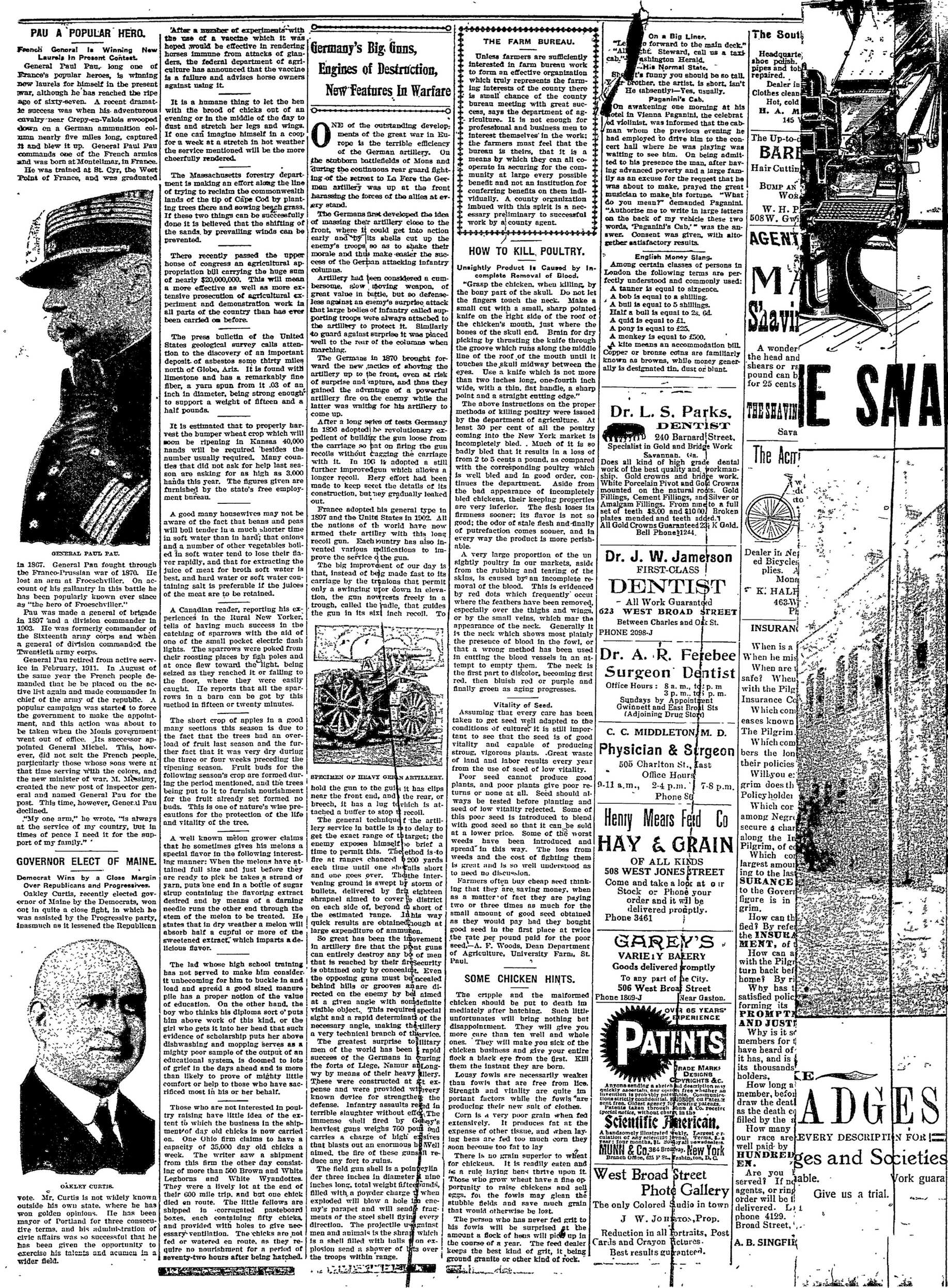
GENERAL PAUL PAU.
in 1867. General Pau fought through the Franco-Prussian war of 1870. He lost an arm at Froceschviller. On account of his gallantry in this battle he has been popularly known ever since as "the hero of Froceschviller."
Pau was made a general of brigade in 1897 and a division commander in 1903. He was formerly commander of the Sixteenth army corps and when a general of division commanded the Twentieth army corps.
General Pau retired from active service in February, 1911. In August of the same year the French people demanded that he be placed on the active list again and made commander in chief of the army of the republic. A popular campaign was started to force the government to make the appointment, and this action was about to be taken when the Monis government went out of office. Its successor appointed General Michel. This, however, did not suit the French people, particularly those whose sons were at that time serving with the colors, and the new minister of war, M. Messimy, created the new post of inspector general and named General Pau for the post. This time, however, General Pau declined.
"My one arm," he wrote, "is always at the service of my country, but in times of peace I need it for the support of my family."
GOVERNOR ELECT OF MAINE
Democrat Wins by a Close Margin
Gives Republicans and Republicans
Over Republicans and Progressives.
Oakley Curtis, recently elected governor of Maine by the Democrats, won out in quite a close fight, in which he was assisted by the Progressive party, inasmuch as it lessened the Republican
P. A.
OAKLEY CURTIS.
vote. Mr. Curtis is not widely known outside his own state, where he has won golden opinions. He has been mayor of Portland for three consecutive terms, and his administration of civic affairs was so successful that he has been given the opportunity to exercise his talents and acumen in a wider field.
After a number of experiments with the use of a vaccine which it was hoped would be effective in rendering horses immune from attacks of glanders, the federal department of agriculture has announced that the vaccine is a failure and advises horse owners against using it.
It is a humane thing to let the hen with the brood of chicks out of an evening or in the middle of the day to dust and stretch her legs and wings. If one can imagine himself in a coop for a week at a stretch in hot weather the service mentioned will be the more cheerfully rendered.
The Massachusetts forestry department is making an effort along the line of trying to reclaim the commonwealth lands of the tip of Cape Cod by planting trees there and sowing beach grass. If these two things can be successfully done it is believed that the shifting of the sands, by prevailing winds can be prevented.
There recently passed the upper house of congress an agricultural appropriation bill carrying the huge sum of nearly $20,000,000. This will mean a more effective as well as more extensive prosecution of agricultural experiment and demonstration work in all parts of the country than has ever been carried on before.
The press bulletin of the United States geological survey calls attention to the discovery of an important deposit of asbestos some thirty miles north of Globe, Arls. It is found with limestone and has a remarkably fine fiber, a yarn spun from it .03 of an inch in diameter, being strong enough to support a weight of fifteen and a half pounds.
It is estimated that to properly harvest the bumper wheat crop which will soon be ripening in Kansas 40,000 nands will be required besides the number usually required. Many counties that did not ask for help last season are asking for as high as 3,000 hands this year. The figures given are furnished by the state's free employment bureau.
A good many housewives may not be aware of the fact that beans and peas will boil tender in a much shorter time in soft water than in hard; that onions and a number of other vegetables boiled in soft water tend to lose their flavor rapidly, and that for extracting the juice of meat for broth soft water is best, and hard water or soft water containing salt is preferable if the juices of the meat are to be retained.
A Canadian reader, reporting his experiences in the Rural New Yorker, tells of having much success in the catching of sparrows with the aid of one of the small pocket electric flash lights. The sparrows were poked from their roosting places by fish poles and at once flew toward the light, being seized as they reached it or falling to the floor, where they were easily caught. He reports that all the sparrows in a barn can be got by this method in fifteen or twenty minutes.
---
The short crop of apples in a good many sections this season is due to the fact that the trees had an overload of fruit last season and the further fact that it was very dry during the three or four weeks preceding the ripening season. Fruit buds for the following season's crop are formed during the period mentioned, and the trees being put to it to furnish nourishment for the fruit already set formed no buds. This is one of nature's wise precautions for the protection of the life and vitality of the tree.
A well known melon grower claims that he sometimes gives his melons a special flavor in the following interesting manner: When the melons have attained full size and just before they are ready to pick he takes a strand of yarn, puts one end in a bottle of sugar strup containing the flavoring extract desired and by means of a darning needle runs the other end through the stem of the melon to be treated. He states that in dry weather a melon will absorb half a cupful or more of the sweetened extract, which imparts a delicious flavor.
The lad whose high school training has not served to make him consider it unbecoming for him to buckle in and load and spread a good sized manure pile has a proper notion of the value of education. On the other hand, the boy who thinks his diploma sort o' puts him above work of this kind, or the girl who gets it into her head that such evidence of scholarship puts her above dishwashing and mopping serves as a mighty poor sample of the output of an educational system, is doomed to lots of grief in the days ahead and is more than likely to prove of mighty little comfort or help to those who have sacrificed most in his or her behalf.
Those who are not interested in poultry raising have little idea of the extent to which the business in the shipment of day old chicks is now carried on. One Ohio firm claims to have a capacity of 35,000 day old chicks a week. The writer saw a shipment from this firm the other day consisting of more than 500 Brown and White Leghorns and White Wyandottes. They were a lively lot at the end of their 600 mile trip, and but one chick died in route. The little fellows are shipped in corrugated pasteboard boxes, each containing fifty chicks, and provided with holes to give necessary ventilation. The chicks are not fed or watered in route, as they require no nourishment for a period of seventy-two hours after being hatched.
Germany's Big Guns, Engines of Destruction, New Features In Warfare
ONE of the outstanding developments of the great war in Europe is the terrible efficiency of the German artillery. On the stubborn battlefields of Mons and during the continuous rear guard fighting of the retreat to La Fere the German artillery was up at the front harassing the forces of the allies at every stand.
The Germans first developed the idea of massing their artillery close to the front, where it could get into action early and by its shells cut up the enemy's troops so as to shake their morale and thus make easier the success of the German attacking infantry columns.
Artillery had been considered a cumbersome, slow moving weapon, of great value in battle, but so defenseless against an enemy's surprise attack that large bodies of infantry called supporting troops were always attached to the artillery to protect it. Similarly to guard against surprise it was placed well to the rear of the columns when marching.
The Germans in 1870 brought forward the new tactics of showing the artillery up to the front, even at risk of surprise and capture, and thus they gained the advantage of a powerful artillery fire on the enemy while the latter was wulth for his artillery to come up.
After a long series of tests Germany in 1890 adopted the revolutionary expedient of building the gun loose from the carriage so that on firing the gun recoils without tagging the carriage with it. In 1901 it adopted a still further improved gun which allows a longer recoil. Bery effort had been made to keep seet the details of its construction, but they gradually leaked out. France adopted his general type in 1897 and the United States in 1902. All the nations of th world have now armed their artillery with this long recoil gun. Each country has also invented various modifications to improve the service of the gun.
The big improvement of our day is that, instead of being made fast to its carriage by the trplons that permit only a swinging up down in elevation, the gun now rests freely in a trough, called the radle, that guides the gun in its six inch recoil. To
SPECIMEN OF HEAVY GERMAN ARTILLERY.
hold the gun to the guild it has clips
near the front end, and the rear, or
breech, it has a lug to which is attached a buffer to stop it recoil.
The general technique of the artillery service in battle is to delay to get the exact range of target; the enemy exposes himself to brief a time to permit this. The method is to fire at ranges chanced 6200 yards each time until one shells short and one goes over. The intervening ground is swept by storm of bullets, delivered by firn eighteen shrapnel aimed to cover is district on each side of, beyond in short of the estimated range. In this way quick results are obtained though at large expenditure of ammunition.
So great has been the movement in artillery fire that the point guns can entirely destroy any be of men that is reached by their fire security is obtained only by concealing. Even the opposing guns must be beceived behind hills or grooves are directed on the enemy by be aimed at a given angle with sondefinite visible object. This requires special sight and a rapid determinat of the necessary angle, making the tillery a very technical branch of thirvice.
The greatest surprise to military men of the world has been rapid success of the Germans in during the forts of Liege, Namur in Longwy by means of their heavy artillery. These were constructed at a great expense and were provided with every known device for strengthen the defense. Infantry assaults reed in terrible slaughter without effect. The immense shell fired by Genny's heaviest guns weighs 760 pound and carries a charge of high explosives that blasts out an enormous hot well aimed, the fire of these guns will reduce any fort to ruins.
The field gun shell is a potpourri
der three inches in diameter nine
inches long, total weight fifteen
bounds, filled with a powder charge when
exploded will blow a hole in enemy's
parapet and will send fragments
of the steel shell trying every
direction. The projectile against men and animals is the shrap which is a shell filled with balls on explosion send a shower of bits over the troops within range.
Unless farmers are sufficiently interested in farm bureau work to form an effective organization which truly represents the farming interests of the county there is small chance of the county bureau meeting with great success, says the department of agriculture. It is not enough for professional and business men to interest themselves in the work; the farmers must feel that the bureau is theirs, that it is a means by which they can all cooperate in securing for the community at large every possible benefit and not an institution for conferring benefits on them individually. A county organization imbued with this spirit is a necessary preliminary to successful work by a county agent.
HOW TO KILL, POULTRY.
Unseightly Product Is Caused by Incomplete Removal of Blood.
Complete Removal of Bone.
"Grasp the chicken, when killing, by the bony part of the skull. Do not let the fingers touch the neck. Make a small cut with a small, sharp pointed knife on the right side of the roof of the chicken's mouth, just where the bones of the skull end. Brain for dry picking by thrusting the knife through the groove which runs along the middle line of the roof of the mouth until it touches the skull midway between the eyes. Use a knife which is not more than two inches long, one-fourth inch wide, with a thin, flat handle, a sharp point and a straight cutting edge."
The above instructions on the proper methods of killing poultry were issued by the department of agriculture. At least 30 per cent of all the poultry coming into the New York market is incompletely bled. Much of it is so badly bled that it results in a loss of from 2 to 5 cents a pound, as compared with the corresponding poultry which is well bled and in good order, continues the department. Aside from the bad appearance of incompletely bled chickens, their keeping properties are very inferior. The flesh loses its firmness sooner; its flavor is not so good; the odor of stale flesh and finally of putrefaction comes sooner, and in every way the product is more perishable.
A very large proportion of the unlucky poultry in our markets, aside from the rubbing and tearing of the skins, is caused by an incomplete removal of the blood. This is evidenced by red dots which frequently occur where the feathers have been removed, especially over the thighs and wings, or by the small veins, which mar the appearance of the neck. Generally it is the neck which shows most plainly the presence of blood in the fowl, or that a wrong method has been used in cutting the blood vessels in an attempt to empty them. The neck is the first part to discolor, becoming first red, then bluish red or purple and finally green as aging progresses.
Vitality of Seed.
Assuming that every care has been taken to get seed well adapted to the conditions of culture, it is still important to see that the seed is of good vitality and capable of producing strong, vigorous plants. Great waste of land and labor results every year from the use of seed of low vitality. Poor seed cannot produce good plants, and poor plants give poor returns or none at all. Seed should always be tested before planting and seed of low vitality rejected. Some of this poor seed is introduced to blend with good seed so that it can be sold at a lower price. Some of the worst weeds have been introduced and spread in this way. The loss from weeds and the cost of fighting them is great and is so well understood as to need no discussion.
Farmers often buy cheap seed thinking that they are saving money, when as a matter of fact they are paying two or three times as much for the small amount of good seed obtained as they would pay had they bought good seed in the first place at twice the rate per pound paid for the poor seed.-A. F. Woods, Dean Department of Agriculture, University Farm, St. Paul.
SOME CHICKEN HINTS.
The cripple and the malformed chicken should be put to death immediately after hatching. Such little unfortunate will bring nothing but disappointment. They will give you more care than ten well and whole ones. They will make you sick of the chicken business and give your entire flock a black eye from the first. Kill them the instant they are born. Lousy fowls are necessarily weaker than fowls that are free from lice. Strength and vitality are quite important factors while the fowls are producing their new suit of clothes. Corn is a very poor grain when fed extensively. It produces fat at the expense of other tissue, and when laying hens are fed too much corn they soon become too fat to lay
There is no grain superior to wheat for chickens. It is readily eaten and is a rule laying hens thrive upon it. Those who grow wheat have a fine opportunity to raise chickens and sell eggs, for the fowls may glean the stubble fields and save much grain that would otherwise be lost.
The person who has never fed grit to his fowls will be surprised at the amount a stock of heens will pick up in the course of a year. The feed dealer keeps the best kind of grit, it being ground granite or other kind of rock.
On awakening one morning at his hotel in Vienna Paganini, the celebrated violinist, was informed that the cabman whom the previous evening he had employed to drive him to the concert hall where he was playing was waiting to see him. On being admitted to his presence the man, after having advanced poverty and a large family as an excuse for the request that he was about to make, prayed the great musician to make his fortune. "What do you mean?" demanded Paganini. "Authorize me to write in large letters on the back of my vehicle these two words, 'Paganini's Cub.'" was the answer. Consent was given, with altogether satisfactory results.
English Money Slang
Among certain classes of persons in London the following terms are perfectly understood and commonly used:
A tanner is equal to sixpence.
A bob is equal to a shilling.
A bull is equal to 5 shillings.
Half a bull is equal to 2s. 6d.
A quid is equal to £1.
A pony is equal to £25.
A monkey is equal to £500.
A kite means an accommodation bill. Copper or bronze coins are familiarly known as browns, while money generally is designated tin, dust or blunt.
Dr. L. S. Parks,
DENTIST
240 Barnard Street.
Specialist in Gold and Bridge Work
Savannah, Ga.
Does all kind of high grade dental work of the best quality and, workmanship. Gold crowns and bridge work. White Porcelain Pivot and Gold Crowns mounted on the natural roots. Gold Fillings, Cement Fillings, and Silver or Amalgam Fillings. From nine to a full set of teeth $0.00 and $10.00. Broken plates mended and teeth added.1 All Gold Crowns Guaranteed 23 K Gold.
Dr. J. W. Jamerson
FIRST-CLASS
DENTIST
- All Work Guaranteed
623 WEST BROAD STREET
Between Charles and Oak St.
PHONE 2098-J
Dr. A. R. Ferebee
Surgeon Dentist
Office Hours: 8 a.m., 10:2 p.m.
3 p.m., 10:1 p.m.
Sundays by Appointment
Gwinnett and East Broad Sts
(Adjoining Drug Store)
C. C. MIDDLETON M. D.
Physician & Surgeon
505 Charlton St., East
Office Hours
9-11 a.m., 2-4 p.m., 7-8 p.m.
Phone 80
Dealer in New
ed Bicycles
plies. A
Mon
K. HALF
463 W
PI
INSURANCE
When is a
When he miss
When are t
safe? Wheu
with the Pilgrim
Insurance Co
Which com
eases known
The Pilgrim.
Which com
bers the long
their policies
Willyou e
grim does th
Policy holder
Which com
INSURAN
Henry Mears Field Co
HAY & GRAIN
OF ALL KINGS
508 WEST JONES STREET
Come and take a look at our
Stock or Phone your
order and it will be
delivered promptly.
Phone 3461
GAREY'S
VARIE 1 Y BAERY
Goods delivered promptly
To any part of the City.
506 West Broad Street
Phone 1869-J
Near Gaston.
OVER 65 YEARS'
EXPERIENCE
DATENTS
EBCINVE TS A
ad have heard of ‘ gts a a ABVW 7 FrEwvt tee
it has, and is Lyne ce T
axs fits thousands wey reo gee Se) ‘ :
Sc. |bolders, Rs Eee a ra
nmay How long a * Sn. ‘
e142 | member, beso: XN . A s#@ee Ks
teat | draw the deat! . tl Ae ok eee.
eel fas the death c \ : ¥//} Pecos cae
" filled by the . } he ees Rs y —
eh How many gE . Hy iB GP BNO OPS a nad oe 4
tc" Jour race are|/ EVERY DESCRIPTIt jamarwor hart RO | ONE Na IN Oe
7 well aid by iN FOR fs con. secon Oe ses tees
3 V DEE! beg ‘ eg on geet Ee eR Seis en ra
= s pe perentlewecrsy, <5 end ge AS ee
BR es and Sczieties, Sa ae a
Fo Rec Oae (aria PR a
served?’ If nflable. Vork guaranteed. = i ie ee eee tae @
ery | agents, or rin = Give us a trial. re ; creck oor ae nae
order will be a —_ ee ee ee ;
{own | delivered. L} 4 “ ae ee ee
Pp. phone 4129. _ i NIN ich Steen ape ee
Broad Street, | - a
Post _
A.B. SINGFI :
" g he a . . . =
ae a ue . ‘7 i
eS ee ee
(forward to the!® deck.
St. Steward, ca 2 taxi
(jshington Herald
Mus Normal Stat
funny you shoul? £° tal
her, the artist. if isn't
phsentiyy—Yes, all¥-
Paganini’s Gab
ening one mor St his
jenna Paganiot. selebrat
{. vas informed : Be cab-
ja the previous *0Ing he
lyed to drive bin Be con-
here he was “2S Was
we bim On 5 2dmit.
resepce the mater Dav-
poverty ard‘"se fam-
cuse for the re that he
to make, pray2e Bteat
make his fort, “What
ypean”’ demand 2eanink
me to write inse letters
k of my vehicl€Se two
rantrs’s Cub,'"5 the an-
sent was gire th alto
factory results
gtish Money St
Jjertain clusses ¢tsons tn
following terf@ Per-
‘ and comly used:
4s equal to six
na} to a shill
wal to S shith
1 1g equal to 2
equal to 41,
equal to £25. .
is equal to £5
ap accomiton bilL
bronze coins a'milarly
rowns, while 1° Zener
ted tin, dustlunt.
.S. Ps,
DENST
240 Barna‘treet,
in Gold and Br Work
Savannan, ca
ind of high g denta
} best quality aprkman.
«crowns and t work.
plain Pivot and Crown
$n the naturals. Gold
‘iment Fillings, silver or
pilings. From 10a full
$8.00 and £1( Broken
ged and teeth 2.1
swns GuaranteeK Gald,
jell Phonedi244
i W. Jarson
SIRST-CLAS
N
INTIT
Work Guard
4ST BROADREET
n Charles ancSt.
J
|
FO ee
&..R. Fbee
eon [Ctist
rs: 8a,m.0.m
. 7 Pe ta Be m.
Ri and met Tsts
pining Drug §
§IDDLETOI. D.
dian &geon
Sharlton Ste
Office HBr
2-4 pni-S p.m.
Phorp
7 i <
Meargi Co
& MAIN
ALIBEES
“T JOMEREET
ltakei st oir
or Becour
-f aD dit se
veredmly.
61 Be
5 "
ARE'S
-ELY aby
lelivefemptly
park ity,
“est Brorect
___} Gaston.
Midge's Years’
. RIENCE
"Tate Poe
WA WBS
VATS,
i ae ney
§ st MARKS
p eians
feeb! cciptiontese
nba whether an
fidenpal ,fommunicn
Cages om Patent
Sirdey: J+ patenus.
_thaugee. “96. receire
me 2
ING Arica,
ecieima. J.nrcest cir
ae RF sececesiors,
op 8,
BaF dew York
ROD |
TOR eet
PicGallery
rolorec .0 in town
*. do s,Prop.
: raits, Post
“SFO res.
: teed. ;
Sinemet aman eesom apn panna sana ena tape matem ene —
So mh ORE: PY Magy Lae:
pe , \ = Oo 4 Mere = “ « aa
—_|-F et BOOK AND JOB
j aa Eas ee : x : 4 . q
The Sout Ze ce 3 a
om Ei WW aya E 3,0 -
xt] nartes ¢ ra Bs ms. 7 a a .
u.|Fepaireas “ty » ea, t , 5 1 1 i a
"t 7 panes in an is a ef, a L . —_
lothes clean# Os ama 2 os —
| __Hot, eola as a? " : 3
t} Be a. et yo Salas : j : 7 . %
: oe ON eS a
al 2d PAH \ \ 1
e — Seameneoe i ( r . ( :
a- | The ro ill ex po a . oF a he ©
B Me, vie . ,
‘| Re = =O Heads, Cats,
| Hair Cuttin get em ee , . , lle, Picvies ;
e 2b Bet 57s ae =. gt nic
| a -—«Ivitations for Balls, Pict 4
WV. H. Peggy Gcteeanweee iad _ eee ee . 2 .
>| 508W. Gu SSS] Po. ti. -and Marriages. x“
: He ! ‘
hog a ” ‘ .
s ‘
: ae : . Mee 95 Vow ‘
TV oa ey : a
| M ‘TiC By-Laws and Club Constitutions a Specialty
j 1 Si a ae Sa a
ee Se s y oP
“ LS ‘
A wonder: < :
the head and *
shears or ra
pound can b .
for 25 cents
THESEAYD e
Saya, , : :
t 7 ~ Bg 2 ’
The Aon Pee Cha te be Ba
6 5 fo 2 > Pe ge em Pgs se Pen. were . 7
/ H Se. é - 8 ha BABS ;
7 7 st > edo. & ae st ete e
AVA q ” sel i Pies Se & he
G Sa 8 ees See. » OR
=e Ss eet cic Mines ie es, ian Be
: * ee OS ote PRS aca a ree 3 FRR .
ved wera 4 1. Sees ee ee
os “Yi Spee oe.
Mond PE A ie So ae AG ae Cees es Peeagorees |:
Hin it ER i aea EEG Bae eric: Be :
° K. HALB Mee N nn eee PRG Seale ee sere 7
eee a ge
When isa { sey an AEE Bei names ieee see Senet bea Sears , eS
When he mig | eres ae ped Be hae Se ise ee Bee es /
When are eo Be ce a ie mee pe cs ae AE Hae Cae aoe ae 5 .
safe? Wheul & 3 44 ee oP eee 5 peepee BU cas
vith the Pile} 44 Sg ae ee cy A Saas eee OS sees yA an SS, °
ip aOR Ie heh “ANS, 3 ee ee Beek pen ema sDO 5
os ae ee oa Ore oes
hich com} 9x8. A Cee FT eae ie EEE Se UG Pa U as fee ia Pee
known | 2dM cmb see CITE - Spine pone a eee NS Sg ES ae ; eh eit asia
mses known | Be age ees 9 Nees BEANO
Phe Filgeina ee eee PPE BENS : ae ee Pasiae SUC e ie *
Which compege Sy: EE SEES sory EA Semeur bony Bean Sor, '
ers the lonfaee oa, Exes" * BE ae ge « Bea cee GSS asin 2 } :
“Willyou eee es he Pe aa ee ,
: ees eae + Stns Tiga Wy Sie eran She oF oe BE Zi. i
rim does th ope. 3 Ae 2 ie eS be cease D: ee ean Ser SB |
sy LSA URs Ses Sara TSC ee ag CAA sei See eran ices oS IAS ATi '
*oliey holdes | sian ay mee even Te eo Aes Be neta we see aso arene aerate Sen Ee ARS
“Which core RB Sa ee Se ee ce a)
mong N. onrdgeen easehercee Seas ecate: Sahel oe on ae ae Beet hy aaa ae !
cure a chase eats ee cc lee Soh ee
long, the InfgAcaun eee gS eae es Pen ees See
‘ilgrim, of ope ae este! an Es am pare Paes es ete En eee ie ae 3
Which co Se tre. oe EN ee RE Sessa LTS
irgest amourpurse seer a i Suen aa o tke % ‘ \
ie he Saar atts Re McGhee, se netyi ts (ptt tle, age ox mee we
ORANGE eae eos: - ee Raaeetii citi: hve AS oN) ee
» the Gover Sexes, alee eres Pe ww “ED EK, Me, ~ be’ #
ga Ning Soak peg eee aaa
Te SSO TE whale mo Ig enh a regret ger
FOR -HIR&: NGHTORMDAY =. ©
SEABROOK’S BRIVATE:AMBIGANCE |
514 West Broad Street Phond 2166
| - a = = - + ot *
You will be greatly benefitted by stopping in and getting our
free advice on how to take the best care of your shoes .-
which .will cause them to last longer and keep better shane. Wea
do neat repairing on shoes and pay special attention to ladinsané
children shoes. Prompt attention to all -work.
J.H.WASHINGTON
WHITAKER STREET
amc OE
W. L. BLUNT
—-WHOLESALE AND RETAIL~
Fruit and Commission Merchant
303 ST. JULIAN WEST AND 23 J EFFERSON ST
YOUNG BROS.,
507 WEST BROAD STREET
Is the Home of Sweets. Phone 2932
Al. Mi. MONROE & COMPANY
Funeral Directors and Embalmers
Prompt nd courteous attention given all business
entrusted to us, Everything of the latest style
Latzsr Srrre Smysey rar snp Bracx Cars |
CARRIAGE FOR HIRE = .
609 WEST BROAD Phono 2811 ~
OSS ISP SE a
Le G. W. Sthith, Pres. Dr. C. B, Tyson, Treas. Dr. N. W. Este, Sect’ry
East Side Sanitarium
THE BEST PRIVATE PLAGE. FOR COLORED PEOPLE WHEN
S
MODERN EQUIPMENT GOOD NURSING
, Terms Reasonable
CALL, WRITE 0R PHONE
EAST GWINNETT ST, 2 ATLANTIC AVENUE
Phone 4941 - Savannah, Georgia
Rea arc ater ar ata eer OT Sere
SE eee
Johnson Undertaking Establishment
~—OOMBINED WITH—
The Royall Undertaking Company
AIncorporstea)
Funeral Direetors and Embalmerr
Finest line of Coffins, Caskets and Robes. White and black
Burial cars. Office and warerooms'325-331 Jefferscn street.
W.R. FIELDS and L. M. POLLARD, Managere,
Residence Phone 2032
ResidencePhone 4241. Livery Stable Attached. fice Phene 676
CREE Te Robe oo URE Dee ALR tet
aaa
{
x PATE SAYS_= b
Cut outall this war talk and get down tobusiness. Things
x areall right. Boost and don’t get bine and every body 5
will soon be woaking full time. ‘lrade with us, our prices
are practically the same as before the war, only a few
items raised on. If you have fever take 88 tonic, it will
surely break it up- For headache and neuralgia take 88
x powders. PATE’S KIDNEY ROOT will stop backache, 5
weak back and all kidney trouble. Phone us your wants
x we get things to you right now no delay. '
i 5 :
{ Pate’s Drug Store 5
THE NYAL STORE _
x HALLand WEST BROAD STS. Phones 4710and 4711
i .
0 Ee ore 7
. PEEBIEE
"3 A IERL es?
Dae Sora)
Laat Ba een Ree
SRE See
eee aera
x Ps on
S EGE E
"ee ie
Ao son ee
4 SEABORAD AIR LINE RAILWAY =
<
¥ e Important Change of Schedule, April 12, 1914
No. 11. No. 13 No.14 No. 12.
7:00am. 6.00 pm.... Lv. Savannah....... ....Ar. 8:00pm. 8:35 pm.
TATam. 6:43 pm....--...--Cuyler -....-.-.se0eese. U5 am. 7:45 pm
8:05am. 7:20pm. .... .---Lanier... ..-...--2. ee. 4e7:00am. 7:27 pm.
8:58am, 8:00 pm......-----Claxton ... seecesses se-2+-6:10am, 6:40 pm
Y:2vuam. 8:32pm. ..... ..-Collins....... 0 ..-.00-.-.-05:40am. 6:10 pm.
9:50am. 970.5 pm....-...0. LyOnS......sse0s ee seoeeee 5:08am. $740 pm
1:05am. 9:22 pm...... ....Vidalia...... .-s.enee-e. 4:55am, 5:25 por
10:30am.” _ 9203 pm......-...-Me. Vernon.....50-. ...2.- 4:27am. 4:57 pur
10:59am. 10:25 pm......-+2e-AIAMO ..e. eeeeeeeeereeee-4:02am. 4:27 pm
11:25am. 10:53 pm.,.....----Heloma.....e..e05 seeeeees 35am. 4:03 pm
12:25 pm. 12:0lam...... ...-Abbeyille .......-+2-.se00. 2:44am, 3:08pm
12.45 pm. 12:24am........---Rochelle....... .....0.-6. 2:25pm. 2:46pm
12:55 pm = 12:37am: ..! ...--PittS ..eeceeeeeseoe oe eee 2:15.am, 2:36 pm
20upm. 1:l5am. .....+-- Gordele...-...+ seeee sees 143am. 2:05 pm
3:10 pm. 2:40am .z. .....Americus,...- cecsee ooee12:25am. 12:31 pm
4:10pm. 3:42am .....+...Richland...... .sssseeee06 1:30am, 11:35 pm
4:32pm, 4:vlam.... .-.e- Lumpkin’... 66. ./.e..20e-11:10am. 11:06 pm
6:13 pm- 5:43am ... .-..-Hurtsboro ...2...2- scenes 9:32am, | 9:30 pm
B:1E pa. 8:10am ..-Ar... Montgomery ..-...... Lv....7:30 pm. © 7:20 am.
C. W. SMALLS, Division Passenger Agent, Savannah; Ga, __
THE SAVANNAH TRIBUNE
Established 1875
By JOHN H. DEVEAUX
Published by
SOL. C. JOHNSON
Editor and Proprietor
JAS. H. BUTLER
Asso. Editor and Manager
Published Every Saturday
1009 WEST BROAD STREET
Phone 2171
If there be any truth in the statement, "pepole who live in glass houses should never throw any stones," then this truth was certainly brought home to the American people by the Turiksh Ambassador, who was recently called upon by the department of state, for explanation anent certain statements of international import he is alleged to have made. Charges among other things that he represented a government which indulged in persistent persecution of those of the Christian faith within its border, the Ambasador in a stinging rebuke made it plain that America has no cause for holding up herself as the ideal nation in matters of a humane nature, as long as the lynching of so many of her black subjects go unpunished. The Ambasador is right. While it is true that two wrongs do not make a right, it is also true that America cannot hope to wield the proper influence as a leader in humane matters, as long as she allows such barbarous practices as lynching and the like to go unpunished within her borders. Think of it! During the year of 1913, seventy three persons, Negroes, met their death by the lynch route. This means that these unfortunates were given no trial, no opportunity to acknowledge their guilt or prove their innocence. Think of it! In civilized America, such a state of affairs is allowed to exist year in and year out. If America thinks that she can indulge in such uncivilized practices without attracting the attention of the world to her, she is sadly mistaken. Each American lynching is a blot upon the nation's escutcheon. Each stands out by itself in bold relief. Each in its own way lessens the influence of our great nation among powers of the earth. Let this country cut out lynching, which she can, and she will demolish one of her glass houses. Meantime may she ever remember that people in glass houses should never throw any stones.
T
That there is much merit in the movement now going the rounds of the country, looking toward the abolition of toy pistols, toy soldiers, toy battleships and the like as play implements, for young and playing children, is attested by the wide-spread popularity which the movement has gained in thinking circles. For some time, we have been unable to see how it was otherwise than the height of folly to place at the disposal of a child as play articles, those instruments the chief purpose of the manufacture of which is death dealing. The divine injunction, "train up a child in the way he should go and when he is old he will not depart from it," brooks few if any exceptions. If we are to expect the children of today, who, we all know, will be the men of tomorrow, to be peace lovers and advocates of the same, then we must not bring to their lit. tle minds suggestions, material or otherwise which will cause the emo becometoo familiar or at homewith those implements whose only mission is that of death. In giving to our children such play article as heretofore mentioned we have been training, uncousciously perhaps, so called defenders of the republic by means of arms. In this we have made a great blunder. Far better would it have been, if during these many years of the life of our republic, our young peoples' minds had been made to exercise themselves rather along channels of brotherly love and peace than otherwise. As we see it, there is absolutely no efficacy whatever in the toy pistol or toy soldier. If we are to wipe militarism entirely off the map,
as we believe some efforts are now being put forward to do, then we must do away with these toy implements of death which are such fair reminders of the life of warfare.. The movement for abolition of the toy implements of war is a good one. As far as we can see, it is taking root in soil altogether fertile. May the day speedily come when a safe and sane substitution for the toy implements of war be made in order that there may be in the near future a larger and more effective number of peace advocates.
Editorial .Notes
Those who are able should join the "buy a bale" movement and help the tillers of the soil.
There are many hundreds of acres of land in this county that can be purchased at a price cheaper than ever will be again. It behooves our young men to make investments along this line. They will make no mistake in doing so.
It seems difficult for a person to stick to a principle. This is a great weakness that many of us should overcome.
The mass of our people need an industrial education. Every boy and every girl should be taught to work. This does not mean that we are averse to a higher education.
During the past two weeks two of the largest organizations among our people have had national gatherings. These gatherings have cost thousands of dollars and the greater part of this amount is out of the pockets of those who the least afford it. Efforts should be made to have these gatherings less frequent in order that the people will not be so much taxed. For instance the National Baptist Convention should meet every two or four years instead of annually. This question should be seriously considered by the leaders of this denomination and some action taken.
The largest pork barrelever presented to congress was that of the Democratic river and harbor billcalling for fifty-three million dollars. This amount is asounding, especially in the face of the fact of a nearly depleted treasury. The Republicans would not stand for it and fillibustered against its passand succeeded in reducing it to nearly twenty-two million dollars.
Get into the saving habit, it will do you good when in dire trouble.
Should not our ministers in an organized way adopt some practical plan whereby a more effectual hold can be had on our young people? Are they not partly responsible for the present condition of affairs?
The large increase of property holdings by our people in this county last year was indeed gratifying. The record should not be broken, the increase the coming year should be greater.
Our young men should have high ideals and persistently live up to them.
The national platform of the democratic party says "We favor a single Presidential term and to that end we urge the adoption of an amendment to the Constitution to make the President of the United States ineligible for re-election and we pledge the candidate of this convention to this principle." President Wilson subscribed to the above; can he conscientiously violate it?
Never become discouraged; success comes to him who continues to plod.
In the Maine election the Republicans more than doubled their votes of 1912. The Progressives reached only about 17,000 votes despite the fact of the presence of Col. Roosevelt who boosted for them during the campaign.
The saving and economical qualities of the Jews and other individuals should be an incentive for all of our people.
One of the best ways to furnish our boys and girls employment is to unstintingly support our men in business. If this support was given those of us now in business, the result would be an increased business and the need for more help, and of course our boys and girls would reap the benefit.
Secure a copy of next Saturday's Thirty-two page Tribune.
There will be a happy,throng of children wending their way to the several school buildings next Thursday. They will represent the future men and women of our race and no little care should be taken in their training.
St. Philip's Church
Sunday was Educational day at St. Philip. Rev. R. H. Singleton preached the educational sermon at 11 a.m. The Sunday school had their excercises at 3 p.m. At 8 p.m. there was a fine and interesting program rendered by adults and children of the Sunday school. We thank the members of other churches and the public for the splended attendance at the cantata on last Monday night Our fall rally is just one month off; each division must do their duty. The Singleton division will have the next two weeks for entertainments. There will be a special sermon by Rev. Singleton on Sunday night subject, "Evils of the Times." There will be preaching nearly every night next week. The following services on tomorrow Sunday: Prayer meeting at 5:30 a.m. Preaching 11 a.m. Sunday school at 3 p.m. A.C. E. League at 7 p.m. Preaching at 8:15 p.m.
Among the Masons.
If mankind were governed by the principles of our Order the name God would be professed. There would be no prejudices or hypocrisies, noingratitude, pride, nor self-complacency under the smiles of Providence, nor any murmuring under its frowns. If mankind obeyed these teachings, to honor and obey God would be their constant delight, they would love their neighbors as themselves, consequently there would be no wars, nor envying, no strikes; no slanders, litigation, intrigues between neighbors, no persecuting, bitterness, frauds nor deceit; nor murders, robbers nor theft; no unkindness, treachery, nor implacable resentment among friends. Everyone would pursue that only, which would be conducive to the happiness of all.
I believe there is no death. I belive that man has a continued existence and takes on new organism that I can no more understand than a caterpillar can understand the construction of a butterfly. What I believe in one single sentence is that man never dies. Death is a launching. Death calls us and says; Come, come, you are tired; come, you are tired, and sleep." I often look forward to the time when that voice will tell me that I may sail over the unknown sen.—Lyman Abbott.
There are some people in this world who are not satisfied unless they can dictate the policy of everything with which they are connected. There are a good many Masonic bodies burdened with members of this kind. There are brethren who, having been honored with the highest positions in the lodge, are not satisfied to make an honorable retirement from official position and "see who best can work and best agree," but who persist in trying to run the lodge, elect its officers, pick its workers and determine just what it shall and shall not do. And when they do not succeed they commence to make mischief and adopt the rule or run policy. We often hear the brethren high up on the Masonic ladder who are guilty of this misdemeanor. No. presiding officer should allow himself to be intimidated by a brother of this kind, no matter what his Masonic standing and antecedents may be.—Illinois Freemason.
Always abide by the will of the majority in your lodge if you want peace and harmony to prevail. Don't be a knocker because everything idosen't go just to suit your fancy.—The Globe.
astend, Sept. 23 (via London) The power of Freemasonry is illustrated by a story told here by a citizen of Louvain, who, with the masonic sign, says he saved fifty of his fellow citizens from being shot to death by German troops. This group of citizens, according to the recital of Belgian Mason, had been lined up for execution.
The German firing party had their rifles at "present arms" when the narrator gave a Masonic sign. The German officer commanding the firing squard happened to belong to the craft. "He recognized a brother Mason and ordered him to leave ranks, but the Louvain Mason refused saying: "My fellow citizens are no more guilty than I am. If you are going to kill them I shall be killed with them" The German officer thereupon ordered the released of the entire party.
ATLANTA, GEORGIA
An Unsectarian Christian Institution with
HIGH SCHOOL, NORMAL SCHOOL
and COLLEGE.
Superior Advantages in Industrial Training
Music and Printing. Home Life and Training.
For Catalogue and information address
EDWARD T. WARE, President
Atlanta, Ga.
The Union Mutual Association
Has an efficient SYSTEM of handling the daily business of Industrial Insurance. As a result of their long experience in this line of work. The officers of this grand old pioneer Negro Insurance Company are easily in a class by themselves. Each officer and employee becomes a unit in an EFFICIENT SYSTEM working for the benefit of their many policy holders. If you have ever done business with us you know the advantage of such an EFFICIENT SYSTEM. If not, we would like to prove to you the many ways in which our SYSTEM of handling this class of insurance will benefit you. DON'T PUT IT OFF, but see one of our agents THIS VERY DAY or phone 1470, J. C. LINDSAY Dist, Mgr., 509 West Broad St. Srannah, Ga. or write T. W. WALKER, Pres't, or C. C. Shau Secretary, 200 Auburn Ave, Atlanta, Ga.
Deaths
After an illness of two weeks Mr. Joseph B. Willis died at his residence 723 Anderson street, east. He was born in this city August 15th, 1857 in which he lived up to the time of his death. He joined the Second Baptist church under the late Rev. Mr. Ellis. During the pastorate of the Rev. D. Augustine Reid he served faithful up to the time he was confined to his bed. He bore his illness with great Christian fortitude. His bed side was made happy and comfortable by the hands of a loving wife and dutiful daughters. He was a member of the Lone Star cadets from which he organized the Lone Star Aid Social club and branch. He was one of the oldest and most faithful members and past officers of the Armenia lodge of Odd Fellows, also a member of Olympia lodge, K. of P., the Uniform Rank K. of of P. and the Carnation Aid and Social club. He was a loving husband and father. He is survived by a wife, Mrs. Rosa E. Willis, three daughters, Mrs, Mary J. Thompson, Mrs. Wm. Mills, Mrs. N. A. Blackshear, one sister, Mrs. Geo. Crosby of New York; two brothers, Mr. Sam Heyward of this city and Mr. Clifford B. Heyward and other relatives to mount his death.
Mrs. J. H. Patterson's School Mrs. J. H. Patterson's Day and Night School will open at her residence 912 ATLANTIC AVE., ON OCT. 1st.
MADAME
FLORENCE E. WILLIAMS
Graduate Prof. Roher's School,
New York.
445 Price Street, near Gordon
Telephone 2328
Wigs, Switches and Pompadours
Made from Natural Hair.
Combings Made Up. Shampooing and
Hair Cultivating a Specialty.
Face and Electric Massage, Dyeing
and Matching Hair.
ORIENTAL HAIR GROWER,
An excellent preparation, will produce
a beautiful growth of hair. Directions
on each box. For sale, price 25 cents
per box.
A Brief Review
Not long ago the Ga. Mutual proclaimed itself a modern business missionary, intending to preach this gospel and showing that the six Negro industrial insurance companies of this city had an income amounting to $566,775.50 in the six months ending December 1912 according to official report. Now comes the startling announcement from a local statistician saying, that the seven Negro companies paid out during the first week in July 1914 right here in Savannah $1,766.70 in salaries and commissions to their employees for one week's work. The Ga, Mutual is going to bring out more facts, but is sorry to say that these figures are getting so large that a good many of our people can't read them. Join the Ga Mutual and the agent will read them for you
GA. MUTUAL INS. Co.,
Branch Office—509 W. Broad St.
H. T. Singleton, Supt.
—Ad.
Atlanta U.
ATLANTA
An Unsectarian Chr
HIGH SCHOOL,
and CO
"On to Berlin".
That's the war cry of the allies now warring against Germany in Europe. To see just what they will have to contend with. Be sure and get the large double page map of Berlin and its big defensive fortifications, to be a color feature of the Magazine of Next Sunday's New Yerk World. In this issue of the Sunday World there will also be printed the first installment of Sir A. Colman Doyle's great new war story, "Danger." Order the Sunday 'World in advance.
Special Notice
This is to inform the public that J. M. Northington is no longer connected with The Mechanics Investment Company, 139 Barnard street, and is not authorized to collect, receipt for, or receive any money due this Company, or to transact any business whatever in its name. F. D. TUCKER.
FIRST CLASS
WHILE YOU WAT.
All work guaranteed.
Second-hand Shoes For Sale
At 629 East Broad St.
EDWARD ELLIS.
Piano Music Taught
Mrs. J. T. Holly,
505 EAST HALL STREET
Special Attention,
Feed Shop
FOR SALE
540 Liberty St., E.
Stop at S. Kantziper
For MEATS.
WE ALSO BUY LIVE STOCK
Phone 2669
CITY MARKET.
For Plain and Ornamental
PLASTERING
Kalsomining and
PAINTING
G. D. JONES
829 W. GWINNETT ST.
Prices Reasonable.
Dr. GEO. W. SMITH,
PHYSICIAN AND SURGEON
Office W. Broad and Gwinnett lane
Phone 1522
Office Hours— 9-10 a. m.,
12-2 p. m.
6-8:30 p. m.
Res.: 920 Wheaton St. Phone 1439
SAVANNAH, GA.
WILLIAM McKELVEY Contractor and Builder.
I am now doing business for myself and am in position to give estimates to all kinds of work. All orders promptly attended to. See me before building.
508 Huntingdon E. Phone2308-L
University
GEORGIA
Instant Institution with
NORMAL SCHOOL
COLLEGE.
In Industrial Training
1000
The Wage Earners Loan and Investment Company
Will pay Interest ints Savings Department at the rat of
Per Cent
onsums of $100. 00r more, when left or the period of ine Year.
Interest payable quarterly at the rate of
5 Per cent
on leposits payabl upon demand
Officers
Williams, Pres and Treas,
R. Fields, Vice-President
A. Harper, Secretary
Directors
L. E. Williams,
L. M. Pollard,
W. H. Burgess
W. J. Williams
J. G. Garey
Jno. F. Jones
W. R. Fields
H. B. Wright
Sol. C. Johnson
P. Edward Perry
Wm. Wright
R. A. Harper
James M. Ferrebee
The Wage Earners Loan and Investment Co.
(The Pioneer Negro Savings Bank of Georgia)
468 W. Broad St
Savannah, Ga.
ss Rosabelle Lindley of Atlan'ta is in the city the guest of her s is Mrs. M. C Campbell, 555 Berrien f. Ira T. Bryant who is in the city few days will leave today fo Hill, Ala., where he has charge printing department of Snow- nitute.
Misses Rosa Mae and Willie Williams, after spending the summer in Americus with their grandmother, returned home last Saturday looking well. Miss Willie leaves next week for Atlanta, where she will attend Atlanta University.
The Blue Ribbon Dancing Class will be held at the Harris Street nail every Tuesday beginning October 6th, 1914, from 4 p.m. to 12 p.m. Plenty of music and refreshments. Instructions given at afternoon sessions. Admission, from 4 to 7 p.m., 10 cents; evening 15 cents. Committee of management, Jos. W. Handy, Valdo Giles, Arthur S. Givins, Chas. Toppins, J. Clayton Williams, Geo W. Rahn, Chairman.
Miss Wilhelmina Fields left yester day for her home Atlantic City, N. J. after a stay of about two months. She came on account of the illness of her father, who died last week. Mr. D. Z. Duncan spent a short while in Jacksonville, with friends. He re- dited on Thursday. A. R. Stalings of Waycross, and through the city on Thursday Boston
J. H. K. Butler will preach morning and evening at the B Church, Bolton street. Public is invited to each service. Annie Rannair Holmes was the West of Mr. and Mrs. Clarence F. Jones of West Philadelphia during the past week. While in the city Mrs. Holmes was the guest of honor at a number of theater, automobile and whist parties.
For Rent—Modern flat, 5 room bath, electric lights and gas. Upper 531 Park avenue, east, $16.00. Apply G. H. Bowen, 458 West Broad street.
Miss Harriette E. Reynolds who graduated from the domestic science course at Berea College in Philadelphia, passed through Savannah on her way to take charge of the domestic science department at the Daytona Normal School in Florida.
Miss Etta McIntosh returned home on Thursday after a delightful stay in Washington and New York.
A few desirable offices are left in the Wage Earners new building at the corner of West Broad and Alice streets.
FOR. SALE—Household. furniture all kinds, beds, chairs, wardrobe, table, dresser, etc., pictures crockery, mattings and carpets, me. handsome oak folding. bed mirror. front...326 Bull .street, a. m. to 1 p. m.
Special Notice
The S. G. H. Dancing class would be able to state that there will be one dance at Catholic Hall on Monday, beginning September 28th, which will be the final dance at this place, but they will continue to run at the Duffy street hall, beginning Monday evening October 5th, 1914.
Furniture of any kind, bedroom dining room, and kitchen. Fine cooking stove cheap. Beautiful folding bed with mirror, matting refrigerator, reasonable prices, 362 Bull street corner Macon.
Mrs. J. B O'Neal and daughter who have been visiting her mother, at 608 East Henry street, returned to her home in Thomasville, Ga., after a very pleasant stay.
Rev. E. D. Davis, pastor of the First Tabernacle Baptist Church, Huntingdon street, has been out of the city several days on a vacation. The services] are being conducted at the church until he mak.s his return. He is expected to be in the city about the last of the week.
For Sale-Oak dining table in first class condition. Apply 12 Bay Street, west.
after spending, two, pleasant wee
jacksonville, Mrs. Thomas B. Lee
little Thelma returned home Sat-
ay.
Mr. and Mrs. W. L. McLoud left for our home Sept. 13th. Mrs. McLoud been visiting relatives and friends six weeks. The sickness of their boy caused their trip to be cut short. Mrs. Daisy B. Reeves returned home after a delightful visit in Atlanta to relatives and friends. Mrs. Frances Fowler has also returned to the city.
Mrs. M. L. Henry of Wheat Hill, arrived home last week after spending a few weeks with relatives and friend in Charlotte, N. C.
Mr. Louis W. Wells and Mr. Lymas Wells arrived in the city Tuesday morning from New York City and were the guests of their aunt, Mrs. Elizabeth Porter, Waldburg street, west. They left Tuesday afternoon for Daytona, Fla.
Rev. and Mrs. J. S. Moody returned to the city on Thursday of last week, after attending the National Baptist Convention at Philadelphia, Pa.
Mrs. Rosa L. Roberson and Mrs. Sarah M. Mooney left Thursday morning for Augusta and Raines, Ga., and will be the guests of Mr. and Mrs. George Roberson. They will returnd home Oct. 3rd.
Mrs. Emma Johnson, after spending three months at Salters Point, New Bedford and Boston, Magg. returned last Friday.
Mrs. Walter Lee hrs returned from New York and Atlatle City, where she spent her vacation.
Mrs. G. E. Allen, of Brunswick, Ga., was in the city Tuesday en route from New York.
Porf. and Mrs. R. M. Cooper of the Georgia State College returned to the
day from a trip north; light. Maxwell of Atlanta, is a shortwhile in the city. Joseph Turner, and children rised to the city, after a pleas two months in Jersey City, sister. Mrs. Abner Jonea entertained on last Friday, lightful party; quite a number were present.
Secure copy of next Saturday's Thirty two page Tribune.
Mr. Barber spent the week in the city guest of Mr. John Adams. They whab leave tonight for Mpree-house Gege, to resume their studies. Miss Ethe Houston returned to the city Tuay from a visit to her sister, Mrs. F. Robinson, Evanstob. III.
Mrs Gelia Davis left for Newberne N.C., are she will spend a couple of weeks with her mother-in-law.
Aurelia. Allen, formerly of the Colored Millinary Store, will continue in millinary and dressmakingith. the leading. stiles, beginni. October 1st at. her home. I E. Gwinnett. street. Bring. our old hats and. have them me over like new this will savyou money... Will also give inactions in millinary and dressmang... Any one wishing to take either of these studies which. could be of benefit. to every man can do so by attending aurelia Allen's. school of art... ere you can find Madam War's Hair Grower, also a full liof hair gods.
Two rot. use of kitchen, toilet and bath...5least Henry Street, apply at premises.
Sql Happenings.
Mr, anMrs. A. L. Tucker entertainede younger set with a dance inpor of Mr. Leigh B. Maxwell Atlanta on Thursday night las Those present were Mr. Lei B. Maxwell, Misses Lucile Sicer, Mildred Jones; Elizabethtoney, Harriet Parkhurst. Anda Jones, Irma Curley, Annit McDowell, Ilucie and Ednake and Lucile Tucker, Messrs Huton Tolbert, Edgar Habershah Nathaniel Branham, Andrew Mowell, Earl Ashton, Aggie Blahbear and Meldrim Tucker.
On September 9th Eliza Redd entertained few of her little friends in her of Claudia Mays, of Atlanta, her home 213 East Broad street nose present were, Claudia Luc Mays, Lula May Anderson, Dithy Spring, Unice Warren, Price Alexander, Helen Willis, Geneva Hamilton, Virginian, Veronica Redd Margaret Sig, Ophelia Hare, Mildred Wins, Willie May Williams, Tha Skirty, Margaret Hutchin, Louisa Johnson Lena FI Mercides Rein, Johnny Currithrine McBridge Ruby Carterina Green, Amita Smith, Louishstin, Miss Anna Gilliard, Mmma Gilliard Masters Aspill Redd, George Green and Sal Redd.
St. Stephen indergarten and Primary school 3 Harris street, east, will openursday October 1st, 1914. Tu 50 cents per month. Spechre will be given to the childretTeachers: Miss Edna C. PriMrs. Lucy W. Tayler. Rev. J. Taylor, principal, Mr, L. Bollard- trustee.
A special ring of the congregation of Sephen's church will be held imiately after the o'clock servinday October 27th. Everyber is asked to be present.
Golden e News
The Union Circle No. 9 met at the Wise building on Monday nighth a large attendance as u there were a number of vis present; thirteen candidata initiated.
Friendship No. 8 met at Seabrooks halfnesday night; there were an ar of candidates made.
Golden Lincele, No. 4, met at Scott's halfursday night with a largenance, and several canidates taken in.
Three Gaty Circle, number 3, met at Sccall on Wednesday night. dates to the number of 15 wetiated.
The Gateen Success' Circle No. 14, met illiams building on Wednes night. Twelve candidates wade.
Pure Gold 7, meets at Seabrook hall, 14rady nights and 4th Friday night. Bro. John Carson, Hon. Deputy.
Faithful W. Circle No. 18, meets at Med hall 1st and 3rd Wednesday n Bro. Inman Rawls, Hon. Sister Bertna J. Green, Hon. D.
Willing Worlcircle No. 1, meets 1st, and 3rd, 14rady nights at Seabrooks hall, A Brown, Hon. ruler and Frank Hunn Hon. deputy.
Triumph Cil
Monday night and 4th, Wednesday night at Seabrooks hall; A. R. Brown, Hon. ruler; J. S. Lloyd, Hon. deputy. Three Gates City Circle No. 3; meets 2nd, and 4th, Wednesday nights at Scott's hall. Jason. Dukes, Honer ruler, G. W. Winley, Hon. deputy. Golden Link Circle No. 4 meets 2nd, and 4th, Tuesday nights at Scott's hall, Thomas Herd, Hon. ruler; M. C. Cambell, Hon. deputy.
Savannah Circle No. 5, meets 1st, and 3rd, Thursday nights' at Mechanic's hall, Geo. Heyward; Hon ruler; Henry Hall, Hon. deputy.
Rising Sun Circle No. 6, meets 1st, and 3rd, Wednesday nights at West Savannah, Rev, Stokes, John Johnson, Hon. deputy.
Relief Circle No. 7 meets 2nd, and 4th. Wednesday nights at Mechanics Hall, J. H. Green, Hon. ruler; Sam Oliver, Hon. deputy.
Friendship Circle No. 8, meets 2nd, and 4th, Tuesday nights at Seabrook's hall, J. C. Holloway, Hon ruler; Sister A. B. Campfield, Hon. deputy.
Union Link Circle No. 9, meets 1st, and 3rd, Monday nights at Williams building; Brother Seabon Benton Hon. ruler, Sister Sallie Green, Hon deputy *Traveling Pilgrim No. 10, meets in Augusta Ga., at Singfield hall, Watkins street, Rev P. T. Gallot, Hon. ruler; Sister Nancy L. Westly, Hon. deputy.
Lily of the South Circle No. 11 meets 2nd, and 4th, Monday nights at Seabrooks hall, A. B. Singfield, Hon. ruler; Sister Lenora King, Hon. deputy Working Lily of East No. 12 meets 1st, and 3rd, Tuesday nights at Seabrook hall, Brother Lawrence Miller, Hon. ruler; Sister Julia McMasters, Hon. den tv.
Gateway to Success Circle No 14,
meets 2nd, and 4th, Wednesday nights
at Williams Building, H. Rahn,
Hon. ruler; Brother, L. J. Biggins,
Hon. deputy.
Evergreen Circle No 15. meets 2nd,
and 4th, Wednesday nights at Mechanics hall, W. B. Dunn, Hon. rnr; Sister Mattie R. Davis Hon. deputy.
GoldenStar No. 16, meets 2nd, and 4th thursday nights at Williams building, Wilton Wiggins, Hon. ruler; Sister Reiney Morrigan, Hon. deputy,
Easter Rose Junior Circle No. 1,
meets 2nd and 4th, Tuesday evenings
at 4 o clock at Williams building, Sister
Clara Hazel, Hon. lecturer.
Sunflower Junior Circle No. 2
meets 2nd, and 4th, Monday evenings
at Williams building, Sister Anna B.
Campfield, Hon. lecturer.
Secure a copy of next Saturday's Thirty-two page Tribune.
Red Caps to Play Basketball
The Broad Street Station been caps of Philadelphia and Penn station red caps of New York city, both of the Pennsylvania Railroad League will cross bats at Olympic Park, New York City on October 1st. The winning team will play the New York Central on same date. The Broad street station red caps under the management of Mr. Geo. M. Victory, hope to retain the championship which they won at Hillsdale park, Philadelphia on September 10th.
Beth-Eden Church
There will be an echo-meeting of the National Baptist Convention at Beth-Eden Baptist Church tomorrow. The pastor, Rev. N. M. Clarke who has just returned from the convention and his vacation, will devote the entire day to reproducing the program of the convention held at Philadelphia September 9,14. 1914.
First A. B. Church.
Sunday September twenty-fifth is the day set for the great rally contest between the red and blue lines of the First African Baptist Sunday school, Franklin Square. The public is cordially invited to be present at half past three and witness the program which will come off before the contest which will end at five o'clock. The following program will be rendered: Song by the Sunday school, prayer, music, Sunday school choir; introductory remarks, Supt. S. M. Lee; solo, Mr. Paul Davis; recitation, Mr. Oliver Hartwell; cornet solo, Mr. John Hart; piano solo, Miss Ethel Grant; remarks. Mr. John Ebbs; solo, Mrs. Darah Green; clarinet solo, Mr. James Elbert; remarks, Mr. Lindsay; quartette, Messrs. Lawrence Miller, John Byrd, Robert Shepard, Edward Miller; recitation, Miss Mannie Brown; duet, Misses Wells and Porter; address, Mrs. Ethel Cain; recitation, Miss Thulma Pazant.
Segregation Protest
(Boston Globe, Sept. 10, 1914.)
New York, Sept. 9, 1914—It was 12:30 a.m. this morning when the last speaker at the second night mass meeting concluded at the National Independent Political League in Bethel M. E. church. William Monroe Trotter of Boston, secretary of the league, concluded his report on the audience the organization had with President Wilson last winter, protecting against segregation of Colored government clerks and held aloft a letter from a Colored educator in Minneapolis to steer the fund to send another delegation to see the President here election. The mass meeting followed
the morning and afternoon sessions, which were executive with 80 delegates enrolled from a dozen northern states and one each from Virgiania, Georgia and Louisiana.
Prof. Joel E. Spingarn, chairman of the executive board of the National Association for the Advancement of Colored People composed of both white and Colored, strongly urged the organization by Colored people for Colored people under Colored leadership, to regain freedom and quality. Other speakers were Rev. M. A. N. Shaw of Boston and Rev. J. E. Churchman of New Jersey.
Tonight the final mass meeting was held. The speakers included; Rev. B. W. Arnett, New York; Rev. G.F. Miller, Brooklyn; William D. Bringham of Boston; Hon. J.O. Manning af Alabama; Thomas Walker of Washington. NEWLY ELECTED OFFICERS.
President, Dr. Byron Gunner, Hillburn, N. Y.; first vice president, Rev. N. W. Thornton, Boston, Mass; second vice-president Mr. W. D. Bringham, Boston, Mass third vice-president Rev. G. L. Miller, Newport, R. I.; fourth vice-president, Prof. B. B. Church, Salisbury, N. O; fifth vice-president Capt. W. T. M. Grant, New Orleans, La.; sixth vice-president, Dr. C. E. Bently, Chicago, Ill.; recording secretary, Dr. J. L. Johnson, Columbus, Ohio; assistant recording secretary, Rev. W. S. Holder, New York; corresponding secretary, Wm. Monroe Trotter, Boston, Mass.; financial secretary, Dr. W. A. Sinclair, Philadelphia, Pa.; treasurer, Mr. Thomas Walker, Washington, D. O.; chaplain, Rev. M. A. N. Shaw, Boston, Mass.; national organizer, Rev. R. C. Ransom, New York; assistant organizer, Rev. P. C. James, New York; manager, W. Mouroe Trotter, Boston; assistant manager, Mrs. Chas. A. King, North Cambridge, Mass. Eighty delegates were enrolled from 12 Northern states and from Virginia, Georgia and Louisiana.
SIGNERS OF THE ADDRESS TO THE COUNTRY
Byron Gunner, N. Y.; J. L
Johnson, Ohio; O. L. Miller, R
I.; R, O. Ransom, N. Y.; M.
W, Thornton, Thomas Walker,
Washington, D. C.; J. A, Hagan,
Conn.; W. A. Sinclair,
Penn.; B. W. Arnettt, N. Y.; J.
E. Churchman, N. J.; Josephine
E. Holmes, Ga.; Andrew J. Smith,
Va.; G. F. Miller, N. Y.
J. GARDNER
Books and News Dealer
NEW and SECOND BOOKS FOR SALE
Coming Events in the Social World
NOTICE: Artificial Intelligence
September 28th, Monday. Outng by College Park and Union Dautuskle Baptist Churches to Bluffton. Tickets 50 and 25 cents.
September 23rd, Wednesday. Entertainment by Adamant Lodge No. 7862 at Masonic Temple. Tickets 15 cents.
September 21st Monday. Operetta by Flipper Division at St. Phillip A. M. E. Church. Admission 10 cents.
September 21st. Monday. Fall Dance by Mt. Moriah Chapter. No. 37 O. E. S at Masonic Temple. Tickets 15 cents. October 15th. Monday. Dance by the American Aid and Social Club at Mechanic Hall. Tickets 15 and 25 cents. September 25th, Friday Dance at Masonie Temple by Past Worthy Counsellors Union. Admission 15 cents.
HAIR .CULTURIST AND MANICURIST
Miss Marie V. Tolbert, recently graduated from School in Hair Culture, Manicuring and Massaging, is especially prepared for performing the very highest class of work. Being equipped with the very latest and up-to-date methods, the most satisfactory and lasting effect results...
Hair dressed for special occasions. Highest efficiency guaranteed on all work.
Mrs. M. E. Tolbert is now associated with Miss Marie Tolbert and would he glad to receive a call from her friends.
Agents for Madam C. J. Walker's Wonderful Hair Grower.
Phone 3853. 506 Hartridge St.
I SELL
THE EARTH
I am better prepared than ever before to serve you.
A full list of improved and unimproved property in all parts of the city for sale.
CASH OR ON TIME.
RENTALS
of renting property
vice the best. We w
to rent.
STOCK
we plenty stock for
THE
Developmen
$10.00 PER SHA
class Investment Pro
Our list of renting property is good; our service the best. We want more houses to rent.
We have plenty stock for sale in THE
AT $10.00 PER SHARE. A High Class Investment Proposition
Auto Service to Our Customers.
G. H. BOWEN
---
eam aS IN
TITANIC STRUGGLE
Bat in Northem France
Undecided. vo
TERRIBLE ARTILLERY DUEL
Strongly Entrenched the Two Great
Fighting of the Present Terrible
3 Buropean Conflict. |
One of the fiercest battles of all
times, which has been raging &cross
northern France for a week past with
first a slight advantage on one siae
and then on the other, remaing un-
“Aecided.
‘The two great ‘armies which have
been fighting for a month, with few,
if any, intermissions, have dug them-
selves into entrenchi@fits on rivers
sad mountain ranges on a front
reach from the Olse to the Meuse,
and thence southeastward along the
Franco-(?erman frontier.
Artlitry duels such as never before
have been seen are being carried on
with the hope of compelling the
evacuation of the strongly held posi-
tions, with occasional successes to
the opposing sides, while the infantry.
in the face of a galling fire, ‘have
charged right up to the guns, on¥‘to
make their opponent? give way
slightly, or to be repulsed with great
losses.
Fighting has been flercest on the
allies’ left, which Hes on the right
bank of the river Olse, in the vicinity
of Rheims, the famous cathedral of
which has been set afire by German
shells and between that town and
the Argonne ridge it has been give
and take all the time.
French official reports again claim
alight progress on the French left and
that the allles again have repulsed
strong frontal attacks between Cra-
onne and Rheims.
Around Rheims itself matters have
been about equalized, as the Ger-
mans have recaptured the heights of
Brimont, while the French have taken
the defenses of La Pompelle.
"The French also have scored a suc-
cess between Rheims and the <Ar-
_gonne. *
om
>, CATHEDRAL IN RUINS.
ms =
Celebrated Edifice at Rheims Re-
ported Destroyed.
The minister of the interlor, Louts
J. Malvy, announced from Bordeaux
that the famous cathedral of Rheims
had been destroyed and other historic
and public buildings either laid in
ruins or serlously damaged by Ger-
man arillery.
If the reported destruction of the
cathedral of Rheims is true, it is the
greatest loss from an historical and
artistic sense of the present war.
Begun on the site of an earlier church
erected by Robert De Courcy, in
1212, and continued at intervals down
to the fifteenth century, it has been
“described as “the most perfect ex-
ample in grandeur and grace of
Gothic style in existence.”
It was in the cathedral of Rheims
that the successive kings of France
from Philip Il. to Charles X. were
crowned, and it was there the Maid
of Orleans stood, banner in hand, be-
fore the great altar and saw dhe
coronation, of Charles VIL. which
marked the fulfilment of her vision
ESCAPED GERMAN TORCH. —
Louvain Art Works Becca taiical
Can Be Restored.
‘The Nordeutsche Allegemeine Zci-
tung publishes official dispatches from
the German administration of Lou-
vain stating that though from a fifth
to a sixth part of the city is in ruins
most of the publie buildings have been
preserved, including the beautiful city
hall, regarding which\there has been
so much discussion.
The dispstches say that the dam-
age to St. Peters cathedral was such
that the building can pe restored
easily and the art works were pro-
tected by German soldiers. The Ger-
man officers did everything possible tc
check the fire. Many of the residents
are returning and some of the shops
have been reopened. Trains ere be-
ing eperated on the railway between
Louvain and Brussels. The courts
of justice kave resumed thelr ses-
sions at Louvain.
Duel in Air Won By French Aviator.
Newspapers related the story of an
air duel between 2 French aviitor and
a German airman at.an ‘unnamed
place during a battle. After long
Maneuvering the Frenchman ascend-
ed above the German. Both men used
‘revelvers. The German was seriously
wounded and hig machine turned
ever, falling among British troops.
He was dead when picked up.
Famous Corps Almost Blotted Out.
. The Paris correspondent of the
London Exchange Telegraph compa-
ny says: “All accounts received ip
Paris.¢cree that the famous Prussian
guard corps, the elite of the empire
and the especial pride of the Gerraun
emperor, has been yirtually blotted
out in the battles waged along the
Meuse, Marne and Aisne rivers.’”
Austrians Cordoned by Russians.
‘The Rome correspondent of the
Ecke de Paris states under reserve
that reports from Petrograd indicate
that General Dankl's Austridn army
has been ‘surrounded by the Rus-
pians. .
THe THOMETCANNER
Pa) _
‘The home canner is q veryim-
portant help on’ ther tfepm.-sbe-
cause.If.saves the waste! in. pu
fshable fruits and veaptahics.
With the canner eee aad
vegetables that the m: t CAR
not use may bereaved eo use
later on the, table and to sell
when the market Is prepgred for
these food-products. Every farm
should have a canner. The home
canner is.2 means of safihg sur-
plus frujts ‘and vegetables. It
offers a way to keep’ certain
foods during the winter or at
times when fruits and vegetables
are out of geason. Most every
farm has a surplus of fruits an¢
vegetables at certain seasons:
when'the market is not prepared
totake the products fast enough
to keep them from going to
waste.
THE DEADLY CUTWORM.
It Hae Beon Destroying Wheat In West-
| ern Kansas—Preventive Measures.
| ‘The mysterious worm which has
| been reported to be destroying wheat
in western Kansas {s none other than
the cpmmon clayback cotworm, ac-
cording to George A. Dean, professor
of entomology in the Kansas Stute
Agricultural college.
‘When the first report of damage
‘wes received an entomologist was sent
ito the infested region. Infestation
was found to be confined practically
to wheat flelds containing much votun-
teer wheat and to grass lands and al-
falfa fields. Unless weather conditions
re unfavorable for growing crops. the
worms will probably, says the ento-
mologists, cause no great loss of the
wheat crop. ”
Preventive measures are best for
controlling cutworms. If the wheat
fields are plowed during the summer
and the volunteer wheat is kept down
until after seeding there Is very little
danger. Cutworms often migrate from
field to fleld, in which case a good dust
barrier should be constructed In which
the worms may be destroyed. Where
the worms are migrating or are con-
centrated In a small area, they can
probably be killed by using the poisor,
bran mash employed against grass-
hoppers. This should be sown in the
evening along the edge of the field
that the worms are entering.
Growing Alfalfa.
In preparing the land for alfalfa It
is best to go slow. The first step is to
plow the soil deep and prepare it the
first year for potatoes or corn, using
ten londs of manure per acre, pulveriz-
ing or harrowing the land down in
good shape. The corn or potato crop
should then be kept thoroughly clean
for a season. This will destroy weeds
and the ground will have time to settle
properly for alfalfa. Then the follow-
Ing spring the land should be double
disked, rolled and harrowed. ‘Che seed
lean then be sown with an ordinary
wheat drill us follows:
Mix, und mix thoroughly. about six
pounds of cornmeal to ten pounds of
alfaifa seed. The ordinary drill! when
closed to Its finest calibration will sow
about sixteen pounds per acre. Thus
sixteen pounds of the ‘misture- will
mean ten pounds of alfalfa seed. This
4s considered about the best amount to
sow per nere under field conditions.
Another method of sowing Is to cov-
er or plug up all but the first. seventh,
ete., holes In the drill with the indl-
cator set at the same position as be-
fore. This will take about one pound
of seed pet, acre and will put the rows
forty-two inches apart, far enough to
be cultivated.
Straw as a Fertilizer.
A large amount of straw is shipped
from a county in Missouri to a nearby
Paper and strawboard factory. This
straw brings the farmer hibout 50 cents
per ton. A county agent recently
found a pile of about 1,000 tons at
Sikeston ready for.shipment. Hé com-
putes that as a fertilizer this straw is
worth $2.50 per ton, in addition to its
value as a means of adding organic
matter to the soll. He is making a
campaign of the county in an attempt
to show the inadvisability of the farm-
ers selling their straw and urging its
more extensive use as bedding in sta-
‘bles and feed lots. Straw used! as a
topJdressing on fall wheat has been
found to practically insure a good
stand of clover on lands where clover
fs otherwise grown with great diffi-
culty:
Cure or Kill Trees.
It is very unjust to neighbors to per-
mit trees to grow that. are covered
‘with insects or troubled with disease.
‘The disease or ingects will spread and
finally destroy other trees on the prop-
erty where they are growing, and the
trouble rapidly’ spreads to neighboting
grounds, Either cure or kill If un-
able to do the first cut down the trees
and burn them, and do !t promptly.
A Good Whitewash.
A pound of'cheap bar'soap dissolved
in a gallon of boiling water and added
to about five gallons of thick white-
wash will give it a gloss like ol! paint.
Silicate of soda in the proportidn of
one to ter of whitewash produces a
fireproof cement.
ities’ tea: Plas Bak tiv
The wise farmer does nut try to raise
a crop of fruit und a crop of hay from
the same land. By so doing he falls to
get the best possible results from el-
ther. Better put all the attention to
the orchard and raise the hay on some
other tand.
“! GERMANS ‘THRBRT- BACK: /
‘Naser’ s Forces Wayerea’ Before, Rush
of Alllesz3ts-
- The western wing. 8f*the German
ne has ‘been Sirdst “big about 7
miles during the; contltiudus fighting
day and night es ars
Both armies, despite allnost ‘super-
‘buman-tatignes, show fhevitmost de-
termisation not, to_yleld..shinth of
grotind without a terrible’ atrugzle.
but the fresher troops at thé, dipooal
of the allied commanders have frad-
ually forced the Germans.té-recede.
- The Turcos are adding daily-to their
Tecord of daring achievements. Ip
Costly, bayonet encounter they broke
through the German lines Without
firing moze than a few shots and re-
captured hoa brought back four field
guns the’French troops had abandon-
ed the previous day. They seemed
to digdain the murderous rifle nnd ma-
ebipe gun fire poured into them, re-
fysing to listen to the officers who
tzied to keep them under cover.,
Cold steel again -played. 2. consjd-
erable part in the battle of the enor-
moug hoats fighting along the Aisne,
the Oise aud Woerfe. The most Fe-
markable point about the encounters
is that the thoops scarecly see a
other before they actually come hand
te hand. |
HORRORS OF BATTLE.
: Women Bury Dead.
On account of the unceasing fi
in the battlefield along the Aisn
many wounded are lying where the,
fell. The Red Cross ambulanc
could not venture out to pick the!
up beeause of the heavy fire. Many
wounded must have died upon the
field for Iack of medical attention in
the past week.
It ts terrible to imagine what these
wounded soflers must have suffered,
lying upon the wet, soggy ground.
with the cold wind and rain sweeping
over them while the pain of a shat-
tered leg, or arm, or rib, racked
and tortured frames. Day and night
bursting shells fell around these
wounded, covering their feverish bod-
les with showers of mud. In the
wake of the battle the task of clear-
ing up the carnage goes on slowly.
Around Senifs women are helping the
men bury corpses. The streets of
Senlis are full of mounds, each eleva-
tion markingthe graye of a French,
British or German soldier. They are
unnamed, and in the official reports
of the governments they 86 down as
“missing.” .
Similar carnage has marked the
fierce fighting around Caronne, where
both sides showed the fury of fiends
in their attacks.
VALLEY OF DEATH.
Loss of Life Reported as Colossal in
France.
In the-ralley of the Meuse and
fn the Vosges the fighting is less
severe, but is still golng on.
The destruction along the valley
of the Alsne is appalling. Wounded
soldiers, returned officers and pris-
oners from the front describe the loss
of Iife as colossal. The stretch of
lowland between the hills flanking
the Aisne Ix described as a valley ot
death and desolation. =.
Day and night the bombardment
goes on, untll one wonders in amaze-
ment how the Germans are able to
bring from their distant base of sup-
plies sufficient ammunition necessary
‘to keep their -batteries in action all
the time.
Another Prince Wounded.
A message receired from Berlin
says Prince August William, the
fourth son of Emperor Willism, -wae
shot in the teft arm during tke bat-
tle of the Marne. Emperor William
has bestowed the iron cross of the
first class on him.
All Northern France Devastated.
No matter how the great battle now
raging along’the French frontier goes.
all of northeastern France from Barts
to the Belgian and German borders
will have been ravaged, devastated
and scourged. It is as though the
hand of God, sweeping in divine
wrath, had withered and wasted the
land for the sins of Its people.
NOT TIME FOR PEACE.
Paris Papers on Cessation of Hos-
titltles.
According to the semt-official press
the opportune moment for peace ne-
gotiationa is not In sight. The Paris
Journal Des Debates says:
“Tieaties, written prohibitions and
restrictions Will not suffice. All these
the imperial chancellor, Dr. Von Betti-
mann-Hellweg, has declared to be
merely ‘scraps,of paper.’
“What are needed are material
measures, immediately executed, that
will strike all of Germany and con-
&titute guarantees for the future. This
ig the destructiog of German terri-
tory, organizations, and instruments
of war.” «=
‘The Temps says:
“No delusive peace. It ts necessary
to pursue a single Idea—the end of
the militarist German empire.”
Ducal House Mourns.
The ducal house of Saze Meiningen
has been sorely stricken by war.
Prince Frederick, the grand duke’s
brother, and his son Prince Ernest
have both been killed. The Princess
Brederick ts dying from the shock of
losing her husband and son, a8 well
as cher cousin and a nephew, The
house of Lippe has also lost three
princes. 7
It Farm and
: Garden
‘SULPHUR FOR POWDERY SCAB
“ Séed-Potatoes With Sulphur.
On accouat of the possitility of in-
fection with powdery scab, the depart.
ment of agriculture is now recommend-
jng,all potato growers to treat thei:
seed potatoes with sulphur, This Is
made expedient by the fact that in-
fected seed potatoes have been shipped
out of Maine, where powdery scab now
exists. Recent tests justify the depart-
ment’s scientists In recommending a
thorough dusting with flowers of sul-
phur after the potatoes have been cut
28 «precaution against the dixease, but
the treatment is’by no means intended’
to take the place of formaldeliyde as a
‘general disinfectant. The department
advises the use of both formaldehyde
enq sulphur,
Before cutting the potatoes should
be soaked for two hours in a solution
of one pint of formaldehyde to thirty.
gallons of water. They should ther? be,
allowed to dry quickly either in-the
open or while spread out on a clean
floor. This ts kndwn to be effective
against common séab and blackleg and
should therefore be employed in all
cases. Whether it Js equally effective
against powdery seab 1s doubtful. and
for this reason the use of sulpbur ts
strongly adrised in addition. The po-
tatoes sbould- be cut first and then
dusted thoroughly with fowers of sul-
phur. A general use of this treatment
is advised.
Powdery scab of the Yotato ts a Eu-
ropean disease which Scybtiens follow:
ed imported potatoes before the quar
DESO MN EET ES
eg ns geeiteig ety
Sed wg: eae
26. ara ee
ee ce
elias 3 tte
Ee s ae
‘ ee esa
a = age
Y Ah EE ist BE,
eee ee Cortivating 3 £. 7%
VERSEEET ol Blectrign ees 3
ere Rag Hair’ Sec - Be
Reeser” aces
eee
eee es.
OER
ooo. 5 7h, RE S|
ae eS
Aas perks +
shake RSone 6 os,
LESTE IS ww
INFECTED POTATOES ON THE VINE.
antine law went into effect. Every
possible effort is being made to prevent
this disease making Inroads on our po-
tato industry. and the co-operation of
all interested In this crop is much need-
ed in dealing with this new potato
malady.
Powdery scab does not attack the
portion, of the potato vines above the
ground. It is primarily a disease of
the young tubers, which develops as
they mature in the ground. The dis-
ease ls made apparent by small, slight-
ly raised pimples and a slight discol-
oration of the surface. When cut
open the Infected, areas appear faintly
purplish and extend from approximate-
ly the outermost cells of the tuber
toward the deeper layers.
The powders scab fungus. if con-
ditions are favorable, may eat large
cavitles info the immiature potatoes.
‘Besides consuming parts of the tubers,
it stunts thelr further growth and
causes them to be deformed.
‘The seriousness of powdery scab may
be realized from the following state-
ment by a conservative Canadian
scientist:
“The disease should by no means be
regarded Ngbtly. Severe attacks oc-
cur when potatoes are planted year
after year on Infected land. Where this
is practiced the result will be potatoes
hardly superior in quality to those
badly affected with the canker. This
fact is worthy of notice. especially
since, as in the case of canker. no pro
ventive measures have proved of much
value.”
|LEGAL NOTES. ;
au pean using a public highway
have equhl rights. and one using an
automobife must bave due regard for
the equaljrights of others, taking into
consideration the tendency of his ma.
chine to frighten borses and cause In-
Jury to trivelers.
‘Where the owner of land and his ten.
ant agree|that a building erected by
the tenant is to retain Its character ns
personal hoperty of the tenant and it
ts not attathed to the ground. the bulld-
ing does rpt become bound by an ex:
isting mo: fe on the premises.
‘The policy of the law {s to ehcourage
diligence i& the settlement’ of contro
verstes, orlrather to‘discourage delay
and carelessness. A person may have
& perfectly just and lawful claim
‘against another for land or for money
on account ‘of debt or damages and
neglect to assert and enforce his claim
for such a length of time that it be
comes barred by the statute of limita.
tons. Every state has such a statute
“They are similar to one another, but
not precisely alike, and the periods of
‘time necessary to cause claims to be
ontlawed vary with the nature of the
claims.
4 . .
SEABOARD Ak LINE
THE PRORESSIVE KAILROA/JOF THE SOUTH .
___Arrive o : : z ‘ave
16 pm..——|—_——_North and Eas ra 125 pm
325 == and = 12 35 am
1045 am ————|—— Columbia and caters 6.00 am
855 pm ———..|__ Columbia snd Locg_—_ | 400 pm
1230 am’ —.|____ Jacksonville and J———_| 3:30am
120 pm — ..|____ Jacksonville and f——— 329 pm
8 36 pm... |__-—___Montgamery and ¥ ———-.-_— 733 am
12.05 am 1 | daeksonville and Lp 350 pm
- 8 00 am-___.._|__..___ Montgomery and YE——__.__ GC Ov pm
Cc. W.. SMALL, |, P. A.
TECKET O ICE 1
10 BROUHTON STRE} WEST
‘
y\ ‘
/ THE BEST PLACE |
: ; In Savanah ©
FOR MEN'S GoD SHOES |
Prices $450 up
: B. H. Levy jro. & Co. |
I SSRASHAASZASPASASRSSESSE!
ox—TH
©
Standard Life psurance Ceo.,
IS STILL “(THE JOB”
Being the only Old Line {hl Reserve Life Insurance
in the world that is ownechd controlled by Negroes. .
We write policies in the Irptrial Department from 5c
to 25 cents weekly and intlPrdinary Department from
$500.00 to $5,000.00 on thde of one individual.
This is & safe company ture in. $100,000.00 Cap-
ital fully paid., $105,00) deposited in the State |
Treasury for your protectij . .
HOME OFFICE: 200 AUBIN AVE., ATLANTA, GA.
HEMAN E, PERRY, Pres,
HARRY CE, Sec. . é
. F. HERNDON, Treasurer.
Local Office: 109West Broad Street .
W. WILLIAMS, Superintendent
We H Tt !!
“we? (Lee Cumndfo.; Pror)’ .
811 WEST BRAD STREET .
- +Is supplied with Purefresh DRUGS AND .
CHEMICALS, and igrepared to fill any
* + prescription. | . : 2
They have Two (2) Bistered Pharmacists
in charge, who will talfare of your prescrip- 7
tions and Two (2) PolifClerks to see to your i
wants-
_ « We Solicit Yor Patronage. 7
WITH EACH ONE ($1.4DOLLAR PURCHASE om
WE GIVE A BOX OF JR SANITARY TOOTH -
POWDER. FREE. .
339° We send for Prescriptiqand deliver them. _. .
Phone 3570 Quick Service:
aicvigAnAmbidextroup Metaphos, |
‘ing of a certain & it statesman
sald: - a
“His.smooth tongu: fs that.of.& Ber
Dent, which Inres byt to destroy pe
whith holés out nite plums in, ose
hand, while in'the thee Be holds'an un
sheathed “dagger, : tts Beck.
Current Opinion, , |
‘Quarantined.
‘lade, who is a very “mart Alock*
indeed, came roshing ia to bis mother
eaying: a5 7
closed the city Mbrary? |
“Mo, Johnnie, Why?"
“Becacee they found smallpox.ti the
dictionary."—Womran's Home Compas
fea, 7s
2 a CE eae Tica
ELSE GEC w lio; bad tecéntty ‘enter-
Kin sced-{ day and told ber mother
that “the cher eald/that sittough
the scedyas white the pomptia
would ‘boeflow, 7
“ana ¥t will tha cotor of the
wines beSer mother asked.
Grace fled that the teacher haf
not taugier that yet.
‘“{ knovear, but.we have pampkin
vines -infr~canlen, and you must
know wiolor they are.”
“Oh, © anes I do, miother, buigere
ain't gupjed to know anything
tl we'requght” replied Grace con-
vincingiyvational Magazine.
Very Plain.
| ‘Bestantt Patron—That isn’t 2 very
good logg piece of meat. Waiter—
‘Well, yofrdered 2 plafn' steak.
involved be difficult to estimate the start wireless telegraphy's playing in the European war. The destruction of telegraph lies and the lines which crippled communication in previous conflicts and soiled sections no longer counts. When per toll shall be taken of the results the present collision of natins the side of the ledger will carry the vice to commerce of the wireless messages which, have been finishing to amphips and from steamships to and since hostilities began.
The huge stations capable of ending messages 400 miles and more are controlled by the nations engaged in the conflict. Of these Germany his three—at Helgoland, from which Germany is in communication with it fleet; Danzig, Norddeich and Swietaunde. There are a number of Germn stations of smaller range—the Bremerhaven, Barkurn, Bulk, Cuxhaven and Sassrutz, averaging about a hundred miles of range and having best serv-
```markdown
```
A WIRELESS TELEGRAPH STATION. iceable in saving many German boats from capture when war seemed imminent. France, has a station of tremendous range in the Eiffel tower, which was ideal from the first for the transmission and reception of messages. It is a means of communication with the French fleet in the Mediterranean. In addition there are at least six locations with a range over 350 miles — at Frest, Cherbourg, Dunkerque, Rochefor, S. Maries de la Mer and Ouessant. Little can be gleaned regarding the range of Russia's stations. These are scattered over Baltic sea points, the gulf of Riga and the gulf of Finland. The average range is believed to be 100 miles.
Great Britain's important naval and commercial interests have forced the installation of numerous and powerful stations. Twenty have a range of over 60 miles; thirty more can transmit 300 miles. Her warships carry apparatus with 300 miles' capacity. Austria-Hungary's four stations at Pola, Castelnuovo, Sebinico and Trieste average about 400 miles. Communication is going on constantly between France and Russia through the Eiffel tower and Moscow and St. Petersburg. Attempted interference by one hostile nation with another's messages have proved futile because it has seriously interfered with its own service. In the case of the Eiffel tower apparatus its electric waves are so peculiar that only special instruments can harmonize with them.
The stealing of messages by the enemy is, in the case of most stations, rendered impossible by a process called "timing." An apparatus is tuned or timed to receive and send electric waves of certain rapidity and length, just as a tuning fork can be made to sound when a tuning fork of the same pitch is sounded near it. This, supplemented by an arrangement of codes, eliminates the dangers of tapped messages.
The value of the Marconi equipments in this direction was proved in the Balkan war. In all Marconi stations secrecy is secured by a change of electric wave length at stated periods, so that any one who is cutting in would be utterly confused.
In the present war the portable wireless has been of use in keeping various points of the armies in constant contact, no matter how separated. This has resulted in quicker and more certain movements of bodies of men. The portable apparatus can be secreted, and spies have put it into tree tops at night and wirelessed to awaiting commanders at distant points.
Small patches of quack grass may be pretty effectually exterminated by spading them up to the depth of eight or nine inches and carefully shaking the roots free from dirt and hanging them on the fence. When dry they should be burned.
The cranberry marshes in the state of Wisconsin are said to produce as high as $1,400 worth of fruit per acre in a single season. Under clean cultural methods the yield of the berries has been increased in a good many cases nearly 100 per cent.
Heating stoves may be kept from rusting during their periods of nonuse by coating them inside and out with any good graphite stove blacking, which should not be polished. The nickel plated portions should be polished and coated with vaseline.
---
One of New York city's largest milk retailing firms has 8,000,000 bottles in service, and of this number about 8,000,000 are lost or broken annually. It would seem as if there were a lot of folks whose milk bill might be cut down materially if they would take better care of their bottles.
There are said to be nearly half as many dogs in the United States as there are inhabitants. This seems to be a pretty strong statement, judging from the number of dogs in the localities in which most of us live. However, if there are 20,000,000 dogs in the country there are about 19,000,000 too many.
There are at the present time about 2,000 consolidated rural schools in the United States, Ohio, Indiana and Massachusetts having made the greatest progress in this much needed reform. A fact of interest that has been noted in this connection is that about one third of the roads in these states have been improved.
There may be some retailers of milk who do not realize that there is a federal law against putting any chemical into milk to keep it sweet, and as many more in a good many states do not seem to appreciate the fact that most state laws require that milk sold at retail shall contain not less than 3 per cent of butter fat.
The director of the Colorado experiment station is authority for the statement that if cut while young Canada thistles may be used quite successfully for silage. This observation should not be construed by the unwary as justification for letting these pests get a foothold on the farm in order to have stuff with which to fill the silo.
There is no need of any farmer buying commercial fertilizer if the soil and climatic conditions make possible the growing of alfalfa, red or sweet clover. The statement made does not hold in case land has been robbed for generations, for in such cases the application of commercial fertilizers with manures and the groying of legumes are necessary.
While but 1 per cent of the American people are said to be college or university bred, it is interesting to note the figures prepared by one college investigator, which show that twenty-nine of the fifty-one governors of states and territories have come from this 1 per cent; also sixty-one of ninety-three United States senators, 272 out of 305 congressmen and nine of the nine justices of the supreme court.
Dr. Crumbine, secretary of the Kansas board of health, gives the following recipe for a homemade dry potion that will not be injurious to children in the home if they should get hold of it: Beat together the yolk of one egg, one-third cupful of sweet milk, one level teaspoonful of sugar and a level teaspoonful of black pepper. Put mixture on a plate and place where flies abound.
According to the opinion of a good many, the laying out of the front yard does not as often as it should give proper recognition of the value from the artistic point of view of a stretch of unbroken blue grass. It is better to reduce the beds in the lawn space to a minimum, arranging them for the most part as border features. This is just as well for the flowers, simplifies the care of the lawn and sets off the beauty of the carpet of grass in a becoming manner.
The German plan of setting out fruit trees along the highways is to be tried in Missouri. What is known as the Blue Book route, extending from the Missouri river at Kansas City to the Mississippi river at Louisiana, Mo., is to be planted to peach trees and will be hereafter known as the Elbera route, as it is to be lined with trees of that variety. A law is to be passed which will insure the protection of the trees, while the fruit produced by them will become a part of the road fund for the upkeep of the highway.
A reader of this department living in Washington writes for the government bulletin giving in detail the experiments which have been conducted in the line of raising beans in semiarid sections instead of allowing the soil to lie idle under summer fall. The bulletin in question is Farmers' Bulletin No. 561, and may be had by directing a request to the department of agriculture, Washington. The fact that our correspondent has written as he has for this bulletin seems to justify the statement that any bulletin or bulletins on a given subject may be had without expense by sending a request for them to the department at Washington, as stated.
Ancient City of Malines; Cardinal Mercier, Primate, Deplores Bombardment
CARDINAL MERCIER, primate of Belgium and archbishop of Malines, one of the cities devastated by the German forces, had a difficult time in returning from Rome to Belgium. Because the cardinal had refused to give a denial to the charges of German atrocities in Belgium the kaiser's envoy in Rome had rejected his request for a safe conduct back to his archdiocese after the papal conclave, so he was compelled to return through England.
In England the Irish Catholics seduced the occasion of showing their sympathy for Belgium by inaugurating a huge procession which was reviewed by the cardinal, who sat on a balcony with John Redmond on his right and T. P. O'Cannon on his left. The procession numbered more than 50,000. Later the cardinal was warmly welcomed upon his arrival at Malines by the burgomaster and citizens of the town. He expressed great grief at the sight of many damaged houses.
It was during the cardinal's absence from Malines and while he was attending the conclave for the election of a new pope that Malines was attacked by the Germans. The city in a sense is the religious capital of Belgium and is situted on the Wye river about halfway between Antwerp and Brussels. It has a population of about 70,000. It gave the name to mechlin lace, for the making of which Malines was once famous. It is one of the busiest railroad centers of Belgium, the lines from Antwerp to Brussels and from Ghent to Liege crossing there. It has had a somewhat troubled history. During the religious troubles of the sixteenth century it was sacked. During the seventeenth and eighteenth centuries it was captured in turn by the French, Dutch and English. The French finally removed the fortifications in 1804, since which time the city has been unfortified.
The city is also called Mechlin. Its ancient walls and most have been replaced by a wide boulevard and canal, the streets are wide and regular, and the city has fine squares and public buildings. Of its numerous fine
THE CITY OF LONDON
Photos by American Press Association.
MALINES CATHEDRAL AND BELGIAN SOLDIERS DEPENDING THE TOW.
churches St. Romband's is the most noteworthy—a vast Gothic structure adorned in the interior with many fine paintings. The manufacture of lace and cloth which flourished in the former centuries has been largely transferred to Brussels.
It was at first reported that Malines had been greatly damaged by the recent bombardment it suffered, but later reports have corrected this impression. It has been visited by a correspondent of the London Chronicle, who sent the following dispatch to his paper:
"On reaching the gates of Malines we first realized* that all accounts of recent events were grotesquely exaggerated. No doubt thousands of windows were smashed and a large number of houses were nearly destroyed, but not a single public building had substantially suffered.
"The towers of St. Brombaud hardly showed any damage or traces of bomb-shells. Only its large stained windows had been shattered. It was at once obvious that the moral effect of the German raid had been out of all proportion to the material destruction, and the revelation was made that a city can be bombarded for three days with heavy artillery without any decisive result.
"As we moved through the town we found the streets deserted. I went down into a number of cellars and there saw the most uncanny scenes I have witnessed during these eventful war weeks. Underground passages extended in every direction, and everywhere the earthen floors and walls were oozing with moisture. I perceived through the darkness the shadows of about 200 old men and women stretched on mattresses, shaking in all their limbs.
"They stared at me in a frenzy of terror. In vain did I try to reassure them. They only asked; 'Are they coming?' 'Are they here?' 'Are they coming to kill us?'
EGOS VERUS FEATHERS.
Quite a controversy. M. on among poultrymen over the question whether the White Wyandottes of Tom Barron of England, entered in the international egg laying contest at Storrs college, Connecticut, and really Wyandottes or hybrids, from a gross with some light bodied Mediterranean breed, such as the Leghorn. Mr. Barron has cabled that this charge that his Wyandottes are cross, or hybrids, is absolutely false. American poultry show standards call for a Wyandotte hen of nearly the shape and carriage of a Partridge Cochin, minus feathers on the legs. The Barron fowls are long bodied, as slender as the Rhode Island Reds or Whites and remarkably active. This controversy is very natural and was bound to arise. American poultry standards have been laying altogether too much stress on form and feathers and not enough on performance. The Barron Wyandottes might not rank high as show birds, but what is important from the utilitarian standpoint is that they deliver the goods and pay for their board bill. It would seem as if the show standards ought to be overhaul so as to give place for fowls that can do something besides look pretty. Until they are changed buyers of the Barron stock or eggs should not look for show birds from this English stock.
WHAT ONE MAN DID.
Last year a resident of Scott Bluffs county, Neb. kept an accurate record of what he produced on two and a half acres of ground adjoining a good sized town. The record is by no means phenomenal, but it shows what industry and intelligence will accomplish when rightly directed along the line of intensive agriculture on a small scale. Of the land mentioned nearly three quarters of an acre was used by the buildings and a lot for the cow to run in. On half an acre devoted to small fruits, plums and cherries $135 worth of fruit was produced. $10 worth being used at home. A half acre of sweet corn netted $13.55, and there was enough left over for seed, chicken feed and for fodder for the cow. One-fifth of an acre of tomatoes yielded him $104.55, while from another quarter of an acre he sold $48 worth of popcorn. The rest of the garden was devoted to miscellaneous garden truck, from which was realized enough to bring the total income up to $130.70.
SOME NEW PLANTS.
This year the department of agriculture has distributed in all some 20,000 packages of seeds of new forage plants and grains, chiefly feteria and Sudan grass, which are particularly suited to the semiarid conditions found in the west and southwest. Nothwithstanding the extreme drought of last year, these two and some other new dry belt crops came to maturity and furnished forage where practically all other crops failed. Feteria is a grain and forage sorghum similar to Kaffir and milo, while the Sudan grass is a wild form of sorghum somewhat coarser than millet. Among other new crops, the seeds of which were distributed, were the Amroti and Bangalla varieties of field peas, also new strains of wheat, millet and Tepary beans, which latter are especially drought resistant and give much promise as an article of human food.
THE USELESS BOOSTER.
South Dakota has joined the anti-rooster campaign, and Saturday, June 6, was appointed by the state pure food department as a day for killing all roosters not needed for breeding purposes and converting them into potple for the Sunday dinner. The move is a good one and should become general. Hens lay just as well and their eggs keep a whole lot better if the roosters are kept away from them. It is contended that there is not a single factor that is responsible for more rotten and added eggs than their being fertile during warm weather. A few hours under a hen does the business, and the eggs are not fit to market and soon become unit for anything but fertilizer.
SOME SUGGESTIVE FIGURES.
Here are some interesting facts that ought to furnish a suggestion or two for corn growers. In no ten year period in the history of corn growing in the United States has the average yield per acre exceeded, twenty-eight bushels, while no state has averaged for any year over fifty-four bushels per acre. In contrast to these figures is the significant fact that in most every section of the country that pretends to raise corn yields of more than a hundred bushels per acre have been secured. With such low average yields, it is humiliating to contemplate what the production per acre must be of those growers who bring the average for the country down to so low a level.
BATTLESHIPS AND BUGS.
From the standpoint of the agriculturist it would seem good judgment to put the next $20,000,000 which will be called for for the building of two new battleships in a campaign which will have for its purpose the waging of a war on the insect pests of the country. The work might be started in New England, where the gypsy moth is continuing its destructive work, and wind up with the chinch bug in Kansas and Nebraska. Incidentally the money spent in this fashion would be devoted to just as patriotic a purpose as if it were put into battleships, powder and sixteen inch shells.
J.C. Pijg
A group of boys and girls in southwestern Iowa are this season taking part in a contest that ought to bear fruit in a better and more intelligent type of dairying in the near future. One hundred and seventy-two of these boys and girls are sending in to the office of the State Dairy association monthly reports covering the performance of the cows in their home dairy herds along the line of milk and butter fat production. In view of the fact that some of these youthful reporters are keeping tab on as high as fourteen cows it is estimated that more than 500 cows are being checked up. All boys and girls between the ages of twelve and twenty are eligible for entry in the contest, which has been set for three months. Each contestant is furnished with a dairy record sheet, on which the weight of each milk is recorded by accurate scales. Twice each month a sample of the milk must be taken and tested to determine the per cent of butter fat which it contains. Wherever possible the contestants furnish a small testing outfit and do the work themselves, but where testers cannot be secured the samples of milk are tested at the cremery or station where the test is made. The kinds of feed used and the amounts of each consumed are carefully recorded in order to determine the actual value of each cow as a producer. Feed schedules giving the value of the common grains and roughages are furnished, so that the cost account may be figured on the same basis. Each contestant is required to write an essay of not over 500 words describing the manner in which the work is carried on and the benefits derived, the prizes awarded being upon the thoroughness with which the testing work is done and the fullness and accuracy of the records kept. Breeders of dairy cattle and dairy supply houses have assisted by offering valuable prizes for the boys and girls who make the best showing. Three of the winners are to have their choice of a pure bred Guermsey, Jersey or Holstein bull calf, while others will receive cream separators, Babcock testers and other dairy equipment.
HORSES VERSUS MOTORS.
HORSES VERSUS MOTORS
As long as ten years ago it was predicted that the automobile would put the horse out of business. That this process is likely to be one covering a very long period is shown in the following figures giving the census of horse propelled vehicles and motor vehicles of one kind and another in the city of Chicago in the years 1911 and 1914: In the former year there were 40,109 one horse vehicles in Chicago, 17,640 two horse vehicles, 331 three horse rigs and 34 four horse rigs. In the same year there were 436 and 363 auto delivery trucks of less than one ton and more than one ton capacity respectively. Early in the present year the census for the four kinds of horse vehicles were in the order above given as follows: 38,305, 15,851, 256 and 17 respectively. The two sizes of motor trucks had increased to 2,448 and 1,750 respectively.
GETTING RID OF CROWS.
Where crows do not pull corn and kill little chickens it is general7 considered that they do more good than harm because of the fact that they devour large numbers of beetles, caterpillars and mice. Where they do indulge in the two practices referred to an excellent method of putting a stop to their depredations is by killing several crows and hanging them up on long poles. There is something quite suggestive in the sight of a still crow at the end of a long pole, and the lives that remain are quite likely to fight shy of the places where such crows are, on exhibition. The writer has tried this method and found it very satisfactory. If the crows are too wary to sit for a shot at from twelve to fifteen rods one ought to get a bead on them at a greater distance with a good target rifle.
A CHINCH BUG PARASITE.
An entomologist of the Kansas experiment station has discovered a parasite which lays its eggs within the eggs of the chinch bugs, and it is his, ophion that this parasite will ultimately mean the control of the chinch bug pest. When hatched the larvae of the parasites feed upon the contents of the eggs in which they are laid. Last season Professor McCulloch, assistant entomologist, collected fifty-one insects, and he bred out 786, of which number 512 were females. It was found that these females laid on the average from twelve to twenty-nine eggs daily. Their life period was found to run from twelve to thirty days, depending upon weather conditions, from eight to ten generations being produced.
KILLING PLANT LICE.
One of the worst foes of plant life during the warm summer months are the different species of lice. These may be kept in check by spraying the plants or trees with either a soap or a tobacco solution. The first is made by dissolving whale oil soap in water at the rate of one pound to about six gallons of water. The latter is prepared by diluting the commercial tobacco extract preparations according to directions or by steeping a pound of tobacco leaves in foamy or five gallons of water. Both sprays should be applied thoroughly, care being taken to get the spray into all curled leaves and on all the lice present.
J. C. Piigg
```markdown
```
Had All the. Others
"Were you ever in love?" asked the
sweet young thing.
"No," replied the bachelor, "but you
can't mention any other' fashionable
disease that I haven't bad."-Detroit
YOUNG BROS.
NEW STORE
Is the place to get your Groceries,
Meats and Confectioneries,
Cigars and Tobacco,
elephone orders promptly attended to
EDW. G. YOUNG, Manager
Phone 4291
Cor. 36th and Burroughs Sts.
Protect Your Horses' Feet
Have Them Shod by the
The Crescent Horseshoeing and
Clipping Shop
315 JEFFERSON st. Phone 3569
NELSON A. CUYLER
"The Expert Horsehoeer," Prop.
Important—The only Expert
horsehoeing shop in the city
operated by a colored man.
Diving Work
Atlantic and Pacific Coast THE DIVING CONSTRUCTION Co. Reference: Central Bank & Trust Co. All Work Promptly Attended To J. L. MURCHISON Chief Diver 2815{Gravier.St. New Orleans, L
R. E. PHARROW General Contractor
Builder of the $250,000 Odd Fellow Block, Atlanta, and St. Philip A. M. E Church, Savannah, Ga. Mechanically Competent and financially able to carry out the Largest Contracts.
Estimates furnished free on application.
GIVE
Mme, Hart's
Hair Dressing and
Grower
A TRIAL
It will make the hair grow long and silky. Second to no hair preperation on the market. All who have trie it gladly recommend same to others. Agents wanted everywhere. Write for terms VIOLA E. HART Manufacturer 208 College St. Amerieus, Ga
Visit The BEE
and have a Haircut and Shave. Clothes Cleaned, Pressed, Dyed, and Renovated, also Ice Cream, and Soft Drinks D. J. REID, Prop. President St. E. E?Phone 291 4 Why Be Sick? When Health Knocks at Your Door. See
Dr.H.M.Collier
Physician and Surgeon 640 PRESIDENT ST., EAST Phones Office 2152-J.. Residence 1120-L Mrs. Frank Moore wishes to announce that she has just opened Private Boarding
on SCOTT ST. Furnished room with or without Board. For further information apply to Mrs. Frank Moore. 514 Scott St
PRICE STREET SHOE SHOP.
Have your Shoes repaired here.
We pay strict attention to Ladies
and Children Work and make Old
Shoes New. We retan shoes and
dye shoes. All work called for
and delivered promptly.
435 Price Street 3rd door from
Gordon St. Phone 2828
WALTER BING, Preston
Cs %& :
_» LEOPOLD ADLER
- es :
Savannah's Largest School Book House
—————— ee
This house sells the correct School Books for every grade of
Ce. the Savannah Public and High School and at the lowest prices.
Spe : :
fo - .
- f Seeoratee StayDanb Parse Paps SG Each .
~ cg
; - And Books for all the pupils ordered} under correct and careful instruction.
| SCH OL BOOKS!
=. an
yf i
For the Grammar School and High School.
Correct lists.for all grades now ready for free distribution
We exchange your old Arithmetic for the newly adopted book at a special price. Exchange
your arithmetic and get your books NOW and avoid the oper.ing day rush. Ready NOW. é
‘ Come to HEADOQUARTFRS
: . .NO.6 STATE STREET, EAST |
Morris Re-elected Grand Mas~
. ter of Odd Fellows.
| Continued from Page 1
convention that this WOM Calioe
a heated battle, and that the elec-
tion of officers would fake place .
From the moment the gavel
sounded at- 10 o’clock it was evi-
dent that the fight was on. The
opposing factions were busy lin-
ing up their men and everything
was ina bustle. +
The considering of propositions
‘was taken up-and many hot ar-
guments were engaged in during
the proceedings.
_ At 3:30 o'clock this session «:d-
journed for dinner, to reconvene
at 5 o’slock and to remain in ses-
sion until all business was fin-
ished.
Promptly at the appointed
hour the delegates were-on hand
prepared for the long and tedious
‘task that lay before them.
The considering of propositions
was then taken up and some of
them were bitterly contested
and lasted way up into the early
hours of the morning.
About 2 a. m.» the committee
on grand master’s address re-
ported and in their report, which
was rendered by the chairman, J.
C. Asburry, they renewed the
attack on B. J. Davis and H. L.
Johnson and strongly denounced
their actions against the grand
master, which’ was entirely un-
called for and only seemed to
create strife and confusion.
‘At the conclusion of the read-
ing of the report, Davis was given
an opportunity to speak and in
strong language he presented his
cause, claiming that the grand
master took advantage of his
official ‘position to heap abuses
upon him before the B. M. C.
+ . Johnson in a cold and deliber-
ate way refuted the statements
made by the grand master and
claimed that Asbury misrepre-
sented him in his report.
Answers to these statements
were made by Morris and Asbury
and during the time that Asbury
was on the floor there were
shouts of, “sit down,” “we don’t
want to-hear you,” and many
other uncomplimentary remarks.
2 The discldsure, charges and
counter-charges by both sides, of
each other, and which covered
several years, were disgusting
and much to the displeasure of
the delegates, which caused the
house to be in a continuous state
of uproar.
Ge gas 545 o'clock Friday
morning before the election of
officers was called for. The bit-
ter contest which was anticipated
by many had faded away, the
election’ being very quiet and
moving-on with hardly a hitch.
Rev. E. P. Jones of Mississippi,
placed in nomination the present
grand master. Edward H. Morris,
and Rev. Wm. Decker Johnson
of Georgia placed ‘the name of
Henry Lincoln Johnson before
the B. M. C. Both made very
strong appeals for their respec-
tive candidates.
As was conceded at the early
part of the convening of the B.
M. C. by some who kept a close
watch on the situation, Morris
and his entire ticket were elected
without any struggle.
Morris received 876 votes and
Johnson 366, 306 votes were given
Johnson by Georgia, he receiving
only 60 votes from the other
states. Georgia had a total vote
of 317 and 11° of them went to
Morris.
‘The officers elected are: &
* Edward H. Morris, Iilinois,
grand master. a
Julius. on eee Maryland,
geputy grand master,
William David Brown, New
York. grand treasurer.
J. F. Needham, Pennsylvania,
grand secretary. ~ 7
Isaac “L. Roberts, Massachu-_
etts: H. E. Sheely, Virginia; G.
H. Mays, Flodida; J. H. John-
son, North Carolina 3 E. P. Jones,
L. Parker of Washington, D. C.,
suceeded herself as grand’ wor
‘thy “superior-and Mrs. De Tus-
cana of New York was re-elected
grand worthy recorder,
| “
Negro Business Lexgue’s. Weekly
Letter—by J. C. Lindsay
Ths memersjof the local Negro
businessileague willno doubt be
delighted to know the members of
their organizition were accord!
edjmeritorious honors by National
Grand Master E. H. Morris,
leader of the Grand United Order
of Odd Fellows at the recent B,
'M. C., Boston, Mass., when the
following local men, because they
had the courage to express their
convictions, were appointed on
various committees of import-
ance: Bretheren, B, W.S. Dan-
iels, W. S, Roundfield, C. W.
Alexander, Julius Smith, W. E.
Seals J. D. Powell and J. C. Lind-
suy, Bro. Morris thought, that
as a reward for the manly stand
taken by the representatives of
the Savannah Lodges, this
section of the ‘country, especially
this particular city should have
places upon important com-
mittees, Asa" result Bro, B.S.
Daniels was given a place on the
credential committee, to ex-
amine into elligibility of all con-
testants, regardless of whence
they came; Bros. J D. Powell
and W.S, Roundfield were also
named as members of important
committees, and aquitted them-
selves like men, as the others
whose “names are mentioned
above. The writer was also given
a place onthe law-making com-
mittee, which is known as the
committee on propsitions which
comes before this great law-mak-
ing body, theB, M. C.,apd rec-
ommends same for adoption or
ejection thus, you see that at
the 17th, B. M. C.. Savannah
found herself on the map. The
splendid representatives who
were so loyal and stroye sohard
to carry out the wishes of the
lodges whose money they were
spending, should be commended
by their lodges for endeavoring
to do what they weretold todo.
Permit me tosay to the lodges
represented by these loyal men,
that these are the kind of men to
represent your interests, ‘“Every
man that is a man, admires a
manly man.” The next meeting of
the league will be Wednesday
evening, Oct., 7th at the Jeague’s
headquarters new bank building,
G. H. Bowen’s real estate office,
come and bring some one with
you.
oo Premier Carrier of the South
N. B.—Schedules showr as information and are not guaranteed.
Trains arrive and depart Union Station. ‘
No. 24 Departs 12:05 a. m:
For Augusta, Columbia, Asheville, Knoxville, Cincinnati,
St. Louis. .
No, 32 Departs 12:10 p. m.
For‘Augusta, Columbia, Washington,. Baltimore, Philadel-
| phia, New York. : ty
No. 23 Arrives 4:15 a. m.
From St. Louis, ‘Cincinnati, Knoxville, Ashville, Columbia,
Augusta.
No, 31 Arrives 1:00 p. m: ‘
From New York, Philadelphia, Baltimore; Washington,
Columbia, Augusta.
CITY TICKET OFFICB
Savannah Hotel, - No. 30 Bull St.
TELEPHONE 850
Protect Your Wages or Salary
By carrying a Disability Insurance with the
CHICAGO, ILL,
The policies are specially designed to provide an in-
come for the ASSURED for every day of his disability.
Be wise, write today for full particulars, all inquiries
- will be promptly and.courteously answered. 20,000,000
disability cases annually. Can YOU plan your chances
of egcape?
M. Wm, Artist, Agent,
2217 Florence Street, Savannah, Ga.
Knights. ‘of .Damon._to_.Hold
A court martia] was held by’ the
Ast Regiment, U. R, A. O. K. of
D. at the Georgia company’s hall,
on Tuesday night of last week-
Charges were preferred agains’
Capt. William Davidson of Pro-
gress Co., No.3,and Ist. Lieuten-
ant Ed, Bush, of Parker Blues
Co. No. 15, for disorderly conduct
onthe excursion to Charleston,
Sept. 6th. Charges were preferr-
ed by Major Jerry M. Suares;
Capt. Alexander West acting as
judgeand Lieut. Jake Wright, soll:
citor general, Capt. Ulee Parker
was Capt. Davidson’s attorney, |
Lieut. Charles Jacobs serving as
Lieut. Bush’s attorney. The case
as tried before a jury of seven|
fficers. Capt. Davidson was
ound guilty and was suspended |
from the Order, Lieut. Bush
plead zuilty and was suspended
for thirty days. ‘
Gentral’Park Normal and
SAVANNAH, CA. op.
ba *
PPR PR eek SP poner every
BERS © EE,
sh” i fesse! UBpcta aah ot Se for Ae
Foy gaa 3S ER Miss Ape egets .
giles Se Be.
eee Pid pee + : =
ee Pept Os Bee go gS eee i “
(oe See ae we =
je SS Re Ne. - rj
igre ieee ery .4
Jae eer SS Rie aS :
EEE RE ee Eien eR iy £ mee
Bay ae SS et : Z
By Re eee ee ae =
a cr WN Soaee S ae* « ~Eee 7
Be eG pe eee “
© BSE a I one \:
a SERRE So BSA Sak NE pe
ee geo F
2 SRI Fein ee ae 52 3
BI ie RENEE BB ee? SES ge ECS ae
be ee ee et
RES iB: re 2%
Pivee Ra eS Bios.
PS oe oo ge erect
eM: ORE MI ics a ss
Sheela are “
Rete *%
Se EP ER
. —— Courses ——. . 7
Literary. Tra es, Agriculture, _ Domestic Science
Music. ; . Practica] Farming. *
Board $7.00 per honth. _ Tuition $1.00 per month. |
: For information write’. sy
J. W. Maxwe t, Prin. * R. H. Stnereron, Sec’y. <
‘Evangelical Ministers’ Union. 4
The Evangelical Ministers’ Un,
jon met Tuesday with Rey. P. ¥
Curry presiding. Devotionalsert
vice was conducted by Rev. J. S.
Stripling, afterwhich some left
oyer matters of importance were
discussed. Rev. B.J, Ross gave a
Splendid synopsis of his sermon.
Rey. R. EB. Singleton delivered
his sermon on Education.” To-
morrow night every preacher of
the union is requested to preach
onthe ‘‘Evils of the city.” Vis-
itors are always welcomed.
Secure a copy of next Saturday’s
Thirty-two page Tribune.
<=_T H E_.= - 4
PALM SHAVING PALACE
In Wage Earners New Building.
Perry R. Wright,.
Located lust southwest of the City and reached by Durenne
Avenue and Middle Ground Road, is the finest subpivision
connected with the City- High ground and well drained.
© Corner lots $150.00, inside lots $100.00. Terms, $3.00 down,
$3:00 per month. No interest, no taxes. $10,000.00 worth 4
of this subdivision already sold to white and colored. Will
double value insjde two.years.
Improved andjanimproved property for sale. Can arrang
to build for yeu ss
GEO. W. JACOBS
623 West Broad Street. Phone 209;
ne
| PEKIN THEATER
: Week of Monday, Sept. 28
} ! fe
: A
¢
MOVING PICTURES .
J) Monday «HER LAST HOPE 3 reels
; Tuesday THROUGH FIRE TO FamMB 4 reels
J) Weduesday THE RENEGADE SISTERS 3 reels
| Thursday DEAD MAN WHO KILL” 4% reels
| Briday THE BAGLE’S REFUGE 3 reels
Suturday A MODERN MEPHISTO ‘6 reels
Visit the Pekin moreand and you can tell your °
; friends tha} you saw someshow, Our moving pic- .
| tures are superior, ~
| SORE PICTURES SOME SHOW
| Popular Matinee—Mendays and Thursday
| at 3:38 p. m.
Ewe Shows Nightly, 7:30 to 9:30
| 9:30 to 11:30
ADMISSION 10 CENTS “a
GN a iw
Guaranty Mutual Life and Health:
Insurance Company
7 —o— t
7 537 East 32np STREET,
\ Savannah, Ga., May 27th, 1914 -
To Tas Guaranty Morvat Lirs anp Heatru Ins. Co.,
Gentiemen: *
| ow It gives me unbounded pleasure to say to you that
| the good treatment accorded to my husband, Mr. Wm, Wat-
son, by your company, at different times when he was sick,
_ | and the promptness of paying to me the claim after his ,
death, which occurred on May 16th, 1914, are truly pleasing |.
to BiG. I feel I cannot sufficiently thank you for your kind-
ly aid. a
« Lhope great success to your deserving Company. and
recommend it to all my friends who map desir insurance in ‘}
goed Company. .
Sincerely yours. 3
(Mrs) M. L, watson, =|
« x yi q
- Home office, 504 West Broad [.
WYLLY SMITH, / WALTER'S. SCO’
* , City Manager.” P
om ete Tt fe tenpte eek TAC a 0 tit btmeteae ;