Savannah Tribune
Saturday, October 17, 1914
Savannah, Georgia

Page text (machine-generated)
The Savannah Tribune.
VOLUME XXX
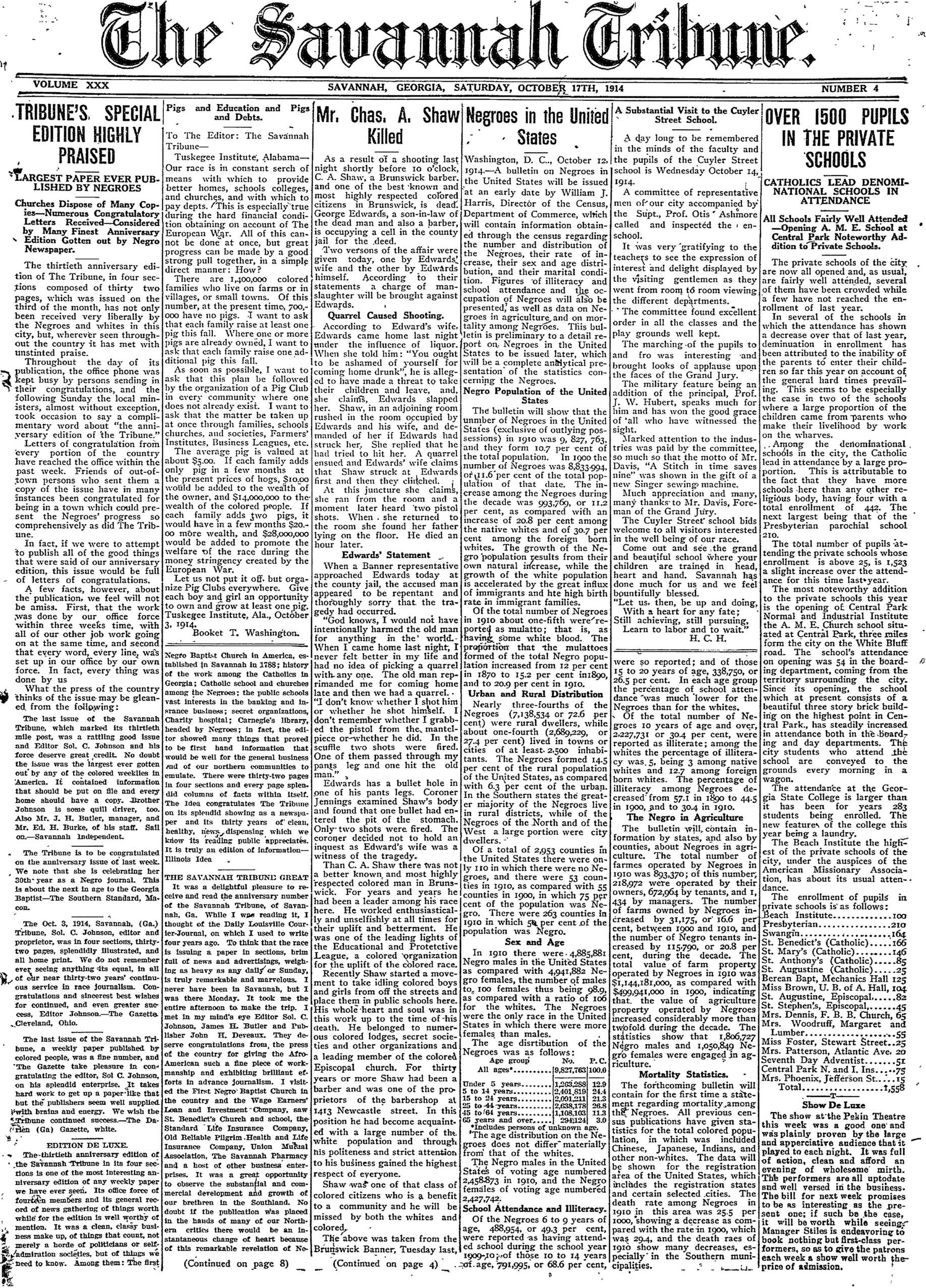
TRIBUNE'S SPECIAL EDITION HIGHLY PRAISED
LARGEST PAPER EVER PUBLISHED BY NEGROES
Churches Dispose of Many Copies—Numerous Congratulatory Letters Received—Considered by Many Finest Anniversary
Edition Gotten out by Negro Newspaper.
The thirtieth anniversary edition of The Tribune, in four sections composed of thirty two pages, which was issued on the third of the month, has not only been received very liberally by the Negroes and whites in this city, but, wherever seen throughout the country it has met with unstinted praise.
Throughout the day of its publication, the office phone was kept busy by persons sending in their congratulations, and the following Sunday the local ministers, almost without exception, took occasion to say a complimentary word about "the anniversary edition of the Tribune." Letters of congratulation from every portion of the country have reached the office within the past week. Friends of out-of-town persons who sent them a copy of the issue have in many instances been congratulated for being in a town which could present the Negroes' progress so comprehensively as did The Tribune.
In fact, if we were to attempt to publish all of the good things that were said of our anniversary edition, this issue would be full of letters of congratulations.
A few facts, however, about the publication, we feel will not be amiss. First, that the work was done by our office force within three weeks time, with all of our other job work going on at the same time, and second that every word, every line, was set up in our office by our own force. In fact, every thing was done by us
What the press of the country thinks of the issue may be gleaned from the following:
The last issue of the Savannah Tribune, which marked its thirtieth mile post, was a rattling good issue and Editor Sol. C. Johnson and his force deserve great credit. No doubt the issue was the largest ever gotten out by any of the colored weeklies in America. It contained information that should be put on file and every home should have a copy. Brother Johnson is some quill driver, too. Also Mr. J. H. Butler, manager, and Mr. Ed. H. Burke, of his staff. Sall on—Savannah Independent.
The Tribune is to be congratulated on the anniversary issue of last week. We note that she is celebrating her 30th year as a Negro journal. This is about the next in age to the Georgia Baptist—The Southern Standard, Macon.
The Oct. 3, 1914, Savannah, (Ga.) Tribune, Sol. C. Johnson, editor and proprietor, was in four sections, thirty-two pages, splendidly illustrated, and all home print. We do not remember ever seeing anything its equal, in all of our near thirty-two years' continuous service in race journalism. Congratulations and sneeorest best wishes for continued, and even greater success, Editor Johnson—The Gazette, Cleveland, Ohio.
The last issue of the Savannah Tribune, a weekly paper published by colored people, was a fine number, and The Gazette take pleasure in congratulating the editor, Sol C. Johnson, on his splendid enterprise. It takes hard work to get up a paper-like that but the publishers seem well supplied with brains and energy. We wish the Tribune continued success.-The Darden (Ga) Gazette, white.
EDITION DE LUXE.
The thirtieth anniversary edition of the Savannah Tribune in its four sections is one of the most interesting anniversary edition of any weekly paper we have ever seen. Its office force of fourteen members and its general record of news gathering of things worth while for the edition is well worthy of mention. It was a clean, classy business make up, of things that count, not merely a horde of politicians or self-admiration societies, but of things we need to know. Among them: The first
Pigs and Education and Pigs and Debts.
To The Editor: The Savannah Tribune
Tuskegee Institute, Alabama— Our race is in constant serch of means with which to provide better homes, schools colleges, and churches, and with which to pay depts. This is especially true during the hard financial condition obtaining on account of The European Wgr. All of this cannot be done at once, but great progress can be made by a good strong pull together, in a simple direct manner: How?
There are 1,400,000 colored families who live on farms or in villages, or small towns. Of this number, at the present time, 700,000 have no pigs. I want to ask that each family raise at least one pig this fall. Where one or more pigs are already owned, I want to ask that each family raise one additional pig this fall.
As soon as possible, I want to ask that this plan be followed by the organization of a Pig Club in every community where one does not already exist. I want to ask that the matter be taken up at once through families, schools churches, and societies, Farmers' Institutes, Business Leagues, etc.
The average pig is valued at about $5.00. If each family adds only pig in a few months at the present prices of hogs, $10,00 would be added to the wealth of the owner, and $14,000,000 to the wealth of the colored people. If each family adds two pigs, it would have in a few months $20,000 more wealth, and $28,000,000 would be added to promote the welfare of the race during the money stringency created by the European War. Let us not put it off, but organize Pig Clubs everywhere. Give each boy and girl an opportunity to own and grow at least one pig. Tuskegee Institute, Ala., October 3, 1914.
Negro Baptist Church in America, established in Savannah in 1788; history of the work among the Catholics in Georgia; Catholic school and churches among the Negroes; the public schools vast interests in the banking and insurance business; secret organizations, Charity hospital; Carnegie's library, headed by Negroes; in fact, the editor showed many things that proved to be first hand information that would be well for the general business and of our northern communities to emulate. There were thirty-two pages in four sections and every page splendid columns of facts within itself. The Idea congratulates The Tribune on its splendid showing as a newspaper and its thirty years of clean, healthy, new, dispensing which we know its reading public appreciates. It is truly an edition of information—Illinois Idea
THE SAVANNAH TRIBUNE GREAT
It was a delightful pleasure to receive and read the anniversary number of the Savannah Tribune, of Savannah, Ga. While I was reading it, I thought of the Dally Louisville Courier-Journal, on which I used to write four years ago. To think that the race is issuing a paper in sections, brim full of news and advertisements, weighing as heavy as any daily or Sunday, is truly remarkable and marvelous. I never have been in Savannah, but I was there Monday. It took me the entire afternoon to make the trip. I met in my mind's eye Editor Sol. C. Johnson, James H. Butler and Publisher John H. Deveaux. They deserve congratulations from, the press of the country for giving the Afro-American such a fine piece of workmanship and exhibiting brilliant effort in advance journalism. I visited the First Negro Baptist Church in the country and the Wage Earners' Loan and Investment Company, saw St. Benedict's Church and school, the Standard Life Insurance Company, Old Reliable Pilgrim. Health and Life Insurance Company, Union Mutual Association, The Savannah Pharmacy and a host of other business enterprises. It was a great opportunity to observe the substantial and commercial development and growth of our brethren in the Southland. No doubt if the publication was placed in the hands of many of our Northern critics there would be an instantaneous change of heart because of this remarkable revelation of Ne
(Continued on page 8)
SAVANNAH, GEORGIA, SATURDAY, OCTOBER 17TH, 1914
Mr. Chas. A. Shaw Killed
As a result of a shooting last night shortly before 10 o'clock, C. A. Shaw, a Brunswick barber, and one of the best known and most highly respected colored citizens in Brunswick, is dead. George Edwards, a son-in-law of the dead man and also a barber, is occupying a cell in the county jail for the deed.
Two versions of the affair were given today, one by Edwards' wife and the other by Edwards himself. According to their statements a charge of manslaughter will be brought against Edwards.
Quarrel Caused Shooting.
According to Edward's wife, Edwards came home last night under the influence of liquor. When she told him: "You ought to be ashamed of yourself for coming home drunk", he is alleged to have made a threat to take their children and leave, and, she claims, Edwards slapped her. Shaw, in an adjoining room rushed in the room occupied by Edwards and his wife, and demanded of her if Edwards had struck her. She replied that he had tried to hit her. A quarrel ensued and Edwards' wife claims that Shaw struck at Edwards first and then they clitched. At this juncture she claims, she ran from the room and a moment later heard two pistol shots. When she returned to the room she found her father lying on the floor. He died an hour later.
Edwards' Statement
When a Banner representative approached Edwards today at the county jail, the accused man appeared to be repentant and thoroughly sorry that the tragedy had occurred.
"God knows, I would not have intentionally harmed the old man for anything in the' world. When I came home last night, I never felt better in my life and had no idea of picking a quarrel with any one. The old man reprimanded me for coming home late and then we had a quarrel. "I don't know whether I shot him or whether he shot himself. I don't remember whether I grabbed the pistol from the, mantel-piece or whether he did. In the scuffle two shots were fired. One of them passed through my pants leg and one hit the old man."
Edwards has a bullet hole in one of his pants legs. Coroner Jennings examined Shaw's body and found that one bullet had entered the pit of the stomach. Only two shots were fired. The coroner decided not to hold an inquest as Edward's wife was a witness of the tragedy.
Than C. A. Shaw there was not a better known, and most highly respected colored man in Brunswick. For years and years he had been a leader among his race here. He worked enthusiastically and unselfishly at all times for their uplift and betterment. He was one of the leading lights of the Educational and Protective League, a colored organization for the uplift of the colored race.
Recently Shaw started a movement to take idling colored boys and girls from off the streets and place them in public schools here. His whole heart and soul was in this work up to the time of his death. He belonged to numerous colored lodges, secret societies and other organizations and a leading member of the colored Episcopal church. For thirty years or more Shaw had been a barber and was one of the proprietors of the barbershop at 1413 Newcastle street. In this position he had become acquainted with a large number of the white population and through his politeness and strict attention to his business gained the highest respect of everyone.
Shaw was one of that class of colored citizens who is a benefit to a community and he will be missed by both the whites and colored. The above was taken from the Brunswick Banner, Tuesday last, (Continued on page 4)
Negroes in the United States
Washington, D. C., October 12, 1914.—A bulletin on Negroes in the United States will be issued at an early date by William J. Harris, Director of the Census, Department of Commerce, which will contain information obtained through the census regarding the number and distribution of the Negroes, their rate of increase, their sex and age distribution, and their marital condition. Figures of illiteracy and school attendance and the occupation of Negroes will also be presented, as well as data on Negroes in agriculture, and on mortality among Negroes. This bulletin is preliminary to a detail report on Negroes in the United States to be issued later, which will be a complete analytical presentation of the statistics concerning the Negroes.
Negro Population of the United States
The bulletin will show that the unnumber of Negroes in the United States (exclusive of outlying possessions) in 1910 was 9, 827, 763, and they form 10.7 per cent of the total population. In 1900 the number of Negroes was 8,833,994, or 11.6 per cent of the total population of that date. The increase among the Negroes during the decade was 993,769, or 11.2 per cent, as compared with an increase of 20.8 per cent among the native whites and of 30.7 per cent among the foreign born whites. The growth of the Negro population results from their own natural increase, while the growth of the white population is accelerated by the great influx of immigrants and hte high birth rate in immigrant families.
Of the total number of Negroes in 1910 about one-fifth were reported as mulatto; that is, as having some white blood. The proportion that the mulattoes formed of the total Negro population increased from 12 per cent in 1870 to 15.2 per cent in 1890, and to 20.9 per cent in 1910.
Urban and Rural Distribution
Nearly three-fourths of the Negroes (7,138,534 or 72.6 per cent) were rural dwellers, while about one-fourth (2,689,229, or 27.4 per cent) lived in towns or cities of at least 2,500 inhabitants. The Negroes formed 14.5 per cent of the rural population of the United States, as compared with 6.3 per cent of the urban. In the Southern states the greater majority of the Negroes live in rural districts, while of the Negroes of the North and of the West a large portion were city dwellers.
Of a total of 2,953 counties in the United States there were only 110 in which there were no Negroes, and there were 53 counties in 1910, as compared with 55 counties in 1900, in which 75 percent of the population was Negro. There were 263 counties in 1910 in which 58 per cent of the population was Negro.
Sex and Age
In 1910 there were 4,885,881 Negro males in the United States as compared with 4,941,882 Negro females, the number of males to 100 females thus being 98.9, as compared with a ratio of 106 for the whites. The Negroes were the only race in the United States in which there were more females than males.
The age distribution of the Negroes was as follows:
Age group No. P.C.
All ages* 9,827,763 100.0
Under 5 years. 1,263,288 12.9
5 to 14 years. 2,401,819 24.4
15 to 24 years. 2,001,211 21.3
15 to 44 years. 2,638,178 26.8
15 to 64 years. 1,108,103 11.3
65 years and over. 294,124 3.0
*Includes persons of unknown age.
The age distribution on the Negroes does not differ materially from that of the whites.
The Negro males in the United States of voting age numbered 2,458,873 in 1910, and the Negro females of voting age numbered 2,427,742.
School Attendance and Illiteracy.
Of the Negroes 6 to 9 years of age, 488,954, or 49.3 per cent, were reported as having attended school during the school year 1909-10; of those 10 to 14 years of age, 791,995, or 68.6 per cent,
A Substantial Visit to the Cuyler Street School.
A day long to be remembered in the minds of the faculty and the pupils of the Cuyler Street school is Wednesday October 14, 1914.
A committee of representative men of our city accompanied by the Supt., Prof. Otis Ashmore called and inspected the enschool.
It was very gratifying to the teachers to see the expression of interest and delight displayed by the visiting gentlemen as they went from room to room viewing the different departments.
The committee found excellent order in all the classes and the play grounds well kept.
The marching of the pupils to and fro was interesting and brought looks of applause upon the faces of the Grand Jury.
The military feature being an addition of the principal, Prof. J. W. Hubert, speaks much for him and has won the good grace of all who have witnessed the sight.
Marked attention to the industries was paid by the committee, so much so that the motto of Mr. Davis, "A Stitch in time saves nine" was shown in the gift of a new Singer sewing machine. Much appreciation and many, many thanks to Mr. Davis, Foreman of the Grand Jury. The Cuyler Street school bids welcome to all visitors interested in the well being of our race. Come out and see the grand and beautiful school where your children are trained in head, heart and hand. Savannah has done much for us and we feel bountifully blessed. "Let us, then, be up and doing, With a heart for any fate; Still achieving, still pursuing
were so reported; and of those 15 to 20 years of age, 338,750, or 26.5 per cent. In each age group the percentage of school attendance was much lower for the Negroes than for the whites. Of the total number of Negroes 10 years of age and over, 2,227,731 or 30.4 per cent, were reported as illiterate; among the whites the percentage of illiteracy was.5, being 3 among native whites and 12.7 among foreign born whites. The percentage of illiteracy among Negroes decreased from 57.1 in 1890 to 44.5 in 1900, and to 30.4 in 1910.
The Negro in Agriculture
The bulletin will, contain information by states, and also by counties, about Negroes in agriculture. The total number of farms operated by Negroes in 1910 was 893,370; of this number, 218,972 were operated by their owners, 672,964 by tenants, and 1,434 by managers. The number of farms owned by Negroes increased by 31,175, or 16.6 per cent, between 1900 and 1910, and the number of Negro tenants increased by 115,790, or 20.8 per cent, during the decade. The total value of farm property operated by Negroes in 1910 was $1,141,181,000, as compared with $499,941,000 in 1900, indicating that, the value of agriculture property operated by Negroes increased considerably more than twofold during the decade. The statistics show that 1,806,727 Negro males and 1,050,849 Negro females were engaged in agriculture.
Mortality Statistics.
The forthcoming bulletin will contain for the first time a statement regarding mortality among the Negroes. All previous census publications have given statistics for the total colored population, in which was included Chinese, Japanese, Indians, and other non-whites. The data will be shown for the registration area of the United States, which includes the registration states and certain selected cities. The death rate among Negroes in 1910 in this area was 25.5 per 1000, showing a decrease as compared with the rate in 1900, which was 29.4, and the death raes of 1910 show many decreases, especially in the Southern municipalities.
OVER 1500 PUPILS IN THE PRIVATE SCHOOLS
OVER 1500 PUPILS IN THE PRIVATE SCHOOLS
CATHOLICS LEAD DENOMINATIONAL SCHOOLS IN ATTENDANCE
All Schools Fairly Well Attended
—Opening A. M. E. School at Central Park Noteworthy Addition to Private Schools.
The private schools of the city are now all opened and, as usual, are fairly well attended, several of them have been crowded while a few have not reached the enrollment of last year.
In several of the schools in which the attendance has shown a decrease over that of last year, deminuation in enrollment has been attributed to the inability of the parents to enter their children so far this year on account of the general hard times prevailing. This seems to be especially the case in two of the schools where a large proportion of the children came from parents who make their livelihood by work on the wharves.
Among the denominational schools in the city, the Catholic lead in attendance by a large proportion. This is attributable to the fact that they have more schools here than any other religious body, having four with a total enrollment of 442. The next largest being that of the Presbyterian parochial school 210. The total number of pupils attending the private schools whose enrollment is above 25, is 1,523 a slight increase over the attendance for this time last year.
The most noteworthy addition to the private schools this year is the opening of Central Park Normal and Industrial Institute the A. M. E. Church school situated at Central Park, three miles form the city on the White Bluff road. The school's attendance on opening was 54 in the boarding department, coming from the territory surrounding the city. Since its opening, the school which at present consists of a beautiful three story brick building on the highest point in Central Park., has steadily increased in attendance both in the boarding and day departments. The city students who attend the school are conveyed to the grounds every morning in a wagon.
The attendance at the Georgia State College is larger than it has been for years 283 students being enrolled. The new features of the college this year being a laundry. The Beach Institute the highest of the private schools of the city, under the auspices of the American Missionary Association, has about its usual attendance.
The enrollment of pupils in private schools is as follows:
Beach Institute.....100
Presbyterian.....210
Swangin.....164
St. Benedict's (Catholic).....166
St. Mary's (Catholic).....146
St. Anthony's (Catholic).....85
St. Augustine (Catholic).....25
Berean Bapt, Mechanics Hall 125
Miss Brown, U. B. of A. Hall, 104
St. Augustine, Episcopal.....82
St. Stephen's, Episcopal.....45
Mrs. Dennis, F. B. B. Church, 51
Mrs. Woodruff, Margaret and Lumber.....55
Miss Foster, Stewart Street.....25
Mrs. Patterson, Atlantic Ave. 20
Seventh Day Adventist.....51
Central Park N. and I. Ins.....75
Mrs. Phoenix, Jefferson St.....15
Total.....1,558
Show De Luxe
The show at the Pekin Theatre this week was a good one and was plainly proven by the large and appreciative audience that it played to each night. It was full of action, clean and afford an evening of wholesome mirth. The performers are all uptodate and well versed in the business. The bill for next week promises to be as interesting as the present one; if such be the case, it will be worth while seeing. Manager Stiles is endeavoring to book nothing but first-class performers, so as to give the patrons each week a show well worth the price of admission.
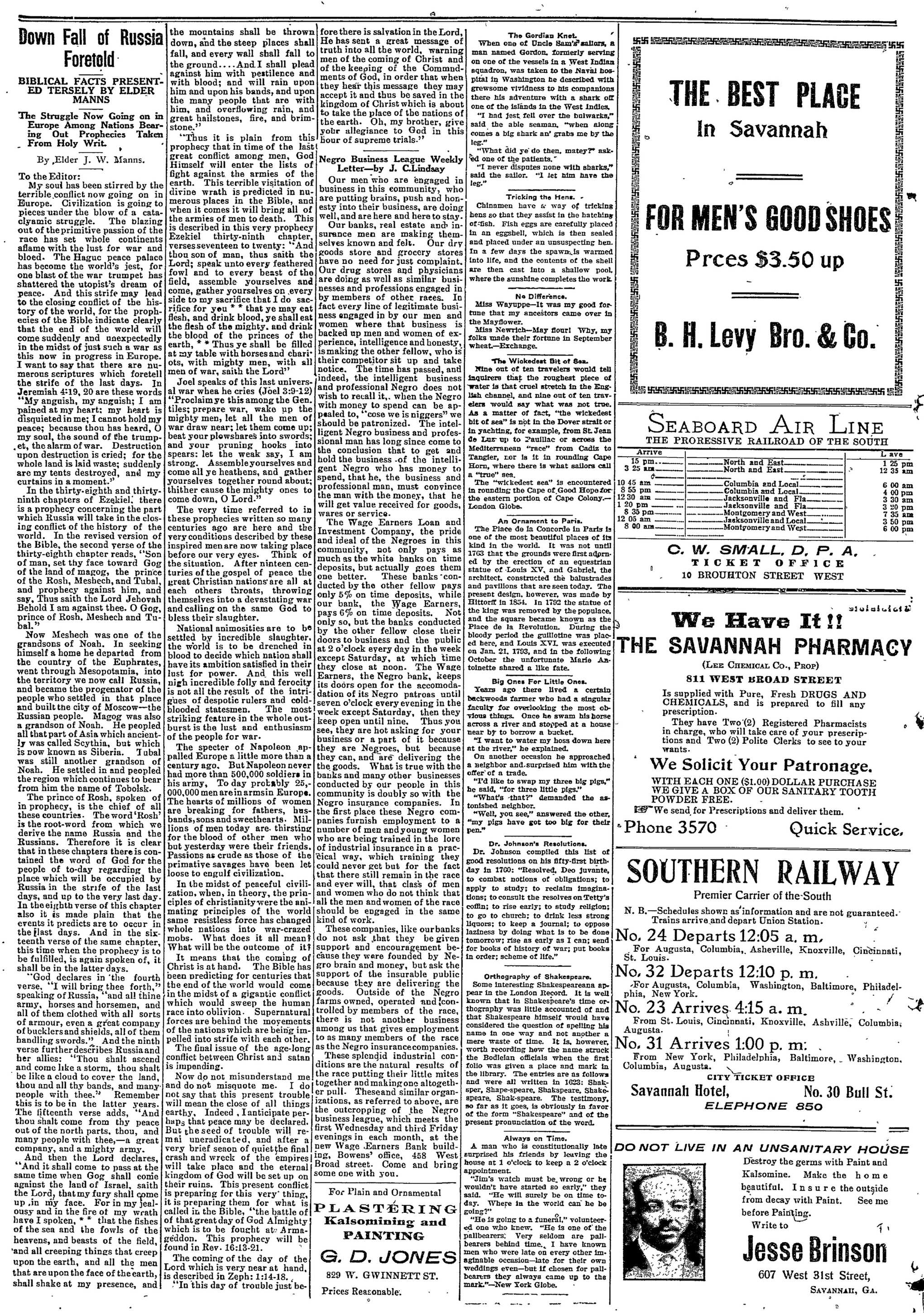
Down Fall of Russia Foretold
BIBLICAL FACTS PRESENTED TERSELY BY ELDER MANNS
The Struggle Now Going on in Europe Among Nations Bearing Out Prophecies Taken From Holy Writ.
By Elder J. W. Manns.
To the Editor:
My soul has been stirred by the terrible conflict now going on in Europe. Civilization is going to pieces under the blow of a cataclyamic struggle. The blazing out of the primitive passion of the race has set whole continents aflame with the lust for war and bloed. The Hague peace palace has become the world's jest, for one blast of the war trumpet has shattered the utopist's dream of peace. And this strife may lead to the closing conflict of the history of the world, for the prophecies of the Bible indicate clearly that the end of the world will come suddenly and unexpectedly in the midst of just such a war as this now in progress in Europe. I want to say that there are numerous scriptures which foretell the strife of the last days. In Jeremiah 4:19, 20 are these words "My anguish, my anguish; I am pained at my heart; my heart is disquieted in me; I cannot hold my peace; because thou has heard, O my soul, the sound of the trumpet, the alarm of war. Destruction upon destruction is cried; for the whole land is laid waste; suddenly are my tents destroyed, and my curtains in a moment."
In the thirty-eighth and thirty-ninth chapters of Ezekiel, there is a prophecy concerning the part which Russia will take in the closing conflict of the history of the world. In the revised version of the Bible, the second verse of the thirty-eighth chapter reads, "Son of man, set thy face toward Gog of the land of magog, the prince of the Rosh, Meshech, and Tubal, and prophecy against him, and say, Thus saith the Lord Jehovah Behold I am against thee. O Gog, prince of Rosh, Meshech and Tubal."
Now Meshech was one of the grandsons of Noah. In seeking himself a home he departed from the country of the Euphrates, went through Mesopotamia, into the territory we now call Russia, and became the progenitor of the people who settled in that place and built the city of Moscow—the Russian people. Magog was also a grandson of Noah. He peopled all that part of Asia which anciently was called Scythia, but which is now known as Siberia. Tubal was still another grandson of Noah. He settled in and peopled the region which continues to bear from him the name of Tobolsk.
The prince of Rosh, spoken of in prophecy, is the chief of all these countries. The word 'Rosh' is the root-word from which we derive the name Russia and the Russians. Therefore it is clear that in these chapters there is contained the word of God for the people of to-day regarding the place which will be occupied by Russia in the strife of the last days, and up to the very last day. In the eighth verse of this chapter also it is made plain that the events it predicts are to occur in the last days. And in the sixteenth verse of the same chapter, this time when the prophecy is to be fulfilled, is again spoken of, it shall be in the latter days.
"God declares in the fourth verse, "I will bring thee forth," speaking of Russia, "and all thine army, horses and horsemen, and all of them clothed with all sorts of armour, even a great company of bucklers and shields, all of them handling swords." And the ninth verse further describes Russia and her allies: "Thou shalt ascend and come like a storm, thou shalt be like a cloud to cover the land, thou and all thy bands, and many people with thee." Remember this is to be in the latter years. The fifteenth verse adds, "And thou shalt come from thy peace out of the north parts, thou, and many people with thee,—a great company, and a mighty army.
And then the Lord declares, "And it shall come to pass at the same time when Gog shall come against the land of Israel, saith the Lord, that my fury shall come up, in my face. For in my jealousy and in the fire of my wrath have I spoken, * * that the fishes of the sea and the fowls of the heavens, and beasts of the field, and all creeping things that creep upon the earth, and all the men that are upon the face of the earth, shall shake at my presence, and
the mountains shall be thrown down, and the steep places shall fall, and every wall shall fall to the ground....And I shall plead against him with pestilence and with blood; and will rain upon him and upon his bands, and upon the many people that are with him, and overflowing rain, and great hailstones, fire, and brimstone."
"Thus it is plain from this prophecy that in time of the last great conflict among men, God Himself will enter the lists of fight against the armies of the earth. This terrible visitation of divine wrath is predicted in numerous places in the Bible, and when it comes it will bring all of the armies of men to death. This is described in this very prophecy Ezekiel thirty-ninth chapter, verses seventeen to twenty: "And thou son of man, thus saith the Lord; speak unto every feathered fowl and to every beast of the field, assemble yourselves and come, gather yourselves on every side to my sacrifice that I do sacrifice for you * * that ye may eat flesh, and drink blood, ye shall eat the flesh of the mighty, and drink the blood of the princes of the earth, * * Thus ye shall be filled at my table with horses and chariots, with mighty men, with all men of war, saith the Lord"
Joel speaks of this last universal war whea he cries (Joel 3:9-12) "Proclaim ye this among the Gentiles; prepare war, wake up the mighty men, let all the men of war draw near; let them come up; beat your plowshares into swords; and your pruning hooks into spears: let the weak say, I am strong. Assemble yourselves and come all ye heathens, and gather yourselves together round about; thither cause the mighty ones to come down, O Lord."
The very time referred to in these prophecies written so many centuries ago are here and the very conditions described by these inspired men are now taking place before our very eyes. Think of the situation. After nineteen centuries of the gospel of peace the great Christian nations are all at each others throats, throwing themselves into a devastating war and calling on the same God to bless their slaughter.
National animosities are to be settled by incredible slaughter, the world is to be drenched in blood to decide which nation shall have its ambition satisfied in their lust for power. And this well nigh incredible folly and ferocity is not all the result of the intrigues of despotic rulers and cold-blooded statesmen. The most striking feature in the whole outburst is the lust and enthusiasm of the people for war.
The specter of Napoleon appalled Europe a little more than a century ago. But Napoleon never had more than 500,000 soldiers in his army, To day probably 25,000,000 men are in arms in Europe. The hearts of millions of women are breaking for fathers, husbands, sons and sweethearts. Millions of men today are thirsting for the blood of other men who but yesterday were their friends. Passions as crude as those of the primitive savages have been let loose to engulf civilization.
In the midst of peaceful civilization, when, in theory, the principles of Christianity were the animating principles of the world same resistless force has changed whole nations into war-crazed mobs. What does it all mean? What will be the outcome of it? It means that the coming of Christ is at hand. The Bible has been predicting for centuries that the end of the world would come in the midst of a gigantic conflict which would sweep the human race into oblivion. Supernatural forces are behind the movements of the nations which are being impelled into strife with each other.
The final issue of the age-long conflict between Christ and satan is impending.
Now do not misunderstand me and do not misquote me. I do not say that this present trouble will mean the close of all things earthy, Indeed, I anticipate perhaps that peace may be declared. But the seed of trouble will remain uneradicated, and after a very brief season of quiet the final crash and wreck of the empires will take place and the eternal kingdom of God will be set up on their ruins. This present conflict is preparing for this very thing, it is preparing them for what is called in the Bible, "the battle of of that great day of God Almighty which is to be fought at Armageddon. This prophecy will be found in Rev. 16:13-21.
The coming of the day of the Lord which is very near at hand, is described in Zeph: 1:14-18.
"In this day of trouble just be-
fore there is salvation in the Lord. He has sent a great message of truth into all the world, warning men of the coming of Christ and of the keeping of the Commudents of God, in order that when they hear this message they may accept it and thus be saved in the kingdom of Christ which is about to take the place of the nations of the earth. Oh, my brother, give your allegiance to God in this hour of supreme trials."
Negro Business League Weekly Letter-by J. C.Lindsay
Our men who are engaged in business in this community, who are putting brains, push and honesty into their business, are doing well, and are here and here to stay.
Our banks, real estate and insurance men are making themselves known and felt. Our dry goods store and grocery stores have no need for just complaint. Our drug stores and physicians are doing as well as similar businesses and professions engaged in by members of other races. In fact every line of legitimate business engaged in by our men and women where that business is backed up men and women of experience, intelligence and honesty, is making the other fellow, who is their competitor sit up and take notice. The time has passed, and indeed, the intelligent business and professional Negro does not wish to recall it, when the Negro with money to spend can be appealed to, "cose we is niggers" we should be patronized. The intelligent Negro business and professional man has long since come to the conclusion that to get and hold the business of the intelligent Negro who has money to spend, that he, the business and professional man, must convince the man with the money, that he will get value received for goods, wares or service.
The Wage Earners Loan and Investment Company, the pride and ideal of the Negroes in this community, not only pays as much as the white banks on time deposits, but actually goes them one better. These banks conducted by the other fellow pays only 5% on time deposits, while our bank, the Wage Earners, pays 6% on time deposits. Not only so, but the banks conducted by the other fellow close their doors to business and the public at 2 o'clock every day in the week except Saturday, at which time they close at noon. The Wage Earners, the Negro bank, keeps its doors open for the accommodation of its Negro patroas until seven o'clock every evening in the week except Saturday, then they keep open until nine. Thus you see, they are hot asking for your business or a part of it because they are Negroes, but because they can, and are delivering the goods. What is true with the banks and many other businesses conducted by our people in this community is doubly so with the Negro insurance companies. In the first place these Negro companies furnish employment to a number of men and young women who are being trained in the lore of industrial insurance in a practical way, which training they could never get but for the fact that there still remain in the race and ever will, that class of men and women who do not think that all the men and women of the race should be engaged in the same kind of work.
These companies, like ourbanks do not ask that they be given support and encouragement because they were founded by Negro brain and money, but ask the support of the insurable public because they are delivering the goods. Outside of the Negro farms owned, operated and controlled by members of the race, there is not another business among us that gives employment to as many members of the race as the Negro insurance companies.
These splendid industrial conditions are the natural results of the race putting their little mites together and making one altogether pull. Theseand similar organizations, as referred to above, are the outcropping of the Negro business league, which meets the first Wednesday and third Friday evenings in each month, at the new Wage Earners Bank building, Bowens' office, 458 West Broad street. Come and bring some one with you.
For Plain and Ornamental
PLASTERING Kalsomining and PAINTING
"I had jest fell over the bulwarks," said the able seaman, "when along comes a big shark an' grabs me by the leg."
"What did ye do then, matey?" asked one of the patients.
"I never disputes none with sharks," said the sailor. "I let him have the leg."
Tricking the Heng.
Chinamen have a way of tricking hens so that they assist in the hatching off fish. Fish eggs are carefully placed in an eggshell, which is then sealed and placed under an unsuspecting hen. In a few days the spawn is warmed into life, and the contents of the shell are then cast into a shallow pool, where the sunshine completes the work.
No Difference.
Miss Wayuppe—It was my good fortune that my ancestors came over in the Mayflower.
Miss Newrich—May flour! Why, my folks made their fortune in September wheat—Exchange.
The Wickedest Bit of Bass
Nine out of ten travelers would tell inquirers that the roughest piece of water is that cruel stretch in the English channel, and nine out of ten travelers would say what was not true. As a matter of fact, "the wickedest bit of sea" is not in the Dover strait or in yachting, for example, from St. Jean de Luz up to Paullac or across the Mediterranean "race" from Cadiz to Tangler, nor is it in rounding Cape Horn, where there is what sailors call a "true" sea. The "wickedest sea" is encountered in rounding the Cape of Good Hope for the eastern portion of Cape Colony.—London Globe.
An Ornament to Paris.
The Place de la Concorde in Paris is one of the most beautiful places of its kind in the world. It was not until 1763 that the grounds were first adorned by the erection of an equestrian statue of Louis XV, and Gabriel, the architect, constructed the balustrades and pavilions that are seen today. The present design, however, was made by Hittorff in 1854. In 1792 the statue of the king was removed by the populace, and the square became known as the Place de la Revolution. During the bloody period the guillotine was placed here, and Louis XVI was executed on Jan. 21, 1793, and in the following October the unfortunate Marie Antoinette shared a like fate.
Big Ones For Little Ones.
Years ago there lived a certain backwoods farmer who had a singular faculty for overlooking the most obvious things. Once he swam his horse across a river and stopped at a house near by to borrow a bucket.
"I want to water my hoss down here at the river," he explained.
On another occasion he approached a neighbor and surprised him with the offer of a trade.
"I'd like to swap my three big pigs," he said, "for three little pigs."
"What's that?" demanded the astonished neighbor.
"Well, you see," answered the other, "my pigs have got too big for their pen."
Dr. Johnson's Resolutions.
Dr. Johnson compiled this list of good resolutions on his fifty-first birthday in 1700: "Resolved, Deo juvente, to combat notions of obligations; to apply to study; to reclaim imaginations; to consult the resolves on Tetty's coffin; to rise early; to study religion; to go to church; to drink less strong liquors; to keep a journal; to oppose laziness by doing what is to be done tomorrow; rise as early as I can; send for books of history of war; put books in order; scheme of life."
Orthography of Shakespeare.
Orthography of Shakespeare.
Some interesting Shakespeareana appear in the London Record. It is well known that in Shakespeare's time orthography was little accounted of and that Shakespeare himself would have considered the question of spelling his name in one way and not another a mere waste of time. It is, however, worth recording how the name struck the Bodleian officials when the first folio was given a place and mark in the library. The entries are as follows and were all written in 1623: Shaksper, Shape-speare, Shakspeare, Shakespeare, Shak-speare. The testimony, so far as it goes, is obviously in favor of the form "Shakespeare" and of the present pronunciation of the word.
Always on Time.
A man who is constitutionally late surprised his friends by leaving the house at 1 o'clock to keep a 2 o'clock appointment. "Jim's watch must be wrong or he wouldn't have started so early," they said. "He will surely be on time today. Where in the world can he be going?" "He is going to a funeral," volunteered one who knew. "He is one of the pallbearers: Very seldom are pallbearers behind time. I have known men who were late on every other imaginable occasion—late for their own weddings even—but if chosen for pallbearers they always came up to the mark."—New York Globe.
811 WEST BROAD STREET Is supplied with Pure, Fresh DRUGS AND CHEMICALS, and is prepared to fill any prescription. They have Two(2) Registered Pharmacists in charge, who will take care of your prescriptions and Two(2) Polite Clerks to see to your wants.
WITH EACH ONE ($1.00) DOLLAR PURCHASE WE GIVE A BOX OF OUR SANITARY TOOTH POWDER FREE. We send for Prescriptions and deliver them. Phone 3570 Quick Service.
SOUTHERN RAILWAY
SOUTHERN RAILWAY
N. B.—Schedules shown as information and are not guaranteed. Trains arrive and depart Union Station.
No. 24 Departs 12:05 a. m.
For Augusta, Columbia, Asheville, Knoxville, Cincinnati, St. Louis.
No. 32 Departs 12:10 p. m.
For Augusta, Columbia, Washington, Baltimore, Philadelphia, New York.
No. 23 Arrives 4:15 a. m.
From St. Louis, Cincinnati, Knoxville, Ashville, Columbia, Augusta.
No. 31 Arrives 1:00 p. m.
From New York, Philadelphia, Baltimore, Washington, Columbia, Augusta.
CITY TICKET OFFICE
Savannah Hotel, No. 30 Bull St.
ELEPHONE 850
DO NOT LIVE IN AN UNSANITARY HOUSE
P.
Premier Carrier of the South
as shown as information and are not
arrive and depart Union Station.
departs 12:05 a. m.
Columbia, Asheville, Knoxville
departs 12:10 p. m.
Columbia, Washington, Baltimore
drives 4:15 a. m.
Is, Cincinnati, Knoxville, Ashw
drives 1:00 p. m.
York, Philadelphia, Baltimore
Ustua.
CITY TICKET OFFICE
Hotel, No. 3
ELEPHONE 850
IVE IN AN UNSANITA
information and are not guaranteed apart Union Station.
12:05 a. m.
Asheville, Knoxville, Cincinnati
12:10 p. m.
Washington, Baltimore, Philadelphia
4:15 a. m.
Nati, Knoxville, Ashville, Columbia
1:00 p. m.
Philadelphia, Baltimore, Washington
TICKET OFFICE
No. 30 Bull St.
PHONE 850
AN UNSANITARY HOUSE
Destroy the germs with Paint and Kalsomine. Make the home beautiful. Insure the outside from decay with Paint. See me before Painting.
Write to
Jesse Brinson
Jesse Brinson
607 West 31st Street,
SAVANNAH, GA.
1 Among the Masons. |
Let every Mason do his duty as
he sees it, Jet the consequences be
what they may. 7.
—T——
Masonry binds men together as
nothing else can outside the
church of God.
ES Sere See nee
All good women should be
friends of Masonry. As a rule
they are. Whatever their opinion
of otherorders, no matter how
much they object to the con-
viviality, or soctal features of this
or that society, nearly all of
ahem are proud to have theirsons
and their husbands wear the
square and compass.
But not all women want their
mento be good Masons, strange
as that may seem, Of course not
half one reads in the alleged
“‘comic” papers of the man who
goes to lodge and comes home
“loaded.” or of sitting up with
asick friend,” has a counterpart
in real life, But sometimes the
good wife and mother objects to
the man ofthe house attending
lodge meeting. She thinks that
iis leisure hours should belong
tothe fireside. Aga rule she is
right, and man can,scarcely be
better employed than staying at
home with his family. Yet an ex-
ception must be made in favor of
the church, and of Masonry.
There is no real opposition to
Masonry among good women.
They may feel a little envious at
its claim ona man they may be
curious as to its secrets but they
intuitively realize that it works
for the betterment of mankind,
and forthe protection of woman-
kind. Ifthey fully realized the
“great protection Masonry is to
women and children the broad
general principles and the thou-
sands of individual instances, in
which Masonry has stretched
forth the mantle of protection
over lonely woman, sick or suffer-
ing woman, helpless woman, dis-
tressed childhood; they would
unite in singing its praise and
working for its advancement, :
Early in his Masonic career
eyery Mason should, so far as he
may take his womenfolks into
his confidence, tell what Masonry
means to them and for them. If
he does that instead of asking
him to stay at home on lodge
nights, they will hold him up to
the mark in his Masonic, as in his
religious duties,—Selected.
Men are great and small in stat-
ure as it pleases God. But their
nature is great or small as it
pleases themselves. Men are not
born, some with great souls, some
with little souls. One by taking
thought cannot add to his stature,
but he can enlarge his soul. By
an act of the willhecan make him-
self a moral giantor dwarf bim-
self to a pigmy.—Albart Pike.
—_r—,
Be not anxious about tomorrow
Do today’s duty,, fight today’s
temptations, and do not weaken
and distract yourself by looking
forward to things which you can
not see, and could not understand
if you saw them.—Charles Kings-
ley.
* SUPREME COUNCIL OF SCOTTISH
. RITE MASONS TO MEET.
The Supreme Council of Scot-
tish Rite Masons of the thirty-
second Degree will hold their ses-
sion in the Masonic Temple next
Monday.
The city lodges in the jurisdic-
tion of the Most Worshipful
Union Grand Lodge will meet in
the temple tonight, when a class
of candidates will be selected to
take the thirty-second degree and
affiliate with Tillman Valentine
Qonsistory. -
A special session of the Grand
Lodge will be held next Monday
raorning at 9 o’clock to dispose of
such business as may come before
that body and also to welcome the
Supreme Council to the State of,
Florida and jurisdiction.
The call has been officially issu-
ed by Grand Master John Dicker-
son, attested to by Grand Secre-
tary R. B. Brooks, for all city
lodges, and representatives from
lodges of the entire jurisdistion,
to bein the city next Sunday in
time to attend the annual sermon.
Services which will be held in
Ebenezer M. E. Church in the
evening. ‘The sermon will be
delivered by the Rev. M. C. B.
Mason, D. D., of Ebenezer..
All Masons will assemble at the
temple early inthe evening, and
proceed to the church.—Metropo-
lis, Jacksonville.
Paradoxical Effort.
“That detective did a queer thing
wrhen he chased the fugitive to Eu-
rope.”
“What was that?*
“He went to sea ta land his map.”-~
~.. FOR GOOD . ||
Job Printing |
On Good Material. © ;
|. At Reasonable Prices |
| |
Waa Minutes, — a
eee / By-Laws, |
ates
es ee ween ~=—|CCté‘<i«‘«é@aaddé ggéU’,
Ate ie eo of ;
el ie ae . Etc., :
| q ag és .
»_ 6S Call at é
_ . . . . - i
The Savannah Tribune - |
‘ * z
1009 WEST BROAD ST.)
: ' OUT OF TOWN ORDER GIVEN :
PHONE 2171. SPECIAL ATTENTION
Hardeeville Dots.
oy Be eh BE ES
aur: i ge e0 BE OE Nn SOR
—- Bees EN RA
a a ee ee Ba) ie
ee Pe OE
ee OSS
Pe ee Ree Boy ee SS
cme Seam Batt tas
ae a re eee eae BPR, oI
ete ace. SG ee regen EN
i aoe Tg Ras 0S
oer SS alee: So SE Se,
eee OS Oe
a tah iA nak oa S ae Peery re GR
: ae ce eet ye we
po SO ays Tak
ace ce ON ee Sher ot ey
: eee EF 8
; eS a » abst awn Pee
aaa Bees. RRS RN
Poe BS ae § : /
oe ee ee ee
ae eee Se! et :
eet: es xd ¥ tae # oi eer
: See og? Ee Wy ae ee
Bat Com | SS pa ee ‘
? E ~ be pas we
I, amr ee cy er pa
PL ar ee ae an ee _
ed. We thao OR ee “A. . Pee
A well known citizen of this
town, Mr. Sam Benett, was seri-
ously hurt on Saturday afternoon,
by a runaway horse. He is now
at his home, confined to bed. On
Sunday night at 9:30 o’clock Mr.
Benry Williams and Miss Agnes
Howard were quietly married at
the parsonage. Rev. E. Graham
performed the ceremony. On
Thursday night last the presiding
elder of the M. E. Church, préach-
ed at Fisher M. E. Chapel, The
sermon was powerfully delivered.
Thisis his 5th year on the dis-
trict. One of the oldest members
of St. Paul A. M. E, Church pass-
ed away on last Thursday, Sister
Darcus Alston. She joined the
A. M.E. Church just after the
close of the Civil War at Hilton
Head, S.C. Later she came to
Bellenger, S. C., where she joined
St. Paul A. M. E. Church, which
she served faithfully. She leaves
a host of friends and relatives to
mourn her death. Mrs. Janie
Coleman and son of Saradnah,
Ga., were in town last week visit-
ing relatives.
. Artificial Diamonds.
An English scientist has produced
minute diamonds by exploding a pow-
der made of cordite and carbon.
| ON DRT ee i
| R. E. Pharrow, Contractor and Builder
rrr a oa ee
ROAST URURUR TURRET. L URURUR Sol RRO TARR LUELLA LS Unt LURE URURIR EE
Deepen een erent ener ager gered era eeteyeere aes
cere Te AU 8 UCT gL LE ote Unk miyretede Se irate eur icetes etetelG Lele ini Hele in_aitetetnlinime
Piano Music Taught
Mrs. J. T, Holly,
S0SJEAST HALL STREET
Special Attention :
FIRST CLASS
Shoe Repairing |
WHILE YOU WAIT. |
All work guaranteed.
Second-band Shoes For Sale
At 629 East Broad St,
EDWARD ELLIS.
Bie, | Mes 8 Oe Se TE ce qi
— ee ‘Masonic Books|
Ca : ; bias SSS °.
2 «| | And Regalias
> 8 po LUOGE SEALS
, a wae FINANCIAL CARDS
a ; ba aes AND BLANKS
Saal paige ee Of Every Description.
piensa te 7 F eres, Se
ee ee Publishers and Manufacturers’ Priced
we yas ‘2 ‘ 4 $$
Be te Liberal Discounts Will Be Arranged,
+ . C. HL
tractor and Builder Sole CdOHeeone
Bete BES Pelee uefa un Ret UUM LRAT URURUR YU RURIR t USURURs CoUrtie tna
Stop at S. Kantziper
For MEATS.
WE ALSO BUY LIVE STOCK
Phone 2669
CITY MARKET.
YOUNG BROS.
NEW STORE .
Is the place to get your Groceries
Meats and Confectioneries,
‘Cigars and Tobacco.”
elephone orders promptly attended te
EDW. G. YOUNG, Manager
Phone 4291
Cor. 36th and Burroughs 3ts-
Protect Your Horses’ Feet
Slave Them Shod by the
The Cresceus Horseshoeing and
:€llpping Shop
315 JEFFERSON sr, Phone3509
NELSON A. CUXLER
‘The Expert Horeeshoer,” Prop.
Important—The only Expert
lhorseshoeing sbop in the city op-
erated Dy a cofored man.
eos
Diving Work
Atlantic and Pacific Coast
THE Drvinc Coxsrruction Co.
Reference: Central Bank & Trust Co.
All Work Promptly Attended To
- J. L, MURCHISON
Chief Diver
2815 Gravier St. ‘New Orleans, La
R. E. PHARROW,
General Contractor
| HOMF OFFICE
| 202 Odd Fellows Building
| ATLANTA. Ga.
| Duilder of the $250,000 Odd
Fellow Block, Atlanta, and St.
‘Philip A. M. E Church, Savan-
nah, Ga. Mechanically Compe-
tent and financially able to carry
out the Largest Contracts.
Estimates furnished free on ap-
plication.
——)
——— GIVE—_—_
Mme. Hart's
Hair Dressing and
Grower
A TRIAL
It will make the hair grow long
andsilky. Second tono hair
preperation on the market, All
who have trie it gladly reccom-
mend same to others, Agenta
wanted everywhere, Write for
terms
VIOLA E, HART
Manufacturer
208 College St. Americus, Ga-
eo Pie
Visit The BEE:
and have a Haircut and Shave.
Clothes Cleaned, Pressed, Dyed
and Renevated, also Ice Cream
and Soft Drinks °
D. J. REID, Prop.
President St.-E. Phone 2914
Why Be Sick? When Health
Knocks at Your Door. See
Dr.H.M.Collier
Physician and Surgeon 9 “*&
640 PRESIDENT ST.,EAST ~
eseewe wee Phones ace-sagzus™
Office 2152-J.. Residence f120-L
Mrs. Frank Moore wishes toan-
ounce that she has just opened
Private Boarding
| House
on SCOTTST. Furnished rooms
with or without Board. For far-
ther information apply to
Mrs. Frank Moore, 514 Scott St,
Beaufort, South Carolina
PRICE STREET sHOFA NV
Have your Shoes’
We pay strict ary’
aud Children ‘woroad St.
Shoes New, W.
dye shoes. re: A
atid delivered .
485 Price S;
* Gordon Saar prin up Aa
WALTER, -
i died t. ie ss
May the Teachers Receive Their Pay.
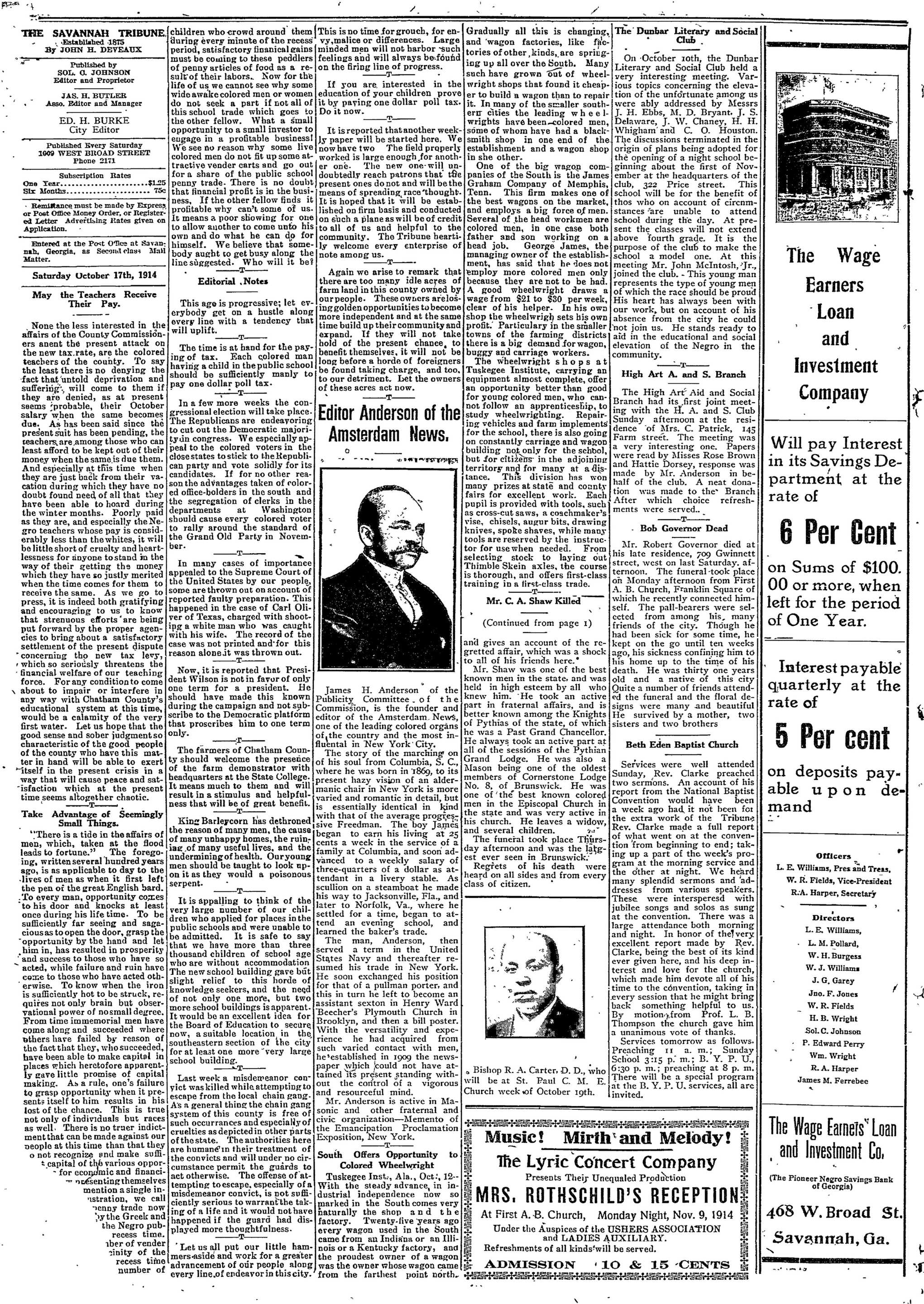
None the less interested in the affairs of the County Commissioners anent the present attack on the new tax rate, are the colored teachers of the county. To say the least there is no denying the fact that untold deprivation and suffering, will come to them if they are denied, as at present seems probable, their October salary when the same becomes due. As has been said since the present suit has been pending, the teachers are among those who can least afford to be kept out of their money when the same is due them. And especially at this time when they are just back from their vacation during which they have no doubt found need of all that they have been able to hoard during the winter months. Poorly paid as they are, and especially the Negro teachers whose pay is considerably less than the whites, it will be little short of cruelty and heartlessness for anyone to stand in the way of their getting the money which they have so justly merited when the time comes for them to receive the same. As we go to press, it is indeed both gratifying and encouraging to us to know that strenuous efforts are being put forward by the proper agencies to bring about a satisfactory settlement of the present dispute concerning the new tax levy, which so seriously threatens the financial welfare of our teaching force. For any condition to come about to impair or interfere in any way with Chatham County's educational system at this time, would be a calamity of the very first water. Let us hope that the good sense and sober judgment so characteristic of the good people of the county who have this matter in hand will be able to exert itself in the present crisis in a way that will cause peace and satisfaction which at the present time seems altogether chaotic.
Take Advantage of Seemingly Small Things.
"There is a tide in the affairs of men, which, taken at the flood leads to fortune." The foregoing, written several hundred years ago, is as applicable to day to the lives of men as when it first left the pen of the great English bard. To every man, opportunity comes to his door and knocks at least once during his life time. To be sufficiently far seeing and sagacious as to open the door, grasp the opportunity by the hand and let him in, has resulted in prosperity and success to those who have so acted, while failure and ruin have come to those who have acted otherwise. To know when the iron is sufficiently hot to be struck, requires not only brain but observational power of no small degree. From time immemorial men have come along and succeeded where others have failed by reason of the fact that they, who succeeded, have been able to make capital in places which heretofore apparently gave little promise of capital making. As a rule, one's failure to grasp opportunity when it presents itself to him results in his lost of the chance. This is true not only of individuals but races as well. There is no truer indictment that can be made against our people at this time than that they o not recognize and make suffi- capital of the various oppor- for economic and financi- presenting themselves mention a single in- illustration, we call penny trade now by the Greek and the Negro pub- recess time. number of venderinity of the recess time number of
children who crowd around them during every minute of the recess period, satisfactory financial gains must be coming to these peddlers of penny articles of food as a result of their labors. Now for the life of us we cannot see why some wide awake colored men or women do not seek a part if not all of this school trade which goes to the other fellow. What a small opportunity to a small investor to engage in a profitable business! We see no reason why some live colored men do not fit up some attractive vender carts and go out for a share of the public school penny trade. There is no doubt that financial profit is in the business. If the other fellow finds it profitable why can't some of us. It means a poor showing for one to allow another to come unto his own and do what he can do for himself. We believe that somebody ought to get busy along the line suggested. Who will it be?
Editorial , Notes
This age is progressive; let everybody get on a hustle along every line with a tendency that will uplift.
T
The time is at hand for the paying of tax. Each colored man having a child in the public school should be sufficiently manly to pay one dollar poll tax.
T
In a few more weeks the congressional election will take place. The Republicans are endayoring to cut out the Democratic majority in congress. We especially appeal to the colored voters in the close states to stick to the Republican party and vote solidly for its candidates. If for no other reason the advantages taken of colored office-holders in the south and the segregation of clerks in the departments at Washington should cause every colored voter to rally around the standard of the Grand Old Party in November.
In many cases of importance appened to the Supreme Court of the United States by our people, some are thrown out on account of reported faulty preparation. This happened in the case of Carl Oliver of Texas, charged with shooting a white man who was caught with his wife. The record of the case was not printed and for this reason alone it was thrown out.
Now, it is reported that President Wilson is not in favor of only one term for a president. He should have made this known during the campaign and not subscribe to the Democratic platform that proscribes him to one term only.
The farmers of Chatham County should welcome the presence of the farm demonstrator with headquarters at the State College. It means much to them and will result in a stimulus and helpfulness that will be of great benefit. T King Barleycorn has dethroned the reason of many men, the cause of many unhappy homes, the ruin- iag of many useful lives, and the undermining of health. Ouryoung men should be taught to look upon it as they would a poisonous serpent.
It is appalling to think of the very large number of our children who applied for places in the public schools and were unable to be admitted. It is safe to say that we have more than three thousand children of school age who are without accommodation The new school building gave but slight relief to this horde of knowledge seekers, and the need of not only one more, but two more school buildings is apparent. It would be an excellent idea for the Board of Education to secure now, a suitable location in the southeastern section of the city for at least one more very large school building.
Last week a misdemeanor convict was killed while attempting to escape from the local chain gang. As a general thing the chain gang system of this county is free of such occurrences and especially of cruelties as depicted in other parts of the state. The authorities here are human in their treatment of the convicts and will under no circumstance permit the guards to act otherwise. The offense of attempting to escape, especially of a misdemeanor convict, is not sufficiently serious to warrant the taking of a life and it would not have happened if the guard had displayed more thoughtfulness.
Let us all put our little hammers-aside and work for a greater advancement of our people along every line of endeavor in this city.
This is no time for grouch, for envy, malice or differences. Large minded men will not harbor such feelings and will always be found on the firing line of progress.
If you are interested in the education of your children prove it by paying one dollar poll tax. Do it now.
It is reported that another weekly paper will be started here. We now have two The field properly worked is large enough for another one. The new one will undoubtedly reach patrons that the present ones do not and will be the means of spreading race thought. It is hoped that it will be established on firm basis and conducted on such a plane as will be of credit to all of us and helpful to the community. The Tribune heartily welcome every enterprise of note among us.
Again we arise to remark that there are too many idle acres of farm land in this county owned by our people. These owners arelosing golden opportunities to become more independent and at the same time build up their community and expand. If they will not take hold of the present chance, to benefit themselves, it will not be long before a horde of foreigners be found taking charge, and too, to our detriment. Let the owners of these acres act now.
Editor Anderson of the Amsterdam News.
O
James H. Anderson of the Publicity Committee of the Commission, is the founder and editor of the Amsterdam News, one of the leading colored organs of the country and the most influential in New York City.
The story of the marching on of his soul from Columbia, S. C., where he was born in 1869, to its present hazy vision of an aldermanic chair in New York is more varied and romantic in detail, but is essentially identical in kind with that of the average progressive Freedman. The boy James began to earn his living at 25 cents a week in the service of a family at Columbia, and soon advanced to a weekly salary of three-quarters of a dollar as attendant in a livery stable. As scullion on a steamboat he made his way to Jacksonville, Fla., and later to Norfolk, Va., where he settled for a time, began to attend an evening school, and learned the baker's trade.
The man, Anderson, then served a term in the United States Navy and thereafter resumed his trade in New York. He soon exchanged his position for that of a pullman porter, and this in turn he left to become an assistant sexton in Henry Ward Beecher's Plymouth Church in Brooklyn, and then a bill poster. With the versatility and experience he had acquired from such varied contact with men, he established in 1909 the newspaper which could not have attained its present standing without the control of a vigorous and resourceful mind.
Mr. Anderson is active in Masonic and other fraternal and civic organization—Memento of the Emancipation Proclamation Exposition, New York.
South Offers Opportunity Colored Wheelwright
Tuskegee Inst., Ala., Oct., 12- With the steady advance, in industrial independence now so marked in the South comes very naturally the shop and the factory. Twenty-five years ago every wagon used in the South came from an Indiana or an Illinois or a Kentucky factory, and the proudest owner of a wagon was the owner whose wagon came from the farthest point north.
At First A. B. Church, Monday Night, Nov. 9, 1914 Under the Auspices of the USHERS ASSOCIATION and LADIES AUXILIARY. Refreshments of all kinds'will be served.
Gradually all this is changing, and wagon factories, like factories of other kinds, are springing up all over the South. Many such have grown out of wheelwright shops that found it cheaper to build a wagon than to repair it. In many of the smaller southern cities the leading wheelwrights have been-colored men, some of whom have had a blacksmith shop in one end of the establishment and a wagon shop in she other.
One of the big wagon companies of the South is the James Graham Company of Memphis, Tenn. This firm makes one of the best wagons on the market, and employs a big force of men. Several of the head workmen are colored men, in one case both father and son working on a head job. George James, the managing owner of the establishment, has said that he does not employ more colored men only because they are not to be had. A good wheelwright draws a wage from $21 to $30 per week, clear of his helper. In his own shop the wheelwright sets his own profit. Particularly in the smaller towns of the farming districts there is a big demand for wagon, buggy and carriage workers.
The wheelwright shops at Tuskegee Institute, carrying an equipment almost complete, offer an opportunity better than good for young colored men, who cannot follow an apprenticeship, to study wheelwrighting. Repairing vehicles and farm implements for the school, there is also going on constantly carriage and wagon building not only for the school, but for citizens in the adjoining territory and for many at a distance. This division has won many prizes at state and county fairs for excellent work. Each pupil is provided with tools, such as cross-cut saws, a coachmaker's vise, chisels, augur bits, drawing knives, spoke shaves, while many tools are reserved by the instructor for use when needed. From selecting stock to laying out Thimble Skein axles, the course is thorough, and offers first-class training in a first-class trade.
(Continued from page 1)
and gives an account of the regretted affair, which was a shock to all of his friends here.*
Mr. Shaw was one of the best known men in the state, and was held in high esteem by all who knew him. He took an active part in fraternal affairs, and is better known among the Knights of Pythias of the state, of which he was a Past Grand Chancellor. He always took an active part at all of the sessions of the Pythian Grand Lodge. He was also a Mason being one of the oldest members of Cornerstone Lodge No. 8, of Brunswick. He was one of the best known colored men in the Episcopal Church in the state and was very active in his church. He leaves a widow, and several children.
The funeral took place Thursday afternoon and was the largest ever seen in Brunswick. Regrets of his death were heard on all sides and from every class of citizen.
PETER M.
Bishop R. A. Carter, D. D., who will be at St. Paul C. M. E. Church week of October 10th.
On October 10th, the Dunbar Literary and Social Club held a very interesting meeting. Various topics concerning the elevation of the unfortunate among us were ably addressed by Messrs J. H. Ebbs, M. D. Bryant. J. S. Delaware, J. W. Chaney, H. H. Whigham and C. O. Houston. The discussions terminated in the origin of plans being adopted for the opening of a night school beginning about the first of November at the headquarters of the club, 322 Price street. This school will be for the benefit of thos who on account of circnstances are unable to attend school during the day. At present the classes will not extend above fourth grade. It is the purpose of the club to make the school a model one. At this meeting Mr. John McIntosh, Jr., joined the club. This young man represents the type of young men of which the race should be proud His heart has always been with our work, but on account of his absence from the city he could not join us. He stands ready to aid in the educational and social elevation of the Negro in the community.
High Art A. and S. Branch
The High Art Aid and Social Branch had its first joint meeting with the H. A. and S. Club Sunday afternoon at the residence of Mrs. C. Patrick, 145 Farm street. The meeting was a very interesting one. Papers were read by Misses Rose Brown and Hattie Dorsey, response was made by Mr. Anderson in behalf of the club. A neat donation was made to the Branch After which choice refreshments were served..
Bob Governor Dead
Mr. Robert Governor died at his late residence, 709 Gwinnett street, west on last Saturday. afternoon. The funeral-took place on Monday afternoon from First A. B. Church, Franklin Square of which he recently connected himself. The pall-bearers were selected from among his, many friends of the city. Though he had been sick for some time, he kept on the go until ten weeks ago, his sickness confining him to his home up to the time of his death. He was thirty one years old and a native of this city Quite a number of friends attended the funeral and the floral designs were many and beautiful He survived by a mother, two sisters and two brothers
Beth Eden Baptist Church
Services were well attended Sunday, Rev. Clarke preached two sermons. An account of his report from the National Baptist Convention would have been a week ago had it not been for the extra work of the Tribune Rev. Clarke made a full report of what went on at the convention from beginning to end; taking up a part of the week's program at the morning service and the other at night. We heard many splendid sermons and addresses from various speakers. These were interspered with jubilee songs and solos as sung at the convention. There was a large attendance both morning and night. In honor of the very excellent report made by Rev. Clarke, being the best of its kind ever given here, and his deep interest and love for the church, which made him devote all of his time to the convention, taking in every session that he might bring back something helpful to us. By motion from Prof. L. B. Thompson the church gave him a unanimous vote of thanks.
Services tomorrow as follows. Preaching 11 a. m.; Sunday School 3:15 p. m.; B. Y. P. U. 6:30 p. m.; preaching at 8 p. m. There will be a special program at the B. Y. P. U. services, all are invited.
THE BANK OF THE PHILIPPINES
The Wage Earners Loan and Investment Company
Will pay Interest in its Savings Department at the rate of
6 Per Cent
on Sums of $100. 00 or more, when left for the period of One Year.
Interest payable quarterly at the rate of
5 Per cent
on deposits payable upon demand
Officers
L. E. Williams, Pres and Treas.
W. R. Fields, Vice-President
R:A. Harper, Secretary
Directors
L. E. Williams,
L. M. Pollard,
W. H. Burgess
W. J. Williams
J. G. Garey
Jno. F. Jones
W. R. Fields
H. B. Wright
Sol. C. Johnson
P. Edward Perry
Wm. Wright
R. A. Harper
James M. Ferrebee
The Wage Earners" Loan and Investment Co.
(The Pioneer Negro Savings Bank of Georgia)
468 W. Broad St.
Savannah, Ga.
LOCALS.
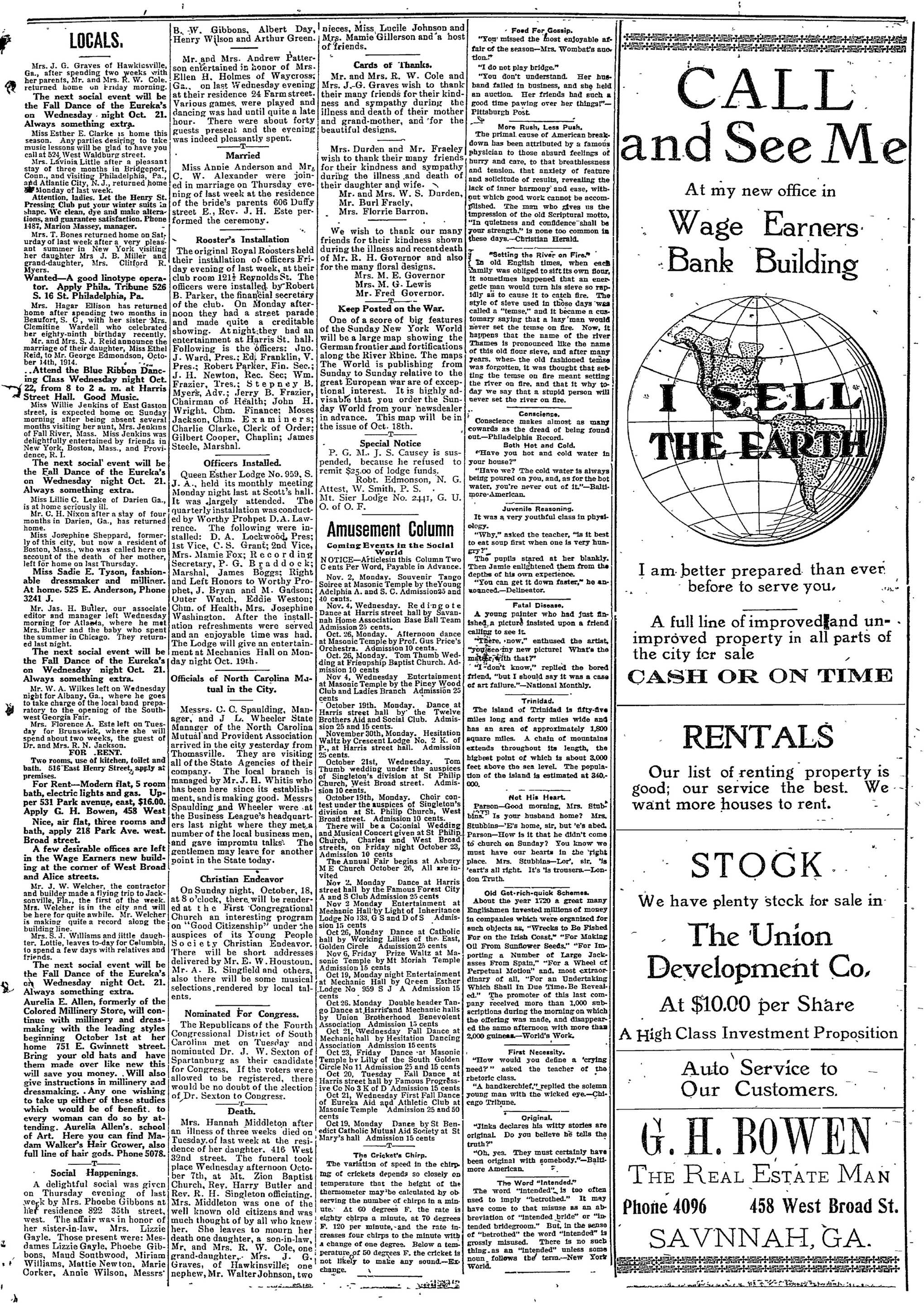
Mrs. J. G. Graves of Hawkicsville,
Ga., after spending two ass with
her parents, Mr. and Mrs. R. W. Cole.
returned home un inday morning.
The next social event will be
the Fall Dance of the Eureka’s
on Wednesday . night Oct. 21.
Always something extra.
Miss Esther E. Clarke 1s home this
season. Any parties desiring to take
music lessons will be glad to have you
callat 524 West Waldburg street.
Mrs. Lavinia Little after a pleasant
stay of three months in Bridgeport,
Conn., and visiting Philadelphia, Pa.,
aga ‘Ablantic City, N. J., returned home
Monday of last week.
Attention, ladies. Let the Henry St.
Pressing Club put your winter suits in
shape. We clean, dye and make altera-
tions, and guarantee satisfaction. Phone
1487, Marion Massey, manager. +
Mrs. T. Bones returned home on Sat;
urday of last week after a very pleas-
ant summer in New York visiting
her daughter Mrs J. B. Miller and
grand-daughter, Mrs. Clitford R.
Myers.
Wanted—A good linotype opera-
tor. Apply Phila. Tribune 526
S. 16 St. Philadelphia, Pa.
Mrs. Hagar Ellison has returned
home after spending two months in
Beaufort, S. C, with her sister “Mrs.
Clemitine Wardell who celebrated
her eighty-ninth birthday Fenently:
Mr. and Mrs. S. J. Reid announce the
soarriage of their daughter, Miss Ethel
Reid, to Mr. George Edmondson, Octo-
ber 34th, 1914. eee
;-Attend the Blue Ribbon Danc-
ing Class Wednesday night Oct.
{ 2% from 8 to 2 a. m. at Harris
Street Hall. Good Music.
Miss Willie Jenkins of East Gaston
street, is expected home or Sunday
morning after being absent several
months visiting ber aunt, Mrs. Jenkins
of Fall River, Mass. Miss Jenkins was
delightfully entertained by friends in
New York, Boston, Mass., and Provi-
dence, R. I.
The next social’ event will be
the Eall Dance of the Eureka’s
on Wednesday night Oct. 21.
Always something extra.
Miss Lillie C. Leake of Darien Ga.,
is at home seriously ill.
Mr. C. H. Nixon after a stay of four
monthsin Darien, Ga., has returned
home.
Miss Josephine Sheppard, former-
ly of this city, but now a resident of
Boston, Mass., who was called here on
account of the death of her mother,
left for home on last Thursday.
Miss Sadie E. Tyson, fashion-
able dressmaker and milliner.
At home, 525 E. Anderson, Phone
3241 J.
Mr, Jas. H. Butler, our associate
editor snd manager left Wednesday
morning for Atlasta, where he met
Mrs, Butler and the baby who spent
the summerin Chicago. They return-
ed last night. .
The next social event will be
the Fall Dance of the Eureka’s
on Wednesday night Oct. 21.
Always something extra.
Mr. W. A. Wilkes left on Wednesday
night for Albany, Ga., where he goes
to take charge of the local band prepa-
ratory to the opening of the South-
west Georgia Fair.
Mrs. Florence A. Este left on Tues-
dsy for Brunswick, where she will
spend about two weeks, the guest of
Dr. and Mrs. R. N. Jackson.
FOR .RENT. q
Two rooms, use of kitchen, toilet and
bath. 516°East Henry Street, apply at
premises. s
For Rent—Modern flat, 5 room
bath, electric lights and gas. Up-
per 531 Park avenue, east, $16.00.
Apply G. H. Bowen, 458 West
Nice, air flat, three rooms and
bath, apply 218 Park Ave. west.
Broad street.
A few desirable offices are left
in the Wage Earners new build-
ing at the corner of West Broad
and Alice streets.
Mr. J. W. Welcher, the contractor
and builder made a flying trip to Jack-
sonville, Fla., the first of the week.
Mrs. Welcher isin the city and will
be here for quite awhile. Mr. Welcher
is making quifea record along the
building line.
Mrs. S.J. Williams and iittle daugh-
ter, Lottie, leaves to-day for Celumbia,
io spend a few days with relatives and
friends. " .
The next social event will be
the Fall Dance of the Eureka’s
ot Wednesday night Oct. 21.
Always something extra.
Aurelia E. Allen, formerly of the
Colored Millinery Store, will con-
tinue with millinery and dress-
- Social Happenings.
A delightful social was given
on Thursday evening of last
werk by Mrs. Phoebe Gibbons at
liek residence 822 35th street,
west. The affair was in honor of
her sistersin-law. Mrs. Lizzie
Gayle. Those present were: Mes-
dames Lizzie Gayle, Phoebe Gib-
bons, Maud Sontbwood, Miriam
Williams, Mattie Newton, Marie
Corker, Annie Wilson, Messrs*
i
* * =
eee eee ==
B. WW. Gibbons, Albert Day,! nieces, Miss, Lucile Johnson and + Foed For Gossip.
Henry Wilson and Arthur Green. | Mrs. Mamie ‘Gillerson and“a host! -yow mtssed the fhost enjoyable af- |
—_ : of friends. fair cf the season—Mrs, Wombat’s auc ||
; Mr.and Mrs. Andrew Patter-| ~ ton.”
ile: /son entertained in honor of Mrs. Cards of ‘Thanks, “I do not play bridge.”
ole. | len H. Holmes of Waycross;] Mr.and Mrs, R, W. Cole andj “Xou don't understand. Her bus-
ing.|Ga., on last Wednesday evening | Mrs, J.-G. Graves wish to thank] band failed in business, and she held
be |at their residence 24 Farmstreet.|their many friends for their kind-| an auction. Her friends had uch, al]
a’s| Various games, were played and{ness and sympathy during the} good time pawing over her things!”—
21, |@ancing was had until quite a late} illness and death of their mother] Pittsburgh Post. ”
hour. There were about forty;and grand-mother, and ‘for the} © ——_—_—————
this| guests present and the evening} beautiful designs. More Rush, Less Push,
ake was indeed pleasantly spent. | aa a tue ee ea American break j(
youl = Mrs. Durden and Mr. Fraeley|opvcteiny (eines ees Pee camous
ant Married wish to thank their many friends, Pbzleiss te those absurd feelings of | (
ort,| Miss Annie Anderson and Mr,|for their kindness and sympathy ery Ain ens, 20) SORE breath lesnase
aC. W. Alexander were join-|durig the illness and death of (4 ‘enslon. that anxiety of feature
meted in marriage on Thursday eve-!their daughter and wife. ~ Bnd soliciinde of Fonulby Eeveating the!
st. [ning of last week at the residence] Mr. and Mrs. W. S. Durden, | Su" Or umes harmony and euse, with:
sinjof the bride’s parents 606 Duffy Mr. Burl Fraely, Su welch good work ceunet bw spun:
ra| street E., Rev. J.H. Este per-} _ Mrs. Florrie Barron. TUE ee a ae
mae ley tle acean “ florrie Bai impression of the old Scriptural motto,
e' formed the ceremony. : « 4 “In quietness and confidence”shall be
ai, | ee - We wish to thank our many |7our strength.” is none too common in
I~ ©) Rooster’s Installation friends for their kindness shown| these days.—Christian Herald. il
The original Royal Roosters held
their installation of: officers Fri-
day evening of last week, at their
club room 1213 Reynolds St. The
officers were installed, by’Robert
B. Parker, the finanéial secretary
of the club. On Monday after-
noon they bad a street parade
and made quite a_ creditable
showing. Atnight:they bad an
entertainment at Harris St. halt.
Following is the $fficers: Jno.
J. Wurd, Pres.; Ed) Franklin, V.
Pres.; Robert Parker, Fin. Sec.;
J. H. Newton, Rec. Sec; Wm.
Frazier, Tres; Stepney B.
Myers, Adv.; Jerry B. Frazier,
Chairman of Health; John H.
Wright. Chm. Finance; Moses
Jackson, Chm. Examiners;
Charlie Clarke, Clerk of Order:
Gilbert Cooper, Chaplin; James
Steele, Marshal.
Officers Installed.
| Queen Esther Lodge No. 959, S.
J.A., held its monthly meeting
Menday night last at Scott’s hall.
It was dJargely uttended. The
quarterly installation was conduct-
ed by Worthy Prohpet D.A. Law-
rence. ‘The following were in-
stalled: D. A. Lockwodd, Pres;
ist Vice, C.S. Grant; 2nd Vice,
Mrs. Mamie Fox; Recording
Secretary, P- G. Braddock;
Marshal, James Boggs; Right
and Left Honors to Worthy Pro-
phet, J. Bryan and M. Gadson;
Outer Watch, Eddie Weston;
Chm. of Health, Mrs. Josephine
Washington. After the install-
ation refreshments were served
andan enjoyable time was had.
The Lodge will give an entertain-
‘ment at Mechanics Hall on Mon-
day night Oct. 19th.
Officials of North Carolina Ma-
tual in the City.
Messrs. C. C. Spaulding, Man-
ager, and J L. Wheeler State
Manager of the North Carolina
Mutual'and Provident Association
arrived in the city yesterday from
Thomasville. They are visiting
all ofthe State Agencies of their
company. The local branch is
managed by Mr.J.H. Whitis who
has been here since its establish-
ment, andis making good. Messrs
Spaulding and Wheeler were .at
the Business League’s headquart-
ers last night where they meta
number of the local business men,
and gave impromtu talks: The
gentlemen may leave for another
point in the State today.
Christian Endeavor
On Sunday night, October, 18,
at 8 o’clock, there will be render-
edat the First ‘Congregational
Church an interesting program
on ‘Good Citizenship” under she
auspices of its Young People
Society Christian Endeavor.
There will be short addresses
delivered by Mr. E. W.Houstoun,
Mr. A- B. Singtield and others,
also there will be some musical
selections rendered by local tal-
ents,
Nominated For Congress.
The Republicans of the Fourth
Congressional District of South
Carolina met on Tuesday and
nominated Dr. J. W. Sexton of
Spartanburg as their candidate
for Congress, If the voters were
allowed to be registered, there
would be no doubt of the election
of Dr. Sexton to Congress.
i
Death.
Mrs, Hannah Middleton after
an illness of three weeks died on
Tuesday.of last week at the resi-
dence of her daughter. 416 West
32nd street. The funeral took
place Wednesday afternoon Ucto-
ber 7th, at Mt. Zion Baptist
Church, Rey, Harry Butler and
Rey. R. H. Singleton officiating.
Mrs. Middleton was one of the
well known old citizens and was
much thought of by all who knew
her. She leaves to mourn her
death one daughter, a son-in-law,
Mr, and Mrs. R. W. Cole, one
grand-daughter,- Mrs. J. G.
Graves, of Hawkinsville; one
nephew, Mr. Walter Johnson, two
‘nieces, Miss, Lucile Johnson and
‘Mrs. Mamie Gillerson and“a host
of friends.
Cards of ‘Thanks,
Mr. and Mrs, R. W. Cole and
Mrs. J.-G. Graves wish to thank
their many friends for their kind-
ness and sympathy during the
illness and death of their mother
and grand-mother, and ‘for the
beautiful designs.
Mrs. Durden and Mr. Fraeley
wish to thank their many friends
for their kindness and sympathy
during the illness and death of
their daughter and wife. ~
Mr. and Mrs. W. S. Darden,
Mr. Burl Fraely,
_ Mrs. Florrie Barron.
We wish to thank our many
friends for their kindness shown
during the illness and recentdeath
of Mr. R. H. Governor and also
for the many floral designs.
Mrs. M. E. Governor
Mrs. M. G. Lewis
Mr. Bred Governor.
Keep Posted on the War.
One of a score of big features
of the Sunday New York World
will be a large map showing the
German frontier and fortifications
along the River Rhine. The maps
The World is publishing from
Sunday to Sunday relative to the
great European war are of excep-
tional interest. Itis highly ad-
visabY that you order the Sun-
day World from your newsdealer
inadvance. This map will bein
the issue of Oct, rath, \
Pe Special Notice
P. G. M. J. S. Causey is sus-
pended, because he refused to
remit $25.00 of lodge funds.
Robt. Edmonson, N. G.
Attest, W. Smith, PS. .
Mt. Sier Lodge No. 2441, G. U.
O. of O. F.
Amusement Column
Coming Events in the Social
: __ World
NOTICE—Afticlesin this Column Two
Cents Per Word, Payable in Advance.
Nov. 2, Monday. Souvenir Tango
‘Soiree at Masonic Temple by theYoung
Adelphia A. and S, C. Admissions and
40 cents.
“Nov. 4, Wednesday. Re dingote
Dance at Harris street hall by Svan.
nah Home Association Base Ball Team
Admission 25 cents.
Oct. 26, Monday. " Afternoon dance
‘at Masonic Temple by Prof. Gus Price's
Orchestra. Admission 10 cents.
_ Oct. 26, Monday. Tom Thumb Wed-
ding at Frieupship Baptist Church. Ad-
‘mission 10 cents
| Nov 4, Wednesday Entertainment
at Masonic Temple by the Picey Wood
Club and Ladies Branch Admission 25
cents
October 19th. Monday. Dance at
Harris street hall by” the Twelve
Brothers Aid and Social Club. Admis-
sion 25 and 15 cents. .
November 30th, Monday. Hesitation
Waltz by Crescent Lodge No, 2 K. of
P., at Harris street hall. Admission
25 cents.
October 2ist, Wednesday. Tom
Thumb wedding under the auspices
of Singleton’s division at St Philip
Church, West Broad street. Admis-
sion 10 cents,
October 19th, Monday. Choir con-
test under the auspices of Singleton’s
division at St. Philip Church, West
Broatl street. Admission 10 cents.
There will bea Co:onial Wedding
and Musical Concert given at St Philip
Church, Charles and West Brosd
streets, on Friday night October 23,
‘Admission 10 cents
| The Annual Fair begins at Asbary
ME Church October 26, All are in-
vited .
Nov 2 Monday Dance at Harris
street hall by the Famous Forest City
‘A and S Club Admission 25 cents
Nov 2 Monday Entertainment at
‘Mechanic Hall'by Light of Inheritance
Lodge No 133,GSandDofS Admis-
sion 15 cents a
Oct 26, Monday Dance at Catholic
hall by Working Lillies of the. East,
Golden Circle Aduission 25 cents
Nov6, Friday Prize Waltz at Ma-
sonic Temple by Mt Moriah Temple
Admission 15 cents .
“Oct 19, Monday night Entertainment
‘at Mechanic Hall by Qreen Esther
Lodge No 959 S J A Admission 15
cents :
Oct 26. Monday Double header Tan-
go Dance at Harris'and Mechanic halls
by Union ‘Brotherhood Benevolent
Association Admission 15 cents
“Oct 21, Wednesday Fall Dance at
‘Mechanichall by Hesitation Dancing
Association Admission 15 cents
"Oct 23, Friday Dance -at Masonic
Temple by Lilly of the South Golden
Circle No 11 Admission 25 and 15 cents
Oct 20, Tuesday Fall Dance at
Harris street hall by Famous Progréss-
ive Co No 3K of D Admission 15 cents
Oct 21, Wednesday First Fall Dance
of Eureka Aid agd Athletic Club at
Masonic Temple ‘Admission 25 and 50
cents
Oct 19, Monday Danee by St Ben-
edict Catholic Mutual Aid Society at St
Mary’s hall Admission 15 cents
‘The Cricket’s Chirp.
The variation of speed in the chirp.
mg of erickets depends so closely on
temperature that the hefght of the
thermometer maybe calculated hy ob
serving the number of chirpe in a min.
ute At 60 degrees F. the rate is
eighty chirps a minute, at 70 degrees
F. 120 per minute,-and the rate in-
creases four chirps to the minute with
4 change of one degree. Below a tem-
perature, of 50 degrees F. the cricket 1s
not Ukely to make any sound—Ex
change. \
+ Foed For Gossip.
“You’ missed the host enjoyable af-
fair of the season—Mrs. Wombat’s auc.
tion.”
“I do not play bridge.”
“You don't understand. Her hus-
band failed in business, and she held
an auction. Her friends had such a
good time pawing over her things!”—
Pittsburgh Post.
|S hom aetrement
“~~ More Rush, Less Push,
‘The primal. cause of American break-
down has been attributed by 2 famous
physician to those absurd feelings of
hurry and care, to that breathlessness
and tension. that anxiety of feature
and solicitude of results, revealing the
lack of inner harmony’ and euse, with-
gut which good work cannot be accom-
Plshed. ‘The man who gtves us the
impression of the old Scriptural motto,
“In quietness and confidence”shall be
your strength.” is none too common in
these days.—Christian Herald.
J Setting the River on Fire.” *
Si old English times, when eack
mily was obliged to sift its own flour,
it sometimes happened that an ener
getic man would turn his sleve so rap-
idly a8 to cause it to catch fire. The
style of sleve used in those days ‘waa
called a “temse,” and it became a cus.
tomary saying that a Jazy’man would
never set the temse on fire. Now, it
happens that the name of the river
Thames 1s pronounced like the name
of this old flour steve, and after many
years, wher- the old fashioned tenise
was forgotten, {t was thought that se>
ting the temse on fire meant setting
the river on fire, and that it why to-
Gay we say that a stupid person will
sever set the river on fire.
.- ‘Gannclenen
_ Conscience makes almost as many
cowards as the dread of being found
out—Philadelphia Record.
Both Hot and Cold.
‘Have you hot and cold water in
your house?”
“Have we? ‘The cold water 1s always
beitg poured on you, and, as for the hot
water, you're never out of it.”—Balti-
more-American.
Juvenile Reasoning.
It was q very youthful class in physt-
ology.
“Why,” asked the teacher, “is t best
to eat soup first when one is very hun-
ey?
Tho pupiis stared at her blankly.
‘Then Jamie enlightened them from the
depths of his own experience.
“Yon can get it down faster,” he an-
wounced.—Delineator.
Fatal Disease,
A young pajnter who had just fin-
ished,a picturé insisted upon a friend
calling to see it
“Tiere, snow,” enthused the artist,
“youfeo'iny new picturel What's the
mig ith that?”
““{~don't know,” replied the bored
friend, “but I should say it was a case
of art failure.”—National Monthly.
‘Trinidad.
‘The {sland of Trinidad is fifty-five
miles Iong and forty miles wide and
has an area of approximately 1,800
square miles. A chain of mountains
extends throughout its length, the
highest point of which is about 3,000
feet above the sea level. The popula-
tion of the island {a estimated at 340,-
000.
Not His Heart,
Parson—Good morning, Mrs. Stub"
bins Is your husband home? irs,
Stubbins—E’s home, sir, but ’e’s abed.
Parson—How 1s it that he didn't come
to church on Sunday? You know woe
must have our hearts in the ‘right
place. Mrs. Stubbins—Lor’, slr, ‘is
eart’s all right. It's ‘Is trousers.—Lon-
don Truth.
Oia Getsclohccuick Gchemet:
About the year 1720 a great many
Englishmen invested millions of money
in companies which were organized for
such objects as, “Wrecks to Be Fished
For on the Irish Coast,” “For Making
Ol From Sunflower Seeds,” “For Im-
porting a Number of Large Jack-
asses From Spain," “For a Wheel cf
Perpetual Motion” and, most ¢xtraor
dinary of all, “For an Undertaking
Which Shall In Due Time. Be Reveal-
ed.” The promoter of this last com-
pany recelved moro than 1,000 sub-
scriptions during the morning on which
the offering was made, and disappear
ed the samo afternoon with more than
2,000 guineas.—World’s Work,
' First Necessity.
“Bow would you define a ‘crying
need?" asked the teacher of the
rhetoric class, i
“A handkerchief,” replied the solemn
young man with the wicked eye.—Chi-
cago Tribune.
* Gricinal.
“Jinks declares his witty stories ate
original Do yon believe he tells the
truth?" :
“Oh, yes. They must certainly have
been original with somebody.”—Baiti-
more American. =
‘The Word “Intended.”
The word ‘intended’ is too often
used to imply “betrothed.” It may
have come to that misuse as an ab-
breviation of “Intended bride” or “in
tended bridegroom.” But, in the sense
of “betrothed” the word “intended” is
grossly misused. There is no such
thing.as an “Intended” unless some
‘noun, follows thé term—New Yor¥
worl
starts a oa a ea
S See Me
| At my new office in
. Wage Earners: a
- Bank Building
ASLIERS
Aig)
(TELL)
S atk coal
HE EABDH|
Vt lyf
OQ
. I am better prepared than ever —
a - before to serve you, me
A full line of improvedfand un- -
improved property in all parts of
the city fer sale ,
CASH OR ON TIME
Our list of renting property is .
good; our service the best. We-
want more houses to rent. -
.° STOCK...
" We have plenty steck tor sale in-
- . The Union
Development Co,
At $10.00 per Share.
A High Class Investment Proposition
- Auto Service to —
Our Customers.” -
XN ; ‘4 _
G. H. BOWEN
Tue Rear Estate Man,
Photte 4096 458 West Broad St.
| SAVN NAH,GA. _
eee eee
i ha ne HERES eee Seber detec cas ae
= . .
WEEKLY NEWS FROM THE
CHURCHES OF THE CITY |
e¢ St. Paul Church
St. Paul services were good
Sunday. The pastor preached
in the morning and evening to a
fullhouse. Rev. J. S. Irby of
Central Baptist church preached
at 4:30. The “St. Paul Money
Week” begins Monday, Octobor
19th and continues through Sun-
day October 25th. Bishop R. A.
pier will appear on the pro-
fram during the money week and
will preach Sunday October 25th.
Those who hear him will be bene-
fited. Rev. Cash of the First Con-
gregational church will preach
Tuesday night. The ¥.M.C. A.
organized with Prof. S, A. Grant
president; Dr. Brent. treasurer
and T. H. Hamilton, secretary at
5 p.m. Sunday.
Evangelical Ministers’ Union.
The Evangelical Ministers Un.
jon met Tuesday with Rey. P. F.
Curry, presiding. Devotional ser-
vice was conducted by Rer, W
V. Daughtry. After having ad-
dressed the throne of Grace_the
4ist Psalter was then read, Hon.
F. B. Pettie visited the union in
the interest of a weekly paper the
| Advocate Publishing Company is
to start.. There will be a union
rally at St. Philip A. M. E. church
Charles and West Broad streets
at4p. m., October 25th, Rev. P.
F. Curry will preach. Sermonic
report was given by Rev. B. S.
Hannah; it was excellent. Re-
member the president’s paper for
next Tuesday, subject ‘Ministeri-
al etiquet.” Visitors always wel-
come.
F. A. B. Sunday School.
Sunday school begins at 3 p.
m., except first Sunday 2:30. The
school is rapidly increasing. On
Sunday there were 121 scholars.
Prof, Hubert principal of the
Cuyler street school gave us a
very interesting talk. James
Ruth, one of the Sunday school
scholars died on Saturday last and
was buried on Tuesday,
St. Philip’s Dots
Rey. Singleton preached at 11
a.m.on Sunday. A large crowd
was outtohearhim. Rey. J. T-
Thomas of Millen, Ga. was the
Lord’s messenger at 8:15 p. m.
The coming week will be a busy
week with the members of St.
Philip. Every member must do
something in this rally Sunday,
October 25th is the day. ‘There
will be entertainments given at
St. Philip.every aight during next
week. Weare glad to note that
our members are returning from
their vacation. ‘The fourh and
last quarterly conference of St.
Philip for 1914 was held on Fri-
day night. The report from the
various departments were very
good. According to [the law of
the A. M. E. church this is Rev.
Singleton’s last year at St. Philip.
There will be a big choir contest
at St. Philip on Monday night,
October 19th. On the 2Ist there
will be given 2 Tom Thumb wed-
ding. On the 23rd a colonial
wedding, all for the benefit of the
building fund. Everybody in-
vited to come and bring your
friends. _ Admission only ten
cents. The following services
will be held on to morrow: prayer
meeting at 5:50 a. m.; -preaching
at 11 a. m.; Sunday school at 3:15
p. m.; League at 7 p. m., preach-
ing at 8:15 p.m. Prayer meeting
every Thursday night from 7 to
8 o'clock.
First Bryan Baptist Church
On Sunday morning quite a
large crowd accompanied Ker.
Wright to Nicolsonboro where the
anniversary of the Nicolsonboro
Baptist church was celebrated. A
most enjoyable Inncheon was
seryed by a committee of the
church. They returned to the
city in the afternoon having spent
avery profitable day. At night
Rev. Wright read for the ‘lesson:
Psalms 1. The honored guest ‘of
the church was the Royat Roost-|
ers Aid aid Social club and their
Ladies Auxiliary A very inter-
esting history was read by the
secretary. Rev. Wright’s text.
was from Ps. 45:3, The sermon,
yas very appropriate and elo-
quently delivered. The choir sang
“*Let the Gospel light shine out.”
eu Wright led the hymn “‘Come
‘ge that love the -lord.” A_lurge
crowd bowed for prayer while the
club stood and a soul stirring
prayer was offered by Rev. Green
The club donated very liberally
to the church, pastor, choir, sex-
ton, ushers and even remembered
the poor. The Sunday scheol is
n a flourishing condition. The
exercises of the B. Y. P. U. were
very interesting. - The lesson was
discussed by Mr. Byrd. We anx-
iously wait to welcome you at any
of these services.
,
Golden Circle News
te seece Page cee eee ee,
night at Seabrooks Hall, was
largely attended by the members
and visitors Among the visitors
were Brother G- W, Winley, Hon.
D, D., and Sister Laura Winley
of Willing Workers Circle No. 1;
Bro. Henry Wright, Hon. D. D.,
and Brother John Carson, Hon.
Deputy No. 1. Candidate initi-
ated one. nie
The Friendship Golden Circle
No 8, meeting on Tuesday night
at Seabrooks Hall was largely at-
tended. Among the yisitors were
Brother H. Wright, D. D.
Golden Link Circle No. 4, met
at Scott’s Hallon Tuesday night
with a large number of the mem-
bers present and also several visi-
tors from the various Circles.
The death claim of Sister Bes-
sie Crawford who was a member
of the Union Link Circle No. 9,
and Sister Emily Burden who was
& member of the Lily of the South
Circle No. 11, will be paid on Sun-
day night October 18th, at the
Abyssinia Baptist Church, on the
Grapevine avenue and Ogeechee
Road. We extend a cordial invi-
tation to the members of the va-
rious circles and friends..
There isa special dispensation
granted to all new circles that is
organized from October 12th,
1914, to January 12th, 1915. A
thousand members wanted in 90
days time at 75 cents each.
Twenty-five more new deputies
wanted to work new circles.
Jobn Walthour,
Hon. G. P. R.
Pure Gold No. 17, meets at Sea-
brook hall, Ist Thursday nights and
4th Friday nights. Bro. John Carson,
Hon, Deputy. s
Faithful Workers Circle No. 18,
meets at Mechanic hall “ist and 3rd
Wednesday nights. Bro. Inman
Rawls, Hon. Ruler, Sister Bertna J.
Green; Hon. Deputy.
- Willing Workers Circle No. 1, meets
Ast, and 3rd, Wednesday nights at Sea-
brooks hall, Arthur Brown, Hon. ruler
and Frank Hucherson Hon. deputy.
Triumph Circle No. 2 meets 2nd
Monday night and 4th, Wednesday
night at Seabrooks hall, A. R. Brown,
Hon. ruler; J.S. Lloyd, Hon. deputy.
Three Gates City Circle No. 3, meets
2nd, and 4th, Wednesday nights at
Scott's ball.” Jason Dukes,“ Honor
ruler, G. W. Winley, Hon. deputy.
Golden Link Circle No. 4 meets 2nd,
and 4th, ‘Tuesday nights at Scott's hall,
Thomas Herd, Hon. ruler; M. C.
Cambell, Hon. deputy. 4
Savannah Circle No. 5 meets ist, and
3rd, Thursday nights at Mechanic’s
hall, Geo. Heyward, Hon ruler; Henry
Hall, Hon. deputy.
Rising Sun Circle No. 6, meets Ist,
and 3rd, Wednesday nights at West
Savannah, Rev. Stokes, John John-
son. Hon. deputy.
Relief Circle No, 7 meets 2nd, and
4th, Wednesday nights at Mechanics
Hall, J. H. Green, Hon. ruler; Sam
Oliver, Hon. deputy.
Friendship Circle No 8, meets 2nd.
and 4th, Tuesday nights at Seabrook’s
hall, J. C. Holloway, Hon ruler; Sister
A. B. Campfield, Hon. deputy.
‘Union Link Circle No. 9, meets Ist,
and 3rd, Monday nights ‘at Williams
building, Brother Seabon Benton Hon.
ruler, Sister Sallie Green, Hon deputy
Traveling Pilgrim No. 10, meets in
Augusta Ga., at Bingfisld hall, Watkins
street, Rev. P. T. Gallot, Hon. ruler;
Sister Nancy L. Westly, Hon. deputy.
Lily of the South Circle No. 11 meets
2nd, and 4th, Monday nights at Sea-
brooks hall, A. B. Singfield, Hon.
ruler; Sister Lenora King, Hon. deputy
Working Lily of East No. 12 meets
Ist, and Srd, Tuesday nights at Sea-
brook hall, Brother Lawrence Miller,
Hon. ruler; Sister Julia McMasters,
Hon. dep ty. 1
Gare way to Success Circle No 14,
meets 2nd, and 4th, Wednesday nights
at Williams Building, H. Raho,
Hon ruler; Brother, f. J. Biggins,
Hon. deputy.
Evergreen Uircle No 15. meets 2nd,
and 4th, Wednesday nights at Me-
chanics hall, W. B. Duna, Hon. rnlez;
Sister Mattie R. Davis, Hon. deputy.
GoldenStar No. 16, meets 2nd, and}
4th Thursday nights at Williams |
building, Wilton Wiggins, Hon. ruler;
Sister Reiney Morrison, Hon. deputy |
Easter Rose Junior Circle No. 1,
meets 2nd and 4th, Tuesday evenings
at 4 o'clock at Williams building, Sis
ter Clara Hazel, Hon. lecturer.
Sunflower Junior Circle No. 2
meets 2nd, and 4th, Monday evenings
at Williams building, Sister Anna B.
Campfield, Hon. lecturer.
rotates
MADAME
FLORENCE E, WILLIAMS
Graduate Prof. Roher’s School,
New York.
445 Price Street, near Gordon
Telephone 2328
Wigs, Switches and Pompadours
‘Made from Natural Hair.
Combings Made Up. Shampooing and
Hair Cultivating a Specialty,
Face and Electric Massage, ‘Dyeing
and Matching Hair. <
ORIENTAL HAIR GROWER,
An excellent preparation, will produce
a beautiful growth of hair. Directions
on each box. For sale, price 25 cents
per box. . ;
AERIAL HAVES
NOW REALIZE
T is the opinion of some experts
that the balance of power in the
great European struggle is tu the
air deets of the different contend-
ing countries—this for the reason that
no land or marine maneuvers can be
accomplished successfully as loug as
aeroplanes and airships are able to
hover out of reach of an enemy's guns
and report back by wireless or by fast
seout machines just what is being
done. Also the destructive power of
these machines 1s to be taken into con-
sideration.
Qne of the most remarkable prophe-
cles in literature Is that of Alfred Lord
Tennyson in his “Locksley Hall.” The
famous English poet realized in pre-
vision the possibility of the conquest of
the air. Tennyson foresaw aerial war-
fare when he wrote:
For I dipt into the future, far as humax
eye could see:
Saw the vision of the world-and all the
wonder that would be;
Heard the heavens fill with shouting, and
there rain'd a ghastly dew
From the nations’ alry navies grappling
in the central blue.
The nightmare of England on the
outbreak of war was the attack] from
the air by Germany's fleet of colossal
war aif craft
For several years the realization of
this possibility has spurred the English
to increased effort in the upbullding of
their air craft arm of defense.
In the war archives of Germany are
complete plans for aerial, attacks on
both Paris and London. Details for
such attacks have been figured out
with Metz as the base. For an attack
on London they calculated upon leaving
Metz as darkness falls, crossing the
Ree eg oY SBS
tS Sewer! iste pase 8
Bo -Aterapeee aie” J BES
pts Maker 2 aay ng E> es
fi sa Rad afer e4
bs Sy eras Foe pape aa j
Pleo & oe Sofa eels De
pe ee ee see Rea
Barats Meee Py foe ESR ES
Sue Pepa ANS z
et, J + RT
pate eS ee
ee 2 OS, i
Bee I Pe
FETE ee
‘ Sieg Roto)
ee ee Sree
Regs ES ERT:
Sy ee Oe
came es ae Sos
oP nace age NR
TYPES OF AEROPLANE DESTROYERS.
channel dt 2 height of 8,000 feet. Un-
der ordinary circumstances London
would be gained before midnight. Then
the bag would be dropped to 3,000 feet
and the work of destruction begun.
Its nitroglycerin cartridges could ren-
der London helpless in a few hours.
The destruction and havoc would be
appalling. Furthermore, the English
capital fs said to be inadequately pro-
tected with searchlights with which to
detect a night attack.
Attacks on Paris bave been outlined
from the same base—Metz Paris {s
better protected by sky searchilghts
than London.
One question which only actual aerial
warfare will decide is that of the
superiority of aeroplane or dirigible.
This is a much mooted question.
France has pinned her main faith on
the aeroplane, Germany on the dirigi-
ble. Alfred W. Lawson, editor of Air-
eraft, who recently furnished the war
department with a table of Sgures
showing approximately the aerial
strength of various nations, compares
those two types as follows:
“Which of the contending forces
has the strongest air fleet and what is
the relative value between an aero-
Plane and a dirigible in war are inter-
esting questions, Some of the aero-
nautical coftrie contend that the
aeroplane will have the advantage in
an alr ght while others put their
faith in thd dirigible, particularly the
Zeppelin rigid type.
“There are many points in favor of
both types of air craft. The Zeppelin
has an approximate lifting capacity of
about fifty tons and ts capable of stay-
ing up in the air continuously for more
than forty-eight hours, It 1s able to
cover more than 1,200 miles with a war
load and is capable of hovering over
any particular point It can carry a
more powerful wireless outfit than an
aeroplane and also mere men, guns
and ammunition. It is able to rise to a
height of about 10,000 feet, which is
considerably higher than necessary to
keep ont of the way of land batteries,
in less time than a heavier than air
machine. Its speed will run from fifty
to sixty miles an hour. |
“On the other hand, the aeroplane
can climb higher than the dirigible and
fiy at greater speed. The most modern |
TPR ee ee
‘FOR HIRE, NIGHT OR DAY -
SEABROOK’S PRIVATE AMBULANCE
514 West Broad Street > Phone 2106
Yu should look as well going as coming. Notice the heels
of your shoes, when the heels are twisted they will throw
your shoes out of shape, which makes a bad appearance when
going. In repairing your shoes we make it our special business
to restore them to their original shape, no matter how bad they
are twisted. Ladies and children shoes are given special} atten-
tion. All work is carefully looked after by me before going out. ©
J.H.WASHUEUN GT OIN =
309 WHITAKER STREET,
. Three Doors South of Liberty Street.
Why, Indeed?
The Doting Mamma (after the bril-
Mant plano soloy—My daughter has
been practicing for six years. The
Grouchy Caller~But why should she
practice ta public?— Cleveland Plain
Dealer.
After the Battle.
A naval engagement with an odd se-
quel was the.battle off Portland, Me.,
between the American ship Enterprise,
16 guns and 102 men, and the British
ship Boxer, 14 guns and 100 men. The
Enterprise was commanded by Lieu-
tenant Burrows and the Boxer by Cap-
tain Blythe. The battle was on Sept
4, 1812, in the bay not far trom Port
Jand, and resulted in the capture of
the Boxer, both commanders being kill’
ed. The two vessels were brought into
Portland on Sept, 7. The bodies ot
the two commanders were rowed
ashore by sailors of both ships and aft-
era public funeral service were buried
side by side in the village cemetery.—
Philadelphia Press.
W. L. BLUNT
~WIHOLESALE AND RETAIL— XK
Fruit and, Commission Merchant
308 ST. JULIAN WEST AND 93 JEFFERSON ST
YOUNG BROS.,.,
507 WEST BROAD STREET -
Is the Home of Sweets. Phone 2932
All the Bank's Fault.
Mrs. Barrows was worrled. That
fact was evident to her husband, al-
though she endeavored to maintain a
cheerful manner. Before the evening
meal was over, however, he discovered
the cause of her anxiety.
“Will” sald she, “I am very much
afraid that my bank'is in a bad way.”
“How foolish, Mabel! Don’t let that
cause you a moment's worry. Why,
it's one of the strongest financial in-
stitutions in the state. Whatever got
that idea into your head?”
“Well, it’s yery strange,” replied Mra
Barrows, still unconvinced. “They've
just returned a check of mine for $40
marked ‘No funds’”—Harpers Maga-
vine.
A. MW. MONROE & COMPANY
Funeral Directors and Embalmers
Prompt nd courteous attention given all business
entrusted to us. Everything of the latest style
Larzsr Srruz Sinyany ray awp Braox Cans
CARRIAGES FOR HIRE
609 WEST BROAD Phowe 3ti? .
: Work For the Lift.
‘The world is always enger ty give a
man 4 lift when he gets near the top.—
Pelican.
Dr.G. W. Smith, Pres. Dr. C. B, Tyson, Treas. Dr. N. W. Este, Sect’ry
East Side Sanitarium
THE BEST PRIVATE PLACE FOR COLORED, PEOPLE WHEN
MODERN EQUIPMENT GOOD NURSING
Terms Reasonable
CALL, WRITE OR PHONE .
EAST GWINNETT ST, 2 ATLANTIC AVENUE
Rhone 4941, Savannah, Georgia
Consolation. .
“Lood here, waiter, I've been waiting
half an hour for that steak I ordered.”
Walter—¥es, sir; 1 know it, sir. Lite
‘would be worth living. sir, if every on
was as patient as you, sir—Christlan
Guardjan.
The Housewife’s Week.
“Feeling Mondayish?” sald a man at
the club, “What's that?” ‘There were
explanations, which suggested that the
Mondayish feeling was a survival from
schooldays. The man with the Monday
feeling admitted he had that slack feel-
ing on the second day of the week, but
that ne the years had passed Monday
had become to him just washing’ day.
This ts how he described the week:
Monday, washing day; Tuesday, tron-
ing day; Wednesday, matinee day;
Thursday, early closing day; Friday,
tiaying up day; Saturday, shopping
aay, and Sunday the day of rest. The
jabels were not his own, but his wife’s.
London Standard.
Johnson Undertaking Establishment
—OOMBINED WITH—
The Royall Undertaking Company
(Incorporated) .
Funeral Directors and Embalmers
Finest line of Coffins, Caskets and Robes. White and black
Burial cars. Office and warerooms’325-331 Jefferson street.
7 L, M. POLLARD, Manager.
Office Phone 676
ResidencePhone 4241. Livery Stable Attached.
NEW VEGETABLE FROM JAPAN.
Experiments With Udo Indicate tt le a
Welcome Addition to the Table.
[Prepared by the United States depart-
ment of agriculture.]
For persons who like novelty in thett
food and in their gurdens an interest
ing field for experiment {s offered by
the new Japanese vegetable, udo.
Nurserymen have grown the udo under
the name of Aralia cordata for orna.
mental purposes for twenty years of
more, but as a vegetable it fs still com:
paratively unknown. On rich soil it
grows to a height of ten feet or more,
producing a very ornamental mass of
Jarge green leaves and, in the late
summer, long, loose flower lusters,
sometimes three feet in length. In ap
pearance it is much Uke a larger va-
riety of the spikenard or petty morel,
a native of our woodlands.
‘The blanched shoots of the udo have
a characteristic flavor. Properly pre-
pared they are delicious, or so the au-
thor of bulletin 84, just published by
the United States department of agri-
culture under the title of “Experiments
With Udo, the New Japanese Vege-
table,” has found them. ‘The plant re-
quires little care and ‘with the same
space devoted to it yields approzi-
mately the same amount of food for
the table as asparagus and is ready
for use at about the same time in the
spring. After the first frost it dies
down each autumn to come up again in
the spring, much as asparagus and rhu-
barb do. 4 patch of it can be forced
each spring for at least six years und
probably much longer.
Udo growing ts not yet sufficiently
general in this country for the most
Inexpensive methods of cultivating to
bave been worked out, and conditions
in America are so different from those
in Japan that little benefit can be de-
rived from the experience of orlental
growers. It is, however, reasonable to
assume that the cultivation of the udo
presents few difficulties. It fs adapted
to a wide range of climate, as is shown
by the fact that it grows all over Ja-
pan, but no part of Japan suffers from
drought. In this country the udo has
done best in moist regions, in particu.
lar in New England, the Atlantic states
as far south as the Carolinas, in the
rainy region of Puget sound and in the
trucking sections of California.
In the cooking of udo there is still
abundant room for innovators. In all
experiments, however, one thing must
be remembered. When raw ‘the stems
contain* a resinous substance which
gives them a decided and to many per-
sons unpleasant taste of pine. It is,
however, easy to eliminate this by
soaking thin slices of the stems in ice |
cold water for an hour or two or by
boiling them in two or three waters, as
1s often done with strong flavored veg-
etables. :
7 Ob
PATE SAYS__=<
Cut out all this war talk and get down to business. Things
areallright. Boost and don’t get blne and éverybody
will soon be woaking full time. ‘Trade with us, our prices
are practically the same as}before the war, only a few
items raised on. If you have fever take 88 tonic, it will 4%
surely break it up- For headache and neuralgia take 88 ¥.
powders. PAT£’S KIDNEY ROOT will stop backache,
} weak back and all kidney trouble. Phone us your wants
we get things to you right now no delay.
wo
) Pate’s Drug Stere
} . THE NYAL STORE i
\ HALLand WEST BROAD STS. Phones 4710and 4711 i
p
“e000 o\e_e|e le 0|0_ 010 010 0100/0 0000 a
SEABORAD AIR LINE RAILWAY .
Important Change of Schedule, April 12, 1914
es,
No. 11. No: 13 No. 14 No. 12.
_7:00am. 6.06 pm.... Ly. Savannah............Ar. 8:00pm. 8:35 pm
TATam. 6:43 pm.....+.....Cuyler..........ee002 eee. TS am. = 7:45 pm
(8:05 am, 7:20 pm...... -+e -Laiers.. e.eeeeeee. 2. 7:00am. 7:27 pm
8:53am. 8:00 pm......+...-Claxtom 62. seseeeeee eeeee-6:10am. 6:40 pm.
y2vam. §:32 pm....... ...Collins....... .2-+ seeee5:40am. 6:10pm
9:50am. 9:08 pm...-..--2+ LYONS... veseee seseseees D:OBam. 5:40 pm
10:05am. 9:22 pm..........- Vidalia... .eeeeeeeeeeee 4:55am. 5:25 pm
10:30am. 9:33 pm.......... Mt. Vernon.....0:0+ se0e- 4:27am. 4:57 pm.
40:59am. 10:95 pm.......0..-AlAMO 2... -eeeeseeeee eens A02am. 4:27 pm.
11:25am. 10:53 pm.......----Helema.....+...-. .--..--. 3:35am. 4:03 pm
1225 pm. 12:01am,,.... ....Abbeville ................. 2:44am. 3:08 pm
12.45 pm. 12:249m....-..... Rochelle...-... .....-.--. 2:29pm. 2:46 pm
12:55 pm. 12:37am-.... -..+-Pitts....--seeeee the oe vee 21S am. 2:36 pm
2OOpm. 1:15 am.....2+ 54+ COrdeles.eeeesseereeeree LidSam. 2:05 pm
3:10pm. 2:40. am.......2.sAMETICUS..006 eeoeee oe-- 12:25am. 12:31 pm
4:30pm. 3:42am...,....--Richland........0......-. 11:30am. 11:35 pm.
4:32pm. 4:0Lam......... Lumpkin... 0... .2..2.2.--1110 am. 11:06 m
6:13 pm: 5:43am.........-Hurtsboro--.-.-.0. -..--. 9:32am. 9:30 pm
81pm, 8:l0am....ar... Montgomery ..-..---. Lv...7:30pm. 7:20 am
C. W. SMALLS, Division Passenger Agent, Savanneh, Ga,
<TH E_= e
PALM SHAVING PALACE
In Wage Earners New Building.
Perry R. Wright,
a _ PROPRIETOR.
rar. = ~ ci i: astgaphee tece + S = % .
e - : a 3 We “We F z ° .
‘ - ooo s SE fn8 I, = — . ni - .
Do you want to go Automobiling?. _ If so see
POLOTE |
Tribune’s Special Edition Highly
: Praised
~ (Continued from page 1)
Re cee SN) ee ee
umns of the Savannah Tribune. Let
the Savannah Tribune stand, out as
a living example Worthy of the emula-
tion of all our other Negro publica-
tions. May the time come when I
can visit there in person. Again, “Mr.
‘Fribune, accept my highest congratu-
lations.—Carey B. Lewis in Indian-
apolis .Ereedman.
We have received the thirtieth’ an-
niversary issue of the Savannah Trib-
une plished by Mr. Sol. C. Johnson,
editor at “Savannah, Ga, The mechan-
‘ical make up and general appearanve
of, the thirty two pages receive our
hearty commendation—St. Louis
Mo.) -Augus.
The thirtigth anniversary edition of
the Savannah, (Georgia), Tribune has
reachéd-our office. It bore date of Oc-
tober 8,,and was a fitting demonstra-
tion of the strength of our great;news-
papérs. ‘This special edition of the
‘Tribung contained 32 neatly printed
pages, aud was a veritable encyclo-
pedia as regards conditions in and
around Savannah and the state of
Georgia. The issuing of such a publi-
cation as,this anniversary Tribune de-
notes that suid paper is now experi-
encing an era, of success, which we
Hopedwitt egntinne, thereby enabling it
to issue many more of a like, or even
greater kind. The editor and publish-
er of the Tribune, Mr. Sol. C. Johnson,
is a real newspaper man, and has la-
bord long and faithful that his race
might enjoy an opportunity equal
with the-white one of bettering itself
along all possible line». Many of the
civic improvements among the Negroes
in Savannah have been due to editor
Johnson's untiring efforts, and as to
how well he and they have succeeded,
the 32 page thirtieth anniversary Tri-
bune tells the tale. More power to
you Brother Johnson.—The Pioneer
Press, Martinburg, Va.
THE: SAVANNAH TRIBUNE
We are‘in receipt of the thirtieth
anniversary edition of the Savannah
‘Tribune. It was issued Saturday,
Octover 3rd, and was ‘made. up of four
sections of? eight pages each. It was
the most pretentious journalistic ef-
fort that has been our pleasure to see
in many days. The business, social
and religious life of the city was fea-
tured in eloquent language and en-
hanced by fine tuts. When it is con-
sidered that the mammoth issue was
the work of members of the race, got-
ten up entirely at their own plant, the
Chicago Defender offers Mr. Sol ©.
Johnson and his co-workers its heart.
iest congratulations. The cut of the
office staff that adorned section four
brought back fond recollections to the
editor and publisher. Expression of
kindest regards to the third lady from
the left on the first row.—Chicago De
fender. ~
TRIBUNE ISSUES CREDITABLE
EDITION
‘The Savannah Tribune which is one
of the representative colored news-
papers of the South, has just issued
a «special number to celebrate its
thirtieth anniversary. The Tribune ts
edited by Sol. C. Johnson, who enjoys
the confidence not only of those of
his own race but others who know him
well—Savanngh Press. °
Activities of the colored people of
Savannah are described, in a yery in-
teresting manner in the Thirtieth An-
niversary edition of the Savannah
‘Tribune, a paper that is owned, edit-
ed and printed by colored people. Its
proprietor “is Sol. C. Johnson. Any-
body who knows how much hard work,
both mentaly and manualy, is required
to issue-a special newspaper edition
that is worth while will understand
the amount of well directed industry
that wns necessary to make this edi-
tion possible. It is in four sections
of eight pages each. The material
with which it is filled is so well se-
lected that it shows comprehensively
what the cglored population of the city
is doing, how progressive it is, for ex-
ample, in business and the professions
in church, secret society and in edu-
cational work. It shows that two in-
dividuals and one firm pay taxes on
more than $10,000 worth of property
each, Not the least interesting state-
ment in the soveral special articles
in the edition is that by Henry Pear-
son, secretary of the faculty of the
Georgia State Industrial College: “If
the Negro fails in Savannah it will
not be for a lack of genuine sym-
pathy, unselfish encouragement whole-
some advice and material assistance
from his white neighbor.”—Savannah
Morning News,
Along with this may be added
that the Editor of the Morning
News rang us up and personally
congratulated us, and criticized
only our modesty in not saying
more about ourselves.
Following are excerpts from 2
few of the letters received:
From Dr. M. W. Adams, dean
of Atlanta University:
| “Congratulations -on your thirtieth
anniversary number, and best: wishes
for the future” ~
| Mr. F.C. Jones of Brunswick,
'Ga., in a letter to Col. A. B. Sing-
field, this city:
| “y ‘appreciate very much the Sayan-
Inah ‘Tribune which you sent me. It
jis: gratifying to see such an elaborate
issue of the Savannah Tribune, treat-
i wholly of the Negro and the Ne-
gro in business. ‘To see business eight
|years ago among Negroes aud to see
[condition now is encoiraging.
“The recent awakening of the Ne-
groes in Savannah {s largely due to
the stimulus of the local Negro Bus!-
hess League of which you are the
[president, and as president you have
a great work to do.
“Wishing you continued success and
the best of health.”
| Mr. R. C. Broyles, manager
Atlanta house of Keystone Type
Foundry:
* “We ave received your 30th an-
‘niversary edition in four sections, and
want to compliment you on same as
it is certainly a splendid paper.
“This edjtion would reflect credit
on many plants larger than yours, and
we feel sure that your'subseribers and
advertisers are greatly pleased with
same.”
| - Présidegyt John Hope of More-
‘house College: 7
| “We are indebted to the Savannah
‘Tribune for that very fine illustrated
eilition, It is one of the best I bate
ever seen from our colored press and
Ages credit to the Trilume and to Sa-
yannah.”
T. K. Gibson, Secretary and
Manager of Atlanta Mutual In-
surance Association:
“Accept our warmest congratula-
tions fur your splendid anniversary
edition. * It marks a uew epoch in Ne-
vro journalism.” .
Dr. H. R> Butler, Grand Mas-
ter of Masons:
“I have just received and gone orer
the thirtieth anniversary edition of the
Savannah Tribune and must congratu-
late you and your able stuff on the
make up of the paper.
“I desire to congratulate you on the
gorwth of the paper. It only shows
what sticktuitiveness will do for. an
enterprise; what pluck, energy and sac-
rifice will do for any undertaking.
“All I can say is said In the above
sentences; I only wish for you a long
life and. clear brain that you may con-
tinue to be useful to your people as
well as helpful to yourself in your
great work.
“You have not entered into privaté
quarrels through your. paper but havg
as best you could given the people the
news and advised them where you
thought it best to do so. May God
Dless and prosper you.”
Mr. C. A. Shaw, Brunswick,
Georgia:
“Accept my. sincere congratulations
upon the successful trade issue of last
week. My very soul rejoiced to
glance over the many business enter-
exts of my people. Sol., I have been a
friend of The Tribune before your
‘time, and I now will eyer be.”
Since receiving the above Mr.
Shaw met a tragic death.
President B. F. Allen, Lincoln
Institute, Jefferson City, Mo.: -
“I want fo thank you for the copies
of the thirtieth anniversary issue of
‘The Savannah Tribune. It is a credit
both to the Tribune force, the city of
Savannah, to the State of Georgia and
too, to the race at large. I take
pleasure in mailing coples to my
friends in this section in order that
they may see what a splendid show
ing the race is making in Georgia.”
“Wishing The Tribune many happy
return of the day.” .
Mr. W. C. Thomas, Atlanta,
Georgia:
“Please accept my many thanks for
the special edition of your paper
showing what we are doing in Savan
nah. I am very well pleased with i
‘anid fitotiie annnlata anes aendinw 4
First-Class Six
Passenger Cadillac is al-
ways at your service.
Car per hour $2.50; rail-
road calls, single passen-
ger 50 cents; two pas-
sengers or more at the
rate of 25 cents each.
Phone—Wage_ Earners
or Savannah Pharmacy.
\R. H. POLOTE.
Owner.
ie —,, gee
: — Bei :
~~ ee a, ni
\ ae im e a.
x — Sy ere —
\ op A Se FON
DE a \ Sa Ge oes
Cee > Wasa or
SS . i ee.
L —
to see in a nut shell, exactly what pro-
gress we are makipx. As we are only
itty years old It Goold hardly be, ex-
pected for us to do more thah W8 Hive
Jdone. Like'the rose, our’ bulb ts‘hard-
ly opened and it will be, many years
tore we will iaye developed jutoya
nll grown flower” |. - » 2
And we add,‘that the main suc-
cess of the edition was caused
by efficency, faithfullness and
cheerfulness of: the office force
each of whom entered with great
zest into the work.—Ed.
——
SPPPOTSHSHSSE
°
WE LFAD IN FIRST
CLASS
JOB PRINTING
BSOSPSPRESSSES
Guaranty. Mutdal Lite and-Health
- Insurance Company |
—_—o— .
587 East 32xp STREET, ~
Savannah, Ga., May oie 1914 =
To Tue Guaranty Muruat Lire axp Heartu Ins. Co., ‘
Gentiemen:
It gives me unbounded pleasure to say to you that
the good treatment accorded to my husband, Mr. Wm, Wat-
son, by your company, at different times when he was sick,
and the promptness of paying to methe claim after his
death, which occurred on May 16th, 1914, are truly pleasing
to mies I feel I cannot sufficiently thank you for your kind-
ly aid. ~ °
I hope great success ,to your deserving Company. and.
recommend it to all my friends who map desire insurance in \)
good Company. $ z i %
% 3 Sincerely ydurs, : .
o- (Mrs.) M. L, WAITSON.
Home office, 504 West Broad St. ~
WYLLY SMITH, » WALTERS.SCOTT, .
City Manager- President.-
dg ee CT Po
sJorfoofeolenfonfeolonfenforleolee foe orloolon enlonleel
Pekin Theatre
“Week of Oct: 19
NEW FACES
EVERY DAY-A FEATURE DAY
- A One Act Mufical Comedy
“When Lucky ‘Bill Came to
Town.”
“ CAST:
McDaniel and White
Miss Nina Stovall , _
Robison and Robison
Billy Cross
= Moving Pictures _ .
Central Park Normal and Industrial Institute
SAVANNAH, GA. OPENS SEPT. 16, 1914; ~
Our Moving Pictures are superior
Look at this Program.
Monpar—The Price of Crime,
3 reels.
Turspar—Acquitted, 4 reels.
Wepnespay—The Blazing Sea,
3 reels.
| Tnurspay—Brother Officers, 4
reels.
| Fripaxy—Secret of the Sea, 3
reels, *
. Saturpayv—A Midnight Marri-
agé, 4 reels.
-£ Come early—avoid the rush. :
SOME PICTURES
SOME SHOW
Popular Matinee— **'
Mondays and Thursdays
at 3:30 p. m. io
Two Shows Nightly, 7:30
| to 9:30, 9:30 to 11:30
Admission 10 cents
hieeieieieieieieieieieininieteeiet
PISNO LESSONS
; —Hy
Miss ETTA McINTOSH
312 East Duffy Street.
Terms reasonable. 7 “ a |
oe poo
i gitia Ramet 's Mba Bs as “*
ages oe
feet eee oie Ge See co tech Oss
Be ee ae
oe ee lee
RS URS Sie = ABS as
Eee eae AES Rea
ok co Sch ee 5: Spies Oe Bee ee
[ARs te SES BE a oa
SSIS Cs See ki ee
J Rye gee SS ae dete oot pee
“See Set Sera ey
eee ee 2 SEE Se ey
Is CS ee OES BSE ei
IA RSeiees te ee ee fa
byron Se a
Be Gees eee BES, Be BE asa we
a ee ay loa A aa
See Seo Son Fetes a
NaS Gees: SEM ase weer eee eee
Scoggins 8 YES OE ae
jog, SR REECE SS ote ee oS
ea he RAR aa : te 4
—— Courses———
Literary. . Trades. Agriculture. Domestic Science. '
Music. Practical Farming.
Board $7.00 per month. Tuition $1.00 per month.
For information write
J. W. Maxwett, Prin. R. H. Sineteton, See’y.
For the transportation of students Vehicles will leave West Broad
and Bolton Sts. daily at 7-15 a. m. for{Central Park Institute return-
ing'‘at 3.30 p. m- -
Mrs. J. H. Patterson’s School.
aMrs. J. H. Patterson’s
Day and Night School
will open at her residence
912 ArLantic AVE., on Oct. Ist
“e <f, 7?
The Ways of Thrift.
@ TheSpecial Edition of The
Savannah Tribune was the
biggest edition the Ga, Mu-
i tual has ever seep gotten out
by a Negro paper. The
progress the Ga. Mutual has
made since its incorporation has
been the greatest of its kind the
Ga. Mutual has ever seen. The
ways of thrift is the only way that
willlead directly to those things
which are biggest, noblest and
best, and no one can fail who trav-
els therein.
Join the Ga. Mutualand go with
us via: ‘“The Ways of Thrift.”
Ga. Muroat Ins.Co., -
Branch Office—509 W. Broad St.
| Hi. T. Singleton, Supt. Aa
Protect Your Wages or Salary
By carrying a Disability Insurance with the
7 CHICAGO, ILL.
‘The policies are specially designed to provide an in-
come for the ASSURED for every day of his disability.
Be wise, write today for full particulars, all inquiries
will be promptly and courteously answered, 20,000,000
disability cases annually. Can YOU plan your chances
of escape? ww?
M. Wm. Artist, Agent,
-2217 Florence Street, Savannah, Ga.
CLEANING, PRESSING,
DYEING and REPAIRING
—AT— ¢
ra os
Collie’s Pressing Club
EMORY COLLIER, Prop.
Phone 1120-L
408 West 34th Street.
+ lala heheialiaatalirticelniaintaalialis aaah
x Atlanta University <
z ATLANTA, GEORGIA 2
* An Unsectarian Christian Institution with *
> HIGH SCHOOL, NORMAL SCHOOL =
x and COLLEGE. _z
* Superior Advantages in Industrial Training %
2 Music and Printing. Home Lifeand Training
3 For Catalogue and information address =
3k EDWARD T. WARE, President ia =
* —
DERE RKDEREREEEE ReRHRREO
~ : . :
The Union Mutual Association
OF ATLANTA, GEORGIA :
Has an efficient SYSTEM of handling the daily business of
Industrial Insurance. Asa result of their long experience in this
line of work. The officers of this grand old pioneer Negro Insur-
ance Company are easily im aclass by themselves. Each officer and
employee becomes a unit in an EFFICIENT SYSTEM working pes
the benefit of their many policy holders. If you have eyer 6
basiness with us you know the advantage of such an EFFICIENT
SYSTEM. If not, we would like to prove to you the many ways in
which our SYSTEM of handling this class of insurance will benefit
you. DON’T PUT IT OFF, but see one ofour agents THIS VERY
DAY or phone 1470, J. C. LINDSAY Dist, Mgr., 509 West Broad
St. Savannah, Ga. or write T. W. WALKER, Pres’t, or C. C.
Shank, Secretary, 200 Auburn ‘Ave, Atlanta Ga. ~ .
ey Me Gem gy ees ieee ve ay Wha aw *h:s &Gedl ce
2
=e
cian
=f
se
eet
n
a
=
ee
aS
See
a
ais
Te
te
as
a
ae
Sha