Savannah Tribune
Saturday, January 30, 1915
Savannah, Georgia
Page text (machine-generated)
The Savannah Tribune.
VOLUME XXX
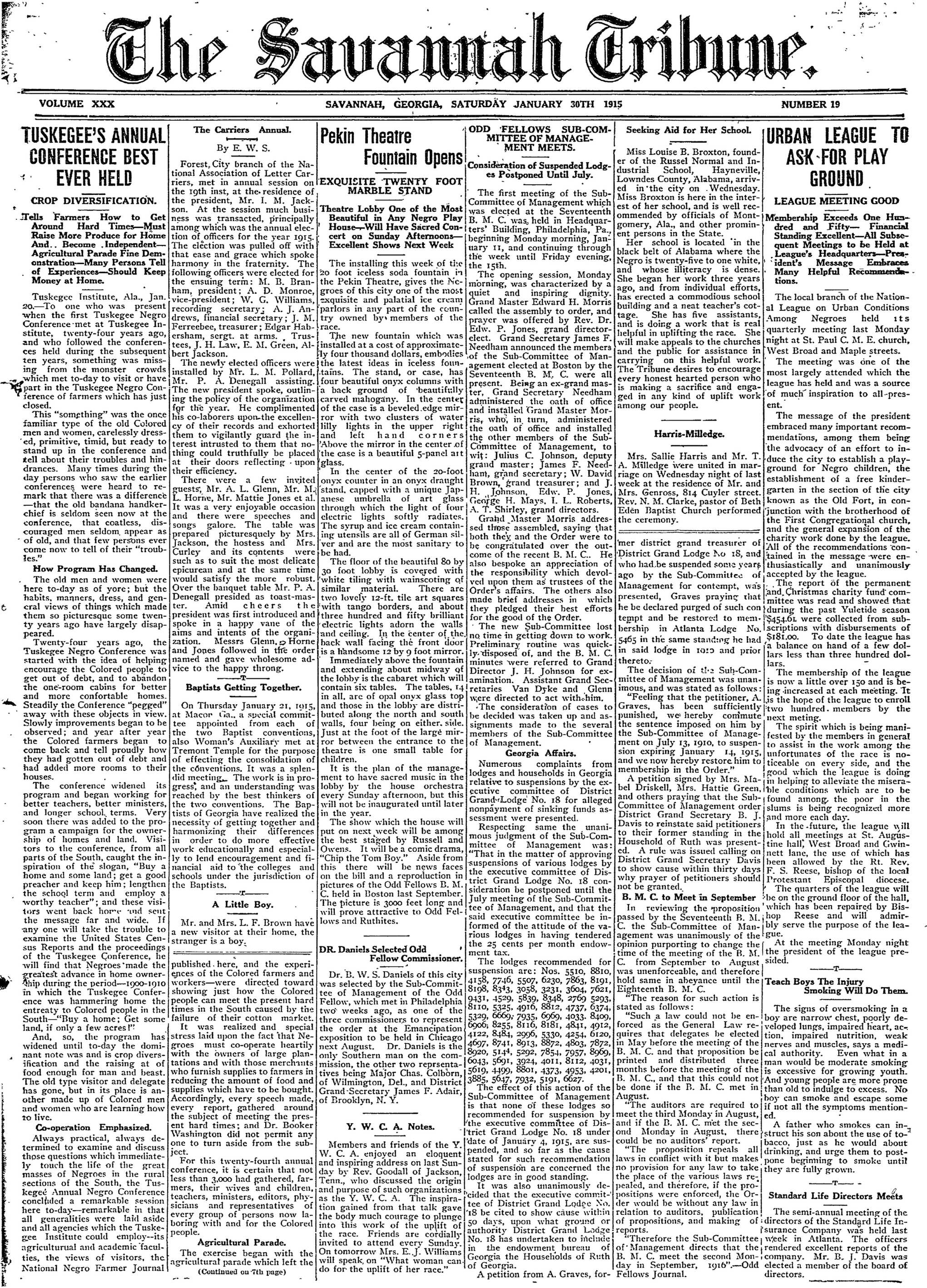
TUSKEGEE'S ANNUAL CONFERENCE BEST EVER HELD
CROP DIVERSIFICATION.
Tells Farmers How to Get Around Hard Times—Must Raise More Produce for Home And.. Become .Independent— Agricultural Parade Fine Demonstration—Many Persons Tell of Experiences—Should Keep Money at Home.
Tuskegee Institute, Ala., Jan. 20. To one who was present when the first Tuskegee Negro Conference met at Tuskegee Institute, twenty-four years ago, and who followed the conferences held during the subsequent ten years, something was missing from the monster crowds which met to-day to visit or have part in the Tuskegee Negro Conference of farmers which has just closed.
This "something" was the once familiar type of the old Colored men and women, carelessly dressed, primitive, timid, but ready to stand up in the conference and tell about their troubles and hindrances. Many times during the day persons who saw the earlier conferences were heard to remark that there was a difference—that the old bandana handkerchief is seldom seen now at the conference, that coatless, discouraged men seldom appear as of old, and that few persons ever come now to tell of their "troubles."
How Program Has Changed.
The old men and women were here to-day as of yore; but the habits, manners, dress, and general views of things which made them so picturesque some twenty years ago have largely disappeared.
Twenty-four years ago, the Tuskegee Negro Conference was started with the idea of helping encourage the Colored people to get out of debt, and to abandon the one-room cabins for better and more comfortable homes. Steadily the Conference "pegged" away with these objects in view. Slowly improvements began to be observed; and year after year the Colored farmers began to come back and tell proudly how they had gotten out of debt and had added more rooms to their houses.
The conference widened its program and began working for better teachers, better ministers, and longer school, terms. Very soon there was added to the program a campaign for the ownership of homes and land. Visitors to the conference, from all parts of the South, caught the inspiration of the slogan, "Buy a home and some land; get a good preacher and keep him; lengthen the school term and employ a worthy teacher"; and these visitors went back home and sent the message far and wide. If any one will take the trouble to examine the United States Census Reports and the proceedings of the Tuskegee Conference, he will find that Negroes made the greatest advance in home ownership during the period—1900-1910 in which the Tuskegee Conference was hammering home the entreaty to Colored people in the South-"Buy a home; Get some land, if only a few acres!"
And, so, the program has widened until to-day the dominant note was and is crop diversification and the raising at of food enough for man and beast. The old type visitor and delegate has gone, but in its place is another made up of Colored men and women who are learning how to live.
Co-operation Emphasized.
Always practical, always determined to examine and discuss those questions which immediately touch the life of the great masses of Negroes in the rural sections of the South, the Tuskegee Annual Negro Conference concluded a remarkable session here to-day—remarkable in that all generalities were laid aside and all agencies which the Tuskegee Institute could employ--its agriculturual and academic faculties, the views of visitors, the National Negro Farmer Journal
Forest, City branch of the National Association of Letter Carriers, met in annual session on the 19th inst, at the residence of the president, Mr. I. M. Jackson. At the session much business was transacted, principally among which was the annual election of officers for the year 1915. The election was pulled off with that ease and grace which spoke harmony in the fraternity. The following officers were elected for the ensuing term: M. B. Branham, president; A. D. Monroe, vice-president; W. G. Williams, recording secretary; A. J. Andrews, financial secretary; J. M. Ferreebee, treasurer; Edgar Habersham, sergt. at arms. Trustees, J. H. Law, E. M. Green, Albert Jackson.
The newly elected officers were installed by Mr. L. M. Pollard, Mr. P. A. Denegall assisting. The new president spoke, outlining the policy of the organization for the year. He complimented his co-laborers upon the excellency of their records and exhorted them to vigilantly guard the interest intrusted to them that nothing could truthfully be placed at their doors reflecting upon their efficiency.
There were a few invited guests, Mr. A. L. Glenn, Mr. M. L. Horne, Mr. Mattie Jones et al. It was a very enjoyable occasion and there were speeches and songs galore. The table was prepared picturesquely by Mrs. Jackson, the hostess and Mrs. Curley and its contents were such as to suit the most delicate epicurean and at the same time would satisfy the more robust. Over the banquet table Mr. P. A. Denegall presided as toast-master. Amid cheers the president was first introduced and spoke in a happy vane of the aims and intents of the organization. Messrs Glenn, Horne and Jones followed in the order named and gave wholesome advice to the happy throng.
Baptists Getting Together.
On Thursday January 21, 1915, at Macor Ga., a special committee appointed from each of the two Baptist conventions, also Woman's Auxiliary met at Tremont Temple for the purpose of effecting the consolidation of the conventions. It was a splendid meeting. The work is in progress, and an understanding was reached by the best thinkers of the two conventions. The Baptists of Georgia have realized the necessity of getting together and harmonizing their differences in order to do more effective work educationally and especially to lend encouragement and financial aid to the colleges and schools under the jurisdiction of the Baptists.
A Little Boy.
Mr. and Mrs. L. F. Brown have a new visitor at their home, the stranger is a boy.
published here, and the experiences of the Colored farmers and workers—were directed toward showing just how the Colored people can meet the present hard times in the South caused by the failure of their cotton market.
It was realized and special stress laid upon the fact that Negroes must co-operate heartily with the owners of large plantations and with those merchants who furnish supplies to farmers in reducing the amount of food and supplies which have to be bought. Accordingly, every speech made, every report, gathered around the subject of meeting the present hard times; and Dr. Booker Washington did not permit any one to turn aside from the subject.
For this twenty-fourth annual conference, it is certain that not less than 3.000 had gathered, farmers, their wives and children, teachers, ministers, editors, physicians and representatives of every group of persons now laboring with and for the Colored people.
Agricultural Parade.
The exercise began with the agricultural parade which left the (Continued on 7th page)
SAVANNAH, GEORGIA, SATURDAY JANUARY 30TH 1915
Pekin Theatre Fountain Opens
Theatre Lobby One of the Most Beautiful in Any Negro Play House—Will Have Sacred Concert on Sunday Afternoons—Excellent Shows Next Week
The installing this week of the 20 foot iceless soda fountain in the Pekin Theatre, gives the Negroes of this city one of the most exquisite and palatial ice cream parlors in any part of the country owned by members of the race.
The new fountain which was installed at a cost of approximately four thousand dollars, embodies the latest ideas in iceless fountains. The stand, or case, has four beautiful onyx columns with a back ground of beautifully carved mahogany. In the center of the case is a beveled edge mirror with two clusters of water lilly lights in the upper right and left hand corners Above the mirror in the center of the case is a beautiful 5-panel art glass.
In the center of the 20-foot onyx counter in an onyx draught stand, capped with a unique Japanese umbrella of art glass through which the light of four electric lights softly radiates. The syrup and ice cream containing utensils are all of German silver and are the most sanitary to be had.
The floor of the beautiful 80 by 30 foot lobby is covered with white tiling with wainscoting of similar material. There are two lovely 12-ft. tile art squares with tango borders, and about three hundred and fifty brilliant electric lights adorn the walls and ceiling. In the center of the back wall facing the front door is a handsome 12 by 9 foot mirror.
Immediately above the fountain and extending about midway of the lobby is the cabaret which will contain six tables. The tables, 14 in all, are of opal onyx glass top and those in the lobby are distributed along the north and south walls, four being on either, side. Just at the foot of the large mirror between the entrance to the theatre is one small table for children. It is the plan of the management to have sacred music in the lobby by the house orchestra every Sunday afternoon, but this will not be inaugurated until later in the year.
The show which the house will put on next week will be among the best staged by Russell and Owens. It will be a comic drama, "Chip the Tom Boy." Aside from this there will be news faces on the bill and a reproduction in pictures of the Odd Fellows B. M. C. held in Boston last September. The picture is 3000 feet long and will prove attractive to Odd Fellows and Ruthites.
DR. Daniels Selected Odd Fellow Commissioner.
Dr. B. W. S. Daniels of this city was selected by the Sub-Committee of Management of the Odd Fellow, which met in Philadelphia two weeks ago, as one of the three commissioners to represent the order at the Emancipation exposition to be held in Chicago next August. Dr. Daniels is the only Southern man on the commission, the other two representatives being Major Chas. Colborn, of Wilmington, Del., and District Grand-Secretary James F. Adair, of Brooklyn, N. Y.
Y. W. C. A. Notes.
Members and friends of the Y. W. C. A. enjoyed an eloquent and inspiring address on last Sunday by Rev. Goodall of Jackson, Tenn., who discussed the origin and purpose of such organizations as the Y. W. C. A. The inspiration gained from that talk gave the body much courage to plunge into this work of the uplift of the race. Friends are cordially invited to attend every Sunday. On tomorrow Mrs. E. J. Williams will speak, on "What woman can do for the uplift of her race."
ODD FELLOWS SUB-COMMITTEE OF MANAGEMENT MEETS.
Consideration of Suspended Lodges Postponed Until July.
The first meeting of the SubCommittee of Management which was elected at the Seventeenth B. M. C. was, held in Headquarters' Building, Philadelphia, Pa. beginning Monday morning, January 11, and continuing through the week until Friday evening, the 15th.
The opening session, Monday morning, was characterized by a quiet and inspiring dignity. Grand Master Edward H. Morris called the assembly to order, and prayer was offered by Rev. Dr. Edw. P. Jones, grand director-elect. Grand Secretary James F. Needham announced the members of the Sub-Committee of Management elected at Boston by the Seventeenth B. M. C. were all present. Being an ex-grand master, Grand Secretary Needham administered the oath of office and installed Grand Master Morris, who, in turn, administered the oath of office and installed the other members of the Sub-Committee of Management, to wit: Julius C. Johnson, deputy grand master; James F. Needham, grand secretary; W. David Brown, grand treasurer; and J. H. Johnson, Edw. P. Jones, George H. Mays, I. L. Roberts, A. T. Shirley, grand directors.
Grand Master Morris addressed those assembled, saying that both they, and the Order were to be congratulated over the outcome of the recent B. M. C.. He also basked an appreciation of the responsibility which devolved upon them as trustees of the Order's affairs. The others also made brief addresses in which they pledged their best efforts for the good of the Order.
The new Sub-Committee lost no time in getting down to work. Preliminary routine was quickly disposed of, and the B. M. C. minutes were referred to Grand Director J. H. Johnson for examination. Assistant Grand Secretaries Van Dyke and Glenn were directed to act with him. The consideration of cases to be decided was taken up and assignments made to the several members of the Sub-Committee of Management.
Georgia Affairs.
Numerous complaints from lodges and households in Georgia relative to suspensions by the executive committee of District Grand Lodge No.18 for alleged nonpayment of sinking funds assessment were presented.
Respecting same the unanimous judgment of the Sub-Committee of Management was: "That in the matter of approving suspensions of various lodges by the executive committee of District Grand Lodge No. 18 consideration be postponed until the July meeting of the Sub-Committee of Management, and that the said executive committee be informed of the attitude of the various lodges in having tendered the 25 cents per month endowment tax.
The lodges recommended for suspension are: Nos. 5510, 8810, 4158, 7746, 5507, 6230, 7863, 8191, 8198, 8343, 5058, 3231, 3604, 7621, 9431, 4529, 5839, 8348, 2769, 5293, 8110, 5325, 4916, 8812, 4737, 6374, 5329, 6669, 7935, 6969, 4033, 8409, 6906, 8255, 8116, 8181, 4841, 4912, 4122, 8484, 2996, 5330, 4254, 6120, 4697, 8741, 8913, 8872, 4803, 7872, 8920, 5144, 5292, 7854, 7957, 8969, 6043, 5691, 3924, 4011, 8112, 4031, 5619, 4499, 8801, 4373, 4953, 4201, 3885, 5647, 7932, 5191, 6627.
The effect of this action of the Sub-Committee of Management is that none of these lodges so recommended for suspension by the executive committee of District Grand Lodge No. 18 under date of January 4, 1915, are suspended, and so far as the cause stated for such recommendation of suspension are concerned the lodges are in good standing.
It was also unanimously decided that the executive committee of District Grand Lodge No. 18 be cited to show cause within 50 days, upon what ground or authority District Grand Lodge No. 18 has undertaken to include in the endowment bureau of Georgia the Households of Ruth of Georgia. A petition from A. Graves, for-
Seeking Aid for Her School.
Miss Louise B. Broxton, founder of the Russel Normal and Industrial School, Hayneville, Lowndes County, Alabama, arrived in the city on Wednesday. Miss Broxton is here in the interest of her school, and is well recommended by officials of Montgomery, Ala., and other prominent persons in the State.
Her school is located in the black belt of Alabama where the Negro is twenty-five to one white, and whose illiteracy is dense. She began her work three years ago, and from individual efforts, has erected a commodious school building and a neat teacher's cottage. She has five assistants, and is doing a work that is real helpful in uplifting the race. She will make appeals to the churches and the public for assistance in carrying on this helpful work. The Tribune desires to encourage every honest hearted person who is making a sacrifice and engaged in any kind of uplift work among our people.
Harris-Milledge.
Mrs. Sallie Harris and Mr. T. A. Milled were united in marriage on Wednesday night of last week at the residence of Mr. and Mrs. Genross, 814 Cuyler street. Rev. N. M. Clarke, pastor of Beth Eden Baptist Church performed the ceremony.
mer district grand treasurer of District Grand Lodge No 18, and who had be suspended some years ago by the Sub-Committee of Management for contempt, was presented, Graves praying that he be declared purged of such contempt and be restored to membership in Atlanta Lodge No. 5465 in the same standing he had in said lodge in 1012 and prior thereto. The decision of the Sub-Committee of Management was unanimous, and was stated as follows:
"Feeling that the petitioner, A. Graves, has been sufficiently punished, we hereby commute the sentence imposed on him by the Sub-Committee of Management on July 13, 1910, to suspension expiring January 14, 1915, and we now hereby restore him to membership in the Order."
A petition signed by Mrs. Mabel Driskell, Mrs. Hattie Green, and others praying that the SubCommittee of Management order District Grand Secretary B. J. Davis to reinstate said petitioners to their former standing in the Household of Ruth was presented. A rule was issued calling on District Grand Secretary Davis to show cause within thirty days why prayer of petitioners should not be granted.
B. M. C. to Meet in September
"The reason for such action is stated as follows:
"Such a law could not be enforced as the General Law requires that delegates be elected in May before the meeting of the B. M. C. and that proposition be printed and distributed three months before the meeting of the B. M. C., and that this could not be done if the B. M. C. met in August.
"The auditors are required to meet the third Monday in August, and if the B. M. C. met the second Monday in August, there could be no auditors' report."
"The proposition repeals all laws in conflict with it but makes no provision for any law to take the place of the various laws repealed, and therefore, if the propositions were enforced, the Order would be without any law in relation to auditors, publication of propositions, and making of reports.
"Therefore the Sub-Committee of Management directs that the B. M. C. meet the second Monday in September, 1916".—Odd Fellows Journal.
NUMBER 19
URBAN LEAGUE TO ASK-FOR PLAY GROUND
LEAGUE MEETING GOOD
Membership Exceeds One Hundred and Fifty—Financial Standing Excellent—All Subsequent Meetings to be Held at League's Headquarters—President's Message Embraces Many Helpful Recommendations. The local branch of the National League on Urban Conditions Among Negroes held its quarterly meeting last Monday night at St. Paul C. M. E. church, West Broad and Maple streets.
The meeting was one of the most largely attended which the league has held and was a source of much inspiration to all-present.
The message of the president embraced many important recommendations, among them being the advocacy of an effort to induce the city to establish a playground for Negro children, the establishment of a free kindergarten in the section of the city known as the Old Fort, in conjunction with the brotherhood of the First Congregational church, and the general expansion of the charity work done by the league. All of the recommendations contained in the message were enthusiastically and unanimously accepted by the league.
The report of the permanent and Christmas charity fund committee was read and showed that during the past Yuletide season $454.61 were collected from subscriptions with disbursements of $181.00. To date the league has a balance on hand of a few dollars less than three hundred dollars.
The membership of the league is now a little over 150 and is being increased at each meeting. It is the hope of the league to enroll two hundred members by the next meeting.
The spirit which is being manifested by the members in general to assist in the work among the unfortunates of the race is noticeable on every side, and the good which the league is doing in helping to alleviate the miserable conditions which are to be found among the poor in the slums is being recognized more and more each day.
In the future, the league will hold all meetings at St. Augustine hall, West Broad and Gwinnett lane, the use of which has been allowed by the Rt. Rev. F. S. Reese, bishop of the local Protestant Episcopal diocese. The quarters of the league will be on the ground floor of the hall, which has been repaired by Bishop Reese and will admirably serve the purpose of the league. At the meeting Monday night the president of the league presided.
Teach Boys The Injury Smoking Will Do Them.
The signs of oversmoking in a boy are narrow chest, poorly developed lungs, impaired heart, action, impaired nutrition, weak nerves and muscles, says a medical authority. Even what in a man would be moderate smoking is excessive for growing youth. And young people are more prone than old to indulge to excess. No boy can smoke and escape some if not all the symptoms mentioned. A father who smokes can instruct his son about the use of tobacco, just as he would about drinking, and urge them to postpone beginning to smoke until they are fully grown.
Standard Life Directors Meets
The semi-annual meeting of the directors of the Standrd Life Insurance Company was held last week in Atlanta. The officers rendered excellent reports of the company. Mr. B. J. Davis was elected a member of the board of directors.
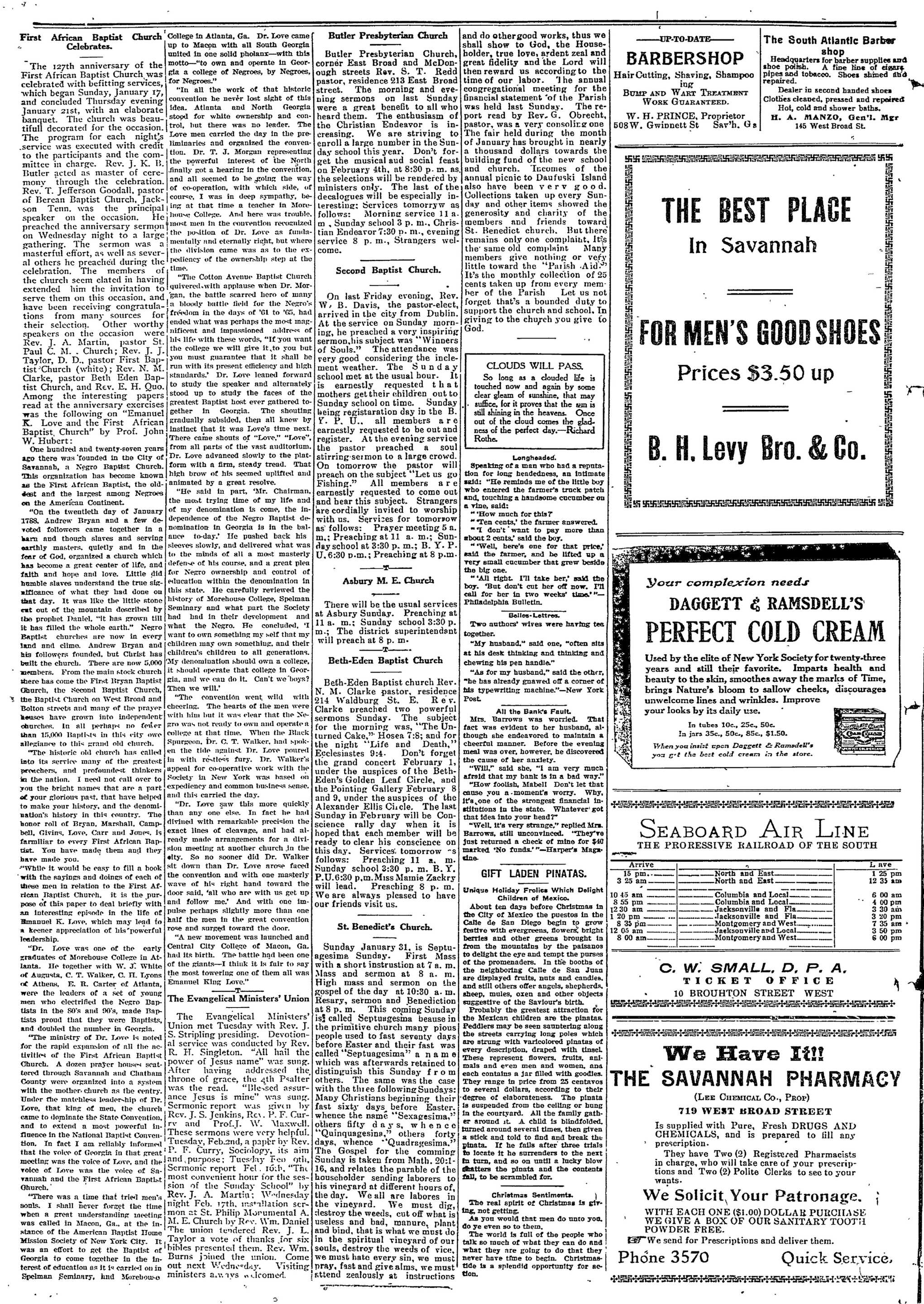
The 127th anniversary of the First African Baptist Church was celebrated with befitting services, which began Sunday, January 17, and concluded Thursday evening January 21st, with an elaborate banquet. The church was beautiful decorated for the occasion. The program for each night's service was executed with credit to the participants and the committee in charge. Rev. J. K. B. Butler acted as master of ceremony through the celebration. Rev. T. Jefferson Goodall, pastor of Berean Baptist Church, Jackson Tenn. was the principal speaker on the occasion. He preached the anniversary sermon on Wednesday night to a large gathering. The sermon was a masterful effort, as well as several others he preached during the celebration. The members of the church seem clated in having extended him the invitation to serve them on this occasion, and have been receiving congratulations from many sources for their selection. Other worthy speakers on the occasion were Rev. J. A. Martin, pastor St. Paul C. M. . Church; Rev. J. J. Taylor, D. D., pastor First Baptist' Church (white); Rev. N. M. Clarke, pastor Beth Eden Baptist Church, and Rev. E. H. Quo. Among the interesting papers read at the anniversary exercises was the following on "Emanuel K. Love and the First African Baptist, Church" by Prof. John W. Hubert:
One hundred and twenty-seven years ago there was founded in the City of Savannah, a Negro Baptist Church. This organization has become known as the First African Baptist, the oldest and the largest among Negroes on the American Continent.
"On the twentleth day of January 1788, Andrew Bryan and a few devoted followers came together in a barn and though slaves and serving earthly masters, quietly and in the fear of God, organized a church which has become a great center of life, and faith and hope and love. Little did humble slaves understand the true significance of what they had done on that day. It was like the little stone eat out of the mountain described by the prophet Daniel, "it has grown till it has filled the whole earth." Negro Baptist churches are now in every land and clime. Andrew Bryan and his followers founded, but Christ has built the church. There are now 5,000 members. From the main stock church there has come the First Bryan Baptist Church, the Second Baptist Church, the Baptist Church on West Broad and Bolton streets and many of the prayer houses have grown into independent churches. In all perhaps no fewer than 15,000 Baptists in this city owe allegiance to this grand old church.
"The historic old church has called into its service many of the greatest preachers, and profoundest thinkers in the nation. I need not call over to you the bright names that are a part of your glorious past, that have helped to make your history, and the denomination's history in this country. The honor roll of Bryan, Marshall, Campbell, Glvins, Love, Carr and Jones, is familiar to every First African Baptist. You have made them and they have made you.
"While it would be easy to fill a book with the sayings and doings of each of these men in relation to the First African Baptist Church, it is the purpose of this paper to deal briefly with an interesting episode in the life of Emanuel K. Love, which may lead to a keener appreciation of his powerful leadership.
"Dr. Love was one of the early graduates of Morehouse College in Atlanta. He together with W. J. White of Augusta, C. T. Walker, C. H. Lyons of Athens, E. R. Carter of Atlanta, were the leaders of a set of young men who electrified the Negro Baptists in the 80's and 90's, made Baptists proud that they were Baptists, and doubled the number in Georgia.
"The ministry of Dr. Love is noted for the rapid expansion of all the activities of the First African Baptist Church. A dozen prayer houses scattered through Savannah and Chatham County were organized into a system with the mother church as the centry. Under the matchless leader-chip of Dr. Love, that king of men, the church came to dominate the State Convention, and to extend a most powerful influence in the National Baptist Convention. In fact I am reliably informed that the voice of Georgia in that great meeting was the voice of Love, and the voice of Love was the voice of Savannah and the First African Baptist Church.
"There was a time that tried men's sonls. I shall never forget the time when a great understanding meeting was called in Macon, Ga., at the instance of the American Baptist Home Mission Society of New York City. It was an effort to get the Baptist of Georgia to come together in the interest of education as it is carried on in Speelman Seminary, hnd Morehouse
College in Atlanta, Ga. Dr. Love came up to Macon with all South Georgia united in one solid pholanx—with this motto—"to own and operate in Georgia a college of Negroes, by Negroes, for Negroes."
"In all the work of that historic convention he never lost sight of this idea. Atlanta and North Georgia stood for white ownership and control, but there was no leader. The Love men carried the day in the preliminaries and organized the convention. Dr. T. J. Morgan representing the powerful interest of the North finally got a hearing in the convention, and all seemed to be going the way of co-operation, with which side, of course, I was in deep sympathy, being at that time a teacher in Morehouse College. And here was trouble, most men in the convention recognized the position of Dr. Love as fundamentally and eternally right, but where the division came was as to the expediency of the ownership step at the time.
"The Cotton Avenue Baptist Church quivered with applause when Dr. Morgan, the battle scarred hero of many a bloody battle field for the Negro's freedom in the days of '61 to '65, had ended what was perhaps the most magnificent and impassioned address of his life with these words, "If you want the college we will give it to you but you must guarantee that it shall be run with its present efficiency and high standards." Dr. Love leaned forward to study the speaker and alternately stood up to study the faces of the greatest Baptist host ever gathered together in Georgia. The shouting gradually subsided, then all knew by instinct that it was Love's time next. There came shouts of "Love," "Love," from all parts of the vast auditorium. Dr. Love advanced slowly to the platform with a firm, steady tread. That high brow of his seemed uplifted and animated by a great resolve.
"He said in part, 'Mr. Chairman, the most trying time of my life and of my denomination is come, the independence of the Negro Baptist denomination in Georgia is in the balance to-day.' He pushed back his sleeves slowly, and delivered what was to the minds of all a most masterly defense of his course, and a great plea for Negro ownership and control of education within the denomination in this state. He carefully reviewed the history of Morehouse College, Spelman Seminary and what part the Society had had in their development and what the Negro. He concluded, I want to own something my self that my children may own something, and their children's children to all generations. My denomination should own a college, it should operate that college in Georgia, and we can do it. Can't we boys? Then we will."
"The convention went wild with cheering. The hearts of the men were with him but it was clear that the Negro was not ready to own and operate a college at that time. When the Black Spurgeon, Dr. C. T. Walker, had spoken the tide against Dr. Love poured in with restless fury. Dr. Walker's appeal for co-operative work with the Society in New York was based on expediency and common business sense, and this carried the day.
"Dr. Love saw this more quickly than any one else. In fact he had divined with remarkable precision the exact lines of cleavage, and had already made arrangements for a division meeting at another church in the city. So no sooner did Dr. Walker sit down than Dr. Love arose faced the convention and with one masterly wave of his right hand toward the door said, 'all who are with us get up and follow me.' And with one impulse perhaps slightly more than one half the men in the great convention rose and surged toward the door.
"A new movement was launched and Central City College of Macon, Ga. had its birth. The battle had been one of the giants—I think it is fair to say the most towering one of them all was Emanuel King Love."
The Evangelical Ministers' Union
The Evangelical Ministers' Union met Tuesday with Rev. J. S. Stripling presiding. Devotional service was conducted by Rev. R. H. Singleton. "All hail the power of Jesus name" was sung. After having addressed the throne of grace, the 4th Psalter was the read. "Blessed assurance Jesus is mine" was sung. Sermonic report was given by Rev. J. S. Jenkins, Rev. P. F. Curry and Prof. J. W. Maxwell. These sermons were very helpful. Tuesday, Feb. 2nd, a paper by Rev. P. F. Curry, Sociology, its aim and purpose; Tuesday Feb. 9th, Sermonic report Fel. 10th, "The most convenient hour for the session of the Sunday School" by Rev. J. A. Martin; Wednesday night Feb. 17th, installation sermon at St. Philip Monumental A. M. E. Church by Rev. Wm. Daniel The union tendered Rev. J. L. Taylor a vote of thanks for six bibles presented them. Rev. Wm. Burns joined the union. Come out next Wednesday. Visiting ministers always welcomed.
Butler Presbyterian Church
Butler Presbyterian Church, corner East Broad and McDonough streets Rev. S. T. Redd pastor, residence 213 East Broad street. The morning and evening sermons on last Sunday were a great benefit to all who heard them. The enthusiasm of the Christian Endeavor is increasing. We are striving to enroll a large number in the Sunday school this year. Don't forget the musical and social feast on February 4th, at 8:30 p.m. as the selections will be rendered by ministers only. The last of the decalogues will be especially interesting: Services tomorryw as follows: Morning service 11 a.m., Sunday school 3 p.m., Christian Endeavor 7:30 p.m., evening service 8 p.m., Strangers welcome.
Second Baptist Church.
On last Friday evening, Rev. W. B. Davis, the pastor-elect, arrived in the city from Dublin. At the service on Sunday morning, he preached a vory inspiring sermon, his subject was "Winners of Souls." The attendance was very good considering the inclement weather. The Sunday school met at the usual hour. It is earnestly requested that mothers get their children out to Sunday school on time. Sunday being registaration day in the B. Y. P. U., all members are earnestly requested to be out and register. At the evening service the pastor preached a soul stirring sermon to a large crowd. On tomorrow the pastor will preach on the subject "Let us go Fishing." All members are earnestly requested to come out and hear this subject. Strangers are cordially invited to worship with us. Services for tomorrow as follows: Prayer meeting 5 a.m.; Preaching at 11 a.m.; Sunday school at 3:30 p.m.; B. Y. P. U. 6:30 p.m.; Preaching at 8 p.m.
Asbury M. E. Church
There will be the usual services at Asbury Sunday. Preaching at 11 a. m.; Sunday school 3:30 p. m.; The district superintendant will preach at 8 p. m.
Beth-Eden Baptist Church
Beth-Eden Baptist church Rev. N. M. Clarke pastor, residence 214 Waldburg St. E. Rev. Clarke preached two powerful sermons Sunday. The subject for the morning was, "The Unturned Cake," Hosea 7:8; and for the night "Life and Death," Ecclesiastes 9:4. Don't forget the grand concert February 1, under the auspices of the Beth-Eden's Golden Leaf Circle, and the Pointing Gallery February 8 and 9, under the auspices of the Alexander Ellis Circle. The last Sunday in February will be Conscience rally day when it is hoped that each member will be ready to clear his conscience on this day. Services tomorrow follows: Preaching 11 a. m. m Sunday school 3:30 p. m. B.Y. P.U.6:30 p.m.Miss Mamie Zackry will lead. Preaching 8 p.m. We are always pleased to have our friends visit us.
St. Benedict's Church.
Sunday January 31, is Septuagesima Sunday. First Mass with a short instruction at 7 a.m. Mass and sermon at 8 a.m. High mass and sermon on the gospel of the day at 10:30 a.m. Resury, sermon and Benediction at 8 p.m. This coming Sunday is called Septuagesima because in the primitive church many pious people used to fast seventy days before Easter and their fast was called "Septuagesima" a name which was afterwards retained to distinguish this Sunday from others. The same was the case with the three following Sundays: Many Christians beginning their fast sixty days before Easter, whence the name "Sexagesima," others fifty days, whence "Quinquagesina," others forty days, whence "Quadragesima." The Gospel for the comming Sunday is taken from Math. 20:1-16, and relates the parable of the householder sending laborers to his vineyard at different hours of the day. We all are labores in the vineyard. We must dig, destroy the weeds, cut off what is useless and bad, manure, plant and bind, that is what we must do in the spiritual vineyard of our souls, destroy the weeds of vice, we must hate every sin, we must pray, fast and give alms, we must attend zealously at instructions
and do othergood works, thus we shall show to God, the Householder, true love, ardent zeal and great fidelity and the Lord will then reward us according to the time of our labor. The annual congregational meeting for the financial statement of the Parish was held last Sunday. The report read by Rev. G. Obrecht, pastor, was a very consoling one. The fair held during the month of January has brought in nearly a thousand dollars towards the building fund of the new school and church. Incomes of the annual picnic to Daufuski Island also have been very good. Collections taken up every Sunday and other items showed the generosity and charity of the members and friends toward St. Benedict church. But there remains only one complaint. It's the same old complaint. Many members give nothing or very little toward the "Parish Aid". It's the monthly collection of 25 cents taken up from every member of the Parish. Let us not forget that's a bounded duty to support the church and school. In giving to the church you give to God.
THE BEST PLACE
In Savannah
FOR MEN'S GOOD SHOES
Prices $3.50 up
B. H. Levy Bro. & Co.
CLOUDS WILL PASS.
So long as a clouded life is touched now and again by some clear gleam of sunshine, that may suffice, for it proves that the sun is still shining in the heavens. Once out of the cloud comes the gladness of the perfect day.—Richard Rothe.
FOR MEN'S GOOD SHOES
Prices $3.50 up
B. H. Levy Bro. & Co.
CLOUDS WILL PASS
So long as a clouded life is touched now and again by some clear gleam of sunshine, that may suffice, for it proves that the sun is still shining in the heavens. Once out of the cloud comes the gladness of the perfect day.—Richard Rothe.
Longheaded.
Speaking of a man who had a reputation for long headedness, an intimate said: "He reminds me of the little boy who entered the farmer's truck patch and, touching a handsome cucumber on a vine, said:
"Well, here's one for that price,' said the farmer, and he lifted up a very small cucumber that grew beside the big one.
"All right. I'll take her,' said the boy. 'But don't cut her off now. I'll call for her in two weeks' time.'"—Philadelphia Bulletin.
Bellos-Lettres.
Two authors' wives were having tea together.
"My husband," said one, "often sits at his desk thinking and thinking and chewing his pen handle."
"As for my husband," said the other, "he has already gnawed off a corner of his typewriting machine."—New York Post.
Coca-Cola
Coca-Cola
Coca-Cola
All the Bank's Fault.
Mrs. Barrows was worried. That fact was evident to her husband, although she endeavored to maintain a cheerful manner. Before the evening meal was over, however, he discovered the cause of her anxiety.
"Will," said she, "I am very much afraid that my bank is in a bad way." "How foolish, Mabell. Don't let that cause you a moment's worry. Why, it's one of the strongest financial institutions in the state. Whatever got that idea into your head?" "Well, it's very strange," replied Mrs. Barrows, still unconvinced. "They've just returned a check of mine for $40 marked 'No funds.'"—Harper's Magazine.
Arrive L ave
15 pm. North and East 1 25 pm
3 25 am North and East 12 35 am
10 45 am Columbia and Local 6 00 am
8 55 pm Columbia and Local 4 00 pm
12 30 am Jacksonville and Fla 3 30 am
1 20 pm Jacksonville and Fla 3 20 pm
8 35 pm Montgomery and West 7 35 am
12 05 am Jacksonville and Local 3 50 pm
8 00 am Montgomery and West 6 00 pm
GIFT LADEN PINATAS
Unique Holiday Frolics Which Delight Children of Mexico.
About ten days before Christmas in the City of Mexico the puestos in the Calle de San Diego begin to grow festive with evergreens, flowers, bright berries and other greens brought in from the mountains by the paisanos to delight the eye and tempt the purses of the promenaders. In the booths of the neighboring Calle de San Juan are displayed fruits, nuts and candles, and still others offer angels, shepherds, sheep, mules, oxen and other objects suggestive of the Saviour's birth.
Probably the greatest attraction for the Mexican children are the pinatas. Peddlers may be seen sauntering along the streets carrying long poles which are strung with varicolored pinatas of every description, draped with tinsel. These represent flowers, fruits, animals and even men and women, and each contains a jar filled with goodies. They range in price from 25 centavos to several dollars, according to their degree of elaborateness. The pinata is suspended from the ceiling or hung in the courtyard. All the family gather around it. A child is blindfolded, turned around several times, then given a stick and told to find and break the pinata. If he falls after three trials to locate it he surrenders to the next in turn, and so on until a lucky blow chatters the pinata and the contents fall, to be scrambled for.
They have Two (2) Registered Pharmacists in charge, who will take care of your prescriptions and Two (2) Polite Clerks to see to your wants.
Christmas Sentiments.
The real spirit of Christmas is giving, not getting.
As you would that men do unto you, do ye even so to them.
The world is full of the people who talk so much of what they can do and what they are going to do that they never have time to begin. Christmaside is a splendid opportunity for action.
---
Among the Masons
Search for the Absentees.
Many good brethren who are actively interested in the work of Masonry and feel a personal responsibility for the welfare of the craft are worried about the stayaways. In a large lodge they find that ten per cent of the members do the work and divide the honors. The wherefore of the 40 per cent of occasional and 50 per cent of cronic absentees gives them serious concern. They cannot reconcile absenteeism with their ideas of good Masonry.
In the consideration of this question it should be remembered that mere attendance at lodge is not a test of man's Masonry. Masonry is not ritualism, but a state of mind. The true Mason practices in his daily life the principles inculcated in the lodge. It is true that the lodge is, or should be, the fountain source of Masonic inspiration, and the Mason owes it to himself and to his brethren to seek the fountain as often as possible. And those in charge of the fountain should see that it is kept pure, fresh and sparkling.—Masonic Standard.
Masonry, like anything else, is what you make it. If you live as near as possible to its teachings you will derive the great benefit of a fraternal association among your fellowmen and self satisfaction which words cannot express.—The Globe.
\* \* \*
The man who fails to appreciate the sublime lessons of morality and virtue, of benevolence and brotherhood, and make them a part of his mental and moral self, fall far short of coming up to the full requirements of Freemasonry.—Masonic Sun.
* *
Our influence should be greater as we go in and out among our fellow citizens; and if we broaden our views as to the purpose of the craft, and make of it an expansive, unselfish brotherhood, we will give to our Masonry an illuminating power penetrating beyond the confines of our tiled doors, or whisperings and mystic signs—a radiance which will carry its message—like God's sunlight, among all men.
Harmony is an element of strength in our Masonic institution, but it is likewise one of the cardinal virtues. At the beginning of this new year it would be well for such lodges as are disrupted with internal dissension to set on foot some means of restoring Masonic fellowship and brotherly love.—Illinois Freemason.
* * *
"The problem of life is not to make life easier, but to make men stronger."
---
A Freemason.
Should be an honest, virtuous brave, intelligent, benevolent charitable man—a lover of the arts and sciences—with a belief in God, a hope of immortality, a good citizen, a providing father, a true friend of enlightened progress; a lover of law and preserver of order and a promoter of harmony, a protector of virtue, ever willing to help the defenseless widow and orphan, and should be temperate, controlling his passions and subduing all inordinate desires to conform to the world, the flesh and the devil
with all these safeguards in mind he may live respected and die regretted. With a good, true and noble character as a monument of his moral worth and integrity that should distinguish every Freemason and enable him to enter the sanctum sanctorum of our Divine Master, clothed in royal robes of righteousness, wielding the golden scepter of his love and mercy, and wearing the jeweled crown of his many virtues.—G. B. Wright.
* * *
Masonry is an institution peculiar unto itself. It completes liar unto itself. It competes with none, patterns after none.
* * *
English Lodges.
There are some interesting features of difference between the English lodges of the present day and our own.
In England the only officers elected by ballot are the Worshipful Master and treasurer. All others are appointed by the Worshipful Master except the Tyler, who is elected by show of hands. They have as a rule, no rooms of their own or Masonic halls, but their meetings are held at a
hotel, which provides a room adapted for the purpose, and for which no charge is made. A banquet is arranged for after the lodge meeting, which is paid for the members remaining to enjoy it. The annual dues in most lodges are five guineas ($25), which covers the cost of banquet after each meeting.
FOR GOOD
Job Printing
On Good Material
..At Reasonabe Prices
Minutes,
By-Laws,
Badges,
Etc.,
Call at
The Savannah Tribune
1009 WEST BROAD ST.
OUT OF TOWN ORDERS GIVEN
SPECIAL ATTENTION
PHONE 2171
Let me send you FREE PERFUME
Write today for a testing bottle of
ED. PINAUD'S LILAC
The world's most famous perfume, every drop as sweet as the living blossom. For handkerchief, atomizer and bath. Fine after shaving. All the value is in the perfume—you don't pay extra for a fancy bottle. The quality is wonderful. The price only 75c (6 oz.). Send 4c for the little bottle—enough for 50 handkerchiefs.
PARFUMERIE ED. PINAUD
Department M.
ED. PINAUD BUILDING NEW YORK
3 IN ONE OILS,
CLEANS. POLISHES,
PREVENTS RUST
3-in-One is a light, pure oil compound that never gums. 3-in-One lubricates perfectly sewing machines, typewriters, bicycles, locks, clocks, guns, lawnmowers—everything that ever needs oiling in your home or office. No grease. No acid. A little 3-in-One on a soft cloth cleans and polishes perfectly all veneered or varnished furniture and woodwork. Sprinkled on a yard of black cheesecloth it makes an ideal Dustless Dusting Cloth.
3-in-One absolutely prevents rust on gun barrels, auto fixtures, bath room fixtures, gas ranges, everything metal, indoors or out, in any climate. It sinks into the unseen metal pores and forms a protecting "overcoat" which stays on.
Free—3-in-One—Free. Write today for generous free bottle and the 3-in-One Dictionary of hundreds of uses.
3-in-One is sold in all good stores in 3-size bottles: 10c (1 oz.), 25c (3 oz.), 50c (8 oz., 3/4 pint). Also in new patented Handy Oil Can, 25c (3/4 oz.).
3-IN-ONE OIL COMPANY
42 DA Broadway
New York City
In nearly all lodges the Master is allowed, to serve only one year. All business is transacted in the first degree, or E.A. Lodge, and when required the lodge room is opened in the second and third degree for the purpose of Masonic labor, and then returns to the first degree.
The working tools are in the E. A.—24-inch gague, the common gavel and the chisel—F. C., the square, level and plumb rule—M. M., the skirrit, the pencil and the compass.
The Worshipful Master does not come down on the floor to do Masonic work but seated in the east, he "rules and governs his lodge."—Hudson River Trestle Board.
* * *
Dignity and assurance are necessary attributes in a Worshipful Master, to a certain degree, but a superabundance becomes offensive and detrimental to the welfare of the lodge, says an exchange.
A Mason' Creed
I believe in God, the Father, and the Brotherhood of Man;
In obtaining Light and Knowledge in every way I can;
In protecting home and fireside, in dispensing Truth and Love;
In making Mason's home below
Christmas Tree In England.
Christmas Tree In England. The Christmas tree has not the vogue in England that it enjoys on the western side of the sea, but it is not exactly unknown. The poor and the middle classes go in for trees to only a trifling extent, but the great folks of the west end and the big country places all allow their gift giving to center about graceful evergreens that Norway and Germany send in.
Holiday Wisdom.
Ethel—If you're not going to accept Mr. Koyne why don't you tell him to stop calling on you?
Clarice-1 am, right after Christmas. Getting Rough With juanita.
Getting Rough With Suanita.
Small Mary, who had been taught to read by the modern "sounding out" system, was amusing herself by singing the school songster from cover to cover. Presently, as she reached "Juanita," one heard coming in her birdlike little voice from the depths of the big armchair:
"In the dark I slammed her."
A startled parent found that the line really read:
"In thy dark eyes' splendor."—New York Post.
A Veritable Hint:
He-Is there anything more boring than flattery? She-The lack of Philadelphia Ledger. Equally Cutting.
"Your voice," said the commanding officer, "is decidedly rasping."
"Yes, sir," said the subordinate, touching his hat. "I have been out roughing it with a file of soldiers all morning."—Chicago Tribune.
Called His Bluff.
Hubby—You look more beautiful every day, dear.
Wifey—You have been telling me so for a good many years. What a horrid fright I must have been to start with!
The Crab In the Oyster-
"The little crab found in the oyster," said a dealer, "is not, as supposed by two-thirds of the oyster eaters, the young of the blue crab, but is a distinct species. It is a messmate of and caterer to the wants of the oyster, being, therefore, a benefit instead of a detriment to the latter. In return for the oyster's kindness in protecting it against its enemies the little crab catches and crushes food which in its entire state could not be taken by the oyster. A singular thing in connection with them is that all found inside of the oyster are females. The male of the same variety has a hard shell."—Exchange.
Taste Differs In Girls and Boys
Taste Differs In Girls and Boys. Girls have more sensitive taste for bitter flavors than boys, and boys have a more sensitive taste for sweet flavors than girls, according to Dr. G. Cohn, author of a book on "Organic Flavoring Materials," published in Berlin. The taste of boys and girls for saltiness is equal. Among adults woman has a taste for sweet, bitter and sour that is more highly developed than that of man. For salty things there is little difference, man, if anything, being slightly more sensitive than woman.
Yellow Fever.
The first appearance of yellow fever is said to have been among the sailors of Columbus in 1495.
Microbes In Kisses.
Patience—Isn't it funny to see two women kissing who are not fond of one another? Patrice—Indeed, it is. It always looks to me as if each hoped the other would get all the microbes.—Yonkers Statesman.
THE SAVANNAH TRIBUNE
Established 1875
By JOHN H. DEVEAUX
Published by
SOL. C. JOHNSON
Editor and Proprietor
JAS. H. BUTLER
Asso. Editor and Manager
ED. H. BURKE
City Editor
Published Every Saturday
1000 WEST BROAD STREET
Phone 2171
Subscription Rates
One Year.....$1.25
Six Months.....750
Remittance must be made by Express
or Post Office Money Order, or Registered
Letter Advertising Rates given on
Application.
Entered at the Post Office at Savannah, Georgia, as Second Class Mail Matter.
Saturday January 30th' 1915
In a strong editorial anent the recent Monticello lynching, the Savannah Morning News, among other good things, says the following: "There never was a better opportunity than the Monticello lynching presents for ending lynching in this state. The governor has taken steps to investigate the lynching. If the investigation is had, and is conducted with vigor and intelligence — with a determination to find out the guilty parties—the lynchers will be found, arrested and tried. There must be many people in Jasper County who know who the lynchers are. If given assurance of protection, if public sentiment rallies to their support, they will tell what they know. It is conceded that lynchings hurt the state. There is no good reason why the whole people should suffer simply because a few in a community insist upon the barbarous practice of taking the law into their own hands. The courts are open and criminals are promptly punished. There is no excuse for mob law. And a far better effect is produced when the courts deal with those charged with crime than when mobs deal with them. The governor has an excellent chance to do the state a very good service. If he takes hold of the Monticello case and succeeds in bringing the lynchers to justice, he will make a record that will cause him to be recommended as one of the state's best
governors. It would be something to be proud of to have the credit of having rid the state of the lynching evil." The foregoing coming as it does from one of our leading white dailles, has the true ring to it. There is no doubt that the Morning News, together with other leading Southern dailles, is against mob violence. This unanimity of action on the part of the Southern press, condemnatory of the lynching evil is not only gratifying to note but augurs in no mistakable way, the speedy triumph of law and order against mob violence regardless to the aspect it assumes. As a great moulder of public opinion the Southern press can do a great deal toward ridding the state of the cancerous lynching evil. In thus speaking the Morning News, like the Augusta Chronicle and other Southern dailles has already dealt the lynching bee a stinging blow. Justice and fair play to all must be the pillars upon which a plea is built. The lynching bee must cease. At least, let us so hope. Meanwhile, as we have recently said, we must get busy ourselves in leading a campaign against mob law and violence.
EDITORIAL NOTES.
Look out for health week announcement in March.
* * *
To be consistent, the segregation idea should be carried also into business. If the colored man is undesirable as a resident in the same block where there are white residents, then he should be an undesirable patron of every class of business controlled by his brother in white.
* * *
The time is propitious for every member of the race to more and more support the enterprises of the race.
\* \* \*
It is a good sign, this returning to the party of prosperity by some of the former adherents of of the Progressive party. This means that the Republicans will sweep the country in November of next year.
Quite refreshing is the united expression of the Southern press condemning the Monticello lynching in this state. It shows that sentiment for law and order is being moulded and in time will result in much good.
How many Belgians, or in fact any other home seekers would come to a state where lynch law is allowed? For every case of
lawlessness Georgia looses thousands of dollars.
The crusade now being made by the police on the street corner loafers is to be commended. This could be amended in a beneficial way by preventing loitering in and around near beer saloons and pool rooms.
It is reported that attached to several of the near beer saloons there are private rooms where women are permitted to enter and are served drinks. This is especially true of some of these saloons near places of amusements on the West Side. The police authorities have been informed of the existence of these places, and assurance has been given that they will be closed.
* * *
The work of charity and donating toward same should be indulged in by those of us who are in better positions than the ones lower down. It sweetens one's life to be thus engaged.
So true is the paragraph taken from an exchange which says, "There are thousands of folks in front pulling, who ought to be behind pushing."
In life's battles don't be a negative.
承 敬 考
We would be happier, and all of us would get along better if each of us would simply endeavor to treat others as we would like them to treat us.
The need of play-grounds for our children was emphasized at the meeting of the Urban League on Monday night. Let all of our people get behind the Urban League in the effort to secure at least one on the east and west sides.
Health week in March. Everybody should attend the meetings. Date announced later.
Proper home training is the main essential for our children, then too there should be better homes and home life for the mass of our people.
---
Would that we could influence every Colored minister to do more practical charity work and join in the movements for race uplift. This would mean so much for our people in this community. We give unstining credit to those ministers whose presence and names are seen in connection with these endeavors. Simply working in our own church is not sufficient. Get out among the masses
\* \* \*
It goes without saying that the boys and girls need amusement. This is necessary for their very being. It is therefore left with usto provide for them wholesome amusements. Unless this be done, we must not blame them for frequenting questionable places.
\* \* \*
We have in the city a number of female societies, some of them well organized and officered. These organizations could do untold good in this community in the way of uplift work. The only thing necessary is for them to get together in a federated body. We have a number of ladies who have tact and ability and who could lead in this movement. May not this federation of societies be formed, and let us take advantage of the many opportunities of doing good in the community?
The attention of the city authorities is called to the need of proper drainage and grading of streets in certain sections where our people are thickly resided.
* * *
Thursday of last week was observed as the anniversary of the establishment of the first Negro Baptist Church in America, and same was fittingly celebrated by the Baptists of the city. The week before The Tribune published a cut of the first church erected, and the Indianapolis Freeman has the following to say about is:
"The Savannah Tribune presents a likeness of what is called the first Negro Baptist Church established in America. It resembles somewhat the picture of what some have called Noah's Ark. It is antiquated all right, and looks worthy of the distinction of being among the first churches if not the very first. It was built when the carpenter's art was not in high state of efficiency among us." This building was razed when many of us were able to have only a slight rememberance of it. A number of the older citizens have a vivid knowledge of the building
and all of us regret that it was necessary to have it demolished. It should have been kept as a heritage to the Baptist denomination of the country.
The experiences of the past should prepare us for better things in the future.
* * *
A writer on health subjects very thoughtfully states that:
"The fact that the Negro is dying in such large numbers of tuberculosis and other still more frightful diseases is, of course, due to his ignorance and to other reasons for which he is largely responsible, but we cannot forget that it is also to be charged to the fact that he is compelled to live in the worst sections of our towns and cities, often without drainage or sewerage or garbage service, without water within a reasonable distance, and scarcely any of the sanitary conditions in houses or yard or street which whites consider an absolute necessity. We drive the worst forms of immorality into the Negro quarters, and then curse the Negro because of his moral weakness. We subject him to the severest test of our city life—physical, moral, and political—and then cynically declare that the "nigger" is no good anyway. Let's give him a square deal, a man's chance. Neither race hatred nor mawkish sentimentality will settle this very delicate question. The South cannot settle it alone, and the North cannot do the work of the South. The North and the South, the city and the country must tackle the thing together, for this is a National problem."
Under the caption "Are we a Race of Cowards?" the Atlanta- Independent 'states the following which should be considered and acted upon;
"No race of people in the history of civilization ever endured a leadership of more consummate cowards than the Negroes. The average Negro is a coward in his own esteem. Void of self-respect, appreciation of manly resentment. He submits to every indignity, with apology, the white man inflicts upon him. When we speak of cowards, we do not mean physical cowards, but moral and intellectual cowards. The coward who hasn't the moral courage to resent a wrong. The coward who submits to every indignity imposed upon him by cowardly newspapers; the coward who accepts every Jim-Crow accommodation offered. If the Negro preacher, leader, pulpit and platform orator would teach their people to decently and respectfully decline to patronize those white businesses and enterprises, that insult their womanhood and manhood, it wouldn't be long before insults and indignities heaped upon the race because of its color would grow beautifully less. If the Negro preacher would tell his congregation, that a manly and self-respecting race pride would not permit us to accept accommodations in the buzzard roost, in the attics and lofts of white man's theaters, it would not be long before the buzzard-roost, attics and Jim-Crow places in white theatres would be cut out, for the reason they would have no business. For the reason a white man has the intelligence and keenness of foresight not to operate a business that does not pay.
"If the Negro preacher would teach his congregation from his pulpit each Sunday and the orator from the platform, not to read a white paper that endorses outrages against the race, that perpetrated and circulated indignities and wrongs upon our man and womanhood, it wouldn't be long before the white papers would cut out that part of their policy for the reason every white paper in the South is largely read by Negro constituents, and their advertising rates are based upon circulation.
The Jew will not read a paper that is hostile to Jews. The German cuts out every paper that antagonizes and fights his nationality. The Irishman resents with all of his hot blood insults heaped upon his race by newspapers and other nationalities. The Jap resents with all of his soul,with all of his might, every wrong done him because of his race, his color or his condition.
"There is nobody a coward but the Negro; there is no race so divided against itself and is such a consummate band of bootlicks, cowards and syncophants as black educated leaders. What we need most is a manly leadership—one full of moral courage and intellectual bravery. No bully, no insulter, but a man who has the intelligence and the Christian manhood to resent decently and manly wrongs heaped upon the race. A man who defends the race of indignities that they ought not to endure, and how they may rid themselves of the agencies that seek to crush and undo it. Let us have a manly race by manly leadership. Let the pulpit and the platform do their duty, and all will be well."
Married.
Miss Ruth Mitchell and Mr Freddie Jefferson were mafried on last Wednesday night at the First Congregational Church by the Rev. W. L. Cash.
That the Y. M. C. A. movement suffers no abatement of interest, was attested on last Sunday when the largest audience in the history of the association presented itself. The program as carried out, was indeed interesting. The principal address as delivered by Rev. S. T. Redd, of the Butler Presbyterian Church, was a characteristically strong one. Many thoughts and suggestions of incalculable benefit to the members of the association were given by the speaker. Rev. T. Jefferson Goodall of Jackson, Tenn., who visited the association, delivered a short address of much helpfulness. The singing of the First A. B. Church quartette was also a feature of the meeting. On to-morrow, the principal address will be delivered by Mr. A. B. Singfield, Gen. Mgr. of Pilgrim Health and Life Insurance Company and President of the Business League. There will be good music. Final action will be taken on the report of the Committee on Headquarters at tomorrow's meeting. The association is planning a joint Lincoln day celebration with the Y. W. C. A. Announcements later. The meeting will be held to-morrow at St. Paul C. M. E. Church, West Broad and Maple streets!
To Our Subcribers
Bills have been left at the homes of many of our subscribers and you will favor us very much by calling at the office and settling same or phoning u and we will send to you.
Just Think of It!
Every person who gets a copy of next Sunday's New York World will receive, besides new, editorials, comics, and Illustrated Magazine, "Fun," the big weekly Joke Book, &c., a new picture by Charles Dana Gibson, printed on tinted paper and suitable to cut out and frame, an eight-page supplement, "Pictorial Weekly Review of Events," presenting photographic illustrations of happenings in the European war zone and another installment of "Runaway June," the great moving picture story by George Randolph Chester, author of "Get Rich Quick Wallingford". Order from your newsdealer in advance.
The Signs of the Time
The signs of the time show unmistakable evidences of greater responsibilities which we as Colored men and women must face and settle, not tomorrow, but today. Every day we hear of positions once held by Colored men but now given to whites. These changes are not made along any particular line, but they begin from the most humble day laborer and extend clear through to the most skilled profession. Sympathy, ability nor politics can no longer stem the tide, and as a result the percentage of Negro employment is seriously lowered each year. The Ga. Mutual is doing its part in making up for this deficiency and you can do yours by taking with us some insurance. It will serve for two purposes; first—the one just mentioned; second--as a protection against losses by sickness and death.
GA. MUTUAL INB. CO.,
Branch Office—509 W. Broad St.
H. T. Singleton, Supt.
—Ad
GIVE
Mme, Hart's
Hair Dressing and
Grower
A TRIAL.
It will make the hair grow long and silky. Second to no hair preperation on the market. All who have tried it gladly recommend same to others. Agents wanted everywhere. Write for terms
VIOLA E. HART
Manufacturer
208 College St. Americus, Ga
Visit TheBEE
I have a Haircut and Shave. Clothes Cleaned, Pressed, Dyed and Renovated, also Ice Cream and Soft Drinks D. J. REID, Prop. President St. E. Phone 2914
[1]
prepare
for
a
RAINY
DAY
PROTECT yourself against the storms of adversity and misfortune by saving now while you are able. Don't think you are immune from misfortune. You are as liable to accidents, illness or loss of earning-power as anybody else.
Commence now to protect yourself from want in such an emergency. Save today if you would have tomorrow. To put it off means that every day brings you nearer the time when saving will not
This Bank will open an account with you even tho you have only a few dollars with which to start.
The Wage Earner's Savings Bank
The Pioneer Negro Savings Bank of Georgia
Authorized Capital $50,000
OFFICERS AND DIRECTORS
L, E. WILLIAMS
President and Treasurer
SOL. C. JOHNSON
Vice-President
R. A. HARPER
Secretary
G. H. BOWEN
W. J. WILLIAMS
JNO. F. JONES
NATHAN ROBERTS
W. H. BURGESS
A. B. SINGFIELD
H B. WRIGHT
WM. WRIGHT
JAMES M. FERREEBEE
West Broad Alice Sts. SAVANNAH, GA.
LOCALS.
For Rent—New. four room. house. six dollars; one five room house eight dollars. Kollock and 36th streets. Apply Wade, room 9 Providence Building.
Mr. W. A. Wilkes is spending quite a pleasant time with friends and relatives at Millen, Augusta, Hawkinsvill and other points. She has been gone for several weeks.
Miss Bessie E. Foster spent several days in Macon last week attending the Baptist conference. She returned on Saturday.
Mrs. S. A. Chisolm attended the conference of Baptists in Macon last week
Going into mourning? Phone 1487 at once. We will call for your clothes, dye them black, and return them the same day. We save your clothes—You save your money. Henry Street Pressing Club, Marion Massey, Mgr., 305 Henry street, west.
Mrs. Amelia Ward, 923 West 40th street, who has been ill is recovering. Mr. Albert Brown, Mr. Dumas Guidry and Mr. Wm Blain after spending four months in the city have returned to New Orleans, La.
Mr. and Mrs. W. J. Timmons wish to express their heartfelt gratitude for the surprise given by a number of friends on Monday night last. His numerous friends wish for him a speedy recovery.
Attend the Blue Ribbon dancing class every Tuesday evening, good music. Admission 15 cents.
Madame Estelle, the noted hair culturist of New York, who was called to the city on account of the illness of her father, Mr. Abram Brown, returned home on Wednesday. While south she visited her cousin, Mrs. M. E. Fontenette of Jacksonville, Fla.
Social Happening
Mrs. John Edward Hearn entertained at her home Duffy strees E., on Tuesday evening January 26 at a buffet luncheon followed by a bridge party, in honor of her birthday. The hostess was assisted by her sisters, Mrs. Lawrence Cheatham, and Mrs. William McIver. Little Miss Ethel West and Dolores Houston kept the score. The prize winners were: Mrs. Heart, Mrs. Dobson, Mr. McNicholls, Mr. Greene. Among those invited were: Mr. and Mrs. William McIver, Mr. and Mrs. Harry McNicholls, Mr. and Mrs. Chas. Dobson, Mr. and Mrs. Lawrence Cheatham, Mr. and Mrs. Thomas McCottry. Mrs. Fannie Heart, Mrs. Jonnie Williams, Miss Sadie Freeman, Miss Annie Booker, Miss Hattie Leech, Misses Sussie Pearl, Nancy Singleton, Mr. Leonard Green, Mr. John Green.
S. D. A. Church
"The work of the wizards and witches of Savannah compared with work of the witch of Endar," will be the subject of Evangelist J. W. Manus next Sunday night at the S. D. A. Church, 36th and Burroughs streets. The subject was commenced last Sunday night. Don't fail to hear the end of it. The public is invited. The "wizards" and "witches" are invited to hear the subject discussed.
Cuyler Street School Notes
On the visitors' register of the school for the week passing appear the names of the following Rev. T. Jefferson Goodall, Jackson, Tenn. He spoke interestingly to the English-Industrial Department. William E. Scott of Indianoplis, Ind., painter, recently from Paris, where he has studied and worked under tutelage of the great French masters, including Tanner. His tour through the South at this time is to find out to what extent it will be possible to bring the life of the old South under the brush in an artistic way; Mrs. J. Pinkerson and Mrs. H. Livingston, Superintendent Ashmore and Representative H. C. Shuptrine.
Death
Mr. George Griffin died in New York on Thursday last. The body will be shipped to this city on Sunday. The body will be accompanied by Mrs. Melvina Griffin, who is a sister of Mrs. Sallie B. Cummings.
St. John Baptist Church.
St John Baptist Church, Rev.
Wm. Gray, pastor. The subject
at the morning service tomorrow
will be "But the very hairs
in your head are all numbered," and
at night. "God's providence in
Man's affairs." The closing of
the fair is on. Monday and
Tuesday night there will be 75
voices, of little girls and boys.
No charge at the door. There
will be refreshments, all for welcome.
MARRIED.
Mr. and Mrs. M. Jefferson announce the marriage of their brother Mr. Samuel G. Croker of St Stephens, S.C., to Miss Ruth E. Butler, daughter of Mrs. Mary E. Butler of Charleston, S. C., Jan. 26 1915, who are spending their honeymoon in our city at 413 Perry street. west.
Imperial Dancing Class
The Imperial Dancing class at the Harris street hall will not be operated on next Wednesday night as previously announced by Prof. Perkins, the instructor. The next class will be held on Wednesday night February 10th and the price of admission will be 15 cents.. All the latest dances will be taught.
Memoriam
In affectionate memory of our be loved,
Mrs. MATILDA M. MONPOE
On January 27th, 1912 the death angel visited Savannah, Ga., and said unto her sister angel, whom the world knew as Mrs. Matilda M. Monroe "Come with me, your work is done on earth and you are called up higher, and she having lived a consistent christian life, readily answered, leaving her loved ones broken-hearted. Altho three weary years have passed, our hearts are still bleeding. She has enjoyed an abundant entrance into the Glory-land, and the passed to her glorious reward, the beautiful and useful life she lived will shed a constant fragrance upon those who knew her. Truly she was a devoted wife, mother and friend. In the golden summer of another life, we hope to gather again in a sweet reunion. Mamma is not dead, for to live in hearts we leave behind is not to d'.
Andr. I. Monroe and children.
Sacred to the memory of our beloved husband and father,
Mr. S H. MAXWELL,
Who departed this life January 28th,
1914.
Tis hard to break the tender cord,
When love has bound the heart,
Tis hard, so hard to speak the words,
That we must part.
Dearest loved one we have laid thee,
In the peaceful grave embrace,
But thy memory will be cherished,
Till we see thy heavenly face.
Mrs. Lottie C. Maxwell, wife
Mrs. Sarah Wright, daughter
Beatrice H. Maxwell,
In memory of our beloved daughter and sister,
Miss BEATRICE C..ANDERSON,
Died January 24th, 1914.
Still thy footsteps seem to linger,
Silently stroll thy peaceful form,
Mingled with our voices softly,
Your sweet voice that echoes still,
Oh! the thought that often kindles,
Deep into our hearts,
Thy devotion, sincere kindness,
And love that's all thy own.
Hovered with a band of angels,
On the brinks of that bright shore;
Beckoning for us oh so teuder,
Just to cross its crystal foam.
Thou art gone beloved to heaven,
Sleep, thy soul repose in rest,
We must soon that road travel,
Join thee on that peaceful shore.
Mother,
Mrs. Margaret L. Anderson
Father,
Dea. J. W. Anderson
Sister,
Miss Miriam M. Anderson.
In loving memory of our dear mother
and grand-mother,
Mrs. PHILLIS ADKINS,
Who departed this life January 28th,
1914.
One year ago you left us
By our dear Lord's command,
You left your earthly dwelling,
To rest in Jerusalem.
"Come, weary soul. for Jesus bids you come,"
You answered his command,
Your going has meant much to us,
But still we feel your guiding hand.
Are we not tending upward, too
As fast as time can move?
Nor would we wish the hours more slow,
To keep us from our love.
God promises us a place with you,
Some day our summons will come,
To join you in the realms above,
And then we'll part no more.
Mr. J. S. Adkins, son
Miss Beile Adkins,
daughter
Mrs. Anna M. Suares
daughter
Miss Inez E. Adkins,
grand-daughter
Master Joseph Suares,
grand-son.
In loving memory of our darling son
JOHN BROWN,
Who departed this life January 24th,
1914.
Four years ago the death angel visited our home, though it seem but yes terday, while his soul is in heaven with God who giveth, we to expect some day to be with him. But forget you never. Oh dear, how we miss you though we know your soul is at rest where no more trouble, pain or sorrow can gross your peaceful breast. We will never forget your sweet gentle voice, your sweet smiling face and it gives us consolation in our saddest hours of grief. We will say our darling son:
Peaceful be thy silent slumber,
Peaceful in the grave so low,
Thou no more can join our number,
Thou no more our sorrow know,
Yet again we hope to meet you,
When the days of life have fled,
Then in heaven with joys to greet you,
Where no farewell tears are shed.
Mother, Mrs. W E Brown
Father, Mr. C. C. Brown
Sad but loving and sweet remembrance of dear father,
Mr. NED DRYER,
Who departed this life January 28th,
1913
Two years ago this day in the garden of love with its roses sweet I saw his form go by, time seems long but it is sweet remembrance. I can never forget you, father, though tears may fall and hearts be sad, I often sit and think of you'dear. What joy to dream of the spirit world to dwell in thought with those we love so dear. What peace to feel their presence near as the soul soars to realms above. Oh spirit friend, with joy I wait the call which bids me come, and join that great angelic host, when lite's work on earth is done. How often does my heart give way to pain when I think that you have left me to return no more. We thank God for His touch of grief, in a world so full of pleasure to encourage in us the firm belief that He pities and loves without measure. Your loving and devoted daughter,
Mary E. Dudloy
Resolution
Whereas, the grim monster death having visited the ranks of Iola Court No. 282 of Arlington, Georgia, laid its icy hands upon and took from our midst our dearly beloved sister Calan-the MARTHA JONES.
Our association with her in the home, church, society and lodge room has been disturbed on earth, which caused us to lament, grieve and shed tears, yet we must bow in humble suo mission to the will of God for it is His way.
"She has run the race with patience, and endured to the end."
and endured to the end.
Thou will come no more gentle Martha.
Thou a flower thy spirit did depart.
Thou art gone has like the many,
Thou art gone has like ours.
That bloomed in the summer of our hearts.
Shall we never more behold thee,
Never hear thy winning voice again,
Ah! the hours grow sad while we ponder,
Near the silent spot where thou art laid,
And our hearts bow down when we wander,
By the home where thou staid.
We have lost a valuable member; who has won our esteem. The family has lost a loving wife and mother. Resolve. That we shall miss her in our meetings mingling but let us strive to meet her in that heavenly court, where parting will be no more. Resolve. That we express our heartfelt sympathy to the widower and family of our deceased sister Martha Jones. Resolve. That a copy of these resolutions be sent to the official Organ of Order of Calanthe of Georgia to be published, and also a copy be sent to the bereaved family. Respectfully submitted, Mrs. Jessie Kenon Mrs. Hattie B. Oliver Mrs. Recie Jones Mrs. Flossie West Mrs. Sara A. Jones
Blackshear Dots
The B. Y. P. U. is progressing nicely with its wide awake president, Mrs. Fannie Gray. On Sunday Jan. 17, a program was rendered as follows: Solo, Miss Carter; quartett, Mrs. E. Betherson and others; recitation, Mrs. Annie Jacobs; solo, Mr. Hendry Tatum; address, Mr. A. Y. Strickland. A few remarks were also make by Mr. J. T. Thomas and Mrs. Dophney Thompson, in behalf of the Woman's Home Mission last Sunday. Miss Minnie Tatum rendered a solo; paper, by Mr. Leroy Tatum; solo, Miss B. Fisher; duet, Mr. Hendry Tatum and Miss Annie Jacobs. Visitors are welcome at each meeting—Mr. J. W. Fisher, Jr., has opened his school again and is doing good work. He is the right man in the right place—Mr. J. B. Flemings is still progressing with his school—Miss Ora B. Fisher will leave Sunday to enter the A. N. I. School at Thomasville—Miss Mamie Midget spent the week-end in Waycross—Miss Minnie Fisher had as her guest Mr. S. S. Pettie of Jacksonville. Florida.
Sacred Concert.
The public is cordially invited to attend the sacred program arranged for at Friendship Baptist Church on tomorrow, after which a silver offering will be taken.
Special Notice
The Athens Club solicits the presence of every member of the G. U. O. of O. F. to attend a mass meeting to be held at Duffy St., hall this Sunday January 31st, 2:30 o'clock, p. m. Business of much importance, please be present.
Respectfully,
The Athens Club
M. V. P., William E. Searles,
President.
P. G. M., C. Maceo Brinson,
Miss Daisy Carter and Mr Walter Watson were quietly married at the residence of the bride's cousins, Mr. and Mrs.. Robert McTeer, 704 West 39th street on last Tuesday evening, January 19. The ceremony was performed by Rev. R. V. Sutton. Those present were, Mr. and Mrs. W. H. Watson, Miss Mattie Jackson, Mrs. Lula Bufilett, Master Clarence Bufilett, Mrs. Charlott Handy.
Mrs. Fannie Handy and Mrs. Addie Wolfe. Reception was Wednes day evening. January 27th at 908 Magnolia street.
Amusement Column
Coming Events in the Social World
NOTICE—Articlesin this Column Two Cents Per Word, Payable in Advance.
February 1st, Monday. Mid-winter dance by the Bay Boys Pleasure Club at Masonic Temple. Admission 25 and 40 cents.
Feb., 15, Monday night, Mid-winter dance by Y. G. E. Ladies Branch at Masonic Temple, admission 15 cents.
Feb., 1, Monday night, Sacred Concert under auspices of Beth-Eden Golden Reapers at Beth-Eden Church admission 10 cents.
Feb. 15, Monday, Dance at Harris street hall by East Side*Smart Set admission 15 cents
Feb., 5, Wednesday, Oyster Supper by First Tabernacle Baptist Church at the residence of Bro. J. B. Morris 521 Minis street tickets 5 cents
Feb., 17, Wednesday, 20th Semi-annual Anniversary of the Evening Call Aid and Social Club at Masonic Temple-admission 25 cents.
Feb., 8, Monday, Fall Dance by Colored Chauffers Association at Masonic Temple, admission 25 and 40 cts
SOUTHERN RAILWAY
Premier Carrier of the South Southern's Southeastern Limited
Northbound Southbound No.32 No.31
Northbound No. 32 Southbound No. 31
11:55 am Lv. Savaumah..Ar 1:30 pm
6:10 pm Augusta..9:10 pm
6:05 pm Columbia..1:15 pm
9:25 pm Charlotte..6:00 am
12:07 am Greenboro..3:07 am
1:30 am Danville..1:35 am
3:24 am Lyuchburg..11:27 pm
8:00 am Richmond..6:00 pm
9:05 am Washington..5:55 pm
10:27 am Baltimore..4:40 pm
12:45 pm Philadelphia..2:15 pm
2:57 pm Ar. New York..Lv 12:08 pm
No. 32 Northbound makes connection at Columbia for Spartanburg, Ashville, Knoxville, Louisville, Cincinnati, Chicago and other Northwestern cities.
No.313 Southbound makes connection at Jesup for Macon, Atlanta, Chattanooga, Memphis, Birmingham, Kansas City, St. Louis, Cincinnati, Chicago and other Western and Northwestern cities. For Pullman Reservations, Schedules and other information call at or telephone City Ticket Office, Savannah Hotel, corner Balt and Congress streets. Phone 850.
A.
Learn to Dance
at Prof. J. L. PERKIN'S
Imperial School of Dancing
Every Wednesday
Evening
At Harris St. Hall
All modern dances guaranteed Special instruction to beginners from 8.30 to 10.30. Dancing continue until 2 a.m. Admission 15c Special muste
Admission 18c Special music
Private lessons given by expert
lady and gentleman and teachers
from 2 p. m. to 10 p. m.
529 CHARLES STREET
Imperial Matinee Tango Tea
Every Friday afternoon at
Masonic Temple Admission 10c
NOTICE TO THE
Public & Clubs
I am In a Position to Furnish
Orchestra music
For all occasions, any amount
of pieces desired at a reason-
sable figure. Satisfaction guar-
anteed. Leave orders at.
407 HALL STREET WEST
Prof. Guss Price Manager
Price's Famous Orchestra
Stop at S.Kantziper For MEATS. WE ALSO BUY LIVE STOCK Phone 2669 CITY MARKET.
We offer in such desirable localities. at such moderate prices and upon such easy terms of payment. If you ever thought of becoming your own landlord now is the best opportunity you will ever have.
Come and Talk It Over
If you are interested and cannot call in person, send for our price list. Free for asking. It shows property at all prices and in all parts of the city. But if you will rent. we have the houses for you.
---
Central Park Normal and Industrial Institute SAVANNAH, GA. OPENS SEPT. 16, 1914.
```markdown
```
For the transportation of students Vehicles will leave West Broad and Bolton Sts. daily at 7.15 a.m. for Central Park Institute returning at 3.30 p.m.
WE
DO
FIRSTCLASS
JOB
PRINTING
J. W. WELCHER
Houses moved and renovated, Estimates on all class of work
ALL WORK GUARANTEED
1111 WEST BROAD STREET. PHONE 1111
SEE ME BEFORE
Building as I can save you money, for one price will Do the Job.
Advice costs nothing.
A man looks at a house.
---
See The Pretty Homes
SIMON BUYS MOSE'S DAWG
WHY! ONE ST
I BOUCT A
WHOLE HORSE
FOR LEVEN
CENTS
INFEDS DE
MONEY BUT
I SURE DON'T
WANT TO
SELL MY DAWG
WOTT BUY A
DAWG DAT KIN
SPEAK TO DE
GENLEMAN LIKE
DAT FOR LEVEN
CENTS
WOOF! WOOF!
GEE! DAT'S
GOING SOME!
I'll make it
THIRTY CENTS!
AND STAND
ON HIS HEAD
AT DE WORD
OF KOMAND.
GOSH! ILL MAKE
IT FIFTY
CENTS!
AND DEN
BALANCE
HISSELF ON
DE END OB
HIS TALL
I'll GIVE
YOU A WHOLE
DOLLAR!
SPEAK QUICK!
AND DEN
WONN
L E A T OO!
GOLLY! DAT
WAS A LEAD
DOLLER ISE
BIT IT IN TWO!
DING!
DINNER!
DINNER!
AH'S DONE
GETS MY DAWG
BACK
QUICK!
DAT'S WHERE
YOU BELONG
RIGHT IN DE
COOLER FOR
PASSING COUNTER
MONEY
International Cartoon Co., N.Y.
Gives the BEST VALUE for Your Money
Every Kind from Cotton to Silk, For Men, Women and Children
Any Color and Style From 25c to $5.00 per pair
Look for the Trade Mark!
Sold by All Good Dealers.
WHOLESALE Lord & Taylor NEW YORK
Dealer in New and Second Hand ed Bicycles. Tires and Supplies. Agency on the Monarch Bicycles. K. HALPERN, Proprietor, 463 West Broad St. Phone 1340.
YOUNG BROS.
Isthe place to get your Groceries Meats and Confectioneries, Cigars and Tobacco. Telephone orders promptly attended to EDW. G. YOUNG, Manager
Cor. 36th and Burroughs 3ts.
AGENTS WANTED TO SELL MAGIC Shaving Powder
A wonderful discovery to shave the head and face without using shears or razor. Will send half pound can by mail, postage paid, for 25 cents in stamps.
WRITE
THE SHAVING POWDER COMPANY
Savannah, Georgia
HAIR CULTURIST AND MANICURIST
Miss Marie V. Tolbert, recently graduated from School in Hair Culture, Manicuring and Massaging, is especiallyprepared for performing the very highest class of work. Being equipped with the very latest and up-to-date methods, the most satisfactory and lasting effect results. Hair dressed for special occasions. Highest efficiency guaranteed on all work. Mrs. M. E. Tolbert is now associated with Miss Marie Tolbert and would be glad to receive a call from her friends.
Agents for Madam C. J. Walker's Wonderful Hair Grower.
Phone 3853. 506 Hartridge St.
Why Be Sick? When Health Knocks at Your Door. See Dr.H.M.Collier
Physician and Surgeon
640 PRESIDENT ST., EAST
Phones
Office 2152-J . Residence 1120-L
PIANO LESSONS BY
Miss ETTA McINTOSH
312 East Duffy Street.
Terms reasonable.
Willing Workers Circle No. 1, meets 1st, and 3rd, Wednesday nights at Seabrooks hall, Arthur Brown, Hon. ruler and Frank Hucherson Hon. deputy.
Triumph Circle No. 2 meets 2nd Monday night and 4th, Wednesday night at Seabrook shall, A. R Brown, Hon. ruler; W. Sis.Holloway, H.deputy.
Three Gates City Circle No. 3, meets 2nd, and 4th, Wednesday nights at Scott's hall. Jason Dukes, Honor ruler, G. W. Winley, Hon. deputy.
Golden Link Circle No. 4 meets 2nd, and 4th, Tuesday nights at Scott's hall, B. F Robinson Hon. ruler; M. C. Cambell, Hon. deputy.
Savannah Circle No. 5 meets 1st, and 3rd, Thursday nights at Mechanic's hall, Geo. Heyward, Hon ruler; Henry Hall, Hon deputy.
Rising Sun Circle No. 6, meets 1st, and 3rd, Wednesday nights at West Savannah, Rev. Stokes, John Johnson, Hon deputy.
Relief Circle No. 7 meets 2nd, and 4th, Wednesday nights at Mechanics Hall, H. DeLaigle, Hon ruler; John Hutchins, Hon deputy.
Friendship Circle No. 8 meets 2nd, and 4th, Tuesday nights at Seabrook's hall, J. C. Holloway, Hon ruler; Sister A. B. Campfield, Hon deputy.
Union Link Circle No. 9, meets 1st, and 3rd, Monday nights at Williams building, Brother Seabon Benton Hon ruler, Sister Sallie Green, Hon deputy
Traveling Pilgrim No. 10, meets in Augusta Ga., at Singfield hall, Watkins street, Nev. P. T. Gallot, Hon. ruler; Sister Nancy L. Westly, Hon. deputy. Lily of the South Circle No. 11 meets 2nd, and 4th, Monday nights at Seabrooks hall, A. B. Singfield, Hon. ruler; Sister Lenora King, Hon. deputy Working Lily of East No. 12 meets 1st, and 3rd, Tuesday nights at Seabrook hall, Brother Lawrence Miller, Hon. ruler; Sister Julia McMasters, Hon. dep ty. Gateway to Success Circle No. 14, meets 2nd, and 4th, Wednesday nights at Williams Building, H. Rahn, Hon rules; Brother, L. J. Biggins, Hon. deputy. Evergreen Circle No 15. meets 2nd, and 4th, Wednesday nights at Mechanics hall, W. B. Duan, Hon. ruler; Sister Mattie R. Davis, Hon deputy.
Pure Gold No. 17, meets at Seabrook hall, 1st Thursday nights and 4th Friday nights. Bro. John Carson, Hon. Deputy.
Faithful Workers Circle No. 18, meets at Mechanic hall 1st and 3rd Wednesday nights. Bro. Iman Rawls, Hon Ruler, Sister Bertna J. G-een, Hon. Deputy;
Easter Rose Junior Circle No. 1, meets 2nd and 4th, Tuesday evenings at 4 o'clock at Williams building, Isaiah Bowie, Jr. prince; Sister Clara Hazel, Hon. lecturer.
Sunflower Junior Circle No. 2 meets 2nd, and 4th, Monday evenings at Williams building, G. W. Winley Jr. prince; Sister Belle Campfield
For all kinks of
Photographic Work
—SEE—
James Edw. Collier
644 EAST PRESIDENT ST.
Phone2152-J
BUY
Aurelia E. Allen, formerly of the Colored Millinery Store, will continue with millinery and dressmaking with the leading styles beginning October 1st at her home 751 E. Gwinnett street. Bring your old hats and have them made over like new this will save you money. Will also give instructions in millinery and dressmaking. Any one wishing to take up either of these studies which would be of benefit. to every woman can do so by attending. Aurelia Allen's. school of Art. Here you can find Madam Walker's Hair Grower, also full line of hair gods. Phone 5078.
Masonic Books
And Regalias
LODGE SEALS
FINANCIAL CARDS
AND BLANKS
Of Every Description.
Publishers and Manufacturers' Prices
Liberal Discounts. Will Be Arranged.
SOL. C. JOHNSON,
Protect Your Horses' Feet
Have Them Shod by the
The Cresceus Horseshoeing and
Clipping Shop
315 JEFFERSON ST. Phone 3509 NELSON A. CUYLER "The Expert Horseshoer," Prop Important—The only Expert horseshoeing shop in the city operated by a colored man.
Diving Work
Atlantic and Pacific Coast THE DIVING CONSTRUCTION Co. Reference: Central Bank & Trust Co. All Work Promptly Attended To J. L. MURCHISON Chief Diver
OVER 65 YEARS' EXPERIENCE PATENTS TRADE MARKS DEBIGNS
COPYRIGHTS & C.
Anyone seeing a sketch and description may
qualify for our own copyright.
Invention is probably patentable. Communications
strictly confidential. HANDBOK on Patentee
sonfree. Oldest agency for securing patents.
No license to receive a notice, without charge, in the
Scientific American.
A handsomely illustrated weekly. Largest cir-
cumference of the year; four months. $L. Sold by all newdealers.
MUNN & Co. 364 Broadway, New York
Branch Office, 65 F St., Washington, D.C.
MOSES
GEE! DAT'S
GOING SOME!
I'll MAKE IT
TWIRTY CENTS!
Dr. GEO. W. SMITH,
PHYSICIAN AND SURGEON
Office W. Broad and Gwinnett lane
Phone 1522
Office Hours— 9-10 a.m.,
12-2 p. m.
6-8:30 p. m
Res.: 920 Wheaton St. Phone 1439
SAVANNAH, GA.
Dr. L. S. Parks.
DENTIST
240 Barnard Street,
Specialist in Gold and Bridge Work
Savannah (ta.
Does all kind of high grade dental work of the best quality and workmanship. Gold crowns and bridge work. White Porcelain Pivot and Gold Crowns mounted on the natural roots. Gold Fillings, Cement Fillings, and Silver or Amalgam Fillings. From nine to a full set of teeth $8.00 and $10.00. Broken plates mended and teeth added. All Gold Crowns Guaranteed 23 K Gold. Bell Phone 1244
Dr. J. W. Jamerson
FIRST-CLASS
DENTIST
All Work Guaranteed
Wage Earners Bank Building
PHONE 3227-L
Dr. A. R. Ferebee
Surgeon Dentist
Remove December 1, 1914
621 West Broad St.
Dr Jamerson's Old Stand
C. C. MIDDLETON, M. D.
Physician & Surgeon
505 Charlton St., East
Office Hours
9-11 a.m., .2-4 p.m., 7-8 p.m.
Phone 86
Heir Mears Feed Co
HAY & GRAIN
OF ALL KINDS
503 WEST JONES STREET
Come and take a look at our
Stock or Phone your
order and it will be
delivered promptly.
Phone 3461
West Broad Street
Photo Gallery
The only Colored Studio in town
J. W. JOHNSTON, Prop.
Reduction in all Portraits, Post Cards and Crayon Pictures. Best results guaranteed. DAWG
When is a man most confused?
When he misses his train.
When are the people most unsafe? When they are not insured with the Pilgrim Health and Life Insurance Company.
Which company pays for all diseases known to medical science? The Pilgrim.
Which company carries its members the longest before lapsing their policies? The Pilgrim
Will you explain why the Pilgrim does this? Only to aid its policyholders, that's all.
Which company organized first among Negroes, in Georgia, and secured a charter to do business along the Industrial lines? The Pilgrim, of course. Which company collected the largest amount of money according to the latest report of the INURANCE DEPARTMENT to the Governor of the state? The figure is in the report. The Pilgrim. How can this statement be verified? By referring to the report of the INSURANE DEPARTMENT, of the state of Georgia.
How can a policy be obtained with the Pilgrim, in case its agents turn back before they reach your home? By ringing phone 4129. Why has the Pilgrim so many satisfied policy holders? By performing its perpetuated motto PROMPTNESS HONESTY AND JUSTICE. Why is it o easy to secure new members for the Pilgrim? They have heard of the many blessings it has, and is still bestowing upon its thousands of satisfied policy holders.
How long after the death of a member, before the beneficiary can draw the death benefit? As soon as the death certificate is properly filled by the attending physician. How many men and women are employed and are well paid by the Pilgrim? SIX HUNDRED TWENTY-SEVEN.
Are you being satisfactory served? If not see the Pilgrim's agents, or ring the office, and your order will be filled, and promptly delivered. Local and long distant phone 4129. Office, 509 West Broad Street, Savannah Georgia.
J. S. PERRY, Sup.
A. B. SINGFIELD, Gen., Supt.
VARIETY BAKERY
Goods delivered promptly
To any part of the City.
506 West Broad Street
Phone 1369-J Near Gaston.
Negro Conference Tells How Win out in Hard Times.
Continued from first page)
Millbank Agricultural Building at 9 o'clock this morning. This parade, intended to contrast old methods of farming with those now in general use and as carried on by the Tuskegee Institute and the Farm Demonstration Work of the United States Government, was begun at the last conference; but the one to day included many new features and was more instructive. The parade left the agricultural building on time, led by twenty-four horsemen, two abreast. These were followed by twenty-four buggies. Three hundred footmen, bearing rods to which various agricultural products were attached, came next, and were immediately followed by the same number of young men from the Institute Agricultural Department and the county. These also carried staffs to which farm products were attached. The band, playing a number of lively airs, came next, and was followed by the experiment station float on which was shown a bale of cotton and select cotton seed produced on the institute experiment plat. The process of ginning and grading cotton was exhibited while the parade moved; and, at the same time, quantities of home-made fertilizer composed of leavesf, swamp muck, pine straw, barnyard manure, etc., were mixed in the presence of the beholders.
It is realized that the Colored farmer will be encouraged to divesify his crops only as he is convinced that other products besides cotton can be grown on his own farm and by other Colored farmers. Keeping this in mind, those in charge of the parade loaded the farm crops division float with such crops as sweet potatoes, oats in sheaves, sack oats, oat-straw hay, and crabgrass hay. In addition, there were shown the farming implements needed to handle these crops, such as a thrasher, baler, and seeder.
On the orchard float was shown a tree planted, and young men pruning and spraying fruit trees; while the truck garden showed a variety of vegetables indicated how they are prepared for market and exhibited the method of selling them from a wagon. Other floats showed a dairy and creamery, a poultry, piggery and meat house; from the canning factory; horses and mules; cotton and corn; individual floats; the new and the old—rural church, etc.; the rural school; hospital aid—children's house.
Slowly the long line passed from the starting point to Carnegie Library, where a monster reviewing stand had been erected for the special guests. The spectacle was imposing, but eloquent in its showings of what can be done on the farm through intelligent efforts. At last the long procession reached the chapel, where, at 11 o'clock, the session began.
Cause of Hard Times.
The chapel was packed. Prominent educators, white and Colored, had seats on the platform. Around the wall were a number of charts showing some of the causes of the present hard times, the main one being that too much cotton and too little corn are produced. For instance, it was shown that Negroes grow $340,000,000 worth of cotton, and only $161,000,000 worth of all other farm products combined, a ration of one dollar's worth of cotton for over forty-five cents worth of all other farm products.
The charts showed in detail the value of all farm products grown in various states by Negro farmers for every dollar's worth of cotton. To give but a few examples—The Arkansas Colored farmer grows 30 cents worth of all other crops for every dollar's worth of cotton he produced in Georgia the Colored man produces 40 cents worth of other crops for his dollar's worth of cotton; in Louisiana, 55 cents worth; and in Alabama, 63 cents worth.
The meeting was opened by a song and prayer, after which Dr. Booker T. Washington delivered his annual address. He said in part:
Notwithstanding the strenuous financial experiences through which most farmers of this section are passing, I am glad to note many evidences of continued progress on your part. First of all, the farmer's parade in which you took part this morning is evidence of a higher character that the Negro farmers are not discouraged, that they are
learning to produce that on their farms which is making them independent and more useful. One of the weights that our people should throw off is habit of carrying pistols, of keeping pistols on the body and in the home. I know many Colored people who spend more on a pistol every year than they do on the education of their children. The pistol, in nine cases out of ten, not only does not protect the individual, but it leads him to trouble. One of the weights, then, that we can throw off first is the expense of buying and keeping a pistol and avoiding the trouble the use of a pistol will lead into.
Another weight that we should get rid of is the reputation which our race is getting altogether too fast, especially this year, of stealing—of pilfering. Perhaps there has never been a season when there have been so many cases reported in town and country districts of people attempting to steal or pilfer. I am aware of the fact that this, by no means, is confined to the Negro race. The same charges are being brought against white people, but the doing of wrong on the part of white people does not help our people, and I am talking just now especially to the Negro.
Don't Go in Blind Tigers.
Still another thing that we can throw off is that of supporting and patronizing "blind tigers". There are not a few petty officers of the law who make their living by arresting Colored people who are charged with patronizing "blind tigers". Let us throw off that weight and wherever the law pronibits the selling or buying of whiskey, let us comply with the law at any cost.
Still another weight that we can throw off is the habit, in too many of our country and farming districts, of gambling. Gambling leads to a loss of time, to a loss of money, to a loss of character, and in many cases, it leads to murder and finally to the prison and often to the gallows. Gambling, then, is a weight we should get rid of in every farming district.
Another weight which we can easily throw off is the habit of spending so much money and time in useless lawsuits—lawsuits that are founded upon some trivial matter that could be settled in five minutes by the minister, by the teacher, or by somebody else, or some honest person in the community. Often weeks are spent and much money is spent in hanging around the court house in connection with some little law suit not worth five minutes discussion. Let us throw off that weight this year, and put the same time and the same money into a better farm, a better home, to the education of our children and the strengthening of the church
Finally, as you go home from this Farmers' Conference carry in your minds a firm resolution that this year, more than ever, you will raise everything necessary to keep you and your family at home. Raise it in your garden, raise it on your farm, raise your own poultry, your own stock, your own fruit, and in proportion as you do this, you will have better homes, better schools better churches and better racial relations and a more righteous and law-abiding community.
Raising their Own Food Supplies
After receiving this address, which was received with great prolonged cheering, Dr. Washington brought the conference right down to business by calling for reports from persons who are raising their own food supplies. S. Pryor, from Perry County, said he would reduce his cotton acreage about one-third this year. He has twenty-five acres in oats and will plant more. He has an orchard, sixty hogs, a good garden and plenty of corn. Pryor is one of the largest farmers, owning 780 acres of land.
The wife of Thomas Pugh created considerable interest by stating that her family does not know anything about the panic, because they have so much food-stuffs which they produced that the hard times have not reached them. She exhibited rutabagas, eggs, butter, preserved fruits of various kinds, and said that her family never eats all of the fruits and preserves which she makes each year. She not only had enough food for family use, but sells vegetables, eggs, butter, milk and chickens all during the year. She made a plea that the men allow their wives time from the making of the crops to raise chickens, turkeys, geese and gardens.
'H. A. Terrell, Pickens County, is a contractor, whose wife and
children run the farm. In addition to eleven bales of cotton, they produced corn and hay enough for four mules, peas peanuts, and received 170 gallons of syrup as toll for grinding cane in their mill for other farmers.
Organized Pig Clubs
Dr. Hicks, pastor of a church in Uniontown, stated that, having read the letter sent out by Prof. Washington, urging the Colored people to buy pigs, he decided to organize a pig club in his church. This he did, causing one of his officials, Deacon Eastman, who was present, to be elected as its president. Another minister, Rev. Davis of Mt. Meigs, said that he has never lived on his congregation since he has been preaching, but always had his own truck garden and a farm to supply his needs. He has killed 600 pounds of meat, giving him a profit of $83.00 last year.
Lula Cowan, a widow, came near being the star speaker of the conference. She said: "I have always raised a plenty of chickens and pigs, and a good garden." She has 166 acres of land, has not bought but one bushel of corn in four years, killed recently 500 pounds of pork, has nearly fifty crates of vegetables and fruits which she has put and declares that she lives much better than most of the women who have husbands.
J. Phillips of Montgomery County was an especially good object lesson to the young people present. He, too, is young; but he looks more like one of the professors of the school than a farmer. His testimony of his success in raising not only enough food for himself, but also enough to help make him independent in other ways, was witnessed by a number of persons present. Being such a young man, his unusual success was especially helpful.
A farmer by the name of Elmore of Montgomery County astounded the audience by showing that his receipts last year just from the sale of truck crops was$1.600. He supplies Montgomery markets with a number of food supplies. Of course he has plenty of food for himself. J. B. Rowe, of Autauga County, has grown plenty of corn, potatoes, syrup, chickens and turkeys and has an abundance of preserves made by his wife.
County Superintendent of Education, J. H. Culkin, of Warren County, Mississippi, was asked to speak. He won the immediate good will of the audience by showing that he was in favor of aiding everyone to become somebody, since life in a community where all of the people are prosperous is better than one where only some of the people are in good circumstances. His address was unusually helpful. At this point the following prizes were awarded?
For the best agricultural float exhibition, $10. to Jordan Craft; for the second bets $5. to Brownville Committee No. 2, William Felton, Chairman; for the third best exhibit $3., to Lucius Pollard; and to Baptist Cluster and Thomas Pugh, each honorable mention.
For the bets live stock exhibit $10, to Brownville Community No. 2, William Felton, Chairman; for second best, $5, to Brownville Community No. 1, J. H. Cason Chairman; and for the third best, $3, to Brown Hill Community No. 3, Thomas Willis, Chairman.
The following declarations were next read and adopted as the sense of the conference: In the midst of the hard times occasioned by the great war in another part of the world, the Tuskegee Negro Conference says for the twenty-fourth time to the Negro farmers of the South, diversify your crops, raise your own food stuffs, live at home, do all you can to promote friendly relations between the races.
Too Much Cotton.
Inspite of the great progress that we have made in the past fifty years in home getting and property owning, it is found that much of the hard times we are now experiencing is because we have depended too much upon cotton and have raised too little of other crops. It is found that for every dollar's worth of cotton we grow we raise only forty-five cents worth of all other crops It is also found that there are hundreds of thousands of farms of Negroes on which, last year, there were no cattle, hogs or poultry., no corn oats or sweet potatoes, no gardens of any sort, nothing but cotton. Let us raise cattle, hogs, and poultry; grow corn, oats, potatoes; make gardens; have something besides cotton to sell. Let us raise at least one pig, and in this way we
get some money to help pay off our debts and to "run" ourselves the coming year. To families schools, churches, secret societies, farmers institutes, business leagues, and other agences throughout the South this Negro conference says: See that the pig club idea is carried out and that such a club is organized in every community.
We especially urge upon Negro farmers that they co-operate with the agencies which they are striving to bring about a better financial situation throughout the South. We urge upon teachers, preachers, business men, and other leaders of the race to lend an active influence in getting the farmers in their communities to co-operate with the financial agencies in carrying out the suggestions which have been given here today for improving financial conditions. An investigation has shown that in the South there are 620,000 farms of Negros on which there are no cattle of any kind: 270,000 on which there are no shogs; 200,000 on which no poultry is, raised; 140,000 on which no corn is grown; on 75,000 farms of Negroes no oats are grown; on 550,000 farms no sweet potatoes are grown, and on 200,000 farms of Negroes there are no gardens of any sort.
These hundreds of thousands of farms, without cattle hogs, poultry, grain or gardens are for the most part operated by tenants. In their behalf the Tuskegee Negro conference requests of the planters, bankers and other financial interests of the South, that more opportunities be given Negro tenants on plantations to grow crops other than cotton; to have gardens, cows, hogs and poultry—to raise food supplies at home. These things will help to do away with hard times, will improve financial conditions and make your tenant more satisfied and less disposed to move every year.
Keep Money at Home
Keep Money at Home Millions of dollars are going out of the South totheNorth and West each year to buy food for man and beast. If this money be kept at home there will be more with which to buy improved farm machinery, to build school houses, lenghten school terms, to build better churches and to pay our teachers and preachers. We likewise will have the means with which to buy homes, build better houses, beautify our homes, and in every way make farm life more attractive for our boys and girls.
Following these declarations, the audience arose, sung the doxology and was dismissed, after which the people went to the large school dining room and had dinner served free to all of the delegates and visitors.
____T____
Eskimo High Kickera
Instead of using only one leg in the standing high kick Eskimos employ both feet, just as they would in a high jump. Although handicapped in this way, by throwing the head and the shoulders higher than the feet a record of six feet nine inches has been established. No other people enjoy more than the Eskimos the exhibiting of their athletic abilities. Whenever there is a national celebration they literally flock into Nome by the hundreds, intent on displaying their prowess.
Mistaken.
"He says he's your friend for life, says you lent him $50."
"So I did. But he's not my friend for life. I propose to ask him for it next pay day." — Louisville Courier-Journal.
East Indian Infantry
A captain in an Indian infantry regiment is known to his men as a "subadar," and the next man below him is called a "jemadar." Most of the officers and noncommissioned officers have names that finish with "dar," for a sergeant is a "havildar." A corporal, however, is called a "nalk," while the private is a "sepoy." The only infantry regiments in which private soldiers are not known as "sepoys" are the Ghurka regiments. A Ghurka private is distinguished as a rifleman. In the cavalry a trooper or private is called a "sowar," a sergeant is a "dufadar" and a captain a "risaldar." Other ranks are similar to those in the infantry—London Answers.
Whittier's Applause
In his declining years the poet Whittier was extremely absentminded. He attended a church meeting where there were a large number of persons. As his presence was known, it was deemed fitting by one of the speakers to quote the poet's lines: I know not where his islands lift
Gredit applause greeted the quotation, and Whitther joined in the hand-clapping. "I suppose I must have had my mind on something else. I had no collection of having written the verse," he said apologetically when his attention was called to the authorship
You should look as well going as coming. Notice the heels of your shoes, when the heels are twisted they will throw your shoes out of shape, which makes a bad appearance when going. In repairing your shoes we make it our special business to restore them to their original shape, no matter how bad they are twisted. Ladies and children shoes are given special attention. All work is carefully looked after by me before going out.
J. H. WASHINGTON
CALL, WRITE OR PHONE
EAST GWINNETT ST, & ATLANTIC AVENUE
Phone 4941 Savannah, Georgia
Johnson Undertaking Establishment
Combined with
The Royall Undertaking Company
(Incorporated)
Funeral Directors and Embalmers
Finest Line of Coffins, Caskets and Robes. White and Black
Burial Cars. Livery Stable Attached.
OFFICE AND WAREROOMS, 325-331 JEFFERSON STREET
OFFICE PHONE 676
L. M. POLLARD, Manager Mrs. W. R. FIELDS, V. Pres.
Residence Phone 4241 Phone 2465
SUBSCRIBE For The Tribune QUIT BORROWING
Wishes every one a HAPPY NEW YEAR and prosperous 1915. We want to extend to the readers of this valuable paper our sincere thanks for their past patronage and ask for a continuance of same and will endeavor to keep up the high class service which has made our place the trade center of thinking people who appreciate good treatment and good goods at rock bottom prices. We fill prescriptions cheapest and best. Phone your wants. Saye your PIEDMONT and SOVEREIGN cigarettes coupons we give you valuable presents for them also give cigarettes or anything in the store for them.
The A. D. S. and Nyal Store Hall and West Broad Streets Phones 4710 and 4711 Premium Station for Cigarettes Coupons.
THE PALM SHAVING PALACE In Wage Earners New Building. Pery R. Wright, PROPRIETOR.
oy - ° *
ec ,
He (fi) BusinessLea ue fayorable public sentiment for water. Then count ten. Now{came to change trains and .. PRICE STREET SHOR BHOP. -
1UDUpi 6 its best and highest good; with- quickly remove the finger and|go to the car which the law re- MOTORING OUTFITS. Have your Shoes repaired here.
fi . out money and without price; be- Idok at the hole left in the water.| quired? Suppose that during . <a We pay strict attention to Ladies
Weekly Letter cause it felt that when it comes to Its size will indicate to you 'your|the absence of the conductor, | Convenience ahd Good Looks Are Com | aud Children Work and make Old
- an exposition of the faults weak- indispensability in matters ‘per-|some half-drunked men had found bined Us ae Sil varieties ot|Sboes New, Woretan shoes and”
‘ a nesses and short comings of the taining to this mundane sphere. |him in-the white coach, **######| Motoring garb is of all varieties of] G6" hoec* All’ work called for
- CLi race whether found in preach- Thus felt Harry after his little at-| I recognize the right of the ma-] forrees that at first characterizea |and delivered promptl ‘
. C. Lindsay) . . xs, i = | features that at first u BC iptly.
| By J. ers. Idwyers, doctors, teachers, tempt at being wicked, and thus| jority to impose laws upon themi-| .... ca hosdenee haw Baan alim.|42k Prien Stener @nd dene Senn
say IR Cag IP Saree ha ir a ar aera A
the. business league or not, will,
if thoughtful, planning means any,
thing, cause many persons, who
heretofore gave their businesses
but fiftle consideration, to sit_up
and take notice. These members
of the race are making
wonderful strides toward improv-
ing the appearance of their stock
and trade as well as having their
customers and patrons under-
stand that none of them shall
come to their places of business
and not receive at the hands of
those in control every accommio-
dation’ and business treatment,
and cven more than they could
reasonably, expect to receive at
the hands of the other fellow.
An Appreciative Public.
As a token of appreciation with
regards to the efforts being put
forth hy the members of the race
engaged in business in this com-
munity, the trading Negro public
very largely gives to that busi-
ness, firm or corporation an en-
couraging amount of whatever
they have to spend. Many of our
men engaged in business, unhesi-
tatingly say to us: “My trade is
gradually “increasing”, another '
will say: “T have no complaint
ta make, as I have a splendid line
of highly satisfied and apprecia-
tiv® customers.” As we have
said before, and just here, we
again repeat the text: Every Ne-
gro man engaged in business in
Savannah, gets exactly what he
makes himself fit to receive.
' Fault-finding Hinders Rather
, » Than Helps.
“The men engaged in business
in this cammunity, who are mak-
ing good and bringing things to
past, are those men who are hope-
tul, cheerful and optimistic. The
grouchy; grum, fault-finding,
whining, pessimistic fellow enga-
ged in business, is like that fellow ,
of whom the bible character Joh |
spoke, who said, “he liveth but a
few days and they are full of ,
trouble.”
r Oatimism Personified.
Tn speaking of Negro business |
men fifled with hope, cheerfulness
and optimism, our thoughts are |
invariably turned to the small |
group of Negro men, who, some }
fourteen years ago, met at the |
home af one of their number, to |
engage in the business of banking |
with the enormous amount of
capital at their command of S102 |
one tundeed and two dollars.
Such+ hope. cheerfulness optim-
ism, yea, even faith itself has not |
been heard of, no, “Not in all Ts- |
rael.”, But they being members
of the Negro race had it, and by
planuing and working and put-*
ting activity, common sense and |
honesty in their business, the of-
ficers af the Wage Earners Sav- |
ings bank for "tq showed their ad-
mitted assets to be $267,646.58. _
MIL of this was accomplished
Whilst the cry-baby, fault-finder
and “wind-jammer” were stand-
ing around the corner talking
about what a hard old world this —
is to ve in, ~ .
Much Favorable Comment __
Many persons have commented
favorably upon the — splendid
showing and. progress made by
the half dozen Negro insurance
companies in this community.
One splendid gentleman said to
us that he was surprised beyond
measure to'learn that these Ne-
gro ‘companies employed one
hundred and fifty three members :
of the race, here in Savannah,
and paid them an annual wage of
$66,7i)0.45. He was also sur-
prised tor know that they pay to
Negro fand lords $1,198.00 for
rent. “Tut,” said he, “When T
saw that these six Negro com-
panies paid to my race, right here
in. Savannah alone, $55,086.65 for
death, sick and accident benefits,
was swep off of my fect and told
amy wife there and then that these
fayorable public sentiment for
its best and highest good; with-
out money and without price; be-
cause it felt that when it comes to
an exposition of the faults weak-
nesses and short comings of the
race whether found in preach-
ers, liwyers, doctors, teachers,
business man or what not, that
the other fellow whose inviron-
ments, training and education
had been so different to that’ of
those of the race which
it represented, would gladly and
willingly attend that part of
muck-raking and slime slinging.
Just a few days ago, the yvriter,
while in Atlanta, was asked what
did the space in the Savannah
Tribune cost the Negro business
men of this city monthly? The
questioner was greatly surprised
when he was told not one brass
penny. We also informed the
questioner that the management
of this progressive, yet conserva-
tive old paper not only gave this
space gratuitously, but urged the
Negroes in this community,
whom they delight in serving, to
give publicity to anything worth-
while that the Negroes in this
community are interested in.
Not being able to see that by
taking, perhaps, one whole page
of its valuable space to ‘show
what a good looking man its edi-
tor is and what great feats he
has accomplished single handed
and all alone, its management has
long since decided instead, to give
this space in heralding to the
world the heroic efforts and
achievements of a struggling and
down trodden race of which it:
is a part. These are some of the
principles for which the Negro,
Business League stand. Banquet:
and installation of officers
Wednesday evening Feb. 3rd.
Come early and bring a friend.
BREAKING THE LAW.
By Edgar H. Webster.
Once upon a time, sq the story
opens, 1 chanced to call upon my
friend, the druggist, to congratu-
late him upon his fine new drug
store. I was shown all over the
establishment, even to the “sane-
tum sanctorum” where the pre-
scriptions are made up. As we
sat there, my friend and I, and
discussed all the conveniences and
appliances of the up-to-date drug
store, I remarked:
“Doctor, I am feeling well. T
cannot ask you to fill a prescrip-
tion for me. But I should like to
spend a little money here in hon-
‘or of your venture. Suppose
that I go out and invest in a
glass of cherry phosphate?”
My friend responded: “Let me
send and have it brought in here.”
But 1 replied:
“No. Doctor, let me go out and
drink with the boys.” So I steod
at the fountain and allowed at-
mospheric pressure to assist me
in enjoyingethe cooling draught,
when T happened to discover that
which I had not thought of be-
fore, namely, that I was in Afri-
ca. I was breaking the law, and
T looked around furtively for the
man in the blue coat and the brass
buttons who might put his hand
on my shoulder and ‘say, “Come
with me.” 8
As I ‘walked up the avenue, I
was humiliated to,recall my own
insignificance as [ told myself
that 1 had crossed a-line and
nothing had happened.
In Mrs. Stowe’s New England
story, “Old Town Folks” Harry,
the ‘hero, as a little boy, had a
great desire to do something that
he knew was wrong. The temp-
tation took the form of a deter-
mination to swear. But the lad
had never brought himself up to
the point of actually-doing the
‘thing which seemed so wicked
and so attractive. But one night,
in the attic chamber, after his
mother had heard him say his
prayers, and had tucked him safe-
ly in bed, and all the house had
become quict, Harry suddenly
threw off the coverlid, sat up in
bed, and said the thing .he had
longed to say. Then with the
speed of thought he | crouched
down under the clothes and wait-
éd. Alas! for him, there was no
whirl-wind, né earth-quake, no
fire; not even a still small voice.
There was for him nothing but
a humiliating sense of insignifi-
cance in that he had defied the
power that hold a universe to-
gether and his defiance had pass-
ed unnoted.
Would you gain an idea of your
real importance in the affairs of
the world? Take a basin of wa-
ter and place it upon a table. “Sit
before it, and lean the Head
upon the ‘eft hand. With ‘the
right fore-finger rub the forehead
3 times back and forth, and then
tarefully push this same forefin-
ger as deep as possible into the
Then count ten,
a taka Sahn URE tat pees STRING fein ene ee a
look at the hole left in the water.
Its size will indicate to you ‘your
indispensability in matters per-
taining to this mundane sphere.
Thus felt Harry after his little at-
tempt at being wicked, and thus
felt I at being unnoticed after my
little infraction of the law.
Later I found myself in another
southern “city in that hottest of
all weeks, the first week of June
1914. I was upon the main busi-
ness street being shown the sights
by soméfriends. It was the day
when the man who can afford it,
dons his Palm, Beach suit, his
white canvas shoes, and his pan-
ama hat, and at least looks cool.
The heat was bearable, but the
thirst was not. And finally I
said in desperation,
| “Friends, isn’t there some place
where we can go and get a cool
drink?”
j There-was a momentary pause,
and one of my hosts said,
| “Why, yes! let us go over to the
cafe and have some soda-water.”
| “And so we found ourselves in
the cafe, not onge but several
times during my somewhat pro-
longed visit in their city. And as
we sat around the little table in
the cafe for the last time I looked
at the proprietor, and said:
| “Doctor, are you aware that you
are breaking the law in serving
me???
| With a quickness of repartee
which so frequently makes me be-
lieve that there must be com-
mon blood between Negro and
Irishman, one of my friends re-
plied, *
“Not so! not so! the white man
can do as he pleases; the colored
man must obey the law.” - |
And the remark classified me.;
T was a man of privilege! Who!
would be a Democrat when he can.
by his own choice be an AAristo-|
erat,
Later in the summer, I found
myself in another southern city,
and this time I felt embolded.
And the first time that I was
treated at a fouritain, I asked my
question, or rather I changed the
question. This time I said.
“Doctor, do you ever serve
white people?” :
The doctor smiled slightly and
said,
*¥es, occasionally some people
from the country drop in not
knowing the place, and T always
serve them.” 7
Still later 1 chanced to be ina
town in which very recently the
governor had met an appointment
and had called together several
thousand people from near and
far. Sitting in the grocery store|
of a friend who had a cafe attach-
ment, we spoke of the governor's
visit, and of the crowds in atten-
dance, and this friend remarked:
“We had a big day yesterday.”
Tn reply I inquired.
“Were there many Colored folk
in town.”
“Yes”, was the reply, “but wve
had a large white trade yestér-
day. We always do on such
days.” .
T must have looked incredulous,
for my friend hastened to add,
“The country people feel more
at home with us than at the white
cafe up town.”
| Agdin I realized that the white
man can do as he pleases, and that
T had company in the land of
“privilege.”
Tam not sure but the recitals
above bring up my history in the
land of privileges to date. But
in a little different line is the fol-
lowing incident: Another friend
of mine was obliged recently to
take a night journey across two
states. Not being of the privi-
leged class, he took the Colored
coach. He was the only occu-
pant. Ihave often thought that
if I were the president of a south-
ern railroad, I should frequently
be tempted as was the boy,
Se Ne ee i eee
A. “ye . ;
Do you want to go Automobiling? - If so see
f : < s ; on
‘POLOTE wo
First 1 Six = j
irst Class y .
Passenger Cadillac is ol- [Siar = fa :
ways at your service. ale Wea i ah ing ig si ;
Car per hour $2.50; rail- 7 Pe ca. ae we
road calls, single passen- Ve ae t naa a oe
ger 50 cents; two pas- > ea 2 Me a ae
sengers or more at the % ee aa Xai eer Sem” deme
rate of 25 cents- each. % aa Pape ee a ae
Phone Waco, Earners. fy (yea \Cooibet pee (ow ee
or Savannah Pharmacy. (yO: 1h “| Wa Sa |
: Owner. ee ss ——h
came to change trains and
go_to the car which the law re-
quired? Suppose that during
the absence of the conductor,
some half-drunked men had found
him in- the white coach. ********
I recognize the right of the ma-
jority to impose laws upon themi-
nority. And I mean in the main
to obey the law, even tho I would
that the laws were otherwise
But even the majority should not
pass laws whose infraction from
one class of the citizenry they
care nothing about, while holding
another class severely to the let-
ter of the law.
| Woman’sW orld
+”
EE
fi ORE. NS
Cee
hisan Sg
Ca SS
en ee a.
ge a,
| pages IEE Spr eal
| fa F ists BRE
I as gg aE J
ee Re
ees 2 BI, yee bs
a: Pees ea oad
NES h SRE
af iy a hy
oe 208
ee ee
Fee ae
a: es
ee
Pies eet
EFF RE a
CORE Pe eee 2 ons ézo pets
£es Pay ee
OORT RR Rec ea
RELI 2 ROMS op
Bees Soe i
REG ER Pewee? ah
Bee ES “eK Atel ety
Rees
4nss ALICE BROWN.
The prize of $10,000 offered on
March 21, 1912, by Winthrop Ames,
formerly director of the New theater
}and now proprietor of the Little and
| Booth theaters, New York, for the
best American play, bas been awarded
‘to a woman.
“Miss Alice Brown of Boston, nov-
glist and short story writer of New
England life and tynes, is the victor in
the contest. The cash prize of $16,000
has already been paid to her, and her
play, “Children of Earth,” fs In prep-
aration for production early next sea-
/son, probably at the Booth theater.
‘Miss Brown, who thus finds herself
conspicuous in the theatrical world,
was born at Hampton Falls, N. Hi, in
1857. She gained her education at
Robinson seminary, Exeter, N. H.,
from which she was graduated in
1876. Almost immediately she took up
Uterary work. Her insight into New
‘England character and her knowledge
of the life of which she was a part
have been great factors In her success,
Her first book, “Meadow Grass,” a
collection of short stories, brought her
immediate recogtition. She has alsa
published a volume of poems, a book
of essays on travel, a great number of
short stories that have first appeared
in magazines and several ambitious
novels. The best known of the latter
are “The Story of Thyrza’s and “Rose
Macleod.”
DOING ONE THING WELE..
‘There is. great deal tn beng
able to do one thing thotoughly
well. Thoroughness in one line of
work usally gives that training,
aad power i initiative which. en
able one to do “almost anything”
else that may be required of him. It
is to the busy men we go for the
extra task which is everybody's
business and nobody's. But te
sure that the people who ean really
Wo “almost anything” are those
who first leamed to do one thing
thoroughly well—Louis Stickney.
Polite attention and everything of the
- very latest model
— E. Seabrook |
FUNERAL DIRECTOR AND EMBALMER .
AUTOMOBILE AND AMBULANCE SERVICE FREE
" 514 WEST BROAD STREET
PHONES 2105 SAVANNAH, GA,
The Union Mutual Association
OF ATLANTA, GEORGIA
! Has an efficient SYSTEM of handling the daily business ‘of
Industrial Insurance. Asa result oftheir long experience in this
line of work. The officers of this grand old pioneer Negro Tnsur-
ance Company are easily in aclass by themselves. Each officer’and
employee becomes a unit in an EFFICIENT SYSTEM working for
the benefit of their many policy holders. If you have ever done
basiness with us you know the advantage of such an EFFICIENT
SYSTEM. If not, we would like to prove to you the many ways in
which our'SYSTEM of handling this class of insurance will benefit
you. DON’T PUT IT OFF, but see one of our agents THIS VERY
DAY or phone 1470, J. C. LINDSAY Dist, Mer., 509 West Broad
St. Savannah, Ga. or write T. W. WALKER, Pres’t, or C. C.
|Shank, Secretary, 200 Auburn Ave, Atlanta Ga-
MGTORING OUTFITS.
Convenience ahd Good Looks Are Com-
* kined In Outing Garments.
Motoring garb fs of all varieties of
convenience. The quite unattractive
features that at first characterized
coats and headgear have been elim-
if a ,
fr .o
és i %
arg ie
a
7 ies &
i ;
a _
. ; es
Te en
ge eae ee *
PERU 33h
BS Sete Se
pane 8 oe ey
a ,
MOTORING COAT AND BONNET.
inated. Motoring hats and bonnets are
often charming affairs, and motoring
‘wraps are so contrived that they may
be used for any emergency that calls
for an outing coat. Llustrated here is
a motoring costume that includes a
dainty straw bonnet, with a long veil of
chiffon and a short cont of checked
materials, The little tollet outfit is a
convenience for the woman who mo-
tors or for the woman traveler.
BA bit Ma A > pacar atari
To keep your neckwear smooth and
fresh when traveling with a sult case
put such things between the different
leaves of 2 magazine, which takes up
less room than a bor and {Is very con-
venient when removed to the dresser
drawer. ‘It 1s especially sulted to
laundered neckwear and ribbons.
Our First Admiral,
Esek Hopkins was the first admiral
of the American navy, belng appointed
fn 1775 by the Continental congress
commander in chief of the navy. While
he at first achieved great success, he
Was removed tn 1777 on the ground of
incompetency. He died in 1802 at
Providence, R. L, where a monument
has been erected to his memory.
PRICE STREET SHOE SHOP. -
Have your Shoes repaired here.
We pay strict attention to Ladies
aud Children Work and make Old
Shoes New, We retan ‘shoes and~
dye shoes. All work called for
and delivered promptly.
435 Price Street 3rd door from
Gordon St. Phone 2328
WALTER BING, Proprieto‘r
Southern Umbrella Works
__ Your ribs put in without pain,
also UMBRELLAS recovered.,
without the aid of detectives, in
silk and all sorts.
Office, 121 Drayton Street,
near Court House.- :
Works, 25 E. State Street.
Phone 3423
Simon Bradley, Prop.
VIOLIN AND PIANO
INSTRUCTOR
WILLIAM A. ROBISON
Pekin Theatre or 410 Wayne St.
Piano parts orchestrated. :
Music transposed accurately:
| (Incorporated) ,
COAL & WOOD
Phone 283
CLOTHES THAT FIT
Each season I make clothes 2 little
better, each season my circle of friends
grows larger because I know how to
please the particular man. When you
need a Suit or Overcoat let me make it
for you. John D, Baker, the Tailor
Cleaning, Pressing, Dyeing, Repairing.
519Price St., Savannah, Ga.
On Exhibation on West Broad btw.
Alice and Wayne Sts., said to be the
World’s greatest living wonder, was
exhibited in ‘Savannak in 1885 and
1892 at 10 and 25 cents, Admission
now 5 ceng to all. a
WILLAM McKELVEY
Contractor and Builder.
See me before building, Ican save
you money on anysize job. It will not
cost you anything to see or phone me.
508 Huntingdon E. Phone3031