Savannah Tribune
Saturday, February 6, 1915
Savannah, Georgia
Page text (machine-generated)
The Savannah Tribune.
[Portrait of a man in formal attire, wearing a suit and bow tie, with a serious expression. The background is a plain, light color, oval-shaped.]]
VOLUME XXX
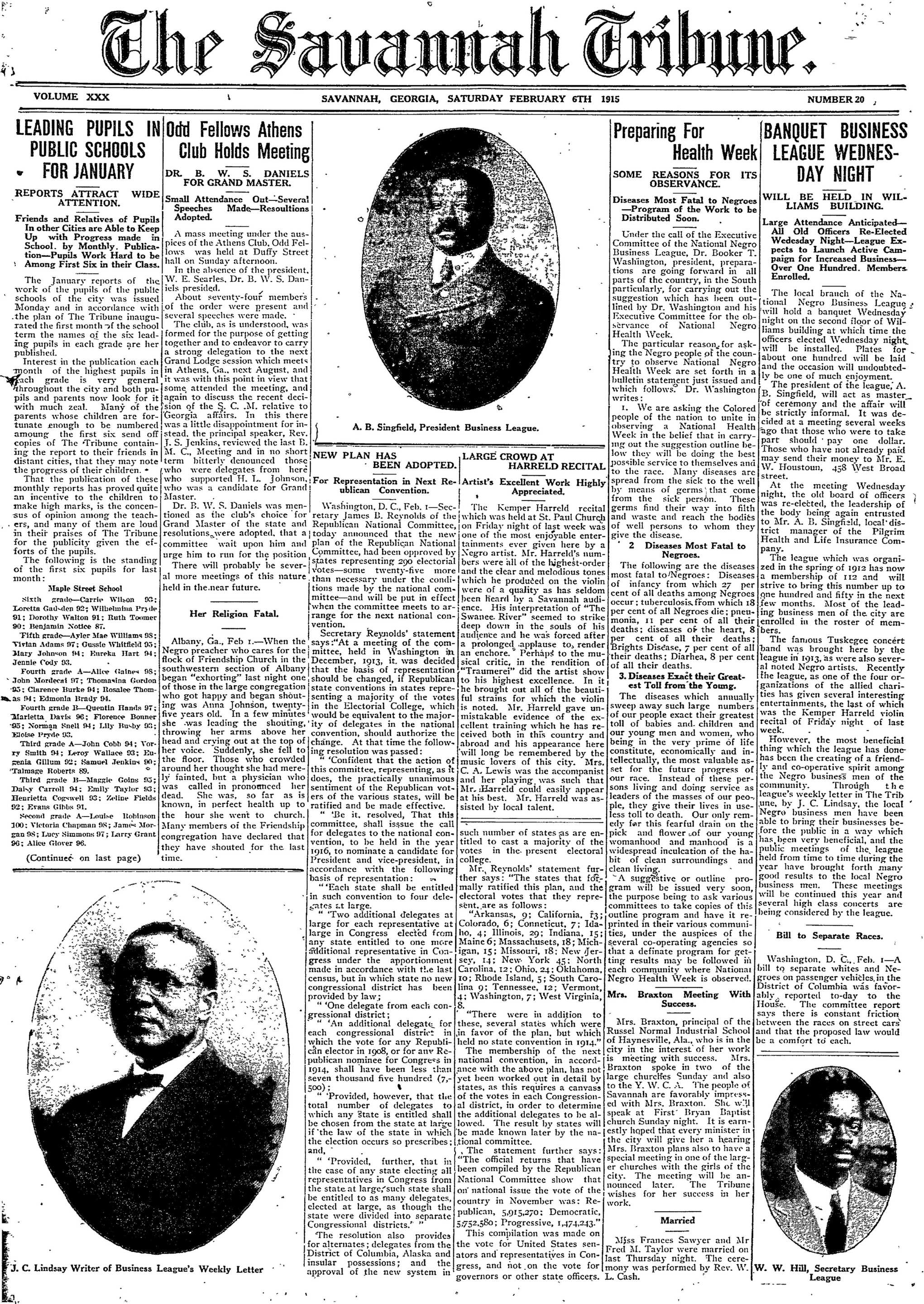
LEADING PUPILS IN PUBLIC SCHOOLS FOR JANUARY
LEADING PUPILS IN PUBLIC SCHOOLS FOR JANUARY
REPORTS ATTRACT WIDE ATTENTION.
Friends and Relatives of Pupils In other Cities are Able to Keep Up with Progress made in School. by Monthly. Publication—Pupils Work Hard to be Among First Six in their Class.
The January reports of the work of the pupils of the public schools of the city was issued Monday and in accordance with the plan of The Tribune inaugurated the first month of the school term the names of the six leading pupils in each grade are her published.
Interest in the publication each month of the highest pupils in each grade is very general throughout the city and both pupils and parents now look for it with much zeal. Many of the parents whose children are fortunate enough to be numbered amoung the first six send off copies of The Tribune containing the report to their friends in distant cities, that they may note the progress of their children.
That the publication of these monthly reports has proved quite an incentive to the children to make high marks, is the consensus of opinion among the teachers, and many of them are loud in their praises of The Tribune for the publicity given the efforts of the pupils. The following is the standing of the first six pupils for last month:
Maple Street School
Sixth grade—Carrie Wilson 93;
Loretta Gadden 92; Wilhelmina Pryde
91; Dorothy Walton 91; Ruth Toomer
90; Benjamin Notice 87.
Fifth grade—Ayler Mae Williams 98;
Vivian Adams 97; Gussie Whitfield 95;
Mary Johnson 94; Eureka Hart 94;
Jennie Cody 93.
Fourth grade A—Alice Galnes 98;
John Mordecal 97; Thomasina Gordon
95; Clarence Burke 94; Rosalee Thomas
94; Edmonla Brady 94.
Fourth grade B—Quentin Hands 97;
Marletta Davis 96; Florence Bonner
95; Norman Snell 94; Lily Busby 93;
Eloise Pryde 93.
Third grade A—John Cobb 94; Vory
Smith 94; Leroy Wallace 93; Eugenia
Gillum 92; Samuel Jenkins 90;
Talmage Roberts 89.
Third grade B—Maggie Goins 95; Daisy Carroll 94; Emily Taylor 93; Henrietta Cogswell 93; Zeline Fields 92; Evans Gibbs 91.
Second grade A—Louise Robinson 100; Victoria Chapman 98; James Morgan 98; Lucy Simmons 97; Larry Grant 96; Alice Glover 96.
(Continue on last page)
Odd Fellows Athens Club Holds Meeting
DR. B. W. S. DANIELS FOR GRAND MASTER.
Small Attendance Out—Several Speeches Made—Resoultions Adopted.
A mass meeting under the auspices of the Athens Club, Odd Fellows was held at Duffy Street hall on Sunday afternoon.
In the absence of the president, W. E. Searles, Dr. B. W. S. Daniels presided.
About seventy-four members of the order were present and several speeches were made.
The club, as is understood, was formed for the purpose of getting together and to endeavor to carry a strong delegation to the next Grand Lodge session which meets in Athens, Ga., next August, and it was with this point in view that some attended the meeting, and again to discuss the recent decision of the S. C. .M. relative to Georgia affairs. In this there was a little disappointment for instead, the principal speaker, Rev. J. S. Jenkins, reviewed the last B. M. C., Meeting and in no short term bitterly denounced those who were delegates from here who supported H. L. Johnson, who was a candidate for Grand Master.
Dr. B. W. S. Daniels was mentioned as the club's choice for Grand Master of the state and resolutions were adopted, that a committee wait upon him and urge him to run for the position There will probably be several more meetings of this nature held in the near future.
Her Religion Fatal.
Albany, Ga., Feb 1.—When the Negro preacher who cares for the flock of Friendship Church in the southwestern section of Albany began "exhorting" last night one of those in the large congregation who got happy and began shouting was Anna Johnson, twenty-five years old. In a few minutes she was leading the shouting, throwing her arms above her head and crying out at the top of her voice. Suddenly, she fell to the floor. Those who crowded around her thought she had merely fainted, but a physician who was called in pronounced her dead. She was, so far as is known, in perfect health up to the hour she went to church. Many members of the Friendship congregation have declared that they have shouted for the last time.
SAVANNAH, GEORGIA, SATURDAY FEBRUARY 6TH 1915
[Portrait of a man in a military uniform].
A. B. Singfield, President Business League.
NEW PLAN HAS BEEN ADOPTED.
For Representation in Next Republican Convention.
Washington, D.C., Feb. 1—Secretary James B. Reynolds of the Republican National Committee, today announced that the new plan of the Republican National Committee, had been approved by states representing 290 electoral votes—some twenty-five more than necessary under the conditions made by the national committee—and will be put in effect when the committee meets to arrange for the next national convention.
Secretary Reynolds' statement says:"At a meeting of the committee, held in Washington in December, 1913, it, was decided that the basis of representation should be changed, if Republican state conventions in states representing a majority of the votes in the Electorial College, which would be equivalent to the majority of delegates in the national convention, should authorize the change. At that time the following resolution was passed:
"Confident that the action of this committee, representing, as it does, the practically unanimous sentiment of the Republican voters of the various states, will be ratified and be made effective.
"Be it, resolved, That this committee, shall issue the call for delegates to the national convention, to be held in the year 1916, to nominate a candidate for President and vice-president, in accordance with the following basis of representation:
"Each state shall be entitled in such convention to four delegates at large.
"Two additional delegates at large for each representative at large in Congress elected from any state entitled to one more additional representative in Congress under the apportionment made in accordance with the last census, but in which state no new congressional district has been provided by law; "One delegate from each congressional district:
"An additional delegate for each congressional district in which the vote for any Republican elector in 1908, or for any Republican nominee for Congress in 1914, shall have been less than seven thousand five hundred (7,500);
"Provided, however, that the total number of delegates to which any state is entitled shall be chosen from the state at large if the law of the state in which the election occurs so prescribes; and,
" 'Provided, further, that in the case of any state electing all representatives in Congress from the state at large,' such state shall be entitled to as many delegates, elected at large, as though the state were divided into separate Congressional districts.' " The resolution also provides for alternates; delegates from the District of Columbia, Alaska and insular possessions; and the approval of the new system in
The Kemper Harreld recital which was held at St. Paul Church on Friday night of last week was one of the most enjoyable entertainments ever given here by a Negro artist. Mr. Harreld's numbers were all of the highest-order and the clear and melodious tones which he produced on the violin were of a quality as has seldom been heard by a Savannah audience. His interpretation of "The Swanee River" seemed to strike deep down in the souls of his audience and he was forced after a prolonged applause to render an enchore. Perhaps to the musical critic, in the rendition of "Traumerei" did the artist show to his highest excellence. In it he brought out all of the beautiful strains for which the violin is noted. Mr. Harreld gave unmistakable evidence of the excellent training which he has received both in this country and abroad and his appearance here will long be remembered by the music lovers of this city. Mrs. C. A. Lewis was the accompanist and her playing was such that Mr. Harreld could easily appear at his best. Mr. Harreld was assisted by local talent.
such number of states as are entitled to cast a majority of the votes in the present electoral college. Mr. Reynolds' statement further says: "The states that formally ratified this plan, and the electoral votes that they represent, are as follows:
"Arkansas, 9; California, 13; Colorado, 6; Connecticut, 7; Idaho, 4; Illinois, 29; Indiana, 15; Maine 6; Massachusetts, 18; Michigan, 15; Missouri, 18; New Jersey, 14; New York 45; North Carolina, 12; Ohio, 24; Oklahoma, 10; Rhode Island, 5; South Carolina 9; Tennessee, 12; Vermont, 4; Washington, 7; West Virginia, 8.
"There were in addition to these, several states which were in favor of the plan, but which held no state convention in 1014."
The membership of the next national convention, in accordance with the above plan, has not yet been worked out in detail by states, as this requires a canvass of the votes in each Congressional district, in order to determine the additional delegates to be allowed. The result by states will be made known later by the national committee. The statement further says: "The official returns that have been compiled by the Republican National Committee show that on national issue the vote of the country in November was: Republican, 5,915,270; Democratic, 5,752,580; Progressive, 1,474,243."
This compilation was made on the vote for United States senators and representatives in Congress, and not on the vote for governors or other state officers.
Preparing For Health Week
Preparing For Health Week
SOME REASONS FOR ITS OBSERVANCE.
Diseases Most Fatal to Negroes
Program of the Work to be Distributed Soon.
Under the call of the Executive Committee of the National Negro Business League, Dr. Booker T. Washington, president, preparations are going forward in all parts of the country, in the South particularly, for carrying out the suggestion which has been outlined by Dr. Washington and his Executive Committee for the observance of National Negro Health Week.
The particular reason for asking the Negro people of the country to observe National Negro Health Week are set forth in a bulletin statement just issued and which follows. Dr. Washington writes:
1. We are asking the Colored people of the nation to unite in observing a National Health Week in the belief that in carrying out the suggestion outline below they will be doing the best possible service to themselves and to the race. Many diseases are spread from the sick to the well by means of germs that come from the sick person. These germs find their way into filth and waste and reach the bodies of well persons to whom they give the disease.
2 Diseases Most Fatal to Negroes.
The following are the diseases most fatal to Negroes: Diseases of infancy from which 27 per cent of all deaths among Negroes occur; tuberculosis from which 18 per cent of all Negroes die; pneumonia, 11 per cent of all their deaths; diseases of the heart, 8 per cent of all their deaths; Brights Disease, 7 per cent of all their deaths; Diarhea, 8 per cent of all their deaths.
3. Diseases Exact their Greatest Toll from the Young.
The diseases which annually sweep away such large numbers of our people exact their greatest toll of babies and children and our young men and women, who being in the very prime of life constitute, economically and intellectually, the most valuable asset for the future progress of our race. Instead of these persons living and doing service as leaders of the masses of our people, they give their lives in useless toll to death. Our only remedy for this fearful drain on the pick and flower of our young womanhood and manhood is a widespread inculcation of the habit of clean surroundings and clean living.
A suggestive or outline program will be issued very soon, the purpose being to ask various committees to take copies of this outline program and have it reprinted in their various communities, under the auspices of the several co-operating agencies so that a definate program for getting results may be followed in each community where National Negro Health Week is observed.
Mrs. Braxton Meeting With Success.
Mrs. Braxton, principal of the Russel Normal Industrial School of Haynesville, Ala., who is in the city in the interest of her work is meeting with success. Mrs. Braxton spoke in two of the large churches Sunday and also to the Y. W. C. A. The people of Savannah are favorably impressed with Mrs. Braxton. She will speak at First Bryan Baptist church Sunday night. It is earnestly hoped that every minister in the city will give her a hearing Mrs. Braxton plans also to have a special meeting in one of the larger churches with the girls of the city. The meeting will be announced later. The Tribune wishes for her success in her work.
Married
Mss Frances Sawyer and Mr Fred M. Taylor were married on last Thursday night. The ceremony was performed by Rev. W. L. Cash.
NUMBER 20
BANQUET BUSINESS LEAGUE WEDNESDAY NIGHT
WILL BE HELD IN WILLIAMS BUILDING.
Large Attendance Anticipated—
All Old Officers Re-Elected
Wednesday Night—League Expects to Launch Active Campaign for Increased Business—
Over One Hundred. Members Enrolled.
The local branch of the National Negro Business League will hold a banquet Wednesday night on the second floor of Williams building at which time the officers elected Wednesday night will be installed. Plates for about one hundred will be laid and the occasion will undoubtedly be one of much enjoyment.
The president of the league, A. B. Singfield, will act as master of ceremony and the affair will be strictly informal. It was decided at a meeting several weeks ago that those who were to take part should pay one dollar. Those who have not already paid may send their money to Mr. E. W. Houstoun, 458 West Broad street. At the meeting Wednesday night, the old board of officers was re-elected, the leadership of the body being again entrusted to Mr. A. B. Singfield, local district manager of the Pilgrim Health and Life Insurance Company.
The league which was organized in the spring of 1912 has now a membership of 112 and will strive to bring this number up to one hundred and fifty in the next few months. Most of the leading business men of the city are enrolled in the roster of members. The famous Tuskegee concert band was brought here by the league in 1913, as were also several noted Negro artists. Recently the league, as one of the four organizations of the allied charities has given several interesting entertainments, the last of which was the Kemper Harreld violin recital of Friday night of last week.
However, the most beneficial thing which the league has done has been the creating of a friendly and co-operative spirit among the Negro business men of the community. Through the league's weekly letter in The Tribune, by J. C. Lindsay, the local Negro business men have been able to bring their businesses before the public in a way which has been very beneficial, and the public meetings of the league held from time to time during the year have brought forth many good results to the local Negro business men. These meetings will be continued this year and several high class concerts are being considered by the league.
Bill to Separate Races.
Washington, D. C., Feb. 1—A bill to separate whites and Negroes on passenger vehicles in the District of Columbia was favorably reported to-day to the House. The committee report says there is constant friction between the races on street cars and that the proposed law would be a comfort to each.
A. B.
W. W. Hill, Secretary Business League
‘ : .
racer te cece a ees
og Seem AND Iiloper NEW DAWwe-
1 8 we
BO YOUR OWN SHOPPING
7 39 Ke e :
— Onyx” SS Hosiery
yx GF Losiery
% Peg Ua ret once
| Gives the BEST VALUE for Your Money
, Every Kind from Cotton to Silk, For Men, Women and Children
| Any Color and Style From 25c to $5.00 per pair
Look for the Trade Mark! Sold by All Good Dealers.
WHOLESALE Lord _ €S Taylor NEW YORK
C
Mose!
FETCH nim! .
. “BENGAL a
n FETCH him!)
roe)
AED aS)
Ane re
J = oc Be
SB = SY
Lat eae
ay AN HV PATIN SS
SN ;
on i
§ ) ‘
| WE poral
| ai se ee
a oe OE il 5 : | i
eye
ee fe b Zh ul i
4 ic (1g acl wih)
Sree nS EES 4 Zs
pees Ss es a
ROME ES ccs = hoa Lapelaarhletetecarthn ig: Rigeorscy vedas sey daimacrer snag cetcnt
&
The Aeme Bicycle Store
ay Xa
Dealer in New and Second Hand
ed Bicycles. Tires and Sup-
plies. Agency on the
Monarch Bicycles.
& K. HALPERN, Proprietor,
468 West Broad St.
Phone 1340.
YOUNG BROS.
: = NEW STORE
Isthe place to get your Groceries
Meats and Confectioneries,
Cigars and Tobacco.
Lelephone orders promptly attended to
EDW. G. YOUNG, Manager
Phone 4291
Cor. 36th and Burroughs 3ts.
AGENTS WANTED
TO SELL
MAGIC
4 a
Suaving Powder
A wonderful discovery to shape
ee
fur 25 cents in ‘une, ese
THESEATING POWDER CNAHY
Savannah, Georgia
ce .
Seg
WOT: so oa
S et...
a ~~ OS
on fy, = Cos
es ae a “@ Gee ' %)
Rie? B/S
Ky ea an VA oe
ay FS oe® ms fl
i ee Wy © “a
A y nile, < < : p
ene A
Yea ) D U besa ¥
_—_—— Ns LF be
2a
* FIRST CLASS
| Shoe Repairing
WHILE YOU WAIT.
All work guaranteed.
Second-hand Shoes For Sale
At 629 East Broad St.
, EDWARD ELLIS.
HAIR .CULTURIST AND
MANICURIST
Miss Marie V. Tolbert, recently
graduated from School in Hair
‘Culture, Manicuring and Massag-
ing, is especiallyprepared for per-
forming the very highest Class of
work. Being equipped with the
very-latest and up-to-date meth-
ods, the most satisfactory and
lasting effect results.
Hair dressed for special occa-
sions .Highest efficiency guar-
anteed on all work.
Mrs. M. E. Tolbert is now as-
sociated with Miss Marie Tolbert
and would be glad to receive a
call from her friends.
Agents for Madam C. J. Walk-
er’s Wonderful Hair Grower.
Phone 3853. 506 Hartridge St.
Why Be Sick? When Health
Knocks at Your Door. See
Dr.H.M.Collier
Physician and Surgeon
640 PRESIDENT ST., EAST
-» + . Phones . . -
Office 2152-T.. Residence 1120-L
PIANO LESSONS
— py
Miss ETTA McINTOSH
312 East Duffy Street.
Terms reasonable. c
fw | : GOSH'ITS TOP OR |
let]. CE
Mo Te Taxe CHrnces| 1)
- “Le 7 worn TRE bo! i
ait Ze] | 3B : CoH
Shy 7 ke > " Ee fe
pel Wife in 6 . Nee Ba
AGN YE) are (ee
ZEEE JA! ee
Gis a afk a
ek. Pe On. AE i BRP
2 tte Nae Be-N, saa
‘PEE ESE Se)
Sy ee ioe ie 4:
BSS BBN FFG Zs on
“4 ac) Lt ar
al Shor eg
fh ha . = he
LN SE
TS 2
Te tapes wuh act By hace Winvin ise dain eer edn ema eee ah ts acs lbs gue dinate bie F ara
GOLDEN CIRCLE MEETING
NIGHTS
-Willing Workers Circle No. 1, meet:
Ist, and 3rd, Wednesday, nights at Sea
brooks hall, Arthur Brown, Hon. rule
and Frank Hucherson Hon. deputy.
Triumph Circle No. 2 meets 2nt
Monday bight! and 4tb, Wednesda)
night at Seabrook shall, A. R. Brown
Hon. ruler;W. Sic Hellowsy, H.deputy
Three Gates cy Circle No. 3, meet:
2nd, and 4th, sanesday uights a
Scott’s hall. Jason Dukes, Hono:
ruler, G. W. Vialey. Hon. deputy.
Golden Link Circle No. 4 meets 2nd,
and 4th, ‘Tuesday nights at Scott’s hall,
B.F. Robinson Hon. ruler; M. C.
Cambell, Hon. deputy.
Savannah Circle No. 5 meets Ist, and
3rd, Thursday nights at Mechanic’s
hall, Geo. Heyward, Hon ruler; Henry
Hall, Hon. deputy.
Rising Sun Circle No. 6, meets Ist,
and 3rd, Wednesty. nights at West
Savannah, Rev. Stokes, John John-
son, Hon. deputy.
Relief Circle No. 7 meets 2nd, and
4th, Wednesday nights at Mechanics
Hall; H. DeLaigle, Hon. ruler; John
Hutchins, Hon. depuy- i
Friendship Circle No 8, meets 2nd.
and 4th, Tuesday nights at Seabrook’s
hall, J. C. Holloway, Hon ruler; Sister
A. B. Campfield, Hon. deputy.
Union Link Circle No. 9, meets Ist,
and 3rd, Monday nights at Williams
building, Brother Seabon Benton Hor.
ruler, Sister Sallie Green, Hon deputy
Traveling Pilgrim No. 10, meets in
Augusta Ga., at pogielanel Watkins
street, Rev. R. T. Gallot, Hon. ruler;
Sister Nancy L. Westly, Hon. deputy.
Lily of the South Circle No. 11 meets
2nd, and 4th, Monday nights at Sea-
brooks hall, A. B. Singfield, Hon.
ruler; Sister Lenora King, Hon. deputy
Working fiy of East No, 12 meets
Ist, and 3rd, Tuesday nights at Sea-
brook hall, Brother Lawrence Miller,
Hon. ruler; Sister Juliz McMasters,
Hon. dep ty.
Gateway to Success Circle No. 14,
meets 2nd, and 4th, Wednesday nights
at Williams Building, H. Rahn,
Hon ruler; Brother, a J.. Biggins,
Hon. deputy.
Evergreen Circle No. 15. meets 2nd,
and 4th, Wednesday nights*’ at Me-
chanics hall, W. B. Dunn, Hon. rnler;
Sister Mattie R. Davis, Hon. deputy.
GoldenStar No. 16, meets 2nd, and
4th Thu rsday nights at Williams
building, Wilton Wiggins, Hon. ruler;
Sister Reiney Morrizan, Hon. deputy.
Pure Gold No. 17, meets -at Sea-
brook hall, ist Thuredey nights and
th Friday nights. Bro. John Carson,
Hon. Deputy. - °
Faithful Workers Circle No. 18,
neets at Mechanic hall Ist and 3rd
Vednesday nights, Bro. Inman
Rawls, Hon. Ruler, Sister Bertna J.
3reen, Hon. Deputy.
Easter Rose Junior Circle No. 1,
neets 2nd and 4th, Tuesday evenings
t 4 o'clock at Williams building, Isa-
ah Bowie, Jr. prince; Sister Clara Ha
el, Hon. lecturer.
Sunflower Junior Circle No. 2
neets 2nd, and 4th, Monday evenings
t Williams building, G. W. Winley
ir. prince; Sister Belle Campfield
For all kinks of
Photographic Work
—SEE—
James Edw, Collier
644 EAST PRESIDENT ST.
Phone2152-J
= .
PaaS
3 ee
roe FO OSI
j g 4 ae” PRELSED Ae
NOT Wane SE a
} PUSsSONLY Sconted J ~ > Yes
) BY MY o> Qe
| BODYGUARD Ry A
P 3 oo pon er,
pe ee, a9 oa
SPSS NR a ' AN |
war aa legac
Aurelia E. Allen, formerly of the
Colored Millinery Store, will con-
tinue with millinery and dress-
making with the leading styles
beginnng October Ist at her
home 751 E. Gwinnett _ street.
Bring your old hats and have
them made over like new this
will save you money. . Will also
give instructions in millmery aad
dressmaking. .Any one wishing
to take up either of these studies
which would be of benefit. to
every woman can do so by at-
tending. Aurelia Allen’s. school
of Art. Here you can find Ma-
dam Walker’s Hair Grower, also,
fuil Iine of hair gods. Phone 5078,_
Masonic Books
And Regalias
LUOGE SEALS
FINANCIAL CARDS
_ AND BLANKS
Of Every Description.
Publishers and Manufacturers’ Prices
Liberal Discounts! Will Be Arranged.
SOL. C. JOHNSON,
Ne
!
Protect Your Horses’ Feet
Have Them Shod by the
The Cresceus Horseshoelng and
Cilpping Shop
315 JEFFERSON st, Phone 3309
NBLSON A. CUYLER
. ‘The Expert Horseshoer,” Prop.
Important—The only Expert
eae tr
s s
Diving Work
* Atlantic and Pécifie Const
THe Drvine Construction Co.
Reference: Central Bank & Trust Co.
All Work Promptly Attended To
J, L. MURCHISON
Chief Diver
2815 Gravier St. New Orleans, La
Bhd 44 OVER 6S YEARS"
a iy EXPERIENCE
i ae é i
3 rs ‘Trave Marne
, Desicns
Copynicnts &c.
Anyone sending a sketch and description may
quickly ascertain our opinion free whether an
fhvention te probably patentable. Communtes
Hons etetctly contdenitlal. HANGBOOK on Patents
tent fren. Oldest agency tor pecaring pateate.
Patents taken throura Muna & Co. receive
tpecial notice, without charge, in the
Scientific American,
Ahandsomety tiustrated weetly. Varcest ctr.
culation of any sclentids foarual Yerme. ¢o0
‘ear four mouths, $1, 801d Dy ali wewsdeslors.
MUNN 2 C0322, New York
Branch Odice, 635 F St, Washlogton, D.C.
Dr. GEO. W, SMITH,
PHYSICIAN AND SURGEON
Office W. Broadand Gwinnettlane
. Phone 1522
Office Hours— 9-10 2. m.,
12-2 p.m
6-8:30 p.m.
Res.: 920 Wheaton St. Phone 1439
SAVANNAH, GA.
Dr. L. S, Parks,
DENTIST _
F essgitt 240 Barnard Strést,
Specialist in Gold and Bridge Work _
Se ee ee eT ee cS eee
Savannah. Ga. Lk
Does all kind of high grade! dental
work of the best quality and, workman-
ship. Gold crowns and bridge work.
White Porcelain Pivot and Crowns
mounted on the natural roots. Gold
Fillings, Cement Fillings, and Silver or
Amalgam Fillings. From nine to a full
set of teeth $3.00 and &10.00. Broken
pistes mended and teeth added.$
Gold Crowns Gueranteed 23} K Geld.
Bell Pheneg244
Dr. J. W. Jamerson
FIRST-CLASS
~ All Work Guaranteed
Wage Earners Bank Building
PHONE 3227-L
Dr. A. R. Ferebee
Surgeon Dentist
Remove December 1, 1914
621 West Broad St.
Dr Jamerson’s Old Stand
Cc. C. MIDDLETON, M. D.
Physician & Surgeon
505 Chariton St., East.
Office Hours
9-lla,m., 2-4p.m., 7-8 p.m,
. Phone 86
Hient Meats Feed Co
HAY & GRAIN
OF ALL KINDS
508 WEST JONES STREET
Come and take a look at our
Stock or Phone your
order and it will be
delivered promptly.
Phone 3461
| Pe S| carne
eae eae Susees
PSS ES)
A q ial
ae |
,
fe *e 0 B
@ Raf Ss
way =e.
ee A |
DHALT! . ,
non oueee!| Parone | i ) Bencne wes ‘
; pes “Gf ee A AUTO. 0
ven S _ SE -TGER now!
a “a a fo
EA . - Ry Zn &
BSCS ss
" f =a : 4 ae
Vi Noi A Wg -o8 if SD
ea: Cie
Ww) Geers
ww ea: eros
Rn NS& y ae Vd sci
Ds, WS ( Wa ee -=
oe RaAe
ROSY Ny :
3
ees oe @ Os ae. tered
INSURANCE GEOGRAPHY
When is a man most confused?
When he misses his tiain.
When are the people most un-
safe? When they are not insured
with the Pilgrim Health and Life
-Insurance Company.
Which compary pays for all
diseases known to medical sei-
ence? The Pilgrim.
* Which company carries its
members the longest before laps-
ing their policies? The Pilgrim
Wilt you explain why the Pil-
grim does this? Only to aid G
policyholders, that’s all.
Which company organized first
among Negroes in Georgia, and
secured a charter to do business
along the Industrial lines? The
Pilgrim, of course.
. Which company collected the
largest amount of money accord-
ing to the latest report of the
INURANCE DEPARTMENT to
the Governor of the state? The
figure is in the report. The Pa-
grim.
How can this statement be ver-
ified? By referring to the report
oi the INSURANE DEPART-
MENT, of the state of Georgia.
How can a policy be obtained
with the Pilgrim, in case its
agents turn back before they
reach your home? By ringiag
phone 4129.
Why has the Pilgrim so many.
satisfied policy holders? By
performing its perpetuated metto
PROMPTNESS HONESTY
AND JUSTICE.
Why is it .e easy to secure
new members for the Pilgrim?
They have heard of the many
blessings it has, and is still be-
stowing upon its thousands of
satisfied policy holders.
How long after the death of a
member, before the beneficiary
can draw the death benefit? As
soon as the death certificate ‘is
properly filled by the attending
physician. :
How many men and women are,
employed and are well paid by
the Pilgrim? SIX HUNDRED
TWENTY-SEVEN.
Are you being | satisfactory
served? If not sce the Pilgrim’s
agents, or ring the office, and
your order will be filled, and
promptly delivered. Local and
long distant phone 4129. Office,
509 West Broad Street, Savan-
nah Georgia.
J. S. PERRY, Sep.
A. B. SINGFIELD, Gen., Supt.
GAREWY’S
“VARIETY BAKERY y
Goods delivered promptly *
To any part of the City.
506 West Broad Street
hone 1869-J Near Gaston.
St. Philip's Dots
Rev. Singleton was the Lord's messenger at the 11 o'clock service on Sunday. Attendance was excellent. Bishop G. W. McLamore of the Christian church preached at 8:15. Rev. Singleton and a delegation of ladies from the Georgia conference will leave for New Orleans, La., next Tuesday for the Bishops' council and Woman Home and Foreign Missionary conference of the A. M. B. Church, which will convene there next week. There are quite a number of entertainment to be given at St. Philip for the benefit of the trustees' department of church. Our friends are invited to these entertainments. Mr Jesse Brinson was elected delegate from St. Philip church to the Josup electoral College at which time two delegates will be elected to the General conference which will meet at Philadelphia, May 1916. The election of officers of every department of the church having been finished, the church will start out for the years' work in full blast. We are very sorry to note that Brother J. S. Quarterman, leader of class 31, is critically ill at his residence, 618 Bolton street, west. "A nobody knows" concert will be given on Monday night February 8th, at St. Philip Church, for the benefit of the missionary department; admission 10 cents. The monthly love feast was held on Friday night. The following services will be held on tomorrow (Sunday): prayer meeting at 5:30 a. m.; preaching, baptism of children and adults and right hand of fellowship at 11 a. m.; Sunday school at 2:45 p. m.; A. G. E. League at 7 p. m.; preaching 8:15 p. m.; week prayer meeting from 7 to 8 Thursday p. m. Everybody is invited to these services.
Second Baptist Church.
On last Sunday the pastor preached at both services. He preached a powerful sermon on "Let us go fishing," which service was largely attended. At the evening services he also preached a soul stirring sermon. The Sunday school met at the usual hour. The attendance was very good. It is hoped that many of the young men and women of the church will try and attend Sunday school. The B. Y. P. U. met at the usual hour. The prayer meeting was led by Miss Alfreda Cannon. On tomorrow evening Miss Alice Lopez will lead the prayer meeting and will also render a program. Visitors and strangers are cordially invited to come and take part with us. Services for tomorrow as follows: Prayer meeting 5 a. m.; preach 11 a. m.; Sunday school 3:30 p. m.; B. Y. P. U. 6:30 a. m.; preaching 8 p. m.
Beth-Eden Baptist Church
Beth-Eden Baptist Church, Rev. M. M. Clark, pastor, residence 214 East Waldburg street. There was a large attendance both morning and night Sunday. Rev. Clarke delivered both sermons Sunday with great force and those who heard them were much inspired. The subject for morning was "A Refuge in Time of Storm" and for night "Slothfulness Eliminated." We are constantly taking in new members; one was added to our number Sunday morning. The last Sunday in this month is Conscience rally day. Don't forget the grand painting gallery, February 8th, and 9th, at the church. The Sunday school enjoyed very much the address from Mr. Smith of the Second Baptist Church. The school is growing rapidly. Services tomorrow as follows: preaching 11 a. m.; Sunday school 3:30 p. m.; B. Y. P. U., 6:30 p. m.; preaching 8 p. m. We invite our friends at all times.
Evangelical Ministers' Union.
The Evangelical Ministers' Union met as usual Tuesday. Rev. J. O. Iverson conducted the divine service. The 5th, Psalm was then read "In the Cleft O Rock of ages" was sung. Mrs. Louise M. Braxton of Haynesville, also; was introduced and spoke in the interest of her school in Alabama. Rev. J. L. Taylor responded. Installation service will be held Wednesday evening February 17th, with the following program: Anthem by St. Philip Monnetel choir; hymn
by Rev. G. P. Prescott; prayer by Rev. P. F. Curry; selection by choir; scripture reading by Rev. R. H. Singleton; hymn by Rev. J. S. Jenkins; sermon by Rev. W. Daniels; hymn by Rev. J. S. Stripling; prayer by Rev. J. A. Martin; offertory, installation, notice, doxology; benediction by Rev. J. L. Taylor. Rev. J. O. Iverson will be master of ceremonies. Rev. P. F. Curry read a paper Tuesday, subject on the aim and purpose of sociology. Tuesday will be sermonic report. All the members of the union must come prepared to pay 50 cents each for installation banquet. Visiting ministers always welcome.
S. D. A. Church
"And in that day seven women shall take hold of one man saying, we will eat our own bread, and wear our own apparel: only let us be called by Thy name to take away our reproach," Isa. 4:1" This will be the text of Evangelist J. W. Manns' Sunday night at 36th and Burroughs streets. Good singing by the choir. Preaching begins at 8:20.
College Park Church
The College Park Church, Rev. R. H. Thomas, pastor. The B. Y. P. U. had a very interesting program last Sunday, after which the officers were elected for the following year, as follows: Mrs. Sadie Bacon, president; Mrs. M. E. Alston, vice-president; Mr. E. R. Jenkins, secretary; G. D. Jenkins, assistant secretary; Mrs. A. J. Rivers, treasurer; Mrs. A. L. Simkins, organist; E. R. Jenkins, reporter.
Butler Presbyterian Church
Butler Presbyterian Church, corner East Broad and McDonough Sts. Rev. S. T. Redd pastor; residence 213 East Broad street. The morning service last Sunday was well attended and the pastor delivered an excellent sermon, subject, "Jesus the Christ," On Tuesday night Dr. Wm. A. Harris lectured on tuberculosis and gave a stereopticon view of same. The doctor deserves great credit for the way in which he delivered same. Sunday night the last of the decalogues was discussed and an unusually large congregation was out. All were very much benefited. The Christian Endeavor was largely attended, and the topic interestingly discussed. On February 14, there will be a line program of the Endeavor. Services for Sunday-as follows: Morning service 11:30 a. m. Sunday school 3 p. m. Christian Endeavor 7:30 p. m. evening service 8:30 p. m. You are invited to worship with us.
St. Benedict's Church.
February 7th. "Sexagesima Sunday." First Mass 7 a. m. Seeond mass at 8 a. m. high mass 10:30 a. m. A special sermon is preached on the Gospel or Epistle of the day at every service. Evening devotions at 8 p. m. At St. Mary's Chapel, Mass and sermon every Sunday at 9:30 a. m. Last Tuesday being "Candlernas Day" a special service was held in honor of the Purification of the Blessed Mother. Candles were blessed before mass. February 3rd was the feast day of St. Blase, bishop and martyx. St. Blase is invoked in dangerous diseases of the throat; hence the ancient custom of the Church to bless on this day the throats of the faithful. On Friday, the Blessed Sacrement was exposed during the whole day in honor of the Sacred Heart of Jesus. The Holy Hour was held in the evening from 8 to 9 p. m. Sunday next, the children of Mary will go in a body to holy communion; every first Sunday of the month should be a general communion day for all the members of the purish. The Catholic Sewing Circle of St Benedict's will hold its monthly meeting next Thursday, at the residence of Mrs. Wm Smith. A pretty valentine party was given last Wednesday for the benefit of the parish, in the basement of the church. Members of our sewing circle and of the cheerful workers took a prominent part in it. Light refreshments were served by Mrs. Ch. Ward and Mrs. Julia Clements. A special meeting of all the men of the Parish will take place tomorrow after high mass.
Old Lady-You have been drinking hard. Tramp-Oh, no, ma'am; that comes easyl-Exchange.
SUNDAY SCHOOL.
Lesson XI.—First Quarter, For March 14, 1915.
Text of the Lesson, I Sam. xi—Memory Verses, 12, 13—Golden Text, Prov. xvi, 32—Commentary Prepared by Rev. D. M. Stearns.
After the Lord had brought to Samuel the man whom He had chosen as king for Israel and Samuel had anointed him he returned to his home, having met on his way all whom Samuel said he would meet, for all came to pass just as Samuel said. The Spirit of the Lord came upon him, and he became a changed man (chapter x, 6-10). All this was a private matter between the Lord and Samuel and Saul, for when Saul reached home he only told that Samuel had assured him that the asses had been found, but he said nothing of the kingdom. Then Saul called the people to Mizpeh; reminded them of the Lord's deliverance from Egypt and all enemies and of their rejection of God in demanding a king and then proceeded to have them elect a king with God's permission. It was, no doubt, done by lot, as the land was divided, for "the lot is cast into the lap, but the whole disposing thereof is of the Lord" (Num. xxvi, 55, 56; Prov. xvi, 33). First the tribe was found and then the family and then the man (chapter x., 20, 21; compare Josh. vll, 16-18), and thus they were guided to the man whom He had already chosen and anointed. Although elected, he could not for a time be found, so they inquired of the Lord, and He told them where to find him. Whether it be a person or a thing that cannot be found. He that is perfect in knowledge knows where to find the lost (Job xxxvi, 4).
When the people looked upon the man whom God had chosen they could not refrain from shouting, "God save the king!" or, as in the margin, "Let the king live!" (x. 23-25.) The band of men whose hearts God had touched were a comfort to him, so that he was able to seem as a deaf man to his enemies (x. 26, 27). Our lesson chapter shows how Saul by the Spirit of the Lord began to deliver Israel and to obtain the confidence of the people. I suppose there is scarcely a day in the life of any child of God when there is not an occasion to say, "Now, the serpent" (Gen. ill. 1), for he is ever going about to make trouble. Nahash, whose name signifies "serpent," was moved by the devil, whose he was and whom he served, to seek to bring reproach upon Israel (verses 1-3). Saul heard of the distress of Jabesh Gilead and in a very striking way summoned the people to gather unto him and Samuel, and 330,000 gathered, and word was sent to the distressed that they would have help by the morrow. That night or in the early morning (verse 11) Saul came suddenly upon the Ammonites and so completely routed them that two of them were not left together (verses 4-11).
The morning deliverances of the Bible are full of interest and are all suggestive of the morning that is coming, when the Lord shall finally and forever deliver Israel (Ps. xlvi. 5, margin). Compare Ps. xlix. 14, and see Ex. xlv. 24, 27. Think also of Dan. vi. 19, 23, and of the deliverance that came to the disciples in the morning watch (Mark vi. 48). But, while believers may well rejoice in the glorious morning that is coming and in Him who is to us the Morning Star (II Sam. xxll. 5; Rev. xxll. 16), it is also written that there will be no morning for such as do not believe God (Isa. vill. 20; margin and revised version). When the people saw the great deliverance wrought by Saul they asked to have Saul's enemies put to death, but Saul would not listen to it, saying, "There shall not a man be put to death this day, for today the Lord hath wrought salvation in Israel" (verses 12, 13). It was the same power that wrought for Israel at the Red sea (Ex. xlv. 13, 30) and on so many occasions in all their history, and their greatest deliverance is yet to come (Zech. xlv. 3, 9). Samuel then gathered the people to Gilgal, and there they made Saul king before the Lord, offered sacrifices, and all Israel rejoiced greatly (verses 14, 15). Thus far all seemed to be going well, but when man has his way there is soon failure; for "verily, every man at his best state (apart from God) is altogether vanity" (Ps. xxxix. 5).
Chapter xii tells how Samuel rehearsed the history of the nation from their coming out of Egypt, the Lord's dealings with them under Moses and Aaron and how many a time He delivered them in the days of the judges. He also asked them to testify as to whether during all the time that he had judged them he had ever taken anything from them or defrauded any one or taken a bribe to blind his eyes, but they called God to witness that they could find no fault in him in any of these matters (xii, 1-5). To show them that he was right before the Lord as well as in their eyes and that they had done wrong in asking for a king when the Lord Himself was their King he asked the Lord to send thunder and rain that day, and He did so. The people seemed to see their sin and asked Samuel to pray for them (xii, 6-10). Samuel assured them that, though they had done this great wrong, yet if they would truly turn to the Lord and fear Him and serve Him in truth with all their heart He would for His great name's sake forgive them and not forgive them and he (Samuel) would not cease, to pray for them.
You should look as well goiris orn. of your shoes, when the hee are twisted they will throw your shoes out of shape, which makes a bad appearance when going. In repairing your shoes we make it our special business to restore them to their original shape, no matter how bad they are twisted. Ladies and children shoes are given special attention. All work is carefully looked after by me before going out.
J. H. WASHINGTON
309 WHITAKER STREET,
Three Doors South of Liberty Street.
Making the Little Farm Pay
A little interest and effort on the part of the family will make a success of fruit on a small farm. The work is not incessant, but it is important at times and requires intelligence and energy. Small fruits pay well in almost any locality, and they are so easily managed that amateurs need not hesitate about making this a prominent feature in their program.
-WHOLESALE AND RETAIL-Fruit and Commission Merchant 303;ST. JULIAN WEST AND 23 JEFFERSON ST
Raspberries turn many a rough and idle spot into profitable land. A farmer who does not make a few hundred dollars a year from berries is not up to snuff. Black raspberries are usually set two and one-half feet apart in the row, with the rows six feet apart. Planted among the trees of an orchard the red raspberry will do rather better than the black. It is not best to put them closer than eight feet from the trees. Fall planting of red raspberries in severe latitudes is not to be recommended. None of the red raspberry family is of ironclad hardiness, and the young plants when transplanted in the fall are much more subject to severe or fatal injury from freezing than they would be if well established. Spring planting is by all means preferable in sections of the country where the temperature drops to or below zero. The plants of the red sorts are termed suckers and should be transplanted at one year old, at which age they rarely have more than one cane, which should be cut back to eight or ten inches at time of transplanting.
YOUNG BROS.,
507 WEST BROAD STREET
Is the Home of Sweets. Phone'2932
Dr. G. W. Smith, Pres. Dr. C. B. Tyson, Treas. Dr. N. W. Este, Sect'ry
East Side Sanitarium
THE BEST PRIVATE PLACE FOR COLORED PEOPLE WHEN
SICK
MODERN EQUIPMENT GOOD NURSING
Terms Reasonable
CALL, WRITE OR PHONE
EAST GWINNETT ST, & ATLANTIC AVENUE
Phone 4941 Savannah, Georgia
Prepare the ground as for a crop of potatoes, making furrows for the plants. Set the young plants in the
Johnson Undertaking Establishment Combined with
```markdown
```
The Royall Undertaking Company (Incorporated)
Funeral Directors and Embalmers
Finest Line of Coffins, Caskets and Robes. White and Black
Burial Cars. Livery Stable Attached.
OFFICE AND WAREROOMS, 325-331 JEFFERSON STREET
OFFICE PHONE 676
L. M. POLLARD, Manager Mrs. W. R. FIELDS, V. Pres.
Residence. Phone 4241 Phone 2465
bottom of the furrow, but cover only a few inches at first and draw in soil as they grow. While berries do not thrive in soggy land, they like plenty of moisture in the soil, and sprinkling can be done to advantage. In setting out currant bushes one should be careful to select a place where there is plenty of light and air. They do not require especially fertile soil, but they do need the sunlight and air. If possible do not put the bushes where they will be weighted down by snow in the winter, for this breaks the branches.
The ground should be worked thoroughly and deep before setting out the bushes, for after the planting only a very shallow cultivation can be done, as the currants are a surface rooting plant. Rotted manure is one of the best fertilizers for working into the land, and after the currant bushes have been set out this will be found excellent as mulch.
PATE'S
Wishes every one a HAPPY NEW YEAR and prosperous 1915. We want to extend to the readers of this valuable paper our sincere thanks for their past patronage and ask for a continuance of same and will endeavor to keep up the high class service which has made our place the trade center of thinking people who appreciate good treatment and good goods at rock bottom prices. We fill prescriptions cheapest and best. Phone your wants. Save your PIEDMONT and SOVEREIGN cigarettes coupons we give you valuable presents for them also give cigarettes or anything in the store for them.
Pate's Drug Store
The A. D. S. and Nyal Store
Hall and West Broad Streets
Phones 4710 and 4711
Premium Station for Cigarettes Coupons.
Hardy one-year-old plants are found to be among the best for starting a new piece. The plants begin to bear the year after planting and come into full maturity in the third year. If they are given care they will produce paying crops for a score of years. Pruning should be done in the early spring, cutting out all the dead and weak branches and heading back most vigorous growth. It will be seen that the currant is an easy plant to raise as well as a very profitable one. The same is true of the gooseberry. Very few diseases attack these plants. The currant worm can be killed by applying pyrethrum powder. If there is any disease found to be among the branches it is best to cut off the afflicted ones at once and thus prevent the spread of the trouble.
The methods of caring for the gooseberry plants are practically the same as those used in dealing with currants. It was formerly thought that gooseberries would do best in a shady place, but this is not true. Mildew will attack them if they are kept shaded. The only thing to prevent this is to have the plants kept open at the top.
SEABORAD AIR LINE RAIL WAY
Important Change of Schedule, April 12, 1914
No. 11. No. 13 No. 14 No. 12.
7:00 am. 6:00 pm... Lv. Savannah... Ar. 8:00 pm. 8:35 pm
7:47 am. 6:43 pm... Cuyler. 7:15 am. 7:45 pm
8:05 am. 7:20 pm... Lanier. 7:00 am. 7:27 pm
8:53 am. 8:00 pm... Claxton. 6:10 am. 6:40 pm
9:20 am. 8:32 pm... Collins. 5:40 am. 6:10 pm
9:50 am. 9:08 pm... Lyons. 5:08 am. 5:40 pm
10:05 am. 9:22 pm... Vidalia. 4:55 am. 5:25 pm
10:30 am. 9:33 pm... Mt. Vernon. 4:27 am. 4:57 pm
10:59 am. 10:25 pm... Alamo. 4:02 am. 4:27 pm
11:25 am. 10:53 pm... Helena. 3:35 am. 4:03 pm
12:25 pm. 12:01 am... Abbeyville. 2:44 am. 3:08 pm
12:45 pm. 12:24 am... Rochelle. 2:25 pm. 2:46 pm
12:55 pm. 12:37 am... Pitts. 2:15 am. 2:36 pm
2 00 pm. 1:15 am... Cordele. 1:43 am. 2:05 pm
3:10 pm. 2:40 am... Americus. 12:25 am. 12:31 pm
4:10 pm. 3:42 am... Richland. 11:30 am. 11:35 pm
4:32 pm. 4:01 am... Lumpkin. 11:10 am. 11:06 m
6:13 pm. 5:43 am... Hurtsboro. 9:32 am. 9:30 pm
8:15 pm. 8:10 am... Ar. Montgomery... Lv. 7:30 pm. 7:20 am
C. W. SMALLS, Division Passenger Agent, Savannah, Ga.
"Plowsole."
This is an artificial hardpan very commonly formed in the practice of plowing to the same depth year after year. A packed layer is thus formed by the action of the plow, which acts exactly like natural hardpan in preventing the passage of water downward and the moisture upward. This condition, or "plowsole," is more often found in clayey solis and greatly increases the difficulty of working them. Of course it is perfectly easy to prevent this trouble by plowing at various depths from time to time. In this case lime will generally be found useful in materially aiding the disintegration of the "plowsole."—Purdue Agriculturist
Seed Corn From Shock.
Seed corn taken from shock corn which has stood in the field most of the winter has been found to give no better germination test than $1\frac{1}{2}$ per cent in some instances. Such corn cannot be used for seed with any degree of success. Corn is not allowed to dry out well in the shock, and when frequent freezing and thawing begins the vitality of the corn soon vanishes.
---
THE SAVANNAH TRIBUNE
Established 1875
By JOHN H. DEVEAUX
Published by
SOL. C. JOHNSON
Editor and Proprietor
JAS. H. BUTLER
Asso. Editor and Manager
ED. H. BURKE
City Editor
Published Every Saturday
1009 WEST BROAD STREET
Phone 2171
Subscription Rates
One Year.....$1.25
Six Months.....75c
Remittance must be made by Express
or Post Office Money Order, or Registered
Letter Advertising Rates given on
Application.
Entered at the Post Office at Savannah, Georgia, as Second class Mail Matter.
Among the many indulgences of our people, which are fraught, more or less, with evil consequences, none hold a more prominent place in our mind at the present time than the one which allows the bill collector of the various business houses, a too frequent presence upon our premises. That such an indulgence brings to our people in many instances, unnecessary annoyances and insults, a little investigation will disclose. Let anyone take awalk in one of the sections of our city, thickly inhabited by our people and there he will see scores of these collectors engaged in a seeming house to house canvass. A prolonged investigation will reveal the fact that as many as two, three, four, and sometimes a half dozen of these collectors call at a single home in the course of a day. And for what? Simply to collect a few pennies on accounts which have been made with their firms. According to our way of thinking, buying on the installment plan is poor business policy. Yet, sometimes it may be necessary so to do. Granting that this is so, we do not see why our people do not arrange with their creditors or the merchants with whom they do business, to call at their places of business themselves in order to pay their bills instead of having these collectors to call, who, too often, with hat on head and cigar in mouth enter the premises of our people with an air suggestive of complete indifference to or disregard of polite conduct. As we have aforesaid, we believe that such indulgence on the part of some of our people, is fraught with many evil consequences and since an ounce of prevention is worth a pound of cure, we suggest that our people rid themselves of the collectors evil by paying their bills at the office of the merchants with whom they have to deal.
The Tribune has been publishing the names of the six leading pupils in the public schools, ever since the present school term began and we are told by the teachers that the appearance of these names in public print has been no small factor in inducing the pupils in general to make better marks. The Tribune is pleased to note the wide interest taken by the pupils in the appearance of their names in print and is ever ready to do all in its power to stimulate their interest and enthysiasm in their work. However, we wish to call attention of the parents to the part which they may play in spurring their children on to greater endeavor in their work. Children, as is also true of adults are susceptible to kind and encouraging words and thoughtful deeds. It is one thing for parents to know that their children are making poor marks in school and that their names appear in the list of the few highest each month, but it is quite another thing to let them know that their work is being diligently watched and that any improvement no matter how small is appricated by them. Many parents are very observant and upon the least sign of improvement by their children along any line whatever are thoughtful enough make to mention of it to them by offering words of praise or in showing their appreciation in other ways. There is nothing which should give a parent more genuine pleasure than to know that his child is "making good" by showing improvement in school from time to time. Of course we are aware of the fact that every child can not be among the leaders in
his class, for all of them are not endowed with the same amount of ability; yet for the parents of those children whose names do not appear in the list of leaders, as they appear in The Tribune, would it not be a source of encouragement to them to a get copy of the paper and let them know that their excellence in scholarship is appreciated. Would it be a bad idea to let your friends and relatives in other cities see that your child is succeeding by sending them The Tribune with his name among the leaders? We do not advise this in order to stimulate The Tribune or even as a matter of advertisement, but simply as one way which the parents of those pupils who are leading their classes may show their appreciation for the good work their children are doing.
EDITORIAL NOTES.
There is one lesson especially that a certain class of our people must learn, and that is to respect the laws and those in authority, despite the fact that officials themselves exceed the law. The latter is demonstrated by the too free use of the club by policemen in making arrests and the former by bystanders interfering.
It is amusing how the Republican senators are wrapping the dominant Democratic senators around their fingers in the ship purchase bill consideration.
The voters of the country are realizing that Democratic inability to conduct affairs of state is causing the present depression in business and the apparent national deficit which will no doubt grow to an alarming extent. Ofcourse the Democrats are placing the blame on the European war, but those who are learned in statecraft know better and will not allow the Democrats to "pull the wool" over the eyes of the people of this country.
There is not the least doubt, but that Governor Whitman of New York will be put forward by his friends as a formidable candidate for the Presidency next year. His management of the gubernatorial office will have much to do with the efficiency of his candidacy. He will be especially watched by the colored voters of the country.
The permanency of the registration list of the State should inspire every colored man to qualify. Once on the list the only requirement is the paying of a poll tax of one dollar a year.
In Chatham county there are about nine hundred colored men on the registration. This number is entirely too small in proportion to our population. At least ten per cent of the population should be represented on the voters' list, therefore instead of nine hundred voters, we should have nearly five thousand: We could secure this number of voters if the colored men would only understand themselves, take hold of their duty and grasp the opportunities that they have to become representative citizens. If in this county we had a larger registration list there would be no talk of, segregation; there would be a larger number of employees on the city's pay roll; there would be no white bawdy housea in respectable colored neighborhood; there would be no ungraded streets in colored localities where water remains a day or more after the rain; there would be better sanitary conditions in these neighborhoods and a more frequent visit from the scavenger men; there would be better treatment in every respect for the colored citizens if the colored man would only understand himself and do his full duty.
The saving habit should be instilled into our children while they are young and pliable. This habit will grow apace and make us a more frugal rather than a spendthrift race. It is deplored to note that as soon as the average child secures a penny, the alarcity with which it goes to the nearest store to buy an article that it does not need and in many cases quite harmful. A child that is indulged in this habit will never save and will finally become a charge on his friends when he gets older. Let the mothers teach the child to save. Our school teachers, and to the great credit of many them, could do great service in encouraging those under them to save their pennies and make regular deposits in the banks. And, too, teach them pride of race by putting their
savings in colored banks, where only members of the race are employed.
It would indeed pay for many of us learn our city and be shown the number of cozy and beautiful homes that are owned by our people and are being erected in the several sections of the city. Twenty-five years ago we could easily count the number of colored persons who owned their homes; today it is different. Our people are becoming more and more consumed with the idea of behome owners, especially is this true of the younger men. During the past several years the class of homes, erected has been much improved and modern style and improvements injected. This is becoming more apparent. The home owning spirit has been advocated for years by The Tribune and same has been accentuated by the Wage Earners Bank which has been the early means of making it possible for hundreds of our people to become land and home owners. This is being added to by the recent formation of the Mechanics Bank and the alertness of our real estate agents. Those of our young men who have not yet become contagious with the home owning fever, should be affected and join this grand army. Property values are lower now than they will ever be, and advantage should be taken of the same. It would not be a bad idea for much of the outlying property to be secured; years hence the value will increase, thus assuring a fair competency to the investors. At any rate we are inspired by what our people have done and are doing in the home owing line, and admonish hundreds of others to join the number.
Twenty five years ago south of Anderson street was an open commons; how populous it is today. Young men, grasp the idea and act upon it. Twenty-five years hence the city will extend to the south beyond DeRenne Ave. Mark the assertion.
Our white citizens are too slow in boosting things that are beneficial to Savannah. In politics they are allowing the other parts of the State to take advantage of them. The district attorney for the Southern District of Georgia should have been a Savannah lawyer. Now the assistant's place will be given to some one out of Savannah. It is noted that the bill creating a new federal judgeship for this section of the State will soon become a law. Candidates are being groomed in other sections; what is Savannah doing? Sitting supinely by and waiting to register a kick in event the position is given to some one of another place. Let our white citizens awake from their lethargy. Let them work for Savannah. Let them boost Savannah morning, noon and night. Create this sentiment in order that it will become contagious and the refrain taken up by the women and children.
Our white friends are complaining that at the beginning of the coming school term about five hundred of their children will be without school accommodations. They should have another building. According to information given out by Supt. Ashmore there are at present above six thousand Negro children unable to be accommodated. What about them? It is true that we have just had erected for us a new building, but it is entirely inadequate. We need three more new buildings to care for the untutored thousands. Our white citizens are responsible for our education. If we do not directly pay sufficient taxes to support our schools, indirectly we do, and are entitled to a grammar education. Another thing, our white friends should keep in mind that they can make no great progress by having a large per cent. of those around them ignorant. The better informed the colored population becomes, the greater asset for good will be accrued by the city.
At least two of the north and south avenues in the colored cemetery should be paved along with the main one leading therein. Not only this, but water mains should also be laid in order, that the graves of loved ones may be kept green. At least, we are deserving of this much.
P. M. Thompson, Jr.
P. M. Thompson, Jr. is the name given the boy born January 2nd to Prof. and Mrs. P. M. Thompson of Albany, Ga.
Jerry C. McTier Secretary
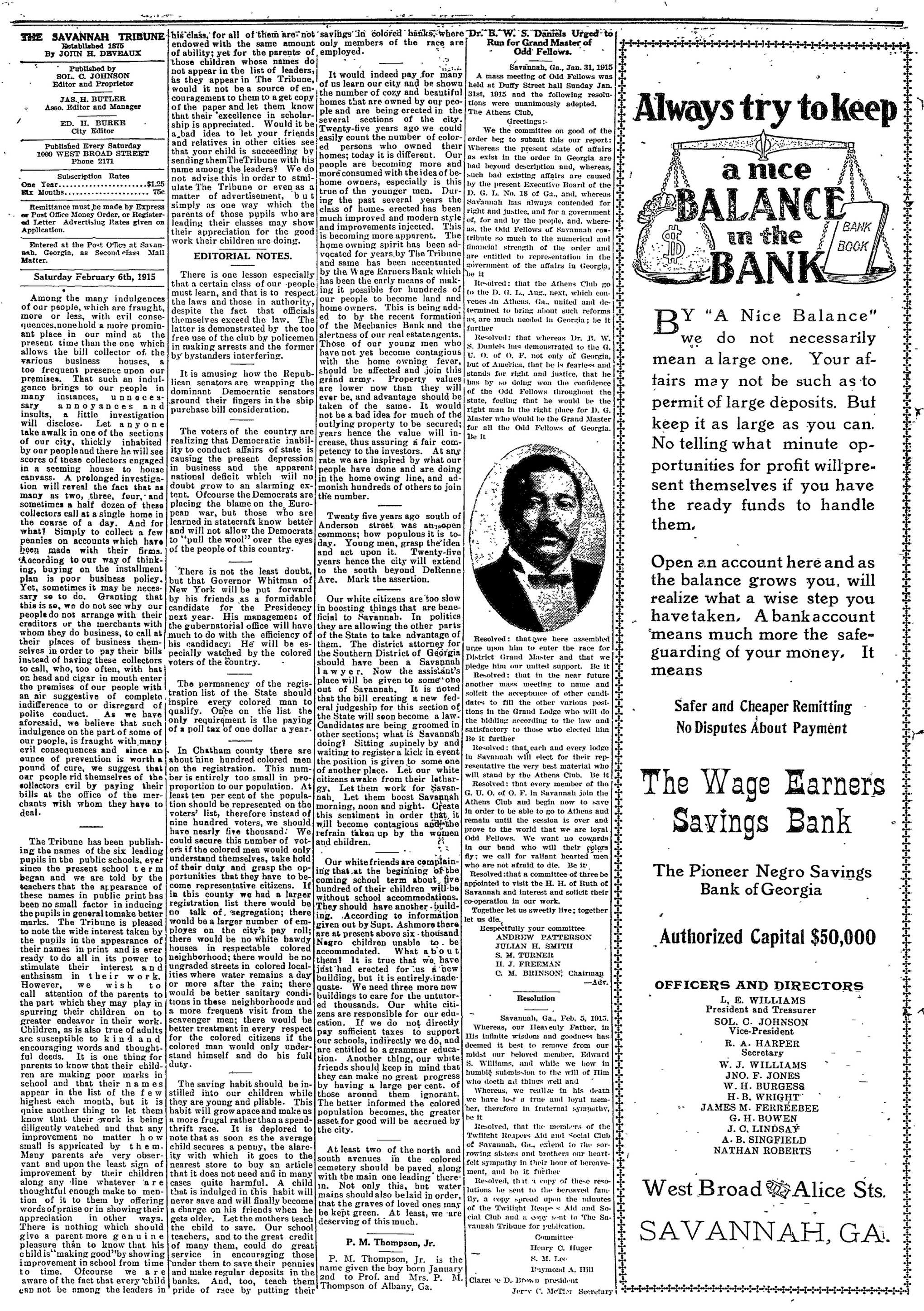
Dr. B. W. S. Daniels Urged to Run for Grand Master of Odd Fellows.
Savannah, Ga., Jan. 31, 1915
A mass meeting of Odd Fellows was held at Duffy Street hall Sunday Jan. 31st, 1915 and the following resolutions were unanimously adopted.
The Athens Club.
Greetings:~
We the committee on good of the order beg to submit this our report. Whereas the present state of affairs as exist in the order in Georgia are bad beyond description and, whereas, such bad existing affairs are caused by the present Executive Board of the D. G. L. No. 18 of Ga., and, whereas Savannah has always contended for right and justice, and for a government of, for and by the people, and, whereas, the Odd Fellows of Savannah contribute so much to the numerical and financial strength of the order and are entitled to representation in the government of the affairs in Georgia, be it
Resolved: that the Athens Club go to the D. G. L., Aug., next, which convenes in Athens, Ga., united and determined to bring about such reforms as, are much needed in Georgia; be it further
Resolved: that whereas Dr. B. W. S. Daniels has demonstrated to the G. U. O. of O. F. not only of Georgia, but of America, that he is fearless and stands for right and justice, that he has by so doing won the confidence of the Odd Fellows throughout the state, feeling that he would be the right man in the right place for D. G. Master who would be the Grand Master for all the Odd Fellows of Georgia. Be it
PETER H. BURGESS
Resolved: that we here assembled urge upon him to enter the race for District Grand Master and that we pledge him our united support. Be it
Resolved: that in the near future another mass meeting to name and solicit the acceptance of other candidates to fill the other various positions in the Grand Lodge who will do the blinding according to the law and satisfactory to those who elected him Be it further
Resolved: that each and every lodge in Savannah will elect for their representative the very best material who will stand by the Athens Club. Be it
Resolved: that every member of the G. U. O. of O. F. in Savannah join the Athens Club and begin now to save in order to be able to go to Athens and remain until the session is over and prove to the world that we are loyal Odd Fellows. We want no cowards in our band who will their colors fly; we call for vallant hearted men who are not afraid to die. Be it.
Resolved: that a committee of three be appointed to visit the H. H. of Ruth of Savannah and interest and solicit their co-operation in our work.
Together let us sweetly live; together let us die.
Respectfully your committee
ANDREW PATTERSON
JULIAN H. SMITH
S. M. TURNER
H. J. FREEMAN
C. M. BRINSON; Chairman
—Δdr.
Resolution
Savannah, Ga., Feb. 5, 1915.
Whereas, our Heavenly Father, in His infinite wisdom and goodness has deemed it best to remove from our midst our beloved member, Edward S. Williams, and while we bow in humble submission to the will of Him who doeth all things well and
Whereas, we realize in his death we have lost a true and loyal member, therefore in fraternal sympathy, be it
Resolved, that the members of the Twilight Reapers Aid and Social Club of Savannah, Ga., extend to the sorrowing sisters and brothers our heartfelt sympathy in their hour of bereavement, and be it further
Resolved, that a copy of the co resolutions be sent to the bereaved family, a copy spread upon the minutes of the Twilight Reapers Aid and Social Club and a copy sent to The Savannah Tribune for publication.
```markdown
```
a nice
BALANCE
in the
BANK
BANK
BOOK
BY "A Nice Balance" we do not necessarily mean a large one. Your affairs may not be such as to permit of large deposits. But keep it as large as you can. No telling what minute opportunities for profit will present themselves if you have the ready funds to handle them.
Open an account here and as the balance grows you, will realize what a wise step you have taken. A bank account means much more the safeguarding of your money. It means
Safer and Cheaper Remitting No Disputes About Payment
The Wage Earners Savings Bank
The Wage Earners Savings Bank
The Pioneer Negro Savings Bank of Georgia
Authorized Capital $50,000
OFFICERS AND DIRECTORS
L. E. WILLIAMS
President and Treasurer
SOL. C. JOHNSON
Vice-President
R. A. HARPER
Secretary
W. J. WILLIAMS
JNO. F. JONES
W. H. BURGESS
H. B. WRIGHT
JAMES M. FERREEBEE
G. H. BOWEN
J. C. LINDSAY
A. B. SINGFIELD
NATHAN ROBERTS
Among the Masons
Among the Masons
Annual reports and fees from all lodges must be rendered and be in the office of the Grand Sec retary on or before March first. Letters from many of the lodges state that good reports will be made.
"In' Masonry we find the most splendid of all philosophies of life and morals, the concentrated wisdom of all the generations of men who have lived and suffered and labored, and tonight rest in dreamless sleep in quiet cities of the dead. So Masonry means, not only the garnered wisdom stored up in lectures and books, but more especially that wisdom which becomes part of the life.
Pleasure in Freemasonry.
The master of a lodge declares it is his will and pleasure that the work of his lodge be opened and closed. Let us for a few moments consider the pleasure of Freemasonry. Pleasure is every one's aim, from the prince to the peasant, from the president to the pauper. Every one craves enjoyment. Freemasonry possesses within itself the simplest power of safety this craving in every brother, whatever healthy enjoyment his mental, moral and physical nature desires, that the fraternity has in store for him. And it may be had for the seeking. "Seek and ye shall find" pleasure, the most satisfying pleasure, in the Craft.
"Life is but a narrow bridge soon to be crossed. A whisper, a word, and the end of all. We know not from whence we came, but faith tells us where we may go. Mystery all around us, but light above us.
"We have passed the Isle of the Long Ago. Just before us are the portals of the Somewhere Land. When we pass them, all of life as it has been will be over, and life as it shall be will begin.
"The temple eternal will be for us. The temple in its beauty will shine with a spiritual splendor and with marble walls and plates of eternal strength and minarets of glory will greet us. Rivers of entrancing beauty will ebb and flow and music ineffable will greet the car."
The novitiate into the mysteries of Freemasonry is taught to lay the corner stone, and place the foundation of his Masonic Temple on the Rock of Truth.—Selected.
"A Masonic optimist is a brother who can at night make lemondade from the lemons thrown at him during the day. A Masonic pessimist is a brother who can make vinegar in the evening out of sweet things said to him during the day. Which are you?" Levity, ribaldry, obscenity, profanity and all forms of baseness
are absolutely incompatible with Masonry; somberness, 'melancholy and depression are equally inconsist. True, we toil in a place hallowed by solemn and sacred associations. The volume of the sacred law must always be open before us in our great work, the sacred symbol of the Great Architect is inseparably conspicuous in our toil; but these sensible elevate; inspire and sustain us in all we do. The notable symbol of the Star and Garter, the Golden Fleece and Roman Eagle cannot inspire and uplift as will these. Our work is sublime, our spirit must be lofty. The sacred labor we undertake is done absolutely "of our own free will and accord." The Great Architect is no taskmaster. It is a labor of love, inculcating reverence, refinement, culture and dignity in every true workman.—Selected.
It is one of the glories of Masonry that its work is done without ostentation or display, that it does not advertise its good deeds that it lifts up and elevates and upbuilds without boasting of its work. As in the building of the Temple, there was not heard the sound of hammer or any tool of iron, so in Masonic circles the fabric of good citizenship is built up without boasting or self-praise —Selected.
The New York Courier says that studious Masons are comparatively rare, although there is a vast amount of rich learning in Masonry.—Exchange.
In Our Boarding House.
"My pillow is awfully hard," remarked the star boarder. "They're stuffed with feathers from a tailor's goose." explained the confirmed idiot, as he helped himself to another prune.-Philadelphia Ledger.
Chase the Gloom.
When you happens ter stumble on de country whar de gloom folks stay try ter match de sun at lookin' bright, an' Trouble'll feel so ole fashioned he'll make quick time gettin' back ter what he come from.—Atlanta Constitution.
Audible Versus Visible
"Her beauty is of the intellectual type." "Yes; heard, but not seen."—Philadelphia Ledger.
Penitence.
"I suppose you're sorry now?" asked the prison visitor, according to the Philadelphia Ledger.
The young man who had stolen $17,000 and spent it in sixteen weeks signed through the bars. "Oh, yes!" he answered. "I tried to cut too much of a splurge. The money ought to have lasted me a week longer."
The Day of Best.
Carrie's sister May, six years of age, on being asked why the Sabbath day was different from the other days in the week answered very carelessly. "Oh, that's the day you pin things on 'stead of sewing.'-Delinator.
Slow Delivery.
Mrs. Gotham—Who spoke at the dinner tonight, dear?
Mr. Gotham—Well, one of the speakers was the owner of that big department store.
"No wonder you're late, then."
"Why?"
"I happen to know his delivery is awfully slow."—Yonkers Statesman.
A Trying Time
"Colenel," asked the beautiful girl, "when was the most trying moment of your life?"
"It was when I went to my wife's father for the purpose of asking him to let me have her. He was very deaf, and I had to explain the matter before twenty clerks."—Chicago Record-Herald.
When Matter Conquered Mind
Lord Wolseley maintained that Ostend would have been the scene of a desperate battle in 1815 if Napoleon's bodily strength had then proved on a par with his brain power. "The more I study the Waterloo campaign." Wolseley told Grant Duff, "the more highly do I think of Napoleon. If his physical condition and energy had been equal to the powers of his mind, I think he would have succeeded in his design and would first be beaten the Prussians and then driven us back on Ostend. * * * In spite of his odious and contemptible character Napoleon was the greatest man of whom we know anything and quite unlike anybody else."—London Mirror.
INTROSPECTION
One can accomplish but comparatively little when all is said, for, make no mistake about it, however much we may pose and strut in the outside world, in the solitude of our own studies there are few of us but know how the faults and blemishes of our craft stand boldly out and stare us in the face to remind us that we are small enough and halting enough to be always learning, never quite gloriously achieving.
LIVE STOCK HUSBANDRY
WINTER HOG FEEDING.
Proper Housing and Dry Beds Indispensable to Good Growth.
One of the most important points in feeding in cold weather is providing ample housing places and seeing that they are on high and dry ground, writes a correspondent of the American Cultivator. In rainy weather the bedding should be removed several times a week and replaced with dry material. A severe winter, will convince the observing man who cares for live stock that proper housing means not only a saving of high priced feeding material, but also more flesh for the feed consumed. A hog that sleeps where he is chilled night after night will naturally require more feed to keep the warmth of the system normal, and at the same time while he, is consuming more grain and slop he is
```markdown
```
Chester White swine, a United States breed, are of the lard or fat type. They have pendent ears and large, long bodies and reach heavy weights. They are good feeders and breeders. The breed is white and only fairly numerous. The illustration shows an excellent picture of the breed. The sow is a pure bred Chester White.
putting on less flesh than if he ate 25 per cent less feed and was properly housed.
Another factor in properly caring for winter hog feeding is having a dry and sanitary feeding place. Many farmers in recent years have provided cement floors in their hog lots and sheds. This means of sanitation is one of the greatest health promoters and devices for economy that is used thus far when actual cost of building is taken into consideration. Many who feed their swine in dirty, insanitary, mud flooded hog lots are wasting feed daily and endangering the health of the hogs as well. The amount of grain saved alone in the course of one year would easily pay for one of those concrete floors in many cases. The feeder can take an ordinary corn shovel and clean the cobs and dirt off once daily in ten minutes, and in the same ten minutes he is saving a large amount of feed and preserving the health of the hogs. Hogs fed under these circumstances are more healthy, thrifty and better for the owner's meat and marketing purposes by 50 per cent than being poorly housed and having insanitary feeding troughs and pens.
FEEDING BEEF STEERS.
Experiments Show That Young Anti-
Mole Make Economical Gaine
mals Make Economical Gains.
According to Professor H. R. Smith, liberal feeding of a steer from the time he is twelve months old until he is twenty-four months old will result in a gain of practically two pounds per day, says the Iowa Homestead. If he is carried for another year this gain will be reduced to a pound and three-quarters per day, and the following year it will take liberal feeding to make a pound and a half daily. This means that the largest gains are made early in life, and it follows that these gains will be made cheaper, because the cost of maintenance is lower. In emphasizing the matter of cheapness of cost of feeding young animals Professor Smith refers to six different trials where accurate records were kept, showing that during the first twelve months of a beef animal's life a hundred pounds of increase in weight cost $3.45, the second twelve months the same animals cost $7.42 per hundred pounds, while the third twelve months it ran up to $11.50 per hundred pounds.
In the light of these figures it can be well understood why the early maturing animal is increasing in popularity, particularly with those feeders who raise their own cattle. It must be remembered that all steers are not of a type to finish up at an early age, because increase in weight is in the form of growth rather than the form of flesh. It is all a question of type, some types being ready for the block almost any time after they have acquired their calf fat, while others reach prime conditions only at maturity or thereabouts. When corn belt cattlemen settle down to a policy of raising the catie that are fed out in the feed lob then and then only will the real merit of the early maturing type be appreciated.
Lice Infested Horses.
There is no use of treating horses to destroy lice unless you cleanse, disinfect, fumigate and whitewash the stable and have it light and perfectly ventilated. Lice and their eggs stay in such places, and reinfect the horses time after time or indefinitely. Insect powder (pyrethrum powder) has some beneficial effect if used every ten days or so freely on the parts of the body most infested. Spraying cannot safely be done in cold weather. Blanket the horses after applying the powder. Slaked lime will do no good, but sulphur is helpful.
FEED THE COLTS A LIBERAL RATION
FEED THE COLTS A LIBERAL RATION
The high cost of keeping horses is often a temptation to feed colts especially in a very poor and cheap manner during the winter, says the Kansas Farmer. In this effort to cheapen the cost of keeping horses and colts some farmers try to carry the young colts through the winter on straw, corn fodder and other low grade feeds of this character. This is a "penny wise and pound foolish" policy. Young colts fed in this way are stunted at the most important point of life. They never overcome the results of this period of hardship, and when ready for market they sell foa from $25 to $75 less than colts with no better breeding but which have received an abundance of growing feed during the first three years of their lives.
The market continues to demand big horses of proper type and conformation, and the only way to produce them is to supply an abundance of feed during the critical period of the coit's life. With the same thought of cheapening the cost of keeping horses there is a temptation, when the working season is over, which usually finds the horses thin in flesh, to turn them out on poor fall pastures. With this treatment working horses may go into the winter even thinner in flesh than when the season of hard work ended. The saving of feed and expense at this period of the year must be paid back during the spring season with interest. The work horse should be so fed and han-
```markdown
```
The farmer who does not have a large proportion of brood mares among his horses is not getting all out of his farm that he should. A few heavy draft mares are valuable assets at this time when the horse raising centers of Europe are largely out of business. Good, heavy mares should be mated to pure bred stallions of one of the recognized draft breeds. Under no circumstances should scrub stallions be used. The picture shows a pure bred Percheron stallion.
dled that it will go into the winter in a reasonably fleshy condition. Whenever alfalfa is grown the pasturing of the work horses on the alfalfa meadows during the fall and early winter season puts them in most excellent condition for the winter. Where horses go into the winter in good condition it is much easier to keep them thrifty, and as spring approaches it will cost less to harden them and prepare them for the work of the spring and summer season.
Impaction of Sheep.
Sheep must have a laxative or succulent feed to regulate the bowels in winter. Keep them out of the stalk field and off frozen meadow and feed clover or alfalfa hay, a mixture of whole oats, wheat bran and ollime, and, if possible, give them roots or silage twice daily. Two pounds of either roots- or silage for each sheep will suffice. For bloat give a pint of new warm milk from a cow and repeat in half hour if necessary. Make the sheep take plenty of exercise every day and keep them dry.
Two Litters a Year.
Sows can be made to produce two litters a year. When this is desired they should be bred at the first period of heat after the pigs are weaned. Sows bred twice a year will not produce so many pigs in each litter as when bred only once a year, but more pigs should be raised in a year from each sow.
Milk of the Ewe:
An analysis of ewe milk shows it to be very high in fat content. The different breeds show some variation in this regard, and there is a considerable variation in the fatty content of the milk of a single ewe at various times. All ewes give richer milk immediately after the lamb is born than they do later on.
THE BEST PLACE
In Savannah
FOR MEN'S GOOD SHOES
Prices $3.50 up
B. H. Levy Bro. & Co.
Used by the elite of New York Society for twenty-three years and still their favorite. Imparts health and beauty to the skin, smoothes away the marks of Time, brings Nature's bloom to sallow cheeks, discourages unwelcome lines and wrinkles. Improve your looks by its daily use.
OLD CASE
---
Arrive L ave
15 pm. North and East 1 25 pm
3 25 am North and East 12 35 am
10 45 am Columbia and Local 6 00 am
8 55 pm Columbia and Local 4 00 pm
12 30 am Jacksonville and Fla 3 30 am
1 20 pm Jacksonville and Fla 3 20 pm
8 35 pm Montgomery and West 7 35 am
12 05 am Jacksonville and Local 3 50 pm
8 00 am Montgomery and West 6 00 pm
(LEE CHEMICAL CO., PROP)
Is supplied with Pure, Fresh DRUGS AND GHEMICALS, and is prepared to fill any prescription. They have Two (2) Registered Pharmacists in charge, who will take care of your prescriptions and Two (2) Polite Clerks to see to your wants.
WITH EACH ONE ($1.00) DOLLAR PURCHASE WE GIVE A BOX OF OUR SANITARY TOOTH POWDER FREE.
---
Scientific Farming
FOOT AND MOUTH DISEASE Aid Given by Farmers In Fighting This Widespread Trouble. Prepared by the United States department of agriculture.]
The recent lifting of the foot and mouth quarantines from large areas previously closed and the modification of the quarantines in still other sections has been made possible by the co-operation not only of the various state officials, but of farmers and stockmen themselves. Where this cooperation has been most in evidence progress in the eradication of the disease has been most rapid. The federal authorities have of course control over the movement of live stock in interstate commerce only. The local quarantines are established and enforced by the state. Their efficiency depends in great measure upon the willingness of the people to submit to the necessary restrictions.
Indiana and Michigan are cited as instances of the importance in this re-
```markdown
```
BARN PREPARED FOR PUMIGATION. spect of public opinion. In Michigan the first herd was slaughtered on Oct. 19. Cases of the disease existed in fifteen Michigan counties and in eighteen in Indiana. In all 330 herds were affected. Sixty days later these herds had all been slaughtered and the infected premises cleaned and freed from disease. In the interval there had been only a few scattering instances—half a dozen possibly—of the plague spreading from these different centers of infection to neighboring farms.
The people not only observed the quarantine regulations, but they did all in their power to expedite the work of slaughter. In many cases they had the ditches in which the animals were to be hurled dug and waiting for the killing gangs. As a rule, no objection was taken to the appraiser's valuation of the condemned stock, which is the more surprising in view of the fact that so little was generally known of the seriousness of the disease. The farmers did not want to part with their stock. They saw that the sore mouths and feet grew better, and they had had no experience with the after effects of the pestilence—the constant aborting, the failure to produce milk, the ability to disseminate disease months after the visible symptoms had disappeared. Nevertheless they accepted the situation, helping instead of hindering.
In only a very few cases was there any attempt to conceal the existence of the disease—in fact, public opinion was so strongly against this that it was practically impossible to do so. In one instance a man fed some skim milk from a creamery to a calf, which later developed foot and mouth disease. It occurred to him to kill the calf and say nothing about the matter. The neighbors, however, obtained some inkling of the facts and notified the authorities. After he had been forced to admit that he had killed the calf the body was dug up and unmistakable marks of the disease found upon it. Within two weeks all the
rest of the herd was infected and had to be killed. In addition, the owner was fined $20 or so for breaking the quarantine regulations. The sentiment of the whole community, it should be noted, was against him.
From such experiences live stock authorities are more than ever convinced that skimmilk should invariably be sterilized. The danger from the foot and mouth disease is, of course, a passing one. Previous epidemics have been stamped out, and there is no reason to suppose that this one will not be. Tuberculosis, however, is a permanent menace. Its symptoms are not so immediately noticeable, and it is therefore more difficult to trace the origin of the infection, but there is no doubt that it is frequently disseminated in skimmilk in the same way that the foot and mouth disease was in the instances described.
Together with the creameries, public sales of live stock have proved themselves most dangerous agents in spreading foot and mouth disease. In Indiana and Michigan the state authorities absolutely prohibited the holding of such sales in or adjacent to areas where the disease existed. The spread of the contagion in other states where this prohibition was not enforced shows the value of the precaution, but it requires strong and determined action on the part of the local authorities.
Every farmer should keep a record of his operating costs and the financial results of everything done on the farm. A farmer who does this is not going to lose anything, but is surely on the road to success. At first it will seem impossible to keep a record of labor, financial accounts and crop yields, but it will be surprising how the habit will become established. A very interesting and profitable record to work on at present is a harvest record of the different grain crops. Such a record will show the farmer how much his crops yielded and the cost to thrash the grain. When the value of such records is realized the farm will then be run on a more strictly business basis.—Orange Judd Farmer.
RADIUM AS FERTILIZER.
An Experimenter Asserts That It Will
\ Increase Yield of Land.
Radium as a fertilizer is a new idea in farming. It is asserted that it will increase the yield of land from 50 to 100 per cent.
..At Reasonabe Prices
So says Dr. H. H. Rusby of the New York College of Pharmacy. He has been experimenting with radium solutions on a tiny farm at Nutley, N.J. for the last two years. Recently he presented his results to the American Pharmaceutical association.
Minutes,
By-Laws,
Badges,
Etc.,
Call at
Dr. Rusby diluted his radium three milligrams to a ton of water. This, he says, will fertilize thoroughly twenty acres of land at an approximate cost of $30. The farm was only an acre and one-half in extent, but in small patches he raised practically all the vegetables used by northern farmers.
Fifty pounds of his solution to the acre gave the best results in the greatest number of cases. Some vegetables required more.
On the whole, however, Dr. Rusby found his experiments particularly encouraging. Cucumbers, squashes, melons, radishes, carrots, corn, cabbage and a host of others responded most satisfactorily to the treatment and gave results far above their normal output.
The use of radium as a fertilizer, Dr. Busby avers, did not originate with him. When it was found that weak solutions of radium salts applied to cancer only stimulated its growth scientists began to experiment with it upon plants. In the beginning all of the solutions which they used were far too strong. The New York botanical gardens and the University of Prague were the first to make successful experiments.
Movable Tool Box.
You might describe this device as a tool box on wheels or the wheel barrow work bench. It is one of the handiest things of its kind that can be made. Suppose a man wants to do a little work in a shed a quarter of a mile from the house? He can make this combination box and bench and take all the tools needed right along with it.
The Savannah Tribune 1009 WEST BROAD ST.
It is really a sort of a portable repair shop. You can keep all manner of tools, nails, clips, bolts and nuts in it. There is room for wire clippers, wire and anything else that may be needed. And it is likely to save you a lot of trouble when the job is done. We all know how easily-tools are mislaid and even lost for good.
OUT OF TOWN ORDERS GIVEN SPECIAL ATTENTION
Materials needed for its construction are: A pair of old cultivator wheels, a few boards, a couple of hinges and enough bolts to fasten things together.—Farm Progress.
FARM WIT AND WISDOM.
No farmer ever gets too old to learn, but the wise farmer doesn't wait until he is old to learn.
All things come to him who owns a piece of land and pitches in and works to beat the band.
Don't try to lift water by a suction pump more than thirty feet. The utmost height to which it is possible to suction it is 33.95 feet. The weight of the air has to do the lifting.
Let me send you FREE PERFUME
Write today for a testing bottle of
ED. PINAUD'S LILAC
The world's most famous perfume, every drop as sweet as the living blossom.
For handkerchief, atomizer and bath. Fine after shaving. All the value is in the perfume—you don't pay extra for a fancy bottle.
The quality is wonderful. The price only 75c (6 oz.). Send 4c for the little bottle—enough for 50 handkerchiefs.
PARFUMERIE ED. PINAUD
Department M.
ED. PINAUD BUILDING NEW YORK
3 in One Oils,
Cleans, Polishes,
Prevents Rust
3-in-One is a light, pure oil compound that never gums. 3-in-One lubricates perfectly sewing machines, typewriters, bicycles, locks, clocks, guns, lawnmowers—everything that ever needs oiling in your home or office. No grease. No acid. A little 3-in-One on a soft cloth cleans and polishes perfectly all veneered or varnished furniture and woodwork.
Sprinkled on a yard of black thesescloth it makes an ideal Dustless Dusting Cloth.
3-in-One absolutely prevents rust on gun barrels, auto fixtures, bath room fixtures, gas ranges, everything metal, indoors or out, in any climate. It sinks into the unseen metal pores and forms a protecting "overcoat" which stays on.
Free—3-in-One—Free. Write today for generous free bottle and the 3-in-One Dictionary of hundreds of uses.
3-in-One is sold in all good stores in 3-size bottles: 10c (1 oz), 25c (3 oz), 50c (8 oz, ½ pint). Also in new patented Handy Oil Can, 25c (3½ oz).
3-in-ONE OIL COMPANY
42 DA Broadway
New York City.
An Iowa farmer pays his foreman 25 cents for every pig over six to the sow which reaches the age for weaning. He likes to pay out the money, and the foreman looks upon it as clear gain. The bonus system is worth studying. It will work in other fields as well as in the piggery. Potash is difficult to get now, not because there are no ships to carry it, but because of the difficulty in securing railway and river equipment to move it from the mines and storehouses to the coast.
Corn fed the sows makes their pigs fat before farrowing, but the pigs need fat only after their eyes open on this world. Prior to that time they need only bone, muscle and vigor. Alfalfa hay, bran, roots and other protein bearing feed prepare the sow for successful farrowing. Corn fed sows are the ones which die at this critical time more than any other.—Farm and Fireside.
Leading: Pupils in the Public Schools for January.
Continued from first page)
Second grade B—Leroy Johnson 95;
John Wilson 94; Millie Busch 94; Arthur Lockley 93; Lucile Everheart 93; Hugh L. Franklin 92.
First grade A—Mack Coffee 97;
Alice Lonax 95; Clinton Pray 95;
Clifford Anderson 94; Noel Peepes 95;
Harriet Anderson 92.
First grade B—George Hudson 98;
Lucy Fuller 97; Alvin Jones 96; Arline Morrison 96; Katie Gaston 95;
Gertrude Murphy 95; Warren Oliver 95.
Cuyler Street School
Eighth grade A—Geneva Bogan 95;
Thos J. Hopkins 88; Ruthie Giles 88;
Jilla Williams 88; Anna Busch 86;
Lola Green 85; B. Harrison 85.
Eighth grade B—Maud Howard 95;
Julia Priolean 95; Marguerite Shelton
93; Milton Reed 92; William Whit-
man 92; Mattie Young 90.
Eighth grade 1—Alice Lopez 92;
Jamilla Walker 88; Ruth Williams 88;
Janie Langford 88; Lillie Springs 88;
Blauch Dicks 87.
Seventh grade—Mazella Multrie 93;
Wilhelmina Sanders 91; Edith Wilson;
Mildred Wigham 92; Evadna Ang-
gers 89; Orne-Chiles 89.
Seventh grade B—Katherine H. Reed 97; Beatrice M. Randall 92; Pearl Bruce 92; Maggie W. Pope 92; Missouri S. Roberts 92; MabeF Williams 92.
Seventh grade 1. academie—Mazie King 89; Beatrice Robinson 89; Anna Jordan 88; Frances Habersham 87; Marie Kendrick 87; Cornelia Thomas 87.
Sixth grade—Merritt Cohen 97; Mamie Shellman 94; Amanda Life 92; Editta Horton 91; Mattie Allen 91; Hazel Sampson 91.
Fifth grade—Edith Black 96; Charlotte Sueed 95; Bessie Williams 95; Henry Patton 94; Jessie Low 93; Rita Stonev 93.
Fourth grade—Edwin Blackshear 97; Lucia E. Williams 97; Dora Dempsey 96; Eugenia Grant 94; Theodore Hawkins 93; Samuel Owen 91.
Third grade—Ethel Sawyer 99; Leonie Burroughs 98; Russell King 96; Ethel May Ford 96; Lucy Gadsden 96; Robert Grant 95.
Second grade A—Ida Mue Wright 97; Clara Anderson 97; Wilhelmina Johnston 96; Alberta Golphin 95; Leona Gay 95; Frank Finch 94.
Second grade B—Estelle Gordon 97; John Sanders 97; Mabel Whitfield 96; James Bolds 96; Walter Doward 95; Arthur Dallas 95.
First grade A—Peter Biggins 98; Alfreda Jones 98; Willie Robinson 96; Helen Miller 95; Stephen Huré 95; Alphia Jones 94.
First grade R—L. Wilson 97; C Jones 95; W. Postick 95; Ula Prae 95; Mattei Ginu 93; Ellen Moragne 93
Eighth grade manual training—Thos. J. Hopkins 95; Milton Reed 90; Allen Maynor 85; Frank Rogers 85; Isaac Murray 80; Joseph Urwin 80
Bighth grade 2. domestic science—Geneva Bogan 90; Leola Green 89; Florence Lee 89; Ruthie Giles 88; Celestine King 85; Eureka Calhoun 85.
Bighth grade 3. domestic science—Jamita Walker 92; Vivian Clark 90; Ruth Williams 90; Amanda Curley 89; Lillie Spring 87; Herline Campbell 86.
Bighth grade 4. domestic science—Julia Prioleau 95; Enobia Smalls 90; Martha Steel 90; Maud Howard 88; Margurite Shelton 88; Geneva Wallace 86.
Seventh grade 1 sewing—Anna Jordan 90; Marie Kendrick 90; Hilda Edward 88; Annie Gillaird 88; Georgine Daly-88; Hattie McTier.
Seventh grade 2. sewing—Albertha Keel 92; Eveline Conyers 88; Orene Chiles 92; Manzella Moultrie 90; Wilhelmina Sanders 90; Agatha Curley 89.
Seventh grade 3. sewing—Pearl Bruce 84; Gertrude Nobles 88; Albert Patterson 88; Katherine Reed 88; Viola Williams 88; Mary Singleton 88.
Seventh grade manual training—Chas. Rogers 90; N. Collier 90; Alston Roberts 90; Clarence Sampson 90; Alonza Ward 90; C. Minyard 88.
Fast Broad Street School.
Sixth grade—Ameita Smith 89; Louisa Stevens 86; Ollie Terrell 84; Eleanora Green 82; Wilbur Dixon 812; Lubirda Priester 81.
Fifth grade A—Irith Tillman 92; Ruth Holmes 96; Catharine McPride 95; Gertrude Hills 94; Marietta Meikel 94; Adel Fuller 92.
Fifth grade B—Carrie Scott 94; Marion Estern 92; Mildred Williams 90; Viola Deuegal 89; Geneva Hamilton 89; Justine Fields 89.
Fourth grade A—Vivian Wigg 94; Ora Lambert 94; Lucile Matthews 93; May Kinckle 93; Beatrice Durant 92; Margaret Amos 92.
Fourth grade B—Esther Carter 94; Richard Montague 94; Marie Barnard 94; Inez Elliott 93; Helen Daniels 92; Alphonse Davis 93.
Fourth grade C—Selika Thomas 93; Rena Walker 94; Manie Williams 95; Mattie Patterson 91; Lizzie Frazier 91; Marjorie Smith 90.
Third grade A—William Dobson 97; Albert Jackson 95; Wesley Carter 94; Eugenia Copeland 94; Mary Anderson 94; Gusse Stromer 93.
Third grade B—Thelma Scurdy 97;
Viola Brown 96; Dorothy Prophet 95;
Lucile Martin 95; Mamie Green 94;
Florence Brown 94.
Second grade A—Bernice Butler 94;
Catherine Simmons 94; Alma Harris 93;
Miriam Harris 93; Willie Bee 92;
Ruth Priester 92.
Second grade C—Walter Mc Bride
98; Ruby Bryan 94; Nathan Hamilton 95; James Noble 95; James Garnett
95; Mitchell Butler 95.
Second grade B—William Green 95;
Edward Robinson 94; John Sheppard
93; Katie Mae Butler 93; Lillian Calhoun 93; Carrie Bell Frances 93.
First grade A—Lillian Delyons 99;
Stella Jones 97; Thelma Thomas 96;
Dora Coppors 96; Amos Chisolm 95;
Sheppard Robinson 94.
First grade B—Martha Smalls 98;
Frances Patterson 97; May Maxwell
97; Alice Burton 96; Christine Daniels
96; Herbert Frazier 95.
First grade C—Ethel Davis 99; Percy
Lewis 98; Ruth Curry 96; Wilhelmina
Sperim 94; Ada Sanders 91;
Emily Jenkins 94.
West Broad Street School.
Sixth grade—Mary Smith 90; Addie
Jenkins 86; Lydia Arnold 81; Waltlena
Brown 81; Geneva Deas 81; Elmore
Bouner 80.
Fifth grade A—Samuel Lee 92; James
Brammen 92; Alma Jenkins 92; Alice
Heyward 91; Eutris Higginbotham 91;
Du Henry Simmons 91; Addie Shappy
91.
Fifth grade B—Sarah J. O'Hare 90;
Helen Williams 89; Winifred Taylor 88; Otis Brown 88; William Brown 88; Ida Thomas 87.
Fourth grade A—Amy Gill 90; Ruby Edwards 89; Gussie Mumfort 88;
Selmore Turner 87; Rebecca Williams 86; Alberta Greeley 86; Rebecca Bryant 86; Dorothy Roberts 86.
Fourth grade B—Helen Mitchel 93; David Smalls 93; William Davis 92; Major Wylly 92; Margaret Fuller 88; Ruth Pinckney 88.
Third grade A—Fannie Josey 98; Florence Nichols 98; Marie Wallace 98; Inez Butler 97; George Goshea 97; Mildred Jones 97.
Third grade B—Geneva Joplin 94;
Grace Houston 93; Eva Alston 93; Roy
Ficklin 92; Leola Mustipher 91; Samuel
Williams 91.
Third grade C—Irene Mears 99; Lester
Rivers 98; Ruby Pritchard 98;
Marie McGriff 97; Mamie Hendricks
96; Sankey Allen 95; James Micheal
95.
Second grade A—Otha Brown 93;
Hubert Hankerson 92; Lillie Edgefield
90; Mary Byrd 90; Eloise Anderson 90;
James Glover 89.
Second grade B—Agnes Brown 96;
William Verdler 95; George Washington
94; Andrew Smith 94; Nancy
Houston 94; Joseph Mustipher 92.
Second grade C—Lavinia Washington 94; Alice Baker 94; Walter Braham 93; Anna Tolbert 93; Alexander Green 92; Jessie Brooks 92; William Martin 92.
First grade A—Elizabeth Jones 98; Alfreda Palmer 98; Henrietta Edgfield 98; Stephen Roberts 98; Abraham Parker 96; Leroy Donophant 96.
First grade B—Carrie Smith 98; Louisa Edwards 97; James North 96; Charles Branham 95; Joe Clements 94; Arthur Brown 93.
First grade C—Thelma Carter 98; Addie Taylor 96; Lolisa Weasby 96; Leros Jackson 96; Leon Greely 95; Evalina Brown 95.
Negro BusinessLeague Weekly Letter
Negro BusinessLeague Weekly Letter
(By J. C. Lindsay)
In these days of unrest segregation and the annulling of constitutional amendments, the American Negro is being put on trial and his loyalty to race enterprises and to race uplift movements, is being tested, as never before. Many of these outrageous and down-right heartless laws, which were enacted for the sole purpose of reducing the best brain and thought of the race to humiliation and serfdom, had their beginnings yea, their birth, in a narrow, contracted mean heart.
Intended Meaness Turned into Good
But, He who said: "righteousness exalteth a nation," has decreed, yea, hath said: "He that regardeth the clouds, will not sow neither shall he reap." "In the morning sow thy seed, in the evening withhold not thy hand." Thus, it is seen from the texts quoted above, that the good Lord will certainly keep that man or that set of men who will help themselves, "Jim-crow" laws, segregation laws, heartless and unfair treatment to the contrary, notwithstanding. The enactment of many of these unfair and inhumane laws, have fallen short of their aim. The object and aim that these fire-eaters and hot water drinkers had in mind when certain of these laws were born into their hearts, which were evidently full of hate for a strug-
gling race which it pleased the Almighty, to place here in their midst, were to discourage and humiliate this struggling people to the extent that they would lose heart and finally give up in dispair. But such is not the case; on the contrary, these people are managing successfully in this State, a hundred thousand dollar old line, legal reserve straight life insurance company, which does over a million and a quarter business annually; six Negro industrial insurance companies which handle over a million and a half of Georgia Negroes' dollars every year; four Negro banks with Negro presidents, Negro cashiers and Negro boards of directors, who handle with safety, dignity and case over a million and a quarter of Georgia Negroes' dollars every year, and the money of every depositor is absolutely protected and is handed out to the proper persons by Negro cashiers.
Six Negro journals, published in five of the leading cities of the state, which besides being fearless defenders of Negro manhood rights, are moulders of favorable public sentiment, without which the better things done by the race would be kept in obscurity.
We have the inclination, yet not the space nor time, to call your attention to the many other worthy as well as profitable businesses engaged in by many of our foremost business men and women, and the ones above named were simply mentioned for the purpose of proving beyond a question of doubt that the good Lord at times makes the wrath of men praise him.
A Splendid Opportunity for Service
The Negro business and professional men of this community, have a splendid opportunity to render an invaluable service to the various moral uplifting agencies which stand so much in need of their services and encouragement, which they can ill afford to withhold. For example, have in our midst, we have a number of persons engaged in the worthy work of raising a fund with which to build an old folks and orphan home. We also have a number of generous hearted men and women who are engaged in the commendable work of studying the housing and sanitary conditions of our people under the national organization of better living and better housing conditions among our people in this city, better known as the Urban League. This organization has raised and given to the unfortunate ones among us since December 5th 1913, over $12.00.
Every man and woman engaged in business in this community, know of the good work being done by the local branch of the National Negro Business League. This organization, through the courtesy and kindness of the Savannah Tribune, for nearly a year, has kept the Negro business in the community in the lime-light. These are not all and the only agencies in this community which have for their life work the material and moral uplift of our people, but there are others, whose influence for good is seen and felt from another angle, which no business and professional man can afford to ignore, namely: the church and Sunday School. In this historic old southern city, one may find religious services being carried on each and every Sabbath, in all the churches representing every denomination. When a business and professional man has spent a week puzzling over the intricate and difficult problems, which are inevitably connected with his business or profession, there can come to him no sweeter relief than to rise on Sunday morning and repair to his Sunday School and there forget about business cares for an hour by throwing himself into such a service in a whole heared way. Some cold blooded proposition may dictate within him that this is putting too much religion into one's business; but what saith the word? "Be diligent in business, fervent in spirit, serving the Lord."
These are some of the principles for which the local branch of the National Negro Business League stands, which meets at headquarters the first Wednesday and third Friday evenings of each month. Come early and bring a friend.
NOTES ON RACIAL PROGRESS.
Furnished by the National Ne- nge Business League
gro Business League. The late Mrs. Ellen Bransford, of Little Rock, Arkansas, better known as "Aunt Ellen" left $6,000 to the Negro Lutheran Church of that city. She had been working
Do you want to go Automobiling? If so see
as a domestic since the Civil War and invested wisely in real estate.
Solomon Harper, a colored man has invented an automatic signal and safety device for trains. Representative Colored men of New York City have organized a company called the National Grand Control Signal Company which will take charge and promote the sales. John E. Nail is the president.
Mr. E. G. Harsleston, a colored undertaker of Charleston, South Carolina, has erected a $10,000 office building in that city.
The Philadelphia (Pa) Courant has a published "black list" of adverstsements which they refuse. The list includes liquor, cure-all medicines, clairvoyants, fake land sales and all advertisements which hold the race up to ridicule.
The Railway Employees Protective Association was organized in Nashville, Tenn. recently. This is an organization of colored men from all sections of the country.
The National Negro Business League has issued a call for the observance of a National Negro Health Week, March 21 to 27.
The Provident Association of St. Louis has been organized to relieve the poor and destitute of that city. The colored people have already contributed more than $200.
At the First Baptist Church, Newport News, Virginia, a special Business Men's Service was held last Sunday. "Negro business: how to build it up and how to tear it down" was the subject selected by Rev. C. D. Henderson, the pastor.
The Standard American Mutual Fire Insurance Company, of Houston, Texas, made a very creditable showing for its first six months of operation. Dr. M. W. Dogan is president.
The Torchlight, of Danville, Kentucky, has installed a "service department" at its office which supplies all kinds of local information, such as names of persons having rooms to rent or who wish to take boarders. It also proposes to be a guide for shoppers. This service is designed to help both their advertisers and readers.
Will Leave for New Orleans.
Rev. and Mrs. Singleton and Mrs. L. A. Newton will leave via Seaboard Air Line R. R., for New Orleans, La., on Tuesday morning at 7 o'clock to attend the Bishops' Council and the Quadrennial Convention of the W. H. and F. M. Society, the legislative body of the missionary women of the A. M. E. Church.
Auction Sale
Pretty Girls, $55.50 given away in cash prizes. Pick your girl now and cast your vote for her. Voting begins Feb. 5th, 1915 and ends March 15th, 1915. For full particulars see Beth-Eden Golden Reapers. Mrs. A. E. Orner, Pres. Mr. Jno, Ebbs, Sec'ty.
Visit TheBEE
and have a Haircut and Shave. Clothes Cleaned, Pressed, Dyed and Renovated, also Ice Cream and Soft Drinks
D. J. REID, Prop.
President St. E. Phone 2914
First Class Six Passenger Cadillac is always at your service. Car per hour $2.50; railroad calls, single passenger 50 cents; two passengers or more at the rate of 25 cents each. Phone—Wage Earners or Savannah Pharmacy. R. H. POLOTE. Owner.
Urban League Headquarters.
The following persons have contributed to the furnishings of the Urban League headquarters; L. M. Pollard $1.00; J. H. Butler $1.00; Rev. J. A. Martin $1.00; Rev. N. M. Clarke $1.00; Rev. J. S. Stripling $1.00; L. E. Williams 6 chairs; Mrs. Mamie Brooks 75c; H. B. Wright $1.00; R. E. Scott, 50c; Casht 25c; H. R. Rahn 25c; Miss Sadie Tyson 50c; Mrs. Rosa Davis 1 chair; Mrs. R. L. Jones 2 pictures; Miss Emma Swangin bencels.
Sunday at the Y. M. C. A.
The Y. M. C. A. session of last Sunday was indeed a full one. Among the important measures passed upon was the matter of quarters. Quarters have been finally settled upon and it is hoped that the association will be in them on or before the middle of next month. Mr. A. B. Singfield delivered the main address on the program. Rev. R. H. Singleton of St. Philips A. M. E.-Church gave much encouragement.to the association by his presence and interest in the meeting. On tomorrow there will be a symposium of short addresses on the subject, "What can be done by the Y. M. C. A. to enhance the spiritual, intellectual, and physical life of our community," The joint Lincoln Day celebration of the Y. M. C. A. and Y. W. C. A. will be held at St. Paul Church on Sunday February 15th at 5 p.m. Program next week. Remember that the meeting tomorrow begins promptly at 5 p.m. at St. Paul C. M. E. Church.
Drs. Belcher and Middleton Re- elected.
At a meeting of the city council last week Drs. F. S. Belcher and C. C. Middleton were re-elected city physicians, the former physician for the west side and the latter for the east side. The only other applicant for the position was Dr. O. C. Clayborn.
Prof W. T. B. Williams in the City
Prof. W. T. B. Williams, teacher at Hampton Institute and a representative of the Jeans and Slater funds, was in the city Wednesday. He addressed the teachers' normal class and also spoke at the meeting of the Negro Business League. Prof. Williams was en route to Brunswick.
Mr. and Mrs. L. A. Whiteman announce the marriage of their daughter Agnes Lucile to Mr. Edmond Clemente, January 27th in Brooklyn, N. Y. which will be their future home.
Polite attention and very late
E. Sea
FUNERAL DIRECTOR
AUTOMOBILE SERVICE FREE
AMBULANCE FOR HI
514 WEST BROOK
Polite attention and everything of the very latest model E. Seabrook
FUNERAL DIRECTOR AND EMBALMER
AUTOMOBILE SERVICE FREE.1
AMBULANCE FOR HIRE AT REASONABLE RATES
514 WEST BROAD STREET
PHONE 2106 SAVANNAH, GA.
The Union Mutual Association
The Union Mutual Association
OF ATLANTA, GEORGIA
Has an efficient SYSTEM of Industrial Insurance. As a result line of work. The officers of thisance Company are easily in a class employee becomes a unit in an EB the benefit of their many policy business with us you know the ad SYSTEM. If not, we would like to which our SYSTEM of handling you. DON'T PUT IT OFF, but s DAY or phone 1470, J. C. LIND St. Savannah, Ga. or write T. W Shank, Secretary, 200 Auburn A
Has an efficient SYSTEM of handling the daily business of Industrial Insurance. As a result of their long experience in this line of work. The officers of this grand old pioneer Negro Insurance Company are easily in a class by themselves. Each officer and employee becomes a unit in an EFFICIENT SYSTEM working for the benefit of their many policy holders. If you have ever done business with us you know the advantage of such an EFFICIENT SYSTEM. If not, we would like to prove to you the many ways in which our SYSTEM of handling this class of insurance will benefit you. DON'T PUT IT OFF, but see one of our agents THIS VERY DAY or phone 1470, J. C. LINDSAY Dist, Mgr., 509 West Broad St. Savannah, Ga. or write T. W. WALKER, Pres't, or C. C. Shank, Secretary, 200 Auburn Ave, Atlanta Ga.
1910
PHONE 2106
PRICE STREET SHOP SHOP.
Have your Shoes repaired here.
We pay strict attention to Ladies
and Children Work and make Old
Shoes New. We retain shoes and
dye shoes. All work called for
and delivered promptly.
435 Price Street 3rd door from
435 Price Street 3rd door from Gordon St. Phone 2328 WALTER BING, Proprietor
Southern Umbrella Works
Your ribs put in without pain, also UMBRELLAS recovered without the aid of detectives, in silk and all sorts.
Office, 121 Drayton Street, near Court House.
Works, 25 E. State Street.
Phone 3423
Simon Bradley, Prop.
VIOLIN AND PIANO
INSTRUCTOR
WILLIAM A. ROBISON
Pekin Theatre or 410 Wayne St.
Piano parts orchestrated.
Music transposed accurately.
VULCAN FUEL CO.
(Incorporated)
COAL & WOOD
Phone 283
CLOTHES THAT FIT
Each season I make clothes a little better, each season my circle of friends grows larger because I know how to please the particular man. When you need a Suit or Overcoat let me make it for you. John D. Baker, the Tailor Cleaning, Pressing, Dyeing, Repairing.
519 Price St., Savannah, Ga.
FROG CHILD
On Exhibition on West Broad blw.
Alice and Wayne Sts., said to be the
World's greatest living wonder,
was exhibited in Savannah in 1885 and
1892 at 10 and 25 cents, Admission
now 5 cen' to all.
WILLAM McKELVEY
Contractor and Builder.
See me before building, I can save you money on any size job. It will not cost you anything to see or phone me. 508 Huntingdon E. Phone 3031
and everything of the best model
abrook
FOR AND EMBALMER
E.I.
FIRE AT REASONABLE RATES
BROAD STREET
UAL ASSOCIATION
TA, GEORGIA
of handling the daily business of
of their long experience in this
grand old pioneer Negro Insur-
s by themselves. Each officer and
EFFICIENT SYSTEM working for
holders. If you have ever done
advantage of such an EFFICIENT
to prove to you the many ways in
this class of insurance will benefit
one of our agents THIS VERY
SAY Dist, Mgr., 509 West Broad
W. WALKER, Pres't, or C. C.
ve, Atlanta Ga.
SAVANNAH, GA.
_ ==
Sel
zal
mele
SEs
i=e
=e
=e
=
ru
pe
=
=
al
Se
=
esr
se:
ae
oes
Ss
es
=
a