Cayton's Weekly
Saturday, July 28, 1917
Seattle, Washington
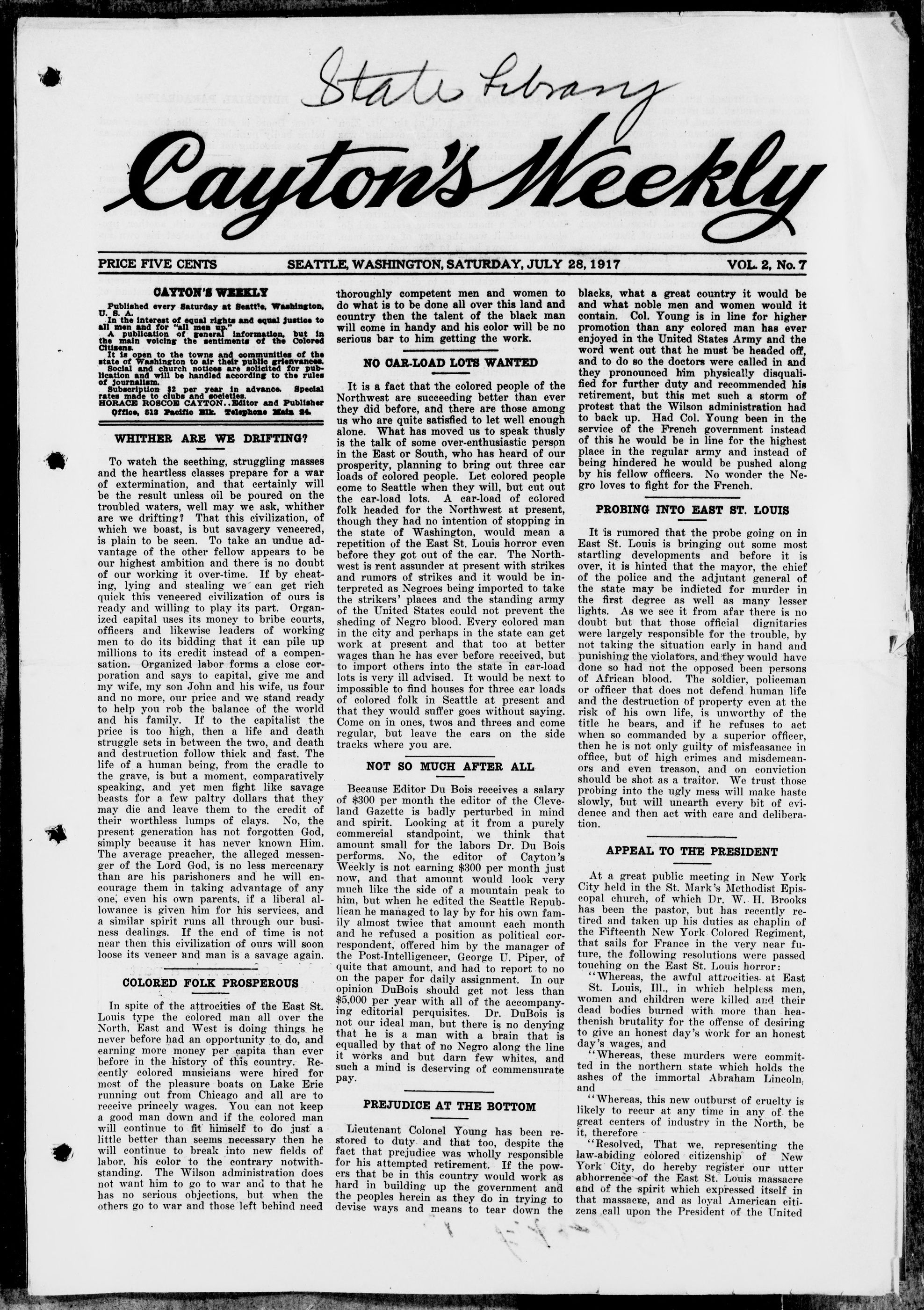
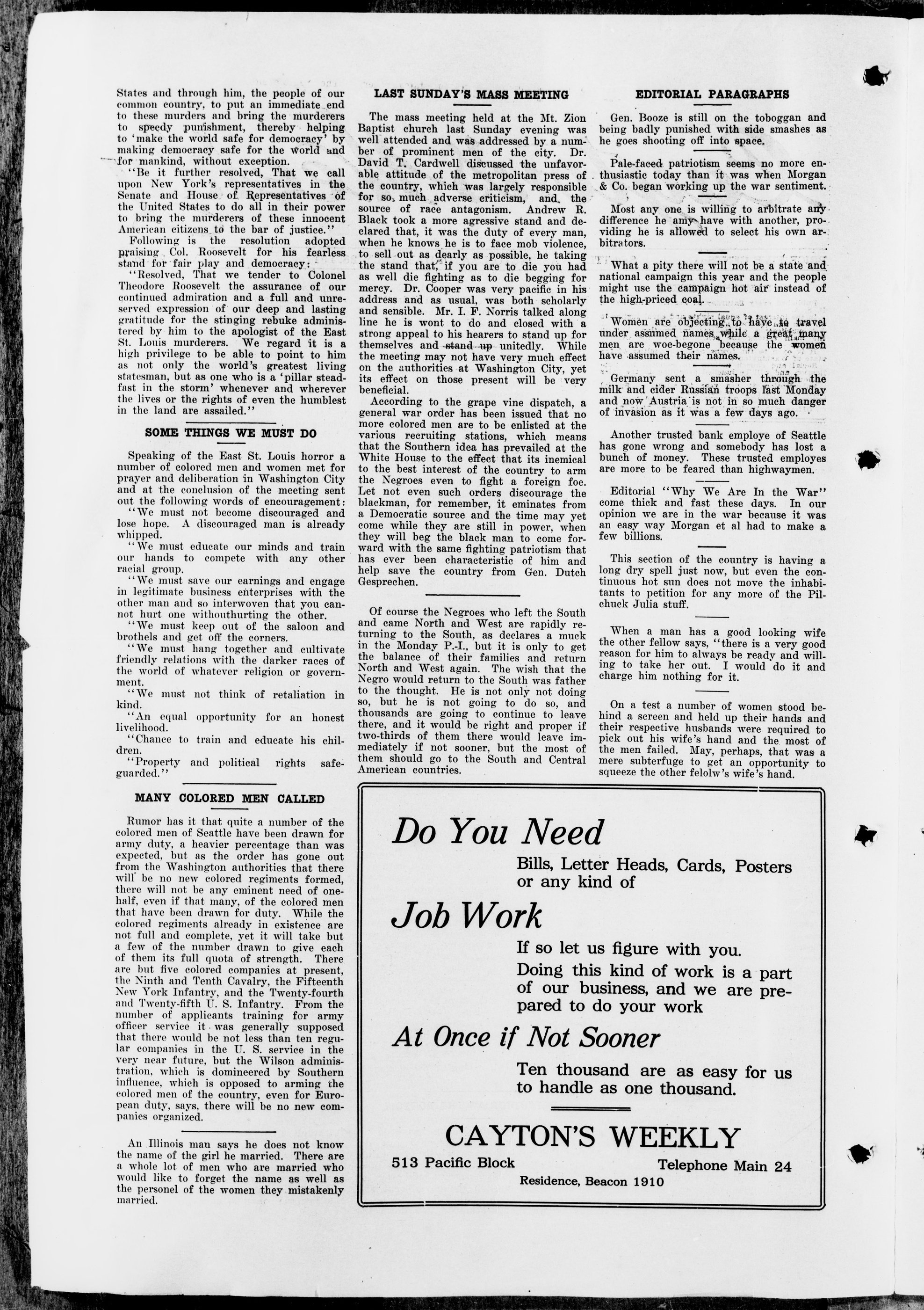
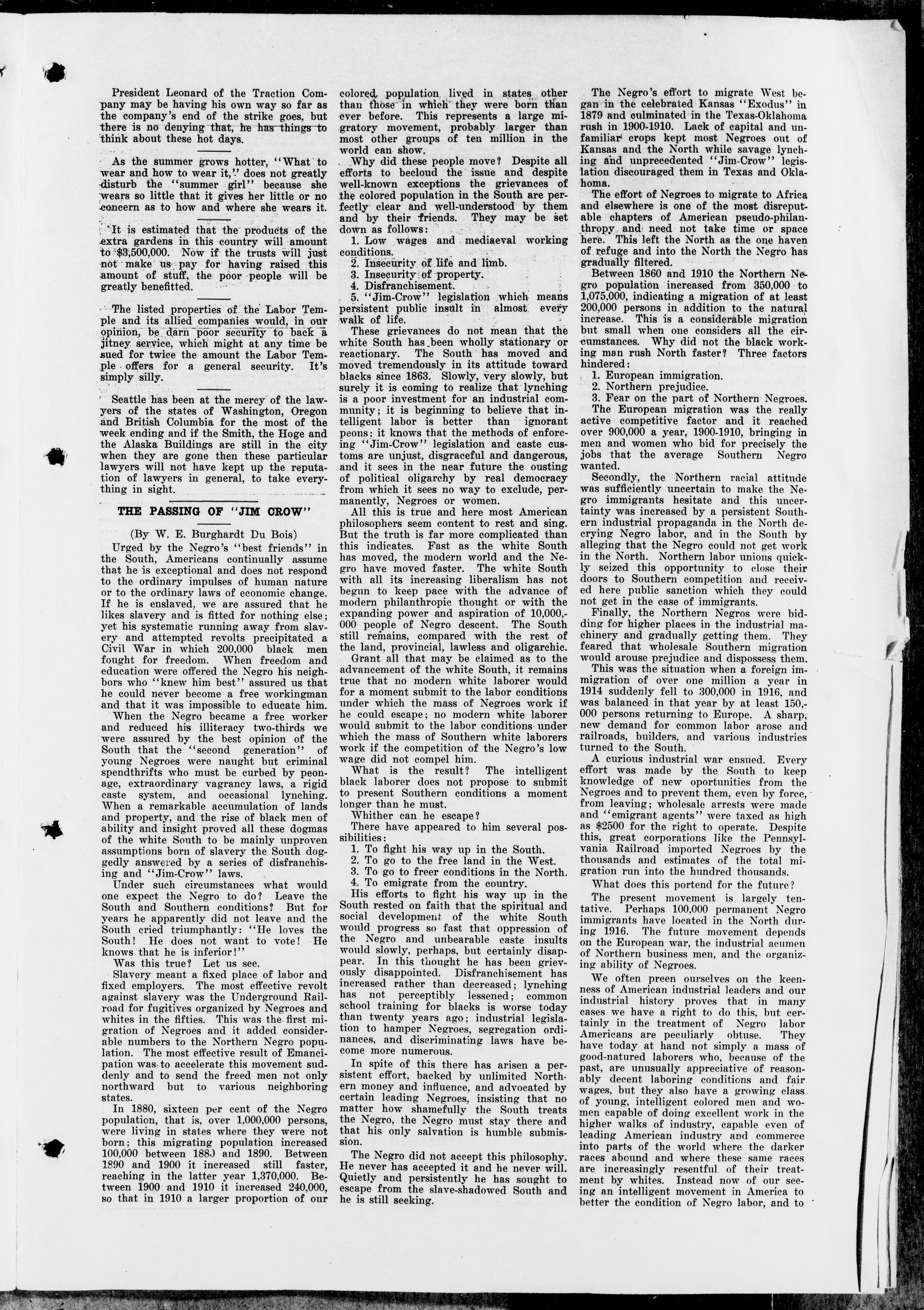
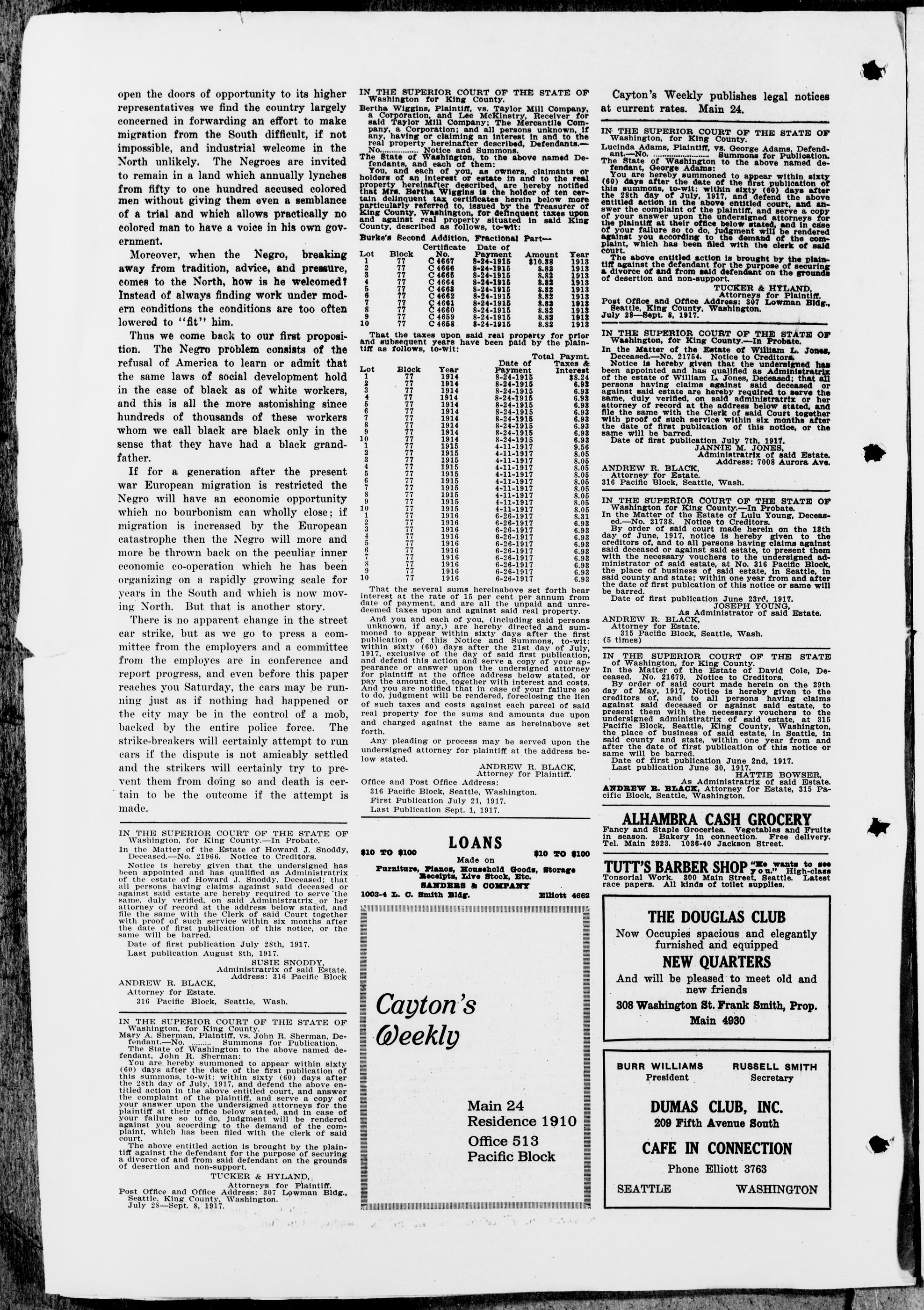
Page text (machine-generated)
State Library
Cayton's Weekly
PRICE FIVE CENTS SEATTLE, WASHINGTON, SATURDAY, JULY 28, 1917 VOL. 2, No. 7
PRICE FIVE CENTS
CAYTON'S WEEKLY
Published every Saturday at Seattle, Washington, U. S. A.
In the interest of equal rights and equal justice to all men and for "all men up."
A publication of general information, but in the main voicing the sentiments of the Colored Citizens.
It is open to the towns and communities of the state of Washington to air their public grievances.
Social and church notices are solicited for publication and will be handled according to the rules of journalism.
Subscription $2 per year in advance. Special rates made to clubs and societies.
HORACE ROSCOE CAYTON..Editor and Publisher
Office, 513 Pacific Blk. Telephone Main 24.
WHITHER ARE WE DRIFTING?
To watch the seething, struggling masses and the heartless classes prepare for a war of extermination, and that certainly will be the result unless oil be poured on the troubled waters, well may we ask, whither are we drifting? That this civilization, of which we boast, is but savagery veneered, is plain to be seen. To take an undue advantage of the other fellow appears to be our highest ambition and there is no doubt of our working it over-time. If by cheating, lying and stealing we can get rich quick this veneered civilization of ours is ready and willing to play its part. Organized capital uses its money to bribe courts, officers and likewise leaders of working men to do its bidding that it can pile up millions to its credit instead of a compensation. Organized labor forms a close corporation and says to capital, give me and my wife, my son John and his wife, us four and no more, our price and we stand ready to help you rob the balance of the world and his family. If to the capitalist the price is too high, then a life and death struggle sets in between the two, and death and destruction follow thick and fast. The life of a human being, from the cradle to the grave, is but a moment, comparatively speaking, and yet men fight like savage beasts for a few paltry dollars that they may die and leave them to the credit of their worthless lumps of clays. No, the present generation has not forgotten God, simply because it has never known Him. The average preacher, the alleged messenger of the Lord God, is no less mercenary than are his parishers and he will encourage them in taking advantage of any one, even his own parents, if a liberal allowance is given him for his services, and a similar spirit runs all through our business dealings. If the end of time is not near then this civilization of ours will soon loose its veneer and man is a savage again.
COLORED FOLK PROSPEROUS
In spite of the attrocities of the East St. Louis type the colored man all over the North, East and West is doing things he never before had an opportunity to do, and earning more money per capita than ever before in the history of this country. Recently colored musicians were hired for most of the pleasure boats on Lake Erie running out from Chicago and all are to receive princely wages. You can not keep a good man down and if the colored man will continue to fit himself to do just a little better than seems necessary then he will continue to break into new fields of labor, his color to the contrary notwithstanding. The Wilson administration does not want him to go to war and to that he has no serious objections, but when the others go to war and those left behind need
thoroughly competent men and women to do what is to be done all over this land and country then the talent of the black man will come in handy and his color will be no serious bar to him getting the work.
NO CAR-LOAD LOTS WANTED
It is a fact that the colored people of the Northwest are succeeding better than ever they did before, and there are those among us who are quite satisfied to let well enough alone. What has moved us to speak thusly is the talk of some over-enthusiastic person in the East or South, who has heard of our prosperity, planning to bring out three car loads of colored people. Let colored people come to Seattle when they will, but cut out the car-load lots. A car-load of colored folk headed for the Northwest at present, though they had no intention of stopping in the state of Washington, would mean a repetition of the East St. Louis horror even before they got out of the car. The Northwest is rent assunder at present with strikes and rumors of strikes and it would be interpreted as Negroes being imported to take the strikers' places and the standing army of the United States could not prevent the sheding of Negro blood. Every colored man in the city and perhaps in the state can get work at present and that too at better wages than he has ever before received, but to import others into the state in car-load lots is very ill advised. It would be next to impossible to find houses for three car loads of colored folk in Seattle at present and that they would suffer goes without saying. Come on in ones, twos and threes and come regular, but leave the cars on the side tracks where you are.
NOT SO MUCH AFTER ALL
Because Editor Du Bois receives a salary of $300 per month the editor of the Cleveland Gazette is badly perturbed in mind and spirit. Looking at it from a purely commercial standpoint, we think that amount small for the labors Dr. Du Bois performs. No, the editor of Cayton's Weekly is not earning $300 per month just now, and that amount would look very much like the side of a mountain peak to him, but when he edited the Seattle Republican he managed to lay by for his own family almost twice that amount each month and he refused a position as political correspondent, offered him by the manager of the Post-Intelligencer, George U. Piper, of quite that amount, and had to report to no on the paper for daily assignment. In our opinion DuBois should get not less than $5,000 per year with all of the accompanying editorial perquisites. Dr. DuBois is not our ideal man, but there is no denying that he is a man with a brain that is equalled by that of no Negro along the line it works and but darn few whites, and such a mind is deserving of commensurate pay.
PREJUDICE AT THE BOTTOM
Lieutenant Colonel Young has been restored to duty and that too, despite the fact that prejudice was wholly responsible for his attempted retirement. If the powers that be in this country would work as hard in building up the government and the peoples herein as they do in trying to devise ways and means to tear down the
VOL.2, No.7
blacks, what a great country it would be and what noble men and women would it contain. Col. Young is in line for higher promotion than any colored man has ever enjoyed in the United States Army and the word went out that he must be headed off, and to do so the doctors were called in and they pronounced him physically disqualified for further duty and recommended his retirement, but this met such a storm of protest that the Wilson administration had to back up. Had Col. Young been in the service of the French government instead of this he would be in line for the highest place in the regular army and instead of being hindered he would be pushed along by his fellow officers. No wonder the Negro loves to fight for the French.
PROBING INTO EAST ST. LOUIS
It is rumored that the probe going on in East St. Louis is bringing out some most startling developments and before it is over, it is hinted that the mayor, the chief of the police and the adjutant general of the state may be indicted for murder in the first degree as well as many lesser lights. As we see it from afar there is no doubt but that those official dignitaries were largely responsible for the trouble, by not taking the situation early in hand and punishing the violators, and they would have done so had not the opposed been persons of African blood. The soldier, policeman or officer that does not defend human life and the destruction of property even at the risk of his own life, is unworthy of the title he bears, and if he refuses to act when so commanded by a superior officer, then he is not only guilty of misfeasance in office, but of high crimes and misdemeanors and even treason, and on conviction should be shot as a traitor. We trust those probing into the ugly mess will make haste slowly, but will unearth every bit of evidence and then act with care and deliberation.
APPEAL TO THE PRESIDENT
At a great public meeting in New York City held in the St. Mark's Methodist Episcopal church, of which Dr. W. H. Brooks has been the pastor, but has recently retired and taken up his duties as chaplin of the Fifteenth New York Colored Regiment, that sails for France in the very near future, the following resolutions were passed touching on the East St. Louis horror:
"Whereas, the awful attrocities at East St. Louis, Ill., in which helpless men, women and children were killed and their dead bodies burned with more than heathenish brutality for the offense of desiring to give an honest day's work for an honest day's wages, and
"Whereas, these murders were committed in the northern state which holds the ashes of the immortal Abraham Lincoln, and
"Whereas, this new outburst of cruelty is likely to recur at any time in any of the great centers of industry in the North, be it, therefore
"Resolved, That we, representing the law-abiding colored citizenship of New York City, do hereby register our utter abhorrence of the East St. Louis massacre and of the spirit which expressed itself in that massacre, and as loyal American citizens call upon the President of the United
Do You Need
Bills, Letter Heads, Cards, Posters or any kind of
Job Work
If so let us figure with you.
Doing this kind of work is a part of our business, and we are prepared to do your work
At Once if Not Sooner
Ten thousand are as easy for us to handle as one thousand.
CAYTON'S WEEKLY
513 Pacific Block Telephone Main 24
Residence, Beacon 1910
15
States and through him, the people of our common country, to put an immediate end to these murders and bring the murderers to speedy punishment, thereby helping to 'make the world safe for democracy' by making democracy safe for the world and for mankind, without exception. "Be it further resolved, That we call upon New York's representatives in the Senate and House of Representatives of the United States to do all in their power to bring the murderers of these innocent American citizens to the bar of justice." Following is the resolution adopted praising Col. Roosevelt for his fearless stand for fair play and democracy:
"Resolved, That we tender to Colonel Theodore Roosevelt the assurance of our continued admiration and a full and unreserved expression of our deep and lasting gratitude for the stinging rebuke administered by him to the apologist of the East St. Louis murderers. We regard it is a high privilege to be able to point to him as not only the world's greatest living statesman, but as one who is a 'pillar steadfast in the storm' whenever and wherever the lives or the rights of even the humblest in the land are assailed."
SOME THINGS WE MUST DO
Speaking of the East St. Louis horror a number of colored men and women met for prayer and deliberation in Washington City and at the conclusion of the meeting sent out the following words of encouragement: "We must not become discouraged and lose hope. A discouraged man is already whipped. "We must educate our minds and train our hands to compete with any other racial group. "We must save our earnings and engage in legitimate business enterprises with the other man and so interwoven that you cannot hurt one withouthurting the other.
"We must keep out of the saloon and brothels and get off the corners.
"We must hang together and cultivate friendly relations with the darker races of the world of whatever religion or government.
"We must not think of retaliation in kind.
"An equal opportunity for an honest livelihood.
"Chance to train and educate his children.
"Property and political rights safeguarded."
MANY COLORED MEN CALLED
Rumor has it that quite a number of the colored men of Seattle have been drawn for army duty, a heavier percentage than was expected, but as the order has gone out from the Washington authorities that there will be no new colored regiments formed, there will not be any eminent need of one-half, even if that many, of the colored men that have been drawn for duty. While the colored regiments already in existence are not full and complete, yet it will take but a few of the number drawn to give each of them its full quota of strength. There are but five colored companies at present, the Ninth and Tenth Cavalry, the Fifteenth New York Infantry, and the Twenty-fourth and Twenty-fifth U. S. Infantry. From the number of applicants training for army officer service it was generally supposed that there would be not less than ten regular companies in the U. S. service in the very near future, but the Wilson administration, which is domineered by Southern influence, which is opposed to arming the colored men of the country, even for European duty, says, there will be no new companies organized.
An Illinois man says he does not know the name of the girl he married. There are a whole lot of men who are married who would like to forget the name as well as the personel of the women they mistakenly married.
LAST SUNDAY'S MASS MEETING
The mass meeting held at the Mt. Zion Baptist church last Sunday evening was well attended and was addressed by a number of prominent men of the city. Dr. David T. Cardwell discussed the unfavorable attitude of the metropolitan press of the country, which was largely responsible for so much adverse criticism, and, the source of race antagonism. Andrew R. Black took a more aggressive stand and declared that, it was the duty of every man, when he knows he is to face mob violence, to sell out as dearly as possible, he taking the stand that, if you are to die you had as well die fighting as to die begging for mercy. Dr. Cooper was very pacific in his address and as usual, was both scholarly and sensible. Mr. I. F. Norris talked along line he is wont to do and closed with a strong appeal to his hearers to stand up for themselves and stand up unitedly. While the meeting may not have very much effect on the authorities at Washington City, yet its effect on those present will be very beneficial.
According to the grape vine dispatch, a general war order has been issued that no more colored men are to be enlisted at the various recruiting stations, which means that the Southern idea has prevailed at the White House to the effect that its inemical to the best interest of the country to arm the Negroes even to fight a foreign foe. Let not even such orders discourage the blackman, for remember, it eminates from a Democratic source and the time may yet come while they are still in power, when they will beg the black man to come forward with the same fighting patriotism that has ever been characteristic of him and help save the country from Gen. Dutch Gesprechen.
Of course the Negroes who left the South and came North and West are rapidly returning to the South, as declares a muck in the Monday P.-I., but it is only to get the balance of their families and return North and West again. The wish that the Negro would return to the South was father to the thought. He is not only not doing so, but he is not going to do so, and thousands are going to continue to leave there, and it would be right and proper if two-thirds of them there would leave immediately if not sooner, but the most of them should go to the South and Central American countries.
EDITORIAL PARAGRAPHS
Gen. Booze is still on the toboggan and being badly punished with side smashes as he goes shooting off into space.
Pale-faced patriotism seems no more enthusiastic today than it was when Morgan & Co. began working up the war sentiment.
Most any one is willing to arbitrate any difference he amy have with another, providing he is allowed to select his own arbitrators.
What a pity there will not be a state and national campaign this year and the people might use the campaign hot air instead of the high-priced coal.
Women are objecting to have to travel under assumed names while a great many men are woe-begone because the women have assumed their names.
Germany sent a smasher through the milk and cider Russian troops last Monday and now Austria is not in so much danger of invasion as it was a few days ago.
Another trusted bank employee of Seattle has gone wrong and somebody has lost a bunch of money. These trusted employees are more to be feared than highwaymen.
Editorial "Why We Are In the War" come thick and fast these days. In our opinion we are in the war because it was an easy way Morgan et al had to make a few billions.
This section of the country is having a long dry spell just now, but even the continuous hot sun does not move the inhabitants to petition for any more of the Pilchuck Julia stuff.
When a man has a good looking wife the other fellow says, "there is a very good reason for him to always be ready and willing to take her out. I would do it and charge him nothing for it.
On a test a number of women stood behind a screen and held up their hands and their respective husbands were required to pick out his wife's hand and the most of the men failed. May, perhaps, that was a mere subterfuge to get an opportunity to squeeze the other felolw's wife's hand.
President Leonard of the Traction Company may be having his own way so far as the company's end of the strike goes, but there is no denying that, he has things to think about these hot days.
As the summer grows hotter, "What to wear and how to wear it," does not greatly disturb the "summer girl" because she wears so little that it gives her little or no concern as to how and where she wears it.
It is estimated that the products of the extra gardens in this country will amount to $3,500,000. Now if the trusts will just not make us pay for having raised this amount of stuff, the poor people will be greatly benefitted.
The listed properties of the Labor Temple and its allied companies would, in our opinion, be darn poor security to back a jitney service, which might at any time be sued for twice the amount the Labor Temple offers for a general security. It's simply silly.
Seattle has been at the mercy of the lawyers of the states of Washington, Oregon and British Columbia for the most of the week ending and if the Smith, the Hoge and the Alaska Buildings are still in the city when they are gone then these particular lawyers will not have kept up the reputation of lawyers in general, to take everything in sight.
THE PASSING OF "JIM CROW"
(By W. E. Burghardt Du Bois)
Urged by the Negro's "best friends" in the South, Americans continually assume that he is exceptional and does not respond to the ordinary impulses of human nature or to the ordinary laws of economic change. If he is enslaved, we are assured that he likes slavery and is fitted for nothing else; yet his systematic running away from slavery and attempted revolts precipitated a Civil War in which 200,000 black men fought for freedom. When freedom and education were offered the Negro his neighbors who "knew him best" assured us that he could never become a free workingman and that it was impossible to educate him.
When the Negro became a free worker and reduced his illiteracy two-thirds we were assured by the best opinion of the South that the "second generation" of young Negroes were naught but criminal spendthrifts who must be curbed by peonage, extraordinary vagrancy laws, a rigid caste system, and occasional lynching. When a remarkable accumulation of lands and property, and the rise of black men of ability and insight proved all these dogmas of the white South to be mainly unproven assumptions born of slavery the South doggedly answered by a series of disfranchising and "Jim-Crow" laws.
Under such circumstances what would one expect the Negro to do? Leave the South and Southern conditions? But for years he apparently did not leave and the South cried triumphantly: "He loves the South! He does not want to vote! He knows that he is inferior!" Was this true? Let us see.
Slavery meant a fixed place of labor and fixed employers. The most effective revolt against slavery was the Underground Railroad for fugitives organized by Negroes and whites in the fifties. This was the first migration of Negroes and it added considerable numbers to the Northern Negro population. The most effective result of Emancipation was to accelerate this movement suddenly and to send the freed men not only northward but to various neighboring states.
In 1880, sixteen per cent of the Negro population, that is, over 1,000,000 persons, were living in states where they were not born; this migrating population increased 100,000 between 1880 and 1890. Between 1890 and 1900 it increased still faster, reaching in the latter year 1,370,000. Between 1900 and 1910 it increased 240,000, so that in 1910 a larger proportion of our
colored population lived in states other than those in which they were born than ever before. This represents a large migratory movement, probably larger than most other groups of ten million in the world can show. Why did these people move? Despite all efforts to becloud the issue and despite well-known exceptions the grievances of the colored population in the South are perfectly clear and well-understood by them and by their friends. They may be set down as follows: 1. Low wages and mediaeval working conditions. 2. Insecurity of life and limb.
3. Insecurity of property.
4. Disfranchisement.
5. "Jim-Crow" legislation which means persistent public insult in almost every walk of life.
These grievances do not mean that the white South has been wholly stationary or reactionary. The South has moved and moved tremendously in its attitude toward blacks since 1863. Slowly, very slowly, but surely it is coming to realize that lynching is a poor investment for an industrial community; it is beginning to believe that intelligent labor is better than ignorant peons; it knows that the methods of enforcing "Jim-Crow" legislation and caste customs are unjust, disgraceful and dangerous, and it sees in the near future the ousting of political oligarchy by real democracy from which it sees no way to exclude, permanently, Negroes or women.
All this is true and here most American philosophers seem content to rest and sing. But the truth is far more complicated than this indicates. Fast as the white South has moved, the modern world and the Negro have moved faster. The white South with all its increasing liberalism has not begun to keep pace with the advance of modern philanthropic thought or with the expanding power and aspiration of 10,000,000 people of Negro descent. The South still remains, compared with the rest of the land, provincial, lawless and oligarchic.
Grant all that may be claimed as to the advancement of the white South, it remains true that no modern white laborer would for a moment submit to the labor conditions under which the mass of Negroes work if he could escape; no modern white laborer would submit to the labor conditions under which the mass of Southern white laborers work if the competition of the Negro's low wage did not compel him.
What is the result? The intelligent black laborer does not propose to submit to present Southern conditions a moment longer than he must.
Whither can he escape?
There have appeared to him several possibilities:
1. To fight his way up in the South.
2. To go to the free land in the West.
3. To go to freer conditions in the North.
4. To emigrate from the country.
His efforts to fight his way up in the South rested on faith that the spiritual and social development of the white South would progress so fast that oppression of the Negro and unbearable caste insults would slowly, perhaps, but certainly disappear. In this thought he has been grievously disappointed. Disfranchisement has increased rather than decreased; lynching has not perceptibly lessened; common school training for blacks is worse today than twenty years ago; industrial legislation to hamper Negroes, segregation ordinances, and discriminating laws have become more numerous.
In spite of this there has arisen a persistent effort, backed by unlimited Northern money and influence, and advocated by certain leading Negroes, insisting that no matter how shamefully the South treats the Negro, the Negro must stay there and that his only salvation is humble submission.
The Negro did not accept this philosophy. He never has accepted it and he never will. Quietly and persistently he has sought to escape from the slave-shadowed South and he is still seeking.
The Negro's effort to migrate West began in the celebrated Kansas "Exodus" in 1879 and culminated in the Texas-Oklahoma rush in 1900-1910. Lack of capital and unfamiliar crops kept most Negroes out of Kansas and the North while savage lynching and unprecedented "Jim-Crow" legislation discouraged them in Texas and Oklahoma.
The effort of Negroes to migrate to Africa and elsewhere is one of the most disreputable chapters of American pseudo-philanthropy and need not take time or space here. This left the North as the one haven of refuge and into the North the Negro has gradually filtered.
Between 1860 and 1910 the Northern Negro population increased from 350,000 to 1,075,000, indicating a migration of at least 200,000 persons in addition to the natural increase. This is a considerable migration but small when one considers all the circumstances. Why did not the black working man rush North faster? Three factors hindered: 1. European immigration. 2. Northern prejudice.
3. Fear on the part of Northern Negroes. The European migration was the really active competitive factor and it reached over 900,000 a year, 1900-1910, bringing in men and women who bid for precisely the jobs that the average Southern Negro wanted.
Secondly, the Northern racial attitude was sufficiently uncertain to make the Negro immigrants hesitate and this uncertainty was increased by a persistent Southern industrial propaganda in the North decrying Negro labor, and in the South by alleging that the Negro could not get work in the North. Northern labor unions quickly seized this opportunity to close their doors to Southern competition and received here public sanction which they could not get in the case of immigrants.
Finally, the Northern Negros were bidding for higher places in the industrial machinery and gradually getting them. They feared that wholesale Southern migration would arouse prejudice and dispossess them. This was the situation when a foreign immigration of over one million a year in 1914 suddenly fell to 300,000 in 1916, and was balanced in that year by at least 150,000 persons returning to Europe. A sharp, new demand for common labor arose and railroads, builders, and various industries turned to the South.
A curious industrial war ensued. Every effort was made by the South to keep knowledge of new opportunities from the Negroes and to prevent them, even by force, from leaving; wholesale arrests were made and "emigrant agents" were taxed as high as $2500 for the right to operate. Despite this, great corporations like the Pennsylvania Railroad imported Negroes by the thousands and estimates of the total migration run into the hundred thousands. What does this portend for the future?
The present movement is largely tentative. Perhaps 100,000 permanent Negro immigrants have located in the North during 1916. The future movement depends on the European war, the industrial acumen of Northern business men, and the organizing ability of Negroes.
We often preen ourselves on the keenness of American industrial leaders and our industrial history proves that in many cases we have a right to do this, but certainly in the treatment of Negro labor Americans are peculiarly obtuse. They have today at hand not simply a mass of good-natured laborers who, because of the past, are unusually appreciative of reasonably decent laboring conditions and fair wages, but they also have a growing class of young, intelligent colored men and women capable of doing excellent work in the higher walks of industry, capable even of leading American industry and commerce into parts of the world where the darker races abound and where these same races are increasingly resentful of their treatment by whites. Instead now of our seeing an intelligent movement in America to better the condition of Negro labor, and to
```markdown
```
open the doors of opportunity to its higher representatives we find the country largely concerned in forwarding an effort to make migration from the South difficult, if not impossible, and industrial welcome in the North unlikely. The Negroes are invited to remain in a land which annually lynches from fifty to one hundred accused colored men without giving them even a semblance of a trial and which allows practically no colored man to have a voice in his own government.
Moreover, when the Negro, breaking away from tradition, advice, and pressure, comes to the North, how is he welcomed? Instead of always finding work under modern conditions the conditions are too often lowered to "fit" him.
Thus we come back to our first proposition. The Negro problem consists of the refusal of America to learn or admit that the same laws of social development hold in the case of black as of white workers, and this is all the more astonishing since hundreds of thousands of these workers whom we call black are black only in the sense that they have had a black grandfather.
If for a generation after the present war European migration is restricted the Negro will have an economic opportunity which no bourbonism can wholly close; if migration is increased by the European catastrophe then the Negro will more and more be thrown back on the peculiar inner economic co-operation which he has been organizing on a rapidly growing scale for years in the South and which is now moving North. But that is another story.
There is no apparent change in the street car strike, but as we go to press a committee from the employers and a committee from the employes are in conference and report progress, and even before this paper reaches you Saturday, the cars may be running just as if nothing had happened or the city may be in the control of a mob, backed by the entire police force. The strike-breakers will certainly attempt to run cars if the dispute is not amicably settled and the strikers will certainly try to prevent them from doing so and death is certain to be the outcome if the attempt is made.
IN THE SUPERIOR COURT OF THE STATE OF Washington for King County.
Bertha Wiggins, Plaintiff, vs. Taylor Mill Company, a Corporation, and Lee McKinstry, Receiver for said Taylor Mill Company; The Mercantile Company, a Corporation; and all persons unknown, if any, having or claiming an interest in and to the real property hereinafter described, Defendants.—No. Notice and Summons.
The State of Washington, to the above named Defendants, and each of them:
That the taxes upon said real property for prior and subsequent years have been paid by the plaintiff as follows, to-wit:
That the several sums hereinabove set forth bear interest at the rate of 15 per cent per annum from date of payment, and are all the unpaid and unredeemed taxes upon and against said real property.
And you and each of you, (including said persons unknown, if any,) are hereby directed and summoned to appear within sixty days after the first publication of this Notice and Summons, to-wit: within sixty (60) days after the 21st day of July, 1917, exclusive of the day of said first publication, and defend this action and serve a copy of your appearance or answer upon the undersigned attorney for plaintiff at the office address below stated, or pay the amount due, together with interest and costs. And you are notified that in case of your failure so to do, judgment will be rendered, foreclosing the lien of such taxes and costs against each parcel of said real property for the sums and amounts due upon and charged against the same as hereinabove set forth.
Any pleading or process may be served upon the undersigned attorney for plaintiff at the address below stated.
Attorney for Plaintiff.
Office and Post Office Address:
316 Pacific Block, Seattle, Washington.
First Publication July 21, 1917.
Last Publication Sept. 1, 1917.
$10 TO $100
Made on
Furniture, Pianos, Household Goods, Storage
Receipts, Live Stock, Etc.
SANDERS & COMPANY
1003-4 L. C. Smith Bldg.
Elliott 4662
Cayton's
Weekly
Main 24
Residence 1910
Office 513
Pacific Block
IN THE SUPERIOR COURT OF THE STATE OF Washington, for King County.
You are hereby summoned to appear within sixty (60) days after the date of the first publication of this summons, to-wit: within sixty (60) days after the 28th day of July, 1917, and defend the above entitled action in the above entitled court, and answer the complaint of the plaintiff, and serve a copy of your answer upon the undersigned attorneys for the plaintiff at their office below stated, and in case of your failure so to do, judgment will be rendered against you according to the demand of the complaint, which has been filed with the clerk of said court.
The above entitled action is brought by the plaintiff against the defendant for the purpose of securing a divorce of and from said defendant on the grounds of desertion and non-support.
TUCKER & HYLAND,
Attorneys for Plaintiff.
Post Office and Office Address: 307 Lowman Bldg.,
Seattle, King County, Washington.
July 28—Sept. 8, 1917.
IN THE SUPERIOR COURT OF THE STATE OF
Washington, for King County.—In Probate.
In the Matter of the Estate of William L. Jones,
Deceased.—No. 21754. Notice to Creditors.
Notice is hereby given that the undersigned has been appointed and has qualified as Administratrix of the estate of William L. Jones, Deceased; that all persons having claims against said deceased or against said estate are hereby required to serve the same, duly verified, on said administratrix or her attorney of record at the address below stated, and file the same with the Clerk of said Court together with proof of such service within six months after the date of first publication of this notice, or the same will be barred.
Date of first publication July 7th, 1917. IANNIE M. JONES.
ANDREW R. BLACK,
Attorney for Estate.
316 Pacific Block, Seattle, Wash.
IN THE SUPERIOR COURT OF THE STATE OF
Washington for King County—In Probate.
In the Matter of the Estate of Lulu Young, Deceased.
—No. 21738. Notice to Creditors.
By order of said court made herein on the 13th
day of June, 1917, notice is hereby given to the
creditors of, and to all persons having claims against
said deceased or against said estate, to present them
with the necessary vouchers to the undersigned
administrator of said estate, at No. 316 Pacific Block,
the place of business of said estate, in Seattle, in
said county and state; within one year from and after
the date of first publication of this notice or same will
be barred.
Date of first publication June 23rd, 1917.
IN THE SUPERIOR COURT OF THE STATE of Washington, for King County.
In the Matter of the Estate of David Cole, Deceased. No. 21679. Notice to Creditors.
By order of said court made herein on the 29th day of May, 1917, Notice is hereby given to the creditors of, and to all persons having claims against said deceased or against said estate, to present them with the necessary vouchers to the undersigned administratrix of said estate, at 315 Pacific Block, Seattle, King County, Washington, the place of business of said estate, in Seattle, in said county and state, within one year from and after the date of first publication of this notice or same will be barred.
Date of first publication June 2nd, 1917.
Last publication June 30, 1917.
HATTIE BOWSER,
As Administratrix of said Estate.
ANDREW R. BLACK, Attorney for Estate, 315 Pacific Block, Washington.
ALHAMBRA CASH GROCERY Fancy and Staple Groceries. Vegetables and Fruits in season. Bakery in connection. Free delivery. Tel. Main 2923. 1036-40 Jackson Street.
TUTT'S BARBER SHOP "He wants to see you." High-class Tonsorial Work. 300 Main Street, Seattle. Latest race papers. All kinds of toilet supplies.
THE DOUGLAS CLUB
Now Occupies spacious and elegantly furnished and equipped
NEW QUARTERS
And will be pleased to meet old and new friends