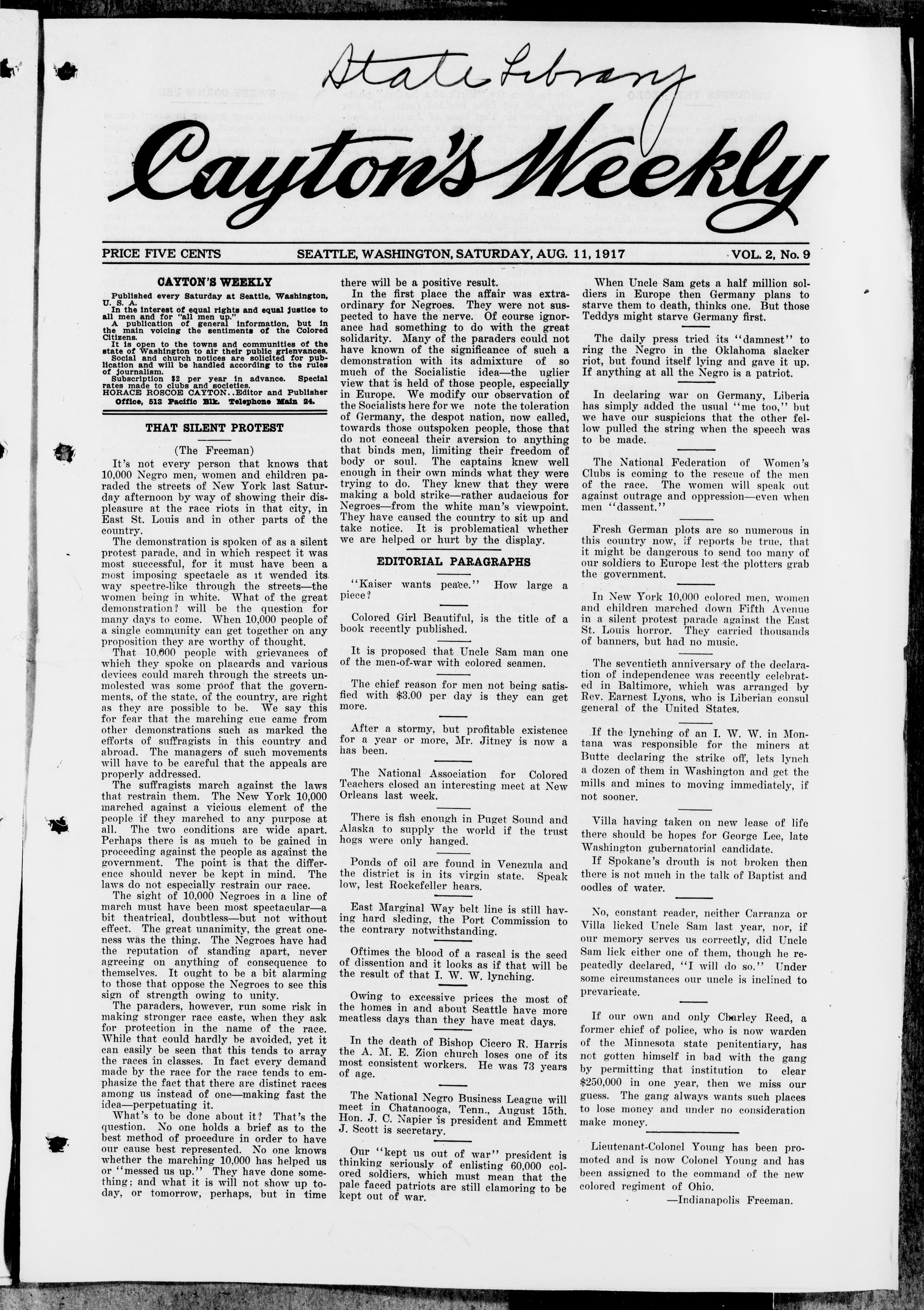
Cayton's Weekly
Saturday, August 11, 1917
Seattle, Washington
Page text (machine-generated)
State Library
Cayton's Weekly
CAYTON'S WEEKLY
Published every Saturday at Seattle, Washington, U. S. A. In the interest of equal rights and equal justice to all men and for "all men up." A publication of general information, but in the main voicing the sentiments of the Colored Citizens.
It is open to the towns and communities of the state of Washington to air their public grievances. Social and church notices are solicited for publication and will be handled according to the rules of journalism.
Subscription $2 per year in advance. Special rates made to clubs and societies. HORACE ROSCOE CAYTON. Editor and Publisher
HORACE ROSCOE CAYTON..Editor and Publisher
Office, 513 Pacific Blk. Telephone Main 24.
THAT SILENT PROTEST
(The Freeman)
It's not every person that knows that 10,000 Negro men, women and children paraded the streets of New York last Saturday afternoon by way of showing their displeasure at the race riots in that city, in East St. Louis and in other parts of the country. The demonstration is spoken of as a silent protest parade, and in which respect it was most successful, for it must have been a most imposing spectacle as it wended its way spectre-like through the streets—the women being in white. What of the great demonstration? will be the question for many days to come. When 10,000 people of a single community can get together on any proposition they are worthy of thought.
That 10,000 people with grievances of which they spoke on placards and various devices could march through the streets unmolested was some proof that the governments, of the state, of the country, are right as they are possible to be. We say this for fear that the marching cue came from other demonstrations such as marked the efforts of suffragists in this country and abroad. The managers of such movements will have to be careful that the appeals are properly addressed. The suffragists march against the laws that restrain them. The New York 10,000 marched against a vicious element of the people if they marched to any purpose at all. The two conditions are wide apart. Perhaps there is as much to be gained in proceeding against the people as against the government. The point is that the difference should never be kept in mind. The laws do not especially restrain our race.
The sight of 10,000 Negroes in a line of march must have been most spectacular—a bit theatrical, doubtless—but not without effect. The great unanimity, the great oneness was the thing. The Negroes have had the reputation of standing apart, never agreeing on anything of consequence to themselves. It ought to be a bit alarming to those that oppose the Negroes to see this sign of strength owing to unity.
The paraders, however, run some risk in making stronger race caste, when they ask for protection in the name of the race. While that could hardly be avoided, yet it can easily be seen that this tends to array the races in classes. In fact every demand made by the race for the race tends to emphasize the fact that there are distinct races among us instead of one—making fast the idea—perpetuating it.
What's to be done about it? That's the question. No one holds a brief as to the best method of procedure in order to have our cause best represented. No one knows whether the marching 10,000 has helped us or "messed us up." They have done something; and what it is will not show up today, or tomorrow, perhaps, but in time
there will be a positive result. In the first place the affair was extraordinary for Negroes. They were not suspected to have the nerve. Of course ignorance had something to do with the great solidarity. Many of the paraders could not have known of the significance of such a demonstration with its admixture of so much of the Socialistic idea—the uglier view that is held of those people, especially in Europe. We modify our observation of the Socialists here for we note the toleration of Germany, the despot nation, now called, towards those outspoken people, those that do not conceal their aversion to anything that binds men, limiting their freedom of body or soul. The captains knew well enough in their own minds what they were trying to do. They knew that they were making a bold strike—rather audacious for Negroes—from the white man's viewpoint. They have caused the country to sit up and take notice. It is problematical whether we are helped or hurt by the display.
EDITORIAL PARAGRAPHS
"Kaiser wants peace." How large a piece?
Colored Girl Beautiful, is the title of a book recently published.
It is proposed that Uncle Sam man one of the men-of-war with colored seamen.
The chief reason for men not being satisfied with $3.00 per day is they can get more.
After a stormy, but profitable existence for a year or more, Mr. Jitney is now a has been.
The National Association for Colored Teachers closed an interesting meet at New Orleans last week.
There is fish enough in Puget Sound and Alaska to supply the world if the trust hogs were only hanged.
Ponds of oil are found in Venezuela and the district is in its virgin state. Speak low, lest Rockefeller hears.
East Marginal Way belt line is still having hard sleding, the Port Commission to the contrary notwithstanding.
Oftimes the blood of a rascal is the seed of dissention and it looks as if that will be the result of that I. W. W. lynching.
Owing to excessive prices the most of the homes in and about Seattle have more meatless days than they have meat days.
In the death of Bishop Cicero R. Harris the A. M. E. Zion church loses one of its most consistent workers. He was 73 years of age.
The National Negro Business League will meet in Chatanooga, Tenn., August 15th. Hon. J. C. Napier is president and Emmett J. Scott is secretary.
Our "kept us out of war" president is thinking seriously of enlisting 60,000 colored soldiers, which must mean that the pale faced patriots are still clamoring to be kept out of war.
VOL. 2. No. 9
When Uncle Sam gets a half million soldiers in Europe then Germany plans to starve them to death, thinks one. But those Teddys might starve Germany first.
The daily press tried its "damnest" to ring the Negro in the Oklahoma slacker riot, but found itself lying and gave it up. If anything at all the Negro is a patriot.
In declaring war on Germany, Liberia has simply added the usual "me too," but we have our suspicions that the other fellow pulled the string when the speech was to be made.
The National Federation of Women's Clubs is coming to the rescue of the men of the race. The women will speak out against outrage and oppression—even when men "dassent."
Fresh German plots are so numerous in this country now, if reports be true, that it might be dangerous to send too many of our soldiers to Europe lest the plotters grab the government.
In New York 10,000 colored men, women and children marched down Fifth Avenue in a silent protest parade against the East St. Louis horror. They carried thousands of banners, but had no music.
The seventieth anniversary of the declaration of independence was recently celebrated in Baltimore, which was arranged by Rev. Earnest Lyons, who is Liberian consul general of the United States.
If the lynching of an I. W. W. in Montana was responsible for the miners at Butte declaring the strike off, lets lynch a dozen of them in Washington and get the mills and mines to moving immediately, if not sooner.
Villa having taken on new lease of life there should be hopes for George Lee, late Washington gubernatorial candidate.
If Spokane's drouth is not broken then there is not much in the talk of Baptist and oodles of water.
No, constant reader, neither Carranza or Villa licked Uncle Sam last year, nor, if our memory serves us correctly, did Uncle Sam lick either one of them, though he repeatedly declared, "I will do so." Under some circumstances our uncle is inclined to prevaricate.
If our own and only Charley Reed, a former chief of police, who is now warden of the Minnesota state penitentiary, has not gotten himself in bad with the gang by permitting that institution to clear $250,000 in one year, then we miss our guess. The gang always wants such places to lose money and under no consideration make money.
Lieutenant-Colonel Young has been promoted and is now Colonel Young and has been assigned to the command of the new colored regiment of Ohio.
—Indianapolis Freeman.
```markdown
```
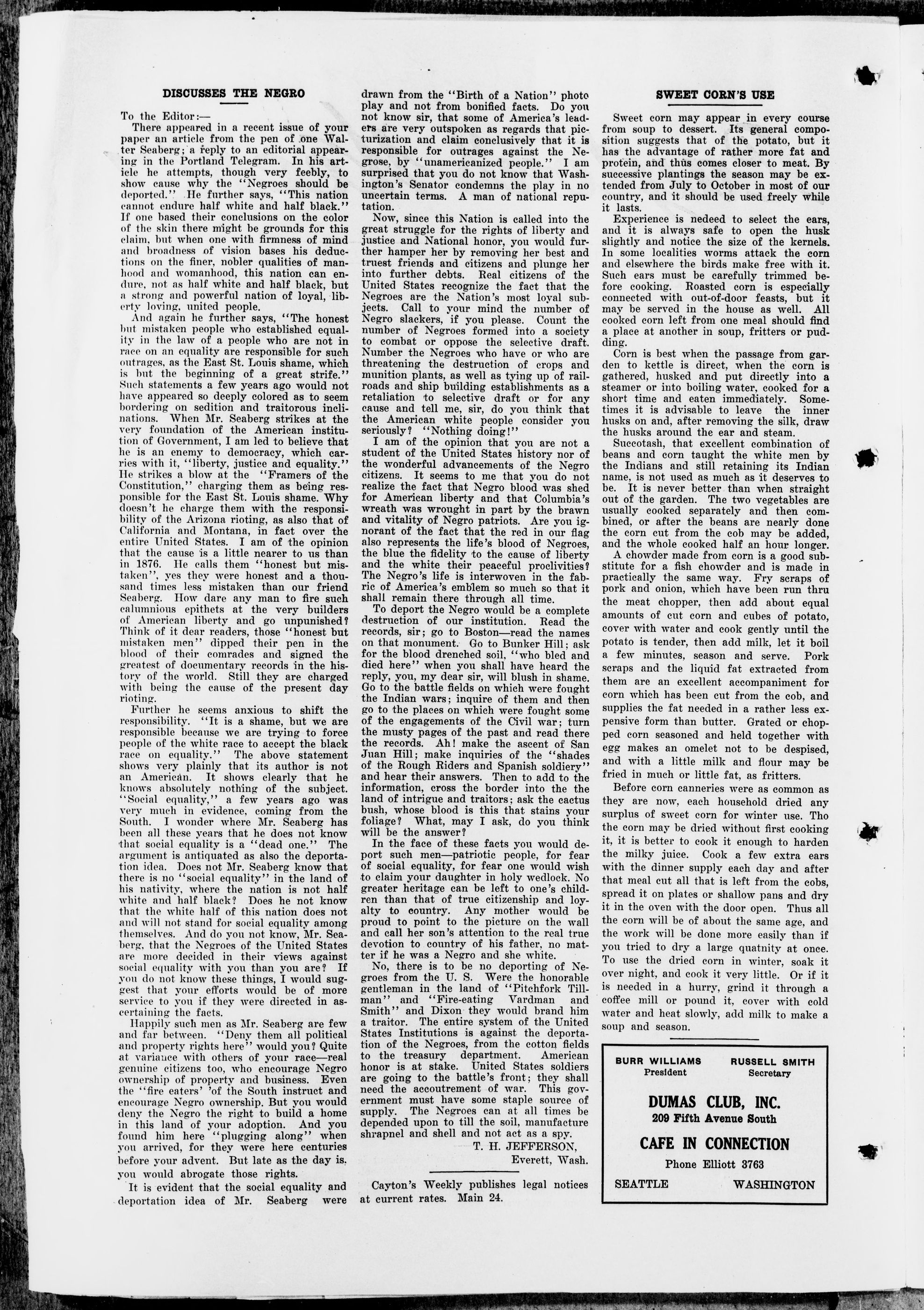
DISCUSSES THE NEGRO
To the Editor:—
There appeared in a recent issue of your paper an article from the pen of one Walter Seaberg; a reply to an editorial appearing in the Portland Telegram. In his article he attempts, though very feebly, to show cause why the "Negroes should be deported." He further says, "This nation cannot endure half white and half black." If one based their conclusions on the color of the skin there might be grounds for this claim, but when one with firmness of mind and broadness of vision bases his deductions on the finer, nobler qualities of manhood and womanhood, this nation can endure, not as half white and half black, but a strong and powerful nation of loyal, liberty loving, united people.
And again he further says, "The honest but mistaken people who established equality in the law of a people who are not in race on an equality are responsible for such outrages, as the East St. Louis shame, which is but the beginning of a great strife." Such statements a few years ago would not have appeared so deeply colored as to seem bordering on sedition and traitorous inclinations. When Mr. Seaberg strikes at the very foundation of the American institution of Government, I am led to believe that he is an enemy to democracy, which carries with it, "liberty, justice and equality." He strikes a blow at the "Framers of the Constitution," charging them as being responsible for the East St. Louis shame. Why doesn't he charge them with the responsibility of the Arizona rioting, as also that of California and Montana, in fact over the entire United States. I am of the opinion that the cause is a little nearer to us than in 1876. He calls them "honest but mistaken", yes they were honest and a thousand times less mistaken than our friend Seaberg. How dare any man to fire such calumnious epithets at the very builders of American liberty and go unpunished? Think of it dear readers, those "honest but mistaken men" dipped their pen in the blood of their comrades and signed the greatest of documentary records in the history of the world. Still they are charged with being the cause of the present day rioting.
Further he seems anxious to shift the responsibility. "It is a shame, but we are responsible because we are trying to force people of the white race to accept the black race on equality." The above statement shows very plainly that its author is not an American. It shows clearly that he knows absolutely nothing of the subject. "Social equality," a few years ago was very much in evidence, coming from the South. I wonder where Mr. Seaberg has been all these years that he does not know that social equality is a "dead one." The argument is antiquated as also the deportation idea. Does not Mr. Seaberg know that there is no "social equality" in the land of his nativity, where the nation is not half white and half black? Does he not know that the white half of this nation does not and will not stand for social equality among themselves. And do you not know, Mr. Seaberg, that the Negroes of the United States are more decided in their views against social equality with you than you are? If you do not know these things, I would suggest that your efforts would be of more service to you if they were directed in ascertaining the facts.
Happily such men as Mr. Seaberg are few and far between. "Deny them all political and property rights here" would you? Quite at variance with others of your race—real genuine citizens too, who encourage Negro ownership of property and business. Even the "fire eaters' of the South instruct and encourage Negro ownership. But you would deny the Negro the right to build a home in this land of your adoption. And you found him here "plugging along" when you arrived, for they were here centuries before your advent. But late as the day is, you would abrogate those rights.
It is evident that the social equality and deportation idea of Mr. Seaberg were
drawn from the "Birth of a Nation" photo play and not from bonified facts. Do you not know sir, that some of America's leaders are very outspoken as regards that picturization and claim conclusively that it is responsible for outrages against the Negrose, by "unamericanized people." I am surprised that you do not know that Washington's Senator condemns the play in no uncertain terms. A man of national reputation.
Now, since this Nation is called into the great struggle for the rights of liberty and justice and National honor, you would further hamper her by removing her best and truest friends and citizens and plunge her into further debts. Real citizens of the United States recognize the fact that the Negroes are the Nation's most loyal subjects. Call to your mind the number of Negro slackers, if you please. Count the number of Negroes formed into a society to combat or oppose the selective draft. Number the Negroes who have or who are threatening the destruction of crops and munition plants, as well as tying up of railroads and ship building establishments as a retaliation to selective draft or for any cause and tell me, sir, do you think that the American white people consider you seriously? "Nothing doing!"
I am of the opinion that you are not a student of the United States history nor of the wonderful advancements of the Negro citizens. It seems to me that you do not realize the fact that Negro blood was shed for American liberty and that Columbia's wreath was wrought in part by the brawn and vitality of Negro patriots. Are you ignorant of the fact that the red in our flag also represents the life's blood of Negroes, the blue the fidelity to the cause of liberty and the white their peaceful proclivities? The Negro's life is interwoven in the fabric of America's emblem so much so that it shall remain there through all time.
To deport the Negro would be a complete destruction of our institution. Read the records, sir; go to Boston—read the names on that monument. Go to Bunker Hill; ask for the blood drenched soil, "who bled and died here" when you shall have heard the reply, you, my dear sir, will blush in shame. Go to the battle fields on which were fought the Indian wars; inquire of them and then go to the places on which were fought some of the engagements of the Civil war; turn the musty pages of the past and read there the records. Ah! make the ascent of San Juan Hill; make inquiries of the "shades of the Rough Riders and Spanish soldiery" and hear their answers. Then to add to the information, cross the border into the the land of intrigue and traitors; ask the cactus bush, whose blood is this that stains your foliage? What, may I ask, do you think will be the answer?
In the face of these facts you would deport such men—patriotic people, for fear of social equality, for fear one would wish to claim your daughter in holy wedlock. No greater heritage can be left to one's children than that of true citizenship and loyalty to country. Any mother would be proud to point to the picture on the wall and call her son's attention to the real true devotion to country of his father, no matter if he was a Negro and she white.
No, there is to be no deporting of Negroes from the U. S. Were the honorable gentleman in the land of "Pitchfork Tillman" and "Fire-eating Vardman and Smith" and Dixon they would brand him a traitor. The entire system of the United States Institutions is against the deportation of the Negroes, from the cotton fields to the treasury department. American honor is at stake. United States soldiers are going to the battle's front; they shall need the accoutrement of war. This government must have some staple source of supply. The Negroes can at all times be depended upon to till the soil, manufacture shrapnel and shell and not act as a spy.
T. H. JEFFERSON, Everett, Wash. Cayton's Weekly publishes legal notices at current rates. Main 24.
SWEET CORN'S USE Sweet corn may appear in every course from soup to dessert. Its general composition suggests that of the potato, but it has the advantage of rather more fat and protein, and thus comes closer to meat. By successive plantings the season may be extended from July to October in most of our country, and it should be used freely while it lasts.
Experience is nedeed to select the ears, and it is always safe to open the husk slightly and notice the size of the kernels. In some localities worms attack the corn and elsewhere the birds make free with it. Such ears must be carefully trimmed before cooking. Roasted corn is especially connected with out-of-door feasts, but it may be served in the house as well. All cooked corn left from one meal should find a place at another in soup, fritters or pudding.
Corn is best when the passage from garden to kettle is direct, when the corn is gathered, husked and put directly into a steamer or into boiling water, cooked for a short time and eaten immediately. Sometimes it is advisable to leave the inner husks on and, after removing the silk, draw the husks around the ear and steam.
Succotash, that excellent combination of beans and corn taught the white men by the Indians and still retaining its Indian name, is not used as much as it deserves to be. It is never better than when straight out of the garden. The two vegetables are usually cooked separately and then combined, or after the beans are nearly done the corn cut from the cob may be added, and the whole cooked half an hour longer.
A chowder made from corn is a good substitute for a fish chowder and is made in practically the same way. Fry scraps of pork and onion, which have been run thru the meat chopper, then add about equal amounts of cut corn and cubes of potato, cover with water and cook gently until the potato is tender, then add milk, let it boil a few minutes, season and serve. Pork scraps and the liquid fat extracted from them are an excellent accompaniment for corn which has been cut from the cob, and supplies the fat needed in a rather less expensive form than butter. Grated or chopped corn seasoned and held together with egg makes an omelet not to be despised, and with a little milk and flour may be fried in much or little fat, as fritters.
Before corn canneries were as common as they are now, each household dried any surplus of sweet corn for winter use. Tho the corn may be dried without first cooking it, it is better to cook it enough to harden the milky juice. Cook a few extra ears with the dinner supply each day and after that meal cut all that is left from the cobs, spread it on plates or shallow pans and dry it in the oven with the door open. Thus all the corn will be of about the same age, and the work will be done more easily than if you tried to dry a large quatnity at once. To use the dried corn in winter, soak it over night, and cook it very little. Or if it is needed in a hurry, grind it through a coffee mill or pound it, cover with cold water and heat slowly, add milk to make a soup and season.
BURR WILLIAMS
President
RUSSELL SMITH
Secretary
DUMAS CLUB, INC.
209 Fifth Avenue South
CAFE IN CONNECTION
Phone Elliott 3763
SEATTLE
WASHINGTON
---
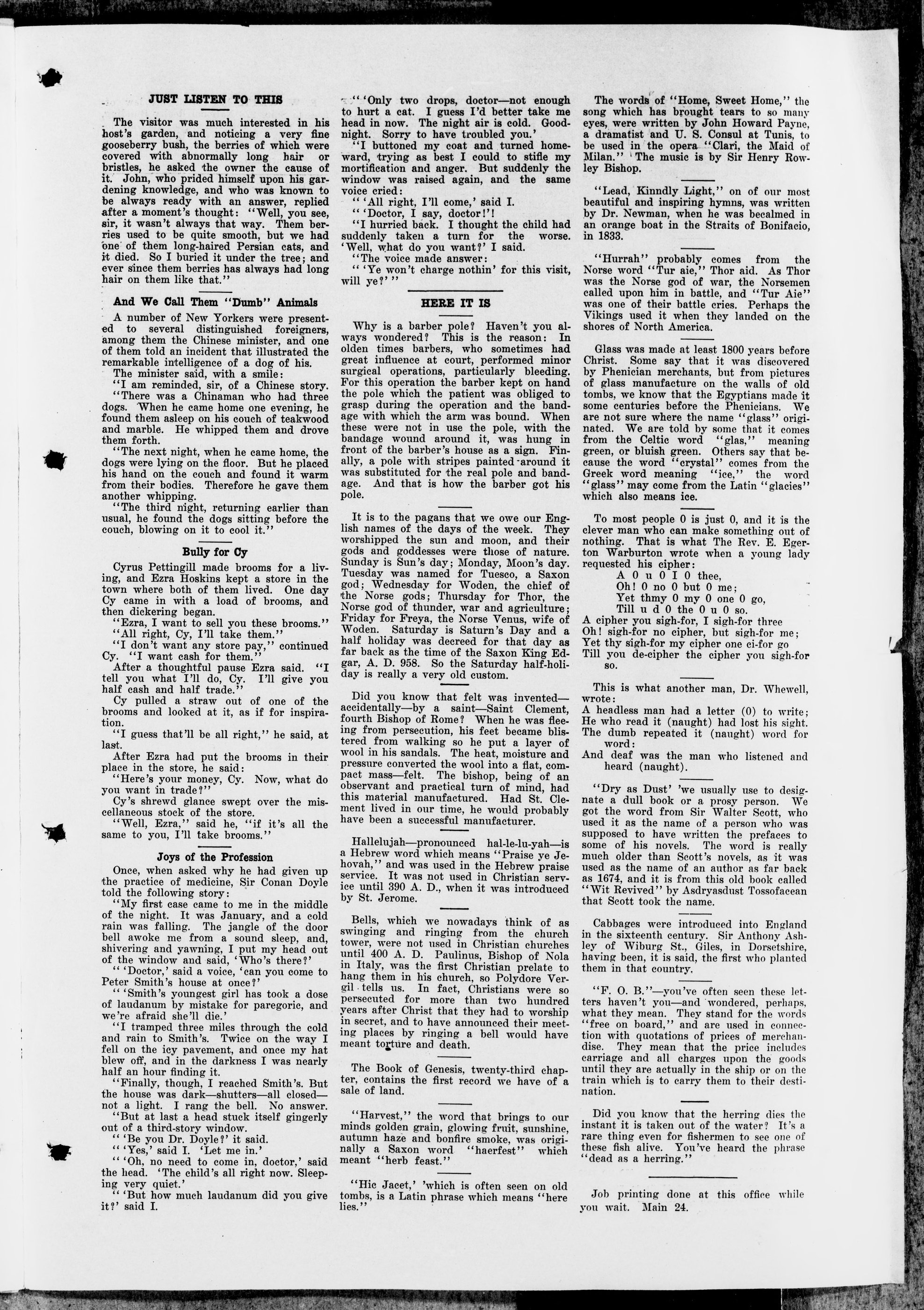
JUST LISTEN TO THIS
The visitor was much interested in his host's garden, and noticing a very fine gooseberry bush, the berries of which were covered with abnormally long hair or bristles, he asked the owner the cause of it. John, who prided himself upon his gardening knowledge, and who was known to be always ready with an answer, replied after a moment's thought: "Well, you see, sir, it wasn't always that way. Them berries used to be quite smooth, but we had one of them long-haired Persian cats, and it died. So I buried it under the tree; and ever since them berries has always had long hair on them like that."
And We Call Them "Dumb" Animals
A number of New Yorkers were presented to several distinguished foreigners, among them the Chinese minister, and one of them told an incident that illustrated the remarkable intelligence of a dog of his.
The minister said, with a smile:
"I am reminded, sir, of a Chinese story.
"There was a Chinaman who had three dogs. When he came home one evening, he found them asleep on his couch of teakwood and marble. He whipped them and drove them forth.
"The next night, when he came home, the dogs were lying on the floor. But he placed his hand on the couch and found it warm from their bodies. Therefore he gave them another whipping.
"The third night, returning earlier than usual, he found the dogs sitting before the couch, blowing on it to cool it."
Bully for Cy
Cyrus Pettingill made brooms for a living, and Ezra Hoskins kept a store in the town where both of them lived. One day Cy came in with a load of brooms, and then dickering began.
"Ezra, I want to sell you these brooms."
"All right, Cy, I'll take them."
"I don't want any store pay," continued Cy. "I want cash for them."
After a thoughtful pause Ezra said. "I tell you what I'll do, Cy. I'll give you half cash and half trade."
Cy pulled a straw out of one of the brooms and looked at it, as if for inspiration.
"I guess that'll be all right," he said, at last.
After Ezra had put the brooms in their place in the store, he said:
"Here's your money, Cy. Now, what do you want in trade?"
Cy's shrewd glance swept over the miscellaneous stock of the store.
"Well, Ezra," said he, "if it's all the same to you, I'll take brooms."
Jovs of the Profession
Once, when asked why he had given up the practice of medicine, Sir Conan Doyle told the following story:
"My first case came to me in the middle of the night. It was January, and a cold rain was falling. The jangle of the door bell awoke me from a sound sleep, and, shivering and yawning, I put my head out of the window and said, 'Who's there?'
'Doctor,' said a voice, 'can you come to Peter Smith's house at once?'
'Smith's youngest girl has took a dose of laudanum by mistake for paregoric, and we're afraid she'll die.'
"I tramped three miles through the cold and rain to Smith's. Twice on the way I fell on the icy pavement, and once my hat blew off, and in the darkness I was nearly half an hour finding it.
"Finally, though, I reached Smith's. But the house was dark—shutters—all closed—not a light. I rang the bell. No answer.
"But at last a head stuck itself gingerly out of a third-story window.
"‘Be you Dr. Doyle?' it said.
"‘Yes,’ said I. ‘Let me in.’
"‘Oh, no need to come in, doctor,’ said the head. 'The child's all right now. Sleeping very quiet.'
"But how much laudanum did you give it?' said I.
"Only two drops, doctor—not enough to hurt a cat. I guess I'd better take me head in now. The night air is cold. Goodnight. Sorry to have troubled you.' "I buttoned my coat and turned homeward, trying as best I could to stifle my mortification and anger. But suddenly the window was raised again, and the same voice cried: "All right, I'll come,' said I. "Doctor. I say, doctor!'!
"I hurried back. I thought the child had suddenly taken a turn for the worse. 'Well, what do you want?' I said.
"The voice made answer:
"'Ye won't charge nothin' for this visit, will ye?''"
HERE IT IS
Why is a barber pole? Haven't you always wondered? This is the reason: In olden times barbers, who sometimes had great influence at court, performed minor surgical operations, particularly bleeding. For this operation the barber kept on hand the pole which the patient was obliged to grasp during the operation and the bandage with which the arm was bound. When these were not in use the pole, with the bandage wound around it, was hung in front of the barber's house as a sign. Finally, a pole with stripes painted around it was substituted for the real pole and bandage. And that is how the barber got his pole.
It is to the pagans that we owe our English names of the days of the week. They worshipped the sun and moon, and their gods and goddesses were those of nature. Sunday is Sun's day; Monday, Moon's day. Tuesday was named for Tuesco, a Saxon god; Wednesday for Woden, the chief of the Norse gods; Thursday for Thor, the Norse god of thunder, war and agriculture; Friday for Freya, the Norse Venus, wife of Woden. Saturday is Saturn's Day and a half holiday was decreed for that day as far back as the time of the Saxon King Edgar, A. D. 958. So the Saturday half-holiday is really a very old custom.
Did you know that felt was invented—accidentally—by a saint—Saint Clement, fourth Bishop of Rome? When he was fleeing from persecution, his feet became blistered from walking so he put a layer of wool in his sandals. The heat, moisture and pressure converted the wool into a flat, compact mass—felt. The bishop, being of an observant and practical turn of mind, had this material manufactured. Had St. Clement lived in our time, he would probably have been a successful manufacturer.
Hallelujah—pronounced hal-le-lu-yah—is a Hebrew word which means "Praise ye Jehovah," and was used in the Hebrew praise service. It was not used in Christian service until 390 A. D., when it was introduced by St. Jerome.
Bells, which we nowadays think of as swinging and ringing from the church tower, were not used in Christian churches until 400 A. D. Paulinus, Bishop of Nola in Italy, was the first Christian prelate to hang them in his church, so Polydore Vergil tells us. In fact, Christians were so persecuted for more than two hundred years after Christ that they had to worship in secret, and to have announced their meeting places by ringing a bell would have meant torture and death.
The Book of Genesis, twenty-third chapter, contains the first record we have of a sale of land.
"Harvest," the word that brings to our minds golden grain, glowing fruit, sunshine, autumn haze and bonfire smoke, was originally a Saxon word "haerfest" which meant "herb feast."
"Hic Jacet,' 'which is often seen on old tombs, is a Latin phrase which means "here lies."
The words of "Home, Sweet Home," the song which has brought tears to so many eyes, were written by John Howard Payne, a dramatist and U. S. Consul at Tunis, to be used in the opera "Clari, the Maid of Milan." The music is by Sir Henry Rowley Bishop.
"Lead, Kinndly Light," on of our most beautiful and inspiring hymns, was written by Dr. Newman, when he was becalmed in an orange boat in the Straits of Bonifacio, in 1833.
"Hurrah" probably comes from the Norse word "Tur aie," Thor aid. As Thor was the Norse god of war, the Norsemen called upon him in battle, and "Tur Aie" was one of their battle cries. Perhaps the Vikings used it when they landed on the shores of North America.
Glass was made at least 1800 years before Christ. Some say that it was discovered by Phenician merchants, but from pictures of glass manufacture on the walls of old tombs, we know that the Egyptians made it some centuries before the Phenicians. We are not sure where the name "glass" originated. We are told by some that it comes from the Celtic word "glas," meaning green, or bluish green. Others say that because the word "crystal" comes from the Greek word meaning "ice," the word "glass" may come from the Latin "glacies" which also means ice.
To most people 0 is just 0, and it is the clever man who can make something out of nothing. That is what The Rev. E. Egerton Warburton wrote when a young lady requested his cipher:
A cipher you sigh-for, I sigh-for three
Oh! sigh-for no cipher, but sigh-for me;
Yet thy sigh-for my cipher one ci-for go
Till you de-cipher the cipher you sigh-for
so.
A 0 u 0 I 0 thee,
Oh! 0 no 0 but 0 me;
Yet thmy 0 my 0 one 0 go,
Till u d 0 the 0 u 0 so.
This is what another man, Dr. Whewell, wrote: A headless man had a letter (0) to write; He who read it (naught) had lost his sight. The dumb repeated it (naught) word for word: And deaf was the man who listened and heard (naught).
"Dry as Dust' we usually use to designate a dull book or a prosy person. We got the word from Sir Walter Scott, who used it as the name of a person who was supposed to have written the prefaces to some of his novels. The word is really much older than Scott's novels, as it was used as the name of an author as far back as 1674, and it is from this old book called "Wit Revived" by Asdryasdust Tossofacean that Scott took the name.
Cabbages were introduced into England in the sixteenth century. Sir Anthony Ashley of Wiburg St., Giles, in Dorsetshire, having been, it is said, the first who planted them in that country.
"F. O. B."—you've often seen these letters haven't you—and wondered, perhaps, what they mean. They stand for the words "free on board," and are used in connection with quotations of prices of merchandise. They mean that the price includes carriage and all charges upon the goods until they are actually in the ship or on the train which is to carry them to their destination.
Did you know that the herring dies the instant it is taken out of the water? It's a rare thing even for fishermen to see one of these fish alive. You've heard the phrase "dead as a herring."
Job printing done at this office while you wait. Main 24.
```markdown
```
---
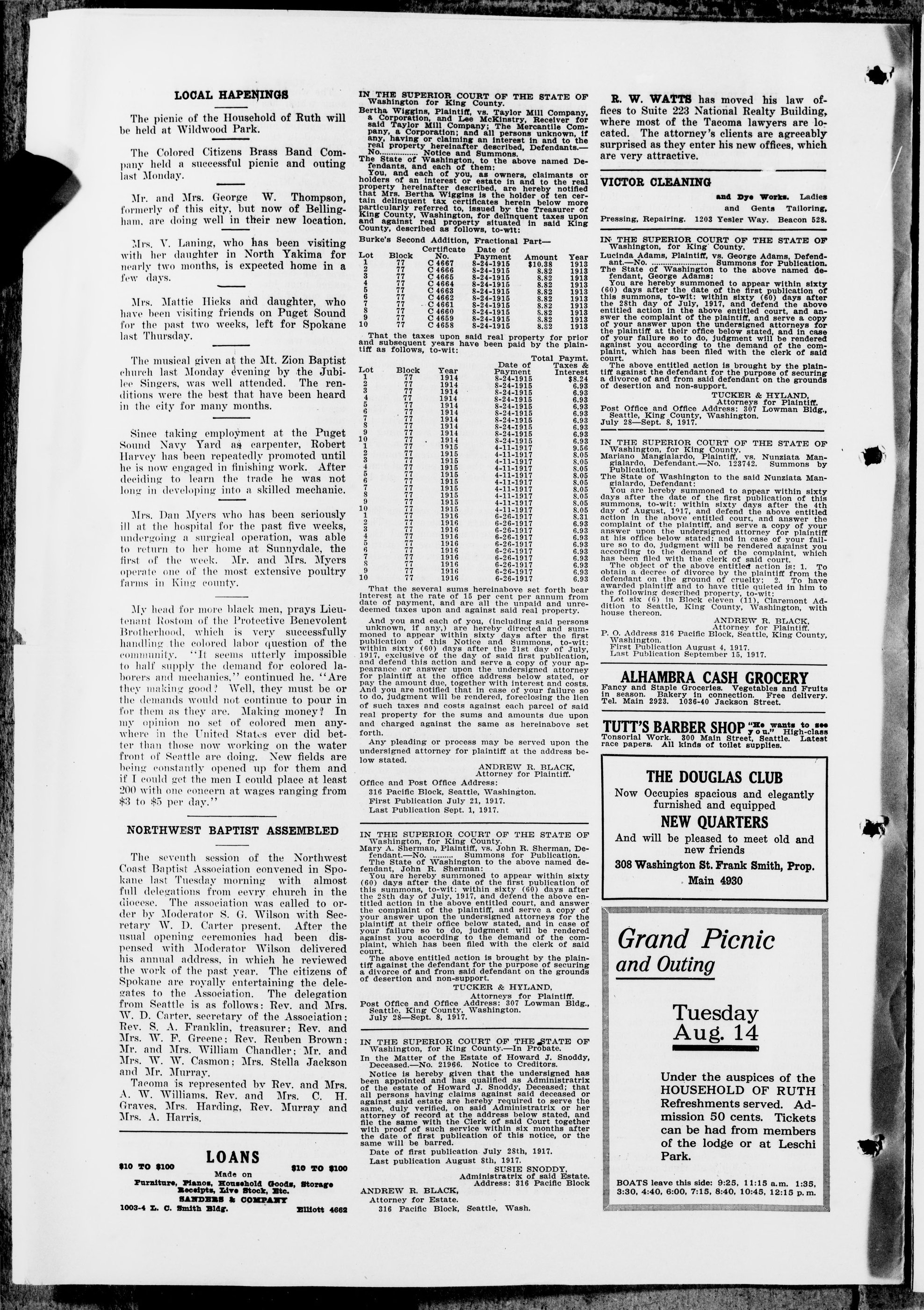
LOCAL HAPENINGS
The picnic of the Household of Ruth will be held at Wildwood Park.
The Colored Citizens Brass Band Company held a successful picnic and outing last Monday.
Mr. and Mrs. George W. Thompson, formerly of this city, but now of Bellingham, are doing well in their new location.
Mrs. V. Laning, who has been visiting with her daughter in North Yakima for nearly two months, is expected home in a few days.
Mrs. Mattie Hicks and daughter, who have been visiting friends on Puget Sound for the past two weeks, left for Spokane last Thursday.
The musical given at the Mt. Zion Baptist church last Monday evening by the Jubilee Singers, was well attended. The renditions were the best that have been heard in the city for many months.
Since taking employment at the Puget Sound Navy Yard as carpenter, Robert Harvey has been repeatedly promoted until he is now engaged in finishing work. After deciding to learn the trade he was not long in developing into a skilled mechanic. Mrs. Dan Myers who has been seriously ill at the hospital for the past five weeks, undergoing a surgical operation, was able to return to her home at Sunnydale, the first of the week. Mr. and Mrs. Myers operate one of the most extensive poultry farms in King county.
My head for more black men, prays Lieutenant Rostom of the Protective Benevolent Brotherhood, which is very successfully handling the colored labor question of the community. "It seems utterly impossible to half supply the demand for colored laborers and mechanics," continued he. "Are they making good? Well, they must be or the demands would not continue to pour in for them as they are. Making money? In my opinion no set of colored men anywhere in the United States ever did better than those now working on the water front of Seattle are doing. New fields are being constantly opened up for them and if I could get the men I could place at least 200 with one concern at wages ranging from $3 to $5 per day."
NORTHWEST BAPTIST ASSEMBLED
The seventh session of the Northwest Coast Baptist Association convened in Spokane last Tuesday morning with almost full delegations from eevry church in the diocese. The association was called to order by Moderator S. G. Wilson with Secretary W. D. Carter present. After the usual opening ceremonies had been dispensed with Moderator Wilson delivered his annual address, in which he reviewed the work of the past year. The citizens of Spokane are royally entertaining the delegates to the Association. The delegation from Seattle is as follows: Rev. and Mrs. W. D. Carter, secretary of the Association; Rev. S. A. Franklin, treasurer; Rev. and Mrs. W. F. Greene; Rev. Reuben Brown; Mr. and Mrs. William Chandler; Mr. and Mrs. W. W. Casmon; Mrs. Stella Jackson and Mr. Murray.
Taeoma is represented by Rev. and Mrs. A. W. Williams, Rev. and Mrs. C. H. Graves, Mrs. Harding, Rev. Murray and Mrs. A. Harris.
LOANS
$10 TO $100 $10 TO $100
Made on
Furniture, Pianos, Household Goods, Storage
Receipts, Live Stock, Etc.
SANDERS & COMPANY
1003-4 L. C. Smith Bldg. Elliott 4662
IN THE SUPERIOR COURT OF THE STATE OF Washington for King County.
Bertha Wiggins, Plaintiff, vs. Taylor Mill Company, a Corporation, and Lee McKinstry, Receiver for said Taylor Mill Company; The Mercantile Company, a Corporation; and all persons unknown, if any, having or claiming an interest in and to the real property hereinafter described, Defendants.—No. Notice and Summons.
The State of Washington, to the above named Defendants, and each of them:
That the taxes upon said real property for prior and subsequent years have been paid by the plaintiff as follows, to-wit:
That the several sums hereinabove set forth bear interest at the rate of 15 per cent per annum from date of payment, and are all the unpaid and unredeemed taxes upon and against said real property.
And you and each of you, (including said persons unknown, if any,) are hereby directed and summoned to appear within sixty days after the first publication of this Notice and Summons, to-wit: within sixty (60) days after the 21st day of July, 1917, exclusive of the day of said first publication, and defend this action and serve a copy of your appearance or answer upon the undersigned attorney for plaintiff at the office address below stated, or pay the amount due, together with interest and costs. And you are notified that in case of your failure so to do, judgment will be rendered, foreclosing the lien of such taxes and costs against each parcel of said real property for the sums and amounts due upon and charged against the same as hereinabove set forth.
Any pleading or process may be served upon the undersigned attorney for plaintiff at the address below stated.
ANDREW R. BLACK
Attorney for Plaintiff.
Office and Post Office Address:
316 Pacific Block, Seattle, Washington.
First Publication July 21, 1917.
Last Publication Sept. 1, 1917.
IN THE SUPERIOR COURT OF THE STATE OF Washington, for King County.
Mary A. Sherman, Plaintiff, vs. John R. Sherman, Defendant—No. .... Summons for Publication.
The State of Washington to the above named defendant, John R. Sherman:
You are hereby summoned to appear within sixty (60) days after the date of the first publication of this summons, to-wit: within sixty (60) days after the 28th day of July, 1917, and defend the above entitled action in the above entitled court, and answer the complaint of the plaintiff, and serve a copy of your answer upon the undersigned attorneys for the plaintiff at their office below stated, and in case of your failure so to do, judgment will be rendered against you according to the demand of the complaint, which has been filed with the clerk of said court.
The above entitled action is brought by the plaintiff against the defendant for the purpose of securing a divorce of and from said defendant on the grounds of desertion and non-support.
TUCKER & HYLAND.
Attorneys for Plaintiff.
Post Office and Office Address: 307 Lowman Bldg.
Seattle, King County, Washington.
July 28—Sept. 8, 1917.
IN THE SUPERIOR COURT OF THE STATE OF Washington, for King County.—In Probate.
In the Matter of the Estate of Howard J. Snoddy, Deceased.—No. 21966. Notice to Creditors.
Notice is hereby given that the undersigned has been appointed and has qualified as Administratrix of the estate of Howard J. Snoddy, Deceased; that all persons having claims against said deceased or against said estate are hereby required to serve the same, duly verified, on said Administratrix or her attorney of record at the address below stated, and file the same with the Clerk of said Court together with proof of such service within six months after the date of first publication of this notice, or the same will be barred.
Date of first publication July 28th, 1917.
R. W. WATTS has moved his law offices to Suite 223 National Realty Building, where most of the Tacoma lawyers are located. The attorney's clients are agreeably surprised as they enter his new offices, which are very attractive.
VICTOR CLEANING
Pressing, Repairing. 1203 Yesler Way. Beacon 528.
IN THE SUPERIOR COURT OF THE STATE OF Washington, for King County.
Lucinda Adams, Plaintiff, vs. George Adams, Defendant.—No. Summons for Publication.
The State of Washington to the above named defendant, George Adams:
You are hereby summoned to appear within sixty (60) days after the date of the first publication of this summons, to-wit: within sixty (60) days after the 28th day of July, 1917, and defend the above entitled action in the above entitled court, and answer the complaint of the plaintiff, and serve a copy of your answer upon the undersigned attorneys for the plaintiff at their office below stated, and in case of your failure so to do, judgment will be rendered against you according to the demand of the complaint, which has been filed with the clerk of said court.
The above entitled action is brought by the plain- tiff against the defendant for the purpose of securing a divorce of and from said defendant on the grounds of desertion and non-support.
TUCKER & HYLAND,
Attorneys for Plaintiff.
Post Office and Office Address: 307 Lowman Bldg.,
Seattle, King County, Washington.
July 28—Sept. 8, 1917.
IN THE SUPERIOR COURT OF THE STATE OF
Washington, for King County.
Mariano Mangicilardo, Plaintiff, Nuwatare, Man
Mariano Mangialardo, Plaintiff, vs. Nunziata Mangialardo, Defendant.—No. 123742. Summons by Publication.
The State of Washington to the said Nunziata Mangialardo, Defendant:
You are hereby summoned to appear within sixty days after the date of the first publication of this summons, to-wit: within sixty days after the 4th day of August, 1917, and defend the above entitled action in the above entitled court, and answer the complaint of the plaintiff, and serve a copy of your answer upon the undersigned attorney for plaintiff at his office below stated; and in case of your failure so to do, judgment will be rendered against you according to the demand of the complaint, which has been filed with the clerk of said court.
The object of the above entitled action is: 1. To obtain a decree of divorce by the plaintiff from the defendant on the ground of cruelty; 2. To have awarded plaintiff and to have title quieted in him to the following described property, to-wit; Lot six (6) in Block eleven (11), Claremont Addition to Seattle, King County, Washington, with house thereon.
First Publication August 4. 1917.
Last Publication September 15. 1917
ALHAMBRA CASH GROCERY
Fancy and Staple Groceries. Vegetables and Fruits in season. Bakery in connection. Free delivery. Tel. Main 2923. 1036-40 Jackson Street.
TUTT'S BARBER SHOP "He wants to see you." High-class Tonsorial Work. 800 Main Street, Seattle. Latest race papers. All kinds of toilet supplies.
THE DOUGLAS CLUB
Now Occupies spacious and elegantly furnished and equipped
NEW QUARTERS
And will be pleased to meet old and new friends
308 Washington St. Frank Smith, Prop.
Main 4930
Grand Picnic and Outing
Tuesday
Aug. 14
Under the auspices of the
HOUSEHOLD OF RUTH
Refreshments served. Ad-
mission 50 cents. Tickets
can be had from members
of the lodge or at Leschi
Park.
BOATS leave this side: 9:25, 11:15 a.m. 1:35, 3:30, 4:40, 6:00, 7:15, 8:40, 10:45, 12:15 p.m.