Cayton's Weekly
Saturday, September 1, 1917
Seattle, Washington
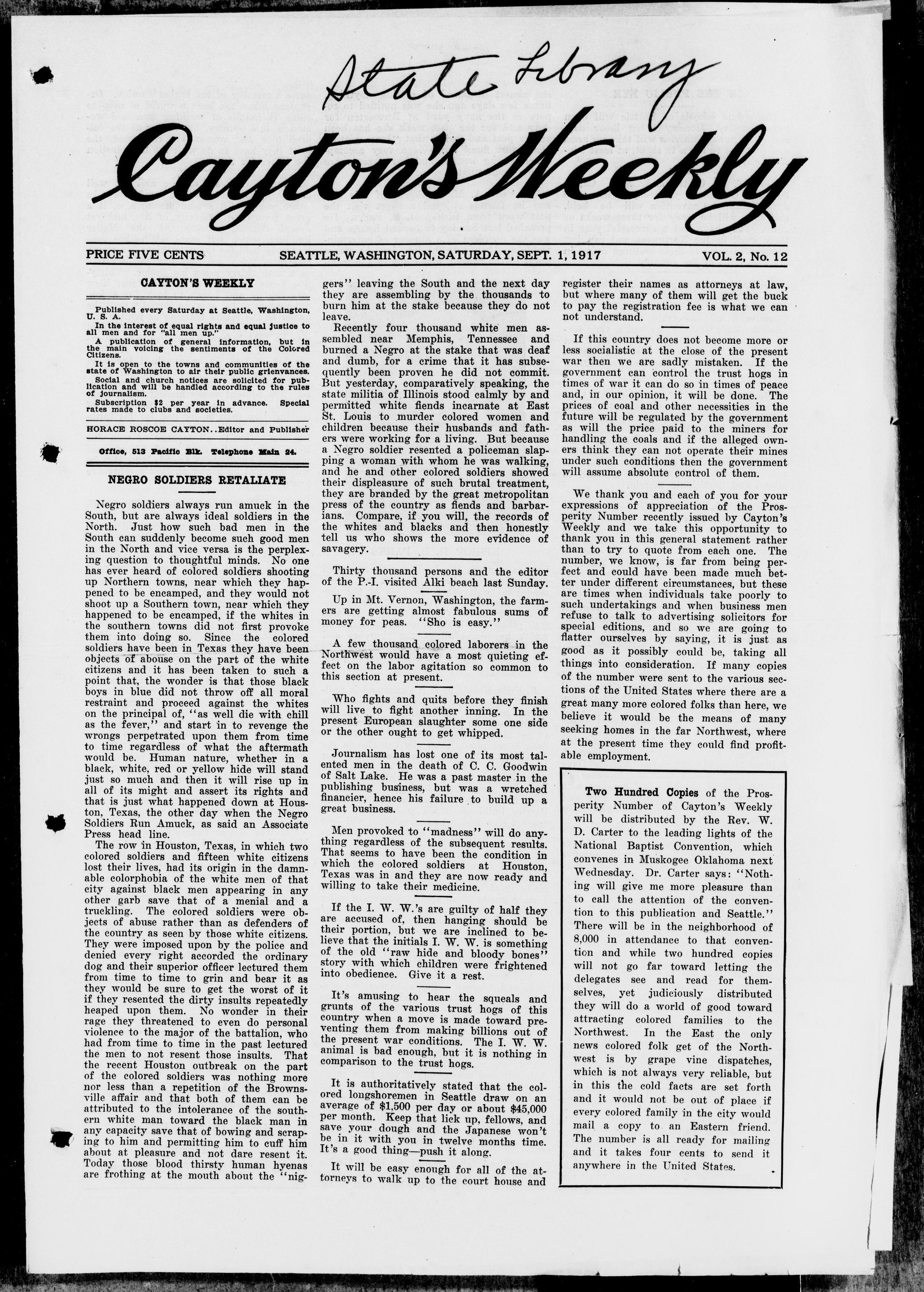
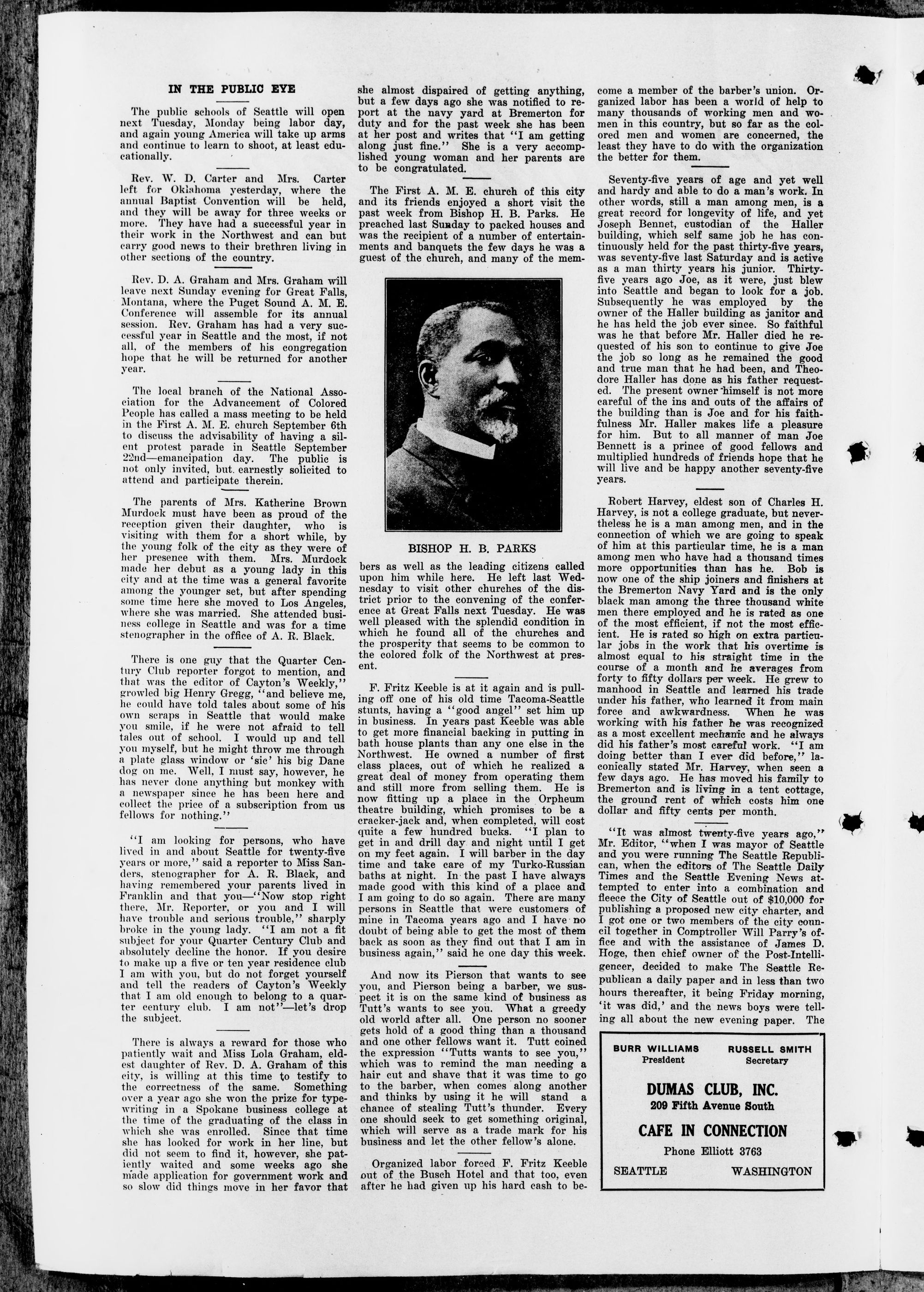
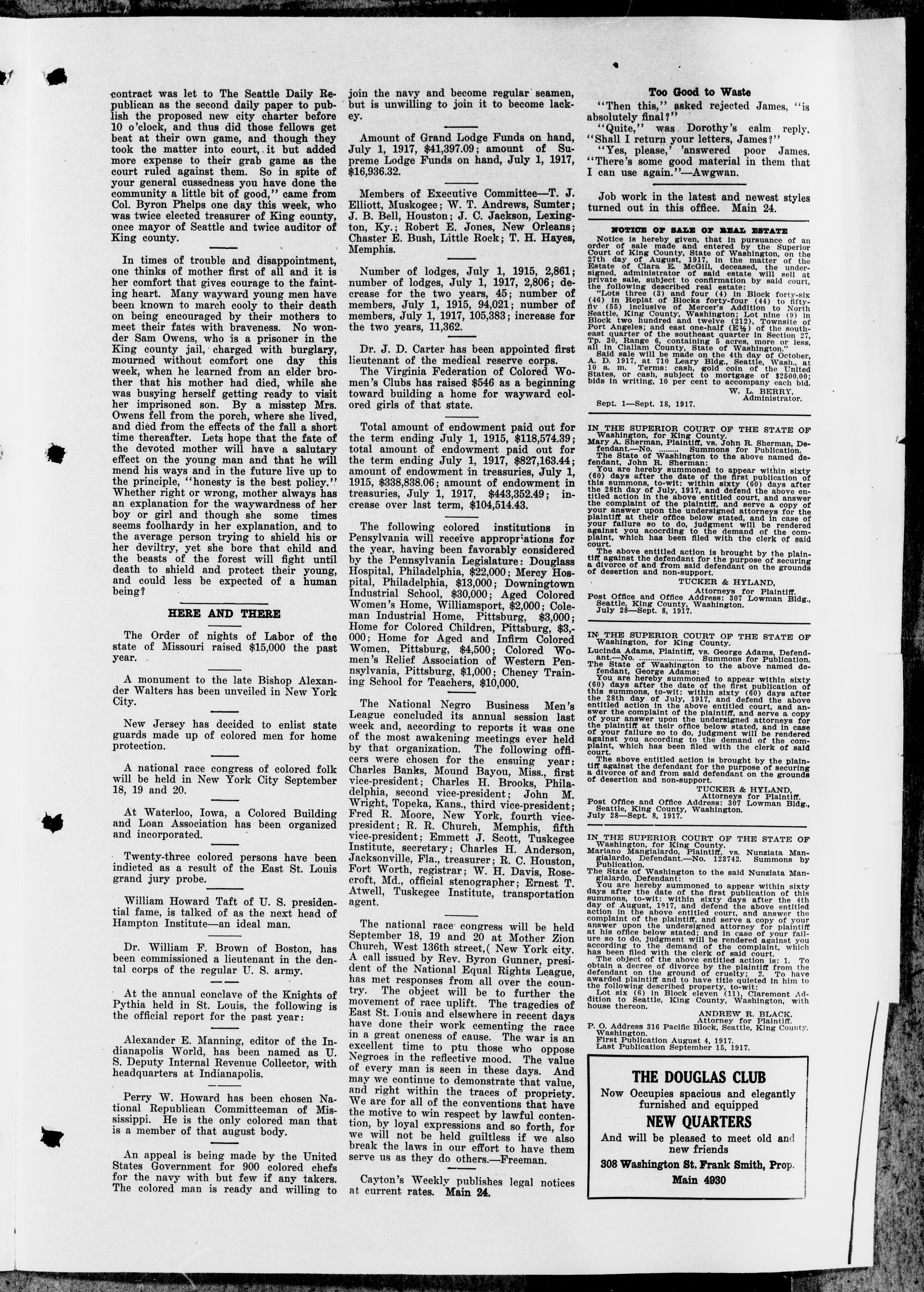
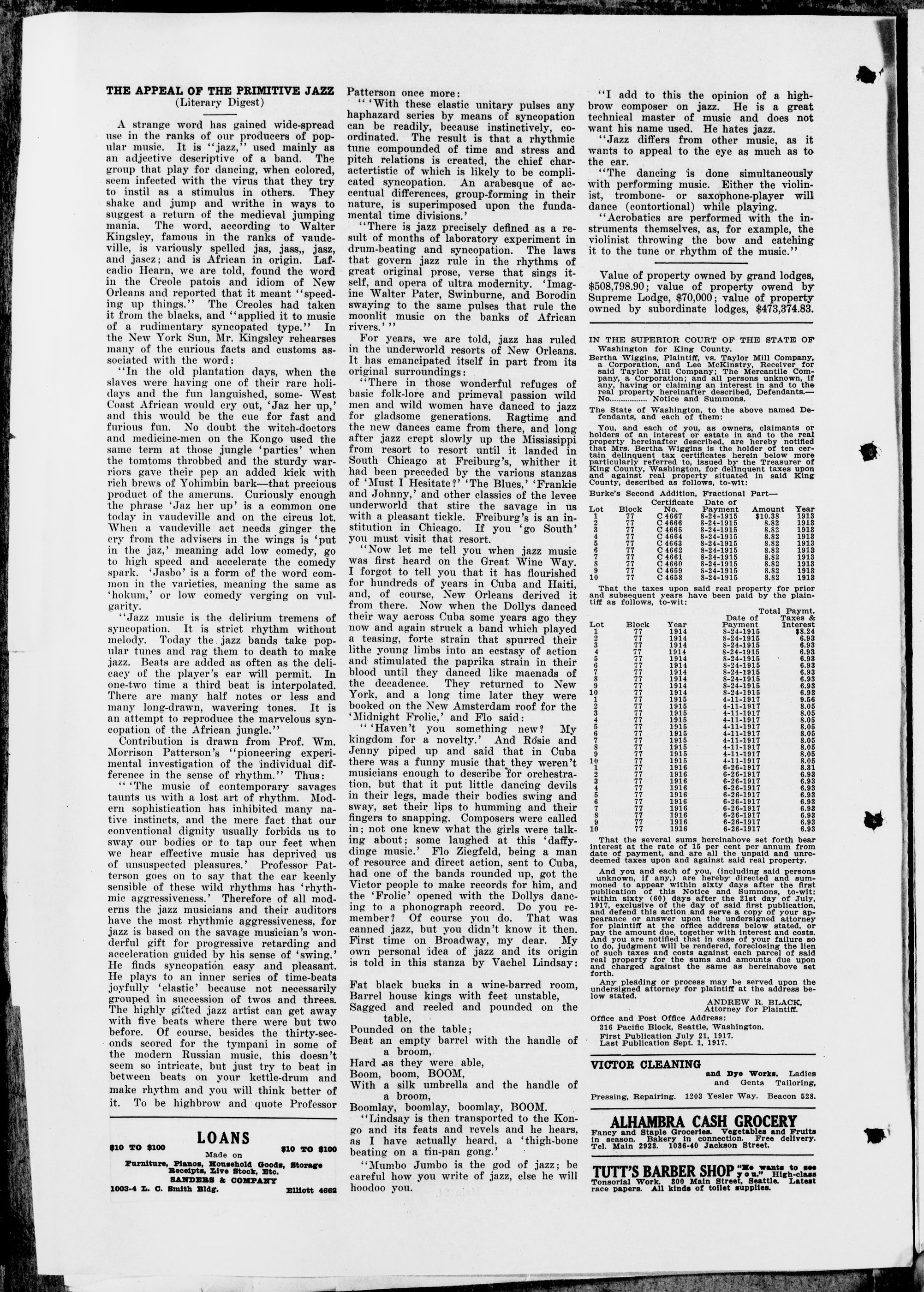
Page text (machine-generated)
State Library
Cayton's Weekly
CAYTON'S WEEKLY
Published every Saturday at Seattle, Washington, U. S. A.
In the interest of equal rights and equal justice to all men and for "all men up."
A publication of general information, but in the main voicing the sentiments of the Colored Citizens.
It is open to the towns and communities of the state of Washington to air their public grievances. Social and church notices are solicited for publication and will be handled according to the rules of journalism.
Subscription $2 per year in advance. Special rates made to clubs and societies.
HORACE ROSCOE CAYTON..Editor and Publisher
Office, 513 Pacific Blk. Telephone Main 24.
NEGRO SOLDIERS RETALIATE
Negro soldiers always run amuck in the South, but are always ideal soldiers in the North. Just how such bad men in the South can suddenly become such good men in the North and vice versa is the perplexing question to thoughtful minds. No one has ever heard of colored soldiers shooting up Northern towns, near which they happened to be encamped, and they would not shoot up a Southern town, near which they happened to be encamped, if the whites in the southern towns did not first provoke them into doing so. Since the colored soldiers have been in Texas they have been objects of abuse on the part of the white citizens and it has been taken to such a point that, the wonder is that those black boys in blue did not throw off all moral restraint and proceed against the whites on the principal of, "as well die with chill as the fever," and start in to revenge the wrongs perpetrated upon them from time to time regardless of what the aftermath would be. Human nature, whether in a black, white, red or yellow hide will stand just so much and then it will rise up in all of its might and assert its rights and that is just what happened down at Houston, Texas, the other day when the Negro Soldiers Run Amuck, as said an Associate Press head line.
The row in Houston, Texas, in which two colored soldiers and fifteen white citizens lost their lives, had its origin in the damnable colorphobia of the white men of that city against black men appearing in any other garb save that of a menial and a truckling. The colored soldiers were objects of abuse rather than as defenders of the country as seen by those white citizens. They were imposed upon by the police and denied every right accorded the ordinary dog and their superior officer lectured them from time to time to grin and bear it as they would be sure to get the worst of it if they resented the dirty insults repeatedly heaped upon them. No wonder in their rage they threatened to even do personal violence to the major of the battalion, who had from time to time in the past lectured the men to not resent those insults. That the recent Houston outbreak on the part of the colored soldiers was nothing more nor less than a repetition of the Brownsville affair and that both of them can be attributed to the intolerance of the southern white man toward the black man in any capacity save that of bowing and scraping to him and permitting him to cuff him about at pleasure and not dare resent it. Today those blood thirsty human hyenas are frothing at the mouth about the "nig-
gers" leaving the South and the next day they are assembling by the thousands to burn him at the stake because they do not leave.
Recently four thousand white men assembled near Memphis, Tennessee and burned a Negro at the stake that was deaf and dumb, for a crime that it has subsequently been proven he did not commit. But yesterday, comparatively speaking, the state militia of Illinois stood calmly by and permitted white fiends incarnate at East St. Louis to murder colored women and children because their husbands and fathers were working for a living. But because a Negro soldier resented a policeman slapping a woman with whom he was walking, and he and other colored soldiers showed their displeasure of such brutal treatment, they are branded by the great metropolitan press of the country as fiends and barbarians. Compare, if you will, the records of the whites and blacks and then honestly tell us who shows the more evidence of savagery.
Thirty thousand persons and the editor of the P.-I. visited Alki beach last Sunday.
Up in Mt. Vernon, Washington, the farmers are getting almost fabulous sums of money for peas. "Sho is easy."
A few thousand colored laborers in the Northwest would have a most quieting effect on the labor agitation so common to this section at present.
Who fights and quits before they finish will live to fight another inning. In the present European slaughter some one side or the other ought to get whipped.
Journalism has lost one of its most talented men in the death of C. C. Goodwin of Salt Lake. He was a past master in the publishing business, but was a wretched financier, hence his failure to build up a great business.
Men provoked to "madness" will do anything regardless of the subsequent results. That seems to have been the condition in which the colored soldiers at Houston, Texas was in and they are now ready and willing to take their medicine.
If the I. W. W.'s are guilty of half they are accused of, then hanging should be their portion, but we are inclined to believe that the initials I. W. W. is something of the old "raw hide and bloody bones" story with which children were frightened into obedience. Give it a rest.
It's amusing to hear the squeals and grunts of the various trust hogs of this country when a move is made toward preventing them from making billions out of the present war conditions. The I. W. W. animal is bad enough, but it is nothing in comparison to the trust hogs.
It is authoritatively stated that the colored longshoremen in Seattle draw on an average of $1,500 per day or about $45,000 per month. Keep that lick up, fellows, and save your dough and the Japanese won't be in it with you in twelve months time. It's a good thing—push it along.
It will be easy enough for all of the attorneys to walk up to the court house and
VOL.2, No.12
register their names as attorneys at law, but where many of them will get the buck to pay the registration fee is what we can not understand.
If this country does not become more or less socialistic at the close of the present war then we are sadly mistaken. If the government can control the trust hogs in times of war it can do so in times of peace and, in our opinion, it will be done. The prices of coal and other necessities in the future will be regulated by the government as will the price paid to the miners for handling the coals and if the alleged owners think they can not operate their mines under such conditions then the government will assume absolute control of them.
We thank you and each of you for your expressions of appreciation of the Prosperity Number recently issued by Cayton's Weekly and we take this opportunity to thank you in this general statement rather than to try to quote from each one. The number, we know, is far from being perfect and could have been made much better under different circumstances, but these are times when individuals take poorly to such undertakings and when business men refuse to talk to advertising solicitors for special editions, and so we are going to flatter ourselves by saying, it is just as good as it possibly could be, taking all things into consideration. If many copies of the number were sent to the various sections of the United States where there are a great many more colored folks than here, we believe it would be the means of many seeking homes in the far Northwest, where at the present time they could find profitable employment.
Two Hundred Copies of the Prosperity Number of Cayton's Weekly will be distributed by the Rev. W. D. Carter to the leading lights of the National Baptist Convention, which convenes in Muskogee Oklahoma next Wednesday. Dr. Carter says: "Nothing will give me more pleasure than to call the attention of the convention to this publication and Seattle." There will be in the neighborhood of 8,000 in attendance to that convention and while two hundred copies will not go far toward letting the delegates see and read for themselves, yet judiciously distributed they will do a world of good toward attracting colored families to the Northwest. In the East the only news colored folk get of the Northwest is by grape vine dispatches, which is not always very reliable, but in this the cold facts are set forth and it would not be out of place if every colored family in the city would mail a copy to an Eastern friend. The number is all ready for mailing and it takes four cents to send it anywhere in the United States.
```markdown
```
IN THE PUBLIC EYE
The public schools of Seattle will open next Tuesday, Monday being labor day, and again young America will take up arms and continue to learn to shoot, at least educationally.
Rev. W. D. Carter and Mrs. Carter left for Oklahoma yesterday, where the annual Baptist Convention will be held, and they will be away for three weeks or more. They have had a successful year in their work in the Northwest and can but carry good news to their brethren living in other sections of the country.
Rev. D. A. Graham and Mrs. Graham will leave next Sunday evening for Great Falls, Montana, where the Puget Sound A. M. E. Conference will assemble for its annual session. Rev. Graham has had a very successful year in Seattle and the most, if not all, of the members of his congregation hope that he will be returned for another year.
The local branch of the National Association for the Advancement of Colored People has called a mass meeting to be held in the First A. M. E. church September 6th to discuss the advisability of having a silent protest parade in Seattle September 22nd-emancipation day. The public is not only invited, but earnestly solicited to attend and participate therein.
The parents of Mrs. Katherine Brown Murdock must have been as proud of the reception given their daughter, who is visiting with them for a short while, by the young folk of the city as they were of her presence with them. Mrs. Murdock made her debut as a young lady in this city and at the time was a general favorite among the younger set, but after spending some time here she moved to Los Angeles, where she was married. She attended business college in Seattle and was for a time stenographer in the office of A. R. Black.
There is one guy that the Quarter Century Club reporter forgot to mention, and that was the editor of Cayton's Weekly," growled big Henry Gregg, "and believe me, he could have told tales about some of his own scraps in Seattle that would make you smile, if he were not afraid to tell tales out of school. I would up and tell you myself, but he might throw me through a plate glass window or 'sic' his big Dane dog on me. Well, I must say, however, he has never done anything but monkey with a newspaper since he has been here and collect the price of a subscription from us fellows for nothing."
"I am looking for persons, who have lived in and about Seattle for twenty-five years or more," said a reporter to Miss Sanders, stenographer for A. R. Black, and having remembered your parents lived in Franklin and that you—"Now stop right there, Mr. Reporter, or you and I will have trouble and serious trouble," sharply broke in the young lady. "I am not a fit subject for your Quarter Century Club and absolutely decline the honor. If you desire to make up a five or ten year residence club I am with you, but do not forget yourself and tell the readers of Cayton's Weekly that I am old enough to belong to a quarter century club. I am not"—let's drop the subject.
There is always a reward for those who patiently wait and Miss Lola Graham, eldest daughter of Rev. D. A. Graham of this city, is willing at this time to testify to the correctness of the same. Something over a year ago she won the prize for typewriting in a Spokane business college at the time of the graduating of the class in which she was enrolled. Since that time she has looked for work in her line, but did not seem to find it, however, she patiently waited and some weeks ago she made application for government work and so slow did things move in her favor that
she almost dispaired of getting anything, but a few days ago she was notified to report at the navy yard at Bremerton for duty and for the past week she has been at her post and writes that "I am getting along just fine." She is a very accomplished young woman and her parents are to be congratulated.
The First A. M. E. church of this city and its friends enjoyed a short visit the past week from Bishop H. B. Parks. He preached last Sunday to packed houses and was the recipient of a number of entertainments and banquets the few days he was a guest of the church, and many of the mem-
[Picture of a man with a white beard and a dark suit, facing slightly to the right.]
BISHOP H. B. PARKS bers as well as the leading citizens called upon him while here. He left last Wednesday to visit other churches of the district prior to the convening of the conference at Great Falls next Tuesday. He was well pleased with the splendid condition in which he found all of the churches and the prosperity that seems to be common to the colored folk of the Northwest at present.
F. Fritz Keeble is at it again and is pulling off one of his old time Tacoma-Seattle stunts, having a "good angel" set him up in business. In years past Keeble was able to get more financial backing in putting in bath house plants than any one else in the Northwest. He owned a number of first class places, out of which he realized a great deal of money from operating them and still more from selling them. He is now fitting up a place in the Orpheum theatre building, which promises to be a cracker-jack and, when completed, will cost quite a few hundred bucks. "I plan to get in and drill day and night until I get on my feet again. I will barber in the day time and take care of my Turko-Russian baths at night. In the past I have always made good with this kind of a place and I am going to do so again. There are many persons in Seattle that were customers of mine in Tacoma years ago and I have no doubt of being able to get the most of them back as soon as they find out that I am in business again," said he one day this week.
And now its Pierson that wants to see you, and Pierson being a barber, we suspect it is on the same kind of business as Tutt's wants to see you. What a greedy old world after all. One person no sooner gets hold of a good thing than a thousand and one other fellows want it. Tutt coined the expression "Tutts wants to see you," which was to remind the man needing a hair cut and shave that it was time to go to the barber, when comes along another and thinks by using it he will stand a chance of stealing Tutt's thunder. Every one should seek to get something original, which will serve as a trade mark for his business and let the other fellow's alone.
Organized labor forced F. Fritz Keeble out of the Busch Hotel and that too, even after he had given up his hard cash to be-
come a member of the barber's union. Organized labor has been a world of help to many thousands of working men and women in this country, but so far as the colored men and women are concerned, the least they have to do with the organization the better for them.
Seventy-five years of age and yet well and hardy and able to do a man's work. In other words, still a man among men, is a great record for longevity of life, and yet Joseph Bennet, custodian of the Haller building, which self same job he has continuously held for the past thirty-five years, was seventy-five last Saturday and is active as a man thirty years his junior. Thirty-five years ago Joe, as it were, just blew into Seattle and began to look for a job. Subsequently he was employed by the owner of the Haller building as janitor and he has held the job ever since. So faithful was he that before Mr. Haller died he requested of his son to continue to give Joe the job so long as he remained the good and true man that he had been, and Theodore Haller has done as his father requested. The present owner himself is not more careful of the ins and outs of the affairs of the building than is Joe and for his faithfulness Mr. Haller makes life a pleasure for him. But to all manner of man Joe Bennett is a prince of good fellows and multiplied hundreds of friends hope that he will live and be happy another seventy-five years.
Robert Harvey, eldest son of Charles H. Harvey, is not a college graduate, but nevertheless he is a man among men, and in the connection of which we are going to speak of him at this particular time, he is a man among men who have had a thousand times more opportunities than has he. Bob is now one of the ship joiners and finishers at the Bremerton Navy Yard and is the only black man among the three thousand white men there employed and he is rated as one of the most efficient, if not the most efficient. He is rated so high on extra particular jobs in the work that his overtime is almost equal to his straight time in the course of a month and he averages from forty to fifty dollars per week. He grew to manhood in Seattle and learned his trade under his father, who learned it from main force and awkwardness. When he was working with his father he was recognized as a most excellent mechanic and he always did his father's most careful work. "I am doing better than I ever did before," laconically stated Mr. Harvey, when seen a few days ago. He has moved his family to Bremerton and is living in a tent cottage, the ground rent of which costs him one dollar and fifty cents per month.
"It was almost twenty-five years ago," Mr. Editor, "when I was mayor of Seattle and you were running The Seattle Republican, when the editors of The Seattle Daily Times and the Seattle Evening News attempted to enter into a combination and fleece the City of Seattle out of $10,000 for publishing a proposed new city charter, and I got one or two members of the city council together in Comptroller Will Parry's office and with the assistance of James D. Hoge, then chief owner of the Post-Intelligence, decided to make The Seattle Republican a daily paper and in less than two hours thereafter, it being Friday morning, 'it was did,' and the news boys were telling all about the new evening paper. The
nt a rn ° ri Eat
|| TS a Sa ee we
fo 6h
‘contract was let to The Seattle Daily Re-
publican as the second daily paper to pub-
lish the proposed new city charter before
10 o’clock, and thus did those fellows get
beat at their own game, and though they
took the matter into court,.it but added
more expense to their grab game as the
court ruled against them. So in spite of
your general cussedness you have done the
community a little bit of good,’”’ came from
Col. Byron Phelps one day this week, who
was twice elected treasurer of King county,
once mayor of Seattle and twice auditor of
King county.
In times of trouble and disappointment,
one thinks of mother first of all and it is
her comfort that gives courage to the faint-
ing heart. Many wayward young men have
been known to march cooly to their death
on being encouraged by their mothers to
meet their fates with braveness. No won-
der Sam Owens, who is a prisoner in the
King county jail, charged with burglary,
mourned without comfort one day this
week, when he learned from an elder bro-
ther that his mother had died, while she
was busying herself getting ready to visit
her imprisoned son. By a misstep Mrs.
Owens fell from the porch, where she lived,
and died from the effects of the fall a short
time thereafter. Lets hope that the fate of
the devoted mother will have a salutary
effect on the young man and that he will
mend his ways and in the future live up to
the principle, ‘‘honesty is the best policy.’’
Whether right or wrong, mother always has
an explanation for the waywardness of her
boy or girl and though she some times
seems foolhardy in her explanation, and to
the average person trying to shield his or
her deviltry, yet she bore that child and
the beasts of the forest will fight until
death to shield and protect their young,
and could less be expected of a human
being?
HERE AND THERE
The Order of nights of Labor of the
state of Missouri raised $15,000 the past
year.
A monument to the late Bishop Alexan-
der Walters has been unveiled in New York
City.
New Jersey has decided to enlist state
guards made up of colored men for home
protection.
A national race congress of colored folk
will be held in New York City September
18, 19 and 20.
At Waterloo, Iowa, a Colored Building
and Loan Association has been organized
and incorporated. i
- Twenty-three colored persons have been
indicted as a result of the East St. Louis
grand jury probe.
William Howard Taft of U. S. presiden-
tial fame, is talked of as the next head of
Hampton Institute—an ideal man.
Dr. William F. Brown of Boston, has
been commissioned a lieutenant in the den-
tal corps of the regular U. S. army.
At the annual conclave of the Knights of
Pythia held in St. Louis, the following is
the official report for the past year:
Alexander E. Manning, editor of the In-
dianapolis World, has been named as U.
8. Deputy Internal Revenue Collector, with
headquarters at Indianapolis.
Perry W. Howard has been chosen Na-
tional Republican Committeeman of Mis-
sissippi. He is the only colored man that
is a member of that august body.
An appeal is being made by the United
States Government for 900 colored chefs
for the navy with but few if any takers.
The colored man is ready and willing to
join the navy and become regular’ seamen,
but is unwilling to join it to become lack-
ey.
Amount of Grand Lodge Funds on hand,
July 1, 1917, $41,397.09; amount of Su-
preme Lodge Funds on hand, July 1, 1917,
$16,936.32.
Memphis.
Number of lodges, July 1, 1915, 2,861;
number of lodges, July 1, 1917, 2,806; de-
crease for the two years, 45; number of
members, July 1, 1915, 94,021; number of
members, July 1, 1917, 105,383; increase for
the two years, 11,362.
Dr. J. D. Carter has been appointed first
lieutenant of the medical reserve corps.
The Virginia Federation of Colored Wo-
men’s Clubs has raised $546 as a beginning
toward building a home for wayward col-
ored girls of that state.
Total amount of endowment paid out for
the term ending July 1, 1915, $118,574.39;
total amount of endowment paid out for
the term ending July 1, 1917, $827,163.44;
amount of endowment in treasuries, July 1,
1915, $338,838.06; amount of endowment in
treasuries, July 1, 1917, $443,352.49; in-
crease over last term, $104,514.43.
The following colored institutions in
Pensylvania will receive appropriations for
the year, having been favorably considered
by the Pennsylvania Legislature: Douglass
Hospital, Philadelphia, $22,000; Mercy Hos-
pital, Philadelphia, $13,000; Downingtown
Industrial School, $30,000; Aged Colored
Women’s Home, Williamsport, $2,000; Cole-
man Industrial Home, Pittsburg, $3,000;
Home for Colored Children, Pittsburg, $3,-
000; Home for Aged and Infirm Colored
Women, Pittsburg, $4,500; Colored Wo-
men’s Relief Association of Western Pen-
nsylvania, Pittsburg, $1,000; Cheney Train-
ing School for Teachers, $10,000,
The National Negro Business Men’s
League concluded its annual session last
week and, according to reports it was one
of the most awakening meetings ever held
by that organization. The following offi-
cers were chosen for the ensuing year:
Charles Banks, Mound Bayou, Miss., first
vice-president; Charles H. Brooks, Phila-
delphia, second vice-president; John M.
Wright, Topeka, Kans., third vice-president ;
Fred R. Moore, New York, fourth vice-
president; R. R. Church, Memphis, fifth
vice-president; Emmett J. Scott, Tuskegee
Institute, secretary; Charles H. Anderson,
Jacksonville, Fla., treasurer; R. C. Houston,
Fort Worth, registrar; W. H. Davis, Rose-
croft, Md., official stenographer; Ernest T.
Atwell, Tuskegee Institute, transportation
agent.
The national race congress will be held
September 18, 19 and 20 at Mother Zion
Church, West 136th street,( New York city.
A call issued by Rey. Byron Gunner, presi-
dent of the National Equal Rights League,
has met responses from all over the coun.
try. The object will be to further the
movement of race uplift. The tragedies of
East St. Louis and elsewhere in recent days
have done their work cementing the race
in a great oneness of cause. The war is an
excellent time to ptu those who oppose
Negroes in the reflective mood. The value
of every man is seen in these days. And
may we continue to demonstrate that value,
and right within the traces of propriety.
We are for all of the conventions that have
the motive to win respect by lawful conten-
tion, by loyal expressions and so forth, for
we will not be held guiltless if we also
break the laws in our effort to have them
serve us as they do others—Freeman.
Cayton’s Weekly publishes legal notices
at current rates. Main 24,
Too Good to Waste
“Then this,’’ asked rejected James, ‘‘is
absolutely final?”’
“‘Quite,’? was. Dorothy’s calm reply.
“Shall I return your letters, James?’’
“Yes, please,’ ‘answered poor James.
“‘There’s some good material in them that
I can use again.’’—Awgwan.
Job work in the latest and newest styles
turned out in this office. Main 24.
a
MOTICE OF SALE OF REAL ESTATE
Notice is hereby given, that in ore of an
order of sale made and entered by the Superior
Court of King County, State of Washington, on the
27th day of August, 1917, in the matter’ of the
Estate of Clara E. McGill, deceased, the under-
signed, administrator of said estate will sell at
private sale, subject to confirmation by said court,
the following described real estate:
“Lots three (3) and four (4) in Block forty-six
(46) in Replat of Blocks forty-four (44) to fifty-
fiv (55) inclusive of Mercer's Addition to North
Seattle, King County, Washington; Lot nine (9) in
Block two hundred and twelve (212), Townsite of
Port Angeles; and east one-half (E%) of the south-
east quarter of the southeast quarter in Section 27,
Tp. 30, Range 6, containing 5 acres, more or less,
all in Clallam County, State of Washington.”
Said sale will be made on the 4th pay of October,
A. D, 1917, at 710 Leary Bldg., Seattie, Wash., at
10 a. m. Terms: cash, gold coin of the United
States, or cash, subject to mortgage of $2500.00;
bids in writing, 10 per cent to accompany each bid.
W. L. BERRY,
Administrator.
Sept. 1—Sept. 18, 1917.
IN_THE SUPERIOR COURT OF THE STATE OF
sain gion for King County.
Mary A. Sherman, Plaintiff, vs. John R. Sherman, De-
fendant.—No. ........._ Summons for Publication.
The State of Washington to the above named de-
fendant, John R. Sherman: .
You are hereby summoned to appear within sixty
(60) days after the date of the first publication of
this summons, to-wit: within sixty, (60) days after
the 28th day of July, 1917, and defend the above en-
titled action in the above entitled court, and answer
the complaint of the plaintiff, and serve a copy of
your answer upon the undersigned attorneys for the
Plaintiff at their office below stated, and in case of
your failure so to do, judgment will be rendered
against you acocrding to the demand of the com-
ey which has been filed with the clerk of said
court.
The above entitled action is brought by the plain-
tiff against the defendant for cue purboRe of securing
a divorce of and from said defendant on the grounds
of desertion and non-support.
. TUCKER & HYLAND,
Attorneys for Plaintiff.
Post Office and Office Address: 307 Lowman Bidg.,
Seattle, King County, Washington.
July 28—Sept. 8, 1917.
IN THE SUPERIOR COURT OF THE STATE OF
‘Washington, for King County.
Lucinda Adams, Plaintiff, vs. George Adams, Defend-
ant.—No. ............-.......... Summons for Publication.
The State of Washington to the above named de-
fendant, George Adams:
You are hereby summoned to appear within sixty
(60) days after the date of the first publication of
this summons, to-wit: within sixty (60) days after
the 28th day of July, 1917, and defend the above
entitled action in the above entitled court, and an-
Swer the complaint of the plaintiff, and serve a copy
of your answer upon the undersigned attorneys for
the plaintiff at their office below stated, and in case
of your failure so to do, judgment will be rendered
orainat you according to the demand of the com-
plaint, which has been filed with the clerk of said
court.
The above entitled action is brought by the plain-
tiff against the defendant for the purpose of securing
a divorce of and from said defendant on the grounds
of desertion and non-support.
TUCKER & HYLAND,
Attorneys for Plaintiff.
Post Office and Office Address: 307 Lowman Bldg.,
Seattle, King County, Washington.
July 28—Sept. 8, 1917.
IN_|THE SUPERIOR COURT OF THE STATE OF
‘Washington, for King County.
Mariano Mangialardo, Plaintiff, vs. Nunziata Man-
gialardo, Defendant.—No. 123742. Summons by
Publication.
The State of Washington to the said Nunziata Man-
gialardo, Defendant:
You are hereby summoned to appear within sixty
days after the date of the first publication of this
summons, to-wit: within sixty care after the 4th
day of August, 1917, and defend the above entitled
action in the above entitled court, and answer the
complaint of the plaintiff, and serve a copy of your
answer upon the undersigned attorney for plaintiff
at his office below stated; and in case of your fail-
ure so to do, judgment will be rendered against you
according to the demand of the complaint, which
has been filed with the clerk of said court.
The object of the above entitled action is: 1. To
obtain a decree of divorce by, the plaintiff from the
defendant on the ground of cruelty; 2. To have
awarded plaintiff and to have title quieted in him to
the following described property, to-wit:
Lot six (6) in Block eleven (11), Claremont Ad-
dition to Seattle, King County, Washington, with
house thereon,
ANDREW R. BLACK,
Attorney for Plaintiff.
P.O. Address 316 Pacific Block, Seattle, King County,
Washington.
First Publication August 4, 1917.
Last Publication September 15, 1917.
THE DOUGLAS CLUB
Now Occupies spacious and elegantly
furnished and equipped
NEW QUARTERS
And will be pleased to meet old and
new friends
308 Washington St, Frank Smith, Prop.
Main 4930
THE APPEAL OF THE PRIMITIVE JAZZ (Literary Digest)
A strange word has gained wide-spread use in the ranks of our producers of popular music. It is "jazz," used mainly as an adjective descriptive of a band. The group that play for dancing, when colored, seem infected with the virus that they try to instil as a stimulus in others. They shake and jump and writhe in ways to suggest a return of the medieval jumping mania. The word, according to Walter Kingsley, famous in the ranks of vaudeville, is variously spelled jas, jass,, jasz, and jasez; and is African in origin. Lafcadio Hearn, we are told, found the word in the Creole patois and idiom of New Orleans and reported that it meant "speeding up things." The Creoles had taken it from the blacks, and "applied it to music of a rudimentary syncopated type." In the New York Sun, Mr. Kingsley rehearses many of the curious facts and customs associated with the word:
"In the old plantation days, when the slaves were having one of their rare holidays and the fun languished, some- West Coast African would cry out, 'Jaz her up,' and this would be the cue for fast and furious fun. No doubt the witch-doctors and medicine-men on the Kongo used the same term at those jungle 'parties' when the tomtoms throbbed and the sturdy warriors gave their pep an added kick with rich brews of Yohimbin bark—that precious product of the ameruns. Curiously enough the phrase 'Jaz her up' is a common one today in vaudeville and on the circus lot. When a vaudeville act needs ginger the cry from the advisers in the wings is 'put in the jaz,' meaning add low comedy, go to high speed and accelerate the comedy spark. 'Jasbo' is a form of the word common in the varieties, meaning the same as 'hokum,' or low comedy verging on vulgarity.
"Jazz music is the delirium tremens of syncopation. It is strict rhythm without melody. Today the jazz bands take popular tunes and rag them to death to make jazz. Beats are added as often as the delicacy of the player's ear will permit. In one-two time a third beat is interpolated. There are many half notes or less and many long-drawn, wavering tones. It is an attempt to reproduce the marvelous syncopation of the African jungle." Contribution is drawn from Prof. Wm. Morrison Patterson's "pioneering experimental investigation of the individual difference in the sense of rhythm." Thus:
“‘The music of contemporary savages taunts us with a lost art of rhythm. Modern sophistication has inhibited many native instincts, and the mere fact that our conventional dignity usually forbids us to sway our bodies or to tap our feet when we hear effective music has deprived us of unsuspected pleasures.’ Professor Patterson goes on to say that the ear keenly sensible of these wild rhythms has ‘rhythmic aggressiveness.’ Therefore of all moderns the jazz musicians and their auditors have the most rhythmic aggressiveness, for jazz is based on the savage musician's wonderful gift for progressive retarding and acceleration guided by his sense of ‘swing.’ He finds syncopation easy and pleasant. He plays to an inner series of time-beats joyfully 'elastic' because not necessarily grouped in succession of twos and threes. The highly gifted jazz artist can get away with five beats where there were but two before. Of course, besides the thirty-seconds scored for the tympani in some of the modern Russian music, this doesn't seem so intricate, but just try to beat in between beats on your kettle-drum and make rhythm and you will think better of it. To be highbrow and quote Professor
LOANS
LOANS
$10 TO $100 $10 TO $100
Made on
Furniture, Pianos, Household Goods, Storage
Receipts, Live Stock, Etc.
SANDERS & COMPANY
1003-4 L. C. Smith Bldg. Elliott 4662
Patterson once more: "With these elastic unitary pulses any haphazard series by means of syncopation can be readily, because instinctively, coordinated. The result is that a rhythmic tune compounded of time and stress and pitch relations is created, the chief characteristic of which is likely to be complicated syncopation. An arabesque of accentual differences, group-forming in their nature, is superimposed upon the fundamental time divisions."
"There is jazz precisely defined as a result of months of laboratory experiment in drum-beating and syncopation. The laws that govern jazz rule in the rhythms of great original prose, verse that sings itself, and opera of ultra modernity. 'Imagine Walter Pater, Swinburne, and Borodin swaying to the same pulses that rule the moonlit music on the banks of African rivers.'"
For years, we are told, jazz has ruled in the underworld resorts of New Orleans. It has emancipated itself in part from its original surroundings:
"There in those wonderful refuges of basic folk-lore and primeval passion wild men and wild women have danced to jazz for gladsome generations. Ragtime and the new dances came from there, and long after jazz crept slowly up the Mississippi from resort to resort until it landed in South Chicago at Freiburg's, whither it had been preceded by the various stanzas of 'Must I Hesitate?' 'The Blues,' 'Frankie and Johnny,' and other classics of the levee underworld that stire the savage in us with a pleasant tickle. Freiburg's is an institution in Chicago. If you 'go South' you must visit that resort.
"Now let me tell you when jazz music was first heard on the Great Wine Way. I forgot to tell you that it has flourished for hundreds of years in Cuba and Haiti, and, of course, New Orleans derived it from there. Now when the Dollys danced their way across Cuba some years ago they now and again struck a band which played a teasing, forte strain that spurred their lithe young limbs into an ecstasy of action and stimulated the paprika strain in their blood until they danced like maenads of the decadence. They returned to New York, and a long time later they were booked on the New Amsterdam roof for the 'Midnight Frolic.' and Flo said:
‘‘Haven't you something new? My kingdom for a novelty.’ And Rösie and Jenny piped up and said that in Cuba there was a funny music that they weren't musicians enough to describe for orchestra, but that it put little dancing devils in their legs, made their bodies swing and sway, set their lips to humming and their fingers to snapping. Composers were called in; not one knew what the girls were talking about; some laughed at this 'daffy-dinge music.' Flo Ziegfeld, being a man of resource and direct action, sent to Cuba, had one of the bands rounded up, got the Victor people to make records for him, and the 'Frolic' opened with the Dollys dancing to a phonograph record. Do you remember? Of course you do. That was canned jazz, but you didn't know it then. First time on Broadway, my dear. My own personal idea of jazz and its origin is told in this stanza by Vachel Lindsay:
Fat black bucks in a wine-barred room Barrel house kings with feet unstable,
Sagged and reeled and pounded on the table,
Pounded on the table;
Beat an empty barrel with the handle of a broom.
With a silk umbrella and the handle of a broom,
Boomlay, boomlay, boomlay, BOOM.
'Lindsay is then transported to the Kongo and its feats and revels and he hears, as I have actually heard, a 'thigh-bone beating on a tin-pan gong.'
'Mumbo Jumbo is the god of jazz; be careful how you write of jazz, else he will hoodoo you.
"I add to this the opinion of a highbrow composer on jazz. He is a great technical master of music and does not want his name used. He hates jazz.
"Jazz differs from other music, as it wants to appeal to the eye as much as to the ear.
"The dancing is done simultaneously with performing music. Either the violinist, trombone- or saxophone-player will dance (contortional) while playing.
"Acrobatics are performed with the instruments themselves, as, for example, the violinist throwing the bow and catching it to the tune or rhythm of the music."
Value of property owned by grand lodges, $508,798.90; value of property owend by Supreme Lodge, $70,000; value of property owned by subordinate lodges, $473,374.83.
IN THE SUPERIOR COURT OF THE STATE OF Washington for King County.
Bertha Wiggins, Plaintiff, vs. Taylor Mill Company, a Corporation, and Lee McKinstry, Receiver for said Taylor Mill Company; The Mercantile Company, a Corporation; and all persons unknown, if any, having or claiming an interest in and to the real property hereinafter described, Defendants.—No.... Notice and Summons.
The State of Washington, to the above named Defendants, and each of them:
You, and each of you, as owners, claimants or holders of an interest or estate in and to the real property hereinafter described, are hereby notified that Mrs. Bertha Wiggins is the holder of ten certain delinquent tax certificates herein below more particularly referred to, issued by the Treasurer of King County, Washington, for delinquent taxes upon and against real property situated in said King County, described as follows, to-wit:
Burke's Second Addition, Fractional Part—
That the several sums hereinabove set forth bear interest at the rate of 15 per cent per annum from date of payment, and are all the unpaid and unredeemed taxes upon and against said real property.
And you and each of you, (including said persons unknown, if any,) are hereby directed and summoned to appear within sixty days after the first publication of this Notice and Summons, to-wit: within sixty (60) days after the 21st day of July, 1917, exclusive of the day of said first publication, and defend this action and serve a copy of your appearance or answer upon the undersigned attorney for plaintiff at the office address below stated, or pay the amount due, together with interest and costs. And you are notified that in case of your failure so to do, judgment will be rendered, foreclosing the lien of such taxes and costs against each parcel of said real property for the sums and amounts due upon and charged against the same as hereinabove set forth.
Any pleading or process may be served upon the undersigned attorney for plaintiff at the address below stated.
ANDREW R. BLACK,
Attorney for Plaintiff.
Office and Post Office Address:
316 Pacific Block, Seattle, Washington.
First Publication July 21, 1917.
Last Publication Sept. 1, 1917.
VICTOR CLEANING
Pressing, Repairing. 1203 Yesler Way. Beacon 528.
ALHAMBRA CASH GROCERY
Fancy and Staple Groceries. Vegetables and Fruits in season. Bakery in connection. Free delivery. Tel. Main 2923. 1036-40 Jackson Street.
TUTT'S BARBER SHOP "He wants to see you." High-class Tonsorial Work. 300 Main Street, Seattle. Latest race papers. All kinds of toilet supplies.
---