Cayton's Weekly
Saturday, September 22, 1917
Seattle, Washington
Page text (machine-generated)
State Libary
Cayton's Weekly
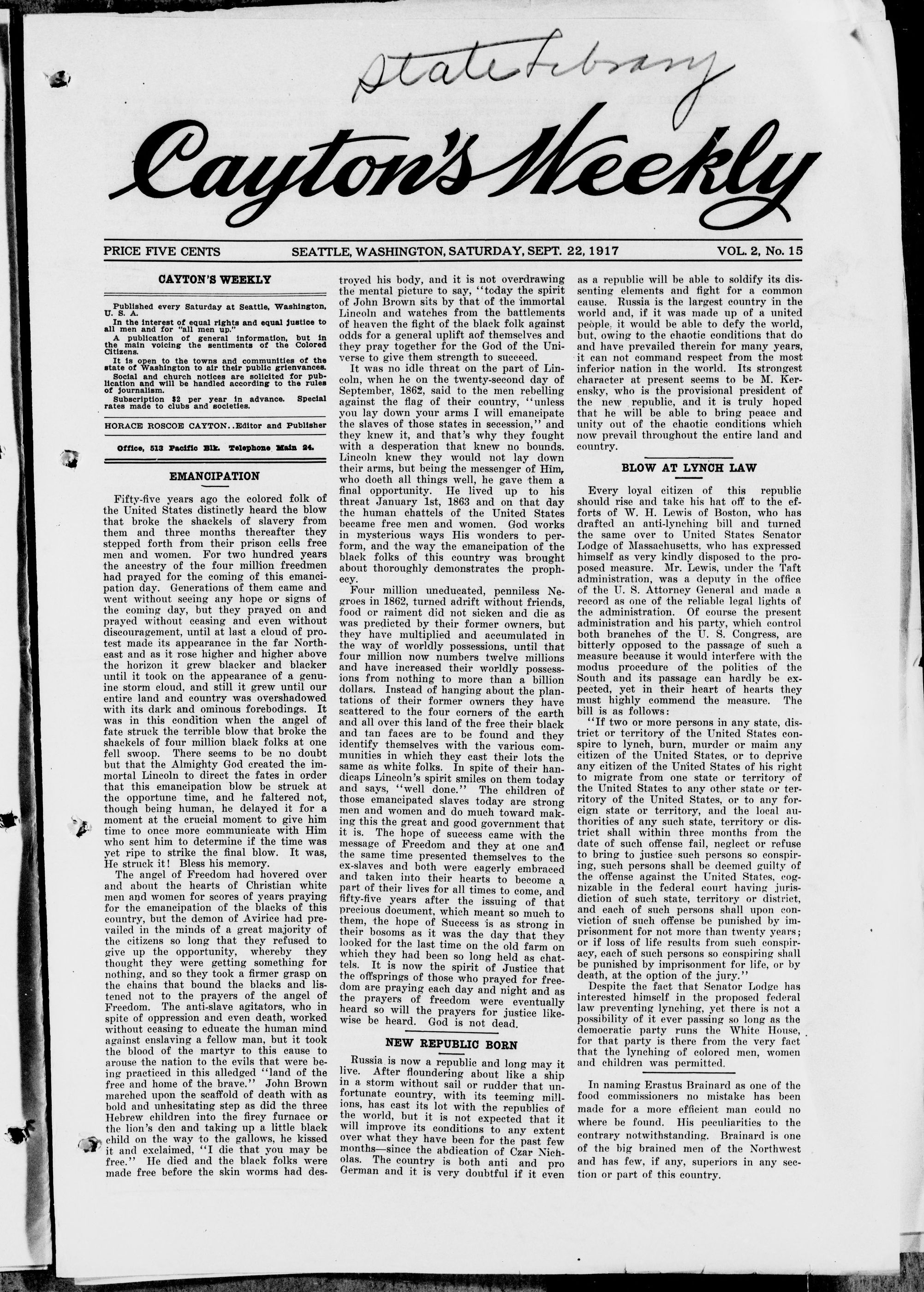
CAYTON'S WEEKLY
Published every Saturday at Seattle, Washington, U. S. A.
In the interest of equal rights and equal justice to all men and for "all men up."
A publication of general information, but in the main voicing the sentiments of the Colored Citizens.
It is open to the towns and communities of the state of Washington to air their public grievances.
Social and church notices are solicited for publication and will be handled according to the rules of journalism.
Subscription $2 per year in advance. Special rates made to clubs and societies.
HORACE ROSCOE CAYTON..Editor and Publisher
Office, 513 Pacific Blk. Telephone Main 24.
EMANCIPATION
Fifty-five years ago the colored folk of the United States distinctly heard the blow that broke the shackels of slavery from them and three months thereafter they stepped forth from their prison cells free men and women. For two hundred years the ancestry of the four million freedmen had prayed for the coming of this emancipation day. Generations of them came and went without seeing any hope or signs of the coming day, but they prayed on and prayed without ceasing and even without discouragement, until at last a cloud of protest made its appearance in the far Northeast and as it rose higher and higher above the horizon it grew blacker and blacker until it took on the appearance of a genuine storm cloud, and still it grew until our entire land and country was overshadowed with its dark and ominous forebodings. It was in this condition when the angel of fate struck the terrible blow that broke the shackels of four million black folks at one fell swoop. There seems to be no doubt but that the Almighty God created the immortal Lincoln to direct the fates in order that this emancipation blow be struck at the opportune time, and he faltered not, though being human, he delayed it for a moment at the crucial moment to give him time to once more communicate with Him who sent him to determine if the time was yet ripe to strike the final blow. It was, He struck it! Bless his memory.
The angel of Freedom had hovered over and about the hearts of Christian white men and women for scores of years praying for the emancipation of the blacks of this country, but the demon of Avirice had prevailed in the minds of a great majority of the citizens so long that they refused to give up the opportunity, whereby they thought they were getting something for nothing, and so they took a firmer grasp on the chains that bound the blacks and listened not to the prayers of the angel of Freedom. The anti-slave agitators, who in spite of oppression and even death, worked without ceasing to educate the human mind against enslaving a fellow man, but it took the blood of the martyr to this cause to arouse the nation to the evils that were being practiced in this alledged "land of the free and home of the brave." John Brown marched upon the scaffold of death with as bold and unhesitating step as did the three Hebrew children into the firey furnace or the lion's den and taking up a little black child on the way to the gallows, he kissed it and exclaimed, "I die that you may be free." He died and the black folks were made free before the skin worms had des-
---
troyed his body, and it is not overdrawing the mental picture to say, "today the spirit of John Brown sits by that of the immortal Lincoln and watches from the battlements of heaven the fight of the black folk against odds for a general uplift aof themselves and they pray together for the God of the Universe to give them strength to succeed.
It was no idle threat on the part of Lincoln, when he on the twenty-second day of September, 1862, said to the men rebelling against the flag of their country, "unless you lay down your arms I will emancipate the slaves of those states in secession," and they knew it, and that's why they fought with a desperation that knew no bounds. Lincoln knew they would not lay down their arms, but being the messenger of Him, who doeth all things well, he gave them a final opportunity. He lived up to his threat January 1st, 1863 and on that day the human chattels of the United States became free men and women. God works in mysterious ways His wonders to perform, and the way the emancipation of the black folks of this country was brought about thoroughly demonstrates the prophecy.
Four million uneducated, penniless Negroes in 1862, turned adrift without friends, food or raiment did not sicken and die as was predicted by their former owners, but they have multiplied and accumulated in the way of worldly possessions, until that four million now numbers twelve millions and have increased their worldly possessions from nothing to more than a billion dollars. Instead of hanging about the plantations of their former owners they have scattered to the four corners of the earth and all over this land of the free their black and tan faces are to be found and they identify themselves with the various communities in which they cast their lots the same as white folks. In spite of their handicaps Lincoln's spirit smiles on them today and says, "well done." The children of those emancipated slaves today are strong men and women and do much toward making this the great and good government that it is. The hope of success came with the message of Freedom and they at one and the same time presented themselves to the ex-slaves and both were eagerly embraced and taken into their hearts to become a part of their lives for all times to come, and fifty-five years after the issuing of that precious document, which meant so much to them, the hope of Success is as strong in their bosoms as it was the day that they looked for the last time on the old farm on which they had been so long held as chattels. It is now the spirit of Justice that the offsprings of those who prayed for freedom are praying each day and night and as the prayers of freedom were eventually heard so will the prayers for justice likewise be heard. God is not dead.
NEW REPUBLIC BORN
Russia is now a republic and long may it live. After floundering about like a ship in a storm without sail or rudder that unfortunate country, with its teeming millions, has cast its lot with the republics of the world, but it is not expected that it will improve its conditions to any extent over what they have been for the past few months—since the abdication of Czar Nicholas. The country is both anti and pro German and it is very doubtful if it even
VOL.2, No.15
as a republic will be able to soldify its dissenting elements and fight for a common cause. Russia is the largest country in the world and, if it was made up of a united people, it would be able to defy the world, but, owing to the chaotic conditions that do and have prevailed therein for many years, it can not command respect from the most inferior nation in the world. Its strongest character at present seems to be M. Kerensky, who is the provisional president of the new republic, and it is truly hoped that he will be able to bring peace and unity out of the chaotic conditions which now prevail throughout the entire land and country.
BLOW AT LYNCH LAW
Every loyal citizen of this republic should rise and take his hat off to the efforts of W. H. Lewis of Boston, who has drafted an anti-lynching bill and turned the same over to United States Senator Lodge of Massachusetts, who has expressed himself as very kindly disposed to the proposed measure. Mr. Lewis, under the Taft administration, was a deputy in the office of the U. S. Attorney General and made a record as one of the reliable legal lights of the administration. Of course the present administration and his party, which control both branches of the U. S. Congress, are bitterly opposed to the passage of such a measure because it would interfere with the modus procedure of the politics of the South and its passage can hardly be expected, yet in their heart of hearts they must highly commend the measure. The bill is as follows:
Despite the fact that Senator Lodge has interested himself in the proposed federal law preventing lynching, yet there is not a possibility of it ever passing so long as the democratic party runs the White House, for that party is there from the very fact that the lynching of colored men, women and children was permitted.
In naming Erastus Brainard as one of the food commissioners no mistake has been made for a more efficient man could no where be found. His peculiarities to the contrary notwithstanding. Brainard is one of the big brained men of the Northwest and has few, if any, superiors in any section or part of this country.
```markdown
```
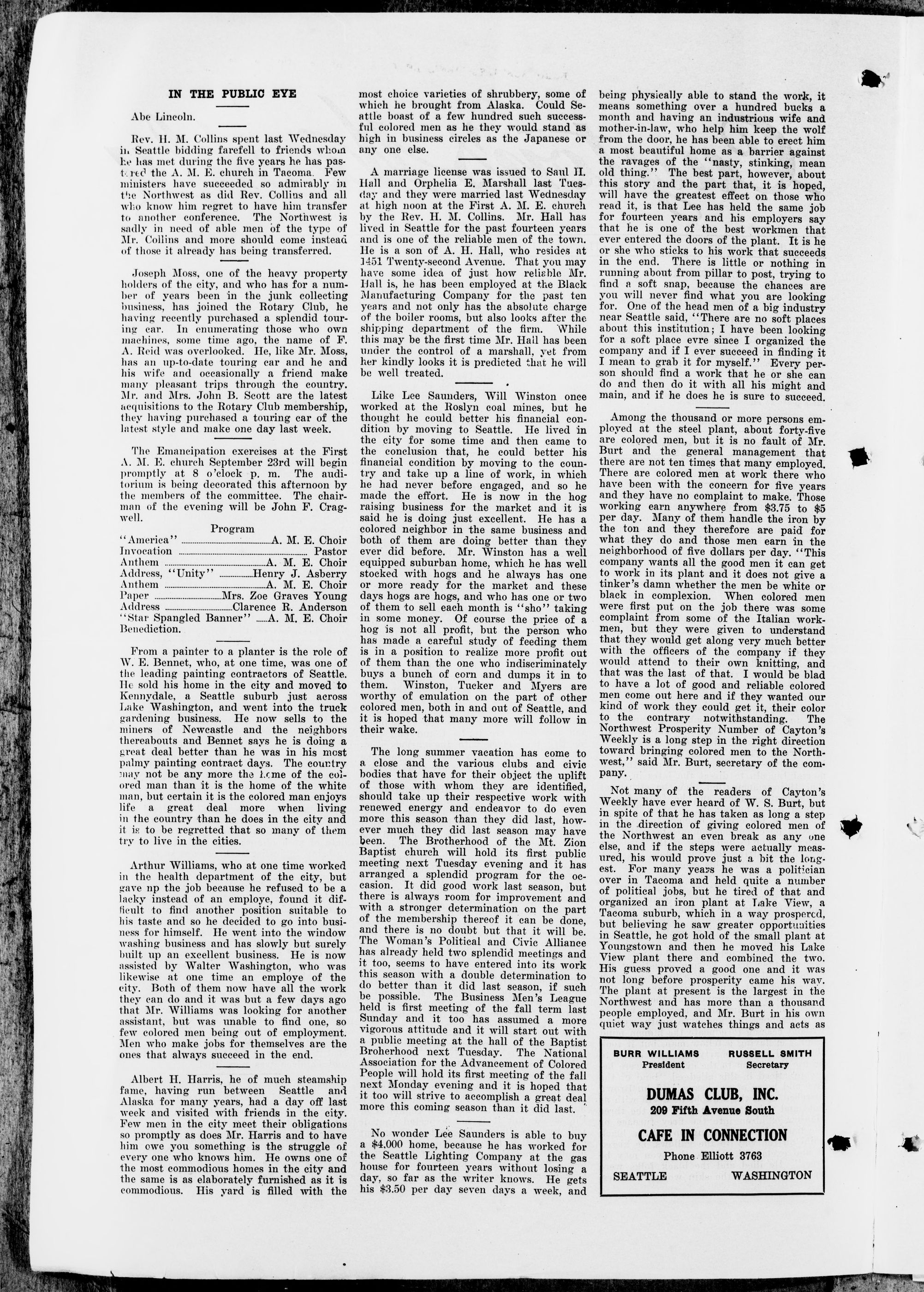
IN THE PUBLIC EYE
Rev. H. M. Collins spent last Wednesday in Seattle bidding farefell to friends whom he has met during the five years he has pasted the A. M. E. church in Tacoma. Few ministers have succeeded so admirably in the Northwest as did Rev. Collins and all who know him regret to have him transfer to another conference. The Northwest is sadly in need of able men of the type of Mr. Collins and more should come instead of those it already has being transferred.
Joseph Moss, one of the heavy property holders of the city, and who has for a number of years been in the junk collecting business, has joined the Rotary Club, he having recently purchased a splendid touring car. In enumerating those who own machines, some time ago, the name of F. A. Reid was overlooked. He, like Mr. Moss, has an up-to-date touring car and he and his wife and occasionally a friend make many pleasant trips through the country. Mr. and Mrs. John B. Scott are the latest acquisitions to the Rotary Club membership, they having purchased a touring car of the latest style and make one day last week.
The Emancipation exercises at the First A. M. E. church September 23rd will begin promptly at 8 o'clock p. m. The auditorium is being decorated this afternoon by the members of the committee. The chairman of the evening will be John F. Cragwell.
"America" .....A. M. E. Choir
Invocation .....Pastor
Anthem .....A. M. E. Choir
Address, "Unity" .....Henry J. Asberry
Anthem .....A. M. E. Choir
Paper .....Mrs. Zoe Graves Young
Address .....Clarence R. Anderson
"Star Spangled Banner" .....A. M. E. Choir
Benediction.
From a painter to a planter is the role of W. E. Bennet, who, at one time, was one of the leading painting contractors of Seattle. He sold his home in the city and moved to Kennydale, a Seattle suburb just across Lake Washington, and went into the truck gardening business. He now sells to the miners of Newcastle and the neighbors thereabouts and Bennet says he is doing a great deal better than he was in his most palmy painting contract days. The country may not be any more the home of the colored man than it is the home of the white man, but certain it is the colored man enjoys life a great deal more when living in the country than he does in the city and it is to be regretted that so many of them try to live in the cities.
Arthur Williams, who at one time worked in the health department of the city, but gave up the job because he refused to be a lacky instead of an employe, found it difficult to find another position suitable to his taste and so he decided to go into business for himself. He went into the window washing business and has slowly but surely built up an excellent business. He is now assisted by Walter Washington, who was likewise at one time an employe of the city. Both of them now have all the work they can do and it was but a few days ago that Mr. Williams was looking for another assistant, but was unable to find one, so few colored men being out of employment. Men who make jobs for themselves are the ones that always succeed in the end.
Albert H. Harris, he of much steamship fame, having run between Seattle and Alaska for many years, had a day off last week and visited with friends in the city. Few men in the city meet their obligations so promptly as does Mr. Harris and to have him owe you something is the struggle of every one who knows him. He owns one of the most commodious homes in the city and the same is as elaborately furnished as it is commodious. His yard is filled with the
most choice varieties of shrubbery, some of which he brought from Alaska. Could Seattle boast of a few hundred such successful colored men as he they would stand as high in business circles as the Japanese or any one else.
A marriage license was issued to Saul H. Hall and Orphelia E. Marshall last Tuesday and they were married last Wednesday at high noon at the First A. M. E. church by the Rev. H. M. Collins. Mr. Hall has lived in Seattle for the past fourteen years and is one of the reliable men of the town. He is a son of A. H. Hall, who resides at 1451 Twenty-second Avenue. That you may have some idea of just how reliable Mr. Hall is, he has been employed at the Black Manufacturing Company for the past ten years and not only has the absolute charge of the boiler rooms, but also looks after the shipping department of the firm. While this may be the first time Mr. Hall has been under the control of a marshall, yet from her kindly looks it is predicted that he will be well treated.
Like Lee Saunders, Will Winston once worked at the Roslyn coal mines, but he thought he could better his financial condition by moving to Seattle. He lived in the city for some time and then came to the conclusion that, he could better his financial condition by moving to the country and take up a line of work, in which he had never before engaged, and so he made the effort. He is now in the hog raising business for the market and it is said he is doing just excellent. He has a colored neighbor in the same business and both of them are doing better than they ever did before. Mr. Winston has a well equipped suburban home, which he has well stocked with hogs and he always has one or more ready for the market and these days hogs are hogs, and who has one or two of them to sell each month is "sho" taking in some money. Of course the price of a hog is not all profit, but the person who has made a careful study of feeding them is in a position to realize more profit out of them than the one who indiscriminately buys a bunch of corn and dumps it in to them. Winston, Tucker and Myers are worthy of emulation on the part of other colored men, both in and out of Seattle, and it is hoped that many more will follow in their wake.
The long summer vacation has come to a close and the various clubs and civic bodies that have for their object the uplift of those with whom they are identified, should take up their respective work with renewed energy and endeavor to do even more this season than they did last, however much they did last season may have been. The Brotherhood of the Mt. Zion Baptist church will hold its first public meeting next Tuesday evening and it has arranged a splendid program for the occasion. It did good work last season, but there is always room for improvement and with a stronger determination on the part of the membership thereof it can be done, and there is no doubt but that it will be. The Woman's Political and Civic Alliance has already held two splendid meetings and it too, seems to have entered into its work this season with a double determination to do better than it did last season, if such be possible. The Business Men's League held is first meeting of the fall term last Sunday and it too has assumed a more vigorous attitude and it will start out with a public meeting at the hall of the Baptist Broherhood next Tuesday. The National Association for the Advancement of Colored People will hold its first meeting of the fall next Monday evening and it is hoped that it too will strive to accomplish a great deal more this coming season than it did last.
No wonder Lee Saunders is able to buy a $4.000 home, because he has worked for the Seattle Lighting Company at the gas house for fourteen years without losing a day, so far as the writer knows. He gets his $3.50 per day seven days a week, and
being physically able to stand the work, it means something over a hundred bucks a month and having an industrious wife and mother-in-law, who help him keep the wolf from the door, he has been able to erect him a most beautiful home as a barrier against the ravages of the "nasty, stinking, mean old thing." The best part, however, about this story and the part that, it is hoped, will have the greatest effect on those who read it, is that Lee has held the same job for fourteen years and his employers say that he is one of the best workmen that ever entered the doors of the plant. It is he or she who sticks to his work that succeeds in the end. There is little or nothing in running about from pillar to post, trying to find a soft snap, because the chances are you will never find what you are looking for. One of the head men of a big industry near Seattle said, "There are no soft places about this institution; I have been looking for a soft place ever since I organized the company and if I ever succeed in finding it I mean to grab it for myself." Every person should find a work that he or she can do and then do it with all his might and main, and if he does he is sure to succeed.
Among the thousand or more persons employed at the steel plant, about forty-five are colored men, but it is no fault of Mr. Burt and the general management that there are not ten times that many employed. There are colored men at work there who have been with the concern for five years and they have no complaint to make. Those working earn anywhere from $3.75 to $5 per day. Many of them handle the iron by the ton and they therefore are paid for what they do and those men earn in the neighborhood of five dollars per day. "This company wants all the good men it can get to work in its plant and it does not give a tinker's damn whether the men be white or black in complexion. When colored men were first put on the job there was some complaint from some of the Italian workmen, but they were given to understand that they would get along very much better with the officers of the company if they would attend to their own knitting, and that was the last of that. I would be blad to have a lot of good and reliable colored men come out here and if they wanted our kind of work they could get it, their color to the contrary notwithstanding. The Northwest Prosperity Number of Cayton's Weekly is a long step in the right direction toward bringing colored men to the Northwest," said Mr. Burt, secretary of the company.
Not many of the readers of Cayton's Weekly have ever heard of W. S. Burt, but in spite of that he has taken as long a step in the direction of giving colored men of the Northwest an even break as any one else, and if the steps were actually measured, his would prove just a bit the longest. For many years he was a politician over in Tacoma and held quite a number of political jobs, but he tired of that and organized an iron plant at Lake View, a Tacoma suburb, which in a way prospered, but believing he saw greater opportunities in Seattle, he got hold of the small plant at Youngstown and then he moved his Lake View plant there and combined the two. His guess proved a good one and it was not long before prosperity came his wav. The plant at present is the largest in the Northwest and has more than a thousand people employed, and Mr. Burt in his own quiet way just watches things and acts as
. : , = {
= san 0 “ — |
‘2 Pe ge et eh 2 te eee BE oa Ce ee ne Oe i PA
a great balance wheel to the whole. The
Pacific Coast Steel Company is an institu-
tion that not only Seattle can feel proud
of, it being in existence within her con-
fines, but the state of Washington should
feel equally proud. You, who have never
seen it in operation, have not the slightest
idea of how extensive this great industry is
and you will not believe it even when you
read this and you can not believe it until
you have actually seen it.
United States Senate. Sept. 12. 1917.
presents In a very nhne way the activities
of typical representatives of your people.
I feel sure they appreciate the splendid pro-
duction you have gotten out. I shall keep
it as a reference. With heartiest good
wishes.
W. L. JONES,
Richard Paul is attending the United
States Circuit Court of Appeals, which has
been sitting in Seattle for the past week.
Mr. Paul has beea messenger in Judge
Morrow’s court in San Francisco for the
past two years. He is of a pleasing per-
sonality and very affiable in conversation
Judge Morrow has had @ colored man as
his messenger for the past twenty years,
the first being T. B. Morton of San Fran-
cisco, who was some thing of a pioneer in
California. Mr. Paul, while in Seattle, is
being chaperooned by John T. Gayton of
Judge Neterer’s court.
Mt. Rainier Chapter of the Eastern Star
had as its house guest at the home of Mrs.
W. M. Jones 710 Twenty-eighth Avenue
South, Mrs. Ester and Mrs. Turner of
Butte, Montana, who are visiting in the
city with Mrs. Burnside. Mrs. Stella Nor-
ris, worthy matron of the chapter did much
toward making the evening a most pleas-
ant one, not only for the honored guests,
but for all, and all reported a most delight-
ful evening. Those present were: Mrs.
Ester, Mrs. Turner, Mrs. Burnside, Mrs.
Henry, Mrs. Henry G. Jones, Mrs. Taylor,
Mrs. F. A. Reid, Mrs. A. Scott, Mrs. As-
berry, Mrs. Wilson, Mrs. Golden, Mrs. Lin-
ear, Mrs. Heck, Mrs. W. M. Jones, Mrs. J.
H. Wade.
Get Us A Subscriber. If you are satis-
fied with Cayton’s Weekly and think it
sufficiently meritorious to recommend it to
another we desire each and every subscrib-
er to Cayton’s Weekly to get it at least
one subscriber and thereby double its sub-
scription list. We are endeavoring to run
Cayton’s Weekly along different lines to
that done by the great majority of papers
published by colored men and the innova-
tion may not prove as popular as the old
way, but if there never had been any in-
novations as well as variations, then the
living would be doing just what the dead
was doing an hundred or more years ago
and those living a hundred years from now
would be doing the same things that we
are doing at present. We live to improve
or to try to improve and that’s why Cay-
ton’s Weekly is attempting to give to its
readers a different weekly publication than
is customary. Cayton’s Weekly wants to
be fair to all men and in no way drag
personalities into its columns and while
you may not see either your name or the
name of your friend in the columns as oft-
en as you would like, yet you will always
see things in its columns just as edifying
as society notes. Get us a new subscriber
and compliment yourself with having help-
ed a struggling publication on its feet.
W. H. Robinson, one of Tacoma’s most
substantial citizens, has been visiting in the
city for the past week. Mr. Robinson is
custodian of the largest apartment house in
Tacoma and he is on his annual vacation.
He will visit about the Sound country for
the next two weeks before returning to his
work.
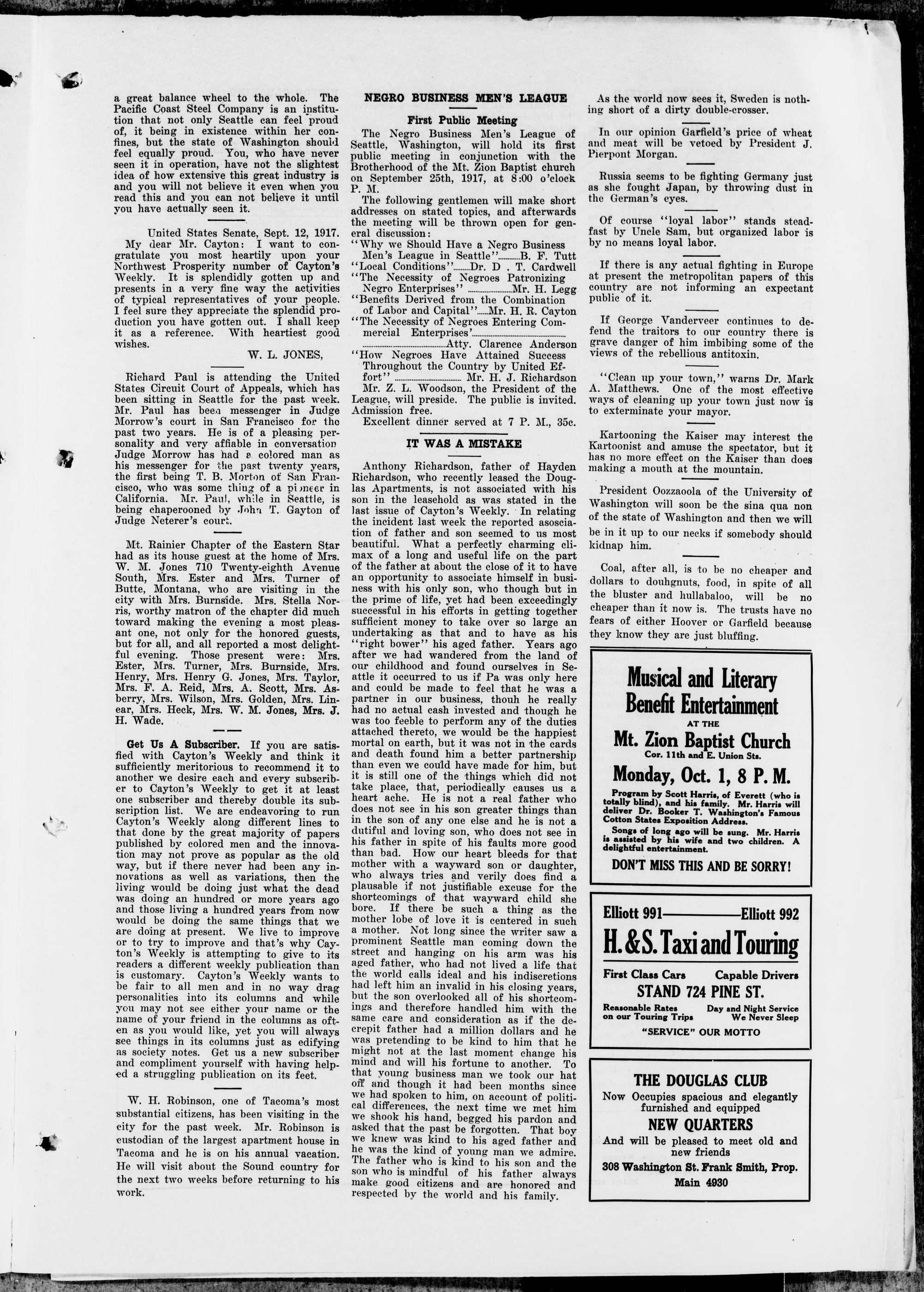
NEGRO BUSINESS MEN’S LEAGUE
First Public Meeting
The Negro Business Men’s League of
Seattle, Washington, will hold its first
public meeting in conjunction with the
Brotherhood of the Mt. Zion Baptist church
on September 25th, 1917, at 8:00 o’clock
P. M.
The following gentlemen will make short
addresses on stated topies, and afterwards
the meeting will be thrown open for gen-
eral discussion:
“Why we Should Have a Negro Business
Men’s League in Seattle’’........B. F. Tutt
“Local Conditions”’.......Dr. D . T. Cardwell
“The Necessity of Negroes Patronizing
Negro Enterprises’? ..............Mr. H. Legg
“Benefits Derived from the Combination
of Labor and Capital’’.... Mr. H. R. Cayton
“The Necessity of Negroes Entering Com-
Mercial Enterprises ’..ccecmcmemucneneneenne
crmutenenmnnnnndritty, Clarence Anderson
““How Negroes Have Attained Success
Throughout the Country by United Ef-
LOPE? eerie Mr, H. J. Richardson
Mr. Z. L. Woodson, the President of the
League, will preside. The public is invited.
Admission free.
Excellent dinner served at 7 P. M., 35e.
IT WAS A MISTAKE
Anthony Richardson, father of Hayden
Richardson, who recently leased the Doug-
las Apartments, is not associated with his
son in the leasehold as was stated in the
last issue of Cayton’s Weekly. In relating
the incident last week the reported asoscia-
tion of father and son seemed to us most
beautiful. What a perfectly charming cli-
max of a long and useful life on the part
of the father at about the close of it to have
an opportunity to associate himself in busi-
ness with his only son, who though but in
the prime of life, yet had been exceedingly
successful in his efforts in getting together
sufficient money to take over so large an
undertaking as that and to have as his
“right bower’’ his aged father. Years ago
after we had wandered from the land of
our childhood and found ourselves in Se-
attle it occurred to us if Pa was only here
and could be made to feel that he was a
partner in our business, thouh he really
had no actual cash invested and though he
was too feeble to perform any of the duties
attached thereto, we would be the happiest
mortal on earth, but it was not in the cards
and death found him a better partnership
than even we could have made for him, but
it is still one of the things which did not
take place, that, periodically causes us 2
heart ache. He is not a real father who
does not see in his son greater things than
in the son of any one else and he is not a
dutiful and loving son, who does not see in
his father in spite of his faults more good
than bad. How our heart bleeds for that
mother with a wayward son or daughter,
who always tries and verily does find a
plausable if not justifiable excuse for the
shortcomings of that wayward child she
bore. If there be such a thing as the
mother lobe of love it is centered in such
a mother. Not long since the writer saw a
prominent Seattle man coming down the
street and hanging on his arm was his
aged father, who had not lived a life that
the world calls ideal and his indiscretions
had left him an invalid in his closing years,
but the son overlooked all of his shortcom-
ings and therefore handled him with the
same care and consideration as if the de-
crepit father had a million dollars and he
was pretending to be kind to him that he
might not at the last moment change his
mind and will his fortune to another. To
that young business man we took our hat
off and though it had been months since
we had spoken to him, on account of politi-
cal differences, the next time we met him
we shook his hand, begged his pardon and
asked that the past be forgotten. That boy
we knew was kind to his aged father and
he was the kind of young man we admire,
The father who is kind to his son and the
son who is mindful of his father always
make good citizens and are honored and
respected by the world and his family.
As the world now sees it, Sweden is noth-
ing short of a dirty double-crosser.
In our opinion Garfield’s price of wheat
and meat will be vetoed by President J.
Pierpont Morgan.
Russia seems to be fighting Germany just
as she fought Japan, by throwing dust in
the German’s eyes.
Of course ‘‘loyal labor’’ stands stead-
fast by Uncle Sam, but organized labor is
by no means loyal labor.
If there is any actual fighting in Europe
at present the metropolitan papers of this
country are not informing an expectant
publie of it.
If George Vanderveer continues to de-
fend the traitors to our country there is
grave danger of him imbibing some of the
views of the rebellious antitoxin,
“Clean up your town,’’ warns Dr, Mark
A. Matthews. One of the most effective
ways of cleaning up your town just now is
to exterminate your mayor.
Kartooning the Kaiser may interest the
Kartoonist and amuse the spectator, but it
has no more effect on the Kaiser than does
making a mouth at the mountain.
President Oozzaoola of the University of
Washington will soon be the sina qua non
of the state of Washington and then we will
be in it up to our necks if somebody should
kidnap him. '
Coal, after all, is to be no cheaper and
dollars to douhgnuts, food, in spite of all
the bluster and hullabaloo, will be no
cheaper than it now is. The trusts have no
fears of either Hoover or Garfield because
they know they are just bluffing.
Musical and Literary
Benefit Entertainment
AT THE
Mt. Zion Baptist Church
Cor. 11th and E. Union Sts.
Monday, Oct. 1, 8 P. M.
Program by Scott Harris, of Everett (who is
totally blind), and his family. Mr. Harris will
deliver Dr. Booker T. Washington’s Famous
Cotton States Exposition Address. .
us Seats cf Heng, seo ill be sone, Me Hari
delightful entertainment.
DON’T MISS THIS AND BE SORRY!
Elliott 991 lliott 992
H.&S. Taxi and Touring
First Class Cars Capable Drivers
STAND 724 PINE ST.
Reasonable Rates Day and Night Service
on our Touring Trips We Never Sleep
“SERVICE” OUR MOTTO
THE DOUGLAS CLUB
Now Occupies spacious and elegantly
furnished and equipped
NEW QUARTERS
And will be pleased to meet old and
new friends
308 Washington St. Frank Smith, Prop.
Main 4930