Cayton's Weekly
Saturday, September 29, 1917
Seattle, Washington
Page text (machine-generated)
State Library
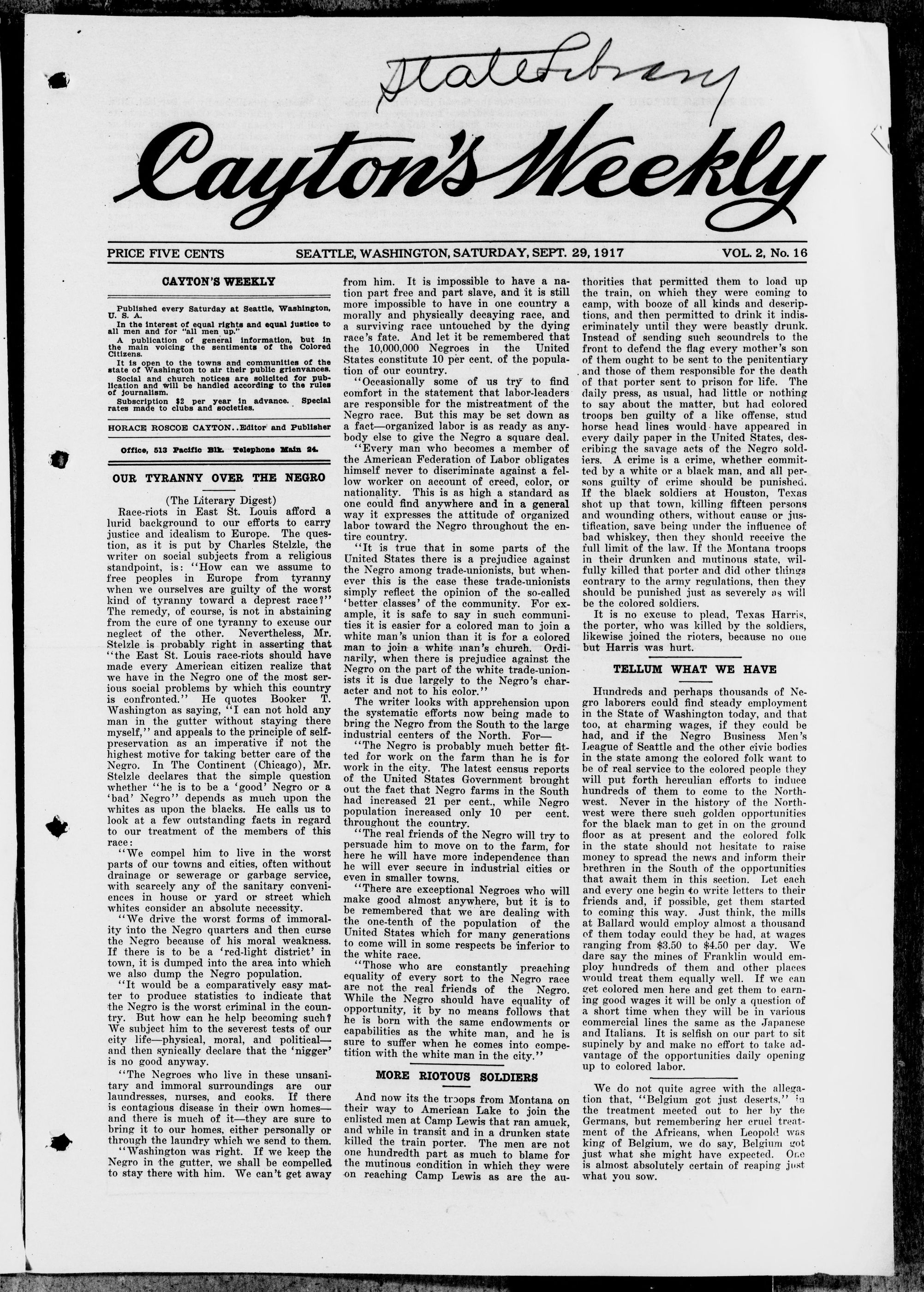
Cayton's Weekly
---
PRICE FIVE CENTS
CAYTON'S WEEKLY
Published every Saturday at Seattle, Washington, U. S. A.
In the interest of equal rights and equal justice to all men and for "all men up."
A publication of general information, but in the main voicing the sentiments of the Colored Citizens.
It is open to the towns and communities of the state of Washington to air their public grievances.
Social and church notices are solicited for publication and will be handled according to the rules of journalism.
Subscription $2 per year in advance. Special rates made to clubs and societies.
HORACE ROSCOE CAYTON..Editor and Publisher
Office, 513 Pacific Blk. Telephone Main 24.
OUR TYRANNY OVER THE NEGRO
Race-riots in East St. Louis afford a lurid background to our efforts to carry justice and idealism to Europe. The question, as it is put by Charles Stelzle, the writer on social subjects from a religious standpoint, is: "How can we assume to free peoples in Europe from tyranny when we ourselves are guilty of the worst kind of tyranny toward a deprest race?" The remedy, of course, is not in abstaining from the cure of one tyranny to excuse our neglect of the other. Nevertheless, Mr. Stelzle is probably right in asserting that "the East St. Louis race-riots should have made every American citizen realize that we have in the Negro one of the most serious social problems by which this country is confronted." He quotes Booker T. Washington as saying, "I can not hold any man in the gutter without staying there myself," and appeals to the principle of self-preservation as an imperative if not the highest motive for taking better care of the Negro. In The Continent (Chicago), Mr. Stelzle declares that the simple question whether "he is to be a 'good' Negro or a 'bad' Negro" depends as much upon the whites as upon the blacks. He calls us to look at a few outstanding facts in regard to our treatment of the members of this race:
"We compel him to live in the worst parts of our towns and cities, often without drainage or sewerage or garbage service, with scarcely any of the sanitary conveniences in house or yard or street which whites consider an absolute necessity.
"We drive the worst forms of immorality into the Negro quarters and then curse the Negro because of his moral weakness. If there is to be a 'red-light district' in town, it is dumped into the area into which we also dump the Negro population.
"It would be a comparatively easy matter to produce statistics to indicate that the Negro is the worst criminal in the country. But how can he help becoming such? We subject him to the severest tests of our city life—physical, moral, and political—and then synically declare that the 'nigger' is no good anyway.
"The Negroes who live in these unsanitary and immoral surroundings are our laundresses, nurses, and cooks. If there is contagious disease in their own homes—and there is much of it—they are sure to bring it to our homes, either personally or through the laundry which we send to them.
"Washington was right. If we keep the Negro in the gutter, we shall be compelled to stay there with him. We can't get away
from him. It is impossible to have a nation part free and part slave, and it is still more impossible to have in one country a morally and physically decaying race, and a surviving race untouched by the dying race's fate. And let it be remembered that the 10,000,000 Negroes in the United States constitute 10 per cent. of the population of our country.
"Occasionally some of us try to find comfort in the statement that labor-leaders are responsible for the mistreatment of the Negro race. But this may be set down as a fact—organized labor is as ready as anybody else to give the Negro a square deal.
"Every man who becomes a member of the American Federation of Labor obligates himself never to discriminate against a fellow worker on account of creed, color, or nationality. This is as high a standard as one could find anywhere and in a general way it expresses the attitude of organized labor toward the Negro throughout the entire country.
"It is true that in some parts of the United States there is a prejudice against the Negro among trade-unionists, but whenever this is the case these trade-unionists simply reflect the opinion of the so-called 'better classes' of the community. For example, it is safe to say in such communities it is easier for a colored man to join a white man's union than it is for a colored man to join a white man's church. Ordinarily, when there is prejudice against the Negro on the part of the white trade-unionists it is due largely to the Negro's character and not to his color."
The writer looks with apprehension upon the systematic efforts now being made to bring the Negro from the South to the large industrial centers of the North. For—
"The Negro is probably much better fitted for work on the farm than he is for work in the city. The latest census reports of the United States Government brought out the fact that Negro farms in the South had increased 21 per cent., while Negro population increased only 10 per cent. throughout the country.
"The real friends of the Negro will try to persuade him to move on to the farm, for here he will have more independence than he will ever secure in industrial cities or even in smaller towns.
"There are exceptional Negroes who will make good almost anywhere, but it is to be remembered that we are dealing with the one-tenth of the population of the United States which for many generations to come will in some respects be inferior to the white race.
"Those who are constantly preaching equality of every sort to the Negro race are not the real friends of the Negro. While the Negro should have equality of opportunity, it by no means follows that he is born with the same endowments or capabilities as the white man, and he is sure to suffer when he comes into competition with the white man in the city."
MORE RIOTOUS SOLDIERS
And now its the troops from Montana on their way to American Lake to join the enlisted men at Camp Lewis that ran amuck, and while in transit and in a drunken state killed the train porter. The men are not one hundredth part as much to blame for the mutinous condition in which they were on reaching Camp Lewis as are the au-
VOL.2, No.16
thorities that permitted them to load up the train, on which they were coming to camp, with booze of all kinds and descriptions, and then permitted to drink it indiscriminately until they were beastly drunk. Instead of sending such scoundrels to the front to defend the flag every mother's son of them ought to be sent to the penitentiary and those of them responsible for the death of that porter sent to prison for life. The daily press, as usual, had little or nothing to say about the matter, but had colored troops ben guilty of a like offense, stud horse head lines would have appeared in every daily paper in the United States, describing the savage acts of the Negro soldiers. A crime is a crime, whether committed by a white or a black man, and all persons guilty of crime should be punished. If the black soldiers at Houston, Texas shot up that town, killing fifteen persons and wounding others, without cause or justification, save being under the influence of bad whiskey, then they should receive the full limit of the law. If the Montana troops in their drunken and mutinous state, wilfully killed that porter and did other things contrary to the army regulations, then they should be punished just as severely as will be the colored soldiers.
It is no excuse to plead, Texas Harris, the porter, who was killed by the soldiers, likewise joined the rioters, because no one but Harris was hurt.
Hundreds and perhaps thousands of Negro laborers could find steady employment in the State of Washington today, and that too, at charming wages, if they could be had, and if the Negro Business Men's League of Seattle and the other civic bodies in the state among the colored folk want to be of real service to the colored people they will put forth herculian efforts to induce hundreds of them to come to the Northwest. Never in the history of the Northwest were there such golden opportunities for the black man to get in on the ground floor as at present and the colored folk in the state should not hesitate to raise money to spread the news and inform their brethren in the South of the opportunities that await them in this section. Let each and every one begin to write letters to their friends and, if possible, get them started to coming this way. Just think, the mills at Ballard would employ almost a thousand of them today could they be had, at wages ranging from $3.50 to $4.50 per day. We dare say the mines of Franklin would employ hundreds of them and other places would treat them equally well. If we can get colored men here and get them to earning good wages it will be only a question of a short time when they will be in various commercial lines the same as the Japanese and Italians. It is selfish on our part to sit supinely by and make no effort to take advantage of the opportunities daily opening up to colored labor.
We do not quite agree with the allegation that, "Belgium got just deserts," in the treatment meeted out to her by the Germans, but remembering her cruel treatment of the Africans, when Leopold was king of Belgium, we do say, Belgium got just what she might have expected. One is almost absolutely certain of reaping just what you sow.
TELLUM WHAT WE HAVE
```markdown
```
```markdown
```
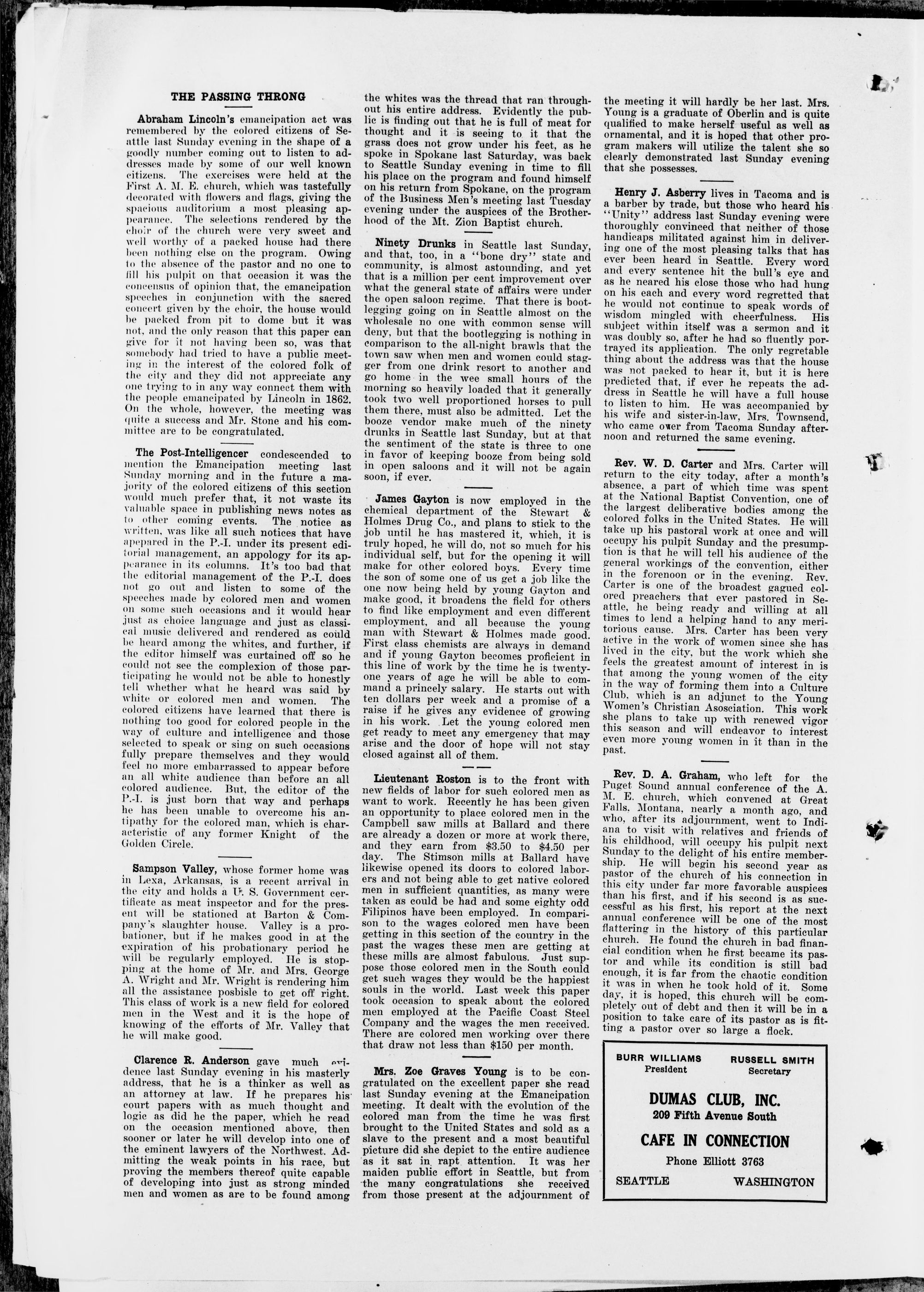
THE PASSING THRONG
Abraham Lincoln's emancipation act was remembered by the colored citizens of Seattle last Sunday evening in the shape of a goodly number coming out to listen to addresses made by some of our well known citizens. The exercises were held at the First A. M. E. church, which was tastefully decorated with flowers and flags, giving the spacious auditorium a most pleasing appearance. The selections rendered by the choir of the church were very sweet and well worthy of a packed house had there been nothing else on the program. Owing to the absence of the pastor and no one to fill his pulpit on that occasion it was the concensus of opinion that, the emancipation speeches in conjunction with the sacred concert given by the choir, the house would be packed from pit to dome but it was not, and the only reason that this paper can give for it not having been so, was that somebody had tried to have a public meeting in the interest of the colored folk of the city and they did not appreciate any one trying to in any way connect them with the people emancipated by Lincoln in 1862. On the whole, however, the meeting was quite a success and Mr. Stone and his committee are to be congratulated.
The Post-Intelligencer condescended to mention the Emancipation meeting last Sunday morning and in the future a majority of the colored citizens of this section would much prefer that, it not waste its valuable space in publishing news notes as to other coming events. The notice as written, was like all such notices that have appared in the P.-I. under its present editorial management, an appology for its appearance in its columns. It's too bad that the editorial management of the P.-I. does not go out and listen to some of the speeches made by colored men and women on some such occasions and it would hear just as choice language and just as classical music delivered and rendered as could be heard among the whites, and further, if the editor himself was curtained off so he could not see the complexion of those participating he would not be able to honestly tell whether what he heard was said by white or colored men and women. The colored citizens have learned that there is nothing too good for colored people in the way of culture and intelligence and those selected to speak or sing on such occasions fully prepare themselves and they would feel no more embarrassed to appear before an all white audience than before an all colored audience. But, the editor of the P.-I. is just born that way and perhaps he has been unable to overcome his antipathy for the colored man, which is characteristic of any former Knight of the Golden Circle.
Sampson Valley, whose former home was in Lexa, Arkansas, is a recent arrival in the city and holds a U. S. Government certificate as meat inspector and for the present will be stationed at Barton & Company's slaughter house. Valley is a probationer, but if he makes good in at the expiration of his probationary period he will be regularly employed. He is stopping at the home of Mr. and Mrs. George A. Wright and Mr. Wright is rendering him all the assistance posbisle to get off right. This class of work is a new field for colored men in the West and it is the hope of knowing of the efforts of Mr. Valley that he will make good.
Clarence R. Anderson gave much evidence last Sunday evening in his masterly address, that he is a thinker as well as an attorney at law. If he prepares his court papers with as much thought and logic as did he the paper, which he read on the occasion mentioned above, then sooner or later he will develop into one of the eminent lawyers of the Northwest. Admitting the weak points in his race, but proving the members thereof quite capable of developing into just as strong minded men and women as are to be found among
the whites was the thread that ran throughout his entire address. Evidently the public is finding out that he is full of meat for thought and it is seeing to it that the grass does not grow under his feet, as he spoke in Spokane last Saturday, was back to Seattle Sunday evening in time to fill his place on the program and found himself on his return from Spokane, on the program of the Business Men's meeting last Tuesday evening under the auspices of the Brotherhood of the Mt. Zion Baptist church.
Ninety Drunks in Seattle last Sunday, and that, too, in a "bone dry" state and community, is almost astounding, and yet that is a million per cent improvement over what the general state of affairs were under the open saloon regime. That there is bootlegging going on in Seattle almost on the wholesale no one with common sense will deny, but that the bootlegging is nothing in comparison to the all-night brawls that the town saw when men and women could stagger from one drink resort to another and go home in the wee small hours of the morning so heavily loaded that it generally took two well proportioned horses to pull them there, must also be admitted. Let the booze vendor make much of the ninety drunks in Seattle last Sunday, but at that the sentiment of the state is three to one in favor of keeping booze from being sold in open saloons and it will not be again soon, if ever.
James Gayton is now employed in the chemical department of the Stewart & Holmes Drug Co., and plans to stick to the job until he has mastered it, which, it is truly hoped, he will do, not so much for his individual self, but for the opening it will make for other colored boys. Every time the son of some one of us get a job like the one now being held by young Gayton and make good, it broadens the field for others to find like employment and even different employment, and all because the young man with Stewart & Holmes made good. First class chemists are always in demand and if young Gayton becomes proficient in this line of work by the time he is twenty-one years of age he will be able to command a princely salary. He starts out with ten dollars per week and a promise of a raise if he gives any evidence of growing in his work. Let the young colored men get ready to meet any emergency that may arise and the door of hope will not stay closed against all of them.
Lieutenant Roston is to the front with new fields of labor for such colored men as want to work. Recently he has been given an opportunity to place colored men in the Campbell saw mills at Ballard and there are already a dozen or more at work there, and they earn from $3.50 to $4.50 per day. The Stimson mills at Ballard have likewise opened its doors to colored laborers and not being able to get native colored men in sufficient quantities, as many were taken as could be had and some eighty odd Filipinos have been employed. In comparison to the wages colored men have been getting in this section of the country in the past the wages these men are getting at these mills are almost fabulous. Just suppose those colored men in the South could get such wages they would be the happiest souls in the world. Last week this paper took occasion to speak about the colored men employed at the Pacific Coast Steel Company and the wages the men received. There are colored men working over there that draw not less than $150 per month.
Mrs. Zoe Graves Young is to be congratulated on the excellent paper she read last Sunday evening at the Emancipation meeting. It dealt with the evolution of the colored man from the time he was first brought to the United States and sold as a slave to the present and a most beautiful picture did she depict to the entire audience as it sat in rapt attention. It was her maiden public effort in Seattle, but from the many congratulations she received from those present at the adjournment of
the meeting it will hardly be her last. Mrs. Young is a graduate of Oberlin and is quite qualified to make herself useful as well as ornamental, and it is hoped that other program makers will utilize the talent she so clearly demonstrated last Sunday evening that she possesses.
Henry J. Asberry lives in Tacoma and is a barber by trade, but those who heard his "Unity" address last Sunday evening were thoroughly convinced that neither of those handicaps militated against him in delivering one of the most pleasing talks that has ever been heard in Seattle. Every word and every sentence hit the bull's eye and as he neared his close those who had hung on his each and every word regretted that he would not continue to speak words of wisdom mingled with cheerfulness. His subject within itself was a sermon and it was doubly so, after he had so fluently portrayed its application. The only regretable thing about the address was that the house was not packed to hear it, but it is here predicted that, if ever he repeats the address in Seattle he will have a full house to listen to him. He was accompanied by his wife and sister-in-law, Mrs. Townsend, who came ower from Tacoma Sunday afternoon and returned the same evening.
Rev. W. D. Carter and Mrs. Carter will return to the city today, after a month's absence, a part of which time was spent at the National Baptist Convention, one of the largest deliberative bodies among the colored folks in the United States. He will take up his pastoral work at once and will occupy his pulpit Sunday and the presumption is that he will tell his audience of the general workings of the convention, either in the forenoon or in the evening. Rev. Carter is one of the broadest gagged colored preachers that ever pastored in Seattle, he being ready and willing at all times to lend a helping hand to any meritorious cause. Mrs. Carter has been very active in the work of women since she has lived in the city, but the work which she feels the greatest amount of interest in is that among the young women of the city in the way of forming them into a Culture Club, which is an adjunct to the Young Women's Christian Asosciation. This work she plans to take up with renewed vigor this season and will endeavor to interest even more young women in it than in the past.
Rev. D. A. Graham, who left for the Puget Sound annual conference of the A. M. E. church, which convened at Great Falls, Montana, nearly a month ago, and who, after its adjournment, went to Indiana to visit with relatives and friends of his childhood, will occupy his pulpit next Sunday to the delight of his entire membership. He will begin his second year as pastor of the church of his connection in this city under far more favorable auspices than his first, and if his second is as successful as his first, his report at the next annual conference will be one of the most flattering in the history of this particular church. He found the church in bad financial condition when he first became its pastor and while its condition is still bad enough, it is far from the chaotic condition it was in when he took hold of it. Some day, it is hoped, this church will be completely out of debt and then it will be in a position to take care of its pastor as is fitting a pastor over so large a flock.
BURR WILLIAMS
President
RUSSELL SMITH
Secretary
DUMAS CLUB, INC.
209 Fifth Avenue South
CAFE IN CONNECTION
Phone Elliott 3763
SEATTLE
WASHINGTON
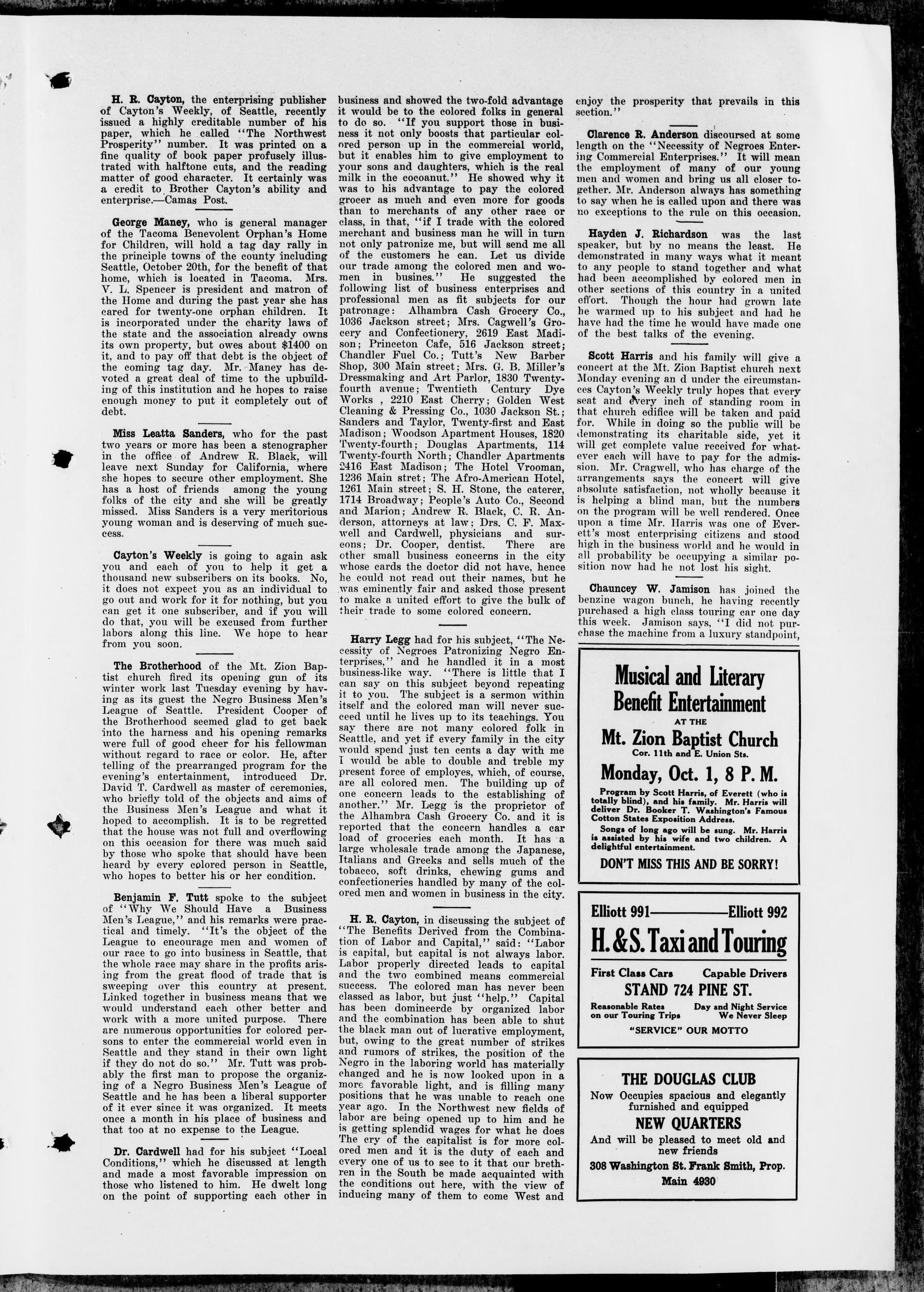
H. R. Cayton, the enterprising publisher of Cayton's Weekly, of Seattle, recently issued a highly creditable number of his paper, which he called "The Northwest Prosperity" number. It was printed on a fine quality of book paper profusely illustrated with halftone cuts, and the reading matter of good character. It certainly was a credit to Brother Cayton's ability and enterprise.—Camas Post.
George Maney, who is general manager of the Tacoma Benevolent Orphan's Home for Children, will hold a tag day rally in the principle towns of the county including Seattle, October 20th, for the benefit of that home, which is located in Tacoma. Mrs. V. L. Spencer is president and matron of the Home and during the past year she has cared for twenty-one orphan children. It is incorporated under the charity laws of the state and the association already owns its own property, but owes about $1400 on it, and to pay off that debt is the object of the coming tag day. Mr. Maney has devoted a great deal of time to the upbuilding of this institution and he hopes to raise enough money to put it completely out of debt.
Miss Leatta Sanders, who for the past two years or more has been a stenographer in the office of Andrew R. Black, will leave next Sunday for California, where she hopes to secure other employment. She has a host of friends among the young folks of the city and she will be greatly missed. Miss Sanders is a very meritorious young woman and is deserving of much success.
Cayton's Weekly is going to again ask you and each of you to help it get a thousand new subscribers on its books. No, it does not expect you as an individual to go out and work for it for nothing, but you can get it one subscriber, and if you will do that, you will be excused from further labors along this line. We hope to hear from you soon.
The Brotherhood of the Mt. Zion Baptist church fired its opening gun of its winter work last Tuesday evening by having as its guest the Negro Business Men's League of Seattle. President Cooper of the Brotherhood seemed glad to get back into the harness and his opening remarks were full of good cheer for his fellowman without regard to race or color. He, after telling of the prearranged program for the evening's entertainment, introduced Dr. David T. Cardwell as master of ceremonies, who briefly told of the objects and aims of the Business Men's League and what it hoped to accomplish. It is to be regretted that the house was not full and overflowing on this occasion for there was much said by those who spoke that should have been heard by every colored person in Seattle, who hopes to better his or her condition.
Benjamin F. Tutt spoke to the subject of "Why We Should Have a Business Men's League," and his remarks were practical and timely. "It's the object of the League to encourage men and women of our race to go into business in Seattle, that the whole race may share in the profits arising from the great flood of trade that is sweeping over this country at present. Linked together in business means that we would understand each other better and work with a more united purpose. There are numerous opportunities for colored persons to enter the commercial world even in Seattle and they stand in their own light if they do not do so." Mr. Tutt was probably the first man to propose the organizing of a Negro Business Men's League of Seattle and he has been a liberal supporter of it ever since it was organized. It meets once a month in his place of business and that too at no expense to the League.
Dr. Cardwell had for his subject "Local Conditions," which he discussed at length and made a most favorable impression on those who listened to him. He dwelt long on the point of supporting each other in
business and showed the two-fold advantage it would be to the colored folks in general to do so. "If you support those in business it not only boosts that particular colored person up in the commercial world, but it enables him to give employment to your sons and daughters, which is the real milk in the cocoanut." He showed why it was to his advantage to pay the colored grocer as much and even more for goods than to merchants of any other race or class, in that, "if I trade with the colored merchant and business man he will in turn not only patronize me, but will send me all of the customers he can. Let us divide our trade among the colored men and women in busines." He suggested the following list of business enterprises and professional men as fit subjects for our patronage: Alhambra Cash Grocery Co., 1036 Jackson street; Mrs. Cagwell's Grocery and Confectionery, 2619 East Madison; Princeton Cafe, 516 Jackson street; Chandler Fuel Co.; Tutt's New Barber Shop, 300 Main street; Mrs. G. B. Miller's Dressmaking and Art Parlor, 1830 Twenty-fourth avenue; Twentieth Century Dye Works, 2210 East Cherry; Golden West Cleaning & Pressing Co., 1030 Jackson St.; Sanders and Taylor, Twenty-first and East Madison; Woodson Apartment Houses, 1820 Twenty-fourth; Douglas Apartments, 114 Twenty-fourth North; Chandler Apartments 2416 East Madison; The Hotel Vrooman, 1236 Main stret; The Afro-American Hotel, 1261 Main street; S. H. Stone, the caterer, 1714 Broadway; People's Auto Co., Second and Marion; Andrew R. Black, C. R. Anderson, attorneys at law; Drs. C. F. Maxwell and Cardwell, physicians and surgeons; Dr. Cooper, dentist. There are other small business concerns in the city whose cards the doctor did not have, hence he could not read out their names, but he was eminently fair and asked those present to make a united effort to give the bulk of their trade to some colored concern.
Harry Legg had for his subject, "The Necessity of Negroes Patronizing Negro Enterprises," and he handled it in a most business-like way. "There is little that I can say on this subject beyond repeating it to you. The subject is a sermon within itself and the colored man will never succeed until he lives up to its teachings. You say there are not many colored folk in Seattle, and yet if every family in the city would spend just ten cents a day with me I would be able to double and treble my present force of employes, which, of course, are all colored men. The building up of one concern leads to the establishing of another." Mr. Legg is the proprietor of the Alhambra Cash Grocery Co. and it is reported that the concern handles a car load of groceries each month. It has a large wholesale trade among the Japanese, Italians and Greeks and sells much of the tobacco, soft drinks, chewing gums and confectioneries handled by many of the colored men and women in business in the city.
H. R. Cayton, in discussing the subject of "The Benefits Derived from the Combination of Labor and Capital," said: "Labor is capital, but capital is not always labor. Labor properly directed leads to capital and the two combined means commercial success. The colored man has never been classed as labor, but just "help." Capital has been domineerde by organized labor and the combination has been able to shut the black man out of lucrative employment, but, owing to the great number of strikes and rumors of strikes, the position of the Negro in the laboring world has materially changed and he is now looked upon in a more favorable light, and is filling many positions that he was unable to reach one year ago. In the Northwest new fields of labor are being opened up to him and he is getting splendid wages for what he does The cry of the capitalist is for more colored men and it is the duty of each and every one of us to see to it that our brethren in the South be made acquainted with the conditions out here, with the view of inducing many of them to come West and
enjoy the prosperity that prevails in this section."
Clarence R. Anderson discoursed at some length on the "Necessity of Negroes Entering Commercial Enterprises." It will mean the employment of many of our young men and women and bring us all closer together. Mr. Anderson always has something to say when he is called upon and there was no exceptions to the rule on this occasion.
Hayden J. Richardson was the last speaker, but by no means the least. He demonstrated in many ways what it meant to any people to stand together and what had been accomplished by colored men in other sections of this country in a united effort. Though the hour had grown late he warmed up to his subject and had he have had the time he would have made one of the best talks of the evening.
Scott Harris and his family will give a concert at the Mt. Zion Baptist church next Monday evening and d under the circumstances Cayton's Weekly truly hopes that every seat and every inch of standing room in that church edifice will be taken and paid for. While in doing so the public will be demonstrating its charitable side, yet it will get complete value received for whatever each will have to pay for the admission. Mr. Cragwell, who has charge of the arrangements says the concert will give absolute satisfaction, not wholly because it is helping a blind man, but the numbers on the program will be well rendered. Once upon a time Mr. Harris was one of Everett's most enterprising citizens and stood high in the business world and he would in all probability be occupying a similar position now had he not lost his sight.
Chauncey W. Jamison has joined the benzine wagon bunch, he having recently purchased a high class touring car one day this week. Jamison says, "I did not purchase the machine from a luxury standpoint.
Musical and Literary
Benefit Entertainment
AT THE
Mt. Zion Baptist Church
Cor. 11th and E. Union Sts.
Monday, Oct. 1, 8 P. M.
Program by Scott Harris, of Everett (who is
totally blind), and his family. Mr. Harris will
deliver Dr. Booker T. Washington's Famous
Cotton States Exposition Address.
Songs of long ago will be sung. Mr. Harris
is assisted by his wife and two children. A
delightful entertainment.
DON'T MISS THIS AND BE SORRY!
Elliott 991——Elliott 992
H. & S. Taxi and Touring
First Class Cars Capable Drivers
STAND 724 PINE ST.
Reasonable Rates Day and Night Service
on our Touring Trips We Never Sleep
“SERVICE” OUR MOTTO
THE DOUGLAS CLUB
Now Occupies spacious and elegantly
furnished and equipped
NEW QUARTERS
And will be pleased to meet old and
new friends
308 Washington St. Frank Smith, Prop.
Main 4930
---
```markdown
```
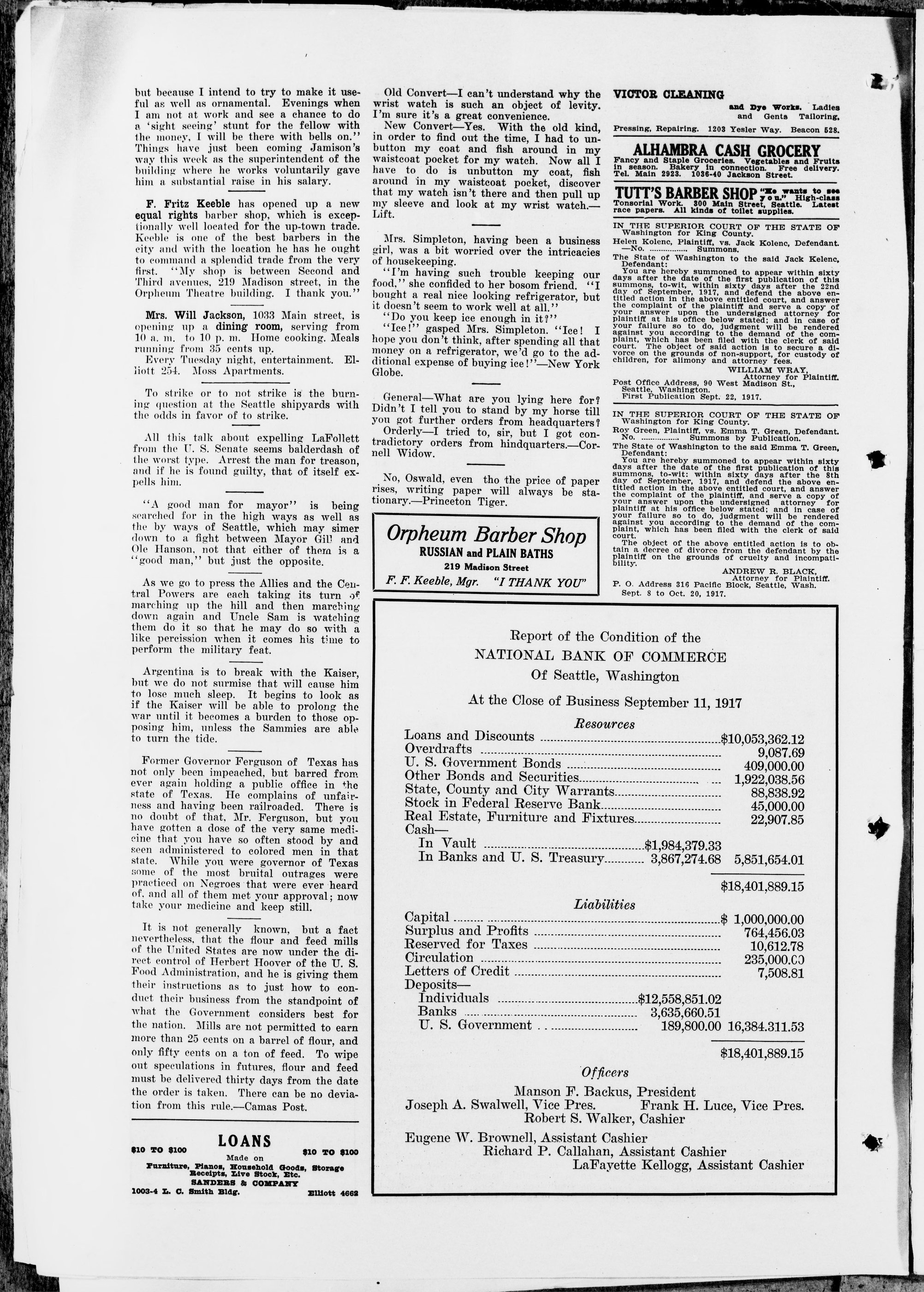
Report of the Condition of the NATIONAL BANK OF COMMERCE Of Seattle, Washington
At the Close of Business September 11, 1917
Resources
Loans and Discounts ..... $10,053,362.12
Overdrafts ..... 9,087.69
U. S. Government Bonds ..... 409,000.00
Other Bonds and Securities ..... 1,922,038.56
State, County and City Warrants ..... 88,838.92
Stock in Federal Reserve Bank ..... 45,000.00
Real Estate, Furniture and Fixtures ..... 22,907.85
Cash—
In Vault ..... $1,984,379.33
In Banks and U. S. Treasury ..... 3,867,274.68 5,851,654.01
Liabilities
Capital ..... $ 1,000,000.00
Surplus and Profits ..... 764,456.03
Reserved for Taxes ..... 10,612.78
Circulation ..... 235,000.00
Letters of Credit ..... 7,508.81
Deposits—
Individuals ..... $12,558,851.02
Banks ..... 3,635,660.51
U. S. Government . ..... 189,800.00 16,384.311.53
Officers
Manson F. Backus, President
Joseph A. Swalwell, Vice Pres. Frank H. Luce, Vice Pres.
Robert S. Walker, Cashier
Eugene W. Brownell, Assistant Cashier
Richard P. Callahan, Assistant Cashier
LaFayette Kellogg, Assistant Cashier
---
but because I intend to try to make it useful as well as ornamental. Evenings when I am not at work and see a chance to do a 'sight seeing' stunt for the fellow with the money, I will be there with bells on." Things have just been coming Jamison's way this week as the superintendent of the building where he works voluntarily gave him a substantial raise in his salary.
F. Fritz Keeble has opened up a new equal rights barber shop, which is exceptionally well located for the up-town trade. Keeble is one of the best barbers in the city and with the location he has he ought to command a splendid trade from the very first. "My shop is between Second and Third avenues, 219 Madison street, in the Orpheum Theatre building. I thank you." Mrs. Will Jackson, 1033 Main street, is opening up a dining room, serving from 10 a. m. to 10 p. m. Home cooking. Meals running from 35 cents up. Every Tuesday night, entertainment. Elliott 254. Moss Apartments.
To strike or to not strike is the burning question at the Seattle shipyards with the odds in favor of to strike.
All this talk about expelling LaFollett from the U. S. Senate seems balderdash of the worst type. Arrest the man for treason, and if he is found guilty, that of itself expells him.
"A good man for mayor" is being searched for in the high ways as well as the by ways of Seattle, which may simer down to a fight between Mayor Gill and Ole Hanson, not that either of them is a "good man," but just the opposite.
As we go to press the Allies and the Central Powers are each taking its turn of marching up the hill and then marching down again and Uncle Sam is watching them do it so that he may do so with a like percussion when it comes his time to perform the military feat.
Argentina is to break with the Kaiser, but we do not surmise that will cause him to lose much sleep. It begins to look as if the Kaiser will be able to prolong the war until it becomes a burden to those opposing him, unless the Sammies are able to turn the tide.
Former Governor Ferguson of Texas has not only been impeached, but barred from ever again holding a public office in the state of Texas. He complains of unfairness and having been railroaded. There is no doubt of that, Mr. Ferguson, but you have gotten a dose of the very same medicine that you have so often stood by and seen administered to colored men in that state. While you were governor of Texas some of the most brutal outrages were practiced on Negroes that were ever heard of, and all of them met your approval; now take your medicine and keep still.
It is not generally known, but a fact nevertheless, that the flour and feed mills of the United States are now under the direct control of Herbert Hoover of the U. S. Food Administration, and he is giving them their instructions as to just how to conduct their business from the standpoint of what the Government considers best for the nation. Mills are not permitted to earn more than 25 cents on a barrel of flour, and only fifty cents on a ton of feed. To wipe out speculations in futures, flour and feed must be delivered thirty days from the date the order is taken. There can be no deviation from this rule.—Camas Post.
LOANS
$10 TO $100 $10 TO $100
Made on
Furniture, Planos, Household Goods, Storage
Receipts, Live Stock, Etc.
SANDERS & COMPANY
1003-4 L. C. Smith Bldg. Elliott 4662
Old Convert—I can't understand why the wrist watch is such an object of levity. I'm sure it's a great convenience.
New Convert—Yes. With the old kind, in order to find out the time, I had to unbutton my coat and fish around in my waistcoat pocket for my watch. Now all I have to do is unbutton my coat, fish around in my waistcoat pocket, discover that my watch isn't there and then pull up my sleeve and look at my wrist watch.—Lift.
Mrs. Simpleton, having been a business girl, was a bit worried over the intricacies of housekeeping.
"I'm having such trouble keeping our food," she confided to her bosom friend. "I bought a real nice looking refrigerator, but it doesn't seem to work well at all."
"Do you keep ice enough in it?"
"Ice!" gasped Mrs. Simpleton. "Ice! I hope you don't think, after spending all that money on a refrigerator, we'd go to the additional expense of buying ice!"—New York Globe.
General—What are you lying here for? Didn't I tell you to stand by my horse till you got further orders from headquarters? Orderly—I tried to, sir, but I got contradictory orders from hindquarters.—Cornell Widow.
No, Oswald, even tho the price of paper rises, writing paper will always be stationary.—Princeton Tiger.
Orpheum Barber Shop
RUSSIAN and PLAIN BATHS
219 Madison Street
F. F. Keeble, Mgr. "I THANK YOU"
Loans and Discounts ..... Overdrafts ..... U. S. Government Bonds ..... Other Bonds and Securities..... State, County and City Warranty Stock in Federal Reserve Bank
and Dye Works. Ladies and Gents Tailoring.
Pressing, Repairing. 1203 Yesler Way. Beacon 528.
ALHAMBRA CASH GROCERY
Fancy and Staple Groceries. Vegetables and Fruits in season. Bakery in connection. Free delivery.
Tel. Main 2923. 1036-40 Jackson Street.
TUTT'S BARBER SHOP "He wants to see you." High-class Tonsorial Work. 300 Main Street, Seattle. Latest race papers. All kinds of toilet supplies.
IN THE SUPERIOR COURT OF THE STATE OF Washington for King County.
Helen Kolenc, Plaintiff, vs. Jack Kolenc, Defendant.
—No. ..... Summons.
The State of Washington to the said Jack Kelenc, Defendant:
You are hereby summoned to appear within sixty days after the date of the first publication of this summons, to-wit, within sixty days after the 22nd day of September, 1917, and defend the above entitled action in the above entitled court, and answer the complaint of the plaintiff and serve a copy of your answer upon the undersigned attorney for plaintiff at his office below stated; and in case of your failure so to do, judgment will be rendered against you according to the demand of the complaint, which has been filed with the clerk of said court. The object of said action is to secure a divorce on the grounds of non-support, for custody of children, for alimony and attorney fees.
WILLIAM WRAY,
Attorney for Plaintiff.
Post Office Address, 90 West Madison St.,
Seattle, Washington.
First Publication Sept. 22. 1917.
IN THE SUPERIOR COURT OF THE STATE OF Washington for King County.
Roy Green, Plaintiff, vs. Emma T. Green, Defendant.
No. ..... Summons by Publication.
The State of Washington to the said Emma T. Green,
Defendant:
You are hereby summoned to appear within sixty days after the date of the first publication of this summons, to-wit: within sixty days after the 8th day of September, 1917, and defend the above entitled action in the above entitled court, and answer the complaint of the plaintiff, and serve a copy of your answer upon the undersigned attorney for plaintiff at his office below stated; and in case of your failure so to do, judgment will be rendered against you according to the demand of the complaint, which has been filed with the clerk of said court.
The object of the above entitled action is to obtain a decree of divorce from the defendant by the plaintiff on the grounds of cruelty and incompatibility.
ANDREW R. BLACK,
Attorney for Plaintiff.
P. O. Address 316 Pacific Block, Seattle, Wash.
Sept. 8 to Oct. 20, 1917.