Cayton's Weekly
Saturday, October 6, 1917
Seattle, Washington
Page text (machine-generated)
Cayton's Weekly
PRICE FIVE CENTS
CAYTON'S WEEKLY
In the interest of equal rights and equal justice to all men and for "all men up."
A publication of general information, but in the main voicing the sentiments of the Colored Citizens.
It is open to the towns and communities of the state of Washington to air their public grievances.
Social and church notices are solicited for publication and will be handled according to the rules of journalism.
Subscription $2 per year in advance. Special rates made to clubs and societies.
HORACE ROSCOE CAYTON..Editor and Publisher
Office, 513 Pacific Blk. Telephone Main 24.
EDITORIAL PARAGRAPHS
Evidently the mayorality chair will not Trimble this winter for W. P. has gone East for the season.
Russia, it is believed, will best Germany in the long run, and if our memory serves us right, that is the way she bested Japan.
Twelve thousand shipyard workers quit their jobs last Saturday and slowly but surely they are strangling "the hen that lays the golden egg."
"Ay ban gude lil faller," proclaims the Swedish government, and we might have taken his word for it if he had thought to have washed the convicting evidence from his face.
If you have not written to a friend or an acquaintance telling him of the easy money colored men can make out here, then you are recreant to the dtuy of being your brother's keeper.
When organized labor casts up accounts, January 1st, 1918, owing to its many strikes, it will be little or nothing ahead over what it was January 1st, 1917. Experience is a dear teacher, but fools will have no other.
If there is any one left after the world war is over then we will have at least profited from it to the extent of doing things ourselves and not depending on the Germans, the English, the French, or any other nation, to do it for us.
A call has been made for four million and a quarter dollars to keep the wolf from the door in Armenia. Its right and proper for us to remember the poor and needy, but if we continue to do so we will sooner or later be in just as bad, if not worse, fix as those we have helped.
There may be and verily are papers in Russia, but you can not make us believe there are political parties in Russia, though there may be innumerable political aggregations throughout that land and country. Canada is said to be juggling with the right of suffrage and many of the citizens are all het up over it. We can sympathize with you, neighbor. Protesting against the raise of rates in articles manufactured and sold by public service corporations seem sto have no more effect on the government officials that have the regulation of the sale of such articles
---
than would be protesting against the ebb and flow of the tide. Dr. Garfield has regulated wheat to $2.00 per sack, thus maintaining the $12 and $15 per barrel price for flour. He has also regulated the price of coal and the consumers will pay twice as much for coal this coming winter as they did last. Dr. Garfield in those two instances has proven a great benefactor of the poor man—nit. The poor people protested against the raise in price of street car fares in Seattle and Tacoma, but the price was raised. Now the people are protesting against the raise in price of gas in Seattle and an hundred to one the price will be raised even higher than the gas company is asking. Its the people be damned, but how to get the rich richer and the poor poorer, is the perplexing question.
Twelve thousand shipyard employes are on a strike in Seattle, which has completely demoralized the marching of the bucket brigade. While the strikers are very hopeful that the walk-out will be of short duration, pinning their faith in the ability of the government authorities bringing the shipyard operators round to the strikers' way of thinking, yet the shipyard operators are not so sanguine about the early settlement of the strike and talk as if they are not inclined to submit to even any dictatorial demands from the government authorities. If it were only a case of increased wages involved the strike might soon be settled, but when the strikers work on the theory that the operators must go outside of their own affairs and take unto itself the troubles of others, we doubt very much if they, the strikers, are not bighting off a good deal more than they will be able to chew. Let the lumber men and their employers settle their own troubles and let the shipyard employers and employes settle their own troubles, and all concerned will come very much nearer getting a square deal.
If you, who perchance have a file of Cayton's Weekly, will turn to the issue of January 6th, 1917, and re-read the speech delivered by the editor hereof and compare its thoughts and ideas with those in the article in another column hereof under the caption of "The Evolution of A Race," you doubtless will note a striking similarity of thoughts between the two. The theory advanced in the article herein are advocated by a man, who has never heard of either the editor of Cayton's Weekly or the publication, and, yet, they completely coincide with those advanced by us nine months ago. White or black who take exceptions to such race evolutions are both narrow and biggoted. Whatever is is, and kicking against the pricks neither alters or modifies the situation. We firmly believe that in North America is to yet spring up a race made up of all the races of the world which race will sooner or later dominate the world. The blood of the ten million blacks will not make much of a showing when thrown into the melting pot with ninety million whites, but will make a sufficient showing to evolve a mongrel race.
Robbing the county and state and even the national government is by no means looked upon as being a crime by the average citizen and the most of them who get an opportunity will do so with no religious scruples. But recently an investigation was
VOL.2, No.17
started by the county commissioners of King county as to the poor quality of roads made by the contractors for the county and as the investigation grows the highhandedness of the contractors becomes more and more apaprent and it begins to look as if the county has lost multiplied thousands of dollars on faulty roads, that is building a low grade of roads and charging for a high grade of roads. The prosecuting attorney plans to force these ill-gotten gains to be returned and he even may criminally prosecute some of the contractors, which thing ought to be done even if they blow back. Another investigation has been put under headway that promises to develop the worst padded pay rolls of all, in the bridge building part of the county work. Lets hope that Prosecuting Attorney Lundin will push this investigation to a fare you well finish and send every criminal one of them to the penitnetiary.
WILLIAM M. RUSSELL
"Dad" Russell is dead, which ends the earthly career of one of God's noblemen. For fifteen years or more W. M. Russell was one of the theatrical men of the Northwest and he was one of the whitest men that ever operated a show house. When things did not go right or somebody did something to somebody else connected with the shows playing in one or the other of the houses he managed, they would just take their troubles to "Dad" Russell, as all learned to call him, and it would all be straightened out, both combatants being perfectly willing to abide by his decision. If the colored show man who visited the Northwest did not get a square deal from some of the other houses he could always bank on Dad Russell giving him one. Colored patrons to his play houses got the best the house had and if one of them got rough he was put out, but that had no effect on the next one getting just as good accommodations. Once on a time a southern white skunk made a holler about niggers being given seats by his family and went to Russell with his complaint, whereupon Russell cooly remarked, "When I sold you that ticket I though you just as good as a nigger, providing you behaved yourself, but I am now thoroughly convinced that I was mistaken, and your future patronage to this house is not solicited." The skunk looked foolish and backed off without a word of reply, but continued to visit the show house, even though he was not wanted. For fifteen years or more the editor of this paper and his family were always welcome to the houses managed by W. M. Russell. He had a host of friends among the colored citizens of the city and always had a pleasant as well as encouraging word for them wheenever he met them. After giving up the show business he traveled for a house and frequently he would tell us of the hundred and one colored men he met on his travels, whom he had befriended, and who would greet him almost as a father. Peace to his ashes.
Job work in the latest and newest styles turned out in this office. Main 24. "It is all over," groaned the Kaiser, "the game is up. The American people have decided to put into the war the money which they now spend for chewing gum and penny chocolate!"—Brooklyn Eagle.
---
PASSING THRONG
Mrs. L. C. Freeman and her daughter, Mrs. Clifford Scurry, have returned to Seattle and are at home to their friends. Mrs. Freeman has had Mrs. Maud Longus brought over from Tacoma that she may care for her during her illness. Mrs. Longus was formerly Miss Maud Hartsfield and was reared by Mrs. Freeman.
Emmett H. Holmes of Spokane, grand master of the Masons of Washington and jurisdiction, was in the city this week making his first tour of the various lodges in this jurisdiction. In discussing the general condition of the colored folks in the Northwest he said, "It was never better and all over Washington and Oregon they are doing exceedingly well."
Mrs. J. W. Sweeney left for Kansas City last Tuesday evening and will be absent for the next eight weeks. She goes to visit her brother and sister, whom she has not seen for thirty years. Mrs. Sweeney is one of the faithful as well as effective workers of the First A. M. E. church of this city and has done much for the good ofthe community.
W. D. Slater has returned from his ranch in eastern Washington, which is near Kittitas, and has gone to work for the Pacific Steel plant at Youngstown. He plans to take a course in architecture and building at the Broadway High School this coming winter that he may be able, when he returns to his ranch next spring, to plan and do the most if not all of his building. He has taken rooms in the home of Mrs. Robinson, 603 Twenty-second avenue.
"Pinky" (John) Prim seems to be the star of hope for the Franklin football squad and his masterly plays won the day for the Franklin bunch last Saturday at the opening game of the season, which was between Franklin and the Ballard boys. Prim is some player and his appearance on the field is always the signal for an outburst of applause. Broadway has had two football stars in Clyde Coleman and Ed. Johnson, but Prim is the first colored star Franklin has ever had.
Lemuel Jenkens, who has spent the greater part of his life in the barbering business, read about the work at the Pacific Steel plant over at Youngstown and decided he could make a hit for himself over there and he at once gave up, what he thought at one time a pretty good job, and sought employment over there. He got work and now it is reported that he is donig as well as he ever did in the barber business and much better than he was doing at the job he quit to go to Youngstown to work. If you want to work in Seattle just now you "sho" can get all you can do and that too, at splendid wages.
Mrs. John Franklin Cragwell was hostess at a diner party last Monday evening in honor of Mrs. Scott Harris of Everett. Covers were laid for twelve in the persons of Mrs. Scott Harris, Mrs. John O. Lewis, Mrs. John Byron Parker, Mrs. Andrew R. Black, Mrs. Benjamin F. Tutt, Mrs. James Reems, of Bellingham, Mrs. Walter J. Ball, Mrs. Samuel H. Stone, Mrs. L. A. Graves, Mrs. E. A. Johnson. After having partaken of the elegant repast the guests were taken to the church in automobiles, where the Harris family rendered a most pleasing program. The Cragwell and Harris families have been intimate friends for at least a hundred years, both hailing from Virginia. Mr. Cragwell was largely responsible for the financial success of the entertainment given for the benefit of the Harris family.
Louis L. Scott, S. T. Waters, Henry and Harris are janitors at the Seattle postoffice at present. Roy Harvey was also working there, but got more money at the navy yard and is now working there. It seems to be rather hard for Uncle Sam to
keep men at that job and all because he does not pay them enough money. Those janitors get $60 per month for eight hours work pe rday, which is just about $40 per month too short of what men should get for such work. The white janitors all quit to go to work in the various ship yards and it is only a matter of a short time when the colored men will quit and take more lucrative jobs. However, this is a splendid time for colored men to get government jobs, which will last the most of their natural lives, as the white men can do so much better that they do not hesitate to not only leave them even when they are fixtures, but new ones will not apply.
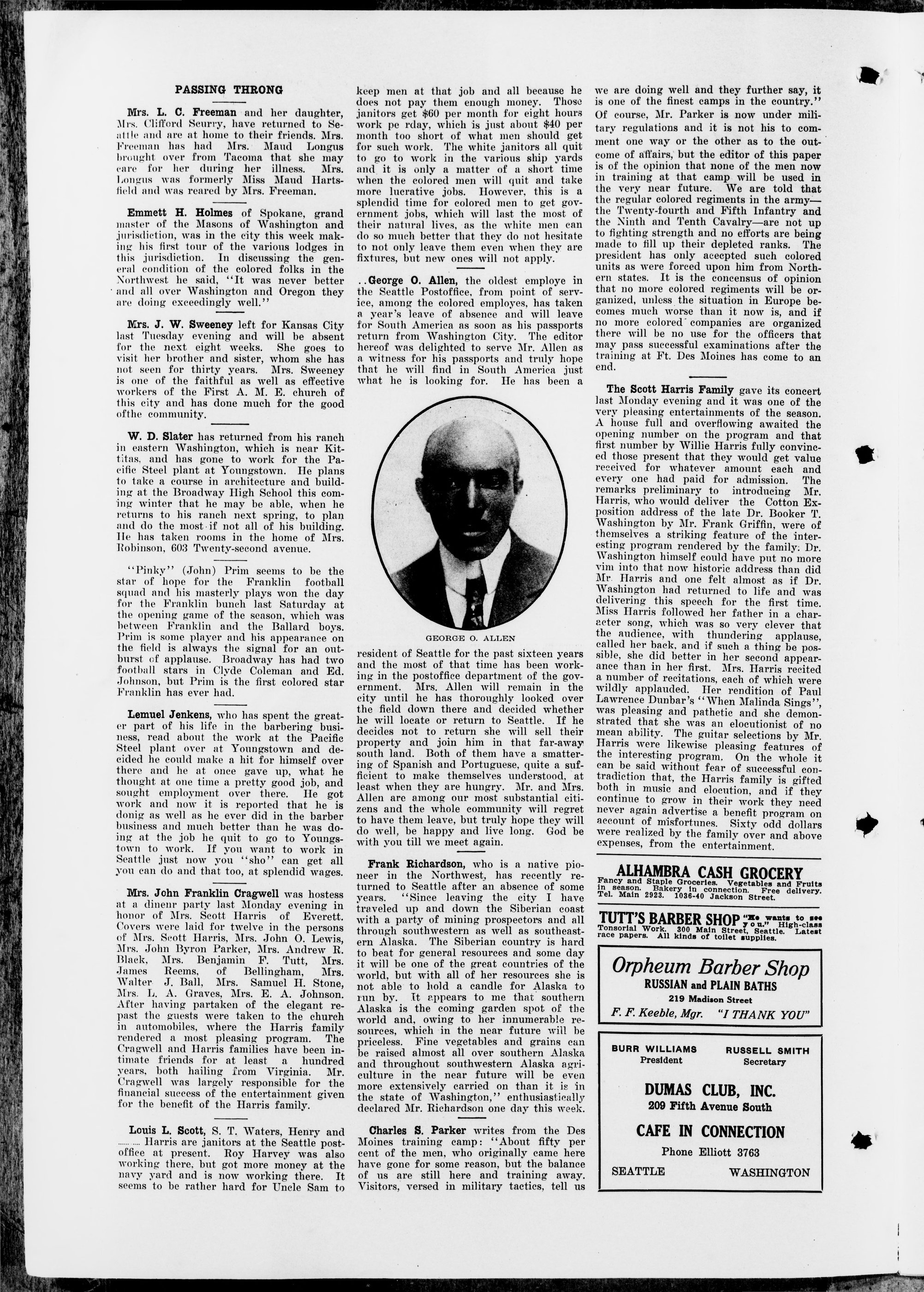
..George O. Allen, the oldest employee in the Seattle Postoffice, from point of service, among the colored employes, has taken a year's leave of absence and will leave for South America as soon as his passports return from Washington City. The editor hereof was delighted to serve Mr. Allen as a witness for his passports and truly hope that he will find in South America just what he is looking for. He has been a
[Image of a man in a suit with a tie].
GEORGE O. ALLEN
resident of Seattle for the past sixteen years and the most of that time has been working in the postoffice department of the government. Mrs. Allen will remain in the city until he has thoroughly looked over the field down there and decided whether he will locate or return to Seattle. If he decides not to return she will sell their property and join him in that far-away south land. Both of them have a smattering of Spanish and Portuguese, quite a sufficient to make themselves understood, at least when they are hungry. Mr. and Mrs. Allen are among our most substantial citizens and the whole community will regret to have them leave, but truly hope they will do well, be happy and live long. God be with you till we meet again.
Frank Richardson, who is a native pioneer in the Northwest, has recently returned to Seattle after an absence of some years. "Since leaving the city I have traveled up and down the Siberian coast with a party of mining prospectors and all through southwestern as well as southeastern Alaska. The Siberian country is hard to beat for general resources and some day it will be one of the great countries of the world, but with all of her resources she is not able to hold a candle for Alaska to run by. It appears to me that southern Alaska is the coming garden spot of the world and, owing to her innumerable resources, which in the near future will be priceless. Fine vegetables and grains can be raised almost all over southern Alaska and throughout southwestern Alaska agriculture in the near future will be even more extensively carried on than it is in the state of Washington," enthusiastically declared Mr. Richardson one day this week.
Charles S. Parker writes from the Des Moines training camp: "About fifty per cent of the men, who originally came here have gone for some reason, but the balance of us are still here and training away. Visitors, versed in military tactics, tell us
we are doing well and they further say, it is one of the finest camps in the country." Of course, Mr. Parker is now under military regulations and it is not his to comment one way or the other as to the outcome of affairs, but the editor of this paper is of the opinion that none of the men now in training at that camp will be used in the very near future. We are told that the regular colored regiments in the army—the Twenty-fourth and Fifth Infantry and the Ninth and Tenth Cavalry—are not up to fighting strength and no efforts are being made to fill up their depleted ranks. The president has only accepted such colored units as were forced upon him from Northern states. It is the concensus of opinion that no more colored regiments will be organized, unless the situation in Europe becomes much worse than it now is, and if no more colored companies are organized there will be no use for the officers that may pass successful examinations after the training at Ft. Des Moines has come to an end.
The Scott Harris Family gave its concert last Monday evening and it was one of the very pleasing entertainments of the season. A house full and overflowing awaited the opening number on the program and that first number by Willie Harris fully convinced those present that they would get value received for whatever amount each and every one had paid for admission. The remarks preliminary to introducing Mr. Harris, who would deliver the Cotton Exposition address of the late Dr. Booker T. Washington by Mr. Frank Griffin, were of themselves a striking feature of the interesting program rendered by the family: Dr. Washington himself could have put no more vim into that now historic address than did Mr. Harris and one felt almost as if Dr. Washington had returned to life and was delivering this speech for the first time. Miss Harris followed her father in a character song, which was so very clever that the audience, with thundering applause, called her back, and if such a thing be possible, she did better in her second appearance than in her first. Mrs. Harris recited a number of recitations, each of which were wildly applauded. Her rendition of Paul Lawrence Dunbar's "When Malinda Sings", was pleasing and pathetic and she demonstrated that she was an elocutionist of no mean ability. The guitar selections by Mr. Harris were likewise pleasing features of the interesting program. On the whole it can be said without fear of successful contradiction that, the Harris family is gifted both in music and elocution, and if they continue to grow in their work they need never again advertise a benefit program on account of misfortunes. Sixty odd dollars were realized by the family over and above expenses, from the entertainment.
ALHAMBRA CASH GROCERY
Fancy and Staple Groceries. Vegetables and Fruits in season. Bakery in connection. Free delivery. Tel. Main 2923. 1036-40 Jackson Street.
TUTT'S BARBER SHOP "He wants to see you." High-class Tonsorial Work. 300 Main Street, Seattle. Latest race papers. All kinds of toilet supplies.
Orpheum Barber Shop
RUSSIAN and PLAIN BATHS
219 Madison Street
F. F. Keeble, Mgr. "I THANK YOU"
BURR WILLIAMS RUSSELL SMITH
President Secretary
DUMAS CLUB, INC.
209 Fifth Avenue South
CAFE IN CONNECTION
Phone Elliott 3763
SEATTLE WASHINGTON
ROBERT BROOKS ALBERTSON
In the death of Judge R. B. Albertson the community loses one of its most eminent judicials and his loss is rightfully mourned by all. He has been prominent in public affairs in this community for the past thirty years and had been on the superior court bench for the past fourteen years. He was very independent in politics and though he claimed to be a Republican, yet he generally did whatever he believed to be right, regardless of his party wishes. While a member of the legislature a civil rights bill in the interest of the colored folks of the state came before the body and though "Bob' 'Albertson did not fight it on the floor, yet he did not favor it and gave the editor hereof, who was fathering the bill, to understand as much, which caused a difference to arise between us, that lasted for many years. Time, however, heals all differences and later in life we talked the old score over and decided it was a dead issue and we were friends again. While in North Carolina, in his late illness, the bailiff in his court religiously sent him a copy of Cayton's Weekly every week and it was likewise sent out to his sick room every week after he returned to Seattle. We take pleasure in making this explanation because it was but a few days ago that an old-time prominent Republican politician inquired of a friend of the editor hereof "Why did Cayton oppose Judge Albertson for so long?"
N. A. A. C. MEETING
Next Monday evening the local branch of the National Association for the Advancement of Colored People will hold its bi-mnothly meeting and if there be no more present than usually attend these meetings then its doubtful if a legal quorum will be on hand. Knowing, however, of the many energetic men and women, who live in Seattle, we are unable to explain why splendid meetings are not held every month and good work from time to time done. The following account of a recent monthly meeting held in St. Louis may, we hope, be a stimulus to the lukewarmness in Seattle:
"The splendid handling of the different phases of the East St. Louis horror of last July is opening the eyes of the community to the efficiency of this organization. The thorough relief furnished the many pitiable victims of the riots, the able and relentless detection and prosecution of more than one hundred of the mobsters, the defense of the accused Negroes, whose only crime is shown to be that of self-defense, the extensive claims for property and life losses, all show that the St. Louis branch is on the job as no Negro organization ever operating in this country has been before.
"In addition to riot matters, the branch reported the practical completion of a full Negro regiment for the Missouri Home Guard (the supplemental militia.
"A large portion of the meting was given up to industrial proscription in employing labor on two buildings whose aggregate cost of construction is nearly half a million dollars. These buildings are the Colored Y. M. C. A. building, representing at least $60,-000 of Negro capital in its total cost of $250,000, and the Pope-Turnbo-Malone building, representing $200,000 of private Negro capital. In this matter the branch uttered a strong statement that speaks for itself.
"No greater evidence of the completeness of the labors of the St. Louis branch can be found than the reaction that is showing in public sentiment in East St. Louis and St. Clair county, Illinois, because of its activities. The mobsters indicted in St. Clair county for their crimes at East St. Louis are unanimously seeking change of venue, because of the moral certainty of conviction and drastic punishment if tried where the enormity of their crimes has been made so plain.
The branch also forwarded a (b) communication to the national headquarters at New York city, which was a severe complaint against what it regards as unwarranted delay in granting commissions to
```markdown
```
colored officers and mobilizing colored troops. Following is the (a) communication in full: "St. Louis, Mo., Sept. 19, 1917 "Actuated solely by the motive of instructing the frequently too thoughtless of our race to recognition of race service, particularly along economic industrial lines, we call attention to two marked instances (now prominently in view of the world at St. Louis), where hundreds of thousands of dollars of Negro capital are being applied to the construction of buildings from which Negro craftsmen are, by circumstances, excluded, regardless of their efficiency.
"We refer to the Negro Y. M. C. A. building being erected at Ewing avenue and Pine street and the Pope-Turnbo-Malone building at Pendleton avenue and St. Ferdinand street.
"In viewing conditions in the construction of these edifices, we consider the personnel of the promoters, the interests of "union labor" and all other things that have been advanced in extenuation of wrong there most fully; and then we say, with all the force and emphasis of truth, these considerations are peurile and insignificant in contrast to the offense of Negro capital, directly or indirectly, ostracising Negro labor.
"That this ostracism comes from thoughtlessness and not from treacherous design does not alter one iota the hurt and shame of its results.
"The colored people have unanimously complained against industrial ostracism by white capital ever since their lips have been free to complain. These generations of complaint have been without justification if the complaint we here make against Negro capital is without justification. We denounce these blows, whoever delivers them from whatever motive.
“Mr. Everybody and "union labor" and "business contracts" are all right with us until they strike, directly or in a roundabout fashion, in the purse, the stomach or the finer sensibilities, any humanity because of that humanity's race or color. On this rock we stand. "If "union labor" ostracizes Negro labor, we are for Negro labor and against "union labor"; and we are against every person who is with "union labor" and against Negro labor.
“‘If through thoughtlessness contracts are made that insure exclusion of Negro labor, we denounce that thoughtlessness as being ruinously harmful, and we warn against its prevalence.
“‘In passing, we note the whispered fear that our criticism of this great wrong may furnish excuse to some subscribers to the Y. M. C. A. to repudiate their subscriptions, only to say that any man who would break his pledged word on such pretext, however just he holds our contention, is too palpably dishonest to make his tainted money welcome to a Christian association.’”
NOBODY KNOWS
Absolute knowledge I have none,
But my aunt's washerwoman's sister's son
Heard a policeman on his beat
Say to a laborer on the street,
That he had a letter just last week,
Written in the finest Greek,
From a Chinese coolie in Timbuctoo,
Who said the niggers in Cuba knew
Of a colored man in a Texas town,
Who got it straight from a circus clown,
That a man in the Klondike heard the news
From a bunch of South American Jews,
About somebody in Borneo,
Who heard a man who claimed to know
Of a swell society female rake,
Whose mother-in-law will undertake
To prove that her husband's sister's niece,
Has stated, in a printed piece,
That she has a son who has a friend
Who knows when the war is going to end.
—Anonymous.
VICTOR CLEANING
and Dye Works. Ladies and Gents Talloring, Pressing, Repairing. 1203 Yesler Way. Beacon 528.
IN THE SUPERIOR COURT OF THE STATE OF Washington for King County.
Helen Kolenc, Plaintiff, vs. Jack Kolenc, Defendant;
—No. ..... Summons.
The State of Washington to the said Jack Kelenc,
Defendant;
You are hereby summoned to appear within sixty days after the date of the first publication of this summons, to-wit, within sixty days after the 22nd day of September, 1917, and defend the above entitled action in the above entitled court, and answer the complaint of the plaintiff and serve a copy of your answer upon the undersigned attorney for plaintiff at his office below stated; and in case of your failure so to do, judgment will be rendered against you according to the demand of the complaint, which has been filed with the clerk of said court. The object of said action is to secure a divorce on the grounds of non-support, for custody of children, for alimony and attorney fees.
WILLIAM WRAY,
Attorney for Plaintiff.
Post Office Address, 90 West Madison St.,
Seattle, Washington.
First Publication Sept. 22, 1917.
IN THE SUPERIOR COURT OF THE STATE OF
Washington for King County.
Roy Green, Plaintiff, vs. Emma T. Green, Defendant.
No. ..... Summons by Publication.
The State of Washington to the said Emma T. Green,
Defendant:
You are hereby summoned to appear within sixty days after the date of the first publication of this summons, to-wit: within sixty days after the 8th day of September, 1917, and defend the above entitled action in the above entitled court, and answer the complaint of the plaintiff, and serve a copy of your answer upon the undersigned attorney for plaintiff at his office below stated; and in case of your failure so to do, judgment will be rendered against you according to the demand of the complaint, which has been filed with the clerk of said court.
The object of the above entitled action is to obtain a decree of divorce from the defendant by the plaintiff on the grounds of cruelty and incompatibility.
ANDREW R. BLACK,
Attorney for Plaintiff.
P. O. Address 316 Pacific Block, Seattle, Wash.
Sept. 8 to Oct. 20, 1917.
STATEMENT OF THE OWNERSHIU, MANAGEMENT, CIRCULATION, ETC., REKUIRED BY THE ACT OF CONGRESS OF AUGUST 24, 1912
Of Cayton's Weekly, published weekly at Seattle for October, 1917.
State of Washington, County of King.—ss.
Before me, a rotary public in and over the State and county aforesaid, personally appeared Horace Roscoe Cayton, who, having been duly sworn according to law, deposes and says that he is the editor of the Cayton's Weekly and that the following is, to the best of his knowledge and belief, a true statement of the ownership, management (and if a daily paper, the circulation), etc., of the aforesaid publication for the date shown in the above caption, required by the Act of August 24, 1912, embodied in section 443, Postal Laws and Regulations, printed on the reverse of this form, to-wit:
1. That the names and addresses of the publisher, editor, managing editor, and business managers are: Publisher, Horace Roscoe Cayton, .....Seattle, Wash. Editor, Horace Roscoe Cayton.....Seattle, Wash. Manag. Editor, Horace Roscoe Cayton, Seattle, Wash. Business Mgr., Horace Roscoe Cayton, Seattle, Wash.
2. That the owners are: Horace Roscoe Cayton.
3. That the known bondholders, mortgagees, and other security holders owning or holding 1 per cent or more of total amount of bonds, mortgages, or other securities are: None.
4. That the two paragraphs next above, giving the names of the owners, stockholders, and security holders, if any, contain not only the list of stockholders and security holders as they appear upon the books of the company but also, in cases where the stockholder or security holder appears upon the books of the company as trustee or in any other fiduciary relation, the name f the person or corporation for whom such trustee is acting, is given; also that the said two paragraphs contain statements embracing affiant's full knowledge and belief as to the circumstances and conditions under which stockholders and security holders who do not apepar upon the books of the company as trustees, hold stock and securities in a capacity other than that of a bona fide owner; and this affiant has no reason to believe that any other person, association, or corporation has any interest direct or indirect in the said stock, bonds, or other securities than as so stated by him.
5. That the average number of copies of each issue of this publication sold or distributed, through the mails or otherwise, to paid subscribers during the six months preceding the date shown above is _____ (This information is required from daily publications only.)
HORACE ROSCOE CAYTON,
Sworn to and subscribed before me this 5th day of
October, 1917.
GILBERT F. BOGUE,
Notary Public.
(My commisison expires March 18th, 1919)
Elliott 991——Elliott 992
H. & S. Taxi and Touring
First Class Cars Capable Drivers
STAND 724 PINE ST.
Reasonable Rates Day and Night Service
on our Touring Trips We Never Sleep
“SERVICE” OUR MOTTO
THE DOUGLAS CLUB
Now Occupies spacious and elegantly
furnished and equipped
NEW QUARTERS
And will be pleased to meet old and
new friends
308 Washington St. Frank Smith, Prop.
Main 4930
---
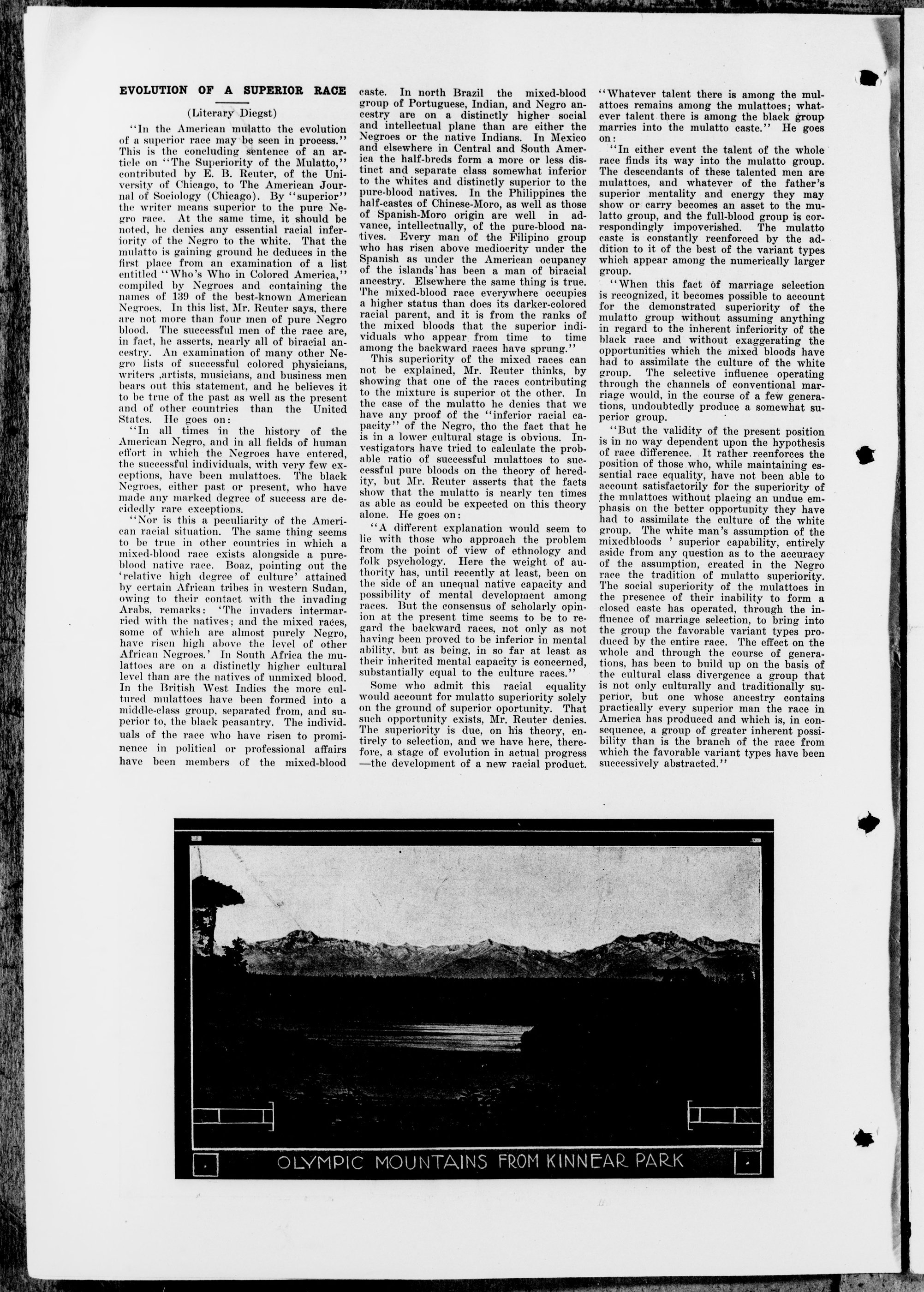
OLYMPIC MOUNTAINS FROM KINNEAR PARK
```markdown
```
(Literary Diegst)
"In the American mulatto the evolution of a superior race may be seen in process." This is the concluding sentence of an article on "The Superiority of the Mulatto," contributed by E. B. Reuter, of the University of Chicago, to The American Journal of Sociology (Chicago). By "superior" the writer means superior to the pure Negro race. At the same time, it should be noted, he denies any essential racial inferiority of the Negro to the white. That the mulatto is gaining ground he deduces in the first place from an examination of a list entitled "Who's Who in Colored America," compiled by Negroes and containing the names of 139 of the best-known American Negroes. In this list, Mr. Reuter says, there are not more than four men of pure Negro blood. The successful men of the race are, in fact, he asserts, nearly all of biracial ancestry. An examination of many other Negro lists of successful colored physicians, writers, artists, musicians, and business men bears out this statement, and he believes it to be true of the past as well as the present and of other countries than the United States. He goes on:
"In all times in the history of the American Negro, and in all fields of human effort in which the Negroes have entered, the successful individuals, with very few exceptions, have been mulattoes. The black Negroes, either past or present, who have made any marked degree of success are decidedly rare exceptions.
'Nor is this a peculiarity of the American racial situation. The same thing seems to be true in other countries in which a mixed-blood race exists alongside a pureblood native race. Boaz, pointing out the 'relative high degree of culture' attained by certain African tribes in western Sudan, owing to their contact with the invading Arabs, remarks: 'The invaders intermarried with the natives; and the mixed races, some of which are almost purely Negro, have risen high above the level of other African Negroes.' In South Africa the mulattoes are on a distinctly higher cultural level than are the natives of unmixed blood. In the British West Indies the more cultured mulattoes have been formed into a middle-class group, separated from, and superior to, the black peasantry. The individuals of the race who have risen to prominence in political or professional affairs have been members of the mixed-blood
caste. In north Brazil the mixed-blood group of Portuguese, Indian, and Negro ancestry are on a distinctly higher social and intellectual plane than are either the Negroes or the native Indians. In Mexico and elsewhere in Central and South America the half-breds form a more or less distinct and separate class somewhat inferior to the whites and distinctly superior to the pure-blood natives. In the Philippines the half-castes of Chinese-Moro, as well as those of Spanish-Moro origin are well in advance, intellectually, of the pure-blood natives. Every man of the Filipino group who has risen above mediocrity under the Spanish as under the American occupancy of the islands has been a man of biracial ancestry. Elsewhere the same thing is true. The mixed-blood race everywhere occupies a higher status than does its darker-colored racial parent, and it is from the ranks of the mixed bloods that the superior individuals who appear from time to time among the backward races have sprung."
This superiority of the mixed races can not be explained, Mr. Reuter thinks, by showing that one of the races contributing to the mixture is superior ot the other. In the case of the mulatto he denies that we have any proof of the "inferior racial capacity" of the Negro, tho the fact that he is in a lower cultural stage is obvious. Investigators have tried to calculate the probable ratio of successful mulattoes to successful pure bloods on the theory of heredity, but Mr. Reuter asserts that the facts show that the mulatto is nearly ten times as able as could be expected on this theory alone. He goes on:
"A different explanation would seem to lie with those who approach the problem from the point of view of ethnology and folk psychology. Here the weight of authority has, until recently at least, been on the side of an unequal native capacity and possibility of mental development among races. But the consensus of scholarly opinion at the present time seems to be to regard the backward races, not only as not having been proved to be inferior in mental ability, but as being, in so far at least as their inherited mental capacity is concerned, substantially equal to the culture races."
Some who admit this racial equality would account for mulatto superiority solely on the ground of superior opportunity. That such opportunity exists, Mr. Reuter denies. The superiority is due, on his theory, entirely to selection, and we have here, therefore, a stage of evolution in actual progress the development of a new racial product.
"Whatever talent there is among the mulattoes remains among the mulattoes; whatever talent there is among the black group marries into the mulatto caste." He goes on:
"In either event the talent of the whole race finds its way into the mulatto group. The descendants of these talented men are mulattoes, and whatever of the father's superior mentality and energy they may show or carry becomes an asset to the mulatto group, and the full-blood group is correspondingly impoverished. The mulatto caste is constantly reenforced by the addition to it of the best of the variant types which appear among the numerically larger group.
"When this fact of marriage selection is recognized, it becomes possible to account for the demonstrated superiority of the mulatto group without assuming anything in regard to the inherent inferiority of the black race and without exaggerating the opportunities which the mixed bloods have had to assimilate the culture of the white group. The selective influence operating through the channels of conventional marriage would, in the course of a few generations, undoubtedly produce a somewhat superior group.
"But the validity of the present position is in no way dependent upon the hypothesis of race difference. It rather reenforces the position of those who, while maintaining essential race equality, have not been able to account satisfactorily for the superiority of the mulattoes without placing an undue emphasis on the better opportunity they have had to assimilate the culture of the white group. The white man's assumption of the mixedbloods' superior capability, entirely aside from any question as to the accuracy of the assumption, created in the Negro race the tradition of mulatto superiority. The social superiority of the mulattoes in the presence of their inability to form a closed caste has operated, through the influence of marriage selection, to bring into the group the favorable variant types produced by the entire race. The effect on the whole and through the course of generations, has been to build up on the basis of the cultural class divergence a group that is not only culturally and traditionally superior, but one whose ancestry contains practically every superior man the race in America has produced and which is, in consequence, a group of greater inherent possibility than is the branch of the race from which the favorable variant types have been successively abstracted."