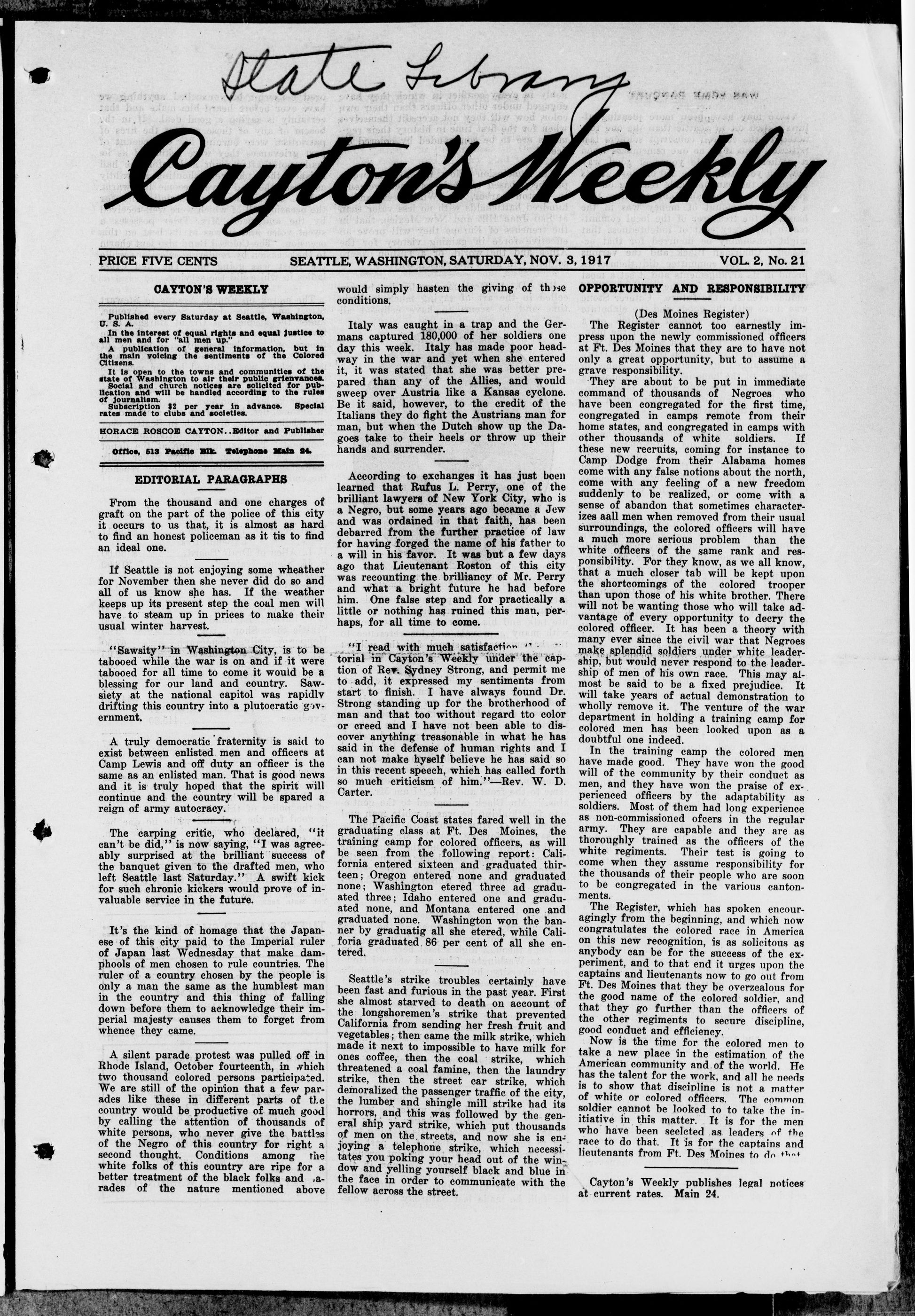
Cayton's Weekly
Saturday, November 3, 1917
Seattle, Washington
Page text (machine-generated)
State Library
Cayton's Weekly
---
PRICE FIVE CENTS
CAYTON'S WEEKLY
Published every Saturday at Seattle, Washington, U. S. A. In the interest of equal rights and equal justice to all men and for "all men up." A publication of general information, but in the main voicing the sentiments of the Colored Citizens. It is open to the towns and communities of the state of Washington to air their public grievances. Social and church notices are solicited for publication and will be handled according to the rules of journalism.
Subscription $2 per year in advance. Special rates made to clubs and societies.
HORACE ROSCOE CAYTON..Editor and Publisher
Office, 513 Pacific Blk. Telephone Main 24.
EDITORIAL PARAGRAPHS
From the thousand and one charges of graft on the part of the police of this city it occurs to us that, it is almost as hard to find an honest policeman as it tis to find an ideal one.
If Seattle is not enjoying some wheather for November then she never did do so and all of us know she has. If the weather keeps up its present step the coal men will have to steam up in prices to make their usual winter harvest.
"Sawsity" in Washington City, is to be tabooed while the war is on and if it were tabooed for all time to come it would be a blessing for our land and country. Sawsiety at the national capitol was rapidly drifting this country into a plutocratic government.
A truly democratic fraternity is said to exist between enlisted men and officers at Camp Lewis and off duty an officer is the same as an enlisted man. That is good news and it is truly hoped that the spirit will continue and the country will be spared a reign of army autocracy.
The carping critic, who declared, "it can't be did," is now saying, "I was agreeably surprised at the brilliant success of the banquet given to the drafted men, who left Seattle last Saturday." A swift kick for such chronic kickers would prove of invaluable service in the future.
It's the kind of homage that the Japanese of this city paid to the Imperial ruler of Japan last Wednesday that make damphools of men chosen to rule countries. The ruler of a country chosen by the people is only a man the same as the humblest man in the country and this thing of falling down before them to acknowledge their imperial majesty causes them to forget from whence they came.
A silent parade protest was pulled off in Rhode Island, October fourteenth, in which two thousand colored persons participated. We are still of the opinion that a few parades like these in different parts of the country would be productive of much good by calling the attention of thousands of white persons, who never give the battles of the Negro of this country for right a second thought. Conditions among the white folks of this country are ripe for a better treatment of the black folks and parades of the nature mentioned above
---
would simply hasten the giving of those conditions.
Italy was caught in a trap and the Germans captured 180,000 of her soldiers one day this week. Italy has made poor headway in the war and yet when she entered it, it was stated that she was better prepared than any of the Allies, and would sweep over Austria like a Kansas cyclone. Be it said, however, to the credit of the Italians they do fight the Austrians man for man, but when the Dutch show up the Dagoes take to their heels or throw up their hands and surrender.
According to exchanges it has just been learned that Rufus L. Perry, one of the brilliant lawyers of New York City, who is a Negro, but some years ago became a Jew and was ordained in that faith, has been debarred from the further practice of law for having forged the name of his father to a will in his favor. It was but a few days ago that Lieutenant Roston of this city was recounting the brilliancy of Mr. Perry and what a bright future he had before him. One false step and for practically a little or nothing has ruined this man, perhaps, for all time to come.
"I read with much satisfaction torial in Cayton's Weekly under the caption of Rev. Sydney Strong, and permit me to add, it expressed my sentiments from start to finish. I have always found Dr. Strong standing up for the brotherhood of man and that too without regard to color or creed and I have not been able to discover anything treasonable in what he has said in the defense of human rights and I can not make hyself believe he has said so in this recent speech, which has called forth so much criticism of him."—Rev. W. D. Carter.
The Pacific Coast states fared well in the graduating class at Ft. Des Moines, the training camp for colored officers, as will be seen from the following report: California entered sixteen and graduated thirteen; Oregon entered none and graduated none; Washington etered three ad graduated three; Idaho entered one and graduated none, and Montana entered one and graduated none. Washington won the banner by graduatig all she etered, while California graduated 86 per cent of all she entered.
Seattle's strike troubles certainly have been fast and furious in the past year. First she almost starved to death on account of the longshoremen's strike that prevented California from sending her fresh fruit and vegetables; then came the milk strike, which made it next to impossible to have milk for ones coffee, then the coal strike, which threatened a coal famine, then the laundry strike, then the street car strike, which demoralized the passenger traffic of the city, the lumber and shingle mill strike had its horrors, and this was followed by the general ship yard strike, which put thousands of men on the streets, and now she is enjoying a telephone strike, which necessitates you poking your head out of the window and yelling yourself black and blue in the face in order to communicate with the fellow across the street.
VOL.2.No.21
OPPORTUNITY AND RESPONSIBILITY
(Des Moines Register)
The Register cannot too earnestly impress upon the newly commissioned officers at Ft. Des Moines that they are to have not only a great opportunity, but to assume a grave responsibility.
They are about to be put in immediate command of thousands of Negroes who have been congregated for the first time, congregated in camps remote from their home states, and congregated in camps with other thousands of white soldiers. If these new recruits, coming for instance to Camp Dodge from their Alabama homes come with any false notions about the north, come with any feeling of a new freedom suddenly to be realized, or come with a sense of abandon that sometimes characterizes all men when removed from their usual surroundings, the colored officers will have a much more serious problem than the white officers of the same rank and responsibility. For they know, as we all know, that a much closer tab will be kept upon the shortcomings of the colored trooper than upon those of his white brother. There will not be wanting those who will take advantage of every opportunity to decry the colored officer. It has been a theory with many ever since the civil war that Negroes make splendid soldiers under white leadership, but would never respond to the leadership of men of his own race. This may almost be said to be a fixed prejudice. It will take years of actual demonstration to wholly remove it. The venture of the war department in holding a training camp for colored men has been looked upon as a doubtful one indeed.
In the training camp the colored men have made good. They have won the good will of the community by their conduct as men, and they have won the praise of experienced officers by the adaptability as soldiers. Most of them had long experience as non-commissioned ofcers in the regular army. They are capable and they are as thoroughly trained as the officers of the white regiments. Their test is going to come when they assume responsibility for the thousands of their people who are soon to be congregated in the various cantonments.
The Register, which has spoken encouragingly from the beginning, and which now congratulates the colored race in America on this new recognition, is as solicitous as anybody can be for the success of the experiment, and to that end it urges upon the captains and lieutenants now to go out from Ft. Des Moines that they be overzealous for the good name of the colored soldier, and that they go further than the officers of the other regiments to secure discipline, good conduct and efficiency. Now is the time for the colored men to take a new place in the estimation of the American community and of the world. He has the talent for the work, and all he needs is to show that discipline is not a matter of white or colored officers. The common soldier cannot be looked to to take the initiative in this matter. It is for the men who have been selected as leaders of the race to do that. It is for the captains and lieutenants from Ft. Des Moines to do that
Cayton's Weekly publishes legal notices at current rates. Main 24.
WAS SOME BANQUET
There may have been more pleasing affairs pulled on in Seattle than the one tendered to the colored conscript soldiers last Saturday, but if so no one remembers when it occurred. It made you feel good way down in your toes to see 250 or more guests sitting at the banquet table feasting on the good things of the land, and to know that a sufficient amount of money was in the hands of the treasurer of the local committee to pay every cent of indebtedness that might reasonably be incurred for that occasion. Chairman Black and the various members of the committee did themselves proud in its arrangements and it set a most brilliant precedent for the pulling off of similar events in the future. Caterer Stone was there with the goods and the elaborate menu was served without a hitch or a bawk and using the vernacular of the plantation Negro, "it was jest as good as if it wus fur whit foks." Even the Seattle Daily Times changed its dirty vulgar slang in reference to the banquet and the following morning came through with a most commendable write-up of the affair, which was better late than never.
Chairman Black, as toastmaster of the occasion, was brief in his introductory remarks, but sandwiched in a funny story, which served to rob the meeting of any soberness it might wander into on account of the young men leaving for war, to perhaps never return.
Rev. Eugene A. Johnson spoke as follows: Mr. Chairman, ladies and gentlemen: We do ourselves great honor today in our small attempt to honor the volunteer and consecpt men who are making the noblest contribution that men are capable of giving to any cause. And if, in any sense their number seems small, in comparison with other contingents that are to engage with them in the same conflict, let me remind you that small things become great when God and humanity require them of us.
"In the Corcoran's Art Gallery at Washington, Eugene Vail's 'Ready About' adorns the gallery walls, and depicts a fishing smack in a storm, three of a crew, one handling the tiller and the others the sail. The old boat is tossed like a chip on the waves while over the deck are sliding mackeral and cod, all unheeded by the men. A moment ago the all-important thing was fish,—now it is life. While there are instances in which men control circumstances, I think they are more frequently controlled by them and thus standards are changed. If at any time during the war in Europe we have said: 'this is a white man's quarrel, we are not in it,' the issues are now far-reaching and world-wide democracy is at stake. It is not fish or any sordid material thing for which fish may stand, but life and liberty throughout the world.
"During one of the King of Prussia's victories Frederick addressed his little army, not amounting to more than 20,000 men, in nearly the following language: 'My brave soldiers, the hour is come when all that is and ought to be dear to us depends upon the swords that are now drawn for battle. Time permits me to say but little; nor is there occasion to say much. You know that there is no hunger, no cold, no danger that I have not shared with you hitherto and now you see me ready to lay down my life with you and for you. All I ask is the same pledge of fidelity and affection that I give. Acquit yourselves like men and put your confidence in God.'
"The force of these words were not lost, for the soldiers became animated with a sort of heroic frenzy and Frederick led them on to the hottest of the fire. Night alone saved from total destruction, the scattered remains of an army that in the morning was double the number of the conquerors.
"Now, if in the past, as has been conceded that colored soldiers have fought
nobly in every conflict in which they have engaged under other officers than their own color, how will they not accredit themselves when for the first time in history their regiments are to be commanded by colored officers?
"In conclusion allow me to venture a prophecy based on their past achievements in Boston harbor, the Wilderness, and a hundred battlefields with no less valor than at San Juan Hill and New Mexico, that in the trenches of Europe they will prove an effective force in gaining victory for the Allies and the world, or a million Negro soldiers will know the reason why."
Rev. D. A. Graham can hardly be excelled in the art of saying much in little time and he seems to have eclipsed all
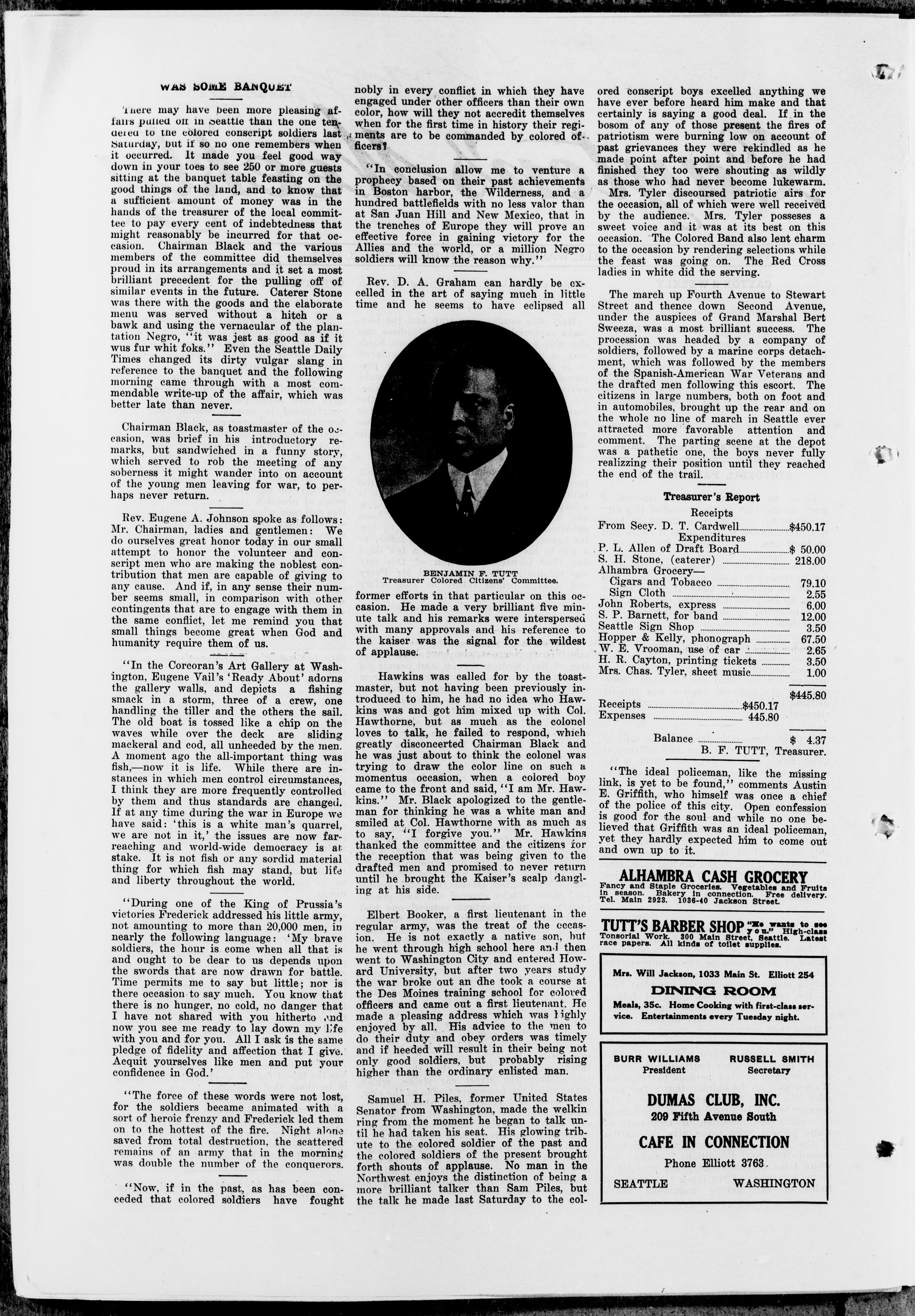
[Name]
BENJAMIN F. TUTT Treasurer Colored Citizens' Committee. former efforts in that particular on this occasion. He made a very brilliant five minute talk and his remarks were interspersed with many approvals and his reference to the kaiser was the signal for the wildest of applause.
Hawkins was called for by the toastmaster, but not having been previously introduced to him, he had no idea who Hawkins was and got him mixed up with Col. Hawthorne, but as much as the colonel loves to talk, he failed to respond, which greatly disconcerted Chairman Black and he was just about to think the colonel was trying to draw the color line on such a momentus occasion, when a colored boy came to the front and said, "I am Mr. Hawkins." Mr. Black apologized to the gentleman for thinking he was a white man and smiled at Col. Hawthorne with as much as to say, "I forgive you." Mr. Hawkins thanked the committee and the citizens for the reception that was being given to the drafted men and promised to never return until he brought the Kaiser's scalp dangling at his side.
Elbert Booker, a first lieutenant in the regular army, was the treat of the occasion. He is not exactly a native son, but he went through high school here and then went to Washington City and entered Howard University, but after two years study the war broke out an dhe took a course at the Des Moines training school for coloured officers and came out a first lieutenant. He made a pleasing address which was highly enjoyed by all. His advice to the men to do their duty and obey orders was timely and if heeded will result in their being not only good soldiers, but probably rising higher than the ordinary enlisted man.
Samuel H. Piles, former United States Senator from Washington, made the welkin ring from the moment he began to talk until he had taken his seat. His glowing tribute to the colored soldier of the past and the colored soldiers of the present brought forth shouts of applause. No man in the Northwest enjoys the distinction of being a more brilliant talker than Sam Piles, but the talk he made last Saturday to the col-
7
ored conscript boys excelled anything we have ever before heard him make and that certainly is saying a good deal. If in the bosom of any of those present the fires of patriotism were burning low on account of past grievances they were rekindled as he made point after point and before he had finished they too were shouting as wildly as those who had never become lukewarm.
Mrs. Tyler discoursed patriotic airs for the occasion, all of which were well received by the audience. Mrs. Tyler possesses a sweet voice and it was at its best on this occasion. The Colored Band also lent charm to the occasion by rendering selections while the feast was going on. The Red Cross ladies in white did the serving.
The march up Fourth Avenue to Stewart Street and thence down Second Avenue, under the auspices of Grand Marshal Bert Sweeza, was a most brilliant success. The procession was headed by a company of soldiers, followed by a marine corps detachment, which was followed by the members of the Spanish-American War Veterans and the drafted men following this escort. The citizens in large numbers, both on foot and in automobiles, brought up the rear and on the whole no line of march in Seattle ever attracted more favorable attention and comment. The parting scene at the depot was a pathetic one, the boys never fully realizing their position until they reached the end of the trail.
Treasurer's Report
Receipts
From Secy. D. T. Cardwell.....$450.17
Expenditures
P. L. Allen of Draft Board.....$ 50.00
S. H. Stone, (caterer) .....218.00
Alhambra Grocery—
Cigars and Tobacco .....79.10
Sign Cloth .....2.55
John Roberts, express .....6.00
S. P. Barnett, for band .....12.00
Seattle Sign Shop .....3.50
Hopper & Kelly, phonograph .....67.50
W. E. Vrooman, use of car .....2.65
H. R. Cayton, printing tickets .....3.50
Mrs. Chas. Tyler, sheet music .....1.00
$445.80
Receipts .....$450.17
Expenses .....445.80
Balance ..... $ 4.37
B. F. TUTT, Treasurer.
"The ideal policeman, like the missing link, is yet to be found," comments Austin E. Griffith, who himself was once a chief of the police of this city. Open confession is good for the soul and while no one believed that Griffith was an ideal policeman, yet they hardly expected him to come out and own up to it.
ALHAMBRA CASH GROCERY
Fancy and Staple Groceries. Vegetables and Fruits in season. Bakery in connection. Free delivery. Tel. Main 2923. 1036-40 Jackson Street.
TUTT'S BARBER SHOP "He wants to see you." High-class Tonsorial Work. 300 Main Street, Seattle. Latest race papers. All kinds of toilet supplies.
Mrs. Will Jackson, 1033 Main St. Elliott 254 DINING ROOM Meals, 35c. Home Cooking with first-class service. Entertainments every Tuesday night.
---
"FIGHT ON"—YOU NEGRO SOLDIERS
(Mary M. T. Thompson)
To arms you Negro soldiers,
Fight for your country's gain,
Shoulder your musket and knapsack,
And march to the battle plain.
You must fight to save your country,
'Tis a duty you owe by birth,
Your kindred before you battled
To save the Union's worth.
Fight on you valiant soldiers,
Tho' the cause you fight to win,
May not be to your advantage,
Your nation or your kin;
You have fought in many battles,
You have answered your countrys' call,
Not for yourself or your people
But, that others might not fall.
'Tis said that you show great courage,
And will fight till you die or fall,
'Tis said you have never hindered
Or shirked from duty's call.
Fight on you Negro soldiers,
To your captain's anaxious call,
Fight on till your conscience tells you,
That the fighting should be for all.
You are ready at a moment's calling,
When your country needs your aid,
You muster to the front like ferrets,
With a courage that's not afraid.
You must fight against foreign nations,
Though to you they have done no wrong
Those who have often wondered
At your country's sin and wrong.
They know in your own dear country,
Your people are lynched and burned,
And never a hand is lifted,
Where so many lives are spurned.
They know there is no protection
For your people when ere they err,
In your beautiful home, the Southland,
Where lynching is a terrible blur.
Your country calls you to battle,
It causes you to maim and slay,
While thousands of your own dear people
Art tortured from day to day.
No wonder your foreign brothers
Marvel at your courage bold,
In fighting for your dear old country,
Where innocent blood lies cold.
Fight on you Negro soldiers,
Fight on till the dawning day,
Fight on till the Power above you,
Will avenge for sin's dark way.
Fight on for your dear old country,
And help her in time to win,
A law to protect your people,
Thus, wiping away her sin.
Stand firm tho' her sins be scarlet,
And have flown like a swollen spring,
Racing as tho' in madness
On a downward, downward wing.
Stand firm till the veil is lifted,
Till the mist is all rolled away,
Stand firm till she sees the great monster
Which is leading her nation astray.
Keep courage you Negro soldiers,
Her subjects are not all blind,
Your cause long ago was expounded
By a few who had God in mind.
Fight on to the end, valiant soldiers,
E'en tho' your hearts be in pain,
Fight on till that mightiest of Powers,
Will force her some day to explain.
You must fight on in faith dear soldiers,
For the time is near at hand,
When God will fight a battle,
That none can understand.
Put all your trust in Jesus,
Like you, He suffered too,
But God will lead an army
That will help your people through.
His army will face the conflict,
They will fight with their wicked foes,
And win in a bloodless battle,
Without any loss of souls.
For His army will bring to reason,
The minds of the ones thats gone,
To an appalling depth of darkness,
Through the curse of satans wrong.
Then fighting will be over, dear soldiers,
From lynching your people be safe,
For God will have won the victory
Of love for the whole human race.
WATCH AS WELL AS PRAY
(By Ida Wells Barnett)
Rhode Island has just had a silent protest by parade, in Providence, on October 14. The race should be very glad to know that 2,000 people made protest against the awful race riot of East St. Louis. These silent parades of Rhode Island, New York, New Jersey and the women's prayer meeting of Washington, D. C., together with the meetings of protest in other parts of the country are a very fine start for beginning an effort to do something to put a stop to these outrages. But the danger lies in stopping there, in thinking that they have done all they could when they have marched and prayed and passed resolutions. I would not, for a moment, minimize these effects of such a splendid beginning, but I do want the Race to realize that we must put a stop to these beginnings. It is almost the same as if our soldier boys had contented themselves with enlisting to fight for their country and feeling that they had done their duty in defending their country when they had taken part in a great parade, with flags flying and bands playing. But we all know that unless these parades are followed up by hard work in the trenches, all the firing of guns by every conceivable active physical movement possible, the war will not be won.
By our parades, and protests, and prayers, the Negro has succeeded in securing the Congressional Investigation of those outrages, but not a dollar has been raised with which to keep someone on guard to take note of the doings of this Investigation Committee. Every one knows that even in the case of an individual on trial his friends must give him their moral support and that he must employ a counsel to see that his interests are looked after. Nothing of this kind has yet been done. The 10,000,000 of Negroes in the United States have not raised a dollar to have somebody on guard at the Congressional Investigation, neither have we had anybody present at the trials of the fifteen Negroes who have been sentenced. The papers of the country informed us last week that Dr. Bundy has been extradited from Ohio into Illinois and that he has been placed on trial. We also note that the authorities there have been very anxious to get a crack at Bundy as the alleged leader of the body of armed colored men who shot two police officers who afterward died. As a Race matter in the three months we have had to get ready for it; we should have engaged the finest criminal lawyer to be had and had on the ground to protect the Race's interests. Dr. Bundy has written here for help and from no source is it forthcoming. Please make it clear to our people that the situation now needs dollars; that the first step of our effort, prayers, protests and passing resolutions has passed, and that we are now entering upon the second stage when dollars will win the battle. I am leaving today for Belleville, Illinois, as a representative of the National Equal Rights League as well as the Negro Fellowship League. If I could only get some money to take with me from these members of the Race who are protesting against this treatment, in order that I might fight this case of Dr. Dundy's. Fifty cents apiece from each protestor would furnish sufficient with which to fight,—as it is I am going empty handed. Can the Broad Ax get me some money with which to labor to defend the Race's interests in this trial? If so, let me hear from the country at my home address.
Special Kentucky Course
A keen-eyed mountaineer led his overgrown son into a country schoolhouse. "This here boy's arter larnin'," he announced. "What's yer bill o'fare?"
"Our curriculum, sir," corrected the schoolmaster, "embraces geography, arithmetic, trigonometry—"
"That'll do," interrupted the father. "That'll do. Load him up well with trigernometry. He's the only poor shot in the family."—People's Home Journal.
Prudent
He—"I would give lots to make you happy." She—"Vacant or improved?"—Baltimore American.
A Misfit
"I must say this khaki camping skirt is a loose fit."
"You're in wrong, auntie. That is the boy's tent you have on."—Louisville Courier-Journal.
Touching Compliment
"I do hope you appreciate that in marrying my daughter you marry a large-hearted girl!" "I do sir! And I hope she inherits those qualities from her father."—Passing Show.
High Thinking
It is unfortunate that all grocers are not so candid as the market-man in Hays who advertises "Food for Thought." That's about all the customer gets for a dollar in any grocery this year.—Kansas City Star.
The Greater Need
Western railroads are putting Bibles in their smoking-cars. Obviously it would be more conducive to Christianity if they would spend that money on car-windows that won't stick. We dare say the Recording Angel gets more business from that source than almost any other.—Buffalo Evening News.
Men Should Skip This
A little girl wrote the following composition on men:
"Men are what women marry. They drink and smoke and swear, but don't go to church. Perhaps if they wore bonnets they would. They are more logical than women, also more zoological. Both men and women sprang from monkeys, but the women sprang farther than the men."—Ladies' Home Journal.
Going Into Half-Mourning
Miss Annette Benton, on returning from a visit, brought a gift to each of her mother's colored servants. It was the "day out" for Lily, the housemaid, so Annette distributed her gifts, reserving for Lily a scarlet-silk blouse. "That won't do," said Mrs. Benton. "Lily's in mourning."
"Mourning?"
"Yes, for her husband; he died in jail, and Lily's wearing a long crape veil."
When Lily returned, her young mistress exprest regret. "I'll give the blouse to Lizzie," she said, "and get you something else."
Lily looked at the blouse, then she swallowed. "Don't you give that blouse to no Lizzie, Miss Annette, co's nex' mont' I'e gwine outa mournin' from the waist up."—Harper's Magazine.
Elliott 991-Elliott 992
H. & S. Taxi and Touring
First Class Cars Capable Drivers
STAND 724 PINE ST.
Reasonable Rates Day and Night Service
on our Touring Trips We Never Sleep
“SERVICE” OUR MOTTO
THE DOUGLAS CLUB
Now Occupies spacious and elegantly
furnished and equipped
NEW QUARTERS
And will be pleased to meet old and
new friends
308 Washington St. Frank Smith, Prop.
Main 4930
---
---
HERE AND THERE
An organization to be known as the Negro American Alliance, has been recently perfected and held its first general meeting at Atlantic City, N. J. It plans to organize every person of Negro blood in the United States in one grand union to fight for the betterment of Negroes. It starts out with the announcement that, "it has no white friends and wants none, for there are no such beings." James A. Lightfoot is president and Floyd Delos Francis is secretary.
Twelve thousand colored troops are to be quartered at Funston, Kansas, and the white citizens of Junction City and Manhattan are registering their protests. The Indians of Oklahoma bought three million dollars worth of liberty bonds bully for Mistah Injun. However, do not overlook the fact that the most of the alleged Indians of Oklahoma are white folks with Indian names.
A new industrial school for colored youths has just thrown open its doors for students at Albany, Georgia. It is a state institution and the late legislature thereof appropriated the princely sum of $5,000 for its maintainance for the ensuing two years. It requires almost that much to care for one student in the Agricultural College of the State of Washington.
Col. Franklin A. Dennison of the now famous Eighth Illinois Infantry, which is now cantoned at Houston, Texas, is a native of that city and returns after many years at the head of one of the finest equipped military regiments in the United States. If Texas would only induce Jack Johnson to return to his first love she would be some state.
A. C. Howard, a colored shoe polish manufacturer, with a large plant in New York City, has a contract to furnish polish for the U. S. Army, which means that his plant will have to work night and day for months and perhaps years. The man that has something of service finds little or no trouble in disposing of it these times.
The State of Maryland has a law on her statute books that compels every man in the state in good health to perform so many hours of labor at some useful employment every day and as a result, it is reported that there are fewer idle men in the big cities of that state than any other state in the South. Some of the states of the North might find such a law very useful.
William Buckner, a colored man of Chicago, is coming in for a part of the glory of the triumph of the White Sox over the Giants in the recent baseball world series. Buckner has been employed as trainer for the White Sox and Comiskey is his handy work. For many years, it will be remembered, the Seattle team had a colored trainer in the person of George Paris. Colored men seem especially adapted to training work.
Jack Johnson, who is still an exile in Spain, is said to be "longing fur de ol plantation" again and wants to do something to help Uncle Sam in his fight with Germany. There are many unpleasant things thrust upon the colored man of this country, but after all its his home and its hard for him to give it up. Johnson should be permitted to come home as he did nothing, but what is being done every day.
"The Republic of Haiti has quietly passed out. A few days since the American Army officer who had been in temporary charge of Haitian affairs spoke softly to the assembled multitude, to the effect that these colored gentlemen need not hold any further elections, and that the United States would assume full responsibility for the future conduct of the island of Haiti. As all the firearms had long since been gathered in from the natives by United States office-
ials, the proclamation did not create any unnecessary stir. For upward of a hundred years Haiti has endeavored to govern herself, but always with disastrous results. The amount of it is that the Haitian is not fit for self-government. The country's finances are in a chaotic condition. The island is greatly overpopulated; imagine two and one-half million people cooped up on ten thousand square miles, and with no disposition to be industrious at that. The country's trade has been steadily decreasing, and there is not now sufficient money in the treasury to meet the bond interest. This means that the United States will be obliged to assume all these responsibilities, financial and otherwise, and bring Haiti out of the slough into which a century of misgovernment has precipitated her. In connection with the United States' attempt to advance Haitian interests it is interesting to note that the officers of the United States Marine Corps sationed on the island have been busily engaged developing its agricultural resources. They have cleared large tracts of land that the native was too lazy to cultivate, and expect soon to be able to export large quantities of fruits and vegetables. Haiti has long been one of the problems of the Caribbean, and it is to be hoped and expected, now that Uncle Sam has taken the tiller in earnest, there will be a distinct change for the better. In any event, the United States will see to it that the country will miss its usual monthly revolution.—Toronto Saturday Night.
A copy of Rev. Sydney Strong's alleged treasonable speech was sent to us and after reading the same, it is rather strange that it attracted more than a passing notice.
PERSONALS
Rev. Eugene A. Johnson has gotten a three months leave of absence from the Grace Presbyterian church and during that time will look after the spiritual welfare of the colored soldiers at Camp Lewis. There are now between seven and eight hundred colored soldiers in the camp.
Roger W. Watts, prominent in colored Republican circles in Tacoma, is now employed as stenographer at Camp Lewis.
Gustave B. Aldrich, a practicing attorney of Tacoma, transacted business in Seattle last Tuesday.
Terrible Tempered Panlow
In the Domestic Relations Court Mrs. Antoinette Panlaaw explained some of the reasons why she dreads the wilder type of life. She made it clear that she had been associated with her husband in matrimony for ten years and that all interest in liffe on the plains, tales of valor and revenge, detective stories, and adventurous situations had died in the meantime.
"He's always going to kill some one," said Mrs. Panlow, "and he won't work. Every time the rent is due for years I've had to scurry around to get it for fear he'd kill the rent man if a word was said to him. Every time the dumbwaiter bell has rung loud he's said he'd knock the head off whoever rang it, and every time we've been out walking he has been on the verge of getting into a terrible fight and of killing some one. He has a terrible temper."
Magistrate Harris looked intently at the defendant.
"Didn't I see you in Harlem Court two weeks ago?" he asked.
"Yes," said Mr. Panlow to the magistrate, "I was there. I made a complaint agains th' boy that tends the fruit-stand at our corner. But I didn't tell my wife about it."
"What did the boy do to you?" asked the court.
"He hit me," said the terrible tempered Mr. Panlow, "and I had him arrested."—New York Herald.
Job work in the latest and newest styles turned out in this office. Main 24.
Cayton's Weekly
Main 24
Residence 1910
Office 513
Pacific Block
IN THE SUPERIOR COURT OF THE STATE OF
Washington for King County.
Lena Holland, Plaintiff, vs. Arthur Holland, Defendant—No. ..... Summits by Publication.
The State of Washington to the said Arthur Holland, Defendant:
You are hereby summoned to appear within sixty days after the date of the first publication of this summons, to-wit: within sixty days after the 3rd day of November, 1917, and defend the above entitled action in the above entitled court, and answer the complaint of the plaintiff, and serve a copy of your answer upon the undersigned attorney for plaintiff at his office below stated; and in case of your failure so to do, judgment will be rendered against you according to the demand of the complaint, which has been filed with the clerk of said court.
The object of the above entitled action is to obtain a decree of divorce from the defendant by the plaintiff on the ground of desertion.
ANDREW R. BLACK,
Attorney for Plaintiff.
P. O. Address, 316 Pacific Block, Seattle, Wash.
Nov. 3—Dec. 15, 1917.
VICTOR CLEANING
and Dye Works. Ladies and Gents Tailoring. Pressing, Repairing. 1203 Yesler Way. Beacon 528.
IN THE SUPERIOR COURT OF THE STATE OF Washington for King County.
Roy Green, Plaintiff, vs. Emma T. Green, Defendant.
No. ..... Summons by Publication.
The State of Washington to the said Emma T. Green,
Defendant:
You are hereby summoned to appear within sixty days after the date of the first publication of this summons, to-wift: within sixty days after the 8th day of September, 1917, and defend the above entitled action in the above entitled court, and answer the complaint of the plaintiff, and serve a copy of your answer upon the undersigned attorney for plaintiff at his office below stated; and in case of your failure so to do, judgment will be rendered against you according to the demand of the complaint, which has been filed with the clerk of said court.
The object of the above entitled action is to obtain a decree of divorce from the defendant by the plaintiff on the grounds of cruelty and incompatibility.
ANDREW R. BLACK,
Attorney for Plaintiff.
P. O. Address 316 Pacific Block, Seattle, Wash.
Sept. 8 to Oct. 20, 1917.
IN THE SUPERIOR COURT OF THE STATE OF Washington for King County.
Helen Kolenc, Plaintiff, vs. Jack Kolenc, Defendant.
—No. ..... Summons.
The State of Washington to the said Jack Kelenc, Defendant:
You are hereby summoned to appear within sixty days after the date of the first publication of this summons, to-wit, within sixty days after the 22nd day of September, 1917, and defend the above entitled action in the above entitled court, and answer the complaint of the plaintiff and serve a copy of your answer upon the undersigned attorney for plaintiff at his office below stated; and in case of your failure so to do, judgment will be rendered against you according to the demand of the complaint, which has been filed with the clerk of said court. The object of said action is to secure a divorce on the grounds of non-support, for custody of children, for alimony and attorney fees.
WILLIAM WRAY,
Attorney for Plaintiff.
Post Office Address, 90 West Madison St.,
Seattle, Washington.
First Publication Sept. 22, 1917.
IN THE SUPERIOR COURT OF THE STATE OF Washington for King County.
B. L. Ducknoviske, Plaintiff, vs. Selma Ducknoviske, Defendant.-No. ..... Summons by Publication. The State of Washington to the said Selma Ducknoviske, Defendant:
You are hereby summoned to appear within sixty days after the date of the first publication of this summons, to-wit: within sixty days after the 18th day of October, 1917, and defend the above entitled action in the above entitled court, and answer the complaint of the plaintiff, and serve a copy of your answer upon the undersigned attorney for plaintiff at his office below stated; and in case of your failure so to do, judgment will be rendered against you according to the demand of the complaint, which has been filed with the clerk of said court.
The object of the above entitled action is to obtain a decree of divorce from the defendant by the plaintiff on the grounds of desertion.
ANDREW R. BLACK,
Attorney for Plaintiff.
P. O. Address, 316 Pacific Block, Seattle, Wash.
Oct. 13; Nov. 24, 1917.