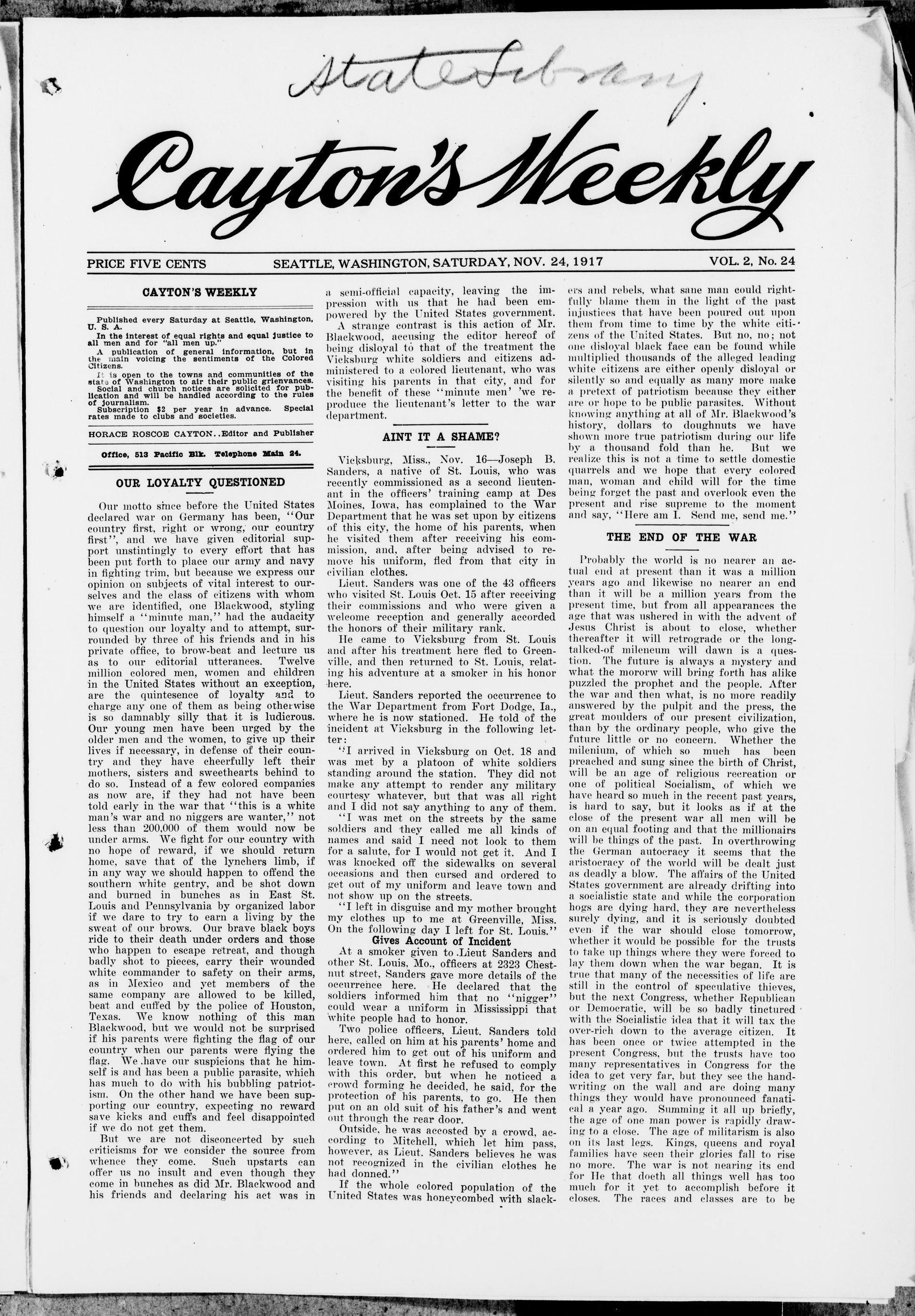
Cayton's Weekly
Saturday, November 24, 1917
Seattle, Washington
Page text (machine-generated)
---
PRICE FIVE CENTS
CAYTON'S WEEKLY
Published every Saturday at Seattle, Washington, U. S. A.
In the interest of equal rights and equal justice to all men and for "all men up."
A publication of general information, but in the main voicing the sentiments of the Colored Citizens.
It is open to the towns and communities of the state of Washington to air their public grievances. Social and church notices are solicited for publication and will be handled according to the rules of journalism.
Subscription $2 per year in advance. Special rates made to clubs and societies.
HORACE ROSCOE CAYTON..Editor and Publisher
Office, 513 Pacific Blk. Telephone Main 24.
OUR LOYALTY QUESTIONED
Our motto since before the United States declared war on Germany has been, "Our country first, right or wrong, our country first", and we have given editorial support unstintingly to every effort that has been put forth to place our army and navy in fighting trim, but because we express our opinion on subjects of vital interest to ourselves and the class of citizens with whom we are identified, one Blackwood, styling himself a "minute man," had the audacity to question our loyalty and to attempt, surrounded by three of his friends and in his private office, to brow-beat and lecture us as to our editorial utterances. Twelve million colored men, women and children in the United States without an exception, are the quintesence of loyalty and to charge any one of them as being otherwise is so damnably silly that it is ludicrous. Our young men have been urged by the older men and the women, to give up their lives if necessary, in defense of their country and they have cheerfully left their mothers, sisters and sweethearts behind to do so. Instead of a few colored companies as now are, if they had not have been told early in the war that "this is a white man's war and no niggers are wanter," not less than 200,000 of them would now be under arms. We fight for our country with no hope of reward, if we should return home, save that of the lynchers limb, if in any way we should happen to offend the southern white gentry, and be shot down and burned in bunches as in East St. Louis and Pennsylvania by organized labor if we dare to try to earn a living by the sweat of our brows. Our brave black boys ride to their death under orders and those who happen to escape retreat, and though badly shot to pieces, carry their wounded white commander to safety on their arms, as in Mexico and yet members of the same company are allowed to be killed, beat and cuffed by the police of Houston, Texas. We know nothing of this man Blackwood, but we would not be surprised if his parents were fighting the flag of our country when our parents were flying the flag. We have our suspicions that he himself is and has been a public parasite, which has much to do with his bubbling patriotism. On the other hand we have been supporting our country, expecting no reward save kicks and cuffs and feel disappointed if we do not get them.
But we are not disconcerted by such criticisms for we consider the source from whence they come. Such upstarts can offer us no insult and even though they come in bunches as did Mr. Blackwood and his friends and declaring his act was in
a semi-official capacity, leaving the impression with us that he had been empowered by the United States government. A strange contrast is this action of Mr. Blackwood, accusing the editor hereof of being disloyal to that of the treatment the Vicksburg white soldiers and citizens administered to a colored lieutenant, who was visiting his parents in that city, and for the benefit of these "minute men' 'we reproduce the lieutenant's letter to the war department.
AINT IT A SHAME?
Vicksburg, Miss., Nov. 16—Joseph B. Sanders, a native of St. Louis, who was recently commissioned as a second lieutenant in the officers' training camp at Des Moines, Iowa, has complained to the War Department that he was set upon by citizens of this city, the home of his parents, when he visited them after receiving his commission, and, after being advised to remove his uniform, fled from that city in civilian clothes.
Lieut. Sanders was one of the 43 officers who visited St. Louis Oct. 15 after receiving their commissions and who were given a welcome reception and generally accorded the honors of their military rank.
He came to Vicksburg from St. Louis and after his treatment here fled to Greenville, and then returned to St. Louis, relating his adventure at a smoker in his honor here.
Lieut. Sanders reported the occurrence to the War Department from Fort Dodge, Ia., where he is now stationed. He told of the incident at Vicksburg in the following letter:
"I arrived in Vicksburg on Oct. 18 and was met by a platoon of white soldiers standing around the station. They did not make any attempt to render any military courtesy whatever, but that was all right and I did not say anything to any of them.
"I was met on the streets by the same soldiers and they called me all kinds of names and said I need not look to them for a salute, for I would not get it. And I was knocked off the sidewalks on several occasions and then cursed and ordered to get out of my uniform and leave town and not show up on the streets.
"I left in disguise and my mother brought my clothes up to me at Greenville, Miss. On the following day I left for St. Louis."
Gives Account of Incident
At a smoker given to Lieut Sanders and other St. Louis, Mo., officers at 2323 Chestnut street, Sanders gave more details of the occurrence here. He declared that the soldiers informed him that no "nigger" could wear a uniform in Mississippi that white people had to honor.
Two police officers, Lieut. Sanders told here, called on him at his parents' home and ordered him to get out of his uniform and leave town. At first he refused to comply with this order, but when he noticed a crowd forming he decided, he said, for the protection of his parents, to go. He then put on an old suit of his father's and went out through the rear door.
Outside, he was accosted by a crowd, according to Mitchell, which let him pass, however, as Lieut. Sanders believes he was not recognized in the civilian clothes he had donned."
If the whole colored population of the United States was honeycombed with slack-
VOL.2, No.24
ers and rebels, what sane man could rightfully blame them in the light of the past injustices that have been poured out upon them from time to time by the white citizens of the United States. But no, no; not one disloyal black face can be found while multiplied thousands of the alleged leading white citizens are either openly disloyal or silently so and equally as many more make a pretext of patriotism because they either are or hope to be public parasites. Without knowing anything at all of Mr. Blackwood's history, dollars to doughnuts we have shown more true patriotism during our life by a thousand fold than he. But we realize this is not a time to settle domestic quarrels and we hope that every colored man, woman and child will for the time being forget the past and overlook even the present and rise supreme to the moment and say, "Here am I. Send me, send me."
THE END OF THE WAR
Probably the world is no nearer an actual end at present than it was a million years ago and likewise no nearer an end than it will be a million years from the present time, but from all appearances the age that was ushered in with the advent of Jesus Christ is about to close, whether thereafter it will retrograde or the long-talked-of mileneum will dawn is a question. The future is always a mystery and what the mororw will bring forth has alike puzzled the prophet and the people. After the war and then what, is no more readily answered by the pulpit and the press, the great moulders of our present civilization, than by the ordinary people, who give the future little or no concern. Whether the milenium, of which so much has been preached and sung since the birth of Christ, will be an age of religious recreation or one of political Socialism, of which we have heard so much in the recent past years, is hard to say, but it looks as if at the close of the present war all men will be on an equal footing and that the millionairs will be things of the past. In overthrowing the German autocracy it seems that the aristocracy of the world will be dealt just as deadly a blow. The affairs of the United States government are already drifting into a socialistic state and while the corporation hogs are dying hard, they are nevertheless surely dying, and it is seriously doubted even if the war should close tomorrow, whether it would be possible for the trusts to take up things where they were forced to lay them down when the war began. It is true that many of the necessities of life are still in the control of speculative thieves, but the next Congress, whether Republican or Democratic, will be so badly tinctured with the Socialistic idea that it will tax the over-rich down to the average citizen. It has been once or twice attempted in the present Congress, but the trusts have too many representatives in Congress for the idea to get very far, but they see the handwriting on the wall and are doing many things they would have pronounced fanatical a year ago. Summing it all up briefly, the age of one man power is rapidly drawing to a close. The age of militarism is also on its last legs. Kings, queens and royal families have seen their glories fall to rise no more. The war is not nearing its end for He that doeth all things well has too much for it yet to accomplish before it closes. The races and classes are to be
‘wit ‘ie i ae 4 J ee 2) ere = 4
oi) MOP R ere Ye © i Pads, “A... ato ar oD
a e" eat : ee bets des ea ee ea i ae
i v
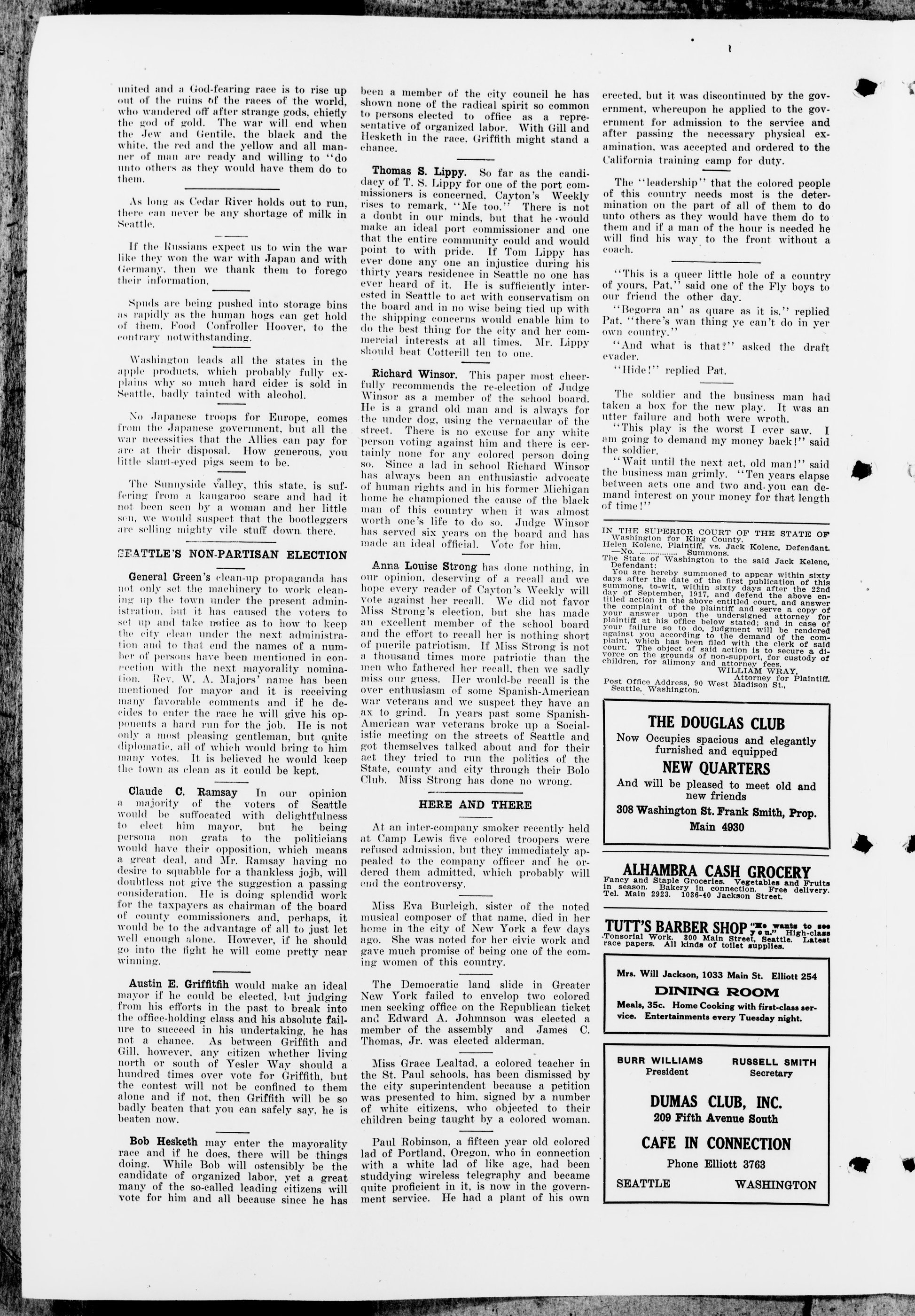
united and a God-fearing race is to rise up
out of the ruins of the races of the world,
who wandered off after strange gods, chietly
the god of gold. The war will end when
the Jew and Gentile. the black and the
white, the red and the yellow and all man-
ner of man are ready and willing to ‘‘do
unto others as they would have them do to
them.
a ee
As long as Cedar River holds out to run,
there can never be any shortage of milk in
Seattle.
If the Russians expect us to win the war
like they won the war with Japan and with
Germany, then we thank them to forego
their information,
Spuds are being pushed into storage bins
as rapidly as the human hogs can get hold
of them, Food Controller Hoover, to the
contrary notwithstanding,
Washington leads all the states in the
apple products, which probably fully ex-
plains why so much hard cider is sold in
Seattle, badly tainted with alcohol.
No Japanese troops for Europe, comes
from the Japanese government, but all the
war necessities that the Allies can pay for
are at their disposal. Tow generous, you
little slant-eyed pigs seem to be.
The Sunnyside valley, this state, is suf-
fering from a kangaroo seare and had it
not been seen by a woman and her little
sen, we would suspect that the bootleggers
are selling mighty vile stuff down. there.
cEATTLE’S NON-PARTISAN ELECTION
General Green’s clean-up propaganda has
not only set the machinery to work clean-
ing up the town under the present admin-
istration, but it has caused the voters to
set up and take notice as to how to keep
the city clean under the next administra-
fion and to that end the names of a num-
her of persons have been mentioned in eon-
rection with the next mayorality nomina-
tion, Rey, W. A. Majors’ name has been
mentioned for mayor and it is receiving
many favorable comments and if he de-
cides to enter the race he will give his op-
pouents a hard run for the job. Te is not
only a most pleasing gentleman, but quite
diplomatic, all of which would bring to him
many votes. It is believed he would keep
the town as clean as it could be kept.
Claude C. Ramsay In our opinion
a majority of the voters of Seattle
would be suffocated with delightfulness
to elect him = mayor, but he being
persona non grata to the politicians
would have their opposition, which means
a great deal, and Mr. Ramsay having no
desire to squabble for a thankless jojb, will
doubtless not give the suggestion a passing
consideration. Ile is doing splendid work
for the taxpayers as chairman of the board
of county commissioners and, perhaps, it
would be to the advantage of all to just let
well enough alone. Tlowever, if he should
go into the fight he will come pretty near
winning.
Austin E. Griffitfih would make an ideal
mayor if he could be elected, but judging
from his efforts in the past to break into
the office-holding class and his absolute fail-
ure to sneceed in his undertaking, he has
not a chance. As between Griffith and
Gill, however, any citizen whether living
north or south of Yesler Way should a
hundred times over vote for Griffith, but
the contest will not be confined to them
alone and if not, then Griffith will be so
badly beaten that you can safely say, he is
beaten now.
Bob Hesketh may enter the mayorality
race and if he does, there will be things
doing. While Bob will ostensibly be the
candidate of organized labor, yet a great
many of the so-called leading citizens will
vote for him and all because since he has
oo SS AMCOET OF the city council he has
shown none of the radical spirit so common
to persons elected to office as a repre-
sentative of organized labor. With Gill and
Hesketh in the race. Griffith might stand a
chance,
Thomas 8, Lippy. So far as the candi-
dacy of T. S. Lippy for one of the port com-
missioners is concerned, Cayton’s Weekly
rises to remark, ‘‘Me too.’? There is not
a doubt in our minds, but that he -would
make an ideal port commissioner and one
that the entire community could and would
point to with pride. If Tom Lippy has
ever done any one an injustice during his
thirty years residence in Seattle no one has
ever heard of it. He is sufficiently inter-
ested in Seattle to act with conservatism on
the board and in no wise being tied up with
the shipping concerns would enable him to
do the best thing for the city and her com-
mercial interests at all times. Mr. Lippy
should beat Cotterill ten to one.
Richard Winsor. his paper most cheer-
fully recommends the re-election of Judge
Winsor as a member of the school board.
He is a grand old man and is always for
the under dog, using the vernacular of the
street. There is no excuse for any white
person voting against him and there is cer-
tainly none for any colored person doing
so. Since a lad in school Richard Winsor
has always been an enthusiastic advocate
of human rights and in his former Michigan
home he championed the cause of the black
man of this country when it was almost
worth one’s life to do so. Judge Winsor
has served six years on the board and has
made an ideal official. Vote for him.
Anna Louise Strong has done nothing, in
our opinion, deserving of a recall and we
hope every reader of Cayton’s Weekly will
vote against her reeall. We did not favor
Miss Strong’s election, but she has made
an excellent member of the school board
and the effort to recall her is nothing short
of puerile patriotism. If Miss Strong is not
a thousand times more patriotic than the
men who fathered her recall, then we sadly
miss our guess. Ter would-be reeall is the
over enthusiasm of some Spanish-American
war veterans and we suspect they have an
ax to grind. In years past some Spanish-
American war veterans broke up a Social-
istie meeting on the streets of Seattle and
got themselves talked about and for their
act they tried to run the polities of the
State, county and city through their Bolo
Club. Miss Strong has done no wrong.
HERE AND THERE
At an inter-company smoker recently held
at Camp Lewis five colored troopers were
refused admission, but they immediately ap-
pealed to the company officer and he or-
dered them admitted, which probably will
end the controversy,
Miss Eva Burleigh, sister of the noted
musical composer of that name, died in her
home in the city of New York a few days
ago. She was noted for her civie work and
gave much promise of being one of the com.
ing women of this country.
The Democratic land slide in Greater
New York failed to envelop two colored
men seeking office on the Republican ticket
and Edward A. Johmnson was elected a
member of the assembly and James C.
Thomas, Jr. was elected alderman.
Miss Grace Lealtad, a colored teacher in
the St. Paul schools, has been dismissed by
the city superintendent because a petition
was presented to him, signed by a number
of white citizens, who objected to their
children being taught by a colored woman.
Paul Robinson, a fifteen year old colored
lad of Portland, Oregon, who in connection
with a white lad of like age, had been
studdying wireless telegraphy and became
quite proficient in it, is now in the govern-
ment service. He had a plant of his own
erected, but it was discontinued by the gov-
ernment, whereupon he applied to the gov-
ernment for admission to the service and
after passing the necessary physical ex-
amination, was accepted and ordered to the
California training camp for duty.
The ‘‘leadership’’ that the colored people
of this country needs most is the deter-
mination on the part of all of them to do
unto others as they would have them do to
them and if a man of the hour is needed he
will find his way to the front without a
coach, . :
“This is a queer little hole of a country
of yours, Pat,’’ said one of the Fly boys to
ow friend the other day.
““Begorra an’ as quare as it is,”’ replied
Pat, ‘“‘there’s wan thing ye can’t do in yer
own country.”
“And what is that?’? asked the draft
evader.
“Tide!”’ replied Pat.
The soldier and the business man had
taken a box for the new play. It was an
utter failure and both were wroth.
“This play is the worst I ever saw. I
am going to demand my money back!”? said
the soldier,
“Wait until the next act, old man!” said
the business man grimly. ‘Ten years elapse
between acts one and two and. you ean de-
mand interest on your money for that length
of time!”’
IN THE SUPERIOR COURT OF THE STATE oF
Washington for King County.
Helen Kolenc, Plaintiff, vs. Jack Kolene, Defendant.
NO. ..-eeecseeeseeee SUMMONS,
The State of Washington to the said Jack Kelenc,
Defendant:
You are hereby summoned to appear within sixty
days after the date of the first publication of this
Summons, to-wit, within sixty days after the 22nd
day of September, 1917, and’ defend the above en-
titled action in the above entitled court, and answer
the complaint of the plaintiff and serve a copy of
your answer upon the undersigned attorney for
plaintiff at his office below stated; and in case of
your failure so to do, judgment will be rendered
‘ugainst you according to the demand of the com-
plaint, which has been filed with the clerk of said
court. The object of said action is to secure a di-
vorce on the grounds of non-support, for custody of
children, for alimony and_attorney ‘fees,
WILLIAM WRAY,
Attorney for Plaintiff,
Post Office Address, 90 West Madison St,
Seattle, Washington.
THE DOUGLAS CLUB
Now Oceupies spacious and elegantly
furnished and equipped
NEW QUARTERS
And will be pleased to meet old and
new friends
308 Washington St. Frank Smith, Prop.
Main 4930
Fancy and Staple Groceries. Vegetables and Fruits
in season. Bakery in connection. Free delivery.
Tel. Main 2923. 1036-40 Jackson Street.
ee
7 “Me wants to see
TUTT’S BARBER SHOP 3%», 7*21¢,,*2,28¢
‘Tonsorial Work, 300 Main Street, Seattle. © Latest
race papers. All kinds of toilet supplies.
Mrs. Will Jackson, 1033 Main St. Elliott 254
DINING ROOM
Meals, 35c. Home Cooking with first-class ser-
vice. Entertainments every Tuesday night.
BURR WILLIAMS RUSSELL SMITH
President Secretary
DUMAS CLUB, INC.
209 Fifth Avenue South
CAFE IN CONNECTION
Phone Elliott 3763
SEATTLE WASHINGTON
---
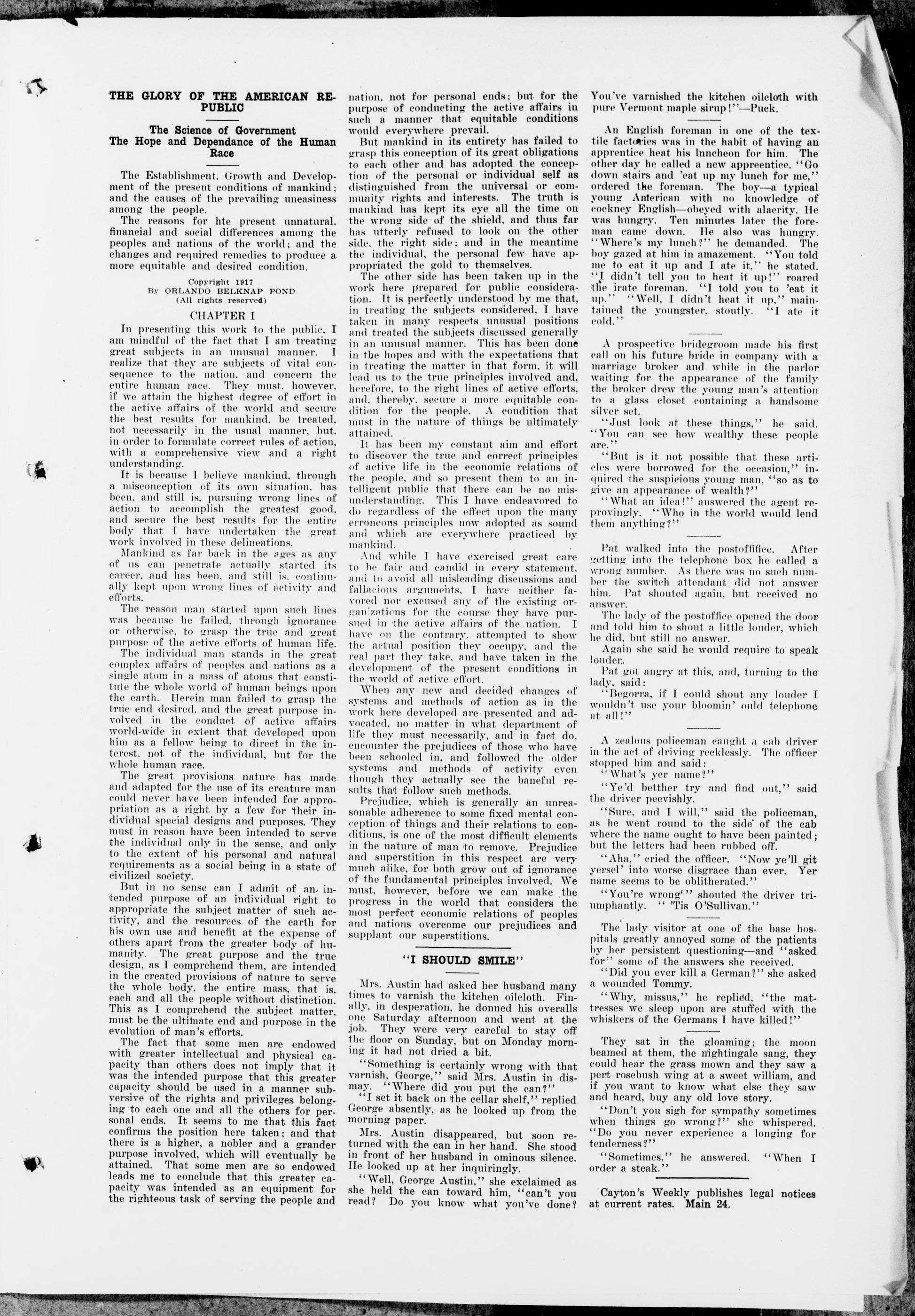
THE GLORY OF THE AMERICAN REPUBLIC
The Science of Government The Hope and Dependance of the Human Race
The Establishment, Growth and Development of the present conditions of mankind; and the causes of the prevailing uneasiness among the people. The reasons for hte present unnatural, financial and social differences among the peoples and nations of the world; and the changes and required remedies to produce a more equitable and desired condition.
Copyright 1917
By ORLANDO BELKNAP POND
(All rights reserved)
CHAPTER I
In presenting this work to the public, I am mindful of the fact that I am treating great subjects in an unusual manner. I realize that they are subjects of vital consequence to the nation, and concern the entire human race. They must, however, if we attain the highest degree of effort in the active affairs of the world and secure the best results for mankind, be treated, not necessarily in the usual manner, but, in order to formulate correct rules of action, with a comprehensive view and a right understanding.
It is because I believe mankind, through a misconception of its own situation, has been, and still is, pursuing wrong lines of action to accomplish the greatest good, and secure the best results for the entire body that I have undertaken the great work involved in these delineations.
Mankind as far back in the ages as any of us can penetrate actually started its career, and has been, and still is, continually kept upon wrong lines of activity and efforts.
The reason man started upon such lines was because he failed, through ignorance or otherwise, to grasp the true and great purpose of the active efforts of human life.
The individual man stands in the great complex affairs of peoples and nations as a single atom in a mass of atoms that constitute the whole world of human beings upon the earth. Herein man failed to grasp the true end desired, and the great purpose involved in the conduct of active affairs world-wide in extent that developed upon him as a fellow being to direct in the interest, not of the individual, but for the whole human race.
The great provisions nature has made and adapted for the use of its creature man could never have been intended for appropriation as a right by a few for their individual special designs and purposes. They must in reason have been intended to serve the individual only in the sense, and only to the extent of his personal and natural requirements as a social being in a state of civilized society.
But in no sense can I admit of an intended purpose of an individual right to appropriate the subject matter of such activity, and the resources of the earth for his own use and benefit at the expense of others apart from the greater body of humanity. The great purpose and the true design, as I comprehend them, are intended in the created provisions of nature to serve the whole body, the entire mass, that is, each and all the people without distinction. This as I comprehend the subject matter, must be the ultimate end and purpose in the evolution of man's efforts.
The fact that some men are endowed with greater intellectual and physical capacity than others does not imply that it was the intended purpose that this greater capacity should be used in a manner subversive of the rights and privileges belonging to each one and all the others for personal ends. It seems to me that this fact confirms the position here taken; and that there is a higher, a nobler and a grander purpose involved, which will eventually be attained. That some men are so endowed leads me to conclude that this greater capacity was intended as an equipment for the righteous task of serving the people and
nation, not for personal ends; but for the purpose of conducting the active affairs in such a manner that equitable conditions would everywhere prevail.
But mankind in its entirety has failed to grasp this conception of its great obligations to each other and has adopted the conception of the personal or individual self as distinguished from the universal or community rights and interests. The truth is mankind has kept its eye all the time on the wrong side of the shield, and thus far has utterly refused to look on the other side. the right side; and in the meantime the individual, the personal few have appropriated the gold to themselves.
The other side has been taken up in the work here prepared for public consideration. It is perfectly understood by me that, in treating the subjects considered, I have taken in many respects unusual positions and treated the subjects discussed generally in an unusual manner. This has been done in the hopes and with the expectations that in treating the matter in that form, it will lead us to the true principles involved and, herefore, to the right lines of active efforts, and, thereby, secure a more equitable condition for the people. A condition that must in the nature of things be ultimately attained.
It has been my constant aim and effort to discover the true and correct principles of active life in the economic relations of the people, and so present them to an intelligent public that there can be no misunderstanding. This I have endeavored to do regardless of the effect upon the many erroneous principles now adopted as sound and which are everywhere practiced by mankind.
And while I have exercised great care to be fair and candid in every statement, and to avoid all misleading discussions and fallacious arguments, I have neither favored nor excused any of the existing organizations for the course they have pursued in the active affairs of the nation. I have on the contrary, attempted to show the actual position they occupy, and the real part they take, and have taken in the development of the present conditions in the world of active effort.
When any new and decided changes of systems and methods of action as in the work here developed are presented and advocated, no matter in what department of life they must necessarily, and in fact do, encounter the prejudices of those who have been schooled in, and followed the older systems and methods of activity even though they actually see the baneful results that follow such methods.
Prejudice, which is generally an unreasonable adherence to some fixed mental conception of things and their relations to conditions, is one of the most difficult elements in the nature of man to remove. Prejudice and superstition in this respect are very much alike, for both grow out of ignorance of the fundamental principles involved. We must, however, before we can make the progress in the world that considers the most perfect economic relations of peoples and nations overcome our prejudices and supplant our superstitions.
"I SHOULD SMILE"
Mrs. Austin had asked her husband many times to varnish the kitchen oilcloth. Finally, in desperation, he donned his overalls one Saturday afternoon and went at the job. They were very careful to stay off the floor on Sunday, but on Monday morning it had not dried a bit.
"Something is certainly wrong with that varnish, George," said Mrs. Austin in dismay. "Where did you put the can?"
"I set it back on the cellar shelf," replied George absently, as he looked up from the morning paper.
Mrs. Austin disappeared, but soon returned with the can in her hand. She stood in front of her husband in ominous silence. He looked up at her inquiringly.
"Well, George Austin," she exclaimed as she held the can toward him, "can't you read? Do you know what you've done?
You've varnished the kitchen oileloth with pure Vermont maple sirup!"—Puck.
An English foreman in one of the textile factories was in the habit of having an apprentice heat his lincheon for him. The other day he called a new appreentice. "Go down stairs and 'eat up my lunch for me,'" ordered the foreman. The boy—a typical young American with no knowledge of cockney English—obeyed with alacrity. He was hungry. Ten minutes later the foreman came down. He also was hungry. "Where's my lunch?" he demanded. The boy gazed at him in amazement. "You told me to eat it up and I ate it," he stated. "I didn't tell you to heat it up!" roared the irate foreman. "I told you to 'eat it up.'" "Well, I didn't heat it up," maintained the youngster, stoutly. "I ate it cold."
A prospective bridegroom made his first call on his future bride in company with a marriage broker and while in the parlor waiting for the appearance of the family the broker drew the young man's attention to a glass closet containing a handsome silver set.
"Just look at these things," he said.
"You can see how wealthy these people are."
"But is it not possible that these articles were borrowed for the occasion," inquired the suspicious young man, "so as to give an appearance of wealth?"
"What an idea!" answered the agent reprovingly. "Who in the world would lend them anything?"
Pat walked into the postoffice. After getting into the telephone box he called a wrong number. As there was no such number the switch attendant did not answer him. Pat shouted again, but received no answer.
The lady of the postoffice opened the door and told him to shout a little louder, which he did, but still no answer.
Again she said he would require to speak louder.
Pat got angry at this, and, turning to the lady, said:
"Begorra, if I could shout any louder I wouldn't use your bloomin' ould telephone at all!"
A zealous policeman caught a cab driver in the act of driving recklessly. The officer stopped him and said:
"What's yer name?"
"Ye'd betther try and find out," said the driver peevishly.
"Sure, and I will," said the policeman, as he went round to the side of the cab where the name ought to have been painted; but the letters had been rubbed off.
"Aha," cried the officer. "Now ye'll git yersel' into worse disgrace than ever. Yer name seems to be oblitherated."
"You're wrong'" shouted the driver triumphantly. "Tis O'Sullivan."
The lady visitor at one of the base hospitals greatly annoyed some of the patients by her persistent questioning—and "asked for" some of the answers she received.
"Did you ever kill a German?" she asked a wounded Tommy.
"Why, missus," he replied, "the mattresses we sleep upon are stuffed with the whiskers of the Germans I have killed!"
They sat in the gloaming; the moon beamed at them, the nightingale sang, they could hear the grass mown and they saw a pert rosebush wing at a sweet william, and if you want to know what else they saw and heard, buy any old love story.
"Don't you sigh for sympathy sometimes when things go wrong?" she whispered. "Do you never experience a longing for tenderness?" "Sometimes," he answered. "When I order a steak."
Cayton's Weekly publishes legal notices at current rates. Main 24.
---
99
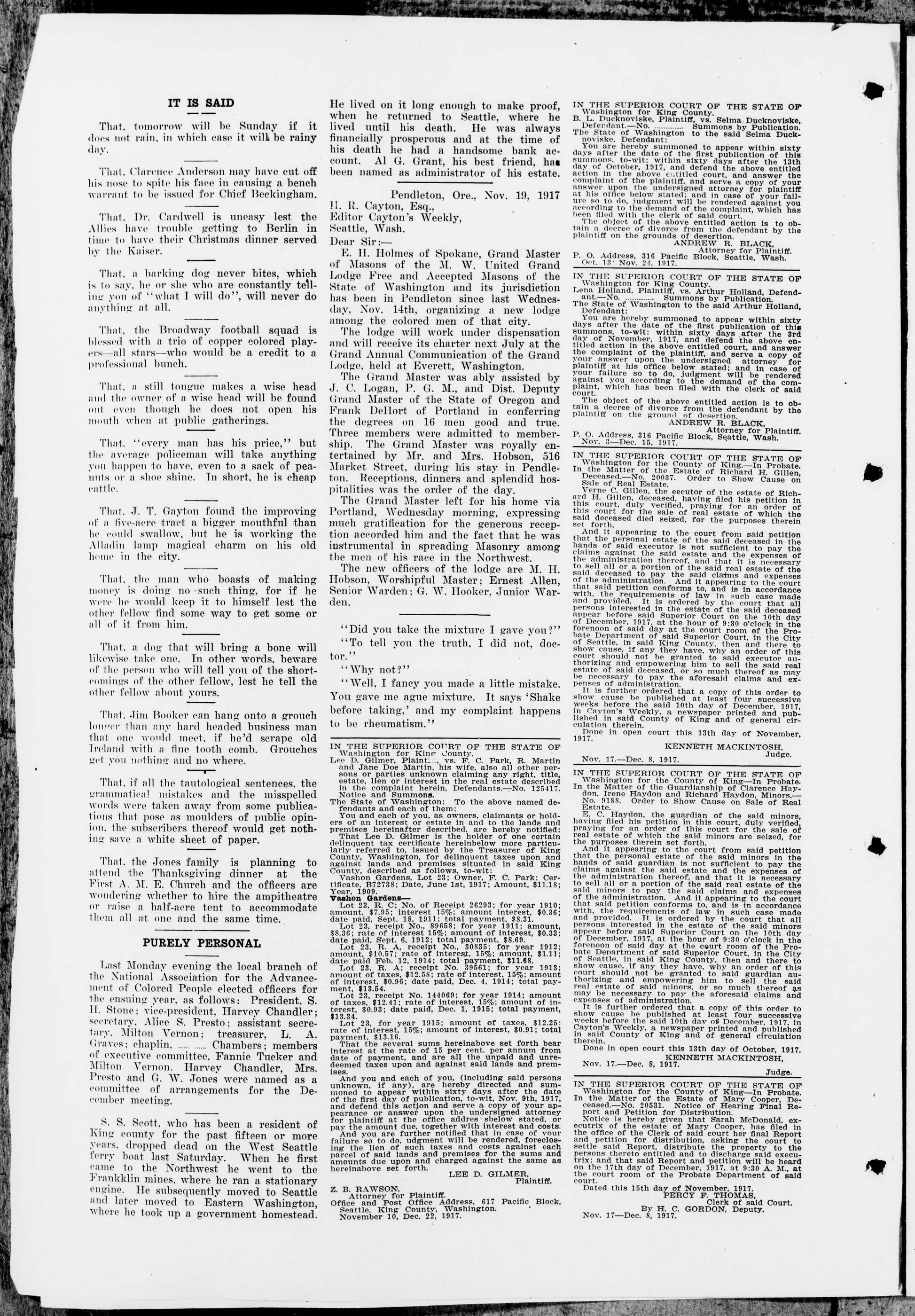
IT IS SAID
That, tomorrow will be Sunday if it does not rain, in which case it will be rainy day.
That, Clarence Anderson may have cut off his nose to spite his face in causing a bench warrant to be issued for Chief Beckingham.
That, Dr. Cardwell is uneasy lest the Allies have trouble getting to Berlin in time to have their Christmas dinner served by the Kaiser.
That, a barking dog never bites, which is to say, he or she who are constantly telling you of "what I will do", will never do anything at all.
That, the Broadway football squad is blessed with a trio of copper colored players—all stars—who would be a credit to a professional bunch.
That, a still tongue makes a wise head and the owner of a wise head will be found out even though he does not open his mouth when at public gatherings.
That, "every man has his price," but the average policeman will take anything you happen to have, even to a sack of peanuts or a shoe shine. In short, he is cheap cattle.
That, J. T. Gayton found the improving of a five-acre tract a bigger mouthful than he could swallow, but he is working the Alladin lamp magical charm on his old home in the city.
That, the man who boasts of making money is doing no such thing, for if he were he would keep it to himself lest the other fellow find some way to get some or all of it from him.
That, a dog that will bring a bone will likewise take one. In other words, beware of the person who will tell you of the short-comings of the other fellow, lest he tell the other fellow about yours.
That, Jim Booker can hang onto a grouch longer than any hard headed business man that one would meet, if he'd scrape old Ireland with a fine tooth comb. Grouches get you nothing and no where.
That, if all the tautological sentences, the grammatical mistakes and the misspelled words were taken away from some publications that pose as moulders of public opinion, the subscribers thereof would get nothing save a white sheet of paper.
That, the Jones family is planning to attend the Thanksgiving dinner at the First A. M. E. Church and the officers are wondering whether to hire the ampitheatre or raise a half-acre tent to accommodate them all at one and the same time.
PURELY PERSONAL
Last Monday evening the local branch of the National Association for the Advancement of Colored People elected officers for the ensuing year, as follows: President, S. H. Stone; vice-president, Harvey Chandler; secretary, Alice S. Presto; assistant secretary, Milton Vernon; treasurer, L. A. Graves; chaplin, ..... Chambers; members of executive committee, Fannie Tucker and Milton Vernon. Harvey Chandler, Mrs. Presto and G. W. Jones were named as a committee of arrangements for the December meeting.
S. S. Scott, who has been a resident of King county for the past fifteen or more years, dropped dead on the West Seattle ferry boat last Saturday. When he first came to the Northwest he went to the Frankklin mines, where he ran a stationary engine. He subsequently moved to Seattle and later moved to Eastern Washington, where he took up a government homestead.
He lived on it long enough to make proof, when he returned to Seattle, where he lived until his death. He was always financially prosperous and at the time of his death he had a handsome bank account. Al G. Grant, his best friend, has been named as administrator of his estate. Pendleton, Ore., Nov. 19, 1917 H. R. Cayton, Esq.,
Editor Cayton's Weekly,
Seattle, Wash. Dear Sir: E. H. Holmes of Spokane, Grand Master of Masons of the M. W. United Grand Lodge Free and Accepted Masons of the State of Washington and its jurisdiction has been in Pendleton since last Wednesday, Nov. 14th, organizing a new lodge among the colored men of that city. The lodge will work under dispensation and will receive its charter next July at the Grand Annual Communication of the Grand Lodge, held at Everett, Washington.
The Grand Master was ably assisted by J. C. Logan, P. G. M., and Dist. Deputy Grand Master of the State of Oregon and Frank DeHort of Portland in conferring the degrees on 16 men good and true. Three members were admitted to membership. The Grand Master was royally entertained by Mr. and Mrs. Hobson, 516 Market Street, during his stay in Pendleton. Receptions, dinners and splendid hospitalities was the order of the day.
The Grand Master left for his home via Portland, Wednesday morning, expressing much gratification for the generous reception accorded him and the fact that he was instrumental in spreading Masonry among the men of his race in the Northwest. The new officers of the lodge are M. H. Hobson, Worshipful Master; Ernest Allen, Senior Warden; G. W. Hooker, Junior Warden.
"Did you take the mixture I gave you?" "To tell you the truth, I did not, doctor." "Why not?" "Well, I fancy you made a little mistake. You gave me ague mixture. It says 'Shake before taking,' and my complaint happens to be rheumatism." IN THE SUPERIOR COURT OF THE STATE OF Washington for King County.
Washington for King County. Lee D. Gilmer, Plaintiff, vs. F. C. Park, R. Martin and Jane Doe Martin, his wife, also all other persons or parties unknown claiming any right, title, estate, lien or interest in the real estate described in the complaint herein, Defendants.—No. 125417. Notice and Summons.
The State of Washington: To the above named defendants and each of them:
Tenants and each of them:
You and each of you, as owners, claimants or holders of an interest or estate in and to the lands and premises hereinafter described, are hereby notified:
That Lee D. Gilmer is the holder of one certain delinquent tax certificate hereinbelow more particularly referred to, issued by the Treasurer of King County, Washington, for delinquent taxes upon and against lands and premises situated in said King County, described as follows, to-wit:
Vashon Gardens, Lot 23; Owner, F. C. Park; Certificate, B72738; Date, June 1st, 1917; Amount, $11.18; Year, 1909.
Vashion Gardens—
Lot 23, R. C; No. of Receipt 26293; for year 1910; amount, $7.95; interest 15%; amount interest, $0.36; date paid, Sept. 18, 1911; total payment, $8.31.
Lot 23, receipt No., 89658; for year 1911; amount, $8.36; rate of interest 15%; amount of interest, $0.33; date paid, Sept. 6, 1912; total payment, $8.69.
Lot 23, R. A, receipt No., 30835; for year 1912;
amount, $10.57; rate of interest, 15%; amount, $1.11;
date paid Feb. 12, 1914; total payment, $11.68.
Lot 23, R. A; receipt No. 39561; for year 1913; amount of taxes, $12.58; rate of interest, 15%; amount of interest, $0.96; date paid, Dec. 4, 1914; total payment, $13.54.
Lot 23, receipt No. 144069; for year 1914; amount of taxes, $12.41; rate of interest, 15%; amount of interest, $0.93; date paid, Dec. 1, 1915; total payment, $13.34.
Lot 23, for year 1915; amount of taxes, $12.25; rate of interest, 15%; amount of interest, $0.91; total payment, $13.16.
That the several sums hereinabove set forth bear interest at the rate of 15 per cent. per annum from date of payment, and are all the unpaid and unredeemed taxes upon and against said lands and premises.
And you and each of you, (including said persons unknown, if any), are hereby directed and summoned to appear within sixty days after the date of the first day of publication, to-wit, Nov. 9th, 1917, and defend this action and serve a copy of your appearance or answer upon the undersigned attorney for plaintiff at the office addres sbelow stated, or pay the amount due, together with interest and costs.
And you are further notified that in case of your failure so to do, udgment will be rendered, foreclosing the lien of such taxes and costs against each parcel of said lands and premises for the sums and amounts due upon and charged against the same as herinabove set forth.
LEE D. GILMER,
Z. B. RAWSON:
Attorney for Plaintiff.
Office and Post Office Address, 617 Pacific Block,
Seattle, King County, Washington.
November 10. Dec. 22, 1917.
IN THE SUPERIOR COURT OF THE STATE OF Washington for King County.
B. L. Ducknoviske, Plaintiff, vs. Selma Ducknoviske, Defendant—No. ..... Summons by Publication.
The State of Washington to the said Selma Ducknoviske, Defendant;
You are hereby summoned to appear within sixty days after the date of the first publication of this summons, to-wit; within sixty days after the 13th day of October, 1917, and defend the above entitled action in the above entitled court, and answer the complaint of the plaintiff, and serve a copy of your answer upon the undersigned attorney for plaintiff at his office below stated; and in case of your failure so to do, judgment will be rendered against you according to the demand of the complaint, which has been filed with the clerk of said court.
The object of the above entitled action is to obtain a decree of divorce from the defendant by the plaintiff on the grounds of desertion.
ANDREW R. BLACK,
Attorney for Plaintiff.
P. O. Address, 316 Pacific Block, Seattle, Wash.
Oct. 13: Nov. 24, 1917.
IN THE SUPERIOR COURT OF THE STATE OF
Washington for King County.
Lena Holland, Plaintiff, vs. Arthur Holland, Defendant.—No. Summons by Publication.
Summons by Publication. The State of Washington to the said Arthur Holland, Defendant:
You are hereby summoned to appear within sixty days after the date of the first publication of this summons, to-wit: within sixty days after the 3rd day of November, 1917, and defend the above entitled action in the above entitled court, and answer the complaint of the plaintiff, and serve a copy of your answer upon the undersigned attorney for plaintiff at his office below stated; and in case of your failure so to do, judgment will be rendered against you according to the demand of the complaint, which has been filed with the clerk of said court.
The object of the above entitled action is to obtain a decree of divorce from the defendant by the plaintiff on the ground of desertion.
ANDREW R. BLACK,
Attorney for Plaintiff.
P. O. Address, 316 Pacific Block, Seattle, Wash.
Nov. 3—Dec. 15, 1917.
IN THE SUPERIOR COURT OF THE STATE OF Washington for the County of King.—In Probate.
In the Matter of the Estate of Richard H. Gillen,
Deceased.—No. 20037. Order to Show Cause on Sale of Real Estate.
Verne C. Gillen, the executor of the estate of Richard H. Gillen, deceased, having filed his petition in this court, duly verified, praying for an order of this court for the sale of real estate of which the said deceased died seized, for the purposes therein set forth.
And it appearing to the court from said petition that the personal estate of the said deceased in the hands of said executor is not sufficient to pay the claims against the said estate and the expenses of the administration thereof, and that it is necessary to sell all or a portion of the said real estate of the said deceased to pay the said claims and expenses of the administration. And it appearing to the court that said petition conforms to, and is in accordance with, the requirements of law in such case made and provided. It is ordered by the court that all persons interested in the estate of the said deceased appear before said Superior Court on the 10th day of December, 1917, at the hour of 9:30 o'clock in the forenoon of said day at the court room of the Probate Department of said Superior Court, in the City of Seattle, in said King County, then and there to show cause, if any they have, why an order of this court should not be granted to said executor authorizing and empowering him to sell the said real estate of said deceased, or so much thereof as may be necessary to pay the aforesaid claims and expenses of administration.
It is further ordered that a copy of this order to show cause be published at least four successive weeks before the said 10th day of December, 1917, in Cayton's Weekly, a newspaper printed and published in said County of King and of general circulation therein.
Done in open court this 13th day of November, 1917.
KENNETH MACKINTOSH,
Judge.
Nov. 17.—Dec. 8, 1917.
IN THE SUPERIOR COURT OF THE STATE OF Washington for the County of King—In Probate.
In the Matter of the Guardianship of Clarence Haydon, Irene Haydon and Richard Haydon, Minors.—No. 9188. Order to Show Cause on Sale of Real Estate.
E. C. Haydon, the guardian of the said minors, having filed his petition in this court, duly verified, praying for an order of this court for the sale of real estate of which the said minors are seized, for the purposes therein set forth.
And it appearing to the court from said petition that the personal estate of the said minors in the hands of said guardian is not sufficient to pay the claims against the said estate and the expenses of the administration thereof, and that it is necessary to sell all or a portion of the said real estate of the said minors to pay the said claims and expenses of the administration. And it appearing to the court that said petition conforms to, and is in accordance with, the requirements of law in such case made and provided. It is ordered by the court that all persons interested in the estate of the said minors appear before said Superior Court on the 10th day of December, 1917, at the hour of 9:30 o'clock in the forenoon of said day at the court room of the Probate Department of said Superior Court, in the City of Seattle, in said King County, then and there to show cause, if any they have, why an order of this court should not be granted to said guardian authorizing and empowering him to sell the said real estate of said minors, or so much thereof as may be necessary to pay the aforesaid claims and expenses of administration.
It is further ordered that a copy of this order to show cause be published at least four successive weeks before the said 10th day of December, 1917, in Cayton's Weekly, a newspaper printed and published in said County of King and of general circulation therein. Done in open court this 13th day of October, 1917. KENNETH MACKINTOSH.
IN THE SUPERIOR COURT OF THE STATE OF Washington for the County of King—In Probate. In the Matter of the Estate of Mary Cooper, Deceased.—No. 20531. Notice of Hearing Final Report and Petition for Distribution.
Notice is hereby given that Sarah McDonald, executrix of the estate of Mary Cooper, has filed in the office of the Clerk of said court her final Report and petition for distribution, asking the court to settle said Report, distribute the property to the persons thereto entitled and to discharge said executrix; and that said Report and petition will be heard on the 17th day of December, 1917, at 9:30 A. M., at the court room of the Probate Department of said court.
Dated this 15th day of November, 1917.
PERCY F. THOMAS,
Clerk of said Court.
By H. C. GORDON, Deputy.
Nov. 17—Dec. 8, 1917.