Cayton's Weekly
Saturday, December 1, 1917
Seattle, Washington
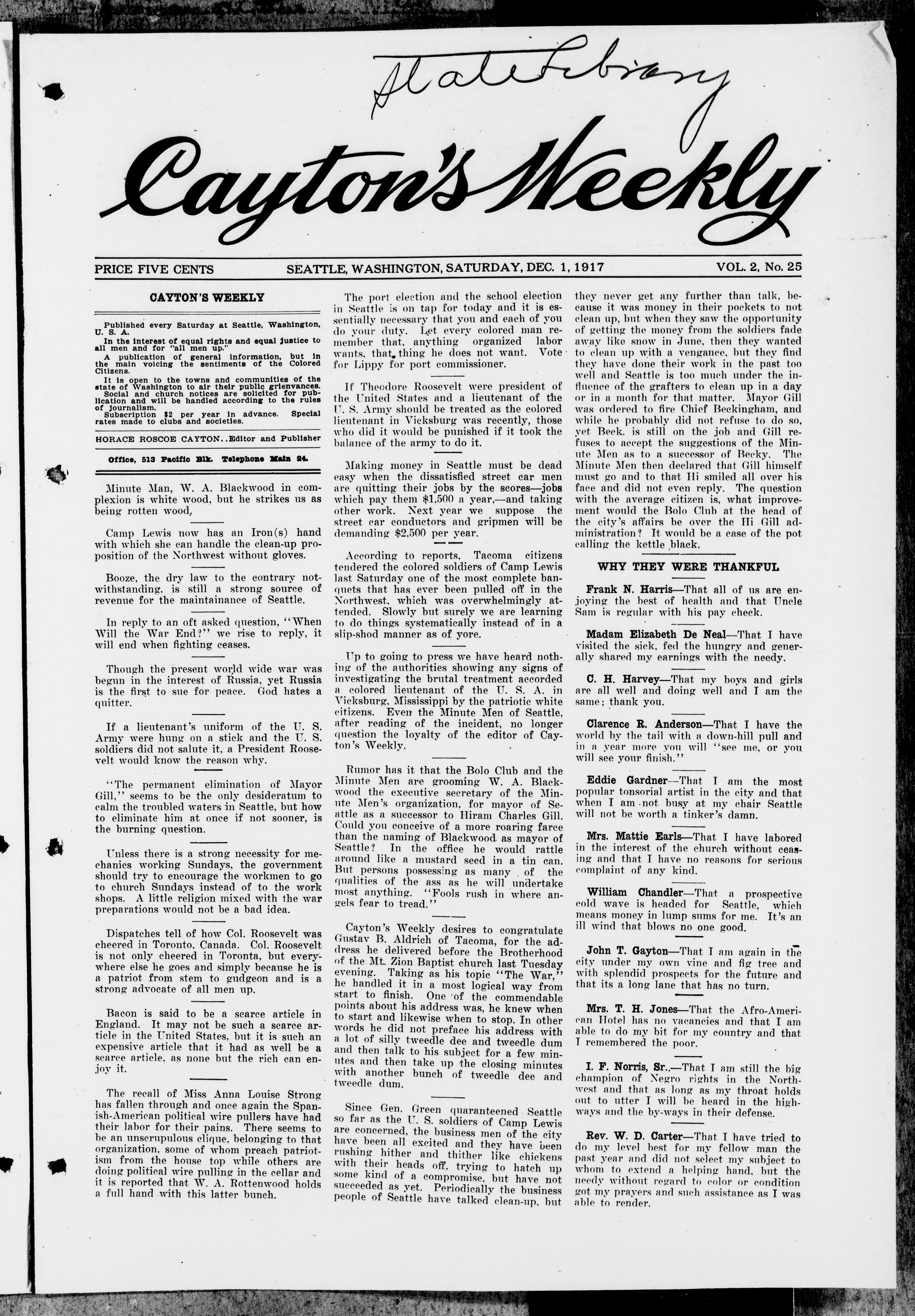
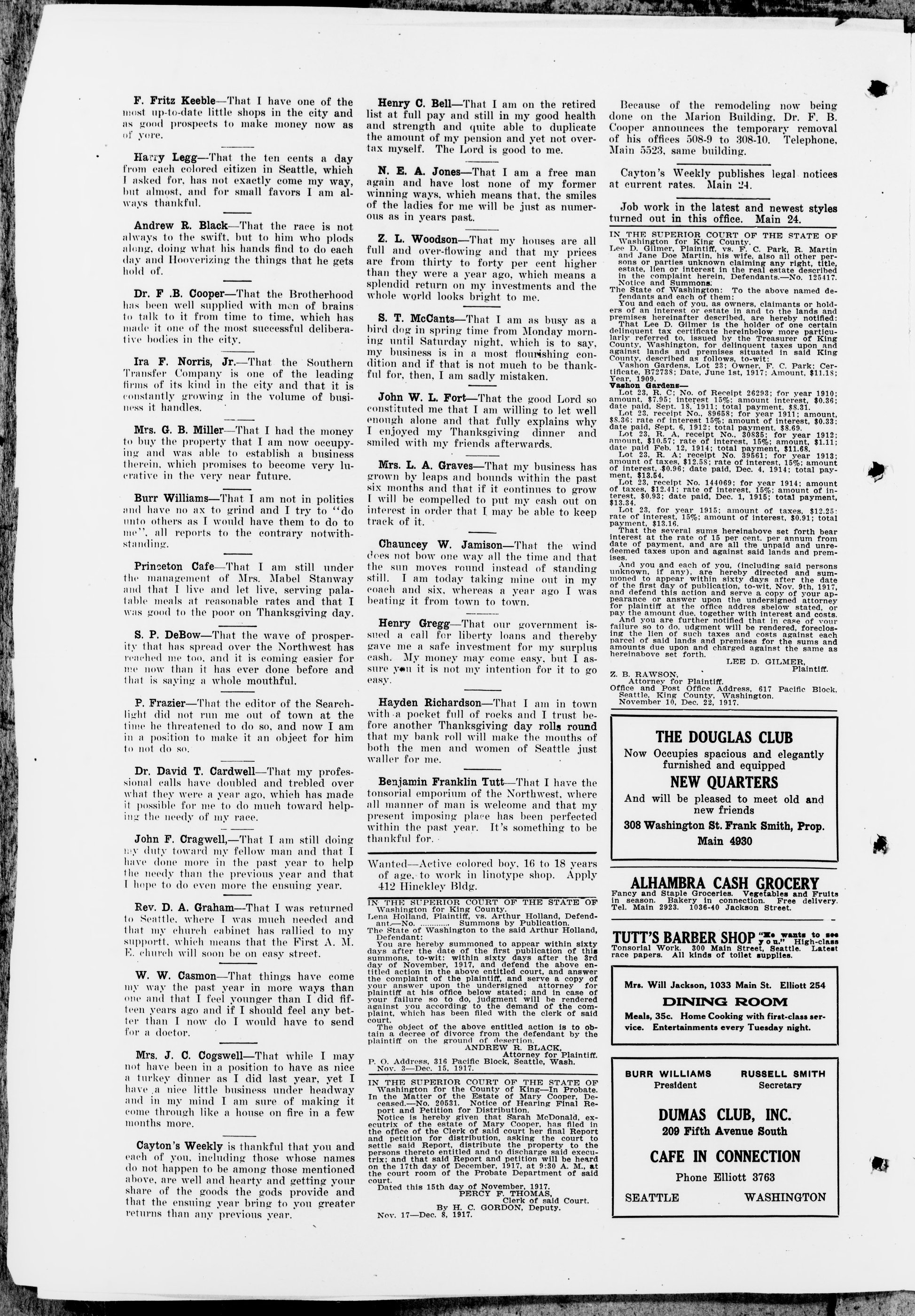
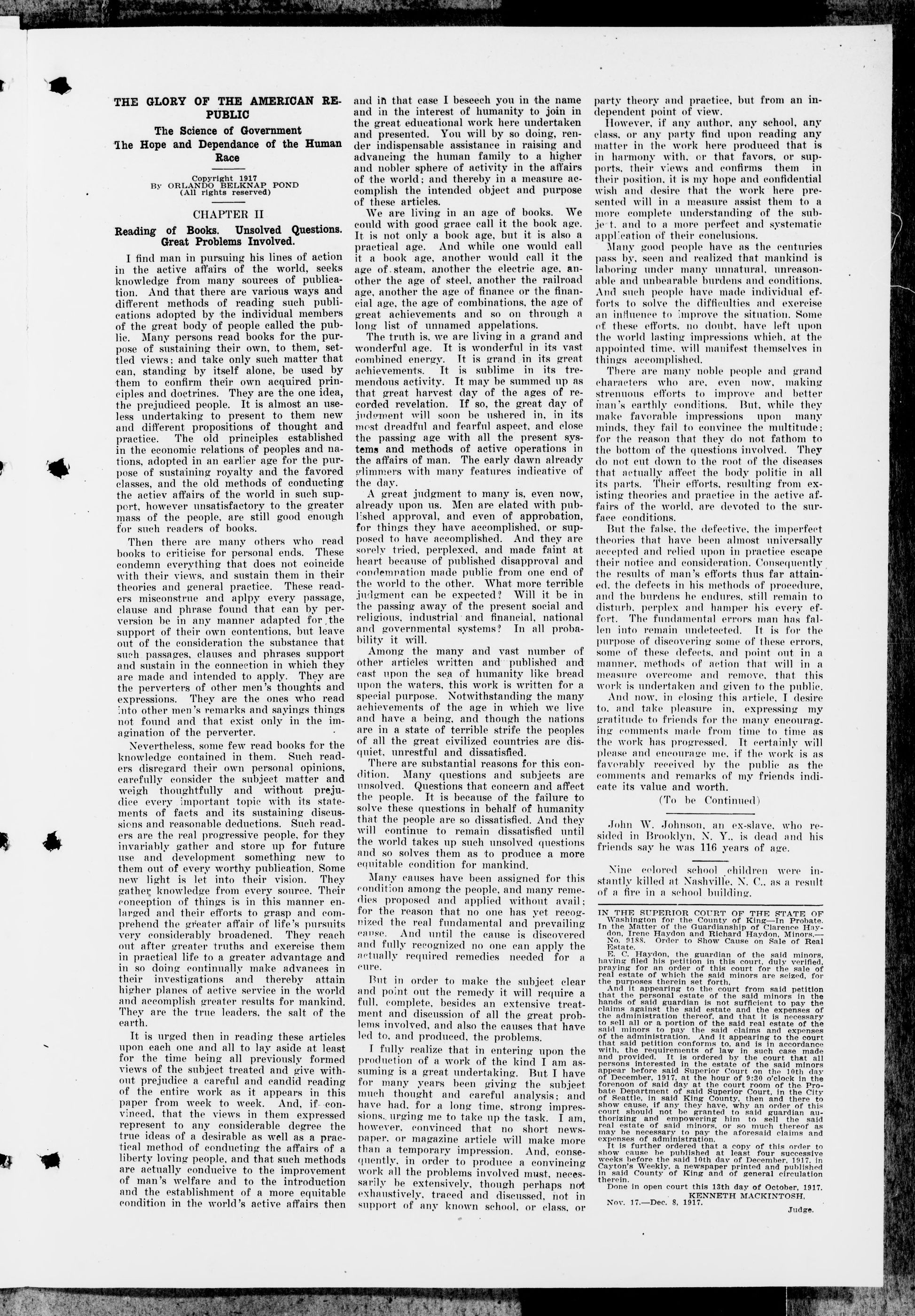
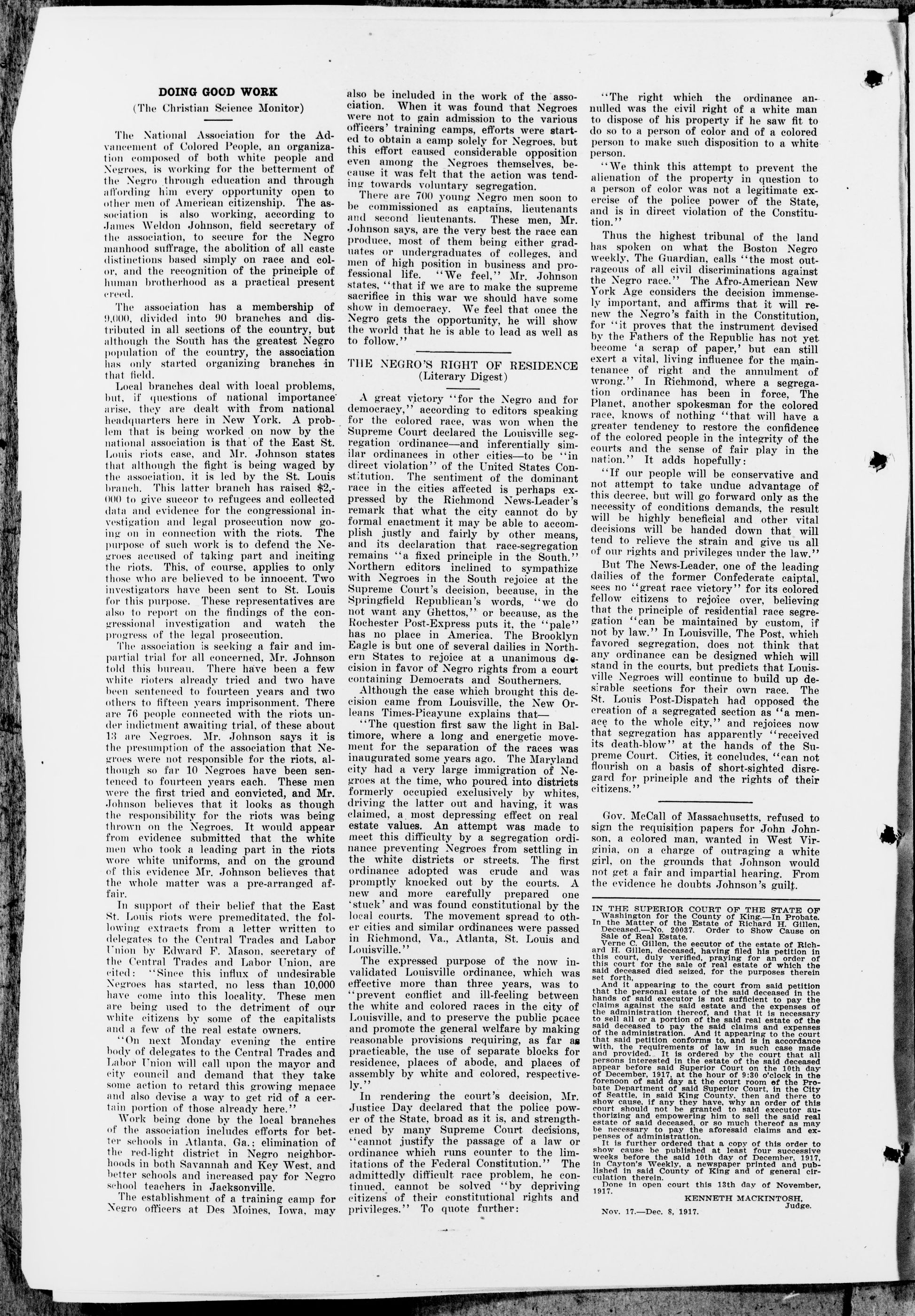
Page text (machine-generated)
State Library
Cayton's Weekly
---
PRICE FIVE CENTS
CAYTON'S WEEKLY
Published every Saturday at Seattle, Washington. U. S. A.
In the interest of equal rights and equal justice to all men and for "all men up."
A publication of general information, but in the main voicing the sentiments of the Colored Citizens. It is open to the towns and communities of the state of Washington to air their public grievances. Social and church notices are solicited for publication and will be handled according to the rules of journalism.
Subscription $2 per year in advance. Special rates made to clubs and societies.
HORACE ROSCOE CAYTON..Editor and Publisher
Office, 513 Pacific Blk. Telephone Main 24.
Minute Man, W. A. Blackwood in complexion is white wood, but he strikes us as being rotten wood.
Camp Lewis now has an Iron(s) hand with which she can handle the clean-up proposition of the Northwest without gloves.
Booze, the dry law to the contrary notwithstanding, is still a strong source of revenue for the maintainance of Seattle.
In reply to an oft asked question, "When Will the War End?" we rise to reply, it will end when fighting ceases.
Though the present world wide war was begun in the interest of Russia, yet Russia is the first to sue for peace. God hates a quitter.
If a lieutenant's uniform of the U. S. Army were hung on a stick and the U. S. soldiers did not salute it, a President Roosevelt would know the reason why.
"The permanent elimination of Mayor Gill," seems to be the only desideratum to calm the troubled waters in Seattle, but how to eliminate him at once if not sooner, is the burning question.
Unless there is a strong necessity for mechanics working Sundays, the government should try to encourage the workmen to go to church Sundays instead of to the work shops. A little religion mixed with the war preparations would not be a bad idea.
Dispatches tell of how Col. Roosevelt was cheered in Toronto, Canada. Col. Roosevelt is not only cheered in Toronta, but everywhere else he goes and simply because he is a patriot from stem to gudgeon and is a strong advocate of all men up.
Bacon is said to be a scarce article in England. It may not be such a scarce article in the United States, but it is such an expensive article that it had as well be a scarce article, as none but the rich can enjoy it.
The recall of Miss Anna Louise Strong has fallen through and once again the Spanish-American political wire pullers have had their labor for their pains. There seems to be an unscrupulous clique, belonging to that organization, some of whom preach patriotism from the house top while others are doing political wire pulling in the cellar and it is reported that W. A. Rottenwood holds a full hand with this latter bunch.
---
SEATTLE, WASHINGTON, SATURDAY, DEC. 1, 1917
The port election and the school election in Seattle is on tap for today and it is essentially necessary that you and each of you do your duty. Let every colored man remember that, anything organized labor wants, that thing he does not want. Vote for Lippy for port commissioner.
If Theodore Roosevelt were president of the United States and a lieutenant of the U. S. Army should be treated as the colored lieutenant in Vicksburg was recently, those who did it would be punished if it took the balance of the army to do it.
Making money in Seattle must be dead easy when the dissatisfied street car men are quitting their jobs by the scores—jobs which pay them $1,500 a year,—and taking other work. Next year we suppose the street car conductors and gripmen will be demanding $2,500 per year.
According to reports, Tacoma citizens tendered the colored soldiers of Camp Lewis last Saturday one of the most complete banquets that has ever been pulled off in the Northwest, which was overwhelmingly attended. Slowly but surely we are learning to do things systematically instead of in a slip-shod manner as of yore.
Up to going to press we have heard nothing of the authorities showing any signs of investigating the brutal treatment accorded a colored lieutenant of the U. S. A. in Vicksburg, Mississippi by the patriotic white citizens. Even the Minute Men of Seattle, after reading of the incident, no longer question the loyalty of the editor of Cayton's Weekly.
Rumor has it that the Bolo Club and the Minute Men are grooming W. A. Blackwood the executive secretary of the Minute Men's organization, for mayor of Seattle as a successor to Hiram Charles Gill. Could you conceive of a more roaring farce than the naming of Blackwood as mayor of Seattle? In the office he would rattle around like a mustard seed in a tin can. But persons possessing as many of the qualities of the ass as he will undertake most anything. "Fools rush in where angels fear to tread."
Cayton's Weekly desires to congratulate Gustav B. Aldrich of Tacoma, for the address he delivered before the Brotherhood of the Mt. Zion Baptist church last Tuesday evening. Taking as his topic "The War," he handled it in a most logical way from start to finish. One of the commendable points about his address was, he knew when to start and likewise when to stop. In other words he did not preface his address with a lot of silly tweedle dee and tweedle dum and then talk to his subject for a few minutes and then take up the closing minutes with another bunch of tweedle dee and tweedle dum.
Since Gen. Green quaranteened Seattle so far as the U. S. soldiers of Camp Lewis are concerned, the business men of the city have been all excited and they have been rushing hither and thither like chickens with their heads off, trying to hatch up some kind of a compromise, but have not succeeded as yet. Periodically the business people of Seattle have talked clean-up but
VOL.2, No.25
they never get any further than talk, because it was money in their pockets to not clean up, but when they saw the opportunity of getting the money from the soldiers fade away like snow in June, then they wanted to clean up with a vengeance, but they find they have done their work in the past too well and Seattle is too much under the influence of the grafters to clean up in a day or in a month for that matter. Mayor Gill was ordered to fire Chief Beckingham, and while he probably did not refuse to do so, yet Beck. is still on the job and Gill refuses to accept the suggestions of the Minute Men as to a successor of Becky. The Minute Men then declared that Gill himself must go and to that Hi smiled all over his face and did not even reply. The question with the average citizen is, what improvement would the Bolo Club at the head of the city's affairs be over the Hi Gill administration? It would be a case of the pot calling the kettle black.
WHY THEY WERE THANKFUL
Frank N. Harris—That all of us are enjoying the best of health and that Uncle Sam is regular with his pay check.
Madam Elizabeth De Neal—That I have visited the sick, fed the hungry and generally shared my earnings with the needy.
C. H. Harvey—That my boys and girls are all well and doing well and I am the same; thank you.
Clarence R. Anderson—That I have the world by the tail with a down-hill pull and in a year more you will "see me, or you will see your finish."
Eddie Gardner—That I am the most popular tonsorial artist in the city and that when I am not busy at my chair Seattle will not be worth a tinker's damn.
Mrs. Mattie Earls—That I have labored in the interest of the church without ceasing and that I have no reasons for serious complaint of any kind.
William Chandler—That a prospective cold wave is headed for Seattle, which means money in lump sums for me. It's an ill wind that blows no one good.
John T. Gayton—That I am again in the city under my own vine and fig tree and with splendid prospects for the future and that its a long lane that has no turn.
Mrs. T. H. Jones—That the Afro-American Hotel has no vacancies and that I am able to do my bit for my country and that I remembered the poor.
I. F. Norris, Sr.—That I am still the big champion of Negro rights in the Northwest and that as long as my throat holds out to utter I will be heard in the highways and the by-ways in their defense.
Rev. W. D. Carter—That I have tried to do my level best for my fellow man the past year and did not select my subject to whom to extend a helping hand, but the needy without regard to color or condition got my prayers and such assistance as I was able to render.
```markdown
```
F. Fritz Keeble—That I have one of the most up-to-date little shops in the city and as good prospects to make money now as of yore.
Harry Legg—That the ten cents a day from each colored citizen in Seattle, which I asked for, has not exactly come my way, but almost, and for small favors I am always thankful.
Andrew R. Black—That the race is not always to the swift, but to him who plods along, doing what his hands find to do each day and Hooverizing the things that he gets hold of.
Dr. F .B. Cooper-That the Brotherhood has been well supplied with men of brains to talk to it from time to time, which has made it one of the most successful deliberative bodies in the city.
Ira F. Norris, Jr.-That the Southern Transfer Company is one of the leading firms of its kind in the city and that it is constantly growing in the volume of business it handles.
Mrs. G. B. Miller—That I had the money to buy the property that I am now occupying and was able to establish a business therein, which promises to become very lucrative in the very near future.
Burr Williams—That I am not in politics and have no ax to grind and I try to "do unto others as I would have them to do to me", all reports to the contrary notwithstanding.
Princeton Cafe-That I am still under the management of Mrs. Mabel Stanway and that I live and let live, serving palatable meals at reasonable rates and that I was good to the poor on Thanksgiving day.
S. P. DeBow-That the wave of prosperity that has spread over the Northwest has reached me too, and it is coming easier for me now than it has ever done before and that is saying a whole mouthful.
P. Frazier—That the editor of the Searchlight did not run me out of town at the time he threatened to do so, and now I am in a position to make it an object for him to not do so.
Dr. David T. Cardwell—That my professional calls have doubled and trebled over what they were a year ago, which has made it possible for me to do much toward helping the needy of my race.
John F. Cragwell,—That I am still doing my duty toward my fellow man and that I have done more in the past year to help the needy than the previous year and that I hope to do even more the ensuing year.
Rev. D. A. Graham—That I was returned to Seattle, where I was much needed and that my church cabinet has rallied to my supportt, which means that the First A. M. E. church will soon be on easy street.
W. W. Casmon-That things have come my way the past year in more ways than one and that I feel younger than I did fifteen years ago and if I should feel any better than I now do I would have to send for a doctor.
Mrs. J. C. Cogswell-That while I may not have been in a position to have as nice a turkey dinner as I did last year, yet I have a nice little business under headway and in my mind I am sure of making it come through like a house on fire in a few months more.
Cayton's Weekly is thankful that you and each of you, including those whose names do not happen to be among those mentioned above, are well and hearty and getting your share of the goods the gods provide and that the ensuing year bring to you greater returns than any previous year.
Henry C. Bell—That I am on the retired list at full pay and still in my good health and strength and quite able to duplicate the amount of my pension and yet not overtax myself. The Lord is good to me.
N. E. A. Jones—That I am a free man again and have lost none of my former winning ways, which means that, the smiles of the ladies for me will be just as numerous as in years past.
Z. L. Woodson—That my houses are all full and over-flowing and that my prices are from thirty to forty per cent higher than they were a year ago, which means a splendid return on my investments and the whole world looks bright to me.
S. T. McCants—That I am as busy as a bird dog in spring time from Monday morning until Saturday night, which is to say, my business is in a most flourishing condition and if that is not much to be thankful for, then, I am sadly mistaken.
John W. L. Fort-That the good Lord so constituted me that I am willing to let well enough alone and that fully explains why I enjoyed my Thanksgiving dinner and smiled with my friends afterwards.
Mrs. L. A. Graves-That my business has grown by leaps and bounds within the past six months and that if it continues to grow I will be compelled to put my cash out on interest in order that I may be able to keep track of it.
Chauncey W. Jamison—That the wind does not bow one way all the time and that the sun moves round instead of standing still. I am today taking mine out in my coach and six, whereas a year ago I was beating it from town to town.
Henry Gregg—That our government issued a call for liberty loans and thereby gave me a safe investment for my surplus cash. My money may come easy, but I assure you it is not my intention for it to go easy.
Hayden Richardson-That I am in town with a pocket full of rocks and I trust before another Thanksgiving day rolls round that my bank roll will make the mouths of both the men and women of Seattle just waller for me.
Benjamin Franklin Tutt-That I have the tonsorial emporium of the Northwest, where all manner of man is welcome and that my present imposing place has been perfected within the past year. It's something to be thankful for.
Wanted—Active colored boy, 16 to 18 years of age, to work in linotype shop. Apply 412 Hinckley Bldg.
IN THE SUPERIOR COURT OF THE STATE OF Washington for King County.
Lena Holland, Plaintiff, vs. Arthur Holland, Defendant—No. ..... Summons by Publication.
The State of Washington to the said Arthur Holland, Defendant:
You are hereby summoned to appear within sixty days after the date of the first publication of this summons, to-wit: within sixty days after the 3rd day of November, 1917, and defend the above entitled action in the above entitled court, and answer the complaint of the plaintiff, and serve a copy of your answer upon the undersigned attorney for plaintiff at his office below stated; and in case of your failure so to do, judgment will be rendered against you according to the demand of the complaint, which has been filed with the clerk of said court.
The object of the above entitled action is to obtain a decree of divorce from the defendant by the plaintiff on the ground of desertion.
ANDREW R. BLACK,
Attorney for Plaintiff.
P. O. Address, 316 Pacific Block, Seattle, Wash.
Nov. 3—Dec. 15, 1917.
IN THE SUPERIOR COURT OF THE STATE OF Washington for the County of King—In Probate.
In the Matter of the Estate of Mary Cooper, Deceased.—No. 20531. Notice of Hearing Final Report and Petition for Distribution.
Notice is hereby given that Sarah McDonald, executrix of the estate of Mary Cooper, has filed in the office of the Clerk of said court her final Report and petition for distribution, asking the court to settle said Report, distribute the property to the persons thereto entitled and to discharge said executrix; and that said Report and petition will be heard on the 17th day of December, 1917, at 9:30 A. M., at the court room of the Probate Department of said court.
Dated this 15th day of November, 1917.
PERCY F. THOMAS,
Clerk of said Court.
By H. C. GORDON, Deputy.
Nov. 17—Dec. 8, 1917.
Because of the remodeling now being done on the Marion Building, Dr. F. B. Cooper announces the temporary removal of his offices 508-9 to 308-10. Telephone, Main 5523, same building.
Cayton's Weekly publishes legal notices at current rates. Main 24.
Job work in the latest and newest styles turned out in this office. Main 24.
IN THE SUPERIOR COURT OF THE STATE OF Washington for King County.
Lee D. Gilmer, Plaintiff, vs. F. C. Park, R. Martin and Jane Doe Martin, his wife, also all other persons or parties unknown claiming any right, title, estate, lien or interest in the real estate described in the complaint herein, Defendants.—No. 125417. Notice and Summons:
The State of Washington: To the above named defendants and each of them:
Tendants and each of them:
You and each of you, as owners, claimants or holders of an interest or estate in and to the lands and premises hereinafter described, are hereby notified:
That Lee D. Gilmer is the holder of one certain delinquent tax certificate hereinbelow more particularly referred to, issued by the Treasurer of King County, Washington, for delinquent taxes upon and against lands and premises situated in said King County, described as follows, to-wit:
Vashon Gardens, Lot 23; Owner, F. C. Park; Certificate, B72738; Date, June 1st, 1917; Amount, $11.18; Year, 1909.
Vashon Gardens—
Lot 23, R. C; No. of Receipt 26293; for year 1910; amount, $7.95; interest 15%; amount interest, $0.36; date paid, Sept. 18, 1911; total payment, $8.31.
Lot 23, receipt No., 89658; for year 1911; amount,
$8.36; rate of interest 15%; amount of interest, $0.33;
date paid, Sept. 6, 1912; total payment, $8.69.
Lot 23, R. A, receipt No., 30835; for year 1912; amount, $10.57; rate of interest, 15%; amount, $1.11; date paid Feb. 12, 1914; total payment, $11.68.
Lot 23, R. A; receipt No. 39561; for year 1913; amount of taxes, $12.58; rate of interest, 15%; amount of interest, $0.96; date paid, Dec. 4, 1914; total payment, $13.54.
Lot 23, receipt No. 144069; for year 1914; amount of taxes, $12.41; rate of interest, 15%; amount of interest, $0.93; date paid, Dec. 1, 1915; total payment, $13.34.
Lot 23, for year 1915; amount of taxes, $12.25; rate of interest, 15%; amount of interest, $0.91; total payment, $13.16.
That the several sums hereinabove set forth bear interest at the rate of 15 per cent. per annum from date of payment, and are all the unpaid and unredeemed taxes upon and against said lands and premises.
And you and each of you, (including said persons unknown, if any), are hereby directed and summoned to appear within sixty days after the date of the first day of publication, to-wit. Nov. 9th, 1917, and defend this action and serve a copy of your appearance or answer upon the undersigned attorney for plaintiff at the office addresses below stated, or pay the amount due, together with interest and costs
And you are further notified that in case of your failure so to do, udgment will be rendered, foreclosing the lien of such taxes and costs against each parcel of said lands and premises for the sums and amounts due upon and charged against the same as hereinabove set forth.
Attorney for Plaintiff.
Office and Post Office Address, 617 Pacific Block,
Seattle, King County, Washington.
November 10. Dec. 22. 1917.
THE DOUGLAS CLUB
Now Occupies spacious and elegantly
furnished and equipped
NEW QUARTERS
And will be pleased to meet old and
new friends
308 Washington St. Frank Smith, Prop.
Main 4930
ALHAMBRA CASH GROCERY Fancy and Staple Groceries. Vegetables and Fruits in season. Bakery in connection. Free delivery. Tel. Main 2923. 1036-40 Jackson Street.
TUTT'S BARBER SHOP "We wants to see you." High-class Tonsorial Work. 300 Main Street, Seattle. Latest race papers. All kinds of toilet supplies.
Mrs. Will Jackson, 1033 Main St. Elliott 254
DINING ROOM
Meals, 35c. Home Cooking with first-class service. Entertainments every Tuesday night.
BURR WILLIAMS RUSSELL SMITH
President Secretary
DUMAS CLUB, INC.
209 Fifth Avenue South
CAFE IN CONNECTION
---
Copyright 1917
By ORLANDO BELKNAP POND
(All rights reserved)
Reading of Books. Unsolved Questions. Great Problems Involved.
I find man in pursuing his lines of action in the active affairs of the world, seeks knowledge from many sources of publication. And that there are various ways and different methods of reading such publications adopted by the individual members of the great body of people called the public. Many persons read books for the purpose of sustaining their own, to them, settled views; and take only such matter that can, standing by itself alone, be used by them to confirm their own acquired principles and doctrines. They are the one idea, the prejudiced people. It is almost an useless undertaking to present to them new and different propositions of thought and practice. The old principles established in the economic relations of peoples and nations, adopted in an earlier age for the purpose of sustaining royalty and the favored classes, and the old methods of conducting the actiev affairs of the world in such support, however unsatisfactory to the greater mass of the people, are still good enough for such readers of books.
Then there are many others who read books to criticise for personal ends. These condemn everything that does not coincide with their views, and sustain them in their theories and general practice. These readers misconstrue and aplpy every passage, clause and phrase found that can by perversion be in any manner adapted for the support of their own contentions, but leave out of the consideration the substance that such passages, clauses and phrases support and sustain in the connection in which they are made and intended to apply. They are the perverters of other men's thoughts and expressions. They are the ones who read into other men's remarks and sayings things not found and that exist only in the imagination of the perverter.
Nevertheless, some few read books for the knowledge contained in them. Such readers disregard their own personal opinions, carefully consider the subject matter and weigh thoughtfully and without prejudice every important topic with its statements of facts and its sustaining discussions and reasonable deductions. Such readers are the real progressive people, for they invariably gather and store up for future use and development something new to them out of every worthy publication. Some new light is let into their vision. They gather knowledge from every source. Their conception of things is in this manner enlarged and their efforts to grasp and comprehend the greater affair of life's pursuits very considerably broadened. They reach out after greater truths and exercise them in practical life to a greater advantage and in so doing continually make advances in their investigations and thereby attain higher planes of active service in the world and accomplish greater results for mankind. They are the true leaders, the salt of the earth.
It is urged then in reading these articles upon each one and all to lay aside at least for the time being all previously formed views of the subject treated and give without prejudice a careful and candid reading of the entire work as it appears in this paper from week to week. And, if convinced, that the views in them expressed represent to any considerable degree the true ideas of a desirable as well as a practical method of conducting the affairs of a liberty loving people, and that such methods are actually conducive to the improvement of man's welfare and to the introduction and the establishment of a more equitable condition in the world's active affairs then
and in that case I beseech you in the name and in the interest of humanity to join in the great educational work here undertaken and presented. You will by so doing, render indispensable assistance in raising and advancing the human family to a higher and nobler sphere of activity in the affairs of the world; and thereby in a measure accomplish the intended object and purpose of these articles.
We are living in an age of books. We could with good grace call it the book age. It is not only a book age, but it is also a practical age. And while one would call it a book age, another would call it the age of steam, another the electric age, another the age of steel, another the railroad age, another the age of finance or the financial age, the age of combinations, the age of great achievements and so on through a long list of unnamed appellations.
The truth is, we are living in a grand and wonderful age. It is wonderful in its vast combined energy. It is grand in its great achievements. It is sublime in its tremendous activity. It may be summed up as that great harvest day of the ages of recorded revelation. If so, the great day of judgment will soon be ushered in, in its most dreadful and fearful aspect, and close the passing age with all the present systems and methods of active operations in the affairs of man. The early dawn already glimmers with many features indicative of the day.
A great judgment to many is, even now, already upon us. Men are elated with published approval, and even of approbation, for things they have accomplished, or supposed to have accomplished. And they are sorely tried, perplexed, and made faint at heart because of published disapproval and condemnation made public from one end of the world to the other. What more terrible judgment can be expected? Will it be in the passing away of the present social and religious, industrial and financial, national and governmental systems? In all probability it will.
Among the many and vast number of other articles written and published and cast upon the sea of humanity like bread upon the waters, this work is written for a special purpose. Notwithstanding the many achievements of the age in which we live and have a being, and though the nations are in a state of terrible strife the peoples of all the great civilized countries are disquiet, unrestful and dissatisfied.
There are substantial reasons for this condition. Many questions and subjects are unsolved. Questions that concern and affect the people. It is because of the failure to solve these questions in behalf of humanity that the people are so dissatisfied. And they will continue to remain dissatisfied until the world takes up such unsolved questions and so solves them as to produce a more equitable condition for mankind.
Many causes have been assigned for this condition among the people, and many remedies proposed and applied without avail; for the reason that no one has yet recognized the real fundamental and prevailing cause. And until the cause is discovered and fully recognized no one can apply the actually required remedies needed for a cure. But in order to make the subject clear and point out the remedy it will require a full, complete, besides an extensive treatment and discussion of all the great problems involved, and also the causes that have led to, and produced, the problems.
I fully realize that in entering upon the production of a work of the kind I am assuming is a great undertaking. But I have for many years been giving the subject much thought and careful analysis; and have had, for a long time, strong impressions, urging me to take up the task. I am, however, convinced that no short newspaper, or magazine article will make more than a temporary impression. And, consequently, in order to produce a convincing work all the problems involved must, necessarily be extensively, though perhaps not exhaustively, traced and discussed, not in support of any known school, or class, or
party theory and practice, but from an independent point of view. However, if any author, any school, any class, or any party find upon reading any matter in the work here produced that is in harmony with, or that favors, or supports, their views and confirms them in their position, it is my hope and confidential wish and desire that the work here presented will in a measure assist them to a more complete understanding of the subject, and to a more perfect and systematic application of their conclusions.
Many good people have as the centuries pass by, seen and realized that mankind is laboring under many unnatural, unreasonable and unbearable burdens and conditions. And such people have made individual efforts to solve the difficulties and exercise an influence to improve the situation. Some of these efforts, no doubt, have left upon the world lasting impressions which, at the appointed time, will manifest themselves in things accomplished.
There are many noble people and grand characters who are, even now, making strenuous efforts to improve and better man's earthly conditions. But, while they make favorable impressions upon many minds, they fail to convince the multitude; for the reason that they do not fathom to the bottom of the questions involved. They do not cut down to the root of the diseases that actually affect the body politic in all its parts. Their efforts, resulting from existing theories and practice in the active affairs of the world, are devoted to the surface conditions.
But the false, the defective, the imperfect theories that have been almost universally accepted and relied upon in practice escape their notice and consideration. Consequently the results of man's efforts thus far attained, the defects in his methods of procedure, and the burdens he endures, still remain to disturb, perplex and hamper his every effort. The fundamental errors man has fallen into remain undetected. It is for the purpose of discovering some of these errors, some of these defects, and point out in a manner, methods of action that will in a measure overcome and remove, that this work is undertaken and given to the public.
And now, in closing this article, I desire to, and take pleasure in, expressing my gratitude to friends for the many encouraging comments made from time to time as the work has progressed. It certainly will please and encourage me, if the work is as favorably received by the public as the comments and remarks of my friends indicate its value and worth.
(To be Continued)
John W. Johnson, an ex-slave, who resided in Brooklyn, N. Y., is dead and his friends say he was 116 years of age. Nine colored school children were instantly killed at Nashville, N. C., as a result of a fire in a school building.
IN THE SUPERIOR COURT OF THE STATE OF Washington for the County of King—In Probate. In the Matter of the Guardianship of Clarence Haydon, Irene Haydon and Richard Haydon, Minors.—No. 1918. Order to Show Cause on Sale of Real Estate.
E. C. Haydon, the guardian of the said minors, having filed his petition in this court, duly verified, praying for an order of this court for the sale of real estate of which the said minors are seized, for the purposes therein set forth.
And it appearing to the court from said petition that the personal estate of the said minors in the hands of said guardian is not sufficient to pay the claims against the said estate and the expenses of the administration thereof, and that it is necessary to sell all or a portion of the said real estate of the said minors to pay the said claims and expenses of the administration. And it appearing to the court that said petition conforms to, and is in accordance with, the requirements of law in such case made and provided. It is ordered by the court that all persons interested in the estate of the said minors appear before said Superior Court on the 10th day of December, 1917, at the hour of 9:30 o'clock in the forenoon of said day at the court room of the Probate Department of said Superior Court, in the City of Seattle, in said King County, then and there to show cause, if any they have, why an order of this court should not be granted to said guardian authorizing and empowering him to sell the said real estate of said minors, or so much thereof as may be necessary to pay the aforesaid claims and expenses of administration.
It is further ordered that a copy of this order to show cause be published at least four successive weeks before the said 10th day of December, 1917, in Cayton's Weekly, a newspaper printed and published in said County of King and of general circulation therein.
Done in open court this 13th day of October, 1917.
KENNETH MACKINTOSH.
Nov. 17.—Dec. 8, 1917.
ise TRBRROD ES So OL Skee hh) EN oy ce ae oa ae
ty q . Lye Neb ee Ni f ig ZR cal aS teh RAG Sees at ae De a
RED i ee aU ST at ea ver
DOING GOCD WORK
(The Christian Science Monitor)
et ee Meee or ee ae Sie Me CER atl Me ee ee eee
tion composed of both white people and
Negroes, is working for the betterment of
the Negro through education and through
affording him every opportunity open to
other men of American citizenship. The as-
sociation is also working, according to
James Weldon Johnson, field secretary of
the association, to secure for the Negro
manhood suffrage, the abolition of all caste
distinctions based simply on race and col-
or, and the recognition of the principle of
human brotherhood as a practical present
creed,
The association has a membership of
9,000, divided into 90 branches and dis-
tributed in all sections of the country, but
although the South has the greatest Negro
population of the country, the association
has only started organizing branches in
that field.
Local branches deal with local problems,
but, if questions of national importance’
arise, they are dealt with from national
headquarters here in New York. A prob-
lem that is being worked on now by the
national association is that of the East St.
Louis riots case, and Mr. Johnson states
that although the fight is being waged by
the association, it is led by the St. Louis
branch. This latter branch has raised $2,-
000 to give suecor to refugees and collected
data and evidence for the congressional in-
vestigation and legal prosecution now go-
ing on in connection with the riots. The
purpose of such work is to defend the Ne-
groes accused of taking part and inciting
the riots. This, of course, applies to only
those who are believed to be innocent. Two
investigators have been sent to St. Louis
for this purpose. These representatives are
also to report on the findings of the con-
gressional investigation and watch the
progress of the legal prosecution.
The association is seeking a fair and im-
partial trial for all concerned, Mr. Johnson
told this bureau. There have been a few
white rioters already tried and two have
been sentenced to fourteen years and two
others to fifteen years imprisonment. There
are 76 people connected with the riots un-
der indictment awaiting trial, of these about
13 are Negroes. Mr. Johnson says it is
the presumption of the association that Ne-
groes were not responsible for the riots, al-
though so far 10 Negroes have been sen-
tenced to fourteen years each. These men
were the first tried and convicted, and Mr.
Johnson believes that it looks as though
the responsibility for the riots was being
thrown on the Negroes. It would appear
from evidence submitted that the white
men who took a leading part in the riots
wore white uniforms, and on the ground
of this evidence Mr, Johnson believes that
the whole matter was a pre-arranged af-
fair.
In support of their belief that the East
St. Louis riots were premeditated, the fol-
lowing extracts from a letter written to
delegates to the Central Trades and Labor
Vnion by Edward F. Mason, secretary of
the Central Trades and Labor Union, are
cited: ‘Since this influx of undesirable
Negroes has started, no less than 10,000
have come into this locality. These men
are being used to the detriment of our
white citizens by some of the capitalists
and a few of the real estate owners.
“On next Monday evening the entire
hody of delegates to the Central Trades and
Labor Union will eall upon the mayor and
city council and demand that they take
some action to retard this growing menace
and also devise a way to get rid of a cer-
tain portion of those already here.’’
Work being done by the local branches
of the association ineludes efforts for het-
also be included in the work of the asso-
ciation. When it was found that Negroes
were not to gain admission to the various
officers’ training camps, efforts were start-
ed to obtain a camp solely for Negroes, but
this effort caused considerable opposition
even among the Negroes themselves, be-
cause it was felt that the action was tend-
ing towards voluntary segregation,
There are 700 young Negro men soon to
be commissioned as captains, lieutenants
and second lieutenants. These men, Mr.
Johnson says, are the very best the race can
produce, most of them being either grad-
uates or undergraduates of colleges, and
men of high position in business and pro-
fessional life. ‘‘We feel,’? Mr. Johnson
states, ‘‘that if we are to make the supreme
sacrifice in this war we should have some
show in democracy. We feel that once the
Negro gets the opportunity, he will show
the world that he is able to lead as well as
to follow.’’
the world that he is able to lead as well as
to follow.’’
THE NEGRO’S RIGHT OF RESIDENCE
(Literary Digest)
A great victory ‘‘for the Negro and for
democracy,’’ according to editors speaking
for the colored race, was won when the
Supreme Court declared the Louisville seg-
regation ‘ordinance—and inferentially sim-
ilar ordinances in other cities—to be ‘‘in
direct violation’’ of the United States Con-
stitution. The sentiment of the dominant
race in the cities affected is perhaps ex-
pressed by the Richmond News-Leader’s
remark that what the city cannot do by
formal enactment it may be able to accom-
plish justly and fairly by other means,
and its declaration that race-segregation
remains ‘‘a fixed principle in the South.”
Northern editors inclined to sympathize
with Negroes in the South rejoice at the
Supreme Court’s decision, because, in the
Springfield Republican’s words, ‘‘we do
not want any Ghettos,’’ or because, as the
Rochester Post-Express puts it, the ‘“‘pale’’
has no place in America. The Brooklyn
Eagle is but one of several dailies in North-
ern States to rejoice at a unanimous de-
cision in favor of Negro rights from a court
containing Democrats and Southerners.
Although the case which brought this de-
cision came from Louisville, the New Or-
leans Times-Picayune explains that—
“The question first saw the light in Bal-
timore, where a long and energetic move-
ment for the separation of the races was
inaugurated some years ago. The Maryland
city had a very large immigration of Ne-
groes at the time, who poured into districts
formerly occupied exelusively by whites,
driving the latter out and having, it was
claimed, a, most depressing effect on real
estate values. An attempt was made to
meet this difficulty by a segregation ordi-
nance preventing Negroes from settling in
the white districts or streets. The first
ordinance adopted was crude and was
promptly knocked out by the courts. A
new and more carefully prepared one
‘stuck’ and was found constitutional by the
local courts. The movement spread to oth-
er cities and similar ordinances were passed
in Richmond, Va., Atlanta, St. Louis and
Louisville.’’
The expressed purpose of the now in-
validated Louisville ordinance, which was
effective more than three years, was to
“prevent conflict and ill-feeling between
the white and colored races in the city of
Louisville, and to preserve the public peace
and promote the general welfare by making
reasonable provisions requiring, as far as
practicable, the use of separate blocks for
residence, places of abode, and places of
assembly by white and colored, respective-
ly?
“In rendering the court’s decision, Mr.
Justice Day declared that the police pow-
er of the State, broad as it is, and strength-
ened by many Supreme Court decisions,
‘‘cannot justify the passage of a law or
ordinance which runs counter to the lim-
itations of the Federal Constitution.’’ The
admittedly difficult race problem, he con-
tinned, cannot be solved ‘‘by depriving
citizens of their constitutional rights and
privileges.’? To quote further:
“The right which the ordinance an-
nulled was the civil right of a white man
to dispose of his property if he saw fit to
do so to a person of color and of a colored
person to make such disposition to a white
person.
““We think this attempt to prevent the
alienation of the property in question to
a person of color was not a legitimate ex-
ercise of the police power of the State,
and is in direct violation of the Constitu-
tion.”’
Thus the highest tribunal of the land
has spoken on what the Boston Negro
weekly, The Guardian, calls ‘‘the most out-
rageous of all civil discriminations against
the Negro race.’’? The Afro-American New
York Age considers the decision immense-
ly important, and affirms that it will re-
new the Negro’s faith in the Constitution,
for ‘it proves that the instrument devised
by the Fathers of the Republic has not yet.
become ‘a serap of paper,’ but can still
exert a vital, living influence for the main-
tenance of right and the annulment of
wrong.’’ In Richmond, where a segrega-
tion ordinance has been in force, The
Planet, another spokesman for the colored
race, knows of nothing ‘‘that will have a
greater tendency to restore the confidence
of the colored people in the integrity of the
courts and the sense of fair play in the
nation.’’ It adds hopefully:
“Tf our people will be conservative and
not attempt to take undue advantage of
this decree, but will go forward only as the
necessity of conditions demands, the result
will be highly beneficial and other vital
decisions will be handed down that will
tend to relieve the strain and give us all
of our rights and privileges under the law.’
But The News-Leader, one of the leading
dailies of the former Confederate caiptal,
sees no ‘‘great race victory’’ for its colored
fellow citizens to rejoice over, believing
that the principle of residential race segre-
gation ‘‘can be maintained by custom, if
not by law.’’ In Louisville, The Post, which
favored segregation, does not think that
any ordinance can be designed which will
stand in the courts, but predicts that Louis-
ville Negroes will continue to build up de-
sirable sections for their own race. The
St. Louis Post-Dispatch had opposed the
creation of a segregated section as ‘‘a men-
ace to the whole city,’”’ and rejoices now
that segregation has apparently ‘‘received
its death-blow’”’ at the hands of the Su-
preme Court. Cities, it concludes, “can not
flourish on a basis of short-sighted disre-
gard for prineiple and the rights of their
citizens.’”
Gov. McCall of Massachusetts, refused to
sign the requisition papers for John John-
son, a colored man, wanted in West Vir-
ginia, on a charge of outraging a white
girl, on the grounds that Johnson would
not get a fair and impartial hearing, From
the evidence he doubts Johnson’s guilt.
IN HE SUPERIOR COURT OF THE STATE OF
Washington for the County of King.—In Probate.
In_the Matter of the Estate of Richard H. Gillen,
Deceased.—No. 20037. Order to Show Cause on
Sale of Real Estate.
Verne ©. Gillen, the eecutor of the estate of Rich-
ard H. Gillen, deceased, having filed his petition in
this court, duly verified, praying for an order of
this court’ for the sale of real estate of which the
Said deceased died seized, for the purposes therein
se ‘orth,
And it’appearing to the court from said petition
that the personal estate of the said deceased in the
hands of said executor is not sufficient to pay the
claims against the said estate and the expenses of
the administration thereof, and that it is necessary
to sell all or_a portion of the said real estate of the
said deceased to pay the said claims and expenses
of the administration. And it appearing to the court
that said petition conforms to, and is in accordance
with, the requirements of law in such case made
and provided. It is ordered by the court that all
persons interested in the estate of the said deceased
appear before said Superior Court on the 10th day
of December, 1917, at the hour of 9:80 o'clock in the
forenoon of ‘said day at the court room ef the Pro-
bate Department of said Superior Court, in the City
of Seattle, in said King County, then and there to
show cause, if any they have, why an order of this
court should not be granted to said executor au-
thorizing and empowering him to sell the said real
estate of said deceased, or so much thereof as may
be necessary to pay the aforesaid claims and ex-
penses of administration,
It is further ordered that a copy of this order to
show cause be published at least four successive
weeks before the said 10th day of December, 1917,
In Cayton’s Weekly, a newspaper printed and pub:
lished in said County of King and of general cir-
culation therein.
Done in open court this 18th day of November,
1917.
KENNETH MACKINTOSH,
Judge.
Nov. 17.—Dee. 8, 1917.
cee : ve