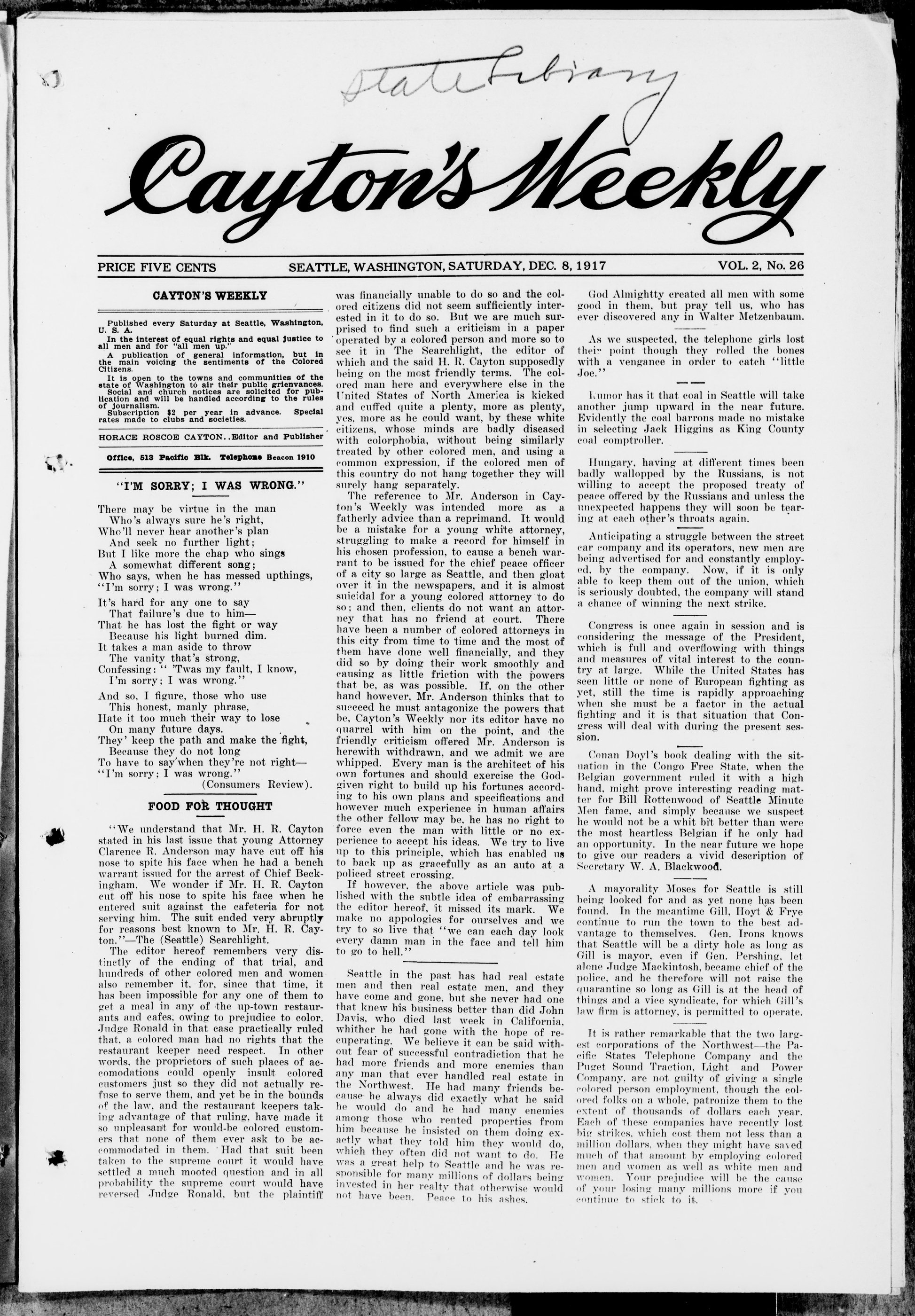
Cayton's Weekly
Saturday, December 8, 1917
Seattle, Washington
Page text (machine-generated)
CAYTON'S WEEKLY
Published every Saturday at Seattle, Washington, U. S. A.
In the interest of equal rights and equal justice to all men and for "all men up."
A publication of general information, but in the main voicing the sentiments of the Colored Citizens.
It is open to the towns and communities of the state of Washington to air their public grievances. Social and church notices are solicited for publication and will be handled according to the rules of journalism.
Subscription $2 per year in advance. Special rates made to clubs and societies.
HORACE ROSCOE CAYTON..Editor and Publisher
Office, 513 Pacific Blk. Telephone Beacon 1910
"I'M SORRY; I WAS WRONG."
There may be virtue in the man Who's always sure he's right,
Who'll never hear another's plan And seek no further light;
But I like more the chap who sings A somewhat different song;
Who says, when he has messed upthings, "I'm sorry; I was wrong."
It's hard for any one to say That failure's due to him—
That he has lost the fight or way Because his light burned dim.
It takes a man aside to throw The vanity that's strong,
Confessing: "Twas my fault, I know, I'm sorry; I was wrong."
And so, I figure, those who use This honest, manly phrase,
Hate it too much their way to lose On many future days.
They' keep the path and make the fight, Because they do not long
To have to say'when they're not right— "I'm sorry; I was wrong."
(Consumers Review).
FOOD FOR THOUGHT
"We understand that Mr. H. R. Cayton stated in his last issue that young Attorney Clarence R. Anderson may have cut off his nose to spite his face when he had a bench warrant issued for the arrest of Chief Beckingham. We wonder if Mr. H. R. Cayton cut off his nose to spite his face when he entered suit against the cafeteria for not serving him. The suit ended very abruptly for reasons best known to Mr. H. R. Cayton."—The (Seattle) Searchlight.
The editor hereof remembers very distinctly of the ending of that trial, and hundreds of other colored men and women also remember it, for, since that time, it has been impossible for any one of them to get a meal in any of the up-town restaurants and cafes, owing to prejudice to color. Judge Ronald in that case practically ruled that, a colored man had no rights that the restaurant keeper need respect. In other words, the proprietors of such places of accommodations could openly insult colored customers just so they did not actually refuse to serve them, and yet be in the bounds of the law, and the restaurant keepers taking advantage of that ruling, have made it so unpleasant for would-be colored customers that none of them ever ask to be accommodated in them. Had that suit been taken to the supreme court it would have settled a much mooted question and in all probability the supreme court would have reversed Judge Ronald, but the plaintiff
was financially unable to do so and the colored citizens did not seem sufficiently interested in it to do so. But we are much surprised to find such a criticism in a paper operated by a colored person and more so to see it in The Searchlight, the editor of which and the said H. R. Cayton supposedly being on the most friendly terms. The colored man here and everywhere else in the United States of North America is kicked and cuffed quite a plenty, more as plenty, yes, more as he could want, by these white citizens, whose minds are badly diseased with colorphobia, without being similarly treated by other colored men, and using a common expression, if the colored men of this country do not hang together they will surely hang separately.
The reference to Mr. Anderson in Cayton's Weekly was intended more as a fatherly advice than a reprimand. It would be a mistake for a young white attorney, struggling to make a record for himself in his chosen profession, to cause a bench warrant to be issued for the chief peace officer of a city so large as Seattle, and then gloat over it in the newspapers, and it is almost suicidal for a young colored attorney to do so; and then, clients do not want an attorney that has no friend at court. There have been a number of colored attorneys in this city from time to time and the most of them have done well financially, and they did so by doing their work smoothly and causing as little friction with the powers that be, as was possible. If, on the other hand however, Mr. Anderson thinks that to succeed he must antagonize the powers that be, Cayton's Weekly nor its editor have no quarrel with him on the point, and the friendly criticism offered Mr. Anderson is herewith withdrawn, and we admit we are whipped. Every man is the architect of his own fortunes and should exercise the Godgiven right to build up his fortunes according to his own plans and specifications and however much experience in human affairs the other fellow may be, he has no right to force even the man with little or no experience to accept his ideas. We try to live up to this principle, which has enabled us to back up as gracefully as an auto at a policed street crossing.
If however, the above article was published with the subtle idea of embarrassing the editor hereof, it missed its mark. We make no appologies for ourselves and we try to so live that "we can each day look every damn man in the face and tell him to go to hell."
Seattle in the past has had real estate men and then real estate men, and they have come and gone, but she never had one that knew his business better than did John Davis, who died last week in California, whither he had gone with the hope of recuperating. We believe it can be said without fear of successful contradiction that he had more friends and more enemies than any man that ever handled real estate in the Northwest. He had many friends because he always did exactly what he said he would do and he had many enemies among those who rented properties from him because he insisted on them doing exactly what they told him they would do, which they often did not want to do. He was a great help to Seattle and he was responsible for many millions of dollars being invested in her realty that otherwise would not have been. Peace to his ashes.
VOL.2, No.26
God Almighty created all men with some good in them, but pray tell us, who has ever discovered any in Walter Metzenbaum.
As we suspected, the telephone girls lost their point though they rolled the bones with a vengeance in order to catch "little Joe."
Kumor has it that coal in Seattle will take another jump upward in the near future. Evidently the coal barrons made no mistake in selecting Jack Higgins as King County coal comptroller.
Hungary, having at different times been badly wallopped by the Russians, is not willing to accept the proposed treaty of peace offered by the Russians and unless the unexpected happens they will soon be tearing at each other's throats again.
Anticipating a struggle between the street car company and its operators, new men are being advertised for and constantly employed, by the company. Now, if it is only able to keep them out of the union, which is seriously doubted, the company will stand a chance of winning the next strike.
Congress is once again in session and is considering the message of the President, which is full and overflowing with things and measures of vital interest to the country at large. While the United States has seen little or none of European fighting as yet, still the time is rapidly approaching when she must be a factor in the actual fighting and it is that situation that Congress will deal with during the present session.
Conan Doyl's book dealing with the situation in the Congo Free State, when the Belgian government ruled it with a high hand, might prove interesting reading matter for Bill Rottenwood of Seattle Minute Men fame, and simply because we suspect he would not be a whit bit better than were the most heartless Belgian if he only had an opportunity. In the near future we hope to give our readers a vivid description of Secretary W. A. Blackwood.
A mayorality Moses for Seattle is still being looked for and as yet none has been found. In the meantime Gill, Hoyt & Frye continue to run the town to the best advantage to themselves. Gen. Irons knows that Seattle will be a dirty hole as long as Gill is mayor, even if Gen. Pershing, let alone Judge Mackintosh, became chief of the police, and he therefore will not raise the quarantine so long as Gill is at the head of things and a vice syndicate, for which Gill's law firm is attorney, is permitted to operate.
It is rather remarkable that the two largest corporations of the Northwest—the Pacific States Telephone Company and the Puget Sound Traction, Light and Power Company, are not guilty of giving a single colored person employment, though the colored folks on a whole, patronize them to the extent of thousands of dollars each year. Each of these companies have recently lost big strikes, which cost them not less than a million dollars, when they might have saved much of that amount by employing colored men and women as well as white men and women. Your prejudice will be the cause of your losing many millions more if you continue to stick to it.
```markdown
```
Let's hope that the move to convert Judge Mackintosh back to plain Kenneth Mackintosh will be consumated, but we have our fears.
There is no doubt but that Seattle is in Irons and there to stay and she has only herself to blame as she would have Gill again and that too, in spite of his notorious past.
Made in Seattle has for some years been quite a slogan hereabouts, but the fellow with beer made in Seattle got cold comfort when he threw himself on the mercy of the court, pleading it was a home industry.
If organized labor had cajoled itself into believing that it was running the city of Seattle it experienced a humiliating rebuke last Saturday when its candidates were beaten three to one. The citizens of Seattle are seasoning up shealalies in bunches for the same gang, which they will use on them next Spring.
Seattle has been quaranteentd so far as the U. S. soldiers are concerned on account of her immorality and yet the war department refuses to lift the ban, even if she cleans up to its liking. Under such circumstances there seems to be a nigger in the wood pile. The Good Book teaches us that while the lamp holds out to burn the vilest sinner may return.
Let it be understood now and forever more that the editor of Cayton's Weekly has no fears of criticisms and is absolutely fearless of what any one may say about him. We have no intention of entering into any newspaper or personal controversy with any one, but reserve the right to handle things of a public nature as we see fit, however, always in a pleasant manner.
Men and women of the great under-world may be leaving Seattle by the scores, hundreds and even thousands, but two men and women of the great working world are coming in for every one of them that leaves and as a result the apartment houses and other places of light accommodations are full and overflowing throughout the city and rents will soon be beyond the normal stage. Let all who will, come, for truly is the harvest is great and the laborers few.
Representing the money bags of this country as does Frank A. Vanderslip, he is but voicing his masters when he says. "I fear government of ownership." With government ownership the hope of the corporation and trust pirates to make millions at the expense of the great middle class would go glimmering. A Jesse James ownership would be a thousand fold more preferable than the J. Pierpont Morgan ownership, which at present exercises such an unmeasurable influence over our present government.
If Senator Jones changes his residence from North Yakima, where the most of his life has been spent, to Seattle, for political purposes, then more is the pity. He has represented Seattle all these years he has been in Congress just as well while claiming North Yakima for his home as he will in the coming years while claiming Seattle as his home. It does not amount to a tinker's damn on which side of the ditch a good man lives, for his lamp will shine just as bright on one side as it will on the other.
A white Sammy soldier, and from the Souf, sah, went all the way to France to rape a seven-year-old girl and get himself hung for his wantonness. If only there had been an American Negro convenient for him and his comrades to have accused of the crime, what a relief it would have been to that class of white men of this country, who swear up and down that, only Negroes commit such unmentionable crimes. If the truth was fully known, not one in ten of such crimes, for which 4,000 Negroes have been lynched, were actually committed by Negroes, but by white men with blackened faces.
It looks very much like that the European war has reached the crucial point and that before spring comes again the end will have come. With Russia suing for peace and a temporary armistice declared, the Germans are throwing their full strength against the Allies and while the latter is standing the onslaughts like a stone wall, it is very apaprent that one side or the other will soon show weakness on account of the fearful slaughter of men and the side showing weakness first will evidence the beginning of the end. To say the least, it is an awful struggle, and a hair-raising situation.
"Once a politician always, always one" can be aptly said and in substantiation of the point in question, last Saturday a copy of Cayton's Weekly per chance fell into the hands of Capt. Harry K. Struve, who has been confined to his home for some time, and after reading the same, it brought memories of the past to him, when he was a Seattle politician and the editor hereof was doing political stunts in the Fifth of the Fifth, and he ordered it sent to him for the ensuing year. It was from that district that Capt. Struve was elected a member of the legislature and the editor hereof was a delegate in the convention that nominated him. If we make no mistake, Harry was born in Olympia, and if not, he spent many of his early boyhood days there and in going to the legislature he was but revisiting his old home as a much honored guest. As a member of the body he was some man on the floor and made a great record. He was very popular with the members of the Third House and always had a crowd about him in the evenings, telling them of his boyhood days in Olympia. Once, when the crowd stood around and Harry was telling funny stories, a young fellow walked up to him with, "Hello, Harry! Don't you remember me? I am the fellow that was with you when we got caught in old man Thompson's apple orchard, helping ourselves to his apples." But Harry did not remember him and Van De Vanter and the gang began to smile and smiled so loud that you could hear them quite a few blocks. For once the joke was turned on Harry and, as we remember it now, those who "took something" were so numerous that Harry refused to count them and handed over all the spare change he had with him and called it even.
The mayor of a French town had, in accordance with the regulations, to make out a passport for a rich and highly respected lady of his acquaintance, who, in spite of a slight disfigurement, was very vain of her personal appearance. His native politeness prompted him to gloss over the defect, and after a moment's reflection he wrote among the items of personal description: "Eyes, dark, beautiful, tender, expressive, but one of them missing."
You are hereby summoned to appear within sixty days after the date of the first publication of this summons, to-wit: within sixty days after the 3rd day of November, 1917, and defend the above entitled action in the above entitled court, and answer the complaint of the plaintiff, and serve a copy of your answer upon the undersigned attorney for plaintiff at his office below stated; and in case of your failure so to do, judgment will be rendered against you according to the demand of the complaint, which has been filed with the clerk of said court.
The object of the above entitled action is to obtain a decree of divorce from the defendant by the plaintiff on the ground of desertion.
ANDREW R. BLACK,
Attorney for Plaintiff.
P. O. Address, 316 Pacific Block, Seattle, Wash.
Nov. 3—Dec. 15, 1917.
Nathan S. Nabbie of New York has been arrested charged with having stolen jewelry from his employer, valued at $15,000. He was a butler in the family.
Cayton's Weekly publishes legal notices at current rates. Main 24.
Job work in the latest and newest styles turned out in this office. Main 24.
IN THE SUPERIOR COURT OF THE STATE OF Washington for King County.
Lee D. Gilmer, Plaintiff, vs. F. C. Park, R. Martin and Jane Doe Martin, his wife, also all other persons or parties unknown claiming any right, title, estate, lien or interest in the real estate described in the complaint herein, Defendants.—No. 125417. Notice and Summons.
The State of Washington: To the above named defendants and each of them:
You and each of you, as owners, claimants or holders of an interest or estate in and to the lands and premises hereinafter described, are hereby notified:
That Lee D. Gilmer is the holder of one certain delinquent tax certificate herebelow more particularly referred to, issued by the Treasurer of King County, Washington, for delinquent taxes upon and against lands and premises situated in said King County, described as follows, to-wit:
Vashon Gardens, Lot 23; Owner, F. C. Park; Certificate, B72738; Date, June 1st, 1917; Amount, $11.18; Year, 1909.
Vashon Gardens—
Lot 23, R. C; No. of Receipt 26293; for year 1910; amount, $7.95; interest 15%; amount interest, $0.36; date paid, Sept. 18, 1911; total payment, $8.31.
Lot 23, receipt No. 1911; amount, $8.36; rate of interest 15%; amount of interest, $0.33; date paid, Sept. 6, 1912; total payment, $8.69.
Lot 23, R. A, receipt No. 30835; for year 1912; amount, $10.57; rate of interest, 15%; amount, $1.11; date paid Feb. 12, 1914; total payment, $11.68.
Lot 23, R. A; receipt No. 39561; for year 1913; amount of taxes, $12.58; rate of interest, 15%; amount of interest, $0.96; date paid, Dec. 4, 1914; total payment, $13.54.
Lot 23, receipt No. 144069; for year 1914; amount of taxes, $12.41; rate of interest, 15%; amount of interest, $0.93; date paid, Dec. 1, 1915; total payment, $13.34.
Lot 23, for year 1915; amount of taxes, $12.25; rate of interest, 15%; amount of interest, $0.91; total payment, $13.16.
That the several sums hereinabove set forth bear interest at the rate of 15 per cent. per annum from date of payment, and are all the unpaid and unredeemed taxes upon and against said lands and premises.
And you and each of you, (including said persons unknown, if any), are hereby directed and summoned to appear within sixty days after the date of the first day of publication, to-wit, Nov. 9th, 1917, and defend this action and serve a copy of your appearance or answer upon the undersigned attorney for plaintiff at the office address sbelow stated, or pay the amount due, together with interest and costs.
And you are further notified that in case of your failure so to do, udgment will be rendered, foreclosing the lien of such taxes and costs against each parcel of said lands and premises for the sums and amounts due upon and charged against the same as hereinabove set forth.
LEE D. GILMER,
Plaintiff.
Z. B. RAWSON,
Attorney for Plaintiff.
Office and Post Office Address, 617 Pacific Block,
Seattle, King County, Washington.
November 10, Dec. 22, 1917.
THE DOUGLAS CLUB
Now Occupies spacious and elegantly
furnished and equipped
NEW QUARTERS
And will be pleased to meet old and
new friends
308 Washington St. Frank Smith, Prop.
Main 4930
ALHAMBRA CASH GROCERY
Fancy and Staple Groceries. Vegetables and Fruits
in season. Bakery in connection. Free delivery.
Tel. Main 2923. 1036-40 Jackson Street.
TUTT'S BARBER SHOP "We want to see you." High-class Tonsorial Work. 300 Main Street, Seattle. Latest race papers. All kinds of toilet supplies.
Mrs. Will Jackson, 1033 Main St. Elliott 254
DINING ROOM
Meals, 35c. Home Cooking with first-class service. Entertainments every Tuesday night.
BURR WILLIAMS RUSSELL SMITH
President Secretary
---
THE GLORY OF THE AMERICAN REPUBLIC
Copyright 1917
By ORLANDO BELKNAP POND
(All rights reserved)
Individual Control and Ownership of Governments. The Ancient and Modern World
The people who now inhabit the earth are living in the midst of great and momentous events, the products of accumulated time in which great and intricate problems have developed and must in the interest of mankind, be solved. There are many who realize this fact; but no one has yet been able to present to the world a practical solution. And nothing short of a colution will satisfy the world.
There are those who believe in universal ownership by the government. There are others who think otherwise. The latter contend that government ownership should embrace only such property as it actually requires for needed uses. But anything more than this interferes with, and hampers, personal opportunities. But all admit that there are certain affairs of the human race that should, and must, be under government control. This is readily conceded, especially, by the people of this nation, who dwell under a representative government, founded for the purpose of serving their interests in the higher degree.
The governments in ancient times were, for the most part, created and formed by the most skillful and powerful warriors; those who had the largest following, and commanded the strongest and most perfect phalanx. The governments so created and established, were held as the personal rights of the founders, and in their own interests, and were exercised for their own purpose. All property and property rights and privileges were appropriated and held by them as the price of their skill and power.
The land with all the appurtenances in many instances, was largely distributed among a certain few favorites who were expected when commanded, to render assistance, offensive and defensive, in warfare. Thus was created a class condition. The favored ones were designated by titles of varying grades, and constituted the nobility. The mass of the people were mere serfs, bound to the soil of their birth and held in constant bondage to the governing classes, and, finally, became the peasantry of the various nations of the European world.
Nations and governments were at this time treated as objects of individual manipulation and control, direction and administration. They were obtained, established, and developed, by invasions and continuous warfare. The successful commander was, oftentimes, made the ruler, the head, the sovereign, in whom vested all the authority and all the powers of the nation.
This individual person is called in the English language King or Emperor, depending upon the degree of authority held and exercised; whether absolute or, more or less, limited. Whether his authority was absolute, or limited, the supreme authority of the state was vested in, and supposed to be held by, him, and was always exercised, theoretically at least, by his commands. And, having once vested it so remained during his life time, and at his death passed to the oldest living heir, or next of kin, or else to some one appointed by him. during his life time, unless wrested therefrom as often occurred by a more influential, or a more powerful adversary.
The objects that occupied the attention of mankind in these ancient times, were much in many respects, the same that occupy the attention of mankind in our own times. They were engaged in mining gold and silver, copper and tin, and probably to some extet iron. Iron, though known and employed for some purposes, was probably mined and used to a less extent than the other minerals. These mining operations
were generally prosecuted by those governments favorably situated, and the government profited by it. The people as serfs performed the labor, but had none of the profits. The object of agricultural pursuits and stock raising also engaged their attention. They were engaged, too, in manufacture and in commerce. And there is reason to believe that in personal skill they were equal to, and in some respects surpassed, the moderns.
Agriculture and commerce were, most likely, even in these earlier stages of existence, the principal source of employment and occupation of the people, though subject to the existing governing classes. And war, either offensive or defensive, was, almost continuously, carried on by the governments. A condition that created the necessity of employing armies; and that subjected the people to the will of the government. This situation developed the theory of allegiance that the people owed to the government, and that their first duty was to serve the king and obey his every command without question. The penalty for disobedience was death. The governments on their part undertook to protect the people against invasion from without, and against rebellions from within, the royal domain.
The purpose in view for creating a titled nobility, was, first: to reward certain members of the king's followers, who had rendered special service in war. And second: that the king might always have a reliable class ready, when the occasion required, to respond to his commands. The king was the government; and the nobility his reliable strength and support.
It was necessary that the government and the nobility should be supported and maintained out of the resources of the nation as developed by the labor of the people. This was accomplished by vesting the larger proportion of the lands in the nobility, and granting to the king's favorites the commercial rights, and the privileges of monopolies of trade and commerce.
The religious worship was that of idolatry. That is, the worship of idols and various other objects. And from this worship the sacred office of the heathen priesthood was established. Thus creating the priestly classes who in many respects filled an important sphere in the progress of the world's events.
There were, greater or less, differences in the conditions then existing in the various nations of the world, depending largely upon the state of civilization among the governing classes. Education, knowledge, and the fine arts, measured the civilization of the nations. And this was largely represented in the nobility and in the priesthood: though it was in some instances, acquired by the more gifted and better circumstanced among the people, who on rare occasions and with unusual opportunities attained high educational acquirements; and were recognized by the governing authorities and were sometimes granted titles.
But the mass of the people had no educational advantages, and were, therefore, illiterate in all the essential knowledge of their times; and ignorant of true manhood and womanhood and of the actual state of their surroundings. They were, on account of their simple habits, and limited service, and their idolotrous worship and superstitious beliefs, narrow minded and full of bigotry: and, consequently, made no progressive advancement during the centuries. And besides they were held in a low grade form of slavery and serfdom to the governing classes.
Thus the nations of the world were in practical results actually owned as well as governed by warring kings and emperors, supported and sustained by a class of nobility who, though often rebellious, were generally ready to follow and obey the king's behest. The priesthood teaching and influencing the people in every conceivable form of heathen superstition, and the slavish serfs following without protest the directions and commands of their superiors in blind obedience, presents to our view the state of actual existence at the time. War, agriculture, barter and trade, manu-
facture and commerce, and to a considerable extent the arts and sciences, were, in general, the pursuits of the most civilized nations of antiquity, varied according to the local conditions, the habits of the people, and the advanced state of their civilization, but controlled and directed by the governing classes, the principal revenues of which were taken and appropriated for the support, sustenance, and the maintenance of the king, the nobility, and the priesthood with their favorites in wealth and luxury and in governmental extravagance.
All property, and all the rights and the privileges thereto belonging, were held by the governing classes; and all laws, all rules, and all regulations concerning them, were made and established for the purpose of maintaining such conditions. Thus was laid in this remote past the fundamental principles of all laws that govern property rights and that developed the systems and methods of commercial, industrial and financial affairs of the world in our own times. These laws and systems and methods of conducting the affairs of the world established so long ago placed the neck of the human race under intolerant burdens in order that the property rights in the land as well also as the industrial and the commercial rights and all the privileges thereto belonging, should be, and remain, in the king, the nobility, and the priesthood.
Thus was constituted the vested rights, which nothing but a disastrous defeat in war and the entire subjugation of the nation and the confiscation of the property holdings which occurred at times, could disturb. When this did happen a new nobility was established. The landed estates were again parcelled out and became vested anew; and the same laws remained in force, giving the same protection to the newly created nobility. All trade and commercial rights vested in, belonged to, and were exercised by, and for, these new comers.
The serf, the peasant, always remained the same. He had no rights, except such as his immediate superior, for temporary purposes, gave to him, which were always subject, at the will of the giver, to defeat. All methods of commercial procedure, the laws of trade, of real and of personal property, and also of credits and of debits, were established and arranged so as to coconcentrate the wealth of the nation in the possession of the king, the nobility, and the priesthood: and, consequently, created thereby a condition of serfdom, of poverty, and of degradation among the mass of the people.
I have, thus, in a general manner, portrayed the actual conditions as they existed, during a long past, practically, in the entire known world. A condition, which, under different forms, and designated by different terms, still exists in too large a measure, to hamper and retard men in their efforts to achieve a better and a more equitable condition in the world.
(To be Continued)
IN THE SUPERIOR COURT OF THE STATE OF Washington for the County of King—In Probate.
In the Matter of the Guardianship of Clarence Haydon, Irene Haydon and Richard Haydon, Minors.—No. 9188. Order to Show Cause on Sale of Real Estate.
E. C. Haydon, the guardian of the said minors, having filed his petition in this court, duly verified, praying for an order of this court for the sale of real estate of which the said minors are seized, for the purposes therein set forth.
And it appearing to the court from said petition that the personal estate of the said minors in the hands of said guardian is not sufficient to pay the claims against the said estate and the expenses of the administration thereof, and that it is necessary to sell all or a portion of the said real estate of the said minors to pay the said claims and expenses of the administration. And it appearing to the court that said petition conforms to, and is in accordance with, the requirements of law in such case made and provided. It is ordered by the court that all persons interested in the estate of the said minors appear before said Superior Court on the 10th day of December, 1917, at the hour of 9:30 o'clock in the forenoon of said day at the court room of the Probate Department of said Superior Court, in the City of Seattle, in said King County, then and there to show cause, if any they have, why an order of this court should not be granted to said guardian authorizing and empowering him to sell the said real estate of said minors, or so much thereof as may be necessary to pay the aforesaid claims and expenses of administration.
It is further ordered that a copy of this order to show cause be published at least four successive weeks before the said 10th day of December, 1917, in Cayton's Weekly, a newspaper printed and published in said County of King and of general circulation therein.
---
```markdown
```
THE END OF THE PLAY
And in the world, as in the school, I'd say how fate may change and shift, The prize be sometimes with the fool, The race not always to the swift; The strong may yield, the good may fall, The great may be a vulgar clown, The knave be lifted over all, The kind cast pitilessly down.
Come wealth or want, come good or ill,
Let young and old accept their part,
And bow before the awful will,
And bear it with an honest heart.
Who misses or who wins the prize—
Go lose or conquer as you can,
But if you fall, or if you rise,
Be each, pray God, a gentleman.
—Thackery.
Thanksgiving at Camp Lewis must have been a joyful occasion if all of the companies had as many good things to eat as the company from which the following menu was sent to this paper by Sargeant Frank Evans.
MENU
Thanksgiving Dinner, Nov. 29, 1917
Relishes
Stuffed Olives Mixed Pickles
Radishes Green Olives
Oyster Soup
Roast Young Turkey
Oyster Dressing Cranberry Sauce
Vegetables
Creamed Mashed Potatoes
Creamed Sweet Corn
Candied Sweet Potatoes
Desserts
Chocolate Layer Cake Mince Pie
Cocoanut Layer Cake Pumpkin Pie
Fruits
Oranges Bananas Apples
Coffee Hot Chocolate
Cigars Cigarettes
HERE AND THERE
Dan Shay, the baseball player, who shot and killed Clarence Ewell in a hotel in Indianapolis more than a year ago, has been acquitted by a jury.
Sarah Hamilton, eighty-six years of age, who died some time ago at her home in Wheeling, W. Va., was no woman at all, but a man and had lived for the past sixty years, disguised as a woman.
J. Wesley Jones is the name of a more or less remarkable musician of Chicago, but he is only remotely related to Washington state's own and only Senator Wesley L. Jones, both of them being Americans.
Dr. James N. Harris, a prominent young physician of Chicago, was recently shot and instantly killed by a Miss Josephine Polk, a stenographer of the Chicago public library. Miss Polk claims that the physician had seduced her and then refused to marry her.
About forty-eight sleeping car porters have gone to the Canadian Pacific Railway Co. from St. Paul to operate the military transportation cars from Halifax to Vancouver. Their salaries are to be $65 per month and all expenses.
The city of Chicago has gained a million inhabitants since the Defender of that city came into existence and that paper now claims the honor of having attracted that number of persons to the Windy City. Well, wouldn't it jar you?
A local mayor was presiding at the annual dinner of the town rowing club, and he rose to make his speech."
"Gentlemen," he said, "it gives me greater pleasure than I can express to preside on this occasion, though personally I am not an adept at aquatics on the water, such successes as I have achieved being always on terra cotta."
NOW SMILE
An Irishman and an Englishman met one day and they had a very heated discussion. Pat, who had only one eye, attracted the Englishman's attention, when he said: "Those are grand eyes you have."
"How much grander are those you have?" said the English in answer.
"I thought," replied Pat, "ye Englishmen were good grammarians. I have but one eye, and you could not say 'those.'" Then Pat, who was anxious to outdo the Englishman from a point of wit and humor, said:
"I bet you 20 shillings to your one that I can see more with my one eye than you can with your two."
"Done," said the Englishman. "It's a bet."
And Pat, in his truly witty manner, vociferated:
"Arrah, shure, I with my one eye can see your two, whereas you with your two eyes can only see my one."
The Englishman collapsed.
An old lady was going to Stamford, Conn., to visit a daughter, and took her seat in the cars for the first time in her life. During the ride the car in which she was seated was thrown down an embankment and demolished.
Crawling out from beneath the debris, she spied a man who was held down in a sitting posture by his legs being fastened.
"Is this Stamford?" she anxiously asked.
"Is this Stamford?" she anxiously asked. The man was from Boston, Mass. He was in considerable pain, but he didn't lose sight of the fact that he was from Boston, so he said:
"No, this is catastrophe."
"Oh!" ejaculated the old lady. "Then I hadn't oughter get off here!"
A story is going the rounds concerning the inquiry instituted by Lord Devonport into the best method of checking extravagance in restaurants and hotels.
Among the many witnesses called before the committee was a certain stolid looking waiter. The particular article of food under discussion at the moment happened to be margarine, and one of the members asked incidentally:
"How do you call it in the restaurant business—'margarine' or 'marjorine'?"
"Neither, sir," blandly replied the waiter; "we calls it 'butter.'"
An Irishman, employed in a large factory, had taken a day off without permission, and who seemed likely to lose his job in consequence. When asked by his foreman the next day why he had not turned up the day before he replied:
"I was so ill, sir, that I could not come to work to save my life."
"How was it, then, Pat, that I saw you pass the factory on your bicycle during the morning?" asked the foreman.
Pat was slightly taken aback, then regaining his presence of mind, replied:
"Sure, sir, that must have been when I was going for the doctor."
Mrs. Simpleton, having been a business girl, was a bit worried over the intricacies of housekeeping.
"I'm having such trouble keeping our food," she confided to her bosom friend.
"I bought a real nice looking refrigerator, but it doesn't seem to work well at all."
"Do you keep ice enough in it?"
"Ice!" gasped Mrs. Simpleton. "Ice! I hope you don't think, after spending all that money on a refrigerator, we'd go to the additional expense of buying ice!"
Tim Malloy, a Texas farmer, applied for naturalization papers. The judge asked him: "Are you satisfied with the general conditions of the country?"
"Y-yis," hesitated Tim. "Does the government suit you?" "Y-yis, yis, only, bedad, I'd like to see more rain."—Puck.
The stout old gentleman, loaded down with several bags and a traveling rug, was endeavoring to make a graceful exit from a crowded railway carriage. At the door, however, he stumbled and brought down his foot heavily on the pet corn of a brawny Scot.
"Hoots, toots, man," groaned the injured one, "canna ye look whaur ye're going? Hoot, man, hoot!"
The overburdened traveler slammed the door behind him. Then he put his head near the window.
"Hoot, yerself," he retored. "I'm a passenger, not a motor bus."
Some soldiers home on leave from the front were discussing the different things they had seen while in France, and among them were the number and size of the rats they had been troubled with. Said one boy: "Talk about rats! Why, I've seen some as big as sucking pigs." "That's nowt." spoke up another. "One night in my billet I woke up and there was one of them trying my coat on."
IN THE SUPERIOR COURT OF THE STATE OF
Washington, for King County.—In Probate.
In the Matter of the Estate of Cora Green, Deceased.
—No. 22412. Notice to Creditors.
Notice is hereby given that the undersigned has been appointed and has qualified as Administrator of the estate of Cora Green, deceased. All persons having claims against the deceased are required to serve the same( supported by claimant's affidavit as required in Sec. 108, Probate Code) on the administrator or his attorney of record at the address below stated, and file the same with the clerk of the court, together with proof of such service, within six months after the date of the first publication of this notice, or same will be barred.
Date of first publication Dec. 8, 1917.
W. D. CARTER.
Administrator of said Estate.
Address 316 Pacific Block , Seattle.
ANDREW R. BLACK.
Attorney for Estate.
316 Pacific Block, Seattle, Wash.
IN THE SUPERIOR COURT OF THE STATE OF Washington, for King County.—In Probate. In the Matter of the Estate of Sander S. Scott, Deceased.—No. 22483. Notice to Creditors
Notice is hereby given that the undersigned has been appointed and has qualified as administrator of the estate of Sander S. Scott, deceased; that all persons having claims against said deceased or against said estate are hereby required to serve the same, duly verified, on said administrator or his attorney of record at the address below stated, and file the same with the clerk of said court together with proof of such service within six months after the date of first publication of this notice, or the same will be barred.
Date of first publication Dec. 8, 1917.
AL G. GRANT,
Administrator of said Estate.
Address 316 Pacific Block, Seattle, Wash.
ANDREW R. BLACK,
Attorney for Estate.
316 Pacific Block, Seattle, Wash.
IN THE SUPERIOR COURT OF THE STATE OF
Washington, for King County.—In Probate.
In the Matter of the Guardianship of Della, Watts.
an Insane Person.—No. 22357. Notice to Creditors. Notice is hereby given that the undersigned has been appointed and has qualified as the Guardian of the estate of Della Watts, an Insane Person. All persons having claims against her estate are required serve the same (sunported by claimant's affidavit as required in Sec. 108, Probate Code) on the Guardian or his attorney of record at the address below stated, and file the same with the clerk of the court, together with proof of such service, within six months after the date of the first publication of this notice, or same will be barred.
Date of first publication Dec. 8, 1917.
S. A. WATTS,
Guardian of the Estate of Della Watts,
an Insane Person.
Address 316 Pacific Block, Seattle, Wash.
ANDREW R. BLACK,
Attorney for Estate.
316 Pacific Block, Seattle, Wash.
IN THE SUPERIOR COURT OF THE STATE OF
Washington for the County of King.—In Probate.
In the Matter of the Estate of Richard H. Gillen,
Deceased.—No. 20037. Order to Show Cause on
Sale of Real Estate.
Verne C. Gillen, the executor of the estate of Richard H. Gillen, deceased, having filed his petition in this court, duly verified, praying for an order of this court for the sale of real estate of which the said deceased died seized, for the purposes therein set forth.
And it appearing to the court from said petition that the personal estate of the said deceased in the hands of said executor is not sufficient to pay the claims against the said estate and the expenses of the administration thereof, and that it is necessary to sell all or a portion of the said real estate of the said deceased to pay the said claims and expenses of the administration. And it appearing to the court that said petition conforms to, and is in accordance with, the requirements of law in such case made and provided. It is ordered by the court that all persons interested in the estate of the said deceased appear before said Superior Court on the 10th day of December, 1917, at the hour of 9:30 o'clock in the forenoon of said day at the court room of the Probate Department of said Superior Court, in the City of Seattle, in said King County, then and there to show cause, if any they have, why an order of this court should not be granted to said executor authorizing and empowering him to sell the said real estate of said deceased, or so much thereof as may be necessary to pay the aforesaid claims and expenses of administration.
It is further ordered that a copy of this order to show cause be published at least four successive weeks before the said 10th day of December, 1917, in Cayton's Weekly, a newspaper printed and published in said County of King and of general circulation therein.
Done in open court this 13th day of November, 1917.
KENNETH MACKINTOSH.
Judge.
Nov. 17.—Dec. 8, 1917.