Cayton's Weekly
Saturday, December 22, 1917
Seattle, Washington
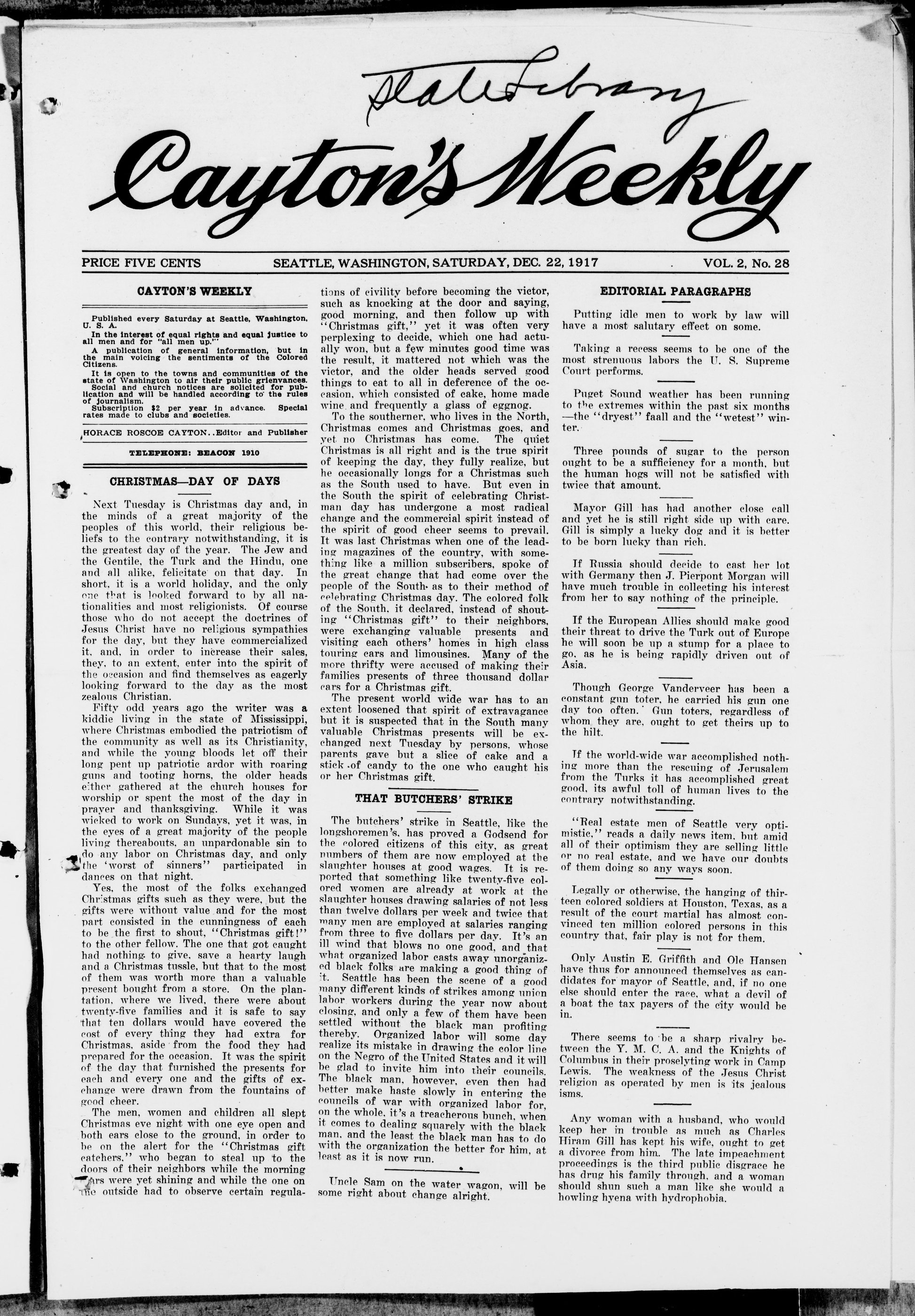
Page text (machine-generated)
State Library
Cayton's Weekly
PRICE FIVE CENTS
SEATTLE, WASHINGTON, SATURDAY, DEC. 22, 1917
VOL. 2, No. 28
CAYTON'S WEEKLY
Published every Saturday at Seattle, Washington. U. S. A.
In the interest of equal rights and equal justice to all men and for "all men up."
A publication of general information, but in the main voicing the sentiments of the Colored Citizens. It is open to the towns and communities of the state of Washington to air their public grievances. Social and church notices are solicited for publication and will be handled according to the rules of journalism.
Subscription $2 per year in advance. Special rates made to clubs and societies.
HORACE ROSCOE CAYTON..Editor and Publisher
TELEPHONE: BEACON 1910
CHRISTMAS—DAY OF DAYS
Next Tuesday is Christmas day and, in the minds of a great majority of the peoples of this world, their religious beliefs to the contrary notwithstanding, it is the greatest day of the year. The Jew and the Gentile, the Turk and the Hindu, one and all alike, felicitate on that day. In short, it is a world holiday, and the only one that is looked forward to by all nationalities and most religionists. Of course those who do not accept the doctrines of Jesus Christ have no religious sympathies for the day, but they have commercialized it, and, in order to increase their sales, they, to an extent, enter into the spirit of the occasion and find themselves as eagerly looking forward to the day as the most zealous Christian.
Fifty odd years ago the writer was a kiddie living in the state of Mississippi, where Christmas embodied the patriotism of the community as well as its Christianity, and while the young bloods let off their long pent up patriotic ardor with roaring guns and tooting horns, the older heads either gathered at the church houses for worship or spent the most of the day in prayer and thanksgiving. While it was wicked to work on Sundays, yet it was, in the eyes of a great majority of the people living thereabouts, an unpardonable sin to do any labor on Christmas day, and only the 'worst of sinners'" participated in dances on that night.
Yes, the most of the folks exchanged Christmas gifts such as they were, but the gifts were without value and for the most part consisted in the cunningness of each to be the first to shout, "Christmas gift!" to the other fellow. The one that got caught had nothing to give, save a hearty laugh and a Christmas tussle, but that to the most of them was worth more than a valuable present bought from a store. On the plantation, where we lived, there were about twenty-five families and it is safe to say that ten dollars would have covered the cost of every thing they had extra for Christmas, aside from the food they had prepared for the occasion. It was the spirit of the day that furnished the presents for each and every one and the gifts of exchange were drawn from the fountains of good cheer.
The men, women and children all slept Christmas eve night with one eye open and both ears close to the ground, in order to be on the alert for the "Christmas gift catchers." who began to steal up to the doors of their neighbors while the morning cars were yet shining and while the one on the outside had to observe certain regula-
tions of civility before becoming the victor, such as knocking at the door and saying, good morning, and then follow up with "Christmas gift," yet it was often very perplexing to decide, which one had actually won, but a few minutes good time was the result, it mattered not which was the victor, and the older heads served good things to eat to all in deference of the occasion, which consisted of cake, home made wine and frequently a glass of eggnog.
To the southerner, who lives in the North, Christmas comes and Christmas goes, and yet no Christmas has come. The quiet Christmas is all right and is the true spirit of keeping the day, they fully realize, but he occasionally longs for a Christmas such as the South used to have. But even in the South the spirit of celebrating Christmas day has undergone a most radical change and the commercial spirit instead of the spirit of good cheer seems to prevail. It was last Christmas when one of the leading magazines of the country, with something like a million subscribers, spoke of the great change that had come over the people of the South as to their method of celebrating Christmas day. The colored folk of the South, it declared, instead of shouting "Christmas gift" to their neighbors, were exchanging valuable presents and visiting each others' homes in high class touring cars and limousines. Many of the more thrifty were accused of making their families presents of three thousand dollar cars for a Christmas gift.
The present world wide war has to an extent loosened that spirit of extravagance but it is suspected that in the South many valuable Christmas presents will be exchanged next Tuesday by persons, whose parents gave but a slice of cake and a stick of candy to the one who caught his or her Christmas gift.
THAT BUTCHERS' STRIKE
The butchers' strike in Seattle, like the longshoremen's, has proved a Godsend for the colored citizens of this city, as great numbers of them are now employed at the slaughter houses at good wages. It is reported that something like twenty-five colored women are already at work at the slaughter houses drawing salaries of not less than twelve dollars per week and twice that many men are employed at salaries ranging from three to five dollars per day. It's an ill wind that blows no one good, and that what organized labor casts away unorganized black folks are making a good thing of it. Seattle has been the scene of a good many different kinds of strikes among union labor workers during the year now about closing, and only a few of them have been settled without the black man profiting thereby. Organized labor will some day realize its mistake in drawing the color line on the Negro of the United States and it will be glad to invite him into their councils. The black man, however, even then had better make haste slowly in entering the councils of war with organized labor for, on the whole, it's a treacherous bunch, when it comes to dealing squarely with the black man, and the least the black man has to do with the organization the better for him, at least as it is now run.
Uncle Sam on the water wagon, will be some right about change alright.
VOL.2, No.28
EDITORIAL PARAGRAPHS
Putting idle men to work by law will have a most salutary effect on some.
Taking a recess seems to be one of the most strenuous labors the U. S. Supreme Court performs.
Puget Sound weather has been running to the extremes within the past six months—the "dryest" faall and the "wetest" winter.
Three pounds of sugar to the person ought to be a sufficiency for a month, but the human hogs will not be satisfied with twice that amount.
Mayor Gill has had another close call and yet he is still right side up with care. Gill is simply a lucky dog and it is better to be born lucky than rich.
If Russia should decide to cast her lot with Germany then J. Pierpont Morgan will have much trouble in collecting his interest from her to say nothing of the principle.
If the European Allies should make good their threat to drive the Turk out of Europe he will soon be up a stump for a place to go, as he is being rapidly driven out of Asia.
Though George Vanderveer has been a constant gun toter, he carried his gun one day too often. Gun toters, regardless of whom they are, ought to get theirs up to the hilt.
If the world-wide war accomplished nothing more than the rescuing of Jerusalem from the Turks it has accomplished great good, its awful toll of human lives to the contrary notwithstanding.
"Real estate men of Seattle very optimistic," reads a daily news item, but amid all of their optimism they are selling little or no real estate, and we have our doubts of them doing so any ways soon.
Legally or otherwise, the hanging of thirteen colored soldiers at Houston, Texas, as a result of the court martial has almost convinced ten million colored persons in this country that, fair play is not for them.
Only Austin E. Griffith and Ole Hansen have thus for announced themselves as candidates for mayor of Seattle, and, if no one else should enter the race, what a devil of a boat the tax payers of the city would be in.
There seems to be a sharp rivalry between the Y. M. C. A. and the Knights of Columbus in their proselyting work in Camp Lewis. The weakness of the Jesus Christ religion as operated by men is its jealous isms.
Any woman with a husband, who would keep her in trouble as much as Charles Hiram Gill has kept his wife, ought to get a divorce from him. The late impeachment proceedings is the third public disgrace he has drug his family through, and a woman should shun such a man like she would a howling hyena with hydrophobia.
a
```markdown
```
The Texas high-brows did not burn the Twenty-fourth soldiers at the stake as they threatened to do, but they are dead just the same. It's always death for the black man that talks back to the white man in the South.
"Give The Railroads a Chance," is a headline. The railroads have the knack of taking a chance, whether you give it to them or not, and as a result, they come pretty near running the country as they see fit.
Congress some time ago made it an offense for any citizen of this country to criticise the president of the United States, and we are not going to break the law, but we are going to think about him devilish hard.
It's a going away and a coming back in Russia all the time. The various Russian governments are truly ephemeral. They are very much like that beetle told of in ancient history, hatched in the morning and die of old age in the evening.
"New York dry" is the hope of the women of that wicked city, but for every woman there doubtless is a man, whose hope is to "keep it wet." As long as the city is wet the men can continue to practice almost unmolested their licentious midnight brawls.
The average white man of the state of Mississippi is such a licentious wretch, especially among colored women, that he lives in constant fear lest the colored man do unto him as he is constantly doing unto him. The wicked flee when no one pursueth.
Another power site has been offered to Seattle, all the same the Heb site, and out of the latter gold brick Jack Eden and his associates expect to realize a fortune from the tax payers of the city. Let's hope that it will meet the same fate as did the Heb gold brick.
A treaty of peace has been agreed to between the present Russian authorities and the German government, but the present Russian government may be a thing of the past in a fortnight, and then the fighting between the two will begin again in dead earnest.
The Cudahy Packing Company is trying the experiment of employing colored women in departments of their extensive plant where formerly men, or white women have been exclusively employed. A large number of women were put to work this week. Chicago Broadax.
There are fifteen thousand men employed in the various ship yards of Seattle at present and it is hoped before February next at least twenty thousand more will be employed, and the question is, where will they sleep, if that many strangers come to Seattle in so short a time.
If three-fourths of the states of the United States ratify the measure passed by Congress, prohibiting the manufacture and sale of intoxicating liquors within seven years after its passage. Uncle Sam will go on the water wagon and Mr. Booze will go to hades where he rightfully belongs.
You can look for a mighty raise in price of Standard Oil commodities from now on as the home of John D. Rockefeller was burned and all of its contents a total loss. He will not only get value received for what he actually lost, but he will get twice and three times its value for heart balm.
The white citizens of Oklahoma seem over-solicitous as to the future welfare of the Indians residing in that state, and, we suspect the reason for it is because so long as the white folks can keep the Indians in existence they can continue to surreptitiously draw millions of dollars from the government.
Whether or not the recent police shake up in the city will result in the city being cleaned up morally remains to be seen, but, in our opinion, it took a bad man from the position of police inspector and filled it with one of the best men on the force, and as that position is next to the chief of police in importance the shake up ought to help some.
In the state of Tennessee the white citizens seem to have entered into a secret alliance with Germany to kill as many of the colored men, who might be sent to the front, as is possible. Those that they do not actually kill they intimidate to such an extent that they do not want to fight for the stars and sitrpes. We firmly believe the hidden hand of Germany is getting in its work in this country through the white citizens of the South.
S. T. McCants is now the editor of The Bulletin, which is being issued in the interest of the First A. M. E. church of this city, and it is reported that he may devote his whole time to its publication after January 1st. IN THE SUPERIOR COURT OF THE STATE OF Washington for King County.
Lee D. Gilmer, Plaintiff, vs. F. C. Park, R. Martin and Jane Doe Martin, his wife, also all other persons or parties unknown claiming any right, title, estate, lien or interest in the real estate described in the complaint herein, Defendants.—No. 125417. Notice and Summons.
The State of Washington: To the above named defendants and each of them:
You and each of you, as owners, claimants or holders of an interest or estate in and to the lands and premises hereafter described, are hereby notified;
That Lee D. Gilmer is the holder of one certain delinquent tax certificate herebelow more particularly referred to, issued by the Treasurer of King County, Washington, for delinquent taxes upon and against lands and premises situated in said King County, described as follows, to-wit:
Vashon Gardens, Lot 23; Owner, F. C. Park; Certificate, B72738; Date, June 1st, 1917; Amount, $11.18; Year, 1909.
Vashon Gardens—
Lot 23, R. C; No. of Receipt 26293; for year 1910; amount, $7.95; interest 15%; amount interest, $0.36; date paid, Sept. 18, 1911; total payment, $8.31.
Lot 23, receipt No., 89658; for year 1911; amount,
$8.36; rate of interest 15%; amount of interest, $0.33;
date paid, Sept. 6, 1912; total payment, $8.69
Lot 23, R. A, receipt No., 30835; for year 1912;
amount, $10.57; rate of interest, 15%; amount, $1.11;
date paid Feb. 12, 1914; total payment, $11.68
Lot 23, R. A; receipt No. 39561; for year 1913; amount of taxes, $12.58; rate of interest, 15%; amount of interest, $0.96; date paid, Dec. 4, 1914; total payment, $13.54.
Lot 23, receipt No. 144069; for year 1914; amount of taxes, $12.41; rate of interest, 15%; amount of interest, $0.93; date paid, Dec. 1, 1915; total payment, $13.34.
Lot 23, for year 1915; amount of taxes, $12.25; rate of interest, 15%; amount of interest, $0.91; total payment, $13.16.
That the several sums hereinabove set forth bear interest at the rate of 15 per cent. per annum from date of payment, and are all the unpaid and unredeemed taxes upon and against said lands and premises.
And you and each of you, (including said persons unknown, if any), are hereby directed and summoned to appear within sixty days after the date of the first day of publication, to-wit, Nov. 9th, 1917, and defend this action and serve a copy of your appearance or answer upon the undersigned attorney for plaintiff at the office addres sbelow stated, or pay the amount due, together with interest and costs.
And you are further notified that in case of your failure so to do, udgment will be rendered, foreclosing the lien of such taxes and costs against each parcel of said lands and premises for the sums and amounts due upon and charged against the same as hereinabove set forth.
Office and Post Office Address, 617 Pacific Block, Seattle, King County, Washington. November 10. Dec. 22. 1917.
CAYTON'S WEEKLY
IN THE SUPERIOR COURT OF THE STATE OF Washington for the County of King—In Probate.
In the Matter of the Guardianship of Clarence Haydon, Irene Haydon and Richard Haydon, Minors.—No. 9188. Order to Show Cause on Sale of Real Estate.
E. C. Haydon, the guardian of the said minors, having filed his petition in this court, duly verified, praying for an order of this court for the sale of real estate of which the said minors are seized, for the purposes therein set forth.
And it appearing to the court from said petition that the personal estate of the said minors in the hands of said guardian is not sufficient to pay the claims against the said estate and the expenses of the administration thereof, and that it is necessary to sell all or a portion of the said real estate of the said minors to pay the said claims and expenses of the administration. And it appearing to the court that said petition conforms to, and is in accordance with, the requirements of law in such case made and provided. It is ordered by the court that all persons interested in the estate of the said minors appear before said Superior Court on the 10th day of December, 1917, at the hour of 9:30 o'clock in the forenoon of said day at the court room of the Probate Department of said Superior Court, in the City of Seattle, in said King County, then and there to show cause, if any they have, why an order of this court should not be granted to said guardian authorizing and empowering him to sell the said real estate of said minors, or so much thereof as may be necessary to pay the aforesaid claims and expenses of administration.
It is further ordered that a copy of this order to show cause be published at least four successive weeks before the said 10th day of December, 1917, in Cayton's Weekly, a newspaper printed and published in said County of King and of general circulation therein.
Done in open court this 13th day of October, 1917.
KENNETH MACKINTOSH,
Nov. 17.—Dec. 8, 1917.
Judge.
IN THE SUPERIOR COURT OF THE STATE OF Washington for the County of King.—In Probate.
In the Matter of the Estate of Richard H. Gillen,
Deceased.—No. 20037. Order to Show Cause on Sale of Real Estate.
Verne C. Gillen, the executor of the estate of Richard H. Gillen, deceased, having filed his petition in this court, duly verified, praying for an order of this court for the sale of real estate of which the said deceased died seized, for the purposes therein set forth.
And it appearing to the court from said petition that the personal estate of the said deceased in the hands of said executor is not sufficient to pay the claims against the said estate and the expenses of the administration thereof, and that it is necessary to sell all or a portion of the said real estate of the said deceased to pay the said claims and expenses of the administration. And it appearing to the court that said petition conforms to, and is in accordance with, the requirements of law in such case made and provided. It is ordered by the court that all persons interested in the estate of the said deceased appear before said Superior Court on the 10th day of December, 1917, at the hour of 9:30 o'clock in the forenoon of said day at the court room of the Probate Department of said Superior Court, in the City of Seattle, in said King County, then and there to show cause, if any they have, why an order of this court should not be granted to said executor authorizing and empowering him to sell the said real estate of said deceased, or so much thereof as may be necessary to pay the aforesaid claims and expenses of administration.
It is further ordered that a copy of this order to show cause be published at least four successive weeks before the said 10th day of December, 1917, in Cayton's Weekly, a newspaper printed and published in said County of King and of general circulation therein.
Done in open court this 13th day of November, 1917.
KENNETH MACKINTOSH.
Judge.
Nov. 17.—Dec. 8, 1917.
Cayton's Weekly publishes legal notices at current rates. Main 24.
THE DOUGLAS CLUB
Now Occupies spacious and elegantly
furnished and equipped
NEW QUARTERS
And will be pleased to meet old and
new friends
308 Washington St. Frank Smith, Prop.
Main 4930
ALHAMBRA CASH GROCERY
Fancy and Staple Groceries. Vegetables and Fruits in season. Bakery in connection. Free delivery.
Tel. Main 2923. 1036-40 Jackson Street.
TUTT'S BARBER SHOP "He wants to see you." High-class Tonsorial Work. 300 Main Street, Seattle. Latest race papers. All kinds of toilet supplies.
THE GLORY OF THE AMERICAN REPUBLIC
The Science of Government
The Hope and Dependance of the Human
Race
Copyright 1917
By ORLANDO BELKNAP POND
(All rights reserved)
Combinations
The growth and increase of families, and the circumstances under which they were situated and existed, no doubt, determined several friendly families to seek possessions near each other and combine for mutual safety and protection. Such defensive combinations naturally caused other combinations of equal or greater strength for offensive operations. Thus we have developed the early combinations for both defensive and offensive undertakings.
It was eventually learned that such combinations could not be successfully managed by heaeds of families acting independently as bad likely often been undertaken. Such combinations in order to accomplish the greatest and most effectual results must of necessity be under the command and direction of an authoritative and competent leader. The leader himself must necessarily be a member of the combination and command the confidence of all the heads of the combined families.
The combats are largely hand to hand contests, consequently the leader must be a person of great strength and physical endurance, able to successfully cope with the adversary in personal encounter; and competent to lead and direct his followers in battle, and conduct successfull engagements, both offensive and defensive, against the enemy.
The leader would, naturally, be selected from the most powerful and influential family of the combination, probably its head member. This would, most likely, be the result in purely defensive warfare, especially, if the community was more devoted to peaceful and domestic pursuits than to warlike undertakings.
Perhaps the greatest enemy, and the most vicious elements against which the family mode of government was forced to contend, were the prowling bands of criminal marauders bent on bloodshed, destruction and plunder. That many such bands existed and were a constant source of fear and dread, there can be no doubt. The most powerful and the most desperate, the most cunning and the most heartless, and likewise the most resourceful villian among them, would, likely, take the place of leader. They were the enemies of all communities, and spared no one in their attacks. Though their assaults were usually confined, no doubt, to the least defensive and where they were certain of good plunder and reasonable prospects of escape with their booty.
Besides such enemies there were others, composed most likely of certain powerful and influential characters of a grasping disposition and determined purpose to possess everything they could seize upon and hold. They, without doubt induced every family they could influence by cajolery or otherwise, to join with them, not for the purpose of protection, but for the aggrandizement of the leading characters of the combination. If there were families, or others, individual persons who with conscientious scruples, or because of friends or some special interest, objected to, or refrained from, joining, means and ways were found by which these dictatorial characters compelled them to submit. The result was, that every family within their circle or sphere of influence and dictation, was induced or compelled to join, or else suffer all the indignities of person, the loss of caste, and the destruction of property that lie in the power of such characters to inflict.
It was the purpose of such combinations to create disturbances, which was often accomplished by invading some portion of the territory of others, or by plundering upon the outskirts of such territory, or by mur-
dering some stray individual, or by the massacre of an isolated band of the other community, and often by direct and unexpected invasion; thus bringing about a conflict between the parties. And then, if, by superior forces or by superior skill, they were successful, overwhelm and annihilate the invaded community, making those taken prisoners in battle, slaves, and compelling the remainder to join and become a part of the league.
The joining of families, during these earlier stages of existence, was, likely, in the beginning, intended to be exercised, either for defensive or offensive purposes, upon special occasions of necessity. The leaders were also selected only for such special occasions. But in the course of time such joining of families became more definitely fixed and stable, and the leaders held a more permanent tenure.
Such were some of the steps taken from time to time as the circumstances, conditions and interests of the human family required for its self preservation in the contest for existence against the villainous, and the bloodthirsty prowling bands that continuously harrassed them, to rob, to murder, and to destroy: and later against the bands of strong determined characters whose purpose was to control all the families, and to seize upon and appropriate all of the property rights, and all of the possessions within the limits of the territory of their operations.
This situation gradually developed the necessity of a stronger, a better, and a more durable form of government than the family with its limited numbers and its sphere of action, was capable of exercising. The most feasible form for this purpose, was the form which they had developed by their experience in the hard school of adversity, and which grew out of, and was developed from, the combinations that the necessities of the situation compelled them to adopt.
We have here the example of one of the earliest applications of the principles of combination of which man has made use though in fields of limited extent, yet effectual for the intended purpose. The larger and consequently the stronger combination naturally prevailing over the smaller and therefore the weaker. Combination, then, is no new principle. It is as old as the ages, and has been used by man during all the time of his existence whenever and wherever it best served his purpose to accomplish the desired ends of his undertakings. (To be Continued.)
A LITTLE LOVE AND WAR.
The tanned young man in the new kahki uniform, who had been waiting in the parlor of the business women's boarding house for fifteen minutes, jumped to his feet as the girl in the rose colored blouse came in. "H'lo there, Min," he greeted her as she slipped her tapering fingers into his vigorous looking brown hand. "How're they coming?" "Fine and dandy," she assured him. After a moment she withdrew her hand and sat down in the big rattan rocker. "How's yourself?"
"Fine,' he answered, taking the chair opposite. His eyes lighted up with admiration. "Gee, you look good in that waist," he added fervently. The girl wriggled back into the depths of her chair, her cheeks growing pinker. "Quit your kidding." she adjured him
"Don't you ever believe I'm kidding," he insisted. "You, honest now, you always look good to me, but tonight you're a dream. Your cheeks look just the color of your waist."
"Some dream," she retorted lightly. She wove a hairpin through the soft, wavy looks about her ears, watching him a little shyly from under the curve of her arm. Then she changed the subject.
"You're looking pretty nifty yourself," she said archly.
"Honest, do you think so, Min?" the young soldier queried eagerly. "I kind of hoped you would, but I didn't know."
"Say, Min," he continued after a mo-
ment's pause, "I can't stay but a minute. I just come up to tell you—I guess we're, honest to goodness, going in about a week or ten days." The smile was erased from her face. The delicately manicured hands met in a little panic stricken clasp. "I guess it's decided," he said. "I guess you're real glad you're going?" "In some ways I am. Somebody's got to go after the kaiser and I guess I'm the kind of fellow that can be spared the easiest, not having any folks particularly, only one brother out in California. And, anyway, I want to go."
"I bet you do," she chimed in eagerly, but her round cheeks were white.'
"You see," he explained, "there's such lot of fellows that's got a raft of folks that would be half crazy if anything should happen to them."
Avoiding the girl's eyes, he looked at his watch and rose quickly.
"Well, I guess I got to go," he said. "I didn't know I'd been here such a long time."
He took his hat from the table. Then he suddenly straightened up and took a deep breath.
"Well, I guess I got to say good-by, Min," he held out his hand. "I wonder if, now, if I should send you my address—of course. I know you're awful busy at the office and all, but I wonder if, just now and then, you could find the time to—drop me a line sometimes. I wouldn't bother you, only I know how good you've been making sweaters and things for the Red Cross for fellows that you don't know at all, and so I thought maybe now and then you wouldn't mind—"
Min choked and began fumbling for her handkerchief.
He leaned over and patter her shoulder contritely.
"Don't you do it. hen. if you don't want to bother." he said tenderly. "I guess I hadn't ought to ask you when you're so busy and all. I only just thought as long as I didn't have anybody else much, and I wouldn't ask you to write only just a line Two girls passing through the hall peered in and retired giggling.
"Don't!" Min whispered. "You're making me bawl right in front of everybody. Of course I'll write to you and I'll make you a sweater if you want me to. I'd rather do it for you than anybody; and if anything should happen to you, you don't need to think there wouldn't anybody care—Oh, Jim—"
She clutched at his arm and he dropped to his knees beside her chair.
"I—I—want you to go," she sobbed. "I'd hate you if you didn't—but—you just—got—to come back. I couldn't—bear—it—if you didn't."
She buried her head on his shoulder regardless of possible observers and twined her arm about his neck convulsively.
"Min,' he whispered, "do you mean that if I come back——"
"Don't." she choked, "you just got to come back, Jim. You—just—got to come back."
There was a little rustle at the doorway. Then the two girls who had been pacing the hall looked in again, but this time the giggles were suddenly silenced, as they tip-toed softly away down the dingy hall.—Exchange.
Mrs. Frank (Hattie) Wilson, who has been a bed-ridden invalid for so long, died one day this week.
William P. Black, one of the U. S. postal clerks of the city, is working at the Sears Roebuck station during the Christmas rush
DR. J. A. GHENT, SPECIALIST In Surgery and Gynecology has removed his office from the Marion Bldg. to 221 and 222 Seaboard Bldg., formerly Northern Bank Bldg., corner Westlake and Pine. Tel. Main 1185.
---
MASONIC FIELD NOTES
Lewiston was very greatly honored on the 5th and 6th of this month by a visit from Mr. E. H. Holmes, Grand Master of Masons of the M. W. United Grand Lodge, Free and Accepted Masons of the State of Washington and Jurisdiction. Mr. Holmes was the guest of Mr. and Mrs. Robert Irvine while in our city. He reported the state of Montana ripe for harvest and having found many excellent and prosperous colored citizens in the numerous places that he had visited.
The Grand Master was the recipient of many courtesies while here, meeting the leading members of our race. He was especially favored by Mr. Alex Branson, pioneer citizen, and Mason, who is one of the old guard of Colonel Shaw's celebrated 54th Massachusetts, but now a Montana resident. This grand old man is universally loved and respected. The last time he visited a Masonic lodge was at the city of Philadelphia, in 1867.. and that lodge was known as Equal Rights Lodge: being composed of an equal number of white and colored members. The old veteran was delighted to meet the Grand Master and dined him in due and ancient form.
The Grand Master organized a splendid club at this place, appointing Mr. H. Ball, president: Mr. Eugene Hobson, secretary, and Mr. Alex Branson, treasurer.
Lewiston is prosperous and many of the best colored citizens of this section reside here and upon farms in and around here. They are steadily employed and their relations with their white neighbors are of the most friendly and harmonious nature. Most of the residents are men of families and several are engaged in business. Mr. Max Reed is proprietor of a splendid barber shop doing a thriving and increasing business. A social club, lodging and boarding houses, well conducted and neatly kept, assures the visitor to Lewiston a cordial welcome. Mr. Duff Charlton, an old St. Paul boy, well known up and down the coast for manly qualities has moved his family here from their former Minnesota home and with Mr. Geo. W. Bradshaw, is holding down the Lewiston Club (white). Theo Carmon, who has been a barber in many coast cities and in the interior for lo! these many years, is doing well in Lewiston. Mr. Robert Irvine is employed at the Milwaukee station as assistant baggage master and is a prominent Mason and leading citizen. The Reed family consisting of several brothers, are prosperous and highly respected citizens Mr. Eugene Hobson and family, long residents of Lewiston, are among the leading families here. Mr. H. Ball and family are prominent and highly respected. There is a snap and go about Lewiston not found in the older cities of Montana. It may be the weather that accounts for this snap and go—as it tis a trifle frigid hereabouts in the winter. Lewiston has about 10,000 inhabitants, is modern and up to date. Agriculture and stock raising being the chief resources.
The Grand Master found in Mr. Eugene Hobson an old Mississippi boy from Meridian and almost claimed kin with him. They were one and inseparable while the Grand Master remained in our city. Grand Master Holmes returned to Butte on the 7th, expecting to reach his home in Spokane about the 13th. He will return to Lewiston and other points in Montana in the very near future to organize the lodge under dispensation.
—Hortzel Ball.
IN THE SUPERIOR COURT OF THE STATE OF
Washington, for King County—In Probate.
In the Matter of the Estate of James J. Ryan, Deceased.—No. 21908. Notice to Creditors.
Notice is hereby given that the undersigned has been appointed and has qualified as Administrator of the estate of James J. Ryan, deceased. All persons having claims against the deceased are required to serve the same (supported by claimant's affidavit as required in Sec. 108. Probate Code) on the Administrator or his attorney of record at the address below stated, and file the same with the clerk of the court, together with proof of such service, within six months after the date of the first publication of this notice, or same will be barred.
Date of first publication, Dec. 15, 1917.
WM. T. PERKINS.
Administrator of said Estate.
Address 607 Pioneer Bldg., Seattle, Wash.
JOHN J. KINNANE.
Attorney for Estate.
Hotel Seattle, Seattle, Wash.
FOR CHRISTMAS, SEND—
Gene Butler a "marble front." C. H. Brown a larger pay check every month.
Walter Washington a bottle of bezebug jujice.
S. T. McCants a dictionary and a spelling book.
George Hunt an old fashioned coon dog. Dr. C. F. Maxwell a biled shirt.
Sam Peoples a song and dance for the ladies.
Joe Bennett that lost bunch of youth.
Louis Toomer a successful reducer.
Sargeant Vrooman a horse and a buggy.
J. Z. Barrow some fruit from the Loon Lake ranch.
I. F. Norris a crowd to hear him speak.
Doc. Williams a girl with a limousine as well as feet.
George O. Allen a pass, wrapped in the Stars and Stripes.
Granny Grosse a drink from the fabled fountain of immortal youth.
Mrs. L. C. Freeman something for an aching heart,—man preferred.
John Roberts an automatic trunk handler to cut out the help.
Dr. F. B. Cooper a favorable communication from the war department.
Hayden J. Richardson a house-keeper that can cook and yet look pretty.
N. J. Barbour a few more sisters for the amen corner.
Gene Griffin one of those things that Willie Dixon got.
Rec. W. D. Carter a new church edifice.
James Booker a train load of good checer.
Franklin High School of Seattle has a quartet of colored pupils, each of whom is a star in his or her special line of school work. May, perhaps, there are pupils in the other high schools of the city whose class standings are just as high as these, but they have not come under the observation of the editor hereof. If, however, there be others we will be delighted to pay them the same editorial compliment that these are getting. The brain of a colored person is no more dwarfed in any respect than that of a white person and this quartet of colored pupils as well as hundreds of others are day by day demonstrating that fact.
S. H. Stone. the caterer. sat in rapt attention a few nights ago, listening to a Miss James trill the musical notes of the old masters of the musical art and when she had finished he looked at the editor hereof and rather dooggedly exclaimed: "That would-be musical critic who declared the colored man was simply a rag time musician and had no capacity for classical music, regardless of his station of life and his or her ability to criticise, was just a plain liar." Rough, we admit, but it fully expresses the capacity of the colored man to acquire knowledge in every line, the same as the white man repeated it as with that musical wonder so with these high school pupils.
Maggie Revels Cayton of the Seattle Franklin High School, has the distinction of being the first colored girl in the history of the high schools of this city, so says one of the teachers who has examined the records, to win a position on the "Honor Rolls." She is now in her third year and will graduate with her class, providing she keeps up her present pace, despite the fact that she lost eight months prior to and after matriculating in the Franklin. The A honor roll is a school standing that few pupils attain. She plans to enter the
"U." as soon as she finishes at the Franklin. She hopes to be one of Seattle's future teachers.
John "Pinky" Prim has for some time been on the "B" honor roll of the Franklin High and he is an all round bright lad in his classes. Aside from this honor Pinky is the star foot ballist of the school, which has made of him the most popular pupil in the school. It is said by those who know that, when he is called upon to appear before the general assembly he is cheered from the second he arises from his seat until he reaches the platform. He graduates next June and plans to at once matriculate in the "U."
Eulalia Lillard is taking a special course with the dramatic art as her objective. In the annual school drama given by the Franklin, Eulalia easily walked off with the honors of the occasion, which has made of her one of the very popular pupils of the school. As soon as she finishes her special course she plans to enter a school of dramatic art and perfect herself for the stage. She speaks Spanish fluently and dances the fandangoes like a real Spaniard, all of which make her future look very bright.
Horace Roscoe Cayton, who won many honors in the Colman graded school as a speaker, is holding his own in the Franklin High. He made a bold stagger to be one of the debating team to contest for the state honor, but missed the mark by a hair's breadth. He was sadly disappointed, but is making preparations to try again. He is in his first high school year and only fourteen years of age. It. of course, will be a long time before he graduates, but he hopes to enter the mechanical world by perfecting himself in electrical engineering and perhaps link civil engineering to it. He, like Prim, is on the "B" honor roll.
Mrs. Eugene A. Johnson informed this office that Cayton's Weekly was in error in stating that the Rev. Johnson has resigned the pastorate of the Grace Presbyterian church. He is on leave of absence and when that leave expires what he will do remains to be seen.
IN THE SUPERIOR COURT OF THE STATE OF Washington, for King County.—In Probate.
In the Matter of the Estate of Cora Green, Deceased.
—No. 22412 Notice to Creditors.
Notice is hereby given that the undersigned has been appointed and has qualified as Administrator of the estate of Cora Green, deceased. All persons having claims against the deceased are required to serve the same (supported by claimant's affidavit as required in Sec. 108, Probate Code) on the administrator or his attorney of record at the address below stated, and file the same with the clerk of the court, together with proof of such service, within six months after the date of the first publication of this notice, or same will be barred.
Date of first publication Dec. 8, 1917.
W. D. CARTER,
Administrator of said Estate.
Address 316 Pacific Block, Seattle.
ANDREW R. BLACK,
Attorney for Estate.
316 Pacific Block, Seattle, Wash.
IN THE SUPERIOR COURT OF THE STATE OF Washington, for King County.—In Probate.
In the Matter of the Estate of Sander S. Scott, Deceased. No. 32463.
Notice is hereby given that the undersigned has been appointed and has qualified as administrator of the estate of Sander S. Scott, deceased; that all persons having claims against said deceased or against said estate are hereby required to serve the same, duly verified, on said administrator or his attorney of record at the address below stated, and file the same with the clerk of said court together with proof of such service within six months after the date of first publication of this notice, or the same will be barred.
Date of first publication Dec. 8, 1917.
AL G. GRANT,
Administrator of said Estate.
Address 316 Pacific Block, Seattle, Wash.
ANDREW R. BLACK,
Attorney for Estate.
316 Pacific Block, Seattle, Wash.
IN THE SUPERIOR COURT OF THE STATE OF Washington, for King County.—In Probate.
In the Matter of the Guardianship of Della Watts, an Insane Person.—No. 22357. Notice to Creditors. Notice is hereby given that the undersigned has been appointed and has qualified as Guardian of the estate of Della Watts, an Insane Person. All persons having claims against her estate are required to serve the same (supported by claimant's affidavit as required in Sec. 108, Probate Code) on the Guardian or his attorney of record at the address below stated, and file the same with the clerk of the court, together with proof of such service, within six months after the date of the first publication of this notice, or same will be barred.
Date of first publication Dec. 8, 1917.
S. A. WATTS,
Guardian of the Estate of Della Watts,
an Insane Person.
Address 316 Pacific Block, Seattle, Wash.
ANDREW R. BLACK,
Attorney for Estate.
316 Pacific Block, Seattle, Wash.