Cayton's Weekly
Saturday, April 27, 1918
Seattle, Washington
Page text (machine-generated)
State Library
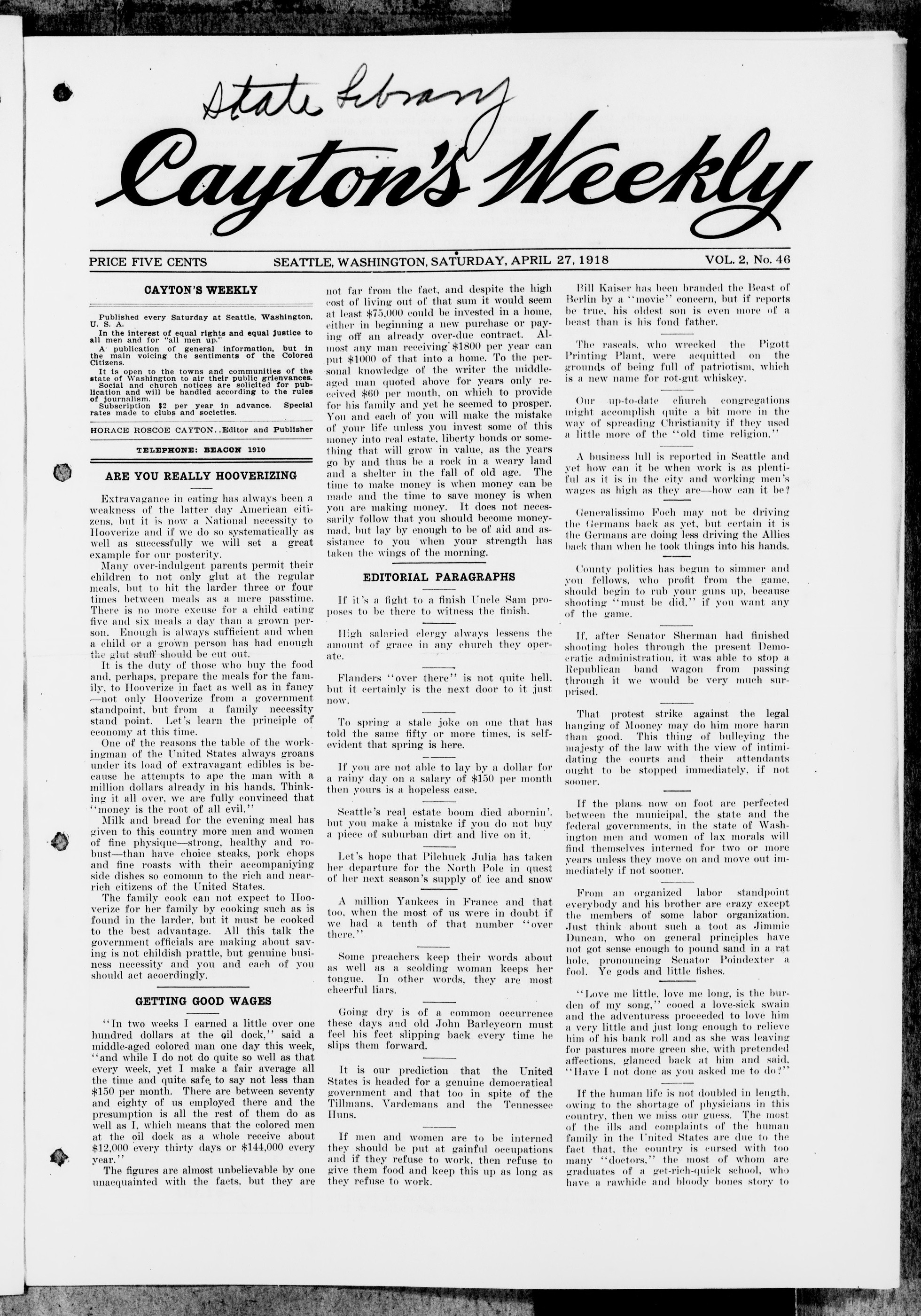
Cayton's Weekly
PRICE FIVE CENTS SEATTLE, WASHINGTON, SATURDAY, APRIL 27, 1918 VOL. 2, No. 46
CAYTON'S WEEKLY
Published every Saturday at Seattle, Washington. U. S. A.
In the interest of equal rights and equal justice to all men and for "all men up."
A publication of general information, but in the main voicing the sentiments of the Colored Citizens.
It is open to the towns and communities of the state of Washington to air their public grievances. Social and church notices are solicited for publication and will be handled according to the rules of journalism.
Subscription $2 per year in advance. Special rates made to clubs and societies.
HORACE ROSCOE CAYTON..Editor and Publisher
TELEPHONE: BEACON 1910
ARE YOU REALLY HOOVERIZING
Extravagance in eating has always been a weakness of the latter day American citizens, but it is now a National necessity to Hooverize and if we do so systematically as well as successfully we will set a great example for our posterity.
Many over-indulgent parents permit their children to not only glut at the regular meals, but to hit the larder three or four times between meals as a mere passtime. There is no more excuse for a child eating five and six meals a day than a grown person. Enough is always sufficient and when a child or a grown person has had enough the glut stuff should be cut out.
It is the duty of those who buy the food and, perhaps, prepare the meals for the family, to Hooverize in fact as well as in fancy—not only Hooverize from a government standpoint, but from a family necessity stand point. Let's learn the principle of economy at this time.
One of the reasons the table of the workingman of the United States always groans under its load of extravagant edibles is because he attempts to ape the man with a million dollars already in his hands. Thinking it all over, we are fully convinced that "money is the root of all evil."
Milk and bread for the evening meal has given to this country more men and women of fine physique—strong, healthy and robust—than have choice steaks, pork chops and fine roasts with their accompaniying side dishes so comomm to the rich and near-rich citizens of the United States.
The family cook can not expect to Hooverize for her family by cooking such as is found in the larder, but it must be cooked to the best advantage. All this talk the government officials are making about saving is not childish prattle, but genuine business necessity and you and each of you should act accordingly.
GETTING GOOD WAGES
"In two weeks I earned a little over one hundred dollars at the oil dock," said a middle-aged colored man one day this week, "and while I do not do quite so well as that every week, yet I make a fair average all the time and quite safe, to say not less than $150 per month. There are between seventy and eighty of us employed there and the presumption is all the rest of them do as well as I, which means that the colored men at the oil dock as a whole receive about $12,000 every thirty days or $144,000 every year." The figures are almost unbelievable by one unacquainted with the facts, but they are
not far from the fact, and despite the high cost of living out of that sum it would seem at least $75,000 could be invested in a home, either in beginning a new purchase or paying off an already over-due contract. Almost any man receiving $1800 per year can put $1000 of that into a home. To the personal knowledge of the writer the middle-aged man quoted above for years only received $60 per month, on which to provide for his family and yet he seemed to prosper. You and each of you will make the mistake of your life unless you invest some of this money into real estate, liberty bonds or something that will grow in value, as the years go by and thus be a rock in a weary land and a shelter in the fall of old age. The time to make money is when money can be made and the time to save money is when you are making money. It does not necessarily follow that you should become money-mad, but lay by enough to be of aid and assistance to you when your strength has taken the wings of the morning.
EDITORIAL PARAGRAPHS
If it's a fight to a finish Uncle Sam proposes to be there to witness the finish.
High salaried clergy always lessens the amount of grace in any church they operate.
Flanders "over there" is not quite hell, but it certainly is the next door to it just now.
To spring a stale joke on one that has told the same fifty or more times, is self-evident that spring is here.
If you are not able to lay by a dollar for a rainy day on a salary of $150 per month then yours is a hopeless case.
Seattle's real estate boom died abornin', but you make a mistake if you do not buy a piece of suburban dirt and live on it.
Let's hope that Pilchuck Julia has taken her departure for the North Pole in quest of her next season's supply of ice and snow
A million Yankees in France and that too, when the most of us were in doubt if we had a tenth of that number "over there."
Some preachers keep their words about as well as a scolding woman keeps her tongue. In other words, they are most cheerful liars.
Going dry is of a common occurrence these days and old John Barleycorn must feel his feet slipping back every time he slips them forward.
It is our prediction that the United States is headed for a genuine democratical government and that too in spite of the Tillmans, Vardemans and the Tennessee Huns.
If men and women are to be interned they should be put at gainful occupations and if they refuse to work, then refuse to give them food and keep this up as long as they refuse to work.
VOL.2.No.46
Bill Kaiser has been branded the Beast of Berlin by a "movie" concern, but if reports be true, his oldest son is even more of a beast than is his fond father.
The rascals, who wrecked the Pigott Printing Plant, were acquitted on the grounds of being full of patriotism, which is a new name for rot-gut whiskey.
Our up-to-date church congregations might accomplish quite a bit more in the way of spreading Christianity if they used a little more of the "old time religion."
A business lull is reported in Seattle and yet how can it be when work is as plentiful as it is in the city and working men's wages as high as they are—how can it be?
Generalissimo Foch may not be driving the Germans back as yet, but certain it is the Germans are doing less driving the Allies back than when he took things into his hands.
County politics has begun to simmer and you fellows, who profit from the game, should begin to rub your guns up, because shooting "must be did," if you want any of the game.
If, after Senator Sherman had finished shooting holes through the present Democratic administration, it was able to stop a Republican band wagon from passing through it we would be very much surprised.
That protest strike against the legal hanging of Mooney may do him more harm than good. This thing of bulleying the majesty of the law with the view of intimidating the courts and their attendants ought to be stopped immediately, if not sooner.
If the plans now on foot are perfected between the municipal, the state and the federal governments, in the state of Washington men and women of lax morals will find themselves interned for two or more years unless they move on and move out immediately if not sooner.
From an organized labor standpoint everybody and his brother are crazy except the members of some labor organization. Just think about such a toot as Jimmie Duncan, who on general principles have not got sense enough to pound sand in a rat hole, pronouncing Senator Poindexter a fool. Ye gods and little fishes.
“Love me little, love me long, is the burden of my song,” cooed a love-sick swain and the adventures proceeded to love him a very little and just long enough to relieve him of his bank roll and as she was leaving for pastures more green she, with pretended affections, glanced back at him and said, “Have I not done as you asked me to do?”
If the human life is not doubled in length, owing to the shortage of physicians in this country, then we miss our guess. The most of the ills and complaints of the human family in the United States are due to the fact that, the country is cursed with too many "doctors," the most of whom are graduates of a get-rich-quick school, who have a rawhide and bloody bones story to
```markdown
```
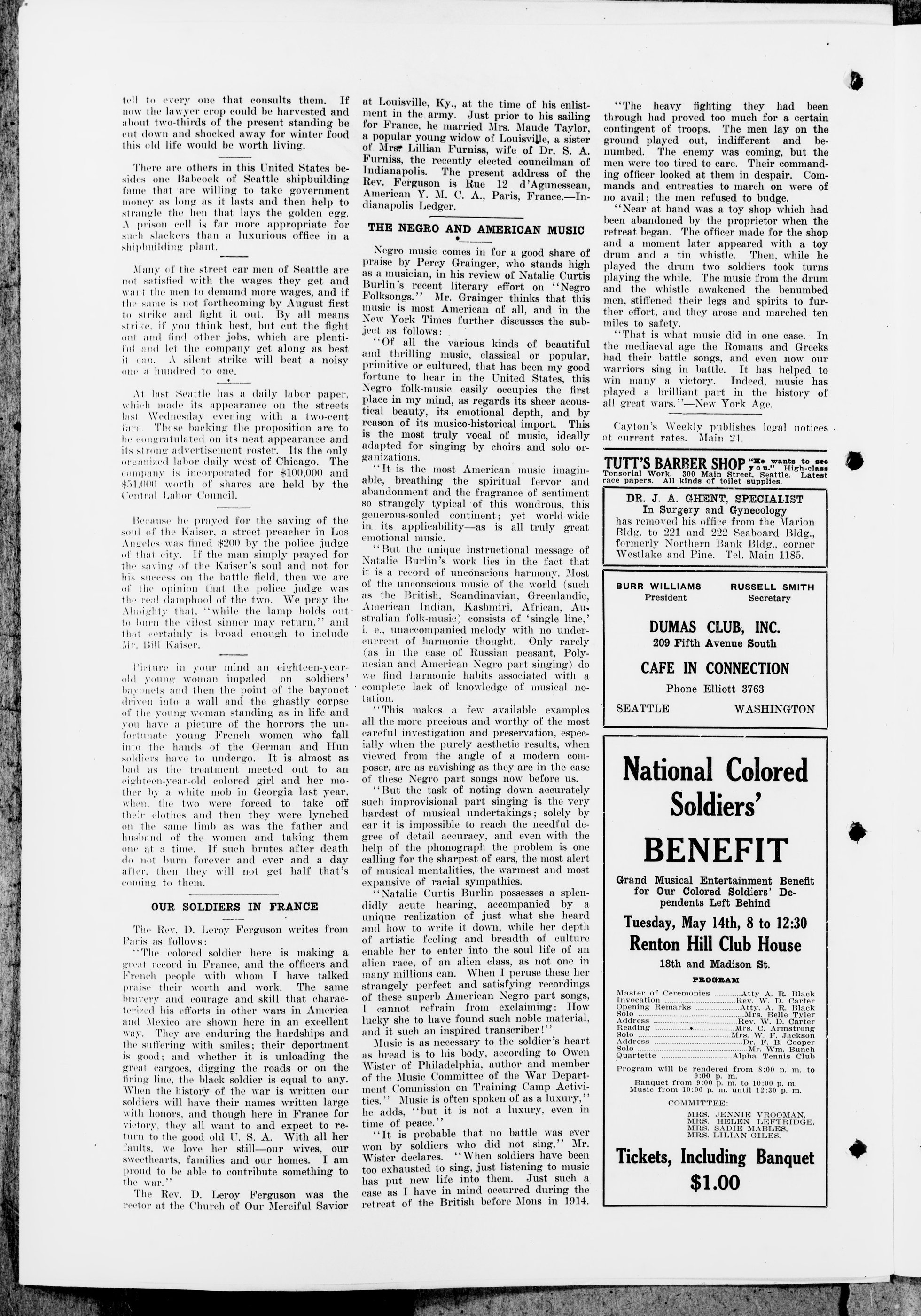
tell to every one that consults them. If now the lawyer crop could be harvested and about two-thirds of the present standing be cut down and shocked away for winter food this old life would be worth living.
There are others in this United States besides one Babcock of Seattle shipbuilding fame that are willing to take government money as long as it lasts and then help to strangle the hen that lays the golden egg. A prison cell is far more appropriate for such slackers than a luxurious office in a shipbuilding plant.
Many of the street car men of Seattle are not satisfied with the wages they get and want the men to demand more wages, and if the same is not forthcoming by August first to strike and fight it out. By all means strike, if you think best, but cut the fight out and find other jobs, which are plentiful and let the company get along as best it can. A silent strike will beat a noisy one a hundred to one.
At last Seattle has a daily labor paper which made its appearance on the streets last Wednesday evening with a two-cent fare. Those backing the proposition are to be congratulated on its neat appearance and its strong advertisement roster. Its the only organized labor daily west of Chicago. The company is incorporated for $100,000 and $51,000 worth of shares are held by the Central Labor Council.
Because he prayed for the saving of the soul of the Kaiser, a street preacher in Los Angeles was fined $200 by the police judge of that city. If the man simply prayed for the saving of the Kaiser's soul and not for his success on the battle field, then we are of the opinion that the police judge was the real damphool of the two. We pray the Almighty that, "while the lamp holds out to burn the vilest sinner may return," and that certainly is broad enough to include Mr. Bill Kaiser.
Picture in your mind an eighteen-year-old young woman impaled on soldiers' bayonets and then the point of the bayonet driven into a wall and the ghastly corpse of the young woman standing as in life and you have a picture of the horrors the unfortunate young French women who fall into the hands of the German and Hun soldiers have to undergo. It is almost as bad as the treatment meeted out to an eighteen-year-old colored girl and her mother by a white mob in Georgia last year, when, the two were forced to take off their clothes and then they were lynched on the same limb as was the father and husband of the women and taking them one at a time. If such brutes after death do not burn forever and ever and a day after, then they will not get half that's coming to them.
OUR SOLDIERS IN FRANCE
The Rev. D. Leroy Ferguson writes from Paris as follows:
"The colored soldier here is making a great record in France, and the officers and French people with whom I have talked praise their worth and work. The same bravery and courage and skill that characterized his efforts in other wars in America and Mexico are shown here in an excellent way. They are enduring the hardships and the suffering with smiles; their deportment is good; and whether it is unloading the great cargoes, digging the roads or on the firing line, the black soldier is equal to any. When the history of the war is written our soldiers will have their names written large with honors, and though here in France for victory, they all want to and expect to return to the good old U. S. A. With all her faults, we love her still—our wives, our sweethearts, families and our homes. I am proud to be able to contribute something to the war."
The Rev. D. Leroy Ferguson was the rector at the Church of Our Merciful Savior
at Louisville, Ky., at the time of his enlistment in the army. Just prior to his sailing for France, he married Mrs. Maude Taylor, a popular young widow of Louisville, a sister of Mrs. Lillian Furniss, wife of Dr. S. A. Furniss, the recently elected councilman of Indianapolis. The present address of the Rev. Ferguson is Rue 12 d'Agunessean, American Y. M. C. A., Paris, France.—Indianapolis Ledger.
THE NEGRO AND AMERICAN MUSIC
Negro music comes in for a good share of praise by Percy Grainger, who stands high as a musician, in his review of Natalie Curtis Burlin's recent literary effort on "Negro Folksongs." Mr. Grainger thinks that this music is most American of all, and in the New York Times further discusses the subject as follows:
Of all the various kinds of beautiful and thrilling music, classical or popular, primitive or cultured, that has been my good fortune to hear in the United States, this Negro folk-music easily occupies the first place in my mind, as regards its sheer acoustical beauty, its emotional depth, and by reason of its musico-historical import. This is the most truly vocal of music, ideally adapted for singing by choirs and solo organizations.
"It is the most American music imaginable, breathing the spiritual fervor and abandonment and the fragrance of sentiment so strangely typical of this wondrous, this generous-souled continent; yet world-wide in its applicability—as is all truly great emotional music.
"But the unique instructional message of Natalie Burlin's work lies in the fact that it is a record of unconscious harmony. Most of the unconscious music of the world (such as the British, Scandinavian, Greenlandic, American Indian, Kashmiri, African, Australian folk-music) consists of 'single line,' i. e., unaccompanied melody with no undercurrent of harmonic thought. Only rarely (as in the case of Russian peasant, Polynesian and American Negro part singing) do we find harmonic habits associated with a complete lack of knowledge of musical notation.
"This makes a few available examples all the more precious and worthy of the most careful investigation and preservation, especially when the purely aesthetic results, when viewed from the angle of a modern composer, are as ravishing as they are in the case of these Negro part songs now before us. But the task of noting down accurately such improvisional part singing is the very hardest of musical undertakings; solely by ear it is impossible to reach the needful degree of detail accuracy, and even with the help of the phonograph the problem is one calling for the sharpest of ears, the most alert of musical mentalities, the warmest and most expansive of racial sympathies.
"Natalie Curtis Burlin possesses a splendidly acute hearing, accompanied by a unique realization of just what she heard and how to write it down, while her depth of artistic feeling and breadth of culture enable her to enter into the soul life of an alien race, of an alien class, as not one in many millions can. When I peruse these her strangely perfect and satisfying recordings of these superb American Negro part songs, I cannot refrain from exclaiming: How lucky she to have found such noble material, and it such an inspired transcriber!"
Music is as necessary to the soldier's heart as bread is to his body, according to Owen Wister of Philadelphia, author and member of the Music Committee of the War Department Commission on Training Camp Activities." Music is often spoken of as a luxury," he adds, "but it is not a luxury, even in time of peace."
"It is probable that no battle was ever won by soldiers who did not sing," Mr. Wister declares. "When soldiers have been too exhausted to sing, just listening to music has put new life into them. Just such a case as I have in mind occurred during the retreat of the British before Mons in 1914.
"The heavy fighting they had been through had proved too much for a certain contingent of troops. The men lay on the ground played out, indifferent and benumbed. The enemy was coming, but the men were too tired to care. Their commanding officer looked at them in despair. Commands and entreaties to march on were of no avail; the men refused to budge.
"Near at hand was a toy shop which had been abandoned by the proprietor when the retreat began. The officer made for the shop and a moment later appeared with a toy drum and a tin whistle. Then, while he played the drum two soldiers took turns playing the while. The music from the drum and the whistle awakened the benumbed men, stiffened their legs and spirits to further effort, and they arose and marched ten miles to safety.
"That is what music did in one case. In the mediaeval age the Romans and Greeks had their battle songs, and even now our warriors sing in battle. It has helped to win many a victory. Indeed, music has played a brilliant part in the history of all great wars."—New York Age.
Cayton's Weekly publishes legal notices at current rates. Main 24.
TUTT'S BARBER SHOP "He wants to see you." High-class Tonsorial Work. 300 Main Street, Seattle. Latest race papers. All kinds of toilet supplies.
DR. J. A. GHENT, SPECIALIST In Surgery and Gynecology has removed his office from the Marion Bldg. to 221 and 222 Seaboard Bldg., formerly Northern Bank Bldg., corner Westlake and Pine. Tel. Main 1185.
BURR WILLIAMS RUSSELL SMITH
President Secretary
DUMAS CLUB, INC.
209 Fifth Avenue South
CAFE IN CONNECTION
Phone Elliott 3763
SEATTLE WASHINGTON
National Colored Soldiers' BENEFIT
Grand Musical Entertainment Benefit for Our Colored Soldiers' Dependents Left Behind Tuesday, May 14th, 8 to 12:30 Renton Hill Club House 18th and Madison St.
PROGRAM
Master of Ceremonies ... Atty A. R. Black
Invocation ... Rev. W. D. Carter
Opening Remarks ... Atty A. R. Black
Solo ... Mrs. Belle Tyler
Address ... Rev. W. D. Carter
Reading ... Mrs. C. Armstrong
Solo ... Mrs. W. F. Jackson
Address ... Dr. F. B. Cooper
Solo ... Mr. Wm. Bunch
Quartette ... Alpha Tennis Club
Program will be rendered from 8:00 p. m. to 9:00 p. m.
Banquet from 9:00 p. m. to 10:00 p. m.
Music from 10:00 p. m. until 12:30 p. m.
COMMITTEE:
MRS. JENNIE VROOMAN,
MRS. HELEN LEFTRIDGE,
MRS. SADIE MABLES,
MRS. LILIAN GILES.
Tickets, Including Banquet
$1.00
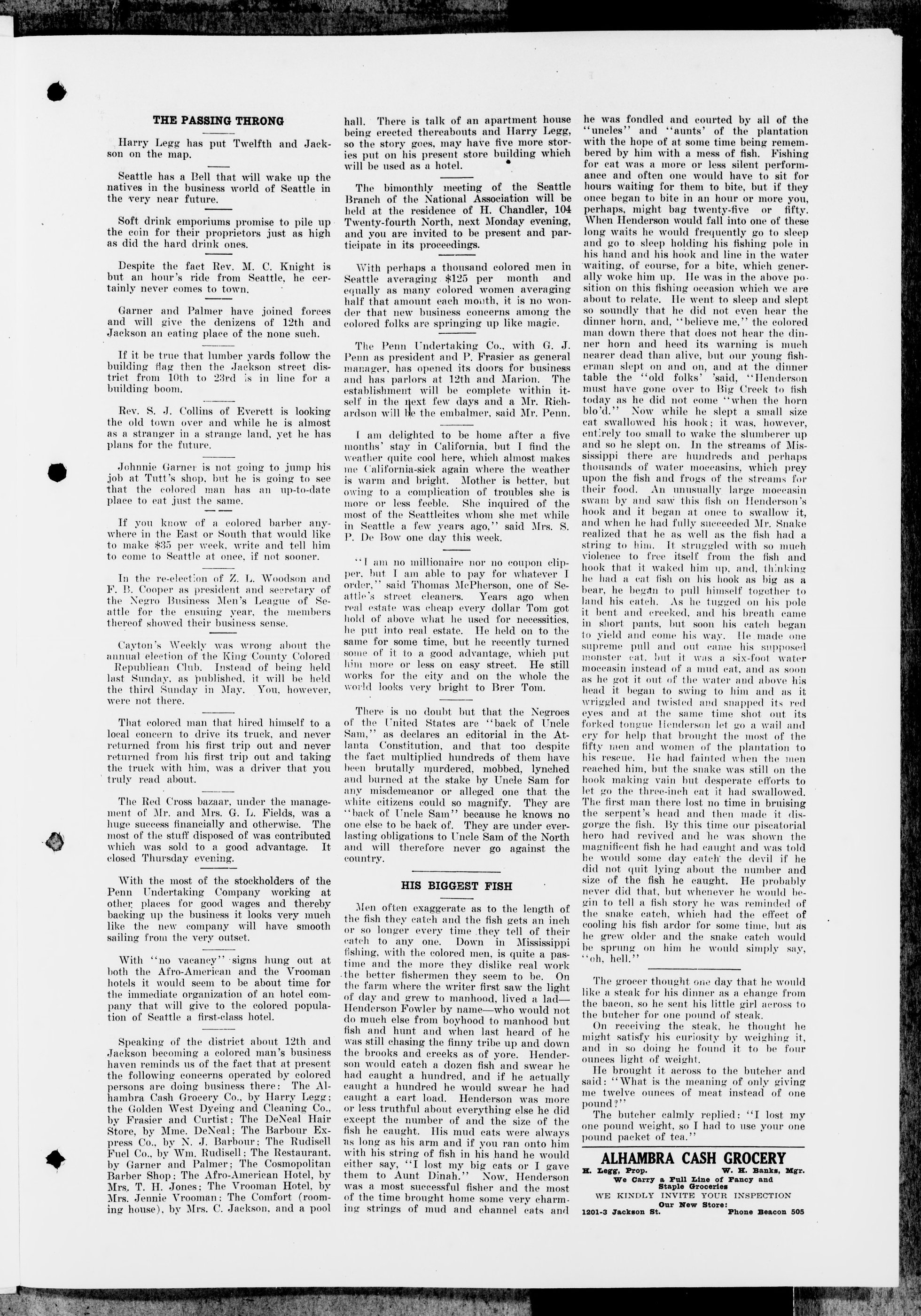
THE PASSING THRONG
Harry Legg has put Twelfth and Jackson on the map.
Seattle has a Bell that will wake up the natives in the business world of Seattle in the very near future.
Soft drink emporiums promise to pile up the coin for their proprietors just as high as did the hard drink ones.
Despite the fact Rev. M. C. Knight is but an hour's ride from Seattle, he certainly never comes to town.
Garner and Palmer have joined forces and will give the denizens of 12th and Jackson an eating place of the none such.
If it be true that lumber yards follow the building flag then the Jackson street district from 10th to 23rd is in line for a building boom.
Rev. S. J. Collins of Everett is looking the old town over and while he is almost as a stranger in a strange land, yet he has plans for the future.
Johnnie Garner is not going to jump his job at Tutt's shop, but he is going to see that the colored man has an up-to-date place to eat just the same.
If you know of a colored barber anywhere in the East or South that would like to make $35 per week, write and tell him to come to Seattle at once, if not sooner.
In the re-election of Z. L. Woodson and F. B. Cooper as president and secretary of the Negro Business Men's League of Seattle for the ensuing year, the members thereof showed their business sense.
Cayton's Weekly was wrong about the annual election of the King County Colored Republican Club. Instead of being held last Sunday, as published, it will be held the third Sunday in May. You, however, were not there.
That colored man that hired himself to a local concern to drive its truck, and never returned from his first trip out and never returned from his first trip out and taking the truck with him, was a driver that you truly read about.
The Red Cross bazaar, under the management of Mr. and Mrs. G. L. Fields, was a huge success financially and otherwise. The most of the stuff disposed of was contributed which was sold to a good advantage. It closed Thursday evening.
With the most of the stockholders of the Penn Undertaking Company working at other places for good wages and thereby backing up the business it looks very much like the new company will have smooth sailing from the very outset.
With "no vacancy" signs hung out at both the Afro-American and the Vrooman hotels it would seem to be about time for the immediate organization of an hotel company that will give to the colored population of Seattle a first-class hotel.
Speaking of the district about 12th and Jackson becoming a colored man's business haven reminds us of the fact that at present the following concerns operated by colored persons are doing business there: The Alhambra Cash Grocery Co., by Harry Legg; the Golden West Dyeing and Cleaning Co., by Frasier and Curtist; The DeNeal Hair Store, by Mme. DeNeal; The Barbour Express Co., by N. J. Barbour; The Rudisell Fuel Co., by Wm. Rudisell; The Restaurant, by Garner and Palmer; The Cosmopolitan Barber Shop; The Afro-American Hotel, by Mrs. T. H. Jones; The Vrooman Hotel, by Mrs. Jennie Vrooman: The Comfort (rooming house), by Mrs. C. Jackson, and a pool
---
hall. There is talk of an apartment house being erected thereabouts and Harry Legg, so the story goes, may have five more stories put on his present store building which will be used as a hotel. The bimonthly meeting of the Seattle Branch of the National Association will be held at the residence of H. Chandler, 104 Twenty-fourth North, next Monday evening, and you are invited to be present and participate in its proceedings.
With perhaps a thousand colored men in Seattle averaging $125 per month and equally as many colored women averaging half that amount each month, it is no wonder that new business concerns among the colored folks are springing up like magic. The Penn Undertaking Co., with G. J. Penn as president and P. Frasier as general manager, has opened its doors for business and has parlors at 12th and Marion. The establishment will be complete within itself in the next few days and a Mr. Richardson will be the embalmer, said Mr. Penn.
I am delighted to be home after a five months' stay in California, but I find the weather quite cool here, which almost makes me California-sick again where the weather is warm and bright. Mother is better, but owing to a complication of troubles she is more or less feeble. She inquired of the most of the Seattleites whom she met while in Seattle a few years ago," said Mrs. S. P. De Bow one day this week.
"I am no millionaire nor no coupon clipper, but I am able to pay for whatever I order," said Thomas McPherson, one of Seattle's street cleaners. Years ago when real estate was cheap every dollar Tom got hold of above what he used for necessities, he put into real estate. He held on to the same for some time, but he recently turned some of it to a good advantage, which put him more or less on easy street. He still works for the city and on the whole the world looks very bright to Brer Tom.
There is no doubt but that the Negroes of the United States are "back of Uncle Sam," as declares an editorial in the Atlanta Constitution, and that too despite the fact multiplied hundreds of them have been brutally murdered, mobbed, lynched and burned at the stake by Uncle Sam for any misdemeanor or alleged one that the white citizens could so magnify. They are "back of Uncle Sam" because he knows no one else to be back of. They are under everlasting obligations to Uncle Sam of the North and will therefore never go against the country.
HIS BIGGEST FISH
Men often exaggerate as to the length of the fish they catch and the fish gets an inch or so longer every time they tell of their catch to any one. Down in Mississippi fishing, with the colored men, is quite a pastime and the more they dislike real work the better fishermen they seem to be. On the farm where the writer first saw the light of day and grew to manhood, lived a lad—Henderson Fowler by name—who would not do much else from boyhood to manhood but fish and hunt and when last heard of he was still chasing the finny tribe up and down the brooks and creeks as of yore. Henderson would catch a dozen fish and swear he had caught a hundred, and if he actually caught a hundred he would swear he had caught a cart load. Henderson was more or less truthful about everything else he did except the number of and the size of the fish he caught. His mud cats were always as long as his arm and if you ran onto him with his string of fish in his hand he would either say, "I lost my big cats or I gave them to Aunt Dinah." Now, Henderson was a most successful fisher and the most of the time brought home some very charming strings of mud and channel cats and
he was fondled and courted by all of the "uncles" and "aunts' of the plantation with the hope of at some time being remembered by him with a mess of fish. Fishing for cat was a more or less silent performance and often one would have to sit for hours waiting for them to bite, but if they once began to bite in an hour or more you perhaps, might bag twenty-five or fifty. When Henderson would fall into one of these long waits he would frequently go to sleep and go to sleep holding his fishing pole in his hand and his hook and line in the water waiting, of course, for a bite, which generally woke him up. He was in the above position on this fishing occasion which we are about to relate. He went to sleep and slept so soundly that he did not even hear the dinner horn, and, "believe me," the colored man down there that does not hear the dinner horn and heed its warning is much nearer dead than alive, but our young fisherman slept on and on, and at the dinner table the "old folks' 'said, "Henderson must have gone over to Big Creek to fish today as he did not come "when the horn blo'd." Now while he slept a small size cat swallowed his hook; it was, however, entirely too small to wake the slumberer up and so he slept on. In the streams of Mississippi there are hundreds and perhaps thousands of water moccasins, which prey upon the fish and frogs of the streams for their food. An unusually large moccasin swam by and saw this fish on Henderson's hook and it began at once to swallow it, and when he had fully succeeded Mr. Snake realized that he as well as the fish had a string to him. It struggled with so much violence to free itself from the fish and hook that it waked him up, and, thinking he had a cat fish on his hook as big as a bear, he began to pull himself together to land his catch. As he tugged on his pole it bent and creeked, and his breath came in short pants, but soon his catch began to yield and come his way. He made one supreme pull and out came his supposed monster cat, but it was a six-foot water moccasin instead of a mud cat, and as soon as he got it out of the water and above his head it began to swing to him and as it wriggled and twisted and snapped its red eyes and at the same time shot out its forked tongue Henderson let go a wail and cry for help that brought the most of the fifty men and women of the plantation to his rescue. He had fainted when the men reached him, but the snake was still on the hook making vain but desperate efforts to let go the three-inch cat it had swallowed. The first man there lost no time in bruising the serpent's head and then made it disgorge the fish. By this time our piscatorial hero had revived and he was shown the magnificent fish he had caught and was told he would some day catch the devil if he did not quit lying about the number and size of the fish he caught. He probably never did that, but whenever he would begin to tell a fish story he was reminded of the snake catch, which had the effect of cooling his fish ardor for some time, but as he grew older and the snake catch would be sprung on him he would simply say, "oh, hell."
The grocer thought one day that he would like a steak for his dinner as a change from the bacon, so he sent his little girl across to the butcher for one pound of steak.
On receiving the steak, he thought he might satisfy his curiosity by weighing it, and in so doing he found it to be four ounces light of weight.
He brought it across to the butcher and said: "What is the meaning of only giving me twelve ounces of meat instead of one pound?"
The butcher calmly replied: "I lost my one pound weight, so I had to use your one pound packet of tea."
ALHAMBRA CASH GROCERY
H. Legg, Prop. W. H. Banks, Mgr.
We Carry a Full Line of Fancy and
Staple Groceries
WE KINDLY INVITE YOUR INSPECTION
Our New Store:
1201-3 Jackson St. Phone Beacon 505
```markdown
```
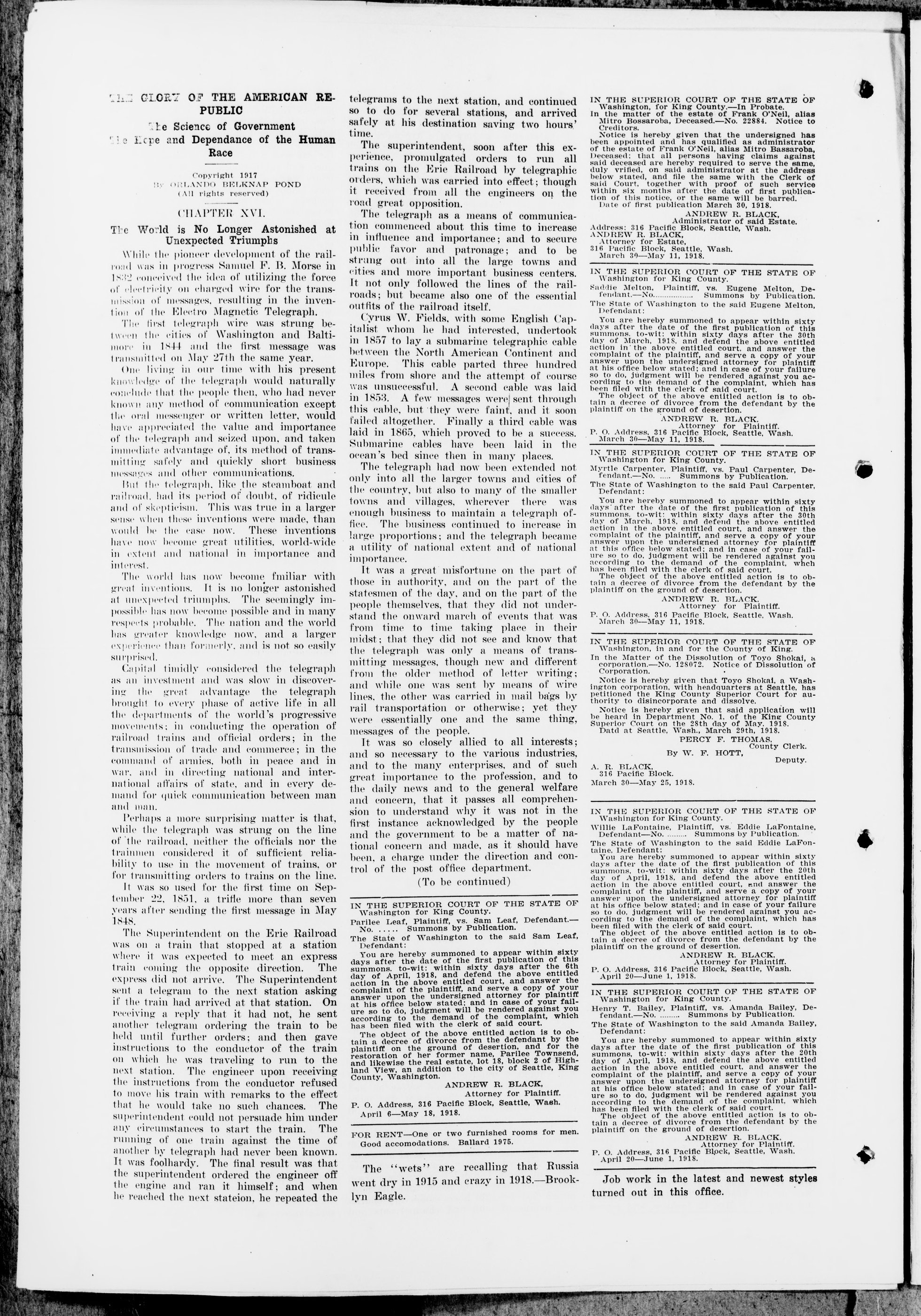
Copyright 1917
By ORLANDO BELKNAP POND
(All rights reserved)
CHAPTER XVL
The World is No Longer Astonished at Unexpected Triumphs
While the pioneer development of the railroad was in progress Samuel F. B. Morse in 1832 conceived the idea of utilizing the force of electricity on charged wire for the transmission of messages, resulting in the invention of the Electro Magnetic Telegraph. The first telegraph wire was strung between the cities of Washington and Baltimore in 1844 and the first message was transmitted on May 27th the same year.
One living in our time with his present knowledge of the telegraph would naturally conclude that the people then, who had never known any method of communication except the oral messenger or written letter, would have appreciated the value and importance of the telegraph and seized upon, and taken immediate advantage of, its method of transmitting safely and quickly short business messages and other communications.
But the telegraph, like the steamboat and railroad, had its period of doubt, of ridicule and of skepticism. This was true in a larger sense when these inventions were made, than would be the case now. These inventions have now become great utilities, world-wide in extent and national in importance and interest. The world has now become familiar with great inventions. It is no longer astonished at unexpected triumphs. The seemingly impossible has now become possible and in many respects probable. The nation and the world has greater knowledge now, and a larger experience than formerly, and is not so easily surprised.
Capital timidly considered the telegraph as an investment and was slow in discovering the great advantage the telegraph brought to every phase of active life in all the departments of the world's progressive movements; in conducting the operation of railroad trains and official orders; in the transmission of trade and commerce; in the command of armies, both in peace and in war, and in directing national and international affairs of state, and in every demand for quick communication between man and man.
Perhaps a more surprising matter is that, while the telegraph was strung on the line of the railroad, neither the officials nor the trainmen considered it of sufficient reliability to use in the movement of trains, or for transmitting orders to trains on the line. It was so used for the first time on September 22, 1851, a trifle more than seven years after sending the first message in May 1848.
The Superintendent on the Erie Railroad was on a train that stopped at a station where it was expected to meet an express train coming the opposite direction. The express did not arrive. The Superintendent sent a telegram to the next station asking if the train had arrived at that station. On receiving a reply that it had not, he sent another telegram ordering the train to be held until further orders; and then gave instructions to the conductor of the train on which he was traveling to run to the next station. The engineer upon receiving the instructions from the conductor refused to move his train with remarks to the effect that he would take no such chances. The superintendent could not persuade him under any circumstances to start the train. The running of one train against the time of another by telegraph had never been known. It was foolhardy. The final result was that the superintendent ordered the engineer off the engine and ran it himself; and when he reached the next stateion, he repeated the
telegrams to the next station, and continued so to do for several stations, and arrived safely at his destination saving two hours' time. The superintendent, soon after this experience, promulgated orders to run all trains on the Erie Railroad by telegraphic orders, which was carried into effect; though it received from all the engineers on the road great opposition.
The telegraph as a means of communication commenced about this time to increase in influence and importance; and to secure public favor and patronage; and to be strung out into all the large towns and cities and more important business centers. It not only followed the lines of the railroads; but became also one of the essential outfits of the railroad itself.
Cyrus W. Fields, with some English Capitalist whom he had interested, undertook in 1857 to lay a submarine telegraphic cable between the North American Continent and Europe. This cable parted three hundred miles from shore and the attempt of course was unsuccessful. A second cable was laid in 1853. A few messages were sent through this cable, but they were faint, and it soon failed altogether. Finally a third cable was laid in 1865, which proved to be a success. Submarine cables have been laid in the ocean's bed since then in many places.
The telegraph had now been extended not only into all the larger towns and cities of the country, but also to many of the smaller towns and villages, wherever there was enough business to maintain a telegraph office. The business continued to increase in large proportions; and the telegraph became a utility of national extent and of national importance.
It was a great misfortune on the part of those in authority, and on the part of the statesmen of the day, and on the part of the people themselves, that they did not understand the onward march of events that was from time to time taking place in their midst; that they did not see and know that the telegraph was only a means of transmitting messages, though new and different from the older method of letter writing; and while one was sent by means of wire lines, the other was carried in mail bags by rail transportation or otherwise; yet they were essentially one and the same thing, messages of the people.
It was so closely allied to all interests; and so necessary to the various industries, and to the many enterprises, and of such great importance to the profession, and to the daily news and to the general welfare and concern, that it passes all comprehension to understand why it was not in the first instance acknowledged by the people and the government to be a matter of national concern and made, as it should have been, a charge under the direction and control of the post office department.
(To be continued)
You are hereby summoned to appear within sixty days after the date of the first publication of this summons. to-wit: within sixty days after the 6th day of April, 1918, and defend the above entitled action in the above entitled court, and answer the complaint of the plaintiff, and serve a copy of your answer upon the undersigned attorney for plaintiff at his office below stated; and in case of your failure so to do, judgment will be rendered against you according to the demand of the complaint, which has been filed with the clerk of said court.
The object of the above entitled action is to obtain a decree of divorce from the defendant by the plaintiff on the ground of desertion, and for the restoration of her former name, Parilee Townsend, and likewise the real estate, lot 18, block 2 of Highland View, an addition to the city of Seattle, King County, Washington.
P. O. Address, 316 Pacific Block, Seattle, Wash. April 6—May 18, 1918.
FOR RENT—One or two furnished rooms for men. Good accomodations. Ballard 1975.
The "wets" are recalling that Russia went dry in 1915 and crazy in 1918.—Brooklyn Eagle.
IN THE SUPERIOR COURT OF THE STATE OF Washington, for King County.—In Probate. In the matter of the estate of Frank O'Neil, alias Mitro Bossaroba, Deceased.—No. 22884. Notice to Creditors.
Notice is hereby given that the undersigned has been appointed and has qualified as administrator of the estate of Frank O'Neil, alias Mitro Bassaroba, Deceased; that all persons having claims against said deceased are hereby required to serve the same, duly vrified, on said administrator at the address below stated, and file the same with the Clerk of said Court, together with proof of such service within six months after the date of first publication of this notice, or the same will be barred. Date of first publication March 30, 1918.
ANDREW R. BLACK,
Administrator of said Estate.
Address: 316 Pacific Block, Seattle, Wash.
ANDREW R. BLACK,
Attorney for Estate.
316 Pacific Block, Seattle, Wash.
March 39—May 11, 1918.
IN THE SUPERIOR COURT OF THE STATE OF Washington for King County.
Saddie Melton, Plaintiff, vs. Eugene Melton, Defendant.—No. Summons by Publication.
The State of Washington to the said Eugene Melton, Defendant:
You are hereby summoned to appear within sixty days after the date of the first publication of this summons. to-wit: within sixty days after the 30th day of March, 1918, and defend the above entitled action in the above entitled court, and answer the complaint of the plaintiff, and serve a copy of your answer upon the undersigned attorney for plaintiff at his office below stated; and in case of your failure so to do, judgment will be rendered against you according to the demand of the complaint, which has been filed with the clerk of said court.
The object of the above entitled action is to obtain a decree of divorce from the defendant by the plaintiff on the ground of desertion.
ANDREW R. BLACK.
Attorney for Plaintiff.
P. O. Address, 316 Pacific Block, Seattle, Wash.
March 30—May 11, 1918.
IN THE SUPERIOR COURT OF THE STATE OF Washington for King County.
Myrtle Carpenter, Plaintiff, vs. Paul Carpenter, Defendant—No. .... Summons by Publication.
The State of Washington to the said Paul Carpenter, Defendant:
You are hereby summoned to appear within sixty days after the date of the first publication of this summons, to-wit: within sixty days after the 30th day of March, 1918, and defend the above entitled action in the above entitled court, and answer the complaint of the plaintiff, and serve a copy of your answer upon the undersigned attorney for plaintiff at this office below stated; and in case of your failure so to do, judgment will be rendered against you according to the demand of the complaint, which has been filed with the clerk of said court.
The object of the above entitled action is to obtain a decree of divorce from the defendant by the plaintiff on the ground of desertion.
ANDREW R. BLACK.
Attorney for Plaintiff.
P. O. Address, 316 Pacific Block, Seattle, Wash.
March 30—May 11, 1918.
IN THE SUPERIOR COURT OF THE STATE OF
Washington, in and for the County of King.
Notice is hereby given that Toyo Shokai, a Washington corporation, with headquarters at Seattle, has petitioned the King County Superior Court for authority to disincorporate and dissolve.
Notice is hereby given that said application will be heard in Department No. 1, of the King County Superior Court on the 28th day of May, 1918.
Detd. at Scotth. Wech. March 30th, 1918.
A. R. BLACK.
316 Pacific Block.
March 30—May 25, 1918.
IN THE SUPERIOR COURT OF THE STATE OF Washington for King County.
Willie LaFontaine, Plaintiff, vs. Eddie LaFontaine,
Defendant—No. Summons by Publication.
Defendant—No. ..... Summons by Publication.
The State of Washington to the said Eddie LaFontaine. Defendant:
You are hereby summoned to appear within sixty days after the date of the first publication of this summons, to-wit: within sixty days after the 20th day of April, 1918, and defend the above entitled action in the above entitled court, and answer the complaint of the plaintiff, and serve a copy of your answer upon the undersigned attorney for plaintiff at his office below stated; and in case of your failure so to do, judgment will be rendered against you according to the demand of the complaint, which has been filed with the clerk of said court.
The object of the above entitled action is to obtain a decree of divorce from the defendant by the plaintiff on the ground of desertion.
ANDREW R. BLACK.
Attorney for Plaintiff.
P. O. Address, 316 Pacific Block, Seattle, Wash.
April 20—June 1, 1918.
IN THE SUPERIOR COURT OF THE STATE OF Washington for King County.
You are hereby summoned to appear within sixty days after the date of the first publication of this summons, to-wit: within sixty days after the 20th day of April, 1918, and defend the above entitled action in the above entitled court, and answer the complaint of the plaintiff, and serve a copy of your answer upon the undersigned attorney for plaintiff at his office below stated; and in case of your failure so to do, judgment will be rendered against you according to the demand of the complaint, which has been filed with the clerk of said court.
The object of the above entitled action is to obtain a decree of divorce from the defendant by the plaintiff on the ground of desertion.
ANDREW R. BLACK.
Attorney for Plaintiff.
P. O. Address, 316 Pacific Block, Seattle, Wash.
April 20—June 1, 1918.
Job work in the latest and newest styles turned out in this office.