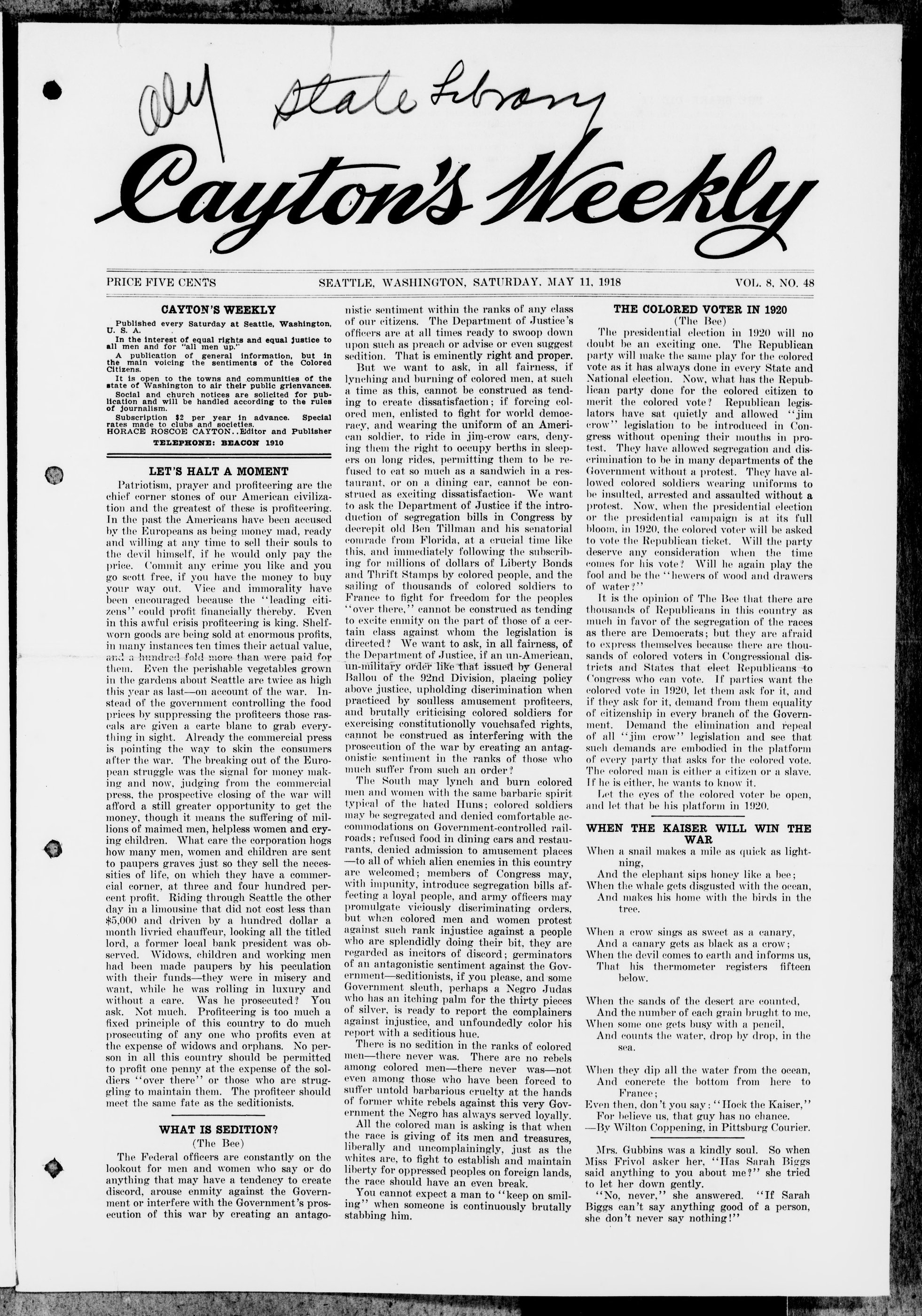
Cayton's Weekly
Saturday, May 11, 1918
Seattle, Washington
Page text (machine-generated)
State Library
Cayton's Weekly
---
PRICE FIVE CENTS
CAYTON'S WEEKLY
Published every Saturday at Seattle, Washington, U. S. A. In the interest of equal rights and equal justice to all men and for "all men up."
A publication of general information, but in the main voicing the sentiments of the Colored Citizens.
It is open to the towns and communities of the state of Washington to air their public grievances. Social and church notices are solicited for publication and will be handled according to the rules of journalism.
Subscription $2 per year in advance. Special rates made to clubs and societies. HORACE ROSCOE CAYTON..Editor and Publisher
TELEPHONE: BEACON 1910
LET'S HALT A MOMENT
Patriotism, prayer and profiteering are the chief corner stones of our American civilization and the greatest of these is profiteering. In the past the Americans have been accused by the Europeans as being money mad, ready and willing at any time to sell their souls to the devil himself, if he would only pay the price. Commit any crime you like and you go scott free, if you have the money to buy your way out. Vice and immorality have been encouraged because the "leading citizens" could profit financially thereby. Even in this awful crisis profiteering is king. Shelfworn goods are being sold at enormous profits, in many instances ten times their actual value, and a hundred fold more than were paid for them. Even the perishable vegetables grown in the gardens about Seattle are twice as high this year as last-on account of the war. Instead of the government controlling the food prices by suppressing the profiteers those rascals are given a carte blanche to grab everything in sight. Already the commercial press is pointing the way to skin the consumers after the war. The breaking out of the European struggle was the signal for money making and now, judging from the commercial press, the prospective closing of the war will afford a still greater opportunity to get the money, though it means the suffering of millions of maimed men, helpless women and crying children. What care the corporation hogs how many men, women and children are sent to paupers graves just so they sell the necessities of life, on which they have a commercial corner, at three and four hundred percent profit. Riding through Seattle the other day in a limousine that did not cost less than $5,000 and driven by a hundred dollar a month livried chauffeur, looking all the titled lord, a former local bank president was observed. Widows, children and working men had been made paupers by his peculation with their funds—they were in misery and want, while he was rolling in luxury and without a care. Was he prosecuted? You ask. Not much. Profiteering is too much a fixed principle of this country to do much prosecuting of any one who profits even at the expense of widows and orphans. No person in all this country should be permitted to profit one penny at the expense of the soldiers "over there" or those who are struggling to maintain them. The profiteer should meet the same fate as the seditionists.
WHAT IS SEDITION?
(The Bee)
The Federal officers are constantly on the lookout for men and women who say or do anything that may have a tendency to create discord, arouse enmity against the Government or interfere with the Government's prosecution of this war by creating an antago-
SEATTLE, WASHINGTON, SATURDAY, MAY 11, 1918
nistic sentiment within the ranks of any class of our citizens. The Department of Justice's officers are at all times ready to swoop down upon such as preach or advise or even suggest sedition. That is eminently right and proper.
But we want to ask, in all fairness, if lynching and burning of colored men, at such a time as this, cannot be construed as tending to create dissatisfaction; if forcing colored men, enlisted to fight for world democracy, and wearing the uniform of an American soldier, to ride in jim-crow cars, denying them the right to occupy berths in sleepers on long rides, permitting them to be refused to eat so much as a sandwich in a restaurant, or on a dining car, cannot be construed as exciting dissatisfaction- We want to ask the Department of Justice if the introduction of segregation bills in Congress by decrepit old Ben Tillman and his senatorial comrade from Florida, at a crucial time like this, and immediately following the subscribing for millions of dollars of Liberty Bonds and Thrift Stamps by colored people, and the sailing of thousands of colored soldiers to France to fight for freedom for the peoples "over there," cannot be construed as tending to excite enmity on the part of those of a certain class against whom the legislation is directed? We want to ask, in all fairness, of the Department of Justice, if an un-American, un-military order like that issued by General Ballou of the 92nd Division, placing policy above justice, upholding discrimination when practiced by soulless amusement profiteers, and brutally criticising colored soldiers for exercising constitutionly vouchsafed rights, cannot be construed as interfering with the prosecution of the war by creating an antagonistic sentiment in the ranks of those who much suffer from such an order?
The South may lynch and burn colored men and women with the same barbaric spirit typical of the hated Huns; colored soldiers may be segregated and denied comfortable accommodations on Government-controlled railroads; refused food in dining cars and restaurants, denied admission to amusement places—to all of which alien enemies in this country are welcomed; members of Congress may, with impunity, introduce segregation bills affecting a loyal people, and army officers may promulgate viciously discriminating orders, but when colored men and women protest against such rank injustice against a people who are splendidly doing their bit, they are regarded as incitors of discord; germinators of an antagonistic sentiment against the Government—seditionists, if you please, and some Government sleuth, perhaps a Negro Judas who has an itching palm for the thirty pieces of silver, is ready to report the complainers against injustice, and unfoundedly color his report with a seditious hue.
There is no sedition in the ranks of colored men—there never was. There are no rebels among colored men—there never was—not even among those who have been forced to suffer untold barbarious cruelty at the hands of former white rebels against this very Government the Negro has always served loyally. All the colored man is asking is that when the race is giving of its men and treasures, liberally and uncomplainingly, just as the whites are, to fight to establish and maintain liberty for oppressed peoples on foreign lands, the race should have an even break. You cannot expect a man to "keep on smiling" when someone is continuously brutally stabbing him.
VOL. 8. NO. 48
THE COLORED VOTER IN 1920 (The Bee)
The presidential election in 1920 will no doubt be an exciting one. The Republican party will make the same play for the colored vote as it has always done in every State and National election. Now, what has the Republican party done for the colored citizen to merit the colored vote? Republican legislators have sat quietly and allowed "jim crow" legislation to be introduced in Congress without opening their mouths in protest. They have allowed segregation and discrimination to be in many departments of the Government without a protest. They have allowed colored soldiers wearing uniforms to be insulted, arrested and assaulted without a protest. Now, when the presidential election or the presidential campaign is at its full bloom, in 1920, the colored voter will be asked to vote the Republican ticket. Will the party deserve any consideration when the time comes for his vote? Will he again play the fool and be the "hewers of wood and drawers of water?"
It is the opinion of The Bee that there are thousands of Republicans in this country as much in favor of the segregation of the races as there are Democrats; but they are afraid to express themselves because there are thousands of colored voters in Congressional districts and States that elect Republicans to Congress who can vote. If parties want the colored vote in 1920, let them ask for it, and if they ask for it, demand from them equality of citizenship in every branch of the Government. Demand the elimination and repeal of all "jim crow" legislation and see that such demands are embodied in the platform of every party that asks for the colored vote. The colored man is either a citizen or a slave. If he is either, he wants to know it. Let the eyes of the colored voter be open, and let that be his platform in 1920.
WHEN THE KAISER WILL WIN THE WAR
When a snail makes a mile as quick as lightning,
And the elephant sips honey like a bee;
When the whale gets disgusted with the ocean,
And makes his home with the birds in the tree.
When a crow sings as sweet as a canary,
And a canary gets as black as a crow;
When the devil comes to earth and informs us,
That his thermometer registers fifteen below.
When the sands of the desert are counted,
And the number of each grain brought to me,
When some one gets busy with a pencil,
And counts the water, drop by drop, in the sea.
When they dip all the water from the ocean,
And concrete the bottom from here to France;
Even then, don't you say: "Hock the Kaiser,"
For believe us, that guy has no chance.
By Wilton Coppening, in Pittsburg Courier.
Mrs. Gubbins was a kindly soul. So when Miss Frivol asker her, "Has Sarah Biggs said anything to you about me?" she tried to let her down gently.
"No, never," she answered. "If Sarah Biggs can't say anything good of a person, she don't never say nothing!"
en ene en
rea Ra yct poe Ean
core Sere
PE LPs Bitew ayia Paget
Py PT meee
THE SNAKE DID IT
Se. Met ee oe een REN Te ae Oe ere ees Semen Te tee a me
the pigeon wing just as slick as a twenty-
year-old lad. Round dancing was unknown
to the anti-bellum plantation colored folks of
the South and especially of Mississippi, but
at quadrilles, Old Virginia reel and buck and
wing dancing they were to the manor born.
But to see a woman of Aunt Naney’s age do-
ing those dances as charmingly as did a young
gal just sixteen and apparently without tire,
was not only very unusual, but rather miracu-
lous.
As generally pleasing as she was young and
old seemed inclined to the belief that she was
possessed of the “bad man,’’ when she would
cut some of her most fancy steps at the Satur-
day night hops; and once she almost broke
up the party when she called for a tumbler
filled with water and, after placing it on her
head. danced through the first eall of the
quadrille without either holding it or wast-
ing a drop of the water. Such feats had been
done before by young missus, but never by
one in colored circles and “it sho’ was great.’?
Unele Mose, Aunt Naney’s husband, who was
about ten years her senior, had long since
heen converted, joined the chureh, had been
baptized and yet in the faith. Daneing in his
sight was as sinful as fishing on Sunday and
that was saying a great deal. Men and wo-
men who attended dances, as he saw it, were
not exactly criminals, but second cousins to
them, and yet he loved his wife very dearly
in spite of her faults, Happening to be pres-
ent on the occasion of her dancing through a
part of the quadrille with a tumbler of water
on her head he grinned like a chessy eat and
turned to their young lady daughter and ex-
claimed, “Sis, how Nancy kin danee.’’
If there was one sin in the eyes of the
antiquated colored folks that was absolutely
certain of landing one into that lake of brim-
stone and fire, better known as hell, it was
the sin of dancing and that was especially
true of the persons so old that they already
had one foot in the grave, figuratively speak-
ing, and so when the elders and the Ziden
elders (presiding elders) held their ‘tracted
efforts’? in the neighborhood where Aunt
Naney lived, they seemed to choose their texts
and direct their most ‘* powerful sermons’? at
Aunt. Nancy Johnsing, hoping to throw her
under conviction, for it would be a bright
star in the crown of him who brought such
a sinner to the mourners bench and, perhaps,
into the church,
Aunt Naney was more or less masculine in
her makeup, so much so that she did not even
fear a mouse on the floor, She however had
one weak spot, she was mortally afraid of a
snake, and could be run into the river with a
six-inch dead garter snake in the hands of
another, and she was frequently imposed upon
by persons who knew of her awful horror of
asnake. But it remained for Elder Hardy,
who had been told of her weakness to preach
a snake sermon, apparently for her especial
benefit. Now Elder Hardy was one of those
soul stirring preachers who, when he had
thoroughly warmed up to his subject, could
make the old church reel and rock like a ship
in a choppy sea. He took for a text on this
occasion, ‘* And the serpent tempted Eve and
Eve tempted Adam to eat of the forbidden
frnit.”’ For two hours he depicted the ser-
pent as the most repulsive of all living things
and the root of all evil. Tf man did not bruise
the serpent’s head he committed a sin and
might be punished by great balls of snakes
devouring him, It was very apparent that
Aunt Naney was visibly affected by the ser-
mon and as the tears stole down her cheeks
the Elder put on more steam and the brethren
and sisters bore him up with their amens and
in such plaintive mourns that it made the
“come through,’’ and-Elder Hardy was the
hero of the occasion, and received almost as
many congratulations as did Aunt Nancy.
At the close of such protracted efforts a
wholesale baptising followed and the ‘candi-
dates for baptism” after having been pre-
pared by the old sisters, were lead to the
neraest running stream to be immersed and
to the joy of the Christians Aunt Nancy John-
sing lead all the rest.
Such baptismal occasions meant the assem-
bling of the entire human family for at least
a ten mile radius and this one proved to be
no exception to the rule. The creeks and
streams of the state of Mississippi and espec-
ially the smaller ones are literally overrun
with water moccasins and when persons gather
about the banks of these streams the old rusty
rascals would slide into the water from the
logs and drifts and periodically pop up their
heads to observe what was going on.
Aunt Nancy in her peculiar baptismal out-
fit watched the men and women as they were
lead into the water and after being ducked
came triumphantly out with shouts and praise
for the God of hosts, and she kept an eye on
the water where the snakes continued to pop
up their heads. When it came her turn to
go in she demurred and pointed to the snake
heads above the surface of the water, in pit-
tying fear. The deacons, sisters and preachers
plead with her to be brave and trust in the
Lord, but to no avail, and she continued to
say, ‘‘look at dem snakes. No, no! Um not
gwine in dat water.’’ But after three or
four of the sisters volunteered to go in with
her she consented to ‘“‘march down to Jor-
dan.’”
Was it the devil as of yore in the
form of a serpent that tempted this wom-
an, or was it a mere coincident, for as
she stood ready to be soused under the water
the head of a monster moccasin shot up above
the water not over a foot from Aunt Nancy,
and just before snatching its head under the
water it ran out its forked tongue and snap-
ped its ugly red eyes, apparently at Aunt
Nancy. That was the straw that broke the
camel’s back and she tore away from the
preacher, deacons and sisters and made a mad
rush for the shore. They cried, ‘‘ wait sister,
there is no danger,’’ and grabbed for her,
but Aunt Naney pressed on and when she
reached the bank as mad as a wet hen and
the most of her religion gone she turned on
the preacher and shouted ‘‘to hell with you
and your damn snakes. No more of them
for me.’’ The sinners enjoyed the fun and
the Christians were deeply chagrined, but
though she failed to get her sins washed away
she never danced any more and was recon-
verted in a Methodist revival and was bap-
tized by ‘‘sprinkling,’’ instead of immersion
where snakes, the devil’s mouthpiece, could
not mar the solemnity of the occasion.
STOLEN FROM THIEVES
is there anything you can Go better thal
anyone else?’’
“Yes,”’ replied the small boy; ‘‘I kin read
my own writing.’’
A flea and a fly in a flue
Were caught. So what could they do?
Said the fly, ‘‘Let us flee.’’
Said the flea, ‘‘Let us fly.”’
So they flew through a flaw in the flue.
A New Englander was traveling in Texas
on a new railroad.
“Hello, neighbor !’’ he called out to a fellow
traveler. ‘‘How about the south-bound train?
Tow often does it run?”
“She’s a try-weekly,’’ said the Texan. ‘‘She
runs down one week and tries mighty hard to
get back the next.’’
Two insurance agents—a Yankee and an
Englishman—were bragging about their rival
methods. The Britisher was holding forth on
the system of prompt payment carried out by
his people—no trouble, no fuss, no attempt to
wriggle out of settlement.
“Tf the man died tonight,’’ he continued,
“‘his widow would receive her money by the
first post tomorrow morning.”’
“You don’t say?’’ drawled the Yankee.
ee ee aS Na at aN ee! | eared oe ee ne nee?
lived in that forty-ninth story, and he fell
out of the window. We handed him his check
as he passed.’’—New , York American.
As a train stopped at a little Ohio station
the passengers heard the plaintive bawling of
a calf, which was being wheeled along the
platform in a crate.
“There’s some one complaining, conduct-
or,’’ said a traveler, looking for a bit of fun.
“*Not to me,’’ answered the mild old ticket-
taker. ‘‘Never heard a passenger’s complaint
with that much sense.’’
Traveler—Say, boy, your corn looks kind
of yellow.
Boy—Yes, sir. That’s the kind we planted.
Traveler—Looks as though you will only
have half a crop.
Boy—Don’t expect any more. The land-
lord gets the other half.
Traveler (after a minute’s thought)—Say,
there is not much difference between you and
a fool.
Boy—No, sir. Only the fence.
One day an ammunition dump blew up.
Cordite was blazing, shels and bombs bursting,
and splinters and whole shells flying every-
where in the vicinity. The atmosphere was
full of smoke and resounding with metallic
whines. Out of a shack hard by came a col-
ored man loaded to the water line with kit,
blankets, rifle, ete., and up the road he
dangled.
“Tlere!’’ Where are you going?’’ shouted
an officer.
“T ain’t goin’, suh,’’ panted the colored
man, ‘‘T’se gone.’’—Journal American Medi-
cal Association.
An old colored gentleman went to the office
of the commissioner of registration in a Mis-
souri town and applied for registration
papers.
“What is your name?’’ asked the official.
“George Washington,’ was the reply.
“Well, George, are you the man who cut
down the cherry tree?”’
“No, suh, I ain’t de man. I ain’t done no
work for nigh onto a year.’’—Everybody’s
Magazine.
After the third addition to the family it
became necessary to secure the services of a
permanent nurse.
“Now my husband is very particular whom
T engage as a nurse,”’ said the mistress to the
girl who had applied for the position.
“Tle wishes me to go into the most minute
details about your qualifications. Do you
know how to prepare food? Can you sew
and mend? Do you mind sitting up late at
night? Are you faithful and devoted, and
have you a kind, loving disposition? Will
you—?”’
“Eixeuse me, ma’am; am I to take care of
the baby or your husband ?”’
The proud father, to whom a college educa-
tion had been denied, met his daughter at the
train on her return from college.
“But, Helen,’’ he said, ‘‘aren’t you un-
usually fat?’’
“Yes, Dad,’’ she replied, ‘‘I weigh one
hundred and_ fifty pounds stripped for
‘Gym.’ ”
The father looked dazed for a moment, and
then demanded: ‘‘ Who in thunder is Jim?’’
-—Sam Smith—( Exchange. )
(a
BURR WILLIAMS RUSSELL SMITH
President Secretary
DUMAS CLUB, INC.
209 Fifth Avenue South
CAFE IN CONNECTION
Phone Elliott 3763
SEATTLE WASHINGTON
wg, eee Oe is. 8 rf re Bl
pow ts See i ‘ OH alo teks
Fo ee ee Se ee ,
BO eee eet ee Saye hee f
FROM A DAUGHTER OF SOLOMON
(Susie Revels Cayton) .
the Chaper OF an undertaker s establishment,
And as I sat there in silence my spirit was
quickly imbued with a great sense of peace
for I had suddenly exchanged the glare of
a bright Summer’s day for the mellow glow
of shaded lamps, the ceaseless clatter of traf-
fie for an unbroken calm, pregnant with that
suggestive mysterious atmosphere accompany-
ing the last rites and services when mortal
man has passed into the great beyond.
And as I sat my gaze rested upon a casket
in its softened cover of grey with its pure
white trimmings, with its carressing folds of
gauzy tule stayed here and there with flowers
increasing in number till they formed a rest-
ful bank around the receptacle.
And I knew that therein lay all that was
mortal of her who was my friend. Time,
duties, obligations, shifting scenes and vary-
ing responsibilities had claimed us for their
own and so had caused our lines of life to
diverge—for years I had not seen my friend.
But there were those who had kept in touch
with her and as they passed in by ones and
twos and sat with me in that silent room
amid those floral offerings which all who knew
her knew she loved, an overwhelming sense
of bereavement came over me.
I recalled that often I had talkd with her
of just such flowers and their manifold sig-
nificance, of the silent moments in life
snatched from the fleeting hours, yea of the
day when she and I would rest from all those
things which hamper, hinder and annoy.
“T am the Resurrection and the Life.’’ It
was the voice of him who for years had been
her earthly leader. And by the blinding tears
which sprang to my eyes and the voiceless
sobs which welled from my heart, I realized
that separation hath not always the power to
quench love.
“Somewhere the sun is shining.’’ It was a
soft, sweet voice singing from a vine-sereened
baleony. And behold with the words came
the thought—shining for her; yea, even for
me. Then it was a pleasure to hear the speaker
tell of my friend’s bright outlook on life, of
the good cheer which radiated from her pres-
ence, of the cordial hospitality ever extended
to those who tarried by her hearth-side, and
of the fortitude with which she faced her
darker hours. Yea, tho’ we knew it well,
it came as cooling waters to thirsty souls, as
healing balms to fresh made wounds.
“When the mists have rolled away.’’ Now
two voices plaintively sang from the balcony
and it so was that the song meant much to
those who loved her; for many years my
friend had been deprived of her sight, and
thus under seurging afflictions had fought
her heroie fight. The mists had indeed rolled
away !
Then it was that we who loved her passed
before the receptacle which bore her body and
thence on out into the bright light off day,
again into the ceaseless clatter of traffic. And
behold we were quickly separated by the
throngs on the streets, each going his own
way urged ever onward by duties, obliga-
tions, shifting scenes, and varying responsi-
bilities.
And I was glad that I had lain aside all
other claims and gone to pay my last respects
to the departed soul of this friend. Glad to
have had the privilege of sitting in that silent
chapel, glad to think of the sun that was ever
shining—somewhere. Glad to know that the
pre-vision is so great that for all who over-
come as my friend had done, the mists would
voll away.
Yea, moreover, I rejoiced that in our pil-
grim’s journey thro’ this land of soul-trying
preparations, the lines of our lives had, for
a time, touched. That tho’ she had reached
the commencement of another life in a place
Ce oe MR OC a Me es ae a Oc ce a
“T suppose a fellow ought to have a good
deal of money saved up before he thinks
of marrying ?’’
‘‘Nonsense! I didn’t have a penny when
I started, and I’m getting along fine now.’?
‘That so? installment plan?’’
“Yes, and we’ve only been married and
keeping house for a year, and I’ve got the
engagement ring paid for already.’’
Cayton’s Weekly publishes legal notices
at current rates. Main U4.
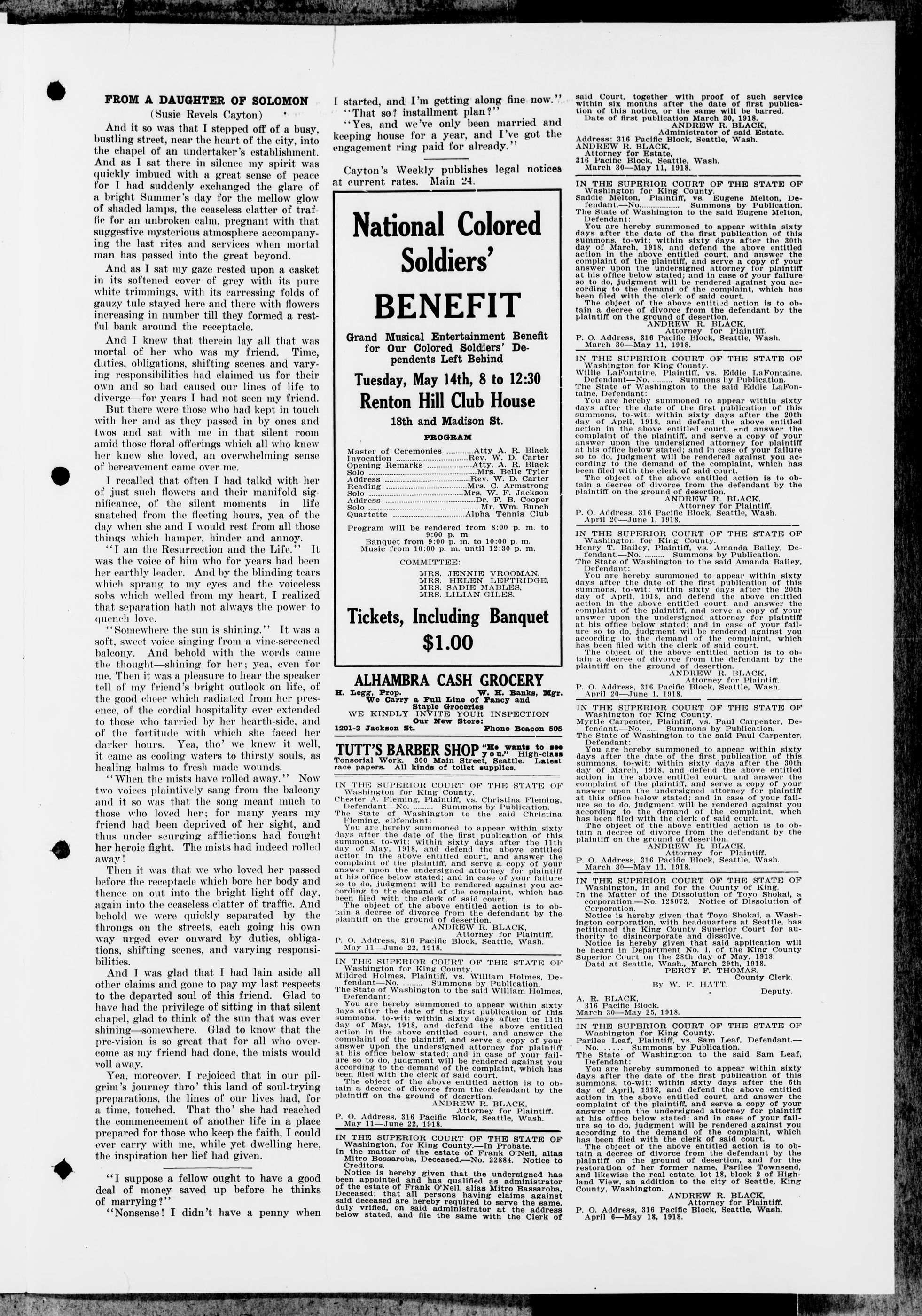
National Colored
S Idi ,
Grand Musical Entertainment Benefit
for Our Colored Soldiers’ De-
pendents Left Behind
Tuesday, May 14th, 8 to 12:30
3
Renton Hill Club House
18th and Madison St.
PROGRAM
Master of Ceremonies . ..Atty A. R. Black
Invocation ..........ccceeeeeee- REV. W. D. Carter
Opening Remarks ...... Atty, A. R. Black
PROTO gsccnocennpscsesnctdssosesnre wee Mrs. Belle Tyler
BOOP OBE 5. piccccocpidsscrccisocscstacsrg BOW Ws as OME UBE
Reading ............... ws-Mrs, C. Armstrong
BOLO cbs ckce chinese nce Wi he Men
AGAVOBD » <...00:0..:, Jivierasnaseey Oy: ee OOUEr
OU aie ecssce sorcerer ety WI EBON
Quartette 0c Alpha Tennis Club
Program will be rendered from 8:00 p. m. to
9:00 p. m.
Banquet from 9:00 p. m. to 10:00 p. m.
Music from 10:00 p. m. until 12:30 p. m.
COMMITTEE:
MRS. JENNIE VROOMAN,
MRS. HELEN LEFTRIDGE,
MRS. SADIE MABLES,
MRS. LILIAN GILES,
; .
Tickets, Including Banquet
$1.00
H. Legg, Prop. ‘W. H. Banks, Mgr.
‘We Carry a Full Line of Fancy and
Staple Groceries
WE KINDLY INVITE YOUR INSPECTION
Our New Store:
1201-3 Jackson St. Phone Beacon 505
7 “He wants to see
TUTT’S BARBER SHOP 32%? *itgncists
Tonsorial Work. 300 Main Street, Seattle. Latest
race papers. All kinds of toilet supplies.
IN THE SUPERIOR COURT OF THE STATE OF
Washington for King County.
Chester A. Fleming, Plaintiff, vs. Christina Mleming,
Defendant—No. .......... Summons by Publication.
The State of Washington to the said Christina
Fleming, eDfendant:
You are hereby summoned to appear within sixty
days after the date of the first publication of this
summons, to-wit: within sixty days after the 11th
day of May, 1918, and defend the above entitled
action in the above entitled court, and answer the
complaint of the plaintiff, and serve a copy of your
answer upon the undersigned attorney for plaintiff
at his office below stated; and in case of your failure
so to do, judgment will be rendered against you ac-
cording to the demand of the complaint, which has
been filed with the clerk of said court.
The object of the above entitled action is to ob-
tain a decree of divorce from the defendant by the
plaintiff on the ground of desertion.
ANDREW R. BLACK,
Attorney for Plaintiff.
P. 0. Address, 316 Pacific Block, Seattle, Wash.
May 11—June 22, 1918.
IN THE SUPERIOR COURT OF THE STATE OF
Washington for King County.
Mildred Holmes, Plaintiff, vs. William Holmes, De-
fendant—No, .......... Summons by Publication.
The State of Washington to the said William Holmes,
Defendant:
You are hereby summoned to appear within sixty
days after the date of the first publication of this
summons, to-wit: within sixty days after the 11th
day of May, 1918, and defend the above entitled
action in the above entitled court, and answer the
complaint of the plaintiff, and serve a copy of your
answer upon the undersigned attorney for plaintiff
at his office below stated; and in case of your fail-
ure so to do, judgment will be rendered against you
according to the demand of the complaint, which has
been filed with the clerk of said court.
The object of the above entitled action is to ob-
tain a decree of divorce from the defendant by the
plaintiff on the ground of desertion.
ANDREW R. BLACK,
Attorney for Plaintiff.
P. 0. Address, 316 Pacific Block, Seattle, Wash.
May 11—June 22, 1918,
er
IN_THE SUPERIOR COURT OF THE STATE OF
Washington, for King County.—In Probate.
In the matter of the estate of Frank O'Neil, alias
Mitro Bossaroba, Deceased.—No. 22884. Notice to
Creditors.
Notice is hereby given that the undersigned has
been appointed and has qualified as administrator
of the estate of Frank O'Neil, alias Mitro Bassaroba,
Deceased; that all persons having claims against
said deceased are hereby required to serve the same,
duly vrified, on said administrator at the address
below stated, and file the same with the Clerk of
said Court, together with proof of such service
within six'months after the date of first publica-
tion of this notice, or the same will be barred.
Date of first publication March 30, 1918.
ANDREW R. BLACK,
Administrator of said Estate.
Address: 316 Pacific Block, Seattle, Wash.
ANDREW R. BLACK,
Attorney for Estate,
316 Pacific Block, Seattle, Wash.
March 30—May 11, 1918.
IN THE SUPERIOR COURT OF THE STATE OF
Washington for King County.
Saddie Melton, Plaintiff, vs. Eugene Melton, De-
fendant.—No................._ Summons by Publication.
The State of Washington to the said Hugene Melton,
Defendant:
You are hereby summoned to appear within sixty
days after the date of the first publication of this
summons, to-wit: within sixty days after the 30th
day of March, 1918, and defend the above entitled
action in the ‘above entitled court, and answer the
complaint of the plaintiff, and serve a copy of your
answer upon the undersigned attorney for plaintift
at his office below stated; and in case of your failure
so to do, judgment will be rendered against you ac-
cording to the demand of the complaint, which has
been filed with the clerk of said court.
The object of the above entiticd action is to ob-
tain a decree of divorce from the defendant by the
plaintiff on the ground of desertion.
ANDREW R. BLACK,
Attorney for Plaintiff.
P. 0. Address, 316 Pacific Block, Seattle, Wash.
March 20—Mav 11. 1918.
fe AGGTCES, O40 FACING DOCK, SCALLIC, WaASK.
March 30—May 11, 1918.
IN THE SUPERIOR COURT OF THE STATE OF
Washington for King County.
Willie LaFontaine, Plaintiff, vs. Eddie LaFontaine,
Defendant—No. ......... Summons by Publication,
The State of Washington to the said Eddie LaFon-
taine, Defendant:
You are hereby summoned to appear within sixty
days after the date of the first publication of this
summons, to-wit: within sixty days after the 20th
day of April, 1918, and defend the above entitled
action in the above entitled court, and answer the
complaint of the plaintiff, and serve a copy of your
answer upon the undersigned attorney for plaintiff
at his office below stated; and in case of your failure
so to do, judgment will be rendered against you ac-
cording to the demand of the complaint, which has
been filed with the clerk of said court.
The object of the above entitled action is to ob-
tain a decree of divorce from the defendant by the
plaintiff on the ground of desertion.
ANDREW R. BLACK,
Attorney for Plaintiff.
P. O. Address, 316 Pacific Block, Seattle, Wash.
April 20—June 1, 1918.
IN THE SUPERIOR COURT OF THE STATE OF
Washington for King County.
Henry T. Bailey, Plaintiff, vs. Amanda Bailey, De-
fendant.—No. . Summons by Publication,
The State of Washington to the said Amanda Bailey,
Defendant:
You are hereby summoned to appear within sixty
days after the date of the first publication of this
summons, to-wit: within sixty days after the 20th
day of April, 1918, and defend the above entitled
action in the above entitled court, and answer the
complaint of the plaintiff, and serve a copy of your
answer upon the undersigned attorney for plaintiff
at his office below stated; and in case of your fail-
ure so to do, judgment wil be rendered against you
according to the demand of the complaint, which
has been filed with the clerk of said court.
The object of the above entitled action is to ob-
tain a decree of divorce from the defendant by the
plaintiff on the ground of desertion.
ANDREW R. BLACK,
Attorney for Plaintiff’.
P. O. Address, 316 Pacific Block, Seattle, Wash,
April 20—June 1. 1918.
IN THE SUPERIOR COURT OF THE STATE OF
Washington for King County.
Myrtle Carpenter, Plaintiff, vs. Paul Carpenter, De-
fendant.—No, ...... Summons by Publication.
The State of Washington to the said Paul Carpenter,
Defendant:
You are hereby summoned to appear within sixty
days after the date of the first publication of this
summons, to-wit: within sixty days after the 30th
day of March, 1918, and defend the above entitled
action in the ‘above entitled court, and answer the
complaint of the plaintiff, and serve a copy of your
answer upon the undersigned attorney for plaintiff
at this office below stated; and in case of your fail-
ure so to do, judgment will be rendered against you
according to the demand of the complaint, whch
has been filed with the clerk of said court.
The object of the above entitled action is to ob-
tain a decree of divorce from the defendant by the
plaintiff on the ground of desertion,
ANDREW R. BLACK,
Attorney for. Plaintiff.
P.O. Address, 316 Pacific Block, Seattle, Wash.
March 30—-May 11. 1918.
IN_THE SUPERIOR COURT OF THE STATE OF
Washington, in and for the County of King.
In the Matter of the Dissolution of Toyo Shokai,
corporation.—No. 128072. Notice of Dissolution of
Corporation.
Notice is hereby given that Toyo Shokai, a Wash-
ington corporation, with headquarters at Seattle, has
petitioned the King County Superior Court for au-
thority to disincorporate and dissolve.
Notice is hereby given that said application will
be heard in Department No. 1, of, the King County
Superior Court on the 28th day of May, 1918.
Datd at Seattle, Wash. March 29th, 1918.
PERCY F. THOMAS.
County Clerk.
By W. F. HATT,
= igs. aap ane * Deputy.
A. R, BLACK,
316 Pacific Block.
March 30—May 25, 1918.
IN THE SUPERIOR COURT OF THE STATE OF
Washington for King County.
Parilee Leaf, Plaintiff, vs. Sam Leaf, Defendant.—
No. ...... Summons by Publication.
The State of Washington to the said Sam Leaf,
Defendant:
You are hereby summoned to appear within sixty
days after the date of the first publication of this
summons. to-wit: within sixty days after the 6th
day of April, 1918, and defend the above entitled
action in the above entitled court, and answer the
complaint of the plaintiff, and serve a copy of your
answer upon the undersigned attorney for plaintiff
at his office below stated; and in case of your fail-
ure so to do, judgment will be rendered against you
according to the demand of the complaint, which
has been filed with the clerk of said court.
The object of the above entitled action is to ob-
tain a decree of divorce from the defendant by the
plaintiff on the ground of desertion, and for the
restoration of her former name, Parilee Townsend,
and likewise the real estate, lot 18, block 2 of High-
land View, an addition to the city of Seattle, King
County, Washington.
ANDREW R. BLACK,
Attorney for Plaintiff.
P. O. Address, 316 Pacific Block, Seattle, Wash.
April 6—May 18, 1918.
TOWN TOPICS
Is Black black? No, and Black is not white, "but," said a lady, who had seen him in a crowd, "Black is almost white."
Of course you are an angel without wings, but, who is your friend, to whom you whisper either with your lips or your eyes, behind the screens.
If Sam Corbett will but remember that a Negro is only an Irishman turned wrong side out he will have less regrets about the coming of the Mt. Zion Baptist Church as his neighbor.
Tommy Williams, at one time a popular tonsorial artist at Tutt's barber shop, has wired Mr. Tutt that he had left Juneau for Seattle, which will doubtless land him here Sunday evening or Monday morning.
It is truly hoped that the most of the 400 colored men working on the Seattle waterfront are saving a certain percent of their wages by investing the same in a home, which they will endeavor to fully pay for while getting big wages is good.
A white and a colored kid got into a knock down and drag out at one of the Seattle High Schools and they were doing things so smoothly that a number of the teachers watched it with intent interest—it resulting in a draw, and there was nothing said.
Mr. and Mrs. M. J. Shockley and Mrs. Lucy Jones wish to thank their many friends for their kindness and sympathy in their late bereavement, the sickness and death of their daughter and grand-daughter Myrtle. Its in moments of sorrow that kind words and acts have the most soothing effect.
Mr. and Mrs. Alonzo Laning are making preparations to go to housekeeping in Bremerton, where he has steady employment. Large numbers of colored men, who are employed at the Puget Sound navy yard, live in Seattle and go over every morning, but that means very early rising and about two and a half hours each day in transit, hence Mr. Laning's desire to live in Bremerton and be closer to his work.
It is learned from B. F. Tutt that Prof. Kelly Miller will lecture in Seattle about June 26th. Prof. Miller is one of the most noted lecturers on the American stage and if he does come to Seattle it is here predicted that a house full and overflowing will greet him. He is likewise a writer of rare ability and his recent open letter to President Wilson enticed. The Shame of Democracy, is considered one of the most scholarly as well as statesmanlike documents that has been put in public print for many years.
Let no one overlook the benefit for the colored soldiers now at the front, which will be held at the Renton Hill Club House next Tuesday evening under the general directorship of Mrs. Jennie Vrooman and assisted by Mrs. Leftridge, Mrs. Mables and Mrs. Giles. A musical program interspersed with speaking will be rendered in the early part of the evening. After the program those who like will have an opportunity of whirling in the maizy dance. Mrs. Vrooman is an untiring worker in the interest of public benefits and it is truly hoped that her efforts on this occasion will be crowned with overflowing success. Mrs. Belle Tylar, who is a most pleasing vocalist, will render one of her sweetest on this occasion.
"Something like a hundred colored men are working at Frye's packing plant and more are constantly coming," said W. D. Slater, who recently returned to the city from Kittitas county, where he has a homestead. "After looking the various openings for colored help over I concluded that Frye's slaughter house looked good to me and in the end I would have earned more money. We are treated fine out there if we attend to our knitting." Mr. Slater went to his ranch in the early Spring and after putting it to potatoes and other farm truck he returned to Seattle to
grab some easy money, but hired a boy to watch the ranch during his absence. "If it does half well," he says, "I will have smooth sailing next winter."
Grace Presbyterian Church of this city is soon to again be the center of attraction in colored society, owing to the coming of its new pastor, who is expected here about June 1st. The officers and members are perfecting their plans for receiving the new pastor, and if they are successful in completing what they have in mind, there will be some doings when he arrives. Rev. Hayden, acting pastor, has entered into the full spirit of the making ready, and he himself plans to make one mighty effort to turn over the church free of debt to the new pastor. In his efforts Mr. Cragwell and other members are heartily cooperating with him. The officers further hope to have a part of the inside of the edifice redecorated for the occasion.
Recently a number of young colored men of the city organized an Efficiency Club, the object of which is to encourage more proficiency among those employed in and about the city. George E. Wright was elected president and it starts out under most favorable auspices. At its meeting last Wednesday evening the club decided to hold a public smoker at Harmony Hall, 14221/2 Second Avenue, Thursday evening, May 16th, 1918, to which the general public is invited. The set speeches for the occasion will be as follows: Objects and Aims of The Club, Dr. F. B. Cooper; The Value of Such Clubs, Hayden J. Richardson; How Seattle Will Be Benefited by Such a Club, E. J. Porter. No charges for either admission or the smokes and refreshments that will be served.
The last Thursday and Friday in June the State Federation of Colored Women's Clubs will convene in Seattle to hold their first annual meeting. The Federation was organized last August in Spokane and the officers are as follows: President, Mrs. John E. Mapps (Spokane); vice-president-at-large, Mrs. W. D. Carter (Seattle); second vice-president, Mrs. Alice S. Presto (Seattle); secretary, Mrs. Charles Haultz-claw (Spokane). It is expected that at least fifty delegates from Spokane will be inattendance at the coming Seattle meeting and delegates from every section of the state are expected. Many things will come up at this meeting that will be of vital importance to the colored folks of the Northwest and it is earnestly hoped by the members that large numbers of the local citizenry will attend the sessions.
A ten cent round trip fare to Bremerton would be an incentive for more Seattle men to seek employment at the Puget Sound navy yard and at that the boat operator would lose nothing, as a boat can carry 450 men, meaning $45 for a round trip, which requires two hours to make. The operators of the boats to the navy yard, like all the profiteers, want to get rich quick and so they have been charging every cent they could drag out of the men. Hundreds of men with families have refused to take employment over there because the boat fare was unreasonable and house and room rents in Bremerton being so outrageously high. We do not quite advocate the government telling the boat operators what they must do, but the government should put on a line of boats to Bremerton and exact nothing but the cost of operating the boats.
At the annual meeting of the Woman's Political Alliance the following officers were elected for the ensuing year: President, Mrs. G. W. Dupee; vice-president, Mrs. A. R. Bonner; secretary, Miss Allie Dupee; assistant secretary, Mrs. Alice S. Presto; treasurer, Mrs. Frank N. Harris. The Alliance was organized in 1916 with Mrs. Alice S. Presto president and since that time has been doing good work in the interest of the colored folk of this city and county. It took an active part in the 1916 Republican compaign and made many friends. It plans to be heard in the coming campaign and hopes to be able to accomplish even more than it did in the last county campaign.
The Red Cross Auxiliary to the Alliance elected for the ensuing year the following officers: Chairman, Mrs. F. N. Harris; directress of sewing, Mrs. Lemuel Jenkins; directress of knitting, Mrs. Eugene A. Johnson; secretary, Mrs. Hamilton; treasurer, Mrs. A. R. Bonner.
The Auxiliary, under the retiring president, Mrs. G. L. Fields, did excellent work and turned over considerable money and many articles for the care and comfort of the soldiers. At the bazaar, which closed last week more than $120 was cleared and turned over to the Red Cross. Mrs. Harris, the new president, has had considerable experience in relief work in Seattle and it is predicted that she will accomplish much in the ensuing year.
After life's fitful fever death has claimed Alexander Miles, who has been more or less indisposed for some months, and his remains were incinerated last Thursday. He was in his eighties at the time of his death and he leaves a daughter to mourn his loss. As said in our last issue he was one of the unique characters that came to the Northwest, and he never quite adjusted himself to his adopted surroundings. In his youth he started out as a barber in Duluth, Minnesota. Though dark in complexion he married a white woman, who was a prosperous dressmaker of that city, from which union one child was born. Duluth took a great building boom about that time and he and his wife, both being prosperous in their business almost had money to burn. They invested heavily in speculative real estate and on the whole their investments gave good accounts of themselves and ere many moons, A. Miles was one of the big money guns of that city. He hob nobbed with James J. Hill and men of his financial calibre and enjoyed their association as well as friendship. It is safe to say that at one time he could have cashed in for $500,000 and still had a scrap or so left, but like many speculators he wanted more and continued to plunge and instead of getting more he got nothing and woke up to but realize, all was lost. To occupy so exalted a financial pedestal and then fall flat is a terrific blow to anyone and many is the man that has taken his own life rather than face such changed conditions, but he just pulled up and came West and silently went back to his trade as a journeyman. Whatever may have been his feelings he kept them to himself. Evidently he hoped to regain at least some of his lost ground, but the tide was against him, and his was a constant battle for bread. Sickness overtook him and the end seemed to be in sight, but his old time ambition was still alive and he refused to bow to the inevitable. Being without sufficient funds to be cared for at a private sanitarium the county hospital was suggested, at which his whole soul rebelled, but friends found it necessary to take him there. He died the next day and, it is suspected, of a broken heart. Such are the fates of fortunes. May his soul rest in peace and find that comfort in death it failed to find in life.
SPRING MOTORING
The choo-choo season has arrived, the roads are good, the fields are green; I'm thankful that I have survived to burn a lot more gasoline. Sometimes I thought when tempests shreiked I wouldn't live to see the spring, for rheumatism through me streaked and wrenched my joints like everything. When blizzards, whooping down from Nome, were brawling angrily and loud, I called morticians to my home to figure on a bier and shroud. But I hung on through sleet and snow, the lamp of life maintained its flame, and now that springtime breezes blow you'll see me in the motor game. I'll buy some bonds to save the boons inherited from martial sires; I'll spend some bones for bread and prunes and blow some more for rubber tires. I've cut rich cigars and wines and made a simple bill of fare; I'll need my change to pay my fines for busting speed laws here and there. I'll blow a portion of long green to help the Red Cross work, that's blest; the bulk will go for gasoline—mechanics then will get the rest.