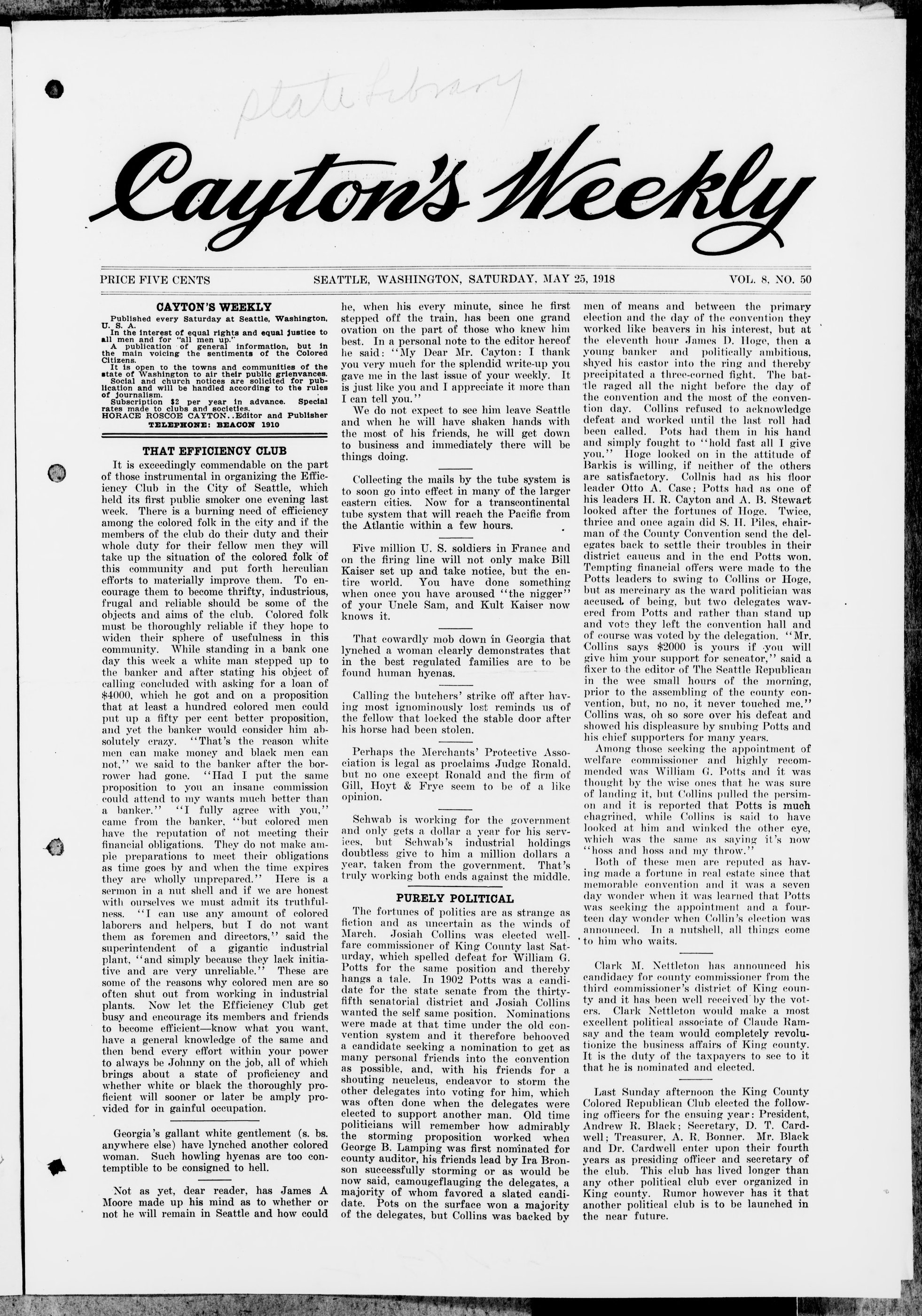
Cayton's Weekly
Saturday, May 25, 1918
Seattle, Washington
Page text (machine-generated)
---
PRICE FIVE CENTS
CAYTON'S WEEKLY
Published every Saturday at Seattle, Washington, U. S. A.
In the interest of equal rights and equal justice to all men and for "all men up." A publication of general information, but in the main voicing the sentiments of the Colored Citizens.
It is open to the towns and communities of the state of Washington to air their public grievances. Social and church notices are solicited for publication and will be handled according to the rules of journalism.
Subscription $2 per year in advance. Special rates made to clubs and societies. HORACE ROSCOE CAYTON..Editor and Publisher TELEPHONE: BEACON 1910
THAT EFFICIENCY CLUB
It is exceedingly commendable on the part of those instrumental in organizing the Efficiency Club in the City of Seattle, which held its first public smoker one evening last week. There is a burning need of efficiency among the colored folk in the city and if the members of the club do their duty and their whole duty for their fellow men they will take up the situation of the colored folk of this community and put forth herculian efforts to materially improve them. To encourage them to become thrifty, industrious, frugal and reliable should be some of the objects and aims of the club. Colored folk must be thoroughly reliable if they hope to widen their sphere of usefulness in this community. While standing in a bank one day this week a white man stepped up to the banker and after stating his object of calling concluded with asking for a loan of $4000, which he got and on a proposition that at least a hundred colored men could put up a fifty per cent better proposition, and yet the banker would consider him absolutely crazy. "That's the reason white men can make money and black men can not," we said to the banker after the borrower had gone. "Had I put the same proposition to you an insane commission could attend to my wants much better than a banker." "I fully agree with you," came from the banker. "but colored men have the reputation of not meeting their financial obligations. They do not make ample preparations to meet their obligations as time goes by and when the time expires they are wholly unprepared." Here is a sermon in a nut shell and if we are honest with ourselves we must admit its truthfulness. "I can use any amount of colored laborers and helpers, but I do not want them as foremen and directors," said the superintendent of a gigantic industrial plant, "and simply because they lack initiative and are very unreliable." These are some of the reasons why colored men are so often shut out from working in industrial plants. Now let the Efficiency Club get busy and encourage its members and friends to become efficient—know what you want, have a general knowledge of the same and then bend every effort within your power to always be Johnny on the job, all of which brings about a state of proficiency and whether white or black the thoroughly proficient will sooner or later be amply provided for in gainful occupation.
Georgia's gallant white gentlement (s. bs. anywhere else) have lynched another colored woman. Such howling hyenas are too contemptible to be consigned to hell.
Not as yet, dear reader, has James A Moore made up his mind as to whether or not he will remain in Seattle and how could
he, when his every minute, since he first stepped off the train, has been one grand ovation on the part of those who knew him best. In a personal note to the editor hereof he said: "My Dear Mr. Cayton: I thank you very much for the splendid write-up you gave me in the last issue of your weekly. It is just like you and I appreciate it more than I can tell you." We do not expect to see him leave Seattle and when he will have shaken hands with the most of his friends, he will get down to business and immediately there will be things doing.
Collecting the mails by the tube system is to soon go into effect in many of the larger eastern cities. Now for a transcontinental tube system that will reach the Pacific from the Atlantic within a few hours.
Five million U. S. soldiers in France and on the firing line will not only make Bill Kaiser set up and take notice, but the entire world. You have done something when once you have aroused "the nigger" of your Uncle Sam, and Kult Kaiser now knows it.
That cowardly mob down in Georgia that lynched a woman clearly demonstrates that in the best regulated families are to be found human hyenas.
Calling the butchers' strike off after having most ignominously lost reminds us of the fellow that locked the stable door after his horse had been stolen.
Perhaps the Merchants' Protective Association is legal as proclaims Judge Ronald, but no one except Ronald and the firm of Gill, Hoyt & Frye seem to be of a like opinion.
Schwab is working for the government and only gets a dollar a year for his services, but Schwab's industrial holdings doubtless give to him a million dollars a year, taken from the government. That's truly working both ends against the middle.
PURELY POLITICAL
The fortunes of politics are as strange as fiction and as uncertain as the winds of March. Josiah Collins was elected welfare commissioner of King County last Saturday, which spelled defeat for William G. Potts for the same position and thereby hangs a tale. In 1902 Potts was a candidate for the state senate from the thirty-fifth senatorial district and Josiah Collins wanted the self same position. Nominations were made at that time under the old convention system and it therefore behooved a candidate seeking a nomination to get as many personal friends into the convention as possible, and, with his friends for a shouting neucleus, endeavor to storm the other delegates into voting for him, which was often done when the delegates were elected to support another man. Old time politicians will remember how admirably the storming proposition worked when George B. Lamping was first nominated for county auditor, his friends lead by Ira Bronson successfully storming or as would be now said, camougeflauging the delegates, a majority of whom favored a slated candidate. Pots on the surface won a majority of the delegates, but Collins was backed by
VOL. 8. NO. 50
men of means and between the primary election and the day of the convention they worked like beavers in his interest, but at the eleventh hour James D. Hoge, then a young banker and politically ambitious, shyed his castor into the ring and thereby precipitated a three-corned fight. The battle raged all the night before the day of the convention and the most of the convention day. Collins refused to acknowledge defeat and worked until the last roll had been called. Pots had them in his hand and simply fought to "hold fast all I give you." Hoge looked on in the attitude of Barkis is willing, if neither of the others are satisfactory. Collnis had as his floor leader Otto A. Case; Potts had as one of his leaders H. R. Cayton and A. B. Stewart looked after the fortunes of Hoge. Twice, thrice and once again did S. H. Piles, chairman of the County Convention send the delegates back to settle their troubles in their district caucus and in the end Potts won. Tempting financial offers were made to the Potts leaders to swing to Collins or Hoge, but as mercinary as the ward politician was accused of being, but two delegates wavered from Potts and rather than stand up and vote they left the convention hall and of course was voted by the delegation. "Mr. Collins says $2000 is yours if you will give him your support for senator," said a fixer to the editor of The Seattle Republican in the wee small hours of the morning, prior to the assembling of the county convention, but, no no, it never touched me." Collins was, oh so sore over his defeat and showed his displeasure by snubing Potts and his chief supporters for many years.
Among those seeking the appointment of welfare commissioner and highly recommended was William G. Potts and it was thought by the wise ones that he was sure of landing it, but Collins pulled the persimon and it is reported that Potts is much chagrined, while Collins is said to have looked at him and winked the other eye, which was the same as saying it's now "hoss and hoss and my throw." Both of these men are reputed as having made a fortune in real estate since that memorable convention and it was a seven day wonder when it was learned that Potts was seeking the appointment and a fourteen day wonder when Collin's election was announced. In a nutshell, all things come to him who waits.
Clark M. Nettleton has announced his candidacy for county commissioner from the third commissioner's district of King county and it has been well received by the voters. Clark Nettleton would make a most excellent political associate of Claude Ramsay and the team would completely revolutionize the business affairs of King county. It is the duty of the taxpayers to see to it that he is nominated and elected.
Last Sunday afternoon the King County Colored Republican Club elected the following officers for the ensuing year: President, Andrew R. Black; Secretary, D. T. Cardwell; Treasurer, A. R. Bonner. Mr. Black and Dr. Cardwell enter upon their fourth years as presiding officer and secretary of the club. This club has lived longer than any other political club ever organized in King county. Rumor however has it that another political club is to be launched in the near future.
---
---
ALMOST HAD RELIGION
Among the colored folks of the South, immediately after the war, there were but two classes, the saints and the sinners—no degrees among the former, but quite a few among the latter, that is to say, the ordinary sinner could be easily brought to the mourner's bench at the annual summer "tracted effuts," but the sinner, who had stood at the crossroad, one leading from a "grave yard," and sold himself to the devil, if he (the devil) would give him a gift to play the fiddle and had nerve enough to play a jig, while the headless spooks scampered by, was to their minds beyond the pales of saving grace. Such sinners could sit and grin at the "elder" while he was preaching his most blood curdling hell and damnation sermon and find amusement in those meetings, where the convicted sinners were screaming "bretheren what shall I do to be saved."
It was in a meeting of this nature that Bob Brazile, who had joyfully gone through many "tracted effuts" without having had any remorse of conscience, when he got hit. While Bob had long since been put down as having sold his soul to the devil, yet he was a bully good fellow and one of the most reliable as well as trustworthy men on the plantation, but he was a hardened sinner, and in the minds of his colored bretheren, "wus gwine to hell in a hand baskit." He would not only play cards on Sunday, go to dances, call "de figers" and cuss, but "wust uv all" he would go fishing on Sunday and "wonce" offered the preacher a mess of fish he caught on Sunday.
Oh Bob was an awful sinner and all of the preachers had long since given him up as the absolute property of the devil. May perhaps, dear reader, you have no idea what a painful process one had to undergo in those "tracted effuts" in order to get converted. First of all after you had listened to a "most powerful sermon" of about two hours' duration, and listened to the plaintiff "moans" of the brothers and sisters, bearing up the words of the elder, and saw the sisters shout themselves almost nude, you must fall under conviction, that the prayers of the righteous might besiege heaven for your conversion. If you happen to be a harden sinner you might be under conviction for a whole week, but you must keep in constant prayer, eating little or nothing and looking serious every minute, and perhaps at the end of the week your sins would drop from you like a clap of thunder and you would out run the devil and all his hosts and reach the realm of everlasting bliss. Whether right or wrong the people had been educated or tutored up to that belief and it was impossible to change them.
As said above Bob had been some sinner, but at one of these "tracted effuts" he fell under conviction. The meeting was just about to close when he fell under conviction, but this was such a star in "de elder's crown" that the meeting was extended one week to try to convert Bob. During that week he prayed earnestly and hard and made every effort to see the light. Not one time did he lose his temper with the devilish old mule he was plowing, and devilish old mule is said advisedly, for one of those long eared skunks would make a preacher cuss. He would even stop his mule and uncover a worm or a bug that got covered up with the dirt from his turn plow, so softened had his heart become. One night after returning from a most glorious meeting, which was heard two miles away, Bob was in agony and as he lay in his bed praying for forgiveness and freedom from past sins, in the deep stillness of the night, when nature itself sleeps, he heard a sound. The houses at that time in which colored tenants lived were made of round pine poles put up hog pen fashion and clap board covered. Boards were laid on the joice thus making a rude loft in the house and many household things were thrown up there. Bob's bed was under this loft at the time he heard the sound. His wife lay by his side, and while she too was praying for his conversion, yet she was endowed with more or less
horse sense, which applied to her religious beliefs.
As Bob lay in earnest prayer all of a sudden something fell on the floor of the cabin that shook it from center to circumference. Bob trembled in every joint and lay speechless for quite a few minutes. Then he whispered to his wife. "Cora, did you hear that fall." "Yes," she promptly replied. "Do you know what that was?" "Yes, but what do you think it was?" "That was my sins falling from me." "Oh go on Bob that was nothing but our old black cat that fell out of our loft." "Is that so," he replied in a rage, "we'll G-damn her old soul, I'll beat hell out of her," and got up and proceeded to execute his threat. For that time Bob's praying ended and the "tracted effut" unceremoniously closed. In talking about it a few days thereafter to the preacher he said, "I tell you, elder, I sho'd had a ligion if dat damn black cat hadn't to bothered me."
FROM A DAUGHTER OF SOLOMAN (Susie Reeves Cayton)
It was the Cynic who stood by my side, and behold we were debating whether or not we would enter the carnival grounds on University Street between Fourth and Fifth. We could see quite an enticing bit over the fence—a few booths, the Ferris wheel, and the Merry-go-round. Let us go in, I coaxed. The Unions are giving this carnival to help with the war fund. "Alright," replied the Cynic, "but likely you'll find it not worth the admittance fee." And it so was, that as we were about to enter a band was heard coming our way.
Beloved, thou knowest the effect of a brass band marching down the street: the crowd thickened as if by magic. And we looked, and saw that it was the Boy Scouts, ending up their splendid drive in the Third Liberty Loan. And some were short boys and some were long ones. Verily, it was with pride they marched—these American men of tomorrow.
And my heart waxed warm within me as I beheld those boys of tender years keeping step to the drum beat and the bugle. And my thoughts flew on to the cantonments, all over our land where other boys, now older grown, were in step to that same martial sound, and on, and on to the bloody battle fields of France where others were daily being called to enter the deadly trenches, yea, to cross no man's land.
And still those Boy Scouts filed past. God bless them, I thought. They are bravely doing their bit.
Then it was a column of Negro Boy Scouts turned the corner, and behold, they carried themselves in true military style. Their step was excellent for the Negro falls easily into the rhymth of music. God made him so. And behold, as they faced the street on which we were, a white American, who stood near us, burst out in an uprorous fit of laughter. And the derision in his mirth clashed with that patriotic drum beat. Yea, its discordant tones harshly rose above the soldierly tread.
"What do you think of that?" he yelled to some one below him. "Nigger boys marching right on the streets with white boys! Don't you know they think they're great?"
And, it was when the Scouts had all passed and the music reached us but faintly, that I looked into the Cynic's face and lo it was sorely troubled. "I now know what it is to hate," said he, "my heart has burned with it. My thoughts have been saturated with it. I have felt it, for a moment, in every atom of my being for that man and his entire race. I did not mind his words so much, every jack-ass must bray, but that laugh."
And I answered him not. Yet I linked my arm in his and started across the street, and behold when some time had elapsed I spake to him saying: "you are making the same mistake many other make, you are judging an entire race of people by a single individual."
Thereupon, he replied hotly, "That man is not alone. When the first draft of Race men left our city they were grandly entertained at the Y. M. C. A. They were given a send-off befitting those who are called upon to give up all for country. The parade which escorted them to the station, I witnessed from the street. And when it had passed, a white American called, right over my face, to his companion: "The idea of people stopping on the streets like this just to see a lot of niggers go by."
"Verily," said I, "the man did not know enough to read the daily papers. Yea, he did not know enough to know that he was letting the public know how little he knew. Behold, a man whose opinion is worth considering does not express it in public places for the amusement or enlightenment of others. Again, you are judging the majority by the minority. Beloved, it can not be done." "Be that as it may," exclaimed the Cynic. "I would like to have called back every mother's son of those drafted men and sent them to their homes. Let the nigger haters fight, let the nigger haters die, say I."
Then, indeed, was I grievously tried. My blood ran with fever heat, yea, my breath came in gasps. "Not so," I cried, "our race men are Americans. America is at war—we fight. Our race believes in, and has ever died for, liberty. The keynote of its life's struggle has been for liberty. The cornerstone of its very existence is liberty. This war is for American liberty and we'll bear our part in it. The winning of the war means democracy. It's up to America to fight. Verily, we are Americans and we claim the right to fight, yea, to die for America. Let all such as you heard yell nigger, yell on. We'll drown them out by the tramp of our feet as we run to get our guns. Meanwhile, our women-folk will keep the home-fires burning."
"Moreover, think of our race men in the trenches over there! Think of our race men in training throughout the country; What if there is a great hullabaloo about separate cantonment, and indiscriminate mixing of the man power Uncle Sam is sending over to whip the Huns, the underlying principles of this war is not America's home rule or the weakness in American institutions; it's American liberty, American prosperity, American democracy.
"The call to arms has been given. Fight? Why we'll—but I shall now have to depart from you. If I talk any longer I fear I might grab an American flag and start running down the street."
SELAH
END OF THE WAR
You ask me when the war will end, and sadly I reply, "I fear it will not stop my friend, till pigs begin to fly." A flippant answer, you will say, to come from my fat tongue; but every hour of every day I hear that question sprung. I am no seer in spangled robe, no wizard full of gall, who looks into a crystal globe and tells what will befall. No prophet's mantle came my way, the mystic's power to lend, and so I really cannot say just when the war will end. Oh, I can see as far ahead as any common swain; and when the morning sky is red, I know there will be rain; and I can tell by sundry signs when there'll be snow and sleet; along such cheap forecasting lines I simply can't be beat. But when you to my lair ascend, along my stairway steep, and ask me when the war will end, "Search me," I say, and weep. Oh, once I won a full size cheese, as good as cheeses are, by guessing just how many peas were in a grocer's jar. All guessing contests I attend, in this and other lands, but ask me when the war will end and I throw up my hands.
—Walt Mason.
There probably will be no union of the Methodist Episcopal Church and the Methodist Episcopal Church South and all because the members of the former are Christions while the members of the latter are hyprocrites and in many instances criminals, either before or after the fact.
WE SHOULD SMILE
The naval class was under signal instruction. Most of them had just come back from leave and, as a result, to some of the boys in blue the instructor's voice seemed very far away, indeed.
"A ship in distress," he was saying, through the room spaces, "has several methods by means of which she can make known her condition to the vessels or shore stations.. Name one, Binks!"
"The international code signal 'N. C.'" replied Binks, waking up just in time.
"Right!" said the instructor. "Jenks, name another."
Jenks started out of a dream.
"Eh?" he ejaculated.
"What would you do if you were in distress?" repeated the signal instructor.
"Why," mumbled Jenks, "pawn me watch!"
As rats did much damage to his papers the Hindu clerk in charge of the official documents in one of the more remote Indian towns obtained permission to keep two cats, the larger of them receiving rather better rations. A few weeks later the head office at Delhi received this dispatch:
"I have the honor to inform you that the senior cat is absent without leave. What shall I do?"
To this problem there was vouchsafed no answer. After waiting a few days the Hindu sent off a proposal:
"In re absentee cat. I propose to promote the junior cat and in the meantime to take into government service a probationer cat on full rations."
The unconquerable Pat, being one day in town, found his way into a barber's shop to get a shave. As it was near dinner time the barber was feeling the gnawings of hunger he became hasty over the job and was unfortunate in inflicting several cuts on both of Pat's cheeks. The shave being concluded, Pat arose, and, approaching a table on which was a glass of water, he took a mouthful and rocked his head from side to side. "Anything the matter," asked the barber.
"Not much," came Pat's reply. "I was only just trying to find out whether my mouth would still hold water without leaking."
A letter had been received by the sergeant-major of artillery from the war office, with reference to one Gunner Green, who, reported killed, had arrived at Woolwich. Could a full and satisfactory explanation of same be forwarded?
The N. C. O. gave the matter much thought, and then forwarded this reply:
"Green was an old comrade of mine. I visited him when he was dying of his wounds, and then saw him buried. Hence I know that he is dead, and am considerably surprised to hear of his return to Woolwich; but please exonerate me from further blame, inasmuch as I am not responsible for his subsequent movements."
The poor cripple thumped his crutch on the ground and said to his lawyer:
"Merciful heavens, man, your bill is outrageous! You are taking four-fifths of my damages! I never heard of such extortion!"
"I furnished," said the lawyer coldly, "the skill, the eloquence and the legal training for your case."
"Yes, but I," said the clinet, ruefully glancing at his injuries, "I furnished the case itself."
"Bosh!" sneered the lawyer. "Anybody can fall down a coal hole."
A lady recently selecting a hat at a milliner's asked, cautiously:
"Is there anything about these feathers that might bring me into trouble with the Bird Protection Society?"
"Oh no madam," said the milliner.
"But did they not belong to some bird?" persisted the lady. "Well, madam," returned the milliner,
pleasantly, "these feathers are the feathers of a howl; and the howl, you know, madam, seein' as 'ow fond he is of mice, is more of a cat than a bird."
A lady crossing from France to England was asked by the customs officer if she had anything dutiable. She assured him that she had nothing but wearing apparel in her trunks, but at the bottom of the largest one, which to him seemed the most suspicious, were found twelve bottles of brandy.
"Madam," said the officer, sarcastically, "do you call these wearing apparel?"
"Certainly," she replied, sweetly. "Those are my husband's nightcaps."
A party of visitors entered a metropolitan art studio. The curator, who was engaged in showing them around, was called away on business and left the guests in charge of one of the clerks. They were admiring a beautiful statue of translucent marble. He dwelt upon the fine points of the statue, giving the name of the sculptor, showing it from every viewpoint.
One of the visitors asked: "Alabaster, isn't it?"
"No. Venus." he corrected.
Irving Fletcher said at the club, apropos of the failure of one of those tailors of the expensive, exclusive who do not even display their wares in their windows: "The trend of modern business proves that if a man won't advertise his goods the sheriff will step in and do it for him."
The wrathful visaged dame was cuffing the small boy so vigorously that the benevolent old lady interposed.
"Surely he has done nothing to deserve such a thrashing," she remonstrated; "a sweet child like that!"
"Sweet child is right," shouted the virago. "He's been and swallowed our sugar ticket!"
A schoolmaster received the following note one morning from a pupil:
"Dear Sir: Please eskcoose little Tommy for his absens yestiday as he was kwite il, and the doctor tolled me to kepe him in bed. So I let him stay home. Yours respectively,
"MISSES SMITH."
The master was a trifle suspicious.
"Tommy," said he, sternly, "who wrote that note?"
"My—er—mother did, if you please, sir."
"Well, I must say that some of that spelling is remarkably like the spelling you generally give me."
But Tommy was equal to the occasion.
"Yes, sir," said he cheerily. "Every one says that, as far as spelling is concerned, I'm the image of my mother."
The junior clerk sought out his employer and timidly addressed him:
"Could I have a fortnight's leave of absence, sir, to attend the wedding of a friend?"
"It must be a dear friend for you to want all that time?" remarked the boss, sarcastically.
"Well, after the wedding, sir, she—she'll be my wife!"
ALHAMBRA CASH GROCERY
H. Legg, Prop.
W. H. Banks, Mgr.
We Carry a Full Line of Fancy and
Staple Groceries
WE KINDLY INVITE YOUR INSPECTION
Our New Store:
1201-3 Jackson St.
Phone Beacon 505
TUTT'S BARBER SHOP "We wants to see you." High-class
Tonsorial Work. 300 Main Street, Seattle. Latest
race papers. All kinds of toilet supplies.
IN THE SUPERIOR COURT OF THE STATE OF
Washington for King County.
Chester A. Fleming, Plaintiff, vs. Christina Fleming, Defendant—No. ..... Summons by Publication. The State of Washington to the said Christina Fleming, eDfendant:
You are hereby summoned to appear within sixty days after the date of the first publication of this summons, to-wit: within sixty days after the 11th day of May, 1918, and defend the above entitled action in the above entitled court, and answer the complaint of the plaintiff, and serve a copy of your answer upon the undersigned attorney for plaintiff at his office below stated; and in case of your failure
so to do, judgment will be rendered against you according to the demand of the complaint, which has been filed with the clerk of said court.
The object of the above entitled action is to obtain a decree of divorce from the defendant by the plaintiff on the ground of desertion.
ANDREW R. BLACK,
Attorney for Plaintiff.
P. O. Address, 316 Pacific Block, Seattle, Wash.
May 11—June 22, 1918.
IN THE SUPERIOR COURT OF THE STATE OF Washington for King County.
Mildred Holmes, Plaintiff, vs. William Holmes, Defendant—No. ..... Summons by Publication.
The State of Washington to the said William Holmes, Defendant.
You are hereby summoned to appear within sixty days after the date of the first publication of this summons, to-wit: within sixty days after the 11th day of May, 1918, and defend the above entitled action in the above entitled court, and answer the complaint of the plaintiff, and serve a copy of your answer upon the undersigned attorney for plaintiff at his office below stated; and in case of your failure so to do, judgment will be rendered against you according to the demand of the complaint, which has been filed with the clerk of said court.
The object of the above entitled action is to obtain a decree of divorce from the defendant by the plaintiff on the ground of desertion.
ANDREW R. BLACK,
Attorney for Plaintiff.
P. O. Address, 316 Pacific Block, Seattle, Wash.
May 11—June 22, 1918.
IN THE SUPERIOR COURT OF THE STATE OF Washington for King County.
Dottie Blackadar, Plaintiff, vs. Carl H. Blackadar, Defendant.—No. ..... Summons by Publication,
tendant—No. Summons by Publication.
The State of Washington to the said Carl H. Blackadar, Defendant:
You are hereby summoned to appear within sixty days after the date of the first publication of this summons, to-wit: within sixty days after the 18th day of May, 1918, and defend the above entitled action in the above entitled court, and answer the complaint of the plaintiff, and serve a copy of your answer upon the undersigned attorney for plaintiff at his office below stated; and in case of your failure so to do, judgment will be rendered against you according to the demand of the complaint, which has been filed with the clerk of said court.
The object of the above entitled action is to obtain a decree of divorce from the defendant by the plaintiff on the ground of desertion.
ANDREW R. BLACK,
Attorney for Plaintiff.
P. O. Address, 316 Pacific Block, Seattle, Wash.
May 18—June 29, 1918.
IN THE SUPERIOR COURT OF THE STATE OF Washington for King County.
Willie LaFontaine, Plaintiff, vs. Eddie LaFontaine, Defendant—No. Summons by Publication. The State of Washington to the said Eddie LaFontaine, Defendant:
You are hereby summoned to appear within sixty days after the date of the first publication of this summons, to-wit: within sixty days after the 20th day of April, 1918, and defend the above entitled action in the above entitled court, and answer the complaint of the plaintiff, and serve a copy of your answer upon the undersigned attorney for plaintiff at his office below stated; and in case of your failure so to do, judgment will be rendered against you according to the demand of the complaint, which has been filed with the clerk of said court.
The object of the above entitled action is to obtain a decree of divorce from the defendant by the plaintiff on the ground of desertion.
ANDREW R. BLACK.
Attorney for Plaintiff.
P. O. Address, 316 Pacific Block, Seattle, Wash.
April 20—June 1, 1918.
IN THE SUPERIOR COURT OF THE STATE OF
Washington for King County.
Henry T. Bailey, Plaintiff, vs. Amanda Bailey, Defendant—No. Summons by Publication.
The State of Washington to the said Amanda Bailey, Defendant:
You are hereby summoned to appear within sixty days after the date of the first publication of this summons, to-wit: within sixty days after the 20th day of April, 1918, and defend the above entitled action in the above entitled court, and answer the complaint of the plaintiff, and serve a copy of your answer upon the undersigned attorney for plaintiff at his office below stated; and in case of your failure so to do, judgment will be rendered against you according to the demand of the complaint, which has been filed with the clerk of said court.
The object of the above entitled action is to obtain a decree of divorce from the defendant by the plaintiff on the ground of desertion.
P. O. Address, 316 Pacific Block, Seattle, Wash. April 20-June 1, 1918. IN THE SUPERIOR COURT OF THE STATE OF Washington, in and for the County of King.
In the Matter of the Dissolution of Toyo Shokal, a corporation.—No. 128072. Notice of Dissolution of Corporation. Notice is hereby given that Toyo Shokal, a Washington corporation, with headquarters at Seattle, has petitioned the King County Superior Court for authority to disincorporate and dissolve.
Notice is hereby given that said application will be heard in Department No. 1, of the King County Superior Court on the 28th day of May. 1918.
A. B. BLACK.
316 Pacific Block.
March 30—May 25, 1918.
IN THE SUPERIOR COURT OF THE STATE OF
Washington for King County.
Parilee Leaf, Plaintiff, vs. Sam Leaf, Defendant.—
No. Summons by Publication.
No. ..... Summons by Publication.
The State of Washington to the said Sam Leaf, Defendant:
You are hereby summoned to appear within sixty days after the date of the first publication of this summons. to-wit: within sixty days after the 6th day of April, 1918, and defend the above entitled action in the above entitled court, and answer the complaint of the plaintiff, and serve a copy of your answer upon the undersigned attorney for plaintiff at his office below stated; and in case of your failure so to do, judgment will be rendered against you according to the demand of the complaint, which has been filed with the clerk of said court.
The object of the above entitled action is to obtain a decree of divorce from the defendant by the plaintiff on the ground of desertion, and for the restoration of her former name, Parlee Townsend, and likewise the real estate, lot 18, block 2 of Highland View, an addition to the city of Seattle, King County, Washington.
ANDREW R. BLACK,
Attorney for Plaintiff.
P. O. Address, 316 Pacific Block, Seattle, Wash.
April 6—May 18, 1918.
```markdown
```
---
TOWN TOPICS
In organizing a Young Colored Men's Efficiency Club in Seattle it started off in the Wright direction.
In closing the Dumas Club and storing its furnishings it can be said without fear of successful contradiction that a "big money maker" has been put out of commission.
From the green cloth to the green sward that is from seven come eleven to hog and hominey is something out of the ordinary—but Burr Williams threatens to go to farming.
Cards have been issued by Rev. and Mrs. D. A. Graham announcing the matrimonial engagement of their daughter, Miss Lola, to S. T. McCants, a well known business man the city.
No one wanted the presidency of the King County Colored Republican Club and so Black had to break the third term nightmare and permit himself to be re-elected. Good man at that.
Doing good for somebody or something seems to be the nature of Mrs. Jennie Vrooman and to that end she is planning a grand ball for June 10th in the interest of the Seattle Branch of the National Association for the Advancement of Colored People.
One of the smoothest machines in the possession of a member of Cayton's Weekly Rotary Club is the Chandler Six, Cleveland roadster, the property of Mrs. Zella M. Ashby, who handles it with as much skill and dexterity as a professional. It simply is a thing of beauty.
Thomas H. Jones of the Afro-American hotel, is the proud possessor of a very handsome car. Some weeks ago he sold his old car and in his new beauty he sails by the Red Cross Corner Cop and passes out his dollar without so much as lowering its speed. There seems to be times when large sums of money for meritorious causes can be raised with little or no trouble and last Sunday at the First A: M. E. Church of this city $724 were put on the table by the congregation, which is to be applied on the mortgage.
The annual sermon to the John R. Tanner Camp No. 1, United Spanish War Veterans, will be preached at the Mt. Zion Baptist Church by the Rev. W. D. Carter Sunday. May 26th, to which the general public is cordially invited. This camp's membership is made up of some of the most prominent colored men of the city among whom are Capt. Roots, Lieutenant Roston, Sergeants Vrooman, Bell and Musician Chappelle.
The Rev. J. B. Barber, the new pastor of the Grace Presbyterian Church reached Seattle last Wednesday evening and will occupy the pulpit at all of the services of the day next Sunday. He comes to the church highly recommended and possessing a most brilliant mind. The leading members of the organization have many plans for its future having for their object the upbuilding of the church and community and they have every assurance that the Rev. Barber will enter with a vim into the perfecting of their plans.
It is currently reported that the colored tenants of the Douglas Annex have been notified to surrender their various apartments on a fixed date. The owner of the building says its returns are not sufficient to justify him to run it as it is now operated. The building as now rented is said to take in $150 per month. He paid $18,000 for it and after deducting the operating expenses from the income there is not enough left to pay a two per cent dividend on that amount. Those apartments in order to be a paying investment would have to bring on an average of $22 per month.
PROF. KELLY MILLER
Wants you to hear him June 26th. Make no other engagements. Just where the fourteen tenants will find comfortable quarters just now is a very difficult question to answer. In the future apartments are going to be apartments and a living room and kitchenette, steam heated, will rent for from $20 to $25 per month.
"I am undecided as to what I will do or where I wil go," said Burr Williams, late of the Dumas Club. "I sometimes think I will go to Southern California and locate on a farm or I may go to Portland and take up a like proposition; or I may do the same thing near Seattle. I have stored the most of the furnishings of the Dumas Club for the present. I am expecting Smith, who is working in a Portland shipyard, shortly, when we will decide as to what final disposition we will make of it."
There are three gangs of colored employes at Camp Lewis, each under the directorship of a retired seargent (colored), who does all the hiring and likewise all the firing. The men get $3.50 per day, seven days' pay and six days' work and they have to pay $18 per month for board and lodging, said John Walls, who, prior to going to Camp Lewis, had been employed in a Puyallup lumber yard for nine years. There are few better jobs in the Northwest than those at Camp Lewis and others inclined to do that kind of work should seek employment there as there is much to be done.
The superior court case of George Maney vs. the Mt. Zion Baptist Church, the pastor, Rev. W. D. Carter, and the individual trustees of said church, is scheduled for trial next Tuesday morning. This is a case where the plaintiff has sued the defendants both collectively and singly for personal damage to his character, which he alleges has been slandered to the extent of $25,000. The pastor and members set up a counter plea that Maney was a refractory member and had to be expelled to preserve the integrity of the organization. The differences arose in the outset over money matters and continued until he was expelled from the connection. The question, on which the trial will hinge, is, has the court any jurisdiction in church affairs. In other words can the courts step into a church organization and nullify the laws that a majority of its members have made. The case will not only be exceedingly interesting, but likewise sensational, if it is not killed in the very outset by demurrers.
Uncle Sam has issued a war order to the effect that drafted men must either fight or work. Go a step further Uncle and issue an order to the effect that every man in the United States of sound mind and body must either fight or work at some gainful occupation.
GRAND BENEFIT BALL
FOR
THE SEATTLE BRANCH
THE NATIONAL ASSOCIATION
FOR THE ADVANCEMENT OF
COLORED PEOPLE
MONDAY EVENING, JUNE 10th
WASHINGTON HALL
Fourteenth and Fir
Miss Lillian Smith's Jazz Band
Tickets 50 cents Elegant Punch
Mrs. J. Vrooman, Chairman Committee of Arrangements
```markdown
```
It looks very much like that any one has bad blood that Dr. McBride wants to have it.
If wheat is so essential to the success of the war, then why the deuce is the price of corn meal so blankety blank high?
Now that the government sedition measure is a statutory law, we suggest that it be immediately applied to the barbarous Huns of the South.
It certainly is a step in the right direction when R. H. Thomson banters the Puget Sound Traction, Light & Power Company to sell its holdings in and about Seattle to the municipality. This company has always had at its head men that have not only antagonized official heads of Seattle, but likewise the men it employed to operate its plant, and to such an extent has it done so that it will take twenty years to put the company in smooth running order in and about Seattle and if it has not made money in the past, it will make still less in the future under the Stone-Webster corporation.
"Your hard luck story is one of the most affecting I have ever heard." "Thanks, boss. Then you'll give me a small donation?"
"No."
"But you just said——"
"Exactly. A man with your imagination and gift of narration ought to make a great deal of money as promoter. There is no earthly excuse."
He seated himself in the grill and made a protracted study of the menu. "Waiter," he said at length. "I have only $2 with me. What would you recommend?" The waiter gently removed the card from the hand of the unsophisticated stranger, as he replied. "Another restaurant."
"What's the matter, little microbe?" inquired the typhoid germ.
"I'm utterly discouraged," replied the anthrax bacillus. "Here I am employed in the military service of a great emperor. Even if I earn the iron cross I'm not big enough to wear it."
Cayton's Weekly publishes legal notices at current rates. Main 24.
AFRO-AMERICAN HOTEL
AFRO-AMERICAN HOTEL Phone Beacon 912 1261 Main Rooms by Day or Week. Well kept and highly sanitary. Steam heated. Mrs. T. H. Jones.
VROOMAN HOTEL
Phone Beacon 29 1236 Main
Three story concrete building. Steam heated.
Beautifully furnished.
W. E. Vrooman Jennie Vrooman
NEW WAY CAFE
Phone Main 5964 1034 Jackson Regular Dinner. Send or phone your order in and it will be delivered promptly in first class condition. J. C. Garner and E. T. Palmer, Props.
GOLDEN WEST
Phone 2647 1034 Jackson
Tailors and Cleaners
Clothes called for and delivered.
Hats retrimmed and blocked.
H. S. Frazier C. W. Curtest
BURR WILLIAMS President
DUMAS CLUB, INC.
209 Fifth Avenue South
CAFE IN CONNECTION
Phone Elliott 3763
SEATTLE WASHINGTON