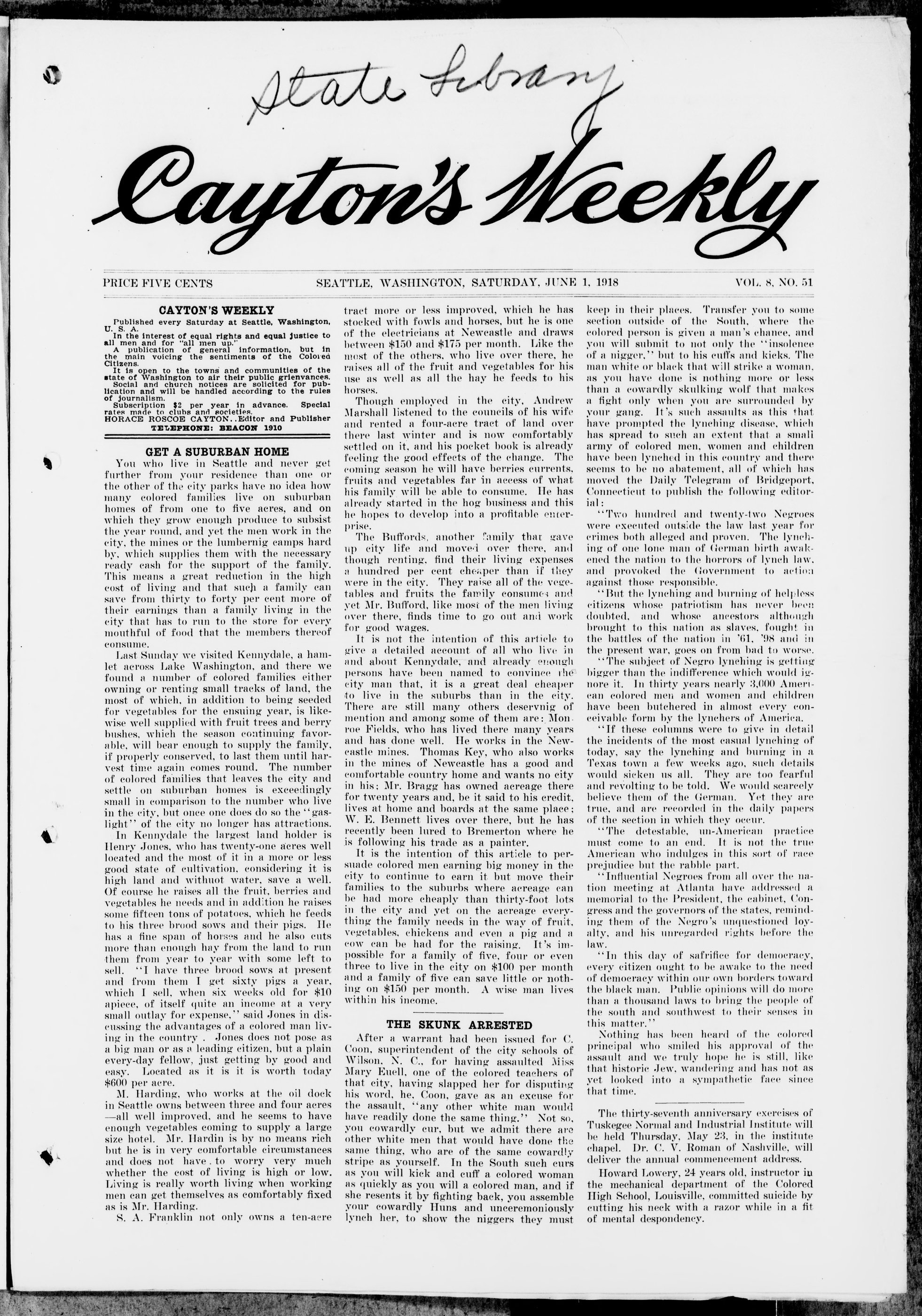
Cayton's Weekly
Saturday, June 1, 1918
Seattle, Washington
Page text (machine-generated)
State Library Cayton's Weekly
---
PRICE FIVE CENTS
CAYTON'S WEEKLY
Published every Saturday at Seattle, Washington, U. S. A. In the interest of equal rights and equal justice to all men and for "all men up." A publication of general information, but in the main voicing the sentiments of the Colored Citizens.
It is open to the towns and communities of the state of Washington to air their public grievances. Social and church notices are solicited for publication and will be handled according to the rules of journalism.
Subscription $2 per year in advance. Special rates made to clubs and societies. HORACE ROSCOE CAYTON..Editor and Publisher
GET A SUBURBAN HOME
You who live in Seattle and never get further from your residence than one or the other of the city parks have no idea how many colored families live on suburban homes of from one to five acres, and on which they grow enough produce to subsist the year round, and yet the men work in the city, the mines or the lumbernig camps hard by, which supplies them with the necessary ready cash for the support of the family. This means a great reduction in the high cost of living and that such a family can save from thirty to forty per cent more of their earnings than a family living in the city that has to run to the store for every mouthful of food that the members thereof consume.
Last Sunday we visited Kennydale, a hamlet across Lake Washington, and there we found a number of colored families either owning or renting small tracks of land, the most of which, in addition to being seeded for vegetables for the ensuing year, is likewise well supplied with fruit trees and berry bushes, which the season continuing favorable, will bear enough to supply the family, if properly conserved, to last them until harvest time again comes round. The number of colored families that leaves the city and settle on suburban homes is exceedingly small in comparison to the number who live in the city, but once one does do so the "gaslight" of the city no longer has attractions.
In Kennydale the largest land holder is Henry Jones, who has twenty-one acres well located and the most of it in a more or less good state of cultivation, considering it is high land and withuot water, save a well. Of course he raises all the fruit, berries and vegetables he needs and in addition he raises some fifteen tons of potatoes, which he feeds to his three brood sows and their pigs. He has a fine span of horses and he also cuts more than enough hay from the land to run them from year to year with some left to sell. "I have three brood sows at present and from them I get sixty pigs a year, which I sell, when six weeks old for $10 apiece, of itself quite an income at a very small outlay for expense," said Jones in discussing the advantages of a colored man living in the country. Jones does not pose as a big man or as a leading citizen, but a plain every-day fellow, just getting by good and easy. Located as it is it is worth today $600 per acre.
M. Harding, who works at the oil dock in Seattle owns between three and four acres all well improved, and he seems to have enough vegetables coming to supply a large size hotel. Mr. Hardin is by no means rich but he is in very comfortable circumstances and does not have to worry very much whether the cost of living is high or low. Living is really worth living when working men can get themselves as comfortably fixed as is Mr. Harding. S. A. Franklin not only owns a ten-acre
SEATTLE, WASHINGTON, SATURDAY, JUNE 1, 1918
tract more or less improved, which he has stocked with fowls and horses, but he is one of the electricians at Newcastle and draws between $150 and $175 per month. Like the most of the others, who live over there, he raises all of the fruit and vegetables for his use as well as all the hay he feeds to his horses. Though employed in the city, Andrew Marshall listened to the councils of his wife and rented a four-acre tract of land over there last winter and is now comfortably settled on it, and his pocket book is already feeling the good effects of the change. The coming season he will have berries currents, fruits and vegetables far in access of what his family will be able to consume. He has already started in the hog business and this he hopes to develop into a profitable enterprise.
The Buffords, another family that gave up city life and moved over there, and though renting, find their living expenses a hundred per cent cheaper than if they were in the city. They raise all of the vegetables and fruits the family consumes and yet Mr. Bufford, like most of the men living over there, finds time to go out and work for good wages.
It is not the intention of this article to give a detailed account of all who live in and about Kennydale, and already enough persons have been named to convince the city man that, it is a great deal cheaper to live in the suburbs than in the city. There are still many others deservnig of mention and among some of them are: Monroe Fields, who has lived there many years and has done well. He works in the Newcastle mines. Thomas Key, who also works in the mines of Newcastle has a good and comfortable country home and wants no city in his; Mr. Bragg has owned acreage there for twenty years and, be it said to his credit, lives at home and boards at the same place; W. E. Bennett lives over there, but he has recently been lured to Bremerton where he is following his trade as a painter.
It is the intention of this article to persuade colored men earning big money in the city to continue to earn it but move their families to the suburbs where acreage can be had more cheaply than thirty-foot lots in the city and yet on the acreage everything the family needs in the way of fruit, vegetables, chickens and even a pig and a cow can be had for the raising. It's impossible for a family of five, four or even three to live in the city on $100 per month and a family of five can save little or nothing on $150 per month. A wise man lives within his income.
THE SKUNK ARRESTED
After a warrant had been issued for C. Coon, superintendent of the city schools of Wilson, N. C., for having assaulted Miss Mary Euell, one of the colored teachers of that city, having slapped her for disputing his word, he, Coon, gave as an excuse for the assault, "any other white man would have readily done the same thing." Not so, you cowardly cur, but we admit there are other white men that would have done the same thing, who are of the same cowardly stripe as yourself. In the South such curs as you will kick and cuff a colored woman as quickly as you will a colored man, and if she resents it by fighting back, you assemble your cowardly Huns and unceremoniously lynch her, to show the niggers they must
VOL. 8. NO. 51
keep in their places. Transfer you to some section outside of the South, where the colored person is given a man's chance, and you will submit to not only the "insolence of a nigger," but to his cuffs and kicks. The man white or black that will strike a woman, as you have done is nothing more or less than a cowardly skulking wolf that makes a fight only when you are surrounded by your gang. It's such assaults as this that have prompted the lynching disease, which has spread to such an extent that a small army of colored men, women and children have been lynched in this country and there seems to be no abatement, all of which has moved the Daily Telegram of Bridgeport, Connecticut to publish the following editorial:
"Two hundred and twenty-two Negroes were executed outside the law last year for crimes both alleged and proven. The lynching of one lone man of German birth awakened the nation to the horrors of lynch law, and provoked the Government to action against those responsible.
"But the lynching and burning of helpless citizens whose patriotism has never been doubted, and whose ancestors although brought to this nation as slaves, fought in the battles of the nation in '61, '98 and in the present war, goes on from bad to worse.
"The subject of Negro lynching is getting bigger than the indifference which would ignore it. In thirty years nearly 3,000 American colored men and women and children have been butchered in almost every conceivable form by the lynchers of America.
"If these columns were to give in detail the incidents of the most casual lynching of today, say the lynching and burning in a Texas town a few weeks ago, such details would sicken us all. They are too fearful and revolting to be told. We would scarcely believe them of the German. Yet they are true, and are recorded in the daily papers of the section in which they occur.
"The detestable, un-American practice must come to an end. It is not the true American who indulges in this sort of race prejudice but the rabble part.
"Influential Negroes from all over the nation meeting at Atlanta have addressed a memorial to the President, the cabinet, Congress and the governors of the states, reminding them of the Negro's unquestioned loyalty, and his unregarded rights before the law.
"In this day of safrifice for democracy, every citizen ought to be awake to the need of democracy within our own borders toward the black man. Public opinions will do more than a thousand laws to bring the people of the south and southwest to their senses in this matter."
Nothing has been heard of the colored principal who smiled his approval of the assault and we truly hope he is still, like that historic Jew, wandering and has not as yet looked into a sympathetic face since that time.
The thirty-seventh anniversary exercises of Tuskegee Normal and Industrial Institute will be held Thursday, May 23, in the institute chapel. Dr. C. V. Roman of Nashville, will deliver the annual commencement address.
Howard Lowery, 24 years old, instructor in the mechanical department of the Colored High School, Louisville, committed suicide by cutting his neck with a razor while in a fit of mental despondency.
```markdown
```
THEY FOLLOWED THE FLAG
On the plantations of Mississippi, if May thirtieth was any different from April or June thirtieth, it was because it rained May 30th and did not rain on the same date the other months, and a rainy day was always a good day as it was a holiday, and the only kind of holiday that was observed, except Christmas, but Bob Lewis, though bred and born in the state, had wandered North and had witnessed two Decoration Day ceremonies in memory of the Old Soldiers and the fires of patriotism had been set to burning in his soul. But, inspite of the fact that he was doing well in the North he wanted to see the old folks at home again, and so one bright balmy morning in May, Bob strolled in on the old folks thus giving them a most joyful surprise, "He's drest to kill and got lots of money" spread through the neighborhood like wild fire; and he was like unto Barnum's "What Is It?"
When he showed up at the monthly meeting, which was presided over by "Elder" Hardy, a most "powerful" preacher, and for once, the elder came dangerously close to losing "his efficacy." Bob was in no hurry to go into the "meetin' house" and as long as he remained on the outside the crowd was almost equally divided between the ins and outs, but he was religiously inclined and so he finally went in and instead of "sitin' among sinners" he marched close up to the amen corner and took a seat among the bretheren "and he aint got no ligion either." whispered the sisters and brothers, but he had been gone a long time and all were too glad to see him to hurt his feelings right in the "meeting house." Now Bob had always been a good fellow and everybody liked him and since he had gone North and got some sense he was lionized after meeting was out.
He visited here and there for a week or so and occasionally went to the field and helped the old folks chop the grass out of the cotton. Things had almost settled down to their normal condition, but here comes Decoration Day and Bob proposed to the neighborhood to take a general holiday by remembering their dead and decorating their graves with flowers and having religious services right in the middle of the week.
If you would flaunt a red rag in a bull's face, you would not rouse his fighting blood any quicker than to observe Decoration Day among the old time seeesh of the South. He hates that day because its paying tribute to the Yankees, who licked the Rebs and the Fourth of July is equally as obnoxious to him because Vicksburg fell on that date. "You don furgit yoself Bob Lewis and if you has any preachin here in de week dese white foks will lynch you sho as anything," warned his father and mother and Elder Hardy told him week days wus made "for niggers to wuk and I sho is not gwine to preach in de middle of de week." So Bob's Decoration Day services fell through and the idea only faintly reached the ears of the white folks living thereabouts. The month of June was soon gone and Bob was still at the old home and while his patriotism had been smothered Decoration Day he did not propose to permit the Fourth of July to pass without his pent up patriotism bursting forth on the nations galorious natal day, and to that end he made the necessary preparations to enjoy himself. On the morning of the Fourth, Bob not only refused to go to the field to work himself, but prevailed on his parents to not do so and worst of all, at least down there, he tied an American flag to a pole and set it up in the yard and then proceeded to shoot fire crackers, an unheard of thing at that time of the year. Bob was having the time of his life simply because he was the whole show. "I mean to show you folk in the South how to be patriotic on the Nation's birth day," he said to a few curious youngsters, who stood at a respectable distance and watched him go through his strange performances. The old folks knew better than to be seen about that house that day and they shook their heads as they went to work and prophecled that Brer Lewis' boy was gwine to git all ny us in trouble."
Now it was not long before Bob's Fourth of July celebration reached the ears of the vigilant committee (the white men who regulated the niggers) and before night many of the members thereof were there with blood in their eyes and hell in their hearts. Somebody give Bob the tip "de white folks is coming" and he snatched his flag down and cut for the tall timber. Old man Lewis was asked about the flag and the celebration, but he denied having anything to do with it and concluded "I runs dat onray rascal way fum hear when he start-ed it." A diligent search was made for Bob, but to no avail, for he had not waited to take the wings of the morning, but had taken the wings of the evening and that too, without telling the old folks good-by and in the deep darkness of the night made his way accross the country to the Illinois Central R. R. some twenty-five miles away, and when again heard of he was in Chicago, where Old Glory is always first in war, first in peace and first in the hearts of the patriots. The red-handed murderous Rebs were chagrinned at not being able to make an example of a "smart nigger" and warned Uncle Eben Lewis if Bob ever showed up there he would never see the North again. Uncle Eben was very submissive, but hoped his son would not forget him and after the storm had blown over Uncle Eben Lewis got a letter from Bob with enough money in it to pay the fares of the family to Chicago and he quietly left for the North without the white folks knowing anything about it.
"Brer Lewis has gone somewhere," commented the bretheren at the next monthly meeting and there seemed to be trouble in their hearts. A strange white man passed through that community soon after, and colored folks whispered together and before the white folks realized what was going on half of the black folks had left for the North, and on investigation the whites found that the blacks had gone North and the strange white man that talked so bitter against the "niggers" was a Yankee and had furnished the colored men with means to go North to work in industrial plants. It was then the vigilant committee had another meeting this time to beg the colored folks to not go North, but Bob Lewis had done his work too well and many more of them continued to follow the flag.
IT HAPPENED LONG AGO
Elder smoathers presided over a very large Baptist Church in the state of Mississippi and for him to keep peace in the family was surely one big religious undertaking, but for a number of years he was equal to the occasion. Dissention however eventually arose among the membership and split them in twain. A general church meeting was called and the more they talked the further apart they grew. Finally it resulted in the whole matter being taken into the civic courts. The elder was on the witness stand telling his story when one of the deacons got so hot that he fairly frothed at the mouth and when the elder came down and court adjourned the lie and then the qualified lie were freely passed, when the deacon walked up to the elder and punched him in the face. One of the sisters saw it and she flew out of court and into the street like a shot out of a gun and ran as did Paul Revere and as she ran she shouted at the top of her voice, "Fo de Lod, dey don hit de lam." An inter-necine riot was prevented by the prompt arrival of a squad of police.
Coon hunting in the South is great sport and quite a few persons indulge in it, when a good "coon dog" can be had for the chase. Coons are quite common in the South and sometimes while hunting for squirrels in the timbers, you will run onto a monster racecoon sleeping in the forks of a giant oak of the forest. Once Unele Dick's Bill, a bull of a young fellow, and the writer were squirrel hunting after a heavy rain and in our wanderings ran upon a raccoon sunning himself in the forks of a mighty oak. Our guns were loaded with No. 2 squirrel shot, which we poured into Mr. Coon, but had no greater effect than
to make him hot foot it higher up at a very rapid rate. A few shots at his majesty convinced us we were waisting our loads, so Bill agreed to climb the tree and shake the coon down providing we would stand on guard with the dogs and do the coon up when he fell. We afterwards learned we both undertook a good deal more than we had bargained for, as will be subsequently seen. When Bill got to the top of the tree and crawled out to a slender limb on which Mr. Coon had taken refuge the coon showed fight, which Bill was not expecting and for the space of a minute things looked serious for Bill. The coon kept coming inspite of his yells and just as he was about to spring Bill gave the limb a sudden jerk and the coon lost his footing and came sailing to the ground from a hundred feet up. The fall did not seem to hurt him and he was up and ready for fight as soon as he hit the ground. He made a dive at us and would have had a picknic had not the two dogs made a dive at him. After a brief fight the coon got away and plunged head long into a deep hole of water, where he defied both dogs and boys. In our excitement we forgot our guns and when it looked as the coon was certain of getting away we thought of our gun and calling the dogs off, let him have a load full in the face, which so disabled him that we soon had him dangling at our sides. We learned to be careful about tackling a coon.
"Say Brer Brown do you believe in the efficacy of prayer," said one colored deacon to another. No Brer Jones I can't say I do." "You sho mus be jokin Brer. Brown when you say you do not believe in the efficacy of prayer and you bein a deacon of de church. "De reason I do not believe in de efficacy of prayer is dis: Las week I prayed fur de good Lord to send me one uv Farmer Thomson's turkeys, kos I wus skeered to go aftah it, as Farmer Thomson had don sed he would shoot any one he found aftah his turkeys, but no turkey comes dat night, and I prayed de same way de nex night and yet no turkey comes. On de third night I gits up and gos aftah dat turkey and de nex day I had ros turkey fur dinnah." Praying for impossible thnigs is fool hardy and so when the Christian Scientist prays for the Lord to heal his bodily ailments without medicine or treatment he or she is praying foolishly.
Perhaps what we are about to relate is a bit shy of the truth, but it is a fish story and if any fish or snake story is true, being from Missouri, "you have to show me." In the state of Louisiana there are almost innumerable lakes and lagoons and all of them are just teeming with fish and often with alligaters as well. Now allegators live on fish, frogs and other things of an aquatic nature, and they will frequently crawl ashore and lay in the sun with their mouths open until the flys and gnats fill them up and then they shut down on them as a part of a meal. The alligators will hurd the fish in a corner of a lake and then catch all they want to eat. Evidently such had been done just prior to Tom Tucker falling into a lagoon some ten feet deep. He worked fast and furious to get out for he knew it was full of allegators. Willing hands helped to pull him out, but to the surprise of all (they were at a fish fry) the frightened fish had taken refuge in Tom's pockets and under his clothes and when he got up he was loaded down with bass and perch. The boys wanted to throw him back for more, but he objected.
Brer Maney lost. That's all.
Members of No. 2 Construction Batalion, composed of colored men who enlisted in Canada, were entertained May 2 by the ladies of the Victoria Red Cross and W. C. T. U. at Curno Hall, London, at a concert and supper. The Lowndesboro Training School, Prof. S. T. Wilson, principal, located at Charity, seven miles from Haynesville, Ala., closed for the scholastic year May 4. The annual sermon was preached by the Rev. A. F. Owens of Selma University.
```markdown
```
FROM A DAUGHTER OF SOLOMON
And behold, the hour was growing late and I sought my couch somewhat weary; not of the big things which I had met and conquered during the day but of the manifold little hinderances, and annoyances which had sapped much energy. Moreover, I had also labored in a mental conflict, the burden of which was still with me as my eyelids closed.
Then it was, that I was conscious of a presence, near yet far removed; and in some mysterious way this presence imparted thoughts to me. Thus it was I became aware that my time in the world of men was ending; that soon I must stand before my God. And I thought of all I would yet like to do in the world of men; of things I had hoped to accomplish, yea, of my loved ones whom I would have to leave behind. Vainly, I sought for some means of escape, of even, a postponement, yet I felt the finality of the imparted message. "Those who trust in God should not meet Him holding on to earthly ties," imparted the presence.
There was no need of meditation. Had I not Truth's conviction? As a warrior lays down his trusted sword, surrendered, I, each earthly ambition, every heart's desire. Moreover, thereupon I at last placed the severed ties which had so lovingly bound me to each member of my family—save one.
And it so was, at this time I was conscious that all life had left my limbs. I lay a trunk, a head and a heart. Then a pause, as I waited further instructions. Soon I knew why nothing else was imparted; any moment my soul might depart from its earthly home; I must not be earth-bound. Then with one heart-rending effort, laid I upon my forsaken hopes and ties the golden one which had bound me to the babe upon my bossom.
Whereupon, I became instantly conscious that the breath of life was fast leaving my entire body. Finally I, or what had been the best within me, existed in space, connected only to some invisible substance: vapory as floating clouds, frail as silken threads, and insecure as ascending smoke wreaths.
And behold, so I was transported to a place far distant and I looked and behold, I was located upon a great and lofty eminence far overhanging a casm, dark, deep and wide; in a darkness unbroken in its distressing blackness, and there was not a sound in all that vast surroundings. Never had I conceived that there could be such isolation. Verily it were as if the entire world had been swept from around me and only I left of all things which once had been.
Then I found that the presence was still with me, speaking to me: "Time there is if you wish to pray."
Oh God, cleanse and accept my soul. With the whole of my heart's strength and with confidence I prayed. And the answer was at once forthcoming. Although the darkness remained just as impenetrable, the silence no less intense, all fear had vanished and a willing acceptance came to me, of the great unknown. Fear was turned to undreamt of courage; assurance where doubt had reigned.
Thus I waited: how long I could not tell. Enumerated time seemed to have passed just as had all other things which I had known. When, lo, suddenly, from out the depths of that endless chasm came a sound: a low moan not unlike a woman in long travail, on the stillness which surrounded me it was startling in the extreme. Louder, and yet louder still it grew until it became a deafening roar of misery, and it raged and shook and tore, as does a turbulent sea by tempest driven. "You now," imparted the presence, "get the sounds caused by sin which ascend from the earth you have left behind you, up to the very throne of God."
Then intently I listened. Clearly I could distinguish the different sounds; the cries caused by poverty, discontent and greed; by malice, injustice and immorality and high above them all rose the piercing wails
caused by the selfishness of mankind.
And a realization of the greatness of the sins which God's love must redeem, came to me, whereupon the sounds died out as suddenly as they began. Thus, again, I waited. Though not afraid, my spirit was under much depression; that clamorous wail of woes, woes, woes was still with me. Too hopelessly great they seemed to be overcome.
"God's love," imparted the presence, readily reading my thoughts, "is sufficiently great to redeem." Then continued:
"Prayers from a soul on the verge of eternity availeth much, if in yonder world dwell those whom you wish to pray."
"God, save my entire family," feverently I prayed. "It is well," imparted the presence. Then I felt the desire to save others. One by one I lovingly called to mind other relatives and close friends. "God, save them," I prayed. "It is well," spake the presence. Again the silence, the suspense, the urge. The love of race came to me and my heart quickened with the great unexplainable call of race brotherhood. "God, save the entire Negro race," from an overflowing heart, I prayed. "It is well," imparted the presence.
Once again I waited, waited long. With me still was the presence, yet it spake not; with me still the urge, yet I prayed not. Moreover I knew if a prayer from me could aid anyother soul in that bedlam of woe, for humanity's sake I should not lose the chance—yet I prayed not. For behold, before my mind's eye came visions of an angry mob. I could see their inhuman treatment to man not unlike themselves, save that his skin was black. Yea, in fancy I could smell the chared flesh from black men's bodies as red-heated irons were thrust over their quivering flesh. Deep groans from black men, whose bodies were dismembered ere they were hung from trees and telephone poles, cries of women and children shot while trying to escape from burning buildings, reached me. I could not make the prayer.
Then it was I had a strange sensation: not as water flows, but oozing out my surroundings, came a flood of liquid and it was cold and clamy, yet it burnt as does heated lead. Intuitively I knew that was blood, human blood. Blood of the black men who had died on the battlefields in the war of the Revolution, in the cruel Civil War; blood from the death hill, El Carney, yea, from the battlefields of distant France, and intermingled with the blood of those black men was the blood of the white men who had fought and fallen with them. And as it all engulfed me, I felt its mute, yet potent urge, still I could not make the prayer.
Moreover, great dispair possessed me and as a frightened child reaches out for its mother's hand in the night time, so reached I out for the hand of God.
Whereupon, far out in the darkness, the outlines of a massive picture began to form. And behold it was the picture of a man nailed to a cross, and His hands were bleeding, and His side was torn; resting on His brow was a crown of thorns. Meanwhile, an angry mob pressed bitter gall to His uncomplaining lips. Those lips they moved. He prayed: "They know not what they do."
Then it was that all sin left me; then it
TUTT'S BARBER SHOP "He wants to see you." High-class Tonsorial Work. 300 Main Street, Seattle. Latest race papers. All kinds of toilet supplies.
IN THE SUPERIOR COURT OF THE STATE OF Washington for King County.
Chester A. Fleming, Plaintiff, vs. Christina Fleming, Defendant—No. ..... Summons by Publication. The State of Washington to the said Christina Fleming, eDfendant:
You are hereby summoned to appear within sixty days after the date of the first publication of this summons, to-wit: within sixty days after the 11th day of May, 1918, and defend the above entitled action in the above entitled court, and answer the complaint of the plaintiff, and serve a copy of your answer upon the undersigned attorney for plaintiff at his office below stated; and in case of your failure
so to do, judgment will be rendered against you according to the demand of the complaint, which has been filed with the clerk of said court.
The object of the above entitled action is to obtain a decree of divorce from the defendant by the plaintiff on the ground of desertion.
ANDREW R. BLACK,
Attorney for Plaintiff.
P. O. Address, 316 Pacific Block, Seattle, Wash.
May 11—June 22, 1918.
IN THE SUPERIOR COURT OF THE STATE OF Washington for King County.
Mildred Holmes, Plaintiff, vs. William Holmes, Defendant—No. ..... Summons by Publication.
The State of Washington to the said William Holmes, Defendant:
You are hereby summoned to appear within sixty days after the date of the first publication of this summons, to-wit: within sixty days after the 11th day of May, 1918, and defend the above entitled action in the above entitled court, and answer the complaint of the plaintiff, and serve a copy of your answer upon the undersigned attorney for plaintiff at his office below stated; and in case of your failure so to do, judgment will be rendered against you according to the demand of the complaint, which has been filed with the clerk of said court.
The object of the above entitled action is to obtain a decree of divorce from the defendant by the plaintiff on the ground of desertion.
ANDREW R. BLACK,
Attorney for Plaintiff.
P. O. Address, 316 Pacific Block, Seattle, Wash.
May 11—June 22, 1918.
IN THE SUPERIOR COURT OF THE STATE OF
Washington for King County.
Dottie Blockeden Plaintiff on Carl H. Blockeden Do
Dottie Blackadar, Plaintiff, vs. Carl H. Blackadar, Defendant.—No. Summons by Publication. The State of Washington to the said Carl H. Blackadar, Defendant:
You are hereby summoned to appear within sixty days after the date of the first publication of this summons, to-wit: within sixty days after the 18th day of May, 1918, and defend the above entitled action in the above entitled court, and answer the complaint of the plaintiff, and serve a copy of your answer upon the undersigned attorney for plaintiff at his office below stated; and in case of your failure so to do, judgment will be rendered against you according to the demand of the complaint, which has been filed with the clerk of said court.
The object of the above entitled action is to obtain a decree of divorce from the defendant by the plaintiff on the ground of desertion.
ANDREW R. BLACK,
Attorney for Plaintiff.
P. O. Address, 316 Pacific Block, Seattle, Wash.
May 18—June 29, 1918.
IN THE SUPERIOR COURT OF THE STATE OF Washington for King County.
Willie LaFontaine, Plaintiff, vs. Eddie LaFontaine, Defendant—No. Summons by Publication.
The State of Washington to the said Eddie LaFontaine, Defendant:
You are hereby summoned to appear within sixty days after the date of the first publication of this summons, to-wit; within sixty days after the 20th day of April, 1918, and defend the above entitled action in the above entitled court, and answer the complaint of the plaintiff, and serve a copy of your answer upon the undersigned attorney for plaintiff at his office below stated; and in case of your failure so to do, judgment will be rendered against you according to the demand of the complaint, which has been filed with the clerk of said court.
The object of the above entitled action is to obtain a decree of divorce from the defendant by the plaintiff on the ground of desertion.
ANDREW R. BLACK.
Attorney for Plaintiff.
P. O. Address, 316 Pacific Block, Seattle, Wash.
April 20—June 1, 1918.
IN THE SUPERIOR COURT OF THE STATE OF Washington for King County.
Henry T. Bailey, Plaintiff, vs. Amanda Bailey, Defendant—No. ..... Summons by Publication.
The State of Washington to the said Amanda Bailey. Defendant:
You are hereby summoned to appear within sixty days after the date of the first publication of this summons, to-wit: within sixty days after the 20th day of April, 1918, and defend the above entitled action in the above entitled court, and answer the complaint of the plaintiff, and serve a copy of your answer upon the undersigned attorney for plaintiff at his office below stated; and in case of your failure so to do, judgment will be rendered against you according to the demand of the complaint, which has been filed with the clerk of said court.
The object of the above entitled action is to obtain a decree of divorce from the defendant by the plaintiff on the ground of desertion.
ANDREW R. BLACK,
Attorney for Plaintiff.
P. O. Address, 316 Pacific Block, Seattle, Wash.
April 20—June 1, 1918.
IN THE SUPERIOR COURT OF THE STATE OF Washington, in and for the County of King.
In the Matter of the Dissolution of Toyo Shokai
In the Matter of the Dissolution of Toyo Shokai, a corporation.—No. 128072. Notice of Dissolution of Corporation.
Notice is hereby given that Toyo Shokai, a Washington corporation, with headquarters at Seattle, has petitioned the King County Superior Court for authority to disincorporate and dissolve.
Notice is hereby given that said application will be heard in Department No. 1, of the King County Superior Court on the 28th day of May, 1918.
A. R. BLACK.
316 Pacific Block.
March 30—May 25, 1918.
IN THE SUPERIOR COURT OF THE STATE OF
Washington for King County.
Parilee Leaf, Plaintiff, vs. Sam Leaf, Defendant.—
No. Summons by Publication.
The State of Washington to the said Sam Leaf, Defendant:
You are hereby summoned to appear within sixty days after the date of the first publication of this summons. to-wit: within sixty days after the 6th day of April, 1918, and defend the above entitled action in the above entitled court, and answer the complaint of the plaintiff, and serve a copy of your answer upon the undersigned attorney for plaintiff at his office below stated; and in case of your failure so to do, judgment will be rendered against you according to the demand of the complaint, which has been filed with the clerk of said court.
The object of the above entitled action is to obtain a decree of divorce from the defendant by the plaintiff on the ground of desertion, and for the restoration of her former name, Parilee Townsend, and likewise the real estate, lot 18, block 2 of Highland View, an addition to the city of Seattle, King County, Washington.
ANDREW R. BLACK,
Attorney for Plaintiff.
P. O. Address, 316 Pacific Block, Seattle, Wash.
April 6—May 18, 1918.
```markdown
```
was my soul was cleansed: "God save the world," vehemently I prayed. And to my soul came joy undiscribble; came a happiness ne'er dreamed of before. Yea, I had the peace which passeth all understanding. Moreover, the darkness gradually began to lighten as when the sun's first rays appear, distant birds their first morning's notes to utter. There were murmers of limpid streams of water, whispers of balmy breezes, through tree tops blown; sounds of insects and growing things around me, and the clouds took shape and motion. Verily, I witnessed a new creation.
Then I felt myself again transported. Felt the confinments of my body as my breath my bossom stirred. Felt the babe upon my bossom, felt my eyelids unclose.
Lo, once more I lived. Selah.
NEWS NOTES
(New York Age) Over $15,000 was raised by the Negroes of Dallas, Tex., in the last Liberty Loan campaign.
The colored citizens of Norfolk, Va., subscribed nearly $50,000 to the Third Liberty Loan.
Thirty thousand colored and white citizens participated in the big sendoff to the colored draftees of Memphis, Tenn.
James A. Scott, a colored lawyer of standing, is being spoken of as a candidate for Judge on the Republican ticket at Chicago.
Robert Kenneth Jones of the Clinton Street High School won the Blue Grass oratorical contest held at Paris, Ky. Negroes in California have incorporated to launch a big farm and cattle-raising project fifty-odd miles southeast of San Diego, Cal. Dr. J. E. Wallace, former president of Bennett College, is now state agent director in Alabama for the Standard Life Insurance Co. Miss Martha W. Barksdale, 14 Chester street, Winchester, Mass., has been appointed stenographer in the Department of Commerce, Washington, D. C.
The colored club women of Mobile, Ala., are co-operating to secure a detention home for wayward colored boys and girls. Of the nine religious denominations in the United States the Negro Baptists rank fourth. There are three million colored Baptists in this country with over nineteen thousand ministers. Benedict College in South Carolina awarded one hundred degrees, diplomas and certificates this year, said to have been the largest in the history of the school. The 1100 block, Bolton street, just above the Fifth Regiment Armory, heretofore known as an exclusive "white block" in Baltimore has been invaded by Negroes.
Through the generosity of Adolphus Busch, a municipal cannery has been opened in Dallas, Tex., and colored women have been asked to take advantage of this opportunity to put up vegetables and fruits. B. F. Howard, founder of the original Order of Colored Elks of America, died recently at Covington, Ky., aged 76 years. He is survived by a widow, Mrs. Mary Howard, a brother and niece. The Louisiana State Medical, Dental and Pharmaceutical Association was held at the Pythian Temple. In his annual address Dr. W. H. Wethers emphasized the high patriotic duty of the Negro physician.
In the death of Dr. Junius B. Burnett, Dallas, Tex., has lost its leading colored dentist. He recently was commissioned a lieutenant in the United States Dental Reserve Corps and was getting ready to go overseas. The remains of the late Rev. John Jasper of the "Sun Do Move' fame, have been removed from Mechanics Cemetery, Richmond, Va., to the Woodland Cemetery, the new burial ground adjacent to Highland Park. "Granna" Deliah Kink, the oldest woman in Lake County, Ill., recently celebrated her one hundredth birthday at her home. She eats three hearty meals a day.
William Lamprod, Greek proprietor of a restaurant, will have to pay a fine or go to jail for refusing to serve food to the Rev. J. A. Pinson, of Jenkinstown, according to
PROF. KELLY MILLER
PROF. KELLY MILLER
Wants you to hear him June 26th. Make no other engagements. Judge Miller of the Criminal Court, Morristown, Pa. Rabbi Joseph Goldberg, the only colored rabbi in the world, is in the United States lecturing on "The Universal Brotherhood of Man." Rabbi Goldberg was born near Jerusalem, Palestine, and was educated at Oxford, England. He speaks twelve different languages.
At the twenty-third annual session of the Palmetta Medical Association held at Orangeburg, S. C., a resolution was adopted, introduced by Dr. C. C. Johnson, in which the physicians reaffirmed their sincere loyalty to their country and their intentions to continue teaching their fellows and practicing themselves all conserving and self-sacrificing measures which will help America to win the war. For the first time in the history of the Richmond, Ind., a colored man has been appointed a clerk in the postoffice in the person of Walter H. Dennis.
The St. Paul Episcopal School, Rock Hill, S. C., under the principalship of Miss Ruby G. Vance, assisted by Mrs. Janie C. Moore, closed a successful year last week. Frank R. Steward and Thomas W. Dennis, both colored, are candidates for the Legislature from the First Legislative District, Pittsburgh. The district is in the most thickly populated Negro section of the city. In an address before the Boston Literary and Historical Association Lieut. Governor Calvin Coolidge of Massachusetts, declared that colored Americans in their wronged condition were more loyal than many white Americans in a favored condition.
The Community House for Colored People has been organized in Richmond, Va., by the white and colored citizens. Judge Ricks is president of the board; Dr. W. H. Hughes, secretary, and Dr. G. R. Hovey, chairman, of the Executive Committee. The Dallas Negro Welfare Board has opened a campaign for better health conditions in Dallas and has petitioned the Mayor and Board of Commissioners to aid in providing more sanitary quarters for the colored residents. The appointment of a colored trained nurse is also asked.
A warrant has been issued by Squire J. A. Clarke of Wilson, N. C., charging Prof. C. Coon, the white superintendent of schools, with assaulting Miss Mary Euell, a teacher of the colored school. Coon's excuse for striking Miss Euell was that "any other white man would have readily done the same thing." Prof. R. S. Grossley has been appointed a member of the State Department of Education of Mississippi, and is an assistant supervisor of the colored schools of the State. This is the first time since reconstruction since a Negro has been given such recognition. The Rev. A. Clayton Powell and W. Monroe Trotter have issued a call for a meeting of the Colored Liberty Congress, which will
GRAND BENEFIT BALL
THE SEATTLE BRANCH THE NATIONAL ASSOCIATION FOR THE ADVANCEMENT OF COLORED PEOPLE MONDAY EVENING, JUNE 10th
Miss Lillian Smith's Jazz Band Tickets 50 cents Elegant Punch Mrs. J. Vrooman, Chairman Committee of Arrangements
be held June 24-29, at John Wesley A. M. E. Church, Washington, D. C. The Negroes of the country are asked to observe Liberty Sunday in all the churches on Sunday June 23. The Rev. Plummer W. Wortham, pastor of St. John's A. M. E. Church, Baltimore, and one of the best known ministers in Maryland, died last week after a short illness. The deceased was born in Warrenton, N. C., in 1862, and received his early education and was given a degree of doctor of divinity by Kittrel College.
The committee of colored citizens which did such excellent work in selling Liberty Bonds at Jacksonville, Miss., was composed of J. S. McLane, Dr. M. . McCleary, Capt. J. W. Floyd, L. H. Myers, the Rev. J. A. Gregg, J. C. Holmes, W. W. Andrews, A. L. Lewis, J. M. Baker, C. W. Ward, B. C. Lewis, W. T. Clarke and Charles H. Anderson, chairman. Dean W. F. Tillet of Vanderbilt University will deliver the commencement address to the graduating class of the Agricultural and Industrial State Normal School, Nashville, Wednesday, May 29. There will be more than one hundred graduates from the literary, agricultural, mechanical, domestic art, and domestic science departments.
More than one hundred prominent Negroes of Louisiana called on Governor Pleasant at the capitol and conferred with the chief executive of the State on the subject of lynching. B. V. Baracano of Baton Rouge, was chairman of the delegation. Charles M. Robertson and Prof. B. Collins were the principal speakers. Governor Pleasant went on record as being opposed to mob law.
Newton Smith, a successful colored planter of the Red Valley District, near Shreveport, La., owns one thousand acres of valuable land and is rated by bankers at $200,000. He employs about seventy-five families on his plantations. Last season Mr. Smith dieivered 286 bales of cotton, which together with the seed, netted $50,000.
Officers of the New York Ladies' Auxiliary of the Sons of Virginia are: Mrs. Rebecca Booker, president; Mrs. Winnie Bailey, vice president; Mrs. Lydia Vesta, recording secretary; Miss M. Carrington, assistant secretary; Mrs. Laura A. Hall, financial secretary; Mrs. L. L. Winter, chaplain; Mrs. Annie Durrell, treasurer; Mrs. Mattie Graves, doorkeeper; Misses Sarah Robeson and Emma Moore, ushers; Misses Julia Johnson, Laura Cassell and Mrs. Katie Powell, Banking Committee.
AFRO AMERICAN HOTEL
Phone Beacon 912 1261 Main Rooms by Day or Week. Well kept and highly sanitary. Steam heated. Mrs. T. H. Jones.
VROOMAN HOTEL
Phone Beacon 29 1236 Main
Three story concrete building. Steam heated.
Beautifully furnished.
W. E. Vrooman Jennie Vrooman
NEW WAY CAFE
NEW WAY CAFE
Phone Main 5964 1034 Jackson
Regular Dinner.
Send or phone your order in and it will be delivered promptly in first class condition.
J. C. Garner and E. T. Palmer, Props.
GOLDEN WEST
Phone 2647 1034 Jackson
Tailors and Cleaners
Clothes called for and delivered.
Hats retrimmed and blocked.
H. S. Frazier C. W. Curtest
RUSSELL SMITH
Secretary
BURR WILLIAMS President
DUMAS CLUB, INC.
209 Fifth Avenue South