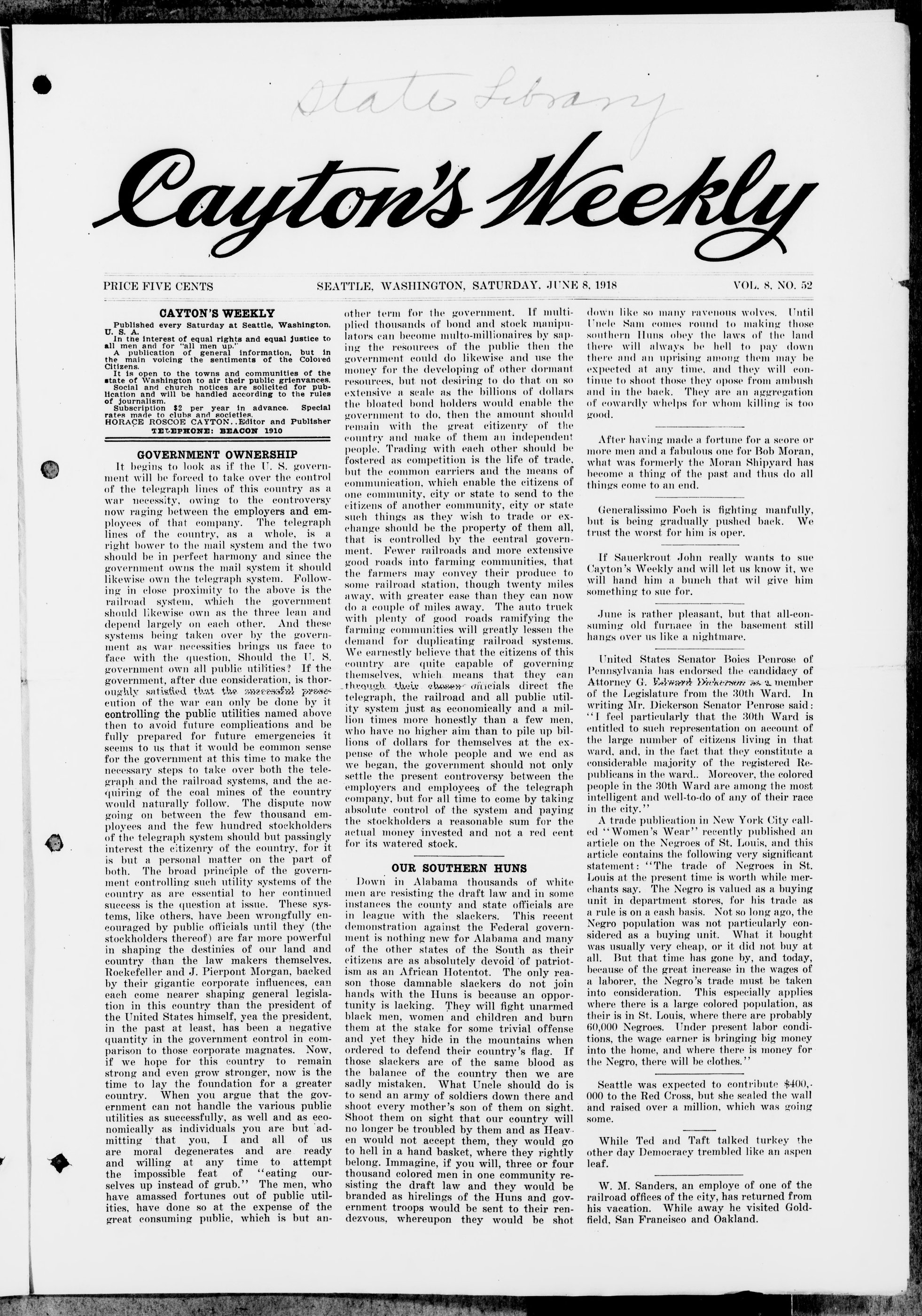
Cayton's Weekly
Saturday, June 8, 1918
Seattle, Washington
Page text (machine-generated)
Cayton's Weekly
---
PRICE FIVE CENTS
CAYTON'S WEEKLY
Published every Saturday at Seattle, Washington, U. S. A. In the interest of equal rights and equal justice to all men and for "all men up." A publication of general information, but in the main voicing the sentiments of the Colored Citizens.
It is open to the towns and communities of the state of Washington to air their public grievances. Social and church notices are solicited for publication and will be handled according to the rules of journalism.
Subscription $2 per year in advance. Special rates made to clubs and societies.
HORACE ROSCOE CAYTON..Editor and Publisher
TELEPHONE: BEACON 1910
GOVERNMENT OWNERSHIP
It begins to look as if the U. S. government will be forced to take over the control of the telegraph lines of this country as a war necessity, owing to the controversy now raging between the employers and employees of that company. The telegraph lines of the country, as a whole, is a right bower to the mail system and the two should be in perfect harmony and since the government owns the mail system it should likewise own the telegraph system. Following in close proximity to the above is the railroad system, which the government should likewise own as the three lean and depend largely on each other. And these systems being taken over by the government as war necessities brings us face to face with the question, Should the U. S. government own all public utilities? If the government, after due consideration, is thoroughly satisfied that the successful prosecution of the war can only be done by it controlling the public utilities named above then to avoid future complications and be fully prepared for future emergencies it seems to us that it would be common sense for the government at this time to make the necessary steps to take over both the telegraph and the railroad systems, and the acquiring of the coal mines of the country would naturally follow. The dispute now going on between the few thousand employees and the few hundred stockholders of the telegraph system should but passingly interest the citizenry of the country, for it is but a personal matter on the part of both. The broad principle of the government controlling such utility systems of the country as are essential to her continued success is the question at issue. These systems, like others, have been wrongfully encouraged by public officials until they (the stockholders thereof) are far more powerful in shaping the destinies of our land and country than the law makers themselves, Rockefeller and J. Pierpont Morgan, backed by their gigantic corporate influences, can each come nearer shaping general legislation in this country than the president of the United States himself, yea the president, in the past at least, has been a negative quantity in the government control in comparison to those corporate magnates. Now, if we hope for this country to remain strong and even grow stronger, now is the time to lay the foundation for a greater country. When you argue that the government can not handle the various public utilities as successfully, as well and as economically as individuals you are but admitting that you, I and all of us are moral degenerates and are ready and willing at any time to attempt the impossible feat of "eating ourselves up instead of grub." The men, who have amassed fortunes out of public utilities, have done so at the expense of the great consuming public, which is but an-
SEATTLE, WASHINGTON, SATURDAY, JUNE 8, 1918
other term for the government. If multiplied thousands of bond and stock manipulators can become multo-millionaires by saping the resources of the public then the government could do likewise and use the money for the developing of other dormant resources, but not desiring to do that on so extensive a scale as the billions of dollars the bloated bond holders would enable the government to do, then the amount should remain with the great citizenry of the country and make of them an independent people. Trading with each other should be fostered as competition is the life of trade, but the common carriers and the means of communication, which enable the citizens of one community, city or state to send to the citizens of another community, city or state such things as they wish to trade or exchange should be the property of them all, that is controlled by the central government. Fewer railroads and more extensive good roads into farming communities, that the farmers may convey their produce to some railroad station, though twenty miles away, with greater ease than they can now do a couple of miles away. The auto truck with plenty of good roads ramifying the farming communities will greatly lessen the demand for duplicating railroad systems. We earnestly believe that the citizens of this country are quite capable of governing themselves, which means that they can through their chosen officials direct the telegraph, the railroad and all public utility system just as economically and a million times more honestly than a few men, who have no higher aim than to pile up billions of dollars for themselves at the expense of the whole people and we end as we began, the government should not only settle the present controversy between the employers and employees of the telegraph company, but for all time to come by taking absolute control of the system and paying the stockholders a reasonable sum for the actual money invested and not a red cent for its watered stock.
OUR SOUTHERN HUNS
Down in Alabama thousands of white men are resisting the draft law and in some instances the county and state officials are in league with the slackers. This recent demonstration against the Federal government is nothing new for Alabama and many of the other states of the South as their citizens are as absolutely devoid of patriotism as an African Hotentot. The only reason those damnable slackers do not join hands with the Huns is because an opportunity is lacking. They will fight unarmed black men, women and children and burn them at the stake for some trivial offense and yet they hide in the mountains when ordered to defend their country's flag. If those slackers are of the same blood as the balance of the country then we are sadly mistaken. What Uncle should do is to send an army of soldiers down there and shoot every mother's son of them on sight. Shoot them on sight that our country will no longer be troubled by them and as Heaven would not accept them, they would go to hell in a hand basket, where they rightly belong. Immagine, if you will, three or four thousand colored men in one community resisting the draft law and they would be branded as hirelings of the Huns and government troops would be sent to their rendezvous, whereupon they would be shot
VOL. 8, NO. 52
down like so many ravenous wolves. Until Uncle Sam comes round to making those southern Huns obey the laws of the land there will always be hell to pay down there and an uprising among them may be expected at any time, and they will continue to shoot those they opose from ambush and in the back. They are an aggregation of cowardly whelps for whom killing is too good.
After having made a fortune for a score or more men and a fabulous one for Bob Moran, what was formerly the Moran Shipyard has become a thing of the past and thus do all things come to an end.
Generalissimo Foch is fighting manfully, but is being gradually pushed back. We trust the worst for him is oper.
If Sauerkrout John really wants to sue Cayton's Weekly and will let us know it, we will hand him a bunch that wil give him something to sue for.
June is rather pleasant, but that all-consuming old furnace in the basement still hangs over us like a nightmare.
United States Senator Boies Penrose of Pennsylvania has endorsed the candidacy of Attorney G. Edward Dickerson as a member of the Legislature from the 30th Ward. In writing Mr. Dickerson Senator Penrose said: "I feel particularly that the 30th Ward is entitled to such representation on account of the large number of citizens living in that ward, and, in the fact that they constitute a considerable majority of the registered Republicans in the ward.. Moreover, the colored people in the 30th Ward are among the most intelligent and well-to-do of any of their race in the city."
A trade publication in New York City called "Women's Wear" recently published an article on the Negroes of St. Louis, and this article contains the following very significant statement: "The trade of Negroes in St. Louis at the present time is worth while merchants say. The Negro is valued as a buying unit in department stores, for his trade as a rule is on a cash basis. Not so long ago, the Negro population was not particularly considered as a buying unit. What it bought was usually very cheap, or it did not buy at all. But that time has gone by, and today, because of the great increase in the wages of a laborer, the Negro's trade must be taken into consideration. This especially applies where there is a large colored population, as their is in St. Louis, where there are probably 60,000 Negroes. Under present labor conditions, the wage earner is bringing big money into the home, and where there is money for the Negro, there will be clothes."
Seattle was expected to contribute $400,000 to the Red Cross, but she sealed the wall and raised over a million, which was going some.
While Ted and Taft talked turkey the other day Democracy trembled like an aspen leaf.
W. M. Sanders, an employee of one of the railroad offices of the city, has returned from his vacation. While away he visited Goldfield, San Francisco and Oakland.
;
eS
Yan a ee ee
TOWN TOPICS
Prom The PPAR Tigh next Wednesday
and go forth in the world to battle for sue-
cess. While he is not occupying the position
as star of his class, yet his markings are
above the class average. During the four
years he has been in the Franklin he has
been one of the most generally popular
pupils in the school. He early developed
into a fine gridiron athlete and succeeded
in making the Franklin football squad the
leading team of the city high schools, which
of course, popularized John. Among the
pupils he was known as Pinky Prim. He
was also a star baseball player. Te plans
to enter the University of Washington next
September,
Two men were in a hot dispute and one
of them branded the other ‘‘a dirty s. b.,’”
which is looked upon as the most oprobrious
epithet that one man can apply to another.
Number one went to pieces in a minute and
cleared for fighting, but a friend of his
interfered and appealed to him to not lose
his dignity and have a street broil. ‘But,
he has called me a dirty name,’’ he scream-
ed to his ‘friend. ‘‘That’s true, for I heard
him, but you are not that and everybody
knows it, and in calling you that he has
most woefully lied and you have not the
time to go round licking all the liars in
town, and then again, some one of the most
contemptable liars may liek you.’’ In-
nocently Cayton’s Weekly published an
article to the effect that, the trenants of a
certain apartment house had been notified to
vacate, but preluded the article with, ‘‘it is
currently rumored’’, Whereupon, the pro-
prietor rushes into print with a lot of un-
gramatical verbose that renered him in the
eyes of the publie a complete idiosynerasy,
but what more could have been expected
from an ignoramus? Nothing from nothing
and nothing remains. <A tale from a Dutch-
man and a dog remains.
Perhaps the Rey. George Maney feels
that it was his Christian duty to sue the
Mt. Zion Baptist church, but from the view
point of a great majority of the citizens
in doing so he did not practice what he has
preached, that is, if he predicated his ser-
mons on the words of the Bible—which
says: “If thy brother smotes thee on one
cheek, turn the other’? and ‘‘do unto
others as you would have them do to you.
Prior to the calling of the case there were
some who thought that may perhaps he had
been done a gross injustice, but after he
himself had _ testified the court was thor-
oughly convinced that there was nothing to
the ease, and entertained a motion for its
dismissal. It’s not the intention of this
article to unduly eriticise Mr. Maney, for
in many ways he has been a very useful
citizen and has done much for the uplift of
the colored folk of this community, but we
do wish to impress upon any other mem-
ber of any church that, when he or she
finds it impossible to get along peacably
with a majority of the members thereof it
is his or her Christian duty to withdraw
therefrom as quietly as night withdraws for
day.
Among the twenty-five or more pupils
selected from the Franklin High School to
work in the condensed milk plant at Stan-
wood was Horace Roscoe Cayton, Jr., and
he left with the bunch last Saturday morn-
ing and will be gone three months, provid-
ing all things go well with him. Horace is
quite a mixer and very cosmopolitan in his
make-up, both of which have made of him
a more or less favorite with a majority of
the boys. The mere fact that he, like the
a mtunber oF mischevious boys, “1 thank
you, Lord, it’s good, if the devil did bring
tte
At the First A. M. E. church next Sun
day evening the Negro Business Men’s
League of Seattle will render a more or
less interesting program. The object of the
League is to stimulate colored citizens into
not only going into business, but to pat-
ronize those who do go into business. The
general public is invited to attend next
Sunday evening and listen to those selected
by the League to expound its doctrines.
The League has been organized for more
than a year and if it has done no good it
most assuredly has done no harm. “It can
do good and great good, if its teachings and
doctrines are lived up to by those whose
interest it was organized to subserve. Or-
ganization is the first law of heaven and
there can be no success on land or sea in
heaven or in hell without organization be-
ing its chief corner stone. The program
will begin at 8 o’clock, thus supplementing
the regular Sunday evening preaching.
One of the members of the League who
will address the meeting next Sunday even-
ing is B. F. Tutt, one of the very few suc-
cessful business men of color in Seattle. He
is the father of the Negro Business Men’s
League in Seattle and he has worked in and
out of season for its success. Mr. Tutt is
a thoroughly practical man, which he ap-
plies to his business, which accounts for its
success. Ile makes no pretense of being an
orator, but you may expect a practical talk
on the aims and object of th eLeague and
if a hundred men do not come forward and
associate themselves with the League it will
be no fault of his. Here is another in-
stance where ‘‘Tutt wants to see you.’’
This glad hand stunt that politicians so
frequently give to the voting public, when
they are seeking office, which is followed
by the marble heart and the icy stare, when
they have been defeated or have gotten
all they want, used to be the caper, but it_
don’t go now. ‘wo years ago a certain
fellow was seeking an office in King
county and he subseribed for Cayton’s
Weekly and another paper operated by a
colored man. Without pay or the promise
of future reward, Cayton’s Weekly gave
him a warm support and his candidacy
seemed to have been favored by a great
many of the colored citizens. He, however,
was defeated, but here comes the niggardly
part of the man. He was called upon to
pay his $2 subscription. ‘‘I do not get
your paper,’’ he promptly replied, and re-
fused to pay at that time, but did do so
later on, but held to it that the paper did
not come. The postal authorities were
asked to explain and the carrier reported
as follows: ‘‘Mr, Cheap Skate told me to
destroy the paper as he did not want it and
yet did not want to hurt the feelings of the
editor by refusing it.’’ If the poor simp
had have soaked his head in a soap goard
it might have dawned upon him that he
was as big a fool as was Thompson’s colt
that swam the river to get a drink.
Persons who get’ Cayton’s Weekly are ex-
pected to pay for it, but the collector does
not expect to whip it out of the hide of
anyone who refuses to pay, nor is it neces-
sary for any one to make a damphool of
himself in making an excuse for not paying
when called upon. When Jack Thatcher
was a candidate for county assessor he sub-
scribed for Cayton’s Weekly and like every
body else, paid for it in advance, however,
cher that had blown off the throttle valve
to his common sense air pipe. It makes a
great deal of difference with some folk
whether they have held office their last time
or whether they are still on the anxious
seat and such hypocrites are of ‘‘sueh hid-
deous mein that to be hated they need but
to be seen,”*
It’s to the credit of Russell Miller, cus-
todian of the Pantages building to be the
first and to the present the only one that
has given employment to colored girls as
elevator operators. The young women are
giving perfect satisfaction and their suc-
cess may be the means of others getting like
employment. The elevator jobs pay all the
way from $55 to $85 per month and its
only a question of a very short time when
superintendents of large buildings will seek
colored girls for many of the buildings as
elevator operators. Mr, Miller says he is
perfectly willing to give girls instruction
as to how to operate an elevator so that
they will be ready in case of a hurried call.
Other building superintendents are even
now seriously contemplating employing col-
ored girls and yea verily, would do so at
onee, but have some hesitancy in mixing the
crews.
After six months of blood purification
Oscar Colins is again walking the street and
looks as if he would make a Jack Johnson
look to his laurels in a manly art contest.
“No, I do not think I wil be a priest nor
am T certain what I will be. Last week
I ran over to Vancouver and there, like
here, its everybody works, even to father,
and I have about concluded that I too had
better go to work and to that end will either
apply for a railroad job or I will seek work
on the oil dock. If I must work I will
work, and believe me, I can do just as
strenuous work as any other man. I am
through with the elub business and while
this conclusion may not be wholly as I
would have had it, yet I realize that the
club business is not in harmony with the
present war-time conditions, and I mean to
spend such time as I am not in the employ
of others, improving my acreage,’’ said Col-
lins, one day this week.
The leading speaker at the League next
Sunday evening will be Dr. F. B. Cooper,
and leading speaker is said advisedly, for
Dr. Cooper is one of the cleverest off-hand
talkers in Seattle, and, so far as the col-
ored citizens are concerned, he has the
bunch of them outelasesd a country mile.
A few weeks ago at a patriotic benefit in
the interest of the colored soldiers ‘‘over
there,’’ Dr. Cooper delivered a short ad-
dress that would have passed muster amid
members of Congress or men, who do noth-
ing else, but make publie speeches. His
heart is in the success of the Negro Busi-
ness Men’s League of Seattle and for that
reason the public may expect a rare treat
from him next Sunday evening.
Whether Tommy Williams was lost, stray-
ed or stolen between Juneau and Seattle,
Tommy refuses to say, but one thing is cer-
tain, he was almost a month getting to Se-
attle after wiring his departure from Jun-
eau. Rumor has it that Tommy realized
after he had left for Seattle that the state
was bone dry and he loitered long enough
on the way to get on the outside of a suf-
ficient amount of fun to last him until he
LADIES, LOOK, LISTEN!
You are solicited to have your fancy shoes
polished at Russell Miller’s Shine Shop. You
get a beter job by leaving them.
Pantages Building
Regular Dinner from 4 to 8 P. M.
We give Special Attention to Theatre parties
AMERICA'S WAR-SPIRIT. OF TO-DAY We ask of Thee a greater strength, Oh God! Staggering beneath the burdens that we bear Coureageously against a hellish squad— Demons and fiends who set their treacherous lair To net the world, that it would in time despair In servile fear beneath the Prussian rod. I know Thou wilt not fail us now, Oh God, When darkness hovers o'er land and sea, And Prussia fights to crush Democracy Firmly beneath her black ungodly tread, And count as naught the bravery of our dead.
Thou wilt not fail us now when hellish deeds Seek in their lustful prey the harmless lives Of women and children for whom mercy pleads
Vainly to Prussia's god who lordly thrives, Beastly upon his prey in greed and lust. We will fight on until we shall have thrust Death's fatal sabre thro' his ruthless side; Commanding fate his destiny shall guide Him thro' the ominous realms of vale and
Him thro' the ominous realms of vale and dell,
Where his Satanic sins shall rise pell-mell
In maddening fury, an insurgent tide,
To curse and hound him to the depths of hell.
Thou wilt not fail us now for to this cause
Of highest honor and most sacred trust,
We give not in accordance to fixed laws;
We offer all—naught would we feign to give,
For Thou dost know, Oh God, our cause is just.
We are being shaken in the world's great sieve,
Of hist'ry's reckoning: nations have been tried—
Not all emerged as victors with the spoils
From despot's chains of black intriguing coils;
Yet some survived as weaklings; others died.
Shall we march forth as victors brave and bold?
Or shal we come as weaklings from the strife?
Shall we write hist'ry that when read or told
Shall make America pulse with newer life?
We will fight on until the vict'ry's won,
And heavy clouds made black by war shall flee
Before the rising of a golden sun,
Bringing glad greetings to a world that's free.
We will fight on 'til in the strangling dust
Autocracy—like a worm-eaten crust
Shall lie unheeded by Democracy,
The beacon light for ev'ry land and sea,
We cannot fail, Oh God, we trust in Thee.
—Thornton Haskell Kelley.
If it so happens that T. R.'s wish becomes effective and all persons unable to speak English be deported as un-American then a great many of the white folk of the South, whose ancestors have lived there for more than a century, will have to leave the country as none of them speak the English language sufficiently intelligent to be wholly understood.
DEMOCRACY
We wuz discussin', jis Bill 'n' me;
The pros 'n' cons of democracy;
Leastwise Bill didn't have much to say,
That wuz owin' to Bill's pecular way.
Bill's one of them kind what knows a heap,
But he always 'lows that talk is cheap.
Talkin's all right, but list'n is grand,
The talkin' guy always tips his hand.
So Bill sets tight 'thout movin' er joint,
'N' only talks when he makes his point.
I never fell fer the high brow stuff.
My edicashun is in th' rough.
All this talk erbout AUTOCRACY
Is shootin' a bit to high fer me.
There's sumhthin' else that gives me th'
"bats."
This makin' things safe fer th' Democrats.
So I says to Bill, now put me right,
'N' tell me jis why we're in this fight.
Bill looked et me like a wise ole owl,
Shifted his quid to the other jowl,
Then spat th' juice in a cuspidore,
'N' made a noise like a 3-inch bore:
I takes no stock in AUTOCRACY;
This lordship junk is all bosh t' me;
Don't care a durn 'bout your family tree,
It's th' man what counts, not ancestry.
Now, there's them folks what we calls the
They want t' roll th' whole world in one 'N' rule us all, 'n' their pettygree Is crowns, 'n' titles, 'n' ancestry. Now in this country, the man's the thing: Here, a man's ez good ez any king Or czar, or emp'ror, th' whole durn lot Never worked a lick fer what they're got. Folks over there want a chance, you see, T' prove their worth jis the same ez we, 'N' that's th' reason we're off for France, T' give them folks over there their chance. It's ez plain t' me ez A, B, C, 'N' I puts it here where all can see:
N I puts it here where all can see,
"I'm ez good ez you, 'N' you're good ez me."
By SALEM TUTT WHITNEY.
Now that school is about to close for a three-month's vacation have you found gainful occupation for your girls and boys? If not, why not?
Yesterday flowers were planted on the graves of young as well as old soldiers: Peace to their ashes.
If a colored soldier merits favorable mention you can always rest assured that Gen. Pershing will not hesitate to give it to him. Long may he live.
In the Morefield Storey drive for membership, Tacoma sent 107 new names to the National headquarters and yet Tacoma is without a branch. It occurs to us that somebody or something somewhere has jumped a cog.
A SAMPLE COPY
Cayton's Weekly sends out a similar paper to this every week.
It is not the leading paper of the Northwest, nor does it "occupy an exclusive field", but it is always well edited and full to the brim with up-lift matter.
Cayton's Weekly would like you for a subscriber and if you would subscribe you would like it. Let us get together.
Telephone Beacon 1910
513 Pacific Block
ALHAMBRA CASH GROCERY
H. Legg, Prop. W. H. Banks, Mgr. We Carry a Full Line of Fancy and Staple Groceries WE KINDLY INVITE YOUR INSPECTION Our New Store: 1201-3 Jackson St. Phone Beacon 505 TUTT'S BARBER SHOP "He wants to see you." High-class Tonsorial Work. 300 Main Street, Seattle. Latest race papers. All kinds of toilet supplies.
IN THE SUPERIOR COURT OF THE STATE OF Washington for King County. Georgia Watson, Plaintiff, vs. Milton Watson, Defendant—No. Summons by Publication. The State of Washington to the said Milton Watson, Defendant:
You are hereby summoned to appear within sixty days after the date of the first publication of this summons, to-wit: within sixty days after the 8th day of June, 1918, and defend the above entitled action in the above entitled court, and answer the complaint of the plaintiff, and serve a copy of your answer upon the undersigned attorney for plaintiff at his office below stated; and in case of your failure so to do, judgment will be rendered against you according to the demand of the complaint, which has been filed with the clerk of said court.
The object of the above entitled action is to obtain a decree of divorce from the defendant by the plaintiff on the ground of cruelty.
ANDREW R. BLACK,
Attorney for Plaintiff.
P. O. Address, 316 Pacific Block, Seattle, Wash.
June 8—July 27, 1918.
IN THE SUPERIOR COURT OF THE STATE OF
Washington for King County.
You are hereby summoned to appear within sixty days after the date of the first publication of this summons, to-wit: within sixty days after the 11th day of May, 1918, and defend the above entitled action in the above entitled court, and answer the complaint of the plaintiff, and serve a copy of your answer upon the undersigned attorney for plaintiff at his office below stated; and in case of your failure
so to do, judgment will be rendered against you according to the demand of the complaint, which has been filed with the clerk of said court.
The object of the above entitled action is to obtain a decree of divorce from the defendant by the plaintiff on the ground of desertion.
ANDREW R. BLACK,
Attorney for Plaintiff.
P. O. Address, 316 Pacific Block, Seattle, Wash.
May 11—June 22, 1918.
IN THE SUPERIOR COURT OF THE STATE OF
Washington for King County.
Mildred Holmes, Plaintiff, vs. William Holmes, Defendant—No. ..... Summons by Publication.
The State of Washington to the said William Holmes, Defendant:
You are hereby summoned to appear within sixty days after the date of the first publication of this summons, to-wit; within sixty days after the 11th day of May, 1918, and defend the above entitled action in the above entitled court, and answer the complaint of the plaintiff, and serve a copy of your answer upon the undersigned attorney for plaintiff at his office below stated; and in case of your failure so to do, judgment will be rendered against you according to the demand of the complaint, which has been filed with the clerk of said court.
The object of the above entitled action is to obtain a decree of divorce from the defendant by the plaintiff on the ground of desertion.
ANDREW R. BLACK,
Attorney for Plaintiff.
P. O. Address, 316 Pacific Block, Seattle, Wash.
May 11—June 22, 1918.
IN THE SUPERIOR COURT OF THE STATE OF Washington for King County.
The State of Washington to the said Carl H. Blackadar, Defendant;
You are hereby summoned to appear within sixty days after the date of the first publication of this summons, to-wit: within sixty days after the 18th day of May, 1918, and defend the above entitled action in the above entitled court, and answer the complaint of the plaintiff, and serve a copy of your answer upon the undersigned attorney for plaintiff at his office below stated; and in case of your failure so to do, judgment will be rendered against you according to the demand of the complaint, which has been filed with the clerk of said court.
The object of the above entitled action is to obtain a decree of divorce from the defendant by the plaintiff on the ground of desertion.
ANDREW R. BLACK,
Attorney for Plaintiff.
P. O. Address, 316 Pacific Block, Seattle, Wash.
May 18—June 29, 1918.
IN THE SUPERIOR COURT OF THE STATE OF
Washington for King County.
Willie LaFontaine, Plaintiff, vs. Eddie LaFontaine,
Defendant—No. .....
Summons by Publication.
The State of Washington to the said Eddie LaFontaine, Defendant:
You are hereby summoned to appear within sixty days after the date of the first publication of this summons, to-wit: within sixty days after the 20th day of April, 1918, and defend the above entitled action in the above entitled court, and answer the complaint of the plaintiff, and serve a copy of your answer upon the undersigned attorney for plaintiff at his office below stated; and in case of your failure so to do, judgment will be rendered against you according to the demand of the complaint, which has been filed with the clerk of said court.
The object of the above entitled action is to obtain a decree of divorce from the defendant by the plaintiff on the ground of desertion.
P. O. Address, 316 Pacific Block, Seattle, Wash
April 20—June 1, 1918.
IN THE SUPERIOR COURT OF THE STATE OF
Washington for King County.
Henry T. Bailey, Plaintiff, vs. Amanda Bailey, Defendant—No. ..... Summons by Publication.
The State of Washington to the said Amanda Bailey, Defendant:
You are hereby summoned to appear within sixty days after the date of the first publication of this summons, to-wit: within sixty days after the 20th day of April, 1918, and defend the above entitled action in the above entitled court, and answer the complaint of the plaintiff, and serve a copy of your answer upon the undersigned attorney for plaintiff at his office below stated; and in case of your failure so to do, judgment will be rendered against you according to the demand of the complaint, which has been filed with the clerk of said court.
The object of the above entitled action is to obtain a decree of divorce from the defendant by the plaintiff on the ground of desertion.
ANDREW R. BLACK,
Attorney for Plaintiff.
P. O. Address, 316 Pacific Block, Seattle, Wash.
April 20—June 1, 1918.
IN THE SUPERIOR COURT OF THE STATE OF
Washington, in and for the County of King.
In the Matter of the Dissolution of Toyo Shokai, a
corporation.—No. 128072. Notice of Dissolution of
Corporation.
Notice is hereby given that Toyo Shokai, a Washington corporation, with headquarters at Seattle, has petitioned the King County Superior Court for authority to disincorporate and dissolve.
Notice is hereby given that said application will be heard in Department No. 1, of the King County Superior Court on the 28th day of May, 1918.
A. R. BLACK.
316 Pacific Block.
March 30—May 25, 1918.
IN THE SUPERIOR COURT OF THE STATE OF Washington for King County.
Parilee Leaf, Plaintiff, vs. Sam Leaf, Defendant.—
No. Summons, by Publication.
PUNISHES BY PUNISHING:
The State of Washington to the said Sam Leaf,
Defendant:
You are hereby summoned to appear within sixty days after the date of the first publication of this summons. to-wit: within sixty days after the 6th day of April, 1918, and defend the above entitled action in the above entitled court, and answer the complaint of the plaintiff, and serve a copy of your answer upon the undersigned attorney for plaintiff at his office below stated; and in case of your failure so to do, judgment will be rendered against you according to the demand of the complaint, which has been filed with the clerk of said court.
The object of the above entitled action is to obtain a decree of divorce from the defendant by the plaintiff on the ground of desertion, and for the restoration of her former name, Parilee Townsend, and likewise the real estate, lot 18, block 2 of Highland View, an addition to the city of Seattle, King County, Washington.
ANDREW R. BLACK.
Attorney for Plaintiff.
P. O. Address, 316 Pacific Block, Seattle, Wash.
April 6—May 18, 1918.
---
DAMNABLE WHITE WHELPS
Some of the white subscribers of Cayton's Weekly living in Seattle felt that its criticism of the cowardly whelps of the South, who lynch colored women, was too severe and became so incensed at what it said that they ordered their papers discontinued, but if they thought what we said was too severe, listen to what papers published by white men and in the South at that, have to say on the subject:
"The (Augusta, Ga.) Chronicle need waste no words in expressing its horror of of the detestable and cowardly attack committed by a party of Lowndes County outlaws, who, on Sunday afternoon last, took from her home a woman—whose husband had been lynched the night before—hanged her to a tree and riddled her body with bullets, because, forsooth, she had made unwise remarks about the unlawful killing of her husband.
"All civilized people must stand aghast at such a crime, and who does not is at heart a criminal and a coward. So much, then, for this crime aganist the State of Georgia, against society, against humanity and against God.
"The only thing worth discussing, in view of all the condemnation that similar crimes and lynching in general have received from the right-thinking press and people of this and all other states—in which The Chronicle has, heretofore, performed its full duty to the public, when some others failed—the only thing worth discussing now, we say, is what is the State of Georgia going to do about it?"
"First of all, what is the governor of Georgia going to do? For, of all the governors who have served Georgia since the war or since lynching became a more or less popular pastime in this State—it will seem to most people that he is more obligated, if that be possible, to put down lynching than any of his predecessors.
"For we cannot forget that Governor Dorsey was swept into the governor's chair by the lynching sentiment of the State. Not meaning, of course, that all the people who voted for him were lynchers in practice or sentiment, but saying and meaning that without this sentiment back of him, he might still be solicitor-general of the Atlanta circuit.
"We cannot forget, nor can it be denied, that his elevation to the governorship was the direct and immediate result of the Leo Frank lynching.
"Nor can we get away from the fact, that, following this upheaval of lawless sentiment, lynching followed lynching in this State—until Georgia soon won, and has held ever since, the lynching record of the country.
"And right here, it may be recalled that this is not the first time a Negro woman has been lynched in Georgia; another case of very recent time being the cruel and cowardly lynching of a Negro mother at, or near, Leary, Ga., for committing the horrible crime of trying to protect her son from an unmerciful beating.
"This and scores upon scores of other lynchings that have occurred in this State within recent years have gone absolutely unpunished. A protest from the press, an expression of disapproval, here and there, from the public, the perfunetory offering of rewards for the lynchers—and there was an end to it.
"Not a single individual has been made to pay the penalty for these crimes. Not a serious effort has been made to apprehend and punish the perpetrators of them.
"Is it any wonder, then—assuming that men can be found who are so cowardly and inhuman as to take part in such outrages—that lynchings continue to occur in Georgia?"
"Is it to be expected that they will grow fewer in number, or cease altogether, until somebody in Georgia does something to bring to the gallows the brutes who participate in them?
"Alas! that Georgia permitted herself to be set aflame a few years ago with the lynching fever. Alas! that, at that time, The Chronicle was the only daily newspaper that dared to wage a crusade against
this unlawful sentiment, and to conduct a systematic expose of the motives and mendacity of the men who were responsible for it; a service to its state for which reprisals were attempted against The Chronicle such as have never been directed against any newspaper in Georgia. "Georgia then sowed the wind—and she has been reaping the whirlwind ever since.
"Is it not, we ask, peculiarly up to Governor Dorsey to use every agency of his high office—and if these be not enough, to use his tongue and pen and every power of his position—to put down lynching in Georgia; to help redeem his state from such lawlessness as felt itself justified and glorified by his election?
"And Lowndes County!—one of the most prosperous and progressive counties in the state; with as cultured and noble people in it as are to be found anywhere on earth—what will be its answer? What will its good people do to punish this crime of crimes and, in a measure at least, wipe away this stain?
"Or are such people outnumbered within its borders? Must its law-officers give more heed to the ignorant and lawless of its population than to those who have made Lowndes county what it is?—one of the best counties in Georgia? It remains to be seen.
"But, when we recall that Lowndes, with its neighboring county of Brooks, has been the hotbed of anti-dip-vat sentiment; that many of its citizens deliberately dynamited government operated plants for eradicating the cattle tick in that county—and when we see, at this very time, that in the published list of deserters under the draft law, Lowndes county easily leads all the rest, any forty other counties, in fact with 211 deserters—we are compelled to confess that we fear for the power and influence of its better element and, really, look for little or nothing to be done toward aprehending and punishing the cowardly murderers of Mary Turner, the poor black woman who made unwise remarks about the lynching of her husband; a new capital offence in Georgia, as Major Joseph B. Cumming so scathingly refers to this Lowndes county lynching in a card, published in yesterday's Chronicle, that nobly voices the best sentiment of all real Georgians."
"Stain on Democracy"
Says the Charleston Gazette of Charles ton. W. Va. :
"There are so many sidelights to our national character that we turn automatically hot and cold with self pride, but fortunately the thermometer registers high. We stood on the streets only a day ago and witnessed a remarkable spectacle in our own city when 5,000 colored men and women, led by bands, one a soldier organization from a catonment, march through the city streets in a patriotic demonstration. The thrill of pride that we all had in this race, which at the best is fighting under a great handicap, was dampened by a sense of shame we felt when the papers carried a news item of another lynching outrage in the South where a
GRAND BENEFIT BALL
FOR
THE SEATTLE BRANCH
THE NATIONAL ASSOCIATION
FOR THE ADVANCEMENT OF
COLORED PEOPLE
MONDAY EVENING, JUNE 10th
crazy mob of white men perpetrated another outrage on the Negroes.
"There can be no extenuating circumstances for lynching. The fact that a major crime had been committed is not a license for embracing lynch law, but rather is a reflection upon the lynchers, illiterate, ignorant, prejudiced as they are in most instances. There can be no defense for any crime committed by a Negro or white man, but the law provides for punishment and the execution of this law is vested in authorities, not in the mob. This mob spirit is still confined almost exclusively to the South, where a population is still ignorant of the fact that the only real asset it has is its comparatively cheap labor which lies in the hands of its colored population.
"The race problem is still confined to the South, which resents any attempts to suggest a solution. The exodus from Dixie of the Negro would soon awaken the South to an appreciation of the fact that it takes just such labor as that of the Negro to plant, cultivate and pick its cotton crop. Any other kind of labor would make the price of cotton prohibitive, yet the South is still trying to kill the goose that laid the golden egg.
"The race question in the South is an economic one and the South would do well to try and clean some of its dirty linen in its attitude toward the Negro. The great area of the South is fitted for nothing except the production of cotton, and despite every effort to diversify its crops cotton is still king and will remain so, although a diversification could become a fact but for climatic and other conditions which are natural barriers which cannot be overcome.
"The Negroes of the nation are giving the world a fine example of patriotism. One banner which was carried in the parade here the other day contained the motto:
"We never had a traitor."
"This is to the credit of the Negro race, and encouragement should be given them. This encouragement should not be manifest in lynching."
As two little colored boys lay in a hay mow preparatory to going to the land of nod for the night they heard the wind howling and the rain falling outside. Now it was the duty of these little fellows, who unfortunately were without living parents and like Topsy "jest growing up," to each morning go after the cows for the milk maid. The little fellows listened to the howling wind and as they crouched down more comfortable in the warm hay they each thought of the morrow and each thought the other asleep. Finally one gently called to the other as follows: Sam, Sam, you'll have to go aftah de cows by yo'self in de mornin, fur I's gwine to be sick." "No I aint fur I's sick now." Thus did those little fellows try to out scheme each other only to find himself checkmated and to end up by both going after the cows as usual in their scanty wearing apparel in a biting cold wind and rain storm the next morning.
AFRO AMERICAN HOTEL
Phone Beacon 912 1261 Main Rooms by Day or Week. Well kept and highly sanitary. Steam heated. Mrs. T. H. Jones.
VROOMAN HOTEL
Phone Beacon 29 1236 Main Three story concrete building. Steam heated. Beautifully furnished. W. E. Vrooman Jennie Vrooman
NEW WAY CAFE
Phone Main 5964 1034 Jackson
Regular Dinner.
Send or phone your order in and it will be delivered
promptly in first class condition.
J. C. Garner and E. T. Palmer, Props.
GOLDEN WEST
Phone 2647 1034 Jackson
Tailors and Cleaners
Clothes called for and delivered.
Hats retrimmed and blocked.
H. S. Frazier C. W. Curtest