Cayton's Weekly
Saturday, June 15, 1918
Seattle, Washington
Page text (machine-generated)
State Library Cayton's Weekly
PRICE FIVE CENTS
CAYTON'S WEEKLY
Published every Saturday at Seattle, Washington, U. S. A.
In the interest of equal rights and equal justice to all men and for "all men up."
A publication of general information, but in the main voicing the sentiments of the Colored Citizens.
It is open to the towns and communities of the state of Washington to air their public grievances.
Social and church notices are solicited for publication and will be handled according to the rules of journalism.
Subscription $2 per year in advance. Special rates made to clubs and societies.
HORACE ROSCOE CAYTON..Editor and Publisher
TELEPHONE: BEACON 1910
EDITORIAL PARAGRAPHS
That sweet girl graduate has already become a thing of the past.
Russia is afraid to trust Japan and in this Russia seems to show some good hard horse sense.
A Republican convention is to be held in Tacoma June 15th. Let's hope that the delegates thereto will be Republicans.
And now comes the report that Uncle Sam has a million soldiers in France. If this be true, and we do not doubt it, Hindenberg is like to be in hell before snow flies.
If the Puget Sound country ever witnessed a more ideal June, it was before old man Puget made his appearance hereabouts.
County candidates have begun to sprout and as usual the court house ring leads all the rest.
If the Seattle Electric thinks its not getting a square deal, then draw the water from your stock, and the city will take your plant immediately, if not sooner.
No, constant reader, the name of the commander of the Allies is not General Isimo, but Generalissimo Foch, which is pronounced fush.
Cayton's Weekly begins its third year today and thus has the campaign sheet of 1916 moved along in the even tenor of its way.
From the number of times Seattle's lone colored high school graduate appeared in Tolo, the school paper of the Franklin High, he was as popular in the school as he was Prim.
No wonder its popular to pinch a bootlegger, for he always has the money to pay his fine and generally pleads guilty.
We have had both a mother's day and a children's day, the expense of both, father has borne without murmer or complaint, but it seldom ever happens that either "mother or children" have a sympathetic thought or word for father unless they think they can work him for a little more.
Who seeks to profit of necessities of life in this world war is about as low and contemptable as he who steals a penny from a dead man's eye.
How in heaven's name can owners of apartment houses reduce rents when coal is as high as it is and threatening to go as high again next winter? It simply "can't be did."
---
SEATTLE, WASHINGTON, SATURDAY, JUNE 15, 1918
Not being able to skin the city, the Master Builders' Association refuse to bid further on city school work. This a true case of rule or ruin.
And now it's the Hull instead of the milk of the cocoanut that is to be the next tax assessor, if the will of the court house ring prevails.
Hats off to two colored American soldiers who fought like tigers and held twenty boches who had planned a silent raid on our boys in the trenches. This act of bravery reminds us of the Negro in Bellingham when registering for the war census, upon being asked if he wanted to claim exemptions, replied, "No, I'm pretty black but I'm not yellow." Give the colored man a chance equal with his white brother and he will give a splendid account for himself.—Camas Post.
Representative John F. Miller of the state of Washington has given much time and study to the preparation of a bill for the control and prevention of diseases due to immorality. The measure is entitled "A Bill to Conserve and Increase the Industrial Man Power of the United States." The public health service is charged with the administration of the proposed legislation, which deals with the evil in a way that will insure beneficial results if it is enacted into law. Mr. Miller proposes to establish internment hospitals for the observation and treatment of those afflicted, and to prevent diseased immoral persons from traveling from one state to another. Because of the latter provision the measure has been referred to the interstate commerce committee of the house, from which a favorable report is looked for.—Mt. Vernon Argus.
Henry Johnson, a colored soldier, of Albany, N. Y., has been cited and decorated by the French military authorities for what the French general of division terms "a magnificent example of courage and energy." With him was Needham Roberts, another colored man. "Both men fought bravely," says Pershing in his official report of the exploit. On the same day that the cables from France brought the news of Johnson's and Robert's heroism, the wires from Valdosta, Georgia, brought the story of the lynching of a colored woman, Mary Turner by name, because she attempted to resist the lynching of her husband. This coincidence has moved the New York World to inquire: "With tens of thousands of American Negroes fighting for civilization in France under the American flag, how much longer are the American people to tolerate Negro lynching?" The answer is easy. Negro lynchings will be tolerated in the South—where they occur almost exclusively—so long as the political party to which the New York World adheres is permitted to deprive Negro citizens of their right to vote and thus, through the exercise of their civil rights, to protect their rights to property and life—Camas (Washington) Post.
The more oil that is poured on the waters from U-boats with broken backs, the quieter the seas will become—Philadelphia Inquirer.
Beans and peas and garden-sass, they tell the Boche he shall not pass.—Baltimore Sun.
VOL. 8, NO. 26
THE MOTHER OF A BOY
THE MOTHER OF A BOY
"I didn't raise my boy to be a coward;
I want my boy to go if there is war.
I want to stand and watch him proudly marching,
I want to gaze upon him from the door.
I do not want to lose him or to keep him,
I only long and long to have him be
A man whene'er his country comes to sweep him
Into her surging legions of the free.
I do not want my boy to be craven;
I love him, and I'd hate to see him go;
And yet I'd rather lose him—sadly lose him,
Than have him hide in fear to face the foe.
I've prayed with all the spirit of a woman
For peace and that our struggle might not come;
But since it has I want him brave and human,
My boy must march away with flag and drum.
I'd give him, yes, a thousand times I'd give him,
With all he means to me of love and joy;
Because I would not love him if he wasn't
My ideal of a woman's kind of boy.
I do not harbor hate or yearn for vengeance;
I would not crush a violet with my hand;
But if it comes to fighting, then I want him
To be a man and struggle for his land.
I want my boy to go if we must enter
This mad world-conflict raging in its might;
With all it means to me to have him leave me,
I'll give him to his country—help him fight;
For, so I think a mother does her duty,
And keeps her faith with honor and with God;
I didn't raise my boy to be a coward,
I'd rather have him dead and turned a clod."
—Consumer's Review.
WINNING THE WAR
The things I do to win the war are things I always did abhor. So give me credit, I beseech, for loyalty that is a peach. I'd like to mount a foaming steed and charge the foe at frightful speed. I'd like to ride an aeroplane above the clouds that sen dthe rain, above the forest and the hill, and drop some bombs on Kaiser Bill. I'd like to walk a cruiser's deck 'mid scenes of battle and off wreck. But all such things are barred to me. I may not fight, on land or sea, I may not garner gory sheaves, because I'm fat and have the heaves. And so I'm doing things I hate, that I may keep my record straight. I'm digging soil and sowing weeds. I till the garden and repeat, and there are sand-burrs in my feet; that valued foodstuffs be supplied, I gather thistles in my hide; I grow the bean and marrowfat; I'll win the war or break a slat. I hope when history is writ, and warriors who did their bit are loaded with the heroes' bays, there'll be some mention of the jays who had to do their stunt at home and grow things in the fertile loam. I'm doomed to raise my sparrowgrass while younger men to battle pass, so I will do it with a will, and hoe my beets with wondrous skill, and raise fresh rhubarb by the keg; I'll win the war or break a leg.
—Walt Mason.
i a ab hin
¥ tte SS hat ae
Re ee ee ee
ee ee ee eae
a
é oa
mn
i an
a j
oe
a * valet Z
‘ %y
Pe le :
ae : Q
Peres . awe. hy .
eee 4
i et on Ce A cr
; Ba a ee en oe q
F EY RBs eee
a ae CO BN‘
Fa ata? ee eis aaa
Le Ch Save y ei ee
eM aN ap te ie ,
ee ae ee Rhee 3 &
ae ee a er Be P
pe Rae. bee CON. Near mea 6 q
ee a a ee ae
ce Me $e No :
oe
3 tte, | AR Ne 4
Ce, Ree ae ee
a igs Se eee ge
AVG Ramee we ae
Ati ak ge Se
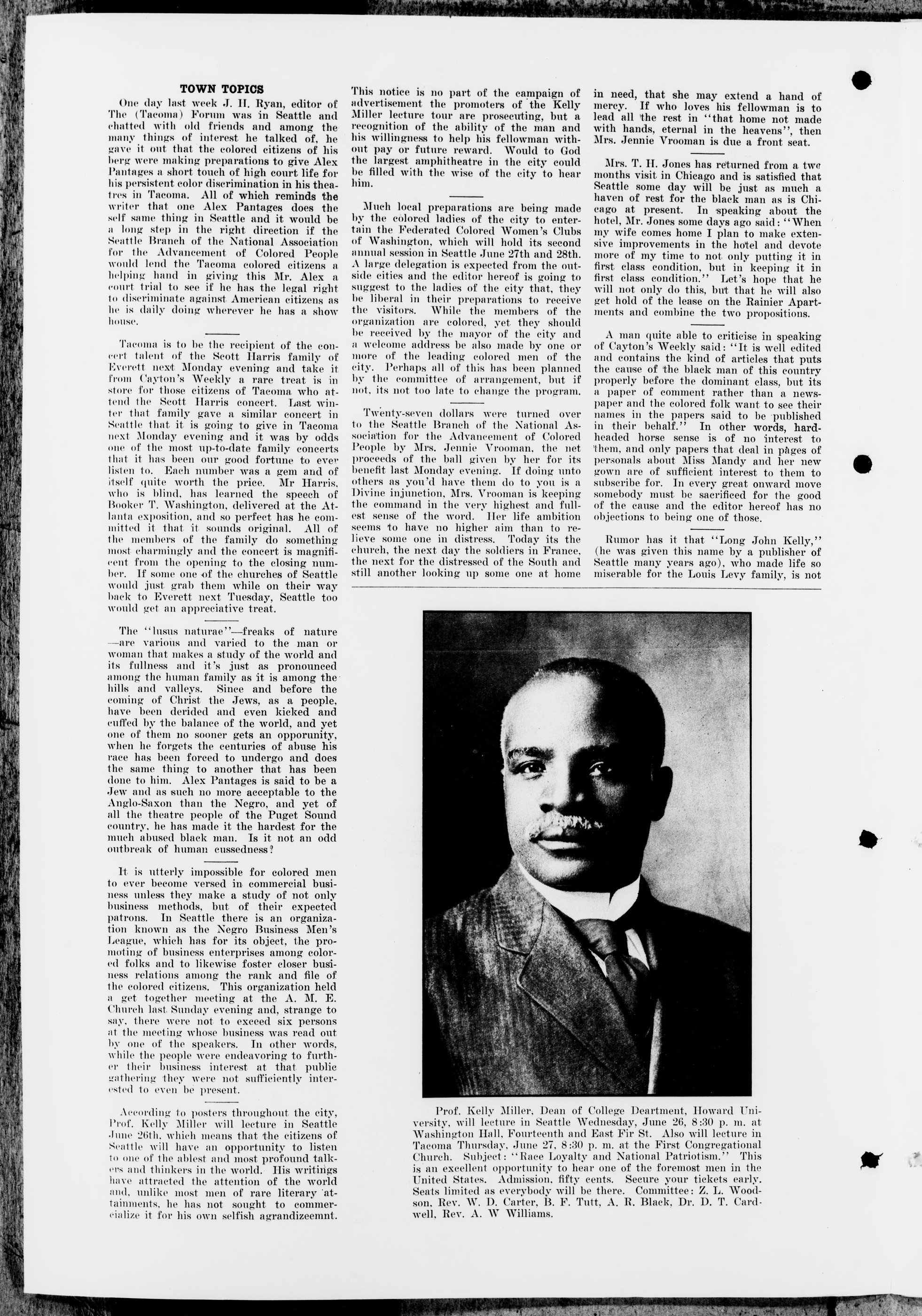
Prof. Kelly Miller, Dean of College Deartment, Howard Uni-
versity, will lecture in Seattle Wednesday, June 26, 8:30 p. m. at
Washington Hall, Fourteenth and East Fir St. Also will lecture in
Tacoma Thursday, June 27, 8:30 p. m. at the First Congregational
Church. Subject: ‘‘Race Loyalty and National Patriotism.’’ This
is an excellent opportunity to hear one of the foremost men in the
United States. Admission, fifty cents. Secure your tickets early.
Seats limited as everybody will be there. Committee: Z. L. Wood-
son, Rey. W. D. Carter, B. F. Tutt, A. R. Black, Dr. D, T. Card-
well, Rev. A. W Williams.
TOWN TOPICS
Foren Migr aerate we) Sor ane asa | eee, ees a a
chatted with old friends and among the
many things of interest he talked of, he
gave it out that the colored citizens of his
herg were making preparations to give Alex
Pantages a short touch of high court life for
his persistent color discrimination in his thea-
tres in Tacoma. All of which reminds the
writer that one Alex Pantages does the
self same thing in Seattle and it would be
a long step in the right direction if the
Seattle Branch of the National Association
for the Advancement of Colored People
would lend the Tacoma colored citizens a
helping hand in giving this Mr. Alex a
court trial to see if he has the legal right
to discriminate against American citizens as
he is daily doing wherever he has a show
house.
Tacoma is to be the recipient of the con-
cert talent of the Scott Harris family of
Everett next Monday evening and take it
from Cayton’s Weekly a rare treat is in
store for those citizens of Tacoma who at-
tend the Scott Harris coneert. Last win-
ter that family gave a similar concert in
Seattle that it is going to give in Tacoma
next Monday evening and it was by odds
one of the most up-to-date family concerts
that it has been our good fortune to ever
listen to, Each number was a gem and of
itself quite worth the price. Mr Harris,
who is blind, has learned the speech of
Booker T. Washington, delivered at the At-
lanta exposition, and so perfect has he com-
mitted it that it sounds original. All of
the members of the family do something
most charmingly and the concert is magnifi-
cent from the opening to the closing num-
her. If some one of the churches of Seattle
would just grab them while on their way
back to Everett next Tuesday, Seattle too
would get an appreciative treat.
The ‘‘Iusus naturae’’—freaks of nature
-are various and varied to the man or
woman that makes a study of the world and
its fullness and it’s just as pronounced
among the human family as it is among the
hills and valleys. Sinee and before the
coming of Christ the Jews, as a people,
have been derided and even kicked and
cuffed by the balance of the world, and yet
one of them no sooner gets an opporunity,
when he forgets the centuries of abuse his
race has been foreed to undergo and does
the same thing to another that has been
done to him. Alex Pantages is said to be a
Jew and as such no more acceptable to the
Anglo-Saxon than the Negro, and yet of
all the theatre people of the Puget Sound
country, he has made it the hardest for the
much abused black man. Is it not an odd
outbreak of human cussedness?
It is utterly impossible for colored men
to ever become versed in commercial busi-
ness unless they make a study of not only
business methods, but of their expected
patrons. In Seattle there is an organiza-
tion known as the Negro Business Men’s
League, which has for its object, the pro-
moting of business enterprises among color-
ed folks and to likewise foster closer busi-
ness relations among the rank and file of
the colored citizens. This organization held
a get together meeting at the A. M. E.
Church last Sunday evening and, strange to
say, there were not to exceed six persons
at the meeting whose business was read out
by one of the speakers. In other words,
while the people were endeavoring to furth-
er their business interest at that publie
gathering they were not sufficiently inter-
ested to even be present.
According to posters throughout the city,
Prof. Kelly Miller will lecture in Seattle
Jime 26th, which means that the citizens of
Seattle will have an opportunity to listen
to one of the ablest and most profound talk-
evs and thinkers in the world. His writings
have attracted the attention of the world
and, unlike most men of rare literary ‘at-
tainments, he has not sought to commer-
cialize it for his own selfish agrandizeemnt.
This notice is no part of the campaign of
advertisement the promoters of the Kelly
Miller lecture tour are prosecuting, but a
recognition of the ability of the man and
his willingness to help his fellowman with-
out pay or future reward. Would to God
the largest amphitheatre in the city could
be filled with the wise of the city to hear
him.
Much local preparations are being made
by the colored ladies of the city to enter-
tain the Federated Colored Women’s Clubs
of Washington, which will hold its second
annual session in Seattle June 27th and 28th.
A large delegation is expected from the out-
side cities and the editor hereof is going to
suggest to the ladies of the city that, they
he liberal in their preparations to receive
the visitors. While the members of the
organization are colored, yet they should
be received by the mayor of the city and
a welcome address be also made by one or
more of the leading colored men of the
city. Perhaps all of this has been planned
by the committee of arrangement, but if
not, its not too late to change the program.
Twenty-seven dollars were turned over
to the Seattle Branch of the National As-
sociation for the Advancement of Colored
People by Mrs. Jennie Vrooman, the net
proceeds of the ball given by her for its
benefit last Monday evening. If doing unto
others as you'd have them do to you is a
Divine injunction, Mrs. Vrooman is keeping
the command in the very highest and full-
est sense of the word. Ier life ambition
seems to have no higher aim than to re-
lieve some one in distress. Today its the
church, the next day the soldiers in France,
the next for the distressed of the South and
still another looking up some one at home
in need, that she may extend a hand of
merey. If who loves his fellowman is to
lead all ‘the rest in ‘‘that home not made
with hands, eternal in the heavens’’, then
Mrs. Jennie Vrooman is due a front seat.
Mrs. T. H. Jones has returned from a twe
months visit in Chicago and is satisfied that
Seattle some day will be just as much a
haven of rest for the black man as is Chi-
cago at present. In speaking about the
hotel, Mr. Jones some days ago said: ‘‘ When
my wife comes home I plan to make exten-
sive improvements in the hotel and devote
more of my time to not only putting it in
first class condition, but in keeping it in
first class condition.’’ Let’s hope that he
will not only do this, but that he will also
get hold of the lease on the Rainier Apart-
ments and combine the two propositions.
A man quite able to criticise in speaking
of Cayton’s Weekly said: ‘‘It is well edited
and contains the kind of articles that puts
the cause of the black man of this country
properly before the dominant class, but its
a paper of comment rather than a news-
paper and the colored folk want to see their
names in the papers said to be -published
in their behalf.’’ In other words, hard-
headed horse sense is of no interest to
‘them, and only papers that deal in pages of
personals about Miss Mandy and her new
gown are of sufficient interest to them to
subscribe for. In every great onward move
somebody must be sacrificed for the good
of the cause and the editor hereof has no
objections to being one of those.
Rumor has it that ‘‘Long John Kelly,’’
(he was given this name by a publisher of
Seattle many years ago), who made life so
miserable for the Louis Levy family, is not
wholly satisfied with Levy's coupe in selling his property to the Mt. Zion Baptist church at a sacrifice, just to get even with him, and now he plans to sell his property to a colored family, if only one can be found that has sufficient cash. As has been previously said, "its an ill wind that blows no one good," and if Long John wants to dispose of his property at a sacrifice, its a good buy and some colored family would do well to pick it up.
Speaking about the number of colored men doing business in Seattle, one of the speakers at the meeting last Sunday evening named the following partial list of firms that invites colored patronage: Attorneys—Andrew R. Black and C. R
Attorneys—Andrew R. Black and C. R. Anderson.
Physicians—Dr. D. T. Cardwell and Dr. M. F. Maxwell.
Dentist—Dr. F. B. Cooper.
Publishers—S. P. DeBow and H. R. Cayton.
Chiropodists—Mrs. L. A. Graves, Mme. Burch and Arthur Williams.
Real Estate—P. Frazier.
Merchants—Harry Legg, Mrs. J. C. Cogswell, Mrs. G. B. Miller, Mme. DeNeal.
Restaurants—Garner & Palmer, Mrs. Clark and Miss Clara Williams and Mrs. M. D. Harvey.
Apartments—Z. L. Woodson, Hayden Richardson and William Chandler.
Hotels—Mr. and Mrs. W. A. Vrooman, Mr. and Mrs. T. H. Jones.
Expressmen and Movers—Norris Bros., William Chandler and a score or more of one-horse operators.
Tailors—Frazier and Curtis, F. D. Wright, Taylor & Saunders, S. T. McCants, and Miss Eva Ford.
Touring and Sight Seeing Cars—Alonzo and Samuel Peoples.
Undertaking—Penn Undertaking Co., Inc. There are four churches—First A. M. E., Rev. D. A. Graham; Mt. Zion Baptist, Rev. W. D. Carter; Grace Presbyterian, Rev. Barber; Church of God, Rev. J. N. Barbour.
GROWING JUSTICE TO MEN
Roscoe Simmons, the eloquent Negro orator of Louisville, Ky., who is attracting so much attention in this country on account of his patriotic utterances, recently said: "I would rather be an American Negro, trusting my case to the growing justice of the American white man; I would rather be an American Negro, eating bread of hope and drinking waters from the springs of fate, waving above me the Stars and Stripes, than feast from plates of gold in the palace of a king."
"The growing justice of the American white man"—that is the text. The balance of the sentence is beautiful; the whole speech from which it is quoted is the embodiment of eloquence. But the expression, "the growing justice of the American white man"—that is the point.
That justice among men is growing, there is not the remotest doubt. That men are coming to the understand all the better the dependence of one upon aother and each upon all, there can be no question. We are still a long way from absolute justice, not only as regards the attitude of the white man toward the colored man, but as regards the attitude of the white man toward the white man and the colored man toward the colored man. But we are making headway. We are growing in grace." We are learning day by day that until absolute justice is established as between man and man, the earth will not be as good a place to live as it might be. We are beginning to see that it is injustice that holds back the race; that it is injustice which promotes poverty—even as it is proPERTY that promotes crime and disease and intemperance.
More men are today studying the problems of the world than has ever been the case. More men are considering ways and means for combating evil. More men are giving their money and their time for the solution of problems which have to do with human happiness.—Dayton News.
The above excerpt was reproduced by the Consumer's Review of Seattle, which is edited by Albert J. Goddard, and he reproduced it because every word and sentence therein was written after his own heart. Without regard to race, color or creed Al Goddard has always been on the square and in the open in dealing with his fellowman. Frequently has his confidence in his fellowman been rudely shaken but the shortcomings of one person were no reason that the balance of the human family were crooks, and then again, he would argue, you can not tell why the person acted in such a manner. If Albert Goddard is not one of God's noblemen then there are none.
AGAINST A DIRTY TRAITOR
The protest registered by The (Tacoma) Forum against the city worshiping at the shrine of a traitor is quite timely and Cayton's Weekly fully endorses every word of its terse criticism, which is as follows:
"The descendants of the rebel confederacy in Tacoma are becoming bolder as the years stretch out. Now they have a Davis Day. Later perhaps they will ask the legislature to set aside a day to glorify the traitor who attempted to disrupt the union. What is the G. A. R. going to do about it? Have the old boys lost their pep? There is no intelligent excuse that can be given why the memory of Jeff Davis should be kept green in any northern state. It may be all right in the South, where civilization has not yet reached its highest development. Where lawlessness rides rampant, where reconstruction did not reconstruct. Where state rights are paramount to federal rights. Where chattel slavery is succeeded by peonage, and where it requires 5,000 or 6,000 brave (?] men to lynch and burn at the stake one helpless creature.
"A country like that should honor Jeff, but Washington should never permit such a service."
Mr. McAdoo may feel that it is necessary to fire a railroad president occasionally to show who is boss.—St. Louis Globe-Democrat.
LADIES. LOOK. LISTEN!
You are solicited to have your fancy shoes polished at Russell Miller's Shine Shop. You get a better job by leaving them.
IN THE SUPERIOR COURT OF THE STATE OF Washington, in and for the County of King.
In the Matter of the Dissolution of Toyo Shokai, a corporation.—No. 128072. Notice of Dissolution of Corporation.
Notice is hereby given that Toyo Shokal, a Washington corporation, with headquarters at Seattle, has petitioned the King County Superior Court for authority to disincorporate and dissolve
Notice is hereby given that said application will be heard in Department No. 1, of the King County Superior Court on the 28th day of May, 1918.
A. R. BLACK,
316 Pacific Block.
IN THE SUPERIOR COURT OF THE STATE OF
Washington for King County.
Henry T. Bailey, Plaintiff, vs. Amanda Bailey, Defendant—No. ..... Summons by Publication.
The State of Washington to the said Amanda Bailey, Defendant:
You are hereby summoned to appear within sixty days after the date of the first publication of this summons, to-wit: within sixty days after the 20th day of April, 1918, and defend the above entitled action in the above entitled court, and answer the complaint of the plaintiff, and serve a copy of your answer upon the undersigned attorney for plaintiff at his office below stated; and in case of your failure so to do, judgment will be rendered against you according to the demand of the complaint, which has been filed with the clerk of said court.
The object of the above entitled action is to obtain a decree of divorce from the defendant by the plaintiff on the ground of desertion.
ANDREW R. BLACK,
Attorney for Plaintiff.
P. O. Address, 316 Pacific Block, Seattle, Wash.
IN THE SUPERIOR COURT OF THE STATE OF Washington for King County.
Willie LaFontaine, Plaintiff, vs. Eddie LaFontaine, Defendant—No. Summons by Publication. The State of Washington to the said Eddie LaFontaine, Defendant:
You are hereby summoned to appear within sixty days after the date of the first publication of this summons, to-wit: within sixty days after the 20th day of April, 1918, and defend the above entitled action in the above entitled court, and answer the complaint of the plaintiff, and serve a copy of your answer upon the undersigned attorney for plaintiff at his office below stated; and in case of your failure so to do, judgment will be rendered against you according to the demand of the complaint, which has been filed with the clerk of said court.
The object of the above entitled action is to obtain a decree of divorce from the defendant by the plaintiff on the ground of desertion.
ANDREW R. BLACK.
Attorney for Plaintiff.
P. O. Address, 316 Pacific Block, Seattle, Wash.
A SAMPLE COPY
Cayton's Weekly sends out a similar paper to this every week.
It is not the leading paper of the Northwest, nor does it "occupy an exclusive field", but it is always well edited and full to the brim with up-lift matter.
Cayton's Weekly would like you for a subscriber and if you would subscribe you would like it. Let us get together.
Telephone Beacon 1910
513 Pacific Block
ALHAMBRA CASH GROCERY
H. Legg, Prop.
W. H. Banks, Mgr.
We Carry a Full Line of Fancy and
Staple Groceries
WE KINDLY INVITE YOUR INSPECTION
Our New Store:
1201-3 Jackson St.
Phone Beacon 505
TUTT'S BARBER SHOP "He wants to see you." High-class Tonsorial Work. 300 Main Street, Seattle. Latest race papers. All kinds of toilet supplies.
IN THE SUPERIOR COURT OF THE STATE OF Washington for King County.
Georgia Watson, Plaintiff, vs. Milton Watson, Defendant—No. ..... Summons by Publication.
The State of Washington to the said Milton Watson, Defendant:
You are hereby summoned to appear within sixty days after the date of the first publication of this summons, to-wit: within sixty days after the 15th day of June, 1918, and defend the above entitled action in the above entitled court, and answer the complaint of the plaintiff, and serve a copy of your answer upon the undersigned attorney for plaintiff at his office below stated; and in case of your failure so to do, judgment will be rendered against you according to the demand of the complaint, which has been filed with the clerk of said court.
The object of the above entitled action is to obtain a decree of divorce from the defendant by the plaintiff on the ground of cruelty.
ANDREW R. BLACK,
Attorney for Plaintiff.
P. O. Address, 316 Pacific Block, Seattle, Wash.
June 15—August 3, 1918
IN THE SUPERIOR COURT OF THE STATE OF Washington for King County.
Chester A. Fleming, Plaintiff, vs. Christina Fleming, Defendant—No. ..... Summons by Publication. The State of Washington to the said Christina Fleming, eDfendant:
You are hereby summoned to appear within sixty days after the date of the first publication of this summons, to-wit: within sixty days after the 11th day of May, 1918, and defend the above entitled action in the above entitled court, and answer the complaint of the plaintiff, and serve a copy of your answer upon the undersigned attorney for plaintiff at his office below stated; and in case of your failure so to do, judgment will be rendered against you according to the demand of the complaint, which has been filed with the clerk of said court.
The object of the above entitled action is to obtain a decree of divorce from the defendant by the plaintiff on the ground of desertion.
ANDREW R. BLACK,
Attorney for Plaintiff.
P. O. Address, 316 Pacific Block, Seattle, Wash.
May 11—June 22, 1918.
IN THE SUPERIOR COURT OF THE STATE OF Washington for King County.
Mildred Holmes, Plaintiff, vs. William Holmes, Defendant—No. ..... Summons by Publication.
The State of Washington to the said William Holmes, Defendant:
You are hereby summoned to appear within sixty days after the date of the first publication of this summons, to-wit: within sixty days after the 11th day of May, 1918, and defend the above entitled action in the above entitled court, and answer the complaint of the plaintiff, and serve a copy of your answer upon the undersigned attorney for plaintiff at his office below stated; and in case of your failure so to do, judgment will be rendered against you according to the demand of the complaint, which has been filed with the clerk of said court.
The object of the above entitled action is to obtain a decree of divorce from the defendant by the plaintiff on the ground of desertion.
ANDREW R. BLACK,
Attorney for Plaintiff.
P. O. Address, 316 Pacific Block, Seattle, Wash.
May 11—June 22, 1918.
IN THE SUPERIOR COURT OF THE STATE OF Washington for King County.
Dottie Blackadar, Plaintiff, vs. Carl H. Blackadar, Defendant.—No. Summons by Publication. The State of Washington to the said Carl H. Blackadar, Defendant:
You are hereby summoned to appear within sixty days after the date of the first publication of this summons, to-wit: within sixty days after the 18th day of May, 1918, and defend the above entitled action in the above entitled court, and answer the complaint of the plaintiff, and serve a copy of your answer upon the undersigned attorney for plaintiff at his office below stated; and in case of your failure so to do, judgment will be rendered against you according to the demand of the complaint, which has been filed with the clerk of said court.
The object of the above entitled action is to obtain a decree of divorce from the defendant by the plaintiff on the ground of desertion.
ANDREW R. BLACK,
Attorney for Plaintiff.
P. O. Address, 316 Pacific Block, Seattle, Wash.
May 18—June 29, 1918.
---
---
9
A REGULAR CAMOUFLAGER
On a Mississippi plantation, forty miles from Nowhere, was an African Methodist Episcopal church, built of round pine poles, with an inch board floor and the whole covered with four foot clapboards. It was not intended for an exclusive summer meeting house, but that was about the only season of the year that services could be held in it owing to its rather open condition, and then again, it kinder fitted in with the community which had an over-supply of summer Christians and winter devils. Under this church edifice the hogs of the plantation spent their winter nights, which left it pretty well stocked with fleas that became very numerous in summer, and they never lost an opportunity of coveting with the Lord's elect on Sundays, when they assembled for worship. So annoying to the congregation did these little pests become that, the parson sent word a week ahead, that the flets had to be driven out or he would have to preach under an accommodating shade tree hard by, which moved the brethren to assemble the following Saturday afternoon and proceed to clean house and to likewise make it hog-tight for the following winter that there would be fewer fleas the following summer. The pests were just a sbad preaching day as in the past and might have so continued all summer had not some wise old head moved to herd a few sheep about the house for a brief period. The fleas got matted into the sheep's wool and when the sheep were let out the flees went with them and the balance of the summer there was more preaching and praying and less scratching.
This church edifice was one of four of a similar construction, which belonged to the Beech Grove Circuit and it generally had a new preacher every year and sometimes a change was necessary in the middle of the year, when the Elder became unduly fond of some of the sisters. So when Rev. Makiel (accent on the a), a tall slender and more or less prepossessing parson, showed up for the summer protracted effort it was not much out of the ordinary, save and accept that the young ladies of the community vied with each other as to who could fry the finest cuts of yellow leg chicken for him. Unlike most country communities of that state, there were a large number of young ladies that had acquired a sufficient educational smattering to enable them to pass a third grade examination permitting them to teach a country school, which had anywhere from fifty to one hundred pupils in it for three months each year, and those young school marms were at home for the "big meetin'" in general and to see the new preacher in particular on this occasion. Rev. Makiel had a voice that could be heard a mile away on a still clear night as easily as if you were in the meetin' house, and he seemed to always try to accommodate the fellow a mile away.
Aside from his good looks and loud voice, he, using the word of the present hour, was a past master at the art of camouflaging. At the recess hour he took special delight in assembling the school marms about him and telling them of his great learning. Latin and Greek to him were no more than ordinary English and he would recite one or the other at length for their entertainment and his edification. Hebrew was the foundation of his theology and he even read his Sunday Bible lessons prior to preaching, from a Greek testament. Such a learned preacher, black or white, had never before visited this community and Sis Mandy told ol' missus all about "dat fin educated elder, dat had jist come to preach at the traced effort.
That flock of young girls and the big meetin of that community always attracted a number of young men teachers and among them were to be found some possessing a genuine college education. The girls told the boys how the new preacher had them all bested in the dead languages, which made the boys exceedingly anxious to hear this prince of peace preach one of his most "powful sommons," which was full of Hebrew, Greek and Latin and it so happened that one of the young men was a
college graduate of Dartmouth and was visiting friends in the community at this time. Now Billy, as he was called by all, was exceedingly reticent, and from his general deportment he did not appear to be any better educated than the ordinary third grade school teacher, who did not know a single word or sylable in the dead languages. He was introduced to the Rev. Makiel, who proceeded at once to victimize Billy with his much education, which Billy listened to as intently as if he had been his old college professor. It had been agreed with the young ladies that the parson was to know nothing of Billy's educational advantages. In the pulpit the new preacher got there with both feet and his sermon was full and overflowing with quotations from the dead languages, to which Billy listened with silent amusement. Not only did he not have a smattering of the dead languages, but he did not utter a single word in them and what he was pleased to call Hebrew, Greek and Latin was nothing at all, but just a lot of incoherent gibberish sounds.
"How did you like my sermon," inquired the parson after the services.
"It was magnificent," Billy dryly responded, "and, permit me to add, you are the damndest hypocrite that I have ever met. Here is my diploma from Dartmouth College and if you have uttered a single Hebrew, Greek or Latin word then the professors of that college are as ignorant as these poor colored farmers you are endeavoring to victimize."
Billy was a matter of fact fellow and pretty set in his way of doing things and he looked straight at the parson and in unmistakable language said: "It'st now 4 o'clock and I am going to give you until 6 o'clock for you to pack up your Hebrew, Greek, Latin and religion and with them find greener pastures." The sudden departure of the new parson was a great surprise to the big meeting devotees and Billy seemed to be as much puzzled as any of the rest.
It was a rather strang coincident some twenty years after that and in the far Northwest that Billy heard of a very learned A. M. E. preacher in British Columbia, who was "a Scotchman by birth" and was pronouncing his name Makiel (accent on the e), Billy was anxious to meet the preacher, not recognizing the name, and it was at an A. M. E. annual conference that Dr. Makiel was seen and recognized by him and he was taking the minutes of the conference in short hand which, like his dead language he did not know a single short hand mark. The eyes of the two men met as Billy sat in the audience and the parson on the platform pretending to be taking down the bishop's sermon in short hand, and a smile played over the faces of the two men.
"You are at it again," Billy briefly remarked to him after the services. "Mum is the word," he whispered and the two parted, perhaps forever.
BORROWED THOUGHTS
The yellow peril is the yellow streak—Memphis Commercial Appeal.
The railroads of the country never had a more distinguished list of deadheads. Boston Herald.
If the Kaiser builds bigger U-boats the American gunners will find them easier to hit.—Des Moines Register.
In christening an airship we suggest the young lady smash a bottle of liquid air on its nose—St. Louis Globe-Democrat.
For twenty-five years the Kaiser drilled for war, and now he can't control the geyser he struck.—Philadelphia Inquirer.
The name of the German Food Controller is General Shortage.—New York Evening Post.
"God grant our brave troops may win the reward they deserve!" says the Kaiser.
Nobody could wish them any worse luck.— Nashville Southern Lumberman..
One general says the side with the last reserves will win; and America is raising 5,000,000 reserves—St. Louis Globe-Democrat.
Corn bread properly made is an ambrosial deilight. Corn bread improperly made tastes like German propaganda.—Chicago Daily News.
The only crop that bids fair to be a complete failure this year is the crop of sedition Germany tried to plant in this country. New York World.
"Baptists to Work in Russia," says a head-line. It is well. The Russian convert to democracy will need more than a mere sprinkling.—Kansas City Star.
It is about time for some one to take the Hun out of Hungary.—Philadelphia Inquirer.
Probably the Kaiser would consent to pick out a king for Ireland along with the rest.—New York World.
Germany won't say she's licked as long as there's a church left standing in Belgium or France.—Savannah Press.
In view of the success of the first concrete ship, Faith, they might call the second one Works.—Providence Journal.
Every time Germany says the U-boats will wi nthe war her voice gets a little will win the war her voice gets a little
"Our whole struggle is in God's hands," says the Kaiser. And if he only knew what that means!"—Wall Street Journal.
There are two countries that will never forget the Americans. One is France and the other is Germany.—Kansas City Star.
The Germans have one claim to renown: they're the only folk in history the Irish have declined to fight.—Philadelphia North American.
Sixteen sheep are grazing on the White House lawn. The White House goats are penned in the Senate chamber.—Peoria Transcript.
O Mme. Breshkovskaya, grandmother of the Russian revolution, have you any idea where your wandering grandson is tonight? —Kansas City Star.
The "Almighty Dollar" is no longer the potentate of other days. A dollar doesn't get much of anywhere nowadays without a partner.—Kansas City Times.
AFRO AMERICAN HOTEL
Phone Beacon 912 1261 Main Rooms by Day or Week. Well kept and highly sanitary. Steam heated. Mrs. T. H. Jones.
VROOMAN HOTEL
Phone Beacon 29 1236 Main
Three story concrete building. Steam heated.
Beautifully furnished.
W. E. Vrooman Jennie Vrooman
NEW WAY CAFE
Phone Main 5964 1034 Jackson
Regular Dinner from 4 to 8 P. M.
We give Special Attention to Theatre parties
J. C. Garner and E. T. Palmer, Props.
GOLDEN WEST
Phone 2647 1034 Jackson
Tailors and Cleaners
Clothes called for and delivered.
Hats retrimmed and blocked.
H. S. Frazier C. W. Curtest